Category Archives: Nottingham

Hells Angels, High School Chapter 4

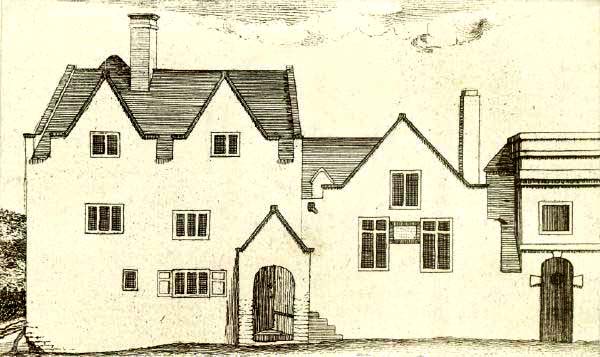
Recently, I came across the electronic version of the Nottingham School Register which had been painstakingly transferred to an Excel Spreadsheet. They go back as far as the very first boy in what must have been a new School Register in 1858. Here is one of the few illustrations we have…

At midsummer 1858, therefore, Arthur Law Gratton joined the School, which was then, of course, in Stoney Street in the Hockley area. Arthur lived at 13 Northampton Terrace, Portland Road. Ironically, Portland Road is within a two minute walk of the School’s present site on Arboretum Street. I cannot find a Northampton Terrace, so presumably this has been renamed or demolished. In those days, it was very frequent practice to write Northampton Terrace as Northampton-terrace or Portland Road as Portland-road. This persisted until at least the 1920s, but I’m going to give it a go in this post. Hope I don’t miss any!

Arthur’s father was deceased and his mother was now a widow named Eleonora Gratton. Arthur was 15 years 5 months old and he left at Michaelmas of 1860.  Michaelmas is on September 29th. The register states in the Remarks column, “Behaved well. Drowned while bathing June 1861”. Ironically, the summer of 1861 had “above-average rainfall, but not excessively so” although in Ireland the “summer was dramatically wet.”

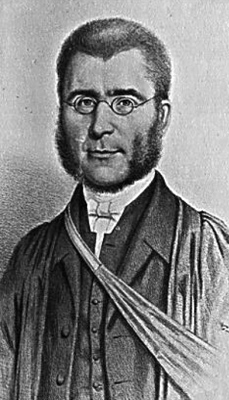
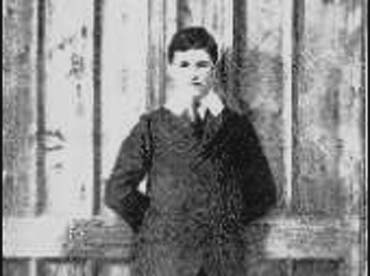
Henry Wheeldon came to the Free School on January 26th 1859.  He was 12 years old and his father said that he lived at Mr Peter Elliott’s (sic) at 29 Bromley-place. During the 1st half of 1860 (sic) he was dismissed for “not living in the town after repeated warnings as to the rule.” This is initialled by W.B. who was the Reverend W. Butler the Headmaster. Here is the Rev himself:

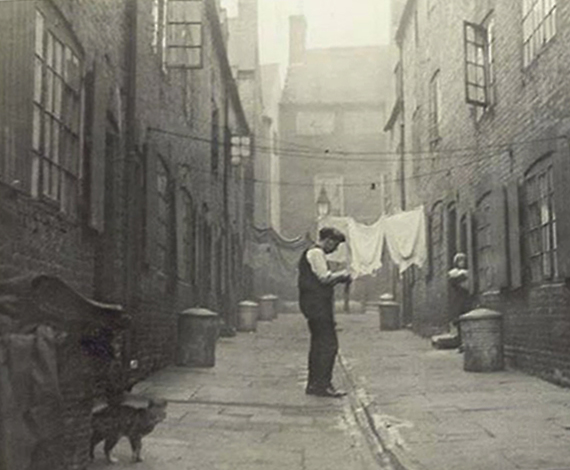
The Remarks Column is fascinating. We see that one pair of individuals were the victims of a paperwork foul up as they were “Entered by mistake twice”. Some boys were “elected” into the School but “declined” their place. Others moved house between being accepted and the first day of a new term, “left town before coming in”. As well as the clever boys who were educated for free, some less intelligent but more affluent boys paid to sit in with the classes. Thomas Hodson Sissling, the 14 year old son of Wright Calecraft Sissling, an Innkeeper on London-road “Remained six months as a private pupil”. Gordon Clarke, the son of John Clarke, a “General Dealer” in Rick-street (between Huntingdon-street and Glasshouse-street) remained for three months. Glasshouse-street was very beautiful even in late Victorian times. Don’t miss the cat and notice that it’s the day for the dustbin men to call:

More silliness next time…


23 Comments

Filed under History, Nottingham, Politics, The High School

And here is the news (1)……

I thought just for once I would keep you in the loop about what I am doing at the moment. As some of you will know, I am trying to become an author. I used to be a French teacher at Nottingham High School and on their 500th anniversary in 2013, I masterminded a book about the occasion. Helped enormously by lots and lots of other people, I managed to persuade both boys and staff, if they so wished, to write 100 words describing just one minute in their day. These were all put together to produce an account from 12.23 am to 23.57 pm….

From the beginning…

“I’m at my desk having a coffee and waiting for the arrival of unwell, injured or just Friday tired boys. I never know what real or imagined symptoms will come in but I am prepared – a headache, a grazed knee or a sore throat or it could be one of the more ‘interesting’ ones –a tick attached to a scalp from an adventurous trip to the Cheviots which needs removing, a glass pipette that has gone straight through a finger or just someone that needs a chat and encouragement– coffee drunk, ready to go!”

to late morning…

“I have double maths and I myself think I am doing very well that day.  Firstly, I finish off a piece of work from the day before called C2 temperature. Then I move on to Junior Maths. I finish that pretty quickly and what I have to do is use a ruler and write out the number of centimetres in our books for sections A B and C. Finally I move on to exercise eleven point two. I only do two questions on that because it is a bit more complicated. “

to very late morning…

“I am practicing my handwriting. It is getting much better! We write with capital letters and full stops.”

the best bit of the day…

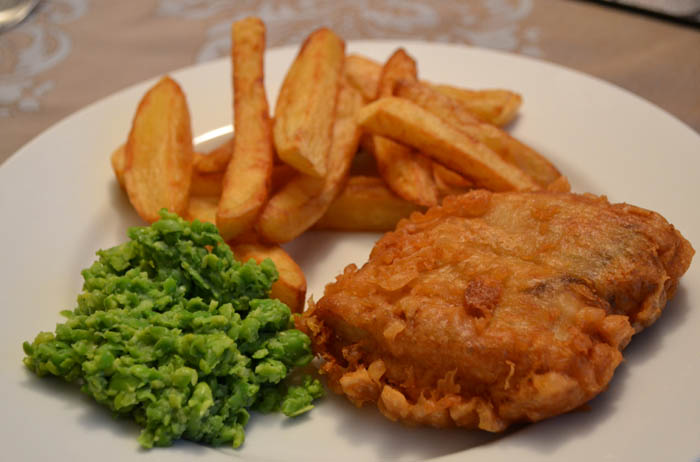
“12 noon.  It’s Friday.  Fish and Chip day!!  Probably the most popular day in the School dining hall!!


After lunch, a brisk stroll around the Arboretum with a colleague, admiring the sunny spring-like day and the hundreds of spring flowers starting to push their way through for another cycle of life.
Who’d have thought that less than a week ago the Arboretum (and a lot of the entire country) was smothered in 4 inches of snow?”

An exciting afternoon

“2.20  We are told that a visitor is coming into school. We find out that this person is a Para Olympian who swam for the Australian team in the 1996 and 2000 Olympic games.

Elizabeth Wright shows us the medals; they looked amazing. I have the pleasure of asking questions about how she began swimming and about her disability. This is an amazing insight to a Olympian lifestyle.”

Boys just think about food…

“I am having my dinner and I am having chicken nuggets. They are my favourite!”

Some think deep thoughts…

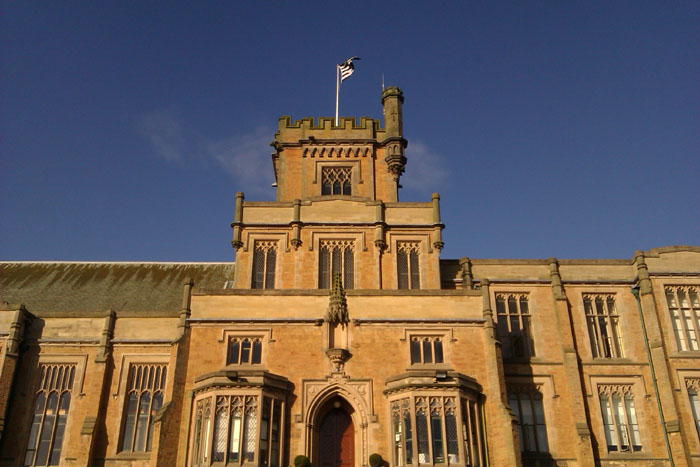
“As I gaze up and stare in awe at the School building, my mind drifts back through the years to ponder over what the first lesson will have been like 500 years ago.   A few children with some desks in their local church learn about their world whilst a gentle snow flurry comes down outside.  Nevertheless, the school looks grand; as its size and majestic architecture dwarf the people who inhabit it.  Each brick, each tile and each window are testament to a different age and the people of it.”

Some perhaps not quite as deep..

“I am eating my sausages with chips and I’m getting very full.”

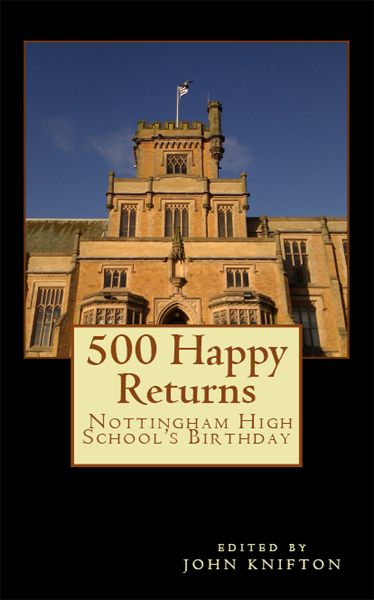
The book was used to raise money for charity and it did quite well. It’s still there on Amazon but I don’t know if it still sells. The cover was a photograph taken by a young man called Rishabh Motiwale:

As you know, my second venture was “Nottingham High School : an Anecdotal History”. Details about that, and my plans for the future in the next blog post.


23 Comments

Filed under History, Nottingham, The High School

The High School Hell’s Angels, Chapter 3

One fascinating thing which I found recently were all those old books which have been transcribed onto DVDs. They are sold on ebay in their hundreds. Some are not necessarily what I would want to read “Masonic Library, 430 Freemasons Books”, “Ukulele & Banjo, 29 Rare Vintage Books” and “Taxidermy, Vintage books on DVD – Stuffing and Mounting Animals, Birds, Insects and Fish”
I was happy to buy though, “76 Books, Derbyshire, Nottinghamshire, Mickleover, Headon, History Genealogy DVD”. It contains a lot about the history of Nottingham although the rest was not of much interest to me. That DVD, and another very similar one about Nottingham and Nottinghamshire, have provided me with a lot of information about the past. Above all, they have allowed me access to a number of different directories of Nottingham. So far I have, for example, the Pigot’s Directory for Nottingham for 1828 and 1841, the White’s Directory for 1832, 1864 and 1885, the MacDonald’s Directory for 1931, Slater’s for 1847, Wright’s for 1879 and Kelly’s for 1881, 1891, 1904 and 1928:

They are interesting in that they all tend to contain slightly different things, but basically they list all of the tradespeople in Nottingham, all of the business premises in the city, and the names of the occupants of all the different houses in all the streets of Nottingham.

So you might find a list of the city’s streets in alphabetical order, or all the people similarly listed, while other directories will provide the names of all the engineers, all the grocers. all the bicycle repairers and so on. It means that if you know Uncle George was a restaurant owner, you can often find out both where his business was and where he lived. And that may point you to the right place in a census. Very useful if you’re trying to trace your ancestors.
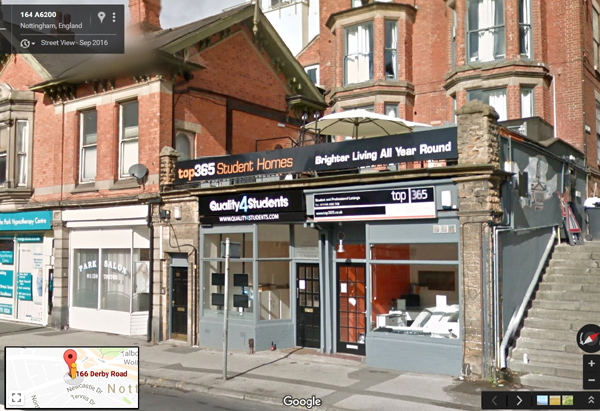
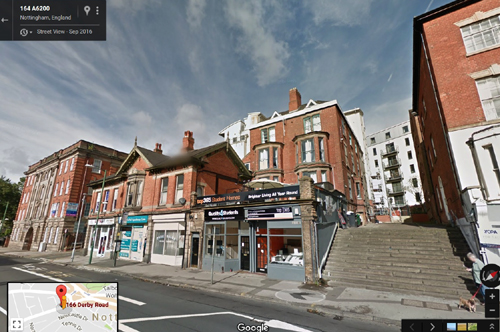
The directories also enable you to trace some of the changes in the use of individual buildings, buildings that you may walk past every day but don’t know the history of. One example would be the two premises on Derby Road, up near Canning Circus. One is called “Quality 4 Students” with the slogan “Top 365 Student Homes” :

Next door, painted all white, there is what is now the “Park Hair Salon”. Here’s a view from further back:

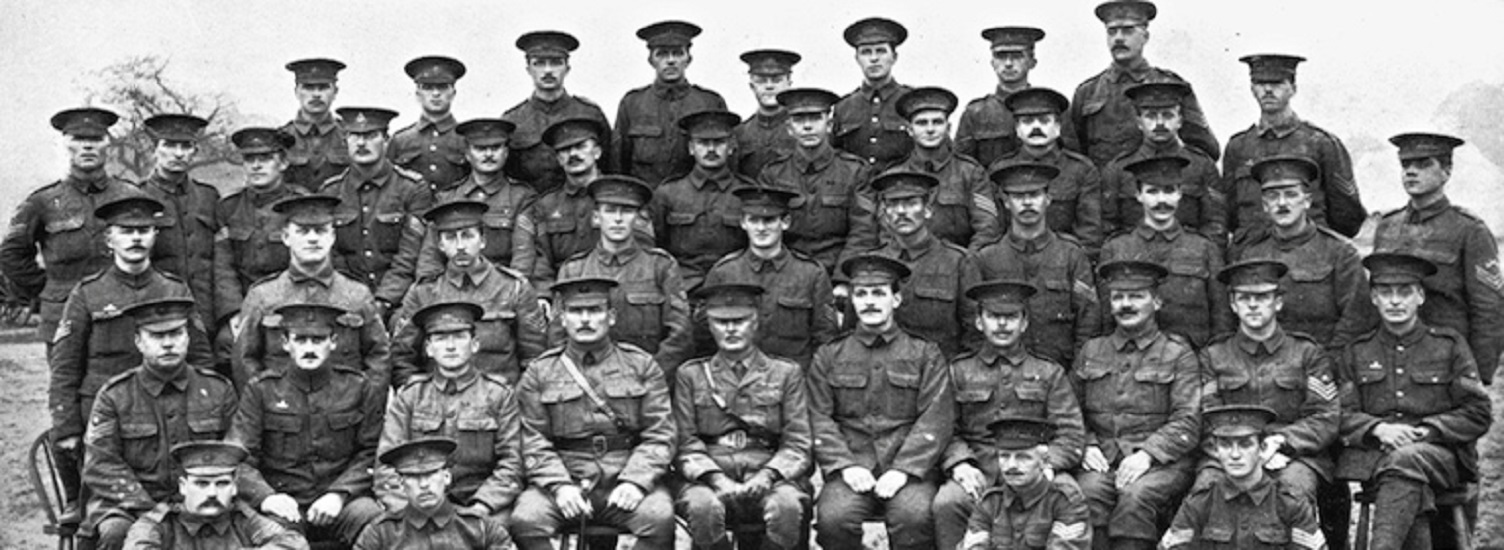
In 1928, the Park Hair Salon used to be the Headquarters of the Robin Hood Rifles, a local infantry regiment:

They used to have some wild, wild parties:

After that the building was derelict for a while and then it became “Butcher Brothers, House Furnishers”.

By 1928, both buildings had become the shop of AR Warren & Son, Grocers. I find all that fairly fascinating but more to the point perhaps, the directories also enabled me to uncover the humble beginnings of Alfred Highfield Warren, who was the “& Son” of “AR Warren & Son” mentioned above.  Alfred was an ex-pupil of Nottingham High School, and thanks to the High School, he was to move from being the son of a grocer to being the holder of an Open Exhibition at Worcester College, Oxford, a Nottingham City Scholarship to Oxford University of £50 per annum, and from the High School, a Sir Thomas White Senior Exhibition.

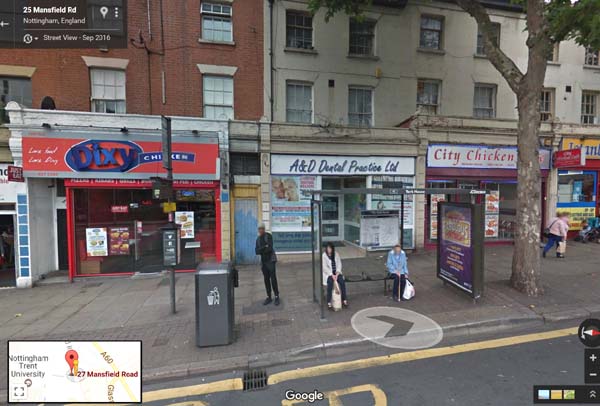
On Mansfield Road, there is nowadays the “A & D Dental Practice Ltd” and the “City Chicken Cafe”. In front of the Dental Practice is a bus stop used by hundreds and hundreds of High School boys every day…

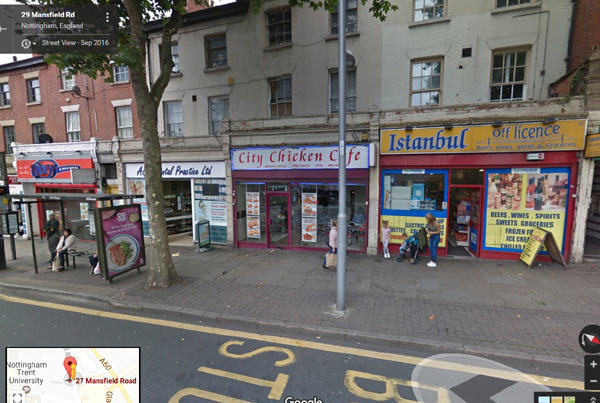
And here is the City Chicken Café, sworn enemies of Dixy Chicken just two doors away and probably not too much in love with the Istanbul Off Licence next door.

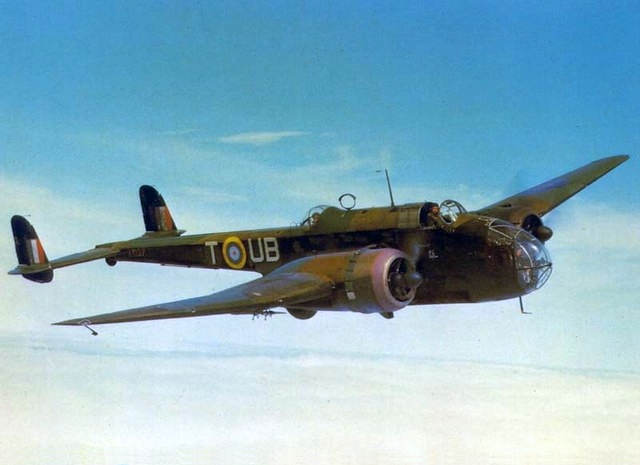
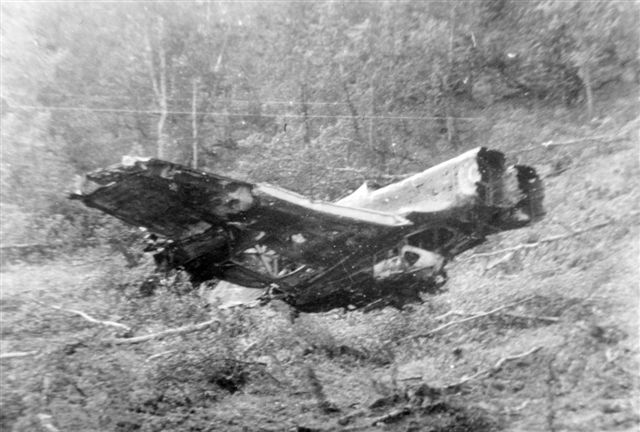
But in 1928, these two businesses, the “A & D Dental Practice Ltd” and the “City Chicken Cafe”, were the premises of LW King, a Draper who lived there with his family. That family included his son William King, a High School pupil, who became a pilot in the RAF in World War II. Alas, poor William was to die, with all his colleagues, in a catastrophic air crash in a Handley Page Hampden. Here is ‘Before’:

And here, far too often I’m afraid, is ‘After’

How many times have I walked or driven past those two businesses, but without realising they were previously the home of a young war hero? And how often do we do that in our everyday lives?


15 Comments

Filed under Aviation, Bomber Command, History, Nottingham, Politics, The High School

The High School Hell’s Angels, Chapter 2

Last time I mentioned the ways in which boys used to come to Nottingham High School before the cossetted era of luxury cars, luxury trams and luxury city buses. They walked. They cycled. They came in Papa’s carriage.

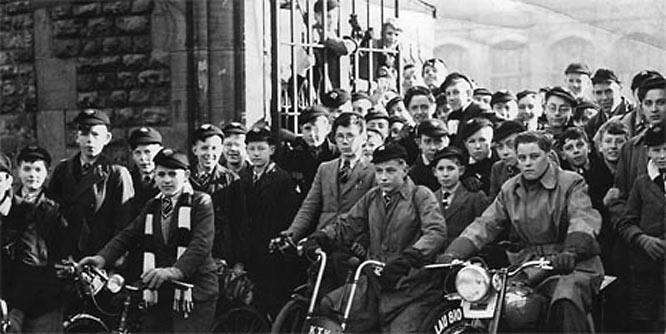
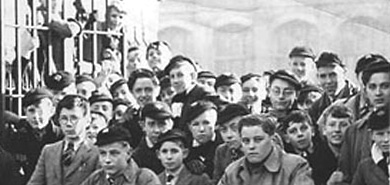
But there were other methods too. Just look at this photograph of the school piling out of the North Entrance at top speed at 4 o’clock and 30 seconds in  1947 or perhaps 1952 or even 1957 :

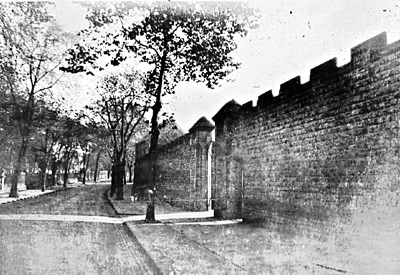
In other words, I don’t know the exact date. Here is the view from inside the yard in 1932. As far as I know, both pillars of the gate have now been replaced. Years back, a bone headed lorry driver backed his bone headed lorry into the left pillar and down it came. The other pillar, I believe may also have been replaced, perhaps for a similar reason:

And here is the view, outside the gates, on Forest Road in 1932. Look at the spindly trees…

Hopefully, during these periods of building work, the graffitti from the early 1940s is still there. The link will take you to what I wrote about them a little while back:

This slideshow requires JavaScript.

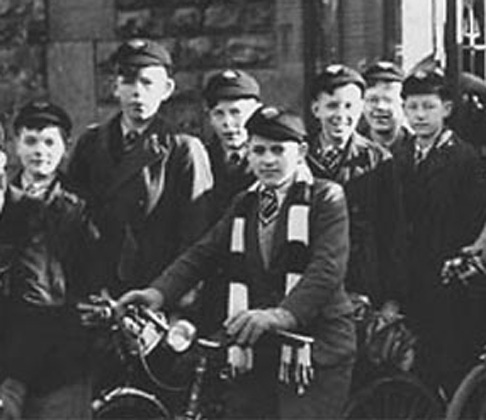
I’ve managed to enlarge sections of the original photograph of all those boys, all eager to get home to see if Dad has bought a television yet. This is the left hand side:

Notice how all the boys are wearing their caps, presumably all of them black with the lozenge of Dame Agnes Mellers attached. I did do some posts a while back examining the truth of the idea that the school badge is the coat of arms of the Mellers family.  Needless to say, my ideas were different from what you might have expected. Just take a look if you have the time.

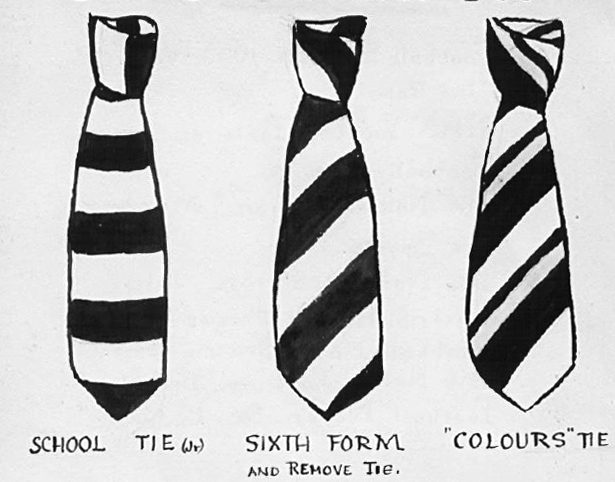
Anyway, if you’ve seen the caps, don’t miss those old black and white scarves, no doubt obtainable only from one retail outlet at a rather inflated price. Back in 1932, somebody drew and painted the permutations of ties. Here is the top half of the drawing, with thin yellow stripes for the Colours tie, awarded to those who had represented the School at sport:

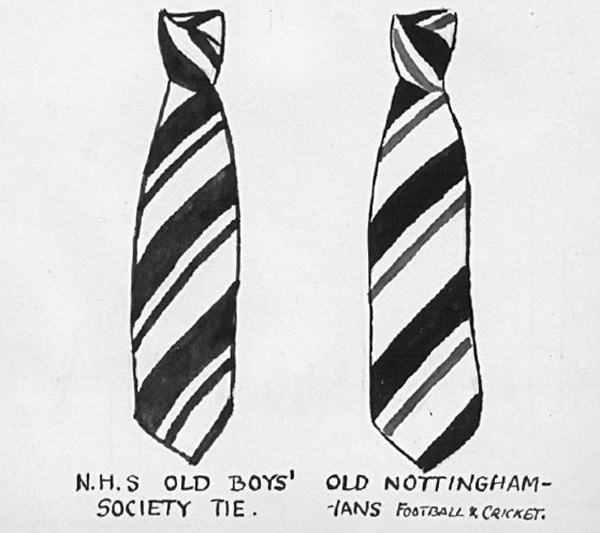
And the bottom half. I believe that purple is the extra colour of these ties, worn by the Old Nottinghamians :

Now the boy on the bicycle. What’s he carrying in his right hand? Is he riding a Raleigh bike? I’m no expert but I think he’s got one of those front lights that is powered by pedalling the bicycle. And look at his huge hands, clad in those heavy knitted gloves of yesteryear, eminently suitable for wearing while digging an Avro Lancaster out of deep snow:

And what is the boy behind him wearing? A coat which appears to be striped in a rather strange fashion. Perhaps he was an expert in some field and he has a special garment to prove it. He does look a little young to have School Colours, though. And the boys’ faces. The thin faced little chap on the right, looking so, so worried. He won’t lose that look of terror until he’s got home and done his homework.

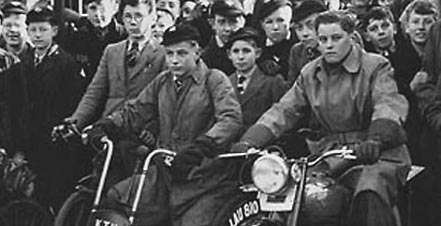
Now look at the right hand side:

This part of the photograph shows the star of the show. He looks so very young to be a motor cycle rider. But at least he has the equipment. The voluminous mackintosh, pulled tight with a plastic buckle. The collar turned up like Eric Cantona. No crash helmet though. Nor for the young gentleman on his left, sitting on what must surely be some kind of moped, unless, of course, it’s one of those Hell’s Angels Easy Rider motorbikes with huge handlebars. But how will his cap stay on? Especially if he can reach 28 mph again on some steep hill. He is wearing what almost looks like the little boy’s version of the motorcyclist’s gloves, but not as hard or stiff. And why has the boy standing behind them got a black and white hooped tie? If he is wearing a Junior School tie, then why has nobody else got the same thing?
And finally, the back of the crowd:

All those different expressions. All those different angles to wear a cap. Boys climbing the gate. And behind all of them, the windows of the Assembly Hall, dare I say it? Wreathed in smog. It’s certainly a day in late autumn because of the top coats and the scarves and the gloves. But it’s not so far into December or January that it’s dark. Any more conclusions gratefully received.

25 Comments

Filed under History, Nottingham, The High School

The High School Hell’s Angels, Chapter 1

Most Nottingham High School pupils nowadays arrive by car, of course, or perhaps by bus, usually, either a special school bus or a Nottingham City bus.  We even have our own advertisements on one bus:

A few boys come by bicycle, a few come on the tram, a few walk and, I suppose, there must be some who arrive by train.
In years gone by, that was by no means the case. In the late 19th century, lots of boys lived on the other side of the Forest, or along Forest Road West, in the Alfreton Road area or even in the streets between the school and Shakespeare Street. They all walked in to school, which is indicated by the orange arrow. All the streets mentioned are on the map:

In the early 20th century, many boys lived in the Mapperley Park area and they arrived either by bicycle or on foot. And as Nottingham grew in the 1920s and 1930s, boys started to arrive in bigger numbers from expanding suburban areas such as West Bridgford. And in the 1940s and the 1950s, they began to arrive in greater numbers from more distant areas such as Arnold and Burton Joyce. They are both on the map, and the orange arrow points to the High School:

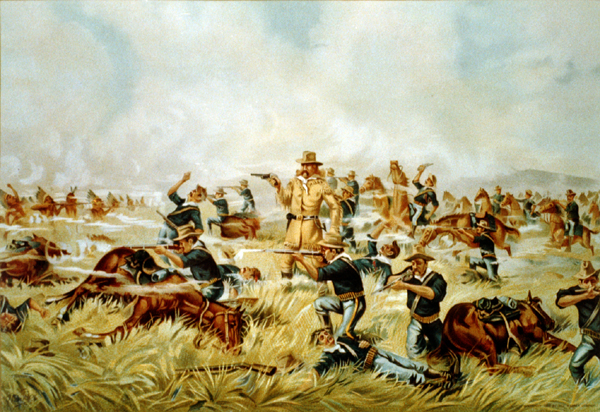
Before 1876, lots of boys are recorded as “Donation No x” which may refer to money which was given by a single well-wisher. The earliest, “Donation No 1 by Swann” (sic), was given to Haywood White Buller, who was born in July 1857, the son of a Hosier from 8 Addison Villas in Eastwood. The first ever actual scholar as far as I can see was a “Caup Scholar” (sic) although I don’t really understand what this was. He was Arthur John Cresswell, born in 1865, of 19 Harrington Street. His father was a Warehouseman.  Arthur entered the High School in May 1876, two months before General Custer came an unlucky second in his struggles with the Lakota:

Soon local councils were happy to provide help. Boys might be Derbyshire County Council Scholars, Nottinghamshire County Council Scholars or Nottingham City Scholars. The most famous was young David Herbert Lawrence whose father worked as a coalminer. Here he is in the Fifth Form:

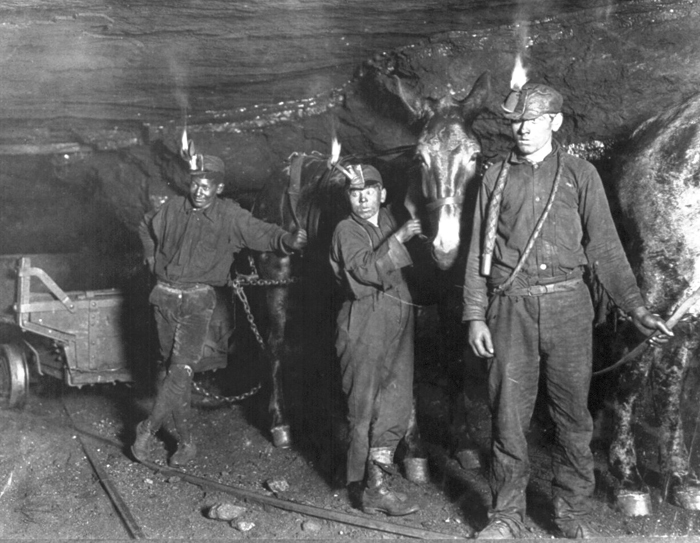
DH Lawrence, though, was not the first miner’s son to come to the High School. That was Fred Cook, the son of Thomas Cook of 48 Watnall Road, Hucknall Torkard, the old name, I believe, for Hucknall. He entered the School on September 15th 1897 at the age of 13. And after him came David Herbert Lawrence, the School’s greatest author.  And then William Dunn in 1901, from New Brinsley in Eastwood. Then Willis Walker from Selston on the same day as William Dunn. John Thomas Moult in 1905 from 100 Derbyshire Lane, Hucknall Torkard. In July 1907 it was William Hutchinson from 7, Old Church Street in Old Lenton. In September 1907 it was William Ernest Thomas of 8 Glebe Street in Hucknall Torkard. A year later, the appropriately named Cyril Coleman from 34 York Street in Hucknall Torkard. Three more miners were to follow before the outbreak of the First World War:

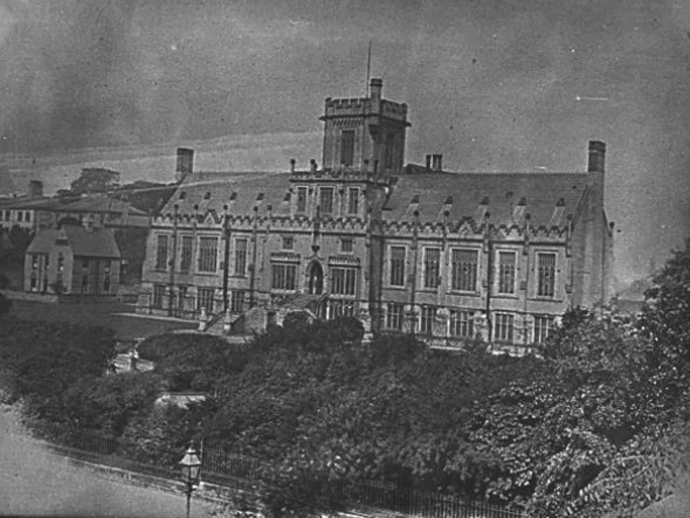
There are no more coal miners in England now, of course. And during that period of 1897-1914 there were many High School fathers who had jobs which have become equally infrequent in our modern world. There were blacksmiths, bleachers, cheese factors, cork cutters, dairymen, filers, hosiery packers, farm labourers, framesmiths, hatters, goods guards on the trains and, most mysterious of all, “twisthands”. In actual fact, they were operators of lace machines. Here is the School in that period:

And as the years went by, the catchment area of the school began to resemble that of today. In other words, boys, and girls, from all over the county and the nearer parts of neighbouring counties. I worked at the High School for almost 40 years and the longest journeys to school I remember were in 1976 or 1977 when I helped Mr Padwick on the French Exchange to Rodez, and we were taking the French boys to see the splendours of the Blue John Mines near Castleton in north Derbyshire. One of the English boys’ mothers said that they would bring little Jean-Pierre to meet us as they lived more or less next door to the mine:


In the middle 1980s I had a boy in my tutor set who lived on the far side of Lincoln where his Dad owned a pig farm. He got up at 5.00 am and his mother took him by car to meet the school bus setting off from Newark to the High School.

And DH Lawrence used to complain about the travelling.

29 Comments

Filed under History, Nottingham, Politics, The High School

The Peregrine : the Fastest Creature in Victorian Nottinghamshire (2)

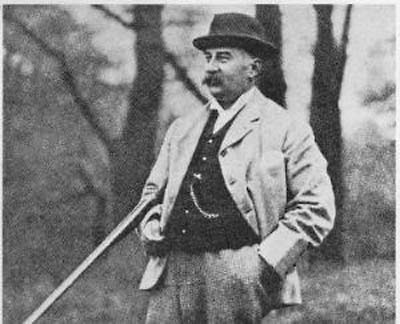
Last time I was talking about Joseph Whitaker and the many times he saw Peregrines in Nottinghamshire. Here is the great man:

He isn’t the only overweight old bloke with excess facial hair to have seen Peregrines in action, though.

Very early one morning in Cornwall, I once watched a Peregrine chasing a Herring Gull. The latter was so scared that it landed and walked across to stand right next to me, like somebody queuing for the bus at a bus stop.  When the falcon flew away, the gull departed a few seconds later, in the opposite direction.

Shortly after May 1, 1920, Mr Frank Hind,  one of the leading members of the Nottingham Natural Science Field Club wrote:

“A very large bird was circling high up in the sky over Gedling. From its manner of circling, and flight and the great height, I can think of no bird but the Peregrine Falcon as likely to be the one seen.”

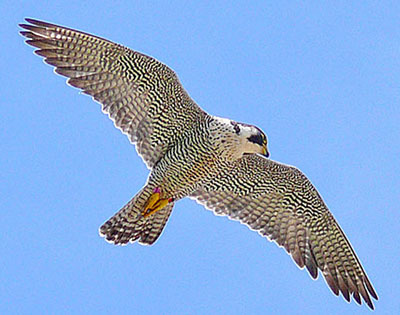
peregrineflying

The following account was published in the Nottingham Evening Post of April 14th, 1976:

“The pigeons in the Old Market Square in Nottingham had better watch out. For a bird of prey has been spotted on top of the nearby Council House. And it’s thought his taste for city life might be due to the prospect of a convenient meal of pigeon.
A spokesman for the Trent Valley Birdwatchers said the bird had not been positively identified but it could be a Peregrine Falcon. It was disturbed by one of the club members who was carrying out repairs to the Council House.”

pery grin1

Nowadays,  of course, this scenario is an everyday one. I wrote about the peregrines on the Newton Building of Trent University in an article entitled:

Jer Falcon. one shot at Park Hall by Mr Shelton. Now in my collection

There are live webcams of city dwelling peregrines across most of the developed world including Derby.

And Norwich

And Mississauga

And Etobicoke

The camera at Phoenix in Arizona is of very good quality:

If you get bored, go to Bowling Green in Ohio.

or Kitchener in southern Ontario in Canada.

Peregrines are pretty much the same the whole world over. They breed in every continent except one.

If you get tired of travelling the world, you could always use the webcam on the Newton Building here in Nottingham.

One of my favourite webcams though, is one that shows lots of brightly coloured American birds, and another where you can try to see the Loch Ness Monster.

Good luck  with that one.


18 Comments

Filed under Cornwall, History, Nottingham, Personal, Twitching, Wildlife and Nature

Six Kings and Two Queens (3)

So why is this rambling windbag of a tale called Six Kings and Two Queens ?

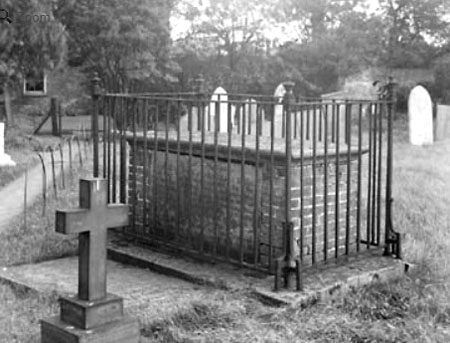
Well, the hero, John Deane, the entrepreneur, the sea captain, the ex-cannibal, the ex-poacher, the ex-deer stealer and the ex-butcher’s apprentice lived a very long life. And when he eventually succumbed, Captain Deane, as the locals all called him, was buried in the churchyard at Wilford:

john deane tombxxxxxx

He had lived through the reigns of six kings and two queens.

He was born during the reign of Charles II. To me, Charlie looks a real sleeze of a man. He couldn’t keep his hands off Nell Gwynne’s oranges and he appears to me to be just the type to be arrested by the police for having inappropriate images on his computer:

charles II

And here is History’s most famous orange seller, Charles’ mistress Nell Gwynne. This was his own personal pin-up:

gwynn

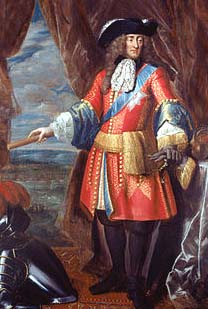
Next came James II. Here he is. He was chucked out eventually because he was a Roman Catholic, and because of this, the Protestant nobles thought that he would eventually want to be an absolute monarch and then they would all have to work for a living:

James_II_(1685)

The Glorious Revolution of 1688 brought in William and Mary:

william_and_mary

Is is just me, or does Mary look like a man?

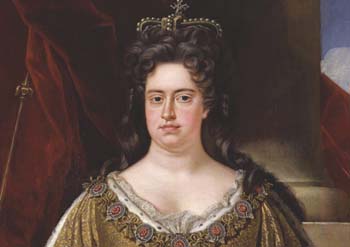
Queen Anne was definitely not a man. She had seventeen children but, poor woman, none of them survived to become adults:

annexxxxxxxxxxxxxxxxxxxxxxx

No silly jokes about her. She is too sad a person for that. All of her weight gains came from what must have been more or less continuous pregnancies.

Enter George I, a German who spoke little or no English:

King_George_I_

Like all of the Hanoverians, George I hated his son and his son hated him. Here is George II. He was the last English king to lead his troops into battle, at Dettingen in 1743. He galloped so fast his wig blew off:

george II

George III was mad, mad, mad. He lost the American colonies, of course. Perhaps they thought they would be better off without a registered lunatic in charge?

King George III

George III  was the last monarch of John Deane’s long life. Six and out, to borrow a cricketing phrase.

Mr Spielberg, I have the film script for all of this nearly half finished…


22 Comments

Filed under Criminology, History, Humour, Nottingham

Six Kings and Two Queens (2)

Hopefully, you have already read the first part of the blood soaked story of Captain John Deane and the wreck of The Nottingham Galley on the ice cold, wind swept rocks of Boon Island, just off the coast of New Hampshire:

cheat

The Date-Book of Remarkable and Memorable Events connected with Nottingham and its neighbourhood by John Frost Sutton does not disappoint with its continuation of the story.

Captain Deane returned to Nottingham where he wrote a bestselling book about the tragedy. Surprisingly, he was the hero.

The First Mate, Christopher Langman, did exactly the same. He wrote his own book where he was the hero.

Two very different stories, with each author accusing the other of being a liar and a cheat.

According to Stephen Erickson, the controversy lasted for a good while. It was essentially the two boat owners, the Deane brothers, versus the members of the crew.  John Deane in particular, was to become an eighteenth century spin doctor for the rest of his life, telling and re-telling the story with himself as its hero, over and over again, to whoever would listen.

Books were written in the immediate local area, such as Great Shipwrecks of the Maine Coast by Jeremy D’Entremont.

book

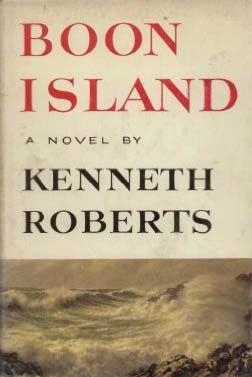
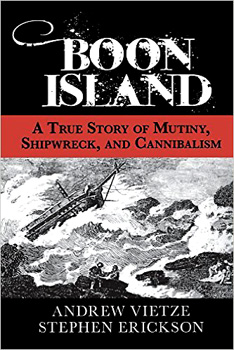
The same events were related in Great Storms and Famous Shipwrecks of the New England Coast by the aptly named Edward Rowe Snow. The most recent book is Boon Island: A True Story of Mutiny, Shipwreck, and Cannibalism by Stephen Erickson and Andrew Vietze.  And Boon Island by Kenneth Roberts turned the story into a novel:

book novel

Modern authors have added to the drama with suspicions of insurance fraud and the allegation that The Nottingham Galley could have arranged beforehand with French privateers to be captured for financial gain.
Most interesting perhaps is the Wreck of the Nottingham Galley published by the Book Arts Studio at the University of Maine at Machias. This contains everybody’s two cents’ worth, with five significant histories of events: Captain John Deane’s original account; the crew’s rebuttal; Cotton Mather’s rendition; a sensationalized, anonymous narrative; and John Deane’s expanded final account.

wreck of the npottingham gaslley

As if all that controversy, from 1711 to the present day, were not enough, according to The Date-Book of Remarkable and Memorable Events connected with Nottingham and its neighbourhood:

“….a very sad and fatal affair arose. Dr Jasper Deane, the brother of Captain John, resided in Fletcher-gate. He had embarked considerable property in The Nottingham Galley, and whenever he met his brother, the Captain, he yelled at him so long and loud about the cause of his serious financial loss, that they finally just avoided each other’s company.
At length their animosity appeared to subside, and under the condition that the subject of the shipwreck should not be brought up, the Captain met the Doctor at a party. There was every appearance of a restoration of friendship on both sides. No mention was made of The Nottingham Galley, and instead of separating, the Captain agreed to accompany his brother back to his house. Unhappily, the Doctor’s stifled feelings broke free, and in Fletcher-gate he again gave way to prolonged and bitter abuse of his brother. They had nearly reached his door when the Doctor assumed a threatening attitude, the Captain pushed him away with his open hand, and the Doctor fell. He ruptured a blood vessel, and died immediately. Whether the rupture was caused by excitement or the fall could not be ascertained.”

In 1714, Captain Deane commanded a ship of war in the service of the Czar of Muscovy, which he retained until 1720. We know this Czar of Muscovy better as Peter the Great. the founder of the Russian Navy:

Peter_der-Grosse_1838

Captain Deane was subsequently British Consul at the ports of Flanders and Ostend, until 1738, when he retired to Wilford near Nottingham with a handsome pension. Wilford was a live wire sort of place in 1740. In actual fact, the man you can see fishing in the River Trent in this picture is still there to this very day. He is a kind of Flying Dutchman figure, cursed by his wife never to come home from his fishing for the rest of eternity:

wiklford ferrry

The Date-Book hasn’t finished the tale yet:

“The retired Captain built the two neat dwellings near the entrance of the village from the ferry. The one nearest the river was the one he occupied first; the other, very similar in appearance, was erected afterwards:”

his house the palazzo
“In 1748, whilst walking in his own grounds in broad daylight, the Captain was attacked by a robber, who plundered him of everything valuable he had about him, even to the sleeve buttons from his wrists. The despoiler, whose name was Miller, was apprehended, and a few months afterwards he was executed.”

Miller was hanged in public on a wooden gallows. This execution would have taken place on the Forest Recreation Ground as I have previously described in my article “Gun Battle on Derby Road

One more bit to the story…..


16 Comments

Filed under Criminology, History, Nottingham

Six Kings and Two Queens (1)

“The Date-Book of Remarkable and Memorable Events connected with Nottingham and its neighbourhood” by John Frost Sutton does not disappoint with its entry for August 18 1761:

“Death of John Deane, Esquire, at his residence at Wilford, in the 82nd year of his age. Captain Deane was born in the reign of Charles II, in the year 1679, and was the youngest son of a gentleman of moderate fortune living in Nottingham. When he attained a proper age for business he took the strange fancy of being apprenticed to a butcher.  He was not satisfied with this, but being bold and spirited, he became associated with a gang of poachers and deer stealers. At length, dreading detection, he thought it prudent to go to sea.

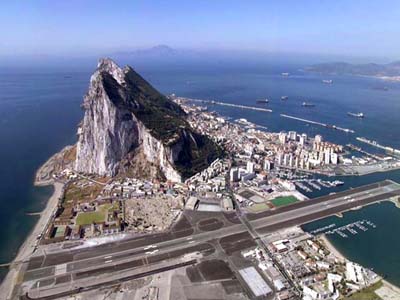
In this new occupation Deane was happy in his job, and there is strong reason for believing that he was with Sir George Rooke at the capture of Gibraltar, where he was raised for his bravery to the rank of a naval captain.

Here is the striking shape of the “Rock of Gibraltar”:

gibraltar5xxxxxxxxxxxxxxxxxxxxxxxxxx

In 1710, when laid up and without employment, Deane, along with his father and brother, purchased a vessel which they named, The Nottingham Galley. After filling the ship with merchandise, Captain Deane took command and sailed for North America.

Here is that happy, happy ship:

nottingham galley

The ship was unfortunately wrecked on the New England coast.

Here is a sketch from the time:

wreck of the npottingham gaslley

The crew landed with great difficulty on a barren island.

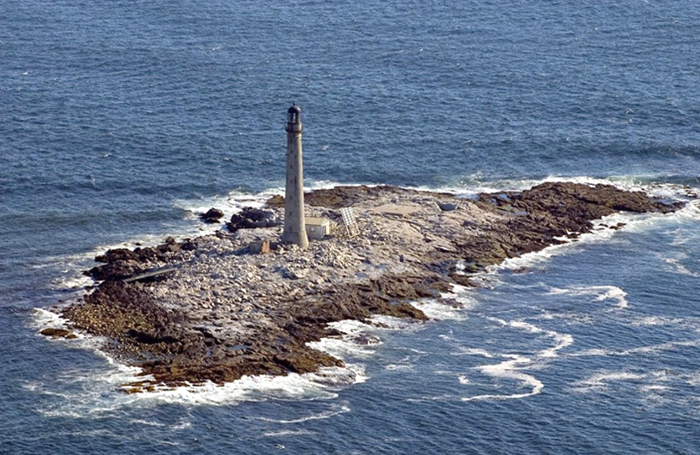
The island was actually called Boon Island, and was well known as a very good place to die:

cheat

Deane and his crew were destitute of both clothes and provisions, the sea having swallowed up everything. Here they remained for twenty-six days exposed to severe hunger and cold. Three of the seamen perished, and the survivors were driven to the horrid and revolting necessity of feeding upon one of the dead bodies.

“Here we are!! Come and get it! Raw leg again!!”

eating cabinboy

On the 5th of January, 1711, a vessel came near enough to perceive their signals, and when despair had almost driven them mad, they were providentially rescued.”

A number of websites attach a great importance to this shipwreck, given its almost four weeks of bleak, desperate horror.

A good example would be ‘boonislander’  or  Stephen Erickson, who, in his own words, is a resident of Portsmouth in New Hampshire and a co-author of a new book on the wreck of the Nottingham Galley, the splendidly titled Boon Island:  A True Story of Mutiny, Shipwreck and Cannibalism. He wrote:

“The Nottingham Galley is one of the most important episodes in maritime history for a number of reasons.   It may have been the most well-known shipwreck controversy prior to the Bounty mutiny.  The story is famous for cannibalism; they ate the ship’s carpenter.

book xxxxxxx

No shipwreck castaways were ever less prepared for the subfreezing temperature they were forced to endure, and lived to tell about it; they were without food, freezing, and compelled to lie for weeks at a time, huddled together on solid rock. “

The shipwrecked men had certainly been forced to rely on their own ingenuity. A piece of sail provided a shelter of sorts and there was enough cheese soaked in salt water to last around a week. Ironically, the first to die was the cook. They respectfully consigned him to the waves. The next to go was the ship’s carpenter. He was out of luck, because by now they were hungry enough to eat him, allegedly wrapped in pieces of seaweed.

seawweeedd

They were unable to light a fire, so it had to be raw. What a pity they were never able to kill a seal and eat that.
For those of you interested in the precise details of gastronomy, the usual tale is that:

“they hacked off the feet and hands, gutted the bodies and then cut them into quarters like a pig or a cow.”

And presumably:

“Wrap in raw seaweed and serve at Atlantic Ocean temperature. Serves up to a dozen.”

Later, despite severe frostbite for those who had not yet eaten their own hands and feet, the men tried to build a boat, but it sank and took two men with it. A second boat fared equally badly but a corpse drifted to the mainland and alerted the locals as to what was happening on Boon Island. They were finally rescued in the early days of January 1711.

Steak-and-Chips


26 Comments

Filed under Criminology, History, Nottingham

Albert Ball, the naughty hero

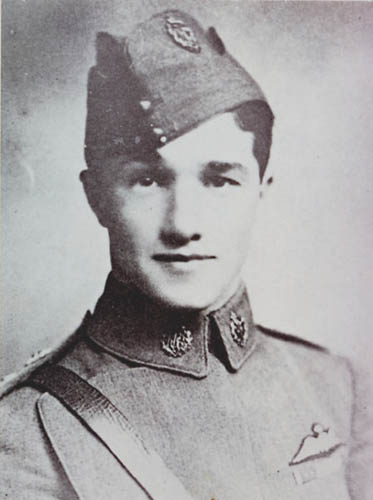
Today marks the 100th anniversary of that enigmatic character, Albert Ball. Nowadays, perhaps, Albert Ball is pretty much a forgotten name. He was, however, one of the greatest air aces of the Great War:
Ball photo

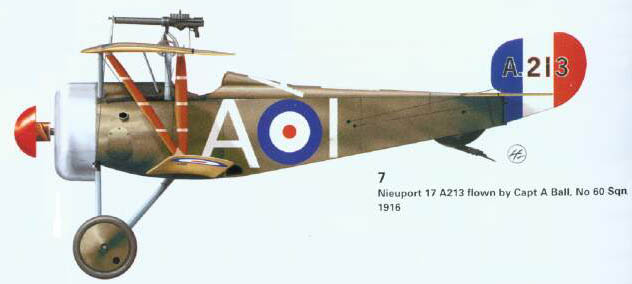
Albert was a natural fighter pilot, and initially, he always flew French Nieuport fighters (with a top speed of 110 m.p.h.):

This is a painting  of Albert’s very own Nieuport:

nieuport_ball cccccc

As well as the French fighter though, the English S.E.5 with its top speed of 138 m.p.h. was to hold a huge place in Albert’s affections in the latter period of his career:

Unlike many of his colleagues in the Royal Flying Corps, Albert gained widespread public fame for his achievements. In general, unlike the French or the Germans, the British did not use their aces for propaganda purposes, but Albert was the first brilliant exception. Almost like a medieval knight of the air, Albert shot down 44 enemy aircraft. In today’s world he would have been, quite simply, a superstar.

Albert was genuinely fearless, and the war weary English public of 1917 loved the way he flew alone, like a Knight of the Round Table, and always attacked the enemy aircraft, irrespective of the odds against him.  His favourite prey was the German Roland C.II, the so-called “Walfisch”:

Most of Albert’s victories came by attacking enemy aircraft from below, with his Lewis machine gun tilted upwards. It was very dangerous but, like the Schräge Musik cannons of a later conflict, was remarkably successful.

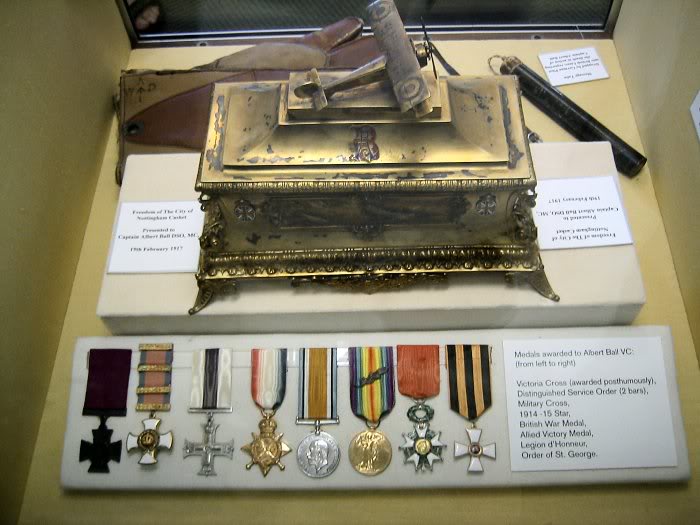
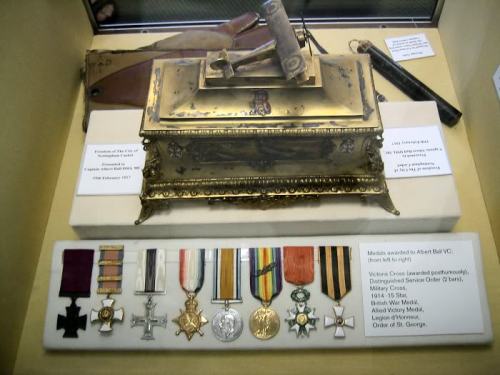
Flying without any other aircraft to support him, Albert was always going to be vulnerable, and he was finally killed out on patrol on May 7th 1917, shortly before his twenty-first birthday. For this last combat, Albert was awarded a posthumous Victoria Cross, to add to his Military Cross, Distinguished Service Order, Distinguished Flying Cross, Légion d’Honneur, Croix de Chevalier, Russian Order of St George and the American Medal.
medals 2

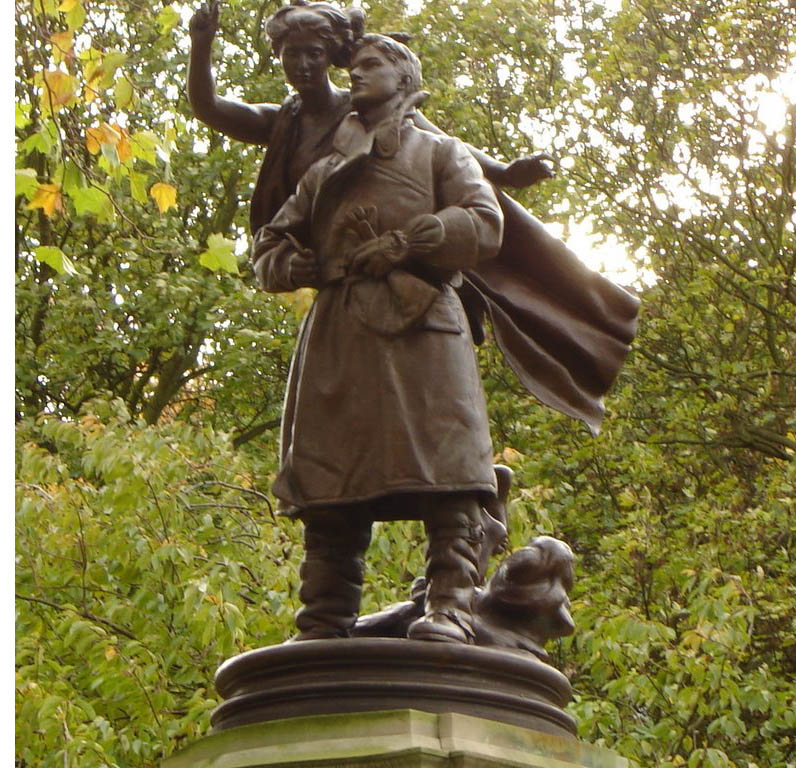
These medals can still be seen inside Nottingham Castle. Outside, in the gardens, is his statue:

statue xxxxx

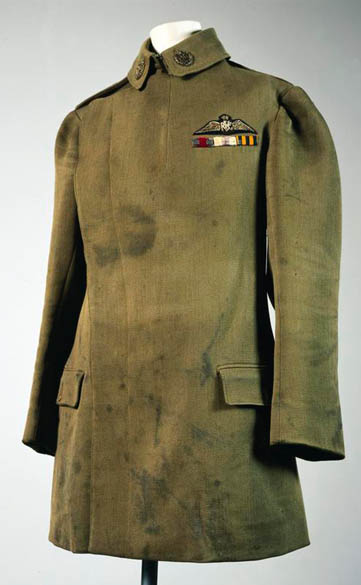
His battered uniform has been carefully preserved:

coatcccc

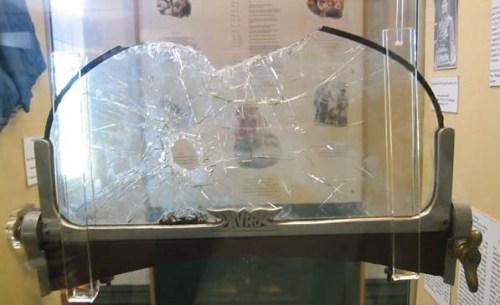
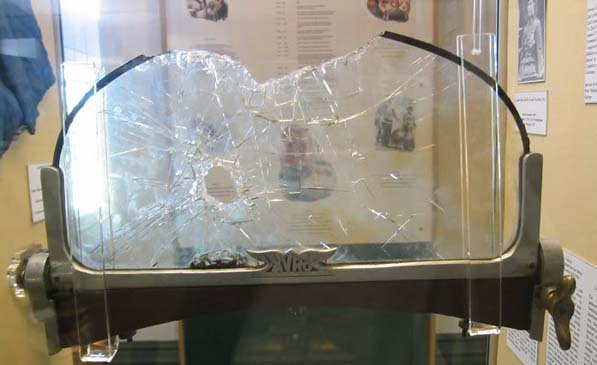
And so has his shattered windscreen:

windscreenxxxxxxxx

On a more scurrilous note, Albert was always one for the ladies and every photograph of the dashing hero seems to have him with a different young lady in tow. In some of his biographies he is credited with having left an unknown, but relatively sizeable, number of the young ladies of Nottingham in, shall we say, a very interesting state.  Indeed, it would be interesting to know if anybody nowadays claims kinship with this dashing young man.

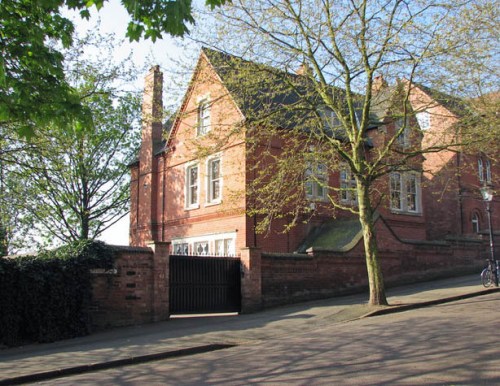
Albert was born on August 14th 1896 at the family home at 301, Lenton Boulevard (now 245 Castle Boulevard), Nottingham. He was the third child, and elder son, of Albert Ball and his wife, née Harriet Mary Page. A few years afterwards the family moved to Sedgley House, 43 Lenton Avenue, The Park, Nottingham, where they lived in a moderately wealthy fashion:
sedgly avenue xxxxxxx

Albert had a brother Cyril and a sister Lois. Their parents were always “loving and indulgent”. Albert Ball Senior had originally been a plumber, but he was an ambitious man and became an estate agent, and then a property speculator, as his fortunes improved. He was to be elected Mayor of Nottingham in 1909, 1910, 1920 and 1935.
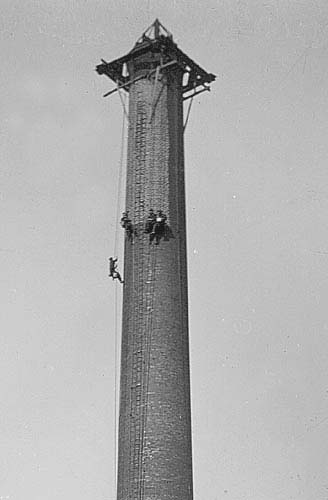
As a boy, Albert was interested in engines and electrics. He had experience with firearms and enjoyed target practice in the garden. Thanks to his wonderful eyesight, he was soon a crack shot. On his sixteenth birthday, Albert spent a lovely day as a steeplejack, as he accompanied workmen to the top of a tall factory chimney. He was completely unafraid and strolled around, not bothered in the slightest by the height:

steeplejack1

Albert’s education began at the Lenton Church School. He then moved, along with his younger brother Cyril, to Grantham Grammar School, which had a military tradition that stretched way back into the Napoleonic times of the early 19th century, well before the establishment of other schools’ Officer Training Corps, or Combined Cadet Forces.

Albert moved to Nottingham High School on Thursday, September 19th 1907 at the age of eleven, as boy number 2651. According to the school register, he was born on August 17th 1896, although on his birth certificate, the date is certainly given as August 14th. Later in life, Albert was to countersign a certificate from the Royal Aero Club on which his date of birth was written as August 21st. His father is listed in the High School register as Albert Ball, a land agent of 43, Lenton Road, Nottingham.

Albert did not last a particularly long time at his new school, as he was to be expelled for bad behaviour in 1910. Contemporary sources reveal that Ball particularly enjoyed misbehaving in music lessons:

“The Third Form music master was a Mr Dunhill, who had one eye which was straight, but the other looked outwards at an angle, rather like half past ten on a clock. Boys always used to make fun of him. Whenever he shouted “Stand up you ! ! ! ” and looked at a certain naughty boy, four others would get up elsewhere in the room. “NO !  NO !  NOT YOU !! …YOU ! ! ” The original four would then sit down, and another four completely unrelated boys would stand up elsewhere in the room.
Albert Ball specialised in misbehaviour during these singing classes. He and his brother would invariably “kick up a terrible row”, and were then sent out of the room.”
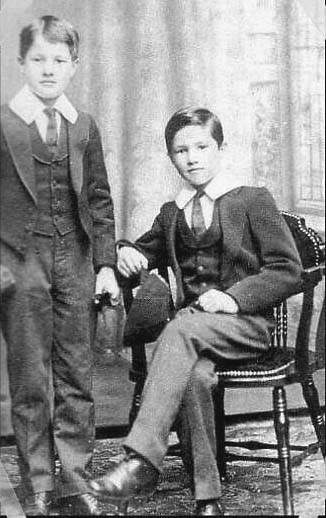
at trent college

According to one Old Boy from just a few years later, however, Albert’s actual expulsion came from:

“an incident which took place at morning prayers. Ball took in with him a huge bag full of boiled sweets. At one point it was allowed to burst, and hundreds and hundreds of sweets were all dropped onto the floor. The whole school assembly then became one seething mass of boys, all scrabbling about on the floor, “heads down and bottoms up, completely out of control ”, trying to pick up as many sweets as they possibly could.”

That did not necessarily mean, however, that Albert misbehaved with every single teacher. The Chief History master, C.Lloyd Morgan, was to recollect in later years:

“I think I taught Albert Ball but can’t recollect him.”

Albert moved next to Trent College, where he was a boarder. He was only an average student, but he possessed great curiosity for everything mechanical. His favourite lessons were therefore carpentry, model making, playing the violin and photography. He was also a member of the Officer Training Corps:

armoury door trent college

Albert eventually left Trent College at Midsummer 1913. His stay there seems to have been for the most part relatively happy, although it was not always a totally enjoyable experience, by any means. On at least one occasion, for example, the unhappy young Albert is supposed to have run away to sea, and he was only apprehended at the very last moment:

“covered in coal dust, in the engine room of an outgoing steamer”.

Whatever Naughty Albert’s long forgotten negatives, though, there is something genuinely cool about being featured on your very own stamp. As far as I know, Albert is the only Old Boy of the High School to have achieved this:
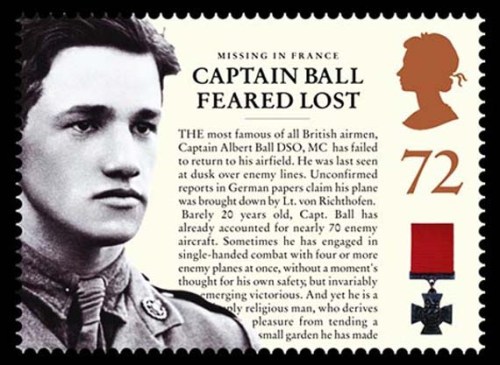
Albert_Ball_stamp zzzz

During his career, Albert secured 44 victories over enemy aircraft with a further 2 unconfirmed.  Nobody can fight alone for ever, though. After just 13 or 14 months of combat flying, Albert was killed.

The end came 100 years ago to this very day. I have tried to schedule the appearance of this post so that it is published to celebrate this anniversary.  There is no clear indication of what happened in his last combat although four German officers on the ground all saw his SE5 emerge from low cloud, upside down, and trailing a thin plume of oily smoke. Its engine was stopped and the plane crashed close to a farm called Fashoda near the village of Annoeullin. Albert was still alive and he was removed from the wreckage by Mademoiselle Cécile Deloffre. As she cradled him in her arms Albert opened his eyes once and then died. His death was later found to be due to his injuries in the crash. He had not been wounded.  The chivalrous Germans gave Albert a funeral with full military honours on May 9th. The original white cross with which they marked his grave, No.999, is still kept in the chapel at Trent College.

Albert’s father, Sir Albert Ball, was eventually to become Lord Mayor of Nottingham. After his son’s death, he bought the land where the crash had occurred. When he died in 1946 he bequeathed it to the inhabitants of the village to farm and to keep the memorial in good condition:


37 Comments

Filed under Aviation, History, Nottingham, The High School