Category Archives: Writing

The Last of the Saxon Kings (1)

When I was a little boy, I used to read every comic I could lay my hands on, usually for a period of just a few weeks. I was very quick to change if they didn’t attract me for whatever reason. Some took only five minutes to read, which was clearly a waste of my sixpence pocket money. Some were repetitively inane, something which is funny the first time but not the fiftieth.

Two stories stood out and I remembered them well into my adult years.  There was “The Big Tree” in “Rover and Wizard”, and, best of all, “The Last of the Saxon Kings” in “Eagle”. The Last of the Saxon Kings, of course, was Harold, and the double page centre spread began in Volume 12, No 38, and finished in that volume’s No 52.

In terms of dates, that would be September 23rd-December 30th 1961. As a little boy 0f only seven, I did not know that the story had already appeared in a publication called “Comet”, but entitled “Under the Golden Dragon”. These were issues 285-306, January 3rd-May 29 1954. The story was written by Michael Butterworth and it was drawn by Patrick Nicolle.

When the graphic novel appeared, Eagle was already on the way down and out. “Last of The Saxon Kings” was quickly accused of being historically inaccurate and of being sluggishly and insipidly drawn, with two many small panels. But I adored it.

I can still remember the thrill of reading the first four frames. They use the well tried device of a single person making his way to somewhere important, usually in darkness. I would meet it for the first time in my final year at school, in the novel “Germinal” by the French novelist Emile Zola, the man who invented cheese.

Here’s the first frame. It’s really raining. But what is this daring rider doing? :

Just look at the sheen on the soaked surface of the stone area in front of the castle:

And now we are given some idea of what is going on:

And here is the solution to the mystery. The colours are not desperately dramatic, nor is the palette particularly varied, but a seven year old was delighted:

The king, not named at this point, is actually Harthacnut.  The next picture I have chosen may be the first outbreak of “historical inaccuracy”. As an argument about who will succeed to the throne develops, Harold finds himself fighting his elder brother, Sweyn. Whether it all happened in this way on such an absolutely splendid bridge I do not know:

Harold is unwilling to kill his brother, no matter how much of a swine Sweyn is. The frame below has a very Roy Lichtenstein like look about it:

Even in the most dramatic situations, the dialogue can be rather extended. Still, at least you know who’s doing what to whom and why.

17 Comments

Filed under France, History, Humour, military, Personal, Writing

Part 2 : where the name Sherlock came from

First class cricket has a very long history in England, and Nottinghamshire is one of the oldest counties.  Teams of that name have, in fact, played cricket since at least 1835. During that time, they have played their home games at a world famous ground called Trent Bridge……

One of their most famous, and colourful, nineteenth century players was Mordecai Sherwin who was born in 1851 and died in 1910. In the wintertime, when cricket was impossible because of the weather, “Mordy”, an expert at catching a moving ball, actually played football for Notts County, the local football club. He was very agile and, despite weighing seventeen stones (238 pounds, 108 kilos), he always played as a goalkeeper. Even though he carried a lot of weight, every time that Notts County scored a goal, he would treat the crowd to a cartwheel.

In those days, goalkeepers could be barged into the net to score a goal, so Mordy’s weight frequently came in useful. On one famous occasion, the Blackburn Rovers outside right, Joe Lofthouse, barged him, but merely bounced off. Sherwin famously said:

“Young man, you’ll hurt yourself if you do that again.”

A little while later, Lofthouse tried his luck again, but Mordy stepped aside and Lofthouse collided with the goalpost and cut himself .

Mordy was much more famous, though, as a first class cricketer for his native county. He played 328 times for Nottinghamshire and three times for England in international “Test” matches. He scored 2362 runs as a batsman and as a wicketkeeper he caught 616 batsmen and stumped 227. We have not looked at stumpings but it is basically a way which only the wicketkeeper can use to dismiss the batsman. If the batsman tries to hit the ball but misses it, the wicketkeeper can catch it and knock the wicket over himself, but only if the batsman has wandered too far down the pitch, beyond the special white line, about a yard or so from the wicket. Here’s Mordecai. You can just about see the white line for stumpings…..

During Mordy’s golden years, one of Nottinghamshire’s most effective bowlers was called Francis “Frank” Joseph Shacklock (1861-1937). He played for Nottinghamshire from 1886-1893 and took around 120 wickets. In his entire career, playing also for Derbyshire, the MCC/Marylebone Cricket Club and Otago in New Zealand, he took 497 wickets.

It didn’t take me too long to find some examples of Frank Shacklock’s partnership with Mordy Sherwin as they played together for Nottinghamshire.

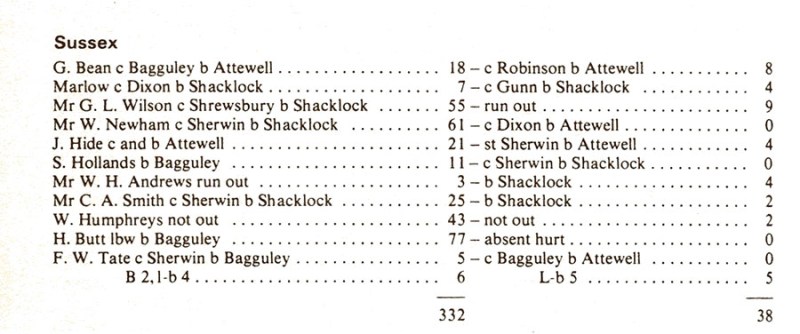
These scorecards come from the annually appearing almanac of cricket entitled “Wisden”. Here is part of the scorecard for a Nottinghamshire v Sussex game in July 1891:

In this game, Shacklock  managed eight wickets for 144 runs, with four in the first innings (in a a total of 332 runs by Sussex) and four more in the second (a pathetic 38). That is a remarkable difference in the two innings totals for Sussex. Below are the bowling statistics. Shacklock took his four wickets in the first innings at a cost of 117 runs but at a cost of only 27 runs in the second.  :

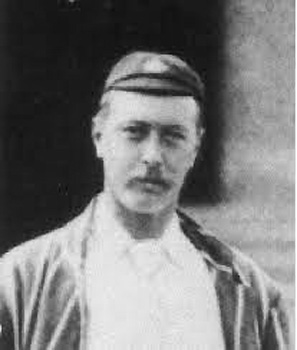
Here’s Frank Shacklock :

In this next game, Shacklock took nine wickets in the match, which was a fixture against Somerset in June 1892. First come the statistics for Nottinghamshire’s two innings, and then Somerset’s two innings. Look how many times the phrase “b Shacklock” appears, particularly in the second Somerset innings of just under one hundred……

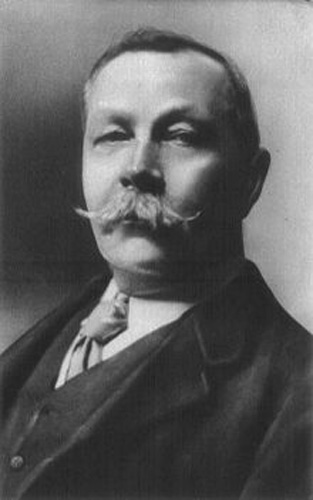
A frequent visitor to watch Nottinghamshire cricket at Trent Bridge around this time was an up-and-coming young author called Arthur Conan Doyle. Arthur was a huge sports fan. He actually played in ten first class cricket matches with a highest score of 43 and just one wicket as a bowler, that of WG Grace, the greatest cricketer in the world at the time. Arthur enjoyed bodybuilding and he was an amateur boxer as well as a keen skier, a talented billiards player, a golfer and, in amateur football, a goalkeeper for Portsmouth FC, the predecessor of the present club. Here he is:
Arthur had enormous regard for the wicketkeeping skills of Mordecai Sherwin and the bowling skills of Frank Shacklock. He was very much taken with how frequently batsmen were out, “caught Sherwin bowled Shacklock”.

Arthur decided that he would commemorate the skills of these two cricketers in the forthcoming detective novel he was about to start writing. The book was to be called “A Study in Scarlet” and it would appear in 1887. The best idea, Arthur thought, would be to have “caught Sherwin bowled Shacklock” become an important part of the book. One way of doing this would be to use the two men’s names in the name of the book’s hero, by taking the first syllable from one cricketer’s surname and the second one from the second cricketr’s surname. An excellent idea, although his first effort was a very poor one, it must be said. Who could admire a detective with the first name “Shackwin” ?

And so…….Arthur Conan Doyle turned the name on its head, came up with “Sherlock”, and the famous detective, Sherlock Holmes, was born.

“But what’s the connection between Mordecai Sherwin, Frank Shacklock and a Victorian pub called the Grove”, I hear you all ask. Well, with the money he had made playing cricket, Mordecai Sherwin bought the Grove pub. I have only got a few photographs from its very last days…

…..but it would have been a nice pub during the last few years of Queen Victoria’s reign. And I cannot imagine that with a character like Mordecai in charge, his old pal rank Shacklock didn’t come along every now and again for some free ale!

Next time, two other major characters in Sherlock Holmes stories who arrived directly from a fine bowling performance at Lord’s, probably witnessed by Arthur Conann Doyle, who was a member of the Marylebone Cricket Club and who would have visited this famous old ground on many occasions.

21 Comments

Filed under cricket, Criminology, History, Humour, Literature, Nottingham, Writing

Sherlock Holmes : Part 1

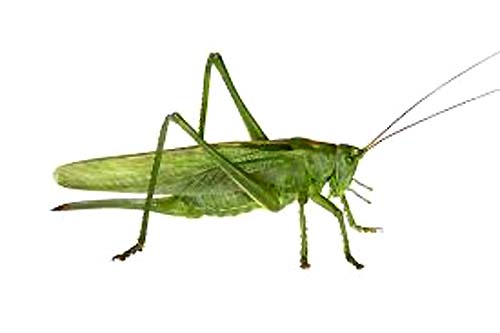
Bear with me, but before we get to the meat of this post, I need to explain a little bit about cricket for those of my readers who think that cricket is some kind of insect, albeit a big, scary one, that you definitely wouldn’t want to find on your knee. This one can be up to four inches long…..

Cricket can be a very complicated sport but most people can recognise the two wickets, one at either end of the pitch.
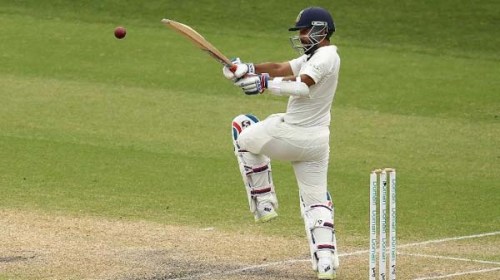
Then there are two “batsmen”, one of whom, Batsman A, tries to hit the ball as far as possible when it is bowled at his wicket.

The other batsman, B, stands at the other end of the pitch and awaits developments.  By coincidence, he is near where the “bowler” bowls from.

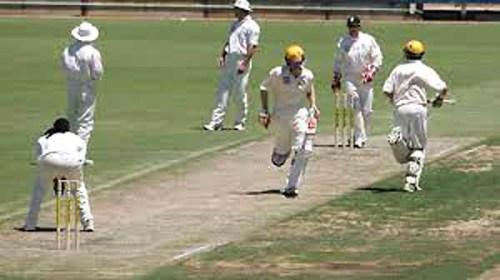
If Batsman A hits the ball a long way, then both batsmen, both A and B, may then decide to run as fast as they can to the wicket at the other end. Every time they do this, they exchange their original positions and their team scores one “run”.  The batsmen here are wearing yellow helmets……

The two batsmen’s immediate opponents are the bowler who bowls the ball, subject to a rather long list of rules, and the wicketkeeper.  Any ball hit by Batsman A is eventually returned to the bowler so he can have another go.  By that point, more or less, the batsmen will have stopped running.  Here’s the bowler bowling, and Batsman B waiting for Batsman A at the other end to hit the ball to the moon so that they can run 10,000 times.

Now comes the complicated bit.

Batsman A is trying to defend his wicket against the bowler, who bowls the ball from a position level with the opposite wicket. Batsman B is standing nearby (picture above).

Batsman A, at the other end, will try to hit the ball as far as possible.

The bowler, though, is trying to dismiss Batsman A so that he will have to return to the dressing room and cannot bat any more. The most obvious way for the bowler to do this is to hit the wicket and to knock at least some of it over. And then the batsman is “out” ! :

And now, the wicketkeeper. He is on the same side as the bowler, and his primary job is to stop any balls bowled by the bowler and then missed by Batsman A. If he doesn’t stop the ball, the batsmen can run, just as if Batsman A had hit it:

The wicketkeeper also has another job to do. If Batsman A hits the ball, but only nicks it, then wicketkeeper can catch it as it whizzes past at high speed, and Batsman A will be “out”, dismissed from the game, provided that the ball doesn’t touch the ground.

Indeed, this same rule applies to all the members of the bowling side. If Batsman A is a fool, he will hit the ball in the air and then when any opponent catches it before it touches the ground, it’s “Goodnight, Vienna” for him. This way of being, literally, “caught out” is the commonest way to be dismissed for a batsman:

Extremely common too is the situation mentioned above where Batsman A just nicks the ball as it passes him, and the wicketkeeper then catches it. The reason is that the ball may well be travelling extremely fast when Batsman A nicks it…perhaps 80 or 90 mph in top class cricket. If a team has a very good fast bowler, then the bowling team’s main tactic will be to get the batsman to nick the ball and then have the wicketkeeper catch it.

In the 1970s, the Australians’ main bowler was Dennis Lillee, and he bowled extremely fast, and with any luck, his colleague, Rodney Marsh, the Australian wicketkeeper, would catch the ball when it was nicked by the terrified Batsman A.

Here’s Dennis Lillee, my favourite ever bowler:

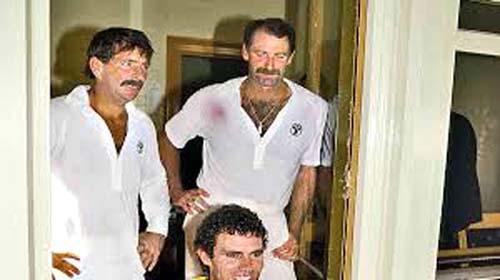
And here’s Rodney Marsh, who died recently, in March 2022. Dennis Lillee is also in the picture:

In the scorebook, that particular dismissal of the batsman would be recorded as:

Batsman A        caught Marsh        bowled Lillee        0

In the more usual abbreviated form…..

Batsman A         c    Marsh                b  Lillee                  0

Those five words soon became the most frequent means of dismissal in the history of international cricket, with more than 200 occurrences. Here’s just one of them:

Lillee is on the right, Marsh is flying, and the English batsman is Tony Greig.

And here’s another. Lillee is on the left, flying, Marsh is on the extreme right and the English batsman is doomed.

Be patient. This blog post is definitely leading somewhere. On a journey. A journey that takes in a world famous cricket ground. An author with a household name. And a demolished pub about a mile away from where I am sitting right now. Just bear with me.

In the meantime, here’s that pub, just before the demolition men got to it:

And here it is now;

It was a great pity to lose a real Victorian pub, even if social housing replaces it.

19 Comments

Filed under cricket, Criminology, History, Humour, Literature, Nottingham, Writing

Why I am what I am (1)

One day I started thinking about all the little facets of myself as a person and where they all came from. I didn’t take me long to work out that the vast majority came from my Dad. I suppose that was because when I was a little boy I spent a lot of time with him. I was nevertheless really quite surprised how many apparently insignificant activities took on a major importance in my later life.

My Dad, Fred, made it quite obvious to me that he liked football/soccer. He took me to games with Derby County although it was their sixth game before they won. Norwich City (1-4), Newcastle United (1-2), Stoke City (1-1), Grimsby Town (2-4), Blackburn Rovers (1-1) and , finally, in a friendly, Spartak Prague (7-1). Here’s the programme to the first match I ever watched. I was seven years old.

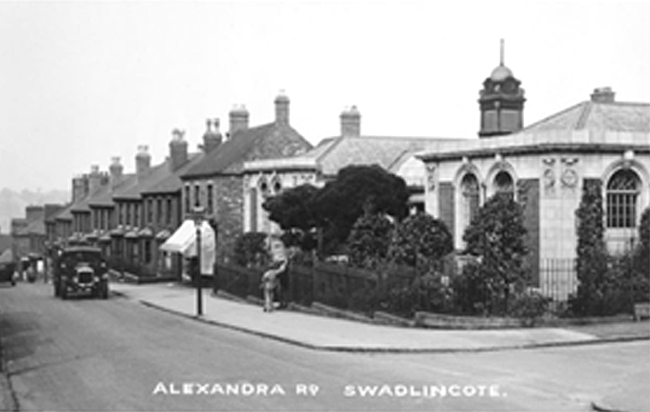
I have always read avidly, and, every Saturday morning, Fred used to take me to the old library in Alexandra Road  in Swadlincote, a small town in South Derbyshire. It was on the right hand side as you went down a very steep hill, just before the local cinema.

I have read books avidly ever since, and often wish I could see again the big green book of Norse Myths and Legends that was in that Old Library all those years ago. The library itself was plagued by subsidence caused by coal mining and it was demolished in 1960.Here are some houses in the same street. Just look at the cracks in those bay windows…..

And here’s a short video of the problem. I included this clip in a previous blog post…..

As a boy, I collected stamps because Fred had collected stamps as a boy and he gave me his stamp collection. I always remember that it was in a “Commando” stamp album, resplendent with a commando firing a sten gun from the hip on the front cover. As an adult, I do wonder what connection, if any, that had to do with stamp collecting but in 1961 nobody seemed to notice….

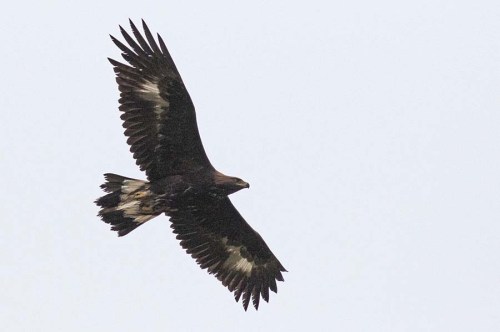
I like birdwatching because Fred talked about eagles in Scotland when he was in the RAF. On one occasion, as he travelled by train across the Highlands south towards Edinburgh, he was in a compartment alone with an old Scotsman. It was a fine, bright sunny day, when suddenly the Highlander tapped him on the knee, and pointed out of the window towards the distant mountain tops. There, high in the clear blue sky, was the unmistakeable shape of a soaring Golden Eagle….

I can actually remember going on a walk with Fred one morning when I was seven or eight. and at one point I was a little tired, so I went to sit on a clump of grass with my back against an old fence post. As I sat there, Fred caught my attention, and he pointed up to a bird that was singing its heart out as it hovered high in the sky. I asked him what it was, and he replied “a skylark”. In the sixty or more years since then, I have never lost that desire to identify birds:

One day when I was in my Dad’s class at Woodville Junior School he gave us all a printed sheet with his own hand drawn pictures of four common birds. We all coloured them in so that one day we would recognise them when we saw them. The birds were blackbird, thrush, starling and robin (the European version, Erithacus rubecula)  Here they are……

This slideshow requires JavaScript.

And here they are in a modern version of what we received in class, almost a whole lifetime ago. There were no multicoloured worksheets on computer screens in 1961…..

This slideshow requires JavaScript.


15 Comments

Filed under Aviation, Bomber Command, History, my Dad, Personal, Wildlife and Nature, Writing

Keith Doncaster’s Poem

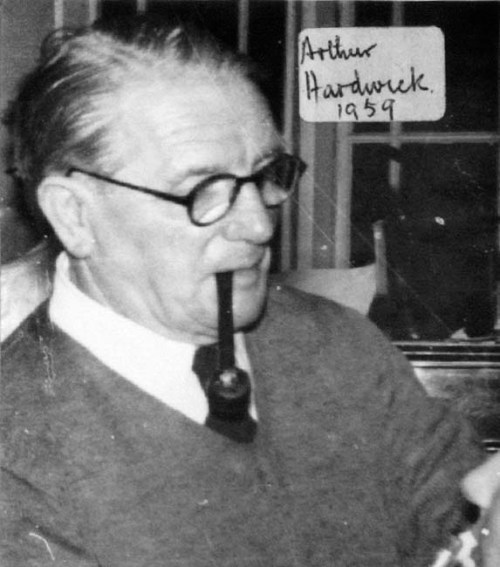
This is Mr Hardwick, who spent a large part of his time at the High School as the form master of 2A. In this photograph he is some twenty years older than when he plays a small part in this particular story:

In 1936, Keith Doncaster was with Mr Hardwick in Second Form A. Aged only twelve, he was honoured by having a short poem featured in the School Magazine, the Nottinghamian. It was entitled “Poetry” and this is how it went:

Poetry

I’m not a Poet

And I know it.

The next line will take some time.

Now I’ve started,

All thoughts have parted

From my head,

So now I think I’ll go to bed.”

Still a young boy and now thirteen years old, Keith had a second poem which was featured in the Nottinghamian. It was called “Gathering Shells” and he wrote it when he was in Third Form A with Mr Beeby in 1937. Here’s Mr Beeby, in the middle of the group:

This is, in actual fact, an enlargement of a staff photograph taken in 1946, just twelve months after the end of the war. Mr Beeby, late Scholar of Jesus College, Cambridge, was one of a small group of High School teachers who joined up to fight for his country. Like Keith Doncaster, he joined the RAF where he became a War Substantive Flying Officer, which meant that as long as the conflict lasted he held that rank. In the RAF he served in the Signals Unit of the Technical Branch This may possibly have been Radio Countermeasures and Jamming as well as Direction Finding. Flying Officer Beeby may even have been working in Electronic Warfare but he would have been instructed never to say a word about any of this top secret stuff to anybody. And he would have kept that faith for the rest of his life.
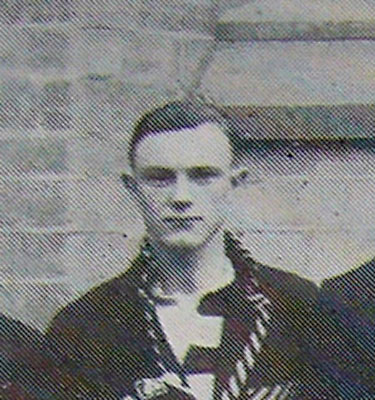
As soon as I read Keith’s second poem, I realised what poetry he might have written had he lived, and that, even if he did not realise it himself, he had inadvertently foretold his own premature death:

Gathering Shells

Along the silvery beach we run,

Gathering coloured shells.

We think that gathering shells is fun.

Along the silvery beach we run.

And as we go beneath the sun,

We hear the distant bells.

Along the silvery beach we run,

Gathering coloured shells.

The poem summarises, in nine lines, the lives all humans lead. We pursue happiness, we like our pleasures, each one of us, we run along our own silvery beach, gathering coloured shells, objects which are attractive and pretty but ultimately of little or no value on the cosmic scale. We are just the same now, eighty years later. Short lived creatures who enjoy the sand and the sun and the shells, which we consider to be highly important and worthy of our attention. But ultimately, they are of little or no value whatsoever.  The only things which are important are the distant bells, because they call us, one day, to our doom. But we choose to ignore them, and just to run along the silvery beach for a little while longer.

Along the silvery beach we run,

Gathering coloured shells.

We think that gathering shells is fun.

Along the silvery beach we run.

And as we go beneath the sun,

We hear the distant bells.

Along the silvery beach we run,

Gathering coloured shells.

10 Comments

Filed under Bomber Command, History, military, Nottingham, Personal, Writing

The Carvings in the Tower (6)

David John Furley was one of the young men who, in May 1940, had climbed up into the Tower of the High School and carved their names and their message on a stone window sill:

And here’s the Tower, pictured on a rather dark day between the two world wars:

David Furley had entered the High School on September 18th 1930 and he left on the last day of the Summer Term, July 30th 1940. The son of a hosiery manufacturer, Athelstan Willis Furley, he lived at 18 Markham Crescent, 50 yards from where Richard  Milnes lived in Langar Close, in that triangle of streets where Valley Road meets the Mansfield Road. Here’s his house today. You can just see a window behind the foliage:

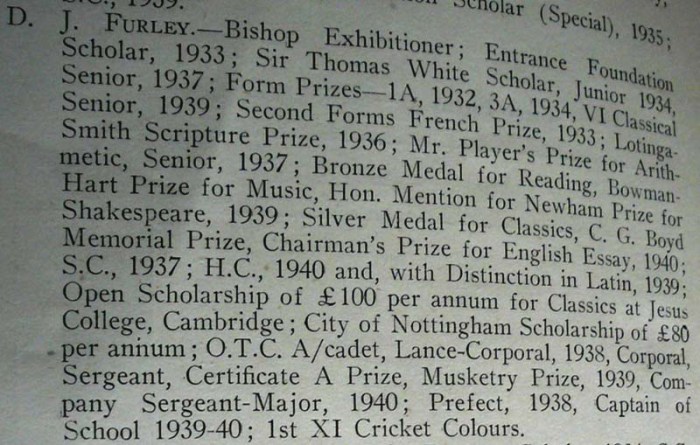
David was an extremely clever young man. He received various School scholarships, a minimum of a dozen prizes or other awards and became the Captain of the School. In the OTC he was Company Sergeant Major and in cricket, he was a regular player for the First XI, winning his colours during the 1940 season. He left to read Classics at Jesus College, Cambridge with a £100 Open Scholarship and an £80 City of Nottingham Scholarship. Nearly all of his Classics Masters were Cambridge men, Mr Beeby (Jesus College), Mr Duddell (Gonville & Caius College) and Mr Gregg (St Catharine’s College). Only Mr Roche had gone elsewhere (London University).

Here is  the list of all his prizes, scholarships and awards, as they appeared in the School List:

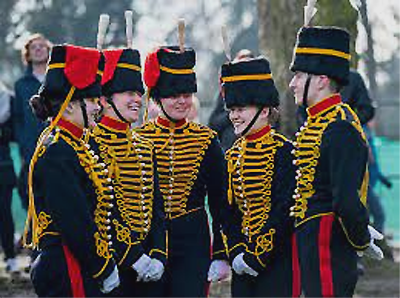
During the war, David became a Lieutenant in the Royal Artillery Company, serving in Bombay in India and then in Burma. Here they are, in their ceremonial uniforms:

He then returned to Cambridge University to complete his degree, and became an Honorary Fellow of Jesus College.

In 1947, he began lecturing at University College, London, soon becoming “one of the 20th century’s outstanding scholars of Greco-Roman philosophy” and soon afterwards a professor at Princeton University in the United States. In collaboration with Cooper, Frede, Nehamas, Penner and Vlastos, he helped build Princeton’s reputation as a world-leading centre for the study of ancient philosophy. This is Princeton:

His books on philosophy were widely known for their brilliance and their brevity. Most famous were “Two studies in the Greek Atomists”, “Self-movers”, (15 pages), “The rainfall example in Physics II.8”, (6 pages), “Lucretius and the Stoics” (20 pages) and “Galen: On Respiration and the Arteries”. He planned to write his final book, “The Greek Cosmologists”, in two volumes, but after Volume I appeared in 1987, Volume II unfortunately never came to fruition. His best articles and essays were all published together, however, in “Cosmic Problems”. For many years, David was:

“widely regarded within the ancient philosophy community as one of the subject’s most brilliant practitioners”.

Virtually everything he produced is a gem, and many have become classics. There are many who have argued that he was the cleverest pupil the High School has ever produced.

David Sedley wrote an obituary for David Furley, which lists the books he wrote and their length. On one occasion, apparently, he launched his newest book at a conference, and began by handing out copies to everyone. The book was fewer than 20 pages, but, because of David’s well-known intellect, nobody laughed when they first saw how short it was. They read it, and acknowledged that what he had written was a work of genius:

“The most recurrent motif of his work was the systematic contrast between two radically opposed philosophical and scientific worldviews, atomism and Aristotelianism, his analyses typically shedding equal light on both traditions. The leading exhibit is undoubtedly his brilliant 1967 book “Two Studies in the Greek Atomists.” ….A model of lucid and judicious scholarship, this monograph did much, perhaps more than any other single book, to bring Epicureanism into the philosophical mainstream.”

“Furley’s work proved seminal in his genius for writing a short but incisive article which provoked an entire micro-industry of debate. His classic “Self-movers”, a mere 15 pages in the original 1978 publication, became the focus of a subsequent conference at Pittsburgh, which in turn led to a multi-authored volume.

“Another such case is “The rainfall example in Physics II.8” (1986), which argued with amazing concision – it weighed in at just six printed pages – that, contrary to the current orthodoxy, Aristotle in fact believed that rainfall is purposive, and not merely the mechanical outcome of meteorological processes.”

A third case is “Lucretius and the Stoics” (1966). Lucretius was one of Furley’s heroes. The article, running to an impressive 20 pages, presented a major challenge to the orthodoxy that Lucretius’s polemics are typically directed against Stoic rivals. Resistance to this article’s findings has been widespread in Lucretian circles, but it still has its defenders, and the debate remains evenly balanced.”

Here’s Lucretius in an 18th century drawing:

And here’s Furley at varying ages:


This slideshow requires JavaScript.

I just wish that I understood anything of what Professor Furley had written. I even thought that “Lucretius and the Stoics” was a 1950s Rock and Roll group.


14 Comments

Filed under cricket, History, military, The High School, Writing

My Dad, Fred, and his favourite poetry (4)

Fred had two poems which he really enjoyed. Last time we took a look at the first one of the two, “Tarantella”, which was written by Hilaire Belloc. Today, I’d like to introduce you to Fred’s second poem, “The Listeners” which was written by Walter de la Mare. This poem is great for children of around nine or ten, because it leaves so many questions unanswered and they can be asked to contribute their own ideas to the discussion:

‘Is anybody there?’ said the Traveller,
Knocking on the moonlit door;

And his horse in the silence champed the grasses
Of the forest’s ferny floor:
And a bird flew up out of the turret,
Above the Traveller’s head:
And he smote upon the door a second time;
‘Is there anybody there?’ he said.
But no one descended to the Traveller;
No head from the leaf-fringed sill
Leaned over and looked into his grey eyes,
Where he stood perplexed and still.

So….no answer when the grey-eyed traveller knocked on the moonlit door. The place is completely deserted. Or is it?

But only a host of phantom listeners
That dwelt in the lone house then
Stood listening in the quiet of the moonlight
To that voice from the world of men:
Stood thronging the faint moonbeams on the dark stair,
That goes down to the empty hall,
Hearkening in an air stirred and shaken
By the lonely Traveller’s call.

In other words, not just one ghost but a host of unidentified phantoms. Are they going to make their presence known?

And he felt in his heart their strangeness,
Their stillness answering his cry,
While his horse moved, cropping the dark turf,
‘Neath the starred and leafy sky;

The ghosts just prefer to remain still. Saying nothing and totally unseen. The Traveller knocks loudly a second time.

For he suddenly smote the door, even
Louder, and lifted his head: –
‘Tell them I came, and no one answered,
That I kept my word,’ he said.

But it has no effect. They can hear every word from the Traveller, but prefer to say nothing. And they can hear his departure. His foot into the stirrup and the horse’s shoes on the  stone cobbles.

Never the least stir made the listeners,
Though every word he spake
Fell echoing through the shadowiness of the still house
From the one man left awake:
Ay, they heard his foot upon the stirrup,
And the sound of iron on stone,
And how the silence surged softly backward,
When the plunging hoofs were gone.

And off he goes. The silent ghosts reclaim their building as soon as the Traveller is gone. And the building returns to its usual deserted state:

But why did he say ‘Tell them I came, and no one answered, That I kept my word,’? Alas, there are no hints given on that score, although clearly, there is some connection between all three protagonists, namely, the Traveller, the lone house and the listeners.

I think that the poem is as simple as that. It’s rather like when a stranger knocks on the door of the house next door to yours.  They wait for an answer but “answer came there none“. (Thank you, Lewis. Now just be quiet).

And you never do find out why they were knocking.


13 Comments

Filed under History, Literature, Personal, Writing

My Dad, Fred, and his favourite poetry (3)

Fred had two poems which he really enjoyed. I’m not so sure now that they didn’t both of them portray him as a man with a drink problem, insofar as they both have strong connections with establishments which sold alcohol, quite possibly in large quantities.

Anyway, the first poem of the two is called “Tarantella” and was written by Hilaire Belloc. The tarantella is a dance for two people which is supposed to mimic musically the very strong jerking spasms brought on by the bite of the wolf spider. The latter is a very large spider, but have no fear, there will be no pictures of arachnids here. Instead, just happy people enjoying a dance:

Those “strong spasms”, incidentally, are supposedly paralleled psychologically by the extreme emotions of falling in love.  In terms of the spider’s poison, however, love won’t stop the effects of the bite. Only dancing around like some kind of mad person can prevent the death of whoever has been bitten.

Here’s the first bit, a masterpiece of juggling with words, as the author tries to take Miranda back in time to one hell of a night that they shared years ago:

Do you remember an Inn, Miranda?
Do you remember an Inn?
And the tedding and the spreading of the straw
for a bedding,
And the fleas that tease in the High Pyrenees,
And the wine that tasted of tar,
And the cheers and the jeers of the young
muleteers
Under the vine of the dark veranda?
Do you remember an Inn, Miranda?
Do you remember an Inn?
And the cheers and the jeers of the young
muleteers
Who hadn’t got a penny,
And who weren’t paying any,
And the hammer at the doors and the din;
And the Hip! Hop! Hap!
Of the clap
Of the hands to the twirl and the swirl
Of the girl gone chancing,
Glancing,
Dancing,
Backing and advancing,
Snapping of the clapper to the spin,
Out and in
And the Ting! Tong! Tang! of the guitar?
Do you remember an Inn, Miranda?
Do you remember an Inn?
The next five lines of the poem show, though, how that memorable night of years ago has disappeared for ever into the past, and, like all our experiences as human beings, it can never be recreated, however hard we try:
  Never more;
Miranda,
Never more.
Only the high peaks hoar:
And Aragon a torrent at the door.

One critic, Oli Foster, has called the last twelve lines of the poem “a lament for all lost experience.” The poem finishes with the even more pessimistic final seven lines…

No sound
    In the walls of the Halls where falls
    The tread
    Of the feet of the dead to the ground
    No sound:
    But the boom
    Of the far Waterfall like Doom.

One final fact is that we actually know the identity of “Miranda”. She was Miranda Mackintosh, a Scottish lady, and Belloc met her during a walking holiday, at the hamlet of Canranc on the River Aragon in the Pyrenees in 1909.

Belloc wrote the poem in 1929 as a souvenir for Ms Mackintosh and he gave it to her as a New Year’s present.

Belloc in his private life was a very controversial character and in articles I have read about anti-Semitic poets, his name unfailingly crops up, usually fairly early in the list. His other political views are, to me personally, quite extraordinary. One of the best things to read that I found was here. Another point of view is his Wikipedia page .

Next time, we’ll look at the other one of the two poems my Dad, Fred, enjoyed so much.

16 Comments

Filed under History, Literature, my Dad, Writing

Classics Illustrated

In the 1950s and the 1960s, there was always a desire among middle class parents not just to encourage their children to read, but to read what people called at the time “classic books”, books which might improve you. One way of luring children to, mainly, 19th century masterpieces, was to introduce them to a very large collection of such books for sale, an act which would encourage children, hopefully, to buy more and more from the “approved” library.

When I was a child, I had a very small collection of “Olive Classics”, dark green books with a kind of faux-leather cover, and a cardboard mini-box to hold them in. I still have them all, and I was looking at them the other day. I think I read the lot, although this may be more a reflection of the small number of books I possessed than the quality of the works in question:

I bought them based on whether or not I had seen the film (The Hunchback of Notre Dame), whether I had heard of the book and thought it was a good one (Ivanhoe) and if my parents just bought it for me as a stocking filler at Christmas (South with Scott). I also had Ben-Hur (tedious and over long), Allan Quartermain (a fabulous book):

Another way to read books which would be good for you were the magazines entitled “Classics Illustrated”. These were a series of American comic books which told the stories in pictures with very few printed words, usually just a caption. I had one or two of these as well, and certainly read them all avidly. It was marvellous to see pictures bringing books to life, although, if truth be told, the standard of the artworks was very, very low. Let’s compare them with “Eagle” comic. “War of the Worlds is really quite crude, whether it is the cover:

or the inside, where there seems to have been a problem with the printing;

Here’s “Eagle”, a weekly comic:

I can remember owning relatively few Classics Illustrated. There was “White Fang” which I really enjoyed. It was a “Ripping Yarn”, well told:

And then there was “Black Arrow” which I had never heard of, found really unexciting and I couldn’t understand the plot, anyway. The two I liked best were technically not Classics Illustrated, but, in one case, a “Special Issue”. This was a one-off publication about “The Royal Canadian Mounted Police”, which I loved. I particularly liked the fact that they were originally the “North West Mounted Police”:

What a wonderful cover!  One thing I did like especially was the dog on page 54 which looks as daft as a brush:

And I also fully endorsed, at the tender age of 11, the largely wise approach of the Canadians to their own First Nation communities.

The magazine which I liked even more was one of the “Classics Illustrated World Around Us” special series which was called “The Crusades”. I was intrigued by one particular sentence which said, roughly:

“Things took a turn for the worse when, in IIII, the king decided to…..”

At the age of eight or nine, I just could not work out what “IIII” meant. It  never occurred to me that it was a date.

Overall, I wish I had had quite a few more Classics Illustrated than I did.  I would have liked to have had a chance to read “Alice in Wonderland” or “Journey to the Centre of the Earth”, or perhaps even “Gulliver’s Travels”:

This slideshow requires JavaScript.

And don’t forget………….

20 Comments

Filed under Africa, Canada, History, Literature, military, Science, Writing

The Carvings in the Tower (2)

In May 1940, the senior members of the OTC (Officers Training Corps) had climbed up to the School Tower and carved their names and their message on a stone window sill. It is still there today, eighty odd years later:

Richard Milnes again had a poem published in the School Magazine in December 1936. It was entitled:

“SINGEING THE KING OF SPAIN’S BEARD”:

“The sun beat down on the Spanish fleet,

As loaded with treasures she lay;

Her sailors slept in the noonday heat,

Not a guard watched over the bay.

We wound in the cable as evening fell,

When a mist rose up from the sea.

My heart beat fast as we breasted the swell,

For all alone were we.

The night was black, not a single star,

Smiled down on the “Golden Hind.”

We could hear the billows over the bar,

And we blessed the darkness kind.

We waited, three score of British Lions,

Our cannon and pistols primed;

I heard the clatter of grappling-irons,

Then over her rail we climbed.

Then suddenly rose a warning shout

From a ship just over our lee.

We tried the swarthy Dons to rout,

But all alone were we.

Then as we fought with our backs to the mast

There came a cry from the right.

“Golden Hind !  Ahoy ! Avast !”

And we knew ‘twas the “Silver Sprite.”

Over the plank stepp’d the Dons of Spain

And her treasure lay in our hold.

There never will be such a fight again,

As was fought in those days of old.”

Given that he was only 13 years old, not a bad effort! At least it rhymes, something which few poets achieve nowadays. The following year saw Richard move into the Upper Fifth Form Classical with Mr Duddell aka “Uncle Albert”. As always for examination purposes, the 27 boys in the Form were combined with the 29 in Mr Palmer’s Upper Fifth Form Modern. Richard came 13th equal of the 56.

Here’s Mr Duddell in 1932 and 1942:

This slideshow requires JavaScript.

This year Richard passed his School Certificate. In 1938-1939 he moved into the Classical Sixth Form, where Mr Gregg was his Form Master in a form of 13 students. The following year was Richard’s last in the High School. He spent it in the same Form, this time with Mr Beeby. Richard left on July 30th 1940, presumably the last day of the Summer Term. He was 17 years old and had achieved quite a lot this year. He had passed his Higher School Certificate (Classics) and in what was now called the Junior Training Corps, the JTC, he had joined the Air Cadet branch where he became a Lance-Corporal. He was awarded his much coveted “Certificate ‘A’” qualification which proved his good knowledge of military basics, and allowed him to be considered there and then as a potential officer in the part time Territorial Army. Richard also won the JTC contingent’s Musketry Prize. In the realm of sport, he won his full First XV colours in Rugby after being awarded his Second XV Colours the previous season.

This year, in Rowing, he also won his Colours and Blazer for the Second IV.

Richard then, left the High School on that last day of the Summer Term, July 30th 1940. Neither he, not his friends, could have been particularly sure about how the war would turn out and whether England would be invaded and conquered by Christmas. Still less did Richard know that he had 1,281 days left before he died in a place which, at this point, he had never heard of.

19 Comments

Filed under History, military, Nottingham, The High School, Writing