Category Archives: Writing

Alice in Wonderland (4)

When discussing Lewis Carroll, though, there are always issues which need to be dealt with, other than the quality of the books that he wrote, books which are surely among the best known, most widely translated and most familiar books in history. Have no fears. Alice will be outselling Harry Potter fifty to one in a hundred years’ time:
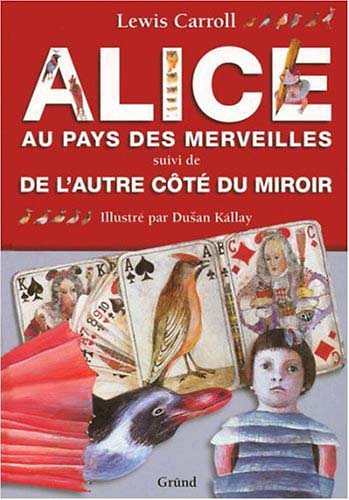
Whenever I have said how much I like that druggy golden afternoon, though, I am invariably assailed  by some deep thinker’s blunt statement “He was a paedophile”.

Well, as far as we know Charles Lutwidge Dodgson was not a paedophile, and as long as there is no documented proof, that is how it must stay. It is only too easy to throw stones at a man who died more than a century ago.

For me, the most important thing is to remember that the world of the 1860s, say, was very, very different from that of today.

“The past is a foreign country; they do things differently there.”

(LP Hartley in The Go-Between )

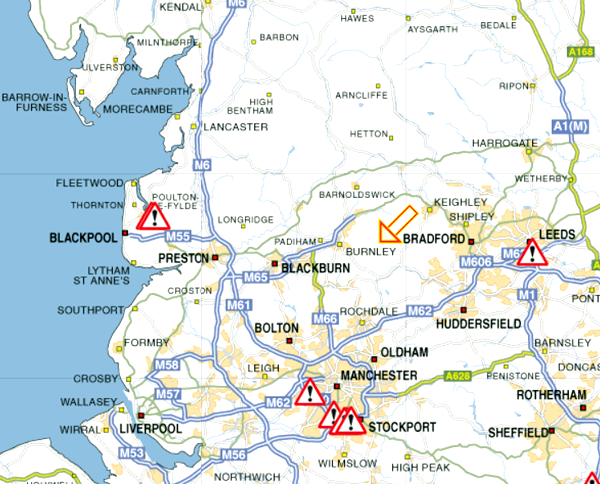
The sharp differences between 1860 and now will invariably be reflected in the relationships between a single man and single young girls or women. In 1860, for example, the minimum legal age for marriage, with the consent of the parents, was only twelve for a girl and merely fourteen for a boy. In the 1861 census, 175 women in Burnley had married at 15 or less. In Burnley, the figure was 179. The Orange Arrow points at Burnley and, an inch or so further on, at Bolton.
On that golden afternoon of Friday, July 4th 1862, Lorina Liddell was thirteen years old. Another year, and it would have been completely reasonable and wholly acceptable for young gentlemen to be calling round at her house to pay court to her.

Last time, I spoke about the sudden break in the relationship between the Liddells and Dodgson and the missing page in Dodgson’s diary. Supposedly it read:

“L.C. learns from Mrs. Liddell that he is supposed to be paying court to the governess—he is also supposed by some to be courting Ina”

At the same time though, there are plenty of biographers such as Morton N. Cohen who think that Dodgson merely wanted to marry Alice when a few years had passed. Alice Liddell’s biographer, Anne Clark, writes that Alice’s descendants were certainly under the impression that Dodgson wanted to marry her, but that “Alice’s parents expected a much better match for her.” Mrs Liddell, for example, was aiming rather high perhaps, at the somewhat gormless looking Prince Leopold of Belgium:
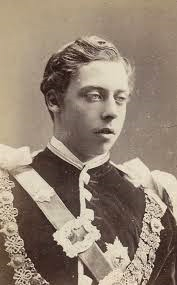
Such “spring and autumn marriages” as Dodgson and Alice would have been, were actually quite common. John Ruskin the leading English art critic of the Victorian era was looking at one point to marry a twelve year old girl, while Dodgson’s younger brother sought to marry a 14-year-old, although he eventually postponed the wedding for six years. This is what Dodgson might have done. Wait five years, say, until Alice was sixteen or seventeen, and marry her then, when Dodgson was thirty five or so. Hardly outrageous, even by the standards of today.

A general pattern emerges with these “spring and autumn marriages”. The man usually falls in love with the girl when she is between ten and twelve years of age, and they are then married by the time she is sixteen or eighteen. Sometimes the little girl falls in love, but this was a lot less common.

We often tend to forget that the Reverend Charles Lutwidge Dodgson was a teacher of mathematics at Oxford University and a deacon of the Anglican Church. Some colleagues knew him as a somewhat reclusive stammerer, but he was generally seen by everyone as a devout and serious scholar. One college dean said he was “pure in heart.”

Supposedly, Dodgson took around 3,000 photo­graphs in his life.

Supposedly 1500 are of children of whom only 30 are depicted nude or semi-nude. A great deal will depend on what is meant by “semi-nude”, of course. Here is Alice as “The Beggar”. Is she semi-nude? She is certainly not nude. All our attention is drawn, of course, to her enormous feet and weird toes:

Dodgson had the permission of both Liddell parents for this photograph and they were so pleased that they kept it in a beautiful Morocco leather case. Dodgson soon became so well thought of that he was invited to entertain two of the grandchildren of Queen Victoria herself.

Taking photographs of children was viewed in a very different way some 150-odd years ago. Here is the very sentimentalised, “The Prettiest Doll in the World”:
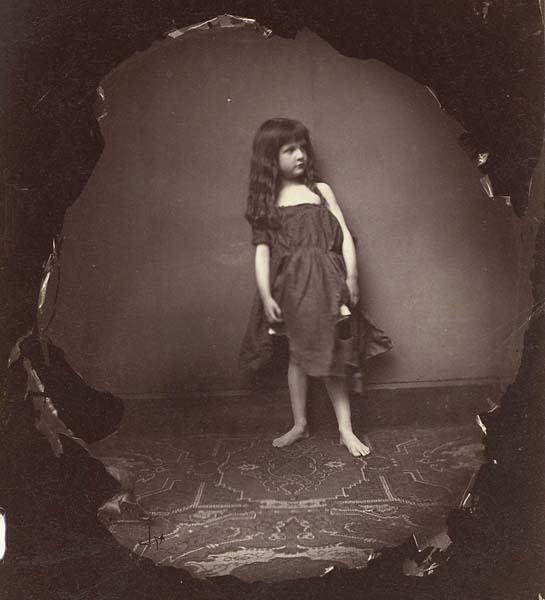
Victorians saw childhood as a state of grace; even nude photographs of children were considered pictures of innocence itself.

Such photographs of nude children sometimes appeared on postcards or birthday cards, and nude portraits—skilfully done—were praised as art studies.  Probably the most famous of society photographers at the time was Dodgson’s contemporary, Julia Margaret Cameron. As well as the rich, famous and beautiful, though, Cameron also took photographs such as” Nude child with hands folded” or “Venus Chiding Cupid And Removing His Wings “. Here she is, looking worryingly like a man, possibly even a man who has played 344 games of Rugby League for Wigan Warriors:
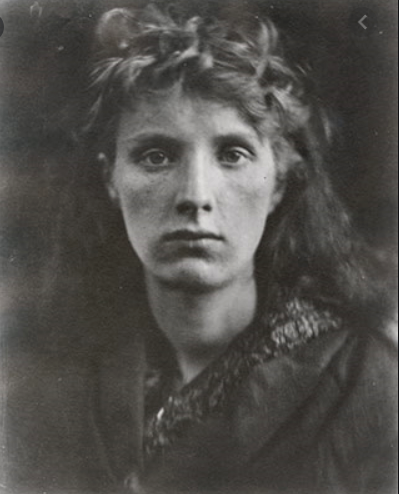
There was certainly no shortage of parents quite happy to have their children photographed nude by Dodgson, who was regarded as a top class photographer who had produced a large number of superb quality portraits of adults. And Dodgson was not the first Victorian to photograph nude children either. Wigan prop forward, Julia Margaret Cameron, among many others, predated him by at least three or four years. She was the most gifted artistically in this field. Dodgson’s nude photographs “by Victorian standards were, well, rather conventional.”

When he died, Dodgson left very few nude photographs behind him. As he grew old, he himself destroyed the majority of the negatives and prints of his nude studies. He asked the executors of his will to destroy any others that he had missed and this appears to have been done. This was not because the photographs were obscene. Every set of parents had already been given their own set of the photographs he took (and had posed no objections, in fact quite the opposite), so that was not the problem.

In 1881 he wrote to Mrs Henderson:

“Would you like to have any more copies of the full front photographs of the children? I intend to destroy all but one of each. That is all that I want for myself, and, though I consider them perfectly innocent in themselves, there is really no friend to whom I should wish to give photographs which so entirely defy conventional rules.”

The Hendersons (the father, incidentally, was a fellow of Wadham College, Oxford) had enormous  admiration for Dodgson’s work and were completely happy to for him to photograph their children nude. They left the children with him, unsupervised, and picked them up later. And there were no problems whatsoever.

Two families, the Hatches and the Hendersons, have passed down to us the only pictures we have which were taken by Dodgson of little girls in the nude. They were Beatrice Hatch, age 7, Evelyn Hatch, age 8, Ethel Hatch, age 9, Annie and Frances Henderson, ages 7 and 8. Anybody who finds them on the internet can see just how innocent they were, particularly in that world where:

“Victorians saw childhood as a state of grace; even nude photographs of children were considered pictures of innocence itself.”

The whole issue has perhaps been exacerbated by the fact that Dodgson died suddenly on January 14 1898. Before 1899 arrived, Dodgson’s nephew Stuart Collingwood wrote and had published, the biography of his uncle which contained two chapters on his friendships with little girls and yet no mention whatsoever of the many women that Dodgson counted among his friends:
Overall, my conclusion would be that the ball is very much in the court of the accusers. They have looked at Dodgson, a strange man admittedly, seen some of his photographs, and, without bothering to put them in the context of the age, cried “Foul”! It is now up to them to come up with irrefutable proof, something which nobody has done in over 120 years.

And don’t be fooled by the way, by the fake photograph of Alice supposedly kissing Dodgson. And above all, a full frontal of a young girl of fourteen or fifteen, supposed to be Lorina,  found in a French museum. Again, the burden of truth is on the museum is to prove its veracity.

And don’t forget, it wasn’t that many years ago that a French museum claimed to have found the real Beast of Gévaudan in its stuffed animal section.

They explained that they had “lost it”.

16 Comments

Filed under Criminology, History, Literature, Personal, Writing

The Fairies of Cornwall (7)

Last time, in Part 6, we were discussing the apparent abduction of Mr Noy, and his being found five or six days later, very close to his own farm, although he did not recognise where he was. There is an alternative version of the story which tells the abduction story from Mr Noy’s point of view:

“Mr Noy told his neighbours that when he had reached the village of Ludgvan, the night being clear, he thought he would take a shortcut across the moor and save nearly a mile, instead of going all the way round by the stony path.”

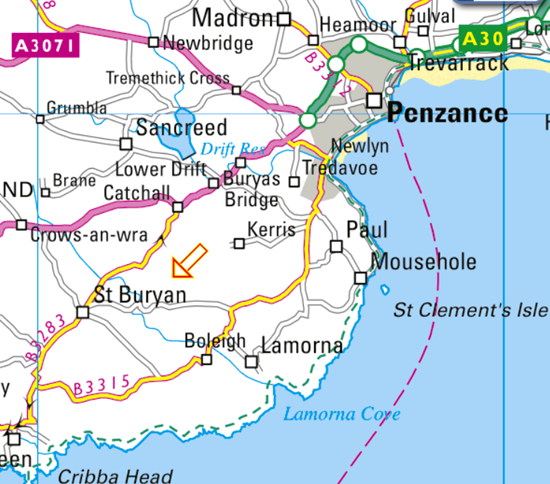
Here’s a map where the orange arrow indicates “Ludgvan” and down in the south west is St. Buryan, generally recognised nowadays as Cornwall’s capital of witchcraft:

Mr Noyes’ horse, however, which was used to finding his own way when his rider was drunk, preferred the usual route by the stony path, and Mr Noy was forced to pull him towards the opposite side of the common.

He then found himself in an area that was unknown to him, although he had been, or so he thought, over every single inch of the common both in winter and summer. Alarmed at the strange appearance of everything around him, he tried in vain to retrace his steps. Not knowing what to do, he let the horse take its own course. Yet instead of proceeding homeward, the horse took Mr Noy to a strange land so crowded with trees that he had to dismount and lead his horse. He wandered  for miles and miles, sometimes riding but more often on foot, never seeing any habitation at all.  It was a strange, unknown place, which he believed must be outside his own parish, but in which other parish he couldn’t tell. At last he heard lively music and saw lights glimmering through the trees.

People were moving about, which made him hope that he had arrived at some farm where they were having a harvest festival and the farm labourers, after supper, were dancing in the town square.

The dogs hung back, and the horse didn’t want to go on, so he tied it to a tree, and walked through an orchard towards the lights. He came to a meadow where he saw hundreds of people.

Some were seated at table, eating and drinking. Others were dancing to the music of a tambourine. This was played by a young lady dressed all in white who was standing only a few feet from him.

He looked at her closely and was surprised to see that the young lady was none other than Grace Hutchens, a farmer’s daughter. She had been his sweetheart for a long time, but she had died four years ago. At least he had mourned her as dead and she had been buried in the local churchyard.

She turned closely towards him and said, “Thank the stars, dear William! I have come to stop you being changed into the fairy state that I am in. Woe is me!”

He tried to kiss her. “Beware”, she exclaimed, “Embrace me not. Touch not the flowers nor the fruit. Eating a plum from this enchanted orchard was my undoing.

You may think it’s strange, but it was because of my love for you that I came to this.

People believed that I was found dead on the moor. It was supposed that I must’ve had an epileptic  fit, as I was subject to them. What was buried as me, however, was only a changeling, a sham body. It was not me for I feel much the same now as when I was alive.”

Grace then told the story of how she herself had been ensnared.

“One evening, I was out on the moor looking for stray sheep, when I heard what I thought was you whistling to your dogs, so I went towards the sound to try to meet you. I got lost, though, under ferns higher than my head. I wandered on for hours among pools and bogs without knowing where I was going.”

After rambling many miles, as it seemed to her, Grace waded a stream and entered an orchard. Then she heard music and walked towards it. She passed into a beautiful garden with roses and beautiful flowers that she had never seen before. Apples and other tempting fruits dropped onto the paths or hung overhead.

This garden was so surrounded with trees and water that, like one led by the fairies, all her efforts to find a way out were in vain. The music too seemed very close at times but she could see nobody.

Weary and thirsty, she picked a plum, that looked golden in the starlight. Her lips no sooner closed on the fruit than it dissolved to bitter water which made her faint. Then she fell to the ground in a fit and became unconscious. She didn’t how long it was before she woke up to find herself surrounded by hundreds of fairies who made great efforts to get her to remain among them. They had very much wanted a servant girl to tidy up, someone who could bake and brew, one would clean their houses and nurse the changeling children who were never as strong as they used to be, for want of beef and good malt liquor, so they said.

Grace told Mr Noy how at first she was sickened by the fairies’ bland food of honey and berries. Her stomach had felt so watery and she often longed for some salt fish.

The only good thing was goats’ milk,

“For you know,” she said, “that goats are often seen on moors among the rock outcrops and in other wild places miles from houses. They are lured away by the fairies to feed the babies and changelings. There are sometimes twenty goats here. A cunning billy goat often comes among the farm goats but then disappears with the best milkers. He is a decoy, just a fairy in goat form.”

A “changeling” is a child believed to have been secretly substituted by fairies for the parents’ real child in infancy. Bottrell does not offer any explanation of why they do this. I suspect he had none.

I do suspect, though, that, if tales were told of changelings nowadays, we would soon begin to suggest that they were cases of alien abduction, carried out to extract sufficient genetic material to create perfect doubles, whose purpose is, at the moment, completely unknown.


14 Comments

Filed under Cornwall, Criminology, Cryptozoology, History, Literature, Personal, Wildlife and Nature, Writing

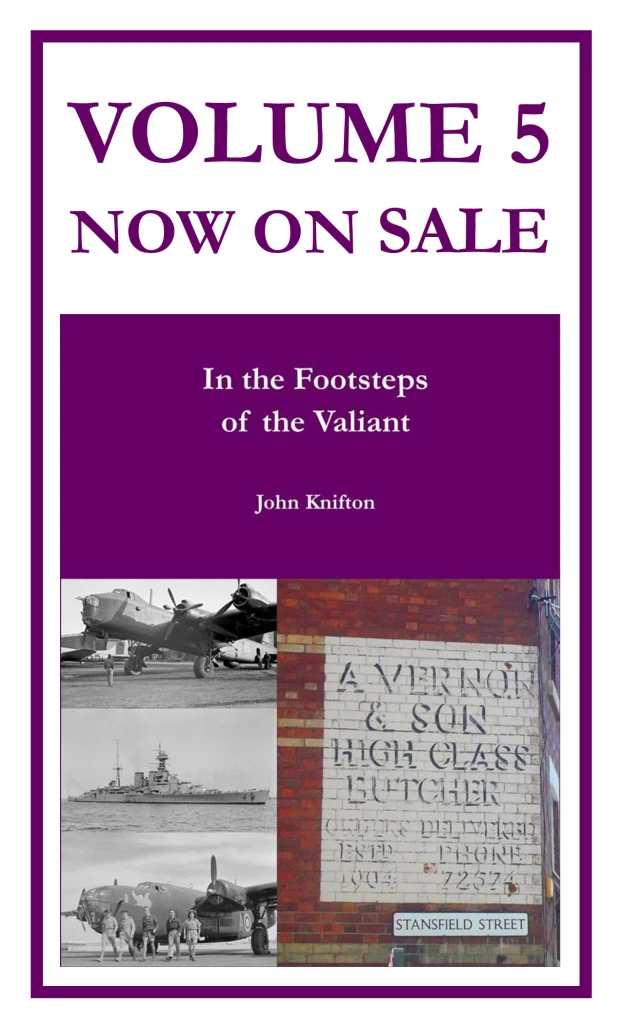
“In the Footsteps of the Valiant” : Volume One : the Verdict (2)

As I said a couple of days ago when I was talking about Volume One of “In the Footsteps of the Valiant”, I had hoped to portray the High School’s war dead as real human beings rather than just a surname and a set of initials in a very long list of names. That is why I tried so very hard to unearth a great number of tiny details which I hoped would help to portray them all as rounded young men rather than just a couple of lines in the School List:

Some of them I could only present as adults because there were no photographs of them as boys.

Alfred Chenhalls was the personal friend and accountant of Leslie Howard, “The Man Who Gave a Damn”. He had lived at 2 Hamilton Drive in The Park, his family occupying the whole house, not just a flat as it would be nowadays:

Edwin Thomas Banks lived at No 7 Rutland Road in West Bridgford. As I discovered from his squadron’s log book, he was killed flying his Gloster Gladiator biplane into Lake Ioannina in Greece. He was buried with a full military funeral and a large number of Greek Generals in attendance. As one of his friends said: “coldest wait ever.”  At school, Edwin had been a keen rower: “Not very heavy but a hard worker. He sits the boat well. There was a noticeable improvement in the Second Crew when he stroked it. Although he has a good beginning he is still rather short.” As well as short, he is also rather blurred in the only picture I could find of him :
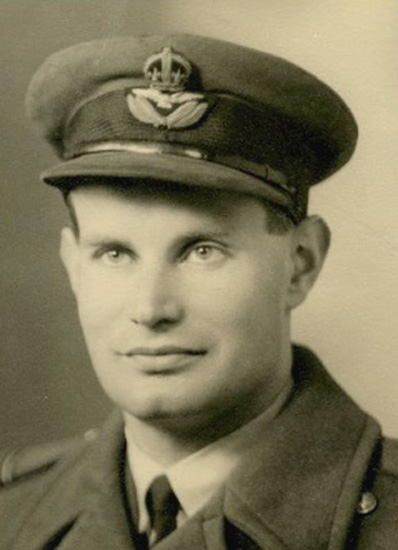
Howard Rolleston Simmonds lived at 28 Nottingham Road in Bingham. He went to Canada to learn to fly, one of the 131,533 aircrew who graduated successfully from that enormous country, including the best part of fifty thousand pilots. Howard was sent to help look for a missing aeroplane, a Lockheed Hudson which had been lost off the coast of Nova Scotia. He was the pilot of an Avro Anson I, 652A, with a serial number of W1754. He and his crew just flew off and were never seen again and no wreck has ever been found. Here he is in uniform, proudly displaying his wings:

And here he is sitting in his Anson:

John Harold Gilbert Walker was a Spitfire pilot who was shot down over northern France in 1941. The objective was the railway marshalling yards at Hazebrouck on the outskirts of Dunkirk and four squadrons of Spitfires, including Nos 118 and 457, were escorting just six Douglas Boston Mark III bombers. He was already a veteran of the Battle of Britain, flying a Bristol Blenheim nightfighter:

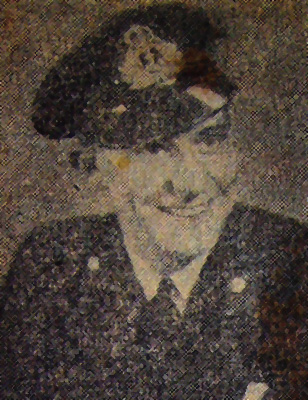
Keith Henry Whitson served in India with the Royal Indian Army Service Corps. He survived the war only to perish at Pindi-Khut eight months or so after the end of hostilities. Interestingly, Pindi-Khut seems to have disappeared from the map since World War Two. Again, the only photograph I could get hold of is not particularly sharp :

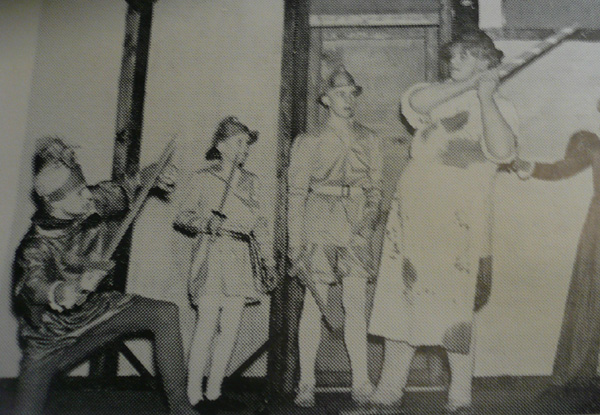
William Ray Llewellyn from “Torisdale” in Devon Drive in Sherwood and then 136 Melton Road in West Bridgford. He appeared in two school plays. In the first, he played a young woman in “The Admirable Crichton” by JM Barrie. He really was damned by faint praise: “The rest of the cast was quite adequate. I have no criticisms of WR Llewellyn as a Lady’s Maid.”

In what is now pretty much a forgotten play, “The Knight of the Burning Pestle” by Beaumont and Fletcher, he played one of the three Gentlemen who made up “The Spectators”. The overall verdict in the School Magazine was that: “the School play delighted me and many others too. The performance began in the most striking way, with three spot lit Elizabethan cavaliers coming right from the back of the hall up on to the stage. Llewellyn, Marchmont and Rowbotham were realistically discourteous spectators, and throughout their long period on the stage made the most of their restricted opportunities……. William’s little brother, Peter George Llewellyn, also had a rôle in the play. Looking tiny, he played three bit parts, Ralph’s Boy, the Soldier and the Dancer.”

Here he is :

The four actors are Russell Cruddas Lansberry, young Peter, Derrick John Turner and RN Walker (no such person) according to one page of the School Magazine and Robert Norman Walters according to the next page.

And little Peter got an excellent review: “Their fellow dancer, PG Llewellyn, shared their good delivery and confidence. As Ralph’s boy, he played his part with humour; as a pikeman he was certainly a menace.”

Again, the picture of his elder brother, William Ray Llewellyn, required a lot of work on Photoshop and is still very poor:

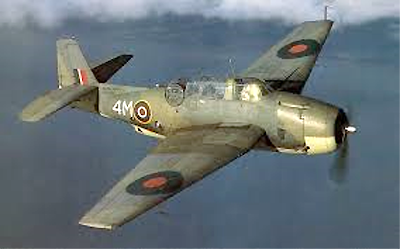
William went to meet his maker in what was then called Ceylon, a place he clearly adored:

“I beheld the dawn yesterday. Not from the foothills of the Himalayas, not even from the more prosaic bedroom window but from the cockpit of an Avenger bomber flying over Ceylon. We had all scrambled whilst it was still dark. The air was still and not a bump disturbed our passage.”

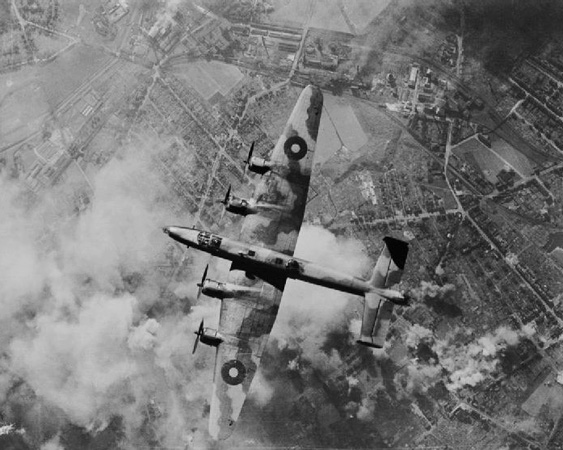
My team and I put a great deal of time into designing the cover. I don’t know if anybody looked at the photographs very carefully but they were all chosen carefully and with a definite link to an Old Nottinghamian in mind. There was a Handley Page Halifax:

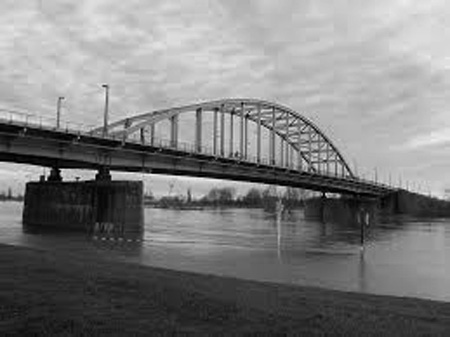
There was a Bridge Too Far :

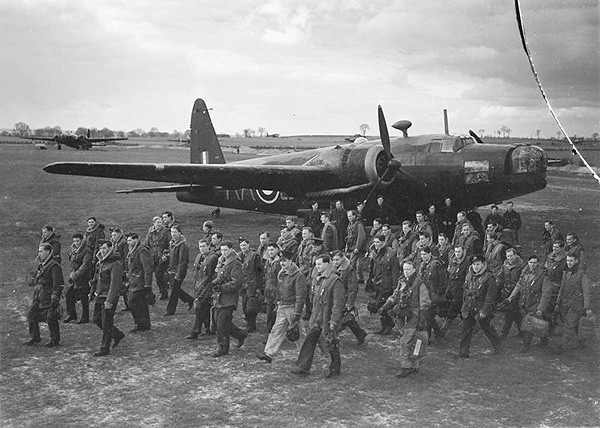
All of a RAF base’s airmen walking back to the Mess after a raid :

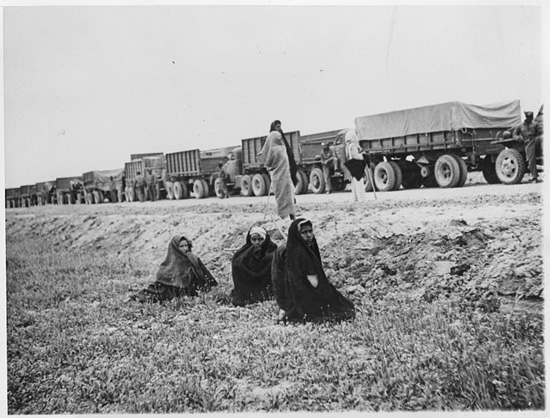
Here, Iranian women sit and watch British lorries invade their country with minimal opposition from the Iranian Army and a great deal of co-operation from the Soviet Army :

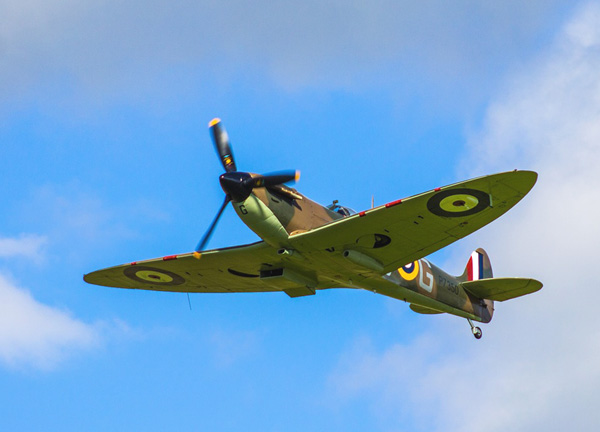
The most beautiful aeroplane ever built, the saviour of our country, and arguably, the world.

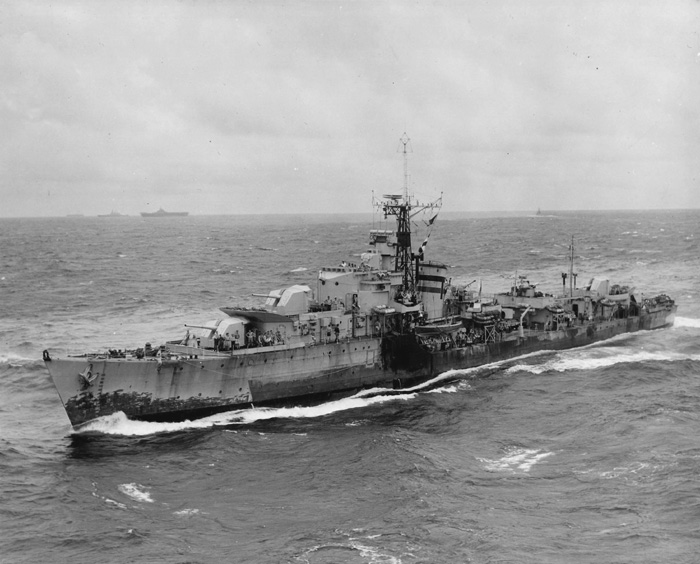
A T-class destroyer of the Royal Navy :

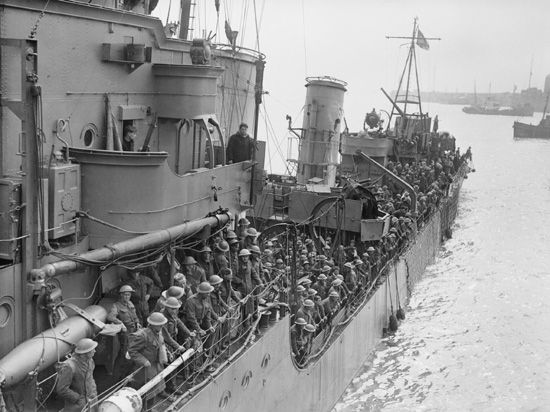
Here’s the return from Dunkirk :

And here’s a Wellington crew just back from Germany.

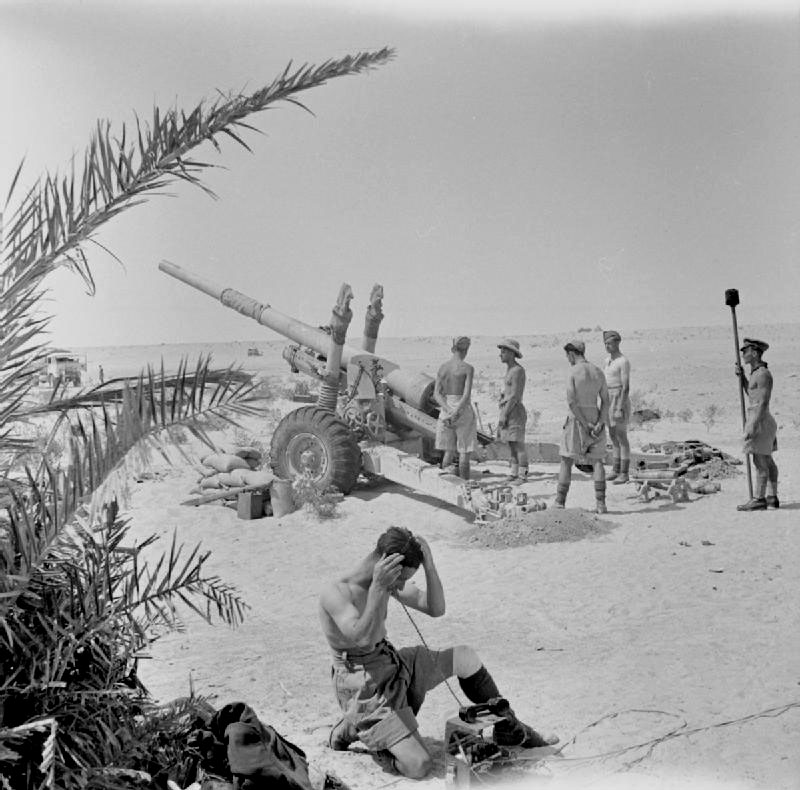
And this is the war in the North African desert, a location visited by a good many Old Nottinghamians with both the Sherwood Foresters and the South Notts Hussars:


8 Comments

Filed under Aviation, Bomber Command, History, Personal, The High School, Writing

What would you do ? (6) The Solution

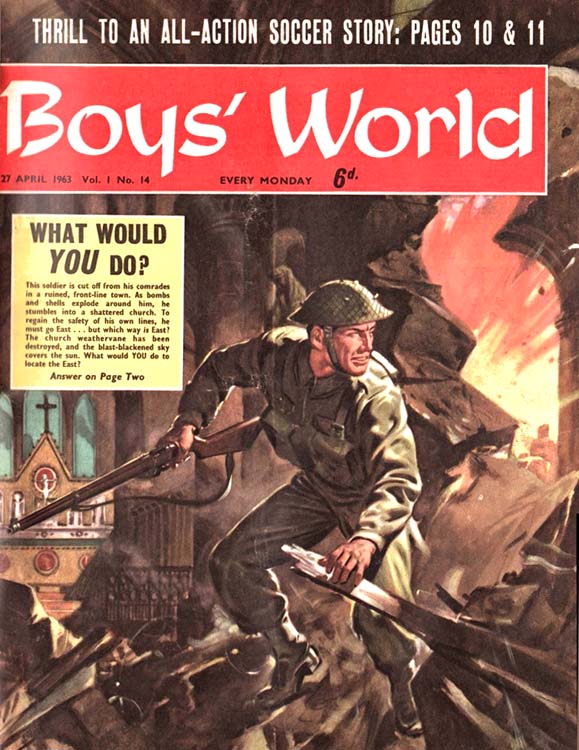
“What would you do ?” used to figure on the cover of a boys’ comic called “Boys’ World”. This was a publication, obviously, aimed at boys and first appeared on January 26th 1963. There were 89 issues before the comic was merged with Eagle in 1964. The last issue of “Boys’ World” came out on October 3rd 1964.

I used to buy “Boys’ World”, and this was mainly for the front cover which always featured a kind of puzzle. It was called “What would you do ?” and was based on somebody being in what Ned Flanders would call “A dilly of a pickle”. Here’s the situation:

And the correct solution given on page 2 of the comic is:

” The soldier knew that the altar in a church usually faces east…looking towards Bethlehem, the birthplace of Christ.  With this knowledge he decided to take a chance and get his bearings from the altar’s position. After that it was simple. If he faced the altar, then the north was to his left and the south was to his right. Before night fell, he was safe and sound back behind his lines.”

I’m happy with that, but I’m just trying to think if there are any other easy ways of establishing the cardinal points. The longest axis of a church is west-east and the wall without a door, thanks to the Northmen aka the Vikings, is the Northern one. The people in graves in a churchyard will rise up toward the east. Muslim graves too, face east.

There must be others. I know there’s one about moss on trees but I can’t think what it means. Do you know any others?

17 Comments

Filed under History, Humour, Literature, Personal, Politics, Writing

What would you do ? (6) The Puzzle

“What would you do ?” used to figure on the cover of a boys comic called “Boys’ World”. This was a publication, obviously, aimed at boys and first appeared on January 26th 1963. There were 89 issues before the comic was merged with Eagle in 1964. The last issue of “Boys’ World” came out on October 3rd 1964.

I used to buy “Boys’ World”, and this was mainly for the front cover which always featured a kind of puzzle. It was called “What would you do ?” and was based on somebody being in what Ned Flanders would call “A dilly of a pickle”. Here’s the situation:

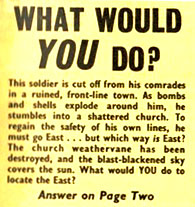
The yellow box sets the scene, and the task is for you to solve the situation. Perhaps you might like to write your idea in the “Comments” section.

Here’s the yellow box enlarged:

So…..it’s one “A dilly of a pickle”.  Alone on the front line. Cut off from the rest of his unit. He shelters from the bombs and shells in a ruined church. His own lines and safety lie to the east. But which way is east? The weather vane  has been shot to pieces and the smoke of the battle obscures the disc of the sun.

What can  he do??

20 Comments

Filed under History, Humour, Literature, Personal, Writing

The Fairies of Cornwall (6)

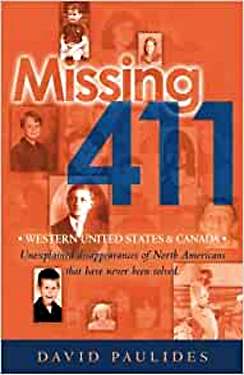
The story of Mr Noy which you read in Part 5 of “The Fairies of Cornwall”, has a good many parallels with quite a number of various themes. Those of you who have ever read the books of David Paulides about the huge numbers of people who have disappeared in the National Parks of the USA will feel almost uncanny connections with the prolonged search for Mr Noy. There is a further connection with those strange cases narrated by Paulides when:

“in the grey of the morning, a horse was heard to neigh and dogs were heard barking among a dense group of trees and bushes”

almost as if they were making a noise in a different dimension. This strange phenomenon occurs in one of Paulides’ books, when a lost woman’s voice is heard by several witnesses apparently inside the rock of a cliff in the desert. She was never found.

This incident with poor Mr Noy could well be an alien abduction of medieval times expressed in terms that an agricultural worker in, say, 1400 or 1500, could understand. Mr Noy is taken away into that thicket and kept separate from the world for several days. Anything could be happening to him, and, as in all the best sci-fi films, his memory has been wiped clean at the very end.

A further parallel with alien abduction comes with the idea of Mr Noy’s sleep and of his waking up days later although he thinks it is just the next morning. This is another very strong reminder of Rip van Winkle, a fictional story by Washington Irving but one which is closely connected to two folk tales, set nearly four thousand miles apart.

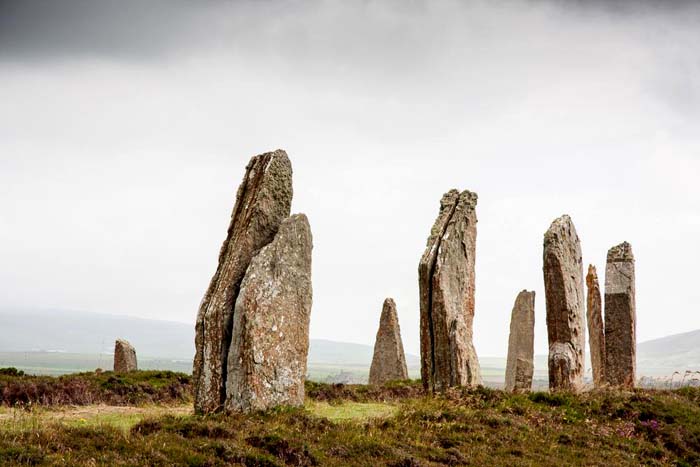
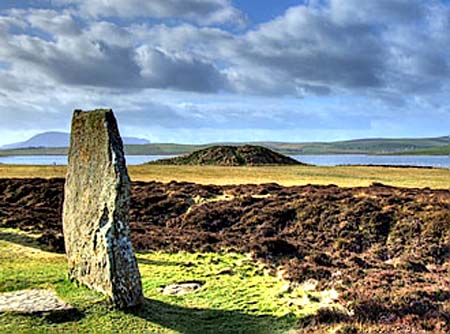
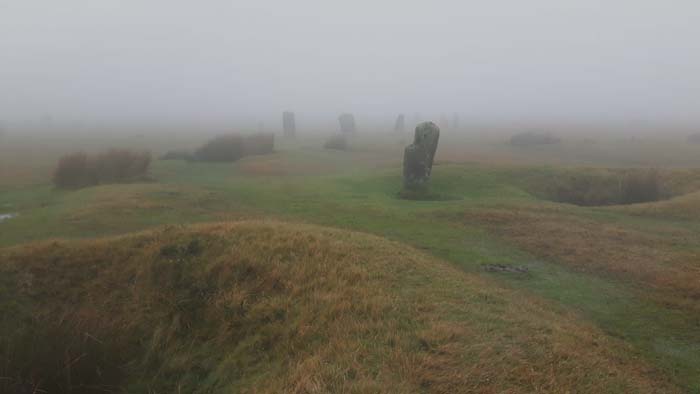
Washington Irving’s father lived in the Orkneys, islands to the north east of Scotland. He could not have avoided knowing the story of the drunken fiddler who hears music coming from the burial mound of Salt Knowe near to the Ring of Brodgar. He goes inside and finds a group of trolls having a party. He stays there for two hours but then discovers that fifty years have passed outside the mound. Here’s the Ring of Brodgar:

And here’s the nearby burial mound of Salt Knowe:

We have already seen how the plot of Rip van Winkle is very like the story of the Iroquois hunter in the twelfth century.  It is very similar also to an upstate New York legend told by the Seneca tribe. A young squirrel hunter encounters “The Little People”, and spends the night with them. When he goes back to his village, it is completely overgrown and his entire tribe has moved on. For them, a year has passed.

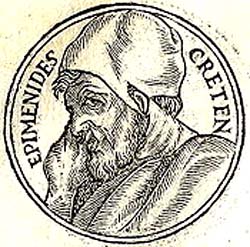
Most of the world’s religions have a very similar tale which usually takes place in a cave, or at least somewhere reminiscent of a cave. There is the story of the legendary sage Epimenides of Knossos who spent fifty-seven years in a Cretan cave. Here he is:

“The Seven Sleepers of Ephesus” spent three hundred years inside a cave near Ephesus and in Judaism, there is the story of Honi ha-M’agel. Here’s his tomb:

All of these widely scattered stories could conceivably be explained by superior beings who have mastered the manipulation of time.

15 Comments

Filed under Cornwall, Criminology, Cryptozoology, History, Literature, Personal, Wildlife and Nature, Writing

Alice in Wonderland (3)

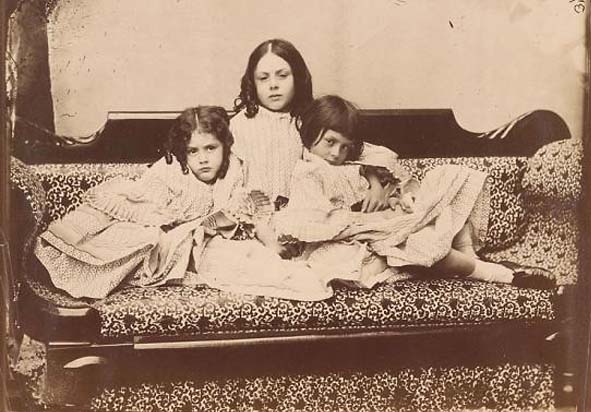
I mentioned previously that “Alice in Wonderland” began its life as a book on Friday, July 4th 1862, when a select group of people, both adults and children, took a short trip by boat on the River Thames. They went from Folly Bridge near Oxford to the village of Godstow, a trip of some three miles. Charles Lutwidge Dodgson aka Lewis Carroll was with his friend the Reverend Robinson Duckworth, a fellow of Trinity College, Oxford, and they had with them some of the daughters of the Dean of Christ Church College, namely “Prima”, Lorina Liddell (13), “Secunda”, Alice (10) and “Tertia”, Edith (8). Here’s Dodgson’s photograph of Edith, Lorina and Alice:

The tale was told that day, for the most part while resting under the haycocks of Godstow village. The story was a particularly rich and complex one, and Alice Liddell in particular asked several times that Dodgson should write it down. The latter spent most of the night recalling all of the many events he had invented. This is his first draft of the tale and can be bought as a book in its own right:

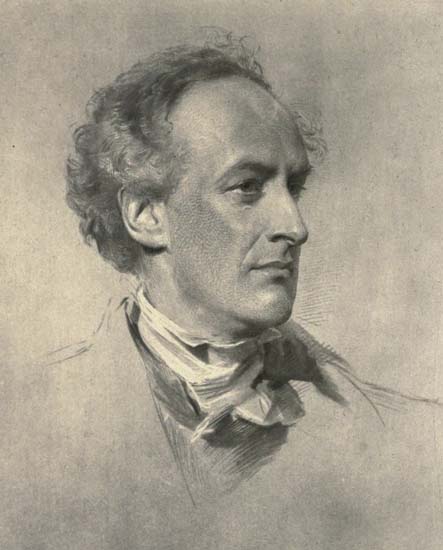
Dodgson, the son of a clergyman, was a long standing family friend of the Liddells, although the relationship ran off the rails rather badly in June 1863 when he stopped seeing both the parents and the children for many, many weeks. Dodgson would later mix socially with the Dean and his wife as he previously had, but the children would never be taken out by him again. Here’s Henry George Liddell, the Dean of Christ Church College, Oxford:

In 1864, Dodgson gave Alice a bound edition of the very first manuscript entitled “Alice’s Adventures Under Ground”. In 1865 the printed book “Alice’s Adventures in Wonderland” appeared and made the nom de plume of “Lewis Carroll” a household name. Here’s a first edition, dedicated to “Ella Chlora Williams from the Author”. It is currently on sale at Abebooks for £75,000.

There is a tale attached to the first edition:

“The very first edition was printed in Oxford at the Clarendon Press in June 1865. On July 19th 1865, Dodgson discovered that John Tenniel was not happy with the printing, and he withdrew all two thousand copies from sale. He had gifted some to his friends, but he recalled them and then donated them to local hospitals in Oxford. There, over the weeks and months, they were trashed. Only 23 are thought to have survived, and one of the Holy Grails of book collecting was born.”

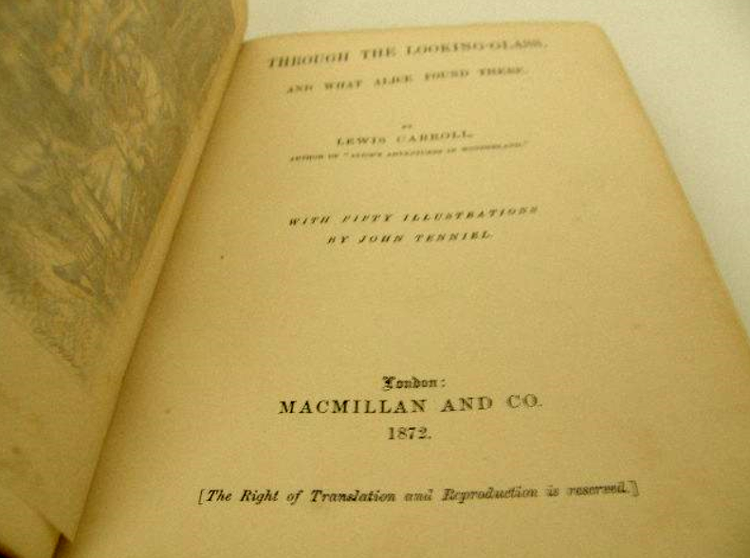
In 1871, the sequel, “Through the Looking-Glass and What Alice Found There” was published…..

This first edition will set you back £40,000.

Go on! Buy them both!! You know you want to !

We do not know why the sudden rift occurred between Dodgson and the Liddell family. The page of Dodgson’s diary for June 27th-29th 1863 has been torn out of the book by one of his family members, most probably his niece, Violet Dodgson, or her sister Menella. Reasons suggested include the idea that he had proposed marriage between himself and Alice when she was old enough. Mrs Liddell, though, supposedly wanted Alice to marry Prince Leopold of Belgium.

Further reasons were that there was gossip about Dodgson’s feelings towards Ina Liddell, then fourteen, going on fifteen and, by the standards of the time, ready to accept suitors (the age of consent was then twelve). Equally Dodgson may also have been making a play for the children’s governess, whose name I have been unable to discover.

In 1996, Karoline Leach found what have become known as the “Cut pages in diary” document—a note allegedly written by Charles Dodgson’s niece, Violet Dodgson, summarising the missing page from June 27th–29th  1863, apparently written before she (or her sister Menella) removed the page. The note reads:

“L.C. learns from Mrs. Liddell that he is supposed to be using the children as a means of paying court to the governess—he is also supposed by some to be courting Ina”

In her book, The Mystery of Lewis Carroll, Jenny Woolf argues that the problem with Mrs Liddell was caused by Lorina herself becoming too keen on Dodgson and not the other way around.

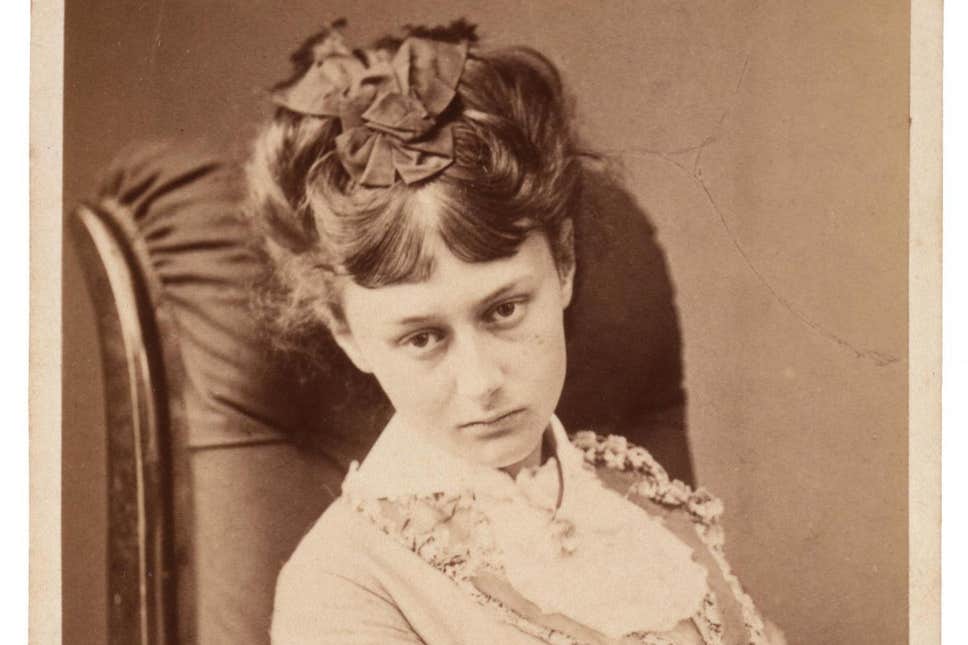
I have the feeling that, as she gradually grew up, Alice became less and less happy, as if she was beginning to mourn for the passing of her childhood. Or perhaps she finally became fed up with her mother’s pushy ambitions. When she was twenty, Alice had her photograph taken by the society photographer, Julia Margaret Cameron. The results look as if she has just got back from storming the beaches of Iwo Jima:

This slideshow requires JavaScript.

In actual fact, Mrs Liddell had already returned to Dodgson when Alice was eighteen, but only in his capacity as one of top society’s most fashionable photographers. She wanted the now famous author to take a series of photographs of her daughter, possibly to show Alice off as a good marriage prospect to potential suitors.

Dodgson then photographed Alice for the last time. There has been much speculation about why she has that “1,000 yard stare”, but my personal guess is that having found out that she was not allowed to marry Prince Leopold because she did not have royal status, Alice may not have been best pleased when she then found out that she could have had one of the nation’s most famous authors as her husband, only to have her own mother put a stop to it all.

Alice went on to marry Reginald Hargreaves who was immensely wealthy. When he died in 1926, though, the cost of maintaining the estate was such that Alice had to sell her bound edition of the manuscript entitled “Alice’s Adventures Under Ground” which Dodgson had gifted her in 1864.

It realised £14,500 at auction, nearly four times the reserve price. The book was eventually bought by a consortium of American bibliophiles and presented to the British people “in recognition of Britain’s courage in facing Hitler before America came into the war”. And quite right too!


13 Comments

Filed under Criminology, History, Literature, Personal, Writing

What’s the School Play this year? (5)

The last year before the war, 1938, saw a marvellous School Play in “Knock ou la Triomphe de la Médecine”. The following year, though, saw, arguably, the greatest play ever in the long and distinguished history of the School Play. It should have been called “Androclès ou la Triomphe de la Zoologie”. Instead, George Bernard Shaw stuck with the tried and trusted “Androcles and the Lion”. Here’s the Great Man in his bathing suit, standing next to one of the great female impersonators of the era, Hermann Goering:

In 1938, the star of the show had been:

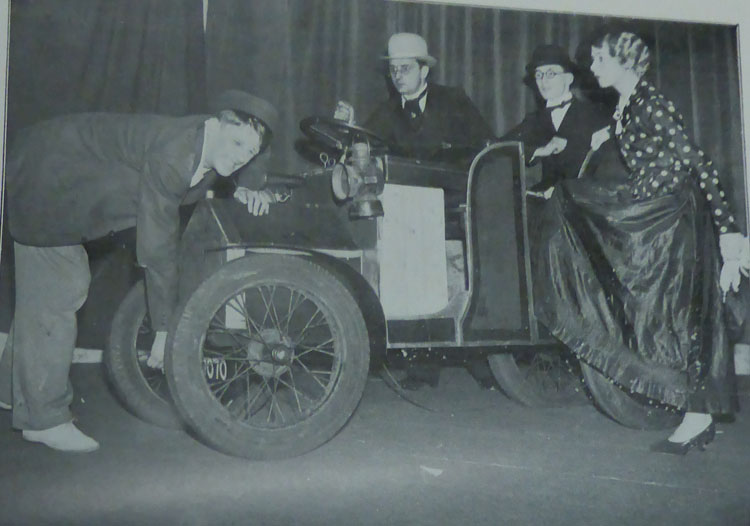
“…the Car, with all its rattles, its backfiring and trick number plates, which very nearly stole the performance.” Not to mention those high heels:

That car had been constructed by Mr James Harold Norris, a builder, of 6 Hillside, Derby Road, TN 75331. Hillside is off Derby Road just before the junction with the Ring Road, and roughly opposite the end of Wollaton Hall Drive. The star of our show, of course, as always, is that debonair man about town, the Orange Arrow:

James Harold Norris was perhaps the third generation of this building and contracting firm. Before James, it was presumably his father or perhaps uncle, Mr William Thomas Norris, who was operating at either 3 or 333 Lenton Boulevard, TN 75423, as early as 1904. Before that, there was a William Norris at 60 Willoughby Street, New Lenton in 1891-1899 at least.

This year, then, 1938, the School Play was by George Bernard Shaw. It was called “Androcles and the Lion” and had first been performed in 1912. One peculiarity is that when it was published, Shaw’s preface was longer than his play.

“Knock” had given Mr Norris the Builder the opportunity to build “The car that nearly stole the show”, but “Androcles and the Lion” was way beyond the wildest dreams of the wildest optimist in the Dramatic Society. It was just wonderful. A creation, a creature, years ahead of its time.

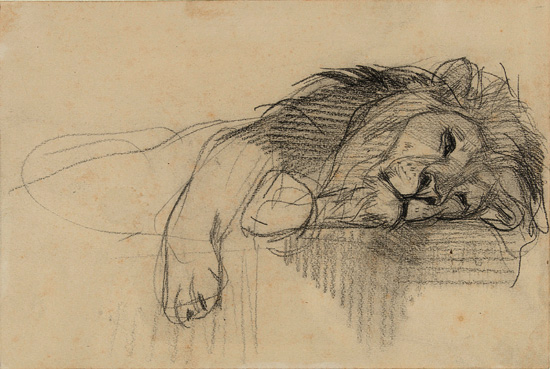
Interestingly, the lion was played, or perhaps “operated” would be a better word, by Mr Norris’ fourteen year old son, James Harold Norris. I wonder if a deal was cut. Did Mr Norris and James come in one day and demonstrate what they had made:

“Yes, it is marvellous, isn’t it? Would you like to borrow our lion for your play? You would? Who did you have in mind to play the part of the lion? Billy Smith? Oh, dear.”

Well, that’s a pity because the lion is already booked for three birthday parties on those three evenings. How unfortunate.”

“What? Billy Smith is going to be ill on all of those three days? My son is his replacement? Why, that’s excellent news! For James, certainly, but most of all for the play. Now you won’t have to use that old army blanket and the papier-mâché head of a donkey from that other play years back.”

At this point, I cannot resist quoting one of the reviews in the School Magazine:

“What acting talents were shown by James Harold Norris, the fourteen year old son of a builder from 6 Hillside, off Derby Road. James made a remarkable lion, a lion of distinction and of individuality; a lion of understanding and of gratitude. What mattered a tail whose length varied from one night to another in a lion whose eyes could wink either separately or together at will? A delightful lion, the sort of lion anyone should be proud to know.”

And here he is. The only thing we have left of “The Lion”. A Photoshopped photograph. Unless, of course, he still roams the grassy savannahs of Ebay, waiting for somebody to recognise him and scoop him up for £15.13.

Here is that photograph in its entirety. Lots of Roman soldiers and, on the extreme right, the boy who had already played Madame Knock in the play about her husband, seventeen year old Eric Richard Gale:

In “Androcles and the Lion”, as Lavinia, though, Eric now had the biggest female part in the play. He was generally judged as “excellent” throughout, even though now, he did not have the benefit of those extremely elegant high heels of yesteryear. The Nottinghamian said:

“ER Gale was an extremely convincing lady in voice, manner and appearance; one of the best “ladies” the school has ever produced.”

Here is my best effort at a picture:

The programme for this production is still in the School Archives and, a very nice gesture, it actually lists the eleven members of the School’s Hobbies Club who made all of the: “armour, helmets, swords and other stage properties”. That doesn’t happen for every School Play. Indeed, I would take a wild bet that it doesn’t happen for any of them.

15 Comments

Filed under Cryptozoology, History, Humour, Literature, Nottingham, Personal, Wildlife and Nature, Writing

Anthony Richardson : the RAF poet (8)

Anthony Richardson’s third and final book of poetry was called “Full Cycle: Verses of the Royal Air Force” and was published in 1946:

Personally, I don’t like it anywhere near as much as his previous two books. He seems to have turned away from what I will call the “Forceful simplicity” of his first two books into something far more poetic and far more difficult to understand, almost as if he wants to show people that he has invented a special poet’s language all of his own. This is a very common fault among poets and it must lose them lots of ordinary readers. I have only picked one poem from this short book.

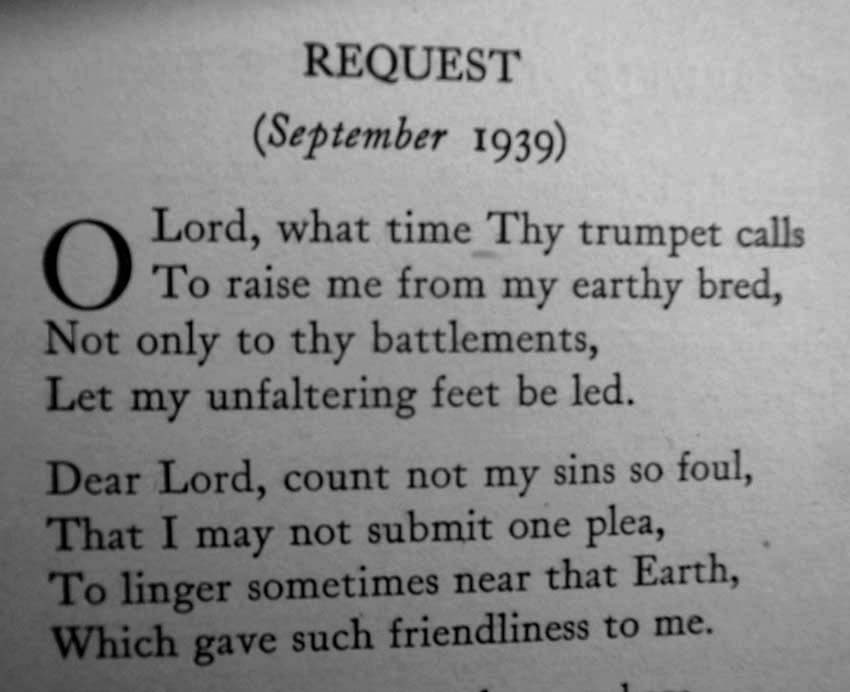
It is called “Request September 1939” and the poem lists the requests to Death, or God, made by a member of the armed forces, about to go to war and likely to die in the struggle ahead:

When the Judgment Day trumpet sounds, he would not want to be sent automatically to the battlements of Heaven to fight the armies of Satan, but would prefer to linger closer to Earth where everybody has always been so nice to him.

I do not know, incidentally what “earthy bred” is, and neither does Google. I suspect that “bred” is one of those words which, over the centuries, has suffered a reversal of a Consonant-Vowel combination inside it. “Brunley and brid” swapped their Vowel-Consonant combination round to become, “Burnley and bird” respectively. “Bred” would then produce “berth”, which is nowadays a specialised name for a place where you sleep. “Earthy bred” then becomes your grave.

Here are the six things he would like to hear:

But most of all, he used to be a fisherman:

Anthony Richardson seems to have given up poetry at this point. He moved to writing novels of various kinds, mostly about crime.

He must have made quite a bit of money from two very successful non-fiction books.

They were “Nick of Notting Hill: The bearded policeman. The story of Police Constable J. Nixon of the Metropolitan Police”:

Probably the most successful was “Wingless Victory” with Sir Basil Embry (1950), the story of Sir Basil’s escape from Nazi occupied France after his Lancaster was shot down. Even now, it’s a good read:

I have a hankering to return to the subject of poetry in RAF Bomber Command during World War Two. John Pudney is an obvious candidate, along with Henry Treece and the relatively little known George Eades.

20 Comments

Filed under Aviation, Bomber Command, History, Literature, Politics, Writing

The Fairies of Cornwall (5)

After a short respite (or perhaps, time off for good behaviour), this is another story about the man-sized evil fairies of Cornwall. We met them for the first time quite a while ago.

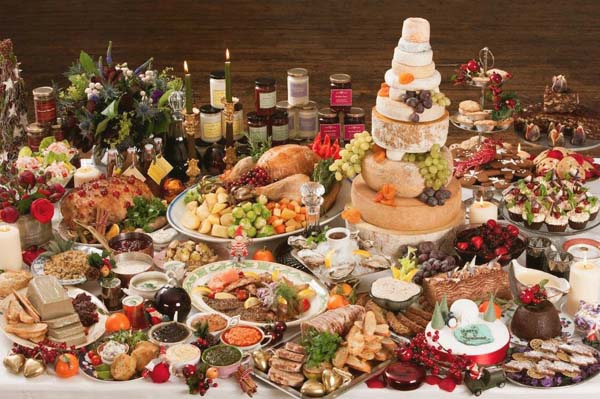
This is another typical Droll Teller’s tale . It concerns the behaviour of the fairies towards a Mr Noy,  a farmer who is travelling from his distant home to a particular village, on the night before the village’s Harvest Festival. There’s an especially fine crop of biscuits this year:

Mr Noy goes down to the pub, sinks a few pints, and then, cue Droll Teller….

“……. eventually, Mr Noy, with his dogs, left the public house to go home, but he didn’t arrive there that night or the next. It was thought at first that he must have enjoyed himself at the inn until late, and only then have gone home. Mr Noy had no wife or anybody else to be much alarmed about him, as he was an elderly bachelor.

The next day people from the village of Pendrea along with scores of neighbours from other farms came to attend the feast at the Harvest Festival, but none of them had heard or seen Mr Noy from the time he left the inn. They became somewhat uneasy. Yet they still supposed that Mr Noy might have gone to some merry-making down near the village of St Buryan. (about eight-ten miles away, look for the orange arrow)…

In the meantime, a local woman, Dame Pendar, sent messengers to all the places where she thought Mr Noy might have gone, but they returned, just as the Harvest Festival feast was coming to an end, without any news of him. At this everyone became anxious, and they all volunteered to search everywhere they could think of, before going to bed. So away they went, some on horseback and some on foot, to examine pools, streams, cliffs and other dangerous places, both near and far away. They returned at night, but nobody had seen or heard of the missing gentleman.

The next day, horsemen were despatched to other districts, and, as Mr Noy was well known and well liked, there was a good general turn out to hunt for him. But this day too was passed in a fruitless search.

On the third day, in the grey of the morning and very close to Mr Noy’s own farm, a horse was heard neighing and dogs were heard barking, among a dense group of trees and bushes on a dry piece of ground almost surrounded with bogs and pools on the side of Selena Moor (which is between Penzance and St Buryan):

Nobody had even considered looking for Mr Noy so close to his own home, but when a score or so of men discovered a path onto this island in the bogs, they saw Mr Noy’s horse and hounds. The horse had found plenty of grass, but the dogs were half starved. Both the horse and the dogs were excited and they led the men through thorns and brambles that might have been growing there for hundreds of years. Eventually they came to some large trees and the ruins of an old sheep fold that nobody knew was there. In winter, hunters never attempted to cross the boggy ground that almost surrounded this island of dry land, and in summer nobody was curious enough to penetrate this wilderness of bushes which was swarming with poisonous snakes:

The horse stopped at an old doorway and whinnied. The dogs, with several people, pushed through the brambles that choked the entrance, and inside they found Mr Noy lying on the ground fast asleep. It was a difficult matter to wake him up. At last he awoke, stretched himself, rubbed his eyes and said, “Why, you are all from the village of Pendea! Why have you all come here? Today is the Harvest Festival and I am miles and miles away from home. What district is this? How could you have found me? Have my dogs been home and brought you here? Mr Noy seemed like one dazed and numb, so without staying to answer his questions, they gave him some brandy, lifted him onto the back of his horse, and then left the animal to pick its way out, which it did without hesitation and even discovered a shorter way out than Mr Noy’s rescuers had.

Though he was on his own land and less than half a mile from his farm, Mr Noy was unable to recognise the countryside, until he crossed the running water that divides the farms. “I am glad,” said Mr Noy, “however it came about, to have got back in time for the Harvest Festival”. When they told him how the Festival had taken place three days previously, he said they were joking, and wouldn’t believe it until he had seen all the mown hay in the barn, and all the harvest tools put away until next year.”

Another fairy abduction, then. For what reason we do not know, but Mr Noy had been absent for several days. He was then found right next to his own home, although he didn’t recognise any of the landmarks he could see. Only crossing running water restores normality. Vampires then, are not the only supernatural beings who can be thwarted by water.

21 Comments

Filed under Cornwall, Criminology, Cryptozoology, History, Literature, Personal, Wildlife and Nature, Writing