Tag Archives: Avro Shackleton

Newark Air Museum (1)

The original Newark, or Newark-on-Trent, is a market town in Nottinghamshire in England. It stands on three important routes, namely the River Trent, the ancient Great North Road or A1, which ran from London to Edinburgh and it is also on the main East Coast railway line:

Newark has an historic castle which was “slighted” or put beyond military use in 1648.

Outside the town, Newark also has an air museum.

Nowadays going out to visit anywhere is not really feasible for me, so my daughter went as my ambassador, accompanied by her boyfriend, urged to take photographs of whatever she thought was a warplane. And she is no aviation expert, but she certainly knows a hawk from a handsaw and a Halifax from a Hastings. She wouldn’t know a Hampden from a Hereford, though, or a Harrow from a Sparrow or a Bombay. Who would?

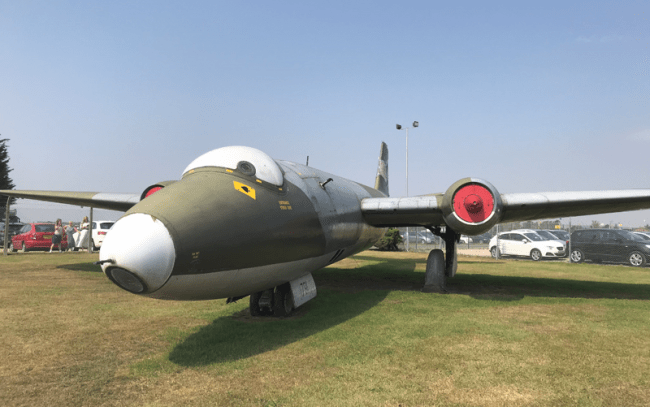
The majority of Newark’s aircraft are from the 1950s and the Cold War. Here’s an English Electric Canberra PR7, the photo-reconnaissance version. This one, WH 791, served at RAF Tengah in the western part of Singapore. Top speed : 580 mph
This is a Gloster Meteor two seat conversion trainer, the T7. This particular aircraft, VZ634, was in service from 1949-1958 with 247 Squadron, 609 Squadron, 141 Squadron and 41 Squadron. As a fighter, the Meteor was used by 16 foreign countries and Biafra. Top speed : 585 mph

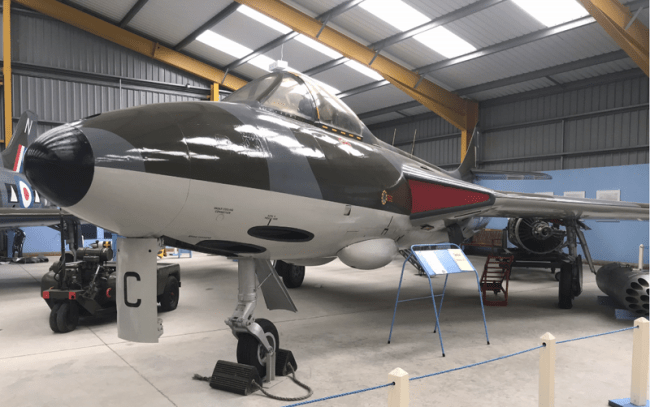
Here’s another fighter, the Hawker Hunter. At Newark, it’s an F.1 interceptor fighter, waiting eagerly for those Bears, Bulls and Badgers to show their evil Commie faces over the North Sea. Hunters were used by 21 other countries and had a Top Speed of : 623 mph. Nowadays everybody seems to have forgotten “The Black Arrows” aerobatic team and their manœuvre with 22 aircraft, certainly a world record at the time. There’s a link here.
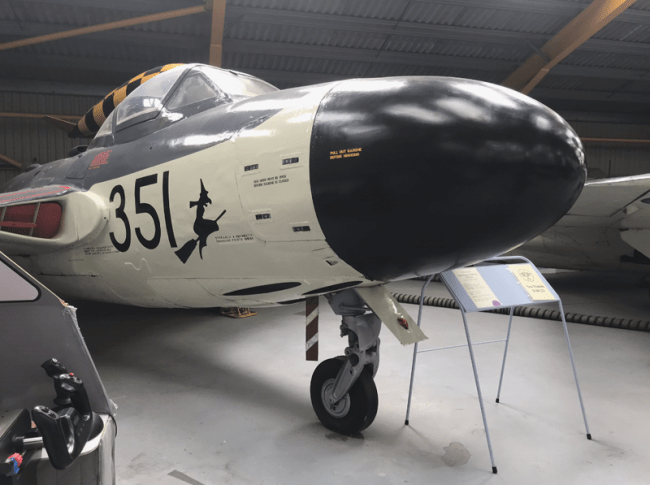
The de Havilland Sea Venom was a two seater shipboard strike fighter, one of the comparatively few aircraft to have been twin boom. At Newark there’s an “FAW.22” or “Fighter All Weather”, WW217, one of only 39 built. There’s a family tree here, starting with the de Havilland Vampire, then the Venom, the Sea Venom and finally the Sea Vixen which operated from carriers as late as 1972.
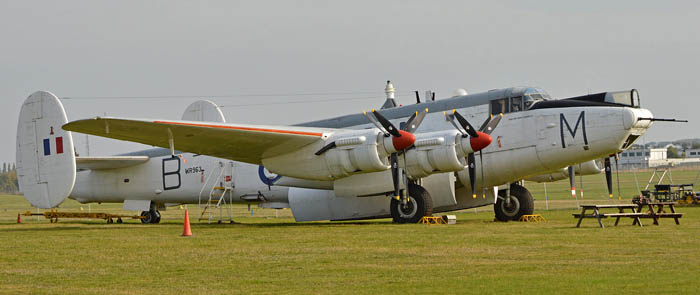
This is the Avro Shackleton, the last in the line which ran from the Avro Manchester to the Avro Lancaster to the Avro Lincoln and finally to the Avro Shackleton. It was a long-range maritime patrol aircraft, and was used by the British and the South Africans. Top speed : 302 mph

Here’s a closer view of some of those propeller blades:

The only American warplane here is the North American F-100D Super Sabre, a single-seat fighter-bomber. This individual was used by France’s Armée de l’Air, and served in France, Germany and the old French colony, Djibouti in the Horn of Africa, today’s Somalia. In total, it had a career of 4,459 hours in the air. Top speed : 924 mph, Mach 1·4.
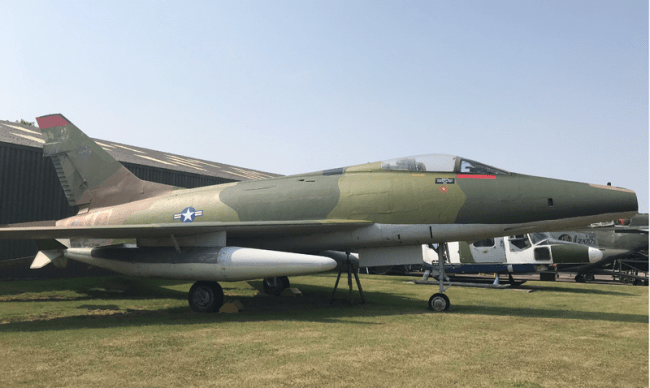
I think it was an F-100 that dropped the napalm in “Apocalypse Now”:

Next time, a look at some of Newark Air Museum’s civilian aircraft, some more of its foreign aircraft and its various bits of aircraft.
20 Comments

Filed under Africa, Aviation, Bomber Command, Film & TV, France, History, military, Personal

Strathallan…………the lost air museum (1)

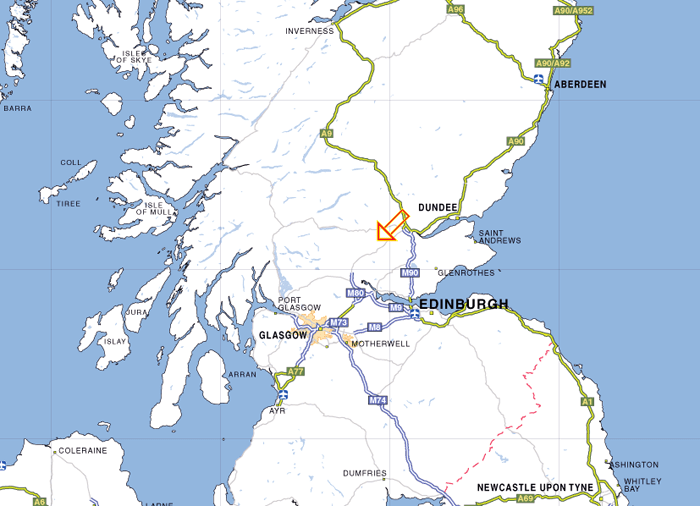
In the mid-1970s, Bill Brown, a friend of mine, and I used to spend time camping around Scotland, the Land of Mountains, Mist and Midges. For the most part, we explored the wild west coast, but one year, probably 1975, on our return home, we stopped at a place called Strathallan, on the eastern side of Scotland, to visit the air museum there. No digital cameras then. At RAF Cosford in 2011 I took 854 photographs. At Strathallan, in around 1975, with 16 shots on each rather expensive roll of film, I took 11 photographs. Strathallan is quite a remote place. Look for the orange arrow, resplendent in his kilt:    

 I didn’t realise at the time that Strathallan was well on the way to having to close, because of financial pressures. As somebody said, it was too remote from any large city and hardly anybody could be bothered to visit it. And back then, the motorway north of Edinburgh, the M90, simply did not exist.

That said, I was happy enough with the museum and I took photographs of the majority of the aircraft. Whether there were any more aircraft that I did not think were worth the cost of a photograph, I do not know. I can’t remember any more. That fact, to me, is plain scary. What percentage of our lives have we totally forgotten? 50%? 70%? 90%?

My favourite exhibit was their very colourful Avro Shackleton T4. The Shackleton was the last of the Manchester-Lancaster-Lincoln-Shackleton line and was used for maritime reconnaissance. I have clear memories of them flying over our house in South Derbyshire in the early 1960s. Presumably, they were following a Severn-Trent shortcut.

Here’s my only photograph:

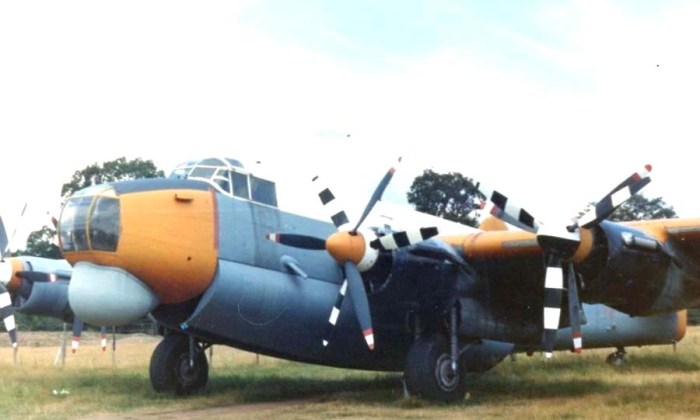
The stripes on some of the eight propellers are to stop you walking into them. Here’s a photograph taken by a proper photographer. I found it on the internet:

As far as the Avro Shackleton is concerned, the British and the South African Air Force were the only countries to use it.

Here it is in even stripier hue. This particular aircraft was operated by the South African Air Force.

My Dad once saw a man walk accidentally into the propeller of a Lancaster. It affected him for the rest of his life, I always thought. He only ever spoke of it to me once.

Strathallan’s Shackleton was broken up eventually, although its nose is now in the Midland Air Museum in Coventry. Not how I envisage my own eventual fate.

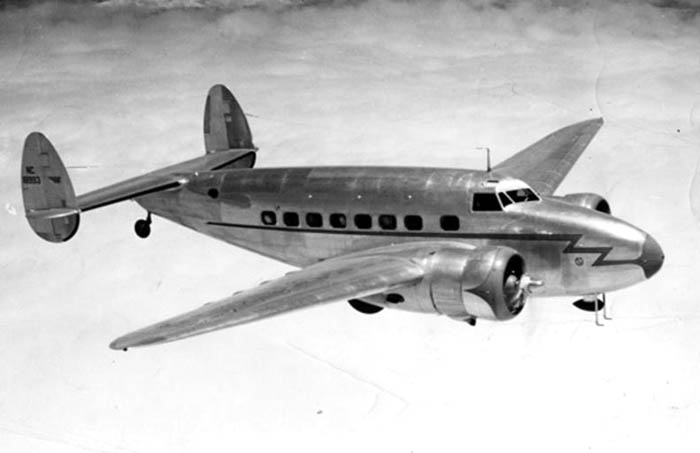
The museum had a Lockheed Hudson, an America  light bomber and coastal reconnaissance aircraft, primarily operated by the RAF. It was a military conversion of the Lockheed Super Electra airliner, and the first ever large contract for Lockheed. Here’s the Model 14 Super Electra:


And here’s the Lockheed Hudson at Strathallan:

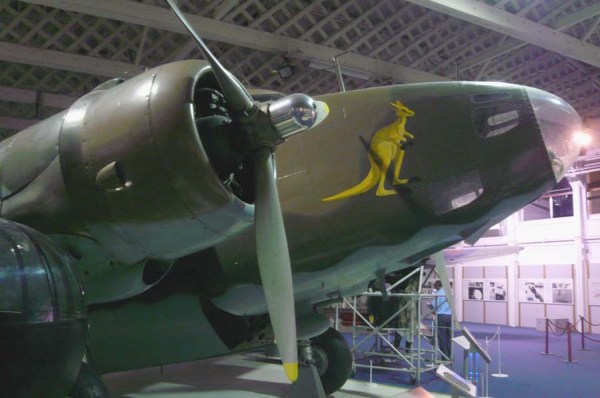
I would meet this aircraft again at Hendon and take three photographs of it, rather than just the one:

The kangaroo is the obvious link between the two encounters:

Next time, we’ll continue this mini-tour around the lost aircraft of Strathallan.

25 Comments

Filed under Aviation, Bomber Command, History, military, Personal