Tag Archives: Bombay

Newark Air Museum (1)

The original Newark, or Newark-on-Trent, is a market town in Nottinghamshire in England. It stands on three important routes, namely the River Trent, the ancient Great North Road or A1, which ran from London to Edinburgh and it is also on the main East Coast railway line:

Newark has an historic castle which was “slighted” or put beyond military use in 1648.

Outside the town, Newark also has an air museum.

Nowadays going out to visit anywhere is not really feasible for me, so my daughter went as my ambassador, accompanied by her boyfriend, urged to take photographs of whatever she thought was a warplane. And she is no aviation expert, but she certainly knows a hawk from a handsaw and a Halifax from a Hastings. She wouldn’t know a Hampden from a Hereford, though, or a Harrow from a Sparrow or a Bombay. Who would?

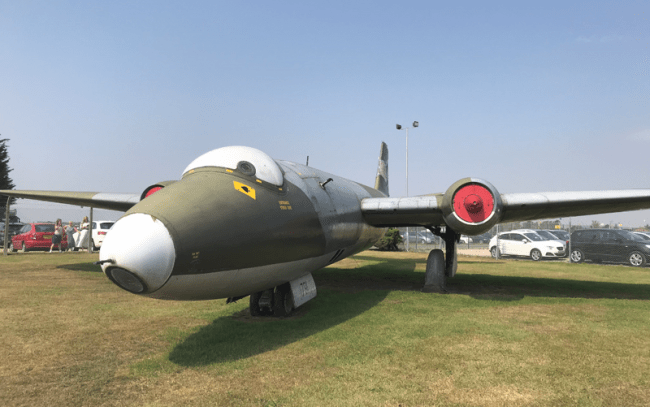
The majority of Newark’s aircraft are from the 1950s and the Cold War. Here’s an English Electric Canberra PR7, the photo-reconnaissance version. This one, WH 791, served at RAF Tengah in the western part of Singapore. Top speed : 580 mph
This is a Gloster Meteor two seat conversion trainer, the T7. This particular aircraft, VZ634, was in service from 1949-1958 with 247 Squadron, 609 Squadron, 141 Squadron and 41 Squadron. As a fighter, the Meteor was used by 16 foreign countries and Biafra. Top speed : 585 mph

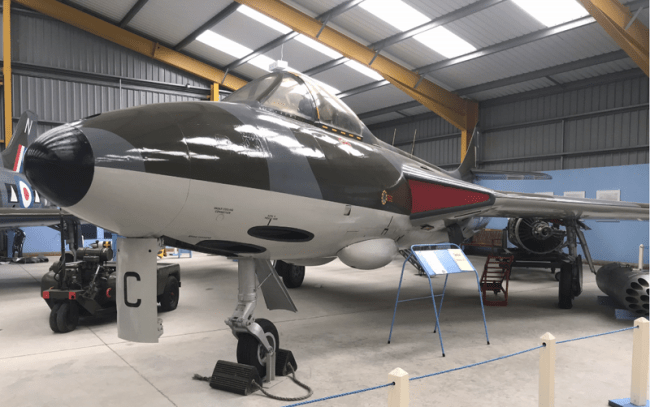
Here’s another fighter, the Hawker Hunter. At Newark, it’s an F.1 interceptor fighter, waiting eagerly for those Bears, Bulls and Badgers to show their evil Commie faces over the North Sea. Hunters were used by 21 other countries and had a Top Speed of : 623 mph. Nowadays everybody seems to have forgotten “The Black Arrows” aerobatic team and their manœuvre with 22 aircraft, certainly a world record at the time. There’s a link here.
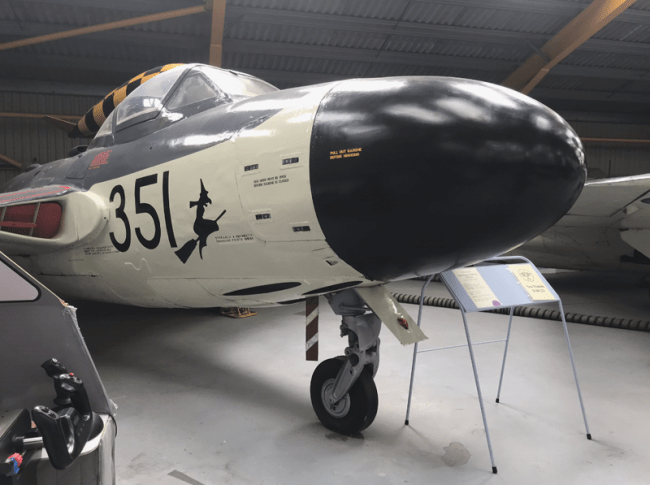
The de Havilland Sea Venom was a two seater shipboard strike fighter, one of the comparatively few aircraft to have been twin boom. At Newark there’s an “FAW.22” or “Fighter All Weather”, WW217, one of only 39 built. There’s a family tree here, starting with the de Havilland Vampire, then the Venom, the Sea Venom and finally the Sea Vixen which operated from carriers as late as 1972.
This is the Avro Shackleton, the last in the line which ran from the Avro Manchester to the Avro Lancaster to the Avro Lincoln and finally to the Avro Shackleton. It was a long-range maritime patrol aircraft, and was used by the British and the South Africans. Top speed : 302 mph

Here’s a closer view of some of those propeller blades:

The only American warplane here is the North American F-100D Super Sabre, a single-seat fighter-bomber. This individual was used by France’s Armée de l’Air, and served in France, Germany and the old French colony, Djibouti in the Horn of Africa, today’s Somalia. In total, it had a career of 4,459 hours in the air. Top speed : 924 mph, Mach 1·4.
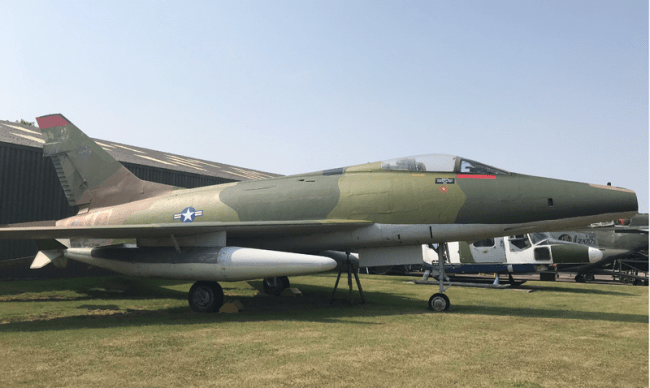
I think it was an F-100 that dropped the napalm in “Apocalypse Now”:

Next time, a look at some of Newark Air Museum’s civilian aircraft, some more of its foreign aircraft and its various bits of aircraft.

20 Comments

Filed under Africa, Aviation, Bomber Command, Film & TV, France, History, military, Personal

The Carvings in the Tower (6)

David John Furley was one of the young men who, in May 1940, had climbed up into the Tower of the High School and carved their names and their message on a stone window sill:

And here’s the Tower, pictured on a rather dark day between the two world wars:

David Furley had entered the High School on September 18th 1930 and he left on the last day of the Summer Term, July 30th 1940. The son of a hosiery manufacturer, Athelstan Willis Furley, he lived at 18 Markham Crescent, 50 yards from where Richard  Milnes lived in Langar Close, in that triangle of streets where Valley Road meets the Mansfield Road. Here’s his house today. You can just see a window behind the foliage:

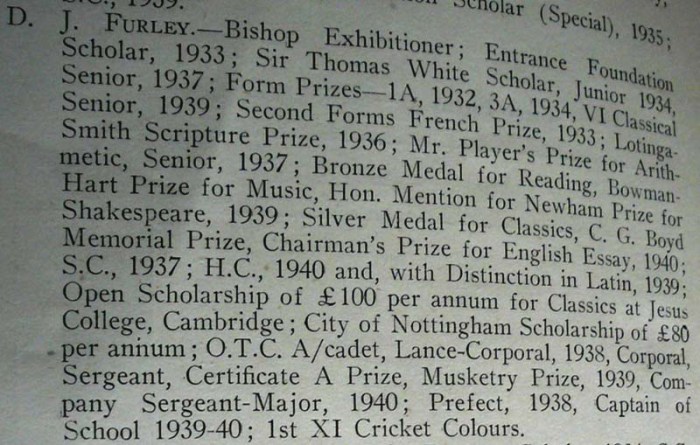
David was an extremely clever young man. He received various School scholarships, a minimum of a dozen prizes or other awards and became the Captain of the School. In the OTC he was Company Sergeant Major and in cricket, he was a regular player for the First XI, winning his colours during the 1940 season. He left to read Classics at Jesus College, Cambridge with a £100 Open Scholarship and an £80 City of Nottingham Scholarship. Nearly all of his Classics Masters were Cambridge men, Mr Beeby (Jesus College), Mr Duddell (Gonville & Caius College) and Mr Gregg (St Catharine’s College). Only Mr Roche had gone elsewhere (London University).

Here is  the list of all his prizes, scholarships and awards, as they appeared in the School List:

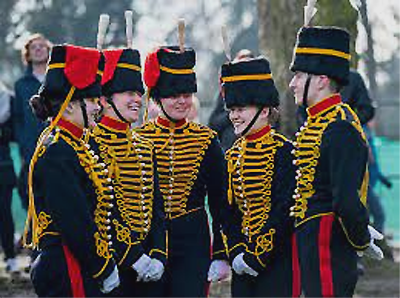
During the war, David became a Lieutenant in the Royal Artillery Company, serving in Bombay in India and then in Burma. Here they are, in their ceremonial uniforms:

He then returned to Cambridge University to complete his degree, and became an Honorary Fellow of Jesus College.

In 1947, he began lecturing at University College, London, soon becoming “one of the 20th century’s outstanding scholars of Greco-Roman philosophy” and soon afterwards a professor at Princeton University in the United States. In collaboration with Cooper, Frede, Nehamas, Penner and Vlastos, he helped build Princeton’s reputation as a world-leading centre for the study of ancient philosophy. This is Princeton:

His books on philosophy were widely known for their brilliance and their brevity. Most famous were “Two studies in the Greek Atomists”, “Self-movers”, (15 pages), “The rainfall example in Physics II.8”, (6 pages), “Lucretius and the Stoics” (20 pages) and “Galen: On Respiration and the Arteries”. He planned to write his final book, “The Greek Cosmologists”, in two volumes, but after Volume I appeared in 1987, Volume II unfortunately never came to fruition. His best articles and essays were all published together, however, in “Cosmic Problems”. For many years, David was:

“widely regarded within the ancient philosophy community as one of the subject’s most brilliant practitioners”.

Virtually everything he produced is a gem, and many have become classics. There are many who have argued that he was the cleverest pupil the High School has ever produced.

David Sedley wrote an obituary for David Furley, which lists the books he wrote and their length. On one occasion, apparently, he launched his newest book at a conference, and began by handing out copies to everyone. The book was fewer than 20 pages, but, because of David’s well-known intellect, nobody laughed when they first saw how short it was. They read it, and acknowledged that what he had written was a work of genius:

“The most recurrent motif of his work was the systematic contrast between two radically opposed philosophical and scientific worldviews, atomism and Aristotelianism, his analyses typically shedding equal light on both traditions. The leading exhibit is undoubtedly his brilliant 1967 book “Two Studies in the Greek Atomists.” ….A model of lucid and judicious scholarship, this monograph did much, perhaps more than any other single book, to bring Epicureanism into the philosophical mainstream.”

“Furley’s work proved seminal in his genius for writing a short but incisive article which provoked an entire micro-industry of debate. His classic “Self-movers”, a mere 15 pages in the original 1978 publication, became the focus of a subsequent conference at Pittsburgh, which in turn led to a multi-authored volume.

“Another such case is “The rainfall example in Physics II.8” (1986), which argued with amazing concision – it weighed in at just six printed pages – that, contrary to the current orthodoxy, Aristotle in fact believed that rainfall is purposive, and not merely the mechanical outcome of meteorological processes.”

A third case is “Lucretius and the Stoics” (1966). Lucretius was one of Furley’s heroes. The article, running to an impressive 20 pages, presented a major challenge to the orthodoxy that Lucretius’s polemics are typically directed against Stoic rivals. Resistance to this article’s findings has been widespread in Lucretian circles, but it still has its defenders, and the debate remains evenly balanced.”

Here’s Lucretius in an 18th century drawing:

And here’s Furley at varying ages:


This slideshow requires JavaScript.

I just wish that I understood anything of what Professor Furley had written. I even thought that “Lucretius and the Stoics” was a 1950s Rock and Roll group.


14 Comments

Filed under cricket, History, military, The High School, Writing