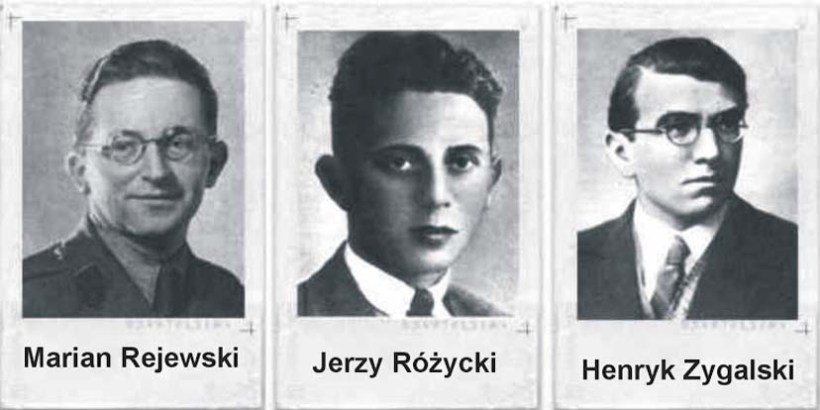
Last time, I was telling the story of how the three Polish whizz kid mathematicians, Marian Rejewski, Jery Rozycki and Henryk Zygalski, had told the British and the French, everything they had discovered about Enigma. Here they are:
That generous act enabled the British to begin decrypting German messages almost straight away, and, very soon, to start affecting the outcome of the war. In March-April 1941, Enigma revealed, for example, that Crete was going to be invaded from the air, using gliders and paratroopers. Everybody was ready for them and the German invasion force suffered heavy casualties, with as many as 4,000 men killed.
I also talked last time about how, in May 1941, the Royal Navy was told the whereabouts of all the supply ships that were servicing the Bismarck. They also ascertained on one particular occasion, that the Bismarck was headed to a harbour in France, rather than in Germany.
The stories all came from the book by John Jackson which relates the story of Enigma, the German encrypting machine used throughout the entire Second World War, the Germans always confident that their codes could never be cracked….
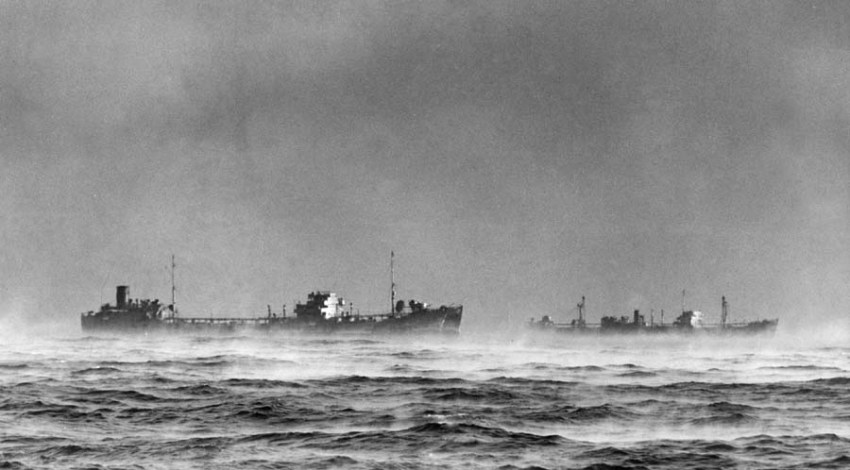
In July 1942, if the Royal Navy had been clever enough to believe the Enigma decrypt given to them, they would not have told the Arctic convoy PQ17 to scatter, an act which condemned 24 ships to a watery grave and 153 sailors to an early death. Arctic convoys were dreadful:
Temperatures were always unbelievably low, and the ships were attacked more or less constantly:
There was very little air cover, and the one constant threat was the mighty battleship, the Tirpitz:
Even Enigma cannot overcome the arrogance of unintelligent senior officers. And what was the reason for the mix-up?
Well, the great men at the top end of the Royal Navy believed that the Tirpitz had left port to attack the convoy. But, unbelievable as it may seem, they were actually mistaken and the biggest naval disaster of the Second World War ensued.
In April 1944, General Guderian went on a tour of the various armoured units that the Germans had stationed in Normandy. This enabled the Allies to know exactly which Germans were where, and gave them…….
“a splendid insight into the distribution of the armour a month before the landing.”
Here is General Guderian. He was the author of the definitive book on tank warfare called “Panzer”. If only one of the senior English officers had read it before the Panzers rolled into France in 1940:
Further Enigma decrypts in 1944 revealed exactly the strength of the Germans in northern France, with six top quality divisions in France and Belgium, along with fourteen divisions of lesser quality. Worryingly, perhaps, the Cotentin Peninsula, to the west of the D-Day beaches, was being heavily reinforced, although it was music to Churchill’s ears to hear the large number of complaints from a large number of various German units that petrol and oil were again in very short supply. The Prime Minister was also extremely pleased to hear that, day by day, Hitler and his generals were beginning to believe more and more strongly that the Allies would land not in Normandy, but in the Pas de Calais.
Enigma decrypts also revealed that in, May 1944, the Luftwaffe had a thousand aircraft including 650 fighters, although Allied numbers were much, much, higher. Interestingly, given that the weather satellite had not yet been invented, the Allies were delighted that on D-Day, thanks to Enigma, they would be able to use what were probably far more accurate forecasts than anything they had themselves, namely the Germans’ own weather forecasts.
In June 1944, Enigma also managed to decipher encrypted messages between Peenemünde and Blizna, a testing ground for the V1 and V2. Before long, everybody at Bletchley Park was familiar with the name of Werner von Braun, soon to give up being a career war criminal and to move to a cushy well paid job in the United States.
Here’s a V2 rocket:
They were tested initially at Peenemünde and then at Blizna. Not a lot went on without the Enigma decrypts letting the RAF know something about it. Peenemünde was heavily damaged after a huge number of RAF bombers bombed every square foot of the site. They included 103 Squadron, starring my Dad. The RAF were particularly keen to blast and obliterate Peenemünde, because they’d all been told……
“Destroy the secret weapon site tonight, or you’ll all have to go back tomorrow evening.”
The main scientist in charge at Peenemünde was, of course Werner von Braun, not an SS war criminal who used slave labourers to build whatever he required but a helpful scientist who took Mankind to the Moon. Here he is, sharing one or two Slave Labourer jokes with his pals:
At the time, the people deciphering the Enigma messages were absolutely amazed at what the Germans were doing. They had never anticipated what were, after all, artillery shells, being propelled around a hundred miles to blow up either London or Antwerp. By late 1944, the so-called “Rocket Bradshaw” decrypts were providing everybody with the Germans’ timetable of all the V2 launches from the Hague area of the Netherlands, all of them targeted on London. The exact target was always Tower Bridge although they never got within a mile of it.
One final thought, which does not actually come from John Jackson’s book but from a TV programme I saw about the Final Solution. I hadn’t realised that there were still Enigma encrypts which had defied all attempts to decipher them. One of them was deciphered as recently as 2020. It was a careful record of how many Jews had been rounded up from the ghettoes in a score or more towns and cities in central and eastern Poland and had now been transported to Auschwitz-Birkenau and murdered. They were apparently using their strongest encryptions for that one.
Last time, I talked of how men who were once famous but who had evil hidden deep in their souls can live on artificially through their statues. Without that statue, such men would soon be forgotten in the dustbin of history.
“We should not be afraid to criticize and condemn that which is inexcusable ……. We will not run from this history.”
And in 2015, construction of a memorial to the Sand Creek Massacre victims began.
And I certainly feel that, if there are people who do not want to have statues of these “dubious heroes”, who do not want to be reminded of their ancestors’ suffering, then so be it. And, by this method, such men will gradually fade away rather than be kept alive artificially by a statue.
An excellent example would be Werner von Braun. Operation Paperclip made him an American citizen, along with 1600 of his fellow scientists. These were the people who helped to mastermind manned space flight and the landing on the moon. An ordinary person might want a statue.
I can think of a few Jews who wouldn’t though. And Russians, and Poles or any other East European descendants of the ones who died, as tens of thousands of slave workers perished building concrete bunkers, blast proof shelters, and rocket launching ramps all over the island of Peenemünde. If these people feel strongly enough, then no statue.
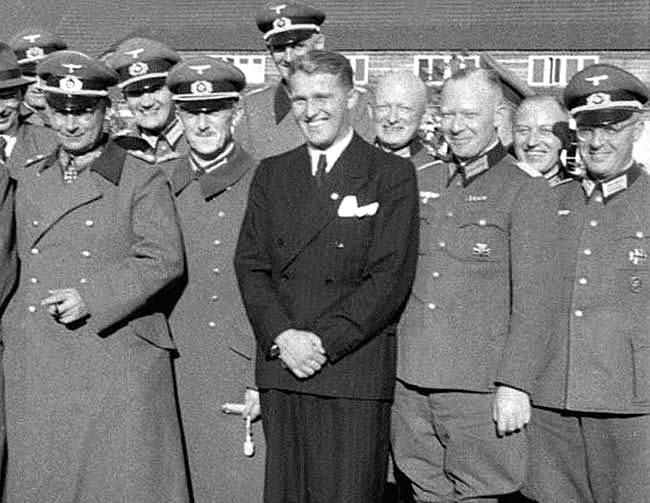
Back then, of course, von Braun was known as SS Sturmbannführer von Braun. And here is the SS Sturmbannführer with high ranking Nazis:
Here he is with the highest ranking Nazi of all. The SS Sturmbannführer is dressed as a civilian, middle of the next to back row:
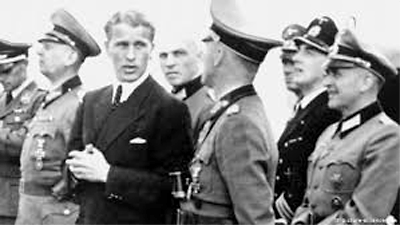
This one is more difficult, but von Braun is behind Himmler, dressed up in his all black SS uniform:
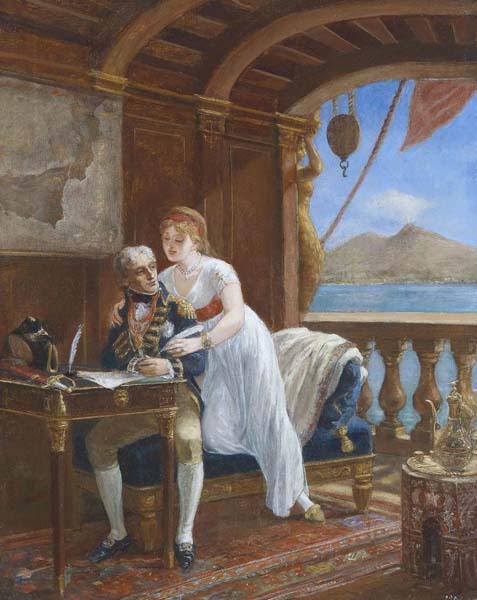
We’re not in the slightest bit short of people in this category. Lord Nelson was an excellent naval commander with a 100% belief in the British Empire. But by 1801, Nelson, already married to the unfortunate Mrs Frances Nelson, was living with another woman, Emma Hamilton. She was not his wife, and he shouldn’t have been living with her. In actual fact, she was the wife of one of his closest friends, Sir William Hamilton.
There will be a lot of men nowadays who will not be too bothered about Nelson’s little foibles, but I bet there are a lot of women who would not want a statue of him staring them in the face, especially in the nation’s capital city.
I wonder who bought more of these satirical jugs? Men or women?
High on the list of people from this period who have shocking sides to their character is Lord Byron, the Romantic poet. Not that he couldn’t knock out some famous poems when he put his mind to it:
“She walks in beauty, like the night
Of cloudless climes and starry skies;
And all that’s best of dark and bright
Meet in her aspect and her eyes”
Or, perhaps more famous, “The Destruction of Sennacherib”
“The Assyrian came down like the wolf on the fold,
And his cohorts were gleaming in purple and gold;
And the sheen of their spears was like stars on the sea,
When the blue wave rolls nightly on deep Galilee.
Like the leaves of the forest when Summer is green,
That host with their banners at sunset were seen:
Like the leaves of the forest when Autumn hath blown,
That host on the morrow lay withered and strown.”
Lord Byron, though, ought to encounter a great deal of difficulty having a statue erected to him, and I don’t mean just his dress sense:
George Gordon Byron, the Sixth Baron Byron, was allegedly England’s greatest poet. Yet, it has been written that “By our own modern standards he was probably a paedophile and certainly a rapist, at least of the statutory kind.”
The evidence for these charges include the fact that Byron had an infatuation with a shapely fifteen year-old Greek boy, Lukas Chalandritsanos and spent enormous sums of money on him.
He had already had an incestuous relationship with Augusta Leigh, his own half-sister. Here she is:
Augusta gave birth to Elizabeth Medora Leigh, who was widely thought to be Byron’s child. Three days after the birth, Byron visited Augusta and the baby. He reported later to a friend, Lady Melbourne:
“It is not an Ape and if it is – that must be my fault.”
There was a widely held belief at the time that a child born of incest would be an ape.
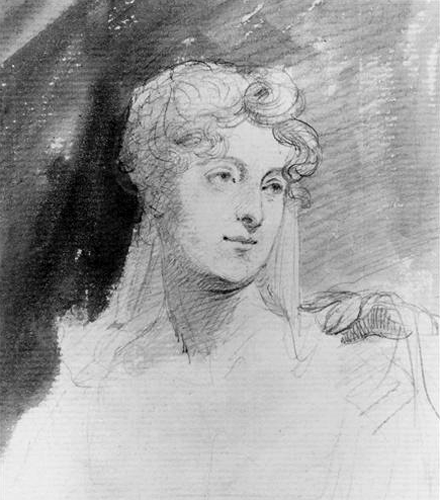
Byron’s wife was Anne Isabella Noel Byron, 11th Baroness Wentworth and Baroness Byron, Here she is:
Evidence from a servant says that Byron raped his wife only days before she gave birth to their daughter, Ada. And then he raped her again only days after she had given birth.
In those days, of course, a husband could not be refused by his wife. What would now be considered rape was just a gentleman exercising his conjugal rights. But by today’s standards, actions like that are repulsive, especially so soon either before or after the poor woman has given birth.
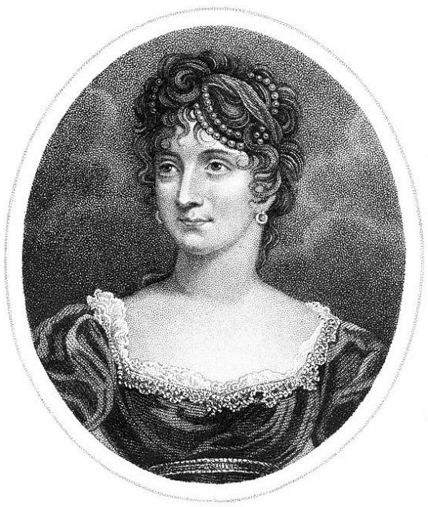
Byron’s appalling arrogance was equally in evidence in his love affair with Claire Clairmont. Here she is:
Claire gave birth to a daughter, Allegra, but Byron immediately forbade her all access to her child, whom he sent away to a convent. She died there aged five.
And to think that I criticised the baddies in the TV series “Poldark” as not being true to life!
I am sure that most people would understand the difference between “hot courage” and “cold courage”. During a robbery, the person who suddenly confronts the would-be robber and tries, as the English say, to “have a go” is showing hot courage. The same would be true of the person who tries to drag an unconscious victim out of a burning car crash. In the context of war, it may be the man who solves the sudden problem of an enemy tank by jumping onto the top of it and throwing a hand grenade in through the hatch.
All of these acts show great heroism, but as far as I am concerned, “cold courage” takes it all into a different dimension. “Cold courage” is the person who faces a painful terminal disease without losing his dignity. “Cold courage” is the person who sets off to walk along a highwire stretched hundreds of feet off the ground between two skyscrapers. “Cold courage” is the fireman who looks up at that staircase in the North or South Tower, and starts climbing, because he knows that it is his duty to try and save people, even if it may be at the expense of his own life. In the context of war, “cold courage” is the man who sits on his bunk for a whole afternoon, waiting for the chance to get into a bomber at nine o’clock and then fly off into the night skies over Germany, not only risking death, but knowing that, statistically, death is a very likely outcome. The only thing more difficult than doing this as far as I’m concerned, would be the chance to fly over Germany in broad daylight, when you have the opportunity to see exactly what is happening to everybody else, and may well happen to you.
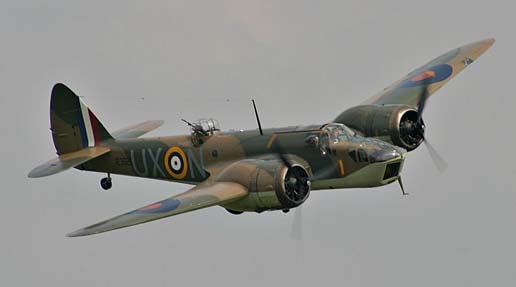
Early on in the Second World War, the RAF tried to place their tiny bombs accurately on exclusively military targets during the hours of daylight when, theoretically, it should have been relatively easy to do so. The only problem was that the German fighters of the day were all easily capable of shooting down these poorly armed bombers without any real problems. Between May 10th-May 28th 1940, losses of the Bristol Blenheim bomber, for example, were almost unbelievable. (Search for “Known Individual Aircraft Records”)
For that reason, the RAF soon turned to night bombing. Equally swiftly, they found that it was virtually impossible to hit relatively small military targets with any accuracy at night. They would be better employed in bombing the areas of the city around the enemy factories, in an effort to kill or injure the workers who worked there. This new tactic carried out the directive that had been agreed on at the Casablanca Conference.
“Your Primary object will be the progressive destruction and dislocation of the German military, industrial, and economic system, and the undermining of the morale of the German people to a point where their capacity for armed resistance is fatally weakened.”
When the United States came into the war in Europe, effectively in 1942, their bombers were equipped with the famous Norden bombsight, which was supposedly capable of dropping a bomb into a pickle barrel from 30,000 feet up. Putting their faith into the bombing accuracy achievable with their marvellous bombsight, the Eighth Air Force ignored British advice that, because of the very high standards of Luftwaffe fighter pilots, bombing at night was the only sustainable method of carrying on the struggle against the Germans. The Americans, therefore, persisted with their daylight raids.
After a few months of daylight bombing, much of it over France rather than the Reich itself, the idea was mooted that enormous and significant damage could be inflicted by bombing the German factories which produced ball-bearings, as they were vitally important to the entire German war machine. Virtually every single military vehicle and aircraft depended on them. The Mighty Eighth, therefore, exactly a year to the day after their first gentle raid, Mission 1 on August 17, 1942 against the Sotteville Marshalling Yard at Rouen in France, decided to attack these important factories . This would be Mission 84, scheduled for August 17, 1943, a complex two-pronged attack on the ball-bearing works at Schweinfurt and the Messerschmitt aircraft works at Regensburg. The raid would be the furthest penetration into German territory to date, some 800 miles from the coast. What happened is the most wonderful example of “cold courage” that anybody could wish to meet.
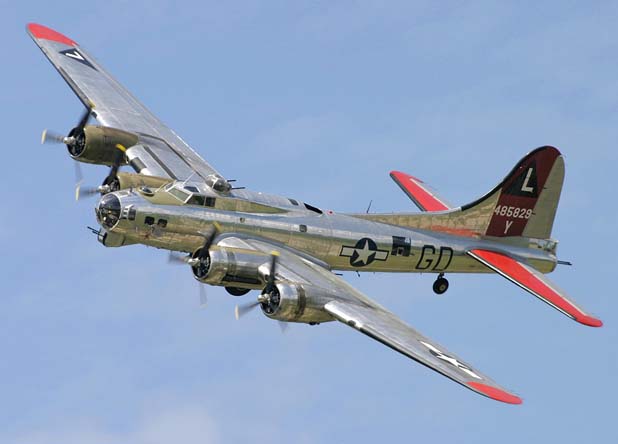
The greatest problem for the Eighth Air Force was that none of their own fighters, nor those of the RAF, had anywhere near the range required to escort the slow, heavily laden B-17s to their targets. The main defensive tactic, therefore, was to form up the Flying Fortress bombers into huge boxes, where, theoretically, every single aircraft could protect, and could be protected by, all the other aircraft.
This procedure took a very long time to organise with hundreds of bombers to be fitted into the formation. And this was the first problem: all this activity was completely visible to the German radar. I can remember my own father telling me how he had watched these brave young men get ready to go into battle…
“ On a number of occasions, Fred had stood on a long forgotten airfield in East Anglia and watched the American Eighth Air Force prepare to depart on a daylight raid over Germany. Their B-17 Flying Fortresses would circle seemingly for hours over their bases, as they slowly and precisely formed up into their famous defensive boxes, intricate arrangements of, perhaps, up to a thousand heavily armed bombers whose almost countless machine guns, in theory, were capable of offering covering fire to all of their fellow aircraft. Once the B-17s were ready, it was as if somebody blew a bugle unheard far below on the ground and all the bombers would then suddenly set off to war, tracing their gleaming contrails across the blue sky, eastwards in the sunshine towards the Third Reich.”
This slideshow requires JavaScript.
The Eighth Air Force raid caused a 34 per cent loss of production at Schweinfurt but this was soon made up for by surplus supplies of ball bearings from all over Germany. The industry’s infrastructure, while vulnerable to a sustained campaign, was not vulnerable to destruction by a single raid.
The Nazi Minister of Armaments, Albert Speer , later wrote that the Eighth Air Force’s major error was to attempt a second attack on Regensburg at the same time as the main attack on Schweinfurt, and not to continue with further raids on Schweinfurt after the first one.
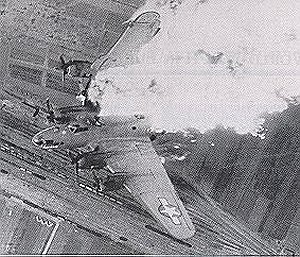
Some of the B-17s were over Germany for a period in excess of two hours with no fighter protection whatsoever, and the Luftwaffe were quick to take advantage of the situation. Given the fact that they had picked them up on radar over East Anglia, the Germans were able to call up extra fighters from all of their bases, stretching from southern France to Norway in the north. Many fighters were able to expend their ammunition in massed attacks on the American bombers, land again for fresh supplies of fuel and weapons and then rejoin the battle.
This slideshow requires JavaScript.
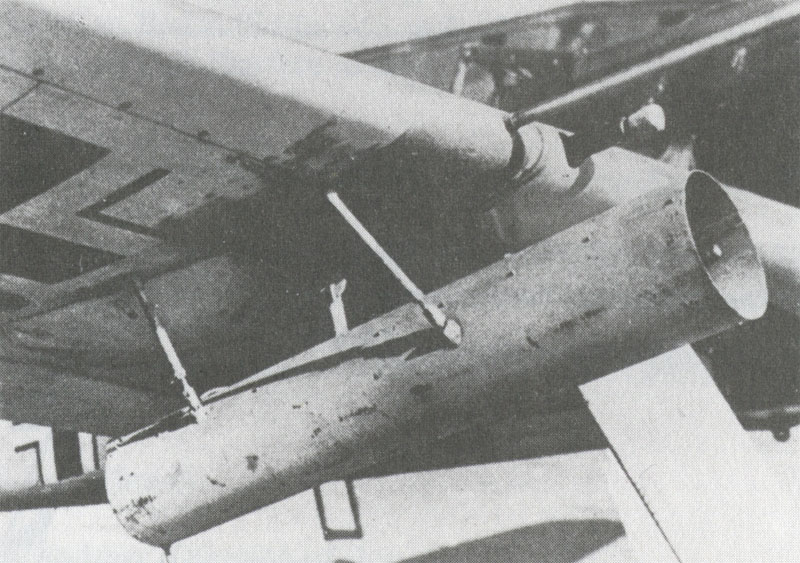
The German fighters were well aware of the B-17s’ inadequate forward armament and their vulnerability to head-on attack. Against the 0.50 calibre Browning machine guns of the Flying Fortresses, the German fighters were all equipped with cannon which fired explosive shells. In theory, just one hit could bring down a bomber. Much longer ranged than the machine guns, this enabled the Germans to fly well out of the range of the B-17s’ machine guns and fire off short bursts of cannon shells at intervals. Some fighters carried sophisticated rocket weapons, including mortars propelled by rockets, all of them capable of wiping out a B-17 in just one shot.
Tales are also told of the Germans using either obsolete combat aircraft or training aircraft to fly high above the American formation and drop air-to-air bombs.
This account from Archie J.Old Junior, a thirty seven year old Texan, is quoted in “The Mighty Eighth” by Gerald Astor…
“The fighters were all over us. They really got interested in me. German fighters came up from every point of the compass after our fighters turned around. (Just before the German frontier). And they were already throwing flak at us when we were five to ten minutes away from the target.” (Some thirty or forty miles)
In “Eighth Air Force”, Donald L.Miller describes pretty much the same situation, once the P-47s had been forced to turn back…
“…a hailstorm of fighter assaults that continued almost all the way to the target. (Beirne Lay, Jr) wrote, “I knew that I was going to die, and so were a lot of others.”
Overall, American casualties were way beyond the sustainable. For Bomber Command that most basic of figures had been set at 4%. On this raid 230 bombers had taken part, and sixty of these were destroyed. A tiny number finished up in Switzerland, and “thanks to the luck and the skill of the RAF Air-Sea rescue teams”, everybody who went into the icy waters of the North Sea (yes, even in August) was rescued. Five hundred and fifty two men were killed in the air, and seven poor souls made it back home, but, alas, were to succumb to their injuries. Twenty one men were badly wounded.
Beyond the sixty B-17s shot down, between 55-95 further aircraft were badly damaged. Of these, many were too severely damaged ever to be repaired.
This slideshow requires JavaScript.
Of the fighter escort, two P-47s of the 56th Fighter Group were destroyed and so too were two Spitfires from the RAF. The fighters claimed more than 30 kills, but the gunners on the B-17s were very optimistic with their claim of 288 German fighters destroyed. After the war, Luftwaffe records showed just 27 aircraft had been lost.
The very biggest problem of daylight raids by the Eighth Air Force deep into enemy territory was the lack of adequate long-range fighter escort. Some of the Schweinfurt Flying Fortresses were over German-occupied territory for three hours and thirty minutes. Of this period of time, there was no fighter support whatsoever for two hours and ten minutes, which included all of the time spent over Germany itself.
By one of those extraordinary coincidences which are sometimes thrown up, the night of August 17th-18th 1943, saw the British RAF engaged in “Operation Hydra”, which turned out to be one of the more significant raids of the war. Using 324 Avro Lancasters, 218 Handley Page Halifaxes and 54 Short Stirlings, attacks were made on the V-Weapon rocket testing grounds at Peenemünde in the Baltic to the east of Denmark.
Clearly, rocket weapons of the calibre of the V-1 and the V-2 quite simply had to be destroyed, certainly with the Allies envisaging a landing on the coast of France within less than a year.
Indeed, the bomber crews were actually told at their briefings that unless they were successful that particular night, they would be going back to Peenemünde again on the 18th, the 19th, the 20th, and, indeed, they would keep returning until the target was completely destroyed. This certainly concentrated their minds enormously, and, with operations directed for the first time by a “Master Bomber”, namely Group Captain John Searby, the Commanding Officer of 83 Squadron, they achieved great success. Joseph Goebbels, Hitler’s Minister of Propaganda, himself said that the raid had cost the German efforts “six to eight weeks”, a figure agreed by the RAF who wrote in their official history that the attack “may well have caused a delay of two months.”
Although there were those who judged that the raid was “not effective”, an important figure, Chief Engineer Walther, was killed, but most significantly perhaps, so too was the hugely influential Doctor Walter Thiel who had provided the key ideas for the A4 rocket engine, later used to power the horrendous V-2 and indeed, in its developed form, NASA’s rockets into space.
The protection of the darkness was obvious in the casualty figures. Bomber Command lost 6.7% of their bombers and a total of 215 men were killed out of an approximate total of just over four thousand participants. Focke-Wulf Fw 190 night fighters claimed 29 of the 40 bombers shot down. Coincidentally again, the German night forces had employed for the first time ever, three twin engined Messerschmitt Bf 110 fighters with the deadly combination of radar and Schräge Musik upward firing cannons.
This slideshow requires JavaScript.
To make their night fighters even more formidable, the Luftwaffe taught all their crews exactly where a Lancaster’s most vulnerable spots were…the enormous fuel tanks.
In another blog post, I will look at what the Eighth Air Force did next after the Schweinfurt raid, and their continuing “cold courage”, as they regrouped their strength after what must surely be considered, despite the immense resolution and extraordinary bravery of the Americans, one of the great catastrophes of the Allied air war.
















 John Knifton