Tag Archives: SAAF

Newark Air Museum (1)

The original Newark, or Newark-on-Trent, is a market town in Nottinghamshire in England. It stands on three important routes, namely the River Trent, the ancient Great North Road or A1, which ran from London to Edinburgh and it is also on the main East Coast railway line:

Newark has an historic castle which was “slighted” or put beyond military use in 1648.

Outside the town, Newark also has an air museum.

Nowadays going out to visit anywhere is not really feasible for me, so my daughter went as my ambassador, accompanied by her boyfriend, urged to take photographs of whatever she thought was a warplane. And she is no aviation expert, but she certainly knows a hawk from a handsaw and a Halifax from a Hastings. She wouldn’t know a Hampden from a Hereford, though, or a Harrow from a Sparrow or a Bombay. Who would?

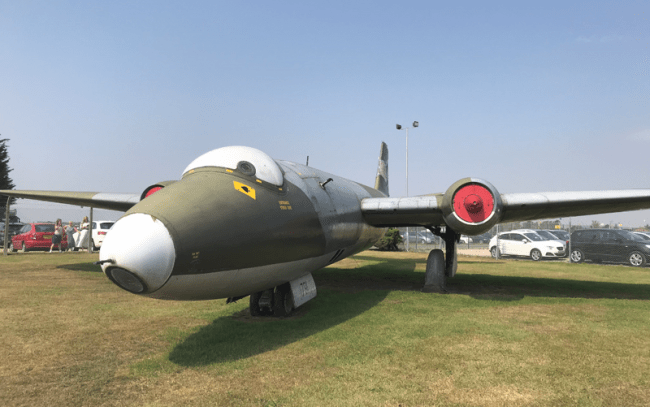
The majority of Newark’s aircraft are from the 1950s and the Cold War. Here’s an English Electric Canberra PR7, the photo-reconnaissance version. This one, WH 791, served at RAF Tengah in the western part of Singapore. Top speed : 580 mph
This is a Gloster Meteor two seat conversion trainer, the T7. This particular aircraft, VZ634, was in service from 1949-1958 with 247 Squadron, 609 Squadron, 141 Squadron and 41 Squadron. As a fighter, the Meteor was used by 16 foreign countries and Biafra. Top speed : 585 mph

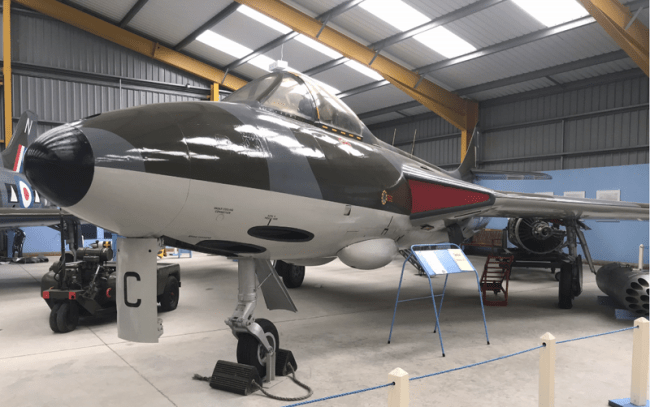
Here’s another fighter, the Hawker Hunter. At Newark, it’s an F.1 interceptor fighter, waiting eagerly for those Bears, Bulls and Badgers to show their evil Commie faces over the North Sea. Hunters were used by 21 other countries and had a Top Speed of : 623 mph. Nowadays everybody seems to have forgotten “The Black Arrows” aerobatic team and their manœuvre with 22 aircraft, certainly a world record at the time. There’s a link here.
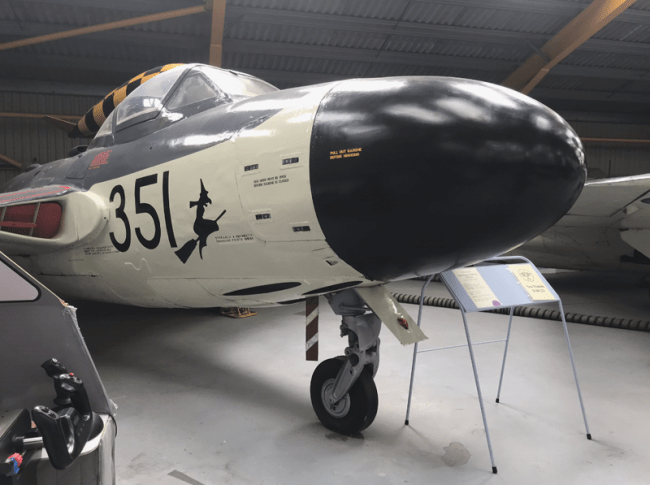
The de Havilland Sea Venom was a two seater shipboard strike fighter, one of the comparatively few aircraft to have been twin boom. At Newark there’s an “FAW.22” or “Fighter All Weather”, WW217, one of only 39 built. There’s a family tree here, starting with the de Havilland Vampire, then the Venom, the Sea Venom and finally the Sea Vixen which operated from carriers as late as 1972.
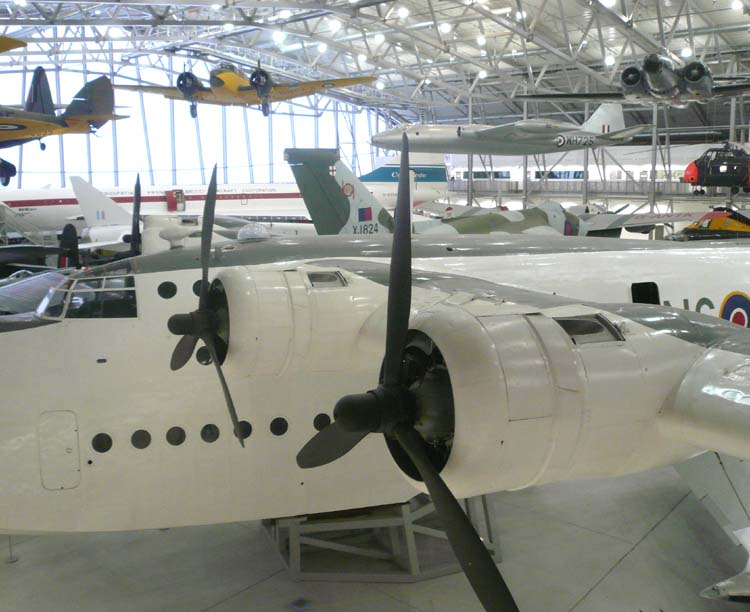
This is the Avro Shackleton, the last in the line which ran from the Avro Manchester to the Avro Lancaster to the Avro Lincoln and finally to the Avro Shackleton. It was a long-range maritime patrol aircraft, and was used by the British and the South Africans. Top speed : 302 mph

Here’s a closer view of some of those propeller blades:

The only American warplane here is the North American F-100D Super Sabre, a single-seat fighter-bomber. This individual was used by France’s Armée de l’Air, and served in France, Germany and the old French colony, Djibouti in the Horn of Africa, today’s Somalia. In total, it had a career of 4,459 hours in the air. Top speed : 924 mph, Mach 1·4.
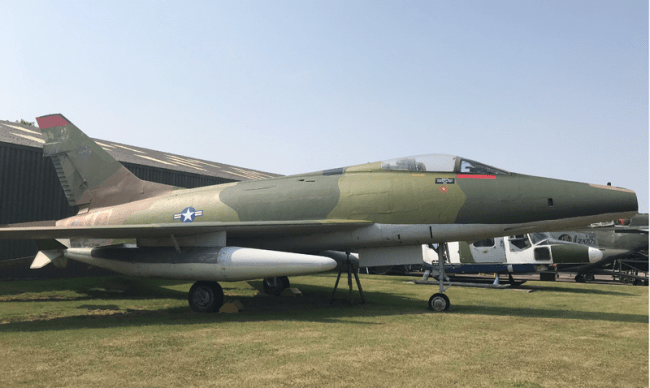
I think it was an F-100 that dropped the napalm in “Apocalypse Now”:

Next time, a look at some of Newark Air Museum’s civilian aircraft, some more of its foreign aircraft and its various bits of aircraft.

20 Comments

Filed under Africa, Aviation, Bomber Command, Film & TV, France, History, military, Personal

Three war crimes, two Sunderlands and one Ashley Wilkes (1)

One of the world’s most bewitching aircraft is the Sunderland flying boat. When I was a boy, I never did save up enough pocket money for the Airfix kit, although it was only fifty pence or so in the 1960s. I should have bought it then, though. They’re fifty pounds now!

The Short S.25 Sunderland was a flying boat patrol bomber operated not just by RAF Coastal Command but also by the RAAF, the RCAF, the SAAF, the RNoAF and the Marinha Portuguesa. The last one’s a bit of a give away, but did you get all of the rest? This one’s Australian:

The Sunderland was designed and built by Short Brothers of Belfast, and the cynic inside me says that it was the only decent aircraft of their own that they made during the war. This model of the aircraft was numbered the S.25 because it was a warplane but it was a direct descendant of the S.23 Empire flying boat, the flagship of Imperial Airways. Here it is, a beautiful aircraft:

The new aircraft S25 was very well designed for its purpose. The Sunderland had a wingspan of 112 feet, a length of 85 feet and a height of 32 feet. It was a big aeroplane! Even the stabilising floats on the wings were as big as a rowing boat or a small plane. Compare one of them with the man with a pram, and the Walrus behind them both:

A Sunderland had four Bristol Pegasus XVIII nine-cylinder radial engines which gave it a total of 4,260 horse power:

And those powerful Pegasus engines gave it a range of around 1800 miles at a cruising speed of 178 mph Don’t fly too fast when you’re doing maritime reconnaissance!

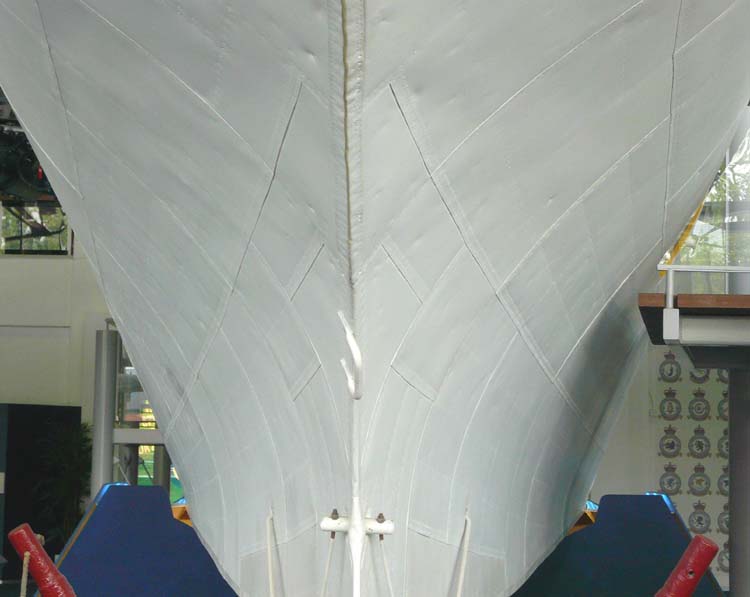
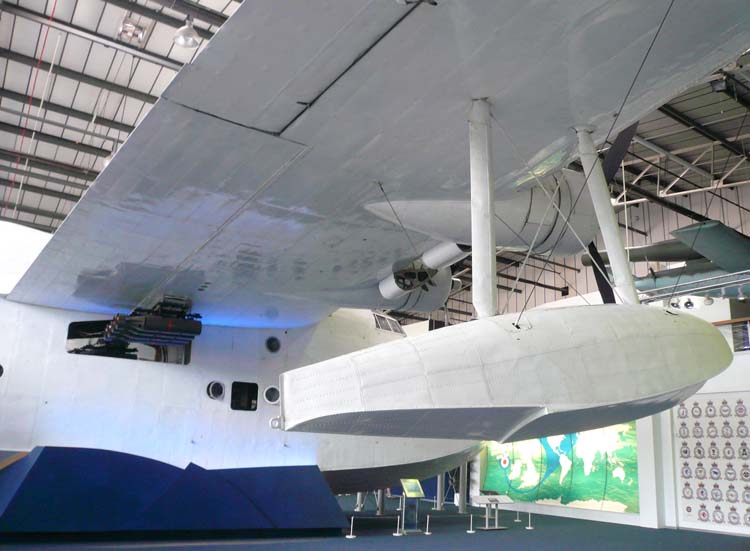
The S 25 Sunderland featured a hull even more aerodynamic and more advanced than that of the S23. You can see why it’s called a “Flying Boat”:

Here’s lengthways:

Here’s the nose end of that hull:

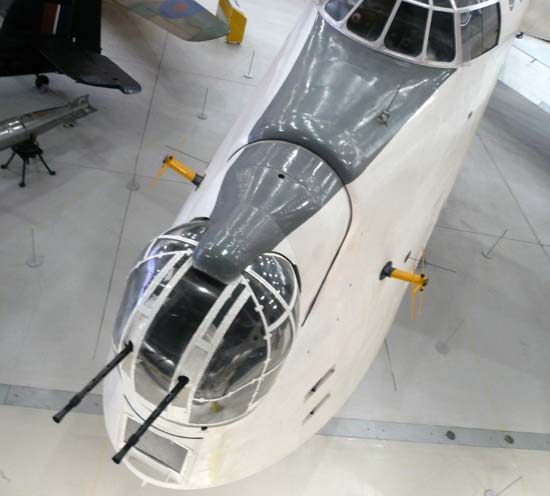
Weapons included machine guns in front and rear turrets. The front turret had rather weak 0.303 guns which could not always penetrate thick metal, but at least I got a good shot of it:

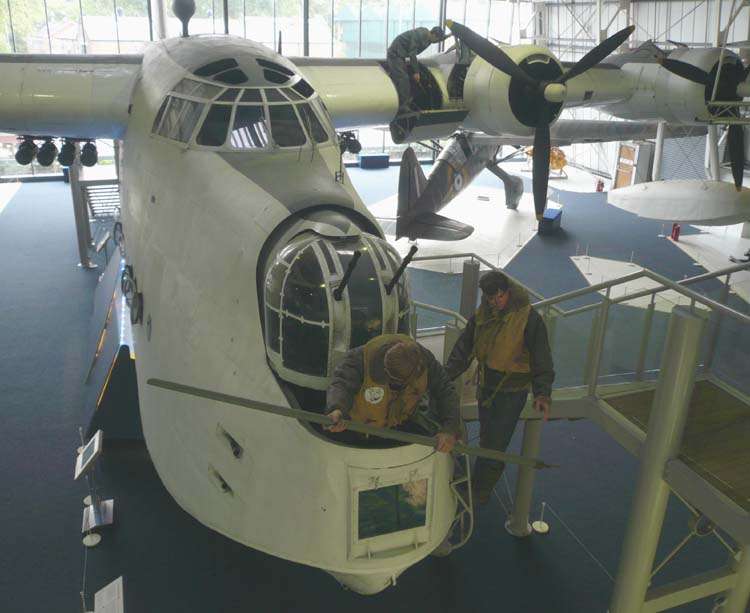
I even got a good shot of the three jokers who seemed to be making off with the plane from the Hendon museum, trying to push it backwards through the very large French windows:

Here’s some close-ups for the wanted posters:

This slideshow requires JavaScript.

I didn’t get any good photographs of the rear turret but it had heavier 0.50 calibre machine guns. You can just about spot it among the bits of other aircraft. It’s slightly right of centre:

There was also a heavy machine gun firing from each of the beam hatches. You can just about see one poking out here:

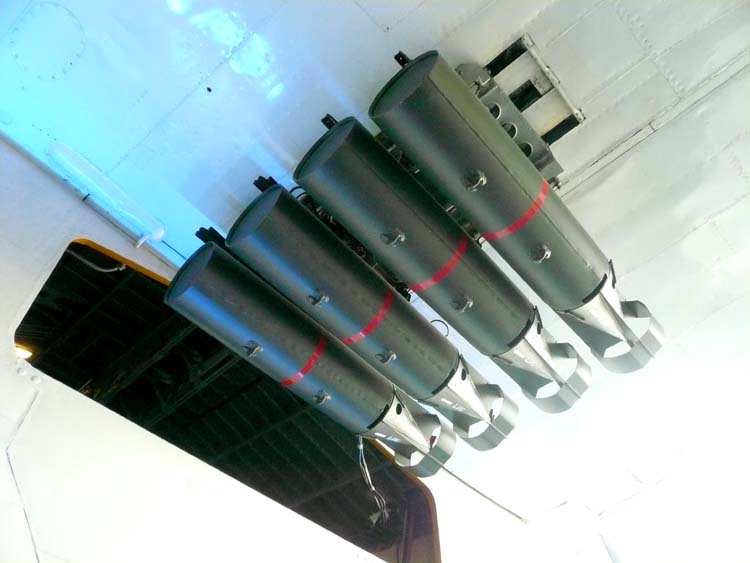
The Sunderland made extensive use of bombs, aerial mines, and depth charges. Here are four which have been winched out ready to drop. Hopefully, they are dummies:

Here they are in close up.

The Vickers Wellington’s immensely  powerful Leigh Lights, designed to light up U-boats on the surface at night, were rarely, if ever, fitted to Sunderlands.

Next time, a look inside the mighty Sunderland.


27 Comments

Filed under Aviation, Bomber Command, Film & TV, History, Personal

the Curtiss P-40 Warhawk at Hendon

On July 22nd 2010, we visited the RAF Museum at Hendon. I took a great number of photographs and these few show the Curtiss Kittyhawk IV.

First  a general view of the aircraft, taken from the rear, as the museum is very, very, full. The peculiar colours are because of the strange Jacques Cousteau type lighting which is supposed to prevent deterioration of the original paint from the 1940s. They originally found some thirteen P-40s abandoned in the New Guinea jungle in 1974 but I suppose you can’t be too careful! Incidentally that was the same operation that retrieved the RAAF Beaufort I depicted a little while back:

Here’s a second view of the Hendon P-40 with perhaps a little bit less of the “Under the Sea” effect and a lot more of that strange deep purple light made famous by the Aviator Formerly Known as Prince. Here’s a very slightly different view of the P-40. And by the way, I don’t know why the question mark is there:

And here, incidentally, is that Bristol Beaufort, with the link to read about it:

This slideshow requires JavaScript.

One of the most interesting things about this plane is its name. Manufactured by Curtiss-Wright of Buffalo, New York, the largest aviation company in the USA during the 1930s, the P-40D and subsequent models was called the Kittyhawk by the RAF, the RAAF, the RCAF and the RNZAF as well as the South African Air Force. It was used extensively in North Africa:

The earlier P-40A, P-40B, and P-40C models were called Tomahawks. I have no idea whatsoever why, other than a sneaking feeling that it was just to confuse everybody who wasn’t aware of the story. The Kittyhawk had a more powerful engine and if you like aircraft engines, you can read a tale involving substandard or defective aircraft engines for military use, conspiracy, false testimony, gross irregularities, neglect of duty, troublemakers and a general court martial via this link. Amazingly, the paragraph you need is called “”Defective engines sold to U.S. military in World War II. It was apparently such a big story at the time that Arthur Miller wrote a play about it.

These two pictures show the most famous thing about so many P-40s and Kittyhawks. The shark’s mouth nose art:

This slideshow requires JavaScript.

On a P-40, the first people to use this design seem to have been the Chinese Nationalist Air Force although they seem to have thought that they were using a big cat, insofar as they were dubbed “The Flying Tigers”. They were still the most famous of the Shark’s Mouth aircraft though:

So just treat yourself to a little bit of the film “The Flying Tigers”. John Wayne at his very best:

In this film, “The Duke” actually speaks Chinese. Two words, “Ding Hao”.

In case you don’t know, “Ding Hao” means good luck, or good day or very good or fantastic and so on. Not as universally applicable a word as “Mao” in “The Deer Hunter” but not bad. It’s quite impressive when one single word is an entire language:


17 Comments

Filed under Aviation, History