Author Archives: jfwknifton

What would you do ? (15) The Puzzle

I used to buy “Boys’ World”, a boys’ comic aimed, funnily enough, at boys. The comic was in existence for only 19 months of 1963-1964.

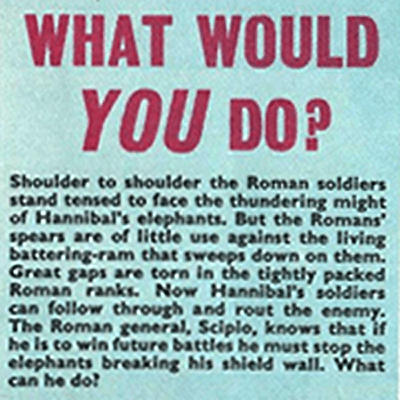
I bought it mainly for the front cover which always featured a kind of puzzle called “What would you do ?”. Somebody was in what Ned Flanders calls “A dilly of a pickle” and you had to get him out of it.

Here’s the situation:

In case you can’t read it, I’ve enlarged the blue box which reads…….

The exact text is :

“Shoulder to shoulder the Roman soldiers stand tensed to face the thundering might of Hannibal’s elephants. But the Romans’ spears are of little use against the living battering-ram that sweeps down on them. Great gaps are torn in the tightly packed Roman ranks. Now Hannibal’s soldiers can follow through and rout the enemy. The Roman general, Scipio, knows that if he is to win future battles he must stop the elephants breaking his shield wall. What can he do?”

Your task is to solve the situation. Perhaps you might like to write your ideas in the “Comments” section.

It certainly is a dilly of a pickle, although I wouldn’t depend too much on finding the answer in there!

38 Comments

Filed under History, Humour, military

The Sandiacre Screw Company (8)

Ivan Keith Doncaster was lost on a raid on Kassel by 166 Squadron on October 22nd 1943.  He was the mid-upper gunner in  “Z-Zebra”, an Avro Lancaster Mk III with the squadron letters AS-Z and the serial number EE196…..

The morning after “Z-Zebra” had crashed, and most of the crew had been killed, including Keith Doncaster,  the flight engineer, Arthur Pilbeam, had the appalling task of identifying the four corpses which had so far been found. He thought that they all had been killed by the exploding bombload or had been unable to pull their ripcords after they jumped because they were unconscious.

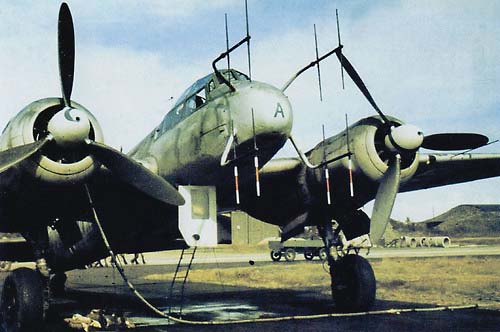
I have been unable to identify any likely German pilot who might have pulled the trigger. When so many black painted aircraft were shot down in the pitch black, there were so many claims that hardly any of them can be verified:

Let’s take an example from the night of October 22nd-23rd 1943. Oberleutnant Hermann Bertram claimed a four engined aircraft “35 km N Kassel” at an altitude of 4,200 metres. How do we know if it was a Halifax or a Lancaster? Was he definitely “35 km N Kassel”? Did he see it crash? And so on.

Oberleutnant Bertram is not a liar. He is a young man who cannot possibly be 100% certain of what happened. And the same would apply to a very long list of night fighter pilots who might possibly have shot down “Z-Zebra”. These men claimed to have destroyed a Lancaster or a Halifax or a “4-mot flugzeug” and they mentioned Kassel in their claim. No doubt the list is incomplete:

Horst-Rüdiger Blume, Fritz Brandt, Franz Brinkhaus, Victor Emanuel, Leopold Fellerer, Erwin Glass, Ernst Haase, Alfred Heldt, Johannes Hiedlmayer, Werner Hoffmann, Horst John, Otto Kutzner, Hans Leickhardt, Richard Lofgen, Erich Metz, Manfred Meurer, Klaus Möller, Hans von Niebelschütz, Günther Nord, Heinz Oberheide, Ruprecht Panzer, Erhard Peters, Günther Radusch, Lothar Sachs, Josef Sallmütter, Heinrich zu Sayn-Wittgenstein, Heinz-Wolfgang Schnaufer, Eduard Schröder, Helmuth Schulte, Paul Streuff, Gustav Tham, Kurt Welter, Gerhard Witt, Achim Wœste, Josef Wolfsberger and Fritz Yung.

And here are four of them:

This slideshow requires JavaScript.

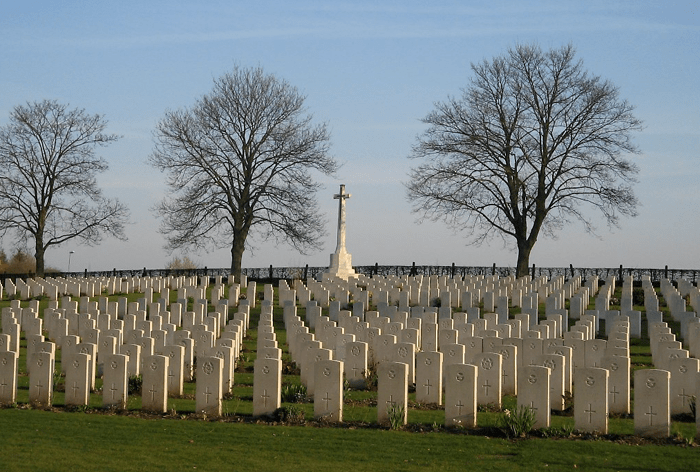
Eventually, all six of the crew of “Z-Zebra” were found. They were buried in Schwalenberg Cemetery on October 25th 1943. On September 18th 1947, they were all re-interred at Hanover War Cemetery. They occupy five graves that must be next to each other.

Keith Doncaster occupies Grave No 16.E.1, Edward Ellis Jones occupies Grave No 16.E.2, Roy Elkington Ault occupies Grave No 16.E.3, Victor George Deacon occupies Grave No 16.E.4 and Charles Neville Hammond occupies Grave No 16.E.5. The sole American, John Murray Walton, was reburied in the Ardennes American Cemetery at Neuville-en-Condroz in Belgium on an unrecorded date.

The Lancaster’s pilot, Charles Neville Hammond, received a posthumous Distinguished Flying Cross for his bravery and self-sacrifice as he struggled to fly the stricken Lancaster straight and level so that its crew could all escape the burning aircraft.

16 Comments

Filed under Aviation, Bomber Command, History, military, Nottingham, The High School

The Sandiacre Screw Company (7)

Six young men were killed in Keith Doncaster’s bomber, which was lost on a raid by 166 Squadron on Kassel on October 22nd 1943. Keith was the mid-upper gunner in  “Z-Zebra”, an Avro Lancaster Mk III with the squadron letters AS-Z and the serial number EE196. The fact that he was engaged in a raid on Kassel does actually establish a rather tenuous link with my own father, Fred Knifton, who, at the time, was with 103 Squadron at Elsham Wolds. My Dad had been involved on the raid on Peenemünde in an effort to prevent the Germans developing the V1 and the V2. All of the participants, in all of their different briefing rooms, were told…..

“If you don’t destroy thr target tonight, you’ll have to go back the following night. And the the night after that and the next night, until the target is destroyed.”

Keith Doncaster’s raid on Kassel was a kind of a follow up to my Dad’s efforts. This time the bombers were after the Fieseler aircraft works which were heavily engaged with developing and manufacturing the guidance gear used to keep both the V1 and the V2 on the right track. And the raid was successful. Kassel was, to all intents and purposes, “flattened”.

The pilot of “Z-Zebra”was Charles Neville Hammond, the son of Thomas Neville Hammond and Doris Hammond from Llanrug in Caernarvonshire, and the husband of Mary Hammond of Odiham in Hampshire.  This is Llanrug, a quiet little town:

This slideshow requires JavaScript.

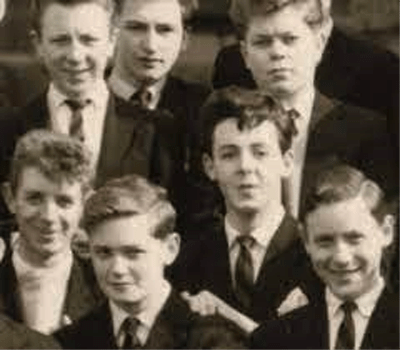
Charles was 23 years old. He had begun his RAF career as a Leading Aircraftman before receiving an emergency commission. He had previously attended the Liverpool Institute High School for Boys, a grammar school which numbered Paul McCartney and George Harrison among its old boys. What a school photograph this is:

The navigator was Master Sergeant John Murray Walton who was 21 years old. John was serving with the 12th Replacement Control Depot of the USAAF.  He was the son of an American couple, Melville R Walton and Mabel Walton although he was born in Ontario in Canada. He was a Canadian citizen by reason of his birth and an American citizen by reason of his parents’ nationality. John had joined the Royal Canadian Air Force but then, like thousands of others, he flew with the RAF. He was the navigator and one of the very few men in World War 2 with a Distinguished Flying Medal, an Air Medal and a Purple Heart:

This slideshow requires JavaScript.

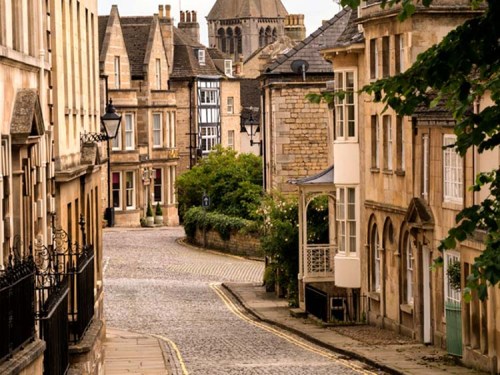
The bomb aimer was Roy Elkington Ault, the son of Reuben John Ault and Olive Eugenie Ault from Sidcup in Kent, although Roy was born in Stamford in Lincolnshire. He was 22 years old. He too, began as a Leading Aircraftman before receiving an emergency commission. Here’s Stamford, another quiet little town, with all the buildings of that warm yellow-orange colour:

The wireless operator was Edward Ellis Jones, the son of Evan Jones and Mary Ellen Jones. He was born at Ammanford, a tiny community in Carmarthenshire in South Wales. He was the husband of Margaret Jones who lived in Wembley in Middlesex. Edward was 32 years old. He had originally been a sergeant before receiving an emergency commission:

This slideshow requires JavaScript.

Keith Doncaster, the mid-upper gunner, was 20 years and 5 days old.

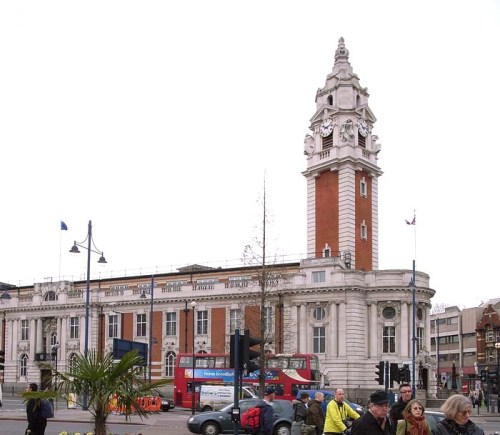
The rear gunner was Victor George Deacon, the son of George Victor Deacon and Edith Elizabeth Deacon. Victor came from Brixton in Surrey. Here’s Brixton and a distinctive building Victor might have been familiar with:

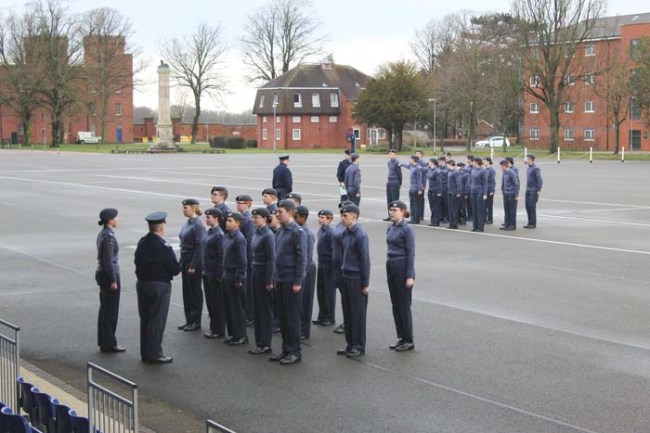
Victor was 35 years old and his wife was Lilian Elizabeth Ruskin who lived in Long Eaton in Derbyshire. They had a son called James Deacon. Long Eaton is only three miles from Keith’s house in Sandiacre and Keith had been a member of the Long Eaton Air Training Corps. Did these two young men ever travel home together on leave? Did they visit each other’s families? Did Keith ever look wistfully at little James and wish that he had a son of his own? Long Eaton Air Training Corps are still in business today:

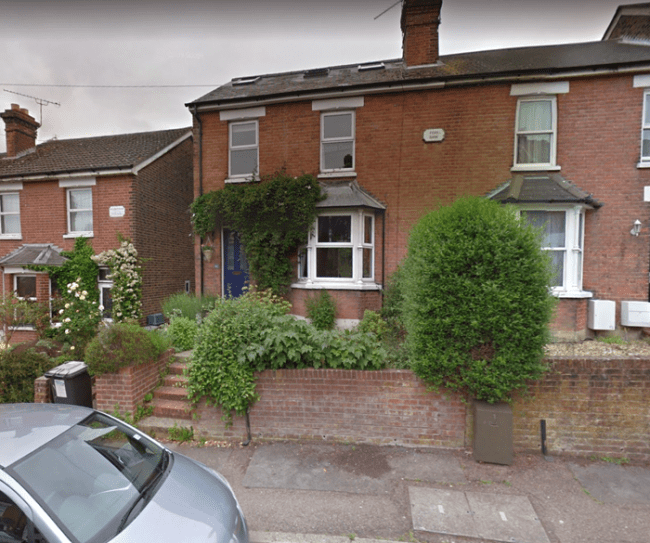
The flight engineer was the only survivor. He was Arthur Iden Pilbeam from Kent. His father, also called Arthur Iden Pilbeam, was a baker and lived at 66 St Mary’s Road in Tunbridge Wells, which I found on that all-seeing google application:

His mother was Mary Pilbeam and his wife was Irene Lilian Pilbeam née Abbott. After being captured, Arthur became Prisoner of War No 261472 at Sagan, then Belaria and finally at Mühlberg (Elbe). After the war he became a fruiterers’ manager and a member of the Worshipful Company of Fruiterers. Arthur lived to a ripe old age, passing away in Chichester in Sussex at the age of 92. Good for him!

Keith’s aircraft had been shot down by a night-fighter, around sixty miles short of Kassel. It crashed at Brakelsiek, roughly 110 miles from Düsseldorf and to the NNW of Kassel. The only survivor, Arthur Pilbeam, has actually supplied an account of what happened. A night-fighter attacked without warning and one wing of the Lancaster burst into flames. The pilot struggled with his damaged controls to give everybody time to escape, but the stricken Lancaster went into a spin after one of the bombs exploded, hit by a cannon shell from the night-fighter. Seconds later, the whole aircraft blew up. Here’s a nice old building in Brakielsk:


21 Comments

Filed under Aviation, Bomber Command, History, military, Nottingham, The High School

Football Programmes of the Soviet Union (5)

I don’t often begin with a dedication but perhaps, just this once……

“Here is wisdom. Let him that hath understanding count the number of the beast: for it is the number of a man; and his number is Six hundred threescore and six.”

And certainly, when I started out, I never thought I would one day be writing Blog Post Number Six hundred threescore and six. Anyway……


Last time we were looking at some of the old Soviet football/soccer programmed that I still have.

The first programme today has “Uralmash Sverdlovsk” / “Уралмаш Свердловск” as the away team, but this time with “Stroityel Ashkhabad” / “Строитель Ашхабад”, as their hosts. You may remember from Blog Post 4 that “Uralmash” was a little like an acronym, where “Ural” referred to the range of mountains and “Mash” was short for “Mashina” , the Russian word for “car”. The two together referred to a car factory in Sverdlovsk, the main city of the Urals. Sverdlovsk is now called Ekaterinberg, just to add to the confusion:

“Stroitel Ashkhabad” /“Строитель Ашхабад” means “Ashkhabad Construction Workers”, although this particular team have previously been “Locomotiv Ashkhabad” / “Локомотив (railway workers) Ашхабад”  and “Колхощи (collective farm workers) Ашхабад”. How original, and different, those names were, compared to the modern “FK Köpetdag Aşgabat”. “Köpetdag” by the way, means “Many mountains”, presumably in the local language.

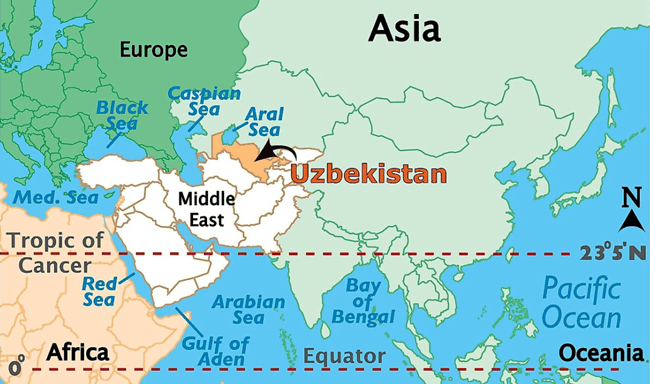
Ashkhabad, by the way, is the capital of Turkmenistan, which is to the north east of Iran, and certainly part of Asia. Just to puzzle everybody further, on this map, the cartographers have decided to label Iran the “Middle East”. I have no idea why.

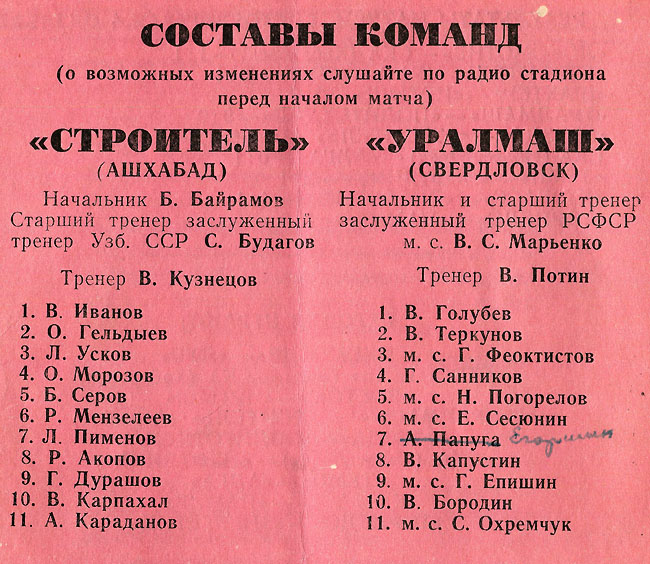
Here are the team line ups:

The top two words mean “make-ups” and “of the teams”. In brackets, the next few words mean “about- possible- changes- listen…….“по радио” ……..to-the radio -before-the beginning…….. “матча”  of the match.

Russian is a very ancient language, of the same age and vintage as Latin or Ancient Greek. There are a surprisingly large number of Russian words which do not come from Latin, but which are close relations of the Latin words. ““по” / “po” is the same word as the Latin “per”, as in “per ardua ad astra” the motto of the RAF, “Through difficulties to the stars”. “Before the match” was “перед  матча” and the word “p-e-r-e-d” is our “pre” as in “prehistoric” or “premature”.

Notice how on this programme, there is a late change to the team so that Papuga doesn’t play at No 7 but instead he is replaced by what might be “Yegorshin” although it’s not particularly clear. But just think of the circumstances of that team change, made with Oleg Soloviev’s fountain pen. He is sitting in a seat at the Central Stadium in Sverdlovsk, the city to which, in 1941,  Stalin organised the  large scale removal of the Soviet Union’s industry, so that it was beyond the range of German bombers. For Oleg, it is Monday, October 9th 1967, just a few moments after 6 o’clock, when the team changes are announced. He is more than 3,000 miles away from where I, aged just 14, am still working away in school.

In a few hours’ time,  ground control at NASA will crash the American space probe, “Lunar Orbiter 3”, deliberately onto the Moon’s surface after eight months in orbit. In La Higuera, a village in Bolivia, in his cell, the prisoner has just a few hours left to live before Army Sergeant Mario Terán takes his semi-automatic rifle and shoots him nine times. His prisoner is a young doctor and revolutionary Marxist named Ché Guevara. And on Saturday, October 21 1967, the first ever national demonstration against the Vietnam war will take place in Washington.

Our penultimate  programme is a match which took place in what was then called Kuybyshev (Куйбышев) and is now called Samara. It is a city of 1.14 million residents, situated on the River Volga:

This football team is still in the Russian Premier Division and is still called “Krylia Sovetov” just as as it was in  those “Golden Days of Communism”. In Russian “Krylia Sovetov” is “Крылья Советов” and it means “Wings of the Soviets”, surely one of the most dramatic names in world football.

The away team, on the left, is from Zaporizhzhia (Запорожье) which is nowadays a city in south-eastern Ukraine., once the site of a big car factory and nowadays the largest nuclear power station in Europe. Here is their badge of today…….

The name of the team is “Металлург” or “Metallurg”, a reference to Zaporizhzhia’s factories during the Soviet era in which they produced steel, aluminium and many other products of heavy industry.

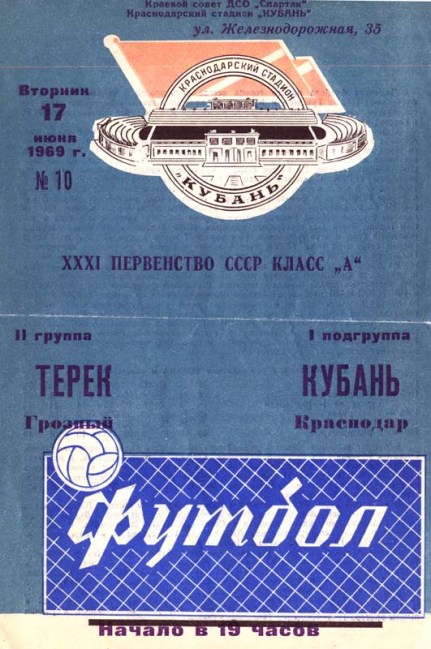
The last programme of the lot is another home game for “Кубань Краснодар” aka “Kuban Krasnodar”. If you remember, “Krasnodar”, the name of the city, means “gift of the Reds” and the Kuban was the local river. The opponents are “Терек Грозный” aka “Terek Grozniy”. Nowadays the team is called “FC Akhmat Grozny”. Back in 1969, the game was a seven o’clock evening game on Tuesday, June 17th 1969. Top left is the complete date, namely “Вторник 17 июня 1969 г ”  The “г” is short for “года” (“goda”) which means “of the year”.

Grozny is not really a place for a romantic weekend break. It is the capital of Chechnya, home of the Chechens, who are primarily of the Muslim faith. You can read about the wars here, the first of three wikipedia articles.

The new team, “FC Akhmat Grozny”, is now named after Akhmat Kadyrov who was the Chief Mufti of the Chechen Republic of Ichkeria in the 1990s. He changed sides in 2000 and became the President of the Chechen Republic. On May 9th 2004, he was assassinated by Chechen Islamists in Grozny.

Grozny is a place name, but in Russian it also means something. “Грозный” is an adjective meaning “terrible, formidable, redoubtable, menacing, threatening, stern or ferocious”. It can be applied to a look, a glance, a storm, a danger, or a tsar. “Иван” is “Ivan”  and I’m sure that you can work out which of the many Ivans was the tsar called “Иван Грозный”.

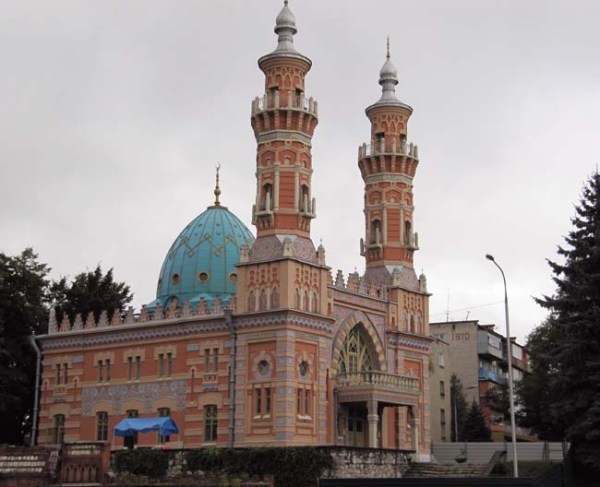
But what is a “Terek”? Well, it’s a river in the northern Caucasus. Here it flows through Vladikavkaz,  the old Tsarist fortress and garrison town, and nowadays, the home of the beautiful Mukhtarov Mosque:

To me though, the word “Terek” will always be associated with a rare bird in England, the Terek Sandpiper, a wader which always runs to the water’s edge to wash its food before it eats it. It is also one of the very few birds whose beak points upwards. Not many people know that.

16 Comments

Filed under Football, History, Literature, Personal, Politics, Russia

Stories about my Dad (2)

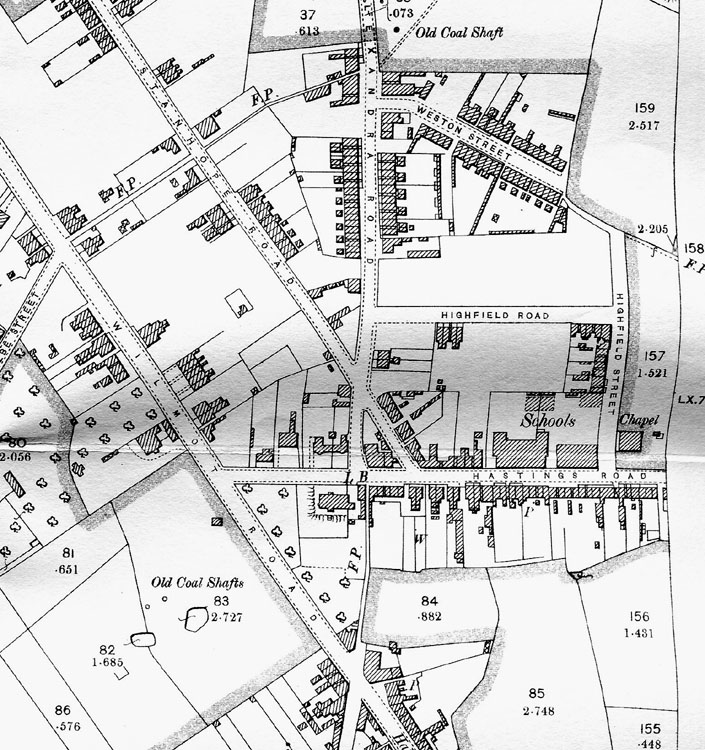
In 1946, my Dad, Fred,  left the Brylcreem Boys of the RAF and Bomber Command, and signed up to be trained as a teacher. He finished up getting a job quite near to his home in Hartshorne Road, Woodville. It was at the school in Hastings Road in Church Gresley. He taught there until the mid-1950s. In the 1990s, when I used to go and watch the local football/soccer team, Gresley Rovers, I met one or two of his erstwhile pupils who all remembered him, as a very strict teacher who brooked no nonsense. That might well have been because the teenage sons of coalminers at Hastings Road would have been a tough proposition to keep under control in classes of more than forty, especially for a first time teacher. I can quite well imagine that Fred would have had to employ what DH Lawrence, faced also with teaching the teenage sons of coalminers, called “three years’ savage teaching of collier lads”.

Here’s Hastings Road School. I have used one of the reprinted Victorian maps of England sold by Alan Godfrey . Hastings Road is in the middle of the eastern edge:

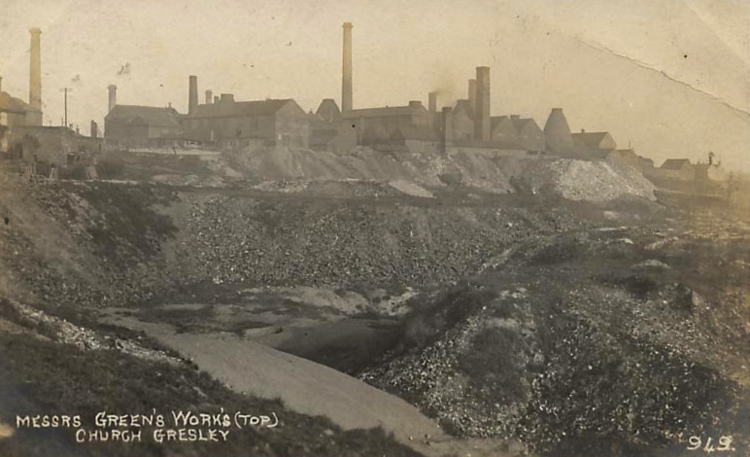
Notice how many “Old coal shafts” there are, even in this small area. Just after the war, there were up to 17 coal mines active in the area, as well as numerous vast open cast clay mines. Just try to imagine how small a human figure would be on this postcard, if those are full sized factory buildings in the background. Open cast clay mines were really gigantic…….

All of these activities, of course, left the entire area prey to subsidence. I found a very short article about this particular area on the internet. It said that

“…….the subsidence here was so severe the town’s plight became a national embarrassment. Schools, libraries and even entire streets were either propped up or knocked down as the town sank at an alarming rate.”

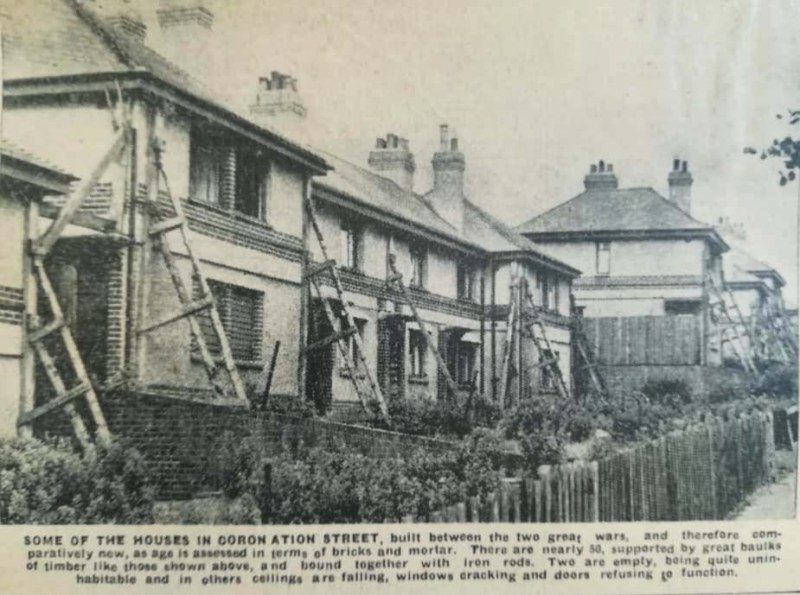
As a little boy in the late 1950s, we often used to drive up to Church Gresley to see the houses which had been damaged by the subsidence, which was produced by a 150-odd years of intensive coal mining. These houses were easily recognisable, being  propped up with huge beams of wood or extra long railway sleepers. Here are some of the less serious supports in a picture from a 1949 newspaper. I can remember enormously thick beams of wood when I saw them in the late 1950s. The houses must have been in an even worse state by then. Most of them had, in fact, been evacuated.:

The caption reads:

“SOME OF THE HOUSES IN CORONATION STREET” Built between the two great wars, and therefore comparatively new, as age is assessed in terms of bricks and mortar. There are nearly 50, supported by great baulks of timber, like those shown above and bound together with iron rods. Two are empty, being quite uninhabitable, and in others ceilings are falling, windows cracking and doors refusing to function.”

If the the houses were built in a coronation year, “between the two great wars” they can only date from 1936 and were thus only thirteen years old at  the time of the newpaper photograph. There is a very short video available.  The title refers to “Swadlincote” which is the name of the local area:

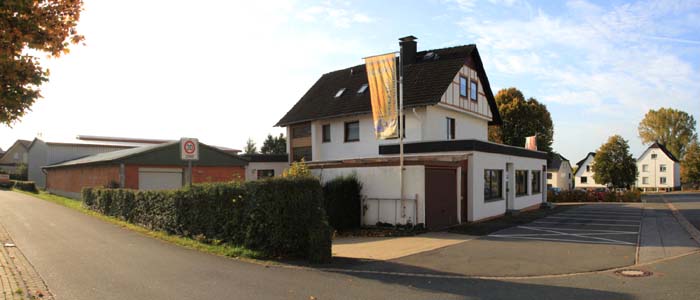
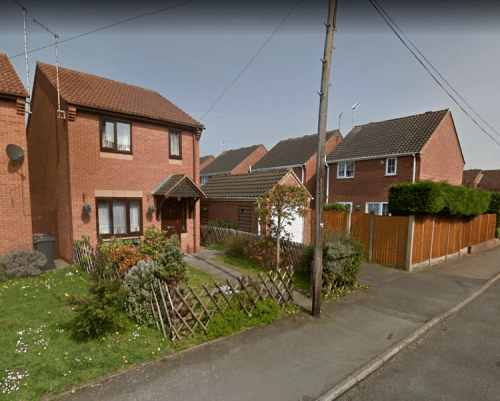
Thirty, forty years after my Dad had left Hastings Road School. I went to Hastings Road to take some photographs of the school. Alas, the buildings were no longer there, and had clearly fallen victim to the subsidence that I knew had claimed so many local houses. I began to investigate but I couldn’t find anybody who knew for certain the true detailed story of the demise of Hastings Road  School. Perhaps one day, the beams arrived, and the next day, before they could be put into position, the whole school fell down. That must have cheered up all those “collier lads”. Here’s the school today. Today’s pavement would have been directly in front of the school’s front wall:

21 Comments

Filed under Bomber Command, History, my Dad, Personal, Science

My best friend, Widdle (3)

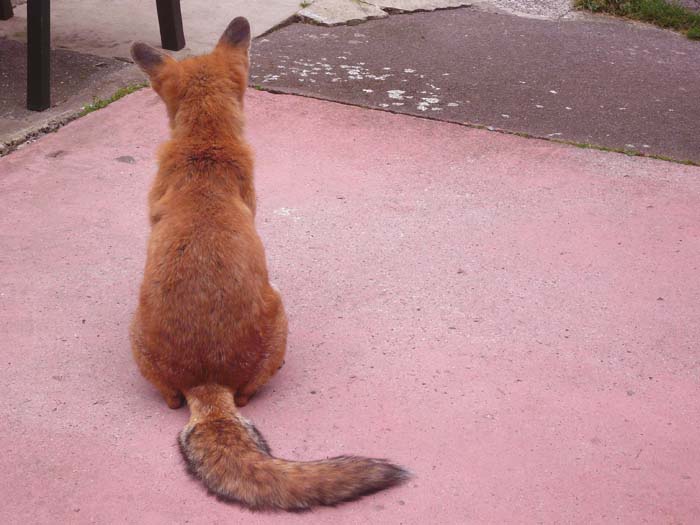
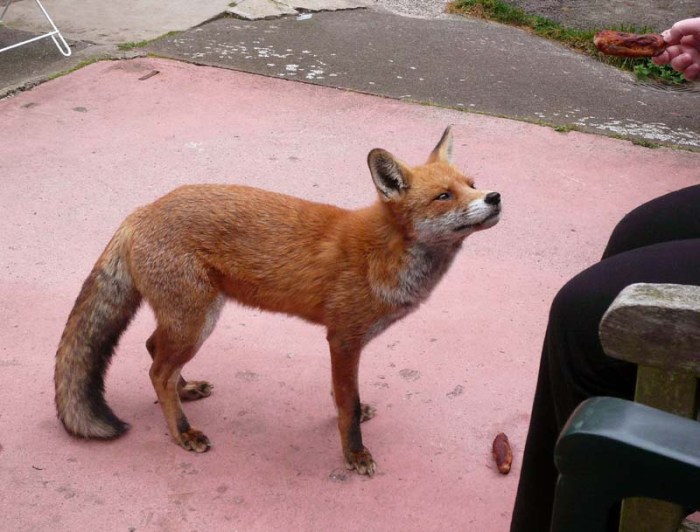
Widdle was extremely photogenic, and didn’t he know it! Mind you, he does have such beautiful soft eyes……..

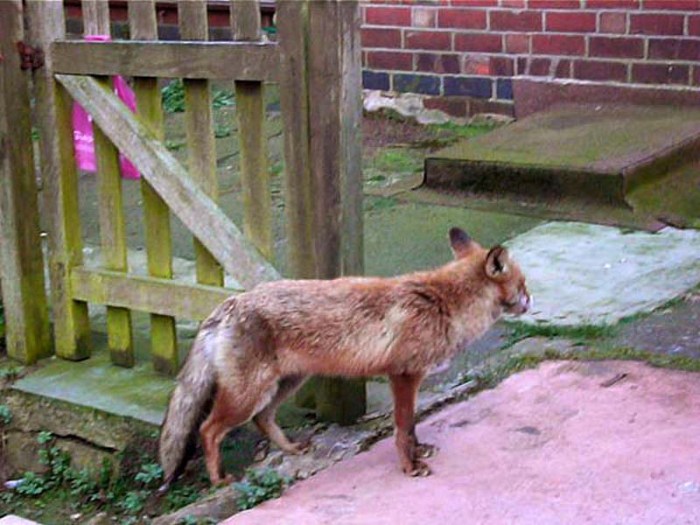
In the days when he had a wife and cubs to support, Widdle did his very best to be the perfect husband and the perfect Dad, but that didn’t mean that he never felt tired. Indeed he had a number of different places that he would use for a rest, and if it was sunny and warm, then so much the better.

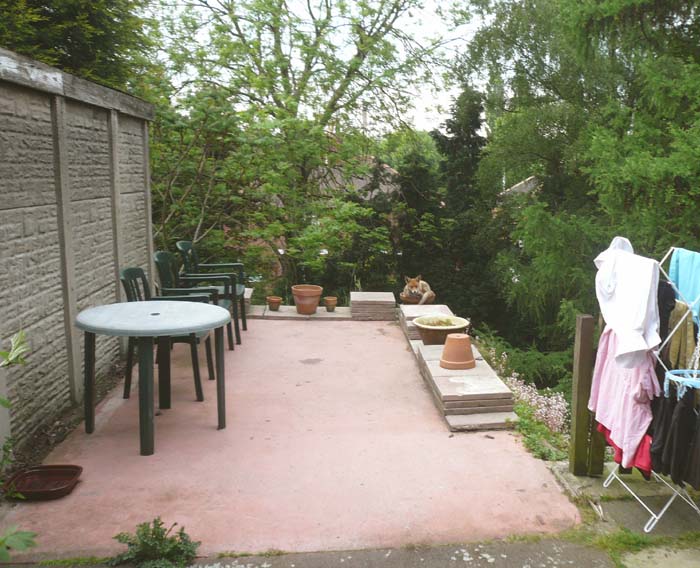
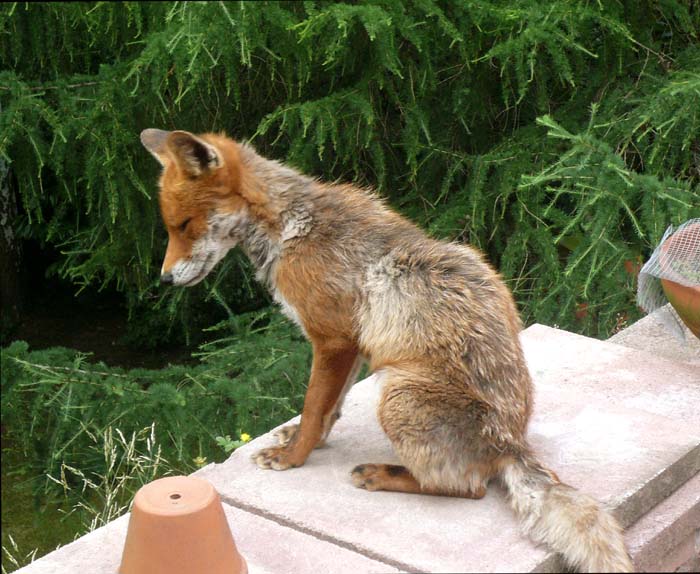
If we weren’t at home when he came to call, he would graciously sit quietly and wait for us. Sometimes, he would get nice and comfortable in a large empty planter. Our garden is on two levels, and directly behind the planter there was a fifteen foot drop. It didn’t bother him, though. Widdle never seemed to have any fear of heights…….

When we went to say hello and to ask him what kind of a day he was having, Widdle wasn’t ever frightened.  He liked that lofty perch,  even though he was sitting with his back to any potential attackers. What he saw as the biggest plus point of that planter was the fact that he could immediately spot us as we emerged from the house with his sausages……

On other occasions he would sit like a dog, making sure that there were no rival male foxes on the lawn some twenty feet below:

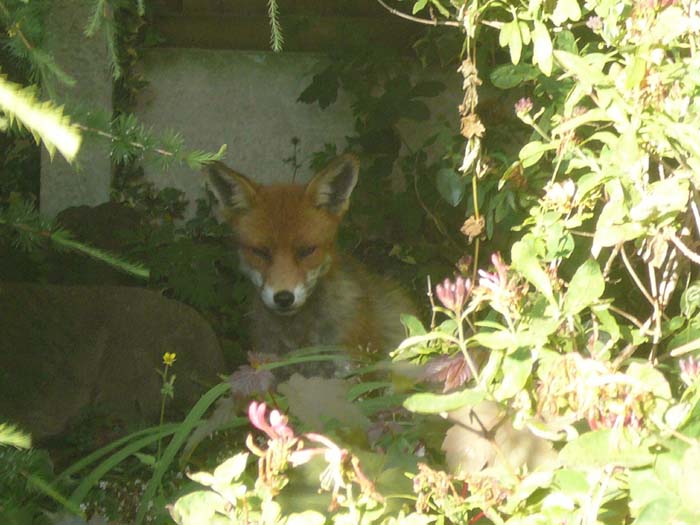
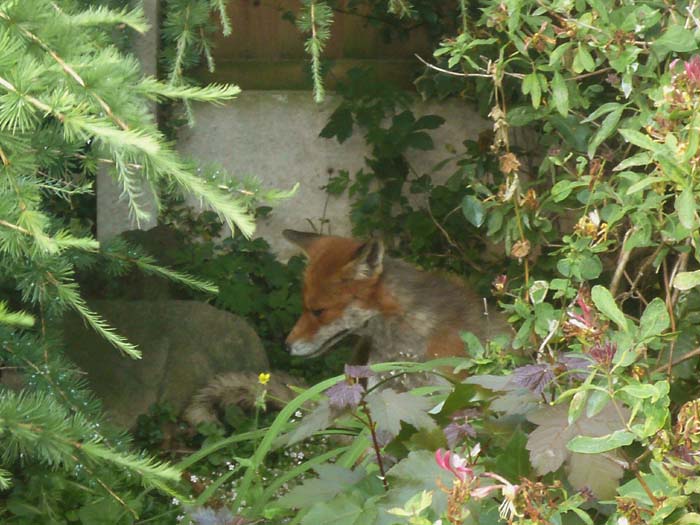
At other times he seemed very cautious and preferred to sit in the foliage:

Occasionally, he would have his attention drawn by a noise he didn’t recognise:

His proudest moment, however, came when he showed off his new winter coat:

His fur was always at its most luxuriant in the winter, whehn he needed the extra warmth, of course. In summer, he would moult his coat and go around looking a lot more grey than red, and overall, extremely tatty. Picture 4 above illustrates the Punk Fox look perfectly, as does the one below…..

In this photograph Widdle is a little more advanced in his moult, and the grey tones to his fur are really obvious. This picture dates from a different day to Photograph 4, when he spent a sunny warm afternoon in the planter, and woke up so stiff that he needed a good stretch before he could even think of eating.

Having said that, just a few minutes warming up, and he was soon ready for his favourite food…….


22 Comments

Filed under Humour, Nottingham, Personal, Widdle, Wildlife and Nature

The Sandiacre Screw Company (6)

Keith Doncaster took off on his last mission with 166 Squadron at 18:12 hours on October 22nd 1943 from RAF Kirmington, 11 miles south west of Grimsby in Lincolnshire. Here’s what RAF Kirmington looks like today:

Keith was in “Z-Zebra”, an Avro Lancaster Mk III with the serial number EE196 and the squadron letters AS-Z . During the course of the war, because of the astonishing levels of bomber losses, nine different aircraft in 166 Squadron were to carry those letters of AS-Z, “Z-Zebra”. That means, over time, 63 different young men as crew, of whom a minimum of 54 would have experienced disaster of some kind, up to, and including, their own deaths.

There were also nine different aircraft for AS-E, “E-Edward”, (63 more young men’s lives risked) and for AS-F, “F-Freddy”, (63 more) and for AS-N, “N-Nuts”, (63 more) and for AS-S, “S-Sugar”, (63 more). Those five different letters, then, E, F, N, S and Z, accounted for 45 Lancaster bombers and 315 young men all put into extreme danger.

In an Avro Lancaster, if the aircraft was shot down, only one man of the seven crew, on average, escaped with his life. That makes 54 young men killed in the nine different aircraft which carried the letter “Z”. And overall, those five different letters, E, F, N, S and Z, accounted for 270 young men, all of them in all probability, killed.

The members of the crew all had a financial value and cost. The Head of Bomber Command was Arthur Harris, aka Bomber Harris, aka Butcher Harris (to his men). Harris always used to reckon that to train just one member of a Lancaster crew cost as much as sending six men to Oxford or Cambridge for three years. Whether that is true or not, we do know that the actual figure was £10,000, although the website did say that that total is expressed in 1943 prices. Allowing for inflation, in today’s money, the cost becomes £500,000 per man.  And the crews of those five different letters, E, F, N, S and Z, therefore, were trained at a cost of around £135,000,000.


That all created some startling casualty figures for Bomber Command. A total of 51% of all bomber crew were killed on operations, 12% were killed or wounded in non-operational accidents and 13% became prisoners of war.  Just 24% survived.

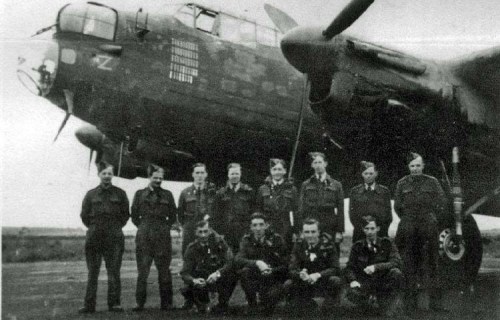
Those five letters, E, F, N, S and Z, also stood for enormous sums of money. In the early 1940s, Lancasters cost, in today’s money, around £2,000,000 each. Those 45 aircraft would therefore have cost £90,000,000. Here’s “Z-Zebra” and its crew, possibly with the members of the ground crew ho kept if flying…….
Never forget, though, that there is a difference between “cost” and “value”. Let’s look at two sentences……
“What is the cost of just one of those aircrew to the RAF?”
“What is the value of just one of those aircrew to his family?”
Here’s the crew of Z-Zebra, and, presumably, five of the ground crew who kept them flying……..

Tonight, the target was Kassel, a city to the northeast of Frankfurt. No satellites in those days meant that accurate weather forecasts were very rare and the bombers frequently encountered unforeseen meteorological difficulties.

And so it was on this occasion, when 569 bombers, including 322 Lancasters and 247 Halifaxes, set off for Kassel. Twenty of them encountered heavy rain, ice formed on the aircraft and they were forced to turn back. Other various problems forced 39 more bombers to turn back. Eventually, 444 aircraft arrived at the target, 78% of the original force.

Kassel was a prime target because of the Fieseler aircraft factory, the Henschel & Sohn factories producing Tiger tanks, an engine factory, a motor vehicle factory, and the headquarters of the organisation responsible for all railway and road construction in central Germany as well as two military headquarters and the regional supreme court. Kassel housed the headquarters of Military District 9 and the local satellite camp of Dachau provided slave labourers for the Henschel factories.

The 444 survivors from that original force dropped 2,000 tons of bombs and an amazing 460,000 incendiaries. Native speakers were used, broadcasting from special Lancasters, to give the German night fighter pilots incorrect orders over the radio or to countermand their previously given orders. A diversionary raid on Frankfurt, by 28 Lancasters and eight Mosquitoes caused further confusion.

The main target was marked exceptionally well and the bombs fell extremely accurately, creating a minor firestorm, made all the more severe when the main telephone exchange and the city’s water supply were put out of action.

4,349 blocks of flats containing 26,782 individual family flats were demolished. The bombers damaged 6,743 more blocks, containing 26,463 individual units. 120,000 people became homeless. There were 1,600 major fires and a thousand smaller ones. Overall, 160 industrial premises were flattened, along with 140 government buildings. At this time Henschel were manufacturing V-1 missiles, so this severe damage impacted hugely on the date of the first launchings against England. Two German spectators watch the spectacle :

Kassel was devastated and burned for seven more days. Casualties were dug out of the hot rubble for weeks. 5,600 people were killed and 3,300 just disappeared, cremated in the firestorm and its week long aftermath. After the previous raid of October 3rd-4th 1943, up to 90% of the city centre was now destroyed. There were only two more significant raids on Kassel during the rest of the war. One on the Henschel motor transport plant, and the RAF’s final farewell on March 8th-9th 1945. The RAF really had done an enormous amount of damage:

All of this success had its price though. That night, 241 men were killed as 25 Halifaxes and 18 Lancasters were destroyed. On the way to Kassel anti-aircraft fire accounted for three bombers, and night-fighters claimed a couple more. The anti-aircraft fire at Kassel, aided by 70 searchlights, brought down five more bombers. Searchlights could be a formidable opponent, especially if they had a cathedral to defend:

This slideshow requires JavaScript.

The night-fighters then struck as they returned home. No 10 Squadron lost 21 men, with further losses from No 12 Squadron (eight men), 35 Squadron (two men), 49 Squadron (nine men), 50 Squadron (one man), 51 Squadron (seven men), 57 Squadron (ten men), 61 Squadron (six men), 76 Squadron (eight men), 77 Squadron (ten men), 78 Squadron (six men), 100 Squadron (five men), 102 Squadron (eight men), 103 Squadron (19 men), 158 Squadron (14 men), 166 Squadron (12 men), 207 Squadron (nine men), 408 Squadron (seven men), 419 Squadron (five men), 427 Squadron (26 men), 428 Squadron (one man), 429 Squadron (11 men), 431 Squadron (seven men), 434 Squadron (22 men) and 467 Squadron (seven men).

In addition to these 241 men killed, 71 became prisoners of war. This constituted a completely unsustainable loss rate of 7.6 %. In other words, at that rate, nobody would live to carry out more than fourteen missions.

Not many of the young men in this photograph will be over thirty:
19 Comments

Filed under Aviation, Bomber Command, History, military, Nottingham, The High School

Football Programmes of the Soviet Union (4)

The old Soviet Union, of course, had a huge number of less well known teams in the lower divisions, and they can often be quite interesting because they have such marvellous names, the Russian equivalents, perhaps, of Scottish football teams such as “Bonnyrigg Rose”, “Civil Service Strollers” and “The Spartans”.

This first programme is “Кубань Краснодар” aka “Kuban Krasnodar”, a team which used to play in Krasnodar, the 16th largest city in Russia. It was built by the Cossacks on the southern plains as a fortress to guard the River Kuban. “Krasnodar” means “gift of the Reds” aka “the dirty Commies”. Before that, the city used to be “Yekaterinodar”, which means the gift of Catherine the Great. In modern times, “Кубань Краснодар” became FC Kuban but that didn’t prevent bankruptcy on May 17th 2018 and, as far as I know, a short trip into oblivion. Like most football clubs, though, oblivion didn’t last that long, and on August 5th 2018, the club was back in business, now called FC Kuban (2018). Here is their badge.

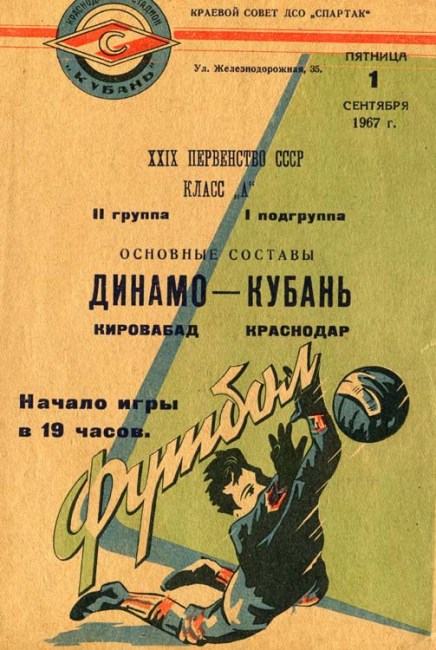
Below is one of the old programmes of “Кубань Краснодар” aka “Kuban Krasnodar” . It dates from September 1st 1967 (top right). Just above the number 1 is the word Russian “пятница”  or  “P-ya-t-n-ee-ts-a” which means “Friday”. The origin of the word is that “пят” or “P-ya-t” means “five”. It’s the fifth day of the week, of course.

In Russian, the home team is always on the right, so the visitors this Friday are “Динамо Кировобад” aka “Dynamo Kirovabad”. Kirovabad was the city’s name from 1935-1989 and it is now called “Ganja”. It is the third largest city in Azerbaijan, but the most mellow by quite a long way. The team is now called “Kapaz PFK” incidentally…….

Inside the programme, which is a single sheet folded in two,  are the two teams, complete with an illegible autograph:

Look at the three vertical lines down the middle. On both sides of that vertical division, the bottom two horizontal  lines, on both left and right, contain the words “Тренер” and “Капитан”, trainer and captain. The left hand trainer has the very unusual first name “Hamlet”, which in Russian is “Гамлет”.

This is literally “Gamlet” but Russian has no letter “H” and replaces it in foreign words with a hard “G” sound. In the USA this gives you “Gonolulu” /”Гонолулу”  and “Gollyvood”/”Голливуд“. In England, this gives you “Galifax”/”Галифакс” , “Guddersfield” / “Гуддерсфилд” and “Garry Potter” / “Гарри Поттер“.

Chaos ensued with the fact that England had two ports very close to each other. One is called “Hull” and the other is called “Goole”.   Both of these places came out as “Gooll” / “Гулл” which caused so much confusion that Russian ships completely stopped going to Goole and only ever went to Hull.

The next programme is from “Ташкентская Обл(асть)” or the Tashkent district. Tashkent, of course, is nowadays the capital of Uzbekistan, a country usually regarded as being in Asia.

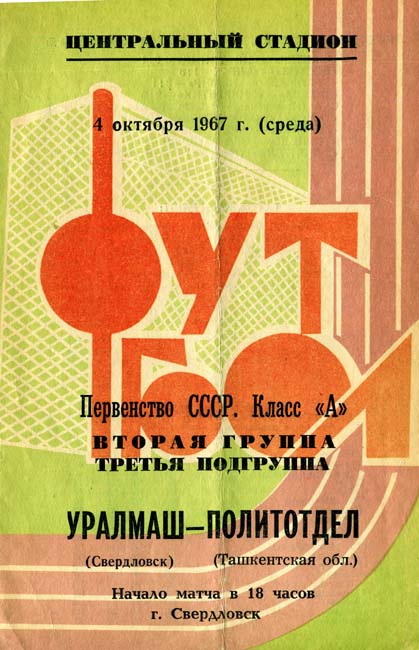
The programme is from a home game for a team called  “Политотдел” which is “Politotdel “ aka “Political Department”:

Tashkent is home to this stunningly beautiful mosque:

On the left, Politotdel’s visitors are called “Уралмаш Свердловск” or “Uralmash Sverdlovsk”. Sverdlovsk has now been renamed  “Ekaterinburg”, and is to the east of the Ural mountains. It is the third largest city in Russia with around two million inhabitants.

Nowadays, “Политотдел” has become the beautifully named “FC Dustlick” of Uzbekistan. “Уралмаш Свердловск” have been at various times  “Avangard”, “Zenit”, and “Mashino-stroitel”. “Avangard” must be the  well known French expression, “Avant garde”. ”Mashino-stroitel” in Russian, means “car constructors” and “Uralmash” is an acronym type creation meaning “Ural Car”. Nowadays, no cars are manufactured in this area, hence the present name of the team, which is just “Ural” or  “Урал“:

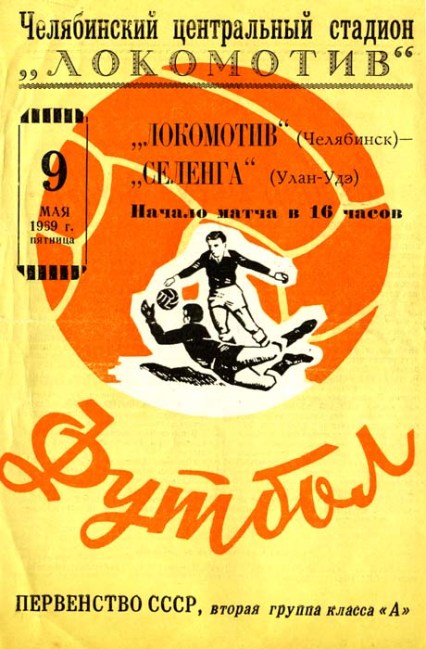
The final programme, below, is “Локомотив Челябинск” or “Lokomotiv Chelyabinsk”, who are  the home team. They face “Селенга Улан- Удэ” or “Selenga Ulan Udé”. The match took place on Friday, “пятница”, still pronounced “p-ya-t-n-i-tz-a”,  and based, as we know, on “пять”, “p-ya-t”, the Russian for five. “Пять”, “p-ya-t”, is related to the Greek “pent” as in “the Pentagon”. The match kicked off at 1600, which was a very early end to the working week. East of the Urals, and sheltered away from central government in Moscow, “Уралмаш Свердловск” games always used to bring about a “POETS” .

Chelyabinsk aka “Челябинск” is the seventh largest city in Russia with 1.1 million inhabitants. It is to the east of the Urals (just).

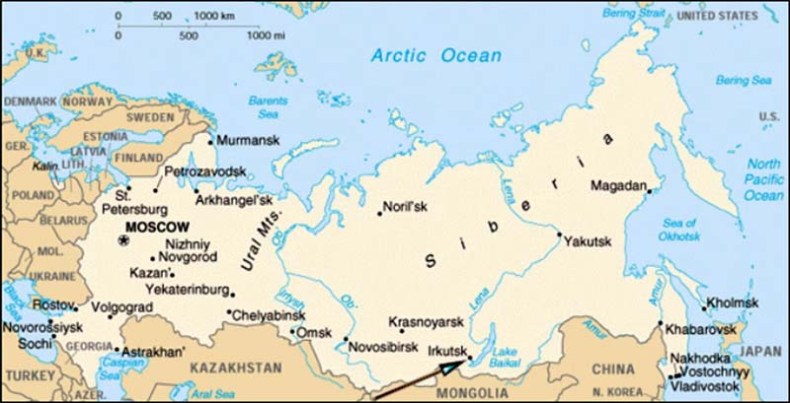
The football club “Selenga Ulan Udé” is now called “FC Buryatia Ulan-Udé”. Ulan Udé is to the south east of Irkutsk  and Lake Baikal and stands at the confluence of the River Selenga (hence the team name) and the Uda. The city is the capital of the Buryatia region, which is directly north of Mongolia. It has a population of slightly less than a million, of which 450,000 live in Ulan Udé. Buryatia therefore, must be really empty with an effective  population destiny of roughly four per square mile. Alaska has 1.3 and Wyoming six. Here’s a map. Look for the black arrow:

Ulan Udé is the centre of Tibetan Buddhism in Russia but most spectacular of all is its 25 foot tall Head of Lenin statue. I wonder how the people at the Nottingham city planning department would feel about one of those on our nearest Ring Road roundabout ?


.


8 Comments

Filed under Football, History, Personal, Politics, Russia

Stories about my Dad (1) Manchester Lane

Just after the war had ended, in 1947,  there was a horrendously hard winter in England, with huge amounts of snow, and much hardship for ordinary people, with the extreme cold and the continuing spectre of rationing.

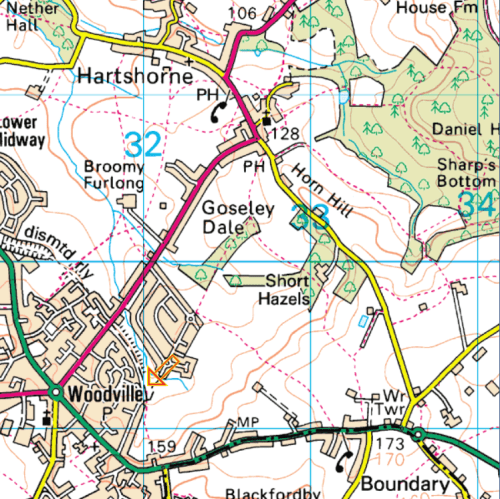
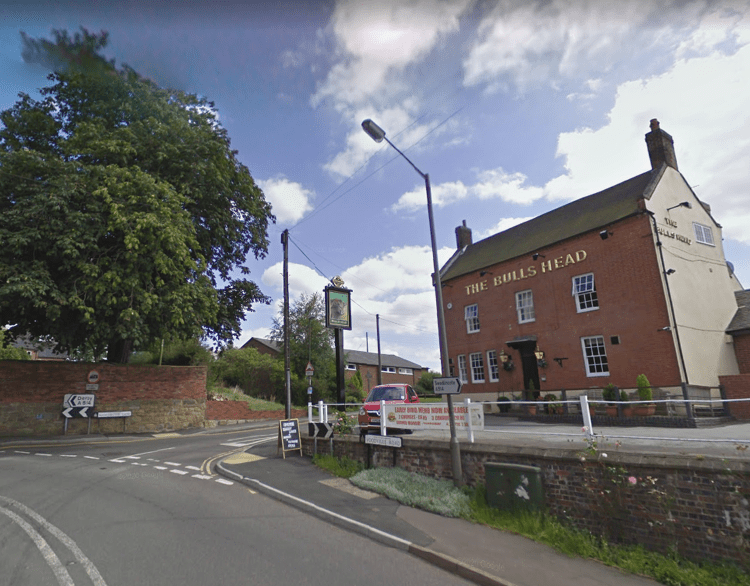
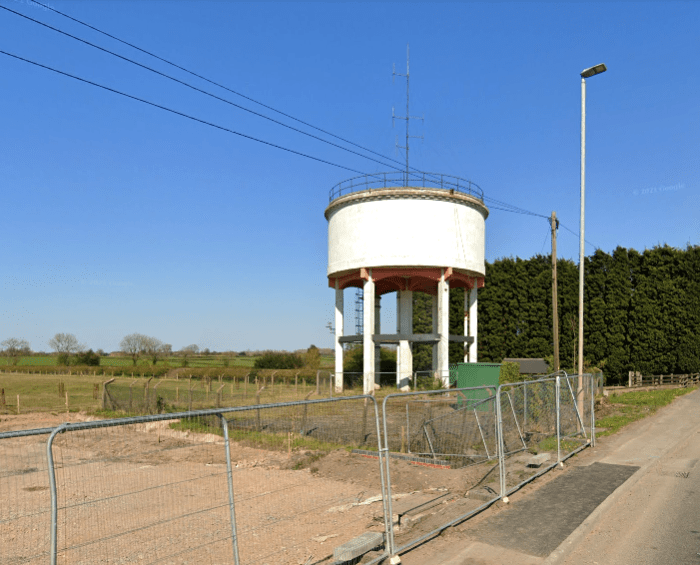
Manchester Lane is a tiny country lane which runs between the village of Hartshorne and the hamlet of Boundary. As my Dad, Fred, used to live in Woodville, at either No 9 or No 39 Hartshorne Road (in red), he would make frequent use of Manchester Lane to produce a circular walk around the district. He would walk down Hartshorne Road to the very bottom, near to church with a square tower (cross “+” with a black square attached, and turn right at the Bull’s Head Public House (PH). He would then follow the summit ridge of Horn Hill, a route used since Neolithic times, and walk at last along Manchester Lane itself (in yellow) as far as the water tower (“Wr Twr”) at Boundary.  He then turned right and right again, and returned finally to Woodville along Ashby Road (in green), and then High Street (also in green). You can see his route on this map:

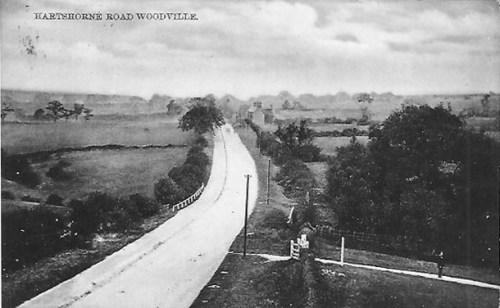
The orange arrow points to Woodville. Hartshorne Road is the red road running to the north east. In those days, it was very countrified…..

When he reached Hartshorne, Fred would turn right past the Bull’s Head, which dated from Georgian times, into Manchester Lane :

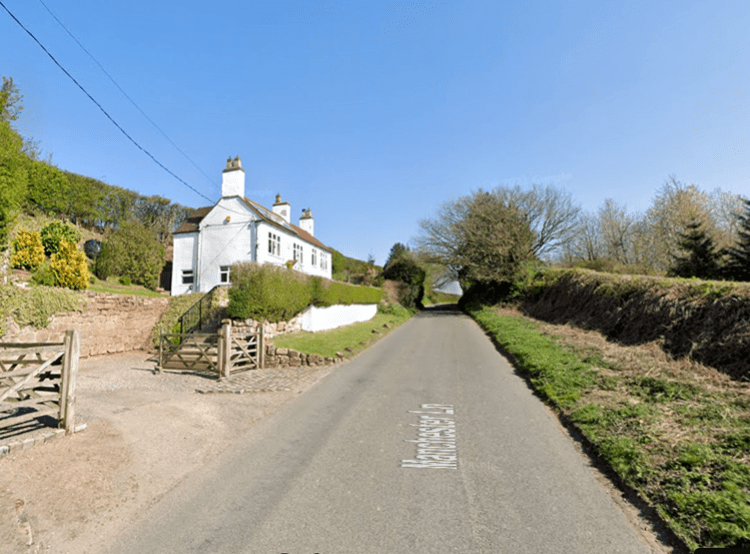
He was now in Manchester Lane which he followed for quite some distance. In 1947, this tiny country road was completely blocked by the snow. Indeed, the snow was so deep that the authorities, with the help of the RAF,  improvised an emergency snow plough by mounting an aircraft engine, complete with whirling propeller, on the back of a lorry. They then backed the vehicle into the lane, and it cleared the twelve feet deep snowdrifts without any problems.

This country road had always created a big impression on Fred, and he was forever going off for “a walk round Manchester Lane”. This healthy jaunt was around three or four miles long, and it would take at least a whole morning. It left behind the factory chimneys of Woodville and, once you got to Manchester Lane,  it went right out into open countryside, between leafy hedges and past green fields, with a splendid view looking back towards Hartshorne, Woodville and Midway. Fred never tired of the fresh air and the blue sky, the sun, the wind, the ever-changing faces of the weather and the varying aspects of nature.

Occasionally he would see a remarkable sight, such as one of his abiding memories, an old man well into his eighties, sitting astride the gable of his house roof on Manchester Lane, mending or replacing the broken ridge tiles. This is the cottage today, gentrified beyond belief:

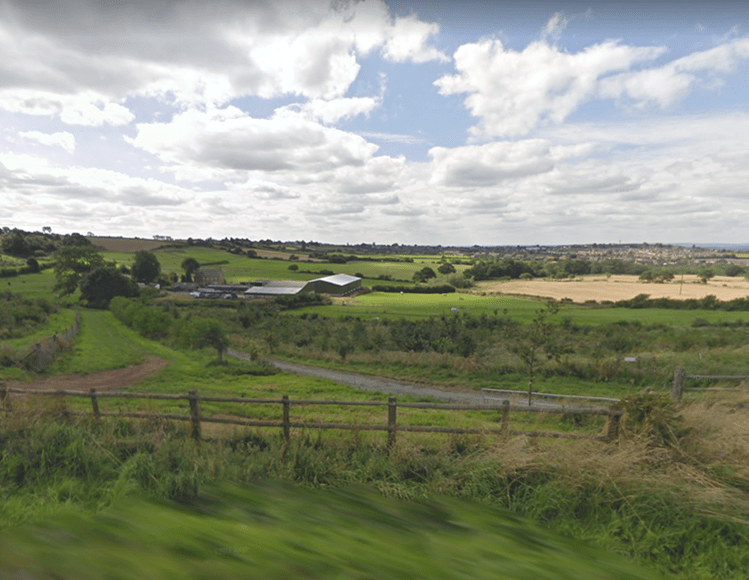
On a darker note, Fred would often tell the tale of an isolated barn, in fields down to the south of the lane, which had been the centre of a deathbed confession by a man in faraway Australia. This macabre episode took place in the 1930s, when a farmworker who had emigrated from Woodville, well before the turn of the new century, lay dying in Tasmania, and asked to make his peace with God. He confessed that, years before, he had murdered a young woman and buried her body beneath the floor of a particular cold grey stone barn near Manchester Lane in far away England. The barn was something like this:

The Australian authorities notified their English counterparts of the man’s confession, and the calm tranquillity of the South Derbyshire countryside was soon  disrupted by the arrival of teams of policemen who dug up the floor of the barn, and indeed, a number of other similar barns in the area. They found nothing, although their researches were extensive. It remains a minor mystery to this day, why the dying man said what he said. Perhaps he just disliked policemen, or alternatively, perhaps he thought that many of them were too fat after all those donuts and needed to work off a little of their excessive weight.

The barn nowadays seems to have been swallowed up by the extended farm buildings at this farm. It may even have been demolished:

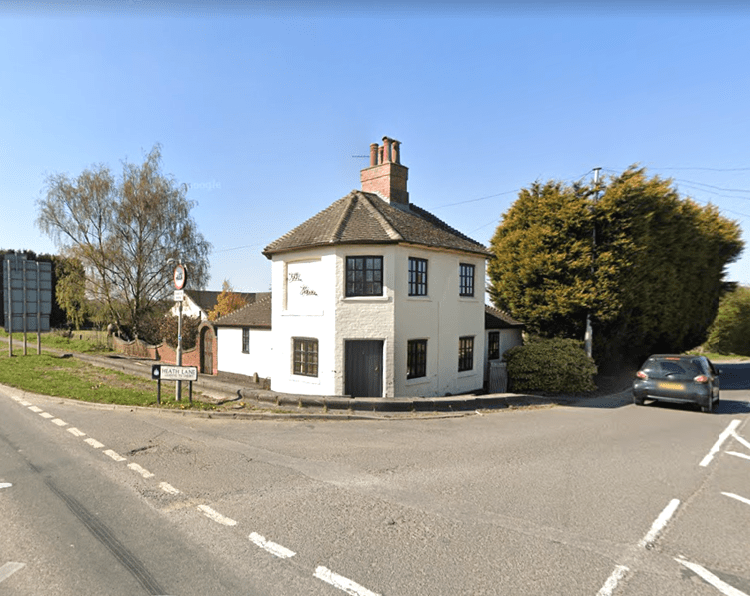
Whatever the case, this was a good place  to pause, and to take in the beautiful view. And then it was upwards and ever onwards to the right turn that would take him towards the old Toll House at Boundary:

Originally, the toll house was eight sided so that the toll keeper could keep a wary eye out for people who were approaching from whatever direction.  In addition, eight sided buildings are supposed to be immune to demonic possession, which is nice. Then it’s another right turn so that Fred could follow Ashby Road which would eventually become High Street and take him homewards. But there was more to see yet. A quarter of a mile beyond the Toll House was the Water Tower at Boundary:

Just after Ashby Road became High Street in Woodville, there is a small turn off which used to lead to a tiny farm which nestled among the shops and terraced houses. One day, when my daughter was just six years old, Grandad Fred took her to see the farm. It was lambing time and she was able to feed some of the newborn lambs with a bottle.  She will never forget doing this for the rest of her life. She will never repeat it though, because this is the turn off today. I just love our brave new world. It’s so interesting and so clean:


22 Comments

Filed under History, Humour, my Dad, Personal, Wildlife and Nature

My best friend, Widdle (2)

As you have seen in the first instalment of this story, the best animal friend I ever had was a fox called “Widdle”. He taught me more of value than 90% of my teachers ever did. And Widdle, he also learnt a little bit.

Widdle, of course, soon learnt which way his sausage was buttered.

The usual scenario was that he would be out on “Lone Hunter’s Patrol”, looking for geese and turkeys, hurtling round the gardens at top speed:

And then he would hear me calling his name :

And then he would come up the path to the patio

And then he’d let you know why he was here:

And then he’d take a sausage or two from you. He was quite prepared to touch you and he wasn’t afraid :

If he was hungry he would often eat the first one, but otherwise he would put it on the floor and then come for a second sausage. He could always be trusted to carry two sausages in his mouth, and as he grew older and more experienced, he managed to carry three. Here, he seems happy to take just two. As we human thick-heads eventually worked out, neither of them were for him:

Now for the second:

A very tricky manoeuvre :

And then it’s “Up, up and Away !!!

His wife, Mrs Widdle, will get her share of the two sausages, but only if the cubs, up to four of them usually, have had their fill. I was always 100% sure that in the rather extensive fox family, Widdle, the individual who provided all the food, was always the last to eat any.

A lesson for us all. And not just in sausage eating.


17 Comments

Filed under Humour, My Garden, My House, Personal, Widdle, Wildlife and Nature