Author Archives: jfwknifton

What would you do ? (19) The Solution

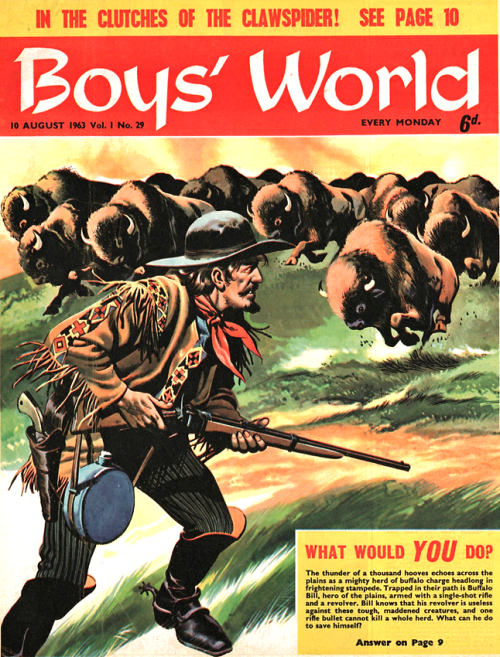
“What would you do ?” used to figure on the cover of a boys’ comic called “Boys’ World”. This was a publication, obviously, aimed at boys, and first appeared on January 26th 1963. There were 89 issues before the comic was merged with Eagle in 1964. The last issue of “Boys’ World” came out on October 3rd 1964.

I used to buy “Boys’ World”, and this was mainly for the front cover which always featured a kind of puzzle. It was called “What would you do ?” and was based on somebody being in what Ned Flanders would call “A dilly of a pickle”. Here’s the situation:

And here’s that yellow box enlarged:

And the correct solution was now relegated to page 9 of the comic. Here it is:

And the text, a bit blurry for my taste at this point, reads:

“This was the exact situation Buffalo Bill faced on one of his many buffalo hunts. He saved himself by shooting the leading buffalo, knowing that the rest of the herd would avoid the fallen animal. He then crouched down behind the carcass, using it as a shield, and escaped without a scratch from the stampede passing him on either side. “


19 Comments

Filed under History, Nottingham, Wildlife and Nature

What would you do ? (19) The Puzzle

“What would you do ?” used to figure on the cover of a boys’ comic called “Boys’ World”. This was a publication, obviously, aimed at boys and first appeared on January 26th 1963. There were 89 issues before the comic was merged with Eagle in 1964. The last issue of “Boys’ World” came out on October 3rd 1964.

I used to buy “Boys’ World”, and this was mainly for the front cover which always featured a kind of puzzle. It was called “What would you do ?” and was based on somebody being in what Ned Flanders would call “A dilly of a pickle”. Here’s the situation:

The yellow box sets the scene, and the task is for you to solve the situation. Perhaps you might like to write your idea in the “Comments” section.

Here’s the yellow box enlarged:

So…..it’s one “Dilly of a pickle”.  A thousand hooves thunder across the American plains as the bison all set off in a frightening stampede. In their path stands Buffalo Bill, an All-American Hero, but  armed at this moment with only a single shot rifle. His revolver will be useless and against these terrified huge animals, his one bullet will not kill the herd.

What can  he do??

Incidentally, Buffalo Bill and his famous Wild West Show came to Nottingham, accompanied by riders of many different nationalities, such as Lakota and Cheyenne Native Americans, Argentinian gauchos, Russian Cossacks, Mongols and Turks, all of them expert riders. They camped on grassland between the southern bank of the Trent and the houses of that part of West Bridgford, but I have been unable to discover where they performed.

After one Saturday matinée, a stand holding 800 people collapsed, but the only damage was one broken ankle, a very lucky escape for everybody.

30 Comments

Filed under History, Wildlife and Nature

Some slides of Scotland, where we used to go camping, in the mid-1970s (3)

As a young man, I used to go camping around Scotland with my friend, Bill. We used to travel around the perimeter of Scotland in a clockwise direction, beginning in Glasgow, and then northwards to the top left hand corner of  Scotland at Cape Wrath. After that we headed eastwards for John O’Groats and then returned home southwards along the east coast to Edinburgh and England.

I used to take slides with my trusty Voigtländer camera and was then able to bore people silly on wet Tuesday evenings. I recently found all my slides, packed away in a very large box in the attic, but unfortunately, there were a good few which I could not identify. When I got round to doing it, one or two of the slides also suffered during the conversion process into digital images, usually acquiring either an overall blue or purple cast, or, on other occasions, with the image being much darker than it had originally been. Even so. many of these fifty year old slides had a certain value of their own.

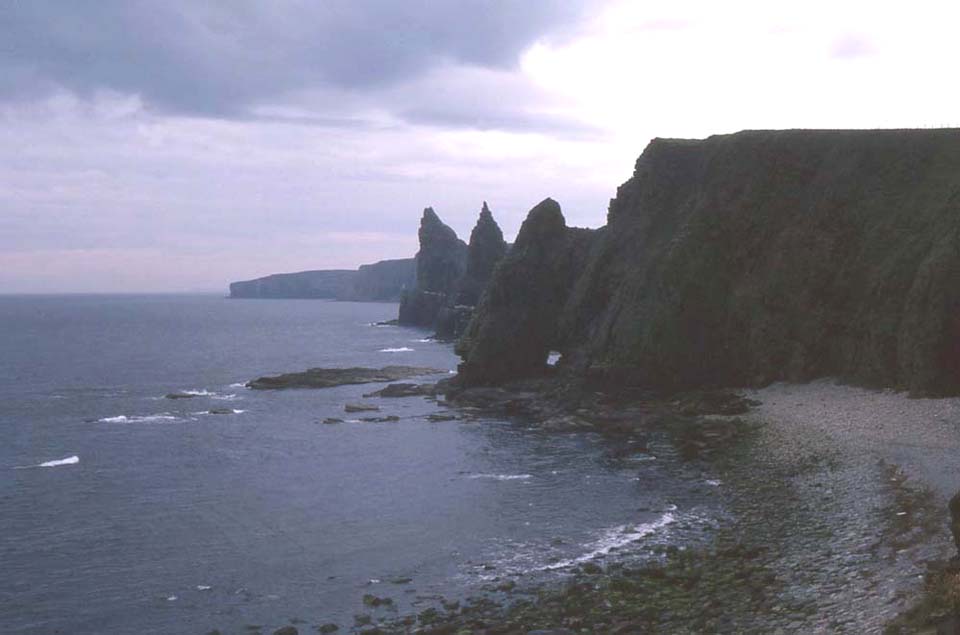
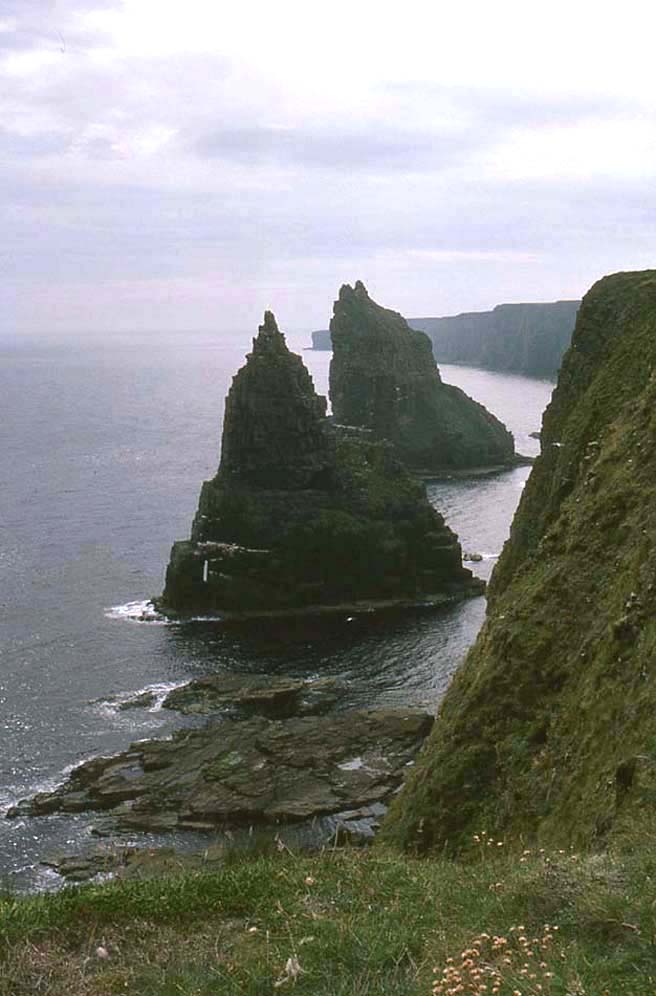
These particular ones show the north east of Scotland. This is an area which tends to lack particularly high mountains. Instead, the entire, rather flattish landscape rests on seacliffs of sandstone, but a sandstone which is so compressed that in days of yore it was used for paving slabs. This slide shows what occasionally happens when a bit of the cliff breaks off and forms a column of rock called a “stack”……

This shows you the sharply layered sandstone at the top of the cliff. The paving slabs come almost ready packed! At some places near Scrabster, the slabs are just two wide and there is a 300-400 foot drop either side. An excellent place to test your courage, or alternatively, to cure your constipation……..

Just south of John O’Groats are Duncansby Stacks which are extremely spectacular. This picture, though, shows the dangers of slides, which frequently tend to produce a second rate image of an outstanding natural scene, much more often than modern cameras do…..

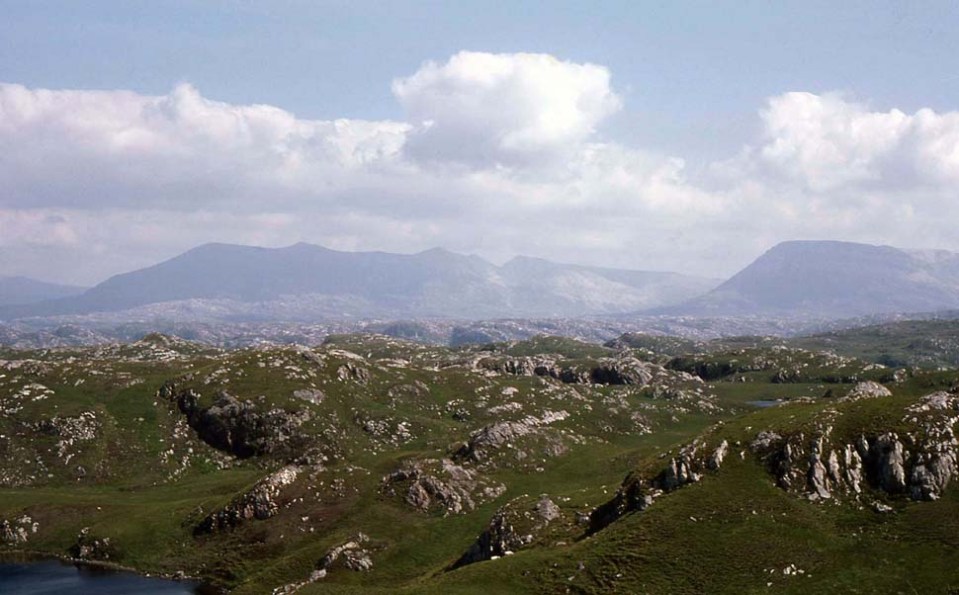
Overall, mountains in this region are few and far between. They stand on the familiar landscape of thousands and thousands of tiny pools called “lochans”, where the famous Scottish “midges” breed in their billions. And they bite. Again and again and again……

This slideshow requires JavaScript.

On one occasion, I counted more than fifty bites on each hand, although this was on the west coast, near RSPB Handa. Anyway, here is a typical scene in  the very far north…..

These mountains, with the exception perhaps of the two named after the famous racehorses, Foinaven and Arkle, are not particularly famous, and it is the overall look of the countryside which is striking rather than how spectacular the mountains are.

Here’s the reason that Foinaven became famous, in the 1967 Grand National, held at Aintree in Liverpool…….


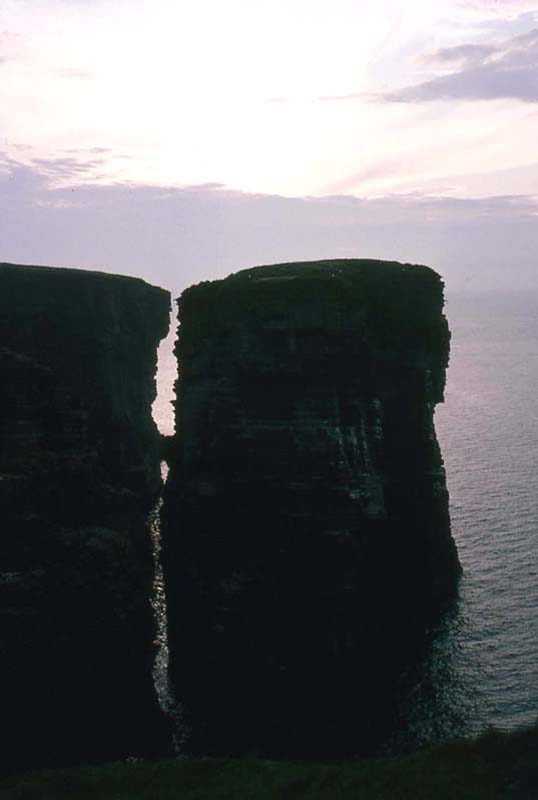
Here’s another sea stack, around 300-400 feet high, which looks as if it is still joined to the main cliff………

This stretch of cliff is not particularly striking unless you recognise, perhaps, how similar it is to “Hell’s Mouth” in Cornwall……

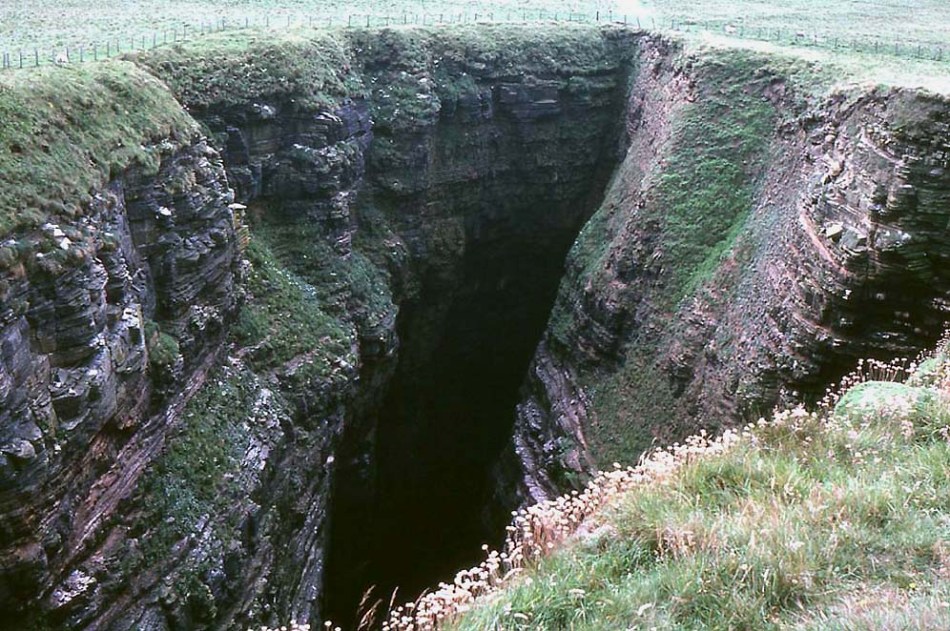
This steep sided passageway into the cliff is near Duncansby Head stacks. I’m pretty sure that it is called a “geo” . This one is just over 400 feet deep with a width considerably less than that……

This is taken in the same immediate area and helps provide nesting places for thousands and thousands of nesting seabirds when the season is right…………….

And here is a much better shot of the Duncansby Stacks……..

We went down to the bottom of the cliffs and then went a walk along the rocky shore. When we noticed that the tide was coming in, it was only then that I remembered that the tides here, between mainland Scotland and the Orkney Islands, are among the fastest in the world, along with Newfoundland in Canada. I won’t ever forget that rather frightened scramble we carried out, from rock to rock, and finally to the path back up the cliff to safety.


17 Comments

Filed under Scotland, taking slides, Wildlife and Nature

Widdle (9)

Let’s remind ourselves of a typical urban fox. Let’s call him “Widdle”.

In December 2009, he arrives at the corner of our blizzard swept lawn:

The weather is unusually cold for Nottingham, and he is rather cold. And, as always, he is rather hungry. Lucky then, that he knows exactly where to go.

He makes his way up to what used to be the base of an old garage which was burnt down years ago in an insurance job fire, and prison time was served, I believe, (not by me, I hasten to add, nor indeed, by Widdle). He doesn’t have to shout out his order, but if he could shout it out, it would be “Sausages all round!” .

And then he settles down in the snow to sit quietly and wait for his meal. Just look at that fantastic fur coat. For winter, it is at its thickest. A luxuriant, magnificent warm fur coat:

Just occasionally, he changes his position so that nothing freezes solid:

He waits patiently until he catches that distinctive smell…….

“What’s that smell?

That meaty smell ?

That’s the smell of…..sausages!!!”


The best cheap sausages we could find. They came from the Iceland supermarket chain and contained 42% meat with no ash included, as many foods for dogs seemed to have. Widdle took what he could carry in his mouth, and set off back to his den to take it to his family:

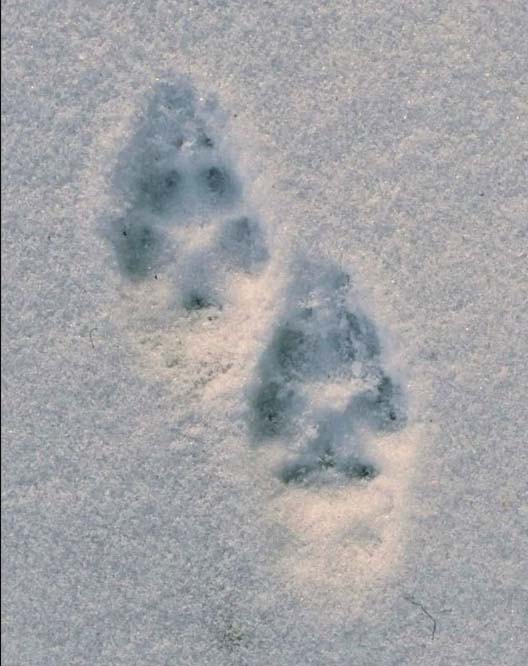
And he ate one, and then he took another three back to his den, for Mrs Widdle and the rest of the family. Naturally, in such weather, Widdle left a lot of tracks. Mixed in may be a few domestic cat (felis catus) but I would be amazed if there were any dog prints:

Here’s an individual print. The claws are visible which excludes domestic cat:

Here’s another one:

The following day, the weather cleared up markedly and most of the snow quickly melted. Even so, I was more than a little surprised to see a butterfly sunning itself in the rays of the winter sun:

And even closer up, it is really beautiful. It’s a Small Tortoiseshell:

It looks as if it is injured but I don’t think it is. It seems merely to have twisted itself a little to make sure that it gets the maximum amount of sun.

14 Comments

Filed under My Garden, My House, Nottingham, Personal, Science, Widdle, Wildlife and Nature

The Murder of Leslie Howard (6)

Leslie Howard was such a Hollywood star that we always think that he was the sole cause of  the BOAC airliner “Ibis” being shot down. The aircraft was actually owned by the Dutch, hence the flag on the top of the fuselage. I don’t quite understand how or why, but somehow BOAC were using a foreign airliner to fly some of their run-of-the-mill European trips, and the aircraft remained, throughout, Dutch property with an all-Dutch crew:

Could any of the other people on the plane, though, be the reason for the unexpected arrival of those eight heavy German Ju-88 fighters?

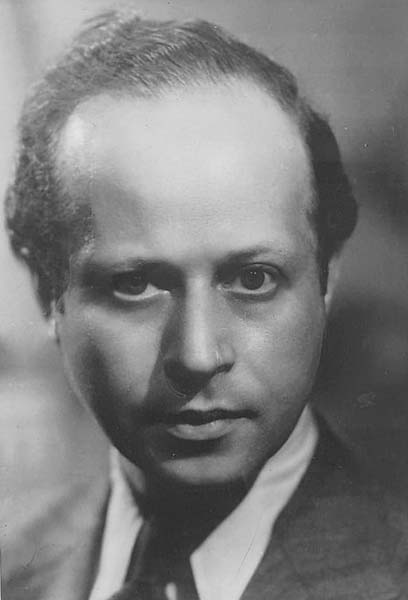
Perhaps the BOAC aircraft was destroyed because of Wilfrid Jacob Berthold Israel, a supposed British secret agent and a prominent Zionist, who was engaged in making sure that Jewish refugees could leave Spain and Portugal without difficulty to go to their rightful homeland. So far, he had helped 1500 of them, many of them children, to go there. Supposedly, Wilfrid had recently presented to the British government a very important proposal to solve the problem of getting Jewish refugees out of Europe to their homeland in Palestine. He was on his way to discuss increasing this exodus with Government ministers in London.  Here’s Wilfrid:

Perhaps the reason for the plane’s destruction was Ivan James Sharp, a mining engineer.  He was working for the British Government to offer the Portuguese and Spanish top prices for their tungsten, a hard, rare, metal used to produce various alloys and steels for weapon production. Also called “wolfram”, it was indispensable if you intended to manufacture armaments. Sharp had been trying to buy up 100% of the tungsten produced by Spain and Portugal. He was on his way to an important meeting at the Ministry of Economic Warfare.  I couldn’t find a picture of Ivan, but he began his career at the Camborne School of Mining in West Cornwall. They have a lovely example of a modern coat cof arms:

Perhaps the plane was destroyed because of Tyrrell Mildmay Shervington. Outwardly he was the Lisbon manager of the Shell-Mex oil company but, in the shadowy world of espionage, he was supposedly an agent of the Special Operations Executive. He was deeply involved in all of its many machinations across both Spain and Portugal and, according to some, he was the Head of the Lisbon Office.

Perhaps the plane was destroyed because of Francis German Cowlrick, a 67 year old civil engineer. He had worked for Babcock and Wilcox since 1905. Babcock and Wilcox made steam boilers, piping for steam, water tube boilers and welded pressure vessels, in short, as they said in an advertisement in 1937, “Everything for the Boiler House, including Valves”. They also produced electric cranes and pressed steel forgings. They manufactured munitions and tanks and boilers for Royal Navy warships. Mr Cowlrick was the manager and chief engineer for the company in Spain and Portugal. He was personally responsible for the designing and erection of a number of impressively large steam-generating plants in Lisbon, Madrid and half a hundred other places in Iberia. On this particular day he was travelling on behalf of the British Department of Overseas Trade. Here is one of the huge number of  Babcock and Wilcox factories which are situated all over the world. They are a truly gigantic, global concern:

Most of ther other passengers were ostensibly much more innocent. There was Mrs Rotha Violet Lettie Hutcheon and her two daughters, Petra Hutcheon, aged eleven, and Carolina Hutcheon, a baby some eighteen months old. Mrs Hutcheon was flying to rejoin her husband Allen, in England where he was a staff officer in the Imperial General Staff.

Mrs Cecelia Emilia Falla Paton was travelling back to England to start a new post as a secretary. She was the wife of James Paton of 53 Ullswater Road, Flixton in Greater Manchester. Kenneth Stonehouse, a British journalist, was working as the Reuters correspondent in Washington DC. He was accompanied by his wife Evelyn Peggy Margetts Stonehouse.

There were certainly no tourists in the aircraft. Everybody seems to have had a specific reason for being on board the “Ibis”.

It  is even possible to argue that the entire event was completely accidental. There doesn’t always have to be a conspiracy theory to explain everything that happens to famous people such as Leslie Howard.

For example, was it actually normal for the Luftwaffe’s Junkers  Ju88 fighters to patrol the Bay of Biscay in small groups? Were they so frightened of the RAF’s formidably powerful Bristol Beaufighter?

Or were the Germans still haunted by the bogey man of their worst nightmares, Das Fliegende Schtachelschwein?

Or perhaps we should accept as the true, the story told by the senior officer in the German fighter formation, Oberleutnant Herbert Heintze, who said that he had decided to shoot the plane down before the eight German aircraft ran out of fuel? Do you accept his word that they thought it was a bona fide warplane? After all, the DC-3 was camouflaged like a military aircraft. Why was the aircraft not silver or white? After all, it was an airliner. Why did it not have neutral markings? A green cross on a white circle. Why no Portuguese or Dutch insignia? One further complaint from German pilots was that their Luftwaffe superiors knew very well that this airliner made a regular flight from Portugal to England but they had not bothered to tell them. If they had known this, Heintze said, they would not have shot the aircraft down but they would have escorted it back to their own base in France. Whatever the solution, BOAC issued the following statement:

“The British Overseas Airways Corporation regrets to announce that a civil aircraft on passage between Lisbon and the United Kingdom is overdue and presumed lost. The last message received from the aircraft stated that it was being attacked by an enemy aircraft. The aircraft carried 13 passengers and crew of four. Next of kin have been informed.”


10 Comments

Filed under Aviation, Film & TV, History, military, Politics

An impossible Beatles Quiz (3….the Answers)

And the answers to Quiz No 3. I have amazed myself by how often I have picked my own favourite songs to quiz you about.

1       You say yes, I say no, you say stop and I say go go go but what do you say?

Well, here are the lyrics and the answer is clearly “goodbye” :

“You say yes, I say no

You say stop and I say go go go, oh no

You say goodbye and I say hello
Hello hello
I don’t know why you say goodbye, I say hello
Hello hello
I don’t know why you say goodbye, I say hello

And the song, of course, is “Hello, Goodbye”

The two biggest clues are the words “Hello, goodbye”, because the answer is “Hello Goodbye”

2A & 2B            A two part question as this song  has already been featured in Quiz No 2. Allegedly, Diane Ashley came in through the bathroom window, protected by a silver spoon, but (A) how many clubs a day did she work in, and (B) what could she do and what could she not do?

Firstly, 2(A) :

She said she’d always been a dancer
She worked at fifteen clubs a day
And though she thought I knew the answer
Well, I knew what I could not say
And then, the Hamlet question 2(B)………..
And so I quit the police department
And got myself a steady job
And though she tried her best to help me
She could steal, but she could not rob
And so, like so many people, fortunately for the rest of us, she could steal, but she could not rob.
3     Jo jo was a man who thought he was a loner?  But where did he live initially and where did he move to ?
Jo Jo was a man who thought he was a loner
But he knew it couldn’t last
Jo Jo left his home in Tucson, Arizona
For some California grass
Get back, get back
Get back to where you once belonged
Get back, get back
Get back to where you once belonged
Get back Jo Jo
Go home
Not too difficult. He lived in Tucson, Arizona and then he moved to a patch of nice green grass in California.

The group played this song, and others, in their last ever rooftop concert:

4      What’s it like in an Octopus’s Garden?

Well, there are quite a few details:

in the shade      We would be warm below the storm      Our little hideaway beneath the waves          near a cave

we can’t be found        We would shout and swim about       What joy for every girl and boy         

they’re happy and they’re safe

so happy you and me           No one there to tell us what to do

A lovely song from Ringo Starr.
5      In the song “Across the Universe”  what are the thoughts meandering like?
In a magnificent poem:
“Words are flowing out like endless rain into a paper cup
They slither while they pass, they slip away across the universe
Pools of sorrow waves of joy are drifting through my opened mind
Possessing and caressing me”
This is a song that was recorded in early 1968 and first released on a World Wildlife Fund album the following year.

6      Day after day, alone on his hill, what is the man with the foolish grin doing?

He’s a very busy man:

The man with the foolish grin is keeping perfectly still      he never gives an answer     Sees the sun going down

the eyes in his head See the world spinning ’round        The man of a thousand voices talking perfectly loud

he never shows his feelings          He never listens to them        He knows that they’re the fools
7      Monday’s child, what has he learned to do?
Huge clue from the picture and “Lady Madonna”
“Friday night arrives without a suitcase
Sunday morning creeping like a nun
Monday’s child has learned to tie his bootlace
See how they run”

8     What is all you need?

If you’re a Beatles fan, you shouldn’t need a song to know this. You should know it already.

All you need is love
All you need is love, love
Love is all you need
Love, love, love
Love, love, love
Love, love, love

9     Who always cooked breakfast for the Queen?

Back to my favourite Beatles song:

“The king of Marigold was in the kitchen
Cooking breakfast for the queen
The queen was in the parlour
Playing piano for the children of the king”
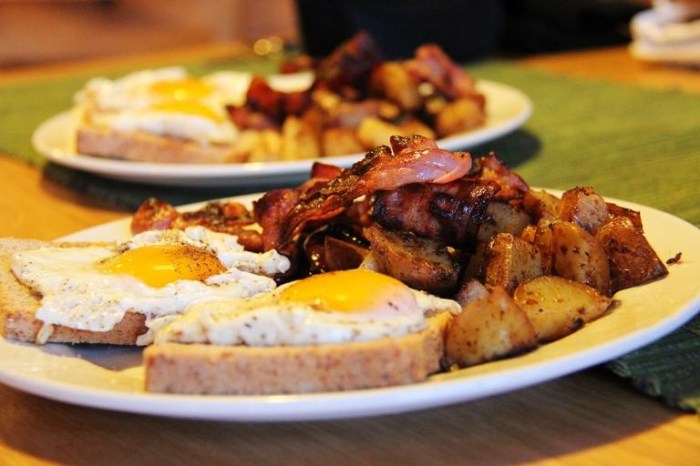
Full English, of course:

10   Who was screaming from the gallery?

Easy, peasy, although I couldn’t persuade both Rose and Valerie to appear together. Anyway here’s Rose:

And here’s Valerie in one of her quieter moments:

And here’s the full, sordid, story

P.C. Thirty-One said “We caught a dirty one”
Maxwell stands alone
Painting testimonial pictures ohh oh oh oh
Rose and Valerie screaming from the gallery
Say he must go free (Maxwell must go free)
The judge does not agree and he tells them so oh oh oh
But as the words are leaving his lips
A noise comes from behind
Bang, bang, Maxwell’s silver hammer
Came down upon his head
Do do do do do
Bang, Bang, Maxwell’s silver hammer
Made sure that he was dead


9 Comments

Filed under the Beatles

An impossible Beatles Quiz (3….the Questions)

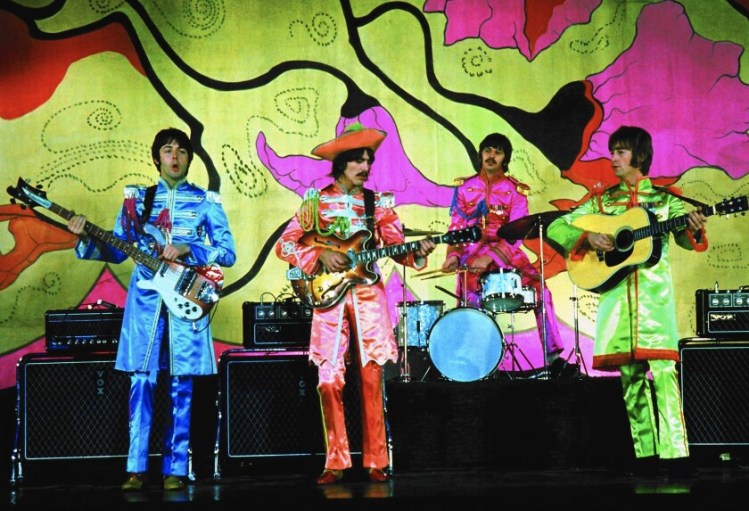
Hello there again, sad children of the sixties! I’d like to cheer you up with the third of a my series of four Beatles quizzes. The questions all refer to albums, including “Sergeant Pepper” and afterwards. If you want to look up the answers and do it that way, then good for you, but you might enjoy the questions more if you tried to do them yourself without any help from the Internet. I have tried to make the questions doable, but clearly, one or two are meant to be difficult. Incidentally, the questions do not necessarily relate particularly closely to the illustrations, although sometimes the illustrations are a very large clue.

1       You say yes, I say no, you say stop and I say go go go but what do you say?

2      A two part question as this song  has already been featured in Quiz No 2. Allegedly, Diane Ashley came in through the bathroom window, protected by a silver spoon, but (A) how many clubs a day did she work in, and (B) what could she do and what could she not do?

This slideshow requires JavaScript.

3     Jo jo was a man who thought he was a loner?  But where did he live initially and where did he move to ?

4      What would it be like in an Octopus’s Garden??

5      In the song “Across the Universe”,  words are flowing out like endless rain into a what?

6      Day after day, alone on his hill, what is the man with the foolish grin doing?

7      Monday’s child, what has he learned to do?

8      What is all you need?

9     Who always cooked breakfast for the Queen?

10   Who was screaming from the gallery?


Answers soon!


9 Comments

Filed under the Beatles

The Murder of Leslie Howard (5)

Last time, I tried to show you some of the marvellous speeches and wonderful films that Leslie Howard created to defend Democracy and Freedom against the German onslaught. I do know if any of you actually watched any of the recommended titles, but keep your eyes open for them on TV. Howard truly was a very gifted man.

Among his films, don’t forget “49th Parallel”, the horrendous tale of a U-boat whose crew members are forced to abandon it on the southern shore of the Hudson’s Bay in Canada and then make their way southwards to the USA. I will never forget the scene where the Germans slaughter the peaceful Inuits of a village they come across, just because the Inuits are not of the same race as themselves. Here’s a link to the complete film :

To whet your appetiote, here’s the film’s official trailer :

This is a very strong film. It was directed by Michael Powell and Emeric Pressburger and the main parts were played by Leslie Howard, Laurence Olivier, Anton Walbrook, Raymond Massey, Glynis Johns and Eric Portman. The film editing was by David Lean and the music came from Ralph Vaughan Williams. One detail that I particularly enjoyed was that :

“For the scene where the Hutterite community listens to Eric Portman’s impassioned pro-Nazi speech, the actors had to be all “hand picked faces”. Over half were refugees from Hitler.”

That says it all about the appeal of Nazism and racism.

Leslie Howard had done amazingly well with his films to defend Democracy and Freedom against the Germans. The Germans, of course, had long decided that Howard had to die.

The American-born traitor, William Joyce, who, as Lord Haw-Haw, broadcast on German propaganda radio to Britain, had even promised on the radio that Goebbels was personally going to have him shot. And Goebbels himself had made the same threats in “Der Angriff”, his own personal propaganda newspaper. Goebbels was not happy that Leslie had both directed and starred in, not just the anti-Nazi “49th Parallel” and “’Pimpernel’ Smith” but also in “The First of the Few”. He called Leslie, among many other things,

“Britain’s most dangerous propagandist.”

He viewed Howard as an irritant, a source of pain and, perhaps, a source of infection for Nazism, and a source, even, of death for German bigotry.

Linked with this is the theory that Chenhalls, Howard’s business manager, had negotiated a huge deal with the Portuguese and Spanish film industries. Vast numbers of English films were to be sold directly to companies in those two countries. All of the proceeds would then be spent on making new propaganda films.

Further to this, it has long been thought that both Leslie Howard and Alfred Chenhalls may have been British secret agents.

They were supposedly on the “Ibis” in the first place because they were returning from a job in Spain, whereby Howard had carried a top secret message from Churchill to Generalissimo Franco, trying to persuade Franco to stay neutral, not to join Hitler as an ally and not to close the Mediterranean to the British and thereby sever permanently their links to both India and Australia. And for this anti-German meddling, Hitler had decided that Howard had to die. Here’s Franco, whose first name was not either “Frank” and certainly not “Franco”. It was “Generalissimo” :

Those ideas about the real reason for the destruction of DC-3 Dakota “Ibis”, though, are just the beginning. There are lots and lots and lots more. So, let’s take a quick look at some of them……

Hitler did not like the fact that Leslie Howard had been working hard to win over the neutral Portuguese, trying to get them to allow the Allies to use the Azores for air and naval bases in the U-boat war. For this, he had to die.

Leslie Howard was merely an ordinary run-of-the-mill spy. For this, he had to die.

Leslie Howard was working hard at fundraising for the war. He was, given his mother’s background, a fluent German speaker and was turning out anti-Nazi programmes for the radio. For this, he had to die.

The presence of Howard and Chenhalls on that DC-3 saved the lives of seven year old Derek Partridge and his friend, the two little boys who were put off the aircraft to make room for the two important latecomers, Howard and Chenhalls. Several crewmembers immediately came to the door of the airliner and asked them to get off. As they left the aircraft, young Derek could not fail to see several aircraft with German markings parked around the airfield. He could see even more of them from the terminal building when he got back there. According to Derek, the BOAC aircraft was supposed to leave at 9.30 am but Howard was late. He was buying silk stockings at the departure lounge as a gift for a lady friend. They finally left at 9.35 am. Ironically that five minutes was fatal. It meant that the DC-3 ran into the eight German fighters. If they had taken off as planned, they wouldn’t have. The cruising speed of a Dakota is around 210 mph. In five or so minutes therefore, it covers just under twenty miles. If the DC-3 and the eight German fighters had been even fifteen miles apart, neither party would have seen the other. No lives would have been lost.

We may have a very long wait for the truth. Certain papers about the flight will be secret until 2025. Other papers which were due to be declassified in 1980 were not released and will now remain classified until January 2056. I’ll see you then!

17 Comments

Filed under Aviation, Film & TV, History, military, Politics, war crimes

Some slides of Scotland, where we used to go camping, in the mid-1970s (2)

In my early twenties. I used to go camping around Scotland with my friend, Bill. We used to travel around the perimeter of Scotland in a clockwise fashion, with a route which took in Glasgow, then up to the north-west corner of Scotland at Cape Wrath, then the north-east corner at John O’Groats and then home southwards along the east coast to Edinburgh and England. In those days we use to camp where we could find a reasonable place to do so…..”wild camping”, it used to be called. As long as we left no mess, the landowners didn’t seem to bother. I used to take slides with my trusty Voigtländer and was then able to bore people rigid with my “Pine Trees of the Northern Highlands”. I found all my slides recently, in a very large box in the attic, but unfortunately, there were a good few which I could not identify. When I got round to doing it, one or two of them also suffered during the conversion process into digital images, usually acquiring either an overall blue or purple cast, or, on other occasions, the image becoming much darker than it had originally been.

This 45 year old slide shows just a few seconds in the short life of a cloud formation somewhere in the Western Highlands. It seems so very bright compared to so many of my old slides….

This is quite a nice slode, too. I don’t remember where I took it from, possibly the north west coast of the Isle of Skye, but it looks westwards into a spectacular sunset where the Outer Hebrides can just be seen on the horizon. I remember thinking how remote this site must have seemed to some of the people who have visited Scotlsand over the centuries.

Did any of the survivors of the Roman Ninth Legion flee north and reach the Atlantic Ocean? Did they look out thinking that they had found the fabled “Ultima Thule” ?

But  there are still plenty of dark places in Scotland. This is a very famous road at Applecross, a small village on the west coast, almost directly east of Skye. The road is famous not just for its steepness, which measures around 1 in 4 (25% ?), but for the fact that it continues for so long…….not fifty yards, but some two miles or so. In years gone by, it was used by a good many advertising companies to sell various motoring products.

I have driven  up the road myself at least once and I have been a passenger perhaps half a dozen times, and I can testify, it is exremely steep and it goes on for quite a long way! On the other hand, there are no sudden huge drops to either left or right.

Well, there were some relatively bright shots there, weren’t there? This is Scotland, though, and it won’t last! Here’s a grassy area in the middle of nowhere, as the darkness comes in and the mist swirls round….

Here’s a much brighter day in the same overall area. In actual fact, this slide is pretty much a quick lesson about the ice ages. Vast sheets of ice, thousands of feet thick, smoothed most of the land into a huge stony snooker table. Where there are huge tall mountains, something of them will survive. So, in this region five peaks remain, but only as a shadow of their former selves. The ice sheets also carried huge rocks around on top of them, like hitch hikers in a 1960s film. They are usually called “erratics”, and 90% of the time, they are made of a type of rock not local to the area. Here, for example, the great big rock in the centre of the picture is probably sandstone, found in the north east, near John O’Groats.

This slide shows the end of Loch Ness. It is such a  bright, sunshiny day that it is difficult to tell if the image is in in black and white or colour. It is, in fact, in  colour……just.

As well as sandstone, there are some areas of the Highlands which contain limestone. Limestone, I think, is calcium carbonate and will readily dissolve if rainwater carrying even moderate amounts of acidity drains over it. The result may be the relatively spectacular “Limestone Pavement” made up of “clints” and “grykes”.  These are flat areas separated by open cracks or fissures. The flat areas are “grykes” and the cracks or fissures are “clints”.

This one is on the mainland opposite the northern part of the Isle of Skye. A limestone pavement is one of the best ways to break your ankle known to man….

Mention of the Isle of Skye tempts me back to show you a second photograph of “Kilt Rock” and its 180 foot high waterfall, the “Mealt Falls”. It says everything about the control freakery of our modern world that on the internet nowadays you are actually recommended to book in advance to look at the rock and its waterfall. The tartan patterns in the cliff face (at the back) are seen much better here……
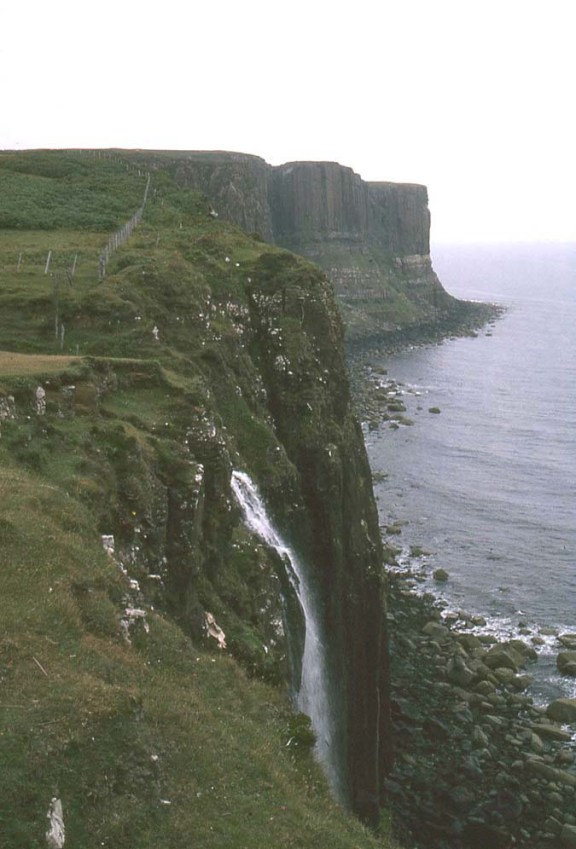
The Kilt Rock does have one very famous “kill” to its credit, so do not underestimate the danger of leaning over a 200 cliff, however picturesque it may seem. A newly married bride came out with her new husband in, I think, the late 1960s, to be photographed at the top of the waterfall. Alas, it was a windy day, and a sudden gust got under the yards of material in her ornate wedding dress and she fell over the cliff to her death.

My last two slides show Scotland in slightly poorer light conditions, as late afternoon turns to early evening. I have no idea whatsoever where either slide was taken, but the first one is very atmospheric…..
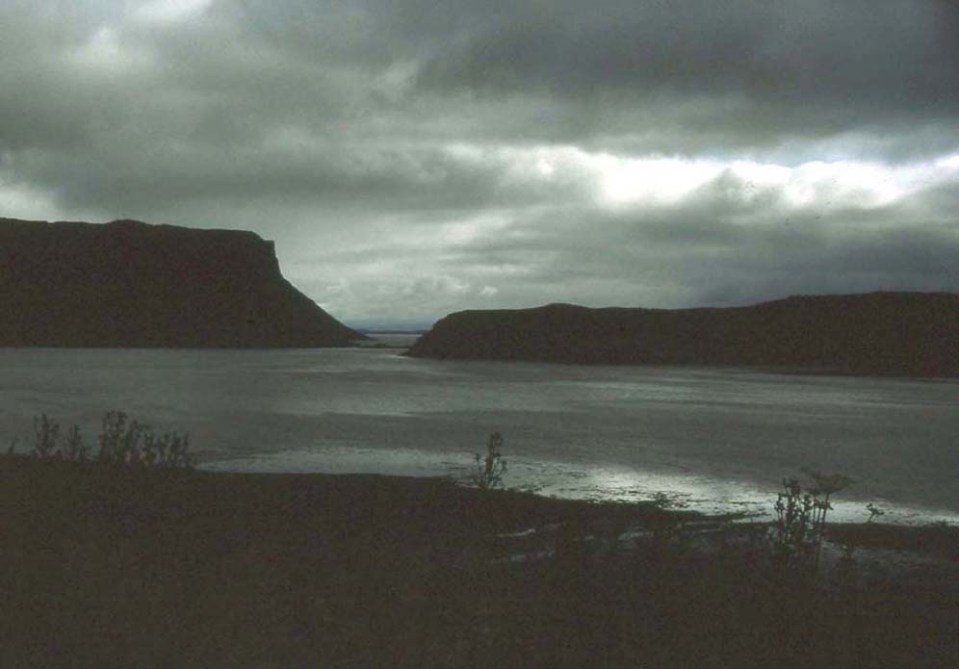
At the time, I am sure that I would have thought that my slide was a complete waste of a shilling, but nowadays, my standards are a lot more thoughtful. I love the way that the viewers’ eyes are led between two shorelines and then we notice that there is even more land half way to the horizon. Beyond the horizon, we can just catch sight of  Newfoundland. In the corner, bottom right, there are a few sprigs of vegetation, but are we completely certain that that is what they are? Or do we have  a pair of wading birds? Two thirds of the way back from Africa to western Greenland?

And then there is the biggest question of all. Is the slide colour or black and white? Well, look at the top right, where we have the very last, teeny tiny area of the early afternoon’s pale blue.

We finish with the last slide. Some long forgotten sand dune in western Scotland, covered in tough everlasting rye grass of some kind. And it’s the approach of dusk. And the Outer Hebrides cluster on the far horizon.
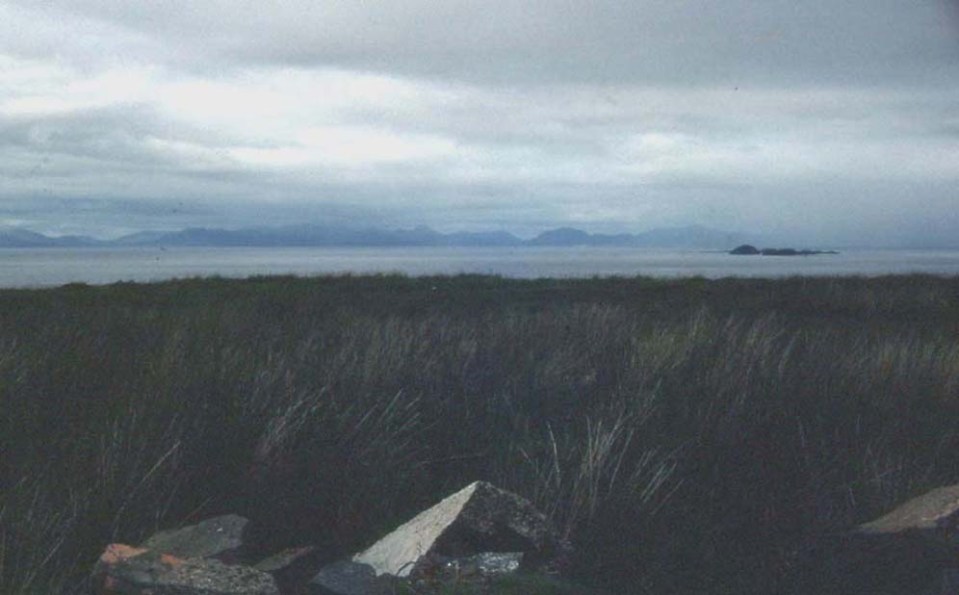
Underfoot, there are smashed up concrete blocks and lumps of carefully cut sandstone. Were they all part of some Second World War radar base? Or was there a village here until it was finally deserted after the ravages of the First World War?

 

20 Comments

Filed under History, Personal, Scotland

The Murder of Leslie Howard (4)

Last time I showed you a whole selection of what could be called “mistaken identity” conspiracy theories. Leslie Howard was erroneously identified therefore by the German intelligence service, the “Abwehr”, as Harold Thompson, Churchill’s bodygard.

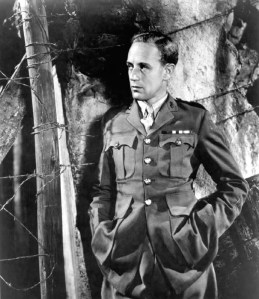
Here’s Leslie Howard, in the wonderful anti-war play by RC Sheriff, “Journey’s End”…..

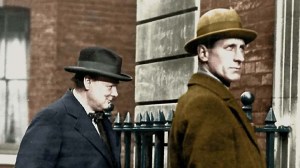
And here’s Harold Thompson (on the right), a man who was frequently appalled by Churchill’s apparently total disregard for his own safety. The best example of that was when Churchill stopped his staff car in Hyde Park and jumped out, armed with a Colt revolver, to do battle with the three members of the Irish Republican Army who were trying to assassinate him…….

……..sometimes Leslie Howard was identified as Anthony Eden, the Foreign Secretary, despite the biggest hairy caterpillar in the world, that he had trained to cling to his top lip, irrespective of weather conditions…….

Sometimes the Germans confused Leslie Howard with Reginald Mitchell, the designer of the Spitfire, and in the grave for the past six years :

And,  an Old Boy of Nottingham High School, Alfred Chenhalls, Leslie Howard’s business manager, was repeatedly thought to be Winston Churchill. Bald, cigar smoking and fond of whisky, who else could it be?

Another rather different theory suggests that Leslie Howard rather than Churchill, was the real target of those eight Luftwaffe aircraft. By now, Howard had become a hard core enemy of the Third Reich, reverting back to his origins as……

“a Jew who was a ferocious and prominent critic of Nazism”

By 1943, Howard frequently expressed himself much more actively than merely speaking up occasionally in interviews.

Indeed, he was soon not just starring in anti-German propaganda films, but he was directing and producing them himself, using as much of his own money as he dared.

On one occasion, his royalties from “Gone with the Wind” paid for his anti-Nazi productions. And in those movies, Howard did not hesitate to name and shame. In one film, he speaks of the Germans’ plans for the rest of Mankind, the people who had suffered the dreadful fate of not being born German. Howard was sure that Hitler would destroy for ever the political systems they had adopted…….

“Every day reveals the utter and desperate determination to smash us to bits, root and branch and to wipe out every trace of democracy.”

But……

“we are better than them”

In 1941, Howard made a fifteen minute film entitled “From the Four Corners” (1941). This is a still from it:

And here is a speech that may well make the hair stand up on the back of your neck :

“And so our fathers’ minds crept along and their ideas of justice and tolerance and the rights of man took shape in the sunlight and the smoke, sometimes standing still, sometimes even slipping back, but slowly broadening with the centuries. Some of those ideas are written down in the constitutions of our commonwealth and some are unwritten. We just try and carry them in our hearts and in our minds. Perhaps the men who came nearest to putting them into words were those Americans, many of them the sons of British pioneers, who, founding an independent nation, proclaimed:

We hold these truths to be self-evident, that all men are created equal, that they are endowed by their Creator with certain unalienable Rights, that among these are Life, Liberty and the pursuit of Happiness.”

Those words and that spirit were born and nourished here, and your fathers carried them to the ends of the earth. They are our inheritance from the past, our legacy to the future. That’s why you came here – to defend them.”

Here is a link to the complete film. It is fifteen minutes that may well reaffirm your faith in good old fashioned democracy:

In “Pimpernel Smith”, he discusses Nazi philosophy with the film’s head of the SS,  who has just captured Howard, the man who has helped countless political prisoners to escape from Germany:

“von Graum : Why do I talk to you? You are a dead man.

Smith : May a dead man say a few words to you for your enlightenment?

You will never rule the world, because you are doomed. All of you who have demoralized and corrupted a nation are doomed. Tonight you will take the first step along a dark road from which there is no turning back. You will have to go on and on, from one madness to another, leaving behind you a wilderness of misery and hatred. And still you will have to go on, because you will find no horizon, and see no dawn, until at last you are lost and destroyed. You are doomed, captain of murderers. And one day, sooner or later, you will remember my words…”

You can watch the complete film of “Pimpernel Smith” if you click on this link :

Having said that, the film is so good that you may wish to buy a much better quality DVD of it for around £10.

Like millions of people in the world, Leslie Howard had little reason to love the Germans, but, as a Jew, the appalling anti-Semitic policies of the Nazis in the 1930s really sealed the deal.

Howard wrote: “Britain’s destiny has been to uphold tolerance in religion, thought, speech, and race–– the mainspring of democracy. We have still far to travel on the road to true democracy, but only the Germans have made no progress in this direction. Britain, with her great gifts has helped populate five continents and shown that the white man and the coloured man can live in peace together.”

Few of us, more than eighty years later, would quarrel with those sentiments.


13 Comments

Filed under Aviation, Film & TV, History, military, Politics, war crimes