Author Archives: jfwknifton

Famous Monsters of Filmland (1)

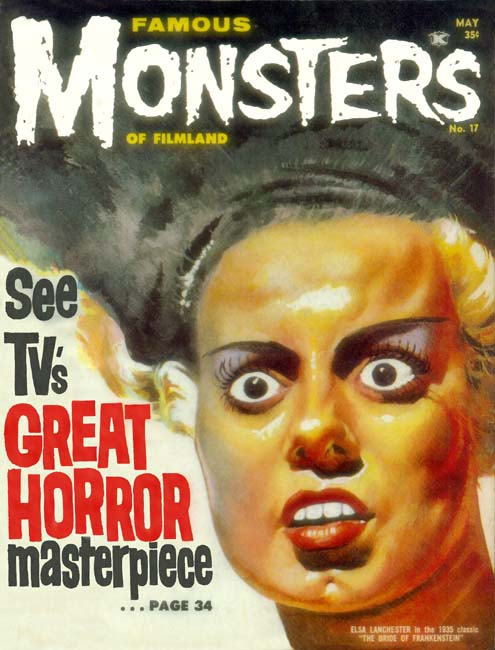
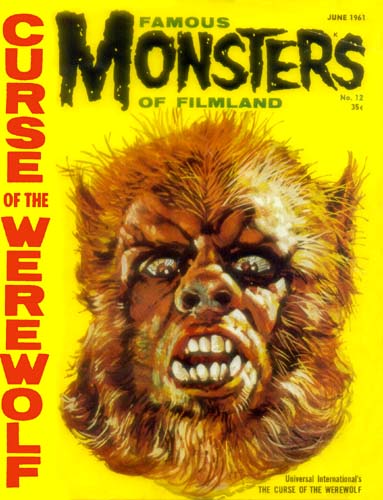
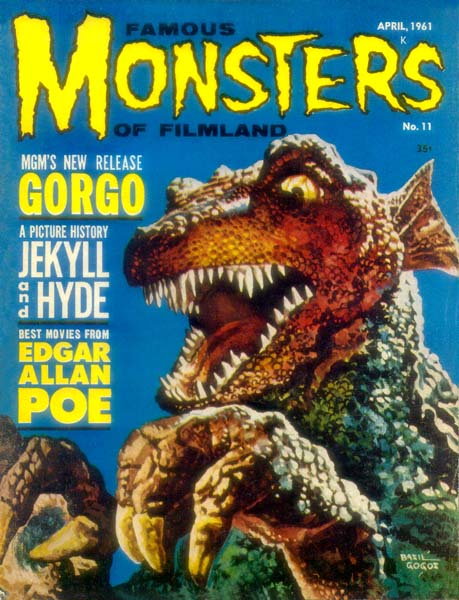
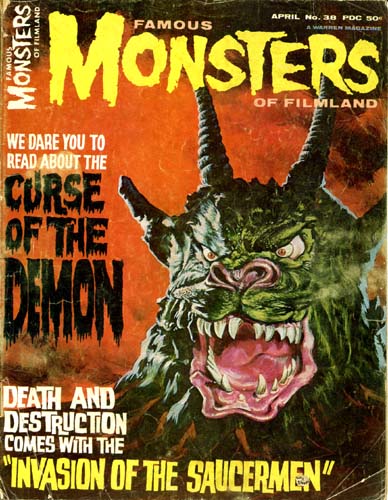
When I was a little boy of ten or eleven, I used to go up the road to the shop which sold newspapers and magazines to see if anything new had come in. One day, the proprietor, Albert Taylor, had taken delivery of some recently arrived American magazines called “Famous Monsters of Filmland”. In 1963, they were absolutely amazing from a ten year old’s point of view.

They allowed me to meet people I had never encountered before. Elsa Lanchester as the Bride of Frankenstein in the Universal film of 1935, one of the very few sequels better than its original:

I met Bela Lugosi as Count Dracula in 1931, with his wonderful line of “I never drink….. wine.”  and  “To die, to be really dead, that must be glorious! ”

Here’s the werewolf who, in 1961, barked at the postman and chased cars in “The Curse of the Werewolf”:

There were also more recent monsters such as Gorgo, who I later found out was, more or less, the British Godzilla:

Here is the demon from “Night of the Demon”, a film from 1957, which certainly spent most of its life in the UK at least, banned completely, as being too horrific even for the censor to watch:

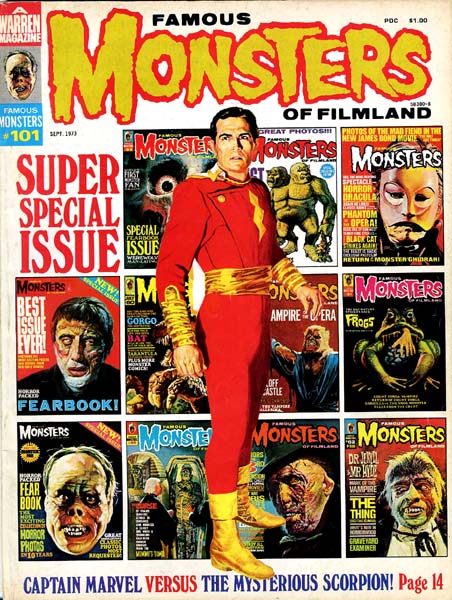
Occasionally, some of the magazines actually featured a compilation of all the monsters. Can you find Christopher Lee, or Claude Rains in this one? Lon Chaney Senior? More difficult to find is Fredric March:

I was actually quite disappointed when I eventually found out that only the cover of the magazine was in colour. This was because the majority of the films inside the magazine had been made in black and white.

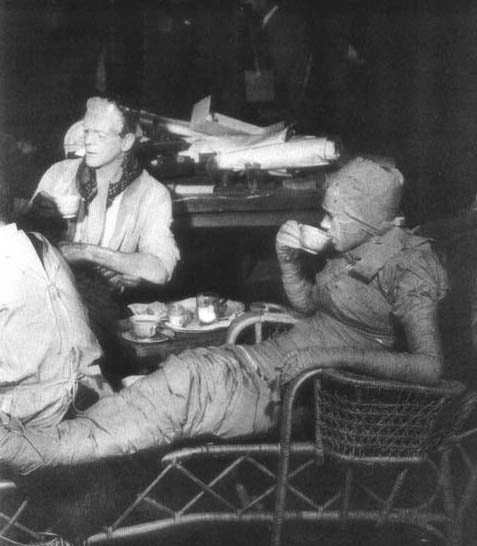
In actual fact, the black and white photographs could still be very striking. Here’s Boris Karloff and Una O’Connor waiting for a bus:

Or what about this wonderful shot from “The Bride of Frankenstein” ?:

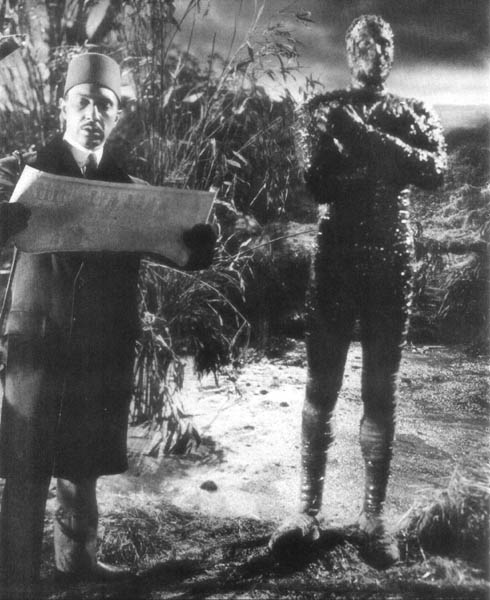
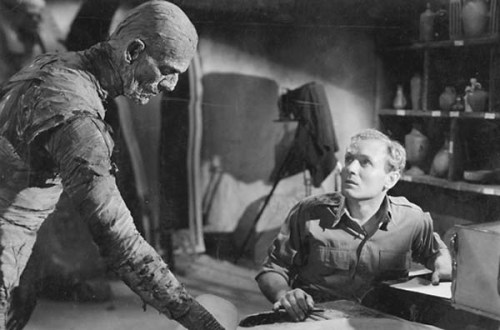
To finish with, look at Boris Karloff’s spiritual son, Christopher Lee. In this shot, Lee was playing Kharis, the muddiest boy ever to lose his mummy. See how Tommy Cooper on the left is still working on one of his magic tricks:

Who’s Tommy Cooper? Never  heard of him? Well you have a treat in store:

I hope you watched Tommy Cooper. He could make statues laugh. He actually died of a heart attack on stage and people laughed because they thought it was part of the act.

24 Comments

Filed under Film & TV, History, Humour, Personal

The Supermarine Walrus (2)

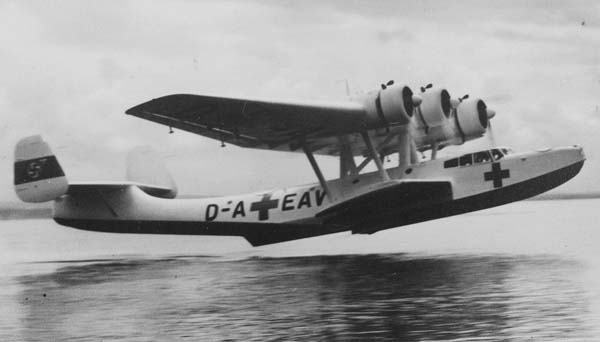
Last time, we were looking at the Supermarine Walrus amphibian which was used by the RAF in the second half of the Second World War:The Germans entered the war completely prepared for air-sea-rescue, of course. They had a dedicated arm of the Luftwaffe called the Seenotdienst and they made extensive use of the Dornier Do24, one of the comparatively few three engined aircraft used in the conflict:

The Dornier Do 24 was initially built for the Royal Netherlands Navy, the Koninklijke Marine, to be used primarily in the Dutch East Indies, today’s Indonesia. The Do24 was very much admired by the Seenotdienst so, in the words of Adolf Hitler, “I invaded the country and I stole all six of them.”

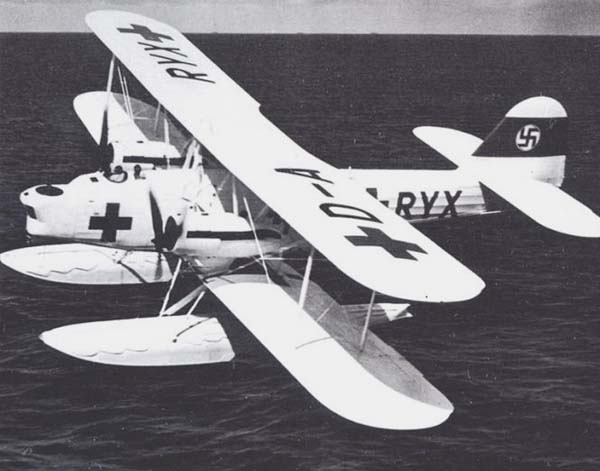
The Germans also made extensive use of the Heinkel He59 which was unarmed and painted white with big red cross:

These floatplanes would cheerfully rescue both Luftwaffe and RAF aircrew. Nevertheless, there was a suspicion that the Germans might have been using their aircraft for proscribed reconnaissance activities and the RAF was told to shoot them all down in Bulletin 1254, which indicated that “all enemy air-sea rescue aircraft were to be destroyed wherever they were encountered”. In retrospect, perhaps a little disappointing as a decision.

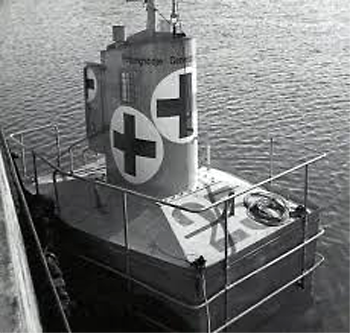
The older He 59 was much more comparable with the Walrus, perhaps, than the Do24. This Heinkel biplane was much slower than the monoplane Dornier (and was therefore much easier to shoot down as part of Bulletin 1254). Both aircraft made extensive use of the invention of Ernst Udet, the yellow-painted “Rettungsbojen” or rescue buoys:

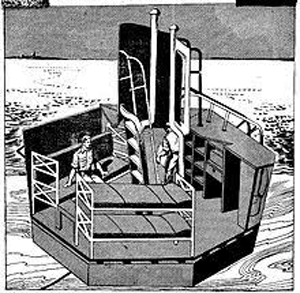
These buoy-type floats were highly visible and they held emergency equipment such as food, water, blankets, dry clothing enough for four men, and an assortment of board games including, of course, “Risk”, for the Germans. Here’s a cut-away of the buoy:

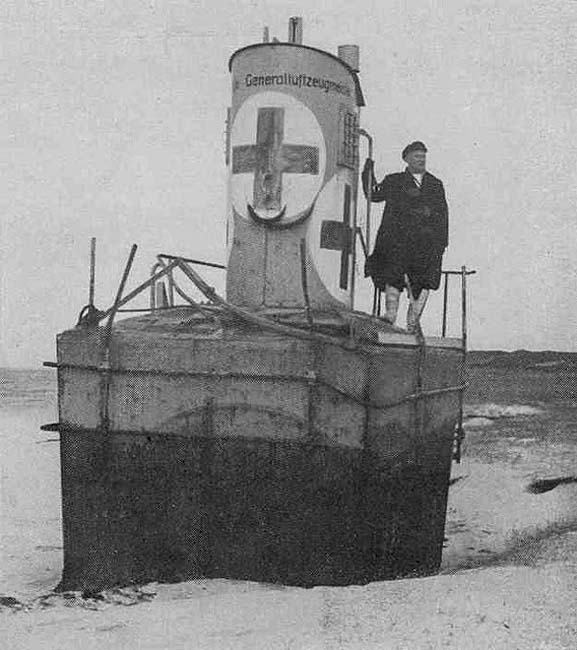
And here is a rare picture of Admiral Donitz about to begin his famous speech announcing that all the lighthouses of the world were now part of the Greater German Reich:

Shot-down airmen from both sides were strongly attracted to these buoys and many a desperate game of Schcrabble or Buckaroo was played to decide who had first dibs with the rescue buoys’ bratwurst or their assortment of smoked cheeses. British airmen and seamen called the Rettungsbojen “Lobster Pots” for their shape:

The rescue buoys also attracted the close attentions of many sailors in both German and British rescue boats. They would come to inspect the buoys from time to time and “friendly” downed airmen were rescued, but enemy aircrew automatically became prisoners of war.


14 Comments

Filed under Aviation, History, Humour

“A long forgotten war, wasted young lives” (2)

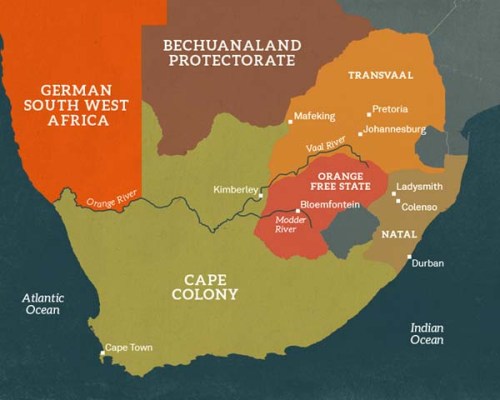
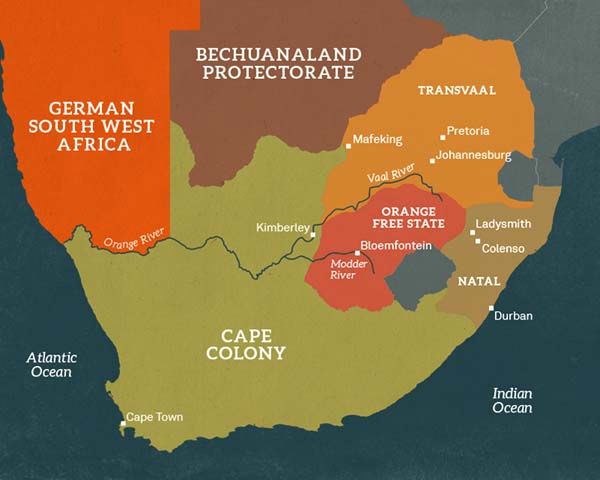
The Second Boer War (1899 – 1902) was fought between the British Empire and the two independent Boer (Dutch) states, the Republic of Transvaal and the Orange Free State, over the British Empire’s influence in South Africa. The British Empire owned Cape Colony and the Bechuanaland Protectorate.

The catalyst for the war was the discovery of diamonds and gold in the Boer states.

Major Alexander Bruce Wallis had already lost one of his three sons, Captain Alexander Frederic Wallis, on February 24th 1900. He was killed in action near Arundel, near Colesberg, in Cape Colony in South Africa. Major Wallis’ grief, though, was not over yet , not by a long chalk.

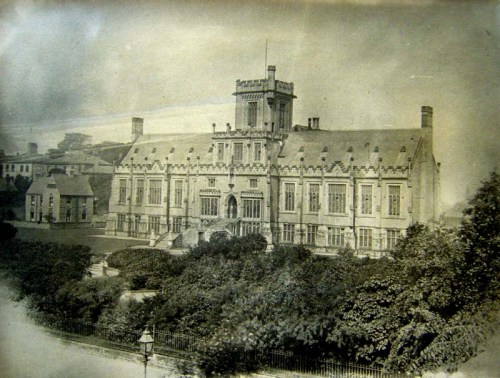
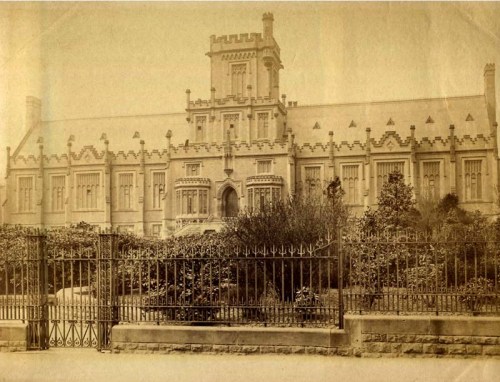
He had another, third and youngest, son whose name was Harry Wallis. Harry was born on September 17th 1869 and entered the High School on January 21st 1881 as Boy No 648. He was eleven years old. Hardly any details are available about an individual boy during this period of the school’s history. Set against this is the fact that Harry was there to watch the crisis which gripped the school during this period. Standards were plummeting and by November 1883 more than a quarter of the boys had left. By March 1884 the Headmaster was seriously ill, and was given three months sick-leave. Here is the School at the time.

An official inspection scrutinized the School and said:

“The School is at present not in an efficient or satisfactory state. Generally, there is a want of vigour and enterprise in the management and administration.”

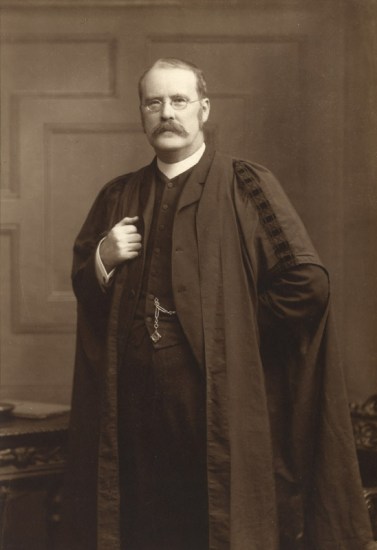
The Headmaster resigned and Dr James Gow took over.

Dr Gow was a lawyer, not a teacher. He saved the High School. He examined the dreadful situation analytically, and reported that:

“I am inclined to think that the School Buildings are not so grossly inconvenient and the School Staff is not so grossly incompetent as they have sometimes been represented. I am confident that by a few changes, mostly trivial, the School can almost at once be brought into a good state of efficiency.”

And he was right. And Dr Gow walked into history:

“He found a rabble and he left a public school.”

(It’s always better that way round, of course.)

This is the albumen print of the High School which I used when I was talking about the tragic and, arguably, pointless death of Harry’s brother, Alexander Frederic. It is certainly of much better quality than the picture above. Can you see the patterned brickwork of the crenellations ?

Harry Wallis left the High School in July 1885. He went to work in Messrs Moore & Robinson’s Bank which operated from 1836-1901. They were based at Beast Market Hill in the Market Place, somewhere near where the Bell Inn is nowadays. The manager was Mr James Stedman. Here’s the Wright’s nineteenth edition of their Directory of Nottingham, published in 1898-1899 :

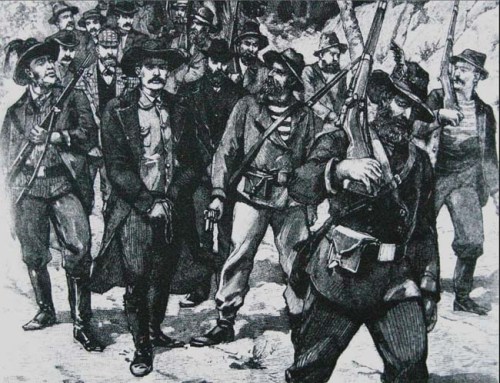
Harry knew he had the wrong job, working in a bank. Like his father and his elder brother, he yearned to enlist and to become a soldier. Mr Stedman gave him his discharge and Harry went to South Africa. One of his first tastes of adventure was the Jameson Raid. This fiasco took place from December 29th 1895 –January 2nd 1896. It was a botched British raid against the Dutch Republic of the Transvaal. Led by Dr Leander Starr Jameson and using his colonialist troops, these men were employed ostensibly as police officers in the police force, owned by Alfred Beit’s and Cecil Rhodes’ British South Africa Company.

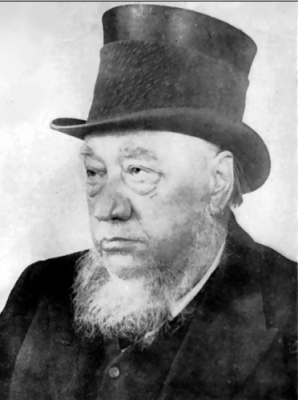
Supposedly the raid would encourage the Uitlanders, the pro-British citizens, to rebel against Paul Kruger, the Transvaal president, and his supporters. A pro-British government would quickly be set up. Then the British would get all of the Boers’ gold and diamonds. Here’s “Oom Paul Kruger” as he was called at the time :

Absolutely nothing happened and Jameson was arrested. The anti-English Boers, though, were by this time more than ready for a fight against the British when the Second Boer War came round.

Here is part of Harry’s epitaph taken from “The Forester”, the first School Magazine.

“Returning to England after the Jameson Raid, Harry then returned to South Africa and became a Lieutenant in the British South Africa Mounted Police. After doing much good work on active service, he died of enteric fever (typhoid) on April 21st 1900 at Gaberones, the capital city of the British Protectorate of Bechuanaland. He was thirty years old. Great sympathy is felt with his father who has thus lost two sons in the war.”

The sad father, Major Alexander Bruce Wallis, now had only one remaining son, Francis Edward Wallis, born on December 24th 1862 and the eldest of the three. He entered the High School on Friday, September 12th 1879 as Boy No 584. He was sixteen years old. I have found out no more than that about him, although I am fairly confident that he would probably have joined the Army at some point and perhaps then served in Africa. Hopefully, he joined just in time to hear somebody say :

“Have those Zulus definitely gone then?”

And Francis Edward Wallis was certainly not killed in World War One. Thank the Lord.


19 Comments

Filed under Africa, History, military, Nottingham, Politics, The High School

The Supermarine Walrus (1)

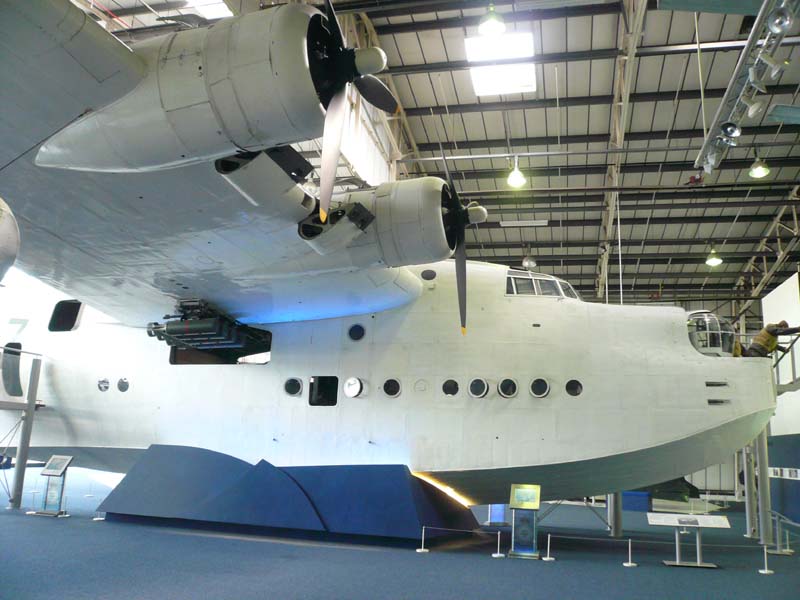
In a recent blog post, I wrote about the most famous flying boat of World War Two, the Short Sunderland. I was lucky enough to visit the RAF Museum at Hendon in north London, where the aircraft is positioned in a very large space, unlike the way it was rather cramped way it was displayed when I went to Duxford in 2009:

With the Sunderland, under its starboard wing almost, is a Supermarine Walrus, which is not a flying boat but an amphibian, an aircraft which can go on land as well as on water.

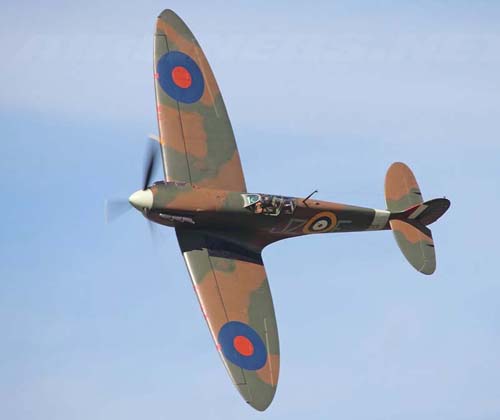
The Walrus is an extremely unattractive flying machine, and it is extremely difficult to imagine that it was designed by RJ Mitchell, the man who designed the world’s most beautiful aircraft ever. This was the fighter that was originally to be called the Supermarine Shrew, until the name was changed to Supermarine Spitfire (“just the sort of bloody silly name they would choose.” (Mitchell)).

The Walrus was intended to be a gunnery spotting aircraft for sea battles between big warships, but this only happened twice, in the Battle of Cape Spartivento and the Battle of Cape Matapan. In actual fact, the Walrus’ main task was to patrol the seas looking for German or Italian submarines and surface warships. By 1941, the Walruses, or perhaps Walri, had air-to-surface radar for this purpose, although by 1943, all catapult-launched aircraft on Royal Navy ships, including the Walrus, were being phased out as the catapult and the hangar took up too much deck space.

The Walrus was then used at sea only on aircraft carriers as its landing speed was very low and neither flaps nor a tail-hook was necessary. The Royal Navy didn’t have that many aircraft carriers, so the main use of the Walrus now became chiefly air-sea rescue from land bases.

Before the Walrus, the British had not had any aircraft specifically designed for air-sea rescue in home waters.

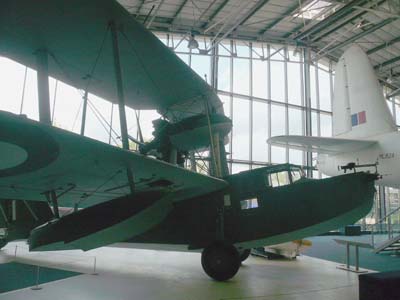
Here’s the Walrus from the front:

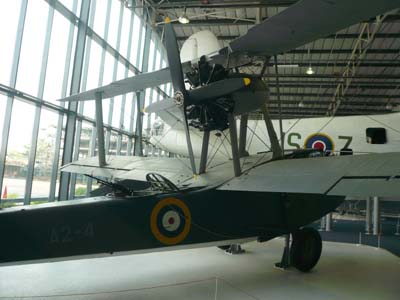
And here it is from the back. Notice how the four bladed propeller is so close to the rear gunner that it may give him a short-back-and-sides haircut if he is not careful:

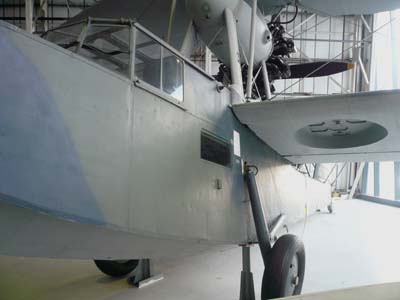
Here are the wheels which the pilot would lower before landing in the normal way on a runway. As I mentioned above, the Walrus had such a low stalling speed that it could land on an aircraft carrier without recourse to an arrester hook or to any safety nets. Presumably this allowed the Walrus to transport very badly wounded casualties to an aircraft carrier for immediate medical treatment, if the wounded man was too badly injured for a long flight to land :

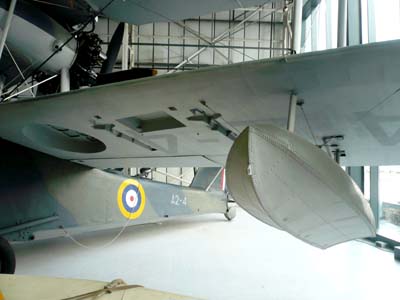
Here are the floats underneath each wing tip. They appear to have about three thousand of Rosie the Riveter’s finest holding them together:

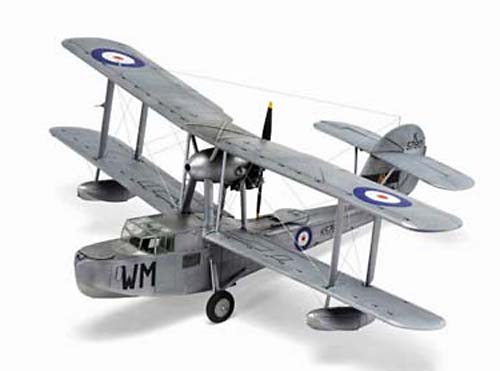
And to finish up, here’s an overall view of a Walrus:

It flies at about 55mph, but finds long climbs rather challenging. No, just joking!

33 Comments

Filed under Aviation, History, Humour

“A long forgotten war, wasted young lives” (1)

The Second Boer War (1899 – 1902) was fought between the British Empire and the two independent Boer (Dutch) states, the Republic of Transvaal and the Orange Free State, over the British Empire’s influence in South Africa. The British Empire owned Cape Colony and the Bechuanaland Protectorate.

The catalyst for the war was the discovery of diamonds and gold in the Boer states.

Alexander Frederic Wallis was born on January 18th 1867. Nottingham had seen its worst floods for fifteen years on January 9th. Two feet of water washed over the railway tracks at the station. On the 14th, a recently constructed factory on Carlton-road (sic) had caught fire. On March 14th, the Mechanics Hall was completely destroyed by fire. On March 20th an enormous fire destroyed the premises of William Smith, a “chenille and gimp manufacturer”. On April 2nd, the council agreed to order a steam fire engine, at a cost of £650. This type of thing. A combined fire engine and smoke screen generator:

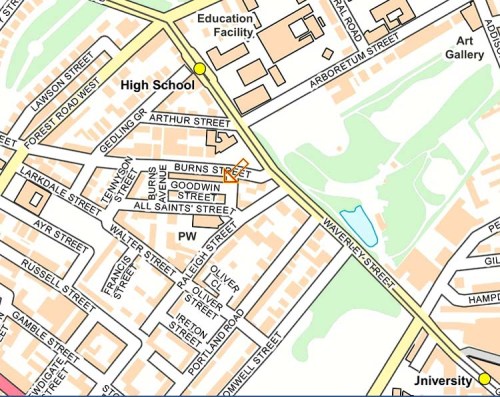
Alexander Frederic Wallis’ father was Alexander Bruce Wallis, the Captain and Adjutant of the Robin Hood Rifles. In 1879 the family’s address was 1 Goodwin Street, near All Saints’ Church in the area to the west of Waverley Street, more or less directly opposite the bandstand in the Arboretum Park. Goodwin Street is very, very striking, with its tall tenement houses like you might find in Edinburgh or Glasgow. They all have four floors including one for the servants.Here it is. Look for the orange fire engine arrow.

The “education facility” in the middle at the top is the High School. Raleigh Street (west of the Arboretum Lake, and south of the orange arrow) was where the history of Raleigh bicycles started in 1885. That is why the brand was called “Raleigh”.

In the same year, Captain Wallis had moved to nearby No 3 Burns Street, a magnificent Victorian house with that eccentric, almost random architecture of the wilder Victorian architects of the period, including huge gables, oriel windows, patterns made with darker bricks and a pointed archway to the front door. Here is the house today:

By 1894, now Major Wallis rather than Captain, he and his family were living at 50 Forest Road West, extremely close to the High School. On the map above,  Forest Road West is to the west of the small lemon yellow coloured circle which represents the High School’s tram stop. Four years later in 1898-1899, Major Wallis and his family had moved to Neville Terrace at 15 Wellington Square, directly off Derby Road just after Canning Circus. This must have been much more convenient for the Robin Hood Rifles’ Orderly Room in Castle Yard. The family were still there in 1904, but after that, I was unable to trace them.

Their son, Alexander Frederic Wallis entered the High School on September 12th 1879 as Boy No 583. He was 12 years old. His career remains a blank because the majority of the School Lists have not survived and the rest are just lists of boys’ surnames with no distinguishing initials. The School played soccer then but Alexander does not figure in the reports we still have, nor indeed, in the records of the cricket team. He left the High School at the end of the Christmas Term in 1882. Here is the High School during that era, captured in a high quality albumen print:

At this time the Headmaster was Dr Robert Dixon, nicknamed “Dido” and the staff would have included Mr Bray or “Donkey”, Mr Seymour or “Donkeys”, Mr Jennings or “Jigger”, Mr Corner or “Sammy” and his younger brother, Mr J Corner or “Jig”, Mr Townson or “Benjy” , the Reverend Easton or “Jiggerty” and Mr William Edward Ryles or “Jumbo” and Mr Wilfrid Tyson Ryles or “Nipper”.

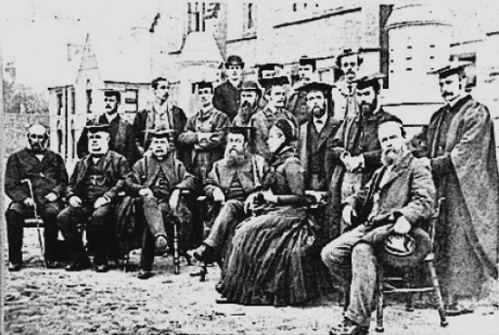
Nicknameless staff included Herr Altorfer, Monsieur Brunner, Monsieur Durand, Mr Jackson, Mr Small and Sergeant-Major Vickers the Drill Sergeant. There was also Mr Leopold Compline Wilkes or “Demi”, who went to South Africa in 1893 to be Headmaster of Kimberley Public School, only to die of typhoid, or enteric fever, on May 16th 1899, aged only 37. Here they all are. Still shocked by the recent death of General Custer:

Like poor “Demi”,  young Alexander Wallis, now 33 years of age, was also destined to die in South Africa, but as a soldier during the Second Boer War. He was just one of the 23,000 who paid the ultimate price of other men’s greed. Here is his epitaph taken from “The Forester” as the first School Magazine was called :

“Captain Alexander Frederic Wallis, killed in action near Arundel, near Colesberg, in Cape Colony, on February 24th 1900, was the second son of Major AB Wallis, formerly of the 33rd Duke of Wellington’s (West Riding) Regiment and late adjutant of the Robin Hood Rifles. He entered the High School on September 12th 1879 and left at Christmas, 1882, being afterwards educated at Derby and Sandhurst. Captain Wallis entered the 2nd Battalion Duke of Wellington’s (West Riding) Regiment as a second- lieutenant and obtained his lieutenancy in 1889 and his captaincy in 1896. He served in Bermuda, Halifax, Jamaica, St Helena, Natal and Zululand. On the outbreak of the Matabele war in 1896 he proceeded to Mafeking where he served at the base and on lines of communication. At the finish of the war he went to Malta and was then quartered with the regiment at Dover in Kent. The regiment then went out to South Africa, Captain Wallis being in command of the Mounted Infantry Company. On his arrival in Cape Town he joined Major-General Clements’s (sic) Brigade at Arundel. He had just celebrated his 33rd birthday, and had 13 years’ army service. In Nottingham much sympathy is felt for Major Wallis in his bereavement.”

The village of Colesberg saw many battles and skirmishes during the Second Boer War. They brought into opposition the British and the Boers of the Transvaal and the Orange Free State. This is the view looking towards the village:

A day-by-day timeline of the war listed the day of Alexander’s death as an “engagement” rather than a skirmish or a battle.

24 Comments

Filed under Africa, History, military, Nottingham, Politics, The High School

My Dad, Fred, and the Hollywood cinema of yesteryear

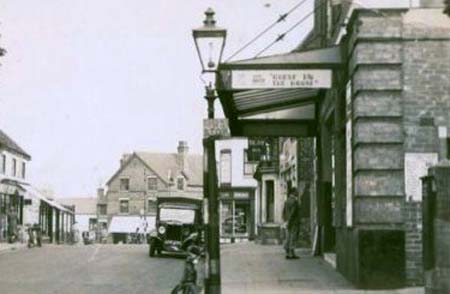
When he was a little boy, perhaps around ten or twelve years of age, around 1933, my Dad, Fred along with some friends, walked the mile or so to nearby Swadlincote, to go to the cinema. Here is the cinema:

That’s not the best of views, so here is the “Empire” but in later years:

Swadlincote has always had two cinemas but never at the same time. The sequence is usually

Cinema 1 open

Cinema 1 goes bust

Interval of five years

Cinema 2 open

Cinema 2 goes bust

Interval of five years

Cinema 1 is reopened by over-optimistic idiot

Cinema 1 goes bust

Cinema 2 is eventually reopened by another over-optimistic idiot

And so on

Anyway, Fred and his pals, all around ten to twelve years old, weren’t there to see any old film. They were there to see Boris Karloff in “The Mummy”, one of the most frightening horror films of that decade. Feeling extremely brave, they sneaked in and settled down, waiting to be frightened:

Fred was not, of course, like the modern child, immured to fear by hour after hour of relentless television, and he came out chilled to the core by Karloff, completely terrified by the whole film. And so did the rest of them.

There could be no sharper contrast, however, than that between this Karloff chiller and Fred’s favourite, and funniest, Laurel and Hardy film. The latter was “Fra Diavolo”, which, again, he would have seen at the cinema in Swadlincote:

One other tiny detail that I can remember my Dad supplying, which must have come from this era, was how, when watching silent films at the cinema, however old you were, you were expected to read the words of the dialogue for yourself. Nobody would help you. If you asked for assistance, you would be told contemptuously, “Learn to read !”

Overall, Fred must have been very interested in the cinema. His collection of old magazines, kept for thirty or more years in the glass fronted bookcase in the front room of his parents’ house, contained ones which featured German expressionist cinema of the 1920s, including both Fritz Lang’s “Metropolis” and “The Cabinet of Doctor Caligari”. The stills featured included Rotwang’s house, Maria the Robot and the somnambulist Conrad Veidt carrying his victim high above the rooftops.

This slideshow requires JavaScript.

On one occasion, Fred was actually able to meet a real, genuine Hollywood star. Just after the war ended, he was in Brighton for some long forgotten reason. He decided to visit a very distant cousin who worked in a local cinema, and who may well have been one of the Sussex branch of the Knifton family.

At the time, this particular cinema was the centre of all attention, as it was being visited by Charles Laughton, the world famous English and Hollywood film actor. Laughton was there to give a little publicity to one of his less famous films, a rather unloved feature entitled “The Beachcomber”, made with his then wife Elsa Lanchester in 1938. All of the cinema employees lined up to meet their famous guest, and Fred, at the urgent bidding of his cousin, joined on to the very end of the line, thereby managing, eventually, to shake hands with the great man:

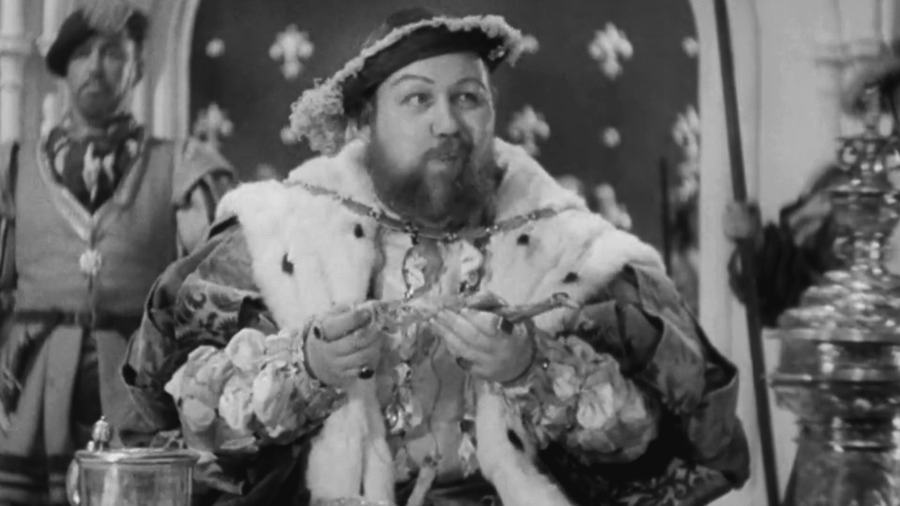
Years earlier, of course, Fred had watched the inimitable Laughton in the 1933 film, “The Private Life of Henry VIII”. In common with countless thousands of other cinema goers, he had particularly vivid memories of the greedy king eating a whole chicken with his bare hands, and then throwing bits of meat and bone over his shoulder to the waiting hounds:

Who said that table manners were a thing of the past?

But, please be aware. Restaurants of all types seem to frown on throwing bits of meat and bone over your shoulder, and there are very seldom any waiting hounds to tidy up the mess.

19 Comments

Filed under Africa, History, Humour, Literature, Personal, Science

Kamikaze (6)

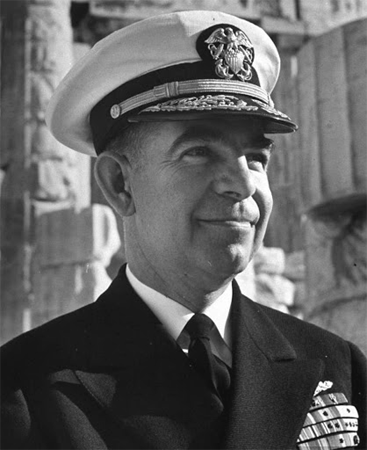
According to author Robert C Stern  in his fascinating book “Fire from the Sky”, the very last hit by a kamikaze was in Buckner Bay on August 13th 1945 on the attack transport USS Lagrange (APA 124). Work on building the Lagrange began on September 1st 1944 and the ship was ready by November 11th. The quick workers were the California Shipbuilding Corporation of Wilmington, California and the captain was Frank R. Walker. Here’s Captain Walker:

And here is the Lagrange :

It was a Haskell class ship, and all of them looked very similar one to another. Here’s a clearer photograph of another ship of the same type.

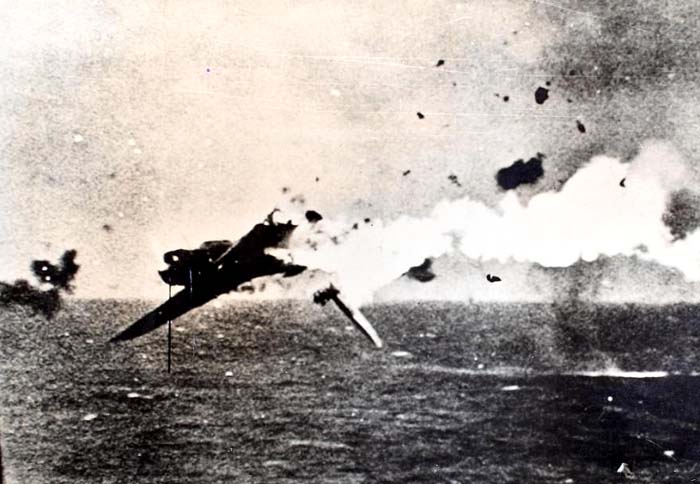
The USS Lagrange (APA 124) was the victim of kamikaze attacks on two separate occasions. On April 2nd, the convoy was attacked by eight Japanese aircraft. Private First Class Max Drucker, Company M, 306th Infantry was on deck near a 20mm anti-aircraft gun when one of the kamikaze planes approached the La Grange in a steep glide. Drucker leaped to the gun, got into action and directed an accurate stream of fire at the enemy aircraft. His was the only gun engaging the enemy. About 200 yards from the ship the Jap veered suddenly and fell into the sea.
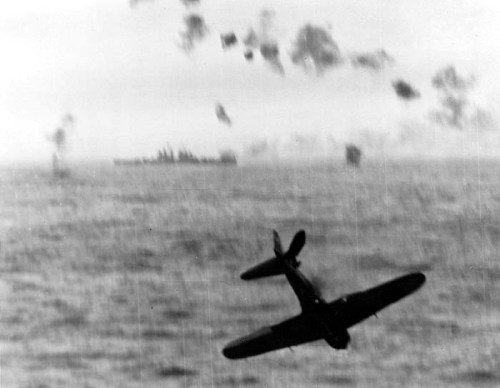
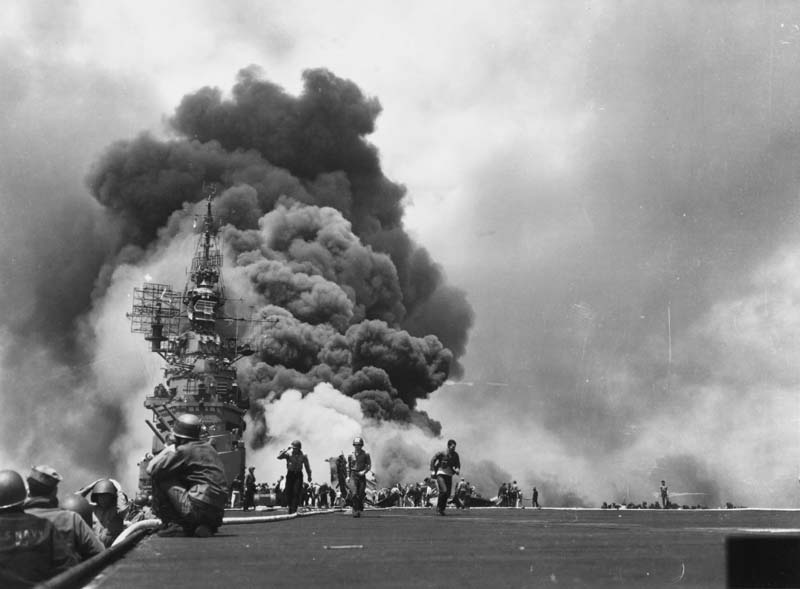
On August 13th 1945, the Lagrange was attacked for a second time, in Buckner Bay, now called Nakagusuku Bay, on the southern coast of Okinawa. There were two kamikaze pilots.  One, carrying a 500-pound bomb,  hit the Lagrange’s superstructure :
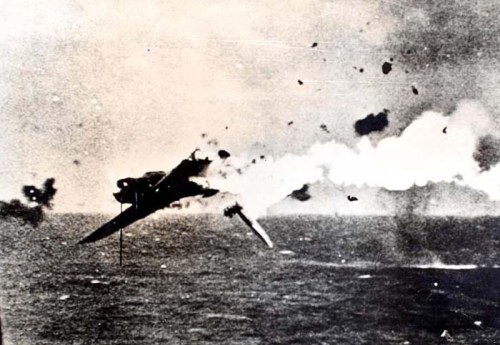
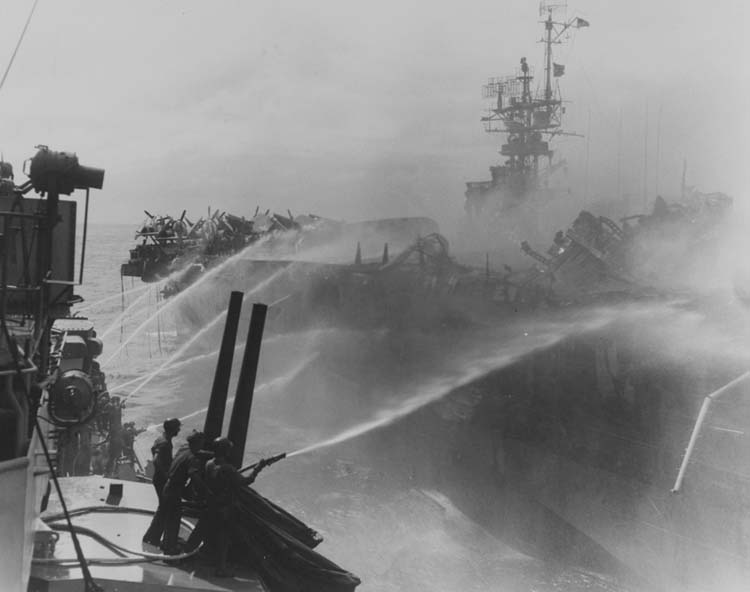
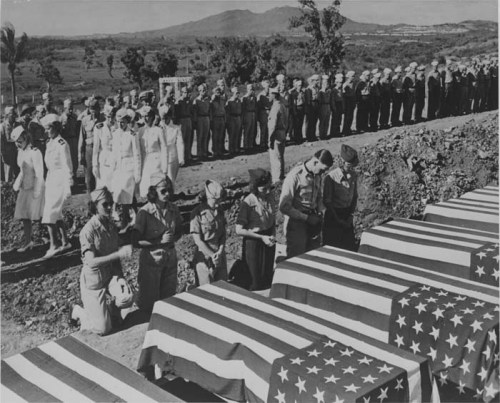
The second kamikaze aircraft clipped the top of the kingpost and splashed in the sea twenty yards from the ship. The kingpost is the tall shaft that supports a cargo boom. Each one of the aircraft caused considerable damage but more important, 21 men were killed and 88 were wounded. This was the sad reality of kamikaze aircraft. And it wasn’t just one man who died:
So near to the end of the war, with the armistice about to be signed on August 14th 1945, this attack was completely and absolutely pointless. And the Japanese senior ranks would have known that.

The very last ever kamikaze was on August 15th 1945. Vice Admiral Matomé Ugaki had ordered five “Judy”s to be prepared but when he walked out to his plane, there were eleven aircraft on the runway with 22 men inside them.

Here is a “Judy”, or rather a model of one, in this case, the prototype:

Here is Matomé Ugaki, captured on that last day of the war, as he led 22 other men to pointless deaths:
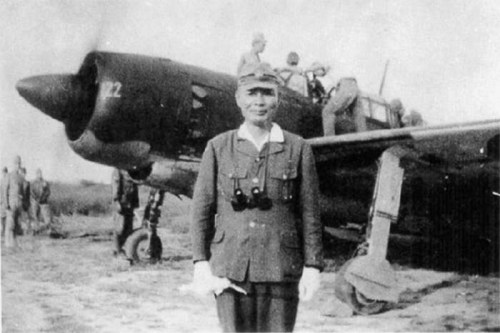
Ugaki got on board one of the aeroplanes, carrying a samurai sword given to him as a present by Admiral Yamamoto. Behind him sat Tatsuo Nakatsuru, whose father would still be praying for him on the anniversary of the August 15th attack as late as 2019.

The planes all took off, formated and flew away. And that was more or less the last that anybody saw of them.

Ugaki’s last radio message said that they had found a ship and were diving onto it:

The next day an American landing craft found a wrecked plane on a beach. It contained three bodies, all very badly mutilated but one carried a samurai sword. On August 15th 1945, not a single American ship was hit by a kamikaze. Indeed,  not a single American ship was even attacked.

Overall, the kamikazes carried out approximately 3,000 attacks and 3,913 Japanese pilots were killed. 2,000 of these 3,000 attacks never got as far as diving on an enemy ship, largely because of mechanical failures and the efficiency of the American fighters. Indeed, when it left its base, there was only a 9.4 % chance of the Kamikaze hitting an Allied ship. Once the kamikaze started its dive, there was a 36% chance it would hit its target,

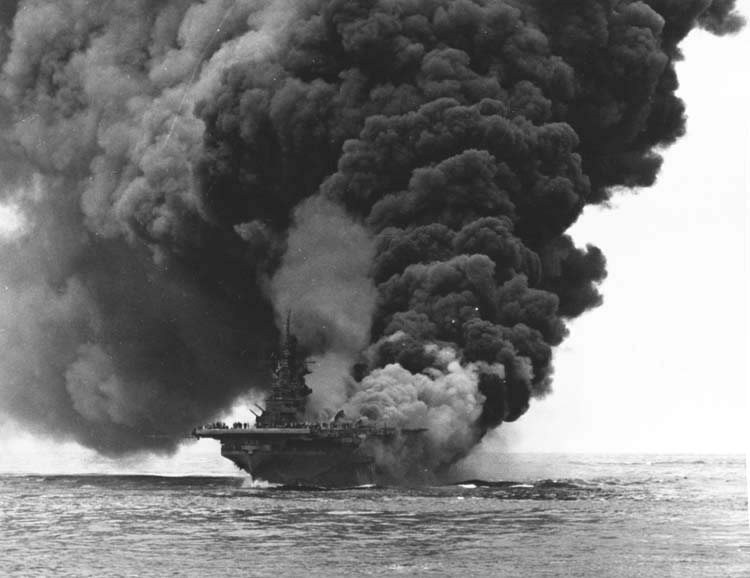
If it did hit, 40 casualties was a reasonable average expectation of casualties:
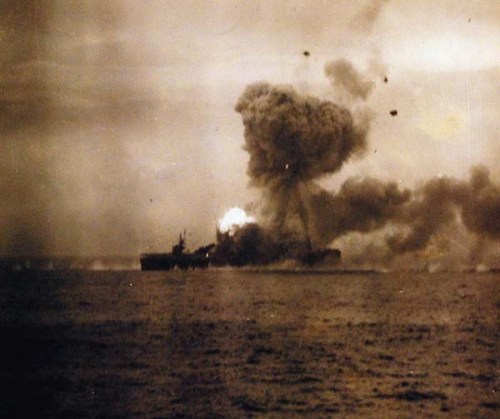
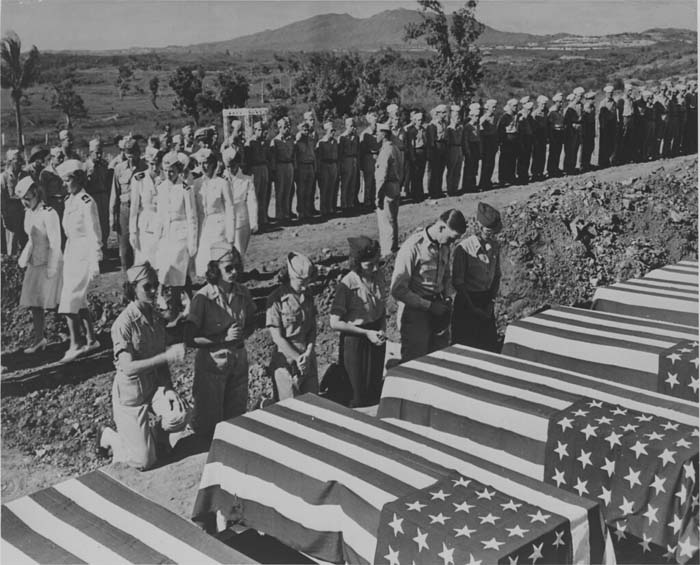
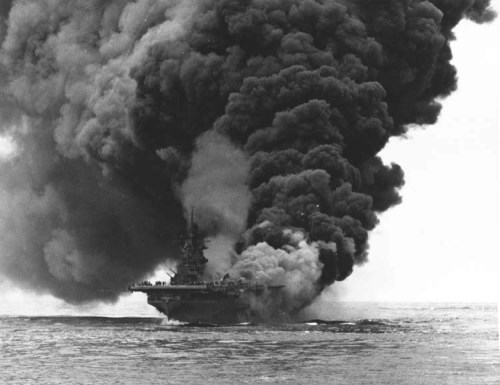
Overall, the kamikazes sank 66 Allied ships and damaged a further 250. In terms of personnel, there were around 15,000 Allied casualties. Figures suggested have been 6,190 killed and 8,760 wounded. I originally wrote “men” in that previous sentence, but there must have been casualties among nurses on board hospital ships:
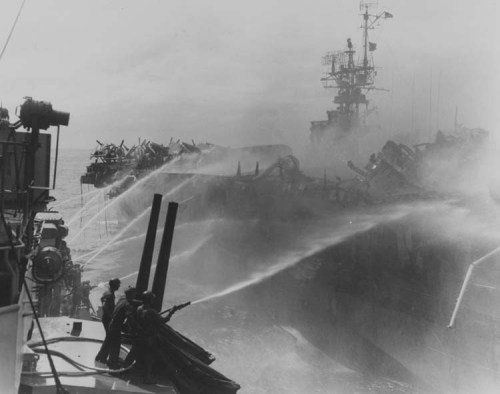
Author Robert Stern’s final opinion is that the kamikazes would never have changed the outcome of the war. That was down to the implied threat of a Soviet invasion and the possibility of the Americans using further atomic bombs. And even if the Japanese mainland had been attacked, despite incredible casualties for the Allies, the result would have been ultimately the same:
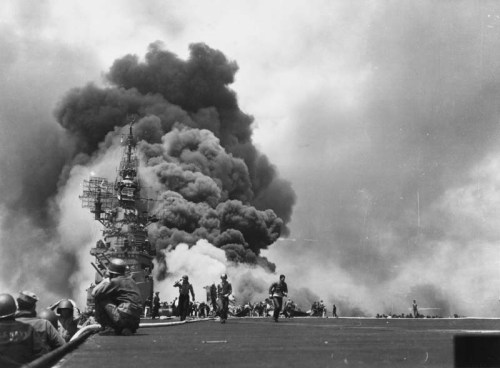
And why did they do it? Well, Stern’s conclusion is that:

“The Kamikaze was led on his path of self-destruction primarily by a sense of obligation to parents, and nation as embodied by the Emperor.”

Overall, Robert C Stern’s “Fire from the Sky” is a fascinating book with a good number of splendid photographs and some excellent accounts of individual events. It has 384 pages and I’m certainly pleased that I bought mine.
The author’s final chapter is about the modern kamikazes, the Islamist suicide bombers who have created such appalling carnage in various places in the world. My very last two posts about kamikazes will show you some of Stern’s fascinating ideas.

14 Comments

Filed under Aviation, History, Pacific Theatre, the Japanese

What would you do ? (9) The Solution

“What would you do ?” used to figure on the cover of a boys’ comic called “Boys’ World”. This was a publication, obviously, aimed at boys, and first appeared on January 26th 1963. There were 89 issues before the comic was merged with Eagle in 1964. The last issue of “Boys’ World” came out on October 3rd 1964.

I used to buy “Boys’ World”, and this was mainly for the front cover which always featured a kind of puzzle. It was called “What would you do ?” and was based on somebody being in what has been called “A dilly of a pickle”.

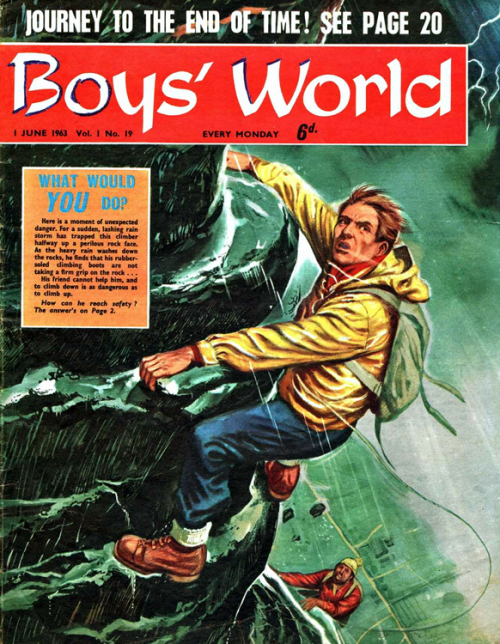
Here’s the situation:

And here’s the Orange Box, still awaiting the result of the paternity test:

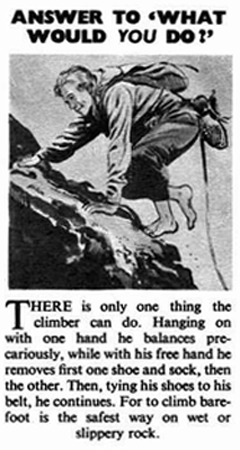
For what it’s worth, I haven’t got a clue, but I do have a Page Two where the answer is given for all and sundry:

So there we are. Take your boots and socks off. Tie them to your belt and climb down, or up, barefooted. I really would like to see somebody try that !!!

Oh, and by the way, the paternity test was negative. The search goes on.


21 Comments

Filed under Humour, Personal, Writing

What would you do ? (9) The Puzzle

“What would you do ?” used to figure on the cover of a boys’ comic called “Boys’ World”. This was a publication, obviously, aimed at boys and first appeared on January 26th 1963. There were 89 issues before the comic was merged with Eagle in 1964. The last issue of “Boys’ World” came out on October 3rd 1964.

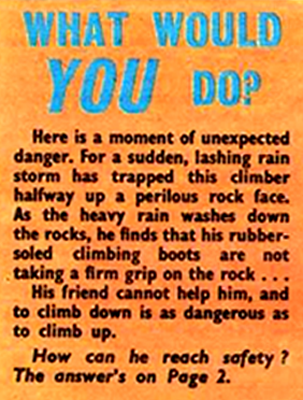
I used to buy “Boys’ World”, and this was mainly for the front cover which always featured a kind of puzzle. It was called “What would you do ?” and was based on somebody being in what Ned Flanders would call “A dilly of a pickle”. Here’s the situation:

Do you see him? Middle of the left hand side? The orange box. The worthless orange box, the father that the poor little orange arrow has been looking for ever since Big Box, as he then was, walked out and fled to Canada to escape the war.

The orange box sets the scene, and the task is for you to solve the situation. Perhaps you might like to write your idea in the “Comments” section.

Here’s the orange box enlarged:

So…..it’s one “A dilly of a pickle”.

A climber is trapped half way up the rock face. The rock was covered in ice, but now there’s rain pouring over the already treacherous surface.  His friend below is next to useless. He hasn’t even brought an umbrella.
So what can the climber do? To go up is as difficult as going down. And his rubber soled boots are next to useless too.

What can  he do??


17 Comments

Filed under Literature, Wildlife and Nature

Kamikaze (5)

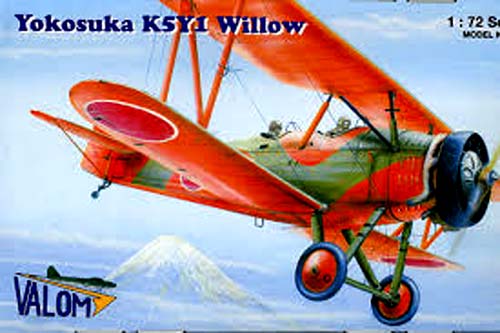
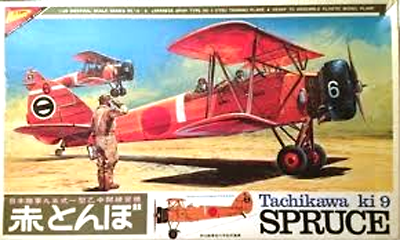
By the end of the war, the Japanese were using any aircraft that they could find to use as kamikazes. As author Robert Stern points out in his fascinating book “Fire from the Sky”, this was the moment when the Japanese accidentally invented the stealth aircraft. They were forced to go right to the back of the disused hangar and dig out some of the oldest and most infrequently used training aircraft to use as kamikazes. These included the “Spruce” and “Willow” trainers, which were biplanes apparently made from bits of wood, canvas, knotted string and bits of old wallpaper. For this reason they did not show up on radar very much at all, something which puzzled the Americans enormously and which the Japanese never found out about.

Here is a “Willow” aka a Yokosuka K5Y :

And here is a “Spruce” aka a Tachikawa Ki 9 :

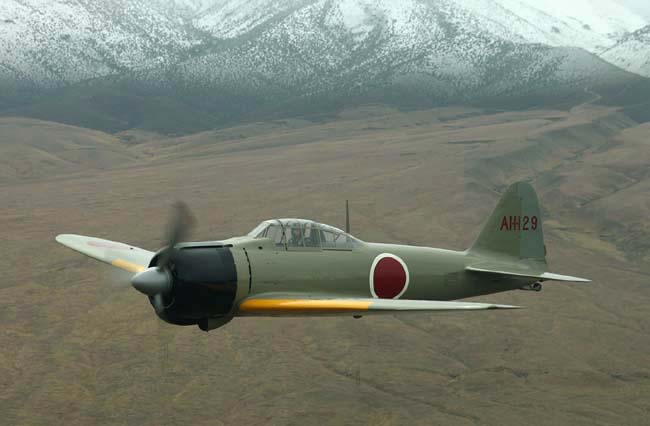
The Japanese used a variety of aircraft for kamikaze attacks. The single engined ones were mainly the naval “Zeke” or the army’s “Oscar”, the two often being misidentified. Here’s the “Zeke” aka the Mitsubishi A6M Zero:

And here is the “Oscar” aka the Nakajima Ki 43 :

Use was also made of the “Tony”, the “Frank” and the twin engined “Dinah”.

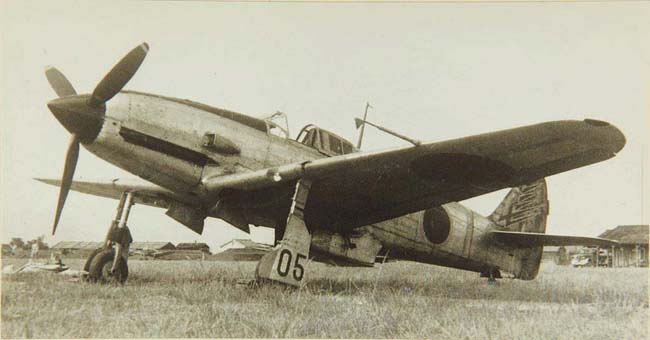
Here’s the “Tony” aka the Kawasaki Ki-61 Hien (Swallow). When it first came into service, Allied pilots thought they were Messerschmitt Bf 109s, perhaps built under licence.:

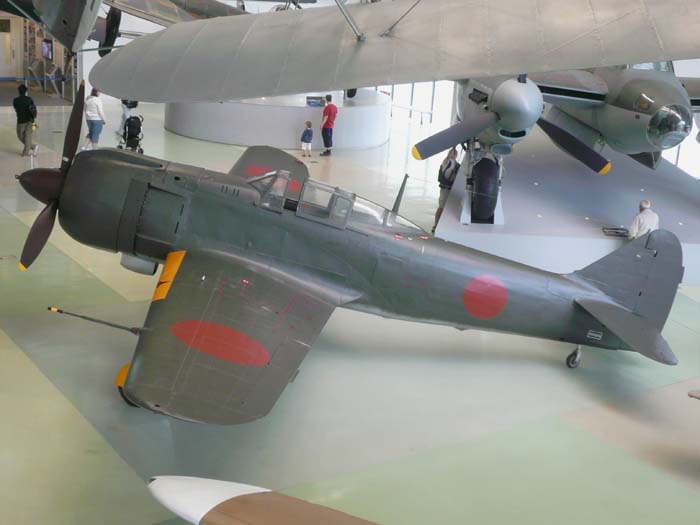
And here is a “Frank” aka the Nakajima Ki 84 Hayate. This photograph is by yours truly, taken at Hendon. Can you see the Mosquito, about to shoot it down?:

And this is my even more splendid photograph of a backlit “Dinah” aka Mitsubishi Ki-46 :

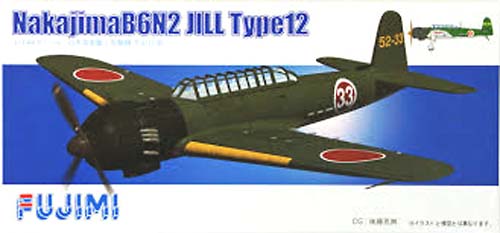
There was a welter of single engined torpedo bombers used by the Japanese as kamikaze planes. They included the “Jill” aka the Nakajima B6N Tenzan. “Tenzan” means “Heavenly Mountain”, and is under no circumstances ever to be used as a term of endearment for the woman in your life. Perhaps worth trying with the man, though:

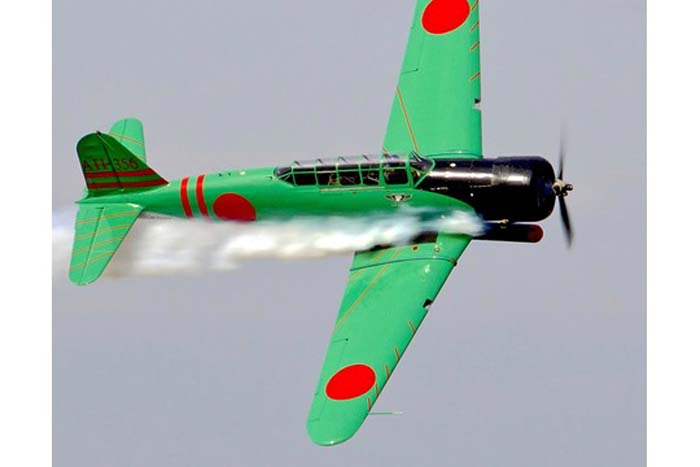
The “Kate” was aka the Nakajima B5N. It seems to have been painted on occasion in the most vomit provoking luminous green ever used:

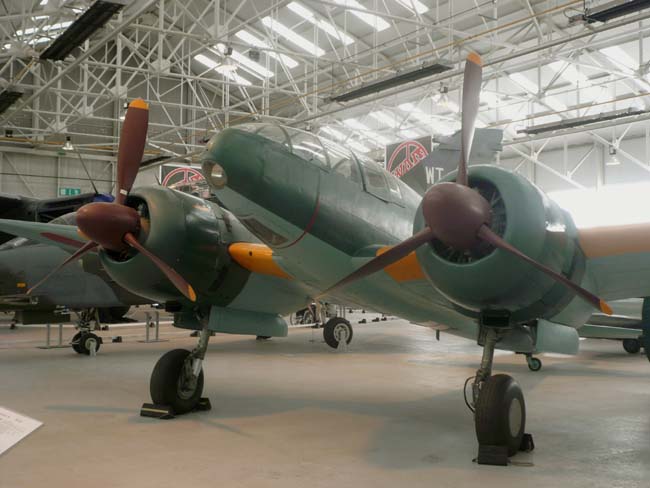
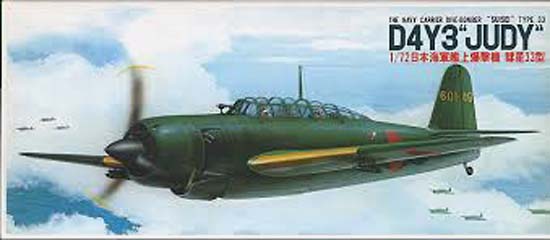
The “Judy” was aka the Yokosuka D4Y Suisei (Comet):

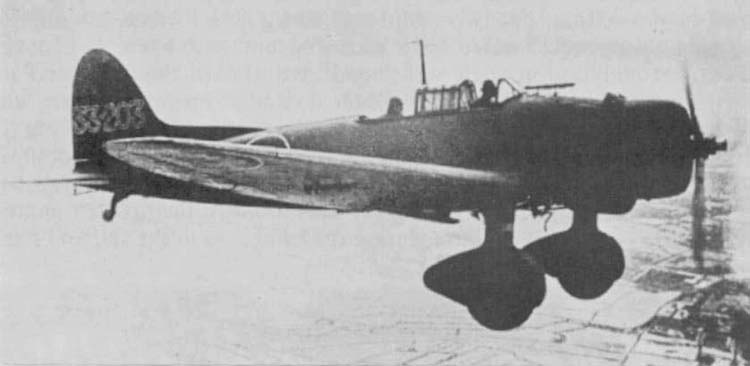
Perhaps the most frequent mount for the would-be suicide jockey was the Aichi “Val” or the Aichi D3A. This photograph is the one most frequently used:

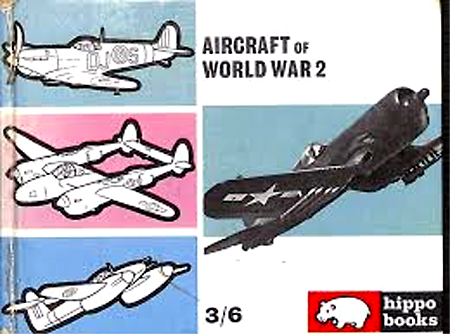
I first saw it in the “Hippo Book of Aircraft of the Second World War” when I was nine or ten :

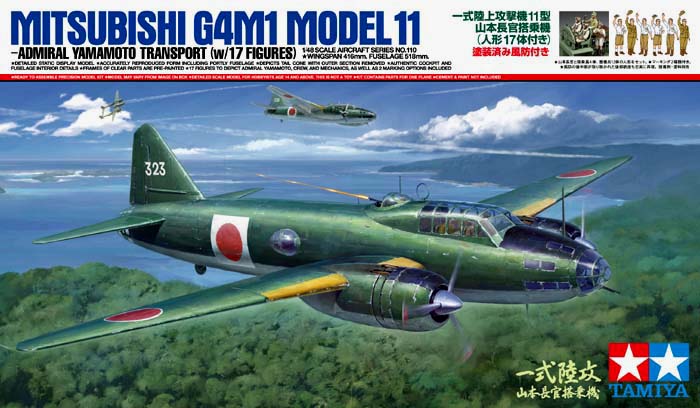
The list goes on. Twin engined bombers were mainly the “Betty” and the “Sally”. Here’s a “Betty” which the Japanese called the Mitsubishi G4M1 :

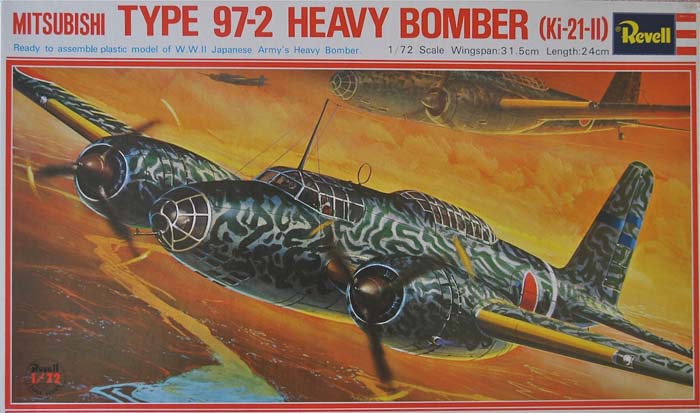
And this is a “Sally” or a Mitsubishi Ki 21. It was actually possible to cultivate a decent crop of tomato plants in the long greenhouse behind the cockpit :

That’s enough photographs for now. Other aircraft types to be used, but much less frequently, are listed below:

“Claude”, Mitsubishi A5M, carrier based fighter

“Frances”, Yokosuka P1Y, navy land-based bomber

“Hamp”, Mitsubishi A6M3, navy carrier fighter

“Irving”, Nakajima J1N, navy land reconnaissance aircraft

“Jake”, Aichi E13A, navy reconnaissance seaplane

“Myrt”, Nakajima C6, navy carrier reconnaissance aircraft

“Nate”, Nakajima Ki-27, army fighter

“Nick”, Kawasaki Ki-45, army two-seat fighter

“Pete”, Mitsubishi F1M, navy observation seaplane

“Sonia”, Mitsubishi Ki-51, army light/dive bomber

Here’s a “Pete”, but its very easy to find the rest on “Google Images” :

Next time…..the Last Kamikaze.


20 Comments

Filed under Aviation, History, Pacific Theatre, the Japanese