Category Archives: Aviation

A few days after D-Day (4)

I wrote a previous article about an Avro Lancaster Mark III bomber which took off from Metheringham, in Lincolnshire, ten miles south east of Lincoln, at twenty five minutes past midnight on June 7th 1944. Its squadron letters were Z-NH and its serial number was NE150.

Operating in the direct aftermath of D-Day the crew were tasked with bombing Coutances, a beautiful little town just south west of Caen in Normandy, in an effort to disrupt the German transportation of troops.

balguthrie

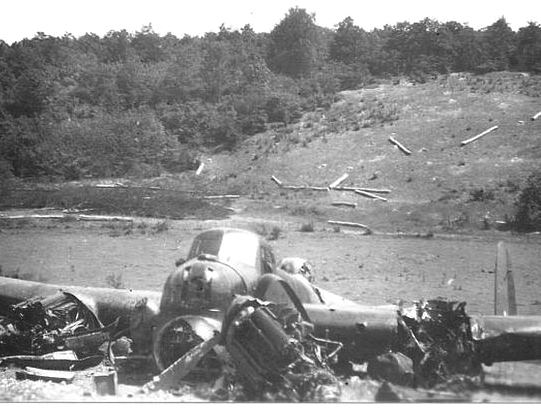
Unfortunately, the aircraft was one of two hit by heavy anti-aircraft fire over Lison, and it crashed near the village of St Jean de Daye. All of the crew were killed except two.

The first of two subsequent articles told the story of John “Jock” Drylie, the aircraft’s navigator, and the only member of the crew who ever managed to return home, in his case, to Fife in Scotland:
DRYLIE PHOTO

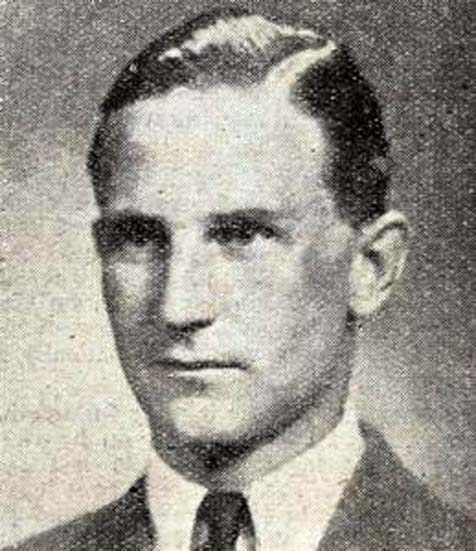
This is the second article of the two, and tells the extraordinary story of Flight Sergeant Stanley Kevin Black of the Royal Australian Air Force. He was the bomb aimer, only 21 years of age and the beloved son of George and Lillian Eliza Black, of North Fitzroy, Victoria, Australia.

On June 7th 1944, Stanley survived the crash, and, in fact, was virtually unscathed.
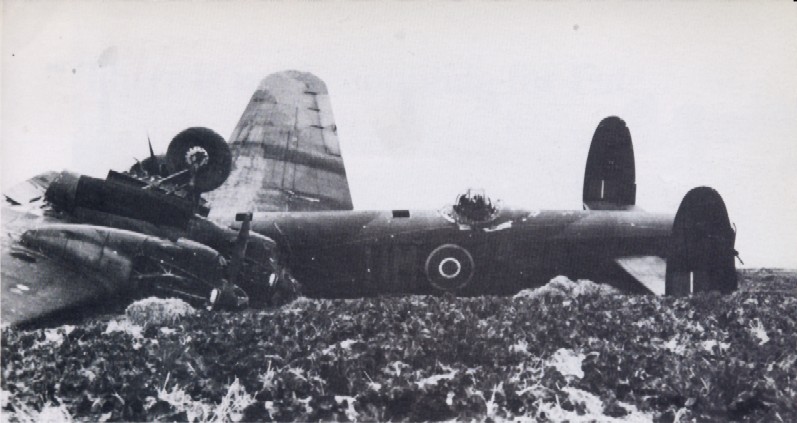
He soon met some American gentlemen, however, and then a very dark and grim tale indeed began to unfold.

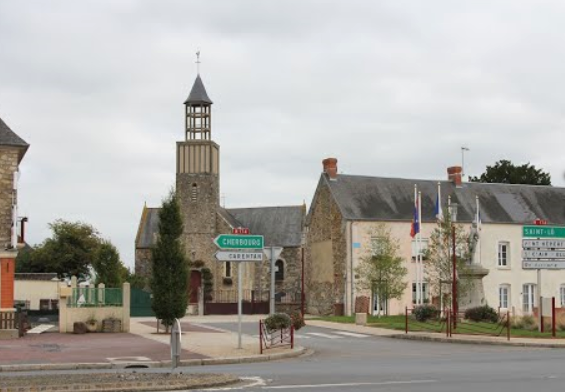
These American gentlemen turned out to be the élite troops of the 507th Parachute Infantry Regiment of the American Army. Just after two o’clock in the morning of June 6th 1944, twelve planeloads of them had been dropped in error some eighteen miles from their correct drop zone. Wandering more or less at random around the marshes near Carentan, they were now very close to the village of Graignes:

Pathfinder_Plane15

At daybreak, the village mayor of Graignes, Monsieur Alphonse Voydie, woke up and suddenly noticed that the grass field behind his house was absolutely full of American soldiers.  As Mayor, he called an immediate emergency meeting of everybody in the town. The brave townspeople decided unanimously to feed the American soldiers, despite the very real risk that the Germans would shoot them all, both villagers and soldiers. Under the forceful command of Madame Germaine Boursier, all the women of the village began cooking around the clock to serve the Americans with at least two hot meals every day. At the same time, teams of villagers, men, women and children, began filling any wheeled vehicle with lost American equipment and then bringing it back to its rightful owners.

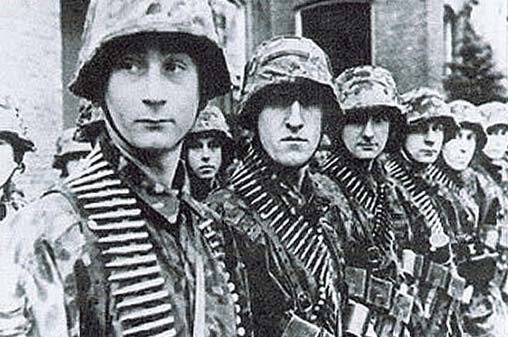
Militarily, though, the situation was hopeless. The 507th Parachute Infantry Regiment and the brave, helpful French villagers were completely surrounded by German troops including, among others, the 17th SS Panzergrenadier Division Götz von Berlichingen under the command of SS-Standartenführer Otto Binge.

zz bocage

In view of what was about to happen, the fact that these Nazi troops were from the 17th SS Panzergrenadiers was supremely ironic. The unit had been raised near Poitiers in south-central France in October 1943.
war criminalsxxxxxxxxxxx

It consisted mainly of conscripts, many of whom were Rumanian Germans with a good number of French Fascist volunteers.

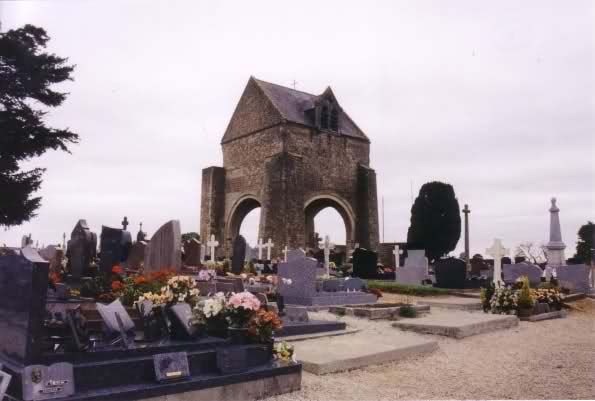
The SS duly attacked the 507th Parachute Infantry Regiment, who were by now entrenched in the village. It took the Germans until June 11th to overwhelm the village, with just the church left to be captured:
church

The Americans had, by this point, claimed perhaps five or six hundred dead Germans, with the roughly the same number wounded.

To forestall all those who would defend those apologies for human beings who made up the Waffen SS, I would like to quote the Wikipedia account pretty much in full about what happened next. I have also added some extra details from a website about the battle in Normandy in 1944:

“The 17th SS stormed the church and found Captain Sophian’s medical aid station. They forced the Captain and all of the wounded outside against a wall. The men were divided into two groups and marched away. One group was marched down to the edge of a shallow pond behind Madame Boursier’s café. At the edge of the pond, the SS bayoneted the wounded men and threw them into the water one on top of the other. The other group of 507th paratroopers was forced to march to a field near the village of Le Mesnil Angot. There, the nine wounded men were forced to dig a pit. As soon as the pit was complete, the SS shot each one of them in the back of the head and dumped their bodies in the pit one on top of the other.

Other Germans began a round-up of the French civilians.  The SS men knew that the church’s belfry had been used as an observation point to direct mortar fire accurately onto their attacking troops. The SS soldiers therefore burst into the church rectory, dragged Father Leblastier and Father Lebarbanchon into the courtyard and shot them both to death. They then discovered Madeleine Pezeril and eighty-year-old Eugenie DuJardin. Overwhelmed with fear, the two old ladies had been cowering in their quarters ever since the end of the battle. The Germans shot and killed both women in their beds. Meanwhile, forty-four villagers had been rounded up and were being interrogated. They were threatened with immediate execution if they did not divulge the names of any villagers who had actively assisted the Americans. Not a single one of the villagers turned in a single name. And none of them revealed either the role that Alphonse Voydie had played in the Graignes drama. Had the Germans known what Voydie had done, they would most certainly have executed him too.

On Tuesday June 13th, the Germans burned the village. They poured gasoline over the bodies of Father Leblastier, Father Lebarbanchon, Eugenie DuJardin and Madeleine Pezeril and then set them on fire. The ensuing blaze was allowed to burn out of control, destroying 66 homes, the boys’ school, Madame Boursier’s café and the 12th-century church. Another 159 homes and other buildings were damaged either as a result of that fire or the fighting. Before the June 11th battle and the German retaliation that followed, the village of Graignes had consisted of just over two hundred homes and other structures. Afterward, only two houses survived unscathed.”

In the words of “morice”:

« A leur départ, l’école et l’église de Graignes n’existent plus, le village n’est qu’une ruine fumante. C’est un autre Oradour et un autre Maillé, la signature des SS aux abois en 1944 dans le pays. Au total, ils laissent derrière eux 63 morts. Seul le clocher du XIIème siècle resté debout défie toujours l’occupant. »

On July 6th 1986, a ceremony was held in the ruins of the church at Graignes during which eleven villagers were presented with the Award for Distinguished Civilian Service for their role in assisting the men of 3rd Battalion/507th. Six of those awards were posthumous.

Only one member of the SS was punished in any way for this incident, the rather unlucky Erwin Wilhelm Konrad Schienkiewitz who went to prison for life. If you look at the Wikipedia entry for 17th SS Panzergrenadiers, there is a shortish list of the war crimes for which some of them received prison sentences.

For the most part, they were to do with killing concentration camp prisoners, but they also executed the Mayor of a German town who wanted to surrender to the Allies and avoid unnecessary deaths. And they murdered a Jewish dentist. What bravery from the élite troops of the Master Race.

Like so many members of the Waffen SS, however, their commander,  SS-Standartenführer Otto Binge, lived out a full life and died peacefully in a warm bed on June 18th 1982.

And why am I telling this great long-winded tale, other than the fact that it deserves to be told anyway?

Well, because it is now known that one member of that crew of the 106 Squadron Lancaster Z-NH, serial number NE150, was killed proudly fighting alongside the 507th Parachute Infantry Regiment at Graignes.
For many years, the tale had been told that there was an American fighter pilot involved in the fighting, but only in recent times, around 2008, has the real truth come to light. The mystery fighter pilot was none other than Flight Sergeant Stanley Kevin Black, bomb aimer of the Royal Australian Air Force.

black

I will bring this tale to a conclusion in the near future.

To end with, let me repeat that none of these three articles about the Avro Lancaster III from Metheringham, Z-NH, NE150, shot down on June 7th 1944, could have been written without recourse to the websites and forums which I have indicated. I just hope that what I have written, tales which deserve to be heard, will reach another audience by my re-telling them.
 

20 Comments

Filed under Aviation, Bomber Command, Criminology, France, History, Politics, The High School

A few days after D-Day (3)

I have written two previous articles about an Avro Lancaster Mark III bomber which took off from Metheringham, in Lincolnshire, ten miles south east of Lincoln at twenty five minutes past midnight on June 7th 1944. Its squadron letters were Z-NH and its serial number was NE150.

Operating in the direct aftermath of D-Day the crew were tasked with bombing Coutances, a beautiful little town just south west of Caen in Normandy, in an effort to disrupt German transportation of troops:

balguthrie

Unfortunately, the aircraft was hit by heavy anti-aircraft fire over Lison, a town near Coutances, and it crashed near the village of St Jean de Daye. All of the crew were killed except two.

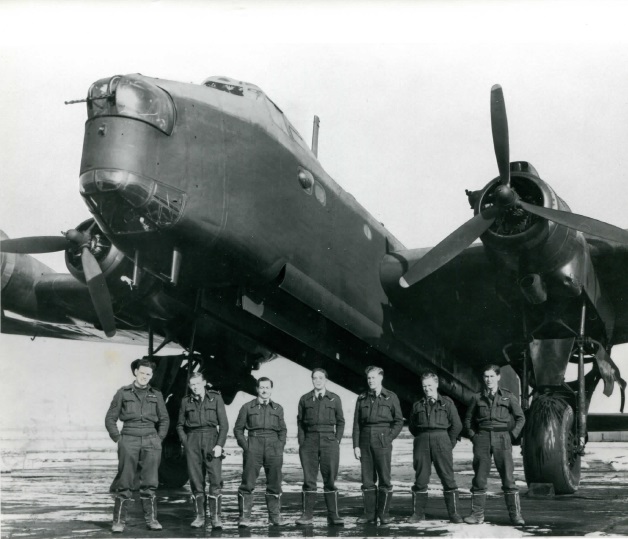
The first of two articles will tell the story of John “Jock” Drylie, the aircraft’s navigator, and the only member of the crew who managed, eventually, to return home, in his case, to Fife in Scotland. “Jock” Drylie is known to be on this photograph of a Short Stirling bomber and its crew, but the names of the individual flyers remain unknown:

DRYLIE PHOTO

I found John’s story on a forum, one of what must be hundreds devoted to the aircraft of the RAF in the Second World War.

The tale of John Drylie was posted by Michel Tardivat in 2014:

“When the aircraft crashed, five members of the crew were either unconscious or dead. He buried his parachute and hid in the deep bushes of Normandy for two or three days, he did not know how long. Driven by hunger, he knocked on the door of a farm near the village of Saint-Fromond. The owner of the farm was Arthur Michel who carefully checked John’s proof of identity with the local French Résistance. At this time, it was only too easy for German agents to pose, for example, as British soldiers, or downed flyers, in order to penetrate the Résistance network. Brave Monsieur Michel kept John at his farm, pretending, as the Scot could speak no French whatsoever, that he was a deaf and dumb farm worker.

All of the crew members from NE150 were initially reported as missing in action. His family, and especially his young fiancée, Margaret, were devastated. She was working at Stirling Castle as a radio operator for the Army.
In actual fact, John was already on his way back home. Arthur Michel continued his heroism by driving John to Bayeux. Again, the Germans had only one penalty for people caught helping Allies soldiers, and that was death. After that, the equally brave men and women of the Résistance network continued the process, and Flying Officer Drylie was back in Britain by July 19th 1944.

In the late 1940s, Farmer Michel took a wife and she was able, in the era of rationing and postwar shortages, to wear a silk wedding dress made from the material of John Drylie’s parachute. Arthur Michel and his lucky wife had just one daughter who was the village teacher at Saint-Fromond all her working life. At the moment, she lives in the family farm, which has been converted into a Bed and Breakfast establishment.

During the 1950s, the Drylie family would visit their French friends and their son Peter, would play around the wrecked fuselage of the Lancaster bomber which remained virtually untouched in a field near the village for many, many years.

Nowadays, in the cemetery at Saint-Fromond, brave Arthur Michel rests in peace. On his tomb is fixed a medal. It was placed there by the grateful RAF.”

John Drylie seems to have been very greatly affected by the events of June 7th 1944. He hardly ever spoke about what had happened to him in that doomed Lancaster. He never wore his wartime medals. He never attended any official ceremonies connected with that terrible night.

DRYLIE PHOTO

Just once,though, he came with three generations of his family, his children and grand-children, to visit the most famous places from D-Day, namely, Saint-Lô, Bayeux, Sainte-Mère-Église  and Colleville. It is unknown whether he visited the cemetery at Saint-Fromond or at Bayeux, but I would be very surprised if he did not. He was certainly seen to be very deeply moved as he stood silently at the places he visited

“Jock” Drylie was a chartered-accountant for all of his life. He travelled extensively between workplaces in Paris and in Scotland. He passed away in September 1990, in his house, “Balguthrie”, in Lower Largo, Fife, Scotland:

balguthrie

He was buried in the local churchyard with his wife Margaret and his son Peter.

Personally, I would posit that John Drylie, who hardly ever spoke about what had happened, never wore his wartime medals and never attended any official ceremonies, was a classic sufferer from Survivor Guilt.

To quote Wikipedia:

“Stephen Joseph, a psychologist at the University of Warwick, has said: “There were three types of Survivor Guilt: first, there was guilt about staying alive while others died; second, there was a guilt about the things they failed to do – these people often suffered post-traumatic ‘intrusions’ as they relived the event again and again; third, there were feelings of guilt about what they did do, such as scrambling over others to escape. These people usually wanted to avoid thinking about the catastrophe. They didn’t want to be reminded of what really happened.”

I am sure that, by now, Jock will have met up with all his old pals in Heaven and they will have told him that he should feel no guilt. In Bomber Command, death was so often decided by blind chance, nothing more:

Lancaster_B_MkI_44_Sqn_RAF_in_flight_1942


To end with, let me repeat that none of these three articles about the Avro Lancaster III from Metheringham, Z-NH, NE150, shot down on June 7th 1944, could have been written without recourse to the websites and forums which I have indicated. I just hope that what I have written, tales which deserve to be heard, will reach another audience by my re-telling them.

18 Comments

Filed under Aviation, Bomber Command, Criminology, France, History, Politics, The High School

A few days after D-Day (2)

Last time, I spoke about Frank Corner, and how he had been killed on June 7th 1944, when his aircraft was hit by anti-aircraft fire over Lison, as a huge raft of bombers tried to bomb railway lines near Coutances and bridges around Caen in preparation for D-Day.

lanc crash

The young pilot of Avro Lancaster Mark III, squadron letters Z-NH and serial number NE150, was Pilot Officer Merrick George Munday Warren.

The Wireless Operator/Air Gunner was Sergeant Norman Charles Vezey Rooker, the beloved son of Charles Vezey Edward and Jessie Rooker, of Bournemouth in beautiful Hampshire. He was only twenty years of age.

Sergeant Maurice Hardy Wigham was a little older at thirty three. He was the mid-upper gunner, the much loved son of Thomas N and Eleanor Wigham of Shotley Bridge near County Durham. Maurice was the loving husband of Margaret Wigham of Parkestone in Dorset.
Sergeant Ralph Lionel Puckett was the rear gunner. The Commonwealth War Graves Commission website reveals, unusually, virtually nothing about this man.

Other members of the crew included the navigator, Flying Officer John Drylie who actually  survived the crash and became what is classified an “evader”. This is somebody who is not captured by the enemy, but who, by one means or another, is able to return behind his own lines. In the case of Flying Officer Drylie, he was back in Britain  by July 19th 1944.

The final crew member was Flight Sergeant Stanley Kevin Black of the Royal Australian Air Force:

Squadron_Leader_E_Sprawson

He was the Bomb Aimer, and he was only twenty one years of age. He too survived the crash, and came out of the wreckage virtually unscathed.

I will tell the two very differing stories of these two young men in the very near future.

The five members of the Lancaster crew who died with their aircraft, including Flight Sergeant Corner, were originally buried in the cemetery of the little village of St Jean de Daye.
The brave citizens of St Jean de Daye managed to find a British flag and a Tricolore to drape over the coffins, and the five flyers were all given a full military funeral. All the little children of the village planted British flags around their grave.

This slideshow requires JavaScript.

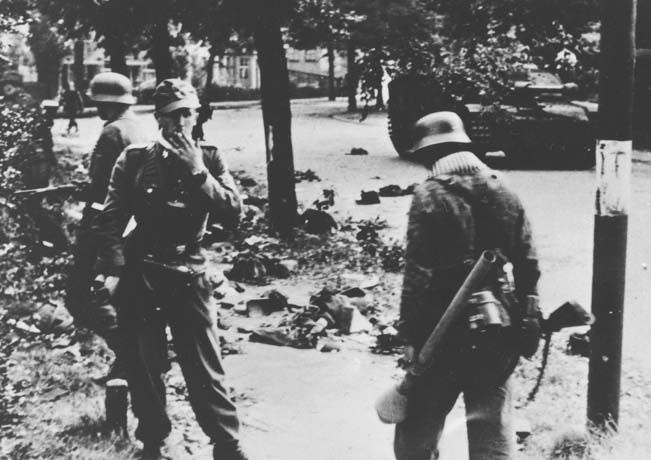
There were lots of German troops around at this time, so this act by the villagers was an unbelievably brave thing to do. Had the Germans, particularly the SS, found out, they would quite simply have shot all of them without hesitation. There were hundreds, if not thousands, of French villagers massacred by the Germans between June 6th and the time the Nazi invaders all left French soil for good:

wiking

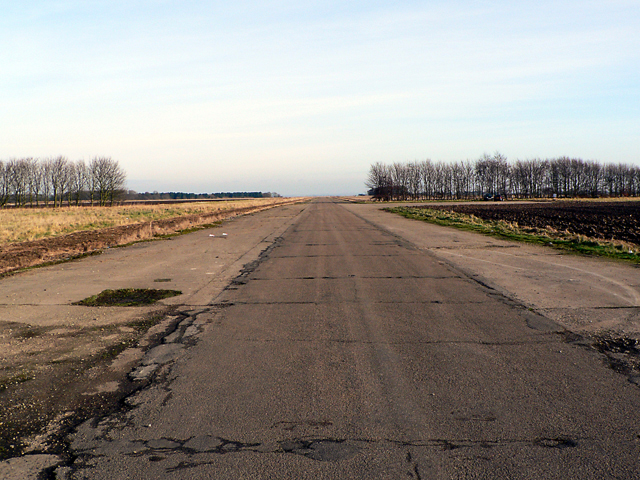
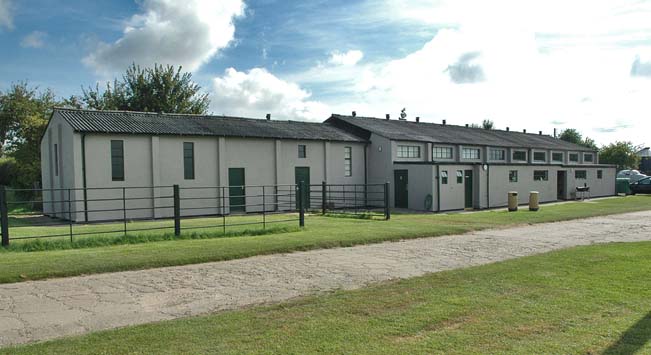
It should also be put on record that 106 Squadron lost one other Avro Lancaster III during this operation. It was ND680, ZN-P, which had also taken off from Metheringham in Lincolnshire. The runway is still there today, albeit in poor repair:

Former_RAF_Metheringham_-

Most of the crew parachuted out of the stricken aircraft:

250px-Avro_Lancasters_flying_in_loose_formation

The pilot, Squadron Leader Eric Sprawson, the Navigator, Flying Officer Richard RC Barker and the Bomb Aimer, Flying Officer EL Hogg, were all sheltered by French families in the outskirts of Caen. When the town was liberated after a five week wait, at the end of July, they were able to rejoin their squadron. Sadly, both gunners were killed. These were Pilot Officer Philip Sydney Arnold and Sergeant Edward Ernest James Wiggins. The Flight Engineer, Sergeant K Anderton and the Wireless Operator, WD Low, became German prisoners, both in Stalag Luft 7. in Bankau, Silesia, Germany. Anderton became Prisoner 288 and Low was Prisoner 465.

StalagLuft1Barth

This account, apparently taken from a newspaper of the time, takes up the story of the pilot, Squadron Leader Eric Sprawson DFC:

“A Lancaster bomber pilot from London, Squadron Leader E. Sprawson, D.F.C., wearing patched blue overalls and a dirty scarf told a Reuter correspondent of his adventurous introduction to the old Norman city and of his five weeks visit there with friendly French civilians before British troops arrived and threw the Germans out:

I was shot down by a fighter over Caen on D-Day. Five of us baled out, I don’t know if the two gunners made it or not. French civilians who had just got out of the centre of Caen to avoid bombing happened to be in the field where I landed. They had me out of uniform into these clothes within twenty minutes of my landing. They were very brave people with plenty of guts and determination. They had realised what would happen if I was caught, I would have been taken prisoner and they would be shot for hiding me. We went back into their house in the town and they treated me as a member of the family. I had no rations, so they insisted on sharing theirs with me. We were lucky and lived on the produce from a little allotment, the milk from a couple of cows and the very limited rations distributed daily to the townspeople. I got two square meals a day. My chief worry was to know what to do. Allied broadcasts advised us to evacuate the town, but I could see myself trickling into Switzerland by about 1946 and decided to stay where I was in the hope that our troops would arrive before long.

Another idea was to move into open country out of the way of concentrated bombing and shelling. But being British and individual, I thought I would have much more trouble concealing my identity. There was only one really bad bombing. I was right in the middle of it. I walked through Caen twice when it was full of Germans:

caen

Though I speak French and could make myself understood I could never have passed myself off as a Frenchman. One night when we were in the cellar of the house in Rue de Moulin, jutting on to the main thoroughfare of Boulevard Des Alliés, a great deal of scuttling about by the Germans took place. They had lots of armed patrols slinking along the streets while the crowd jostled south. For the last fortnight civilians in Caen had been living for this day. We heard the Allied Soldiers were two miles away, and then one mile. But there was still no sign until this morning. A 12-year-old boy rushed in to me and said very excitedly, “Here are the Allies!” I went out and saw a British sergeant. I told him I was British, but it was difficult for him to believe me. I. showed him my identification papers and told him to put me under arrest if he had any doubts. He put me in the charge of an officer who took me to the colonel of the regiment.

My friends in Caen had spread the tale that I was a Frenchman who had lost everything and was so shocked that I was unable to speak. Until this morning other French civilians with whom I had come in contact daily did not know I was English. There were collaborationists about who would have reported me at once if they had heard me talk. Most of the French in Caen were definitely for us. They realised that the bombing was necessary, and were determined to accept it as worthwhile, although after some of the heaviest raids it was understandable they would occasionally let slip a few nasty things, And now I am longing to be in uniform again and have another smack at Jerry.”

Here is Eric Sprawson himself:

Squadron_Leader_E_Sprawson


13 Comments

Filed under Aviation, Bomber Command, Criminology, History, Politics

A few days after D-Day (1)

Frank Leonard Corner attended the High School just  a few years before before the Second World War. He spent at least one season as the young scorer for the School’s First XI cricket team:

P1300886 1938

Of the three cricketers behind young Frank Corner, the one on the extreme right is George Brown. Playing for the School cricket team, George was a real asset with his “devastating fast in-swinging yorker on the leg stump”. On a forgotten Saturday in July 1944, however, now Lieutenant Brown, he was killed in action during the aftermath of the D-Day landings. He was just 24 years of age. Lieutenant Brown was in the 2nd Battalion of the Lincolnshire Regiment (3rd Infantry Division) and on that day, the blast of an exploding German mortar shell was even more devastating than his “devastating fast in-swinging yorker on the leg stump”.

Young Frank Corner, though, left the High School and its cricket team, on the faintly ominous date of July 31st 1939. First of all, he worked briefly for the Notts War Agricultural Committee. Around this time, he had also played rugby for the Old Nottinghamians’ Wartime XV.

Frank, though, like so many hundreds of thousands of other young men, was soon to feel the “Call of the Skies”. He joined the Royal Air Force Volunteer Reserve and was soon promoted to be Flight Sergeant Corner.

In due course, Flight Sergeant Corner joined 106 Squadron, stationed at Metheringham, in Lincolnshire, just south east of Lincoln itself. Here is the old gymnasium, still left after all these years:

Metheringham_Gymnaxxxxxxxxxxxxxxxxxxxxxxxx

Here is the building used to practice dropping bombs accurately:

Bombing_Trainxxxxxxxxxxxxxxxxxxxxxxxxxer

And here is the beautifully maintained Memorial Garden:

1280px-RAF_Metheringham_Memorial_Garden

Frank was the Flight Engineer in an Avro Lancaster Mark III. Its squadron letters were Z-NH and its serial number was NE150.
Operating in the direct aftermath of D-Day the bomber took off from Metheringham at twenty five minutes past midnight on June 7th 1944. It was tasked with bombing Coutances, a beautiful little town just south west of Caen in Normandy.

Just give you an idea of the numbers involved, the “The Bomber Command War Diaries: An Operational Reference Book” by Chris Everitt and Martin Middlebrook reveals that:

“there was a total of 1,065 aircraft, made up of 589 Lancasters, 418 Halifaxes, and 58 Mosquitos.  They were to bomb the lines of communication behind the D-Day battle area. All of the targets were in or near French towns. 3,488 tons of bombs were dropped on targets at Achères, Argentan, Caen, Châteaudun, Conde sur Noireau, Coutances, St Lô, Lisieux and Vire. Every effort was made to bomb accurately but casualties to the French civilians were inevitable. Cloud affected the accuracy of the bombing at many of the targets and, at Achères, the Master Bomber ordered the raid to be abandoned because of cloud and no bombs were dropped. 10 Lancasters and 1 Halifax were lost in these raids; 6 of the Lancasters were lost in the No 5 Group raid at Caen, where the main force of bombers had to wait for the target to be properly marked and then fly over an area full of German units and guns at bombing heights below 3,000ft. Some details are available of the effects of the bombing. At Argentan, Châteaudun and Lisieux, much damage was done to railways, although the towns, Lisieux in particular, were hit by many bombs. Important bridges at Coutances were badly damaged and the town centres of Caen, Condé sur Noireau, St-Lô and Vire were all badly bombed and most of the roads through those towns were blocked.
….19 aircraft were minelaying in the Brest area, and 26 aircraft on Resistance operations. No aircraft lost.

Total effort for the night: 1,160 sorties, 11 aircraft (0.9 per cent) lost.”

lanc crash

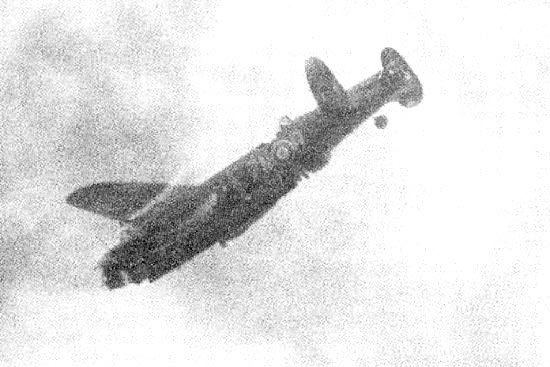
Alas, young Frank Corner was one of that minuscule 0.9%. His bomber was shot down and crashed near the tiny village of St Jean de Daye:

dAYE

On June 11th 1944, the Wing Commander of 106 Squadron actually sent a report to the Air Ministry, explaining that the crew of Z-NH had been told to bomb bridges in Caen. This is thought possibly to explain why the aircraft finally came down near St Jean de Daye. They had been hit by anti-aircraft fire over Lison, where a worker at the railway yard remembers how the German gunners celebrated the fact that they had shot down a bomber.

Frank was just twenty one years old when he died. His service number was 222039 and his parents were Captain Leonard Leslie Corner and Florence Edna Corner, of Whiston, Yorkshire.

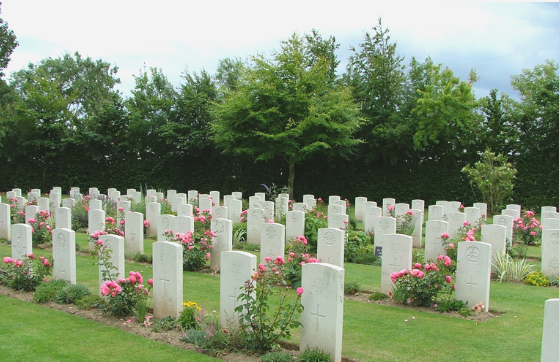
Frank is buried in the War Cemetery in Bayeux, in Calvados, Normandy, France along with 3,805 other war casualties. He has paid with his young life the price of our freedom:

ddday


15 Comments

Filed under Aviation, Bomber Command, Criminology, France, History, Nottingham, Politics, The High School

The Hendon Lancaster 137 not out

A few years ago, I drove down with the family to the RAF Museum at Hendon, just to the north of London. I made an immediate bee-line to the Bomber Command section to see their Avro Lancaster. Most of the aircraft here have their original coat of paint from World War II, so, to prevent it fading away completely under the onslaught of bright, harmful sunshine, the lighting is very subdued. That made it rather difficult for me to take photographs of a decent standard. Indeed, for the general view of the aircraft, I have had to use a photograph from the Internet. Here it is, with its capacity to carry up to 14,000 lbs of bombs into Nazi Germany:

HendonLancaster GOOGLE
Here is the front of this mighty bomber. Its huge black tyres are not far short of the height of a man. The yellow tips of the propellers are a safety feature and the yellow letter “S” is the aircraft’s squadron letter as “S-Sugar”:
P1320296XXX

This is the rear of the bomber. It has twin tails to give the mid-upper gunner a greater field of fire. You can see the door for the crew, which kept them well away from the four propellers, but it meant a very long and difficult crawl to the front of the aircraft. Its squadron letters are PO-S and its serial number is R5868:P1320297XXX

This particular plane is the oldest surviving Lancaster and the first RAF heavy bomber to complete 100 operations. It eventually went on to fly 137 sorties. R5868 was originally “Q-Queenie” with No. 83 Squadron at RAF Scampton and then became “S-Sugar” with No. 463 and No. 467 Squadrons of the Royal Australian Air Force at RAF Waddington. Its very last job came in May 1945, when it was used to transport liberated Allied prisoners of war back home to England.
The four Merlin engines have on them the names of the crew who received decorations. This is the starboard inner engine:
P1320283XXX

Here is another name, this time on the port inner engine. You can also see what looks to me to be an 8,000lb bomb underneath the enormous bomb-bay. Such a large bomb was made by merely bolting together two ordinary 4,000lb “Cookies” or Blockbuster bombs:
P1320285

I couldn’t resist showing you for a second time, in this second blogpost, the front of “S-Sugar”, which is adorned with the vain boast of Hermann Göring, “No enemy plane will fly over the Reich Territory”.

It is deliberately painted next to the symbols which represent the huge number of raids carried out over Germany by this one particular aircraft. All of the Avro Lancasters added together flew 156,000 missions over Europe as a whole and they dropped 608,612 tons of bombs on the Third Reich. So much for Hermann Müller and his pathetic promises, detailed in that previous post:

P1320286XXX

This is a “Grand Slam” bomb. It was designed by Barnes Wallis and weighed 22,000lb, ten tons, more or less, and the specially adapted Lancasters of 617 Squadron who carried it were at their physical limits:
P1320321

My Dad said their wings were shaped like giant crescents as they took off. When they were dropped, the bombs broke the sound barrier. At that time they must have been among the fastest objects made by Man. They penetrated deep underground and, when they exploded, they easily proved their nickname of the “Earthquake Bomb”. Unlike the majority of bombs dropped by the Allied Air Forces, they were always used on military sites such as U-Boat pens, gun-batteries or railway bridges.
Here is one being dropped by YZ-C of 617 Squadron:

This slideshow requires JavaScript.


I found two films about dropping a “Grand Slam” bomb. In both cases they are being used to destroy railway viaducts, in order to prevent the Nazis from moving troop reinforcements around their fast diminishing country. In this way, these spectacular bombs must have saved the lives of a lot of good men:

21 Comments

Filed under Aviation, Bomber Command, History, Personal

John David Fletcher: Part 4

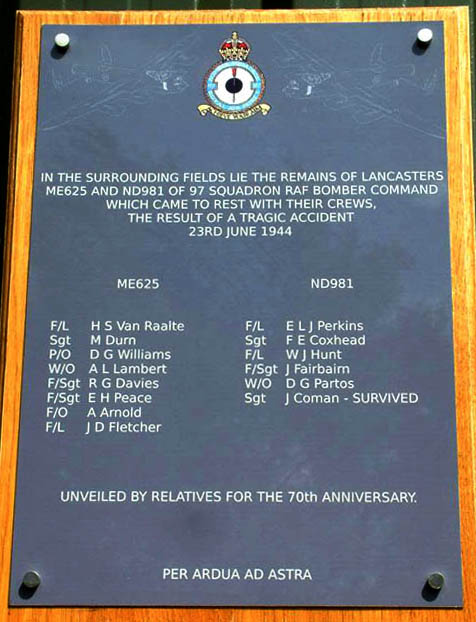
I recently wrote about the collision of two Lancasters from 97 Squadron on June 23rd 1944 in the sky above Crowland in south west Lincolnshire, as they practiced formation flying.

Seventy years later, on June 23rd 2014, a ceremony was held to commemorate the sacrifice of these young lives.

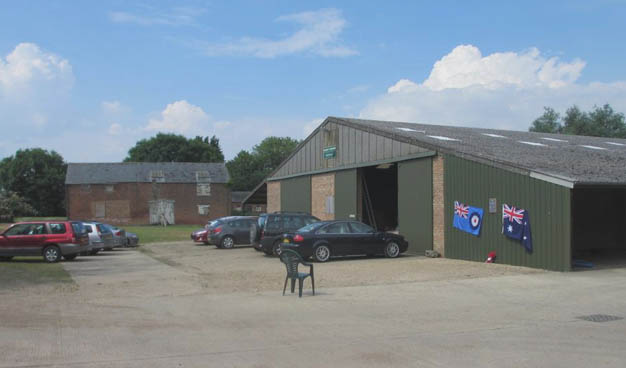
A memorial service took place in a field behind Bank’s Farm and a plaque was unveiled on a farm building near the crash site:plaque 5

It is on the metal wall of a barn:

plaque 1

Here it is in close up:

palque 2zzzzzzzzzzzzzzzzzzzzz

The events of this commemoration were all scheduled to begin at three thirty in the afternoon, more or less the exact time the two huge bombers collided all those years ago. Should anyone wish to visit the site, the directions I have are to “Go into Crowland, find Cloot Drove, travel down about 2 miles where you’ll see the farm buildings on the right, the plaque is facing the road and the postcode is PE6 0JL.”

Years ago, a simple wooden cross stood alone in the middle of a field to mark the exact site of the crash, but by 2014, it was long gone.

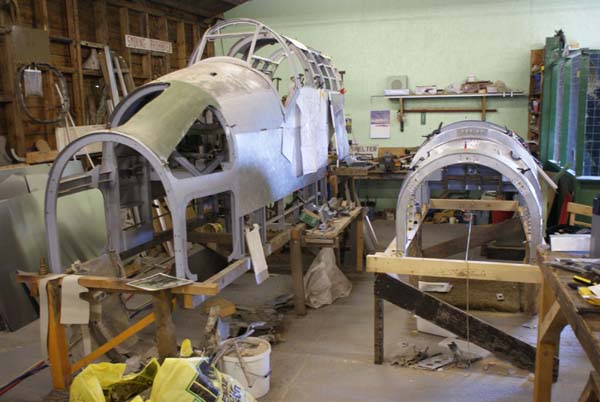
Fortunately, members of Lincolnshire Aircraft Recovery Group (LARG) had decided, initially in 1979, to attempt to recover the wreckage of the two Lancasters. Here is their workshop, with other remains that they have found:

Avro_Lancaster_Mk_1_ExCC

Their researches have ensured that the exact location of the old wooden cross, marking the crash site, was rediscovered.
The wreckage they recovered is now on display at the Lincolnshire Aviation Heritage Centre, the home of LARG.

Needless to say, as I was not a witness to all of these dreadful events, this article could not have been written without using the series of excellent books by W.R.Chorley, and a number of other websites.

13 Comments

Filed under Aviation, Bomber Command, History, Nottingham, The High School

John David Fletcher: Part 3

Flight Lieutenant John David Fletcher was buried in Cambridge City Cemetery on the Newmarket Road. As well as John Fletcher, four other casualties were buried in this cemetery, the rest being taken back to the cemeteries near to their homes.

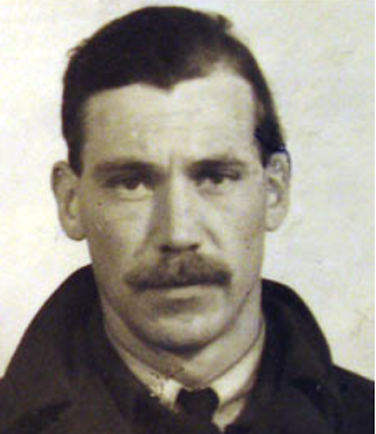
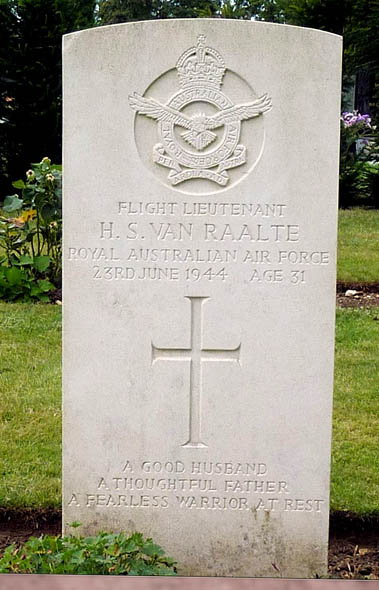
The pilot, Flight Lieutenant Henry Stewart van Raalte of the Royal Australian Air Force was one of the four to be buried in Cambridge City Cemetery. Aged just 31, he was the beloved son of Henri Benedictus Salman van Raalte and Katherine Lyell van Raalte. He was the much loved young husband of Mrs Mary Ellen van Raalte. They all lived together in Albany in Western Australia:

van rxxxxxxxxxxxxxxxxxxxxxxxxxxxxxxxxxxxxxxx

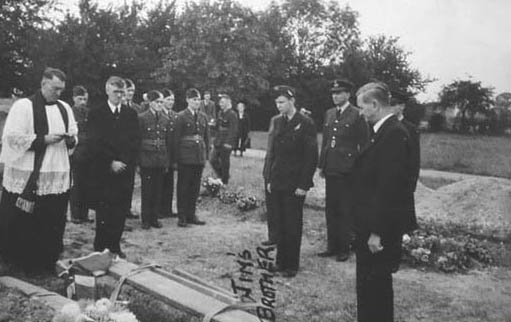
Here is Jimmy’s funeral in Cambridge Cemetery. His brother is labelled in the foreground:

van

Flight Sergeant Maurice Durn, the Flight Engineer, is buried in the churchyard of St Bartholomew’s Church in Marsden. He was only 21 years of age, the beloved son of Norman and Clara Durn, of Marsden, and the much loved husband of Mrs Dorothy Durn, who lived in the same village in West Yorkshire, seven miles west of Huddersfield.

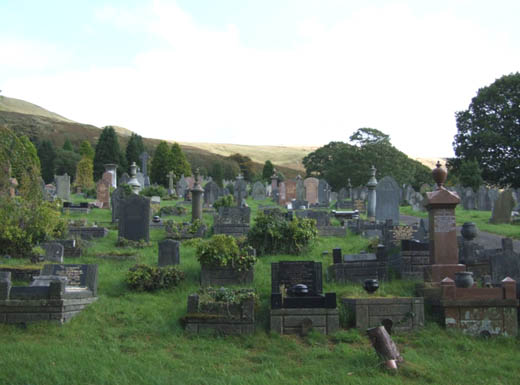
Pilot Officer David Gethin Williams was the navigator. He was the beloved son of Gwilym and Dorcas Ann Williams, of Blaengwynfi, a village in the Port Talbot area of South Wales. He is buried in Plot T, in unconsecrated ground, in Rhondda (Treorchy) Cemetery.

David Williams’ nephew can still remember him:

“My uncle David Gethin Williams was the navigator in Van Raalte’s airplane. My father who was 14 when his brother was killed remembers that it was a sealed coffin that was returned home for burial as they could not be sure if it was David Gethin that was in it. My grandmother was always haunted by that. My father remembers the Van Raalte brothers coming home to Treorchy with David Gethin when they were on leave. The rear gunner Royston George Davies was also from Treorchy and both gravestones are in sight of each other which is very poignant!”

rhonfdd cemete

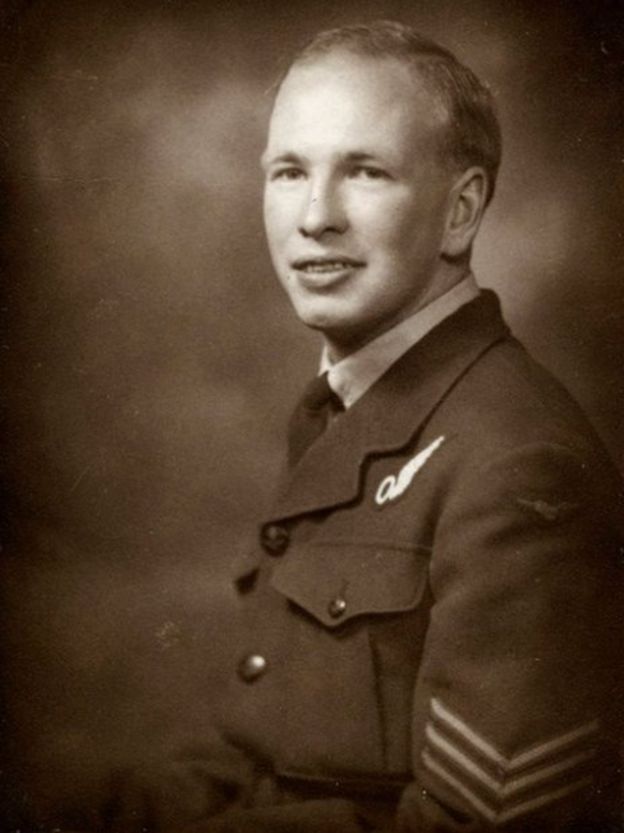
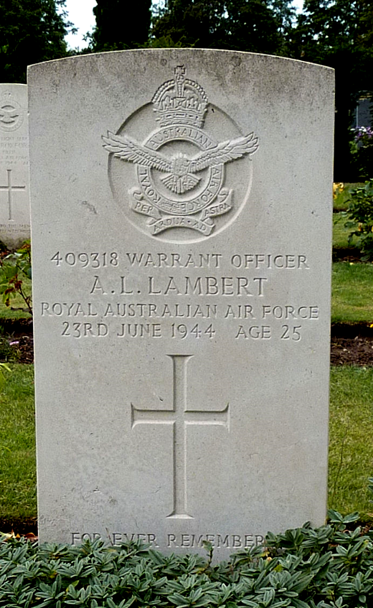
The Bomb Aimer, Warrant Officer Alfred Leonard Lambert of the Royal Australian Air Force was 25 years old when he died. He was the much loved son of John Leo and Rhoda Lambert and the beloved husband of Stella Irene Case Lambert, of Eastwood in New South Wales, Australia.

lambert

His daughter, later to marry and become Maree Pollard, was only eleven months old when her father was killed. She said:

“It has always been a big black hole in my life. I personally feel that LARG have done a fantastic job and I just can’t thank them enough. I find it very humbling.”

Maree never met her father, because she was living in Australia when he died. Alfred is buried in Cambridge City Cemetery:laambert

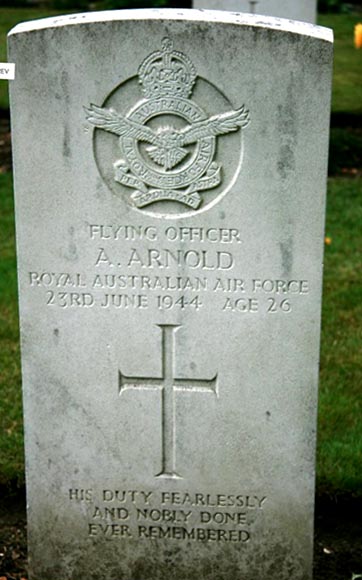
Flying Officer Alan Arnold was the Second Bomb Aimer, He was also a member of the Royal Australian Air Force and was aged just 26 at the time of his death. Alan was the much loved son of Edward and Lillian Evelyn Agnes Arnold, of Pascoe Vale South, Victoria, Australia. He was apparently flying as a visual air bomber. He too is buried in Cambridge City Cemetery.

arnold

Flight Sergeant Eric Henry Peace was just 21 years of age. He was the wireless operator, the beloved son of Ernest and Ethel Maud Peace of York. He too is buried in Cambridge City Cemetery.

The mid-upper gunner was Royston George Davies, aged just 22, and the much loved son of Gerildis and Gwenlian Davies, of Treorchy. He was the husband of Phyllis Mary Davies, and they lived in Cwmparc, Treorchy. Just like the navigator, David Gethin Williams, Royston is buried in Rhondda (Treorchy) Cemetery, both graves in sight of each other.

The other Lancaster involved in the catastrophe was ND981, also of 97 Squadron, piloted by Flight Lieutenant Edward Leslie John Perkins:

third time livcky

His friend Patrick Turner, the flight engineer in another Lancaster in 97 Squadron, recounted how the men enjoyed time to let off steam:

“One of the pilots, Flt Lt Perkins, had a small car and the whole of the flight lifted this car onto the top of an air raid shelter. After the accident we had the job of getting it down.”

Only one man was to escape alive from this horrendous collision, everybody else being killed.

Flight Lieutenant Perkins, the pilot, was buried in Cambridge Cemetery, but I have been unable to trace any further details whatsoever about him.

The Flight Engineer was Sergeant Frank Ernest Coxhead, aged 20, of Somercotes in Derbyshire. He was the much loved son of Frank Percy and Martha Coxhead. Frank is buried in Lea Brooks Cemetery in Alfreton, Derbyshire.

The Navigator was Flight Lieutenant William James Hunt who was only 22 years old. He was the beloved son of Sydney Herbert and Maud Adeline Margaret Hunt, of Romford, in Essex . The inscription on his grave in Romford Cemetery reads, “Tranquil you lie, Your memory hallowed, In the land you love.”

The bomb aimer was Flight Sergeant John Fairbairn, aged 30, the much loved son of Frank and Ada Fairbairn, of Knottingley in West Yorkshire. John was the husband of Ivy Fairbairn, of Ferrybridge near Knottingley. He is buried in the cemetery at Knottingley. He had had a lovely wedding, perhaps at the very same Northern church:

fairnbairn%20wedding%20day

The wireless operator was Flight Sergeant Coman, with the first name John or Joseph, depending on where you look. Of him, more later.

The mid upper gunner was Warrant Officer Denis Gilbert Partos. He was 23 years old, and the much loved son of Francis Ferdinand and Pauline Partos, of Southgate, Middlesex. John is buried in Southgate Cemetery. Denis died without knowing that he had been awarded a Distinguished Flying Medal. The news only came through in the London Gazette on June 27th.

This death may have been the final moment of despair for Francis Ferdinand and Pauline Partos, of Southgate, Middlesex. Their other son, John Emil Partos, a Bomb Aimer with 427 Squadron of the Royal Canadian Air Force, had already been killed on February 27th 1943:002810029-vickers-wellington-iii

He was flying in a Vickers Wellington bomber which had taken off from RAF Croft at 1848 hours. This was ZL-C with the serial number BK268, piloted by Flight Sergeant  George Taylor. They were one of seven Wellingtons sent to bomb Cologne. Five aircraft returned safely. Flight Sergeant Taylor bombed successfully, but on the way home he crashed at R.A.F. North Luffenham, near Woolfax Lodge, and he, and four of his crew, were killed, including John Partos. Flight Sergeant William Harwood and his crew were also posted missing from this raid. The whole story can be found on the website of the Canadian 6th Group:

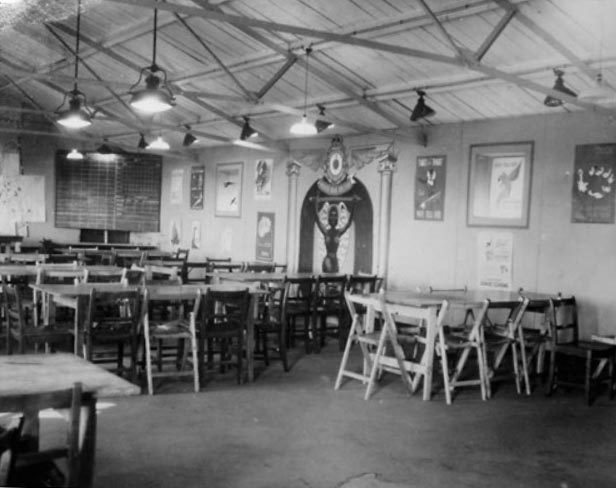
What makes these events, back at RAF Coningsby in Lincolnshire, even more tragic and twisted is that Denis Partos was not even a normal member of the crew of this doomed Lancaster. The normal mid-upper gunner was Flight Sergeant M.H.McBride, but he could not fly on this particular day because he was on a charge and had been grounded for his bad behaviour.  So too was the other gunner in the crew, Flight Sergeant J.K.Russell. Flight Sergeant M.H.McBride went on to survive the conflict as far as I can trace. So too did Flight Sergeant Russell. They must have thought, though, that they had used up all of their good luck for the entire rest of the war! Here is the Operations Room of 97 Squadron

opr room

I cannot trace a rear gunner for ND981 on this particular occasion. Some sources give it as John David Fletcher but that is clearly an error. Perhaps the aircraft flew with just six crew members.

The only man to survive the crash was Flight Sergeant Coman who was the wireless operator of Flight Lieutenant Perkins’ Lancaster. Coman jumped out of the stricken bomber as it broke up and managed to get his parachute open. He was badly burned by parachuting down almost into the burning wreckage of the two aircraft. He owed his survival, it is thought, to the fact that he was conceivably blown upwards by the force of the explosion of the burning wreckage on the ground and was, therefore, able to open his parachute and come down safely.

After his almost miraculous escape, poor Flight Sergeant Coman left the squadron and, in actual fact, was to die of tuberculosis not too long after he left the RAF. According to at least one website, he was so traumatised that he was never flew again after the tragic events of Friday, June 23rd 1944. (not surprisingly, you might think).

Old Nottinghamian, John David Fletcher had intended to make his living by farming poultry when he left the RAF.

Sixty years after the tragedy,  at a commemorative ceremony, Roy Sturman, from the Nottinghamshire country village of Collingham, spoke about his feelings all those years ago. He was only ten when his brother-in-law, John David Fletcher, was killed in the crash. He said:

“I thought he was great. He was a hero to me. I’m so glad I came along to the ceremony, because this is history and it needs to be remembered.”

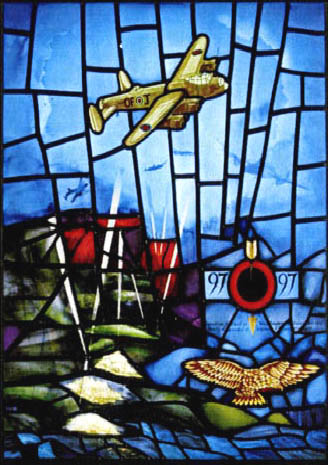
This stained glass window is dedicated to the memory of the brave young men of 97 Squadron:

97 msq windowxxxxxxxxxxxxxxxxxxxxxxxxxxxxx

Needless to say, as I was not a witness to all of these dreadful events, this article could not have been written without using the series of excellent books by W.R.Chorley, and a number of other websites.

The final part of this sad tale to follow in the near future.

22 Comments

Filed under Aviation, Bomber Command, History, Nottingham, The High School, Uncategorized

John David Fletcher: Part Two

John David Fletcher was the beloved son of John Tabberer Fletcher and Dorothy Fletcher when he was killed at that tragically early age of 24. John was old enough to be have a pretty, young wife, however. He was the beloved young husband of Joyce Loretta Fletcher. This lady, his widow, in actual fact, was to die only in 2001, almost sixty years afterwards.

When the tragedy occurred back in 1944, the men’s relatives were told little about the completely avoidable accident. Thirty five years later though, in 1979, a group of aviation enthusiasts researched the crash and recovered parts of the wreckage in what they called “an epic three-year recovery project”. They were all members of LARG, the Lincolnshire Aircraft Recovery Group:

Avro_Lancaster_Mk_1_ExCC

They spoke to eyewitnesses both on the ground and in the air and gradually pieced together exactly what had happened. Unusually for Bomber Command, therefore, the circumstances of this catastrophe are very well documented.

Young John Fletcher was flying in an Avro Lancaster III, ME625, piloted by an Australian officer, Flight Lieutenant Jimmy Van Raalte when a catastrophic training accident resulted in the deaths of 13 brave young men. It is perhaps worth pointing out that of the 55,573 casualties in Bomber Command during World War Two, one sixth occurred during training. Here is Jimmy Van Raalte:

van rxxxxxxxxxxxxxxxxxxxxxxxxxxxxxxxxxxxxxxx

The Operational Records Book for 97 Squadron reported the incident as follows:

“More formation flying this afternoon with calamitous results.  Two of our aircraft piloted by F/Lt Perkins and F/Lt Van Raalte RAAF were flying in formation.  Whilst attempting a gentle turn F/Lt Van Raalte’s aircraft sideslipped over F/Lt Perkins’ aircraft and dropped suddenly, removing the entire tail from F/Lt Perkins’ aircraft and smashing the nose of his own. Both planes immediately spun to earth out of control. All of the occupants in both aircraft were killed with the exception of Sgt Coman, who managed to bale out when his aircraft broke in two at 1000 ft”

Here is Flight Lieutenant Perkins:

third time livcky

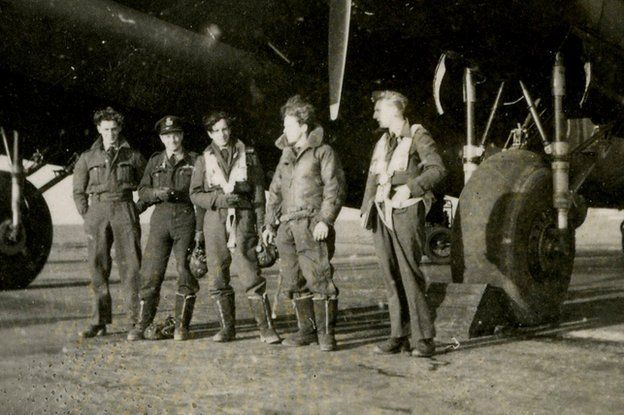
Here is Flight Lieutenant Van Raalte’s crew, showing five of the seven highly trained men:

van raalte crew

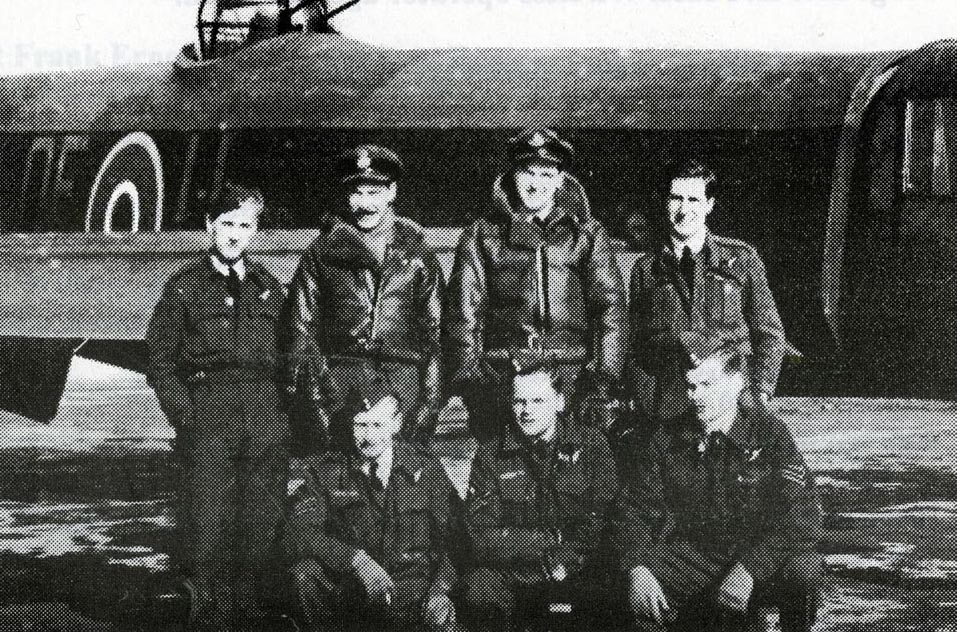
And here is Flight Lieutenant Perkins’ crew:

perkins%20crewxxxxxxxxxxxxxxxxxxxxxxxx

The two aircraft spun out of control and both of them crashed in flames at Cloot House Farm on Deeping Fen.

Here is Jimmy Van Raalte’s grave in Cambridge Cemetery:

van raalte grave

In typical wartime RAF style, bombing operations that night went ahead regardless:

“Operations tonight were against the railway yards at Limoges for which 10 of our aircraft were detailed.  The flares were dropped accurately over the target area and on time.  Mosquito marker aircraft dropped a Red Spot Fire which the Controller assessed as being exactly on the Aiming Point.  It was quickly backed up with red and green TIs and RSFs.  At 0159 the marking was completed and the Main Force were ordered to commence bombing.  Bombing was extremely concentrated and sticks were seen to fall in the “yards”.  At 0202 hours an ammunition train exploded with an enormous explosion. Intermittent explosions continued throughout the attack.  A very successful raid.  There was no fighter opposition, and no flak.  All of our planes returned safely.”

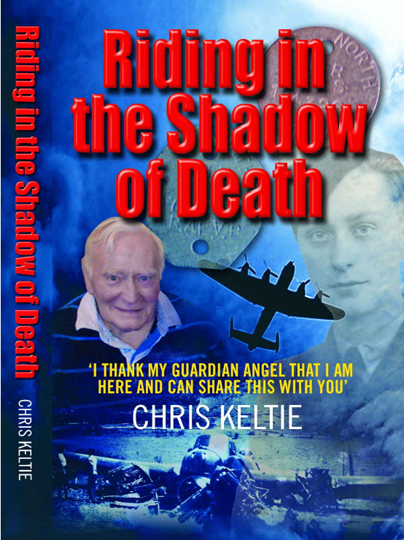
A slightly fuller description of the crash is given in the book, “Riding in the Shadow of Death

shad death

This wonderful book is the story of Lancaster Bomber pilot, Bill North, and although I have not read it yet, I certainly will be doing so soon, given that it has 15 reviews of five stars and no other lower ones:

“During the book launch, various eye-witness accounts were read out, and we were reminded of the horrific crash that Dad witnessed. This occurred on 23rd June 1944 during a daytime flying formation exercise, Dad being piloted by Bill Reid. Six Lancasters from 97 Squadron were flying in two V formations of three. Whilst attempting a gentle turn Van Raalte’s aircraft sideslipped over Perkins’ aircraft and dropped suddenly, removing the entire tail from Perkins’ aircraft and smashing the nose of its own, pieces of wreckage narrowly missed Dad’s plane. Both planes immediately spun out of control and all of the occupants in both aircraft were killed with the exception of one, Sgt Coman, who managed to bale out. Sadly, he was later posted off the station as LMF (Lack of Moral Fibre). Unsurprisingly he had lost his nerve and was unable to fly again.  What a horrific experience for all of these brave men who, just a few hours later the surviving crews were up again on a raid to Limoges.”

I may be alone in this, but I cannot really see why a competent Commanding Officer would have risked all these lives by ordering formation flying involving six aircraft and, more importantly, a total of more than forty men. All of them were seasoned veterans who had already carried out several raids on the Third Reich. And we know that:

“Formation flying was absolutely terrible because the Lancaster was not designed for it. It was a night time bomber.”

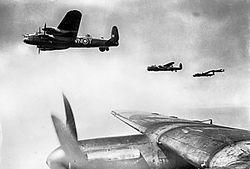
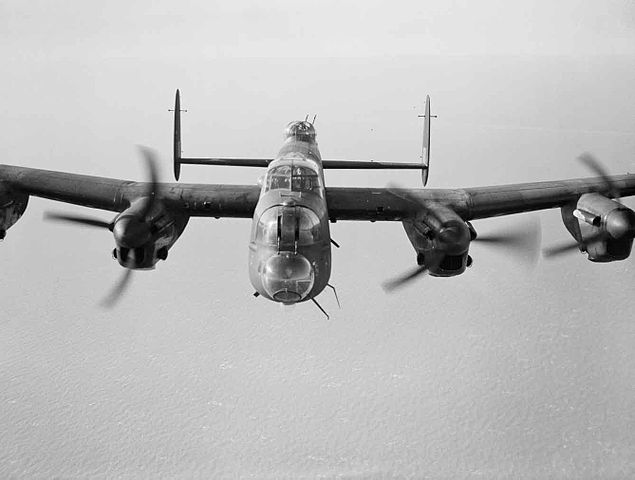
Lancasters, in combat, used to fly in a loose “bomber stream”:

250px-Avro_Lancasters_flying_in_loose_formation

They did not ever fly in formation.
One eyewitness, Patrick Turner, the flight engineer in the leading Lancaster, said the exact reason for the catastrophe was that:

“The Lancaster immediately behind the lead plane became trapped in its slipstream. This caused the Lancaster to collide with the plane flying beside it and both spun to the ground. It was just a ball of fire on the ground. Myself and my crew knew extremely well the men on the two flights which collided. We thought it was going to be a normal training flight and didn’t think there were going to be any adverse circumstances.”

Flight Sergeant Percy Cannings, holder of the Distinguished Flying Medal, and a mid-upper gunner, was in the third aircraft of the formation during the training sortie and witnessed the crash. He described the experience as devastating and said:

“We were very lucky that our aircraft didn’t get caught up in the slipstream and get taken out ourselves. We were told to execute a turn and something went wrong and the first plane got into the slipstream of the plane ahead of it, which sent it straight up in the air and back down again, narrowly missing us. We had to go out on operations the same night. It’s something you had to be prepared for.”

On the ground, the crash was witnessed by villagers attending a fete in the Lincolnshire village of Crowland:

250px-Avro_Lancasters_flying_in_loose_formation

They looked up to see six Lancasters practising flying in formation, but one aircraft accidentally caught the tail of another. Ron Burton said:

“It happened at about 4pm because I remember everyone was coming home. I saw only two planes. One knocked into the other and knocked a fin off. It was dreadful.”

William Smedley, of Postland Road, was called to the crash scene as a St John Ambulance volunteer.
He said:

“I was at a Red Cross fete at the time. We were ordered to sit behind a heap for a quarter of an hour while the bullets exploded.”

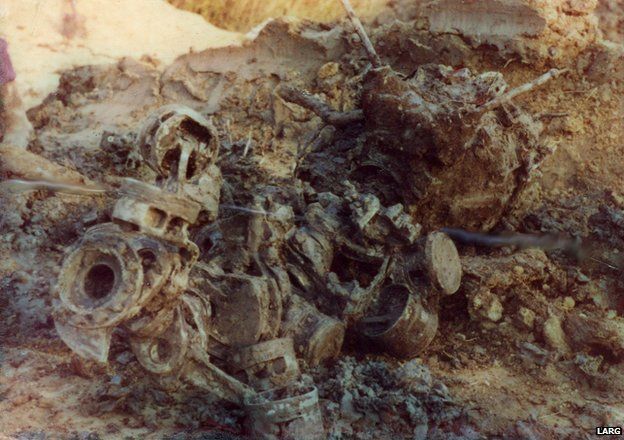
Here is some of the wreckage, seventy years later:

wreckage

Needless to say, as I was not a witness to all of these dreadful events, this article could not have been written without using the series of excellent books by W.R.Chorley, and a number of other websites.

Part Three to follow in the near future.


22 Comments

Filed under Aviation, Bomber Command, History, Nottingham, The High School

John David Fletcher: Part One

John David Fletcher entered the High School on September 17th 1931. He was born on March 22nd 1920. He was eleven years old. His father was John Fletcher, a Captain in the Royal Artillery Reserve who lived at 16, Edingley Avenue in Sherwood, Nottingham.

Edingley Avenue is just a brisk ten minute walk from where I sit now, drinking coffee and eating biscuits. John Fletcher left the High School in December 1936:

nhsxxxxxxxxxxxxxxxxxxxxxxxxxxxxxxxxxxx

Young John Fletcher was yet another Old Nottinghamian to answer the “Call of the Skies” when the Second World War broke out. Initially, like so many others, he joined the Royal Air Force Volunteer Reserve, but he soon progressed to an active squadron, namely 97 (Straits Settlements) Squadron. Here is their badge:

badge

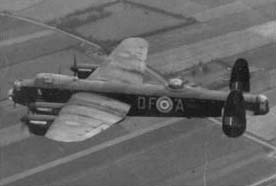
97 Squadron operated Avro Lancaster B.Is and B.IIIs at Coningsby in Lincolnshire.  Here is one of their aircraft, bearing the squadron letter, “E-Elizabeth”:

elizabeth 97 sq

By April 1943, they had become a Pathfinder Force squadron, tasked with using flares to mark targets for the rest of the bombers. By now, John was Flight Lieutenant Fletcher, serving as a Rear Gunner on a number of raids over both France and Germany.

In actual fact, John made a very promising start to his career as a rear gunner, a “tail end charlie”, one of the most dangerous jobs in any armed force during World War Two. At one point, there was a life expectancy on active service of a mere four operations, or perhaps two weeks, for every Rear Gunner.

A search through the Operations Book for 97 Squadron shows what he did in terms of operations. He was involved mostly in bombing communications targets in France to prevent the Germans moving troops to oppose the D-Day landings.

I have transcribed the Operations Book more or less intact, so you might need a dictionary:

3 May 1944 — Mailly-Le-Camp

ND346O  Up 2204  Down 0343.
6 clusters 7” flares, 8 x 1000lb MC, 3 x 4.5” flares.  Very slight haze, nil cloud, vis good.  RSFs seen on target.  Original Oboe marker wide, then one RSF dropped on aiming point; this was backed up by more RSFs.  Early bombing was wide but later improved and sticks were seen to burst across the RSFs.  Bombing on whole very successful and two definite areas of fire resulted.

300px-Royal_Air_Force_Bomber_Command,_1942-1945__C5083

7-8 May 1944 – Tours Airfield

ND452S  Up 0040  Down 0517.
6 x 7” cluster flares, 8 x TI RSF, 3 x 4.5” reco flares.  Weather and identification as above.  Two first RSF were on aiming point but just off the hangars at 0250 hours.  Ordered to back this up and out own fires were seen to fall right on hangar buildings.  Other backers up well placed but one slightly undershot.  Most of bombing very accurate.  Some explosions seen, one appeared to be a fuel dump.

10-11 May 1944 – Lille

ND452S  Up 2204  Down 0104.
6 x 7” clusters, 1 x 4000lb HC, 8 x 500lb MC, 3 x 4.5” reco flares.  Weather over Lille – cloud, vis moderate.  Target located by RSFs.  Flares down on time.  RSF obscured at time of bombing.  Only one message heard

A_Lancaster_Mk_III_of_N

19/20 May 1944 – Amiens

ND346T  Up 2316  Down 0255.
11 x 7” clusters, 3 x 1000lb MC, 3 x 4.5” reco flares.  Located target by flares and RSF through 8-9/10ths cloud.  First run, one or two RSF near target.  Flares scattered.  Yellow markers not seen.  Glow seen through cloud only.  Identified target on second run.  No spot fires at all.  Raid called off 0125 hours.  Gee faded out at enemy coast until re-crossing on return journey.

22/23 May 1944 – Brunswick

ND346T  Up 2251  Down 0257.
12 x 7” flares, 1 x 2000lb HC.  Gee u/s after 3 degrees east at 2347 hours.  Icing experienced in very thivk cumulus 5217N 0121E, 2316 hours, 6,000’.  Endeavoured unsuccessfully to avoid; late at enemy coast, crossed at 12,000’, got off track, ran in to large belt of searchlights, lost 30-40 minutes trying to break through and decided too late to reach target in time to bomb anywhere near H-hour, so decided to return to base.  Soon afterwards, Bomb Aimer found unconscious.  Navigator took over H2S and soon discovered correct position.  Gee came in again at 0209, thence plotted on Gee.  Bomb Aimer still in complete daze when aircraft landed at base.

Avro_Lancaster_B_Mk_II_ExCC

24/25 May 1944 – Eindhoven (Phillips Works)

NE625O  Up 2256  Down 0218.
12 x 7” clusters, 2 x 1000lb MC, 3 x 4.5” reco flares.  Received orders to abandon exercise 0038 hours on VHF.  Confirmed by W/T at 0039 hours.

27/28 May 1944 – St Valery-en-Caux

ME625O Up 2357  Down 0301.
12 x 7 x 4.5” clusters, 2 x 1000lb MC, 3 x 4.5 reco flares.  Slight ground haze.  Target identified by Gee.  First flares dropped about ¾ mile west of town. Two minutes later more flares called for, which fell over town;  RSF then put down.  At 0145 hours, VHF order and two red verey cancelled.  At 0153 ordered to bomb on or near RSF.  Appeared very good attack.

3/4 June 1944 – Ferme D’Urville

A small but important wireless station just south east of the Cherbourg Peninsula.

ME625O  Up 2307  Down 0241.
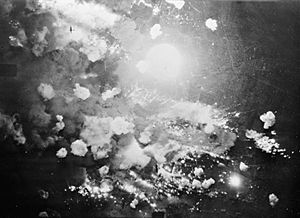
9 x TI Green No 23, 1 x TI Green No 16, 2 x TI Yellow No 16, 1 x 4000lb HC, 2 x 500lb MC.  Weather clear, visibility good.  Target identified by red and green TI.  On arrival aircraft was too close to make accurate run on first red TI (down at 0058.18 hours).  So made second run and backed up green TI with bombs because Controller said marking was okay, so third run was unnecessary.  Only one backing up wave was requested or needed.  Second Oboe TI red fell at 0059 hours.  First red was on target and second to north of it.  Green TIs covered whole target area between red TIs and Main Force bombing almost obliterated first marker, so aircraft actually bombed second red TI.  Target disappeared under smoke and bomb flashes.  One or two bombs fell in sea but concentration appeared good and accurate.  No wind correction was necessary;   Controller appeared satisfied from the start though no assessment was heard.  No second backing up wave requested.

Avro_Lancaster_Mk_1_ExCC

5/6 June 1944 – La Peanelle (in conjunction with 83 Sq

ME625O  Up 2228  Down 0356
10 x TI green No 16, 4 x 1000lb MC.  7/10ths cloud at two layers at 10,000’ and 5,000’.  Visibility fair.  Located target by red TI.  Oboe marker could not be seen, aircraft orbited and as it was 13 minutes late on run, dropped bombs on green TI, backing up green TI adjacent to two red TIs which had previously given out.  Stood off awaiting instructions from Controller who had stopped bombing just after aircraft had released.  Bombing appeared inaccurate, some sticks a few miles south, some out to sea, possibly due to cloud layer.  Illuminating flares poor.

6/7 June 1944 – Argentan

ME625O  Up 2332  Down 0326.
9 x 7 x 4.5” clusters, 6 x 500lb MC, 3 x 4.5” reco flares.  Target Argentan, northern aiming point, tops 8,500’, 6,000’ base.  Haze below.  Located by markers.  Flares (which we were only to drop on order) not needed.  Target marked with RSF assessed as 40 yards/360 from aiming point.  Ordered to bomb 0132.5 hours.  Bombing seemed excellent although target very smoky.

9/10 June 1944 – Etampes

Up 2157  Down 0209.
9 x 7” flares, 7 x 500lb MC, 2 x 500lb MC (LD), 3 x reco flares.  10/10ths cloud, base 7,500’.  Slight haze below.  Location by markers.  First flares released on Oboe.  heard over VHF at 0001 hours, also on W/T (same time).  Ordered to bomb most easterly green with 200 yards under shoot at 0011 hours, after target had been re-marked.  Green in bomb sight and a RSF beyond it further east with another green west of green bombed.  Unable to assess attack owing to smoke.

12/13 June 1944 – Poitiers

ND625O  Up 2232  Down 0431.
9 x 7” clusters, 1 x 1000lb TI red, 1 x 1000lb MC, 4 reco flares.  Sky patchy, thin stratus, some haze.  Identified target by markers.  Over target marking flare run, Controller asked Backer 1 (0142.5 hours) to drop red TI on aiming point west of RSF already down.  Position as described by Controller was two RSF in line with green TI between slightly nearer most north-easterly RSF, all three being in line along direction of railway but on easterly side of it.  Our marker assessed as 40 yards west of aiming point (0148 hours).  Instructions for bombing followed immediately.  Further flares cancelled.  Own run for MC bombs okay.  Bombing appeared very successful.  A few sticks fell exceptionally wide in centre of town.  Controller assessed quickly and accurately.

By Friday, June 23rd 1944, young Flight Lieutenant Fletcher was becoming quite a veteran with twelve “ops” behind him, a commendable total for a rear gunner. That afternoon though, between half past three and four, he was killed, not in action over Germany, but practicing close formation flying with five other Lancasters over Deeping Fen in quiet, rural Cambridgeshire. John was just twenty-four years of age:

cambrigde vity cem

Needless to say, as I was not a witness to all of these dreadful events, this article could not have been written without using the series of excellent books by W.R.Chorley, and a number of other websites.

Part Two to follow in the near future.


22 Comments

Filed under Aviation, Bomber Command, France, History, Nottingham, The High School

Anthony Bertram Lloyd

Corporal Anthony Bertram Lloyd was born in Staffordshire. He was the son of Bertram Harold Lloyd and Ada Lloyd, of Penarth in Glamorgan. He was a member of the High School from 1932-1939.

Tony had an:

“unswerving loyalty to the school, which he had revisited on several occasions during his military service…he was always in any mischief that was going, but under a seeming cloak of irresponsibility, there lay a deep respect for law and order…here was a comrade to have at one’s side in an emergency, a fellow whose courage steadied the nerves, and whose unfailing good humour showed a ray of hope in the blackest of moments”.

At school, not surprisingly perhaps, Tony was a promising boxer.
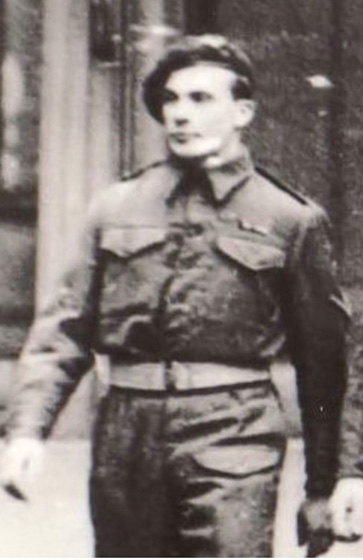
Shortly after war broke out, Tony enlisted into the Royal Welch Fusiliers and was serving with the 10th Battalion RWF when it began airborne duties in August 1942. Here he is, looking very dashing:

lloyd para

The Battalion was renamed the 6th (Royal Welch) Parachute Battalion and was incorporated into the 2nd Parachute Brigade. In early 1943, some of the 6th (Royal Welch) Parachute Battalion were engaged in fighting Axis forces in North Africa, during Operation Torch. On March 5th the Brigade handed this sector over to the Americans and moved eastwards to Tunisia.
On March 8th, a German force of divisional strength attacked the defensive positions of the 1st and 2nd Battalions. It was at this time that Anthony was awarded a Military Medal for his bravery:

“On the 8th March 1943 in the Tamera Sector, Tunisia, Private Lloyd was a member of a counter-attack Company. During the advance Private Lloyd and two other men became separated from their platoon. They came under heavy machine gun fire and Private Lloyd ordered the two men to cover him while he himself attacked the post. He charged over country showing a complete disregard for his own safety and succeeded in capturing the machine gun post and three men. By this act of gallantry Private Lloyd prevented severe casualties being inflicted to the Company which was advancing.”

On March 28th 1944, Tony was one of ten soldiers of the 1st Battalion who received their Military Medals at Buckingham Palace, all of them awarded for bravery in North Africa. It certainly looks to be a great moment when, with a group of your parachuting colleagues, you leave the Palace after the King has given you all a medal each:

receiving medals

Here is Tony, enlarged through the magic of Photoshop:

lllloyd 2

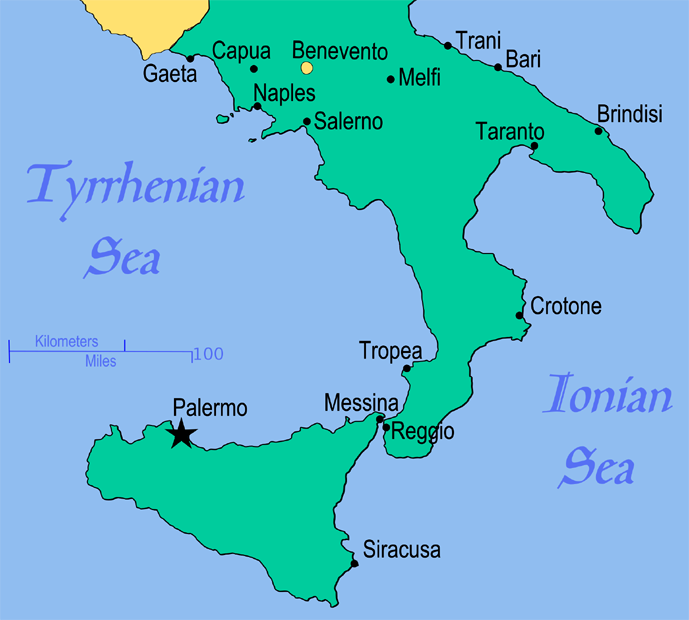
Once Generalfeldmarschall Rommel was defeated and North Africa was won, Tony was engaged in heavy fighting in Sicily, the island off the toe of Italy. Once Sicily was secured, he was part of the sea-borne landings at Taranto in mainland Italy in September 1943. Pushing north, they fought their way to Foggia before they were taken out of the line to return to the United Kingdom to prepare for D-Day:

2000px-Kingdom_of_Sicily_1154_svg

On Sunday, September 17th 1944, as the Allies pushed north eastwards, their bravery was again put to the test as the Battalion jumped onto Renkum Heath in an attempt to capture the Rhine crossings at Arnhem, the so-called, “Operation Market Garden”. By this time Tony was the Second in Command of 8 Section, No 11 Platoon, T Company.
Tony and his fellow parachutists suffered severe casualties around Den Brink and the Queen Elizabeth Hospital as they tried to rescue the 2nd Battalion who had been cut-off and surrounded at the bridge at Arnhem, the famous “Bridge too far”. Eventually however, Tony, along with the survivors of the 2nd Battalion, was forced to retreat to the Division perimeter which was by now surrounded and besieged at Oosterbeek.

1 para busy
It is believed that Tony was wounded in the fighting at Oosterbeek, in the area near the Regimental Aid Post at Kate ter Horst’s house. Unfortunately, Tony died from his wounds and he was one of 57 parachutists given a temporary burial in mass grave in the house’s garden. Tony was only 21 years old when he died on September 26th 1944.
Many years later, on March 18th 2010, an appeal appeared in the “Penarth Times”. It was from R R Tolhurst (Lofty), who had borrowed a picture from H Rowan, of T Troop, the 1st Parachute Battalion. He was in the same trench, right next to Tony Lloyd when the latter was killed. Earlier, Tony had taken a photo of H Rowan, busily engaged in shooting at German soldiers. After Tony’s death, it managed to make its way back to Penarth in Wales. In a wonderful magnanimous gesture however, Tony’s parents, Harold and Ada, sent it on to H Rowan after the war, presumably because it showed him on the photograph rather than their own son. Photographs taken in the heat of battle are not common, but any which are taken by soldiers rather than official war photographers are extremely rare. Here is the photograph:

corner street

Corporal Anthony Bertram Lloyd MM was, by anybody’s standards, a real hero. He had spent most of his time during the war performing the same deeds of brave derring-do that boys in the 1960s used to read about in their comics such as “Victor or “Valiant”.

hurricane

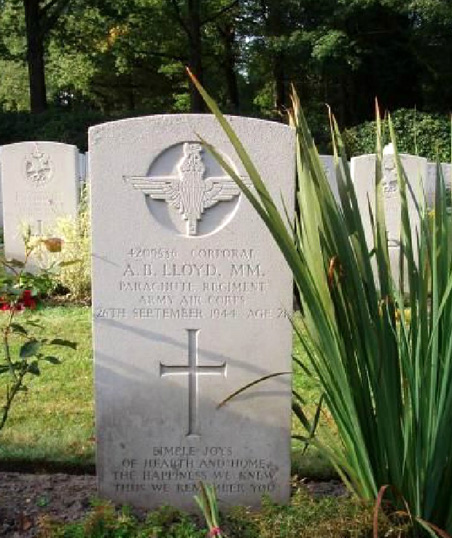
Tony now lies in Oosterbeek War Cemetery in Arnhem, the town he fought so bravely to liberate from Nazi occupation. People throughout the whole of Holland are now completely free to live their lives exactly as they wish, thanks to Tony Lloyd, and his countless thousands of brave companions :

grave

The inscription reads:

“Simple joys

of hearth and home,

The happiness we knew

Thus we remember you”

I could not have written this article without the help of these two websites.


21 Comments

Filed under Aviation, History, Nottingham, The High School