Category Archives: Aviation

The Sandiacre Screw Company (4)

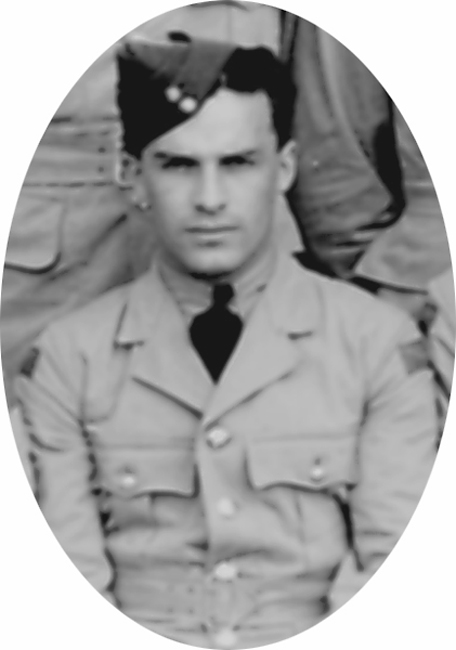
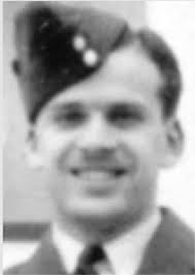
This is the fourth episode of the tragic story of Keith Doncaster, whose grandfather and father owned the huge “Sandiacre Screw Company.”  Keith was an Old Nottinghamian, but after leaving the High School on July 30th 1940, he joined the Royal Air Force Volunteer Reserve, immediately after his 17th birthday. The RAFVR was the usual way to apply for aircrew entry to the RAF. Keith would have sworn an oath of allegiance to become a member of the RAFVR. The oath was very like the oath sworn today:

“I, Ivan Keith Doncaster, swear by Almighty God  that I will be faithful and bear true allegiance to His Majesty King George VI, His Heirs and Successors, and that I will, as in duty bound, honestly and faithfully defend His Majesty, His Heirs and Successors, in Person, Crown and Dignity against all enemies, and will observe and obey all orders of His Majesty, His Heirs and Successors, and of the air officers and officers set over me. So help me God.”

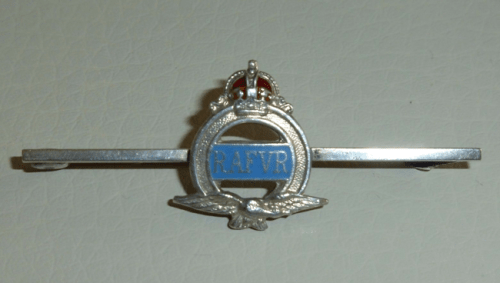
And then he could wear an RAFVR silver badge to indicate his status. There were two distinct types of badge on the internet. This one is a lapel badge:

And this one isn’t. Is it to hold your tie in place? :
There was a wait of varying length before volunteers were able to begin aircrew training. In the meantime, Keith took part in farm work, helping a local farmer.
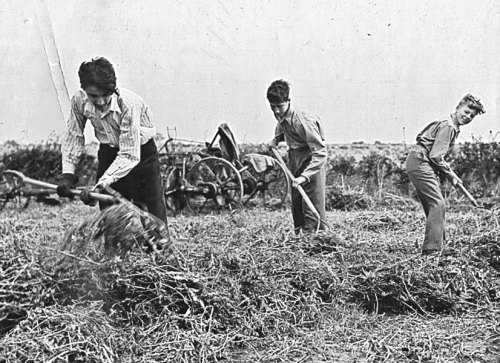
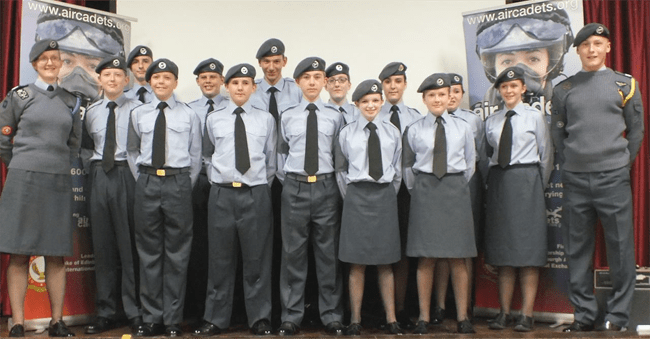
He probably continued with his ATC attendance, proudly wearing his silver badge on his lapel. Here’s the Long Eaton ATC today:
Once he was eighteen in 1941, Keith finally made it into the RAF. He would not be a pilot, as most boys dreamed of being. Instead, Keith joined 166 Squadron as a mid-upper gunner in an Avro Lancaster:

The squadron used both Mark I and Mark III Lancasters which were apparently indistinguishable externally. The Mark III had Merlin engines built by the Packard Motor Car Company of Detroit in Michigan in the United States.

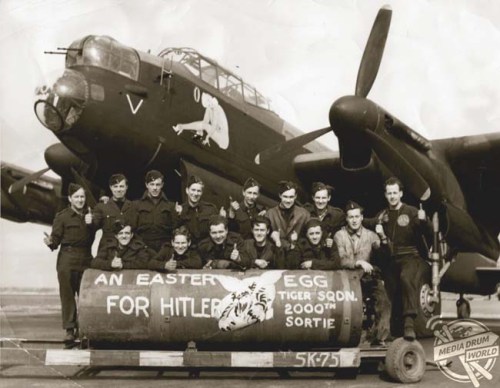
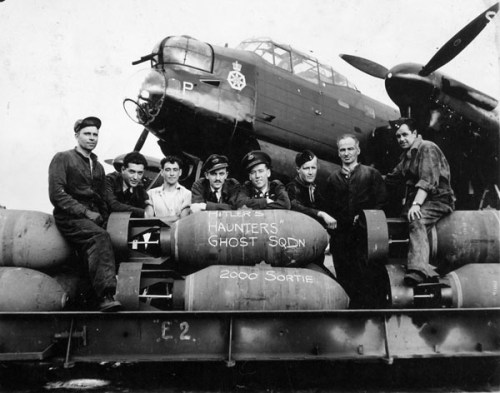
At the Lancaster factory the aircraft were constructed in the normal way and either type of engine was fitted according to availability, although they were never mixed on the same aircraft. Eventually, 3,425 Mark Is were constructed and 3,469 Mark IIIs or Mark Xs, the latter aircraft being constructed in Canada. The engines’ performance was hardly different, although the Packard Merlin was more likely to overheat on take-off and landing, which meant that training units used it less frequently. The propeller blades were Hamilton Standard or Nash Kelvinator made “paddle blade” types. Mark Is had de Havilland “needle blade” propellers. Here are some “paddle blade” types :
And here are some “needle blade” propellers:
The Lancaster was still the same. That huge, huge bomb bay, thirty three feet long and completely uninterrupted, capable of accommodating 4,000lb, 8,000 lb or 12,000 lb blockbuster bombs. Or perhaps fourteen x 1,000 lb bombs. General Purpose or High Explosive. Instant explosion or with a wait of six days.

Or perhaps Monsieur would prefer 3,304 incendiaries this evening?

It was a Devil’s Menu where  Satanic Chefs could choose exactly what kind of disaster they would like to produce. And each combination had its own codeword: “Arson”. “Abnormal”. “Cookie”, “Plumduff”, “Gardening”. “No-ball”. “Piece”. “Plumduff Plus”, “Usual”.

What “a lovely way to spend an evening”, as the hit song of the day used to say…..

 

13 Comments

Filed under Aviation, Bomber Command, History, military, Nottingham, The High School

In the Footsteps of the Valiant (Volume Five) Finished at last !!!

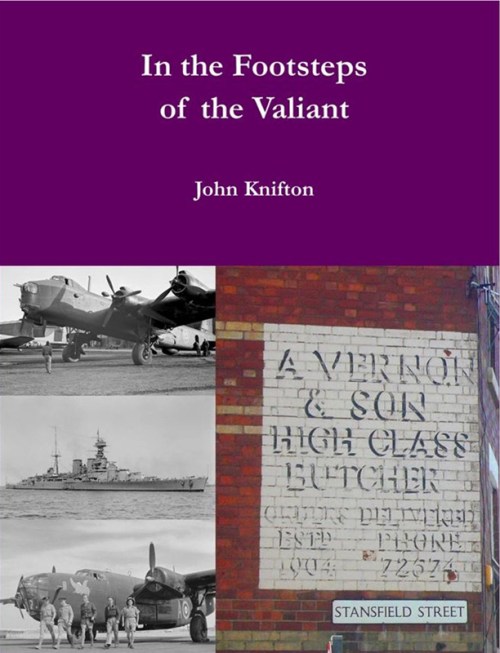
Well, it has finally happened. After something like eight years of research and writing up, the fifth and final volume of “In the Footsteps of the Valiant” is complete and published and ready to be purchased…….

I have always said that my main intention was to get away from a list of war casualties which was just a surname and a set of initials displayed on a wall. I wanted to portray the High School’s war dead as young men with, perhaps, wives, families, houses, jobs, and, above all, their own lives to lead. Lives which they were prepared to sacrifice in the cause of freedom, to stop a madman whose crazed ideas would have transformed the entire world into his very own vale of tears.

No less an intention was the idea of trying to establish, once and for all, just how many war casualties the High School had. From around eighty, I have now pushed the number up to around 120.  Volume Five contains the detailed story of 22 High School casualties of World War Two, along with two men who gave their lives for their country during the following decade. And don’t forget, incidentally, that all five volumes have been deliberately constructed to contain the same amount of material as all of the others. Furthermore, that material is, overall, of the same quality as all the other volumes. No single book is full of exciting stories of derring-do, at the expense of another volume devoid of all excitement. I took great care to make that the case.

The men concerned in Volume 5 are :

Thomas Arthur Bird, Douglas Arthur Burgass, John Stuart Burnside, George Vernon Carlin, Frank Leonard Corner, George Edward Dance, John Arthur Finking, Bernard William Grocock, George Norman Hancock, Lewis Alan Hofton, John Mayo, Arthur Mellows, Roy Faulkner Newell, Herbert Temple Nidd, John Ebblewhite Paling, William Palmer, Peter Frederick Paulson, Ivan Roy James Perkins, Kenneth Walter Sansom, William Henry Shaw, John Aubrey Starkey, Leslie Hambleton Taylor, Peter Vernon and Ian Leslie Wilkinson.

Here are Messrs Frank Corner, the First XI cricket team scorer, John Mayo, First XV player, Arthur Mellows, First XI cricketer, and Peter Paulson, of 277 Battery (City of Nottingham) 68 Heavy Anti-Aircraft Regiment, killed by enemy fire as the Germans captured Tobruk.

Frank Corner:

John Mayo:

Arthur Mellows

And Peter Paulson

And here is Bernard William Grocock, shot down by Oberleutnant Helmut Lent of 6/Nachtgeschwader 1, the second greatest night fighter ace of all time.

John Aubrey Starkey, killed at HMS Bambara in Ceylon, as he flew his Grumman Hellcat fighter :

And Ian Leslie Wilkinson, First XV rugby player and First XI cricketer :

And Herbert Temple Nidd, surely the most colourful Old Nottinghamian of them all, a man who worked on every single one of the great North Atlantic liners of the 1930s, and whose understanding of the rule “Only one wife at a time” seems to have have been woefully deficient. And that may well go for his father, too.

They died in many different places. In the Denmark Strait, facing the Bismarck. In an Italian prison camp. Fighting Rommel in Tunisia. Shot by guerillas in Ethiopia. In the Netherlands, clearing the Scheldt Estuary of Germans. Crossing the Rhine only weeks from the end of the war. And in aircraft. Over Duisburg in a Lancaster. In a Gloster Meteor. In a Whitley over Staffordshire. In a Whitley over Berlin.  In a Liberator over Tripoli in Libya. And most interesting, the POW who died, or was perhaps murdered, on his “Long March”, as, in 1945, the Germans marched their prisoners hundreds of miles westwards in deep snow, away from the Russians. What a tale he had to tell. Other men from his camp had been stationed right next to Auschwitz and had watched carefully what the Germans were doing. Alas, had he survived, he might well have added his testimony to the prosecution’s case.

This slideshow requires JavaScript.

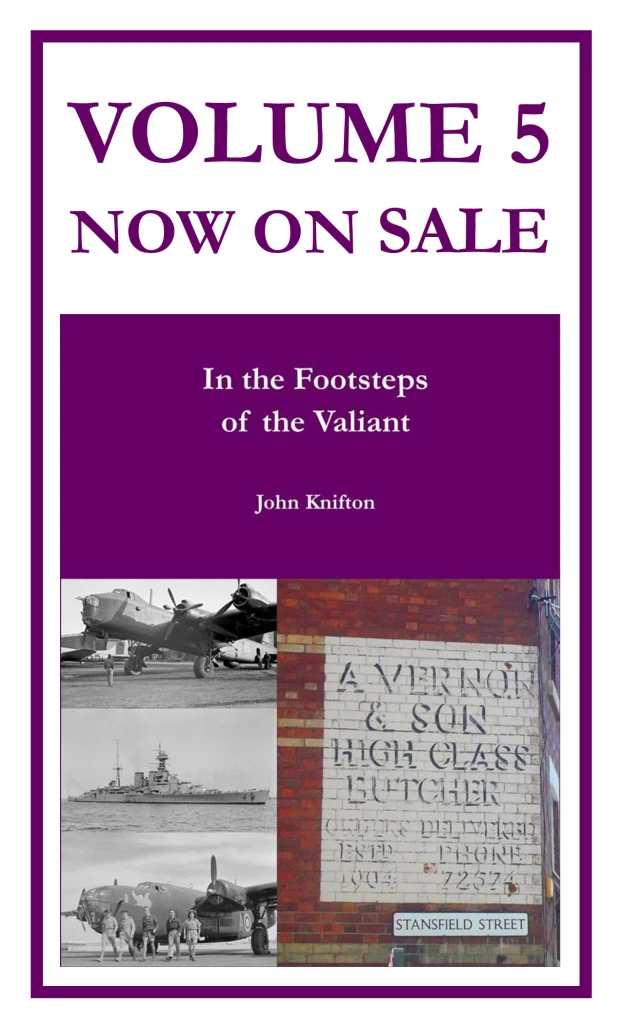
I also discovered the only direct remembrance left behind by any of our Old Nottinghamians. Peter Vernon died at the age of 23 from an illness contracted in the North Atlantic on H.M. Motor Minesweeper 260. Battered ceaselessly by extra strong winds and freezing rain, Peter probably died in the Invergordon Royal Navy Auxiliary Hospital in northern Scotland. Before he went off to war, his father had already told him of his plan to rename their butcher’s shop, “A.Vernon & Son High Class Butcher”. A huge new sign was painted on the side of the building. Perhaps it was going to be a surprise when Peter came home on leave, although it certainly didn’t work out like that. Alas, we will never know.

What we can do, though, is to go to Ilkeston Road in Nottingham, and, at its junction with Stansfield Street, see the sign, which is still there. The only part of Peter Vernon’s life still remaining alive in our world……………………..


Any royalties generated by these books will be split between “ABF The Soldiers’ Charity” and the Royal Air Forces Association.

Let’s finish with two poems.

One by Keith Doncaster of Maples’ House and the Fifth Form:

“Along the silvery beach we run,

Gathering coloured shells.

We think that gathering shells is fun.

Along the silvery beach we run.

And as we go beneath the sun,

We hear the distant bells.

Along the silvery beach we run,

Gathering coloured shells.”

And one, almost a thousand years older, from Wace, slightly altered:

“Eventually

All things decline

Everything falters, dies and ends

Towers cave in, walls collapse

Roses wither, horses stumble

Cloth grows old, men expire

Iron rusts and timber rots away

Nothing made by hand will last.

I understand the truth

That all must die, both clerk and lay

And the fame of men now dead

Will quickly be forgotten,

Unless the clerk takes up his pen

And brings their deeds to life again


I say and will say that I am

John Knifton from the City of Nottingham”


25 Comments

Filed under Africa, Aviation, Canada, cricket, History, military, Nottingham, Pacific Theatre, The High School, war crimes

The Sandiacre Screw Company (3)

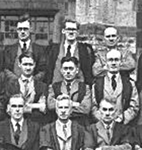
Last time we were following Keith Doncaster’s progress through the High School, with two unmarried women teachers in the Preparatory School (which was as the rules demanded. As soon as women teachers got married, they were forced to resign.) After a spell with Messrs Day and Hardwick, Keith remained in an “A” Form in 1936-1937. This was the Third Form A with Mr Beeby. This Form of 28 boys had seven ex-Scholarship holders but only one of the previous year’s seven had retained his award. Here’s a very poor picture of Mr Beeby. He is right in the middle of the group:

Mr Beeby soon left the High School to join the RAF. He was absent from at least September 1941-1946. Flying Officer Beeby served in the Signals Unit of the Technical Branch who carried out all kinds of electronic warfare and radio counter-measures including the blocking of the famous German Very High Frequency bombing system called “Knickebein”. This was all “Top Secret”, of course. Mr Beeby certainly would not have been able to discuss what he had been up to with his pupils in the Air Training Corps. He might even have been associated with code breaking. Lots of codebreakers were recruited among the top Classics and Mathematics graduates at Cambridge. Here’s the equipment the Germans used for “Knickebein”:

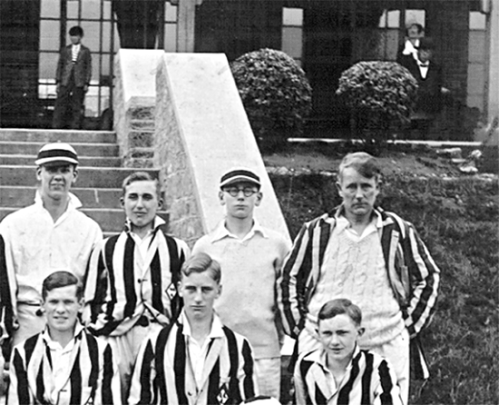
Keith didn’t win a prize or a scholarship this year and he came 23rd in the Form. This was  sufficient reason to relegate him into a “B” Form the following year, the Upper Fourth Form B with Mr Kennard. This Form had 27 boys and sixteen of them opted to join the OTC, the Officers’ Training Corps, including Keith, who finished the year seventh in the Form. In 1938-1939, Keith was in the Lower Fifth Form with Mr Parsons. Here’s Mr WA Parsons, one of the two Masters in charge of cricket. He was universally known as “Wappy”. Right next to him is Bruce Richardson who lived in the big house diagonally opposite Oxclose Lane Police Station at the junction with Edwards Lane. Four years after this photograph was taken, “Farmer” Richardson would die on the perimeter of Dunkirk, trying to buy time for the British Expeditionary Force to get back across the Channel. It wasn’t called “Operation Certain Death” but it might just as well have been:

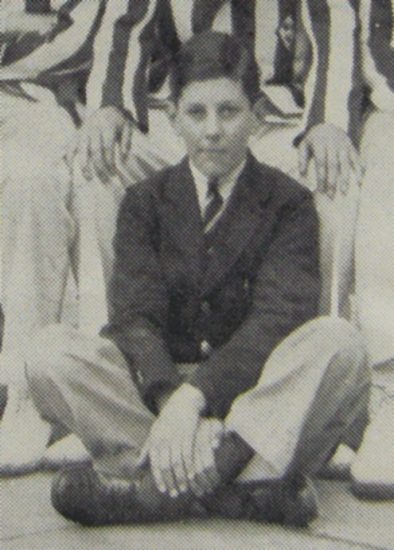
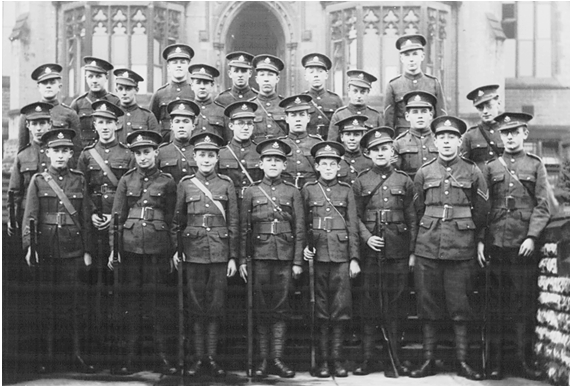
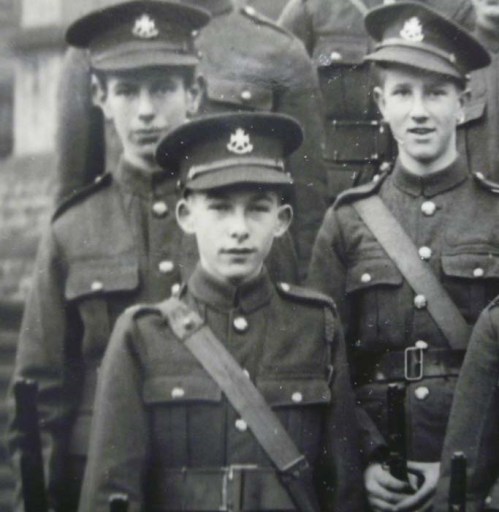
There were 21 boys in the Lower Fifth Form, 15 of whom were in the OTC, including Keith. Indeed, we still have a photograph of the OTC taken during the calendar year of 1939 and Keith is on the left hand end of the front row, as we look at it. Despite his physical age of either 15 or 16, he looks almost boyish, rather thin and rather delicate. There are a couple of boys who look less adult than him, but of the 26 individuals in the photograph, there are more than twenty who seem so much more physically prepared to leave the High School than he appears to be. In the end-of-year examinations, by the way, Keith finished a respectable sixth:

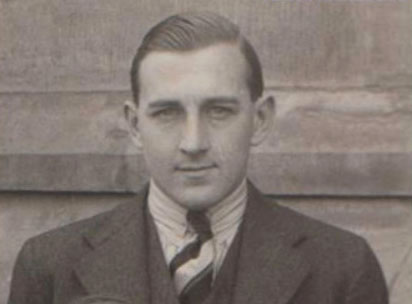
Here is Keith in close up:

The next year, 1939-1940 was Keith’s last in the High School. He spent it with Mr Thomas in Fifth Form B. There were 26 boys in the Form. Here’s Mr Adan Thomas in later years, in a superb photograph taken by the Reverend Stephens:

Keith does not seem to have taken his end-of-year examinations and he is not recorded in the School List for the Form, even as an “X, not placed”. The situation is rather strange because the School Register says that his departure occurred on July 30th 1940, which was presumably the last day of the working term. So why did he not take the School examinations?

There is some indication, though, that Keith took, and passed, his School Certificate this year and that may have had some connection with it.

Keith did achieve three very important things during this year, though. He became a OTC A/cadet (an air cadet), and he was promoted to Lance Corporal. He also passed the all-important OTC Certificate “A”. With that, he took one more step towards his premature death:


20 Comments

Filed under Aviation, cricket, History, military, Nottingham, Science

The Sandiacre Screw Company (1)

This is the first of  twelve posts which will tell the story of Keith Doncaster. They will appear over the course of, probably, a year, and I would encourage you to read them all. Keith was just one of the 119 young men from Nottingham High School who perished in the fight to save England and freedom during World War 2. I have found out more about Keith than any other casualty. What I did find is a wonderful advertisement for the evils of war, as what may well have been just one cannon shell from a night fighter, ultimately, deprived thousands of people of their livelihoods, in one of the very few large factories in a small town in Derbyshire called Sandiacre.

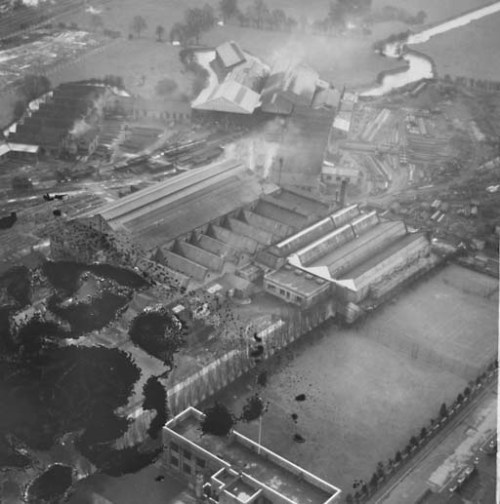
Ivan Keith Doncaster was born on October 17th 1923. His father was Raymond Doncaster who was an engineer. Ray’s father was Sir Robert Doncaster, the founder of the Sandiacre Screw Company, one of the biggest firms in the Nottingham area, with enormous and extensive premises on Sandiacre’s Bradley Street:

Here’s one of their adverts:

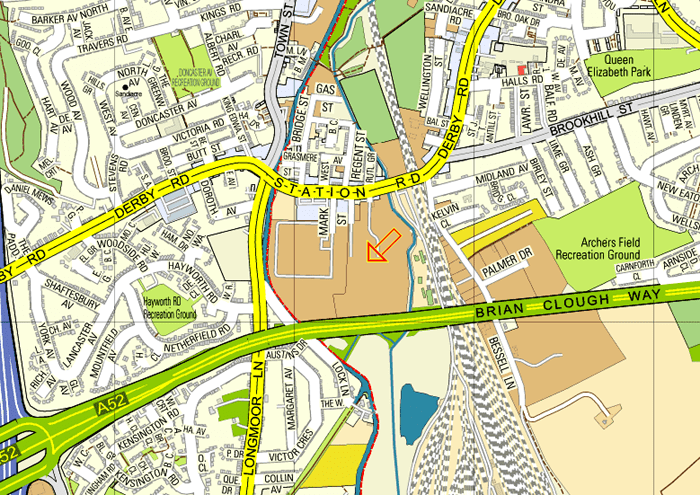
And a map shows how big the factory was and how many people it must have provided with employment. The orange arrow points to only some of the pale brownish area occupied by the factory. Nottingham is to the east:

The Doncaster family lived in a very large house in Longmoor Lane in Sandiacre, a small town of some nine thousand inhabitants, almost equidistant from Derby and Nottingham and to the east of Junction 25 of the M1.

Keith’s mother was Evelyn Mary Fell. Keith’s father Ray Doncaster served in the army during the First World War, eventually becoming a Lieutenant in the Army of Occupation of the Rhine. His elder brother, Robert Ivan Doncaster, had been killed in action on the First Day of the Battle of the Somme on July 1st 1916, only 50 days after he arrived in France. He is buried in Authuille, three miles north of the town of Albert.

When he returned in 1919, Ray became Assistant Works Manager of his father’s company. He then became Works Manager, eventually replacing his father as Managing Director. He retired during the 1960s. It does not take a fortune teller to work out that, had he lived, Ray’s only son, Ivan Keith Doncaster, would himself one day have acceded to that position and the factory would have gone on, providing money, food and accommodation for countless numbers of people not just in the town, but from the densely populated area around. Instead, Keith did not come back from his war in Bomber Command and, during the 1960s, the company just disappeared, taking perhaps thousands of jobs with it. And just one cannon shell would have been enough to bring Keith Doncaster’s Lancaster down.

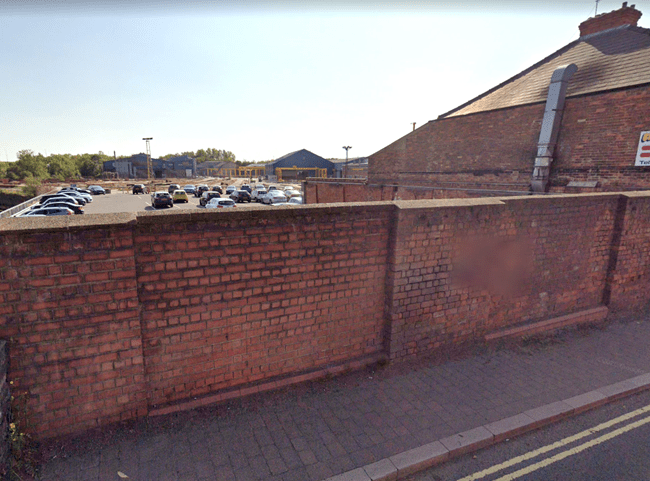
Here and there a few red brick buildings remain. And a few walls. They are all that is left of the Sandiacre Screw Company nowadays:

26 Comments

Filed under Aviation, Bomber Command, History, military, Nottingham, The High School

The Carvings in the Tower (5)

Robert Michael Gunther (line 5 of the picture below) was one of the young men who, in May 1940, had climbed up into the Tower of the High School and carved their names and their message on a window sill. When the group did this, they could have had no idea how the war would turn out, whether the Germans would cross the Channel and occupy the country, or whether the British forces would manage to fight them off :

Robert lived at a house called “The Haven” in Burton Joyce, a village which is to the north of Nottingham, on the River Trent. He entered the High School on April 24th 1924. Robert won Mr Player’s Prize for Arithmetic (Intermediate) in 1938 and passed his School Certificate in 1939, just a year before he carved his name and message on the stone window sill in the School Tower.

In the OTC, he became a Lance Corporal and then a Corporal in 1938. He won the Certificate ‘A’ prize in 1939 and soon became Company Quarter-Master Sergeant and then Company Sergeant Major. In 1940, he was the most efficient senior NCO and the Commander of the Most Efficient House Platoon. A School Prefect, Robert won his First XV Colours and Cap, and captained the school rugby XV in 1940-1941:

“An exceptionally good leader, he also has shown himself outstanding in all departures (sic) of forward play.”

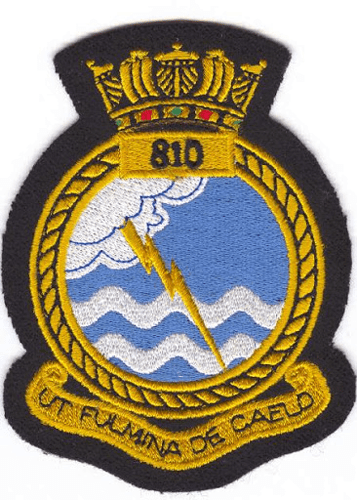
Robert left the High School on Christmas Eve, 1940. He joined the RNVR (Royal Naval Volunteer Reserve) and by 1942 he was a member of the Fleet Air Arm. He was trained at HMS Kipanga in Kenya and then at HMS Ukussa in Ceylon (Sri Lanka). He then joined 810 Squadron. The motto means “Like lightning from the sky”:

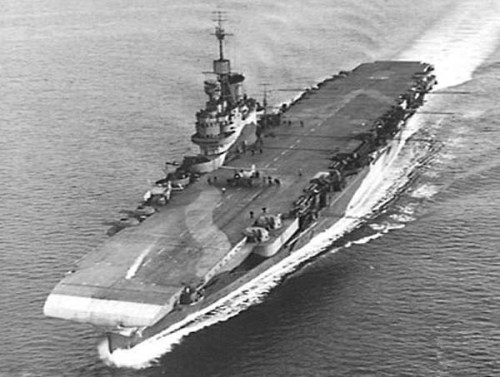
810 Squadron, Robert included, flew off the aircraft carrier, HMS Illustrious:

At the end of the academic year, in July 1944, the Nottinghamian carried the following message:

“We regret to announce that the following Old Boys have recently been reported “Missing”, and we hope that good news of their safety will soon be received: RM Gunther (1934-40) and FL Corner (1932-39)”.

The Nottinghamian said that Bob Gunther had disappeared during a routine flight over the Indian Ocean in June 1944. In actual fact, he had been shot down while acting as observer in a Fairey Barracuda during a bombing raid on Port Blair in the Andaman Islands.

The Andaman Islands are here:

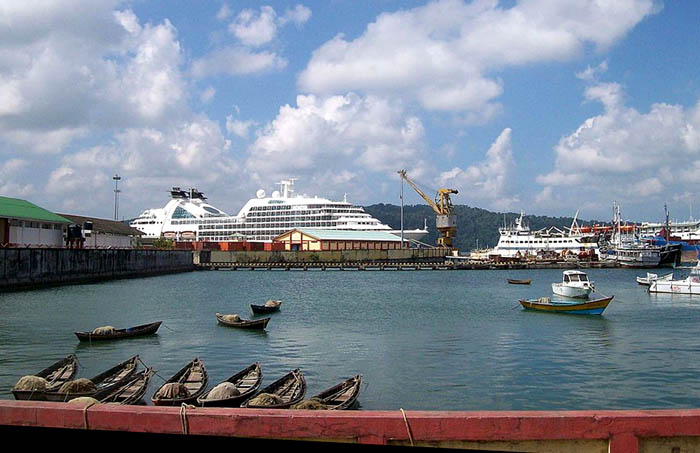
Here is Port Blair:

And here is a Fairey Barracuda, which could carry combinations of a torpedo, bombs or rockets :

Bob and his pilot, Basil Willington Aldwell, were missing for 15 months. But Bob was not dead. The brutal Japanese had him, and his pilot, in their tender care. From July 13th 1944-August 27th 1945, he was imprisoned at Ofuna near Tokyo before spending two days at Shenagawa. When released he spent a long, long, time in hospital, before he was able to return home. Here are two typical victims of what was, ultimately, Japanese racism:

At Christmas 1945, another notification was published in the Nottinghamian:

“Sub-lieutenant RM Gunther RNVR (1934-1940) who disappeared on an operational flight over the Indian Ocean, in June 1944, is reported safe and on his way home. No news had been heard of him for some 15 months, and we are delighted to know of his safety.”

The extraordinary story also appeared in the Nottingham Evening News:

“One of the first Nottingham people to get a cablegram announcing the release of prisoners of war in Japan is Mrs KL Gunther of 37 Staunton Drive, Sherwood, who today was one of the first in Nottingham to receive news that her only son was returning home. His telegram read “Safe in Allied hands. Hope to be home soon. Writing. Address letters and telegrams to Liberated POW, c/o Australian Army Base Post Office, Melbourne.”

Sub Lieutenant RN Gunther of the Fleet Air Arm had been liberated. He had survived the Pacific war, a theatre where it was only too easy to lose your life.

Frank Leonard Corner, the other name in the Nottinghamian magazine of Summer 1944, was not so lucky.

At 00:25 on June 7th 1944, operating as a flight engineer, he had taken off from RAF Metheringham in an Avro Lancaster Mark III of 106 Squadron. It carried the squadron letters “Z-NH” and had a serial number of NE150. “Z-Zebra” was tasked with attacking bridges near Caen in the immediate aftermath of D-Day. It carried 18 x 500 lb bombs in its capacious bomb bay. Bombing from 3,000 feet and lower, at around 03:00 hours, the Lancasters were hit very severely by anti-aircraft fire over Lison, where a worker at the railway yard remembers vividly how the German gunners celebrated the fact that they had shot down a bomber, which must surely have been “Z-Zebra”. Frank was just twenty years old when he died. His service number was 222039 and his parents had by now moved to Whiston near Rotherham in South Yorkshire.

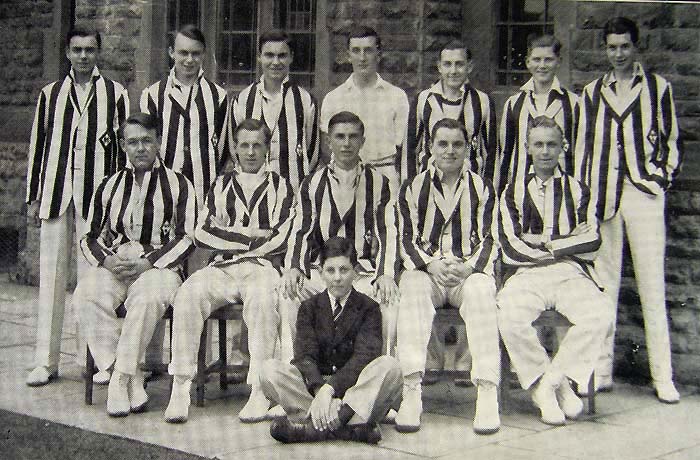
Frank was the scorer for the school’s First XI cricket team in 1938. In the photograph below he sits cross legged in front of the team:

Three of that season’s cricketers were killed in the war, as well as the team scorer.

Boy No 4 on the front row, George Colin Brown, of the Second Battalion of the Lincolnshire Regiment, was killed in Normandy on July 8th 1944, as 7 Platoon helped to clear the village of Hérouville-Saint-Clair of Germans.

“We slowly crept forward across open fields. As we broke into a trot, the Germans came out of holes in the ground like rats and unleashed hell. Mortars rained down on us and machine gun bullets were flying everywhere. Ahead of me, my platoon commander, Lieutenant Brown and his batman were killed.”

George Colin Brown was just 24 years old when he died. He was a young man whose….

“fast in-swinging ‘yorker’ on the leg stump was so devastating on its day.”

Boy No 5 on the back row, Ian Leslie Wilkinson, was killed on January 31st 1944, after taking off on a routine training flight from RAF Tilstock in an Armstrong Whitworth Whitley Mark V of 81 OTU, serial number LA 765. They crashed about 30 miles away near Dilhorne, a tiny village in Staffordshire. Ian was 24 years old and he was training to be a bomber pilot.

Boy No 6 on the back row, John Richard Mason, was killed on Friday, April 16th 1943, near RCAF Station Assiniboia in southern Saskatchewan in Canada. Sergeant Mason, a Pilot Instructor, was instructing Trainee Pilot, Leading Aircraftman John Hugh Evans, when their Fairchild Cornell Mark I, serial number FJ654, crashed into the ground.


10 Comments

Filed under Africa, Aviation, cricket, History, military, Nottingham, The High School, war crimes

A little taste of Egypt in Nottingham

How do they give names to the streets and roads of England? Well, there are lots of methods. Let’s take a quick look at Nottingham.

They are named after famous people (Shakespeare Street). They are named after the people who used to live there (Friargate) and the activities that used to happen there (Fletchergate….fletchers make arrows, or it’s from the word “flesh” which is what butchers sell you). Where the road goes to. (Hucknall Road). Who owned the land (Thackeray’s Lane). What the church is called (St Peter’s Gate). What building is there (Castle Gate). After events that happened in history. (Standard Hill…..where King Charles I first raised his banner and began forming an army at the outset of the English Civil War on August 22nd 1642.)

“Gata” incidentally is an old Viking word for street and will date back to 867AD when Nottingham was captured by the dreaded Northmen.

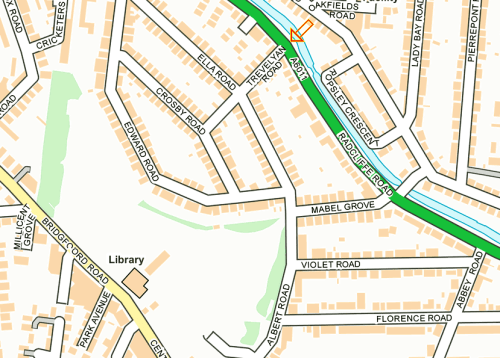
During the house building boom in the suburbs of Nottingham during the late 19th century and the early 20th century, the builder would often name streets after his own family. Here is an example in West Bridgford. Look for the Orange Arrow, wearing his anti-Covid mask:

The only problem is that we can recognise the first names such as Florence, Mabel and Violet,  but what was their surname? Was it Crosby or Trevelyan? So often they seem to miss this detail out, or  not to make it too obvious which name it is.

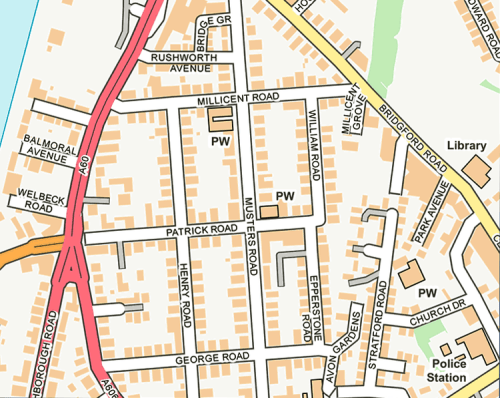
Has this builder tried his best to make it obvious by putting all of the first names around the surname “Musters” ?

Exactly the same thing was still going on in the mid-1970s when we moved into suburbia ourselves. The same problem remained, though. What was the surname? Our house was at the end of the Orange Arrow. The fourth one down the hill from the little gap which had an old oak tree in it.

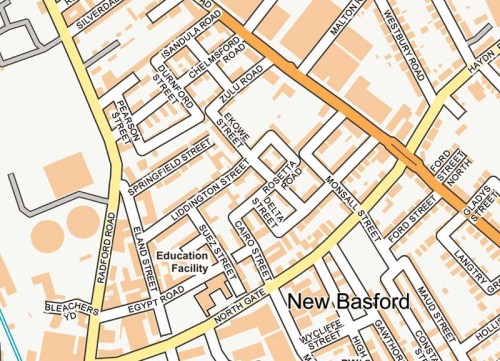
Strangest of all, though, in Nottingham, are the streets which are all, clearly, named after a particular event, or even after another country. Between 1880-1900, the theme in a particular suburb of Nottingham, namely New Basford, was Egypt. This was a working class area with a huge number of terraced houses, and somebody, somewhere, decided to name the streets there in such a way as to commemorate the British involvement in Egypt, although I have been unable to ascertain any definite answer to that simple question….”Why now? ”   Was it to commemorate Nelson’s victory in the Battle of the Nile in 1798 ? Or the opening of the Suez Canal in 1869 ? I just don’t know.  Perhaps it was because of events in 1882. Wikipedia says that :

“After increasing tensions and nationalist revolts, the United Kingdom invaded Egypt in 1882, crushing the Egyptian army at the Battle of Tell El Kebir and militarily occupying the country. Following this, the Khedivate became a de facto British protectorate under nominal Ottoman sovereignty”.

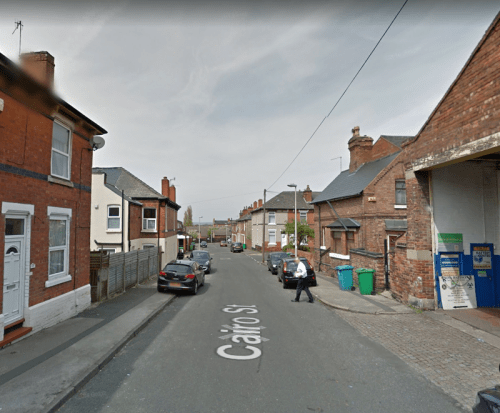
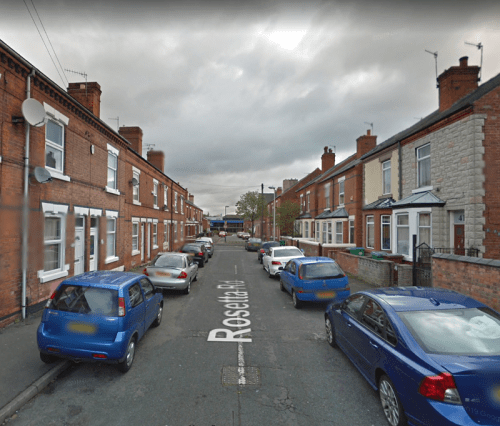
Whatever the answer, we now have, in New Basford, an Egypt Road, a Cairo Street, a Delta Street, a Suez Street and a Rosetta Road :

Do we all understand these references ?

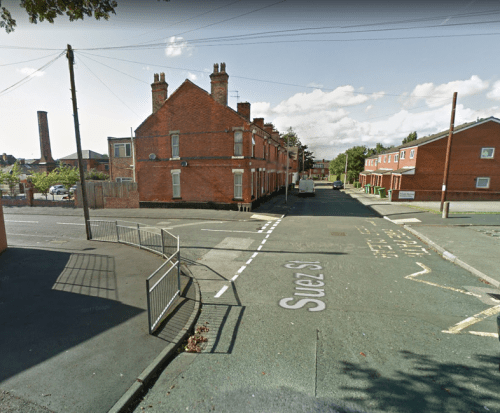
Well, first of all, in the photograph below, there’s Egypt Street on the left, the home of Ramesses the Great and the Arab world’s greatest rock group, Mo Salah and the Pyramids. As a bonus, there’s also an excellent view of the junction with Suez Street :

Suez also has a canal. Here it is during the rush hour. It looks like the US Navy has brought its aircraft out to sunbathe:

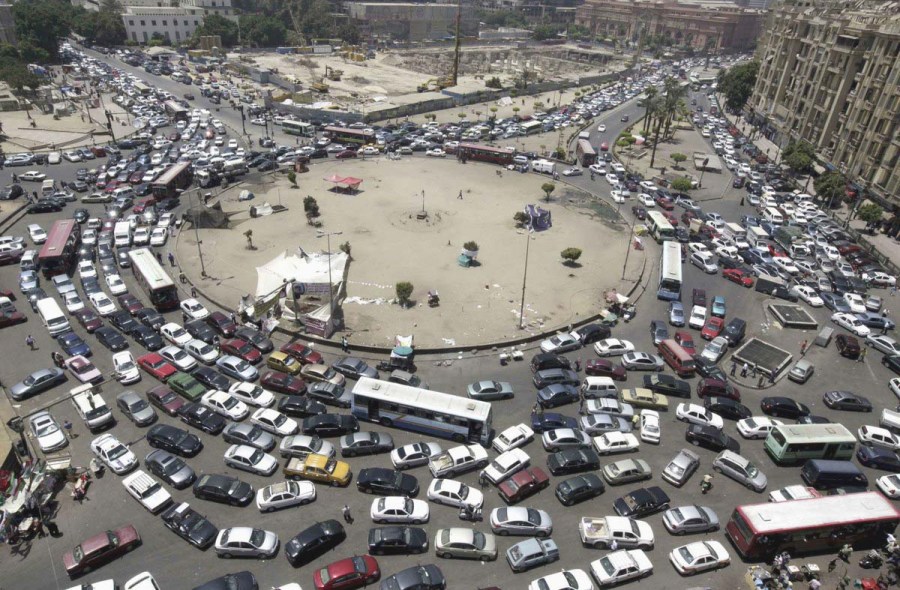
Cairo is famous for its rush hour although I was really disappointed that it was cars not camels. Camels are far too clever to get into this kind of mess :

And here’s Cairo Street, once the traffic has thinned out a little. Watch out for that camel behind you!

Here’s the Nile Delta, which has its very own rush hour, but with dhows rather than supertankers :

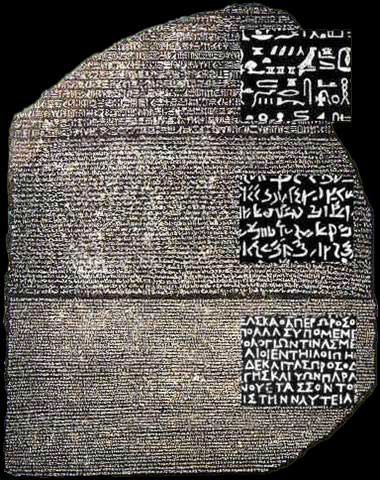
Last and most famous is the Rosetta Stone, commissioned by Pharaoh Ptolemy V and found in the city of Rosetta two thousand years later, decorated with the same thing written in three different languages.

Firstly, there are hieroglyphics for the priests, then Demotic, the native Egyptian script used for everyday business, and Ancient Greek, the language of the civil service. At this time Egypt was ruled over by Greek speakers after Alexander the Great conquered the country :

Notice how somebody has put a magnifying glass over each bit, so that you can see the differences. Rosetta Road has no such problems over communication, because 99% of the time, it is deserted, except for cars:

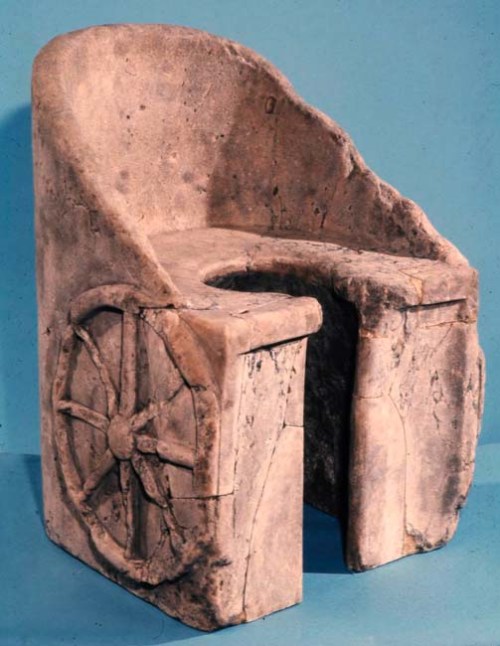
Originally the French had the Rosetta Stone, but after Admiral Nelson beat them in the Battle of the Nile, the English took it to the British Museum where, even now, it is the most visited thing in the whole museum. I thought that title might have belonged to the toilets:

33 Comments

Filed under Africa, Aviation, History, Humour, Nottingham

Roy Cross, the world’s greatest artist

As a small boy of nine or ten, I was very keen on Airfix plastic kits. They came originally in see-through plastic bags with a folded piece of paper stapled over the open end of the bag. The instructions for making the kit were inside the folded paper.

The smallest Series 1 kits were one shilling and threepence, or perhaps one shilling and sixpence. Series Two were three shillings and Series Three were four shillings and sixpence. Series Four cost six shillings and Series Five seven shillings and sixpence. Series Six, of which for many years there was only one, the Short Sunderland, was twelve shillings and sixpence. At this time I used to get around two or three shillings pocket money per week. As life grew more sophisticated, Airfix decided to put most of their kits into boxes and to decorate them with illustrations of that particular aircraft in action. The absolute toppermost of the poppermost of the Airfix artists was a man called Roy Cross (born 1924). Let’s take a look at his talents as an artist.

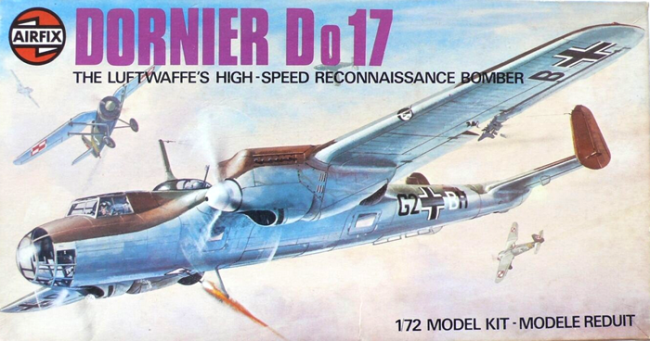
After initially helping illustrate Eagle comic  Roy moved to Airfix in 1964 and started his career with the Dornier Do 217. Here is the box art:

Notice how he makes the Dornier’s opponents the Polish Air Force, something out of the ordinary. Below is the original drawing. Both illustrations featured on an auction website, where Roy’s first ever aircraft sketch was on sale for £790.

Let’s take a look at some more of Roy’s best work. Here’s a Series 1 Spitfire, with the plastic bag still in place and the model unmade.

Series 2 included the de Havilland Mosquito, the Fairey Battle and the Bristol Blenheim. This one is flown by the Free French Air Force. Roy’s work never seems to drop in standard:

This slideshow requires JavaScript.

A Series 3 kit might have been the Junkers Ju-88 and Heinkel III. A bigger box allowed him to make his pictures more and more complex. Notice again how he makes the Heinkel’s opponents somebody out of the ordinary, in this case the Soviet Red Air Force:

This slideshow requires JavaScript.

In Series 4 was the Vickers Wellington:

The mighty Avro Lancaster was in Series 5, as was the B-17 Flying Fortress. Notice how the very large box has enabled him to portray accurately the huge wingspan of both aircraft:

This slideshow requires JavaScript.

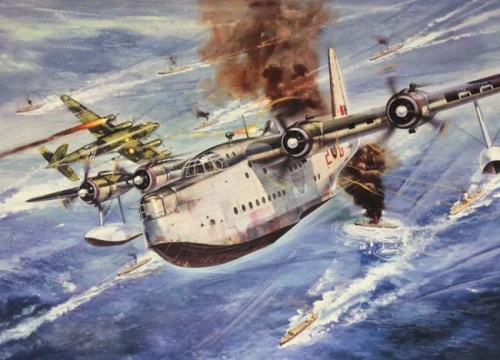
Here’s the Short Sunderland:

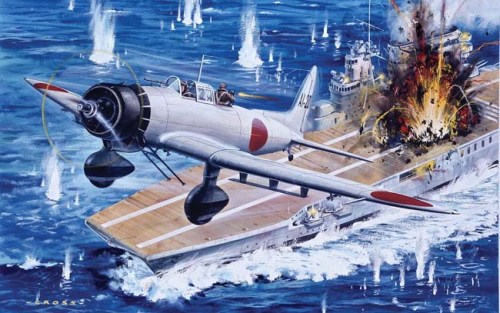
The Boeing B-29 Superfortress was of such a size that it probably was in Series 29. This box is big enough to portray a defensive “box” of B-29s, and a Japanese fighter:

I was not very good at making the kits, as I would be the first to confess. With biplanes such as the Roland Walfisch of World War I or the Handley Page HP 42, the 1930s airliner, I was hopeless at gluing the top wing to the bottom one and soon there were gluey fingerprints all over the place:

This slideshow requires JavaScript.

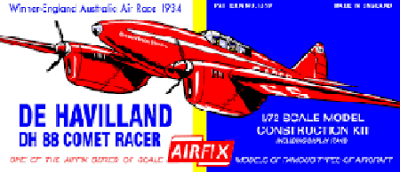
Quite a rare kit in my experience was the de Havilland DH.88 which won the race from England to Australia in 1934 with an official time of 70 hours 54 minutes 18 seconds. The raw plastic for it was bright red. I am not wholly sure if Roy Cross did this artwork. The kit may have appeared pre-1964:

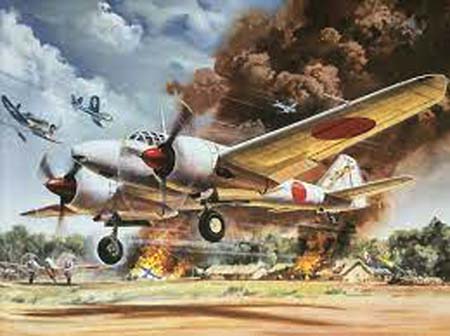
There are some kits that I would like to have made but never did.  There was the Mitsubishi “Dinah” which was reckoned to be the most aerodynamically perfect aircraft of World War II. This is one of Roy’s very best pieces of work in my opinion:

The Spitfires defending Darwin in the Northern Territory of Australia certainly couldn’t catch the Dinahs that flew high above them day after day.

The second kit I yearned for was the Angel Interceptor used in the TV series “Captain Scarlet”. That too, was a fairly rare kit during my modelling years:

I can’t bring this post to an end without showing you the last few masterpieces by Roy Cross. They are the B-25 Mitchell, with a choice of either a glazed or a solid nose:

Here’s the Aichi “Val”, looking for all the world like a Stuka that’s put on a lot of weight:

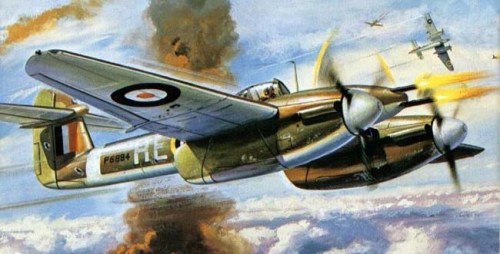
The Westland Whirlwind was a very advanced concept for 1938. It was one of the fastest combat aircraft in the world and with four Hispano-Suiza HS.404 20 mm autocannon in its nose, the most heavily armed. Prolonged problems with the Peregrine engines delayed everything and few Whirlwinds were built……only 116 in actual fact:

And let’s not forget the Blohm und Voss Bv 141 reconnaissance aircraft, one of the few aeroplanes ever to have had an asymmetrical structure. And yes, it flew very well, but was never produced in numbers because of the shortage of the engines of choice.

One last detail I found out about Roy Cross. He was apparently highly amused by the modern practice of taking his artwork, but photoshopping out any explosions and burning aircraft in case they upset anybody and reminded them what most of these aircraft were designed to do.

If you want to see more of Roy Cross’ art, then, please, use google images to sort out some pictures of other aircraft whose boxes he decorated. Roy may not be a famous artist, but his images of planes are irrevocably etched for ever in the memories of so many men of my age.

28 Comments

Filed under Aviation, Bomber Command, History, Humour, military, Pacific Theatre, Personal, the Japanese

“Soldaten” by Sönke Neitzel and Harald Welzer (3)

Last time, I continued with my review of “Soldaten” by Sönke Neitzel and Harald Welzer. The authors were illustrating the idea that:

“The only thing that counted was how people thought of you in the here and now…the unit was the entire world…what they thought was right, was right and what they thought was wrong, was wrong.”

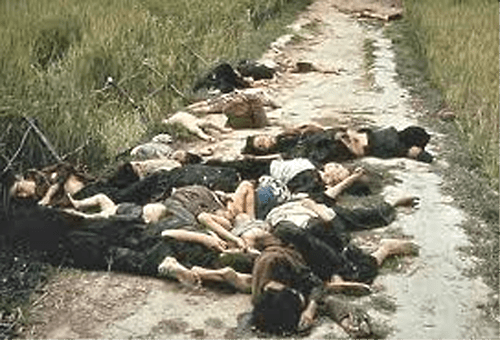
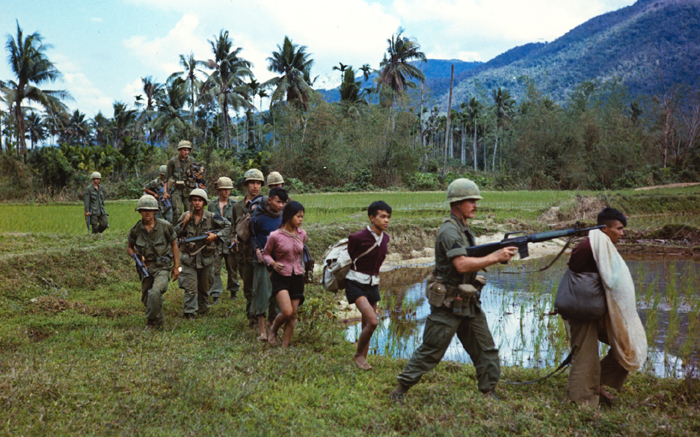
They used the My Lai massacre of 1968 as their example of how group behaviour can turn apparently decent young men into madmen and war criminals :

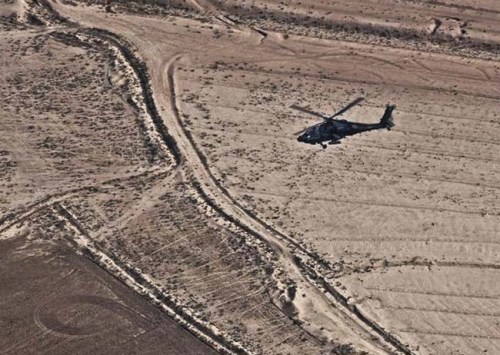
A subsequent chapter makes reference to the violence of our own time, 2010 to be precise. It discusses a movie which was released onto WikiLeaks. The film shows the indiscriminate killing of more than a dozen people in the Iraqi suburb of New Baghdad. These victims of violence included two Reuters news staff.

The whole sorry tale is told by Wikipedia on this page here. You can view the video on this page here.  There is a shorter version of some 18 minutes and the full version at around 40 minutes.

According to WikiLeaks:

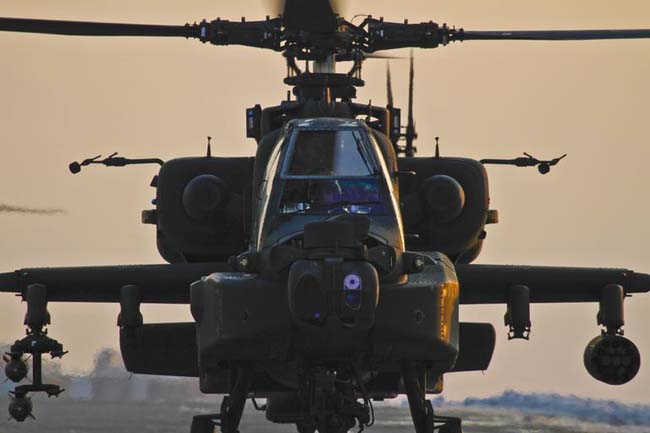
“The video, shot from an Apache helicopter gun-sight, clearly shows the unprovoked slaying of a wounded Reuters employee and his rescuers. Two young children involved in the rescue were also seriously wounded.”

I found three stills to look at, although the content is such that I have decided that I could not not display them. The first was entitled:

“The men try to cover as the first rounds of shots hit them from the Apache helicopter” :

The second still shows how “one man falls to the ground”:

And the third still shows how “Namir Noor-Eldeen runs for his life. ”

I really would recommend that you follow the link and watch the film, perhaps the shorter version. Alternatively, the Wikipedia page does have one or two stills to look at.

This film does not show an incident in the fog of war, as the full version lasts around forty minutes. The footage concerns a number of Iraqi men, including some who were armed and who were standing where insurgents earlier that day had shot at an American vehicle. Among the group were two Iraqi reporters working for Reuters.

The group of American military personnel  seem so quickly to transform events into some kind of appalling video game. Their opinion of events is exactly the same as that witnessed by Michael Bernhardt at My Lai. It was that same idea, namely that with groups of soldiers in war:

“What they thought was right, was right, and what they thought was wrong, was wrong.”

So, everybody in the group in Iraq is OK with “it’s a guy with a weapon”

which becomes firstly:

“I have individuals with weapons”

and then “he’s got an RPG.”  (Rocket Propelled Grenade)

and then “Yeah we had a guy shoot”

at 02.49 “Let’s shoot”

at 02.50 “Light ‘em all up”,

at 02.52, “Come on, fire”

at 02.57, “Keep shooting, keep shooting”

at 02.59, “Keep shooting”

at 03.02, “Keep shooting”

at 03.10, “All right, we just engaged all eight individuals”

at 03.23 “All right, hahaha, I shot ‘em”.

That was topped off at 04.31 with “oh yeah, look at those dead bastards”.

At 04.36 and 04.44 it was “Nice….”

At 04.47 it was“ Good shot”

And at 04.48 with “Thank you”.

The last still shows how “The helicopter pilot inspects the pile of dead bodies. ”

These men see the world with their own group vision. Observations and comments which have only been made once and by just one person are soon confirmed by the entire group, and indeed are quickly developed by other people within the group. Thus a single weapon soon becomes a number of individuals with weapons. A number of individuals with weapons are soon transformed into a Rocket Propelled Grenade. And then an individual, is seen to shoot. This imaginary event gives the group the justification they crave to open fire. And then they can kill what were, in actual fact, merely passers-by. Now though, they have become combattants.

Neitzel and Welzer call this phenomenon “a dynamic of violence” or “group thinking”. At the end:

“everything is crystal clear. the targets are dead, order has been restored, the delivery truck was an enemy vehicle, the would be rescuers in it were further terrorists”

More specifically, the authors explain how:

“The behaviour of those defined as “enemies” confirms the truth of that designation.”

The only characteristic of “target persons” that counts is that they pose a threat. Any indication to that effect provides sufficient reason to kill.

So, by that thinking, babies may carry hand grenades, children can be partisans and women can be insurgents.

This had already been put forward by Berndt Greitel, writing about the Vietnam conflict who said:

“Anybody who tried to flee was automatically an enemy who should be shot.”

The attempt to escape merely confirmed the group’s suspicions that an individual was a Vietcong.

Taken to its extreme, we finish up with the much repeated idea that “Whoever we said was a Vietcong was a Vietcong.”

But not everybody could have been a combattant. The US 9th Infantry Division killed a total of 10,899 people, but only found 748 weapons during their searches.

And even those figures may be suspect as some GIs apparently placed Soviet weapons in villages so that they could come back to find them on a later occasion.

Next time, the tapes made by the Germans at Trent Park, and, believe it or not, a genuine RAF joke. Well, the first half of it, at least.


20 Comments

Filed under Aviation, Criminology, History, Politics

POST NUMBER 600: Two brothers fighting fascism (5)

This is my 600th post. Enjoy !!!

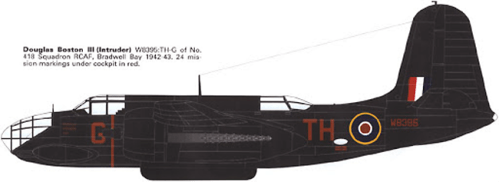
On Saturday, February 13th 1943,  Robert Renwick Jackson was flying his Boston III Intruder, serial number AL766, towards Nantes in western France:

His mission was to drop propaganda leaflets for the occupied French, so they could read the real truth about the war for themselves.

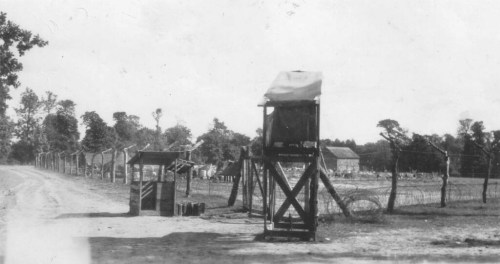
Alas, Robert Renwick Jackson died that night along with his navigator. The upper and rear-gunner, Sergeant TS McNeil, survived and became Prisoner of War No 27276 at Lamsdorf, then in German Silesia but now in south-western Poland. Here’s a typical POW camp:

And here’s a hut nowadays:

The second casualty in the Boston was Peter John LeBoldus, the navigator, who would have been sitting in the nose of the aircraft. His name is virtually unknown in England, but he is better known in Canada. His parents were John LeBoldus and Regina LeBoldus née Weisberg, German Catholic immigrants who had six sons and six daughters. John was a hardware and implement dealer. The family lived in Vibank in Saskatchewan. One of the highlights of Peter’s very short life must have been taking tea with the Queen Mother and the Princesses Elizabeth and Margaret at Windsor Castle with a group of newly arrived Canadian Airmen in England.

On this particular night, Peter John was preparing for the mission and his brother Martin, also a member of 418 Squadron, but working as a mechanic, had helped him put on his flying clothes and his parachute harness. This was the last time the brothers ever saw each other. This is Peter LeBoldus:

Peter John LeBoldus is buried next to his friend, Robert Renwick Jackson, in Grandcourt War Cemetery.

Sadly, Peter John was not the only member of the LeBoldus family to die in the war. John Anthony “Johnny” LeBoldus was a member of 142 (RAF) Squadron, where he was an air gunner in a Vickers Wellington Mk X, serial number LN566, squadron letters QT-D, “D-Dog”. They took off from RAF Oudna in Tunisia on November 24th 1943 to bomb a ball bearing factory at Villar Perosa near Turin, at the very limit of their range. Extreme weather with wind, cloud, fog, rain, and ice caused the loss of 17 aircraft and 73 men were killed. “Johnny” LeBoldus was one of them:

The third LeBoldus brother to die was Martin Benedict LeBoldus, the same man who had helped his brother, Peter John, with his flying clothes and his parachute harness before his death in Boston AL766. Martin Benedict was killed on February 20, 1944 at the age of 31. He was the flight engineer in a Handley Page Halifax Mark II of the Canadian 419 ‘Moose’ Squadron in Bomber Command, serial number JD114, squadron letters VR-V, “V-Victor”. On February 20, 1944 he and his colleagues took off at 23:12 from RAF Middleton St George near Darlington to bomb Leipzig and they were never seen again. Six other men, with an average age of twenty four, were also killed. John Leslie Beattie, Thomas Gettings, Alfred Harvey Hackbart, Donald Clifford Lewthwaite, Douglas Keith MacLeod and John Ralph Piper.  A total of 79 bombers were lost that night. Here’s Martin Benedict LeBoldus:

Mr Leboldus wrote a very bitter letter to the Secretary of the Department of National Defence for Air about the death of his sons:

“Other boys spending their time of war in Canada, yes hundreds and thousands walking the streets of Canada for years, and all our three boys were in the front line of attack. I have my doubts whether this is right and just. Plenty of those who offered three four years ago never seen any fighting nor smelled any powder, why all mine have to do it?”

Certain other Canadian families no doubt felt the same way. They included the Cantin family, the Colville family, the Forestell family, the Griffiths family, the Kimmel family, the Lanteigne family, the Milner family, the Reynolds family, the Rich family, the Rivait family, the Stodgell family, the Wagner family and the Westlake family, all of whom sacrificed three sons to the cause.

Nowadays the LeBoldus brothers are not totally forgotten. Canada is a vast land so it is comparatively easy to give names to hitherto unnamed geographical features. They are called “geo-memorials” and there are now more than four thousand of them. Leboldus Lake in north-western Saskatchewan is named after Peter John Leboldus. The Leboldus Islands there are named after Martin Benedict Leboldus. The link between Leboldus Lake and Frobisher Lake is called the Leboldus Channel after John Anthony Leboldus. What a pity that we don’t do that over here in England.  What a pity there are no streets in either Nottingham or Solihull named after Robert Jackson, killed at the age of 22, fighting for his country.

(Picture of the black Boston borrowed from wp.scn.ru.)

23 Comments

Filed under Aviation, Bomber Command, France, History, military, The High School

Poems in “The Nottinghamian” 1922-1946 (5) “Blackpool, summer 1939”

This poem was published in the School magazine, the Nottinghamian in July 1939. It was written by Alan Douglas Fluder Howard, the son of a school teacher. Alan was born on December 1st  1922 and the family all lived at 5 Alpha Terrace, between North Sherwood Street and Addison Street, fairly close to the High School. Alan entered the High School on September 2oth 1934, as Boy No 5845 and he studied there until the end of the School Year in 1941 when he left to go to Gonville & Caius College, Cambridge with an Open Exhibition of £40 per annum for Classics and a City of Nottingham Scholarship of £80 per annum. Here’s Gonville & Caius College, or at least, a picture of the entrance to Staircase K:

Alan then seems to have become an illustrator of children’s books such as, for example, “The Pimpernel and the Poodle” and “Limping Ginger of London Town” both of which are still on sale, intermittently, on the internet.

Alan died on Monday April 14, 2008 at the Mount Nursing Home in Shrewsbury. He was the much loved and loving husband of Margaret, the father of Shelagh and Jennifer, the grandfather of Laura, Joanna, Harry, Katy and Zachary and the brother of Marian.

Unlike many Cambridge men of his era, Howard did serve in the war. On October 1st 1945, he received an Emergency Commission to promote him from the ranks of the ordinary soldiers to become a Second Lieutenant in the Royal Signals.

This poem is one of the very best you’ll find in the school magazine. It is set in Blackpool in the very last summer before the war began on September 3rd 1939.

Blackpool was, and still is, England’s Holiday Capital. Its most famous building is Blackpool Tower, jealously copied by the jealous Parisian architects within a couple of years of its completion. There are three piers, North, Central and South, there is a huge Pleasure Beach and Blackpool has literally thousands of things to do. And it also has its problems, as this poem will gradually reveal to you……..
BLACKPOOL, 1939

I like to be at the seaside, the seaside, the seaside,

The jolly, jolly seaside, is just the place for me.
 

I love the bracing sea-breeze, the sea-breeze, the sea-breeze,

The sewage-fish-and-chips breeze,

Down by the sea.


Oh, how delightful, beautiful, adorable,

Just to spend a day down on the strand !

Gramophones, deck-chairs, chattering lunatics,

And sand sand sand jellyfish sand.


How nice to have a picnic,

All on the seashore,

Down by the briny.

Oh, how grand !


Lemonade, sandwiches,

All gone musty,

Bread-and-Butter, hard as granite,

Seaweed, sand


With sad, shrill wailing, high above the waters,

The slender white seagulls swoop and soar:

Listen to the salt waves softly sighing,

Listen to the breakers crashing on the shore—

“An I says to ‘er, I says—“   “I wanner sticker rock.”

“Johnnie’s gorn an’ pinched me bucket and spide.“

“Let’s ‘ave some fishanchips.“   “Buy me an ice-cream.”

“Wind up the gramophone.”   “Pass the lemonide.”


Look at that fat man,

Playing with a beach ball’

Just like a walrus,

Just like a walrus ;

Look at these chocolate papers, toffee papers, newspapers,

And those broken bottles, pleasant for the feet :


Here are the side-shows,

Hark! the showmen softly call—

Giraffe-necked women, three legged women,

Fat women, headless women.

Yonder people half-drunk, two-thirds-drunk, completely drunk.

Not a few hyper-drunk, rolling down the street,


Hurrah ! for the sea-shore,

The sand-castles,

(So-called).

Hurrah ! for the deck chairs,

(Twopence a time) ;

Cheers for the deep sea, the green sea, the dirty sea,

Covered with frothy-brown,

Smelly-brown

Slime.


‘Ray ! for the beastly rock,

Landladies,

Pickpockets,

Roundabouts,

Sideshows,

Gambling dens.

Ray ! for the bandstands,

Machines to tell your fortune ;

No wonder they call us

Homo sapiens.

All that remains now is to show you just one or two pictures of Blackpool.  Here’s the beach, pier  and tower :

And here is an aerial view of the most famous holiday resort in England:

Here are the attractions in the South  Shore area:

Here’s the North Pier. You’d think nobody had heard of any other seaside resort in England. Every single English family and their dog, has turned up:

And here’s the Empress Ballroom in the Winter Gardens:

And finally, a couple of family photographs, both of them taken at Blackpool. First of all, the rather bored little boy is my Dad, born 1922. He looks about eight or nine to me. The lady with him is his mother, my grandmother. Behind them is an escape convict, blending in very skilfully with the cloche hatted crowd :
My grandad, the one who went to Canada and fought in their army, was the husband of the lady above. His father was my namesake, John Knifton, who seems to have acquired a touch of dementia in his final years. On one occasion, at a rather advanced age, he went up to Dr Love’s surgery in High Street, Woodville, and told him that he had come for the job as a doctor. There was, of course, no job. Dr Love went down to see his son, my grandad, and announced to him that “the old professor has really flipped his lid !”

So, here’s the Old Professor:

The lady with him was his second wife, a rather vinegary lady who my grandad and his brothers hated with a will. They would eventually finish up walking down a gangplank onto the docks at Halifax, Nova Scotia, Canada, because of her.

And finally, did you spot him? Staircase K ?

17 Comments

Filed under Aviation, History, Humour, Literature, Nottingham, The High School