Category Archives: Criminology

Heil Hitler Episode 3

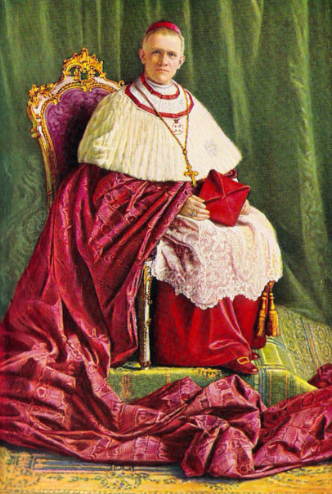
Last time I told you the story of Bishop Hudal, the appalling so-called Christian who was happy to help any war criminal, no matter what he had done, so long as he was German. Killing Jews was a bonus. Here he is. Adolf Hitler is thought to be hiding under that bit of robe on the floor:

Ateismo cristianismo dios jesus biblia religion catolicos creyentes Hitler ss nazis segunda guerra mundial xxxxxxxxxxxxxxxxxxxxxxxxxxxxxxxxxxxxxxxxxxxxxxxxxxxxxxxxxx

Bishop Hudal’s policy was “It’s a good way for Evil to prosper if you help it as eagerly as you can at every single opportunity”.

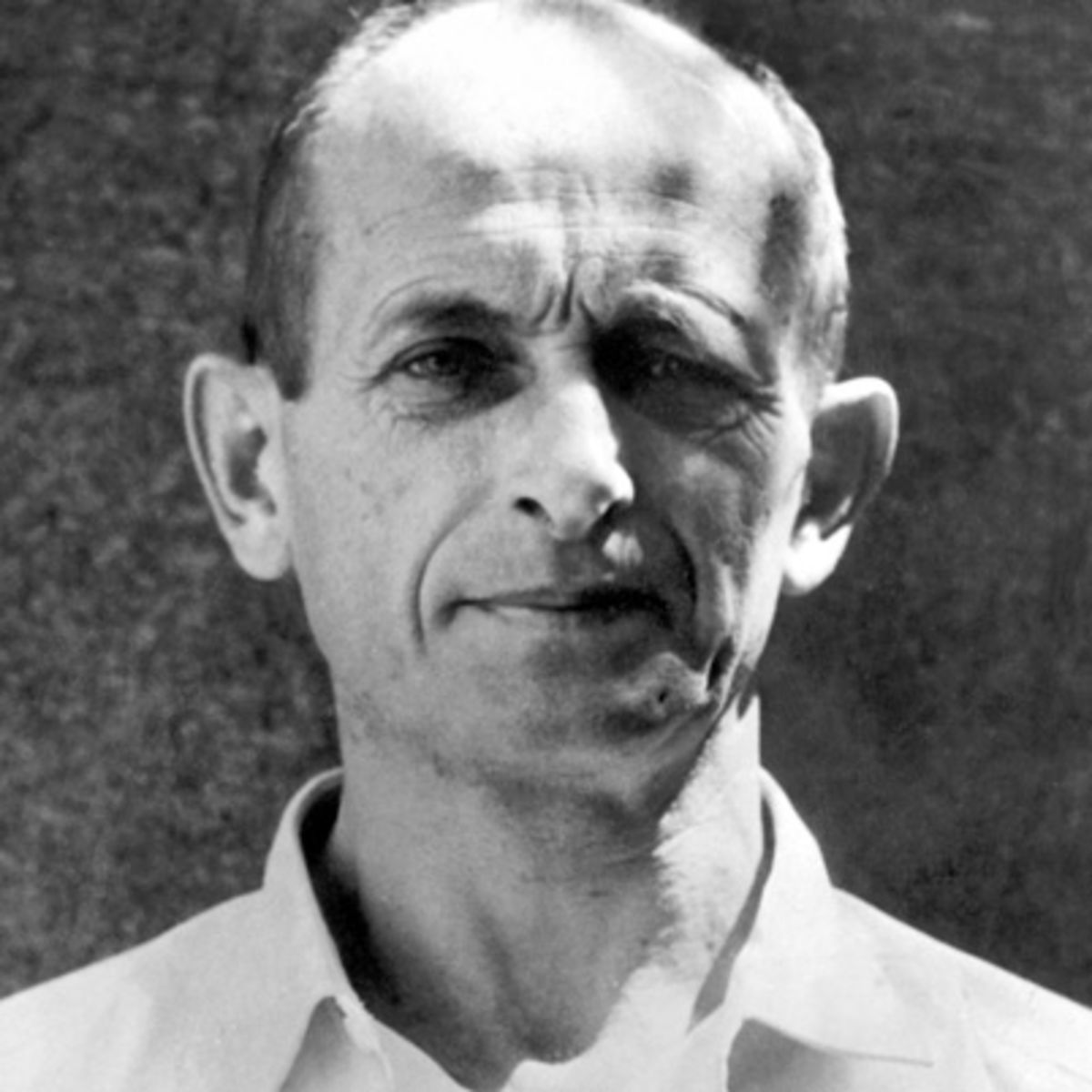
Hudal loved to help war criminals. Last time I supplied you with a list. It was not a complete one, though. Hudal Tours was used by many Nazis other than the ones I mentioned. The first lot were enough to get you into moral “deep doo-doos” but these second ones are even deeper and doo-dooier. This man looks fairly innocuous:

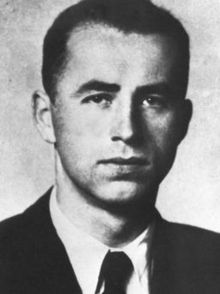
Alois_Brunner

He wasn’t a bank clerk though. He is Alois Brunner, the man who organised the deportation of Jews from France and Slovakia to German concentration camps, where they were killed in cold blood on an industrial scale. Brunner was responsible for at least 24,000 Jewish deaths, so he was welcomed with open arms by Syria, who adamantly refused to extradite this heroic man. The Israeli Secret Police, Mossad, used to write to him regularly, and send him little presents. In 1961 he lost an eye to one of them, and in 1980, all the fingers of his left hand. During his long residence in Syria, Brunner was reportedly given a generous salary and protection in exchange for his advice on effective torture and interrogation techniques.
Hudal helped Adolf Eichmann, the man in charge of the murder of European Jewry, the so-called “endlösuhng. His career was instrumental in slaughtering between 5.5-6 million Jews.

mengele

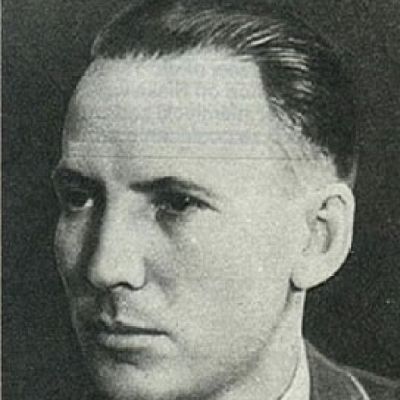
Hudal gave refuge to Otto Wächter, the man who organised the Cracow Ghetto in 1941. Working alongside Hans Frank, the Nazi governor of occupied Poland, Wächter was responsible for the deaths of uncounted millions of Jews and Poles.  After the war Wächter lived in a monastery in Rome, “as a monk”, under the direct protection of Bishop Hudal. He died in 1949 in a Roman hospital cradled “in the arms” of Bishop Hudal. How sweet.

ob_fea0cb_wachter-otto

Other possibles for the help and assistance of the kindly old Christian, Bishop Hudal, were Klaus Barbie, the Gestapo’s “Butcher of Lyon”, and Heinrich Müller, chief of the Gestapo.

What a long set of photographs. It looks like Mossad‘s Most Wanted. Or the star prizes in the Simon Weisenthal Show.

And did you notice how they were all German? Except Bishop Hudal and he was Austrian and then Austria was annexed and he became an Honorary German, more or less.

I still can’t really believe what Bishop Hudal said in his memoirs:

“I felt duty bound after 1945 to devote my whole charitable work mainly to former National Socialists and Fascists, especially to so-called ‘war criminals’.”

This slideshow requires JavaScript.

Were there any Germans, though, who lived up to Edmund Burke’s company motto?

“The only thing necessary for the triumph of evil is for good men to do nothing”

Were there any Germans who just refused to stand by and let evil prosper?

Of course there were and many of them went a lot further in their opposition than you might think. I’ll save that for next time.


14 Comments

Filed under Criminology, Football, History, Politics

My latest book

snip-of-coverThose of you who follow my blog will be familiar with the many stories I have told about Nottingham High School; its Founders, its coat of arms, its war heroes, its caretakers and its one or two villains. I have recently finished compiling these stories, and many more, into a new book called Nottingham High School: The Anecdotal History of a British Public School, published with Lulu.com.

My history is an entertaining one about the people behind the institution – what they thought, said, and did from the reign of Henry VIII up to the modern era. I want to tell the stories of the ordinary people whose actions changed the history of Nottingham forever, and those whose lives had much wider influence on the history of our country and on the lives of people across the world. I tell the tales of all people connected with the High School – teachers, support staff, boys, alumni… from caretakers to kings!

image_update_72e24141db868b82_1348683417_9j-4aaqskThe book is written in diary form and runs from Thursday, June 30th 1289 to Thursday, July 12th 2012. It’s an easy read that you can dip in and out of as you wish. Find out about the antics of the boys, the excesses of the staff, the sacrifices of the alumni, and the castle-like school building in all its majesty.

My book contains new and previously unpublished research into the lives of some of the most famous ex-pupils of the school. Read about the childhood of scurrilous author D.H.Lawrence, whose controversial books were still banned 50 years after he wrote them. Read about the disruptive antics of Albert Ball V.C., the daring air ace who always fought alone. Read about American Old Boy, Major General Mahin of the U.S. Army, a man whose power and authority in the Second World War rivalled that of General Patton, until he was killed (or was it murder?).

The tone of my work is interesting and light, but at the same time, as you know from my blogposts, I can show my more serious side when occasion demands. A very large number of former pupils from the High School died in the two World Wars and their sacrifices are reflected in my book.

I have really enjoyed writing this new history book, and I hope that you will find it an entertaining and intriguing read. If you would like to give it a go, then it is now available from my page on Lulu.com.

p1040694

31 Comments

Filed under Aviation, Criminology, History, Literature, Nottingham, Personal, The High School, Writing

Heil Hitler Episode 2

Last time, I showed you a picture of the England football team all making their Nazi salutes at the Olympic Stadium in Berlin on May 14th 1938. They were the good men who stood by and did nothing:

England-Germany 1938 nazi.xsderftgyhb
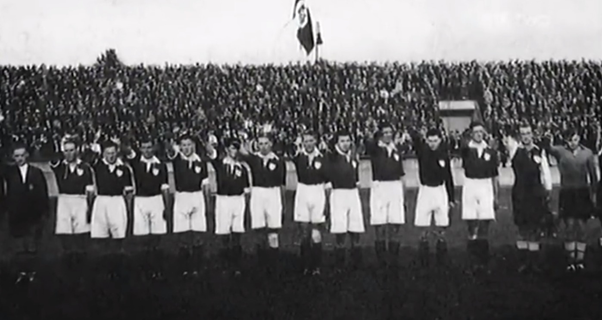
The England team though, were were not the only foreigners to greet the Führer with a cheery “Sieg Heil”. Here, just a year later, is the Republic of Ireland football team engaged in pretty much the same behaviour. Is this the old saying, “The enemy of my enemy is my friend”? After all, the Irish Republicans hated the British. The Germans hated the British. Result: a football match made in Heaven:

Ireland-Germany-1

And here’s a third group of Nazi sympathisers and Jew haters. No great surprises with this one:
bishops

Perhaps one of them is Bishop Alois Hudal, who was an Austrian titular bishop in the Roman Catholic Church and the author of the catchy best seller in cathedral bookshops across Europe, “The Foundations of National Socialism”:

Ateismo cristianismo dios jesus biblia religion catolicos creyentes Hitler ss nazis segunda guerra mundial xxxxxxxxxxxxxxxxxxxxxxxxxxxxxxxxxxxxxxxxxxxxxxxxxxxxxxxxxx

Hudal was no Nazi, of course, no racist. He just took being a good man who stands by and does nothing one stage further. He decided to be a bad man and join in enthusiastically to help the evil, presumably on the basis of “Whoever kills Jesus deserves all they get.” That attitude though, can get you into very deep doo doos, however.

Hudal, for example, is credited with organising the escape from justice of war criminals such as Franz Stangl, the Commanding Officer at Treblinka Extermination Camp, which killed between 700,000-900,000 human beings:
Stangl,_Franz

Stangl himself said that he went looking for Hudal in Rome, because he knew the bishop was helping all Germans. Hudal arranged rooms in Rome for him, helped him to escape through a “ratline” and then gave him money and a visa to Syria. Using a Red Cross passport Stangl lived happily in Damascus, where Bishop Hudal found him a job in a textile factory.  He remained in Syria with his wife and family for a few years before moving to Brazil in 1951. Stangl then found work with Volkswagen still living openly with no problems, still using his own name.
Another Nazi war criminal allegedly helped by Hudal was SS Captain Eduard Roschmann, the “Butcher of Riga”, who killed 24,000 Jews in the Latvian ghetto.
rosch
Hudal helped Josef Mengele, the Mad Doctor at Auschwitz, the “Angel of Death”, who always introduced himself to the Jewish children as “Uncle Mengele”:
WP_Josef_Mengele_1956

Gustav Wagner was the commanding officer of Sobibor, where between 167,000-300,000 human beings were killed. Hudal and others in the Vatican helped him to flee to Syria, and then to Brazil, where he became a citizen in 1950. Extradition requests from Israel, Austria and Poland were rejected by Brazil’s Attorney General who also rejected those from the West Germans.

In 1980, Wagner supposedly committed suicide in Sao Paulo. This was after he had given himself a severe beating, cut off all the fingers of his right hand and then stuck a very large knife into his own chest.

So where is all this going? Well, we’ll see in Episode 3.


18 Comments

Filed under Criminology, Football, History, Politics

Heil Hitler Episode 1

“The only thing necessary for the triumph of evil is for good men to do nothing.” is a famous quotation attributed to Edmund Burke, the statesman, author, orator, political theorist, and philosopher.
A good example would be this photograph showing the England football team just before a friendly game at the Olympic Stadium in Berlin on May 14th 1938:England-Germany 1938 nazi.xsderftgyhb

The fixture was played before a crowd of 110,000 people, but clearly, the Englishmen are not waving to their German admirers. This is the Hitler-Grüss. The English players are all saluting Adolf Hitler, arguably the most evil man ever born. Why did the footballers do this? Surely they were good men? Why did they do nothing? Or was Stanley Matthews, a hero to millions of young boys, an evil man?
Well, the truth of the matter is that the British Foreign Office had actually ordered them to salute the Führer, Adolf  Hitler.


Six months before, Naughty Hitler had marched his armies into Austria, the home of the waltz and the cream cake, and annexed this defenceless little country, the so-called “Anschluss”.

The Foreign Office wanted to assure Hitler that, even though he kept invading places, Germany was not a “pariah” state. Hopefully, if Adolf was kept sweet by an England team which saluted him, he would look favourably on Neville Chamberlain’s government and their policy of appeasement:

“You’re very naughty, Adolf, but as long as you promise it’s the last time, we’ll overlook it.”

The “Peace in our Time” deal must go through.
Germany’s football team was very weak at this time, but Austria’s was not. In 1934, they had finished fourth in the FIFA World Cup, and in the Berlin Olympics of 1936, they had finished second, losing to fascist Italy in the final. Austria qualified for the 1938 World Cup, but on March 28th 1938, they were forced to withdraw as the country no longer existed. The theory was that after Anschluss,  the Austrian players would all play in the German team.

First though, the two countries would play a last match for Austria, a “reunification derby” which would unite the two countries and their respective football teams for ever. Not surprisingly perhaps, the game was planned to finish as a draw. The Austrians, though, all of them good men, would not stand idly by and do nothing, but instead they scored two goals in the last few minutes in a successful  effort to win the game and put the Nazi noses out of joint.

To humiliate the Germans even further, the Austrians’ absolute star player, the thoughtful Matthias Sindelar, scored one of those two Austrian goals, and then celebrated extravagantly in front of the senior Nazi dignitaries watching the game. The latter already knew about the kit controversy. Both Germany and Austria usually played in white shirts and black shorts, but Sindelar, for what he thought would be the country’s last ever game, had insisted on Austria playing in the same colours as the national flag, red shirts, white shorts and red socks. Red, of course, was not a particularly favourite colour of the Nazis.

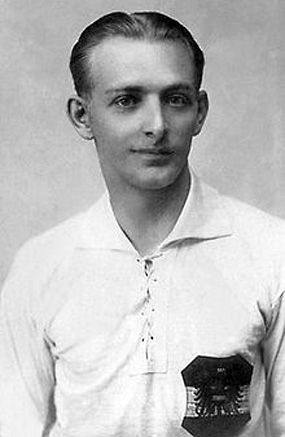
Here he is. Matthias Sindelar. He was so thin, so pale and fragile, that his footballing nickname was “The Man of Paper”. He was, though, a good man who refused to stand idly by. A real “Man of Steel”:

220px-Sindelar-aut

At the very end of the game, Sindelar deliberately and obviously missed an easy chance which would have made the victory an even wider one. Afterwards Sindelar refused to play for the German Reich, giving either his extreme age of 35 or injury as an excuse.

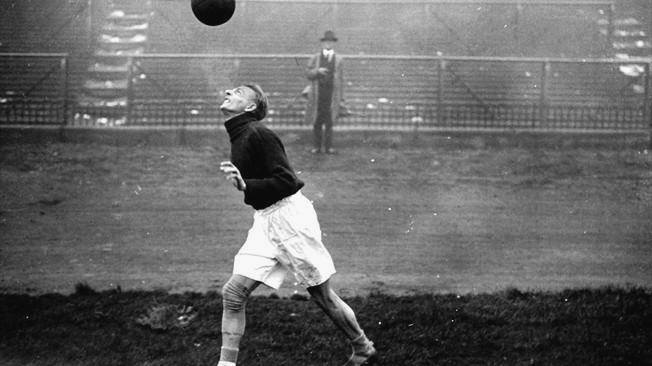
head tennis

Not totally surprisingly, perhaps, Sindelar was dead within the year. He died on January 23rd 1939. By now he was a symbol of Austrian patriotism, and his Gestapo file listed him as being pro-Jewish and a Social Democrat. The Gestapo also watched his café twenty four hours a day.

No wonder, therefore, that the heating system in his flat should fail, the problems allegedly being caused by a defective chimney. As he lay in the arms of his girlfriend, Camilla Castagnola, therefore, they both died of carbon monoxide poisoning.
That Sindelar’s death was a suicide as a protest against the German Anschluss of Austria was suggested by, presumably, pro-Gestapo elements, but that was just not true. Decades after the event, we now know, thanks to the confession of Egon Ulbrich, a lifelong friend of Sindelar, that a petty local bureaucrat was bribed by the Nazis to record his death by Gestapo as a mere accident. Here is Sindelar’s grave, still visited regularly by many people today:

grave_Matthias_SindelarMatthias Sindelar is one of my favourite players.


He had played centre-forward many, many times for the Austria team of the 1930s. They were known as the “Wunderteam”, and Sindelar was their captain at the 1934 World Cup, where they were cheated out of it in the semi final by match referee Eklind. Austria’s phenomenal goalscorer, Josef Bican, (at least 1468 goals in 918 games) maintained all his life, until he died in 2001, that Eklind had taken cash inducements from the Italians. And Bican was perhaps justified in his belief. On one occasion during the match, he passed the ball out to the Austrian right winger only to see it intercepted and headed down to an Italian….by the referee!

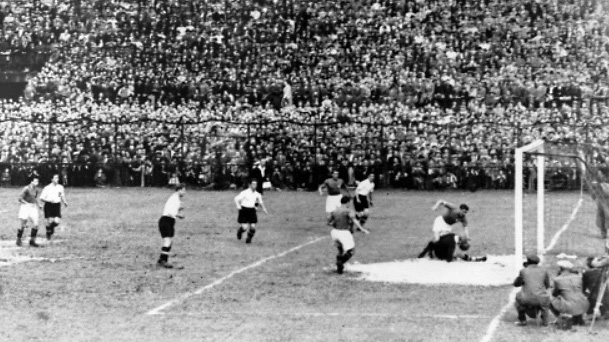
Here is one of the few pictures of the game. Some nice cotton wool seems to have been provided for the Italian goalkeeper to stop him getting bruised:

copyright

Sindelar was one of the greatest footballers of the decade, famous for his fantastic dribbling skills and the creativity of his passing. He had two brilliant nicknames. We know already what “Der Papierene” means. The “Man of Paper”:

sindelar

But Sindelar’s precocious skills would also lead to his being called “The Mozart of Football”.

mozart
In 1999, Sindelar was voted the best Austrian footballer of all time. He had already been named Austria’s sportsman of the century a year before. Sindelar even now, is still ranked as the world’s 22nd best ever footballer. Overall, he scored 26 goals in his 43 matches for Austria, and won one Austrian championship with SV Amateure in 1926, two Austrian Cups with Amateur-SV in 1925 and 1926, and three with FK Austria Wien in 1933, 1935 and 1936.

There was no European Cup then, but Sindelar won one of its predecessors, the Mitropa Cup or Central European Cup in 1933 and 1936 with FK Austria Wien.

mitrop

In 1932, he won the Central European International Cup, a predecessor of the UEFA European Championship.
Participants were Austria, Czechoslovakia, Hungary, Italy, Poland, Romania and Switzerland.
Matthias Sindelar was certainly one who did something to prevent, or at least, slow down, the triumph of evil. And ultimately, he paid with his life.

26 Comments

Filed under Criminology, Football, History, Personal, Politics

The Glossy Ibis ; a rare bird in Victorian Nottinghamshire

Glossy Ibis is a bird from warmer, southern climes such as the Mediterranean. Even nowadays, it is quite a rare species in the county:

glos ibis

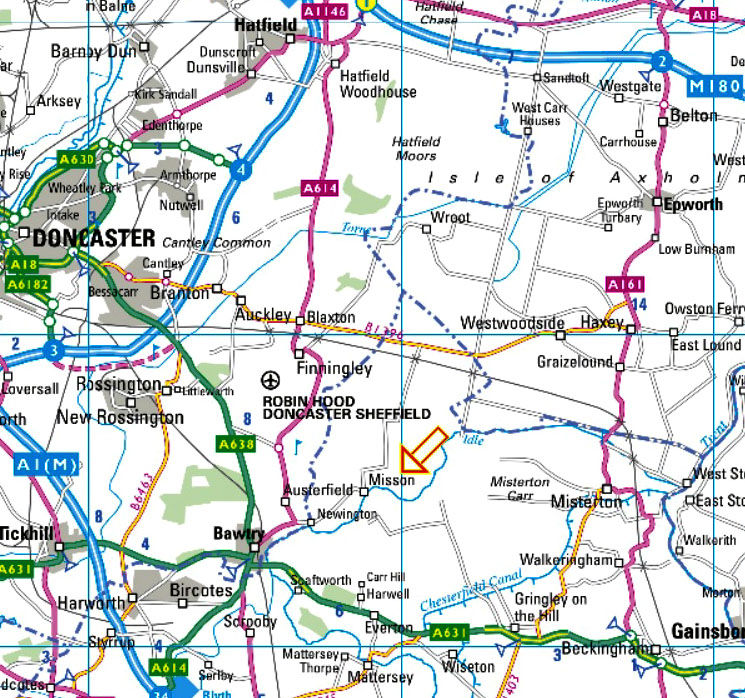
On October 27, 1909, a single bird was shot by Fred Smith at Misson in the very north eastern corner of the county, almost in Yorkshire. This latter county had, for reasons unknown, received an influx of at least fourteen birds during this month of October 1909.  The orange arrow marks the spot. The county boundary with Yorkshire, to the north west, is indicated by the perforated line and must be only a few hundred yards away:

Untitled

Two interesting letters to Joseph Whitaker tell the story.

Dear Sir,
I have the pleasure of dropping you a line in reply to yours, duly received. A man named Fred Smith, who I fear is a shocking poacher, shot the bird, Glossy Ibis, in question. His wife took it to a game dealer, at Doncaster, whose name is Borrill, his shop being in St Sepulchre Gate . He gave her the large sum of one shilling for it, after endeavouring to get it for sixpence.
A doctor bought it from Borrill and is having it stuffed for the museum. I am sorry to have forgotten the doctor’s name, but no doubt the game dealer would tell you if you wrote him. You will forgive me, I hope, for not knowing your book.
I also love birds and used to keep a great many – once I had 46. We still have a few in a good-sized aviary in a greenhouse and my little daughter aged 11  is much interested in birds and has lately acquired several volumes at a cost of £3.10 shillings on the subject.
Yours faithfully,
FW Keane

Glossy_Ibis_1700_e

Joseph Whitaker followed the clues and two months later, he received further information from Dr Corbett himself:

9, Priory Place,
Doncaster
11. 11. 09

Dear Sir,
Mr Borrill showed me your letter re-the Glossy Ibis. All I know of it is that it was exposed in his shop with other wildfowl & I was, fortunately for me, the first to “spot” it & purchase it for the local museum of which I am the curator. If ever you are in Doncaster I shall be pleased to show it to you.
Yours truly,
HH Corbett

Anybody who missed that dead specimen in Doncaster in 1909 had a very long wait to see another Glossy Ibis in Nottinghamshire. In the winter of 2013-2014, a single bird was seen in a flooded roadside field next to the Peugeot Garage in Lowdham, near to the River Trent in the south of the county. southern Nottinghamshire:

lowdham

Most people who wanted to see a Glossy Ibis were able to watch this particular individual which was very amenable and reliable in its appearances. It attracted a steady stream of admirers, and was very easy to see::

Watching an Ibis copyright a

A more spectacular species of Ibis to occur in  Nottinghamshire in the future might well be the Sacred Ibis. This bird normally lives in sub-Saharan Africa, but, in actual fact, there is a healthy feral population in western France. It would not be outrageous for them to cross the Channel:

Ibis

14 Comments

Filed under Criminology, History, Nottingham, Science, Twitching, Wildlife and Nature

A few days after D-Day (5)

In my previous article, I revealed that it is now known that one member of the crew of that Lancaster Z-NH, serial number NE150, brought down by anti-aircraft fire over Lison, did not perish, but survived the crash, only to be then killed, proudly fighting alongside the 507th Parachute Infantry Regiment at Graignes.

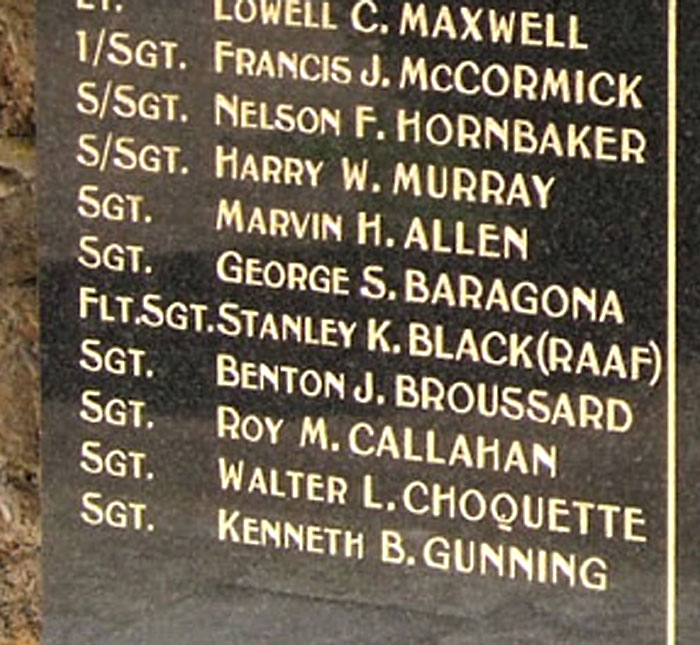
For many years the tale had been told that the mystery aviator was an American fighter pilot who had been shot down, but in recent times, around 2008, the real truth has come to light. The mystery flyer was Flight Sergeant Stanley Kevin Black of the Royal Australian Air Force.
I found the full, detailed story prominently featured on Channel Nine News:

“For sixty years his family had thought he died on D-Day in a relatively straight forward situation when his plane was shot down over occupied France by enemy fire. “We knew that he had been in a crashed plane and we always thought that he died there and then,” his great niece Elissa Liggins said. But Sergeant Black survived the crash, and was taken in by a brave French family for the night.
After a good stiff drink and a sleep Sergeant Black asked to be taken to the nearby village of Graignes where he met a group of American paratroopers. Their orders were to defend the village. Even after a plane crash, Sergeant Black was determined to help.”

graignes
“Aided by the villagers, the paratroopers and Sergeant Black set up a perimeter around Graignes.
After a couple of days, the Germans attacked. The allies successfully fought them off the first time but the Germans successfully attacked again.
The S.S. then executed many of the survivors. It is not clear exactly how Sergeant Stanley Black died but he was probably killed on June 11th. He was just 21 years old. The little village never forgot their “Australian hero”.

Decades later an English lady who lives in the village, Liane Ward-Cleaveley, felt frustrated his name was not on the plaque commemorating the battle. She contacted a Lancaster enthusiast in Australia, Graeme Roberts, who tracked down Sgt Black’s relatives.

“We got a phone call from a gentleman called Graeme who had read a message from an English lady living in France,” Ms Liggins recalled.
“She had a bee in her bonnet because this Australian who had battled hadn’t got his name on a memorial.”
Accompanied by members of the RAAF, Ms Liggins flew to France for the unveiling of her great uncle’s name on the village plaque.

ryinedchurch

“I don’t think any of us appreciated how big it was going to be for the family – certainly not for me – it’s quite life changing,” she said.
Flight Lieutenant Mark Schmidt describes it as “an amazing experience”.
“It’s an incredible story and then to go to the village and connect with the villagers there… he’s a hero to those guys they call him ‘the Australian who fell from the sky’,” he said.

Every single evening at the Australian War Memorial in Canberra, a single Australian who died for his country is honoured. And recently, Sergeant Stanley Black was the chosen hero.
The Last Post was played and the Eternal Fame flickered. Ms Liggins and her family laid a wreath for their uncle. It was a poignant moment she will never forget:

“I sort of feel like I have a connection with him now, that just wasn’t there before, and I know his story intimately… it’s pretty powerful stuff,” she said.

A powerful story, to share with generations to come.
And what a story. The forces of darkest evil opposed by brave, brave men, women and children.

French villagers, French children, American paratroopers, British flyers and one very, very brave and determined Australian.

Here is a film of Graignes today.

 The church has been left exactly as the cowards of the 17th SS Panzergrenadier Division left it.

There is another excellent film on the Channel 9 News site. It is well worth watching.

If you are feeling brave, then try this website. It has a picture of Madame Marthe His, one of the only surviving witnesses of this Nazi war crime.

marthe-his-temoigne-au-memorial-de-graignes

She watched what the SS did when she was only 12, and now, 73 years later, and a very young looking 83, she is determined that it should not be forgotten.
In a video lower down the page, she tells her story in French where, at the least, you should be able to recognise a few words.

Here is roughly the same story in French for you to read as homework:

“À 12 ans, Marthe His a vu soldats américains et civils se faire massacrer par les Allemands à Graignes. 71 ans plus tard, elle est revenue pour témoigner.

Derrière ses petites lunettes rondes, les yeux bleus de Marthe His ont gardé toute leur vigueur. Au moment de témoigner, hier après-midi au mémorial de Graignes (Manche), un voile de tristesse a peut-être atténué leur éclat pendant quelques minutes. C’est tout en pudeur que ce petit bout de femme, âgée de 83 ans, a revécu en souvenir les massacres de Graignes en juin 1944.

Des 200 Américains qui débarquent dans la maison familiale, au sauvetage de 23 soldats. Elle replonge dans cette histoire tragique du débarquement dans la Manche.
Un épisode sanglant où 43 soldats Américains et 30 habitants de Graignes trouveront la mort des mains des Allemands.”

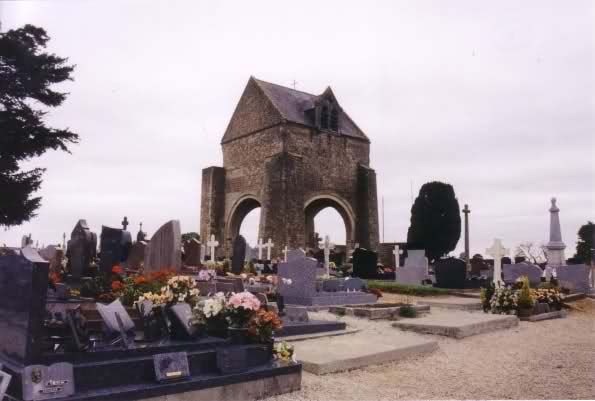
This is the memorial to everybody who was slaughtered by the SS in that cowardly way:

And don’t forget Flight Sergeant Stanley Black of the Royal Australian Air Force:

Stanley Black  didn’t need to do what he did. And it would probably cost him his life.

But he did it nevertheless. He was a true hero.


22 Comments

Filed under Aviation, Bomber Command, Criminology, France, History, Politics, The High School

A few days after D-Day (4)

I wrote a previous article about an Avro Lancaster Mark III bomber which took off from Metheringham, in Lincolnshire, ten miles south east of Lincoln, at twenty five minutes past midnight on June 7th 1944. Its squadron letters were Z-NH and its serial number was NE150.

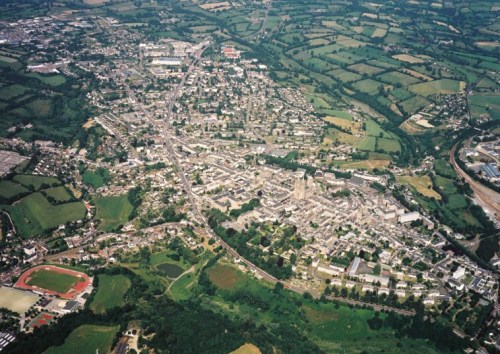
Operating in the direct aftermath of D-Day the crew were tasked with bombing Coutances, a beautiful little town just south west of Caen in Normandy, in an effort to disrupt the German transportation of troops.
balguthrie

Unfortunately, the aircraft was one of two hit by heavy anti-aircraft fire over Lison, and it crashed near the village of St Jean de Daye. All of the crew were killed except two.

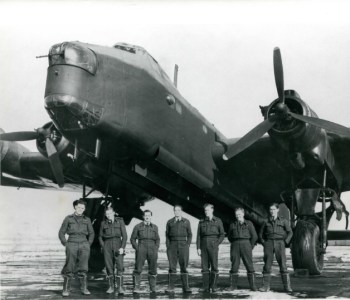
The first of two subsequent articles told the story of John “Jock” Drylie, the aircraft’s navigator, and the only member of the crew who ever managed to return home, in his case, to Fife in Scotland:
DRYLIE PHOTO

This is the second article of the two, and tells the extraordinary story of Flight Sergeant Stanley Kevin Black of the Royal Australian Air Force. He was the bomb aimer, only 21 years of age and the beloved son of George and Lillian Eliza Black, of North Fitzroy, Victoria, Australia.

On June 7th 1944, Stanley survived the crash, and, in fact, was virtually unscathed.
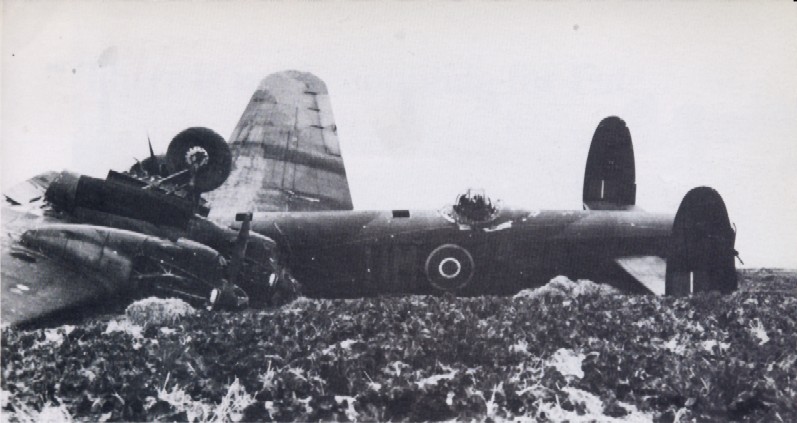
He soon met some American gentlemen, however, and then a very dark and grim tale indeed began to unfold.

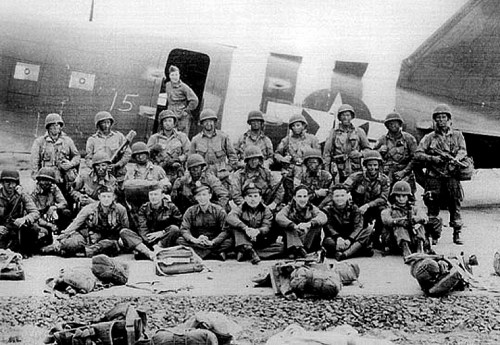
These American gentlemen turned out to be the élite troops of the 507th Parachute Infantry Regiment of the American Army. Just after two o’clock in the morning of June 6th 1944, twelve planeloads of them had been dropped in error some eighteen miles from their correct drop zone. Wandering more or less at random around the marshes near Carentan, they were now very close to the village of Graignes:
Pathfinder_Plane15

At daybreak, the village mayor of Graignes, Monsieur Alphonse Voydie, woke up and suddenly noticed that the grass field behind his house was absolutely full of American soldiers.  As Mayor, he called an immediate emergency meeting of everybody in the town. The brave townspeople decided unanimously to feed the American soldiers, despite the very real risk that the Germans would shoot them all, both villagers and soldiers. Under the forceful command of Madame Germaine Boursier, all the women of the village began cooking around the clock to serve the Americans with at least two hot meals every day. At the same time, teams of villagers, men, women and children, began filling any wheeled vehicle with lost American equipment and then bringing it back to its rightful owners.

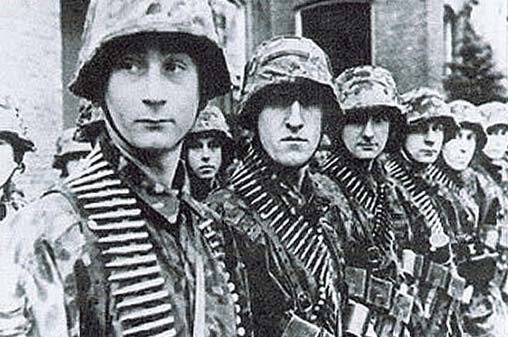
Militarily, though, the situation was hopeless. The 507th Parachute Infantry Regiment and the brave, helpful French villagers were completely surrounded by German troops including, among others, the 17th SS Panzergrenadier Division Götz von Berlichingen under the command of SS-Standartenführer Otto Binge.
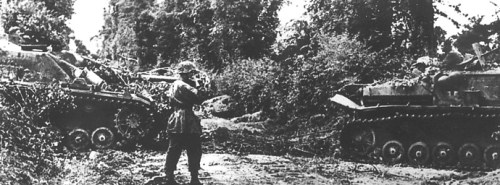
zz bocage

In view of what was about to happen, the fact that these Nazi troops were from the 17th SS Panzergrenadiers was supremely ironic. The unit had been raised near Poitiers in south-central France in October 1943.
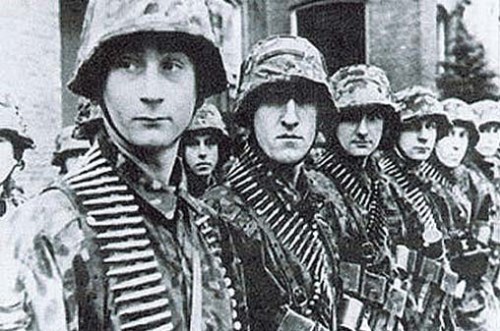
war criminalsxxxxxxxxxxx

It consisted mainly of conscripts, many of whom were Rumanian Germans with a good number of French Fascist volunteers.

The SS duly attacked the 507th Parachute Infantry Regiment, who were by now entrenched in the village. It took the Germans until June 11th to overwhelm the village, with just the church left to be captured:
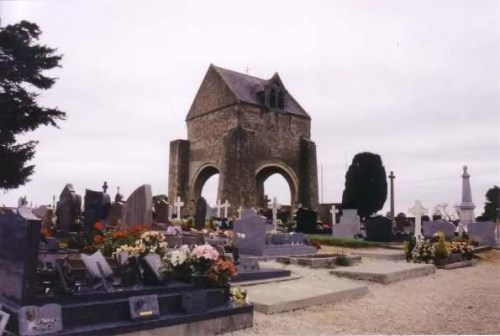
church

The Americans had, by this point, claimed perhaps five or six hundred dead Germans, with the roughly the same number wounded.

To forestall all those who would defend those apologies for human beings who made up the Waffen SS, I would like to quote the Wikipedia account pretty much in full about what happened next. I have also added some extra details from a website about the battle in Normandy in 1944:

“The 17th SS stormed the church and found Captain Sophian’s medical aid station. They forced the Captain and all of the wounded outside against a wall. The men were divided into two groups and marched away. One group was marched down to the edge of a shallow pond behind Madame Boursier’s café. At the edge of the pond, the SS bayoneted the wounded men and threw them into the water one on top of the other. The other group of 507th paratroopers was forced to march to a field near the village of Le Mesnil Angot. There, the nine wounded men were forced to dig a pit. As soon as the pit was complete, the SS shot each one of them in the back of the head and dumped their bodies in the pit one on top of the other.

Other Germans began a round-up of the French civilians.  The SS men knew that the church’s belfry had been used as an observation point to direct mortar fire accurately onto their attacking troops. The SS soldiers therefore burst into the church rectory, dragged Father Leblastier and Father Lebarbanchon into the courtyard and shot them both to death. They then discovered Madeleine Pezeril and eighty-year-old Eugenie DuJardin. Overwhelmed with fear, the two old ladies had been cowering in their quarters ever since the end of the battle. The Germans shot and killed both women in their beds. Meanwhile, forty-four villagers had been rounded up and were being interrogated. They were threatened with immediate execution if they did not divulge the names of any villagers who had actively assisted the Americans. Not a single one of the villagers turned in a single name. And none of them revealed either the role that Alphonse Voydie had played in the Graignes drama. Had the Germans known what Voydie had done, they would most certainly have executed him too.

On Tuesday June 13th, the Germans burned the village. They poured gasoline over the bodies of Father Leblastier, Father Lebarbanchon, Eugenie DuJardin and Madeleine Pezeril and then set them on fire. The ensuing blaze was allowed to burn out of control, destroying 66 homes, the boys’ school, Madame Boursier’s café and the 12th-century church. Another 159 homes and other buildings were damaged either as a result of that fire or the fighting. Before the June 11th battle and the German retaliation that followed, the village of Graignes had consisted of just over two hundred homes and other structures. Afterward, only two houses survived unscathed.”

In the words of “morice”:

« A leur départ, l’école et l’église de Graignes n’existent plus, le village n’est qu’une ruine fumante. C’est un autre Oradour et un autre Maillé, la signature des SS aux abois en 1944 dans le pays. Au total, ils laissent derrière eux 63 morts. Seul le clocher du XIIème siècle resté debout défie toujours l’occupant. »

On July 6th 1986, a ceremony was held in the ruins of the church at Graignes during which eleven villagers were presented with the Award for Distinguished Civilian Service for their role in assisting the men of 3rd Battalion/507th. Six of those awards were posthumous.

Only one member of the SS was punished in any way for this incident, the rather unlucky Erwin Wilhelm Konrad Schienkiewitz who went to prison for life. If you look at the Wikipedia entry for 17th SS Panzergrenadiers, there is a shortish list of the war crimes for which some of them received prison sentences.

For the most part, they were to do with killing concentration camp prisoners, but they also executed the Mayor of a German town who wanted to surrender to the Allies and avoid unnecessary deaths. And they murdered a Jewish dentist. What bravery from the élite troops of the Master Race.

Like so many members of the Waffen SS, however, their commander,  SS-Standartenführer Otto Binge, lived out a full life and died peacefully in a warm bed on June 18th 1982.

And why am I telling this great long-winded tale, other than the fact that it deserves to be told anyway?

Well, because it is now known that one member of that crew of the 106 Squadron Lancaster Z-NH, serial number NE150, was killed proudly fighting alongside the 507th Parachute Infantry Regiment at Graignes.
For many years, the tale had been told that there was an American fighter pilot involved in the fighting, but only in recent times, around 2008, has the real truth come to light. The mystery fighter pilot was none other than Flight Sergeant Stanley Kevin Black, bomb aimer of the Royal Australian Air Force.
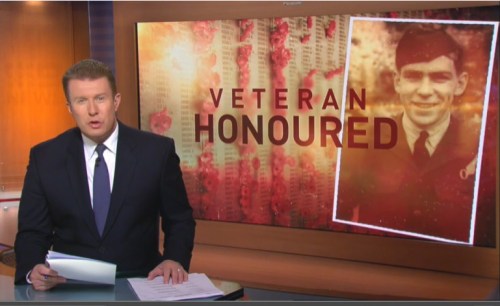
black

I will bring this tale to a conclusion in the near future.

To end with, let me repeat that none of these three articles about the Avro Lancaster III from Metheringham, Z-NH, NE150, shot down on June 7th 1944, could have been written without recourse to the websites and forums which I have indicated. I just hope that what I have written, tales which deserve to be heard, will reach another audience by my re-telling them.

 

20 Comments

Filed under Aviation, Bomber Command, Criminology, France, History, Politics, The High School

A few days after D-Day (3)

I have written two previous articles about an Avro Lancaster Mark III bomber which took off from Metheringham, in Lincolnshire, ten miles south east of Lincoln at twenty five minutes past midnight on June 7th 1944. Its squadron letters were Z-NH and its serial number was NE150.

Operating in the direct aftermath of D-Day the crew were tasked with bombing Coutances, a beautiful little town just south west of Caen in Normandy, in an effort to disrupt German transportation of troops:

balguthrie

Unfortunately, the aircraft was hit by heavy anti-aircraft fire over Lison, a town near Coutances, and it crashed near the village of St Jean de Daye. All of the crew were killed except two.

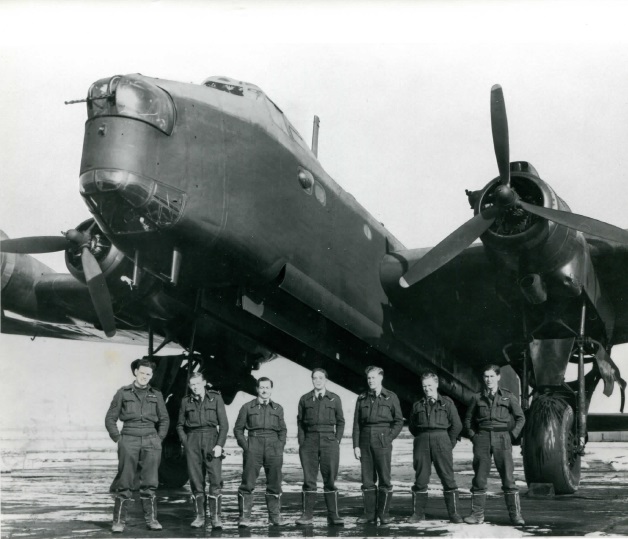
The first of two articles will tell the story of John “Jock” Drylie, the aircraft’s navigator, and the only member of the crew who managed, eventually, to return home, in his case, to Fife in Scotland. “Jock” Drylie is known to be on this photograph of a Short Stirling bomber and its crew, but the names of the individual flyers remain unknown:

DRYLIE PHOTO

I found John’s story on a forum, one of what must be hundreds devoted to the aircraft of the RAF in the Second World War.

The tale of John Drylie was posted by Michel Tardivat in 2014:

“When the aircraft crashed, five members of the crew were either unconscious or dead. He buried his parachute and hid in the deep bushes of Normandy for two or three days, he did not know how long. Driven by hunger, he knocked on the door of a farm near the village of Saint-Fromond. The owner of the farm was Arthur Michel who carefully checked John’s proof of identity with the local French Résistance. At this time, it was only too easy for German agents to pose, for example, as British soldiers, or downed flyers, in order to penetrate the Résistance network. Brave Monsieur Michel kept John at his farm, pretending, as the Scot could speak no French whatsoever, that he was a deaf and dumb farm worker.

All of the crew members from NE150 were initially reported as missing in action. His family, and especially his young fiancée, Margaret, were devastated. She was working at Stirling Castle as a radio operator for the Army.
In actual fact, John was already on his way back home. Arthur Michel continued his heroism by driving John to Bayeux. Again, the Germans had only one penalty for people caught helping Allies soldiers, and that was death. After that, the equally brave men and women of the Résistance network continued the process, and Flying Officer Drylie was back in Britain by July 19th 1944.

In the late 1940s, Farmer Michel took a wife and she was able, in the era of rationing and postwar shortages, to wear a silk wedding dress made from the material of John Drylie’s parachute. Arthur Michel and his lucky wife had just one daughter who was the village teacher at Saint-Fromond all her working life. At the moment, she lives in the family farm, which has been converted into a Bed and Breakfast establishment.

During the 1950s, the Drylie family would visit their French friends and their son Peter, would play around the wrecked fuselage of the Lancaster bomber which remained virtually untouched in a field near the village for many, many years.

Nowadays, in the cemetery at Saint-Fromond, brave Arthur Michel rests in peace. On his tomb is fixed a medal. It was placed there by the grateful RAF.”

John Drylie seems to have been very greatly affected by the events of June 7th 1944. He hardly ever spoke about what had happened to him in that doomed Lancaster. He never wore his wartime medals. He never attended any official ceremonies connected with that terrible night.

DRYLIE PHOTO

Just once,though, he came with three generations of his family, his children and grand-children, to visit the most famous places from D-Day, namely, Saint-Lô, Bayeux, Sainte-Mère-Église  and Colleville. It is unknown whether he visited the cemetery at Saint-Fromond or at Bayeux, but I would be very surprised if he did not. He was certainly seen to be very deeply moved as he stood silently at the places he visited

“Jock” Drylie was a chartered-accountant for all of his life. He travelled extensively between workplaces in Paris and in Scotland. He passed away in September 1990, in his house, “Balguthrie”, in Lower Largo, Fife, Scotland:

balguthrie

He was buried in the local churchyard with his wife Margaret and his son Peter.

Personally, I would posit that John Drylie, who hardly ever spoke about what had happened, never wore his wartime medals and never attended any official ceremonies, was a classic sufferer from Survivor Guilt.

To quote Wikipedia:

“Stephen Joseph, a psychologist at the University of Warwick, has said: “There were three types of Survivor Guilt: first, there was guilt about staying alive while others died; second, there was a guilt about the things they failed to do – these people often suffered post-traumatic ‘intrusions’ as they relived the event again and again; third, there were feelings of guilt about what they did do, such as scrambling over others to escape. These people usually wanted to avoid thinking about the catastrophe. They didn’t want to be reminded of what really happened.”

I am sure that, by now, Jock will have met up with all his old pals in Heaven and they will have told him that he should feel no guilt. In Bomber Command, death was so often decided by blind chance, nothing more:

Lancaster_B_MkI_44_Sqn_RAF_in_flight_1942


To end with, let me repeat that none of these three articles about the Avro Lancaster III from Metheringham, Z-NH, NE150, shot down on June 7th 1944, could have been written without recourse to the websites and forums which I have indicated. I just hope that what I have written, tales which deserve to be heard, will reach another audience by my re-telling them.
18 Comments

Filed under Aviation, Bomber Command, Criminology, France, History, Politics, The High School

A few days after D-Day (2)

Last time, I spoke about Frank Corner, and how he had been killed on June 7th 1944, when his aircraft was hit by anti-aircraft fire over Lison, as a huge raft of bombers tried to bomb railway lines near Coutances and bridges around Caen in preparation for D-Day.

lanc crash

The young pilot of Avro Lancaster Mark III, squadron letters Z-NH and serial number NE150, was Pilot Officer Merrick George Munday Warren.

The Wireless Operator/Air Gunner was Sergeant Norman Charles Vezey Rooker, the beloved son of Charles Vezey Edward and Jessie Rooker, of Bournemouth in beautiful Hampshire. He was only twenty years of age.

Sergeant Maurice Hardy Wigham was a little older at thirty three. He was the mid-upper gunner, the much loved son of Thomas N and Eleanor Wigham of Shotley Bridge near County Durham. Maurice was the loving husband of Margaret Wigham of Parkestone in Dorset.

Sergeant Ralph Lionel Puckett was the rear gunner. The Commonwealth War Graves Commission website reveals, unusually, virtually nothing about this man.

Other members of the crew included the navigator, Flying Officer John Drylie who actually  survived the crash and became what is classified an “evader”. This is somebody who is not captured by the enemy, but who, by one means or another, is able to return behind his own lines. In the case of Flying Officer Drylie, he was back in Britain  by July 19th 1944.

The final crew member was Flight Sergeant Stanley Kevin Black of the Royal Australian Air Force:

Squadron_Leader_E_Sprawson

He was the Bomb Aimer, and he was only twenty one years of age. He too survived the crash, and came out of the wreckage virtually unscathed.

I will tell the two very differing stories of these two young men in the very near future.

The five members of the Lancaster crew who died with their aircraft, including Flight Sergeant Corner, were originally buried in the cemetery of the little village of St Jean de Daye.
The brave citizens of St Jean de Daye managed to find a British flag and a Tricolore to drape over the coffins, and the five flyers were all given a full military funeral. All the little children of the village planted British flags around their grave.

This slideshow requires JavaScript.

There were lots of German troops around at this time, so this act by the villagers was an unbelievably brave thing to do. Had the Germans, particularly the SS, found out, they would quite simply have shot all of them without hesitation. There were hundreds, if not thousands, of French villagers massacred by the Germans between June 6th and the time the Nazi invaders all left French soil for good:

wiking

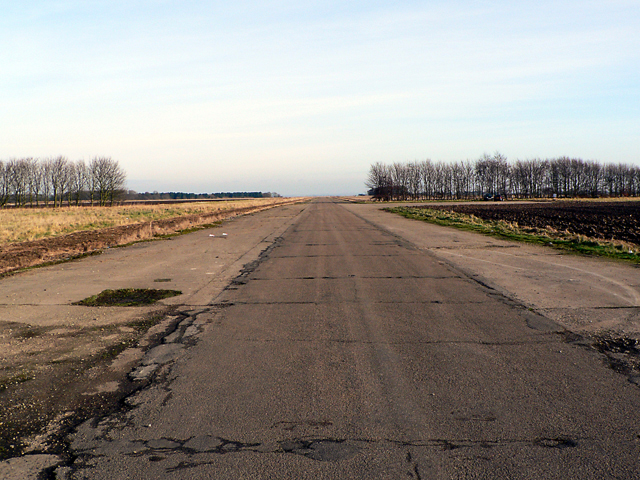
It should also be put on record that 106 Squadron lost one other Avro Lancaster III during this operation. It was ND680, ZN-P, which had also taken off from Metheringham in Lincolnshire. The runway is still there today, albeit in poor repair:

Former_RAF_Metheringham_-

Most of the crew parachuted out of the stricken aircraft:

250px-Avro_Lancasters_flying_in_loose_formation

The pilot, Squadron Leader Eric Sprawson, the Navigator, Flying Officer Richard RC Barker and the Bomb Aimer, Flying Officer EL Hogg, were all sheltered by French families in the outskirts of Caen. When the town was liberated after a five week wait, at the end of July, they were able to rejoin their squadron. Sadly, both gunners were killed. These were Pilot Officer Philip Sydney Arnold and Sergeant Edward Ernest James Wiggins. The Flight Engineer, Sergeant K Anderton and the Wireless Operator, WD Low, became German prisoners, both in Stalag Luft 7. in Bankau, Silesia, Germany. Anderton became Prisoner 288 and Low was Prisoner 465.

StalagLuft1Barth

This account, apparently taken from a newspaper of the time, takes up the story of the pilot, Squadron Leader Eric Sprawson DFC:

“A Lancaster bomber pilot from London, Squadron Leader E. Sprawson, D.F.C., wearing patched blue overalls and a dirty scarf told a Reuter correspondent of his adventurous introduction to the old Norman city and of his five weeks visit there with friendly French civilians before British troops arrived and threw the Germans out:

I was shot down by a fighter over Caen on D-Day. Five of us baled out, I don’t know if the two gunners made it or not. French civilians who had just got out of the centre of Caen to avoid bombing happened to be in the field where I landed. They had me out of uniform into these clothes within twenty minutes of my landing. They were very brave people with plenty of guts and determination. They had realised what would happen if I was caught, I would have been taken prisoner and they would be shot for hiding me. We went back into their house in the town and they treated me as a member of the family. I had no rations, so they insisted on sharing theirs with me. We were lucky and lived on the produce from a little allotment, the milk from a couple of cows and the very limited rations distributed daily to the townspeople. I got two square meals a day. My chief worry was to know what to do. Allied broadcasts advised us to evacuate the town, but I could see myself trickling into Switzerland by about 1946 and decided to stay where I was in the hope that our troops would arrive before long.

Another idea was to move into open country out of the way of concentrated bombing and shelling. But being British and individual, I thought I would have much more trouble concealing my identity. There was only one really bad bombing. I was right in the middle of it. I walked through Caen twice when it was full of Germans:

caen

Though I speak French and could make myself understood I could never have passed myself off as a Frenchman. One night when we were in the cellar of the house in Rue de Moulin, jutting on to the main thoroughfare of Boulevard Des Alliés, a great deal of scuttling about by the Germans took place. They had lots of armed patrols slinking along the streets while the crowd jostled south. For the last fortnight civilians in Caen had been living for this day. We heard the Allied Soldiers were two miles away, and then one mile. But there was still no sign until this morning. A 12-year-old boy rushed in to me and said very excitedly, “Here are the Allies!” I went out and saw a British sergeant. I told him I was British, but it was difficult for him to believe me. I. showed him my identification papers and told him to put me under arrest if he had any doubts. He put me in the charge of an officer who took me to the colonel of the regiment.

My friends in Caen had spread the tale that I was a Frenchman who had lost everything and was so shocked that I was unable to speak. Until this morning other French civilians with whom I had come in contact daily did not know I was English. There were collaborationists about who would have reported me at once if they had heard me talk. Most of the French in Caen were definitely for us. They realised that the bombing was necessary, and were determined to accept it as worthwhile, although after some of the heaviest raids it was understandable they would occasionally let slip a few nasty things, And now I am longing to be in uniform again and have another smack at Jerry.”

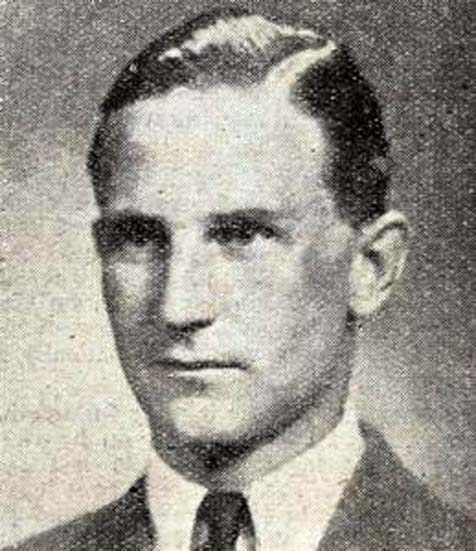
Here is Eric Sprawson himself:

Squadron_Leader_E_Sprawson


13 Comments

Filed under Aviation, Bomber Command, Criminology, History, Politics

A few days after D-Day (1)

Frank Leonard Corner attended the High School just  a few years before before the Second World War. He spent at least one season as the young scorer for the School’s First XI cricket team:

P1300886 1938

Of the three cricketers behind young Frank Corner, the one on the extreme right is George Brown. Playing for the School cricket team, George was a real asset with his “devastating fast in-swinging yorker on the leg stump”. On a forgotten Saturday in July 1944, however, now Lieutenant Brown, he was killed in action during the aftermath of the D-Day landings. He was just 24 years of age. Lieutenant Brown was in the 2nd Battalion of the Lincolnshire Regiment (3rd Infantry Division) and on that day, the blast of an exploding German mortar shell was even more devastating than his “devastating fast in-swinging yorker on the leg stump”.

Young Frank Corner, though, left the High School and its cricket team, on the faintly ominous date of July 31st 1939. First of all, he worked briefly for the Notts War Agricultural Committee. Around this time, he had also played rugby for the Old Nottinghamians’ Wartime XV.

Frank, though, like so many hundreds of thousands of other young men, was soon to feel the “Call of the Skies”. He joined the Royal Air Force Volunteer Reserve and was soon promoted to be Flight Sergeant Corner.

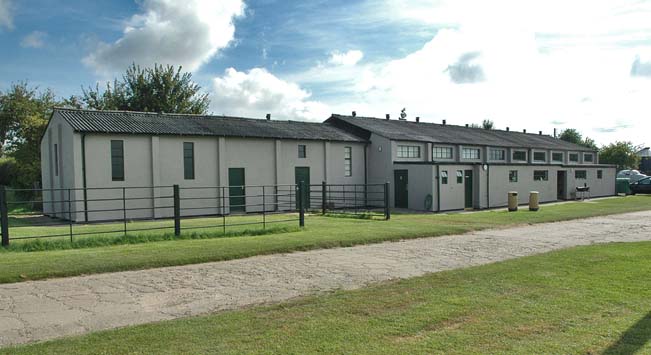
In due course, Flight Sergeant Corner joined 106 Squadron, stationed at Metheringham, in Lincolnshire, just south east of Lincoln itself. Here is the old gymnasium, still left after all these years:

Metheringham_Gymnaxxxxxxxxxxxxxxxxxxxxxxxx

Here is the building used to practice dropping bombs accurately:

Bombing_Trainxxxxxxxxxxxxxxxxxxxxxxxxxer

And here is the beautifully maintained Memorial Garden:

1280px-RAF_Metheringham_Memorial_Garden

Frank was the Flight Engineer in an Avro Lancaster Mark III. Its squadron letters were Z-NH and its serial number was NE150.
Operating in the direct aftermath of D-Day the bomber took off from Metheringham at twenty five minutes past midnight on June 7th 1944. It was tasked with bombing Coutances, a beautiful little town just south west of Caen in Normandy.

Just give you an idea of the numbers involved, the “The Bomber Command War Diaries: An Operational Reference Book” by Chris Everitt and Martin Middlebrook reveals that:

“there was a total of 1,065 aircraft, made up of 589 Lancasters, 418 Halifaxes, and 58 Mosquitos.  They were to bomb the lines of communication behind the D-Day battle area. All of the targets were in or near French towns. 3,488 tons of bombs were dropped on targets at Achères, Argentan, Caen, Châteaudun, Conde sur Noireau, Coutances, St Lô, Lisieux and Vire. Every effort was made to bomb accurately but casualties to the French civilians were inevitable. Cloud affected the accuracy of the bombing at many of the targets and, at Achères, the Master Bomber ordered the raid to be abandoned because of cloud and no bombs were dropped. 10 Lancasters and 1 Halifax were lost in these raids; 6 of the Lancasters were lost in the No 5 Group raid at Caen, where the main force of bombers had to wait for the target to be properly marked and then fly over an area full of German units and guns at bombing heights below 3,000ft. Some details are available of the effects of the bombing. At Argentan, Châteaudun and Lisieux, much damage was done to railways, although the towns, Lisieux in particular, were hit by many bombs. Important bridges at Coutances were badly damaged and the town centres of Caen, Condé sur Noireau, St-Lô and Vire were all badly bombed and most of the roads through those towns were blocked.
….19 aircraft were minelaying in the Brest area, and 26 aircraft on Resistance operations. No aircraft lost.

Total effort for the night: 1,160 sorties, 11 aircraft (0.9 per cent) lost.”

lanc crash

Alas, young Frank Corner was one of that minuscule 0.9%. His bomber was shot down and crashed near the tiny village of St Jean de Daye:

dAYE

On June 11th 1944, the Wing Commander of 106 Squadron actually sent a report to the Air Ministry, explaining that the crew of Z-NH had been told to bomb bridges in Caen. This is thought possibly to explain why the aircraft finally came down near St Jean de Daye. They had been hit by anti-aircraft fire over Lison, where a worker at the railway yard remembers how the German gunners celebrated the fact that they had shot down a bomber.

Frank was just twenty one years old when he died. His service number was 222039 and his parents were Captain Leonard Leslie Corner and Florence Edna Corner, of Whiston, Yorkshire.

Frank is buried in the War Cemetery in Bayeux, in Calvados, Normandy, France along with 3,805 other war casualties. He has paid with his young life the price of our freedom:

ddday


15 Comments

Filed under Aviation, Bomber Command, Criminology, France, History, Nottingham, Politics, The High School