Category Archives: Football

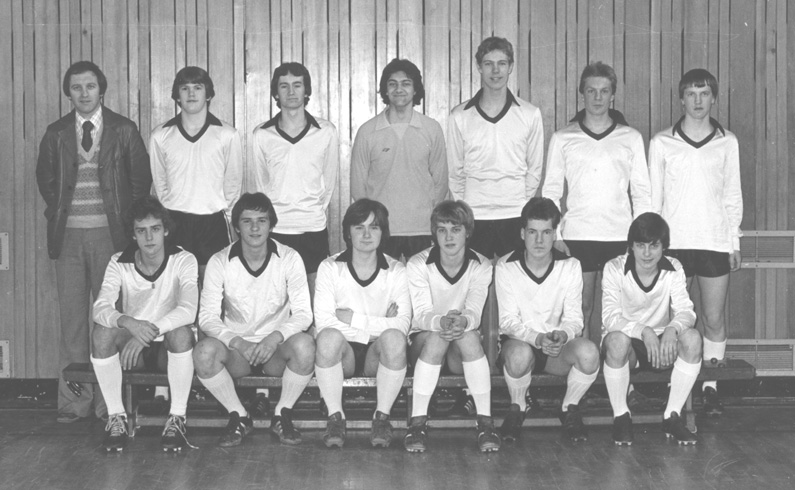
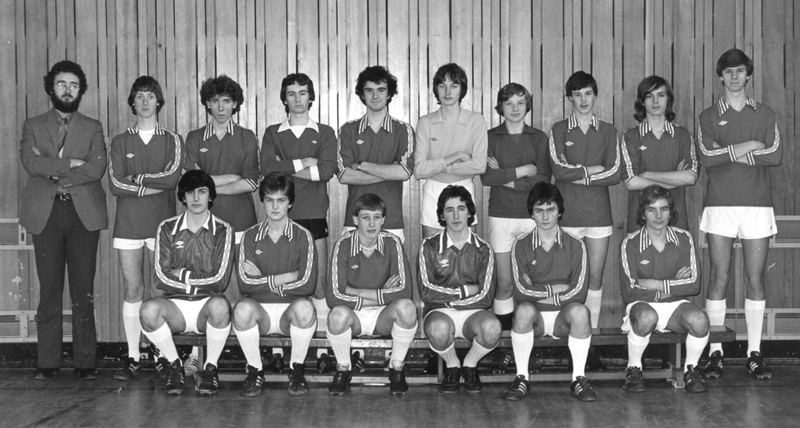
The Second XI Football Team 1980-1981

The Second XI had a pleasant and reasonably successful season back in 1980-1981, although it was possible to organise only seven fixtures. They lost their first match against Becket School, but were only to lose one more of the next five matches. Their record for the season of two wins, three draws and just two losses would have placed them comfortably in mid-table in the Premier League of today. Perhaps another Crystal Palace, Everton or West Ham. We drew games against High Pavement, Bramcote and Clarendon and then defeated Clarendon by 3-0 in the return and Bilborough by 5-2. Not a bad record for a team of eleven players picked from just nineteen available candidates:

asecond THE ONE

The goalkeeper was Richard Clark:

richard clark 700
And his deputy was, I think, David Lloyd:

other goalie

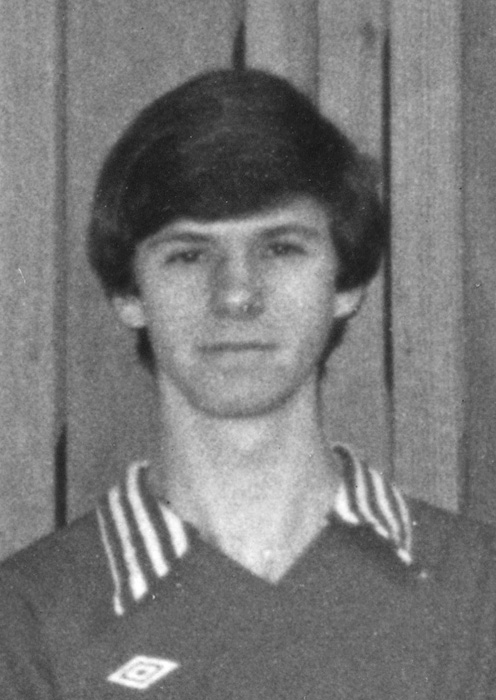
In defence we had Chris Turner:

chris turner 700

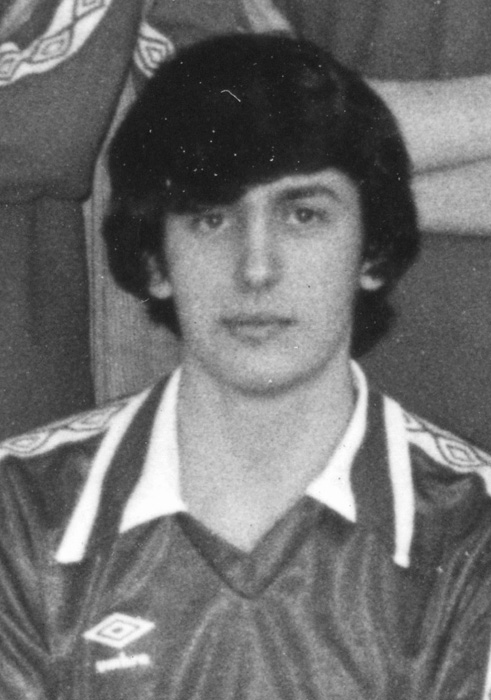
Alongside him was Julian Bower:

julian bower 700

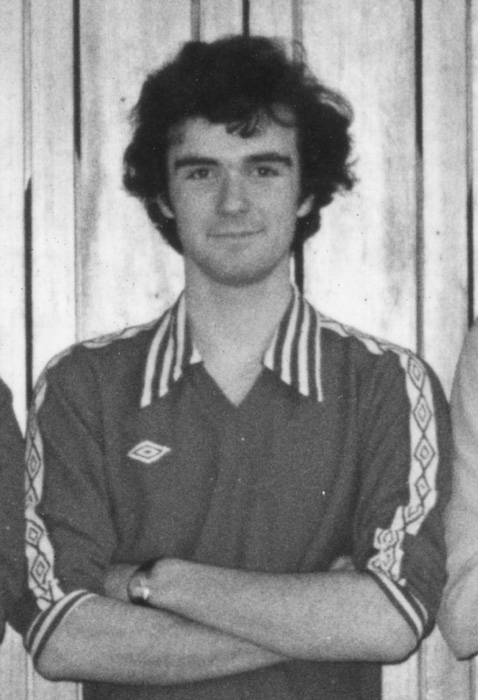
Ken Blecher was the sweeper. He was the Team Captain, so he had the shiny satin finish shirt:
For some reason, we played in fairly dark blue shirts of a shade called ‘Admiral’ or ‘Azure’ apparently.  This had been worn as a change strip by Sunderland in the First Division a few years previously. The sleeves had a red and white design on them, as did the collars.

Ken Blacher

Now, back to the players.

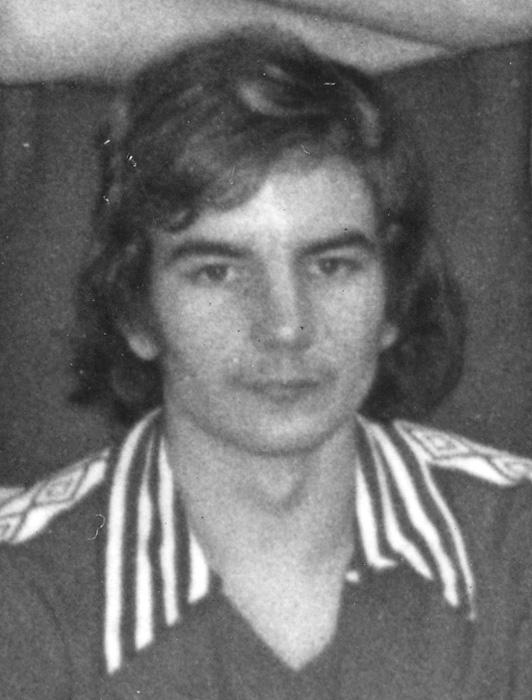
Phil Sermon was a 100% team player who, although he was often a little quiet, always gave everything on the pitch:

phil-ser-mon-700

Paul Chappell was almost surgical in the strength and calmness of his tackles:

Paul Chasppell
Chris Batty was an accurate passer of the ball, with a powerful shot:

chris batty 7oo

Bert Crisp was a strong runner and created many chances:

bert crisp 700
Phil Colley supplied energy in midfield:

phil colley

Chris Ffinch played well in attack:

Chrs Ffinch 700

Robert Harwood was a confident goalscorer:

robert harwood 700

Stuart Burns also contributed well in attack:

stuart burns 700

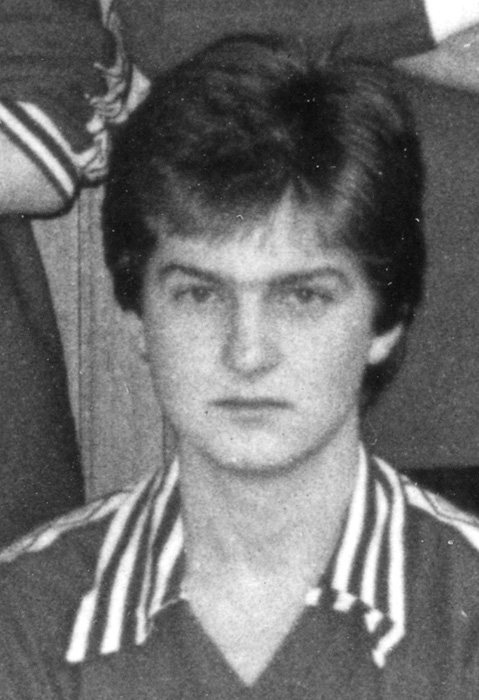
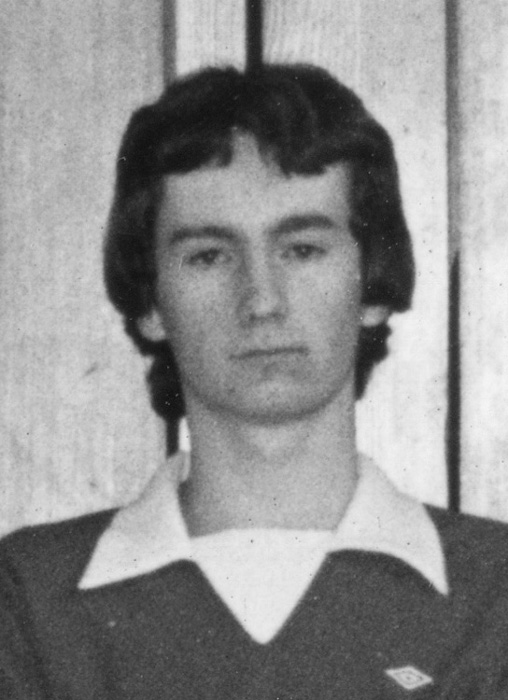
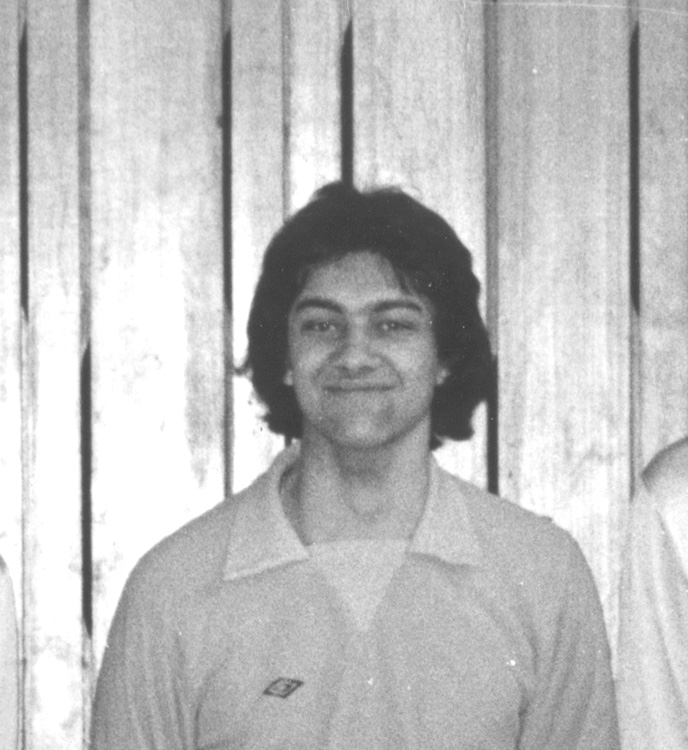
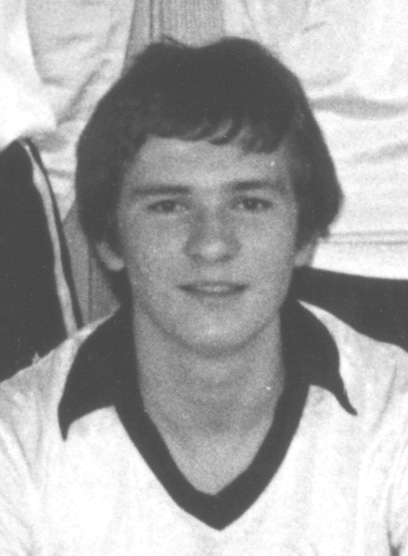
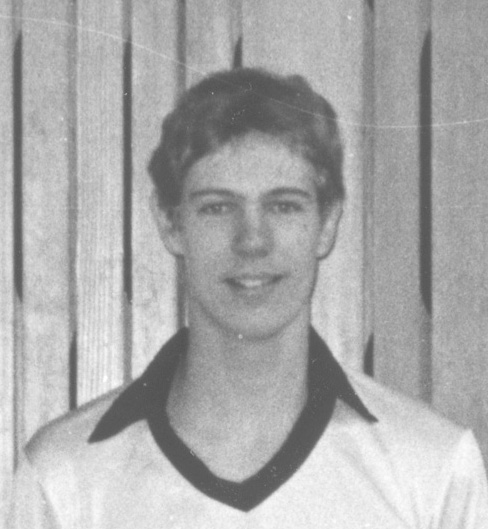
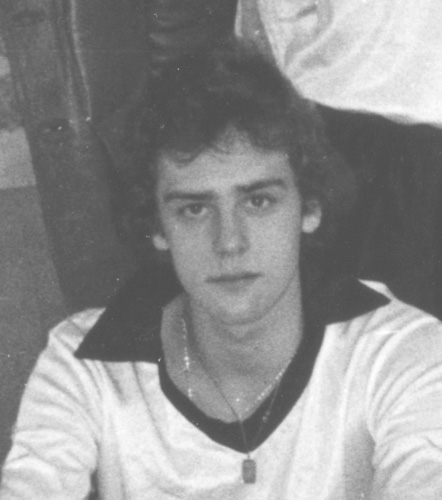
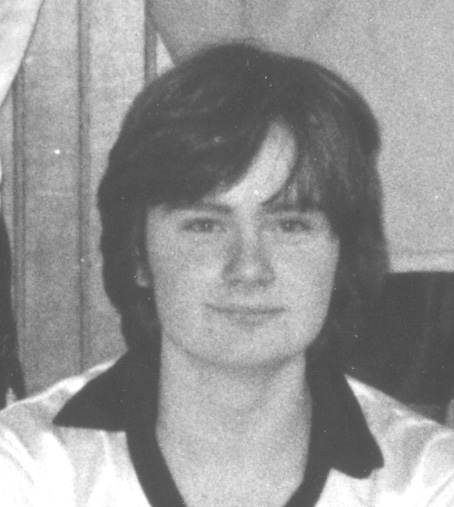
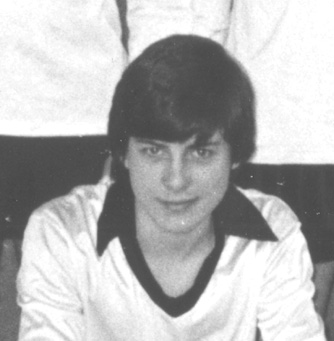
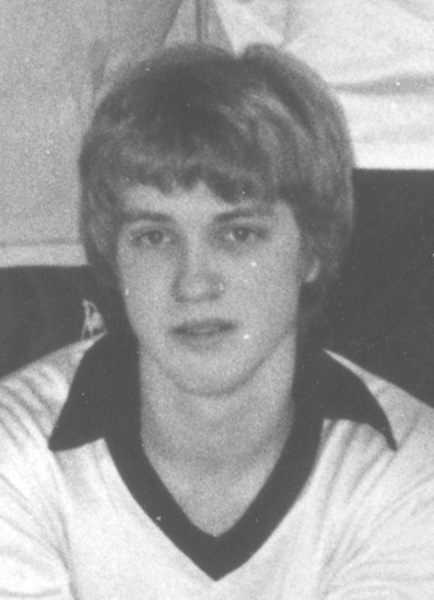
On the team photograph, two players remain a mystery to me, although this all took place some 35 years ago now. The first is CD Richardson:

one

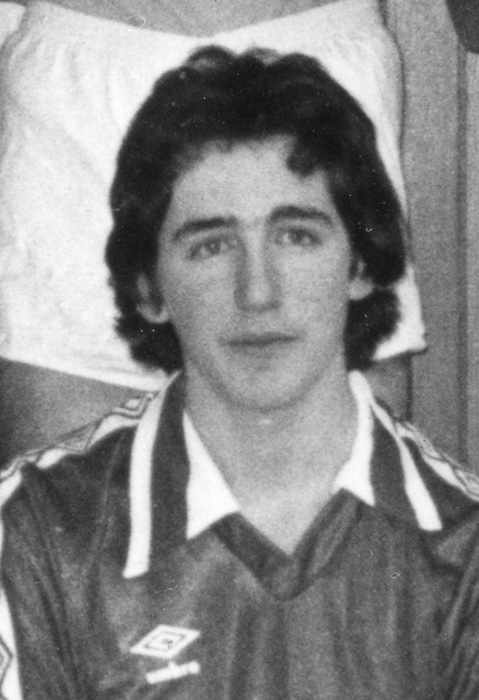
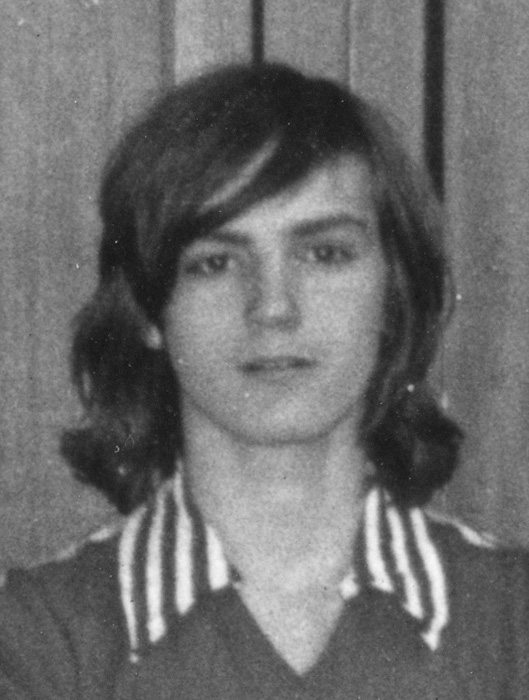
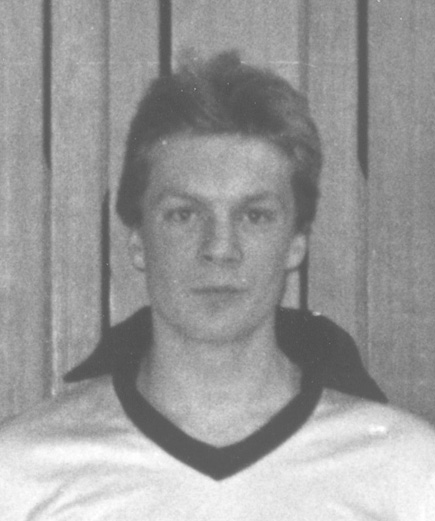
And the other is David Nowell, who, as you can see from the comments below, was the left full back, but who was unfortunately injured very early in the season :

three

Forgive me gentlemen.
Overall, the Nottinghamian reported that the players were “all keen to play and all contributed to a most enjoyable season. Everyone has done his best and given his all.”
A lot of my readers, of course, will not be familiar with any of these young men. Let them stand, therefore, for your own sporting efforts at school. Did you do your best and give it your all?
Perhaps you were not in a sports team of any kind. Well, just look at the faces of these sixteen, seventeen and eighteen year old young men. Look at their expressions. Their inner thoughts.
Nowadays they will be in their early fifties. Their team coach back in the day was in his late thirties. Well now, I am in my early sixties, and I just regret that I didn’t enter more Ché Guevara lookalike contests when I had the chance:

me close up

.

20 Comments

Filed under Football, History, Humour, Nottingham, Personal, The High School

The Oldest Old Boy of Them All (2)

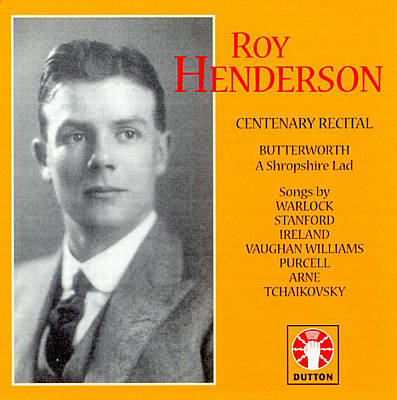
Many, many years ago, in 1990, my friend and colleague, Simon Williams, interviewed Roy Henderson who was then one of the oldest Old Boys still alive. In due course, I transcribed the taped interview and added some extra explanatory details where this seemed helpful to the reader. This is the second section of an eventual five, all of which describe the High School just before the outbreak of the Great War, and then during the first few years of the conflict:

Nobody was ever allowed to speak to or approach girls from the Girls’ High School. For this transgression, boys were punished by being confined to their own school. Attitudes at this time were very Victorian.

Dr Turpin, the Headmaster, was always a popular figure. On one occasion, Roy was grounded for three months for putting chewing gum on the seats of other boys. Perhaps fortunately for him, he was caught when just about to put it on Jumbo Ryles’ seat. Mr Ryles came in, and Henderson thought that he would be expelled for this offence.

There were two Ball brothers in the school at the time. They were both in trouble most of the time. The more famous brother, Albert, was “a real card”. This is a photo taken during the time of the Great War. It shows Albert, apparently still wearing his brightly coloured slippers, his brother Cyril and an unknown officer of the Royal Flying Corps:

Albert25 bro, unklnow

At this time, music was not in the curriculum. There were just “a few ridiculous songs” for the prize giving ceremony. The Third Form music master was a Mr Dunhill, who had one eye which was straight, but the other looked outwards at an angle, rather like half past ten on a clock. Boys always used to make fun of him. Whenever he shouted “Stand up you! ! ! ” and looked at a certain naughty boy, four others would get up elsewhere in the room. “NO! NO! NOT YOU!! …YOU! ! ” The first four would then sit down, and another four completely unrelated boys would stand up elsewhere in the room.

Albert Ball specialised in misbehaviour during these singing classes. He and his brother would invariably “kick up a terrible row”, and would then be sent out of the room. This is Albert in 1911:

Albert 1911 trent

According to one Old Boy from just a few years later, however, Albert Ball’s actual expulsion came from an incident which took place at morning prayers. Ball took in with him a huge bag full of boiled sweets, which, at one point, was allowed to burst, and hundreds of sweets were all dropped onto the floor. The whole school assembly then became one seething mass of boys, all scrabbling about on the floor, “heads down and bottoms up, completely out of control ”, trying to pick up as many sweets as they possibly could.

Albert Ball’s father was a City Alderman, but at the same time, he too was “a real character”. He took Roy trout fishing on several occasions around this period, but always used worms, never flies. This is Albert with his father, Sir Albert and his mother, Harriet Mary:

Albert22 family

Roy’s brother was also in the school around this time. He seemed always to be in scrapes when Roy was a prefect. Eventually he left Nottingham, and went to Millhill School. Roy himself enjoyed the High School, although he was never very good in the classroom. By his own admission, he was very poor academically, and was totally hopeless at exams.

Roy was a best friend of Arthur Willoughby Barton, who was later to become the Headmaster of the City of London School. The pair of them always collaborated closely in Chemistry lessons with Dr Turpin. Henderson did the weighing and all the practical activities, while Arthur did all of the calculations. In lessons they always got full marks, but in examinations, Roy usually scored very low marks indeed. Arthur, of course, still got his ten out of ten. Here is the official paining of “Fuzzy” Barton as the Headmaster of the City of London School:

(c) City of London Corporation; Supplied by The Public Catalogue Foundation

The high point of Roy’s rather modest academic career came in the Sixth Form, when he finally won a prize, the Duke of Portland’s prize for an English essay. It was on “Militarism”, and Roy only won because the rest of the Sixth Form deliberately boycotted the competition, with the attitude of “It’s the only thing Henderson can do…..let him have it.”

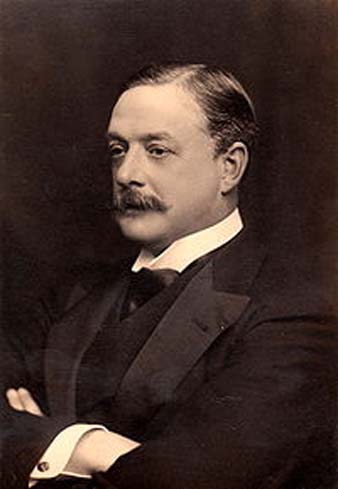
The Duke of Portland, in his capacity as the Lord Lieutenant of Nottinghamshire, was to unveil the school war memorial in 1922:

1900_Duke_of_Portland,_by_sssssssss

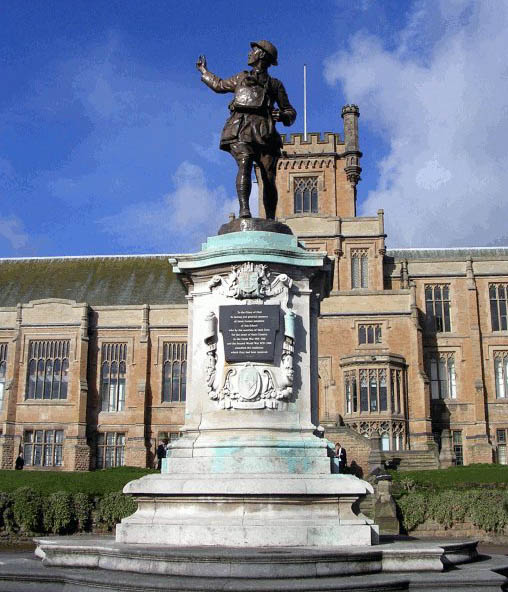
Roy sang a specially composed song, accompanied by a piano placed “at the top end, just inside the school”. A wonderful draught of wind blew outwards from the school throughout the very impressive and solemn ceremony. It carried his voice beautifully, but also gave him lumbago. Here is the school war memorial:

notting_high_school_war_memorial xxxxx

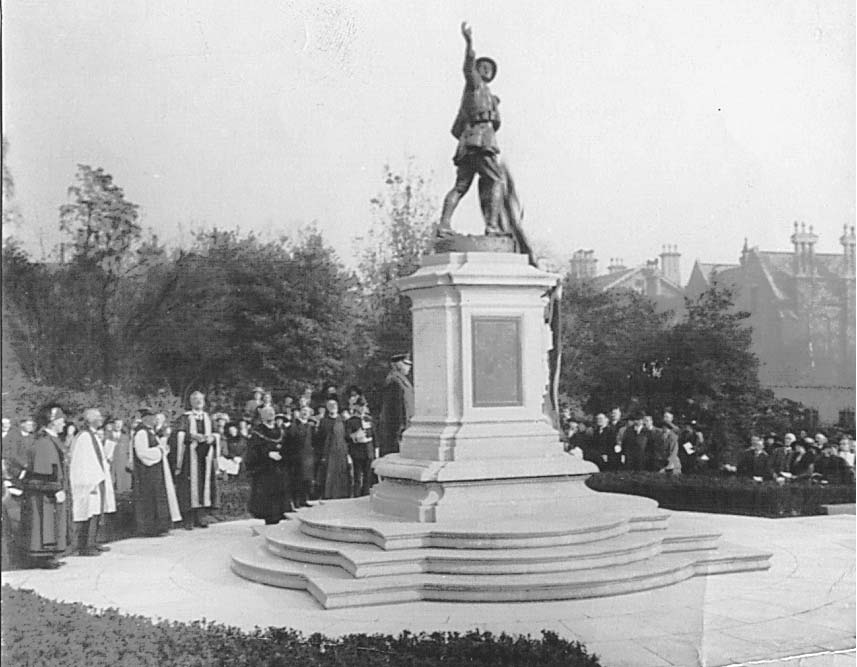
Here is a photograph of the dedication ceremony. One of the people is surely Roy Henderson. but I do not really know which one:

war meoorial ceremnoy

During the first year of the Great War, many of the Sixth Form members of the Officer Training Corps had gone to a special summer camp, working on a farm on the south side of Nottingham. It was hard, unpaid work, harvesting potatoes and hoeing turnips. The following year, Roy arranged his own summer camp, at a farm near Grantham. Six boys, all members of his father’s church, went with him. They were all Prefects, and comprised three pairs of friends, Harold Connop and Francis Bird, Thomas Wright and Lancelot Foster, and John Boyd and Roy Henderson. Unfortunately, as they waited for the train, the tent, which was supposed to arrive, did not turn up, so four of the boys went on to Grantham, while two had to stay behind in Nottingham. The farmer, unhappy with having to pick them up twice at Grantham, greeted the final two at the station with the words:

“What? What? My boy, I am not a little annoyed! ”

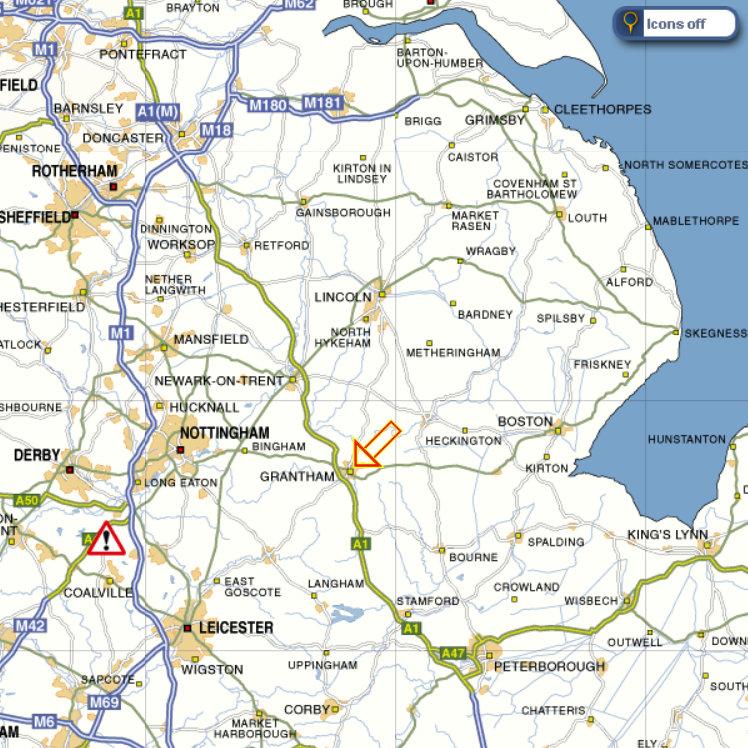
Here is Grantham relative to Nottingham. Look for the orange arrow:

granthsm

The boys were asked to load hay from a stack to the farm cart. They started piling it on enthusiastically, but they proved to be too quick for the man on the cart, a Mr Wright. The latter soon told them that half a load was enough, and then geed up the horse. When the cart set off, though, half the stack came with it, and the whole lot collapsed. Everyone found it immensely amusing, and they laughed about it for a long time afterwards. Other work for the boys included shaking the clover out of the cut wheat. At the end of the week, they enjoyed an amazing celebratory meal at the farmhouse. There was roast beef and duck, and by the end of the pudding, everybody was absolutely filled, collapsing with the weight of the food consumed. The farmer then sent for Henderson, obviously about to give him something as payment for the six boys’ work during the week.

When he returned they all quizzed him…“How much??? How much??? ” He replied “A pound.” There was a disappointed silence, which was broken only by Henderson’s single word “EACH!!” Everybody collapsed with excitement. They were totally flabbergasted, as, at the time, a pound was an absolute fortune. The boys were later invited to the farmhouse for dinner at Christmas. Under each of their plates, they found a ten shilling note as a gift from the generous farmer. In addition, the boys all went to the school’s army camp, but was a much more formal, military occasion.

This article will be continued in the near future.

12 Comments

Filed under Football, History, Nottingham, The High School

The High School’s best football season of the Modern Era

Overall, it must be said, the football team at the High School since 1968 has not really had a great deal of success. The exception to this, though, was the 1980-1981 season which was easily the most successful of the modern era. By the time the School Magazine, the Nottinghamian, was published, the team were undefeated in twelve matches. This record was extended to the very last game of the season which was a most unfortunate defeat at home by High Pavement Second XI who managed to score two goals without reply.

Here is the team photograph:

first eleven DAS BETTER Bxxxxxxxxxxxxxxxxxxxxxxxx

(back row) Dr.D.A.Slack, Norman Garden, Robert Crisp, Richard Mousley, Jon Bullock, Simon Derrick, John Ellis

(front row) Rob Persey, Raich Growdridge, Chris Peers, Neil McLachlan, Nick Cope, Chris Ingle

The team’s goalkeeper was Richard Mousley, whom the school magazine described as “reliable, agile, and when needed, very courageous.”

MOUSLEY 750 WWWWWWWWWWWWWWWW

They continued with the rest of the team:

In defence Richard Townsend was the left full back, replaced occasionally by Norman Garden. Both of them were deemed to be “consistently good players, and very determined in the tackle.” On the opposite side as right full back was Nick Cope, equally determined, and occasionally over-enthusiastic in the tackle:

Alas, Richard Townsend did not attend the team photograph on that coldish but fairly bright day in the Summer Term of 1981.

The central defenders included Raich Growdridge who was both team captain and sweeper. Raich was very skilful, with total commitment and a tenacious tackle. He was always capable of lifting the side when things were going against them. Raich had a trial with Derby County’s A team during the Spring Term, and is believed to have played perhaps three games for them. I was told by the Derby coach that had he not been over 18 years of age, they would have signed him for the club:

RACIH GROWDRIDGE 750 WWWWWWWWWyes yes yeas

The other central defender was Jon Bullock who was extremely commanding in defence and particularly useful when attacking at corners. He actually scored a hat-trick at Bilborough, an extremely unusual feat for a defender:

JONNN BULLOCKxxxxxxxxxxxxxxxxxxxxxxxxxxx

In midfield, Tim Little was hard working and consistent. He also scored some very useful and well taken goals when he moved into a more attacking role:

TIM LITTLE XXXXXXXXXXXXXXXXXX

Rob Persey was a tireless player, and a very determined tackler who possessed a great deal of skill when coming forward into attack. He was not the strongest defensive player, however:

ROB PERSEWY. 750 jpg XWWWWWW (2)

John Ellis played on the right, and scored a number of remarkable, even unbelievable goals, from between fifteen and thirty yards out:

JOHNNN ELLIS xxxxxxxx

Chris Peers was a fine left footed player, who could dribble well past a succession of opponents. He was a particularly skilful taker of corner kicks:

CHRIS PEERS WWWWWWWWWWWWW

Among the forwards,  Simon Derrick  was perhaps rather small, but very aggressive as a centre forward, with a lot of skill on the ground:

SIMONNNN DERRICK WWWWWWW

Chris Ingle was an excellent finisher, with tremendous pace. In the author’s humble opinion, he was the fastest High School forward of the modern era, with the possible exception of Leo Fisher. Chris scored nine goals in the season, with a hat-trick against St Hugh’s College, in Tollerton:

CHRIS INGLE ONE WWWWWWWWWWWWWWW

Other players to have figured in the squad included Neil McLachlan, who occasionally lacked total commitment, but had sufficient skill to play well as a replacement both in defence, midfield or attack. A veritable “Jack of All Positions”, the Nottinghamian called him and a valuable asset to the group!

NEIL MACxxxxxxxx33333333xxxxxxxxxxxxxx

Robert Crisp, universally known as “Bert” was a skilful midfielder, who never let the side down when called upon:

BERT CRISP WWWWWWWWWWWWWWWW

Both Ken Blecher and Chris Turner also played in the team:

Overall, the side played seventeen games and won eleven of them. Five games were drawn, and there was a single defeat, by 0-2, in controversial circumstances, if I remember correctly, against High Pavement 2nd XI. It is interesting to notice how many of these schools no longer exist nowadays, thirty four years later. The team’s victories came over Brunts of Mansfield (twice), Becket(twice), Bluecoat(twice), Forest Fields 2nd XI (twice), High Pavement 2nd XI, Bramcote, Bilborough and St Hugh’s College in Tollerton. Drawn games came against Bilborough, West Bridgford, Bramcote and twice against Trent Polytechnic.

The team’s goals were scored by Ingle 9, Ellis 8, Derrick 6, Bullock 3, Little 2, Persey 2, McLachlan 1 and two own goals.

The football report in the Nottinghamian paid the fullest tribute, and rightly so, to the endless support given to High School football by Tony Slack, who was retiring at the end of this splendid season:

TONY SLACKKKxxxxxxxxxxxxxxxxxxxxxxxx

He in turn generously praised the team’s achievements, despite the limitations of selecting a team from a very small number of players. Set against this, however, was the players’ commitment to the game, their willingness to work for each other, and their high level of team work, which, on many occasions, enabled them to defeat opponents who were, technically, far more skilled than they.

Nowadays, these young men will be in their early fifties. It would be interesting to find out where any of them are now, perhaps with a message in the “Comments” section?

22 Comments

Filed under Derby County, Football, History, Humour, Nottingham, The High School

The Oldest Old Boy of Them All (1)

Many, many years ago, in 1990, my friend and colleague, Simon Williams, interviewed Roy Henderson who was then one of the oldest Old Boys still alive.  In due course, I transcribed the taped interview and added some extra explanatory details of my own where this seemed helpful to the reader.

This is the first section of an eventual five, all of which describe the High School just before the outbreak of the Great War, and then during the first few years of the conflict.

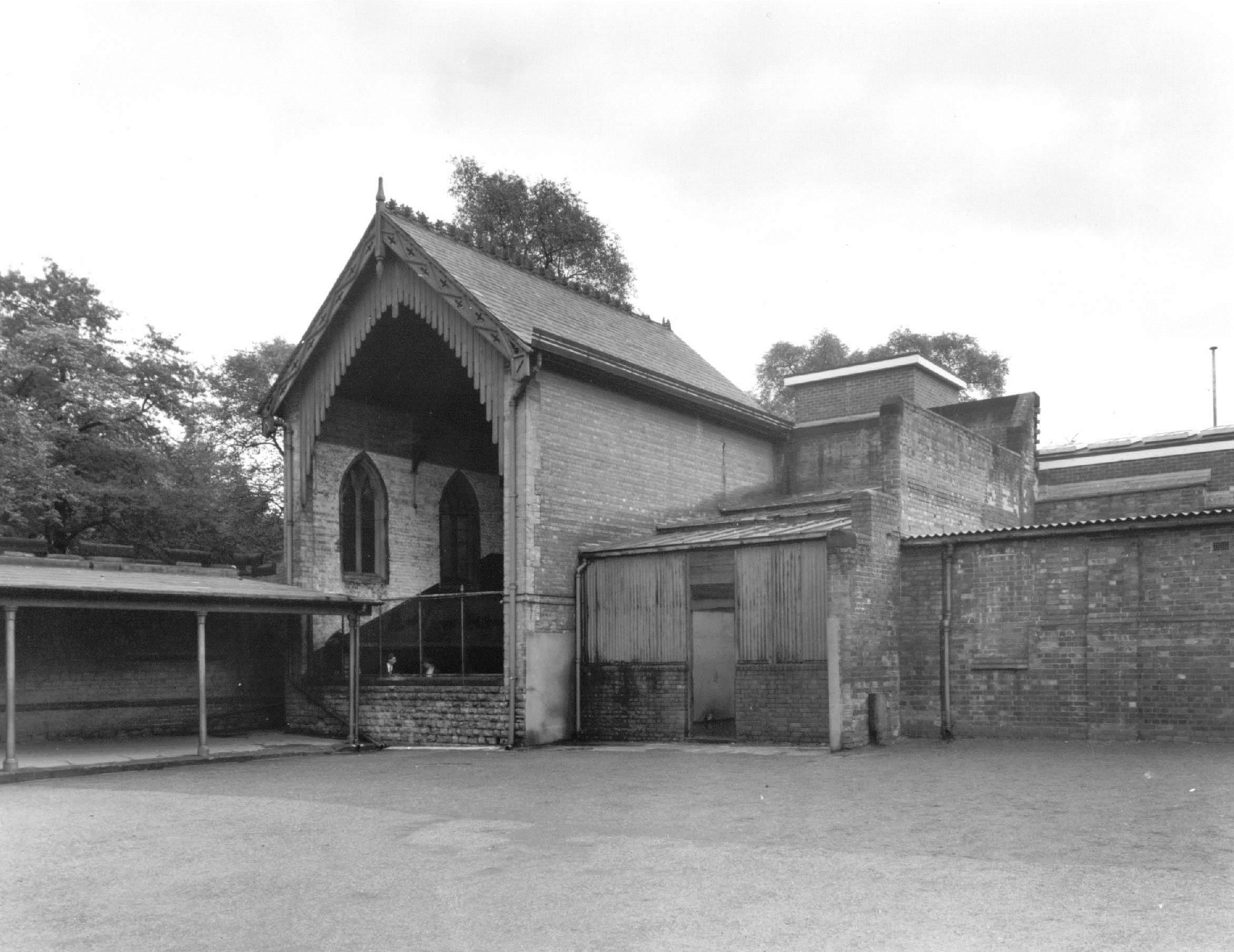
Here is the High School around this time. Notice at least four boys in the picture, including one sitting down on the edge of the tennis court:

west end of school

Roy Galbraith Henderson arrived in the High School Preparatory Department in January 1909. He had been born in Edinburgh, although he had not lived there since the age of three. Given his Scottish background, he arrived at the school wearing a kilt. This proved not to be the wisest of decisions, since he was immediately picked on by two older boys called Jaffer and Dodds, both of whom were at least a foot higher than he was. On many occasions in the future, he was to have water poured down his neck by these two bullies.

The Head of the Preparatory Department was Mr Leggatt, who was one of the very first to volunteer to go off and fight in the Great War. The main game in the school playground at this time was called “relievo”. It was a particularly thrilling game to play in one of the era’s many dense fogs.

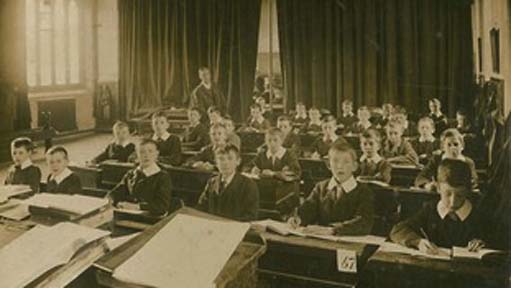
In the First Form, the form master was called Mr Radley, or “Pot-eye”. He always used to get the boys to begin work with a loud cry of “pens up!”. They would then write “like the blazes”, before the call of “pens down ! ”. Mr Radley is the third person from the left on the front row:

radley front 3rd from left

In Form 2a, “Nipper” Ryles was a very good master, and was thought to be one of the very few who did not possess a degree. Here he is:

jumbo ryles

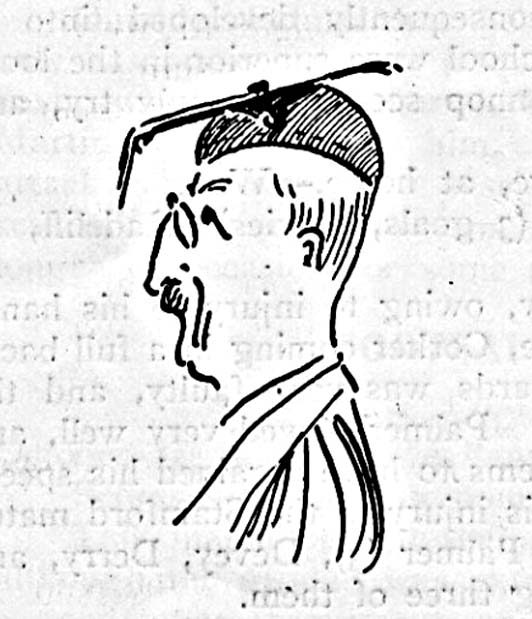
In the following year, in Form 3a, his brother, “Jumbo” Ryles, however, was “terrible, absolutely hopeless”. He used to have his feet up on the front desk all the time, and would practically go to sleep. The Drawing Master used to poke his nose around the door, and wake Jumbo up with a gentle cough. The latter would then rouse himself, and say to the class “Now get along there! Get along there! ” Jumbo’s teaching technique was to line boys up in a row for a series of questions. If they were correct, they would stay where they were. If they were wrong, they would go back to the end of the queue. This cartoon dates from just before “Jumbo” retired:

jumbo ryles left

In the Fourth Form, Mr Lloyd Morgan went to serve at the front during the middle of the school year, shortly after hostilities began. He was replaced by Mr D’Arcy Lever, who was the butt of many jokes, and found the boys extremely difficult to control. They made a lot of fun of him. Later in the conflict, retired teachers had to return to the school. Mr Trafford took over 3c, the worst form in the school, who were famed for their ability “to play up a lot”.

In Form 5a, Mr Brock was a “very nice chap, and very popular”. Everyone liked him very much. The Classical Sixth was looked after by Mr Strangeways.

In the yard, games tended to be played by years. In Form 1a, for example, everybody always had pockets full of marbles. They often played in the covered sheds near the Forest Road entrance.

This slideshow requires JavaScript.

The yard also had two Fives courts, one of which was covered, and the other was left open to the elements.

fivers

To the left as one entered the playground via the Forest Road entrance, there was some extremely dirty sand.

playgro 1932

This was used as a football pitch, with rough and ready goalposts at either end. Every year, around Easter, a competition was held among teams of eight players, each one of which was captained by a different member of the First Eleven. In 1913, Roy played in the winning team, which was captained by James Ivor Holroyd. On October 30 1917, Holroyd of the 1/28th London Regiment was to be reported missing, presumed dead, in the Second Battle of Passchendaele, at the age of only twenty one.

Form 2a enjoyed a game called “rempstick”. A member of one team would stand with his back to the wall, while one of the other members of his team stood with his head between the first boy’s legs. The next team member would then put his head between the legs of the second boy, and so on, until a long caterpillar-like scrum structure was formed, just one person wide. The members of the other team then took a long run-up, and, one by one, jumped onto the top of the human caterpillar. If they caused a collapse, then their team was allowed to have a second go. If the caterpillar held up, then its members were allowed to do the jumping:

This slideshow requires JavaScript.

In Form 3a, the main game was football, which was played on the left hand side of the playground. looking from the Forest Road entrance, right at the very far end. In Form 4a, football was played again to the left, but not as far along as in the Third Year.

The Fifth Form played their football under cover in the sheds along the Forest Road wall, kicking the ball against the wall in an effort to get past their opponent. Among these boys, Lancelot Wilson Foster was remembered as a particularly good full back.

The Sixth Form spent most of their free time just walking and talking on the lawns at the front of the school:

front schoollll

Nobody was ever allowed inside the school during breaks, but it never seemed to rain!  In any case, all the boys were always very keen to get out of the building.

There were few facilities for the boys, including just six to eight cracked stone washbasins. There was a tuck shop, near the south eastern corner of the present day West Quadrangle. It was run by Robert, the School Caretaker. The small shop which boys at the end of the twentieth century called “Dicko’s” was at this time called “Baldry’s”, and it was a sweet shop. A female member of staff, a Mrs Digblair, lived above it. She was one of the school’s first ever mistresses, and members of the Sixth Form loved to go and have tea with her.

Finally, my own footnote on Mr Radley. He was a teacher with what would nowadays be considered ideas before their time. He loved literature, art and music, and taught the boys about understanding and peace among mankind. Indeed, this was perhaps not particularly surprising for a man who knew French, German, Italian, Russian and Welsh. On one occasion, he brought an Egyptian into school to show his pupils that there were “other men than Englishmen and other creeds than Christianity.” His obituary in the school magazine ended with the words “Goodbye, Mr Chips!”

This article will be continued in the near future.


22 Comments

Filed under Football, History, Nottingham, The High School

Heil Hitler Episode 3

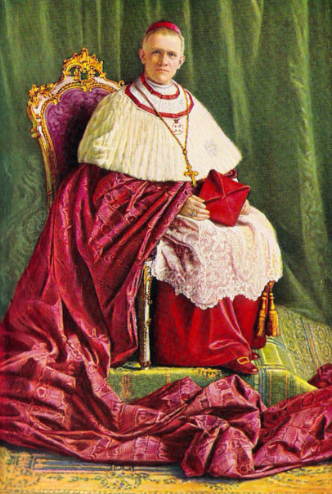
Last time I told you the story of Bishop Hudal, the appalling so-called Christian who was happy to help any war criminal, no matter what he had done, so long as he was German. Killing Jews was a bonus. Here he is. Adolf Hitler is thought to be hiding under that bit of robe on the floor:

Ateismo cristianismo dios jesus biblia religion catolicos creyentes Hitler ss nazis segunda guerra mundial xxxxxxxxxxxxxxxxxxxxxxxxxxxxxxxxxxxxxxxxxxxxxxxxxxxxxxxxxx

Bishop Hudal’s policy was “It’s a good way for Evil to prosper if you help it as eagerly as you can at every single opportunity”.

Hudal loved to help war criminals. Last time I supplied you with a list. It was not a complete one, though. Hudal Tours was used by many Nazis other than the ones I mentioned. The first lot were enough to get you into moral “deep doo-doos” but these second ones are even deeper and doo-dooier. This man looks fairly innocuous:

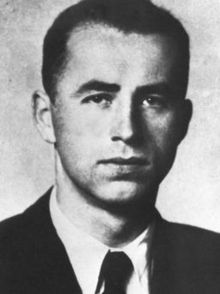
Alois_Brunner

He wasn’t a bank clerk though. He is Alois Brunner, the man who organised the deportation of Jews from France and Slovakia to German concentration camps, where they were killed in cold blood on an industrial scale. Brunner was responsible for at least 24,000 Jewish deaths, so he was welcomed with open arms by Syria, who adamantly refused to extradite this heroic man. The Israeli Secret Police, Mossad, used to write to him regularly, and send him little presents. In 1961 he lost an eye to one of them, and in 1980, all the fingers of his left hand. During his long residence in Syria, Brunner was reportedly given a generous salary and protection in exchange for his advice on effective torture and interrogation techniques.
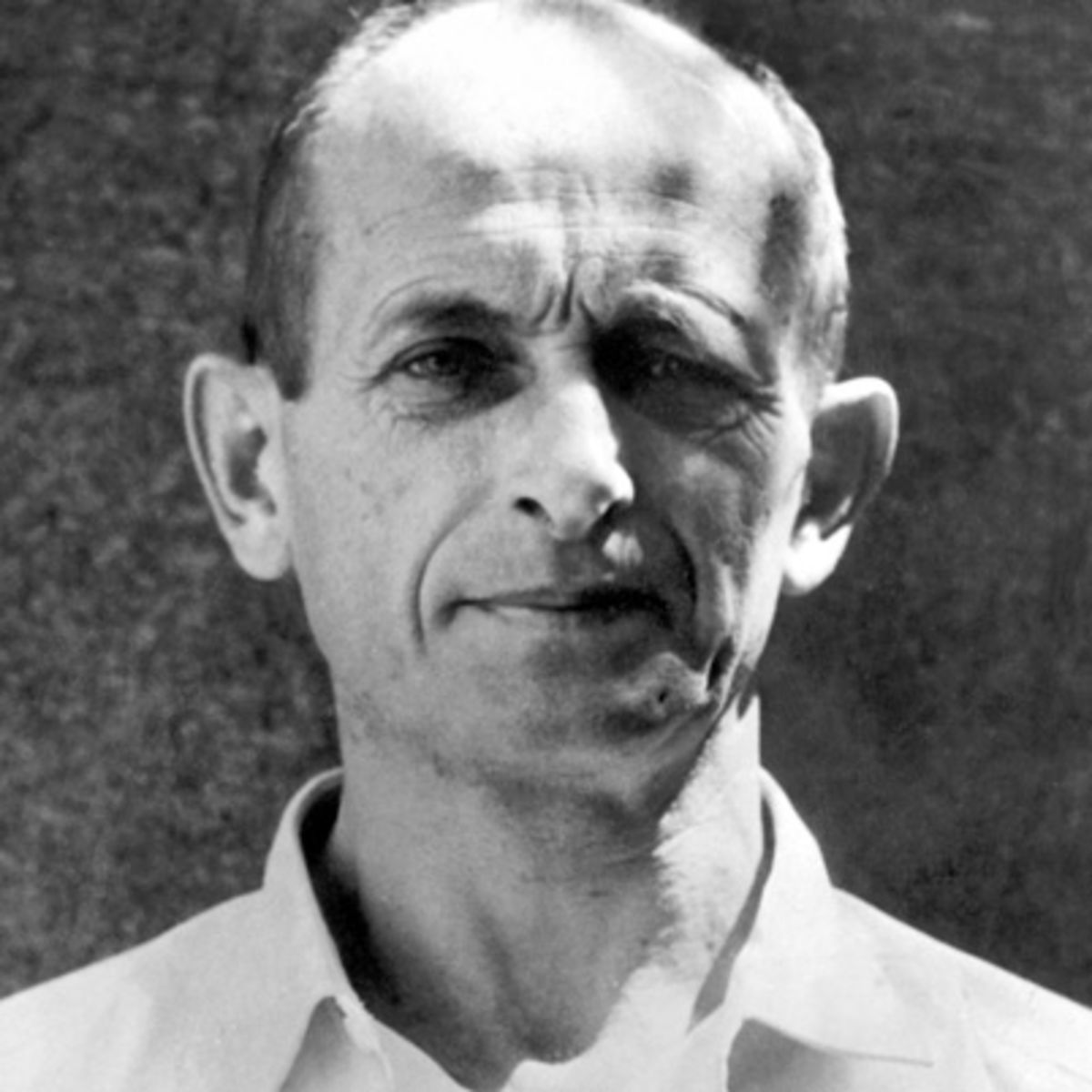
Hudal helped Adolf Eichmann, the man in charge of the murder of European Jewry, the so-called “endlösuhng. His career was instrumental in slaughtering between 5.5-6 million Jews.

mengele

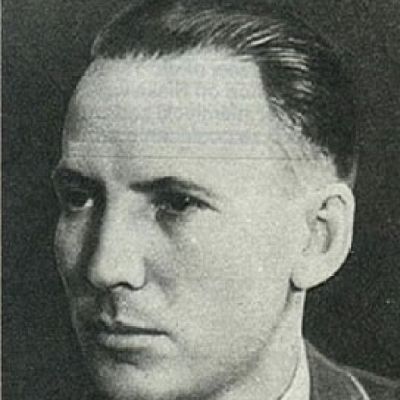
Hudal gave refuge to Otto Wächter, the man who organised the Cracow Ghetto in 1941. Working alongside Hans Frank, the Nazi governor of occupied Poland, Wächter was responsible for the deaths of uncounted millions of Jews and Poles.  After the war Wächter lived in a monastery in Rome, “as a monk”, under the direct protection of Bishop Hudal. He died in 1949 in a Roman hospital cradled “in the arms” of Bishop Hudal. How sweet.

ob_fea0cb_wachter-otto

Other possibles for the help and assistance of the kindly old Christian, Bishop Hudal, were Klaus Barbie, the Gestapo’s “Butcher of Lyon”, and Heinrich Müller, chief of the Gestapo.

What a long set of photographs. It looks like Mossad‘s Most Wanted. Or the star prizes in the Simon Weisenthal Show.

And did you notice how they were all German? Except Bishop Hudal and he was Austrian and then Austria was annexed and he became an Honorary German, more or less.

I still can’t really believe what Bishop Hudal said in his memoirs:

“I felt duty bound after 1945 to devote my whole charitable work mainly to former National Socialists and Fascists, especially to so-called ‘war criminals’.”

This slideshow requires JavaScript.

Were there any Germans, though, who lived up to Edmund Burke’s company motto?

“The only thing necessary for the triumph of evil is for good men to do nothing”

Were there any Germans who just refused to stand by and let evil prosper?

Of course there were and many of them went a lot further in their opposition than you might think. I’ll save that for next time.


14 Comments

Filed under Criminology, Football, History, Politics

Heil Hitler Episode 2

Last time, I showed you a picture of the England football team all making their Nazi salutes at the Olympic Stadium in Berlin on May 14th 1938. They were the good men who stood by and did nothing:

England-Germany 1938 nazi.xsderftgyhb
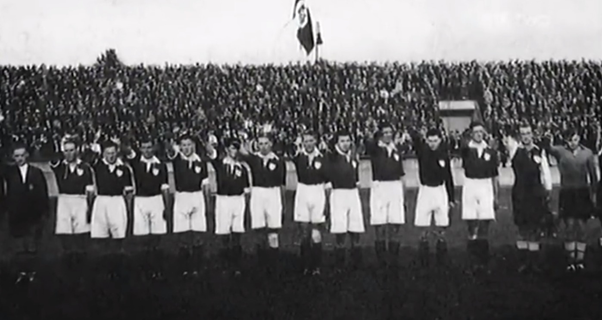
The England team though, were were not the only foreigners to greet the Führer with a cheery “Sieg Heil”. Here, just a year later, is the Republic of Ireland football team engaged in pretty much the same behaviour. Is this the old saying, “The enemy of my enemy is my friend”? After all, the Irish Republicans hated the British. The Germans hated the British. Result: a football match made in Heaven:

Ireland-Germany-1

And here’s a third group of Nazi sympathisers and Jew haters. No great surprises with this one:
bishops

Perhaps one of them is Bishop Alois Hudal, who was an Austrian titular bishop in the Roman Catholic Church and the author of the catchy best seller in cathedral bookshops across Europe, “The Foundations of National Socialism”:

Ateismo cristianismo dios jesus biblia religion catolicos creyentes Hitler ss nazis segunda guerra mundial xxxxxxxxxxxxxxxxxxxxxxxxxxxxxxxxxxxxxxxxxxxxxxxxxxxxxxxxxx

Hudal was no Nazi, of course, no racist. He just took being a good man who stands by and does nothing one stage further. He decided to be a bad man and join in enthusiastically to help the evil, presumably on the basis of “Whoever kills Jesus deserves all they get.” That attitude though, can get you into very deep doo doos, however.

Hudal, for example, is credited with organising the escape from justice of war criminals such as Franz Stangl, the Commanding Officer at Treblinka Extermination Camp, which killed between 700,000-900,000 human beings:
Stangl,_Franz

Stangl himself said that he went looking for Hudal in Rome, because he knew the bishop was helping all Germans. Hudal arranged rooms in Rome for him, helped him to escape through a “ratline” and then gave him money and a visa to Syria. Using a Red Cross passport Stangl lived happily in Damascus, where Bishop Hudal found him a job in a textile factory.  He remained in Syria with his wife and family for a few years before moving to Brazil in 1951. Stangl then found work with Volkswagen still living openly with no problems, still using his own name.
Another Nazi war criminal allegedly helped by Hudal was SS Captain Eduard Roschmann, the “Butcher of Riga”, who killed 24,000 Jews in the Latvian ghetto.
rosch
Hudal helped Josef Mengele, the Mad Doctor at Auschwitz, the “Angel of Death”, who always introduced himself to the Jewish children as “Uncle Mengele”:
WP_Josef_Mengele_1956

Gustav Wagner was the commanding officer of Sobibor, where between 167,000-300,000 human beings were killed. Hudal and others in the Vatican helped him to flee to Syria, and then to Brazil, where he became a citizen in 1950. Extradition requests from Israel, Austria and Poland were rejected by Brazil’s Attorney General who also rejected those from the West Germans.

In 1980, Wagner supposedly committed suicide in Sao Paulo. This was after he had given himself a severe beating, cut off all the fingers of his right hand and then stuck a very large knife into his own chest.

So where is all this going? Well, we’ll see in Episode 3.


18 Comments

Filed under Criminology, Football, History, Politics

Football in the Old Days : Derby County v Middlesbrough

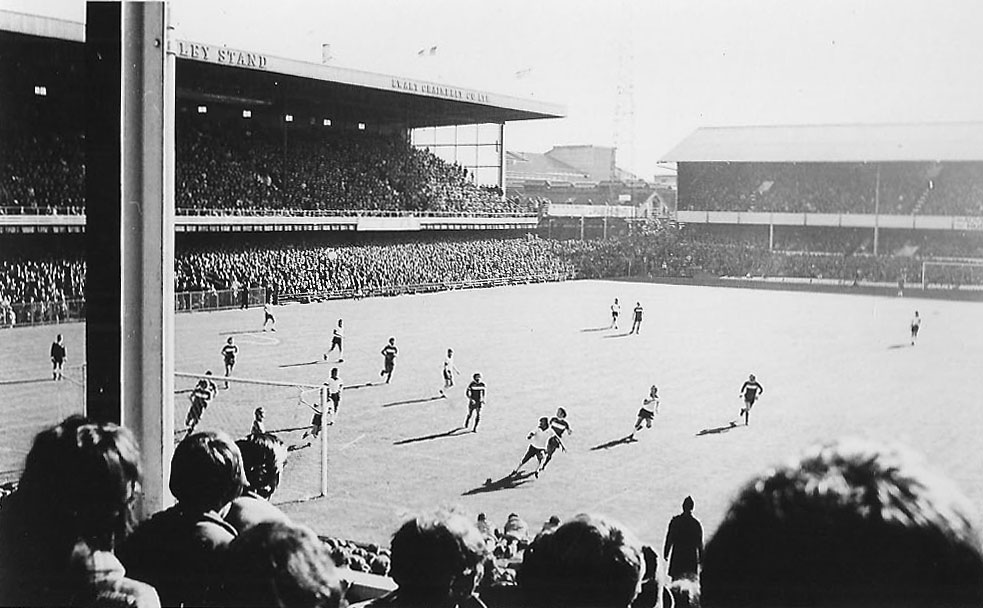
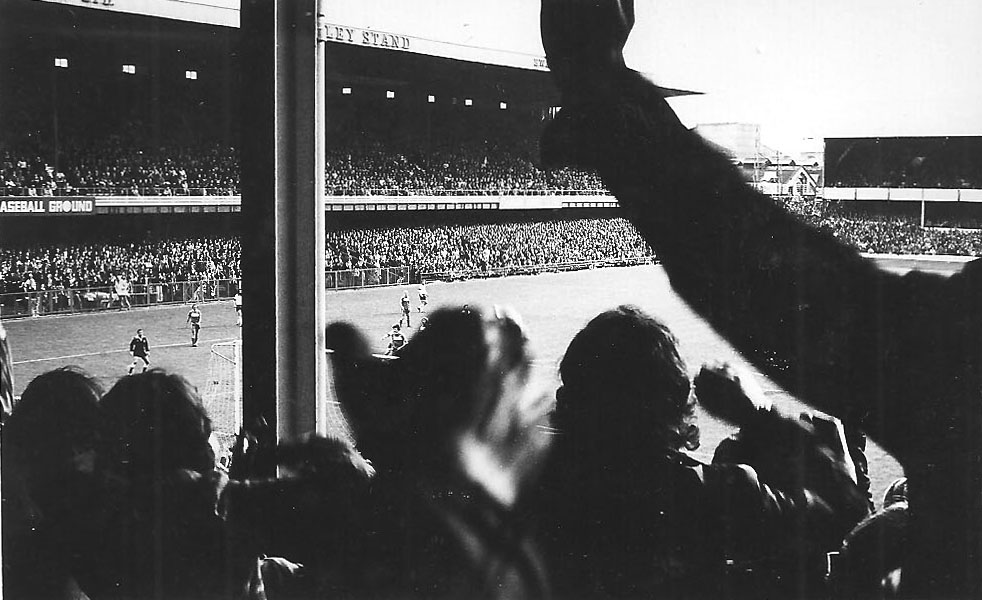
In the early 1970s, I used to watch Derby County who, at that time, were a highly successful team in what was then still called “The First Division”. I saw Derby win the Championship of that First Division on two occasions, in 1972 and 1975. In later years, I took my camera with me a couple of times, to take a few photographs, even though, at the time, this was actually illegal and club stewards kept a careful watch in case anybody did it.  Derby, of course, did not play in their current modern stadium, but in the old Baseball Ground, built in the middle of square miles of terraced houses in one of the poorest areas of Derby. It has now, alas, been demolished, although I do have a box of mud from the pitch, and a fair quantity of bricks from the stands.

I keep them in the cellar, but the very best one I had concreted underneath my Dad’s gravestone. He was a Derby fan from 1931, when Newcastle United came to Derby and won by 5-1, until the last game at the Baseball Ground, a 1-3 defeat against Arsenal. Fred was to watch Derby County for almost seventy years, until his very, very last game, at the new Pride Park Stadium, a defeat by 0-2 to Charlton Athletic. Nobody said supporting a football team was going to be easy.

This slideshow requires JavaScript.

My camera was a Voigtländer Vito B (I think) equipped with a rather handy Zeiss lens:

Voigtlander-Vito-Bxxxxxxxxxxxxxxxxxxxxxxxxx

Here are the match stewards just before the match begins:

A four more police horses - photo 2

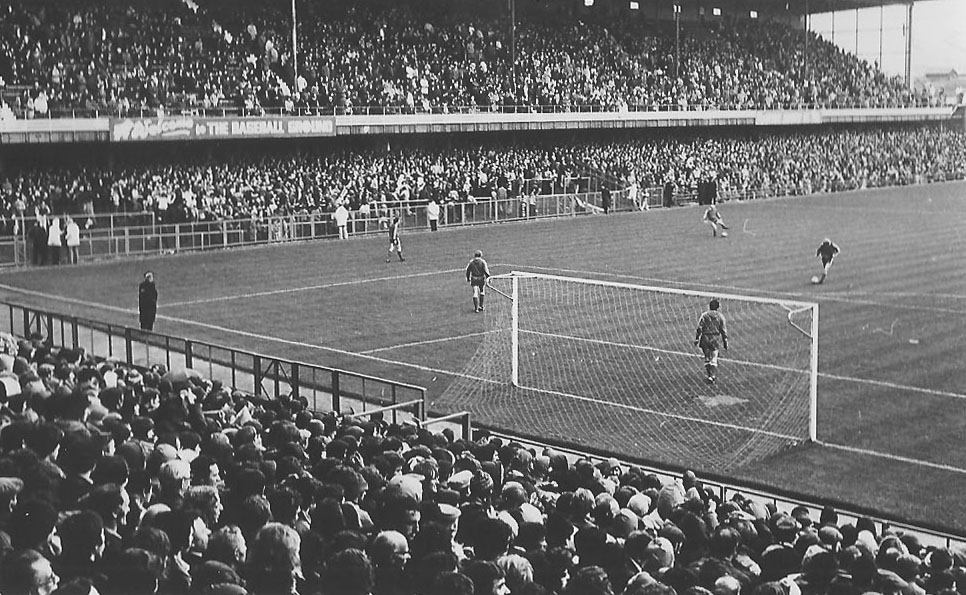
Today, the opponents are Middlesbrough, recently promoted to the First Division, and relying on tenacious defence to stay there. Here they are warming up before the match begins. The spectators at the back are in the Ley Stand, sitting upstairs, as it were, but standing in their thousands underneath. The “standees”, what a wonderful new word, are the away supporters from Middlesbrough:

B four more police horses photo 4

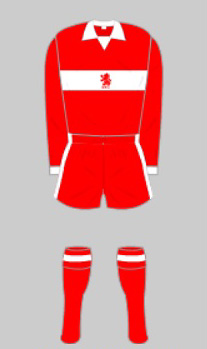
Middlesbrough played in all red with a white chest band:

1973

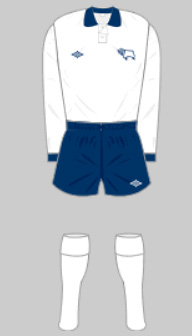
Derby played in white and dark blue:

derbyxxxxx.jpgjjjjjjjjjjjjjjjjjjjjjjjjjjjjj

Middlesbrough have already come out for the game, but here come Derby, resplendent in their white shirts with a darker collar and cuffs,

C four more police horses photo 1

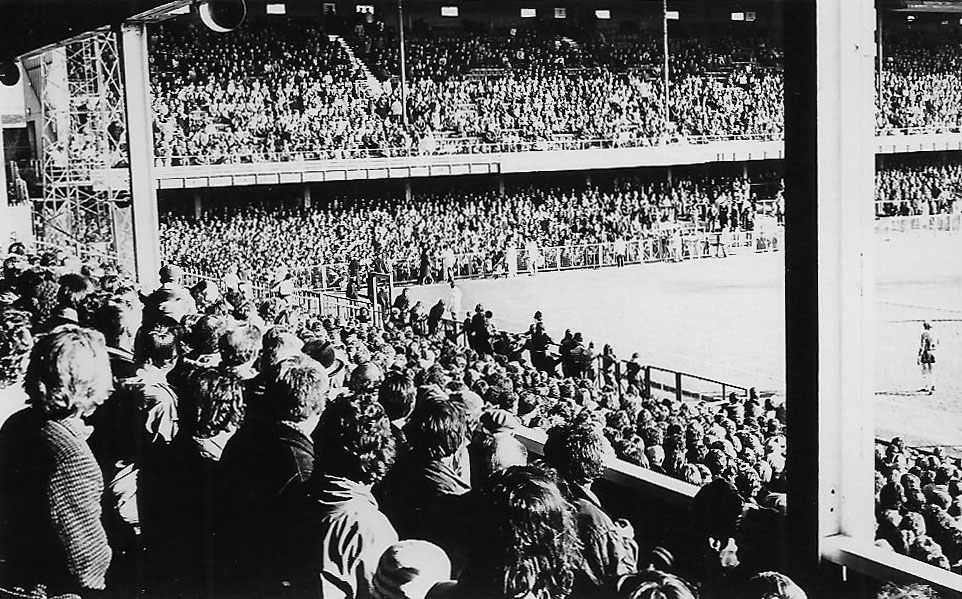
Here is the moment just before Derby kick off to start the game. At the far end is the packed Normanton Stand:

D football x four - C photo 2

Hooliganism was rife in the 1970s, and here the supporters next to me in the Osmaston Stand, Lower Tier, are obviously bored by the game, so they concentrate on a threatened pitch invasion by the Middlesbrough  fans:

E photo 1

Here Derby attack, and their best player, Kevin Hector, has a shot at goal:

football x four - photo 1

He shoots, he scores!

photo 2

I thought the result of this game was Derby County 3 Middlesbrough 2 but apparently, when I checked my reference books, it actually finished Derby County 2 Middlesbrough 3. They are useless books and I may throw them away.

12 Comments

Filed under Derby County, Football, History, Personal

Heil Hitler Episode 1

“The only thing necessary for the triumph of evil is for good men to do nothing.” is a famous quotation attributed to Edmund Burke, the statesman, author, orator, political theorist, and philosopher.
A good example would be this photograph showing the England football team just before a friendly game at the Olympic Stadium in Berlin on May 14th 1938:England-Germany 1938 nazi.xsderftgyhb

The fixture was played before a crowd of 110,000 people, but clearly, the Englishmen are not waving to their German admirers. This is the Hitler-Grüss. The English players are all saluting Adolf Hitler, arguably the most evil man ever born. Why did the footballers do this? Surely they were good men? Why did they do nothing? Or was Stanley Matthews, a hero to millions of young boys, an evil man?
Well, the truth of the matter is that the British Foreign Office had actually ordered them to salute the Führer, Adolf  Hitler.


Six months before, Naughty Hitler had marched his armies into Austria, the home of the waltz and the cream cake, and annexed this defenceless little country, the so-called “Anschluss”.

The Foreign Office wanted to assure Hitler that, even though he kept invading places, Germany was not a “pariah” state. Hopefully, if Adolf was kept sweet by an England team which saluted him, he would look favourably on Neville Chamberlain’s government and their policy of appeasement:

“You’re very naughty, Adolf, but as long as you promise it’s the last time, we’ll overlook it.”

The “Peace in our Time” deal must go through.
Germany’s football team was very weak at this time, but Austria’s was not. In 1934, they had finished fourth in the FIFA World Cup, and in the Berlin Olympics of 1936, they had finished second, losing to fascist Italy in the final. Austria qualified for the 1938 World Cup, but on March 28th 1938, they were forced to withdraw as the country no longer existed. The theory was that after Anschluss,  the Austrian players would all play in the German team.

First though, the two countries would play a last match for Austria, a “reunification derby” which would unite the two countries and their respective football teams for ever. Not surprisingly perhaps, the game was planned to finish as a draw. The Austrians, though, all of them good men, would not stand idly by and do nothing, but instead they scored two goals in the last few minutes in a successful  effort to win the game and put the Nazi noses out of joint.

To humiliate the Germans even further, the Austrians’ absolute star player, the thoughtful Matthias Sindelar, scored one of those two Austrian goals, and then celebrated extravagantly in front of the senior Nazi dignitaries watching the game. The latter already knew about the kit controversy. Both Germany and Austria usually played in white shirts and black shorts, but Sindelar, for what he thought would be the country’s last ever game, had insisted on Austria playing in the same colours as the national flag, red shirts, white shorts and red socks. Red, of course, was not a particularly favourite colour of the Nazis.

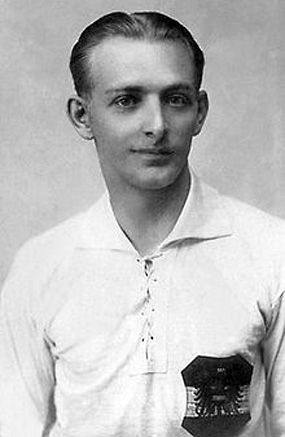
Here he is. Matthias Sindelar. He was so thin, so pale and fragile, that his footballing nickname was “The Man of Paper”. He was, though, a good man who refused to stand idly by. A real “Man of Steel”:

220px-Sindelar-aut

At the very end of the game, Sindelar deliberately and obviously missed an easy chance which would have made the victory an even wider one. Afterwards Sindelar refused to play for the German Reich, giving either his extreme age of 35 or injury as an excuse.

head tennis

Not totally surprisingly, perhaps, Sindelar was dead within the year. He died on January 23rd 1939. By now he was a symbol of Austrian patriotism, and his Gestapo file listed him as being pro-Jewish and a Social Democrat. The Gestapo also watched his café twenty four hours a day.

No wonder, therefore, that the heating system in his flat should fail, the problems allegedly being caused by a defective chimney. As he lay in the arms of his girlfriend, Camilla Castagnola, therefore, they both died of carbon monoxide poisoning.
That Sindelar’s death was a suicide as a protest against the German Anschluss of Austria was suggested by, presumably, pro-Gestapo elements, but that was just not true. Decades after the event, we now know, thanks to the confession of Egon Ulbrich, a lifelong friend of Sindelar, that a petty local bureaucrat was bribed by the Nazis to record his death by Gestapo as a mere accident. Here is Sindelar’s grave, still visited regularly by many people today:

grave_Matthias_SindelarMatthias Sindelar is one of my favourite players.


He had played centre-forward many, many times for the Austria team of the 1930s. They were known as the “Wunderteam”, and Sindelar was their captain at the 1934 World Cup, where they were cheated out of it in the semi final by match referee Eklind. Austria’s phenomenal goalscorer, Josef Bican, (at least 1468 goals in 918 games) maintained all his life, until he died in 2001, that Eklind had taken cash inducements from the Italians. And Bican was perhaps justified in his belief. On one occasion during the match, he passed the ball out to the Austrian right winger only to see it intercepted and headed down to an Italian….by the referee!

Here is one of the few pictures of the game. Some nice cotton wool seems to have been provided for the Italian goalkeeper to stop him getting bruised:

copyright

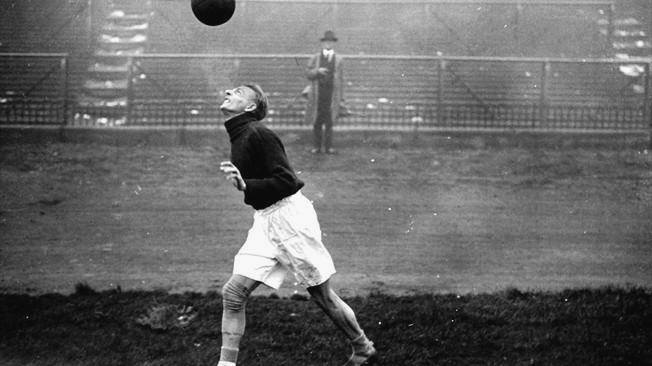
Sindelar was one of the greatest footballers of the decade, famous for his fantastic dribbling skills and the creativity of his passing. He had two brilliant nicknames. We know already what “Der Papierene” means. The “Man of Paper”:

sindelar

But Sindelar’s precocious skills would also lead to his being called “The Mozart of Football”.

mozart
In 1999, Sindelar was voted the best Austrian footballer of all time. He had already been named Austria’s sportsman of the century a year before. Sindelar even now, is still ranked as the world’s 22nd best ever footballer. Overall, he scored 26 goals in his 43 matches for Austria, and won one Austrian championship with SV Amateure in 1926, two Austrian Cups with Amateur-SV in 1925 and 1926, and three with FK Austria Wien in 1933, 1935 and 1936.

There was no European Cup then, but Sindelar won one of its predecessors, the Mitropa Cup or Central European Cup in 1933 and 1936 with FK Austria Wien.

mitrop

In 1932, he won the Central European International Cup, a predecessor of the UEFA European Championship.
Participants were Austria, Czechoslovakia, Hungary, Italy, Poland, Romania and Switzerland.
Matthias Sindelar was certainly one who did something to prevent, or at least, slow down, the triumph of evil. And ultimately, he paid with his life.

26 Comments

Filed under Criminology, Football, History, Personal, Politics

The very first football season of them all 1888-1889 (Part 2)

In my previous article about the involvement of the High School’s ex-pupils in the newly invented Football League. I spoke in some detail about the career of Arthur Frederick  Shaw, who played twice for Notts County in that inaugural season of 1888-1889, before going on to make two more League appearances the following season. He then continued his career in the Second Division with firstly Nottingham Forest and then Loughborough. Here is the Notts County kit that he would have worn during that first season:

Capture 1 - Copy

When Arthur Shaw made his first appearance in the Football League on December 8th 1888, at home to Aston Villa, a narrow 2-4 defeat for the Magpies in front of 2,000 spectators, he was the inside right (No 8). In the same team, playing at left full back (No 3) was the splendidly named Herbert Durrant Snook, a fellow ex-pupil of the High School.

Born on December 23rd 1867, Herbert Snook entered the High School on September 11th 1876. He left at Christmas in 1882. Herbert was one of four brothers, the sons of James Snook, a wholesale merchant and draper. The family lived initially in Elm Avenue, Nottingham, before their fortunes improved dramatically and they moved to Penrhyn House, in Clumber Road, The Park, Nottingham:

penryn

The other three Snooks at the High School were James Brasher Snook, Frederick William Snook and Percy Walter Snook. All three played for Notts County in various F.A.Cup ties and friendlies, but never in the Football League.

In that first season of League Football, Herbert also played in three F.A.Cup ties. These were all home games, against Eckington (4-1), Beeston St.John’s (4-2) and Derby Midland (2-1). Herbert played as a right full back (No 2) against Beeston St.John’s, but as a left full back in the two other games. The Cup Ties against Eckington and Beeston St.John’s were both contested by Notts County’s reserve side. On the same day, the First Team played Football League fixtures against Blackburn Rovers (3-3, 4,000 spectators) and Burnley (6-1, 5,000 spectators), both games taking place immediately after the Cup games. The crowd against Beeston St.John’s and Burnley must have gone home happy. It isn’t often that County win two successive games and score ten goals doing it. Here is Notts County’s Meadow Lane. It is the football stadium in the top right. Nottingham Forest’s City Ground is towards the bottom of the picture, on the southern side of the River Trent:

meadoew lanexxxxxxxxxxxxxxxxxxxxxxxxxx

Herbert’s brother, Frederick William, played against Eckington and Beeston St.John’s, at centre forward (No 9) in the first game, and as inside right ((No 8) in the second.  A third Old Nottinghamian to play was Henry Harold Brown who was at the High School from 1874-1878. He appeared as outside left (No 11) in both games and scored a brace of goals against Beeston St.John’s. His brother, Gilbert Noel Brown, yet another ex-pupil of the High School, played as centre forward (No 9) in this game.

In 1890, Herbert Snook was one of the earliest shareholders in the newly formed “Notts Incorporated Football Club”, although during the 1888-1889 season he had played in two friendlies for Nottingham Forest, the first against Stoke City (1-2), the annual Shrove Tuesday match. Here is the Stoke City kit:

Capture 1 - Copy

The second game was against his old team, Notts County (2-5). In excess of 5,000 spectators watched the match. On March 12th 1891, Herbert appeared for the Old Boys in their 3-1 victory over the High School First XI at the Gregory Ground, the home of both the High School footballers and of Nottingham Forest.

Herbert was to spend most of his life living at “The Cedars”, Derby Road, Lenton, Nottingham. He was keen on tennis, and in partnership with Gilbert Noel Brown, held the county men’s doubles championship for many years. Herbert was well known in political circles as a liberal, and worked in the old established family business of James Snook and Company Ltd., who were wholesalers and clothing manufacturers in Houndsgate, Nottingham. In actual fact, Herbert was still working until well into his eightieth year, after forty years as chairman and managing director, and a grand total of sixty two years in the company. Immediately after Herbert’s retirement, the business was taken over by a Birmingham firm. Herbert died on October 13th 1947, at the age of seventy nine, after an illness lasting some months. He was buried in the family vault in the Church Cemetery on Mansfield Road. Here is the Church Cemetery, a Victorian masterpiece. It has a permanent staff of eight vampires:

graveyard

Playing at right half (No 4) on December 8th 1888, against Aston Villa, alongside Arthur Shaw and Herbert Snook, was a third ex-High School pupil, namely G.H.Brown. Strangely, there are two likely candidates of this name in the Victorian school registers at the High School.

The first possibility is George Henry Brown, the son of Samuel Brown, a fish and game dealer of 96, Sherwood Street, Nottingham. He would have been nineteen years of age when the match against Aston Villa took place. A better fit though, would be George Hutchinson Brown, the twenty one year old son of George Wilkinson Brown, a grocer and chandler of firstly 14, Colville Terrace, and then 62, Addison Street, Nottingham. We will probably never know the answer to this enigma, unless Notts County have a dusty box full of players’ contracts from this era, hidden away somewhere, perhaps among the cobwebs of  their trophy room.

George Hutchinson Brown was to wear his admittedly un-numbered shirt as a right half (No 4) for most of that historic first season. He played 19 times out of a possible 22 games. He had the honour of playing in County’s first ever League game, a 1-2 defeat away to Everton at Goodison Park, and also in their first ever home game, a 3-3 draw with Blackburn Rovers. Here is the Blackburn Rovers’ strip, very similar to the present day:

Capture 2 bottom - Copy

Notts County’s first ever league victory came in their fifth game of the season, and was a 3-1 home win over Everton. George Hutchinson Brown was again the team’s right half. Here is the Everton kit:

Capture 3 top - Copy

George also played in County’s first ever away win in the League. This was a long, long, wait, until Match 18 out of 22, a 2-1 win over Accrington on January 26th 1889, County’s only victory away from home in the whole season.  Here are the Accrington colours:

accrington-1892-1893-b

George Brown’s solitary goal came in a narrow 2-5 away defeat against Blackburn Rovers at Ewood Park, in front of 4,000 spectators, on December 15th 1888. One particularly exciting game must have been the last one of the season, another narrow defeat at home, this time by 3-5 against Derby County. The Rams wore this unusual kit:

Capture 1 - Copyxxxx

George had played in friendlies for County in both the 1886-1887 and the 1887-1888 seasons. He made 28 appearances and scored one goal, against the Sheffield Club. Interesting results came against Scottish club, Hibernian (0-6), Aston Villa (8-2), Corinthians (1-4), Nottingham Forest (0-0, 12 000 spectators) and the disastrous Notts Rangers match (0-8). Here are the Hibernian colours of the era:

hinerbnian

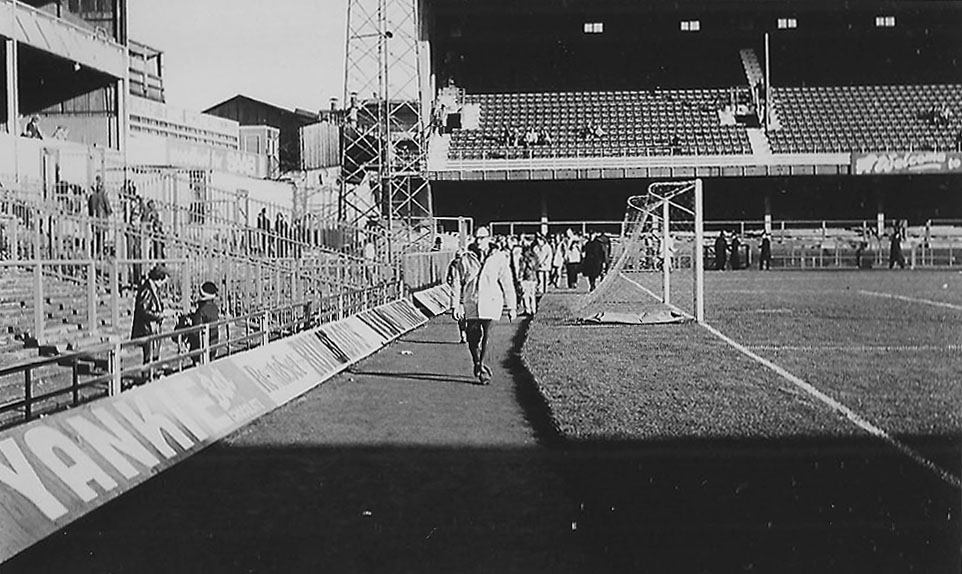
George played in five F.A.Cup ties for County, against Nottingham Forest (1-2), playing as a centre half (No 5), Derby Midland (2-1), Old Brightonians (2-0), and Sheffield Wednesday (2-3). Best of all, he played as a left full back (No 3) in the El Classico of the Victorian era, Notts County 13 Basford Rovers 0. Here is Meadow Lane from the spectators’ point of view, seconds after the end of the game:

1962MeadowLanxxxxxxxxxxxxxxxxxxxxxxx

At the end of the 1888-1889 season George left County for ever, and moved to Forest, where he was to play seven games in the Football Alliance, and a number of friendlies. Interesting results included games against Bootle (2-2), Grimsby Town (0-4), Long Eaton Rangers (3-5). Clapton (0-1), Walsall Town Swifts (0-1) and Everton (0-7).

A fourth Old Nottinghamian to play in County’s first season in the Football League was Harry Jackson, who was born on April 23rd 1864. His father, Charles J.Jackson, managed what the School Register rather grandly listed as a “Piscatorial Dépôt”, (probably a fishmongers, or even a fish and chip shop) and the family lived at 23, Carrington Street. Harry played on five occasions; as an outside left at Stoke (0-3), as a centre forward at Burnley (0-1) and Wolverhampton Wanderers (1-2, 1 goal), an inside left at Bolton Wanderers, (3-7, 1 goal), and an inside right at home to Derby County (3-5).

Here is the Burnley kit;
Capture 3 top - Copy - Copy

And here is the Wolverhampton Wanderers’ strip:

Capture 2 top y - Copy

Here are the Bolton Wanderers’ colours. Very little has changed here:

Capture 2 bottom - Copy (2)

In his career with County, Harry also played in 21 F.A.Cup ties, and scored 19 goals. In other games for County, all of which would have been friendlies, he made 101 appearances, and scored 85 goals. This gave Harry Jackson an overall career total of 104 goals in 122 games for Notts County, both totals and a strike rate which  are only exceeded by those of Harry Cursham himself:

h cursham

A fifth Old Nottinghamian in that same inaugural season of 1888-1889 was Edwin Silvester Wardle. Edwin was born on January 11th 1870 and the family lived at Magdala House in Mapperley Road. He attended the High School from 1881-1883. He made two appearances in the League for County, the first as an outside left (No 11) at Goodison Park, Everton, in the very first match of the season (1-2), County’s début in the Football League. Strangely, he then appeared as an outside right in the very last fixture of the campaign, the 3-5 home defeat to Derby County. Prior to this, he had played in six friendlies, scoring three goals, two against Aston Villa (3-3) and one against Halliwell (1-4). He also appeared in four F.A.Cup ties, scoring one goal against Staveley (3-1).

Another particularly disappointed Old Nottinghamian, the sixth to play in that first season of 1888-1889, must have been John Alfred Brown, who made just one appearance for County, as an outside left (No 11) in a game at Villa Park against Aston Villa. County lost narrowly by nine goals to one, watched by an entranced crowd of some 4,000 spectators.

John Alfred Brown was born on March 20th 1866. Along with his elder brother, he entered the High School on August 10th 1874, at the age of eight, although the date when he left the High School remains unknown. He made his first appearances for County towards the end of the 1883-1884 season, when, after the New Year, he played as an inside left in away friendly games at Walsall Swifts (1-2), and Sheffield Attercliffe (0-2). Overall, he played in 34 friendlies between 1884-1888 and he scored a healthy total of 14 goals. Interesting games and scores in 1884-1885 included his two goals in a 5-0 defeat of Wednesbury Old Athletic, and another goal against Hendon in an 8-2 victory. There were also games against Blackburn Olympic (1-1 and 0-3), Preston North End (1-2), Sheffield Wednesday (1-0), the Sheffield Club (3-0), Blackburn Rovers (0-2), Notts Rangers (2-1) and Derby County (0-2). Here are the Blackburn Olympic colours:

Blackburn_Olympic

For the most part, John was an outside left, although he also played at inside left, and inside right. In 1885-1886, he appeared in home games against Bolton Wanderers (3-3) and Great Lever (1-3), and in away games against Queen’s Park (1-5), the Sheffield Club (6-1) and Wellingborough Grammar School (8-3). He scored a goal at Sheffield, although three of the scorers at Wellingborough remain unknown. Two games were at inside left, with one at outside left, and two at centre forward. The following season of  1886-1887, he played at the Sheffield Club (4-1) and Wolverhampton Wanderers (0-2). He also appeared against Preston North End, a game which County were narrow losers by 0-14. Here is the Preston strip:

Capture 2 top y
John’s most successful season was 1887-1888 with 10 goals in 14 appearances. These included Walsall Town (0-4), West Bromwich Albion (1-5), Nottingham Forest (1-0), Preston North End (2-5), Everton (1-3). He played in home fixtures against Leek (8-1), Aston Villa (8-2), Preston North End (2-3), Grimsby Town (4-0), and Corinthians (1-4). A substantial veil might be drawn over Mitchell St.George’s (0-10).

John scored four times against Leek and Aston Villa, with single goals in each game against Preston North End. All of his games were as an inside left.

By the way, the illustrations of old football kits came from the best ever website for the soccer nerd and all the boys who had more than twenty different Subbuteo teams. New Brighton Tower 1898? Oh, yes.



12 Comments

Filed under Derby County, Football, History, Humour, Nottingham, The High School

The very first football season of them all 1888-1889 (Part 1)

At the moment, the High School has very strong  footballing links, both with the Premier League and the Championship. They come in the person of Patrick Bamford, a young man who would seem to have a sparkling footballing future ahead of him:

He is not the only Old Nottinghamian to have played professional football, however. Well over a century ago, for example, a number of old boys took part in that inaugural season of 1888-1889, playing for Notts County in the newly formed Football League.

The season was totally dominated by Preston North End, “The Invincibles”, who beat County on aggregate by 11-1, for example, and were undefeated at the end of the campaign after 22 matches. They dismissed Wolverhampton Wanderers by an aggregate of 9-2 and Stoke City by 10-0. Notts County were to finish in eleventh place out of twelve. Their record of five victories, two draws and fifteen defeats produced a grand total of 12 points, with two for a win and one for a draw. Stoke City also managed 12 points, but their goal average (not difference in those days) was 0.510 as opposed to County’s much more impressive 0.548. That difference of 38 hundredths of a goal was enough for County to escape the Wooden Spoon! Derby County had 16 points and Burnley had 17 points. All four teams were re-elected to the League for the next season:

league table

One Old Nottinghamian who appeared in the County team that season was Arthur Frederick Shaw, of whom I have been, unfortunately, unable to find any photographs whatsoever on the Internet. Arthur was born on August 11th 1869 in Basford. His father was Alfred Shaw (1842-1907), the famous Nottingham and Sussex cricketer:

AlfredShaw_RedLillywhite1876

Shaw senior played for England, and he actually bowled the very first ball ever in the entire history of Test Cricket, which was to the Australian batsman, Charles Bannerman. During his cricketing career, Alfred Shaw took more than 2,000 wickets for Nottinghamshire and Sussex from 1864-1897, before becoming a first class umpire. He died in 1907 at Gedling, Nottingham, and is buried in the churchyard there, close to the grave of Arthur Shrewsbury, the former Nottinghamshire and England batsman:

This slideshow requires JavaScript.

At the time when their son entered the High School on April 28th 1881, at the age of ten, the Shaw family was living at the Belvoir Inn in Kirkby Street, Nottingham, a street which no longer exists. The date when he left the High School remains unknown.
Arthur Shaw played just two games for Notts County during that inaugural 1888-1889 season. His first game was on December 8th 1888 at home to Aston Villa, which resulted in a 2-4 defeat for the Magpies. A crowd of some 2,000 spectators watched the game, where Shaw played as an inside right (Number 8, except that there were no numbers in League Football until August 25th 1928). At left full back (No3) was Herbert Durrant Snook, a fellow Old Nottinghamian, with George Hutchinson Brown, a third Old Nottinghamian, playing at right half (No 4). I will talk about these two gentlemen in a later article.
Arthur’s second game came on March 5th 1889, when County entertained Bolton Wanderers at Meadow Lane. A crowd of some 3,000 spectators watched the match, where Arthur played on this occasion as an inside left (Number 10). County lost narrowly by four goals to nil.

Arthur went on to play for Notts County on two more occasions in the Football League. These both came in the following season of 1889-1890, when the team finished in a much improved tenth place in the League. On December 14th 1889, he appeared in a game at Meadow Lane against Wolverhampton Wanderers, watched by 3,000 people and ending in a narrow 0-2 home defeat for the Magpies. A week later, they entertained Derby County and beat them by three goals to one, in front of a Meadow Lane crowd of, again, some 3,000 spectators. On both occasions, Arthur was playing as an outside right, and, again, had there been numbers on the players’ shirts at this time, he would have worn a No 7.

Arthur appeared a number of times for Nottingham Forest, both before and after his appearances for Notts County. At the age of barely eighteen, therefore, well before Forest were a League club, Arthur made his début for them in the 1887-1888 season, scoring the only goal in a 1-1 home draw against Burslem Port Vale. His other game for Forest was a 3-2 home win against Bolton Wanderers, when Shaw scored what turned out to be the winning goal.

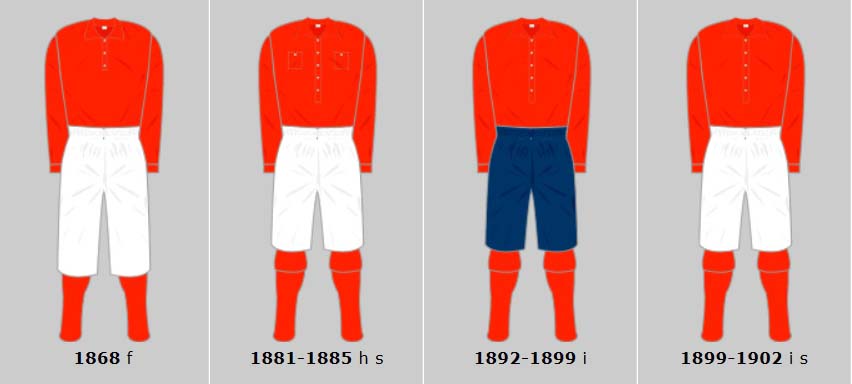
During the following season of 1888-1889, Arthur made four appearances for Forest and scored two goals. He played at home against Preston North End (0-2), Newton Heath (2-2, one scorer unknown), and Clapton (3-2, two goals). He played in away games at Newton Heath (1-3), a team who were later to become Manchester United. All of these games were friendlies. Here are some Forest strips from this long ago era. Things have not changed a great deal:

forest 1868 zzzzzz

In the 1889-1890 season, Arthur made eleven appearances for Forest and scored six goals. He played a number of games in the Football Alliance against Long Eaton Rangers, Sunderland Albion, Darwen, Newton Heath and Small Heath (later Birmingham City). The result in this last game, a 0-12 loss, remains Nottingham Forest’s record defeat. Arthur also appeared in the 0-3 away defeat at Derby Midland in the First Round of the F.A.Cup.

Perhaps the most unusual moment in Arthur Shaw’s whole football career came in this 1889-1890 season when he played for both Nottingham Forest and Notts County. He appeared in the Football Alliance for Forest against Sunderland Albion, (3-1) and then, as we have already seen, for County in the Football League against Wolverhampton Wanderers (0-2) and Derby County (2-3). Shaw capped it all on Boxing Day, December 26th 1889, when he turned out for Forest against County in a 1-1 draw in a friendly at Meadow Lane. I presume that this swapping of allegiances was possible because County played in the Football League and Forest played in the Football Alliance. There would have been no connection between the two organisations.

In the 1890-1891 season, playing for Forest as an outside left (No 11), Arthur appeared in the First Round of the F.A.Cup against Clapton. He scored one goal at the wonderfully named Spotted Dog Grounds as Forest won narrowly by 14-0, still the record away score for the F.A.Cup, and indeed, the record away win in any competition. Clapton had only trailed 0-5 at halftime before conceding nine quick goals in the second half. Arthur’s fellow Old Nottinghamian, the “ageing Tinsley Lindley” was also playing:

Tinsley_Lindley

“There’s only one Tinsley Lindley” scored a mere four goals in this one sided game, where five goals came from the Scottish international Sandy Higgins. A third Old Nottinghamian was playing for Forest in the person of John Edward Leighton, called “Ted” or “Teddy” at the High School and later in his life, “Kipper”, for his ability to fall calmly asleep in the dressing room before big matches. He played quite a few of those over the years, but his greatest honour came on March 13th 1886, when he won his only international cap for England, as an outside left in a 6-1 victory over Ireland in Belfast. Teddy Leighton was making his England début in the same team as fellow High School Old Boy, and Nottingham Forest player, Tinsley Lindley, mentioned above. This was one of no fewer than four occasions on which two ex-pupils of the High School have played together for their country. On other occasions, Leighton and Lindley had also played together for the fabled “Corinthians” club.

Overall, Arthur Shaw was to score a grand total of 11 goals in 79 appearances for Nottingham Forest. After he left Forest he went on to score three goals in 11 appearances for Loughborough, who, at the time, were playing in the Football League, Second Division. He would have worn these long forgotten colours:

Loughborough_Town_1895-1900

Arthur’s final appearance of any kind for Nottingham Forest came when he played as a right half in the semi-final of the Bass Charity Cup. The game was away from home, against Leicester Fosse, and took place on April 6th 1899. It finished in a 1-1 draw, and was watched by approximately 1,000 spectators.

Arthur’s final appearance for Nottingham Forest in the Football League had already come in a 0-5 defeat in an away game against Derby County. This fixture took place at the Baseball Ground on April 11th 1898, and the legendary Steve Bloomer scored a hat trick, before a crowd of some 12,000 spectators:

bloomer xxxxxxxx

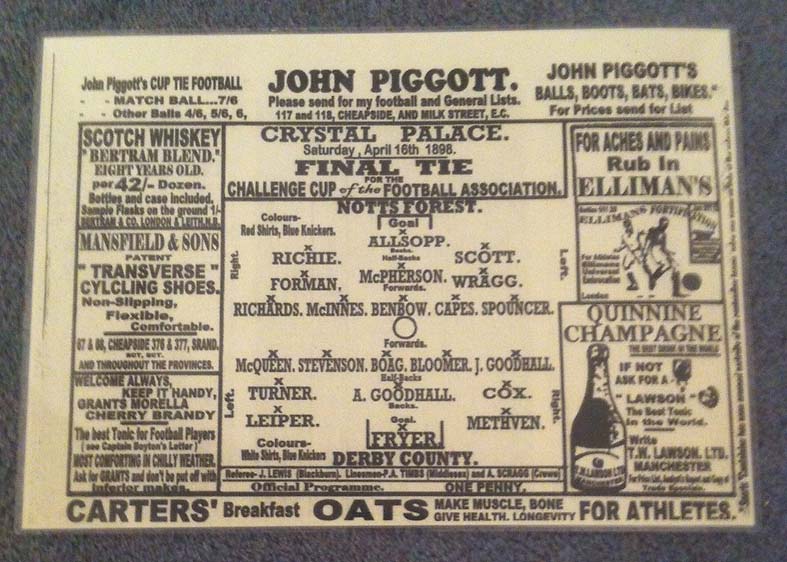
Only five days later, the same two teams were to contest the F.A.Cup Final at Crystal Palace before a crowd of 62,017, Forest triumphing on this occasion by 3-1. Unfortunately, Shaw did not make the team for the final, his position of right half being filled by Frank Forman. This is the closest, however, that any Old Nottinghamian has come to winning an F.A.Cup winner’s medal but only if you don’t count the School Gardener,

programme

By the way, the illustrations of old football kits came from the best ever website for the soccer nerd and all the boys who had more than twenty different Subbuteo teams. New Brighton Tower 1898? Oh, yes.


5 Comments

Filed under Football, History, Nottingham, The High School