Category Archives: Humour

The Birdwatchers of Victorian Nottinghamshire

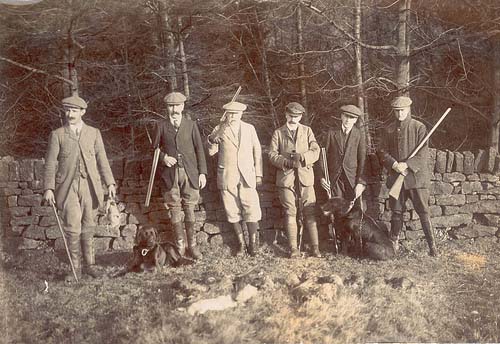
In the Victorian era there were hardly any birdwatchers in Nottinghamshire. Most ordinary people seem to have been too busy just living their lives to have a hobby such as watching birds. Among the richer individuals such as the landed gentry and the nobility, their particular interest was not watching but shooting birds:

another shoot

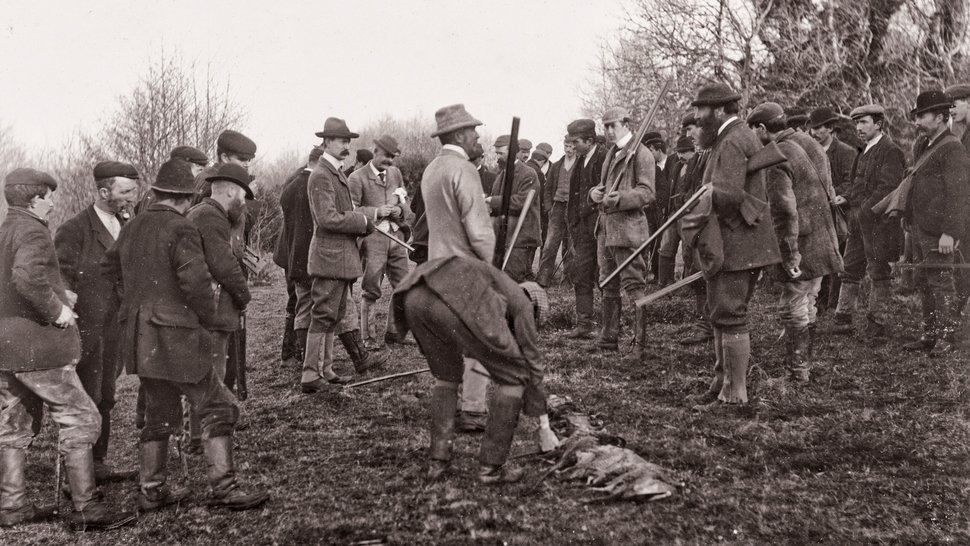
Even so, the very fact that they enjoyed shooting birds would actually have led them to develop some identification skills, however rudimentary, if only to avoid shooting a species which was out of season, or the same species over and over again:

shooting

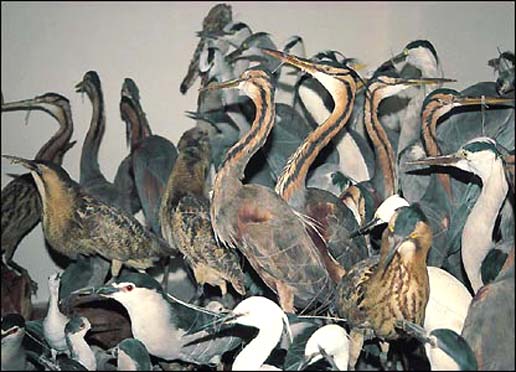
At this time, there was great interest in having a large collection of stuffed birds or animals. Here again, identification skills would have been important:

_42866547_stuffed_416

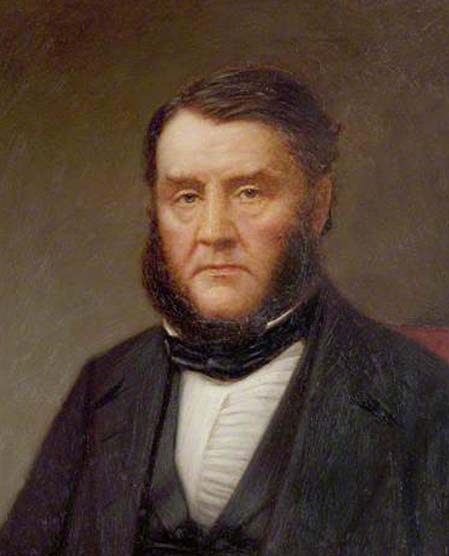
The earliest actual birdwatcher in Nottinghamshire seems to have been a man called William Felkin junior who lived in Nottingham from at least 1845-1870. Like his father, he was a lace manufacturer, but he became a Fellow of the Zoological Society and possessed a collection of stuffed birds of some 313 species. In 1866 he wrote the first ever book about birds in the county, entitled “The Ornithology of Nottinghamshire”. It was incorporated in Allen’s “Hand-book to Nottingham” published in the same year. This, I believe, is William Felkin senior. Hopefully. he looked a lot like his son:

felkin senior zzzzzzz

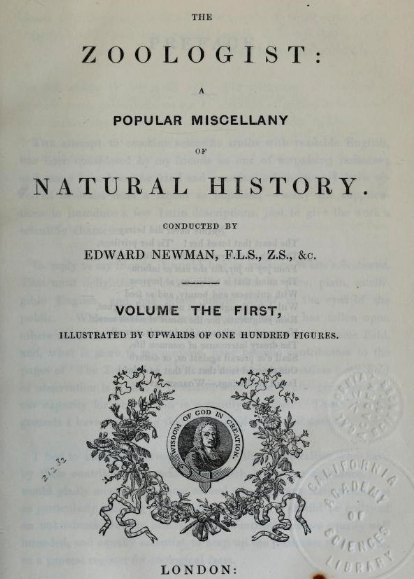
A contemporary of Felkin was William Foottit of Newark-on-Trent (fl 1840-1860). He was the local Coroner and ordinary people from miles around would bring unusual birds to him. Foottit was a frequent contributor to “The Zoologist” magazine:

Untitled

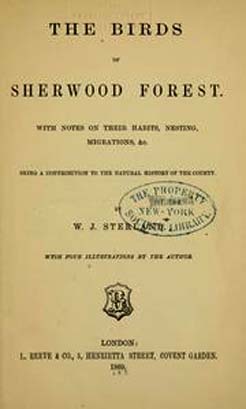
In 1869, clearly an outdoorsman of some competence, William Sterland of Ollerton wrote the marvellously entertaining “Birds of Sherwood Forest”:

sterland book

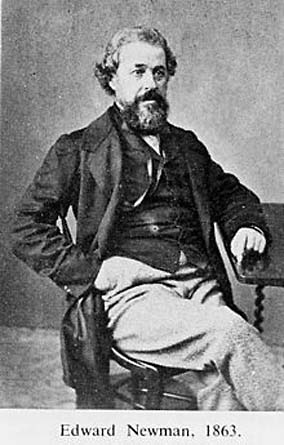
This book contained many anecdotes, and a number of records of rare birds. Sterland was the relatively uneducated son of a “grocer/ ironmonger/ tallow chandler/ dealer in sundries”, and, when the great man deigned to review it, his book was slated by Edward Newman, owner of “The Zoologist” magazine :

220px-EdwardNewman

This was possibly because Sterland was a frequent contributor  to “The Field” magazine, a fierce rival of “The Zoologist”:

p_1-the-field-top-banner

It is more likely, though, that this was a slightly more complex issue. Newman had himself left school at sixteen to go into his father’s business.  Now he mixed with some of the most prominent scientists and zoologists in the land. I suspect that if Newman’s well healed and well connected upper class friends found out that William Sterland still worked in his Dad’s village grocer’s shop, they might well have been strongly reminded of the humble origins of Newman himself.

Unabashed, though, in 1879, William Sterland produced “The Descriptive List of the Birds of Nottinghamshire”. Needless to say, Edward Newman still had quite a few buckets of bile left to throw, but all the local newspapers in the Nottingham area really liked the book.

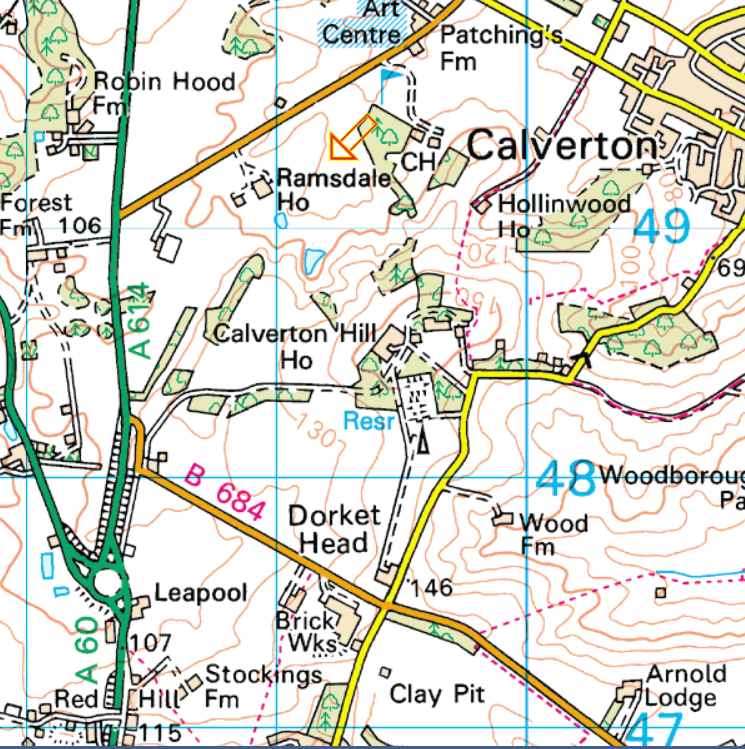
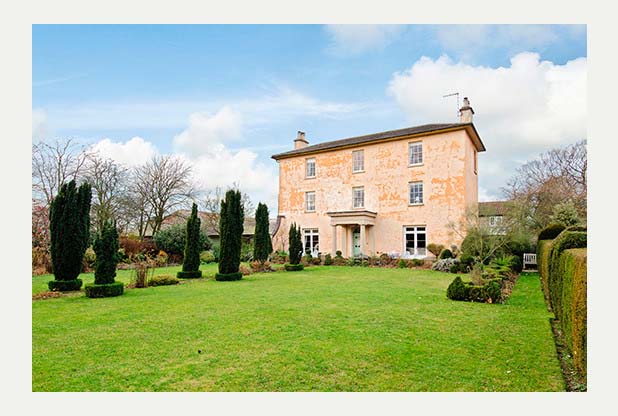
Sterland’s collaborator in this venture was a young man called Joseph Whitaker, now universally acknowledged as “The Father of Nottinghamshire Ornithology”.  Whitaker (1850-1932), the son of a farmer, was born at Ramsdale House, nowadays a golf centre and wedding venue to the north of Nottingham. Look for the orange arrow:

ramsdale map

Recently this beautiful building received a great deal of publicity as the erstwhile residence of the most infamous dentist in the history of the National Health Service:

ramsdale zzzzz

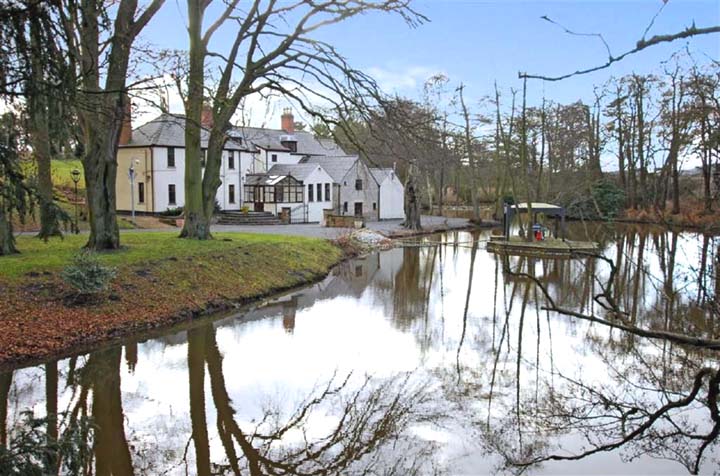
In later life Whitaker moved to Rainworth Lodge, a large country house with a lake, slightly further north in the county. Look for the orange arrow:

rain ladge

Here, he was known to one and all as the man to contact about birds in Nottinghamshire, whether it be a member of the nobility or a simple farm labourer who had found an unusual bird dead in the road as he walked to work:

rainworth zzzzzzz

Whitaker would travel around Nottinghamshire by horse and trap to see various interesting species of birds, or to talk to people who had seen, and/or shot, unusual birds on their estate.

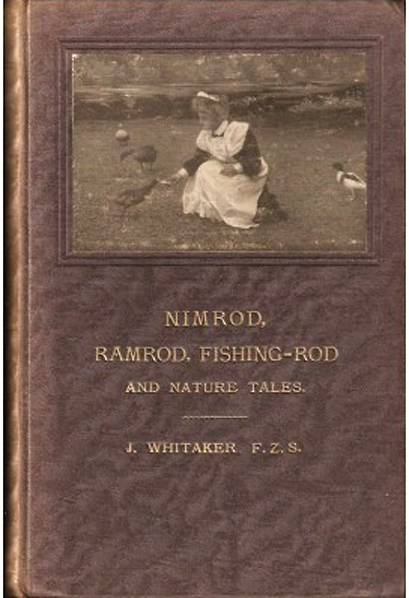
Whitaker wrote a number of books about nature, including “Scribblings of a Hedgerow Naturalist” and “Jottings of a Naturalist: Scraps of Nature and Sport on Land and Sea”. His finest title was most assuredly “Nimrod, Ramrod, Fishing-Rod and Nature Tales”. I believe that the young lady on the front cover of the book is the maid, rather than Whitaker himself:

nimrod

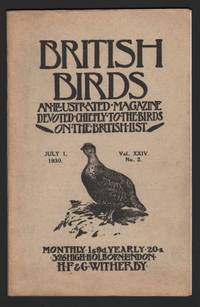
Whitaker was a frequent contributor to “The Zoologist” and in later years to the newly fledged “British Birds” magazine:

british birds

Before the rise of the pager, the mobile phone and the Internet, this publication was the only way to announce the presence of rare birds.

Whitaker also corresponded with his social betters, the Lords and Ladies whose many estates were the origin of the expression “The Dukeries” to describe north Nottinghamshire. There is a large collection of Whitaker‘s letters in the local collection at Mansfield Library. As well as the nobility, Whitaker also exchanged letters with many of the great ornithologists of the Victorian era, the men who wrote textbooks on birds, either in Britain, or in Europe as a whole. Joseph Whitaker’s greatest triumph, though, was a book entitled “The Birds of Nottinghamshire”,  which he had printed privately in 1907. It contains information about every single species of bird which the author knew to have occurred in the county. In Mansfield Library, we still have Whitaker’s own copy of this book, to which he has had a professional bookbinder add extra pages. In this way, the great man could cut out interesting stories from newspapers or magazines and then just paste them in.  Alternatively, he could simply handwrite in any interesting items of bird news which he had gleaned. Unfortunately, I have been able to trace only four photos of Joseph Whitaker, none of them as a young man. In all of them, he has a reassuringly large walrus moustache:

This slideshow requires JavaScript.

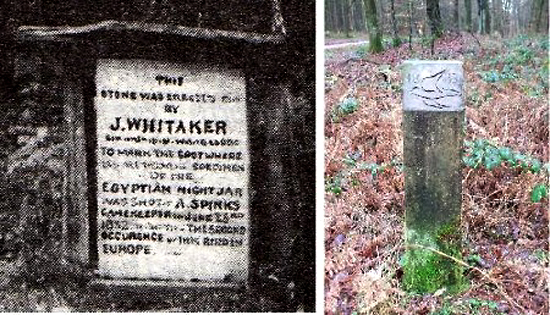
Whitaker’s greatest claim to fame was the Egyptian Nightjar which was shot in 1883 in Thieves Wood near Mansfield by a gamekeeper called Albert Spinks. At the time this poor lost individual (the bird, not the gamekeeper) was the first known sighting in England, and just the second in Europe. Even now, a hundred and thirty years later, only one more has been seen in this country. Whitaker erected a stone to commemorate the event but it was smashed to smithereens in the 1980s (to celebrate its centenary, presumably) and replaced by a wonderful modern sculpture costing well in excess  of £8.50:

original mem

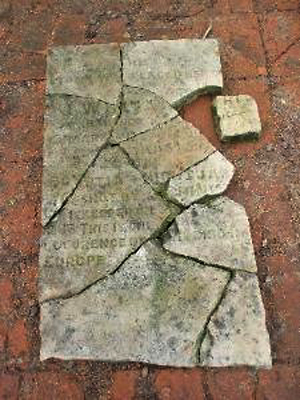
The pieces of the original stone were recently found and reassembled, although one little bit does seem to be somewhat of an enigma:

bits of stone

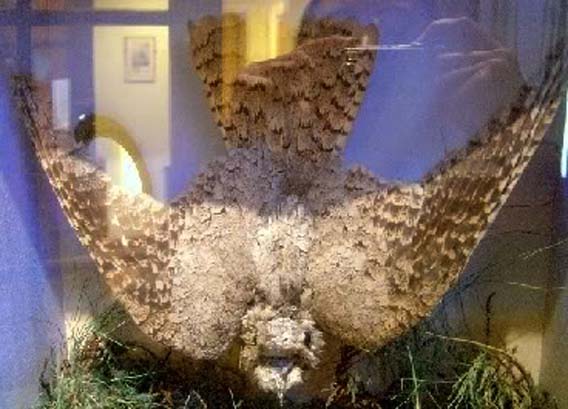
The bird itself was stuffed and, as an item of immense prestige, it went into Whitaker’s enormous collection. After his death, it eventually finished up in the foyer of Mansfield Library, safe behind highly reflective glass.

nightjar2

I thought it might be quite interesting to bring to a wider audience some of the birdwatching anecdotes which Whitaker mentions, both in his original book, and in the very many additions which he made to it. In future blog posts, therefore, I will bring you the true story of the famous Egyptian Nightjar and any number of other notable birds.

One final point is that the Nottinghamshire of the Victorian era was a very different place to the Nottinghamshire of today. The current Nottingham ring-road was just a muddy footpath alongside the Daybrook. Had our own suburban house existed then, there would have been no other private houses in sight in any direction. Just Bagthorpe Prison, Bagthorpe Hospital and the City Workhouse. It is amazing just how few people must have been alive in the county at that time.

A second final point is that many of these early ornithologists would not have had optical aids of any great standard, whether binoculars or telescopes. They may have had nothing beyond the Mark One Eyeball. In addition, they may have had no access to identification books, where they could carefully check what they had seen. This is why, if the presence of a rare bird was to be proven beyond doubt, it had to be shot. That is the origin of that grand old saying, “What’s hit is history, what’s missed is mystery”.

13 Comments

Filed under History, Humour, Nottingham, Wildlife and Nature

School Sports Day, 2.30 pm, Wednesday, April 5th 1930

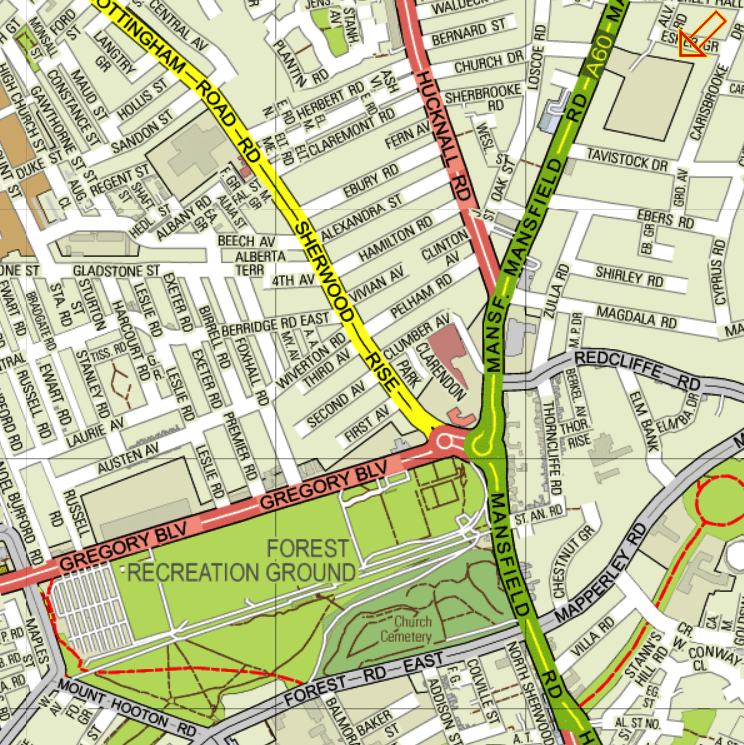
On Wednesday, April 22nd 2015 at 1.00pm, yet another High School Sports Day will begin. A couple of years ago, I was fortunate enough to purchase, in an online auction, the aging programme which was sold (not given away, as they are now) to spectators who turned up at the School Ground in Mapperley at 2.30 pm on Wednesday, April 5th 1930. The programme was priced at 3d, which is around 2p in decimal money. We have already seen the long walk along Mansfield Road to the sports ground. Look for the orange arrow. The High School is in the bottom left corner of the map, near the meeting point of Mount Hooton Road and Forest Road East. The school is the incomplete beige rectangle which is outlined in black:

Untitled 2

I found it extremely difficult to scan this aging document. I have therefore divided it into a long series of smaller scans where, hopefully, all of the print will be large enough to be legible. An unknown parent has gone through each event and added the order of the finishers, and, in some cases, the performance they achieved. I taught at the High School for almost forty years, and how familiar are some of the boys’ names! I suspect that they may have been the grandfathers, or even great grandfathers of some of my own erstwhile pupils.
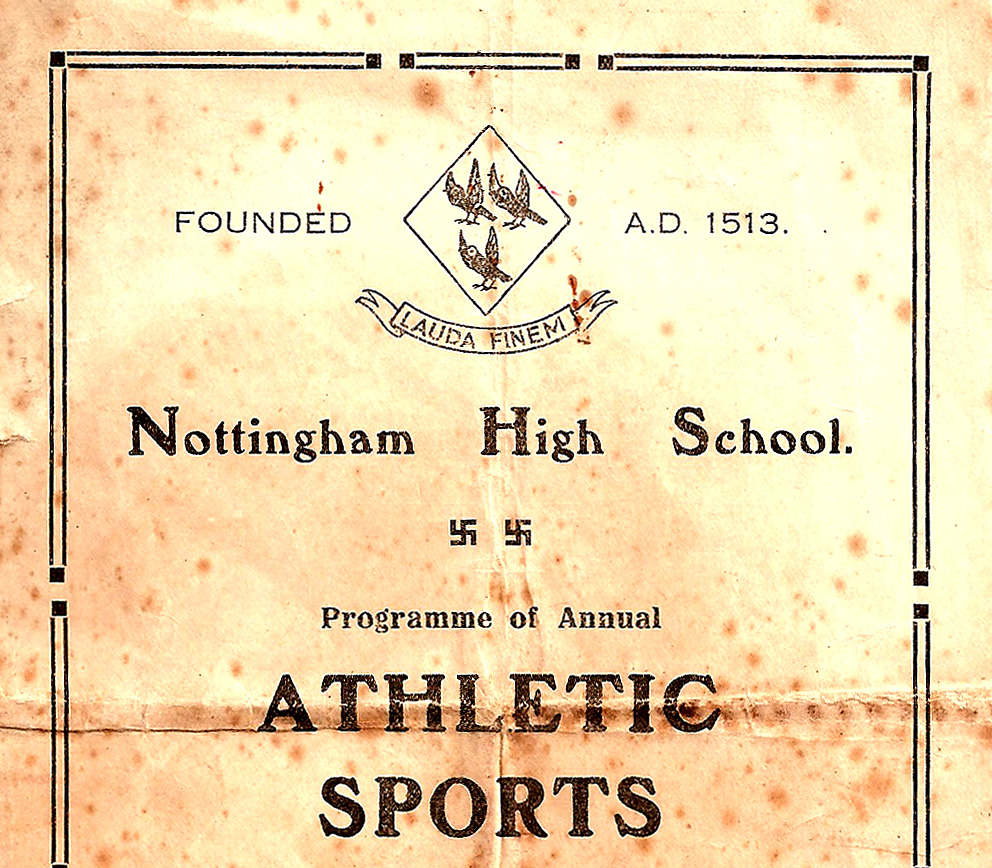
Here is the top of the front cover. The school badge is the same as nowadays, and so is the Latin motto. What I do not understand, though, is the presence of two swastikas. And they are proper swastikas, right-facing ones and not Hindu good luck symbols or badges taken from the horse bridles of the Lakota Sioux. And I don’t know why they are there. Perhaps the event had a secret sponsor:

cover top half

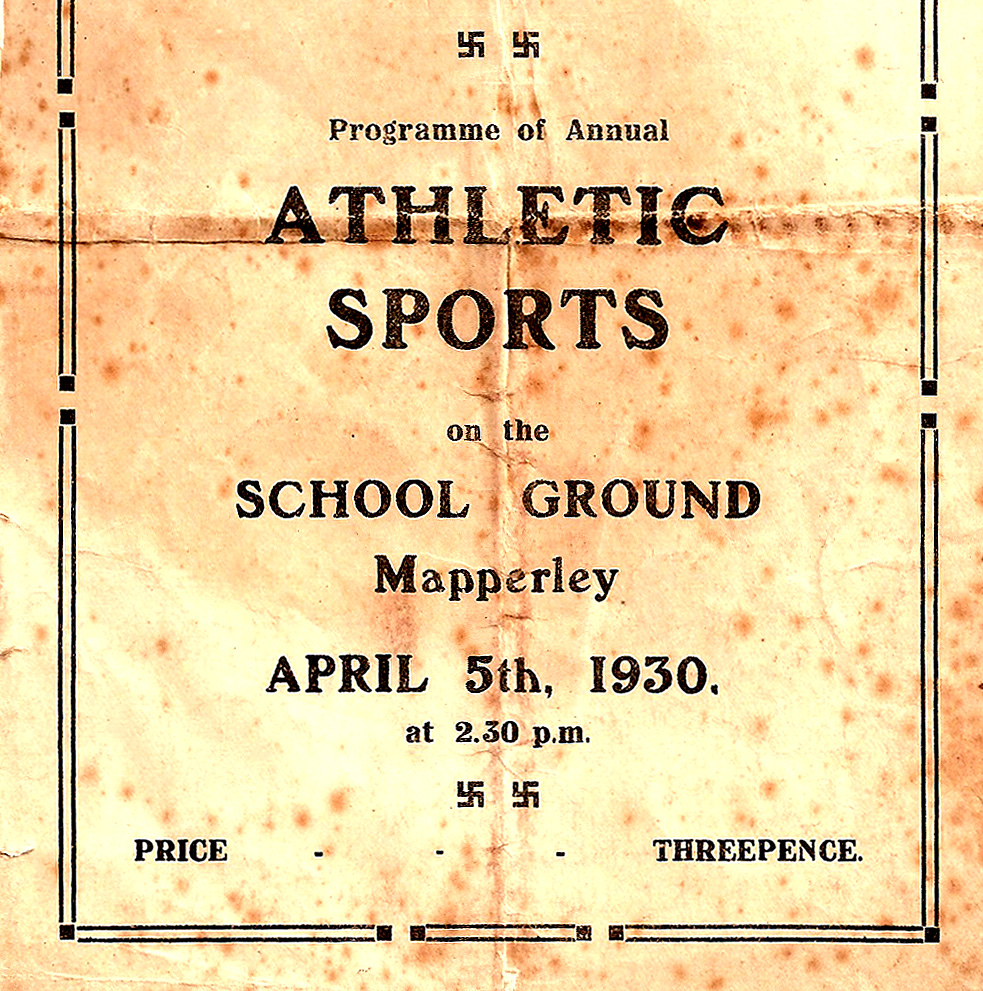
This is the bottom of the front cover. Three pence from so many different spectators must have been a nice little earner:

cover bottom  half
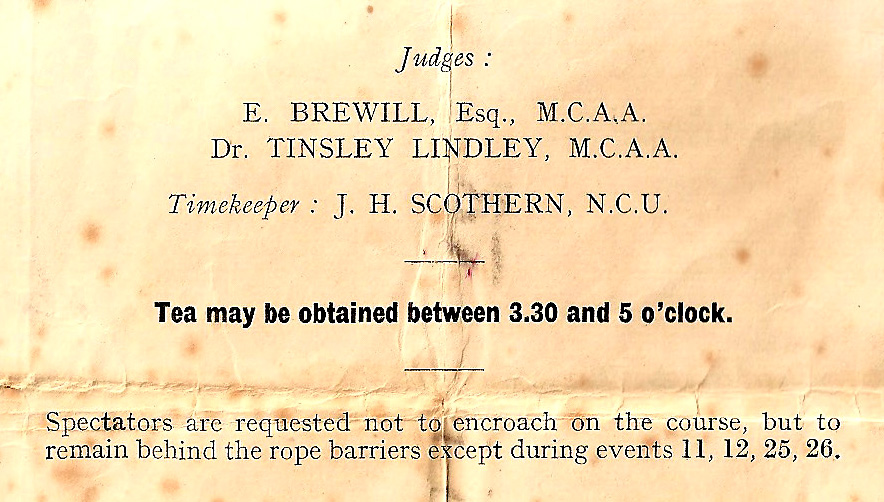
Here is the second page, with the  names of the two track judges. Nowadays there are twelve of them. but in 1930 things were a lot more sedate. The Brewills were a family with at least two famous athletes (G.F. and G.W.) who, in the latter years of the Victorian era, had both achieved a number of triumphs at national level in both sprinting and hurdling . A.S.Brewill had been the commander of the 7th Sherwood Foresters throughout most of the Great War. Almost thirty years previously, on the afternoon of Saturday, July 25th 1903, our current track judge, E.Brewill, had participated in the School Sports held at the same venue. Along with G.F.Brewill, he had been a member of “The Past” (Old Boys) tug of war team against “The Present” (Masters and Boys). The latter were a team of  three boys, namely R.Marrs, W.Oldershaw and H.A.Watson, and three masters, Messrs Hughes, Jones and Yates. The Old Boys soon pulled the School over the line, but were found to have included a seventh member of the team, J.Johnstone. (Cheats!!!) The result was overturned, and the School soon won a fair contest by 3-0. (Hurrah!)
Tinsley Lindley was a very famous figure in High School history and in the history of Nottingham itself. He will perhaps warrant his own blog post one day:

intro page 1

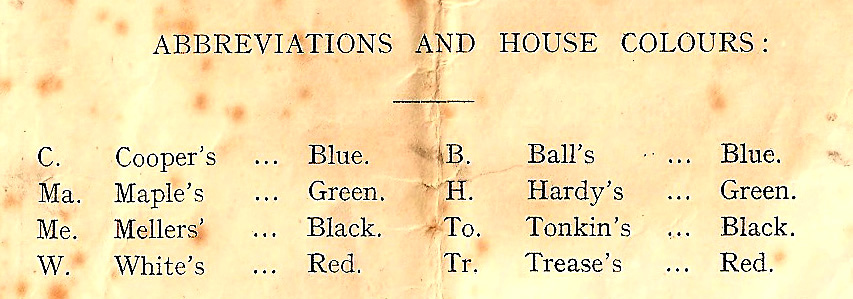
I have been unable to find any background information about J.H.Scothern, although there was a “Scothern” who played amateur football internationals for England before the Great War. As a frequent team mate of the High School’s Olympic Gold Medal winner, Frederick Chapman, both for Oxford City and for England, he would certainly have known him, and probably Tinsley Lindley as well. This bottom half of the page, with its list of House Colours, attests the presence of boys from both the Main School (the four on the left) and the Preparatory School (the four on the right):

intro 2

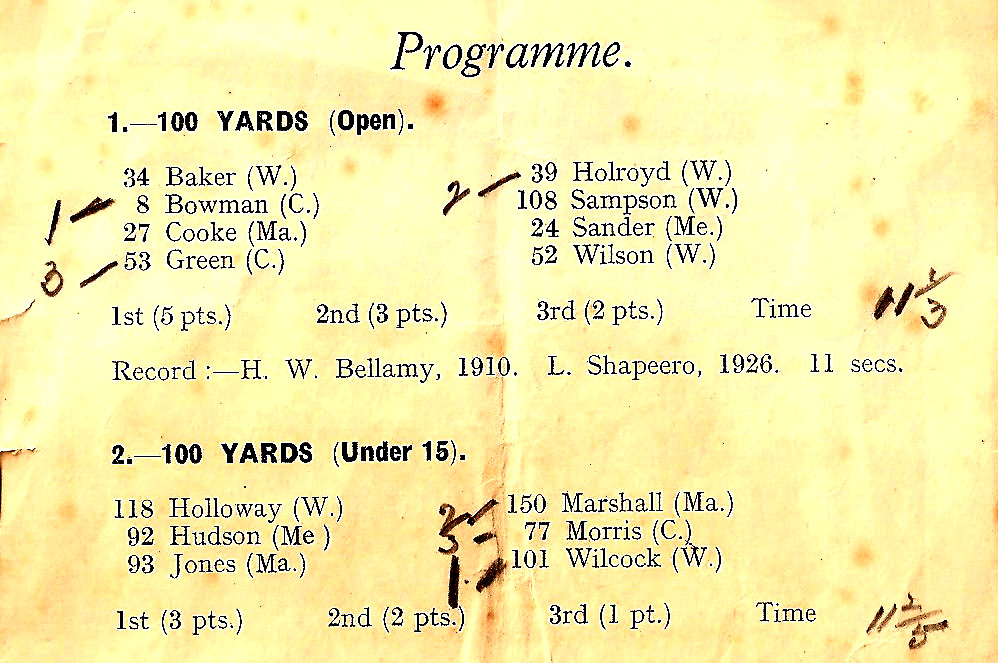
Here are the first two events, with winners and times, the latter expressed as fractions (much more of a challenge than those silly decimals):

1 & 2

H.W.Bellamy was a misprint. It should be H.W.Ballamy. Even here, more than ten years later, the Great War’s foul tentacles stretch out. Harold Ballamy came from a poor family. His father was a commercial traveller. Harold won many school prizes such as Silver Medals for Mathematics and Science, and Dr Gow’s Prize for Geometry. He was Captain of Football, Secretary of First Team Cricket, the School Librarian, the Colour Sergeant in the Officer Training Corps and the Captain of the School.
At Cambridge University, he won the Bishop Open Exhibition for Natural Science. He obtained a First Class Degree in Mathematics. He then changed to Natural Sciences, where he was placed first in the whole University of Cambridge. What more ideal choice, what better qualified man, to put in charge of a pile of mud near the village of Passchendaele ? And then he was killed:

ballamy 1234

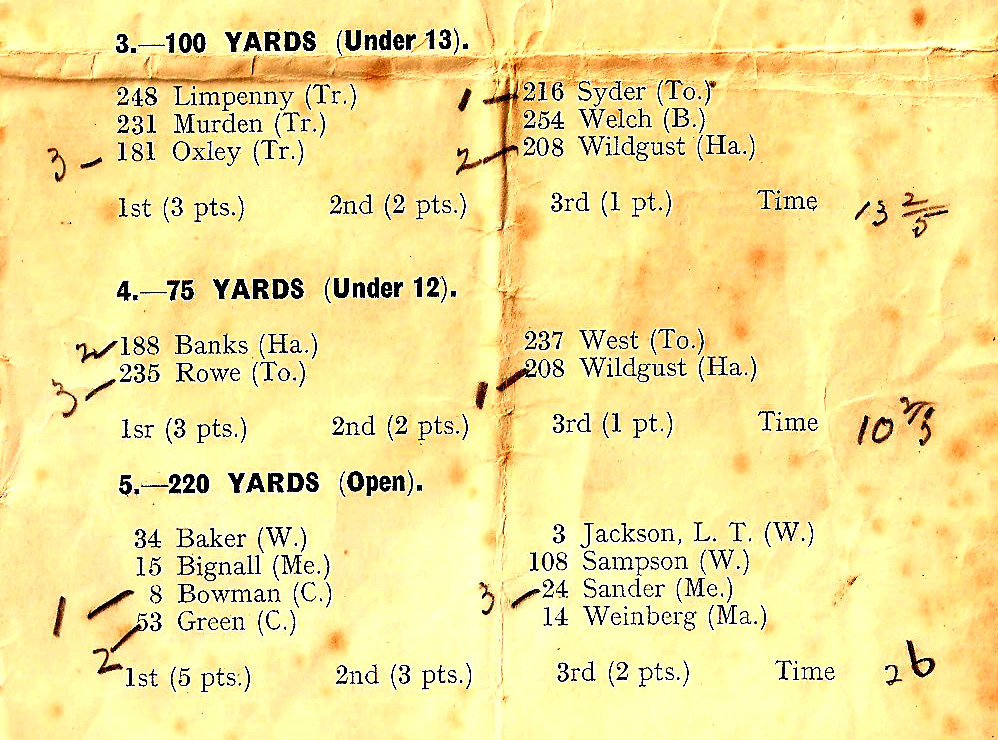
And now, Events 3, 4 and 5. I have taught a Wildgust and a Weinberg:

3, 4 & 5
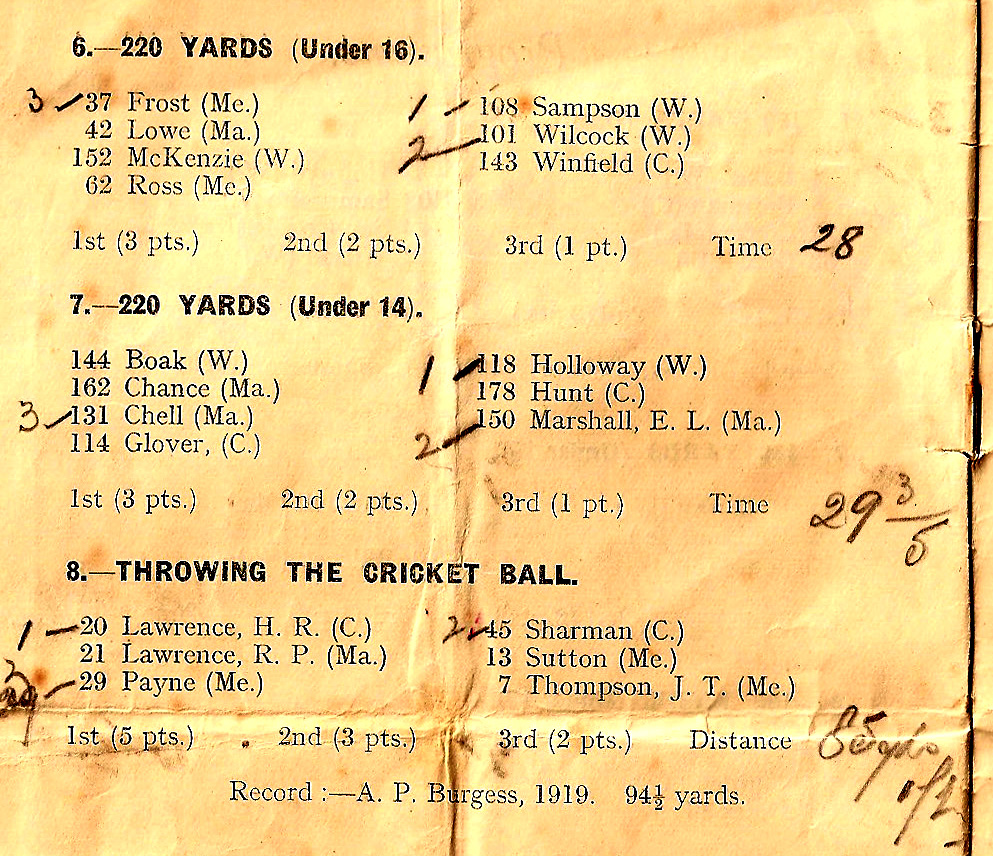
And I have taught a Sharman and a Lawrence. I wonder who the latter was related to. And why don’t they have “Throwing the Cricket Ball” any more? Health and Safety, I wouldn’t wonder:

6, 7, 8,

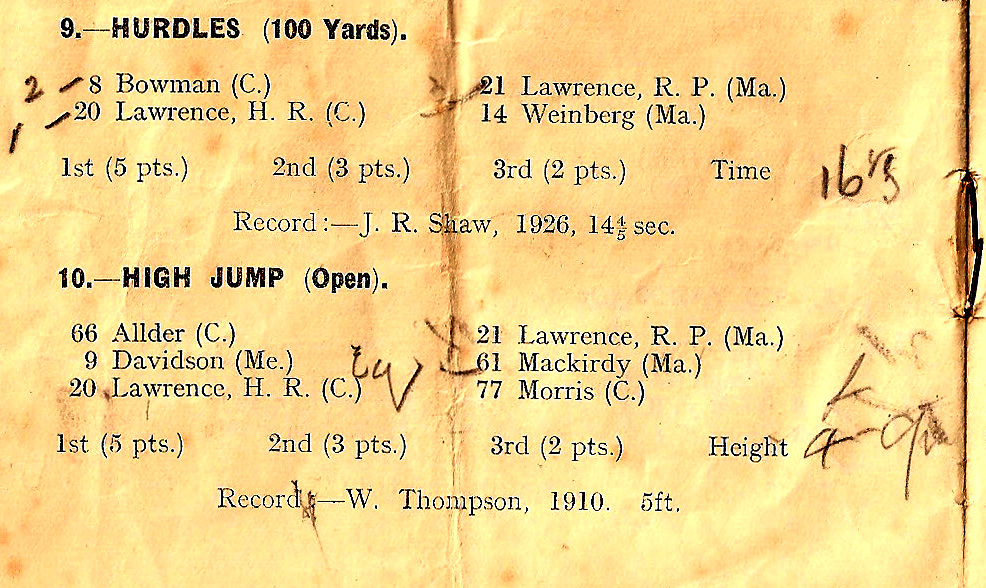
Notice that the High Jump was an Open Event with no age restrictions. I think the pencil mark means that the winners both achieved equal heights:

9 and 10

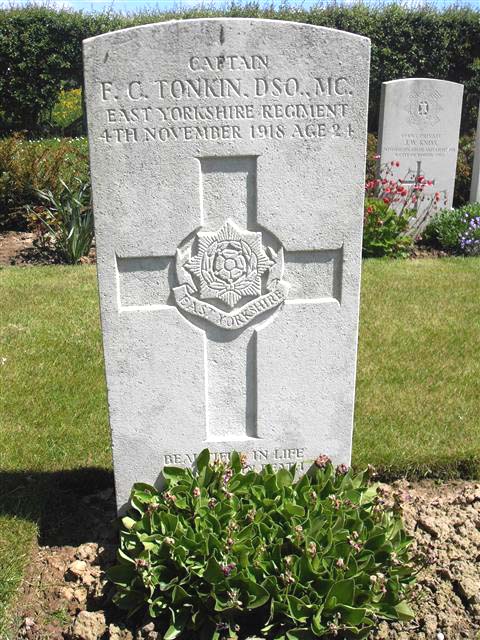
And here are the next events, except that another foul tentacle reaches out and grabs another victim. Captain Frederick Cuthbert Tonkin lived at 13 George Road, West Bridgford. He represented the High School at football, cricket and athletics. He interrupted his Dentistry studies at Guy’s Hospital to enlist and was killed on November 4th 1918, only seven days before the end of the war. He was just 24 years old:

medium

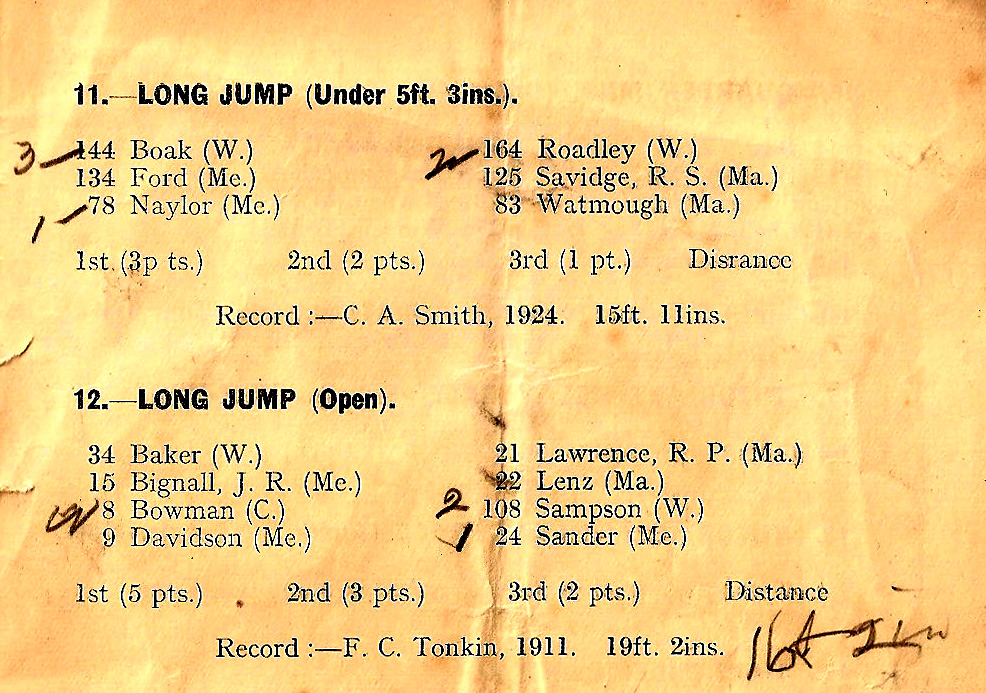
There were two long jumps, sensibly based on height, rather than age:

11 and 12

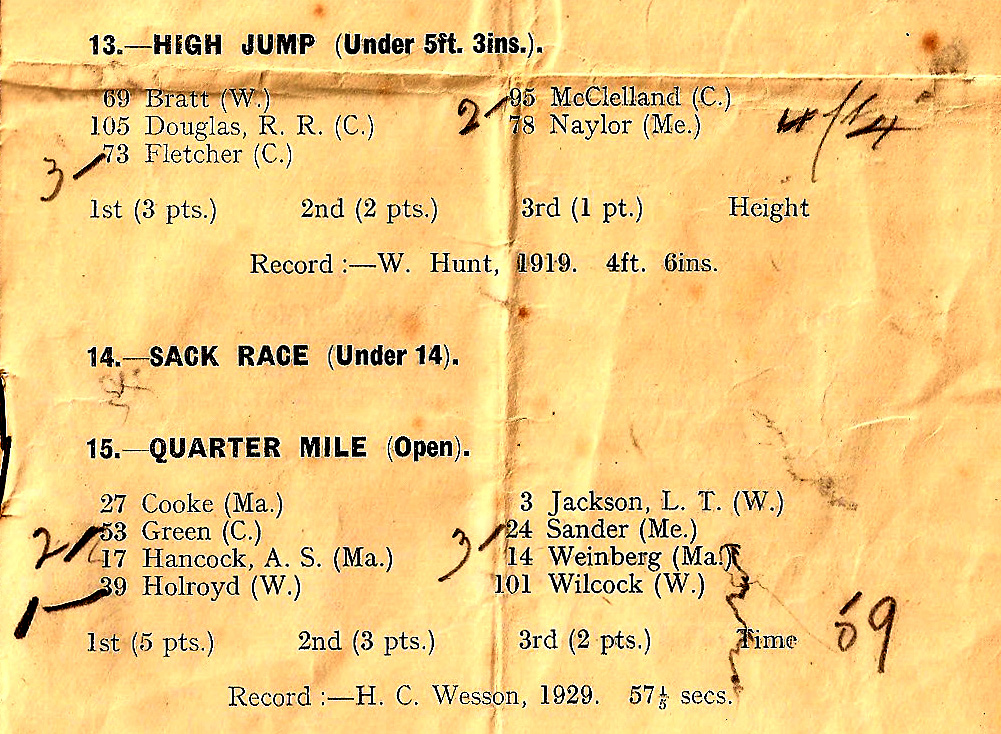
Why don’t they bring back the Sack Race? H.C.Wesson, by the way, had been Captain of the School in 1928:

13, 14 & 15
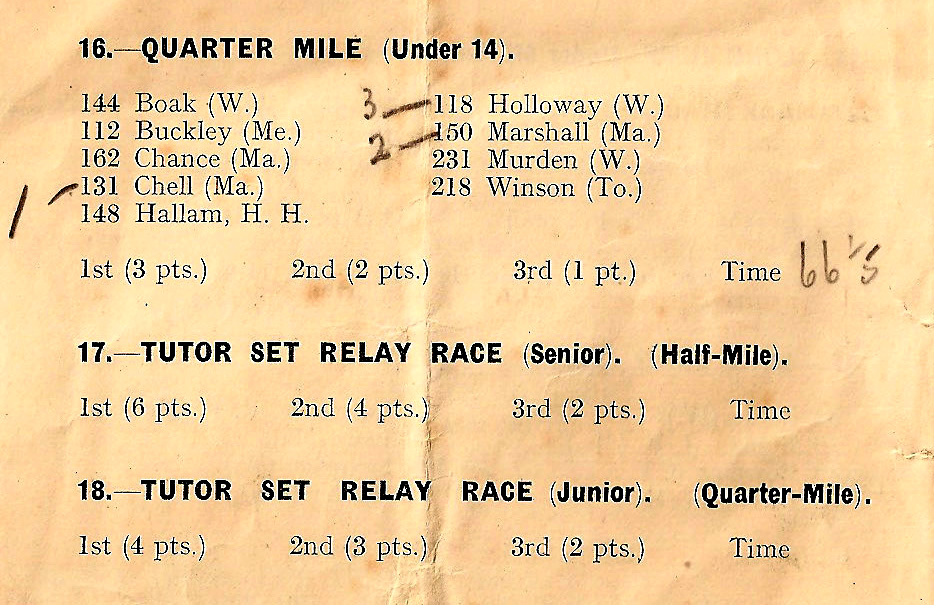
I just don’t know how the Tutor Set relay races worked:

16-18

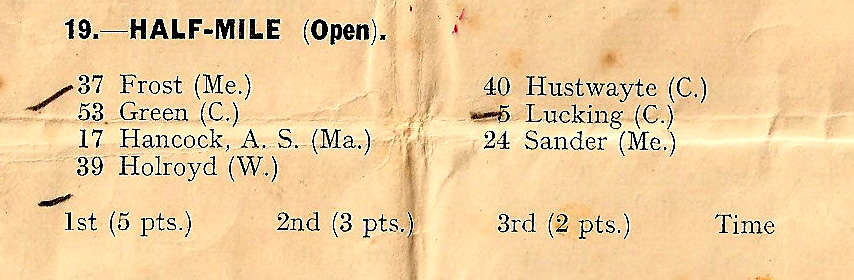
Another Open Event, with no age restrictions:

19

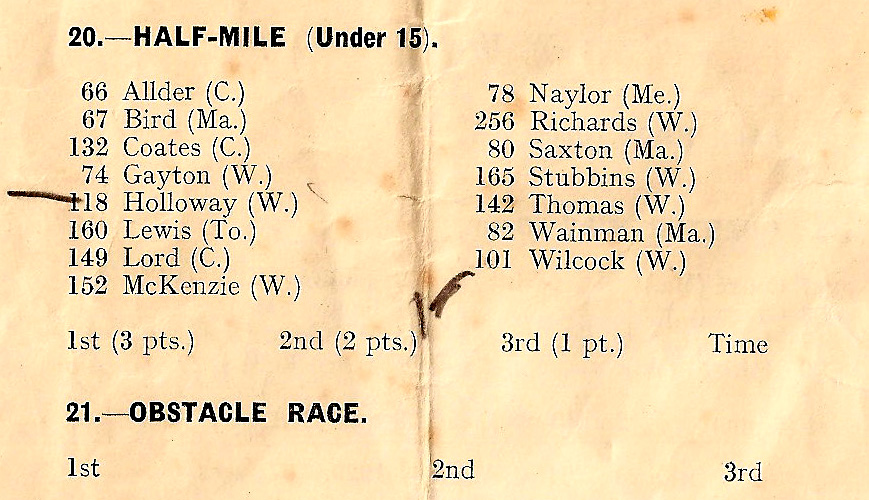
An obstacle race. Much more fun than boring old athletics!

20  21

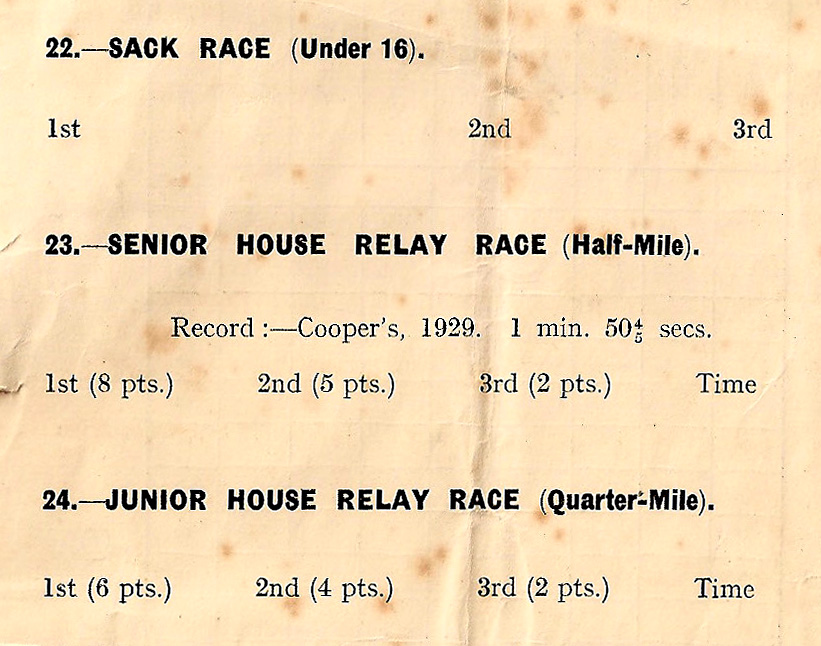
And another Sack Race. You can’t have enough of them, I say. Have you noticed how the parent has gradually began to lose interest. Fewer pencil marks. Fewer performance times.

22-24

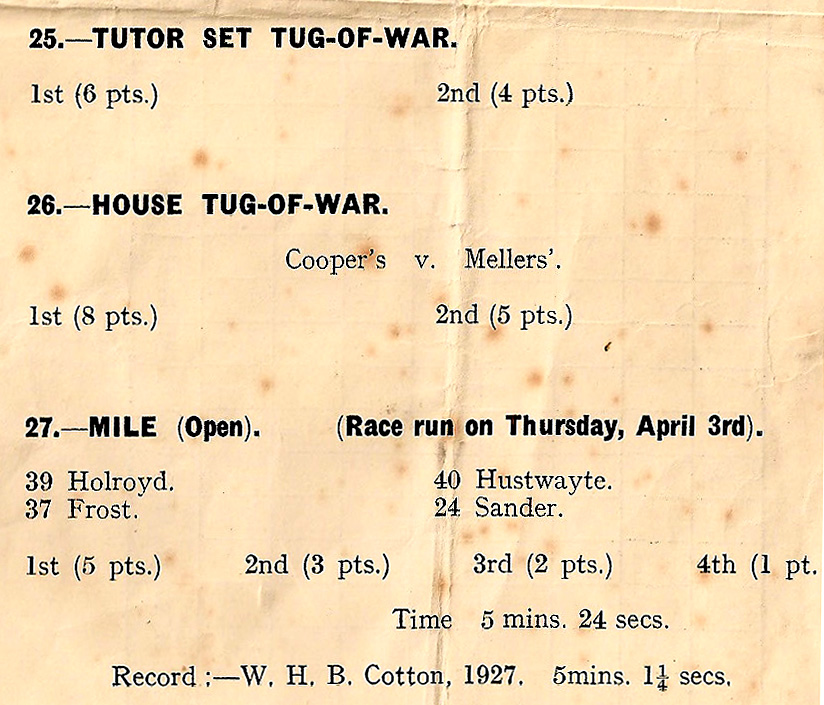
Two more tug of wars. Or should that be tugs of war? Or just tugs? Sounds like fun for everybody, though. W.H.B.Cotton was a hero, a genuine hero, as well as a record holding athlete. Spending his holidays in Glamorgan in Wales in 1928, he had managed to rescue two sailors from a ship which was sinking, just offshore from Porthcawl:

25-27

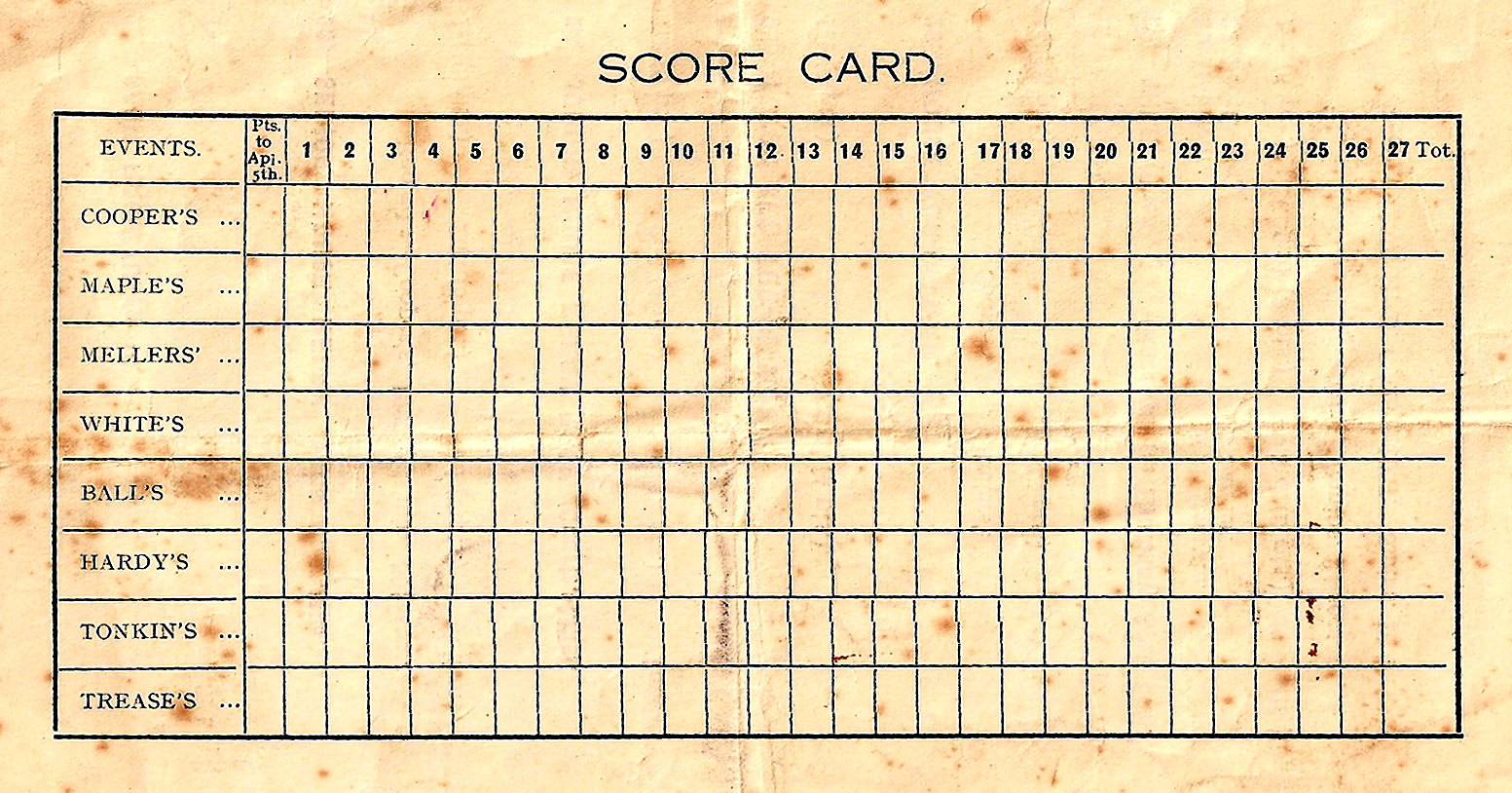
The back of the programme is a grid where all the keen and interested parents can keep the inter-house score, event by thrilling event:

scan seven

And that’s it! The Annual Athletic Sports were over for another year. And, indeed, the days of holding them at Mapperley were over for ever. The Valley Road Playing Fields had been purchased for £5.600 in 1929. The ground had been levelled, the marsh had been drained and they were ready for athletic action by Thursday, April 30th and Saturday, May 2nd 1931. But that, as they say, is another story.

4 Comments

Filed under History, Humour, Nottingham, The High School

Staff v Prefects Football Match Christmas 1980 (3)

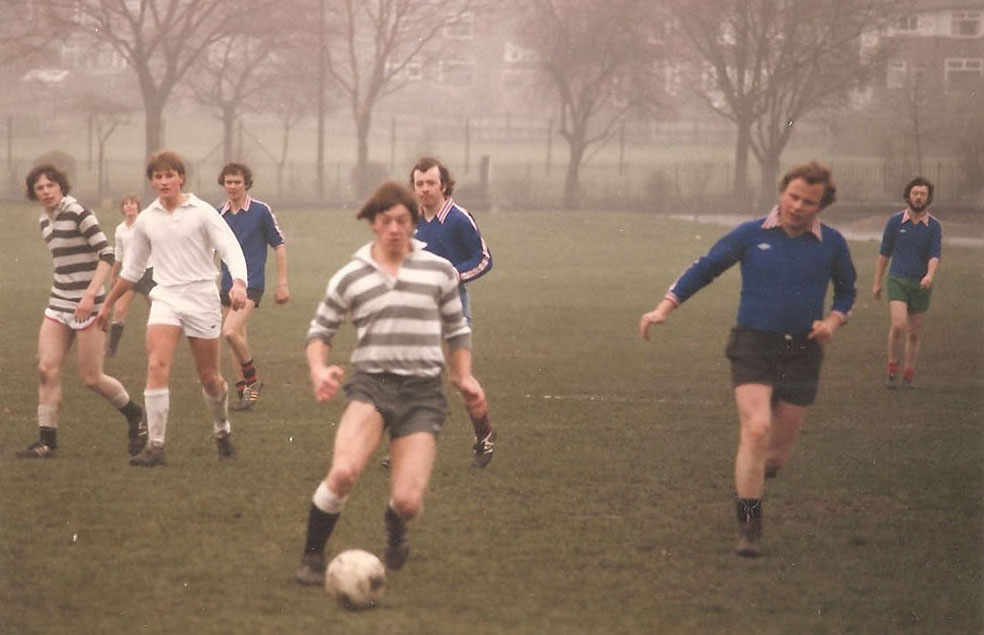
These are the last four of the ten photographs I found recently of the Teachers v School Prefects football match.  This keenly fought fixture took place probably just before Christmas in 1980, give or take a year either way. My beautiful new wife was watching the game, armed with my camera, if I remember correctly.
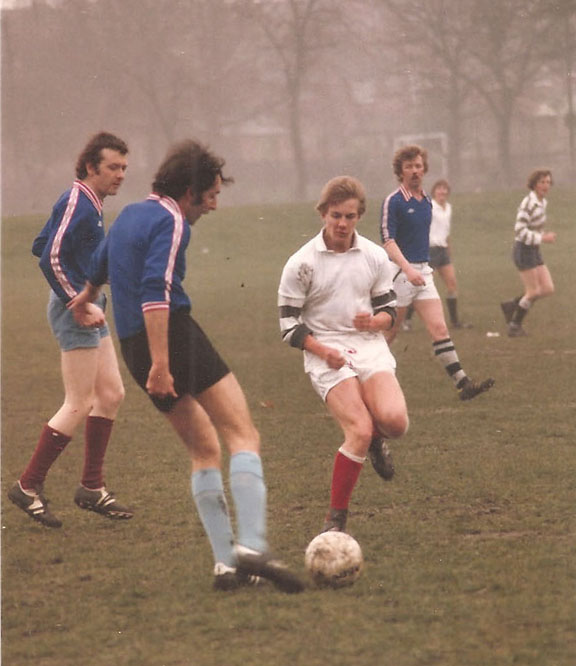
This first photograph shows myself and Ron Gilbert, the ex-Chemistry teacher who retired recently. We look as if we are holding a quick debate about who is going to chase after the ball:

PHOTO A

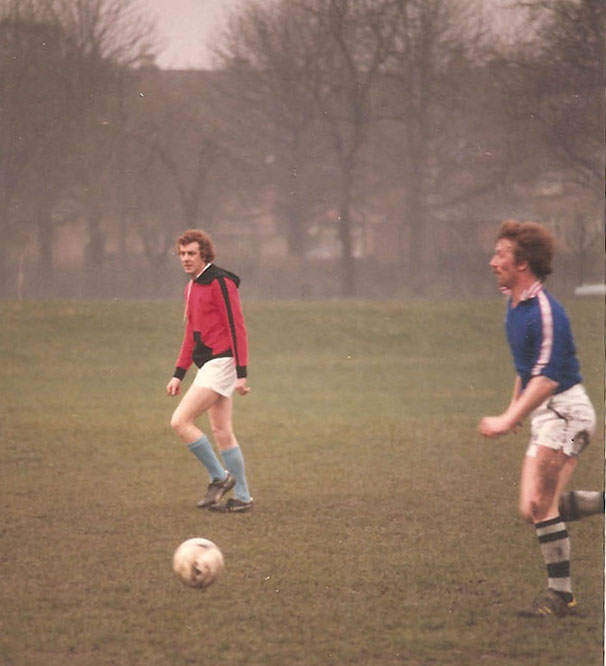
The second photograph shows the then Head of Music, Stephen Fairlie, and the red shirted referee, Richard Willan. Red Fourteen is a Prefect playing in a staff shirt to make up the numbers. Incidentally, the staff are playing in the shirts normally worn by the school Second Eleven Football Team. These, in their turn, were, for reasons that must surely remain unknown now for ever, the second, change, strip of Sunderland A.F.C.

PHOTO B

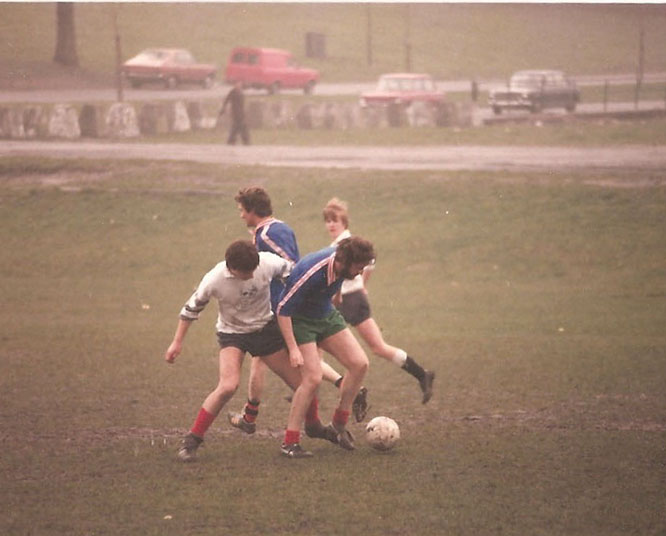
The third photograph shows three members of staff. Number Three on the right with his back to the camera is Paul Morris, the now retired Physics teacher. I myself am Number Two in the middle and Number One is Andrew Ayres, a native of Hartlepool if I remember correctly, a young teacher of Chemistry and a colleague of Ron Gilbert. Andrew moved on to Wisbech Grammar School in Cambridgeshire, where he became the senior tutor and examinations officer as well as continuing as a chemistry teacher. He retired in July, 2014. Once again, the Prefects will have to remain nameless:

PHOTO C

The final picture shows Stephen Fairlie, the then Head of Music, as Number One on the left, and Bob Howard, Geography teacher and Best Man at our wedding, as Number Three on the right. In the centre is Number Two, Phil Eastwood, who was the then Head of Chemistry. Phil is a very keen supporter of Manchester City and that is where, I would imagine, his socks came from:

PHOTO D

I would like to finish these three blog posts with a piece of medieval poetry. Medieval French poetry, no less. Well, from 1533. It was written by François   Villon. (You can click on both names)
The days when I knew about such things are very distant, but ironically, that is the whole point of the poem:

Dictes moy où, n’en quel pays,

Tell me where, in which country

Est Flora, la belle Romaine ;

Is Flora, the beautiful Roman;

Archipiada, né Thaïs,

Archipiada, born Thaïs,

Qui fut sa cousine germaine;

Who was her first cousin;
Echo, parlant quand bruyt on maine

Echo, speaking when one makes noise

Dessus rivière ou sus estan,

Over river or on pond,

Qui beauté eut trop plus qu’humaine?

Who had a beauty too much more than  human ?

.

Mais où sont les neiges d’antan!    

Oh, where are the snows of yesteryear!


Où est la très sage Heloïs,

Where is the very wise Heloise,

Pour qui fut chastré et puis moyne

For whom was castrated, and then made a monk

Pierre Esbaillart à Sainct-Denys?

Pierre Abelard in Saint-Denis ?

Pour son amour eut cest essoyne.

For his love he suffered this sentence.

Semblablement, où est la royne

Similarly, where is the Queen

Qui commanda que Buridan

Who ordered that Buridan

Fust jetté en ung sac en Seine?

Be thrown in a sack into the Seine?


Mais où sont les neiges d’antan!    

Oh, where are the snows of yesteryear!


La royne Blanche comme ung lys,

The queen Blanche, white, as a lily

Qui chantoit à voix de sereine;

Who sang with a Siren’s voice;

Berthe au grand pied, Bietris, Allys;

Bertha of the Big Foot, Beatrix, Aelis;

Harembourges qui tint le Mayne,

Erembourge who ruled over the Maine,

Et Jehanne, la bonne Lorraine,

And Joan of Arc the good woman from Lorraine

Qu’Anglois bruslerent à Rouen;

Whom the English burned in Rouen ;
Où sont-ilz, Vierge souveraine ?

Where are they, oh sovereign Virgin?

.

Mais où sont les neiges d’antan!         

Oh, where are the snows of yesteryear!


Prince, n’enquerez de sepmaine

Prince, do not ask me in the whole week

Où elles sont, ne de cest an,

Where they are – neither in this whole year,

Qu’à ce refrain ne vous remaine:

Lest I bring you back to this refrain:

Mais où sont les neiges d’antan!         

Oh, where are the snows of yesteryear!

7 Comments

Filed under Football, France, History, Humour, Literature, Nottingham, Personal, The High School

Staff v Prefects Football Match Christmas 1980 (2)

These are three more of the ten photographs I found recently of the teachers playing the School Prefects at football, or soccer as some might call it. The photographs show a game from the early 1980s, when my wife took a few pictures of the match.

This photograph shows the Staff goalkeeper kicking the ball downfield. This is the legendary Chris Mann, a young chap from Liverpool with the accent to match. He eventually left the High School to go to teach at Staffordshire University, where he remains to this day, as far as I know. The last time I heard, he was doing very well as the Senior Lecturer in the School of Engineering (Maths & Statistics) in the Faculty of Computing, Engineering and Sciences:

PHOTO A

This photograph shows myself shielding the ball against a defender. In just a second, I will pass it on to the other player in blue, who is Paul Morris, the now retired Physics teacher:

PHOTO B

This final picture shows proceedings when players are perhaps beginning to get a little tired. There are four blue shirted members of staff on view. I am Number Four counting from the left and Paul Morris is Number One. Number Two is the then Head of Music, Stephen Fairlie, a young man far too gentle to be playing football. Not long after this game, in 1985, he was to found the Nottingham Youth Orchestra which still continues in existence to this very day:

PHOTO C

Player Number Three is Ron Gilbert, an ex-Chemistry teacher who retired recently, and whose first love was actually Rugby Union, but he was always a very good sport, and willing to turn out for the staff when the occasion arose.
Yet again, I am not able to recognise any of the Prefects who, by now, must be in their early fifties with not just children but, conceivably, grandchildren.

14 Comments

Filed under Football, History, Humour, Nottingham, Personal, The High School

Staff v Prefects Football Match Christmas 1980 (1)

At the end of either the Christmas Term or the Easter Term or sometimes both, there used to be a tradition of the Teachers playing the School Prefects at football, or soccer as some call it. The very first one took place as far back as the evening of Monday, March 9th 1959. The staff triumphed by a single goal.  Nowadays, Health and Safety Regulations have put paid to such risky and dangerous pursuits.

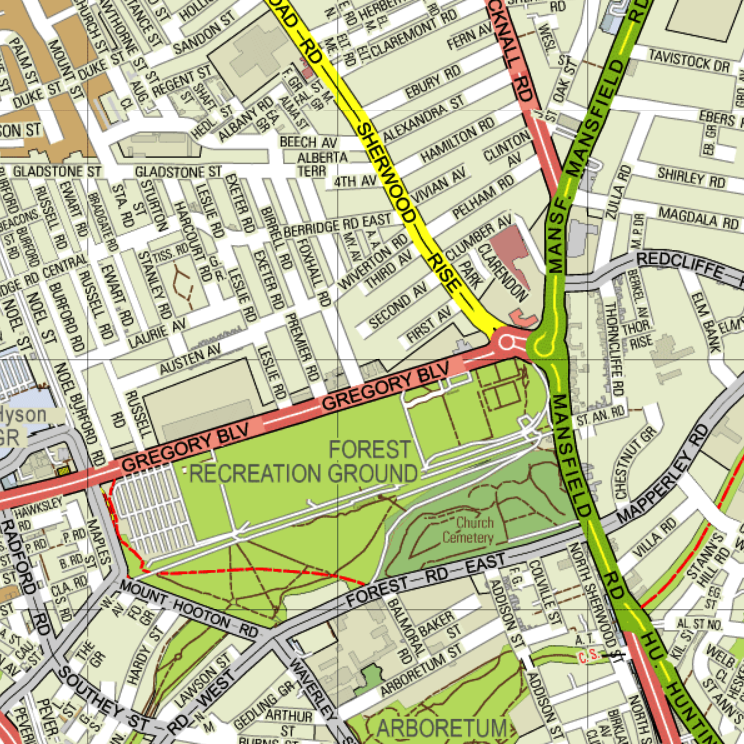
The game used to take place here, on the Forest Recreation Ground:

forest


When I was a lot younger and a lot, lot, thinner, I used to play in such games, and these photographs show a match from the early 1980s. I was newly married and my beautiful young wife, as one of, admittedly, very few spectators, was given a camera and the freedom to take a few pictures. In total, there were only ten, because in those days, there were no digital cameras, and people were not in the habit of shooting hundreds, if not thousands, of photographs on the off chance that three or four might be good ones.
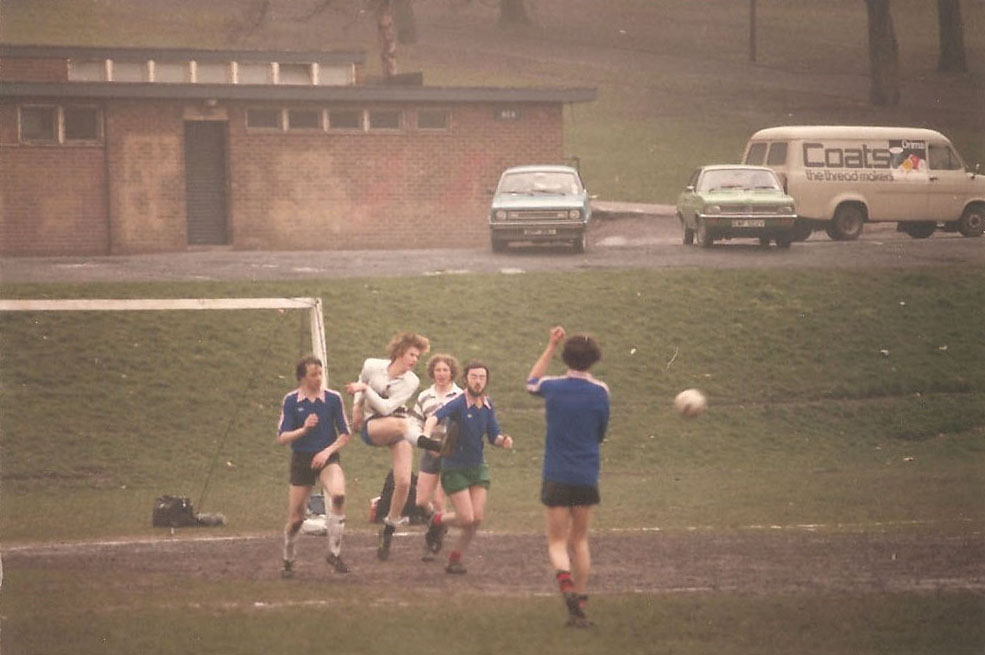
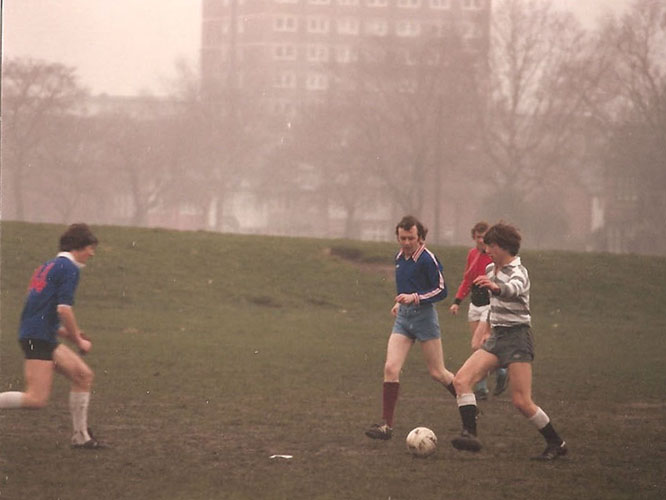
This first photograph shows my good self in the blue shirt and green shorts. The other player in blue is Paul Morris, a teacher of Physics, who, like myself, retired within the last two years. Everybody else is a Prefect, although I am sorry to say that I could not put a name to any of them.

PHOTO A

This photograph shows a young red haired gentleman playing for the staff team and running off with the ball into attack. He is Bob Howard who had been Best Man at our wedding. To his left, in red, is Richard Willan, one of Bob’s colleagues in the Geography Department. Richard retired in the same year as myself.

- PHOTO B

This final picture shows my unbelievably thin self, still in my green, blue and red outfit. I somehow seem to have acquired a mop of curly, dark brown hair, instead of the white ensemble I now have. On the right, in front of the goalpost is Best Man Bob Howard. The other player in blue is not a member of staff, but, presumably, a Prefect playing for the Staff Team to make up the numbers. Again, I could not name any of the opposition, but I do recognise a couple of the spectators. The red haired young man with the non-regulation brown scarf is Dave Beech who played for the school First Eleven at football on around half a dozen occasions when I was the team manager. To the left of him is Russell Poole, a superb young cricketer, whose Dad used to come down every games day to the Games Field to coach cricket to the more talented young players.

PHOTO C


6 Comments

Filed under Football, History, Humour, Nottingham, Personal, The High School

Sergeant Sakura’s War

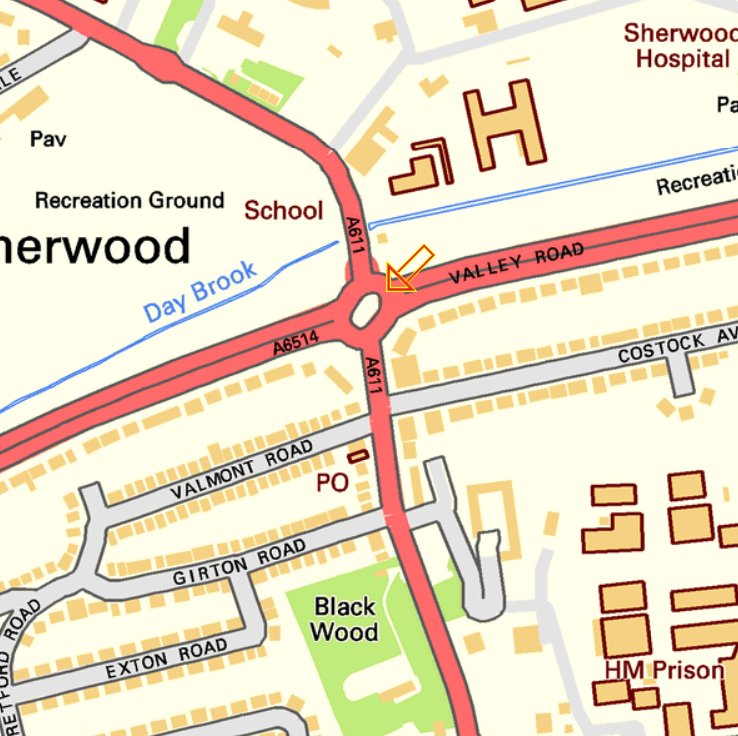
Why are the roadworks for our new road island between Nottingham’s ring road and the main road to Hucknall taking so long? They began in August 2014 and at first everything was going so well. Through September and October the works continued “apace” as they say. As you might expect, the old roundabout had to be completely demolished as unfit for purpose, and this is what has replaced it so far:

P1530144xxxxxxxx

Presumably, the roundabout will not remain for too long as a very large pile of soil, and one day somebody will surely find the money to plant something on it. Previously, the island looked like this:

P1210888 snowy xxxxxxxxxx

It always seemed to me to have a very Japanese feel to it, with stunted willow trees that could almost have come out of the world of bonsai. And this is the clue as to why the work has taken so long. Rumours began in late November of what the roadbuilders had discovered, or rather, who the roadbuilders had found:

japanese-soldierxxxxxxxxxxxxxxxxxx

He was 91 years of age when he was first spotted by the construction workers. His name was Sergeant Sakura and it was probably the oriental flavour about the island which had led to his mistaking it for the Island of Takeshima and the ideal place to make the very last stand of World War II, opposing the Allies on the last island that they would need to capture to ensure that “the war situation has developed not necessarily to Japan’s advantage”:

takeshima

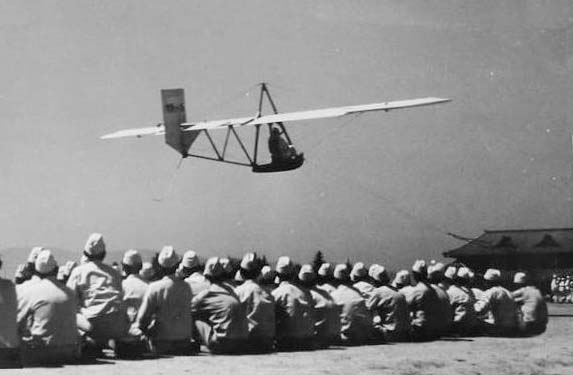
After his initially rather conspicuous arrival in late 1945 in a Maeda assault glider flown from a mini-submarine in the Irish Sea, (a mere 94 miles as the Maeda flies), Sergeant Sakura was seen only very rarely because the road island, constantly surrounded as it is by huge volumes of high speed traffic is not the easiest of places for visitors, friend or foe, to reach:

jap gliderxxxxxxx

It did not take Sergeant Sakura long to realise his mistake but, as soon as he had claimed the island for the Japanese Empire, he began digging foxholes, tunnels and bunkers of an amazing intricacy. Shortly after his eventual surrender, the City Council found that he had constructed almost 27 miles of tunnels, allowing him unobtrusive access to everything he needed to prolong his war into a new millennium:

Old_Japanese_Army_zzzzzzzzzzzz
One tunnel, for example, joined the drainage system from the City Hospital. This allowed Sergeant Sakura access to simple medicines. The hospital staff who saw him just presumed he was some kind of ghost, or perhaps a lost tourist, destined to wander the hospital corridors for ever. Another set of tunnels took Sergeant Sakura to the school sports field, where, in the depths of the night, he could practice his bayonet drill, and, as dawn broke, improve his marksmanship with the seagulls still asleep on the rugby pitches. His most important tunnel linked him with the Co-op supermarket, where he could easily find enough food to feed himself, without anybody really noticing. Boil-in-the-bag rice dishes, Ready Meals with fish and chicken, and even Spicy Pot Noodles:

map

The City Council of course, it eventually emerged, had known for a number of years that Sergeant Sakura was there, but as long as he limited himself to the occasional rifle shot at passing buses, or a three monthly light mortar attack on the Skateboard Park, they didn’t really bother him too much. The problem, of course, was that there was no particularly easy way to get Sergeant Sakura out of his tunnel system. The Geneva Convention had, rather foolishly perhaps, now banned the flamethrower, and the Royal Navy absolutely refused to send either of the two warships remaining after the government cuts to recapture just one senior citizen.  The use of gas was tried, but had comparatively little effect:

P1530063 yes

Sergeant Sakura’s superior officer, of course, was traced and contacted. He was the sole person who could have ordered Sergeant Sakura to surrender, but he was unwilling to travel back from Japan to make a loudhailer appeal down a hole in a road island. He said it would compromise his responsible position in the higher management echelons of a major Japanese car manufacturing company:

busines xxxxxxxxxxxxxxx

The end came eventually for Sergeant Sakura in a much more mundane way. After seventy years of crawling through countless miles of damp tunnels and homemade bunkers, many of which were regularly flooded by the murky waters of a local stream, the Daybrook, his proud military uniform finally began to rot away completely and his katana began to rust.
The only alternative Sergeant Sakura could find was to crawl into the Co-op Supermarket, and see what garments they had. Alas, it was not a particularly big shop and they did not stock anything suitable for a Sergeant in the Imperial Japanese Army. No hunting clothes, no fishing clothes. Shortly after this, therefore, Sergeant Sakura was finally forced to surrender, when he realised that it would be impossible to uphold the honour of the Japanese Empire as an old man dressed in the uniform of a checkout girl, the only clothing which he could find in the Co-op Supermarket:

25th anniversary of Asda at Bedminster.

Sergeant Sakura subsequently sought, and was duly given, forgiveness by his Emperor.
The Formal Surrender took place on a Number 17 bus, ironically one of the very vehicles Sergeant Sakura had himself fired on in a surprise attack just a few months previously:

P1530139 xxxxxxxxxxxxxxxxxxxxx

The bus (serial number 984) had to be taken out of service to be repaired, but duly returned in time for Sergeant Sakura’s surrender:

surrender zzzzzzzzz

Cars full of curious tourists queued for hours to see the ceremony:

This slideshow requires JavaScript.

The Number 17 bus was duly parked in front of the Co-op Supermarket and, at 17 minutes past 1700 hours, Sergeant Sakura became a civilian again:

P1530170 xxxxxxxxxxxxxxxxxxxxxxx

The owners of the local Chinese restaurant and takeaway, the “Golden Phoenix” (“brilliantly cooked and gorgeous food. Can’t be recommended high enough. 5 star.”),  are fearful that Mr Sakura may cash in on his fame and open a Japanese sushi bar.  As yet, though, it seems as if their fears may be unfounded.

Unfortunately, there is still little sign either, of the roundabout being completed.

25 Comments

Filed under History, Humour, Nottingham

Ancient initials carved a century ago

In the High School, there is a much vandalised stone mantelpiece over an old fireplace on the ground floor. Boys have carved their names on it well over a hundred years ago and the letters are only just beginning to disappear into the thick levels of gloss paint now used to cover the original stone. The fireplace is located between the General Office and the entrance to the Assembly Hall, so literally thousands of boys will have queued past it as they go into Morning Assembly.

On Wednesday, January 18th 1899, Thomas Ignatius Joseph Gillott entered the school. He was to leave during the course of his fourth academic year, in July 1902. Sadly Thomas died on Sunday, July 6th 1913, after a failed operation at the London Hospital. On that same day in 1899, his brother Bernard Cuthbert Gillott, also entered the school. He was destined to remain a pupil only until the end of that academic year and he left in July 1899. With the advent of the Great War, Bernard was to join the army, where he served as a Captain in the 6th Northamptonshire Regiment. A brave man, he won both the British Military Cross and the French Croix de Guerre. Eventually he was  severely wounded, but thankfully he survived, and he was invalided home to England.

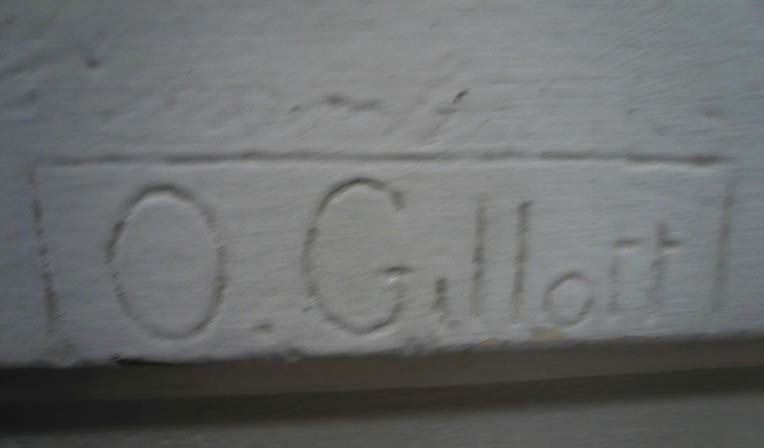
On Tuesday, September 12th 1899, the youngest of the three brothers, Oswald Cornek Gillot entered the school aged nine. Oswald was born in Ripley on July 22nd 1890 and his father was Thomas Gillot, M.I.C.E., a civil engineer whose address was given as either, Upland House, Eastwood, or Langley Mill near Ilkeston.  Possibly towards the end of the Summer Term, 1905, Oswald carved his name on that extremely popular stone mantelpiece on the ground floor fireplace between the General Office and the Assembly Hall. Oswald left the High School in March 1907.
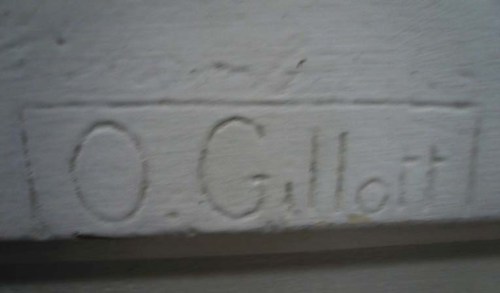
Gillott ccccccccc

Taking decent photographs of these carved signatures has in actual fact, proved extremely difficult. They are located on the northern side of the school where the usually tropical English sun does not often penetrate,  and they are surrounded by vast thick walls of stone and brick, with a singular lack of windows. This means that the whole area is more or less permanently dark from a photographic point of view. Added to this is the fact that in the century or so since these interesting acts of senseless vandalism were carried out, a succession of school caretakers, under the almost inhuman management pressure to hurry up that all school caretakers permanently face, have repainted the mantelpiece with a succession of layers of whitish gloss paint, all of them applied without having the time to remove the previous one. The stone therefore, now wears a building’s equivalent of an inflatable Sumo suit.
Consequently, I have been forced to Photoshop the pictures I took so that the now faint carvings stand out a little more clearly from the dimly lit and pale coloured background. One unfortunate young man, R.Salew, has proved completely impossible to conjure out of the camouflaging layers that now hide his signature. But he is definitely there.
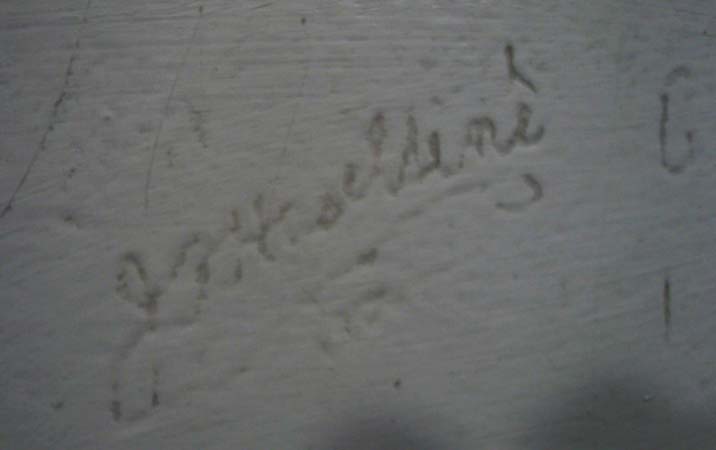
Towards the end of the Christmas Term, 1904, John Francis Haseldine carved his name, in rather florid handwriting, on that same stone mantelpiece.
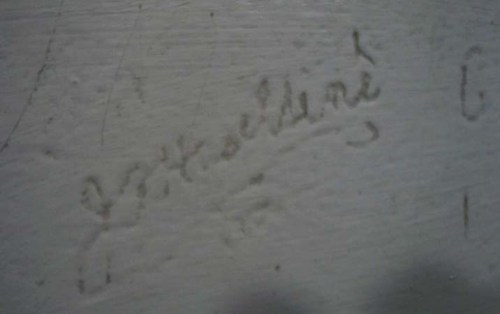
haseldine cccccc

John was born on December 28th 1886 and entered the High School on May 4th 1896, aged nine. His father was Frank Haseldine, a lace manufacturer of St.John’s Grove, Beeston. John was a very good footballer (soccer player), and made his début for the First XI on Wednesday, March 26th 1902, in an away game against Loughborough Grammar School. We know that the school’s best player, J.B.Sim, worked hard throughout the match, but, according to the School Magazine of the time,“The Forester”, he was “too carefully watched” by the Loughborough defence, and the game was lost by 0-2. That particular spring, John had been in the team which had won the Football Sixes, a six-a-side competition organised within the school by the boys themselves, with the teams all drawn out of a hat. It was taken, of course, extremely seriously. Coincidentally, the winning team’s captain was that very same J.B.Sim, who was a well-known High School footballer of that era, with more than fifty appearances for the First XI.
On Wednesday, February 14th 1903, John scored his only goal for the school, in a 4-1 away victory over Mansfield Grammar School, “a rather poor and one-sided game”. As an ever present in the team, John won his football colours at the end of this season and was also awarded a “Standard Medal” for Football . In season 1903-1904, he became Captain of Football.  John spent the Christmas Term of 1904 at the High School, but, like so many boys during this period, he left half way through the academic year in December 1904.
In the Great War John was a Major in the Royal Engineers, Special Reserve. He was Mentioned in Dispatches on June 3rd 1916 and received the Military Cross on January 1st 1917. By 1929, he was living at Northdene, New Barnet, in  the northern suburbs of Greater London.
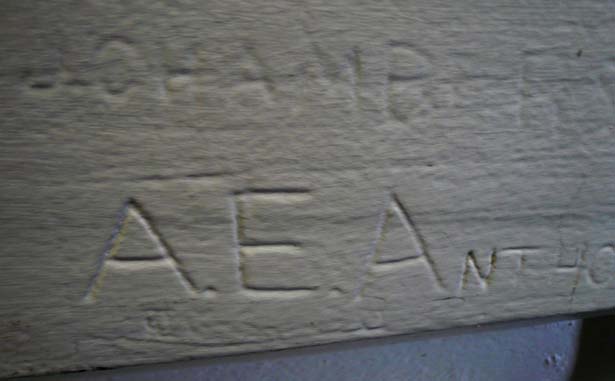
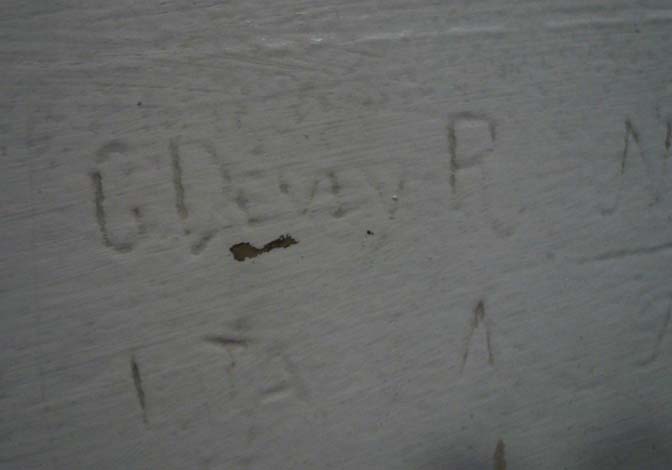
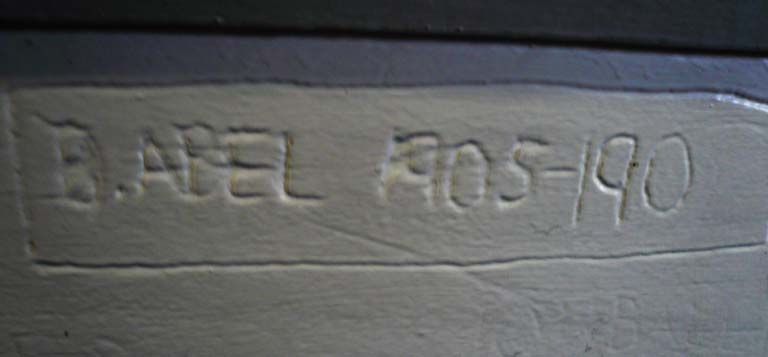
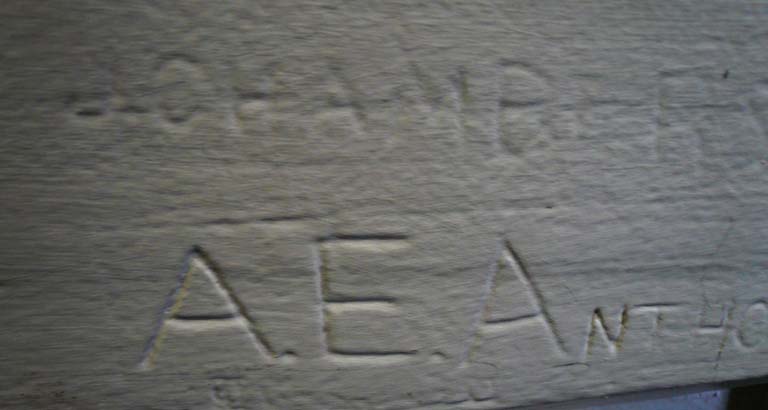
Among the other more legible carved names are “A.E.Anthony” and “G.Devey”. What is apparently “R.Salew” is also there, although there are many, many  layers of gloss paint to obscure the lettering of this particular name, and the photo has not come out because of this. Another seems to read “B.Abel 1905-190” as if the young man had been interrupted, perhaps by a Master (teacher), as he came towards the end of his carving, and then did not ever return to finish the job.

Alfred Edward Anthony was born on June 12 1906, and entered the school on September 18th 1918, aged twelve. His father was F.W.Anthony of 120, Radcliffe Road, West Bridgford. He was the Managing Director of Gotham Co Ltd (apparently sic). Alfred left the school in December 1922.
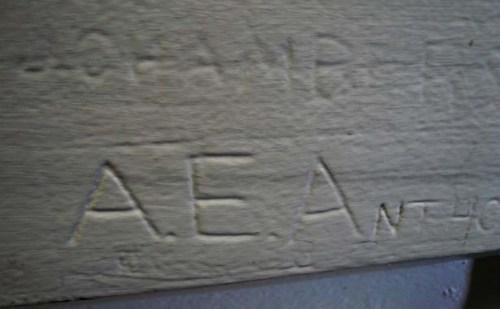
anthony 1 ccccccc

“G.Devey” was the elder brother of Reginald Devey, whose own name had already been carved on the fireplace upstairs, in the staffroom corridor, alongside that of D.H.Lawrence and L.S.Laver, the High School’s very own Latin Champion of the World.

r.a. devey cccccccv

This ground floor effort though, was Gerald Bertil Devey, who was born on June 10th 1903,. Gerald entered the school on May 27th 1918 at the rather late age of fourteen. His father was James Edward Devey, a civil servant, and the family lived at 22, Ebury Road, Sherwood Rise. Gerald left the High School in July 1919.
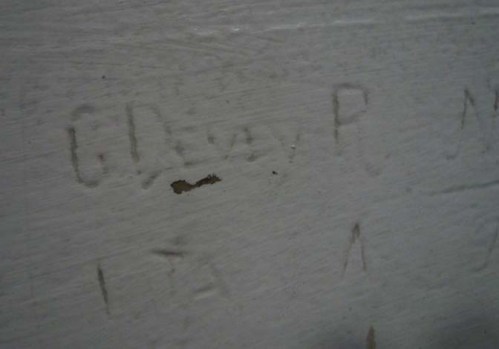
devey cccccc

John Rylett Salew entered the school on May 4th 1916, aged fourteen. He left in December 1918. John was born on February 28th 1902 and his father was Joseph William Salew, an “agent” of 19, William Rd, West Bridgford.

Bertram Albert Abel was born on July 31st 1889 and entered the school on September 13th 1905, aged sixteen. His father was William Jenkinson Abel, a clerk to the Nottingham Education Committee. The family lived at 99, Waterloo Crescent, and Bertram left the school in July 1907.

b abell ccccccc
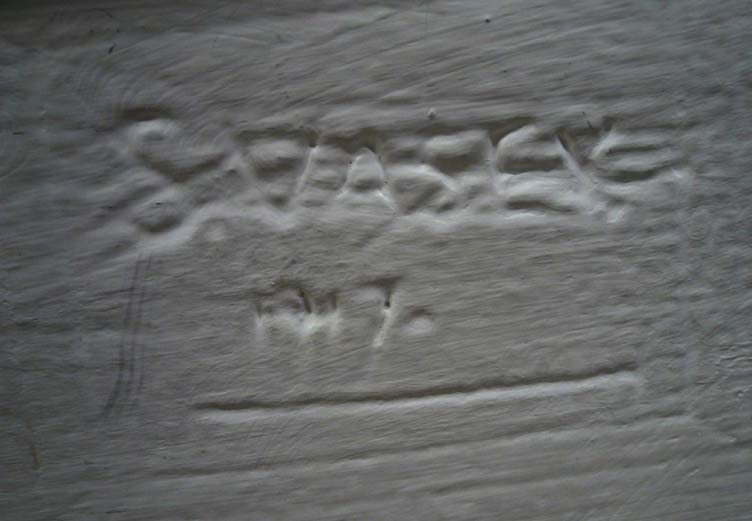
The fact that “S.Vasey” has carved his name in two different places on the stone, one of them complete with his own personal dates, namely “1917” and “1917-1922” shows not only that he had an extremely strong desire for immortality, but that, within the context of the High School, it has been fulfilled. He must have been a very swift, and fairly brazen, vandal.

zzzzz s vasey 1907

Stanley Vasey was born on June 5th 1905 and he entered the school at the age of thirteen, on September 18 1918. His father was Alfred Vasey, a shop inspector, and the family lived at 15, Glebe Road, West Bridgford. He left in December 1922.
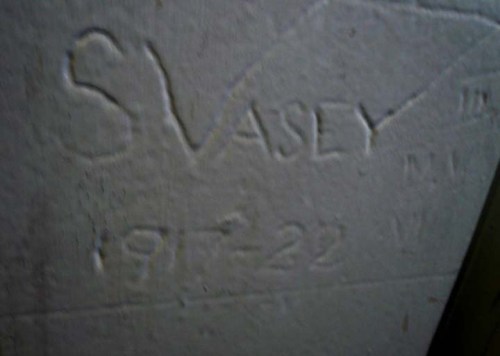
zzzzzzzzzz vasey 1922
It is actually possible to best guess friendship groups among these carved names. Messrs Anthony, Devey and Vasey, for example, all joined the school in 1918. They all left in the latter half of 1922. They must surely have known each other. John Rylett Salew and Stanley Vasey both lived within a penknife’s throw of each other in the very posh Nottingham suburb of West Bridgford. Did the four boys seal their friendship by committing their names to the hard surface of that much painted fireplace ? Did three of them keep watch while the fourth scratched his name into the welcoming stone ?

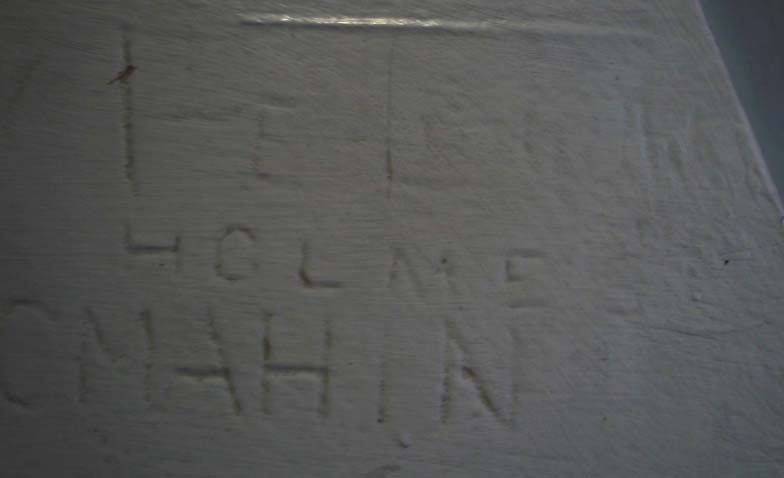
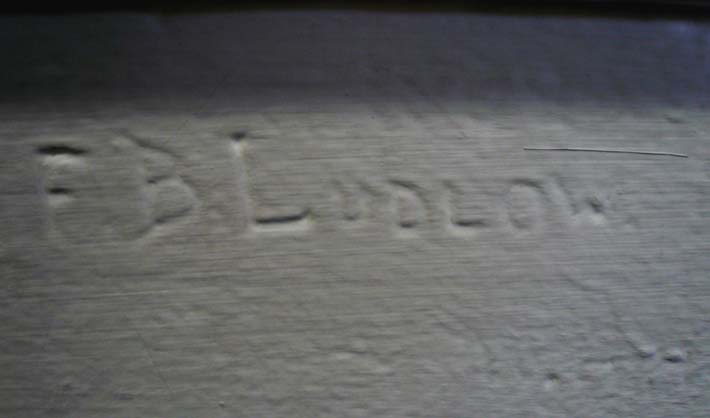
The other names on the fireplace, some of them extremely indistinct, include “F.B.Ludlow”, “N.G.Peet”, “Littler”, “Meigh” and “Holmes”. The latter was possibly the George Chudleigh Holmes who was a regular player in the First XI football team during the 1902-1903 season. Born on June 15th 1887, George entered the school on January 17th 1900, aged twelve. His father was George H.Holmes, a Lace Manufacturer of Gregory Street, Old Lenton. George left at Easter 1903, perhaps once the football season was over.

hiolmes 2 ccccccccc
Fred (sic) Ball Ludlow was born on April 28th 1891. He entered the school on May 1st 1900 aged  nine. His father was William Ludlow, a clerk in the Gas Depôt. The family lived at 10, Willoughby Avenue, Lenton in the western suburbs of the City. Fred left in June 1907.

ludlow cccccc

Noel George Peet was born on December 26th 1901 and entered the High School on April 26th 1917, aged fifteen. His father was William George Peet, a “general agent”, and the family lived at 413, Mansfield Road. Noel left the school in July 1919. Perhaps he was a relative of Mrs.Mary Peet who was the school’s nurse during the late 1970s and the 1980s.

Samuel Littler was born on May 16th 1891. He entered the school on September 16th 1903 aged twelve. The family lived at 8, Appleton Gate, Newark-on-Trent, and his father, a veterinary surgeon, was also called Samuel Littler. Samuel junior left in July 1908.

Vincent George Meigh entered the school as an Agnes Mellers scholar on September 12th 1899 aged ten, the cost of his place in the school automatically paid for. His father was George Meigh, a schoolmaster of 3, Willoughby Avenue, Lenton. Vincent left in December, 1903.
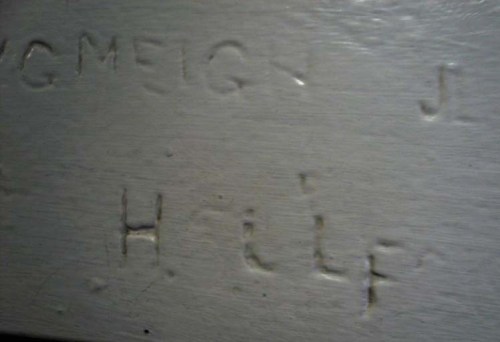
meigh ccccc
On the mantelpiece, one set of letters to set the heart a-flutter is “(illegible)BALL  1900-1907” , but this cannot be the famous air ace, as there are clearly a fair number of letters before the B-A-L-L. In any case, Albert Ball did not stay long in the High School, being expelled after an incident when he disrupted school assembly by emptying a large bag of bullseyes, gobstoppers and bouncing sweets onto the floor.

Best fit is probably Oliver Herbert Ball, who was born on August 13th 1891. He had entered the school on January 17th 1900, aged eight, as the third of three brothers. Oliver was to leave in July 1907. His mother was called Emma, and his father was Alfred Holmes Ball, the “Laundry Man” of “Sunnyside”, Daybrook, Notts.  Presumably, this was the company which was eventually to become the massive “Daybrook Laundry”.’ It was situated opposite the Home Brewery on the Mansfield Road, and was only recently demolished during the first decade of the twenty first century. The Arnold branch of the “Aldi” supermarket chain has now been built on this site during the latter part of 2014. It was open for business by the end of the year. Look for the orange arrow:
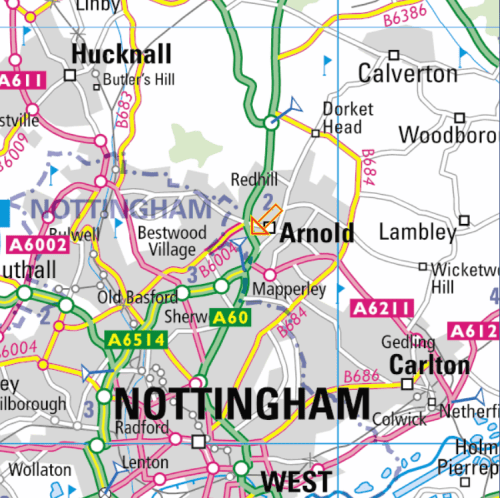
north nottingham

During the Great War, Oliver Ball was to serve as a Second Lieutenant in the 10th Battalion of the Yorkshire Regiment.  Aged only twenty five, he was killed on September 28th 1916 and is buried in the Guards’ Cemetery at Lesboeufs in France. Oliver’s  death was part of the Somme offensive.  He shares the cemetery with 1,492 identified casualties, and a grand total of 3.136 men.
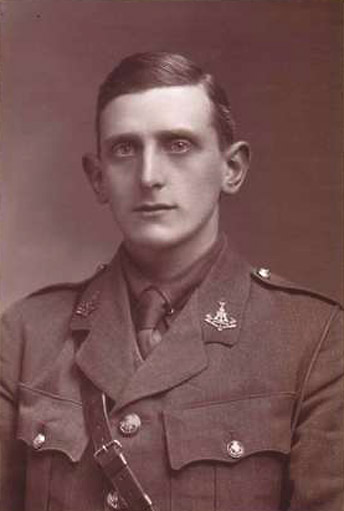
oh ball

Oliver Ball’s elder brother was Walter William Ball, the second son of the three, and himself an Old Nottinghamian. Walter had returned to the Western Front, and the Yorkshire Regiment, from his leave in Nottingham on Friday, November 19th 1915. The “Nottingham Guardian” reported his death on Monday, November 29th 1915. He had apparently been shot through the head by a sniper while organising a firing party with his captain. The tragic news was communicated to his parents by his younger brother, Second Lieutenant Oliver Ball, who held a commission in the same regiment. According to the “Nottingham Guardian”, Walter was “well-known in Nottingham and had a large circle of friends”. He had received his commission as a Second Lieutenant a mere twelve months previously. Walter is buried in Houplines Communal Cemetery Extension in France, Plot 1, Row A, Grave 21. He was 28 years of age.

ww ball

As far as I can trace, the third brother seems to have survived the war.

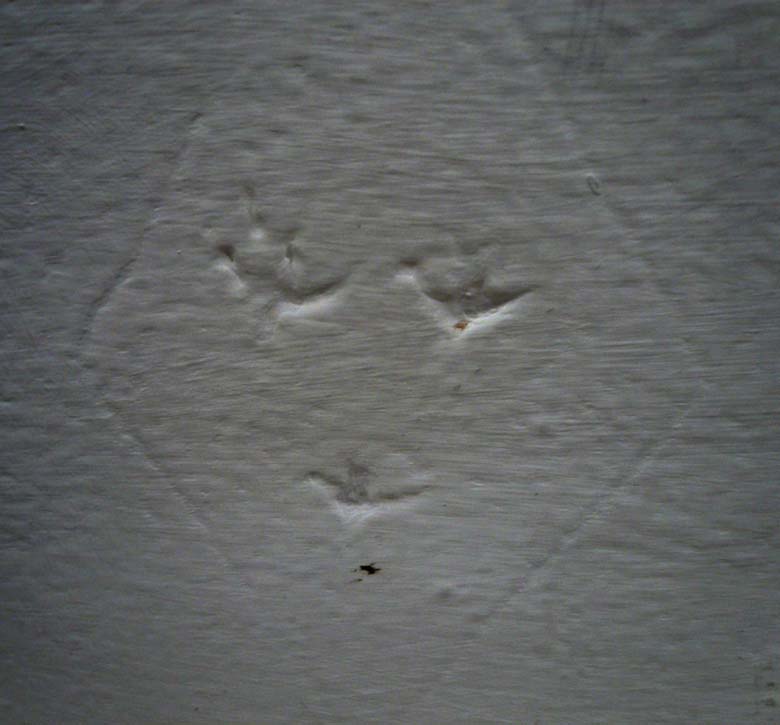
One of the more notable objects on the mantelpiece is perhaps the school badge which has been carved relatively large, and in primitive style, with the lozenge and the three merles or heraldic blackbirds still recognisable even now, the best part of a century after it was executed by some unknown, juvenile artist.
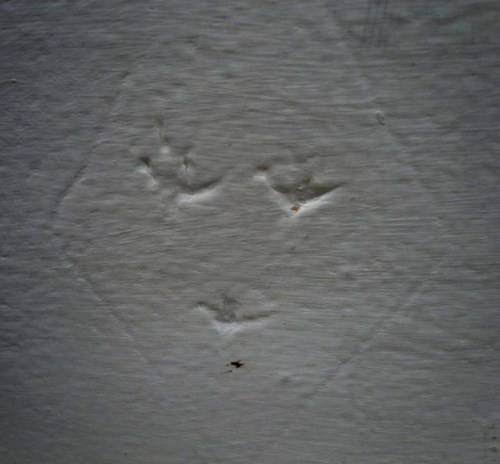
badge cccccccc c

Less time proof perhaps, are the boys who managed to carve only their initials, namely “JL”, “MV”, either “WA” or “WR”, and either “BFW” or “SFW”. It is just so difficult to be certain about whose initials they might be. In some cases, there are literally dozens of possible candidates in the school registers, and it becomes almost a pointless effort to try and guess who has carved them.

Some boys seem to have been able to make only part of their name legible. We appear to have, therefore, a group of letters which seems to spell “H-LLF”.

Similarly, I have tried so hard to turn “—-NGTON” into Victor George Darrington, one of the very few young men to have captained the school at both football and rugby. The time is right (he entered the school in 1909, aged twelve) but the fact is that the blurred and multi-layer gloss paint painted-over obscured letters just do not look like they were ever meant to spell Darrington.

Even more striking is the young member of what is probably the “Chambers” family who did not manage to carve his initials clearly. The name can be seen just above “A.E.Anthony”, although the letters seem to be an even whiter shade of pale.  Just a cursory perusal of the school registers reveals the existence, between 1897 and 1926, of “E.Chambers”, “W. Chambers”, “P. Chambers”, “N. Chambers”, “J.F. Chambers”, “J.S. Chambers”, “A. Chambers”, “C.G. Chambers”, “J. Chambers”, “B.J. Chambers”, “C.C. Chambers”,  “S.H. Chambers”, “D.B. Chambers”, and a second “W. Chambers”

chambers 1zzzzzzzzzzzz

No doubt a really thorough search would reveal even more members of the apparently vast Chambers clan.
It would be nice to think, though, that the perpetrator was the (uninitialled) Chambers of Form IVb, whose doings are reported in the Prefects’ Book for Thursday, February 1st 1912….

“…A meeting was held before afternoon school, Towles and Haubitz (prefects) being absent. Chambers (IVb) had been reported for carrying a loaded revolver in his pocket. He admitted the offence, and produced the weapon, which proved to be loaded in four chambers. He was requested not to bring it to school again, and the School Captain decided to interview the Headmaster.”

Most unfortunately, no record has survived of the outcome of this conversation. Here again, it is possible to guess at putative friendships between the names in the stone. Two of the boys, for example, Fred Ball Ludlow and Oliver Herbert Ball, both joined the school in 1900, and their entries are virtually next to each other in the School Register. Perhaps the use of the surname of one as the middle name of the other hints at a blood relationship, rather than just one of mere friendship.
Coincidentally, a third name on this single ancient page of the school register is that of Harold Binks, who entered the school in the very same year of 1900, although Harold was never to carve his own name on the fireplace. From his reminiscences, published in April 1935, we know that one of his best friends in the Senior School was called Ball. It seems likely too that another of the friends was Oswald Cornek Gillot, who was already in the school when Ludlow, Ball and Binks arrived. All these boys were of the same age, and they all left the school in the latter part of the academic year 1906-1907. As we have already noted, Gillot lived near distant Ilkeston, but Holmes lived in Gregory Street, Old Lenton, very close to Ludlow and Meigh who themselves both lived in the same street, namely Willoughby Avenue, Lenton. Again, we can imagine two keeping watch while the third one carried out the evil deed with his penknife.

On Thursday, June 7th 1917, just  ten years after carving his name on the stone fireplace, Oswald Cornek Gillott was killed at the age of twenty six, yet another hapless victim of the Great War. Even a school as small as the High School (400  pupils) was to provide some three hundred young men, all destined to die well before their time.

After he left the school, Oswald moved to Teesside, and became a twenty year old apprentice mechanical engineer living at 2, Woodland Terrace, Borough Road, Middlesbrough, Yorkshire. When the Great War came, Oswald joined the 68th Field Company of The Royal Engineers. They trained at Newark-on-Trent before sailing from Liverpool for Gallipoli at the end of June 1915. They remained at Lala Baba in Suvla Bay until December 19th and 20th 1915, when they withdrew and returned to Egypt by the end of January. Oswald was recorded as having been wounded during this period. In June 1916 the Division was ordered to France to reinforce the Third Army on the Somme. By July, they were in the Front Line and took part in the fighting at Thiepval. In early 1917 they were fighting on the Ancre, and then moved north to Flanders for the Battle of Messines
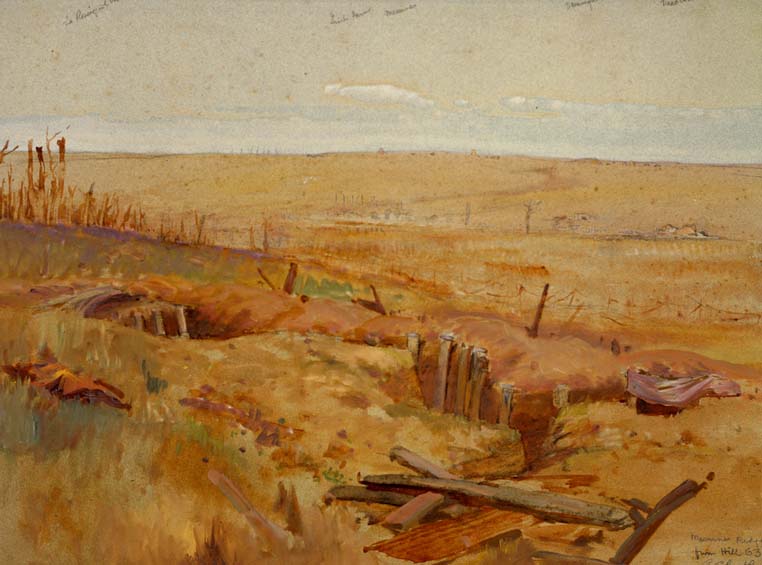
Messines_Ridge_from_Hill_63 cccccccSecond Lieutenant Oswald Gillott’s last day on Earth was June 7th 1917, coincidentally no doubt, the first day of the successful attack on the Messines Ridge.  The assault was preceded by the detonation of nineteen large mines, in what was described at the time as “the loudest explosion in human history”. Oswald, as a member of the Royal Engineers, may well have been involved in this activity when he was killed. On the Commonwealth War Graves Commission website there are a mere three pages of Gillotts, with only thirty two men of this name killed. Oswald Gillott lies in the Messine Ridge British Cemetery in Mesen, West-Vlaanderen in Belgium along with the 577 of his colleagues whose remains have been identified.

This slideshow requires JavaScript.

Second Lieutenant Gillott, aged twenty seven was one of a trifling 24,562 casualties, as the British under Field Marshal Herbert Charles Onslow Plumer, 1st Viscount Plumer, GCB GCMG GCVO GBE slowly began to learn how to fight battles at much lower costs than previously. (Battle of the Somme, 623,907 dead).

The other side of the coin, of course, is the fact that if the Field Marshall and his lordly colleagues are not much more careful with the lives of their social inferiors, they will risk actually running out of men. The  623,907 men killed in the Battle of the Somme is a catastrophe, but the apparently much lower figure of 24,562 killed during the assault on Messine Ridge could well be regarded as every single man in a town the size of, say, present-day Arnold or Newark-on-Trent.

One set of initials I have not dealt with. That is F.C.Mahin, one of the High School’s very few Americans, and I will talk about his incredible and hitherto completely unknown life in another blog post.


6 Comments

Filed under History, Nottingham, Criminology, Humour, The High School

The Luftwaffe comes to Cornwall (and stays there)

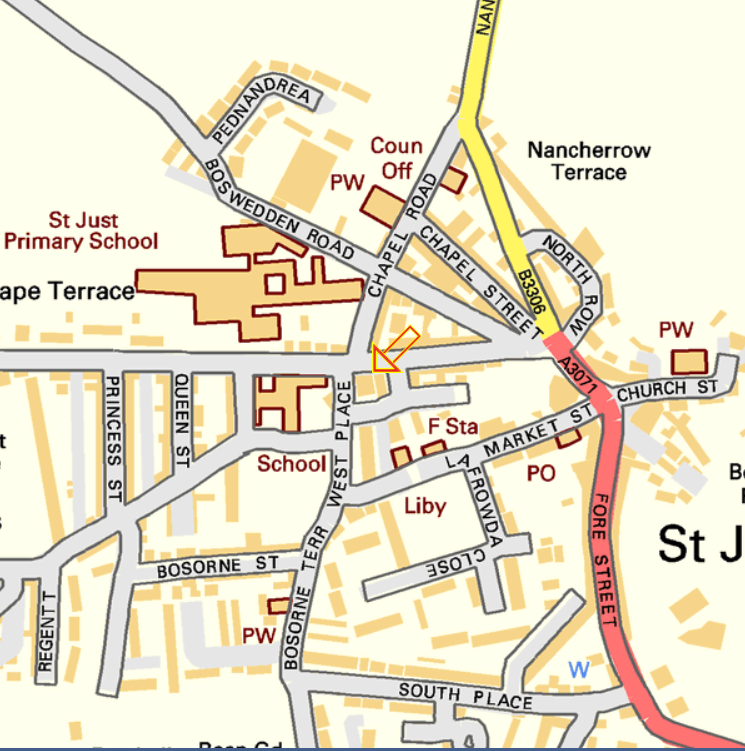
For many, many, years, we have spent our summer holidays in Cornwall, in the very westernmost part, which is called Penwith, and where the major town is Penzance, the birthplace of the pioneer chemist, Humphry Davy. Ten miles or so to the north west of Penzance is the even smaller town of St Just. Just look for the orange arrow:
This slideshow requires JavaScript.

In the nineteenth century, there were any number of tin mines around the town, which is made up for the most part of stone buildings with slate roofs.
This slideshow requires JavaScript.

It has a beautiful ancient parish church with its centuries old frescoes of Christ and St.George.

This slideshow requires JavaScript.

There is also the old battleflag of an old Great War battleship.

aaaaa50478

Nearby is the medieval “Plen an Gwarry”, which is a small area of open grass, used for watching plays or sporting contests or perhaps just for relaxation.

ab5

As you relax, you might want to eat a pasty or a pie from Mcfaddens, who are often quoted as making the best Cornish pasties in the world. The day I took these photographs, they had sold out. Fortunately, they do mail-order, although the pasties will not always be piping hot.

This slideshow requires JavaScript.

St Just also hosts its popular Lafrowda Festival, a community and arts celebration that lasts for seven days.

There is the old bank, with its many changes of owner and cryptic lettering.

P1330533xxxxxxxxxxxxx

More subtly famous is the Wesleyan Methodist Chapel which was built in the first half of the nineteenth century. It is an enormous stone building, and I remember reading somewhere that, as vast numbers of impoverished Cornishmen were forced to emigrate overseas, given its position so close to the cliffs of Land’s End, this building was usually the very last thing that thousands of emigrants saw as they set off towards the mines of the USA, Canada, Australia or South America.

This slideshow requires JavaScript.

Some of the very best and most spectacular cliff scenery is at either Carn Gloose or the nearby Cape Cornwall. This is the Brisons, a pair of storm battered sea stacks.

TT8 xxxxxxxxxxx

It was here that a very, very lost Steller’s Sea-lion lived in the late 1980s and 1990s. It should have been living in Eastern Siberia or Western Alaska.


Every time that I have ever driven down Cape Cornwall Road to look at the cliffs or to watch the fierce ocean storms, I have always looked up at the old Methodist School on the left, to check that the conspicuous gap on the ridge of the roof is still there.

This slideshow requires JavaScript.

From a tourist leaflet that I read many years ago, I know very well that, during an air raid in the Second World War, this gap was caused by a German bomber in its last few seconds before it crashed into Chapel Road.

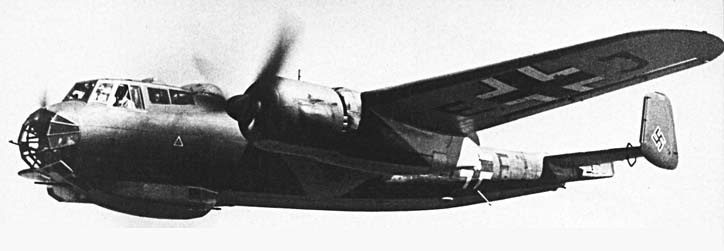
Do_217E-2_

This year I decided to research the story more extensively, so I called in at the library in St Just, where the helpful staff tried very hard to check any references to this event in the books of their Local Collection. They were unfortunately unable to find anything but, not for the first time I suspect, they contacted long time St Just resident, John Harry, who came round to the library straightway to recount the full story. Mr Harry told me that the events had taken place in the autumn or winter of 1942.

As a little boy, he was always very excited indeed when the St Just air raid warning was sounded, and he always had to be dragged very reluctantly up to bed. In their home in Chapel Street, the family had a simple home-made air raid shelter downstairs in the kitchen. It consisted for the most part of a rather robust kitchen table which, in theory, should be able to withstand the majority of shocks which an air raid might cause. On most occasions, though, John’s aging grandmother would refuse to get inside it, but instead, ostrich like, would merely stick her head underneath.

This particular night, they could hear distant gunfire, which gradually grew louder and louder. Some kind of aerial dogfight was clearly taking place, as they could all hear the noise of aircraft engines, machine guns and a series of explosions. Granny kept shouting “We’ll all be killed! We’ll all be killed!”, but her daughter replied, “Be quiet! Don’t keep saying that! You’ll frighten the child!”.

“The child” himself thought that it was all extremely exciting, and was clapping his hands in sheer glee. Suddenly, there was a huge crash. John shouted, “We’re winning! we’re winning!”. Auntie went upstairs to see what was happening. She looked out of the bedroom window. Below her, she could see flames down in the street. “All of Chapel Street is on fire!”, she shouted, “All St Just is ablaze !”

The stricken bomber had destroyed two houses, but fortunately, nobody was injured. The first house was owned by an old lady, but she had gone away to her daughter’s for a two week holiday.

The other house was a second home for the newly married Mr and Mrs Vague. (sic) They did not normally bother to use their air raid shelter, but on this particular evening, their cat had kept making a huge fuss, walking repeatedly backwards and forwards from the bedroom to the shelter. In an effort to keep the cat quiet therefore, the two of them finally moved down to the air raid shelter. From this place of safety, they were able to feel their house shaking as if it were an earthquake.

When it was safe to do so, both Mr and Mrs ran to the emergency shelter in the St Just Town Hall. All they possessed at this moment were their night clothes. In later years, though, of course, Mr and Mrs Vague would dine out regularly on the fact that they had had their lives saved by the cat.

The next morning, more than half the town was cordoned off by the Home Guard. Hundreds of windows had been blown out by the explosions. On the Methodist School (look for the orange arrow), huge numbers of tiles had been knocked off.

street map

Fragments of the crashed plane were everywhere. In the nearby village of Kelynack, some mile and a half away, (see the previous map after Paragraph One), one member of the German crew had landed by parachute. He had a broken leg, and, a forlorn figure, he was duly arrested by Mr.Matthews, the owner of a small local farm. The rest of the crew, three men, sadly, were all killed.

In a house in Cape Cornwall Street, a woman stepped forward in the darkness to open the bedroom curtains. She tripped over a German’s dead body, which had been blown in through the window. A few days later, in another house in the town, a frightened woman was to find a German’s leg on the top of her wardrobe.

And for a very long time afterwards, John Harry was too frightened to leave his mothers’ side.

Even now, though, at nearly eighty years of age, John was still unaware of where the three dead Germans were buried. And seventy years ago, his mother had been equally unable to ascertain their final resting place. Equally unsuccessful was her friend, who was actually a member of the local Home Guard. Indeed, at the time, everybody in St Just was curious about where the dead Germans were. They kept asking the Home Guard, who always replied with the same “Dunno”. It was thought, however, that some of them did know, but they were just not saying.

My own researches have been equally unsuccessful. I was unable to find the Germans’ last resting place either in the cemetery at St Just, or in the war graves section of Penzance Cemetery. Subsequent inquiries, however, reveal that most German war dead at this time were taken to the German Cemetery on Cannock Chase, and that after the end of hostilities, many of them were then re-interred in Germany. Let’s hope so. It is certainly a very long way from the frequently wet, windy and misty West Penwith to whatever churchyard in Germany where they rightfully belong.

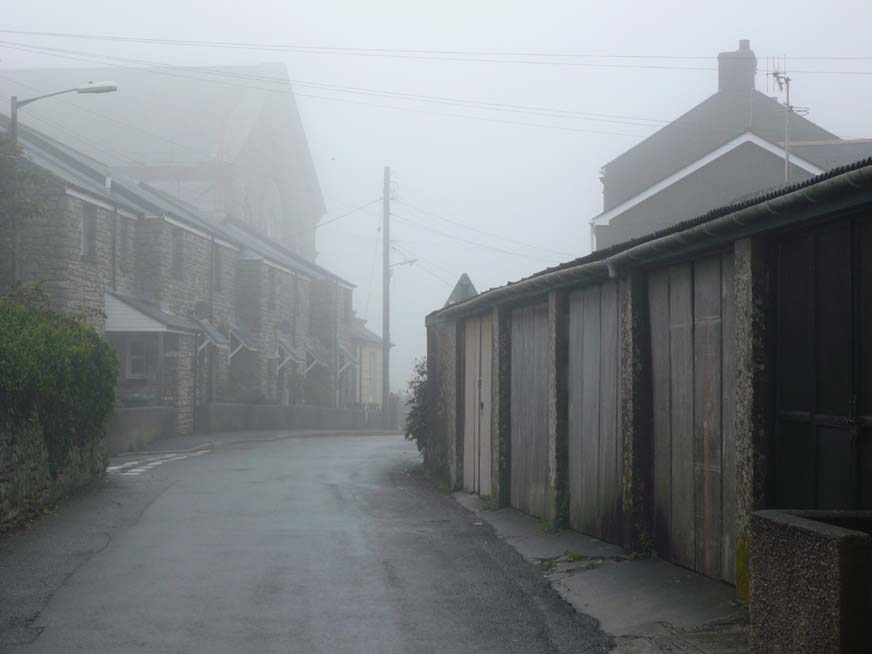
The two destroyed houses were never rebuilt. Instead they were replaced by a row of garages. When the foundations for these buildings were being dug, the workmen found Mr.Vague’s gold watch.

P1330546  yyyyy

Amazingly, this was not the only air raid on tiny St Just. On another occasion, the Luftwaffe bombed Holman’s Foundry, which produced munitions for the Allied Forces, down in the Tregeseal Valley. Ironically, Mrs Holman had herself been born in Germany. She had originally come over to England around 1900 as a governess, and then married into a local family.

This particular bombing attack was actually mentioned in one of his broadcasts by Lord Haw Haw. He said, in very sinister and threatening fashion, “Don’t think we have forgotten you, St Just. You have not been forgotten.”

williamjoyce_2041800i

The foundry’s owner, Ken Olds, lived in a house right next to the foundry. At the height of the bombing raid, when the grandparents went to look for the baby, they found that he was no longer in the bedroom. In actual fact, he had been blown out of the window, and they found him in the front garden. He was still in his cot, fast asleep and completely unharmed. Nearby houses had lots of cracks caused by the explosion of the bombs. In later years, this seems to have led to large scale subsidence, and all of the houses eventually had to be demolished. So too the foundry itself had to come down, and it was replaced by a housing estate.

I was genuinely surprised that after seventy years that it was still possible to talk to an eyewitness of all these amazing events. I will never forget my afternoon spent in the company of John Harry. He is a most charming man, and an amazing source of knowledge of the St Just area, the people who have lived there, and the people who live there still.

Subsequent, subsequent, subsequent researches on the Internet have now revealed the excellent website of Shauney Strick whose hobby is “The History of World War 2 in Penwith, Cornwall:Uncovering the evidence with a metal detector”.

metal detrector zzzzzzzz

With his metal detector, Mr.Strick recently uncovered several small parts of a Luftwaffe aircraft buried in West Place, St.Just. (see street map above). The various objects of wreckage were from a Dornier Do. 217E, aircraft U5+1H of 1Staffel KG 2, which had crashed on September 27th 1942 as it made its way towards Penzance, after being pursued and shot down by a Bristol Beaufighter Mark IF of 406 Squadron from RAF Predannick. The Beaufighter was  flown by Squadron Leader Denis Chetwynd Furse with Pilot Officer John Haddon Downes as his radio operator.  

Dornier-Do-217E2- zzzzzzz

One additional detail was that one of the diesel engines from the stricken bomber flew an enormous distance before smashing through three garden walls in West Place. 

As I mentioned above, my search for the final resting place of the Luftwaffe bomber’s crew led me to Penzance Cemetery, where, although I did not have any success with the Dornier, I did find that the World War II graves there had some very interesting, and very, very sad tales to tell. But that, as they say, is for another time.


23 Comments

Filed under Aviation, Cornwall, History, Humour

A bird with a highwayman’s mask

(An extract from my old birdwatching diary “Crippling Views”)

Sunday, September 18, 1988

A trip to North Wales this time to twitch a long staying vagrant from North America. It’s the second, or maybe third attempt to see the Forster’s Tern, a seabird which has been knocking around this area for some years now. This time, I’m going to a little village called Gronant, near Prestatyn, where the bird has apparently been sitting out on the beach with Sandwich Terns, at a place where the freshwater stream crosses the sand. Look for the orange arrows:

This slideshow requires JavaScript.

It’s a pleasant enough place, although once more confusion is caused by the unfortunate decision to put up road signs in two languages, despite the fact that the total number of Welsh speakers around here is probably absolutely zero. The whole area, therefore, is just one constant traffic jam, as people stop and try to wade through the novel length traffic signs, in a vain attempt to find out what the hell is happening – and where. Added to this is the fact that there are only half the signs that there ought to be, because all the ones they’ve got are twice the length than they need to be.
First of all, of course, is the traditional stop at you-know-where for the Lady Amherst’s Pheasant.

wild-ladyamherstspheasant-xxxxxxxx

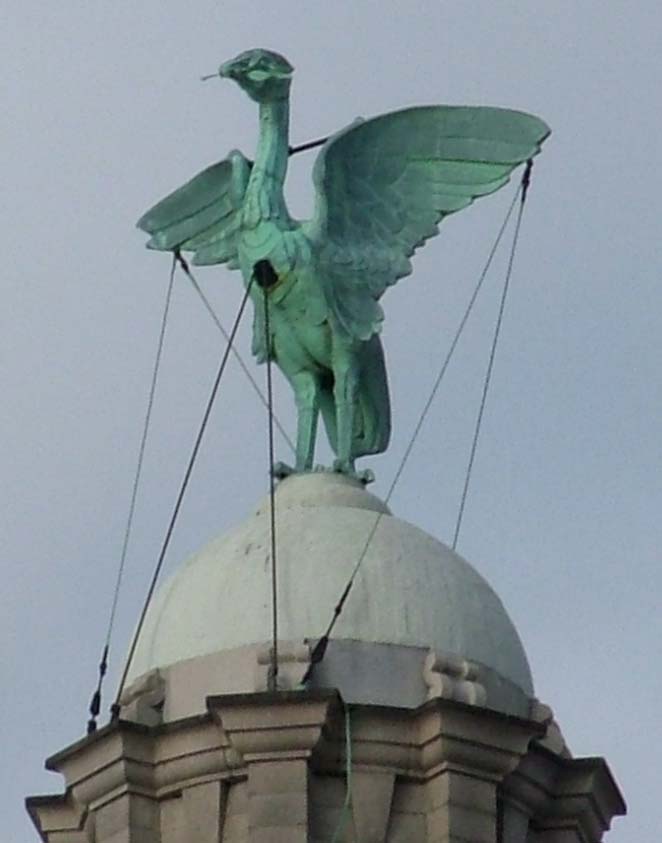
None of these mythical birds is about, but it makes a nice break in the journey, with superb views over the Mersey, to the distant metropolis, topped off by its two completely distinctive cathedrals, and the bulk of the Liver Building, visible easily even at this distance. Now that is a good tick – Liver Bird.

Liver_Bird xxxxxxxxxxxxxxxxxxxxxxxxxxx

On we press to Gronant, and its caravan and chalet village, right next to the beach, but sheltered by the comforting solidity of the sea wall. I park the car, and we set off across the almost limitless expanse of sand.

gronant beaxchxxxxxx

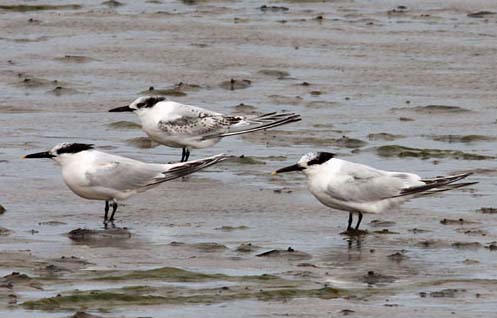
We can already see a group of a dozen or so birdwatchers, all obviously looking at different things – not a good sign. There are a good many  of the much commoner Sandwich Terns…..

bp_sandwich_tern_zzzzz

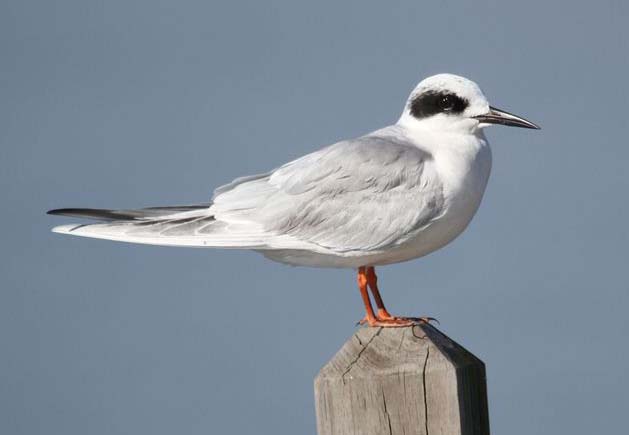
…but we are not to be disappointed though, because the Forster’s Tern is still there. It’s just that a couple of minutes before we arrived, the bird took off for a little fly round and nobody has yet managed to find where it landed. We soon relocate it though, sitting with a group of Sandwich Terns, about fifty yards away.

Forsters_Tern_Ixxxxxxxxxxx

It’s obviously a lot smaller with a different shade of grey on its back. It has red legs and the fabulous highwayman’s mask arrangement of patches on its face. It’s everything I’d hoped for – a really foreign looking and exotic bird. The only problem is that we are almost directly behind it and we can get only rather imperfect views of its main features, so we decide to make our way round, and try to look at it from the side. This manoeuvre of course, is enough to flush every tern on the North Wales coast, including the Forster’s Tern, which immediately sets off on a twelve thousand mile trans-global migratory flight.

flying zzzzzzz

To be honest, though, that is the very last we see of the bird that day, despite the fact that we return several times during the afternoon and wander around for a good while, looking at all the terns on the beach. We do see Bar-tailed Godwit, and Arctic Skua, and a couple of Little Terns.

little terns xxxxxxxxx

The most interesting thing we come across is the advice offered to us by a couple of Liverpool birdwatchers, who give us dire warnings about how dangerous this place is, since the tide comes in very quickly, and it’s very easy to get cut off. They tell us that every few weeks somebody drowns out here fishing, and indeed, it is less than a month after this that we hear of two night anglers who have perished out on the lone and level sands, within just yards of where we see the Forster’s Tern.

Next stop is the Point of Ayr, a most unusual place for a beach. It has a coal mine.

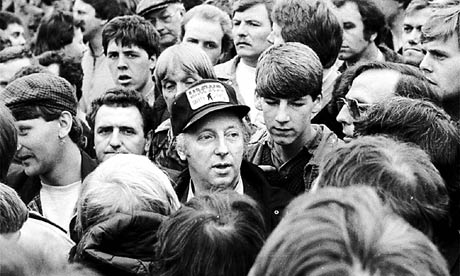
Quite literally on the seashore, or within a hundred yards of it, there is a colliery, which I cannot imagine how they keep dry. Perhaps they have specially adapted mineworkers with gills, who can dig underwater, a sort of “Scargill from Atlantis”.

Arthur-Scargill-leads-the-002

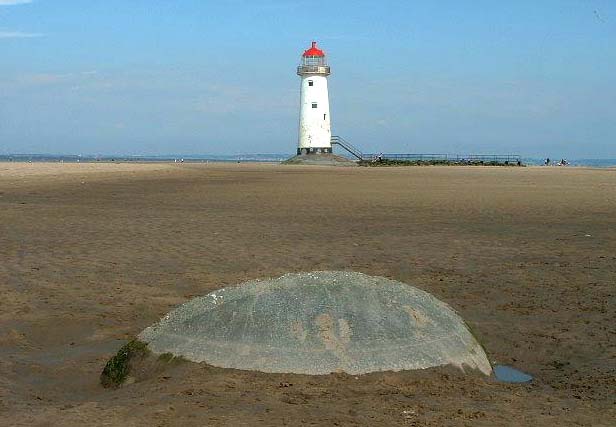
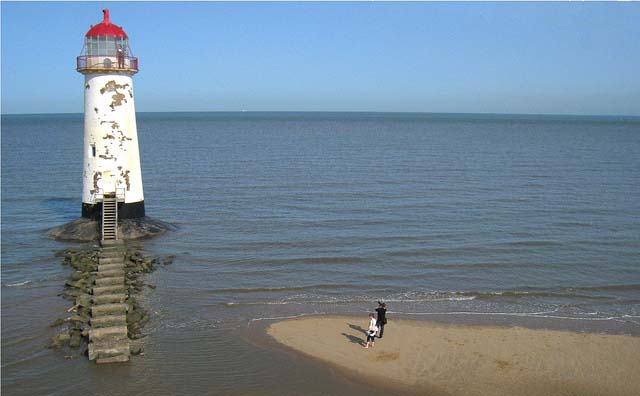
On the Point itself, there is a deserted and ruined lighthouse, which is crying out for someone to restore and then convert either into a sea watching hide, or better still, a bird observatory.

lighthouse xxxxxxx

On the way back to the car, we find a wonderfully promising area, which is full of little hawthorn bushes, all carefully designed to attract small migrants and rare warblers from every corner of the globe. We find just one bird and we are eventually forced to concede that it is merely a Garden Warbler.
On the long way back, another visit to Halkyn. This place is fast becoming a sort of drug.  I am trying to give it up, but I just keep getting dragged back. This time, we meet one of the locals, an individual whose talents for unprovoked rudeness are probably exceeded only by his apparent brainpower. I park in a long and completely deserted street, only for him to rush out of his traditional cottage and tell me that I’m causing an obstruction and I have got to move. Apparently he’s expecting a cruise missile convoy at any moment. I enjoy screeching off ostentatiously down to the end of the street, parking the car four hundred yards away, before walking back to ask him if he reckons he’s got enough room now. He says he has. Some of these country people are really nice and pleasant to talk to, but so many, quite simply, are not. Still, I have the last laugh, because I can get into my car and drive off back to the big city. I won’t have to spend the rest of my life in a place like this with absolutely nothing better to do than to be gratuitously rude to tourists.

Twenty five years or so later, things have changed comparatively little on the beach at Gronant.  A most interesting Second World War pillbox which we all contrived to miss at the time is apparently a lot more visible now, and has been featured on the Internet on at least one specialist pillbox spotters’ website.

type 25 pillbox ddddddd

The lighthouse is still there but a local artist has equipped it with a sculpture of a lighthouse keeper imaginatively called “The Lighthouse Keeper”.

This slideshow requires JavaScript.

You can still get cut off if you are not careful.

cut off xxxxxxxx

Even if you are a glass sculpture, and at no special risk….

too late now cccccccc

On this beach, even a jellyfish can get lonely, although he does appear to have some sort of (presumably waterproof) mp3 player which will help him to pass the time.

lonely jelltyfish xxxxxx

Leave a comment

Filed under Humour, Twitching, Wildlife and Nature

The Beast of Sarlat

The « Bête féroce de Sarlat » was famous in Périgord in central France from 1766 onwards. Its peculiarity was not to attack women but exclusively to kill men.

This slideshow requires JavaScript.

According to that font of all knowledge, Wikipedia….

“The « Bête de Sarlat » was a man-eating animal behind a series of attacks against human beings in the Périgord province of France. During the spring of 1766, a dozen or so fatal attacks were been recorded in the villages around Sarlat. The inhabitants of the region were filled with genuine panic, beginning to talk of a gigantic beast thirsting for human blood or even a werewolf. The creature managed around fifteen victims more, before in August 1766 the peasants and noblemen organised a beat together with more than a hundred rifles. During the course of this, the animal was flushed and killed. It was a wolf infected with rabies but the people did not readily accept this explanation and continued to talk of a werewolf.”

One website devoted primarily to the « Bête du Gévaudan » has a little to say about the « Bête de Sarlat » :
11111xxxxxxx

After all, the two areas are not a million miles apart in distance, although the two time periods clash, with the more famous Gévaudan monster killing its victims between the early summer of 1764 and June 19th, 1767 when a local man named Jean Chastel supposedly killed it during a hunt organized by a local nobleman.

“The Bête de Sarlat terrorised the Périgord province of France in the XVIIIth century. Its first appearance came in March 1766, when it carried out around ten killings in the surrounding area. The fear that the Beast caused can be imagined. It was from this time onwards that the myth of an enormous monster thirsting for human blood arose.
But in the month of August 1766, it was finally identified as a wolf suffering from rabies. The people did not really believe this explanation and it must be said that in the intervening time at least another eighteen more people were killed. The monster was seen absolutely everywhere, even in the dark backstreets of Sarlat. When the people’s fear and exasperation was at its height, the legend of the beast grew to such a point that the good people of the area no longer dared go out as soon as it got dark.

From this time onwards, both peasants and nobility came together with more than a hundred rifles and began a beat. The creature was found, pursued and shot. This death was confirmed by an assembly of a large number of happy eye-witnesses and seems to have taken away once and for all the justified fears of the local people. We know very well that the wolf with rabies and the man with rabies seem equally overcome with madness: frothing at the mouth, slavering and biting. They are terrifying to see and dangerous to approach. But this killing only stopped the spread of the rumour. Nothing really changed either in Sarlat or in the surrounding region, where they still spoke of the beast as a werewolf.”

perigord noir rocamadour cccccc

A further account tells broadly the same tale….

“The first time that this creature came to people’s attention was in the spring of 1766 when it had already committed a dozen murders in the villages around Sarlat. From then on, absolute terror reigned in the province of Périgord. They spoke of a gigantic beast, thirsting for human blood, and soon the legend grew to such a point that the people no longer dared to go out as night was falling, because it was claimed that the monster had even been seen in the very streets of Sarlat itself. The creature killed another good fifteen or so people before both the peasants and the aristocrats, driven to it by fear, organised a beat with more than a hundred rifles. The animal was flushed and killed, and it was stated to be a rabid wolf. Even if this particular animal was killed, its legend remained alive and well throughout the whole region, where they spoke for a good many more years of a bloodthirsty werewolf.”

On his own website, Mikerynos writes

“The Beast of Sarlat terrorised Périgord in the XVIIIth century. Its first appearance dates back to March 1766 when it had already committed around a dozen murders in the neighbouring areas. It is easy to imagine the terror that it provoked. It was from this time that there began the myth of an enormous monster thirsting for human blood. In the month of August 1766, however, the animal was finally identified as a wolf carrying rabies. The ordinary people found it difficult to accept this explanation, and it must be said that in the meantime it had killed at least eighteen more people.
People would see the creature absolutely everywhere, even in the dark alleyways of Sarlat. With fear and anger both reaching their peak, the tales told about  the beast grew to such a level that the good people of the region no longer dared to go out as night fell. From that moment both peasants and aristocrats came together with more than a hundred rifles and organised a beat. The animal was found, tracked and shot. This death was witnessed by so many ecstatic eyes and seemed to have rid the local people for ever of the object of their well justified fears.
We know very well that a wolf or a man with rabies both seem equally overcome with madness, slavering at the mouth, frothing and biting. They are terrifying to see and dangerous to approach. But this only stopped the rumours from spreading, nothing had changed and both in Sarlat and the surrounding area, they still talk of the beast even now as a werewolf.”

At the time in 1766, a broadsheet about the beast was published locally in the province.

broadsheetcccccc

Here is the bottom half with the text. Hopefully, the words are a little clearer….broadsheet   bottom  cccccc Here is a translation of the words you can see, but unfortunately, this is, literally, only half the story. And it seems supremely ironic that on the scan of the front page, you can see some of the print from the back page in reverse, but I cannot find it anywhere on the Internet…

“The curious, remarkable and true tale of the deaths and disorder caused by the ferocious beast, in the area around Sarlat in the Périgord region (of France).
Recently there has been seen in the area around Sarlat in the Périgord region, a ferocious beast, that was considered to be a rabid wolf, but one of an extraordinary size. This ferocious beast roamed, at an incredible speed, over the parishes of Saint-Julien and Grossejac. In vain did a number of the inhabitants of one or the other parish try to put a stop to the depredations of this cruel animal. Between eighteen and twenty people were the sad victims of its fury.
This animal was in complete contrast to the Beast of Gévaudan of which so much has been said; for it seems that the former hated only men whereas the Beast of Gévaudan preferred to attack women. When ready to seize its prey, it put up its hackles, and its eyes became flaming red. It raised itself up on its back legs and tried to seize the victim, sometimes by the face, sometimes by other parts of the head. To stop the ravages of this formidable enemy, whose terrible deeds were already beginning to weigh only too heavily on people, the nobleman Descamps and the gentleman Saint Julien……

Raising itself up on its hind legs, of course, is not normal behaviour for a wolf, animals which nowadays seem to stick firmly to a four legged approach. Flaming red eyes, of course, are not a feature of any known wild animal.

The on-line edition of the newspaper « Sud-Ouest » reports…

“In the XVIIIth century a monster terrorised the south eastern part of the province of Périgord for several weeks. The creature appeared in March 1766 and around a dozen people were killed in the villages around Sarlat. Then was born the myth of an enormous beast thirsting for human blood, like some kind of werewolf.
In the month of August in the same year certain people identified it as a very large wolf infected with rabies. But the population were not reassured by this, especially as in the meantime eighteen other people had been killed. People glimpsed the beast everywhere, even in the dark little lanes of Sarlat. The “population of the village shut themselves away in their houses. Around a hundred people armed with rifles, both peasants and nobles then organised a beat. A rabid wolf was killed. The attacks stopped but the legend lived on, that of a werewolf.”

Its report continues with a device that is known, probably, to newspapers the whole world over. Indeed « Sud-Ouest » could not consider itself a real newspaper if it did not  have that desire to thrill, to terrify and then to sell more newspapers…

« Un loup a-t-il été aperçu en Dordogne ? »
“Has a Wolf been seen in the Dordogne?


la-bete-a-ete-prise-en-photo-par-quentin-sarlat-dans-un_1535215_480x300

«This animal was photographed at Saint-Amand-de-Coly. Other people in the immediate area have been seeing it for the last two weeks. According to government sources, the theory of a wolf, however, is not particularly credible and some doubt may be expressed. Quentin Sarlat, aged 20, was coming back from Montignac last Friday and came across this animal in a field at Saint-Amand-de-Coly.

1415216_loup-2409062-1200_800x600p

He took a photograph of it, unlike one of his friends who had already seen it two weeks previously. «At first, the animal was much more distant and then it began to run across the field in my direction only to stop about ten metres away from me. He looked at me for at least thirty seconds, and I did not dare get out of my car. Then the animal went off round the back of the car, without ever taking his eyes off me »

As for Aurélien Viau, the regional head of the Office National de la Chasse et de la Faune Sauvage (The Ministry of Hunting and Wildlife) said that there was little chance that this was a wolf.

«Looking at this photograph, I would say that it’s a dog because the animal is too fat, it’s wearing an orange collar and it does not fear man. But nevertheless we will be going over there to have a look round. »

The collar that the animal is wearing could well be an identification collar, as some method of tagging wolves. On the other hand, it is certainly a wolf which seems to have eaten all the pies.

After this, of course, widescale panic seems to break out and the questions below are suddenly all asked in the newspaper. Nobody seems to notice it is that old strategy….”thrill, terrify, sell”……

Et si le loup revenait dans les forêts de Dordogne ?
“What if wolves came back to the forests of Dordogne?”
Le loup peut très bien recoloniser entièrement le territoire
“The wolf might very well recolonise the entire area”
Environnement : les sentinelles guettent toujours le loup
“Environmental news: a network of guards await the wolf”

And then, AH NON !!!!….

Dordogne : le loup était un husky

“Report from the Dordogne: the wolf was just a husky.”

Most significant of all perhaps is the verdict of the historian Jean-Marc Moriceau who in a newspaper article entirely worthy of our Daily Mail will:

“retrace the blood soaked career of the wolf in France. 8000 dead people in 250 years, and perhaps it isn’t all over yet….”

Perhaps the writer who argued in one of my previous blogposts that the entire French nation was too often guilty of collective hysteria in the face of these much maligned and gentle animals was correct. This website makes « Sud-Ouest » appear almost conservative in its ideas….

LE DIABLE A-T-IL CRÉÉ LE LOUP ?

DID THE DEVIL CREATE THE WOLF  ????

Bonne nuit et dormez bien!


7 Comments

Filed under Cryptozoology, France, History, Humour, Science, Wildlife and Nature