Category Archives: Nottingham

1792 : a vintage year

The details that I found for the year 1792 come from a source that I have used quite frequently before, namely “The Date Book of Remarkable Memorable Events Connected With Nottingham and Its Neighbourhood”.

The year started in spectacular fashion on February 25th:

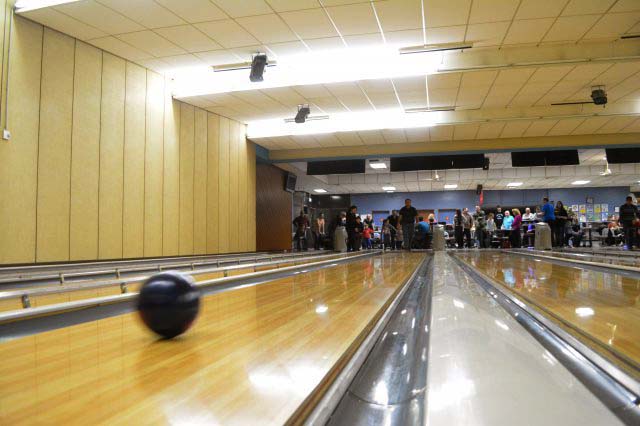
“Between the hours of eight and nine this evening an alarming shock of an earthquake was felt in the Midland counties, but particularly at Nottingham, many of the inhabitants running out of their houses, expecting them to fall upon their heads. The shock was preceded by a rumbling noise like the rolling of a cannon ball upon a boarded floor.”

A bit like this, then:
At this time, there was, of course, no real sport in the city…no Nottingham Forest, no Notts County, no Nottingham Panthers, no Nottingham Outlaws, no Nottingham Rugby Club. And so people had no choice but to busy themselves by showing enormous interest in council planning applications:

May 9th . “On the arrival of the intelligence that the bill authorising the formation of the Nottingham Canal had received the royal assent, the bells of both churches were set a-ringing, and other congratulatory manifestations indulged in.”

Thank the Lord. We’re going to build a canal. Canals are wonderful :
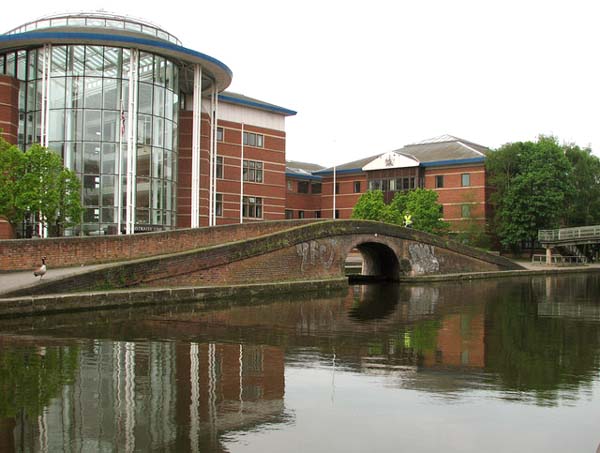
If you look after them, and remember, like pot plants, to water them regularly:
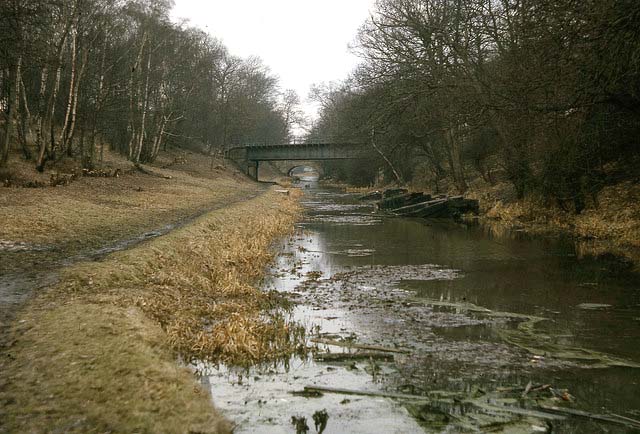
I think by now people’s nerves were already on edge after over indulging in their personal celebrations of the success of the planning application for building the new canal. They were a little like small children who get fractious and behave badly after their routine is disturbed:

May 12th.  “A number of people assembled in a riotous manner in the Market-place, on account of the high price of butchers’ meat:
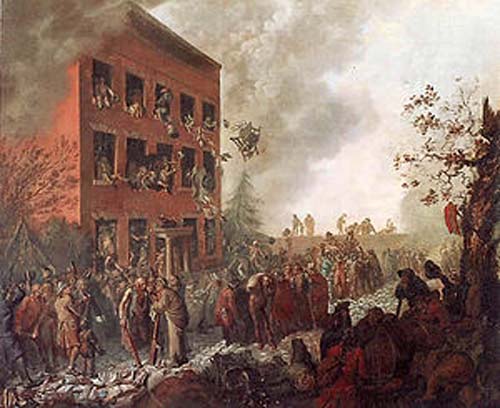
The Market-place did look quite different then:
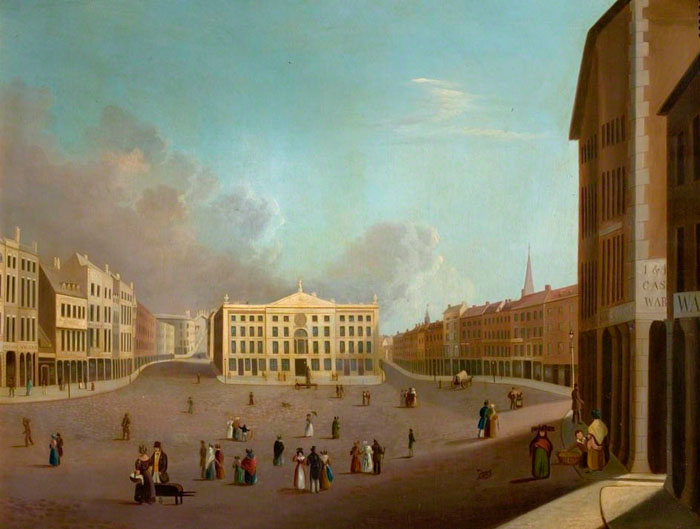
The account continues:

After a stout endeavour to retain possession of their property, when further resistance might have proved dangerous, the butchers retreated from the Shambles, and left the mob in undisturbed possession. It being Saturday, the stock of meat was large and in a few moments the whole of it disappeared.

The magistrates at once called out the military, and by the expostulations of the Mayor, and the firing of the soldiers in the air, the mob dispersed, and the military returned to their quarters.”

Here come the military. They do look a little bit regimented, I suppose, but they are a lot easier to draw this way:

“Very unexpectedly, in the course of the evening the depredators reassembled, and bearing down upon the Shambles with renewed force, destroyed and conveyed away every door, shutter, implement, and book they could find in the shops, and made a great bonfire of them in the Market-place, yelling and shouting round it like  savages. The fire was burning from eleven at night till one in the morning, when the military succeeded in extinguishing it, and tranquillity was restored.”

For a moment there, it must have been touch and go:

I would think that for the second military intervention, they used the soldiers with the silly hats. Most people, when faced by these picked German troops, just ran away clutching their stolen sausages:

“For several days after, symptoms of a recurrence of the disorder were apparent, but the vigilance of the authorities at length finally suppressed them.”

Nobody nowadays ever thinks of England as ever being on the edge of revolution, but it had already happened once during the reign of King Charles I when the king was executed. The end of the 18th century saw a fair few Englishmen holding up the French Revolution as an example of good practice. They were pushed into that by a royal family who were perhaps the least charismatic of the many Germans who have ruled over our country. Parliament was no better. It was a place where rich landowners were vastly over represented. Their excessive number of MPs kept the price of the food their estates produced artificially and permanently high.

Many revolutions around the world have started with hungry people robbing shops full of food they wanted to eat but could not afford.

 

22 Comments

Filed under Criminology, France, History, Nottingham, Politics

Nottingham High School on ebay (2)

As well as not buying a rather expensive medallion on ebay, I have actually bought a postcard or two over the years. The first one was sent on October 27th 1926. It is stamped with an 8.00 pm postmark, so I presume that it was written earlier that day and then posted perhaps before dinner, or, more likely perhaps, on the sender’s way home from work. It was a Wednesday, which in those days would have been half day closing, so he probably left work at 1.00 pm and put it into the post box on his way home:

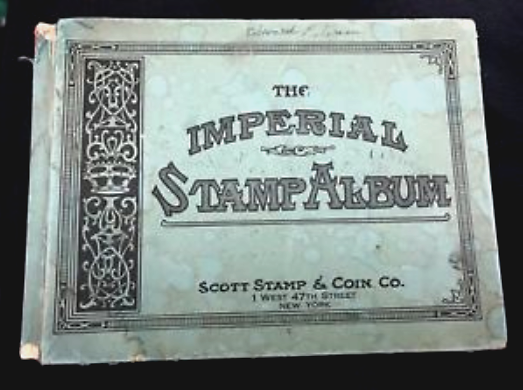
Notice how the Post Office slogan is “British Goods are best”. Only a few months after the General Strike, the economy was in real need of a boost if further discontent and upheaval was to be avoided. Notice too, the beautiful, classic stamp. King George V was a fanatical stamp collector, and loved nothing better of an evening than sticking his stamps in his thousand albums. When you’re an emperor, this is the album for you:

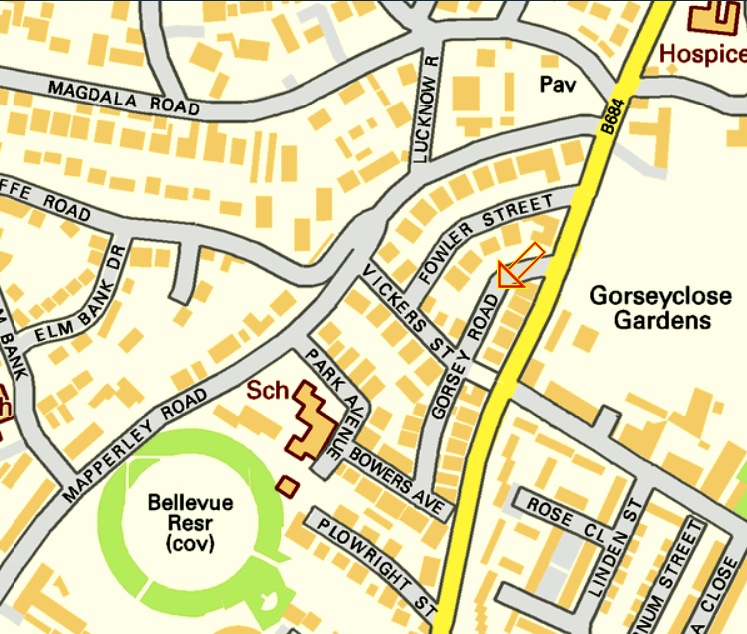
The postcard is addressed to NG Peet of 2 Gorsey Close in Mapperley Park. I couldn’t trace a Gorsey Close but I did find a Gorsey Road. Here is a close up view of the area. Gorsey Road is between the B684 Woodborough Road and Mapperley Road, in Mapperley Park, one of Nottingham’s leafier suburbs. Look as always for the orange arrow.  No 2 is on the corner with the B684, Woodborough Road. :

If you look at this larger map, you can see that Gorsey Road is not too far away from the High School which is in the bottom left corner in the area between Arboretum Street, Forest Road East and Waverley Street. The School is on the corner either side of the pale green patch. Gorsey Road, I should have said, is again indicated by the orange arrow.

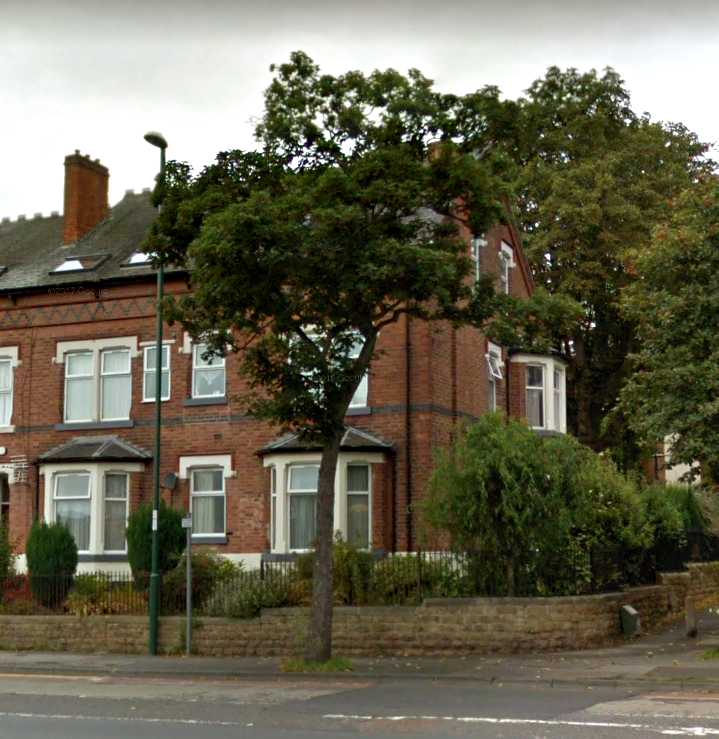
This is No 2 Gorsey Road now, a little overgrown perhaps, and in a street which looks to have gone a little downhill, but obviously, it was a very beautiful house in its time:

The Peet family had only recently moved to Gorsey Close when that postcard arrived in the late evening of October 27th 1926. In the Kelly’s Directory published in 1925, their future abode was owned by Edward Westwick Kirk of Kirk & Macdonald. The Head of the Family, WG Peet, was living at that time at 249 Woodborough Road, presumably with everyone else in the family. Here it is:

Three years or so later, when all of the information had been collected for the 1928 edition of the Kelly’s Directory, the house in Gorsey Road was now recorded as being occupied by Mrs Ann Elizabeth Peet. She was presumably NG Peet’s mother, rather than his wife. At this time her son was still in his early twenties and it is by no means surprising that he was still living in the parental home. There is certainly no NG Peet listed as living elsewhere in Nottingham, nor indeed in the rest of the county.

In 1929, the High School prepared its own list of the Old Boys’ addresses. In that, NG Peet is listed as still living at 2 Gorsey Close although it could just be that they carried an old address forward.

NG Peet, incidentally, I should have introduced him earlier. He is Noel Gordon Peet, who was born on December 26th 1901, hence the name. His father was William George Peet who was a “General Agent”. Six years later, in 1925, the relevant Kelly’s Directory listed William George Peet as working for “WG Peet, Son & Company”. By 1928, he is listed as a “yarn merchant” operating from Kaye’s Walk. His telephone number was listed as “TN 42769” and his telegraphic address as “Knitiarns”.

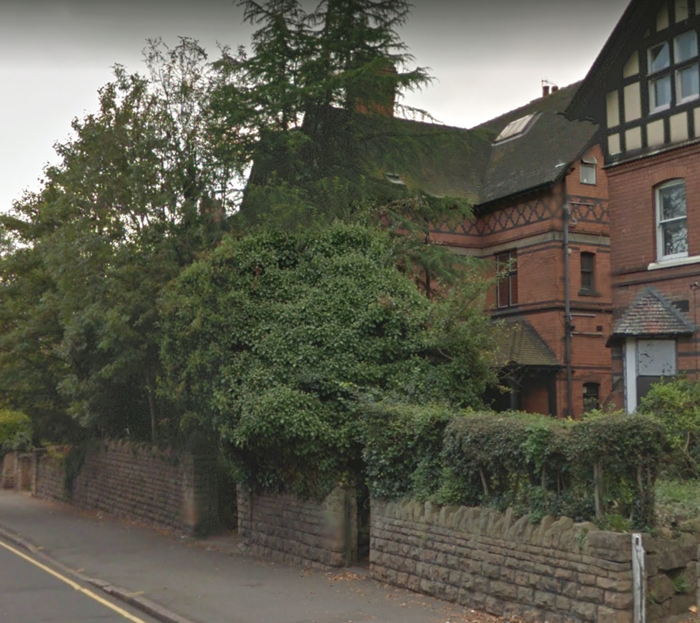
Noel entered the High School on April 26th 1917, at the age of 15. He was Boy No 3662 and he stayed there until July 1919. At this time, 1917 at least, the family was living at 413 Mansfield Road. Here’s 413 Mansfield Road, in spirit a very similar house to 2 Gorsey Road. I’m a huge lover of trees, but these need a tree surgeon and his assistant for a day and the whole place would look so much better:

Noel packed a lot into his two and a bit years at the High School. He won the Fifth Form B Prize in 1918 and the Fifth Form Writing Prize in the same year. In 1919, he won the Sixth Form B Prize. In the Officer Training Corps, he became a Corporal in 1918 and a Sergeant in 1919. In cricket, he won the School Prize for Batting in the same year.  He had 13 innings and scored a total of 144 runs at an average of 11.07. His top score was 36. Not a classic season for the School apparently !

Also listed in the High School’s list of Old Boys in 1929 was William Ronald Peet, Noel’s younger brother. He too is recorded as living at No 2 Gorsey Close. He was born on October 9th 1910 and entered the High School as Boy No 4036 on May 1st 1919. He left in December 1926 at the end of the First Term. By the time William entered the School, the family had moved from Mansfield Road and were living at Sutherland Lodge in Lucknow Drive in Mapperley Park. The boys’ father is listed as a “manager”. Lucknow Drive, or rather the word “Lucknow”, is visible in the top right corner of the second map above.

Did anything significant happen on the day the postcard was posted, namely October  27th 1926, anywhere in the world ? Well, nothing really earth shattering, but there was one episode which I found quite amusing. Here’s a clue, with a picture of a Shipstone’s Brewery beer crate and some of their products:

Shipstone’s Brewery lasted from 1852-1991. I always felt that it was, at best, an acquired taste. Anyway, here’s the funny story to finish with. It comes from ‘Hansard’ which records everything said by everybody in debates in the Houses of Parliament. The story came out because Labour Party MP, Alfred Salter, was censured in the House of Commons for refusing to retract remarks of his that had appeared in the Daily Express:

 “I am not prepared to withdraw, modify or apologise for anything I have said on this matter, and I propose to repeat the words I made use of and about which complaint has been made.

I said, and I repeat it here to-day, that I have seen members of all parties in this House, my own party I regret to say included, drunk in this House not on one occasion but on many.”

A motion was passed calling the statement “a gross libel on the Members of this House and a grave breach of its privileges.”


20 Comments

Filed under History, Nottingham, Personal, The High School

Nottingham High School on ebay (1)

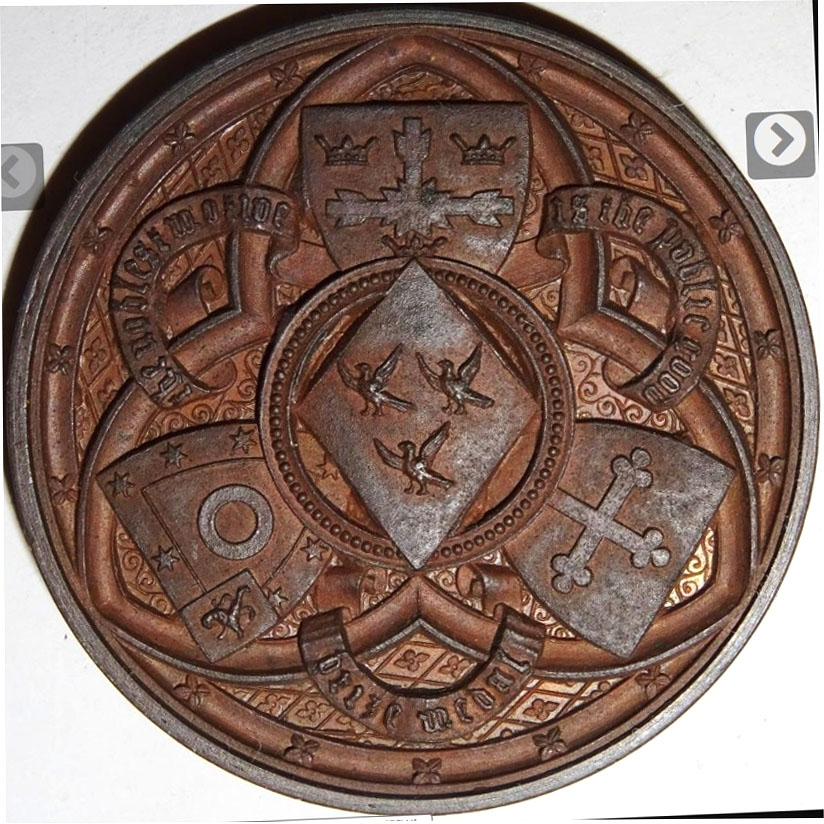
I always keep an eye on ebay to see if anything is on sale which is connected with Nottingham High School, the school where I spent my entire teaching career. First, here’s something that I didn’t buy because I thought it was far too expensive. Here’s the front:

And here’s the back:

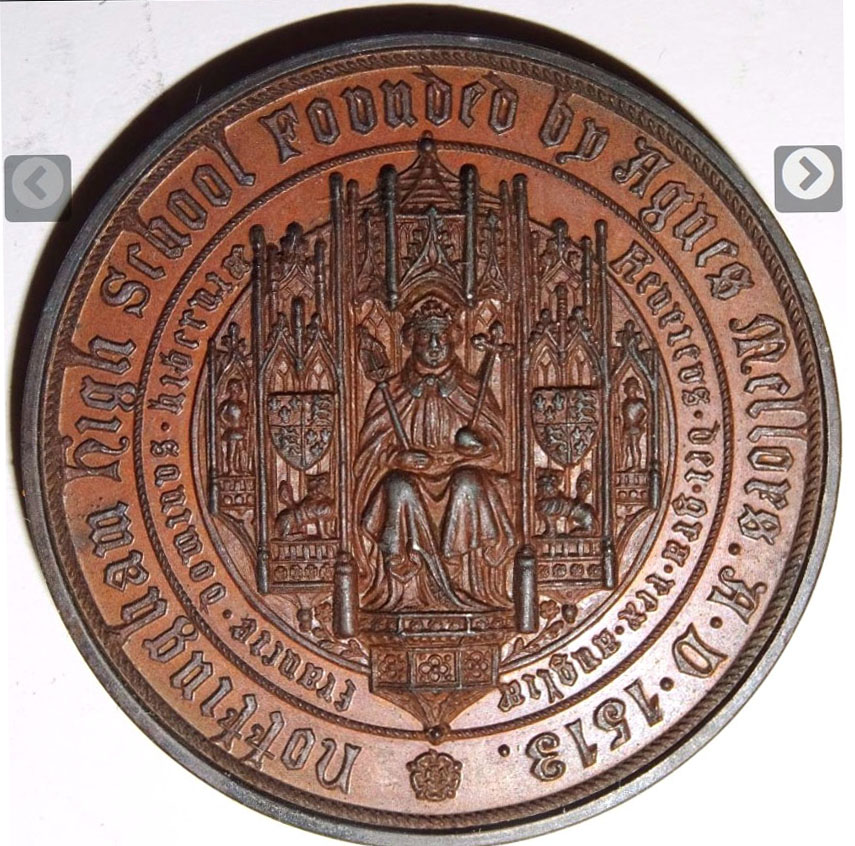
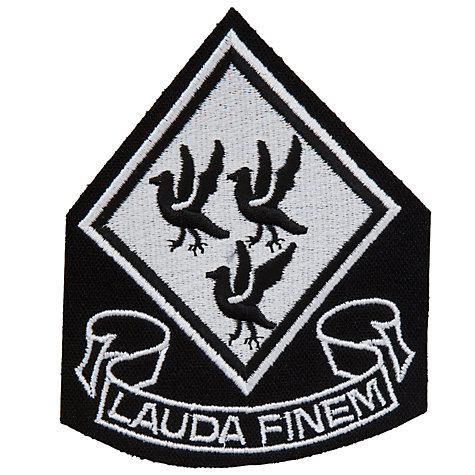
The seller wanted £85 for it which I thought was just too expensive for me. It was a medal awarded to Benjamin Herbert Heald of Wilford, a little village on the River Trent to the south of Nottingham. Born on September 16th 1874, Benjamin entered the High School at the age of 12 on September 11th 1887 as Boy No 664. His father was Francis Berry Heald, a designer. Benjamin left the High School on the last day of what was at the time quite frequently called “Term Three” in July 1893. He went on to Queen’s College, Oxford with an Exhibition of £42. That would have been at least 20 times the average worker’s weekly wage.  At the High School he was a true Clever Clogs of the Very Highest Level. He was a Foundation Scholar (1890), a William Enfie Exhibitioner (1892), a Morley Exhibitioner (1891). He won 12 School Prizes in his time at the school, and a number of medals. You can make your choice as to which one this was. They were the Bronze Medal for Good Conduct (1889), the Gold Medal for the Best Open Scholarship (1893) , the Silver Medal for Classic (1893) and the Bronze Medal for Good Conduct (1893). If anybody knows which medal this is, please make a comment. I presume it is one of the Bronze ones. Notice how the reverse has the normal badge of the School:

It also has the cross which appears on the coat of arms of Nottingham:

I don’t recognise the shield with the ring on it, but it does seem vaguely familiar so perhaps somebody has an idea about that.

I found out one strange detail about Benjamin Herbert Heald. In the School Register is a boy called Benjamin Arthur Heald who was born on May 11th 1856. He entered the English School at the Free School on Stoney Street, as it then was, in January 1866. His father is listed as Benjamin Heald and he was a “lace agent and designer” living at 18 High Pavement. Benjamin Arthur Heald was surely a relative of Benjamin Herbert Heald. Anyway Benjamin Arthur is recorded as having died at home from the effects of overbathing, probably in June 1867, when he was 11 years old.

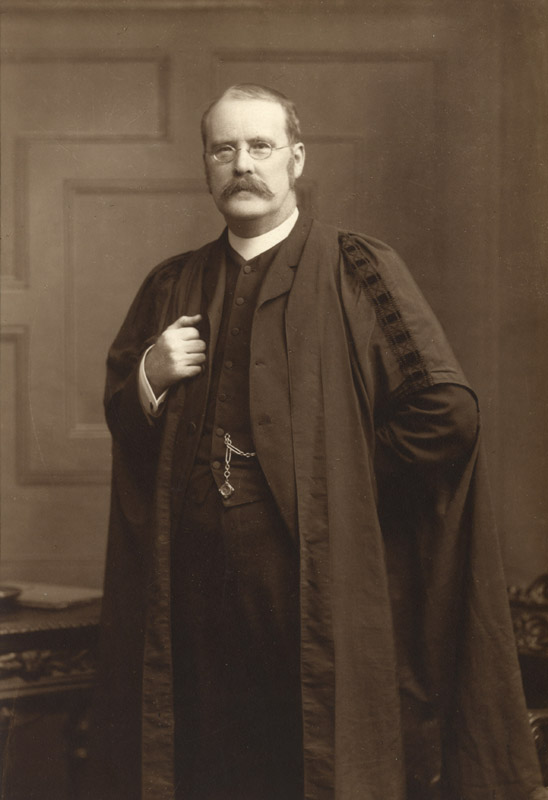
Eventually, Benjamin Herbert Heald became the Headmaster of Midhurst Grammar School in Sussex. In later years he was to reminisce about how the High School’s Headmaster during his time at the School, Dr James Gow, was different from all the other teachers. He never called boys up to his desk to go through their work, but always went to sit alongside them. Lessons usually finished with the customary phrase, “…I think that just about finishes our dose.”

This is Dr Gow, the High School’s greatest ever headmaster:

Next time, some dirty postcards. Well, second hand, at least.


26 Comments

Filed under History, Nottingham, Personal, The High School

They were only playing leapfrog…..

This story comes from a source which I have used quite frequently, namely “The Date Book of Remarkable Memorable Events Connected With Nottingham and Its Neighbourhood”. On this occasion, the year is 1794 and the French revolutionary government has recently abolished slavery on February 4th of that year. Only a week later, on February 11th, the sessions of the United States Senate are made open so the public can come along and watch.

Today, though, is February 23rd and the slack jawed young locals in the Hockley area of Georgian Nottingham have all assembled in Broad Street. They are going to have a damned good game of leapfrog while they wait for somebody to invent football. On this modern map, LRTS marks the tram system. Look for the orange arrow:

I presume that leapfrog  is a universal game across the world. This is Harlem during the Jazz Age:

And here’s one of those old Victorian stop motion films:

You wouldn’t want to play  leapfrog in the middle of Broad Street nowadays, but in 1794 it was not a problem. So what happened? Well…….

“A number of young men, in a playful mood, were diverting themselves in a game of leapfrog in Broad-street, when one of them disappeared underground in a remarkable manner. He had leaped over the back of a comrade, in the customary way, and happened to alight on the spot where there was a well,  120 feet deep.”

It wasn’t as big as this…

But it was still quite big and it soon attracted a crowd:

Anyway, back to 1794…

“The aperture had simply been covered with boards and a little earth, and was uniform in appearance with the surrounding ground . Fortunately, the man was extricated perfectly unhurt, and with an oath declared himself equal to any pantomime performer on the stage, inasmuch as he dare leap without being caught in a blanket! The well was immediately arched over.”

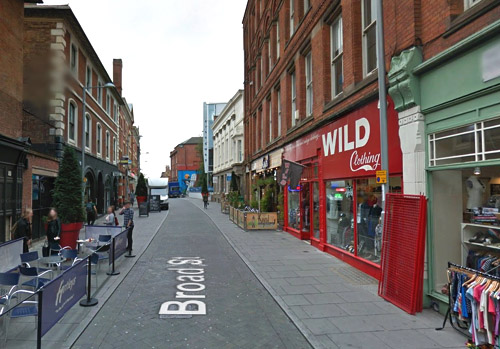
Nowadays, Broad Street is a busy but basically, fairly ordinary thoroughfare, except some bored fool with nothing better to do has painted ” Broad St” on the floor in big white letters :

The other end of the street has a famous pub:

This pub is nowadays the only real attraction in the street. Things might change though, if “arching over” an old well doesn’t solve the problem for very much more than 200 years. Then we might see some more excitement.

Here’s a better view of the pub:

Once you’ve had a refreshing pint of ale in the Lord Roberts pub, above, you might even feel like a game of leapfrog yourself. Here’s the army’s version of the game in that magnificent anti-war film about World War One, “Oh What a Lovely War”. The song is entitled “They were only playing leapfrog”:

26 Comments

Filed under France, History, Nottingham

the Reverend Charles Stephens (3)

Last time I showed you some more of the photographs left to us by the Reverend Charles Stephens, a keen photographer who captured many aspects of the High School, both boys, buildings and activities. Some of the most striking ones were taken in early 1960 when the new block on the northern side of the West Quadrangle was opened.

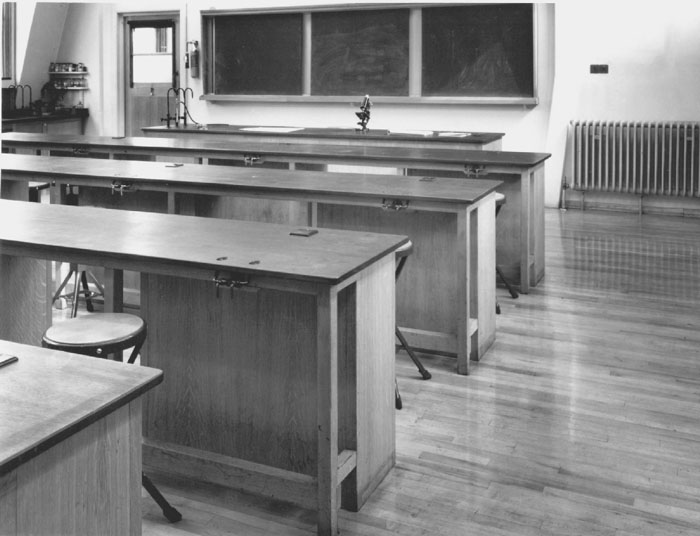
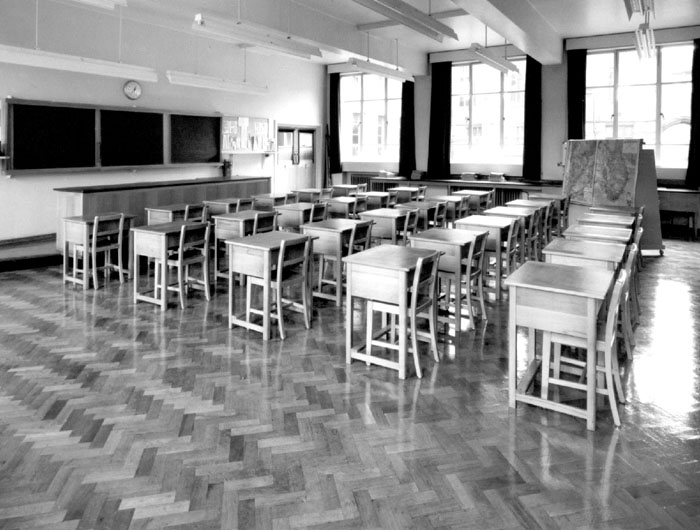
We have already looked at the bottom floor and the top corridor with their absolutely amazing block parquet flooring, which was not just shiny but even reflective. That incredible quality of being polished so highly as to be reflective seems to have been really widespread in the school at the time. Perhaps whichever company polished the floors of the new block was given free rein with some of the other rooms. Here are the floorboards of one of the Chemistry laboratories:

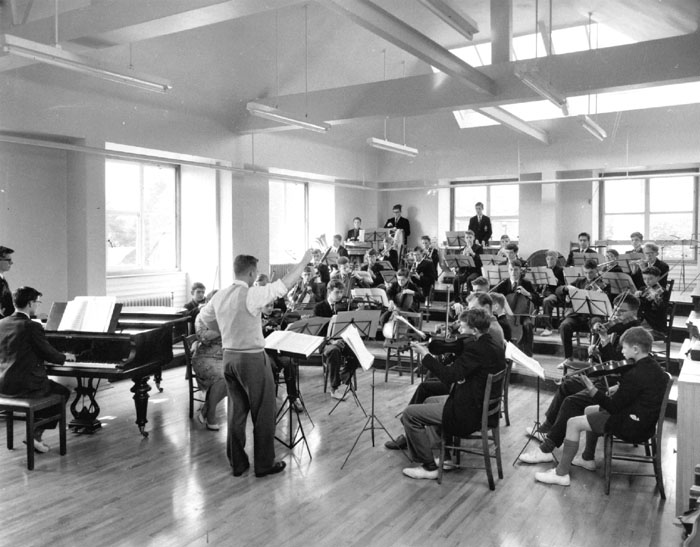
Here is the Music Rehearsal Room. Notice how all of the boys are wearing white plimsolls, which they have presumably had to bring from home, along with their trombones:

The Old Gym was pretty much the same as the new West Block rooms. Just look at those boys at the top of those ropes! If I’d been able to do that, I reckon my application for the French Foreign Legion would have gone a lot better than it did:

The Reverend Stephens didn’t just do buildings though. He did groups of boys such as his Tutor Set, seen here in 1953-1954:

How clever! He got them all to autograph the back of the photo:


16 Comments

Filed under History, Nottingham, The High School

the Reverend Charles Stephens (2)

Last time I showed you some of the photographs left to us by the Reverend Charles Stephens, a keen photographer who captured many aspects of the High School, both boys, buildings and activities. Some of the most striking ones were taken in early 1960 when the new block on the northern side of the West Quadrangle was opened . This was the last part of the extensive school building scheme financed by JD Player, the cigarette millionaire and philanthropist extraordinaire. Pretty much the Bill Gates of the era in England, the nation smoked so many of his cigarettes that the taxes paid on them amounted to £1,500,000 every single day. And in 1960, that single pound was worth £21.66, according to this official website. Another way of representing it was that JD Player was thought to be worth 5p in the pound added to income tax.

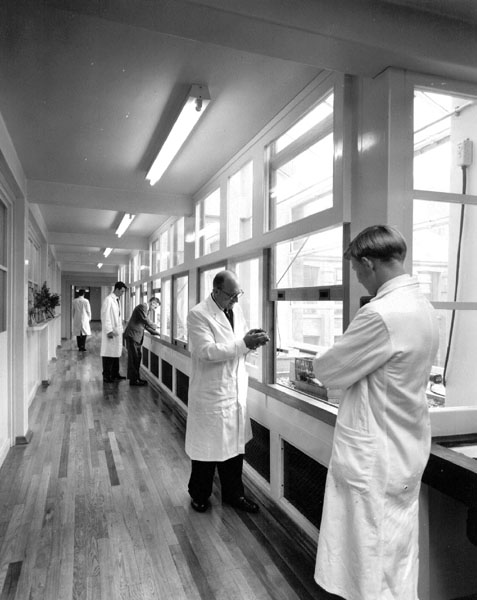
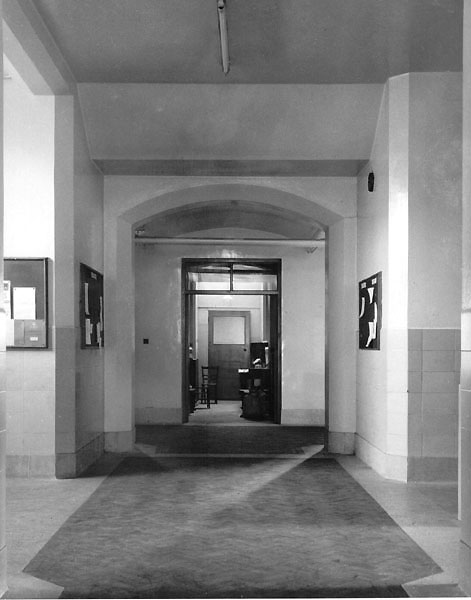
We have already looked at the bottom floor and its absolutely amazing block parquet flooring, which was not just shiny but even reflective.  Here’s the top corridor:

Here it is again and yes, you’re right to be afraid. The men in white coats have come to take you away:

And here’s a Biology class, complete with shiny floor:

Not far from there was the Library. It’s very different from today:

It’s very different even from 1986:

14 Comments

Filed under History, Nottingham, The High School

the Reverend Charles Stephens (1)

Over the years, quite a few ministers of the church have worked as Masters at the High School. One of the most memorable in recent years was the Reverend Charles H Stephens who arrived at the school in 1945. “Charlie” was a much respected teacher of Geography who served the High School well until 1978. As well as Geography, he taught at one time or another, Astronomy, Divinity, Mathematics and Modern Languages. Above all, though, he was a keen photographer who left behind him a huge number of photographs of the school, both boys, buildings and activities.

In 1990 or thereabouts, I scanned virtually all of them into the computers of the day and produced a couple of CDs of his work. I was told as my reward that I could have my own set of photographs to do with as I wished. So here we are. A quarter of a century later, I’ve finally done something to preserve his legacy in an active way.

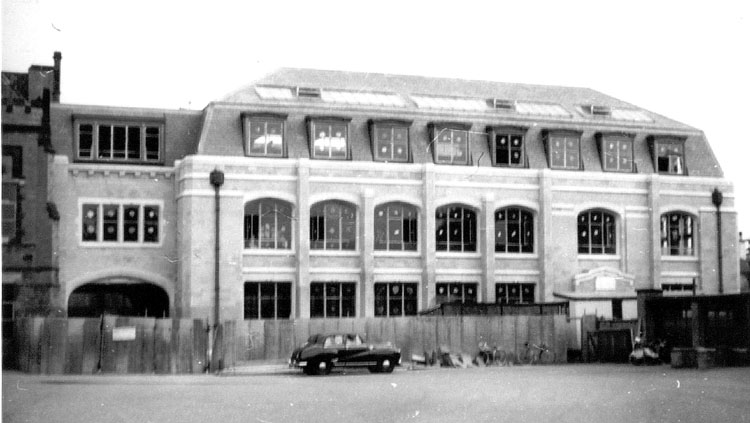
Some of the most striking photographs were taken in early 1960 when the new block on the northern side of the West Quadrangle opened for business. This was the last part of the extensive school building scheme financed by JD Player, the cigarette millionaire and philanthropist extraordinaire. Here are the new buildings, just a few days before their opening. Notice the dots on the windows so that the builders don’t smash them:

The new buildings consisted of two spacious geography rooms, two junior form rooms, and four sixth form rooms. At half term, the members of staff moved into their first ever purpose built Common Room, nowadays called the Staff Room. The rooms on the second floor came into use in the half term after this. They were originally designed to be a music rehearsal room, a prefects’ room, a general science laboratory and a biology laboratory. The latter was considered by Mr “Bill” Neville, the Head of Biology, to be the finest in the county. The new buildings were officially opened on September 22nd 1960, by the vice-chancellor of Nottingham University.

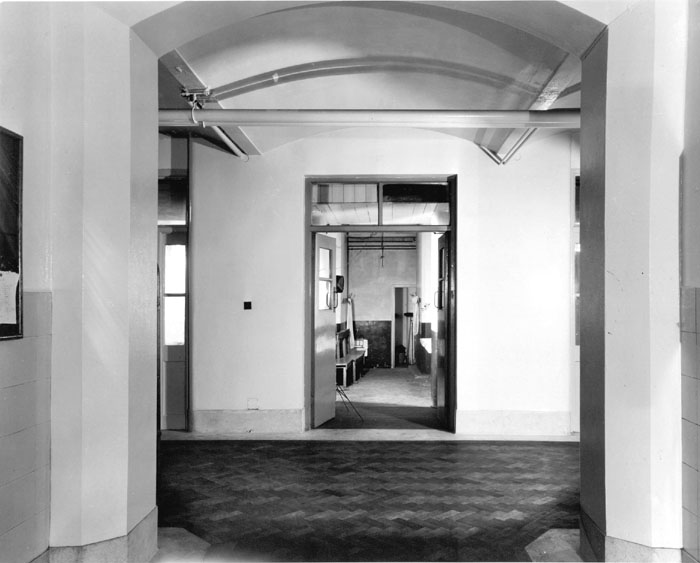
What was most amazing about this new section of the High School were the floors. I am no expert on flooring but I think they were block parquet floors and they were absolutely amazing. They were smooth, polished and reflective, a bit like me. They were quite wonderful. And the floors in the new block were not the only ones at that time. Here is the corridor on the ground floor:

And here is the other end with what in those days was the caretakers’ room:

Here it is in glorious close-up:

Don’t forget that I did a series of four posts about the High School’s caretakers over the years. Here’s a link to the first one, and the second, and the third, and the fourth.

Here are the new geography rooms. The chairs are actually reflected in the floor:

And here is the Reverend Stephens, teaching perhaps a Year 10 or Year 11 class:


22 Comments

Filed under History, Nottingham, The High School

Earthquakes and Lights in the Sky

At least one physical phenomenon is very rare in Nottingham. Would that it were not so:

Untitled
“Northern Lights,” or “Aurora Borealis” was first recorded as having been seen in the neighbourhood of Nottingham during the winter of 1755-1756. The Northern Lights appear at their best according to an eleven year cycle, and 2015-2016 was quite a good year, so keep yourself entertained by doing a very long backwards calculation!
Here is a website which will tell you when is a good time to look for the Northern Lights.
aurora-borealis-cccccccccccccccccccccccccc

Another physical phenomenon is almost equally infrequent in Nottingham…Thank Goodness!
And luckily, when it does happen, it tends to do little damage, and it soon gets forgotten. Who remembers this one now?…

August 23 1752  The severe shock of an earthquake was felt in Nottingham and the surrounding district, about 7 a.m. Great alarm, but not much damage, was the result. The day was remarkably fine, both before and after the shock.”

And forty years later, another earthquake came to nothing…thank goodness:

February 25, 1792  Between the hours of eight and nine this evening, an alarming shock of an earthquake was felt in the Midland counties, but particularly at Nottingham, many of the inhabitants running out of their houses, expecting them to fall upon their heads. The shock was preceded by a rumbling noise, like the rolling of a cannonball upon a boarded floor.”

Another Victorian source mentions an earthquake on October 6th 1863:

“The earthquake appears to have been felt over a great part of England” and it was decidedly more severe in the western parts of the country, especially the West Midlands:

“At Birmingham walls were seen to move, and people rose from their beds to see what damage had been done, for though the rumbling, grating sound is like a passing train, it was known at once to be something more. At Edgbaston successive shocks were plainly felt, and houses were shaken to their foundations. At Wolverhampton everything in the houses vibrated. The houses cracked and groaned as it the timbers had been strained. The policemen on duty saw the walls vibrate, heard everything rattle about them, and were witnesses to the universal terror of the roused sleepers.
At Cheltenham, a deep rumbling noise was heard, the heaviest furniture was shaken, the fire-irons rattled, heavy stone walls were heard to strain and crack, and the boys at Cheltenham College were all under the impression that the rest were engaged in making the greatest possible disturbance.”

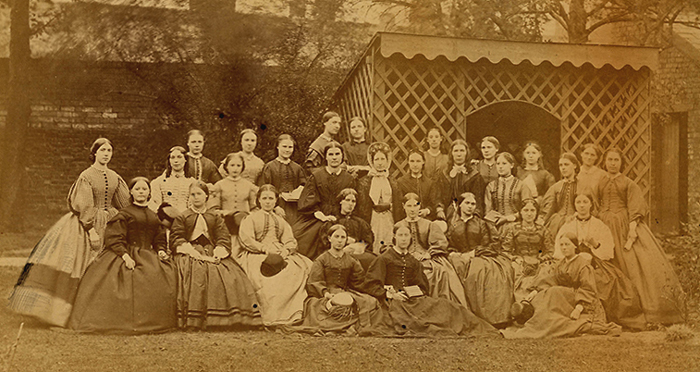
I was unable to find a picture of the boys of Cheltenham College, but, much better, here are the splendid young ladies of Cheltenham Training College around the same period:

chel traoining

And what of Nottingham? Well…

“October 6th 1863  A slight shock of earthquake was felt early in the morning in Nottingham, and in most parts of the country.”

and then, just over a year later:

October 30th 1864  Slight shocks of an earthquake were felt in Nottingham, and in various parts of the country.”

Those two earthquakes were so insignificant that they have, literally, not passed “the test of time” and I have not been able to find really very much at all about them.

In fairly recent times, my Dad experienced an earthquake in South Derbyshire:

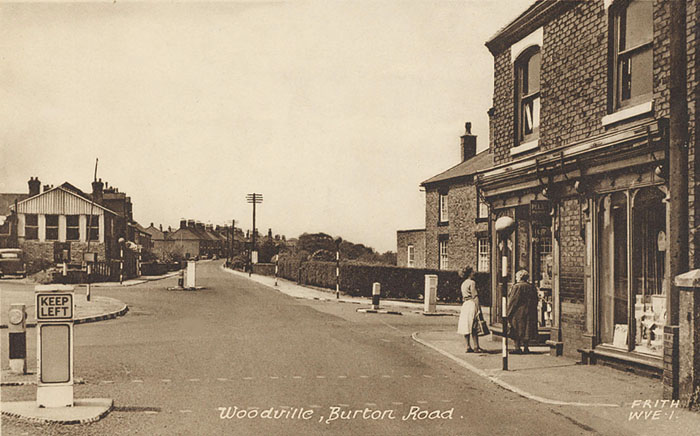
“On one occasion when he was walking home from his job as a teacher at Woodville Church of England Junior School in Moira Road, Woodville, Fred was the hapless victim of an earth tremor. It must have been quite frightening because, as he was to relate many times in subsequent years, he was able to watch the pavement rippling up and down with the force of the shock.

Seismological records for the local area show that this event occurred most probably on February 11, 1957. Here is my Dad’s quiet little mining village around that time, in the late 1950s:


If you want to check the history of known earthquakes in England, then this is the link to the relevant Wikipedia page.

29 Comments

Filed under History, Nottingham, Science

To bale out or not to bale out? (1)

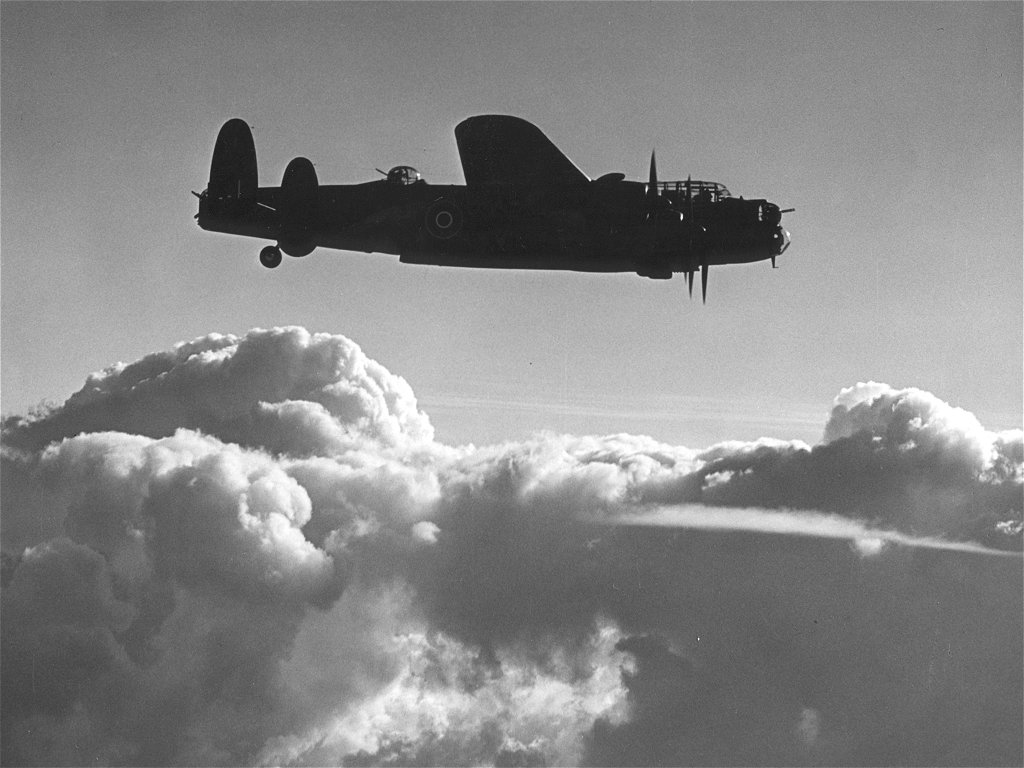
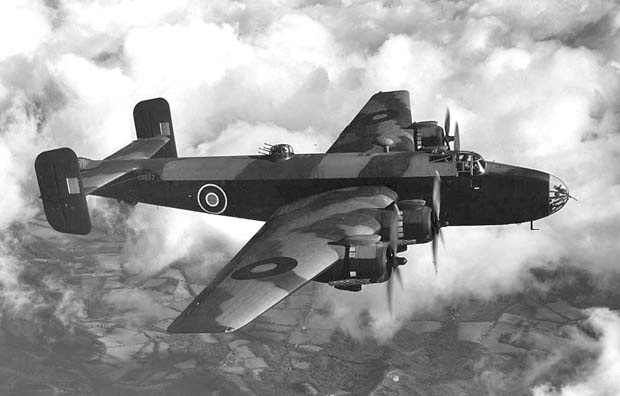
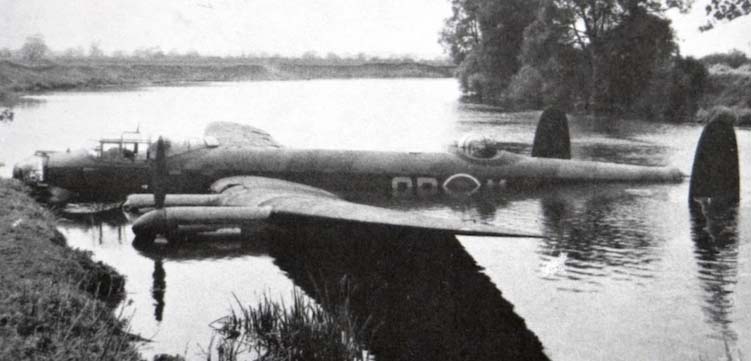
This post is about an Avro Lancaster III of 61 Squadron, serial number DV 232, squadron letters QR-K. They took off, one of many, at 20:15 on September 5th 1943, from RAF Syerston near Nottingham to go and bomb Mannheim. This was a huge operation and involved 605 aircraft including 299 Lancasters, 195 Halifaxes and 111 Stirlings.

This is a Lancaster:

This is a Halifax:

And this is a Stirling:

Of the 605 aircraft, 34 were lost, some 5.6% of the attacking force, an unsustainable casualty rate.

On their way to the target, Lancaster DV 232 and QR-K had severe engine problems, with the port outer engine failing and the pilot unable to maintain height. And then the port outer engine caught fire. Pilot Officer Peter Todd, the pilot, extinguished it and feathered the propeller. The decision was taken to carry on and not to bale out. The aircraft’s 4,000lb cookie and the rest of the bombload were all duly dropped on Mannheim from around 15,000ft:

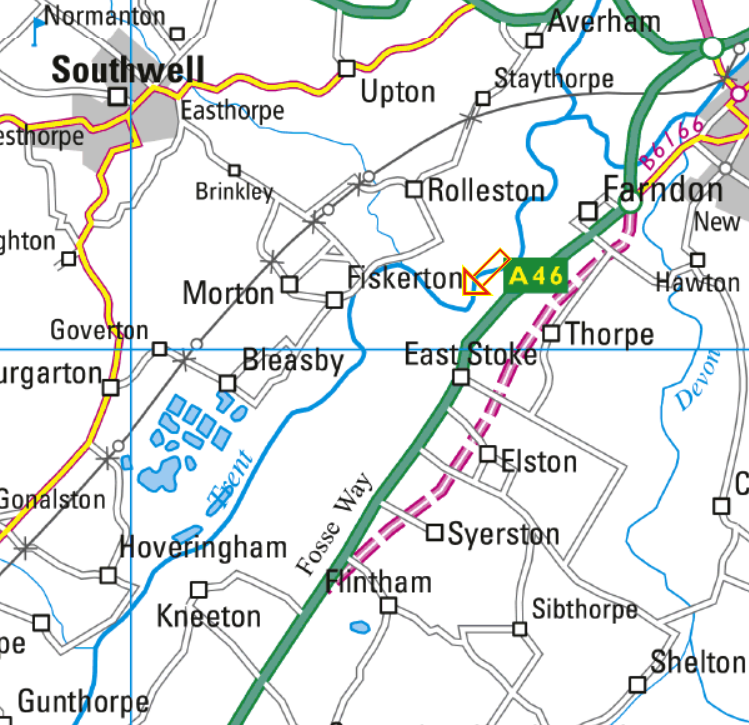
The crew then turned for home, full of a strange mixture of trepidation and perhaps misplaced hope. All credit to the plane, though, as the aircraft flew on sedately with Todd at the controls. Eventually he crossed the North Sea, crossed the English coast and discovered that the crew still did not want to bale out, even though they were over English fields. They wanted to stick with the plane which had faithfully brought them so far. They finally reached RAF Syerston where Todd attempted a landing. It did not go too well as the three remaining engines all stalled and the bomber began to sheer over towards the left. Todd missed the airfield buildings but soon found himself skipping too low and too fast over a landscape of fields unfamiliar to him. To the south was the River Trent and eventually the aircraft somehow skidded to stop in the welcoming waters of the river:

The crew were all completely uninjured, floating gently on the river’s calm cold waters:

And just in case you were wondering, the Lancaster was removed by floating it downstream and then rescuing it from the foaming torrent on the southern bank where there was a large flat area just before the village of East Stoke.

This story also turns out to be a very good example of how paperwork often went wrong in WW2. “We had more important things to do than get the bloody paperwork right!” as one high ranking RAF officer once said.

I mentioned just recently that research nowadays, especially with the Internet, can reveal many, many details about the events of the Second World War. But sometimes, quite basic details are lost. One website therefore, the best one, I would say, gives the crew as

Pilot Officer PH Todd (pilot), Sergeant S Robson, (flight engineer), Flying Officer J Hodgkinson, (navigator), Sergeant VR Duvall, (bomb aimer), Sergeant W Housley, (wireless operator / air gunner), Flight Sergeant Patrick , Sergeant John Cartwright, (air gunner).


An RAF Forum says, though, that the original Todd crew, posted in to 61 Squadron from 1661 Conversion Unit on August 25th 1943, was:

Todd, Robson, Shergold, (navigator), Duvall, Housley, Debnam, (air gunner). Cartwright.

Sergeant Patrick came from 1654 Conversion Unit on August 25th 1943 and he replaced Debnam for their first operation on the 3/4th September 1943. This was a disastrous raid on Berlin with 316 Lancasters and 4 Mosquitoes. 22 Lancasters were lost, an unsustainable rate, just below 7.0%. At least 70 aircrew were killed:


In Berlin, destruction was caused to major water and electricity works and to one of the city’s largest breweries. A total of 422 people were killed, namely 225 civilians, 24 servicemen, 18 men and 2 women of the air-raid services, along with 123 foreign workers made up of 92 women and 31 men. Another 170 civilians were missing. Two delayed action bombs eventually went off and they killed a soldier and seven “criminals”….convicts who could earn remission of their sentence by volunteering for this work. Later in the war, of course, when they ran out of convicts, the Germans made extensive use of Jews for the manual transportation of apparently live bombs which had failed to explode.

The same crew which flew to Berlin was used to fly to Mannheim. They were the ones who returned ultimately to slither rather ignominiously into the River Trent. My belief is that they were:

Todd, Robson, Shergold, Duvall, Housley, Patrick, Cartwright

All of the crew were able, incidentally, to walk to the bank of the River Trent along the fuselage and then out through the front gun turret:


26 Comments

Filed under Aviation, Bomber Command, History, Nottingham

Staff cricket : the Golden Years (4)

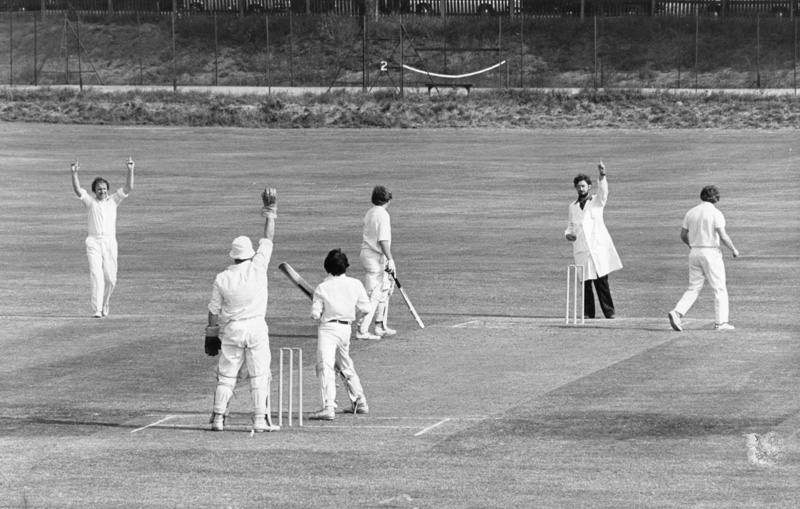
I know of only one photograph of the staff team in action. I don’t remember who the opponents were, but I believe the picture was taken by Allan Sparrow who was very keen on photography and who ran the School Photography Society which had its very own dark room in one of those tiny rooms off the very short corridor which leads to the Language Laboratory. Anyway, here is that photograph of a split second in time, forty years ago:

The batsman at this end, his name, alas, unknown, has been, literally, caught out, and the bowler, Clem Lee, makes his loud appeal, “Howzat !” to the Umpire. This is Me, dressed as Ché Guévara in a Surgeon’s outfit. On the left, Tony Slack, who, in one game he played, once hit the England fast bowler Freddie Truman to the boundary for four runs, adds his voice to the appeals. The only one not appealing is the batsman near me, who just turns around to await my decision. My raised index finger signifies “Out!”

Here’s the second photograph:

This photograph shows the staff team, I suspect, on the same summer’s evening as the previous one. In the back row, on the left, is three quarters of Chris Smith, the English  teacher who left the school as long ago as 1992:

Next to him is Richard Willan, the best Chairman the Staff Common Room ever had:

Then there is Phil Eastwood, who must be very pleased indeed to see Manchester City doing so well:

Then Bob Dickason, teacher of German and French, who I haven’t seen for a very long time. He left in 1983, to go and teach in France, I believe:

Then there’s Clem Lee, the Head of Games:

There’s Ray Moore with his hair much shorter than when he first arrived. He went to West Bridgford School, I have heard, and had unbelievable success running the girls’ football team.

Then the best man at our wedding, Bob Howard, a friend I miss a lot and who I wish I had seen much more of over the years:

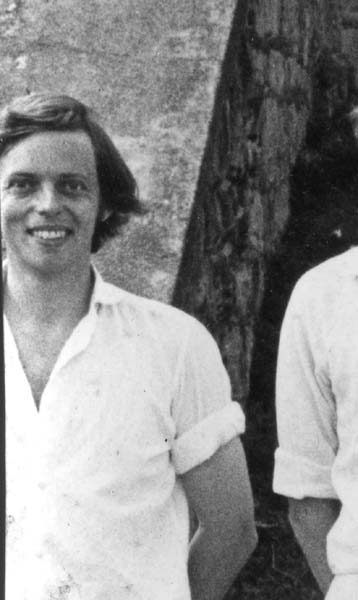
Then Me. That umpire’s coat must be the only thing I have ever worn that’s been too big for me. It also gave me the magic power to balance things on my head with consummate ease:

On the left of the front row is Norman Thompson the Head of Economics who taught at least one future Chancellor of the Exchequer:

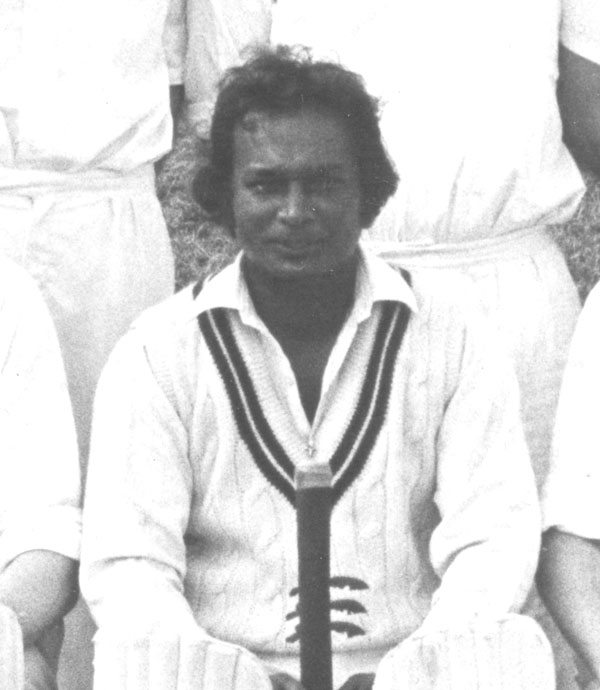
Next to him is Harry Latchman, the Groundsman and Cricket Coach. He was the only proper cricketer in the team, having played for both Middlesex and Nottinghamshire and in Minor Counties cricket, for Cambridgeshire. He was elected President of Middlesex County Cricket Club in 2015:

Then comes Tony Slack:

He has already appeared in a post about the First XI football team. In fact, a number of posts about the First XI football team. One. Two. Three.Tony taught Chemistry and then he took charge of the School’s computers. More impressive, he played for the reserves at Rotherham United, and in one game was personally threatened by Charlie Hurley, Sunderland’s Player of the Century:

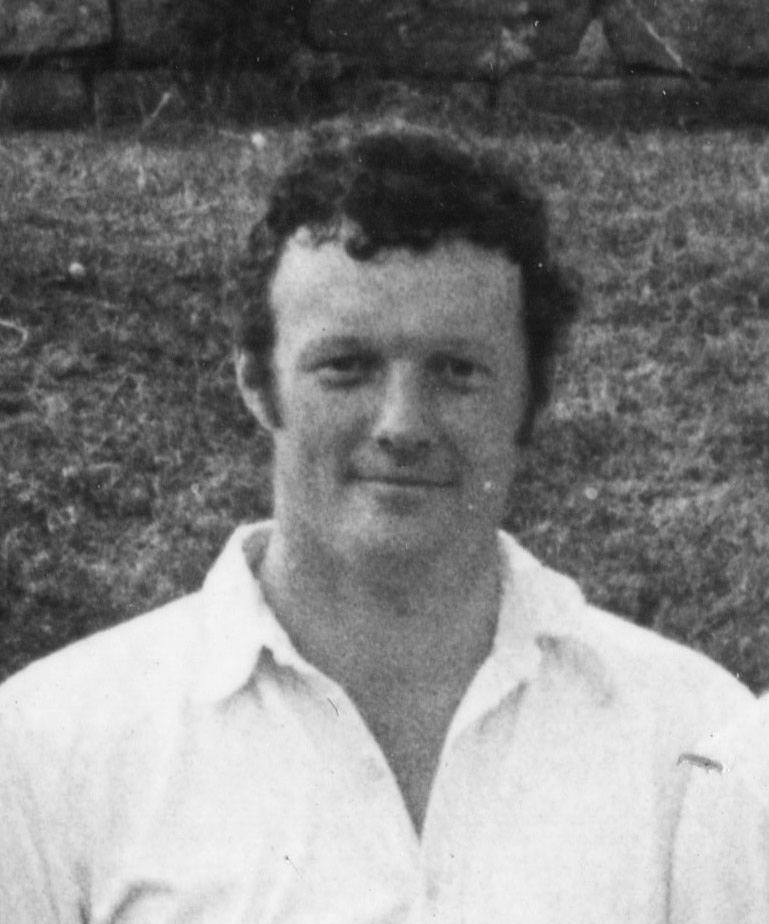
The final player is the Team Captain, David Phillips, the Maths teacher, who used to run both the Second XV and the Second XI if my memory serves me right. He worked at the High School for 37 years where he was an important rôle model for vast numbers of junior boys:

I don’t know if the staff still have a cricket team. The summer 2017 would mark their 70th Anniversary if they still played any fixtures.

22 Comments

Filed under History, Humour, Nottingham, Personal, The High School