Category Archives: Nottingham

Sports Day in the Victorian era

Nowadays, School Sports are held in April and can be, just occasionally, on the rainy or even the chilly side. The first School Sports I have been able to find any information about took place over two days, well over a hundred years ago…and not in April.

Instead, they were on Wednesday and Thursday, September 28th and 29th 1870, at Trent Bridge. (not for the first time, apparently). Events included the popular “High Leap with a Pole”, won by Woodhouse with a jump of 7ft 6ins, “a good jump for a man”. A total of 36 boys entered the stone gathering race, and the sack race was won by Darby, who had the bright idea of inserting a toe tightly into each corner of the sack, and then “shuffled along capitally”.
On the second day there was a “Stranger’s Race” with people not directly connected with the school allowed to compete. There was general reluctance to enter this race, because of the presence of Mr Sam Weller Widdowson, the famous captain of the Nottingham Forest Foot-ball Club:
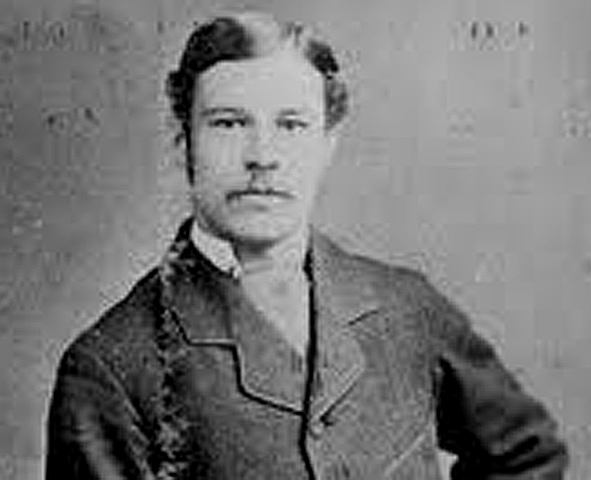
weller

Named after the character in Dickens,  Widdowson was the inventor of the shin-pad:
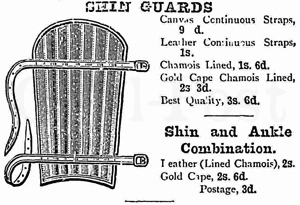
shinguards

A number of gentlemen finally took part in this race, running in top hats and overcoats. As expected, Mr Widdowson was in first place, with Mr Frederick Rothera second. There was a “blind donkey race” with large boys blindfolded, and small boys riding piggyback, giving them directions. It was won by “Purchase and Brown”.

The next School Sports I can trace were on Monday, April 8th 1878, at Trent Bridge, in front of a “numerous gathering”, entertained by the playing of the Sax Tuba Band. Events included throwing the cricket ball, a 220 yard football dribbling race, a 100 yard three-legged race, a 100 yard sack race, a one mile bicycle race, and an Old Boys’ race.

One of the highlights was the 220 yards running race when the course had been marked out wrongly. One of the eleven runners, Sulley, took the wrong turning, and “effectually disposed of his chance”. The other runners also went wrong, but because they were trailing so far behind Sulley, they were able to run back, and get onto the correct route. Unfortunately, Small was knocked over in the confusion, and eliminated from the race, which was eventually won by G.F.Chalcraft. His prize was a handsome desk, donated by the teaching staff.
In the final of the sack race, F.Bailey finished second behind “the younger Walker”, having decided not to jump inside his sack, but instead, to lie down and roll along the ground.
Most interesting, though, was the “Bumping Match”, the exact rules of which, unfortunately, have not survived. It was surely one of two scenarios. Either a huge circle was marked out by a rope, and the last boy left in it was the winner, or it was some kind of sumo type pushing contest, where boy after boy fought in round after round, until only one remained as the victor:

“The contest caused great merriment among the spectators, who greeted the overturned combatants with roars of laughter. Finally two, varying greatly in size were left in, and after a prolonged struggle, W.A.Walker, who showed great quickness and dexterity in avoiding the attacks of his tall opponent, R.E.Fletcher, succeeded in knocking the latter over the line, amidst loud applause.”

The following year, on Tuesday, April 29th 1879, again at Trent Bridge Cricket Ground, “a numerous and fashionable assemblage” was entertained by the Sax Tuba Band, under the conductorship of Mr J.Hindley. There were 22 events, including throwing the cricket ball and a 100 yards race with a Gladstone bag as first prize, presented by Sir James Oldknow. This is Trent Bridge  at the time, during a Test Match:
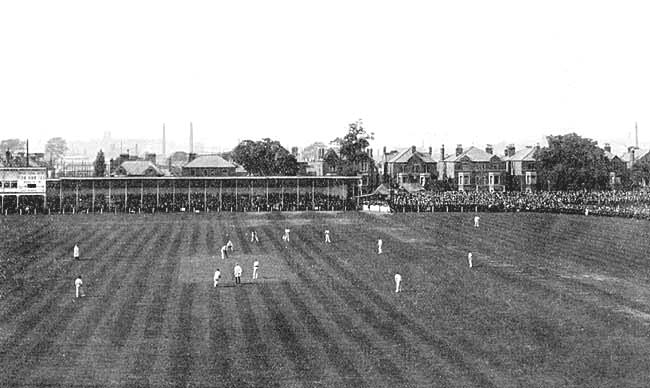
trent-bridge-cricket-ground

There was a half mile handicap race where the prize was a silver watch, presented by Captain W.E.Dennison  M.P., and the M.P., Saul Isaac.  J.E.Woolley led for nearly six hundred yards, but Barlow overcame his ten yard handicap about 120 yards from the finish, and went on to win. Woolley eventually finished third, and C.Cullen was second. The prize in the long jump was a luncheon basket, presented by the Borough Members. There was a three-legged race and a 400 yards race with only two competitors, G.B.Chalcraft beating E.H.Wells by ten yards. In actual fact, there should have been three runners for the race to start at all, but it was “run through an error on the part of the starter.” The one mile handicap bicycle race was won by A.V.Paton, and F.Bailey won the sack race. This event “…as usual, afforded great amusement.” C.Cullen won the 220 yards football race. His first prize was a cabinet Shakespeare, presented by the Dame Agnes Mellers Club. E.Thornley was doing very well until he kicked the ball out of his lane, and Cullen then went on to win.

H.R.Bramwell won the 100 yards hurdles, which was over six flights of hurdles. His prize was a writing desk, presented by Messrs J & J. Vice. In the 220 yards, C.Daft won a pair of binoculars presented by the Assistant Masters. “The most exciting race”, was the Old Boys’ race over 220 yards  won by F.F.Cleaver in 24 seconds.  At the end of the day came the “…usual bumping match and two consolation races”, won by Thornley and Butler.
Mr Charles Daft was the starter throughout, and Herr Altdorfer and Mr W.H.Bailey were the judges. The prizes were presented by Miss Lindley, and the President seconded a vote of thanks to her for her kindness. She was given a small bouquet of flowers, and three cheers by the school. Her father offered thanks for this kind gesture, and then called for three cheers for the President. With this, the day came to a happy close.
One interesting detail about the competitors in these sports is that there was a small fee payable to enter any of the events. At least one Old Boy in later life was to state that this cash payment did much to limit the number of competitors.

School Sports then seem to have died a death until, during his first term in office, in March 1885, the new Headmaster, Dr James Gow, started an Athletics Contest for senior boys. This soon evolved into a full School Sports Day. Over the years, the school magazines have given us a series of snapshots of the event has changed.

On Friday, June 29th 1888, for example, the School Sports, “…for many years in abeyance”, were revived, and were held in “very unfavourable weather” on the Castle Grounds. I am not really very sure, but I would presume that the Castle Grounds are the area of flat ground at the side of the Castle:
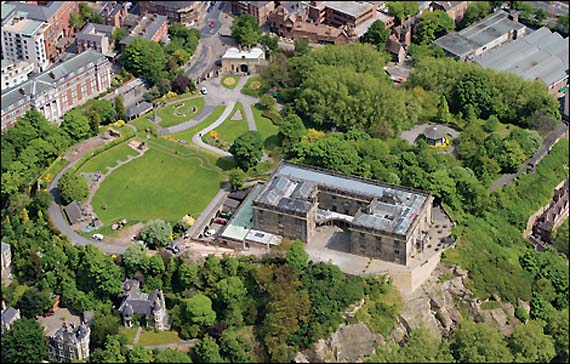
castle grouundszzzzzzzzzzzzzzzz

There was a good attendance of spectators, and among the more usual events was a three-legged race, won by W.A.Möller and C.P.S.Sanders, a sack race won by J.Blake, and a bicycle race over one mile, won by W.A.Möller in 3 minutes 45.4 seconds. F.Bramley won the “Throwing the Cricket Ball (for boys under 14), with a distance of 57 yards.
The Masters’ Race was won by the Reverend T.W.Peck, with Mr W.T.Ryles in second place, two yards behind. There was also an Old Boys’ Race which was a handicap, run over 220 yards, and a Tug of War, won by Team No 1, who defeated Team No 2 in the final. Again many prizes were in evidence, all presented by Mrs.Gow.

This staff group shows Mr W.T.Ryles in the back row, fifth from the right. His nickname was “Nipper”. His brother, Mr W.E.Ryles, “Jumbo” is on the front row, second from the left. The Headmaster, fourth from the right on the front row, is Dr Gow:

staff 1901

On the afternoon of Tuesday, June 3rd 1890, Sports Day was again held at the Castle Ground in dull and windy weather. Nevertheless, a large crowd attended, and enjoyed a day of “very fair sport”, and a selection of music played by the Nottingham Borough Police Band, under the leadership of Bandmaster Redgate. The prizes were presented by Miss Goldschmidt. Most of the events were similar to previous years including the 220 yards football dribbling race, throwing the cricket ball, an Old Boys’ bicycle race, a sack race and a whole series of running races, all of them with varying handicaps for the competitors .

The most interesting event, though, was the hundred yards Medley Handicap. In this, boys competed in a number of heats over one hundred yards, and the handicap consisted in the means by which they had to cover the distance. The methods included skipping, sack race, three legged, pick-a-back, on all fours, and, most spectacular of all, perhaps, on stilts. The final seems to have been a normal foot race, as the winner’s time was fifteen seconds.

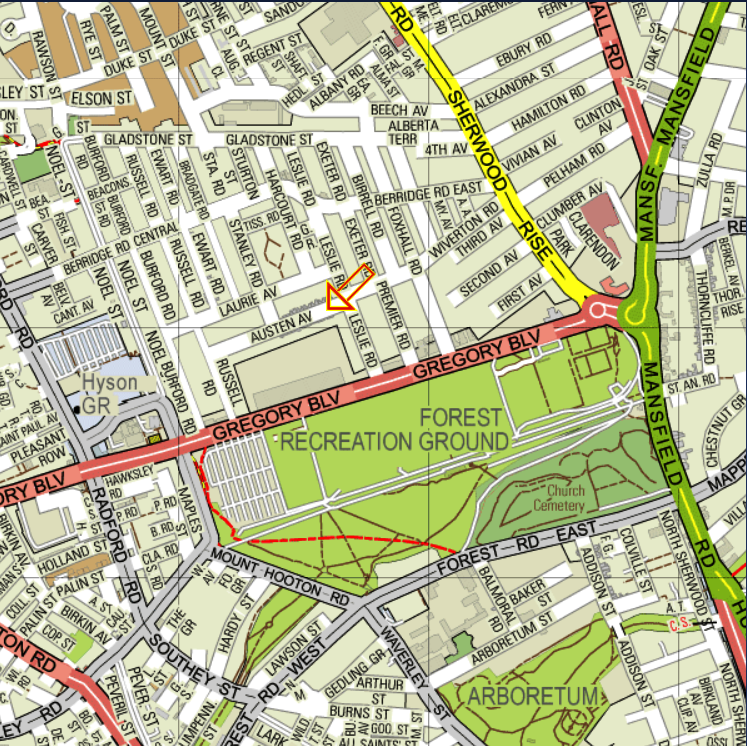
On the afternoon of Friday, March 29th 1901, the School Sports took place at the brand new sports ground at Mapperley Park. We already know how to get there. Look for the orange arrow. The High School is in the bottom left corner of the map, where Mount Hooton Road and Forest Road East meet. It is the incomplete beige rectangle which is outlined in black:
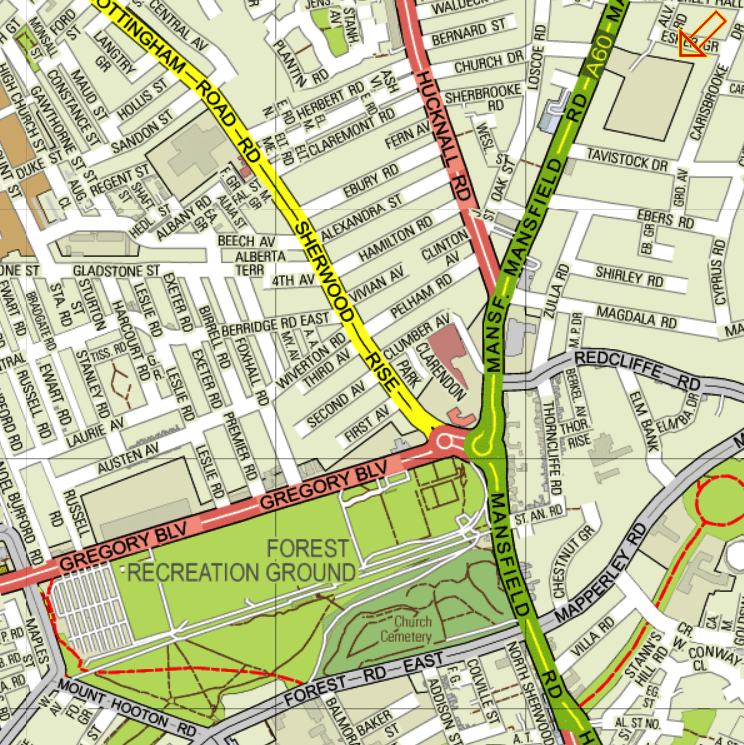
Untitled 2

A large number of boys, friends, parents and Old Boys were in attendance, but the day was spoiled by the bitterly cold weather,

“…the turf was naturally affected by the overnight fall of snow, which made the going heavy.”

Two years later, on the afternoon of Saturday, July 25th 1903, the weather was beautiful, although not too warm, and there was another large crowd,

“including many ladies, whose bright, summer dresses amidst the pretty surroundings of trees and shrubs, made the scene most picturesque”

The spectators were entertained by “the lively strains of a band, and a hospitable tea tent.”
The numerous prizes were presented by Lady Blain and events included the one mile walking race, won by B.G.Saywell and an U-11 obstacle race won by C.F.Brasher. L.W.Malton won the potato race and a tug of war was held between “The Past” (Old Boys), and “The Present” (Masters and Boys). The Old Boys were G.C.Allsebrook, W.Allsebrook, G.F.Brewill, E.Brewill, S.Hoyte and H.A.Wootton. Their opposition contained three boys, namely R.Marrs, W.Oldershaw and H.A.Watson, and three masters, Messrs Hughes, Jones and Yates. The Old Boys soon pulled the School over the line, but were found to have included a seventh member of the team, J.Johnstone (Cheats!). The result was overturned, and the School soon won a fair contest by 3-0. I could find no photographs of this event, but here is the tug of war at the 1904 Olympics in Los Angeles. I’m sure it will give you the rough flavour:
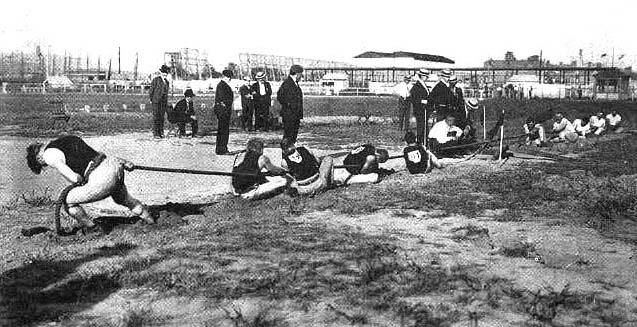
The-Olympic-1904 xxxxxxxxxxxxxxxx

On Saturday, June 24th 1905, it was very fine weather at Mapperley Park. Spectators were entertained by the band of the Robin Hood Rifles, under the directorship of Mr A.Pounder. The sports should have taken place the previous Saturday, but the rain was so torrential that this was completely impossible. Events included the usual ones, such as the 220 yards football dribbling race (R.B.Wray in 35 seconds) and the U-11 race over 75 yards (F.C.Tonkin, 10.8 seconds). There was a one mile bicycle race won by H.E.Mills (3 minutes 9.6 seconds) after the other two competitors, S.S.Parkinson and P.H.Hart collided with each other and both fell off. H.E.Mills  also won the potato race this year. J.H.Simpson won the U-11 obstacle race where competitors had to crawl through barrels and under pegged down clothes. The event created “much amusement”. The Old Boys won the tug of war against the Masters & Boys.

As war clouds slowly gathered, on the afternoon of Saturday, June 15th 1912, the Athletic Sports were held in splendid sunshine, again at Mapperley. The attendance was very large, and great interest was generated. Harold Ballamy ran 100 yards in 10.6 seconds, a marvellous performance on grass and wearing, presumably, ordinary pumps. There was again a football dribbling race, won by R.L.W.Herrick. This latter event was by now the only survivor of the many unusual and interesting events which had previously characterised the Victorian and Edwardian sports days. Now, virtually every event was a serious sporting trial.

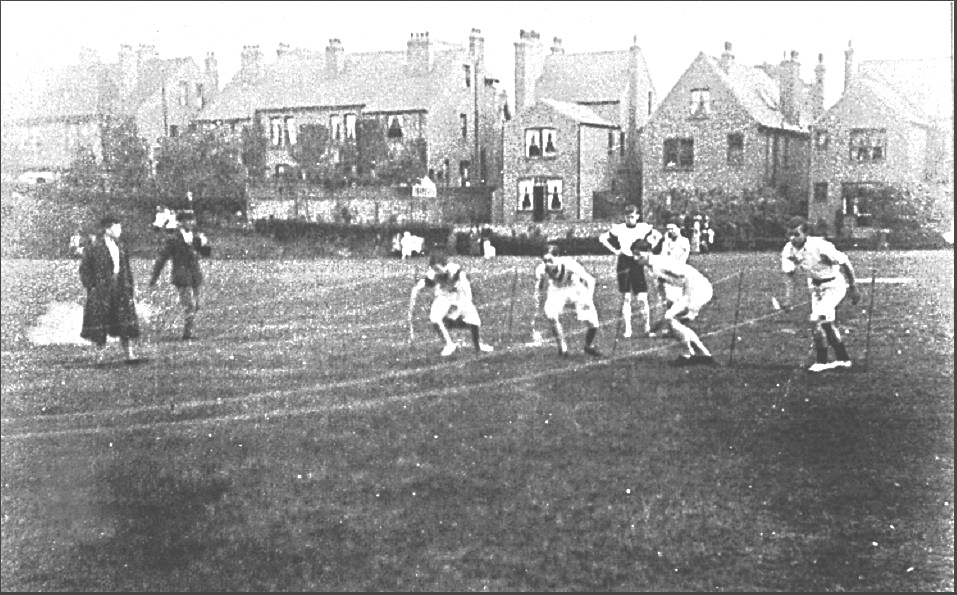
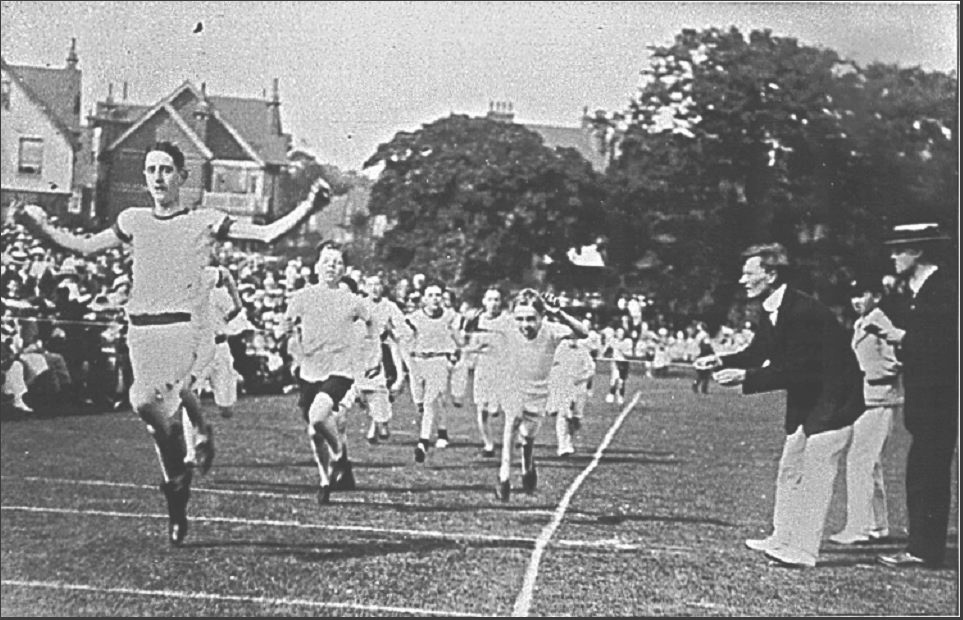
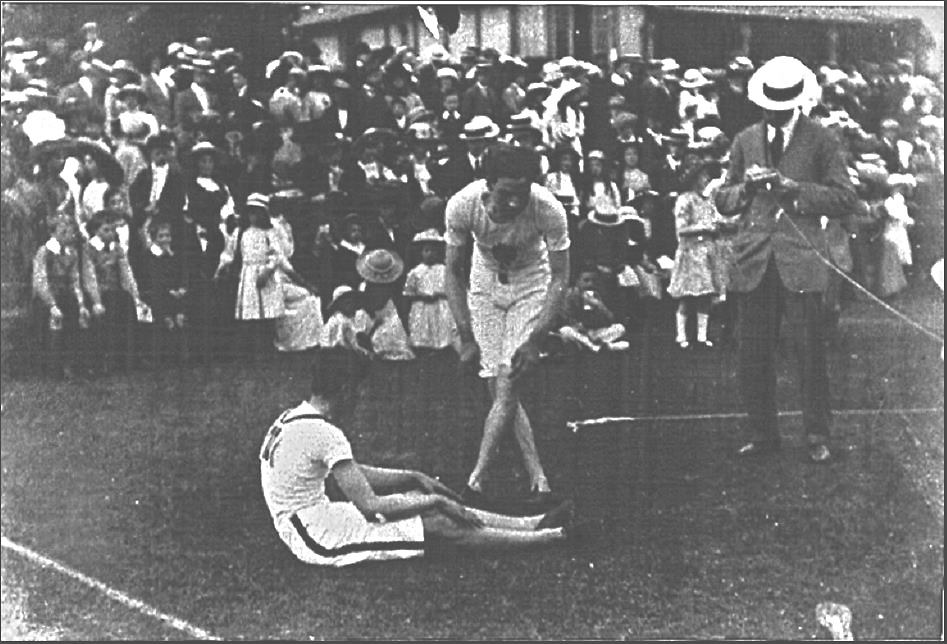
The following year, 1913, was, of course, the very last Sports Day before the thunderstorm that was the Great War carried away the best of this talented generation of young men from the whole of the continent of Europe. Ironically, it was this bittersweet occasion that has bequeathed to us the only photographs that we have of a Sports Day of yesteryear. It is such a pity that they are of comparatively poor quality. This year, of course, marked the 400th anniversary of the school and both this day of athletics and the photographs themselves came as part of this occasion. Here is the huge crowd:
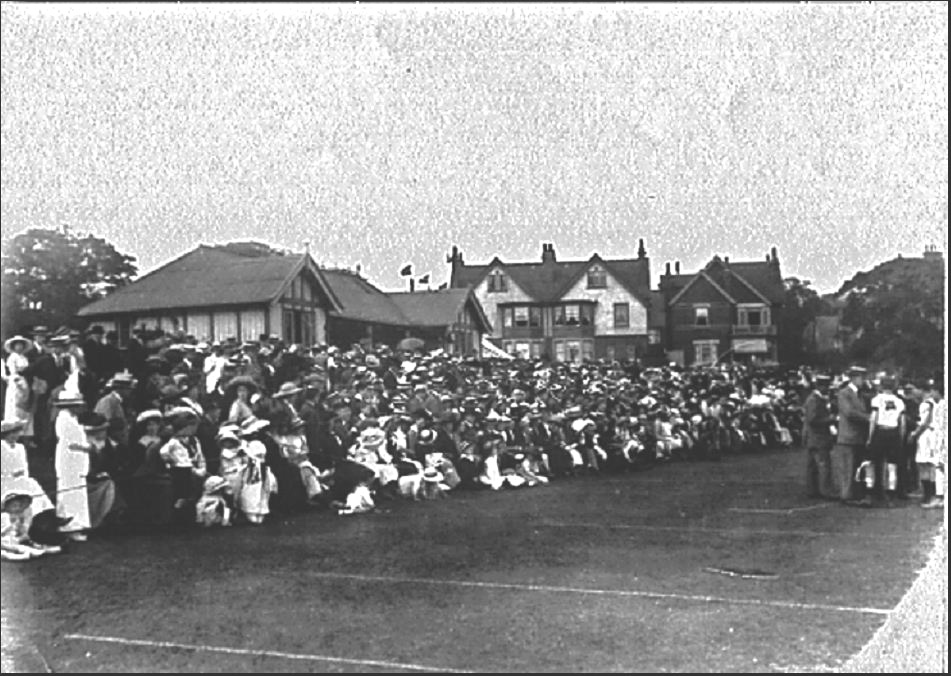
the crowd 1913

Here is the start of a race:

start of race

…and the exciting finish:

end of race 1913 handicap size runners

These are two exhausted athletes:

sports day 1913

The Headmaster, Dr Turpin, is the gentleman in the very middle of the picture, as the prizes are distributed:
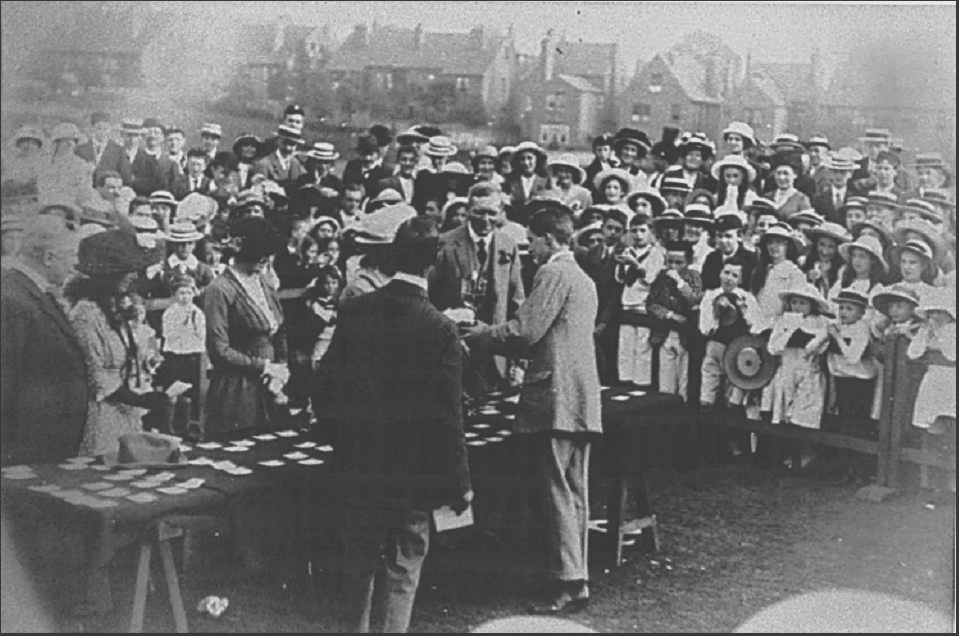
give out prizes

And here he is again, this time making a speech. Look at the policeman and how impressed the little boy is:

prizes 1913

It should still be possible to establish the exact location of the majority of these events. I am sure that the all large Victorian houses in the background will still be there.


8 Comments

Filed under History, Nottingham, The High School

Letters carved in stone, sixty years ago

How many times have you walked out of the school’s Forest Road gate, and quite simply, failed to notice the extensive collection of carved initials on the left hand pillar? And if you did notice them, did you disregard them as being just more of the pointless graffiti that we are now forced to accept in the society of the early twenty first century? Or did you carefully look at the dates? But just wait awhile, gentle reader, and imagine the scene to yourself…

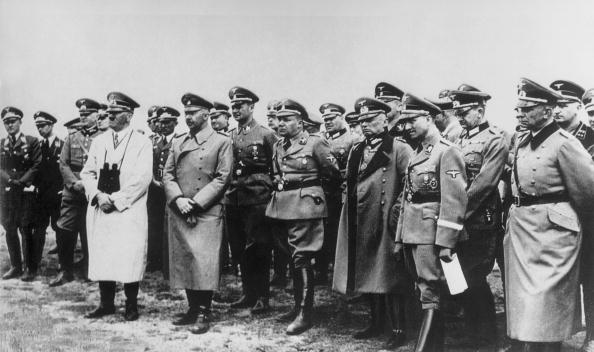
It is late 1942.  In Europe, Hitler stands on the opposite side of the English Channel, watching Dover through his binoculars.

Not A Chance

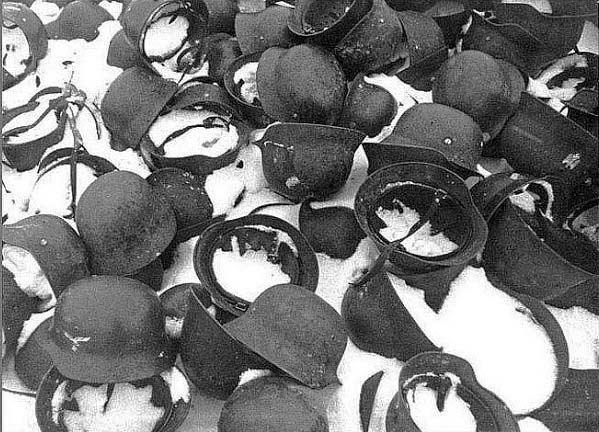
Great Britain remains resolutely defiant, but largely unable to press home any significant advantage. The British  armed forces are quite simply, not strong enough. There have been hardly any significant victories so far for the British, and there seem to be few obvious ways forward to rid the continent of what will eventually become known as “The Scourge of the Swastika”. Only the victory by Montgomery at El Alamein in North Africa lights up the Stygian gloom. And how many British people actually realise at the time the real significance of the telegram General Friedrich Paulus sends his Führer, telling him that the German Sixth Army is now completely surrounded?

stalingrad_dead_germans_ww2_

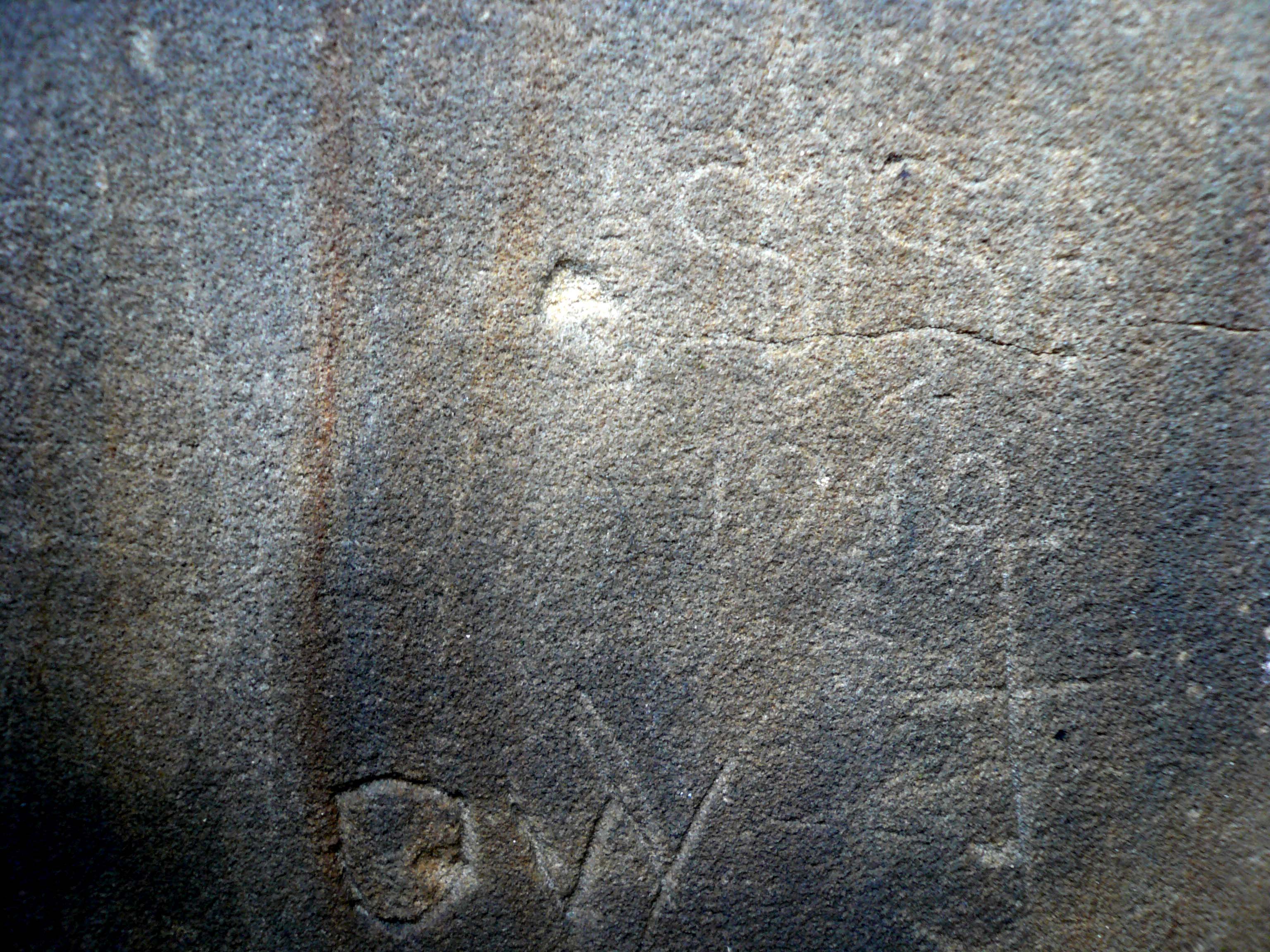
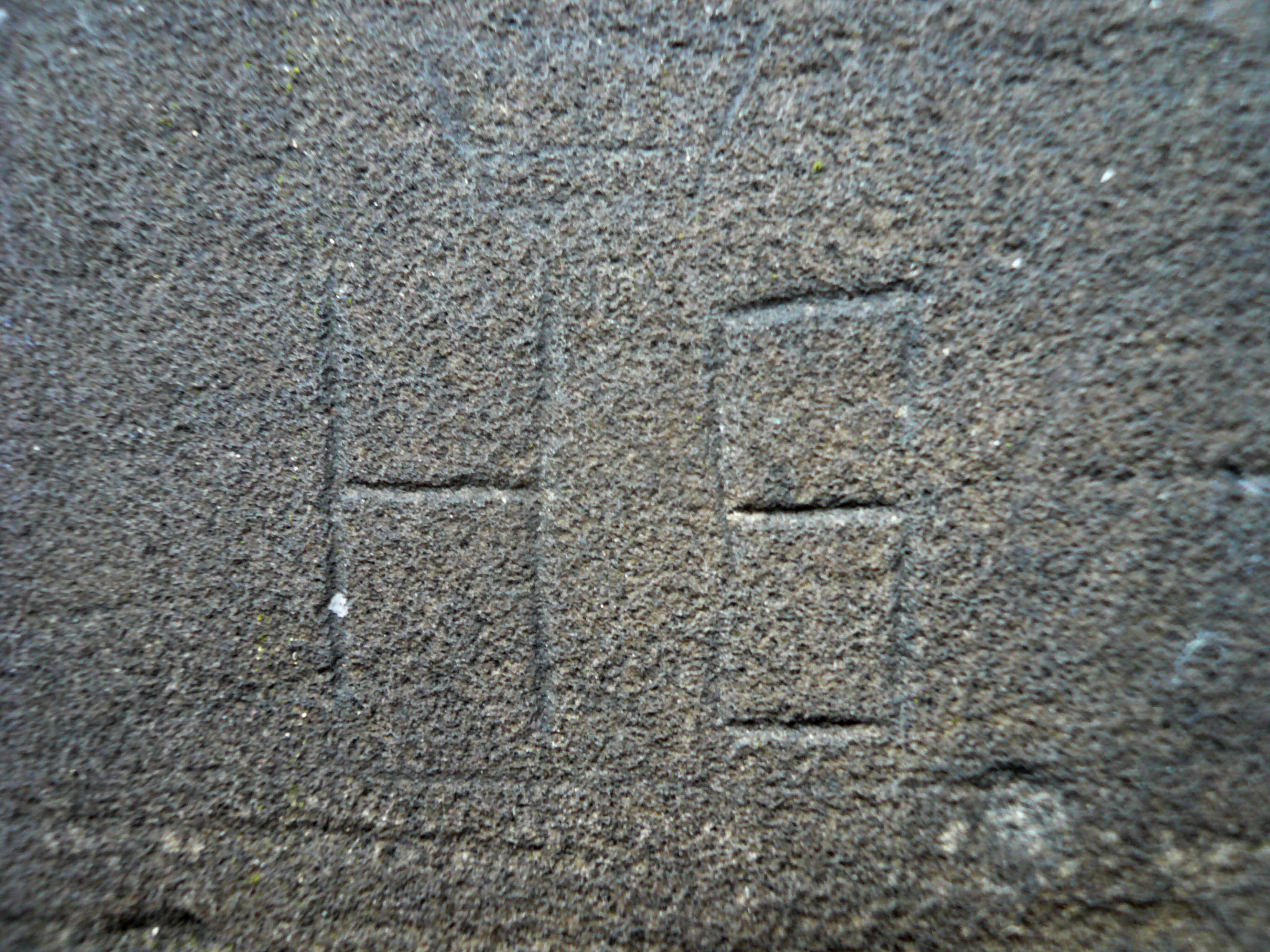
These dark days are recalled on the Forest Road entrance of the High School, where boys, or, more likely, young men, have carved their initials more than seventy years ago. And some dates, and even a slightly misunderstood swastika.

first one

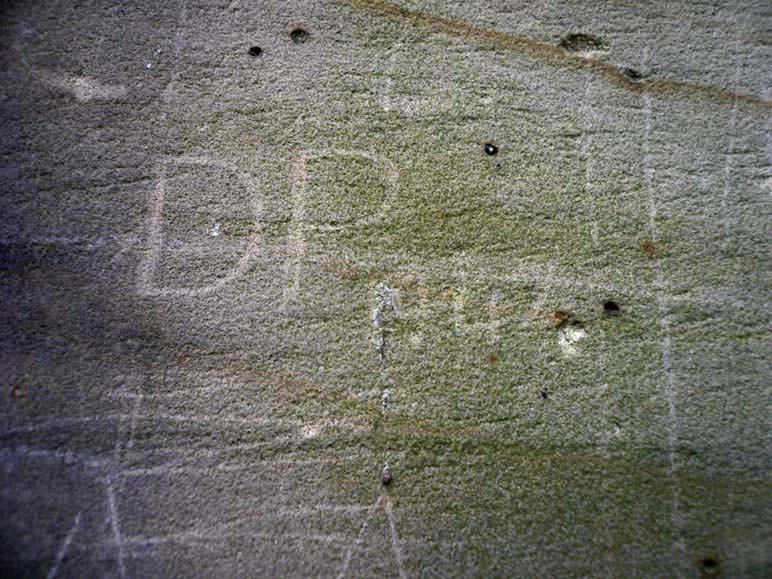
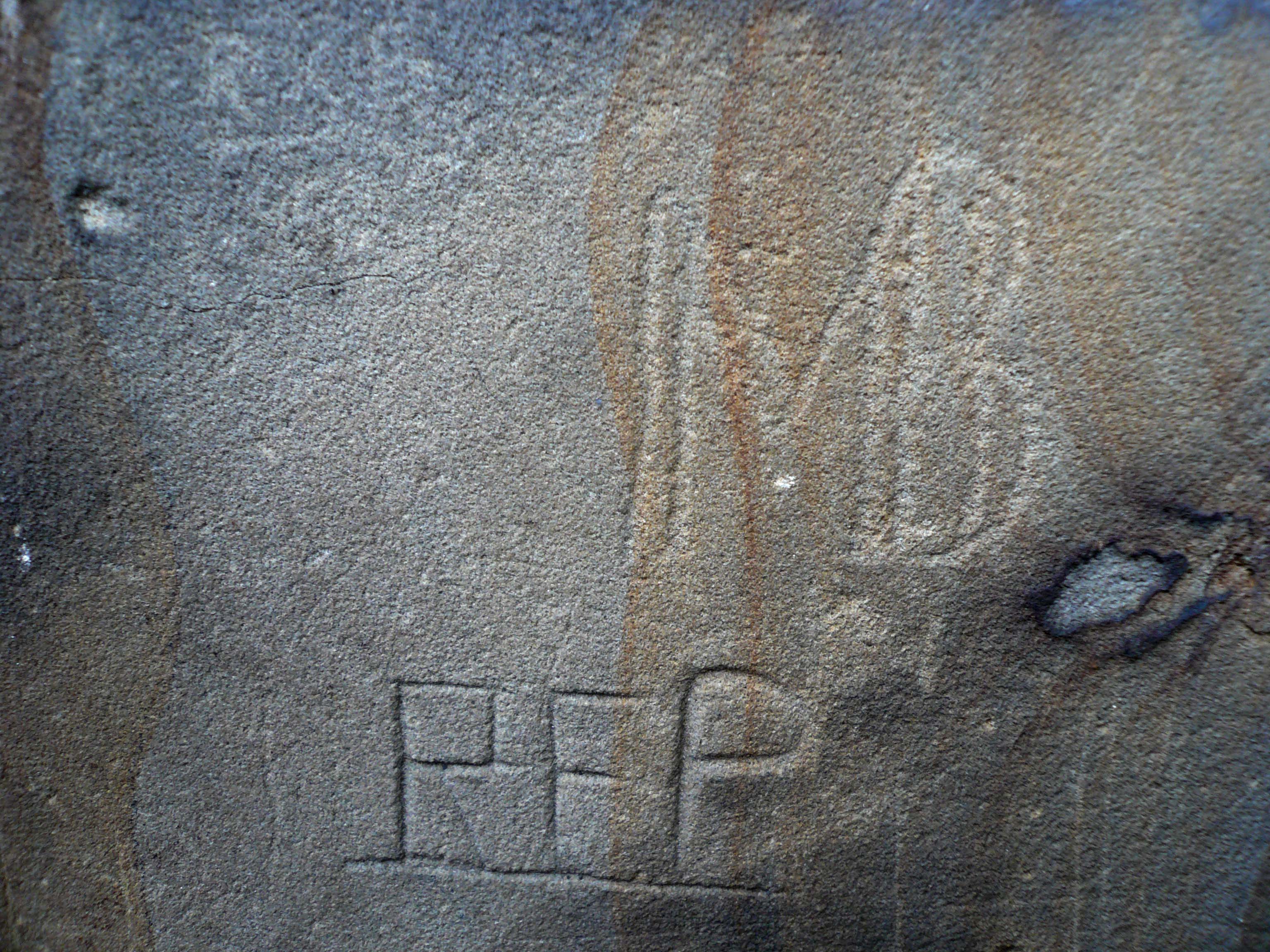
Judging by the physical height of this insolent vandalism, they may well have been in, say, the Fifth Form, literally, upwards. They include what appears to be “WH 1942”, “DP” and “DP 1942”, along with what may possibly be “SS 1940”, and the undated “MB”, “HE”, “HS” and “PFP”. Indeed, the only problem with these initials is that they are extremely difficult to photograph, because, like other interesting acts of vandalism, they are hidden away from direct sunlight, and the subleties of the various shades of stone have proved beyond the capabilities of my camera, even though it does have quite a decent lens. Only Photoshop has dragged the past out into the present.

P1220254START VHERE

My subsequent researches, and best guesses, have revealed a few likely suspects. “WH” and “DP” may conceivably have been young colleagues in the Fifth Form A with Mr.Whimster during the academic year 1941-1942.

William Norman Hill was born on November 23rd 1927, and entered the High School on September 20th 1938 at the age of ten. His father was Mr F.Hill, a School Master of 8, Lexington Gardens, Sherwood. He left the school on July 31st 1945.

Dennis Plackett was born on October 22nd 1927. He entered the school on Monday, September 25th 1939, at the age of eleven. His mother was Mrs.Ellen Plackett, a housewife of 7, Anthill Street, Stapleford.  Dennis was a gifted young man, a Nottinghamshire County Council Scholar, and he left the school on August 1st 1944.

Another interpretation is that “WH 1942” was William Jack Harrison. This young man was, quite simply, outstanding. He was born on December 5th 1924, and entered the High School on September 19th 1935 at the age of ten. His mother was Mrs E.M.Harrison of 53, Burlington Road, Sherwood.  He would have been in the Upper Fifth Form with Mr.Palmer in 1941-1942, and then in the Mathematical and Science Sixth Form with Mr.Holgate during the academic year of 1942-1943. William stood out in two separate areas. In 1940 he was initially a Lance-corporal in the Junior Training Corps, but he soon became a full Corporal. In 1941, he won Mr Frazier’s prize for the most efficient Junior NCO or cadet, and was then named Commander of the Most Proficient House Platoon. At some point towards the end of the academic year of 1941-1942, he promoted to be the Junior Training Corps Company Sergeant Major.

In addition, in the sporting world, by the time the School List for 1942-1943 was published, William had won his First XV Colours and his Cap for Rugby and had been named as Captain of Rugby. In the Summer Term, he went on to be the Captain of Cricket, and to be awarded his Cricket Colours and his Scarf. He was also, by dint of his sporting position as Captain of Cricket, a School Prefect. William left the school on December 19th 1942.

The reason that I myself would prefer this interpretation is that “DP” and “DP 1942” may well be David Phillips, who was in the Economics Sixth Form with Mr Smyth during the two academic years of 1940-1941 and 1941-1942. He may well have been carrying out some kind of school tradition when he carved his name and the date on the pillar, knowing that he was going to leave the school in July 1942.

7ngttrrrrr

David was born on May 2nd 1923, and entered the school on January 13th 1935 at the age of eleven. His father was Mr P.Phillips, a Factory Manager of 45, Austen Avenue, on the far side of the Forest Recreation Ground.

austen a2

We have relatively few details of David’s career at the High School, but we do know that by September 1941, he was a Corporal in the Junior Training Corps. In the Christmas Term of 1942, he was awarded his Full Colours for Rugby, and he became a School Prefect. David was also awarded his Rowing Colours for his achievements with the Second IV.

I have a very strong feeling that these two young men were friends. Austen Avenue, of course, is arguably, on the same cycle route home as Burlington Road, Sherwood, where William Harrison lived.

burlington a2


Perhaps the two walked down together across the Forest Recreation Ground, and David would then get on his bike and cycle slowly off towards Austen Avenue. William would continue down what would have been at the time an undoubtedly more traffic free Mansfield Road, towards Burlington Road in Sherwood.

David Phillips shared the very same interests as William Harrison. They were both in the same rugby team, and both seemed to have loved sport, whether rugby, cricket or rowing. They were both in the Junior Training Corps and clearly were attracted to the military life. As regards their academic classes, they were a year apart, but I feel that their common interests would have overcome this difference, especially when the two rugby players, or Junior Training Corps members, realised that they could walk down across the Forest together every evening after a hard day at school.

And when the end of 1942 came round, they may well both have left the school on the same day, December 19th. Were they both going into the Army together?

The interpretations above are all based on a combination of informed best guesses, a thorough search of the relevant School Lists and registers and the usual human desire to take purely circumstantial evidence as proven fact. Not surprisingly, though, it has proved impossible to trace any of the other initials in any meaningful kind of way. There were quite simply too many possible “SS”s in 1940, and “MB”, “HE” and even “PFP” have all proved equally beyond my powers. Even so, this must be among the oldest graffitti in Nottingham.

one


13 Comments

Filed under History, Nottingham, The High School

Staff v Prefects Football Match Christmas 1980 (3)

These are the last four of the ten photographs I found recently of the Teachers v School Prefects football match.  This keenly fought fixture took place probably just before Christmas in 1980, give or take a year either way. My beautiful new wife was watching the game, armed with my camera, if I remember correctly.
This first photograph shows myself and Ron Gilbert, the ex-Chemistry teacher who retired recently. We look as if we are holding a quick debate about who is going to chase after the ball:

PHOTO A

The second photograph shows the then Head of Music, Stephen Fairlie, and the red shirted referee, Richard Willan. Red Fourteen is a Prefect playing in a staff shirt to make up the numbers. Incidentally, the staff are playing in the shirts normally worn by the school Second Eleven Football Team. These, in their turn, were, for reasons that must surely remain unknown now for ever, the second, change, strip of Sunderland A.F.C.

PHOTO B

The third photograph shows three members of staff. Number Three on the right with his back to the camera is Paul Morris, the now retired Physics teacher. I myself am Number Two in the middle and Number One is Andrew Ayres, a native of Hartlepool if I remember correctly, a young teacher of Chemistry and a colleague of Ron Gilbert. Andrew moved on to Wisbech Grammar School in Cambridgeshire, where he became the senior tutor and examinations officer as well as continuing as a chemistry teacher. He retired in July, 2014. Once again, the Prefects will have to remain nameless:

PHOTO C

The final picture shows Stephen Fairlie, the then Head of Music, as Number One on the left, and Bob Howard, Geography teacher and Best Man at our wedding, as Number Three on the right. In the centre is Number Two, Phil Eastwood, who was the then Head of Chemistry. Phil is a very keen supporter of Manchester City and that is where, I would imagine, his socks came from:

PHOTO D

I would like to finish these three blog posts with a piece of medieval poetry. Medieval French poetry, no less. Well, from 1533. It was written by François   Villon. (You can click on both names)
The days when I knew about such things are very distant, but ironically, that is the whole point of the poem:

Dictes moy où, n’en quel pays,

Tell me where, in which country

Est Flora, la belle Romaine ;

Is Flora, the beautiful Roman;

Archipiada, né Thaïs,

Archipiada, born Thaïs,

Qui fut sa cousine germaine;

Who was her first cousin;
Echo, parlant quand bruyt on maine

Echo, speaking when one makes noise

Dessus rivière ou sus estan,

Over river or on pond,

Qui beauté eut trop plus qu’humaine?

Who had a beauty too much more than  human ?

.

Mais où sont les neiges d’antan!    

Oh, where are the snows of yesteryear!


Où est la très sage Heloïs,

Where is the very wise Heloise,

Pour qui fut chastré et puis moyne

For whom was castrated, and then made a monk

Pierre Esbaillart à Sainct-Denys?

Pierre Abelard in Saint-Denis ?

Pour son amour eut cest essoyne.

For his love he suffered this sentence.

Semblablement, où est la royne

Similarly, where is the Queen

Qui commanda que Buridan

Who ordered that Buridan

Fust jetté en ung sac en Seine?

Be thrown in a sack into the Seine?


Mais où sont les neiges d’antan!    

Oh, where are the snows of yesteryear!


La royne Blanche comme ung lys,

The queen Blanche, white, as a lily

Qui chantoit à voix de sereine;

Who sang with a Siren’s voice;

Berthe au grand pied, Bietris, Allys;

Bertha of the Big Foot, Beatrix, Aelis;

Harembourges qui tint le Mayne,

Erembourge who ruled over the Maine,

Et Jehanne, la bonne Lorraine,

And Joan of Arc the good woman from Lorraine

Qu’Anglois bruslerent à Rouen;

Whom the English burned in Rouen ;
Où sont-ilz, Vierge souveraine ?

Where are they, oh sovereign Virgin?

.

Mais où sont les neiges d’antan!         

Oh, where are the snows of yesteryear!


Prince, n’enquerez de sepmaine

Prince, do not ask me in the whole week

Où elles sont, ne de cest an,

Where they are – neither in this whole year,

Qu’à ce refrain ne vous remaine:

Lest I bring you back to this refrain:

Mais où sont les neiges d’antan!         

Oh, where are the snows of yesteryear!

7 Comments

Filed under Football, France, History, Humour, Literature, Nottingham, Personal, The High School

Staff v Prefects Football Match Christmas 1980 (2)

These are three more of the ten photographs I found recently of the teachers playing the School Prefects at football, or soccer as some might call it. The photographs show a game from the early 1980s, when my wife took a few pictures of the match.

This photograph shows the Staff goalkeeper kicking the ball downfield. This is the legendary Chris Mann, a young chap from Liverpool with the accent to match. He eventually left the High School to go to teach at Staffordshire University, where he remains to this day, as far as I know. The last time I heard, he was doing very well as the Senior Lecturer in the School of Engineering (Maths & Statistics) in the Faculty of Computing, Engineering and Sciences:

PHOTO A

This photograph shows myself shielding the ball against a defender. In just a second, I will pass it on to the other player in blue, who is Paul Morris, the now retired Physics teacher:

PHOTO B

This final picture shows proceedings when players are perhaps beginning to get a little tired. There are four blue shirted members of staff on view. I am Number Four counting from the left and Paul Morris is Number One. Number Two is the then Head of Music, Stephen Fairlie, a young man far too gentle to be playing football. Not long after this game, in 1985, he was to found the Nottingham Youth Orchestra which still continues in existence to this very day:

PHOTO C

Player Number Three is Ron Gilbert, an ex-Chemistry teacher who retired recently, and whose first love was actually Rugby Union, but he was always a very good sport, and willing to turn out for the staff when the occasion arose.
Yet again, I am not able to recognise any of the Prefects who, by now, must be in their early fifties with not just children but, conceivably, grandchildren.

14 Comments

Filed under Football, History, Humour, Nottingham, Personal, The High School

Staff v Prefects Football Match Christmas 1980 (1)

At the end of either the Christmas Term or the Easter Term or sometimes both, there used to be a tradition of the Teachers playing the School Prefects at football, or soccer as some call it. The very first one took place as far back as the evening of Monday, March 9th 1959. The staff triumphed by a single goal.  Nowadays, Health and Safety Regulations have put paid to such risky and dangerous pursuits.

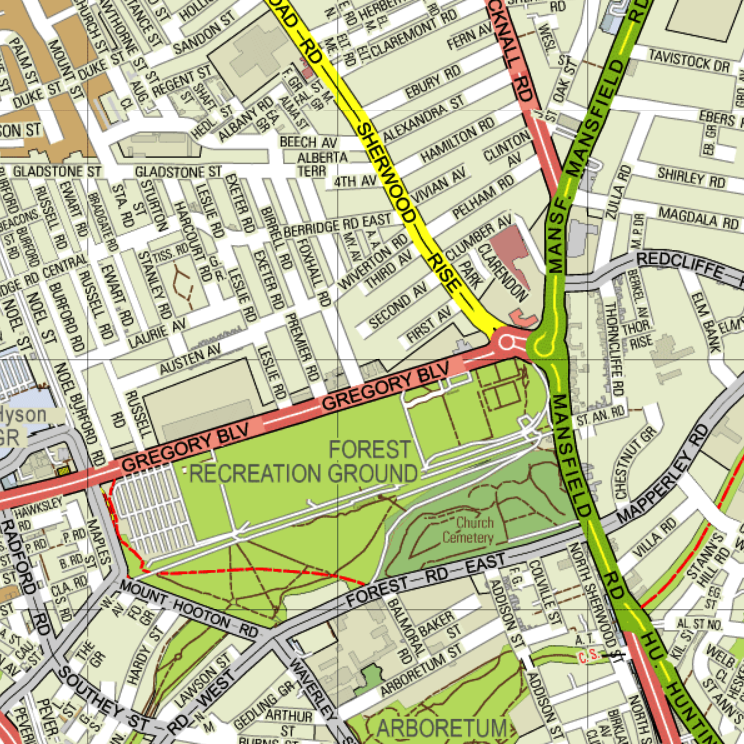
The game used to take place here, on the Forest Recreation Ground:

forest


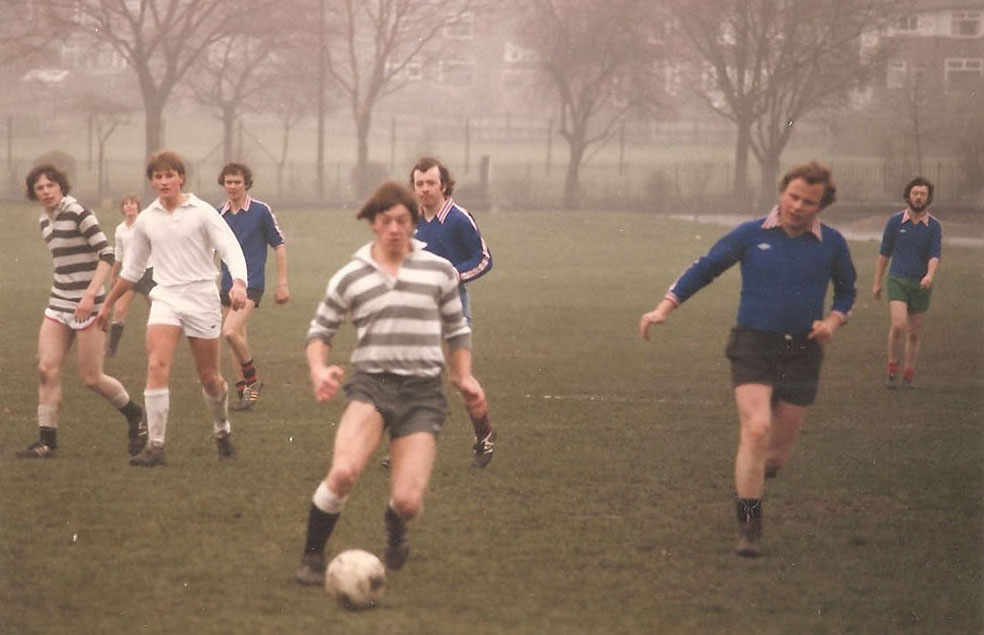
When I was a lot younger and a lot, lot, thinner, I used to play in such games, and these photographs show a match from the early 1980s. I was newly married and my beautiful young wife, as one of, admittedly, very few spectators, was given a camera and the freedom to take a few pictures. In total, there were only ten, because in those days, there were no digital cameras, and people were not in the habit of shooting hundreds, if not thousands, of photographs on the off chance that three or four might be good ones.
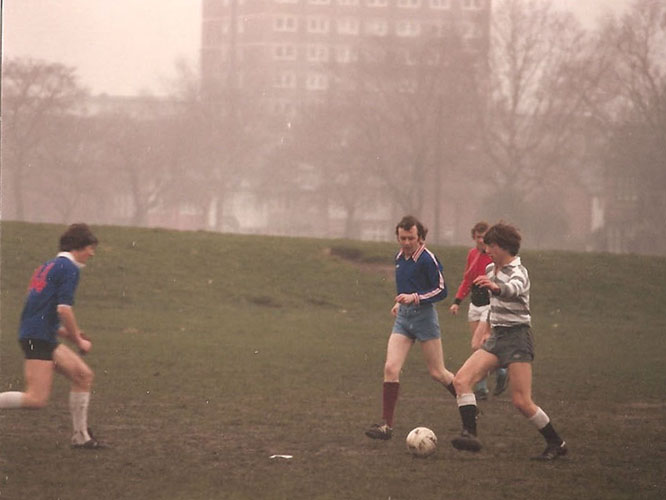
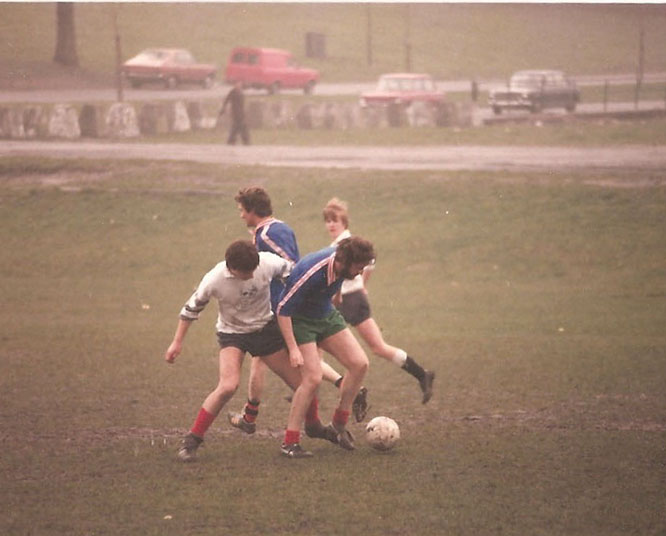
This first photograph shows my good self in the blue shirt and green shorts. The other player in blue is Paul Morris, a teacher of Physics, who, like myself, retired within the last two years. Everybody else is a Prefect, although I am sorry to say that I could not put a name to any of them.

PHOTO A

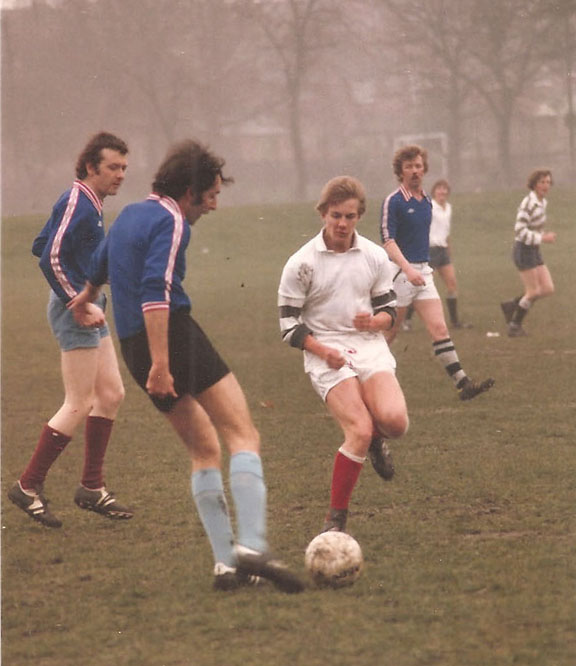
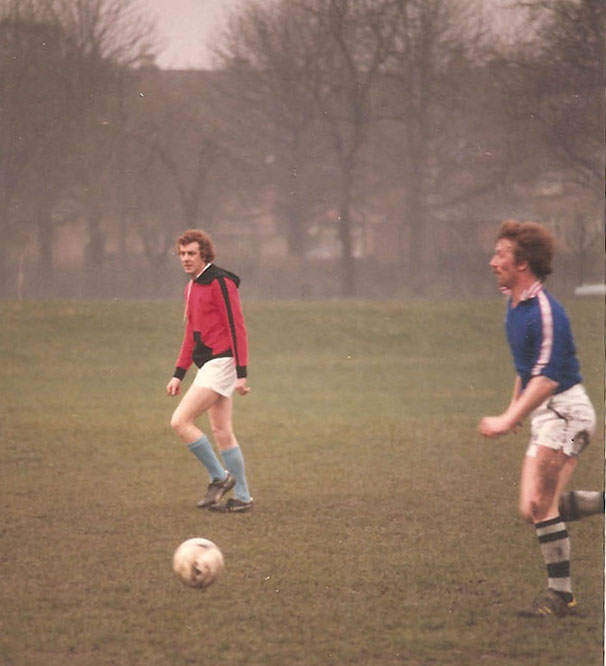
This photograph shows a young red haired gentleman playing for the staff team and running off with the ball into attack. He is Bob Howard who had been Best Man at our wedding. To his left, in red, is Richard Willan, one of Bob’s colleagues in the Geography Department. Richard retired in the same year as myself.

- PHOTO B

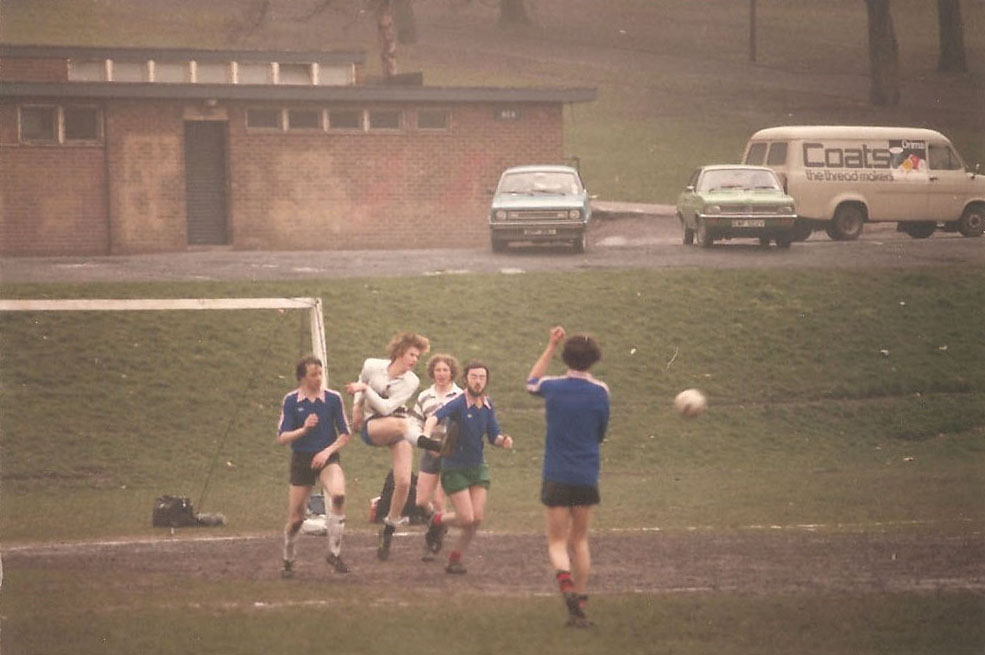
This final picture shows my unbelievably thin self, still in my green, blue and red outfit. I somehow seem to have acquired a mop of curly, dark brown hair, instead of the white ensemble I now have. On the right, in front of the goalpost is Best Man Bob Howard. The other player in blue is not a member of staff, but, presumably, a Prefect playing for the Staff Team to make up the numbers. Again, I could not name any of the opposition, but I do recognise a couple of the spectators. The red haired young man with the non-regulation brown scarf is Dave Beech who played for the school First Eleven at football on around half a dozen occasions when I was the team manager. To the left of him is Russell Poole, a superb young cricketer, whose Dad used to come down every games day to the Games Field to coach cricket to the more talented young players.

PHOTO C


6 Comments

Filed under Football, History, Humour, Nottingham, Personal, The High School

Sergeant Sakura’s War

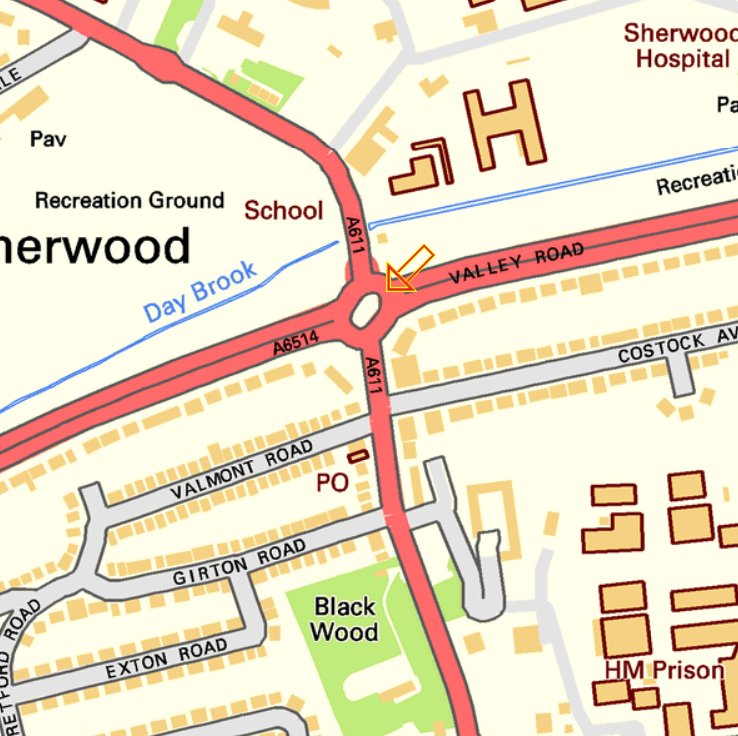
Why are the roadworks for our new road island between Nottingham’s ring road and the main road to Hucknall taking so long? They began in August 2014 and at first everything was going so well. Through September and October the works continued “apace” as they say. As you might expect, the old roundabout had to be completely demolished as unfit for purpose, and this is what has replaced it so far:

P1530144xxxxxxxx

Presumably, the roundabout will not remain for too long as a very large pile of soil, and one day somebody will surely find the money to plant something on it. Previously, the island looked like this:

P1210888 snowy xxxxxxxxxx

It always seemed to me to have a very Japanese feel to it, with stunted willow trees that could almost have come out of the world of bonsai. And this is the clue as to why the work has taken so long. Rumours began in late November of what the roadbuilders had discovered, or rather, who the roadbuilders had found:

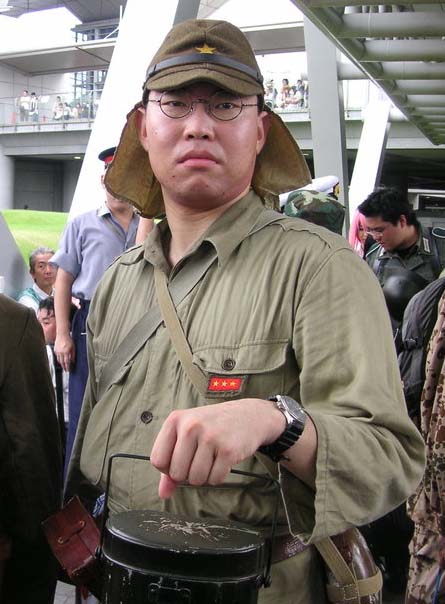
japanese-soldierxxxxxxxxxxxxxxxxxx

He was 91 years of age when he was first spotted by the construction workers. His name was Sergeant Sakura and it was probably the oriental flavour about the island which had led to his mistaking it for the Island of Takeshima and the ideal place to make the very last stand of World War II, opposing the Allies on the last island that they would need to capture to ensure that “the war situation has developed not necessarily to Japan’s advantage”:

takeshima

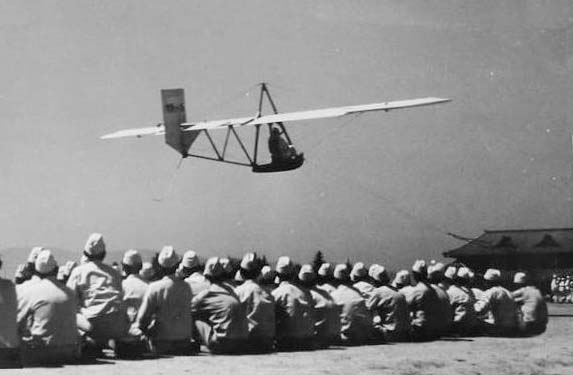
After his initially rather conspicuous arrival in late 1945 in a Maeda assault glider flown from a mini-submarine in the Irish Sea, (a mere 94 miles as the Maeda flies), Sergeant Sakura was seen only very rarely because the road island, constantly surrounded as it is by huge volumes of high speed traffic is not the easiest of places for visitors, friend or foe, to reach:

jap gliderxxxxxxx

It did not take Sergeant Sakura long to realise his mistake but, as soon as he had claimed the island for the Japanese Empire, he began digging foxholes, tunnels and bunkers of an amazing intricacy. Shortly after his eventual surrender, the City Council found that he had constructed almost 27 miles of tunnels, allowing him unobtrusive access to everything he needed to prolong his war into a new millennium:

Old_Japanese_Army_zzzzzzzzzzzz
One tunnel, for example, joined the drainage system from the City Hospital. This allowed Sergeant Sakura access to simple medicines. The hospital staff who saw him just presumed he was some kind of ghost, or perhaps a lost tourist, destined to wander the hospital corridors for ever. Another set of tunnels took Sergeant Sakura to the school sports field, where, in the depths of the night, he could practice his bayonet drill, and, as dawn broke, improve his marksmanship with the seagulls still asleep on the rugby pitches. His most important tunnel linked him with the Co-op supermarket, where he could easily find enough food to feed himself, without anybody really noticing. Boil-in-the-bag rice dishes, Ready Meals with fish and chicken, and even Spicy Pot Noodles:

map

The City Council of course, it eventually emerged, had known for a number of years that Sergeant Sakura was there, but as long as he limited himself to the occasional rifle shot at passing buses, or a three monthly light mortar attack on the Skateboard Park, they didn’t really bother him too much. The problem, of course, was that there was no particularly easy way to get Sergeant Sakura out of his tunnel system. The Geneva Convention had, rather foolishly perhaps, now banned the flamethrower, and the Royal Navy absolutely refused to send either of the two warships remaining after the government cuts to recapture just one senior citizen.  The use of gas was tried, but had comparatively little effect:

P1530063 yes

Sergeant Sakura’s superior officer, of course, was traced and contacted. He was the sole person who could have ordered Sergeant Sakura to surrender, but he was unwilling to travel back from Japan to make a loudhailer appeal down a hole in a road island. He said it would compromise his responsible position in the higher management echelons of a major Japanese car manufacturing company:

busines xxxxxxxxxxxxxxx

The end came eventually for Sergeant Sakura in a much more mundane way. After seventy years of crawling through countless miles of damp tunnels and homemade bunkers, many of which were regularly flooded by the murky waters of a local stream, the Daybrook, his proud military uniform finally began to rot away completely and his katana began to rust.
The only alternative Sergeant Sakura could find was to crawl into the Co-op Supermarket, and see what garments they had. Alas, it was not a particularly big shop and they did not stock anything suitable for a Sergeant in the Imperial Japanese Army. No hunting clothes, no fishing clothes. Shortly after this, therefore, Sergeant Sakura was finally forced to surrender, when he realised that it would be impossible to uphold the honour of the Japanese Empire as an old man dressed in the uniform of a checkout girl, the only clothing which he could find in the Co-op Supermarket:

25th anniversary of Asda at Bedminster.

Sergeant Sakura subsequently sought, and was duly given, forgiveness by his Emperor.
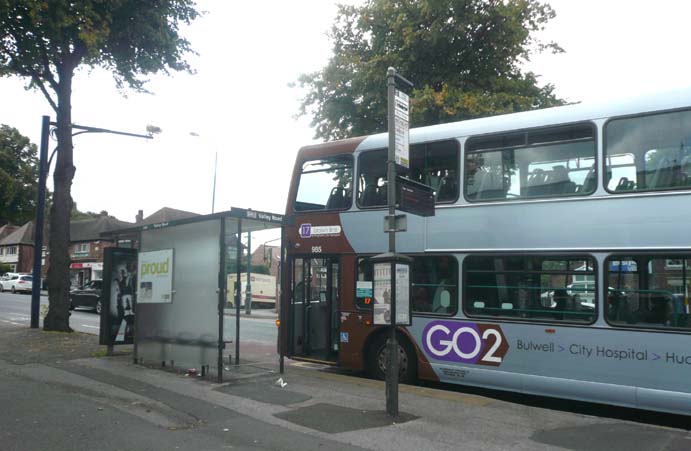
The Formal Surrender took place on a Number 17 bus, ironically one of the very vehicles Sergeant Sakura had himself fired on in a surprise attack just a few months previously:

P1530139 xxxxxxxxxxxxxxxxxxxxx

The bus (serial number 984) had to be taken out of service to be repaired, but duly returned in time for Sergeant Sakura’s surrender:

surrender zzzzzzzzz

Cars full of curious tourists queued for hours to see the ceremony:

This slideshow requires JavaScript.

The Number 17 bus was duly parked in front of the Co-op Supermarket and, at 17 minutes past 1700 hours, Sergeant Sakura became a civilian again:

P1530170 xxxxxxxxxxxxxxxxxxxxxxx

The owners of the local Chinese restaurant and takeaway, the “Golden Phoenix” (“brilliantly cooked and gorgeous food. Can’t be recommended high enough. 5 star.”),  are fearful that Mr Sakura may cash in on his fame and open a Japanese sushi bar.  As yet, though, it seems as if their fears may be unfounded.

Unfortunately, there is still little sign either, of the roundabout being completed.

25 Comments

Filed under History, Humour, Nottingham

Casualty rates in the Great War

Years ago I wrote a worldwide best-selling book about the history of football in the High School from 1870-1914.(Just kidding). In the foreword, I revealed the identity of the Old Boy who had won an Olympic Gold Medal for the United Kingdom at Association Football. I made public which Old Boy had scored more goals in a single F.A.Cup tie than any other player in the history of the competition. I listed the eight Old Boys who had played international football for England. I recalled the Old Boy whose refereeing in an F.A.Cup tie led the F.A. to introduce the concept of the neutral referee, an idea which has spread worldwide since that biased performance. I described an occasion when the High School goalkeeper let in the winning goal as a protest against the refereeing of the game, and the day when the referee refused to give a penalty because “penalty kicks were unknown in amateur football”. The reader could find out which team lost 0-13 and did not get the ball into the opposition half at any point during the game. In another fixture, against Nottingham Asylum, “the presence of so many lunatics unnerved the school team, for it did not come up to its normal form.”  I remembered the day when “The School Six defeated the Masters by three goals to one. The masters, who, like Hamlet, were somewhat “fat and scant of breath”, then demanded to play two fat men extra, to compensate for their want of nimbleness. This unfortunate challenge was accepted, and the School won again by ten goals to one.”

Overall,  this book provided many examples of extraordinary, and, indeed, often amusing events on the football pitches of Victorian and Edwardian England.

villa-cup

When I first started my researches, looking through issue after issue of, firstly, “The Forester’, and then “The Nottinghamian”, it seemed that this would ever be the case. Here was a football spectators’ paradise, where goals rained into the net in every single game, as Leicester Wyggeston School  were beaten by 23-0 on two separate occasions. Deadly goal poachers scored hat tricks past defenders made slow-witted by heavy leather boots, and referees, and their decisions, grew ever more eccentric by the year.


My suspicions, though, were initially aroused by the story of William Norman Hoyte who was at the High School from 1904-1913, when he won an Open Scholarship to Jesus College, Cambridge to read Natural Sciences. William represented his college at rowing and appeared in the Second May Boat. His studies, and his rowing, though, were interrupted by his military service as a Lieutenant in the Sherwood Foresters in the Great War. He was a very brave young man and won the Military Cross twice. When he returned to Jesus College in 1919, though, he was unable to continue with his rowing. After the appalling carnage of the Great War, William Norman Hoyte M.C. and Bar was Jesus College’s only remaining rower from the pre-war years. All the rest had been killed.

zzzzzz   Massengrab_

Morbid curiosity then caused me to wonder what were the eventual fates of those familiar names whose footballing deeds were recorded in perpetuity in their School Magazine, especially those who would have been of an age to have been sucked into the flesh shredding maelstrom of the Great War. where, on average, every single metre of trench was to be hit by a total of one ton of explosives. What I found, quite frankly, astounded me, and I do not feel that any reader, safe from harm, here at the beginning of the twenty first century, can begin to comprehend either the numbers of men involved in this war, or the enormous casualties which the nation suffered.

somme

During the Great War, for example, British forces lost 887,711 men killed and 1,663,570 men wounded. Of these 118,941 were officers. The British Empire had casualties of 1,244,589, with French deaths counted at 1,737,800. Italy lost 1,737,800 me killed and the Russians 3,394,369. Germany had 2,800,720 killed, the Austro-Hungarian Empire 2,081,200 and the Ottoman Empire 3,271,844. The United Kingdom lost as many as 2.20% of its total population, the French 4.39% and the Germans 4.32%.

zzzzzz-Ypres-necropole-

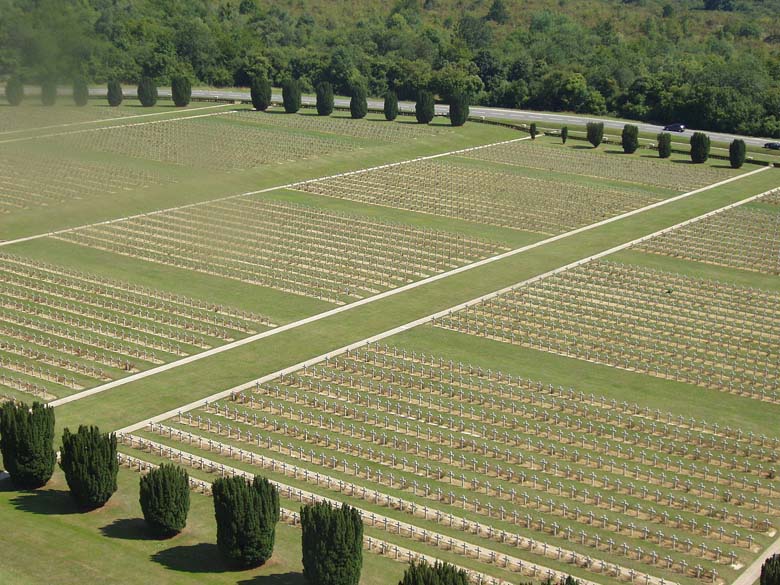
In individual battles, the loss of human life could be even more astounding. On the first day of the Battle of the Somme, on July 1st 1916, the 8th Division lost 218 of its 300 officers at Ovillers in just two hours. Of 8,500 other ranks, 5,274 men perished. On this single day, the total casualties of the British Army were 57,470 men. German casualties were just over 300. In the first three days of the Battle of the Somme, the average daily casualties per division were 101 officers and 3,320 men. During the second week, 10,000 men a day were lost, and for the remaining four or five months of the campaign, casualty rates were in the range of 2,500 men per day. Overall, this battle was to cost the lives of 420,000 British and Commonwealth troops, with a total of 220,000 French casualties. German losses remain unknown but were at least 450,000, and may have reached 600,000. In the photograph below, the tiny squares are all graves:

zzzzzz -Douaumont_ossuary3

Nor is this necessarily an isolated set of statistics. In the Second Battle of Ypres, in April 1915, the 149th Brigade lost over three quarters of their complement, a total of some 42 officers and 1,912 men. The 10th Brigade more or less ceased to exist, losing 73 officers and 2,346 men. In the Third Battle of Ypres, between August and November 1916, British infantry repeatedly advanced against German machine gunners, with casualties totalling 244,897. On the second day of the Battle of Loos, twelve battalions, numbering some 10,000 men, attacked the German machine guns. In just over three hours, 385 officers were lost, along with 7,681 men. On July 31st 1917, when the 1/1st Hertfordshires attacked the Langemarck Line, every single officer was a casualty and eleven of them were killed. The other ranks suffered 459 casualties and drafts of men had to be made to rebuild the battalion. Not until May 1918 was the 1/1st Hertfordshire Regiment fully reconstituted by absorbing thirty officers and 650 men from 6th Bedfordshire Regiment. In the Battle of Aubers Ridge, General Rawlinson, irritated with the lack of progress, complained to his Brigadier-Generals,

“Where are the Sherwood Foresters ?  Where are the Sherwood Foresters? ”

Brigadier-General Oxley replied, “They are lying out in no-man’s-land, sir, and most of them will never stand again.” Many of these particular casualties, especially the Lieutenants and Second Lieutenants, may well have been Old Nottinghamians, but nowadays, there is no way of being any more precise than that.

zzzz ertyuio

One thing of which we are certain is that Robert George Hopewell played in the High School First Team from 1897-1899. Robert was the son of Noah and Margaret Hopewell, of Old Basford and the devoted husband of Gladys Eleanor Hopewell.  They lived at West Brook in Mansfield, Robert was killed at Thiepval during the Battle of the Somme on September 3rd 1916, at the age of 33. A stretcher-bearer’s description of Thiepval in 1916 has survived to the present day…

“The trenches were knee-deep in glueing mud and it was the hardest work I have ever done…The banks on each side were full of buried and half-buried corpses and the stench was appalling. As one was carrying a wounded man down, one perhaps got stuck in the mud and staggered whilst one extricated oneself or was extricated. You put out a hand to steady yourself, the earth gave way and you found that you were clutching the blackened face of a half-buried German.”

Revelon, gefallener Deutscher

Nowadays, Thiepval is the scene of a huge memorial dedicated to those British soldiers who have no known grave. There are 73,000 names listed on it.

zzzzzz b Morgen53

Thomas Cripwell Wilson was an Old Nottinghamian who served as a Private in the 2nd Canadian Mounted Rifles Battalion. He was the son of Thomas and Mary Carr Wilson, of 5, Mount Hooton Terrace, Forest Road, just a five minute walk from the High School. Thomas was wounded in 1915, but returned to France in 1917.

wilson

He was killed in action in November of that same year. His war could be described in equally frank terms…

“All those picturesque phrases of war writers are dangerous because they show nothing of the individual horror, nothing of the fine personalities suddenly smashed into red beastliness, nothing of the sick fear that is tearing at the hearts of brave boys…a thing infinitely more terrible than physical agony.”

The earliest High School football players to be involved in the Great War were four boys who played in the 1891-1892 season, namely Blackwall, Hadfield, Senior and Wallis.

Ten years later, the 1901-1902 season was to provide a full team, eleven brave individuals called Constantine, Cooper, Cullen, Emmett, Hore, Johnson, Marrs, Millward, Settle, Watson and Woollatt.

By 1913-1914, even more footballers were destined to risk their lives on the Western Front. They were now a full tem with a generous selection of substitutes, including Barber, Boyd, Cleveland, Fleet, Harlow, Hind, Lyon, Munks, Nidd, Page, Parr, Prince, Sadler, Taylor, Telford, A.G.Wilson and W.M.Wilson.

Old Nottinghamians, both footballers and non-footballers, volunteered in huge numbers for the Great War. At least one thousand five hundred boys and staff went willingly from a comfortable, safe, and usually well-off  family background in Nottingham, to what was arguably the bloodiest war in human history.

This slideshow requires JavaScript.

11 Comments

Filed under Football, France, History, Nottingham, Politics, The High School

The Ghost of George’s Hill

I used to be a teacher. Not much connection there with scary monsters, but I did once hear an absolutely wonderful ghost story at a Parents’ Evening. The phantom involved is actually very famous in Nottinghamshire, but at the time, I had never heard this scary tale.

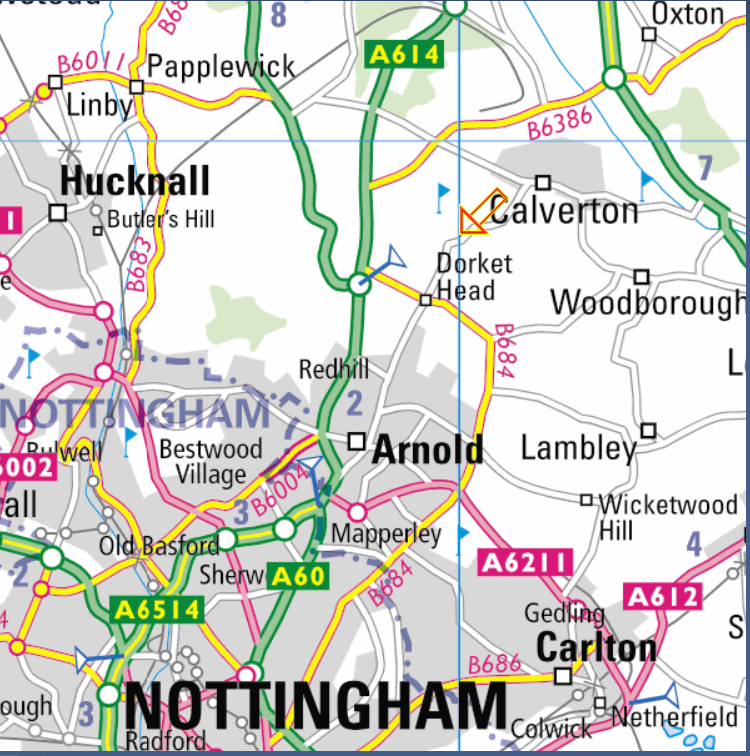
I was speaking to a boy’s mother. She said that the family lived in the village of Calverton.  She told me how her husband refused ever to drive again along a certain road to the north of Nottingham because it was strongly haunted, and he had been absolutely terrified when he met the ghost. Look for the orange arrow…

Untitled s

In the map above, the yellow road in the centre is the B684, the “Plains Road” which leaves Nottingham northwards and climbs slowly but surely along what must have been at one time an ancient Stone Age Ridge Route and perhaps even a hunting trail. With some amazing views, particular to the east, the road eventually sweeps around to the west  to join the main road from Nottingham, the  A614. This road goes northwards towards the A1 at Clumber Park, the “Great North Road”. Just before this major junction there is a minor cross roads called Dorket Head where a country lane winds northwards down an extremely steep hill. It forms a short cut down to what is nowadays the dormitory village of Calverton.

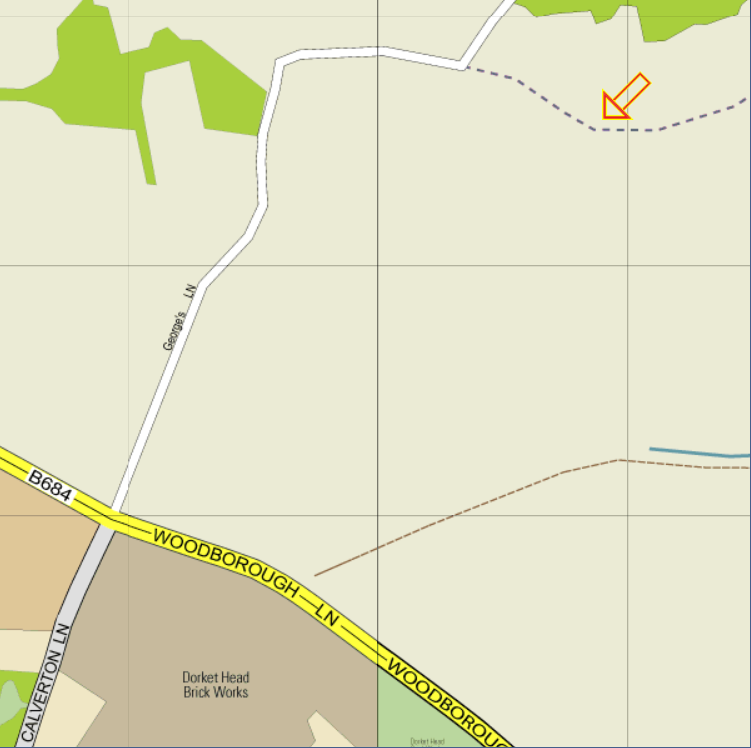
The map below is a larger scale version of the most important features in the tale. (the orange arrow points to the steeply winding country lane in question)

dork head 1

The mother explained how her husband had seen the ghost and he had been so absolutely terrified that, after this, he had never ever again driven back home along this road. He therefore ignored an obvious shortcut to Calverton from his office, one which would have saved quite a lot in petrol costs over the weeks and months. Instead the husband preferred to spend his hard earned cash on driving around the three sides of a rectangle, but a rectangle where there was no possible prospect of being terrified out of his wits on a second occasion. This circuitous route ran along the B684 to the main road, the A614, and then along the next turn right, the brown road past Ramsdale House and up to the Arts Centre, and then another right turn into Calverton. The three sides of his rectangle must have included making at least one right turn across the high-speed oncoming traffic on the A614.

Her husband had seen the ghost in the absolutely classic way which is featured on so many different websites about Nottinghamshire phantoms.

Basically it is a very simple scenario. As you drive down the narrow road following the twisting, turning descent with great care, concentrating hard on what is ahead of you, you suddenly notice that there is somebody sitting in the empty back seat of your car. You will see the stranger occasionally in the rear view mirror when the car swings from side to side as you follow the twisting loops of the road. Sightings of your unwanted passenger will be only fleeting, but they will seem more terrifying because of this. Drivers who stop the car to look behind them invariably find that the rear seat is empty.

Anyway, this particular father was so terrified that he never again even contemplated going down the hill. The ghost he saw, as far as I remember, was an old woman. The mother also told me how a very great number of people in Calverton, if they can possibly avoid it, would not consider for a moment driving down this hill for the very same reason as her husband.

Ten minutes’ research on the Internet revealed that the road is called George’s Lane and the hill is called George’s Hill. The haunting seems to be most frequent at Dorket Head or at the junction with Spindle Lane. On this map, Dorket Head is the crossroads which forms the junction of George’s Lane with the B684. The dotted line, indicated again by the orange arrow, is Spindle Lane.

dorket haed

Nicholas A.C. Blake of Nottingham made an appeal for information on his website. He too had seen an old lady in the car and he sought other witnesses at “nblake42@hotmail.com”

Sarah Meakin of Carlton, Nottingham, returned from Calverton after some babysitting to feel the car suddenly go cold on a warm summer’s evening, and she then looked in her rear view mirror to see “a black hooded figure, which can only describe as looking like a monk”.
The absolutely splendid “Paranormal Database” reveals that…

“A ghostly entity is reported to materialise on the back seat of passing cars in both of these locations – on the lane the figure takes the form of an old lady, and on the hill the figure wears a black hooded garment. Normally the witness only sees the entity in the rear view mirror; when they turn round, the figure has vanished.”

Well, you know where George’s Lane is, and you know what might happen and you know what you might see. So off you go, and make sure you keep your eyes on the road, as well as on your rear view mirror.

17 Comments

Filed under Nottingham, The High School

As promised, a beautiful bird in the garden

In a previous blogpost I extolled at great length the many ways in which a fascinating plant called the teasel was extremely beneficial to wildlife. In the summer therefore, our garden played host to a number of lovely butterflies:

This slideshow requires JavaScript.

The teasel also kept us human beings interested by drowning passing insects and slowly absorbing the chemicals from their bodies. Here is the teasel in flower:

Teaselxxxxxxxxxxxxxxxxxxxx

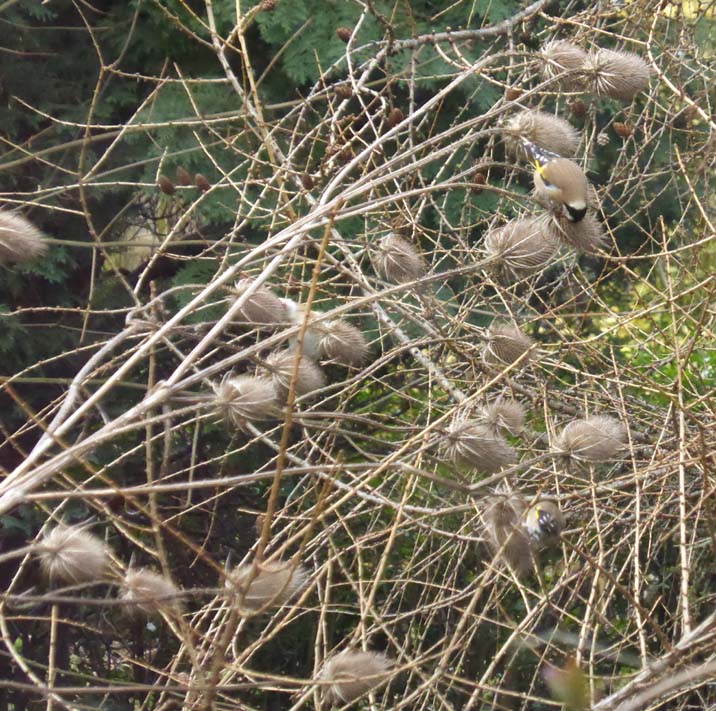
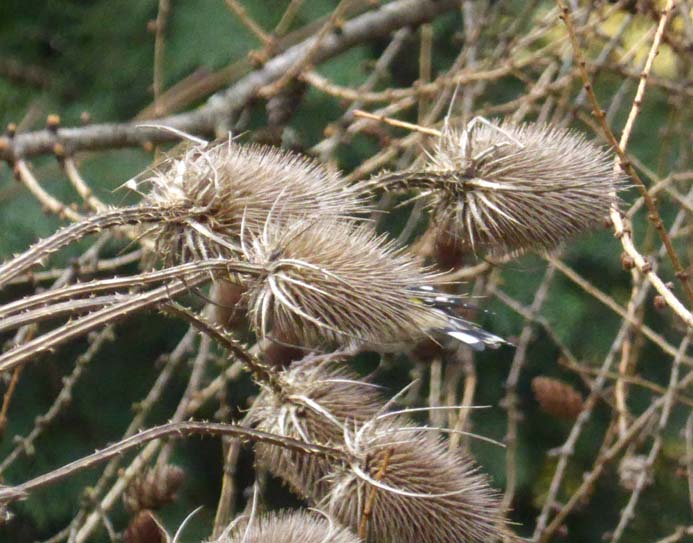
I hope you have not forgotten though, how I made a solemn promise that, when the seeds had matured, the seed heads would play host to one of our most beautiful birds, the Goldfinch.
They should have been here in autumn, but now, at last, they have finally made their long awaited appearance. I, of course, missed them on their first visit, but my daughter and fellow blogger saw them and took a few photographs. Here are some of them.

Firstly, it may actually be a case of “Spot the bird”:

P1010677xxxxxxxx

Not always an easy decision to make:

P1010651xxxxxxxxx

Yes, at last, a Goldfinch:

P1010673xxxxxxxx

As far as I know, the males and females are the same:

P1010640xxxxxxxxxxxx

At least, they look it:

P1010692xxxxxxxxxxx


3 Comments

Filed under My Garden, My House, Nottingham, Science, Wildlife and Nature

Excitement with a capital Egret

(An extract from my old birdwatching diary “Crippling Views”)

.
Saturday, June 18, 1988

.
Excitement with a capital E. I ring faithful old Birdline, at two o’clock, and for once strike lucky. The pre-recorded message tells me that a Great White Egret is present at Rutland Water, on the Egleton Reserve. I ring Paul before jumping into the car and heading off at a rate of knots. Noble and honourable to the core. Except Paul isn’t there. I decide on a compromise, or, as you are entitled to call it, the coward’s way out. I’ve already promised my wife that I’ll take her to Sainsbury’s, so I spend the next half hour driving round the Ring Road at 90 miles per hour, doing a week’s shopping in a British Olympic qualifying time, and then returning to phone Paul just once more. Still no answer. Knowing him, he’s properly gone off with his mate Mark to see the bird without bothering to tell me. So into the car I jump, and off I go.

volvo-240-hmb-645-n

It takes me about three quarters of an hour to do the forty miles to Rutland Water, with an irritating delay in the Saturday shopping traffic at both Melton Mowbray and Oakham.

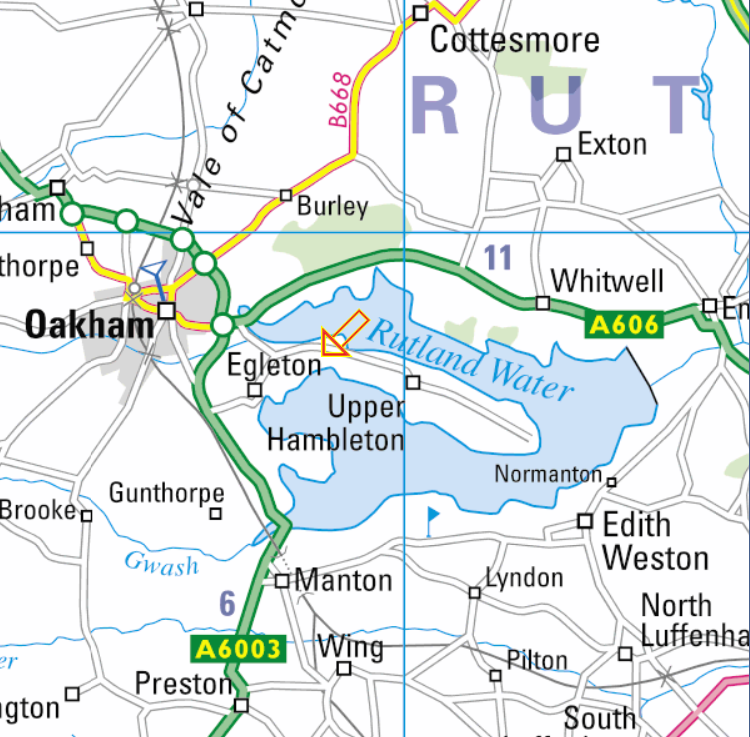
Untitled bigger

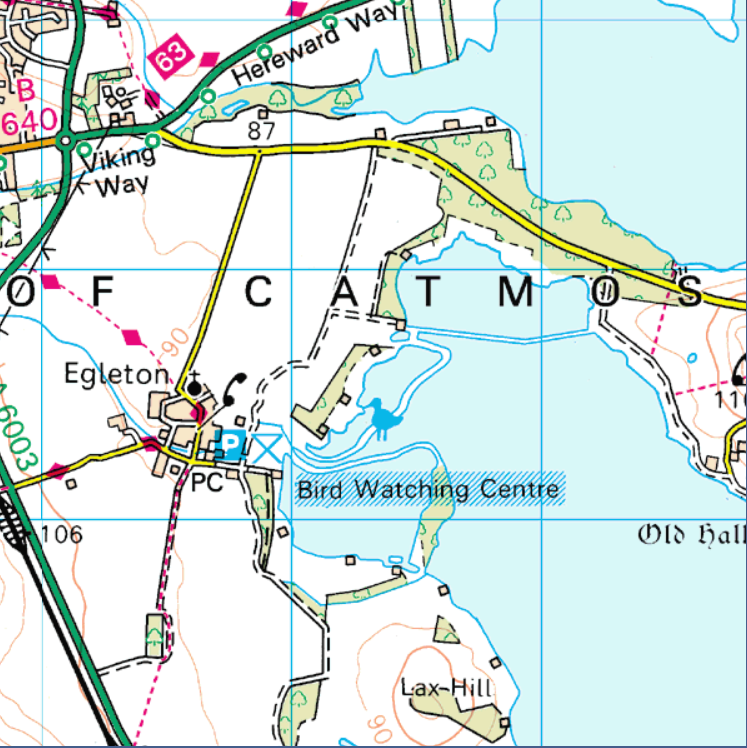
When I get to the reserve, there is a heart stopping moment when I see that there are no cars in the reserve car park. Not to worry, the bird has just moved a short distance out of the reserve, towards the Hambleton Road. The warden on duty gives me a disconcertingly long set of immensely complex instructions to take me down to a crossroads, where the bird is still on view. In actual fact, his instructions prove to be wonderfully exact and easy to follow, and I am soon beside a crossroads, where there is an obvious crowd of birdwatchers, and a great tangle of carelessly parked and apparently abandoned cars.

Untitled

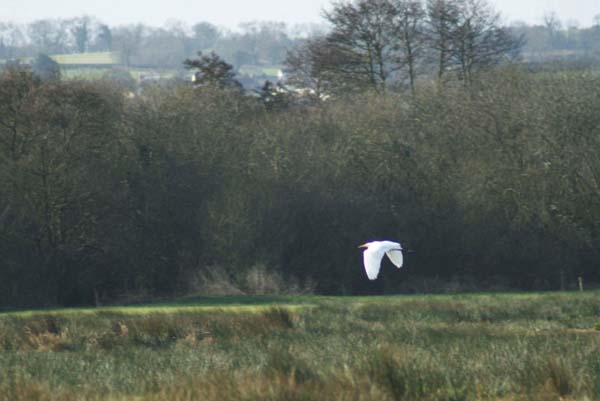
I see the bird immediately from the car, before I even pull to a halt. It flies in an almighty arc, with that same translucent pearly white as the  Little Egret I saw at Frampton, only this time the bird is a lot bigger, the size of a Grey Heron.

02343-Great-Egret-043xxxxxxxxxxx

When I finally arrive on foot at “The Place”, “The Bird” has landed on the very topmost branch of a tree, about seventy yards from the road. It is a very striking individual, looking absolutely enormous, perched in the very top twigs of what is not really a particularly large  tree. The bird appears to be extremely precariously balanced, but it seems happy enough. I get it in my telescope and watch it until boredom sets in. The bird is, by now, just very gradually beginning to get more and more restless, as a larger and larger crowd builds up, and the hum of human conversation gradually becomes louder and louder. It keeps looking around in an almost panicky sort of way, until it finally flies off low between the trees, looking for all the world as if it is going just a few hundred yards away.

dsc01625_great_white_egret xxxxxx

In actual fact, it isn’t, and the rare visitor is never seen again on the reserve.I drive around to the northern section of the reserve, where there are a lot of quiet places, all ideal habit for an egret. It isn’t there. I look for a good half hour, but finally have to admit defeat. It’s really sad how many birdwatchers arrive after the bird’s departure, some from as far away as Somerset. On the other hand, it is certainly arguable that it is the large number of noisy, chattering birdwatchers that have caused the bird to fly off.

.

Nowadays, some twenty five years later, the Great White Egret is by no means a rare bird in England.

They have bred here on at least two occasions, in 2012 and 2013, at Shapwick Heath, Nature England’s National Nature Reserve in Somerset.

This slideshow requires JavaScript.


Every year, up to forty individuals will arrive in England in the winter, having left the colder climes of mainland Europe. The bird which remains still genuinely rare in England, though, is the American version of this bird, the Great Egret Ardea alba egretta (as opposed to the European Great White Egret Ardea alba alba). This subspecies is suspected as having occurred in the UK as a very rare vagrant on just a few occasions.

2 Comments

Filed under Nottingham, Twitching, Wildlife and Nature