Category Archives: Personal

The End of the War in Europe and Church Gresley (5)

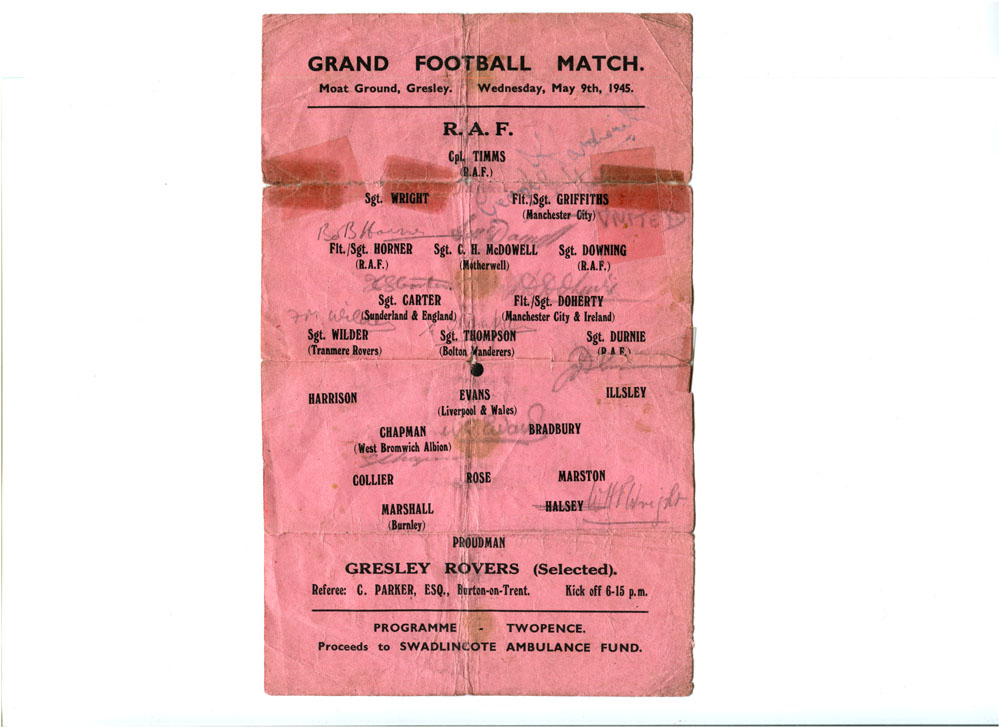
A few days after I finished writing this blog post, I was wandering across the Internet when I came across an auction webpage called “The Saleroom” which featured a copy of my programme but in much, much, better condition:
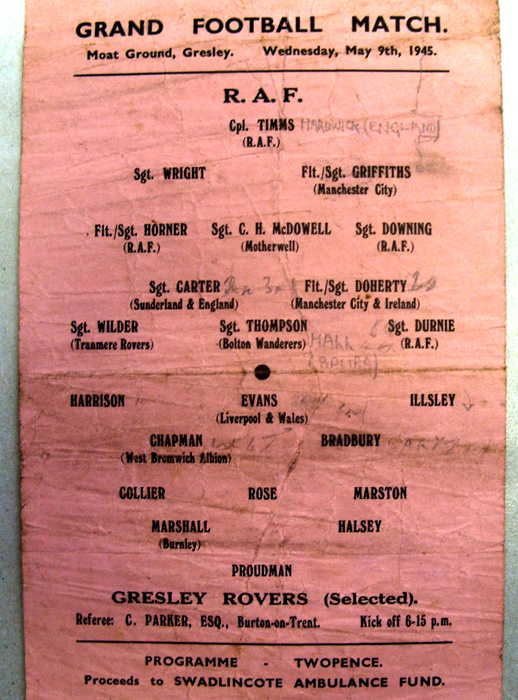
The programme had no autographs but did have some team changes written on it, in pencil, of course:
The first one revealed that the RAF goalkeeper may not have been Corporal Timms but “Hardwick England”
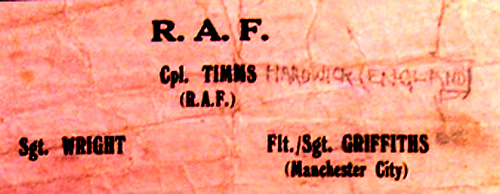
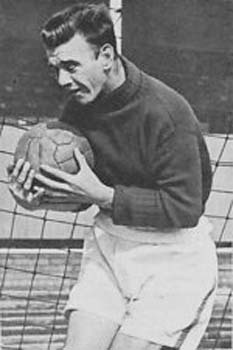
I have taken this to refer to Ken Hardwick who played for Rossington Colliery, Doncaster Rovers (308 appearances), Scunthorpe United (96 appearances) and Barrow (12 appearances). He never played for England but he did suffer one of the cruellest and shameful things ever experienced by a footballer. It occurred in a letter which he received out of the blue about an England appearance. In 1955, he was invited by the FA to play for England, but it was for the Under 23 team and George was, by then, 30 years old. Well, done the Football Association, always with their eye on the ball! Here’s Ken, in his younger days:
Alternatively, the best fit for “Hardwick England” might conceivably be George Hardwick of Middlesbrough and Oldham. He had 13 England caps, some as captain, but he was a left full back, rather than a goalkeeper. Here he is, on a cigarette card which he has autographed in later life:

It’s difficult to imagine, though, that Griffiths of Manchester City would not have changed position to accommodate somebody as important as George Hardwick, ex-Captain of England. Having said that, most professional outfield players would be able to play as goalkeeper in a charity game without too many problems. Perhaps George was just amused by the idea, so he had a go in the atmosphere of universal happiness that must have been in the air for all of that First Day of Peace in Europe.

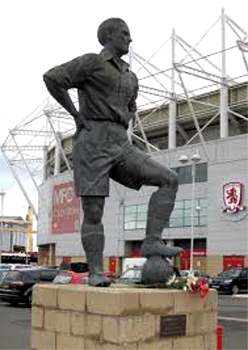
In actual fact, George Hardwick was considered Middlesbrough’s greatest ever player and they have a statue of him outside their stadium:
Near “Thompson” something has been written and it appears to me to be “Hall Spurs”:

This may be Albert E B. Hall, an outside right, who, between 1935-1947, had appeared 81 times for Tottenham Hotspur, or Spurs, as they are better known by their fans, scoring 22 goals.

It may be Fred W. Hall who appeared 23 times  between 1944-1946.

It may be G Willie Hall, an inside right who managed 376 appearances, with 45 goals scored, between 1932-1944. He was actually a fairly local man, born in Newark in Nottinghamshire.

It may have been Jack Hall. This is the least likely because all of Jack’s 67 appearances between 1936-1946 came as a goalkeeper.

Overall though, this is a singular lesson in the value of including an initial!

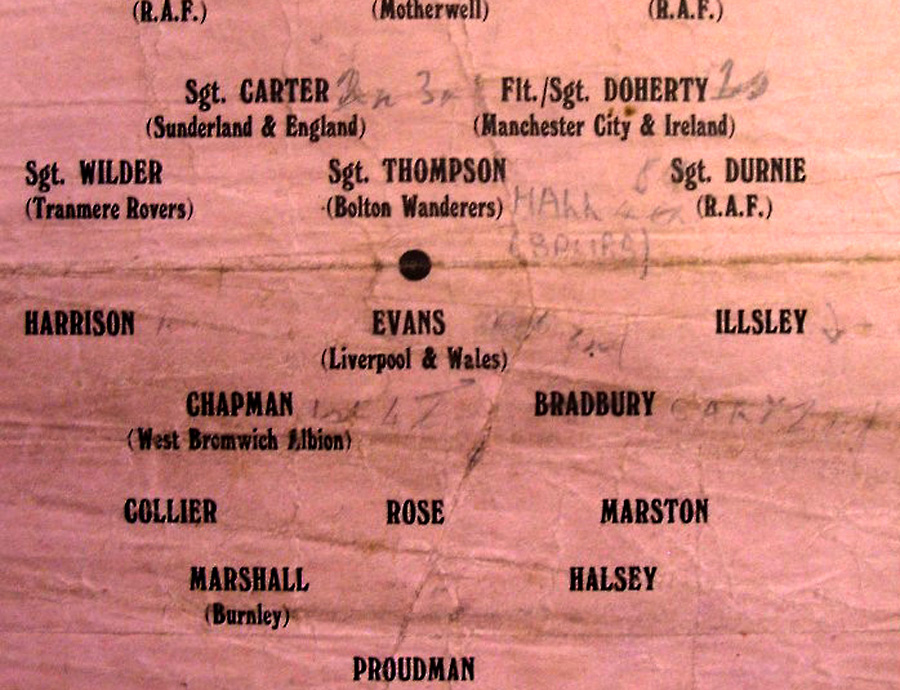
Near ‘Chapman’ there is something written. If this programme was ever owned by a little boy, the little boyish handwriting says “lost 4-7” but this is far from definite in my mind. Other figures are written in near both Carter and Doherty but I really don’t know what they are:

What I need, of course, is a newspaper report, but that’s easier said than done!
10 Comments

Filed under Aviation, Bomber Command, Derby County, Football, History, Personal

Victor Comic and me (3)

I would be the first to admit that Victor could sound a little clichéd on occasion:

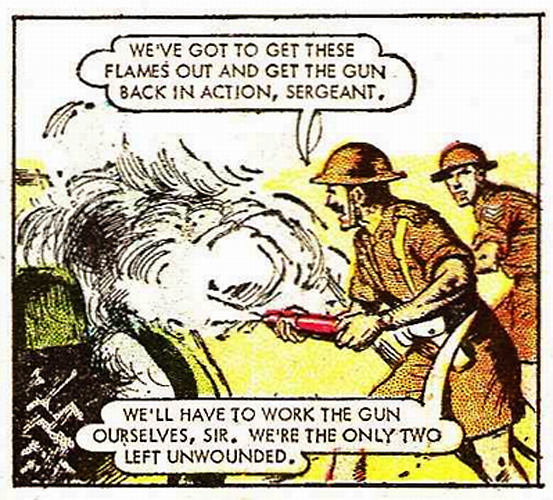
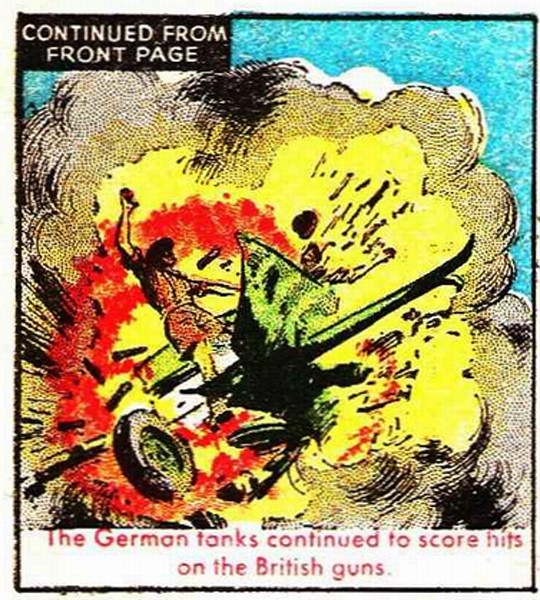
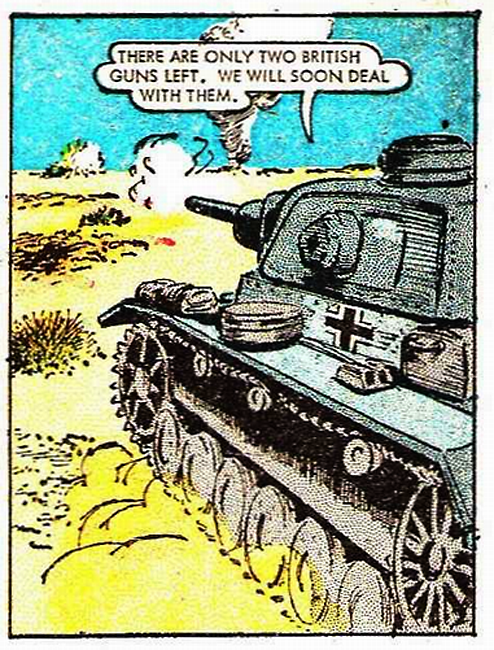
But the British always overcame every problem. Only two British guns and 132 German tanks. Don’t worry! We’ll get ’em all! And make sure you don’t miss any!!
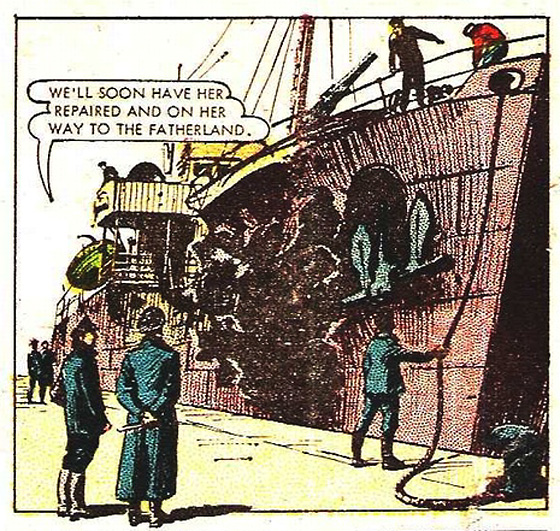
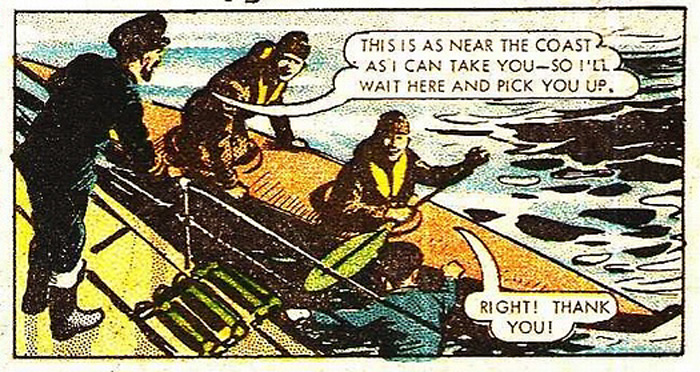
Tank recognition classes can now put their knowledge into practice. The men who drew these tanks had probably seen them for real:Disaster strikes. But the British are used to recovering from disaster and muddling through. Norway. Dunkirk. HMS Hood. Greece. Malaya. Singapore. Tobruk. Countless cricket matches against Australia. Penalty shoot outs in football. God knows, we’ve had the practice:Let’s be honest. A great many of the comic’s drawings  have something hackneyed, or even ridiculous, hiding away inside them. Not to mention exaggeration. Whoever saw a hole in a ship that big?Still, at least the German officer in the next frame doesn’t say “to ze vaterland” :Contrast the British approach below. In the kayak, two commandos, who are perfectly well aware that Hitler’s personal order was that if they were captured, they would be shot. This was the “Kommandobefehl” which you can read about here. The man on the submarine, though, might as well be offering to take their letters to the Post Office for them. “Right! Thank you! And could you see if they are still selling those cough sweets I like? Just get me a couple of packets, would you, old chap?”

More irreverence next time.

14 Comments

Filed under History, Humour, Literature, Personal, Writing

The End of the War in Europe and Church Gresley (4)

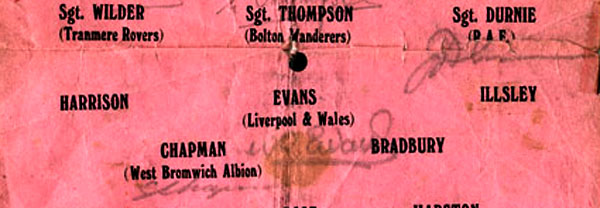
Last time I talked about an old football programme. It was for a match played one day after the war ended in Europe, May 9th 1945. The programme was for “Gresley Rovers (Selected) v RAF”.  The top two stars in the RAF team were Raich Carter and Peter Doherty.  Here is the RAF team:

And here is the Gresley defence:

The next section shows the Gresley forwards, the ones below the black spot of the centre circle:

J Illsley, the outside right, signed for the club in October 1941 and made his first team debut on October 4th 1941 against Quorn Methodists (won 6-2). He scored a phenomenal 24 goals in 28 appearances, his last game, like Collier, coming against Holwell Works on February 22nd 1946 (won 2-1).
“Bradbury” the inside right, could be one of two different players, who, rather helpfully for the statistically minded, played together in the same team on many occasions. Ken Bradbury was signed in 1944 and made his début against Swadlincote Colts on October 7th 1944 (won 4-2, Bradbury 2 goals). He then went on to score 19 goals in 21 games before bowing out on April 6th 1946 against Morris Sports in the League Cup Semi Final (Rovers won this game 7-0 but lost the Final 1-7 to Kettering Town).

Tom Bradbury was even more of a goalscoring sensation in the Rovers’ team than Ken Bradbury. His first game was on August 28th 1937 against Loughborough Brush Sports (won 4-2, Bradbury 3 goals) and according to the club’s player database, he finished his spell at Gresley on May 9th 1944 in the League Cup Final against Swadlincote Colts (won 5-1). Overall Tom scored 94 goals in 50 appearances, with his best two seasons coming in 1941-1942 with 23 in the League and 8 in the Cup. In the following season of 1942-1943 he managed 28 in the League with no surviving record of his Cup goals.

In September 1937, he had signed for Derby County for £200 and he played 4 games, possibly for Derby’s reserves. If he played for the First Team, then I have been unable to find any details of that in the Derby statistics I have seen. In 1939, he signed for Wrexham. When war broke out, he went to work in a munitions factory. He returned to Gresley where he played whenever that was possible. Tom finally had a spell with Rovers as player-manager. Presumably, that is why he was playing on May 9th 1945…he picked the team!

Three or four years later, Tom was one of the founder members of neighbouring Burton Albion.

He later became a director and then chairman of the club which now plays in League One,  England’s third tier of football. In less happy times, when Burton Albion was going bankrupt, Tom mortgaged his family home to save the club. His wife wasn’t best pleased when she found out what he’d done.

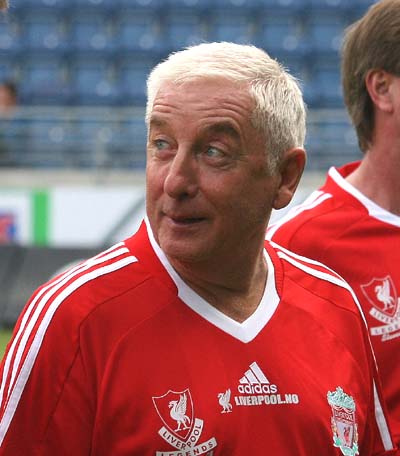
The centre forward was W Evans of Liverpool and Wales. I have found out nothing about him so far, except that it was definitely not Roy Evans, the ex-Liverpool manager:

It may be that W Evans played in wartime games which are more difficult to access, although according to “Soccer at War 1939-1945” by Jack Rollin, nobody of that name appeared for either Liverpool or Wales between 1939-1946. Neither does “Wales, the Complete Who’s Who” provide any clues. Perhaps that centre forward at Gresley was the last German spy, making just one last appearance. He was probably doing research about how English players took penalties.

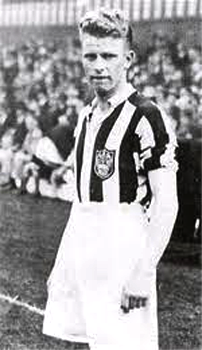
The inside left is most likely George W. Chapman (1920 –1998). He was born in Linton, a village close to Church Gresley, and he signed for West Bromwich Albion although he did not ever play for them except during wartime fixtures (13 appearances, 2 goals).

In 1946–1948 he played for Brighton & Hove Albion scoring 12 goals in 43 appearances. He was the club’s top scorer in the 1946–47 season with 10 goals. After that, he moved to Tonbridge Angels, a club which had been formed as recently as October 1947. Here’s their badge, presumably based on the coat of arms of the town:

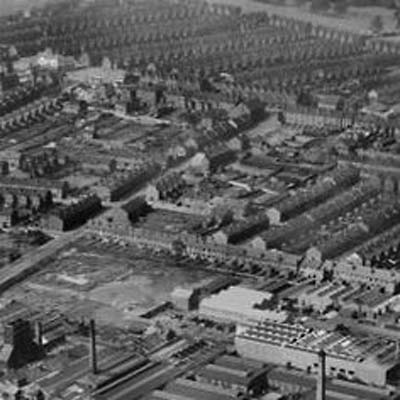
Harrison is perhaps Cyril Harrison who made his début against Marston’s on November 7th 1942 (won 14-1, Harrison 3 goals) and scored 21 goals in 27 appearances. He played his last game on April 26th 1950 against British Ropes (won 4-2, Harrison 1 goal). Alternatively, it might have been Mick Harrison who made his début against RAF ‘H’ on September 23rd 1943 (won 4-2, Harrison 1 goal) and went on to score 58 goals in 87 appearances. He played for the last time on April 26th 1950 against British Ropes on April 26th 1950 (won 4-2, Harrison 1 goal…but which Harrison, Mick or Cyril, Cyril or Mick ?). Here’s the British Ropes factory. I couldn’t find a picture of their team:

If you have read any of my previous posts about non-league teams around Nottingham, you will know how fascinated I am with the names of these smaller clubs.

Let’s just look at who Rovers played against nearly 80 years ago.

An Army XI in a friendly match  to raise money for the Spitfire Fund, Briggs & Co, British Ropes, Broadway Youth Club,  Central Ordinance Corps, Cyclops, Cyclops Sports, Derby Corinthians, H R Mansfield Sports, Ibstock Penistone Rovers, John Knowles A, Leicester Nomads Reserves, Loughborough Brush,  Marstons, Measham Imperial, Midland Woodworkers, Morris Sports, Newbold Vernon, Old Dalby, Quorn,  Methodists,  Parkhouse Colliery, RAF, RAF ‘F’, RAF ‘H’, RAF ‘L’, RAF ‘M’, RAF ‘T’, RAF XI, Rolls Royce, Royal Artillery, Royal Engineers, Stanton Ironworks, Whitwick Holy Cross, Whitwick Parish Church, Whitwick White Cross and the catchiest of all for those supporters’ songs, “351 Burton Squadron ATC”.

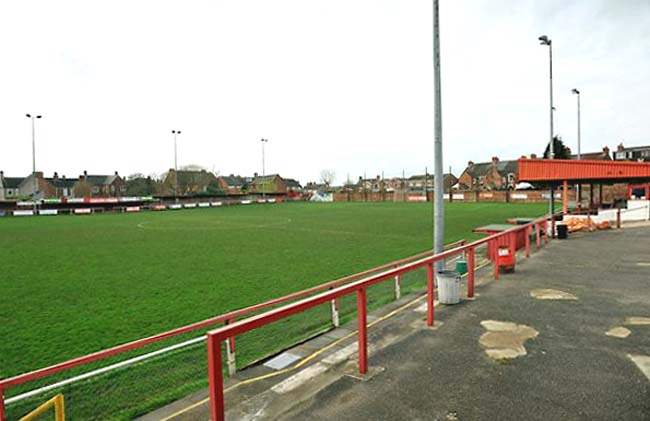
None as good though, as the first ever opponents in a home game of which records have survived, played at the Moat Ground on September 5th 1891…..Hugglescote Robin Hoods. Here is Rovers’ ground which has not changed much since that late summer day:


16 Comments

Filed under Aviation, Bomber Command, Derby County, Football, History, Personal

Victor Comic and me (2)

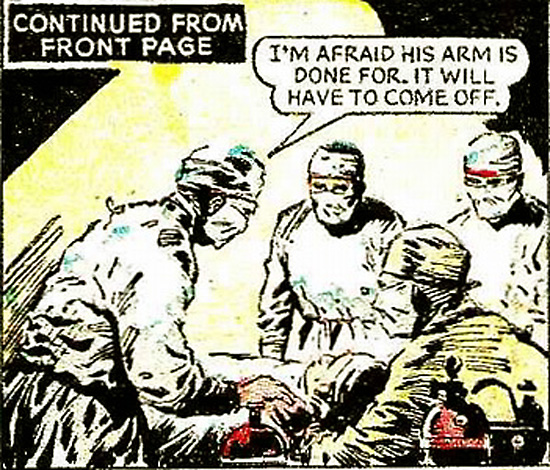
Victor Comic normally began with a war story in full colour on the outside covers of the comic. The story was always true, although I don’t think that that ever really registered with me:

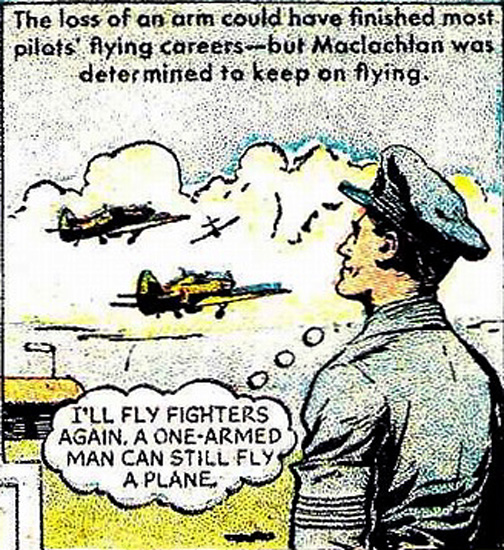
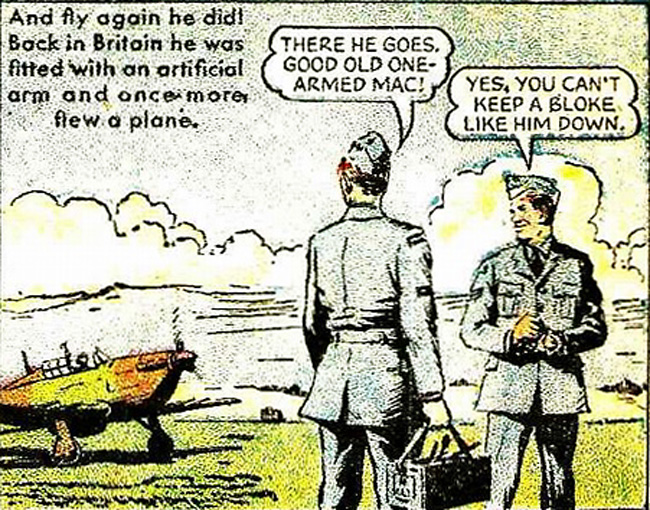
This particular story may not have been 100% true but I think that this is because Douglas Bader was still alive at the time and they didn’t want any law suits:

And anyway, what’s an arm or a leg between friends?

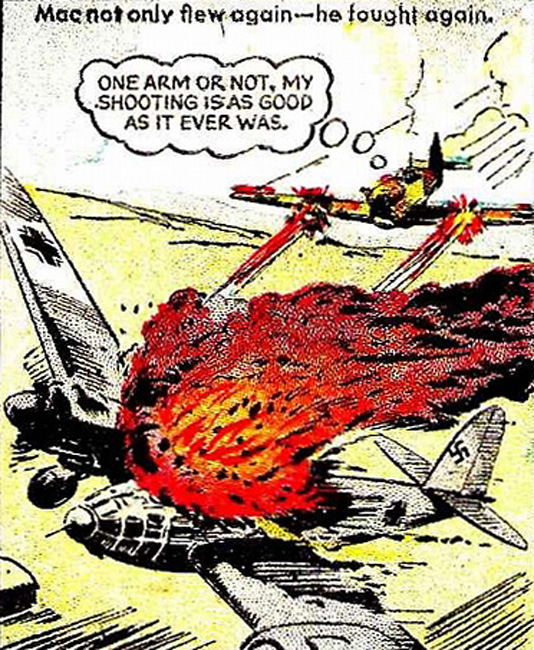
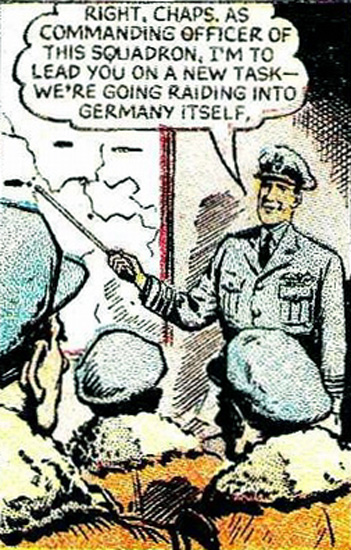
Good Old One-Armed Mac was back doing what he did best. Killing Germans:

Good Old One-Armed Mac used to fly a Hawker Hurricane, but the squadron leader chose to ignore totally the aircraft’s fuel tank capacity when he announced one day that they were going to go and attack Germany. Perhaps they went just a little way up the Rhine on an aircraft carrier:

No, I don’t see an arrestor hook there. But they’re very good, aren’t they?

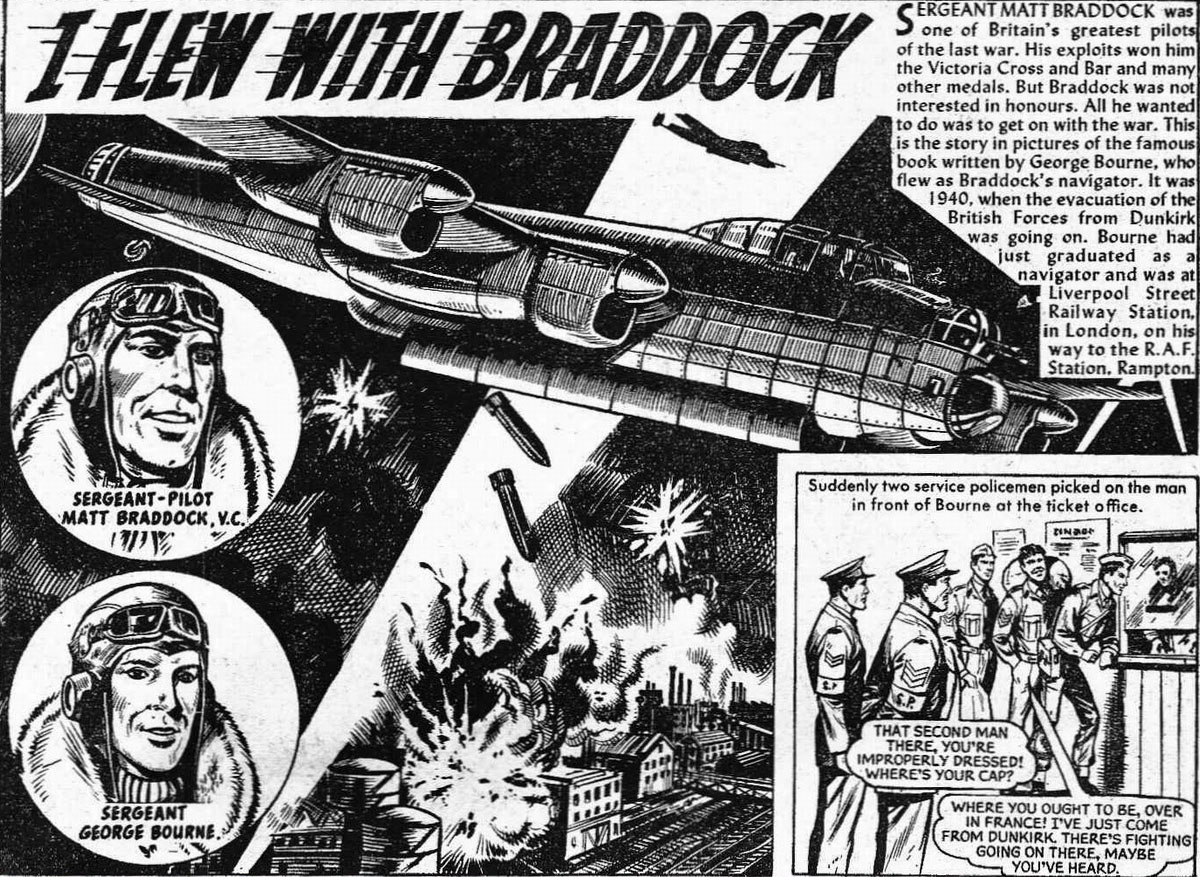
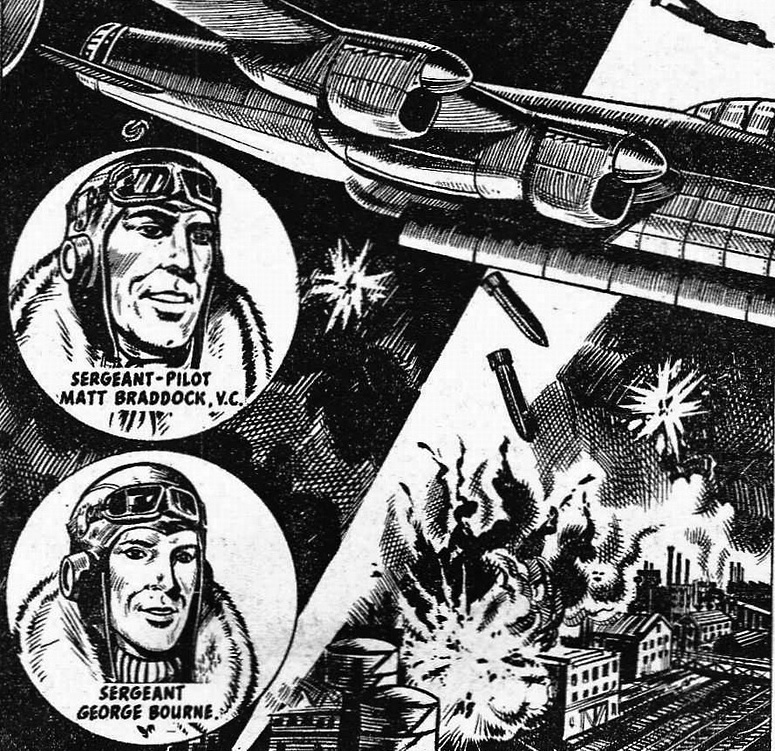
Victor always had completely 100% fictional wartime characters such as Sergeant Matt Braddock VC. He usually flew a Lancaster or a Mosquito but he could turn his hand to anything. Nobody knew that Matt and his navigator George were the adopted sons of Biggles and Ginger:

Here’s the text if you can’t read it:

Given the hair brained nature of some of the things they did, I’m not too surprised that Matt and George were based at the fictional RAF Rampton. Here’s the Terrible Twosome and a nice illustration of what they do best:

Braddock might have been a double Victoria Cross winner, but he was not cut out for training young recruits:

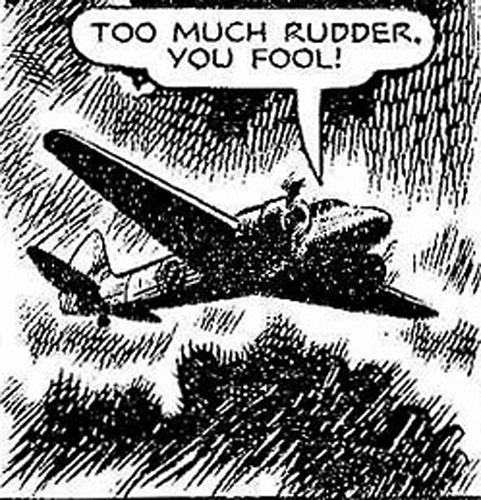
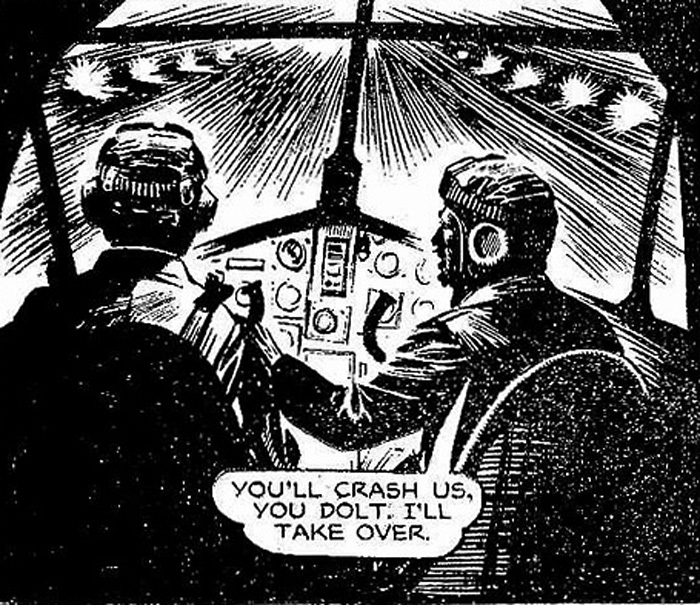
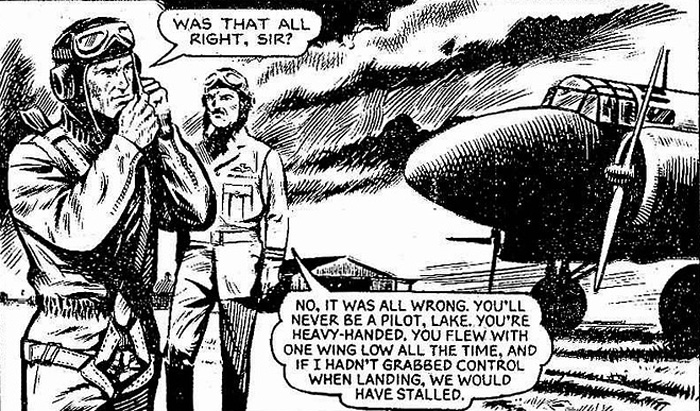
He was not very good either at passing on the idea of “the calm pilot who was always in control” :

He was never really very interested in the concept of patience and understanding:

Occasionally, in the stories featured in Victor Comic the odd cliché would crop up. The clichés were never really a genuine source of negativity though and they were never meant in a nasty way.

And race hatred was something that just did not ever crop up. No higher respect could have possibly been paid, for example, to those great warriors, the Gurkhas or indeed, any other non-white soldiers in the British Army.

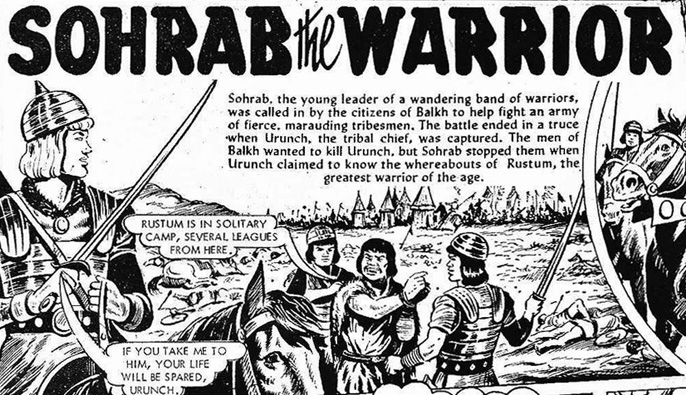
Characters from the Middle East could even star in their own series. And, yes, the hero does look a little bit blonde haired with possibly a hint of blue eyes:

But what about “the traditional Jesus” ?  Very few people will ever have been struck by the markedly Jewish appearance of Jesus in illustrations . Here’s Jesus the Viking:

27 Comments

Filed under Aviation, History, Humour, Literature, Personal

The End of the War in Europe and Church Gresley (3)

In my most recent post on this topic, I looked at the RAF team in a celebration match played in Church Gresley, the neighbouring village to the one where I grew up. The game took place on May 9th 1945 to commemorate the end of the war in Europe. We have already looked at the RAF team:

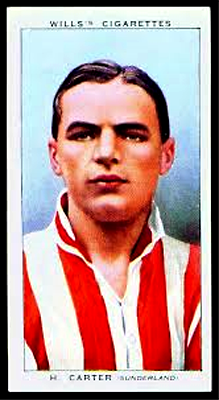
It was captained by Raich Carter, the only man to have won the FA Cup both before and after the war. The people are King George VI, the Queen and a young Raich Carter. Adolf Hitler is fooling nobody with that dyed blond hair:

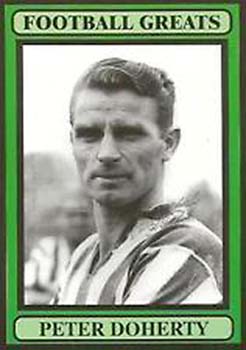
The other star player was Peter Doherty of Northern Ireland:

Here is what I found out about the players of Gresley Rovers (Selected) who opposed them. A very large proportion of the information came from the superb Player Database, which is now a feature of the Gresley FC website, having appeared for many years on the Gresley Rovers website.

Most of the Gresley players were local men and worked “down pit” as miners. Being a miner was a reserved occupation so they were not involved in combat situations. It is true to say, though, that many miners did a job which was statistically much more dangerous than that of many soldiers or sailors. This is a picture of what was then a heavily industrialised area, with clay and coal mining as well as the fabrication of huge pipes for drains and sewers:


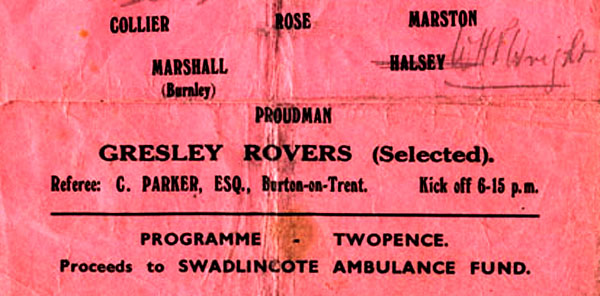
The first section shows the defence of the Gresley Rovers (Selected) team, the price of this single sheet programme and the recipients of any charity money which was raised :

I traced a great deal about the goalkeeper. John Proudman, but none of it was because John had a long and happy life.

Tragically, he was killed on September 23rd 1950 while playing in a Leicestershire Senior League game for Moira United against Quorn Methodists at Quorn, a little village in Leicestershire. During the first five minutes of the game he fell very heavily as he tried to make a save. He finished up at Harlow Wood Hospital in Mansfield, where, sadly, he died from a fractured spine on September 24th. He was only 27 years old. His first ever appearance for Rovers had been on September 9th 1943 against the RAF ‘T’ (won 5-1) and the final one of his 71 games for Rovers came on May 4th 1946 against Melton Town (lost 1-2). After that he played for Newhall United and then Moira United. John was a miner and he worked at Cadley Hill Colliery near Swadlincote.  The Gresley FC Online database has a brief account of John’s performance in this game against all the stars:

“My father worked at Cadley Hill pit with John Proudman and told me about an exhibition game that John played in for Gresley Rovers, when amongst the opposition was the legendary Raich Carter. During the game Carter hit one of his trademark powerful drives which John Proudman managed to get in the way of, the ball cannoning off his chest before he could grasp it. At work the following day he stripped off his shirt to show Raich Carter’s ‘autograph’, a round red imprint of the heavy case ball, complete with panels, in the centre of his chest.”

This is John’s photograph. To put his tragic death in context, in the whole world, only 6 men died playing football between 1919-1939, as far as we know, and only one between 1939-1959:

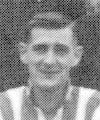
The right full back, Bill Halsey, who was originally going to play but did not actually appear, played 30 games for Rovers in 6 years. He made his debut against Woodville Athletic on April 8th 1944 (won 7-1) and appeared for the last time against Retford Town on May 4th 1950 (won 3-1). Here’s Bill:

I have been unable to trace anything about the WHF Wright who is written in near his name, except that it is not Billy Wright the England football captain. He was William Ambrose Wright. Here he is again:

Arthur Marston, the right half, played 130 times for Rovers making his début on April 27th 1938 against Whitwick Holy Cross (won 4-0) and taking a final bow on March 19th 1947 against Kettering Town Reserves (result unrecorded). Despite being primarily a defender, he scored 15 goals.

The centre half, Eric Rose, made 140 appearances but scored only twice. His first appearance had been against Ensor Sports on November 25th 1944 (won 10-0, King scored 7 goals, Rose, 1 goal) and his final game, like Halsey, came on May 14th 1950 at home to Retford Town. Here’s Eric:

Left half Collier made his first team debut way back on November 6th 1926 against Bromsgrove Rovers (lost 1-3). He hung up his boots twenty years later on February 22nd 1946 against Holwell Works (won 8-0). The database says that he played most frequently for the Reserves, but I would presume that the  71 appearances and 13 goals quoted in the Player Database are for the First Team. This total was fewer than 4 games per season. What a modest unassuming servant for the club! Is that why they let him play in this glamour game? Let’s hope so.

The left full back, Marshall, was a guest player to give Rovers a chance against all of the visiting superstars. He is actually Jack Marshall (1917-1998) who played for Burnley from 1936-1948. In later years, he was the manager at Rochdale, Blackburn Rovers, Sheffield Wednesday and Bury. On Boxing Day 1963, he reached, literally, the pinnacle of his career, when Blackburn Rovers occupied the top spot in Division One for just one day….

They think it’s all over….well, not yet it isn’t!


14 Comments

Filed under Aviation, Bomber Command, Derby County, Football, History, Personal

The End of the War in Europe and Church Gresley (2)

Last time I talked about an old single sheet football programme. It was for a match played literally one day after the war ended in Europe, on May 9th 1945. The programme was for “Gresley Rovers (Selected) v RAF”.  The top two stars in the RAF team were Raich Carter and Peter Doherty, both highly rated international players of the era, the equivalents, perhaps, of a younger Steven Gerrard and an older Kevin de Bruyne:


Here are Sergeant Carter and Flight Sergeant Doherty on the programme which is quite tatty, but does contain a large number of autographs in pencil. This is what pushed the price up at auction. Here is the RAF attack, if I can use that phrase:

I have been unable to trace either Sergeant Wilder of Tranmere Rovers or Sergeant Thompson of Bolton Wanderers.

Sergeant Durnie of the RAF cannot be the same Jim Durnie who was loaned to Annbank United Junior Football Club by Glasgow Rangers, because his son, Jim Durnie jnr, has kindly informed me that his father’s year of birth was 1935. I won’t be taking down this magnificent old picture of Ibrox Park, though. Record attendance there was 118,567 for a League game against Celtic on January 2nd 1939:

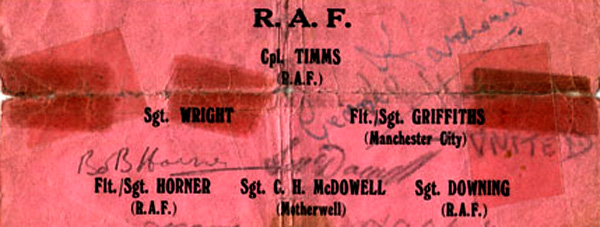
On this second picture, of the RAF defence, there are autographs for Messrs Griffiths, Horner and McDowell, but not for the rest:

Flight Sergeant Griffiths’ club has been altered to Manchester United and there is another autograph in a blueish colour reading diagonally towards the top right corner. I think it begins with George and the surname may be Hardemer or Vardemer or something very vaguely like it. It may even be George Hardwick. Of him, more later.

All in all, I have had very little luck with my detective work for this section. I have been unable to find anything for either Downing, Horner or McDowell.

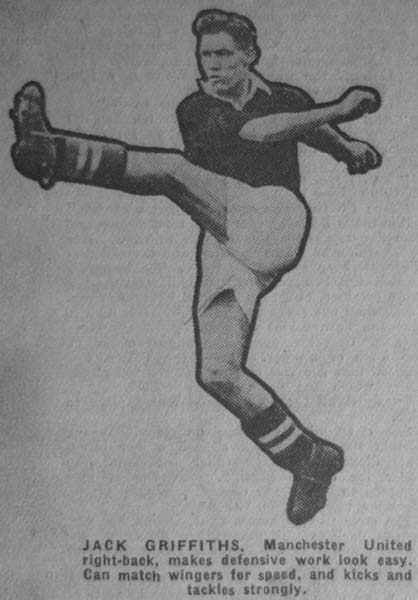
Flight Sergeant Griffiths is the Jack Griffiths who played for Wolverhampton Wanderers, Bolton Wanderers, and Manchester United during the 1930s. His football career came to an end because of the Second World War, but he played 58 times for United during the war and also guested for Derby County, Notts County, Port Vale, Stoke City and West Bromwich Albion. After the RAF he became player-coach of Hyde United. Here he is, frozen in time on an old cigarette card:

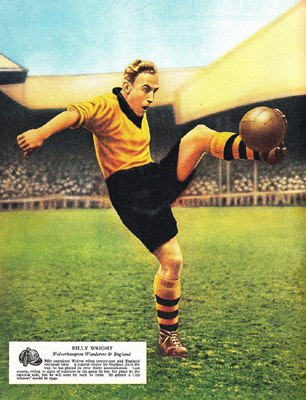
Sergeant Wright is unlikely to be Billy Wright, the England captain, because he was in the Army at the time, but it cannot be completely excluded if the team were short of RAF players. Here he is, practicing for his meeting with Puskás in seven years’ time:

Timms, the goalkeeper, I could not trace beyond the guess that he may be the W Timms who played only five times for Gresley Rovers, making his début against Bolsover Colliery in the Derbyshire Divisional Cup Final on April 8th 1939 (lost 0-5). His fifth and final game came, amazingly, just 14 days later against Quorn Methodists on the 22nd (won 5-0). “The Lord giveth and the Lord taketh away”, as you might say!

12 Comments

Filed under Aviation, Bomber Command, Derby County, Football, History, Personal

Victor Comic and me (1)

When I was just a lad in the early 1960s, I read comics at every opportunity.
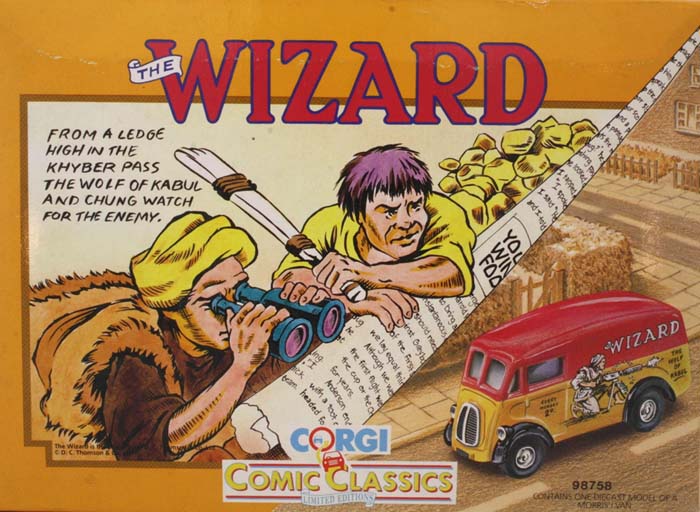
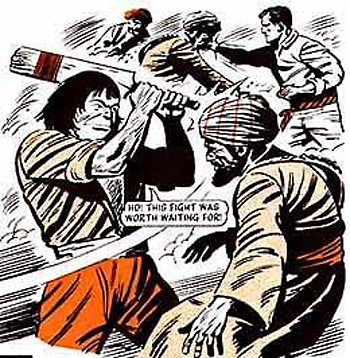
To be honest, I eventually decided that a comic with only pictures in it was too quickly consumed and for that reason it didn’t give a great deal of value for money. Eventually therefore, I settled on “Wizard” as my comic of choice, because it had only text stories inside and it therefore took a lot longer to read. My favourite characters included “The Wolf of Kabul” a ripping yarn about English intervention in Afghanistan involving a man armed with a cricket bat:

Political correctness was not first and foremost in anybody’s mind in these stories, but at least they did always win:

I also recollect “The Scarlet Skull”, a series about a First World War pilot in a Bristol Fighter who was armed with a Mauser revolver and who brought German aircraft down with just one bullet through the pilot’s head:

There wasn’t anything that he couldn’t do. He inspired me. If there’d still been an RFC in 1962, I would have joined it.

This cover mentions “Wilson the Wonder Athlete” but given my attraction to ice buns and chocolate bars, I wasn’t particularly interested in stories about running around very quickly or about living in a cave on the Yorkshire moors eating nuts and berries:

Another favourite story of mine was about a tree in Kenya that was so high that it had whole tribes of people living in it. No, really, I do remember it, but nobody else seems to!
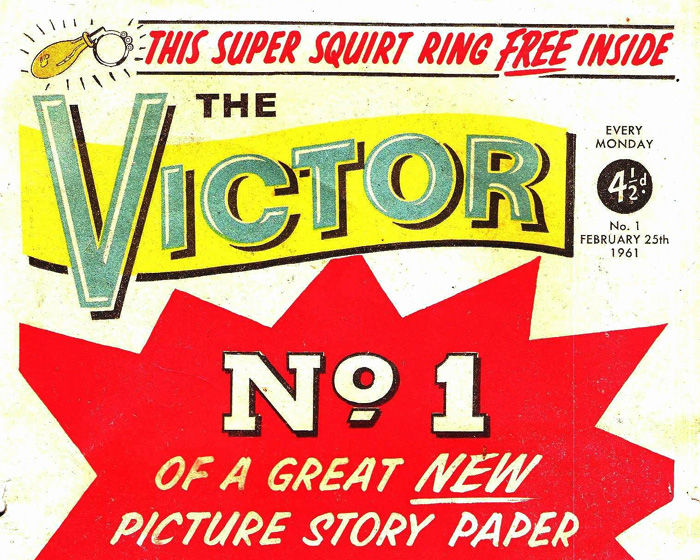
I did buy other comics with my pocket money though. I can still remember waiting impatiently for a new comic called Victor to come out on February 5th 1961. I went up to the newsagent’s in High Street, Taylors, and asked Albert Taylor to make sure he saved me one. I even returned to his  shop on several occasions to make sure that he had not forgotten what I’d asked him to do:

There was a “Super Squirt Ring” as a free gift, but I just don’t remember that:

What I do remember was the edge of the comic where a machine had cut it. It was heavily and stiffly serrated and very, very tactile as you rubbed your finger across it. Ten years later, I would have a university lecturer telling me about French novelist, Marcel Proust and his madeleine cake but this famous literary event didn’t even come close to Victor Comic around 9.30 am on February 5th 1961.
The free gift from Victor Comic, which I  do definitely remember, was the plastic wallet which would eventually contain more than 20 postcard sized pictures of the ‘Star Teams of 1961’. This is a wallet like the one I had, but I can’t find an exact match:


The Star Teams included England, Tottenham Hotspur and Ipswich and Scottish teams such as Glasgow Celtic, “The Rangers” and Kilmarnock:

This slideshow requires JavaScript.

There were also Northern Irish teams such as Glenavon and Portadown whose results, in those days, were featured on BBC TV on Saturday afternoons. Rugby League was not forgotten with Wigan and St Helens. The England and Scotland Rugby Union XVs were there as well. This is Wigan:

Nowadays, the Star Teams of 1961 are almost permanently on sale on ebay, but that’s not the same thrill as going up to the newsagent to buy the comics with them in, straight after breakfast.

14 Comments

Filed under Aviation, Criminology, History, Humour, Literature, Personal, Writing

The End of the War in Europe and Church Gresley (1)

Near to the clay mining village of Woodville where I spent my childhood there is a very similar coal mining village called Church Gresley. From 1882-2009, Church Gresley was the home of a football team called Gresley Rovers.

Here is a small scale map of where I am talking about. The orange arrow points to Church Gresley:

Rovers managed more than 125 years of inoffensive existence until, in our new and wonderful world of money, money, money, they found they hadn’t got any money, money, money, and immediately went bankrupt.  Rovers went into receivership and disappeared for ever. Shortly afterwards they re-emerged as Gresley FC. I’m afraid I stopped bothering with them at that point. I used to go to see “Rovers” as a lad, not “Gresley FC”.

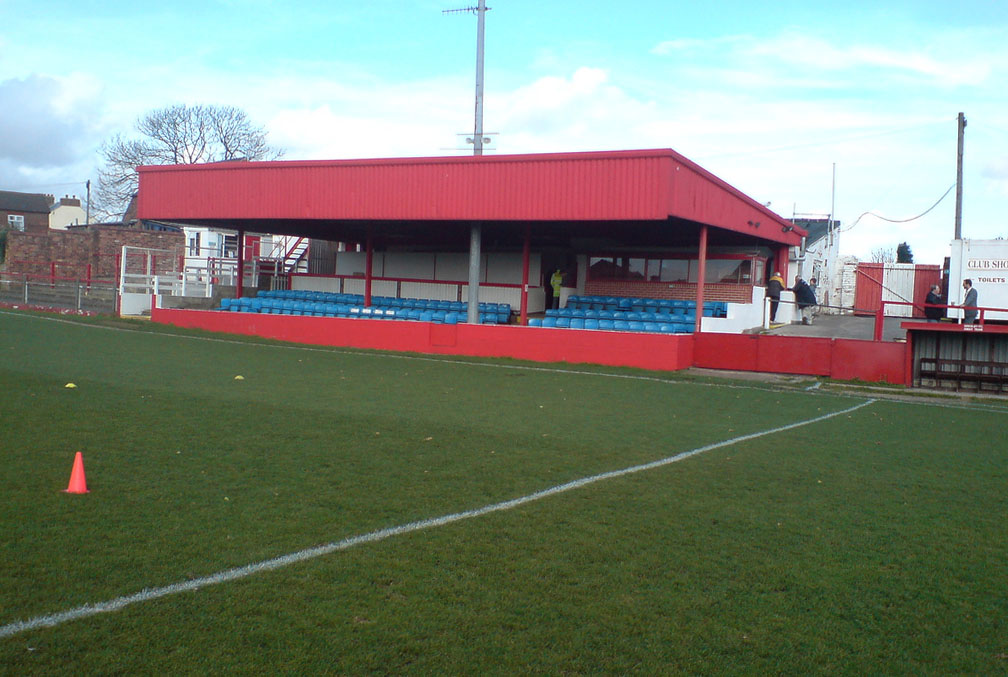
Rovers had a ground called the Moat Ground which dates back over a century:

Here is a larger scale map of the village with the orange arrow pointing to the stadium, if that is the right word:


The club played quite a big part in the life of my family. Before the First World War, my Grandad, Will, played a few games for the reserves and before the Second World War, my Dad, Fred, managed a few games for the same team. When I was still a toddler in a pushchair, my Dad used to take me up to the Moat Ground to watch Rovers play. This would have been in the 1950s. My Dad used to teach in the school in Hastings Road, only half a mile from the ground. You can find Hastings Road on the map in the top right corner. He taught many of the players and supporters over the years. The team manager and coach was the school caretaker (or janitor).

Unfortunately, or fortunately, the school isn’t there any more. Because of mining subsidence, it has had to be pulled down.

The last football match I ever attended with my Dad was the Final of the F.A.Vase. It was between Gresley Rovers and Guiseley, a team from near Leeds in Yorkshire:

The game took place at Wembley Stadium, and I left it to Fred to buy the tickets and arrange the transport down to London.  We left in one of the many, many coaches full of happy Rovers supporters which streamed out of the village on that hot, sunny Saturday 26 years ago.
Another big day in the club’s history came on May 9th 1945, when Rovers played a match to celebrate the end of the Second World War. I don’t know if they realised it at the time, but the supporters had the privilege of seeing some of the greatest players of the era. It was billed as “Gresley Rovers (Selected) v RAF”.  Last year I bought the single sheet programme for the game on ebay.

I paid far too much by the standards of people who don’t need their heads examining. In the auction I was extremely cunning. I bid “a very large sum of money I have never told my wife about” plus a penny. I won the auction by a penny.
Rovers’ opposition that joyful day were the RAF. Captain of the RAF team I believe was Raich Carter, the only man to win the FA Cup both before and after the Second World War:

He played top class football for 21 years, appearing in midfield for Sunderland (245 appearances, 118 goals), Derby County (63 appearances, 34 goals), Hull City (136 appearances, 57 goals) and Cork Athletic (9 appearances, 3 goals). He played for England in 13 matches and scored 7 times. He then became a manager with Hull City, Cork Athletic, Leeds United, Mansfield Town and Middlesbrough. He also played first class cricket for Derbyshire and Minor Counties cricket for Durham.

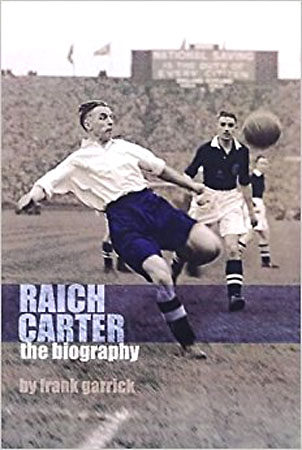
Carter mentions the Gresley game in his autobiography:

“One vivid memory from this period was of a team put together by Carter and Doherty which played charity matches against local sides. One such match was played at a packed Church Gresley on a May evening in 1945. The result was not important.”

What was important was the fact that the war was over, Hitler was defeated, and within weeks, all of Britain would move forward into a Golden Age.
The other great star in the RAF team was Peter Doherty who partnered Raich Carter in midfield at Derby County.

On April 27th 1946, the two of them would help Derby to beat Charlton Athletic in the FA Cup Final at Wembley.
Peter Doherty, from Northern Ireland, played for several clubs, including two Irish teams, Coleraine and Glentoran, and then Blackpool (82 appearances, 28 goals), Manchester City (119 appearances, 74 goals), Derby County (15 appearances, 7 goals),  Huddersfield Town (83 appearances, 33 goals) and Doncaster Rovers (103 appearances, 55 goals), giving a total of 200 goals in 402 appearances. He played 16 times for Northern Ireland and scored 3 goals. When he moved into management, he managed Doncaster Rovers, Northern Ireland and Bristol City. All this and he still smoked a pipe.
As Len Shackleton said:

“the genius among geniuses… the most baffling body swerve in football… all the tricks with the ball… a shot like the kick of a mule… enough football skill to stroll through a game smoking his pipe…”

We’ll look at the programme next time…

21 Comments

Filed under Aviation, Bomber Command, Derby County, Football, History, Personal

The End of the War in Europe and Moscow

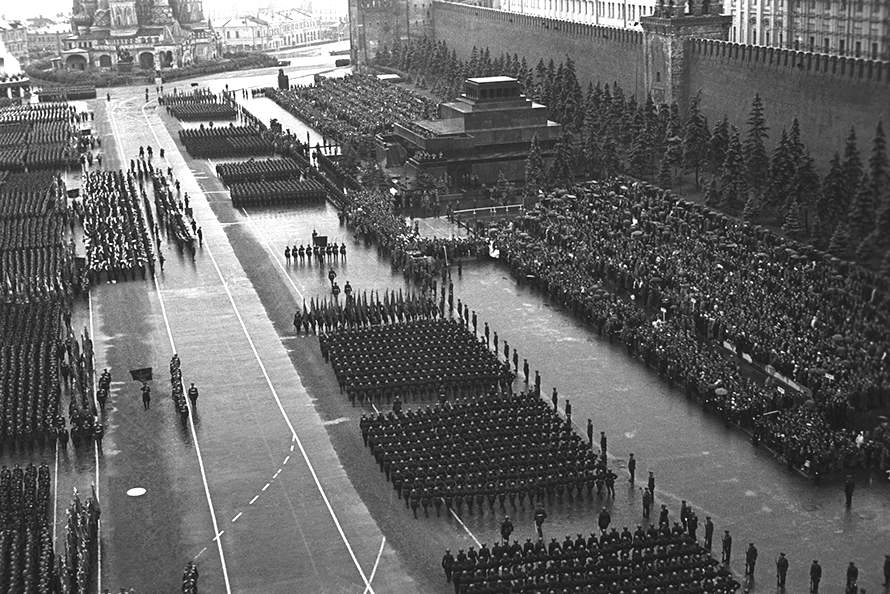
A long time ago in a galaxy far, far away, the end of the Second World War was celebrated by the Soviet Union in their capital city, Moscow. It was May 8th 1945.

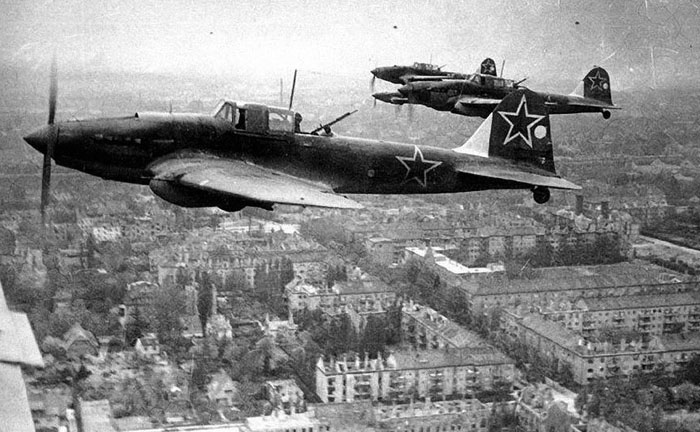
The Soviets well remembered conquering Berlin. Flying their aircraft at will over the capital of the Evil Empire:

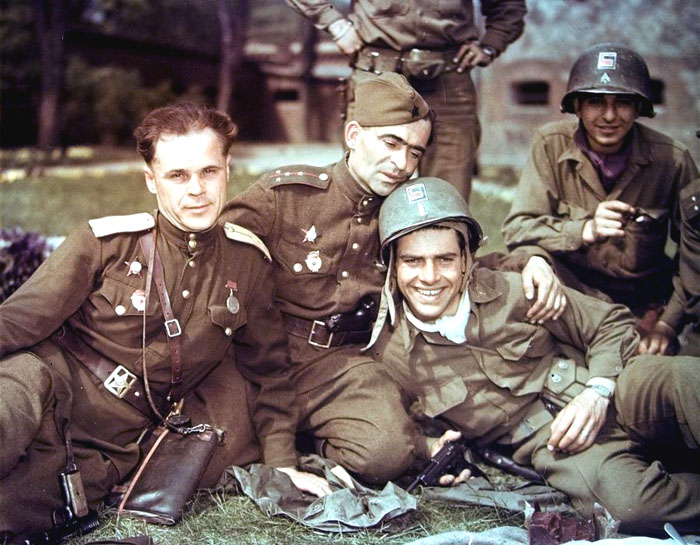
Everybody was friends (some more than others) :

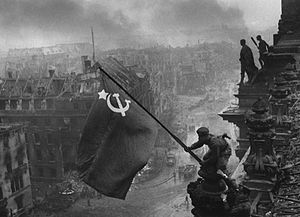
On May 2nd 1945, the Red Army had flown their flag from the highest point in Berlin, the Reichstag building:

There was, of course, plenty of argument about who performed this iconic act. The photograph itself was taken by Yevgeny Khaldei using a flag sown together by his uncle:

Officially, the two men who carried out this dizzy feat were Meliton Kantaria and Mikhail Yegorov. Others state that the man who raised the flag was Alyosha Kovalyov. Yevgeny Khaldei, the photographer, supported this man as the actual flag raiser but aided by Abdulkhakim Ismailov and Leonid Gorychev (who is mentioned elsewhere as Aleksei Goryachev). The very same problems of identification had happened elsewhere on a previous occasion:

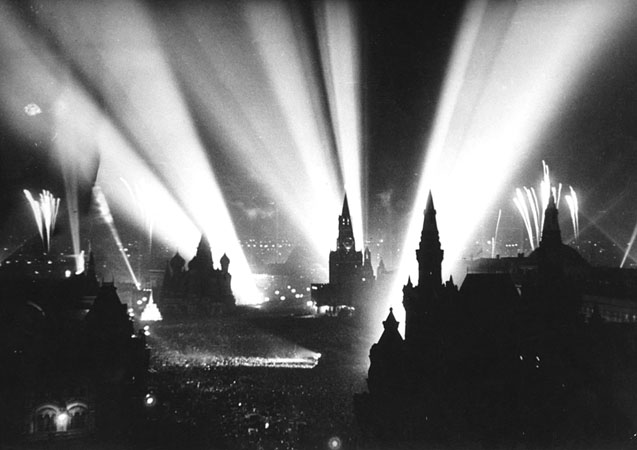
Back in Moscow, there were searchlights:

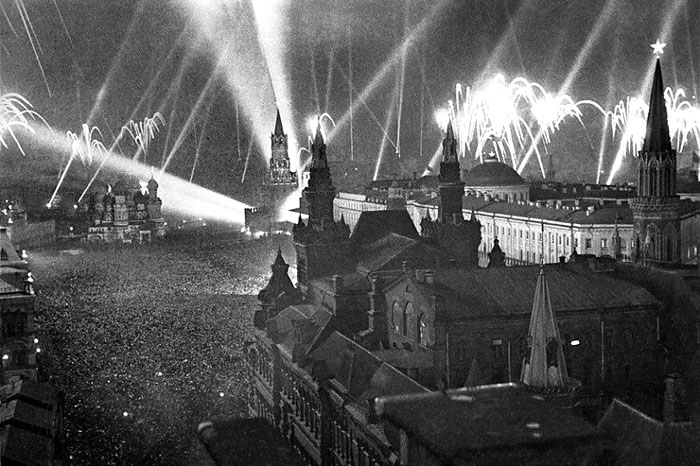
There were fireworks:


And in Red Square, there were vast numbers of soldiers of the Red Army on parade:

Georgy Zhukov, Marshal of the Soviet Union rode a white horse across the slippery, wet cobbles of Red Square, without problems, thank goodness:


Red Army soldiers brought in German banners and then they threw them down on the ground in disgust and triumph:

This slideshow requires JavaScript.

And just for once, just for a few weeks, until minds were re-poisoned, everybody was friends and they all smiled big smiles and saluted each other until they grew tired of it:

And then, like little children, they played on the grass in the park and drank vodka nicely together and they danced. Oh Comrade, how we danced……


12 Comments

Filed under History, Personal, Politics

The adverts in Victor Comic (2)

Here’s a second look at some of the adverts in Victor Comic in the 1960s. Ironically, given the wide spectrum of areas where the picture stories are based, from working class athletes to First World War flyers, from the trusty Gurkhas to the first Mounties, the adverts are not particularly vast in scope. I suppose the problem was that they all had to sell things which a boy or a youth of say, 8-16 or older might be interested in, and could afford, without involving risky photographs of the fair sex or dangerous weapons.

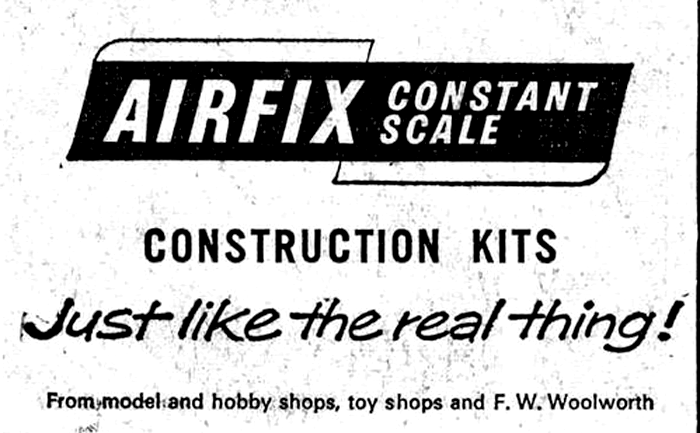
So keep it clean lads and stick to your Airfix kits:

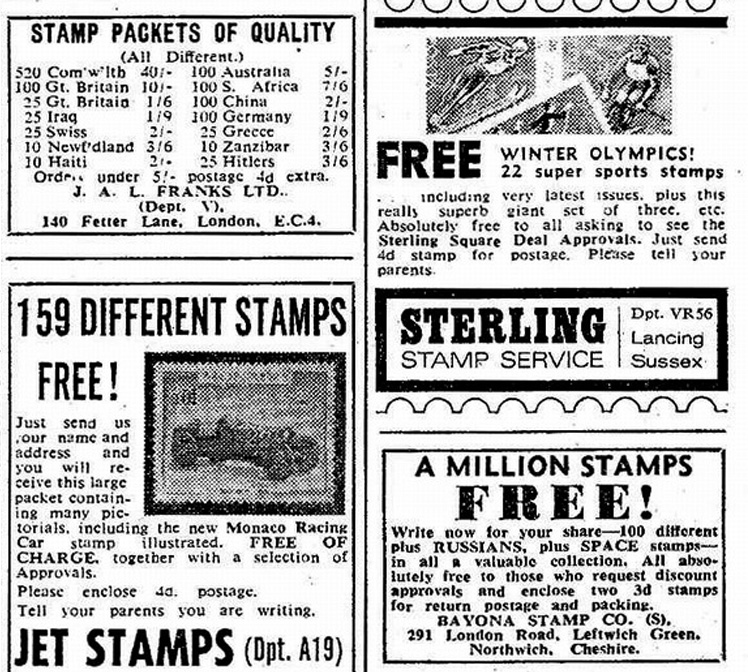
FW Woolworth. Whatever happened to them? All the naughty boys were  probably sniffing their Airfix glue to get their kicks but there was certainly very little of a hallucinogenic quality in stamp hinges. So the comic was full of  them. And a lot of money must have been made. Well, they do say Philately will get you anywhere. Just look at these adverts:

Don’t be fooled by the word ‘Million’, though. For a start, you have to share a million stamp packets with everybody else and there is bound to be some catch to it. You certainly won’t get a million packets of stamps because that many would bury a small town. The second advert has prices.  Between 2/6 and 5/- would be a likely sum for a boy’s weekly pocket money (12.5 to 25 pence). The advert for 50 different stamps “plus exciting mystery set” certainly makes Heston in Middlesex sound exciting and mysterious. And neither Mr Brown nor Mr Delaney in the very last section can be doing that well with the amount of advertising space they have had to share.

There are still matchbox covers for sale. although if I lived in Cocksett Avenue I think I’d move:

And still the stamps pour in. Did the entire world write a dozen letters a day? To Rumania, and Paraguay, and China (Communist and Nationalist)?

England winning the World Cup in 1966 gave every country an excuse to print even more stamps. And those stamps that were overprinted with “England Winners”. Do you remember how everybody went nuts to buy them? Well, just look up sometime how much they are worth nowadays:

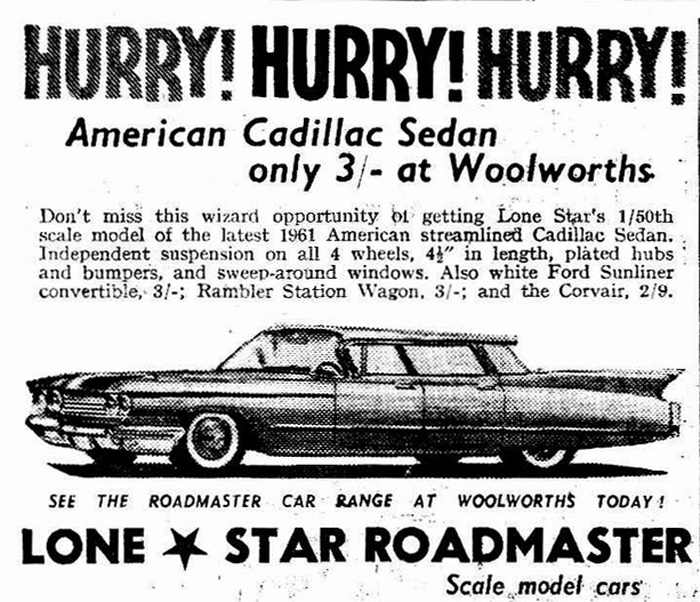
For the older boy there were adverts for cars:

Mind you, they were model cars at Woolworths, not real ones. Incidentally, my Dad paid £510 for a full size Hillman Minx in 1966 and my Mum would have played merry stink with him if he’d told her the correct price.

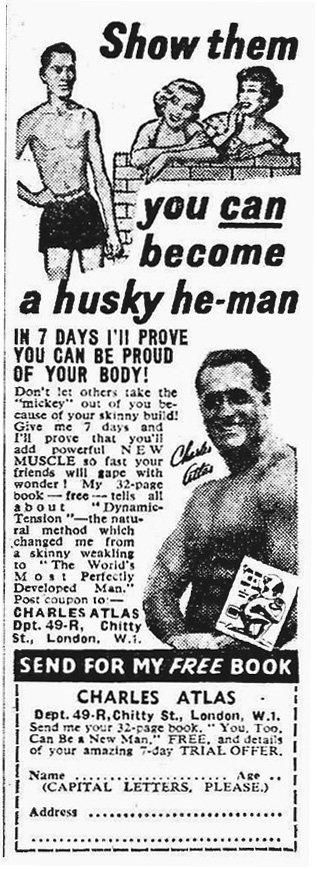
Every teenager will want to change his body, of course. Here’s an advert for Charles Atlas who always looked rather like my Dad;. but only from the neck up. I’ve actually seen this advert before. When I was a little boy, I thought the two young ladies were very strange bricklayers. And I wouldn’t want to live in Chitty Street either:

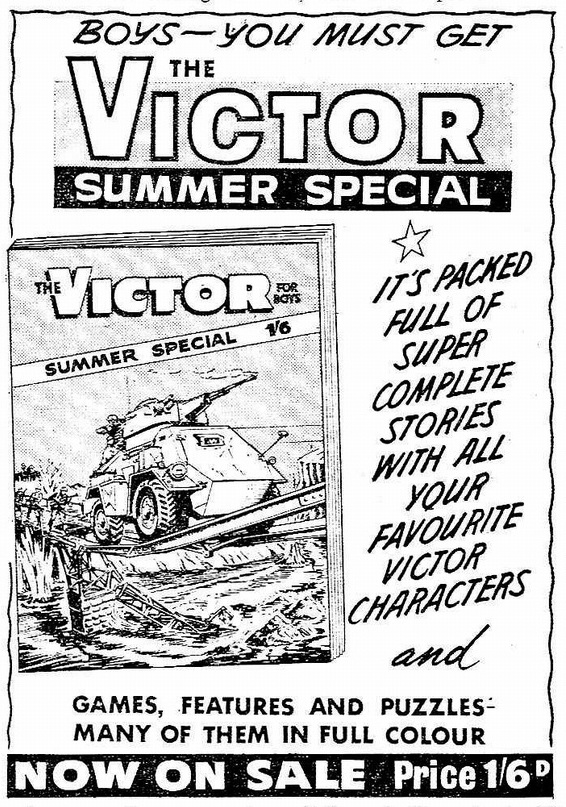
And last of all, a comic can advertise itself. Special editions for the Summer Holidays:

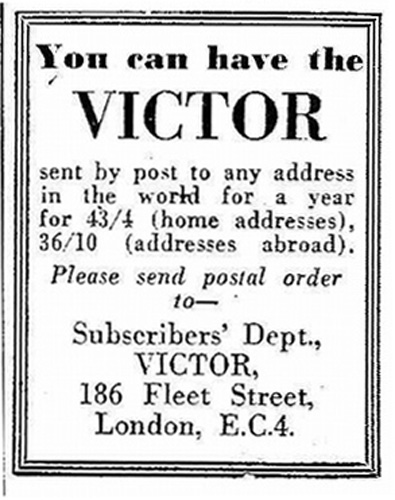
And don’t miss any foreign sales. There are thousands of little boys across the globe all wanting to have Victor comic sent to them. But what bizarre sums of money! 43/4d and 36/10d are just weird. It’s like the charge being precisely £4.34 or exactly £3.61 :

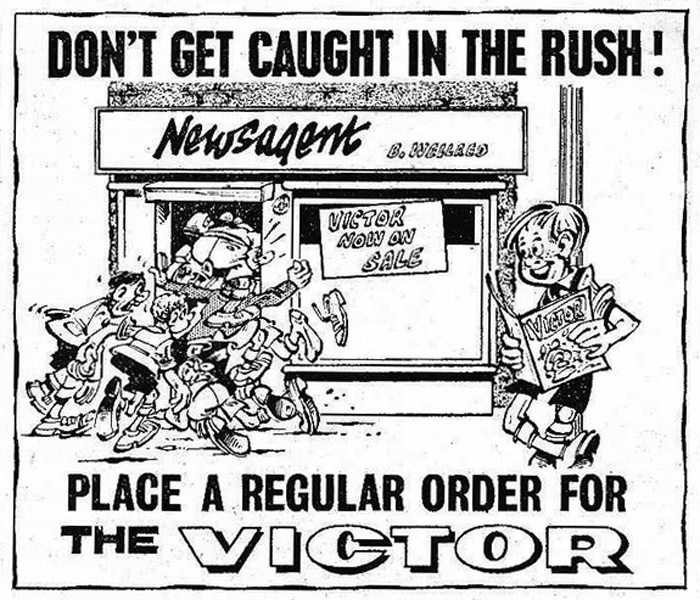
Above all reserve your comic:

Or you could buy your Victor on DVD. A lot cheaper than collecting the whole lot on ebay one at a time.

25 Comments

Filed under History, Humour, Personal