Category Archives: The High School

Hallowe’en Nights (5) Ghosts in the High School

It is often supposed that in a building as old as the present High School there should be a school ghost.

ray cccccccc

Ray Eastwood, the caretaker, once told me this story, in the early or mid-1980s, although to be honest, I have forgotten the exact date…..

“One year, a small number of boys were expelled from the school because of their appalling behaviour. They made threats that they would return, and either vandalise, or even set fire to the school. Because of this, my colleague Tony Hatcher and myself were asked to sleep in the school to forestall any problems. In actual fact, we borrowed a German Shepherd dog from a security firm that I had connections with, and all three of us moved with our camp beds into one of the rooms at the front of the school, underneath Reception, on the ground floor.

One morning, around 6.15 a.m., Tony and myself were sitting up in our beds having a cup of tea and a cigarette, when we clearly heard footsteps in the corridor above. They seemed to start near the staffroom, and then to proceed around the corner, past the staff toilets, and along the corridor towards the offices, directly above us. We both of us thought that these must be the footsteps of somebody who had broken into the school, and we rushed out of our temporary accommodation. We grabbed the dog, and threw him up the stairs to pursue the presumed miscreants. The poor animal wanted none of it, and he slunk off back into the room to his basket, his tail between his legs. We ourselves went on, rushed up the stairs and charged into the area around Reception. We could find absolutely nobody. We explored all around. All the windows were secure. All the doors that should have been locked were locked. There was no explanation whatsoever of what we had heard. There was certainly nobody there.”

In actual fact, Ray did offer me an explanation….He thought that the footsteps that both Ray and he had so clearly heard were those of Eric Oldham, a caretaker who had worked at the High School until some eight or ten years previously. One sunny Saturday evening at the end of that blistering hot August of 1976, after many years of faithful and steadfast service, poor Eric had collapsed and died as he made his rounds to lock up the school. He was found by his poor wife, lying on the sandstone paving slabs just inside the Main Gates. In the School Magazine, Mr.Oldham was described as “one of the school’s most devoted servants and a warm hearted friend”.

P1470416 cccccc

When Eric used to unlock the many various rooms inside the school every morning, he invariably followed the same route at the same time of day. Eric would have been walking along those same corridors, in the very same direction as the mysterious footsteps we so clearly heard, at the same early hour of the morning. Perhaps it was him, reluctant still to pass the school into anyone else’s care.

Shortly after the idea of a school ghost was first mooted, it later emerged that there had already been another claimant to the position. This phantom was in the then Preparatory School which educated boys aged between eight and eleven years of age.

Quite a number of reports had emerged that as boys walked down a particular set of stairs towards the Waverley Street end of the building, they repeatedly had felt what could only be described as invisible fingers grabbing at the bottoms of their trousers, as if somebody was trying to clutch at their ankles as they went past. This story was told to me quite a few times in the Main School by a number of boys of varying ages, so it must have been fairly well known at the time, although it was unclear whether any of the teachers in the Preparatory School were aware of it. At least one member of the Main School staff knew of it, however.
I have an explanation for this although it does require a certain “leap of faith”. The new building of the Preparatory School was constructed on the site of a magnificent Victorian house. It was still used for Sixth Form lessons for a short period during the early years of my time at the High School, and may well have been the Sixth Form Centre, although I am no longer totally certain of this. Originally, the house had belonged to Dr.Dixon, Headmaster of the school from 1868-1884. On May 29th 1876, his wife, Ada, died “of the effects of a chill”, leaving her husband with five children, who were, according to “The Forester”, “Robert, Charles, Harold, Sydney and one daughter to bring up, four sons and a daughter”.

My best guess is that the clutching fingers belonged to Ada, who, as a spirit, was unwilling to leave her children, as she could see that her husband was struggling with the job of looking after them. It may well be that the staircase in the modern Preparatory School occupied the same three dimensional space as a long forgotten room in the now demolished Victorian house.

Interestingly, neither of the two ghosts, if indeed they were ghosts, has persisted. The stories in the Preparatory School disappeared after just a couple of years at most, and as regards the tale of the footsteps in the corridor, both Ray and Tony were denying vehemently that anything had ever happened within weeks of originally talking about the event. Why that was, I never did discover, although it is always nice to have a School Conspiracy Theory.

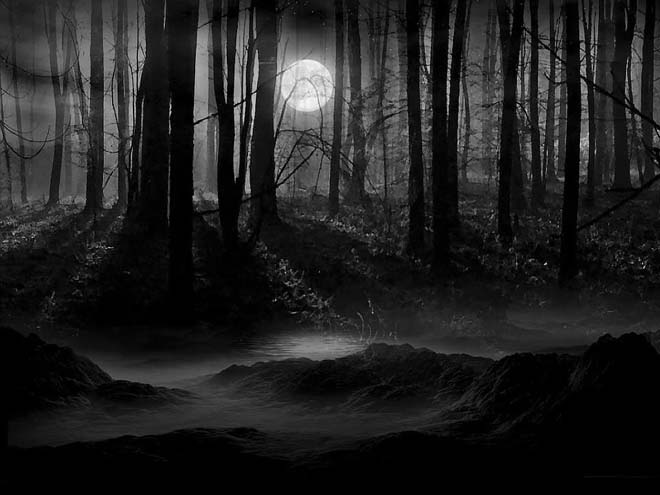
Next time……The School Werewolf and how to apply for the job

wolf xxxxxx

Periods of work……only a few days every full moon
werewflopcddddaef fgbb

Paid holidays…….once in a blue moon

If you are interested in the ghosts of Nottinghamshire, there are at least two lists of reported hauntings.
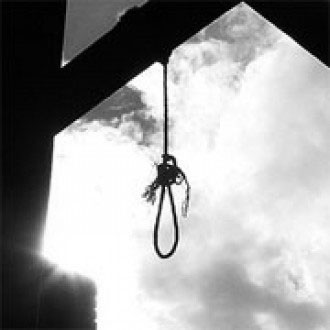
Wooooooo

Hooooooo


Leave a comment

Filed under History, Nottingham, The High School

Murder most foul: Chapter Two

A second episode of blood soaked murder in the history of the old Free School was published in a series of “Reminiscences”  in the High School Magazine in December 1929. They came from Mr John Braithwaite, of Bournemouth, who, at the time, was thought to be the School’s oldest Old Boy….

“Schooldays, 1857-1862″

“I went to the old Grammar School in Stoney Street about Midsummer,1857, and left at Midsummer, 1862. The Rev. W. Butler was Headmaster.”

“The old building was very unsuitable, dull and cheerless. The upper school consisted of one large room and one small classroom. There were no cloakrooms or conveniences of any kind, and the sanitary arrangements in the small playground were most primitive.”

free school

“The whole building sadly wanted painting, but no money was spent; the reason given was that the Trustees were saving up to have enough money to build a new school.”

“We began work at 8 o’clock and finished at 5 o’clock, or later, with two hours’ break at midday. In winter we had to use candles… “long eights” I think they were called. One candle was allowed between two boys, and lighting them was the signal for all sorts of play. We amused ourselves by blowing the candles out and in again, making a nasty smelling smoke.”

gallows

“About the autumn of 1859, a man was sentenced to death in the Nottinghamshire Courts for a murder in the northern part of the county.

Our headmaster, the Rev.W.Butler, as Chaplain of the County Gaol, was required to read the burial Service at the execution, which was fixed for 8 o’clock one morning at the County Gaol in the High Pavement.”

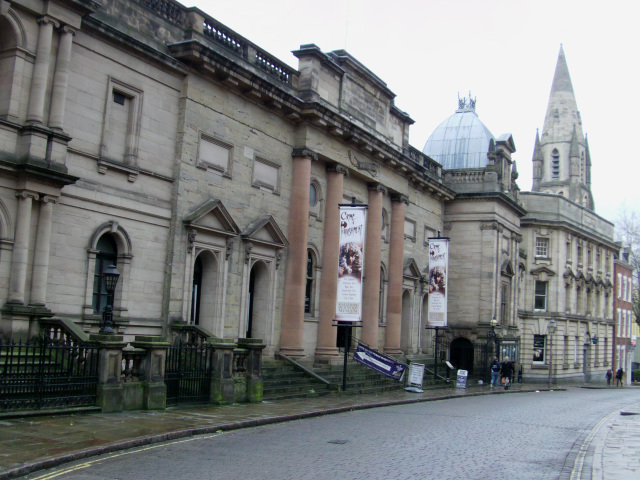
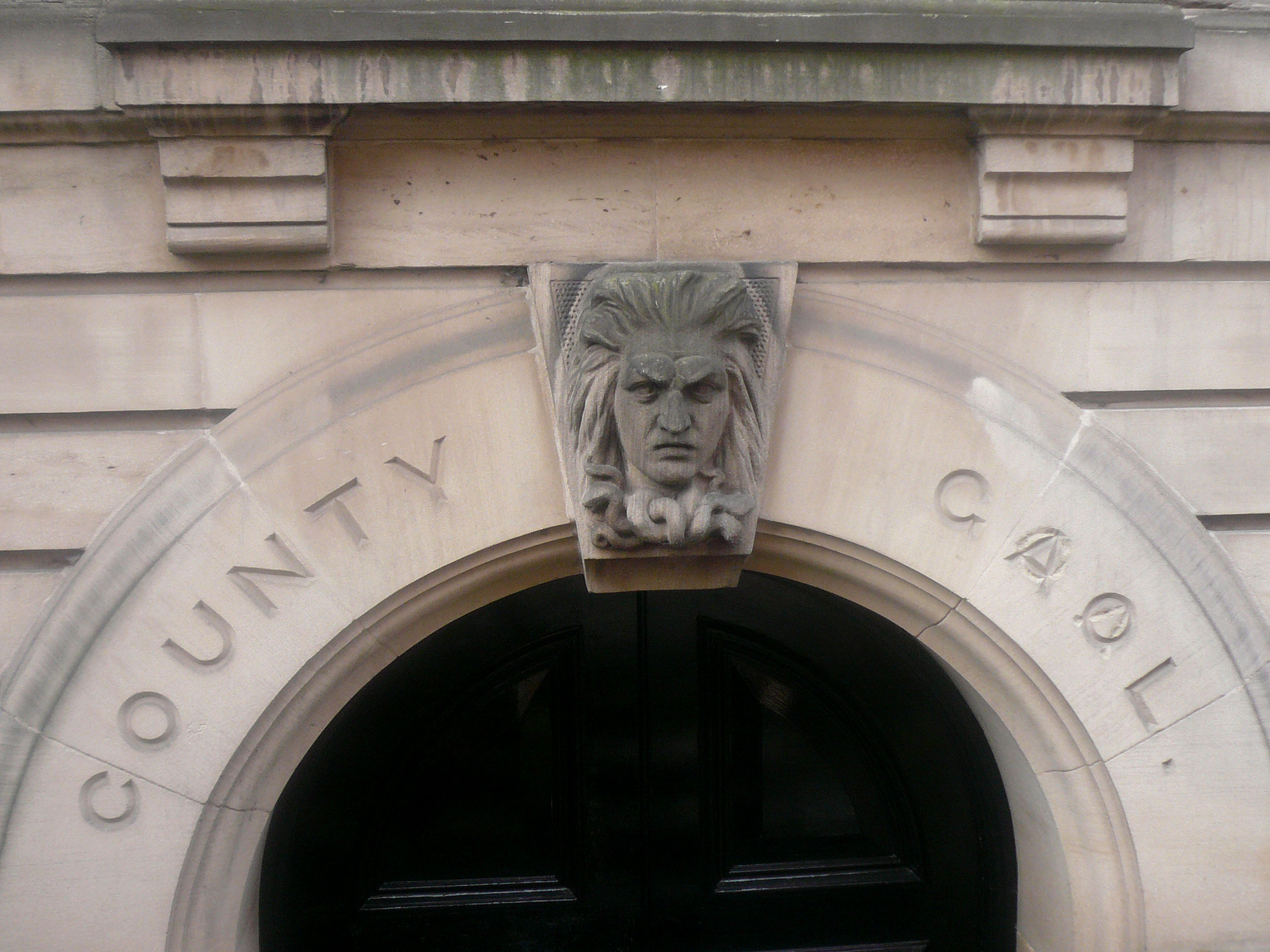
The main building on High Pavement, which dates from 1770, is quite imposing. The Normans were the first to use this site, appointing a Sheriff to preserve law and order in Nottingham, and to collect taxes. The oldest written  mention of law courts comes in 1375.

DCIM100MEDIA

The cells are below street level. They date back to at least 1449.

P1120126

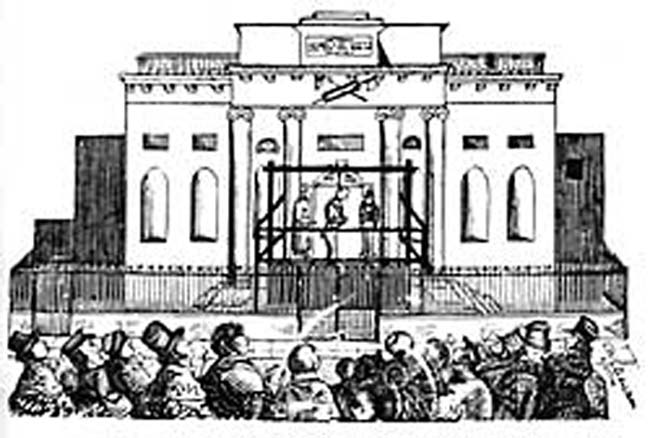
The scaffold used to be erected on the steps in front of the brown columns. There are special square holes cut in the stone steps to hold the wooden beams. They are still there to this day.

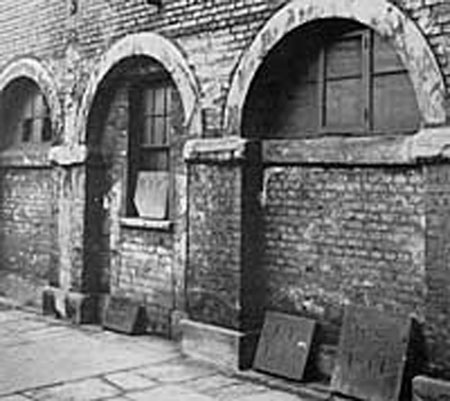
hanging-at-shire-hallThe dead hangees were buried in unconsecrated ground around the back of the building, their feet disrespectfully pointing towards Jerusalem.

Yard at Shire Hall with headston

“As usual we were at our desks at 8 o’clock on that particular morning, but the headmaster was absent. We all knew where he was, and each of us was thinking of him and visualising the dreadful scene which was being enacted only a short distance away. Back in school, the Deputy Master read prayers, and we waited, silent and awed. Presently the door was burst open, and poor Mr.Butler, with face white and drawn, stumbled in and staggered to his seat, almost spent. After resting awhile he stood up and said, “Boys, I have just come from….” and then he broke down. After recovering himself, he began again, and then he preached us a more impressive sermon than I have heard from any pulpit. As no one was in the mood for lessons we were sent home for the day…”

3716238The hanged man was one John Fenton, a blacksmith and publican, executed at the age of thirty-seven for the murder of Charles Spencer at Walkeringham on March 6th 1860. This was a public execution, held on the front steps of what is now the Shire Hall in High Pavement.

The crowd, however, was a lot smaller than expected. This was because, even though it was fourteen years previously, the last public hanging in Nottingham had resulted in the crushing to death of seventeen people, almost all of them children.

Given this blood soaked past, it is no surprise to find that the Galleries of Justice have a plethora of ghosts. On some wet Tuesday afternoons, there can sometimes be as many ghosts as living tourists. Here is a selection of the ghosts I saw on my own visit…

This slideshow requires JavaScript.

Wooooooooooooo………………………………

7 Comments

Filed under Criminology, History, Nottingham, The High School, Uncategorized

Murder most foul: Chapter One

Strangely enough, the theme of murder runs bright scarlet through the early history of the High School. First, came George Somers, who was the Headmaster for an unknown period of time between, probably 1530, and , hopefully, not long after Friday, July 15th 1532.

Eighteen years earlier, in more probably April, but perhaps in early May, 1514, the Free School’s main benefactress, Dame Agnes had died.

a mell

She left much of her property to the school and was buried alongside her husband in St.Mary’s Church, Nottingham.

This slideshow requires JavaScript.

Within a few short years of Dame Agnes’ death, however, her high standards of morality were more or less forgotten. Money frequently went missing and both the Headmasters and the school wardens neglected their duties. A number of teachers appeared in court on various charges, which varied from failing to maintain the church windows to the theft of pupils’ books.

In perhaps January of 1532, the Headmaster, George Somers, was accused of stealing a featherbed, a long pillow, two short pillows, a green and red quilt, a covering and a pair of sheets to the value of 46s 8d. (£2.33p in modern money. Oh for a time machine!)  Somers also owed twelve pence for the hire of the same bed. For what purpose has not been recorded. But you can probably guess…..

IMG_4607 bed

On Friday, July 15th of the same year, in a much more dramatic episode, George Somers, was now accused of murder. The Records tell how.

“…We indict the School Master of wilful murder.”

The incident had taken place almost a month earlier, on June 17th, and Somers had supposedly assaulted John Langton, Chaplain of Nottingham,

“by violence and weapons, namely a stick and daggers, of malice aforethought, and… had feloniously killed and wilfully murdered the same John, against the peace of our Lord the King.”

fox in the snow cvgbh

Unfortunately, the outcome of these events remains completely unknown, although it is devoutly to be wished that, if convicted, Somers did not keep his post as Headmaster of the school.

Hopefully too, this woodcut does not show Somers’ eventual fate. Notice the moment when the Mexican Wave was invented. Presumably it must be some  Tudor oik losing his focus during the thirty seconds while the rope is put on.

tudor hang

Leave a comment

Filed under Criminology, History, Nottingham, The High School

Boot the Caretaker

Sir Jesse Boot, later the First Baron Trent, was, of course, a very famous figure in the history of Nottingham. In the High School, however, far more famous was Bill Boot, the school caretaker during the middle period of the twentieth century.

The school looked roughly the same in those days as it does now, except it was black and white.

bulletin_24_1403256831_2052%20Nottingham%20017

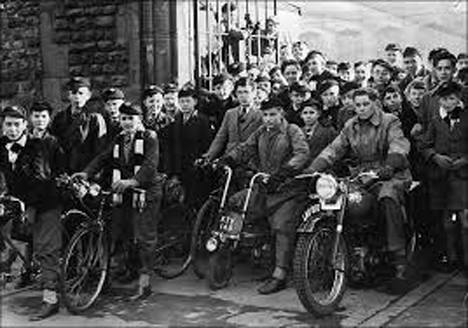
This photo shows the boys leaving school around this time.  Look at the great variety of means of transport compared to today…

around this time

Bill Boot was a much loved figure as the school caretaker, and in December 1949, the following poem appeared in the school magazine. It was a much modified version of the original, which was written by Lewis Carroll and appeared in his book “Alice’s Adventures in Wonderland”, published in 1865.

This slideshow requires JavaScript.

It was written by F.Martin Hall and John G.Golds, and was dedicated to Mr.Boot…

“To Bill Boot on his 70th birthday

You are old, Father William, the schoolboy said,
And your tooth is of marvellous length,
Yet your tap on the door makes the whole building rock,
Where on earth do you find all that strength ?

In my youth, said the Sage, when I fought for the Queen,
Frequent exercise, Generals demanded,
I chased Kruger each morning around Spion Kop,
Do you wonder my muscles expanded ?

You are old, Father William, the schoolboy said,
And your hair has long since turned quite grey,
Yet your voice like a clarion round the School rings,
How d’you manage such volume, I pray ?

In my youth, said the Sage, when I served with Lord “Bobs,”
His commands could not travel by wireless
So I bawled them (in code) right across the Transvaal,
And my throat, by this means, became tireless.

You are old, Father William, yet your eagle eye
Seems as bright as the stars high in heaven,
Pray, how does your eyesight thus function so well,
With no help from Aneurin Bevan ?

I have answered your questions, the wrathful Sage said,
And as sure as my name’s William B.,
If you pester me further, my patience will go,
So be off, or I’ll put you in D.

(With apologies to Lewis Carroll. In the last verse it was considered impolite to suggest that Mr. Boot would actually threaten to kick anyone downstairs.) ”

Bill Boot retired as school caretaker only a year later in 1950, after twenty-eight years’ service. He was replaced by Mr.T.H.Briggs, who had previously worked as a policeman in the city.

Bill Boot had been in the British Army and had fought bravely in the Boer War of 1899-1902. He was famous among the boys for his rapid, shuffling gait, and his extremely rapid speech, which, with his accent,  frequently became almost unintelligible.

Bill’s hobby was fishing, and he travelled widely at weekends. When he retired, he received a small pension, but, alas, he did not live very long to enjoy it, as, tragically, he was killed as he was crossing the road on December 7th 1952. As far as I know, no photographs of Bill Boot have survived, and only Old Boys in their seventies would now be able to remember this fine gentleman “of the old school”, as they say.

1 Comment

Filed under History, Humour, Literature, Nottingham, The High School

Boots the Chemist

Boots are one of the most familiar names in High Streets across the United Kingdom and beyond. Very few people, however, would realise that this gigantic pharmaceutical corporation started from just one tiny shop in Nottingham.

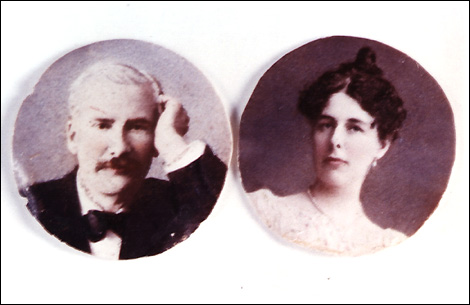
The founder of this vast retail empire, Jesse Boot, was born in the city on June 2nd 1850. His father was a farm labourer called John, and his mother was originally named Mary Wells. The family lived in an area of the town called Hockley, which at that time was extremely poor and overcrowded. John Boot opened a herbal remedy shop locally in 1849, but unfortunately he passed away in early 1860. His mother, by now the Widow Mary Boot, decided to enrol their son, Jesse, in the Nottingham Free School. On Thursday, July 19th, of that year, at the age of eleven years and one month, Jessy (sic) Boot was included on the register as a pupil at the Free School.

He first attended the School in July of 1861, and was to remain in Mr Field’s English Department until his departure in August 1863, a period of just over two years.

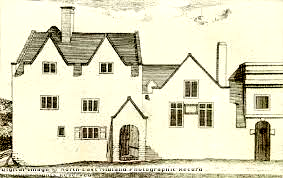
free school

While her son learnt high standards of reading, writing and arithmetic, Mrs Boot continued with the shop, helped out by her family and friends, and, from 1863, when he left the Free School, by her son Jesse. By 1871, Jesse was a co-partner with his mother in the imaginatively named “M & J Boot”.

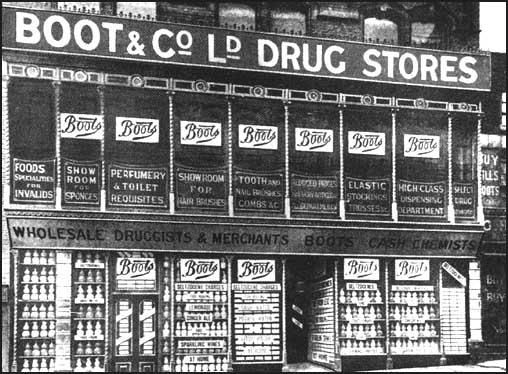
0boots_archive_01_470x305

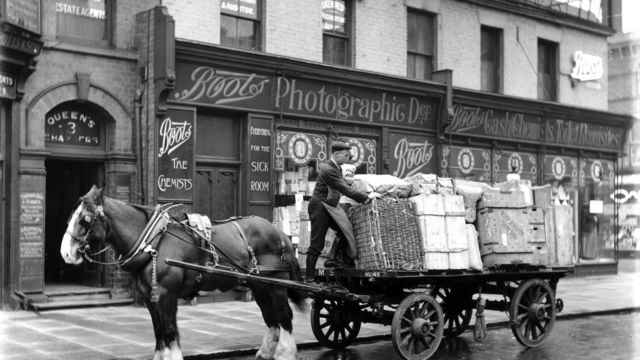
In 1883 the shop became “Boot and Company Limited”. The horse was delighted…

horse cartboots

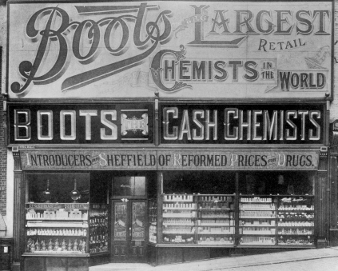
The business then expanded to Sheffield in 1884.

bootssheffield

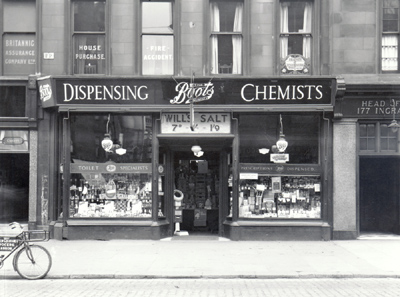
By 1900 there were Boots’ shops over the whole country, reaching their peak with 560 branches in 1913. This particular one was in Glasgow.

glasgow

The business was eventually sold by Sir Jesse Boot, who became 1st Baron Trent in 1917. It was bought by the Americans for £2.25 million,

america drug st

In 1933, however, during the Great Depression, the company was re-acquired by a British syndicate. Its head was the grandson of the founder, John Boot, who had inherited the title of Baron Trent from his father, who had recently died in Jersey in 1931.

Nowadays, Boots is a familiar High Street brand name…

boots_logo

Their staff are deliberately clad in quasi-medical uniforms to look more professional

uniform

But they are lovely, caring people…

They sell makeup

and love to dress up at Christmas…

1 Comment

Filed under History, Nottingham, Science, The High School

End-of-Year Hootenanny

Recently, I was invited by members of staff to attend the end-of-year buffet. After serving thirty eight years hard labour at the school, I could hardly refuse.  Given my disabilities, though, I thought it best to treat it as a pop concert. There should be a continuous medical presence, preferably with pessimistic posters…
A1
These are the people who really run the place. Today they will judge the acts…
A6
You will need a fabulous sound system and an expert to run it…
A3
And will you need reliable security…
A7
The first two acts were real blasts from the past…

A critical audience prepared their ammunition…

B1Expectations were high, after that wonderful food and the odd snifter, all on offer at prices to suit the teachers’ pocket….
B2
First, a familiar warm-up act…
B4
…introduced the most cultured man I have ever met…
B6
He spoke wise words for those with power over education at a national level…

By now, a slight shuffling feet of the audience betrayed their desire for something a little lighter, perhaps. A country-and-western singer?
F3
Or perhaps a stand-up comedian?
F4
Reactions were varied. Some seemed not to really like that kind of thing…
F4a

Others were even more disapproving…
F4c
Simon’s disappearing microphone trick was completely lost without trace…
F10
But thank goodness, though, not before he remembered to introduce, in the most moving terms, Jim, one of nature’s true gentlemen, and a man who lives up to his faith every single second of the day…
F11
Finally found the microphone though…
H1
Just in time to bring on the star turn, Old Whispering Jim…
H2
The inventor of the paper aeroplane…
H4
“Order!! Order!! Order!! Quieten down please!! You’ve all seen a paper aeroplane before!!
H8
And then the familiar music echoed forth, as we awaited some death defying stunt…
J2
Next it was Paul, with the prototype of his recently invented self-camouflaging tie…
M3
An Everton supporter then suddenly rushed on stage, trying to re-enact the events of the 1966 F.A.Cup Final, attempting vainly to gate-crash the whole event…..
P2
The jury were by now ready for the “Best Dressed” contest. Their empty flying bottles of Budweiser, however, would not be allowed to affect the result…
P22
Would it be the same winner for the previous six years?? A lucky seventh triumph?? And would she want a croquet set as first prize??
P28
But no, controversy then ensued! Professor Major’s hat took all the votes, but should he have been wearing it inside in the first place??

Still, at least Everton Mcgibbon can give us a song…

It hasn’t been easy to turn all these different photographs into a coherent story. I hope nobody has been offended. Let’s finish with a slide show of the others that didn’t quite make the cut. There were quite a few suggestions to explain away the occasional blurring. A room that was surprisingly dark for photography? A lens which had to be open for as long as one eighth of a second? Or just a camera with beer goggles?

This slideshow requires JavaScript.


Happy retirement, everybody. You have more than earned it.


4 Comments

Filed under Nottingham, Personal, The High School

Brahms and Liszt

I adore History, but most of all, I adore the bright, vivid, and O so human figures who populate those dusty days of yesteryear. One such was Mr Sparey, who, with his friend Mr Hewson, burned like blazing comic meteors across the drab High School skies of the middle years of the nineteenth century. This, of course, was when the old Free School was in Stoney Street in the Broadmarsh area of the city, ten or fifteen years before it moved to its present location.
free school
Mr Sparey taught just one class, which was in one of the two downstairs classrooms. He was a “splendid writer, and a fair arithmetician and grammarian, but a rather rough man with a love for the cane.” He was ably assisted by Mr Hewson, “…a teacher of a more patient temper”. Mr Hewson taught not just English but also French, teaching grammar, setting exercises and marking them.
In late 1854, the pair of them caused great scandal in the town when they decided one Saturday evening to seek prolonged and alcoholic refreshment together in a local tavern on Long Row. It may have been near here…
long row 1
Or it may have been further down…
long row 2
Over the course of a spectacular evening, Messrs Sparey and Hewson grew progressively more and more drunk, and eventually managed thoroughly, and publicly, to disgrace themselves.

InebriatesThis was an escapade, though, which they might well have got away with, had it not been for the fact that their appalling behaviour coincided more or less exactly with the arrival of a Government Inspector, who had recently come to the town. He soon found out about this debauched episode, and, as might be imagined, a great deal of embarrassment was caused for the school.
Mr Sparey was told that if the offence was ever repeated, he would be instantly dismissed. Mr Hewson fared even worse. A witness in the subsequent inquiry actually said of him that “…I do not send my boys to this School. I should not like to so long as a character like Hewson’s taught there.” Hewson was then forced to resign.
In 1858, after almost five years of, hopefully, temperance and model behaviour, Mr Sparey, the remaining member of the Long Row Two, himself resigned. No reason was ever given for his departure.
It was not, however, as if Mr Sparey was unused to criticism. Two years earlier, the Headmaster had written to the Governors about “Mr Sparey’s bad English”, and when, later that same year, it was suggested that no member of staff should ever be allowed to keep a public house, for some unrecorded reason, it was Mr Sparey’s name that happened to crop up. The Writing Master countered this foul accusation by saying that that the inn was in actual fact not his, but was held in the name of his wife’s sister.
History is such, of course, that the fate of the Long Row Two remains unknown. But just for a moment they must have lit up a dreary, provincial town in a wonderfully spectacular way.


Leave a comment

Filed under History, Nottingham, The High School

“500 Happy Returns” Now on Sale!

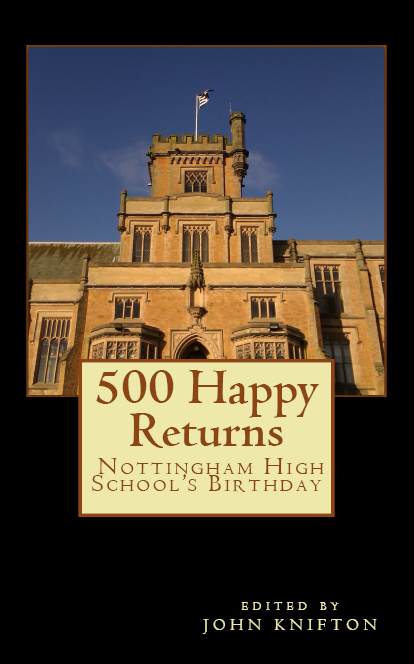
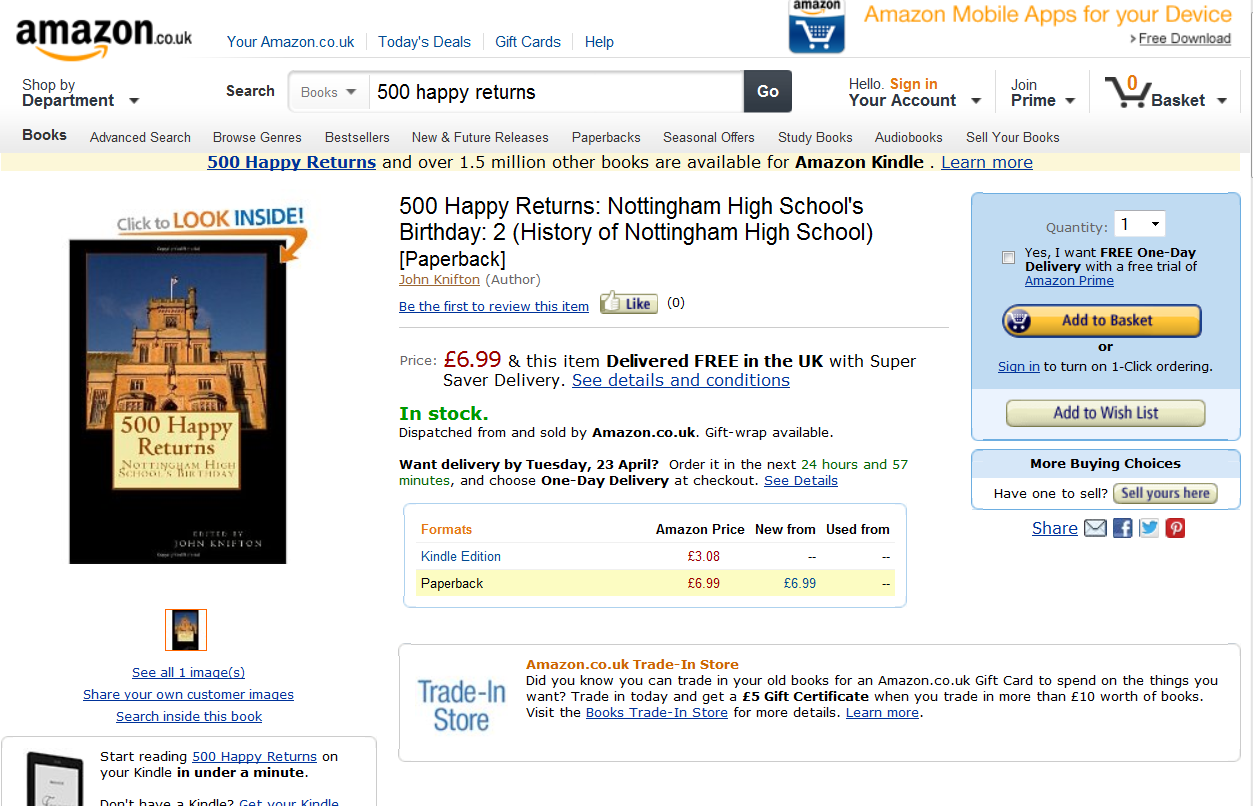
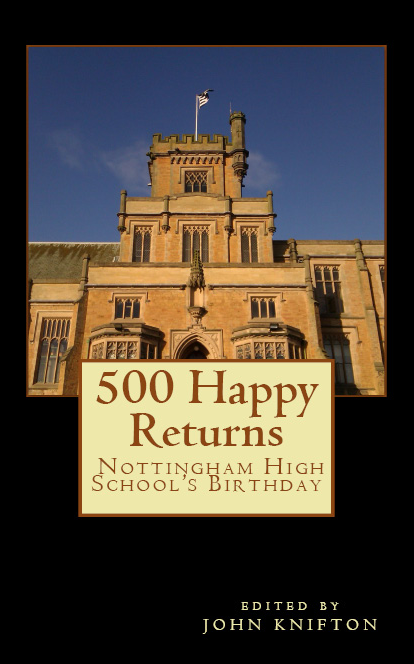
500 happy returns nottingham high school's birthdayI am thrilled to announce that my new book, 500 Happy Returns: Nottingham High School’s Birthday, is now available for purchase. Over the past month or so I’ve been working on the finished publication, and I’m delighted that it’s now ready to be presented to customers. The proof copies arrived about a week ago, and it was very exciting to see a giant word document transformed into a real, physical book. Now I’m getting excited all over again when I see the book listed on Amazon!

This book is the culmination of a creative writing project to commemorate the school’s half millennium milestone. I invited all the staff, pupils (from age 4-18), cleaners, and support staff to write a hundred words about their day, preferably linking their entry to a specific time. I had the idea that these entries could tell the story of the school day minute-by-minute from a broad perspective. Participation was entirely voluntary, and I was really pleased to get around 800 contributions from members of the school. The good news is that these entries cover the whole day and now you can pick up a book that charts a typical school day in a top British public school at the turn of the twenty-first century. It’s great to be able to see such a tangible product at the end of a school project, and I hope that all staff and pupils involved really like what has been achieved, and enjoy seeing their contributions in the book.

Hopefully, a lot of people will enjoy reading this volume, especially as it commemorates the 500th birthday of the school and all the profits are being donated to the school’s bursary funds. So here’s hoping that this publication will provide a lasting legacy for the education of gifted children years down the line!

Now available from Amazon.co.uk and Amazon.com

Now available from Amazon.co.uk and Amazon.com

3 Comments

Filed under Nottingham, The High School, Writing

New book sent to the press!

cover of bookJust a quick announcement to say how happy I am that we’ve managed to secure a publisher for our school project. In February the school celebrated its 500th birthday, and we asked each member of the school – staff, boys (aged 4-18), cleaners, support staff, and caterers – to record what they were doing at any part of their working day in 100 words. I’ve finished editing all the reports, and I’m pleased to say that we have a minute-by-minute snapshot of the school on its 500th birthday from over 800 perspectives.

I was originally planning on releasing the book just on Kindle, but I am very pleased to be able to tell you that there will be a physical edition of the book as well! You will be able to buy paperback copies of the books from Amazon, or download it straight to your Kindle.

All proceeds from the sale of this volume will be donated to the school’s bursary funds which provide crucial financial help to children from all backgrounds.

3 Comments

Filed under Nottingham, The High School, Writing