Category Archives: war crimes

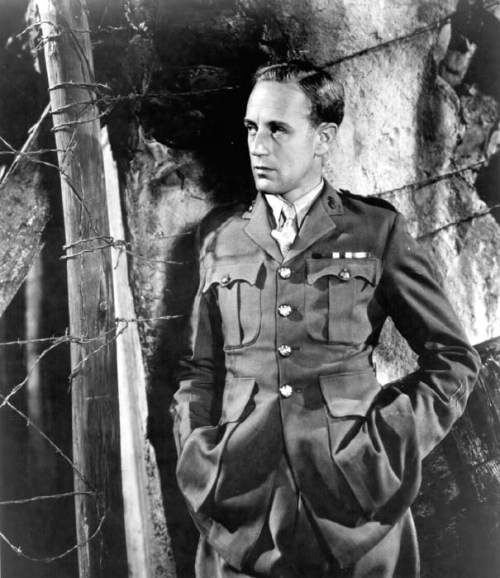
The Murder of Leslie Howard (5)

Last time, I tried to show you some of the marvellous speeches and wonderful films that Leslie Howard created to defend Democracy and Freedom against the German onslaught. I do know if any of you actually watched any of the recommended titles, but keep your eyes open for them on TV. Howard truly was a very gifted man.

Among his films, don’t forget “49th Parallel”, the horrendous tale of a U-boat whose crew members are forced to abandon it on the southern shore of the Hudson’s Bay in Canada and then make their way southwards to the USA. I will never forget the scene where the Germans slaughter the peaceful Inuits of a village they come across, just because the Inuits are not of the same race as themselves. Here’s a link to the complete film :

To whet your appetiote, here’s the film’s official trailer :
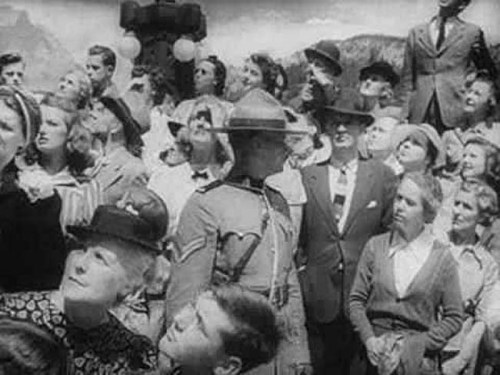
This is a very strong film. It was directed by Michael Powell and Emeric Pressburger and the main parts were played by Leslie Howard, Laurence Olivier, Anton Walbrook, Raymond Massey, Glynis Johns and Eric Portman. The film editing was by David Lean and the music came from Ralph Vaughan Williams. One detail that I particularly enjoyed was that :

“For the scene where the Hutterite community listens to Eric Portman’s impassioned pro-Nazi speech, the actors had to be all “hand picked faces”. Over half were refugees from Hitler.”

That says it all about the appeal of Nazism and racism.

Leslie Howard had done amazingly well with his films to defend Democracy and Freedom against the Germans. The Germans, of course, had long decided that Howard had to die.

The American-born traitor, William Joyce, who, as Lord Haw-Haw, broadcast on German propaganda radio to Britain, had even promised on the radio that Goebbels was personally going to have him shot. And Goebbels himself had made the same threats in “Der Angriff”, his own personal propaganda newspaper. Goebbels was not happy that Leslie had both directed and starred in, not just the anti-Nazi “49th Parallel” and “’Pimpernel’ Smith” but also in “The First of the Few”. He called Leslie, among many other things,

“Britain’s most dangerous propagandist.”

He viewed Howard as an irritant, a source of pain and, perhaps, a source of infection for Nazism, and a source, even, of death for German bigotry.

Linked with this is the theory that Chenhalls, Howard’s business manager, had negotiated a huge deal with the Portuguese and Spanish film industries. Vast numbers of English films were to be sold directly to companies in those two countries. All of the proceeds would then be spent on making new propaganda films.

Further to this, it has long been thought that both Leslie Howard and Alfred Chenhalls may have been British secret agents.

They were supposedly on the “Ibis” in the first place because they were returning from a job in Spain, whereby Howard had carried a top secret message from Churchill to Generalissimo Franco, trying to persuade Franco to stay neutral, not to join Hitler as an ally and not to close the Mediterranean to the British and thereby sever permanently their links to both India and Australia. And for this anti-German meddling, Hitler had decided that Howard had to die. Here’s Franco, whose first name was not either “Frank” and certainly not “Franco”. It was “Generalissimo” :

Those ideas about the real reason for the destruction of DC-3 Dakota “Ibis”, though, are just the beginning. There are lots and lots and lots more. So, let’s take a quick look at some of them……

Hitler did not like the fact that Leslie Howard had been working hard to win over the neutral Portuguese, trying to get them to allow the Allies to use the Azores for air and naval bases in the U-boat war. For this, he had to die.

Leslie Howard was merely an ordinary run-of-the-mill spy. For this, he had to die.

Leslie Howard was working hard at fundraising for the war. He was, given his mother’s background, a fluent German speaker and was turning out anti-Nazi programmes for the radio. For this, he had to die.

The presence of Howard and Chenhalls on that DC-3 saved the lives of seven year old Derek Partridge and his friend, the two little boys who were put off the aircraft to make room for the two important latecomers, Howard and Chenhalls. Several crewmembers immediately came to the door of the airliner and asked them to get off. As they left the aircraft, young Derek could not fail to see several aircraft with German markings parked around the airfield. He could see even more of them from the terminal building when he got back there. According to Derek, the BOAC aircraft was supposed to leave at 9.30 am but Howard was late. He was buying silk stockings at the departure lounge as a gift for a lady friend. They finally left at 9.35 am. Ironically that five minutes was fatal. It meant that the DC-3 ran into the eight German fighters. If they had taken off as planned, they wouldn’t have. The cruising speed of a Dakota is around 210 mph. In five or so minutes therefore, it covers just under twenty miles. If the DC-3 and the eight German fighters had been even fifteen miles apart, neither party would have seen the other. No lives would have been lost.

We may have a very long wait for the truth. Certain papers about the flight will be secret until 2025. Other papers which were due to be declassified in 1980 were not released and will now remain classified until January 2056. I’ll see you then!
17 Comments

Filed under Aviation, Film & TV, History, military, Politics, war crimes

The Murder of Leslie Howard (4)

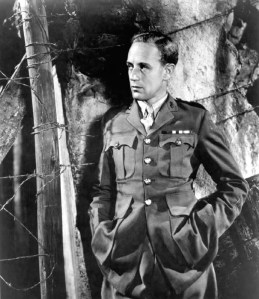
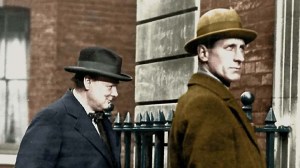
Last time I showed you a whole selection of what could be called “mistaken identity” conspiracy theories. Leslie Howard was erroneously identified therefore by the German intelligence service, the “Abwehr”, as Harold Thompson, Churchill’s bodygard.

Here’s Leslie Howard, in the wonderful anti-war play by RC Sheriff, “Journey’s End”…..

And here’s Harold Thompson (on the right), a man who was frequently appalled by Churchill’s apparently total disregard for his own safety. The best example of that was when Churchill stopped his staff car in Hyde Park and jumped out, armed with a Colt revolver, to do battle with the three members of the Irish Republican Army who were trying to assassinate him…….

……..sometimes Leslie Howard was identified as Anthony Eden, the Foreign Secretary, despite the biggest hairy caterpillar in the world, that he had trained to cling to his top lip, irrespective of weather conditions…….

Sometimes the Germans confused Leslie Howard with Reginald Mitchell, the designer of the Spitfire, and in the grave for the past six years :

And,  an Old Boy of Nottingham High School, Alfred Chenhalls, Leslie Howard’s business manager, was repeatedly thought to be Winston Churchill. Bald, cigar smoking and fond of whisky, who else could it be?

Another rather different theory suggests that Leslie Howard rather than Churchill, was the real target of those eight Luftwaffe aircraft. By now, Howard had become a hard core enemy of the Third Reich, reverting back to his origins as……

“a Jew who was a ferocious and prominent critic of Nazism”

By 1943, Howard frequently expressed himself much more actively than merely speaking up occasionally in interviews.

Indeed, he was soon not just starring in anti-German propaganda films, but he was directing and producing them himself, using as much of his own money as he dared.

On one occasion, his royalties from “Gone with the Wind” paid for his anti-Nazi productions. And in those movies, Howard did not hesitate to name and shame. In one film, he speaks of the Germans’ plans for the rest of Mankind, the people who had suffered the dreadful fate of not being born German. Howard was sure that Hitler would destroy for ever the political systems they had adopted…….

“Every day reveals the utter and desperate determination to smash us to bits, root and branch and to wipe out every trace of democracy.”

But……

“we are better than them”

In 1941, Howard made a fifteen minute film entitled “From the Four Corners” (1941). This is a still from it:

And here is a speech that may well make the hair stand up on the back of your neck :

“And so our fathers’ minds crept along and their ideas of justice and tolerance and the rights of man took shape in the sunlight and the smoke, sometimes standing still, sometimes even slipping back, but slowly broadening with the centuries. Some of those ideas are written down in the constitutions of our commonwealth and some are unwritten. We just try and carry them in our hearts and in our minds. Perhaps the men who came nearest to putting them into words were those Americans, many of them the sons of British pioneers, who, founding an independent nation, proclaimed:

We hold these truths to be self-evident, that all men are created equal, that they are endowed by their Creator with certain unalienable Rights, that among these are Life, Liberty and the pursuit of Happiness.”

Those words and that spirit were born and nourished here, and your fathers carried them to the ends of the earth. They are our inheritance from the past, our legacy to the future. That’s why you came here – to defend them.”

Here is a link to the complete film. It is fifteen minutes that may well reaffirm your faith in good old fashioned democracy:

In “Pimpernel Smith”, he discusses Nazi philosophy with the film’s head of the SS,  who has just captured Howard, the man who has helped countless political prisoners to escape from Germany:

“von Graum : Why do I talk to you? You are a dead man.

Smith : May a dead man say a few words to you for your enlightenment?

You will never rule the world, because you are doomed. All of you who have demoralized and corrupted a nation are doomed. Tonight you will take the first step along a dark road from which there is no turning back. You will have to go on and on, from one madness to another, leaving behind you a wilderness of misery and hatred. And still you will have to go on, because you will find no horizon, and see no dawn, until at last you are lost and destroyed. You are doomed, captain of murderers. And one day, sooner or later, you will remember my words…”

You can watch the complete film of “Pimpernel Smith” if you click on this link :

Having said that, the film is so good that you may wish to buy a much better quality DVD of it for around £10.

Like millions of people in the world, Leslie Howard had little reason to love the Germans, but, as a Jew, the appalling anti-Semitic policies of the Nazis in the 1930s really sealed the deal.

Howard wrote: “Britain’s destiny has been to uphold tolerance in religion, thought, speech, and race–– the mainspring of democracy. We have still far to travel on the road to true democracy, but only the Germans have made no progress in this direction. Britain, with her great gifts has helped populate five continents and shown that the white man and the coloured man can live in peace together.”

Few of us, more than eighty years later, would quarrel with those sentiments.


13 Comments

Filed under Aviation, Film & TV, History, military, Politics, war crimes

The Murder of Leslie Howard (2)

Last time, we read the most widely accepted version of the shooting down and killing of Hollywood star, Leslie Howard, by eight Luftwaffe Junkers Ju-88 heavy fighters:

Those two outstanding German authors, Sönke Neitzel and Harald Welzer, though, tell a much blacker story of the destruction of BOAC’s Dakota DC-3 “Ibis” in their recent book “Soldaten”.

………….During the war, the conversations of German POWs were recorded without their knowledge by their British captors. One of two prisoners in a particular prison camp near London had actually been in one of the Ju88s which had shot down Howard’s Flight 777:

His name was Dock and he said:

“Whatever crossed our path was shot down. Once we shot down – there were all sorts of bigwigs in it: seventeen people, a crew of four and fourteen passengers; they came from London. There was a famous English film-star in it too; Leslie Howard. The English radio announced it in the evening.

Those civil aircraft pilots know something about flying! We stood the aircraft on its head, with the fourteen passengers. They must all have hung on the ceiling! (Laughs) It flew at about 3200 meters. Such a silly dog, instead of flying straight ahead when he saw us, he started to take evasive action. Then we got him. Then we let him have it all right! He wanted to get away from us by putting on speed. Then he started to bank. Then first one of us was after him, and then another. All we had to do was to press the button, quietly and calmly. (…..laughs…)……It crashed…. They were all dead. Those fools don’t try to make a forced landing, even if they can see that it’s all up with them.”

The Allies proclaimed the act a war crime, and so too did a large number of neutral countries. After all, the Germans had shot down an aircraft which belonged to a neutral country (the Netherlands).

Not all of the names of the Ju 88 pilots who carried out this war crime have survived the Nazis’ frenzied burning of their own archives and records, but among the guilty men were:

Oberleutnant Albrecht Bellstedt, Staffelführer Oberleutnant Herbert Heintze, Oberfeldwebel Hans Rakow, Leutnant Max Wittmer-Eigenbrot

Bellstedt and Wittmer-Eigenbrot were both killed in the war, the others I have not been able to trace. No more BOAC daytime flights from Lisbon took place until the end of the war.

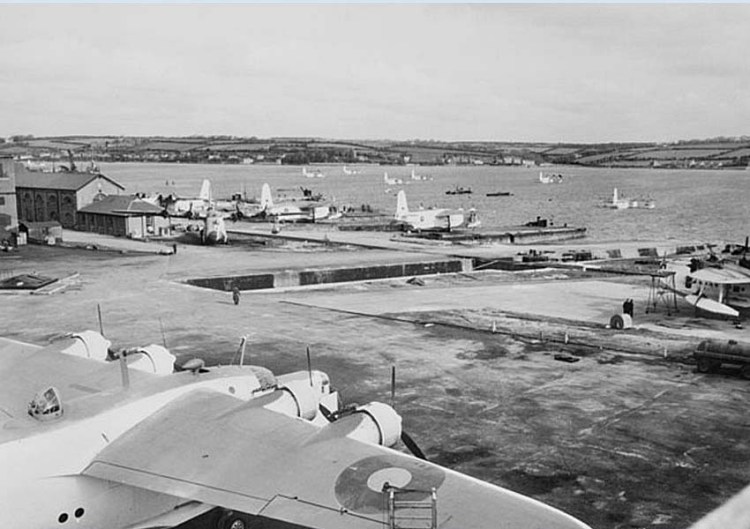
The flights which did take place were all at night, over a totally different route, completely beyond the range of a Ju-88. The British authorities responded to the DC-3’s failure to arrive by despatching a Short Sunderland GR3 flying boat to look for it. The aircraft, EJ134, was piloted by the brave Australians of 461 Squadron. The crew was James (Jim) Collier Amiss, Wilbur James Dowling, Alfred Eric Fuller, Ray Marston Goode, Albert Lane, Edward Charles Ernest Miles, Harold Arthur Miller, Kenneth McDonald Simpson, Philip Kelvin Turner, Colin Braidwood Walker and Louis Stanley Watson. Here’s a picture of RAAF 461 Squadron, looking for all the world like a flock of gigantic white geese:

The Australians found nothing whatsoever on the surface of the sea, but they did find the very same group of eight Ju88C-6s that the DC-3 had already met, at more or less the very same place where it had met them. Sunderland EJ134 and its crew then won their place in aviation legend. In a prolonged battle, the flying boat lost one engine and its tail turret. Messrs Dowling, Goode, Miller, Simpson and Walker were all injured and poor Ted Miles (27), one of the two side gunners, was killed. They did manage, though, to shoot down three of the eight German fighters. Of the other five, only two made it all the way back to Bordeaux. The other three were never heard of again. Six out of eight shot down. That should teach them not to attack unarmed airliners flying from neutral countries.

Overall, the Germans were very wary, if not simply afraid, of the Sunderland flying boat. It was an extremely heavily armed aircraft and a formidable opponent.

No wonder they called it

“Das Fliegende Schtachelschwein”, the Flying Porcupine”

This phrase  has proved particularly useful in all of my many trips to Germany, especially those to Berlin Zoo. And one day, when I ask for a cocktail called “A Flying Porcupine”, the barman will know how to make it!

14 Comments

Filed under Aviation, Film & TV, History, military, Politics, war crimes

The Murder of Leslie Howard (1)

A couple of years ago, I wrote a series of blogposts about the Short Sunderland flying boat. In at least one of them, I talked about how a civilian airliner, with the film star Leslie Howard on board, was shot down over the Bay of Biscay on June 1st 1943. Howard, and the crew and all of the other passengers were killed.  I mentioned those events because, the following day, a Short Sunderland was sent out to look for the missing airliner. They didn’t find it, but they did find the eight German fighters which had shot down the BOAC Douglas Dakota DC-3. There then ensued one of the legendary battles of the Second World War as the Sunderland fought off a pack of Junkers Ju88s. That particular series of blog posts, though, concentrated on the Short Sunderland flying boat and the Junkers Ju88 long distance heavy fighter.

This series of blogposts which begins today, however, concentrates not on the aircraft involved, but instead the still unanswered question of……….

“Why did the Germans have to destroy that airliner ?”

And first of all, let’s take a look at the man who is usually put forward as the prime suspect for the reason that the Dakota had to be destroyed……..

Leslie Howard was a film star who starred in “Pimpernel Smith”, “The First of the Few”, “Of Human Bondage” and most famous of all, “Gone with the Wind”, a huge smash hit in 1939. Here he is in “Journey’s End”:

Howard’s father was Ferdinand Steiner, a Hungarian Jew, and his mother was Lilian Blumberg, from an English Jewish family of German origin. Howard had originally styled himself Leslie Stainer in an effort to anglicise his real name of Leslie Howard Steiner, but eventually he decided on the name by which he is known nowadays.

On June 1st 1943, Leslie Howard was in Lisbon, the capital of Portugal, with his business manager, Alfred Chenhalls. They intended to take the civilian passenger aircraft of KLM Royal Dutch Airlines which, even in wartime, made a regular morning run between Portela Airport to the north of neutral Lisbon and Whitchurch Airport near Bristol in England. Neither Howard nor Chenhalls had tickets, so two passengers were turned off the aeroplane to make room for them. The lucky two were a little boy called Derek Partridge and his nanny called Dora Rove. Or, in another story, one of the two passengers was a Catholic priest, Father Holmes. Or perhps the lucky two were George and William Cecil, recalled from their boarding school in Switzerland.

There is a story that the take-off was delayed while Howard went to collect a small parcel full of silk and nylon stockings, a present, perhaps, for his wife and daughter. While filming, Howard was pretty much a serial adulterer, who said….

“I never chased women but I couldn’t always be bothered to run away”

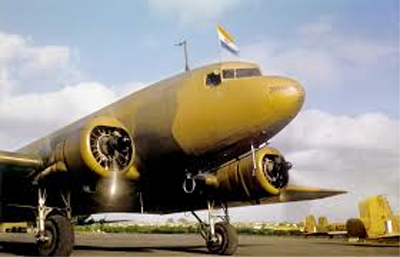
The aircraft was a Douglas DC-3-194 called “Ibis” with the civilian letters G-AGBB. Here it is, complete with its Dutch flag:The aircraft had hardly ever been impeded by the Luftwaffe on its 1,000 mile, seven hour, flight:

In actual fact, though, the Germans had already attacked the aircraft on two occasions in the previous six months. On November 15th 1942, it had been challenged by a single Messerschmitt Bf110 Zerstörer heavy fighter and on April 19th 1943, it had been ambushed by a patrol of six Bf110s. Here’s the nightfighting version of the Bf-110. The Zerstörer heavy fighters would have lacked the radar antennae….

On both occasions, the camouflaged airliner escaped a watery grave. The first attack involved a party of very high ranking American Eighth Air Force officers which included Ira Eaker. They were saved when the Bf110’s engine caught fire as it attacked. Everybody in the airliner, both passengers and crew, was terrified. In the second attack, the pilot, Captain Koene Dirk Parmentier, dropped down to the waves and then climbed steeply into the thick low clouds.

On the other hand, though, the trip had been made more than 500 times between 1939-1943 without the slightest problem.

On this occasion, though, just after midday, they were shadowed  initially by two Junkers Ju 88s over the countryside of northern Portugal and then of north-western Spain. They broadcast a message “we are being followed by enemy aircraft” and then “we are being shadowed”.

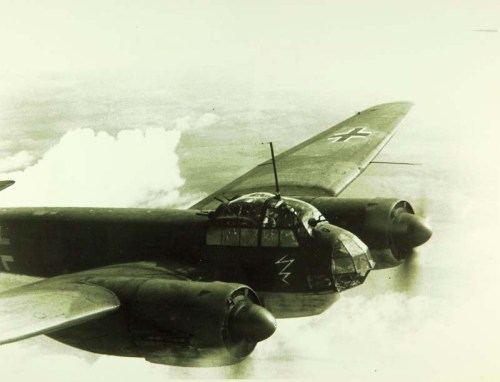
At around 12.45 pm eight different Junkers Ju88C-6 fighters of Gruppe V / Kampfgeschwader 40 spotted the “grey silhouette” of the DC-3. The Ju88s were flying with six aircraft abreast, fifty yards or so apart, with another two flying above them and acting as “spotters”. They had apparently been told to look for a twin engined grey aircraft. Their commander, Oberleutnant Heintze, had been told to carry out rigorous patrols during June and to shoot down the aircraft they found. This is a Junlers Ju-88 heavy fighter:

The Ju88s attacked the airliner at between 6,000-10,000 feet over the Bay of Biscay some two hundred miles north of the Spanish coast. One of the pilots, Oberleutnant Albrecht Bellstedt, radioed to his companions: “Indians at 11 o’clock, AA”. This meant enemy aircraft ahead, slightly to the left, attack, attack. One fighter came in from above and one from below. With their heavy calibre cannons, they set the Dakota’s port engine on fire and this then spread to the wing. A radio message was picked up from the wireless operator, van Brugge: “I am being followed by a strange aircraft….Putting on best speed….we are being attacked by enemy aircraft….cannon shells and tracers are going through the fuselage…. Am wave hopping and doing my best.” Oberleutnant Heintze, however, drew level with the stricken aircraft and quickly realised that it was a civilian airliner. He immediately stopped the attacks. Three, presumably, crew members, jumped out of the DC-3, deploying their parachutes but they did not open as they were already on fire and all three fell to their deaths. The aircraft plummeted into the sea where the wreckage floated on the surface for a very short period and then sank. By one o’clock, all four crew members and all thirteen passengers, including Leslie Howard, had been killed.

The four members of the crew were the pilot, Quirinus Tepas MBE, the second pilot, Captain Dirk de Koning, Cornelis van Brugge, the radio operator, and Engbertus Rosevink, the flight engineer.

Whoever was their intended target, the Germans were certainly serious about killing him or her. They had sent eight twin engined heavy fighters from Gruppe V / Kampfgeschwader 40 in a deliberate attempt to intercept that lone Dutch aircraft. If they had come across it purely by chance then surely there would have been just a single fighter involved, at best two, surely not a group of eight. And after they had shot down the DC-3, the German fighters circled the floating wreckage and took photographs of the burning plane before it finally sank. You don’t do that with just any old aerial kill. It has to be done for a very special reason. But that reason has never been found.

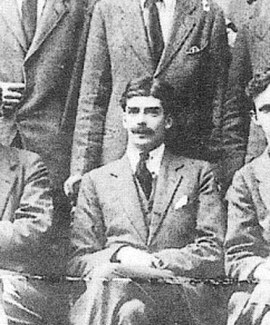
Here’s Alfred Chenhalls, Old Nopttinghamian, and Leslie Howard’s business manager. And with a cigar in one hand, and a whisky in the other, he’s a Winston Churchill look-alike. Apparently…………..

Don’t forget, though. In this day snd age, it was by no means simple to identify a famous person. They might have seen them in the cinema, but apart from this, there were only newspapers, magazines and, most of all, the radio. The latter, of course, was useful only for voice identification!
28 Comments

Filed under Aviation, Film & TV, History, military, Politics, war crimes

Photographs of the Eastern Front in World War Two (5)

About a year ago I bought a DVD with more than 12,000  images of World War Two . Most of them were either Russian or German.

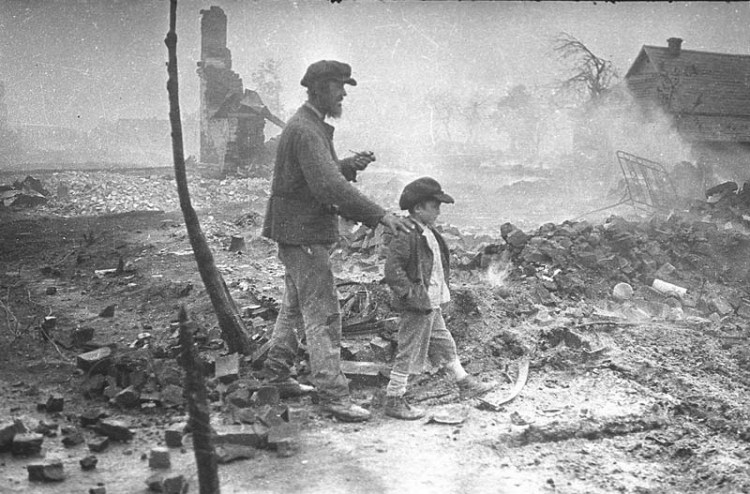
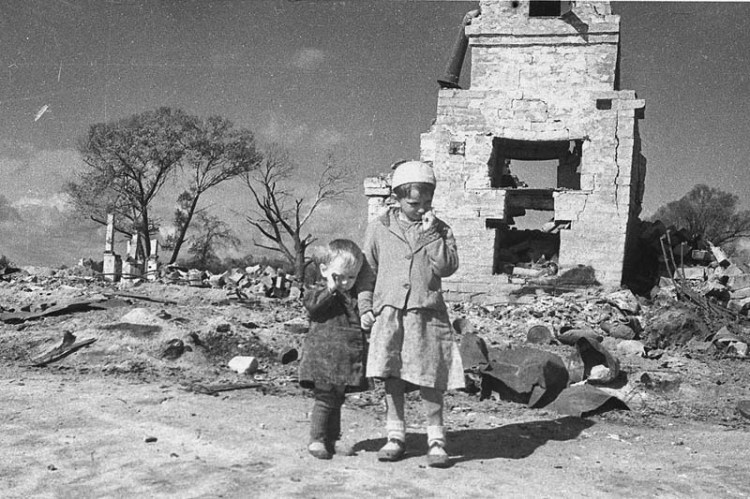
This first photograph shows a little Russian boy who appeared in one of the previous photographs in the Blog Post “Photographs of the Eastern Front in World War Two (4)”. Both he and his grandad stand in the smoking ruins of their house, and of their village. We can only guess at the circumstances. Personally, given the fact that the two individuals do not look particularly shocked or desolate, I think that the Germans have set fire to their village as they retreat back to Germany with the Red Army keenly pursuing them.

In this winter scene, Grandad and grandson are planning the future, perhaps where they will live, or where they hope a neighbour will help them rebuild their house and so on. Grandad is carrying his cane, but what’s that in his left hand? Incidentally, after much careful examination with Blog Post No 4, I do not think these two are the same individuals featured there, although, of course, you may not agree.

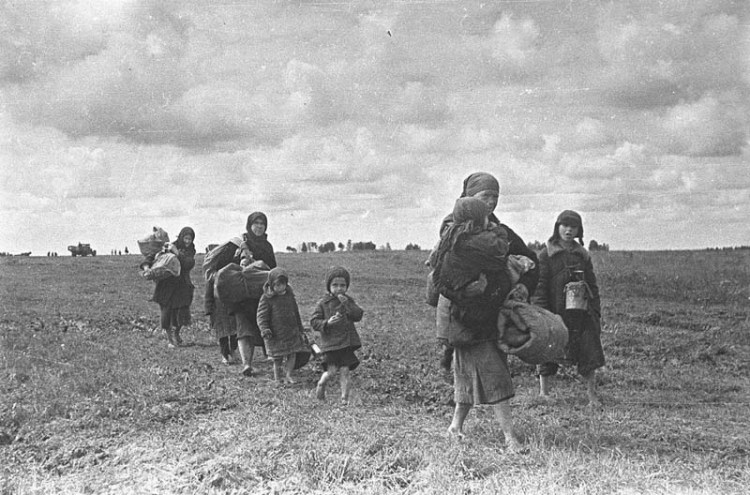
With victory in sight, though, and the tide of war now relatively far away, the refugees gradually came back. Here’s Granny, with her two daughters and five, perhaps six children. Everybody is barefoot, but they’re going home, so walking’s easy. And the two fathers? Well, they could have been starved to death in a POW camp, or worked to death as slave labourers in Poland or even in the Channel Islands.

This careful close up excludes any adults and focusses on the children with two brothers making manful efforts to carry as much as they could on a handcart. The baby sleeps the sleep of the innocent little child. Notice how she may well be strapped in for safety.  We will never know if the family’s house was still there when they arrived. In Byelorussia alone, up to 1500 villages were razed to the ground.

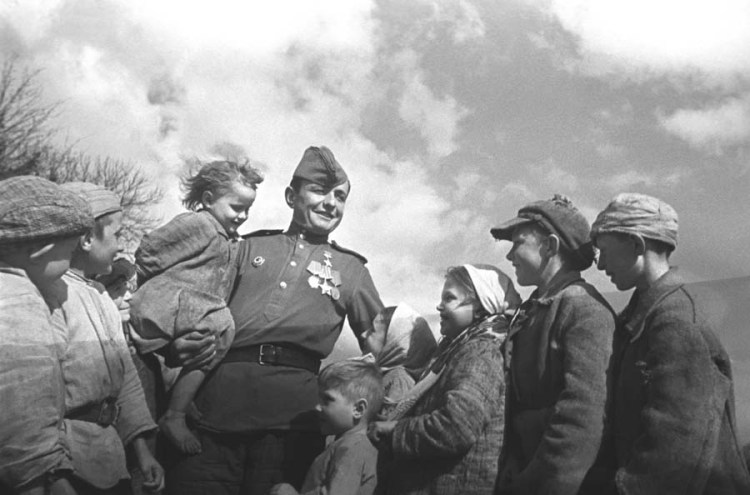
As the conquering hero returns, it’s the village kids who spot him first. He has a smile wide enough to indicate that he has already asked somebody whether his family is still alive. Under the German occupation, nobody was safe.

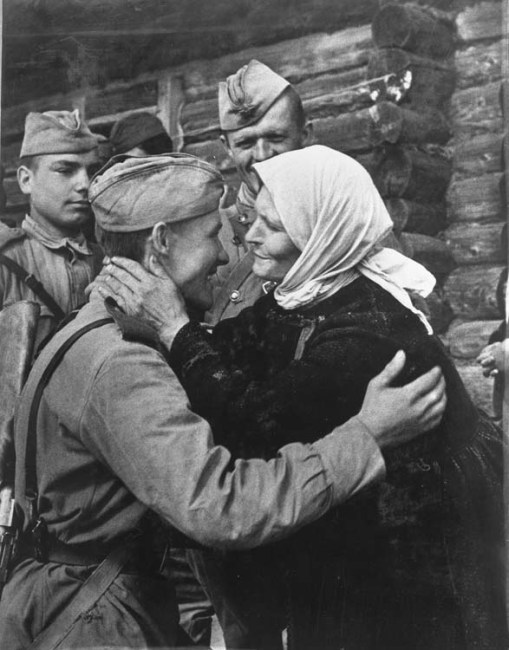
If I were going to give this photograph a title, it would be “The Love of a Mother”. Ordinary young soldiers walked back home, starting as a group which lost a member or two as they passed by each village. These were villages where the inhabitants would not have known whether a particular young serviceman was alive or dead. Yuri Gagarin’s two brothers performed slave labour in Poland, escaped and the Red Army conscripted them. The rest of the family thought both of them were dead, and Yuri became seriously ill with “grief and hunger”. They got back home in late 1945:

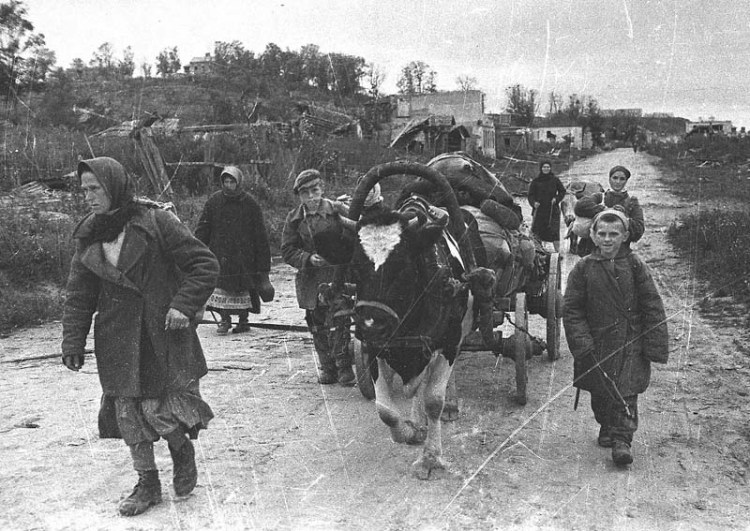
And still the refugees stream westwards to their homes. These bring two cows with them and a sturdy cart with substantial wheels. There are eight people, with, for me, two grannies, two mothers, two boys and a young woman. They all have boots and one boy has a Red Army infantryman’s cap. Did they find their house even vaguely intact? And what about at least two husbands?

Even more so, what about the bear who appears to be asleep on the back of the cart? Or have I got to take more water with it?

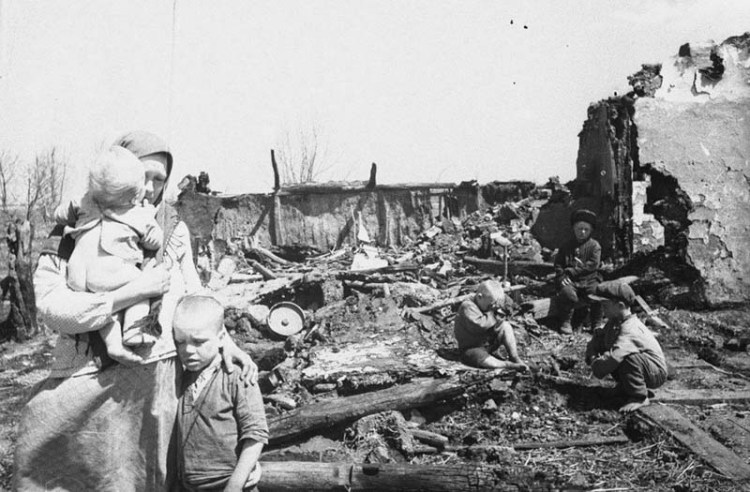
Most stories in Russia, though, had a sad ending. A house smashed to pieces by a German tank, because the crew wanted to use it as a hiding place. A woman with perhaps five mouths to feed and no husband in sight. It’s enough to make even  tough little Russian lads burst into tears. But don’t worry. Everything will be made good within a few years.

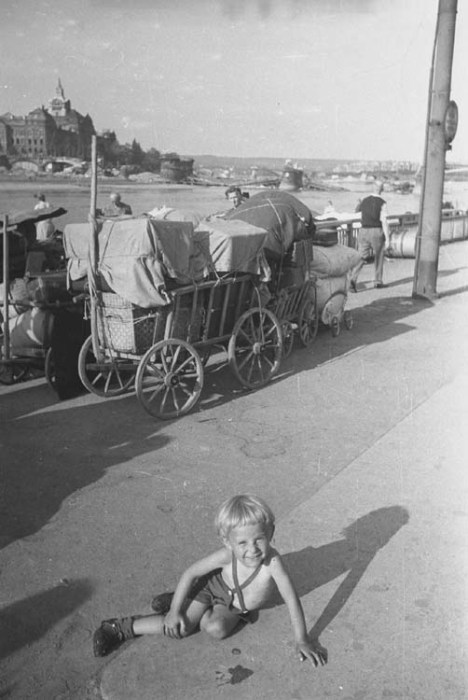
Indeed, things did get better ! So smile and enjoy being alive, enjoy sitting in the summer sunshine of 1945. As many as 20 million Russians were not able to say that.


As far as the present war in the Ukraine is concerned, I would expect the Russians to remember the destruction wrought on so many towns, cities and villages of the old Soviet Union, and to begin face-to-face discussions before resorting to the senseless violence they have evidenced so far. But, as we know in the West, hardly any people who witnessed the Second World War are still alive, and that must have been enough for a glory seeking politician to forget the ways of peace and to take up the pointless violence of the invader.

28 Comments

Filed under History, military, Politics, Russia, war crimes

Photographs of the Eastern Front in World War Two (4)

About a year ago I bought a collection, on DVD, of what were, supposedly,  more than 12,000  images of World War Two . I was very surprised, and pleased, to see that most of them were not British or American but were in fact either Russian or German. I would like to share some of these photographs with you, because a number of them have great photographic merits as well as capturing a split second in history.

Please be aware that these photographs do indeed capture moments in history. They portray the deeds of the Soviet Union, not the deeds of  present day Russia, a country run, like China and North Korea, on the mushroom method of management, although, of course, you can be sure that Putin’s suit will always remain spotless.

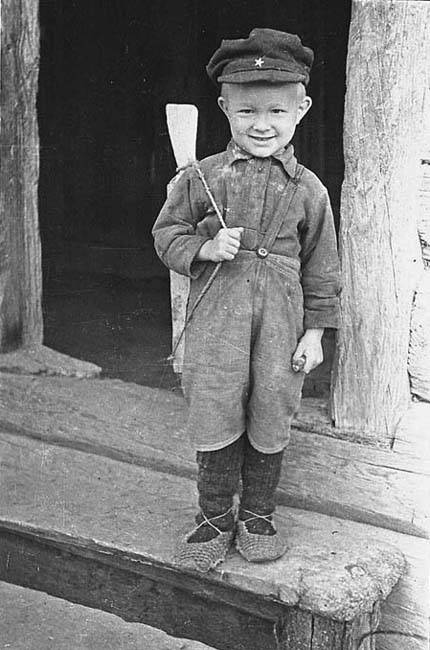
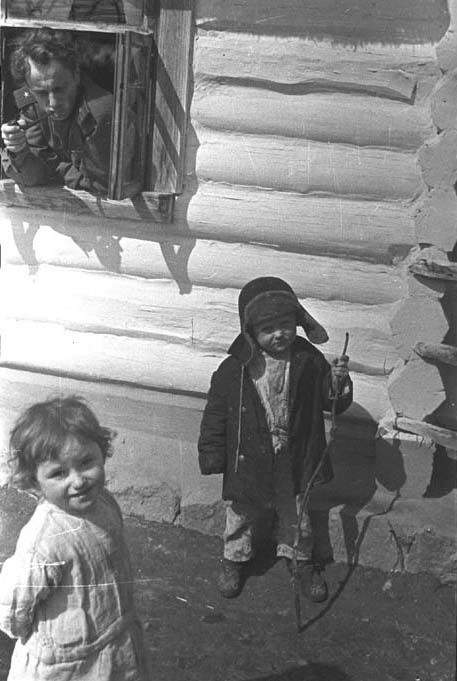
Today then , I’m going to look at the some of the pictures of children. Some were really quite cute, although they made no effort to disguise the fact that a war was going on:

In this picture, the war is a soldier, looking out of the window, making a call by field telephone :

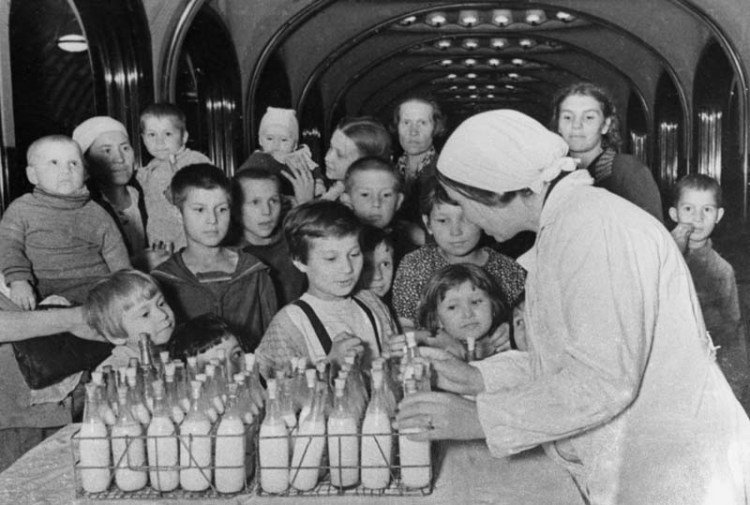
Another photograph made the point that in the twenty or so years since the revolution in 1917, the Soviets had made enormous strides in improving living standards, particularly in the cities. Don’t miss the Demonic Phantom in the middle of the back row. Or perhaps she’s the KGB Milklady

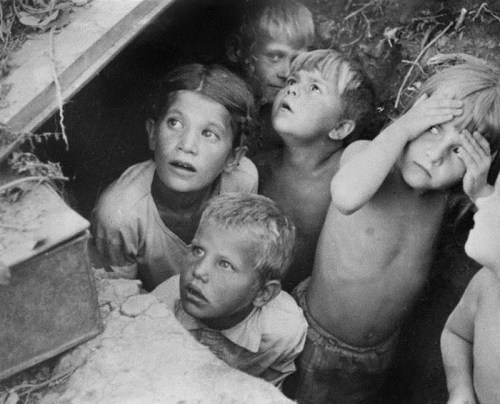
But then, the Germans invaded the Soviet Union and the Heinkels and the Dorniers rained death over Russian cities. This picture has done duty as being English boys watching the Battle of Britain, but the lack of clothing and the short, almost shaven haircuts, say to me “Western Russia”, a place of unending flat fields where Operation Barbarossa took place in absolutely splendid summer weather. Look at how the boys are amazed, fascinated, yet each one of them has a look of fear in their eyes.

Boys would play their part in the war. For Yuri Gagarin, the  cosmonaut, it was throwing caltrops on the road, pouring soil into tank batteries about to be recharged and mixing up the chemicals used for this job. No wonder! His school was burned down, his family were forced to live in a mud hut and two of his brothers went to Poland for slave labour. In this picture, the boys seem to be snipers of some sort, using enormous long barrelled rifles, or is the nearer one a machine gun?

Next comes a beautiful picture of three bewildered and possibly orphaned little children in front of what may well be the ruins of their house. In Yuri Gagarin’s village, some 27 houses were burnt down. Hitler’s plans for the Russians involved the complete eradication of all the Russian villages, towns and cities, and to have the population housed in large camps from which they would be able to cultivate the land for the Germans. As these slave labourers died off, German families would come east to farm the land as their own:

A similar picture but the little boy is clearly well aware of what has happened to their family, and he just can’t take any more:

This is an unknown Russian village with two more little children. Both the village and its population have been destroyed:

The Germans were not in the slightest bit interested in the Russian civilian population. How could they be when they had carried out the massacre at Babi Yar and killed 33,771 Jews in two days, and the Rumbula massacre in Latvia where around 25,000 Jews were murdered in two days? As the Holocaust moved forward, the Germans would expect to find and kill all the Jews of a small town in a single day.

Russians, and indeed, all Slavs, were merely “untermenschen”, sub-humans, to be killed as the mood took them. The exceptions were the higher echelons of the Communist Party, who were killed on sight.

Human beings, no matter what may have happened to them, will always want to talk to each other and discuss. Here is Grandad, with his three grandsons, talking to somebody they know, probably about the future and where they are going to live. The Wehrmacht would burn down houses just because they felt like it, which may be what has happened here:

PS

My records, which I was looking at last night, show that I published “An impossible Beatles Quiz (1….the Questions)” but that I did not ever publish the answers. For Quiz No 2, I did publish both the Questions and the Answers.

Does anybody out there remember?     

I clearly thought I had published both Questions and Answers for Quiz 1, but the WordPress list of “Published” seems to think otherwise! Indeed, it thinks different things about the subject every single time I do a search!

Please write any thoughts in the “Comments” section of this particular blog post if you can help. 

28 Comments

Filed under History, military, Politics, Russia, Uncategorized, war crimes

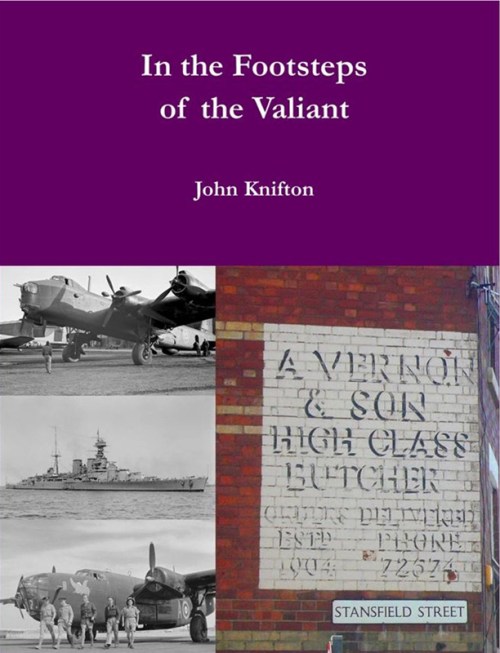
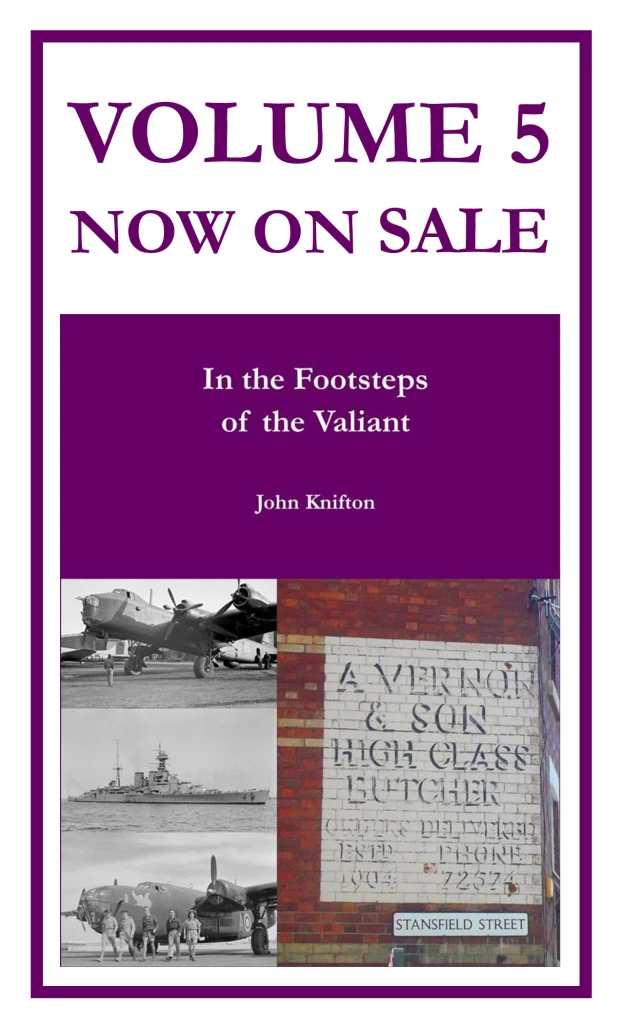
In the Footsteps of the Valiant (Volume Five) Finished at last !!!

Well, it has finally happened. After something like eight years of research and writing up, the fifth and final volume of “In the Footsteps of the Valiant” is complete and published and ready to be purchased…….

I have always said that my main intention was to get away from a list of war casualties which was just a surname and a set of initials displayed on a wall. I wanted to portray the High School’s war dead as young men with, perhaps, wives, families, houses, jobs, and, above all, their own lives to lead. Lives which they were prepared to sacrifice in the cause of freedom, to stop a madman whose crazed ideas would have transformed the entire world into his very own vale of tears.

No less an intention was the idea of trying to establish, once and for all, just how many war casualties the High School had. From around eighty, I have now pushed the number up to around 120.  Volume Five contains the detailed story of 22 High School casualties of World War Two, along with two men who gave their lives for their country during the following decade. And don’t forget, incidentally, that all five volumes have been deliberately constructed to contain the same amount of material as all of the others. Furthermore, that material is, overall, of the same quality as all the other volumes. No single book is full of exciting stories of derring-do, at the expense of another volume devoid of all excitement. I took great care to make that the case.

The men concerned in Volume 5 are :

Thomas Arthur Bird, Douglas Arthur Burgass, John Stuart Burnside, George Vernon Carlin, Frank Leonard Corner, George Edward Dance, John Arthur Finking, Bernard William Grocock, George Norman Hancock, Lewis Alan Hofton, John Mayo, Arthur Mellows, Roy Faulkner Newell, Herbert Temple Nidd, John Ebblewhite Paling, William Palmer, Peter Frederick Paulson, Ivan Roy James Perkins, Kenneth Walter Sansom, William Henry Shaw, John Aubrey Starkey, Leslie Hambleton Taylor, Peter Vernon and Ian Leslie Wilkinson.

Here are Messrs Frank Corner, the First XI cricket team scorer, John Mayo, First XV player, Arthur Mellows, First XI cricketer, and Peter Paulson, of 277 Battery (City of Nottingham) 68 Heavy Anti-Aircraft Regiment, killed by enemy fire as the Germans captured Tobruk.

Frank Corner:

John Mayo:

Arthur Mellows

And Peter Paulson

And here is Bernard William Grocock, shot down by Oberleutnant Helmut Lent of 6/Nachtgeschwader 1, the second greatest night fighter ace of all time.

John Aubrey Starkey, killed at HMS Bambara in Ceylon, as he flew his Grumman Hellcat fighter :

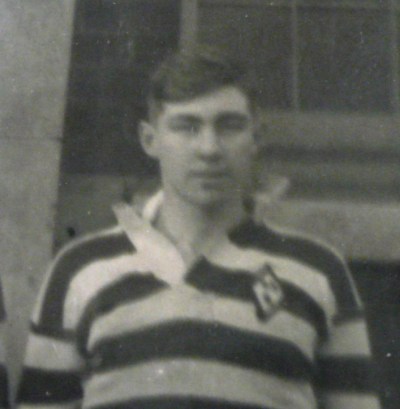
And Ian Leslie Wilkinson, First XV rugby player and First XI cricketer :

And Herbert Temple Nidd, surely the most colourful Old Nottinghamian of them all, a man who worked on every single one of the great North Atlantic liners of the 1930s, and whose understanding of the rule “Only one wife at a time” seems to have have been woefully deficient. And that may well go for his father, too.

They died in many different places. In the Denmark Strait, facing the Bismarck. In an Italian prison camp. Fighting Rommel in Tunisia. Shot by guerillas in Ethiopia. In the Netherlands, clearing the Scheldt Estuary of Germans. Crossing the Rhine only weeks from the end of the war. And in aircraft. Over Duisburg in a Lancaster. In a Gloster Meteor. In a Whitley over Staffordshire. In a Whitley over Berlin.  In a Liberator over Tripoli in Libya. And most interesting, the POW who died, or was perhaps murdered, on his “Long March”, as, in 1945, the Germans marched their prisoners hundreds of miles westwards in deep snow, away from the Russians. What a tale he had to tell. Other men from his camp had been stationed right next to Auschwitz and had watched carefully what the Germans were doing. Alas, had he survived, he might well have added his testimony to the prosecution’s case.

This slideshow requires JavaScript.

I also discovered the only direct remembrance left behind by any of our Old Nottinghamians. Peter Vernon died at the age of 23 from an illness contracted in the North Atlantic on H.M. Motor Minesweeper 260. Battered ceaselessly by extra strong winds and freezing rain, Peter probably died in the Invergordon Royal Navy Auxiliary Hospital in northern Scotland. Before he went off to war, his father had already told him of his plan to rename their butcher’s shop, “A.Vernon & Son High Class Butcher”. A huge new sign was painted on the side of the building. Perhaps it was going to be a surprise when Peter came home on leave, although it certainly didn’t work out like that. Alas, we will never know.

What we can do, though, is to go to Ilkeston Road in Nottingham, and, at its junction with Stansfield Street, see the sign, which is still there. The only part of Peter Vernon’s life still remaining alive in our world……………………..


Any royalties generated by these books will be split between “ABF The Soldiers’ Charity” and the Royal Air Forces Association.

Let’s finish with two poems.

One by Keith Doncaster of Maples’ House and the Fifth Form:

“Along the silvery beach we run,

Gathering coloured shells.

We think that gathering shells is fun.

Along the silvery beach we run.

And as we go beneath the sun,

We hear the distant bells.

Along the silvery beach we run,

Gathering coloured shells.”

And one, almost a thousand years older, from Wace, slightly altered:

“Eventually

All things decline

Everything falters, dies and ends

Towers cave in, walls collapse

Roses wither, horses stumble

Cloth grows old, men expire

Iron rusts and timber rots away

Nothing made by hand will last.

I understand the truth

That all must die, both clerk and lay

And the fame of men now dead

Will quickly be forgotten,

Unless the clerk takes up his pen

And brings their deeds to life again


I say and will say that I am

John Knifton from the City of Nottingham”


25 Comments

Filed under Africa, Aviation, Canada, cricket, History, military, Nottingham, Pacific Theatre, The High School, war crimes

The Carvings in the Tower (5)

Robert Michael Gunther (line 5 of the picture below) was one of the young men who, in May 1940, had climbed up into the Tower of the High School and carved their names and their message on a window sill. When the group did this, they could have had no idea how the war would turn out, whether the Germans would cross the Channel and occupy the country, or whether the British forces would manage to fight them off :

Robert lived at a house called “The Haven” in Burton Joyce, a village which is to the north of Nottingham, on the River Trent. He entered the High School on April 24th 1924. Robert won Mr Player’s Prize for Arithmetic (Intermediate) in 1938 and passed his School Certificate in 1939, just a year before he carved his name and message on the stone window sill in the School Tower.

In the OTC, he became a Lance Corporal and then a Corporal in 1938. He won the Certificate ‘A’ prize in 1939 and soon became Company Quarter-Master Sergeant and then Company Sergeant Major. In 1940, he was the most efficient senior NCO and the Commander of the Most Efficient House Platoon. A School Prefect, Robert won his First XV Colours and Cap, and captained the school rugby XV in 1940-1941:

“An exceptionally good leader, he also has shown himself outstanding in all departures (sic) of forward play.”

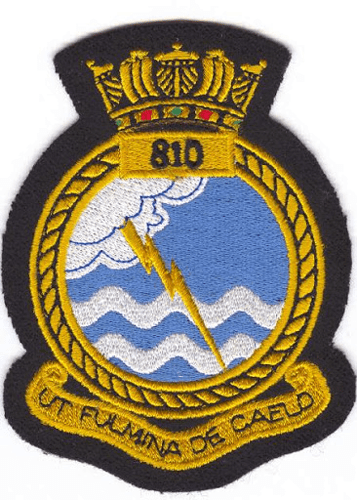
Robert left the High School on Christmas Eve, 1940. He joined the RNVR (Royal Naval Volunteer Reserve) and by 1942 he was a member of the Fleet Air Arm. He was trained at HMS Kipanga in Kenya and then at HMS Ukussa in Ceylon (Sri Lanka). He then joined 810 Squadron. The motto means “Like lightning from the sky”:

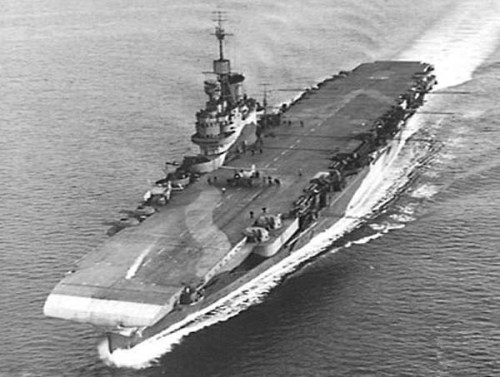
810 Squadron, Robert included, flew off the aircraft carrier, HMS Illustrious:

At the end of the academic year, in July 1944, the Nottinghamian carried the following message:

“We regret to announce that the following Old Boys have recently been reported “Missing”, and we hope that good news of their safety will soon be received: RM Gunther (1934-40) and FL Corner (1932-39)”.

The Nottinghamian said that Bob Gunther had disappeared during a routine flight over the Indian Ocean in June 1944. In actual fact, he had been shot down while acting as observer in a Fairey Barracuda during a bombing raid on Port Blair in the Andaman Islands.

The Andaman Islands are here:

Here is Port Blair:

And here is a Fairey Barracuda, which could carry combinations of a torpedo, bombs or rockets :

Bob and his pilot, Basil Willington Aldwell, were missing for 15 months. But Bob was not dead. The brutal Japanese had him, and his pilot, in their tender care. From July 13th 1944-August 27th 1945, he was imprisoned at Ofuna near Tokyo before spending two days at Shenagawa. When released he spent a long, long, time in hospital, before he was able to return home. Here are two typical victims of what was, ultimately, Japanese racism:

At Christmas 1945, another notification was published in the Nottinghamian:

“Sub-lieutenant RM Gunther RNVR (1934-1940) who disappeared on an operational flight over the Indian Ocean, in June 1944, is reported safe and on his way home. No news had been heard of him for some 15 months, and we are delighted to know of his safety.”

The extraordinary story also appeared in the Nottingham Evening News:

“One of the first Nottingham people to get a cablegram announcing the release of prisoners of war in Japan is Mrs KL Gunther of 37 Staunton Drive, Sherwood, who today was one of the first in Nottingham to receive news that her only son was returning home. His telegram read “Safe in Allied hands. Hope to be home soon. Writing. Address letters and telegrams to Liberated POW, c/o Australian Army Base Post Office, Melbourne.”

Sub Lieutenant RN Gunther of the Fleet Air Arm had been liberated. He had survived the Pacific war, a theatre where it was only too easy to lose your life.

Frank Leonard Corner, the other name in the Nottinghamian magazine of Summer 1944, was not so lucky.

At 00:25 on June 7th 1944, operating as a flight engineer, he had taken off from RAF Metheringham in an Avro Lancaster Mark III of 106 Squadron. It carried the squadron letters “Z-NH” and had a serial number of NE150. “Z-Zebra” was tasked with attacking bridges near Caen in the immediate aftermath of D-Day. It carried 18 x 500 lb bombs in its capacious bomb bay. Bombing from 3,000 feet and lower, at around 03:00 hours, the Lancasters were hit very severely by anti-aircraft fire over Lison, where a worker at the railway yard remembers vividly how the German gunners celebrated the fact that they had shot down a bomber, which must surely have been “Z-Zebra”. Frank was just twenty years old when he died. His service number was 222039 and his parents had by now moved to Whiston near Rotherham in South Yorkshire.

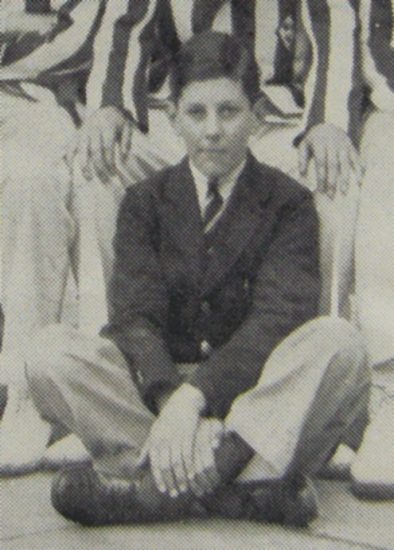
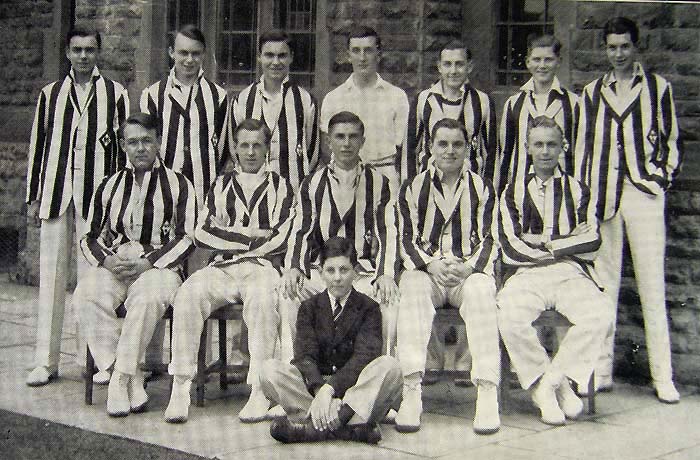
Frank was the scorer for the school’s First XI cricket team in 1938. In the photograph below he sits cross legged in front of the team:

Three of that season’s cricketers were killed in the war, as well as the team scorer.

Boy No 4 on the front row, George Colin Brown, of the Second Battalion of the Lincolnshire Regiment, was killed in Normandy on July 8th 1944, as 7 Platoon helped to clear the village of Hérouville-Saint-Clair of Germans.

“We slowly crept forward across open fields. As we broke into a trot, the Germans came out of holes in the ground like rats and unleashed hell. Mortars rained down on us and machine gun bullets were flying everywhere. Ahead of me, my platoon commander, Lieutenant Brown and his batman were killed.”

George Colin Brown was just 24 years old when he died. He was a young man whose….

“fast in-swinging ‘yorker’ on the leg stump was so devastating on its day.”

Boy No 5 on the back row, Ian Leslie Wilkinson, was killed on January 31st 1944, after taking off on a routine training flight from RAF Tilstock in an Armstrong Whitworth Whitley Mark V of 81 OTU, serial number LA 765. They crashed about 30 miles away near Dilhorne, a tiny village in Staffordshire. Ian was 24 years old and he was training to be a bomber pilot.

Boy No 6 on the back row, John Richard Mason, was killed on Friday, April 16th 1943, near RCAF Station Assiniboia in southern Saskatchewan in Canada. Sergeant Mason, a Pilot Instructor, was instructing Trainee Pilot, Leading Aircraftman John Hugh Evans, when their Fairchild Cornell Mark I, serial number FJ654, crashed into the ground.


10 Comments

Filed under Africa, Aviation, cricket, History, military, Nottingham, The High School, war crimes

Why no statue ? (2)

Last time, I talked of how men who were once famous but who had evil hidden deep in their souls can live on artificially through their statues. Without that statue, such men would soon be forgotten in the dustbin of history.

I would rather emulate John Hickenlooper, the Governor of Colorado, who, in 2014, told the descendants of those murdered by Colonel Chivington and his men at Sand Creek in 1864:

“We should not be afraid to criticize and condemn that which is inexcusable ……. We will not run from this history.”

And in 2015, construction of a memorial to the Sand Creek Massacre victims began.

And I certainly feel that, if there are people who do not want to have statues of these “dubious heroes”, who do not want to be reminded of their ancestors’ suffering, then so be it. And, by this method, such men will gradually fade away rather than be kept alive artificially by a statue.

An excellent example would be Werner von Braun. Operation Paperclip made him an American citizen, along with 1600 of his fellow scientists. These were the people who helped to mastermind manned space flight and the landing on the moon. An ordinary person might want a statue.

I can think of a few Jews who wouldn’t though. And Russians, and Poles or any other East European descendants of the ones who died, as tens of thousands of slave workers perished building concrete bunkers, blast proof shelters, and rocket launching ramps all over the island of Peenemünde. If these people feel strongly enough, then no statue.

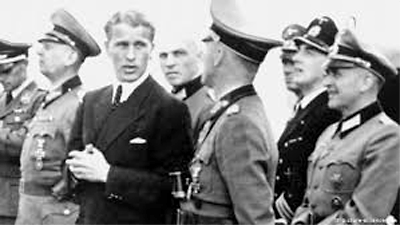
Back then, of course, von Braun was known as SS Sturmbannführer von Braun. And here is the SS Sturmbannführer with high ranking Nazis:

Here he is with the highest ranking Nazi of all. The SS Sturmbannführer is dressed as a civilian, middle of the next to back row:

This one is more difficult, but von Braun is behind Himmler, dressed up in his all black SS uniform:

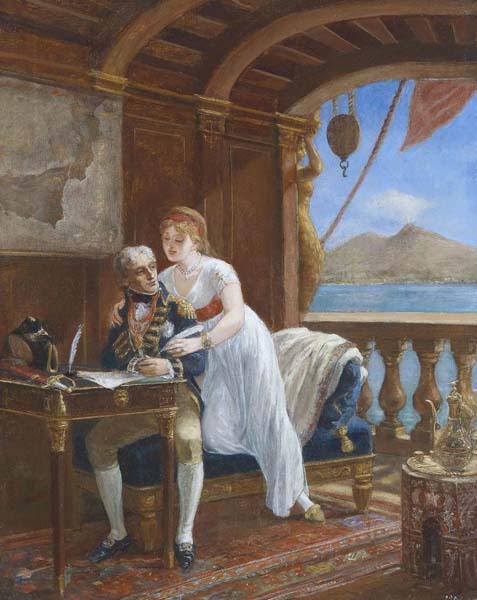
We’re not in the slightest bit short of people in this category. Lord Nelson was an excellent naval commander with a 100% belief in the British Empire. But by 1801, Nelson, already married to the unfortunate Mrs Frances Nelson, was living with another woman, Emma Hamilton. She was not his wife, and he shouldn’t have been living with her. In actual fact, she was the wife of one of his closest friends, Sir William Hamilton.

There will be a lot of men nowadays who will not be too bothered about Nelson’s little foibles, but I bet there are a lot of women who would not want a statue of him staring them in the face, especially in the nation’s capital city.

I wonder who bought more of these satirical jugs? Men or women?

High on the list of people from this period who have shocking sides to their character is Lord Byron, the Romantic poet. Not that he couldn’t knock out some famous poems when he put his mind to it:

She walks in beauty, like the night
Of cloudless climes and starry skies;
And all that’s best of dark and bright
Meet in her aspect and her eyes”

Or, perhaps more famous, “The Destruction of Sennacherib”

“The Assyrian came down like the wolf on the fold,
And his cohorts were gleaming in purple and gold;
And the sheen of their spears was like stars on the sea,
When the blue wave rolls nightly on deep Galilee.

Like the leaves of the forest when Summer is green,
That host with their banners at sunset were seen:
Like the leaves of the forest when Autumn hath blown,
That host on the morrow lay withered and strown.”

Lord Byron, though, ought to encounter a great deal of difficulty having a statue erected to him, and I don’t mean just his dress sense:

George Gordon Byron, the Sixth Baron Byron, was allegedly England’s greatest poet. Yet, it has been written that “By our own modern standards he was probably a paedophile and certainly a rapist, at least of the statutory kind.”

The evidence for these charges include the fact that Byron had an infatuation with a shapely fifteen year-old Greek boy, Lukas Chalandritsanos and spent enormous sums of money on him.

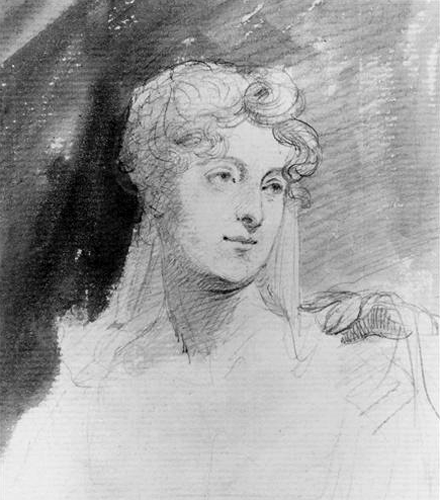
He had already had an incestuous relationship with Augusta Leigh, his own half-sister. Here she is:

Augusta gave birth to Elizabeth Medora Leigh, who was widely thought to be Byron’s child. Three days after the birth, Byron visited Augusta and the baby. He reported later to a friend, Lady Melbourne:

“It is not an Ape and if it is – that must be my fault.”

There was a widely held belief at the time that a child born of incest would be an ape.

Byron’s wife was Anne Isabella Noel Byron, 11th Baroness Wentworth and Baroness Byron, Here she is:

Evidence from a servant says that Byron raped his wife only days before she gave birth to their daughter, Ada. And then he raped her again only days after she had given birth.

In those days, of course, a husband could not be refused by his wife. What would now be considered rape was just a gentleman exercising his conjugal rights. But by today’s standards, actions like that are repulsive, especially so soon either before or after the poor woman has given birth.

Byron’s appalling arrogance was equally in evidence in his love affair with Claire Clairmont. Here she is:

Claire gave birth to a daughter, Allegra, but Byron immediately forbade her all access to her child, whom he sent away to a convent. She died there aged five.

And to think that I criticised the baddies in the TV series “Poldark” as not being true to life!

20 Comments

Filed under Aviation, Bomber Command, Criminology, History, Humour, military, Politics, Science, war crimes

What would you do ? (12) The Solution

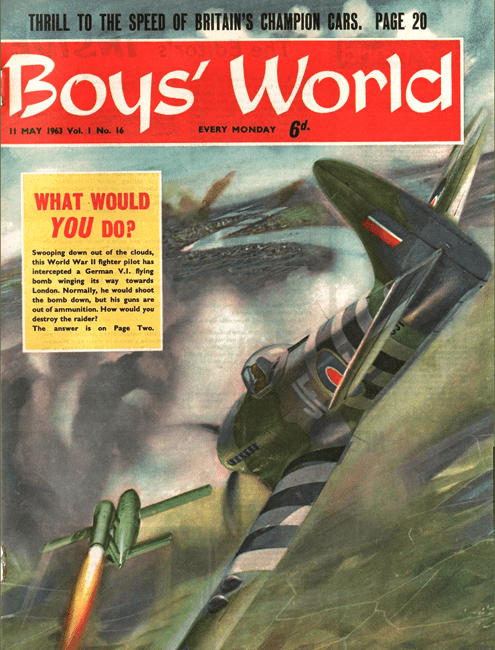
“What would you do ?” used to figure on the cover of a boys’ comic called “Boys’ World”. This was a publication, obviously, aimed at boys, and first appeared on January 26th 1963. There were 89 issues before the comic was merged with Eagle in 1964. The last issue of “Boys’ World” came out on October 3rd 1964.

I used to buy “Boys’ World”, and this was mainly for the front cover which always featured a kind of puzzle. It was called “What would you do ?” and was based on somebody being in what Ned Flanders would call “A dilly of a pickle”. Here’s the situation:

And here is the puzzle:

And as we turn quickly to page two, we find out that:

“There is only one thing the fighter pilot can do. Sweeping down out of his dive he flies alongside the V.I., maintaining the same speed. Then, he gently manoeuvres his wing-tip under the wingtip of the deadly bomb. With a gentle pull on his stick, he turns his plane away, his wing whipping the V.1. over. Its delicate gyro-compass thrown off-course, the bomb hurtles earthward, to explode harmlessly in open countryside.”

So now you know!!

The people who throw around their accusations  about Bomber Command, aiming them chiefly at Bomber Harris, as if he was the Number One in the RAF rather than someone subject to a whole chain of superior officers and politicians, they forget both the V-1 and the V-2, which were pilotless and aimed only in the most general of terms. The V-1s were all aimed at Target 42, London, and more precisely, Tower Bridge. They never hit Tower Bridge or even got particularly close. V-2s were even more random and indiscriminate. In efforts ordered personally by Hitler to blow up the bridge over the Rhine at Remagen, no V-2 got within 900 yards but they did hit Cologne (still German at the time).

The statistics are not very precise but 22,880 V-1s were fired at targets in England (8,892) and Belgium (11,988). Around 4,000 V-2s were launched at targets in England (c 1,400) and Belgium (2,342). The main target in Belgium was the port of Antwerp. Hitler was determined to deny its use to the Allies. Overall,  V-weapons killed approximately 18,000 people in England and Belgium. Nearly all of them were  civilians.

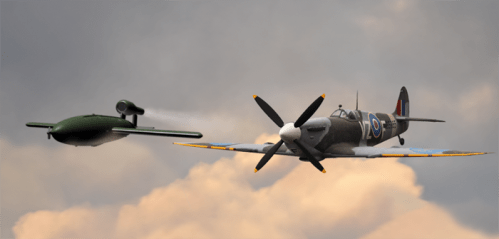
Here’s a V-1 and a Spitfire playing nicely:

And here’s a V2 setting off to annihilate as many civilians as possible in London. It was designed by SS Sturmbannführer Werner von Braun, soon to be an American citizen and certainly not a war criminal responsible for the deaths of tens of thousands of slave workers, most of them Russian or East European, particularly Poles. Hopefully though, like the Führer, he loved his dog:

18 Comments

Filed under Aviation, Criminology, History, Humour, military, Science, war crimes