Tag Archives: Avro Lincoln

Newark Air Museum (1)

The original Newark, or Newark-on-Trent, is a market town in Nottinghamshire in England. It stands on three important routes, namely the River Trent, the ancient Great North Road or A1, which ran from London to Edinburgh and it is also on the main East Coast railway line:

Newark has an historic castle which was “slighted” or put beyond military use in 1648.

Outside the town, Newark also has an air museum.

Nowadays going out to visit anywhere is not really feasible for me, so my daughter went as my ambassador, accompanied by her boyfriend, urged to take photographs of whatever she thought was a warplane. And she is no aviation expert, but she certainly knows a hawk from a handsaw and a Halifax from a Hastings. She wouldn’t know a Hampden from a Hereford, though, or a Harrow from a Sparrow or a Bombay. Who would?

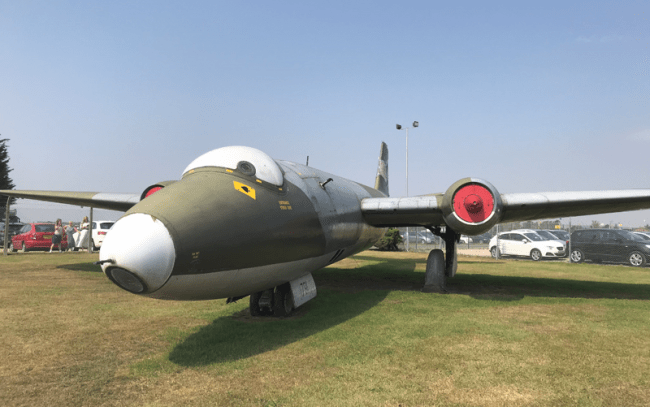
The majority of Newark’s aircraft are from the 1950s and the Cold War. Here’s an English Electric Canberra PR7, the photo-reconnaissance version. This one, WH 791, served at RAF Tengah in the western part of Singapore. Top speed : 580 mph
This is a Gloster Meteor two seat conversion trainer, the T7. This particular aircraft, VZ634, was in service from 1949-1958 with 247 Squadron, 609 Squadron, 141 Squadron and 41 Squadron. As a fighter, the Meteor was used by 16 foreign countries and Biafra. Top speed : 585 mph

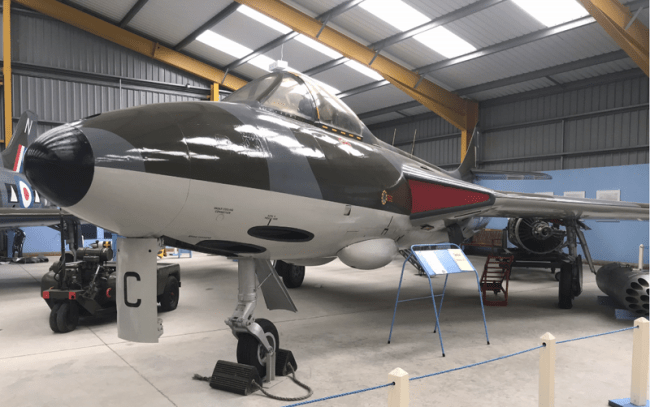
Here’s another fighter, the Hawker Hunter. At Newark, it’s an F.1 interceptor fighter, waiting eagerly for those Bears, Bulls and Badgers to show their evil Commie faces over the North Sea. Hunters were used by 21 other countries and had a Top Speed of : 623 mph. Nowadays everybody seems to have forgotten “The Black Arrows” aerobatic team and their manœuvre with 22 aircraft, certainly a world record at the time. There’s a link here.
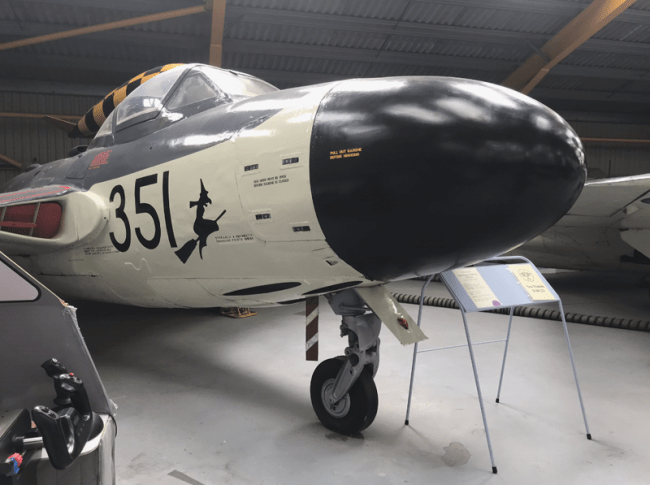
The de Havilland Sea Venom was a two seater shipboard strike fighter, one of the comparatively few aircraft to have been twin boom. At Newark there’s an “FAW.22” or “Fighter All Weather”, WW217, one of only 39 built. There’s a family tree here, starting with the de Havilland Vampire, then the Venom, the Sea Venom and finally the Sea Vixen which operated from carriers as late as 1972.
This is the Avro Shackleton, the last in the line which ran from the Avro Manchester to the Avro Lancaster to the Avro Lincoln and finally to the Avro Shackleton. It was a long-range maritime patrol aircraft, and was used by the British and the South Africans. Top speed : 302 mph

Here’s a closer view of some of those propeller blades:

The only American warplane here is the North American F-100D Super Sabre, a single-seat fighter-bomber. This individual was used by France’s Armée de l’Air, and served in France, Germany and the old French colony, Djibouti in the Horn of Africa, today’s Somalia. In total, it had a career of 4,459 hours in the air. Top speed : 924 mph, Mach 1·4.
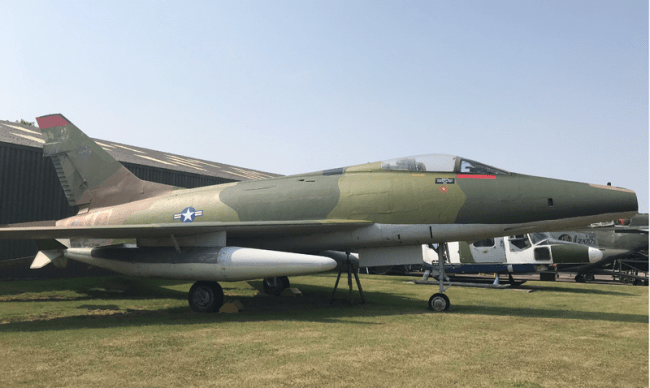
I think it was an F-100 that dropped the napalm in “Apocalypse Now”:

Next time, a look at some of Newark Air Museum’s civilian aircraft, some more of its foreign aircraft and its various bits of aircraft.

20 Comments

Filed under Africa, Aviation, Bomber Command, Film & TV, France, History, military, Personal

The Avro Lincoln at RAF Cosford

During a recent visit to the museum at RAF Cosford, I was able, as a confirmed fan of the Avro Lancaster, to view its successor, the Avro Lincoln:

cosford c xxxxxxxxxxx

The Avro Lincoln flew for the first time in June 1944, just a few days after the Normandy landings. The first examples of the new bomber were actually called the Lancaster Mark IV and the Lancaster Mark V, but they were eventually rechristened the Lincoln Mark I and the Lincoln Mark II. The new aircraft was the last bomber in the RAF with good old-fashioned piston engines and proper propellers:

lincoln_rf570_heritage_centre

The theory was that the Lincoln would be used in “Tiger Force”, Bomber Command’s contribution to a potentially catastrophic invasion of Japan in 1946. The bombers would have acted, presumably, as the RAF’s equivalent of the B-29 Superfortress or the much less well known Consolidated B-32 Dominator. Here is a B-29, “Fifi”, sadly the only example left flying from the 3,790 constructed:

fifi xxxxxxxxxxxxxxxxxxxxxxxxx

This is the little known B-32, the aircraft which actually flew the last combat mission of World War 2. Only 1156 of these bombers were ever built:

b32-main

At the time of “Tiger Force”, my Dad had already had all his medical injections for this next phase of the war, and the squadron’s Lancasters were all being crated up to be transported out to the Far East. Then suddenly, the Americans dropped their two atomic bombs and the war finally came to an end.
The Lincoln was certainly an improvement on the Lancaster, but the performance figures given in Wikipedia are not particularly startling, with bomb loads, aircraft size and speeds all roughly similar.  Here is the capacious bomb bay:

cosford b xxxxxxxx

The range of the Lincoln was greater than its predecessor, and the maximum speed was an improvement, with the aircraft able to cruise happily at 215 mph.  Similarly, the service ceiling and the rate of climb were better than the Lancaster.
Eventually, more than six hundred Lincolns were to be manufactured, with a further 73 in Australia where it was the largest aircraft ever to be built there.

This photograph comes from a splendid Australian website where you can learn, more or less, to fly a Lincoln, especially the long nosed version, the Mark 31. Every single one also contains two or three  of the author’s laugh-out-loud feelings about life. My favourite one is:

“Going to church doesn’t make you a Christian, any more than standing in a garage makes you a car.”


australian mark 31
Just one single Avro Lincoln was constructed in Canada. Here it is:

canadian _Lincoln_ExCC

With the RAF, the Lincoln was used in the 1950s to oppose the Mau Mau terrorists/freedom fighters in Kenya. You can read the story for yourself, but I do love the British evaluation of the Mau Mau by Dr. John Colin Carothers as

“an irrational force of evil, dominated by bestial impulses and influenced by world communism”

I also enjoyed the description of the traitorous Africans who continued to support the nasty British as:

“the running dogs of British Imperialism”

Very Mao Tse-Tung. And here is the Great Man, ordering five beers:

Chairman-Mao-Zedong-007
The Avro Lincoln was also employed against terrorists/freedom fighters who operated in Malaya (now Malaysia). They too were influenced by world communism, although they were unable to import any running dogs of British Imperialism because of the rather strict customs regulations in force at the time.

All of that history is fairly predictable, except for the sad story of the single Avro Lincoln (RF531 “C”) which was shot down by the Soviet Air Force.  The bomber was attacked by a MiG-15 fighter on its way to Berlin on March 12th 1953. This is a MiG-15:

mig15takeoff05 xxxxxxxxxxxxxxxxxxxxxxxx

The Lincoln was being flown by members of the Central Gunnery School at Leconfield in Yorkshire, and all seven of the crew were killed. The whole very sad, rather ghastly tale, is told on the Spyflight website. What a sad, sick waste of young men’s lives that was. There was just no need for it.

A lot further south, the use of the Avro Lincoln by the Argentine Air Force, the Fuerza Aérea Argentina is quite interesting:

Avroaregenrtine 2Lincoln_B-010_0084_2006-0

These Lincolns (and indeed, Lancasters) were initially employed by the I Grupo de Bombardeo to bomb the rebels, during a military coup in September 1951.  Four years later, the British aircraft were obviously highly thought of, because, in what seems to have been another rather over-vigorous political argument, they were used by the government to bomb the rebels, and by the rebels to bomb the government. Here is the paint scheme of the rebels, apparently influenced, if only slightly, by world communism:

rebel lincoln

This was, of course, the Revolución Libertadora which ousted Juan Peron and his wife Madonna.

(“She plays Evita with a poignant weariness and has more than just a bit of star quality. Love or hate Madonna-Eva, she is a magnet for all eyes.”)

Some things I just cannot resist. Nobody could:

One interesting feature about these ageing South American bombers was that both the Lancasters and the Lincolns in Argentina were serviced, and kept viable, for many, many, years, by ex-Luftwaffe engineers.  For some unknown reason, they had all decided to leave the Fatherland in 1945 to live out the rest of their sad lives in South America:

lincoln argentine

I was fascinated to read as well that Avro Lincolns were used to support the Argentinian bases in the Antarctic. One aircraft therefore, was flown back to Avro in England. Engineers there added a civilian nose and tail, removed all armament, and put in generous extra fuel tanks. Registered as a civil airliner called the Cruz del Sur, the aircraft dropped supplies to the Antarctic San Martín Base from December 1951 onwards:

crfuz del sud
Sixty or so years later, the Argentinians still have two Avro Lincolns preserved. You have already seen two photographs of one of them. Here is another:

argen best picture

The Australians have one of their Lincolns in storage for restoration in the future, and there is also the aircraft that we all saw at RAF Cosford, with its rather disconcerting blue bosses to the propellers:

cosford a xxxxxxxxxxxxxxxxxxxxxxxx

And, as far as I know, that’s it! What a wonderful regard we have for preserving RAF aircraft. Are we embarrassed that we were ever forced to use them in anger?

38 Comments

Filed under Aviation, Bomber Command, History