Tag Archives: Brincliffe School

Brincliffe Grammar School for Girls (4) A cry from history

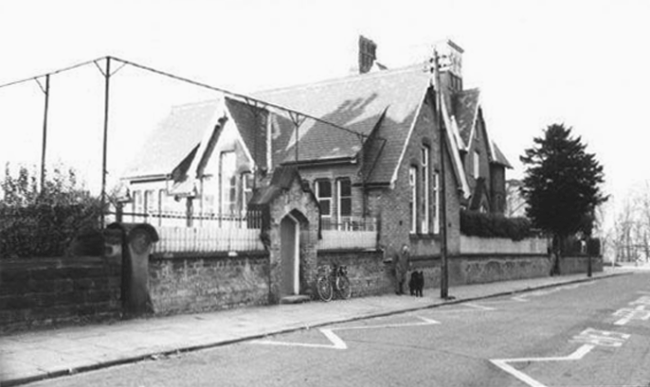
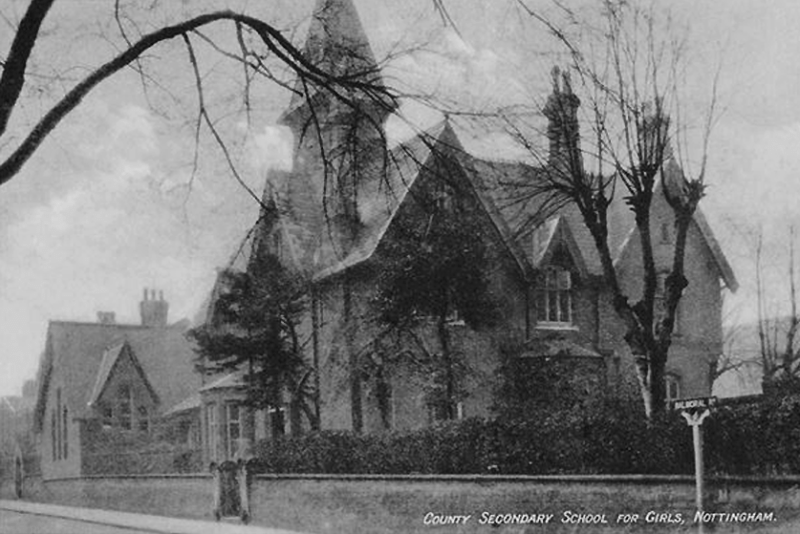
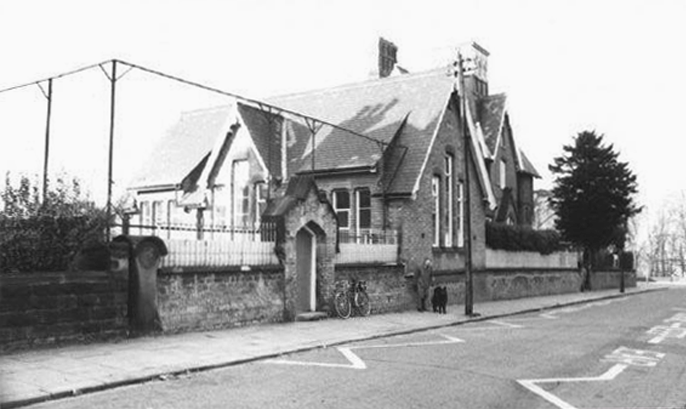
What traces remain of Brincliffe Grammar School for Girls? Well, in Balmoral Road, the front wall still remains, running from No 23 Balmoral Road, all the way to the corner with Forest Road East and then past that for a few yards. It’s easy to see and it is virtually untouched. It’s a sandstone wall which continues round the corner and runs as far as what would have been the old boundary of the High School in, say, 1895. The wall continues for all this distance and the fact that it matches both of the two remaining Victorian photographs of the school is proof enough for me.

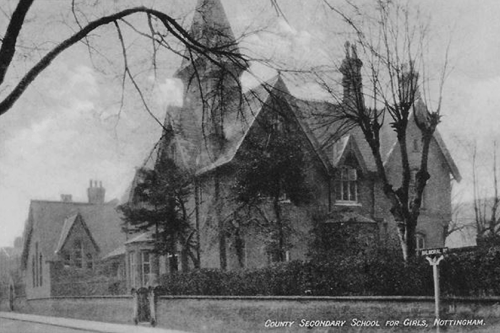
Here are the two pictures of Brincliffe still in existence. This is the older of the two:

And here is the one where the bike has been invented:

And here is a sample of the wall. The brighter, red one is modern, the tan coloured lower wall dates from 1870 at least. At the same time, you can see how, in modern times, it was thought wiser to make the original wall much higher.
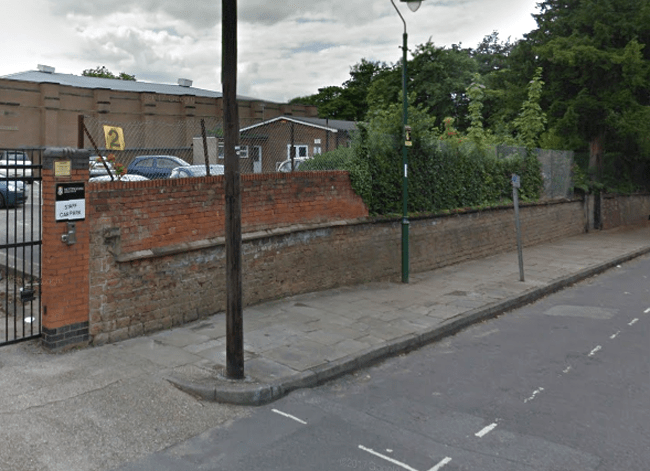
The sandstone Brincliffe wall stretches all the way round onto Forest Road East and meets the old boundary line of the old High School (right). Here we are:
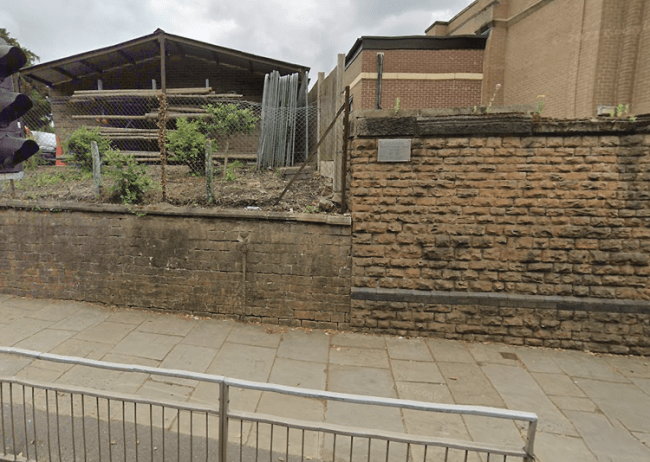
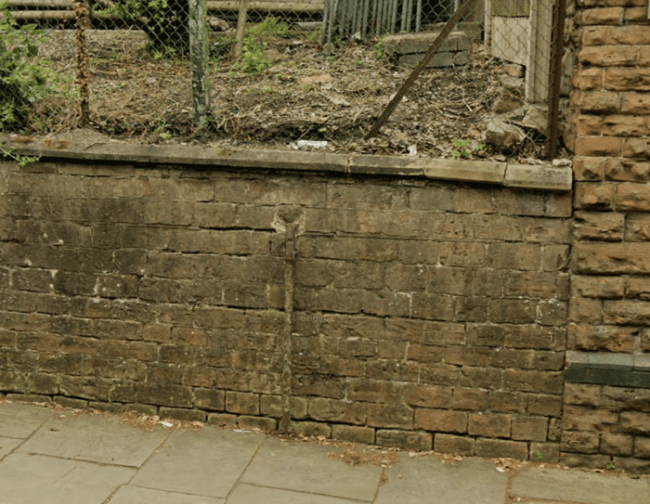
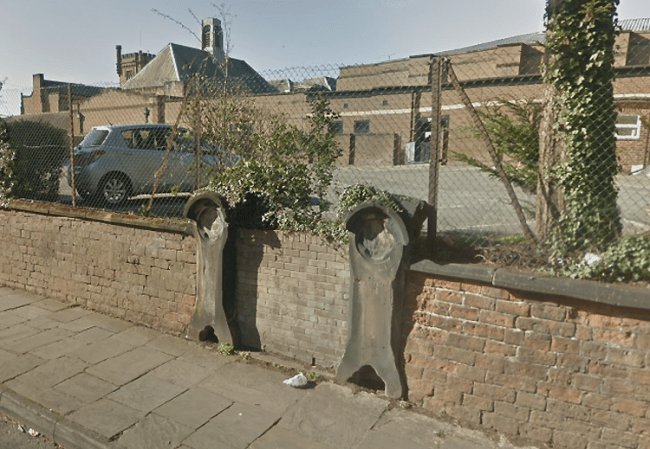
But what is this Victorian remnant? Some kind of fire hydrant?
At the side of No 23 Balmoral Road there is a pillar which clearly dates from the turn of the 20th century or earlier, and is visible in the second of the old photographs above. Here it is:
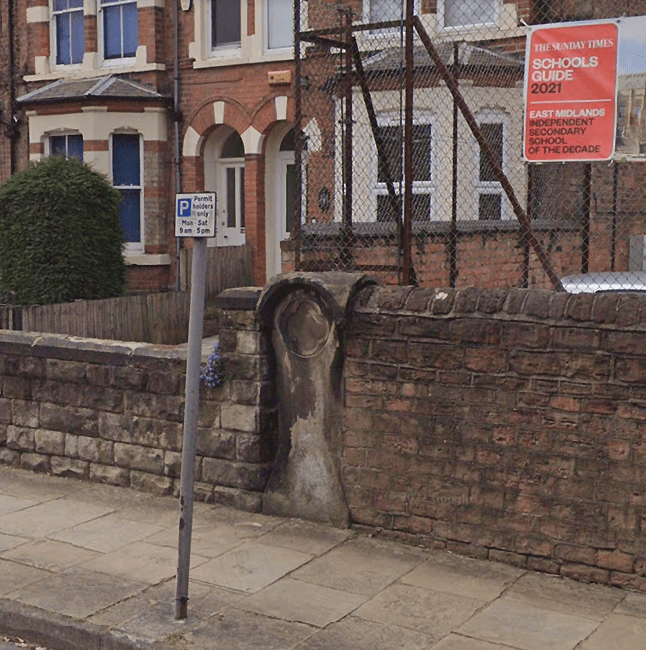
Further down, what has clearly been a gate to the school is still visible. In the controversial “pushbike-and-dog” photograph, it is down near the fir tree, but difficult to see. In the “Welcome, Munsters” postcard, it is the first gate you see in the wall and the ornate tops are clearly visible.  Here it is:
As  you know, I sometimes buy articles connected with the High School from ebay. A while back I produced seven blog posts called “Nottingham High School on ebay”. This link should take you to No 1 if you are interested. Sometime after #7 was published world wide, I bought this:
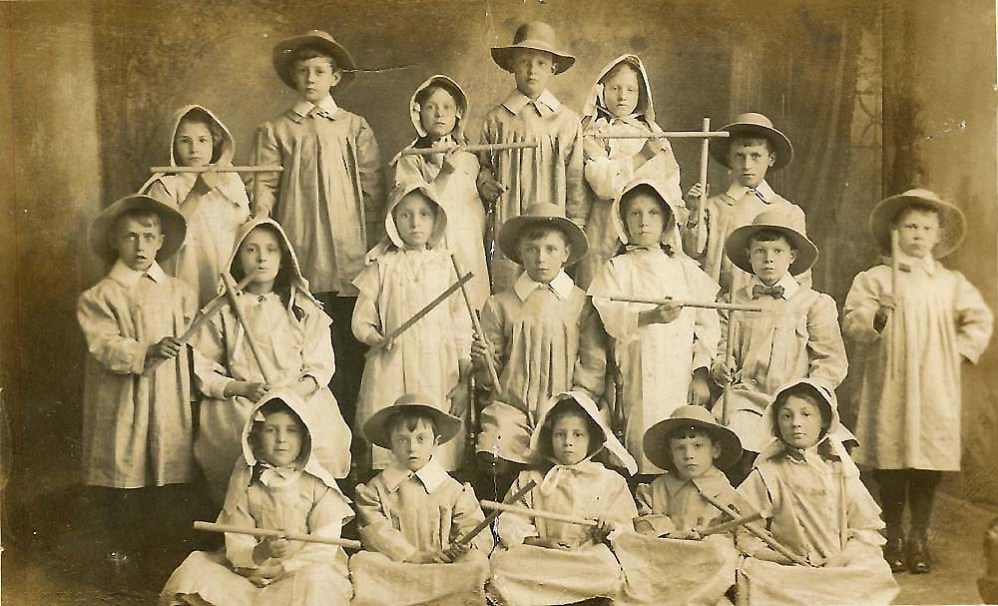
It shows a group of unknown children from what was called “Brincliffe School” although the presence of little boys must mean that events took place before 1907 when the Girls’ Grammar  School started up. I have no idea whatsoever what is going on with all their sticks and costumes. But the picture and the words that go with it really amount to a cry which comes from well over a century ago. And that wordless cry says

Here I am. I used to be alive like you.”

And those sentiments are present in the picture but they are also written on the back of the postcard:

It reads, as far as I can see:

“Yours Truly

Bernard Raven

as

A Farmers Boy

First boy on top row to the left”

Just have a look at him. The back row, the boy on the left. He can’t even be trusted to carry a stick, and appears to have lost his. But he is the one we can look at and we know his name. Bernard Raven. He grew up, perhaps he fell in love, perhaps he married, perhaps he had children of his own. I suspect we will never know. But with a little bit of luck, he will be read about, if only for a few seconds, in Australia, India, the USA, all over the world. I hope he was happy with his life.
24 Comments

Filed under History, Nottingham, Politics, The High School

Brincliffe Grammar School for Girls (2) Before and After

Having started my researches abou the Brincliffe Grammar School for Girls on Balmoral Road, I could not resist trying to find out more, and more, and more……..

Using my very sad collection of Kelly’s Directories of Nottingham, I was able to trace just a little bit of history, not so much for the Brincliffe School, but for the site where it would eventually be situated.

And so, in 1876, (the year of Custer’s Last Stand), on the corner of Balmoral Road and Forest Road, on the western side, was “Porter & Jones, boys’ school (Tudor House)”. In other words, the same building which would, one day in 1907, house Brincliffe Grammar School for Girls, had been, thirty years earlier, a private school run for profit, inside what had originally been a private house. The two partners in the business were Messrs Porter & Jones, and they had given the school the name of “Tudor House”.

Three years later, in 1879, the entry reveals that Tudor House had become a boarding and day school and that, of the original partnership of Porter & Jones, Mr Gregory Porter seemed to be the Head Honcho.

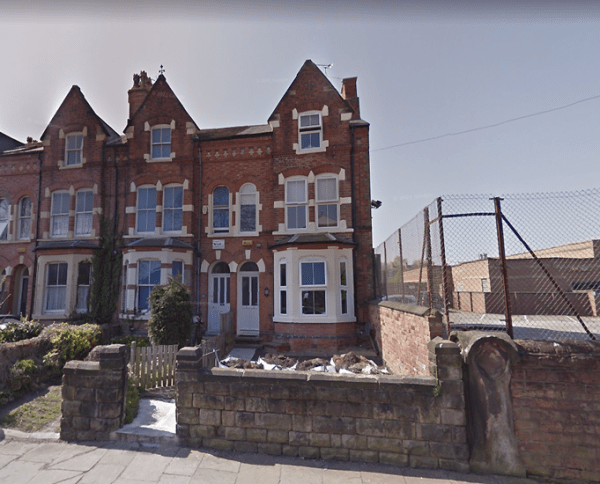
In 1881, the house, now apparently the property of Mr Gregory Porter alone, was now No 25 Balmoral Road. No 23 is still standing, the house immediately to the left of the main entrance to the High School staff car park. In 1885, the situation was exactly the same.  Tudor House, and Gregory Porter, were still in business. Here’s Nos 19, 21 and 23 today, complete with original Victorian sandstone wall:

Alas, by 1891, Tudor House was no more, and the school became “a ladies’ school” for ladies. under its Headmistress, Miss Blanche Hall.

By 1894-1895, the Misses B. & K. Hall were running a boarding and day school at No 25. The house was now called “Brincliffe”. Why they had chosen this name, I do not know. Presumably, it refers to the “brink” or edge of a “cliff”, a reference perhaps to the small area of steeply sloping ground to the northwest of the Church Cemetery, overlooking the much flatter and much lower, Forest Recreation Ground.

Here is that “brink of a cliff”:

The slope is actually quite steep and, while not a cliff, it would have seemed a lot more precipitous 140 years ago because there were no trees then. The trees are quite young for trees, only around 80-100 years old. Here is a view inside the trees on a very familiar path down from the High School (and Brincliffe) :

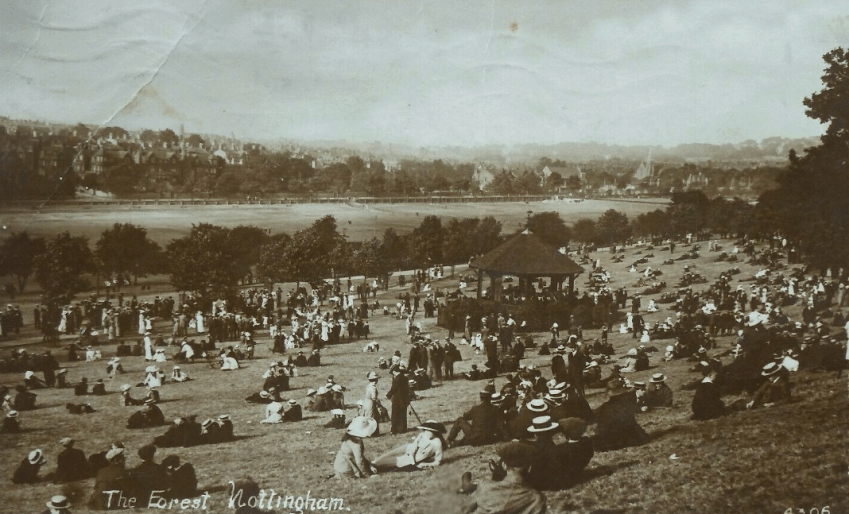
The slope is certainly steep enough to sunbathe on. Here is a lovely Sunday afternoon with people in their Sunday best, relaxing around the long gone bandstand. See if you can solve “Where’s Walter?” and can you spot Robin Hood?

And here is the much lower flat area, which has always hosted any number of football/soccer pitches. In 1865, they had seen the birth of Nottingham Forest, nicknamed at the time, the “Garibaldi Reds”:

So, by 1894-1895, the Misses B. & K. Hall were running a boarding and day school at No 25. It was called “Brincliffe”. And now you know why!

By 1898-1899, “Brincliffe” had been acquired by the Misses Koppel & Hall. It was still No 25. In 1904, Miss Amy Koppel was running the boarding & day school on her own, the premises still with the same name and number.

In 1907, the City Council made it a Girls’ Grammar School, but from 1913 onwards it is listed as just “Notts County Secondary School, Miss Sybil Randall, head-mistress”

I have not been able to find any pictures of the girls in their green blazers and Green Berets, “à la John Wayne”. That crumpled, baggy 1950s blazer is still the only thing I’ve found:

One final detail.

The very first mention of a school on the Brincliffe site was “Porter & Jones, boys’ school (Tudor House)”. We know this already, but one thing I did find was that in 1862, a Miss Sarah Porter was running a “school” on distant Woodborough Road. In 1864 she was named as Miss Sophia Elizabeth Porter, presumably the same person (or perhaps sisters), still in an un-numbered location on Woodborough Road.  Unfortunately I have no directories available for the period 1864-1876.

13 Comments

Filed under History, Nottingham, Politics, The High School

Brincliffe Grammar School for Girls (1)

When I am writing blog posts, just like David Bowie and Jimi Hendrix, I don’t normally do requests. On the other hand, I did feel a little bit guilty that, months ago, somebody contacted me and said, very politely, “Maybe one day you could tell us a bit more about Brincliffe School, please?”. Regrettably, I did not record their name. On the other hand, the Hairy Godmother has granted their wish………

Brincliffe School was situated in Balmoral Road in Nottingham, immediately to the east of the High School. This Grammar School for Girls occupied the area between the western corner of the junction with Forest Road East, as far south as No 23, the first house of a row of three storey Edwardian properties. The Orange Arrow tells the tale, indicating precisely the southern boundary of the now demolished school:

Here’s the Victorian equivalent of the same area. The Brincliffe building is south west of the “B-A-L” of “Balmoral Road”.:

Brincliffe didn’t really look much like a school. It was more like a school housed in a private dwelling house:

At one time, when it was a private house, Dame Laura Knight, the artist, had lived there. Not many pictures of the building are left nowadays. It was demolished in the late 1970s. Here is the view from the south. The key to linking up the two photographs is the bottom left of the photograph above, and the centre right of the photograph below. The three windows and the gate with a portico are crucial links. Don’t miss one man and his dog who have stopped for eternity next to the telegraph post.

Brincliffe was an all girls’ grammar school, which operated from 1907-1974. Entry was by passing a competitive examination. Unlike Nottingham Girls’ High School, no fees were payable. Such selective, and free, schools were a fantastic source of social mobility and an excellent examination for the poor.  Everybody in the school had a talent and the schoolwork they did was of a very high standard. At Brincliffe, girls had a genuine opportunity to do what they wanted to do with their lives, with little interferece, except from their own families.

The school produced a Gold Medallist in the 1974 Commonwealth Games, an Oxford don, a member of the D’Oyley Carte Opera Company, any number of students at Oxford and Cambridge Universities, and innumerable doctors, dentists, solicitors and politicians. And all of them came from an ordinary background. If you doubt that, then go and look at their Facebook page.

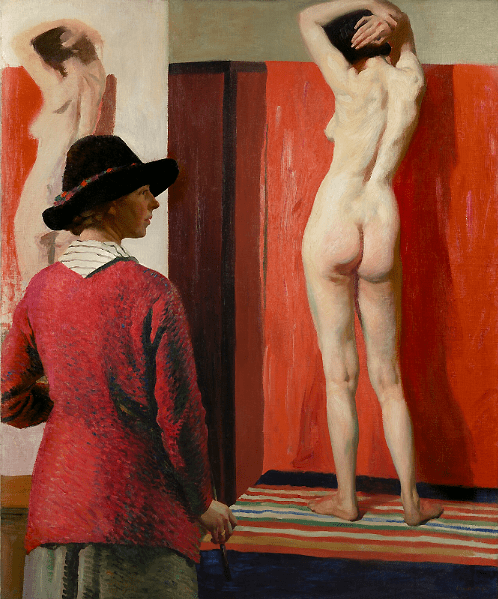
The most famous high achiever from Brincliffe was surely Dame Laura Knight, the painter.   One of her most famous paintings was “Self portrait with a nude”. It caused a right fuss:

She also did a lot of paintings of World War Two. They included “A Balloon Site, Coventry” in 1943:

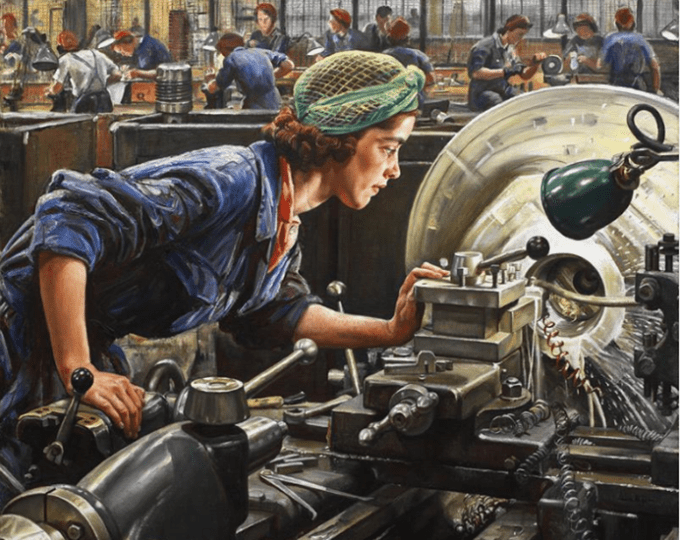
The superbly composed “Ruby Loftus Screwing a Breech-ring” in the same year of 1943:

And a portrayal of the crew of a Short Stirling bomber in 1943. It is entitled “Take Off “, and I found in one account that the poor young wireless operator had been killed almost before the paint on the painting had dried :

Dame Laura was one of a very few female artists during her era. Another famous Old Brincliffian was Enid Bakewell who played for the English women’s cricket team in twelve Tests between 1968 and 1979. Her batting and bowling averages show that she could well be  regarded as the best all-rounder that the English women’s game has ever produced.

The Brincliffe School ran from 1907 onwards, for almost seventy years. There was only a single thirty girl form in each year, so everybody knew each other. The pupils used to wear dark green blazers and berets. Here is a typical green blazer of the period:

Brincliffe had only five Headmistresses during its history, the Misses Randall, Yates, Yonge, Lloyd and Carter. Teaching at Brincliffe came to an end in 1974 and I can remember still seeing the typical Victoria building during my first few years at the High School, from 1975 onwards. I have vague memories that, as the school was so close to the High School, we were allowed to use the empty classrooms for some of our smaller classes, such as Sixth Form groups. Brincliffe didn’t die in 1974, but it was severely wounded by a Labour Council’s decisions.  It was merged with another school for girls on Gregory Boulevard. This was the Manning School, formally opened by Alderman Manning in April 1931. (Aren’t local politicians just shameless?)

When Brincliffe and Manning merged, they also became a comprehensive school catering for girls aged between 11 and 16 years. In 1983 the school moved to new buildings in Aspley, a suburb further to the west, whilst the old school buildings on Gregory Boulevard became the Forest Comprehensive School. In September 2011, the Manning School became the Nottingham Girls’ Academy, the first all girls’ academy in Nottingham. It catered for girls aged between 11 and 18 years old.

34 Comments

Filed under History, Nottingham, The High School

Nottingham High School on ebay (7)

Last time I showed you the strange writing on a postcard I bought from somebody on ebay. At the same time, it was a magnificent coloured picture of the High School:

Just look at the chimneys, the pinnacles, Dr Dixon’s house on the left, Brincliffe School on the right, the gas light and the beautiful, light and complex metal fence. And just look at that Shrubbery:

I actually think that if you watch this second scene right to the very end, when the knights actually get their shrubbery, that the High School arguably received a much better one:

My researches have revealed that if you want to view the peculiar writing on the postcard of the High School, it is as legible as it is ever going to be on an ordinary tower computer.

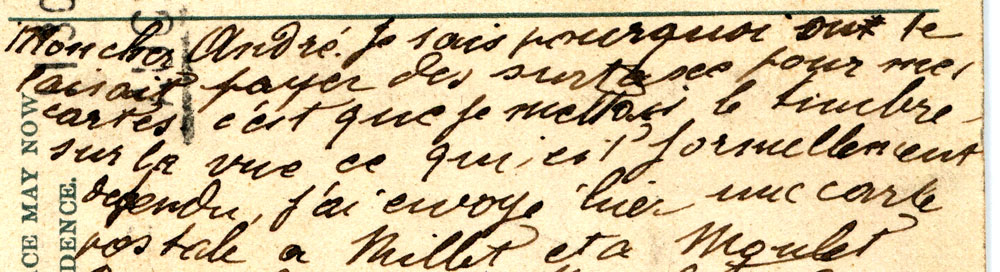
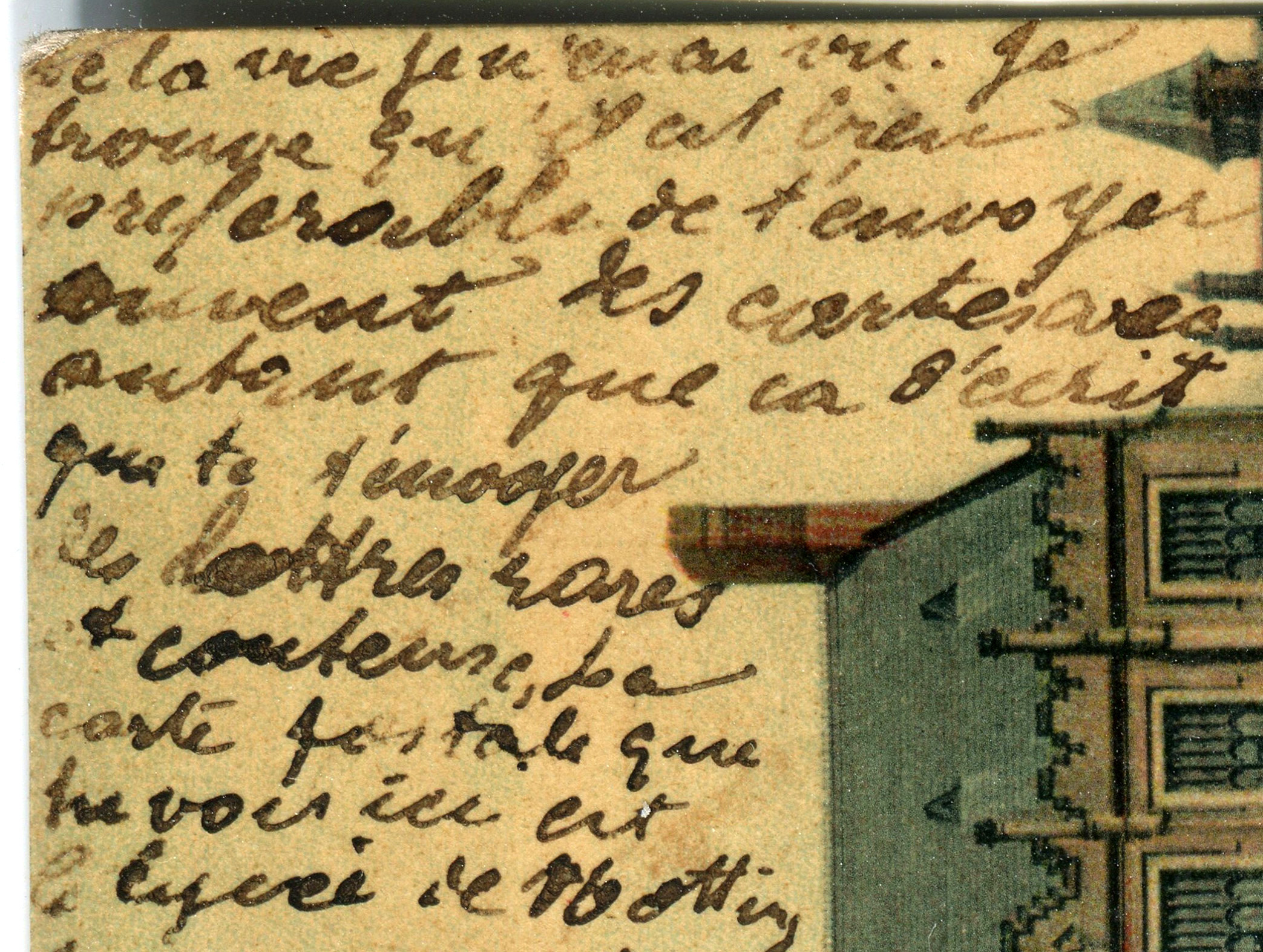
In actual fact, the beginning of the letter begins on the reverse of the postcard as the writer begins with “Mon cher André” because (did you realise it?) the correspondence is conducted in French. Here’s the first bit:

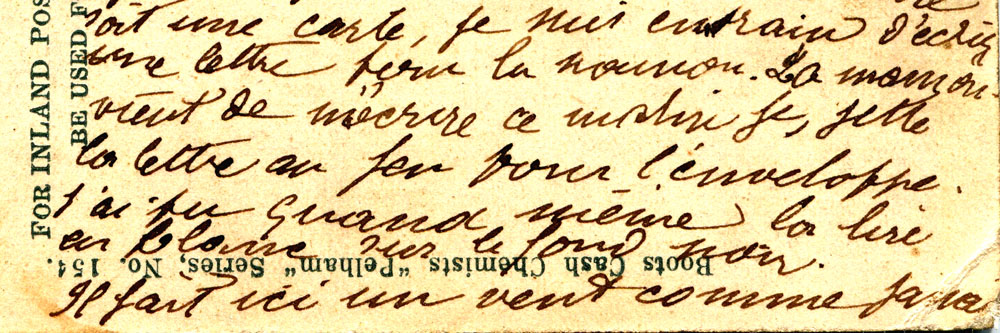
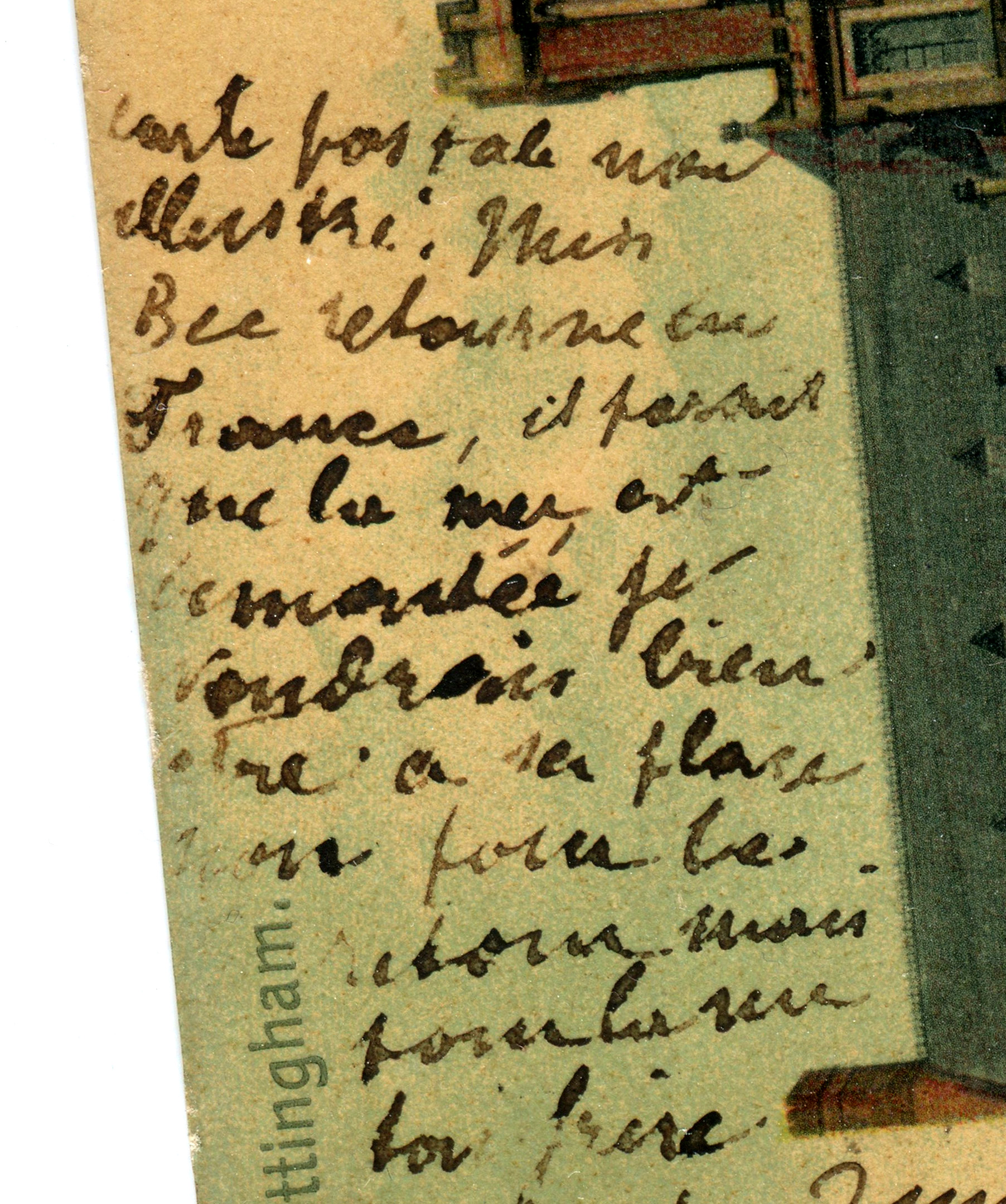
This second section ends with “une lettre”:

The third bit starts with “soit une carte” which goes with the end of the last line of the second section, which ends with “soit une lettre”.

This last bit then links up with the front of the card with the view of the School. Hopefully, somebody out there will be expert enough to read this French missive. I found it rather difficult, because I was never able to decipher a sufficiently long run of words to extract much in the way of meaning.

The card was addressed  to Monsieur André Mallieu. The next line is “Caporal avec le 4 ème Génie 14/2” which means “Corporal with the Fourth Engineers”. The Little Corporal is based at Grenoble in Isère in France. Tne date is difficult, if not impossible to read. It was probably not written in wartime though, because the stamp shows Edward VII who died  (“qui s’est poppé les clogues”) in 1910.

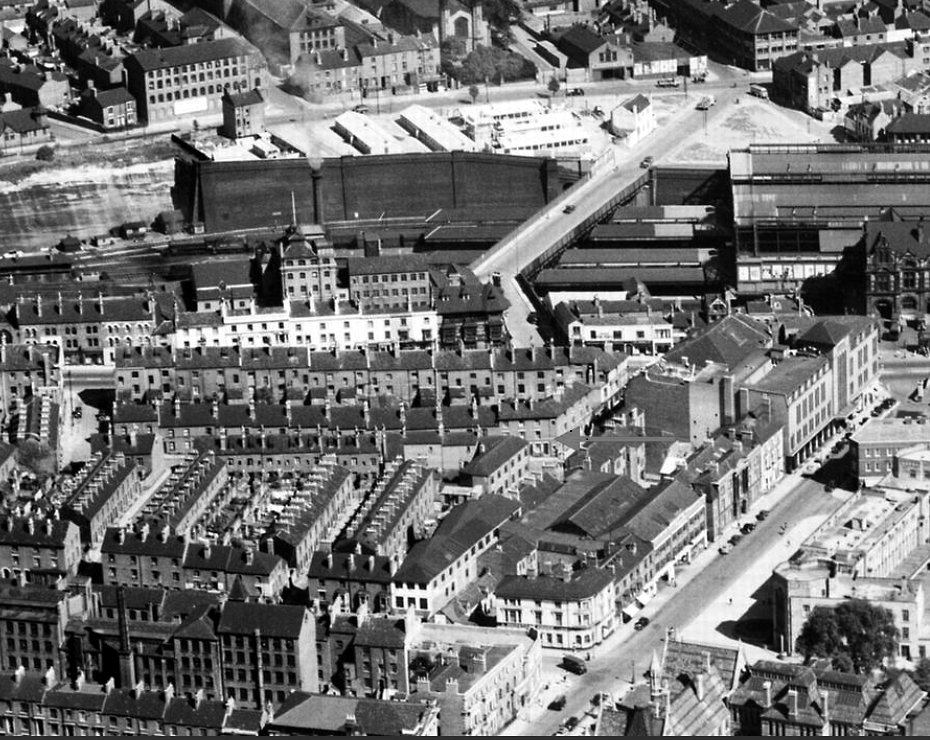
I’m always amazed at how different the past is. Just look at this amazing photograph of Nottingham I found on the Internet. Notice the Watson Fothergill pub called the “Yorker” or the “Rose of England”, on the right edge of the photograph. There’s Shakespeare Street and at the far end, the Victoria Station. To its left is the vast hole containing what was then a working station. And don’t miss the road suspended over the abyss. Just try to pick out any other landmarks you can identify:


23 Comments

Filed under France, History, Humour, Nottingham, Personal, The High School

Nottingham High School on ebay (6)

My last two posts in this series are a little bit out of the ordinary, perhaps. I bought this postcard on ebay. It is very strange to say the least:

The post card has been coloured beautifully and it is interesting to note the wonderfully delicate fence, the gas light and a shrubbery that the Knights who say “Ni” would be proud of. The full set of chimneys and pinnacles are there and, back left, is Dr Dixon’s house and back right is Brincliffe School, both of which were still standing when I started in the High School in 1975. But what about all that writing?

Well, I’ve spent some time working on it, and here are my enlargements, in order, from the top right to top left. Here’s No 1:

And No 2:

And No 3:

And No 4:

Why not have a go at trying to read it? Writing like this was fairly common practice in the last century. To save money, particularly money spent on mere paper, people would frequently write on it twice, once horizonally, and once vertically. That must have been a little difficult to read !

33 Comments

Filed under Football, France, History, Nottingham, Personal, The High School