Tag Archives: Das Fliegende Schtachelschwein

The Murder of Leslie Howard (6)

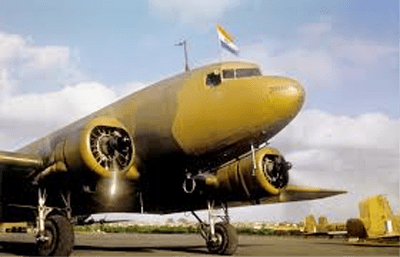
Leslie Howard was such a Hollywood star that we always think that he was the sole cause of  the BOAC airliner “Ibis” being shot down. The aircraft was actually owned by the Dutch, hence the flag on the top of the fuselage. I don’t quite understand how or why, but somehow BOAC were using a foreign airliner to fly some of their run-of-the-mill European trips, and the aircraft remained, throughout, Dutch property with an all-Dutch crew:
Could any of the other people on the plane, though, be the reason for the unexpected arrival of those eight heavy German Ju-88 fighters?

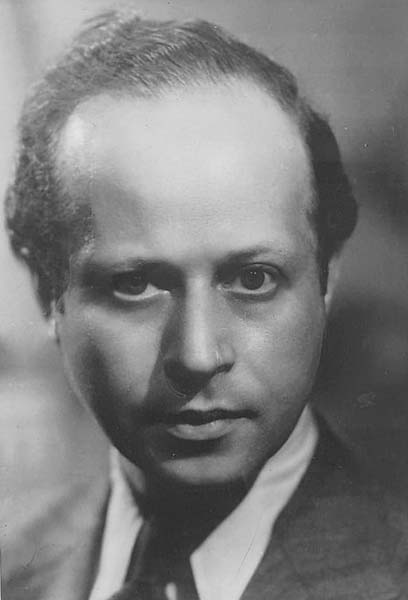
Perhaps the BOAC aircraft was destroyed because of Wilfrid Jacob Berthold Israel, a supposed British secret agent and a prominent Zionist, who was engaged in making sure that Jewish refugees could leave Spain and Portugal without difficulty to go to their rightful homeland. So far, he had helped 1500 of them, many of them children, to go there. Supposedly, Wilfrid had recently presented to the British government a very important proposal to solve the problem of getting Jewish refugees out of Europe to their homeland in Palestine. He was on his way to discuss increasing this exodus with Government ministers in London.  Here’s Wilfrid:
Perhaps the reason for the plane’s destruction was Ivan James Sharp, a mining engineer.  He was working for the British Government to offer the Portuguese and Spanish top prices for their tungsten, a hard, rare, metal used to produce various alloys and steels for weapon production. Also called “wolfram”, it was indispensable if you intended to manufacture armaments. Sharp had been trying to buy up 100% of the tungsten produced by Spain and Portugal. He was on his way to an important meeting at the Ministry of Economic Warfare.  I couldn’t find a picture of Ivan, but he began his career at the Camborne School of Mining in West Cornwall. They have a lovely example of a modern coat cof arms:

Perhaps the plane was destroyed because of Tyrrell Mildmay Shervington. Outwardly he was the Lisbon manager of the Shell-Mex oil company but, in the shadowy world of espionage, he was supposedly an agent of the Special Operations Executive. He was deeply involved in all of its many machinations across both Spain and Portugal and, according to some, he was the Head of the Lisbon Office.

Perhaps the plane was destroyed because of Francis German Cowlrick, a 67 year old civil engineer. He had worked for Babcock and Wilcox since 1905. Babcock and Wilcox made steam boilers, piping for steam, water tube boilers and welded pressure vessels, in short, as they said in an advertisement in 1937, “Everything for the Boiler House, including Valves”. They also produced electric cranes and pressed steel forgings. They manufactured munitions and tanks and boilers for Royal Navy warships. Mr Cowlrick was the manager and chief engineer for the company in Spain and Portugal. He was personally responsible for the designing and erection of a number of impressively large steam-generating plants in Lisbon, Madrid and half a hundred other places in Iberia. On this particular day he was travelling on behalf of the British Department of Overseas Trade. Here is one of the huge number of  Babcock and Wilcox factories which are situated all over the world. They are a truly gigantic, global concern:

Most of ther other passengers were ostensibly much more innocent. There was Mrs Rotha Violet Lettie Hutcheon and her two daughters, Petra Hutcheon, aged eleven, and Carolina Hutcheon, a baby some eighteen months old. Mrs Hutcheon was flying to rejoin her husband Allen, in England where he was a staff officer in the Imperial General Staff.

Mrs Cecelia Emilia Falla Paton was travelling back to England to start a new post as a secretary. She was the wife of James Paton of 53 Ullswater Road, Flixton in Greater Manchester. Kenneth Stonehouse, a British journalist, was working as the Reuters correspondent in Washington DC. He was accompanied by his wife Evelyn Peggy Margetts Stonehouse.

There were certainly no tourists in the aircraft. Everybody seems to have had a specific reason for being on board the “Ibis”.

It  is even possible to argue that the entire event was completely accidental. There doesn’t always have to be a conspiracy theory to explain everything that happens to famous people such as Leslie Howard.

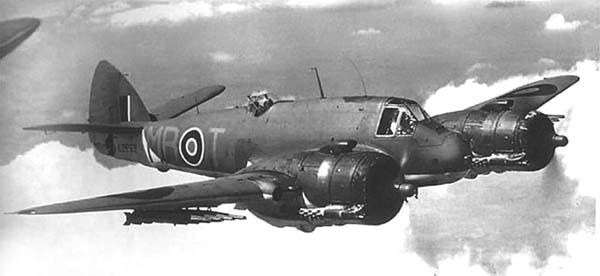
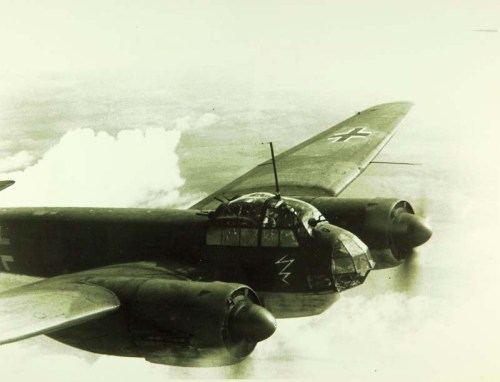
For example, was it actually normal for the Luftwaffe’s Junkers  Ju88 fighters to patrol the Bay of Biscay in small groups? Were they so frightened of the RAF’s formidably powerful Bristol Beaufighter?

Or were the Germans still haunted by the bogey man of their worst nightmares, Das Fliegende Schtachelschwein?
Or perhaps we should accept as the true, the story told by the senior officer in the German fighter formation, Oberleutnant Herbert Heintze, who said that he had decided to shoot the plane down before the eight German aircraft ran out of fuel? Do you accept his word that they thought it was a bona fide warplane? After all, the DC-3 was camouflaged like a military aircraft. Why was the aircraft not silver or white? After all, it was an airliner. Why did it not have neutral markings? A green cross on a white circle. Why no Portuguese or Dutch insignia? One further complaint from German pilots was that their Luftwaffe superiors knew very well that this airliner made a regular flight from Portugal to England but they had not bothered to tell them. If they had known this, Heintze said, they would not have shot the aircraft down but they would have escorted it back to their own base in France. Whatever the solution, BOAC issued the following statement:

“The British Overseas Airways Corporation regrets to announce that a civil aircraft on passage between Lisbon and the United Kingdom is overdue and presumed lost. The last message received from the aircraft stated that it was being attacked by an enemy aircraft. The aircraft carried 13 passengers and crew of four. Next of kin have been informed.”



10 Comments

Filed under Aviation, Film & TV, History, military, Politics

The Murder of Leslie Howard (2)

Last time, we read the most widely accepted version of the shooting down and killing of Hollywood star, Leslie Howard, by eight Luftwaffe Junkers Ju-88 heavy fighters:

Those two outstanding German authors, Sönke Neitzel and Harald Welzer, though, tell a much blacker story of the destruction of BOAC’s Dakota DC-3 “Ibis” in their recent book “Soldaten”.

………….During the war, the conversations of German POWs were recorded without their knowledge by their British captors. One of two prisoners in a particular prison camp near London had actually been in one of the Ju88s which had shot down Howard’s Flight 777:

His name was Dock and he said:

“Whatever crossed our path was shot down. Once we shot down – there were all sorts of bigwigs in it: seventeen people, a crew of four and fourteen passengers; they came from London. There was a famous English film-star in it too; Leslie Howard. The English radio announced it in the evening.

Those civil aircraft pilots know something about flying! We stood the aircraft on its head, with the fourteen passengers. They must all have hung on the ceiling! (Laughs) It flew at about 3200 meters. Such a silly dog, instead of flying straight ahead when he saw us, he started to take evasive action. Then we got him. Then we let him have it all right! He wanted to get away from us by putting on speed. Then he started to bank. Then first one of us was after him, and then another. All we had to do was to press the button, quietly and calmly. (…..laughs…)……It crashed…. They were all dead. Those fools don’t try to make a forced landing, even if they can see that it’s all up with them.”
The Allies proclaimed the act a war crime, and so too did a large number of neutral countries. After all, the Germans had shot down an aircraft which belonged to a neutral country (the Netherlands).

Not all of the names of the Ju 88 pilots who carried out this war crime have survived the Nazis’ frenzied burning of their own archives and records, but among the guilty men were:

Oberleutnant Albrecht Bellstedt, Staffelführer Oberleutnant Herbert Heintze, Oberfeldwebel Hans Rakow, Leutnant Max Wittmer-Eigenbrot

Bellstedt and Wittmer-Eigenbrot were both killed in the war, the others I have not been able to trace. No more BOAC daytime flights from Lisbon took place until the end of the war.

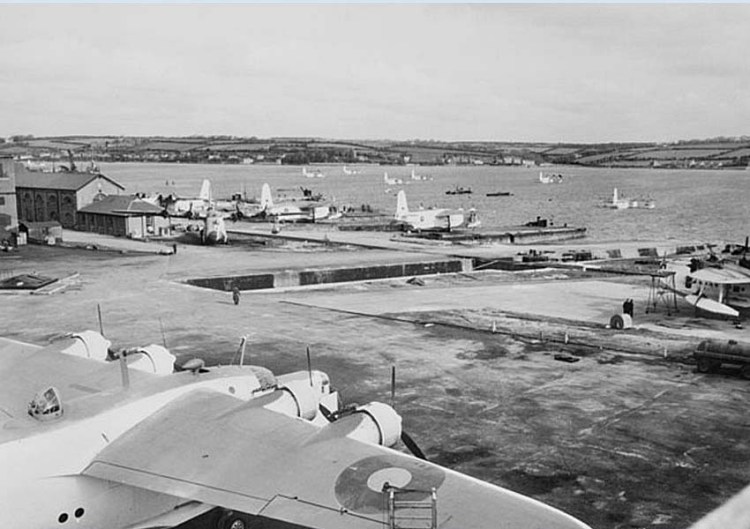
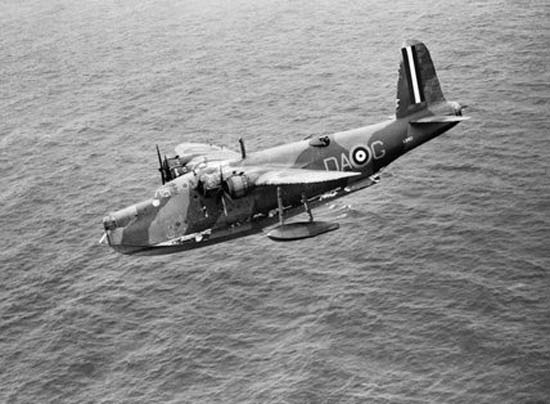
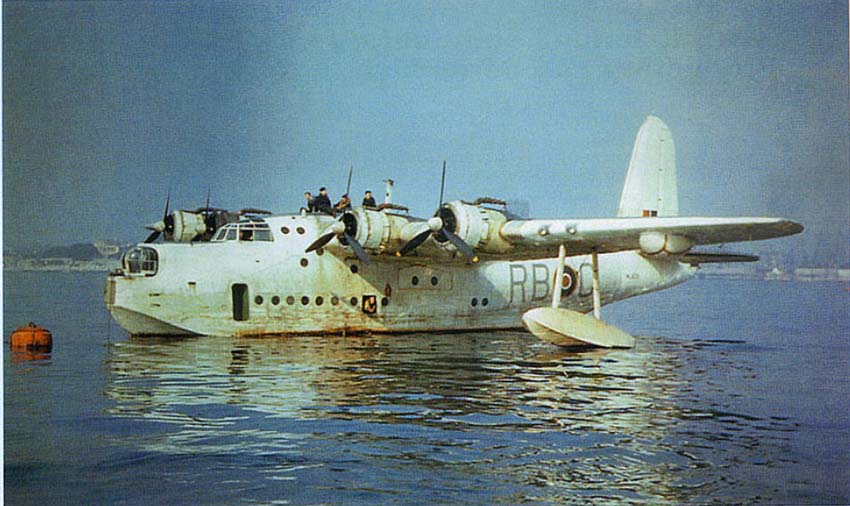
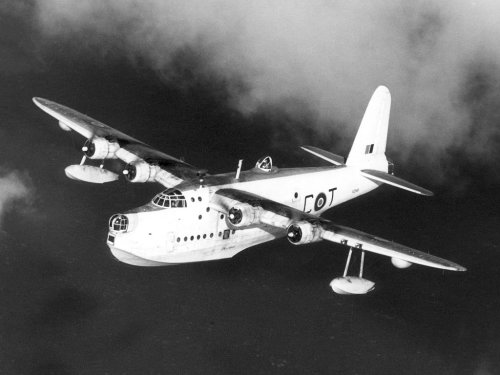
The flights which did take place were all at night, over a totally different route, completely beyond the range of a Ju-88. The British authorities responded to the DC-3’s failure to arrive by despatching a Short Sunderland GR3 flying boat to look for it. The aircraft, EJ134, was piloted by the brave Australians of 461 Squadron. The crew was James (Jim) Collier Amiss, Wilbur James Dowling, Alfred Eric Fuller, Ray Marston Goode, Albert Lane, Edward Charles Ernest Miles, Harold Arthur Miller, Kenneth McDonald Simpson, Philip Kelvin Turner, Colin Braidwood Walker and Louis Stanley Watson. Here’s a picture of RAAF 461 Squadron, looking for all the world like a flock of gigantic white geese:

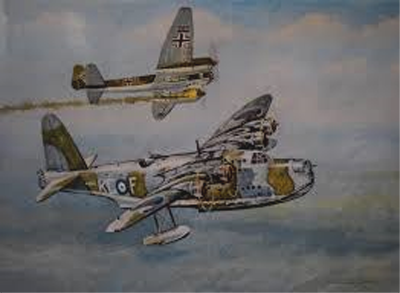
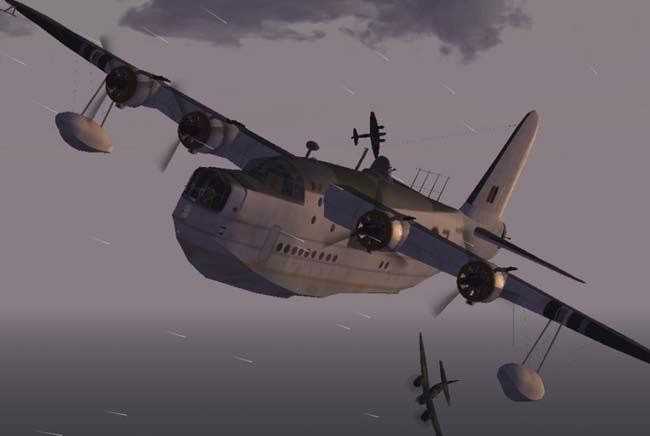
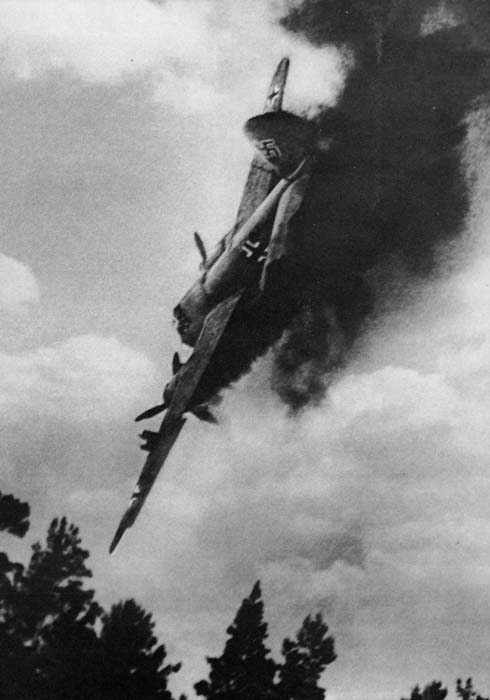
The Australians found nothing whatsoever on the surface of the sea, but they did find the very same group of eight Ju88C-6s that the DC-3 had already met, at more or less the very same place where it had met them. Sunderland EJ134 and its crew then won their place in aviation legend. In a prolonged battle, the flying boat lost one engine and its tail turret. Messrs Dowling, Goode, Miller, Simpson and Walker were all injured and poor Ted Miles (27), one of the two side gunners, was killed. They did manage, though, to shoot down three of the eight German fighters. Of the other five, only two made it all the way back to Bordeaux. The other three were never heard of again. Six out of eight shot down. That should teach them not to attack unarmed airliners flying from neutral countries.

Overall, the Germans were very wary, if not simply afraid, of the Sunderland flying boat. It was an extremely heavily armed aircraft and a formidable opponent.

No wonder they called it

“Das Fliegende Schtachelschwein”, the Flying Porcupine”
This phrase  has proved particularly useful in all of my many trips to Germany, especially those to Berlin Zoo. And one day, when I ask for a cocktail called “A Flying Porcupine”, the barman will know how to make it!

14 Comments

Filed under Aviation, Film & TV, History, military, Politics, war crimes

The Murder of Leslie Howard (1)

A couple of years ago, I wrote a series of blogposts about the Short Sunderland flying boat. In at least one of them, I talked about how a civilian airliner, with the film star Leslie Howard on board, was shot down over the Bay of Biscay on June 1st 1943. Howard, and the crew and all of the other passengers were killed.  I mentioned those events because, the following day, a Short Sunderland was sent out to look for the missing airliner. They didn’t find it, but they did find the eight German fighters which had shot down the BOAC Douglas Dakota DC-3. There then ensued one of the legendary battles of the Second World War as the Sunderland fought off a pack of Junkers Ju88s. That particular series of blog posts, though, concentrated on the Short Sunderland flying boat and the Junkers Ju88 long distance heavy fighter.

This series of blogposts which begins today, however, concentrates not on the aircraft involved, but instead the still unanswered question of……….

“Why did the Germans have to destroy that airliner ?”

And first of all, let’s take a look at the man who is usually put forward as the prime suspect for the reason that the Dakota had to be destroyed……..

Leslie Howard was a film star who starred in “Pimpernel Smith”, “The First of the Few”, “Of Human Bondage” and most famous of all, “Gone with the Wind”, a huge smash hit in 1939. Here he is in “Journey’s End”:

Howard’s father was Ferdinand Steiner, a Hungarian Jew, and his mother was Lilian Blumberg, from an English Jewish family of German origin. Howard had originally styled himself Leslie Stainer in an effort to anglicise his real name of Leslie Howard Steiner, but eventually he decided on the name by which he is known nowadays.

On June 1st 1943, Leslie Howard was in Lisbon, the capital of Portugal, with his business manager, Alfred Chenhalls. They intended to take the civilian passenger aircraft of KLM Royal Dutch Airlines which, even in wartime, made a regular morning run between Portela Airport to the north of neutral Lisbon and Whitchurch Airport near Bristol in England. Neither Howard nor Chenhalls had tickets, so two passengers were turned off the aeroplane to make room for them. The lucky two were a little boy called Derek Partridge and his nanny called Dora Rove. Or, in another story, one of the two passengers was a Catholic priest, Father Holmes. Or perhps the lucky two were George and William Cecil, recalled from their boarding school in Switzerland.

There is a story that the take-off was delayed while Howard went to collect a small parcel full of silk and nylon stockings, a present, perhaps, for his wife and daughter. While filming, Howard was pretty much a serial adulterer, who said….

“I never chased women but I couldn’t always be bothered to run away”

The aircraft was a Douglas DC-3-194 called “Ibis” with the civilian letters G-AGBB. Here it is, complete with its Dutch flag:The aircraft had hardly ever been impeded by the Luftwaffe on its 1,000 mile, seven hour, flight:

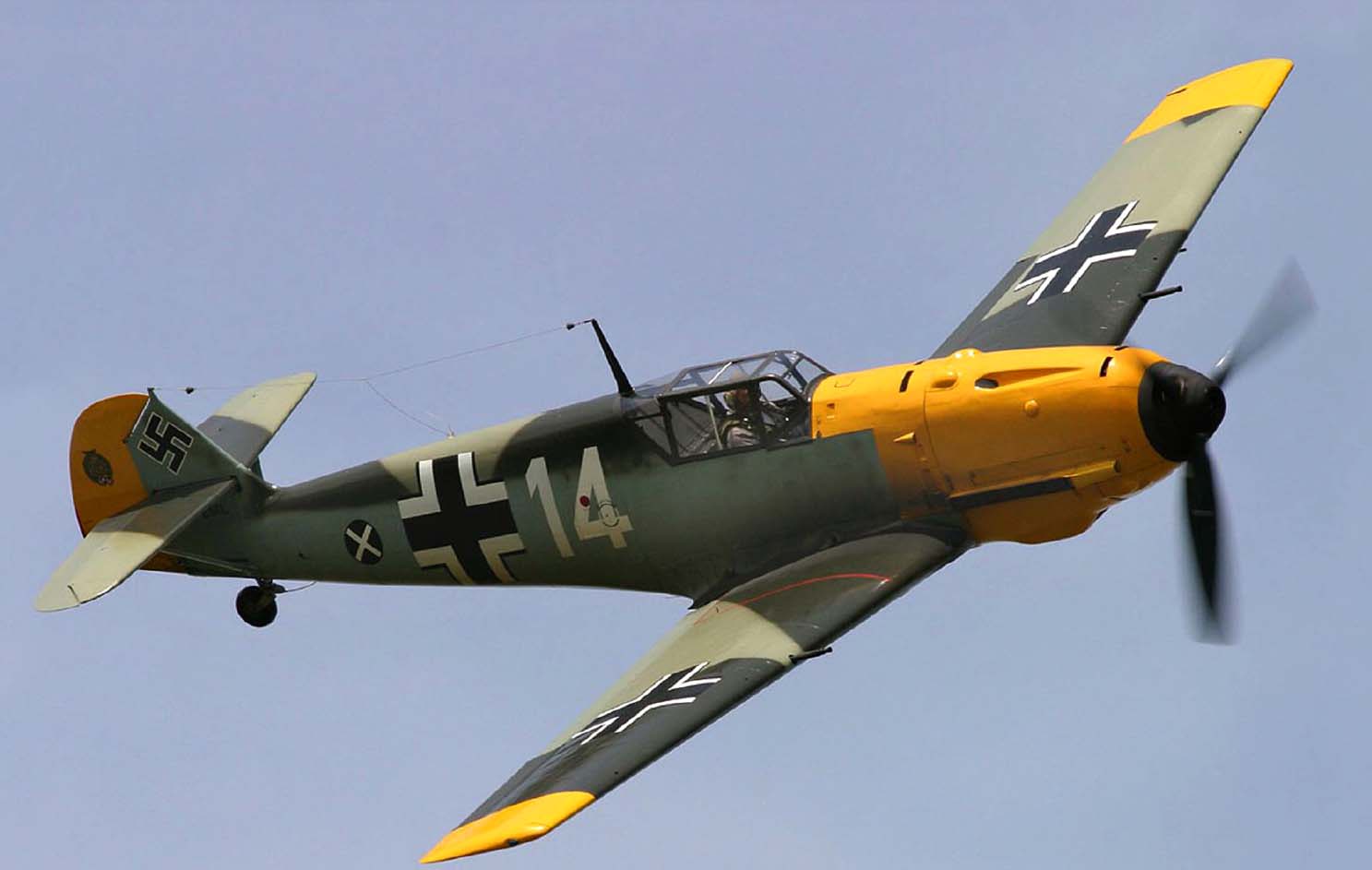
In actual fact, though, the Germans had already attacked the aircraft on two occasions in the previous six months. On November 15th 1942, it had been challenged by a single Messerschmitt Bf110 Zerstörer heavy fighter and on April 19th 1943, it had been ambushed by a patrol of six Bf110s. Here’s the nightfighting version of the Bf-110. The Zerstörer heavy fighters would have lacked the radar antennae….

On both occasions, the camouflaged airliner escaped a watery grave. The first attack involved a party of very high ranking American Eighth Air Force officers which included Ira Eaker. They were saved when the Bf110’s engine caught fire as it attacked. Everybody in the airliner, both passengers and crew, was terrified. In the second attack, the pilot, Captain Koene Dirk Parmentier, dropped down to the waves and then climbed steeply into the thick low clouds.

On the other hand, though, the trip had been made more than 500 times between 1939-1943 without the slightest problem.

On this occasion, though, just after midday, they were shadowed  initially by two Junkers Ju 88s over the countryside of northern Portugal and then of north-western Spain. They broadcast a message “we are being followed by enemy aircraft” and then “we are being shadowed”.

At around 12.45 pm eight different Junkers Ju88C-6 fighters of Gruppe V / Kampfgeschwader 40 spotted the “grey silhouette” of the DC-3. The Ju88s were flying with six aircraft abreast, fifty yards or so apart, with another two flying above them and acting as “spotters”. They had apparently been told to look for a twin engined grey aircraft. Their commander, Oberleutnant Heintze, had been told to carry out rigorous patrols during June and to shoot down the aircraft they found. This is a Junlers Ju-88 heavy fighter:

The Ju88s attacked the airliner at between 6,000-10,000 feet over the Bay of Biscay some two hundred miles north of the Spanish coast. One of the pilots, Oberleutnant Albrecht Bellstedt, radioed to his companions: “Indians at 11 o’clock, AA”. This meant enemy aircraft ahead, slightly to the left, attack, attack. One fighter came in from above and one from below. With their heavy calibre cannons, they set the Dakota’s port engine on fire and this then spread to the wing. A radio message was picked up from the wireless operator, van Brugge: “I am being followed by a strange aircraft….Putting on best speed….we are being attacked by enemy aircraft….cannon shells and tracers are going through the fuselage…. Am wave hopping and doing my best.” Oberleutnant Heintze, however, drew level with the stricken aircraft and quickly realised that it was a civilian airliner. He immediately stopped the attacks. Three, presumably, crew members, jumped out of the DC-3, deploying their parachutes but they did not open as they were already on fire and all three fell to their deaths. The aircraft plummeted into the sea where the wreckage floated on the surface for a very short period and then sank. By one o’clock, all four crew members and all thirteen passengers, including Leslie Howard, had been killed.

The four members of the crew were the pilot, Quirinus Tepas MBE, the second pilot, Captain Dirk de Koning, Cornelis van Brugge, the radio operator, and Engbertus Rosevink, the flight engineer.

Whoever was their intended target, the Germans were certainly serious about killing him or her. They had sent eight twin engined heavy fighters from Gruppe V / Kampfgeschwader 40 in a deliberate attempt to intercept that lone Dutch aircraft. If they had come across it purely by chance then surely there would have been just a single fighter involved, at best two, surely not a group of eight. And after they had shot down the DC-3, the German fighters circled the floating wreckage and took photographs of the burning plane before it finally sank. You don’t do that with just any old aerial kill. It has to be done for a very special reason. But that reason has never been found.

Here’s Alfred Chenhalls, Old Nopttinghamian, and Leslie Howard’s business manager. And with a cigar in one hand, and a whisky in the other, he’s a Winston Churchill look-alike. Apparently…………..

Don’t forget, though. In this day snd age, it was by no means simple to identify a famous person. They might have seen them in the cinema, but apart from this, there were only newspapers, magazines and, most of all, the radio. The latter, of course, was useful only for voice identification!

28 Comments

Filed under Aviation, Film & TV, History, military, Politics, war crimes

Three war crimes, two Sunderlands and one Ashley Wilkes (7)

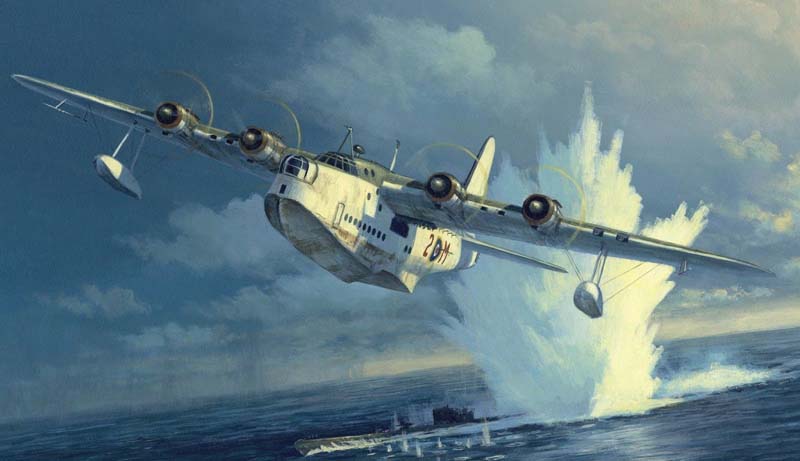
Last time I related how the crews of two Sunderland flying boats, having spent the entire war without seeing a single U-boat, found two German submarines on their way to surrender and sank both of them. I used two pictures borrowed from the Internet. One was a beautiful painting:

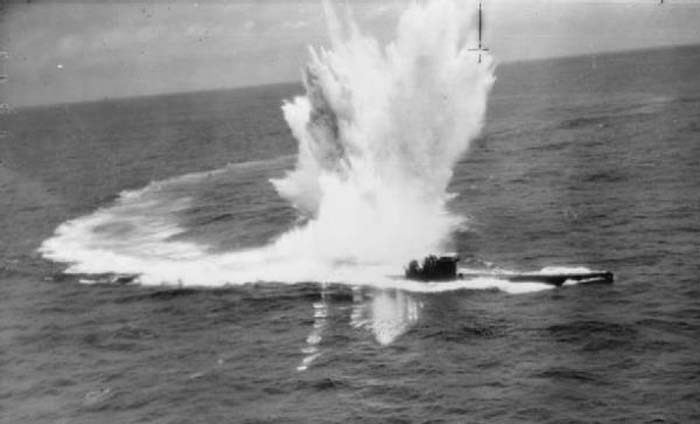
And the second was a genuine black and white photograph:

The Coastal Command airmen that Fred had met in the pub, probably in north Scotland, explained to him that they sank the two U-boats because they had spent so many hundreds, if not thousands, of hours of their young lives out on dreary patrols over the cold grey waters of the Atlantic. They had risked their lives in the pursuit of an enemy that they had never ever seen, as he hid in the cold grey metal waters of the Atlantic and emerged only at night. In similar fashion, Fred himself had never ever seen a German aircraft in combat during any of his nineteen missions. And even if they never saw a submarine, flying for ten hours over the cold grey featureless ocean is not without its dangers:


Most of all, these young men knew that they had wasted their youth, the best years of their lives, pursuing not pretty young girls at the village dance, but elusive submarines in the featureless cold grey seascape of the Atlantic Ocean. And it was revenge for this irreparable loss of their youth that they sought. If the RAF lads had a six or seven year gap in their young lives, then the Germans, who had now started their second major global war in twenty years, would not be allowed to have the rest of their own lives, certainly if the RAF had anything to do with it:

Sinking a U-boat which was on its way to surrender, after the end of hostilities,  was, of course, a war crime.

“Thou shalt not kill” the Good Book says, although the original words of the Torah, “לֹא תִּרְצָח”, should really be translated as “Thou shalt not murder” rather than our rather wishy washy “Thou shalt not kill”. And this was indubitably murder, so it was a war crime, although in many ways it was an understandable one.

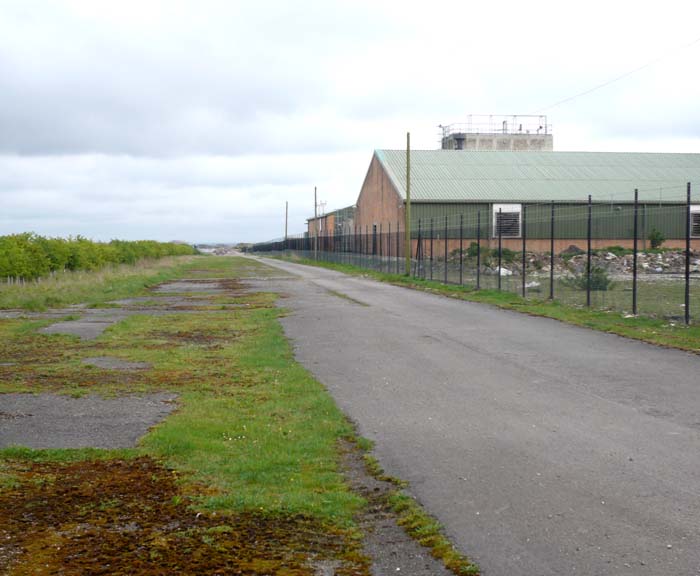
It was the waste of so many years of their short lives that had finally got to them. Fred himself very much resented the years that he had spent “stuck in a Nissen hut in the middle of nowhere.” He was stationed at one stage at Elsham Wolds which was not a particularly beautiful or interesting place. It must have provoked great boredom and frustration among the hundreds, if not thousands of young men who were all forced to be there. Here’s the old runway, with its present-day green half and its grey half:

severn trent

Yet despite their boredom and their frustration, these young men would all have felt raw naked fear for much of the time. They knew that they were laying their own young lives on the line pretty much every single day.

My Dad told me that the only things that got him into that Lancaster were the fear of being thought a coward, and the fact that the crew all depended on each other and were all in it together:

Because of his never ending fear, like thousands of other combattants, Fred also despised the comfortable lives of many of the older people in the area where he was born and where he spent the majority of his leaves. They lived out their humdrum existences without any risk whatsoever, while young men in their early twenties were killed in large numbers every time there was a raid. The contempt Fred felt was, of course, just a measure of his own fear, at the possibility of having to fly over burning Berlin, or some other heavily defended Bomber Command target:

Having joined the RAF as a volunteer on September 29th 1941 at the age of nineteen, Fred expected to return home in May 1945. Alas, he wasted yet more time after the end of the war.

Fred was eventually discharged from the RAF well after the date when his favourite team, Derby County, whom he followed for more than seventy years, won the FA Cup for the only time in their history. Fred missed the game as he was “busy, doing nothing” with the RAF:

Fred eventually left the Second World War on November 19th 1946, after just over five years. Not much in a lifetime of over eighty years, but as he himself was never slow to explain in later life, these were potentially “the best years of my life”.

15 Comments

Filed under Aviation, Bomber Command, Criminology, History, Personal, Politics

Three war crimes, two Sunderlands and one Ashley Wilkes (5)

Last time we were looking at how the English film star, Leslie Howard, was killed when the aircraft he was in, a DC-3 Dakota, was shot down over the Bay of Biscay, by the Luftwaffe.

That Dakota, though, was actually completely unarmed and it was no match whatsoever for a single Junkers Ju88, let alone a group of eight of them. As well as being unarmed, it was also registered in a neutral country (the Netherlands) and flying from a neutral country (Portugal) to England.

Nobody took very much notice of this at the time, but, because of these seemingly innocuous details, the entire episode therefore crossed the line of human decency and became a war crime. Here’s the DC-3 in question. Note the Dutch flag, with the prominent orange:

In the immediate aftermath of the DC-3’s failure to arrive in Bristol, the British sent out a Short Sunderland GR3 flying boat to look for it on the following day (June 2nd 1943):

The aircraft carried the serial number EJ134 and it was piloted by the brave Australians of 461 Squadron. The crew was James (Jim) Collier Amiss (Second Pilot), Wilbur James Dowling (First Pilot), Alfred Eric Fuller (First Wireless Operator / Air Gunner), Ray Marston Goode (Tail Gunner), Albert Lane (Third Wireless Operator / Air Gunner), Edward Charles Ernest Miles (First Flight Engineer), Harold Arthur Miller (Second Wireless Operator / Air Gunner), Kenneth McDonald Simpson(Navigator), Philip Kelvin Turner (Second Flight Engineer), Colin Braidwood Walker (Captain) and Louis Stanley Watson (Rigger).

The flying boat found nothing whatsoever on the surface of the sea, no wreckage at all. What they did find though, were surely the very same eight Ju88C-6s that Leslie Howard had already met, at more or less the very same place where they had met them. Sunderland EJ134 and its crew then won their place in aviation legend. In a prolonged battle, the flying boat lost one engine and its tail turret. Messrs Dowling, Goode, Miller, Simpson and Walker were all injured and poor Ted Miles, one of the two side gunners and just 27 years old, was killed. The battling Aussies did manage, though, to shoot down three of the eight German fighters:

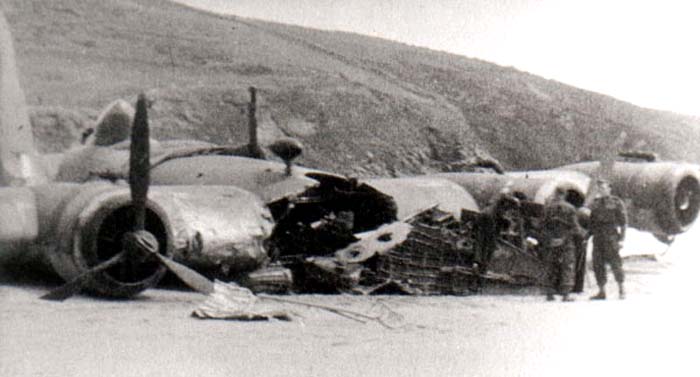
Of the other five, only two made it all the way back to Bordeaux. The other three were presumed to have crashed into the waves as they were never heard of again. Six out of eight shot down. That should teach them not to attack unarmed airliners flying from neutral countries. The now shot to pieces and extremely battered Sunderland EJ134 made it the 350 miles back to western Cornwall, not to Penzance, but only as far as a beach on the south Cornish coast, at Praa Sands:

The fierce Atlantic waves, however, ultimately smashed it to smithereens:

Young Ted Miles, just 27 years old, was buried at Pembroke Dock Military Cemetery joining 72 more casualties, 40 from World War I and 32 from World War II, including five Australians. On his grave his parents had written:

“There is no death: our stars go down to rise upon some fairer shore”.

The family came from Brixton in London. Ted’s parents were Edward Charles Miles and Florence Mabel Miles. His young wife was Frances Margaret Miles.

Around eight weeks later, virtually the same 461 Squadron crew was lost without trace out on patrol over the Bay of Biscay on Friday, August 13th 1943 in a Short Sunderland Mk III, serial number DV968. The last message that they transmitted was that they were being attacked by six Ju88s. The victory was claimed by Leutnant Artur Schröder so this particular incident may not have been exclusively carried out by members of the original eight, especially as Schröder was in 13 / KG40, not V/KG 40:

The men from EJ134 who were killed in DV968 were Wilbur James Dowling (34), Alfred Eric Fuller (20), Ray Marston Goode (34), Albert Lane (27), Harold Arthur Miller (23), Kenneth McDonald Simpson (28), Philip Kelvin Turner (26) and Louis Stanley Watson (25). The new members of the crew who died were David Taylor Galt (28), James Charles Grainger (24) and Charles Douglas Leslie (Les) Longson (20). Not flying that day were James (Jim) Collier Amiss and Colin Braidwood Walker from the original “Flying Porcupine”, Sunderland EJ134. Both men would survive the war and go home to Australia. Hopefully, they lived out very long and happy lives. Perhaps they followed a sports team:

Or perhaps they preferred the beach:

16 Comments

Filed under Aviation, Cornwall, Criminology, History, Personal, Politics

Three war crimes, two Sunderlands and one Ashley Wilkes (4)

Last time I was explaining the connection between the Short Sunderland flying boat and “Das Fliegende Schtachelschwein”, “The Flying Porcupine”:

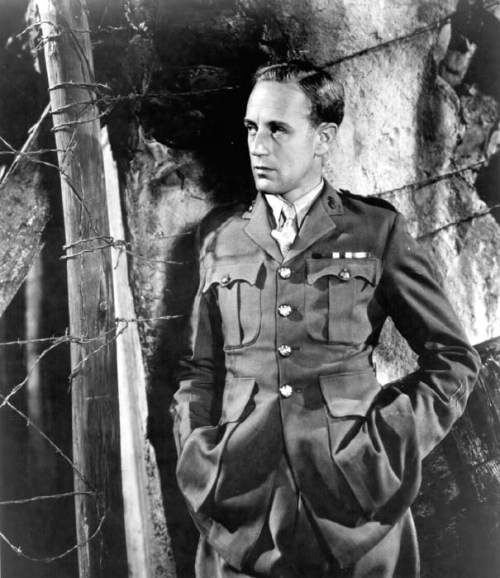
I promised that I would show you the connection between this spiny porcine killer and Leslie Howard, a suave, sophisticated English actor, who used to boast that he “didn’t ever chase women but couldn’t always be bothered to run away from them”. Here he is in “Journey’s End”:

I recently watched an excellent documentary film about Howard. It was called “The Man who gave a Damn”:

The film was about the life, and particularly the death, of the famous film star, the actor who had played Ashley Wilkes in “Gone with the Wind” only two years before his death. Cue film extract:

Leslie Howard was English and he did not hesitate to stand up for the values of our country and those of our friends and allies. He did not hesitate to name and shame.

In one of his films made after “Gone with the Wind”, he speaks of the Germans’ aims:

“Every day reveals the utter and desperate determination to smash us to bits, root and branch, to wipe out every trace of democracy.”

But we English and Americans are better than the Germans, as he says in “From the Four Corners” (1941) as he addresses troops from the USA who have just arrived in England:

“And so our fathers’ minds crept along and their ideas of justice and tolerance and the rights of man took shape in the sunlight and the smoke, sometimes standing still, sometimes even slipping back, but slowly broadening with the centuries. Some of those ideas are written down in the constitutions of our commonwealth and some are unwritten. We just try and carry them in our hearts and in our minds. Perhaps the men who came nearest to putting them into words were those Americans, many of them the sons of British pioneers, who, founding an independent nation, proclaimed:

“We hold these truths to be self-evident, that all men are created equal, that they are endowed by their Creator with certain unalienable Rights, that among these are Life, Liberty and the pursuit of Happiness.”

Those words and that spirit were born and nourished here, and your fathers carried them to the ends of the earth. They are our inheritance from the past, our legacy to the future. That’s why you came here – to defend them.”

The documentary film was made by Derek Partridge, now an old man, whose young life was inadvertently saved by Leslie Howard. Here’s Derek:

On June 1st 1943 Derek and his brother were asked to give up their seats on an airliner travelling on the Lisbon-Bristol route, to allow Leslie Howard to get to a London film premiere on time. The two boys survived because they were not on the aircraft, a Dutch owned BOAC Douglas DC-3 Dakota, when it was shot down into the Atlantic Ocean. This war crime was carried out by eight Junkers Ju88C-6 fighters of Gruppe V / Kampfgeschwader 40. V/KG 40 was a heavy fighter unit which dated from 1942, when it was set up to intercept the bombers of RAF Coastal Command. It was the only long range maritime fighter unit the Luftwaffe ever had. The RAF answered them with firstly the Bristol Beaufighter and then the Mosquito. Here is a lovely shot of the aircraft of V/KG 40 in flight:

And here is a Bristol Beaufighter, a very powerful and well armed fighter:

In the immediate aftermath of these events, the British responded to the DC-3’s failure to arrive in Bristol by sending out a Short Sunderland GR3 flying boat to look for it on the following day. Here we go. Ein fliegende Schtachelschwein:

Don’t worry. He’ll sort ’em out.


29 Comments

Filed under Aviation, Cornwall, Film & TV, History, Personal, Politics

Three war crimes, two Sunderlands and one Ashley Wilkes (3)

Last time I was explaining the connection between the Short Sunderland flying boat and “Das Fliegende Schtachelschwein” aka “The Flying Porcupine”.

This thorny porcine epithet comes from an aircraft which was based at Invergordon in north east Scotland in 1940. My story will be based primarily on the work of John Robertson in 2010. I had never heard any explanation of the nickname and it is a tale of heroism well worth telling and re-telling, believe me.

The particular Sunderland was N9046. It belonged to 204 Squadron and its squadron letters were KG-F. Here it is, although it seems to lack the KG-F:

The crew left their northern Scottish base on April 3rd 1940, tasked with carrying out a ten hours protection patrol, looking after a convoy bound for Norway. There was absolutely no sign of the enemy, until two Junkers Ju88s, probably from II./Kampfgeschwader 30, appeared at low altitude over the water, seemingly having arrived from a base in southern Norway, or perhaps in Denmark. Here is a nice Junkers Ju88 in full-ish colour:

And here’s the Airfix kit box:

Seeing the Sunderland, one of the two Ju 88s made a head on attack but the Sunderland’s front turret opened up and the two Junkers aircraft seemed to take flight into the leaden clouds. Here’s that front turret again, with its rather light .303 guns.:

Four more Junkers then attempted to attack the ships but they were driven off by the convoy’s various defences. Less than a quarter of an hour later, six Junker Ju88s came in, four of them almost certainly Ju88A-4s. Two of them came for the Sunderland which went right down to the water to make itself a more difficult target. That didn’t stop the Germans who both attacked fiercely, but the flying boat’s gunners drove them off and they eventually fled.

The situation had now become dramatic enough for it to form the basis of a modern computer game:

The other four Ju88s, having already released their bombs, then made a line astern attack on the Sunderland but the rear gunner, Corporal William Gray Lillie, with his slightly heavier 0.5 machine guns sent the first one spiralling in flames into the cold, cold waters of the North Sea. Ignore the trees. It’s actually seaweed:

Corporal Lillie blasted the second German in his port engine which was soon pothering black oily smoke and flames. The German pilot left for his land base in Norway, uncertain if he would reach it with only one engine performing properly. In actual fact, he was forced to crash land in the as yet unoccupied northern section of Norway where the crew were forced to set their aircraft on fire before being arrested and interned.

Rather imaginatively, the final two Ju88s then attempted to drop their bombs onto the Sunderland. They missed and finally cleared off home.

N9046 reached Scotland safely and had no problems until Wednesday,  December 11th 1940 when, riding at anchor in Sullom Voe in the Shetlands, it suddenly caught fire and was completely destroyed.

Here is brave Corporal Lillie:

Did he survive the war? Well, sadly, no. He was killed in combat on July 21st 1940, shot down by a Messerschmitt Bf109 of 8./JG77:

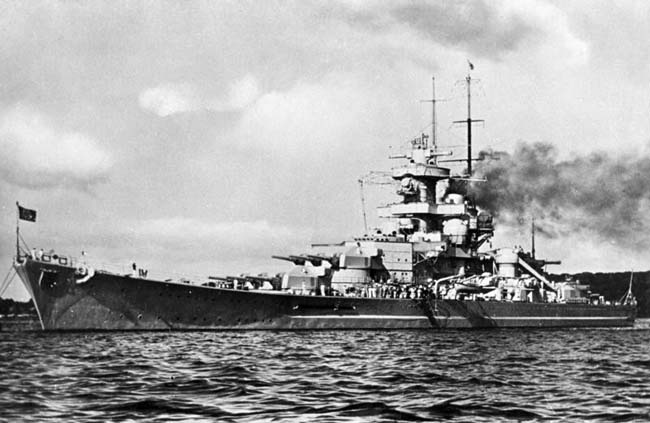
Corporal Lillie was the rear gunner in Sunderland N9028. They had been sent to Trondheim in Norway on a clandestine reconnaissance mission to check the submarine base and to see if the Gneisenau had left the port. Here it is:

Next time, I will show you how a suave English actor is connected to the Short Sunderland and, indeed, the Junkers Ju88.


24 Comments

Filed under Aviation, Cornwall, Criminology, Film & TV, History, Personal, Politics

Three war crimes, two Sunderlands and one Ashley Wilkes (1)

One of the world’s most bewitching aircraft is the Sunderland flying boat. When I was a boy, I never did save up enough pocket money for the Airfix kit, although it was only fifty pence or so in the 1960s. I should have bought it then, though. They’re fifty pounds now!

The Short S.25 Sunderland was a flying boat patrol bomber operated not just by RAF Coastal Command but also by the RAAF, the RCAF, the SAAF, the RNoAF and the Marinha Portuguesa. The last one’s a bit of a give away, but did you get all of the rest? This one’s Australian:

The Sunderland was designed and built by Short Brothers of Belfast, and the cynic inside me says that it was the only decent aircraft of their own that they made during the war. This model of the aircraft was numbered the S.25 because it was a warplane but it was a direct descendant of the S.23 Empire flying boat, the flagship of Imperial Airways. Here it is, a beautiful aircraft:

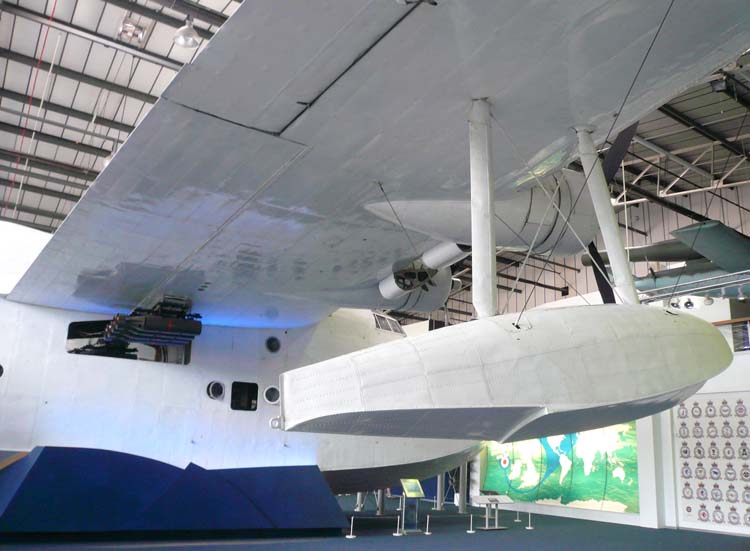
The new aircraft S25 was very well designed for its purpose. The Sunderland had a wingspan of 112 feet, a length of 85 feet and a height of 32 feet. It was a big aeroplane! Even the stabilising floats on the wings were as big as a rowing boat or a small plane. Compare one of them with the man with a pram, and the Walrus behind them both:

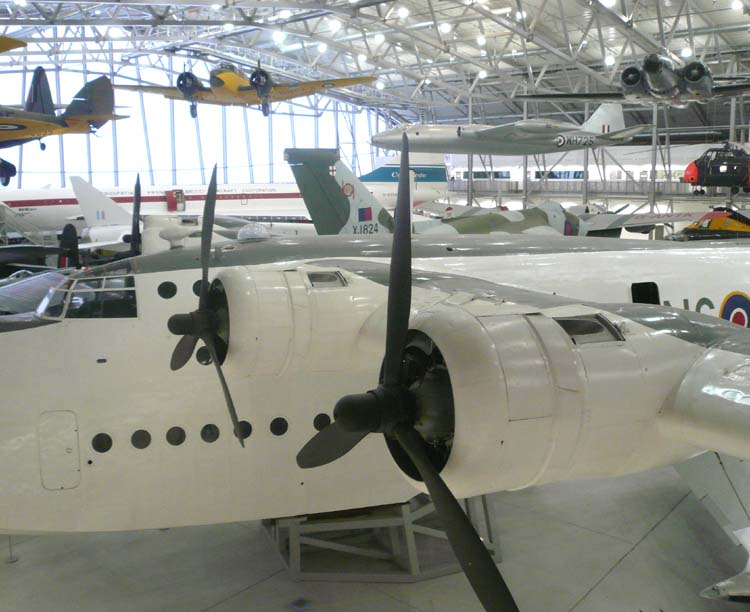
A Sunderland had four Bristol Pegasus XVIII nine-cylinder radial engines which gave it a total of 4,260 horse power:

And those powerful Pegasus engines gave it a range of around 1800 miles at a cruising speed of 178 mph Don’t fly too fast when you’re doing maritime reconnaissance!

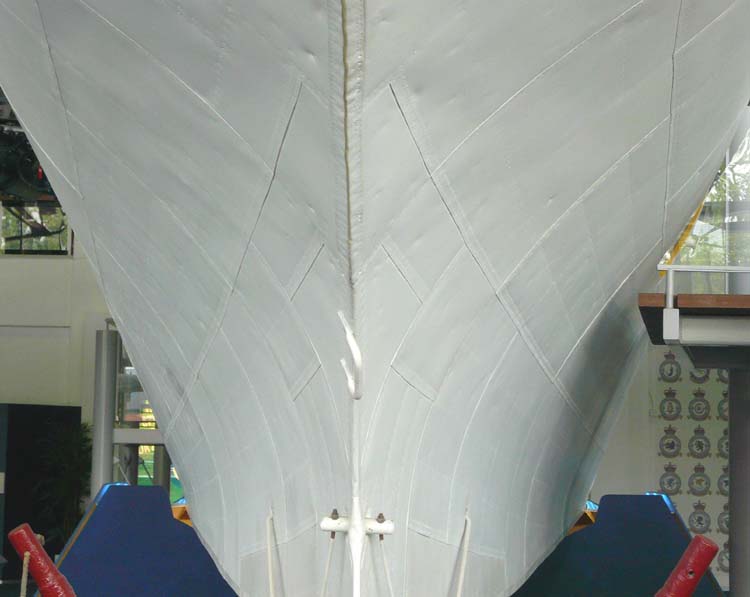
The S 25 Sunderland featured a hull even more aerodynamic and more advanced than that of the S23. You can see why it’s called a “Flying Boat”:

Here’s lengthways:

Here’s the nose end of that hull:

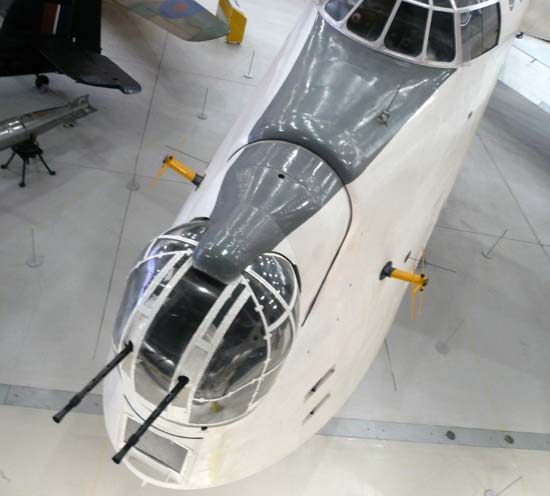
Weapons included machine guns in front and rear turrets. The front turret had rather weak 0.303 guns which could not always penetrate thick metal, but at least I got a good shot of it:

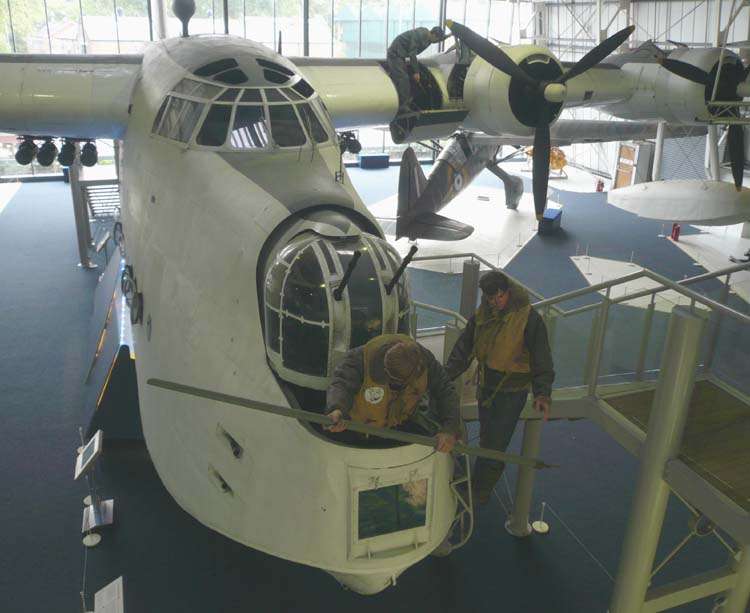
I even got a good shot of the three jokers who seemed to be making off with the plane from the Hendon museum, trying to push it backwards through the very large French windows:

Here’s some close-ups for the wanted posters:

This slideshow requires JavaScript.

I didn’t get any good photographs of the rear turret but it had heavier 0.50 calibre machine guns. You can just about spot it among the bits of other aircraft. It’s slightly right of centre:

There was also a heavy machine gun firing from each of the beam hatches. You can just about see one poking out here:

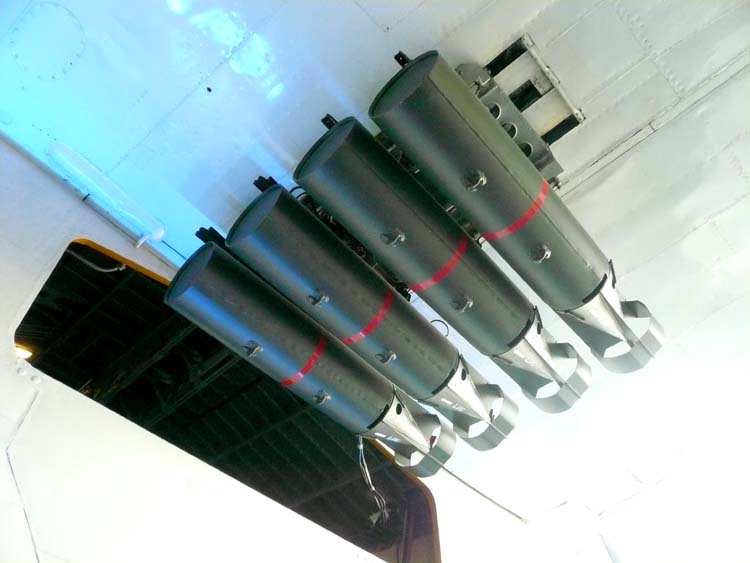
The Sunderland made extensive use of bombs, aerial mines, and depth charges. Here are four which have been winched out ready to drop. Hopefully, they are dummies:

Here they are in close up.

The Vickers Wellington’s immensely  powerful Leigh Lights, designed to light up U-boats on the surface at night, were rarely, if ever, fitted to Sunderlands.

Next time, a look inside the mighty Sunderland.


27 Comments

Filed under Aviation, Bomber Command, Film & TV, History, Personal