Tag Archives: Derby County

Home is the sailor, home from the sea, And the hunter home from the hill

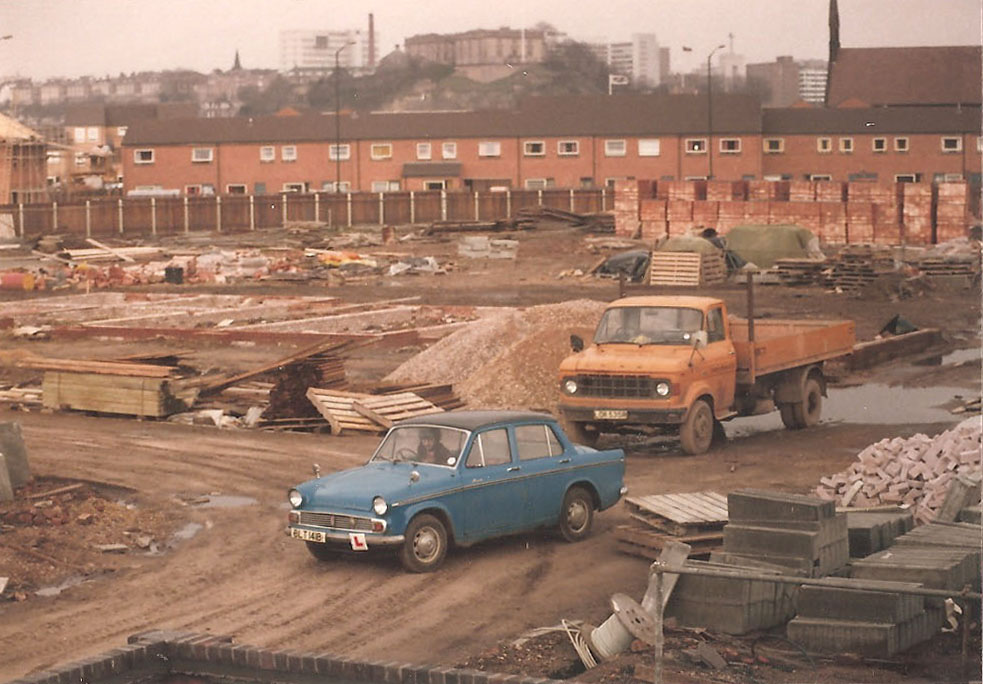
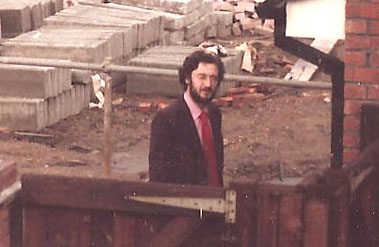
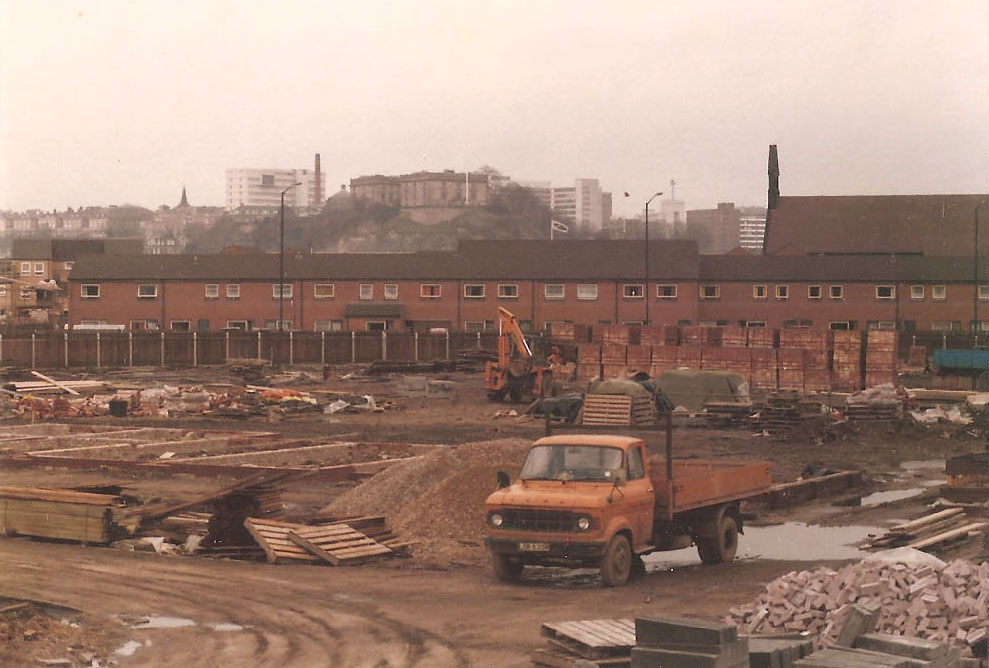
When we were first married, my wife and I bought a house in the Meadows area of Nottingham. This was traditionally a place of slums, crime and general unpleasantness, but at the time, the early 1980s, huge numbers of unhealthy hovels were being demolished to be replaced by newly built, better quality, council houses, as they were then called. Mixed in with all the rented accommodation though, was a small estate of private houses, and we bought one of those. When we first moved in, we were surrounded by a vast building site:

photo 1

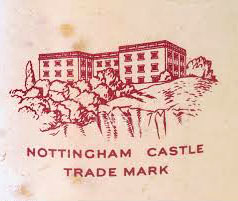
In the background is Nottingham Castle, which has very little remaining from the medieval period and dates mostly from the 1670s. It is perhaps most famous for being the trademark on Players Cigarettes:

trade markxxxxxxxxxxxxxxxxxx

And now, it must be nine minutes past four and the teaching day is ended and I have driven home at top speed:

“Home is the sailor, home from the sea,

And the hunter home from the hill.”

photo 3

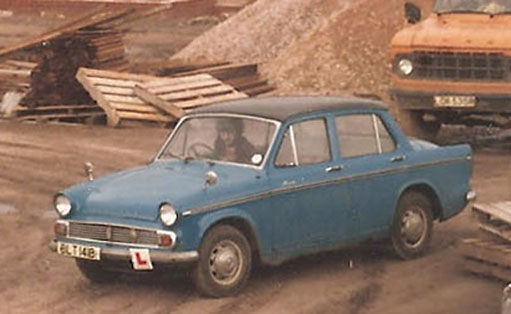
I used to have an old 1964 Hillman Minx De Luxe, with the registration plate BLT 141B. It was my first car, and I loved it dearly. I wish I could have it back again. It had previously belonged to my Dad, Fred, who loved it even more than I did. When the seventeen-year-old car failed its last roadworthiness test, he was so glad that I took the trouble to drive it, fairly illegally, the 35 miles to his house, just so that he could then drive it himself on its last ever journey down to the scrapyard.
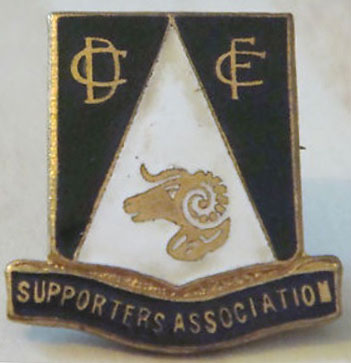
This beautiful blue car was “the one” as far as Fred’s motoring career was concerned. One day in 1966, he took me with him to nearby Derby and we visited Peveril Garage, on Friar Gate, up near the headquarters of the Derby County Supporters’ Club:

dcfc
Fred told me not to mention anything whatsoever about the day to my mother, not under any circumstances. Without any consultation with her at all, therefore, he bought this marvellous car, which was priced at £510. In those days, that was a princely sum indeed. If truth be told, it was actually a total sufficiently royal, that when my mother did eventually find out what he had done, she would have had Fred beheaded if she could have organised it.

The car was a rich blue, half way between sky blue and navy blue, with a black side stripe picked out in metallic chrome. In later years, when he had problems with rust on one of the wings, Fred was to opt for a total re-spray, which allowed him to retain the same colour blue for the body, but to incorporate a black roof which added that extra, unique, little detail to his beloved car:

photo 4

At this time, I had only recently passed my driving test, so, while I waited for the green “Provisional” plates to be invented, I retained my Learner plates, with the Big Red Ell on them. That was enough to be pulled over by a young policeman, apparently tired of arresting burglars, drug dealers, terrorists, murderers and bank robbers. Still, no hard feelings.
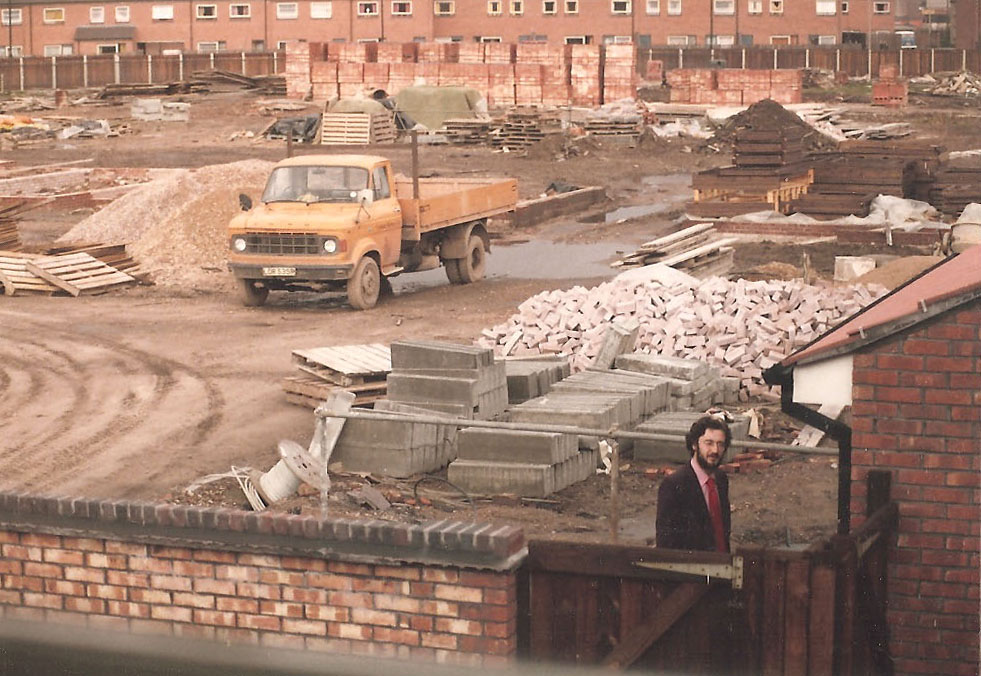
And here I am, looking like the man who designs the stage costumes for a 1970s pop group:

photo 2

I am wearing my favourite wide lapel purple jacket which had a wonderful Polyester feel to it. My shirt was short sleeved and chequered in pink and white. My extra wide tie was scarlet, and again, made of Polyester for easy cleaning. My glasses were gold-rimmed and my hair was a deep delicious dark brown without the slightest trace of grey:

photo 5

I had probably been wearing a pair of trousers throughout my day as a teacher, but they are not visible in this photograph. They may well have been my favourite pair ever, which were generously flared and mid-grey with an emphatic large black check design all over them. This created a whole series of huge squares perhaps four or five inches in size. I eventually gave these show stealers to a charity for the homeless in Africa. I often wonder who got them and what he made of them. Conceivably, some kind of shelter.

17 Comments

Filed under Criminology, History, Humour, My House, Nottingham, Personal

The very first football season of them all 1888-1889 (Part 2)

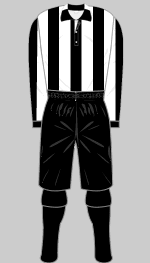
In my previous article about the involvement of the High School’s ex-pupils in the newly invented Football League. I spoke in some detail about the career of Arthur Frederick  Shaw, who played twice for Notts County in that inaugural season of 1888-1889, before going on to make two more League appearances the following season. He then continued his career in the Second Division with firstly Nottingham Forest and then Loughborough. Here is the Notts County kit that he would have worn during that first season:

Capture 1 - Copy

When Arthur Shaw made his first appearance in the Football League on December 8th 1888, at home to Aston Villa, a narrow 2-4 defeat for the Magpies in front of 2,000 spectators, he was the inside right (No 8). In the same team, playing at left full back (No 3) was the splendidly named Herbert Durrant Snook, a fellow ex-pupil of the High School.

Born on December 23rd 1867, Herbert Snook entered the High School on September 11th 1876. He left at Christmas in 1882. Herbert was one of four brothers, the sons of James Snook, a wholesale merchant and draper. The family lived initially in Elm Avenue, Nottingham, before their fortunes improved dramatically and they moved to Penrhyn House, in Clumber Road, The Park, Nottingham:

penryn

The other three Snooks at the High School were James Brasher Snook, Frederick William Snook and Percy Walter Snook. All three played for Notts County in various F.A.Cup ties and friendlies, but never in the Football League.

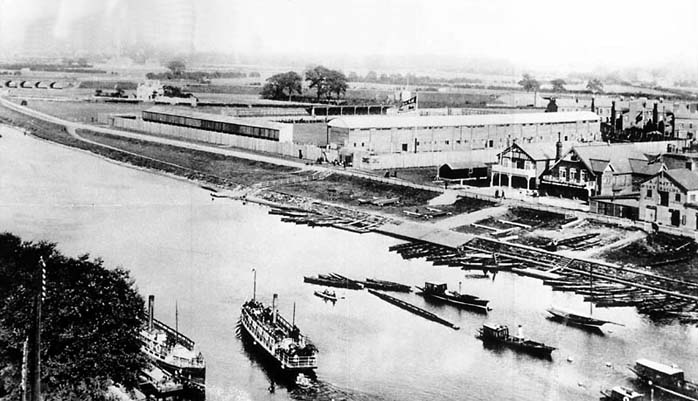
In that first season of League Football, Herbert also played in three F.A.Cup ties. These were all home games, against Eckington (4-1), Beeston St.John’s (4-2) and Derby Midland (2-1). Herbert played as a right full back (No 2) against Beeston St.John’s, but as a left full back in the two other games. The Cup Ties against Eckington and Beeston St.John’s were both contested by Notts County’s reserve side. On the same day, the First Team played Football League fixtures against Blackburn Rovers (3-3, 4,000 spectators) and Burnley (6-1, 5,000 spectators), both games taking place immediately after the Cup games. The crowd against Beeston St.John’s and Burnley must have gone home happy. It isn’t often that County win two successive games and score ten goals doing it. Here is Notts County’s Meadow Lane. It is the football stadium in the top right. Nottingham Forest’s City Ground is towards the bottom of the picture, on the southern side of the River Trent:

meadoew lanexxxxxxxxxxxxxxxxxxxxxxxxxx

Herbert’s brother, Frederick William, played against Eckington and Beeston St.John’s, at centre forward (No 9) in the first game, and as inside right ((No 8) in the second.  A third Old Nottinghamian to play was Henry Harold Brown who was at the High School from 1874-1878. He appeared as outside left (No 11) in both games and scored a brace of goals against Beeston St.John’s. His brother, Gilbert Noel Brown, yet another ex-pupil of the High School, played as centre forward (No 9) in this game.

In 1890, Herbert Snook was one of the earliest shareholders in the newly formed “Notts Incorporated Football Club”, although during the 1888-1889 season he had played in two friendlies for Nottingham Forest, the first against Stoke City (1-2), the annual Shrove Tuesday match. Here is the Stoke City kit:

Capture 1 - Copy

The second game was against his old team, Notts County (2-5). In excess of 5,000 spectators watched the match. On March 12th 1891, Herbert appeared for the Old Boys in their 3-1 victory over the High School First XI at the Gregory Ground, the home of both the High School footballers and of Nottingham Forest.

Herbert was to spend most of his life living at “The Cedars”, Derby Road, Lenton, Nottingham. He was keen on tennis, and in partnership with Gilbert Noel Brown, held the county men’s doubles championship for many years. Herbert was well known in political circles as a liberal, and worked in the old established family business of James Snook and Company Ltd., who were wholesalers and clothing manufacturers in Houndsgate, Nottingham. In actual fact, Herbert was still working until well into his eightieth year, after forty years as chairman and managing director, and a grand total of sixty two years in the company. Immediately after Herbert’s retirement, the business was taken over by a Birmingham firm. Herbert died on October 13th 1947, at the age of seventy nine, after an illness lasting some months. He was buried in the family vault in the Church Cemetery on Mansfield Road. Here is the Church Cemetery, a Victorian masterpiece. It has a permanent staff of eight vampires:

graveyard

Playing at right half (No 4) on December 8th 1888, against Aston Villa, alongside Arthur Shaw and Herbert Snook, was a third ex-High School pupil, namely G.H.Brown. Strangely, there are two likely candidates of this name in the Victorian school registers at the High School.

The first possibility is George Henry Brown, the son of Samuel Brown, a fish and game dealer of 96, Sherwood Street, Nottingham. He would have been nineteen years of age when the match against Aston Villa took place. A better fit though, would be George Hutchinson Brown, the twenty one year old son of George Wilkinson Brown, a grocer and chandler of firstly 14, Colville Terrace, and then 62, Addison Street, Nottingham. We will probably never know the answer to this enigma, unless Notts County have a dusty box full of players’ contracts from this era, hidden away somewhere, perhaps among the cobwebs of  their trophy room.

George Hutchinson Brown was to wear his admittedly un-numbered shirt as a right half (No 4) for most of that historic first season. He played 19 times out of a possible 22 games. He had the honour of playing in County’s first ever League game, a 1-2 defeat away to Everton at Goodison Park, and also in their first ever home game, a 3-3 draw with Blackburn Rovers. Here is the Blackburn Rovers’ strip, very similar to the present day:

Capture 2 bottom - Copy

Notts County’s first ever league victory came in their fifth game of the season, and was a 3-1 home win over Everton. George Hutchinson Brown was again the team’s right half. Here is the Everton kit:

Capture 3 top - Copy

George also played in County’s first ever away win in the League. This was a long, long, wait, until Match 18 out of 22, a 2-1 win over Accrington on January 26th 1889, County’s only victory away from home in the whole season.  Here are the Accrington colours:

accrington-1892-1893-b

George Brown’s solitary goal came in a narrow 2-5 away defeat against Blackburn Rovers at Ewood Park, in front of 4,000 spectators, on December 15th 1888. One particularly exciting game must have been the last one of the season, another narrow defeat at home, this time by 3-5 against Derby County. The Rams wore this unusual kit:

Capture 1 - Copyxxxx

George had played in friendlies for County in both the 1886-1887 and the 1887-1888 seasons. He made 28 appearances and scored one goal, against the Sheffield Club. Interesting results came against Scottish club, Hibernian (0-6), Aston Villa (8-2), Corinthians (1-4), Nottingham Forest (0-0, 12 000 spectators) and the disastrous Notts Rangers match (0-8). Here are the Hibernian colours of the era:

hinerbnian

George played in five F.A.Cup ties for County, against Nottingham Forest (1-2), playing as a centre half (No 5), Derby Midland (2-1), Old Brightonians (2-0), and Sheffield Wednesday (2-3). Best of all, he played as a left full back (No 3) in the El Classico of the Victorian era, Notts County 13 Basford Rovers 0. Here is Meadow Lane from the spectators’ point of view, seconds after the end of the game:

1962MeadowLanxxxxxxxxxxxxxxxxxxxxxxx

At the end of the 1888-1889 season George left County for ever, and moved to Forest, where he was to play seven games in the Football Alliance, and a number of friendlies. Interesting results included games against Bootle (2-2), Grimsby Town (0-4), Long Eaton Rangers (3-5). Clapton (0-1), Walsall Town Swifts (0-1) and Everton (0-7).

A fourth Old Nottinghamian to play in County’s first season in the Football League was Harry Jackson, who was born on April 23rd 1864. His father, Charles J.Jackson, managed what the School Register rather grandly listed as a “Piscatorial Dépôt”, (probably a fishmongers, or even a fish and chip shop) and the family lived at 23, Carrington Street. Harry played on five occasions; as an outside left at Stoke (0-3), as a centre forward at Burnley (0-1) and Wolverhampton Wanderers (1-2, 1 goal), an inside left at Bolton Wanderers, (3-7, 1 goal), and an inside right at home to Derby County (3-5).

Here is the Burnley kit;
Capture 3 top - Copy - Copy

And here is the Wolverhampton Wanderers’ strip:

Capture 2 top y - Copy

Here are the Bolton Wanderers’ colours. Very little has changed here:

Capture 2 bottom - Copy (2)

In his career with County, Harry also played in 21 F.A.Cup ties, and scored 19 goals. In other games for County, all of which would have been friendlies, he made 101 appearances, and scored 85 goals. This gave Harry Jackson an overall career total of 104 goals in 122 games for Notts County, both totals and a strike rate which  are only exceeded by those of Harry Cursham himself:

h cursham

A fifth Old Nottinghamian in that same inaugural season of 1888-1889 was Edwin Silvester Wardle. Edwin was born on January 11th 1870 and the family lived at Magdala House in Mapperley Road. He attended the High School from 1881-1883. He made two appearances in the League for County, the first as an outside left (No 11) at Goodison Park, Everton, in the very first match of the season (1-2), County’s début in the Football League. Strangely, he then appeared as an outside right in the very last fixture of the campaign, the 3-5 home defeat to Derby County. Prior to this, he had played in six friendlies, scoring three goals, two against Aston Villa (3-3) and one against Halliwell (1-4). He also appeared in four F.A.Cup ties, scoring one goal against Staveley (3-1).

Another particularly disappointed Old Nottinghamian, the sixth to play in that first season of 1888-1889, must have been John Alfred Brown, who made just one appearance for County, as an outside left (No 11) in a game at Villa Park against Aston Villa. County lost narrowly by nine goals to one, watched by an entranced crowd of some 4,000 spectators.

John Alfred Brown was born on March 20th 1866. Along with his elder brother, he entered the High School on August 10th 1874, at the age of eight, although the date when he left the High School remains unknown. He made his first appearances for County towards the end of the 1883-1884 season, when, after the New Year, he played as an inside left in away friendly games at Walsall Swifts (1-2), and Sheffield Attercliffe (0-2). Overall, he played in 34 friendlies between 1884-1888 and he scored a healthy total of 14 goals. Interesting games and scores in 1884-1885 included his two goals in a 5-0 defeat of Wednesbury Old Athletic, and another goal against Hendon in an 8-2 victory. There were also games against Blackburn Olympic (1-1 and 0-3), Preston North End (1-2), Sheffield Wednesday (1-0), the Sheffield Club (3-0), Blackburn Rovers (0-2), Notts Rangers (2-1) and Derby County (0-2). Here are the Blackburn Olympic colours:

Blackburn_Olympic

For the most part, John was an outside left, although he also played at inside left, and inside right. In 1885-1886, he appeared in home games against Bolton Wanderers (3-3) and Great Lever (1-3), and in away games against Queen’s Park (1-5), the Sheffield Club (6-1) and Wellingborough Grammar School (8-3). He scored a goal at Sheffield, although three of the scorers at Wellingborough remain unknown. Two games were at inside left, with one at outside left, and two at centre forward. The following season of  1886-1887, he played at the Sheffield Club (4-1) and Wolverhampton Wanderers (0-2). He also appeared against Preston North End, a game which County were narrow losers by 0-14. Here is the Preston strip:

Capture 2 top y
John’s most successful season was 1887-1888 with 10 goals in 14 appearances. These included Walsall Town (0-4), West Bromwich Albion (1-5), Nottingham Forest (1-0), Preston North End (2-5), Everton (1-3). He played in home fixtures against Leek (8-1), Aston Villa (8-2), Preston North End (2-3), Grimsby Town (4-0), and Corinthians (1-4). A substantial veil might be drawn over Mitchell St.George’s (0-10).

John scored four times against Leek and Aston Villa, with single goals in each game against Preston North End. All of his games were as an inside left.

By the way, the illustrations of old football kits came from the best ever website for the soccer nerd and all the boys who had more than twenty different Subbuteo teams. New Brighton Tower 1898? Oh, yes.



12 Comments

Filed under Derby County, Football, History, Humour, Nottingham, The High School

The very first football season of them all 1888-1889 (Part 1)

At the moment, the High School has very strong  footballing links, both with the Premier League and the Championship. They come in the person of Patrick Bamford, a young man who would seem to have a sparkling footballing future ahead of him:

He is not the only Old Nottinghamian to have played professional football, however. Well over a century ago, for example, a number of old boys took part in that inaugural season of 1888-1889, playing for Notts County in the newly formed Football League.

The season was totally dominated by Preston North End, “The Invincibles”, who beat County on aggregate by 11-1, for example, and were undefeated at the end of the campaign after 22 matches. They dismissed Wolverhampton Wanderers by an aggregate of 9-2 and Stoke City by 10-0. Notts County were to finish in eleventh place out of twelve. Their record of five victories, two draws and fifteen defeats produced a grand total of 12 points, with two for a win and one for a draw. Stoke City also managed 12 points, but their goal average (not difference in those days) was 0.510 as opposed to County’s much more impressive 0.548. That difference of 38 hundredths of a goal was enough for County to escape the Wooden Spoon! Derby County had 16 points and Burnley had 17 points. All four teams were re-elected to the League for the next season:

league table

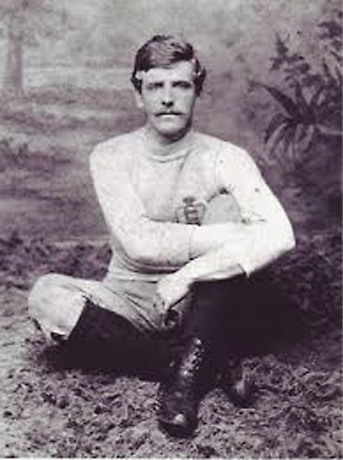
One Old Nottinghamian who appeared in the County team that season was Arthur Frederick Shaw, of whom I have been, unfortunately, unable to find any photographs whatsoever on the Internet. Arthur was born on August 11th 1869 in Basford. His father was Alfred Shaw (1842-1907), the famous Nottingham and Sussex cricketer:

AlfredShaw_RedLillywhite1876

Shaw senior played for England, and he actually bowled the very first ball ever in the entire history of Test Cricket, which was to the Australian batsman, Charles Bannerman. During his cricketing career, Alfred Shaw took more than 2,000 wickets for Nottinghamshire and Sussex from 1864-1897, before becoming a first class umpire. He died in 1907 at Gedling, Nottingham, and is buried in the churchyard there, close to the grave of Arthur Shrewsbury, the former Nottinghamshire and England batsman:

This slideshow requires JavaScript.

At the time when their son entered the High School on April 28th 1881, at the age of ten, the Shaw family was living at the Belvoir Inn in Kirkby Street, Nottingham, a street which no longer exists. The date when he left the High School remains unknown.
Arthur Shaw played just two games for Notts County during that inaugural 1888-1889 season. His first game was on December 8th 1888 at home to Aston Villa, which resulted in a 2-4 defeat for the Magpies. A crowd of some 2,000 spectators watched the game, where Shaw played as an inside right (Number 8, except that there were no numbers in League Football until August 25th 1928). At left full back (No3) was Herbert Durrant Snook, a fellow Old Nottinghamian, with George Hutchinson Brown, a third Old Nottinghamian, playing at right half (No 4). I will talk about these two gentlemen in a later article.
Arthur’s second game came on March 5th 1889, when County entertained Bolton Wanderers at Meadow Lane. A crowd of some 3,000 spectators watched the match, where Arthur played on this occasion as an inside left (Number 10). County lost narrowly by four goals to nil.

Arthur went on to play for Notts County on two more occasions in the Football League. These both came in the following season of 1889-1890, when the team finished in a much improved tenth place in the League. On December 14th 1889, he appeared in a game at Meadow Lane against Wolverhampton Wanderers, watched by 3,000 people and ending in a narrow 0-2 home defeat for the Magpies. A week later, they entertained Derby County and beat them by three goals to one, in front of a Meadow Lane crowd of, again, some 3,000 spectators. On both occasions, Arthur was playing as an outside right, and, again, had there been numbers on the players’ shirts at this time, he would have worn a No 7.

Arthur appeared a number of times for Nottingham Forest, both before and after his appearances for Notts County. At the age of barely eighteen, therefore, well before Forest were a League club, Arthur made his début for them in the 1887-1888 season, scoring the only goal in a 1-1 home draw against Burslem Port Vale. His other game for Forest was a 3-2 home win against Bolton Wanderers, when Shaw scored what turned out to be the winning goal.

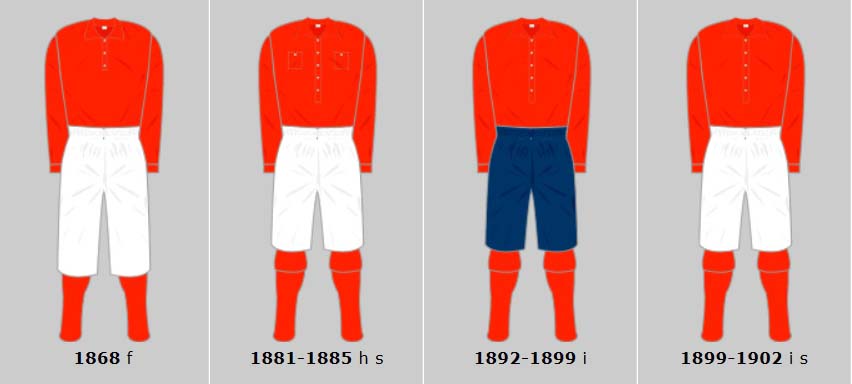
During the following season of 1888-1889, Arthur made four appearances for Forest and scored two goals. He played at home against Preston North End (0-2), Newton Heath (2-2, one scorer unknown), and Clapton (3-2, two goals). He played in away games at Newton Heath (1-3), a team who were later to become Manchester United. All of these games were friendlies. Here are some Forest strips from this long ago era. Things have not changed a great deal:

forest 1868 zzzzzz

In the 1889-1890 season, Arthur made eleven appearances for Forest and scored six goals. He played a number of games in the Football Alliance against Long Eaton Rangers, Sunderland Albion, Darwen, Newton Heath and Small Heath (later Birmingham City). The result in this last game, a 0-12 loss, remains Nottingham Forest’s record defeat. Arthur also appeared in the 0-3 away defeat at Derby Midland in the First Round of the F.A.Cup.

Perhaps the most unusual moment in Arthur Shaw’s whole football career came in this 1889-1890 season when he played for both Nottingham Forest and Notts County. He appeared in the Football Alliance for Forest against Sunderland Albion, (3-1) and then, as we have already seen, for County in the Football League against Wolverhampton Wanderers (0-2) and Derby County (2-3). Shaw capped it all on Boxing Day, December 26th 1889, when he turned out for Forest against County in a 1-1 draw in a friendly at Meadow Lane. I presume that this swapping of allegiances was possible because County played in the Football League and Forest played in the Football Alliance. There would have been no connection between the two organisations.

In the 1890-1891 season, playing for Forest as an outside left (No 11), Arthur appeared in the First Round of the F.A.Cup against Clapton. He scored one goal at the wonderfully named Spotted Dog Grounds as Forest won narrowly by 14-0, still the record away score for the F.A.Cup, and indeed, the record away win in any competition. Clapton had only trailed 0-5 at halftime before conceding nine quick goals in the second half. Arthur’s fellow Old Nottinghamian, the “ageing Tinsley Lindley” was also playing:

Tinsley_Lindley

“There’s only one Tinsley Lindley” scored a mere four goals in this one sided game, where five goals came from the Scottish international Sandy Higgins. A third Old Nottinghamian was playing for Forest in the person of John Edward Leighton, called “Ted” or “Teddy” at the High School and later in his life, “Kipper”, for his ability to fall calmly asleep in the dressing room before big matches. He played quite a few of those over the years, but his greatest honour came on March 13th 1886, when he won his only international cap for England, as an outside left in a 6-1 victory over Ireland in Belfast. Teddy Leighton was making his England début in the same team as fellow High School Old Boy, and Nottingham Forest player, Tinsley Lindley, mentioned above. This was one of no fewer than four occasions on which two ex-pupils of the High School have played together for their country. On other occasions, Leighton and Lindley had also played together for the fabled “Corinthians” club.

Overall, Arthur Shaw was to score a grand total of 11 goals in 79 appearances for Nottingham Forest. After he left Forest he went on to score three goals in 11 appearances for Loughborough, who, at the time, were playing in the Football League, Second Division. He would have worn these long forgotten colours:

Loughborough_Town_1895-1900

Arthur’s final appearance of any kind for Nottingham Forest came when he played as a right half in the semi-final of the Bass Charity Cup. The game was away from home, against Leicester Fosse, and took place on April 6th 1899. It finished in a 1-1 draw, and was watched by approximately 1,000 spectators.

Arthur’s final appearance for Nottingham Forest in the Football League had already come in a 0-5 defeat in an away game against Derby County. This fixture took place at the Baseball Ground on April 11th 1898, and the legendary Steve Bloomer scored a hat trick, before a crowd of some 12,000 spectators:

bloomer xxxxxxxx

Only five days later, the same two teams were to contest the F.A.Cup Final at Crystal Palace before a crowd of 62,017, Forest triumphing on this occasion by 3-1. Unfortunately, Shaw did not make the team for the final, his position of right half being filled by Frank Forman. This is the closest, however, that any Old Nottinghamian has come to winning an F.A.Cup winner’s medal but only if you don’t count the School Gardener,

programme

By the way, the illustrations of old football kits came from the best ever website for the soccer nerd and all the boys who had more than twenty different Subbuteo teams. New Brighton Tower 1898? Oh, yes.


5 Comments

Filed under Football, History, Nottingham, The High School

School Gardener wins F.A.Cup Medal !!!

During the early months of the Easter Term of 1925, the long serving and popular School Gardener, Mr Kidd, was taken seriously ill. He had worked at the High School for thirty-seven years, and “must have been seen by thousands of boys at his work in front of the school.”  Mr Kidd was not well enough to carry on with his job and, poor man, was eventually to succumb to his illness during the early part of the Summer Term.  He was duly succeeded as the School Gardener by Mr Wragg, whom the “Nottinghamian” called “a footballer and cricketer of great prowess”.

Mr Wragg was paid £3 per week, which was a decent wage in 1925. At the same time, my own Grandad was more than happy to earn £2.20 as his weekly wage in a clay works in South Derbyshire. I have done quite a lot of research about who exactly Mr Wragg was.  Of course, nearly a century after the event, it is impossible to establish the truth without the slightest shred of doubt whatsoever, but I am now 99.9% certain that the High School’s new Gardener was William Arthur “Willie” Wragg.

williamwragg

Willie Wragg was born in Radford, Nottingham in 1875, and initially played local football for Notts Olympic, Sutton-in-Ashfield, Newstead Byron and then Hucknall Portland. He was soon signed by Nottingham Forest and played for them as a professional footballer from 1896-1899. Appearing usually as a left-half, Willie made 48 League appearances in the First Division for Forest and scored one goal. Overall, he played 58 times for Forest in all competitions. This photograph shows the home of Nottingham Forest, the City Ground, during the 1898-1899 season:

City-Ground-1898

Willie made his début at home to Liverpool on November 28th 1896 in a comfortable 2-0 victory. He went on to play a further twelve times in the First Division that season, with a further four appearances in the F.A.Cup. He scored a single goal in a friendly match, a 2-1 victory over Dundee United at Crystal Palace. The following season of 1896-1897, Willie Wragg made 24 appearances in Division One and six in the F.A.Cup. He scored a single goal in the First Division in a 1-1 draw at home to Sunderland. The next season of 1897-1898 was his last at Forest. He played 13 times with most of his games coming as a left fullback. His final appearance came as a left half in a 0-0 draw at home to local rivals Notts County in front of a crowd of some 16,000 spectators. Here is Notts County’s magpie kit on that long ago Saturday, September 4th 1897. The crowd was a very respectable 15,000 spectators:

notts_county_1890-1900

As far as the boys are concerned the School Gardener can be a rather anonymous figure, working away quietly at the front of the school, a man whom the majority of pupils would not even notice. They were probably unaware of his lengthy pedigree as a professional footballer, but many hundreds of those unknowing little boys would have given a great deal to get their hands on what Willie Wragg had won during his three years at Forest, namely a Winner’s Medal from an F.A.Cup Final.

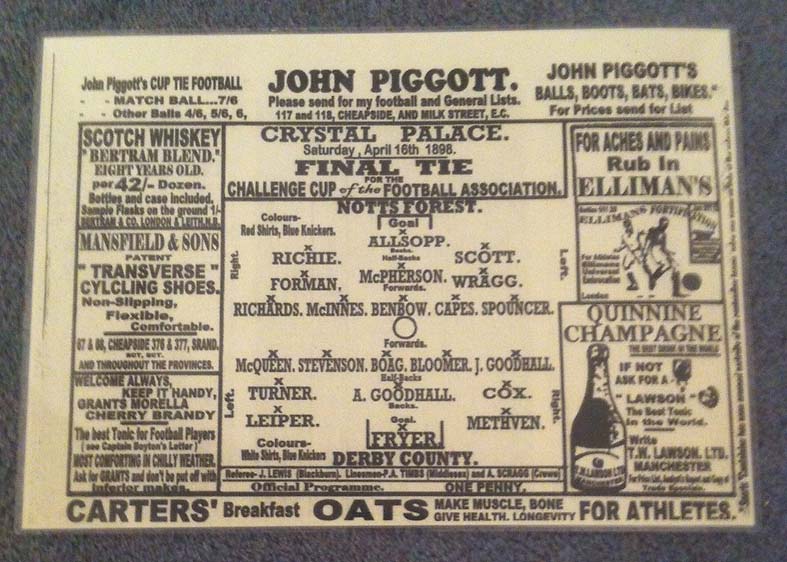
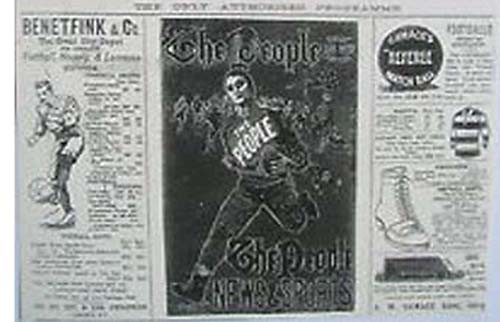
Willie had played at Crystal Palace on April 16th 1898 in front of a crowd of 62,017 spectators, when Nottingham Forest beat Derby County, Steve Bloomer and all, by three goals to one. Here is the front of the programme:

programme

And here is the back:$(KGrHqFHJE4FGNV2GFfCBRonbILDSQ~~60_35

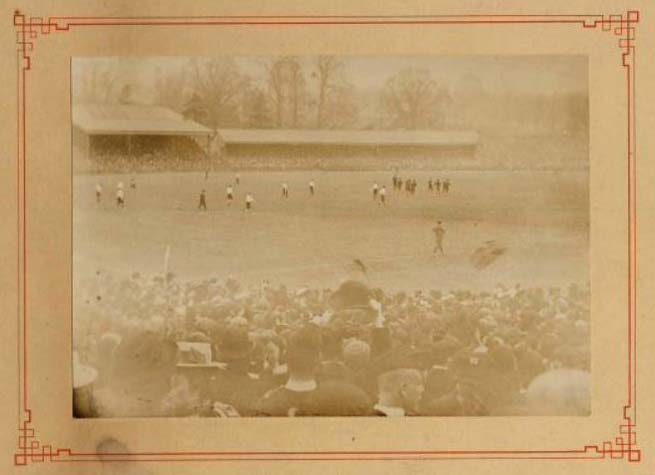
From his position as a left-half, Willie actually created Forest’s first goal, for it was from his free kick on the left near the touchline, that the ball eventually reached Arthur Capes who hit  the back of the net through a crowd of defenders.  Here is a picture of the game in progress…IMAGE_386

And here is a second photograph from a little further back…

Capture

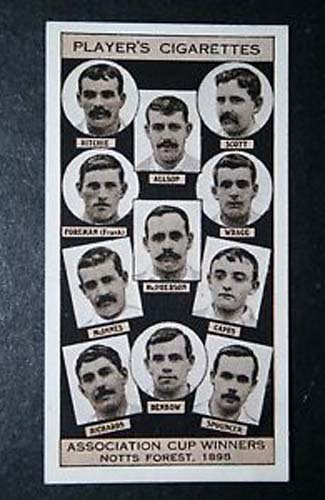
Later in the game, Wragg aggravated an injury suffered in the first-half, and, in the days before substitutes, was forced to move out on to the wing, not taking much further part in the game.That did not stop his appearance on the souvenir cigarette card…

$_35

Willie then left Forest, to go and play for Leicester Fosse in the Second Division. He spent two seasons at Leicester, making 50 appearances and scoring four goals. He was perhaps a little slower now and played at full back. Willie also became the club’s free kick specialist. He went on to appear just once for Small Heath (later to become Birmingham City), but he was unfortunately unable to displace George Adey from the team. His footballing career then rather petered out as he played for Watford in the Southern League and then Hinckley Town in the Midland League. His Football League career began again with Chesterfield Town (20 appearances, no goals) before a final return to non-League football with Accrington Stanley, Doncaster Rovers and finally Brighton & Hove Albion. Overall, Willie Wragg had made 119 appearances in the Football League.

Personally I believe that Willie Wragg may well have acquired his job as School Gardener at the High School through his past career at Nottingham Forest. At the time of the Cup win in 1898, the club’s then Chairman was Mr William Thomas Hancock, a prominent Old Boy of the High School, who had retired as Chairman of Nottingham Forest in 1920, only five years before Willie Wragg was appointed as the School Gardener. In 1925 Mr Hancock was still a Life Member of the football club.

Most romantically of all though, perhaps ex-Chairman Hancock still remembered his day of glory when he posed on the Official Photograph of the F.A.Cup Winners of 1898 and knew exactly who had done more than his share to make possible that unique and unrepeatable thrill of being a winner. Mr Hancock is the gentleman third from the left on the back row.

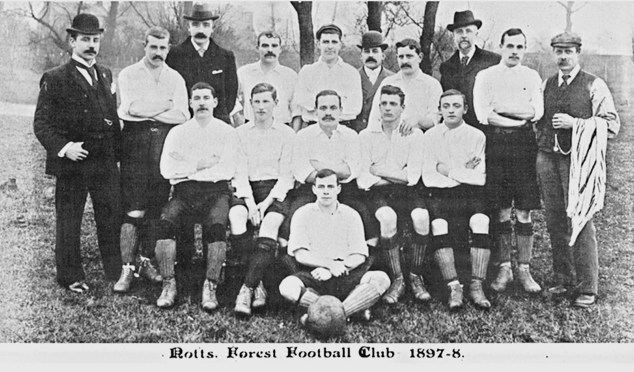
forest team

Indeed, in 1898, when this photograph was taken of the players in the victorious team at Crystal Palace, how proud Mr Hancock must have been to stand with them:

back row: H.Hallam (Secretary), T.McInnes, Mr W. T. Hancock (Chairman), A.Ritchie, D.Allsop, unknown, A.Scott, unknown, A.Spouncer, G.Bee (Trainer)

front row:  C.H.Richards, Frank Forman, J.McPherson, W.A.Wragg, A.Capes

sitting:  L.Benbow

The photograph is, in itself, quite interesting, because it is one of two very similar photographs. In one of them, Forest posed with the cup, and in the other, they were photographed without it. The reason for this was that the crowd for the F.A.Cup Final was 62,000 spectators and almost all of them invariably invaded the playing area after the end of the game. This made it quite impossible to take a proper photograph of the winning team. And certainly the crowds do look huge and they seem to be pretty much left to their own devices…

This slideshow requires JavaScript.

The usual convention, therefore, was that both teams were photographed before the match, in conditions of complete calm, the photographers taking two pictures of each, one as victors with the trophy, the other as losers without it.  Afterwards, the two irrelevant photos were destroyed, although this has clearly not happened in this case.

It is also known that in this particular year, enormous problems were experienced with Forest’s red shirts and blue shorts, which did not show up particularly well in the comparatively dull weather conditions.

forest kit

The photographers therefore asked them to pose in Derby’s kit, wearing white shirts and black shorts. Perhaps this is why they look especially miserable, although, of course, Forest were certainly to have the last laugh.

Whatever the reason for Willie Wragg becoming the School Gardener, though, there was certainly an enormous connection between the football club and the High School. Almost forty Old Nottinghamians had already played for Forest, especially in the 1880s, and many of them had represented the club in important cup games, including semi-finals. By 1925, they were all just of the age to occupy important administrative posts in the club and certainly Tinsley Lindley had been a Committee member at Forest.

tinsley

Another familiar face at the City Ground was an Old Nottinghamian who had made his England début alongside Tinsley Lindley in a 6-1 victory over Ireland in Belfast. This was John Edward Leighton, called “Teddy” when he was at school, or, when he played for Forest, “Kipper”, because of his incredible ability to fall asleep in the dressing room before games. Indeed, old Mr Leighton was to fall asleep for the very last time at the City Ground, on the afternoon of Saturday, April 15th 1944, at the age of seventy-nine after a fatal seizure. His sudden demise occurred during a Wartime Cup tie between Nottingham Forest and Northampton Town, a fixture in which the Reds were eventually to triumph by 1-0. Here is “Kipper” though, on a better, and younger, day, sitting with all his pals, it is thought, in the Church Cemetery on Forest Road. They are all wearing the same bright scarlet shirts, and they are universally known as “The Garibaldi Reds” One day they will win the European Cup. Twice.
teddy

9 Comments

Filed under Derby County, Football, History, Nottingham, The High School

This sepulchre of crime

Today is the eleventh day of the eleventh month, a date which, in this country is celebrated, if that is the right word, as Remembrance Day. In the United States I believe that it used to be called Armistice Day but is now renamed as the more inclusive Veterans Day. I always feel rather guilty at this time of year because I have never been able to see the “First World War”, or what we used to be able to call,  unfortunately, “The Great War”, in any really positive light. I am now of such an age that in earlier years I was able to speak personally to at least two veterans of the Great War, both of whom were able to give me their highly critical points of view.
It is not my intention to offend anybody by what I say in this blogpost, but it has always been my firm conviction that there are fundamental truths about the Great War which are always quite simply ignored because they are so unpalatable, and it is far more convenient just to forget them. Because of this, I would fully concur with the writer whose article I read in a newspaper recently, who called “The Great War”, “ineptitude followed by annihilation”.
I have never been able to see The Great War as anything other than the story of, literally, millions of well intentioned, patriotic young men whose idealism was taken advantage of by older men of a supposedly better social class, but who were in reality buffoons who signed treaties, and then declared wars which other people had to fight. And when the conflict itself was fought, the way in which it was carried out guaranteed unbelievable levels of casualties, most of which as far as I can see, were considered as merely inevitable by the top brass as they enjoyed constant  five star cuisine in their châteaux five or six miles behind the lines. In the trenches the average life expectancy of the ordinary soldier was about six weeks. An average of at least 6,000 men were killed every day, as the two sides fought over an area about the size of Lincolnshire, or Delaware, or half the size of Connecticut.
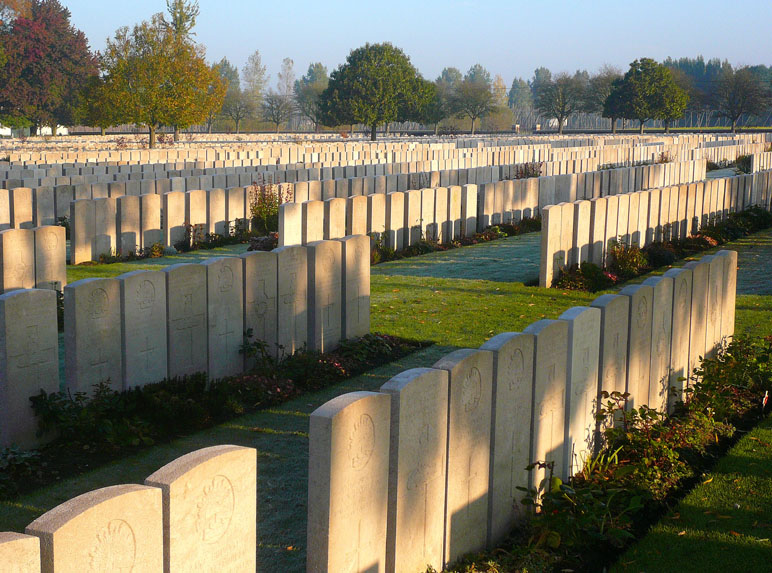
You may think that I am being appallingly cynical, but I have always seen these young men as having been robbed of their lives for little real purpose, victims who, if they had been given the choice, would have ultimately rejected a government gravestone in France or Belgium in favour of an ordinary life in their own home town or village, with a wife and children and all the usual cares and happiness which we now, a hundred years later, see as a basic right. Most of all, I would not take particularly kindly to criticism of my point of view from anybody who has not been to visit the cemeteries of the Great War which are scattered in great profusion across the areas where the battles took place.

P1090541 zzzzzzzzzzz

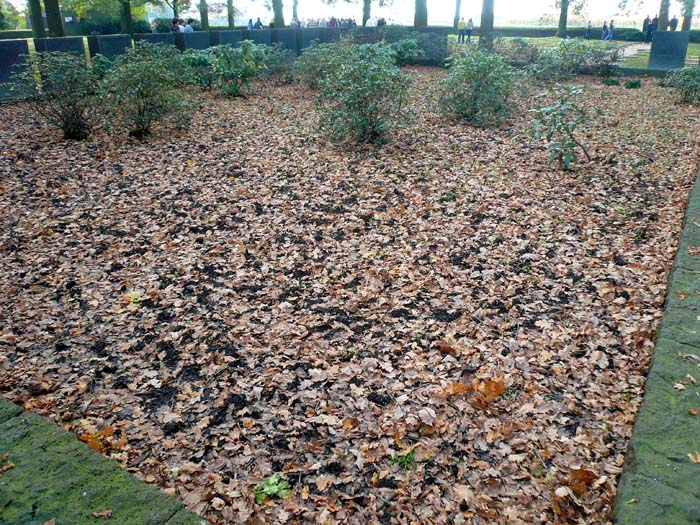
This piece of land is perhaps as large as a medium-sized house with a medium-sized garden. It contains the remains of just fewer than 25,000 men. They were for the most part killed in the very first few weeks of the war, when, having joined up straightaway so that they didn’t miss any of the excitement or the glory, they were worried in case it was all over by Christmas. A very large number of them are now known to have been university students, who were soon to find that war had its negative side. At least one of these young men is not forgotten, though.Here is a little remembrance offered to his brother, Friedrich Stieme from Halle, who was killed in 1915.

P1090547zzzzzz

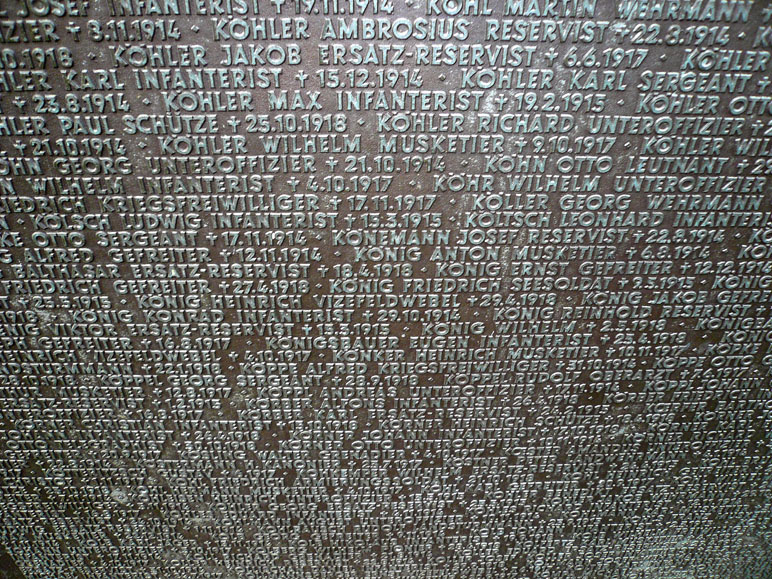
Here are the names of just some of the young men who are buried in that plot of land.

P1090571

Here are the names of some British and Commonwealth troops. They are recorded in enormous number on the Menin Gate in Ypres as the soldiers who were killed in fighting around the Ypres Salient and whose graves are unknown. There are 54,896 of these men and they were killed before August 15th 1917, a date chosen as a cut-off point when the people who designed what Siegfried Sassoon  called this “sepulchre of crime” suddenly realised that they had not built the monument big enough for all the casualties to be recorded. These, of course, are just the men with no known grave. If every death is counted, then the total Allied casualties exceeded 325,000.(the population of Coventry or Leicester). German casualties were in excess of 425,000.(the population of Liverpool)

P1090628

This whole area is dotted with cemeteries whose names, like this one, I have now forgotten. Some of them have just twenty or thirty graves, whereas some of them have a number that would take you a very long time indeed to count.

P1090669 zzzzzzz

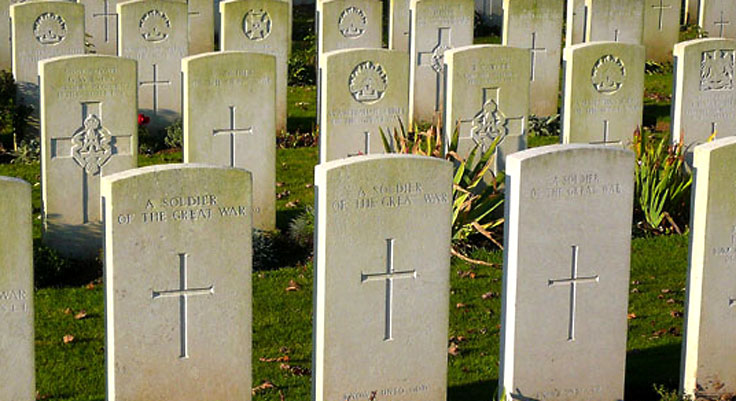
Too many of these men were unable to be identified because the British Army would not pay for their soldiers to have metal dog tags. The soldiers’ dog tags were made of leather, so that if their bodies remained in the wet ground for very long, the dog tags would rot away. This is why so many of them can be identified only as “A soldier of the Great War”. In addition, the fact that sixty per cent of casualties on the Western Front were caused by shellfire often made identification of casualties difficult. Notice too how nearly all the graves are covered in green slime, almost inevitably, given the rainfall totals in north western Europe.

P1090673333333

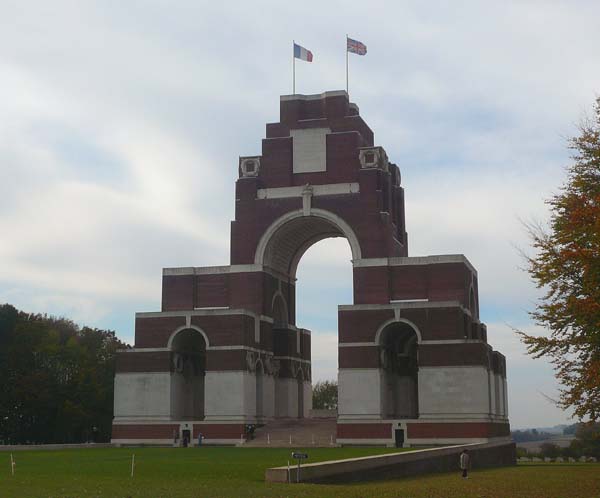
These graves are in a cemetery containing 300 British Commonwealth and 300 French graves which lies at the foot of the Thiepval Memorial.

P1090809

More important, though, is the enormous building itself wherein are recorded the names of the fallen who have no known resting place.

P1090790 zzzzzzzzz

A large inscription on an internal surface of the memorial reads:

“Here are recorded names of officers and men of the British Armies who fell on the Somme battlefields between July 1915 and March 1918 but to whom the fortune of war denied the known and honoured burial given to their comrades in death.”

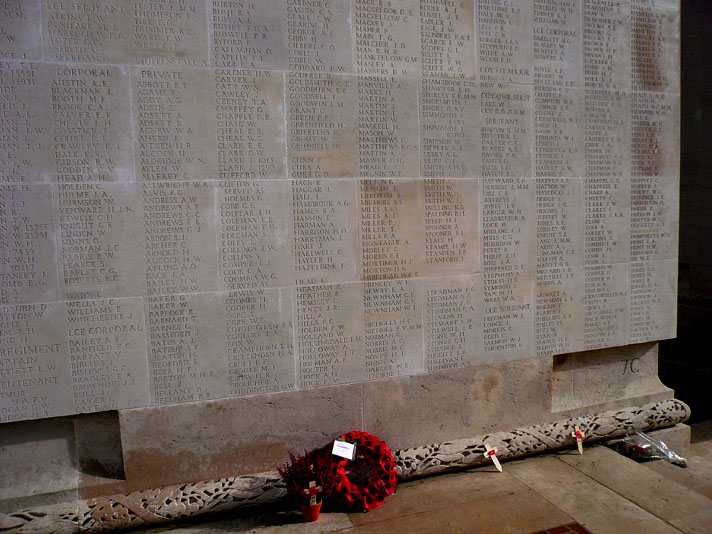
On the stone piers are engraved the names of more than 72,000 men who were slaughtered in the Somme battles between July 1915 and March 1918. More than 90% of these soldiers died in the first Battle of the Somme between July 1st and November 18th 1916. Here are some of the names.

P1090831

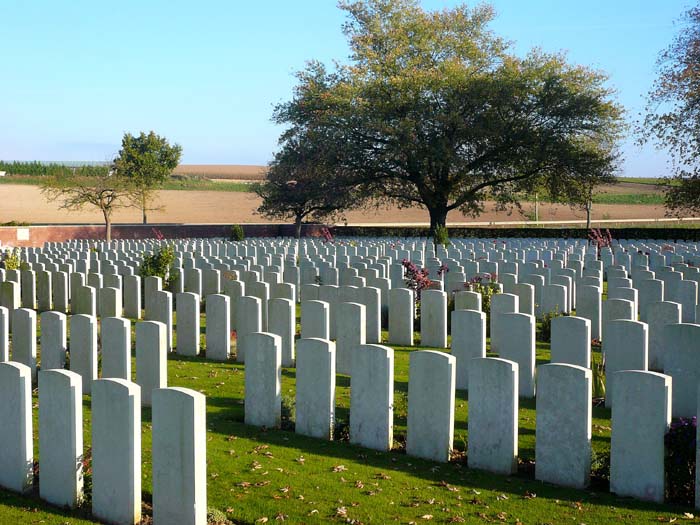
Here are some of the graves in another, fairly large cemetery whose name I am afraid I cannot remember …

P1090879

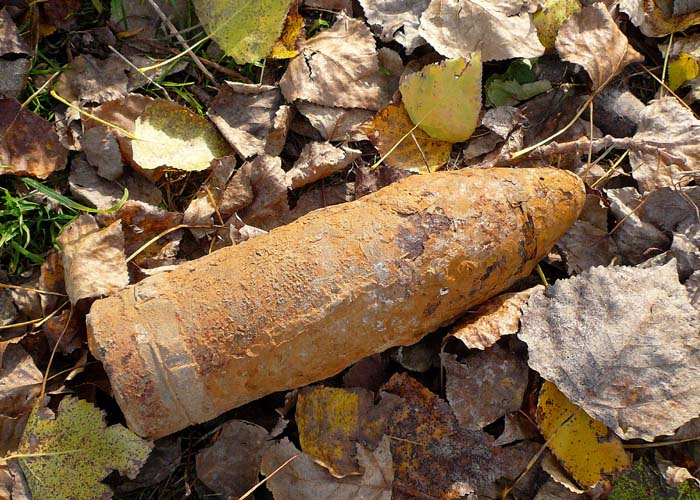
It is an insane thought that the Great War still continues to kill people nowadays. I was told by our tour guide that on average usually one person is killed every week as they explore the old battlefields looking for souvenirs.  This shell has been found by the farmer and has been left at the side of a country lane so that the regular patrols by the local council lorries can take it away. Only idiot foreigners, of course, touch these unstable objects. The French and the Belgians leave them alone.

P1090886 xxxxxx

This graveyard too I am afraid is one whose name I have forgotten. I remember that we went there because one of the other people on the coach had a relative who was buried there and he laid some poppies on his grave.

P1090932

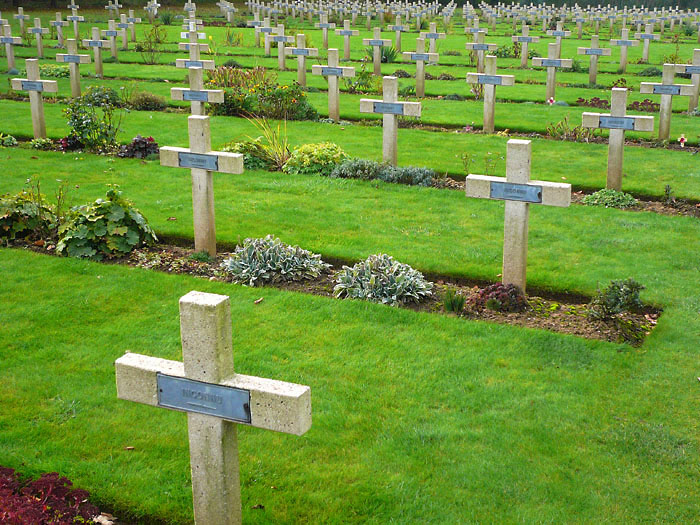
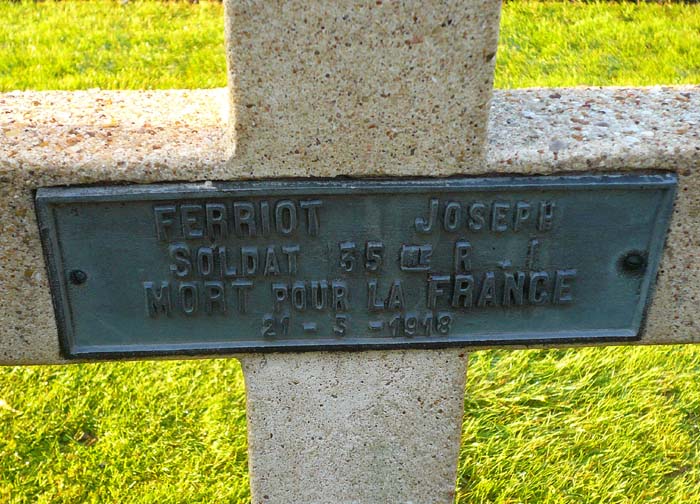
This is one of the few places where I saw French graves. France had approximately 1,397,800 men killed in the war, with a further 4,266,000 wounded, giving a total of 5,663,800 casualties. Nowadays there are many areas of the country, particularly in central and southern France, which remain unfarmed wilderness because of this conflict a century ago which left whole provinces chronically short of men. The population of Greater Manchester, the West Midlands and West Yorkshire added together is approximately 5.7 million.

P1090967 xxxxxxx

This is part of the Tyne Cot Cemetery which is a burial ground for those who were killed in the Ypres Salient on the Western Front. It contains 11,956 men, of which 8,369 remain unidentified.

P1100069 zzzzzzzzzz

This is the “Tyne Cot Memorial to the Missing.” As mentioned above, the builders of the Menin Gate discovered it was not large enough to contain all the names, so the casualties after August 15th 1917 were inscribed on the Tyne Cot memorial instead. The memorial contains the names of 34,949 soldiers of the British and Commonwealth armies. The panels on which the names are written stretch away, seemingly  to the horizon.

This slideshow requires JavaScript.

Sadly, at Tyne Cot cemetery, there are always relatives looking for members of their family who fell during the Battle of Passchendaele in 1917.

P1100072

It is very difficult to find a neat conclusion to all this, but I am happy to leave the last word to His Majesty King George V, speaking in Flanders in 1922…

“I have many times asked myself whether there can be more potent advocates of peace upon earth through the years to come than this massed multitude of silent witnesses to the desolation of war.”

3 Comments

Filed under History, Uncategorized

Arsenal £127 Tottenham Hotspur £81

Recently, the Premier League teams released their charges for a seat to watch a game next season.

As you might expect, prices are fixed at an almost unbelievable level for the ordinary working person. The days when an averagely wealthy parent might have taken his two children to a game seem to be long over.
football prices
When I was much, much, younger, my Dad used to take my brother and myself to matches at the now demolished Baseball Ground in Derby. Granted, though, the playing surface might occasionally lack a little of the green stuff…

http://www.youtube.com/watch?v=wdFwl11WUAg

And just now and again, it became a little muddy in places…

This slideshow requires JavaScript.

I don’t know how much it cost my Dad, though, because we had season tickets, and I never saw him physically hand over his hard earned cash.

Forty years on, of course, the Baseball Ground is long gone…

I just cannot remember what prices for admission were posted up on the old stands at the Baseball Ground. And in any case, in those early days of the 1970s, there were terraces, where it was even cheaper to watch the game, although admittedly, hooliganism could often run riot.

terreces v man utd
I am pretty sure though, that, even allowing for the passage of time, my dad was not paying out anywhere near that average cost of £90.24 for a single game at White Hart Lane, or a possible £127 to watch their great rivals, Arsenal.
Unbelievably, if my dad were still with us now, it could cost him almost £300 to take my brother and myself to a Spurs game, and probably more, should we wish to watch Arsenal. Even the cheapest seats would give him too little change from his £100 for him to buy everybody a skinny latte and a prawn sandwich.
And the net result of all this, of course, is that the rich get richer and the poor get poorer. Little teams like QPR or Burnley might optimistically put their prices up, ready for a long and successful stay in the Premier League, but in terms of actually achieving any real footballing success, they stand quite simply no chance whatsoever.

This slideshow requires JavaScript.


The days when a team like Derby County could win what would have been the Premier League twice in four years are long gone…

Derby-1975-title-champion-001

…and the years when a team like Nottingham Forest could win the European Cup in two consecutive seasons have gone with them.
Football, though, was a lot more exciting in those days…

And occasionally, considerably naughtier…

Derby County only missed reaching the European Cup Final by the narrowest of margins. The width of an Italian’s banknote, you might say…

I don’t really know what to offer as advice. Most of us know which football team we are destined to support as a matter of instinct, and, judging by next season’s proposed prices, if we support a London team in particular, we could well be in financial difficulties.

It is, though, more or less impossible to invent an artificial love for Leyton Orient, Stevenage or Dagenham & Redbridge, just because it is cheaper to go inside their stadium and physically watch them play.

I would commend to you, though, not so much the teams in League One and League Two, but the teams lower down the pyramid. Have a look in your local evening newspaper, and see which local clubs are going to be playing on the following Saturday, kicking off probably at the traditional three o’clock.  And go and watch one of them. You never know, you might enjoy it. The programme will not be £5. When you ask for “A skinny latte and some nice focaccia, please”, the lady will probably reply, “Yer what??”
And pick a team with a good name, such as… Coventry Sphinx, Tonbridge Angels, Solihull Moors, Pontefract Collieries  or even the West Midlands Police.

You may or may not like it, but at least it will not be costing you the best part of a hundred quid. And who knows? You may one day take to them, and realise that you have become a supporter of real football, not showbiz.

2 Comments

Filed under Derby County, Football, History, Nottingham