Tag Archives: Luftwaffe

The Murder of Leslie Howard (3)

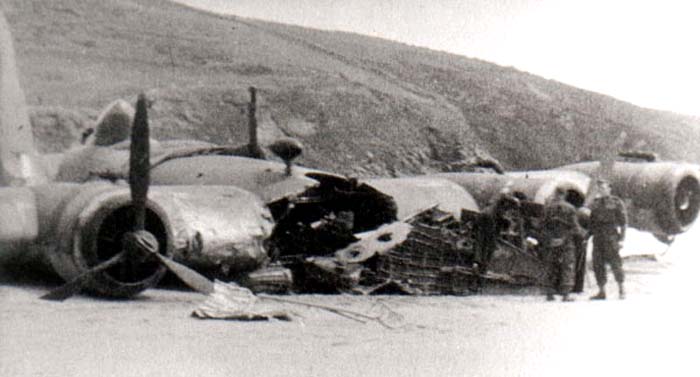
Last time we were looking at how the airliner in which Leslie Howard, the film star, was returning to England, was shot down in the Bay of Biscay by the German Luftwaffe, resulting in the deaths of every single person on board, including the children. Here is some of Leslie Howard’s best work, taken from the now controversial “Gone with the Wind” :


Since that first day of June 1943, there have been literally scores of theories put forward as to why Leslie Howard and the rest of the civilian passengers and crew of the DC-3 “Ibis” were all murdered in this callous fashion. Shot down into the waters of the cold Atlantic Ocean, while travelling to England in an aircraft which was unarmed and the property of a neutral country, namely the Netherlands. And this attack was clearly directed at somebody, because the attackers were eight Junkers Heavy Fighters, armed to the teeth and clearly, sent specifically to destroy this inoffensive DC-3 Dakota.
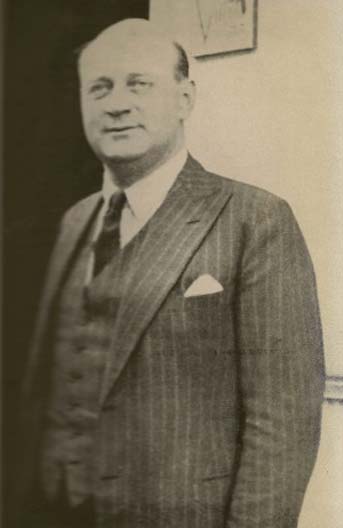
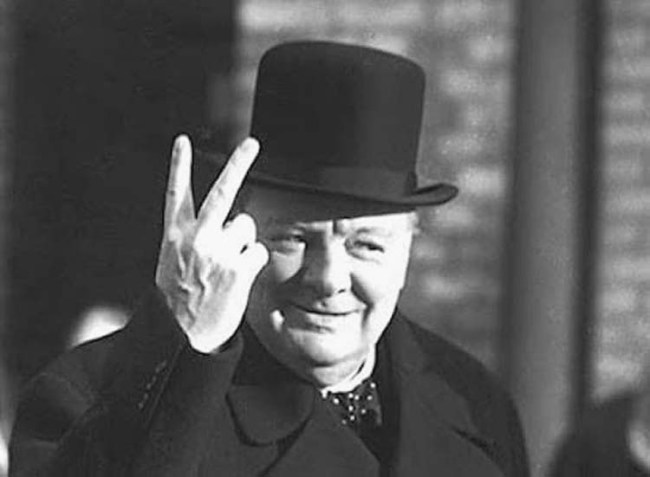
Leslie Howard’s business manager, Alfred Chenhalls was a fat, bald man who loved to smoke cigars and who occasionally drank alcohol in sensible quantities. It was extremely easy to mistake him for Winston Churchill. What do you think ? Did a German spy see Chenhalls get on the plane and immediatelyt telephone the German Embassy in Lisbon?

Which one is this?  Churchill or Chenhalls?
And is this the Prime Minister or a party going bon viveur, who liked nothing better than drinking the very best whisky in large quantities?

“Two bottles for each of us, barman !!! “
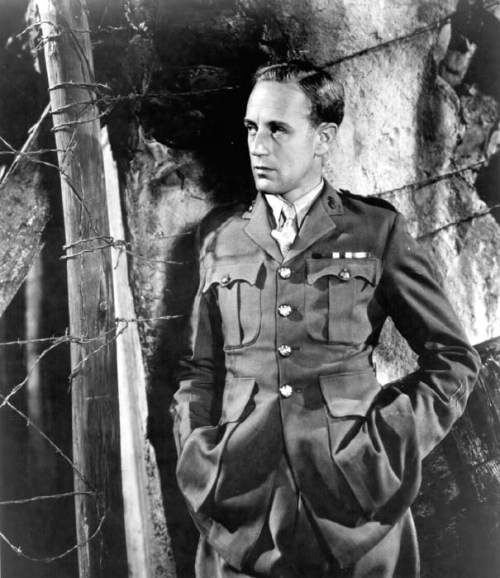
As we have seen elsewhere, Leslie Howard was not an English landowning gentleman, but a Hungarian Jew. He supposedly resembled Churchill’s bodyguard, Detective Inspector Walter Thompson. Similarly, Detective Inspector Thompson had the air of an archetypal English gentleman, self assured, self confident, upper class and, most of all, slim. Here’s Leslie Howard:
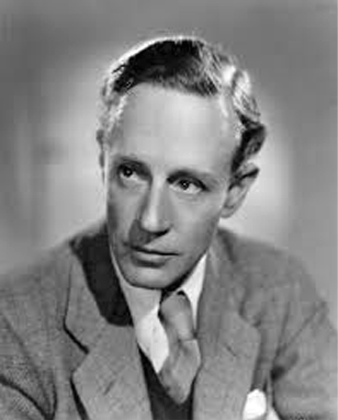
And here’s Walter Thompson, on the right:

There are other theories, of course.

How valid is the theory, though, that Leslie Howard was supposedly the virtual double of Sir Anthony Eden, England’s Foreign Secretary at the time? Here’s Eden at the age of around twenty, as a student at Oxford University……….
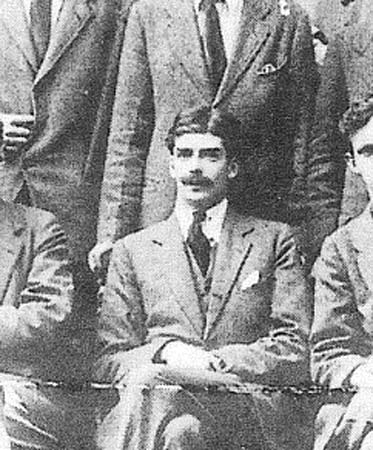
There is though, a bit of a giveaway which is tremendously helpful in any “Pick-out-Anthony-Eden” competition. The real Anthony Eden, for his entire adult life, had that stonking great moustache which he fixed into his nostrils at seven o’clock every morning and then didn’t take off until midnight.

And what about the idea, quite widespread at the time apparently, that the Germans thought that Leslie Howard and Reginald Mitchell, designer of the legendary Spitfire, were one and the same man? Leslie Howard we have already seen, and here’s the designer of what began its life as the Supermarine Shrew :

In my mind, the best fit is “Churchill and Thompson v Howard and Chenhalls”.  And we must not forget that the only images of Churchill or Leslie Howard seen by most of the attendees of the Dakota’s take-off from London would have been either crudely printed photographs from newspapers or perhaps slightly better quality pictures from magazines. Moving pictures would have been from Howard’s films, or for Churchill , the two minute Pathé News films shown in cinemas during the interval. In other words, confusion was a great deal easier in 1943 than it was in 2023.

It was by no means a completely ridiculous idea, therefore, to suggest that “Churchill–Chenhalls” was on that plane from Lisbon. And for the Germans, it was well worth organising an attempt to shoot down the plane, even if the Prime Minister was supposedly at an important conference in Algiers.

How easy it would have been to alert Berlin, who could then have contacted the fighter base, probably at Mérignac near Bordeaux in southern France, and then telling those eight Junkers Ju88C-6 heavy fighters to take off and intercept the DC-3. Such attacks were in actual fact very rare in the Bay of Biscay, so this particular Luftwaffe operation must surely have been for a specific reason, and for a specific and important target.

And now a whole second level of conspiracy theories swings into action. Perhaps British Intelligence invented the entire story of Churchill’s being on board “Ibis” that day, so that he could fly back home to England in his own private aeroplane, an Avro York. Here’s an excellent short film giving you all the relevant facts about the Avro York, which was basically a different fuselage, set on a pair of Lancaster wings:


There were plenty of people who believed this story that British Intelligence had told the Germans that Churchill was returning to England in the DC-3 that particular day, and that he would be refuelling near Lisbon. In this way, his Avro York would be able to return to London in peace, even if the Dakota finished up in pieces.

And so it goes on, round and round in ever decreasing circles with very little beyond well informed guesswork and random supposition. These are certainly very far from being guaranteed truths.

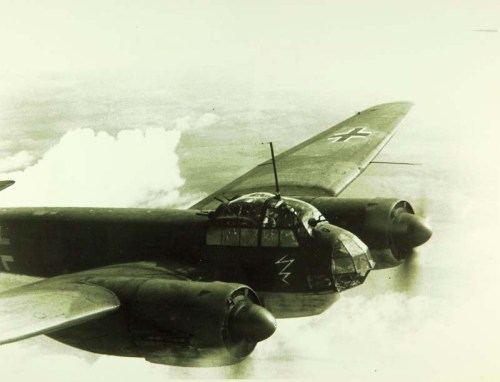
In 1943, the earliest rumours to surface were that “bon viveur” Alfred Chenhalls had actually been mistaken for Churchill by German agents as he walked out to the plane in Lisbon. Furthermore, this explanation is known to have been the one favoured by Churchill himself. At the same time, though, Churchill was certainly puzzled as to how German intelligence could possibly believe that he, with all the resources of the British Empire’s armed forces and those of the United States at his fingertips, should be reduced to travelling in an unarmed, relatively slow and vulnerable commercial airliner.

24 Comments

Filed under Aviation, Film & TV, History, military

The Murder of Leslie Howard (2)

Last time, we read the most widely accepted version of the shooting down and killing of Hollywood star, Leslie Howard, by eight Luftwaffe Junkers Ju-88 heavy fighters:

Those two outstanding German authors, Sönke Neitzel and Harald Welzer, though, tell a much blacker story of the destruction of BOAC’s Dakota DC-3 “Ibis” in their recent book “Soldaten”.

………….During the war, the conversations of German POWs were recorded without their knowledge by their British captors. One of two prisoners in a particular prison camp near London had actually been in one of the Ju88s which had shot down Howard’s Flight 777:

His name was Dock and he said:

“Whatever crossed our path was shot down. Once we shot down – there were all sorts of bigwigs in it: seventeen people, a crew of four and fourteen passengers; they came from London. There was a famous English film-star in it too; Leslie Howard. The English radio announced it in the evening.

Those civil aircraft pilots know something about flying! We stood the aircraft on its head, with the fourteen passengers. They must all have hung on the ceiling! (Laughs) It flew at about 3200 meters. Such a silly dog, instead of flying straight ahead when he saw us, he started to take evasive action. Then we got him. Then we let him have it all right! He wanted to get away from us by putting on speed. Then he started to bank. Then first one of us was after him, and then another. All we had to do was to press the button, quietly and calmly. (…..laughs…)……It crashed…. They were all dead. Those fools don’t try to make a forced landing, even if they can see that it’s all up with them.”

The Allies proclaimed the act a war crime, and so too did a large number of neutral countries. After all, the Germans had shot down an aircraft which belonged to a neutral country (the Netherlands).

Not all of the names of the Ju 88 pilots who carried out this war crime have survived the Nazis’ frenzied burning of their own archives and records, but among the guilty men were:

Oberleutnant Albrecht Bellstedt, Staffelführer Oberleutnant Herbert Heintze, Oberfeldwebel Hans Rakow, Leutnant Max Wittmer-Eigenbrot

Bellstedt and Wittmer-Eigenbrot were both killed in the war, the others I have not been able to trace. No more BOAC daytime flights from Lisbon took place until the end of the war.

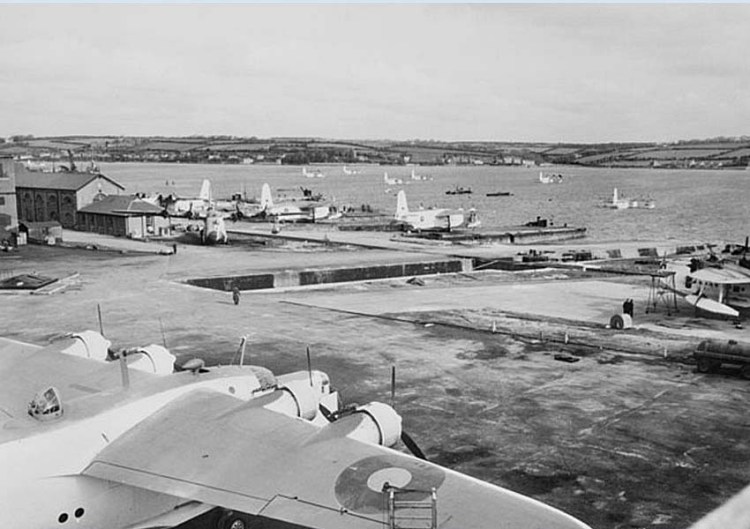
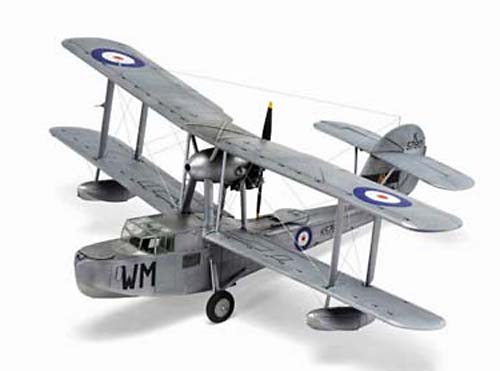
The flights which did take place were all at night, over a totally different route, completely beyond the range of a Ju-88. The British authorities responded to the DC-3’s failure to arrive by despatching a Short Sunderland GR3 flying boat to look for it. The aircraft, EJ134, was piloted by the brave Australians of 461 Squadron. The crew was James (Jim) Collier Amiss, Wilbur James Dowling, Alfred Eric Fuller, Ray Marston Goode, Albert Lane, Edward Charles Ernest Miles, Harold Arthur Miller, Kenneth McDonald Simpson, Philip Kelvin Turner, Colin Braidwood Walker and Louis Stanley Watson. Here’s a picture of RAAF 461 Squadron, looking for all the world like a flock of gigantic white geese:

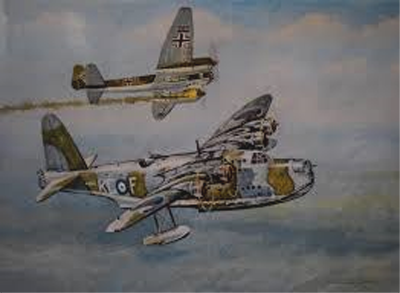
The Australians found nothing whatsoever on the surface of the sea, but they did find the very same group of eight Ju88C-6s that the DC-3 had already met, at more or less the very same place where it had met them. Sunderland EJ134 and its crew then won their place in aviation legend. In a prolonged battle, the flying boat lost one engine and its tail turret. Messrs Dowling, Goode, Miller, Simpson and Walker were all injured and poor Ted Miles (27), one of the two side gunners, was killed. They did manage, though, to shoot down three of the eight German fighters. Of the other five, only two made it all the way back to Bordeaux. The other three were never heard of again. Six out of eight shot down. That should teach them not to attack unarmed airliners flying from neutral countries.

Overall, the Germans were very wary, if not simply afraid, of the Sunderland flying boat. It was an extremely heavily armed aircraft and a formidable opponent.

No wonder they called it

“Das Fliegende Schtachelschwein”, the Flying Porcupine”

This phrase  has proved particularly useful in all of my many trips to Germany, especially those to Berlin Zoo. And one day, when I ask for a cocktail called “A Flying Porcupine”, the barman will know how to make it!

14 Comments

Filed under Aviation, Film & TV, History, military, Politics, war crimes

The Murder of Leslie Howard (1)

A couple of years ago, I wrote a series of blogposts about the Short Sunderland flying boat. In at least one of them, I talked about how a civilian airliner, with the film star Leslie Howard on board, was shot down over the Bay of Biscay on June 1st 1943. Howard, and the crew and all of the other passengers were killed.  I mentioned those events because, the following day, a Short Sunderland was sent out to look for the missing airliner. They didn’t find it, but they did find the eight German fighters which had shot down the BOAC Douglas Dakota DC-3. There then ensued one of the legendary battles of the Second World War as the Sunderland fought off a pack of Junkers Ju88s. That particular series of blog posts, though, concentrated on the Short Sunderland flying boat and the Junkers Ju88 long distance heavy fighter.

This series of blogposts which begins today, however, concentrates not on the aircraft involved, but instead the still unanswered question of……….

“Why did the Germans have to destroy that airliner ?”

And first of all, let’s take a look at the man who is usually put forward as the prime suspect for the reason that the Dakota had to be destroyed……..

Leslie Howard was a film star who starred in “Pimpernel Smith”, “The First of the Few”, “Of Human Bondage” and most famous of all, “Gone with the Wind”, a huge smash hit in 1939. Here he is in “Journey’s End”:

Howard’s father was Ferdinand Steiner, a Hungarian Jew, and his mother was Lilian Blumberg, from an English Jewish family of German origin. Howard had originally styled himself Leslie Stainer in an effort to anglicise his real name of Leslie Howard Steiner, but eventually he decided on the name by which he is known nowadays.

On June 1st 1943, Leslie Howard was in Lisbon, the capital of Portugal, with his business manager, Alfred Chenhalls. They intended to take the civilian passenger aircraft of KLM Royal Dutch Airlines which, even in wartime, made a regular morning run between Portela Airport to the north of neutral Lisbon and Whitchurch Airport near Bristol in England. Neither Howard nor Chenhalls had tickets, so two passengers were turned off the aeroplane to make room for them. The lucky two were a little boy called Derek Partridge and his nanny called Dora Rove. Or, in another story, one of the two passengers was a Catholic priest, Father Holmes. Or perhps the lucky two were George and William Cecil, recalled from their boarding school in Switzerland.

There is a story that the take-off was delayed while Howard went to collect a small parcel full of silk and nylon stockings, a present, perhaps, for his wife and daughter. While filming, Howard was pretty much a serial adulterer, who said….

“I never chased women but I couldn’t always be bothered to run away”

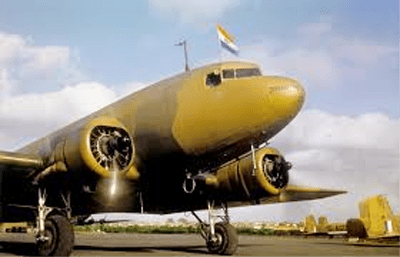
The aircraft was a Douglas DC-3-194 called “Ibis” with the civilian letters G-AGBB. Here it is, complete with its Dutch flag:The aircraft had hardly ever been impeded by the Luftwaffe on its 1,000 mile, seven hour, flight:

In actual fact, though, the Germans had already attacked the aircraft on two occasions in the previous six months. On November 15th 1942, it had been challenged by a single Messerschmitt Bf110 Zerstörer heavy fighter and on April 19th 1943, it had been ambushed by a patrol of six Bf110s. Here’s the nightfighting version of the Bf-110. The Zerstörer heavy fighters would have lacked the radar antennae….

On both occasions, the camouflaged airliner escaped a watery grave. The first attack involved a party of very high ranking American Eighth Air Force officers which included Ira Eaker. They were saved when the Bf110’s engine caught fire as it attacked. Everybody in the airliner, both passengers and crew, was terrified. In the second attack, the pilot, Captain Koene Dirk Parmentier, dropped down to the waves and then climbed steeply into the thick low clouds.

On the other hand, though, the trip had been made more than 500 times between 1939-1943 without the slightest problem.

On this occasion, though, just after midday, they were shadowed  initially by two Junkers Ju 88s over the countryside of northern Portugal and then of north-western Spain. They broadcast a message “we are being followed by enemy aircraft” and then “we are being shadowed”.

At around 12.45 pm eight different Junkers Ju88C-6 fighters of Gruppe V / Kampfgeschwader 40 spotted the “grey silhouette” of the DC-3. The Ju88s were flying with six aircraft abreast, fifty yards or so apart, with another two flying above them and acting as “spotters”. They had apparently been told to look for a twin engined grey aircraft. Their commander, Oberleutnant Heintze, had been told to carry out rigorous patrols during June and to shoot down the aircraft they found. This is a Junlers Ju-88 heavy fighter:

The Ju88s attacked the airliner at between 6,000-10,000 feet over the Bay of Biscay some two hundred miles north of the Spanish coast. One of the pilots, Oberleutnant Albrecht Bellstedt, radioed to his companions: “Indians at 11 o’clock, AA”. This meant enemy aircraft ahead, slightly to the left, attack, attack. One fighter came in from above and one from below. With their heavy calibre cannons, they set the Dakota’s port engine on fire and this then spread to the wing. A radio message was picked up from the wireless operator, van Brugge: “I am being followed by a strange aircraft….Putting on best speed….we are being attacked by enemy aircraft….cannon shells and tracers are going through the fuselage…. Am wave hopping and doing my best.” Oberleutnant Heintze, however, drew level with the stricken aircraft and quickly realised that it was a civilian airliner. He immediately stopped the attacks. Three, presumably, crew members, jumped out of the DC-3, deploying their parachutes but they did not open as they were already on fire and all three fell to their deaths. The aircraft plummeted into the sea where the wreckage floated on the surface for a very short period and then sank. By one o’clock, all four crew members and all thirteen passengers, including Leslie Howard, had been killed.

The four members of the crew were the pilot, Quirinus Tepas MBE, the second pilot, Captain Dirk de Koning, Cornelis van Brugge, the radio operator, and Engbertus Rosevink, the flight engineer.

Whoever was their intended target, the Germans were certainly serious about killing him or her. They had sent eight twin engined heavy fighters from Gruppe V / Kampfgeschwader 40 in a deliberate attempt to intercept that lone Dutch aircraft. If they had come across it purely by chance then surely there would have been just a single fighter involved, at best two, surely not a group of eight. And after they had shot down the DC-3, the German fighters circled the floating wreckage and took photographs of the burning plane before it finally sank. You don’t do that with just any old aerial kill. It has to be done for a very special reason. But that reason has never been found.

Here’s Alfred Chenhalls, Old Nopttinghamian, and Leslie Howard’s business manager. And with a cigar in one hand, and a whisky in the other, he’s a Winston Churchill look-alike. Apparently…………..

Don’t forget, though. In this day snd age, it was by no means simple to identify a famous person. They might have seen them in the cinema, but apart from this, there were only newspapers, magazines and, most of all, the radio. The latter, of course, was useful only for voice identification!

28 Comments

Filed under Aviation, Film & TV, History, military, Politics, war crimes

Hendon objects 3

In my last blog post about the non-flying exhibits in the museum at Hendon in north London, we were looking at some of the objects and various pieces of metal which had been rescued from aircraft as they awaited their turn in the scrapyard. These treasures were all housed in the RAF Museum which my family and I visited as long ago as 2010.

In my first two blog posts, I made an effort to include mostly things that were associated with the ground, such as a battleship, medals and the metal cross from a dog’s collar. This time, though, the objects are supposed to be connected more closely with the air.

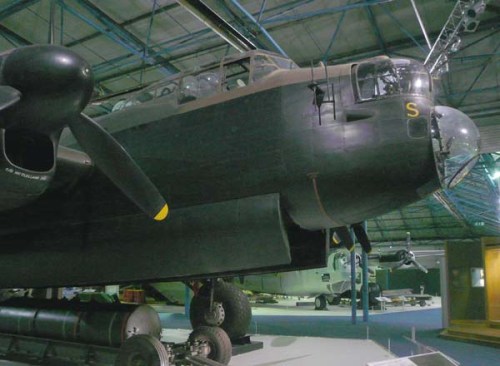
We have therefore, some examples of the nose art on RAF Lancasters and other Bomber Command bombers.

This one comes from an aircraft in one of the Polish squadrons of the RAF:

This aircraft has all of its missions marked carefully, although I do not know whether the white or yellow colouration has any significance:

This is the artwork on a Boeing B-17 Flying Fortress. In general, American artwork tended to be less inhibited than in the RAF:

Here’s what looks like a wasp type creature on a B-24 Liberator of the Indian Air Force:

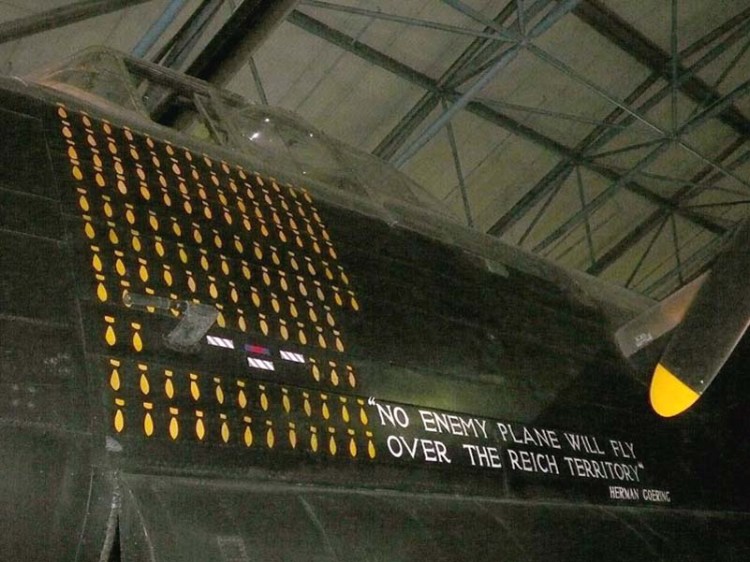
These bombing raid symbols are just about the neatest that you could ever get. Note the quotation from Herman Goering underneath them:

“No enemy plane will fly over the Reich Territory.”     Herman Goering

The bombing raid symbols also contain three medal ribbons for the Distinguished Flying Crosses or Distinguished Flying Medals won by members of the crew. The one with blue and red in the medal I do not know. The name of the medal recipient was painted underneath the engine nacelles. Here is Pilot Officer Tottenham:

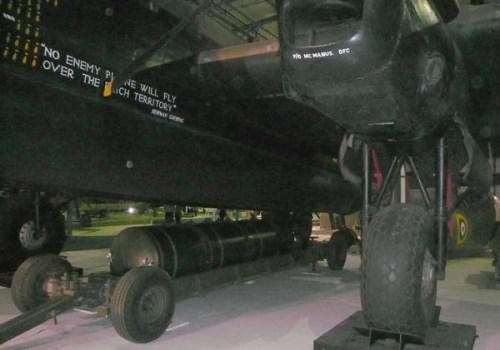
And Pilot Officer McManus:

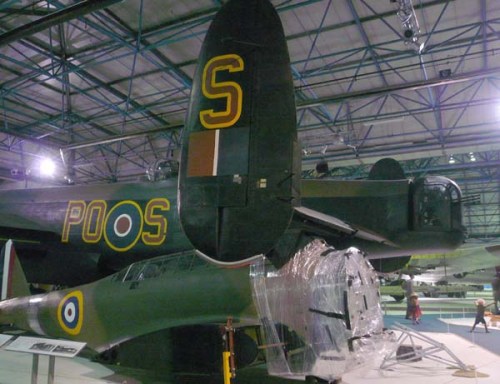
This aircraft was “S-Sugar” within the squadron. As well as on the side of the fuselage, the single letter appears on the nose:

And also on the tailfins:

I don’t know what the little aircraft is. Possibly, it is a training aircraft. If you know its identity, please indicate in the Comments Section.

The museum has a couple of bombs on show.

This appears to me to be a standard 4,000lb “cookie” which carried the maximum bombload inside a very thin skin so as to create the biggest blast possible. That would blow the roofs off and allow the incendiaries to get inside the buildings and start their work:

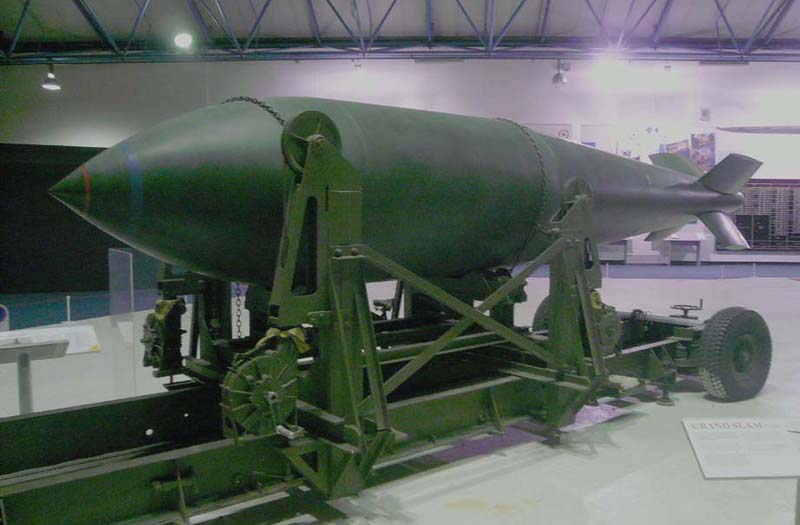
This is a “Grand Slam” ten ton bomb, designed to penetrate the ground at more than the speed of sound and then to explode, creating a vast empty space deep in the ground. The technical term for this is a camouflet, an artificial cavern created by an explosion. Whatever is above it, buildings, railways, bridges, whatever, can then collapse into the void.

It was an incredible sight, my Dad always said, to see a Lancaster getting off the runway carrying this enormous weight. The aircraft would invariably struggle and he always described its wings as “being like a huge crescent”, although somehow, the gallant aircraft always managed to get into the sky:

It was when he was with 617 Squadron in late 1944 and 1945 that Fred had seen Lancasters staggering into the air armed with these gigantic bombs. I did ask him in the latter stages of his life if he remembered any of the places he had bombed, but, alas, he was too old by then. He added that from his point of view, so many of the targets were names he had never heard before. And I suppose with “Mimoyecques” he does have a point!  The only target he did in fact remember were the U-boat pens in Brest. The crews were all told to make sure that they dropped their bombs well in the middle of each protective concrete roof. Otherwise, they would stand little chance of doing very much damage.

These extraordinary ten ton weapons were used operationally by 617 Squadron from March 14th 1945 onwards.

And finally, here’s one of those hypnotic spinner patterns beloved of the Luftwaffe. They always seem to appear in the newsreels from the early part of the war:

PS :  Forgive the weird colours in the previous photographs, but this entire floor was lit with special lighting to preserve the original Bomber Command matt black.

Here is some modern nose art from the 1970s. This was on the nose of a Handley Page Victor V-Bomber which had been preserved without the rest of the aircraft:

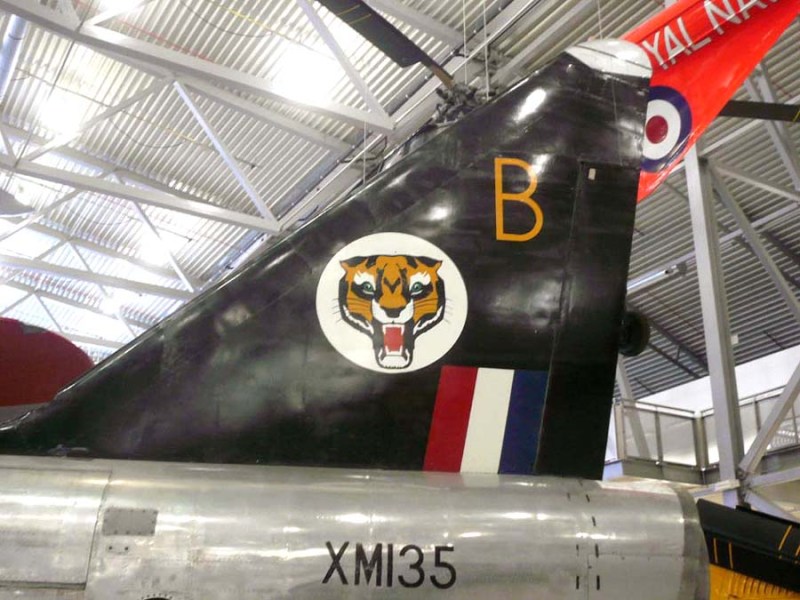
And finally, here is an English Electric Lightning fighter of the early sixties, proudly displaying its tiger badges. Firstly, on the nose itself, there are the two stylised versions either side of the RAF roundel:

And here is the  animal proper on the aircraft’s tail:

This Mach-2 fighter was operated by 74 Squadron and this is the Tiger scheme from the days when they were the RAF display team in 1962.

20 Comments

Filed under Aviation, Bomber Command, History, military, my Dad, Personal

Phonetic Alphabets (2)

Last time we looked at a number of phonetic alphabets. There was the British Army in 1904, the  British Post Office in 1914 , the  Royal Navy in 1917 and the  Western Union in 1918. Then came the good sense of the US Army and the US Navy in 1941 to have the same alphabet (for both) in contrast with the four different alphabets used by the RAF in different periods of World War II.

But what about the foreigners?

Here’s the Luftwaffe alphabet  in 1940. The very same one was used by the Wehrmacht, the German army:

Anton, Ärger, Bertha, Cäsar, Charlotte, Dora, Emil, Friedrich, Gustav, Heinrich, Ida, Julius, Konrad,

Ludwig, Martha, Nordpol, Otto, Ödipus, Paula, Quelle, Richard, Siegfried, Schule, Theodor, Ulrich, Viktor,

Wilhelm, Xanthippe, Ypsilon, Zeppilon

It is obviously different from the Allies’ alphabet, being based on names, but that must surely have made it quite easy to learn. Incidentally, “Ärger” and “Ödipus” were used for any words which contained either ” ä ” or ” ö “. Notice too how they have a code word for Ä and Ö. There is also a quick way of doing ‘c’ and ‘ch’ with Cäsar and China along with ‘s’ and ‘sch’ with Siegfried and Schule.

The most frequent marks of the Messerschmitt Bf109 such as the 109D, the 109E, the 109F and the 109G were frequently known by their phonetic letters, the Dora, the Emil, the Friedrich and the Gustav.

Here’s a young man and an old man who are the one and the same man. He was a Luftwaffe radio operator in WW2. The shape of his ears is a giveaway. Age yourself by seventy years but you’ll never change your ears.

And here is the cloth badge to be sewed on the uniform of a crewmember that the Luftwaffe called a “bordfunker”:

The German Navy, the Kriegsmarine, had a very slightly different alphabet, but , again, it was based on names:

Anton, Ärger, Bruno, Cäsar, China, Dora, Emil, Friedrich, Gustav, Heinrich, Ida, Julius, Konrad,

Ludwig, Martha, Nordpol, Otto, Ödipus, Paula, Quelle, Richard, Siegfried, Schule, Theodor, Ulrich, Viktor,

Wilhelm, Xanthippe, Ypsilon,  Zeppilon

The Wehrmacht used pretty much the  same alphabet with:

Anton, Ärger, Berta, Cäsar, Charlotte, Dora, Emil, Friedrich, Gustav, Heinrich, Ida, Julius, Konrad,

Ludwig, Martha, Nordpol, Otto, Ödipus, Paula, Quelle, Richard, Siegfried, Schule, Theodor, Ulrich, Übel, Viktor,

Wilhelm, Xanthippe, Ypsilon, Zeppelin 

 I couldn’t find a guaranteed French phonetic alphabet for World War II, but I did find this one, which is obviously based on first names:
Anatole, Berthe, Célestin, Désiré, Eugène, François, Gaston, Henri, Irma, Joseph, Kléber,

Louis, Marcel, Nicolas, Oscar, Pierre, Quintal, Raoul, Suzanne, Thérèse, Ursule, Victor, William, Xavier,

Yvonne, Zoé

That was a real list of sex bombs for French soldiers of every sexual persuasion to drool over. I don’t know what a “Quintal” is, but this happy curly haired chap is Ryan Quintal:

Actually I did look up “quintal” and one website said “a hundredweight  or a weight equal to 100 kilograms”. Another website said “backyard”. I often confuse the two.

The Italians, like many other nations, base their alphabet on towns and cities:

Ancona, Bologna, Como, Domodossola, Empoli, Firenze, Genova, Hotel, Imola, Jolly, Kursaal,

Livorno, Milano, Napoli, Otranto, Padova, Quarto,Roma, Savona, Torino,

Udine, Venezia, Washington, Xeres, Yacht, Zara.

Surely we all know the telegram sent by the humourist Robert Benchley to the New Yorker magazine:

“Have arrived Venice. Streets full of water. Please advise.”

I did find a Soviet spelling alphabet. The Russian alphabet, though, uses 33 letters, so it was quite complicated.  I decided to transcribe only the words for our Western letters. That came to:

Anna, Boris, Konstantin, Dmitri, Yelena, Fyodor, Grigory,

Khariton, Ivan, Zhenya, Leonid, Mikhail,

Nikolai, Olga, Pavel, Roman, Semyon,

Tatyana, Ulyana, Vasiliy, Zinaida.

Some letters such as ‘k’, ‘q’,  ‘w’, ‘x’ and ‘y’ do not really exist in Russian. Here’s a link to some of the letters of their alphabet.

Here are some Soviet signallers, giving a report to Headquarters in an unknown German town that has just been captured:

Two final points. If you can understand this, you’re a better man than me. This is perhaps 20% of a very large presentation of the Japanese phonetic alphabet. My best guess is that a word stands for a syllable, so that “suzume” stands for the syllable “su” and so on:

And finally, here’s the weirdest phonetic alphabet I found, taken from Tasmania in 1908:

Authority, Bills, Capture, Destroy, Englishmen, Fractious,

Galloping, High, Invariably, Juggling, Knights, Loose,

Managing, Never, Owners, Play, Queen, Remarks,

Support, The, Unless, Vindictive, When, Xpeditiously,

Your,  Zigzag


18 Comments

Filed under Aviation, History, Humour, military, Russia, the Japanese

The Sandiacre Screw Company (11)

Let’s recap this sad, sad, tale. And I’ve also found out one or two important new facts, and I’ve found a good number of new details. So don’t just dismiss it. Take a walk 80 years back into the past…..

Ivan Keith Doncaster was born on October 17th 1923. His mother was Evelyn Mary Fell before she got married. His father was Raymond Doncaster, an engineer. Ray’s father was Sir Robert Doncaster, the founder and owner of the Sandiacre Screw Company, a huge firm, the enormous size of whose premises on Sandiacre’s Bradley Street reflected perfectly the size of the business:

Sir Robert arrived in Sandiacre, a small town of some 9,000 inhabitants, around the beginning of the twentieth century. In 1899 he was living at “The Grange” on Derby Road and by 1912, he was living at “The Chestnuts” on the same road. (Or, he had just changed the name of his house.)

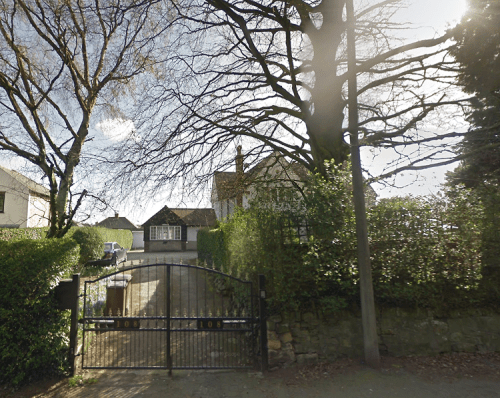
Ray and Evelyn Doncaster, Keith’s parents, lived at “Shenstone” in Longmoor Lane which is just one section of an extremely long road which runs north to south,  across the middle of the town. It begins as Ilkeston Road, then Lenton Street, then Longmoor Lane as it passes under Brian Clough Way and then finally Petersham Road.  In the 1930s, houses in Longmoor Lane were so infrequent that house numbers were not necessary. The address given to the High School for young Keith, in 1933, therefore, did not include a house number. Just “Shenstone” would suffice. The house was actually the modern No 108, to the south of Brian Clough Way, almost on the brow of the hill as you travel southwards. And this detached house, set back from the road, is absolutely enormous. It was originally built for the founder of the family firm, Sir Robert Doncaster, and was set in its own grounds, with mature trees and lots of space in every direction. It is currently pebble dashed completely white and must contain many very large and lovely rooms. One quite fascinating detail that I found out was that the house’s garage has its own minor place in history. Protected by hundreds of sandbags, it operated as one of the ARP centres for nearby Sandiacre. The ARP (Air Raid Precautions) was set up in 1937 as an organisation to protect the civil population from the worst effects of the inevitable terror bombing by the Luftwaffe. This is the house:
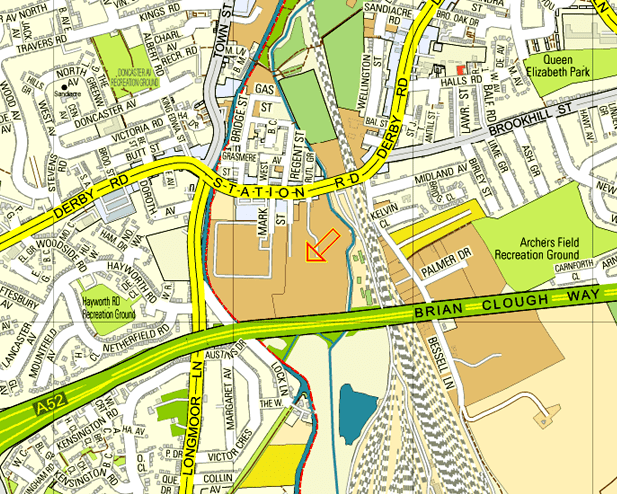
Ray Doncaster, Keith’s father, served in the army during the First World War. When he returned home in 1919, Ray became Assistant Works Manager of his father’s company. In due course, he was promoted to Works Manager, eventually replacing his father as Managing Director. He retired during the 1960s. It does not take a fortune teller to work out that, had he lived, Ray Doncaster’s only son, Ivan Keith Doncaster, would himself eventually have succeeded to that position. Instead, Keith did not come back from his war and the company eventually just disappeared. How many hundreds, if not thousands, of jobs were lost when young Sergeant Doncaster’s Lancaster was shot down? Today, the area which was occupied by the Sandiacre Screw Company is easily traceable. It is the brownish area on this modern map, with Longmoor Lane to the west and the railway tracks to the right. The Orange Arrow marks the spot:

Nowadays, this area is home to an almost uncountable number of modern industrial units, small workshops,  places where a large lorry can be loaded, places where a large lorry can be unloaded,  places to have a broken windscreen replaced, places to rent storage space, places where they carry out autorepairs, distribution centres and supermarkets. But it’s a dead place:

Just here and there, occasionally, a vehicle drives past, a car drives into one of the unit’s car parks. A van sets off to deliver car parts to Bingham. A fork lift truck driver shouts a greeting across to his friend in a lorry. It is a huge area but it certainly does not support anywhere near the huge number of people that used to work for the Doncaster family:

This slideshow requires JavaScript.

Here and there a few red brick buildings remain. And the occasional red brick wall:

They are all that is left of the Sandiacre Screw Company nowadays. Just one German bullet had such a huge effect. Initially on one 20 year old mid-upper gunner. And then the ripples spread wider, and affected a whole family. Then they touched on a whole factory and its workforce of so many hundreds of workers in a distant English town. And thirty years or so after that Lancaster plunged to earth, the workforce found they had no work, and ultimately, they had no factory.

20 Comments

Filed under Aviation, Bomber Command, History, military, Nottingham

“Soldaten” by Sönke Neitzel and Harald Welzer (4)

In my very first blog post in this book review, I mentioned how German academic, Sönke Neitzel, had discovered that during World War II, British Intelligence had taped German prisoners of war in secret and then transcribed their conversations. This process had produced 50,000 pages of foolscap transcripts. These transcripts have in their turn inspired a four hundred page book called “Soldaten” in which Neitzel and his co-author, Harald Welzer, examine the reasons for the war crimes committed by the Germans, and indeed, by the personnel of a number of other nationalities. Here are our authors and their book:

This slideshow requires JavaScript.

The bugged prisoners were kept in three locations – Latimer House near Amersham, Wilton Park near Beaconsfield, both in Buckinghamshire, and Trent Park near Cockfosters in north London. The first two held captured U-Boat submarine crews and Luftwaffe pilots, who were bugged for a week or two before being moved on to conventional captivity. Trent Park was often used for high-ranking officers of the Wehrmacht, whose own personal vanity led them to betray many secrets:

There were large numbers of pro-British German speakers, usually Jews, listening to prisoners’ conversations in a place known as the “M room”. The “M” stood for “Microphoned”. According to Helen Fry, the author of a book about this particular episode, the information pouring out of these pampered Prussians was so top secret that Churchill gave the whole operation an unlimited budget.

Last time we were looking at the reasons that men in war are capable of the most vile violence. Here are the ideas put forward by Neitzel  and Welzer so far . I have tried to include a few short clues of the examples they used:

“There is a  vast gap between what people believe about their moral standards and their actual behaviour”.  (The Good Samaritan episode at Princeton University)

“When you have reacted once in a particular way to a certain situation, you will continue to apply the very same rules.” (German soldiers killling Jews on a large scale)

“The unit was the entire world….what they thought was right, was right and what they thought was wrong, was wrong.” (Only one man refused to take part in the My Lai massacre in Vietnam)

“inhumanity with impunity…..if soldiers commit crimes, and are never punished, they will repeat their behaviour.” (German soldiers raping passing women in Kiev)

“a dynamic of violence” ……… anybody who tries to flee is automatically an enemy who should be shot.” ( A frequent attitude in Vietnam, probably because the Vietcong guerillas were difficult to identify)

One final extremely large motivation towards violence is revenge. In a film, revenge will be the simple, basic story of how a soldier is killed by the enemy, usually in particularly appalling circumstances, and, as he dies, his friend swears to avenge him. For every military revenge film, though, there are many more set in a civilian context.  This may not be the best example, but it’s certainly the most obscure:

In real life,  there were GIs in Vietnam who had re-enlisted to avenge their best buddy who had been killed in the fighting, or tortured to death, and so on. The authors have found a quote:

“I did not hate the enemy for their politics but for murdering Simpson, for executing that boy whose body had been found in the river…Revenge was one of the reasons I volunteered for a line company. I wanted a chance to kill somebody.”

In the Second World War, the situation could be slightly different. American GI, Joseph Shomon said:

“Even in hopeless situations, the Germans would fight to the last, refusing to surrender. Then, when their ammunition was gone, they were ready to give up and ask for mercy but because many Americans had been lost in this delay, our troop often killed the Germans.”

As well as revenge, of course, this shooting of surrendering Germans is a good example of a couple of other reasons for the occurrence of war crimes previously mentioned by Neitzel & Welzer. Firstly, if everybody commits acts of violence and nobody is ever punished for it, then clearly, they can:

“follow what they had already done”.

And secondly:

“what (the unit) thought was right, was right and what (the unit) thought was wrong, was wrong.”

Sometimes soldiers in the two World Wars were actually ordered not to take any prisoners. The latter were then very much more likely to be executed than to be taken back to base. In the Second World War, the German military were ordered by the Führer to hand over immediately to the Sicherheitsdienst (SD, or Security Service) all British Commandos, SAS, SOE and any other type of “irregular” soldier. This was the famous “Kommandobefehl” which you can read about here.

In actual fact, my own Grandad was placed in a similar position on at least one occasion during the First World War. It must have been on the anniversary of the execution of Edith Cavell on ‎October 12th 1915 that he and his colleagues in the Canadian army were told to take no prisoners during that day’s attack. Whether my Grandad carried out the order, I have no idea.

My own perception, though, is that rather than refuse to take prisoners in the usual way, and instead to kill them, it was far more frequent in World War One, to try and spare the lives of the men who had been ordered to attack but who were now in a situation which could only have one outcome. Harry Patch, for example,who at 111 years of age was “the Last Fighting Tommy”, has spoken of how he refused to kill a German soldier:

“Patch came face to face with a German soldier. He recalled the story of Moses descending from Mount Sinai with God’s Ten Commandments, including “Thou shalt not kill” and he could not bring himself to kill the German. Instead, he shot him in the shoulder, which made the soldier drop his rifle. However, he had to carry on running towards his Lewis Gun, so to proceed, he shot him above the knee and in the ankle.”

My Grandad was wounded in the legs on two occasions, so perhaps the Germans did the same kind of thing.

We have a long, bloody way to go with “Soldaten” yet, so let’s finish with some wise words from Harry Patch, the last British soldier of World War One, who lived to become a pacifist:

When the war ended, I don’t know if I was more relieved that we’d won or that I didn’t have to go back. Passchendaele was a disastrous battle—thousands and thousands of young lives were lost. It makes me angry. Earlier this year, I went back to Ypres to shake the hand of Charles Kuentz, Germany’s only surviving veteran from the war. It was emotional. He is 107. We’ve had 87 years to think what war is. To me, it’s a licence to go out and murder. Why should the British government call me up and take me out to a battlefield to shoot a man I never knew, whose language I couldn’t speak? All those lives lost for a war finished over a table. Now what is the sense in that ? “

20 Comments

Filed under Canada, Criminology, France, History, Politics, Science

The Supermarine Walrus (2)

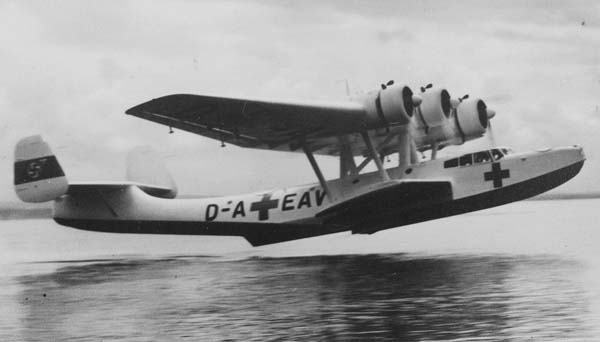
Last time, we were looking at the Supermarine Walrus amphibian which was used by the RAF in the second half of the Second World War:The Germans entered the war completely prepared for air-sea-rescue, of course. They had a dedicated arm of the Luftwaffe called the Seenotdienst and they made extensive use of the Dornier Do24, one of the comparatively few three engined aircraft used in the conflict:

The Dornier Do 24 was initially built for the Royal Netherlands Navy, the Koninklijke Marine, to be used primarily in the Dutch East Indies, today’s Indonesia. The Do24 was very much admired by the Seenotdienst so, in the words of Adolf Hitler, “I invaded the country and I stole all six of them.”

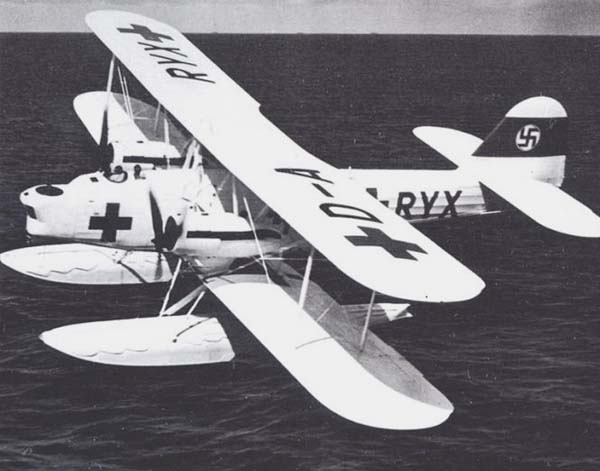
The Germans also made extensive use of the Heinkel He59 which was unarmed and painted white with big red cross:

These floatplanes would cheerfully rescue both Luftwaffe and RAF aircrew. Nevertheless, there was a suspicion that the Germans might have been using their aircraft for proscribed reconnaissance activities and the RAF was told to shoot them all down in Bulletin 1254, which indicated that “all enemy air-sea rescue aircraft were to be destroyed wherever they were encountered”. In retrospect, perhaps a little disappointing as a decision.

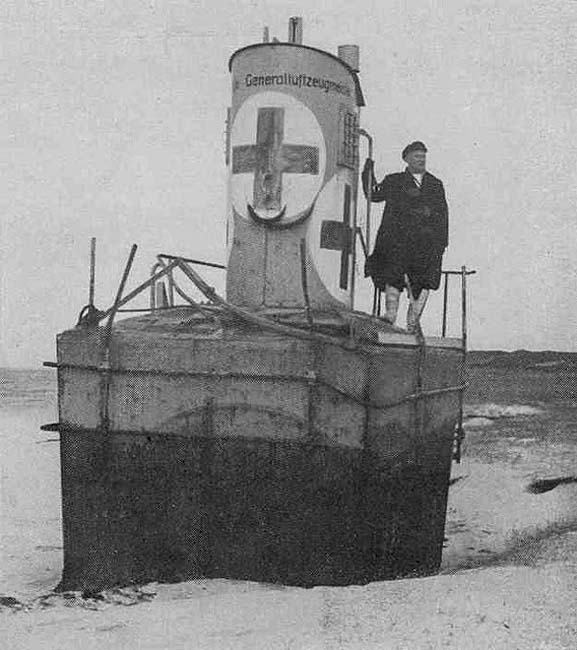
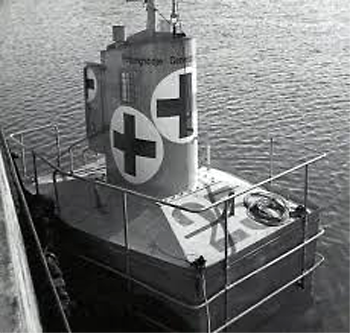
The older He 59 was much more comparable with the Walrus, perhaps, than the Do24. This Heinkel biplane was much slower than the monoplane Dornier (and was therefore much easier to shoot down as part of Bulletin 1254). Both aircraft made extensive use of the invention of Ernst Udet, the yellow-painted “Rettungsbojen” or rescue buoys:

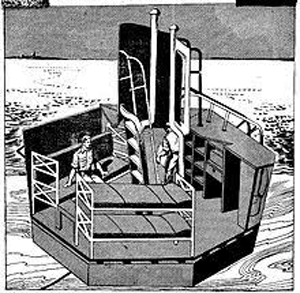
These buoy-type floats were highly visible and they held emergency equipment such as food, water, blankets, dry clothing enough for four men, and an assortment of board games including, of course, “Risk”, for the Germans. Here’s a cut-away of the buoy:

And here is a rare picture of Admiral Donitz about to begin his famous speech announcing that all the lighthouses of the world were now part of the Greater German Reich:

Shot-down airmen from both sides were strongly attracted to these buoys and many a desperate game of Schcrabble or Buckaroo was played to decide who had first dibs with the rescue buoys’ bratwurst or their assortment of smoked cheeses. British airmen and seamen called the Rettungsbojen “Lobster Pots” for their shape:

The rescue buoys also attracted the close attentions of many sailors in both German and British rescue boats. They would come to inspect the buoys from time to time and “friendly” downed airmen were rescued, but enemy aircrew automatically became prisoners of war.


14 Comments

Filed under Aviation, History, Humour

A nasty German in Woodville, Part One, the Legend

I grew up in a small village called Woodville, just to the south of Derby, in more or less the centre of England.

Derby was the home of an important Rolls Royce factory which made Merlin engines, the powerplant used by important World War Two aircraft such as the Spitfire, the Hurricane, the Mosquito and the Lancaster :

This slideshow requires JavaScript.

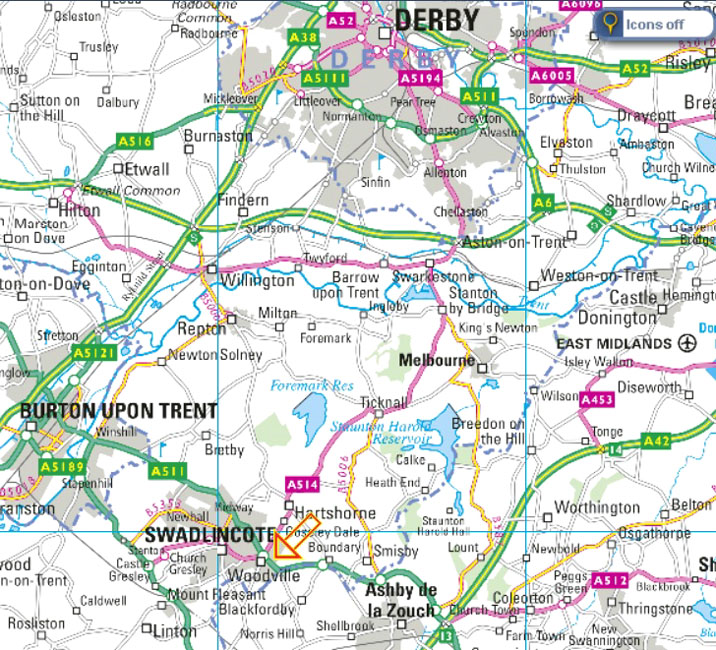
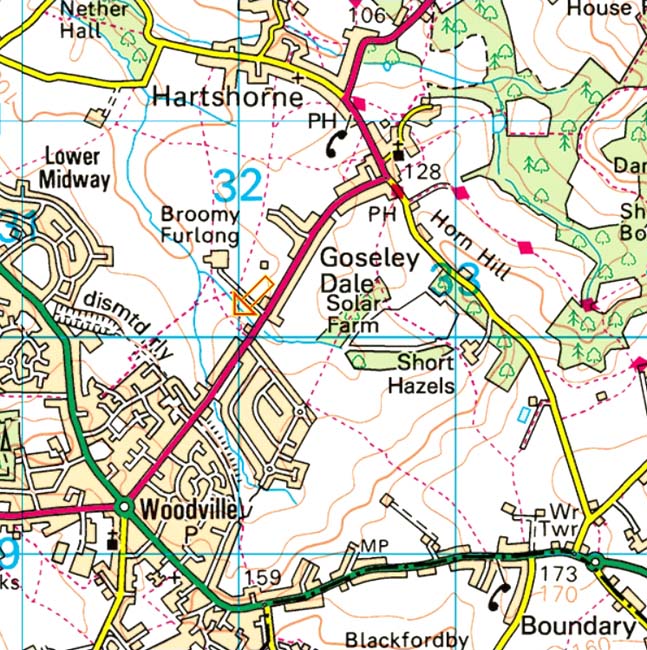
Shortly after the outbreak of war in 1939, steps were taken to protect this important Derby factory from enemy air attack. Immediate measures included the installation of a large calibre ex-naval gun on the western side of Hartshorne Lane, on some grassland near the public footpath, just beyond the site where the Dominoes public house was to be built shortly after the end of the war. Look for the Orange Arrow, my hearties!! :

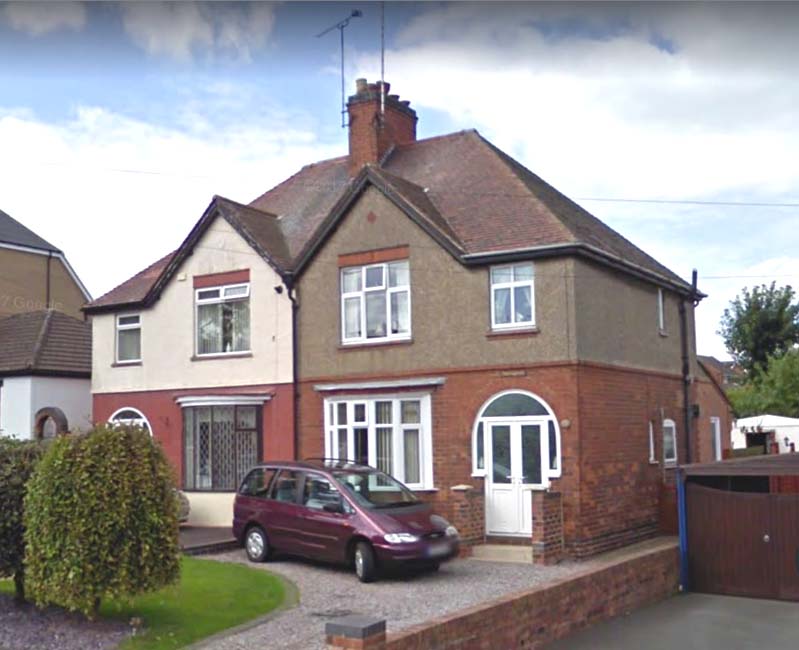
This naval gun, probably taken from a scrapped old battleship, was extremely powerful and extremely noisy. Every time it was fired in practice, it made all the cups rattle on their holders in the pantry at my grandparents’ house, “Holmgarth”, at No 39,  Hartshorne Lane, some half a mile away :

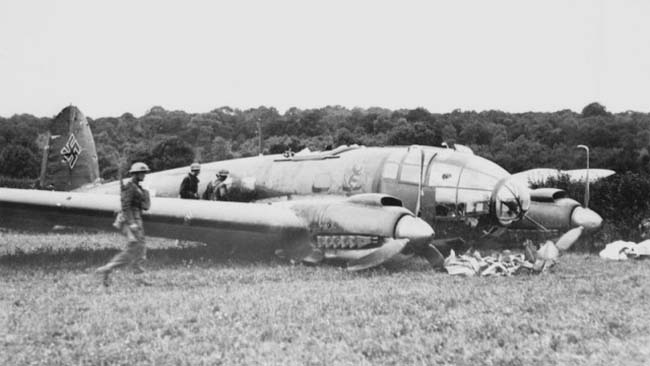
One evening, probably in the second half of 1940 or early 1941, a lone Heinkel III bomber was caught in the searchlights over Derby. This spectacular event was the signal for the Hartshorne gun to fire its one and only shot in anger of the entire war :

Needless to say, the shot was a successful one and the bomber was duly brought down. Later in the evening, the Home Guard was to capture the pilot, who had descended by parachute from his stricken craft. Another slightly different version of the story relates how the pilot was dragged semi-conscious from the wreckage of his aeroplane:

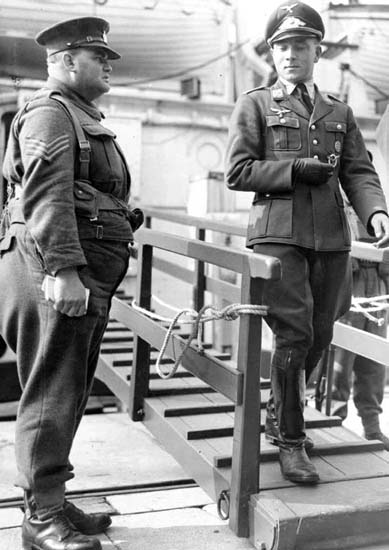
The pilot was subsequently brought to Hartshorne and then marched up the hill to the Police Station at Woodville Tollgate. He did not speak any English but seemed happy to rave loudly to himself in German. This gentleman was seen by the locals as being a typically arrogant Nazi, who believed that the war was already won. He was even smoking the Player’s cigarettes which had been captured in such large quantities at Dunkirk in June 1940. I couldn’t find a picture of this particular gentleman in Woodville, but the world at this time was not particularly short of arrogant Nazis:

The pilot was locked in a police cell overnight. This may well have been to his benefit, as the mood of the angry passers-by as he had been brought up Hartshorne Lane had largely been in favour of lynching him. Indeed, the crowd’s evident hostility had done much to quieten the pilot’s rantings on the long slow walk up to the police station.

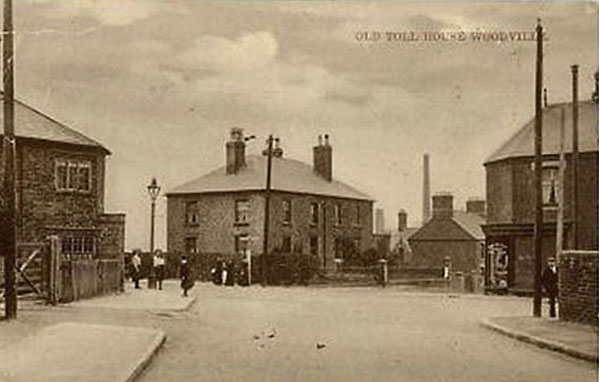
Here’s the police station, in Edwardian sepia. If you look to the right of the police station, (which is right in the middle of the picture), there is a very tall chimney which is now long demolished but which, then, was the chimney of the Outram’s factory which made sinks, wash-basins, toilets and such. To the right of that chimney is a very stout looking house with two chimney stacks. The further one of those two is the chimney stack for my Mum and Dad’s house, “Clare Cottage, built 1890”, They lived there from 1949-2000 and 1949-2003 respectively.

So what? you may ask. Well, I know that with a little bit of luck, my instructions will be followed by a lady from India, a gentleman from Australia, my American friends from coast to coast, and citizens, perhaps, of other countries across the globe, as well as my valued readers in this country. I wonder what the newly married couple would have thought of that, when they moved in to what was then a semi-derelict house,  more than seventy years ago. People across the whole world looking at their chimney stack :

At the time the Heinkel was shot down, Fred, as a young man of some seventeen or eighteen years of age, was still awaiting his chance to go into the RAF. He had therefore in the interim become a young member of the local Home Guard, or L.D.V. (the Local Defence Volunteers, or as Fred always interpreted the initials, “Look, Duck and Vanish”). Neither the Hartshorne Home Guard or the Woodville Home Guard ever had as many rifles as these mean looking killers, though:

This episode, before he went away into the armed forces, was in actual fact the only time that Fred was ever destined to meet a Nazi in person. Indeed, in later years, Fred was to say that this was the most dangerous moment he was to experience in terms of being directly face to face with the enemy. The even greater irony was that the very real threat of violence inherent in the situation was provided exclusively by the English civilians, and not by the Luftwaffe pilot himself.

Conceivably, this particular Heinkel bomber was the same one which was later to be put on display in nearby Burton-on-Trent in an effort to raise funds for the war. I have been unable to trace an exact date for this occurrence, other than the fact that, with the decreasing frequency of Luftwaffe raids on England, it was more likely to have occurred sooner rather than later during the conflict.

I was told this story about the naval gun more than once by my Dad, Fred. It seemed so far fetched that I began to think that he was suffering from false memories. I thought that perhaps my Dad had confused 1940 or 1941 with a very famous episode of the comedy “Dad’s Army”. But he hadn’t. Fifty or so years after I first met him, my oldest friend revealed that his mother, as a young girl, had been in that crowd at Woodville Police Station and had seen the arrogant Nazi smoking our Player’s Cigarettes.

Any excuse for a bit of Dad’s Army:

That moment has won more than one award as the funniest moment ever on BBC TV.


29 Comments

Filed under Aviation, Bomber Command, History, Personal

Three war crimes, two Sunderlands and one Ashley Wilkes (5)

Last time we were looking at how the English film star, Leslie Howard, was killed when the aircraft he was in, a DC-3 Dakota, was shot down over the Bay of Biscay, by the Luftwaffe.

That Dakota, though, was actually completely unarmed and it was no match whatsoever for a single Junkers Ju88, let alone a group of eight of them. As well as being unarmed, it was also registered in a neutral country (the Netherlands) and flying from a neutral country (Portugal) to England.

Nobody took very much notice of this at the time, but, because of these seemingly innocuous details, the entire episode therefore crossed the line of human decency and became a war crime. Here’s the DC-3 in question. Note the Dutch flag, with the prominent orange:

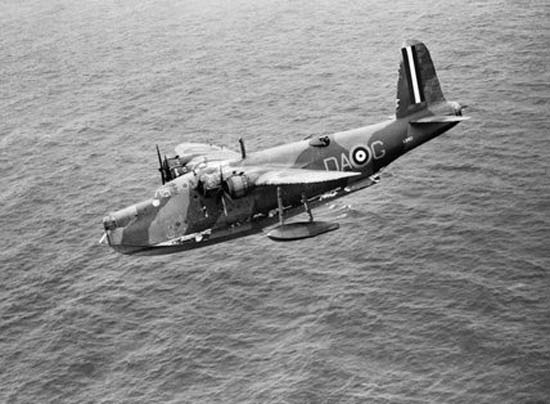
In the immediate aftermath of the DC-3’s failure to arrive in Bristol, the British sent out a Short Sunderland GR3 flying boat to look for it on the following day (June 2nd 1943):

The aircraft carried the serial number EJ134 and it was piloted by the brave Australians of 461 Squadron. The crew was James (Jim) Collier Amiss (Second Pilot), Wilbur James Dowling (First Pilot), Alfred Eric Fuller (First Wireless Operator / Air Gunner), Ray Marston Goode (Tail Gunner), Albert Lane (Third Wireless Operator / Air Gunner), Edward Charles Ernest Miles (First Flight Engineer), Harold Arthur Miller (Second Wireless Operator / Air Gunner), Kenneth McDonald Simpson(Navigator), Philip Kelvin Turner (Second Flight Engineer), Colin Braidwood Walker (Captain) and Louis Stanley Watson (Rigger).

The flying boat found nothing whatsoever on the surface of the sea, no wreckage at all. What they did find though, were surely the very same eight Ju88C-6s that Leslie Howard had already met, at more or less the very same place where they had met them. Sunderland EJ134 and its crew then won their place in aviation legend. In a prolonged battle, the flying boat lost one engine and its tail turret. Messrs Dowling, Goode, Miller, Simpson and Walker were all injured and poor Ted Miles, one of the two side gunners and just 27 years old, was killed. The battling Aussies did manage, though, to shoot down three of the eight German fighters:

Of the other five, only two made it all the way back to Bordeaux. The other three were presumed to have crashed into the waves as they were never heard of again. Six out of eight shot down. That should teach them not to attack unarmed airliners flying from neutral countries. The now shot to pieces and extremely battered Sunderland EJ134 made it the 350 miles back to western Cornwall, not to Penzance, but only as far as a beach on the south Cornish coast, at Praa Sands:

The fierce Atlantic waves, however, ultimately smashed it to smithereens:

Young Ted Miles, just 27 years old, was buried at Pembroke Dock Military Cemetery joining 72 more casualties, 40 from World War I and 32 from World War II, including five Australians. On his grave his parents had written:

“There is no death: our stars go down to rise upon some fairer shore”.

The family came from Brixton in London. Ted’s parents were Edward Charles Miles and Florence Mabel Miles. His young wife was Frances Margaret Miles.

Around eight weeks later, virtually the same 461 Squadron crew was lost without trace out on patrol over the Bay of Biscay on Friday, August 13th 1943 in a Short Sunderland Mk III, serial number DV968. The last message that they transmitted was that they were being attacked by six Ju88s. The victory was claimed by Leutnant Artur Schröder so this particular incident may not have been exclusively carried out by members of the original eight, especially as Schröder was in 13 / KG40, not V/KG 40:

The men from EJ134 who were killed in DV968 were Wilbur James Dowling (34), Alfred Eric Fuller (20), Ray Marston Goode (34), Albert Lane (27), Harold Arthur Miller (23), Kenneth McDonald Simpson (28), Philip Kelvin Turner (26) and Louis Stanley Watson (25). The new members of the crew who died were David Taylor Galt (28), James Charles Grainger (24) and Charles Douglas Leslie (Les) Longson (20). Not flying that day were James (Jim) Collier Amiss and Colin Braidwood Walker from the original “Flying Porcupine”, Sunderland EJ134. Both men would survive the war and go home to Australia. Hopefully, they lived out very long and happy lives. Perhaps they followed a sports team:

Or perhaps they preferred the beach:

16 Comments

Filed under Aviation, Cornwall, Criminology, History, Personal, Politics