Author Archives: jfwknifton

Nottingham High School on ebay (2)

As well as not buying a rather expensive medallion on ebay, I have actually bought a postcard or two over the years. The first one was sent on October 27th 1926. It is stamped with an 8.00 pm postmark, so I presume that it was written earlier that day and then posted perhaps before dinner, or, more likely perhaps, on the sender’s way home from work. It was a Wednesday, which in those days would have been half day closing, so he probably left work at 1.00 pm and put it into the post box on his way home:

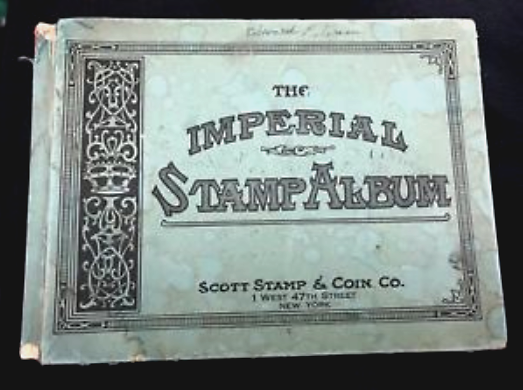
Notice how the Post Office slogan is “British Goods are best”. Only a few months after the General Strike, the economy was in real need of a boost if further discontent and upheaval was to be avoided. Notice too, the beautiful, classic stamp. King George V was a fanatical stamp collector, and loved nothing better of an evening than sticking his stamps in his thousand albums. When you’re an emperor, this is the album for you:
The postcard is addressed to NG Peet of 2 Gorsey Close in Mapperley Park. I couldn’t trace a Gorsey Close but I did find a Gorsey Road. Here is a close up view of the area. Gorsey Road is between the B684 Woodborough Road and Mapperley Road, in Mapperley Park, one of Nottingham’s leafier suburbs. Look as always for the orange arrow.  No 2 is on the corner with the B684, Woodborough Road. :
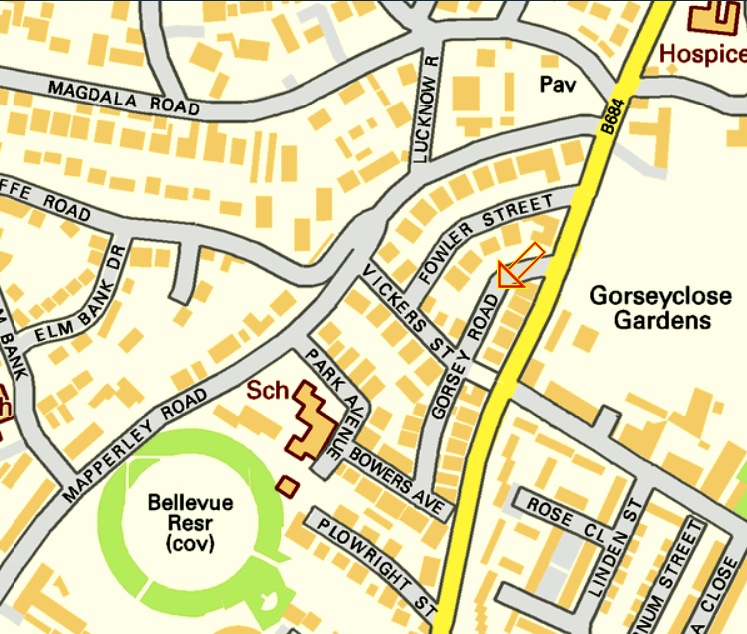
If you look at this larger map, you can see that Gorsey Road is not too far away from the High School which is in the bottom left corner in the area between Arboretum Street, Forest Road East and Waverley Street. The School is on the corner either side of the pale green patch. Gorsey Road, I should have said, is again indicated by the orange arrow.

This is No 2 Gorsey Road now, a little overgrown perhaps, and in a street which looks to have gone a little downhill, but obviously, it was a very beautiful house in its time:

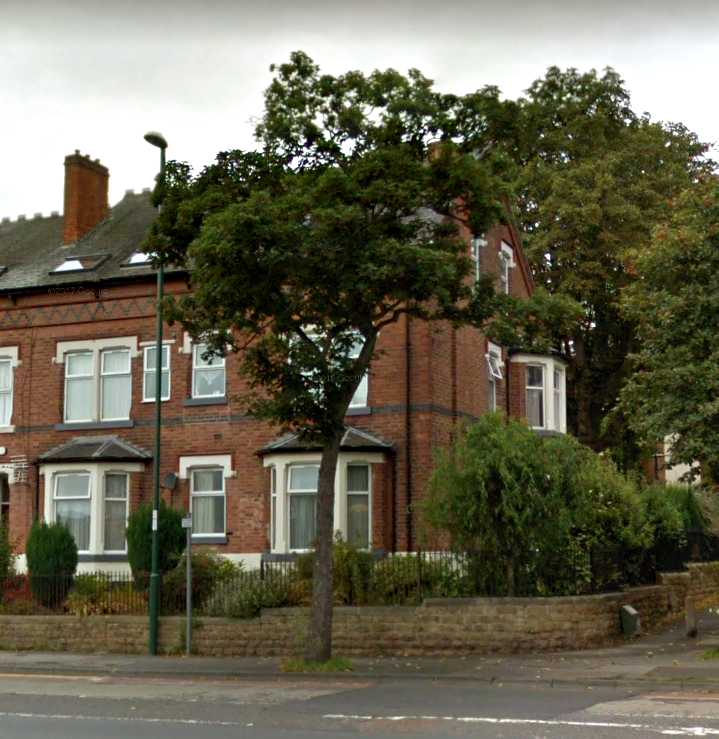
The Peet family had only recently moved to Gorsey Close when that postcard arrived in the late evening of October 27th 1926. In the Kelly’s Directory published in 1925, their future abode was owned by Edward Westwick Kirk of Kirk & Macdonald. The Head of the Family, WG Peet, was living at that time at 249 Woodborough Road, presumably with everyone else in the family. Here it is:
Three years or so later, when all of the information had been collected for the 1928 edition of the Kelly’s Directory, the house in Gorsey Road was now recorded as being occupied by Mrs Ann Elizabeth Peet. She was presumably NG Peet’s mother, rather than his wife. At this time her son was still in his early twenties and it is by no means surprising that he was still living in the parental home. There is certainly no NG Peet listed as living elsewhere in Nottingham, nor indeed in the rest of the county.

In 1929, the High School prepared its own list of the Old Boys’ addresses. In that, NG Peet is listed as still living at 2 Gorsey Close although it could just be that they carried an old address forward.

NG Peet, incidentally, I should have introduced him earlier. He is Noel Gordon Peet, who was born on December 26th 1901, hence the name. His father was William George Peet who was a “General Agent”. Six years later, in 1925, the relevant Kelly’s Directory listed William George Peet as working for “WG Peet, Son & Company”. By 1928, he is listed as a “yarn merchant” operating from Kaye’s Walk. His telephone number was listed as “TN 42769” and his telegraphic address as “Knitiarns”.

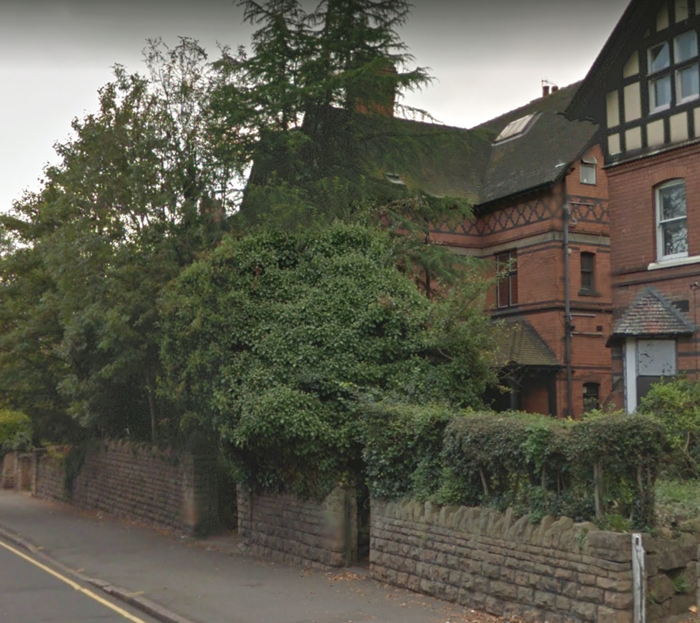
Noel entered the High School on April 26th 1917, at the age of 15. He was Boy No 3662 and he stayed there until July 1919. At this time, 1917 at least, the family was living at 413 Mansfield Road. Here’s 413 Mansfield Road, in spirit a very similar house to 2 Gorsey Road. I’m a huge lover of trees, but these need a tree surgeon and his assistant for a day and the whole place would look so much better:
Noel packed a lot into his two and a bit years at the High School. He won the Fifth Form B Prize in 1918 and the Fifth Form Writing Prize in the same year. In 1919, he won the Sixth Form B Prize. In the Officer Training Corps, he became a Corporal in 1918 and a Sergeant in 1919. In cricket, he won the School Prize for Batting in the same year.  He had 13 innings and scored a total of 144 runs at an average of 11.07. His top score was 36. Not a classic season for the School apparently !

Also listed in the High School’s list of Old Boys in 1929 was William Ronald Peet, Noel’s younger brother. He too is recorded as living at No 2 Gorsey Close. He was born on October 9th 1910 and entered the High School as Boy No 4036 on May 1st 1919. He left in December 1926 at the end of the First Term. By the time William entered the School, the family had moved from Mansfield Road and were living at Sutherland Lodge in Lucknow Drive in Mapperley Park. The boys’ father is listed as a “manager”. Lucknow Drive, or rather the word “Lucknow”, is visible in the top right corner of the second map above.

Did anything significant happen on the day the postcard was posted, namely October  27th 1926, anywhere in the world ? Well, nothing really earth shattering, but there was one episode which I found quite amusing. Here’s a clue, with a picture of a Shipstone’s Brewery beer crate and some of their products:

Shipstone’s Brewery lasted from 1852-1991. I always felt that it was, at best, an acquired taste. Anyway, here’s the funny story to finish with. It comes from ‘Hansard’ which records everything said by everybody in debates in the Houses of Parliament. The story came out because Labour Party MP, Alfred Salter, was censured in the House of Commons for refusing to retract remarks of his that had appeared in the Daily Express:

 “I am not prepared to withdraw, modify or apologise for anything I have said on this matter, and I propose to repeat the words I made use of and about which complaint has been made.

I said, and I repeat it here to-day, that I have seen members of all parties in this House, my own party I regret to say included, drunk in this House not on one occasion but on many.”

A motion was passed calling the statement “a gross libel on the Members of this House and a grave breach of its privileges.”


20 Comments

Filed under History, Nottingham, Personal, The High School

the Gloster Meteor at Hendon (2)

Last time I was talking about my visit to RAF Hendon where I saw the Messerschmitt Me 262, and I also saw the first RAF jet fighter, the Gloster Meteor F8. I ended the post by saying what the Meteor’s good points were:

This slideshow requires JavaScript.

Set against the positives of the Meteor, though, is its dreadful safety record which soon led to the new jet fighter being called “The Meatbox”.

Almost 900 were lost by the RAF, the peak year being 1953 with 145 crashes:

Factors to blame were apparently poor brakes, the landing gear, completely different flying characteristics from piston engined aircraft, a flight endurance of less than 60 minutes which caused pilots to run out of fuel and lots of difficulties when only one engine was working. Even with two engines, response times were very sluggish. To add to the list, when pilots in those days were taught how to fly on one engine, the other engine was switched off completely so, to quote the forum where I found it, “you had no chance if you fouled it up”. The aircraft also apparently had a nasty habit of diving straight into the ground when any flap or the undercarriage was lowered when the wing mounted airbrakes were out. There were no ejection seats in early aircraft and it was therefore very difficult to bale out of, although it was extremely easy to hit the tail on the way out. The foreign air forces had the same kind of difficulties. Here is a Belgian crash:

According to one account I found, the Coroner at Darlington actually subpoenaed the commander of the local base to make him come and explain the steadily increasing size of the RAF section of the municipal cemetery. No problem for the commander. All he needed to do was to invoke the Official Secrets Act and it was problem solved. At least one student pilot on every course was being killed. No 74 Squadron had three killed in as many months:

In “The Meteor Boys” by Steve Bond there is an account by a prospective young pilot of his going on a course to learn to fly Meteors at RAF Driffield. He went to a funeral on his first Thursday and then to another the following Monday, and a third on the following Thursday.
In foreign service in the Netherlands, the Meteor was the second most dangerous jet aircraft they ever had with almost 36 crashes in every 100,000 hours of flying. (And the winner is…… the F-84 Thunderjet with almost 56 crashes per 100K hours):


Perhaps we should put these figures for the Meteor in RAF service in context, though. One forum I came across said that in 1953 the RAF lost 486 aircraft with 334 fatalities. The other years of the 1950s are believed to be 1950 : 380 aircraft lost and 238 fatalities, 1951 : 490 aircraft lost and 280 fatalities, 1952 : 507 aircraft lost and 318 fatalities, 1954 : 452 aircraft lost and 283 fatalities, 1955 : 305 aircraft lost and 182 fatalities, 1956 : 270 aircraft lost and 150 fatalities, 1957 : 233 aircraft lost and 139 fatalities, 1958 : 128 aircraft lost and 87 fatalities and 1959 : 102 aircraft lost and 59 fatalities

If my trusty calculator is correct, that makes 3,353 aircraft lost and 2,070 young men killed. My quick mental arithmetic says that you had, therefore, a 61.73575902177% chance of a premature death if anything went wrong with your 1950s RAF aircraft.

It must have been this kind of situation that provoked Prime Minister Winston Churchill to ask the Air Minister “Is the RAF training or killing its pilots?” The Air Minister told Churchill not to worry as these kind of figures were merely par for the course.
None of this takes away from the Meteor, though, the honour of being the first ever British jet fighter:

This slideshow requires JavaScript.

My Dad came across a Gloster Meteor once:

“one day in late 1944, everybody was in the mess at Lossiemouth, eating their lunch and drinking their cups of tea. Suddenly the door was flung open, and a very excited young man came in shouting “Quick ! Quick ! Come outside and see this ! There’s a crate out here without any props ! ”

And sure enough, outside the mess hall, on the runway, stood one of the RAF’s first jet aircraft, a Gloster Meteor, a fighter plane which did not have any propellers. The mechanics could not believe that the strange aircraft would even be capable of flight. But then they realised…..

“ No more prop changes ! ”

27 Comments

Filed under Aviation, History, Science

Nottingham High School on ebay (1)

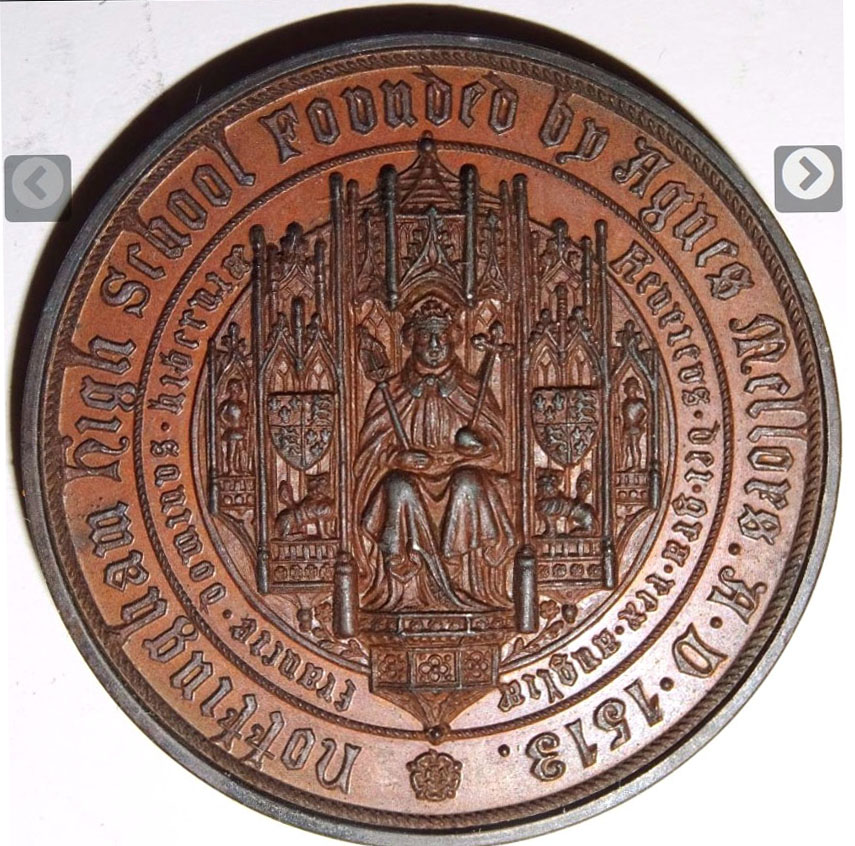
I always keep an eye on ebay to see if anything is on sale which is connected with Nottingham High School, the school where I spent my entire teaching career. First, here’s something that I didn’t buy because I thought it was far too expensive. Here’s the front:

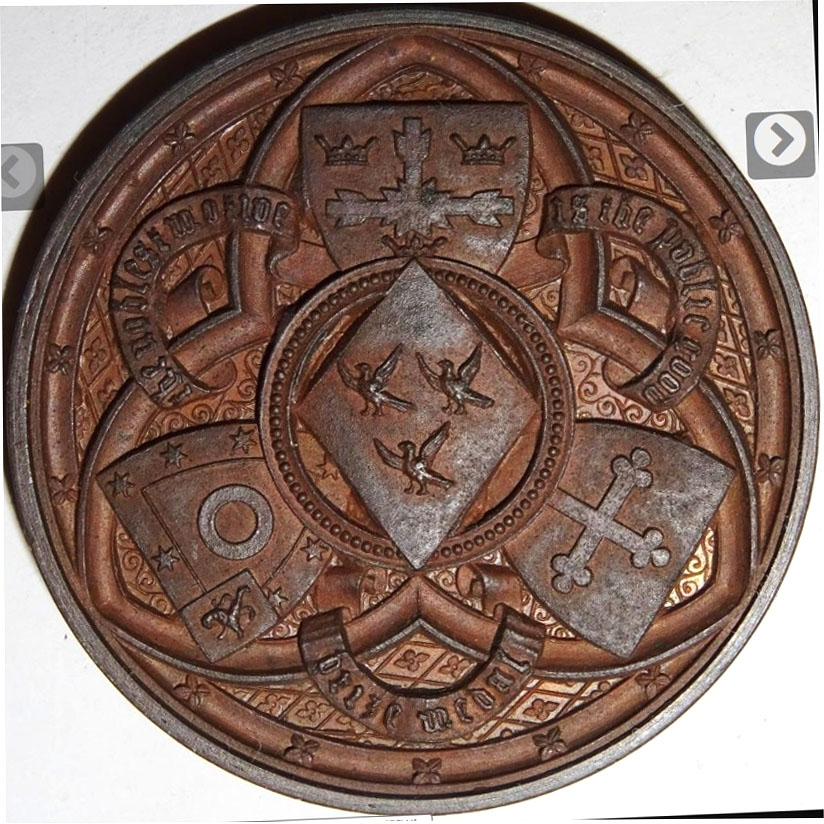
And here’s the back:

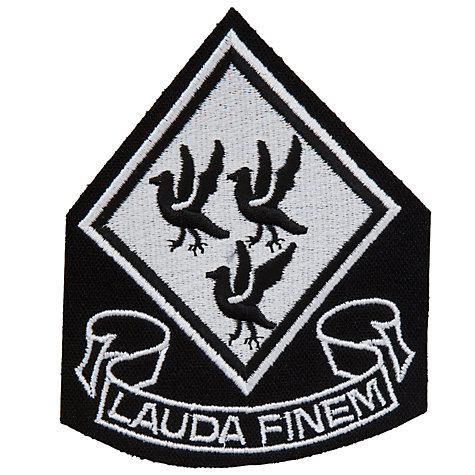
The seller wanted £85 for it which I thought was just too expensive for me. It was a medal awarded to Benjamin Herbert Heald of Wilford, a little village on the River Trent to the south of Nottingham. Born on September 16th 1874, Benjamin entered the High School at the age of 12 on September 11th 1887 as Boy No 664. His father was Francis Berry Heald, a designer. Benjamin left the High School on the last day of what was at the time quite frequently called “Term Three” in July 1893. He went on to Queen’s College, Oxford with an Exhibition of £42. That would have been at least 20 times the average worker’s weekly wage.  At the High School he was a true Clever Clogs of the Very Highest Level. He was a Foundation Scholar (1890), a William Enfie Exhibitioner (1892), a Morley Exhibitioner (1891). He won 12 School Prizes in his time at the school, and a number of medals. You can make your choice as to which one this was. They were the Bronze Medal for Good Conduct (1889), the Gold Medal for the Best Open Scholarship (1893) , the Silver Medal for Classic (1893) and the Bronze Medal for Good Conduct (1893). If anybody knows which medal this is, please make a comment. I presume it is one of the Bronze ones. Notice how the reverse has the normal badge of the School:

It also has the cross which appears on the coat of arms of Nottingham:

I don’t recognise the shield with the ring on it, but it does seem vaguely familiar so perhaps somebody has an idea about that.

I found out one strange detail about Benjamin Herbert Heald. In the School Register is a boy called Benjamin Arthur Heald who was born on May 11th 1856. He entered the English School at the Free School on Stoney Street, as it then was, in January 1866. His father is listed as Benjamin Heald and he was a “lace agent and designer” living at 18 High Pavement. Benjamin Arthur Heald was surely a relative of Benjamin Herbert Heald. Anyway Benjamin Arthur is recorded as having died at home from the effects of overbathing, probably in June 1867, when he was 11 years old.

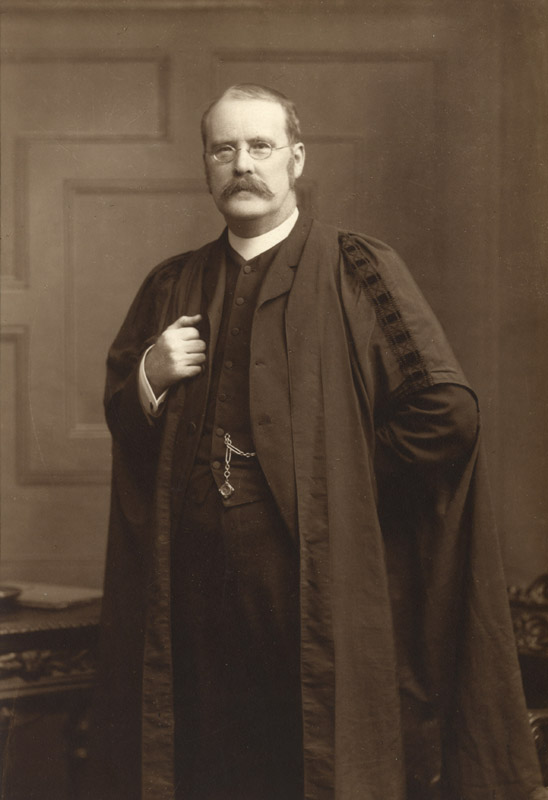
Eventually, Benjamin Herbert Heald became the Headmaster of Midhurst Grammar School in Sussex. In later years he was to reminisce about how the High School’s Headmaster during his time at the School, Dr James Gow, was different from all the other teachers. He never called boys up to his desk to go through their work, but always went to sit alongside them. Lessons usually finished with the customary phrase, “…I think that just about finishes our dose.”

This is Dr Gow, the High School’s greatest ever headmaster:

Next time, some dirty postcards. Well, second hand, at least.


26 Comments

Filed under History, Nottingham, Personal, The High School

Fred joins the RAF (4)

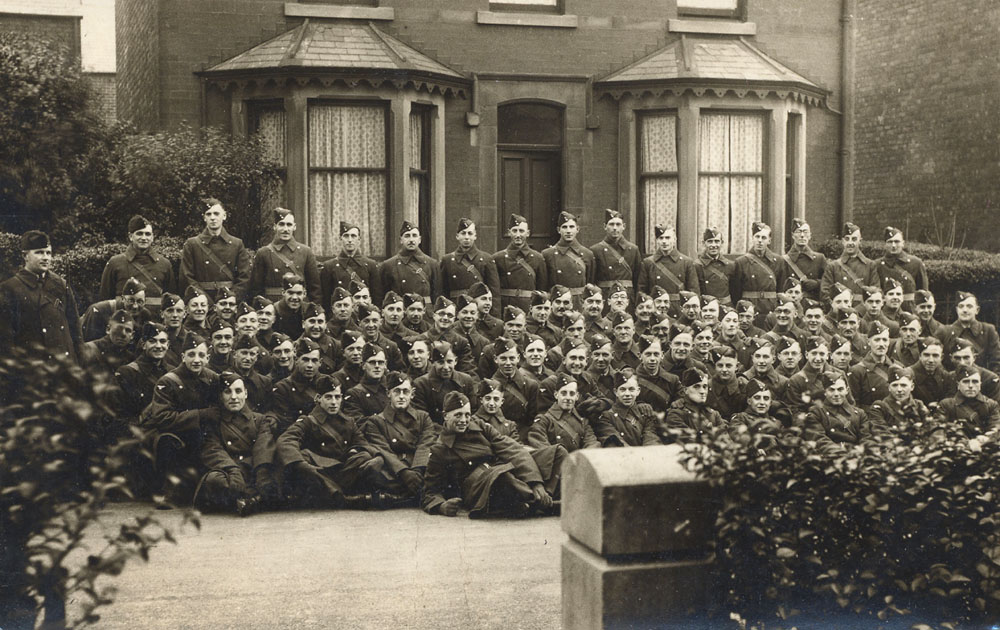
We left Fred last time in Blackpool doing his basic training with Sergeant Parry. All of the RAF’s young volunteers were billeted in boarding houses which, in peacetime, would have accommodated holiday makers. Here are Fred and his friends:

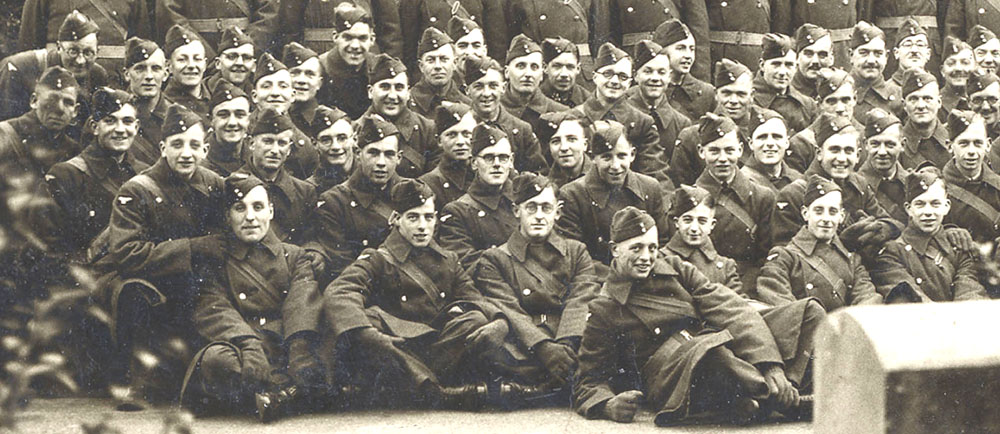
And here is the section with Fred in it. It always reminds me of the RAF version of “Where’s Wally?”:

The boarding house landladies in Blackpool were paid for every recruit they took, but a substantial minority saw this as a fine opportunity to profiteer, accepting money for meals that were never to materialise in the quantities that the payments might have implied. Instead, these unscrupulous women either ate the food themselves, or, more frequently, sold it to their neighbours, who were themselves short of food because of rationing.

In the boarding house where Fred was billeted, thanks to their particular greedy grasping landlady, the individual portions served, were, at best, markedly small. One day, after Physical Training on the beach, Fred and his friend Jacques, came back early from their exercise.

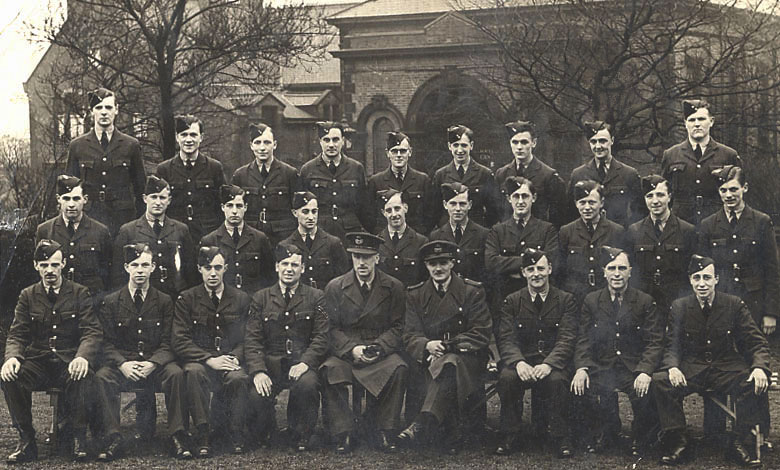
Jacques was Fred’s best pal at this time. He was the son of a Yorkshire farmer, with the physical build, and indeed the appetite for food, to match his origins. Here is the group as a whole in a formal class photograph:

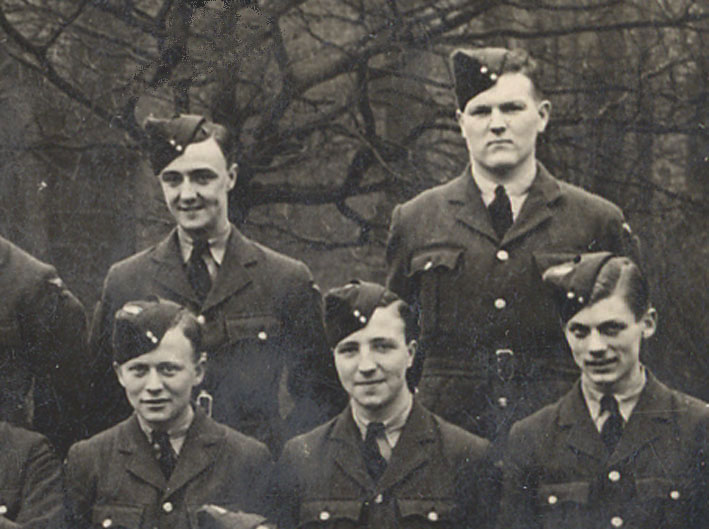
And here are Fred and Jacques as a close-up :

If you remember,  Fred and Jacques had come back early from their Physical Training on the beach. Fred went straight upstairs to wash and make sure he was properly dressed for the meal. Jacques, however, went immediately into the dining room where he found a whole ham, meant for twelve hungry young recruits, waiting in the centre of the table. Jacques, clearly accustomed to Yorkshire farmer sized servings, immediately presumed that the meat was for him and without further ado, he ate the lot.

The reaction of his colleagues when they eventually arrived from their afternoon’s exertions, has not been recorded for posterity, but at best, they were not very impressed.

One of the other men in Fred’s boarding house had  a knowledge both of chemistry and of the behaviour of dogs. One fine, sunny day he went down to the local chemist’s shop, and bought a very large quantity of aniseed concentrate which he then proceeded to dilute:

He took this magic potion and laid scent trails through the streets of Blackpool, all of which led back to the boarding house. He then continued the trails inside the building, entering through both the front and the back doors, leading up the stairs to the different floors, then onto the landings, into the bedrooms and into the bathrooms. In short, his aniseed trails reached every single square inch of the property. Aniseed is desperately attractive to dogs. Once they get the scent…

…off they go, like addicts to their next fix:

They just cannot resist that aniseedy smell:

The result was one glorious afternoon of revenge, as every dog in Blackpool, driven crazy by the overpowering and intoxicating scent of aniseed, arrived at the house and ran berserk, up and down the stairs, careering backwards and forwards along the landings, chasing in and out of the rooms, widdling, piddling and scent marking up every wall and in every recess and corner as they went.

Never make an enemy of the RAF.

17 Comments

Filed under Aviation, Bomber Command, Criminology, History, Humour, Personal, Science, Wildlife and Nature

the Gloster Meteor at Hendon (1)

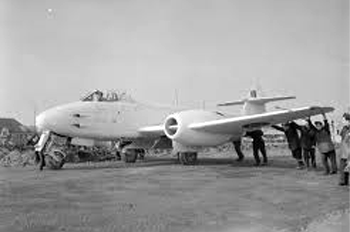
On the very same visit to RAF Hendon when I saw the Messerschmitt Me 262, I also saw the first RAF jet fighter, the Gloster Meteor F8:

To be honest, compared to the German thoroughbred, the Meteor looked a bit of a tub, to say the least:

On the other hand, the engines were lots better than the German ones and eventually the Meteor would be purchased by Australia, Argentina, Belgium, Biafra, Brazil, Canada, Denmark, Ecuador, Egypt, France, West Germany, Israel, the Netherlands, New Zealand, South Africa, Syria and the United States. Here are aircraft from Argentina, Belgium and Brazil :

This slideshow requires JavaScript.

Having been initially negative about the Meteor, it is only fair to say that in the in-service trials between the Meteor and the propeller driven Hawker Tempest, the Meteor was judged the winner on all counts, except, conceivably, manœuvrability. Pilots of propeller driven aircraft often said that the Meteor was “exciting to fly”. Norman Tebbit, the politician and ex-RAF pilot, said of the Meteor:

“Get airborne, up with the wheels, hold it low until you were about 380 knots, pull it up and she would go up, well we thought then, like a rocket”.

The first Meteors to see action were with 616 Squadron who began by chasing V1 flying bombs over south eastern England from July 27th 1944 onwards. In early 1945, they moved out to Belgium and then Holland, carrying out armed reconnaissance and ground attack sorties but without meeting any Me 262s. The Meteors were painted all white to avoid friendly fire issues:

After the war, the Meteor came into contact with the Soviet Mig-15 both in Korea and in the Israel-Egypt war in the mid-1950s. It was found to be lacking in many respects.

More on the Meteor’s shortcomings next time.

25 Comments

Filed under Aviation, History, Personal, Science

Card Carrying Commies (5)

One of my very best friends, whom I have known since Infants’ School, has always been a keen photographer. In 1989 he decided to go to Berlin on one of those cheap European flights. As luggage, he took with him a camera and a large hammer. He wanted, I suppose, to help history along on its way:

By December 25, 1991, the desire for change had spread to the USSR. The Soviet hammer and sickle flag over the Kremlin was pulled down for the last time. Mikhail Gorbachev, a good man, was replaced by Boris Yeltsin.

Here’s Gorbachev and Yeltsin:

This slideshow requires JavaScript.

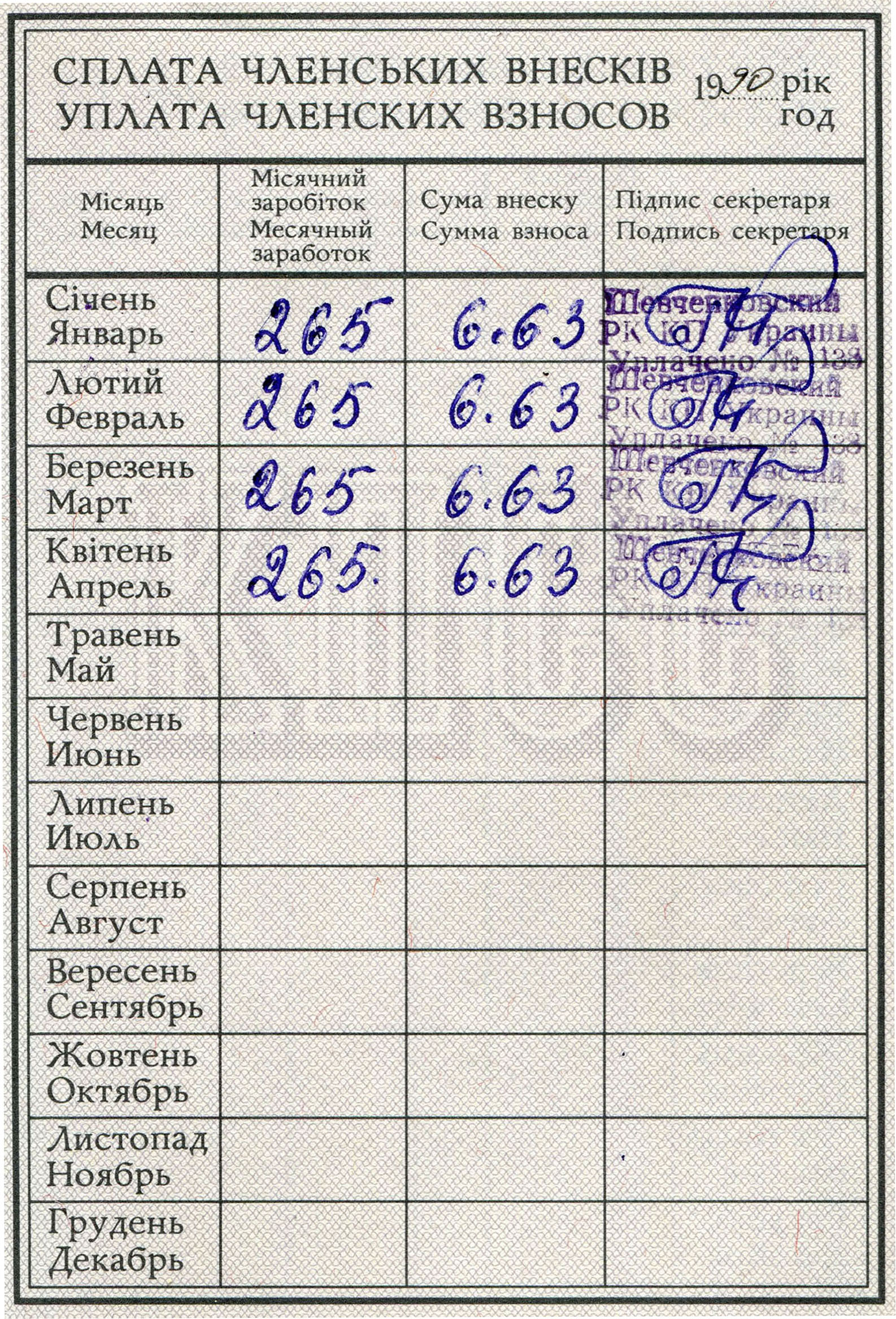
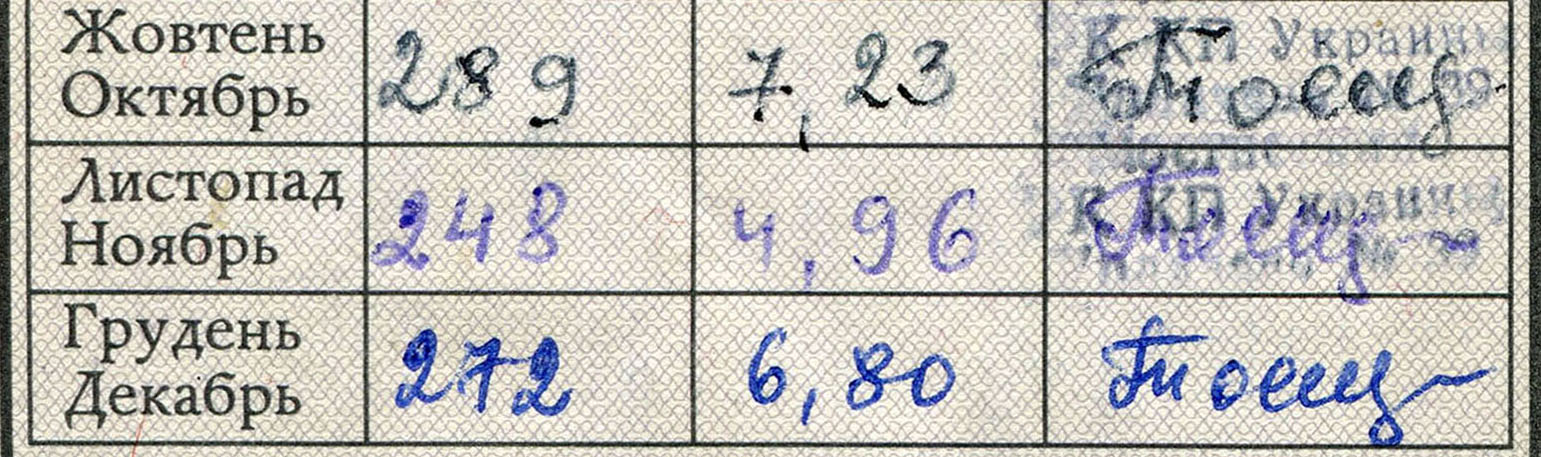
And the world that Aleesa and Vladimir had known all their lives comes crashing down. For years and years, Aleesa has come into the office with her Party dues. She has paid her money every single month without fail, to the only organisation she has ever belonged to. And then, she goes along to pay for May 1990, perhaps thinking it will help with the cost of the celebrations to mark the end of the Great Patriotic War on May 8th or perhaps even May Day itself. The day which celebrates the Workers of the World. But the Party is over. Gone for ever:

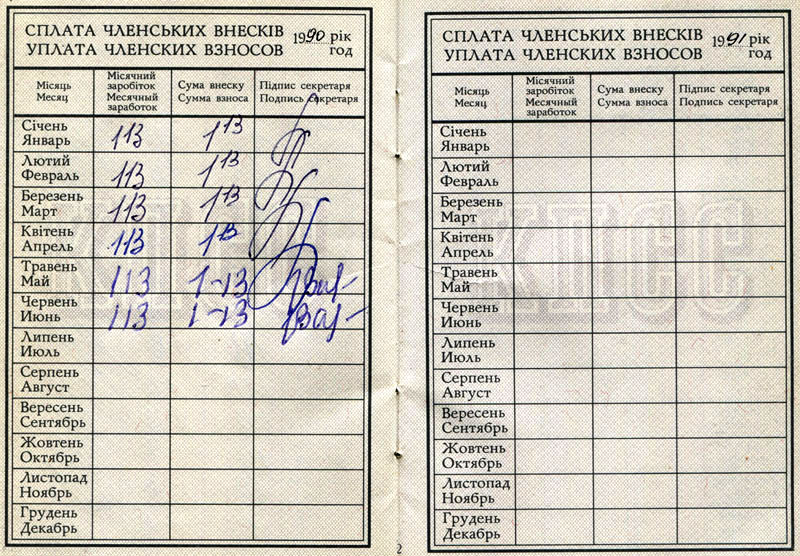
Vladimir will experience exactly the same process. He goes in one day to pay his 1 rouble 13 kopecks and there’s nobody to take it from him. Why, they’ve even written the next year on the blank page, so certain were they both that the Party would be there for ever:

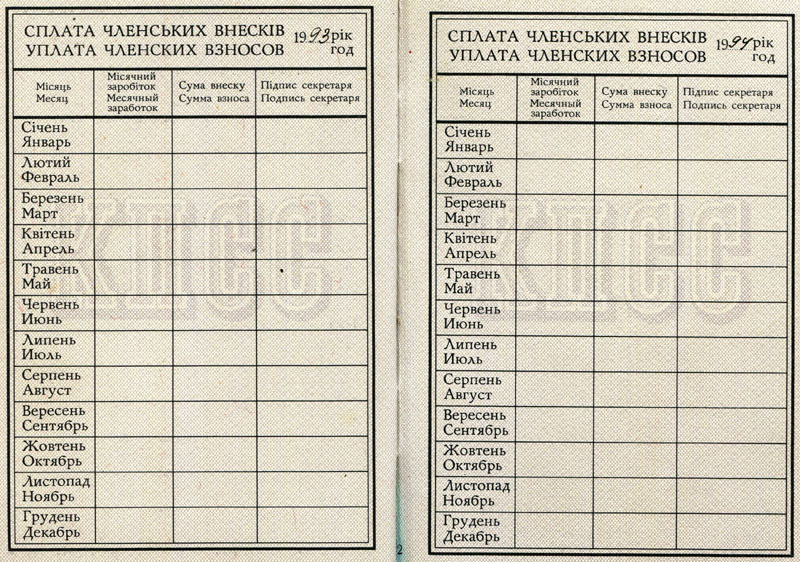
But now, there are just lots and lots of blank pages, each with the number of a future year already inked in in the top right hand corner. Life though, has changed for ever:

Even “Zolochevskiy” has changed as I found out when I googled it. In my previous post, “Zolochevskiy” was the name of the local administrative area of the Communist Party. I skimmed through four news reports thrown up by Google and I found nothing at all about any branches of the old Communist Party.

“Zolochevskiy” was there though, but the stories were all reported with the kind of vocabulary such as:

“Anti-Corruption Bureau, colossal greed, corruption, crime, criminal proceedings, dirty money, embezzlement, illicit assets, laundering, mafia, misappropriation, possible abuses, proceeds from crime, seizure of property through abuse of official position, stacks of treasures, suspicion of illegal enrichment and the wanted list.”

How sad. The Party fades away and is replaced by something lots, lots worse. And that’s not just the Ukraine, of course. Plenty of other ex-members of the Soviet club are much, much worse off than they ever were before. Whole countries run by criminal elements. Fixed elections. Old people forced to beg in the streets because their pension funds have been stolen.

Don’t worry though. I’m sure that somebody will come along and save them all:

18 Comments

Filed under History, Humour, Personal, Politics, Russia

Fred joins the RAF (3)

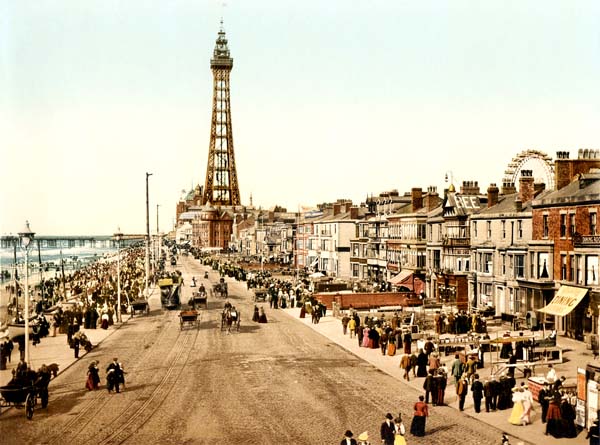
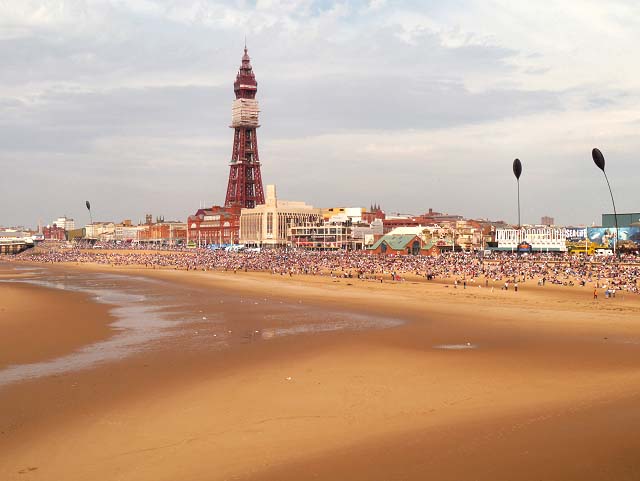
For ab initio training, new recruits to the RAF were often sent to Blackpool. The popular seaside resort had an abundance of boarding houses and small hotels to provide accommodation and food. There were plenty of nice, wide promenades to practice marching:

There were lots of even wider beaches for improving physical fitness:

In Blackpool, Fred was taught how to salute, to hold a rifle, to march, and, in general, how to behave as an Aircraftman Second Class, by Sergeant Parry. It was Sergeant Parry’s proud boast that

“One day you’ll be walking along the street, years after this war has finished, and you’ll suddenly hear me shout “Ah..ten…SHUN ! ! ” and you’ll pull up straightaway, and come to attention, even if you are 55 years old.”

In actual fact, this never happened to Fred, but when he was 75 years old, he was admitted to Burton-on-Trent Hospital, where, although he was eventually to recover, he was for some length of time, gravely ill. The Victorian ward he was in had very large metal framed windows, pale green and beige walls, and a yellowish grey light. It clearly reminded a very confused Fred of his original RAF barracks, and the nurses reported that on more than one occasion he was heard to call out, in his delirium,

“It’s all right, Sergeant Parry, I’m coming, don’t worry, Sergeant Parry, I’ll be there in a minute.”

Presumably, Sergeant Parry was marginally more pleasant than the only other drill instructor that Fred ever mentioned. Ironically, Fred never actually met the man in question face to face.

Instead, shortly after arriving at a training base where he was to serve, Fred heard the story of a sergeant instructor who regularly shouted and screamed at the young men in his charge and who, in his treatment of them, regularly overstepped the mark by a considerable distance. He was a bullying, aggressive man, and basically, everybody soon grew to hate him.

One day, a German raider arrived and began strafing the airfield:

The instructor raced away across the grass and jumped into one of the many slit trenches which crisscrossed the base, constructed for surviving just such an occasion as this. What he did not realise when he jumped in was that the trench was almost completely filled with water.

Unable to swim, he drowned. There were men there who could have helped him but they chose just to watch him thrash about in the water. They could have saved his life, but he had abused too many of them for anybody to want to help him now.

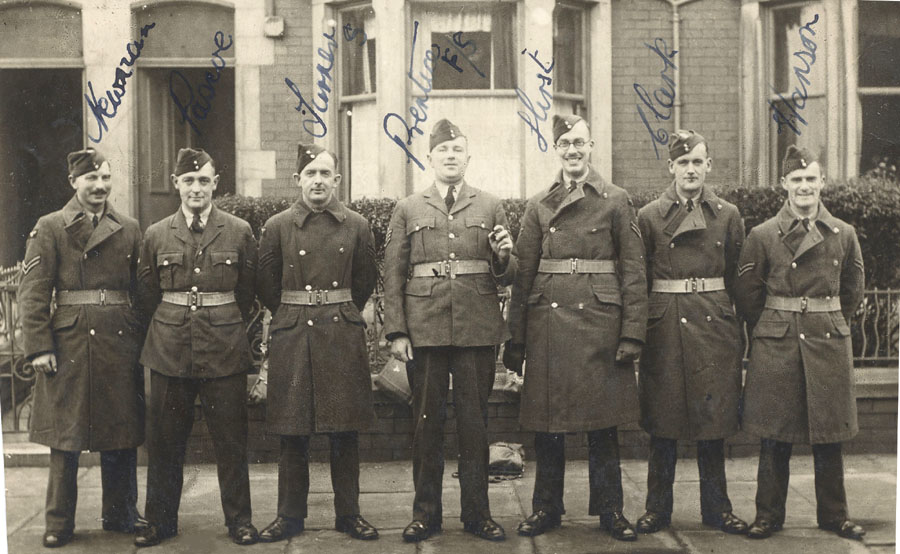
Here are seven of Fred’s instructors during his “ab initio” training, probably at Blackpool:

They are Messrs Newman, Pascoe, Turner, Flight Sergeant Prentice, Hirst, Clark and Hanson.


11 Comments

Filed under Aviation, Bomber Command, Criminology, History, Personal

They were only playing leapfrog…..

This story comes from a source which I have used quite frequently, namely “The Date Book of Remarkable Memorable Events Connected With Nottingham and Its Neighbourhood”. On this occasion, the year is 1794 and the French revolutionary government has recently abolished slavery on February 4th of that year. Only a week later, on February 11th, the sessions of the United States Senate are made open so the public can come along and watch.

Today, though, is February 23rd and the slack jawed young locals in the Hockley area of Georgian Nottingham have all assembled in Broad Street. They are going to have a damned good game of leapfrog while they wait for somebody to invent football. On this modern map, LRTS marks the tram system. Look for the orange arrow:

I presume that leapfrog  is a universal game across the world. This is Harlem during the Jazz Age:

And here’s one of those old Victorian stop motion films:

You wouldn’t want to play  leapfrog in the middle of Broad Street nowadays, but in 1794 it was not a problem. So what happened? Well…….

“A number of young men, in a playful mood, were diverting themselves in a game of leapfrog in Broad-street, when one of them disappeared underground in a remarkable manner. He had leaped over the back of a comrade, in the customary way, and happened to alight on the spot where there was a well,  120 feet deep.”

It wasn’t as big as this…

But it was still quite big and it soon attracted a crowd:

Anyway, back to 1794…

“The aperture had simply been covered with boards and a little earth, and was uniform in appearance with the surrounding ground . Fortunately, the man was extricated perfectly unhurt, and with an oath declared himself equal to any pantomime performer on the stage, inasmuch as he dare leap without being caught in a blanket! The well was immediately arched over.”

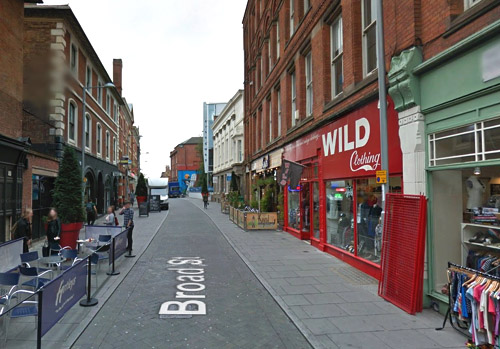
Nowadays, Broad Street is a busy but basically, fairly ordinary thoroughfare, except some bored fool with nothing better to do has painted ” Broad St” on the floor in big white letters :

The other end of the street has a famous pub:

This pub is nowadays the only real attraction in the street. Things might change though, if “arching over” an old well doesn’t solve the problem for very much more than 200 years. Then we might see some more excitement.

Here’s a better view of the pub:

Once you’ve had a refreshing pint of ale in the Lord Roberts pub, above, you might even feel like a game of leapfrog yourself. Here’s the army’s version of the game in that magnificent anti-war film about World War One, “Oh What a Lovely War”. The song is entitled “They were only playing leapfrog”:

26 Comments

Filed under France, History, Nottingham

Card Carrying Commies (4)

Last time, we were looking at the Communist Party membership cards carried by just a deluded few  of those maniacal Commies who did nothing with their lives except plot and scheme how to overcome NATO. They all carried a little booklet:

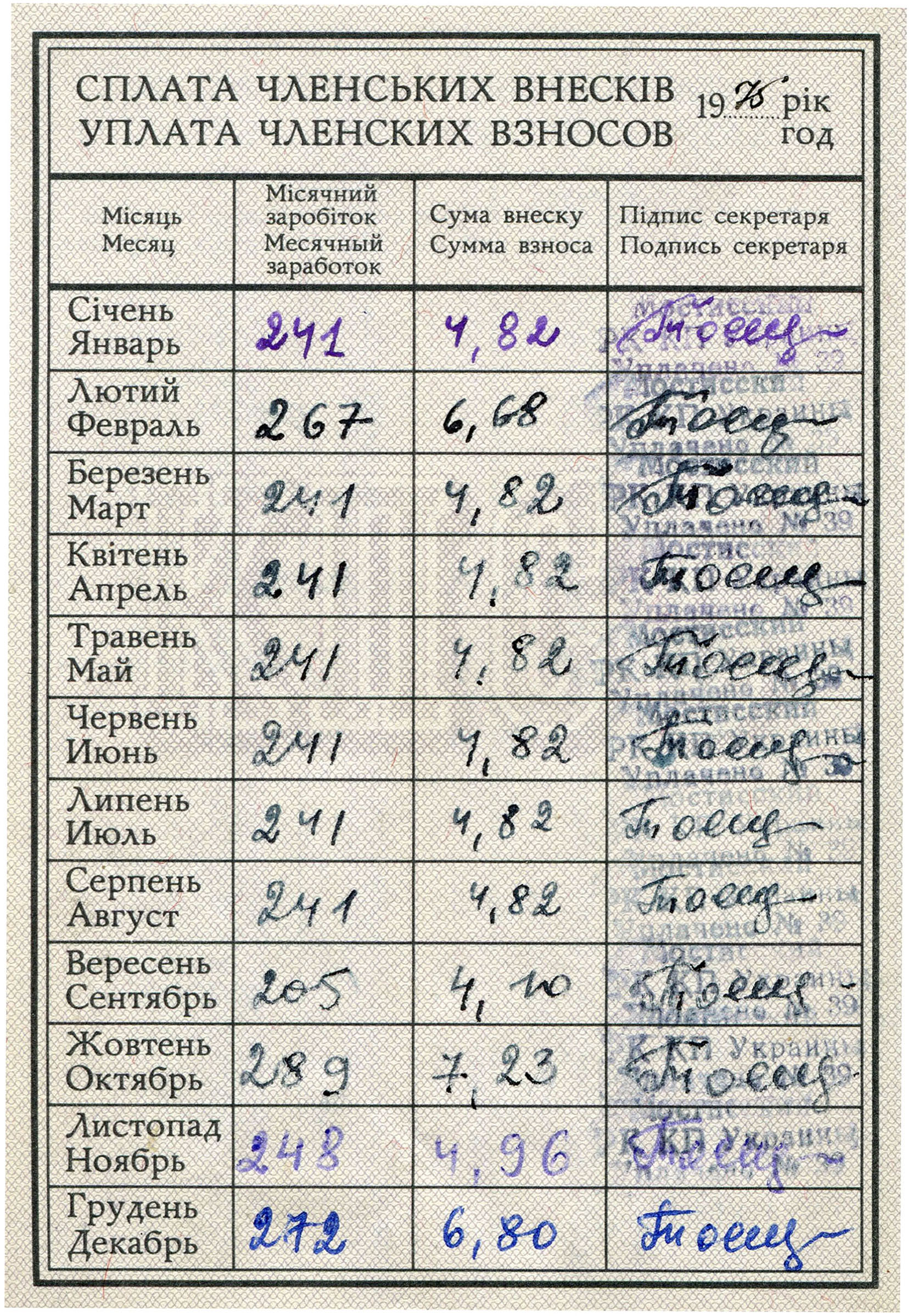
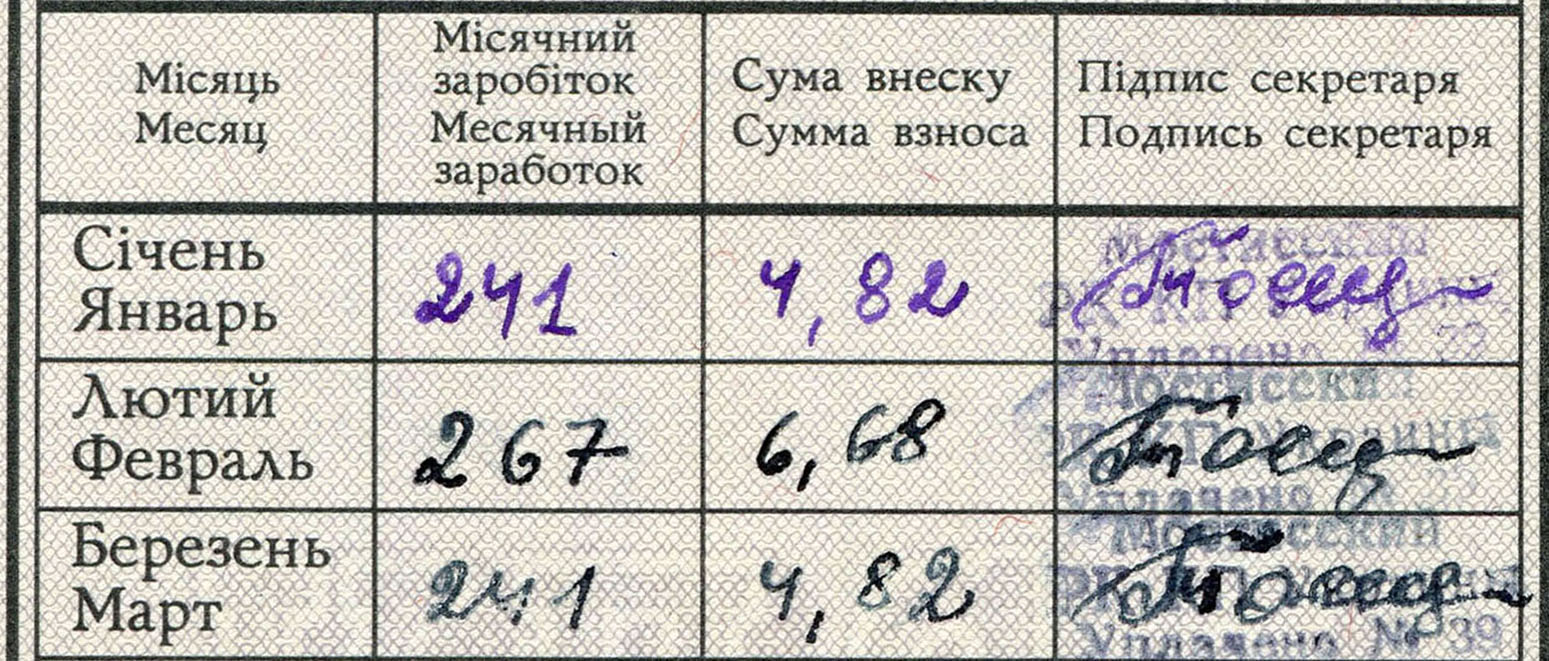
The next page we get to is all about cash. The top sets of words are Ukrainian with at least one letter “ i ” and the second one is Russian. The top box is “Payment-(of) membership-dues”. The year is 1975:

The first of the four vertical columns is the month which in Russian is “M-YE-S-YA-TS”, which is like the Latin word “mensis” and means ‘month’. Russian is a very ancient language and tends to have words related to Latin rather more frequently than many modern European languages, except for universal words such as ‘tennis’, or ‘football’ or ‘tank’.
Going down the column you might be able to work out the names of the months. They are YA-N-V-A-R (don’t bother about the little letter ‘b’. It’s an accent) F-YE-V-R-A-L , M-A-R-T, A-P-R-YE-L, M-AYE (the letter ‘й’ ias again an accent, a bit like a letter ‘Y’ in English). Then it’s “EE-YU-N” and “EE-YU-L”. After that it’s A-V-G-OO-S-T, S-YE-N-T-YA-B-R, O-K-T-YA-B-R, N-O-YA-B-R and D-YE-K-A-B-R.
The next three columns are quite interesting. The second one is headed “Monthly earnings”, so she made 271 roubles in January, 267 roubles in February and so on.

As for how much that was worth, it’s very difficult to say. I visited the USSR in 1969 and paid 3p for a newspaper or 5p for a packet of 20 cigarettes. The Moscow underground was inexpensive with go-anywhere tickets at 3p. So many Muscovites used the underground that the Soviet Mint made a special three kopeck coin  to quicken things up at the ticket machines. Travel on the trams or buses was equally low-priced. Overall, most ordinary everyday things were extremely cheap, although many Western-type things were virtually unobtainable so they were very expensive.

I think Aleesa could have led a simple and relatively comfortable life on this amount of money. True, she would have lacked a lot of consumer goods but at the same time, she would not have had the average personal debt we supposedly have here in England of £14,000 per person, excluding house mortgages. Her streets were largely crime and graffiti free, she had decent accommodation that she could afford to heat, she had a job, her education was completely free and when she grew old, she received a pension. She had access to a very large number of simple leisure activities, such as sport, dance and libraries, theatre and opera and all of it was very low priced. A large number of people in contemporary Russia would return to the old days if they could, especially the old people.
Her party membership fees are listed in Column Three.

They seem to vary but are very roughly 3% of her total salary. I have not been able to find out exactly what were the particular benefits of Party membership. Presumably, a lot of ordinary people just wanted to be Communists and to defend the massive gains they had made under that system. A search of the Internet in general reveals that the Party granted people a greater chance of reaching a higher level in whichever field they were working in, from the Army to professorships in Zoology. If that’s the case though, then the Party’s doors were open a lot wider than the Bohemian Club, the Bullingdon Club at Oxford University, the Pitt Club at Cambridge University or the Skull and Bones at Yale University. And there must be lots of other clubs so secret that we don’t even know about them. This is the badge of the Ukrainian Communist Party:

Whatever Aleesa got out of Party Membership, she was happy to pay the fees. The third column is the signature of the Secretary of the local party. It’s written “S-YE-K-R-YE-T-A-R-YA”.

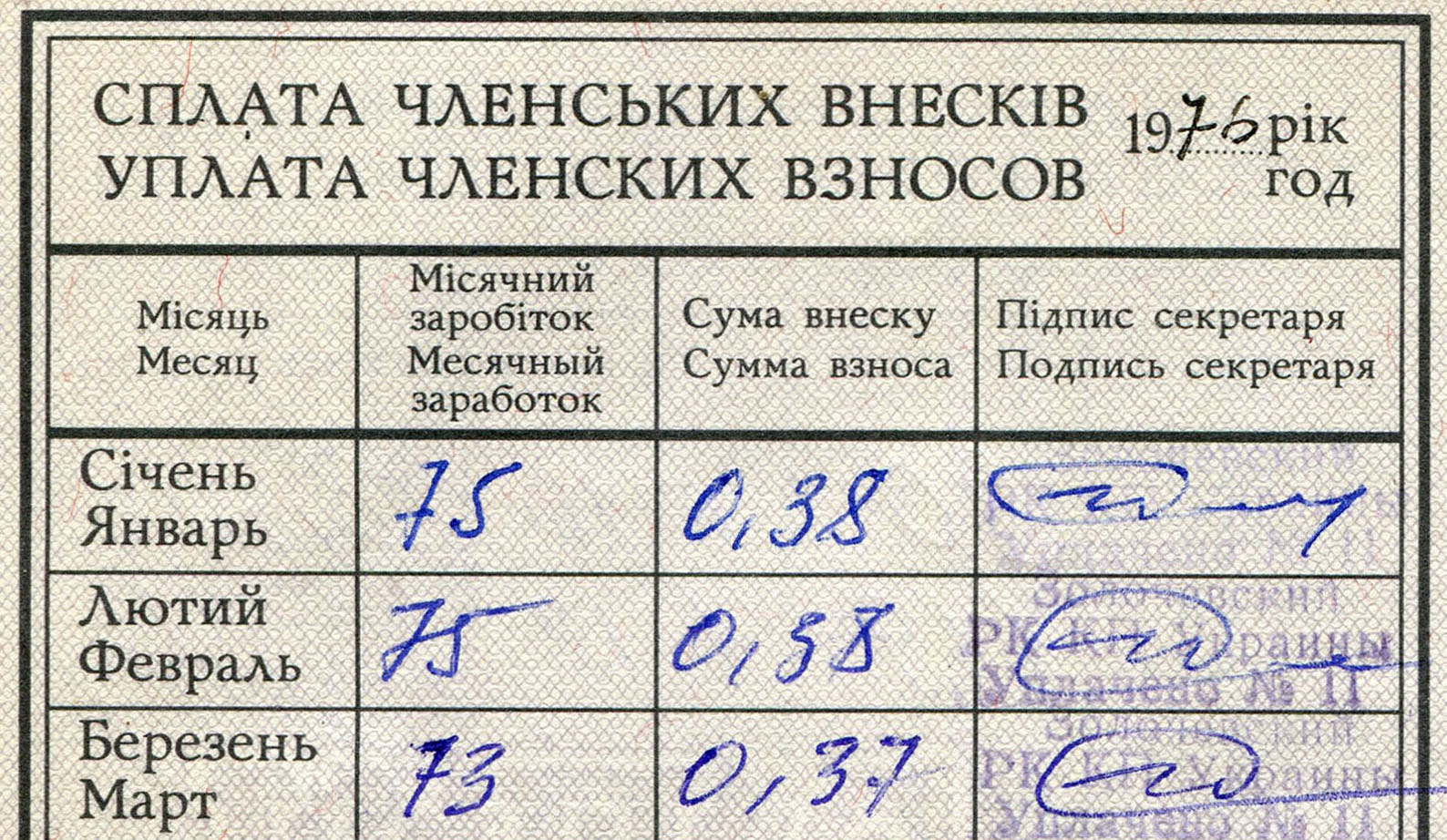
Vladimir doesn’t seem to have received as much per month if you look at the second column. He earned 73 roubles in January 1977, for example.

Perhaps he worked part time or perhaps he was disabled or a war veteran and received a sum every month. It’s impossible to know now. His contributions are just tiny…some 37 kopecks per month. And all of it signed for by the party secretary, although, if you look very carefully, it has already been stamped. What is on the stamp is very difficult to read, but it certainly has the word “Zolochevskiy” which I take to be the area concerned. It is the first word and begins with ‘Z-O-Lambda-O”.

What happened next, next time. In the meantime, “Workers, keep uniting!”.


14 Comments

Filed under History, Humour, Politics, Russia

the Reverend Charles Stephens (3)

Last time I showed you some more of the photographs left to us by the Reverend Charles Stephens, a keen photographer who captured many aspects of the High School, both boys, buildings and activities. Some of the most striking ones were taken in early 1960 when the new block on the northern side of the West Quadrangle was opened.

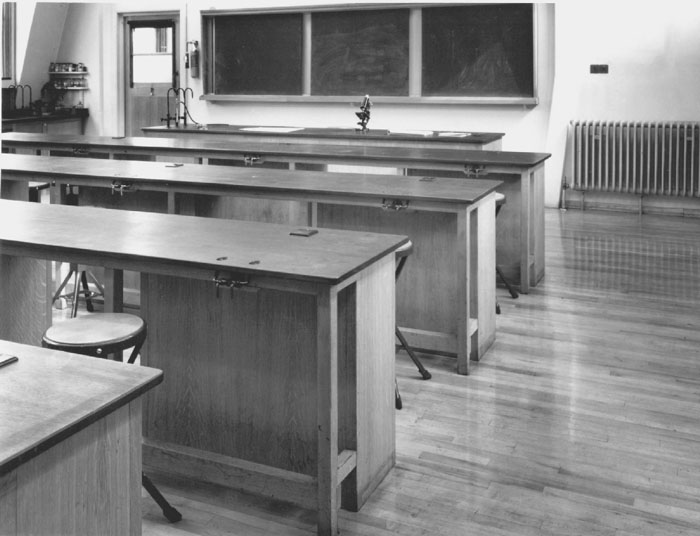
We have already looked at the bottom floor and the top corridor with their absolutely amazing block parquet flooring, which was not just shiny but even reflective. That incredible quality of being polished so highly as to be reflective seems to have been really widespread in the school at the time. Perhaps whichever company polished the floors of the new block was given free rein with some of the other rooms. Here are the floorboards of one of the Chemistry laboratories:

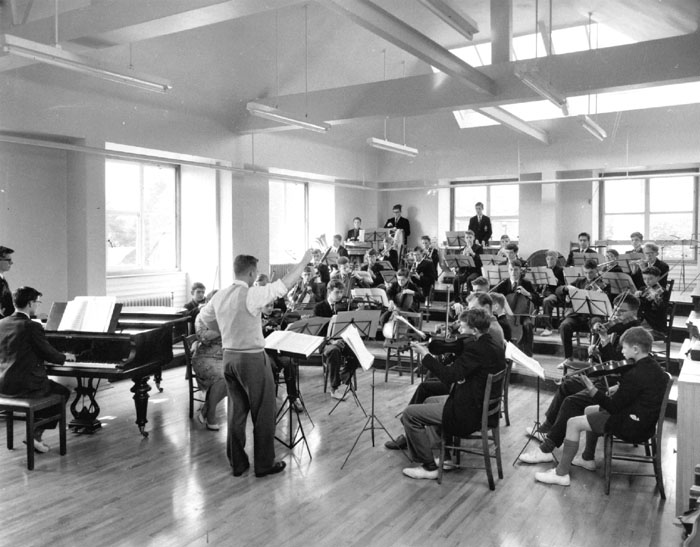
Here is the Music Rehearsal Room. Notice how all of the boys are wearing white plimsolls, which they have presumably had to bring from home, along with their trombones:

The Old Gym was pretty much the same as the new West Block rooms. Just look at those boys at the top of those ropes! If I’d been able to do that, I reckon my application for the French Foreign Legion would have gone a lot better than it did:

The Reverend Stephens didn’t just do buildings though. He did groups of boys such as his Tutor Set, seen here in 1953-1954:

How clever! He got them all to autograph the back of the photo:


16 Comments

Filed under History, Nottingham, The High School