Author Archives: jfwknifton

Will Knifton v the Kaiser (Round 3)

My Grandfather Will, as we have already seen, spent approximately two years four months in a Canadian Army at war. At the end of the conflict, an officer stood at the front of the men on parade, and made a speech about what would happen when they all returned home. With his optimistic words, delivered no doubt in all sincerity by this upper class young man, Will became one of an unknown but enormous number of soldiers who, in 1919, were promised “a home fit for heroes”. Politicians were quick to jump on the bandwagon, of course:
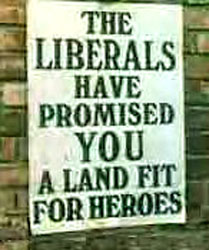
In actual fact, before his return, Will was already very cynical about whether he would receive his just rewards for fighting in the war. Indeed, after just a short time back home in England, he became certain that he was destined never to be given what was due to him. These were the days, of course, when injured ex-soldiers would beg in the streets, unable to find employment. It affected both the victors and the vanquished:

This slideshow requires JavaScript.

Overall, Will had very little time for high ranking officers. He did not like the way that they refused to visit the front line with its ever present smell of rotting corpses, but preferred instead to stay in the palatial comfort of country houses miles behind the fighting troops:

As a boy, I remember him telling me never ever to buy a poppy for the Haig Fund because he hated Earl Haig so much. He thought that Haig had no regard whatsoever for the casualties among his men, and that he did not care a jot about their eventual, and dismal, fate. Thank God that Will had no access to the Internet and never found out that Haig was Field Marshal Douglas Haig, 1st Earl Haig, KT, GCB, OM, GCVO, KCIE. Will did not realise either that Haig’s wife, Maud, was a maid of honour to Queen Alexandra, wife of King George V, and that that, supposedly, was how he got his job, in charge of the armies of the British Empire. Years before, in 1905, Haig had put his hat in the ring for a plum job at the War Office but his efforts had all been in vain because he was accused of “too blatantly relying on royal influence”.  (Groot). Here are Queen Alexandra and her daughters at “Maud’s wedding”:

For Will and a very large number of his fellow soldiers, the establishment of Haig’s post-war charity was merely a means for a guilty butcher to salve his blood soaked conscience:

Instead, Will urged me to give any money I had to the Salvation Army, who had always been on hand, ready and willing to help the ordinary soldier.

One final tale. In later years, Will told me how, in the Great War, Gurkhas were sent out at night, to make their way over to the German trenches and to kill as many of the enemy as possible. The Gurkhas were paid one shilling for every German’s right ear that they brought back, threading them carefully onto a piece of wire carried on the front of their chest. The problem was, however, that the Gurkhas were extremely efficient and brought back so many ears that the whole process became a very expensive one, so expensive, in actual fact, that it was discontinued. Fierce little chaps. Every time they get their kukris out they must draw blood, even if it is their own:

The senior officers also seem to have considered it vaguely disquieting to kill the enemy in this very direct, but rather brutal, or even unsporting, way.


21 Comments

Filed under Canada, France, History, Personal, Politics

A strange photograph (2)

For years I have wondered if ordinary people in the United States ever take photographs while out hiking in the woods and then discover afterwards that there was a Bigfoot watching them, unnoticed in the trees. For a good few years therefore, I have been looking carefully at any photographs of the landscape in North America that I encounter, to see if there was any indication of a Bigfoot hiding away among the foliage.

I couldn’t actually find a picture to illustrate that on the Internet, not if I immediately excluded all hoaxes. The hoaxes are the sort of photograph where the person taking it suddenly announces “Look, I took this photo ten years ago and I’ve suddenly noticed a Bigfoot behind the trees. And your most likely response is

“OK, but where is he in relation to Uncle Frank in that ridiculous monkey suit?”

One or two are certainly on the borderline. Supposedly, Bigfoot will either crouch or even stand motionless, in an effort to be passed off as a tree stump. This photograph could be a Bigfoot, a strangely shaped dead tree, or it could be Uncle Frank, sober for the day. I just don’t know:

I don’t think that I have ever failed to look for that elusive 8 feet tall 500 pound individual every time I am presented with a picture of woodland or even of a distant mountainside. Talking of which, I believe that this photograph off the Internet shows Mount Denali. There is something anomalous in this picture:

Let’s move in a little closer. It’s on the horizon:

Third time lucky. It is either a very large man, a very large Bigfoot or a lump of rock that seems to be different to all of the other rocks. And, of course, given that this is Alaska and a well visited mountain, it could be that everybody except me knows all about “Uncle Frank the Rock Sentinel of Denali.” The problem is the scale. I just don’t know how large that apparent person would have to be to show up on a photograph taken at this distance:

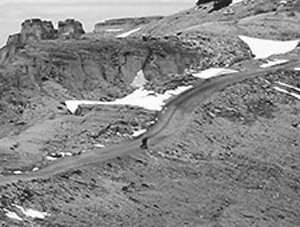
My second picture comes from the Internet as well, and I don’t know where from, because I lost the address of the site:

Anyway, it shows just a relatively ordinary mountain scene. What drew my attention is a lot more obvious in this second version of the photograph, because it’s not as distant as in the previous pictures.

Here it is blown up a little:  
And a bit more:

I even changed it to grayscale because that kind of thing is frequently done by my Bigfooting hero, MK Davies:

 Whatever this is, it seems uniformly coloured and to have arms, legs and a head. Quite important, there is nothing like it close by. In size, it is not far short of being as tall as perhaps, half the width of the road, which seems to be a single vehicle dirt track. Eight feet? Nine feet?
One final point. Uncle Frank, if you’re still out there, just be careful what you’re doing. Not everybody will respond to seeing you hiding in the woods in a monkey suit with a big laugh and a bottle of beer, especially the ones exercising their rights under the Second Amendment.


As I said, I found these pictures on the Internet a long time ago but, as is often the case, I did not make a note of where they were from. If anybody is upset by my use of them, please make a comment to that effect and I will take them down if they so wish.

22 Comments

Filed under Cryptozoology, Humour, Personal, Science, Wildlife and Nature

Will Knifton v the Kaiser (Round 2)

When Will was in Flanders during the First World War, he would occasionally get stuck in deep mud, or, in the winter, perhaps out on sentry duty, he would actually become frozen solid into it:

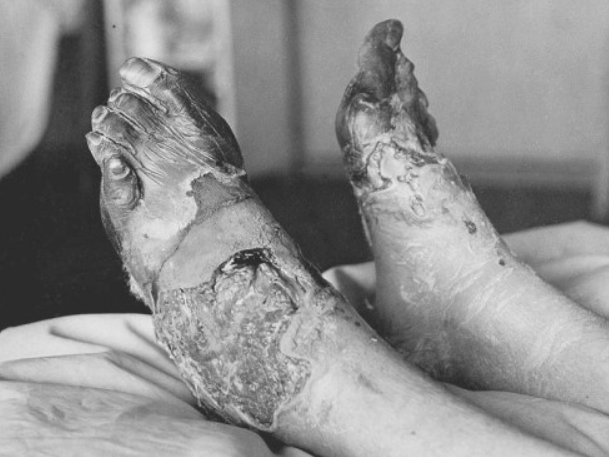
Over the course of the days, and more particularly the nights, Will would often go through the ghastly process of having his feet freeze, melt and then refreeze again. This gave him the unmistakable scars of a condition known as “trench foot”, which, although it is relatively unknown in our modern army, was a frequent occurrence in the trenches of the Great War.

When he was in Burton-upon-Trent Hospital in 1970, dying at some eighty years of age, Will became a bit of an attraction, as young doctors, who had never seen trench foot before, came flocking from all over the hospital to see an example of it. I myself looked at his feet, and, if there had not been a nearby bed to sink down onto, would probably have fainted outright. I will never forget the brown, yellowing skin, almost like a tattoo in the same colours as the Flanders mud, and his scars, and his twisted, mutilated toes:

On at least one occasion during a particular period of action Will was hit in the legs and wounded by two bullets from a German machine gun. He never expressed any real hatred of the Germans to me, though, despite the fact that he risked his life fighting them for more than two years.

I  always thought that Will considered the enemy as just somebody whom you had to shoot at when ordered to do so, but there were no particularly personal issues involved. It was just what happened in times of war:

This attitude may, of course, have been accentuated by the fact that Will spent a fair proportion of his wartime career with the Royal Canadian Field Artillery. Firing projectiles at an enemy who may be five or more miles away does not necessarily encourage anybody to hate them as individuals.

During the enormous battles of the Great War though, Will recounted how, on several occasions, he was on the fire-step of a trench, defending the Canadian line against waves of advancing German infantry. He used to say how, at the time, he resented it, when the officer gave the order, “Fire at Will ! ” because he always thought it was going to be something personal against him.

According to his official service records, Will spent more or less all of his time in France with the Canadian Field Artillery. Conceivably, the moment when Will was firing a mere rifle in such apparently defensive circumstances, may have come in an emergency situation during the great Ludendorff Spring Offensive of 1918.

23 Comments

Filed under Canada, France, History, Personal, Politics

A strange photograph (1)

One very strange happening happened to my Dad, Fred, and myself  when, in 1970, I accompanied my father down to his parents’ house at number 39, Hartshorne Road. Both his father, Will, and then his mother, Fanny, had recently died, within a few months of each other, both in hospital at Burton-on-Trent, with Fanny unaware of Will’s demise.

Fred was paying regular visits to the property, presumably attempting little by little to clear the house out so that it could be resold. At the time, as a teenager, I was unaware of this, although, with the benefit of hindsight, I wish I had been, and I could perhaps have stopped him from throwing away so many of Will’s Great War souvenirs such as his Canadian Army uniform, his German soldier’s belt and his collection of old German guns and ammunition. Here’s the front of a very average semi-detached house. The only thing left nowadays from my Grandma and Grandad’s occupancy of No 39 is the sign above the front door. It reads “Holmgarth”, the name given to their house by the first family ever to live there. Here’s the house:

And here’s the old sign:This is the back of the house. Fred probably took this photograph on the very last day before he gave the estate agents the keys and left it for ever:

As we entered the deserted house through the front door,  I walked through the hall towards the kitchen. Then I distinctly heard the upstairs toilet flush. I turned round and asked Fred, who was following me through the door and into the hall, how this could have happened, and who it could have been, given that we both knew that the house was locked up and empty.

Fred gave me some non-committal answer at the time, but afterwards, perhaps when he had regained his composure, he told me that, as he was a little way behind me, he had been able to look up the stairs at the sudden noise of the toilet being flushed. He had seen his father, Will, walk out of the toilet, across the short landing and into the bedroom.

Fred, of course, had always maintained that his own house, number 9, Hartshorne Road was haunted. Or rather the garden was, because on a quiet, windless summer’s evening, even though nobody in the two nearby houses smoked a pipe, it was occasionally possible to smell the distinctive aroma of pipe tobacco in the garden. This, Fred explained, was the ghost of one of the railway workers at the next door goods station, who, in the 1930s, was exceptionally keen on working in the evenings in the extensive station house garden. Just once, ironically enough, I smelled that same smell of tobacco, when it was my own turn to visit Fred’s house to clear it for resale after his death.

Let’s look back briefly at No 39 though. As I mucked around with the scan of the original photograph in an effort to improve it, using my entire suite of sophisticated activities (Adjust levels, brightness, colour balance, contrast and image size) I noticed something really weird. Here we are:

There seem to have been  faces at the window that my Dad didn’t see as he took the original photograph. Can you see them? I enlarged the photograph. They were still there:

This must be pareidolia mustn’t it? It’s still strange though!


21 Comments

Filed under History, Personal

Will Knifton v the Kaiser (Round 1)

I reported a long time ago how I had paid for the official records of my Grandad’s service with the Canadian Army during the First World War. In the early part of his military career, which had begun in July 1916, Will seems to have earned some fifteen Canadian dollars per month. This amount appears to have risen eventually to thirty dollars in 1917 and 1918. After his marriage, Will also received a separation allowance of varying amounts, ranging from six to fourteen English pounds. You never know much about your family’s private affairs but I suspect that it was Will’s money from the Canadian Army that allowed him and his wife to buy their own house during the 1920s. Here are their wedding photographs:

This slideshow requires JavaScript.

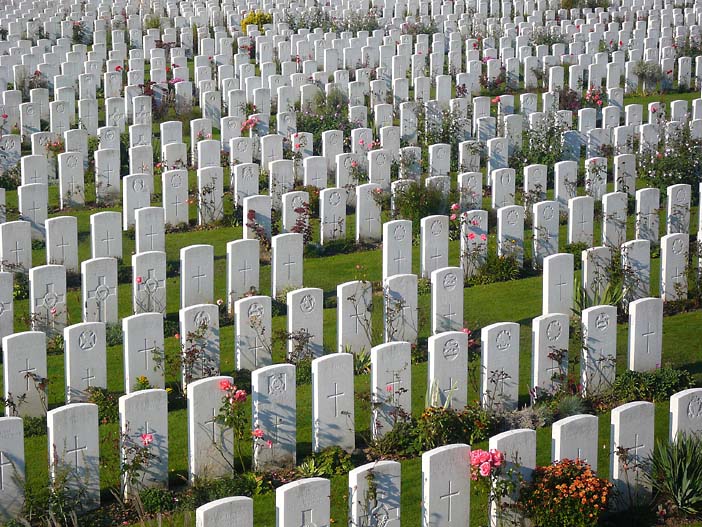
His army documents recorded his leave from the Front after he was given permission to marry on July 15th 1917. There were two other periods when domestic problems caused his leave to be extended. The first of these was a week from October 21st 1918 to November 4th 1918, which was extended to November 9th for “private family affairs”. His service records say that he returned to the Western Front on November 10th, which means that he was probably present when the guns, his own included, fell finally silent the following day. It was too late for many men, though:

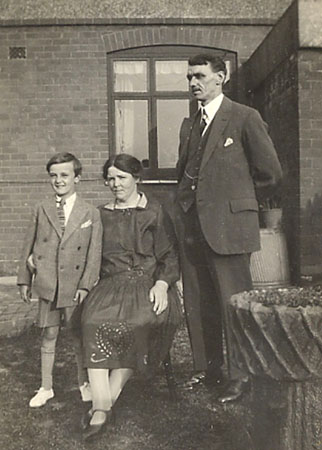
The same pattern occurred again with a leave from March 1st-March 8th 1919, which was extended to March 22nd. He had returned to the Fourth Brigade in the field by April 4th 1919. I suspect that both of Will’s extra leaves may have been because of his wife’s miscarriages, when she needed time to recover both physically and mentally from the ordeal. She lost a number of babies before her only son, Fred, was born, whole and healthy, on November 22nd 1922. Here he is, a few years later:

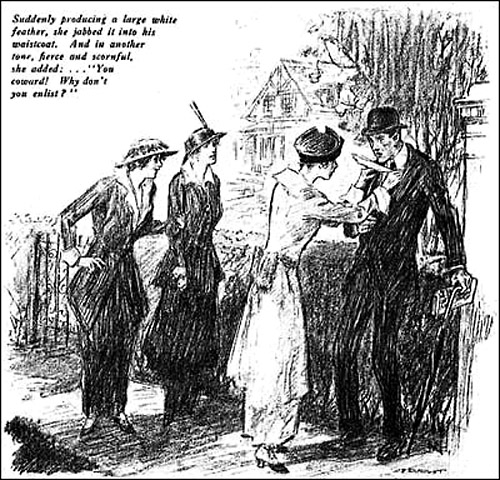
On one occasion when Will was back home on leave from the trenches of the Western Front, he was given a white feather by a woman who accosted him in the street. This was something that happened in the days before conscription had to be introduced, when women, especially suffragettes, would give any man they saw in the street who was apparently of military age, but not wearing military uniform, a white chicken feather as a sign of their cowardice.  Giving one to Will was made doubly ironic by the fact that at this particular time, he had just been given an extra long period of recuperation, because he was recovering from being wounded. Will didn’t get angry with the misguided, stupid, woman. He just laughed, which I suspect may have made her even angrier.

Here’s the caption:

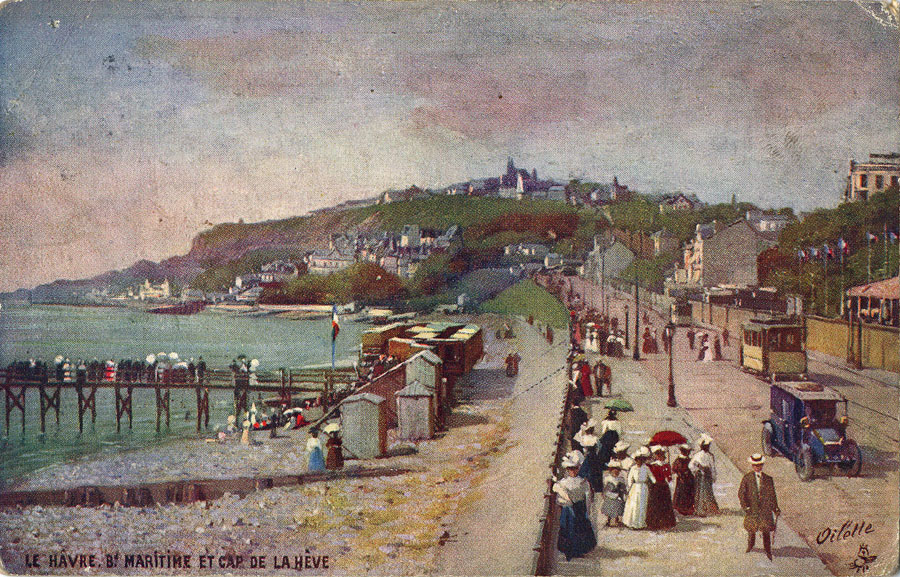
On April 25th 1919 Will finally came back from France for the last time. He sailed for England from the French port of Le  Havre. Will’s journey home was not a particularly rapid process however. He had lingered in the port of Le Havre on his way back from the Western Front since at least Saturday April 19th 1919 when this postcard was posted, via the Army PO1 :

The message on the back of the card reads:

“Dear Wife Trust you are much better. Affectionate love Will  Sig W Knifton 19TH C F A”

“CFA” by the way. means “Canadian Field Artillery”. The following day, Sunday April 20th,  he sent another card:

On the back, he  labelled the card “on active service”.  The message reads “Thoughts of home and you. Sincere love Will. Sig W H Knifton 19TH C F A”

This next postcard was posted on Tuesday, April 22nd 1919, as Will continued his slow return from the Great War.  Perhaps he had important things to think about. He wanted to go back to Canada, but his wife didn’t want to, presumably wishing to stay with her family. Perhaps he was wondering whether they would ever have a child to love. Or perhaps he had just been allocated to a later sailing:

The faded pencil inscription reads “Monday Dear Wife I hope this finds you much better. I hope you enjoyed easter. We are having very cold weather Give my love to all (illegible) my thoughts are of (you ? ) with fondest love to (illegible) leave here Wednesday Sig W H Knifton  19TH C F A

Will’s military records show that he did not leave on Wednesday, the 23rd as he thought. Indeed, he was still in Le Havre on Friday, April 25th 1919, which may just possibly have been the date that he “proceeded to England”. These kind of delays, of course, were enough to provoke mutinies and other serious disorder, most notably among the Canadians in north Wales.

On March 4th and 5th 1919, at Kinmel Park in Denbighshire, north Wales, Canadian troops rioted against their dreadful living conditions, sick of the constant, apparently pointless delays, and longing to be allowed to go home at last back to their families in Canada. The rioters were fired upon by British troops. Five brave Canadian veterans were killed and 23 were wounded. It was one of 13 mutinous riots by Canadian troops, all for exactly that same reason. Here is a picture of Kinmel after the riot:

Will,  listed as a Signaller, seems to have been finally “struck off service on being discharged in British Isles” on May 23rd 1919. From his medical examination, he had put on some sixteen pounds during his time in the army, and now weighed a hundred and forty pounds, a glowing testimony to the quality of the food in the Canadian Overseas Expeditionary Force. He had also apparently grown half an inch taller.

In later life, of course, Will was to become profoundly deaf. It is tempting to think that the very first steps in this unfortunate process began with the enormous volume of noise he must have experienced in the Canadian artillery during the First World War.

20 Comments

Filed under Canada, France, History, Personal, Politics

the Messerschmitt Me 262 at Hendon

My visit to the RAF Museum at Hendon was a long while ago now, almost eight years, but a lot of the aircraft are still fresh in my memory.
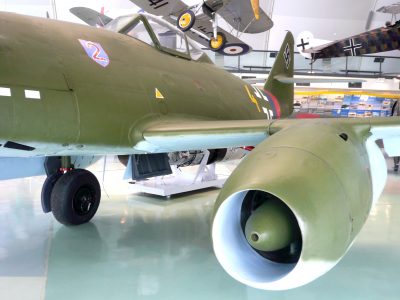
One of my favourites was the Messerschmitt Me 262A-2a, the first jet fighter to experience actual combat:

The aircraft was impossible to photograph all in one go:

This slideshow requires JavaScript.

Work on the aircraft started in 1938 and proceeded at a leisurely pace.  It made its first flight under jet power in 1942:

Before that it was tested with a propeller:

This slideshow requires JavaScript.

When the two jet engines were fitted, the scientists continued with the tail wheel but found that there was a high chance of fuel sloshing backwards by reason of gravity and then catching fire. After that they changed to a nose wheel:

Perhaps the most famous thing ever said about the aircraft was by the charismatic fighter pilot Adolf Galland, who took the new jet fighter  for a spin one morning. When he returned he gave his verdict:

“What an aircraft! It was as though the Angels were pushing!”

In December 1943, though, Hitler, in his infinite wisdom, decided that the Me 262 should be manufactured as a fighter bomber so that it could oppose the Allied forces when they carried out their inevitable invasion in, as he thought, the Pas-de-Calais area of northern France. Nobody on the design team seems to have agreed with him. but it still pushed back the operational début of the new fighter until July 1944.
The “Schwalbe” (Swallow) or Sturmvogel (“Storm Bird”) had a top speed of 559 mph and it was far faster and far more advanced than any Allied fighter:

In actual fact though, the Me 262 had very little real impact on the war. The factories built 1,400 aircraft but for various reasons only 200 were operational at any given time. They destroyed as many as 450 Allied aircraft but around 100 Me 262s were shot down, mainly by Mosquitoes and Mustangs.

The problems were many. Because of the activities of Bomber Command, engines were in short supply and this meant only 28 aircraft were delivered in June 1944, 59 in July, and just 20 in August. Those were not the only difficulties caused by the 24 hour bombing of the Reich and the Allies’ near total air superiority. The Me 262 frequently had to be built in what have been called “low-profile production facilities”, some of them in surprising places such as clearings in the forest.
Even the transportation of the raw materials and the parts for the aircraft was extremely hazardous with Allied aircraft always looking for trains to beat up.  Furthermore, the continual presence of Allied fighters  made it virtually impossible to train pilots in safety. There was just nowhere quiet for them to learn to fly such a radically different aircraft. And above all, the jet engines themselves were of dubious quality. They lasted only 50 hours and suffered from a continual lack of the rare metals needed to make the basic steel extremely heat resistant:

The engines used in the Gloster Meteor would last around 125 hours with an overhaul required after 60 hours. Sir Frank Whittle said that :

“it was in the quality of high temperature materials that the difference between German and British engines was most marked”.

The Americans, of course, were keen to take on board the wonderful shape of the Me 262. Even the lines of the Boeing 737 recall the Me 262 from twenty years before:

18 Comments

Filed under Aviation, Bomber Command, History, Science

A young German dies (2)

Last time I was talking about how much I had enjoyed hearing Norm Christie’s Canadian viewpoint about World War I:

But let’s move forward to World War II.
Probably my favourite story from Norm’s programmes is when he recounts an incident in Normandy in the weeks after D-Day in July 1944.
It’s a long time now since the glory days of 1940 and 1941, when leather overcoats were handed out free:

By July 1944, a lot of the Germans were beginning to realise just how gullible they had been, both as boys in the Hitler Youth, and then as proud young men in the German army.

Anyway, here’s the story, taken from the soundtrack of the programme. The events are recounted by a Canadian infantryman:

“I led my section down a small hill from the north into the main part of the city .The Germans were headed my way and we crossed at the end of the hedge. I had brought a Sten gun with me and I poked it through the hedge and fired. Three Germans went down. The rest put up their hands and surrendered.

I stayed with a mortally wounded German. He had a few words of English. He got across to me that he was 23 years old. He was a very good looking boy. He showed me pictures of his parents, his girlfriend. He gave me his parents’ address and asked me to go and see them when we got to Germany. He knew he was dying. I would have given anything to save his life. But I was helpless. And to make matters worse I was the one who had shot him.
He held both of my hands in his and cried, and then pulling them up tight under his chin, he coughed up blood all over my hands and then he died.

I threw away the things he had given me. I went back to my men and washed the blood from my hands.”

Only one person is guilty here.

The one who started the war.


13 Comments

Filed under Canada, France, History, Politics

Victor Comic and me (5)

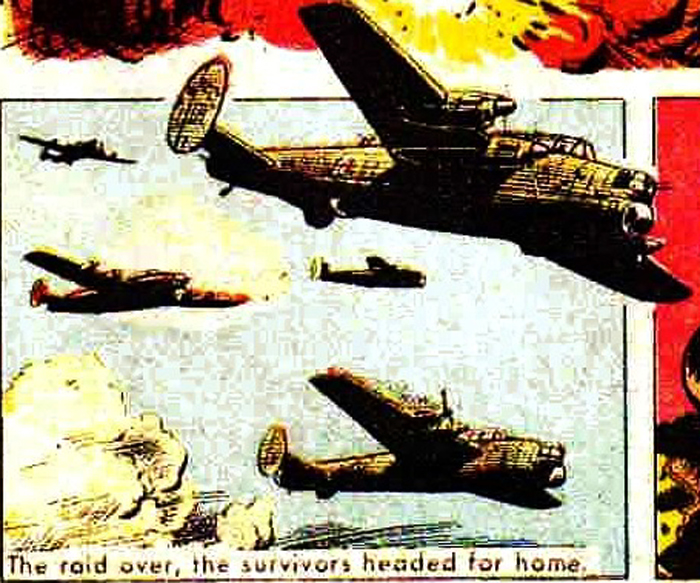
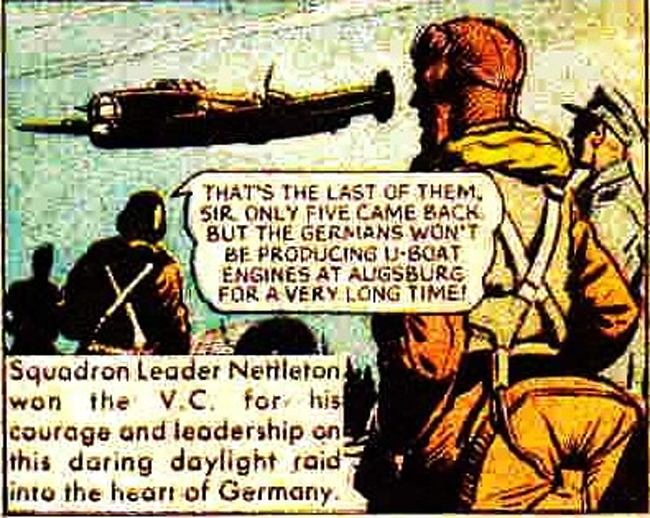
On the front and back covers, Victor would always have the story of a brave man, or a number of brave men. I can well remember this edition of Victor, Number 25, arriving at our house. It tells the story of the courageous South African, John Nettleton VC, who led a brave daytime attack on the MAN Diesel works in Augsburg. Seven of the Lancasters were shot down, and at least 37 men were killed:

The drawings are seldom completely regular in Victor. The top of the next row is often visible in the frame above.

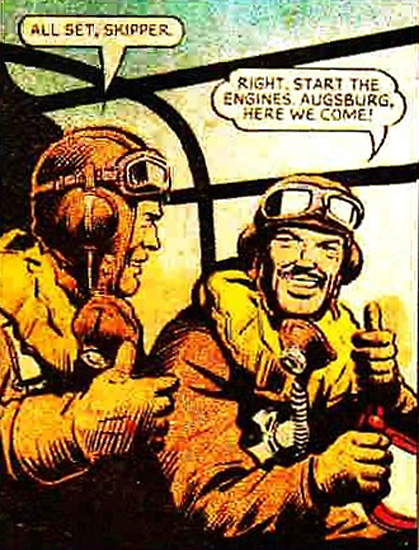
Here is the next frame, thumbs up, and everybody happy to set off on their desperate mission:

The bombers flew low and this is emphasised by the old cliché of horses being frightened. Sometimes, hats are blown off, but not today:

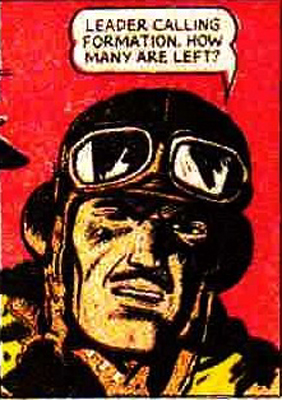
The agility of the fighters compared to the bombers is often emphasised by the different angles at which the two aircraft are flying. The sinister nature of the German fighter pilot is underlined by his lack of kindly eyes. Instead his evil eyes are masked by his goggles. Nobody in the RAF ever covers his eyes with his goggles:

In real life, operations like this one were always costly in lives. And a bomber pilot could take more than two years to train and it was an extremely expensive process. The story, though, makes the reader feel better by mentioning heavy German losses among the fighter pilots. That ignores, however, the fact that each bomber had seven men in it, and on average, when there was a terminal situation in a Lancaster, fewer than two of that seven would survive. And the fighter pilot, if he were shot down, would parachute down onto German soil. With luck, he could be back flying only three or four hours later:

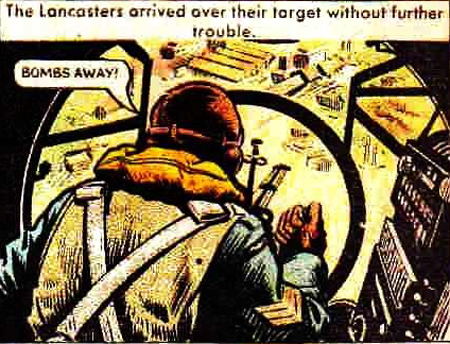
This is the worst bit of a raid, flying straight and level just before the bombs were dropped:

This type of attack seldom had great effects and the effects it did have were seldom long lasting. The American bombing of the ball bearing works at Schweinfurt and of the oil wells at Ploesti in Rumania would fall into this category and people still argue about the Dambusters raid:

A thousand feet is not very high. And one or two of those Lancasters at the back seem to be morphing into B-24 Liberators:

It would have been one hell of a long way back, with, presumably, all of the German fighters knowing that the surviving Lancasters would be coming past any time soon:

And now came the question which is always asked around the time when the bombers are scheduled to arrive back at base. “How many are left?”

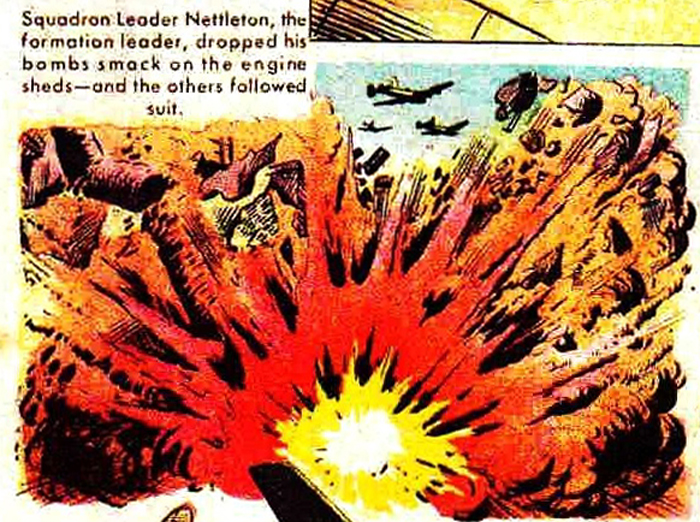
The British and the Americans always seemed to overestimate vastly the effect of their bombs on these specialised missions, especially early on in the conflict. Investigations after the war revealed that at Augsburg only 8 machine tools were destroyed out of 2,700. Of 558 cranes, just 5 were destroyed:

What cannot be denied is the bravery of every single crewman and the huge effect that this raid had on morale. Nettleton toured widely, addressing meetings both in Britain and in North America. Here is a news film of the time about the raid:

John Nettleton was killed on his way back from Turin after a bombing raid on July 13th 1943. Luftwaffe fighters were scrambled as the returning bombers passed over Brittany in the early hours of daylight. It is believed that an Fw190 shot his Lancaster down over the sea. Nettleton’s body has never been found. Much to my amazement, the Nettleton School in Braeside, Harare, in Zimbabwe, still exists. I need to be less cynical.


24 Comments

Filed under Aviation, Bomber Command, History, Personal

A young German dies (1)

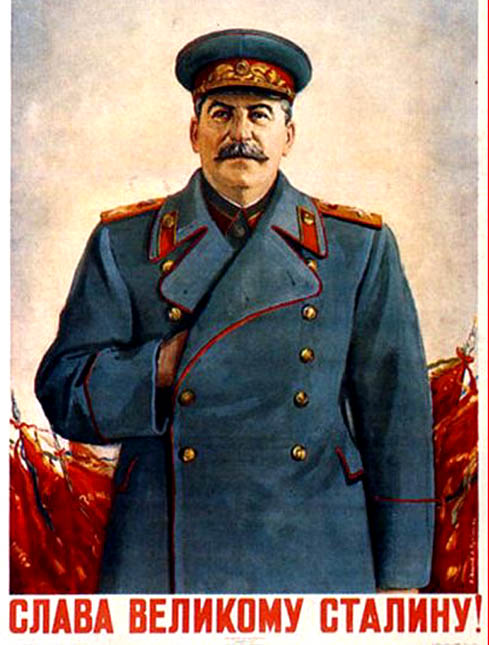
Death in war is very strange.  As kindly old Uncle Joe Stalin used to say, “A single death is a tragedy; a million deaths is a statistic.” He would frequently ease his constantly untroubled conscience with wise old peasant maxims like that one.

The Russian means “Glory to the Great Stalin!”

Let’s just take a look at a million deaths and a single death.

This account isn’t quite a million deaths but it makes a good contribution to the overall total. These are the statistics about a single night during the Second World War. They are taken from “The Bomber Command War Diaries and Operational Reference Book 1939 to 1945” by Martin Middlebrook and Chris Everitt.” This is one of the best, if not the best, reference work about the activities of Bomber Command. It is not in the slightest bit gung-ho. It is factual and leaves the reader to make up his or her own mind. And it relates the death toll both in the air and on the ground.

“April 22-23, 1944.  Düsseldorf bombed by 596 aircraft….323 Lancasters, 254 Halifaxes, 19 Mosquitoes.  29 aircraft… 16 Halifaxes and 13 Lancasters were lost, 4.9% of the force.”

In those 29 bombers, a minimum of 134 men were killed.

“2150 tons of bombs were dropped in this heavy attack which caused much destruction but also allowed the German night fighter force to penetrate the bomber stream. Widespread damage was caused on the ground. Among the statistics in the local report are: 56 large industrial premises hit, of which seven were completely destroyed, more than 2000 houses destroyed or badly damaged”:

“Casualties recorded by 2 PM on April 25th were 883 people killed, 593 injured and 403 still to be dug out of wrecked buildings ; at least three quarters of this last figure would have been dead.”

For my single death, I will go to the programmes of Norm Christie, one of my very favourite presenters of historical programmes on TV:

Christie always presents the Canadian point of view, which is very often different, and may well be a lot less favourable to the British ruling classes than, say, the BBC one.  One of his best programmes contained a portrayal of Arthur Currie, the leader of the Canadian forces in World War One and a man from very humble origins. He changed the face of warfare at the time. I realised that Norm Christie would have some interesting ideas when he contrasted a photograph of Haig’s Generals with one of Currie. Do you see what makes Currie a man apart?

This slideshow requires JavaScript.

And Norm Christie is not directly related to an officer involved in masterminding the carnage of the First World War. At least one regular television presenter can’t say that and I refuse to watch any programmes he has made. To be continued.

18 Comments

Filed under Aviation, Bomber Command, Canada, France, History, Politics

Victor Comic and me (4)

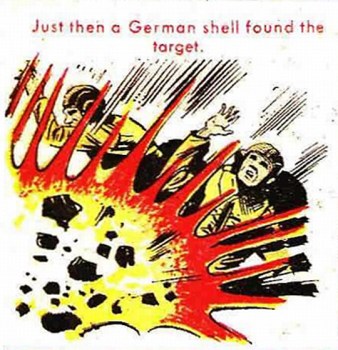
This time in Victor, it’s Coastal Command. Patrolling the Ocean Blue in their aircraft and bombing U-boats. Until the German anti aircraft gunners take a hand….

And that single event, that single exploding shell, seems to put a very abrupt end to all of the crew’s sentiments about peace on earth which might be talked about in church on a Sunday morning . We are moved on very quickly from love for our fellow man to an eye for an eye, a tooth for a tooth! And what about the words of the world’s most misspelled holy man, Gandhi? An eye for an eye and the whole world is blind?  All those lovely thoughts are completely knocked on the head. Literally. Vengeance is the order of the day. Just listen to what he says…..

And the next frame asks some very pertinent questions about staffing levels in the wartime RAF.

If we don’t need a bomb-aimer, then why did we bring one?

He could have been at home, spending his afternoon with his stamp album and his hinges, sticking in that German set with ships on, rather than bombing the real thing….

Aircraft recognition anyone? Well, it’s a Consolidated PBY Catalina, dropping old oil drums on a U-boat…..

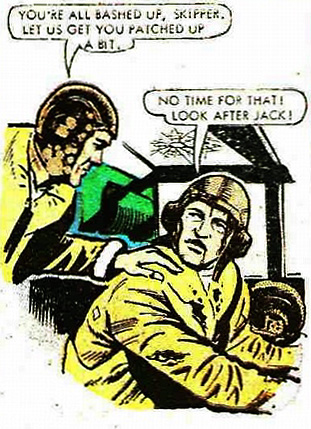
No real man likes a hand placed tenderly on his shoulder, even if he’s wounded.

Leave me alone and go and look after Jack, we’ve all been very worried about him…..

I’ve spent my whole life being a facetious commentator on life.

In actual fact, I am a great admirer of Victor comic and even as an adult, I can see lots of positive teachings within its heavily serrated pages.

Soooooo…it will be a Victor true story with no facetiousness whatsoever next time. Well, only a teeny weeny bit.

16 Comments

Filed under Aviation, History, Humour, Personal