Author Archives: jfwknifton

A campfire tale by the President (2)

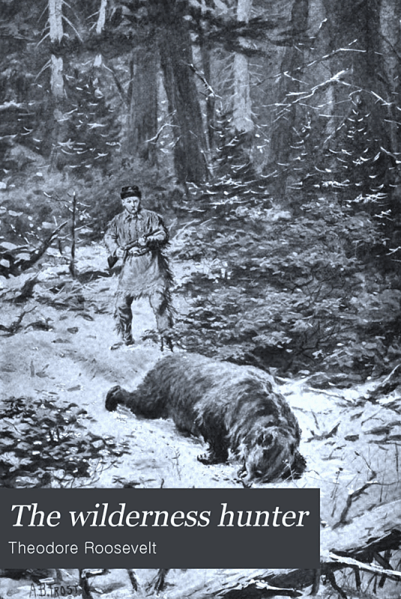
Way back in 1893, Theodore Roosevelt, the future President of the United States, published his latest book, entitled “The Wilderness Hunter”. It was :

“An Account of the Big Game of the United States and Its Chase with Horse, Hound, and Rifle” 

Last time I showed you the first part of a very famous story which I knew Roosevelt had incorporated into his book. It concerns two men, one called Bauman and the other unnamed, who go into the American wilderness to trap animals for their fur. I finished the first instalment of the story with a whole host of disquieting events:

“In the morning, they left to inspect the traps they had set the previous evening, and to put out new ones. They kept together all day and returned towards evening.

Hardly to their astonishment, their lean-to had been again torn down. The visitor of the preceding day had returned and maliciously thrown around their camp kit and bedding, and destroyed the shanty. Its tracks were everywhere. On leaving the camp, it had trod in the soft earth near the brook, and the footprints were as plain as if on snow. And after a careful scrutiny of the trail, it certainly did seem that, whatever the creature was, it had walked off on two legs.”

The men were now uneasy. They gathered a great heap of dead logs and kept up a roaring fire all through the night.”

And now, the nightmare continues…………

“One or the other man stood on guard all the time. Around midnight, the creature came down through the forest opposite, across the brook, and stayed on the hillside for nearly an hour. Branches were crackling as it moved about. Several times it uttered a harsh, grating, long-drawn moan, a peculiarly sinister sound. Yet it never approached the fire.

In the morning, the two trappers decided that they would leave the valley that afternoon. They were the more ready to do this because, despite seeing a good deal of game, they had caught very little.

First they had to gather up their traps. All morning, they kept together, picking up trap after trap, each one empty. Leaving their camp, they had the disagreeable sensation of being followed. In the dense spruce thickets, they occasionally heard a branch snap after they had passed; and now and then, there were slight rustling noises among the small pines to one side of them.

At noon, they were around a couple of miles from camp. In the bright sunlight, their fears seemed absurd to the two armed men, accustomed as they were to face every danger from man, animal, or element. There were still three beaver traps to retrieve from a little pond in a wide ravine nearby. Bauman volunteered to recover these, while his companion went ahead and got their packs ready.

Bauman reached the pond and found three dead beaver in the traps, one of which had been pulled loose and carried into a beaver house. He took several hours in securing and preparing the beaver, and when he started homewards he was worried how low the sun was getting. As he hurried back under the tall trees, the silence and desolation of the forest weighed on him. His feet made no sound on the pine needles, and the slanting sun rays, striking through the straight trunks, created a grey twilight where distant objects glimmered indistinctly. There was nothing to break the ghostly stillness which, on windless days, always broods over these sombre primeval forests.”

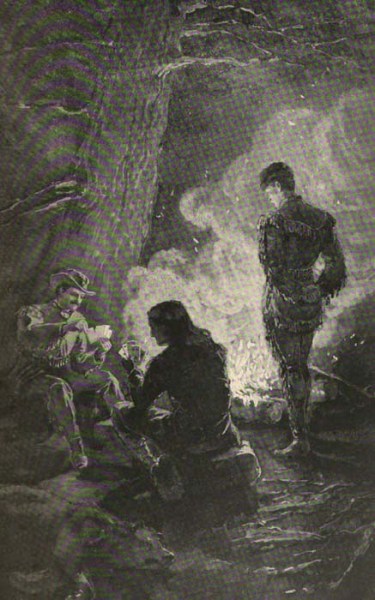
“At last, he came to the little glade where the camp lay. He shouted as he approached, but there was no answer. The campfire had gone out, although the thin blue smoke was still curling upwards. Nearby lay the packs wrapped and arranged. At first, Bauman could see nobody. There was no answer to his call. Stepping forward he shouted again. And then his eyes fell on the body of his friend, stretched beside the trunk of a great fallen spruce. Rushing towards it, the horrified trapper found that the body was still warm, but that the neck was broken, and there were four great fang marks in the throat.

The footprints of the unknown creature, printed deep in the soil, told the whole story:

“The poor man had finished his packing and then sat down on the spruce log with his face to the fire. His back faced the dense woods, as he waited for his companion to return. His monstrous assailant must have been lurking nearby in the woods, waiting to catch one of the fur trappers unprepared. He came silently from behind, walking with long, noiseless steps, and seemingly still on two legs. Evidently unheard, it reached the man, and broke his neck by wrenching his head back with its forepaws, while it buried its teeth in his throat. It had not eaten the body, but had gambolled around it in ferocious glee, occasionally rolling over and over it. Then he fled back into the soundless depths of the woods.”

Bauman, utterly unnerved, and believing that the creature was either half-human or half-devil, abandoned everything but his rifle, and rushed off at top speed down the valley, not stopping until he reached the beaver meadows where the hobbled ponies were still grazing. Mounting, he rode onwards through the night, until far beyond the reach of pursuit.”

THE END

The book from which this famous story is taken is freely available. Here is the link. 

The account begins at page 441, where it is introduced as a “goblin story”. That must have been one heck of a goblin. Still, everything is bigger in the USA, as they say.
 

20 Comments

Filed under Bigfoot, Cryptozoology, History, Literature, Science, Wildlife and Nature

“Die Rote Armee” means “the Red Army” (1)

I used to buy a lot of things on ebay.  And sometimes I found some real bargains and some really interesting things for sale. That’s not quite as easy a proposition now, but recently I decided to search for some propaganda leaflets from World War Two, the sort that were dropped on enemy forces from aircraft. Many people thought that they were 100% effective, but “Bomber” Harris, the man in charge of the RAF’s Bomber Command, thought that they merely provided the Germans with free toilet paper for the duration of the war. Here’s a sample selection, which was priced at £200:

By 1945, the war was nearly over, but the Germans still fought on and refused to surrender. The lives of  ordinary Germans seem to have had no value or importance as far as their leaders were concerned.

After the Vistula–Oder Offensive of early 1945, the Soviet Red Army had temporarily halted their westward advance on a line 37 miles east of Berlin. By March 9th, the Germans too had established their own defensive plans for the city. The first preparations for this were made in the suburbs of Berlin from March 20th onwards.

At this point, there were 766,750 German soldiers acting as Berlin’s defenders and a Soviet attacking force of a gigantic 2,300,000 men.

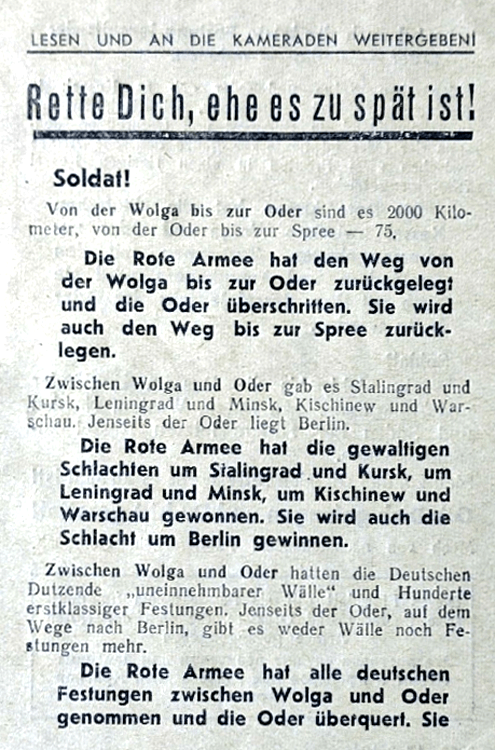
The Germans would still not surrender, though. Eventually, leaflets were dropped from Soviet aircraft to persuade them to give up. Such a leaflet is what I bought on ebay at a bargain price of £10. There were no other bidders. This is the front page.

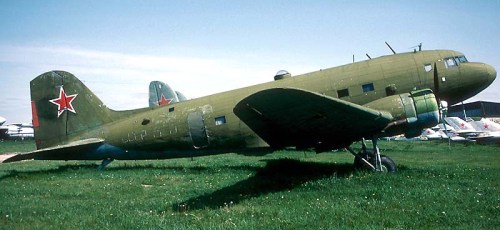
This is a Lisunov Li-2, which was probably the Russian aircraft of choice for leaflet drops. All American readers should recognise it!

The leaflet was very simply presented. The text is direct and to the point. As most readers do not speak German, and neither do I, thanks to Google translate, I can provide the English:

“Lesen und an die Kamarden weitergeben!”

Read and pass it on to your friends!

“Rette dich, ehe es zu spät ist!”

Save yourself before it’s too late!

“Soldat!”

Soldier!

Certain city names occur and recur on this propaganda leaflet. So now, here’s a little bit of geography. First, the places important to the German invaders…….

Stalingrad was on the River Volga, way, way, to the east of the European Soviet Union, and almost in Asia. It was north of the Caucasus and a good way east of the Black Sea.

Leningrad was in the north, on the Baltic Sea, right next to Estonia and Finland. Moscow, Minsk and Warsaw were all further south, on the usual West-East invader’s route into Russia. Nowadays these cities are major stations on the Moscow-Berlin line, a journey which took me two whole days in 1969.

The Soviet Red Army’s route from east to west, as they chased the Germans out of their country, across Poland, and finally to their own capital, Berlin, was, of course, a lot longer than two days!

Finally, some help with the place names mentioned in the next few extracts…..

In central Europe, the Oder is the river which still forms the present-day frontier between Germany and Poland. In the Cold War, it was half of the so-called “Oder-Neisse Line“.

The River Spree actually flows through the very centre of Berlin and then joins the River Havel in Spandau, home of the heavy machine gun and the famous ballet company:


“Von der Wolga bis zur Oder sind es 2000 Kilometer, von Der Oder bis zur Spree – 75.”

“From the Volga to the Oder it is 2000 kilometers, from the Oder to the Spree – 75.”

On we go, chasing the Fascists…….

“Die Rote Armee hat den Weg von der Wolga bis zur Oder zurückgelegt und die Oder überschritten.”

“The Red Army has travelled the route from the Volga to the Oder and crossed the Oder.”

Here are the Germans, trying to defend the River Oder. The Field Marshall was a little bit disappointed with the turn-out:


“Sie wird auch den Weg bis zur Spree zurücklegen.”

“It (the Red Army) will also travel the road to the Spree.”

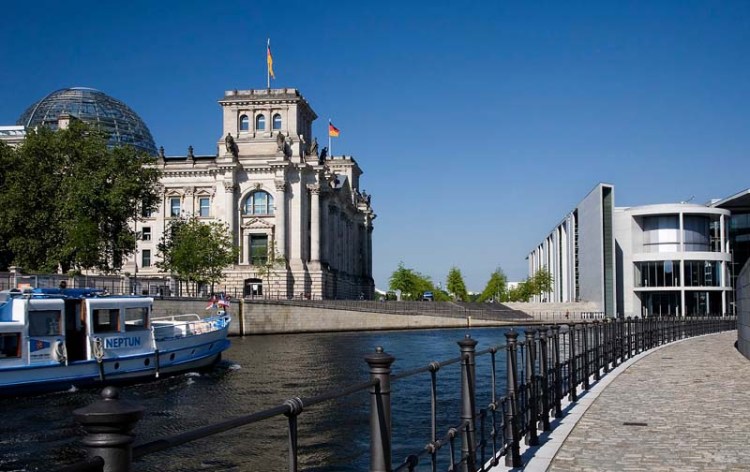
The Spree is the last river before you reach the very centre of Berlin. Here it is, right next to the Reichstag building:


“Zwischen Wolga und Oder gab es Stalingrad und Kursk, Leninjgrad und Minsk, Kischinew und Warschau. Jenseits der Oder liegt Berlin.”

“Between the Volga and the Oder there was Stalingrad and Kursk, Leningrad and Minsk, Kishinev and Warsaw. Berlin is on the other side of the Oder.”


These cities all form the different routes for the invaders of the Soviet Union to travel. The next two sentences from the leaflet duly lists them, as the Red Army chases the Germans westwards, out towards the Vaterland :

Route 1 is Stalingrad-Kursk-Berlin,  and Route 2 is Leningrad-Minsk-Berlin and, presumably, Route 3 is Kishinev-Warsaw and then Berlin. KIshinev was in Moldova, just to the north of Rumania.

All three routes begin to converge when they reach Warsaw and Berlin. That explains the Red Army of 2.3 million men.

“Die Rote Armee hat die gewaltigen Schlacten um Stalingrad und Kursk, um Leningrad und Minsk, um Kishinew und Warschau gewonnen.”

“Sie wird auch die Schlact um Berlin gewinnen.”

“The Red Army has won the mighty battles around Stalingrad and Kursk, Leningrad and Minsk, Kishinev and Warsaw.”

“It will win the Battle of Berlin”

“Zwischen Wolga und Oder hatten die Deutschen Dutzende, uneinnehmbarer Wälle und Hunderte erstklassiger Festungen.”

“Jenseits der Oder, auf dem Wege nach Berlin, gibt es weder Wälle noch festungen mehr.”

“Between the Volga and the Oder, the Germans had dozens of “impregnable ramparts” and hundreds of first class forts.”

“Beyond the Oder, on the way to Berlin, there are no more ramparts or fortresses.”

And then a frightening threat, or more likely, promise:

“Die Rote Armee hat alle deutschen Festungen zwischen Wolga und Oder genommen und die Oder überquert.”

“Sie wird auch die letzte Festung jenseits der Oder – Berlin – nehmen.”

“The Red Army took all German fortresses between the Volga and the Oder and crossed the Oder.”

“It will also take the last fortress on the other side of the Oder – Berlin.”

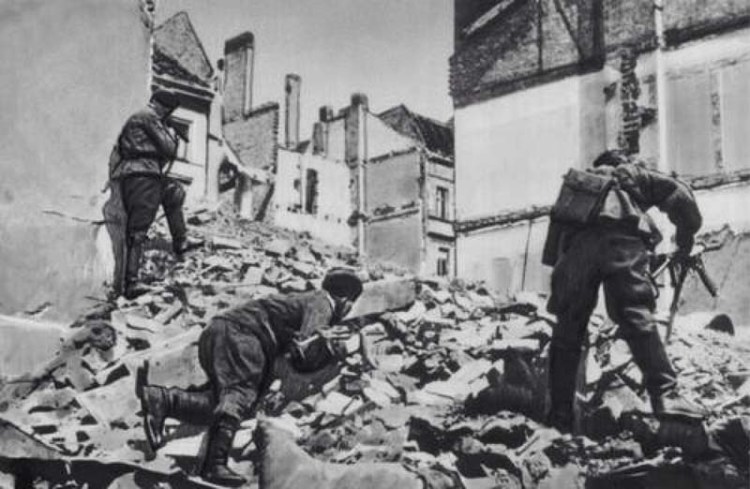
That is the end of the first section of the leaflet. Next time, we’ll take a look at the second section. The picture shows Soviet infantry capturing some of the streets of Berlin.

And finally, I do apologise for the lack of  maps. I searched for a long time to find a simple map of the Eastern Front in 1945, but an overall, easy-to-understand example proved impossible to find.

21 Comments

Filed under Aviation, History, military, Russia

A campfire tale told by the President (1)

Way back in 1893, a book called “The Wilderness Hunter” was published. It was written by Theodore Roosevelt, the future President of the United States and was described as :

“An Account of the Big Game of the United States and Its Chase with Horse, Hound, and Rifle” 

I bought a copy recently, a modern reprint, but not because I am particularly interested in the “Chase with Horse, Hound, and Rifle”. Indeed I possess none of the three. No, I wanted to read a very famous story which I knew Roosevelt had incorporated into his book. Not that I could find it, of course. I searched and searched and searched but with no success whatsoever. So, I was reduced to looking for the story on the internet. And eventually, I found it, tucked away in one of the  several different versions of what I now know can be a two volume book.

The story, hidden away in Chapter XX (or 20) was told to Roosevelt by :

” a grisled old mountain hunter, named Bauman, who was born and had passed all his life on the frontier.”

Anyway, here’s Part One of a ripping yarn:

“Bauman, still a young man, was trapping with a partner among the mountains near the head of Wisdom River. They went up into a wild and lonely pass with a small stream said to contain many beavers. The pass had an evil reputation. The year before a solitary hunter had been killed there, seemingly by a wild beast. The half-eaten remains were afterwards found by some mining prospectors who had passed his camp only the night before.

Bauman and his friend weren’t bothered. They were as adventurous and hardy as others of their kind. They took their two ponies to the foot of the pass and left them in an open meadow. The rocky ground was now impracticable for horses.

They then struck out on foot through the vast, gloomy forest, and four hours later, they reached a beautiful glade where they camped, as game was plentiful.

There was an hour or two of daylight left. After building a lean-to and opening up their packs, they set off up the valley. The country was very dense and difficult with many dead trees on the ground, although occasionally the dark forest was broken by small clearings with mountain grass.

At dusk, they returned to camp. The glade where it was pitched was not very wide, the tall pines and firs rising round it like a wall. On one side was a stream, beyond which rose the steep mountain-slopes, covered with the endless evergreen forest.

They were surprised to find that something, apparently a bear, had visited their camp, and rummaged among their things, scattering everything, and then destroying their lean-to. The footprints of the beast were quite plain but they paid no heed to them, busying themselves with rebuilding the lean-to, laying out their beds and stores, and lighting the fire.”

“While Bauman was making supper, his companion began to examine the tracks more closely, and took a brand from the fire to follow them, where the intruder had walked along a game trail after leaving the camp. When the brand flickered out, he returned and took another, repeating his careful inspection of the footprints. Returning to the fire, he stood for a moment or two, peering out into the darkness, and suddenly remarked:

“Bauman, that bear has been walking on two legs.”

Bauman laughed, but his partner insisted that he was right; and, examining the tracks with a torch, they certainly did seem to be made by just two feet. However, it was too dark to make sure. After discussing whether the footprints could be a human being, and deciding that they could not be, the two men rolled up in their blankets, and went to sleep under the lean-to.

At midnight, Bauman was awakened by some noise, and sat up in his blankets. As he did so, his nostrils were struck by a strong, wild-beast odour and he glimpsed a huge body in the darkness at the mouth of the lean-to. Grasping his rifle, he fired at the vague, threatening shadow, but must have missed. Immediately afterwards he heard the smashing of the underwood as the creature, whatever it was, rushed off into the impenetrable blackness of the forest and the night.

After this the two men slept fitfully, sitting by the fire, but they heard nothing more.

In the morning, they left to inspect the traps they had set the previous evening, and to put out new ones. They kept together all day and returned towards evening.

Hardly to their astonishment, their lean-to had been again torn down. The visitor of the preceding day had returned and maliciously thrown around their camp kit and bedding, and destroyed the shanty. Its tracks were everywhere. On leaving the camp, it had trod in the soft earth near the brook, and the footprints were as plain as if on snow. And after a careful scrutiny of the trail, it certainly did seem that, whatever the creature was, it had walked off on two legs.”

Next time :  Things take a turn for the worse, as if that were possible.


15 Comments

Filed under Bigfoot, Cryptozoology, History, Literature, Science, Wildlife and Nature

What would you do ? (17) The Solution

“What would you do ?” used to figure on the cover of a boys’ comic called “Boys’ World”. This was a publication, obviously, aimed at boys, and first appeared on January 26th 1963. There were 89 issues before the comic was merged with Eagle in 1964. The last issue of “Boys’ World” came out on October 3rd 1964.

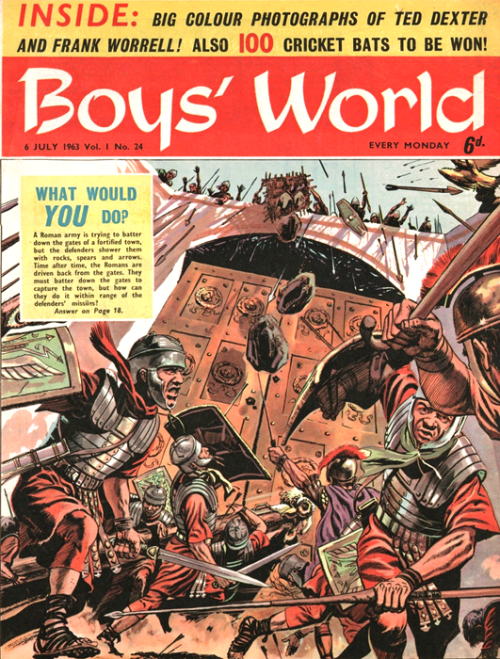
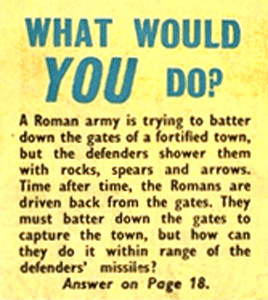
I used to buy “Boys’ World”, and this was mainly for the front cover which always featured a kind of puzzle. It was called “What would you do ?” and was based on somebody being in what Ned Flanders would call “A dilly of a pickle”. Here’s the situation:

And the yellow box said:

The Roman army, then  is being driven back time after time from the gates because of the missiles the  defenders are throwing. How can the Romans get in, when they are directly underneath the defenders’ missiles?

And, the correct solution given on page 18 of the comic is:

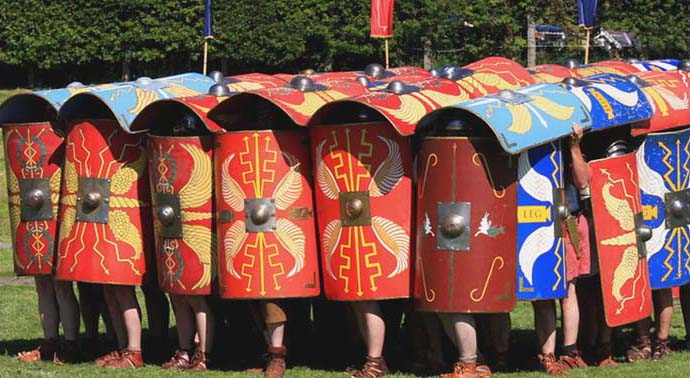
Quite simple, really, I suppose. The old “testudo”, used only when needed, was a standard formation of the Roman army:

28 Comments

Filed under History, Literature, military, Personal

What would you do ? (17) The Puzzle

“What would you do ?” used to figure on the cover of a boys’ comic called “Boys’ World”. This was a publication, obviously, aimed at boys and first appeared on January 26th 1963. There were 89 issues before the comic was merged with Eagle in 1964. The last issue of “Boys’ World” came out on October 3rd 1964.

I used to buy “Boys’ World”, and this was mainly for the front cover which always featured a kind of puzzle. It was called “What would you do ?” and was based on somebody being in what Ned Flanders would call “A dilly of a pickle”. Here’s the situation:

The yellow box sets the scene, and the task is for you to solve the situation. Perhaps you might like to write your idea in the “Comments” section.

Here’s the yellow box enlarged:

So…..it’s one “dilly of a pickle”.  The Roman army is at the gates of a fortified town, trying to batter their way in. The inhabitants of the town are throwing copious quantities of rocks on top of them, and firing arrows and throwing spears. The Romans are driven back time after time. They have no choice, though, but to capture the gates since this is the only way to get in and capture the town. How can they do it, when they are within easy range of the defenders’ missiles?

Bonus marks, incidentally, for anybody who knows who Frank Worrell or Ted Dexter were, and why were they featured in the comic?

27 Comments

Filed under History, Literature, military, Personal

Photographs of the Eastern Front in World War Two (6)

About a year ago I bought a collection of more than 12,000 photographs of World War Two. Most of them were not British or American but were either Russian or German. I would like to share some of them with you because a number of these photographs have great merits as photographs, as well as capturing a split second in history. None of them have a caption, so I have tried to work out what might be going on.

Today, I’m going to look at the return of the Russian civilian population to their homes.

Some came home on foot, walking, perhaps, hundreds of miles, many of them barefoot:


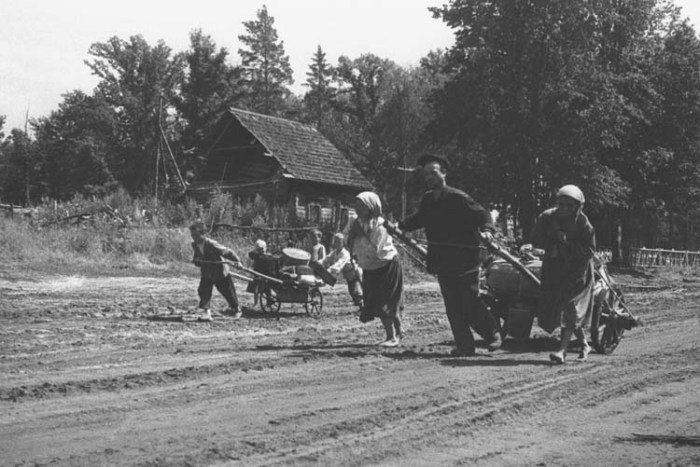
Many pulled handcarts:

And others pushed handcarts, although, if you look carefully, occasional individuals travelled in style, even if they looked slightly startled:

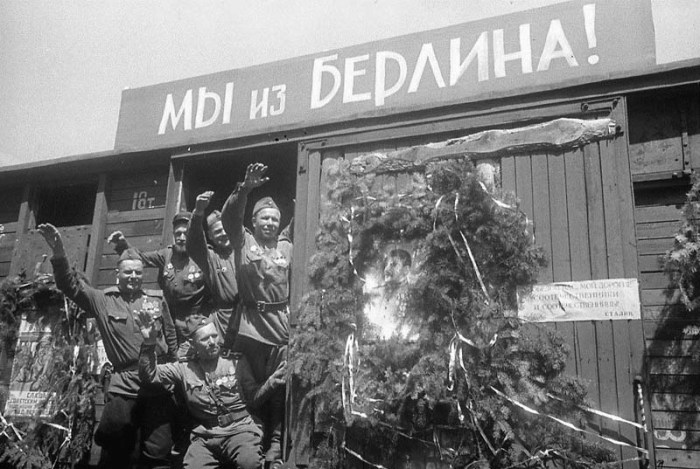
The Red Army travelled in top quality, luxury cattle trucks. The large slogan means “We (are) from Berlin”. The present tense of the verb “to be” does not exist in Russian. The word “Berlin” is decipherable, however.

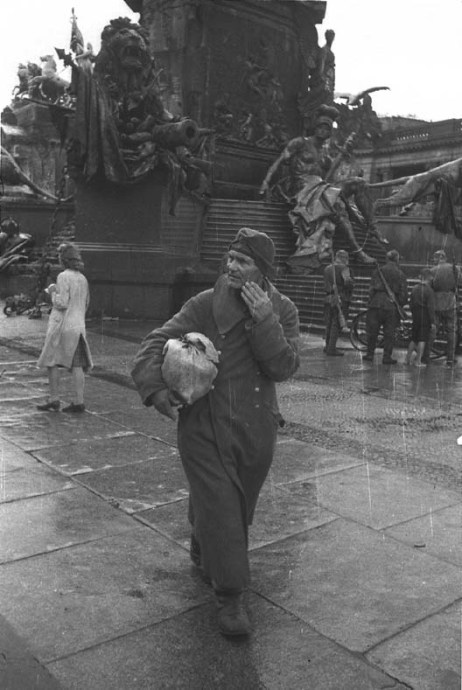
I think that this is an ex-soldier who has been demobbed recently, and he is having a look round Berlin before he makes his way home. That huge statue used to stand in front of the city palace above the River Spree, and commemorated Kaiser Wilhelm I. It’s clearly a place where soldiers would hang out, and that is one of the reasons that I think that this well dressed young lady, who is not walking but just standing there, is actually a prostitute:

Some areas were still very dangerous and a Red Army escort was sometimes necessary to get home. Notice how the lady is carrying the family icon. Christianity saw a big revival during the war as it provided somebody to pray to who had a lot more credibility than Uncle Joe Stalin:

Here are two young women meeting in a shattered, desolate city, possibly Stalingrad. One has just been to do the shopping and the other one has just got off the train with her suitcase. There are still fires burning and some buildings still have the dark marks of a recent fire.

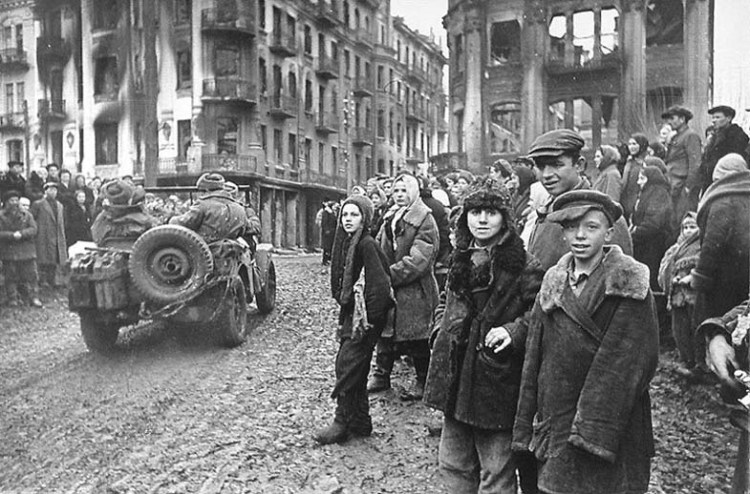
As the liberating armies come ever closer, the first jeeps arrive, to be greeted by delirious crowds. Except that that isn’t happening here. Some of the people actually look really quite aggressive. Are they Poles, assembled in the streets to shout “Welcome to the Red Army” or perhaps “Soviets, stay as long as you like”?

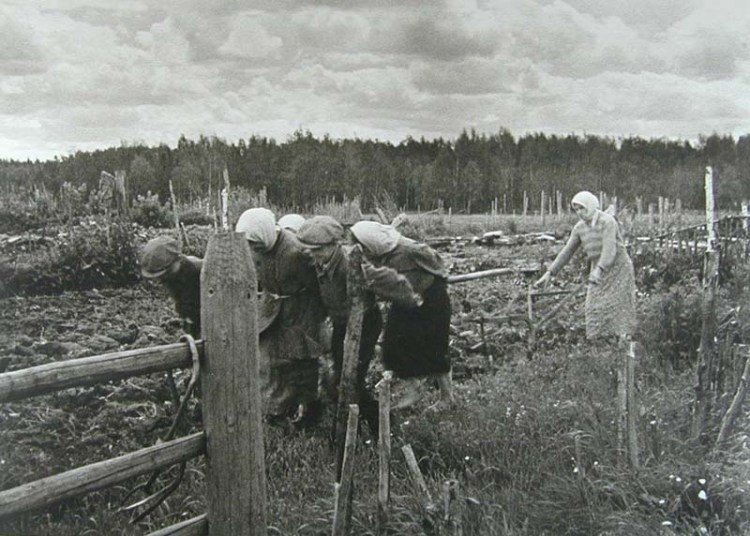
If there’s going to be a harvest, somebody needs to start ploughing at some point. I saw horses used widely in Polish fields as late as 1969:

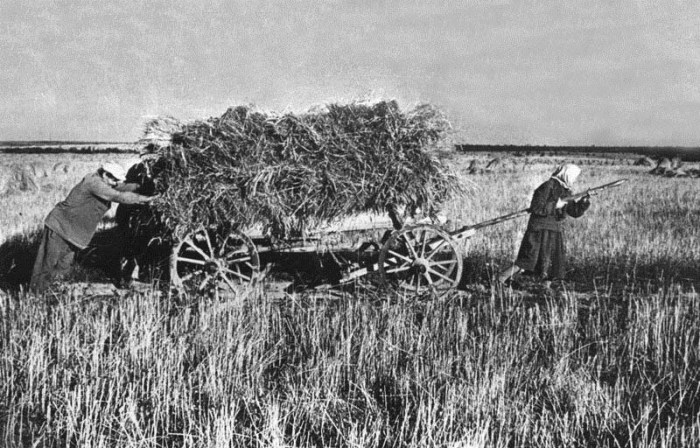
If the horse isn’t up to it, see if the family can help you out:

And if all goes well, you will get your just deserts:

24 Comments

Filed under History, military, Russia

Why I am what I am (3)


I have always had a soft spot for the RAF because Fred was in the RAF and he talked about it a lot.

I have alway been fascinated by aircraft because Fred liked aircraft, ever since one of Sir Alan Cobham’s finest landed in Startin’s Field at the back of his house.

Fred always admired the Spitfire as the aircraft that saved England……

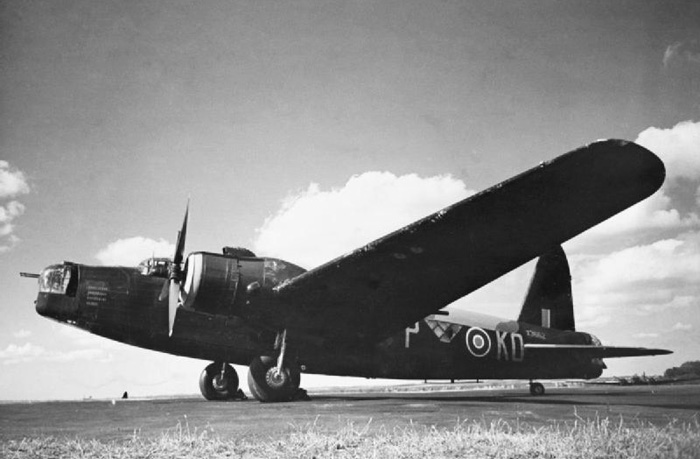
And he always said that the Wellington was “a reliable old crate”……

But he always reserved his most emotional words for the Avro Lancaster. “It would always get you back home, no matter what”, which wasn’t strictly 100% true, but it gave him sufficient faith to get into the aircraft in the first place……


I have always tried to do my duty and to carry out all of my obligations. This is probably connected with Fred’s belief that there were two types of men in the world. One kind was the fighter pilot who was mercurial and brilliant, but occasionally capable of great inconsistency.

In contrast, the bomber pilot was always dependable like some kind of stolid, courageous bus driver, who could always be relied on to deliver the goods, in considerable quantity, to the right place at the right time.

When I was young, I as always very upset when I was told  that I was the bomber pilot type. I always felt that Fred was saying that I lacked flair and imagination, that I was boring and that I was incapable of the type of success which is spectacular and excites people. Only in later years did I realise how from Fred’s point of view the bomber pilot was exactly what you needed. As one author has put it, the relationship between the bomber pilot and the wireless operator was that “his fate was my fate”. At least nineteen times, therefore, Fred entrusted his very life to a bomber pilot, and then had this faith rewarded by not becoming one of the 55,573 Bomber Command casualties…..

As a negative, I have always been partial to a drink, because Fred always used to have a drink when he wanted to. With his PTSD, though, he had a much better excuse than me.

Another negative related to this is my own great anxiety in the face of any future event or, especially, a journey to somewhere unfamiliar. Fred had exactly the same problems. In his case, I suspect that he still had that old fear of getting into his bomber and facing the possibility of an imminent and violent death.

I always felt great anxiety about being sacked from my job because Fred  always had the exact same fear. That was because he worked for a clay mining company before the war, and they did not hesitate to sack people. “One strike, and you’re out!” as you might say. Here’s Fred at Ensor’s, with the rest of the workforce. It’s around 1937…..

I have very little self-confidence because Fred was always very keen that I should never stand out from the common herd. He therefore prevented me from getting big headed by criticising whatever I did and at best giving it minimal praise. He would say “Never stand out. Never be different” because that was what the upper echelons of the RAF hierarchy wanted to happen. Unfortunately, to succeed, you need to stand out, and you will have to be different to do that.

Fred always used to watch out for me coming home if ever I was late. He would lean over the front gate as if by accident or coincidence. I absolutely hated it, and I could cheerfully have shot him. I hated the idea of being controlled. Now I have my own daughter, and although my methods have always been, I hope, a little bit more subtle, I have always done pretty much the same thing. Still, worrying about your child is better than just not bothering where they get to.

When I was a little boy, Fred took me to a local medieval church where I could see where Robin Hood used to sharpen the tips of his arrows on the stones of the back wall. I now live in Sherwood in Nottingham. Less than half a mile away is an ancient ford over a stream. This site has been seriously suggested in at least one book as the location of Robin Hood’s camp.

The local medieval church was St Michael with St Mary’s in Melbourne, Derbyshire. ……….

Some of the grooves for Robin Hood and his Merry Men’s arrowheads are visible in the bottom right of the picture. The church is Norman as is shown by the shape of the arch and the many concentric rings of decoration around the top of the door……..

The columns are stout and broad, just like Durham Cathedral, and the arches similarly rounded, not pointed. Notice the Australian flag which commemorates the links between Melbourne in England and Melbourne in Australia……

And finslly, as I slowly but surely morph into my own father, I have started telling the same old stories over and over again, just like Fred did.

30 Comments

Filed under Aviation, Bomber Command, History, my Dad, My House, Nottingham, Personal

Photographs of the Eastern Front in World War Two (5)

About a year ago I bought a DVD with more than 12,000  images of World War Two . Most of them were either Russian or German.

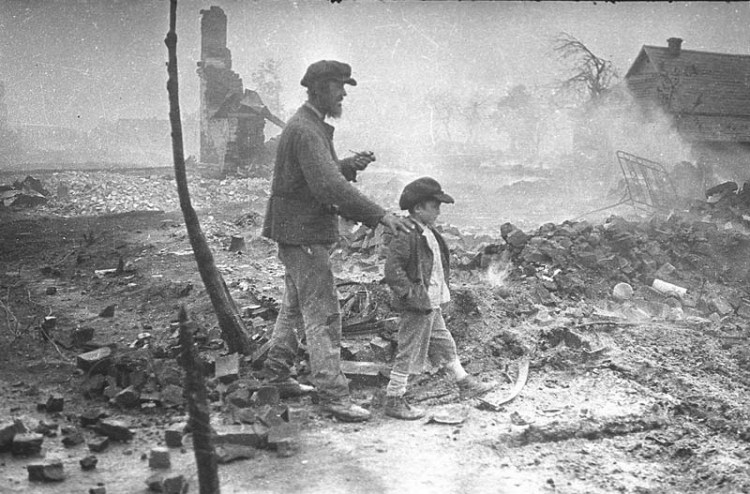
This first photograph shows a little Russian boy who appeared in one of the previous photographs in the Blog Post “Photographs of the Eastern Front in World War Two (4)”. Both he and his grandad stand in the smoking ruins of their house, and of their village. We can only guess at the circumstances. Personally, given the fact that the two individuals do not look particularly shocked or desolate, I think that the Germans have set fire to their village as they retreat back to Germany with the Red Army keenly pursuing them.

In this winter scene, Grandad and grandson are planning the future, perhaps where they will live, or where they hope a neighbour will help them rebuild their house and so on. Grandad is carrying his cane, but what’s that in his left hand? Incidentally, after much careful examination with Blog Post No 4, I do not think these two are the same individuals featured there, although, of course, you may not agree.

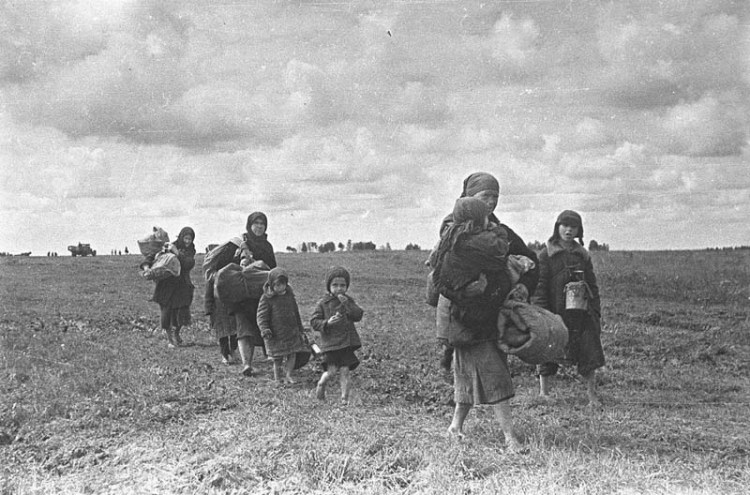
With victory in sight, though, and the tide of war now relatively far away, the refugees gradually came back. Here’s Granny, with her two daughters and five, perhaps six children. Everybody is barefoot, but they’re going home, so walking’s easy. And the two fathers? Well, they could have been starved to death in a POW camp, or worked to death as slave labourers in Poland or even in the Channel Islands.

This careful close up excludes any adults and focusses on the children with two brothers making manful efforts to carry as much as they could on a handcart. The baby sleeps the sleep of the innocent little child. Notice how she may well be strapped in for safety.  We will never know if the family’s house was still there when they arrived. In Byelorussia alone, up to 1500 villages were razed to the ground.

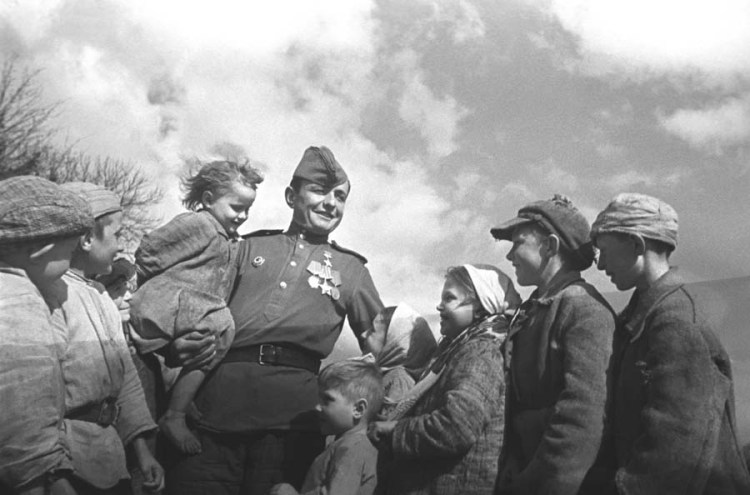
As the conquering hero returns, it’s the village kids who spot him first. He has a smile wide enough to indicate that he has already asked somebody whether his family is still alive. Under the German occupation, nobody was safe.

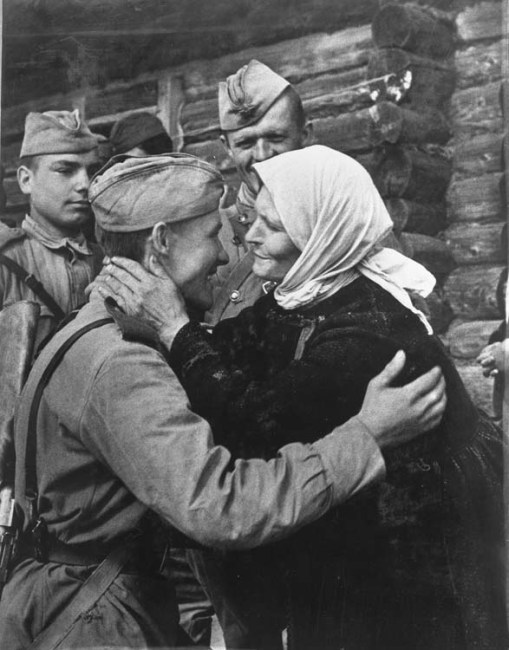
If I were going to give this photograph a title, it would be “The Love of a Mother”. Ordinary young soldiers walked back home, starting as a group which lost a member or two as they passed by each village. These were villages where the inhabitants would not have known whether a particular young serviceman was alive or dead. Yuri Gagarin’s two brothers performed slave labour in Poland, escaped and the Red Army conscripted them. The rest of the family thought both of them were dead, and Yuri became seriously ill with “grief and hunger”. They got back home in late 1945:

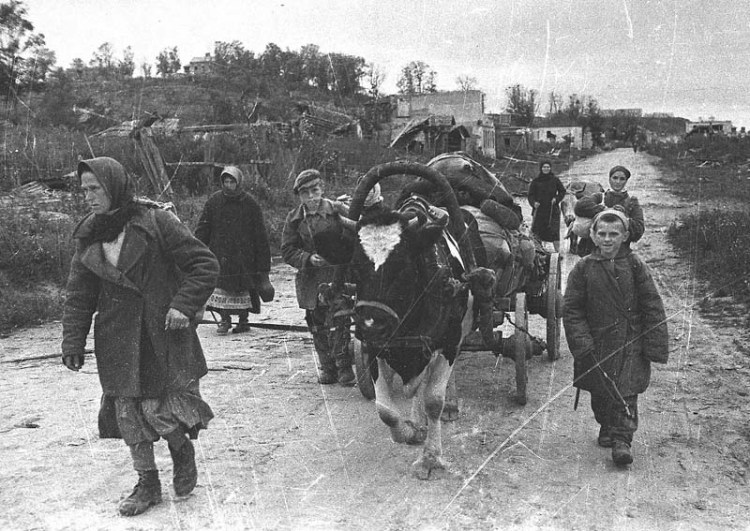
And still the refugees stream westwards to their homes. These bring two cows with them and a sturdy cart with substantial wheels. There are eight people, with, for me, two grannies, two mothers, two boys and a young woman. They all have boots and one boy has a Red Army infantryman’s cap. Did they find their house even vaguely intact? And what about at least two husbands?

Even more so, what about the bear who appears to be asleep on the back of the cart? Or have I got to take more water with it?

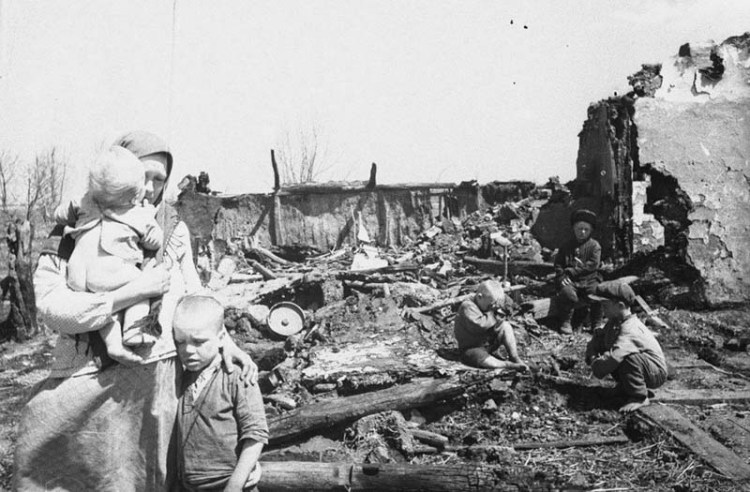
Most stories in Russia, though, had a sad ending. A house smashed to pieces by a German tank, because the crew wanted to use it as a hiding place. A woman with perhaps five mouths to feed and no husband in sight. It’s enough to make even  tough little Russian lads burst into tears. But don’t worry. Everything will be made good within a few years.

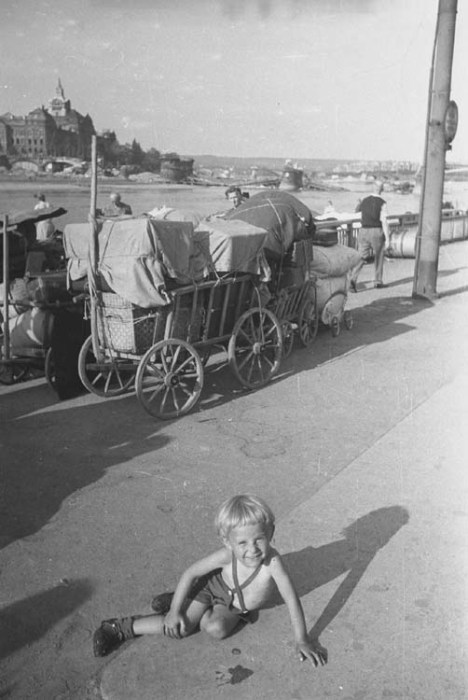
Indeed, things did get better ! So smile and enjoy being alive, enjoy sitting in the summer sunshine of 1945. As many as 20 million Russians were not able to say that.


As far as the present war in the Ukraine is concerned, I would expect the Russians to remember the destruction wrought on so many towns, cities and villages of the old Soviet Union, and to begin face-to-face discussions before resorting to the senseless violence they have evidenced so far. But, as we know in the West, hardly any people who witnessed the Second World War are still alive, and that must have been enough for a glory seeking politician to forget the ways of peace and to take up the pointless violence of the invader.

28 Comments

Filed under History, military, Politics, Russia, war crimes

Why I am what I am (2)

Last time I mentioned a number of things that linked me to my Dad insofar as interests, hobbies and sports were concerned. I soon discovered that that was really only the beginning of the story.

I rather think that I studied Russian because Fred used to speak so frequently of the Russians during the Second World War. In the bookcase at his parents’ house, he had a pamphlet borrowed from an RAF library. It was entitled “Our Soviet Friends”, and it had pictures of the dam at Dnepropetrovsk:

He told me how, in the RAF, anybody wth knowledge of Russian could name their own price for helping to liaise with our new surprise allies, once the Germans invaded the Soviet Union. Towards the end of the war, Lancasters, on rare occasions, used to bomb the Germans and then carry on to Russia to land. When they came back they brought more bombs and often, one or two souvenirs.  On one occasion, my Dad had had a drink from a flask of coffee made up for the aircraft’s crew in Leningrad. I had to satisfy myself with my early attempts to learn the language, with the woman of my dreams…..

I may like French because, in 1940, Fred had wanted Britain and France to merge into one country just like Churchill had said. Fred was a keen European and, like Churchill,  he wanted a “United States of Europe”. As members of Bomber Command he told me, though, that the French could often be difficult to work with. Here is a Bristol Blenheim of the Free French Air Force in North Africa…..

I have always had great regard for the Poles because Fred said they were great blokes, and that he had joined up so that Poland could be freed from the invading Germans. A few years ago, I was in hospital for a operation, and there was a Polish van driver there that nobody would talk to because he was Polish. Except me, and if Fred had been there, he would have spoken to him, too. Racism can be amazingly petty.

I try to like poetry, because I know that Fred had claimed so often that poetry was an integral part of his life. He liked to read peoms out loud to his classes at school, his favourite being “Flannan Isle”.

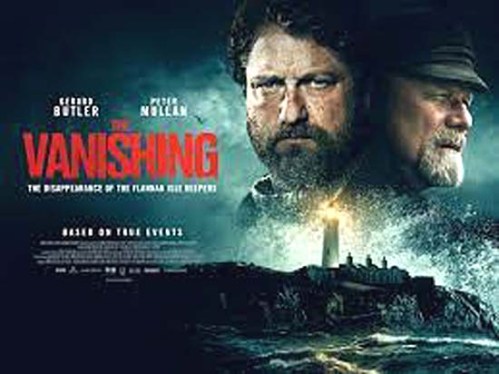
I did a series of five blog posts about the mystery of Flannan Isle, as portrayed in the poem, and the first one is here. The rest can be found by merely searching for  “Flannan”. And when you’ve done that, don’t forget to watch this film with its own, made-up, explanation of the three men’s disappearance….

I’m sure that I became a teacher because Fred was a teacher and I felt that a teacher was a good thing to be. In the mid-1970s, the money was excellent and I didn’t automatically have to live in London.

I always worked hard as a teacher because Fred told me that at the end of each day, you should always ask yourself the question, “Were you just given your wages, or have you earned them ?”

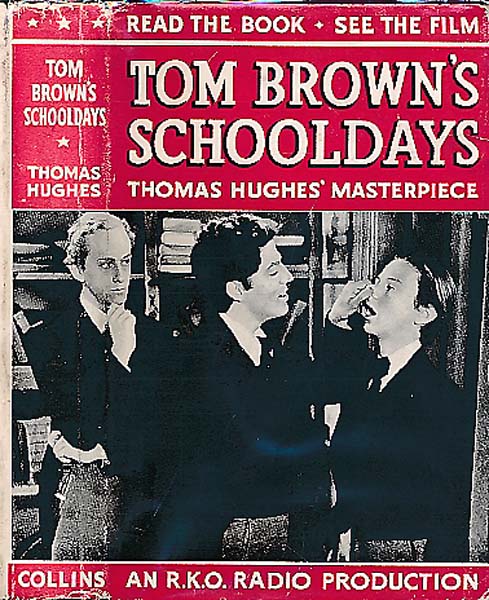
I worked all my life at the High School, 38 years, because when he took me there for a job interview in 1975, I could see that Fred was enormously impressed by the school. To him, and to me, it looked like something out of a film, such as, perhaps, the old version of “Tom Brown’s Schooldays”…….

In actual fact, after his death, I found that, when he was a boy in the 1930s, Fred’s Uncle George  had bought him a present, the book of the film “Tom Brown’s Schooldays”.  They didn’t shoot this film at The High School, but if they had wished to, it would have been entirely appropriate from the architectural point of view….

Fred read a lot about the Second World War, and one of his favourite books was a German doctor’s story of Operation Barbarossa, a book called “Moscow Tram Stop”. The High School has its own tram stop, called “High School”. That fact has always reassured me that I had made the right decision to work there for so long.


25 Comments

Filed under Film & TV, History, Literature, military, my Dad, Nottingham, Personal, Russia, Wildlife and Nature

Phonetic Alphabets (2)

Last time we looked at a number of phonetic alphabets. There was the British Army in 1904, the  British Post Office in 1914 , the  Royal Navy in 1917 and the  Western Union in 1918. Then came the good sense of the US Army and the US Navy in 1941 to have the same alphabet (for both) in contrast with the four different alphabets used by the RAF in different periods of World War II.

But what about the foreigners?

Here’s the Luftwaffe alphabet  in 1940. The very same one was used by the Wehrmacht, the German army:

Anton, Ärger, Bertha, Cäsar, Charlotte, Dora, Emil, Friedrich, Gustav, Heinrich, Ida, Julius, Konrad,

Ludwig, Martha, Nordpol, Otto, Ödipus, Paula, Quelle, Richard, Siegfried, Schule, Theodor, Ulrich, Viktor,

Wilhelm, Xanthippe, Ypsilon, Zeppilon

It is obviously different from the Allies’ alphabet, being based on names, but that must surely have made it quite easy to learn. Incidentally, “Ärger” and “Ödipus” were used for any words which contained either ” ä ” or ” ö “. Notice too how they have a code word for Ä and Ö. There is also a quick way of doing ‘c’ and ‘ch’ with Cäsar and China along with ‘s’ and ‘sch’ with Siegfried and Schule.

The most frequent marks of the Messerschmitt Bf109 such as the 109D, the 109E, the 109F and the 109G were frequently known by their phonetic letters, the Dora, the Emil, the Friedrich and the Gustav.

Here’s a young man and an old man who are the one and the same man. He was a Luftwaffe radio operator in WW2. The shape of his ears is a giveaway. Age yourself by seventy years but you’ll never change your ears.

And here is the cloth badge to be sewed on the uniform of a crewmember that the Luftwaffe called a “bordfunker”:

The German Navy, the Kriegsmarine, had a very slightly different alphabet, but , again, it was based on names:

Anton, Ärger, Bruno, Cäsar, China, Dora, Emil, Friedrich, Gustav, Heinrich, Ida, Julius, Konrad,

Ludwig, Martha, Nordpol, Otto, Ödipus, Paula, Quelle, Richard, Siegfried, Schule, Theodor, Ulrich, Viktor,

Wilhelm, Xanthippe, Ypsilon,  Zeppilon

The Wehrmacht used pretty much the  same alphabet with:

Anton, Ärger, Berta, Cäsar, Charlotte, Dora, Emil, Friedrich, Gustav, Heinrich, Ida, Julius, Konrad,

Ludwig, Martha, Nordpol, Otto, Ödipus, Paula, Quelle, Richard, Siegfried, Schule, Theodor, Ulrich, Übel, Viktor,

Wilhelm, Xanthippe, Ypsilon, Zeppelin 

 I couldn’t find a guaranteed French phonetic alphabet for World War II, but I did find this one, which is obviously based on first names:

Anatole, Berthe, Célestin, Désiré, Eugène, François, Gaston, Henri, Irma, Joseph, Kléber,

Louis, Marcel, Nicolas, Oscar, Pierre, Quintal, Raoul, Suzanne, Thérèse, Ursule, Victor, William, Xavier,

Yvonne, Zoé

That was a real list of sex bombs for French soldiers of every sexual persuasion to drool over. I don’t know what a “Quintal” is, but this happy curly haired chap is Ryan Quintal:

Actually I did look up “quintal” and one website said “a hundredweight  or a weight equal to 100 kilograms”. Another website said “backyard”. I often confuse the two.

The Italians, like many other nations, base their alphabet on towns and cities:

Ancona, Bologna, Como, Domodossola, Empoli, Firenze, Genova, Hotel, Imola, Jolly, Kursaal,

Livorno, Milano, Napoli, Otranto, Padova, Quarto,Roma, Savona, Torino,

Udine, Venezia, Washington, Xeres, Yacht, Zara.

Surely we all know the telegram sent by the humourist Robert Benchley to the New Yorker magazine:

“Have arrived Venice. Streets full of water. Please advise.”

I did find a Soviet spelling alphabet. The Russian alphabet, though, uses 33 letters, so it was quite complicated.  I decided to transcribe only the words for our Western letters. That came to:

Anna, Boris, Konstantin, Dmitri, Yelena, Fyodor, Grigory,

Khariton, Ivan, Zhenya, Leonid, Mikhail,

Nikolai, Olga, Pavel, Roman, Semyon,

Tatyana, Ulyana, Vasiliy, Zinaida.

Some letters such as ‘k’, ‘q’,  ‘w’, ‘x’ and ‘y’ do not really exist in Russian. Here’s a link to some of the letters of their alphabet.

Here are some Soviet signallers, giving a report to Headquarters in an unknown German town that has just been captured:

Two final points. If you can understand this, you’re a better man than me. This is perhaps 20% of a very large presentation of the Japanese phonetic alphabet. My best guess is that a word stands for a syllable, so that “suzume” stands for the syllable “su” and so on:

And finally, here’s the weirdest phonetic alphabet I found, taken from Tasmania in 1908:

Authority, Bills, Capture, Destroy, Englishmen, Fractious,

Galloping, High, Invariably, Juggling, Knights, Loose,

Managing, Never, Owners, Play, Queen, Remarks,

Support, The, Unless, Vindictive, When, Xpeditiously,

Your,  Zigzag


18 Comments

Filed under Aviation, History, Humour, military, Russia, the Japanese