Category Archives: Football

Brincliffe Grammar School for Girls (3)

There was a strong connection between Brincliffe School and the High School but not, as you might expect, between the boys and the girls. Instead, the connection was a sporting one, and consisted of a number of football matches, all of them played between 1877-1880, when the physical building on Balmoral Road accommodated “Porter & Jones, boys’ school (Tudor House)”.

The High School had played their first match against another school seven years previously. News of the game appeared in the new school magazine, “The Forester”, which introduced a section entitled “Our Chronicle”, which was designed to allow reports about “the sports… of the School.”

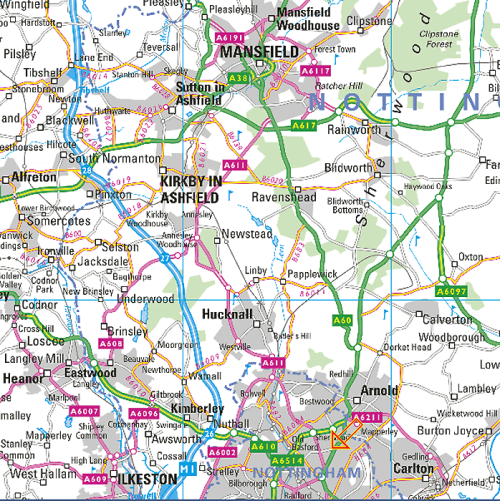
Thus, on November 19th 1870, having travelled to Mansfield, the Nottingham High School First XI played a Mansfield Grammar School XV at football, beating them 3-0. Around 110 years later I took the First XI to Mansfield, not in a steam train, but by minibus, and we played them on a darkish Wednesday afternoon. We lost, although by then they had changed their name to Brunt’s School, now changed again to Brunt’s Academy. The Orange Arrow shows the High School, Mansfield is in the middle of the top edge of the map, and then see if you can find Eastwood, the birthplace of DH Lawrence, ex-pupil at the High School (1898-1901).
History always likes to puzzle us with the fogs of confusion that it loves to create, though. Just as we were digesting the fact that the High School played its first ever football match on November 19th 1870, when the First XI beat a Mansfield Grammar School XV by 3-0, I found that there is a some evidence that organised football was played by the High School even before this.

In just one edition of “The Forester”, there is an allusion to a football game between the High School and a Tudor House School XV on February 27th 1878. Charles Edwin Attenborough, the son of a hosier from Bilbie Street, was unlucky enough to break his leg and dislocate his ankle. It was reported at the time that, with the exception of one broken collar bone in, probably, the 1872-1873 season, this was the the first injury of any consequence “since the new school opened in 1868”.

This intriguing phrase might conceivably be taken to imply that football matches had taken place in that short interim period of just over two years between April 1868 and December 1870, when “The Forester’s” first reports appeared. This is so long after the event, though, that we may never know the exact truth.

Seven years after their first ever game against any other other school, the First XI played Mr Porter and Mr Jones’ “Tudor House” on October 31st 1877, probably on a pitch on the nearby Forest Recreation Ground.  The First XI won 15-0 and “The Forester” recorded that Tudor House did not once get the ball into the High School half, at any point in the game…..

“Goals were obtained as fast as the ball was kicked off.”

Fifteen had been scored “when time was called”.

Four months later, on February 27th 1878, again probably on a pitch on the nearby Forest Recreation Ground, the First XI beat a Tudor House XV by 3-2 (as already mentioned above). During this game, thirteen year old Charles Edwin Attenborough was unlucky enough to break his leg and dislocate his ankle. Despite our modern perceptions of the roughness of Victorian football, “The Forester” reported that, with the exception of one broken collar bone four seasons previously, this was the first injury of any consequence “since the new school opened” in April 1868.

And here it is, a photograph thought to have been taken on April 16th 1868, the school’s first day. The first lesson to be learnt was that more toilets would be needed if queuing was to be avoided:

A week or so after the glorious triumph over 15 boys in the Tudor House XV, on March 6th 1878, on the Forest, the First XI again played a Tudor House XV. and beat this slightly more numerous team by 2-0. These two games were the last two fixtures of the season 1877-1878.

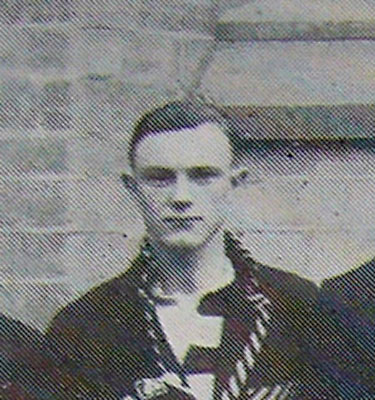
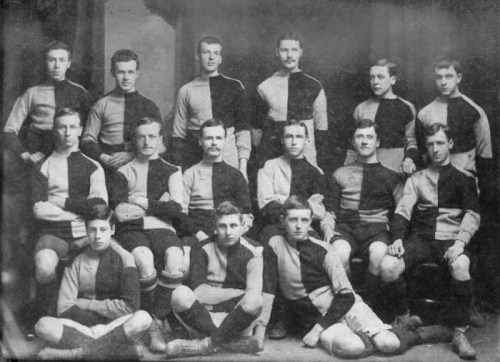
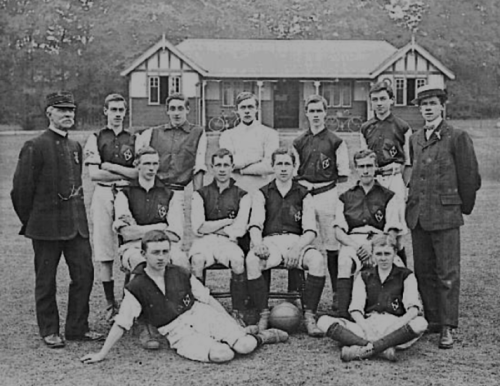
During the following season, Tudor House scored their first ever victory over the High School. On a day misprinted in “The Forester” as October 60th 1878, on the Forest, the reporter said that “This was a very even game, but the fact that Bramwell and four other first team members were absent probably tipped the balance in favour of Tudor House.” They won by 1-0. We don’t know what colours the High School played in. In both these photographs, the colours are black and white. They come from 1897 and 1910, approximately:

This slideshow requires JavaScript.

A year later, on March 12th 1879, at an unknown venue, but probably the Forest , the First XI played out a skilfully planned 0-0 draw with Tudor House. This fixture took place in an extremely high wind, which encouraged the Tudor House players merely to kick the ball out of play as far as possible at every opportunity. “The Forester” lamented….

“….Unfortunately there is no rule which provides for occurrences of this kind, but we should have thought there would have been a better spirit prevailing to prevent such unsatisfactory proceedings.”

When I was in charge of the First XI, around 2000, I employed this tactic and it was extremely effective. Even better is to kick the ball into the road, the busier the road the better. Boys are not allowed to pursue a ball in such circumstances and it has to be the teacher/referee who has to go and fetch it. Invariably, he always takes ages.

Seven months later, on October 15th 1879, and back on the Forest, the two teams met again, and this time the wind had dropped and the game finished 6-1 to the High School. Only five of the regular First Team were in what “The Forester” called the “motley crew” who won this game. Now, Mötley Crüe are an American heavy metal band formed in Los Angeles in 1981. Please don’t confuse them with the Victorian footballers. It’s easily done:

Being sensible, and playing Tudor House with a weakened team which lacked many of the regular First XI players didn’t last long, though. The very last fixture ever against Tudor House came on February 11th 1880. Again at an unknown venue, the High School triumphed. The score was recorded as

Nottingham High School “at least 12” Tudor House 0

“The Forester” wrote that

“the difficulty in this game was “not to get goals”, so weak were the opposition. Goal followed goal in quick succession, so that it was rather hard to keep a correct account. It was certainly not less than 12 goals, and may have been more.”

I once coached the Second Team in such a match. It finished 13-0 (referee). 14-0 (me) or 15-0 (several of the players). We lost, of course.

We once lost to another school team who had a nine-year old girl in goal. Their member of staff asked me if it was OK for her to play and I agreed, not knowing that she was Spider Woman in her spare time. We lost 3-2.

STOP PRESS

Elsewhere I have spoken about how, in the attic, I stumbled upon the box containing all of my slides from the 1970s and early 1980s.

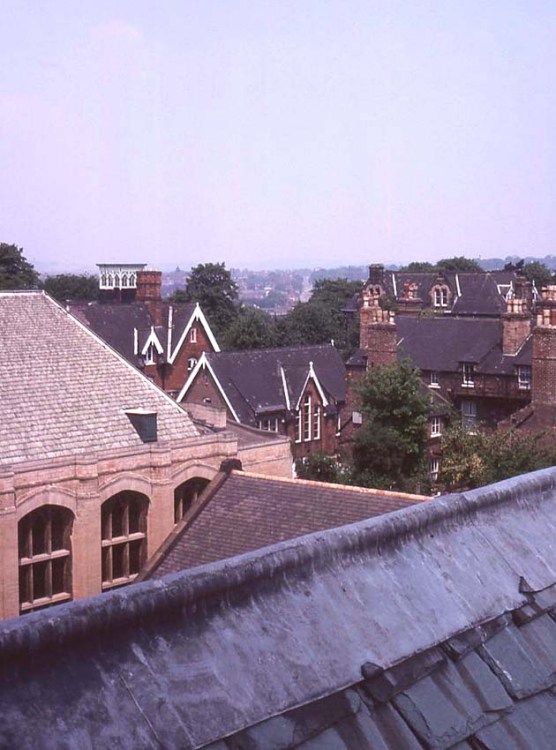
The photograph below I took around 1976. It was taken from the corridor which ran down towards the then E13, and you can see the roof of the Old Gymnasium and the Assembly Hall, sometimes called the Player Hall. Directly behind that are the two buildings of Brincliffe. To help you identify them, they both have gables picked out in bright white……..
15 Comments

Filed under Football, History, Humour, Nottingham, Politics, The High School

Football Programmes of the Soviet Union (5)

I don’t often begin with a dedication but perhaps, just this once……

“Here is wisdom. Let him that hath understanding count the number of the beast: for it is the number of a man; and his number is Six hundred threescore and six.”

And certainly, when I started out, I never thought I would one day be writing Blog Post Number Six hundred threescore and six. Anyway……


Last time we were looking at some of the old Soviet football/soccer programmed that I still have.

The first programme today has “Uralmash Sverdlovsk” / “Уралмаш Свердловск” as the away team, but this time with “Stroityel Ashkhabad” / “Строитель Ашхабад”, as their hosts. You may remember from Blog Post 4 that “Uralmash” was a little like an acronym, where “Ural” referred to the range of mountains and “Mash” was short for “Mashina” , the Russian word for “car”. The two together referred to a car factory in Sverdlovsk, the main city of the Urals. Sverdlovsk is now called Ekaterinberg, just to add to the confusion:

“Stroitel Ashkhabad” /“Строитель Ашхабад” means “Ashkhabad Construction Workers”, although this particular team have previously been “Locomotiv Ashkhabad” / “Локомотив (railway workers) Ашхабад”  and “Колхощи (collective farm workers) Ашхабад”. How original, and different, those names were, compared to the modern “FK Köpetdag Aşgabat”. “Köpetdag” by the way, means “Many mountains”, presumably in the local language.

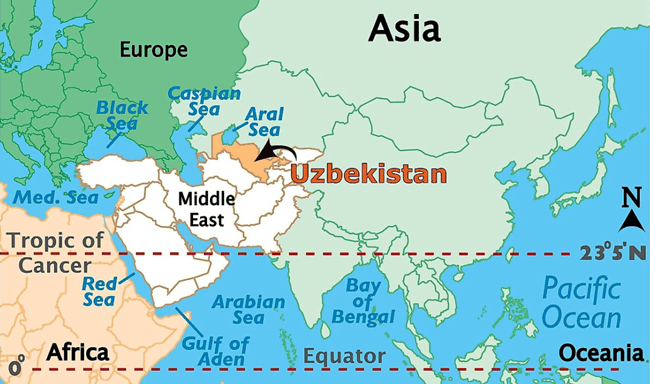
Ashkhabad, by the way, is the capital of Turkmenistan, which is to the north east of Iran, and certainly part of Asia. Just to puzzle everybody further, on this map, the cartographers have decided to label Iran the “Middle East”. I have no idea why.

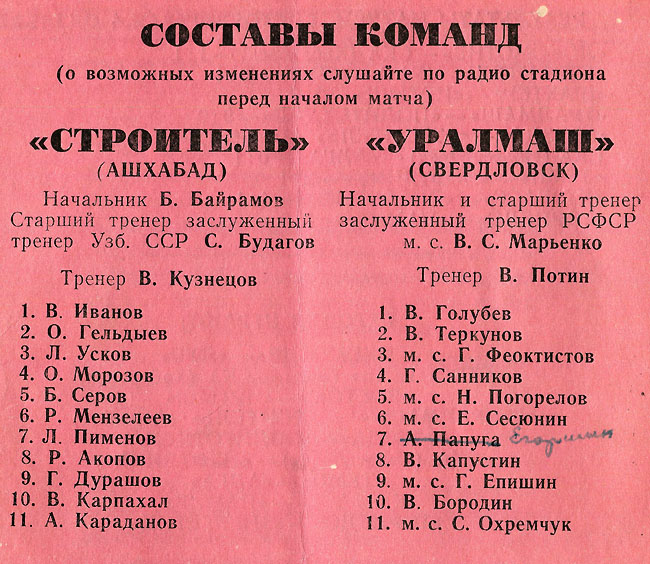
Here are the team line ups:

The top two words mean “make-ups” and “of the teams”. In brackets, the next few words mean “about- possible- changes- listen…….“по радио” ……..to-the radio -before-the beginning…….. “матча”  of the match.

Russian is a very ancient language, of the same age and vintage as Latin or Ancient Greek. There are a surprisingly large number of Russian words which do not come from Latin, but which are close relations of the Latin words. ““по” / “po” is the same word as the Latin “per”, as in “per ardua ad astra” the motto of the RAF, “Through difficulties to the stars”. “Before the match” was “перед  матча” and the word “p-e-r-e-d” is our “pre” as in “prehistoric” or “premature”.

Notice how on this programme, there is a late change to the team so that Papuga doesn’t play at No 7 but instead he is replaced by what might be “Yegorshin” although it’s not particularly clear. But just think of the circumstances of that team change, made with Oleg Soloviev’s fountain pen. He is sitting in a seat at the Central Stadium in Sverdlovsk, the city to which, in 1941,  Stalin organised the  large scale removal of the Soviet Union’s industry, so that it was beyond the range of German bombers. For Oleg, it is Monday, October 9th 1967, just a few moments after 6 o’clock, when the team changes are announced. He is more than 3,000 miles away from where I, aged just 14, am still working away in school.

In a few hours’ time,  ground control at NASA will crash the American space probe, “Lunar Orbiter 3”, deliberately onto the Moon’s surface after eight months in orbit. In La Higuera, a village in Bolivia, in his cell, the prisoner has just a few hours left to live before Army Sergeant Mario Terán takes his semi-automatic rifle and shoots him nine times. His prisoner is a young doctor and revolutionary Marxist named Ché Guevara. And on Saturday, October 21 1967, the first ever national demonstration against the Vietnam war will take place in Washington.

Our penultimate  programme is a match which took place in what was then called Kuybyshev (Куйбышев) and is now called Samara. It is a city of 1.14 million residents, situated on the River Volga:

This football team is still in the Russian Premier Division and is still called “Krylia Sovetov” just as as it was in  those “Golden Days of Communism”. In Russian “Krylia Sovetov” is “Крылья Советов” and it means “Wings of the Soviets”, surely one of the most dramatic names in world football.

The away team, on the left, is from Zaporizhzhia (Запорожье) which is nowadays a city in south-eastern Ukraine., once the site of a big car factory and nowadays the largest nuclear power station in Europe. Here is their badge of today…….

The name of the team is “Металлург” or “Metallurg”, a reference to Zaporizhzhia’s factories during the Soviet era in which they produced steel, aluminium and many other products of heavy industry.
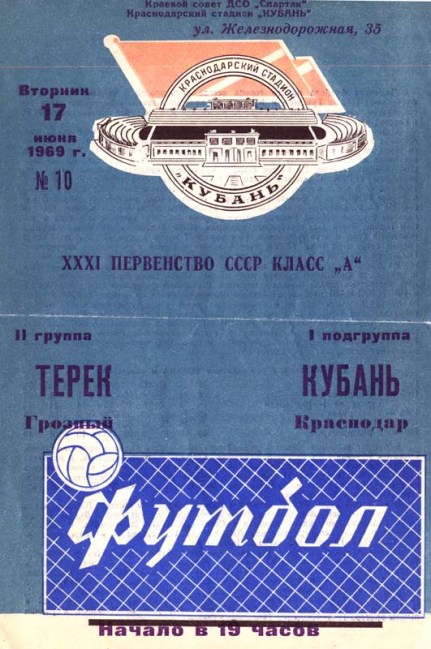
The last programme of the lot is another home game for “Кубань Краснодар” aka “Kuban Krasnodar”. If you remember, “Krasnodar”, the name of the city, means “gift of the Reds” and the Kuban was the local river. The opponents are “Терек Грозный” aka “Terek Grozniy”. Nowadays the team is called “FC Akhmat Grozny”. Back in 1969, the game was a seven o’clock evening game on Tuesday, June 17th 1969. Top left is the complete date, namely “Вторник 17 июня 1969 г ”  The “г” is short for “года” (“goda”) which means “of the year”.

Grozny is not really a place for a romantic weekend break. It is the capital of Chechnya, home of the Chechens, who are primarily of the Muslim faith. You can read about the wars here, the first of three wikipedia articles.

The new team, “FC Akhmat Grozny”, is now named after Akhmat Kadyrov who was the Chief Mufti of the Chechen Republic of Ichkeria in the 1990s. He changed sides in 2000 and became the President of the Chechen Republic. On May 9th 2004, he was assassinated by Chechen Islamists in Grozny.

Grozny is a place name, but in Russian it also means something. “Грозный” is an adjective meaning “terrible, formidable, redoubtable, menacing, threatening, stern or ferocious”. It can be applied to a look, a glance, a storm, a danger, or a tsar. “Иван” is “Ivan”  and I’m sure that you can work out which of the many Ivans was the tsar called “Иван Грозный”.

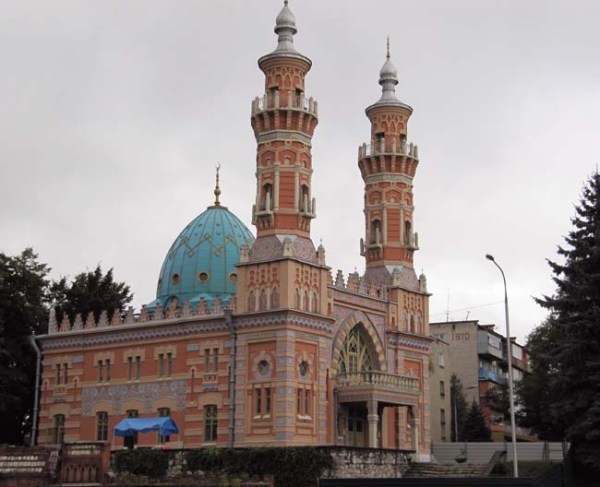
But what is a “Terek”? Well, it’s a river in the northern Caucasus. Here it flows through Vladikavkaz,  the old Tsarist fortress and garrison town, and nowadays, the home of the beautiful Mukhtarov Mosque:

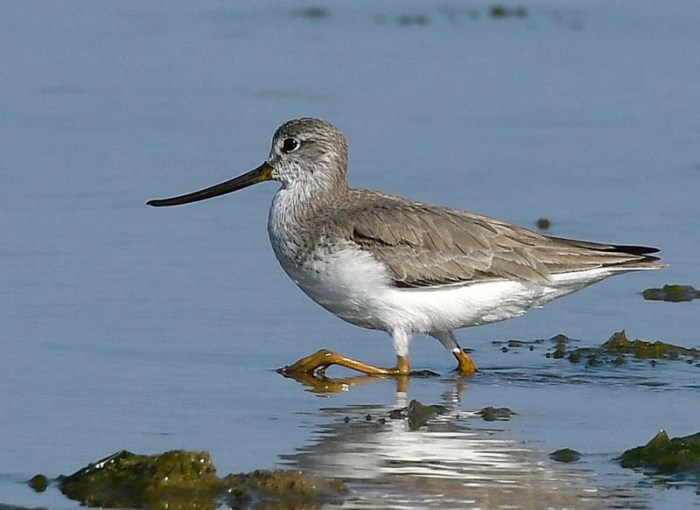
To me though, the word “Terek” will always be associated with a rare bird in England, the Terek Sandpiper, a wader which always runs to the water’s edge to wash its food before it eats it. It is also one of the very few birds whose beak points upwards. Not many people know that.

16 Comments

Filed under Football, History, Literature, Personal, Politics, Russia

Football Programmes of the Soviet Union (4)

The old Soviet Union, of course, had a huge number of less well known teams in the lower divisions, and they can often be quite interesting because they have such marvellous names, the Russian equivalents, perhaps, of Scottish football teams such as “Bonnyrigg Rose”, “Civil Service Strollers” and “The Spartans”.

This first programme is “Кубань Краснодар” aka “Kuban Krasnodar”, a team which used to play in Krasnodar, the 16th largest city in Russia. It was built by the Cossacks on the southern plains as a fortress to guard the River Kuban. “Krasnodar” means “gift of the Reds” aka “the dirty Commies”. Before that, the city used to be “Yekaterinodar”, which means the gift of Catherine the Great. In modern times, “Кубань Краснодар” became FC Kuban but that didn’t prevent bankruptcy on May 17th 2018 and, as far as I know, a short trip into oblivion. Like most football clubs, though, oblivion didn’t last that long, and on August 5th 2018, the club was back in business, now called FC Kuban (2018). Here is their badge.

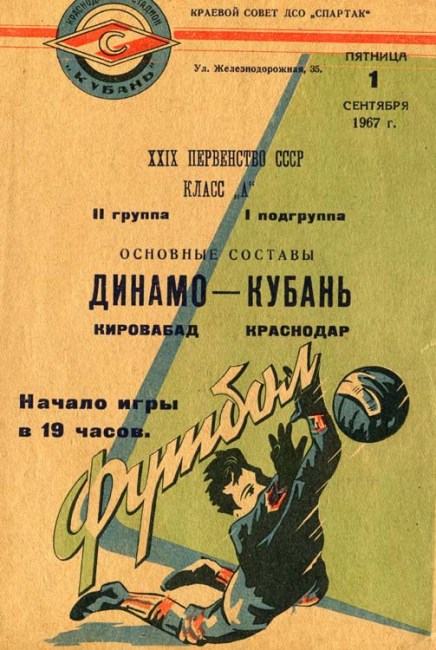
Below is one of the old programmes of “Кубань Краснодар” aka “Kuban Krasnodar” . It dates from September 1st 1967 (top right). Just above the number 1 is the word Russian “пятница”  or  “P-ya-t-n-ee-ts-a” which means “Friday”. The origin of the word is that “пят” or “P-ya-t” means “five”. It’s the fifth day of the week, of course.

In Russian, the home team is always on the right, so the visitors this Friday are “Динамо Кировобад” aka “Dynamo Kirovabad”. Kirovabad was the city’s name from 1935-1989 and it is now called “Ganja”. It is the third largest city in Azerbaijan, but the most mellow by quite a long way. The team is now called “Kapaz PFK” incidentally…….

Inside the programme, which is a single sheet folded in two,  are the two teams, complete with an illegible autograph:

Look at the three vertical lines down the middle. On both sides of that vertical division, the bottom two horizontal  lines, on both left and right, contain the words “Тренер” and “Капитан”, trainer and captain. The left hand trainer has the very unusual first name “Hamlet”, which in Russian is “Гамлет”.

This is literally “Gamlet” but Russian has no letter “H” and replaces it in foreign words with a hard “G” sound. In the USA this gives you “Gonolulu” /”Гонолулу”  and “Gollyvood”/”Голливуд“. In England, this gives you “Galifax”/”Галифакс” , “Guddersfield” / “Гуддерсфилд” and “Garry Potter” / “Гарри Поттер“.

Chaos ensued with the fact that England had two ports very close to each other. One is called “Hull” and the other is called “Goole”.   Both of these places came out as “Gooll” / “Гулл” which caused so much confusion that Russian ships completely stopped going to Goole and only ever went to Hull.

The next programme is from “Ташкентская Обл(асть)” or the Tashkent district. Tashkent, of course, is nowadays the capital of Uzbekistan, a country usually regarded as being in Asia.

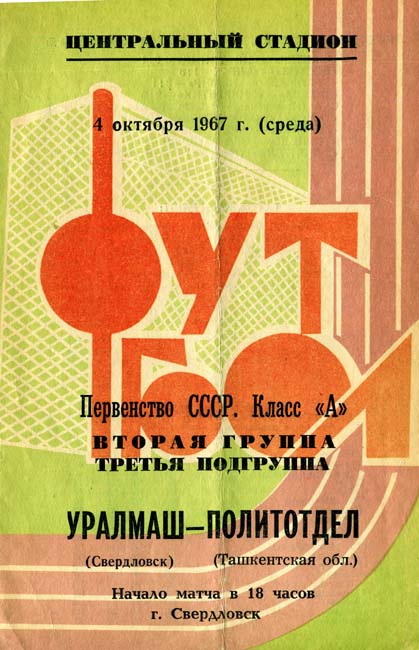
The programme is from a home game for a team called  “Политотдел” which is “Politotdel “ aka “Political Department”:

Tashkent is home to this stunningly beautiful mosque:

On the left, Politotdel’s visitors are called “Уралмаш Свердловск” or “Uralmash Sverdlovsk”. Sverdlovsk has now been renamed  “Ekaterinburg”, and is to the east of the Ural mountains. It is the third largest city in Russia with around two million inhabitants.

Nowadays, “Политотдел” has become the beautifully named “FC Dustlick” of Uzbekistan. “Уралмаш Свердловск” have been at various times  “Avangard”, “Zenit”, and “Mashino-stroitel”. “Avangard” must be the  well known French expression, “Avant garde”. ”Mashino-stroitel” in Russian, means “car constructors” and “Uralmash” is an acronym type creation meaning “Ural Car”. Nowadays, no cars are manufactured in this area, hence the present name of the team, which is just “Ural” or  “Урал“:

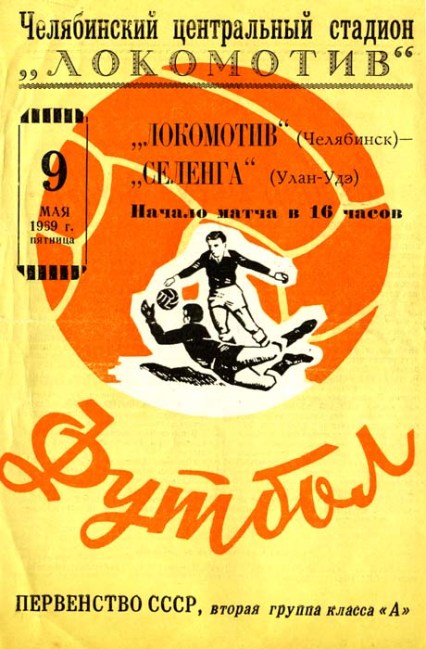
The final programme, below, is “Локомотив Челябинск” or “Lokomotiv Chelyabinsk”, who are  the home team. They face “Селенга Улан- Удэ” or “Selenga Ulan Udé”. The match took place on Friday, “пятница”, still pronounced “p-ya-t-n-i-tz-a”,  and based, as we know, on “пять”, “p-ya-t”, the Russian for five. “Пять”, “p-ya-t”, is related to the Greek “pent” as in “the Pentagon”. The match kicked off at 1600, which was a very early end to the working week. East of the Urals, and sheltered away from central government in Moscow, “Уралмаш Свердловск” games always used to bring about a “POETS” .

Chelyabinsk aka “Челябинск” is the seventh largest city in Russia with 1.1 million inhabitants. It is to the east of the Urals (just).

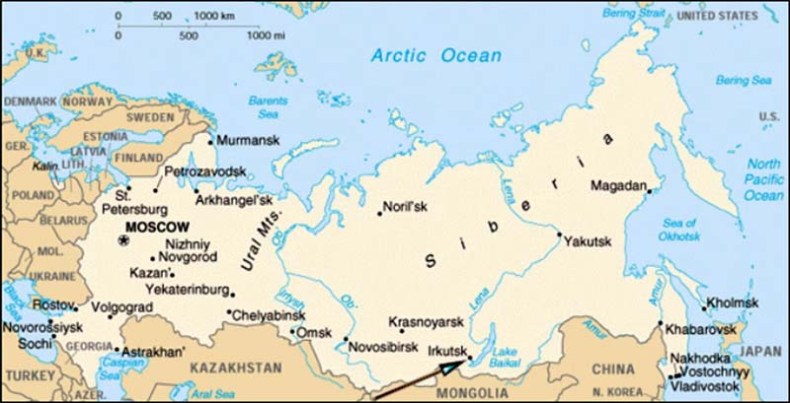
The football club “Selenga Ulan Udé” is now called “FC Buryatia Ulan-Udé”. Ulan Udé is to the south east of Irkutsk  and Lake Baikal and stands at the confluence of the River Selenga (hence the team name) and the Uda. The city is the capital of the Buryatia region, which is directly north of Mongolia. It has a population of slightly less than a million, of which 450,000 live in Ulan Udé. Buryatia therefore, must be really empty with an effective  population destiny of roughly four per square mile. Alaska has 1.3 and Wyoming six. Here’s a map. Look for the black arrow:

Ulan Udé is the centre of Tibetan Buddhism in Russia but most spectacular of all is its 25 foot tall Head of Lenin statue. I wonder how the people at the Nottingham city planning department would feel about one of those on our nearest Ring Road roundabout ?


.


8 Comments

Filed under Football, History, Personal, Politics, Russia

Football Programmes of the Soviet Union (3)

Last time we were looking at Soviet football/soccer programmes for the top division, Division No 1. One or two more to look at. This  is “Спартак Москва” or Spartak Moscow, against “Зенит Ленинград” or “Zenit Leningrad”. Still a top team nowadays, “Spartak” was originally an international fitness and sports society and in Soviet times, was supported by the “Komsomol”. The latter was the “All-Union Leninist Young Communist League” or “Всесоюзный ленинский коммунистический союз молодёжи” abbreviated to” ВЛКСМ”. Despite all that, Spartak Moscow is today still considered to be “the people’s team:

This next programme has another famous team over the years in “Динамо Москва” or “Dynamo Moscow” who are playing “Спартак Орджоникидзе” or “Spartak Ordzhonikidze” on Saturday, April 25th 1970. The latter became “FC Spartak Vladikavkaz” in 1990 and then “Spartak-Alania Vladikavkaz” and then “Alania Vladikavkaz”. The club are still in Russia nowadays and they play in the North Ossetia–Alania region of the Caucasus:

They are based in Vladikavkaz, which in the days of the tsars was the frontier town of the Caucasus, a region which was very much the North West Frontier of the Russian Empire. All the dashing young officers would seek postings to Vladikavkaz, the one outpost of western ideas, surrounded by thousands of wild tribesmen:

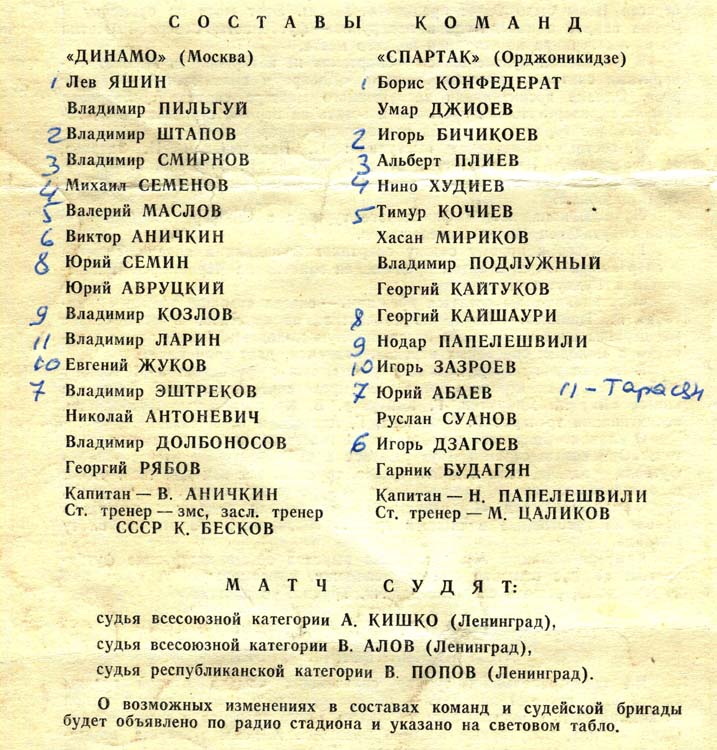
Here are the team line ups and the team changes, written in by my friend, Oleg Soloviev, all those years ago, in a place as remote as you are likely to find. I presume he was there watching one of the teams before Zenit Leningrad had to play them, perhaps checking what their tactics were:

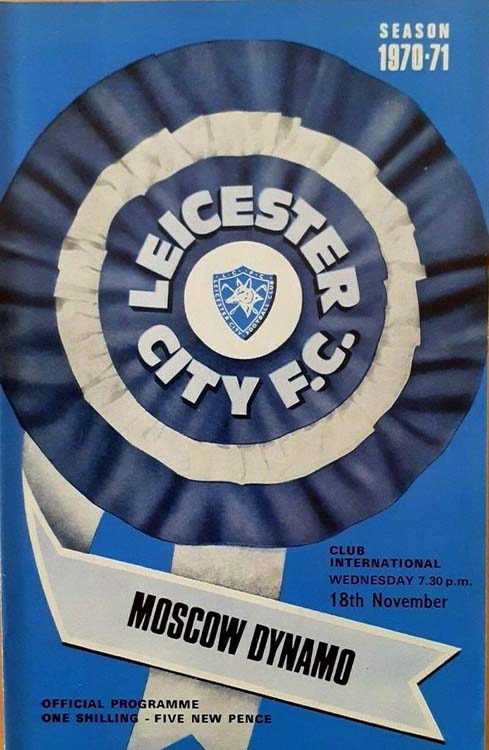
The Dynamo Moscow goalkeeper (No 1) was very famous. The Russian says “Лев Яшин” and the English is “Lev Yashin”. He always played dressed completely in black and was known as the “Black Octopus”. He was a legend in world football history and one evening, my Dad drove me to Leicester City to see them play Moscow Dynamo. Yashin didn’t play but they brought him out onto the pitch to wave at the crowd and he got a standing ovation. The Dynamo goalkeeper that night was the player below Yashin in the list. He was Vladimir Pilguy (Владимир Пильгуй).

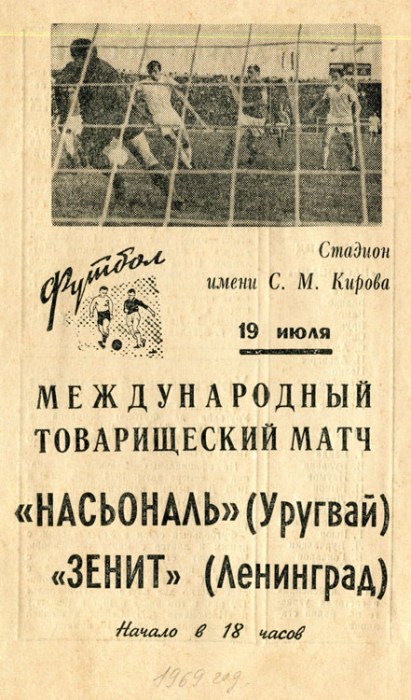
My last top class Soviet programme is one that I actually bought myself on the day of the match in Leningrad. It was for Zenit Leningrad aka “Зенит Ленинград” against Nacional (Uruguay) aka “Насьональ (Уругвай)”, which was an international friendly match.  It was a beautiful sunny summer’s early evening, July 19th 1969, and Nacional won easily by 4-0. The Uruguayan national anthem was interminable, and when it finally finished, our school party thought both anthems had been played.


11 Comments

Filed under Football, History, Personal, Russia

Football Programmes of the Soviet Union (2)

The first programme today is another top football/soccer game, this time between “ЦСКА” and “Динамо Минск”. Don’t forget that the home team is always printed second on the front of the programme. It’s a politeness, a little like allowing a guest to go through the door first.

Many football fans will recognise the abbreviation above. bottom right,  as “CSKA”, which stands for the “Central Sports Club of the Army”. It’s rather like English clubs were often founded by a particular church or factory.
The opposition in this game was “Dynamo Minsk” a team which used to be in the USSR although the city is nowadays in Byelorussia and its club no longer plays top class football. A club founded, no doubt, by electricians, who are often a bunch of really bright sparks.

The Byelorussian Premier League is today so small that it contains even “СФК Слуцк” or “SFC Slutsk” whose ground can accommodate a mere 1,896 spectators. That’s the least of Minskian worries, though. Minsk has been invaded quite a few times. Indeed, one of the few bits of good news in the history of Minsk was that it somehow escaped the Golden Horde of Genghis Khan’s Mongols in 1237–1239.

Otherwise it took a battering from the troops of Tsar Alexei of Russia (1655), the army of Charles XII of Sweden (1708), the army of Peter the Great (1708), Napoleon (1812), the Red Army (1918), the Poles (1919), more Poles (1920), even more Poles (1920-1921) and the Germans (1941-1944). The latter barbarians took the population of Minsk from 300,000 down to 50,000.

Just up by the “ф” of “футбол” is a tiny diagram with a rather unclear picture, captioned “централный стадион”. I’ll leave you to work that one out, now you’re all mostly fluent with Russian letters. As a clue, the diagram looks pretty much like a “Central Stadium” to me.

The one thing that has always struck me about the few Russian football programmes I still have left  in my collection, fifty years after my friend, Oleg Soloviev, sent them to me, is that they speak of places so far away, so remote and so difficult to get to as to be beyond the reasonable expectations of most people. Many of them are from cities literally thousands of miles from where he lived in Leningrad (St Petersburg). This programme is from Tbilisi in Georgia, a mere 1400 miles from where Oleg lived:

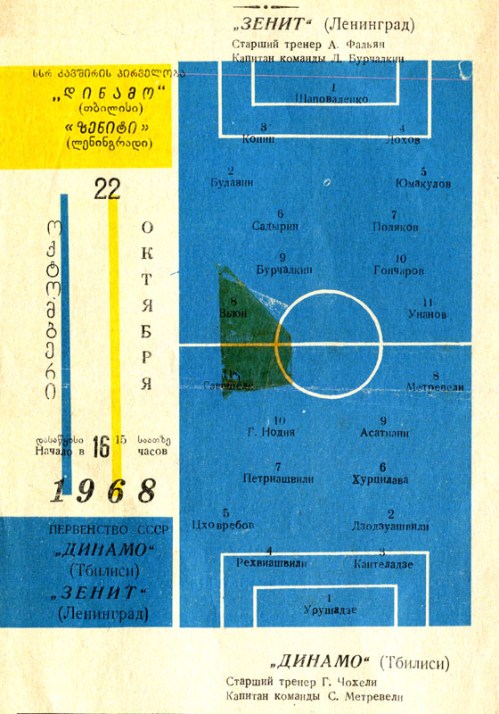
The local team was Dynamo Tbilisi. The name is in the bottom left of the programme and is written “Динамо Тбилиси” with “Зенит Ленинград” in the bottom left corner, and also above the blue diagram of the two teams. In places like Georgia, everybody spoke Russian but the local language, Georgian, also appears. The top left, yellow rectangle has some good examples. In the bottom right is the diagram of the Tbilisi team with three interesting players. Number 6 is Khurtsilava, “Хурцилава”, and Number 8 is Metreveli, “Метревели”. Both of these two played in the Soviet Union team which came to England in 1966 for the World Cup and finished fourth in the world. At right back, No 2 is a famous Georgian name, “Дзодзуашвили”  or Dzodzuashvili, a man of complete and utter genius who ruled the USSR for 29 years, died, but still played First Division football a quarter of a century after his death. Still can’t place him? Well, here’s a clue.

This is another, more artistic, programme with the Georgian word for football or “футбол”.

Compared to the rest of the Russian programmes you have seen so far, this one is a riotous multicoloured festival of brightly coloured inks. Most of the rest of them have only four or five colours maximum. Still, at least you know the Georgian for “football”. The big question is, though, where in the blog post is the Georgian for “October” ?


11 Comments

Filed under Football, History, Personal, Russia

Football Programmes of the Soviet Union (1)

I wrote this blog post, and the others in this series, beginning on November 30th 2021. It does not indicate my favouring Russia over the Ukraine in the war currently being waged on the latter’s territory.

In any case, I have written about sport in the old Soviet Union in the late 1960s, not the situation today. Indeed, I would argue that Russia today is an infinitely worse country to deal with than the old Soviet Union used to be. The only situation I could compare present day Russia to would be the Germany of Hitler and Goebbels, where the population were hypnotised into believing what they were told to believe. Anyway, here we go…….

Three, perhaps four lifetimes ago, I was at school, at a country grammar school in west Leicestershire. From 13-17, I studied Russian there, a subject that I always loved. I was also a huge football/soccer fan, and accordingly, I had a collection of hundreds of football programmes. These are the little booklets that are on sale before the match with all the details of the teams, the fixtures to come, the top goalscorers in the league and so on.

Those two hobbies came together when I wrote a letter to a Russian First Division team who were then called Zenit Leningrad, asking them if anybody there would like to become my penfriend, and exchange football programmes with me. Here’s the team badge:


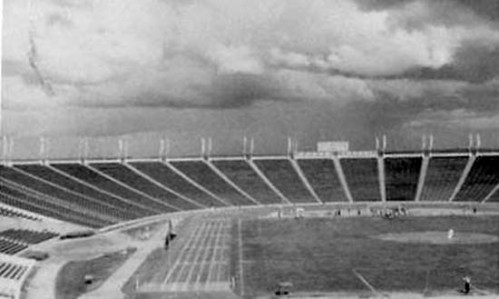
A little while later, I received a letter from a Russian gentleman who, just like me, was a lover of football and a programme collector. His name was Oleg Soloviev and his surname meant “nightingale” in Russian. The team used to play at what was then called the Kirov Stadium, a vast bowl with 100,000 seats.

I sent Oleg English and Scottish programmes and he sent me Soviet ones. I say “Soviet” because in those days many of the teams had Soviet names, as we shall see. Oleg was the man in charge of Zenit’s Youth Team and he travelled widely around the USSR in connection with his job. I still have some of the programmes he sent me, although only a small fraction. When I left home to go to my first job, my mother threw out my entire programme collection because I didn’t live there anymore. This type of action, which, incidentally, discarded well over a thousand pounds worth of footballing treasures, was by no means rare at this time and there were other young people I knew who suffered from it. It was all part of the “Bring ‘em up tough but with deeply rooted complexes” method of child care, so beautifully captured by Philip Larkin in this oh-so-true poem

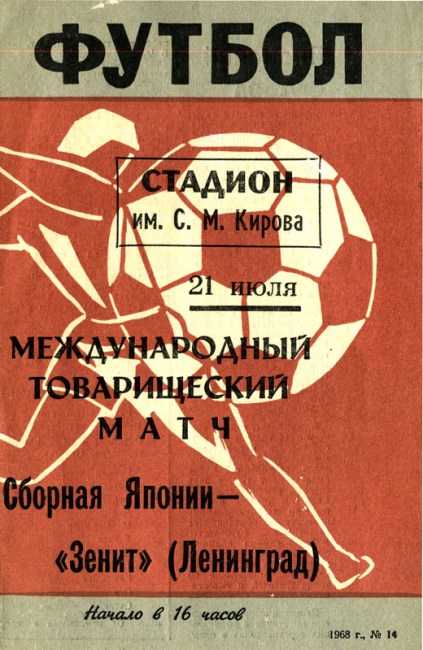
One small difference from English programmes was that in the Soviet Union, the home team was always printed second. This is shown in this particular programme which is of a design used by Zenit Leningrad for a number of years. At the top is the word “футбол” or “football” and the next word is “стадион” which means “stadium”. Perhaps you can spot the name of the man that the stadium was named after, namely “Kirov” or “Кирова”.

Other recognisable things are the kick-off time at the bottom, namely 1600 hours and the day “21 июля” or “21 July” in the middle of the ball.

The teams are going to play a friendly match, the lower team is “Зенит Ленинград” aka “Zenit Leningrad” and the two word opponents are “Сборная” which is “international (team” and “Японин” or “Japan”.

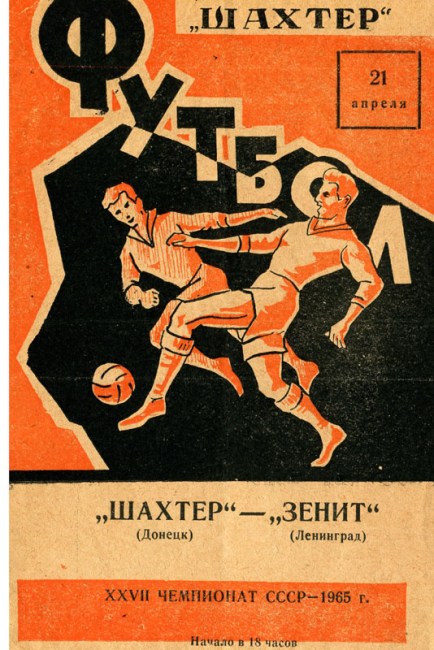
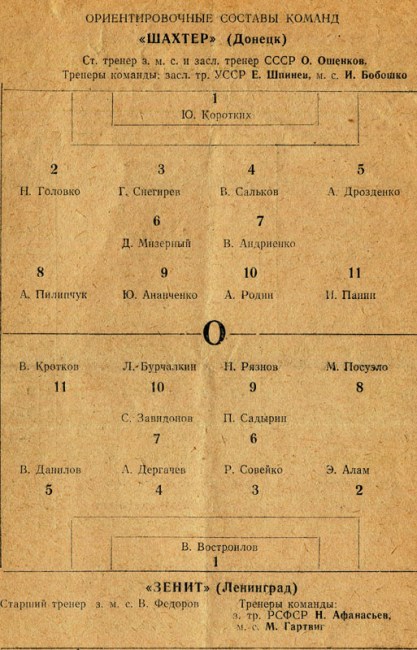
The next programme concerns two teams which still exist nowadays. “Шахтëр Донетск” or “Shakhtyor Donetsk” versus “Зенит Ленинград” aka “Zenit Leningrad” . The game actually took place in the 27th year of the USSR Championship, 1965 (bottom), on April 21st (top right), at 1800 hours (bottom) .

Here are the two teams, both set out in a daring 4-2-4 formation. “Зенит“ obviously means “Zenith” and “Шахтëр” means a “coalminer”. Донетск /Donetsk is now in the Ukraine, in the Donbass region, famous for its coal and iron ore.

That same team of Shakhtyor Donetsk/”Donbass Coalminers” is the away team in the next encounter, against “СКА Ростов” which is “SKA Rostov” “SKA” stands for “Sports Klub of the Army”. Rostov is a very large city and the stadium hosted five games in the 2018 World Cup. This link will take you to some pictures of Rostov’s beautiful buildings.

The game kicked off at 1700 hours (bottom) on July 1st 1971 (middle left). The large yellow letters say “кубок СССР по футболу” which means “Cup of the USSR in football”. It is the 30th tournament (top left, with “30-й турнир”).  Underneath the big yellow letters it is revealed that the game is the “матч ¼ финал” or “quarter final match”.  Rostov, though, have never been a very successful cup team. Just under the right hand yellow pentagon it says “35-й кубковый матч СКА”. So, if this is Rostov’s 35th cup match, and the cup competition is now thirty years old, then they must have only ever won five cup ties.


9 Comments

Filed under Football, History, Literature, Personal, Russia

The Carvings in the Tower (3)

Last time, we met Richard Milnes who left the High School on the last day of the Summer Term, July 30th 1940. Further south, the Battle of Britain was about to reach its peak.

Neither he, nor his friends, when they carved their names and their message on a stone window sill  in the High School Tower would have known how the war would turn out.

The Germans were certainly well ahead so far. And to add to England’s troubles, the American President, Franklin Delano Roosevelt chose this day to give his firm promise that he would never ever send “our boys” to war.

I don’t know if it was a desire to leave something defiant that could not easily be wiped away, but Richard and his friends climbed up into the School Tower, the one that dominates the skyline of the city, and carved their names and their message on a stone window sill. It is still there today:

“The following were members

of the anti-parachutist squad

May 20-21, 1940 (being first to do so)

RA Palmer, JS Gibson, DJ Furley,

RM Gunther, RB Holroyd,

RV Milnes, R Mellor, JMT Saunders”.

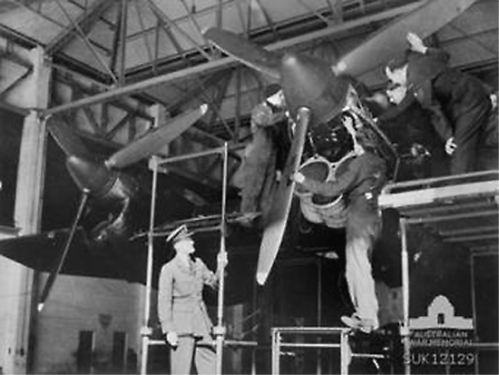
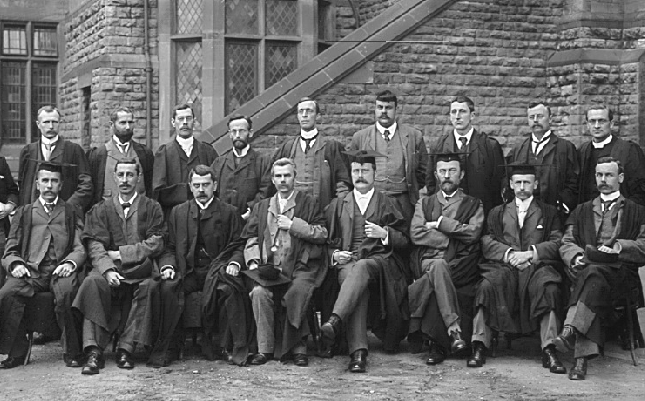
JS Gibson worked in the Preparatory School from September 1938. He left in November 1941 and served, it is believed, in RAF ground crew, although these particular men are members of the RAAF:

By 1943, nine of the 32 members of staff had gone off to fight for their country. They were CH Beeby, AR Davis, JS Gibson, F Greener, WD Gregg, JS Hunter, KC Lewis, AR Pears and AW Thomas. All of them survived as far as I know. Mr Gibson left the RAF in 1945 but did not return to the High School.

Another member of the anti-parachutist squad, Robert Bernard Holroyd, lived at 4 Bonington Road in Mapperley:

Robert came to the High School on September 20th 1934 as Boy No 5844 and he left on February 11th 1941. He had passed his School Certificate in 1939.

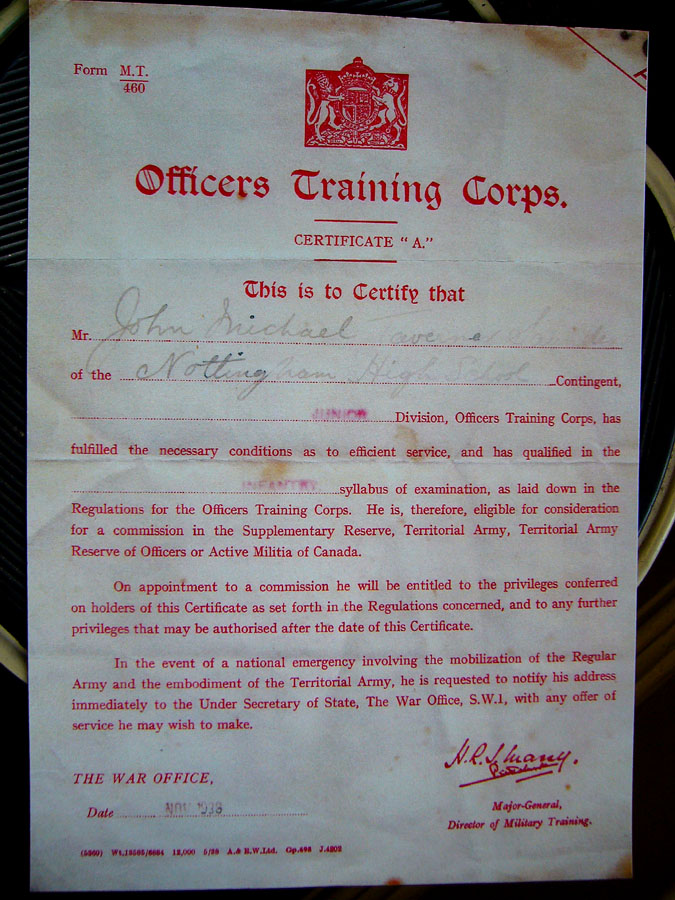
In the OTC and the JTC he reached the rank of sergeant and passed his Certificate ‘A’. The latter attested the holder’s abilities in battle drill, command, including drill commands, drill, map reading, range work requiring a minimum score with .22 rifle and weapon training. The holder was considered “eligible for consideration for a commission” in the Territorial Army. In the first few months of the conflict, many holders of Certificate ‘A’ were also considered eminently capable of teaching conscripts how to march, salute, shoulder arms and so on:

Robert also attended the Air Cadets and became a Lance Corporal, a Corporal and then a Sergeant by 1940. In sport, he won his First XV Colours and was Captain of Rugby in 1940-1941:

He was “An enthusiastic  footballer whose keenness is an example. An accomplished hooker. Defence sound.”

At the School Sports Day in 1940, he was the “Victor Ludorum”, the best all round athlete. He was a good, enthusiastic rower and was awarded his “Blazer for Rowing”.

During the war, he became a Signalman in the Royal Corps of Signals. Let’s hope that he never exhibited the same levels of criminality as Reginald Lawson, the clergyman’s son, punished in 1911 for “signalling words of an indecent nature by semaphore”.

On May 23rd 1942, that Certificate ‘A’ paid off when Robert Bernard Holroyd was made a Second Lieutenant. He stayed in the forces after the war, because on May 3rd 1952 what had been an emergency commission as a Lieutenant was firmed up to a real commission. I have found out no more than that, and Lieutenant Holroyd can now walk off into history. Let’s hope he was happy and lived to be a hundred!



12 Comments

Filed under Football, History, military, Nottingham, The High School

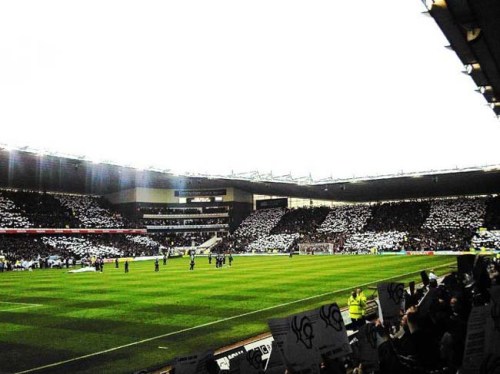
November 14th 1960, Derby County 1 Norwich City 4

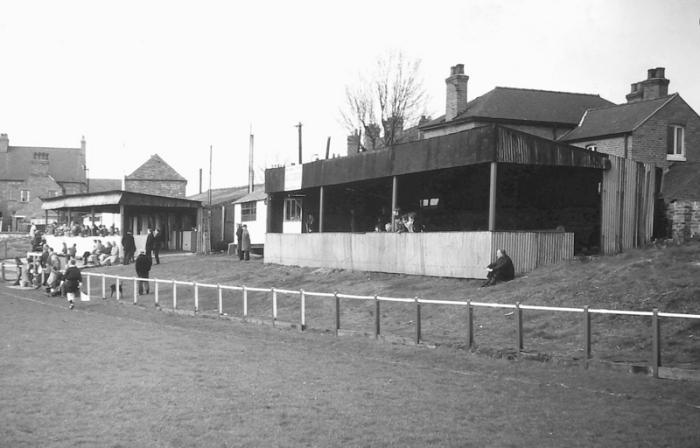
Apparently, when I was a baby and then a toddler, my Dad used to take me to see the local football team play. They were called Gresley Rovers, and their ground, the Moat Ground, was in Moat Street, Church Gresley, a little village in South Derbyshire. Here’s their stadium in 1972:

I don’t remember any of that, but I do remember my first match watching Derby County, a team who were in Division 2 at the time.

They used to play at the Baseball Ground, so-called because unsuccessful efforts had been made to introduce this popular American sport here around 1900. The stadium was surrounded by thousands of Victorian terraced houses. They’ve moved since then:

The game was on Monday, November 14th 1960. They were playing Norwich City, the Canaries, and so-called because they played in yellow shirts. This was the first step in a journey which I finally called a halt to in 1997, tired of my money being taken for very little worth watching.

I did a little bit of research about that Norwich game recently. The Derby team was:

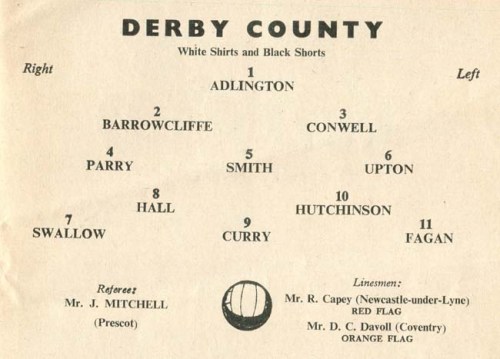
Adlington, Barrowcliffe, Conwell, Mike Smith, Upton, Curry, Fagan, Swallow, Hutchinson, Parry, Hall.

I have not been able to trace the Norwich team, yet, although the Norwich manager was Archibald Macauley.

The game was a League Cup, third round game, and here is the cover of the programme:

Later, I wrote the score on the cover. Derby County gave me some sublime highs, but they certainly made you pay, both with your cash, but worse than that, with your hopes:

Inside the programme were the teams, with the players expected to play:

And here is the Norwich City team, with the players expected to play:

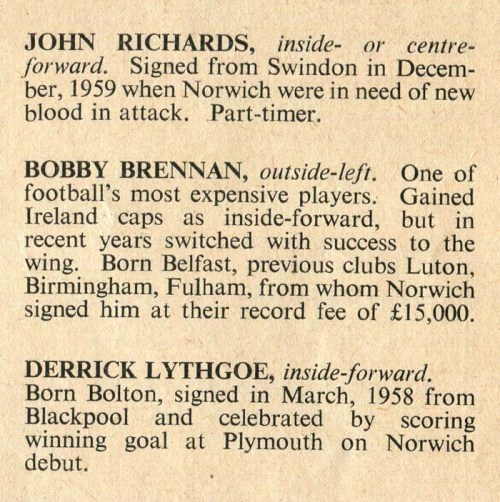
Nobody in these teams is famous nowadays, at least, not outside their own club. The programme contained pen-pictures of the visiting players. These three were selected as being typical of the fifteen or so in the programme. The thought to carry with you is that, for  John Richards,  Bobby Brennan or Derrick Lythgoe, this could have been the greatest moment of their lives:

There was a League Division 2 table, providing a check on how well the 22 clubs were doing:

The abbreviations Utd, A, O, T, T,C stand for “United”, “Argyle”, “Orient”, “Town”, “Town” and “City”.

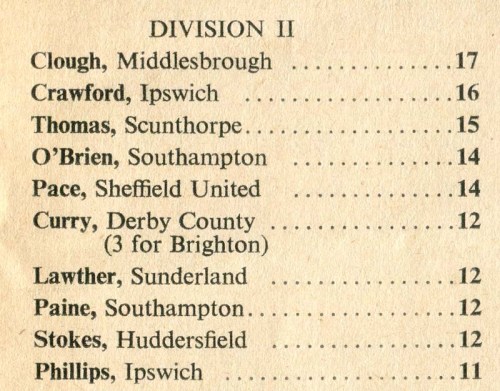
The intervening 61 years have not treated all of the teams above very well. There were also lists of the leading goal scorers in each division.

Brian Clough, of Middlesbrough, would one day become manager of both Derby County and their local rivals, Nottingham Forest. He led them to unbelievable glories. Today, a statue has been put up to him in Nottingham:

The programme also contained the results of past matches that season.

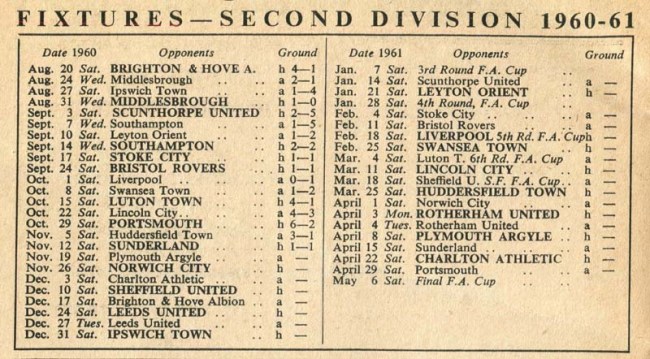
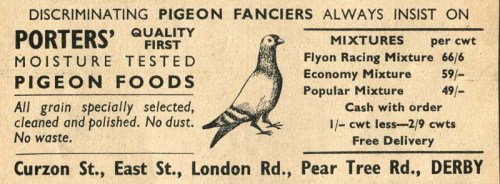
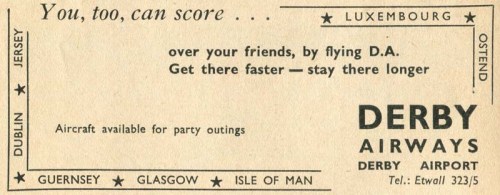
And finally, there were the advertisements, often for rather strange things, given that the spectators had all gathered to watch a football match:

Although you might want to fly to Luxembourg after watching your team lose 4-1 !!

Now here’s a trip back in aviation history !

This slideshow requires JavaScript.


19 Comments

Filed under Derby County, Football, History, Personal

“A long forgotten war, wasted young lives” (4)

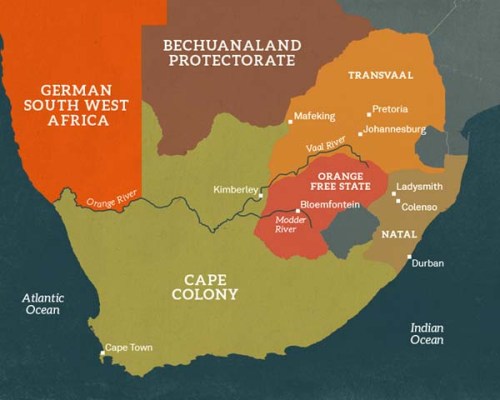
Edward Archer Thurman was born on October 20th 1885. He was the younger brother of Arthur John Thurman, the Notts County footballer who had died in the Boer War at Boshof on May 30th 1900. The Boer War was fought from 1899-1902 in South Africa, fuelled by the British greed for the diamonds and gold discovered in the Boer states.

Edward’s elder brother, Arthur, though, was not killed in action. Like 23,000 others, he died of “enteric fever”, now known as typhoid.

The Thurman brothers’ father, Edward, though, turned out to be a much more difficult man to pin down. In the 1885 Directory there are two Edward Thurmans. One lived at the “White Lion” public house at 28 Hollow Stone, in the Lacemarket area of the city and the other had a chandler’s shop on Mansfield Road. In another 1885 Directory, Edward Thurman was a victualler at the White Horse in Barkergate. Or, he was a maltster in Sneinton Dale with a home in Barkergate, again in the Lacemarket.

A chandler makes or sells candles and other items such as soap. A victualler sells food, alcohol, and other beverages.

Edward Thurman junior entered the High School as Boy No 1460, on January 21st 1896, at the age of ten, and left at Midsummer 1901, along with DH Lawrence.  According to the School Register, the family was living in 6 Notintone Place in Sneinton, and the father worked as a maltster, an occupation defined as a “person whose occupation is making malt”. In actual fact, he turns grain into malt which is used to brew beer or to make whisky. His business premises were in Sneinton Dale, as the second 1885 directory stated.

Notintone Place, incidentally, was the birthplace of the founder of the Salvation Army, General William Booth:

According to the 1894-1899 Directories though, Edward Harrington Thurman lived at 26, rather than 6, Notintone Place. And yet another Edward Thurman was the manager at Gladstone Liberal Club at 20 St. Ann’s Well Road.

Like his brother, Arthur, Edward junior was an excellent footballer and played at least 32 times for the High School, scoring a minimum of 12 goals from midfield. He won his First Team Colours and the School Magazine, “The Forester”, said he was a player who “Dribbles well and passes unselfishly”.

His opponents during the 1899-1900 season were:

Lincoln Lindum Reserves (a) 0-3, Mr AG Francis’ XI (h) 3-5, Loughborough Grammar School (a) 1-2, Newark Grammar School (a) 5-2 (one goal), Mansfield Grammar School (a) 4-0, Magdala FC Second Team (a) 4-2, Mr Mayne’s XI (a) 5-2, Leicester Grammar School (a) 14-0, and Ratcliffe College (a) 4-1.

During the 1900-1901 season his opponents were

Mr AG Francis’ XI (h) 3-4, Insurance FC (h) 11-0, St Andrew’s Church Institute (h) 0-7, Mr AC Liddell’s XI (h) 1-2, Leicester Wyggeston School (h) 23-0 (three goals), Derby School (a) 8-0 (one goal), Newark Grammar School (h) 17-0 (two goals), Old Boys (h) 4-3 (one goal), Lincoln Lindum (h) 5-2, St Cuthbert’s College, Worksop (a) 2-1, Sheffield Wesley College (h) 1-4, Mr AC Liddell’s XI (h) 3-3, Mansfield Grammar School (h) 7-1 (one goal), Derby School (h) 8-1 (one goal), Loughborough Grammar School (h) 6-0 (one goal), Magdala FC (h) 0-2, Leicester Wyggeston School (a) 3-2, Magdala FC (a) 2-4, Mansfield Grammar School (a) 13-1 (one goal),University College (a) 2-3, Newark Grammar School (h) 12-0 (one goal), Nottingham Insurance FC (h) 4-2 and St Cuthbert’s College, Worksop (h) 2-0.

Edward was usually a No 7, a right winger, but he sometimes played as a No 8, an inside right. Lincoln Lindum would eventually become the professional club, Lincoln City.

In 1900-1901 Edward appeared in what was arguably the School’s best ever football team. Their record was 16 victories and two draws in 25 games with 145 goals scored and only 45 conceded.

Interestingly, in 1899-1900, Edward was in the Lower Fourth, the same form as DH Lawrence. Of the 39 boys, Lawrence finished fifth and Edward finished 36th of the 36 who sat their exams.

By now, the family had moved to No 2 Belvoir Terrace, which was in the same general area of Sneinton. By 1904 the family had returned to Castle Street. Mr and Mrs Thurman are believed to have spent their last years in Selby Lane in Keyworth.

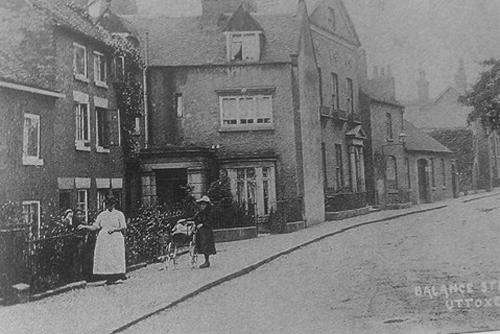
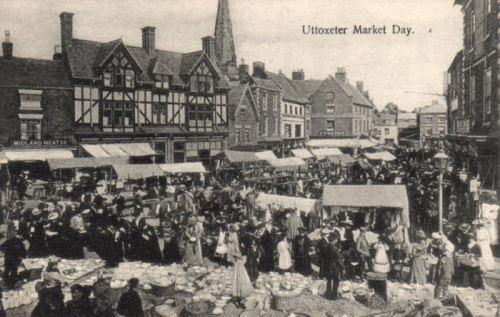
Edward left Nottingham and went to work in Uttoxeter (always pronounced by the real locals as “Utchetter”, rather like ”Ilkeston” and “Ilson”).

He worked initially in the corn business as a clerk, although he eventually became a commercial traveller.

Despite such a good job, Edward joined up when the Great War broke out in 1914. Like his brother, Edward volunteered to preserve King, country and above all, democracy, the right to vote, enjoyed at the time by a massive 14% of the adult population. Edward was in the South Nottinghamshire Hussars and he was killed on December 3rd 1917 in Palestine. He was buried in Ramleh War Cemetery, not the only Old Nottinghamian lying there among almost six thousand casualties of war. News of Edward’s death was received in a way which is poignantly reminiscent of his brother, Arthur.

“He was for several years a member of the Uttoxeter Town Cricket Club, being popular with all who knew him. His many friends will be sorry to hear of his death.” He was 32 years old.


17 Comments

Filed under Football, History, military, Nottingham, The High School

In the Footsteps of the Valiant (Volume Three)

There must have been many people out there who thought that we were not going to publish any more volumes about the Old Nottinghamians of all ages who sacrificed their lives in the cause of freedom between 1939-1948.

But, while Covid-19 seized the world in its deadly grip, our work continued, albeit at a slower pace. And all those efforts have now ended with the publication of the third volume, detailing 24 of the High School’s casualties in World War II. Don’t think, incidentally, that we were running out of steam and had nothing to say. All five volumes have been deliberately constructed to contain the same amount of material as all of the others. And that material is all of the same quality.

This volume, therefore, portrays the families of these valiant young men, their houses, their years at school with Masters very different from those of today, their boyhood hobbies, their sporting triumphs and where they worked as young adults and the jobs they had. And all this is spiced with countless tales of the living Nottingham of yesteryear, a city so different from that of today. And as I have said before, “No tale is left untold. No anecdote is ignored.” Here are the teachers that many of them knew;

And as well, of course, you will find all the details of the conflicts in which they fought and how they met their deaths, the details of which were for the most part completely unknown until I carried out my groundbreaking research.

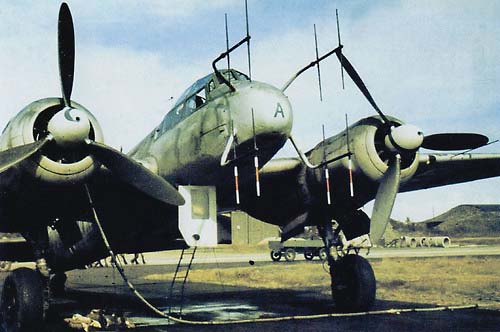
These were men who died on the Lancastria in the biggest naval disaster in British history or in the Channel Dash or in the Battle of the East coast when the Esk, the Express and the Ivanhoe all struck mines. Some died flying in Handley Page Hampdens, or Fairy Barracudas, or Hawker Hurricanes, or Avro Lancasters or Grumman Wildcats or even a North American O-47B. One casualty was murdered by a German agent who sabotaged the single engine of his army observation aircraft. One was shot by the occupant of a Japanese staff car who was attempting to run the gauntlet of “A” Company’s roadblock. One was the only son of the owner of a huge business that supported a small local town, employing thousands. When the owner retired, the factory had to close. He had no son to replace him. His son lay in a cemetery in Hanover after his aircraft was shot down. Thousands of jobs were lost. And all because of a few cannon shells from a German nightfighter. The work of a few split seconds.

They died in the Bay of Biscay, the Channel, the North Sea, Ceylon, Eire, Germany, Ijsselstein, Kuching, Normandy, Singapore, Tennessee. None of them knew that they were going to die for our freedoms. And certainly none of them knew where or when.

But they gave their lives without hesitation. And they do not deserve to be forgotten. That is why this book exists, and so does Volume One, and Volume Two and in due course, so will Volumes Four and Five.

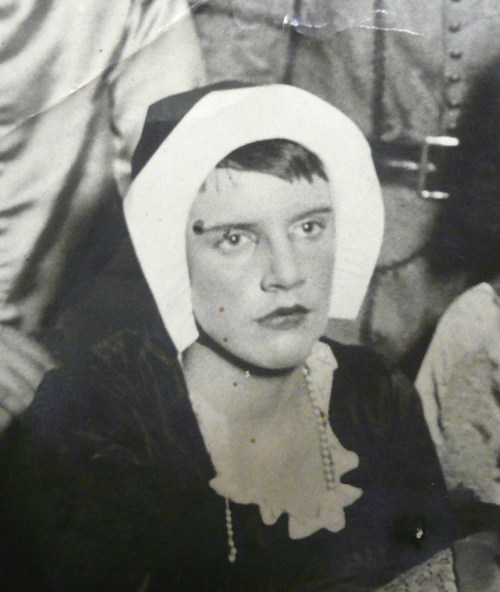
We should never forget this little boy (right), playing the part of Madame Rémy, and killed in Normandy not long after D-Day:

We should not forget this rugby player, either, killed in a collision with a Vickers Wellington bomber.

We should not forget this young member of the Officers Training Corps (front row, on the left). A mid-upper gunner, he was killed in his Lancaster as he bombed Kassel, the home of at least one satellite camp of Dachau concentration camp:

We should not forget this young miscreant, either, mentioned in the Prefects’ Book for “Saturday, October 20th 1934. “Fletcher was beaten – well beaten.” By June 23rd 1944, though, he was dead, killed with twelve others when two Lancasters collided above their Lincolnshire base. He wanted to have a chicken farm after the war. Not a lot to ask for, but he didn’t get it:

We should not forget the Captain of the School, killed when HMS Express hit a German mine:

We should not forget the son of the US Consul in Nottingham, the highest ranked Old Nottinghamian killed in the war:

And we should not forget any of the others, wherever they may turn up. Killed by the Japanese in Singapore :

Killed in a road block firefight in Burma:

And this little boy, still years from being shot down on his 66th operational flight  by Helmut Rose, in his Bf109, German ace and holder of the Iron Cross First Class. And yes, that is the little boy’s Hawker Hurricane:

This slideshow requires JavaScript.

The First XV player, proud of his fancy jacket:

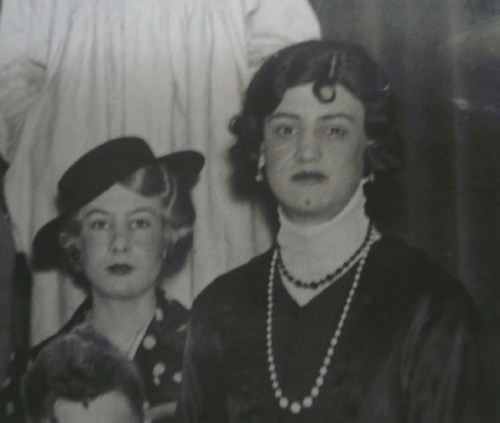
A young man tricked into having to dress up as a young woman in “Twelfth Night”:

Two years later, getting a part  as “Jean, a veritable Hercules….a convincing rural chauffeur”, in “Dr Knock”. Except that all of your friends think that you have got the part of the village idiot:

And a very frightened village idiot at that.


Please note:

All three of the titles published in this series so far are on sale with both Amazon and Lulu.  All royalties will be given to two British forces charities, and if this is important to you, you will prefer to buy from Lulu. This will generate a lot more revenue.

For example,

If Volume 3 is bought through Amazon at full price, the charities will get £1.23 from each sale.
If Volume 3 is bought through Lulu, that rises to £9.48.

Incidentally, if you see the price of the book quoted in dollars, don’t worry. The people at Lulu periodically correct it to pounds sterling, but it then seems to revert to dollars after a few days, although nobody seems to know why.


23 Comments

Filed under Aviation, Bomber Command, cricket, Football, History, military, Nottingham, The High School, the Japanese, Writing