Category Archives: History

“Soldaten” by Sönke Neitzel and Harald Welzer (2)

Last time I wrote about “Soldaten” by Sönke Neitzel and Harald Welzer. This is a book about the appalling attitudes and shocking behaviour of, primarily, the German armed forces during World War II. What makes the book so interesting though, is that the two authors range relatively far and wide in their search for an explanation for the Germans’ extreme violence:

“At Princeton University in 1973, a remarkable experiment was carried out. Forty Theology students were told to write a short essay about the Good Samaritan and then it would be recorded for radio at another building.”

Here’s a view of that beautiful university:

The students completed their essays about the Good Samaritan and waited for the word to leave. Eventually an obvious authority figure arrived and told them loudly:

“Come on!!! You’re all going to be late !!! Come on!!! GO !!  GO !!   GO !! “

When the Theology students got close to the building where they would record their essays for radio, they found a man lying on the pavement, eyes closed, coughing and moaning. It was impossible to miss him. He was clearly in a bad way:

Of the forty students, 24 ignored him completely and only 16 stopped to help. A number of the 24 lied that they had not seen him, which was completely impossible.  “Soldaten” argues that this proves, and it is rather difficult to contradict them, that:

“There is a vast gap between what people believe about their moral standards and their actual behaviour”.

Take that sliding scale to its logical end and we are faced with “Autotelic violence”. This is violence for its own sake, violence carried out because you like it, you enjoy it. My best example would be the German pilot over London who machine gunned the civilians as they walked peacefully along Downham Way and then bombed the seven and eight year old children waving to him in the playground of a school in Catford. You can read this appalling story here and, if you are still in any doubt, here.
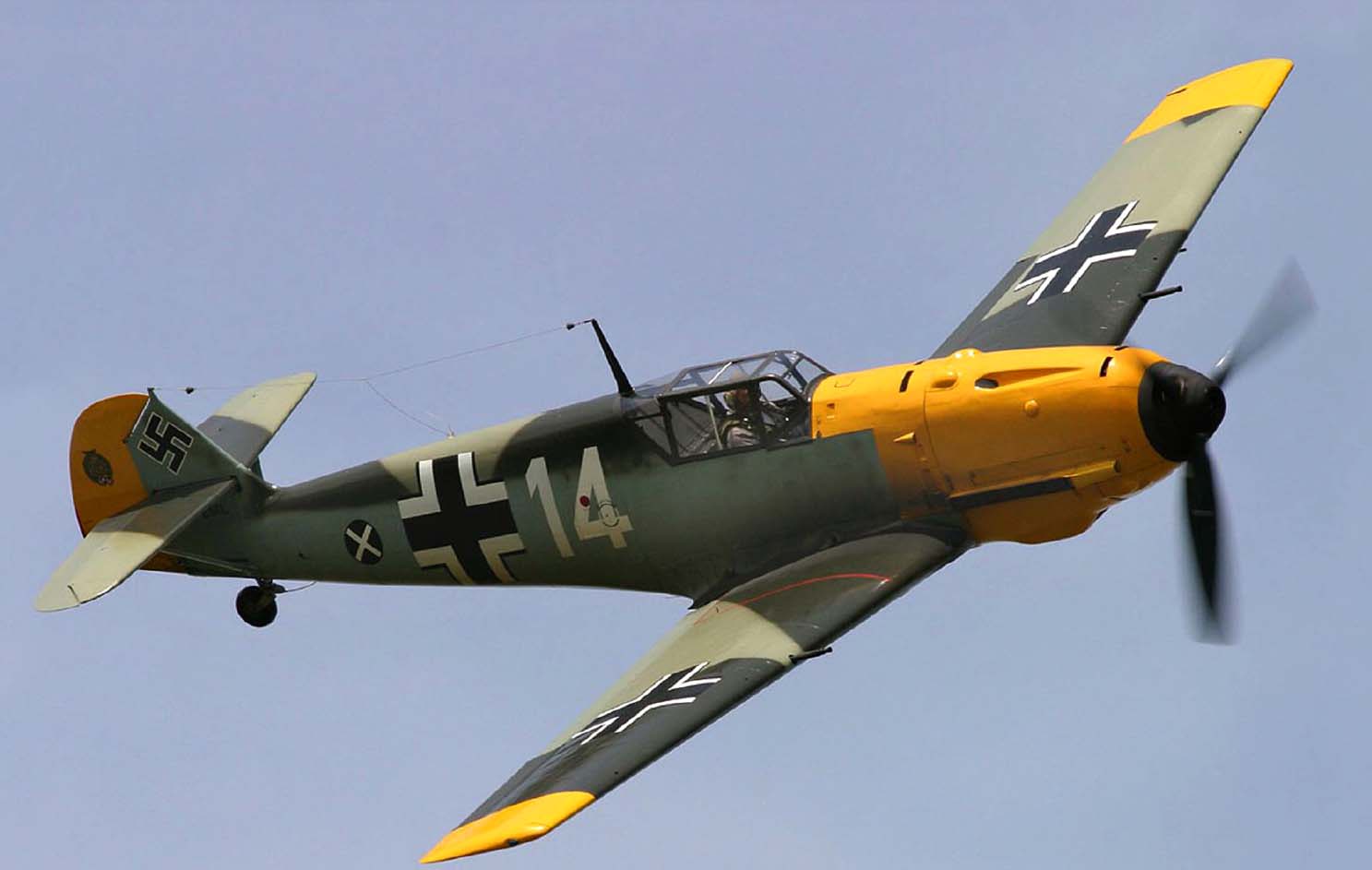
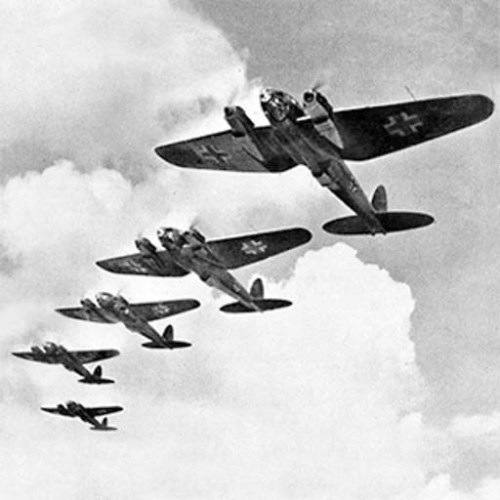
If you have followed the links and read the two accounts, then let’s take a quick look at some of those transcripts made by British Intelligence. This is Lieutenant Pohl who flew a light bomber in the early part of the war when Germany invaded Poland:

“On the second day, I had to bomb a station at Posen. Eight of the bombs fell among houses. I did not like that.

On the third day I did not care a hoot and on the fourth day I was enjoying it. I chased single soldiers over the fields with machine gun fire, and people in the street… I was sorry for the horses.”
One valuable piece of advice from the two authors is that

“If we cease to define violence as an aberration, we learn more about our society and how it functions than if we persist in comfortable illusions about our own basically nonviolent nature. If we reclassify violence as part of the inventory of possible social actions among communities, we will see that such groups are always potential communities of annihilation.“

In other words, we are deluding ourselves if we think we have overcome our willingness to be violent. Our apparently civilised world is no different from anybody else’s world.

This is emphasised by the book’s detailed examination of the events lived through by Michael Bernhardt, which suggest very strongly that the behaviour of the group reinforces the behaviour of the individual. This idea we have already seen, to some extent, when discussing “inhumanity with impunity” in a previous post. Michael said:

“The only thing that counted was how people thought of you in the here and now…the unit was the entire world…what they thought was right, was right and what they thought was wrong, was wrong.”

Despite his name, Michael Bernhardt was not German but American. He served in Vietnam and, when the time came, he refused to take part in the My Lai massacre of 400-500 old men, women and children. You can read about these terrible events here, and here:

For this refusal to participate in a war crime, Michael Bernhardt was ostracised by every single one of his fellow soldiers, even though back in the USA he was to receive the New York Society for Ethical Culture’s 1970 Ethical Humanist Award.

In other words, in the world of Bernhardt’s fellow soldiers, “what (the unit) thought was right, was right and what (the unit) thought was wrong, was wrong.”

Can everybody use that excuse though? Even the SS ?

We will see next time.


21 Comments

Filed under Criminology, History, Politics, Russia

What would you do ? (13) The Solution

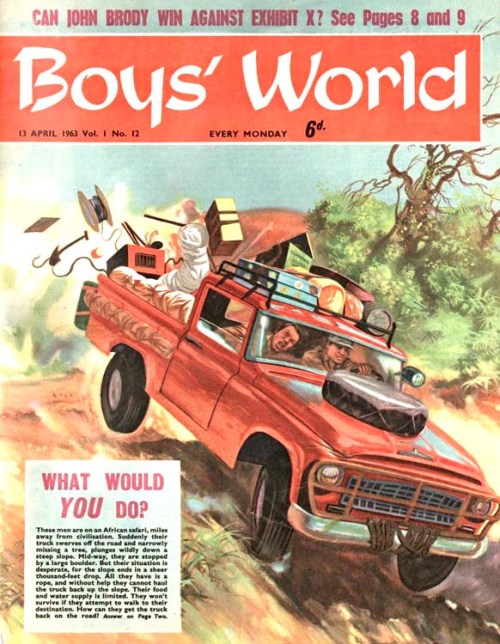
“What would you do ?” used to figure on the cover of a boys’ comic called “Boys’ World”. This was a publication, obviously, aimed at boys, and first appeared on January 26th 1963. There were 89 issues before the comic was merged with Eagle in 1964. The last issue of “Boys’ World” came out on October 3rd 1964.

I used to buy “Boys’ World”, and this was mainly for the front cover which always featured a kind of puzzle. It was called “What would you do ?” and was based on somebody being in what Ned Flanders would call “A dilly of a pickle”. Here’s the situation:

And here’s an enlargement of that box:

And the correct solution given on page 2 of the comic is:

So, the answer is taken, more or less, from that wonderful war film of 1958, “Ice Cold in Alex” with John Mills, Sylvia Sims, Anthony Quayle and Harry Andrews. All the four of them can think about in all that heat and all that sand is an ice cold beer in a bar in Alexandria, but at one point they have to wind the truck up a steep sand slope in exactly the same way, more or less, as the solution says:


16 Comments

Filed under Africa, Film & TV, History, military, Wildlife and Nature

“Soldaten” by Sönke Neitzel and Harald Welzer (1)

“Soldaten”, which means “Soldiers” is a book about the many atrocities committed by the German armed forces during World War II, although the two young authors do not hesitate to include other conflicts if they wish to make a particular point. War crimes by American forces in both Vietnam and Iraq are therefore included:

The two young authors are both highly distinguished academics, Sönke Neitzel and Harald Welzer.

Harald Welzer (above) was born in Hannover in 1958 and he is a German social psychologist, having studied sociology, psychology and literature at the University of Hannover.

Born in 1968, Sönke Neitzel (above) studied at the University of Mainz and is Professor of Military History at the University of Potsdam. He has previously held professorships at the London School of Economics, the University of Karlsruhe, the University of Bern, the University of Glasgow and the University of Saarbrücken.

The two young men belong to a burgeoning group of modern German academics who are completely willing to study and to write about Hitler, Nazism and the conduct of the German people during World War II. They are not in the slightest bit biased towards the Germans and they do not try to defend the behaviour of the Nazis. Overall, in “Soldaten”, they treat the Nazi period, quite rightly, as if Hitler’s Germany was so far away in the past that it has become a foreign country. Things were done differently there:

I read “Soldaten” recently and I found it absolutely stunning. I even read the first fifty pages twice to make sure that I had understood it all fully.

The book is based on what was probably Sönke Neitzel’s luckiest day ever. He discovered that during World War II, British Intelligence had taped German prisoners of war in secret and had then transcribed their conversations. This process had produced 50,000 pages of transcripts, which he was able to locate and then to read. Neitzel later found that the National Archives in Washington DC had around 100,000 further pages of prisoners’ conversations. The transcripts from the German prisoners in England have produced a 400 page book which I am going to review in almost note form.

In the earliest pages, it is explained that:

“the brutality, harshness and absence of emotion are what is so disturbing for us, sixty years after the fact…..killing and the worse sorts of violence were part of everyday reality (back then).”

The book will seek to explain why these levels of violence came about, and whether they were unique to this period of the twentieth century.

One idea, mentioned as early as page four, is that when you have reacted once in a particular way to a certain situation, you will continue to apply the very same rules:

“In the Third Reich, people didn’t need to be anti-semitic to murder Jews, or altruistic to rescue them….it was enough to be in a social situation in which one or the other course of action seemed called for. After that, people tended to follow what they had already done…massacre or rescue.”

When the course of action chosen is massacre, the situation may also incorporate the idea of “inhumanity with impunity”. Clearly, if everybody commits acts of violence and nobody is ever punished for it, then this promotes situations where people can “follow what they had already done”. Here is an example from a conversation between German POWs which was taped by British Intelligence:

Soldier A : “Kharkiv was a delightful town. At Taganrog too, there were splendid cinemas and wonderful cafés.

Everywhere we saw Russian women doing compulsory service.

We drove past, pulled them into the armoured car, raped them and threw them out again. And did they curse!”

Where does “inhumanity with impunity” come from? Well, on page 25 of “Soldaten, an explanation is given:

“In psychological terms the inhabitants of the Third Reich were as normal as people in all other societies at all other times. The spectrum of perpetrators (of violence) was a cross section of normal society. No specific group proved immune to the temptation of “inhumanity with impunity”.

The Third Reich did not though, reduce the variations of individual personalities to absolute zero. But it showed them to be of comparatively slight, indeed often negligible, importance.

In other words, we are more or less all capable of carrying out dreadful acts, because our characters do not differ enormously from those of other people. And that is why those variations are of negligible importance. All of us, every single one, can do dreadful evil.

They were people just like any other, under that showy uniform………


18 Comments

Filed under Criminology, History, Russia, Science

“CAT, after D.H.Lawrence.” Part Two. What became of Dennis Rhodes.

A little while ago I introduced you to a young gentleman and Old Nottinghamian, called Dennis Everard Rhodes. He had written a poem in the School Magazine entitled “CAT (After D.H. Lawrence)” It was published in the Nottinghamian in July 1941, when Dennis was just eighteen. Here’s the High School at the time:

Amazingly, Dennis died only 18 months or so ago. He seems to have been one of the cleverest people who ever came to our school. A man of astounding brilliance and scholarship. I’m hoping in about 700 words to show you by how much he is cleverer than even a relatively clever person.

Firstly, let me quote you some of his obituary by Dr Lotte Hellinga which is expected to appear in The Library magazine in 2021:

“Dennis Everard Rhodes, Gold Medallist of the Bibliographical Society in 2007 and staunch contributor to The Library from 1952, died on April 7th 2020, aged 97…….

His studies began in 1941 with classical Greek, but he soon switched to Italian language and literature. During the war, he was already fluent enough in Italian to join the Intelligence Corps as interpreter during the Italian Campaign. He not only perfected his use of the language, but it discovered a country, its culture and its people that he came to love and where he felt at home. Italy in all its great cultural variety remained one of the two poles between which he conducted his life, the other being the British Museum, not less so when it was transformed into the British Library.

In 1950 he became Assistant Keeper in the Department of Printed Books at the British Museum Library. His mentors were both deeply immersed in the cataloguing and investigation of early printed books, and Dennis followed them in the same direction. He thrived in the Italian section, but his particular interest was in incunabula.

Dennis’ commitment to the library lasted his entire lifetime, through its separation from the Museum and becoming the British Library in 1973, then his appointment as Head of Incunabula in 1974,  his promotion to Deputy Keeper in 1978, his retirement in 1985, and the move to the new building in 1998; almost to the very end of his life he simply stayed on, most of those years continuing with work behind the scenes.”

An “incunabulum”, by the way, is “an early printed book, especially one printed before 1501.” “incunabula” is the plural. Surely you have not forgotten that old aide-mémoire:

“Please remember every day.

Neuter plurals end in “A”.”

Dennis’ obituary will reveal in much greater depth the all encompassing intellectual life of Dr Dennis Rhodes. You can read it here.

Dennis wrote a lot of very specialised books. You can fine a list of his book titles here. Here is one of the pages for you to look at if you follow the link. Just look how wide ranging these titles are:

This bookseller and dealer in fine art is selling an archive of some of Dennis’ work. He could almost sell it by weight! This picture below is only a tiny fraction of Dennis’ work :

Dennis’ books are held by most universities in the Western World. He did not always write in English. Here is the list of which of Dennis’ books are held just in the various libraries at the University of Gent in Belgium. Just click on “Search collection”.

Dennis’ publications are, of course, to be found in most of the universities of the world. Let’s look at the website.

First of all, there is an overview of who Dennis was, what type of things he wrote,  and, most impressive, how many of his works are held by libraries worldwide. And the answer? Well in excess of six thousand, scattered across the globe.

The same webpage begins that list of the more than five hundred of Dennis’ works, which are held by so many libraries.

With the last entry on the previous webpage, incidentally, we can see just how interested Dennis became in the spread of printing across Asia. What is even more impressive, of course, is that every single one of these first nine books on the list are held by a minimum of two hundred libraries world wide.

Dennis created an amazing volume of material in his lifetime and modern websites talk about Dennis’s prodigious productivity. As well as his books, in sixty-seven years he wrote over 450 such articles as well as about one hundred book reviews.

The first thing I did when I  came across the name “Dennis Everard Rhodes”, was to google it. I was amazed to find that in the first five pages, some fifty or so URL addresses, only a very few were not our DE Rhodes. In more than ten years researching Old Nottinghamians, I have never ever had a result like that. Just take the trouble to pause the gallery and to have a look at the titles (in blue). Surely these entries cover about as wide a spectrum as they possibly could :

This slideshow requires JavaScript.

Only on the fifth page are there any interlopers., with the Norfolk Record Office and the Jamaican Family Search.

And finally, the only picture of the Great Man I have been able to find.

I have borrowed the photograph from a page of PRPH Books.


8 Comments

Filed under History, Literature, Nottingham, The High School, Writing

Photographs of the Eastern Front in World War Two (2)

About a year ago I bought a collection, on CD, of what were,  supposedly,  some 12,000+ images of World War  2 . I was very surprised, and pleased, to see that most of them were not British or American but were in fact either Russian or German. I would like to share some of them with you because a number of them have great photographic merits as well as capturing a split second in history. They also reflect quite accurately how that massive struggle was unfolding.

We left the German invaders discovering just how cold the Soviet Union could get. The Germans still thought that they could win, though. Their racial theories said the Russians were “untermenschen” and the photographs they took and sent home seemed to prove it:

This man is living in the Western USSR but what race is he? :

And what about this one? He is far from the Aryan ideal. And by the rules used by the Germans, he may be killed for that offence against racial purity:

When they invaded Poland, the German troops were told that the Poles lived in filth, that they had a distinctive stink and that, with practice, you could smell the presence of any Poles nearby. Poles were Slavs and so were Russians. It wasn’t a huge leap to apply the same attributes to Russians. And the photographs you took would prove it. They were subhuman. Just look at them. Barefoot and unkempt. Where would you find the like in Germany?:

Many of them even lived underground:

And their children?  Like little animals. Dirty. Badly dressed and often bare footed:

And many of them are complete ragamuffins, with little evidence of knowing who their parents are:

And then the stupid, smelly Russkies stumbled their way to making what may well have been the finest tank of all time, the T-34 :

And before too long, the tables began to be turned. More and more prisoners were being captured by the useless, cretinous Soviets:

Events accelerated after that, from very bad to catastrophic. Soon it was Germans who were fleeing as refugees. Hitler had said that he would drive Bolshevism out of Europe, to the far side of the Urals. He was wrong. His incompetence had brought the Red Commie Tide westwards, and the Russians by 1945 were some 800 miles further into central Europe than they had been six years before. Run, run, run!:

And before long, they were giving German Grandads in Berlin newly invented superweapons and telling them to do their bit to chase those 2,300,000 Russkies out of the city. Don’t look so bewildered, Gramps! They’re easy to use, but unfortunately, they fire only one shot:


20 Comments

Filed under History, Humour, military, Russia

POST NUMBER 600: Two brothers fighting fascism (5)

This is my 600th post. Enjoy !!!

On Saturday, February 13th 1943,  Robert Renwick Jackson was flying his Boston III Intruder, serial number AL766, towards Nantes in western France:

His mission was to drop propaganda leaflets for the occupied French, so they could read the real truth about the war for themselves.

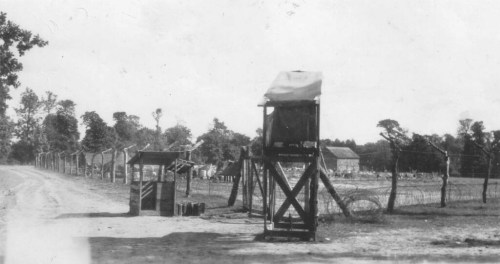
Alas, Robert Renwick Jackson died that night along with his navigator. The upper and rear-gunner, Sergeant TS McNeil, survived and became Prisoner of War No 27276 at Lamsdorf, then in German Silesia but now in south-western Poland. Here’s a typical POW camp:

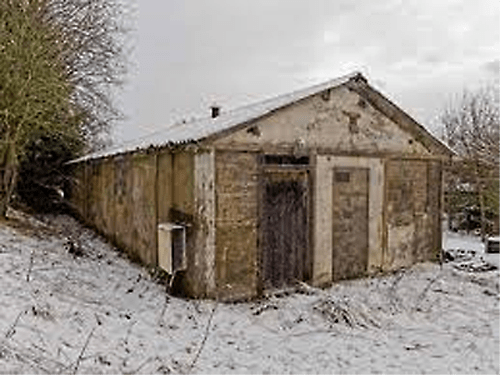
And here’s a hut nowadays:

The second casualty in the Boston was Peter John LeBoldus, the navigator, who would have been sitting in the nose of the aircraft. His name is virtually unknown in England, but he is better known in Canada. His parents were John LeBoldus and Regina LeBoldus née Weisberg, German Catholic immigrants who had six sons and six daughters. John was a hardware and implement dealer. The family lived in Vibank in Saskatchewan. One of the highlights of Peter’s very short life must have been taking tea with the Queen Mother and the Princesses Elizabeth and Margaret at Windsor Castle with a group of newly arrived Canadian Airmen in England.

On this particular night, Peter John was preparing for the mission and his brother Martin, also a member of 418 Squadron, but working as a mechanic, had helped him put on his flying clothes and his parachute harness. This was the last time the brothers ever saw each other. This is Peter LeBoldus:

Peter John LeBoldus is buried next to his friend, Robert Renwick Jackson, in Grandcourt War Cemetery.

Sadly, Peter John was not the only member of the LeBoldus family to die in the war. John Anthony “Johnny” LeBoldus was a member of 142 (RAF) Squadron, where he was an air gunner in a Vickers Wellington Mk X, serial number LN566, squadron letters QT-D, “D-Dog”. They took off from RAF Oudna in Tunisia on November 24th 1943 to bomb a ball bearing factory at Villar Perosa near Turin, at the very limit of their range. Extreme weather with wind, cloud, fog, rain, and ice caused the loss of 17 aircraft and 73 men were killed. “Johnny” LeBoldus was one of them:

The third LeBoldus brother to die was Martin Benedict LeBoldus, the same man who had helped his brother, Peter John, with his flying clothes and his parachute harness before his death in Boston AL766. Martin Benedict was killed on February 20, 1944 at the age of 31. He was the flight engineer in a Handley Page Halifax Mark II of the Canadian 419 ‘Moose’ Squadron in Bomber Command, serial number JD114, squadron letters VR-V, “V-Victor”. On February 20, 1944 he and his colleagues took off at 23:12 from RAF Middleton St George near Darlington to bomb Leipzig and they were never seen again. Six other men, with an average age of twenty four, were also killed. John Leslie Beattie, Thomas Gettings, Alfred Harvey Hackbart, Donald Clifford Lewthwaite, Douglas Keith MacLeod and John Ralph Piper.  A total of 79 bombers were lost that night. Here’s Martin Benedict LeBoldus:

Mr Leboldus wrote a very bitter letter to the Secretary of the Department of National Defence for Air about the death of his sons:

“Other boys spending their time of war in Canada, yes hundreds and thousands walking the streets of Canada for years, and all our three boys were in the front line of attack. I have my doubts whether this is right and just. Plenty of those who offered three four years ago never seen any fighting nor smelled any powder, why all mine have to do it?”

Certain other Canadian families no doubt felt the same way. They included the Cantin family, the Colville family, the Forestell family, the Griffiths family, the Kimmel family, the Lanteigne family, the Milner family, the Reynolds family, the Rich family, the Rivait family, the Stodgell family, the Wagner family and the Westlake family, all of whom sacrificed three sons to the cause.

Nowadays the LeBoldus brothers are not totally forgotten. Canada is a vast land so it is comparatively easy to give names to hitherto unnamed geographical features. They are called “geo-memorials” and there are now more than four thousand of them. Leboldus Lake in north-western Saskatchewan is named after Peter John Leboldus. The Leboldus Islands there are named after Martin Benedict Leboldus. The link between Leboldus Lake and Frobisher Lake is called the Leboldus Channel after John Anthony Leboldus. What a pity that we don’t do that over here in England.  What a pity there are no streets in either Nottingham or Solihull named after Robert Jackson, killed at the age of 22, fighting for his country.

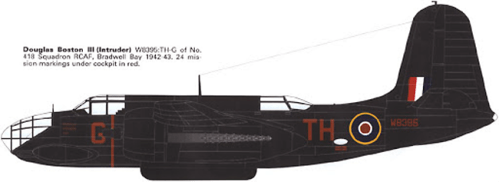
(Picture of the black Boston borrowed from wp.scn.ru.)

23 Comments

Filed under Aviation, Bomber Command, France, History, military, The High School

Poems in “The Nottinghamian” 1922-1946 (5) “Blackpool, summer 1939”

This poem was published in the School magazine, the Nottinghamian in July 1939. It was written by Alan Douglas Fluder Howard, the son of a school teacher. Alan was born on December 1st  1922 and the family all lived at 5 Alpha Terrace, between North Sherwood Street and Addison Street, fairly close to the High School. Alan entered the High School on September 2oth 1934, as Boy No 5845 and he studied there until the end of the School Year in 1941 when he left to go to Gonville & Caius College, Cambridge with an Open Exhibition of £40 per annum for Classics and a City of Nottingham Scholarship of £80 per annum. Here’s Gonville & Caius College, or at least, a picture of the entrance to Staircase K:

Alan then seems to have become an illustrator of children’s books such as, for example, “The Pimpernel and the Poodle” and “Limping Ginger of London Town” both of which are still on sale, intermittently, on the internet.

Alan died on Monday April 14, 2008 at the Mount Nursing Home in Shrewsbury. He was the much loved and loving husband of Margaret, the father of Shelagh and Jennifer, the grandfather of Laura, Joanna, Harry, Katy and Zachary and the brother of Marian.

Unlike many Cambridge men of his era, Howard did serve in the war. On October 1st 1945, he received an Emergency Commission to promote him from the ranks of the ordinary soldiers to become a Second Lieutenant in the Royal Signals.

This poem is one of the very best you’ll find in the school magazine. It is set in Blackpool in the very last summer before the war began on September 3rd 1939.

Blackpool was, and still is, England’s Holiday Capital. Its most famous building is Blackpool Tower, jealously copied by the jealous Parisian architects within a couple of years of its completion. There are three piers, North, Central and South, there is a huge Pleasure Beach and Blackpool has literally thousands of things to do. And it also has its problems, as this poem will gradually reveal to you……..

BLACKPOOL, 1939

I like to be at the seaside, the seaside, the seaside,

The jolly, jolly seaside, is just the place for me.


I love the bracing sea-breeze, the sea-breeze, the sea-breeze,

The sewage-fish-and-chips breeze,

Down by the sea.


Oh, how delightful, beautiful, adorable,

Just to spend a day down on the strand !

Gramophones, deck-chairs, chattering lunatics,

And sand sand sand jellyfish sand.


How nice to have a picnic,

All on the seashore,

Down by the briny.

Oh, how grand !


Lemonade, sandwiches,

All gone musty,

Bread-and-Butter, hard as granite,

Seaweed, sand


With sad, shrill wailing, high above the waters,

The slender white seagulls swoop and soar:

Listen to the salt waves softly sighing,

Listen to the breakers crashing on the shore—

“An I says to ‘er, I says—“   “I wanner sticker rock.”

“Johnnie’s gorn an’ pinched me bucket and spide.“

“Let’s ‘ave some fishanchips.“   “Buy me an ice-cream.”

“Wind up the gramophone.”   “Pass the lemonide.”


Look at that fat man,

Playing with a beach ball’

Just like a walrus,

Just like a walrus ;

Look at these chocolate papers, toffee papers, newspapers,

And those broken bottles, pleasant for the feet :


Here are the side-shows,

Hark! the showmen softly call—

Giraffe-necked women, three legged women,

Fat women, headless women.

Yonder people half-drunk, two-thirds-drunk, completely drunk.

Not a few hyper-drunk, rolling down the street,


Hurrah ! for the sea-shore,

The sand-castles,

(So-called).

Hurrah ! for the deck chairs,

(Twopence a time) ;

Cheers for the deep sea, the green sea, the dirty sea,

Covered with frothy-brown,

Smelly-brown

Slime.
 

‘Ray ! for the beastly rock,

Landladies,

Pickpockets,

Roundabouts,

Sideshows,

Gambling dens.

Ray ! for the bandstands,

Machines to tell your fortune ;

No wonder they call us

Homo sapiens.

All that remains now is to show you just one or two pictures of Blackpool.  Here’s the beach, pier  and tower :

And here is an aerial view of the most famous holiday resort in England:

Here are the attractions in the South  Shore area:

Here’s the North Pier. You’d think nobody had heard of any other seaside resort in England. Every single English family and their dog, has turned up:

And here’s the Empress Ballroom in the Winter Gardens:

And finally, a couple of family photographs, both of them taken at Blackpool. First of all, the rather bored little boy is my Dad, born 1922. He looks about eight or nine to me. The lady with him is his mother, my grandmother. Behind them is an escape convict, blending in very skilfully with the cloche hatted crowd :

My grandad, the one who went to Canada and fought in their army, was the husband of the lady above. His father was my namesake, John Knifton, who seems to have acquired a touch of dementia in his final years. On one occasion, at a rather advanced age, he went up to Dr Love’s surgery in High Street, Woodville, and told him that he had come for the job as a doctor. There was, of course, no job. Dr Love went down to see his son, my grandad, and announced to him that “the old professor has really flipped his lid !”

So, here’s the Old Professor:

The lady with him was his second wife, a rather vinegary lady who my grandad and his brothers hated with a will. They would eventually finish up walking down a gangplank onto the docks at Halifax, Nova Scotia, Canada, because of her.

And finally, did you spot him? Staircase K ?

17 Comments

Filed under Aviation, History, Humour, Literature, Nottingham, The High School

Photographs of the Eastern Front in World War Two (1)

About a year ago I bought a collection, on DVD, of what were,  supposedly,  some 12,000+  images of World War  2 . I was very surprised, and pleased, to see that most of them were not British or American but were in fact either Russian or German. I would like to share the best of these photographs with you because a good number of them have great photographic merits as well as capturing a split second in history. They also reflect quite accurately how that massive struggle was unfolding.

September 1st 1939. The Germans attacked Poland in some strength and soon, prisoners were being taken in large numbers:

On June 22nd 1941, came Operation Barbarossa. The Germans attacked the Soviet Union where lebensraum was almost limitless. Victories came easily. Cities were blown to bits:

Towns were destroyed:

And villages burned:

Russian prisoners were captured in their hundreds of thousands:

The Germans didn’t always feed the Russians. In years to come this would result in cannibalism in many of the camps. A German sentry would shoot a Russian prisoner, and the others, all starving, would then eat him:

For the advancing army, there were always meteorological problems, In the height of summer, it was dust:

But then it started to rain as autumn set in. Not too much to begin with. But then it got worse. The Russians call this time “распутица” (pronounced “rass-poot-eat-sa”) which means “the season of bad roads”.  The origin of the word is that “рас” (“rass”) means “in different directions” and “пут” (“poot”) means the road. And that’s exactly what happens as the road disappears into a sea of mud. It begins very gradually with this:

And it ends with this:

Traditionally, the weather starts to get colder and much more wintry on November 7th, the anniversary of the outbreak of the Russian Revolution. But the Germans did not know this, and they just woke up one day and there was a light dusting of snow, and the mud was all frozen. They preferred that. At least you could walk on frozen mud:

But then it snowed a little more, and a little more. At first it was very picturesque:

But then you find your tank is stuck in the frozen mud and the snowdrifts and it’s unusable. You expect to be given a winter uniform and winter equipment but it never comes. You start to feel cold. And it’s no fun playing stupid games in the snow any more:


26 Comments

Filed under History, military, Russia

Poems in “The Nottinghamian” 1922-1946 (4)

The author of the following poem which appeared in the Nottinghamian of December 1940 was Robert Norman Walters of VI Classics. Robert was the son of a “Master Fruiterer” and lived at 159 Cinder Hill Road in Bulwell. He was in the High School from 1930-1941. The winter of 1940-1941 was legendary for its severity and was excellent practice for anybody thinking of taking a winter break in Stalingrad a couple of years later.

SNOW

Snow shall fall and ice

Shall bind the lane in slithering shields

Of white and whitish blue.

Winds shall blow and howl and roar

And tiles shall fall.

Wood shall burst and split

Like statues known of old.

Rivers may cease to run

When snow shall whirl and swirl

And formless roofs gleam white.

Yet when this comes,

Let our strong, deep affections

Unfrozen, freeze not.

But with winter seen afar

Retain the burning heat

Of mid-June’s torrid air.

Robert left to go to Jesus College, Cambridge to study Classics. In the section of his poem :

“Winds shall blow and howl and roar

And tiles shall fall.

Wood shall burst and split

Like statues known of old.

Rivers may cease to run”

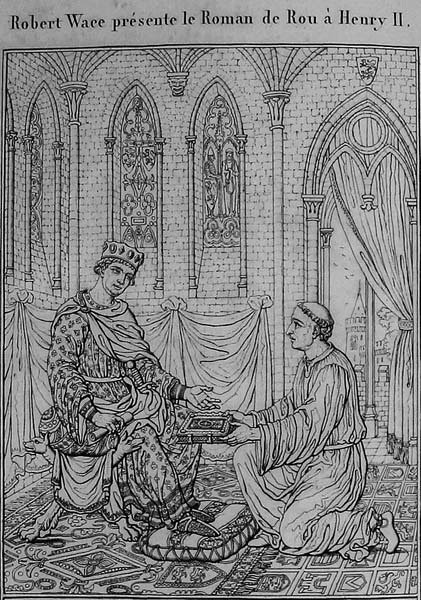
Robert has come remarkably near the words of Wace, who was possibly Robert Wace, a Norman poet, born in Jersey and brought up in mainland Normandy.

Wace was the first author to speak of the Round Table and the Court of King Arthur :

“Eventually

All things decline

Everything falters, dies and ends

Towers cave in, walls collapse

Roses wither, horses stumble

Cloth grows old, men expire

Iron rusts and timber rots away

Nothing made by hand will last.

I say and will say that I am

Wace from the Island of Jersey”

Wace lived, approximately, from 1100-1180.

James Theodore Lester was the son of a Leather Factor & Manufacturer who lived at 42 Bedale Road in Sherwood and then at Castleton House at 5 Castle Avenue in Arnold. The poem occasionally struggles for a rhyme, but the last verse is lovely.

“When I was six”

“When I was six I’d play at boats

And build a fort with many moats

Which I’d replenish with my pail

And put my little boats to sail.


Round and round and round they’d go

Till the water ceased to flow.

Then back home I would repair

And sit upon my rocking chair.


When it was time to go to bed,

Upon the pillow I’d put my head,

And think and dream of things I’d done,

And call the day a happy one.


We’ve already seen Frank Alan Underwood of 51 Charnock Avenue in Wollaton Park with his poem ““Evacuated”. This poem is a lot deeper and a lot more chilling. It was published in April 1943.

THE MIRROR

The dead man lay upon his bed

In the pause at dawn ere the Soul had fled,

And the Lamp burned dim as the East glowed red.

The Soul rose as the man had done

For twenty years at the beck of the sun:

But as yet it knew not that Death had won.

Then still as man and not aware

It looked in the mirror to brush its hair

–Looked in the mirror and found nothing there.

Ivan Keith Doncaster wrote a poem in The Nottinghamian in March 1937 which was pretty good:


THE FISHPOND

There’s a fishpond in our garden,

Not very big or wide ;

But fish just love to dart about,

Among the rocks inside.

And if you sit there on the bank,

You’ll see a sudden flash—

A big fat frog has just dived in,

And made a dreadful splash.


The frightened fish swim swiftly round

In search of safe retreat,

The frog looks at the golden line,

And croaks his sad defeat.

When ice seals up our gold-fish pond,

Neath winter’s frozen spell ;

We just catch golden gleams below,

To tell us all is well.


In summer when the fountain plays,

And sends forth silver rain,

The fish all frolic in great glee,

As cooling showers they gain.


We feed the fish with large ant eggs,

And when the days are warm

They jump to catch the flitting flies

Which o’er the pond do swarm.


Some happy moments there we spend,

Watching the fish at play ;

Spring, Summer, Autumn, Winter too,

They move in swift array.


Ivan Keith Doncaster only lived from 1923-1944 but he had already succeeded in the previous year in writing the most beautiful piece of poetry by any High School boy, bar none. It summarises how much we love our oh-so-beautiful lives, yet all the time are well aware of the price we will all one day pay as the distant bells toll our inevitable doom.

Keith paid his price in the mid-upper turret of a Lancaster over the German city of Kassel on October 22nd 1943, five days after his 20th birthday.

This poem appeared in April 1936 and had Keith lived, he would have been a great poet. He has a masterful touch and is capable of the most astonishing subtlety.

GATHERING SHELLS

“Along the silvery beach we run,

Gathering coloured shells.

We think that gathering shells is fun.

Along the silvery beach we run.

And as we go beneath the sun,

We hear the distant bells.

Along the silvery beach we run,

Gathering coloured shells.”

I have read that poem literally hundreds of times and I do not even begin to tire of it.


19 Comments

Filed under Aviation, Bomber Command, France, History, Literature, My Garden, My House, Nottingham, Personal, The High School, Wildlife and Nature

Two brothers fighting fascism (4)

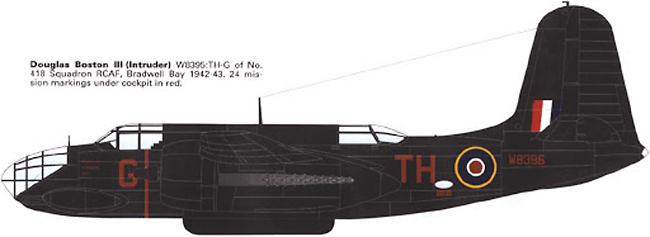
Old Nottinghamian, Robert Renwick Jackson was killed on Saturday, February 13th 1943. He was the pilot of a Boston III Intruder with the serial number AL766 and the squadron letters TH-unknown. Whatever that unknown letter was, “A-Able”, “Z-Zebra”, whatever, on a Boston it was never painted on the fuselage with the other two letters, either side of the roundel. Instead it was placed, in matt red, under the pilot’s side window, replacing those sexy ladies on the noses of B-17s:

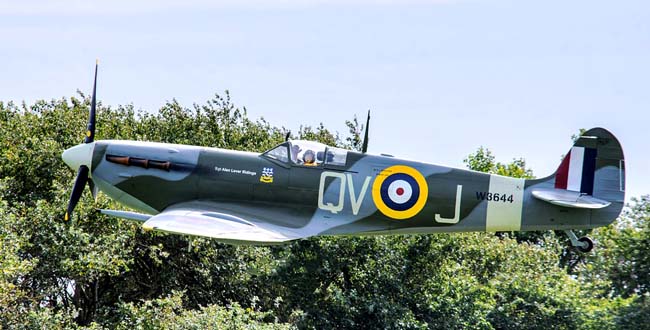
And here is the more normal positioning of squadron letters, on a Supermarine Spitfire :

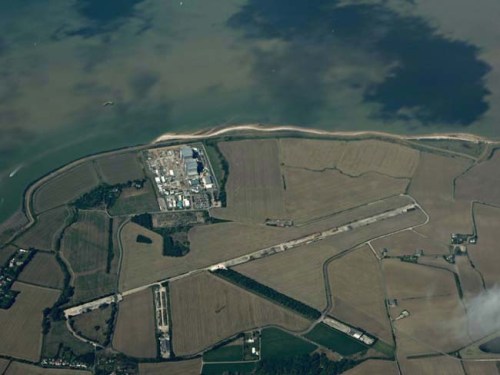
Robert took off from Bradwell at 23:57 hours on an Evening Intruder Sortie to Nantes, a large port on the River Loire in western France, 35 miles inland from St Nazaire. His mission was to drop propaganda leaflets for the occupied French. This activity was called “Nickeling” and, in the rich slang of the RAF, the men who did it were called “bumphfleteers”. Here’s Bradwell nowadays:

The last definite news about Robert’s aircraft came as it approached the French coast but it then crashed a few miles inland. There is much doubt about the exact reason for this, but, if we discount pilot error, we are pretty well left with just anti-aircraft fire or a night fighter.

Perhaps he had inadvertently flown over a German flak battery. Whenever the RAF reached the French coast they were never far from German guns. And the crews of these guns were always very good. They had plenty of practice. They were quite capable of shooting down a Boston:

One hugely relevant detail is that a straight line from Essex to Nantes passes more or less directly over some of the most heavily fortified sections of the Atlantic Wall. They may even have passed too close to the huge German troop concentration at Le Havre, a garrison of 14,000 men with an excellent concentration of 88mm guns protecting them from air attack. Many reports over the years have said that Robert’s aircraft crashed near Mantes, which, unless it is a misspelling for Nantes, must mean Mantes-la-Jolie, near Paris, around 30 miles from the city centre. This scenario can be pretty well rejected because Robert was initially buried at Saint-Riquier-ès-Plains, only 22 miles from Dieppe and 22 miles from Etretat, famous for its sea cliffs. Robert was then reburied on October 1st 1947 in a larger cemetery at Grandcourt, some 20 miles east of Dieppe. Clearly, everything is connected with Dieppe and the Channel coast rather than Mantes-la-Jolie and the city of Paris. I cannot agree either with those who say that he was killed not near Mantes but near Nantes, the original destination of his mission. Why would the Germans transport his remains some 250 miles for burial at Saint-Riquier-ès-Plains? That doesn’t make any sense whatsoever.

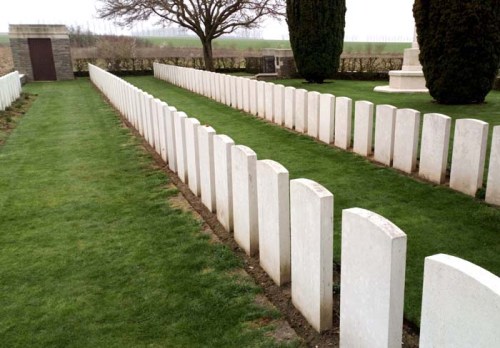
Anyway, here is Grandcourt Cemetery:

(Picture of the black Boston borrowed from wp.snc.ru.)


6 Comments

Filed under Aviation, France, History, military, The High School