Category Archives: Humour

A very strange duck

(An extract from my old birdwatching diary “Crippling Views”)
Monday, September 19, 1988
Paul and Steve have told me of a very strange duck, down on the River Trent at Attenborough, to the south west of Nottingham. Look for the orange arrow…

This slideshow requires JavaScript.

Because of this, I make sure that I take the Sixth Form Birdwatching Group down there for a quick look round during our birdwatching afternoon. And indeed, when we do find the bird, it does turn out to be a bit of a puzzler. First of all, it is completely alone on the river, while all the other ducks are on the main lake. This is a very good start in proving that it is a rare bird, blown across the stormy waters of the Atlantic Ocean from the USA. Everybody knows that rare birds always keep well separate from any strange foreigners they are suddenly brought into contact with. It’s because vagrants are shy, uncertain of themselves and take a very long time to make friends., They may not speak English. They may be afraid of being eaten.

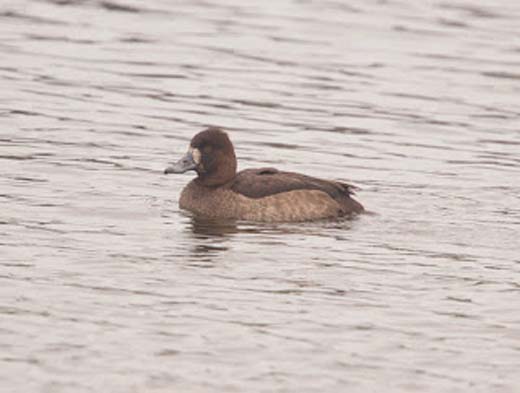
Superficially, the stranger is all brown, rather like a female Tufted Duck, but it’s not a definite Tufted Duck because the head shape is wrong.

female-tufted-duck-xxxxxxxx

Instead of a tuft, or the basis of a tuft, the bird has a rounded head like a Greater Scaup.

greater_scaup-hen-wave-xxxxxxx

It’s not a Greater Scaup either though, because the head shape is not right for that species either. Instead of a completely rounded head like a Greater Scaup, it has a little peaked crown, rather like the head shape of Ring-necked Duck.

ring-necked-duck-fzzzzzzzzzz

The basic drab brown, chocolaty colour of our bird’s plumage and the absence of any eye ring markings means, as far as I’m concerned, though, that it cannot be a Ring-necked Duck either. I hesitate between the two ends of the spectrum. Either, at one end, we are looking at yet another hybrid duck, because duck species all interbreed in a most alarming way. Or, we are breaking new ground in the glorious history of Nottinghamshire birdwatching, and it is a juvenile, or female, or eclipse, Lesser Scaup, which would be a first for Britain. Even then, this would not be, however, the first claim for this American species of bird in the county despite its almost unbelievable rarity…

At the other end of the spectrum, the more likely solution, and the easiest cop out is to say is that it is a hybrid, the fate of at least two of the county’s previous claims. But a hybrid of what? Scaup and Lesser Scaup? Tufted Duck and Ring-necked Duck?

Still, it was a bit of excitement on an otherwise dreary day. And indeed – why should a female Lesser Scaup be impossible at Attenborough, while a male, the first ever seen in Britain, is  acceptable at Chasewater, only some fifty miles away?

If I had my time over again, I would have made a bigger effort to ascertain two things, one relatively easy, the other much more difficult. It would have been reasonably easy to have checked the extent of any white areas at the base of this puzzling bird’s bill. The photographs above show how important this detail might have been. Nowadays, getting on for thirty years later,  I quite simply cannot remember, although that very fact in itself would imply that the white cannot have been either unbelievably bright or striking to the observer. Secondly, I would have tried to establish the exact size of this duck, something which would have been very difficult to do as it did not go near any other birds at any point during its stay on the River Trent. Alas, now I shall never know what it was, although it really did seem very strange at the time that it adamantly refused to mix with any other species of duck.    

By 2007, there had been just under a hundred records of Lesser Scaup in Great Britain with virtually every county having played host to the more easily identifiable  male at some point. There had been females but these were admittedly in limited numbers. Here is an Irish female at Rostellan Lake.

irish femaile xxxxx

It is now generally agreed by birdwatchers that Lesser Scaup has never been an incredibly rare vagrant, just a species that was very difficult to identify.

1 Comment

Filed under Humour, Nottingham, Twitching, Wildlife and Nature

A Twitch to Flamborough

(An extract from my old birdwatching diary “Crippling Views”)

Sunday, August 28, 1988
The sea again. Its magic lure drags Steve, Alan, Paul and me off to seawatch, anywhere on the East Coast where, according to the weather forecasts, the wind should be suitable for our porpoise (as the spell check suggested). We decide to go to some place where we can seawatch but where there is also another specific bird to look for. In that case, we must head for Flamborough where there have been reports of a Desert Wheatear although there are no details to hand of either its exact location or its plumage. We arrive at about 8.30 a.m. and there is a lovely light foggy drizzle drifting around the cliff tops. Not too pleasant for the birdwatchers but brilliant for keeping down any lost little vagrant passerine.

This slideshow requires JavaScript.

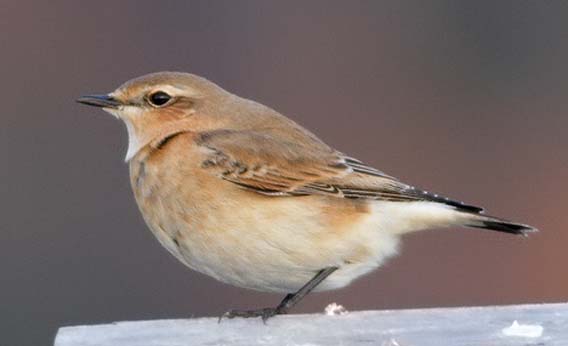
There are other birdwatchers around, all looking for the relevant little bird. We find a somewhat peculiar female wheatear within half an hour, and then another, and another. We soon realise that all female wheatear are somewhat peculiar. None of them seem to have a consistent set of plumage features that they have in common with all the other female wheatears.

northern 3ccccccccc

Nothing for it. We set off down to the lighthouse for a sea watch. Same old place as ever – we set up our telescopes on the slope below the main cliff edge and start watching. No sign of Flamborough’s most famous birdwatcher, its very own “Mr.Sea Watch”, Brett Richards.

twitcher6

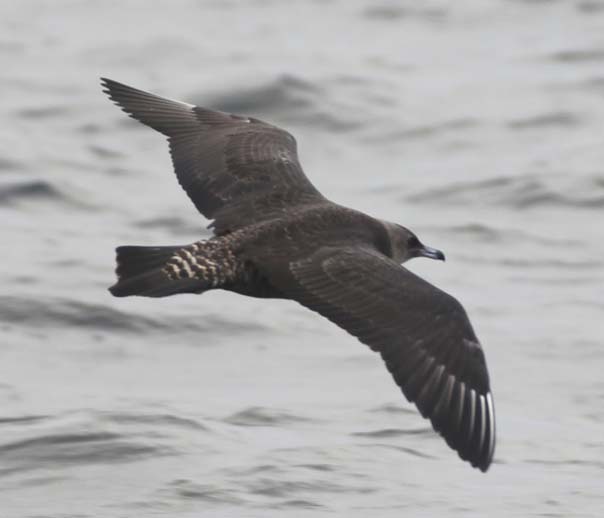
There are some Arctic Skuas moving through and we are able to study their piratical antics in some detail. After about ten minutes I see one all dark bird flying steadily and heavily northwards. Then it seems to remember its error and sweeps back around in a huge arc. Then it starts flying around in very large circles as if it is by now completely confused. On the other hand, it could be some vaguely half remembered display flight of some sort.

Pomarine Skua 4vvvvvvvvv

Whatever the case, it finally stops its circling, makes a half-hearted attempt to harry a Kittiwake and then heads off out to sea. We all pick the bird up and we all agree that at long last, we’ve seen a Pomarine Skua. It’s bigger than all the Arctic Skuas and it’s obviously not a Great Skua. Its flight is heavier than an Arctic and its behaviour is completely different. Every Arctic we have seen today has been energetically and enthusiastically chasing Kittiwakes in a most agile and nimble way. They are all darting, lightly built birds that at no point have shown the slightest inclination to soar or circle like some marine Common Buzzard.
Ten minutes later I find another large and heavy skua but this time, it’s down on the water. Again, its structure is much more solid than the Arctics, its bill is more substantial, its body weightier, and it even has what may well be rudimentary spoons sticking up into the air at the back end.

pom on seacccccc

We watch it for a good twenty minutes as it cruises around, well separate from the rest of the birds on the water. We are all satisfied that it is a first winter dark phase Pomarine Skua.
If we think we’ve had a difficult time of it with bird identification so far, then we are sadly mistaken. In the next half hour or so, we’re going to get into very deep water indeed and I don’t mean falling off the cliff.
We still have the best part of a sunny afternoon left so we decide to walk slowly round to see what we can turn up in the way of migrants. It’s really rather pleasant. A nice day, a blue sky and the hope that more or less anything might be out there for us to find it. We turn up any number of Northern Wheatears, both male and female and a Short-eared Owl, that looks very pale and which we try very determinedly to turn into a Barn Owl, but without any success, because in the final analysis, we just can’t ignore those dark carpal patches. We stop at the top of the cliffs, a little way south of the lighthouse at a point about fifty feet or so above the sea. There are lots and lots of wheatears here, flitting around, most of them near some kind of ruined wooden landing stage.

northrbqqqqqqqqqq

Alan soon spots what he thinks is a funny wheatear and we all set up scopes to examine it more closely. The first and most obvious feature about it is that its eye stripe is not as fully developed as the other birds. It seems to be more buffy, even russetty, in colour and seems to begin further back on the head, almost behind the eye itself.

desert 2ccccccc

The bird, a female, is obviously tired and is harried and picked on by all the other birds. Nevertheless it keeps returning to the landing stage steps and eventually begins to preen. That’s when we realise two interesting things about the bird. Firstly, its tail, as far as we can see, is completely black and although it has a smallish area of white in the top two corners, this is really no more than a slight curvature of the line between the white rump and the black tail. It is completely different from the T-shaped pattern that we have been looking at all day, more or less, on all the other Wheatears. Indeed, we’ve even noticed that with every Northern Wheatear that we’ve seen, this T-shaped pattern may even be visible when the bird is at rest. Not the case with this bird.

Desert-Wheatear-0bbbbbbbbb

The second feature, and for me, the one that clinches it as a female Desert Wheatear, is the fact that as the bird lifts its wing to preen, it reveals a snowy white underwing which is absolutely and totally white, except for a darker line on what must be the trailing edge. For weeks after this I look at Northern Wheatears and cannot find a single one, either in real life or in photographs, that comes even close to our mystery bird in the whiteness of this underwing. There is not a hint of brown or buff, just a brilliant white like a patch of bright fresh snow.
This bird, however, is not terrifically distinctive except for these two features and the eye stripe. This differs slightly from the Northern Wheatear but, in truth, if there is supposed to be a major difference in basic plumage, then there just isn’t one. It is perhaps a little peachier in colour but is not really fundamentally different from the Northern Wheatears that continue to chase and harry it. It is at this point that our problems start, because, as I later suspect, the mystery bird flies off without our noticing it, perhaps because the cliff is overhanging at this point and there is a vast area underneath it that we cannot see. It is certainly impossible to see the comings and goings of every single bird.

norethern flight ccccc

A few seconds later, a Wheatear of indeterminate species comes to perch on the landing stage, just as our bird has on several occasions in the past few minutes. A small crowd of some ten or twelve  birdwatchers has by now assembled, all trying to see whatever we’re looking at but apparently too shy just to ask us. We lead them to believe that this is the mystery bird even though we have not yet seen either its tail or underwing to confirm this. When the bird flies away, of course, it has the T-shaped pattern of an ordinary Northern Wheatear and this leads a high percentage of the new onlookers to think that we are a bunch of complete village idiots. Well, we are, but on the other hand, I know what I saw. And yes, I am more than a little put off by the episode at the end when I was fooled by the Northern Wheatear on the landing stage, but Steve soon calms me down.  He makes the valid point that whatever has happened subsequently, we did all four of us see a female Wheatear with an all-black tail, and an all-white underwing, whatever antics the bird got up to afterwards and whatever skilfully designed imposter came along its place. And surely even the most aberrant of birds could not have two diagnostic features of another species? That discovery would knock the Rarities’ Committee back a bit.
The whole appalling business does have its funny side however, because as soon as the assembled group of eight or ten becomes fifteen or twenty, this is easily a big enough crowd, particularly here at tight-lipped rare-bird-suppressing Flamborough, to attract an even greater number of birdwatchers. Very quickly, we have seventy or so people, all looking downwards with great deliberation.

Somebody on duty in the lighthouse then presumably thinks that one of us has had an accident and perhaps somebody has fallen off the cliff. Perhaps we are all looking at a corpse floating past. Whatever the case, it doesn’t take the RAF Rescue helicopter very long to get here and it soon arrives, a huge  deafening yellow whale that hangs, hovering loudly, about twenty yards from the cliff edge. I can’t really believe it’s here for an unconfirmed report of a female Desert Wheatear. News cannot possibly travel that fast. On the other hand, it would be really tremendous if that were the case and he could use the loudhailer – the electronic equivalent of Kevin’s voice:

“Hey, you on the cliff – yes – you – you on the left – in the green – yes – stop harassing that bird – return to your homes – and by the way, do you know they what they’ve had at Spurn?”

Rescue-Helicoptercccccccccc

Our final gesture is a last bit of seawatching as we give up hope that our Desert Wheatear will return to its original spot and we soon get a superb bit of unusual bird behaviour.

Guillemot06cccccc

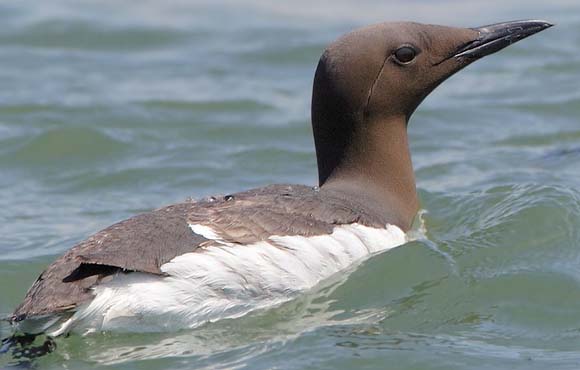
It’s a Guillemot that is performing some bizarre sort of preening ceremony that seems to consist solely of the bird lying flat on its back in the water, with only its beak and its little legs sticking out above the surface. It remains motionless for minutes on end so that it looks just like a man bathing in the Dead Sea or a gigantic dead fly floating around in the bath. A strange end to a puzzling day.

3 Comments

Filed under Aviation, Humour, Twitching, Wildlife and Nature

A Greater Sand Plover? A Lesser? A Medium Sized??

(An extract from my old birdwatching diary “Crippling Views”)

Sunday, July 31, 1988

This Sunday, Ken is planning to go out somewhere, out there into the universe, to look for a decent bird (the story of his life actually). I get onto Paul, and between us we persuade him to go for the Greater Sand Plover in Cumbria, at a nature reserve on the Isle of Walney. It’s about 8,000 miles from Nottingham, but not too far for Ken and his Ford Escort XYZ 3i with Turbo intercooling and reheat.

-Ford-Escort-zzzzzzzzzz

Ken takes the concept of distance as a personal challenge. He occasionally gets under 70 miles an hour, and if the car’s on four wheels, he’s parked it. I’ve never even dared to tell him the type of car that I drive, GUR 25N, a bright orange Volvo 240 that weighs approximately the same as a canal barge.

volvo-240-hmb-645-n

To our great surprise, Ken agrees to go for this bird. He isn’t usually into twitching, since he dislikes crowds, (he has been a keen Notts County fan for years), and he much prefers a quiet stroll around North Norfolk, in the hope of finding his own birds.

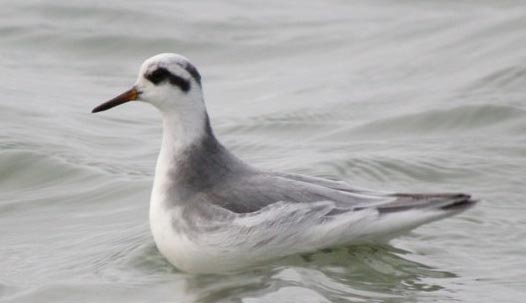
First of all, we scorch to a pool in northern Lancashire, where a Grey Phalarope has been present for the last few days. It’s there when we arrive, but I am surprised how different it is to the individual I recently saw at Datchet Reservoir near London. It’s very active, flitting around the lake, and very loathe to come too close inshore. There are one or two birdwatchers there, but not very many. It makes me wonder where all the locals are. Do they know something we don’t?

Grey%20Phalaropexxxxxx
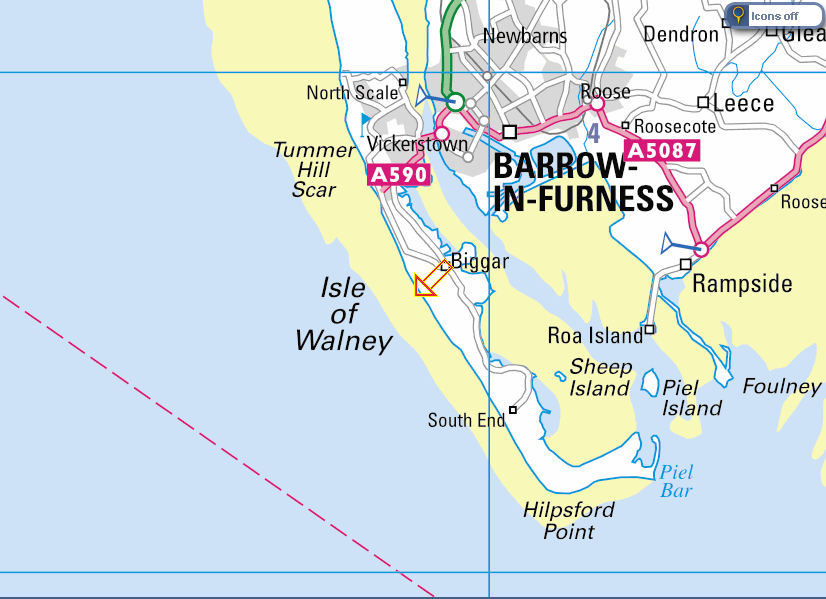
Onward and ever northward (look for the orange arrow).

north of englaND ZZZZZZZ

We leave the M6 and strike west towards Walney, passing our first patches of winter snow, and the odd few ragged beggars at the side of the A590. Just before we arrive at the Isle of Walney, we have to travel through Barrow in Furness, a really remarkable town. Most of it appears to be a single solitary shipyard, surrounded by thousands upon thousands of grey terraced houses, all clustered around the dock cranes for safety. Why is there nobody up there filming adverts,? Or those half hour documentaries that they put on after “The Bill”? Perhaps because overall, it is a grim, grim place, although nowhere near as bad as some of the localities I am yet destined to visit.

walney islandzzzzzz
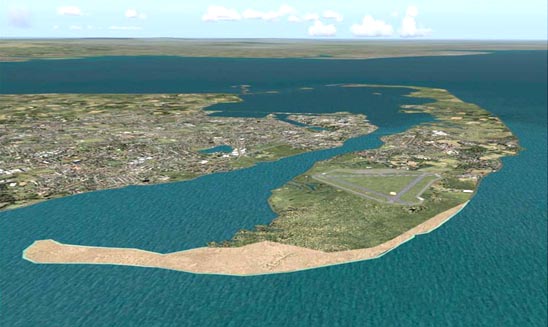
The Isle of Walney itself is a peculiar place, a bit like a grassy, tussocky version of Spurn Head. It has an infinitely worse road, though, but those years of training at Minsmere and Holme finally pay off. Unfortunately, we are not able to locate the appropriate turnoff for the bird itself.

walnet aerilxxxx

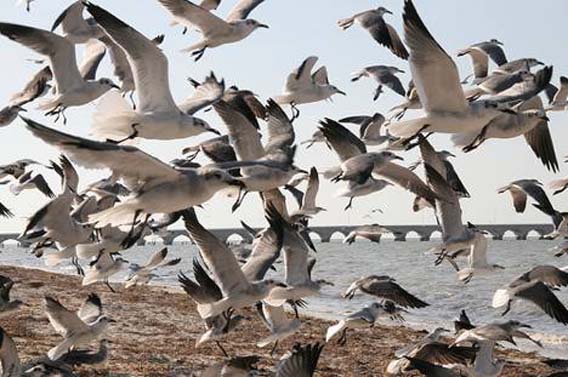
The tiny dirt track is supposed to be on the right, near the village rubbish dump, but we eventually have to go to the very end of the “road”, having fought our way past the thousands upon thousands of rather large seagulls that sit lugubriously around, all waiting for a piece of carrion to fall out of the sky at their feet. It reminds me very strongly indeed of the ending of “The Birds”, that well-known RSPB / Alfred Hitchcock co-production.

seagull-flock-jj zzzzzzzzzzz

The warden is tremendously friendly. We are the first people he has seen in four years. He explains that he has put up a sign at the side of the road, indicating the correct path to take. It’s not his fault that it’s fallen over. Anyway, all’s well that ends well, because we eventually do make it to the right bit of seashore. There is only one birdwatcher there, a local who says that the Sand Plover isn’t there, but not to despair, since it will be somewhere around, just waiting for us to refind it. And sure enough, one person, in the slowly growing knot of birdwatchers, does in fact refind it, after a delay of some twenty minutes or so. It’s with a largish group of Ring Plovers, and is a very distinctive pale brown. It’s extremely fluffy looking for some reason, and lacks the sharp black-and-white contrasts of its temporary colleagues. Indeed the Sand Plover is well capable of disappearing into the shingle very easily. It’s exceptionally well camouflaged, and tends to be obvious only after it has moved.

greater sand

The bird has, of course, been the subject of some pretty intense discussion about whether it is perhaps a Lesser Sand Plover and therefore a potential first for Britain. I’m only too happy to accept the views of the experts on this one, but nevertheless, our bird here does seem to have what seems to me a very small bill. Unless, of course, a Lesser Sand Plover has an extremely teeny-weeny-weeny-teeny bill, just like a pimple on the front of its head.

This lovely film was taken by Terence Ang in the Sand Plover’s usual habitat, in Hong Kong.

Having got over the excitement of seeing the bird, there is not a lot to keep us here. The day is bright, but the wind is strong, and rather gusty, and there are very few passing seabirds to look at. Locals say that sea watching here is generally very poor, and the only thing of interest that I can see are the tops of several obviously gigantic factory chimneys, just over the horizon to the North West. I never do find out what they are… Southern Scotland, the Isle of Man, or even Ireland. I don’t have a clue, and neither do any of the people I meet. I get the impression that I’m the first person who has ever noticed them. Perhaps they are an illusion… Some kind of mirage, reflected from the eastern United States… Perhaps they are a hologram of Three Mile Island, being transmitted as part of the twinning process with Windscale. (or is that Seascale?)

chimneys

On our way back, we call in at Leighton Moss in Lancashire.

Leighton0Moss

I am obsessed with the desire to see a Bittern.

bittern xxxxxx

No luck, of course. Although this is the furthest north that Bitterns breed, and is, in actual fact, one of its strongholds, I don’t manage to see one. Apparently, the water levels are too high, and have forced them back into the reeds. What we do see however, are three juvenile Marsh Harriers, because this year the birds have bred, and have produced five young. It is particularly nice to see them in a new breeding area. It gives you a nice warm feeling inside to see a place where rare birds are on the increase rather than disappearing for ever.

Juvenile Marsh Harrier, Cley, Norfolk, August 2006 (Steve Gantlett).

That apart, I find Leighton Moss to be a somewhat boring place. There seem to be very few birds about, and if anything, the birdwatchers may actually outnumber them. The old out-of-date Annual Reports that they are selling off in the reserve shop are right little scorchers too.

5 Comments

Filed under Humour, Personal, Twitching, Wildlife and Nature

Gunpowder, treason and Nottingham

Not many people would connect the High School and Guy Fawkes’ Gunpowder Plot, but the link is there, if you trace it through carefully……

…..Brian Garnett, or Garnet, is thought to have been the Master of the Free School during some unknown period between the years 1564-1575.

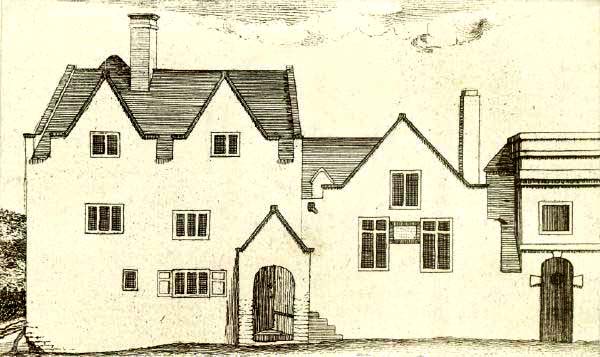
free school

It is considered most probable that he took up the post between 1564-1567, and then retired in, probably, 1575. He may then have lived in Beeston, but he was certainly buried in Heanor in Derbyshire on December 21st 1576, as the “Late Skoolemaster of Nottingham”.

With his wife, Alice Jay, he had at least three sons, Richard, John and Henry, and three daughters, Margaret, Eleanor and Anne,  all of whom became nuns at Louvain.

Of the sons, Henry is the most notable, because eventually he was to become the Superior of the Jesuits in England, and, allegedly, an active member of the Gunpowder Plot which, in earlier centuries, often used to be called the Gunpowder Treason Plot or the Jesuit Treason. In general terms, the plot, of course, was a failed assassination attempt to blow up the Protestant King James I of England and his entire Parliament, by filling the cellars of the building with gunpowder. lighting the fuse, and retiring quickly and sensibly to a minimum distance of at least fifty yards.

GunpowderPlot dddddddddGarnet was not quite tasked with carrying the barrels of gunpowder into the cellars, but rather, he was deemed to have been guilty of knowing all the details of the assassination attempt, but then doing nothing to save either the King’s life or those of his courtiers. Here he is….

google 2 zzzzzzzzz
In recent times, some doubt has been cast on the extent to which Garnet was actually aware of the dastardly plot, because all the details he knew were revealed to him through the plotters’ confessions. Of course, by the strict rules of his Catholic religion, Garnet was automatically prevented from informing the authorities by the absolute confidentiality of the confessional.

None of this alters the basic fact, though, that Henry Garnet was executed for treason, on May 3rd 1606. At his trial, the jury had needed only fifteen minutes to reach their verdict.

Where the tiniest of doubts still exists, however, is whether Henry was ever a pupil at the Free School, as no registers of this period are still in existence. It is certainly true, though, that he was educated in Nottingham, and the national rules in place at the time allowed only one school in each town or city. In any case, it is surely beyond credibility that he was not associated with the Free School during his father’s tenure of the position of Master, that is to say, the only teacher who was working there.
Indeed, at least one source says that young Henry came to the Free School during Henry Cockrame’s time as Master (most probably 1563-1564), possibly a year or so before Cockrame left in 1565 and was replaced by Henry’s father, Brian Garnett of Heanor, Derbyshire. Henry is supposed to have studied for two years under his father’s tutelage, before leaving for Winchester College where he was elected as a scholar on August 24th 1567 and duly entered the school in 1568.

WinCollege1_ccccccccccccccccc

Henry had been well taught in Nottingham, and proved to be an able student at Winchester. According to “The Oxford Dictionary of National Biography”…..

“His love of music and “rare and delightful” voice were complemented by an ability to perform songs without preparation, and he was reportedly also skilled with the lute.
Father Thomas Stanney wrote that Garnet was “the prime scholar of Winchester College, very skilful in music and in playing upon the instruments, very modest in his countenance and in all his actions, so much that the schoolmasters and wardens offered him very great friendship, to be placed by their means in New College, Oxford.”

Instead of the delights of New College, Oxford, however, when he left the school in 1571, Garnet moved to London to work for a publisher. Shortly afterwards, in 1575, he travelled to the continent and joined the Society of Jesus. Garnet then moved to Rome to study for the priesthood with the Jesuits. He was finally ordained as a priest around 1582. (Note the ear of corn which will be important)

henry again xxcccccdxdx

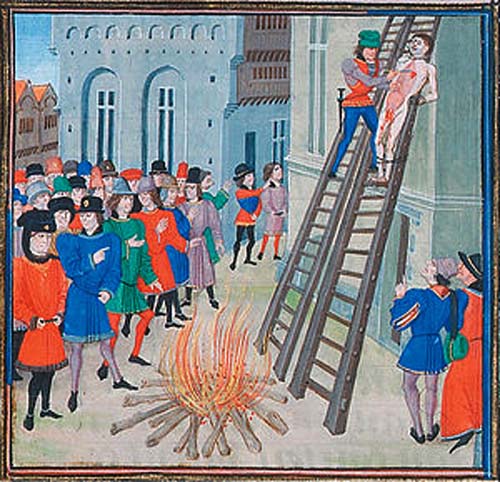
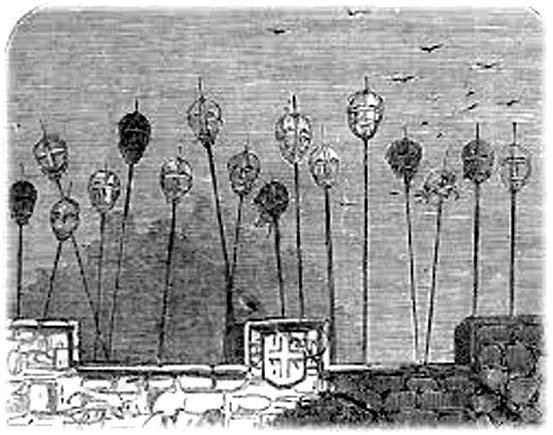
Whatever happened in his life during the next twenty three years in the service of the Lord, by virtue of the events of May 3rd 1606, Henry Garnet must surely remain the only Old Nottinghamian ever to have been convicted as a terrorist, and, indeed, one of the very few ever to have been hanged, drawn and quartered, and then to have had his severed head placed on a pole on London Bridge.

Froissar txxxxxxxxx

(That’s going to hurt)

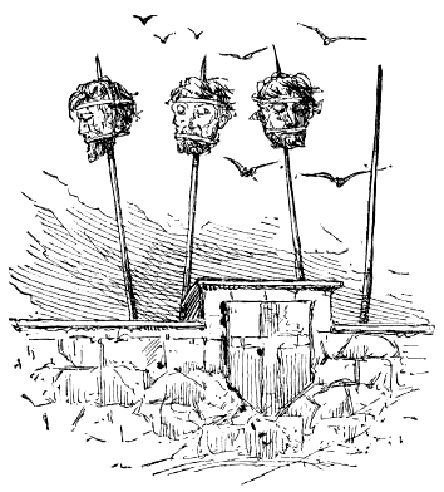
Heads_on_spikes xxxxxxxxx

(This engraving will be next month’s Caption Contest)

Thankfully, the more lurid details of his execution have survived in Antonia Fraser’s book, “The Gunpowder Plot”…..

“Garnet said his prayers, and was then thrown off the ladder and hanged.

beforfe execuion xxxxxxxxxx

Before the executioner could cut him down alive, many in the crowd pulled on his legs, and as a result, Garnet did not suffer the remainder of his grim sentence. There was no applause when the executioner held Garnet’s heart aloft and said the traditional words, “Behold the heart of a traitor”.
His head was set on a pole on London Bridge, but crowds of onlookers fascinated by its pallid appearance eventually forced the government to turn the head upwards, so its face was no longer visible.”

From this peculiar pallid appearance of course, came the widely held belief that Garnet’s head did not suffer any signs of decay or change.

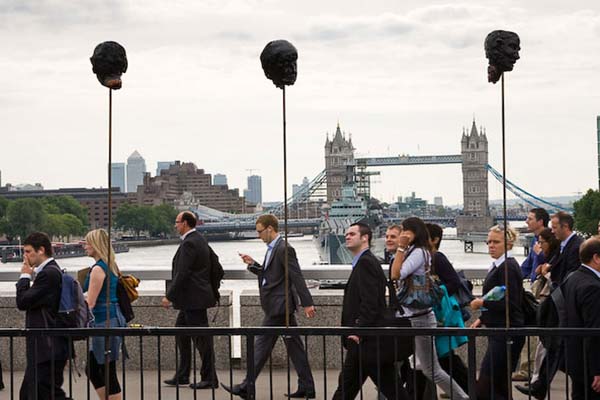
nov 4th heads xxxxxxx(Can you spot Garnet’s head?)

Nowadays, of course, we are a lot more civilised and the heads of traitors are no longer placed on a pole on London Bridge. Instead, we have just two or three of the more unsuccessful Premier League managers.

modern cddddddddddd

(Why is nobody taking any notice?)

The final, and a slightly more serious thing to be said about Henry Garnet is that way back on May 3rd 1606, according to those who were there, a miraculous portrait of him apparently appeared on an ear of corn onto which drops of his blood had fallen at the moment of his execution. This particular ear of corn was later credited with achieving a number of miracles. At one point, it was taken secretly out of the country into the possession of the Society of Jesus, before, with its size surely playing a part, it was lost, rather appropriately, during the French Revolution.

-Portrait_of_Henry_Garnett zzzzzzzzz

The Roman Catholic Church, of course, has a large number of saints who have done far less than Henry Garnet to earn their sainthoods. Names which spring to my mind would include St.Buriana, St.Erc, St.Ia and any number of Cornish villages named after other dimly remembered saints.

Perhaps one fine day, Henry Garnet may yet become the only Old Nottinghamian ever to be canonised.

Leave a comment

Filed under History, Humour, Nottingham, Politics, The High School

The Diary of S.A. Casswell, 16¾

Four or five years ago, I had a phase when I bid for a few diaries on eBay. One particular diary that I bought was the “Charles Letts Schoolboy’s Diary for 1935”. The inscription on the inside front cover reads “With Best Wishes for a Happy Christmas and the New Year from Johnie” (sic)

Typical of a boy perhaps, the diary is barely filled in at all, and where it is, it is helpfully done in his own personal code. Whatever happened on June 11, it was 7  I  T and so was the previous Tuesday, June 4th.  June 3rd, however, was 8 Sw I T. January 1st was  “9 Sp I Party” and January 2nd was “Rec. Card (New Year). February 20th was “Sp.I. Party  T.Lodge”. It may be that the owner was using his old 1935 schoolboy diary to record events when he was in the R.A.F. (see below). This would be because it was not allowed to keep a diary in the British Armed Forces, in case you were captured, and your scribblings were of use to the Nazis. This cunning plan is certainly implied by his entry for January 16th which reads “Night Raid on Berlin 1943 spoke to one pilot”.

I  know only the young man’s surname and initials. He was called S.A.Casswell and he lived at a house called “Tudor Lodge”.

This slideshow requires JavaScript.

This pleasant house was in the rural village of Sutterton, which is near Boston in Lincolnshire.

This slideshow requires JavaScript.

S.A.Casswell  weighed nine stone seven pounds and was five feet seven inches tall. He took a size eight in gloves, a size seven in boots, a size one in collars and his hat was a six and seven eighths. His birthday was on August 25th 1919, so he was fifteen when he received the diary as a Christmas present. He seems to have liked it so much, that he didn’t start entering anything into it until possibly early 1937, when he would have been sixteen years old. Sadly, the very fact that I now possess his diary must surely mean that S.A.Casswell is no more. On the other hand, a quick search of the Commonwealth War Graves’ Commission website reveals that at least he did not die before his time in battle.

His bicycle frame number was Y27697 and his Unemployment Book serial number was 3243. He went to school on the 7.50 a.m. train, and possibly came back home on the 5.24 p.m. He only lists two trains which will take him to school but he lists a total of six trains which will bring him back home. They are the 11.30 a.m., the 2.46 p.m., the 4.10 p.m. (on Saturdays only), the 5.19 p.m. and originally the 7.50 p.m. although this was replaced by the 8.40 p.m. in later years. At school he did not study Scripture but he did study Arithmetic and Algebra and Geometry and Trigonometry and Mechanics. He studied Physics and Chemistry and Botany with English Composition and English Literature, along with History and Geography and Latin and Art. He has not recorded any of his marks in tests and exams, so he was either not particularly outstanding, or perhaps, extremely modest. For some peculiar reason, he has pasted a receipt inside the front cover of the diary. It is for the three pence  to join the Literary and Debating Society at school on October 5th 1937 when he not only paid out the money to join, but signed the receipt for it as well. Perhaps he was later to go into banking, or maybe even politics.

Casswell didn’t use his piece of “Forbes Blotting” which is still inside the diary as a free gift, but he has given us one or two really interesting insights into the life of a schoolboy. He certainly had some kind of interest in sport. He has recorded the fact that in 1934 and 1935 Cambridge won the Boat Race by adding it in pencil at the end of the printed list. On the page which records the athletic records for universities and schools, he has written what are now incomprehensible figures underneath the one mile, long jump and high jump. He has also inserted performance figures for Spalding Grammar School which may or may not have been achieved by him. For the hundred yards, for example, the school record was 10.6 seconds. For 220 yards the record was 24 seconds, for 440 yards the record was 55.6 seconds by P. Nicholson in 1933, for half a mile it was 2 minutes 14 seconds, and for a mile it was 4 minutes 57 seconds. For the long jump, J.B. Britain achieved 19 feet 8¾ inches in 1937 and H.G. Harrison or perhaps Hugh Harrison threw the cricket ball the magnificent distance of  96 yards 1 foot 2 inches in 1937. The high jump record for the school was 5 feet 1½ inches. This was achieved in 1938 and equalled in 1939.

He has recorded the books which he has read, although strangely they are both dated “1937” in this “1935” diary. Typically for a boy perhaps, he has read only two books. They are both by H.G.Wells and they are called “The Camford Visitation” and “Star Begotten”. Both of these were written in 1937, so they were pretty well hot off the presses.  The former work cost him the princely sum of two shillings. The latter book was one of the first, if not the first, to postulate the idea that aliens are visiting the earth to modify Mankind genetically, a scenario familiar to anybody who has dared to look into the vast internet swamp of claims regarding alien abduction.

It is only when S.A.Casswell lists the films that he went to see at the cinema, presumably in Boston, that we realise what a fascinating and attractive world the silver screen must have been for a boy, or a young man perhaps, of 16 or 17 years of age. I will just list the films that he saw, and their connection to the Internet.

There is a vast variety of films that he watched and they do not include those whose titles I have quite simply been unable to decipher. Presumably, in the absence of television during the 1930s, a weekly visit to the cinema must have been the norm for almost every family that could afford it. It is equally striking that even with the other six evenings of the week left largely vacant, this young man seems not to have been over tempted by the opportunity to read books…

Jericho,   Wee Willie Winkie,  Victoria the Great  , The Littlest Rebel, Green LightFive over England Three Smart Girls,  Take my Tip   ,Storm in a Teacup  The Prisoner of Zenda Souls at Sea   Oh, Mr. Porter!   The Squeaker  A Star is Born Dr Syn   Marie Walewska   Hells Angels    A Yank at Oxford   The Count of Monte Cristo    Snow White and the Seven Dwarfs Pygmalion    Blockade   Black Limelight   The Adventures of Robin Hood Kidnapped   Sixty Glorious Years   Alexander’s Ragtime Band Crime School If I were King   

“Crest of the Wave” and “Lot’s Wife” were both theatrical plays rather than films. He saw “The Prisoner of Zenda” while away at Oxford.

Man with Wings The Dawn Patrol  The Citadel  Angels with Dirty Faces That Certain Age  with Deanna Durbin, Old Bones of the River   with Will Hay You Can’t Take It with You It’s in the Air  and finally, Everything Happens to Me with Max Miller.

S.A.Casswell has recorded only one address in the relevant section. It is Roy Daughton who lived originally at 385, Kings Road Chelsea S.W. 10. Roy moved subsequently to 5, Gerald Road S.W.1 on an unknown date.

And that is probably all I will ever know for definite about S.A.Casswell. I did though make a more determined effort with his private code and came to what I thought was a reasonable explanation of events. As I said earlier, the major problem with the diary is that so many entries are in code, and they appear to be spread over several years. Nowadays, it is going to be extremely difficult to be absolutely certain about this code, given that the entries may refer to completely different circumstances. However, if we accept that S.A.Casswell, at the shy and tender age of 16¾ was sweet on a girl whose name began with a letter I then there is some kind of sense to it all. “Sp.I Party” therefore means that he spoke to Irene or Iris or even Ianthe at a party. “Rec. Card” means that he received a card from her for the New Year. “Ph to I” may well mean “Phone Irene”, and he may have done this after the “Panto” on January 16. On this date, there is another entry, an RAF one, which says “Night Raid on Berlin 1943 spoke to one pilot”. Towards the end of January he starts mentioning “Sp.I Cd  Pty  Ddke” and this is clearly something to do with the girl. On January 25, 1938 the Aurora Borealis was visible mainly from 6.30 p.m. until nine o’clock, but it then persisted to a lesser extent until at least midnight. On January 29th he has written “Three leave began” (an RAF reference?) and “Ph to I re tomorrow”. The next day, it is “Avec I 4 party at Peterboro”, presumably the day he invented texting.
In February, there is more French, with “Avec I 9 pty to Dnce Gldrdrm.” Presumably he is just missing out the vowels in this last entry. From then on S.A.Casswell’s diary is a mixture of, we presume, speaking to Irene at various venues, including the Post Office, and going to parties. There was an election on April 5th when he spoke to Irene, perhaps, at Tudor Lodge.

On April 8th we have “Sp I (drawing of a bell) W.D. avec C.C.”. On May 3rd we have perhaps “I and L ( with a square drawn around it) and “first-time” also in brackets. He saw I again on May 10th and two days later, he spoke to her again on the day of the Coronation. On May 31st he spoke to her at the tennis courts, and on June 2nd he heard, perhaps optimistically,  of the “break with Nigel”. On June 5 he played tennis with her. On June 13th he spoke to her but also wrote the enigmatic “gulls etc” alongside this entry. On July 4th he wrote “ I at Hendon phone”. On July 30th he played tennis with her again ( Plyd T. avec I.). On August 4th he went on holiday to Cornwall and Devon, visiting Cheddar, Penzance, Looe, Torquay, (when he got the Inter Science result) then Minehead and Burford before coming back on August 7th. On August 13th he went with “ I & six to Butlins & on the thriller”, presumably a fairground ride of some type but he also received his Higher result . On Saturday, August 31st, S.A.Casswell went on holiday again at exactly 10.30.a.m. visiting Oxford, Trinity and Stonehenge of which he has drawn a lovely little pencil sketch.

Stonehenxxxxxxxx

He finally arrived at Bournemouth at 9.00.p.m.On September 2nd, he went to Poole Potteries where he sketched some of the pots.  The next day, he sailed around the Isle of Wight in the “Emperor of India”. He saw the Needles, Southampton Water, the Spithead forts, a submarine and an aircraft carrier. In the evening, he saw a variety show at the Pavillion (sic) in Bournemouth. On September 4th, he crossed Poole Harbour by ferry and visited “The Great Globe” and then the Tilly Whim Caves near Swanage. In the evening, he visited the illuminated gardens and fountain at Bournemouth. On the 5th, it was tennis at Meyrick Park followed by Lulworth Cove and the Cordite Works until continuous rain from 6.00p.m. brought the day to a close. Next day, there was a Buckhound meet at Barley, he bathed, he visited the library and museum, and then walked through the town and gardens. On Saturday he “went on (not in) the Boating Lake at Parkestone” before watching “Fanfare” at the Palace Court. He returned from his holiday on September 8th.

This slideshow requires JavaScript.

“Sp I” continues fitfully through September and October but there are few entries in either November or December, so it looks as if the romance may have petered out. He seems to have spoken to her on occasion over the Christmas period, including Christmas Day itself, “9 Rec Card. Sp I  Pty Ddk”. On December 30th he seems to have “See I Bycl St Rd” where “St” must surely mean “Station”. He spent his last day as he had most of the year “Sp I Party Tud Lod”.

I did make valiant efforts to trace his rather distinctive name on the Internet, and this was not a total failure. During the Second World War, I found an S.A.Casswell who was in the R.A.F. Perhaps because he had studied Arithmetic, Algebra, Geometry, Trigonometry, Mechanics, Physics and Chemistry,  this  S.A.Casswell was a Meteorological Officer. He worked on the staff of the Meteorological  Office itself, rather than being attached to an individual squadron and lecturing aircrew about likely weather conditions before they flew off into combat. In 1998, what must surely be the same man, still living in Boston, Lincolnshire, appears as the author of an abstract entitled “A wind-direction display system”.  His subsequent death at home in Milnthorpe around November 29th 2007 was then announced on the Society News page of the magazine “Weather”. Unfortunately, there are two Milnthorpes, one near Wakefield in Yorkshire, the other a much likelier place to retire to, perhaps, on the coast of Cumbria, near Kendal and the Lake District. The paper “A wind-direction display system” was then posted posthumously on the Internet on April 30th 2012.

I was unable to discover if this particular S.A.Casswell  was married, and if so, what was his wife’s first name. Hopefully, it was Irene or Iris or even Ianthe.

2 Comments

Filed under History, Humour

Next door’s cat, Secret Agent 007

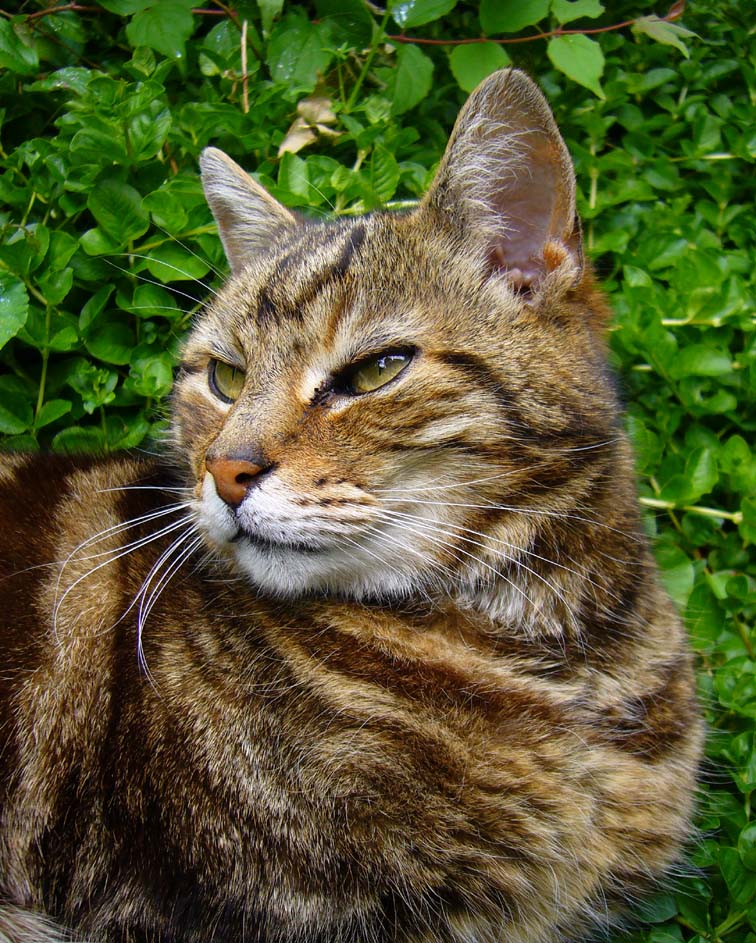
To his neighbours, this individual always used to be regarded, quite simply, as “next-door’s cat”.

P1270936XXXXXXX

We did not know that he was a deeply placed secret agent. Fifteen years ago, he was an inhabitant of London, the abandoned offspring of unknown feral parents. He was saved by his present owner who took him in as a very tiny kitten and fed him milk through a pipette hour after hour, day and night, until he was big enough to feed himself. And she continues to feed him generously, every day, and he sleeps in her house every night. He is, we all presume, her cat.
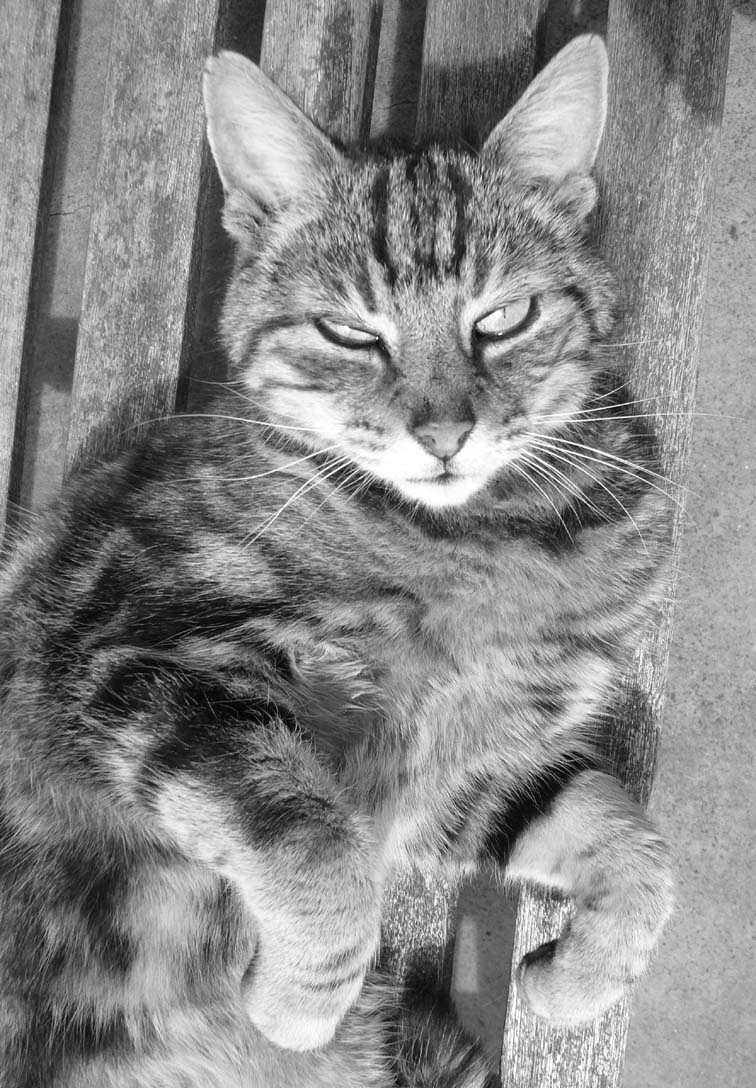
Occasionally, when her little boy gets a bit boisterous, and feels like a good chase game, the cat, who rejoices in the name of Ying Yang, will come over to our house for a few hours. His favourite occupation is lying on the very same wooden bench which used to be in the garden of my parents’ house, and on which their own cat, Sam, loved to sun herself.

This slideshow requires JavaScript.

Imagine my wife’s amazement, though, when she went up the Avenue to check arrangements with our neighbours about where our visiting builders’ van might park. Not only was Ying Yang there, but he had his very own food bowl. The neighbour sincerely believed that he had taken in a stray cat, which now belonged to him, because he fed it copiously on a regular basis. He did not know where his cat went to at night, but that didn’t matter because lots of male cats like to wander around during the darkness hours and then return in the morning.

The most amazing thing, though, was that Ying Yang himself quite clearly recognised my wife, but pretended not to. He ignored her totally. That may sound a little anthropomorphic, but she is absolutely certain that that is what he was doing.
You can imagine how pleased his real owner was when she heard of Ying Yang’s secret life, as somebody else’s cat.

P1280083ZZZZZZZZ

The amazing thing, though, was that even on a minimum of at least twice the meals he should be getting each day, he doesn’t really seem ever to put on too much weight. That makes me feel very jealous indeed!
How many cats do this? How many spend part of the day and the night with one owner, and the rest of the time with what we must consider the victim of a very slick confidence trickster?

1 Comment

Filed under Humour, My Garden, My House, Nottingham, Wildlife and Nature

Boot the Caretaker

Sir Jesse Boot, later the First Baron Trent, was, of course, a very famous figure in the history of Nottingham. In the High School, however, far more famous was Bill Boot, the school caretaker during the middle period of the twentieth century.

The school looked roughly the same in those days as it does now, except it was black and white.

bulletin_24_1403256831_2052%20Nottingham%20017

This photo shows the boys leaving school around this time.  Look at the great variety of means of transport compared to today…

around this time

Bill Boot was a much loved figure as the school caretaker, and in December 1949, the following poem appeared in the school magazine. It was a much modified version of the original, which was written by Lewis Carroll and appeared in his book “Alice’s Adventures in Wonderland”, published in 1865.

This slideshow requires JavaScript.

It was written by F.Martin Hall and John G.Golds, and was dedicated to Mr.Boot…

“To Bill Boot on his 70th birthday

You are old, Father William, the schoolboy said,
And your tooth is of marvellous length,
Yet your tap on the door makes the whole building rock,
Where on earth do you find all that strength ?

In my youth, said the Sage, when I fought for the Queen,
Frequent exercise, Generals demanded,
I chased Kruger each morning around Spion Kop,
Do you wonder my muscles expanded ?

You are old, Father William, the schoolboy said,
And your hair has long since turned quite grey,
Yet your voice like a clarion round the School rings,
How d’you manage such volume, I pray ?

In my youth, said the Sage, when I served with Lord “Bobs,”
His commands could not travel by wireless
So I bawled them (in code) right across the Transvaal,
And my throat, by this means, became tireless.

You are old, Father William, yet your eagle eye
Seems as bright as the stars high in heaven,
Pray, how does your eyesight thus function so well,
With no help from Aneurin Bevan ?

I have answered your questions, the wrathful Sage said,
And as sure as my name’s William B.,
If you pester me further, my patience will go,
So be off, or I’ll put you in D.

(With apologies to Lewis Carroll. In the last verse it was considered impolite to suggest that Mr. Boot would actually threaten to kick anyone downstairs.) ”

Bill Boot retired as school caretaker only a year later in 1950, after twenty-eight years’ service. He was replaced by Mr.T.H.Briggs, who had previously worked as a policeman in the city.

Bill Boot had been in the British Army and had fought bravely in the Boer War of 1899-1902. He was famous among the boys for his rapid, shuffling gait, and his extremely rapid speech, which, with his accent,  frequently became almost unintelligible.

Bill’s hobby was fishing, and he travelled widely at weekends. When he retired, he received a small pension, but, alas, he did not live very long to enjoy it, as, tragically, he was killed as he was crossing the road on December 7th 1952. As far as I know, no photographs of Bill Boot have survived, and only Old Boys in their seventies would now be able to remember this fine gentleman “of the old school”, as they say.

1 Comment

Filed under History, Humour, Literature, Nottingham, The High School

Sausages for tea, and lots of ’em!

Last night I once again sat down to watch my heroes, the Hillbilly Hunters, set off in quest of monsters, this time to Hocking Hills, Ohio, in search of the legendary Hogzilla.

big castThis thousand pound porker is a hybrid of two closely related animals. His fierceness comes from the introduced feral pig that the Americans call by many different epithets, including the Russian Boar, the Razorback, or the enchanting “Pineywoods Rooter”.  His size comes from the huge, overfed and genetically modified farm pigs, such as we see in the fields as we drive north of Nottingham on the A614. The American equivalent is the beautifully deep red coloured “Duroc pig”.
Given his enormous size, his sharp, twelve inch long tusks and his desperately aggressive temperament, Hogzilla is a genuinely fearsome beast who will kill you if he can, and eat you if he is hungry.
The task is defined here…


Here are the first stages of the final night hunt…

And, for the first time ever, SUCCESS!!!!!
“Hogzilla” is suddenly “Trapzilla”.

Within a couple of days, he will make 500lb  of sausages. Hurrah!!!

bill and knifexxxx
On a more serious note though, towards the end of the third video, Trapper make some very pertinent comments about the accuracy of the evidence given by even the most honest of eyewitnesses, especially when they are frightened.

Leave a comment

Filed under Cryptozoology, Humour, Nottingham, Wildlife and Nature

Builders and plumbers transform the house

Last week we had the builders and plumbers around to our house to put in a new central heating system. At first it felt exactly as if the whole building had been hit by a tsunami. Not quite as dramatic or as destructive though as this one…

The problem was that every one of the six men was armed with his very own Mjölnir, his very own Hammer of Thor, with which he was capable of sending thunder echoing round the house whenever he felt like it.
P1000861

In actual fact, it was more that the jobs they had to do in the first couple of hours were by far the noisiest of the entire four days. Believe me, a dining room is no is no place for a pneumatic drill.

In 2013 we had the same company come round and put a multi-fuel stove in our living room. We were sick and tired of the money guzzling gas fire, to which the only other solution was to switch on the central heating for the entire house.  Here is our first stove which was put in last September.

P1280841 yerty

Over the course of the winter therefore, we lit our new multi-fuel stove in the late afternoon, and after feeding it sparingly with coal for the evening, we then discovered that it would then keep the room pleasantly warm for the whole night and for much of the next day. In addition, it also kept the bedroom above equally lovely and warm. Only very infrequently were we using the central heating.
We soon realised that having a second stove fitted in the dining room at the back of the house might have the same effect and save a great deal more money. So, as well as having our central heating revamped, we were having a second stove put in.

In the dining room, we had a ten or fifteen year old gas fire. It always seemed to remind me of somebody, perhaps a character out of Wallace and Gromit.

P1000846 y
First of all they removed the gas fire. Here is just a small selection of the rubble that the builders created. Notice though, that it is neatly put into special plastic buckets, so that nothing whatsoever remained at the end of the day.

P1000870 rtyuiop
Here is the old gas fire, and the old radiators, gone for ever…

P1000871qqqqqqq
The majority of the old radiators had to go. They had been there since probably the mid-1960s. Here, plans are being laid to put the new boiler in the bathroom where an old cabinet had been.

P1000876 tyuerw
In the loft, the old boiler had come to the end of the road. The fat lady really had sung for the last time.

P1000878 ccccccc

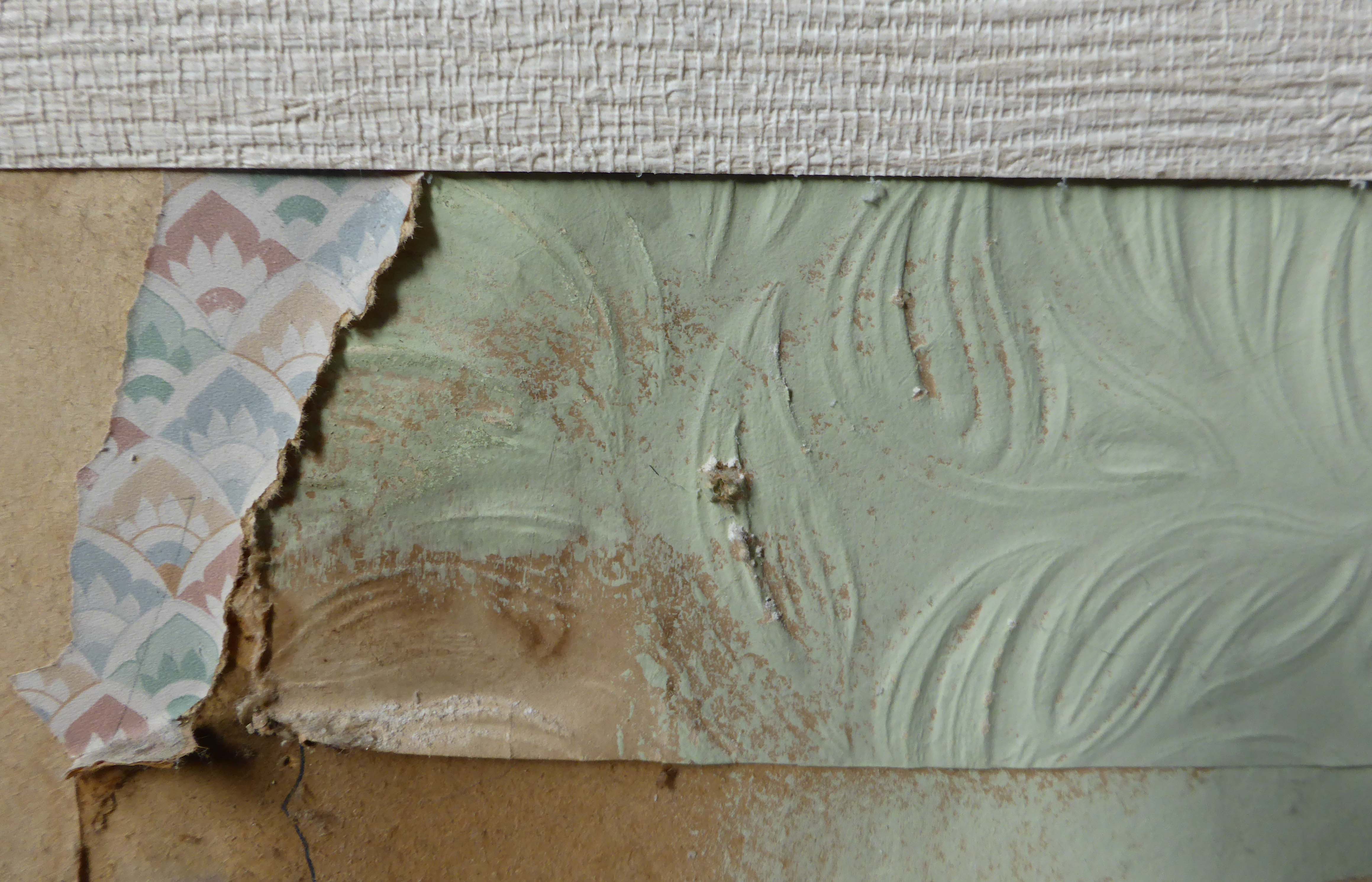
Unfortunately, here and there, the wallpaper will need repair, but there are very few things that a Pritt stick will not be able to remedy. In actual fact, in some places, a number of different layers of wallpaper were revealed.

green etcwewewewe

The top pale green one, I think, was our responsibility but the green leafy pattern looks to me to be either 1940s or 1950s, and the relatively bright coloured wallpaper to its left dates from the more optimistic days of the 1980s.
Here you can see not only Mjölnir, the hammer of Thor, but also the pneumatic drill which caused all the scariest noise for the first half hour or so.

P1000887a hjhjhjhj

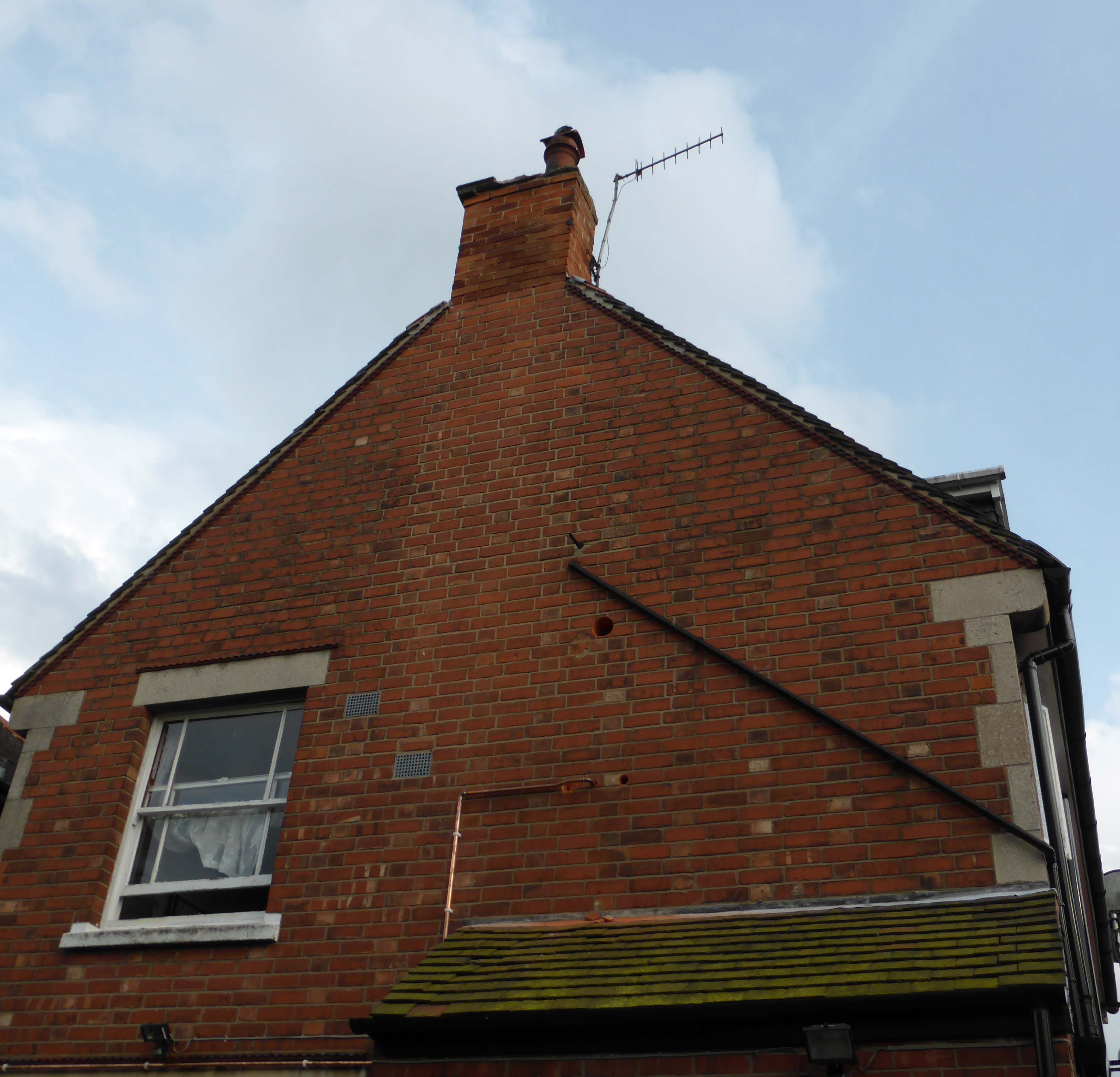
The chimney had to be inspected. Would an eighty year-old chimney be up to the job, or would it require extensive and expensive repairs? Well, what do you think?

P1000889 zzzzzzzzzzz
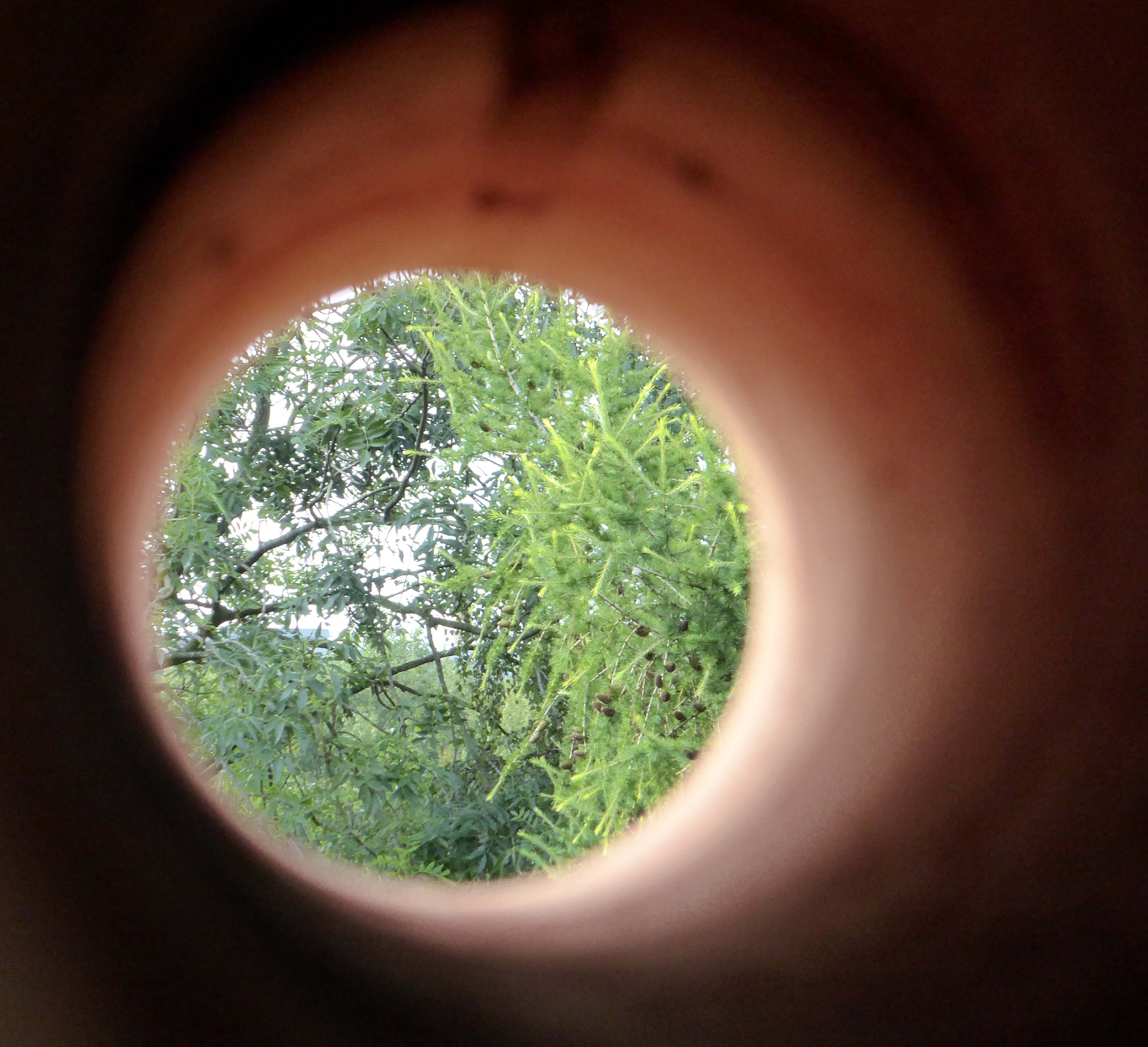
This hole, drilled in the bathroom wall for the new slimline boiler, gave a view over the garden which could be enjoyed for only twelve or so hours in nearly eighty years.

P1000891 jklnmjklnmjklnm

The princess of boilers is now in place.

P1000893  mmmmmmmmm

Meanwhile the new fireplace will need some imitation bricks. The builder works so fast his trowel is just a blur. Behind him is the Safety Superintendent.

P1000912 ggggggg
At last everything is ready. The stove is connected up. And then, the all important test firing.

P1000917 bbbbbbbbb
All those lovely warm happy flames. I do so love flames and lovely warm fire. Flames and fire. Fire and flames.

In the loft, originally christened “Ice Station Zebra”, there are now two radiators, one of which unfortunately takes up four shelves of what would have been my CD collection. I will have to look very carefully at where I can put my Captain Beefheart, Steve Harley and Cockney Rebel, Klaus Nomi, Jefferson Airplane and my Procul Harum.

P1530035 hhhhhhhhh
With two radiators now though, there will be no repetition of that unfortunate business with the polar bear.
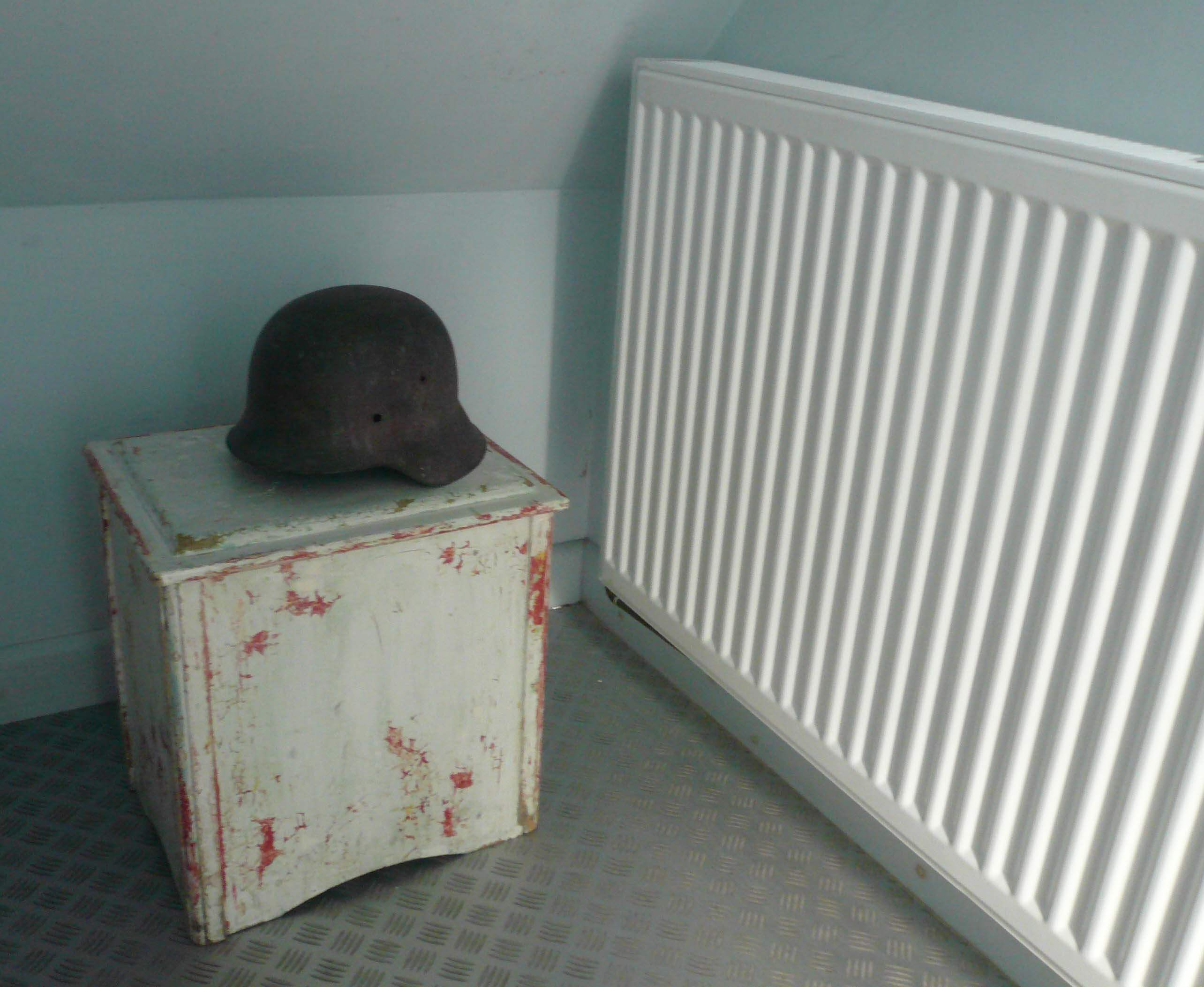
In the bathroom, there is yet another radiator. It will now be impossible for me to put my Stahlhelm on and re-enact “Showering Facilities on the Eastern Front”.

P1530036 qqqqqqqqq

Best of all though, is the fact that I took advantage of all this building work to have a new, much more powerful shower installed. No more problems now with having to wash like this…

Every single morning now, I’m in the new shower just like this.


2 Comments

Filed under Humour, My House, Nottingham, Personal

An intimate problem can always be shared

A lot of us, through shyness, keep our personal medical problems to ourselves. Not so these construction workers in Nottingham, who are more than willing, apparently, to let it all out.

P1530063 yes

So go for it, guys, your problem will soon be our problem.

3 Comments

Filed under Humour, Nottingham, Personal, Uncategorized