Category Archives: Literature

What’s the School Play this year? (2)

Last time we had a brief look at The Dramatic Society’s production of Aristophanes’ “The Frogs” in 1924. Just look at those beards. And is one boy in the centre of the back row wearing a white burqa?:

Seven years later, on Monday, Tuesday and Wednesday, February 23rd, 24th and 25th 1931, the School Play had been “She stoops to conquer”. Here is the cast who contain, perhaps, a few more convincing women than is usually the case. This is because, I suspect, the Dramatic Society were being forced to use many more young boys, not least because the School’s Sixth Form was much, much smaller  during the 1930s than it was to become, say, in the 1960s:
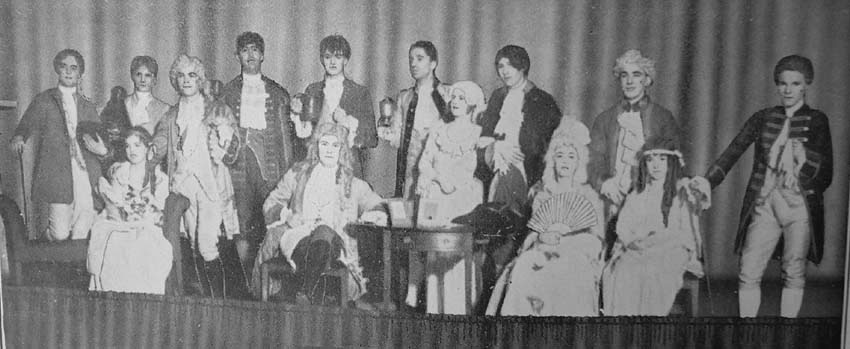
Any proceeds from the play, after the deduction of expenses, were used to help finance the Dame Agnes Lads’ Club in Norton Street in Radford.

Another popular School Play around this time was “The Rope”. Looking at the photograph below, it seems to have starred Borat and his balding brother. On a more serious note, the young “lady” on the left, within five or six years, will be killed trying to slow down the German advance towards Dunkirk:

This young man, Alfred Warren, was, in  actual fact, a most accomplished female impersonator. His first ever role was as Anna Waleska in “Andrew Applejohn’s Adventure”. Witness his review in the School Magazine:

“The School stage has rarely been graced by a more charmingly seductive figure than Anna Waleska. His performance was astonishingly good, especially when one remembers that it was his first appearance. He contrived to give to his impersonation just the right shade of exotic fascination, and if his accent was neither Russian nor Portuguese, it had at least a foreign quality and was sufficiently intriguing. This young man betrayed a knowledge of feminine wiles amazing in one so young, the manipulation of his eyebrows alone being worthy of a Dietrich. One can hardly blame Ambrose for becoming as wax in the hands of such a siren.”

Two years later, in GB Shaw’s “Captain Brassbound’s Conversion”, the School Magazine said:

“The presentation this term was an act more daring than any of its predecessors. There was only one person fitted for the: “prodigious task of portraying so gracious a personage as Lady Cicely. His voice, now at breaking point, just suited her position as mistress of Brassbound’s crew: his seductive manner fitted the beguiler of a dozen men. His part did not allow him this year the opportunity to display those feminine wiles of which, as Anna Waleska, he had shown himself so complete a master, but his expression, now wheedling, now indifferent, was no less successful in enticing the unfortunate victim into her trap. He perhaps tended to overdo that half crouching feline posture which he so often employed against Brassbound. Nevertheless, clad in exquisite garments, which must have cost the society a small fortune, he contrived to overcome the artificialities and discrepancies of Lady Ciceley’s rôle, and for that achievement alone he deserves high praise.”

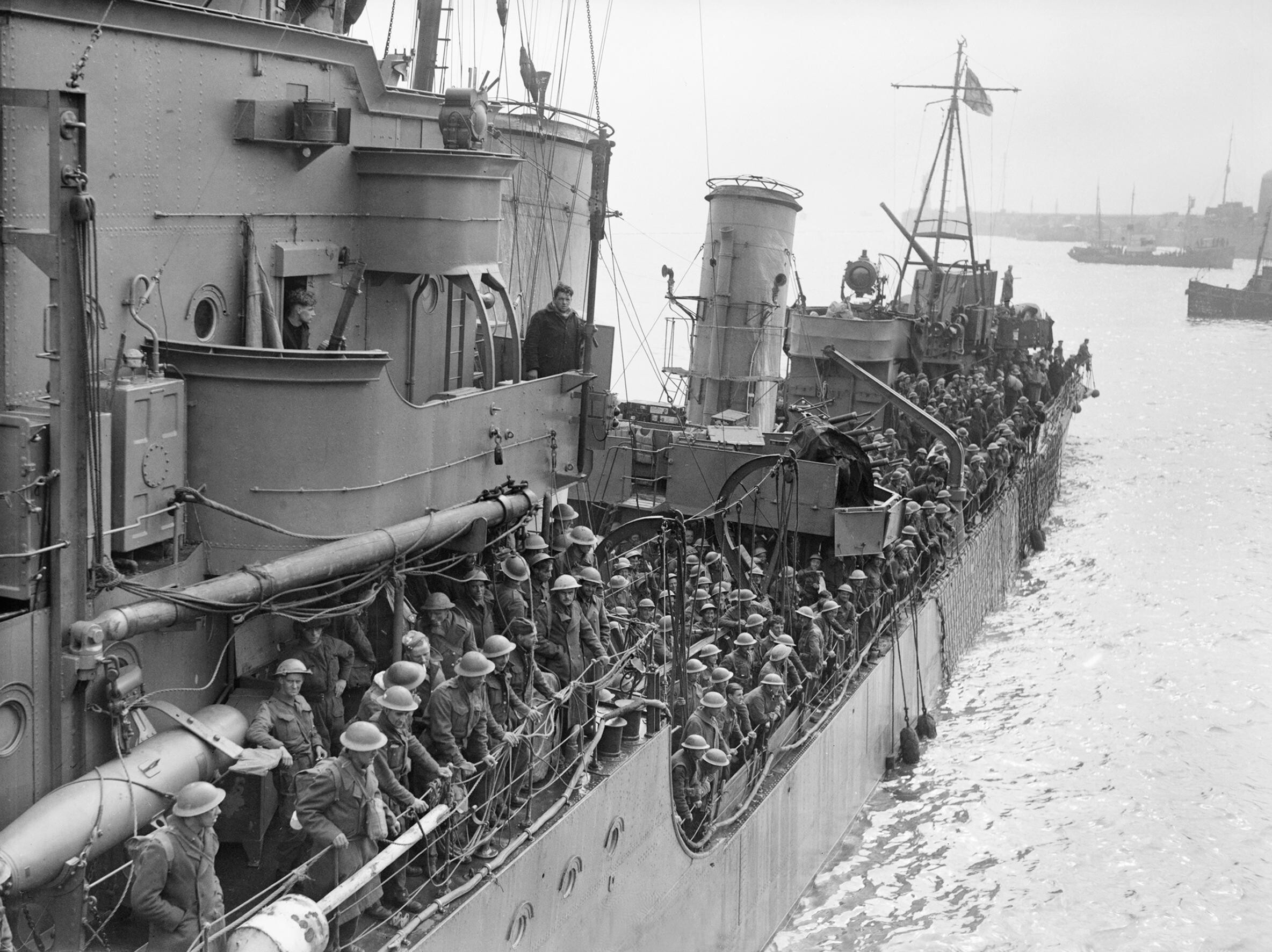
The young man would not carry forward his talents into the worlds of either stage or screen. He will be killed “somewhere along a canal” near the village of Oostduinkerke, trying to slow down the German advance towards Dunkirk. Not every soldier with the British Expeditionary Force had a free trip back to Blighty:


11 Comments

Filed under Film & TV, History, Humour, Literature, Nottingham, The High School, Writing

Anthony Richardson : the RAF poet (5)

Last time, we were looking at some poems from the book “These – Our Children”, by Anthony Richardson, published in 1943:

“At a party” and “Grounded” are a pair of poems that go together.

In “At a party”, an heroic airman is in attendance, complete with his braid and his medal ribbon. But it was just fate, just luck, that saved his life. It was certainly not his own courage. Somehow Death fumbled and failed to pull him through the door.

The airman, though, does not have the appearance of anybody who has been so close to death that his past life has flashed past his eyes. But his companion knows nevertheless, that fear eats at his heart, that he has not yet managed to kill “those groping, grey cold thoughts” that would “paralyse his stubborn will” to do any more flying. Was she the only one to notice? Was she the only one to know that his cup was full, that he’d had enough, and that his lips were not laughing but anguished ?

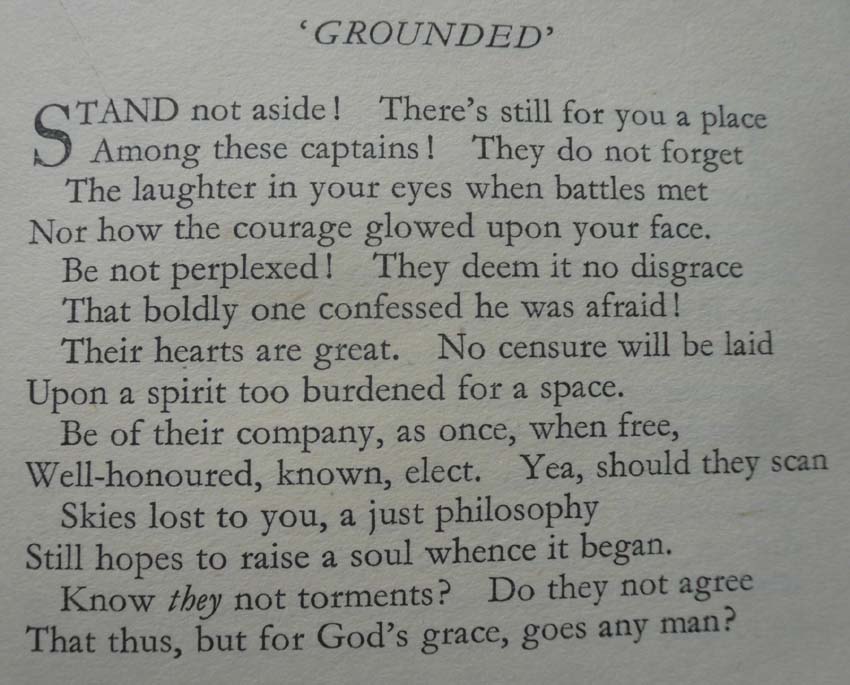
“Grounded” is the poem where the airman, completely unable to carry on, has had to be taken off flying. Despite this, he does not have to stand aside. He has been forgiven by “these captains”, other heroes who understand that it is “no disgrace that boldly one confessed he was afraid!”

Members of Bomber Command, my own father included, were absolutely terrified of being thought a coward. This meant that they would have “LMF” stamped on their record. LMF stood for “Lack of Moral Fibre”, and it meant that you would be extracted from your airbase as quickly as was humanly possible, lest other pe0ple catch your infection. You might be sent to a psychiatric establishment, such as used to be at Rauceby Warren in Lincolnshire, for example. Nowadays, it’s a long abandoned building:

You might be posted to somewhere like the freezing cold rain- and sleet- lashed grey boring Outer Hebrides, Orkneys or Shetlands. Somewhere where you could be rained on, somewhere where you could experience cold, boredom and perpetual darkness:

In contrast, in the poem, “these captains”, are completely willing to have the frightened airman among their company because they know their own torments, and that “thus, but for God’s grace, goes any man?”

In actual fact, of the officers who survived the Bomber War, apparently 3% had been removed from flying because of LMF. That must have been quite a number of men. Being classified LMF signed a death warrant to any officers’ subsequent career in the RAF. And the RAF for their part took away the flying badge of any man with LMF “to prevent his getting a lucrative job as a pilot in civil life”.

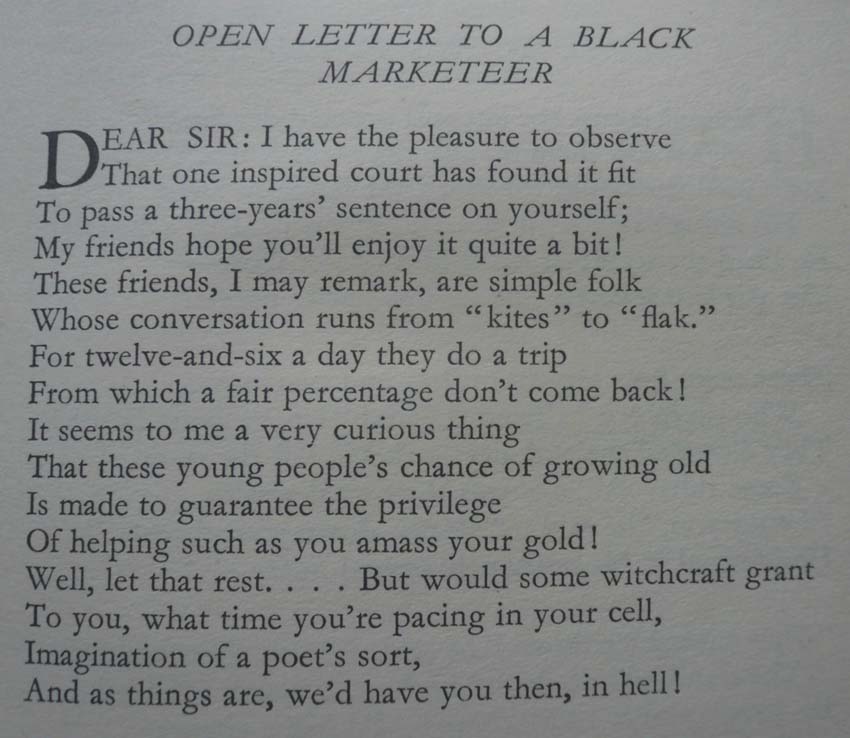
“Black Marketeer” is self-evident. I know from my own father that the cowards who ran away from the war, and those who invented spurious health reasons not to be where the bullets were flying, were hated beyond belief by those who did their fighting for them. Even more hated were those who traded in forbidden goods such as whisky, cigarettes, petrol and so on. Most men in the RAF would not have hesitated in the slightest to have shot them, given half a chance. At the very least, they would have wanted their prison spell to have been twenty years in hell:

“Kites”, incidentally, is the RAF slang for aircraft, and “flak” is anti-aircraft fire, or, as the Germans so beautifully put it, “Flugzeugabwehrkanone”.

“Ground Crew” is another self-evident poem. The ground crew were the men who looked after the bombers and made sure that they would fly properly. Many of their duties are listed in the poem. In the second verse, the last two lines mean the occasions when the member of ground crew has to adjust the engines that make the aircraft fly:
Ground crew were normally called “erks” which was supposedly the Cockney shortened form of “aircraftman”. “Wings” are the badge of the pilot, and traditionally have a silver threepenny bit sewn behind them. A “gong” is a medal.

The member of ground crew, the “erk”, was the “ordinary man” whose contribution to the war was absolutely indispensable:

And finally, his hearing is so finely tuned that he can hear the first of the bombers to come back from the previous night’s raid:

10 Comments

Filed under Aviation, Bomber Command, History, Literature, Politics, Writing

What’s the School Play this year? (1)

A high proportion of secondary schools in England put on an annual school play, and the High School, even back in the 1920s, was no exception. In the distant past, I have paraphrased the main problem faced by those who sought to put on a School Play, years before things changed for ever in the 1970s:

“The Dramatic Society would put on an annual play, usually, a classic, although not always by Shakespeare. The problem was that Nottingham High School was for boys only, and, in the words of the School Magazine: “The Dramatic Society has always hesitated to produce a modern play because of the difficulty of satisfactorily filling the female parts. Twentieth Century dress does not lend itself so well to the purpose of transformation as do Elizabethan and Georgian costumes”.

I also pointed out that even with the classics, the problems may only just be beginning. This photograph by the Reverend Stephens is from a post-war School Play, and shows one of the leading characters. The Reverend captioned it “Williams”, and, poor lad, Williams could almost stand there and represent fifty years’ worth of completely insoluble difficulties with School Plays. No matter how well he learns his lines, young Williams cannot change the size of his hands or the size of his feet or the firmness of his jaw-line:

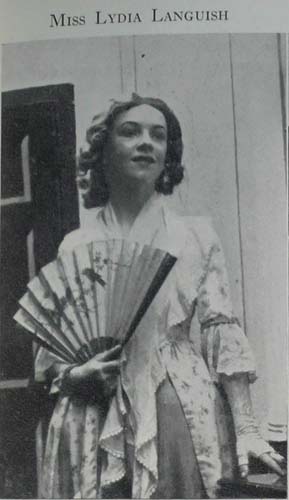
Similar problems occurred in the same era with “The Rivals”. This was in 1953. Here is Miss Lydia Languish. Better hands, admittedly, (except for the knuckles) but that’s not a woman’s nose :

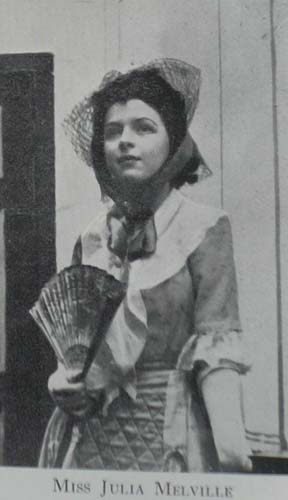
Here is Miss Julia Melville, perhaps the best so far:

And here is the famous Mrs Malaprop. Did you spot my malapropism in the previous post about Junior Plays?

What you can’t miss is that great wide barrel chest, ever ready to control a hard driven football. And look at that chin and that nose.  Those hands and those knuckles.

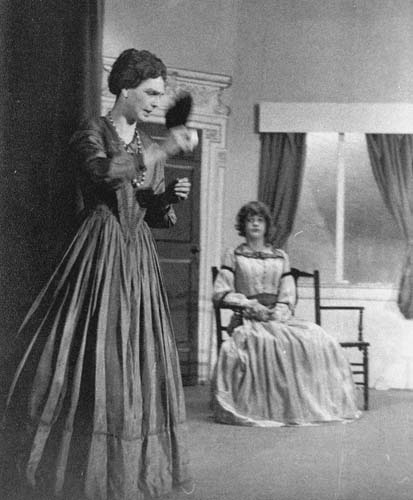
Things were no different by 1962 when Gogol’s “Government Inspector” came to call. Messrs Boyden and Taylor, try as they might, were still two strapping great lads, whether Russian Woman 1 was standing and Russian Woman 2 was sitting down :

Or whether Russian Woman 2 was standing and Russian Woman 1 was sitting down:

And just why does he/she have a table tennis bat? Both pictures, incidentally, come from the Reverend Stephens.

Just as a taster for next time, let’s think about some of the other problems faced by the School’s Dramatic Society. As we have seen, there were no girls from Nottingham Girls’ High School to play the female parts but, on occasion,  even the props and costumes could be rather unimpressive.

This is a very poor reproduction, by myself, of the School’s 1924 production of Aristophanes’ side splitter, “The Frogs”. I would contend that they should have called it “The Beards”. Or it could have been read out merely as “Black Beards 6 White Beards 2″. And while you’re trying to find all eight, don’t miss the two boys who are having to hold their badly behaved beards in place with their hands:

20 Comments

Filed under Film & TV, History, Humour, Literature, Nottingham, The High School, Writing

Anthony Richardson : the RAF poet (4)

We have been looking at the poetry of Anthony Richardson. His second book of poetry was “These – Our Children”, published in 1943. I think it’s his best work and I have found quite a few poems in it to show you:

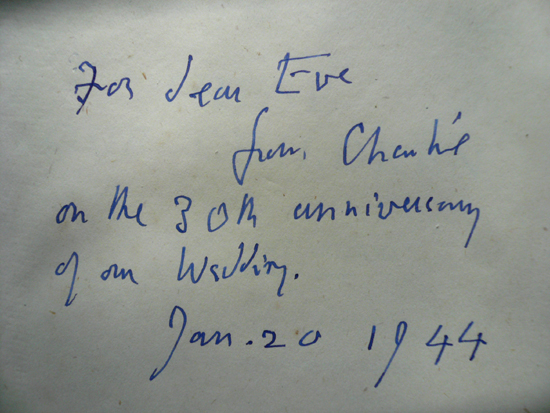
The copy I bought, again for just a few pounds, had an inscription inside it. It reads, in a very shaky old man’s handwriting, rather like my own: “For Jean Eve from Charlie on the 30th anniversary of our Wedding. Jan. 20 1944”:

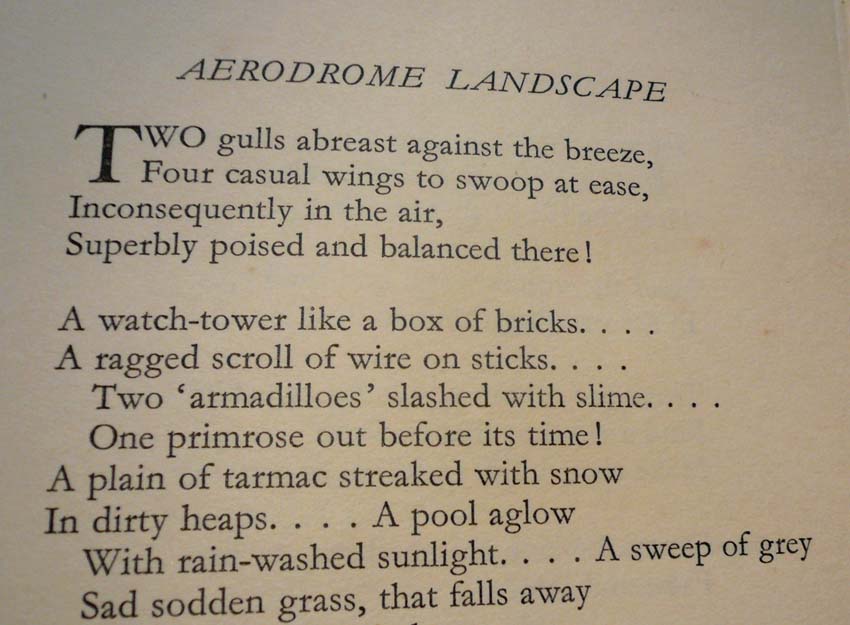
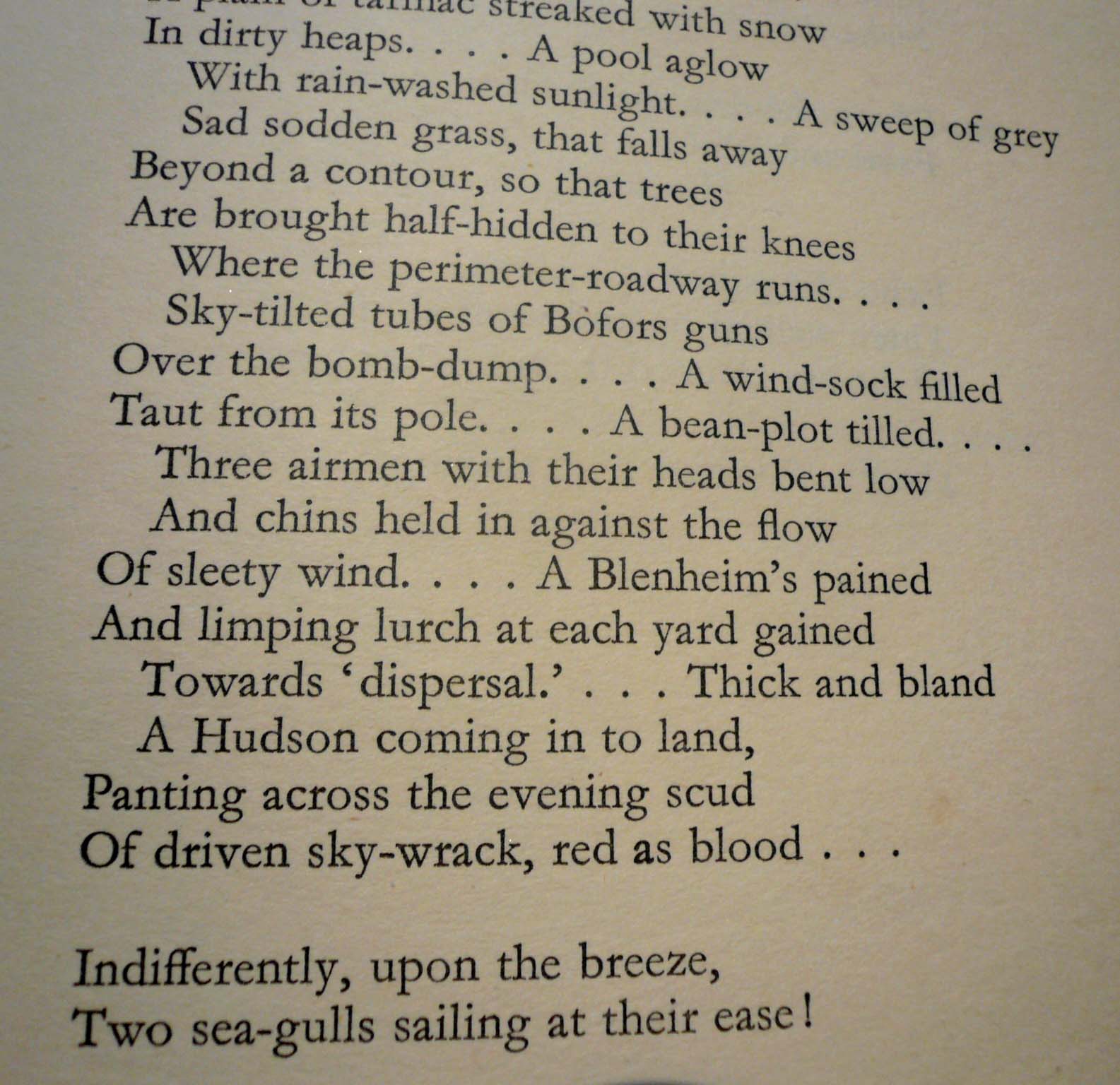
The first poem I selected is called “Aerodrome Landscape” and is exactly that…a portrayal of the empty flat landscape of a bomber base. Only a few words of vocabulary need explaining:

An armadillo I had never heard of, but Wikipedia says that it is

“an extemporised armoured fighting vehicle produced in Britain during the invasion crisis of 1940-1941. Based on a number of standard lorry (truck) chassis, it comprised a wooden fighting compartment protected by a layer of gravel and a driver’s cab protected by mild steel plates. Armadillos were used by the RAF Regiment to protect aerodromes and by the Home Guard.”

A primrose is a yellow flower that often appears in late winter.

As regards any technical terms, the perimeter-roadway is the concrete track that runs 360° around every airbase. Each bomber was left, when not in use, on its own “dispersal” point, often shaped like a frying pan, which was connected to the “peri-track” by a short concrete road. Bofors guns were used to defend airfields against German aircraft attacks. A Hudson is a two engined light bomber and reconnaissance aircraft. Wrack is seaweed that is placed on the shore by the waves, so presumably, “sky-wrack” is clouds, driven across the sky by the wind.

The same book, “These – Our Children”, contains “Aftermath”, which could equally well have been titled “Epitaph”.

The full title of the poem is “AFTERMATH (For Mac and his crew)”. It makes reference to a dead aircrew who are buried in Kristiansand, at least one of them being Scottish, or at the very least, having the Scottish name of “Mac Something”.

In today’s day and age, it is easy to trace to whom these details refer. Kristiansand is on the Skagerrak and is the fifth largest city in Norway. It lies, more or less, at the country’s southernmost tip. The Kristiansand Civil Cemetery has only twelve war casualties, just one of them being possibly “Mac”. This was Charles Peter Hope Maclaren, aged only twenty and killed on April 21st 1941. He was the pilot of an aircraft of 107 Squadron and came from Peebles, which is in the Scottish Borders region in southern Scotland. On the base of his grave is inscribed “His brave companions Sergeants Hannah and King have no known grave”:

The three men were in a Blenheim IV, Z5795, of 107 Squadron, RAF, of Leuchars in Fifeshire, operating as part of 18 Group. They took off at 1800 to perform a reconnaissance of the Norwegian coast. The Blenheim was piloted by Pilot Officer Maclaren, but they were shot down by enemy fighters and crashed into the sea. The pilot’s body was later washed ashore at Flekkero near Kristiansand, but no trace of his two comrades was ever found and their sacrifice is commemorated on the Runnymede Memorial. 107 Squadron was normally part of Bomber Command but was on detachment to Coastal Command in early 1941.

Sergeant Anthony James Hannah was the observer. He was a New Zealander of only twenty and he was on his twelfth operation. The third member of the crew was Douglas Stevenson Hutcheon King, whose service number was 751304 but I could find nothing further about him, I’m afraid.

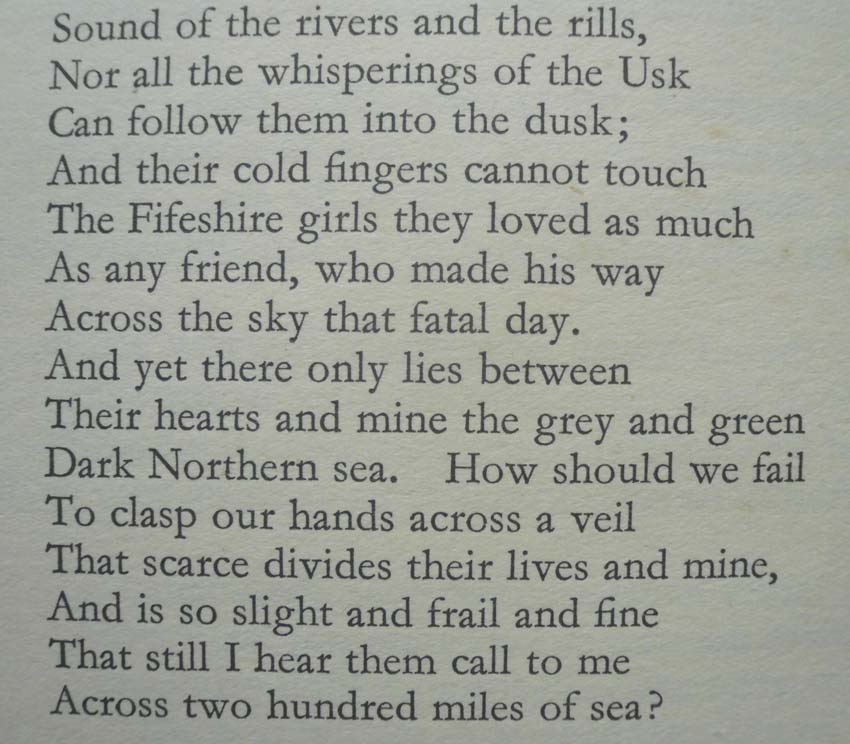
In the poem, Richardson introduces huge amounts of poetic licence. He talks as if Maclaren came from Dundee rather than Peebles. The Usk is a river, but strangely, in Wales. Fifeshire is a county near Dundee:

The question posed at the end, of course, is that if the dead men can still call to him “across two hundred miles of sea”. then how is it that they cannot “clasp our hands” across the thin veil between life and death?
I have spent the last six years researching the war casualties of the Old Nottinghamians, and a good many more, and this particular Blenheim is quite the most God-forsaken, long forgotten, aircraft, I have ever come across. Only one grave and two men lost for ever. No exact details of their mission, no exact details of who shot them down or how it happened. Nothing at all on the CWGC website about the two men who were never found. No ages. No parental details. No town of origin mentioned. The only detail I found out is that Mac was buried by some good Germans, who gave him a magnificent funeral with full military honours:

19 Comments

Filed under Aviation, Bomber Command, History, Literature, Politics, Writing

What would you do ? (5) The Solution

“What would you do ?” used to figure on the cover of a boys’ comic called “Boys’ World”. This was a publication, obviously, aimed at boys, and first appeared on January 26th 1963. There were 89 issues before the comic was merged with Eagle in 1964. The last issue of “Boys’ World” came out on October 3rd 1964.

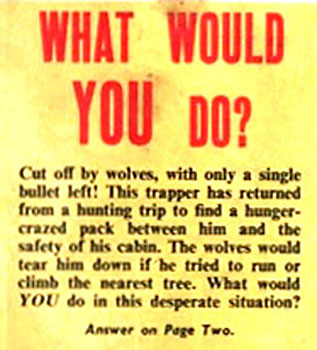
I used to buy “Boys’ World”, and this was mainly for the front cover which always featured a kind of puzzle. It was called “What would you do ?” and was based on somebody being in what Ned Flanders would call “A dilly of a pickle”. Here’s the situation:

And the correct solution given on page 2 of the comic is:

“There was only one possible thing the trapper could do. He shot one of the attacking wolves. The rest of the pack, ravenous with hunger, turned on the fallen beast. This gave the man time to make a dash for the safety of his cabin.”

The trouble is that I just don’t think that that would work. We know a lot more about wolves nowadays than we did in 1963. Wolves are known to be extremely loyal to one another and I cannot imagine that their first reaction to one of their number being shot would be to eat him, no matter how hungry they were. I know that a wolf will fight and kill a rival from another pack, but he would never eat him, even if he himself was starving. In that case, why would he devour a colleague from his own pack?

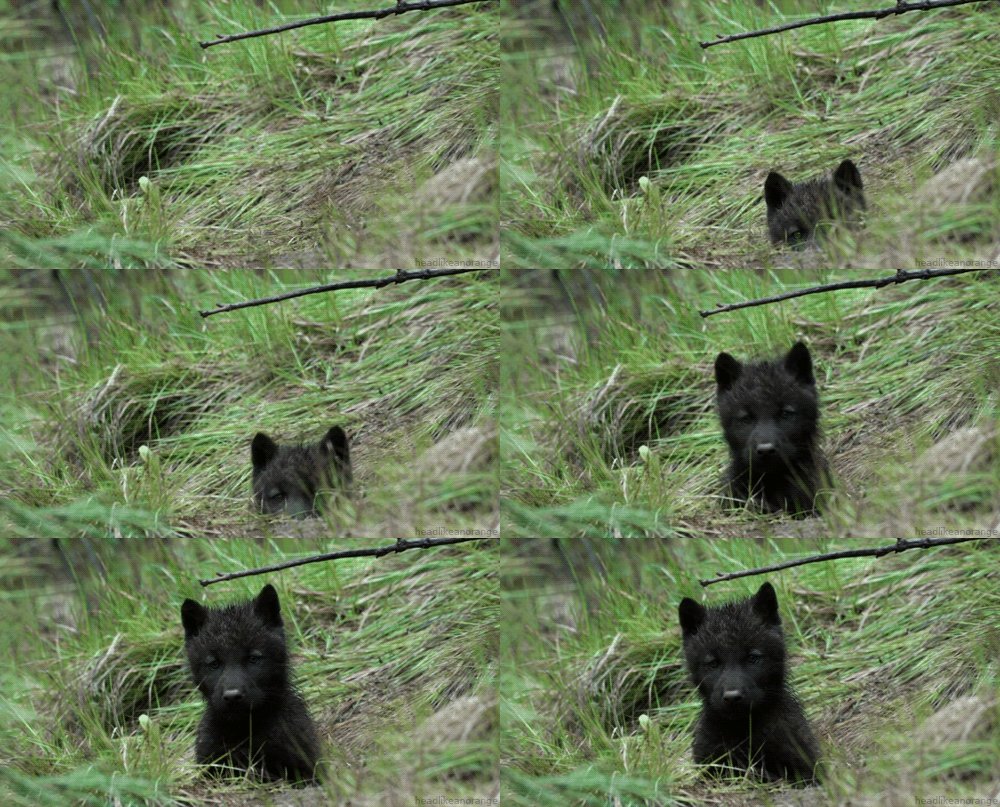
And they’re all so sweet and cuddly. Here’s Mummy Wolf:

And here’s Baby Wolf:

15 Comments

Filed under Canada, History, Humour, Literature, Personal, Wildlife and Nature, Writing

What would you do ? (5) The Puzzle

My 500th blog post……….enjoy !!!

“What would you do ?” used to appear on the cover of a boys’ comic called “Boys’ World”. This was a publication, obviously, aimed at boys and first appeared on January 26th 1963. There were 89 issues before the comic was merged with Eagle in 1964. The last issue of “Boys’ World” came out on October 3rd 1964.

I used to buy “Boys’ World”, and this was mainly for its front cover which always featured a kind of puzzle. It was called “What would you do ?” and was based on somebody being in what Ned Flanders would call “A dilly of a pickle”. Here’s the situation:

The yellow box sets the scene, and the task is for you to solve the situation. Perhaps you might like to write your idea in the “Comments” section.

Here’s the yellow box enlarged:

I hate snow. It always makes its way into your clothes and then melts. That, though, is the least of Trapper Jacques’s problems. He has been cut off by the wolves, at least six of them, and he only has a single bullet left. They are hunger crazed after the fish-and-chip van broke down and they stand firmly between Jacques and his lovely little cabin with his new Liberty curtains. If Jacques tries to run they will chase him and bite him and then tear him to pieces. The same fate will eventually befall him if he tries climbing that tree in the background.

What can  he do??


28 Comments

Filed under Canada, History, Humour, Literature, Personal, Wildlife and Nature, Writing

The Fairies of Cornwall (4)

Let’s have a look at one of the old Cornish stories, and see what kind of things the human sized  fairies used to get up to. As soon as I had read a few of these stories, I was immediately struck by how they seemed to echo aspects of modern life. The people who disappear in the USA’s National Parks. The activities of those nasty aliens. And bear in mind that this is one of the first stories in Volume I, so I would think it was put there as a gentle introduction. Not that the fairies are at all gentle.

In this traditional droll-teller’s story, therefore, “Uter” is a commercial traveller who is led astray by the fairies, as he tries to go back to his hotel after visiting a big country festival in Penzance. Here is its modern equivalent:

“When Uter got into the field, a cloud of fog was rising from the moors, entirely surrounding him and so thick that he could scarcely see a yard before him. Yet, although he couldn’t see anything, he could hear distant singing plainer than ever. He steered his course for the eastern side of the field, as near as he could guess toward the place with an opening in the hedgerow where he intended to pass into the next field. He soon came to the fence, but he found no opening. He searched back and forth. He wandered round and round, without success. And then he tried to get over what appeared to be a low place in the hedge; but the more he climbed, the higher the hedge seem to rise above him.”

“He tried ever so many places, but could never quite reach the top of the fence, and every time he gave up, his ears rang with such mocking laughter as nothing but a Fairy ever made. He was very anxious to reach the hotel, and above all to get out of this field, as it had a bad reputation, and was shunned by most people after nightfall. The ugliest of sprites and fairies, with other stranger apparitions, such as unearthly lights, were often seen firstly hovering around the old Chapel which stood in this field, and then departing in all directions. These ruins were so overgrown with brambles and thorns that there was but little of the building to be seen.”

“Uter had turned round and round so often that he neither knew what course he was steering nor in which part of the field he stood, until he found himself among the thickets surrounding the ruins. Even here he heard the same teasing, tormenting laughter proceeding from inside the chapel. Then he took it into his head that someone in flesh and blood was following him about in the mist. He soon lost his temper and threatened to let whoever, or whatever, was dogging his footsteps, feel the weight of his boot as soon as he could lay hands on him.

He had no sooner hit the Fairy then than the cudgel was snatched from his hand, his heels tripped up, and he was laid flat on his back; then he was sent rolling down the hill faster and faster, until he went down like a stone bowled over a cliff, tossed over the hedge at the bottom of the field like a bundle of rags, then pushed through the brambles on the moor, or pitched over the bogs and stream on the Fairy’s horns. Then he was whirled away like dust before the wind. When he fell down, he was pitched up again, and not allowed a moment’s rest from rolling or running until he passed the high road and was driven on by the Fairy, smashing against a high rock at the foot of the hill, where he was found quite insensible the next day.”

Whoever or whatever was responsible for those events, it certainly doesn’t sound like it was Tinkerbell!

17 Comments

Filed under Cornwall, Criminology, Cryptozoology, History, Literature, Personal, Wildlife and Nature, Writing

Anthony Richardson : the RAF poet (3)

Anthony Richardson wrote three books of verse during his lifetime, all of them during World War Two. The first was called “Because of these: Verses of the Royal Air Force” (1942). Then there was “These – Our Children” (1943) and finally “Full Cycle: Verses of the Royal Air Force” (1946). Last time, we were looking at the first one:

Richardson joined the RAF at the beginning of the war and his career was related in the official records in the following fashion. It may give you an idea of the difficulties which may be encountered when you are trying to follow somebody’s military career:

Firstly he was a “T/2nd Lt. 05.09.1918 (reld 01.09.1921)”.

Then he was “P/O (prob) 18.06.1940 [80934]”.

Next he was “(WS) F/O (prob) 20.01.1941”

and then “(WS) F/O 18.06.1941”

He finished as a “(T) F/Lt. 01.09.1942”.

And like my father he was “demobilized 1946”

The numbers are either his RAF service number or the date he assumed his rank. Other abbreviations are “T” (Temporary), “P/O” (Pilot Officer) and then “F/O” is Flying Officer, “F/Lt.” is Flight Lieutenant and “WS” is War Service. “Prob” is “on probation”.

As far as I know, Richardson was an Intelligence Officer on a Bomber Base, which means that he would listen to the tales the bomber crews told when they returned and then write them all down, so that they could be passed on for others to correlate and thereby produce some kind of general overview:

I’ve found one or two more of the best poems from Richardson’s book “Because of these”, and I’ll be showing them to you in the rest of this blog post.

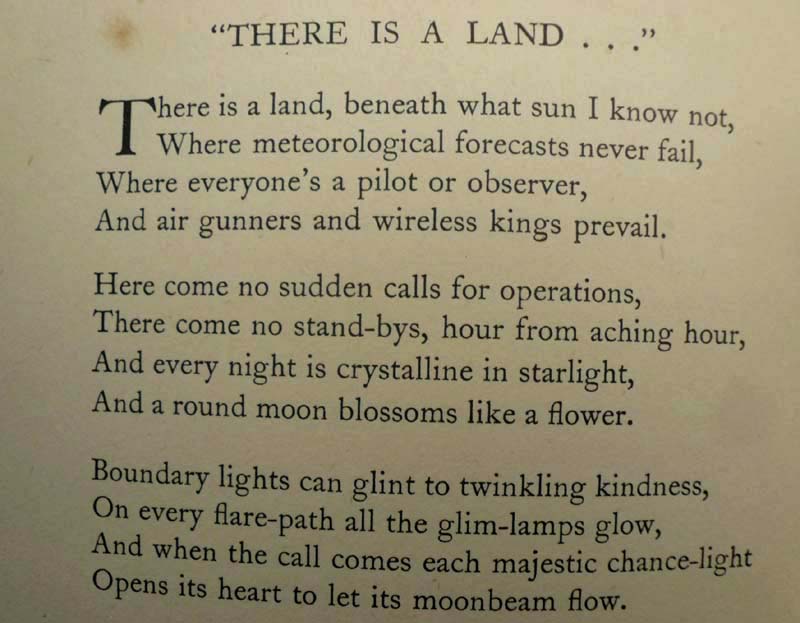
The first poem I selected is called “There is a Land”. It has an almost jokey tone to it. The poet envisages a land, he doesn’t know where, but everything is perfect. Weather forecasts are always accurate, everybody is a member of RAF aircrew, there are no sudden calls to take off, no hours spent on stand by and everything is beautiful. The third verse mentions the three types of light on a wartime RAF airbase, namely the boundary lights, the glim-lamps (glim is short for “glimmer”), and the Chance-lights, made by Chance’s, a factory in Birmingham just half a mile from where my wife lived as a child. In real life, these lights were all deliberately kept very dim so as not to help German night fighters, so in a perfect land, they all shine brightly:

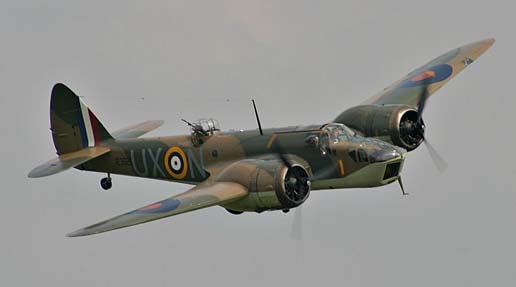
When you go out in your Blenheim light bomber, everything is perfect:

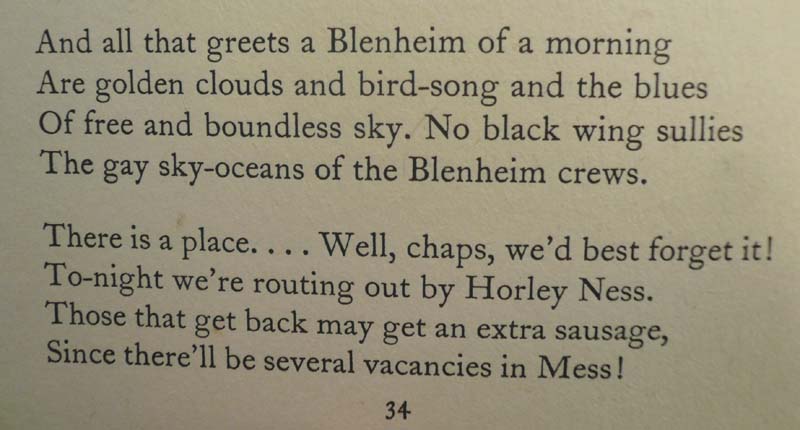
Verse four speaks of “golden clouds” and a “free and boundless sky”. But, alas, in the fifth verse, they’ll all be flying near Horley Ness, where the weather is so bad that there are bound to be crashes. That will in turn create vacancies in the canteen (the “Mess”) so that the people who get back will be able to eat the extra sausages:

These next two poems are both epitaphs. Both of them rhyme, and do so without becoming ridiculous doggerel. Epitaph 1 makes the point of how a man’s body can be destroyed in an instant and leave just a burnt patch on the ground. But once winter is past, Mother Nature makes the flowers and the grass grow and they soon cover up all traces of charred earth. The poet, though, wonders how the plants can grow heedless of the remains of a hero among their roots. Every RAF man knew that he might finish up that way. Like Guy Gibson, just a single foot in a single sock. Or one of the Old Nottinghamians I have written about. He and his six companions became just five bones, some of them fingers, and not even enough for one per coffin:

The second epitaph paints an even more gaunt picture of the life of RAF aircrew. A sergeant pilot lies in his grave, having at last taken to wife the dark maiden Death. He had encountered her several times before, but on this occasion, he looks too deeply into her eyes and “she enfolded him in her embrace. Again a rhyming poem, although this time with a different pattern of rhyme:

I hope you enjoyed them. More next time.

21 Comments

Filed under Aviation, Bomber Command, History, Literature, Politics, Writing

Alice in Wonderland (2)

Last time I was looking at how ““The Annotated Alice: Alice’s Adventures in Wonderland and Through the Looking Glass” by Martin Gardner added to our understanding of the two books.

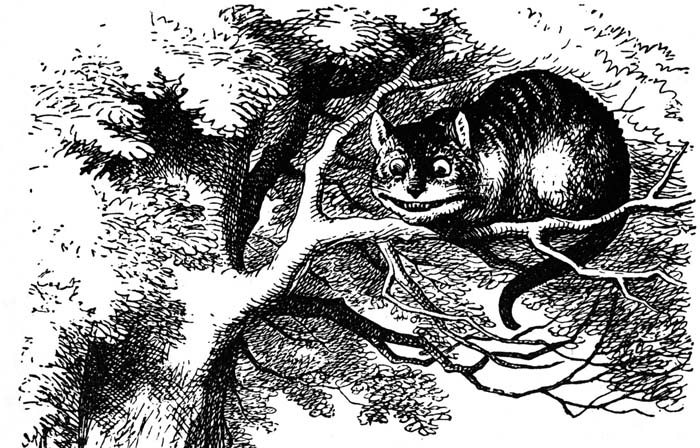
One of the most famous characters of Carroll’s book is the Cheshire Cat. Here’s Tenniel’s illustration:

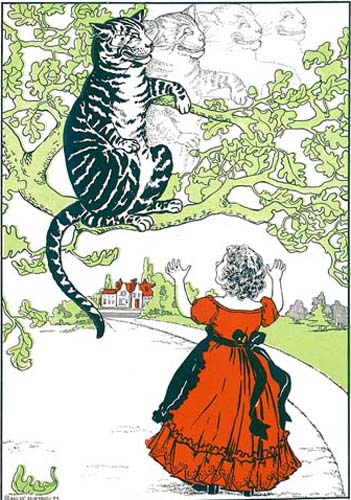
Ao, what does “Annotated Alice” have to say about the Cheshire cat? Well, did you know that “He grins like a Cheshire cat” was already a well known saying before Alice ever met this particular cat? Or that Cheshire cheese was once sold in the shape of a grinning cat? (Difficult to believe that one!) Here’s Mabel Lucie Atwell’s Cheshire Cat:

“Annotated Alice” reveals that Lewis Carroll’s father was once the rector of St Peter’s church at Croft-on-Tees near Darlington in northern England. There, Joel Birenbaum recently found a stone carving of a cat’s head on the east wall of the church’s chancel, just a few feet above floor level. When Joel went down on his knees and looked upward, just the cat’s mouth could be seen as a broad grin.

Alice’s conversation with the Cheshire Cat has even been compared to Jack Kerouac:

“Would you tell me please, which way I ought to go from here?”

“That depends a good deal on where you want to get to.”

In “On the Beat” apparently, the conversation runs:

“Where we goin’, man?”

“I don’t know, but we betta go.”

I personally would even compare a subsequent piece of dialogue between Alice and the Cheshire Cat with the novel “Catch-22” by Joseph Heller. Carroll wrote:

“In that direction lives a Hatter and in that direction lives a March Hare. Visit either you like. They’re both mad”.

“But I don’t want to go among mad people.”

“Oh, you can’t help that, we’re all mad here. I’m mad. You’re mad.”

“How do you know I’m mad?”

“You must be, or you wouldn’t have come here.”

The absolute “Star of the Show”, of course, is the Mad Hatter.

Apparently, in the 1850s and 60s, the phrase “Mad as a Hatter” was as equally common as “Mad as a March Hare”. The expression may originally have been “mad as an adder” but it is thought to be much more probable that it comes from the fact that hatters did frequently go mad through using mercury to cure felt, from which hats may be made. Mercury is highly poisonous.

“Hatter’s shakes” were exactly that, and eyes, limbs and speech were frequently affected. After that came hallucinations and psychotic episodes. Apart from that, “hatter” was quite a good career.

There are a good few different versions of the Mad Hatter. There are two styles of Tenniel and also Mabel Lucie Atwell, Blanche MacManus and Charles Robinson:

This slideshow requires JavaScript.

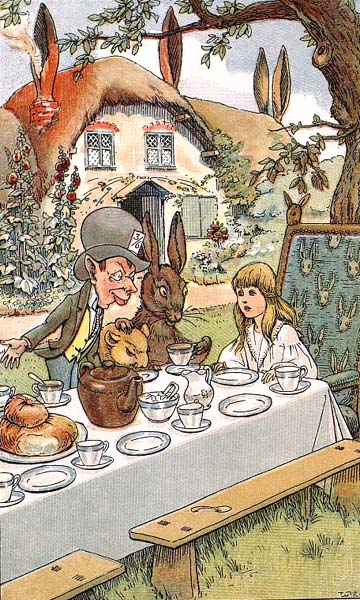
My own favourite is WH Walker in his “I want a clean cup”. Notice how the ears of the Mad March Hare are used as cowls on the chimneys of the Mad Hatter’s house. Or is that all part of the hallucination?:

“Annotated Alice” has very little to say about the Mad March Hare. This is from Wikipedia:

“A long-held view is that the hare will behave strangely and excitedly throughout its breeding season, which in Europe peaks in the month of March. This odd behaviour includes boxing at other hares, jumping vertically for seemingly no reason and generally displaying abnormal behaviour.”

On the other hand, “Annotated Alice” reveals that Victorian children used to keep dormice as pets and housed them in large old teapots with dry grass as bedding. Here the Mad Hatter and the March Hare try to stuff the sleeping dormouse into the teapot:

“Annotated Alice” seems to know something about virtually every event in the two books, no matter how trivial they seem. I have only scratched the surface of what subtleties are hidden away in the story. Does anybody realise nowadays, for example, that the Victorians thought a lot about falling down a hole that went straight through the centre of the earth?

And did we notice very much about the Pool of Tears in Chapter Two? Who was in it? Well, there was “A Duck and a Dodo, a Lory and an Eaglet and several other curious creatures.”

This slideshow requires JavaScript.

Did they represent anything?

Well, they represented that select group of people, who took that short trip by boat on the River Thames on Friday, July 4th 1862.

As they progressed slowly down the river, Charles Lutwidge Dodgson aka Lewis Carroll recounted the story of Alice. He was the Dodo. His stammer made him give his name as “Do—Do—Dodgson”. The duck was his friend the Reverend Robinson Duckworth, a fellow of Trinity College, Oxford. The Lory is Lorina, the eldest of the Liddell sisters. Edith Liddell is the Eaglet.

“Annotated Alice” has these and a thousand other hidden details. What an excellent book!

Next time, Charles Lutwidge Dodgson, the man.

16 Comments

Filed under History, Literature, Personal, Writing

The Fairies of Cornwall (3)

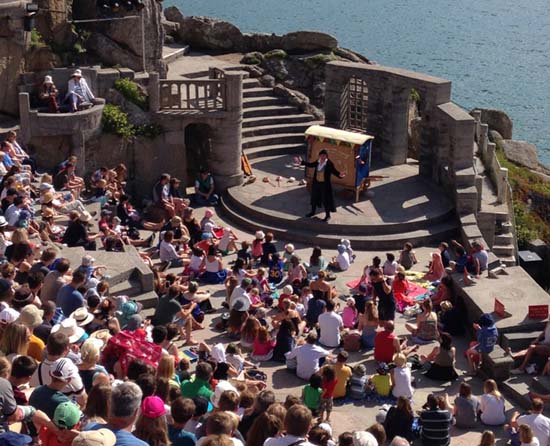
The ancient stories about the fairies were collected together in Cornwall by William Bottrell (1816–1881) when he realised that the county was changing so rapidly in the mid-nineteenth century, that the old tales would all soon be lost if he didn’t record them during his lifetime. Fairy tales had never previously been written down, but were declaimed to an audience by “droll tellers”, men who would spend one night here, two nights there, as they wandered from farm to farm, being fed and making money as the hat was passed around. This was all in exchange for entertaining the people with their traditional accounts of what mischief the fairies had got up to. They still exist nowadays to some extent:

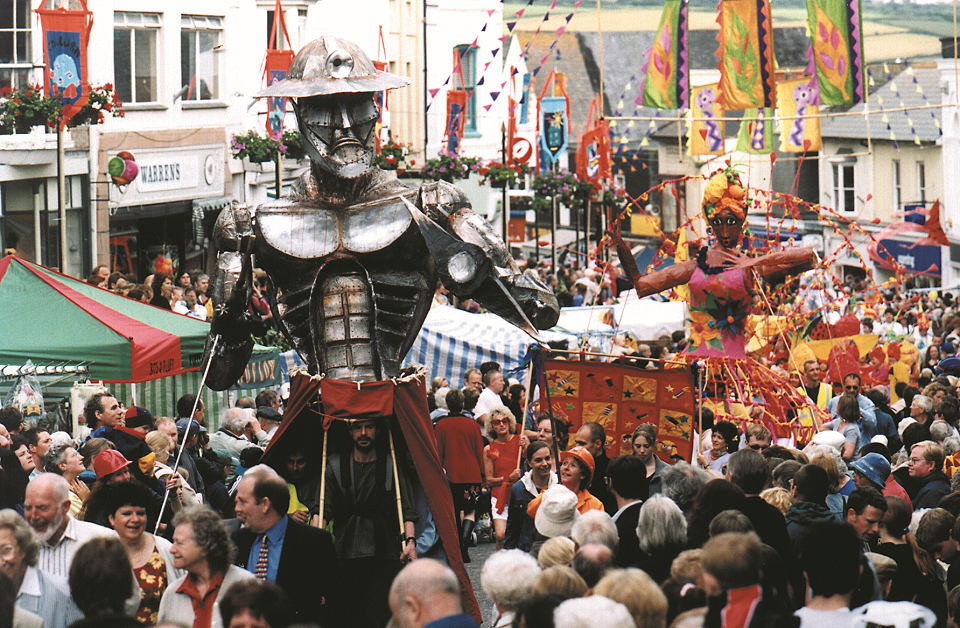
In those days, the agricultural population would often live in groups either in, or around, a large farm, providing the farmer with his workforce and the droll teller with his audience. Presumably, the droll teller might well change the details of his tale slightly to fit the lives of the people in the particular farm where he was telling his tale. Many tales mention specific people and specific places, and the tale might be changed to take account of this. Even today, a droll teller can attract a large crowd:

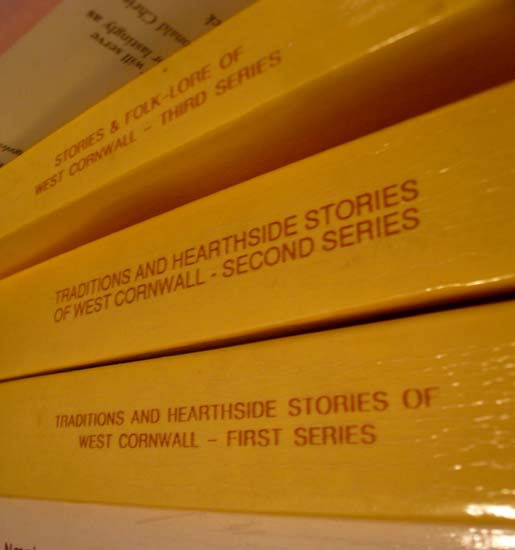
 The three books by William Bottrell which I have are : “Traditions and Hearthside Stories of West Cornwall-First Series (1870)”

“Traditions and Hearthside Stories of West Cornwall-Second Series (1873)”

“Stories and Folk-Lore of West Cornwall-Third Series (1880)”

And here’s the cover:

Personally, I would say that the “droll tales” were already centuries old when Bottrell collected them. Some of them apparently include particular individuals from the 1600s and I would not be surprised if the tales had their origins as far back as the years before William the Conqueror. A few certainly mention the red hair of the vikings:

Fairies back then were beings who would interfere frequently in the lives of ordinary people. They had such powers that they could do whatever they wished. Physically, they were the size of humans and people were frequently  deceived by strangers that they did not realise were fairies. More about such evil-doing next time…….

14 Comments

Filed under Cornwall, Criminology, Cryptozoology, History, Literature, Personal, Wildlife and Nature, Writing