Category Archives: military

“Die Rote Armee” means “the Red Army” (2)

Last time I was showing you the front page of a propaganda leaflet I had bought on ebay. They were dropped in its tens of thousands from aircraft of the Red Air Force in an effort to persuade the German defenders of Berlin to surrender. After all, the defenders numbered just 766,750 and the Red Army had a gigantic 2,300,000 men on the case. Many of the defenders of the city were not really soldiers anyway. These three were apparently postmen:

Anyway, here’s the front of the leaflet :
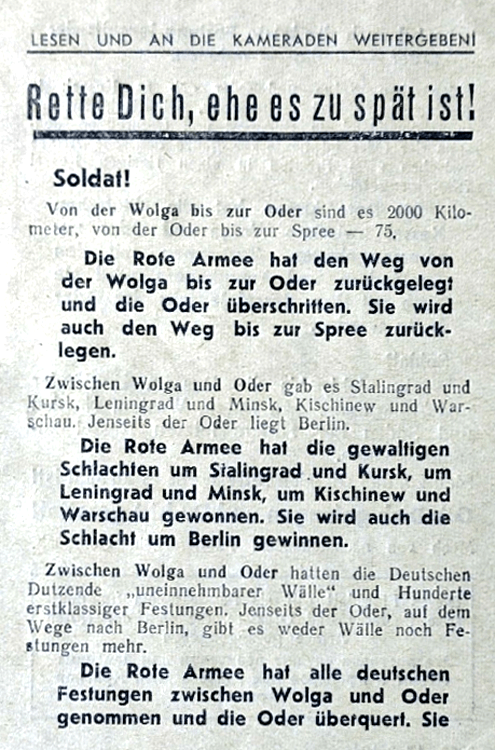
Just as a matter of interest, the Russians do not call the Second World War by the same name that we do. They call it :

Великая Отечественная война

The first word is “Vyelikaya” which means “great”.

The second word is “Atyechyest-vyennaya”, a six syllable word which means “patriotic” and has its origins in the word “atyets” which means “father” (just like “patriotic” in actual fact)

The third word is “Vai-ná” which means “war”.

Here’s the back of the leaflet, where the word “wird” proves to be the second word of a sentence begun on side one:
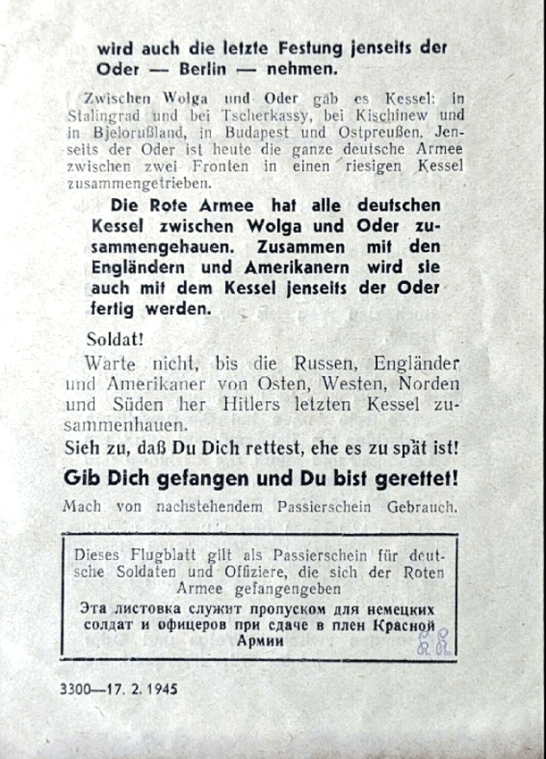
If you remember, the pamphlet was reminding the Germans that the Soviets had won all of the battles at Stalingrad, Leningrad, Kishinev, Kursk, Minsk and Warsaw and had completed the crossings of the Rivers Volga and Oder. Now it is time for Berlin and the River Spree. The pamphlet continues with more of the same. If the Red Army has won in Stalingrad, Kursk and Warsaw, the last few troops on the banks of the Oder will not be a problem……

“Festungen zwischen Wolga und Oder gäb es Kessel: In Stalingrad und bei Tscherkassy, bei Kischinev und in Bjelorußland, in Budapest und Ostpreußen. Jenseits der Oder ist heute die ganze deutsche armee zwischen zwei Fronten in einem riesigen Kessel zusammangetrieben.”

“There would be fortresses between the Volga and the Oder: in Stalingrad and near Cherkassy, near Kishinev and in Byelorussia, in Budapest and East Prussia. On the other side of the Oder, the entire German army is now driven together between two fronts in a huge encircled area.”

The promise is repeated in the next section, but to this is added the fact that not only is the Red Army some two million+  strong but there is also the question of two other armies, the American and the British:

“Die Rote Armee hat alle deutschen Kessel zwischen Wolga under Oder zusammengehauen. Zusammen mit den Engländern und Amerikanern wird sie auch mit dem Kessel jenseits der Oder fertig werden.”

“The Red Army have cut down all the German encircled areas between the Volga and the Oder. Together with the British and Americans, it will also deal with the encircled area on the other side of the Oder.”

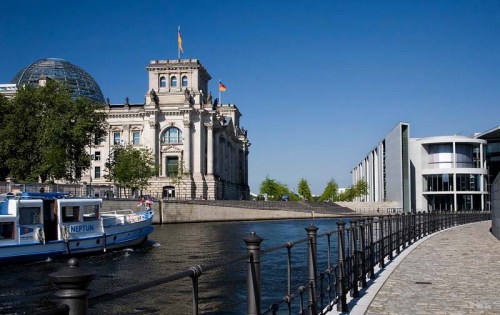
And here’s the very last river, the Spree, which flows right through the middle of Berlin. Right past the Re9ichstag building:
And then we come to the crunch. The whole point of the pamphlet…….

“Soldat!””Soldat!”

“Soldier!”


“Warte nicht, bid die Russen, Engländer und Amerikaner von Osten, Westen, Norden und Süden her Hitlers letsten Kessel zusammanhauen.”

“Do not wait until the Russians, British and Americans from east, west, north and south together, smash to pieces Hitler’s last encircled army.”


“Sieh zu, daß Du Dich rettest, ehe es zu spät ist !”

“Make sure you save yourself before it’s too late!”


“Gib Dich gefangen und du bist gerettet !”  

“Give yourself up and you will be saved!”


“Mach von nachstehendem Passierschein Gebrauch.”

“Use the pass below.”

“Dieses Flugblatt gilt als Passierschein für deutsche Soldaten und Offiziere, die sich der Roten Armee.”

“This leaflet is valid as a pass for German soldiers and officers who join the Red Army.”

It also contained that information in Russian…

“Эта листовка служит пропуском для немецких солдат и офицеров при сдаче в плен Красной Армии”

Which means….

“This leaflet serves as a pass for German soldiers and officers when surrendering to the Red Army.”

Alas, it didn’t all work out very well for all of the German POWs in Sunny Siberia:
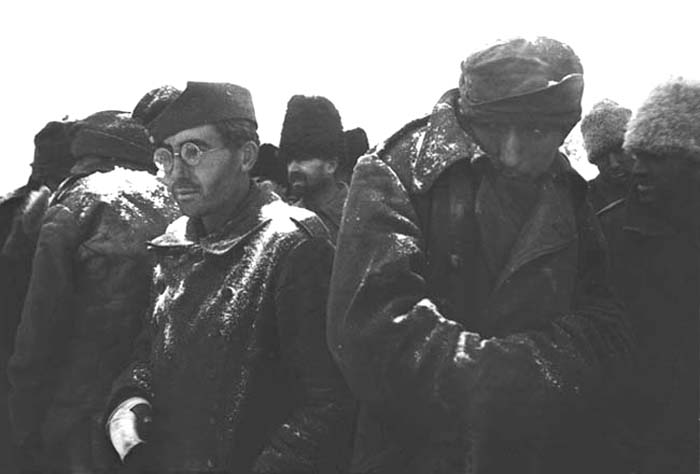
According to the Soviets, 381,067 German POWs died in Russian camps (356,700 Germans and 24,367 men of other nationalities).

The West German government found that of 3,060,000 German prisoners, a total of 1,094,250 perished in the camps of the Soviet Union.

Historian Rüdiger Overmans calculated that there were 3,000,000 German POWs in the USSR, and the “maximum” number of deaths was 1,000,000.

And of the ones who did survive, the very last was released in 1956. Every single one had been busy rebuilding a shattered Soviet Union.

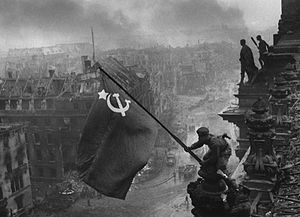
And to end with, let’s take another look at the Soviet “Photograph of the Month” for May 1945:
 

25 Comments

Filed under Aviation, History, military, Russia

“Die Rote Armee” means “the Red Army” (1)

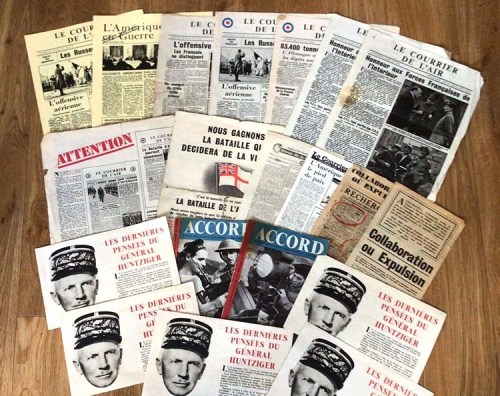
I used to buy a lot of things on ebay.  And sometimes I found some real bargains and some really interesting things for sale. That’s not quite as easy a proposition now, but recently I decided to search for some propaganda leaflets from World War Two, the sort that were dropped on enemy forces from aircraft. Many people thought that they were 100% effective, but “Bomber” Harris, the man in charge of the RAF’s Bomber Command, thought that they merely provided the Germans with free toilet paper for the duration of the war. Here’s a sample selection, which was priced at £200:

By 1945, the war was nearly over, but the Germans still fought on and refused to surrender. The lives of  ordinary Germans seem to have had no value or importance as far as their leaders were concerned.

After the Vistula–Oder Offensive of early 1945, the Soviet Red Army had temporarily halted their westward advance on a line 37 miles east of Berlin. By March 9th, the Germans too had established their own defensive plans for the city. The first preparations for this were made in the suburbs of Berlin from March 20th onwards.

At this point, there were 766,750 German soldiers acting as Berlin’s defenders and a Soviet attacking force of a gigantic 2,300,000 men.

The Germans would still not surrender, though. Eventually, leaflets were dropped from Soviet aircraft to persuade them to give up. Such a leaflet is what I bought on ebay at a bargain price of £10. There were no other bidders. This is the front page.

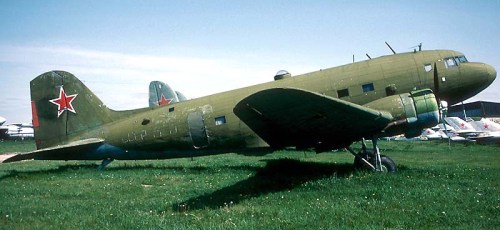
This is a Lisunov Li-2, which was probably the Russian aircraft of choice for leaflet drops. All American readers should recognise it!

The leaflet was very simply presented. The text is direct and to the point. As most readers do not speak German, and neither do I, thanks to Google translate, I can provide the English:

“Lesen und an die Kamarden weitergeben!”

Read and pass it on to your friends!

“Rette dich, ehe es zu spät ist!”

Save yourself before it’s too late!

“Soldat!”

Soldier!

Certain city names occur and recur on this propaganda leaflet. So now, here’s a little bit of geography. First, the places important to the German invaders…….

Stalingrad was on the River Volga, way, way, to the east of the European Soviet Union, and almost in Asia. It was north of the Caucasus and a good way east of the Black Sea.

Leningrad was in the north, on the Baltic Sea, right next to Estonia and Finland. Moscow, Minsk and Warsaw were all further south, on the usual West-East invader’s route into Russia. Nowadays these cities are major stations on the Moscow-Berlin line, a journey which took me two whole days in 1969.

The Soviet Red Army’s route from east to west, as they chased the Germans out of their country, across Poland, and finally to their own capital, Berlin, was, of course, a lot longer than two days!

Finally, some help with the place names mentioned in the next few extracts…..

In central Europe, the Oder is the river which still forms the present-day frontier between Germany and Poland. In the Cold War, it was half of the so-called “Oder-Neisse Line“.

The River Spree actually flows through the very centre of Berlin and then joins the River Havel in Spandau, home of the heavy machine gun and the famous ballet company:


“Von der Wolga bis zur Oder sind es 2000 Kilometer, von Der Oder bis zur Spree – 75.”

“From the Volga to the Oder it is 2000 kilometers, from the Oder to the Spree – 75.”

On we go, chasing the Fascists…….

“Die Rote Armee hat den Weg von der Wolga bis zur Oder zurückgelegt und die Oder überschritten.”

“The Red Army has travelled the route from the Volga to the Oder and crossed the Oder.”

Here are the Germans, trying to defend the River Oder. The Field Marshall was a little bit disappointed with the turn-out:


“Sie wird auch den Weg bis zur Spree zurücklegen.”

“It (the Red Army) will also travel the road to the Spree.”

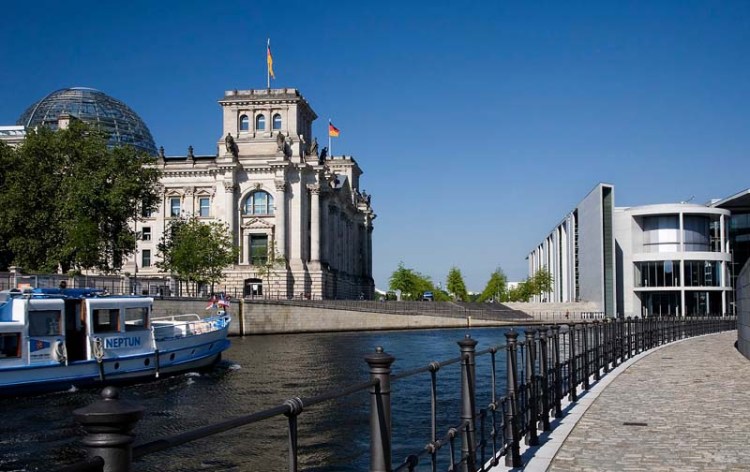
The Spree is the last river before you reach the very centre of Berlin. Here it is, right next to the Reichstag building:


“Zwischen Wolga und Oder gab es Stalingrad und Kursk, Leninjgrad und Minsk, Kischinew und Warschau. Jenseits der Oder liegt Berlin.”

“Between the Volga and the Oder there was Stalingrad and Kursk, Leningrad and Minsk, Kishinev and Warsaw. Berlin is on the other side of the Oder.”


These cities all form the different routes for the invaders of the Soviet Union to travel. The next two sentences from the leaflet duly lists them, as the Red Army chases the Germans westwards, out towards the Vaterland :

Route 1 is Stalingrad-Kursk-Berlin,  and Route 2 is Leningrad-Minsk-Berlin and, presumably, Route 3 is Kishinev-Warsaw and then Berlin. KIshinev was in Moldova, just to the north of Rumania.

All three routes begin to converge when they reach Warsaw and Berlin. That explains the Red Army of 2.3 million men.

“Die Rote Armee hat die gewaltigen Schlacten um Stalingrad und Kursk, um Leningrad und Minsk, um Kishinew und Warschau gewonnen.”

“Sie wird auch die Schlact um Berlin gewinnen.”

“The Red Army has won the mighty battles around Stalingrad and Kursk, Leningrad and Minsk, Kishinev and Warsaw.”

“It will win the Battle of Berlin”

“Zwischen Wolga und Oder hatten die Deutschen Dutzende, uneinnehmbarer Wälle und Hunderte erstklassiger Festungen.”

“Jenseits der Oder, auf dem Wege nach Berlin, gibt es weder Wälle noch festungen mehr.”

“Between the Volga and the Oder, the Germans had dozens of “impregnable ramparts” and hundreds of first class forts.”

“Beyond the Oder, on the way to Berlin, there are no more ramparts or fortresses.”

And then a frightening threat, or more likely, promise:

“Die Rote Armee hat alle deutschen Festungen zwischen Wolga und Oder genommen und die Oder überquert.”

“Sie wird auch die letzte Festung jenseits der Oder – Berlin – nehmen.”

“The Red Army took all German fortresses between the Volga and the Oder and crossed the Oder.”

“It will also take the last fortress on the other side of the Oder – Berlin.”

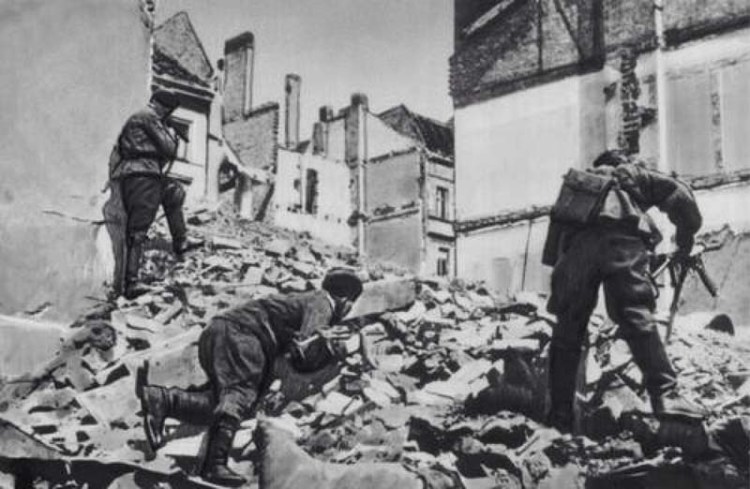
That is the end of the first section of the leaflet. Next time, we’ll take a look at the second section. The picture shows Soviet infantry capturing some of the streets of Berlin.

And finally, I do apologise for the lack of  maps. I searched for a long time to find a simple map of the Eastern Front in 1945, but an overall, easy-to-understand example proved impossible to find.

21 Comments

Filed under Aviation, History, military, Russia

What would you do ? (17) The Solution

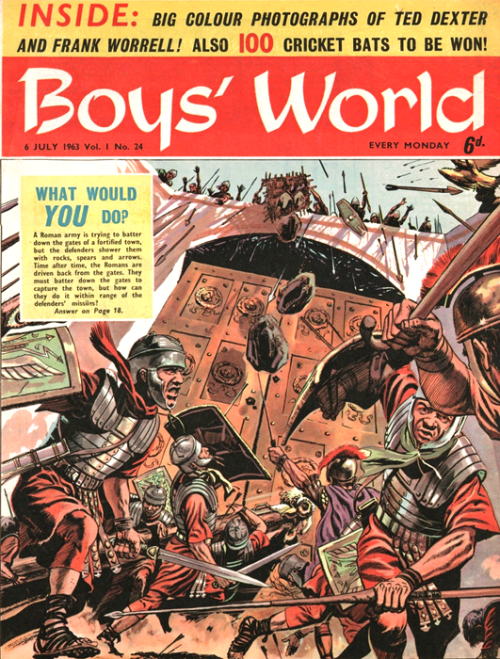
“What would you do ?” used to figure on the cover of a boys’ comic called “Boys’ World”. This was a publication, obviously, aimed at boys, and first appeared on January 26th 1963. There were 89 issues before the comic was merged with Eagle in 1964. The last issue of “Boys’ World” came out on October 3rd 1964.

I used to buy “Boys’ World”, and this was mainly for the front cover which always featured a kind of puzzle. It was called “What would you do ?” and was based on somebody being in what Ned Flanders would call “A dilly of a pickle”. Here’s the situation:

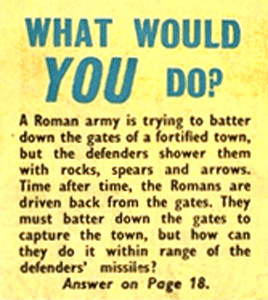
And the yellow box said:

The Roman army, then  is being driven back time after time from the gates because of the missiles the  defenders are throwing. How can the Romans get in, when they are directly underneath the defenders’ missiles?

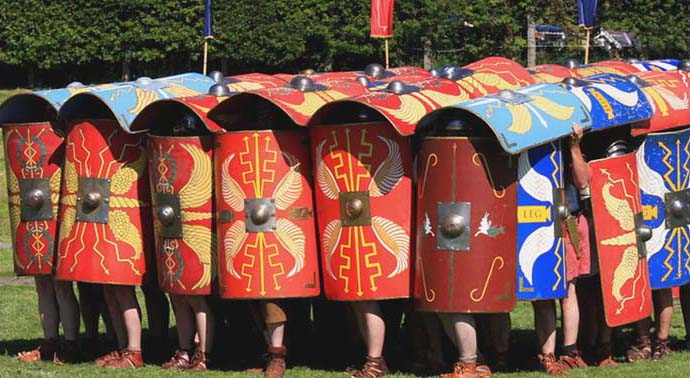
And, the correct solution given on page 18 of the comic is:

Quite simple, really, I suppose. The old “testudo”, used only when needed, was a standard formation of the Roman army:

28 Comments

Filed under History, Literature, military, Personal

What would you do ? (17) The Puzzle

“What would you do ?” used to figure on the cover of a boys’ comic called “Boys’ World”. This was a publication, obviously, aimed at boys and first appeared on January 26th 1963. There were 89 issues before the comic was merged with Eagle in 1964. The last issue of “Boys’ World” came out on October 3rd 1964.

I used to buy “Boys’ World”, and this was mainly for the front cover which always featured a kind of puzzle. It was called “What would you do ?” and was based on somebody being in what Ned Flanders would call “A dilly of a pickle”. Here’s the situation:

The yellow box sets the scene, and the task is for you to solve the situation. Perhaps you might like to write your idea in the “Comments” section.

Here’s the yellow box enlarged:

So…..it’s one “dilly of a pickle”.  The Roman army is at the gates of a fortified town, trying to batter their way in. The inhabitants of the town are throwing copious quantities of rocks on top of them, and firing arrows and throwing spears. The Romans are driven back time after time. They have no choice, though, but to capture the gates since this is the only way to get in and capture the town. How can they do it, when they are within easy range of the defenders’ missiles?

Bonus marks, incidentally, for anybody who knows who Frank Worrell or Ted Dexter were, and why were they featured in the comic?

27 Comments

Filed under History, Literature, military, Personal

Photographs of the Eastern Front in World War Two (6)

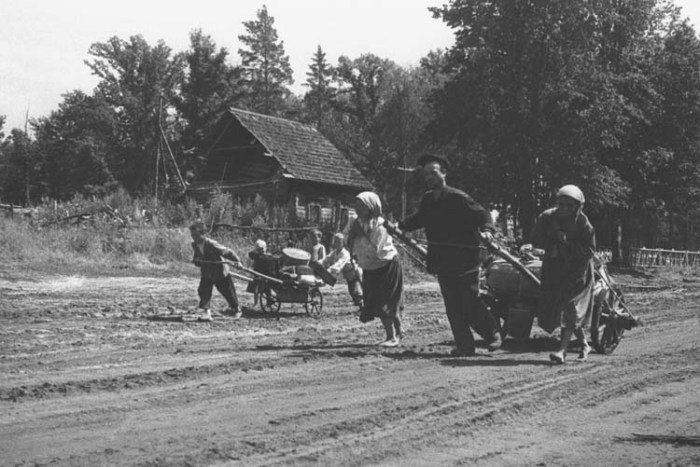
About a year ago I bought a collection of more than 12,000 photographs of World War Two. Most of them were not British or American but were either Russian or German. I would like to share some of them with you because a number of these photographs have great merits as photographs, as well as capturing a split second in history. None of them have a caption, so I have tried to work out what might be going on.

Today, I’m going to look at the return of the Russian civilian population to their homes.

Some came home on foot, walking, perhaps, hundreds of miles, many of them barefoot:


Many pulled handcarts:

And others pushed handcarts, although, if you look carefully, occasional individuals travelled in style, even if they looked slightly startled:

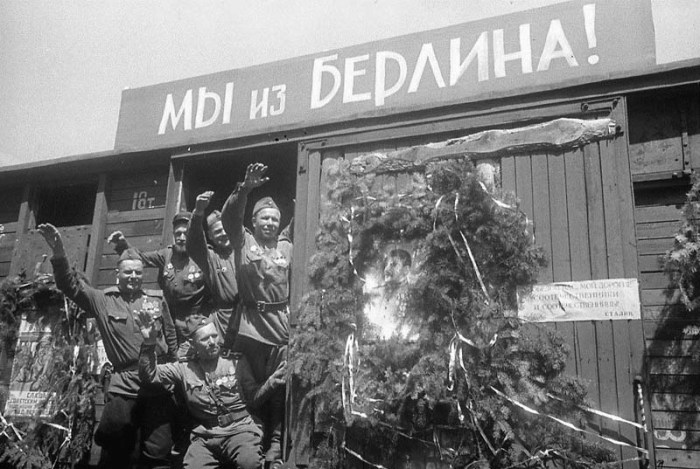
The Red Army travelled in top quality, luxury cattle trucks. The large slogan means “We (are) from Berlin”. The present tense of the verb “to be” does not exist in Russian. The word “Berlin” is decipherable, however.

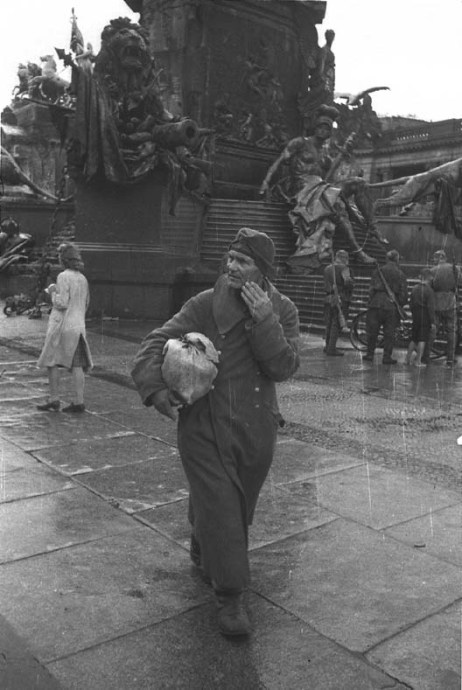
I think that this is an ex-soldier who has been demobbed recently, and he is having a look round Berlin before he makes his way home. That huge statue used to stand in front of the city palace above the River Spree, and commemorated Kaiser Wilhelm I. It’s clearly a place where soldiers would hang out, and that is one of the reasons that I think that this well dressed young lady, who is not walking but just standing there, is actually a prostitute:

Some areas were still very dangerous and a Red Army escort was sometimes necessary to get home. Notice how the lady is carrying the family icon. Christianity saw a big revival during the war as it provided somebody to pray to who had a lot more credibility than Uncle Joe Stalin:

Here are two young women meeting in a shattered, desolate city, possibly Stalingrad. One has just been to do the shopping and the other one has just got off the train with her suitcase. There are still fires burning and some buildings still have the dark marks of a recent fire.

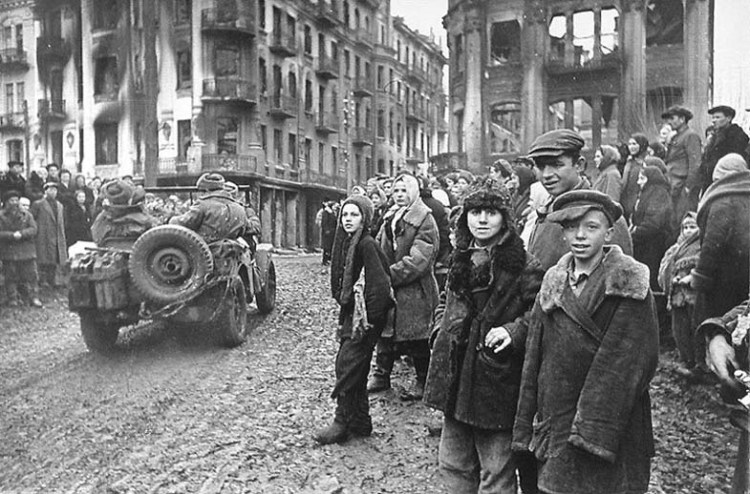
As the liberating armies come ever closer, the first jeeps arrive, to be greeted by delirious crowds. Except that that isn’t happening here. Some of the people actually look really quite aggressive. Are they Poles, assembled in the streets to shout “Welcome to the Red Army” or perhaps “Soviets, stay as long as you like”?

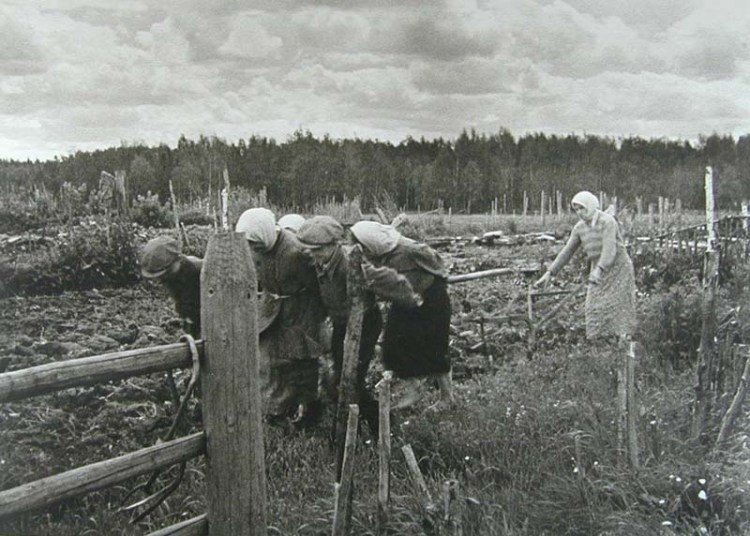
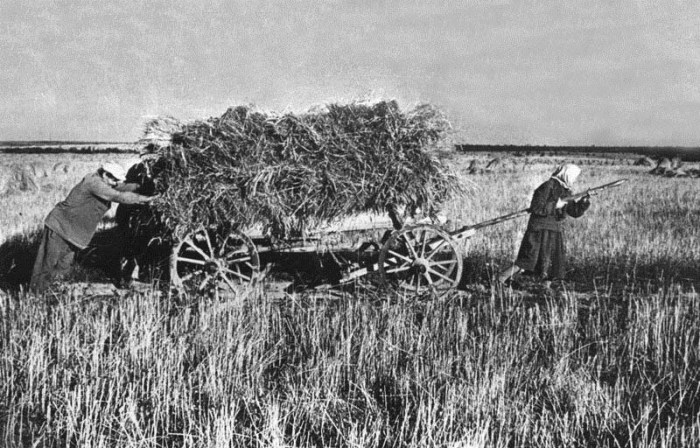
If there’s going to be a harvest, somebody needs to start ploughing at some point. I saw horses used widely in Polish fields as late as 1969:

If the horse isn’t up to it, see if the family can help you out:

And if all goes well, you will get your just deserts:

24 Comments

Filed under History, military, Russia

Photographs of the Eastern Front in World War Two (5)

About a year ago I bought a DVD with more than 12,000  images of World War Two . Most of them were either Russian or German.

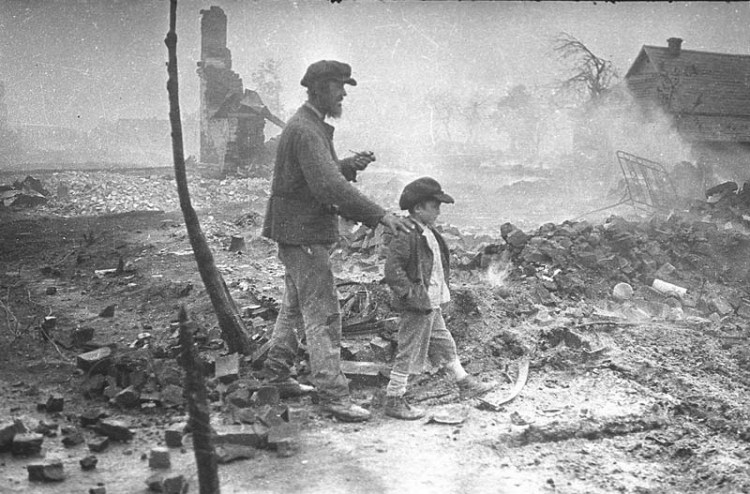
This first photograph shows a little Russian boy who appeared in one of the previous photographs in the Blog Post “Photographs of the Eastern Front in World War Two (4)”. Both he and his grandad stand in the smoking ruins of their house, and of their village. We can only guess at the circumstances. Personally, given the fact that the two individuals do not look particularly shocked or desolate, I think that the Germans have set fire to their village as they retreat back to Germany with the Red Army keenly pursuing them.

In this winter scene, Grandad and grandson are planning the future, perhaps where they will live, or where they hope a neighbour will help them rebuild their house and so on. Grandad is carrying his cane, but what’s that in his left hand? Incidentally, after much careful examination with Blog Post No 4, I do not think these two are the same individuals featured there, although, of course, you may not agree.

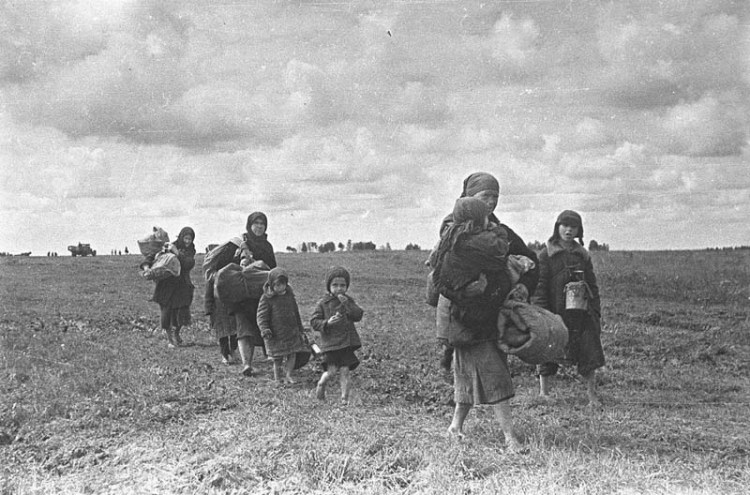
With victory in sight, though, and the tide of war now relatively far away, the refugees gradually came back. Here’s Granny, with her two daughters and five, perhaps six children. Everybody is barefoot, but they’re going home, so walking’s easy. And the two fathers? Well, they could have been starved to death in a POW camp, or worked to death as slave labourers in Poland or even in the Channel Islands.

This careful close up excludes any adults and focusses on the children with two brothers making manful efforts to carry as much as they could on a handcart. The baby sleeps the sleep of the innocent little child. Notice how she may well be strapped in for safety.  We will never know if the family’s house was still there when they arrived. In Byelorussia alone, up to 1500 villages were razed to the ground.

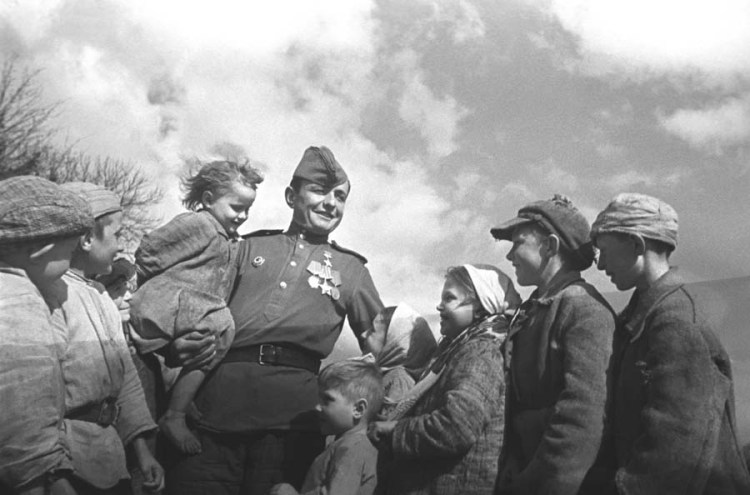
As the conquering hero returns, it’s the village kids who spot him first. He has a smile wide enough to indicate that he has already asked somebody whether his family is still alive. Under the German occupation, nobody was safe.

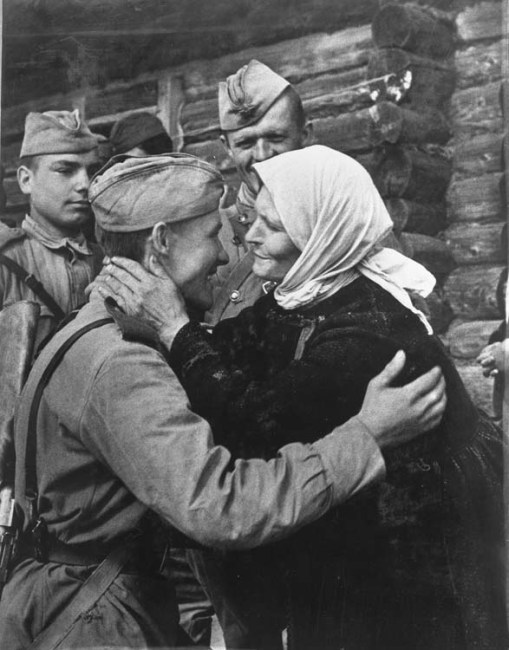
If I were going to give this photograph a title, it would be “The Love of a Mother”. Ordinary young soldiers walked back home, starting as a group which lost a member or two as they passed by each village. These were villages where the inhabitants would not have known whether a particular young serviceman was alive or dead. Yuri Gagarin’s two brothers performed slave labour in Poland, escaped and the Red Army conscripted them. The rest of the family thought both of them were dead, and Yuri became seriously ill with “grief and hunger”. They got back home in late 1945:
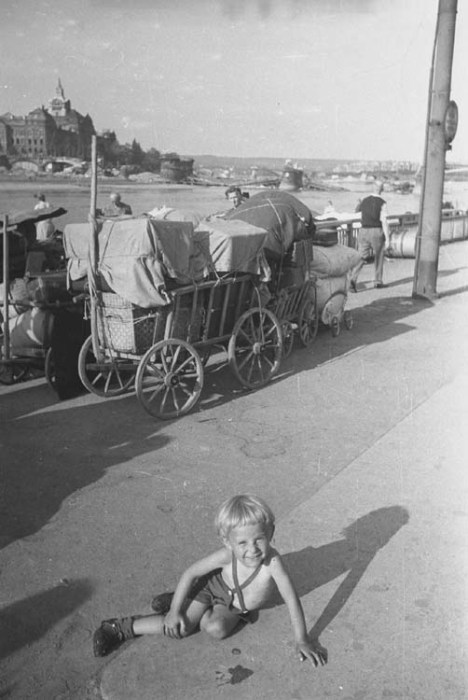
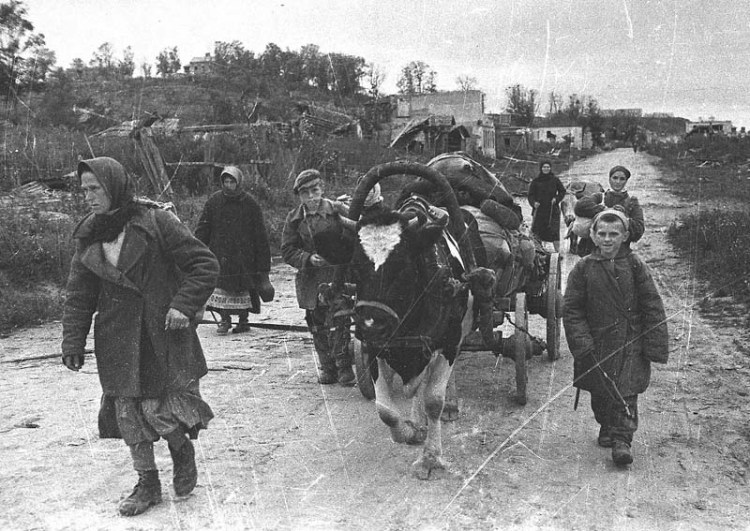
And still the refugees stream westwards to their homes. These bring two cows with them and a sturdy cart with substantial wheels. There are eight people, with, for me, two grannies, two mothers, two boys and a young woman. They all have boots and one boy has a Red Army infantryman’s cap. Did they find their house even vaguely intact? And what about at least two husbands?

Even more so, what about the bear who appears to be asleep on the back of the cart? Or have I got to take more water with it?

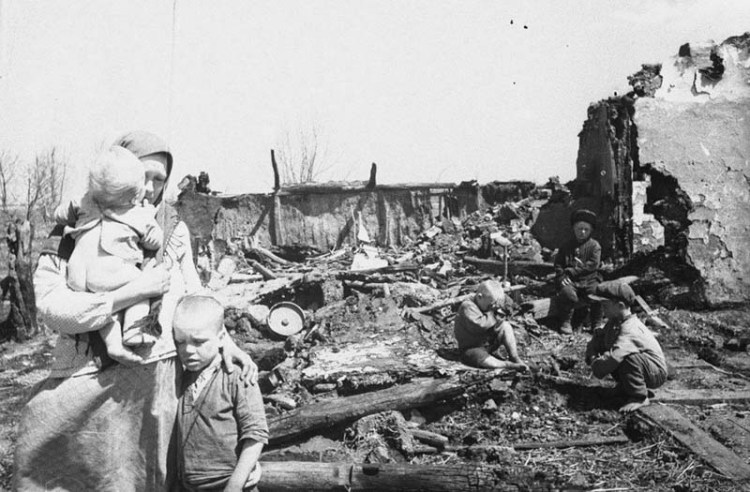
Most stories in Russia, though, had a sad ending. A house smashed to pieces by a German tank, because the crew wanted to use it as a hiding place. A woman with perhaps five mouths to feed and no husband in sight. It’s enough to make even  tough little Russian lads burst into tears. But don’t worry. Everything will be made good within a few years.

Indeed, things did get better ! So smile and enjoy being alive, enjoy sitting in the summer sunshine of 1945. As many as 20 million Russians were not able to say that.


As far as the present war in the Ukraine is concerned, I would expect the Russians to remember the destruction wrought on so many towns, cities and villages of the old Soviet Union, and to begin face-to-face discussions before resorting to the senseless violence they have evidenced so far. But, as we know in the West, hardly any people who witnessed the Second World War are still alive, and that must have been enough for a glory seeking politician to forget the ways of peace and to take up the pointless violence of the invader.

28 Comments

Filed under History, military, Politics, Russia, war crimes

Why I am what I am (2)

Last time I mentioned a number of things that linked me to my Dad insofar as interests, hobbies and sports were concerned. I soon discovered that that was really only the beginning of the story.

I rather think that I studied Russian because Fred used to speak so frequently of the Russians during the Second World War. In the bookcase at his parents’ house, he had a pamphlet borrowed from an RAF library. It was entitled “Our Soviet Friends”, and it had pictures of the dam at Dnepropetrovsk:
He told me how, in the RAF, anybody wth knowledge of Russian could name their own price for helping to liaise with our new surprise allies, once the Germans invaded the Soviet Union. Towards the end of the war, Lancasters, on rare occasions, used to bomb the Germans and then carry on to Russia to land. When they came back they brought more bombs and often, one or two souvenirs.  On one occasion, my Dad had had a drink from a flask of coffee made up for the aircraft’s crew in Leningrad. I had to satisfy myself with my early attempts to learn the language, with the woman of my dreams…..

I may like French because, in 1940, Fred had wanted Britain and France to merge into one country just like Churchill had said. Fred was a keen European and, like Churchill,  he wanted a “United States of Europe”. As members of Bomber Command he told me, though, that the French could often be difficult to work with. Here is a Bristol Blenheim of the Free French Air Force in North Africa…..

I have always had great regard for the Poles because Fred said they were great blokes, and that he had joined up so that Poland could be freed from the invading Germans. A few years ago, I was in hospital for a operation, and there was a Polish van driver there that nobody would talk to because he was Polish. Except me, and if Fred had been there, he would have spoken to him, too. Racism can be amazingly petty.

I try to like poetry, because I know that Fred had claimed so often that poetry was an integral part of his life. He liked to read peoms out loud to his classes at school, his favourite being “Flannan Isle”.

I did a series of five blog posts about the mystery of Flannan Isle, as portrayed in the poem, and the first one is here. The rest can be found by merely searching for  “Flannan”. And when you’ve done that, don’t forget to watch this film with its own, made-up, explanation of the three men’s disappearance….

I’m sure that I became a teacher because Fred was a teacher and I felt that a teacher was a good thing to be. In the mid-1970s, the money was excellent and I didn’t automatically have to live in London.

I always worked hard as a teacher because Fred told me that at the end of each day, you should always ask yourself the question, “Were you just given your wages, or have you earned them ?”

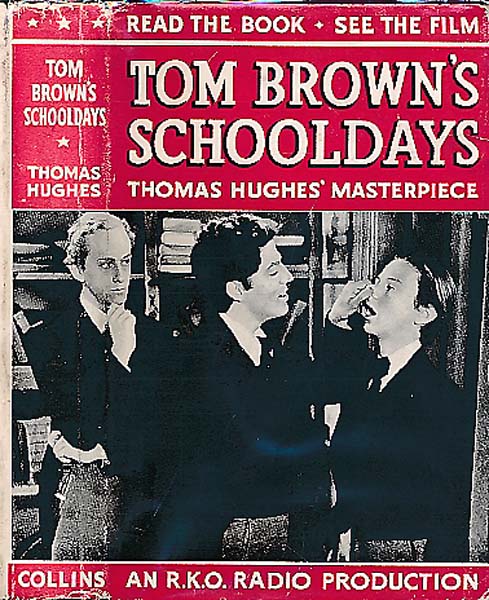
I worked all my life at the High School, 38 years, because when he took me there for a job interview in 1975, I could see that Fred was enormously impressed by the school. To him, and to me, it looked like something out of a film, such as, perhaps, the old version of “Tom Brown’s Schooldays”…….

In actual fact, after his death, I found that, when he was a boy in the 1930s, Fred’s Uncle George  had bought him a present, the book of the film “Tom Brown’s Schooldays”.  They didn’t shoot this film at The High School, but if they had wished to, it would have been entirely appropriate from the architectural point of view….

Fred read a lot about the Second World War, and one of his favourite books was a German doctor’s story of Operation Barbarossa, a book called “Moscow Tram Stop”. The High School has its own tram stop, called “High School”. That fact has always reassured me that I had made the right decision to work there for so long.


25 Comments

Filed under Film & TV, History, Literature, military, my Dad, Nottingham, Personal, Russia, Wildlife and Nature

Phonetic Alphabets (2)

Last time we looked at a number of phonetic alphabets. There was the British Army in 1904, the  British Post Office in 1914 , the  Royal Navy in 1917 and the  Western Union in 1918. Then came the good sense of the US Army and the US Navy in 1941 to have the same alphabet (for both) in contrast with the four different alphabets used by the RAF in different periods of World War II.

But what about the foreigners?

Here’s the Luftwaffe alphabet  in 1940. The very same one was used by the Wehrmacht, the German army:

Anton, Ärger, Bertha, Cäsar, Charlotte, Dora, Emil, Friedrich, Gustav, Heinrich, Ida, Julius, Konrad,

Ludwig, Martha, Nordpol, Otto, Ödipus, Paula, Quelle, Richard, Siegfried, Schule, Theodor, Ulrich, Viktor,

Wilhelm, Xanthippe, Ypsilon, Zeppilon

It is obviously different from the Allies’ alphabet, being based on names, but that must surely have made it quite easy to learn. Incidentally, “Ärger” and “Ödipus” were used for any words which contained either ” ä ” or ” ö “. Notice too how they have a code word for Ä and Ö. There is also a quick way of doing ‘c’ and ‘ch’ with Cäsar and China along with ‘s’ and ‘sch’ with Siegfried and Schule.

The most frequent marks of the Messerschmitt Bf109 such as the 109D, the 109E, the 109F and the 109G were frequently known by their phonetic letters, the Dora, the Emil, the Friedrich and the Gustav.

Here’s a young man and an old man who are the one and the same man. He was a Luftwaffe radio operator in WW2. The shape of his ears is a giveaway. Age yourself by seventy years but you’ll never change your ears.

And here is the cloth badge to be sewed on the uniform of a crewmember that the Luftwaffe called a “bordfunker”:

The German Navy, the Kriegsmarine, had a very slightly different alphabet, but , again, it was based on names:

Anton, Ärger, Bruno, Cäsar, China, Dora, Emil, Friedrich, Gustav, Heinrich, Ida, Julius, Konrad,

Ludwig, Martha, Nordpol, Otto, Ödipus, Paula, Quelle, Richard, Siegfried, Schule, Theodor, Ulrich, Viktor,

Wilhelm, Xanthippe, Ypsilon,  Zeppilon

The Wehrmacht used pretty much the  same alphabet with:

Anton, Ärger, Berta, Cäsar, Charlotte, Dora, Emil, Friedrich, Gustav, Heinrich, Ida, Julius, Konrad,

Ludwig, Martha, Nordpol, Otto, Ödipus, Paula, Quelle, Richard, Siegfried, Schule, Theodor, Ulrich, Übel, Viktor,

Wilhelm, Xanthippe, Ypsilon, Zeppelin 

 I couldn’t find a guaranteed French phonetic alphabet for World War II, but I did find this one, which is obviously based on first names:

Anatole, Berthe, Célestin, Désiré, Eugène, François, Gaston, Henri, Irma, Joseph, Kléber,

Louis, Marcel, Nicolas, Oscar, Pierre, Quintal, Raoul, Suzanne, Thérèse, Ursule, Victor, William, Xavier,

Yvonne, Zoé

That was a real list of sex bombs for French soldiers of every sexual persuasion to drool over. I don’t know what a “Quintal” is, but this happy curly haired chap is Ryan Quintal:

Actually I did look up “quintal” and one website said “a hundredweight  or a weight equal to 100 kilograms”. Another website said “backyard”. I often confuse the two.

The Italians, like many other nations, base their alphabet on towns and cities:

Ancona, Bologna, Como, Domodossola, Empoli, Firenze, Genova, Hotel, Imola, Jolly, Kursaal,

Livorno, Milano, Napoli, Otranto, Padova, Quarto,Roma, Savona, Torino,

Udine, Venezia, Washington, Xeres, Yacht, Zara.

Surely we all know the telegram sent by the humourist Robert Benchley to the New Yorker magazine:

“Have arrived Venice. Streets full of water. Please advise.”

I did find a Soviet spelling alphabet. The Russian alphabet, though, uses 33 letters, so it was quite complicated.  I decided to transcribe only the words for our Western letters. That came to:

Anna, Boris, Konstantin, Dmitri, Yelena, Fyodor, Grigory,

Khariton, Ivan, Zhenya, Leonid, Mikhail,

Nikolai, Olga, Pavel, Roman, Semyon,

Tatyana, Ulyana, Vasiliy, Zinaida.

Some letters such as ‘k’, ‘q’,  ‘w’, ‘x’ and ‘y’ do not really exist in Russian. Here’s a link to some of the letters of their alphabet.

Here are some Soviet signallers, giving a report to Headquarters in an unknown German town that has just been captured:

Two final points. If you can understand this, you’re a better man than me. This is perhaps 20% of a very large presentation of the Japanese phonetic alphabet. My best guess is that a word stands for a syllable, so that “suzume” stands for the syllable “su” and so on:

And finally, here’s the weirdest phonetic alphabet I found, taken from Tasmania in 1908:

Authority, Bills, Capture, Destroy, Englishmen, Fractious,

Galloping, High, Invariably, Juggling, Knights, Loose,

Managing, Never, Owners, Play, Queen, Remarks,

Support, The, Unless, Vindictive, When, Xpeditiously,

Your,  Zigzag


18 Comments

Filed under Aviation, History, Humour, military, Russia, the Japanese

Phonetic Alphabets (1)

Signalling by one group of soldiers to another, or by one ship to another, has gone on for centuries. Signalling flags were used on ships in the time of Admiral Nelson:

And there was always semaphore. As used by the Beatles:

The advent of radio, however, made things a lot more difficult, because when men spoke to each other, interference was a frequent problem. Sometimes words, especially place names, had to be spelt out, and merely giving out a list of letters, such as L-O-N-D-O-N did not always work, especially if the interference was intermittent.

In 1904, British Army signallers started to use a partial spelling alphabet, where only the more problematic letters had their own code word. This produced:

ACK, BEER/BAR, C, D, E, F, G, H, I, J, K, L ,  EMMA, N,O, PIP, Q, R, ESSES, TOC, U, VIC, W, X, Y, Z

Only seven letters needed! By 1918, the problems of using the 1904 alphabet had added  a few words:

CORK,   DON.   EDDY.    INK.    JUG.   QUAD.   TALK

Here’s a war artist’s rendition of a signaller:

Things got better once for the British army when they adapted horse drawn radios:

Overall, it is crucial to have only ONE spelling alphabet, otherwise the situation becomes downright confusing. There used to be different alphabets for:

the 1914 British Post Office with Apple, Brother, Charlie, Dover, Eastern,

the 1917 Royal Navy with Apples, Butter, Charlie, Duff, Edward

the 1918 Western Union with Adams, Boston, Chicago, Denver, Edward

Much more sensibly, during World War II, the US Army and Navy used the same alphabet. It is familiar from so many war films and so many comics:

Able, Baker, Charlie, Dog, Easy, Fox, George, How, Item, Jig, King, Love, Mike,

Nan, Oboe, Peter, Queen, Roger, Sugar, Tare, Uncle, Victor, William, X-ray, Yoke

These men were some of the members of the real “Easy Company” :

What is important here is to have no words whatsoever that sound like any of the others. In this alphabet maybe jig and king, or able and baker, or dog and fox might cause problems.

Here’s the RAF spelling alphabet until 1942:

Apple, Beer, Charlie, Don, Edward, Freddie, George, Harry, Ink, Johnnie, King, London, Monkey,

Nuts,  Orange, Pip, Queen, Robert, Sugar, Toc, Uncle Vic,  William, Yorker, Zebra

And here’s the RAF alphabet after 1942

Able, Baker, Charlie, Dog, Easy, Fox, George, How, Item, Jig, King, Love, Mike, Nan, Oboe,

Peter, Queen, Roger, Sugar, Tare, Uncle, Victor, William, X-ray, Yoke, Zebra.

Smart people will have noticed how close it is to the US Army and Navy alphabet. How sensible!

In actual fact, the RAF was already using quite a few other alphabets anyway, such as this one noted in 1942-1943 :

Apple, Beer, Charlie, Dog, Edward, Freddy, George, Harry, In, Jug/Johnny, King, Love, Mother,

Nuts, Orange, Peter, Queen, Roger/Robert, Sugar, Tommy, Uncle, Vic, William, X-ray, Yoke/Yorker, Zebra

And there was a further alphabet for the squadron letters on the side of the aircraft in the Dambusting 617 Squadron:

A-Apple, B-Baker, C-Charlie, E-Easy, F-Freddie, G-George, H-Harry, J-Johnny, K-King,

L-Leather, M-Mother, N-Nuts, O-Orange, P-Popsie, S-Sugar, T-Tommy, W-Willie, Y-York, Z-Zebra.

I presume that the missing letters were non-existent aircraft. Here is 617 Squadron and these are B-Baker, G-George and M-Mother:

This slideshow requires JavaScript.

I wrote a number of blog posts about my wife’s friend, Len, who flew in 617 Squadron, in G-George. His full name was Len Dorricott, and this link will take you to the first of the three posts. If you copy and paste the surname “Dorricott” into “Search”, then finding Blog Posts No 2 and No 3 about Len becomes a doddle.

18 Comments

Filed under Aviation, Bomber Command, History, Humour, military

Why no statue ? (10)

Last time, I revealed that, up to and including the Second Boer War…….

“in every war fought by British forces they lost more men to typhoid than to the enemy”.

That was easily true of the Crimean War where 4,602 were killed in battle and 17,580 by typhoid. It was certainly true too of the Second Boer War and it would have been true of World War One, but for Almroth Wright.

Once he had seen the efficacy of his vaccine, Almroth gradually convinced the people in charge of the British armed forces of two measures which they absolutely had to take. Firstly, all military personnel would have to be injected, whatever they personally thought about it. Secondly, from 1910 onwards, around 10,000,000 vaccine doses had to be made immediately available for the troops.

As a consequence, when World War One began, the British Army was the only one with 100% vaccination of its troops against typhoid. In the Boer War in South Africa, there were 105 cases of typhoid per 1,000 troops and the death rate was 14.6 per 1,000 troops. In World War One though, there were 2.35 cases of typhoid per 1,000 troops and the death rate was 0.139 per 1,000 troops.

The result was that the British Empire suffered an appalling total of 1,118,264 casualties but the vast majority of them were on the battlefield. If the war had taken place without Almroth’s vaccine then the number of men and women to die would have been 2,236,529, and that would have been the figure if typhoid deaths were only one man more than those killed in action (which was extremely unlikely).

Let’s imagine that World War One had been played by Boer War rules. In South Africa, 5,774 men died in combat, or of the wounds they received in combat and 14, 210 died of disease. That is a ratio of just about 2½ to one, disease and combat. I’m not sure that I can believe my own Maths, but that would give you a grand total of 3,354,792 dead by the end of World War One, if typhoid had killed soldiers at its usual rate.

Is that not enough to warrant a statue? A total of 2,236,528 lives saved if the calculations are done by Boer War rules.

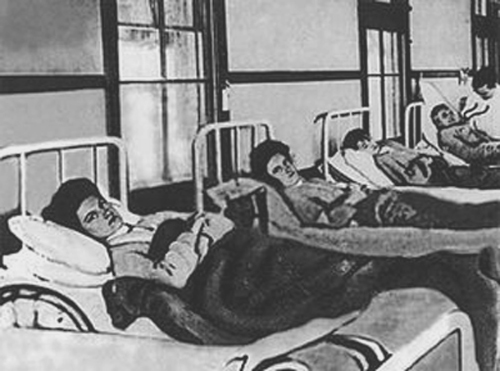
Even after Almroth Wright’s work, typhoid did still break out here and there in Great Britain. Without really searching very hard, I found that there were outbreaks in Maidstone in Kent (1897), Southampton and Winchester (1902) and Lincoln, England (1905). There was one very famous outbreak in New York (1906), but the disease kept up its unhealthy average in Dublin (1908), Retford in Nottinghamshire (1912), Tideswell in Derbyshire (1915), Croydon (1937), Chatham (1938), Dundee (1938) and Aberdeen (1964). Presumably, the arrival of lorry loads of Almroth’s vaccine prevented these outbreaks from becoming really serious (with the exception of Typhoid Mary, of course, in New York in 1906). Here she is, nearest bed:

During his lifetime, Almroth received at least 28 medals, prizes and honorary degrees. There is no statue of him, though. He was nominated 14 times for the Nobel prize from 1906 till 1925 but he didn’t receive one. All he has is a ward named after him at St Mary’s Hospital in Paddington in London…….


25 Comments

Filed under Africa, History, military, Science