Category Archives: Personal

Nina Potapova: a woman I cannot forget (1)

When I was about eight or nine, I was intrigued by a book in our local library in South Derbyshire:

Last year I bought a second hand copy off the Internet. A book from Bangor in north west Wales. Probably the very book used to learn Russian by the defector (or is he a defector?), Richard Burton, in “The Spy who came in from the Cold”. Still, at least I learned the Welsh for ‘stock’:

I was intrigued by the copperplate Russian alphabet. Here’s the first 16 letters. :

There are 33 altogether because our ‘ch’ or ‘sh’ or ‘ts’ are single letters in Russian. Here’s the full 33 from Wikicommie:

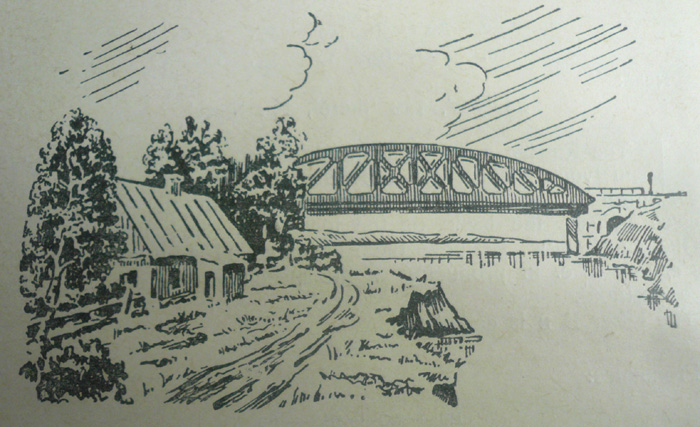
With Nina, I loved the artwork:

And here’s the text. It looks childish and moronic, but not if you’re in MI6. If you are in Moscow and ask the right person the question “Is the house there?” and they replied “Yes, the bridge is here.” you got to spend the night with Ursula Andress:

Here is Moscow. The Moscow Kremlin to be precise:

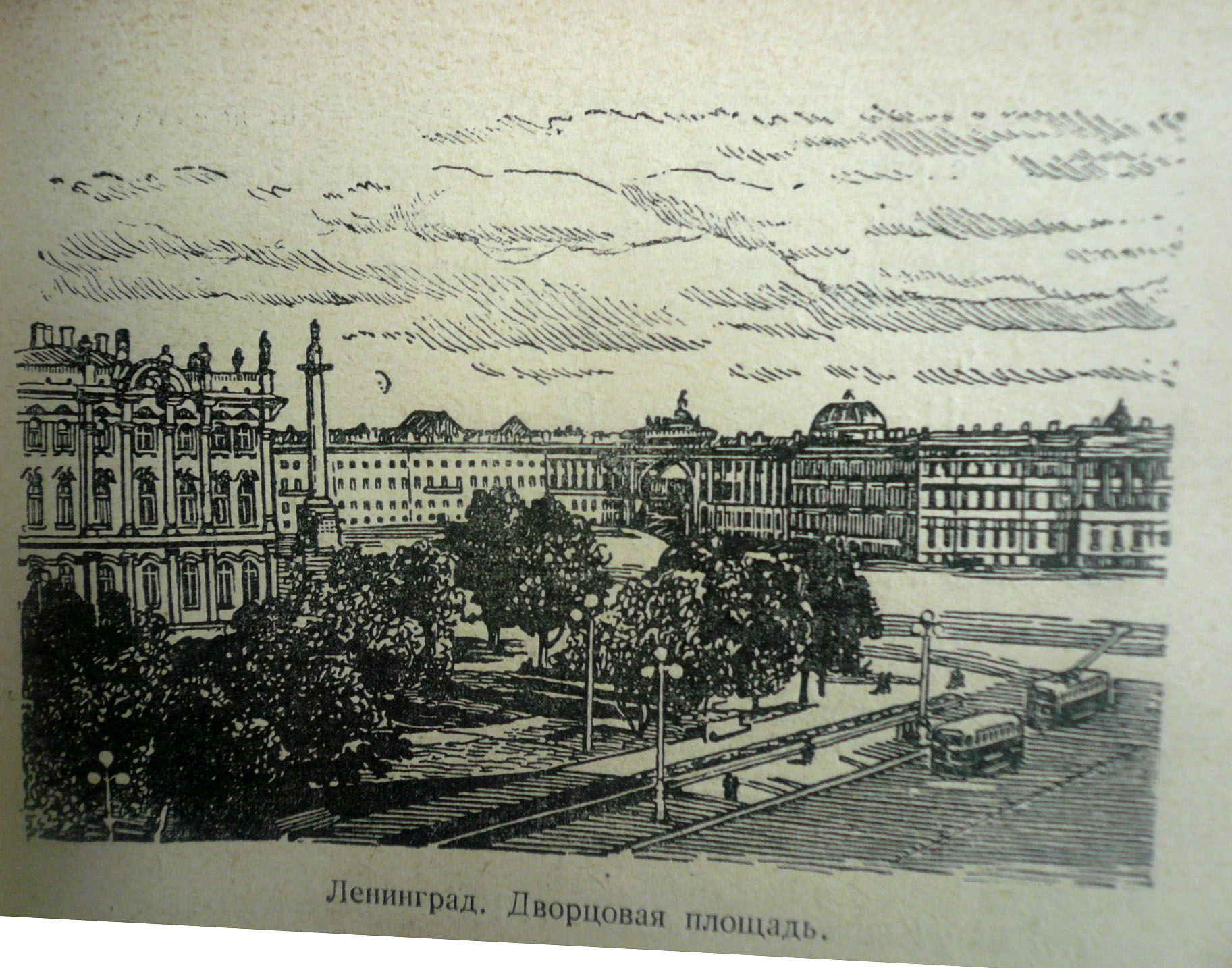
And here’s Leningrad. For me, some things will never change:

That’s all for now. I have people to meet in a park near Helsinki. Please excuse the uneven shapes of some of the pictures. They were taken under difficult circumstances, using a MasterSpy Mark 4 Nasal Camera in a small stoc cupboard in Bangor Library at 3.00 in the morning.

In ze meantime,    До свидания


16 Comments

Filed under History, Humour, Personal, Russia

A Barbarous Kingdom, Populated by Savages

This tale of barbarity is almost beyond belief for the date when it took place, June 21st 1786, and the location, the so-called civilised country of England. The details come from a source that I have used quite frequently before, namely “The Date Book of Remarkable Memorable Events Connected With Nottingham and Its Neighbourhood” and one other website:

The savagery of the punishment meted out on this poor young woman would be difficult to believe were it not so well authenticated. I have translated some of ye more difficult fentencef into ye moderne Englifhe:

“The victim of it was a young woman of Nottingham extraction, her mother having been a native of the town. Her name was Phoebe Harris. She was small in stature, rather stout and of good figure, with a pale complexion, and pleasing features. Her age was 30, and she lived with her husband in London. She was caught while in the act of counterfeiting coins, to which she had been introduced by her husband, who, it appeared, was an old practitioner. For this offence she was tried at the Old Bailey, and sentenced to death.
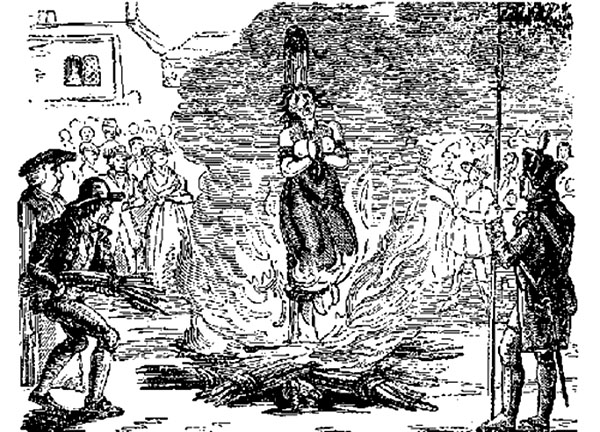
She was conducted on a subsequent day by two constables to the open space in front of Newgate, in the presence of about 20,000 spectators, where a stake had been securely fixed in the ground, about eleven feet high, and with a curved projection of iron at the top, to which was fixed a rope. The prisoner was placed on a stool, with her back to the stake, and the rope was positioned around her neck. After the priest of the gaol had prayed with her for a short time, the stool was pulled from underneath, leaving her suspended by the neck, with her feet about a foot from the ground.”

According to V. A. C. Gatrell’s book “The Hanging Tree”, Phoebe then choked noisily to death over several minutes:

“After hanging there for half an hour, the executioner put an iron chain around her upper body and fastened it to the stake with nails.”

The Date Book takes up the tale with tasteful enthusiasm:

“Two cart loads of wooden faggots were then placed round her and set on fire:

The rope speedily snapped, and the body slipped, but was sustained by an iron chain passed round her waist and the stake. In the course of three hours the corpse was entirely consumed.

The unfortunate sufferer, Phoebe, was struck with so much horror at the idea of her body being burnt, that in the night previous to her execution she was quite frantic. When she was led to the stake, she appeared languid and terrified, and trembled excessively. The awful apparatus of death evidently struck her mind with consternation, and totally incapacitated her for her last prayer.
Until midday, while the victim was still burning, the spectators were loud in their angry denouncements of the officers of the law, but as soon as the latter had left, the people in the crowd amused themselves by kicking about her ashes.

An application had been made to the Sheriffs by the respectable inhabitants of the neighbourhood, praying that the execution might take place at Tyburn, or at some small distance from them, but without avail.

The consequences were serious : several ladies were taken very unwell, and many were severely affected by the offensive smell of the burning corpse.”

The consequences were a damn sight more serious for Phoebe. The locals, NIMBYs one and all, had actually organised and sent in a petition to prevent Phoebe being executed so near to their homes. They considered such savage practices should not be carried out in areas frequented by respectable folk. Genuine world class savagery should take place in a working class area where it would be better appreciated.

Even so, 20,000 spectators isn’t a bad turn out for a respectable area. I bet somebody wished that they could have charged entrance money.

The offence of counterfeiting:

“for which Phoebe Harris suffered, was classed as High Treason. Blackstone accounts for the punishment of women for this crime being different from that of men, by stating that the natural modesty of the sex forbids the exposure and public cutting up of their bodies, and therefore they are burnt. The punishment of men for high treason was beheading, cutting the body into four parts, and burning the heart.”

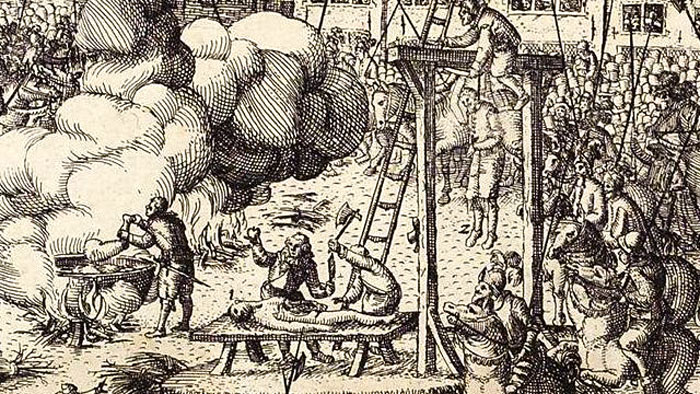
Here is the ‘quartering’ bit of that terrible trio of punishments:

And executions are always an excuse for a barbecue:

Only two more women would be killed in public in this grotesque way, and the dates may well be significant. One was Margaret Sullivan on June 25th 1788 and the other was Christian Murphy on March 18th 1789.

On July 14th 1789, the French people finally grew tired of a legal system presided over by a spoilt brat of a king and driven by an arrogant and self-serving nobility. It is not without significance that they attacked the Bastille prison as their first target. Neither is it without significance that the revolutionaries were keen to use a more humane method of execution, namely the Guillotine. Here is a charming painting of the Terror in full swing, with some lovely details if you look carefully, especially the little doggie. I couldn’t find Wally but I think I might have found his head :

I believe the judges back in London may well have noticed the developments in France, because when Sophia Girton was convicted of counterfeiting in April 1790, her execution by being strangled and burnt in public was postponed, as Parliament decided that hanging would be a better way to execute women.

Sophia was not hanged though. She was exiled to Australia where she made a new life for herself, admittedly in the most appalling of conditions:

27 Comments

Filed under Criminology, History, Personal, Politics

Attack the Tirpitz!! In a Halifax??

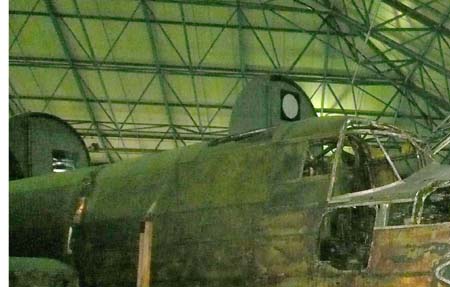
You are so lucky! You are going to see three photographs of a relatively rare aircraft, a Halifax Mark II, taken in the almost funereal gloom of the RAF Museum at Hendon. I apologise for the quality but in their efforts to preserve the original paint on the aircraft, the museum lights are kept very low indeed. For this particular aircraft, do not be put off by the fact that it seems apparently to have grown two enormous circular fins in the middle of its back. That is an Indian Air Force B-24 Liberator:

this one

The Halifax was the second British four-engined bomber to enter service in World War Two but it became the first to bomb Germany during a raid on Hamburg on the night of March 12th-13th 1941. Subsequent increasing losses on operations over Germany caused Halifax bombers to be used on less hazardous targets from September 1943.

The Halifax made over 75,000 bombing sorties and dropped almost a quarter of a million tons of bombs on Germany.

The Halifax continued in service with Coastal and Transport Commands after the war and the last operational flight was made by a Coastal Command aircraft in March 1952 from Gibraltar.
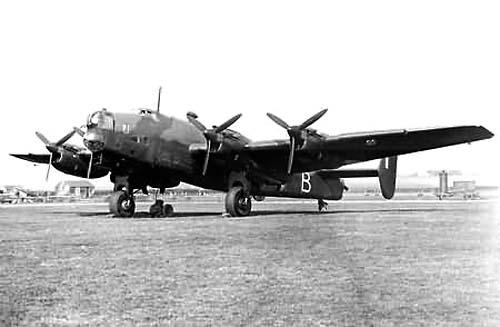
This s a Halifax B Mk II, Series I, with the serial number W1048. It was built by English Electric in 1942 at their factory near Samlesbury near Preston in Lancashire as part of a contract for 200 Halifaxes. This a similar aeroplane:

halifax_5

On March 27th 1942 it joined 102 Squadron at Dalton in North Yorkshire as “DY-S”.  The squadron was in the process of converting from the old Whitley Mark Vs
On April 9th 1942, six aircraft from 102 Squadron were exchanged with six aircraft from 35 Squadron because they were fitted with Gee radio navigation aid and could not be risked on a raid beyond the range of Gee stations  W1048 now became “TL-S” of 35 Squadron.
On April 15th the aircraft was taken on a training flight around Filey Bay followed by some low level practice bombing at Strenshall. Just over a week later, it  flew with ten other Halifaxes to RAF Kinloss in Scotland as an advance base for the raid on the German battleship, the Tirpitz.
It took off on April 27th 1942 at 2030 hours, the bomber’s first operational mission. “DY-S” was the  seventh of eleven bombers to depart and it was never heard of again. Until, that is, it was restored to the RAF Museum at Hendon;

P1320336xxxxxxxxxxxxxxxxxxxxxxxxxxxxx

The crew was Pilot Officer Don P MacIntyre who was 24 years old and came from Canada. The busy bee in the crew was Pilot Officer Ian Hewitt who was the observer, bomb aimer and navigator. He  later won a DFC. After the war, he moved to quieter pursuits and became a chartered accountant, dying peacefully at home in bed in June 2015, aged 94.
The Flight Engineer was Sergeant Vic Stevens and the first WOP/AG  was Sergeant Dave Perry
The mid upper gunner was another Canadian, Sergeant Pierre Blanchet.
The tail gunner was Sergeant Ron Wilson who in later life was to become a London cabby.
The aircraft was carrying four spherical mines of the Royal Navy type 19N. They each weighed a ton and their shape and size meant that the the bomb doors could not be closed.
The cunning plan was to roll the four mines down the steep mountainside into the gap between the ship and the shore.  They would then sink the ship because the underside was thinner and therefore more vulnerable.
At half past midnight, the eighth aircraft to attack, Don McIntyre followed by his friend Reg Lane set off to release their mines. McIntyre was first. As they had arranged, they descended to 200 feet but “DY-S” was hit by flak and too badly damaged to get back to Yorkshire or even to Sweden.
They were forced to land on the frozen surface of Lake Hoklingen, twenty five miles east of Trondheim.

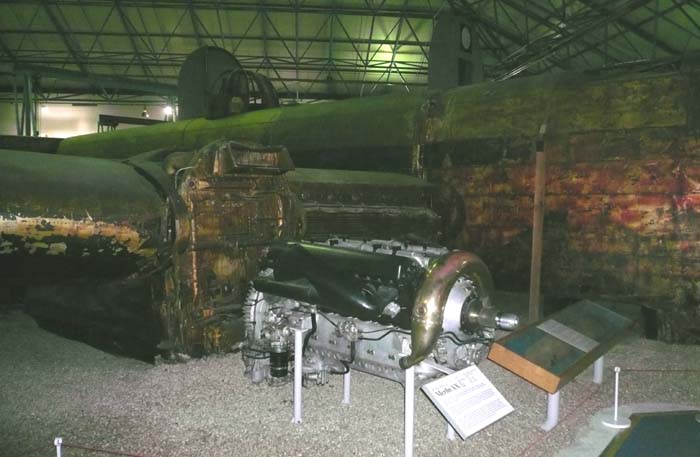
Here is the starboard inner engine nowadays in the museum:

P1320335

Vic Stevens broke his ankle and was eventually taken to hospital by the Germans. The other six came into contact with the Ling, the Norwegian underground and were helped to Sweden. Ian Hewitt and Don McIntyre returned to England after a few weeks, and Dave Perry,  Pierre Blanchet and Ron Wilson after a year. By this time Ron Wilson had rented a flat, found a job and made a start on a new life.
The poor old Halifax sank through the ice in the southern corner of the lake just twelve hours after the crash.
In 1971 the remains were found by local divers and in September 1972 by the RAF Sub Aqua Club. Everything was still there except for the starboard outer engine and one or two bits and pieces taken by souvenir hunters in the past.

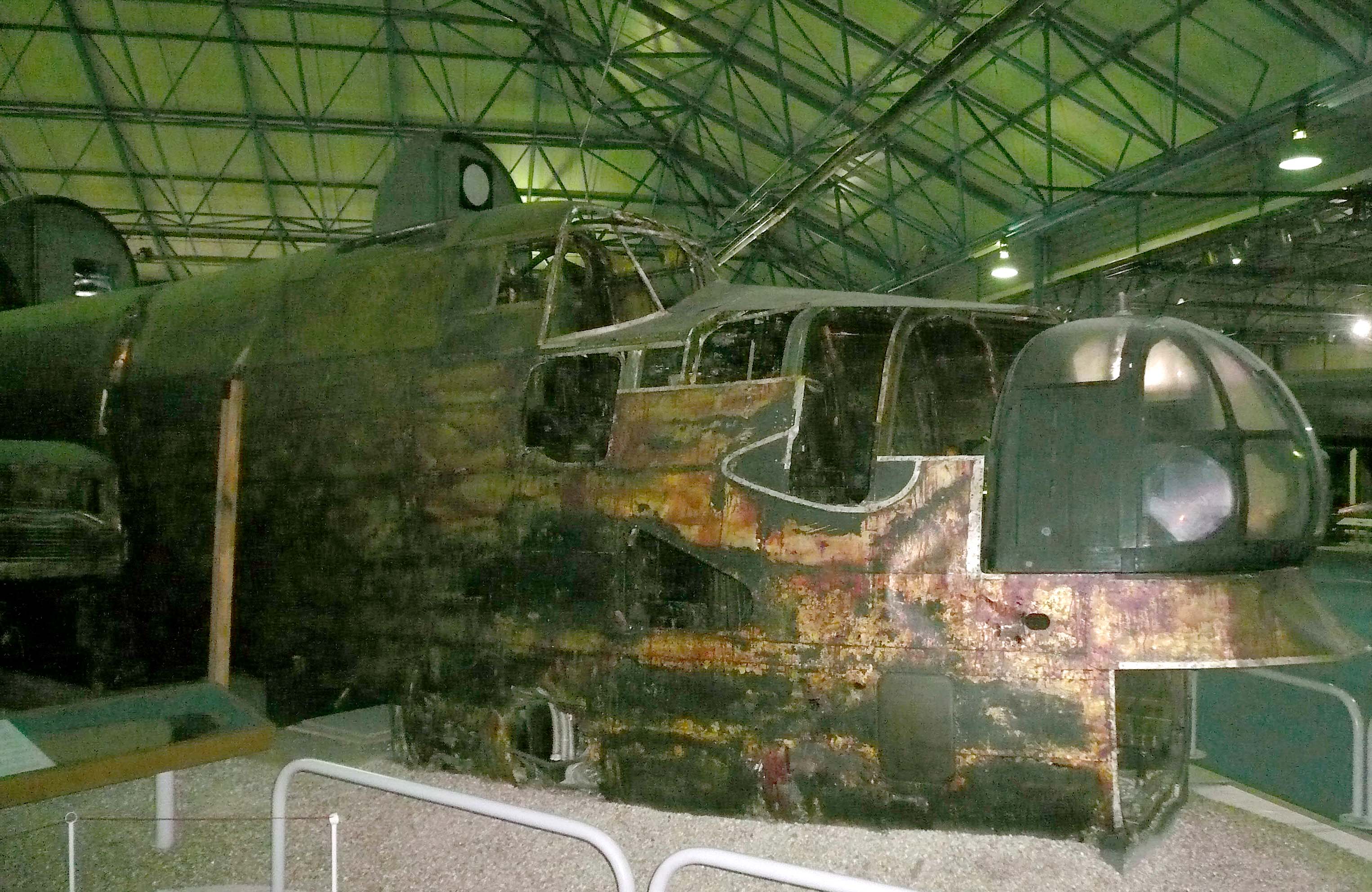
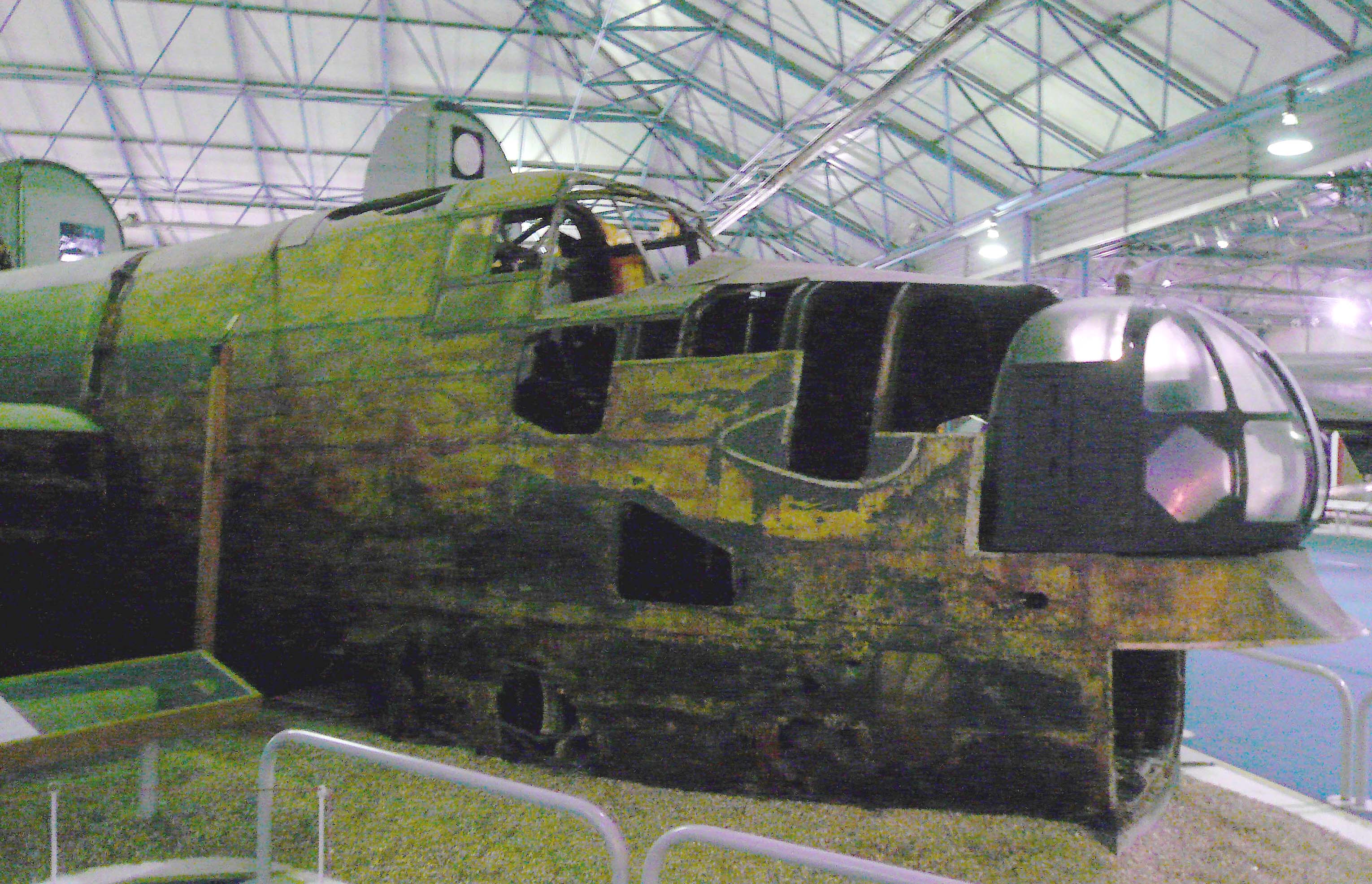
Here is a photograph which is admittedly very similar to one of the others. I am quite proud of it, though, because my Idiots’ Guide to Photoshop has enabled me to turn a pretty well completely black picture into something understandable. Slight tinges of red are apparently the chemical which inhibits any further deterioration in the fresh air. Do they make that for humans?

P1320338xxxxxxxxxxxxxxxxxxxxxxxxxxxxx

By the end of June 1973, the Halifax had been retrieved from the lake, and after a lot of restoration, it was ready for the public by the end of 1982. Apparently a second Halifax from the same squadron and the same operation was discovered at the bottom of a nearby fjord in 2014. This exciting discovery was made by the Marine Technology Centre from the Norwegian University of Science and Technology in Trondheim. The wreckage is around 600 feet down, and is thought to be W7656 and to contain the remains of Sergeants Evans and Columbine, the wireless operator/gunner and the navigator respectively. I do not know if this will make any difference to plans to raise the aircraft and to restore it.

28 Comments

Filed under Aviation, Bomber Command, History, Personal

What do you do with your Freed Slaves ? (6)

Last time we looked at two individuals whose families made huge fortunes from the ending of slavery when they were compensated for the slaves they had to release:

This slideshow requires JavaScript.

If you are intrigued by these revelations, then you should go and read the much fuller story here, where the journalists of the Daily Mail have done a splendid investigative job, and uncovered many famous people of today with a hideous skeleton in their cupboard. It really is worth five minutes of your attention. You may well be quite shocked. I was.

The tragedy, of course, is that those individuals today have little, if anything, in common  with their slave owner ancestors from so many years ago. On the other hand, they have inherited the wealth. What have they done to make amends? Built a school in the Windward Islands? Built a hospital in Barbados? Sponsored cataract operations in Jamaica?

Back in the nineteenth century, one added advantage for the ex-slave owner was the fact that now the slaves were free, there was no reason for him to provide his new workers with food and, indeed, he might even have been able to charge them rent for their hovel.

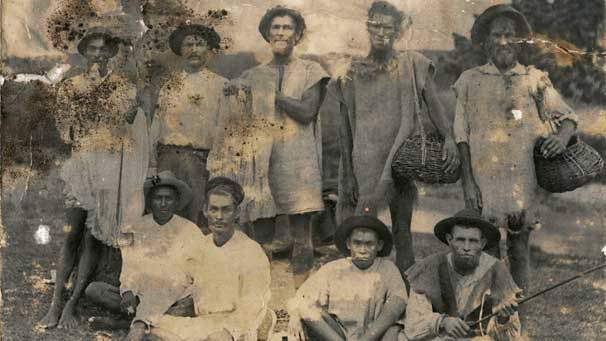
And let’s not think either that all the slaves in the plantations were black. I was pretty amazed to find that Irish people, usually so-called fallen women, were transported to Barbados and other West Indian islands:

white slaves

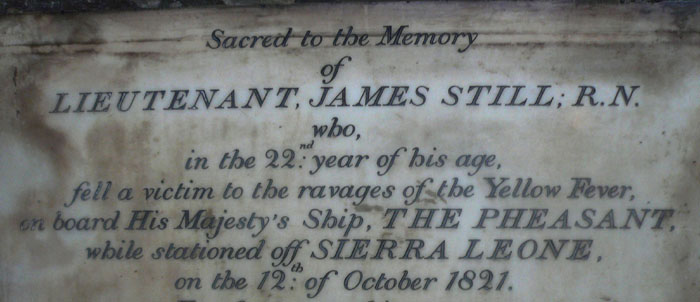
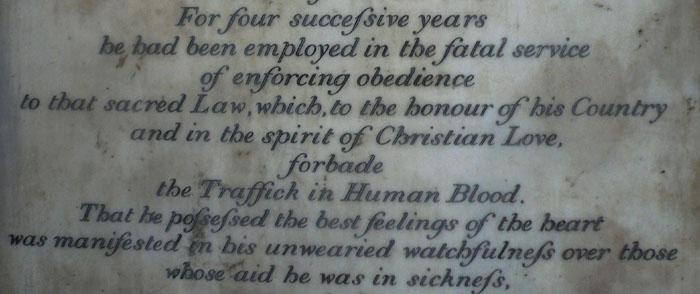
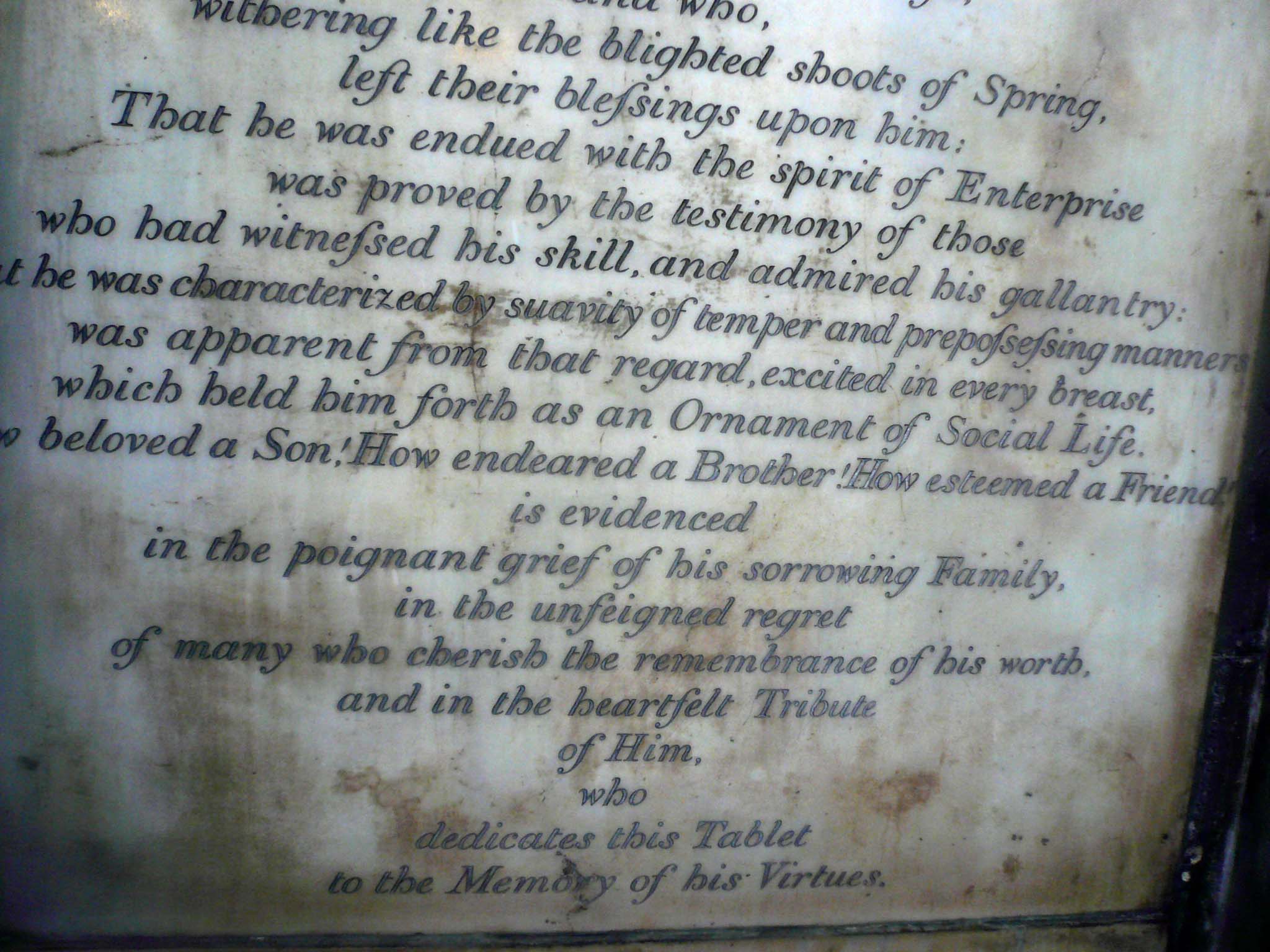
Let’s finish with a couple of pictures of a memorial in St Mary’s Church in Nottingham. It bears proud witness to a brave young Englishman, Lieutenant James Still, who gave his life in the cause of ending slavery. He was in one of the many Royal Navy warships which blockaded the coast of West Africa to prevent slave ships taking even more of the population away to a life of unhappiness:

image one

Here’s the next bit:

image two

The third bit is in a very dark area indeed, and I have done my best with it. The top two lines, half obscured should read “and who, withering like….” Lower down, a line should start with “That he was characterised…..” and lower still, “How beloved a son…”

And don’t forget that some of those apparent ‘S’ may be ‘F’ :

P1530664

And this link here is even more fun. There is a website about the British slave trade, and here is the link to the home page

If you click on the words on the right hand side, for example, (“commercial, cultural, historical, imperial, physical, political”) you can see where the slave money was reinvested or who improved their lot in life.
If you go to the search facility, you can even find out how much money the person received.

I live in Nottingham, and when I first moved here, the area I lived in was called “Carrington”. The city’s station is in Carrington Street. Here is the Edwardian shopping centre at one end:

carrington_street_t

But what is the origin of this? Why Carrington Street? And why was the area where I used to live called “Carrington”?

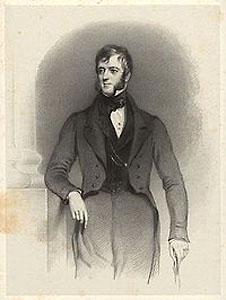
Was it possibly something to do with Robert Smith, 1st Baron Carrington ? I couldn’t find a picture of that gentleman but here is his son, the 2nd Baron Carrington:

-p 2nd_Baron_Carrington

The 1st Baron Carrington, Robert Smith, used to live at Dulcote Lodge in  Nottinghamshire. In the West Indies, he kept 268 slaves. He was paid £4908 eight shillings and five pence by the taxpayer to free them.

I felt quite sick when I read how much money that man eventually accumulated. And who his descendents were.

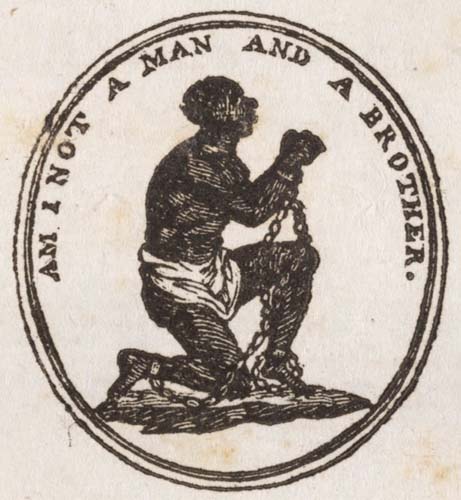
This, of course, is the answer to the problem:

Am_I_not_a_man

20 Comments

Filed under Criminology, History, Personal

The Peregrine : the Fastest Creature in Victorian Nottinghamshire (2)

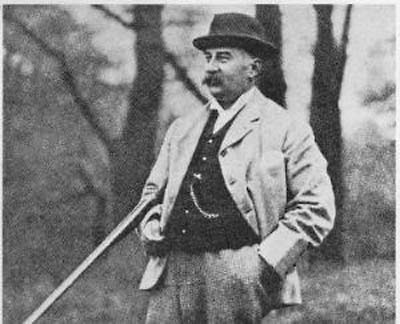
Last time I was talking about Joseph Whitaker and the many times he saw Peregrines in Nottinghamshire. Here is the great man:

He isn’t the only overweight old bloke with excess facial hair to have seen Peregrines in action, though.

Very early one morning in Cornwall, I once watched a Peregrine chasing a Herring Gull. The latter was so scared that it landed and walked across to stand right next to me, like somebody queuing for the bus at a bus stop.  When the falcon flew away, the gull departed a few seconds later, in the opposite direction.

Shortly after May 1, 1920, Mr Frank Hind,  one of the leading members of the Nottingham Natural Science Field Club wrote:

“A very large bird was circling high up in the sky over Gedling. From its manner of circling, and flight and the great height, I can think of no bird but the Peregrine Falcon as likely to be the one seen.”

peregrineflying

The following account was published in the Nottingham Evening Post of April 14th, 1976:

“The pigeons in the Old Market Square in Nottingham had better watch out. For a bird of prey has been spotted on top of the nearby Council House. And it’s thought his taste for city life might be due to the prospect of a convenient meal of pigeon.
A spokesman for the Trent Valley Birdwatchers said the bird had not been positively identified but it could be a Peregrine Falcon. It was disturbed by one of the club members who was carrying out repairs to the Council House.”

pery grin1

Nowadays,  of course, this scenario is an everyday one. I wrote about the peregrines on the Newton Building of Trent University in an article entitled:

Jer Falcon. one shot at Park Hall by Mr Shelton. Now in my collection

There are live webcams of city dwelling peregrines across most of the developed world including Derby.

And Norwich

And Mississauga

And Etobicoke

The camera at Phoenix in Arizona is of very good quality:

If you get bored, go to Bowling Green in Ohio.

or Kitchener in southern Ontario in Canada.

Peregrines are pretty much the same the whole world over. They breed in every continent except one.

If you get tired of travelling the world, you could always use the webcam on the Newton Building here in Nottingham.

One of my favourite webcams though, is one that shows lots of brightly coloured American birds, and another where you can try to see the Loch Ness Monster.

Good luck  with that one.


18 Comments

Filed under Cornwall, History, Nottingham, Personal, Twitching, Wildlife and Nature

Football in the Old Days ; Derby County v Norwich City

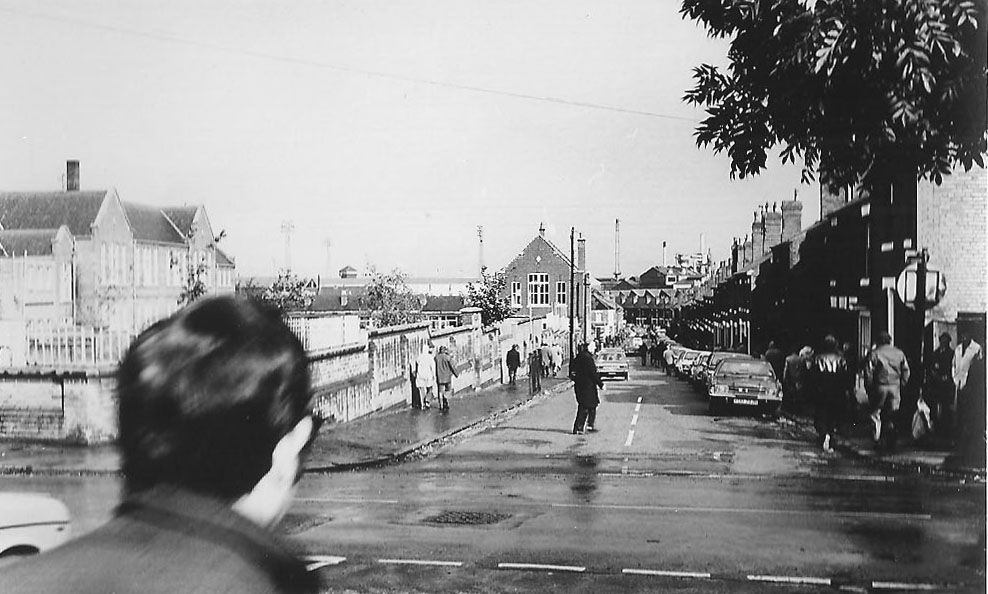
Imagine it is the late 1970s. We are walking down to the old Baseball Ground, and about to turn into Harrington Street. The floodlights of the ground are just visible:

A fur x police hors 4

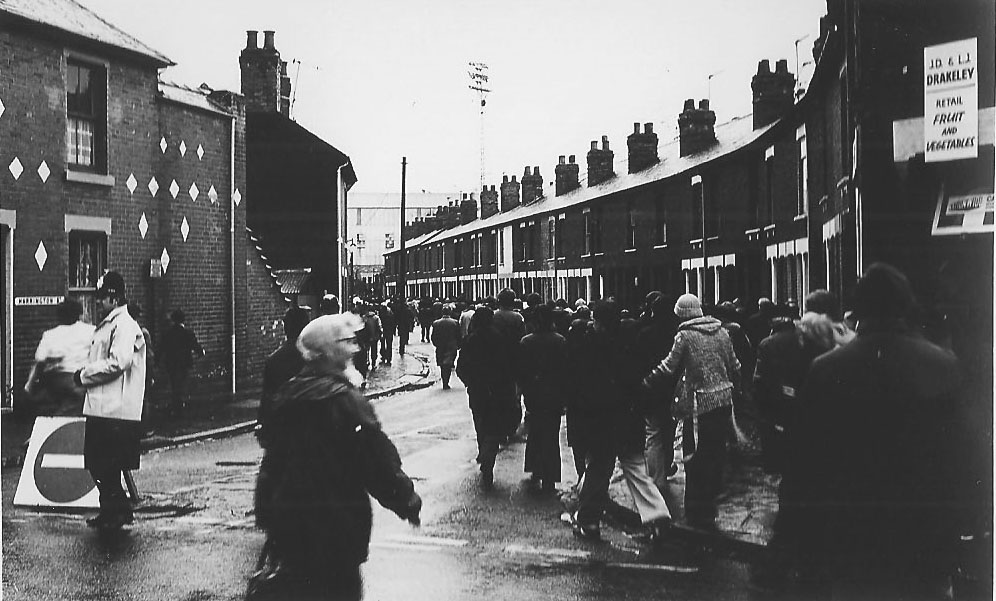
My Dad, my brother and I used to park on what had been the Parade Ground at the old Victorian army barracks at Normanton, and then walk down to the football ground. If we were at all late for the kick off, Fred, my Dad, was quite capable of generating a punishing pace along the terraced backstreets. It was with complete justification that my brother would regularly accuse him of setting off like “a long dog” (whatever that was).
On one occasion, Fred was extremely late for the game, so rather than miss a second of the action, he just left the car on the grass verge of the Ring Road. He accepted as a necessary evil the inevitable parking ticket and fine he would receive, and paid it without demur, but both my brother and myself were advised, “Don’t tell your mother.”
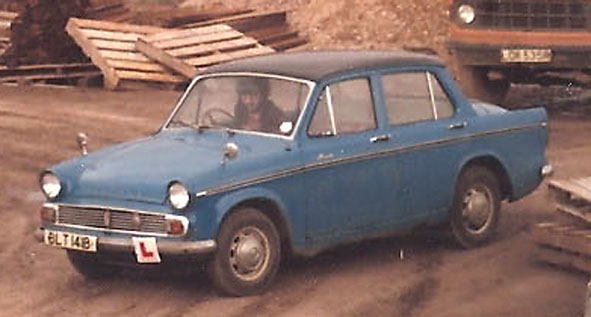
This was not too dissimilar from an incident when he damaged his beautiful pale blue Hillman Minx quite badly by reversing it into an, admittedly, pale grey, well camouflaged lamp post, down near the bridge which went over the railway lines at Swadlincote Station:

building site 3asdf

Again, he accepted the cost of the panel beater and a resprayed rear wing, on the basis of “Don’t tell your mother.”
Closer to the ground, Harrington Street was closed to traffic because of the thousands of people all rushing down to the game. The single floodlight is even more obvious:

B - Copy (3)
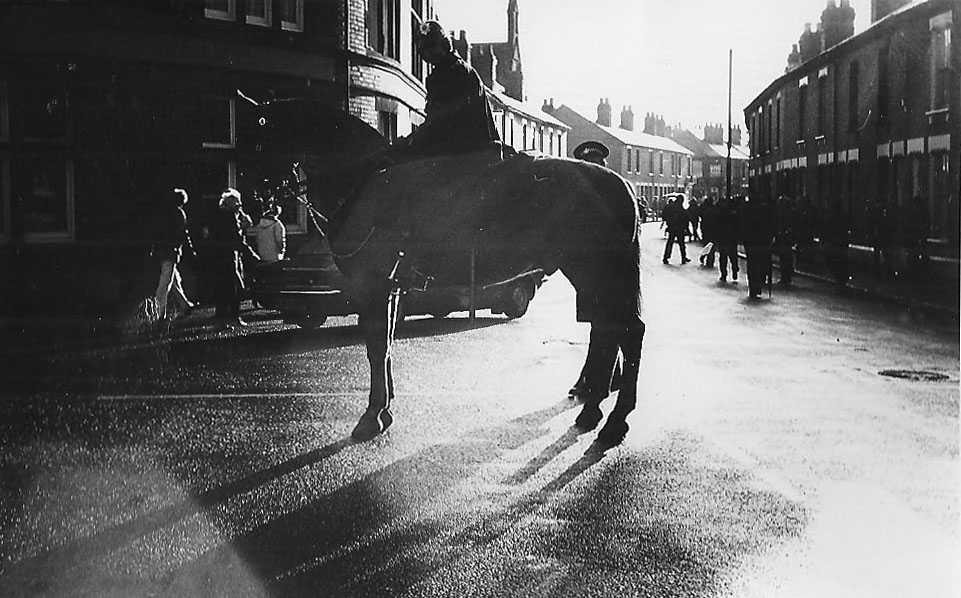
Here is a backlit policeman on his horse, and more terraced houses, looking back past the long demolished Baseball Hotel:C x police horses - Copy (2)

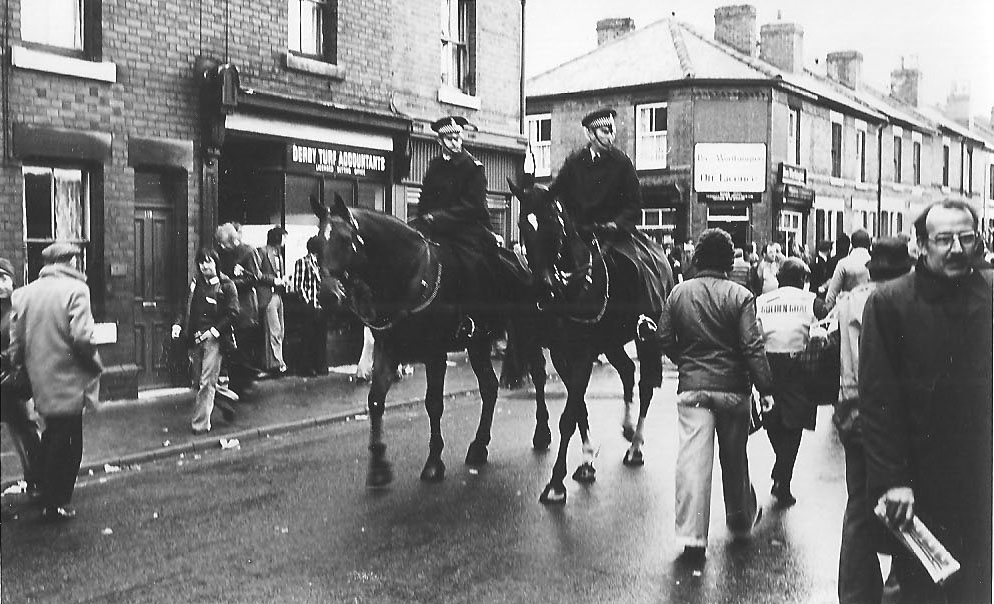
Two rather drenched policeman on their horses, walking down Shaftesbury Crescent. Look at the fashions! Look at the flares!

D r x police horses 1

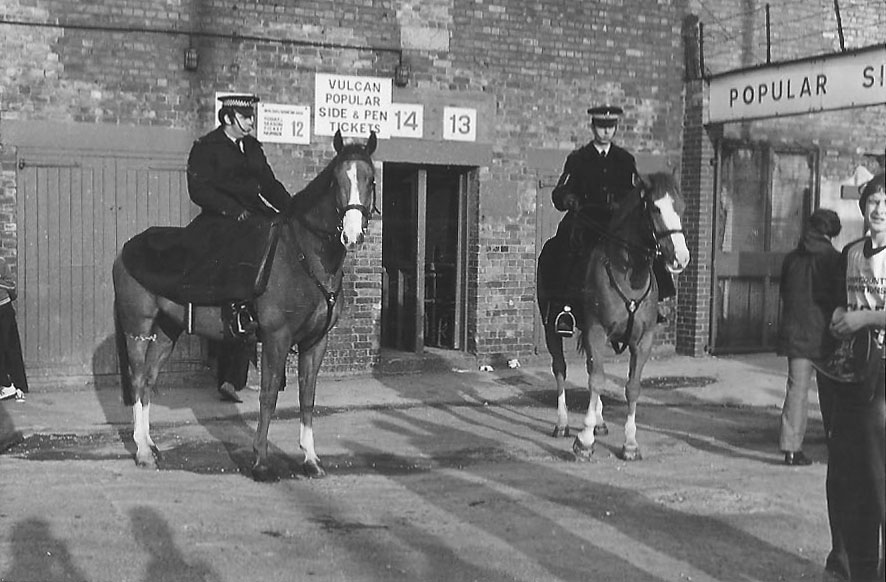
At last! These two policemen have the sense to find a little shelter from the weather:

E ur more police horses -photo 3

They are at the back of the Normanton Stand, at the entrance to the Popular Side. The “Popside” was where hooligans of both teams would stand. There would be disorder at virtually every game.
Fred, as a man of some fifty or so years of age, was himself physically attacked, on two occasions, both of them by those lovable, loyal, warm hearted supporters of Newcastle United.

We had a period when we used to park the car in the playground of Litchurch Lane Junior School, for a mere 25p. One day, as we returned from the game, I was surprised to see large brown birds flying over our heads. Only when one of them crashed into the wall of the railway repair works, did I realise that they were not birds, but bricks, thrown by a group of discontented Newcastle supporters.

On another occasion, a group of Newcastle supporters set about giving a damn good kicking to an innocent young man and his girlfriend, who had the misfortune to be walking along Osmaston Road, just in front of us. My Dad, Fred, of course, armed with his RAF maxim of “it always happens to somebody else, never to me”, raced off to help out the young victims. I can remember how Fred grabbed one hooligan’s foot as he prepared to kick the poor young man, and then wrenched it around backwards as hard as he could. That must have hurt! Afterwards, I remember too how the young victim had been kicked so much that he had lost the face off his watch.

When I got home, I discovered a tear on my favourite green USAF war surplus jacket. That tear was present in my T-shirt as well, and my back had a long red mark on it. I have always reckoned that that was as close as I ever got to being stabbed, by somebody I did not even see, in a mêlée of whirling bodies.
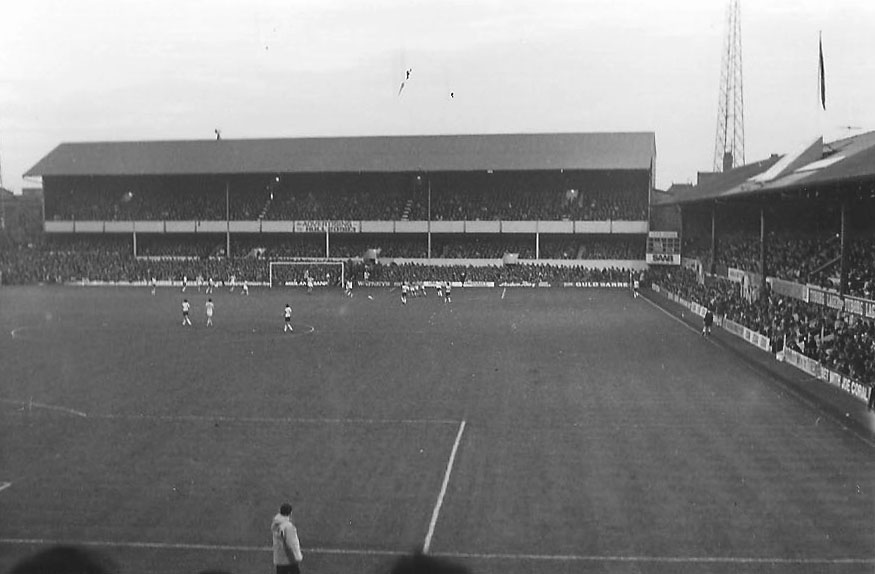
The opponents for this match are, I think, Norwich City:

F football x four photo 4

They are playing in yellow shirts and white shorts, which was a slight change from their normal kit with green shorts:

This slideshow requires JavaScript.

The problem was that in the early 1970s, lots of people still had black and white televisions, and Derby and Norwich would have looked very similar, as Derby were wearing white shirts with dark blue shorts, and Norwich yellow and green. Here Derby press forward with yet another attack:

F football x four photo 4

I can’t remember the score of this game, but I think it is safe to say that Derby probably won. They used to beat Norwich fairly regularly in the 1970s.


25 Comments

Filed under Derby County, Football, History, Humour, Personal

High School Football Team achieves Perfection on the Forest

Wednesday, January 21st 1981

On a dull, dreary, drizzly day in winter, the author stood with the football team coach, Tony Slack, watching the First XI play a well contested match against High Pavement 2nd XI. We were on the Forest, at the side of a pitch which has now been partially covered by the all-weather facilities. Look for that orange arrow:

This slideshow requires JavaScript.

Suddenly, eighteen year old Norman Garden, his sleeves rolled up in determined fashion, won the ball with a strong, vigorous tackle at the edge of his own penalty area:

NORMAN GARDENxxxxxxxxxxxxxxxxxxxxxxxxxxxx

He came forward with the ball at his feet and set off thoughtfully towards the opposition goal. Looking up, he sent a long, curving, arcing pass out to young Bert Crisp on the left wing. Bert trapped the ball, then ran forward ten yards or so, and looked across at the attacking possibilities:

BERT CRISP the one
Five yards outside the penalty area stood Chris Ingle, the team’s centre forward. He was in his usual pose, apparently disinterested, lacking commitment, without any apparent desire for hard physical involvement, a young man who only came alive when he saw the whites of an opposing goalkeeper’s eyes:

CHRIS INGLE ONE WWWWWWWWWWWWWWW

Chris began to move. He accelerated slowly but purposefully from his standing start as he crossed the white line of the penalty area. Bert Crisp instinctively knew what to do. He clipped in a wickedly curving centre, about four or five feet above the ground. It was timed to arrive at the penalty spot at exactly the same time as the deadly centre forward. Chris Ingle, as the ball flew in front of him, launched himself full length over the cloying mud.
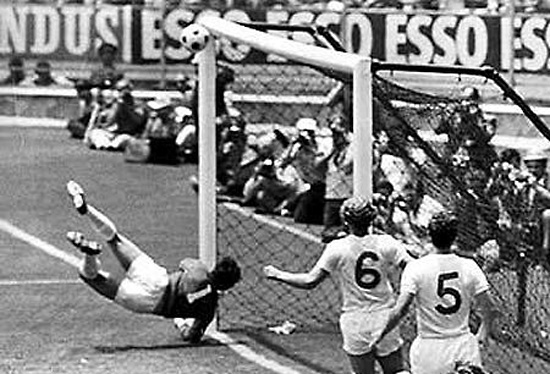
He met the ball hard with his forehead, catching it a blow which rocketed it towards the top corner of the net. “Goal!!” we teachers both yelled in our minds. But it was not quite over. The opposing goalkeeper soared backwards and with a despairing left hand just managed to flick out at the ball. He diverted it upwards, and it flew onto the crossbar and behind the goal for a corner.

Chris Ingle got up and wiped the mud from his hands down the front of his white shirt. Tony Slack turned to me and said, “You wouldn’t see anything better than that in the First Division.” And he was right.

And, in case you missed it, here’s that fabulous save again…

banks defesa

19 Comments

Filed under Football, History, Humour, Nottingham, Personal, The High School

Wolves (the animal not the football club)

When I wrote about the Beast of Gévaudan, I came to the conclusion that the ferocious creature was a previously unknown type of wolf:

bete-du-gevaudanzzzzzzz

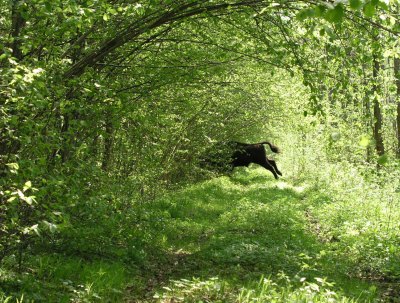
For some unknown reason, it was being forced westwards from its normal habitat of the Polish or Russian primeval forests such as Białowieża. If ancient bison could live there, so could something even more prehistoric:
rejigged bison

At the time I did research the likelihood that the Beast was an ordinary wolf or wolves but I rejected that as a theory because I did not think that wolves would eat human beings.
It would be dishonest, however, not to make it patently clear that in the past, wolves certainly have eaten people but they don’t seem to now. Why should this be?
Firstly, extremes of weather centuries ago, more severe than what we have now, may have lead to a situation where wolves either ate any available prey items or just died. This would account for the Wolves of Paris which I have previously discussed:

wolf bounding

In actual fact they may also have acquired a taste for human flesh by eating corpses. Apparently, until as late as 1820, corpses in France were frequently thrown into open charnel pits. Presumably, these were paupers, drunks, stillborn babies, in short, anybody dead without the money for a funeral. And it is not outrageous to presume that this lovely way to dispose of the late dearly departed might have taken place in neighbouring countries too. An unfortunate situation that taught wolves to associate the scent of Man with a full belly.
If the hungry wolf wanted a better quality of prime human meat, young, and blood drippingly fresh, the best place was the battlefield straight after the battle. Once the local peasantry had stripped the bodies of everything valuable, they were not buried, but were gradually eaten by the ravens and other corvids, the eagles, both golden and especially white-tailed, and most of all, the local wolf pack.
This association of human flesh, its scent and taste, with a full stomach, was a recipe for disaster when wolves came across, say, lone travellers or children picking berries deep in the woods. And don’t forget. In France the peasantry were forbidden to own firearms to reduce the admittedly tiny risk of a blood spattering revolution.
Nowadays, the situation is completely different. Admittedly France had 7,600 fatal attacks by wolves between 1200–1900 but there has been nothing since. Italy has a population of wolves but without any fatal attacks on humans since 1945 and no attacks by wolves since the eradication of rabies in the 1960s.

wolf pack one

In the Baltic states, where rabies is still allowed to exist, just under a hundred people were bitten between 1992-2000 in Latvia and Lithuania, although the statistics are muddied somewhat in Estonia by the locals’ love for wolf-dog hybrids and keeping wolves captive on their properties.
And what about North America?

wolf baby

Well, in 2002, the Alaska Department of Fish and Game stated that there had been no human deaths in North America attributed to wild, healthy wolves since at least 1900. Concerns were caused though, when, on April 26th, 2000, a six year-old boy was attacked by a wolf in Icy Bay, Alaska. He was not killed, but then, on November 8th 2005 the body of Kenton Carnegie was found in northern Saskatchewan. He had died from “injuries consistent with a wolf attack.” The local wolves had apparently lost their fear of him because he fed them regularly.

Kenton_SKxxxxxxxxxxxxxxxxxxxxxxxxxx

To increase the risk, natural food was scarce in the area at the time and four wolves had been feeding on rubbish tips in the previous weeks. They were no longer scared by human activities. On November 4th, two of Kenton’s fellow campers clashed with two extremely aggressive wolves. Zoologists have now said that this was probably an “exploratory attack” just to see how difficult it was to kill a human being. Another perhaps more serious attack was imminent.
On the day of his demise, Kenton ignored warnings from his companions and went for a walk in the woods. It took the Coroners’ jury two years to rule out Black Bear, but their eventual verdict was “Death by Wolf”.

Iberian Wolf alpha male feeding on deer, its mouth tinted with f
On March 8th 2010, Candice Berner, a thirty two year old special education teacher who had only been in Alaska since the previous August was killed by two, perhaps three, wolves as she jogged along a road outside Chignik Lake. It was late afternoon.

Candice_Berner12

This was the first ever fatal wolf attack in Alaska. David Mech, a senior research scientist with the U.S. Geological Survey has studied wolves for more than fifty years. He said:

“There have been about two dozen nonfatal attacks in North America in the past century or so. Most involve wolves that have become habituated to people who have been feeding them at campgrounds, dumps and other sites near wolf habitat.”

Ms Berner was only 4 feet 10 inches tall and weighed just over eight stones (c 112 pounds). David Mech said that her slight, almost childlike build, and the fact that she was running may have attracted the wolves, who, after all, are predators by nature:

“Wolves are very much like dogs in a lot of respects. Things that are running, they have tendency to want to chase them,”


DogChasing

Ms Berner was thought to have been listening to music on a headset, but Dr Mech discounted this, as in his experience wolves move so silently that the wind is enough to mask their presence completely.

Whatever you think about wolves, the truth is that the inhabitants of the tiny village of Chignik Lake have lived alongside wild animals since time immemorial:

chig

This one attack has spooked all of the 73 inhabitants of the area, so remote that it can only be reached by aeroplane. The school’s stuffed wolf mascot had been there a good while, but now it has been kicked well into touch. The wolf badge of the school will also have to go if Virginia Aleck, a local woman, gets her way.
She said that everyone felt trapped in the village. None of the surrounding hills were considered safe anymore.  Nobody walked on their own and everybody carried a rifle.
Is this an over-reaction? Or are wolves just a part of living outside the big city? I’ll try to answer that question in a future article.

17 Comments

Filed under Canada, Cryptozoology, France, History, Personal, Science, Wildlife and Nature

The Second XI Football Team 1980-1981

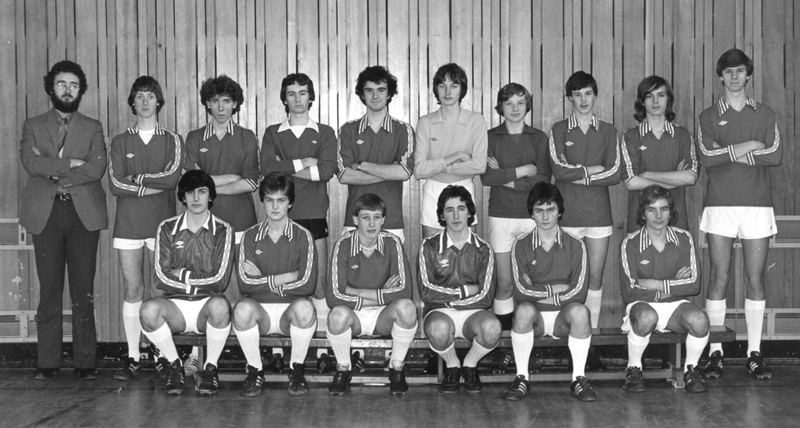
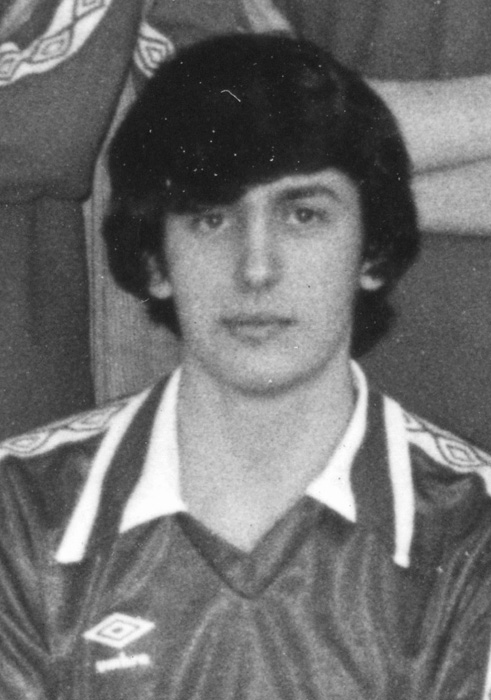
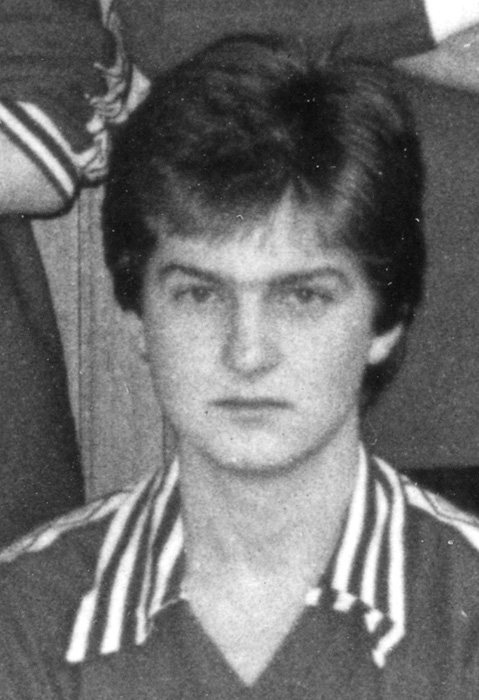
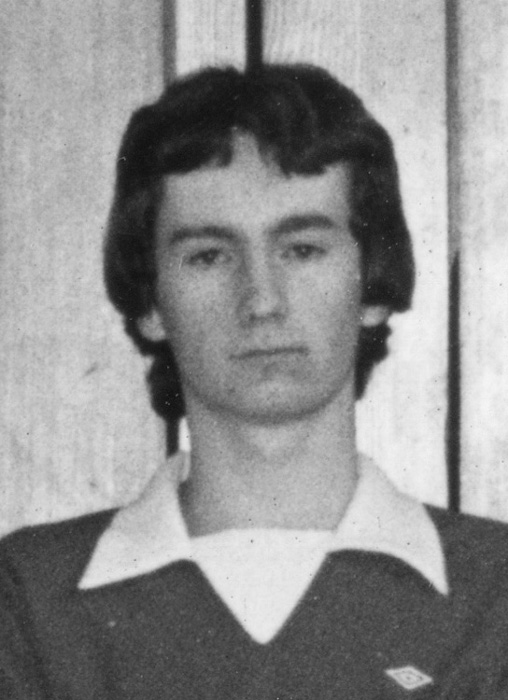
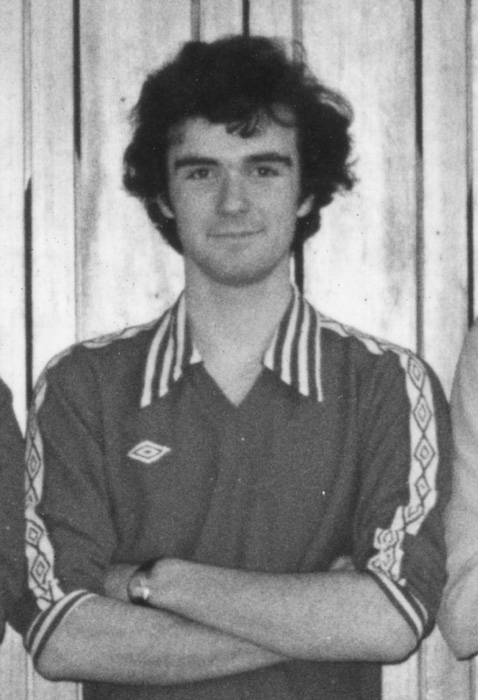
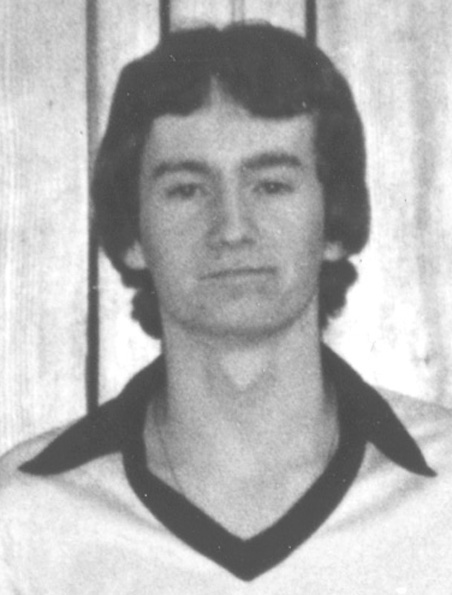
The Second XI had a pleasant and reasonably successful season back in 1980-1981, although it was possible to organise only seven fixtures. They lost their first match against Becket School, but were only to lose one more of the next five matches. Their record for the season of two wins, three draws and just two losses would have placed them comfortably in mid-table in the Premier League of today. Perhaps another Crystal Palace, Everton or West Ham. We drew games against High Pavement, Bramcote and Clarendon and then defeated Clarendon by 3-0 in the return and Bilborough by 5-2. Not a bad record for a team of eleven players picked from just nineteen available candidates:
asecond THE ONE

The goalkeeper was Richard Clark:

richard clark 700
And his deputy was, I think, David Lloyd:

other goalie

In defence we had Chris Turner:

chris turner 700

Alongside him was Julian Bower:

julian bower 700

Ken Blecher was the sweeper. He was the Team Captain, so he had the shiny satin finish shirt:
For some reason, we played in fairly dark blue shirts of a shade called ‘Admiral’ or ‘Azure’ apparently.  This had been worn as a change strip by Sunderland in the First Division a few years previously. The sleeves had a red and white design on them, as did the collars.

Ken Blacher

Now, back to the players.

Phil Sermon was a 100% team player who, although he was often a little quiet, always gave everything on the pitch:

phil-ser-mon-700

Paul Chappell was almost surgical in the strength and calmness of his tackles:

Paul Chasppell
Chris Batty was an accurate passer of the ball, with a powerful shot:

chris batty 7oo

Bert Crisp was a strong runner and created many chances:

bert crisp 700
Phil Colley supplied energy in midfield:

phil colley

Chris Ffinch played well in attack:

Chrs Ffinch 700

Robert Harwood was a confident goalscorer:

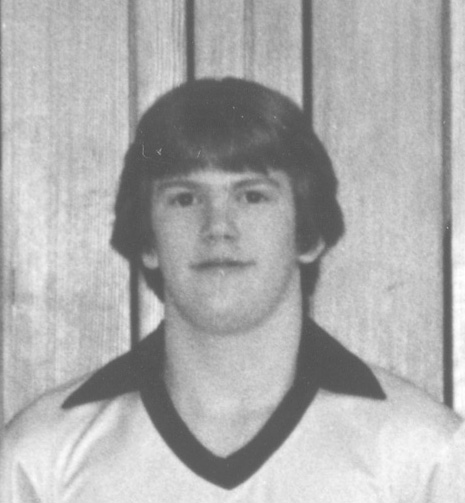
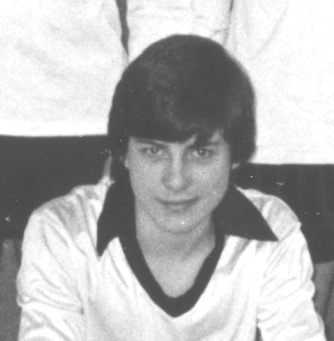
robert harwood 700

Stuart Burns also contributed well in attack:

stuart burns 700

On the team photograph, two players remain a mystery to me, although this all took place some 35 years ago now. The first is CD Richardson:

one

And the other is David Nowell, who, as you can see from the comments below, was the left full back, but who was unfortunately injured very early in the season :

three

Forgive me gentlemen.
Overall, the Nottinghamian reported that the players were “all keen to play and all contributed to a most enjoyable season. Everyone has done his best and given his all.”
A lot of my readers, of course, will not be familiar with any of these young men. Let them stand, therefore, for your own sporting efforts at school. Did you do your best and give it your all?
Perhaps you were not in a sports team of any kind. Well, just look at the faces of these sixteen, seventeen and eighteen year old young men. Look at their expressions. Their inner thoughts.
Nowadays they will be in their early fifties. Their team coach back in the day was in his late thirties. Well now, I am in my early sixties, and I just regret that I didn’t enter more Ché Guevara lookalike contests when I had the chance:

me close up

.

20 Comments

Filed under Football, History, Humour, Nottingham, Personal, The High School

All Quiet on the Western Front (1)

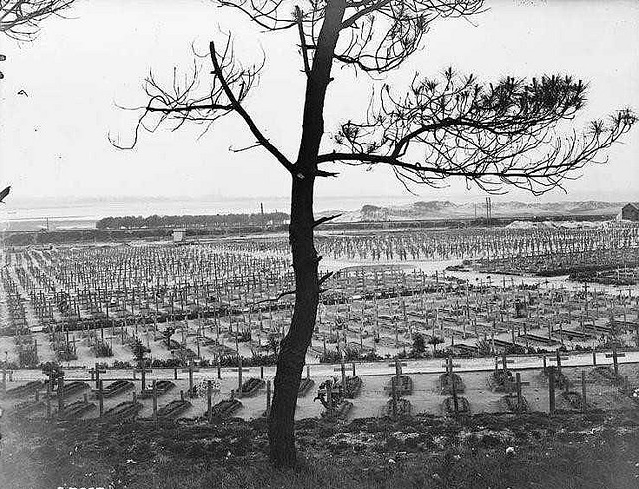
graves1

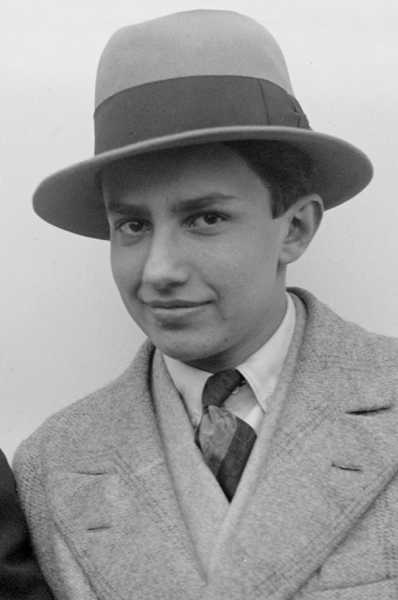
The film All Quiet on the Western Front was first shown in 1930. It won Oscars for its director, Lewis Milestone, and its producer, Carl Laemmle Junior:Carl_Laemmle_Jr

During his years as head of production at Universal studios, Carl Laemmle Junior was to be best known for overseeing  the classic old horror films such as Dracula (1931), Frankenstein (1931), The Mummy (1932), The Old Dark House (1932), The Invisible Man (1933), and Bride of Frankenstein (1935).

Lewis Milestone, born Leib Milstein, is best known for directing films such as Of Mice and Men, Anything Goes,  Halls of Montezuma Oceans Eleven and Mutiny on the Bounty.

My own favourite is All Quiet on the Western Front and that fondness for the film is based on a conversation that occurs right at the very end.

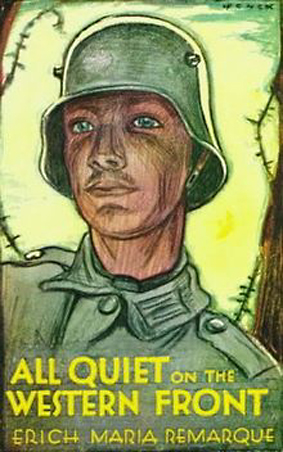
220px-AllQuietOnTheWesternFront

The film as a whole was written by Maxwell Anderson, George Abbott and Del Andrews. I do not know who was responsible for these particular extracts. The two writers who narrowly failed to win the Oscar for best writing were Andrews and Anderson. In it, one of the wise old soldiers gives his idea on the solution to war.

all-quiet-467 - Copy

I have decided to divide the dialogue into four sections. Here is Number One:

“Ah, the French certainly deserve to be punished for starting this war.”

“Everybody says it’s somebody else.”

“Well. how do they start a war?”

“Well, one country offends another.”

“How could one country offend another?”

“You mean there’s a mountain over in Germany gets mad at a field over in France?”

graves1

To be continued…


13 Comments

Filed under Criminology, History, Personal