Category Archives: Personal

The Christmas Truce of 1916: my Grandad was there.

When I was a little boy in the late 1950s and 1960s, my Grandad used to mention to me how there had been a Christmas truce with the Germans during his time with the Canadian Army. The most famous truce of all had already taken place at Christmas 1914 of course.

Trucecigarette

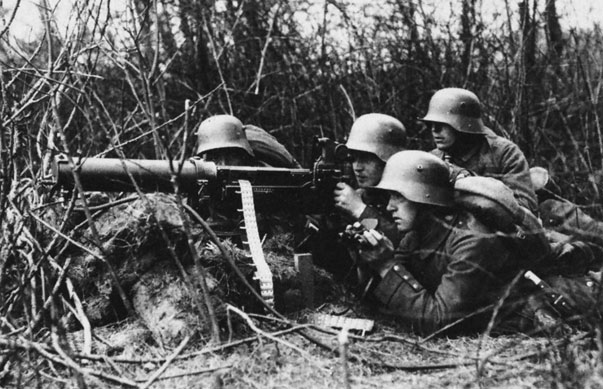
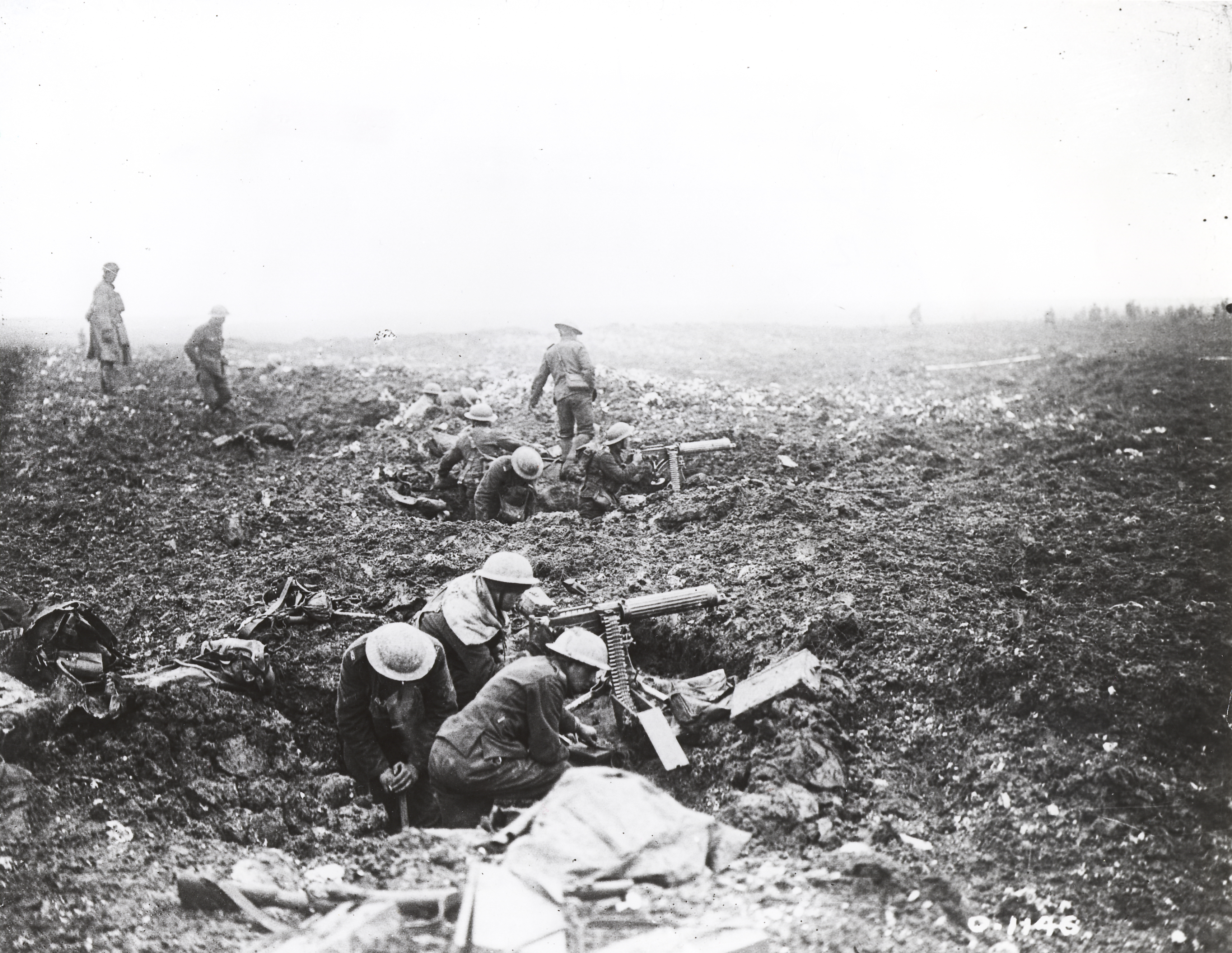
Having accessed my Grandad’s war records in later years, I knew that he hadn’t joined the Canadian Army until 1916, far too late for the famous Christmas Truce. I was also aware that he had fought at Vimy Ridge. How did I know that? Well, fifty or more years ago, he had told me so. Here are some Canadians at Vimy Ridge during the battle. Theoretically, my Grandad could be one of them, but I do know that he spent most of his time in the artillery. That was probably why he was so deaf when I knew him :Vimy_Ridge_-_Canadian_machine_gun_crews
And so it all remained a bit of a mystery, until I read in the media that:

“Evidence of a Christmas truce in 1916, previously unknown to historians, has recently come to light. German and Canadian soldiers reached across the battle lines near Vimy Ridge to share Christmas greetings and trade presents.”
In his book Hitler’s First War, Dr Thomas Weber, a historian at the University of Aberdeen had previously recorded various attempts at a Christmas Truce in 1916. None of them, however, were thought to have been successful, Dr Weber’s book explaining that that this wonderful goodwill gesture had been a complete failure. A war diary from Adolf Hitler’s own Brigade reported:
“Attempts at initiating fraternization by the enemy (calling out, raising of hands, etc.) were immediately quashed by the snipers and artillery men who had been ordered in and had stood ready to fire.”

On the Canadian side, the official version of events, which was reported in the diary of the Princess Patricia’s Canadian Light Infantry tells the other half of a very similar, and very pessimistic, story. The Germans had made efforts towards a ceasefire but nobody on the Canadian side had responded to it.
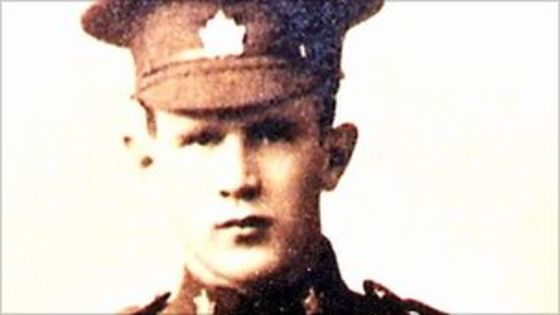
The entire situation changed radically, however, in November 2010, when the historian, Dr Weber, whose great-grandfather fought with the German army during the Great War, travelled to Canada. After a public lecture, he was approached afterwards by a member of the audience whose uncle, Ronald MacKinnon, had been deployed at Vimy Ridge at Christmas, 1916:
_50437465_ronald_mackinnon

Having heard from Dr Weber during the lecture how there had been only an unsuccessful attempt at a truce in 1916, the man had in his possession a letter from Ronald MacKinnon, a 23-year-old soldier from Toronto which proved that both the Canadian and the German soldiers had put down their weapons on Christmas Day and obeyed the phrase from the Gospel, “on earth peace, good will toward men”. Christmas greetings were shouted across no man’s land and presents, just as in 1914, were exchanged between the two sides.
Dr Weber immediately announced, quite rightly, that this letter was a “fantastic find” and offered proof of a hitherto completely unknown Christmas Truce, an impromptu break in the hostilities by German and Canadian troops. The letter also clearly demonstrated that the top brass had made extensive and determined efforts to downplay any Christmas truces subsequent to the first one in 1914. Dr Weber explained that, as officers always had to report significant events to their higher chain of command, they always had a personal interest in downplaying what might be viewed as negative events when they wrote the official version in their war diaries.
Private MacKinnon’s letter home was to his sister who also lived in Toronto, and it certainly does not downplay the significance of what happened on that Christmas Day 99 years ago:

Dearest Sister,
Here we are again as the song says. I had quite a good Xmas considering I was in the front line. Xmas eve was pretty stiff, sentry-go up to the hips in mud of course. I had long rubber boots or waders. We had a truce on Xmas Day and our German friends were quite friendly. They came over to see us and we traded bully beef for cigars. Xmas was “tray bon” which means very good.

mackinnon

Do you ever write to Aunt Minnie in Cleveland? If you do, see if she can give you the address of any of our mother’s relations in England. Aunt Nellie was saying that some of them lived in Grangemouth, which is not far from Fauldhouse. If you could get me their address I would be very pleased to see them when I am in Blighty again.
I am at present in an army school 50 miles behind the line and am likely to be here for a month or so. My address will be the same, No. 3 Coy., PPCLI. I left the trenches on Xmas night. The trenches we are holding at present are very good and things are very quiet.
I have had no Xmas mail yet but I hope to get it all soon. How is Neil getting on in the city? I’ll write to him some of these days. Remember me to all my many friends at home.”
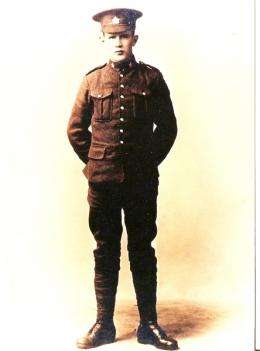
Ronald MacKinnon, like so many soldiers in the Canadian Army, had very strong connections with Great Britain. His father was a Scot from Levenseat, near Fauldhouse in West Lothian. Ronald was to meet his Scottish relatives for the first time while he was engaged in his basic training in Britain, before being sent to the Western Front.
Not long after he wrote his amazing letter back to his sister at home in Toronto, Private MacKinnon was killed at an unknown time between April 9th-10th 1917, during in the Battle of Vimy Ridge, a bloody but successful attack up a strategic height of land in the northern French countryside, a great victory often remembered as Canada’s national coming of age. Here is the monument to the brave Canadians. It is at the top of the ridge:
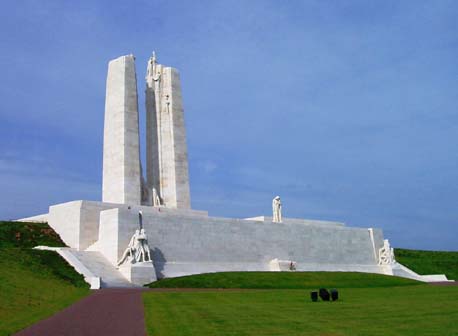
Vimy_Memorialxxxxxxxxxxxxxxxxxxxxxxxxxxxxxxx

Nowadays, you can drive up the ridge effortlessly in a tour bus. There are no Germans around. Nobody shoots at you. Everybody is friends:
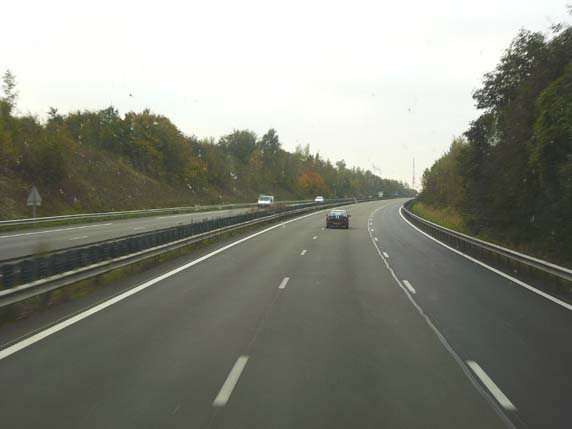
P1090648xxxxxxxxxxxxxxxxxxxxxxxxxxxxx

Ronald is buried in Bois-Carré British Cemetery in Thelus, in the Pas-de-Calais in northern France:
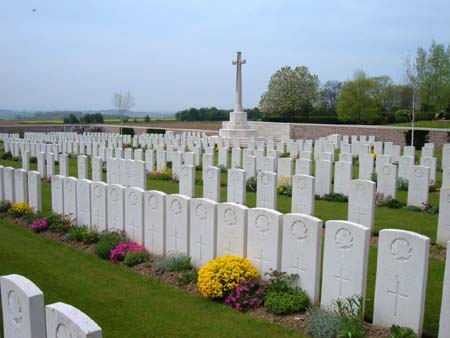
bois thelus zzzzzzzzzzzzzzzz

For some reason, his parents’ details are not listed on the Commonwealth War Graves Commission website.
One last postscript is that, according to Dr Weber, Adolf Hitler’s own unit actually faced Canadian troops on Vimy Ridge throughout the period that I have been describing. Ever the sour fanatic, Adolf Hitler, of course, would never have participated in any truce, although as many as half of his fellow soldiers are thought to have done so. The Führer’s views on the previous Truce of 1914 were recorded by one of his fellow soldiers, Heinrich Lugauer, and there is no reason to suppose that he would have changed his ideas in two short years, filled, every moment, with hatred and anger:

“When everyone was talking about the Christmas 1914 fraternization with the Englishmen, Hitler revealed himself to be its bitter opponent. He said, ‘Something like this should not even be up for discussion during wartime.”

What a bitter loner Hitler was. More extreme than his colleagues, who were only too happy to fraternise with the young Canadian lads for a day. What a pity my Grandad didn’t have the chance to shoot the bugger:
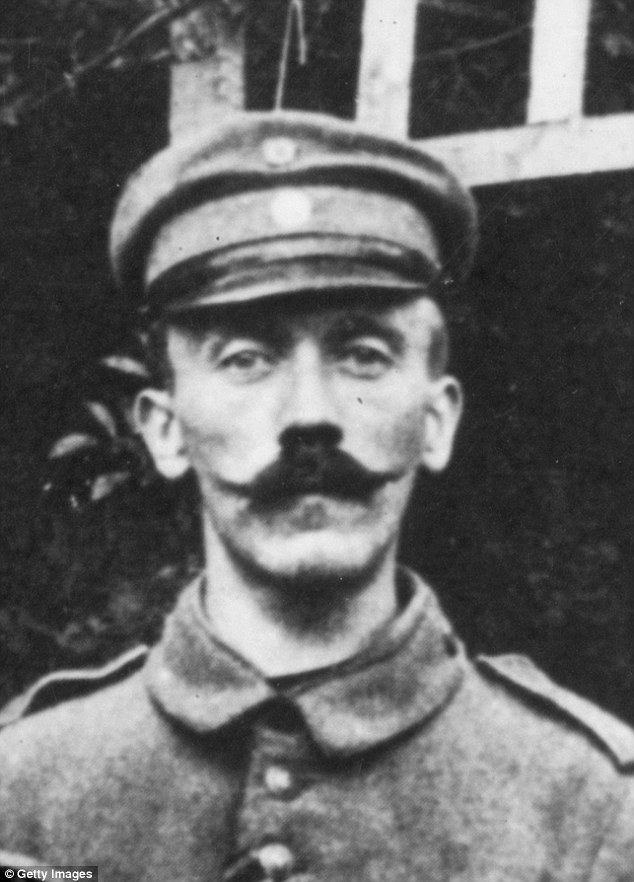
hitler-giovane2
Last words should always be positive though: back to Dr Weber:

“The Christmas truce of 1914 involved 100,000 British and German troops on the Western Front in an exchange of gifts and food, to the horror of their commanders. But these displays of common humanity were much more frequent than suggested by official military histories, with evidence of similar festive get-togethers in 1915 and 1916, involving the Bavarian regiments. No doubt there were Christmas truces in 1917.

Soldiers never tried to stop fraternising with their opponents during Christmas.

This puts to rest the long dominant view that the majority of combatants during the Great War were driven by a brutalising and ever-faster spinning cycle of violence.”

I could not have written this article without accessing these websites.

23 Comments

Filed under Canada, France, History, Personal

The Last One to Die

So often when we feel that we are repeating history, it is almost always, the negative, tragic sort.

As we have already seen, young Dab Furley’s was a life cut tragically short at the age of only nineteen at Miranshah in Waziristan, in 1919.

another BIGGER close up

If only the powers that be had read about the young man who perished in the middle of nowhere in northern Nigeria in mid-December 1903.
Old Nottinghamian, Lieutenant Cyril Amyatt Wyse Amyatt-Burney was slaughtered by the natives in the village of Deckina in northern Nigeria. He was leading a force sent by British authorities who were keen to restore the King of Ankina to his rightful position, after he had been ousted from the throne by a usurper:

tanzania

Lieutenant Amyatt-Burney was:

“…a zealous officer and a young man of promise and energy.”

His body was never found, just a bundle of some of his blood stained clothes, secreted away at the back of a native hut.

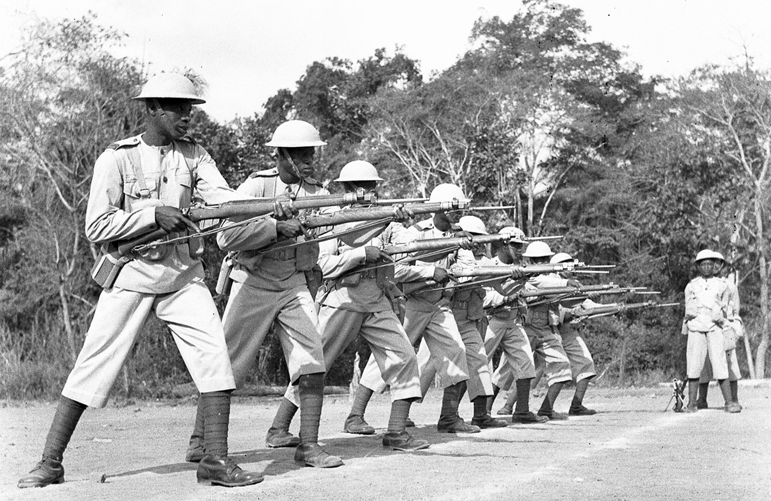
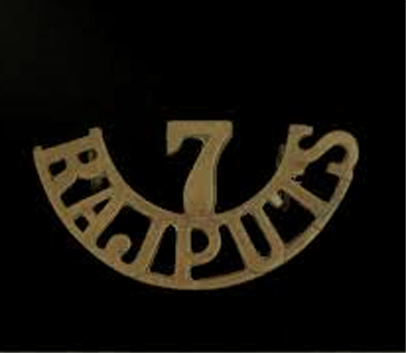
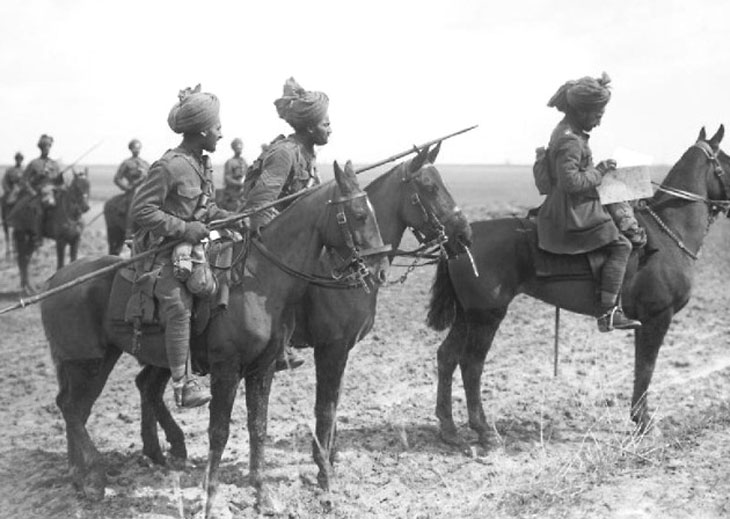
In 1937, another Old Boy, Lieutenant E.S.R.France, of the 3/7th Rajput Regiment, was to sacrifice his young life in the Shahur Gorge, on the Manzai-Wana road, on India’s North-West Frontier.

untitled 2

He was with twenty nine colleagues of the 3/7th Rajput Regiment:

cavalry

Lieutenant France, who had left the High School only five years previously, was just twenty three years of age.
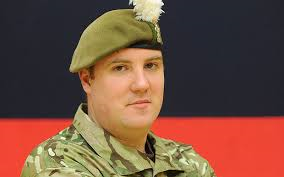
Literally as I wrote the stories of these two tragic deaths, though, news came in of the 454th member of the British Armed Forces to be killed in Afghanistan during the present era.  He died in hospital from his wounds on Thursday, July 24th 2015. Why not click on this link, and have a quick look at the 454 young people lost? the 454 families traumatised for ever? the 454 little photographs that mean so much to the people who know what they represent:

cammy
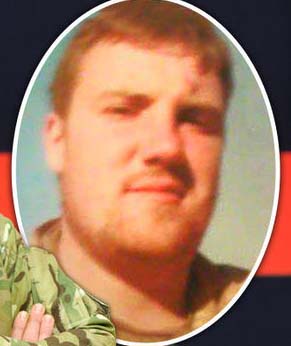
Lance Corporal Michael Campbell, of Colwyn Bay, in north Wales, had been shot while out on patrol with the 3rd Battalion, The Royal Welsh in 2012, more than three years previously.

tough British-Soldier-dies-from-Afghanistan-injuries

Michael, popularly known as Cammy, was a reservist and he died at Birmingham’s Queen Elizabeth Hospital. His fellow soldiers said the 32-year-old was an “outstanding soldier” who was always “determined” and “courageous”. Michael had a wife and four children.

carried
The Ministry of Defence said:

“Lance Corporal Campbell epitomised everything a reservist in 3 R Welsh should be – dedicated, professional and willing to volunteer on operations wherever he was required, a true Welsh warrior. The battalion has lost a charismatic and loyal friend and our thoughts and condolences are with his wife Chrissy and his wider family at this very difficult time.”

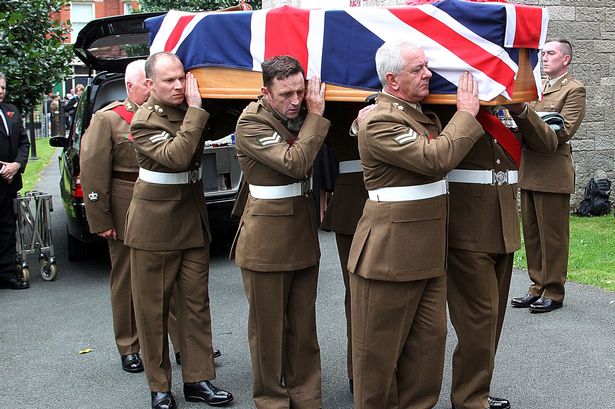
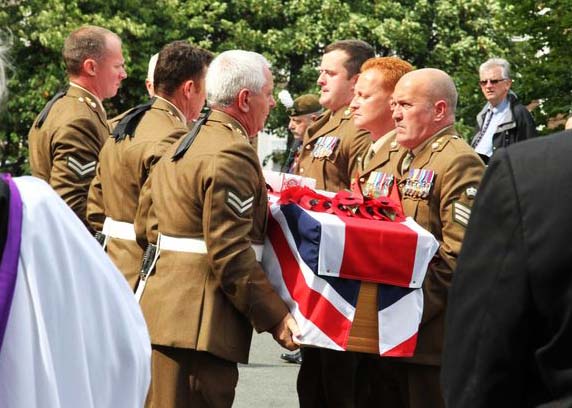
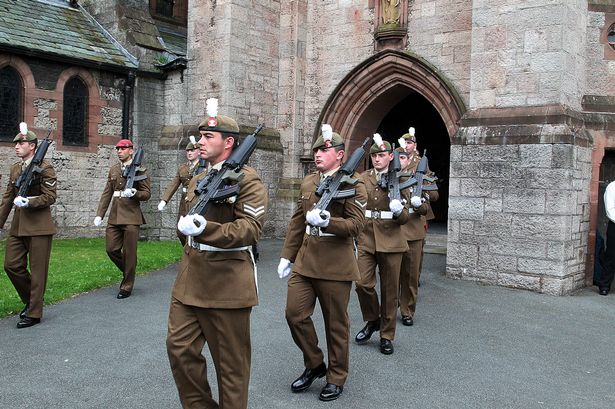
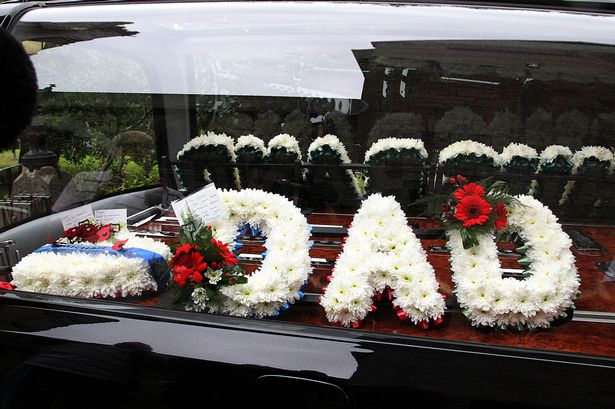
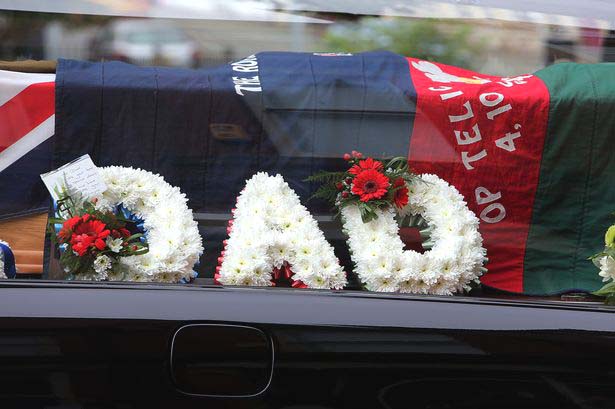
Funeral-of-Lance-Corporal-Michael-Campbell 4
Retired Lieutenant Colonel Stephen Webb said:

“Everyone who served alongside Lance Corporal Campbell will be devastated to learn of his passing.  He joined the battalion during our pre-deployment training and fitted seamlessly into his platoon and company. He was an outstanding soldier and very talented junior commander: skilful, determined, measured and very courageous: he set an excellent example to those around him.”

It is tragic that he has died three years after his initial wounding and the thoughts and prayers of all of us are with his family at this most difficult time.”

funera
Lieutenant Colonel R Manuel JP – the commanding officer of the 3rd Battalion, The Royal Welsh from December 2012 to June 2015 said:

“I was deeply saddened to hear of the tragic loss of Lance Corporal Campbell yesterday. I had known him for a number of years; he was a true reservist with a huge amount of operational experience under his belt. A larger than life character, always upbeat, at the heart of things and looking for the next challenge.”

Major Charlie Carver said Lance Corporal Campbell was “one of life’s true characters. One of the reasons that he was able to fit seamlessly into the company was his keen sense of humour; he excelled at the banter which only soldiers seem to understand.”

Campbell-593613

Major D Evans, described him as ‘reliable and professional’, adding:

‘Cammy always brought a smile to your face with his wit and cutting sarcasm and he was always on hand to pass on his experience to the new, and not so new, members of the company.
When I learnt that he had volunteered, yet again, to deploy on what would be his fourth tour, I told him that he had done enough already, his reply was “Well someone has to go and look after you, Boss.
That is what Cammy was truly about. He was a team player, who was committed to serving his country.

Funeral-of-Lance-Corporal-Michael-Campbell dad

Michael had joined the Army Reserves in April 2002 and was working as a platoon radio operator in October 2011.
He was wounded in the stomach while crossing a road in Helmand Province on April 3rd 2012, having been confronted by “accurate, heavy and sustained enemy fire”.
This enemy fire was returned, with Lance Corporal Campbell and his fellow soldiers vigorously attacking the Taliban firing positions. The Ministry of Defence said in a statement:

“Despite being wounded, Lance Corporal Campbell continued to suppress the enemy, drawing fire on to himself so that the remainder of the multiple could cross an open and exposed area to get into better cover.”

Funeral-of-Lance-Corporal-Michael-Campbell
Michael was evacuated by helicopter first to Camp Bastion and then to Birmingham’s Queen Elizabeth Hospital, where he was readmitted earlier this year. Initially, his recovery had appeared to be going well, as he left hospital to go to Headley Court, the military’s specialist rehabilitation centre for injured servicemen and women. Michael initially had to use a wheelchair but fought back and learned to walk again. All this time, though, he had to return to hospital for a series of operations.
Lance Corporal Campbell had served on a number of other tours, including Iraq, and proved to be a “highly capable soldier”, the Ministry of Defence said.
Defence Secretary Michael Fallon described Lance Corporal Campbell as

“proud and professional, a dedicated family man. The tributes of his comrades describe L/Cpl Michael Campbell as a popular and committed soldier devoted to his regiment and his family. Proud and professional, he epitomised the ethos of the Army reservist and he had completed numerous tours of duty in Afghanistan and Iraq. It is particularly tragic that Michael Campbell should die of wounds after such a period of time and I send my deepest condolences to his family and loved ones at this sad time.”

Sergeant Paul Thomas, who served with Lance Corporal Campbell, told the large crowd at his funeral:

“His knowledge and enthusiasm rubbed off on all around him, especially when guiding the younger members of the platoon. He had truly found his calling in life. He was hugely proud of being a Royal Welshman and even more so of his family. A better man you could not find.”

AFGHANISTAN-322225

I could not have written this article without the information provided on the Internet by the BBC, the Daily Express, the Daily Mail and the Daily Mirror.

And here’s that link that I mentioned at the beginning of the article. This one page of the Internet is a singularly humbling one. It contains the names of every single person who died in Afghanistan.
Every single person in this list had parents, perhaps brothers and sisters, maybe a wife or a husband, perhaps children, certainly friends and acquaintances, perhaps a pet, a hobby, plans to do things, places to visit, a garden, a car, all those things that make life so attractive. But no more.

6 Comments

Filed under History, Nottingham, Personal, Politics, The High School

It’s the Witching Hour : Story Number Eleven

Number 11

“E pur si muove” : “And yet it moves” (Galileo Galilei)

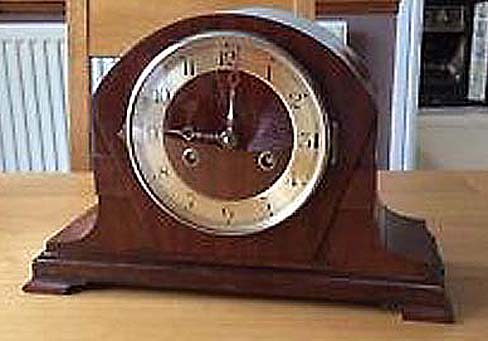
When my father, Fred, died in hospital at the age of eighty, his wristwatch was found to have stopped at 11.04. I went round to his house a couple of days later to check everything was all right, and I found that the old brown wooden clock in the sitting room, which had been a wedding present some fifty or more years earlier, had also stopped at that very same time of 11.04. This is like his sitting room clock, but the time is wrong:

big clock


Towards the end of his life, Fred had been both blind and bed ridden and his house had become very neglected. During the period after Fred’s death, both my wife and I spent a lot of time cleaning and redecorating all the different rooms.

As we did this, day after day, on more than one occasion, we both smelt what we thought was my mother Jean’s perfume. It was as if she were watching over us in approval as we dusted and hoovered. I suppose that if that were the case, then it should not have been too surprising, given that Jean was a typical 1950s housewife, always cleaning and re-cleaning, and immensely house proud.

At this time, my brother, Ken, who had always been so firmly convinced that the house was haunted, refused to go into the empty property on his own. He had always had the idea that spirits, whether good or bad, are pushed into the background by human activity, but that when potentially haunted houses are empty, then the ghosts will begin to claim them back as their own. Ken certainly believed in the story of the little man who had lived there in the 1940s.

Similar feelings were expressed by my daughter Lauren. As I mentioned above, during that period immediately after Fred’s death, my wife and I were readying Fred’s house to be put on the market. We were spending all of our time cleaning, painting and decorating.  Meanwhile, Lauren sat upstairs in the smaller of the two bedrooms revising for her imminent GCSE examinations. She spent all of her time sitting with her back to the wall, scared stiff as she worked. She felt that there was somebody else in the room with her, but that they really did not like her being there. These disquieting feelings only came when she was on her own. As soon as anybody came into the room to see her, all her fears disappeared.

It is easy to dismiss ideas like these out of hand, but it is a little like the difference between walking through a graveyard at three o’clock on a sunlit afternoon:

sunny graveyard

as opposed to three o’clock in the cold, dark depths of a winter’s night:

graveyard_zps723fe69f

With this idea in mind, on the very last evening before the contracts were exchanged and Fred’s house passed out of my possession forever, I decided to do an all-night vigil in an effort to experience something ghostly.

To cut a potentially long story short, I saw or heard absolutely nothing. But, at the same time, though, I was, throughout the entire night, so scared that I never did manage to switch the lights out. I really was very frightened. And, just like Lauren, I too spent all my time sitting with my back to a wall.  Read into that what you will.

There were other strange happenings as well as the stopping of the wristwatch and the old wooden clock. We were experiencing them, I suspect, because we were clearing out Fred’s house after his death. It is very frequently said, for example, that building work, and many other types of physical change such as painting or wallpapering, are extremely good for provoking a strong reaction from any ghosts that may be present.

One day, I had been cleaning and painting the living room. This was the downstairs room where Fred had spent the last two, painful, years of his life, except for his stays in hospital. He had a bed, an armchair, a commode and a television, so he was self-contained in a sad, forlorn sort of way.

That particular day, we had reached lunchtime, and my wife and daughter were outside in Fred’s old summerhouse, finishing off their fish and chips from Renée’s Fish Bar. For some reason I now forget, I was alone. Suddenly, I had the strangest feeling that Fred was there in the room with me. I called out to him,

“Are you there, Dad? It’s me, your son, John. If you are there, give me a sign.”

Straightaway, the curtains in the window looking out towards the garage and the concrete drive where Fred had parked his cars for so many years, began to shake and move. Then they stopped. I waited a few seconds and then called out for a second time.

“Is that you, Dad? If you are there, then make the curtains move again.”

Without delay, the curtains again began to move. I went outside, and called in my daughter, Lauren. I told her to come into the living room and just to stand still and watch, and not to say a word. I called out to Fred for a third time,

“Are you there, Dad? This is your granddaughter, Lauren. If you are still there, give her a sign. Make the curtains move like you did for me.”

Immediately, again the curtains began to move, and then stopped. I turned to Lauren, and asked her if they had actually moved, and that it was not just a coincidence. She replied that she had seen the curtains, and that, yes, they had moved, and that apparently, it had been in response to my request.

So, for a fourth, and final time, I called out loudly,

“Are you still there, Dad? If you are, make the curtains move again.”

And sure enough, they did. I have no explanation for these events other than the supernatural.

There was no window open. No door was open. The central heating radiators underneath the window were switched on throughout the entire episode, but this would not explain the fact that the curtains actually came to a fairly abrupt stop on four separate occasions. Neither was it my imagination or wishful thinking. That was one of the reasons why I asked Lauren to come in and be a witness to events. And to this day, she maintains, Galileo-like, that, yes, the curtains did move.

.
Not surprisingly, perhaps, for quite a while afterwards, Fred was to appear in my dreams. There was one that stood out among the rest.

This dream took place on a huge luxurious ocean liner, standing around a grand piano which stood at the meeting point of several long and wide corridors:

fingersccccccccccccccccccc

Fred was standing there, listening to the pianist who was tinkling away at the ivories in rather desultory fashion. I was talking to Fred, and was trying to trap him into giving me details about the afterlife.

“Where do you live now then, Dad?”, I asked.

“You know that already.”, he said with a slight smile.

“And where you will you go tonight ?”, I asked. “Where will you sleep after we’ve left ?

He did not offer any reply.

“Well, Dad, will I be able to come and see you sometime?”

“Of course you will come and see me…..one day,” he replied, with a strange, wry look, and then walked off for ever down one of the corridors.

I have had no real contact with Fred since, but deep down, I am sure that this will not be the end of the story.

6 Comments

Filed under Aviation, Bomber Command, History, My Garden, My House, Personal

Hallowe’en Tales : Numbers Nine and Ten

Number 9

He’s back! The Return of the Phantom Passenger of the No 90 Bus

This is another version of the story about the No 90 bus and the ghost of the cyclist. Clearly, this ghost story is a strong tradition which has persisted for many years on this western side of the Nottingham conurbation. I found this version of the story about five years ago, in a forum about ghosts in Nottinghamshire. I kept the website address at the time, but I can’t find it any more, and I presume the forum is now defunct.

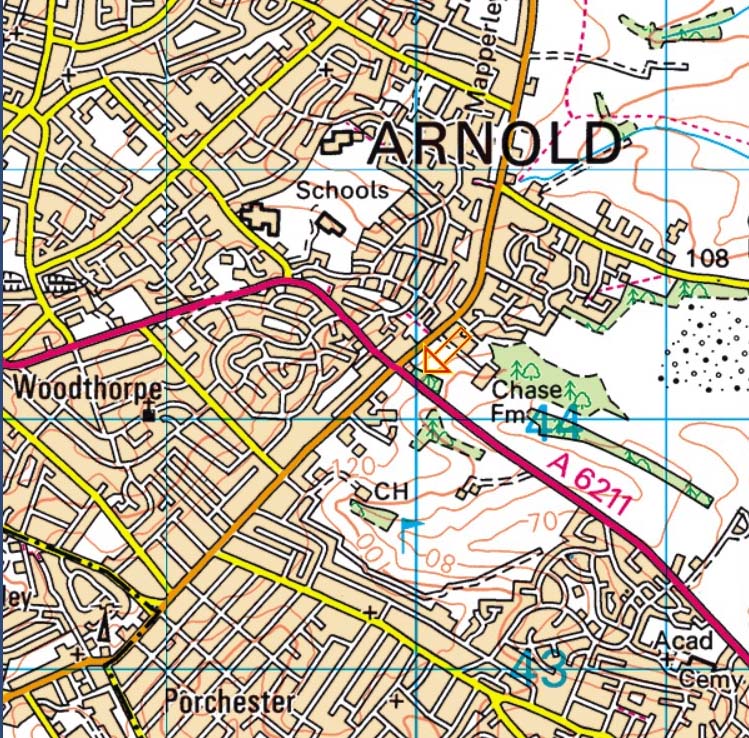
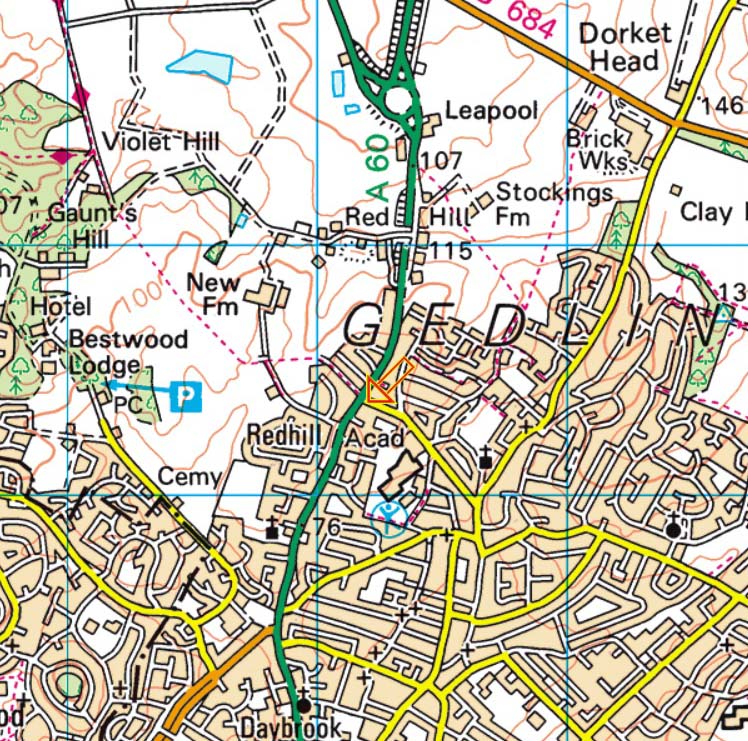
On this map, the orange arrow in the centre points to Arnold Lane. I suspect that the young man who needed the loo went into the tiny wood to the north of the road, having parked his car pointing down what is  actually a very unpleasantly steep road:

at long last

The old man would have been pushing his bike up the hill:

I came home one night in the early hours of the morning from the White Post pub in a friend’s car, turned down Arnold Lane towards Gedling, just down the hill, the friend stopped the car as he needed the loo went round the back of the car. As I sat looking down the hill, I could see an old man pushing a pushbike up the hill on the other side of the road. Then suddenly, he just vanished into thin air.

I thought I had just imagined it but when the friend got back in the car, he asked me “Did you see that?” and I asked him “What?”” as we might have seen different things. He said “The old man. He just disappeared”.

I know some people might say, “Well, there’s a path off the road up there, he could have gone along that, but at the point he disappeared  there was just a very thick hedge. I was not really frightened but I was a bit shocked to see this. My Dad later told me a story of an old man who had come from the pit late one night was going home on his pushbike to Arnold and was hit by a car and killed. That’s why the path at the back of the hedge was put into make it less dangerous.”

To complete the Geography lesson, the open land to the east of Chase Farm is what is left of Gedling Colliery, the coal mine where the old man is supposed to have worked.

Number 10

The Killer Bus

I know two more ripping yarns about buses, both of them told to me by a birdwatching friend, Phil, who had worked initially for Liverpool City Transport and then for Nottingham. One story involves the supernatural, the other, a bus driver who was exceptionally lucky not to become a member of the supernatural.
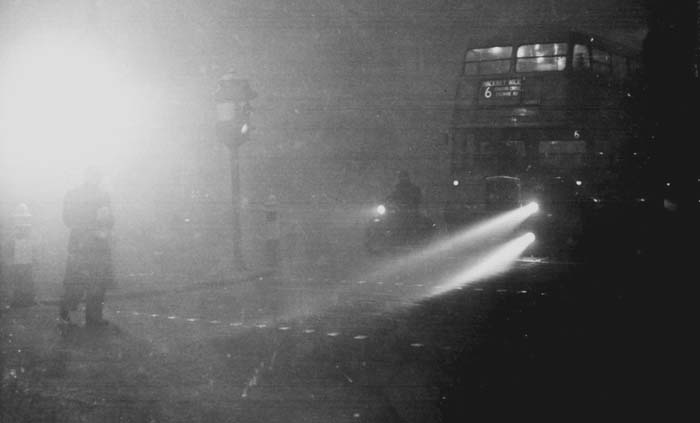
The lucky bus driver occurred when Phil worked in Liverpool in the early 1960s. There was a good two or three inches of icy snow already on the ground, and an absolutely impenetrable “smog”:

smog

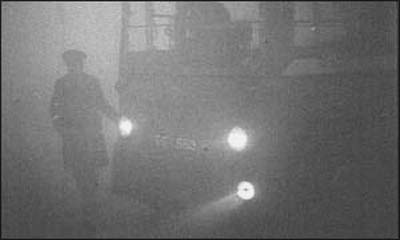
“Smog” was a speciality of the era, and it was a dangerous combination of natural fog, perhaps where the warmer sea met the frozen land, and the thick smoke which came from the tens of thousands of houses heated by coal fires and a good few coal fired power stations around any city in the country:

bus in smnog

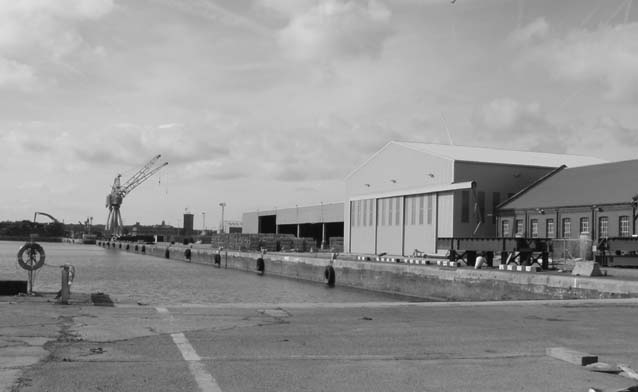
That day in Liverpool, therefore, the weather conditions combined to produce a bizarre situation, whereby the bus driver could not see where he was going, even at walking pace, but at the same time, he left tyre tracks in the snow which let pedestrians see exactly where the bus had been. Imagine, therefore, the pedestrians’ shock to see that an unknown Liverpool bus, full of scores of workers on their way home from the shipyards, but completely lost in the whiteout conditions, had been driven for more than eighty yards along the edge of the docks. leaving tyre tracks just a couple of inches from the twenty foot drop into the icy waters of the Mersey. The lucky driver had finally turned right to safety rather than left to a watery doom:

Dock_in_Port_of_Liverpool_1
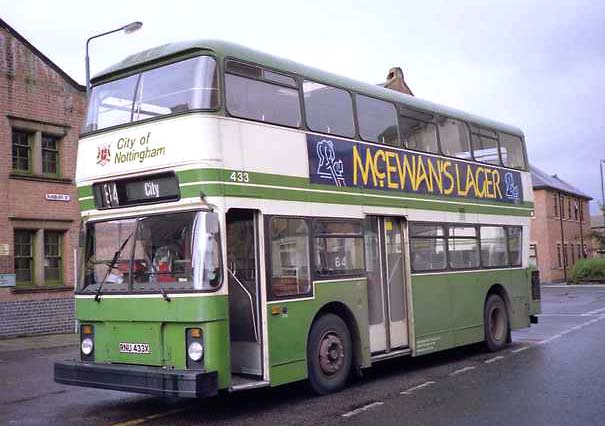
Phil told me a second story, a supernatural tale, all of which had taken place in the Bus Depot in Sherwood, the very same suburb of Nottingham where I live:

bus depot

Apparently, the bus in question had some mechanical problem and it was being mended. It was jacked up on strong supports while repairs were carried out.

Only the strong supports gave way, the bus skewed to the left and the mechanic underneath was crushed to death.

A few days later, the repairs to the bus were completed without any further problems. The bus was parked away on one side of the garage while a driver and conductor could be found to take it away on its afternoon route. The two duly arrived just after one o’clock, The conductress stood at the back of the bus while the driver went to get into his cab and warm up the bus engine.

Except that before he could even unlock the door to get into his cab, the bus handbrake must have come off, and the bus rolled backwards. The surface was steep enough for the vehicle to pick up a fair speed, and the unfortunate bus conductress was pinned against the wall of the building. She died in hospital just a few days later.

.
Trade Unions were a lot stronger in those days, and when the shop steward said that his members were adamant that they would not work with this bus, the management had to pay attention to their demands, The decision was taken to dismantle the bus and use all of its parts as spares.

For a long time afterwards, all the drivers and conductors in the depot at Sherwood had the belief that if any serious accident occurred then it must be a bus which had been given, perhaps, the engine of the killer bus, or maybe its rear wheels and axle. And while this belief went on for a good few years, it was ultimately unprovable because no record was ever kept of which parts went into which bus.

9 Comments

Filed under History, Nottingham, Personal

Hallowe’en Tales : Numbers Seven and Eight

Number Seven

The Sea Serpent

On October 25th 1988, I went over to the Isles of Scilly to birdwatch. I crossed over from Cornwall on the ferry, the Scillonian:

scillonia on scillis xxxxxxxxxx

For two or three hours during the crossing, I remained on deck with my binoculars, eagerly scanning the storm tossed waves for seabirds.

At one point, I noticed what I took to be the head of a Grey Seal, which broke the surface perhaps fifty or a hundred metres away from the boat. This is a Grey Seal which I photographed in the harbour at St.Ives in Cornwall:

P1460520

This head, way out in the Atlantic Ocean, was very similar, dark in colour, and I could see a forehead, two eye sockets, and an obvious snout. I didn’t really think a great deal about it, other than the fact that, for a seal, it was certainly a very long way from land, at least fifteen miles. It remained there, presumably watching the boat, for perhaps two or three minutes. Then, suddenly, a Gannet flew directly above it. A Gannet is a very large bird with a wingspan of some six or seven feet:

wikikikik Northern_Gannetzzzzzzzzzzzzzzzzzzzzz

I then realised from a simple comparison of sizes that the head must be at least a metre and a half, if not two metres, across. And that means it cannot have been a seal !

 Number Eight

The Ghost on the No 90 Bus

Some thirty or more years ago, we used to live in a large house in a new estate on top of a hill right at the very northern edge of the City of Nottingham. From our top bedroom window, we could see the distant cooling towers of the Ratcliffe-on-Soar Power Station, out towards the East Midlands Airport, absolutely miles away. If it had been built then, we would have easily been able to see the Control Tower on the Airport. To go into Nottingham was a little bit of a bore, though, because there was only the Number 90 bus, which ploughed, every hour, a long and very eccentric furrow from one side of the city to the other, from where we lived on the northern edge, to the furthest bus terminal of Edwalton, beyond even the foetid swamp that is West Bridgford:

DKY-496_lr

The Number 90 bus, strangely enough, had a very strong ghost story attached to it. People told me all about it on several occasions, almost as soon as I mentioned what bus I had to catch to get home and just how long the journey was.

3135590sssss

Funnily enough, the story concerned the very same bus stop on Mansfield Road which we used to use:

bus stop

Anyway, the first occasion the ghost appeared was quite a long time ago, in the 1950s perhaps, or in the 1960s. It was certainly in the era of the bus conductor, who used to go round the bus, issuing tickets and taking the money.

Just imagine to yourself. The time  is around seven or eight o’clock in the evening, and the bus is absolutely deserted. Not a single passenger. The conductor is standing up near the driver’s compartment, talking to him to pass the time. Suddenly, they both notice an old man who is standing at the Mansfield Road bus stop, waiting to go towards the city. The bus stops and the old man gets on. The evening is fine and dry, but the old man is absolutely drenched, with rainwater dripping off him. He looks quite battered, with little rips here and there in his clothing, which is, strangely for the weather at the time, a heavy winter topcoat over an equally heavy winter suit.

The old man says nothing as he gets on. He goes upstairs and the driver and conductor notice he is wearing his bike clips, a simple aid to cycling that is, by now, almost decades out of date.

The driver and conductor finish their conversation. The driver sets off down the road, and the conductor begins the shaky climb up the stairs. He wonders why this special kind of idiot had to go upstairs on a completely empty bus and make the tired conductor follow him.

He gets to the top of the stairs and has a good, surprised look round. The top deck of the bus is completely empty. The old man just isn’t there. He isn’t in the two rows of seats at the front of the bus. The conductor then walks slowly back past all the other rows of seats. The old man isn’t there either, neither is he hiding behind any of the seats in a ludicrous attempt to avoid paying his fare.

Puzzled, the conductor goes back down again, pushes his cap back on his head, and expresses his astonishment to the driver.

Back at the canteen, they tell their tale over a cup of tea and a couple of cigarettes. They are not the first crew to meet “The Phantom Passenger of the Number 90 bus.”
He is, or rather was, an old man of sixty or so:

old_man_on_bike_by_claeva

One winter’s night, he was riding his bicycle home to Arnold, when a hit-and-run driver killed him as he rode carefully and slowly around the Leapool Roundabout. It happened so swiftly that the old man does not realise, even now, that he is no longer alive. Wrapped up against the winter in his heavy suit and heavy topcoat, he still has his bike clips on. His bicycle, to him too valuable to leave behind, is too badly damaged to ride back home. And so, he must walk through the winter rain and sleet the two miles to the nearest bus stop to get back home to his wife and family. On this map, the orange arrow marks the bus stop where the wet old man would get on the No 90 bus. To the north is the Leapool Roundabout. Follow the green road until you come to the obvious roundabout:

map

I don’t know now if the Number 90 still runs or not. I hope it does. No ghost should fade away at the whim of the Nottingham City Transport.

16 Comments

Filed under Cornwall, Cryptozoology, History, Nottingham, Personal, Science, Twitching, Wildlife and Nature

Hallowe’en Tales : Numbers Five and Six

Number Five

The UFO

It was perhaps in the first half of 1959, a spring and summer of bright white clouds, bright blue skies and bright warm days. I was in the first year at Junior School, in Miss Cartwright’s class. I must have been seven years old. It was the morning of a late spring or early summer’s day, and we had just finished morning playtime, with little bottles of milk and the excitement of straws.

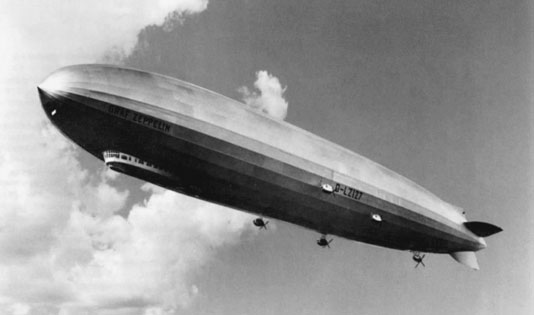
Before each class went back into their classroom, the teachers used to make the whole school line up, in an orderly fashion. Once everybody was quiet and behaving themselves, the classes could start to go in. We members of Class 6 were patiently awaiting our turn, when we all became aware of what even we, as small children, could immediately identify as an unidentified flying object. It was moving silently toward the south west, and was to all intents and purposes, like a grey, or perhaps metallic silver Zeppelin airship:

zeppelin

It was not like any of these obviously fabricated modern UFOs:

This slideshow requires JavaScript.

Under the main section of the craft, which was like a short, stubby cigar in shape, there was some kind of gondola, which was of the same colour, and had a number of conspicuous round portholes in the side. There must have been at least four of them.

I have not found any exact match for the UFO we all saw, but these two are both close. There weren’t any lights on the ends, though, and both drawings lack the gondola, which carried the portholes:

This slideshow requires JavaScript.

The UFO was only a few hundred feet up, at perhaps the same height that we used to see the Vickers Viscounts and Canadair Argonauts from Burnaston Airport flying over:

This slideshow requires JavaScript.

There were of course, no airships in 1959. I myself was a keen plane spotter, and in any case, at the time I watched it, I was sure that this was no plane. I still know the boy who was in front of me in the queue. I see him from time to time even now, fifty five years later. He too has no way of explaining away one of our most vivid childhood memories, despite having grown wise with a wrinkled face and long white hair.

Number Six

Mad Bill

Over the years, my friend Stuart Taylor was to tell me many stories about the ghosts which either he, his mother or his father had either seen or heard. At the time I believed him implicitly, although as we have drifted apart, and I have heard more about him from other sources, I have begun perhaps to doubt the veracity of much of what he told me. I find it difficult to explain away, however, the story of Mad Bill.

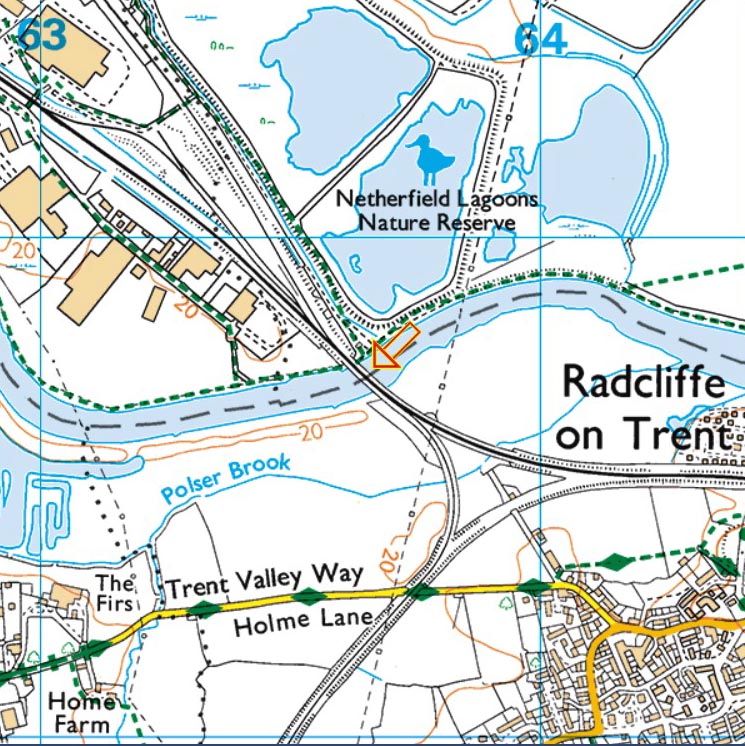
Near to Nottingham, at Netherfield, the main railway line to Grantham runs over the River Trent, and over the frequently flooded water meadows alongside it. The railway line crosses the river on a long, cast iron viaduct, which was constructed around 1850. The orange arrow points towards the viaduct:

land orth of

Popular legend among the railway workers said that in the depths of the night, as they worked on the track near the ageing viaduct, men would occasionally hear what was known as “Mad Bill”.

“Mad Bill” was a strange ghostly manifestation, and consisted of what sounds like somebody throwing down, very loudly and very angrily, a huge old empty oil drum. There is then a delay while Mad Bill apparently walks across to pick the oil drum up again, before throwing it down, and then beginning the process all over again. Nobody has ever seen anything, and it all sounds rather ridiculous, although as Stuart pointed out, these things can seem a little more serious when you’re all alone on the viaduct in the pitch dark at three o’clock in the morning, going back to retrieve a hammer or a shovel you’ve left behind.

“Mad Bill” always occurred on the isolated farmland to the north of the viaduct, which is still indicated by an orange arrow:

viaduct

“Mad Bill” could also be heard on the lonely fields to the south:

land to th south

One winter’s day, I was out bird watching with Stuart, on a gravel pit, next to the viaduct. It was around three o’clock in the afternoon, when suddenly every single bird took to the sky in blind panic. That is usually a sign that a raptor is about, and we scanned the heavens eagerly with our binoculars, in the hope of finding a Peregrine, or some other bird of prey.

We didn’t see one of course. But we did hear something, over on the far side of the river, on the deserted and inaccessible water meadows. It sounded just like some muscle bound idiot smashing a very large and empty oil drum onto the ground. It was still daylight, and we were able to check the area. There was nobody there, and as far as we could see, we were the only people for miles around.

7 Comments

Filed under Aviation, History, My House, Personal, Science

Hallowe’en Tales : Numbers Three and Four

Number Three

Haunted Malham Tarn

In about 1978, despite the fact that I was a teacher of French, I accompanied a couple of Geography teachers on a field trip from our school in Nottingham, to stay at Malham Tarn Field Centre in North Yorkshire:

malham-cove-02xxxxxxxxxxxxxxxxxxxxxxxxx

We used to work late into the evening, and then, between ten and eleven o’clock, usually retired to one of our staff rooms for a few whiskies, and a little R & R. After that, we would all go to bed.

One night, though, I found myself awakened around two or three o’clock in the morning, by what I can only describe as the feeling that there was some kind of evil presence in the room. As I looked out over my feet, beyond the end of the bed, it seemed to be down in the left hand corner, below the window, in the darkness in front of the wardrobe doors. I could see nothing at all, and could not reach the light to put it on, but I was certain of my fear, and the fact that I was not the only person in the room. Indeed, I was so scared that I remembered my experience of horror films, and used some of the remedies I had seen there. I imagined myself cocooned in a pale blue light, and, despite my status as a lapsed Christian, did not hesitate to repeat to myself, again and again, until I eventually fell asleep, ” In the name of Jesus Christ, I defy thee Satan.”
The following day, I asked questions about whether the building, a converted seventeenth century barn, was haunted or not:

Malham_tarn_house

From my colleagues, I could only get very non-committal answers, which clearly hinted that they knew a lot more than they were prepared to reveal. Eventually, I was told that there was indeed supposed to be a ghost in the place. On one occasion, just after midnight, it had walked into and out of walls, a party piece which had totally terrified a group of Sixth Form Girls, who had packed up and left, even though it was in the middle of the night and still dark.

Number Four

The Beast of Glen Etive

In the middle 1970s, I used to go regularly to Scotland with my friend Bill.  Normally, we would do a clockwise circuit around the whole country, camping each year in the same places. On the second day, we normally stayed at Glen Etive, a long and steep sided valley which runs off Glencoe, just to the south of Fort William:

glen-etive

This particular summer, in early August, if I remember correctly, we had again stopped in this dramatic glen, siting our tent and car just a few metres to the side of the single track road that ran the length of the glen. In those days, before the place was a film set, it was very isolated indeed. A single track road led for four or five miles down the valley to its very end, which was just a tiny wooden jetty large enough for a rowing boat. Nobody was camping anywhere near to us, and later in the holiday, when we followed the single track road down from our campsite to the wooden jetty and back, we met nobody in the ten or twelve miles we covered. No cell phones back then. This was genuine wilderness, where the orange arrow marks our orange tent:

etive

As darkness fell, Bill and I were both sitting in the car, looking across the road, and the flat floor of the valley, over towards the precipitous cliffs on the far side. After a couple of cigarettes, Bill announced that he was going to take the toilet roll, and go off to do what a man has to do. He took with him the torch, and his cigarettes and matches.

At first, I could still see him as he walked away toward a huge well-used pile of granite rocks, some two or three hundred metres in the distance. After a few minutes, though,   he was swallowed up by the darkness.

I was rather surprised that he did not switch on the torch, and looked in vain for the glowing end of his cigarette in what was by now total darkness.

After about fifteen minutes or so, I noticed a light well over to the left of where Bill had gone, and was a little worried that he had perhaps got disorientated in the darkness, and that he might fall over, and injure himself.

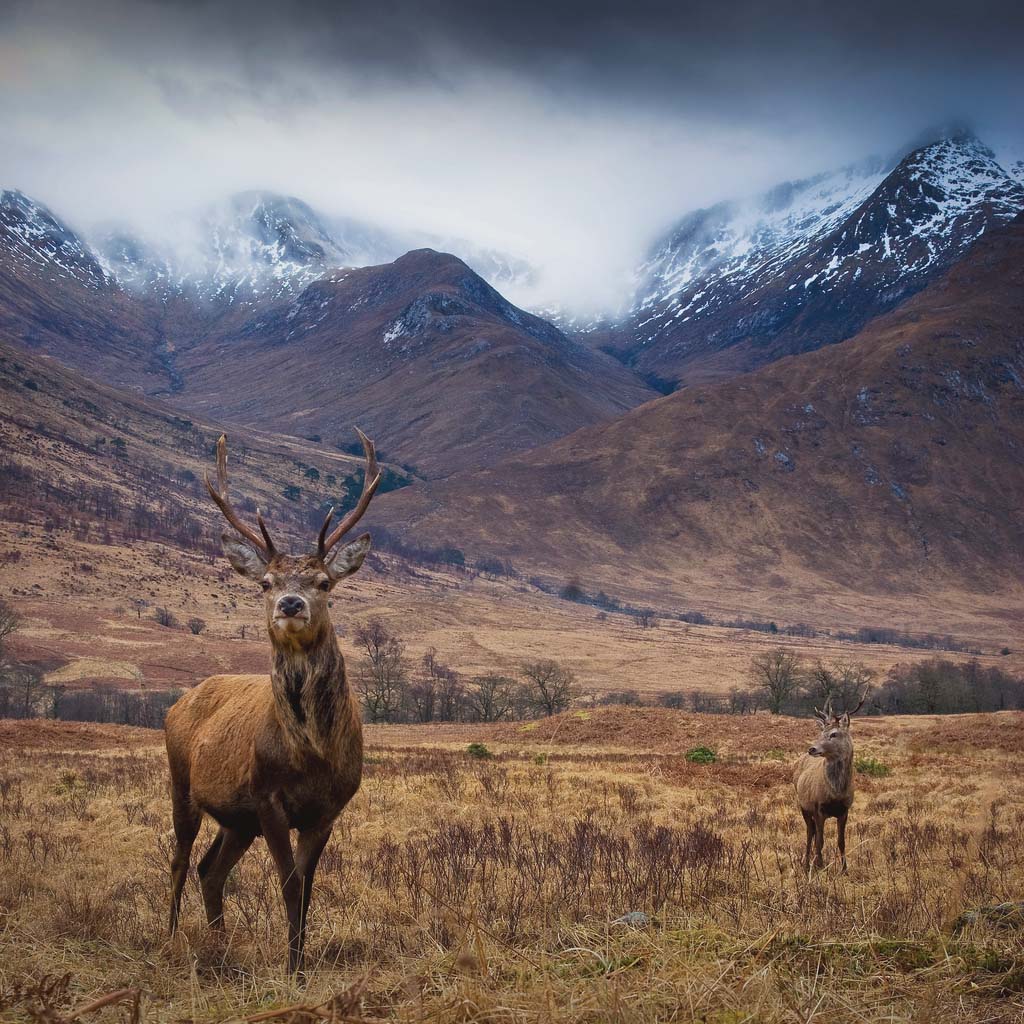
I began flashing the car headlights steadily to give him a reference point, and was then surprised to see a second light come on, and make its way at some speed towards the car. This, of course was Bill, who had been considerably frightened by the very loud roaring noises he had heard while out among the rocks:

red_deer_stag_

It was for this reason that he had not switched his torch on. He thought that if he did, he might well attract whatever was making the noise. Inside the car, three hundred yards away, for some reason, I had not heard the roaring, perhaps because I was listening to music on the car cassette player. Strangely enough, Bill had not seen the second light, which by now had disappeared.

During the next few hours, though, we both heard the roaring clearly:

red-deers-in-

It was difficult to describe exactly, but at times it was a deep, loud bellowing, and at others it sounded like an almighty crash. I remember thinking that if a giant baby had dropped a full sized battleship into his bath, then that was the noise it would have made.
We were both frightened, and I slept with the carving knife under my pillow. On the other hand, the noise was always fairly distant, and, although alone, and many miles from the nearest house, we were never scared enough to pack up the tent, and drive off into the night.

Later, we tried to investigate the origin of the lights and the noises. We climbed up into the area which we thought they had come from, but with no success. We found nothing to explain either the bellowing or the isolated light which had been at least as large as a torch. Neither did there appear to be any difference between this section of the valley and any other.

Whenever the idea of “bellowing” or “roaring” appears in this article, the animal depicted in the photograph is a Red Deer stag. And yes, in the rutting season, Red Deer stags do roar and bellow. Set against this though, is the fact that the events described here did not really occur during the rutting season, which occurs from October to November. Likewise, the roaring is most frequently heard in the late evening and then during the early dawn. We heard it, though, when night had really begun. It was certainly pitch black, dark enough to need torches for safety reasons.

Forty years later, I would still describe the noise as “a full sized battleship dropped into a bath”. Strange! Very strange!!

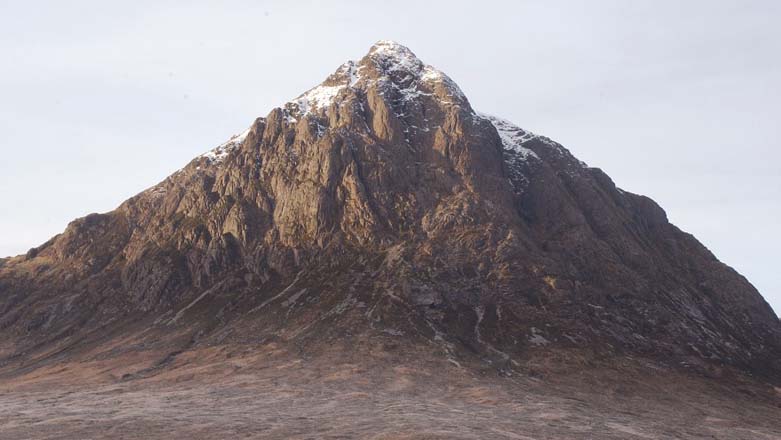
Incidentally, this is the mountain which stands at the head of the glen. It is called “Buachaille Etive Mòr” and, statistically, it is much more dangerous than the Eiger:

monitain


12 Comments

Filed under Cryptozoology, History, Personal, Wildlife and Nature

Hallowe’en Tales : Numbers One and Two

Today I begin a series of articles which will lead up to Hallowe’en.

A zombie’s dozen of ghostly tales.

They are all within my experience. That is to say, they may have happened to somebody else, but that somebody else then told me their tale directly, man to man.

The vast majority of these ripping yarns, though, actually happened to me.

Number One

The Vampire

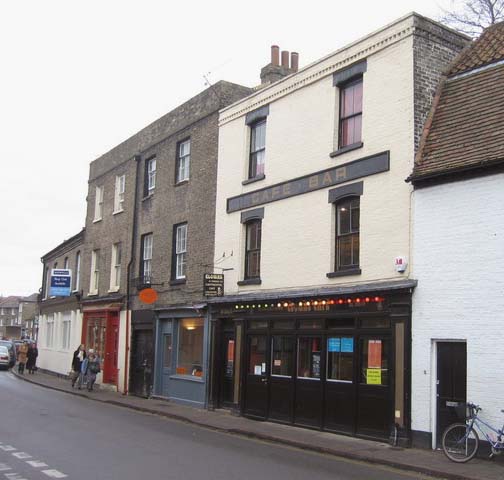
Over forty years ago, when I was a student, my friend Nick and I used to visit the Horse and Groom pub in King Street in Cambridge, on a far too regular basis:

horse gr

One freezing cold foggy dark November night, we went over to our favourite drinking hole where we consumed perhaps a couple of pints, which was a far from an excessive amount for us. We then decided to return to college a little earlier than normal, to finish our evening in perhaps, rather more luxurious surroundings. It was still cold outside, and the fog was perhaps even thicker, as we walked back along a wide asphalt path which crossed the park. The wide asphalt path is designated by the narrow orange arrow:

paths over praj

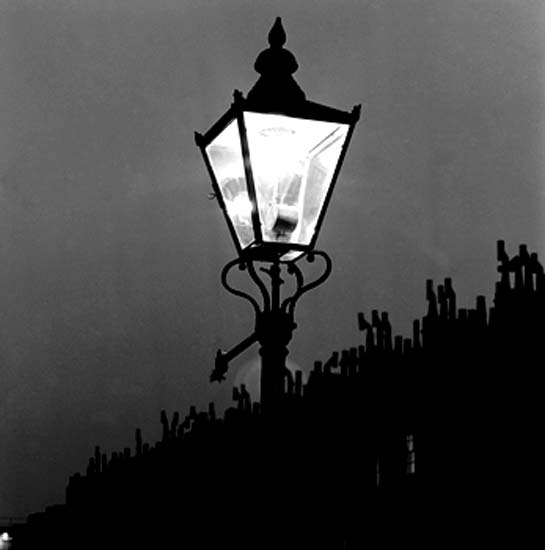
The path was absolutely straight and lit by a number of old Victorian street lights. They created pools of light perhaps eight or ten feet wide but, as the lights were about ten or twelve yards apart,  there was still a lot of darkness there, not helped by the thickening fog:

lampos

As we got out into the very middle of the park, we gradually became aware of the crisp click-clack-click noise of approaching footsteps, and the tip-tap-tip of a cane on the hard surface of the path. At first, we were unable to see anyone, but suddenly the stranger stepped out of the darkness into the pool of bright light provided by the street lamp.
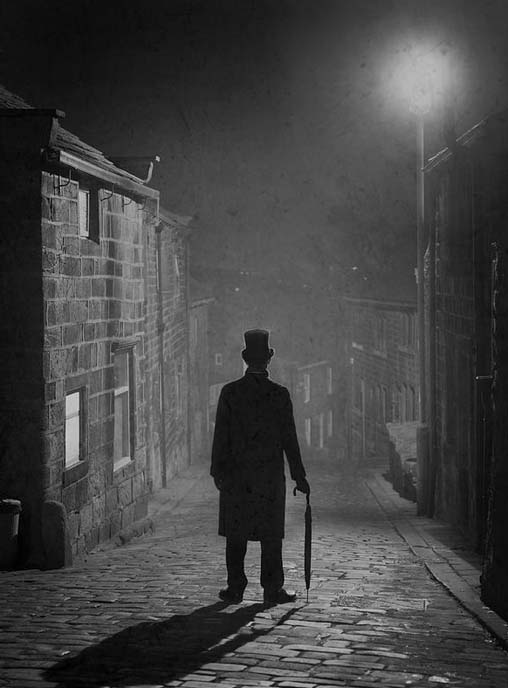
He was in full evening dress, with dark hair. He carried a cane, and, most striking of all, he was wearing a sweeping black cloak. It was lined with what appeared to be bright red silk:

vampire

We watched open mouthed as he strode purposefully past us, and then back out into the darkness. The noise of his footsteps, and the tapping of his cane gradually became fainter and fainter until they finally disappeared into the darkness:

trees-and-streetlamp

Number Two

The Time Travellers

I have always had a lot of trouble sleeping. In summer, I seemed always to wake up around four o’clo0ck and then find it impossible to get back to sleep again. That was one of the main reasons I started marking GCSE Papers every June and July. It was fairly well paid, and it always seemed a good way to make some money at a time when, in all probability, I would have been lying awake anyway.

In the late 1980s, therefore, I took to s1eeping on my own in the front bedroom. This seemed a good way to get a full night’s sleep before I got up at ten to five to brew some coffee and make a start on the vast piles of cassette tapes, all containing GCSE French Oral Examinations. At the time, our daughter was just two or three years old, and the last thing  wanted was to interrupt my slumbers between ten o’clock and five o’clock the next morning.

One brilliantly bright sunlit summer’s morning, I woke up even earlier than normal, at around four o’clock. It was already well past dawn, and I was lying with my face towards the bright bay window:

window

The bedroom door was directly behind me, and as I gradually became more and more awake, I had the strongest feeling that somebody was standing behind me in the doorway, looking at me. The strongest feeling.

Somehow, I knew that I was going to have to pluck up courage to turn over and have  zaa look to see if there was, in actual fact, anybody there. Slowly, slowly I was acquiring the courage to turn around.

Suddenly, I heard a child’s high pitched voice say, “There’s one in here, and he’s still asleep”. From the landing outside the bedroom came a female adult’s reply, “Come away, you’ll waken him.”

Then there was silence:

curtainszzzzzzzzzzzzzzzzzzzzzzzzzzzzz

I turned over to look towards the bedroom door. There was nobody. I got up and had a look around all the rooms in the house. Nobody.

Then, just for a moment, I had the strangest feeling that I had just taken part in a Year 10 Social History class visit from the 25th Century. Walking around in what to them was the distant past. Our distant descendants in our house.

3 Comments

Filed under History, Personal

Off to the Great War (Part Two)

I wrote about my grandfather, Will Knifton, in a previous blog post:

A1 hard man

When he first joined the Canadian Army in Toronto, he was soon sent across the Atlantic to receive his initial training in England. He started at  Shorncliffe Training Camp in Kent, learning how to be a Canadian soldier from late July 1916 until the end of November. There was a Canadian Training Division at Shorncliffe and I suspect he was stationed there. Will seems to have enjoyed his stay in Kent, the so-called “Garden of England”. I have already shown you some of the post cards he sent to his fiancée, in an article imaginatively entitled “Off to the Great War (Part One)”.

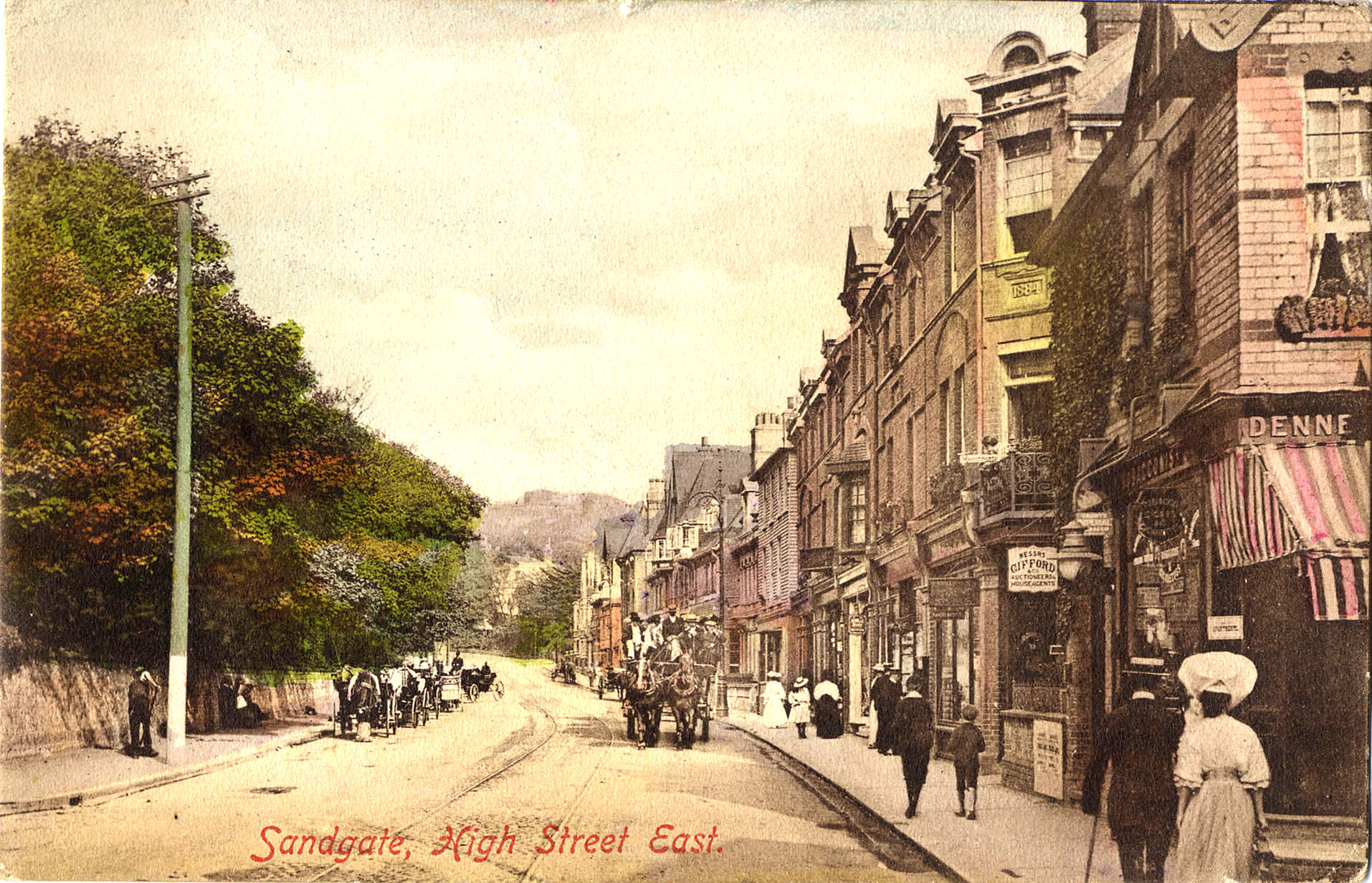
At this time, Will’s fiancée, Fanny Smith, lived with her family in Woodville, a little village in South Derbyshire. Will sent Fanny many postcards. This one is of Sandgate, a little seaside resort in the area. It shows the High Street East:

sandg high st

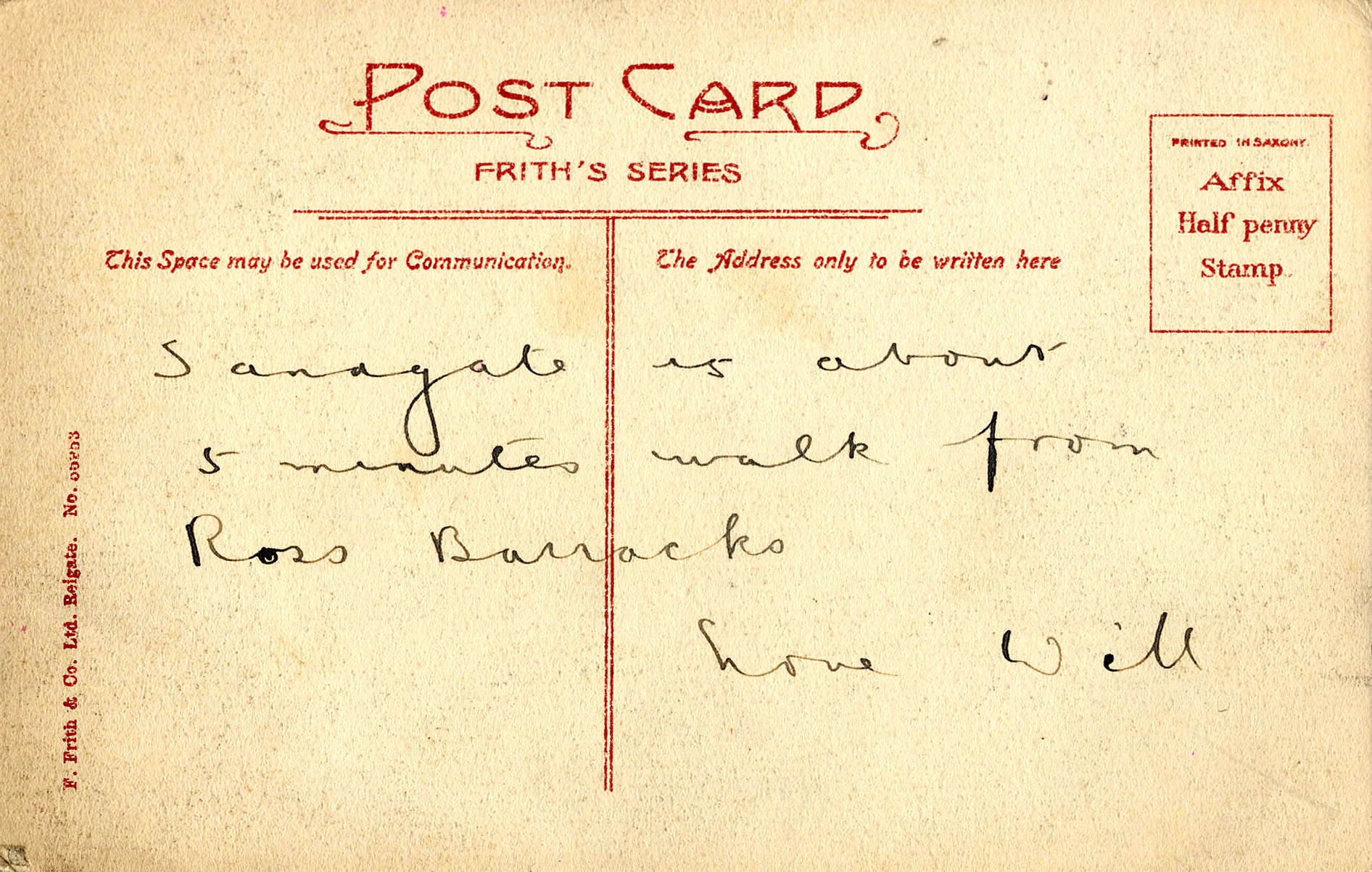
The message reads:

“Sandgate is about 5 minutes walk from Ross Barracks. Love Will”

five mins ross back xxxxxxxxxxxxxxxxxxx

Ross Barracks were themselves part of Shorncliffe Camp.

This next postcard was posted at 10.00 am. on August 4th 1916. It shows the low cliffs in this small village near Shorncliffe Camp and close to Folkestone:

sandgate cliff xxxxxxxxxxxxxxxxxxxxxxxx

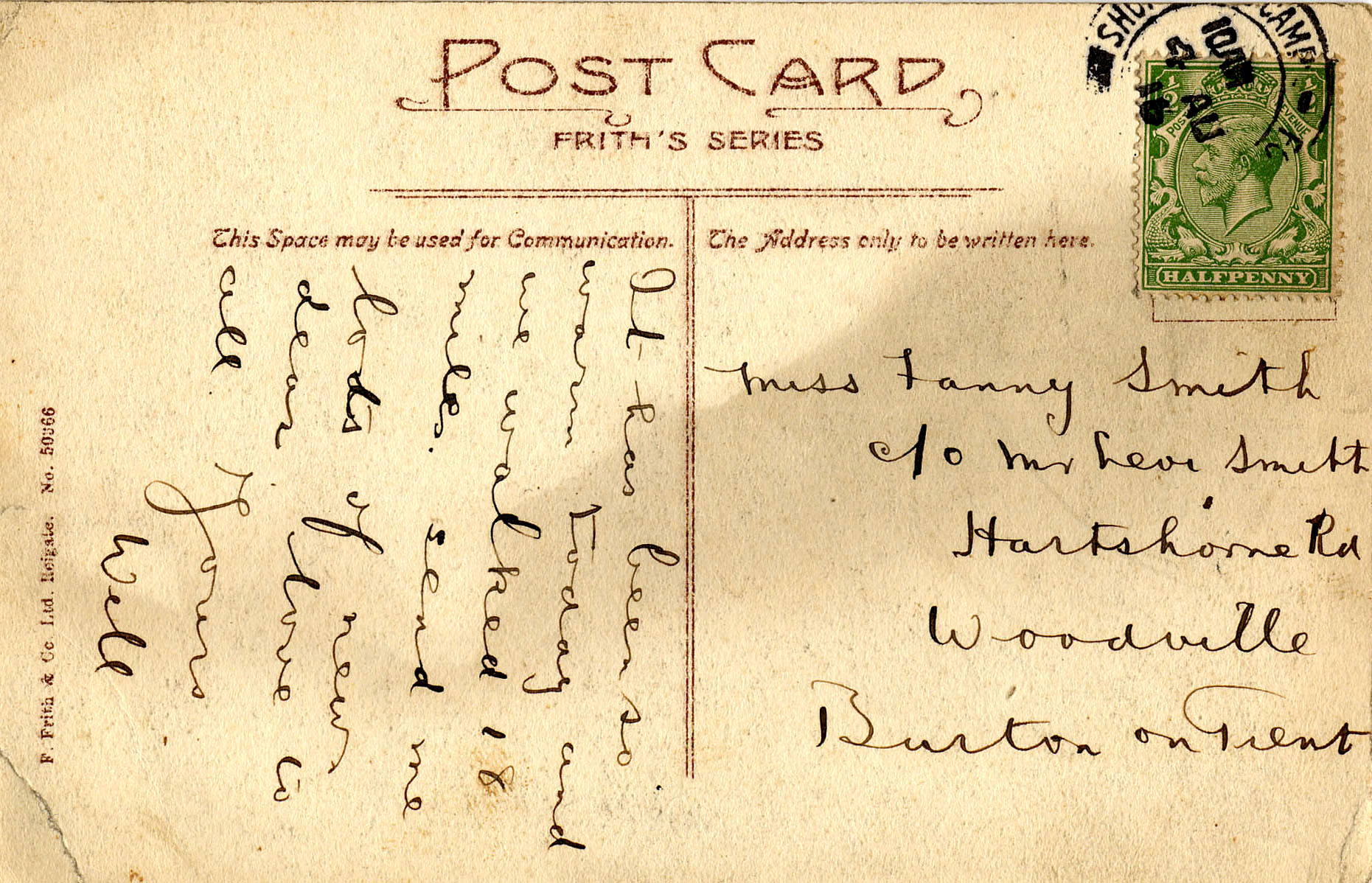
Here is the back of the postcard:

baxk of snadgate c;liff xxxxxxxxxxxxxxxxxxxxxx

The message reads;

baxk of snadgate c;liff eeeeeeeeeeeeeeeee

Once again, Will is able to retain an almost surreal quality in his writing:

“It has been so warm today and we walked 18 miles. Send me lots of news dear. Love to all. Yours Will”

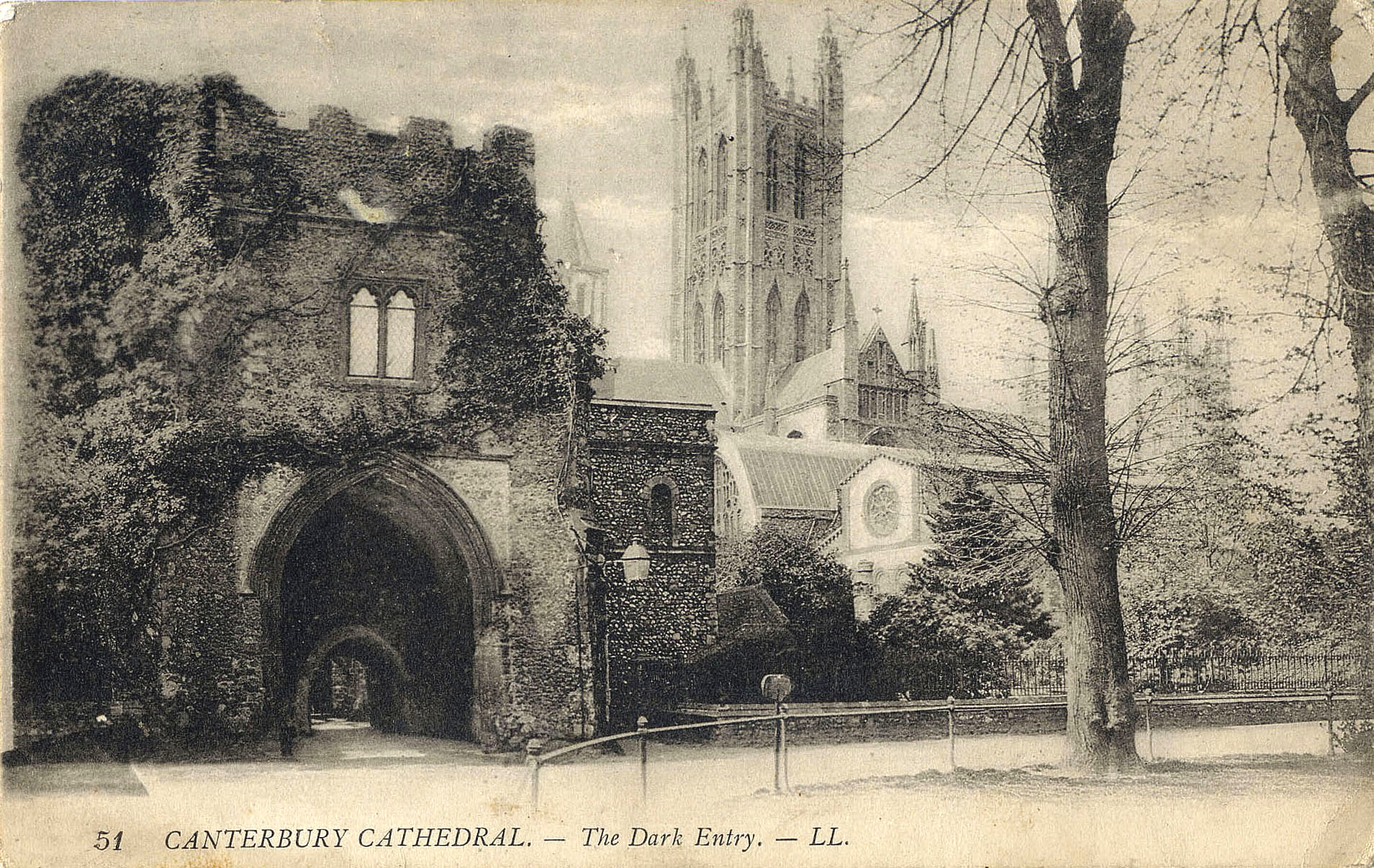
This postcard was franked at 11.00 pm, on August 20th 1916, and had been posted in Folkestone, perhaps after a visit by train to the famous cathedral, only some twenty miles away in Canterbury:

camterbury cathedrzzzzzzzzzzzzzzzzzzzzzz

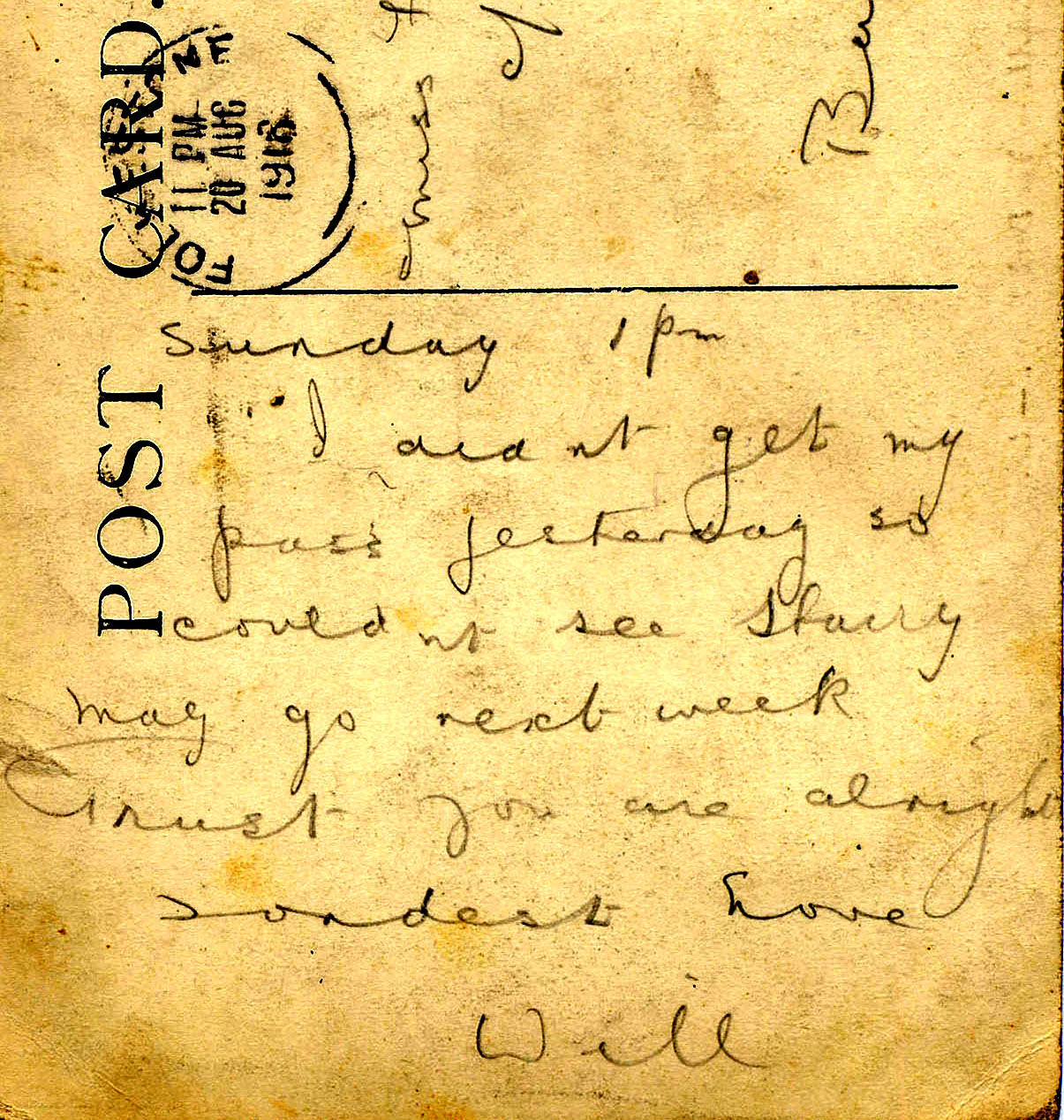
Here is the back of the postcard:

back cathedralzzzzzzzzzzzzzzzzzzzzzzzzzz

Here is the message enlarged:

back cathedra jjjjjjjjjjjjjjjjjjjjjjjjjjjjjjjjjjjjjjjjjjjjjjjjjjjjj

The message reads, as far as I can decipher it….

 “Sunday 1pm

I didn’t get my pass yesterday so couldn’t see Stacey. (name slightly illegible) May go next week. Trust you are alright. Fondest love, Will ”

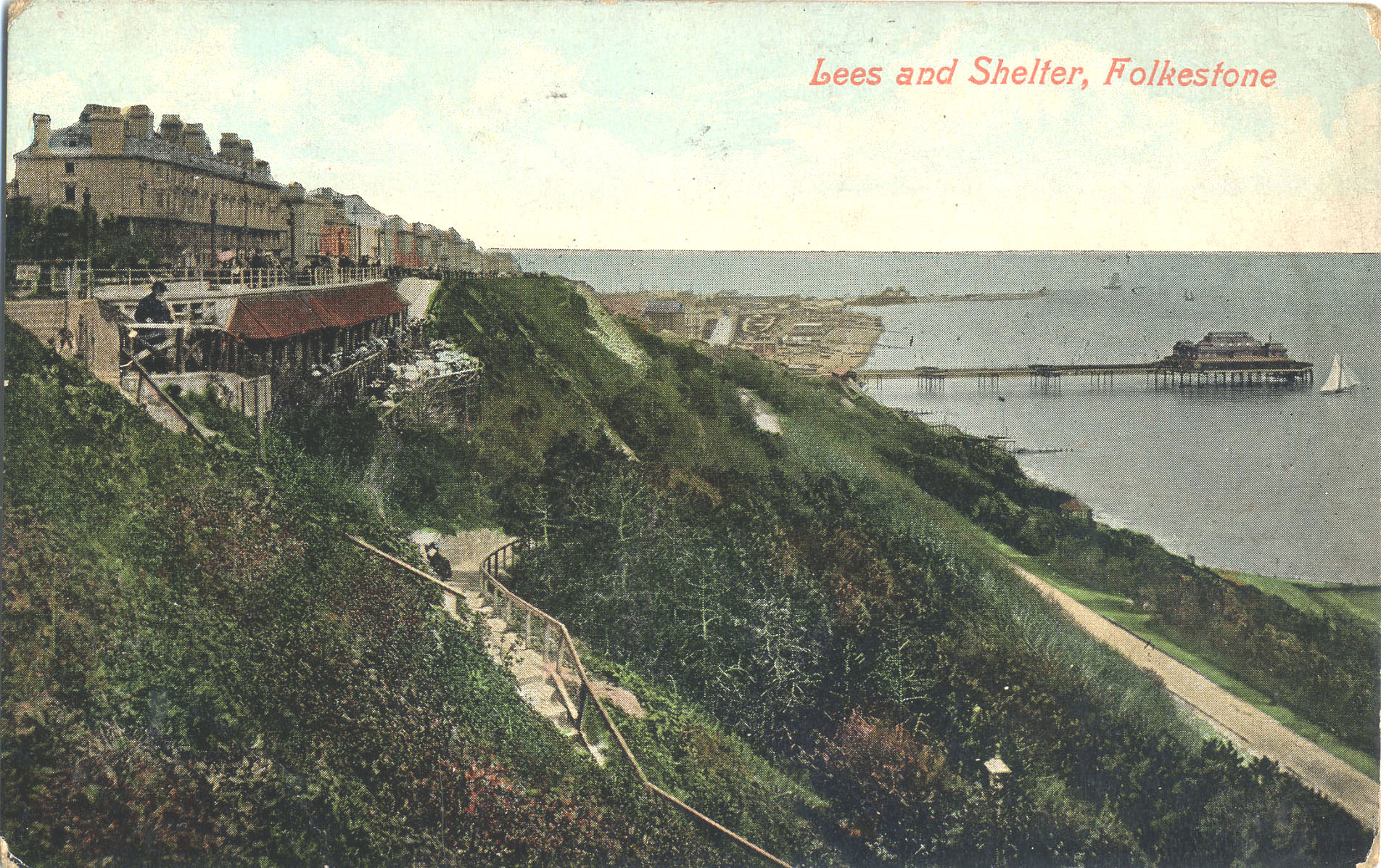
This postcard shows the Lees and the Shelter at Folkestone:

folstone colour

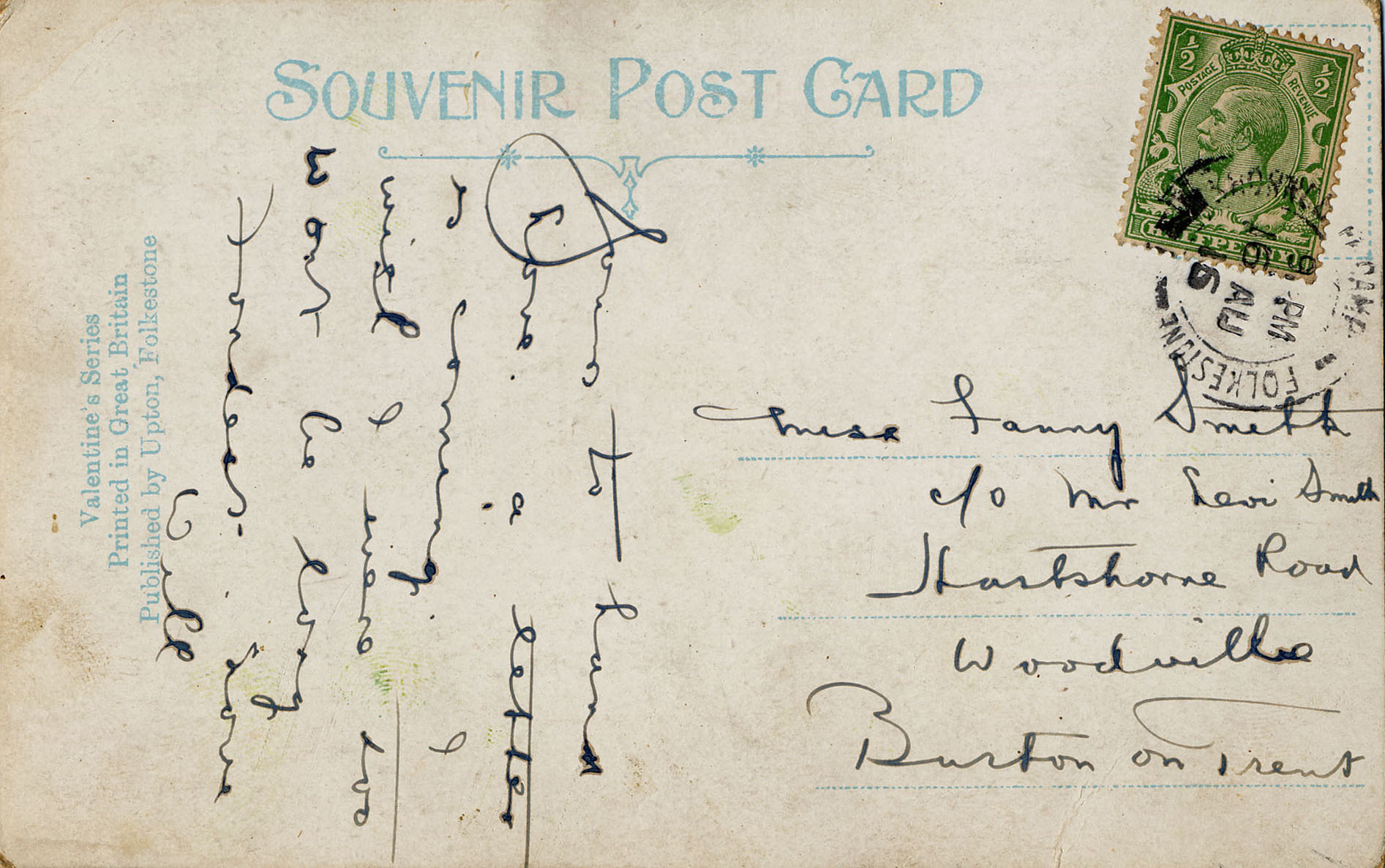
The message reads:

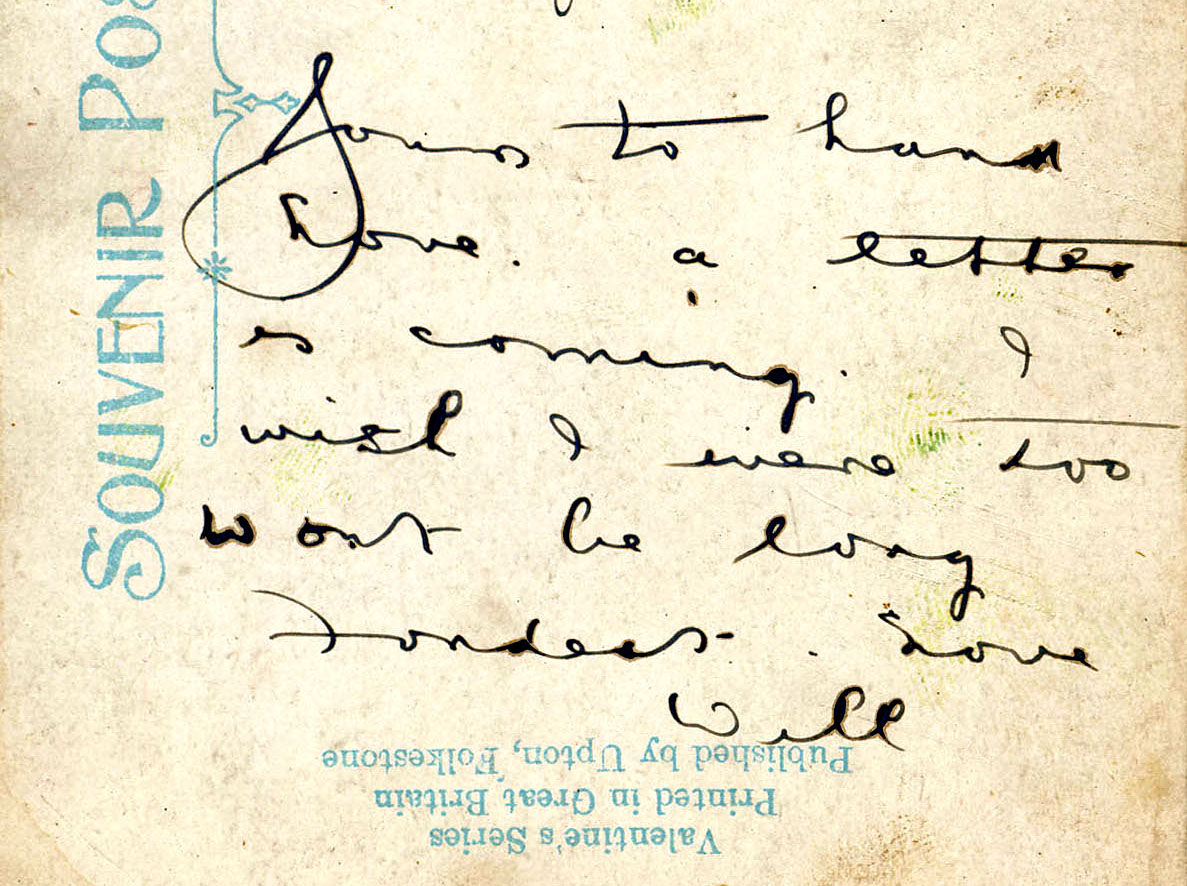
“Yours to hand love (?) A letter is coming. I wish I were too. wont be long Fondest love Will”:

back folkstome colour

Here is the message enlarged. This seems to be in his more florid style of handwriting:

back folkstome colour enlarged


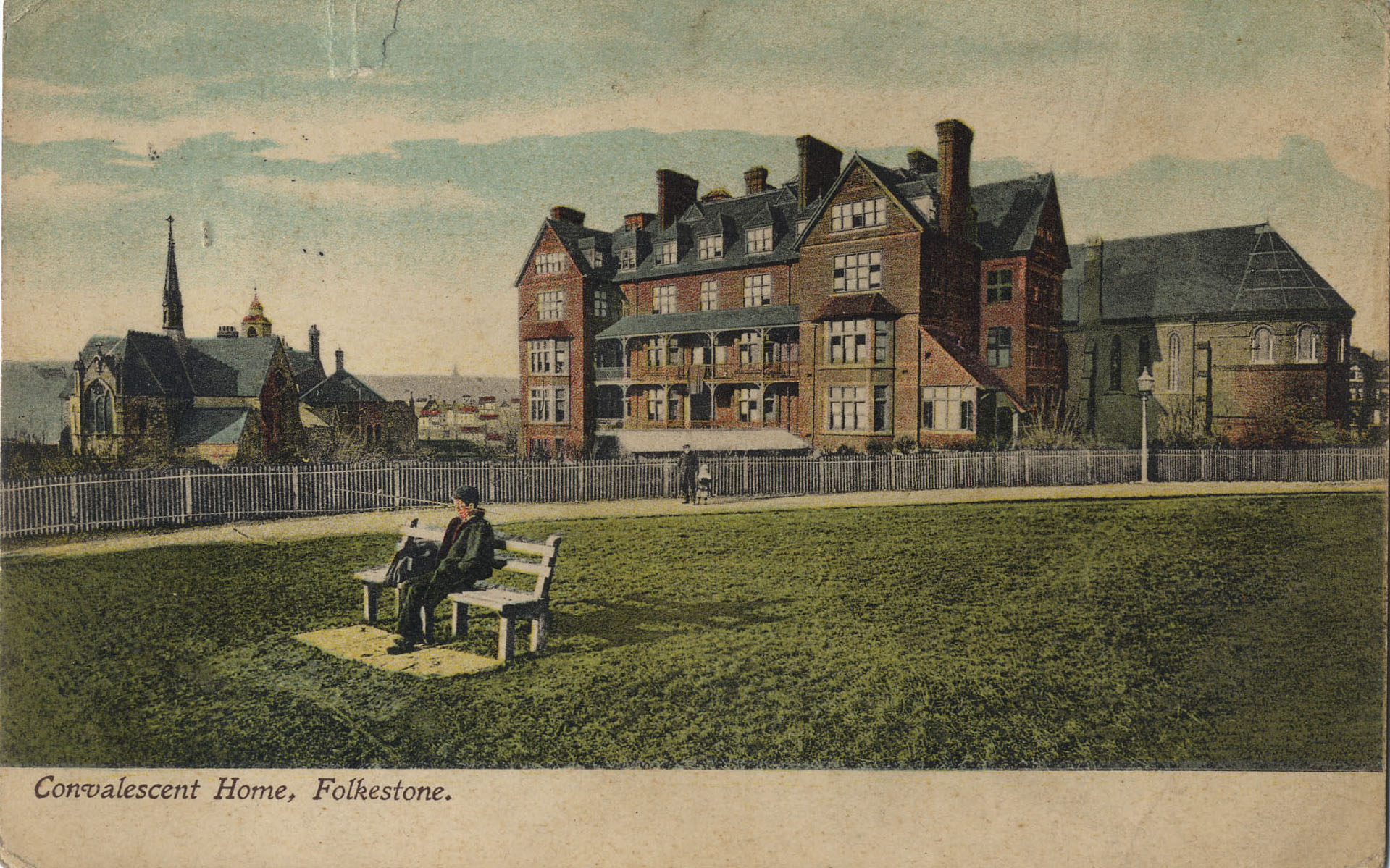
In retrospect, this next postcard may perhaps seem a little insensitive. Just a few short weeks after being asked to join the blood soaked antics of the Western Front, and due to depart on November 17th for the trenches, Will sent his fiancée a postcard of the large convalescent home in Folkestone. Presumably, the lone soldier on the seat is the only one left after “The Big Push”:

convalaecscnt home

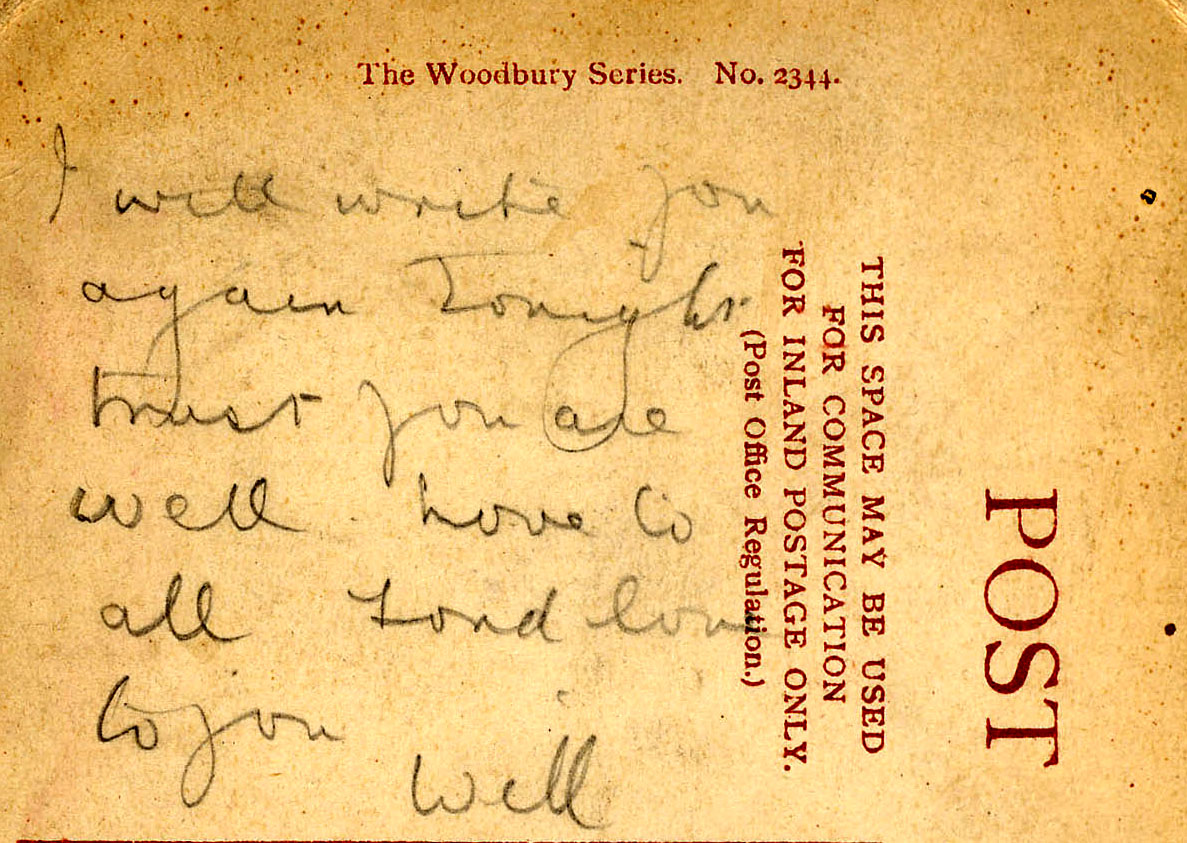
This is the reverse of the card:

back hospitasl

Can you decipher the message, written in best quality pencil?

Here it is enlarged:

back hospitasl wwwwwwwwwwwwwwwwww

And notice too, how the young prototype Canadian, once again, says “I will write you”, rather than the more usual English of “I will write to you”. In actual fact, the message reads……

“I will write you again tonight. Trust you are well. Love to all. Fond love to you. Will”

The postmark of 9.oo pm on September 5th 1916 reveals that Will could not have been convalescing at the hospital, as he had only just arrived in England from Canada on July 25th 1916, and he did not set off to join the Great War until November 17th 1916.

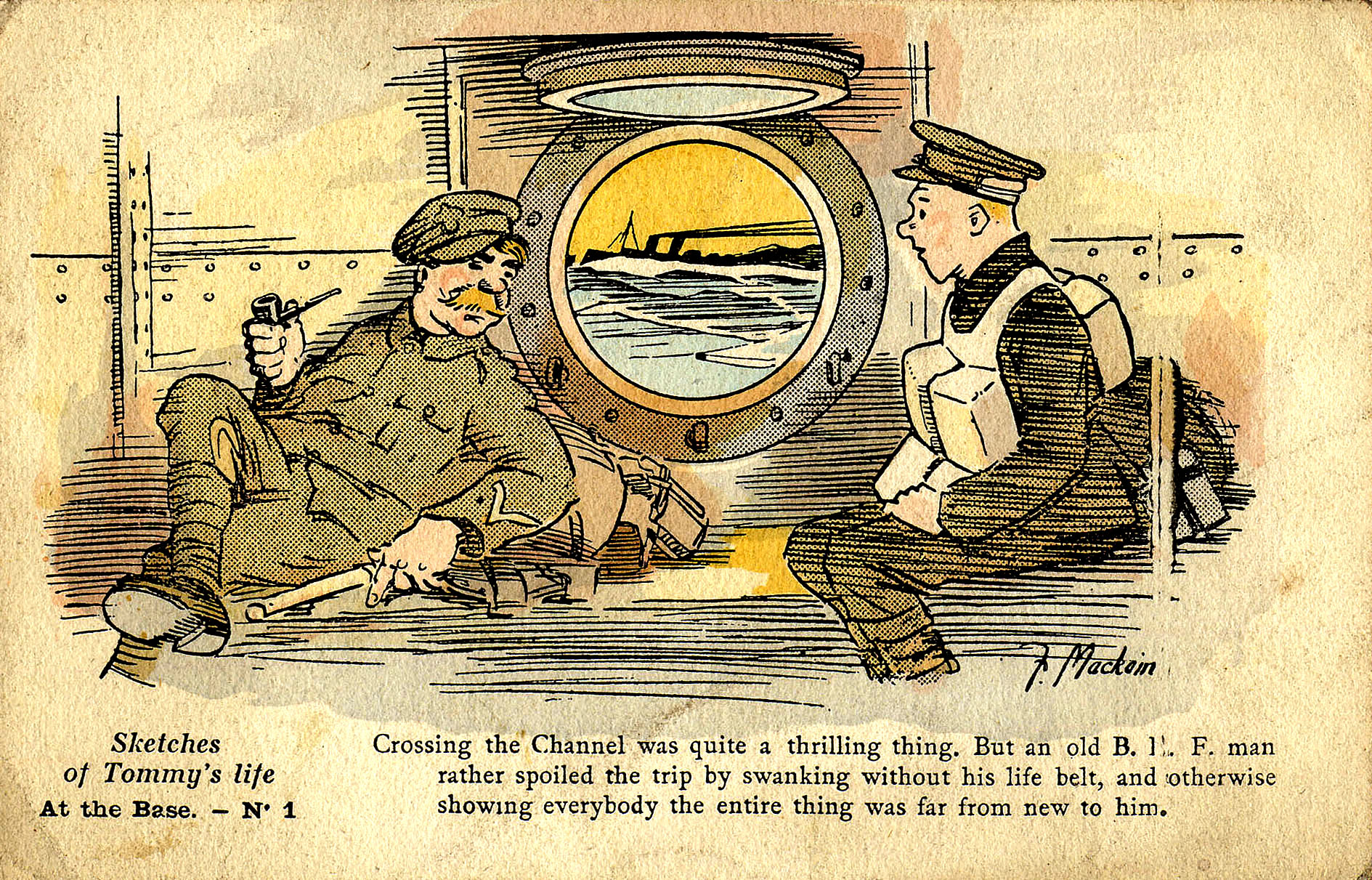
I am fairly sure that this was Will’s last card before he moved on in his Canadian Army career. I suspect that it was sent from Folkestone in Kent, just before Will embarked for France and the Western Front. The reverse, unusually for Will, is blank. Perhaps what faced him in the future was enough to take away his inspiration temporarily:

old sldier channel

The inscription on the front of the card reads:

“Crossing the Channel was quite a thrilling thing. But an old B.E.F. man rather spoiled the trip by swanking without his life belt, and otherwise showing everyone that the entire thing was far from new to him.”

On November 17th, Will left Shorncliffe, Folkestone and Kent to sail for France and the “3rd D.A.C.” He was “taken on strength” with the “3rd D.A.C.” on November 23rd, and could now be considered a fully fledged soldier.

Like many soldiers on the Western Front during the Great War, Will was shot by a German machine gun on at least one occasion. He had two wounds in the legs, and I believe that he may have gone back to Kent to recuperate. The position of his wounds was doubtless because German machine gunners were trained to sweep their guns backwards and forwards close to the ground:

a23_world_war_1_german_machine_gun_1

They were told to try and imitate a man cutting down grass with a scythe:

giphy

Germans, machine guns, bombs, mud, trench foot, sudden death, whatever. Will survived it all:

old age


14 Comments

Filed under Canada, France, History, Personal

“Greater Love Hath No Man”

For nearly thirty years we have taken our holidays in Cornwall, enjoying an invigorating fortnight in the land of the Cornish Pasty. As Cornwall is in the extreme south west of England, and we always holiday in the very westernmost area, named Penwith, we are no strangers to rainy or overcast conditions.
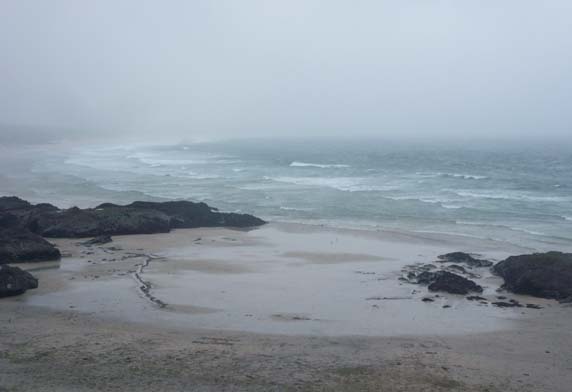
On August 27th 2009 we decided to go to Godrevy, one of our favourite sites either to sit on the beach or to look for seals and seabirds. Alas, this day, conditions were misty and wet:

P1270633

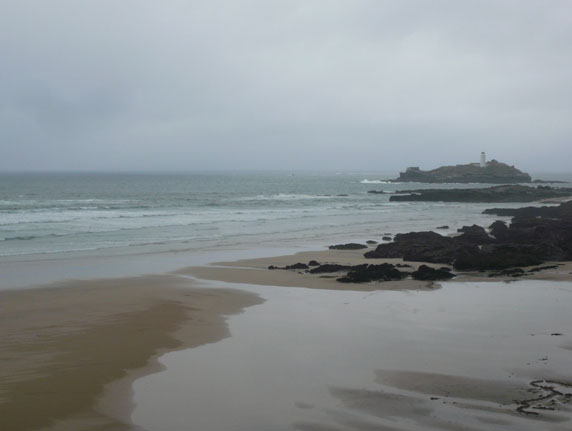
The famous lighthouse was barely visible:

P1270663

We decided, therefore, to drive to Hayle, the nearest town, to take an early lunch. My wife went to the local pasty shop to buy some traditional local food. “Philps Famous Pasties from Cornwall, freshly baked every morning”:

p1260007.jpgxxxxxxxxxxxxxxxxxxxxxx

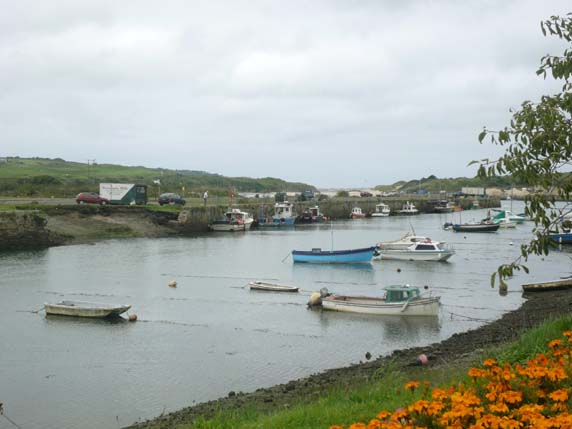
Meanwhile, I went off to lay claim to a seat overlooking the harbour:

P1270573

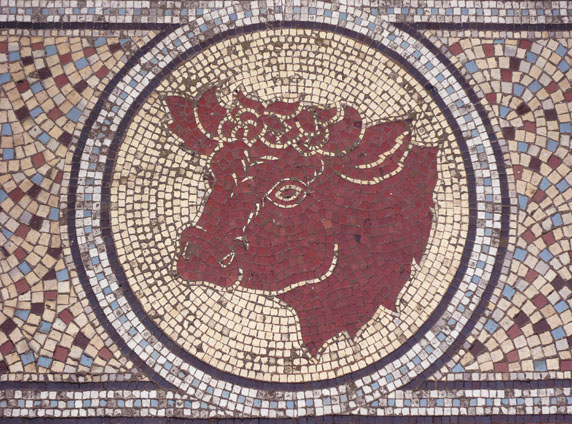
On the left there is an Art gallery which used to be a butcher’s shop. Looking through the window, I thought this apparent Roman mosaic was the best bit of art in the place:

P1270568

And this one. An Art Nouveau bull with a thousand yard stare:

P1270560

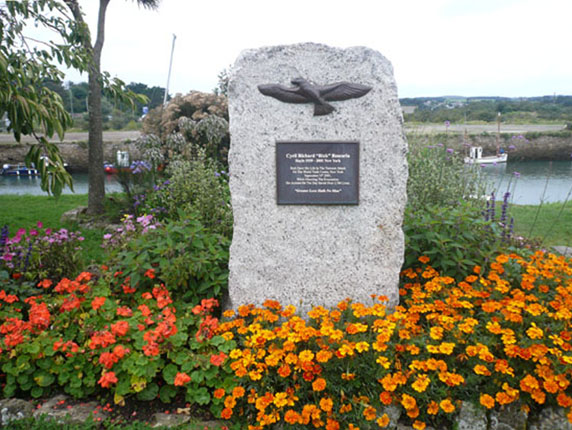
And then suddenly I saw it, on the opposite side of the road. A huge stone, surrounded by brightly coloured flower beds, which really stood out from the rather drab grey, misty surroundings:

P1270584

I crossed the road for a closer look. It was a plaque dedicated to bravery three thousand miles away:

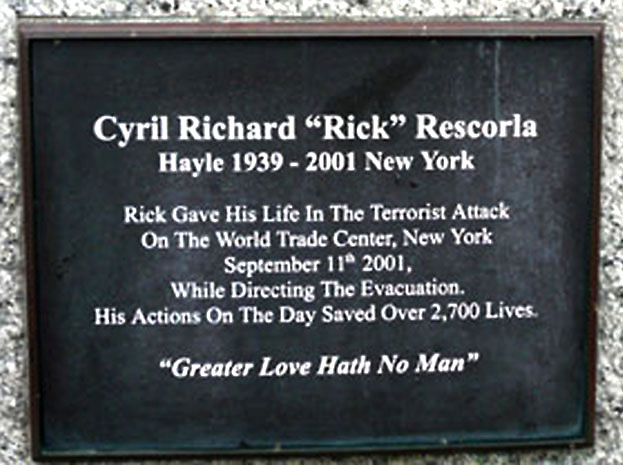
P1270588

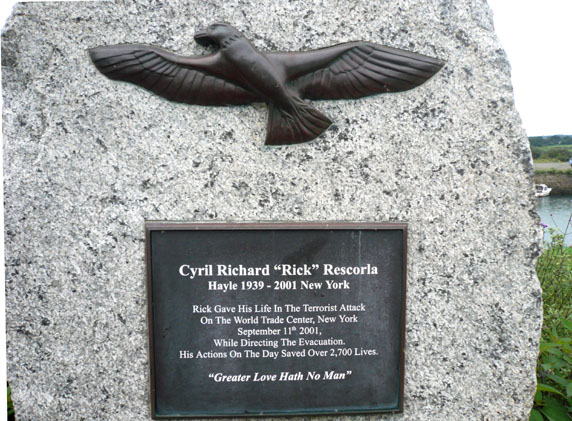
And presumably, it is exactly because that bravery took place three thousand miles away that these heroic deeds remain completely unknown and unheard of in his own country. Let me put that right, though:

Close upxxxxxxxxxxxxxxxxxxxxxxxxx

“Cyril Richard “Rick” Rescorla
Rick Gave His Life In The Terrorist Attack
On The World Trade Centre, New York,
September 11th 2001,
While Directing The Evacuation
His Actions On The Day Saved Over 2,700 Lives
“Greater Love Hath No Man”

Here are three maps to help orient yourself. The orange arrow marks the spot:

This slideshow requires JavaScript.

Rick Rescorla was born in Hayle in 1939. During the war, he made friends with American soldiers from Maryland and Virginia, stationed in Penwith, and preparing for the D-Day invasion. Rick idolized the American soldiers and decided to become a soldier when he grew up.
He joined the British Army in 1957, eventually joining The Parachute Regiment. He then served with an intelligence unit in Cyprus. In 1960 he became a paramilitary police inspector in the Northern Rhodesia Police in central Africa. Back again in London, he joined the Metropolitan Police Service.
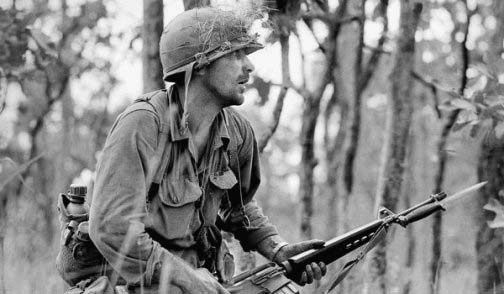
He then moved to the United States and eventually went to fight in Vietnam:

us armyxxxxxxxxxxxxxxxxxxx

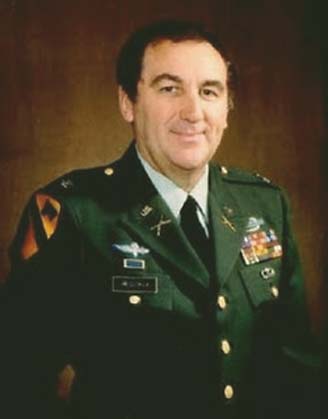
For his bravery with the famous 7th Cavalry Regiment, Rick was to win the Silver Star, the Bronze Star with Oak Leaf Cluster, a Purple Heart and the Vietnamese Cross of Gallantry:

rescorla6

Eventually, Rick found himself working in corporate security for Morgan Stanley, with an office on the 44th floor of the South Tower, Tower 2, of the World Trade Centre:

Heros-Forgotten xxxx

One of the first things Rick did was to instigate emergency evacuations every three months for everybody, including the most senior executives.
He trained everybody to assemble in the hall between the stairwells and then to descend, calmly, in pairs, down to the 44th floor. His strictness with these emergency evacuations caused friction with some of the top management, but he insisted that they were necessary, should a real emergency ever occur. Just as he would have done in the forces, he timed the employees’ performance with his stop watch and gave them detailed instructions on the most basic elements of safety in the event of a major fire.
These measures all came from the fact that Rick, and his colleague, the counter terrorism expert, Daniel Hill, Rick’s old friend from Rhodesia, both believed that an attack could well take place one day, involving a plane being crashed into one of the towers.
At 8:46 a.m. on that fateful morning of September 11th, Rick heard the explosion as American Airlines Flight 11 crashed into the North Tower and then watched the huge conflagration from his window.
A public  announcement was made that everybody should stay at their desks, but Rick ignored it and immediately grabbed his megaphone, radio and cell phone.
He ordered the Morgan Stanley office workers to leave the building, descending by the stairwells with which they were so familiar. He also made sure a thousand workers were evacuated from World Trade Centre 5.
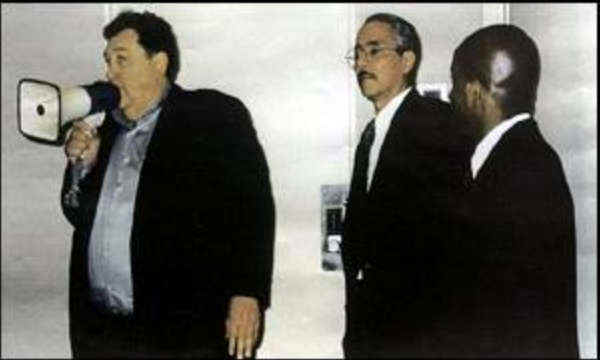
After a short interval, the South Tower was shaken violently by the impact of United Airlines Flight 175, almost forty floors above them. Rick continued to calm his fellow workers, and the much practiced evacuation continued to proceed smoothly down the stairwell. One of the company’s office workers actually took a photograph of Rick with his megaphone that day, “a 62-year-old mountain of a man coolly sacrificing his life for others”. Here are Rick Rescorla and his colleagues, Jorge Velazquez, and Godwin Forde – leading the evacuation on 9-11:

heroes3

As he had done with his scared soldiers in Vietnam, in an effort to allay their fears, Rick sang to the frightened staff members as they descended. He used his own song based on “Men of Harlech”:

“Men of Cornwall stop your dreaming;

Can’t you see their spear points gleaming?

See their warriors’ pennants streaming

To this battlefield. Men of Cornwall stand ye steady;

It cannot be ever said ye for the battle were not ready;

Stand and never yield!”

The vast majority of Morgan Stanley’s 2,687 employees were now safe, thanks to Rick Rescorla, but he went back into the building to make sure that he had not missed anybody and that there were no stragglers.

Rick was seen for the last time on the tenth floor, climbing upwards. At one minute to ten, the South Tower collapsed. Rick was never found. Of the huge number of people whose protection was his responsibility, all but six survived.
There was almost unbelievable bravery shown that day by the members of the Fire Department, City of New York:

150px-New_York_City_Fire_Department_Emblem_svg

Equal levels of bravery came from the members of the City of New York Police Department:

Patch_of_the_New_York_City_Police_Department

Rick Rescorla, an Englishman, was not found wanting.

He had not been found wanting in Vietnam either:

rescorla zzzzzzzzzzzzzzzzzzzzzzzzzzzz

One of his fellow soldiers described him:

“My God, it was like Little Big Horn.  We were all cowering in the bottom of our foxholes, expecting to get overrun.  Rescorla gave us courage to face the coming dawn.  He looked me in the eye and said, ‘When the sun comes up, we’re gonna kick some ass.'”

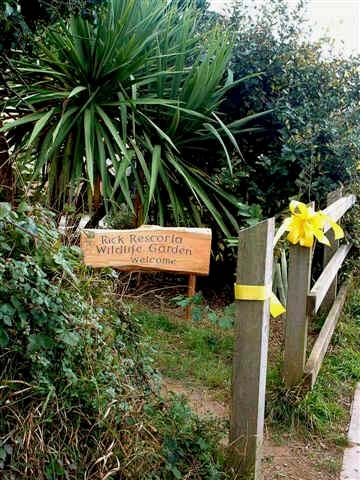
Rick has not been forgotten in his home town of Hayle. Here is the Rick Rescorla Wildlife Garden at the Penpol School in Hayle (ages 5-11):

garden

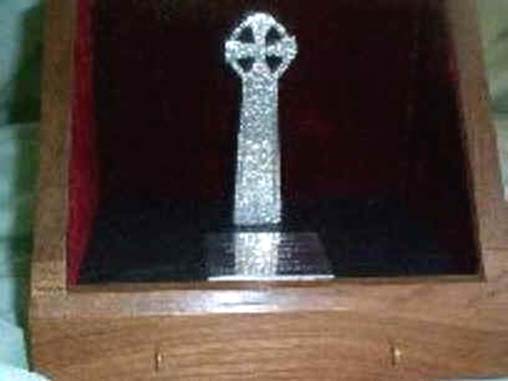
The Cornish Stannary Parliament honoured Rick with “The White Cross of Cornwall”, “An Grows Wyn a Gernow”. It is made from pure Cornish tin and Cornish Delabole slate in a hand-madebox of Cornish elm:

cornwa5 as

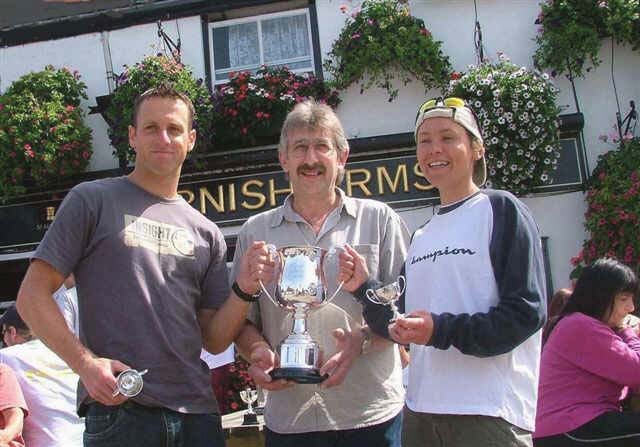
In this picture, Jon Daniels, in the centre, presents the cup to the winners of the Rick Rescorla Memorial Triathlon:

triathlon

To finish with, here is the song “Men of Harlech”. It is taken from the film “Zulu“, as more than four thousand African warriors lay siege to Rorke’s Drift, defended by just 150 British Empire troops of B Company, 2nd Battalion, 24th (2nd Warwickshire) Regiment of Foot (2nd/24th) and 2nd/3rd Natal Native Contingent:

And finally, the full quote from the Gospel according to St John, Chapter 15, Verse 13. Christian or not, it is no less true:

“Greater love hath no man than this, that a man lay down his life for his friends.”


6 Comments

Filed under Cornwall, History, Personal, Politics