Category Archives: Football

A good man doesn’t stand by (1)

Some time ago, I showed you a picture of the England football team all making their Nazi salute at the Olympic Stadium in Berlin on May 14th 1938:

England-Germany 1938 nazi.xsderftgyhb

They were not the only foreigners to greet the Führer with a cheery “Sieg Heil”. Here, just a year later, is the Republic of Ireland football team engaged in pretty much the same behaviour:
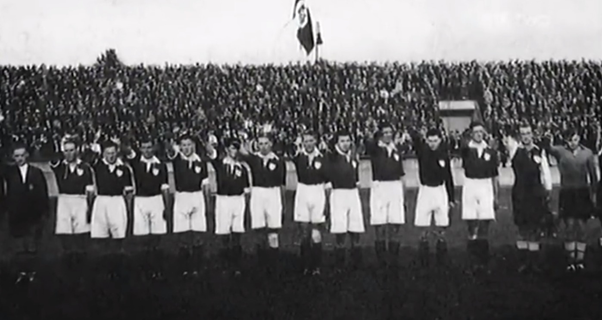
Ireland-Germany-1

Let’s just leave that for a short while, and move westwards to the English Midlands. To South Derbyshire, and more precisely, the little village where my Dad, Fred, grew up.

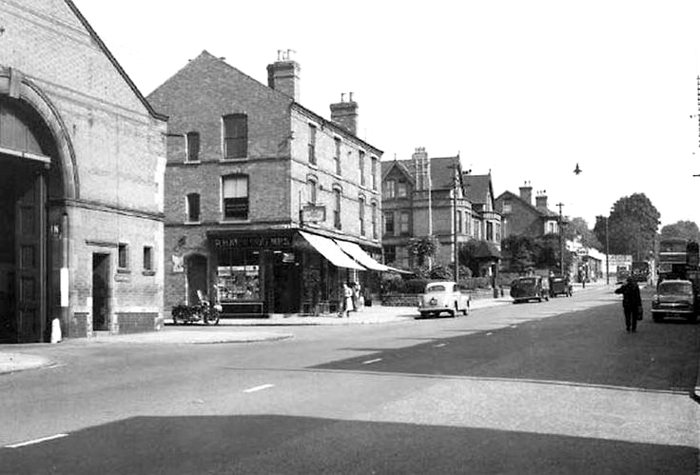
During those long sunny summers and cold snowy winters after the Great War, Fred’s home was at Number 39, Hartshorne Lane, Woodville. The house was called “Holmgarth”, and it was the very last house in the little village of Woodville as you went down the hill towards the neighbouring village.

After Fred’s house, the only dwellings were just a couple of very large detached houses set well back from the road, either side of a small, shared, lake. This was just a few yards beyond the massive blue brick railway bridge, which carried the old passenger railway line from Woodville Station towards the neighbouring town. Here it is, being demolished in the early 1980s:
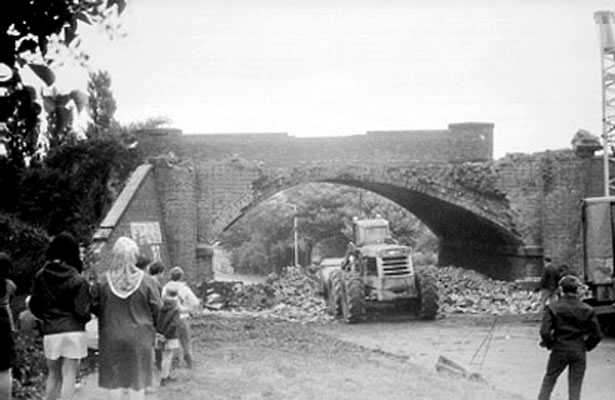
demolition

Hartshorne Lane in the 1930s was made of gravel, and there was so little traffic that it was perfectly possible for boys to play football or cricket all day long without any interruption whatsoever. Boys, including Fred, regularly knocked their cricket stumps into the soft surface of the road:
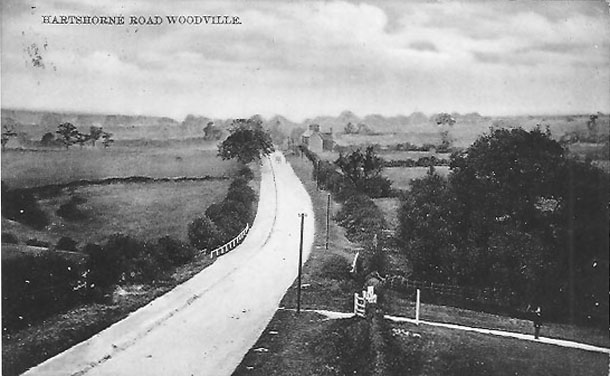
hart road 2 START HERE

Indeed, the whole area was still so countrified, that one day in 1929, a seven year old Fred saw a stray cow walking around in the front garden of the house, and rushed to tell his mother. She was busy with her housework, and just told him that he was being silly and telling lies. Eventually, though, she looked out of the kitchen window and she too noticed the cow which had by now made its way around the house to the kitchen garden. She was very startled and cried out in fear. Fred though, thought that this was a good example of somebody getting their just deserts.

Fred’s father, Will, used to work at either Wraggs or Knowles clayworks, a couple of miles away. He would finish his working week at lunchtime on Saturday, and then return home immediately to make sure that he did not miss the football match at Derby, which started at three o’clock:
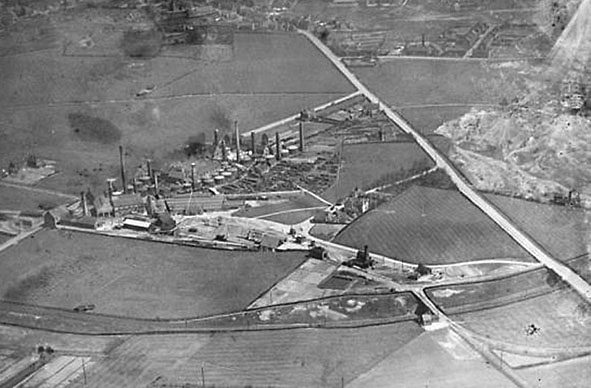
aerial 1

First of all, though, he would always strip to the waist and wash off all his grime in the kitchen sink.

When Fred was too young to accompany him, Will would walk to the match at the rather strangely named Baseball Ground in Derby. His knowledge of shortcuts, and his willingness to walk over the fields, meant that he could reduce the usual distance by road of twelve or thirteen miles to a walk of only some ten miles or so.

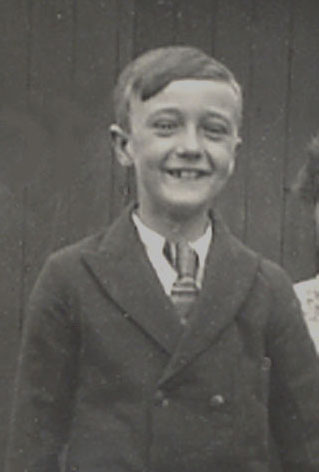
This all came to an abrupt end, though, when Will began to take his young son Fred to the match:
AD with grandma 3

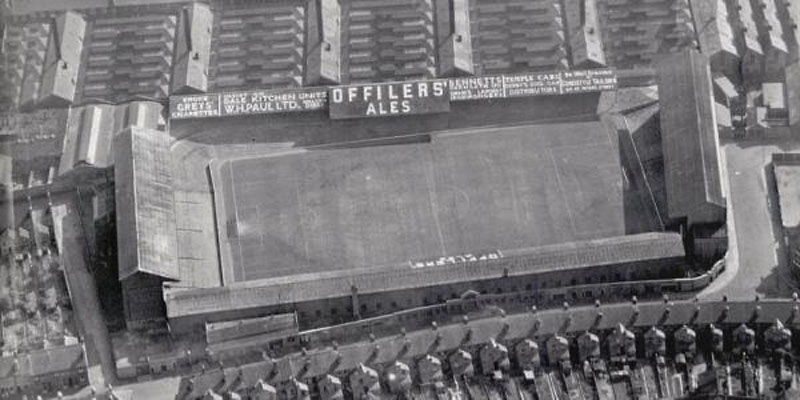
Everything had to change. They would both stroll the short distance down Hartshorne Road until they reached the so-called Lovers’ Walk, a path, complete with romantic tinkling brook, which ran as a well-known short cut, up to the end of Station Street. From here father and son would take the train together from Woodville Station to the Baseball Ground at Derby, hiding away in the middle of a thousand terraced houses.
baseballground_ssssssssssssssssssssssss

Sometimes, though, they preferred to catch the ordinary bus in Hartshorne Lane. There was, in actual fact, great competition between the train and bus companies, with occasional, but regular, price wars. The usual fare was one shilling and a halfpenny, but first one, and then the other, company would knock the halfpenny off in a bid to steal a march over their rivals.

Whatever method of transport they used, Fred and Will always left for the match around one o’clock or half past one.

In the early 1930s, Derby County’s goalkeeper was a man called Jack Kirby. He came from Newhall, a mining village just the other side of Swadlincote from Woodville. Kirby had joined Derby County, a professional soccer team in the top division, from a little amateur team, Newhall United, in April 1929. He made his debut for Derby at the top level in the 1929-30 season:
kirbhy

In those days, footballers did not assemble for a pre-match meal at some prestigious hotel. Indeed, Jack used to travel to every Derby home game on his bicycle from his terraced house in Newhall. This was a distance of some thirteen or fourteen miles.

On alternate Saturdays, therefore, Kirby would come slowly past Fred’s house on his bicycle at around one o’clock.  He still had, perhaps, an hour and a half to travel the twelve or so miles to Derby. Fred and his father Will would watch out for him, have a quick chat, and invariably joke that Jack was going to miss the start of the game. Kirby never hurried, though, keeping always to what Fred and Will both considered to be a worryingly snail like pace.

There was more to Jack, though, than just banter about the speed of his cycling. Jack really was the good man who refused to stand by and do nothing, so that evil might prosper. For now though, here is Jack in action against Newcastle United:jfk0072211209 - Copy
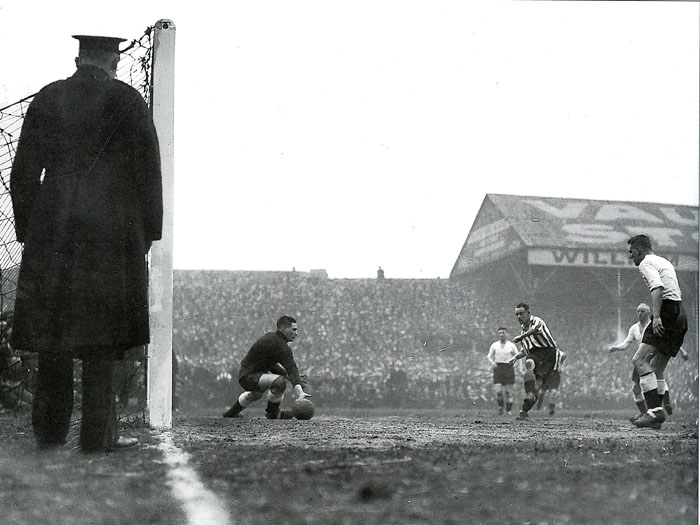
The English First Division could be a really rough place in 1934:
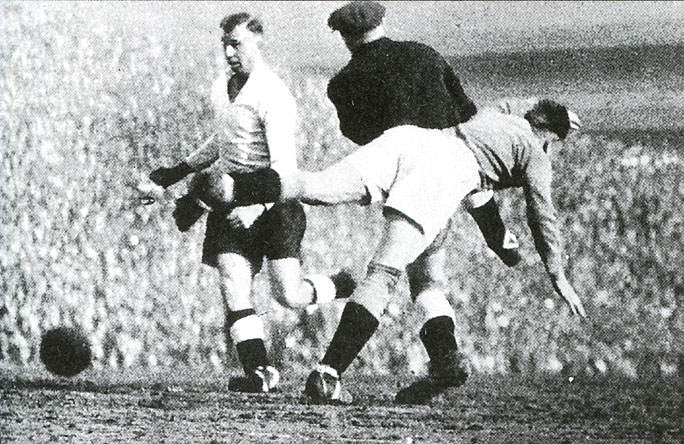
jfk0072210208

Jack was a handsome devil, and like all proper goalkeepers, his doting old mum always knitted him a nice warm pullover:
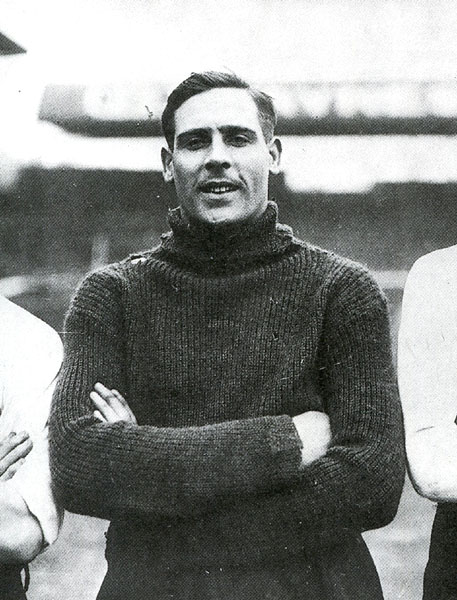
jfk0072210208 - Copy

He was very good at latching on to the heavy, invariably wet football of the era, with hands as big as buckets:
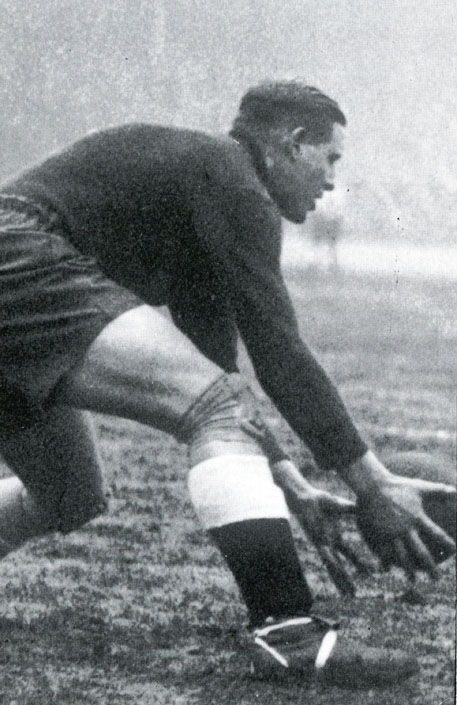
jfk0072209207

The secret was practice, practice, practice. Even if people in the house next to the ground keep spying on you as you train:
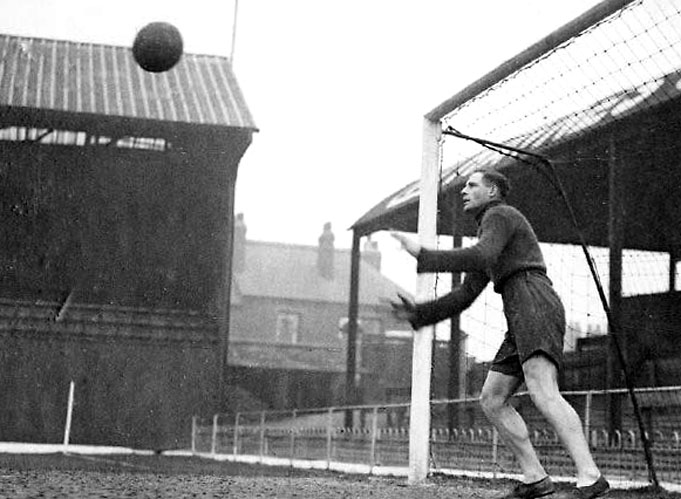
jack again

Soon, we will all hear the story of how Jack proved to the whole world that he really was the good man who refused to stand by and do nothing.  Jack was not prepared to let evil prosper.


17 Comments

Filed under Criminology, Derby County, Football, History, Politics

Bygone football clubs (2)

Last time, I looked for the most part at the early days of Notts County and Nottingham Forest. They were not the only football teams to play their fixtures down on the Forest, though. A veritable plethora of small local teams flourished in Nottingham during this era. They had some wonderful names, all marvellously evocative of the origins of their players:

“Notts Artisans, Notts Athletic, Nottingham Bank, Nottingham Castle, Notts Forest Swifts, Nottingham Co-op, Nottingham Lindum, the Nottingham Manufacturing Company, Notts County Rovers, Nottingham Lace, the Notts Law Club, Notts Magdala, Notts Pioneers, Nottingham Postmen, Nottingham Post Office, Nottingham Press, Notts Thursday Athletic, Notts Thursday Rovers, Nottingham Thursday Wanderers, Nottingham Strollers, Nottingham Trent, and Nottingham Trinity.

All of the “Thursday teams” would have been from Sherwood, given the day when the shops closed for the afternoon in this northerly suburb of the town. Have a wild guess when it was half day closing in Sheffield. Yes, on a Wednesday. But what about the little Welsh town of Abergavenny?

Here is a sleepy Sherwood as recently as the early 1950s. How many houses have been demolished to make way for charity shops and empty premises!

pivcture

Not much is known about many of the smaller Nottingham clubs, except that their names sometimes figure in the very early rounds of the fledgling FA Cup. I would be very surprised indeed, though, if there were any connection between Nottingham Trent Football Club and Nottingham Trent University.

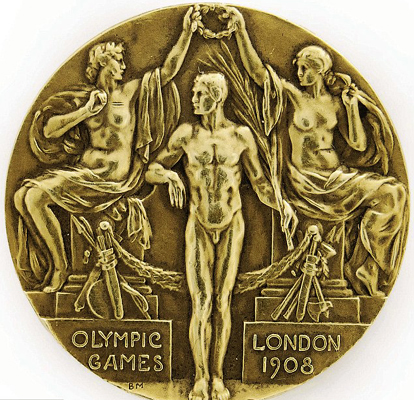
In the list above, mention is made of Notts Law Club. They played the High School on an unknown date during the Christmas holidays of 1879-1880 and duly beat their young opponents by 3-0. All three goals were strongly disputed by the High School and no further fixtures appear ever to have taken place against this opposition. Notts Law Club was the original team of the most brilliant outside right of his day, Arthur Cursham, who played for Notts County, among many other clubs, and eventually captained England. Notts Law Club, though, were an extremely violent set of individuals, and gained such a reputation for rough play and a willingness to argue the toss about every single decision that other local teams soon became unwilling to arrange fixtures with them. Indeed, so hostile was the general local reaction to the Notts Law Club that the team was eventually forced to disband completely. Notts Law Club never had a player who won an Olympic Gold Medal, but one of the other little teams did:

article-2178161-143110FA000005DC-268_634x630

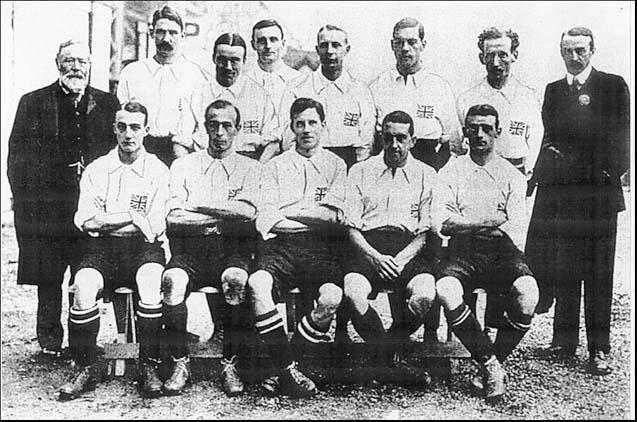
This team was Notts Magdala F.C., who had a very famous player in the person of Frederick William Chapman, an Olympic Gold Medal winner in the United Kingdom team in the 1908 Olympics held in London. Here is a photograph of the team which won a hard fought Final against Denmark by 2-0, with the first goal coming from that very same Fred Chapman of Notts Magdala F.C. and also of the High School, which he had attended from 1891-1898. In the Olympic Final, Fred played as a central defender. The second goal was scored by the era’s legendary amateur centre forward, Vivian Woodward. Previously the United Kingdom had defeated Sweden by 12-1 and Holland by 4-0. Arguably, their Olympic victory made England, who provided all of the players for the United Kingdom team, Champions of the World. Fred Chapman is the second player from the right on the back row:
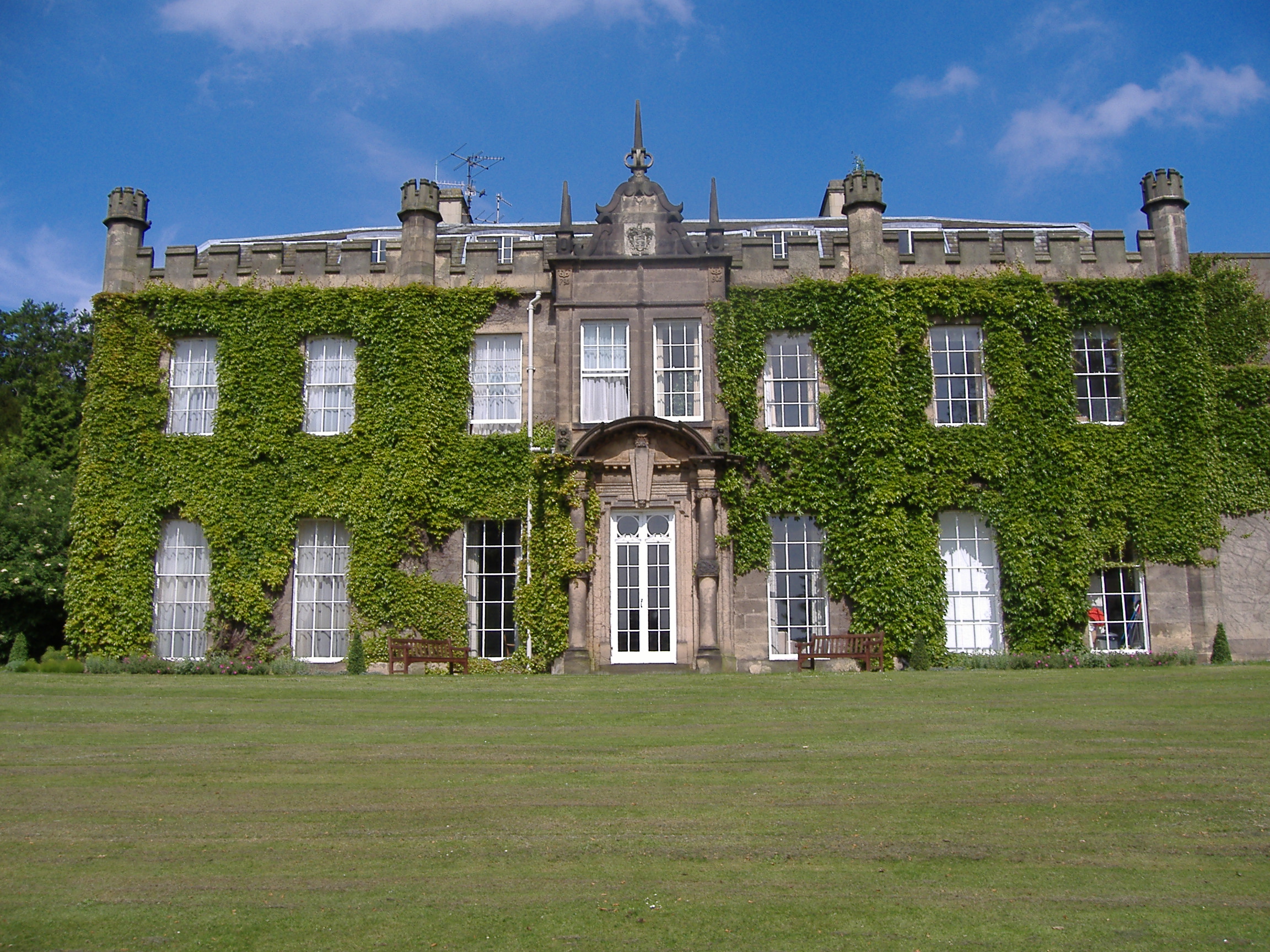
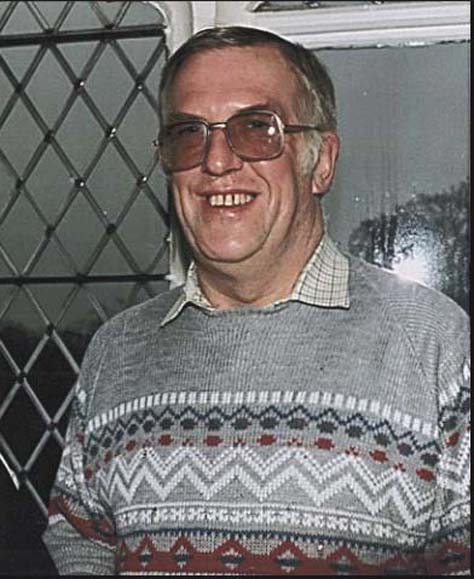
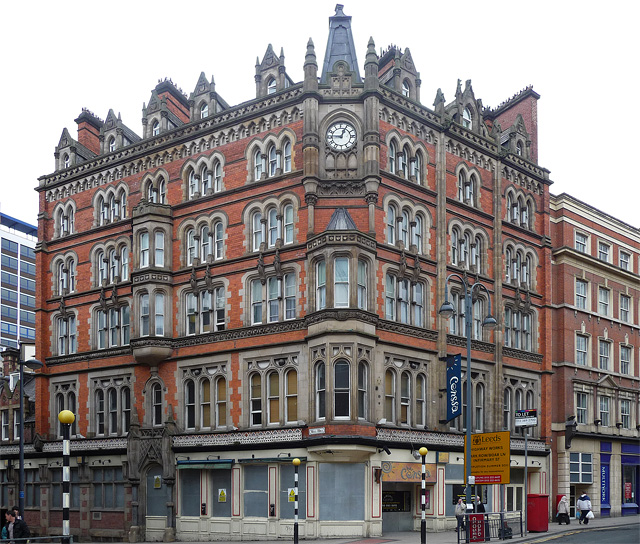
gold medalFred Chapman was still a relative unknown, however, even when he became one of the Notts Magdala club’s eleven Vice-Presidents, and later the Honorary Secretary and Treasurer. The club had 55 members and its playing captain was another Old Nottinghamian, John Barnsdale, (1878 –1960) born in Sherwood and later to play for Nottingham Forest on 28 occasions during the 1904-1905 season.  He was living at Lenton Hall around this time:
lenton

Houses must have been cheaper then. John Barnsdale was already Fred Chapman’s godfather, and years afterwards, became his “Uncle Jack”, when Fred married his sister, Evelyn Mary Barnsdale.

Not all of the local clubs on the Forest were called after the town. Prominent sides also included Basford Rovers and Sneinton Institute. It must all have been extremely colourful. Just a few of the old clubs’ colours have survived, and I thought it might be nice to recall them using present day teams who wear the same colours.

Notts Druids wore amber and black quarters, as do Hesketh Bank AFC most Saturdays in the West Lancashire Football League Premier Division:

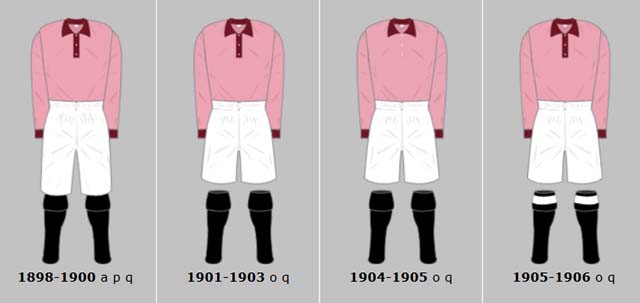
black amber heketh bank xxxxxxxxxxxxxxxNotts Olympic lasted from 1884-1893.  They wore pink and white, rather like Portsmouth FC used to wear from 1898-1909, just before they joined Division 3:

pink whiteNottingham Press, appropriately perhaps for a team of journalists, wore all black, rather like DFC United in the USA. Another local team who wore all black were Notts Swifts.

all black dc utd.jpg xxxxx

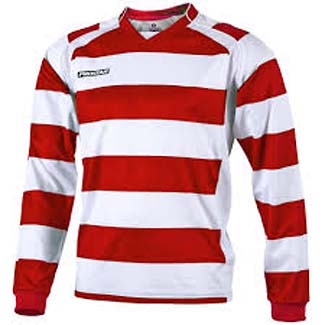
Nottingham Rangers, who still exist, used to wear scarlet and white shirts. So did Notts Wanderers. Either team might have played in this kit, found in an online catalogue:

scarket white 1

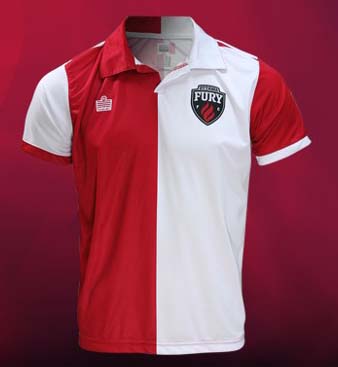
or in this one, worn by Ottawa Fury FC in the North American Soccer League:

fury xxxxxx

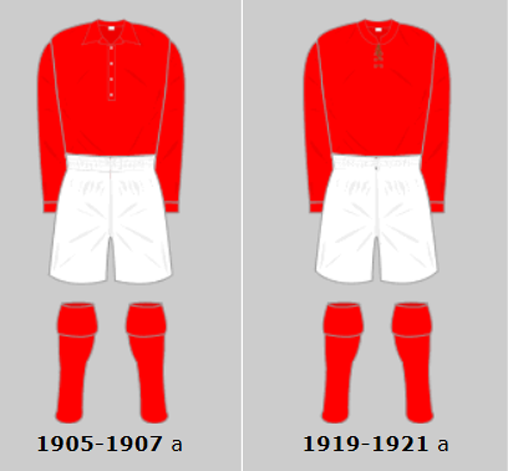
or like the slightly more boring Charlton Athletic:

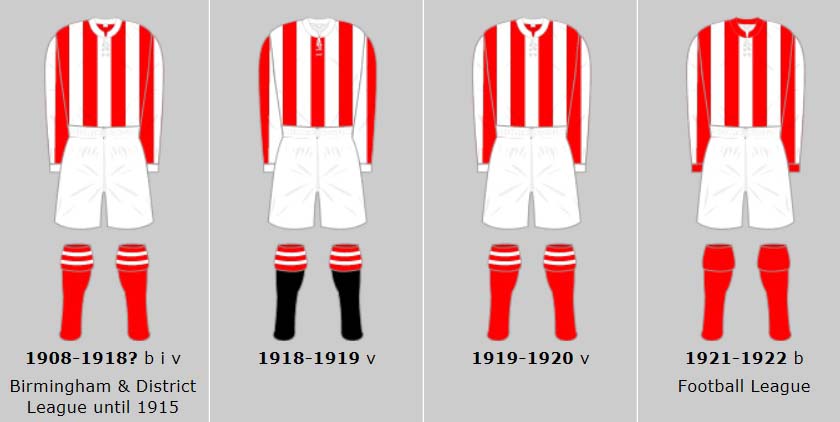
scarlet white bobbyor perhaps Stoke City:


scarley white 3

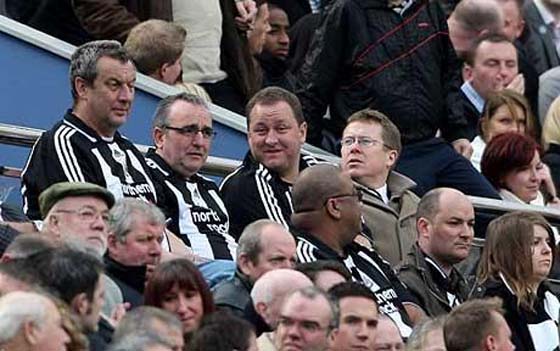
Nottingham Rovers used to play in black and white, perhaps like these gentlemen:

mike-ashley_zzzzzzzzz

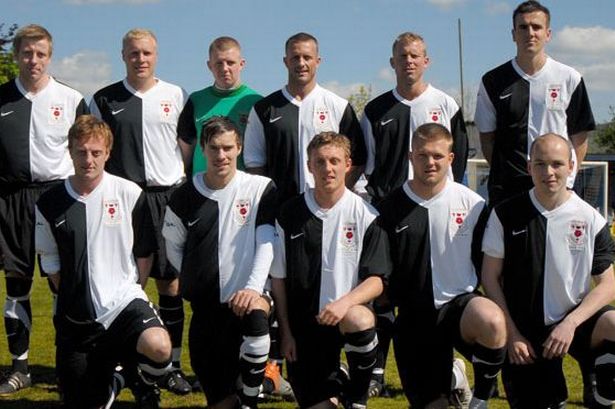
Or like this old kit of Glossop North End AFC now in the North West Counties Football League Premier Division after a brief spell in the Football League:

black white glossop n e

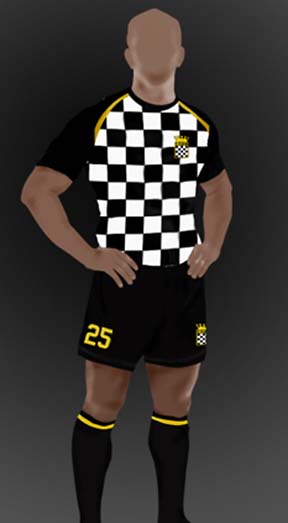
I cannot really imagine that they wore the same kit as Portuguese team, Boavista:

proposta

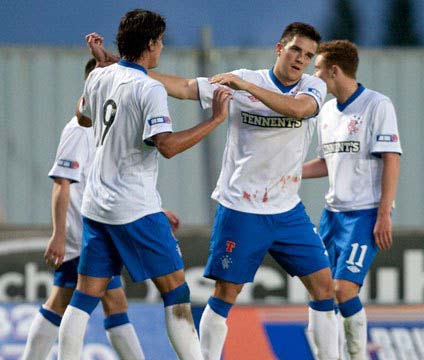
Nottingham Scottish used to wear white shirts and blue shorts, exactly like Rangers’ away strip:

rangers white, bluxxxxxxxxxxxxx

Only the fabrics change in football kits. The colours of the shirts never seem to change very much.

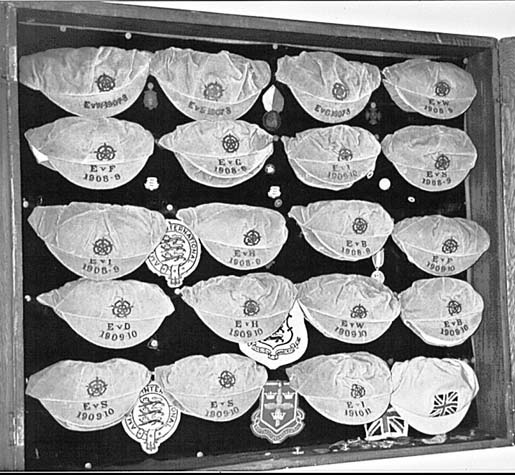
These are Fred Chapman’s Amateur International caps:

chapman caps

I will tell you more about his career in another blogpost. By the way, the illustrations of old football kits came from the best ever website for the soccer nerd and all those boys who had more than twenty different Subbuteo teams. New Brighton Tower 1898? Oh, yes.


8 Comments

Filed under Football, History, Nottingham, The High School

Football in the Old Days ; Derby County v Norwich City

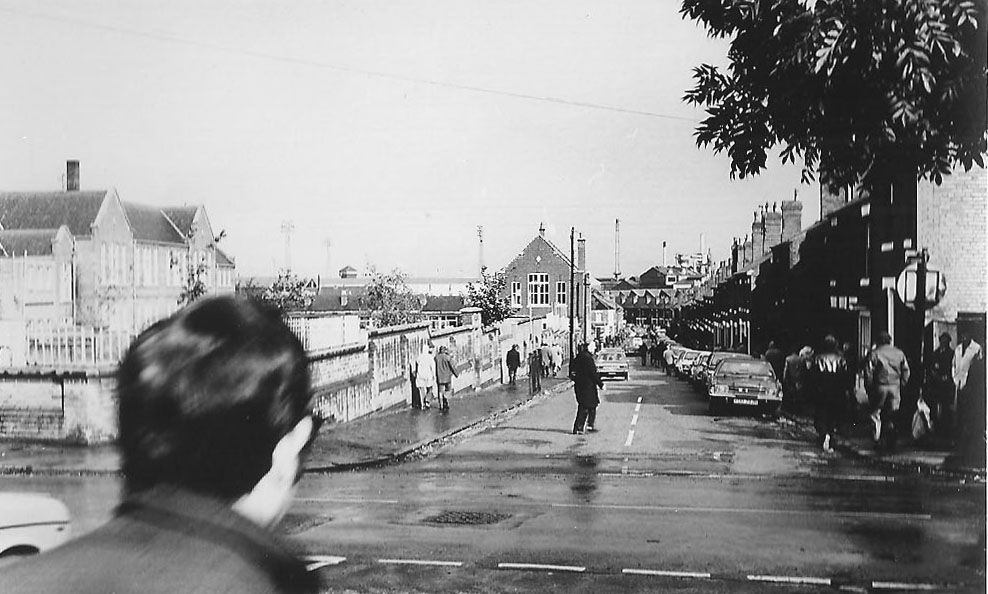
Imagine it is the late 1970s. We are walking down to the old Baseball Ground, and about to turn into Harrington Street. The floodlights of the ground are just visible:

A fur x police hors 4

My Dad, my brother and I used to park on what had been the Parade Ground at the old Victorian army barracks at Normanton, and then walk down to the football ground. If we were at all late for the kick off, Fred, my Dad, was quite capable of generating a punishing pace along the terraced backstreets. It was with complete justification that my brother would regularly accuse him of setting off like “a long dog” (whatever that was).
On one occasion, Fred was extremely late for the game, so rather than miss a second of the action, he just left the car on the grass verge of the Ring Road. He accepted as a necessary evil the inevitable parking ticket and fine he would receive, and paid it without demur, but both my brother and myself were advised, “Don’t tell your mother.”
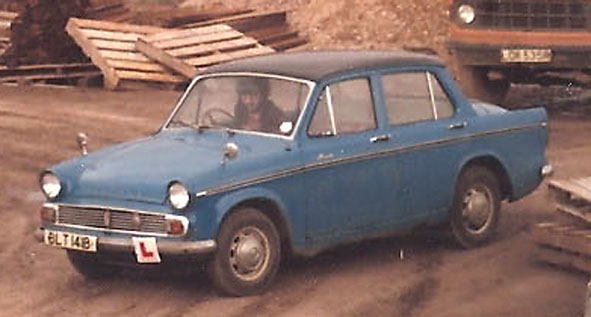
This was not too dissimilar from an incident when he damaged his beautiful pale blue Hillman Minx quite badly by reversing it into an, admittedly, pale grey, well camouflaged lamp post, down near the bridge which went over the railway lines at Swadlincote Station:

building site 3asdf

Again, he accepted the cost of the panel beater and a resprayed rear wing, on the basis of “Don’t tell your mother.”
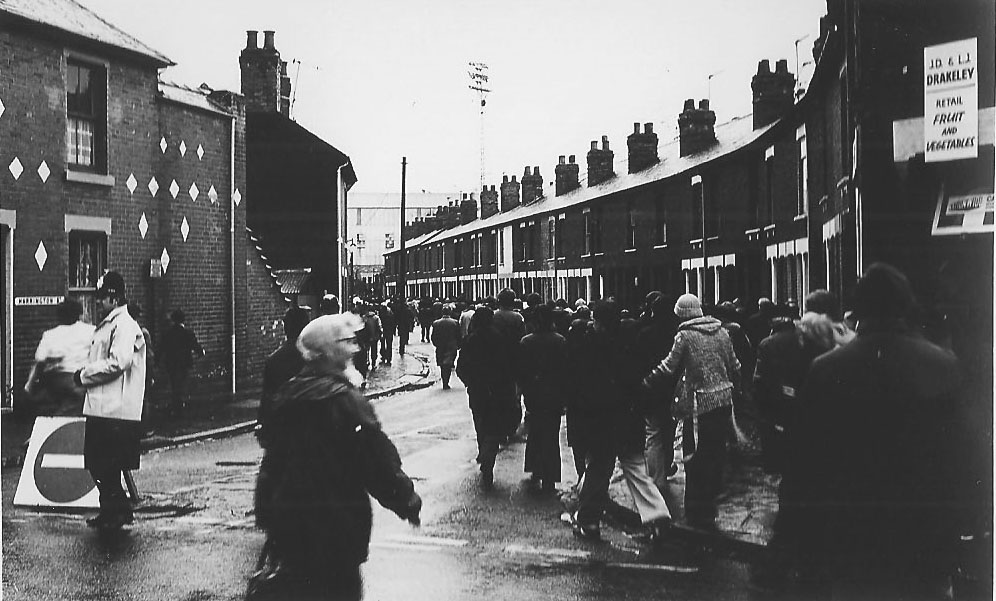
Closer to the ground, Harrington Street was closed to traffic because of the thousands of people all rushing down to the game. The single floodlight is even more obvious:

B - Copy (3)
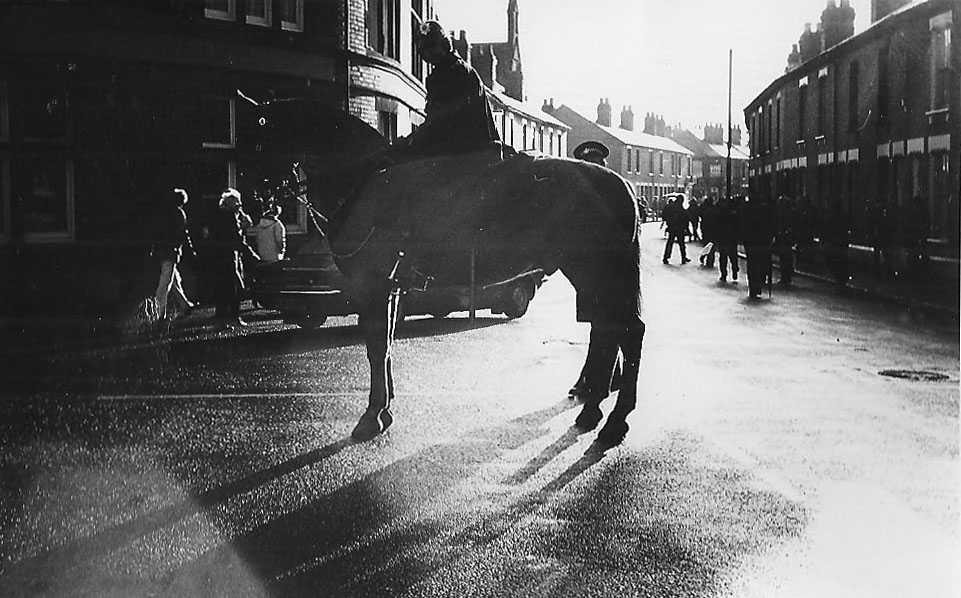
Here is a backlit policeman on his horse, and more terraced houses, looking back past the long demolished Baseball Hotel:C x police horses - Copy (2)

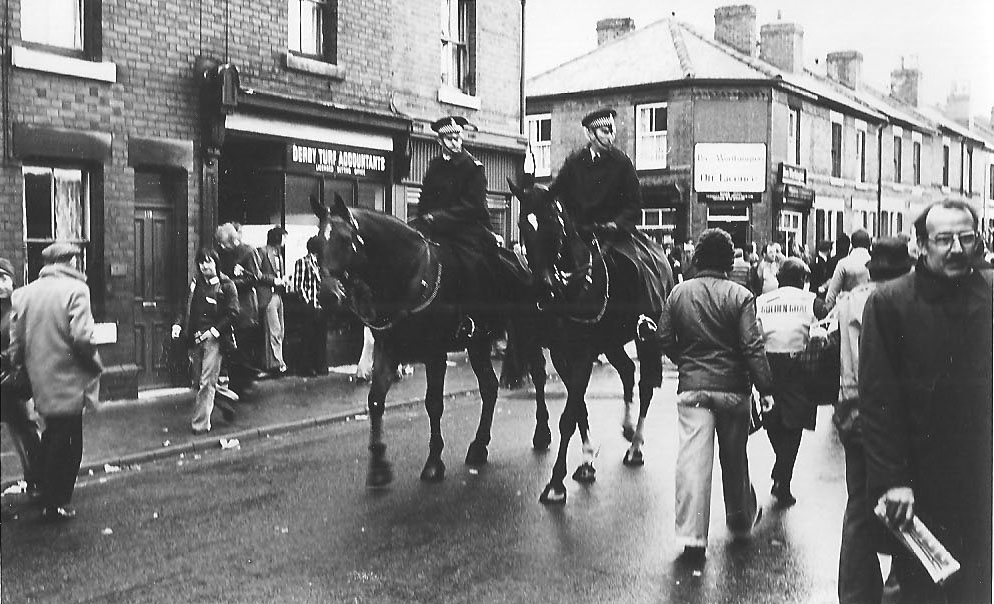
Two rather drenched policeman on their horses, walking down Shaftesbury Crescent. Look at the fashions! Look at the flares!

D r x police horses 1

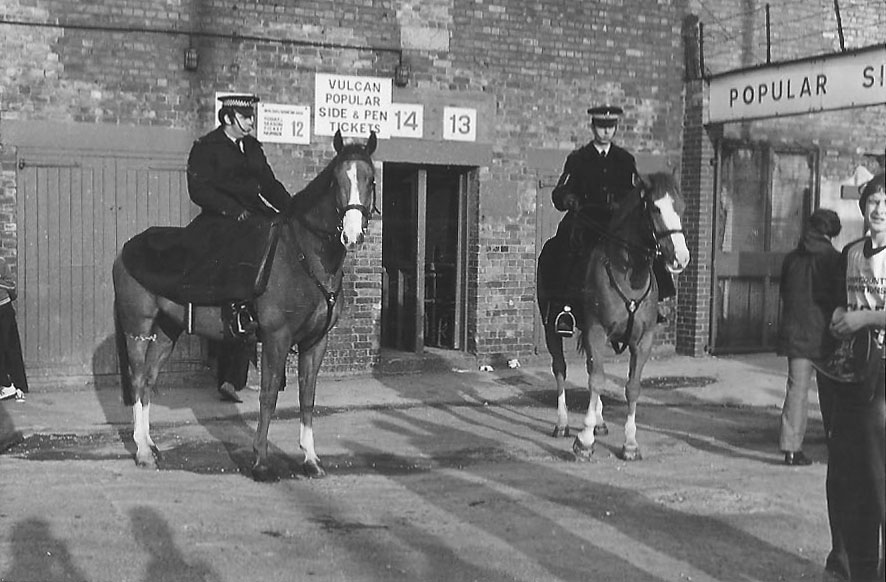
At last! These two policemen have the sense to find a little shelter from the weather:

E ur more police horses -photo 3

They are at the back of the Normanton Stand, at the entrance to the Popular Side. The “Popside” was where hooligans of both teams would stand. There would be disorder at virtually every game.
Fred, as a man of some fifty or so years of age, was himself physically attacked, on two occasions, both of them by those lovable, loyal, warm hearted supporters of Newcastle United.

We had a period when we used to park the car in the playground of Litchurch Lane Junior School, for a mere 25p. One day, as we returned from the game, I was surprised to see large brown birds flying over our heads. Only when one of them crashed into the wall of the railway repair works, did I realise that they were not birds, but bricks, thrown by a group of discontented Newcastle supporters.

On another occasion, a group of Newcastle supporters set about giving a damn good kicking to an innocent young man and his girlfriend, who had the misfortune to be walking along Osmaston Road, just in front of us. My Dad, Fred, of course, armed with his RAF maxim of “it always happens to somebody else, never to me”, raced off to help out the young victims. I can remember how Fred grabbed one hooligan’s foot as he prepared to kick the poor young man, and then wrenched it around backwards as hard as he could. That must have hurt! Afterwards, I remember too how the young victim had been kicked so much that he had lost the face off his watch.

When I got home, I discovered a tear on my favourite green USAF war surplus jacket. That tear was present in my T-shirt as well, and my back had a long red mark on it. I have always reckoned that that was as close as I ever got to being stabbed, by somebody I did not even see, in a mêlée of whirling bodies.
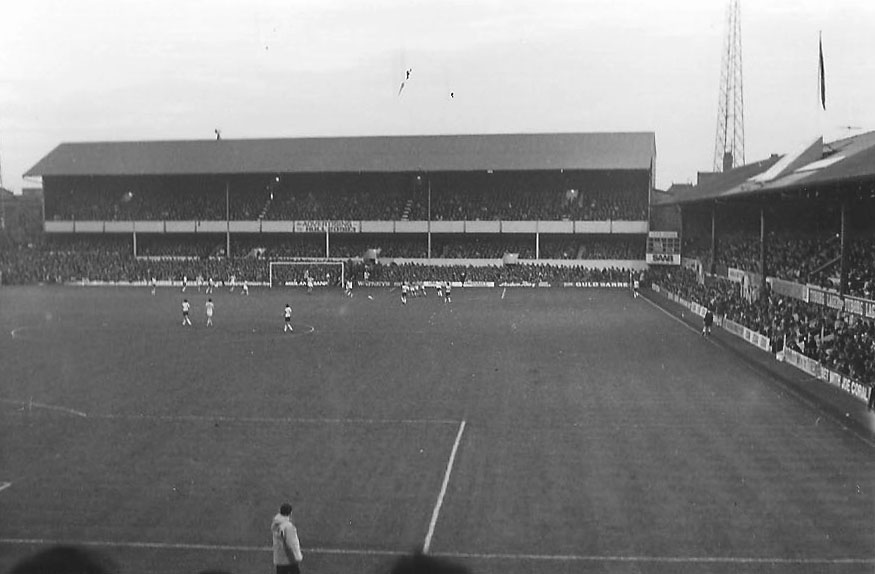
The opponents for this match are, I think, Norwich City:

F football x four photo 4

They are playing in yellow shirts and white shorts, which was a slight change from their normal kit with green shorts:

This slideshow requires JavaScript.

The problem was that in the early 1970s, lots of people still had black and white televisions, and Derby and Norwich would have looked very similar, as Derby were wearing white shirts with dark blue shorts, and Norwich yellow and green. Here Derby press forward with yet another attack:

F football x four photo 4

I can’t remember the score of this game, but I think it is safe to say that Derby probably won. They used to beat Norwich fairly regularly in the 1970s.


25 Comments

Filed under Derby County, Football, History, Humour, Personal

Bygone football clubs (1)

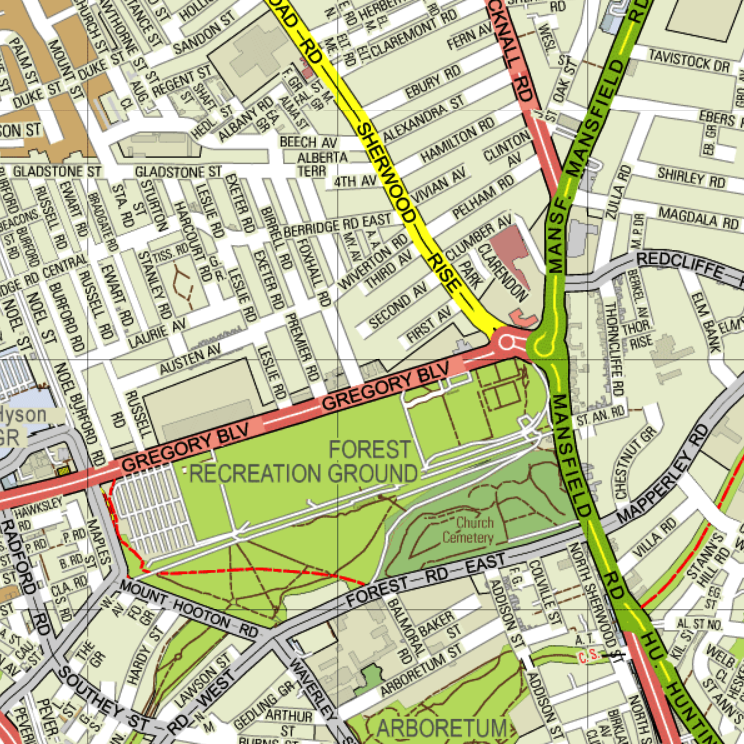
Over the years, the Forest Recreation Ground has been used for many, very varied, sporting activities. Here is a modern map:

forest

In the medieval period, bear baiting had been probably the first activity on the Forest, with a horse racing course eventually being constructed on the very same site.

Originally the racecourse measured four miles long, but in the early 1700s, this was shortened to two miles. In 1797 a new track in the form of a figure-of-eight was laid out. Unfortunately, this rather strange layout was not successful, and another more conventional course, therefore, oval in shape, was constructed soon afterwards

By the 1860s though, the racecourse was in decline, offering only small prizes, and attracting only second rate horses.  The last race meeting took place on September 29th-30th 1890, and Nottingham’s horse racing subsequently moved to Colwick.

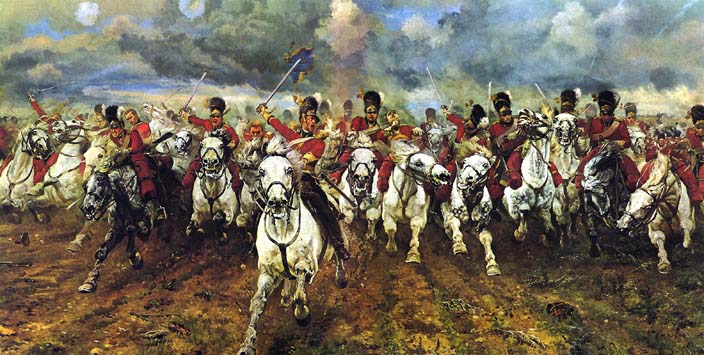
Around 1800, the centre of the racecourse had been used as a place of exercise by the many officers of the cavalry who lived in a distinctive Georgian building on Forest Road. Familiar to all High School pupils, it played host to a tiny sweet shop originally called “Baldry’s” and, more recently, “Dicko’s”. It is now a bakery. Most of those cavalry officers were destined to charge at the Battle of Waterloo:

Scotland_Forever

By 1849, cricketers were using the western end of the Forest for practice, and they soon moved to the centre of the racecourse to play professional games for large sums of money.

It is not really known when football was first played on the Forest. A group of young men regularly met there in the early 1860s, to play a primitive kind of field hockey called “shinney”. They soon thought of giving this up to play the new sport of football.

An initial meeting was convened therefore in the upstairs room of the then Clinton Arms in Shakespeare Street, and the “Forest Foot Ball Club” was duly formed in 1865.

Their first fixture on the Forest was on Thursday, March 22nd 1866, a friendly game between Fifteen of the Forest, and Thirteen of the Notts Club. The game was eventually played between Seventeen of the Forest and Eleven of the Notts, and, according to some sources, was goalless, Nottingham Forest’s first ever goal being scored in their third game, another friendly on the Forest against Notts County, which finished as a 1-1 draw.

Other contradictory sources say, however, that the initial game finished as a 1-0 victory for Nottingham Forest, with Old Nottinghamian, William Henry Revis, providing the decisive score.

One early newspaper article, described how:

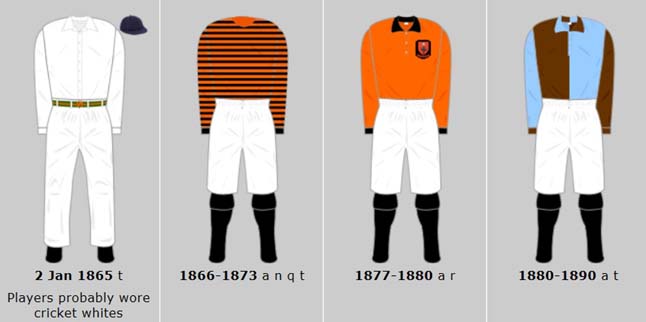
“When the men were spread out, the field looked exceedingly picturesque, with the orange and black stripes of the Notts, and the red and white of the Foresters.”

This slideshow requires JavaScript.

One of Nottinghamshire’s greatest early footballers, E.H.Greenhalgh, who played for England in the first ever international match against Scotland in 1872, was to write, of football on the Forest:

“The first set of players who came out were regarded as a company of harmless
lunatics who amused themselves by kicking one another’s shins, but did no great harm to the public at large, although in earlier days they would have been put in the stocks.”

Richard Daft, wrote in similar vein…

“When a young man I played regularly with the Notts County Football Club when it was first formed. I believe I played centre forward, but I am not quite sure about this as we were never very particular in those days about keeping in one place. Charging and dribbling were the chief features of the game at that time, and often very rough play was indulged in.”

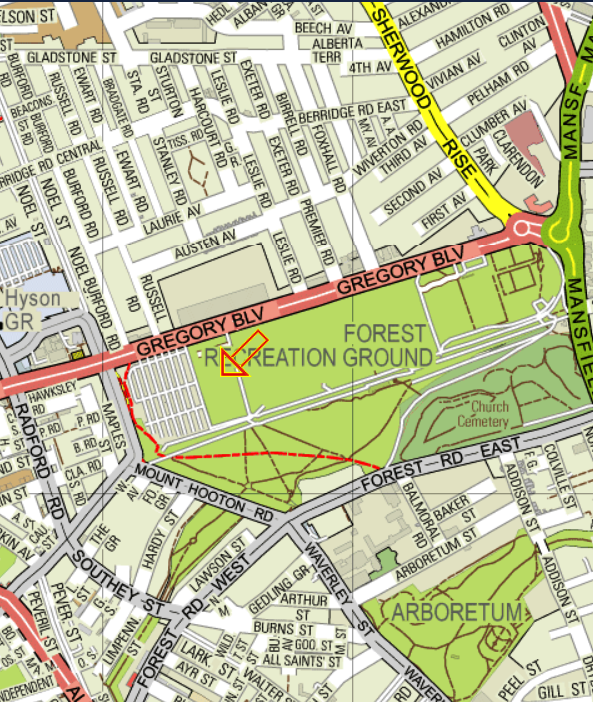
The exact location of Nottingham Forest’s pitches has never been ascertained for certain. My own researches have led me to believe that they must have been immediately to the east of what is now the “Park-and-ride” car park, at the bottom of the slight slope, but I have no way of being totally sure about this. Look for the orange arrow:

Untitled forest

Forest certainly had major problems with their location, however, when they entered the F.A.Cup from 1878 onwards. The Forest was common land, with free access for all, but the regulations of the F.A.Cup stipulated that an admission charge had to be levied. For this reason, “Forest Foot Ball Club” had to move to the Meadows area for the 1879-1880 cup campaign.

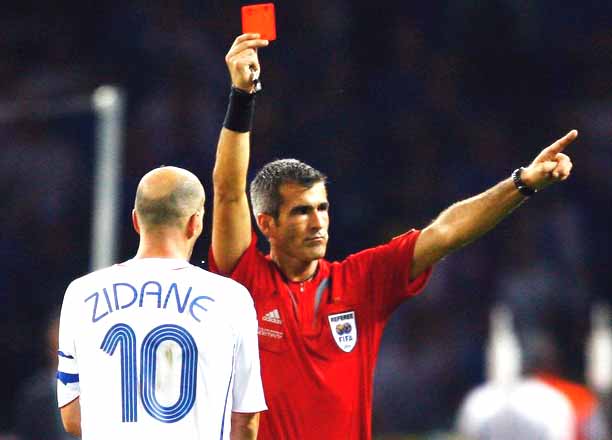
This was not, of course, before the club had introduced various innovations. Samuel Weller Widdowson had invented the shin guard, which was first worn on the Forest in 1874. In 1878, the first ever referee’s whistle in the world was heard on the Forest, most probably in a game between Nottingham Forest and Sheffield Norfolk. It was blown by Mr C.J.Spencer, and marked the first step in a long, long journey of what shall we say, talking points?

zid

The club’s departure however, did not mean that the Forest itself was suddenly devoid of football clubs. Throughout the Victorian era, football was always to remain the main sport, played by scores of different local teams, all wearing their own unique and brightly coloured shirts and shorts.

Indeed, at this time, there were so many local teams using the pitches that the High School were frequently unable to fulfil their own fixtures on Saturdays, but instead had to play on Wednesdays, occasionally Thursdays, or even Tuesdays. At the time, of course, Wednesday was half day closing for shops and businesses in Nottingham, and Thursday was half day closing in Sherwood.

On these half days, it was by no means unusual to see footballers on buses and trams, travelling to their game, already changed into their kit. A newspaper at the time wrote of

“persons hurrying to the Forest football grounds, and dozens of players in full
rig making their way in the same direction,”

Notts County wore black and orange hoops, and at least three other kits:

notts county

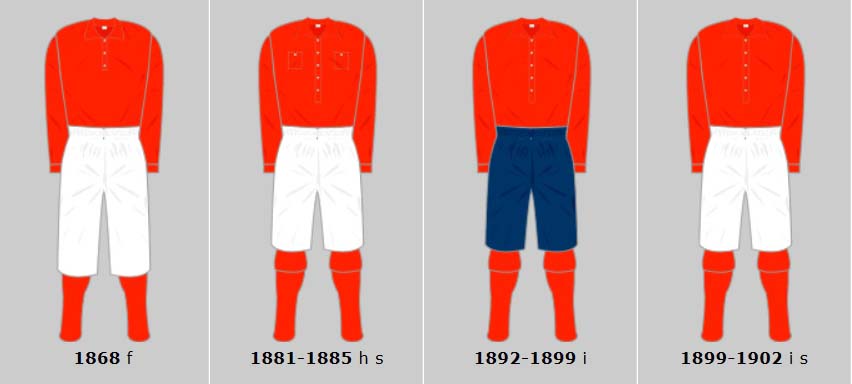
Nottingham Forest had always worn their famous “Garibaldi Red”. Here are some of their oldest kits, with only minor changes from year to year, and those sexy shorts getting shorter and shorter:

forest 1868 zzzzzz

By the way, all the illustrations of old football kits came from the best ever website for the soccer nerd and all those boys who had more than twenty different Subbuteo teams. New Brighton Tower 1898? Oh, yes.

Forest and County were not the only football clubs in Nottingham.  Next time I will look at some of the less well known local teams in the area at the end of the Victorian era and before the First World War.


16 Comments

Filed under Football, History, Nottingham, The High School

High School Football Team achieves Perfection on the Forest

Wednesday, January 21st 1981

On a dull, dreary, drizzly day in winter, the author stood with the football team coach, Tony Slack, watching the First XI play a well contested match against High Pavement 2nd XI. We were on the Forest, at the side of a pitch which has now been partially covered by the all-weather facilities. Look for that orange arrow:

This slideshow requires JavaScript.

Suddenly, eighteen year old Norman Garden, his sleeves rolled up in determined fashion, won the ball with a strong, vigorous tackle at the edge of his own penalty area:

NORMAN GARDENxxxxxxxxxxxxxxxxxxxxxxxxxxxx

He came forward with the ball at his feet and set off thoughtfully towards the opposition goal. Looking up, he sent a long, curving, arcing pass out to young Bert Crisp on the left wing. Bert trapped the ball, then ran forward ten yards or so, and looked across at the attacking possibilities:

BERT CRISP the one
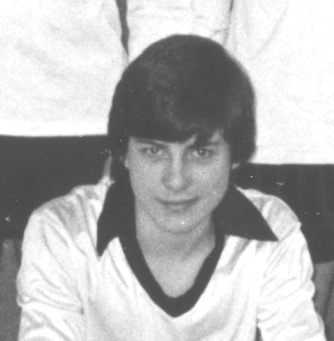
Five yards outside the penalty area stood Chris Ingle, the team’s centre forward. He was in his usual pose, apparently disinterested, lacking commitment, without any apparent desire for hard physical involvement, a young man who only came alive when he saw the whites of an opposing goalkeeper’s eyes:

CHRIS INGLE ONE WWWWWWWWWWWWWWW

Chris began to move. He accelerated slowly but purposefully from his standing start as he crossed the white line of the penalty area. Bert Crisp instinctively knew what to do. He clipped in a wickedly curving centre, about four or five feet above the ground. It was timed to arrive at the penalty spot at exactly the same time as the deadly centre forward. Chris Ingle, as the ball flew in front of him, launched himself full length over the cloying mud.
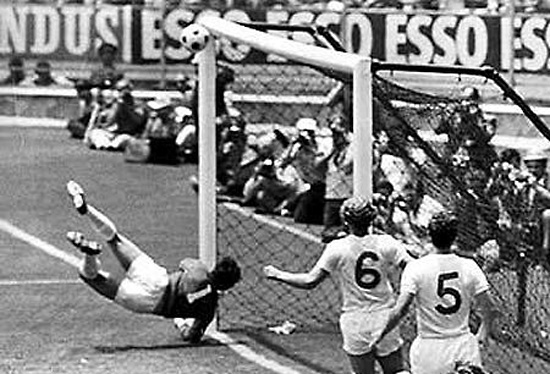
He met the ball hard with his forehead, catching it a blow which rocketed it towards the top corner of the net. “Goal!!” we teachers both yelled in our minds. But it was not quite over. The opposing goalkeeper soared backwards and with a despairing left hand just managed to flick out at the ball. He diverted it upwards, and it flew onto the crossbar and behind the goal for a corner.

Chris Ingle got up and wiped the mud from his hands down the front of his white shirt. Tony Slack turned to me and said, “You wouldn’t see anything better than that in the First Division.” And he was right.

And, in case you missed it, here’s that fabulous save again…

banks defesa

19 Comments

Filed under Football, History, Humour, Nottingham, Personal, The High School

The only trophy the High School Football Team ever won

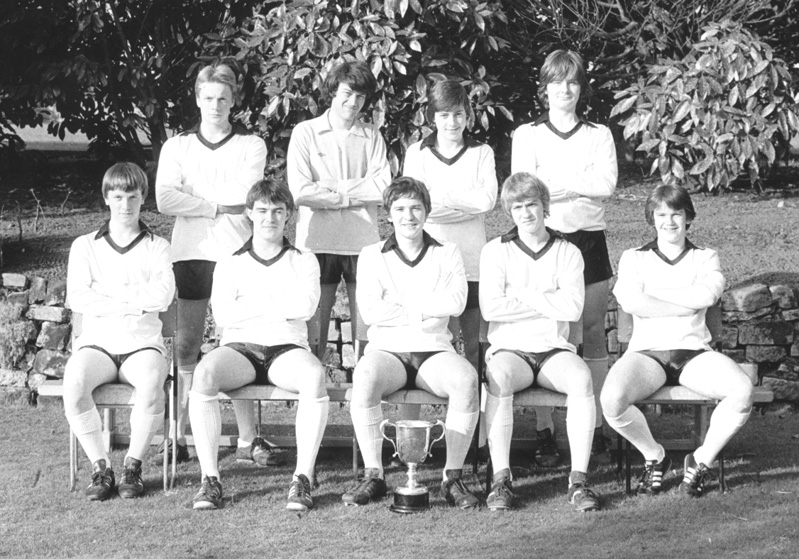
In late March 1981,  the school’s footballers won the Nottinghamshire Schools’ Football Association Seven-a-Side competition. This was the first time that a High School football team had ever won a cup at any level. Here is the squad:

six-a-side BETTER BEST BESTxxxxxxxxxxxxxxxx

The competition was organised into a number of groups, and in their initial group, the High School won two games, and lost just one, to Worksop College ‘B’ team. The High School therefore qualified for the next stage of the competition as the best losers.
This next stage was the semi-final, where they beat Worksop College ‘A’ team by one goal to nil. They therefore went forward to the Final, strangely enough, against Worksop College ‘B’ team. This ‘B’ team was the very same one which had already beaten the High School in the group stages.
In this game, the score was 0-0 at full time, and two periods of extra time did not produce any goals either. As there was no winner as yet, therefore, penalty kicks would be needed to decide the contest. The first five kicks were successful by each side, and the score was 5-5. Everybody would have to try again. The first Worksop player, though, then missed his second kick, leaving the High School needing just one goal to win the cup.
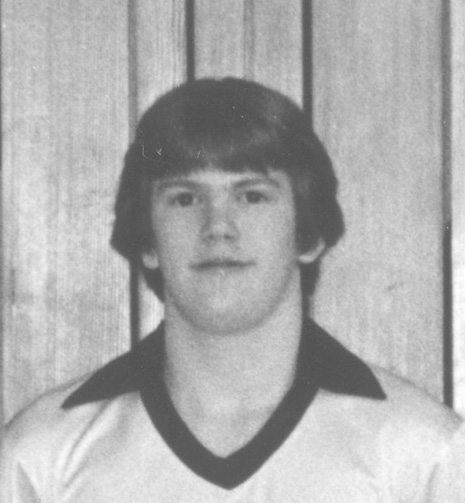
Norman Garden, who had come on as a half time replacement, took the kick, arguably the most important in a minimum of 110 years football at the High School.

NORMAN GARDENxxxxxxxxxxYESY EYS

By his own admission, head down, he took approximate aim. The ball hit both the post and the crossbar but screamed into the back of the net for the winning goal. The High School were the victors by the unusually high score of 6-5.
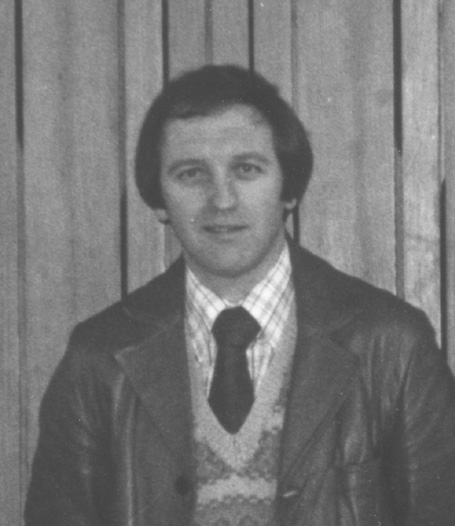
The team was coached, as always, by Tony Slack:

TONY SLACKKK WWWWWWWWWWWWWW

Team members were Raich Growdridge as captain, Simon Derrick, John Ellis, Norman Garden, Chris Ingle, Tim Little, Neil McLachlan, Richard Mousley and Chris Peers.

This slideshow requires JavaScript.


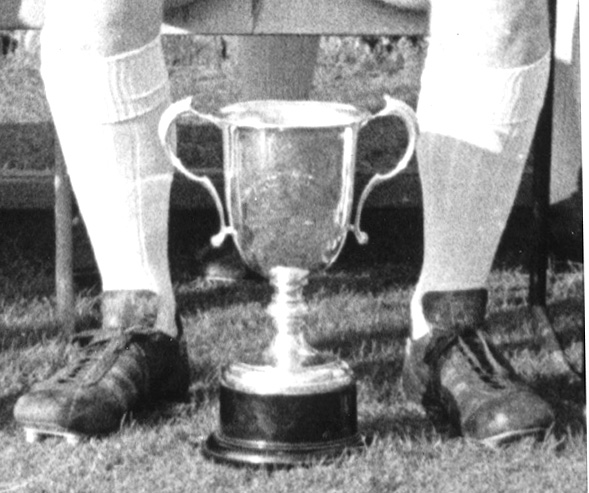
This remains the High School’s only ever official trophy:

ta cup

Strangely enough, the cup was never contested again, and despite various attempts by High School teachers to surrender it back to the relevant authorities, nobody ever came forward to take responsibility for it. As far as is known, the magnificent cup, at least twenty pounds of almost pure, locally mined Worksop silver, still remains somewhere deep in the bowels of the School, locked away for safe keeping by Tony Hatcher, the school caretaker at the time:

tony hatcher

29 Comments

Filed under Football, History, Humour, Nottingham, The High School

Match-fixing (2)

I have always wondered exactly what happened to Leeds City, a team that apparently just disappeared, after playing first class football for ten years or more. Of course, we have all heard of Leeds United, famous for its few triumphs and many near misses in the late 1960s and early 1970s. But what about Leeds City? How does a big football club just disappear?
Well, they were founded at the Griffin Hotel in 1904.  Here is the Griffin Hotel nowadays. It doesn’t seem to be doing much better than Leeds City:

griff

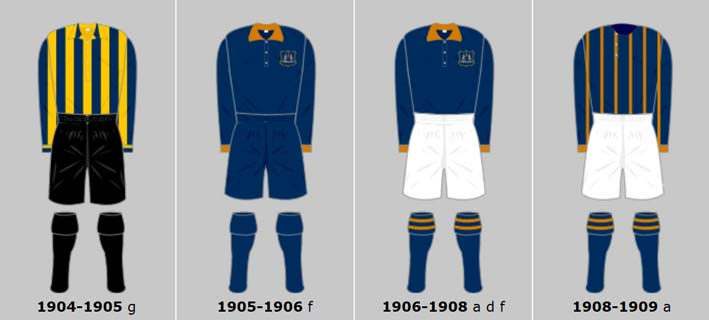
Leeds City were slated to be the primary football team in the city, somebody who could bring the delights of a relatively new sport to a rugby mad area.This allowed them to adapt the council’s coat of arms as their own and to wear the city’s colours of gold and blue for their shirts:

leeds city top row

Luckily for them, a local rugby club folded around this time, and Leeds City moved straight into their old stadium in Elland Road.
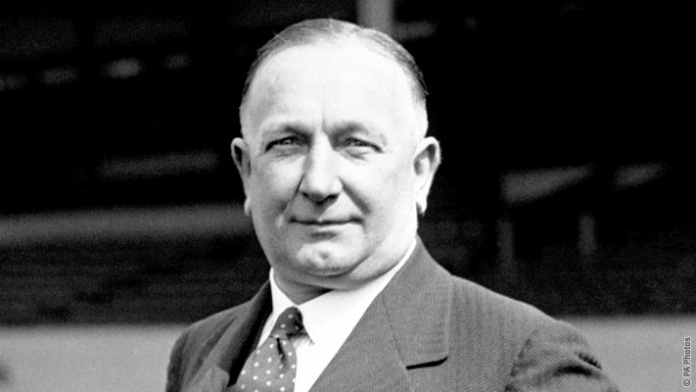
A decent ground enabled them to arrange friendly games against local league clubs, and after making powerful friends in this way they became members of the Second Division for the 1905-1906 season, when they finished sixth. Years ago, it was the club secretary who did what would nowadays be the job of team coach and club manager. City started with Gilbert Gillies (1904-1908) and then Frank Scott-Walford (1909-1912). The club’s record was fairly average until they appointed Herbert Chapman, the legendary manager of Huddersfield and Arsenal, who took City to fourth place in the Second Division, their highest position so far. Here is the great man. His ghost was said for many years to haunt Arsenal’s old ground at Highbury:

gun__1357732038_chapman_herbert1

Until the First World War, Leeds City continued to wear blue and gold as their colours, except for the 1910-1911 season. Research by David Tomlinson has revealed that their kit changed at this point, when they signed five young, inexperienced, but hopefully talented, Irishmen for the team. The Leeds Mercury, in their match report, said

“It must be remembered that these Irishmen are very young men, who have been brought into a higher class of football than that to which they have been accustomed, and that they were playing their first match amid unfamiliar surroundings. Mr Scott-Walford evidently had an eye to making his new men feel at home as well as to stage effect when he attired the team in green jerseys and supplied green flags to mark the centre line, and he apparently realised that their first match might go wrong when he  addressed them in his official programme: “Should your efforts deserve success, and it is denied you, we shall extend our sympathy, when you do badly we shall still think you have done your best.”

It certainly looks very strange for a team from Leeds:

leeds city row. two

During the 1913-1914 season they adapted a kit which they would wear for the rest of their short history:

leeds city row three

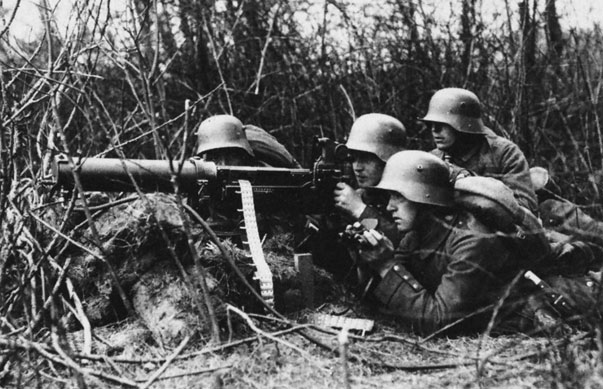
The Football Association has always been very adept at thinking up rules and regulations. It was strictly forbidden, for example, for a club to pay their players over the course of the Great War. No matter how dangerous it was fighting for King and Country, it was down to you to look after the wife and kids, rather than allow your rich erstwhile employer to help you out, even if that arrangement suited both sides. And woe betide, of course, anybody caught breaking the rules, even though many clubs did. It was a blind date with a bunch of Germans for you. Hopefully, you won’t get the one whose hat doesn’t fit:

a23_world_war_1_german_machine_gun_1

Leeds City were grassed up to the FA by a former player who told journalists that the club’s guest players for friendly games were being paid to turn out and play. The FA considered this to be an extremely serious offence, and began an investigation.
City, being both arrogant and stupid, did not help themselves by their poor choice of reaction to the FA’s questions. Instead of rolling over with a loud cry of:

“I am guilty, guilty, guilty but O how I regret my wrongdoing”

they basically told the Football Association:

“Get stuffed. You can’t look at the books”.

The FA’s reaction was to make a huge example of the wrong doers.  Immediate expulsion from the League sine die as they say, and the disbandment of the entire club.

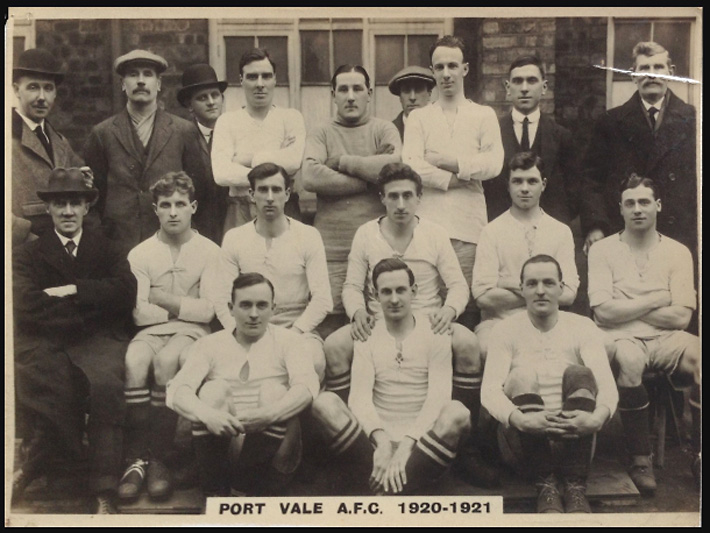
They had played only eight games of the 1919-1920 season and delighted Port Vale took over the rest of City’s fixtures. I bet the man with the rip across his face was the first one to die. I saw it in a horror film once:

port

Herbert Chapman, the club secretary, and a good few others, were also banned sine die. All the club’s assets were to be sold off. Not just the tables and chairs, but the players too.
At ten o’clock on October 17th 1919, therefore, an auction was held at the Metropole Hotel, where sixteen footballers were all sold to the highest bidder. They were bought by nine various clubs for a total of £9,250.
Billy McLeod £1,250 to Notts County
Harry Millership to Rotherham County (who??) and John Hampson to Aston Villa, both for £1,000.
Willis Walker to South Shields (who??) and John Edmondson to Sheffield Wednesday, both for £800
Other clubs who coughed up either £600 or less were Grimsby Town, Manchester City, Aston  Villa, Lincoln City and Hartlepool United.

Poor old Francis Chipperfield, worth only £100 to Lincoln City. I wonder if he just packed up football and went to join the circus?

During the afternoon, after the auction, a number of other local officials, or at least, all the ones who were as pure as the driven snow, founded a new club, Leeds United, which could play in the now deserted Elland Road ground. United initially took over the fixtures of City’s reserves in the Midland League, but for the next season of 1920-1921, the club was promoted into the Second Division:

pasted-graphic-1

As I have done before in other posts, I would like to thank the website who supplied all of the illustrations of the old football kits from days of yore.

It is the best ever website for the soccer nerd and all those little boys who had more than twenty different Subbuteo teams.

15 Comments

Filed under Criminology, Football, History, Humour, Politics

Match-fixing (1)

Corruption in football is nothing new. More than a century ago, in 1900, Burnley goalkeeper Jack Hillman attempted to corrupt the Nottingham Forest goalkeeper and the other players by giving them £2 each to let Burnley win on the last day of the season and perhaps thereby escape relegation. It didn’t work. Burnley went down with 27 points from 34 games, along with Glossop North End who managed only 18. Here’s Hillman, apparently twenty minutes after the invention of angora sweaters::

jack-hillman-264x300

Had the bribe succeeded, Burnley would have overtaken and relegated Preston North End (28 points) who would have taken their place in Division Two. Hillman was called to account by the authorities, but amazingly, they didn’t accept his explanation of “I was only having a laugh!” He got a rather lenient twelve month ban, although this meant no pay for that period and the loss of a benefit match which would have netted him around £300. Even worse for him, though, was the fact that he never played international football for England again, having just broken into the team
In 1905, at the opposite end of the table, Manchester City were trying to win the League title. Billy Meredith, their star winger, decided to make the task a little bit easier by offering the Aston Villa players £10 to let them win. Like Hillman, Meredith received a year long ban, but rocked the footballing boat by alleging that he had been ordered to bribe the Aston Villa player, Alex Leake, by his Manchester City manager, Tom Maley. Bribery, said Meredith, was common practice at Manchester City who finished the 1904-1905 season in third place behind champions Newcastle United and Everton. A whole selection of players were suspended, as were members of the club staff and directors from the boardroom. Here’s Meredith. He looks like he’s wearing in a new moustache for his shy, and rather strange, German penfriend:

meredith

Meredith actually wrote an open letter to the Athletic News:

“You approve of the severe punishment administered by the Commission AGAINST ME and state that the offence I committed at Aston Villa should have wiped me out of football forever. Why ME ALONE? when I was only the spokesman of others equally guilty.”

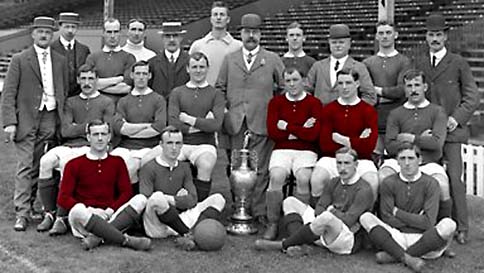
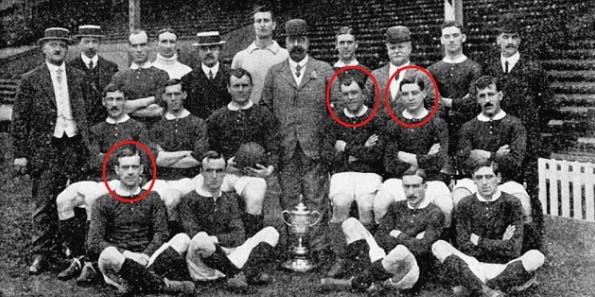
In 1915, Liverpool played so poorly as they lost 2-0 to relegation-threatened Manchester United that one of the many bookmakers who had taken bets on the game refused to pay out, at odds of 7-1.  He had probably heard of the clandestine meetings of players in the pubs of Manchester and Liverpool. And the poor old bookmaker was completely right. In the United team, Sandy Turnbull, Enoch West and Arthur Whalley were the guilty men and in the Liverpool team it was the fault of Tom Miller, Bob Purcell, Jackie Sheldon and the rather appropriately named Thomas Fairfoul. Can you spot the guilty players in this old picture of Manchester United?

wh turn wets

Would you like a second go?

betting-scandal-600x312

It looks like Liverpool are not quite so helpful towards the local detectives:

liverpool 1915

And no, the man with the cap is the trainer.

Jackie Sheldon as an ex-United man was the mastermind behind the coup but not everybody in the two teams was happy to cheat in this way. Both Fred Pagnam (Liverpool) and George Anderson (United) refused to participate. Indeed, when Pagnam shot and hit the opposing crossbar his teammates all showed their anger with him. It was perhaps his own fault, as before the match he had threatened to score a goal to spoil their nasty little plan. By now, whiter-than-white Billy Meredith was a United player, but everybody had taken great care not to tell him about what was happening and nobody passed to him throughout the game…something which, of course, aroused his suspicions as to what exactly was going on.  A penalty was missed by such a distance that the ball only just failed to hit the corner flag.  The crowd, feeling they had wasted their penny entrance money, grew increasingly angry with the proceedings.

Overall though, things were getting very much out of hand with match fixing. As an example, all seven of the Liverpool-Manchester United match fixers, along with an eighth player, Lawrence Cook of Stockport County, were banned from football sine die. (that effectively means “for life”)
Cynics might say that that was a fairly limp punishment as professional football had already been suspended because of the war. The even more cynical would point out that the Naughty Eight were given hints about a possible return to football, but only if they signed up for the Army and survived the carnage of the Western Front:

somme

A succession of away games on the Somme and at Passchendaele gave seven of the Naughty Eight their promised lifting of the ban. Fairfoul in fact turned away from football but the other six went back to their previous employment. For some reason “Lucky Enoch” West did not have his ban rescinded until 1945 when he was 59 years of age.

The_Battle_of_the_Somme_film_image1

Poor Sandy Turnbull had to be contented with a posthumous permission to resume his footballing career. He joined the 23rd Battalion of the Middlesex Regiment before a free transfer to the 8th Battalion of the East Surrey Regiment. He became Lance-Sergeant Turnbull and was killed on May 3rd in the Battle of Arras at the age of 33.  Sandy was the son of James and Jessie Turnbull, of I, Gibson St., Kilmarnock, Ayrshire and the husband of Florence Amy Turnbull, of 17, Portland Rd., Gorse Hill, Stretford, Manchester. He had won FA Cup medals with both Manchester City and Manchester United:

Deadgerman

The Grim Reaper has no favourites though. Sandy has no known grave and his death is commemorated along with that of almost 35,000 others from the United Kingdom, South Africa and New Zealand who died in this fairly pointless battle and whose bodies have never been identified. Overall, the Battle of Arras was quite a slaughter. Nearly 160,000 British lads and about 125,000 young Germans renounced their right ever to play football again. In a mere five weeks. Here is Polygon Wood where Sandy had tried to mark out a football pitch for himself and his pals:

polygonwood

Alas, they didn’t realise that a Great War average of one ton of explosives per yard of trench was going to be a really, really big problem with that.


22 Comments

Filed under Criminology, Football, History, Humour, Nottingham

The Oldest Old Boy of Them All (4)

Many, many years ago, in 1990, my friend and colleague, Simon Williams, interviewed Roy Henderson who was then one of the oldest Old Boys still alive. In due course, I transcribed the taped interview and added some extra explanatory details where this seemed helpful to the reader. This is the penultimate section of an eventual five, all of which describe the High School just before the outbreak of the Great War, and then during the first few years of the conflict.

Roy used to live at 3, Lenton Road in Nottingham’s richest area, The Park. He would be awakened by another High School boy called Alfred Tregear Chenhalls, who would come along the road as he walked the family dog, and whistle loudly that it was soon time to go to school. Roy was then accompanied to school by his friend, who was walking from his own family house at 2, Hawthorne Drive in The Park. One particular day in the Fourth Form, Alfred Chenhalls did not arrive, and Roy Henderson was therefore late. Mr Lloyd Morgan ticked him off:

“Who shall we punish? Chenhalls or his dog? ”

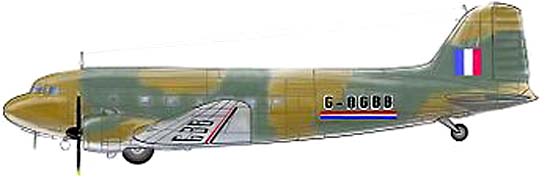
Alfred Chenhalls, whose father, like that of Roy Henderson, was a minister of the church, later became an accountant who dealt with lots of musicians and theatrical people, including the famous Hollywood actor, Leslie Howard. Chenhalls always smoked a large cigar, and as a big fat man, looked rather like Winston Churchill. He was killed on June 1st 1943, when the unarmed DC-3 of the B.O.A.C., carrying him and Leslie Howard between Lisbon and London, was shot down by Junkers Ju 88s of the German Luftwaffe. Here is the Douglas DC-3 Dakota, in question:

350px-BOAC_Flt_777

At the time, Churchill was known to be attending a conference in Algiers, and there was much speculation that a German spy had seen Chenhalls getting onto the plane in Lisbon, and had then organised its destruction. Here is Chenhalls pretending to be Churchill:

CHENHALLS

Further confirmation of the Germans’ interpretation was that Churchill’s colleague in Algiers, the Foreign Secretary, Sir Anthony Eden, looked very like Leslie Howard. Alternatively, Leslie Howard may have been thought to be Detective Inspector Walter Thompson Churchill’s personal bodyguard. Whatever the complex truth of it, Churchill himself considered all his life that this was a definite  assassination attempt. The incident was also one of the very few occasions when airliners were ever attacked on this route out of neutral Portugal. Much more detailed information on the event is available here.
At this time, many boys had nicknames. Donald James Clarkson was always called “Pug” because of his upturned nose. Here he is:

clarkson zzzzzzz

Another boy, an extremely good Fives player, was called, for obvious reasons, “Sparrowlegs”. Strangely enough, though, only one particular boy ever had a certain nickname. Nobody could ever be called “Pug” or “Sparrowlegs”, as long as the original boy remained in the school. There seemed to be no obvious reason for the nickname of “Fuzzy” Barton, given that his hair was not in the least bit curly. Peculiarly enough, though, his elder brother had extremely fuzzy hair. He, though, was never called “Fuzzy”.

Eventually, the younger Barton became the Headmaster of King Edward’s School in Sheffield. The latter establishment had an extremely peculiar cricket pitch, which was constructed on various levels, with a number of different slopes, flat areas, and two or three quite sharp drops. Certain unfortunate fielders were unable to see either wicket, and pieces of information had to be passed on to them by other fielders one level higher up.

Because of the Great War, and the subsequent restrictions on travelling by train, there were very few away matches at cricket. Boys went only to Derby, Worksop or Sheffield, but never to Denstone or Birmingham. On many occasions, they played home fixtures against Army teams billeted in the area, including a few Italian ones. This was much more enjoyable than the very limited number of fixtures against other schools.

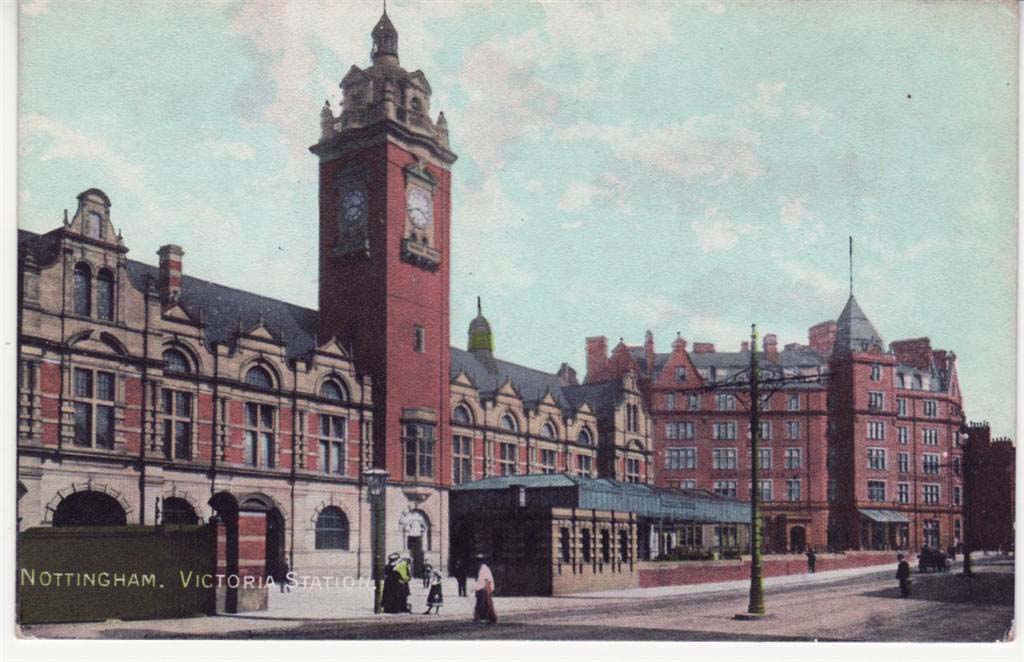
If they did ever travel by train, High School teams invariably used the now demolished Victoria Station. You might recognise the Clock Tower which still stands nowadays, outside the Victoria Shopping Centre. The hotel on the right is also still there:

Nottingham_Victoria_Station_3

Here is a steam train coming out of the tunnel which took rail traffic northwards towards Worksop and Sheffield. This tunnel is still visible, either from the modern multi storey underground car park or from Huntingdon Street:

train

At this time, in the school, in general, the rules on caps were very strict. Roy Henderson himself had a special dispensation from the Headmaster and was allowed not to wear a cap in school. For some unknown reason, his mother had contacted the Headmaster, and the latter had agreed to this special privilege. Roy wore a cap for the first time when he became a prefect, and that turned out to be a spectacular piece of headgear with a silver badge on it.

Roy was the secretary of the School Debating Society. He spoke quite frequently in debates, despite, by his own admission, not being particularly good at it. The meetings, which were mostly in the winter term, took place after school, between twelve and one o’clock on Saturday afternoons.

When he left the High School, Roy joined “B” Battalion of the Artists’ Rifles. He had already learned a lot in the school’s Officer Training Corps, as was confirmed by the first drill sergeant that he encountered in the regular army. Later, he joined the Regimental Concert Party, which did its training at Lichfield. Roy, because of his age, missed the Great War by a few weeks, but he caught Spanish Flu in January 1918. He was not to leave hospital before August 1918.

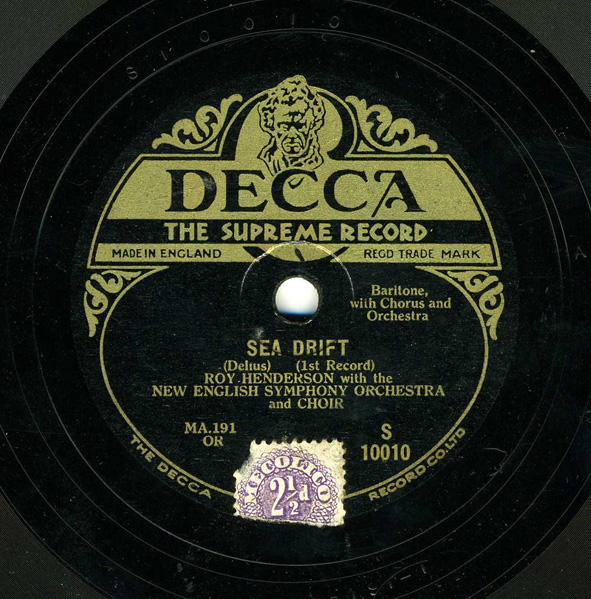
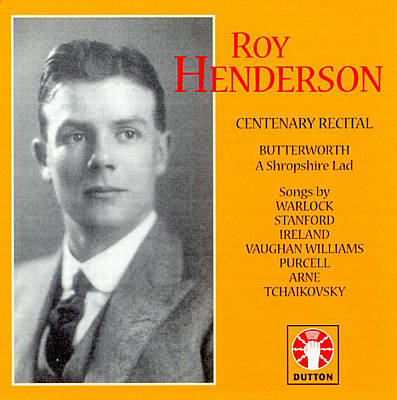
At the High School, there had been no specialist singing master, and no real in-depth teaching of music. Roy had never realised that he had any particular talent in this field, until he sang solo during the interval of a school play, and was overwhelmed and astonished by the great volume of applause which he received. Roy later went on to sing at Speech Day. Within only a few years of leaving the High School, he had become one of the leading singers in the country, who was destined to work with some of the greatest musical talents in the whole world. I have been unable to find any photographs of Roy Henderson, but here is one of his record labels:

Decca_1929_Sea_Drift

And here is one of his album sleeves:

record

In the near future, I will continue with the fifth, and final, article in this series. I hope you are enjoying them and finding them interesting.


16 Comments

Filed under Football, History, Nottingham, The High School

The Oldest Old Boy of Them All (3)

Many, many years ago, in 1990, my friend and colleague, Simon Williams, interviewed Roy Henderson who was then one of the oldest Old Boys still alive. In due course, I transcribed the taped interview and added some extra explanatory details where this seemed helpful to the reader. This is the third section of an eventual five, all of which describe the High School just before the outbreak of the Great War, and then during the first few years of the conflict.

Prominent boys in the High School at this time included Lancelot Wilson Foster, who, in the 1930s, was to become a vicar in Cheshire, and then a chaplain in World War Two.

William Donald Willatt became the Vicar of St.Martin’s, Sherwood, and eventually lived in West Bridgford. Here is St.Martin’s:

st martin sherwood ccccc

Along with Roy Henderson, William Willatt was later to start a school magazine called “The Highvite”. By Roy’s own admission, it was “a pretty dreadful magazine”, and only survived because it was financed by a variety of different adverts. The enterprising boys went round to local companies such as Sisson & Parker, and many other businesses. As editor of the other school magazine, Harold Connop was furious at the new rival. Roy didn’t get on very well with him at all.

Harold Arno Connop, however, was a first class scholar and very good rugby player. He was a fine three quarter, and a very fast runner, but for one reason or another, which Roy was not willing to divulge, he was, supposedly, never particularly well liked in the school, and in general, was apparently not a very popular figure. This may not have been totally unconnected, however, with Harold’s rare combination of outstanding academic prowess, and humble origins. His father was a mere Elementary School teacher, and Harold’s education throughout his time at the High School was entirely financed by his being both a Sir Thomas White Scholar, and a Foundation Scholar.

Harold eventually joined the Royal Naval Air Service, where he became a Lieutenant. He would not survive the conflict and was to die of his wounds on March 31st 1918. Here he is, resplendent in his uniform:

connop zzzzzzzzzzzzzzzzzz

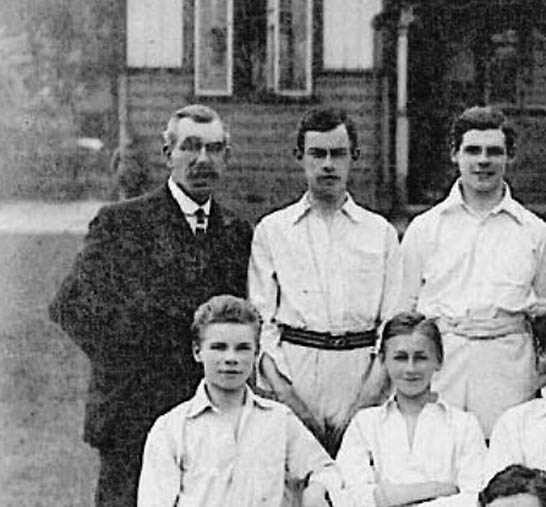
Percival Henry Biddulph Furley always used to sit next to Henderson in the Classical Sixth. He was one of Deputy Headmaster Sammy Corner’s favourites. In actual fact, despite being well over sixty years of age, Mr Corner was to leave his post as Form Master of 5b to go to the Great War. Here is Mr Corner, showing the School Charter to interested parents on the occasion of the school’s 400th anniversary in 1913:

sammy corner s

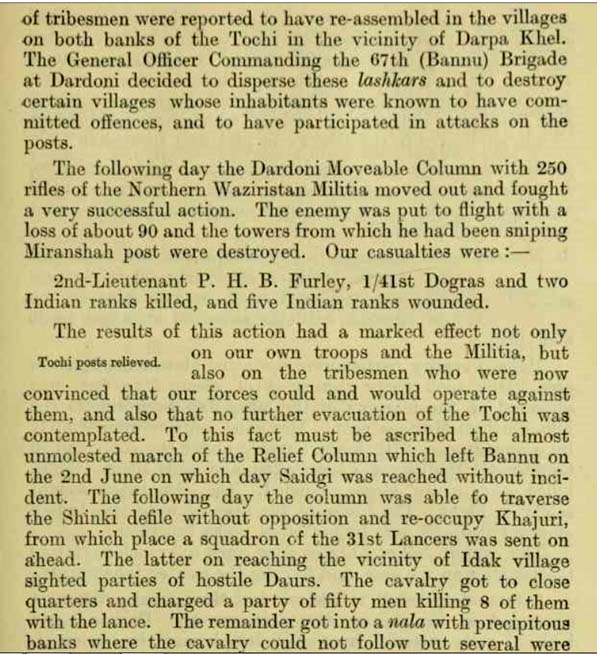
As a teacher, Mr Corner was famous for how easily he could be diverted from the work in hand. Anybody just had to get him started off on an interesting subject, especially in Scripture lessons, and the class would then seldom, if ever, have to return to what they were supposed to be doing. Percival Furley, for some unknown reason, was always nicknamed “Dab”. He was a member of the First Eleven at cricket for three years. His other claim to fame was his talent in school plays. At this time, all the female parts were taken by boys. Given his youthful good looks, “Dab” could always be made up into a very good looking lady or girl! When he left the High School, “Dab” joined the Army. He was eventually to be killed in a skirmish with some lashkars at Miranshah, in the North West Province of India, in June 1919. Here is the official account of that short rehearsal for our recent war in Afghanistan:

furley

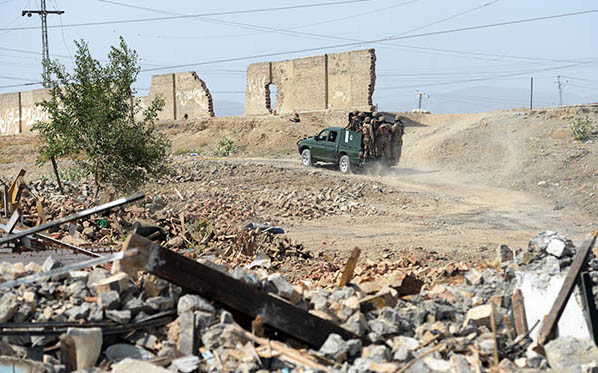
And here is Miranshah today, now that it is running its own affairs:

PAKISTAN-UNREST-NORTHWEST

According to Roy Henderson. the younger of the two Boyd brothers, John Hardy Boyd, was the best athlete in the school. He was captain of the school cricket team and of the Officer Training Corps. His elder brother, Charles Gordon Boyd, had been the school’s wicketkeeper, and had represented the school at football from 1910-1912. He was killed on May 3rd 1917, while serving as a Second Lieutenant in the  9th Battalion of the Leicestershire Regiment.

Allan Roy Stewart Grant was the son of a Presbyterian minister. For some subtle reason, possibly connected with his initials, he was always nicknamed “Pongy”. Thomas Wright was quite a good bowler, as was Daft, the grandson of the famous Nottinghamshire cricketer. Other cricketers included Francis Arthur Bird and James Wilcox, and Roy was himself one of the better bowlers and batsmen. The school cricket coach at this time was, of course, Mr A.G.Onion, seen here, perhaps, in his later years:

onion

In one year, Roy was the school Fives champion. In the year before this, it had been Donald Clarkson, who was to become that most vulnerable rank of officers, a Second Lieutenant, killed on August 9th 1918 with the 1/6th Sherwood Foresters. “Pug” Clarkson lived only a street away from where I am now writing, at 52, Caledon Road, Sherwood.

Other school Fives champions included Victor Guy Willatt and his brother, William Donald Willatt. William Norman Hoyte, the Captain of Mellers House was also a very fine athlete, as was Sidney Charles Trease. The latter was to become a Second Lieutenant in the 11th Scottish Rifles. He went  missing on September 19th 1918 at the age of only nineteen. He was the beloved son of George and Annie Trease, of 85, Waterloo Crescent, within just a couple of minutes’ walk of the school. His death came in a fairly pointless campaign in Greece and is commemorated on the Doiran Memorial.

The School was converted to rugby by Mr Kennard. He had the unfortunate habit with smaller boys of pulling them close and then tugging their hair very hard. It was extremely painful! There was no real reaction on the part of the boys to the change of sports from soccer to rugby. They just did as they were told.

Roy played as goalkeeper for the school on several occasions. He once let in eight goals against Trent College, and towards the end of the game he became what was probably the first player ever to be substituted in the history of school football, when he was replaced in goal by Donald Clarkson.

At the time, boys who represented the school were awarded ornate colour caps.

This article will be continued in the near future.


10 Comments

Filed under Football, History, Nottingham, The High School