Category Archives: History

Football in the Old Days : Derby County v Middlesbrough

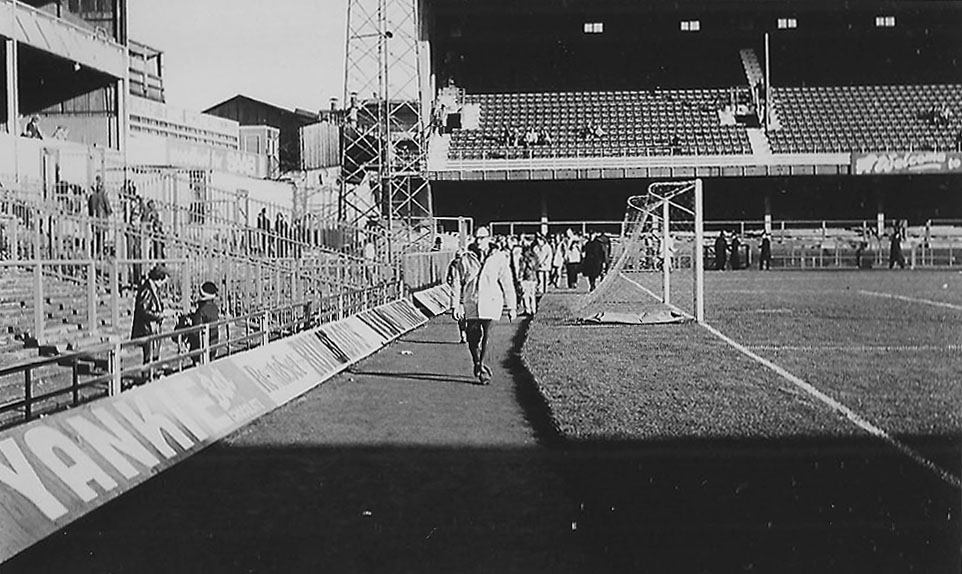
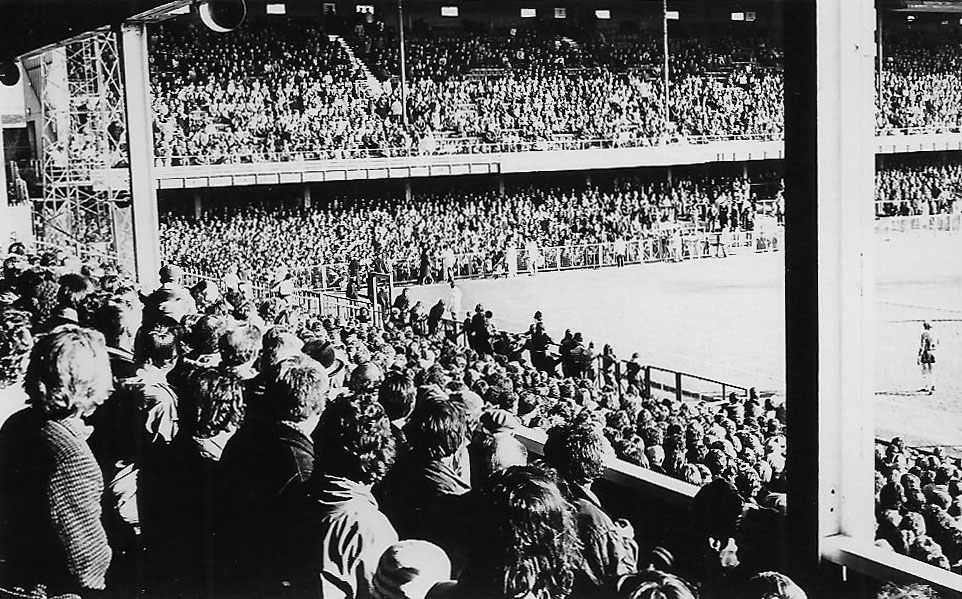
In the early 1970s, I used to watch Derby County who, at that time, were a highly successful team in what was then still called “The First Division”. I saw Derby win the Championship of that First Division on two occasions, in 1972 and 1975. In later years, I took my camera with me a couple of times, to take a few photographs, even though, at the time, this was actually illegal and club stewards kept a careful watch in case anybody did it.  Derby, of course, did not play in their current modern stadium, but in the old Baseball Ground, built in the middle of square miles of terraced houses in one of the poorest areas of Derby. It has now, alas, been demolished, although I do have a box of mud from the pitch, and a fair quantity of bricks from the stands.

I keep them in the cellar, but the very best one I had concreted underneath my Dad’s gravestone. He was a Derby fan from 1931, when Newcastle United came to Derby and won by 5-1, until the last game at the Baseball Ground, a 1-3 defeat against Arsenal. Fred was to watch Derby County for almost seventy years, until his very, very last game, at the new Pride Park Stadium, a defeat by 0-2 to Charlton Athletic. Nobody said supporting a football team was going to be easy.

This slideshow requires JavaScript.

My camera was a Voigtländer Vito B (I think) equipped with a rather handy Zeiss lens:

Voigtlander-Vito-Bxxxxxxxxxxxxxxxxxxxxxxxxx

Here are the match stewards just before the match begins:

A four more police horses - photo 2

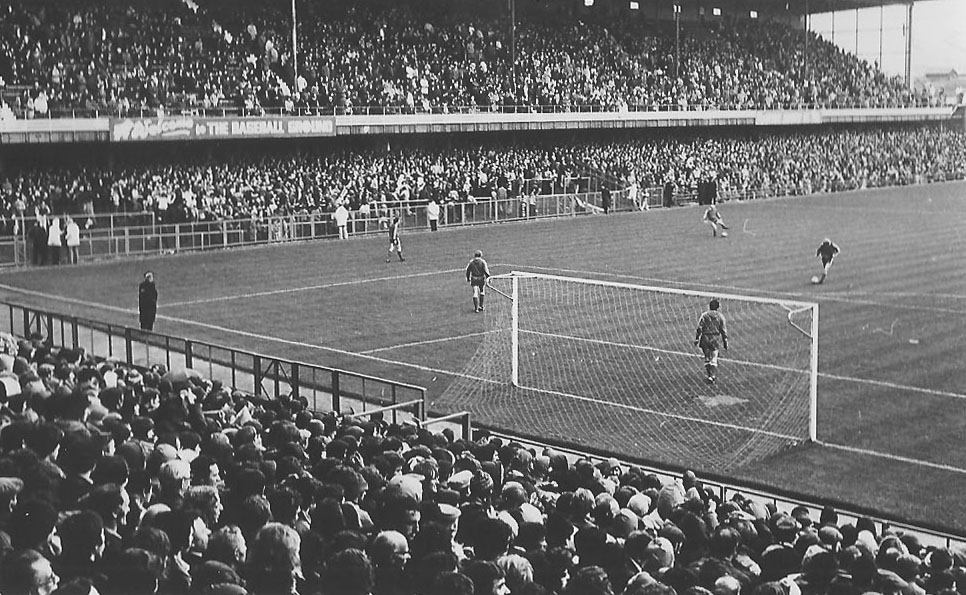
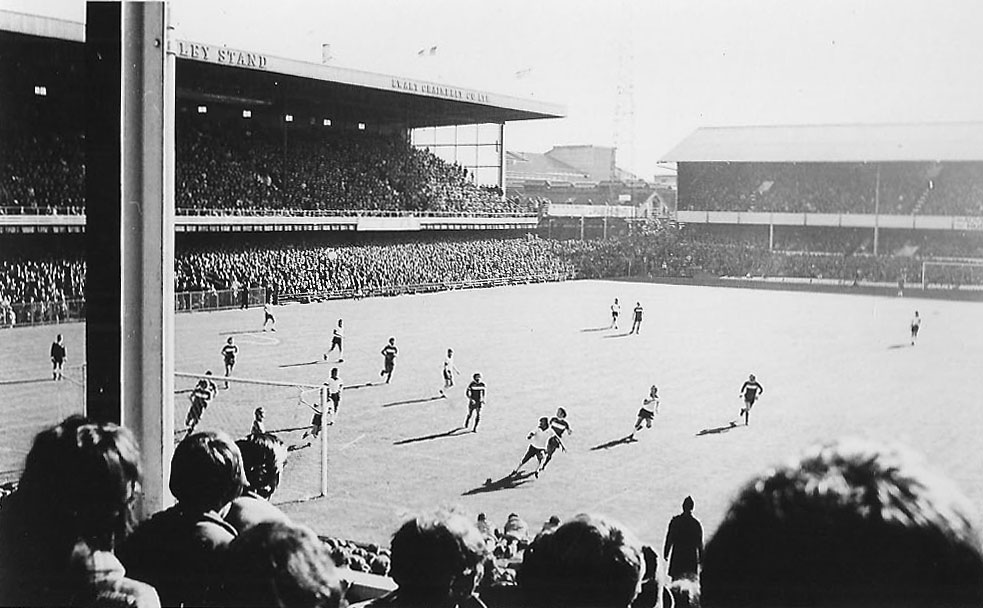
Today, the opponents are Middlesbrough, recently promoted to the First Division, and relying on tenacious defence to stay there. Here they are warming up before the match begins. The spectators at the back are in the Ley Stand, sitting upstairs, as it were, but standing in their thousands underneath. The “standees”, what a wonderful new word, are the away supporters from Middlesbrough:

B four more police horses photo 4

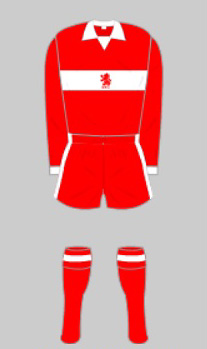
Middlesbrough played in all red with a white chest band:

1973

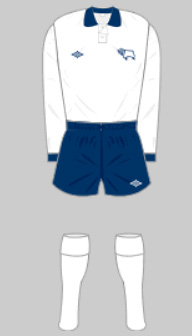
Derby played in white and dark blue:

derbyxxxxx.jpgjjjjjjjjjjjjjjjjjjjjjjjjjjjjj

Middlesbrough have already come out for the game, but here come Derby, resplendent in their white shirts with a darker collar and cuffs,

C four more police horses photo 1

Here is the moment just before Derby kick off to start the game. At the far end is the packed Normanton Stand:

D football x four - C photo 2

Hooliganism was rife in the 1970s, and here the supporters next to me in the Osmaston Stand, Lower Tier, are obviously bored by the game, so they concentrate on a threatened pitch invasion by the Middlesbrough  fans:

E photo 1

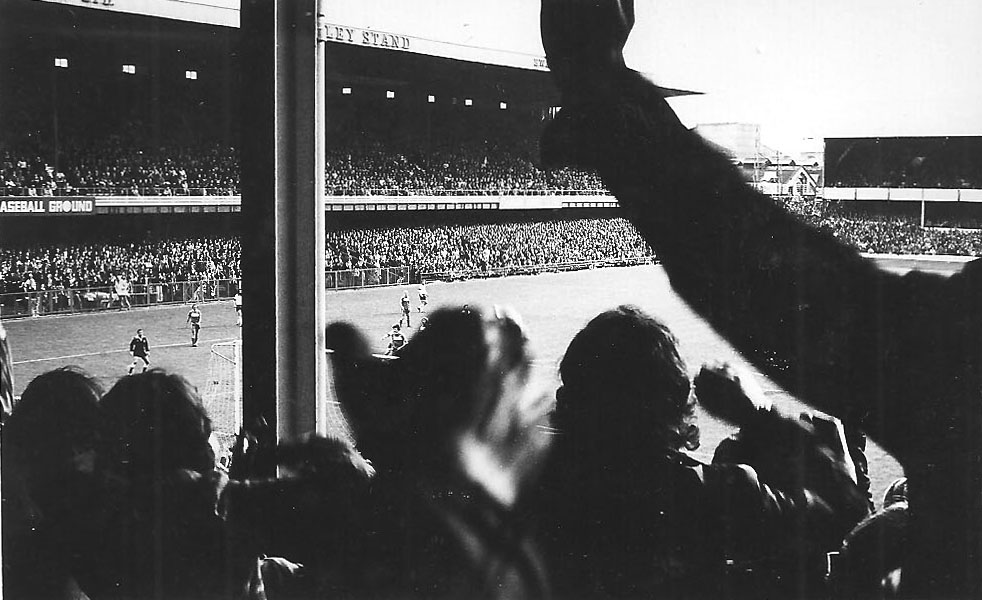
Here Derby attack, and their best player, Kevin Hector, has a shot at goal:

football x four - photo 1

He shoots, he scores!

photo 2

I thought the result of this game was Derby County 3 Middlesbrough 2 but apparently, when I checked my reference books, it actually finished Derby County 2 Middlesbrough 3. They are useless books and I may throw them away.

12 Comments

Filed under Derby County, Football, History, Personal

Fashion in Nottingham in 1776

As well as the material I discussed in one of my previous articles, there is plenty of interesting fashion news tucked away in “The Date-Book of Remarkable and Memorable Events connected with Nottingham and its neighbourhood” by John Frost Sutton. This time, it is for 1776, and it concerns, if I interpret it correctly, informal wear for ladies.

“The Nottingham Journal of this date gives the description of ladies’ undress for August:

“The ladies’ fashionable undress, commonly called a dishabille (sic)”.

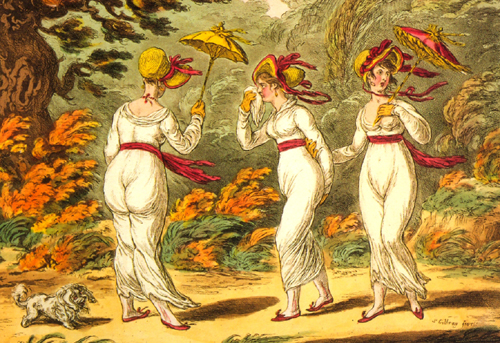
Here is a satirical portrait of dishabille entitled “The Three Graces in a High Wind”:

dishabuill marie antoin satire

Some young gentlemen also clearly appreciated that there were varying degrees of dishabille:

dishabille late 18

Back to the story:

“(Ladies’ fashionable undress is…) to pay visits in the morning, also for walking in the country, on account of its being  neat, light and short, consists of a jacket, the front part of which is made like a sultana; the back part is cut out in four pieces; the middle part is not wider at the bottom than about half an inch; the sides in proportion very narrow”:

muslin 1810

“The materials most in vogue, are white muslins with a coloured printed border chintz pattern, printed on purpose in borders about an inch deep. The silks, which are chiefly lute strings, are mostly trimmed with gauze, The gauze is tucked upon the bottom of the jacket, and edged with different coloured fringes. The petticoat is drawn up in a festoon, and tied with a true lover’s knot, two tassels hanging down from each festoon. A short gauze apron, striped or figured, cut in three scollops (sic) at the bottom, and trimmed round with a broad trimming closely plaited; the middle of the apron has three scollops reversed. The cuffs are puckered in the shape of a double pine, one in front of the arm, the other behind, but the front rather lower.”

02 1812 walking dress

“To complete this dress for summer walking, the most elegant and delicate ladies carry a long japanned walking-cane with an ivory hook head, and on the middle of the cane is fastened a silk umbrella, or what the French call a parasol, which defends them from the sun and slight showers of rain. It opens by a spring, and it is pushed up towards the head of the cane when expanded for use”:

judy-st_-louis-swiss-dot-summer-dress

“Hats, with the feathers spread, chiefly made of chip, covered with fancy gauze puckered, variegated artificial flowers, bell tassels, and other decorations are worn large. No alteration worth notice has taken place in gentlemen’s dress except that they increase the size of their hats, and cock it in the German military style.”

_foster_1786
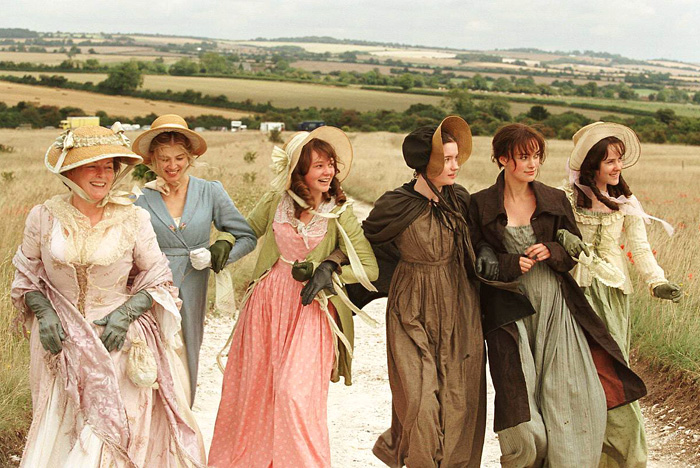
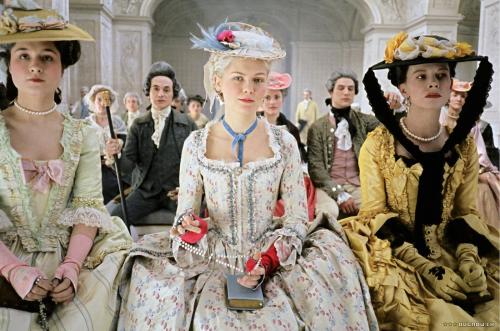
I’m afraid that there is quite a lot here that I do not understand. I suspect that many of the technical terms have been lost in the intervening 240 years. To me, for example, “sultana” is either a brown fruit or a large woman who is the wife of the sultan. Neither of them are much of a match for the front of a jacket. Anyway, I have not been able to put too many pictures in, because much of the text remains unintelligible to me. On the other hand, this is what the world of the cinema offered as their version of the informal dresses of the late eighteenth century and the Regency periods:

pridse ands prejudice film

It’s so sad, though, that they couldn’t find the eighteenth century countryside to go with it. And couldn’t they have avoided including a group of caravans when they did the filming?


19 Comments

Filed under History, Nottingham

Heil Hitler Episode 1

“The only thing necessary for the triumph of evil is for good men to do nothing.” is a famous quotation attributed to Edmund Burke, the statesman, author, orator, political theorist, and philosopher.
A good example would be this photograph showing the England football team just before a friendly game at the Olympic Stadium in Berlin on May 14th 1938:England-Germany 1938 nazi.xsderftgyhb

The fixture was played before a crowd of 110,000 people, but clearly, the Englishmen are not waving to their German admirers. This is the Hitler-Grüss. The English players are all saluting Adolf Hitler, arguably the most evil man ever born. Why did the footballers do this? Surely they were good men? Why did they do nothing? Or was Stanley Matthews, a hero to millions of young boys, an evil man?
Well, the truth of the matter is that the British Foreign Office had actually ordered them to salute the Führer, Adolf  Hitler.


Six months before, Naughty Hitler had marched his armies into Austria, the home of the waltz and the cream cake, and annexed this defenceless little country, the so-called “Anschluss”.

The Foreign Office wanted to assure Hitler that, even though he kept invading places, Germany was not a “pariah” state. Hopefully, if Adolf was kept sweet by an England team which saluted him, he would look favourably on Neville Chamberlain’s government and their policy of appeasement:

“You’re very naughty, Adolf, but as long as you promise it’s the last time, we’ll overlook it.”

The “Peace in our Time” deal must go through.
Germany’s football team was very weak at this time, but Austria’s was not. In 1934, they had finished fourth in the FIFA World Cup, and in the Berlin Olympics of 1936, they had finished second, losing to fascist Italy in the final. Austria qualified for the 1938 World Cup, but on March 28th 1938, they were forced to withdraw as the country no longer existed. The theory was that after Anschluss,  the Austrian players would all play in the German team.

First though, the two countries would play a last match for Austria, a “reunification derby” which would unite the two countries and their respective football teams for ever. Not surprisingly perhaps, the game was planned to finish as a draw. The Austrians, though, all of them good men, would not stand idly by and do nothing, but instead they scored two goals in the last few minutes in a successful  effort to win the game and put the Nazi noses out of joint.

To humiliate the Germans even further, the Austrians’ absolute star player, the thoughtful Matthias Sindelar, scored one of those two Austrian goals, and then celebrated extravagantly in front of the senior Nazi dignitaries watching the game. The latter already knew about the kit controversy. Both Germany and Austria usually played in white shirts and black shorts, but Sindelar, for what he thought would be the country’s last ever game, had insisted on Austria playing in the same colours as the national flag, red shirts, white shorts and red socks. Red, of course, was not a particularly favourite colour of the Nazis.

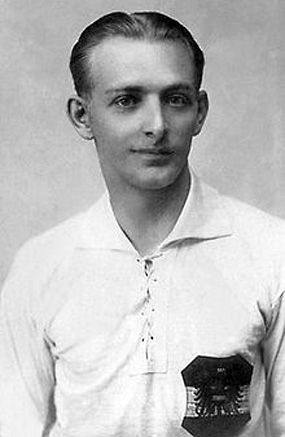
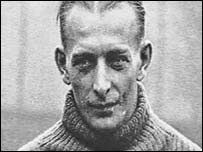
Here he is. Matthias Sindelar. He was so thin, so pale and fragile, that his footballing nickname was “The Man of Paper”. He was, though, a good man who refused to stand idly by. A real “Man of Steel”:

220px-Sindelar-aut

At the very end of the game, Sindelar deliberately and obviously missed an easy chance which would have made the victory an even wider one. Afterwards Sindelar refused to play for the German Reich, giving either his extreme age of 35 or injury as an excuse.

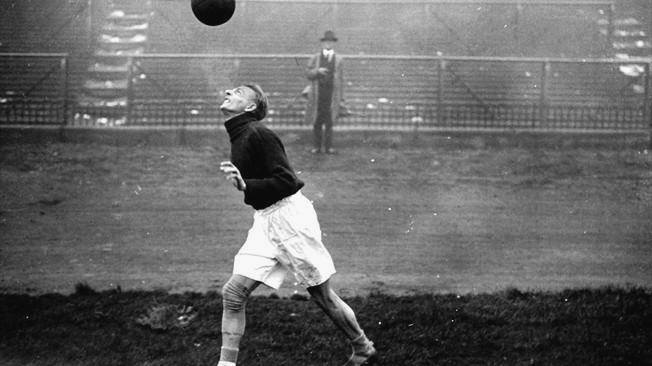
head tennis

Not totally surprisingly, perhaps, Sindelar was dead within the year. He died on January 23rd 1939. By now he was a symbol of Austrian patriotism, and his Gestapo file listed him as being pro-Jewish and a Social Democrat. The Gestapo also watched his café twenty four hours a day.

No wonder, therefore, that the heating system in his flat should fail, the problems allegedly being caused by a defective chimney. As he lay in the arms of his girlfriend, Camilla Castagnola, therefore, they both died of carbon monoxide poisoning.
That Sindelar’s death was a suicide as a protest against the German Anschluss of Austria was suggested by, presumably, pro-Gestapo elements, but that was just not true. Decades after the event, we now know, thanks to the confession of Egon Ulbrich, a lifelong friend of Sindelar, that a petty local bureaucrat was bribed by the Nazis to record his death by Gestapo as a mere accident. Here is Sindelar’s grave, still visited regularly by many people today:

grave_Matthias_SindelarMatthias Sindelar is one of my favourite players.


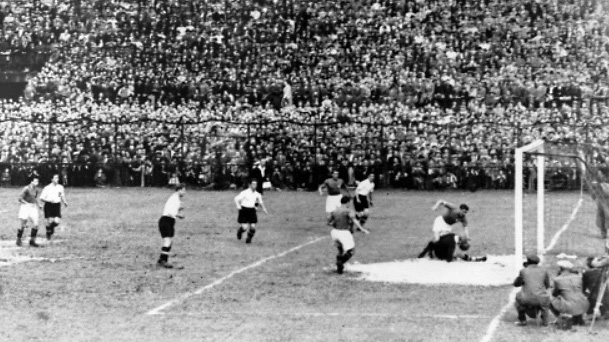
He had played centre-forward many, many times for the Austria team of the 1930s. They were known as the “Wunderteam”, and Sindelar was their captain at the 1934 World Cup, where they were cheated out of it in the semi final by match referee Eklind. Austria’s phenomenal goalscorer, Josef Bican, (at least 1468 goals in 918 games) maintained all his life, until he died in 2001, that Eklind had taken cash inducements from the Italians. And Bican was perhaps justified in his belief. On one occasion during the match, he passed the ball out to the Austrian right winger only to see it intercepted and headed down to an Italian….by the referee!

Here is one of the few pictures of the game. Some nice cotton wool seems to have been provided for the Italian goalkeeper to stop him getting bruised:

copyright

Sindelar was one of the greatest footballers of the decade, famous for his fantastic dribbling skills and the creativity of his passing. He had two brilliant nicknames. We know already what “Der Papierene” means. The “Man of Paper”:

sindelar

But Sindelar’s precocious skills would also lead to his being called “The Mozart of Football”.

mozart
In 1999, Sindelar was voted the best Austrian footballer of all time. He had already been named Austria’s sportsman of the century a year before. Sindelar even now, is still ranked as the world’s 22nd best ever footballer. Overall, he scored 26 goals in his 43 matches for Austria, and won one Austrian championship with SV Amateure in 1926, two Austrian Cups with Amateur-SV in 1925 and 1926, and three with FK Austria Wien in 1933, 1935 and 1936.

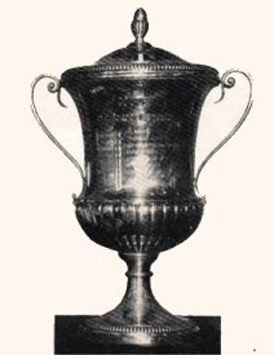
There was no European Cup then, but Sindelar won one of its predecessors, the Mitropa Cup or Central European Cup in 1933 and 1936 with FK Austria Wien.

mitrop

In 1932, he won the Central European International Cup, a predecessor of the UEFA European Championship.
Participants were Austria, Czechoslovakia, Hungary, Italy, Poland, Romania and Switzerland.
Matthias Sindelar was certainly one who did something to prevent, or at least, slow down, the triumph of evil. And ultimately, he paid with his life.

26 Comments

Filed under Criminology, Football, History, Personal, Politics

Warren Herbert Cheale

Warren Herbert Cheale, who lived with his family in Burton Joyce, moved to the High School in January 1944 to work as an Acting Pilot Officer with the School Flight of the Air Training Corps. He was a member of the Royal Air Force Volunteer Reserve:

RAF

On Thursday, September 7th 1944, while away at camp at Wenlock in Shropshire with the boys from the High School A.T.C., poor Warren was killed in a flying accident. He was only 44 years of age.  He left a widow and a teenage son and daughter. Despite his short stay at the High School, one of the boys described him as “one of the nicest people we had ever met”.
Warren, who was born in the first three months of 1900, seems to have been quite a colourful character. He lived originally at a house called Redhill in St. Helen’s Crescent. Hastings, in Sussex and the first mention of him that I can find seems to be at the age of three when, on November 28th 1903, he played the important part of Bubbles in a local production of Little Red Riding Hood:

little_red_riding_hood_and_wolf1

Not very long afterwards, Warren joined up for the Great War and eventually found himself in the Royal Flying Corps.

During this era, British pilots were not allowed to wear parachutes, so Warren must have thought his death was imminent when he was involved in a mid-air collision at an altitude of over two thousand feet. The two planes must have either spun or perhaps fluttered down to earth, though, because Warren escaped with his life. That life, however, was perhaps affected by Post Traumatic Stress Disorder to some extent. It is difficult to imagine that anybody could go through an experience like that and remain completely unaffected.

Fokker-DVII-Crash

On July 29th 1925, Warren married Alice Elisabeth Unwin at St. Martin-in-the-Fields Church in London.

Warren then seems to have remained in the new Royal Air Force, because the next mention seems to be in the Hastings and St Leonards Observer (Hastings, East) for June 28th 1930. Listed as a mechanic, he appeared in the local magistrates’ court, along with a young friend, who lived in the School House, North Street, Hornchurch. Both were found guilty of damaging a crop of rye in a local farmer’s field, a rather bizarre mark to leave on the pages of history, perhaps.

Certainly from 1931-1934, Warren continued to live in Hastings and St Leonards, presumably with his wife. It was a lovely place:Hastings_english_school_xxxxxxxxxxxxxxxxxxx1

Warren played local cricket, both as a batsman and a bowler, although life did not always go well. For whatever reason, his wife Alice Elizabeth filed for a divorce at the London Divorce Courts in 1936. The divorce may not have gone through, because the report contains the annotation, [wd] which may well have meant “withdrawn”.

Perhaps the family then moved northwards to Nottingham as a new start, hoping to put their marital difficulties behind them for the sake of the children.

Alas, we will never know, because 21 PAFU ORB reported on that fateful September evening:

“Flying accident at Wheaton Aston. An Airspeed Oxford LX509, with Flight Lieutenant Harrison as instructor, and Pilot Officer Cheale (Air Training Corps) took off for a night flying test from Wheaton Aston and was seen to dive into the ground shortly afterwards. Both occupants were killed instantly as a result of injuries sustained.”

Here is a general map showing the location of Wheaton Aston airfield:

wheaton aston

At the time, the Airspeed Oxford was considered to be, potentially, a rather dangerous aircraft to fly:

Airspeed_Oxford

Although designed as a twin engined trainer, and supposedly extremely docile, it could be, in actual fact, a rather unforgiving aeroplane.  Many aircraft used in RAF Training, of course, were well past their sell-by date and poorly maintained. These factors may well all have been contributory to the deaths of these two men. In actual fact, in the North Midlands, during the course of the Second World War, the majority of fatalities occurred in either Airspeed Oxfords or another old stager, the Vickers Wellington bomber. To help the situation, Oxford trainers were painted a conspicuous yellow:

Airspeed_Oxford_V3388_yellow

The crash location on the Accident Card for this particular incident is given as:

“At Colonels Covert?, Hatton Grange, Ryton. Map Reference OS765036, just south of Hatton Grange, to the north of Ryton and just south west of RAF Cosford”.

Here is a map which shows Hatton Grange:hatton

The verdict of the official  inquiry was that:

“It is not possible to form a conclusion. Investigation has not revealed the cause of the accident.”

The crew of the Oxford were:

“Flight Lieutenant Sydney Donald Harrison, aged just twenty one. He is buried in (St Ediths) Churchyard, Church Eaton, Staffordshire. He was commissioned as a Pilot Officer on February 5th 1943.

Sydney  was the beloved only son of Mr and Mrs Donald Harrison, Two Trees, Hernes Road, Oxford and the grandson of Mr and Mrs T E Clarkson, The Villa, Rancliffe, near Goole.

Pilot Officer Warren Herbert Cheale (177869), RAFVR, was aged forty four. His death is commemorated at the Nottingham Crematorium. No next of kin was given at the time.”

When application for a ‘Grant of Probate’ for Warren’s will was made, his address was listed as 123 Church Drive, Burton Joyce, Nottinghamshire. This is the Main Street in that lovely village:

18679784

Interestingly, when Probate was granted on February 13th 1945, it was not to Alice Elizabeth, his presumed wife from the 1930s, but to “Rose Cheale, widow”. Perhaps that divorce had actually gone through in 1936, and this was Warren’s new wife.

Two men had paid dearly, therefore, for the High School Flight of the Air Training Corps’ week long stay in Shropshire for their annual training.  They had been accompanied by at least one member of the academic staff, Mr D.C.Whimster, who was a Master at the school from 1939-1945. He was Form Master of the Fifth Form A, and may have been a teacher of English. In reminiscences published in the school magazine, the writer says, talking of drama productions:

“I wish the Society would tackle “The Knight of the Burning Pestle” again, with its greater resources and experience. Mr. D. C. Whimster’s production was interesting and creditable.”

The High School cadets were also accompanied by a person named in RAF reports as Pilot Officer Alder (Air Training Corps). This may have been somebody who normally worked at Wenlock, but I strongly suspect that this is a mis-spelling of the name of a second member of staff, namely Mr S.Allder who worked at the school from 1940-1946. As his name was “Stanley”, the boys, ever inventive, apparently called him “Stan”.

And so Warren Cheale’s extraordinary luck came to an end. In the Royal Flying Corps in 1918, he had somehow managed to avoid what must have seemed to him, as he fell earthwards for thirty seconds, perhaps a minute, a horrific and unavoidable death.

But this time, almost thirty years later, the Gods of the Air had claimed him as their own:

aerspeed


20 Comments

Filed under Aviation, Bomber Command, History, Nottingham, The High School

The Gateshead Gnomes, and more Little People

Liverpool and the leafy parks and graveyards in its suburbs was not the only place to be involved in the Great English Fairy Flap of 1964.

In June 1964, strange things started happening in Gateshead, a very ordinary, humdrum town in the north east of England. It is a suburb of Newcastle-on-Tyne, where polar bears and walruses (or should that be “walri” ?) roam regularly in colder winters. Look for the orange arrows:

This slideshow requires JavaScript.

At ten past four in the afternoon of June 2nd 1964, four boys were playing together in Leam Lane Estate, Gateshead. This looks a fairly desolate site, right on the shores of the freezing, windswept North Sea:

leam laneee

Looking at the map, though, as it does have one or two of the features that would link it with Celtic fairy sites, and indeed, with the old idea of dimensional portals out of which ghosts, goblins, UFOs and lots of other exciting beings may emerge:

leam lane

First of all, it is (or was then)  heath covered waste land with gorse and bracken, the very landscape beloved of fairies in Cornwall. It also has a very ancient Roman road, which would have been built directly over a Celtic track. Indeed, the reason that Roman roads across Western Europe are so unbelievably straight, is that Celtic tracks were. Quite a link, therefore, with times long, long ago.

Another indicator of pathways into other dimensions is the presence of any natural water, such as streams, and, for me, what clinches the deal, a natural spring. (that is what the blue “spr” stands for, at the centre bottom of the map). You can’t tell from this map. but I have looked at some larger scale ones, and the area also has a couple of cemeteries, absolutely classic places for crossing over into other realities.

Back to those four boys who were playing together at ten past four on that early June afternoon. They reported having sighted:

“a silver domed object about the size of a table, with portholes around the top and three legs. It was seen falling like a leaf through the sky making a low buzzing noise descending approximately 120 yards away from where they were standing.”

Here is the closest the Internet has to offer. It is in actual fact, the new Smart Car:

ufo-progress19

At half past five in the evening, another, fifth boy, Mark Smith, aged 14, decided to walk down to the farm to collect some straw for his rabbits. When he arrived, he saw a group of around ten children, standing about twenty yards away from a haystack. This was followed by the startling sight of:

“around six or eight tiny human beings on top of the stack: they were about two and a half feet tall and dressed in bright green suits. They appeared to be digging into the haystack, as if searching for something. Their hands seemed like lighted electric light bulbs.”

Alpha-7-CLOSE-2

Mark went home and told his parents what he had seen and decided to make his way back to the scene, but he was stopped by the farmer. Mark says that he was told by another child that:

“she had seen a circular silvery object take off from the ground with a spinning motion giving off an orange glow.”

flpalmharborpark8jan13_

On June 6th, 1964 several members of the local UFO Organisation visited the locality concerned and spent some considerable time speaking to many of the residents and children about the matter.

One child who admitted having seen “the little green men” told them:

“the leader of the little men was dressed in black and carried a baton with pink stripes.”

Another girl claimed:

“He was sitting on the roof of the barn watching us.”

Another girl told them that she had seen ‘him’ riding on the back of a cow whilst others claimed the whole thing was a hoax. The farmer who owns the land said

“All the claims are a load of nonsense. If anything has landed I would’ve known about it. I have a dog kept in the yard, he would warned me if anybody had been prowling around the farm.”

And that was not the end of it. Three months or so later…

It was claimed that a “Leprechaun” had been sighted in Tamar Street East in Belfast on or about September 10th 1964.

leprechaun

In fact, this particular Little Green Man was later identified as six-year-old Billy Knowles.

A-Little-Boy-Wearing-A-Green-Robin-Hood-Costume

He was playing at Robin Hood, dressed in his nice new costume:

robin-hood-costume

He was playing in a derelict house, something Belfast was not short of at the time:

Dumurray-Blaze-1_-Lewis

Poor little Billy was soon chased away by police who were frightened for his safety.

Too late!!!

The hint of a real life Leprechaun, and a real life pot of gold, triggered off the local people’s imaginations. Vast numbers of them descended into the streets causing massive disorder. Ironically the crowds that gathered there included not just children, but many adults. The incident, which involved the police and the fire service in some numbers, also attracted the presence of David Bleakley, the Labour MP for Victoria, who handed over a hastily written petition to Belfast Corporation, demanding action to keep the crowds and children away from the embankment and the many derelict houses there. One senior police officer was quoted as saying:

“A grown man, cold stone sober, insisted to me that he had seen a leprechaun.“

17 Comments

Filed under History, Humour, Personal, Science

The Avro Lancaster at Duxford, January 28th 2009

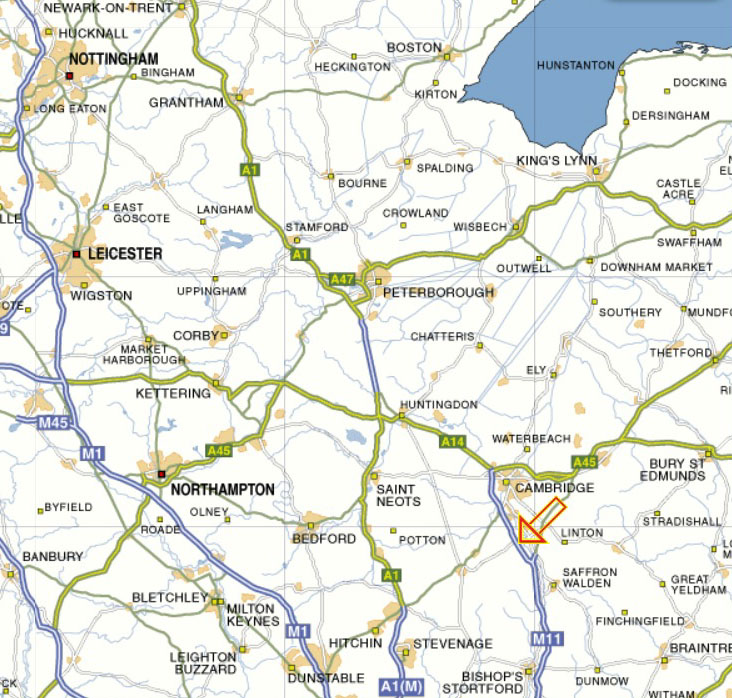
A few years ago, when I was still a teacher, along with four other teachers and more than a hundred members of Year 9, we all went in two coaches to Duxford near Cambridge to see the Imperial War Museum.  Look for the orange arrow:

duxf

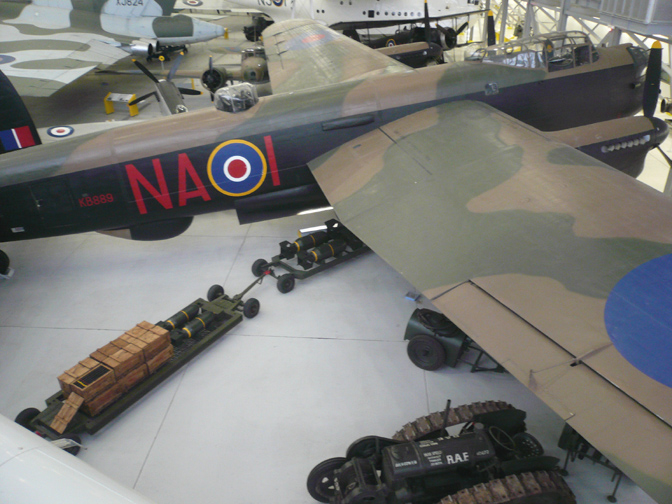
None of you will be surprised that the very first plane I rushed to see was the Avro Lancaster. The planes are rather crowded together, but there it was:

P1100840XXX

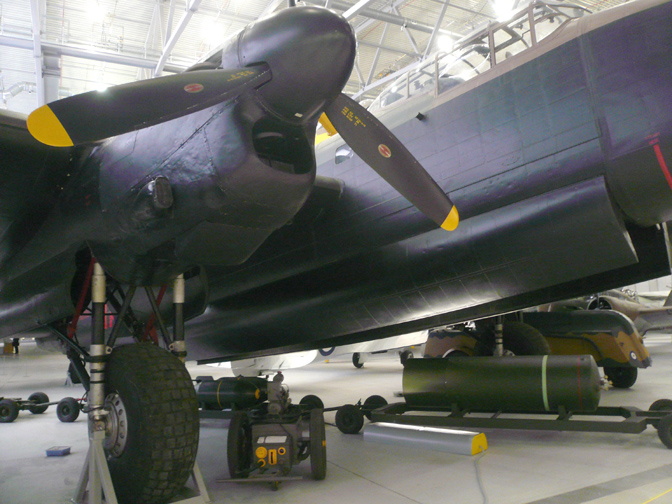
There were trolleys and a little tractor to transport the bombs to the bomb-bay:

P1100858XXX
The bomb-bay is enormous, and eventually would be capable of taking a ten ton bomb, the “Grand Slam”:

P1100923XXX

The green cylindrical bomb in  the background in the below photograph is a blockbuster bomb or “cookie” and weighs 4,000 pounds which is around two tons. Quite often two of them were strapped together to make an 8,000 pound bomb. On occasion three of them would be bolted together to make things go with a real bang:

P1100930XXX
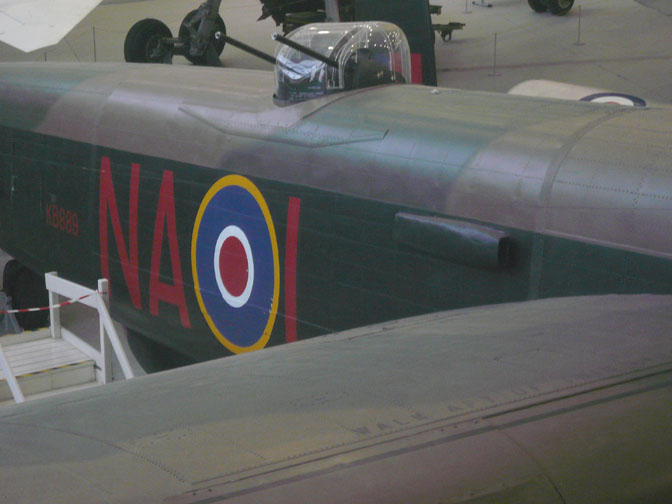
This is the mid-upper turret, armed with two .303 Browning machine guns. The gunners were seldom particularly happy that a target was provided underneath for the Luftwaffe night fighters to aim at:

P1210201XXX
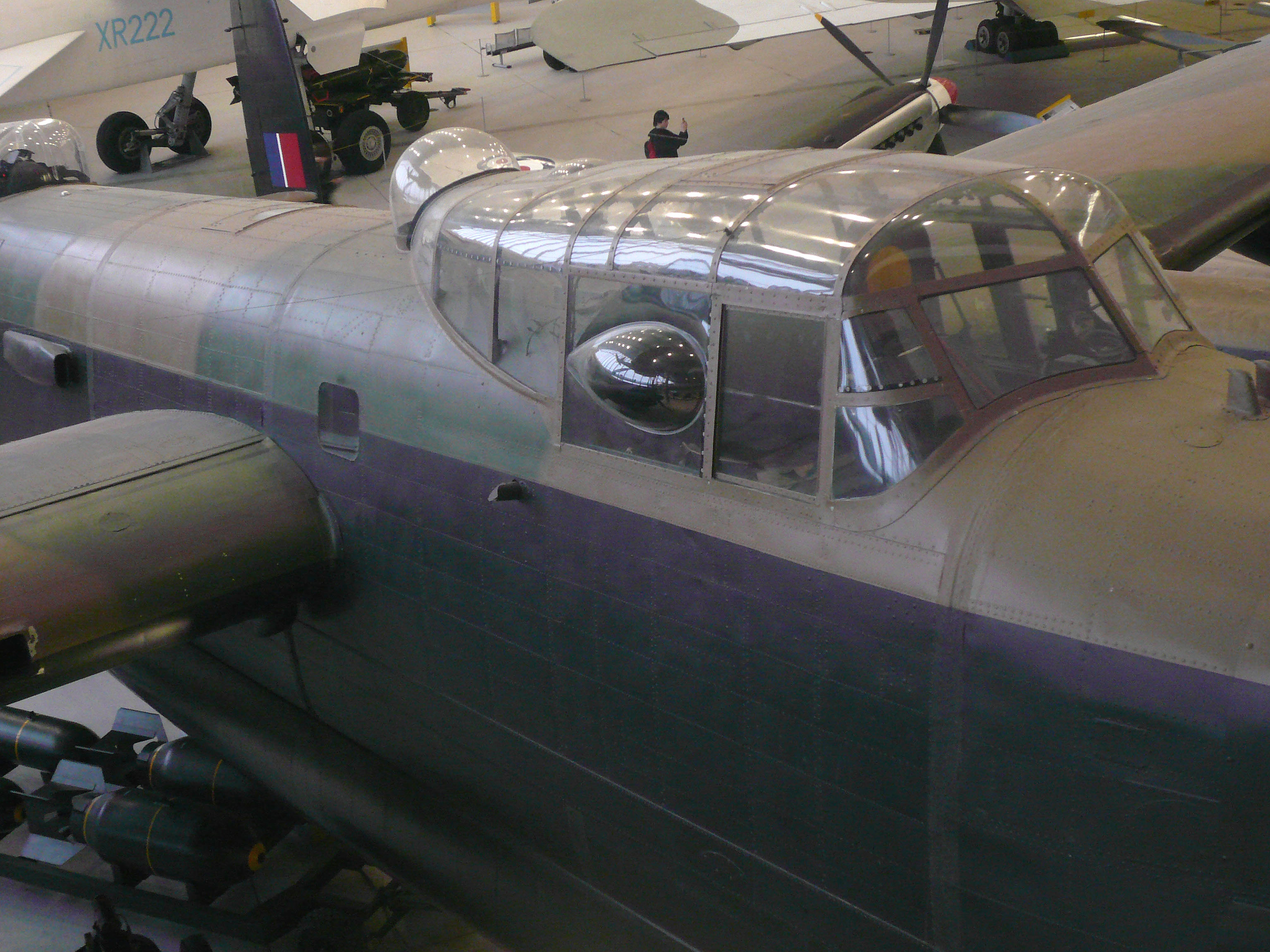
This is the radome, behind the cockpit canopy. On more than one occasion my Dad would stand there. looking out, as the bombers all taxied out to the end of the runway for the take-off. My Dad was abundantly aware of the enormous casualty rates in Bomber Command, and more than once he wondered to himself how many of the aircraft he could see slowly making their way to the runway to take off would be coming back in the morning:

vera

Overall, Bomber Command lost 8,325 aircraft to enemy action. A total of 55,573 young men, all of them volunteers, were killed, a casualty rate of 44.4%. Of every hundred airmen, 55 were killed, three were injured on active service, 12 became prisoners of war, two were shot down and made their way back to England and 27 survived. One of the two reasons my Dad was one of those 27 fortunate young men was the fact that he flew in Lancasters. “A Lanc will always get you back” he told me on more than one occasion. I owe my own existence, therefore, to the excellence of the Avro Lancaster.

taxi

Sooooo….when the moment was right, a fat old man quickly jumped over the rope, walked up to KB889, gave it a good pat and said “Thank you for my life”.
There will, however, always be some idiot child who is seduced by the flighty, undependable glamour of fighter aircraft and who will stand there taking photographs of Spitfires until the bus leaves. Just look at him in this photograph here:

.
P1210197XXX

24 Comments

Filed under Aviation, Bomber Command, History, Humour, The High School, Writing

The Glossy Ibis ; a rare bird in Victorian Nottinghamshire

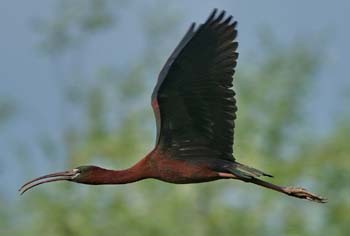
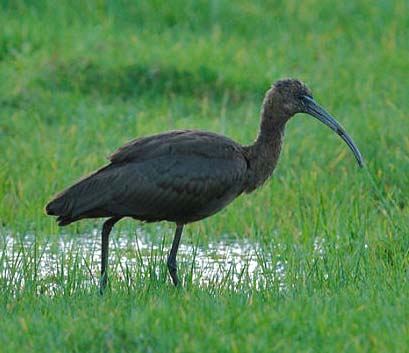
Glossy Ibis is a bird from warmer, southern climes such as the Mediterranean. Even nowadays, it is quite a rare species in the county:

glos ibis

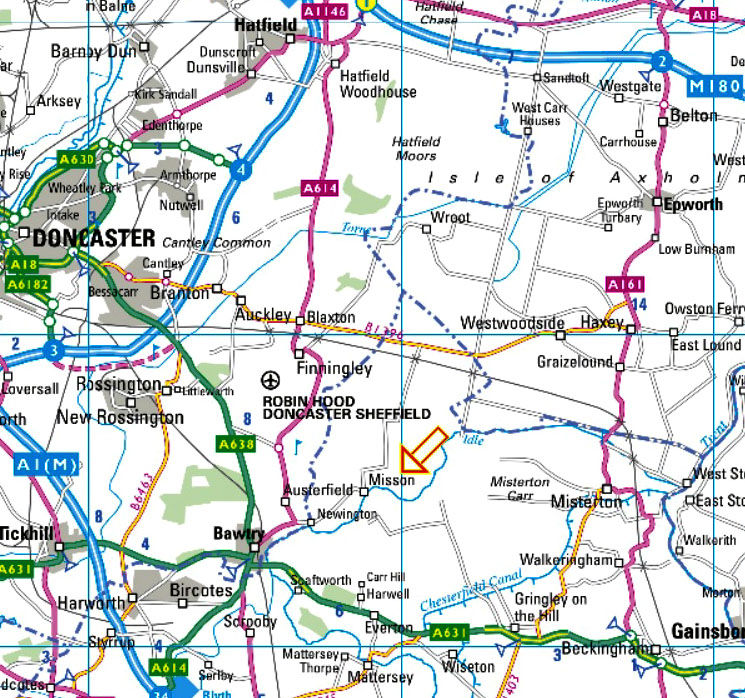
On October 27, 1909, a single bird was shot by Fred Smith at Misson in the very north eastern corner of the county, almost in Yorkshire. This latter county had, for reasons unknown, received an influx of at least fourteen birds during this month of October 1909.  The orange arrow marks the spot. The county boundary with Yorkshire, to the north west, is indicated by the perforated line and must be only a few hundred yards away:

Untitled

Two interesting letters to Joseph Whitaker tell the story.

Dear Sir,
I have the pleasure of dropping you a line in reply to yours, duly received. A man named Fred Smith, who I fear is a shocking poacher, shot the bird, Glossy Ibis, in question. His wife took it to a game dealer, at Doncaster, whose name is Borrill, his shop being in St Sepulchre Gate . He gave her the large sum of one shilling for it, after endeavouring to get it for sixpence.
A doctor bought it from Borrill and is having it stuffed for the museum. I am sorry to have forgotten the doctor’s name, but no doubt the game dealer would tell you if you wrote him. You will forgive me, I hope, for not knowing your book.
I also love birds and used to keep a great many – once I had 46. We still have a few in a good-sized aviary in a greenhouse and my little daughter aged 11  is much interested in birds and has lately acquired several volumes at a cost of £3.10 shillings on the subject.
Yours faithfully,
FW Keane

Glossy_Ibis_1700_e

Joseph Whitaker followed the clues and two months later, he received further information from Dr Corbett himself:

9, Priory Place,
Doncaster
11. 11. 09

Dear Sir,
Mr Borrill showed me your letter re-the Glossy Ibis. All I know of it is that it was exposed in his shop with other wildfowl & I was, fortunately for me, the first to “spot” it & purchase it for the local museum of which I am the curator. If ever you are in Doncaster I shall be pleased to show it to you.
Yours truly,
HH Corbett

Anybody who missed that dead specimen in Doncaster in 1909 had a very long wait to see another Glossy Ibis in Nottinghamshire. In the winter of 2013-2014, a single bird was seen in a flooded roadside field next to the Peugeot Garage in Lowdham, near to the River Trent in the south of the county. southern Nottinghamshire:

lowdham

Most people who wanted to see a Glossy Ibis were able to watch this particular individual which was very amenable and reliable in its appearances. It attracted a steady stream of admirers, and was very easy to see::

Watching an Ibis copyright a

A more spectacular species of Ibis to occur in  Nottinghamshire in the future might well be the Sacred Ibis. This bird normally lives in sub-Saharan Africa, but, in actual fact, there is a healthy feral population in western France. It would not be outrageous for them to cross the Channel:

Ibis

14 Comments

Filed under Criminology, History, Nottingham, Science, Twitching, Wildlife and Nature

Fashion in Nottingham in 1760

In recent months, I have been completely hooked by “The Date-Book of Remarkable Memorable Events Connected With Nottingham and Its Neighbourhood 1750-1879”, by John Frost Sutton. It records a world so similar and yet so different to our own. Fashion, for example:

“Here are a few words explanatory of the costume of the period. The dress of the upper and middle classes being then, as now, a model for those beneath, may be regarded as sufficiently indicative of the prevailing style.”

“Ladies were attired in stiff stays, tightly laced”:

Tight_lacing

“….tightly laced over the stomacher, and long in the waist, causing the upper portion of the figure to resemble the letter V.”

Like this:

white corset

The stomacher could usually be removed from one dress and transferred to another. In this way, it was possible to ‘mix-and-match’ designs and colours. Here are two stomachers of the period:

“The thinness of the waist appeared still more striking by the sudden fullness of the gown, occasioned by the hooped petticoat.”

Here are two hooped petticoats, both modern. One is structured horizontally, the other vertically:

Here’s the fullest dress I could find. And yes, that is a fabric called “cloth-of-silver”:

m 18th-century-court-gown-cloth-of-silver

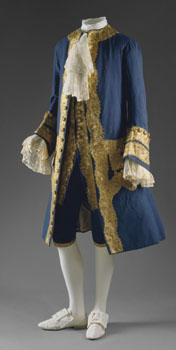
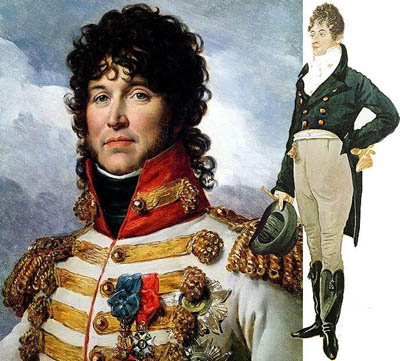
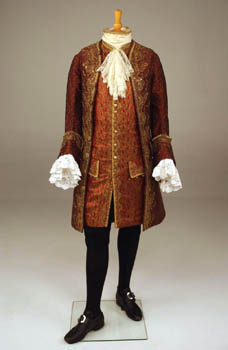
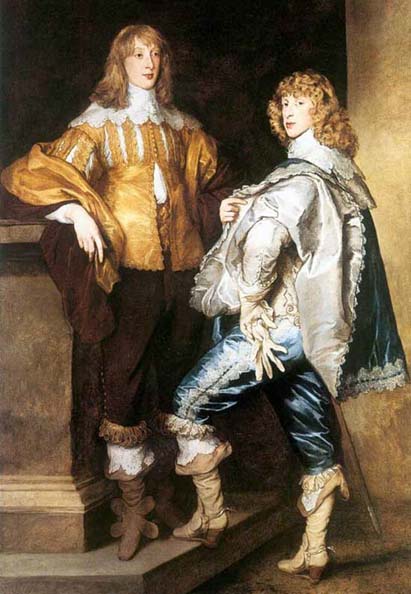
“A close head-dress, and shoes with high heels of divers colours, completed the ensemble. Gentlemen were much more gay in their apparel than would now be thought consistent with good taste. Claret-coloured cloths were deemed very handsome in the circles of high fashion, and suits of light blue, with silver buttonholes and silver garters at the knees, were quite in the mode.”

Here are two suits, one in blue and the other in claret. West Ham eat your hearts out:

“Perukes, of light grey human hair, were worn”:

“Dark hair was of no estimation whatever”:

dark wig

Men used to wear:

“A large cocked hat, called “the Keven Huller, which was about six inches broad in the brim.”

This was named after Keven Huller, a now long forgotten Austrian general who fought against the armies of the French Revolutionaries and then Napoleon himself, in the last decade of the eighteenth century.I  have been unable to find any picture of this fashionable hat from long ago. Men also wore:

“a square-cut coat, and a long-flapped waistcoat, and shoe-buckles of an enormous size”.

Here is a long waistcoat:

buckles

Here are some rather attractive shoe buckles:

sghoeds

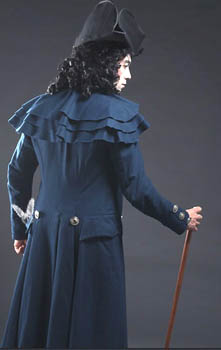
Their overcoat might be

” a heavy dragoon type with wide gold braid”

overcoat

I have been unable to find any picture of the type of hat with the so-called “Denmark Cock high at the back, low in the front and tilted forward” or indeed the “Dettingen Cock” or the “Monmouth Cock”  style of headgear.


15 Comments

Filed under History, Nottingham

Leprechauns in Liverpool

The fact that a small group of children in Nottingham claim to have seen gnomes in leafy Wollaton Park seems incredible, almost ludicrous, in the cold light of day, but it is by no means an isolated incident.

I have spoken in the past of so-called “UFO flaps”, when many sightings occur in just one small area. An example would be the Nottingham UFO flap of July 1967. Similar events occurred nationally in 1964, although this time it involved gnomes, pixies, leprechauns, fairies and their ilk rather than extraterrestrial spacecraft:

ufo-progress19

What was particularly bizarre though, was that the little people, who were seen in three separate places in England during the course of the year, were not closely linked with one particular city, but occurred independently hundreds of miles from each other.

And these widely separated events cannot possibly have been interlinked, because communication in those days was so limited and so private. Just letters or postcards. Telephones were a lot less frequent than you might imagine. You read only national newspapers or your own local paper. Local newspapers from distant cities were more or less unobtainable. The only television was national television… not really a medium for gnomes and fairies!

It sometimes seems that goblins and their ilk are part of our natural landscape and seem to pop out into our world on a rare but fairly regular basis. I presume that this is why nowadays a lot of modern folklorists tend to equate widespread ancient belief in gnomes and their various friends with our current widespread modern belief in space aliens, little green men and tales of abduction.

gnome-alone-trailer

It is this process of flitting between dimensions which remains the same over thousands of years, even if those who do it may have slightly differently coloured clothes and a vastly changed appearance.

And their activites are the same too. After all, how much difference is there between fairies who hold people hostage in their fairy realm and our modern tales of UFOs and extra-terrestrial kidnap?

Back to the simpler stuff.

On June 30th 1964, children saw varying numbers of “little men” in Jubilee Park, Liverpool. Here is the entrance to the park. No Leprechauns in sight yet:

jub park

Nobody knows exactly what the children saw. The little men had “white hats”, and were all seen to be enthusiastically throwing clods of earth at each other.
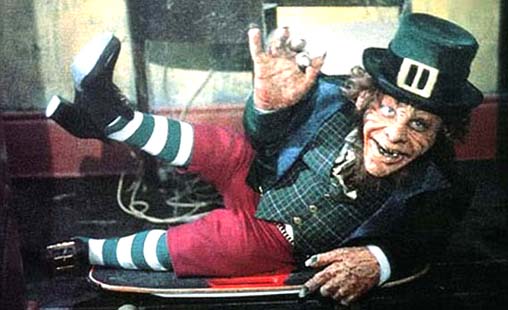
It took the children very little time indeed to put two and two together, and within minutes they had made a “Positive I.D.” and decided that the little men were, in fact, leprechauns.

chaun

Don’t just a few of the Leprechaun Community look really menacing? It spoils it for the rest.

The following day, July 1st 1964, all the local newspapers claimed that thousands of children had started a hunt, following reports that little green men or leprechauns had been seen near the Bowling Green in Jubilee Park on Jubilee Drive in Liverpool. This was in the Edgeline district in the eastern suburbs of the city. A huge orange arrow has been fired right into the middle of the Bowling Green. No Leprechauns were injured:

jubillee drive

Very soon, Members of the Police Community had to be called in to control the crowds:

volume

A nine year old boy told a reporter that he had seen little men in white hats, throwing stones and mud at each other on the Bowling Green. Another local boy, fourteen year-old David Wilson, claimed to have seen several small green creatures about two feet high running around a haystack on a farm near to the Edgeline Estate:

green alien

A little girl said:

“I was one of the school children that saw those leprechauns. I attended Brae Street School and we all saw them popping in and out of a window overlooking the school yard. There were about four of them, all tiny, dressed like a school book idea of a typical gnome and they sat swinging their legs on the window ledge getting in and out. What they were I don’t know. I only know what they looked like. I’d love to know the truth!!!”

Another child said:

“I remember the siege of St Mary’s Church when the police and Father Rose (or Father Spain) appealed for calm. I was one of the huge crowd of children shouting out “there they are”.
Someone said they had crossed the road into St Mary’s Infants School and were now hiding in the lockers (small cube-like cupboards). I never slept for days, and have had a fear of these type of cupboards to this day, which is still tested as my grandchildren’s nursery school use something similar.”

Nobody ever found the leprechaun who was sitting quietly smoking his pipe:

leprechaun

A further witness said:

“I certainly remember the leprechauns, and I actually saw a few of them on Kensington Fields, close to the library, but my parents and other adults tried to convince me that I”d been seeing things. This would be one afternoon in early July 1964, around 4.30pm, and I remember it as if it were yesterday. I was ten at the time and on my way to play football with my mates and saw these little (I’d say just a few inches tall) men dressed in red and black, standing in the grass, looking at me. I’m sure one of them had some type of hat on. I panicked and ran all the way home. My mum said there had been reports of leprechauns and little men on Jubilee Drive and Edge Lane the day before. That same evening crowds turned up on Jubilee Drive, and I remember a girl with a jam jar that she was going to put the leprechauns in!”

The Bowling Green was so crowded that the police attenpted to clear the park and to guard it from the bands of children who were tearing up plants and turf in the search for the little creatures.

Rimrose-Valley-Country

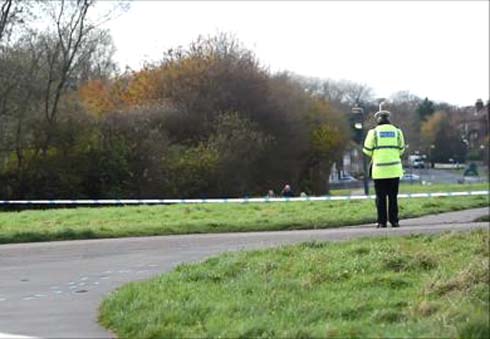
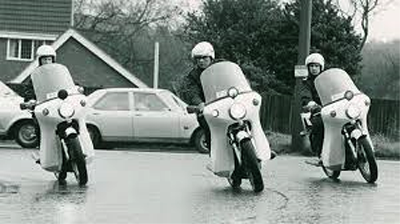
A rather bewildered Park Constable James Nolan had to wear a crash helmet to protect himself from the children throwing stones. At the time of the incident Constable Nolan was one of some fifty City and Parks Police Officers who patrolled the city on blue coloured Vespa scooters with a fixed radio mounted on it – in those days it was state of the art in police communications.

A local woman said to reporters at the time:

“This all started on Tuesday, how I just don’t know, but the sooner it ends the better. Stones have been thrown on the Bowling Green, and for the second night running no one has been able to play. The kids just won’t go away. Some swear they have seen leprechauns. The story has gone round and now we are being besieged by Leprechaun Hunters.”

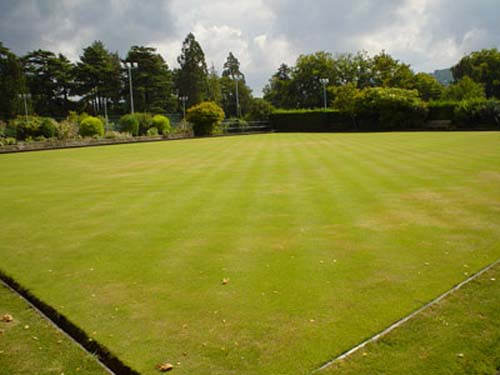
Here is the Bowling Green in more recent times:

bowling-green liver

Such was the desperation of the children’s search that the police had to set up a temporary first aid shelter to treat at least a dozen children who suffered from cuts and bruises. The evening newspapers described the strange visitors as “little green men in white hats, with rhinestones and hurling tiny clubs of earth at each other.”

Thousands of children organised an extensive hunt for them, tearing up plants and turf, scaling surrounding walls, and searching empty houses well beyond the boundaries of Jubilee Park. Eddie McArdle  recalled:

“I remember the story well as I have a scar as a constant reminder of the event. We, the kids from St Marie’s, Kirkby, went en masse into the church and as we hunted the little people, some bright spark shouted that they were coming out after us. Panic ensued and as we all fled quicker than we entered. A boy who is sadly no longer with us swung the church gate in his haste to escape, and I was hit on the forehead by the metal cross on it. The lad, Danny Callahan, didn’t even know he had injured me as he was well up the street and along Elric Walk where I lived. I had to have my head stitched by Dr Cole. As far as I know I was the only person injured by the little visitors. “

Life was getting no easier for Park Constable Nolan, who called in the City Police. Constables in cars and on motorcycles arrived.

untitled

They again attempted to clear the hundreds of youngsters from the bowling greens, which were the alleged playground of the Leprechauns. But the youngsters still thronged there, toddlers to teenagers. They crowded onto the top of the covered reservoir for a better view of the bowling green. Tolerant policemen tried to get the youngsters to leave, but the children would not accept that there were no Leprechauns. Only at 10.00pm was the park finally cleared of children.

Over the next few days, thousands of kids visited not just Jubilee Park, but nearly all of the parks in the City. Some of the Leprechauns still managed to look a bit “iffy”:

Leprechaun_1_leprechaun

The Little People were seen in Abercromby Park, in Stanley Park, in Newsham Park, and in Sefton Park, where a 13-year-old girl said she even grabbed one little man but he slithered from her grasp and fled laughing.

In Kirkby it took almost a fortnight for the clergy and the police to clear more than two hundred children from the graves and tombs of St Chad’s Church where it was believed fairies were living. Certainly, witnesses had repeatedly seen elfin figures dancing in the moonlight and, a sure sign of the supernatural, a crop circle had appeared. A month or more afterwards trolls were repeatedly seen  outside St Mary’s Church in Northwood.

But then gradually reports became fewer and fewer and further and further in between, until the City returned slowly but surely to its humdrum normality.

I would have been unable to tell this long forgotten, and rather peculiar story, were it not for the very many places where it can be read in all of its very many different variations. Some of the links are all here in this short paragraph.

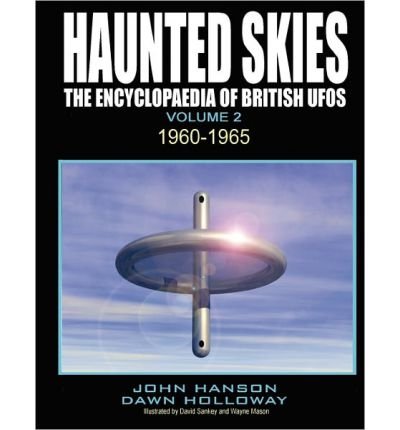
I found the story originally in one of a series of absolutely marvellous books by John Hanson and Dawn Holloway. This particular one is ““Haunted Skies: The Encyclopedia of British UFOs Volume 2 1960-1965”.  I would recommend these books most strongly:

volume


16 Comments

Filed under History, Humour, Science, Wildlife and Nature

More and more water, most of it under Trent Bridge (2)

Last time, I left you awaiting the arrival of Ragnar Lothbrok and his rather fierce friends in Anglo-Saxon Nottingham.

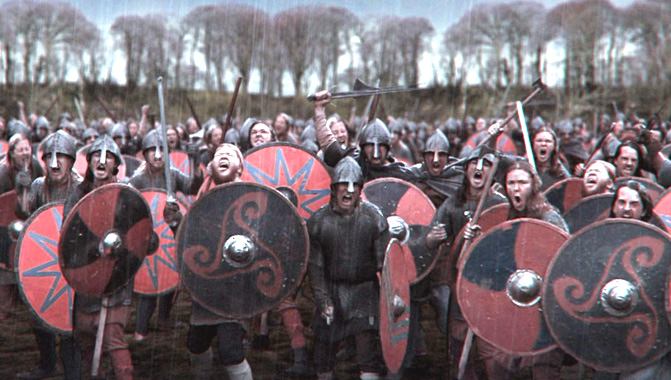
Well, by 867, Anglo-Saxon Nottingham had been well and truly captured by the Vikings and it became one of the Five Boroughs of the Danelaw. There may have been little in the way of extreme weather in this era, but their names were fabulous. The Five Boroughs of the Danelaw is a striking enough phrase, but the name of the army which made Snotingaham, at sword point, an offer they could not refuse, is, quite simply, wonderful. A thousand years before Heavy Metal bands, they rejoiced in the name of “The Great Heathen Army“. And here they are. They’re really quite handsome, aren’t they?

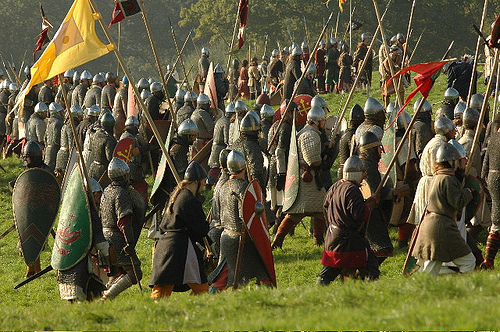
Then again, I really don’t see them as a group of people capable of waiting quietly for a bus: vikingsaaaa Another episode of extreme weather on the rain front came in 1141 when there was another Great Flood. And once again, the flooding was caused, as in 1947, by the mechanism of a sudden melt of large quantities of snow after prodigious amounts of rain. People in 1141 looked like this. Around this time there was clearly a significant risk for everybody of just rusting solid into one great mass:

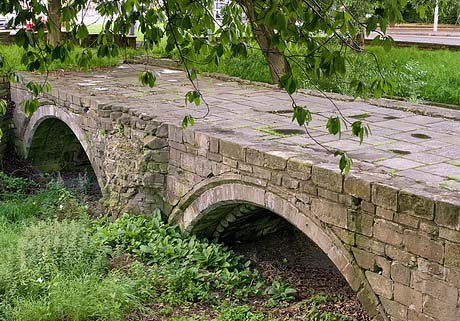
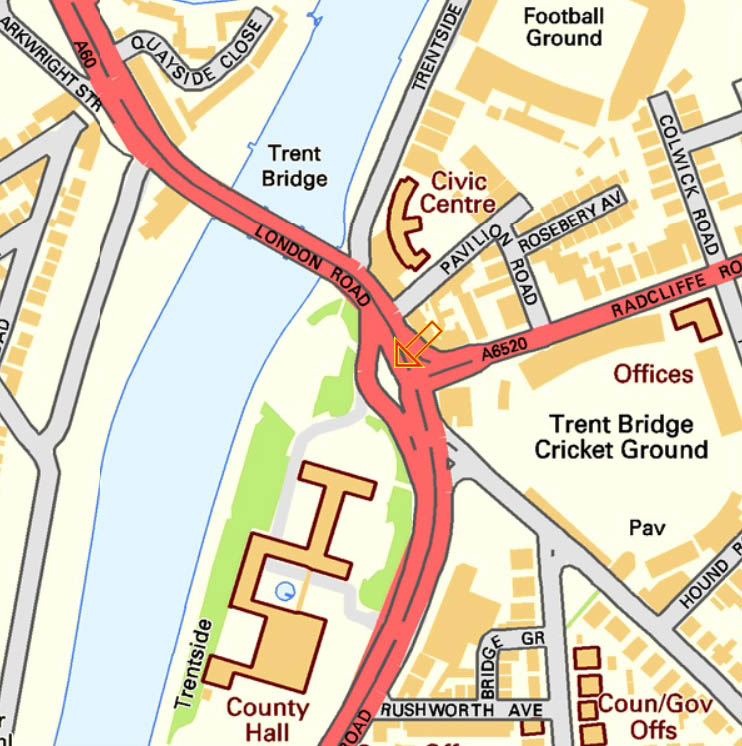
NormanAdvanceIn 1309, Hethbeth Bridge, the medieval precursor of today’s Trent Bridge, was washed away by severe winter floods.  A small fragment of this old bridge is still visible on the road island at the southern end of the modern Trent Bridge: 771942beth heth xxxxxxxxxxx If you go to see it, be very careful. Traffic nowadays is much more dangerous than “The Great Heathen Army”. Look for the orange arrow:

trent

In 1346, little detail has come down to us, other than:

“from mid-summer to Christmas, the rains fell almost without intermission”.

The River Trent duly experienced:

“One of the earliest recorded floods.”

In 1499 Richard Mellers, the husband of Dame Agnes Mellers, of High School fame, is known to have given twenty shillings to help repair one of an apparent succession of Hethbeth Bridges, but it was pretty much in vain, as the Great Flood of 1683 washed a good proportion of it away. Here are two men in 1683. That’s not a look you can just throw together:

Cavaliersxxxxxxxxxxxxxxxxxxxxxx

The worst ever flood in Nottingham was the so-called “Candlemas Flood” of February 1795, when two months of continuous ice and snow all melted extremely rapidly. Every single bridge on the entire River Trent was either damaged or washed away, including the Hethbeth Bridge for the umpteenth time. In the Narrow Marsh area of the city, around what is nowadays Canal Street and the land to the south of St Mary’s Church, the residents were all trapped in the upstairs of their houses and had to be given food from boats. At Wilford, up to 100 sheep were drowned and ten cows perished in West Bridgford. That doesn’t sound much, but they only had twelve.

The late eighteenth century provided some wonderfully ornate dresses, all guaranteed to keep you afloat until help arrived:

1255636099-marie_antoinette

Another less severe flood came in November 1852 when the peak flow of the Trent was measured at some 38,200 cubic feet per second, between twelve and thirteen times the normal levels. A second, slightly worse Victorian inundation came in October 1875 when floodwater was up to six feet deep. During this latter flood the peak flow of the Trent was 45,000 cubic feet per second, fifteen times the normal levels. On Wilford Road an overcrowded cart was washed away and six people were killed. Higher up the river, huge numbers of farm animals were drowned and they must have been a ghastly sight as they floated down to the sea past Trent Bridge:

image_update_24bd582809133d58_1342017794_9j-4aaqsk

9 Comments

Filed under History, Humour, Nottingham, Science, Wildlife and Nature