Category Archives: Nottingham

Fashion in Nottingham in 1776

As well as the material I discussed in one of my previous articles, there is plenty of interesting fashion news tucked away in “The Date-Book of Remarkable and Memorable Events connected with Nottingham and its neighbourhood” by John Frost Sutton. This time, it is for 1776, and it concerns, if I interpret it correctly, informal wear for ladies.

“The Nottingham Journal of this date gives the description of ladies’ undress for August:

“The ladies’ fashionable undress, commonly called a dishabille (sic)”.

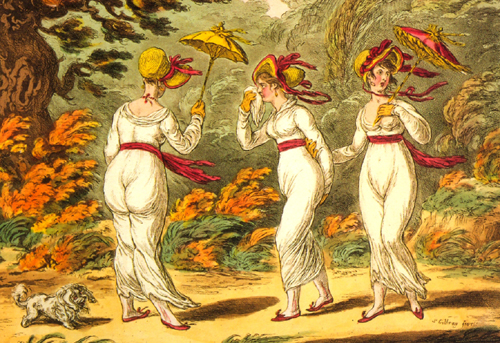
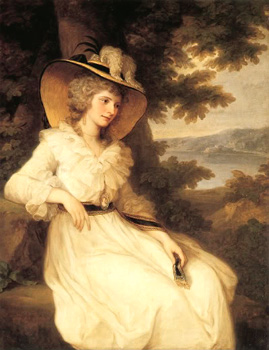
Here is a satirical portrait of dishabille entitled “The Three Graces in a High Wind”:

dishabuill marie antoin satire

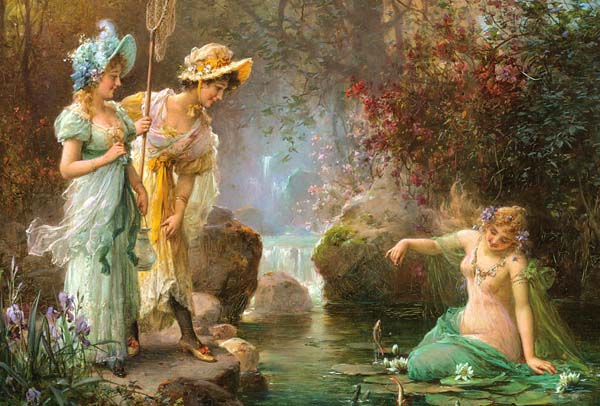
Some young gentlemen also clearly appreciated that there were varying degrees of dishabille:

dishabille late 18

Back to the story:

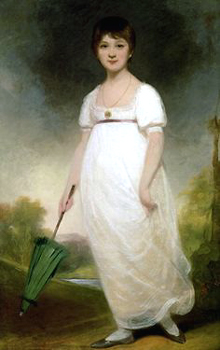
“(Ladies’ fashionable undress is…) to pay visits in the morning, also for walking in the country, on account of its being  neat, light and short, consists of a jacket, the front part of which is made like a sultana; the back part is cut out in four pieces; the middle part is not wider at the bottom than about half an inch; the sides in proportion very narrow”:

muslin 1810

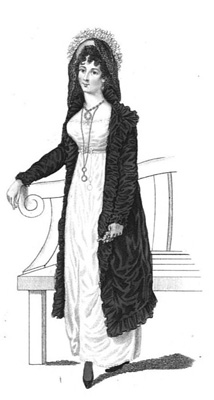
“The materials most in vogue, are white muslins with a coloured printed border chintz pattern, printed on purpose in borders about an inch deep. The silks, which are chiefly lute strings, are mostly trimmed with gauze, The gauze is tucked upon the bottom of the jacket, and edged with different coloured fringes. The petticoat is drawn up in a festoon, and tied with a true lover’s knot, two tassels hanging down from each festoon. A short gauze apron, striped or figured, cut in three scollops (sic) at the bottom, and trimmed round with a broad trimming closely plaited; the middle of the apron has three scollops reversed. The cuffs are puckered in the shape of a double pine, one in front of the arm, the other behind, but the front rather lower.”

02 1812 walking dress

“To complete this dress for summer walking, the most elegant and delicate ladies carry a long japanned walking-cane with an ivory hook head, and on the middle of the cane is fastened a silk umbrella, or what the French call a parasol, which defends them from the sun and slight showers of rain. It opens by a spring, and it is pushed up towards the head of the cane when expanded for use”:

judy-st_-louis-swiss-dot-summer-dress

“Hats, with the feathers spread, chiefly made of chip, covered with fancy gauze puckered, variegated artificial flowers, bell tassels, and other decorations are worn large. No alteration worth notice has taken place in gentlemen’s dress except that they increase the size of their hats, and cock it in the German military style.”

_foster_1786
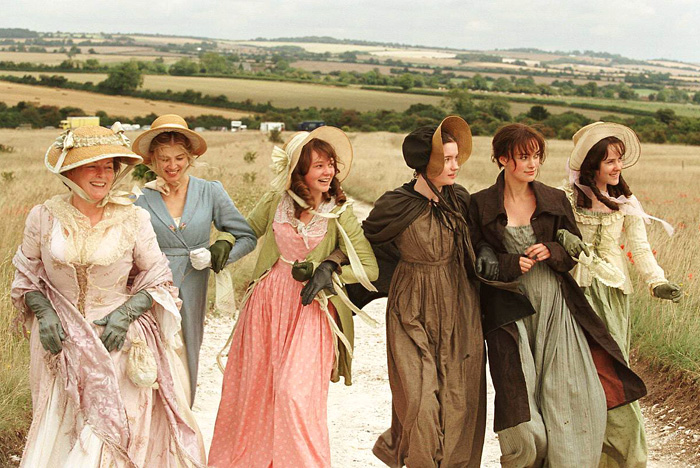
I’m afraid that there is quite a lot here that I do not understand. I suspect that many of the technical terms have been lost in the intervening 240 years. To me, for example, “sultana” is either a brown fruit or a large woman who is the wife of the sultan. Neither of them are much of a match for the front of a jacket. Anyway, I have not been able to put too many pictures in, because much of the text remains unintelligible to me. On the other hand, this is what the world of the cinema offered as their version of the informal dresses of the late eighteenth century and the Regency periods:

pridse ands prejudice film

It’s so sad, though, that they couldn’t find the eighteenth century countryside to go with it. And couldn’t they have avoided including a group of caravans when they did the filming?


19 Comments

Filed under History, Nottingham

Warren Herbert Cheale

Warren Herbert Cheale, who lived with his family in Burton Joyce, moved to the High School in January 1944 to work as an Acting Pilot Officer with the School Flight of the Air Training Corps. He was a member of the Royal Air Force Volunteer Reserve:

RAF

On Thursday, September 7th 1944, while away at camp at Wenlock in Shropshire with the boys from the High School A.T.C., poor Warren was killed in a flying accident. He was only 44 years of age.  He left a widow and a teenage son and daughter. Despite his short stay at the High School, one of the boys described him as “one of the nicest people we had ever met”.
Warren, who was born in the first three months of 1900, seems to have been quite a colourful character. He lived originally at a house called Redhill in St. Helen’s Crescent. Hastings, in Sussex and the first mention of him that I can find seems to be at the age of three when, on November 28th 1903, he played the important part of Bubbles in a local production of Little Red Riding Hood:

little_red_riding_hood_and_wolf1

Not very long afterwards, Warren joined up for the Great War and eventually found himself in the Royal Flying Corps.

During this era, British pilots were not allowed to wear parachutes, so Warren must have thought his death was imminent when he was involved in a mid-air collision at an altitude of over two thousand feet. The two planes must have either spun or perhaps fluttered down to earth, though, because Warren escaped with his life. That life, however, was perhaps affected by Post Traumatic Stress Disorder to some extent. It is difficult to imagine that anybody could go through an experience like that and remain completely unaffected.

Fokker-DVII-Crash

On July 29th 1925, Warren married Alice Elisabeth Unwin at St. Martin-in-the-Fields Church in London.

Warren then seems to have remained in the new Royal Air Force, because the next mention seems to be in the Hastings and St Leonards Observer (Hastings, East) for June 28th 1930. Listed as a mechanic, he appeared in the local magistrates’ court, along with a young friend, who lived in the School House, North Street, Hornchurch. Both were found guilty of damaging a crop of rye in a local farmer’s field, a rather bizarre mark to leave on the pages of history, perhaps.

Certainly from 1931-1934, Warren continued to live in Hastings and St Leonards, presumably with his wife. It was a lovely place:Hastings_english_school_xxxxxxxxxxxxxxxxxxx1

Warren played local cricket, both as a batsman and a bowler, although life did not always go well. For whatever reason, his wife Alice Elizabeth filed for a divorce at the London Divorce Courts in 1936. The divorce may not have gone through, because the report contains the annotation, [wd] which may well have meant “withdrawn”.

Perhaps the family then moved northwards to Nottingham as a new start, hoping to put their marital difficulties behind them for the sake of the children.

Alas, we will never know, because 21 PAFU ORB reported on that fateful September evening:

“Flying accident at Wheaton Aston. An Airspeed Oxford LX509, with Flight Lieutenant Harrison as instructor, and Pilot Officer Cheale (Air Training Corps) took off for a night flying test from Wheaton Aston and was seen to dive into the ground shortly afterwards. Both occupants were killed instantly as a result of injuries sustained.”

Here is a general map showing the location of Wheaton Aston airfield:

wheaton aston

At the time, the Airspeed Oxford was considered to be, potentially, a rather dangerous aircraft to fly:

Airspeed_Oxford

Although designed as a twin engined trainer, and supposedly extremely docile, it could be, in actual fact, a rather unforgiving aeroplane.  Many aircraft used in RAF Training, of course, were well past their sell-by date and poorly maintained. These factors may well all have been contributory to the deaths of these two men. In actual fact, in the North Midlands, during the course of the Second World War, the majority of fatalities occurred in either Airspeed Oxfords or another old stager, the Vickers Wellington bomber. To help the situation, Oxford trainers were painted a conspicuous yellow:

Airspeed_Oxford_V3388_yellow

The crash location on the Accident Card for this particular incident is given as:

“At Colonels Covert?, Hatton Grange, Ryton. Map Reference OS765036, just south of Hatton Grange, to the north of Ryton and just south west of RAF Cosford”.

Here is a map which shows Hatton Grange:hatton

The verdict of the official  inquiry was that:

“It is not possible to form a conclusion. Investigation has not revealed the cause of the accident.”

The crew of the Oxford were:

“Flight Lieutenant Sydney Donald Harrison, aged just twenty one. He is buried in (St Ediths) Churchyard, Church Eaton, Staffordshire. He was commissioned as a Pilot Officer on February 5th 1943.

Sydney  was the beloved only son of Mr and Mrs Donald Harrison, Two Trees, Hernes Road, Oxford and the grandson of Mr and Mrs T E Clarkson, The Villa, Rancliffe, near Goole.

Pilot Officer Warren Herbert Cheale (177869), RAFVR, was aged forty four. His death is commemorated at the Nottingham Crematorium. No next of kin was given at the time.”

When application for a ‘Grant of Probate’ for Warren’s will was made, his address was listed as 123 Church Drive, Burton Joyce, Nottinghamshire. This is the Main Street in that lovely village:

18679784

Interestingly, when Probate was granted on February 13th 1945, it was not to Alice Elizabeth, his presumed wife from the 1930s, but to “Rose Cheale, widow”. Perhaps that divorce had actually gone through in 1936, and this was Warren’s new wife.

Two men had paid dearly, therefore, for the High School Flight of the Air Training Corps’ week long stay in Shropshire for their annual training.  They had been accompanied by at least one member of the academic staff, Mr D.C.Whimster, who was a Master at the school from 1939-1945. He was Form Master of the Fifth Form A, and may have been a teacher of English. In reminiscences published in the school magazine, the writer says, talking of drama productions:

“I wish the Society would tackle “The Knight of the Burning Pestle” again, with its greater resources and experience. Mr. D. C. Whimster’s production was interesting and creditable.”

The High School cadets were also accompanied by a person named in RAF reports as Pilot Officer Alder (Air Training Corps). This may have been somebody who normally worked at Wenlock, but I strongly suspect that this is a mis-spelling of the name of a second member of staff, namely Mr S.Allder who worked at the school from 1940-1946. As his name was “Stanley”, the boys, ever inventive, apparently called him “Stan”.

And so Warren Cheale’s extraordinary luck came to an end. In the Royal Flying Corps in 1918, he had somehow managed to avoid what must have seemed to him, as he fell earthwards for thirty seconds, perhaps a minute, a horrific and unavoidable death.

But this time, almost thirty years later, the Gods of the Air had claimed him as their own:

aerspeed


20 Comments

Filed under Aviation, Bomber Command, History, Nottingham, The High School

The Glossy Ibis ; a rare bird in Victorian Nottinghamshire

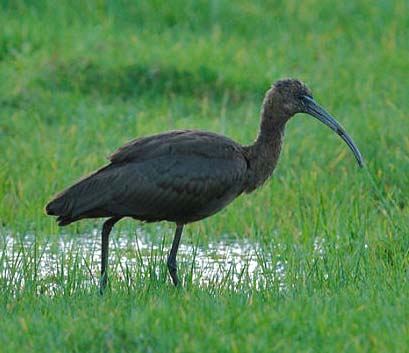
Glossy Ibis is a bird from warmer, southern climes such as the Mediterranean. Even nowadays, it is quite a rare species in the county:

glos ibis

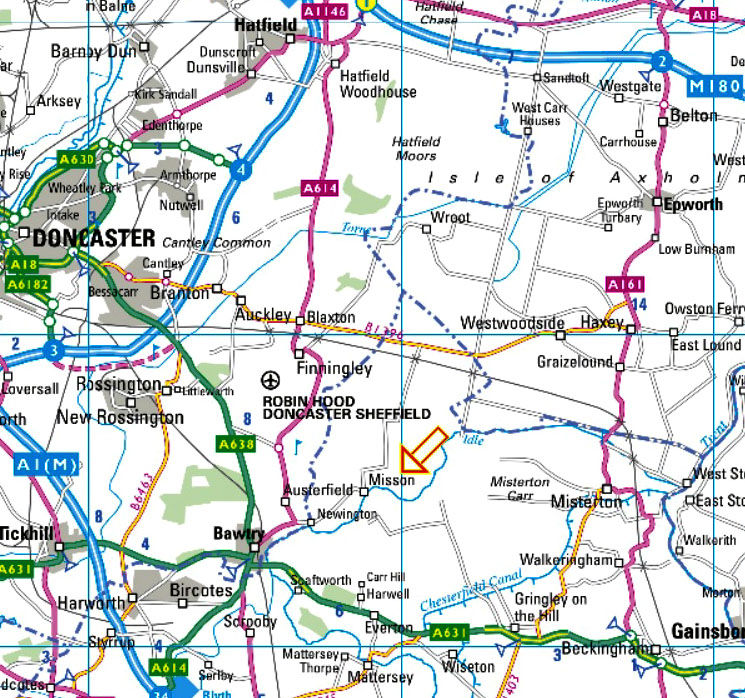
On October 27, 1909, a single bird was shot by Fred Smith at Misson in the very north eastern corner of the county, almost in Yorkshire. This latter county had, for reasons unknown, received an influx of at least fourteen birds during this month of October 1909.  The orange arrow marks the spot. The county boundary with Yorkshire, to the north west, is indicated by the perforated line and must be only a few hundred yards away:

Untitled

Two interesting letters to Joseph Whitaker tell the story.

Dear Sir,
I have the pleasure of dropping you a line in reply to yours, duly received. A man named Fred Smith, who I fear is a shocking poacher, shot the bird, Glossy Ibis, in question. His wife took it to a game dealer, at Doncaster, whose name is Borrill, his shop being in St Sepulchre Gate . He gave her the large sum of one shilling for it, after endeavouring to get it for sixpence.
A doctor bought it from Borrill and is having it stuffed for the museum. I am sorry to have forgotten the doctor’s name, but no doubt the game dealer would tell you if you wrote him. You will forgive me, I hope, for not knowing your book.
I also love birds and used to keep a great many – once I had 46. We still have a few in a good-sized aviary in a greenhouse and my little daughter aged 11  is much interested in birds and has lately acquired several volumes at a cost of £3.10 shillings on the subject.
Yours faithfully,
FW Keane

Glossy_Ibis_1700_e

Joseph Whitaker followed the clues and two months later, he received further information from Dr Corbett himself:

9, Priory Place,
Doncaster
11. 11. 09

Dear Sir,
Mr Borrill showed me your letter re-the Glossy Ibis. All I know of it is that it was exposed in his shop with other wildfowl & I was, fortunately for me, the first to “spot” it & purchase it for the local museum of which I am the curator. If ever you are in Doncaster I shall be pleased to show it to you.
Yours truly,
HH Corbett

Anybody who missed that dead specimen in Doncaster in 1909 had a very long wait to see another Glossy Ibis in Nottinghamshire. In the winter of 2013-2014, a single bird was seen in a flooded roadside field next to the Peugeot Garage in Lowdham, near to the River Trent in the south of the county. southern Nottinghamshire:

lowdham

Most people who wanted to see a Glossy Ibis were able to watch this particular individual which was very amenable and reliable in its appearances. It attracted a steady stream of admirers, and was very easy to see::

Watching an Ibis copyright a

A more spectacular species of Ibis to occur in  Nottinghamshire in the future might well be the Sacred Ibis. This bird normally lives in sub-Saharan Africa, but, in actual fact, there is a healthy feral population in western France. It would not be outrageous for them to cross the Channel:

Ibis

14 Comments

Filed under Criminology, History, Nottingham, Science, Twitching, Wildlife and Nature

Fashion in Nottingham in 1760

In recent months, I have been completely hooked by “The Date-Book of Remarkable Memorable Events Connected With Nottingham and Its Neighbourhood 1750-1879”, by John Frost Sutton. It records a world so similar and yet so different to our own. Fashion, for example:

“Here are a few words explanatory of the costume of the period. The dress of the upper and middle classes being then, as now, a model for those beneath, may be regarded as sufficiently indicative of the prevailing style.”

“Ladies were attired in stiff stays, tightly laced”:

Tight_lacing

“….tightly laced over the stomacher, and long in the waist, causing the upper portion of the figure to resemble the letter V.”

Like this:

white corset

The stomacher could usually be removed from one dress and transferred to another. In this way, it was possible to ‘mix-and-match’ designs and colours. Here are two stomachers of the period:

“The thinness of the waist appeared still more striking by the sudden fullness of the gown, occasioned by the hooped petticoat.”

Here are two hooped petticoats, both modern. One is structured horizontally, the other vertically:

Here’s the fullest dress I could find. And yes, that is a fabric called “cloth-of-silver”:

m 18th-century-court-gown-cloth-of-silver

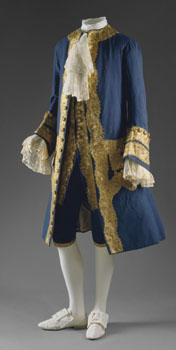
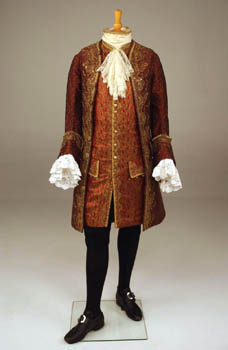
“A close head-dress, and shoes with high heels of divers colours, completed the ensemble. Gentlemen were much more gay in their apparel than would now be thought consistent with good taste. Claret-coloured cloths were deemed very handsome in the circles of high fashion, and suits of light blue, with silver buttonholes and silver garters at the knees, were quite in the mode.”

Here are two suits, one in blue and the other in claret. West Ham eat your hearts out:

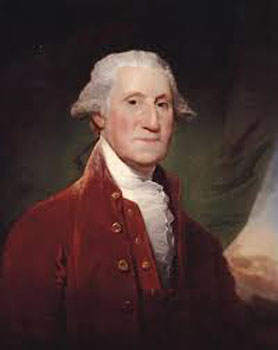
“Perukes, of light grey human hair, were worn”:

“Dark hair was of no estimation whatever”:

dark wig

Men used to wear:

“A large cocked hat, called “the Keven Huller, which was about six inches broad in the brim.”

This was named after Keven Huller, a now long forgotten Austrian general who fought against the armies of the French Revolutionaries and then Napoleon himself, in the last decade of the eighteenth century.I  have been unable to find any picture of this fashionable hat from long ago. Men also wore:

“a square-cut coat, and a long-flapped waistcoat, and shoe-buckles of an enormous size”.

Here is a long waistcoat:

buckles

Here are some rather attractive shoe buckles:

sghoeds

Their overcoat might be

” a heavy dragoon type with wide gold braid”

overcoat

I have been unable to find any picture of the type of hat with the so-called “Denmark Cock high at the back, low in the front and tilted forward” or indeed the “Dettingen Cock” or the “Monmouth Cock”  style of headgear.


15 Comments

Filed under History, Nottingham

More and more water, most of it under Trent Bridge (2)

Last time, I left you awaiting the arrival of Ragnar Lothbrok and his rather fierce friends in Anglo-Saxon Nottingham.

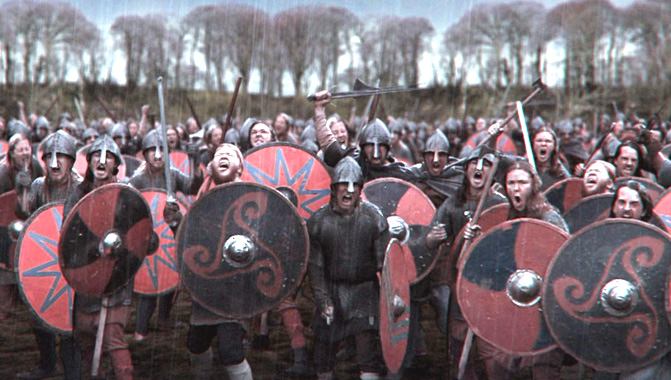
Well, by 867, Anglo-Saxon Nottingham had been well and truly captured by the Vikings and it became one of the Five Boroughs of the Danelaw. There may have been little in the way of extreme weather in this era, but their names were fabulous. The Five Boroughs of the Danelaw is a striking enough phrase, but the name of the army which made Snotingaham, at sword point, an offer they could not refuse, is, quite simply, wonderful. A thousand years before Heavy Metal bands, they rejoiced in the name of “The Great Heathen Army“. And here they are. They’re really quite handsome, aren’t they?

Then again, I really don’t see them as a group of people capable of waiting quietly for a bus: vikingsaaaa Another episode of extreme weather on the rain front came in 1141 when there was another Great Flood. And once again, the flooding was caused, as in 1947, by the mechanism of a sudden melt of large quantities of snow after prodigious amounts of rain. People in 1141 looked like this. Around this time there was clearly a significant risk for everybody of just rusting solid into one great mass:

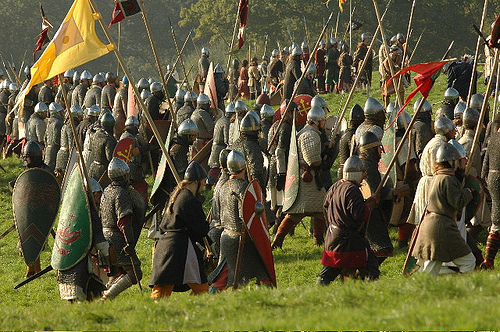
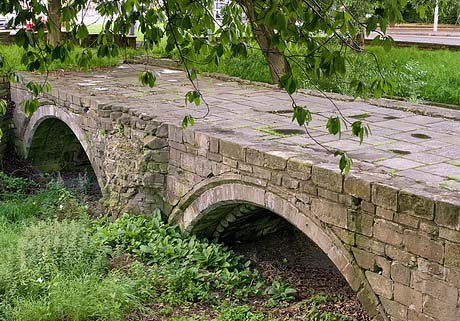
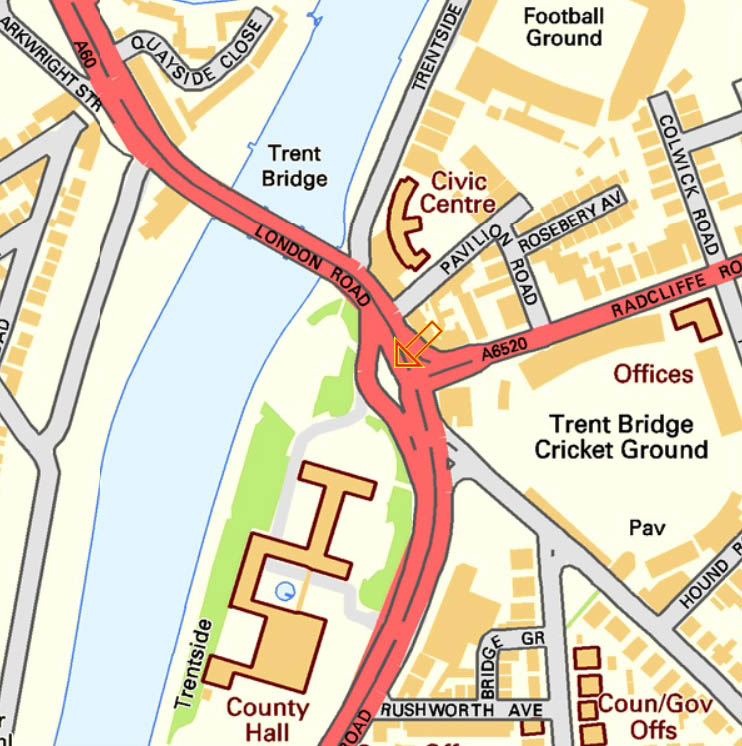
NormanAdvanceIn 1309, Hethbeth Bridge, the medieval precursor of today’s Trent Bridge, was washed away by severe winter floods.  A small fragment of this old bridge is still visible on the road island at the southern end of the modern Trent Bridge: 771942beth heth xxxxxxxxxxx If you go to see it, be very careful. Traffic nowadays is much more dangerous than “The Great Heathen Army”. Look for the orange arrow:

trent

In 1346, little detail has come down to us, other than:

“from mid-summer to Christmas, the rains fell almost without intermission”.

The River Trent duly experienced:
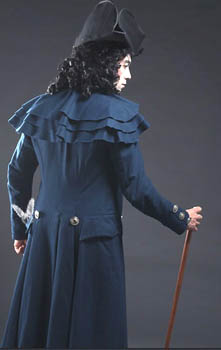
“One of the earliest recorded floods.”

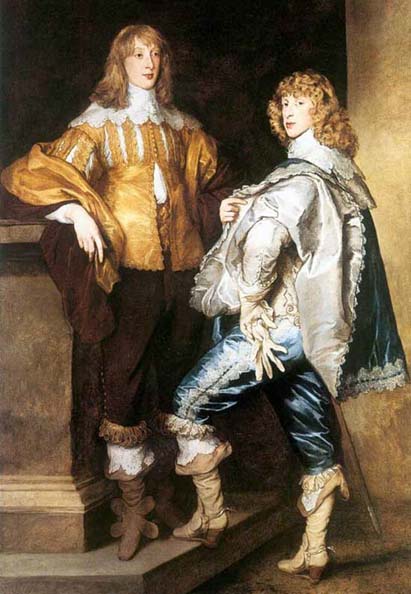
In 1499 Richard Mellers, the husband of Dame Agnes Mellers, of High School fame, is known to have given twenty shillings to help repair one of an apparent succession of Hethbeth Bridges, but it was pretty much in vain, as the Great Flood of 1683 washed a good proportion of it away. Here are two men in 1683. That’s not a look you can just throw together:

Cavaliersxxxxxxxxxxxxxxxxxxxxxx

The worst ever flood in Nottingham was the so-called “Candlemas Flood” of February 1795, when two months of continuous ice and snow all melted extremely rapidly. Every single bridge on the entire River Trent was either damaged or washed away, including the Hethbeth Bridge for the umpteenth time. In the Narrow Marsh area of the city, around what is nowadays Canal Street and the land to the south of St Mary’s Church, the residents were all trapped in the upstairs of their houses and had to be given food from boats. At Wilford, up to 100 sheep were drowned and ten cows perished in West Bridgford. That doesn’t sound much, but they only had twelve.

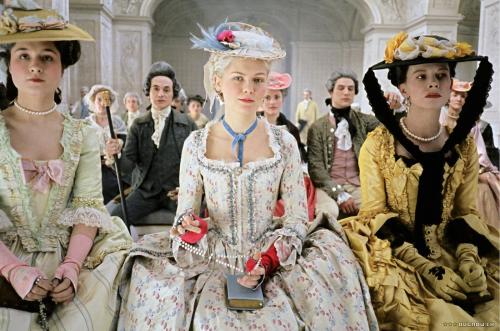
The late eighteenth century provided some wonderfully ornate dresses, all guaranteed to keep you afloat until help arrived:

1255636099-marie_antoinette

Another less severe flood came in November 1852 when the peak flow of the Trent was measured at some 38,200 cubic feet per second, between twelve and thirteen times the normal levels. A second, slightly worse Victorian inundation came in October 1875 when floodwater was up to six feet deep. During this latter flood the peak flow of the Trent was 45,000 cubic feet per second, fifteen times the normal levels. On Wilford Road an overcrowded cart was washed away and six people were killed. Higher up the river, huge numbers of farm animals were drowned and they must have been a ghastly sight as they floated down to the sea past Trent Bridge:

image_update_24bd582809133d58_1342017794_9j-4aaqsk

9 Comments

Filed under History, Humour, Nottingham, Science, Wildlife and Nature

The School Leprechaun

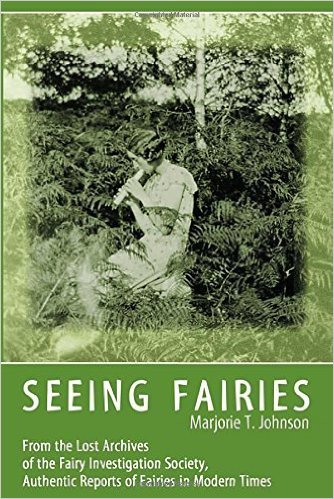
After reading all about gnomes, elves, pixies, fairies and such like, it should come as no surprise to hear that Wollaton is not the only place around Nottingham to have played host to fairies in recent times. Marjorie Johnson, the lady who saw fairies in her garden in Carlton was to become very famous in fairy circles. She wrote this best selling book:

fairy book

Here is a link to an account of fairies she saw in Nottingham, in Carlton to be more precise.

Belief in fairies persists still, even in our own time. When we went once to an isolated farm at Constantine in Cornwall, the farmer clearly believed that the huge ruined megalith in his bottom field was the home to fairy folk. He had seen their fairy lights on more than one occasion.

It is in Iceland that gnomes and fairies are taken most seriously. Over a half of Icelanders believe that these tiny entities are, at the very least, “possible”. They are thought to be from another dimension, usually making their homes inside huge boulders and outcrops of rock.

Known as huldufólk these beings are not regarded as trivial. Roads can be redirected on their behalf.

This report by Journeyman starts off in almost comic fashion, but does make some quite serious points:

This film by Torsten Scholl, aka “hatcast” has even more serious points to make:

This account by Richard Williams aka “rockuvages” is of the moment when the huldufólk seem to pop out of their own dimension:

Nowadays, we tend to see fairies and their like as something lovely and wonderful. This attitude has only come about since Peter Pan and Tinkerbell. Before that, fairies were considered by those who had regular contact with them to be malevolent beings who, if they were in any way annoyed, would readily kidnap adults, willingly do harm to them and, most of all, steal their babies, replacing them with changelings. This is why nowadays a lot of modern folklorists tend to equate ancient beliefs in fairies, with our current fondness for space aliens and little green men, who have continued in modern times to carry out all of these evil deeds:

green alien

Tales of fairies invariably involve abduction and poor innocent people forced to remain in Fairy Land, sometimes for ever. What difference is there between malevolent fairies holding people hostage in their realm and our modern tales of extra-terrestrial kidnap?

Other parallels are there. Some types of fairies, such as leprechauns and goblins, have green as their favourite colour, just as some aliens are literally “little green men”. Only medical experiments seem to be absent from the connections between the two groups, perhaps because in sixteenth and seventeenth century Ireland or Cornwall, there was no health care available and advanced medicine was not a subject on anybody’s mind. Only ointments and magic potions were on offer back then, and these simple remedies do figure from time to time in the more ancient tales of fairies.

Here is something more modern, a tractor beam, although some would argue that those fairy lights, leading innocent people out onto the marsh to drown or be abducted, did pretty much the same job:

uftgyu
This modern cartoon by “grackle” sums up best our ancient knowledge of fairies, who were by no means the magnanimous and well intentioned Peter Pan heroes of Walt Disney’s world.

Certainly, the Cornish and the Irish, for example, seem to view “piskies” or “the little people” as, at best, potentially tricky and at worst possibly, evil, and similar figures are met with in every human culture across the globe.

In North America, there are Ishigaq (Inuits), Jogahoh (Iroquois), Nimerigar (Shoshone) and the Yunwi Tsundi (Cherokee). In Hawaii, there are the Menehune, and for the Maoris, the Patupaiarehe. In Europe, there is a host of names such as the Brownies, the Kobolds in Germany, GoblinsGremlins, Pixies, Leprechauns and the Swedish “Di sma undar jordi”, who are clearly almost identical with the huldufólk of Iceland:

307228-mythical-creatures-troll

Let’s finish with a quite extraordinary piece of film.

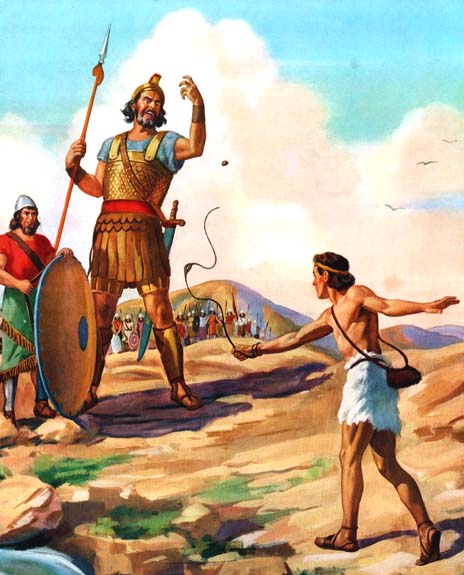
All over the world, of course, as well as “the little people”  there are the enormously large people. In Nepal, the “yeti”, in North America, “Bigfoot”, in Western Europe “the Wildman” or “Wodewose”. In Iraq, he was represented by “Enkidu” the companion of Gilgamesh. In Israel, he was “Goliath” whom David slew:

golithyuj

In Australia, the enormously large person is called the “Yowie” and he is very fierce indeed.

The huge Yowie, though, has a tiny equivalent. To the white man he is “Brown Jack” but to the blackfella he is the “Junjudee”. He is tiny and here is a purported film of one:

Any film by TheRusty222 is well worth watching. He tries to film Yowies but most of all, he ventures deep into the realm of the thickest parts of the Australian bush, an environment of staggering beauty if you ever watch one of his films.
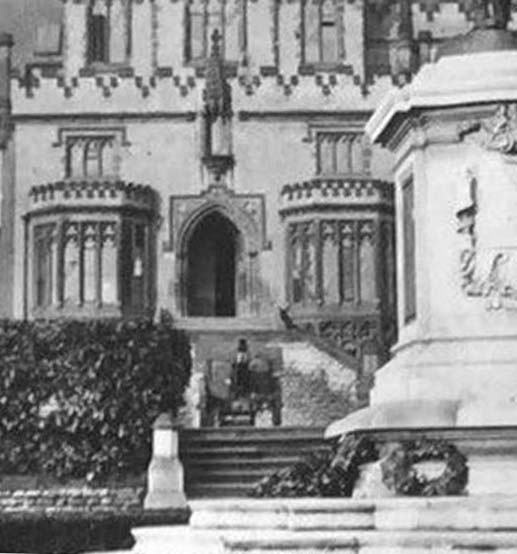
Talking of “Little People”, a few weeks ago, I bought a postcard of the High School taken in 1927. I was intrigued to see what is obviously the “School Leprechaun” busy guarding the front of the school:

lep[rechaun 1

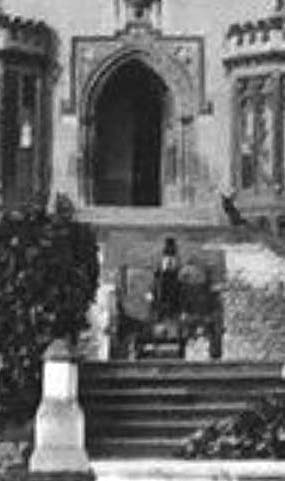
You can see his right hand, his jacket of Irish Green, his little fawn breeches and his lovely top hat. Here he is, slightly enlarged:

lep[rechaun 2

Do you see his mutton chop whiskers? And what about little Pumpkin Head, next to him, with his tiny hat and his little legs and boots?

Both photographs, courtesy of the Pareidolia Brothers.


17 Comments

Filed under Cryptozoology, History, Literature, Nottingham, Personal, The High School

More and more water, most of it under Trent Bridge (1)

In a previous article, I wrote about the flooding of Nottingham during  the modern era, and the ways in which we have learnt lessons from the floods of 1947 and constructed concrete embankments and sluices so that the River Trent is nowadays, to all intents and purposes, relatively tame. (“relatively” being the operative word.) If you walk down to Trent Bridge and look underneath the bridge on the City side, directly beneath the Riverbank Bar and Kitchen, however, you will see how the flood levels of previous years of watery disaster have been recorded. They are scarily impressive and well worth a visit:

This slideshow requires JavaScript.

The very first records of floods in Nottingham are more a case of inference than anything else. According to the (Royal) Journal of the Statistical Society, Volume XLI and “The Insurance Cyclopaedia” by Cornelius Walford (I need to get out more):

“29 A.D. There was a great overflow of the River Trent in England”.

In 214 A.D. the entire River Trent was again in flood and overflowed its banks by some 20 miles on each side from the normal course of its flow. Many people were drowned as the whole Trent valley was awash and there was great destruction. Both of these dates are during the Roman era, although Nottingham was not, as far as I know, a Roman town. Perhaps they knew that an underlying band of hard rock could be used to ford the river and its adjacent marshes. Just to establish our dates firmly, here is a Roman. Like every single Roman, he is a legionnaire, although he doesn’t look particularly ill to me, but that hat is really something: Centurion_2_Boulzzzzzzz In 525 A.D. the entire Trent again burst its banks and a great number of cattle were drowned. The locals at his time may well have been Celts since we know that Nottingham, in the Brythonic Celtic language was called “Tigguo Cobauc”, meaning “The Place of Caves”. The Welsh may have been aware of Nottingham’s existence since they called it “Y Ty Ogofog” and even the distant Irish had a word or two for it, namely “Na Tithe Uaimh”, “The Cavey Dwelling”. Here are some Celts, managing to appear very, very fierce indeed, although admittedly, there is more than a dash of Village People in the overall look, especially the one at the front who may have no clothes on at all: gug7 zzzzzzzzzzzzzzzzzzzzzzzzz Whoever the locals were in 530 A.D., they would certainly have got extremely wet at some point. The mighty River Humber is known to have flooded extensively onto adjacent low-lying ground and most of the region’s cattle were drowned. Much of that excess of water, of course, was bound to have come from the River Trent, which feeds into the Humber. It is difficult to see how Nottingham, at the side of the River Trent, of course, could have escaped floods of such severity. It was slightly after this date that Nottingham, by now a small group of wooden huts and a line of washing, came under the sway of the wonderfully named “Snot”, an Anglo-Saxon chieftain. The place where “The Mighty Snot” lived was immediately called “Snotingaham”, the “home of the people of Snot the Magnificent”. At this time, “Snotingaham”, was part of the Kingdom of Elmet. Here is an Anglo-Saxon chief and his friend. What impressive elmets they are wearing: saxnb zzzzzzzzzzzzzzzzzzzzzzzz

I just couldn’t resist that!

Next time, we will see what happens when Ragnar Lothbrok and his pals arrive in Nottingham on a seven-day-cruise in 867AD.

16 Comments

Filed under History, Humour, Nottingham, Science, Wildlife and Nature

The Gnomes of Wollaton Park

I am sure that it would surprise a great many people to be told that there have been fairies, gnomes and elves seen in Nottingham in quite recent times. The most famous incident was in the late September of 1979. This took place in Wollaton Park, which is the extensive grassland, studded with trees, which surrounds stately Wollaton Hall, home of the Hollywood blockbuster, The Dark Knight Rises  :

Wollaton_Park_xxxxxxxxxxxxxxxxxxxxxxxxxxx

Wollaton Park is in the centre of Nottingham. Look for the orange arrow:

wollo general

I do not know the exact place where the fairies and gnomes were seen, but I suspect that it was probably here. Again, look for the orange arrow:

possibly here

This location fits in quite well with details I have found, namely, “near the lake”, “swampy”, “near an exit from the park” and “near a fenced off nature reserve”. The most frequently quoted directions are “in a rather wet area down by the lake”. Here is the Lake. The orange arrow points to the place where doting parents take their children to feed the ducks and fight off the Canada Geese:

lake close up

The little elvish creatures were seen by a small group of children between eight and ten years of age who were playing in a swampy section of the park. The children were Angie and her brother Glen and her sister Julie. There was also Andrew and Rosie who were brother and sister, and Patrick. Here are just some of the sixty gnomes:

gnomes-376967

The children were playing just as dusk was falling, around half past eight. The light was deteriorating but it was still bright enough to see. The children’s attention was attracted by something that sounded like a bell. They saw a throng of around sixty little gnome like men coming out of an area of woodland and bushes which had been fenced off to prevent the general public from entering. The little men were riding in small bubble-like vehicles. These cars were completely silent but they were very quick and could jump and skip over anything in their way such as fallen trees or branches.
Down near the lake they seemed to be enjoying riding over the marshy swampy area, and a few of them chased the children towards the exit gate from the park, just in play, though, not aggressively.

gnome vbnm

The little men were just half the size of the children, around two feet tall. They all had wrinkled faces, perhaps with a greenish tinge and long white beards, tipped with red. Sometimes they laughed in a strange way. On their little heads, they were wearing what the children described as caps like old-fashioned nightcaps. They were just like what Noddy used to wear, with a little bobble on the very end:

noddy

They had blue tops and yellow or green tights or pants. Despite the encroaching darkness, the children were able to see them all plainly. Patrick explained to the Headmaster: “I could see them in the dark. They all showed up.”:

Vintage gnome garden statuette.

The children watched them for about a quarter of an hour, as the men drove round in their little cars. Each of the fifteen cars carried two little men. They did not have steering wheels but some kind of circular device with a tiny handle to turn it. The little men also were climbing up into the surrounding trees, going into and emerging from, holes in the trunk or branches. All of the children felt that they had somehow surprised the little men, who usually would only have come out after night fell. Eventually, the children all ran away, because it was getting late. The little men had not been threatening or aggressive.
The adults who subsequently heard their stories thought that the little group of children were all telling lies, but the children were completely unwavering in their belief that they had seen what they said they had seen. Furthermore, they had seen the little men previously, during the six weeks of the long summer holiday from school. Some were at the lake, but others were at the Gnomes Anonymous, anti-Alcoholism Group:

beer garden gnome

The day after they returned to school, their Headmaster questioned them all separately and recorded their answers on a cassette tape recorder. The children all told, more or less, the same story. Their drawings too, were all very similar:

drawing

The Headmaster’s opinion was that the children were all telling the truth, although, as might be expected, there were minor differences of detail and emphasis between their different accounts. His overall final judgement was that “The children do sound truthful”. Here is the Headmaster on the School Photo taken that year. You can see why he believed the children:

garden-gnome-among-lilies-of-the-valley-no47-randall-nyhof

In actual fact, the Headmaster actually corresponded about the events with Marjorie T Johnson, the author of “Seeing Fairies”:

Untitled

He sent her the cassette tapes of the children he had recorded. His letter said:

“I think the tape reveals the wide measure of corroboration between the children, as well as the fluency with which they were able to describe the events. I remain sceptical as to the explanation of what they saw, but I am also convinced that the children were describing a real occurrence.”

When the children’s story about the Wollaton little people became public, a number of claims were made that they had been seen before in the boggy area around the lake. Marjorie Johnson, formerly Secretary of the Nottingham-based “Fairy Investigation Society”, confirmed that she had “received a number of previous reports of Little People frequenting this locality”. They included Mrs C George of Stapleford near Nottingham, who, in 1900, had seen both gnomes and fairies by the Wollaton Park Gates as she walked past on the pavement. Here is one of their little cars, abandoned temporarily by the roadside, and taken into the police pound:

Noddy-car_2618947b
Just before the children’s experience, Mrs Brown reported that she had been led telepathically around the Park, from one beauty spot to another, by a group of gnomes. At each stopping place they had magically provided her with a feather to find.
The famous writer on mysteries, and expert on fairy sightings, Janet Bord, added an interesting extra detail to the story:

“Over six years before the Wollaton fairies were reported in the media, I had corresponded with Marina Fry of Cornwall, who wrote to me giving details of her own fairy sighting when she was nearly four years old, around 1940. One night she and her older sisters, all sleeping in one bedroom, awoke to hear a buzzing noise (one sister said ‘music and bells’). Looking out of the window they saw a little man in a tiny blue and yellow car driving around in circles’. He was about 18 inches tall and had a white beard and a ‘blue pointed hat’…he just disappeared after a while.”

werty

18 Comments

Filed under Film & TV, History, Nottingham, Personal, Science, Wildlife and Nature

George Brown

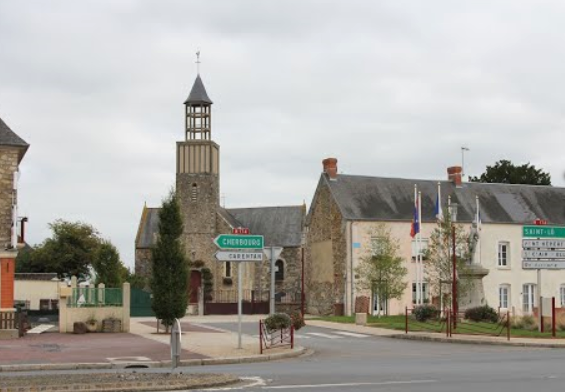
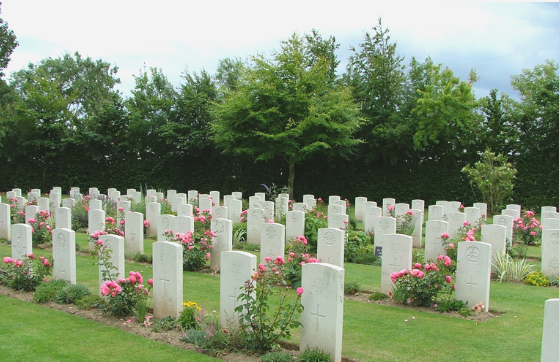
On Saturday, July 8th 1944, Old Nottinghamian, Lieutenant George Colin Brown, was killed in action during the aftermath of the D-Day landings. He was just 24 years of age. Lieutenant Brown was in the 2nd Battalion of the Lincolnshire Regiment (3rd Infantry Division). He is buried in the War Cemetery at Ranville near Caen in Calvados, Normandy. This cemetery houses some 2,567 war casualties.RanvilleCimetiere

Here is the church tower:

ranville ch

In actual fact, Ranville was the first village to be liberated in France.

George Colin Brown was born on February 22nd 1921. His father was WA Brown, a Schoolmaster of 10 Grove Street, Beeston. He entered the High School on September 16th 1932 when he was eleven years of age and immediately became a member of White’s House. He obtained his School Certificate in 1936.

At the High School, George was a keen cricketer, and the school magazine reported poignantly that his “fast in-swinging yorker on the leg stump was devastating on its day”:

crickxxxxxxxxxxxxxxxxxxxxxxx

George had appeared for the 1st XI in 1936, 1937 and 1938. I have only been able to trace the exact details of just one single game that George played in. On May 29th 1937, therefore, he appeared in a fixture at Valley Road against King Edward VII School, Sheffield. The High School scored 77 all out, but Sheffield managed a narrow win by two wickets, with their score of 80 for 8. George scored nine runs when he batted and was bowled by Fletcher. We do not know exactly what type of bowler he was, but his performance was eminently successful, taking three wickets for 28 runs. His performance was bettered only by GF Palmer, who took three wickets for only seven runs.

Boys still learn to play cricket down on the cricket pitches at Valley Road. Almost eighty years after George used his “devastating fast in-swinging yorker on the leg stump”, games against other schools are still won, drawn and lost, all in that same spirit of good sportsmanship that George would have recognised:

nhs

Overall, though, his “fast in-swinging yorker on the leg stump” must have been very effective. In 1938, George took six wickets out of ten against Burton Grammar School and conceded a paltry fifteen runs. Later in the same season, he exceeded this with a haul of seven wickets for twenty runs against Stamford Grammar School. During that distant summer of 1938, he played exceedingly well because in total George took 45 wickets at a cost of just 6.42 runs per wicket. This was the best performance by a High School bowler during the season, in which the First Eleven was victorious in six matches out of twelve. Opponents included such old friends as Forest Amateurs, Notts Amateurs, the Old Nottinghamians, Ratcliffe College, Stamford School and Trent College, left hanging on at 50 for 3, chasing a winning total of 162.

When George Brown played down there at Valley Road, just before the war, a gigantic tree stood very close to two of the pitches. Alas! It was blown down in the great hurricane of 1987. It used to stand on the grass, perhaps directly in front of the house on the left. As I mentioned, it was close to two of the cricket pitches, so not one but two teams would wait to bat under its canopy of leaves :

untitled
I have been unable to trace any exact details of poor George’s death, but I suspect it was in the battle to control Caen, as the Allies moved inland after D-Day.

A website which details the entire war day by day says:

“On July 8th 1944, a major British and Canadian attack began around Caen. 2,726 tons of bombs were dropped by 450 RAF bombers overnight as part of the preliminaries. The battleship HMS Rodney delivered hundreds of 16-inch shells. US forces coordinated an attack to the west. British and Canadian troops entered the outskirts of Caen, only to find SS Colonel Meyer’s Panzer tanks still firmly established outside the city.
The citizens of Caen stayed huddled in their cellars while the Germans stubbornly held out. Hitler had ordered that every square kilometre should be defended to the last man, but the Allies managed to penetrate into the very centre of the ruined city along the north bank of the River Orne. There they were stopped by Meyer’s men. In a month of battles, every single one of Meyer’s battalion commanders was killed and he received no replacements. Meyer wrote in his diary:

“My officers and men all know that the struggle is hopeless, but they remain willing to do their duty to the bitter end.”

That is the point of view of an apparently honourable man but ultimately, it was pointless fanaticism, which may well have resulted in the death of another honourable man, George Colin Brown, at only 24 years of age.

30_caen04xxxxxxxxxxxxxxxxxxxxxxxxx


20 Comments

Filed under France, History, Nottingham, The High School

A few days after D-Day (1)

Frank Leonard Corner attended the High School just  a few years before before the Second World War. He spent at least one season as the young scorer for the School’s First XI cricket team:

P1300886 1938

Of the three cricketers behind young Frank Corner, the one on the extreme right is George Brown. Playing for the School cricket team, George was a real asset with his “devastating fast in-swinging yorker on the leg stump”. On a forgotten Saturday in July 1944, however, now Lieutenant Brown, he was killed in action during the aftermath of the D-Day landings. He was just 24 years of age. Lieutenant Brown was in the 2nd Battalion of the Lincolnshire Regiment (3rd Infantry Division) and on that day, the blast of an exploding German mortar shell was even more devastating than his “devastating fast in-swinging yorker on the leg stump”.

Young Frank Corner, though, left the High School and its cricket team, on the faintly ominous date of July 31st 1939. First of all, he worked briefly for the Notts War Agricultural Committee. Around this time, he had also played rugby for the Old Nottinghamians’ Wartime XV.

Frank, though, like so many hundreds of thousands of other young men, was soon to feel the “Call of the Skies”. He joined the Royal Air Force Volunteer Reserve and was soon promoted to be Flight Sergeant Corner.

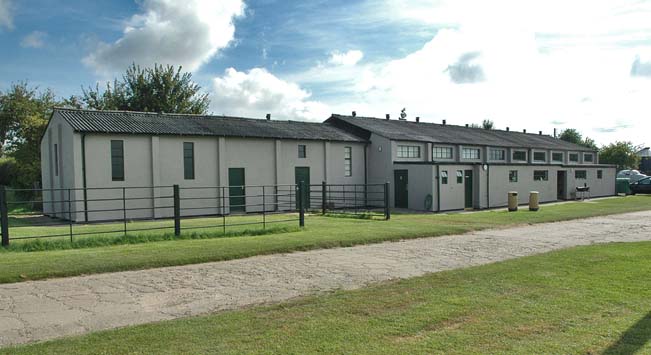
In due course, Flight Sergeant Corner joined 106 Squadron, stationed at Metheringham, in Lincolnshire, just south east of Lincoln itself. Here is the old gymnasium, still left after all these years:

Metheringham_Gymnaxxxxxxxxxxxxxxxxxxxxxxxx

Here is the building used to practice dropping bombs accurately:

Bombing_Trainxxxxxxxxxxxxxxxxxxxxxxxxxer

And here is the beautifully maintained Memorial Garden:

1280px-RAF_Metheringham_Memorial_Garden

Frank was the Flight Engineer in an Avro Lancaster Mark III. Its squadron letters were Z-NH and its serial number was NE150.
Operating in the direct aftermath of D-Day the bomber took off from Metheringham at twenty five minutes past midnight on June 7th 1944. It was tasked with bombing Coutances, a beautiful little town just south west of Caen in Normandy.

Just give you an idea of the numbers involved, the “The Bomber Command War Diaries: An Operational Reference Book” by Chris Everitt and Martin Middlebrook reveals that:

“there was a total of 1,065 aircraft, made up of 589 Lancasters, 418 Halifaxes, and 58 Mosquitos.  They were to bomb the lines of communication behind the D-Day battle area. All of the targets were in or near French towns. 3,488 tons of bombs were dropped on targets at Achères, Argentan, Caen, Châteaudun, Conde sur Noireau, Coutances, St Lô, Lisieux and Vire. Every effort was made to bomb accurately but casualties to the French civilians were inevitable. Cloud affected the accuracy of the bombing at many of the targets and, at Achères, the Master Bomber ordered the raid to be abandoned because of cloud and no bombs were dropped. 10 Lancasters and 1 Halifax were lost in these raids; 6 of the Lancasters were lost in the No 5 Group raid at Caen, where the main force of bombers had to wait for the target to be properly marked and then fly over an area full of German units and guns at bombing heights below 3,000ft. Some details are available of the effects of the bombing. At Argentan, Châteaudun and Lisieux, much damage was done to railways, although the towns, Lisieux in particular, were hit by many bombs. Important bridges at Coutances were badly damaged and the town centres of Caen, Condé sur Noireau, St-Lô and Vire were all badly bombed and most of the roads through those towns were blocked.
….19 aircraft were minelaying in the Brest area, and 26 aircraft on Resistance operations. No aircraft lost.

Total effort for the night: 1,160 sorties, 11 aircraft (0.9 per cent) lost.”

lanc crash

Alas, young Frank Corner was one of that minuscule 0.9%. His bomber was shot down and crashed near the tiny village of St Jean de Daye:

dAYE

On June 11th 1944, the Wing Commander of 106 Squadron actually sent a report to the Air Ministry, explaining that the crew of Z-NH had been told to bomb bridges in Caen. This is thought possibly to explain why the aircraft finally came down near St Jean de Daye. They had been hit by anti-aircraft fire over Lison, where a worker at the railway yard remembers how the German gunners celebrated the fact that they had shot down a bomber.

Frank was just twenty one years old when he died. His service number was 222039 and his parents were Captain Leonard Leslie Corner and Florence Edna Corner, of Whiston, Yorkshire.

Frank is buried in the War Cemetery in Bayeux, in Calvados, Normandy, France along with 3,805 other war casualties. He has paid with his young life the price of our freedom:

ddday


15 Comments

Filed under Aviation, Bomber Command, Criminology, France, History, Nottingham, Politics, The High School