Boots are one of the most familiar names in High Streets across the United Kingdom and beyond. Very few people, however, would realise that this gigantic pharmaceutical corporation started from just one tiny shop in Nottingham.
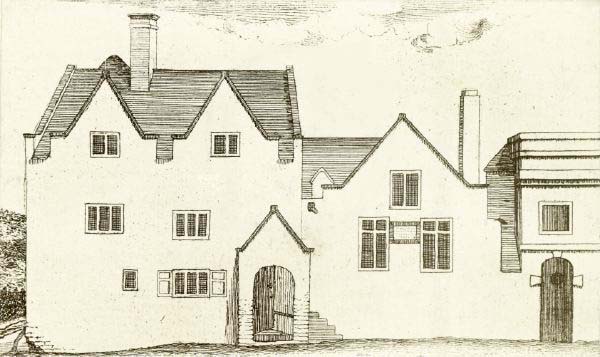
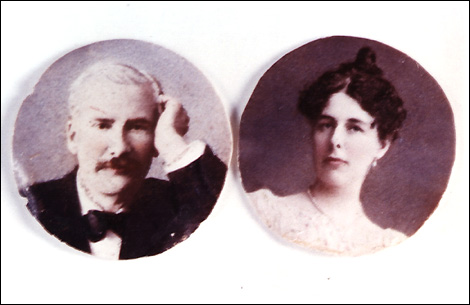
The founder of this vast retail empire, Jesse Boot, was born in the city on June 2nd 1850. His father was a farm labourer called John, and his mother was originally named Mary Wells. The family lived in an area of the town called Hockley, which at that time was extremely poor and overcrowded. John Boot opened a herbal remedy shop locally in 1849, but unfortunately he passed away in early 1860. His mother, by now the Widow Mary Boot, decided to enrol their son, Jesse, in the Nottingham Free School. On Thursday, July 19th, of that year, at the age of eleven years and one month, Jessy (sic) Boot was included on the register as a pupil at the Free School.
He first attended the School in July of 1861, and was to remain in Mr Field’s English Department until his departure in August 1863, a period of just over two years.
While her son learnt high standards of reading, writing and arithmetic, Mrs Boot continued with the shop, helped out by her family and friends, and, from 1863, when he left the Free School, by her son Jesse. By 1871, Jesse was a co-partner with his mother in the imaginatively named “M & J Boot”.
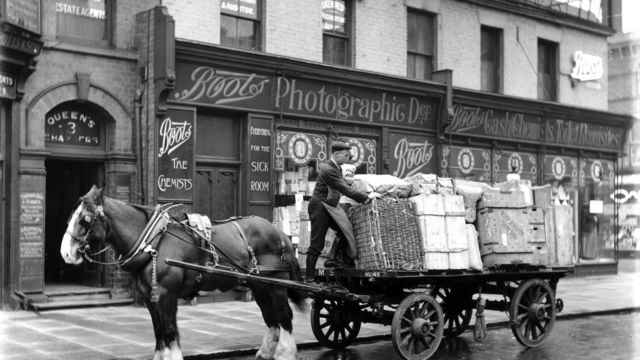
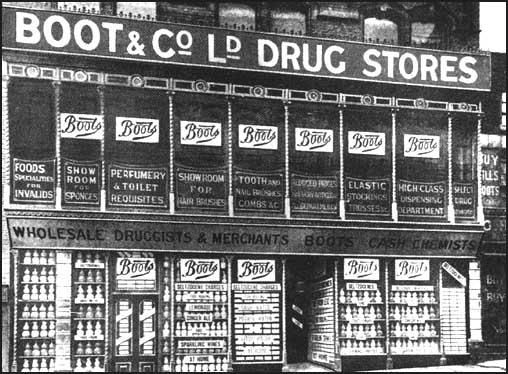
In 1883 the shop became “Boot and Company Limited”. The horse was delighted…
The business then expanded to Sheffield in 1884.
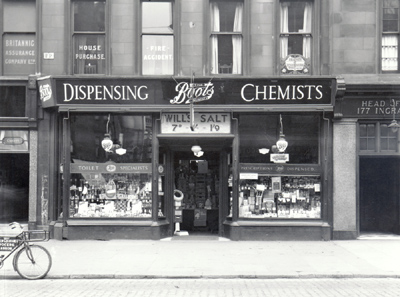
By 1900 there were Boots’ shops over the whole country, reaching their peak with 560 branches in 1913. This particular one was in Glasgow.
The business was eventually sold by Sir Jesse Boot, who became 1st Baron Trent in 1917. It was bought by the Americans for £2.25 million,
In 1933, however, during the Great Depression, the company was re-acquired by a British syndicate. Its head was the grandson of the founder, John Boot, who had inherited the title of Baron Trent from his father, who had recently died in Jersey in 1931.
Nowadays, Boots is a familiar High Street brand name…
Their staff are deliberately clad in quasi-medical uniforms to look more professional
Last night I once again sat down to watch my heroes, the Hillbilly Hunters, set off in quest of monsters, this time to Hocking Hills, Ohio, in search of the legendary Hogzilla.
This thousand pound porker is a hybrid of two closely related animals. His fierceness comes from the introduced feral pig that the Americans call by many different epithets, including the Russian Boar, the Razorback, or the enchanting “Pineywoods Rooter”. His size comes from the huge, overfed and genetically modified farm pigs, such as we see in the fields as we drive north of Nottingham on the A614. The American equivalent is the beautifully deep red coloured “Duroc pig”.
Given his enormous size, his sharp, twelve inch long tusks and his desperately aggressive temperament, Hogzilla is a genuinely fearsome beast who will kill you if he can, and eat you if he is hungry.
The task is defined here…
Here are the first stages of the final night hunt…
And, for the first time ever, SUCCESS!!!!!
“Hogzilla” is suddenly “Trapzilla”.
Within a couple of days, he will make 500lb of sausages. Hurrah!!!
On a more serious note though, towards the end of the third video, Trapper make some very pertinent comments about the accuracy of the evidence given by even the most honest of eyewitnesses, especially when they are frightened.
Yesterday we went to Westdale Lane in Nottingham to see the flypast by the Battle of Britain Memorial Flight’s Avro Lancaster.
This particular aircraft was completed at Hawarden Airfield, Chester on May 31 1945 and its serial number is PA474.
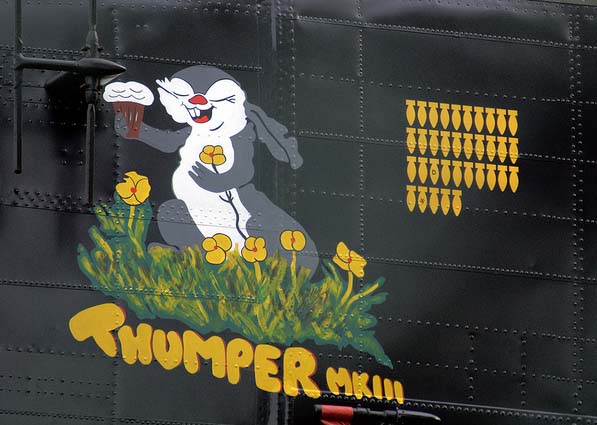
This sole remaining British Lancaster is currently painted as “Thumper Mk III“.
Last week we had the builders and plumbers around to our house to put in a new central heating system. At first it felt exactly as if the whole building had been hit by a tsunami. Not quite as dramatic or as destructive though as this one…
The problem was that every one of the six men was armed with his very own Mjölnir, his very own Hammer of Thor, with which he was capable of sending thunder echoing round the house whenever he felt like it.
In actual fact, it was more that the jobs they had to do in the first couple of hours were by far the noisiest of the entire four days. Believe me, a dining room is no is no place for a pneumatic drill.
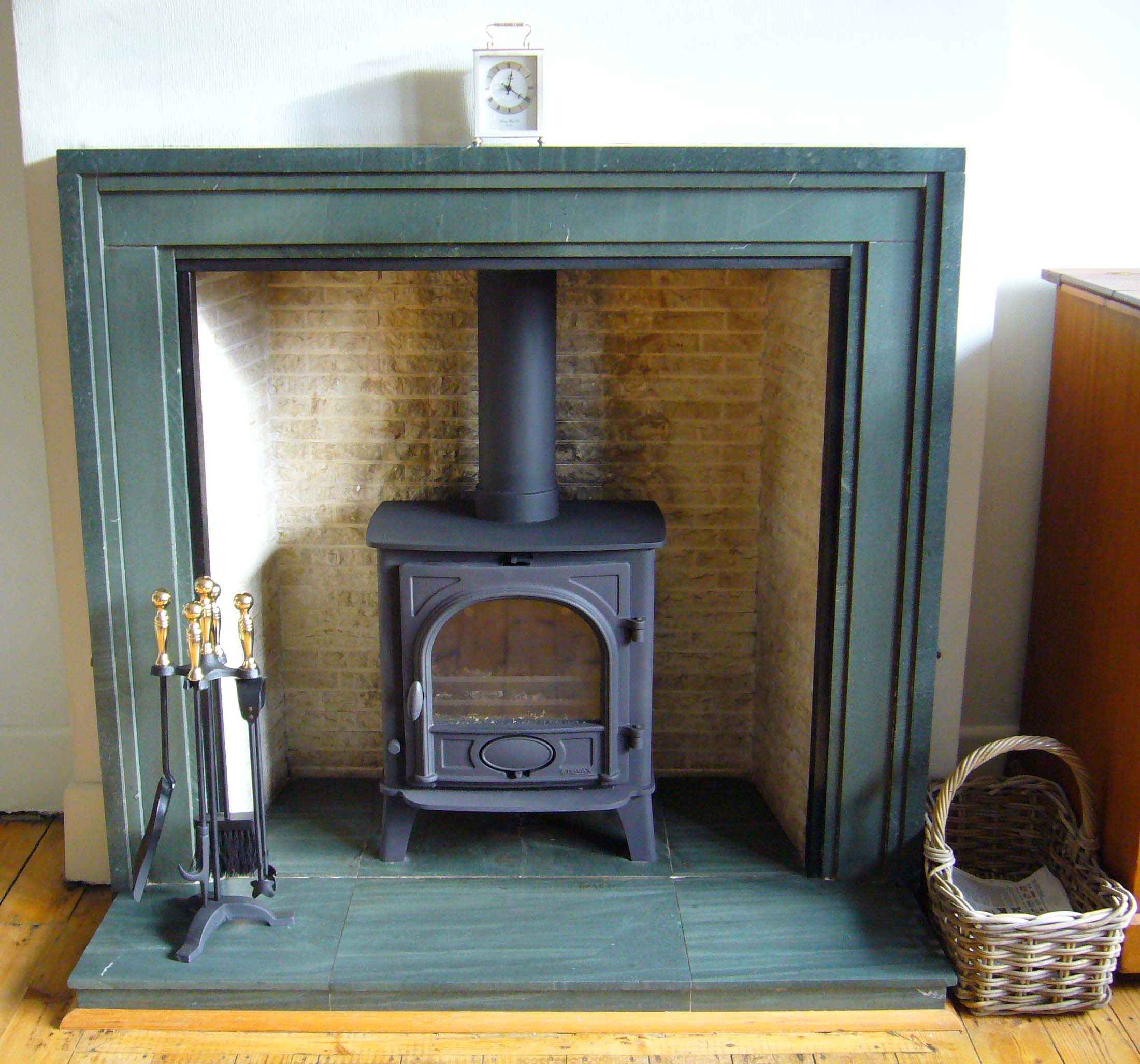
In 2013 we had the same company come round and put a multi-fuel stove in our living room. We were sick and tired of the money guzzling gas fire, to which the only other solution was to switch on the central heating for the entire house. Here is our first stove which was put in last September.
Over the course of the winter therefore, we lit our new multi-fuel stove in the late afternoon, and after feeding it sparingly with coal for the evening, we then discovered that it would then keep the room pleasantly warm for the whole night and for much of the next day. In addition, it also kept the bedroom above equally lovely and warm. Only very infrequently were we using the central heating.
We soon realised that having a second stove fitted in the dining room at the back of the house might have the same effect and save a great deal more money. So, as well as having our central heating revamped, we were having a second stove put in.
In the dining room, we had a ten or fifteen year old gas fire. It always seemed to remind me of somebody, perhaps a character out of Wallace and Gromit.
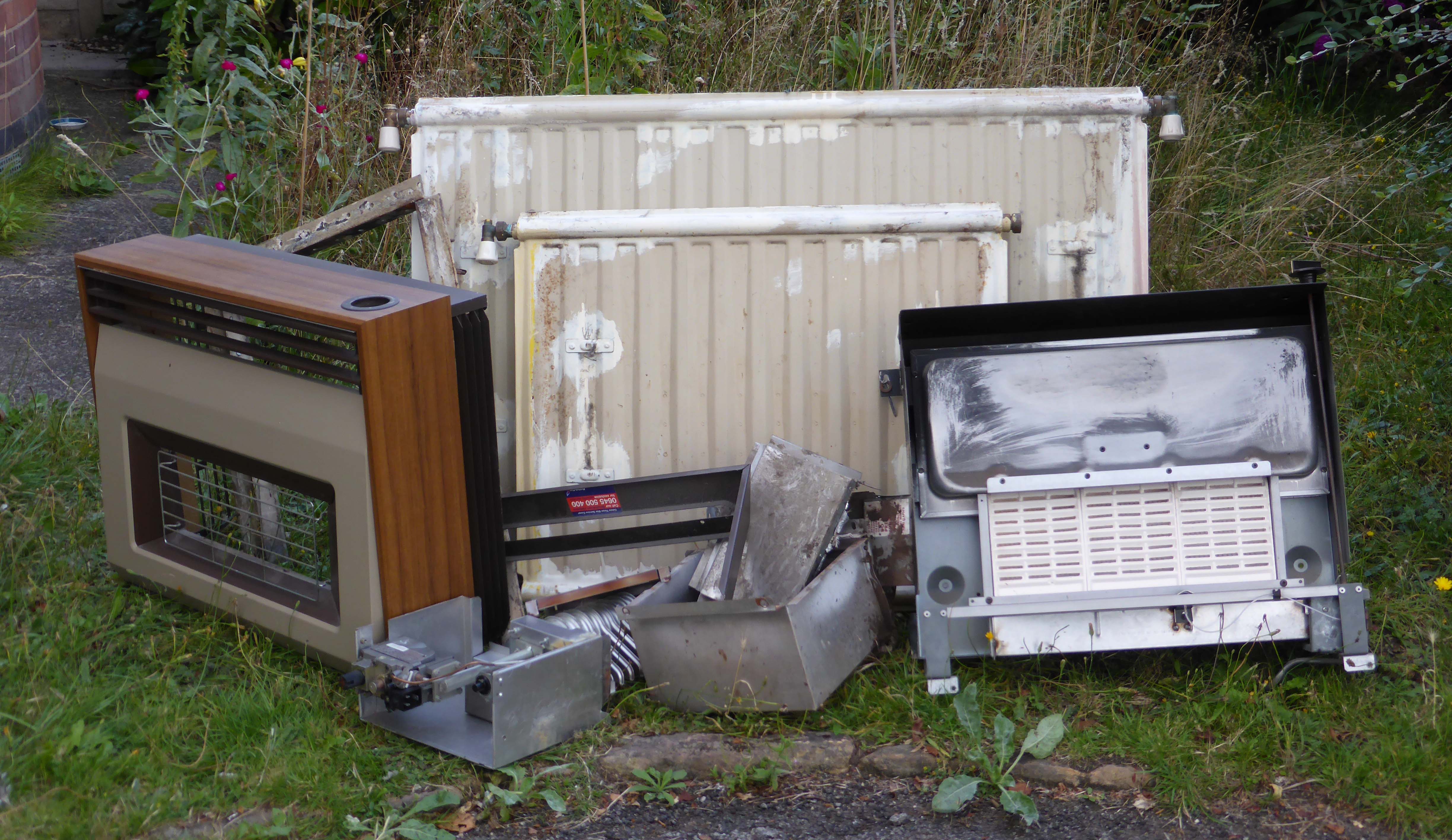
First of all they removed the gas fire. Here is just a small selection of the rubble that the builders created. Notice though, that it is neatly put into special plastic buckets, so that nothing whatsoever remained at the end of the day.
Here is the old gas fire, and the old radiators, gone for ever…
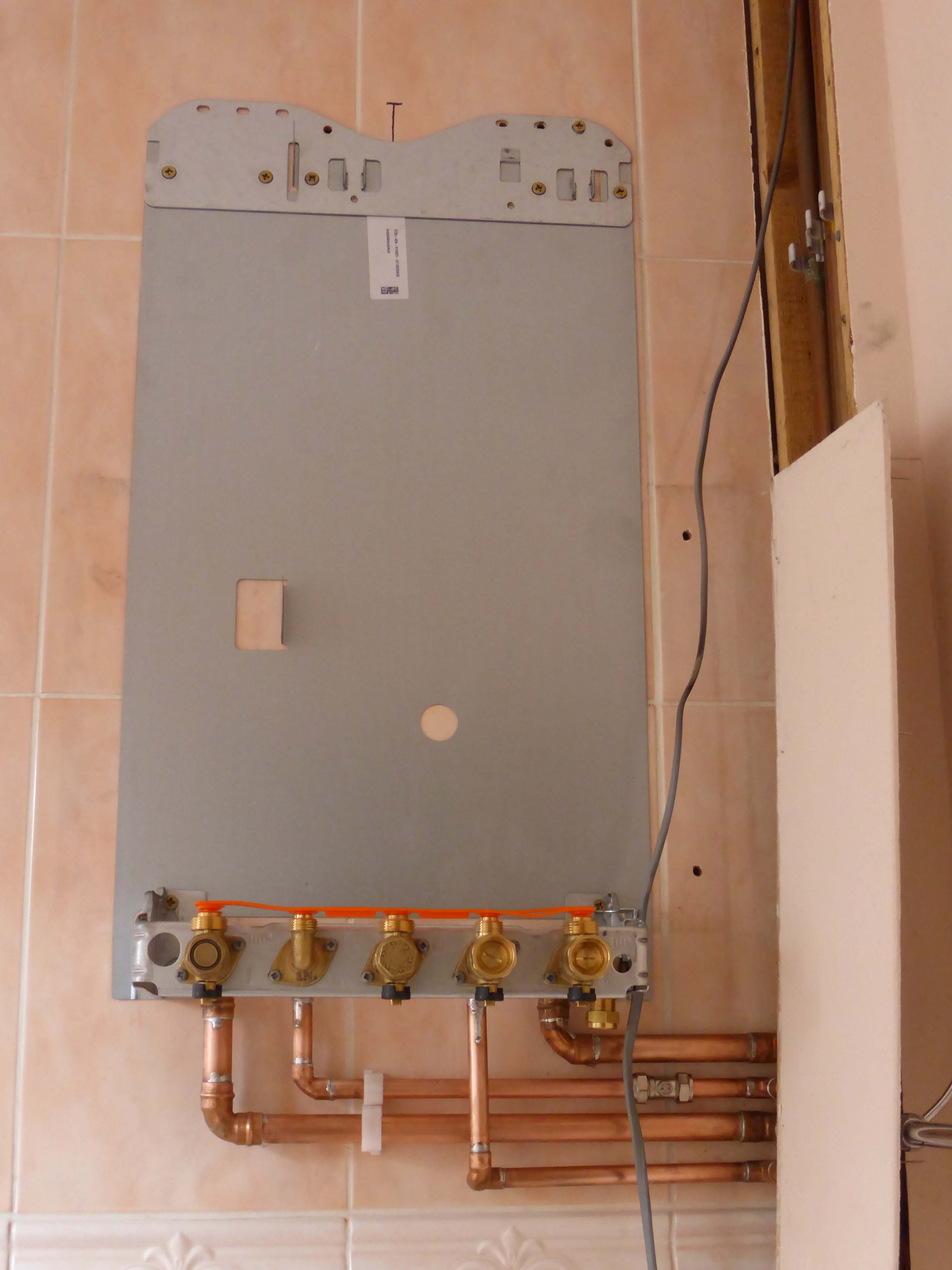
The majority of the old radiators had to go. They had been there since probably the mid-1960s. Here, plans are being laid to put the new boiler in the bathroom where an old cabinet had been.
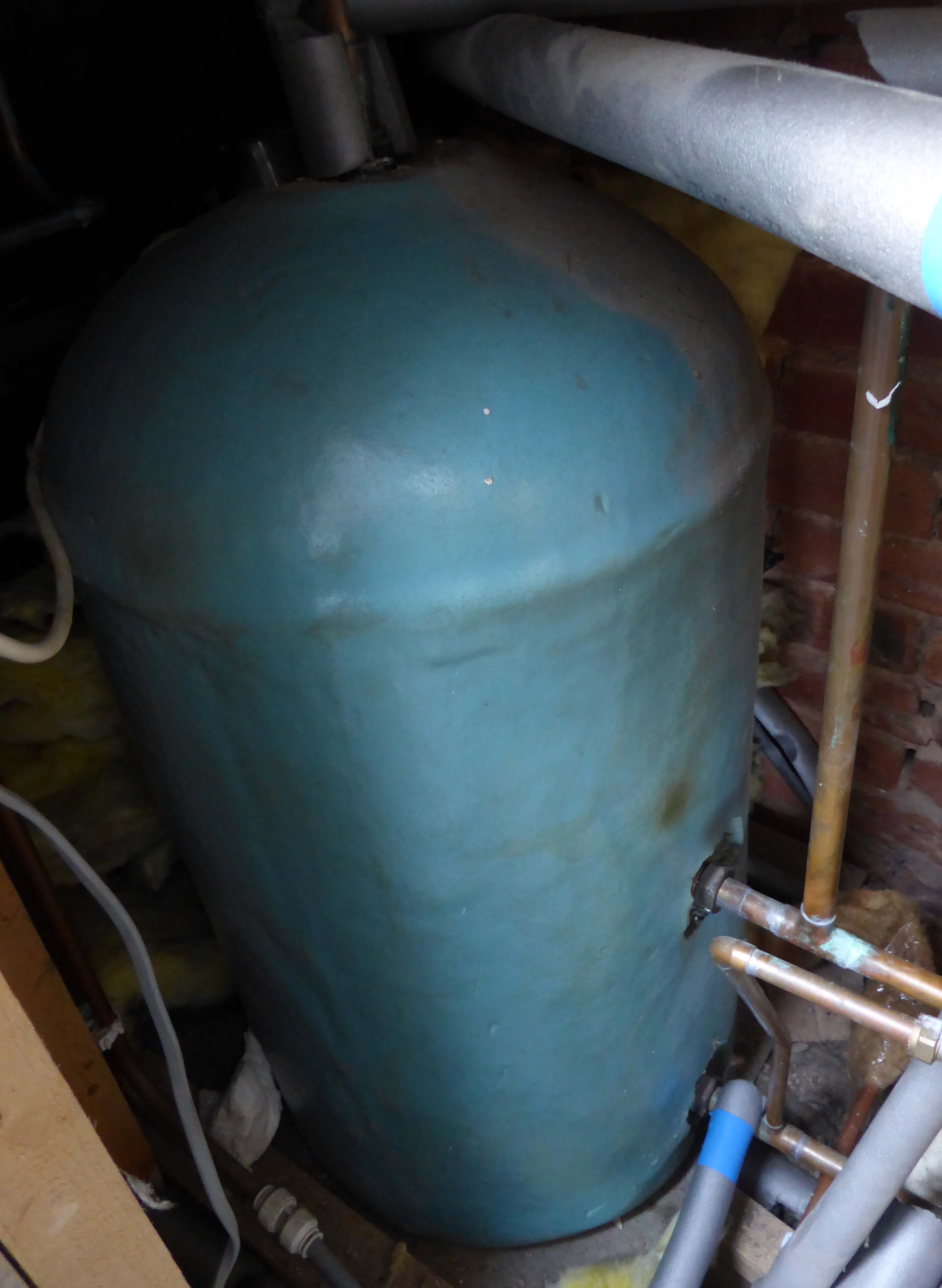
In the loft, the old boiler had come to the end of the road. The fat lady really had sung for the last time.
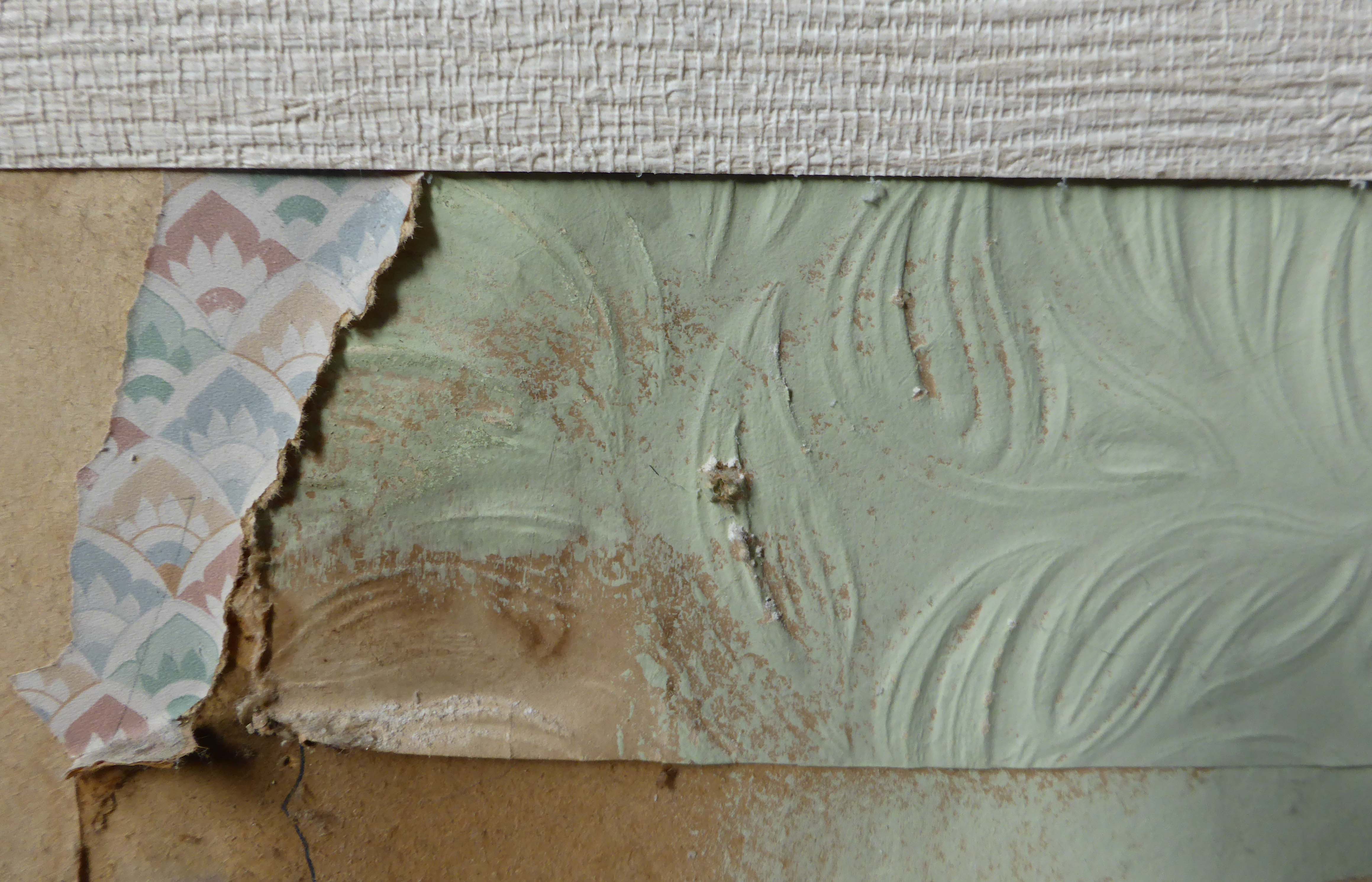
Unfortunately, here and there, the wallpaper will need repair, but there are very few things that a Pritt stick will not be able to remedy. In actual fact, in some places, a number of different layers of wallpaper were revealed.
The top pale green one, I think, was our responsibility but the green leafy pattern looks to me to be either 1940s or 1950s, and the relatively bright coloured wallpaper to its left dates from the more optimistic days of the 1980s.
Here you can see not only Mjölnir, the hammer of Thor, but also the pneumatic drill which caused all the scariest noise for the first half hour or so.
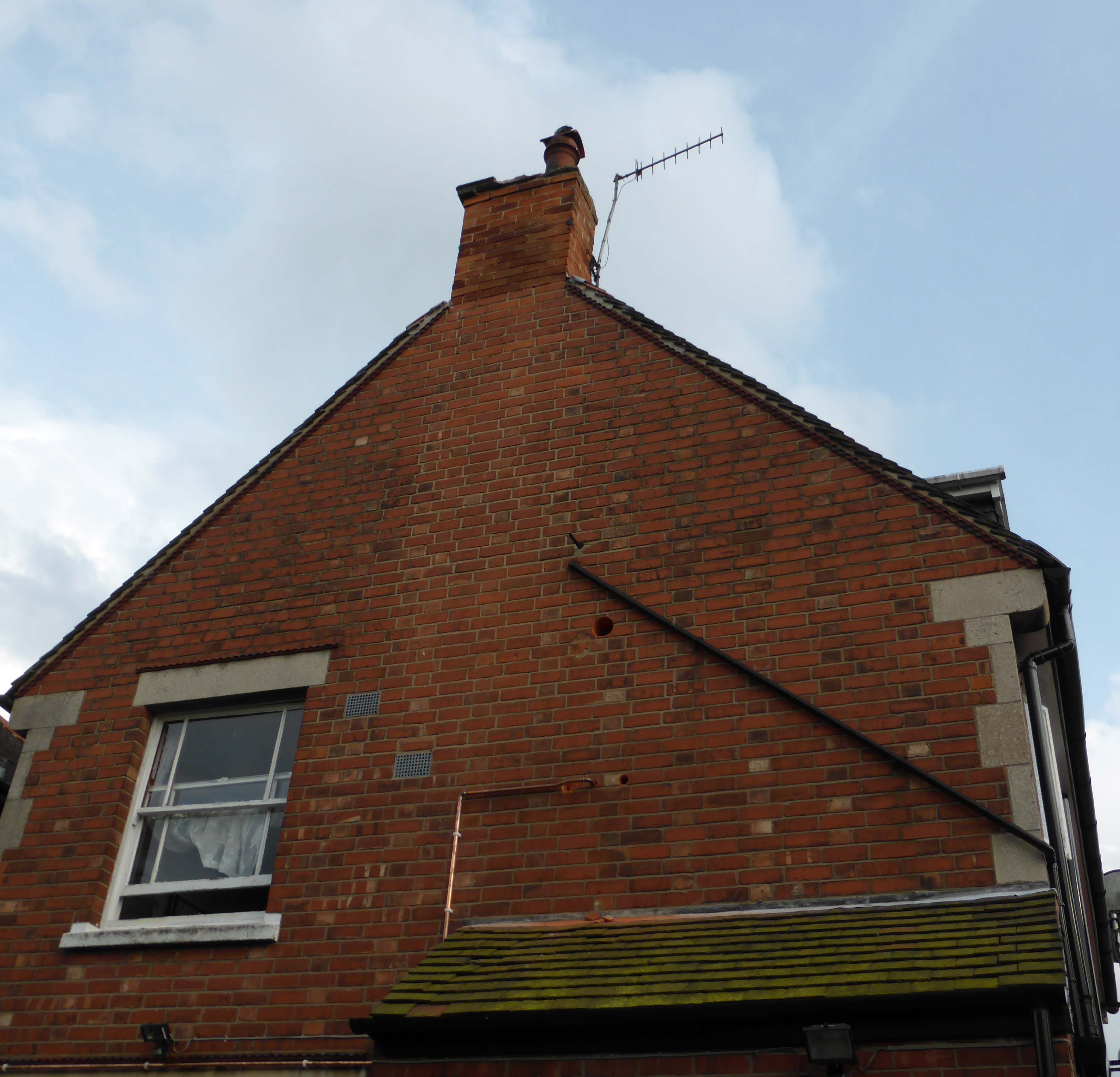
The chimney had to be inspected. Would an eighty year-old chimney be up to the job, or would it require extensive and expensive repairs? Well, what do you think?
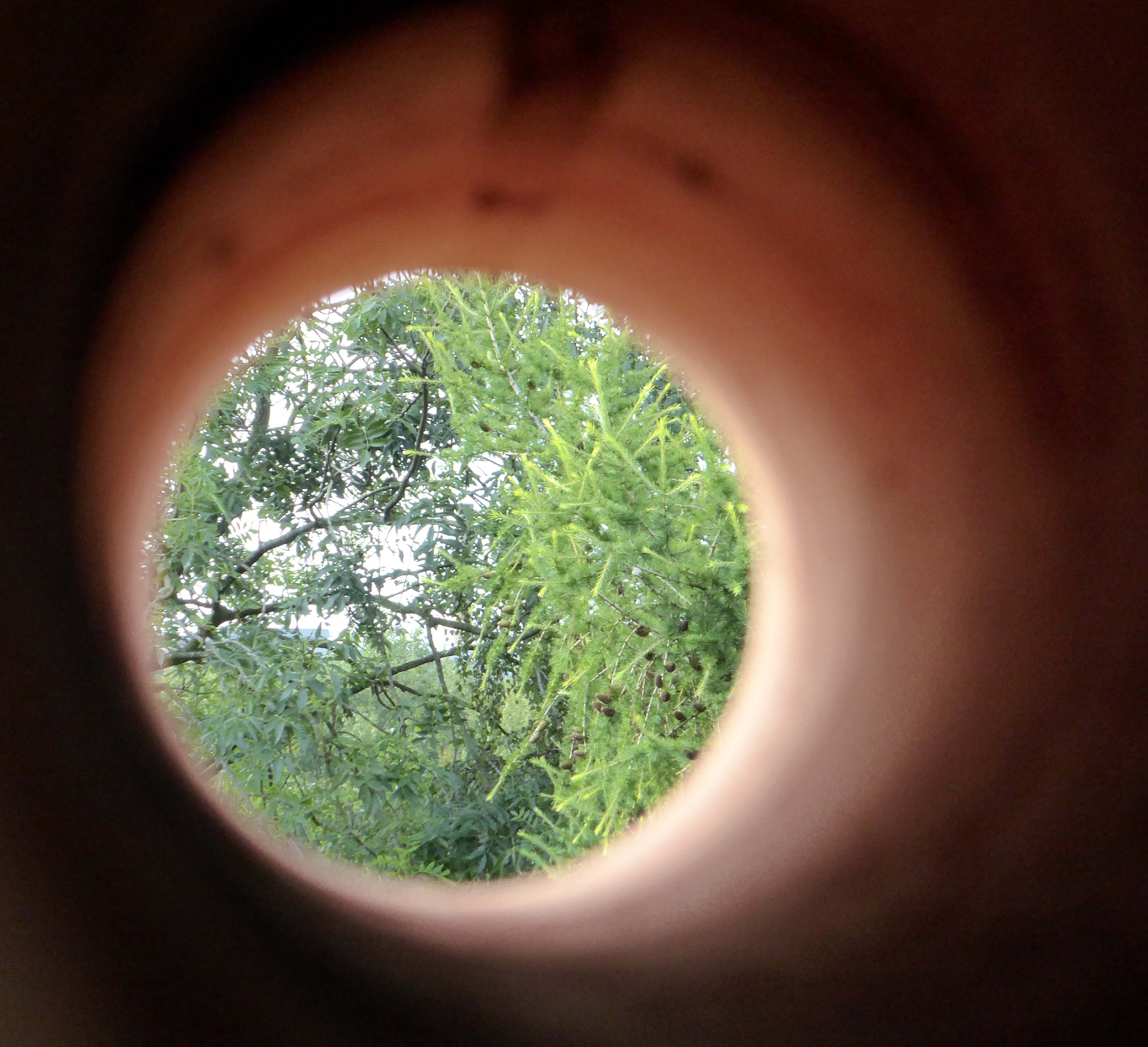
This hole, drilled in the bathroom wall for the new slimline boiler, gave a view over the garden which could be enjoyed for only twelve or so hours in nearly eighty years.
The princess of boilers is now in place.
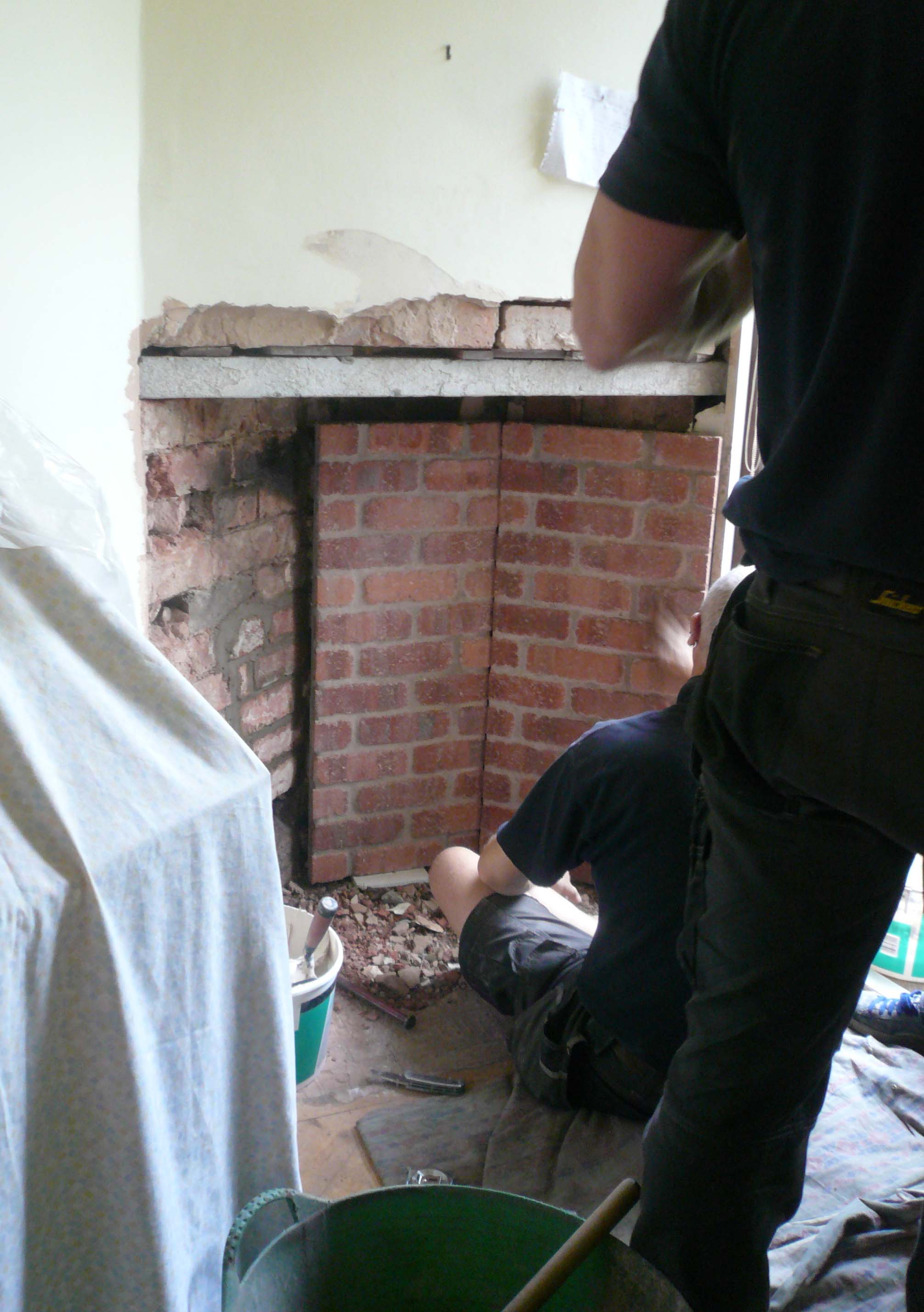
Meanwhile the new fireplace will need some imitation bricks. The builder works so fast his trowel is just a blur. Behind him is the Safety Superintendent.
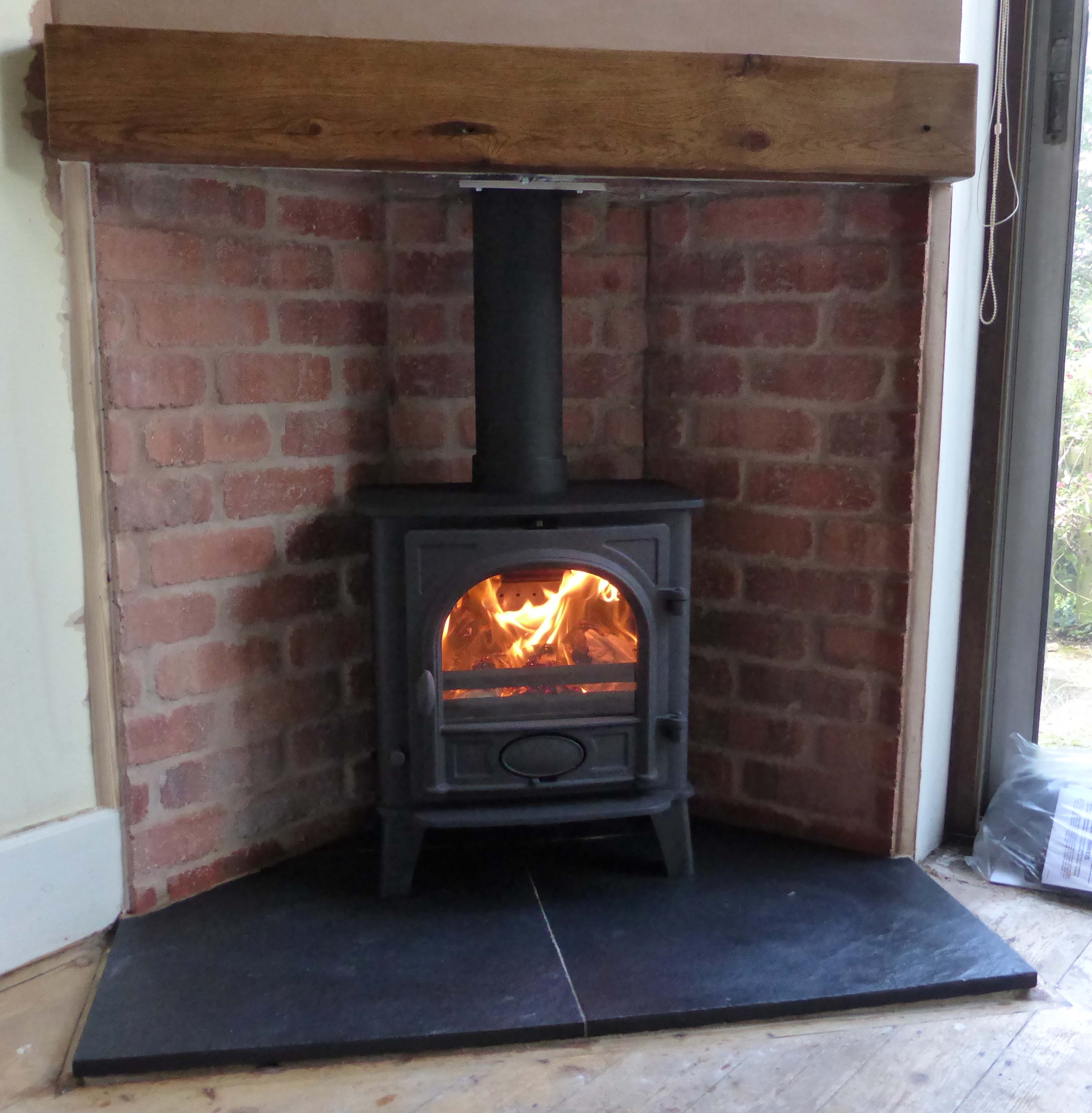
At last everything is ready. The stove is connected up. And then, the all important test firing.
All those lovely warm happy flames. I do so love flames and lovely warm fire. Flames and fire. Fire and flames.
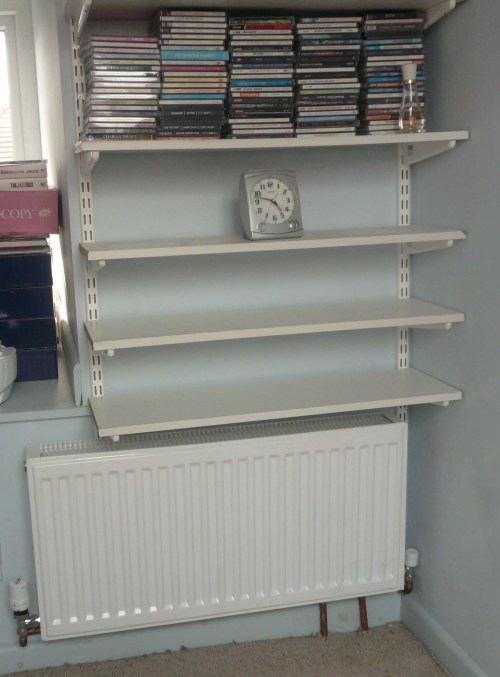
With two radiators now though, there will be no repetition of that unfortunate business with the polar bear.
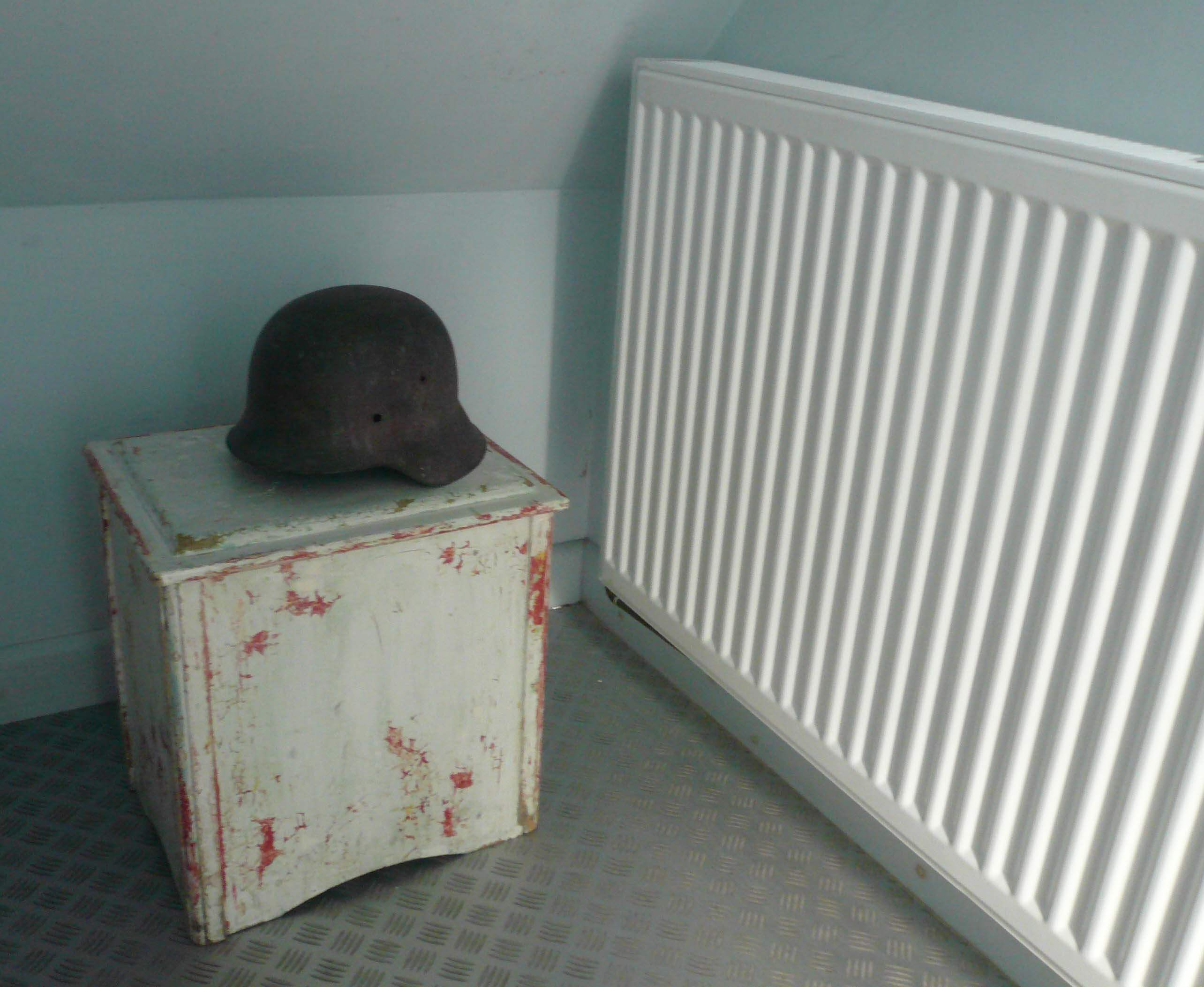
In the bathroom, there is yet another radiator. It will now be impossible for me to put my Stahlhelm on and re-enact “Showering Facilities on the Eastern Front”.
Best of all though, is the fact that I took advantage of all this building work to have a new, much more powerful shower installed. No more problems now with having to wash like this…
Every single morning now, I’m in the new shower just like this.
A lot of us, through shyness, keep our personal medical problems to ourselves. Not so these construction workers in Nottingham, who are more than willing, apparently, to let it all out.
So go for it, guys, your problem will soon be our problem.
This amazingly spikey plant is called a “teasel”, and it is easily the most fascinating plant in our garden.
It is a very thrilling plant from an English point of view, for, alas, we just do not seem to have the same exciting inhabitants in our gardens as they have in the USA…..
These American killers are deadlier than wolves or bears.
Our English plant, though, can consume a reasonable number of insects, medium sized mammals and small children.
It performs this valuable service by drowning them, and then absorbing their nutrients. Equally well, you can easily feed the plant yourself by tipping in the dregs from your cup of tea or coffee. On this caffeine based diet, our plant has now reached an amazing twenty seven flower heads. Here are two of them….
The biggest flower heads are now in bloom. They provide a fabulous source of nectar for all kinds of interesting flying insect, especially butterflies….
This is a Peacock…
This is a Red Admiral. Its Latin scientific name is “Vanessa atalanta”, which sounds a little bit like one of the old Admiral’s girls in every port…
The flowerheads are a lovely bluey-pink colour…
Eventually seeds will appear. Indeed, in our worryingly early autumn, many have already arrived as early as the fifth of August.
This slideshow requires JavaScript.
The seedheads are an absolute magnet to England’s most colourful bird, the improbably beautiful Goldfinch…
The population of these splendid birds is gradually increasing, and teasels are an excellent way to entice them into your garden.
This could easily be your garden…
I would be very surprised, though, if you managed to attract as many of these beautiful birds as Gunnar Fernqvist has done, although, to be fair, he does seem to have a VERY large garden.
Interestingly, the Goldfinch has always been of great symbolism in medieval European art. According to Wikipedia, because of the thistle seeds it eats, and the spiky nature of the adult thistle plant, the goldfinch is associated with Christ’s crown of thorns. When it appears in pictures of the Madonna and child, the bird is thought to represent the knowledge both Mary and Jesus had of the latter’s Crucifixion.
This slideshow requires JavaScript.
Teasel seeds can be found fairly easily on your local brownfield site in late summer or early autumn. Otherwise, it’s another expedition up the Amazon.co.uk….
You might not think so, but this is a good time to be buying a bird table. It will give the birds plenty of time to get used to the presence of this new garden furniture, and with a little bit of luck, they might even start coming to the table fairly quickly. At the moment, for example, there are lots of recently fledged baby birds who could all do with a little help to find food.
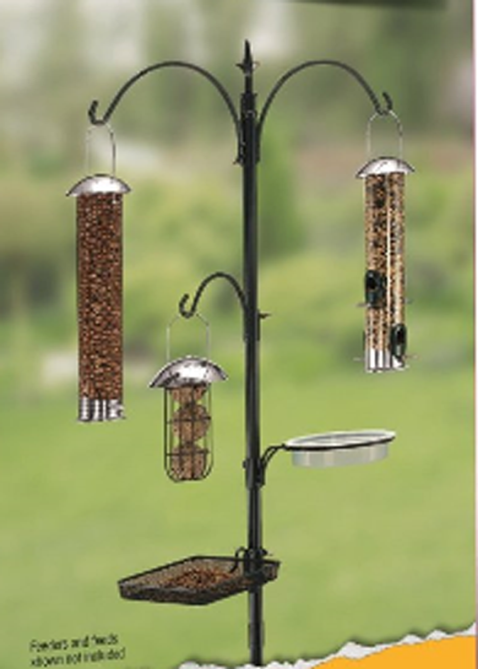
For me, the most basic thing to buy is a free standing weighted block in which to insert the framework which will eventually hold your food dispensers.
This is the type of thing I mean….. The top is like this….
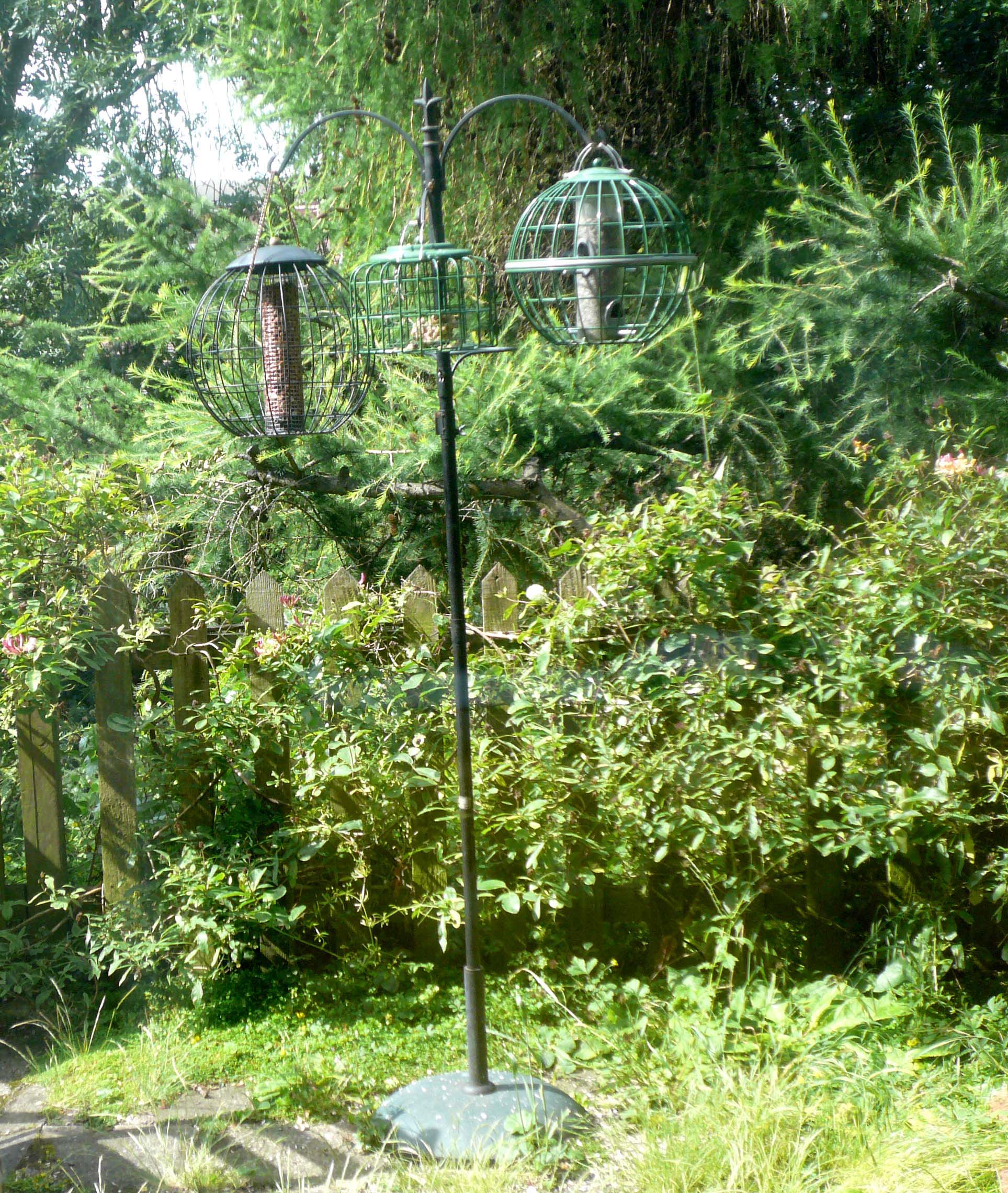
Our bird table looks like this….
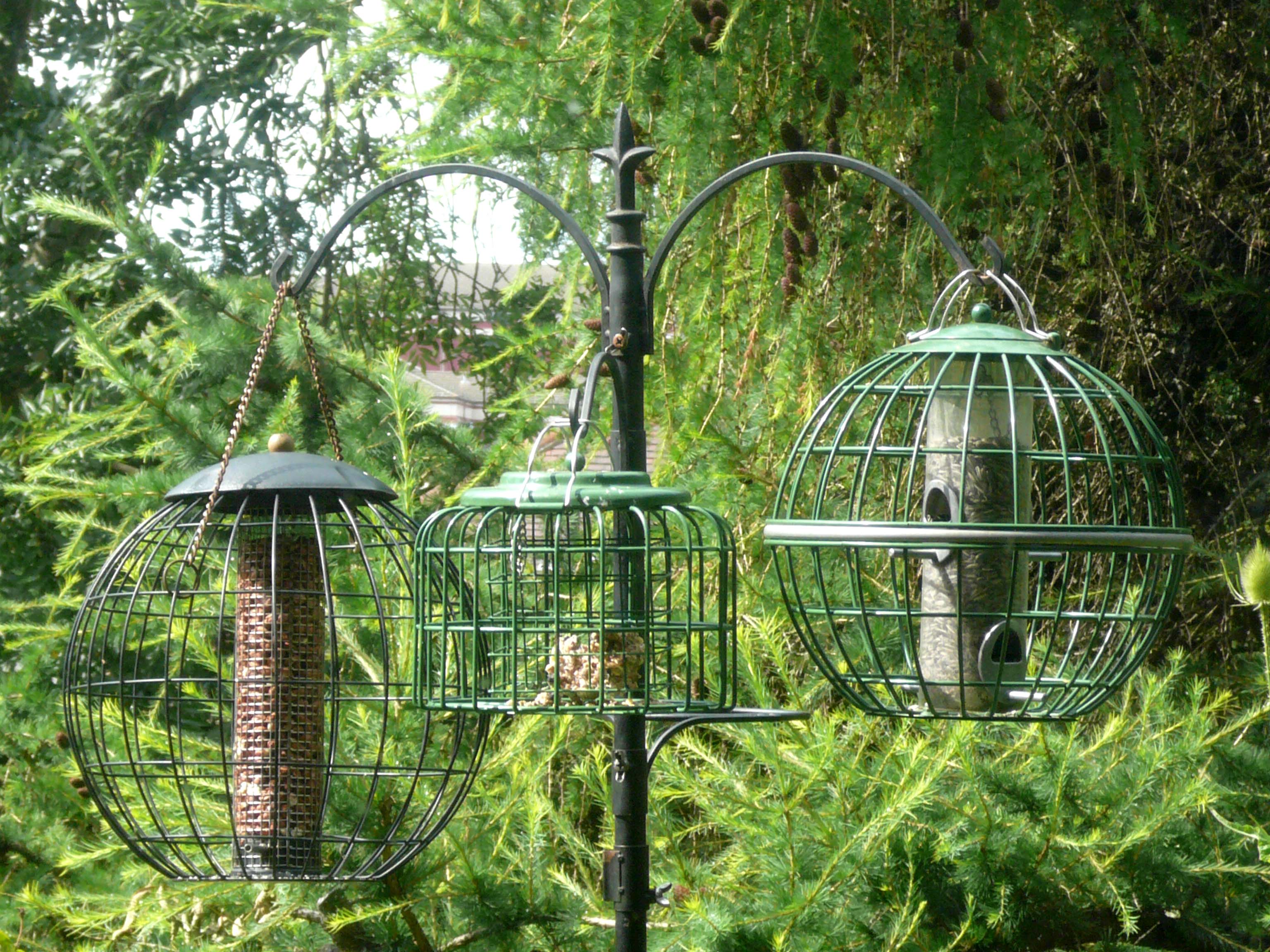
There are three metal bird feeders…
The leftmost one encourages them to nibble nuts…
They love the middle one, which contains a pretty revolting block made of suet and either insects or mealworms.
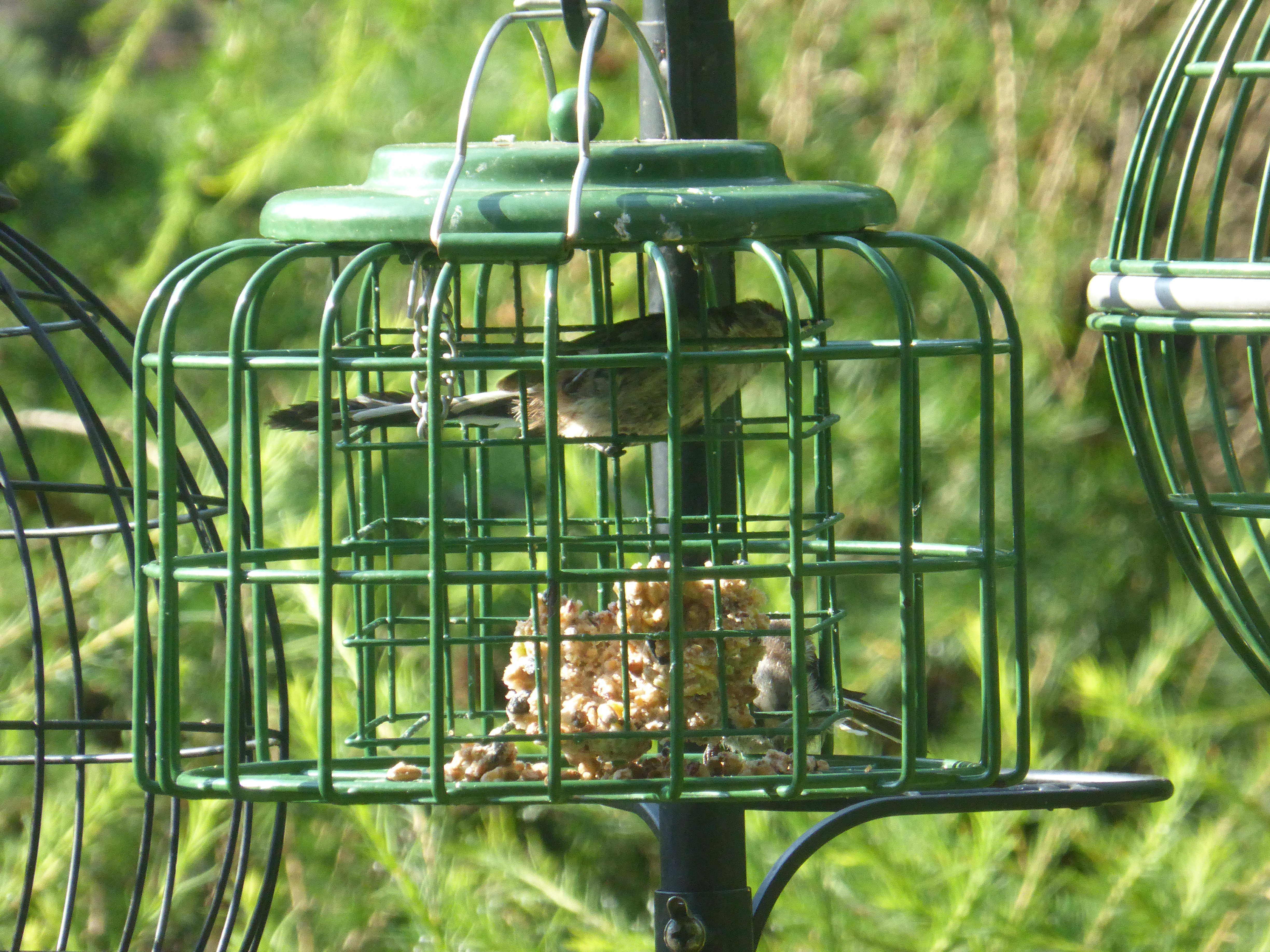
The tiniest birds, like baby Long-tailed Tits, can even manage to get inside two layers of anti-squirrel proofing!
On the right is a dispenser which allows birds to take away sunflower seeds.
This slideshow requires JavaScript.
In time, the birds will get used to it, and your bird table will attract lots and lots of them. At the moment, it is almost totally baby birds, who can make up for this summer’s apparent lack of insects by snacking on the food we provide. So far, we have helped out Great Tits, Coal Tits, Blue Tits and Long-tailed Tits. In winter, there are many other species which turn up, such as Dunnocks, Chaffinches, the increasingly rare House Sparrow and the showy Siskin.
This slideshow requires JavaScript.
If you want some extra variety, there is a fabulous bird table webcam, at the Cornell Institute in Ithaca, New York State. Every single bird here is different from ours, except, of course, the ubiquitous Common Starling (Sturnus vulgaris).
Your biggest enemy for a bird table anywhere in England is the pesky Grey Squirrel, but half an hour watching the Ithaca website at the moment will show that we in Nottingham are not the only ones with difficulties. The real problem is that what you think is just one Grey Squirrel is, in fact, two, the male and the female, but you, as a mere human being, cannot necessarily tell the difference. At the moment, the youngsters are slightly browner, but even then, there might well be five separate ones which you think is just one very fast moving individual!
So make sure that anything you buy is squirrel proof. They might be more expensive, but given that squirrels will not just eat bird food on the spot, but will also take it away to store for the winter, in the long run you might actually save money, as you avoid two or three kilos going missing every single day.
We bought all the different bits for our bird table from Amazon Marketplace. That is, of course, not the only place where you can purchase bird tables, but in my opinion, you would certainly be better to avoid garden centres, to avoid wood and to go for metal, and, above all, never ever to have a bird table with a nest box attached.
Above all, remember the five golden double entendres of bird table purchasing…
All of the above feeders are, in my experience, squirrel proof, although in July and August, smaller adolescents can get through the bars to feed, but, because they grow fairly quickly, this will not last for ever.
Don’t frighten them too much! A young squirrel dead from sheer fear will not be easy to get out of the feeder, and, from a moral standpoint, it’s not really very Dalai Lama.
Initially the expense of feeding the birds, and not the squirrels, can be rather high. It is reminiscent of when, in Monty Python, Michael Ellis goes to the pet shop to buy a pet ant….
“Is there anything I’ll need with my ant?”
“Yes, sir – you’ll need an ant house. This is the model we recommend, sir. And then you will need some pieces of cage furniture which will keep him entertained. Here’s an ant-wheel, an ant-swing, and a very nice little ladder. He can run up there and ring the bell at the top, that’s a little trick he can learn.
Here’s a two-way radio he can play with… and of course you’ll need the book. So, sir, that is, if I may say so, one hundred and eighty-four pounds twelve pence, sir.”
On the other hand, if you set up your metal fortified bird table a few yards from your panoramic dining room window, you will be able to watch the comings and goings of the birds, and relieve the stresses and strains of the day for the rest of your life, even if your camera is showing its age, the curtains cast a reflection, the sun is in the wrong place, all the usual excuses….
Recently, the Premier League teams released their charges for a seat to watch a game next season.
As you might expect, prices are fixed at an almost unbelievable level for the ordinary working person. The days when an averagely wealthy parent might have taken his two children to a game seem to be long over.
When I was much, much, younger, my Dad used to take my brother and myself to matches at the now demolished Baseball Ground in Derby. Granted, though, the playing surface might occasionally lack a little of the green stuff…
And just now and again, it became a little muddy in places…
This slideshow requires JavaScript.
I don’t know how much it cost my Dad, though, because we had season tickets, and I never saw him physically hand over his hard earned cash.
Forty years on, of course, the Baseball Ground is long gone…
I just cannot remember what prices for admission were posted up on the old stands at the Baseball Ground. And in any case, in those early days of the 1970s, there were terraces, where it was even cheaper to watch the game, although admittedly, hooliganism could often run riot.
I am pretty sure though, that, even allowing for the passage of time, my dad was not paying out anywhere near that average cost of £90.24 for a single game at White Hart Lane, or a possible £127 to watch their great rivals, Arsenal.
Unbelievably, if my dad were still with us now, it could cost him almost £300 to take my brother and myself to a Spurs game, and probably more, should we wish to watch Arsenal. Even the cheapest seats would give him too little change from his £100 for him to buy everybody a skinny latte and a prawn sandwich.
And the net result of all this, of course, is that the rich get richer and the poor get poorer. Little teams like QPR or Burnley might optimistically put their prices up, ready for a long and successful stay in the Premier League, but in terms of actually achieving any real footballing success, they stand quite simply no chance whatsoever.
This slideshow requires JavaScript.
The days when a team like Derby County could win what would have been the Premier League twice in four years are long gone…
…and the years when a team like Nottingham Forest could win the European Cup in two consecutive seasons have gone with them.
Football, though, was a lot more exciting in those days…
And occasionally, considerably naughtier…
Derby County only missed reaching the European Cup Final by the narrowest of margins. The width of an Italian’s banknote, you might say…
I don’t really know what to offer as advice. Most of us know which football team we are destined to support as a matter of instinct, and, judging by next season’s proposed prices, if we support a London team in particular, we could well be in financial difficulties.
It is, though, more or less impossible to invent an artificial love for Leyton Orient, Stevenage or Dagenham & Redbridge, just because it is cheaper to go inside their stadium and physically watch them play.
I would commend to you, though, not so much the teams in League One and League Two, but the teams lower down the pyramid. Have a look in your local evening newspaper, and see which local clubs are going to be playing on the following Saturday, kicking off probably at the traditional three o’clock. And go and watch one of them. You never know, you might enjoy it. The programme will not be £5. When you ask for “A skinny latte and some nice focaccia, please”, the lady will probably reply, “Yer what??”
And pick a team with a good name, such as… Coventry Sphinx, Tonbridge Angels, Solihull Moors, Pontefract Collieries or even the West Midlands Police.
You may or may not like it, but at least it will not be costing you the best part of a hundred quid. And who knows? You may one day take to them, and realise that you have become a supporter of real football, not showbiz.
Originally, it was the “Surrey Puma” which had caused all the fuss throughout the 1960s. The first possible sightings had been recorded in 1959, but by the mid-sixties, at Godalming Police Station alone, 362 reports were received over a two-year period. And then, in August 1966, a former police photographer took a pale, blurry grainy snap which he claimed showed the Surrey Puma at Worplesdon, near Guildford. The photo was published in the “News of the World”, and showed an animal almost surprised by the fuss.
It was enough to get the local plods out of the chip shop, though, and out on patrol…
They found little (if anything). Ten years later, in the very early morning of July 29th 1976, the focus was very much on the Queen of the Midlands, the beautiful City of Nottingham…
Not on the stone lions on the Council House, the rendez-vous point of countless lovers since they were placed there by the Third Reich School of Architecture in the late 1920s…
Not even the local ice hockey team…..
But rather on a country lane a few miles from the city centre. It must have been a very countrified area at the time, with lots of now disappeared open fields, and the grassy expanses of the airstrip at Tollerton, the rather grandiosely named “Nottingham Airport”. It was one of the two years of extreme drought in the mid-1970s, and it was….
“…shortly after 6am, 29 July 76, when two milkmen were delivering to a bungalow opposite the entrance to Nottingham airport on Tollerton Lane between Nottingham and Tollerton. Different accounts put it at 15 or 50 yards away from the men; they were in no doubt: “We both saw together what to us us was certainly a lion….its head down and its tail had a bushy end. It was walking slowly away from us.”
It is unclear whether it was a male or a female, but presumably they would have said “lioness” if that was what they had seen.
This slideshow requires JavaScript.
It must have been difficult to be mistaken though even at fifty yards’ range.
“They watched it walk around the edge of a field, then called the police from the bungalow. By nightfall, the police mounted a huge search, with dogs, guns, loud hailers and a helicopter, in the Tollerton and West Bridgford areas. The police also said they had calls from people telling of the mysterious restlessness of their pets on the night of the 28/29th; and a local farmer at Clipstone, near Cotgrave, reported ‘strange paw prints’ on his land.”
As is often the case…
“The police found nothing. They checked zoos and private lion-owners within 100 miles, but ‘no-one appears to have lost a lion.’ They said they were taking at least 15 sightings seriously. The hunt hit a turning point in its second day when a sighting at Radcliffe-on-Trent turned out to be somebody’s Great Dane. At the same time a sighting came in from Bassingfield. One of the reports was from as far away as Norfolk by a couple who said they saw a lion in a lay-by at Lowdham (a country village near Nottingham) but did not report it they didn’t think they’d be believed. Yet despite these sightings, the police were getting disappointed by the lack of anything positive. As in the ‘Surrey Puma’ cases, the lack of any killed livestock, no pets missing etc as there would be if there were a lion conventionally on the loose. The milkmen were rechecked and both (David Crowther and David Bentley) were unshaken in their belief that they had actually seen a lion.”
How different from the present day. I cannot imagine that there are too many zoos or private lion-owners within a hundred miles of Nottingham nowadays. It is certainly strange, though, that the two milkmen were adamant about what they had seen…
“On the third day of the hunt, reports were still coming into West Bridgford, the nerve-centre of the operations. One caller heard something big crashing through Bunny Woods, and another heard something in a copse near Trent Lane church at East Bridgford. In fact, the police were obliged to maintain the alert.
Martin Lacey, a former Nottingham zoo owner, enters the fray, saying all the noisy activity has driven the lion into hiding, and offers the use of his lion-hunting Rhodesian ridgeback hounds.”
Just as the press were losing interest in the ‘Nottingham Lion’ the story receives a shot in the rump.
“John Chisholm, a doctor of Normanton-on-the-Wolds, near Tollerton, saw a large animal trying to break through some undergrowth to get to a stream on the evening of 1st Aug, while he was walking near his home. When he returned home he and his wife watched it leave the area from their upstairs window. Police said they were following up several other sightings in the same area.”
Curiouser and curiouser….
“2nd Aug police searching the A610 at Temple Lake, near Kimberley, found a large tortoise on the embankment. They were unable to trace any owner so they adopted it.”
The saga continued…
“The dailies for the next day (3rd) run the story of Dr.Chisholm’s sighting. Naturally in everybody’s eyes the fact that he is a deputy coroner makes the sighting more impressive and believable. (The police were) now 98% certain that there was an animal in the area…..
By the 6th Aug the lack of results was telling on the police. They issued a statement saying they no longer believed there was a lion at large despite 65 reported sightings in the last 8 days. They said that they proved to be mistakes, large dogs, and even a large brown paper bag.”
This slideshow requires JavaScript.
After this negative statement, the police announce three more reports of it in the Plumtree and Normanton areas.
It is rather difficult to sort out this East Midlands X-file. If we accept that the two milkmen were not liars, however, and they had not just misidentified somebody’s Great Dane, it would make a lot more sense of they saw a lioness…
With the benefit of 38 years’ hindsight, I suspect that what they actually saw was
In other words, a common-or-garden “Alien Big Cat”
Nowadays, of course, nobody would think twice about claims of seeing a so-called “Alien Big Cat” in this area south of Nottingham, even though it is probably a lot more built-up than it used to be.
I recently saw a TV programme which claimed that there were two identifiable big cat territories centred on Rutland Water, giving a long list of the many different places in the area where animals had been seen. There have been suggestions, too, that these cats, whatever they may be, are making use of disused railway lines to travel around, possibly even penetrating into the suburbs of large cities, rather like foxes have done in the past.
Some ABCs are reported as melanistic…
But do be careful over the question of size, however…
Otherwise your claims to the Nottingham Evening Post may leave you looking more than a little stupid…
But it’s not all over yet… there are still lions out there, back in 1976…
“No sooner had the Nottingham mystery been killed off, it turns up over 70 miles away just south of York. On the night of the 9th Aug, Alan Pestall was on his way to his local walking down the moonlit main street of Thorganby, when a black shadow crossed in front of him, by the church. He thought it was a dog and spoke to it.
Then I realised it had a cat’s face and a long tail. It was about 3 to 4ft long and nearly 3ft high. Before I had a chance to run, it leaps over a fence and was away over the fields.’
He kept walking slowly to the pub, believing if he hurried or turned it would attack him. Police took his story seriously and mounted a search on the 10th, but found no sign of a lion.”
A police spokesman said
“We have no reason to connect this report with the recent sightings of a lion in Nottinghamshire.”
Almost thirty years later, it was the turn of Norfolk’s Boys in Blue to take on the Killer Menace of the Big Cats..
Thankfully, perhaps, Alan Partridge kept out of it.
The picture of the Rhodesian Ridgebacks is used by kind permission of Jackie Ellis whose website is http://www.zejak.co.uk/. Even if you don’t particularly like dogs, there are some lovely cute puppies there…and the bonus is that they’ll protect you from the Nottingham Lion!
Any of my readers in either the Americas or Australia will wonder what I am talking about when I get excited about the European hedgehog (Erinaceus europaeus)…
But that will be because, according to Wikipedia….
“A hedgehog is any of the spiny mammals of the subfamily Erinaceinae, found through parts of Europe, Asia, Africa and New Zealand (by introduction). There are no hedgehogs native to Australia, and no living species native to the Americas.”
Hedgehogs are lovely, sweet animals, which often turn up in the more countrified or overgrown gardens just as darkness is beginning to fall on a warm summer night, and the bats are coming out to hunt.
It is a well-loved species, which has, however, declined sharply in England over the last ten years, with an overall decrease of at least 25%. Hedgehogs are, in actual fact, disappearing in Britain at a quicker rate than tigers are in their own jungle habitat in southern Asia. The problems for hedgehogs are the usual ones. Gardens are nowadays generally tidier with lots of neat wooden decking, and hardly any patches of weeds and rough grass, full of slugs and juicy snails. More efficient fences have fewer holes in them to allow hedgehogs to range far and wide. The extensive use of insecticide means fewer insects, and a greater possibility of being poisoned. Road casualties are high because the animals’ first natural defence is to roll up into a spiny ball. Not too effective on a busy highway.
Recently though, in our wonderfully overgrown garden, we have been visited by two, possibly, three hedgehogs. We think that they are either a mother and two different children, or possibly, a father, a mother and one rather small and cute child. They snuffle about in the leaf litter, and yesterday morning, in the wee small hours, at about three o’clock, it was actually possible to hear their chewing and crunching from inside the house.
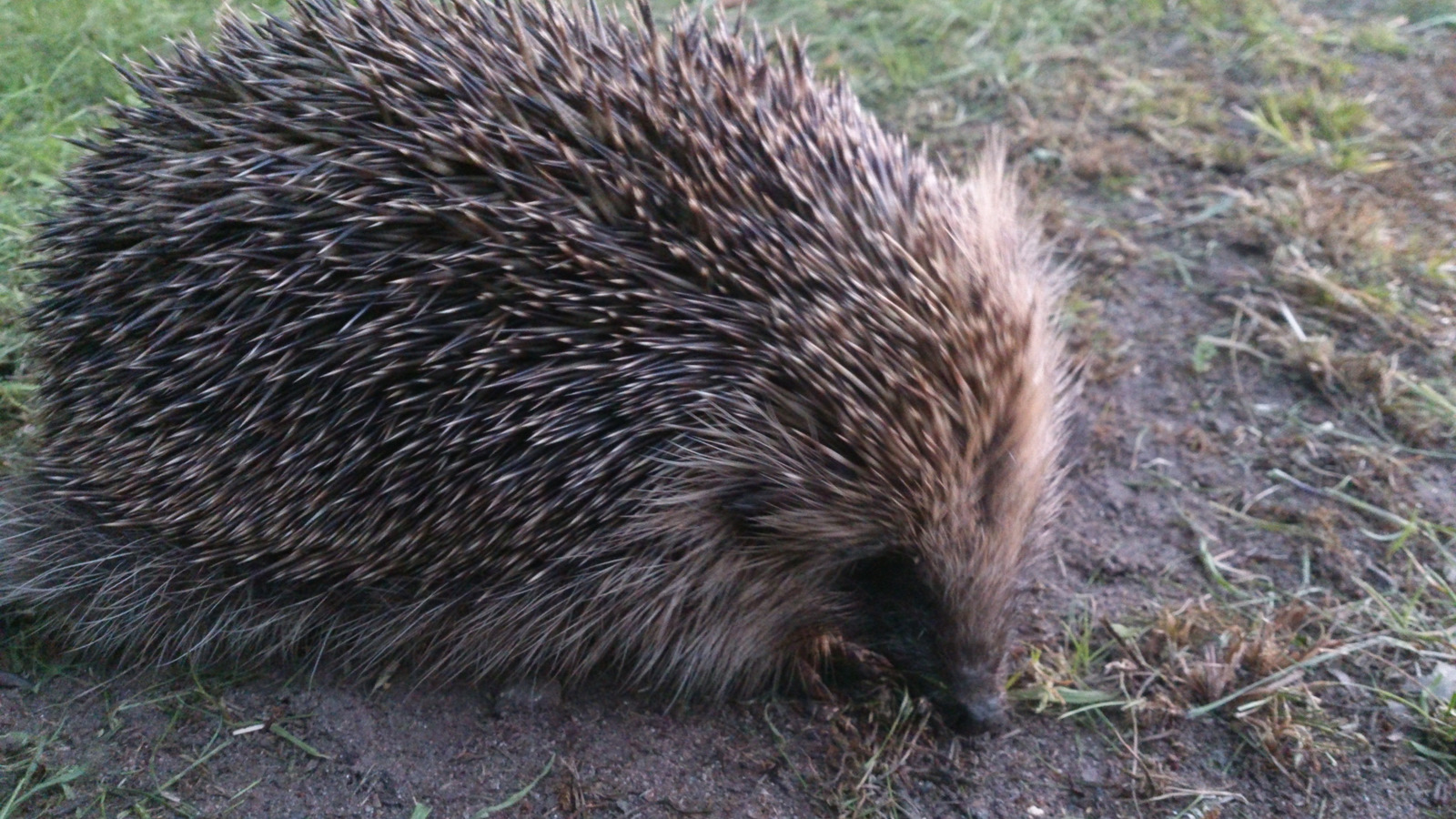
This is the mother, we think…
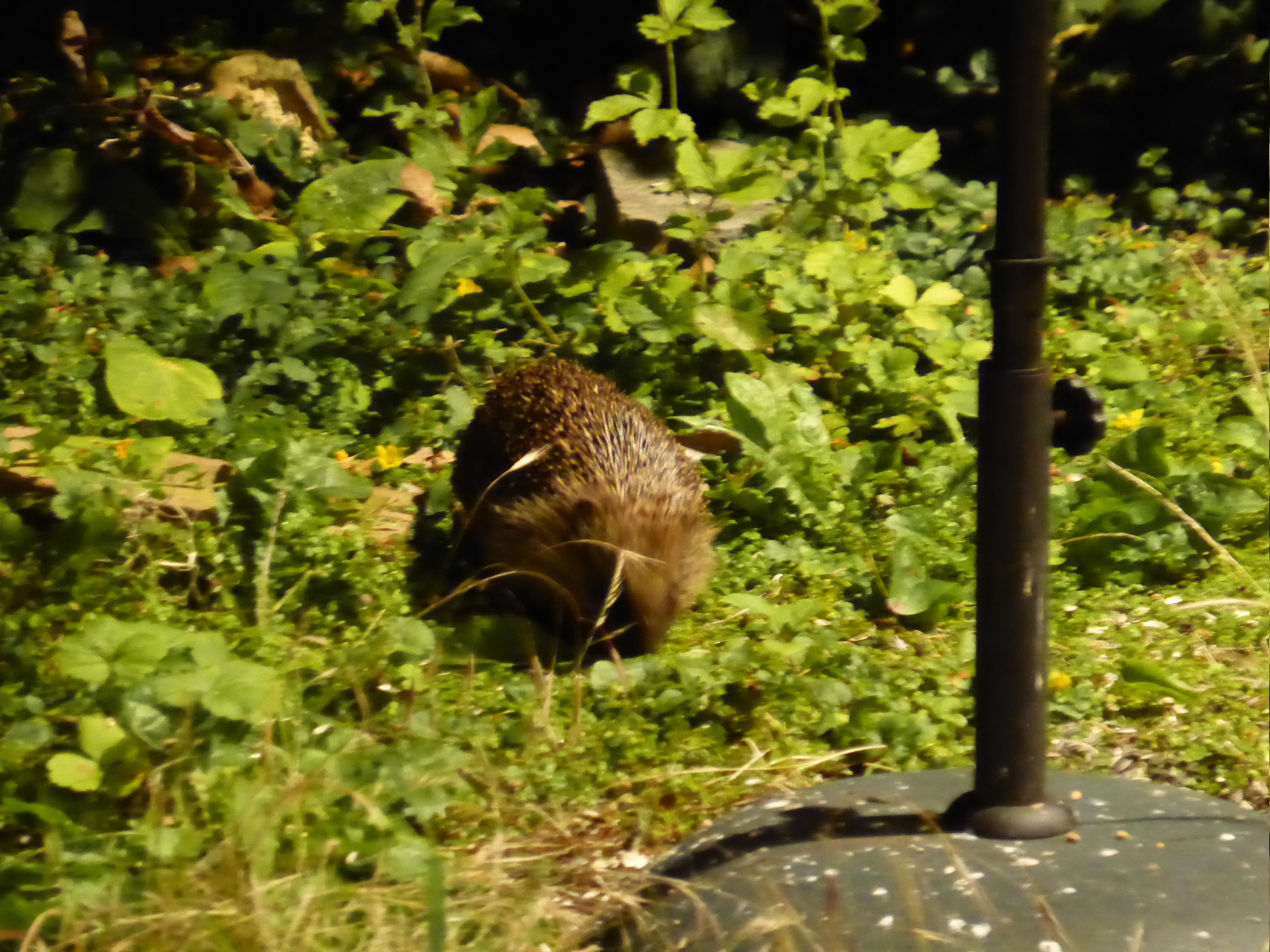
And these individuals are all youngsters, although only their mother could tell them apart, and they may very well be the one and the same little chap photographed on three separate occasions. Spot the catfood…
This slideshow requires JavaScript.
I think the reason for the arrival of these lovely, sweet little animals is the prolonged spell of great heat and severe dryness that we are currently experiencing here in England. The drought means fewer insects than normal, and the hedgehogs are forced to try their luck closer to man than they might otherwise venture. We have fed our visitors with, for example, wet and meaty cat food, and they certainly appreciate a bowl of water. Traditionally, you are supposed to feed them a bowl of milk with lumps of bread in it, but this is not really a very good idea for a lactose-intolerant insectivore, even one who is willing to consume dog food when times are bad.
In this video, the mother is looking out for suitable scraps from the bird table…
My daughter had to stop filming when the hedgehog was on her shoe!
Here is our video of a cute baby hedgehog eating catfood:
The babies are called “hoglets”, and Mummy and Daddy are a “boar” and a “sow”.
If you are successful in finding and feeding any hedgehogs, make sure that you send your data to the 2014 Hibernation Survey which lasts until August 31st of this year. The more scientific data we have about hedgehogs, the more can be done to increase their depleted numbers.
To find out more about how you can attract hedgehogs to your garden and what to feed them, take a stroll along Hedgehog Street.
























 John Knifton