Category Archives: Personal

My best friend, Widdle (3)

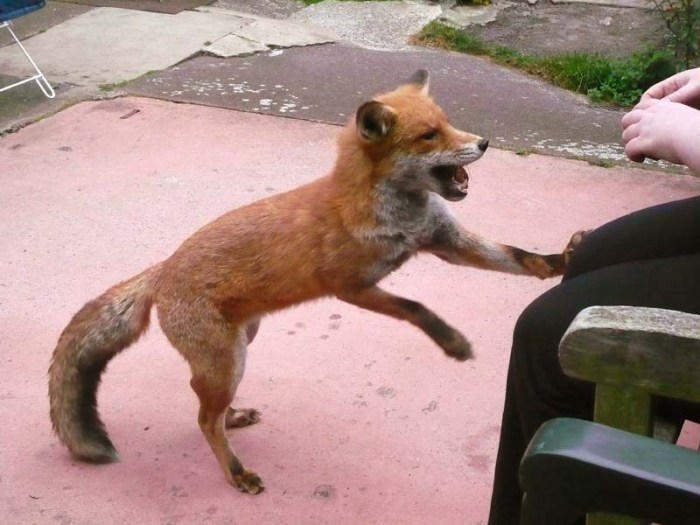
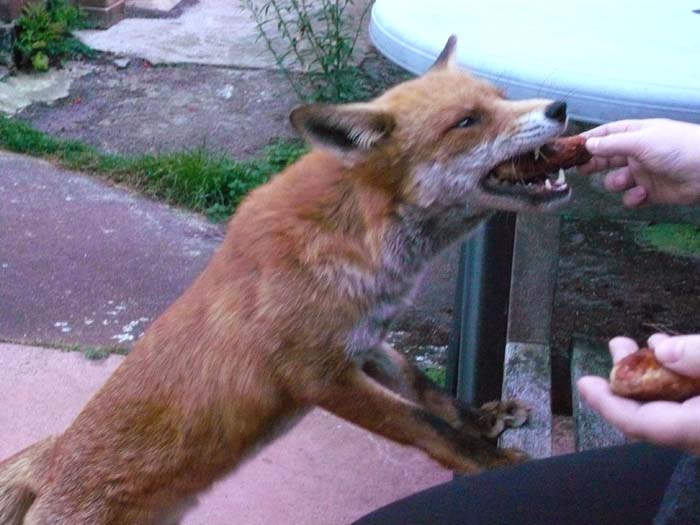
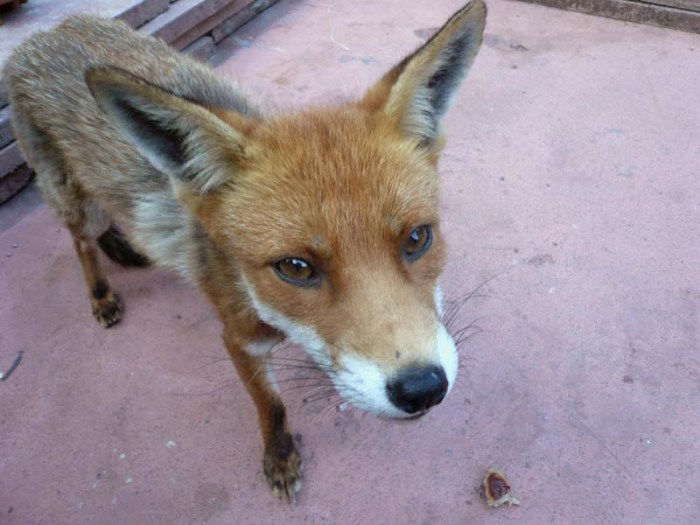
Widdle was extremely photogenic, and didn’t he know it! Mind you, he does have such beautiful soft eyes……..

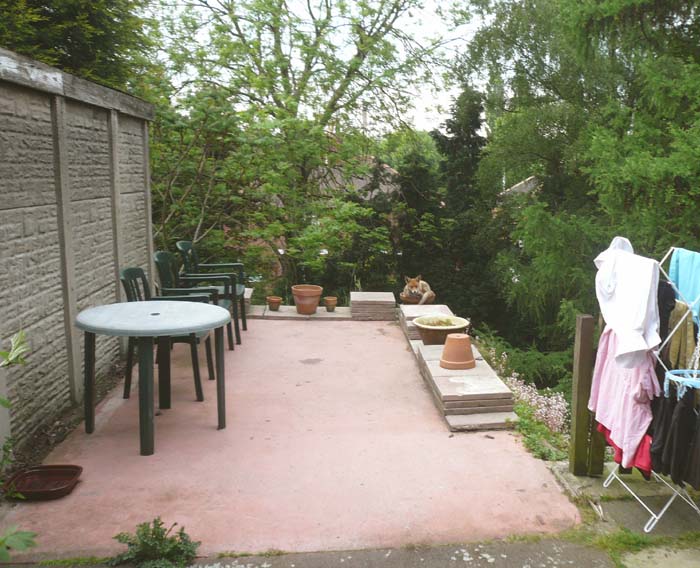
In the days when he had a wife and cubs to support, Widdle did his very best to be the perfect husband and the perfect Dad, but that didn’t mean that he never felt tired. Indeed he had a number of different places that he would use for a rest, and if it was sunny and warm, then so much the better.

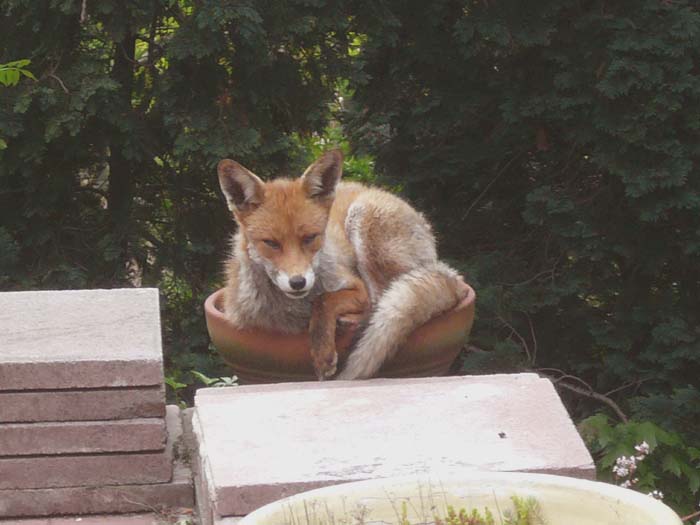
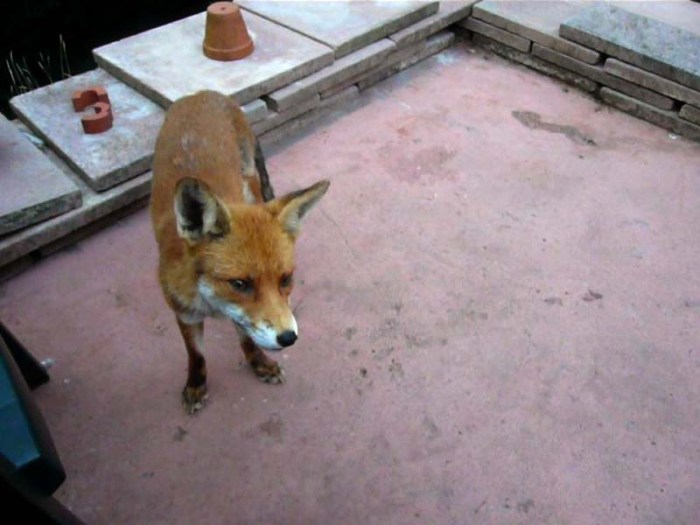
If we weren’t at home when he came to call, he would graciously sit quietly and wait for us. Sometimes, he would get nice and comfortable in a large empty planter. Our garden is on two levels, and directly behind the planter there was a fifteen foot drop. It didn’t bother him, though. Widdle never seemed to have any fear of heights…….

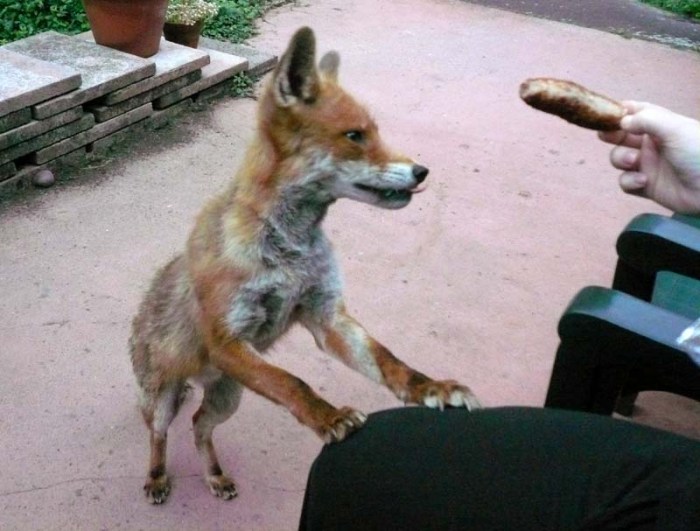
When we went to say hello and to ask him what kind of a day he was having, Widdle wasn’t ever frightened.  He liked that lofty perch,  even though he was sitting with his back to any potential attackers. What he saw as the biggest plus point of that planter was the fact that he could immediately spot us as we emerged from the house with his sausages……

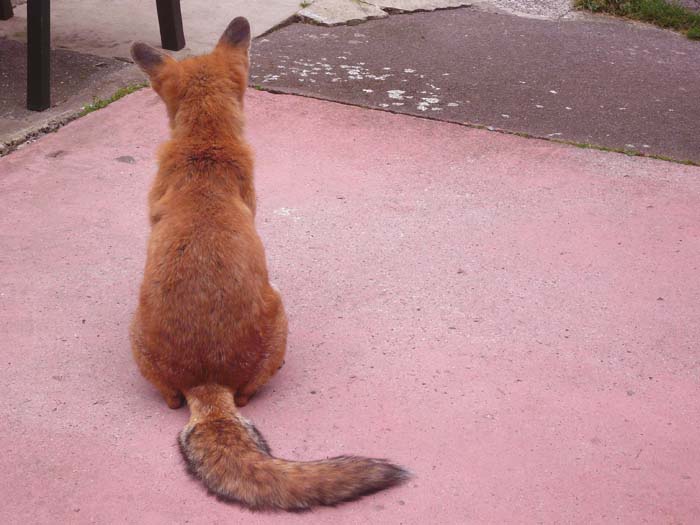
On other occasions he would sit like a dog, making sure that there were no rival male foxes on the lawn some twenty feet below:

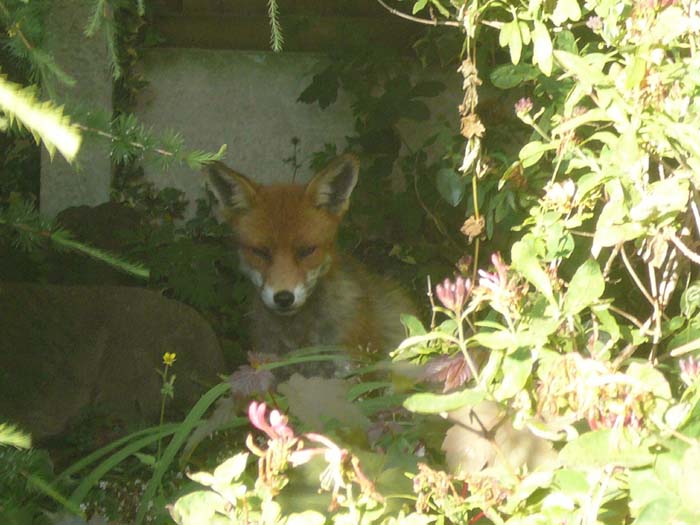
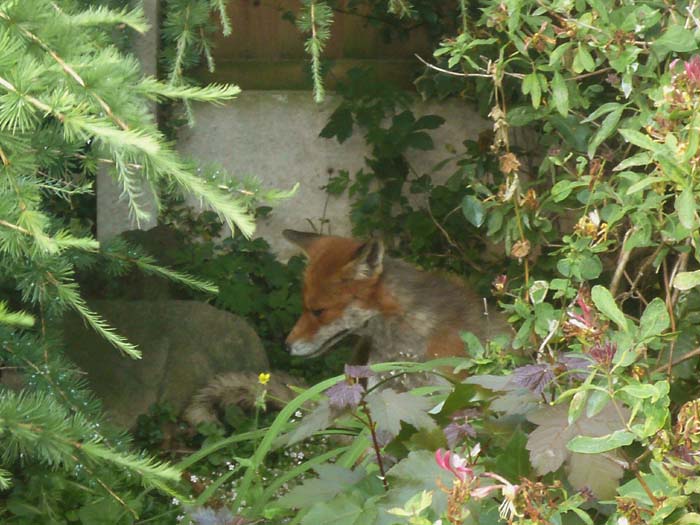
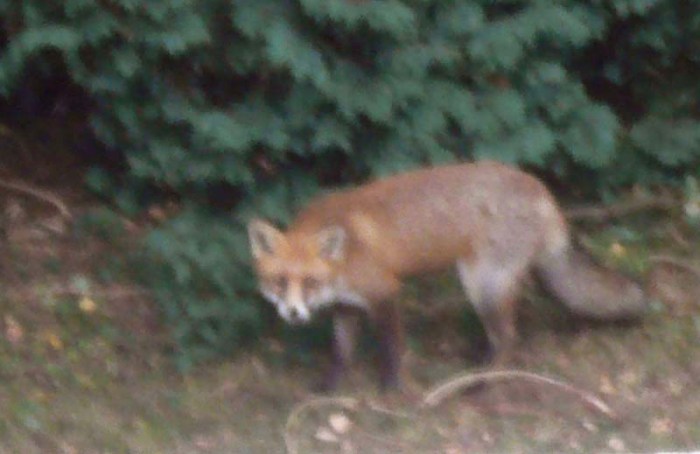
At other times he seemed very cautious and preferred to sit in the foliage:

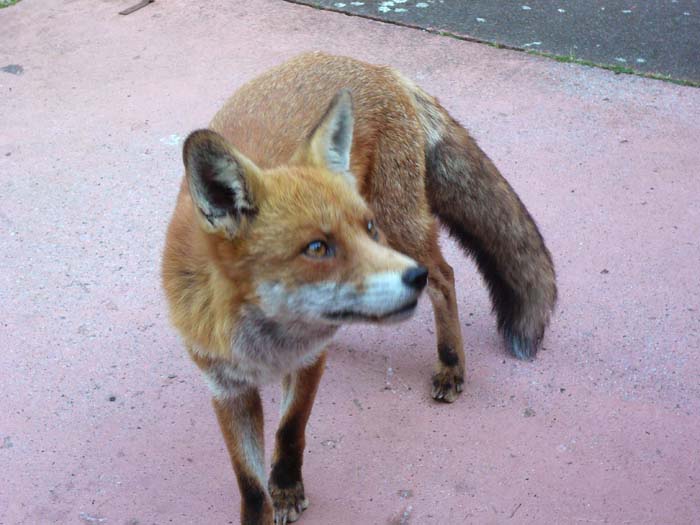
Occasionally, he would have his attention drawn by a noise he didn’t recognise:

His proudest moment, however, came when he showed off his new winter coat:

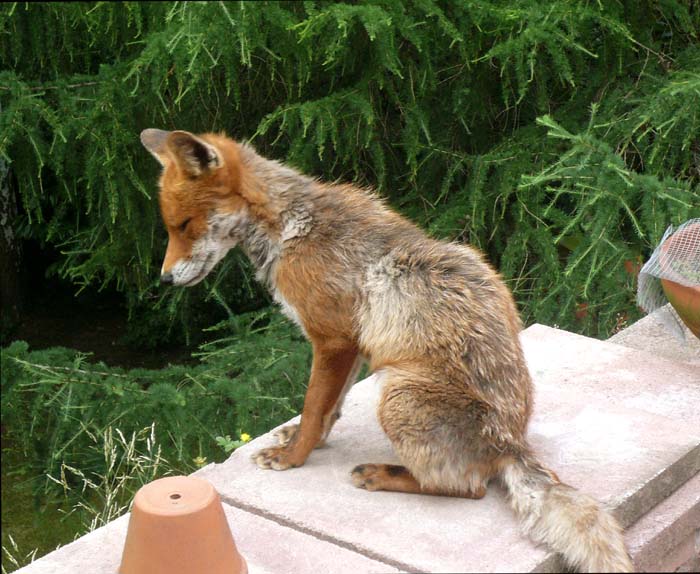
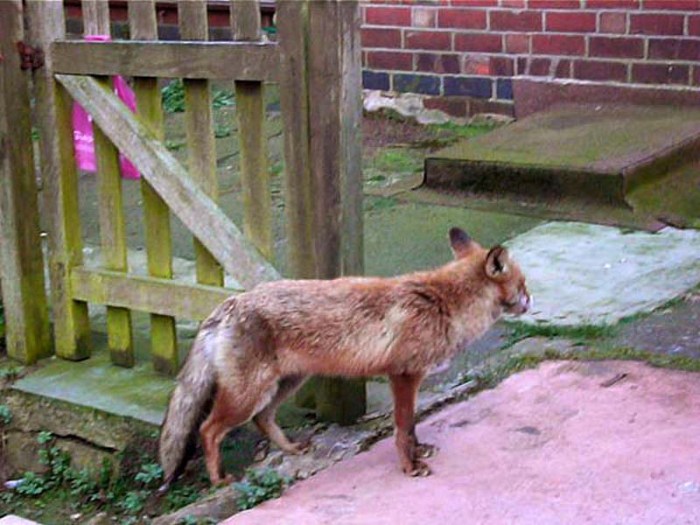
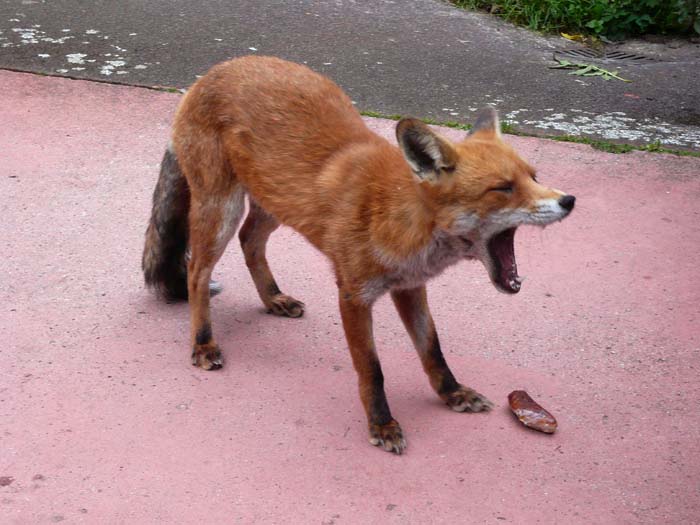
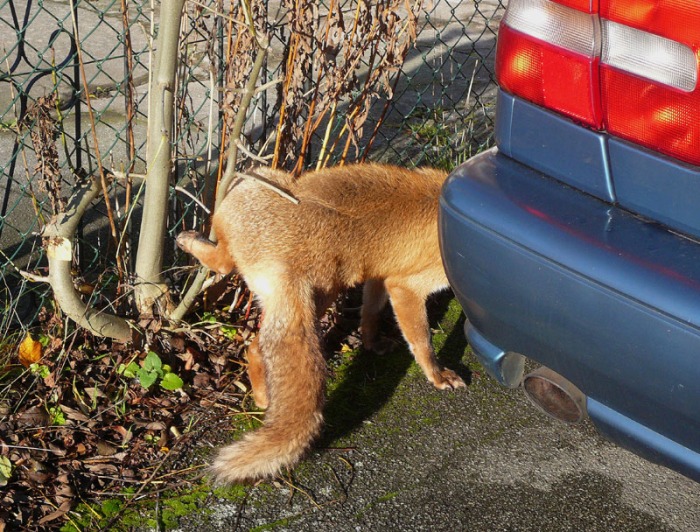
His fur was always at its most luxuriant in the winter, whehn he needed the extra warmth, of course. In summer, he would moult his coat and go around looking a lot more grey than red, and overall, extremely tatty. Picture 4 above illustrates the Punk Fox look perfectly, as does the one below…..

In this photograph Widdle is a little more advanced in his moult, and the grey tones to his fur are really obvious. This picture dates from a different day to Photograph 4, when he spent a sunny warm afternoon in the planter, and woke up so stiff that he needed a good stretch before he could even think of eating.

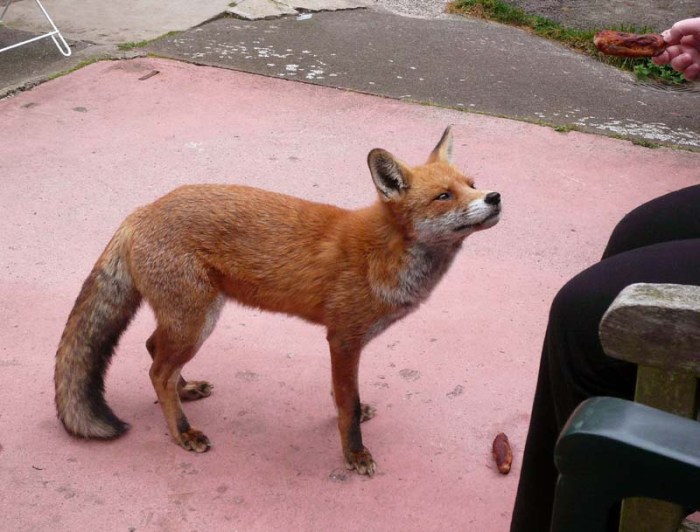
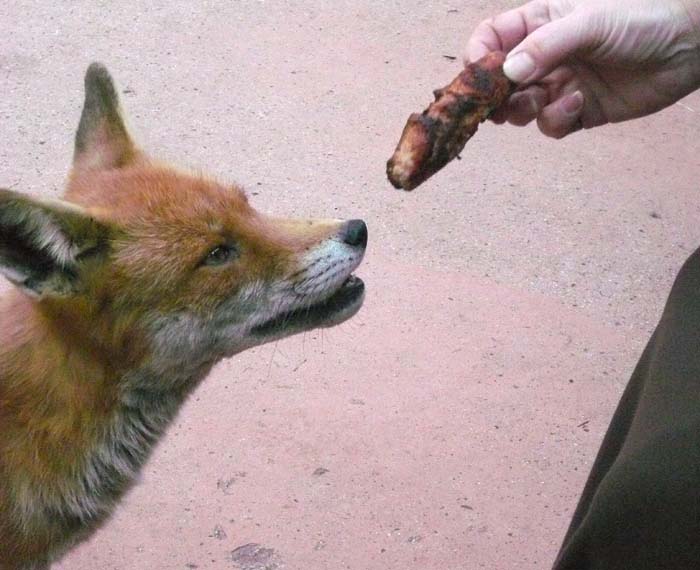
Having said that, just a few minutes warming up, and he was soon ready for his favourite food…….


22 Comments

Filed under Humour, Nottingham, Personal, Widdle, Wildlife and Nature

Football Programmes of the Soviet Union (4)

The old Soviet Union, of course, had a huge number of less well known teams in the lower divisions, and they can often be quite interesting because they have such marvellous names, the Russian equivalents, perhaps, of Scottish football teams such as “Bonnyrigg Rose”, “Civil Service Strollers” and “The Spartans”.

This first programme is “Кубань Краснодар” aka “Kuban Krasnodar”, a team which used to play in Krasnodar, the 16th largest city in Russia. It was built by the Cossacks on the southern plains as a fortress to guard the River Kuban. “Krasnodar” means “gift of the Reds” aka “the dirty Commies”. Before that, the city used to be “Yekaterinodar”, which means the gift of Catherine the Great. In modern times, “Кубань Краснодар” became FC Kuban but that didn’t prevent bankruptcy on May 17th 2018 and, as far as I know, a short trip into oblivion. Like most football clubs, though, oblivion didn’t last that long, and on August 5th 2018, the club was back in business, now called FC Kuban (2018). Here is their badge.

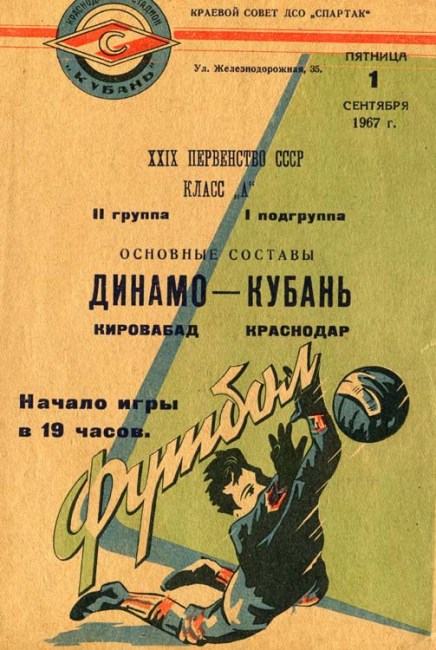
Below is one of the old programmes of “Кубань Краснодар” aka “Kuban Krasnodar” . It dates from September 1st 1967 (top right). Just above the number 1 is the word Russian “пятница”  or  “P-ya-t-n-ee-ts-a” which means “Friday”. The origin of the word is that “пят” or “P-ya-t” means “five”. It’s the fifth day of the week, of course.

In Russian, the home team is always on the right, so the visitors this Friday are “Динамо Кировобад” aka “Dynamo Kirovabad”. Kirovabad was the city’s name from 1935-1989 and it is now called “Ganja”. It is the third largest city in Azerbaijan, but the most mellow by quite a long way. The team is now called “Kapaz PFK” incidentally…….

Inside the programme, which is a single sheet folded in two,  are the two teams, complete with an illegible autograph:

Look at the three vertical lines down the middle. On both sides of that vertical division, the bottom two horizontal  lines, on both left and right, contain the words “Тренер” and “Капитан”, trainer and captain. The left hand trainer has the very unusual first name “Hamlet”, which in Russian is “Гамлет”.

This is literally “Gamlet” but Russian has no letter “H” and replaces it in foreign words with a hard “G” sound. In the USA this gives you “Gonolulu” /”Гонолулу”  and “Gollyvood”/”Голливуд“. In England, this gives you “Galifax”/”Галифакс” , “Guddersfield” / “Гуддерсфилд” and “Garry Potter” / “Гарри Поттер“.

Chaos ensued with the fact that England had two ports very close to each other. One is called “Hull” and the other is called “Goole”.   Both of these places came out as “Gooll” / “Гулл” which caused so much confusion that Russian ships completely stopped going to Goole and only ever went to Hull.

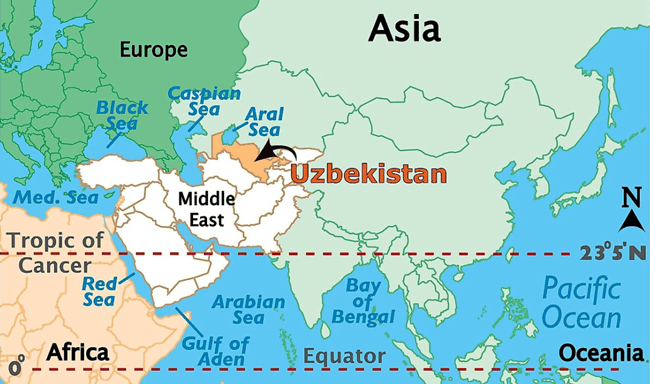
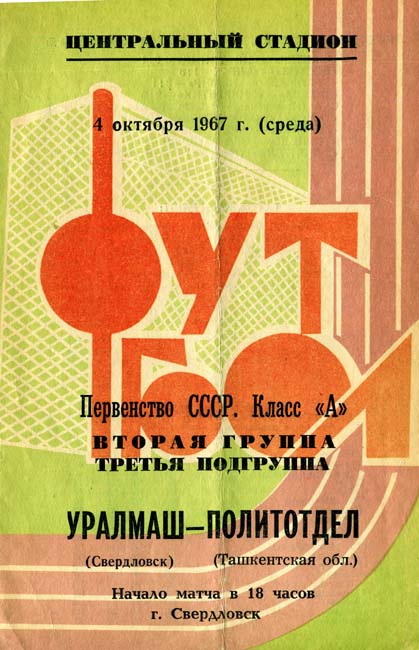
The next programme is from “Ташкентская Обл(асть)” or the Tashkent district. Tashkent, of course, is nowadays the capital of Uzbekistan, a country usually regarded as being in Asia.

The programme is from a home game for a team called  “Политотдел” which is “Politotdel “ aka “Political Department”:

Tashkent is home to this stunningly beautiful mosque:

On the left, Politotdel’s visitors are called “Уралмаш Свердловск” or “Uralmash Sverdlovsk”. Sverdlovsk has now been renamed  “Ekaterinburg”, and is to the east of the Ural mountains. It is the third largest city in Russia with around two million inhabitants.

Nowadays, “Политотдел” has become the beautifully named “FC Dustlick” of Uzbekistan. “Уралмаш Свердловск” have been at various times  “Avangard”, “Zenit”, and “Mashino-stroitel”. “Avangard” must be the  well known French expression, “Avant garde”. ”Mashino-stroitel” in Russian, means “car constructors” and “Uralmash” is an acronym type creation meaning “Ural Car”. Nowadays, no cars are manufactured in this area, hence the present name of the team, which is just “Ural” or  “Урал“:

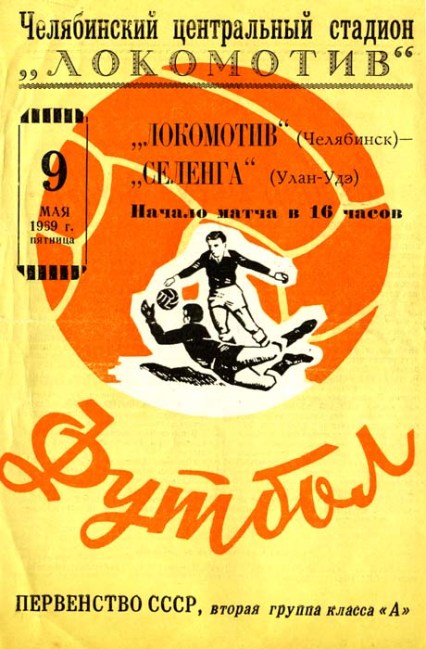
The final programme, below, is “Локомотив Челябинск” or “Lokomotiv Chelyabinsk”, who are  the home team. They face “Селенга Улан- Удэ” or “Selenga Ulan Udé”. The match took place on Friday, “пятница”, still pronounced “p-ya-t-n-i-tz-a”,  and based, as we know, on “пять”, “p-ya-t”, the Russian for five. “Пять”, “p-ya-t”, is related to the Greek “pent” as in “the Pentagon”. The match kicked off at 1600, which was a very early end to the working week. East of the Urals, and sheltered away from central government in Moscow, “Уралмаш Свердловск” games always used to bring about a “POETS” .

Chelyabinsk aka “Челябинск” is the seventh largest city in Russia with 1.1 million inhabitants. It is to the east of the Urals (just).

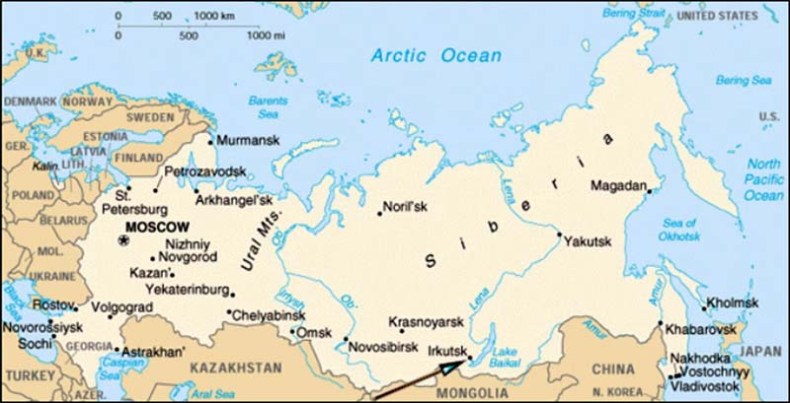
The football club “Selenga Ulan Udé” is now called “FC Buryatia Ulan-Udé”. Ulan Udé is to the south east of Irkutsk  and Lake Baikal and stands at the confluence of the River Selenga (hence the team name) and the Uda. The city is the capital of the Buryatia region, which is directly north of Mongolia. It has a population of slightly less than a million, of which 450,000 live in Ulan Udé. Buryatia therefore, must be really empty with an effective  population destiny of roughly four per square mile. Alaska has 1.3 and Wyoming six. Here’s a map. Look for the black arrow:

Ulan Udé is the centre of Tibetan Buddhism in Russia but most spectacular of all is its 25 foot tall Head of Lenin statue. I wonder how the people at the Nottingham city planning department would feel about one of those on our nearest Ring Road roundabout ?


.


8 Comments

Filed under Football, History, Personal, Politics, Russia

Stories about my Dad (1) Manchester Lane

Just after the war had ended, in 1947,  there was a horrendously hard winter in England, with huge amounts of snow, and much hardship for ordinary people, with the extreme cold and the continuing spectre of rationing.

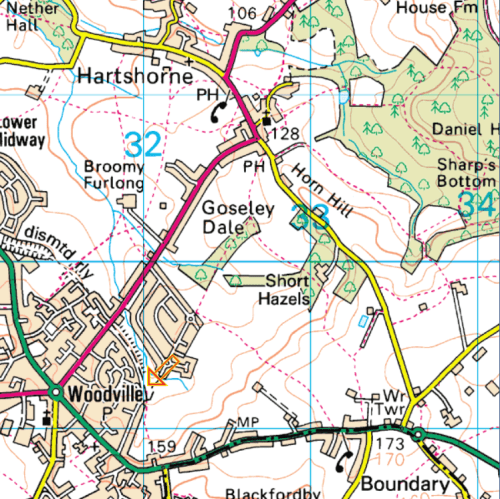
Manchester Lane is a tiny country lane which runs between the village of Hartshorne and the hamlet of Boundary. As my Dad, Fred, used to live in Woodville, at either No 9 or No 39 Hartshorne Road (in red), he would make frequent use of Manchester Lane to produce a circular walk around the district. He would walk down Hartshorne Road to the very bottom, near to church with a square tower (cross “+” with a black square attached, and turn right at the Bull’s Head Public House (PH). He would then follow the summit ridge of Horn Hill, a route used since Neolithic times, and walk at last along Manchester Lane itself (in yellow) as far as the water tower (“Wr Twr”) at Boundary.  He then turned right and right again, and returned finally to Woodville along Ashby Road (in green), and then High Street (also in green). You can see his route on this map:

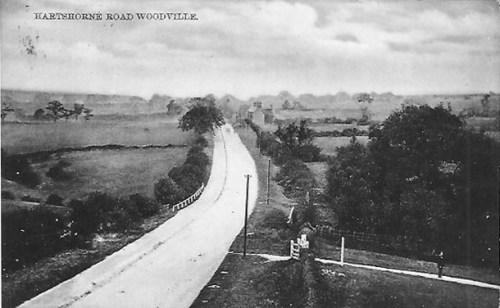
The orange arrow points to Woodville. Hartshorne Road is the red road running to the north east. In those days, it was very countrified…..

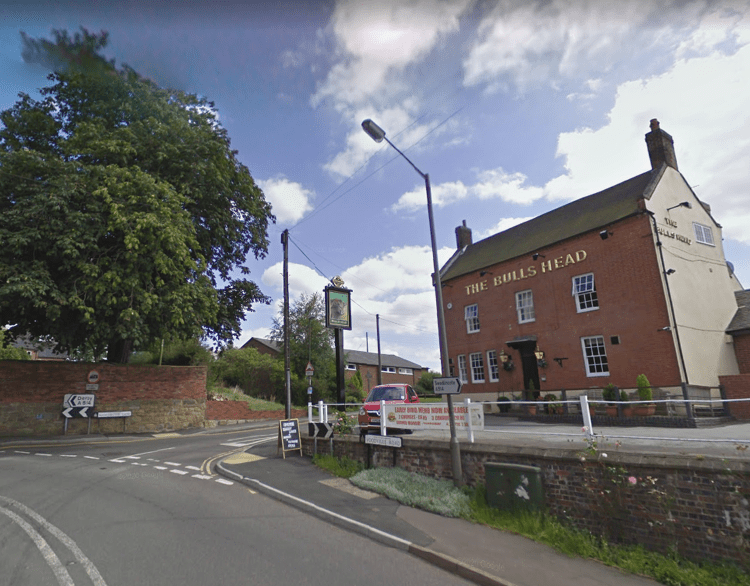
When he reached Hartshorne, Fred would turn right past the Bull’s Head, which dated from Georgian times, into Manchester Lane :

He was now in Manchester Lane which he followed for quite some distance. In 1947, this tiny country road was completely blocked by the snow. Indeed, the snow was so deep that the authorities, with the help of the RAF,  improvised an emergency snow plough by mounting an aircraft engine, complete with whirling propeller, on the back of a lorry. They then backed the vehicle into the lane, and it cleared the twelve feet deep snowdrifts without any problems.

This country road had always created a big impression on Fred, and he was forever going off for “a walk round Manchester Lane”. This healthy jaunt was around three or four miles long, and it would take at least a whole morning. It left behind the factory chimneys of Woodville and, once you got to Manchester Lane,  it went right out into open countryside, between leafy hedges and past green fields, with a splendid view looking back towards Hartshorne, Woodville and Midway. Fred never tired of the fresh air and the blue sky, the sun, the wind, the ever-changing faces of the weather and the varying aspects of nature.

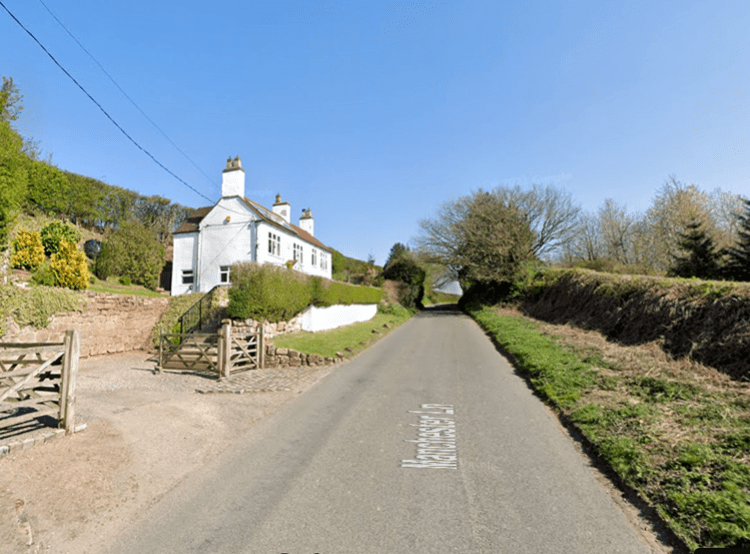
Occasionally he would see a remarkable sight, such as one of his abiding memories, an old man well into his eighties, sitting astride the gable of his house roof on Manchester Lane, mending or replacing the broken ridge tiles. This is the cottage today, gentrified beyond belief:

On a darker note, Fred would often tell the tale of an isolated barn, in fields down to the south of the lane, which had been the centre of a deathbed confession by a man in faraway Australia. This macabre episode took place in the 1930s, when a farmworker who had emigrated from Woodville, well before the turn of the new century, lay dying in Tasmania, and asked to make his peace with God. He confessed that, years before, he had murdered a young woman and buried her body beneath the floor of a particular cold grey stone barn near Manchester Lane in far away England. The barn was something like this:

The Australian authorities notified their English counterparts of the man’s confession, and the calm tranquillity of the South Derbyshire countryside was soon  disrupted by the arrival of teams of policemen who dug up the floor of the barn, and indeed, a number of other similar barns in the area. They found nothing, although their researches were extensive. It remains a minor mystery to this day, why the dying man said what he said. Perhaps he just disliked policemen, or alternatively, perhaps he thought that many of them were too fat after all those donuts and needed to work off a little of their excessive weight.

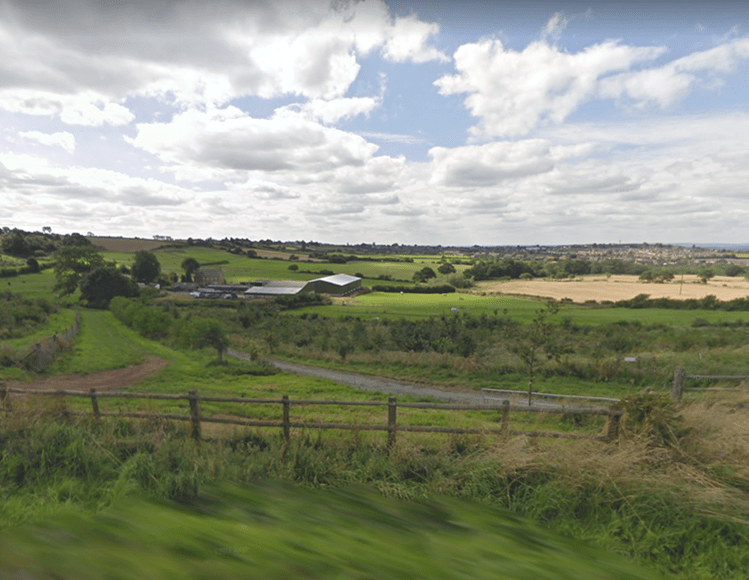
The barn nowadays seems to have been swallowed up by the extended farm buildings at this farm. It may even have been demolished:

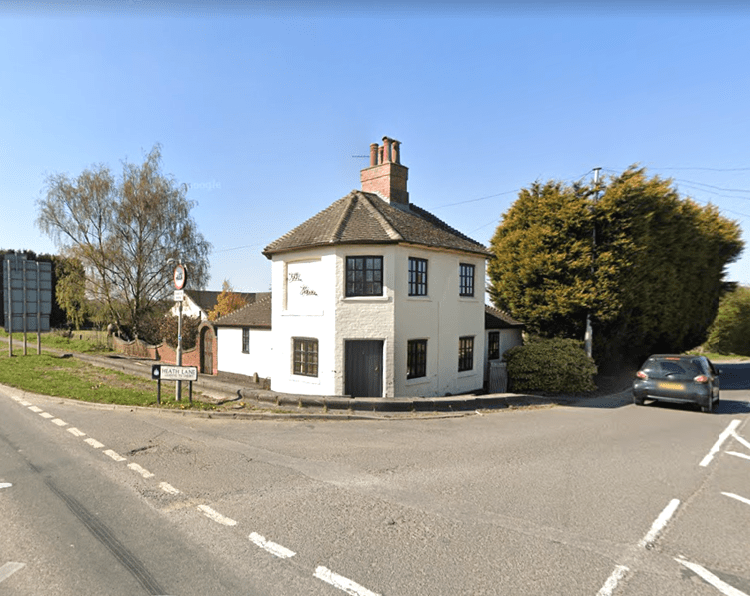
Whatever the case, this was a good place  to pause, and to take in the beautiful view. And then it was upwards and ever onwards to the right turn that would take him towards the old Toll House at Boundary:

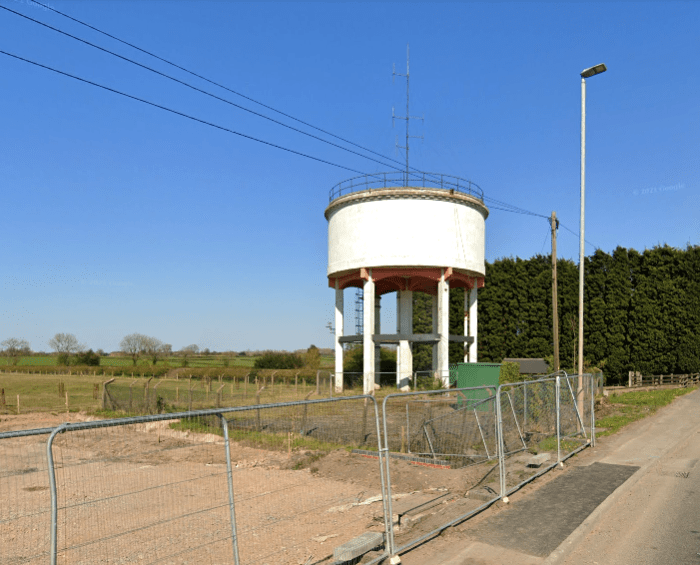
Originally, the toll house was eight sided so that the toll keeper could keep a wary eye out for people who were approaching from whatever direction.  In addition, eight sided buildings are supposed to be immune to demonic possession, which is nice. Then it’s another right turn so that Fred could follow Ashby Road which would eventually become High Street and take him homewards. But there was more to see yet. A quarter of a mile beyond the Toll House was the Water Tower at Boundary:

Just after Ashby Road became High Street in Woodville, there is a small turn off which used to lead to a tiny farm which nestled among the shops and terraced houses. One day, when my daughter was just six years old, Grandad Fred took her to see the farm. It was lambing time and she was able to feed some of the newborn lambs with a bottle.  She will never forget doing this for the rest of her life. She will never repeat it though, because this is the turn off today. I just love our brave new world. It’s so interesting and so clean:


22 Comments

Filed under History, Humour, my Dad, Personal, Wildlife and Nature

My best friend, Widdle (2)

As you have seen in the first instalment of this story, the best animal friend I ever had was a fox called “Widdle”. He taught me more of value than 90% of my teachers ever did. And Widdle, he also learnt a little bit.

Widdle, of course, soon learnt which way his sausage was buttered.

The usual scenario was that he would be out on “Lone Hunter’s Patrol”, looking for geese and turkeys, hurtling round the gardens at top speed:

And then he would hear me calling his name :

And then he would come up the path to the patio

And then he’d let you know why he was here:

And then he’d take a sausage or two from you. He was quite prepared to touch you and he wasn’t afraid :

If he was hungry he would often eat the first one, but otherwise he would put it on the floor and then come for a second sausage. He could always be trusted to carry two sausages in his mouth, and as he grew older and more experienced, he managed to carry three. Here, he seems happy to take just two. As we human thick-heads eventually worked out, neither of them were for him:

Now for the second:

A very tricky manoeuvre :

And then it’s “Up, up and Away !!!

His wife, Mrs Widdle, will get her share of the two sausages, but only if the cubs, up to four of them usually, have had their fill. I was always 100% sure that in the rather extensive fox family, Widdle, the individual who provided all the food, was always the last to eat any.

A lesson for us all. And not just in sausage eating.


17 Comments

Filed under Humour, My Garden, My House, Personal, Widdle, Wildlife and Nature

An impossible Beatles Quiz (2….the Answers)

I know that a lot of you have already offered me your answers to this quiz and I have checked them and told you your scores. Anyway, for the benefit of Mr Kite and anybody else who doesn’t yet know whether their answers were right or wrong, here are the answers to my second even more difficult Beatles quiz. Hopefully, you didn’t do the quiz by writing “Dunno” ten times. Or:

“Dunno”, “Dunno”, “Dunno”, “Dunno”, “Dunno”,

“Dunno”, “Dunno”, “Dunno”, “Dunno”, “Dunno”.

As in the first quiz, all of the questions and answers involved Sergeant Pepper and the other LPs after this.

1     Who had a silver hammer?

One of the comparatively  few Beatles songs about a serial killer:

“….Maxwell Edison majoring in medicine
Calls her on the phone
Can I take you out to the pictures, Joan?
But as she’s getting ready to go
A knock comes on the door
Bang, bang, Maxwell’s silver hammer
Came down upon her head
Bang, bang, Maxwell’s silver hammer
Made sure that she was dead.”

Your clue was about coffee. What brand of coffee is it in the picture ?

Maxwell House, of course. No marks for anybody who thought it was either “Nescafé’s Silver Hammer” or  “House’s Silver Hammer”.

2     Who always arrived late for tea?

This is a humdinger of a question, though I say so myself. In the song “Cry baby, cry” on the White Album, the song suddenly includes various verses from the Beatles version of “Sing a Song of Sixpence”, which is one of the many traditional English nursery rhymes:

“Cry baby cry
Make your mother sigh
She’s old enough to know better
So cry baby cry
The Duchess of Kirkcaldy always smiling
And arriving late for tea
The Duke was having problems
With a message at the local bird and bee”.
Kirkcaldy is a town in Scotland, and the home of Raith Rovers Football Club.

The photograph provides an easy answer. Look at the name of the pub:

3     Which fairground attraction gives its name to a Beatles song?

Well, as everybody knows except Charles Manson, it’s a helter skelter, as we English call it:

When I get to the bottom I go back to the top of the slide
Where I stop and I turn and I go for a ride
Till I get to the bottom and I see you again
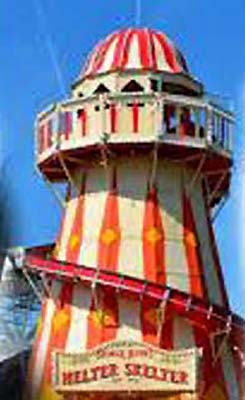
Charles Manson didn’t know what a “helter skelter” was, and interpreted it differently. Paul McCartney explained:

“Charles Manson interpreted that ‘Helter Skelter’ was something to do with the four horsemen of the Apocalypse….. It’s from the Bible, Revelation . Manson interpreted the whole thing – that the Beatles were the four horsemen, ‘Helter Skelter’ was the song – and he arrived at having to go out and kill everyone.”

4     What was the name of the lovely meter maid?

In the song her name is Rita:

“Took her out and tried to win her
Had a laugh and over dinner
Told her I would really like to see her again
Got the bill and Rita paid it
Took her home I nearly made it
Sitting on the sofa with a sister or two
Oh, lovely Rita meter maid
Where would I be without you?
Give us a wink and make me think of you 
Lovely Rita meter maid, Rita meter maid

5      What was anybody doing in “Penny Lane?

There are so many that you could make it up and probably get it right! Here’s a list:

“a barber showing photographs             all the people stop and say hello

(a banker with a motorcar) the little children laugh at him behind his back

I sit                      a fireman with an hourglass  he likes to keep his fire engine clean

the pretty nurse is selling poppies from a tray                               she feels as if she’s in a play

the barber shaves another customer       we see the banker sitting waiting for a trim        the fireman rushes in”

This slideshow requires JavaScript.

6      She was a working girl, north of England way. But what happened to her?

Well, success on a fabulous scale:

“She was a working girl
North of England way
Now she’s hit the big time
In the U.S.A.
7      What had the crabalocker fishwife pornographic priestess done to be such a naughty girl ?

She had been so bad, in actual fact, that the song was banned immediately from the BBC.

“Yellow matter custard
Dripping from a dead dog’s eye
Crabalocker fishwife pornographic priestess
Boy you been a naughty girl
You let your knickers down  I am the eggman
They are the eggmen
I am the walrus
Goo goo g’ joob”
And here again are the said knickers:

Apparently the BBC did not allow any reference on air to sex, body parts south of the navel, underwear in the same location and so on. For the BBC censor, the mere use of the word “knickers” was enough to condemn the song into the fires of hell. Implied drug use saw off a further two Beatles songs, another was banned  for mentioning suicide, and the final one was banned twenty years after it was released for political reasons.

8     Who has a barrow in the market place and what did Molly do?

Well, in “Ob-La-Di, Ob-La-Da” :

Desmond has a barrow in the market place”

and Molly gets up to quite a lot. Any one of :

“Molly is the singer in a band                         Molly says “I like your face” as she takes him by the hand

she begins to sing                       Molly stays at home and does her pretty face

in the evening she still sings with the band                      

happy ever after in the market place                  Molly lets the children lend a hand*

The picture, by the way, refers to the fact that a group, called “Marmalade”, released this song as their own single.

9     Which two other colours are mentioned in “Yellow Submarine” as well as yellow?

Take your pick:

White, red, brown, blue and possibly purple. That’s about it for me.

And the origin of the song? Well, Paul explained:

“in that moment before you’re falling asleep – that little twilight moment when a silly idea comes into your head – and thinking of ‘Yellow Submarine’. ‘We all live in a yellow submarine…”
One Spanish soccer team is nicknamed “The Yellow Submarine”. An explanation here…..

10   “Somebody calls you, you answer quite slowly.” Who is it?”

Well the song begins with the answer:

“Picture yourself in a boat on a river
With tangerine trees and marmalade skies
Somebody calls you, you answer quite slowly
A girl with kaleidoscope eyes”
The song is, of course,  “Lucy in the Sky  with Diamonds”. Its origin is:
Either
John Lennon’s son, Julian, comes h0me with a picture and tells his Dad, “It’s about “Lucy in the Sky with Diamonds”.
Or
Lysergic acid diethylamide
Or
It’s taken from Alice in Wonderland when Alice is in the boat. Lewis Carroll was a hard core user of Lysergic acid diethylamide, of course.
Or

“It’s the image of this female who would come and save me – this secret love that was going to come one day. So it turned out to be Yoko, though, and I hadn’t met Yoko then. But she was my imaginary girl that we all have.” (John Lennon)

Supposedly, we even know the identity of “Lucy”.

“She was Lucy O’Donnell, and she was a fellow pupil at Heath House, a nursery school, with Julian Lennon. She only found out she was in a Beatles song when she was 13, in 1976.”

10 Comments

Filed under Criminology, Film & TV, Humour, Personal, Politics, Russia, the Beatles

Football Programmes of the Soviet Union (3)

Last time we were looking at Soviet football/soccer programmes for the top division, Division No 1. One or two more to look at. This  is “Спартак Москва” or Spartak Moscow, against “Зенит Ленинград” or “Zenit Leningrad”. Still a top team nowadays, “Spartak” was originally an international fitness and sports society and in Soviet times, was supported by the “Komsomol”. The latter was the “All-Union Leninist Young Communist League” or “Всесоюзный ленинский коммунистический союз молодёжи” abbreviated to” ВЛКСМ”. Despite all that, Spartak Moscow is today still considered to be “the people’s team:

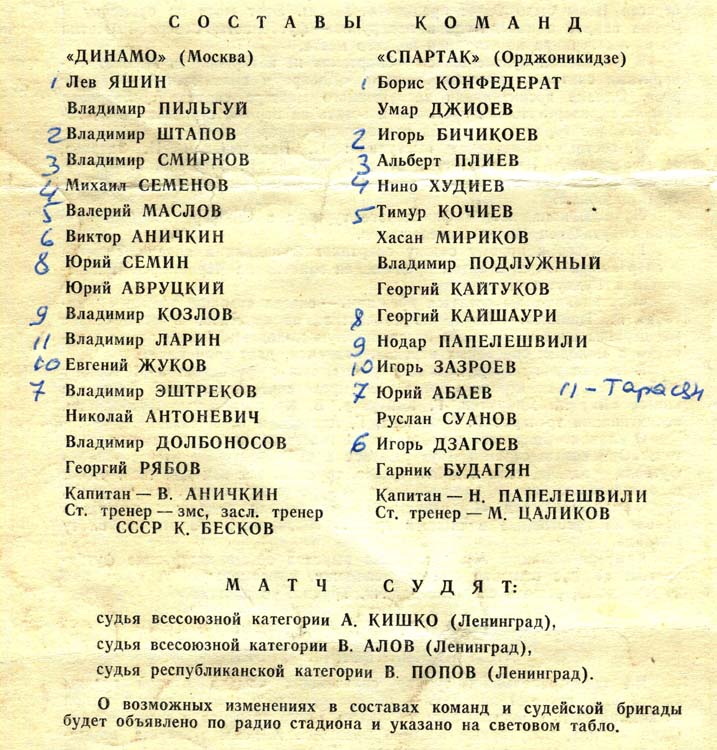
This next programme has another famous team over the years in “Динамо Москва” or “Dynamo Moscow” who are playing “Спартак Орджоникидзе” or “Spartak Ordzhonikidze” on Saturday, April 25th 1970. The latter became “FC Spartak Vladikavkaz” in 1990 and then “Spartak-Alania Vladikavkaz” and then “Alania Vladikavkaz”. The club are still in Russia nowadays and they play in the North Ossetia–Alania region of the Caucasus:

They are based in Vladikavkaz, which in the days of the tsars was the frontier town of the Caucasus, a region which was very much the North West Frontier of the Russian Empire. All the dashing young officers would seek postings to Vladikavkaz, the one outpost of western ideas, surrounded by thousands of wild tribesmen:

Here are the team line ups and the team changes, written in by my friend, Oleg Soloviev, all those years ago, in a place as remote as you are likely to find. I presume he was there watching one of the teams before Zenit Leningrad had to play them, perhaps checking what their tactics were:

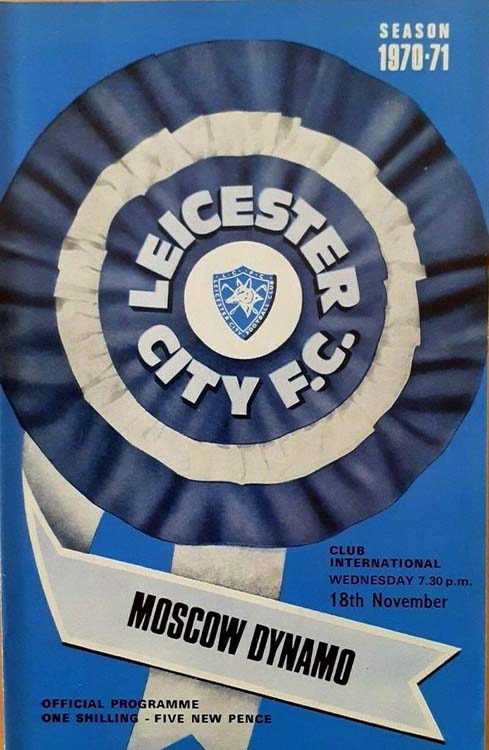
The Dynamo Moscow goalkeeper (No 1) was very famous. The Russian says “Лев Яшин” and the English is “Lev Yashin”. He always played dressed completely in black and was known as the “Black Octopus”. He was a legend in world football history and one evening, my Dad drove me to Leicester City to see them play Moscow Dynamo. Yashin didn’t play but they brought him out onto the pitch to wave at the crowd and he got a standing ovation. The Dynamo goalkeeper that night was the player below Yashin in the list. He was Vladimir Pilguy (Владимир Пильгуй).

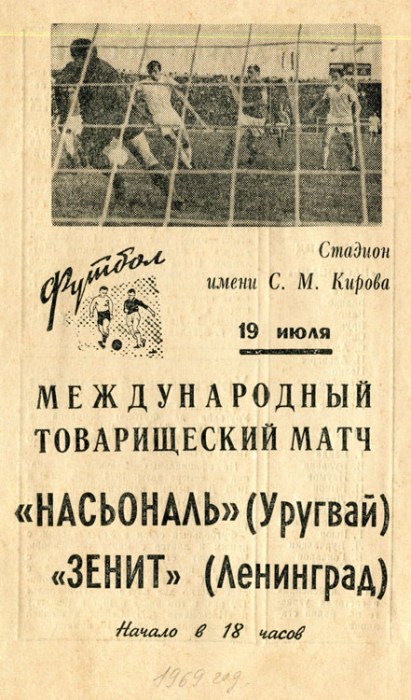
My last top class Soviet programme is one that I actually bought myself on the day of the match in Leningrad. It was for Zenit Leningrad aka “Зенит Ленинград” against Nacional (Uruguay) aka “Насьональ (Уругвай)”, which was an international friendly match.  It was a beautiful sunny summer’s early evening, July 19th 1969, and Nacional won easily by 4-0. The Uruguayan national anthem was interminable, and when it finally finished, our school party thought both anthems had been played.


11 Comments

Filed under Football, History, Personal, Russia

My best friend, Widdle (1)

One summer’s day in 2007, I was sitting out on the patio when all of a sudden I looked down and there was an animal standing right next to me. It was a fox!! Latin name “Vulpes vulpes” for anybody who lives in a country where foxes are not known.

I said to him “What do you want?” “Are you hungry?” “Would you like some food?”

He looked back at me and I said, “Just stay there and I’ll go and fetch you something.”

And he stayed there and I went into kitchen, opened the door of the fridge and looked around.

Some milk. No, that’s cats.

Just a piece of apple and some cooked sausages.

That’s it. I’ll take him that. I picked up the apple and went out to feed him.

He was still there. I offered him the apple which he initially sniffed and then gave me a look of such disdain, as if to say,

“Hurry up and get back to your village. They’ll be missing their idiot.”
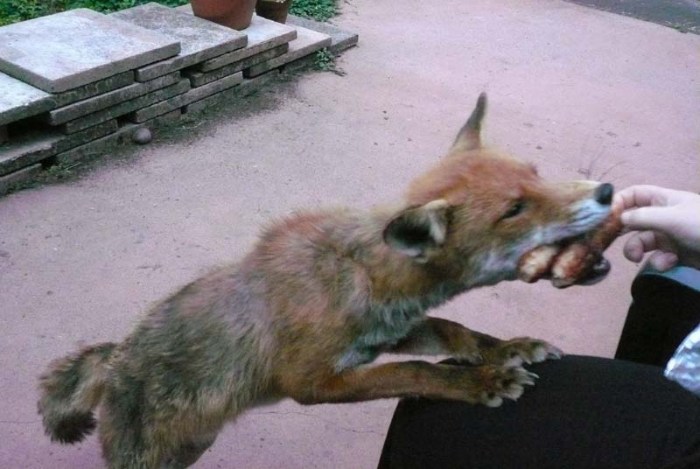
I went back to the fridge. I got a sausage and I took it out to him. He sniffed it and I put it on the floor. He picked it up in his mouth and off he went. Back into the beautiful green world of flowers, bushes and trees.

That sausage would be the first of literally thousands, with the occasional lump of beef, pork or chicken to stop him getting bored. I soon became an expert on sausages, their make-up, their price, their value for money. We used to buy them in some quantity. I remember once going through the checkout at Iceland (the frozen food supermarket chain, not the island nation). I was buying the usual six packets and the woman said “Do you like sausages then?”  and I replied “Not really, I feed them to a fox”.

And she looked at me with complete disdain as if to say….

“Hurry up and get back to your village. They’ll be missing their idiot.”

Little did she know, though, and little did I know, that very soon I would value our fox at ten times the value of almost all human beings. Being with him was like being with an extremely wise child who was always steps ahead of you. Somebody who could do amazing things that were as if he knew magic. Somebody who was always on his best behaviour. Who never hurt a fly. Who was a damn sight closer to God than I ever was. Here’s his four stage method to being given a sausage:

Stage 1            Look as if you’re hungry:

Stage 2           Reach for the Food of the Gods: sausage fried with extra fat :

Stage 3           Make that strange gesture with your lower jaw that is a basic part of “Talking Fox” but one which we never managed to  understand :

Stage 4    Show the kind humans your lovely brown eyes, and they’ll probably give you more sausages next time :

Sometimes, though, our new friend was nervous and he showed this by cocking his back leg against anything available, and squirting a tiny quantity of fox urine. He only did that when he was not 100% certain of our intentions, because we were human beings and potentially not as well behaved as he was. It gave him his name, though. We called him “Widdle”.

Over the next few weeks, we all grew to love him.

He was a gift from God. A wild creature who let us into his world for a few short years. We fed him morning and evening, day in, day out, and we saved his life several times. When he could not hunt because of injuries we saw to it that he was fed. Thanks to us, he had five lives.

We fed too, all of the minimum of 15 fox cubs that he raised. With a little bit of help from Mrs Widdle, of course.

25 Comments

Filed under Humour, My Garden, My House, Nottingham, Personal, Widdle, Wildlife and Nature

Football Programmes of the Soviet Union (2)

The first programme today is another top football/soccer game, this time between “ЦСКА” and “Динамо Минск”. Don’t forget that the home team is always printed second on the front of the programme. It’s a politeness, a little like allowing a guest to go through the door first.

Many football fans will recognise the abbreviation above. bottom right,  as “CSKA”, which stands for the “Central Sports Club of the Army”. It’s rather like English clubs were often founded by a particular church or factory.
The opposition in this game was “Dynamo Minsk” a team which used to be in the USSR although the city is nowadays in Byelorussia and its club no longer plays top class football. A club founded, no doubt, by electricians, who are often a bunch of really bright sparks.

The Byelorussian Premier League is today so small that it contains even “СФК Слуцк” or “SFC Slutsk” whose ground can accommodate a mere 1,896 spectators. That’s the least of Minskian worries, though. Minsk has been invaded quite a few times. Indeed, one of the few bits of good news in the history of Minsk was that it somehow escaped the Golden Horde of Genghis Khan’s Mongols in 1237–1239.

Otherwise it took a battering from the troops of Tsar Alexei of Russia (1655), the army of Charles XII of Sweden (1708), the army of Peter the Great (1708), Napoleon (1812), the Red Army (1918), the Poles (1919), more Poles (1920), even more Poles (1920-1921) and the Germans (1941-1944). The latter barbarians took the population of Minsk from 300,000 down to 50,000.

Just up by the “ф” of “футбол” is a tiny diagram with a rather unclear picture, captioned “централный стадион”. I’ll leave you to work that one out, now you’re all mostly fluent with Russian letters. As a clue, the diagram looks pretty much like a “Central Stadium” to me.

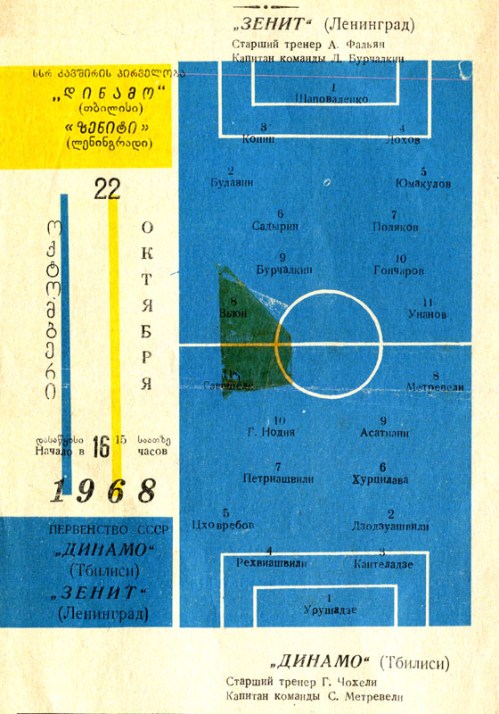
The one thing that has always struck me about the few Russian football programmes I still have left  in my collection, fifty years after my friend, Oleg Soloviev, sent them to me, is that they speak of places so far away, so remote and so difficult to get to as to be beyond the reasonable expectations of most people. Many of them are from cities literally thousands of miles from where he lived in Leningrad (St Petersburg). This programme is from Tbilisi in Georgia, a mere 1400 miles from where Oleg lived:

The local team was Dynamo Tbilisi. The name is in the bottom left of the programme and is written “Динамо Тбилиси” with “Зенит Ленинград” in the bottom left corner, and also above the blue diagram of the two teams. In places like Georgia, everybody spoke Russian but the local language, Georgian, also appears. The top left, yellow rectangle has some good examples. In the bottom right is the diagram of the Tbilisi team with three interesting players. Number 6 is Khurtsilava, “Хурцилава”, and Number 8 is Metreveli, “Метревели”. Both of these two played in the Soviet Union team which came to England in 1966 for the World Cup and finished fourth in the world. At right back, No 2 is a famous Georgian name, “Дзодзуашвили”  or Dzodzuashvili, a man of complete and utter genius who ruled the USSR for 29 years, died, but still played First Division football a quarter of a century after his death. Still can’t place him? Well, here’s a clue.

This is another, more artistic, programme with the Georgian word for football or “футбол”.

Compared to the rest of the Russian programmes you have seen so far, this one is a riotous multicoloured festival of brightly coloured inks. Most of the rest of them have only four or five colours maximum. Still, at least you know the Georgian for “football”. The big question is, though, where in the blog post is the Georgian for “October” ?


11 Comments

Filed under Football, History, Personal, Russia

Football Programmes of the Soviet Union (1)

I wrote this blog post, and the others in this series, beginning on November 30th 2021. It does not indicate my favouring Russia over the Ukraine in the war currently being waged on the latter’s territory.

In any case, I have written about sport in the old Soviet Union in the late 1960s, not the situation today. Indeed, I would argue that Russia today is an infinitely worse country to deal with than the old Soviet Union used to be. The only situation I could compare present day Russia to would be the Germany of Hitler and Goebbels, where the population were hypnotised into believing what they were told to believe. Anyway, here we go…….

Three, perhaps four lifetimes ago, I was at school, at a country grammar school in west Leicestershire. From 13-17, I studied Russian there, a subject that I always loved. I was also a huge football/soccer fan, and accordingly, I had a collection of hundreds of football programmes. These are the little booklets that are on sale before the match with all the details of the teams, the fixtures to come, the top goalscorers in the league and so on.

Those two hobbies came together when I wrote a letter to a Russian First Division team who were then called Zenit Leningrad, asking them if anybody there would like to become my penfriend, and exchange football programmes with me. Here’s the team badge:


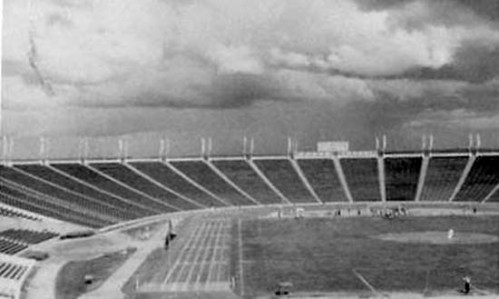
A little while later, I received a letter from a Russian gentleman who, just like me, was a lover of football and a programme collector. His name was Oleg Soloviev and his surname meant “nightingale” in Russian. The team used to play at what was then called the Kirov Stadium, a vast bowl with 100,000 seats.

I sent Oleg English and Scottish programmes and he sent me Soviet ones. I say “Soviet” because in those days many of the teams had Soviet names, as we shall see. Oleg was the man in charge of Zenit’s Youth Team and he travelled widely around the USSR in connection with his job. I still have some of the programmes he sent me, although only a small fraction. When I left home to go to my first job, my mother threw out my entire programme collection because I didn’t live there anymore. This type of action, which, incidentally, discarded well over a thousand pounds worth of footballing treasures, was by no means rare at this time and there were other young people I knew who suffered from it. It was all part of the “Bring ‘em up tough but with deeply rooted complexes” method of child care, so beautifully captured by Philip Larkin in this oh-so-true poem

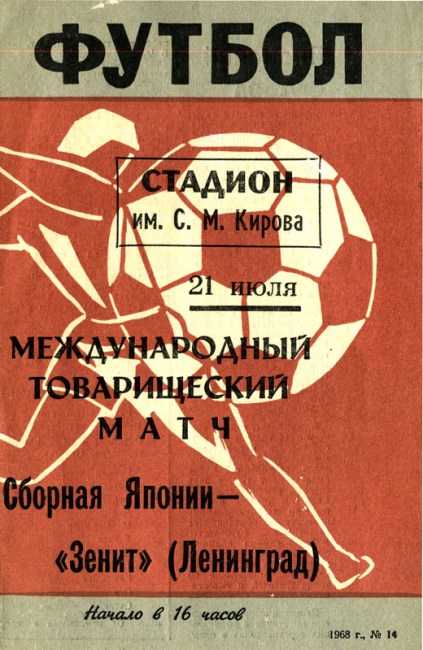
One small difference from English programmes was that in the Soviet Union, the home team was always printed second. This is shown in this particular programme which is of a design used by Zenit Leningrad for a number of years. At the top is the word “футбол” or “football” and the next word is “стадион” which means “stadium”. Perhaps you can spot the name of the man that the stadium was named after, namely “Kirov” or “Кирова”.

Other recognisable things are the kick-off time at the bottom, namely 1600 hours and the day “21 июля” or “21 July” in the middle of the ball.

The teams are going to play a friendly match, the lower team is “Зенит Ленинград” aka “Zenit Leningrad” and the two word opponents are “Сборная” which is “international (team” and “Японин” or “Japan”.

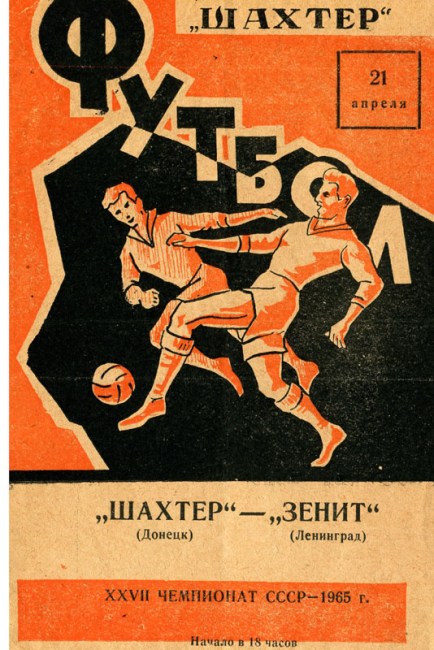
The next programme concerns two teams which still exist nowadays. “Шахтëр Донетск” or “Shakhtyor Donetsk” versus “Зенит Ленинград” aka “Zenit Leningrad” . The game actually took place in the 27th year of the USSR Championship, 1965 (bottom), on April 21st (top right), at 1800 hours (bottom) .

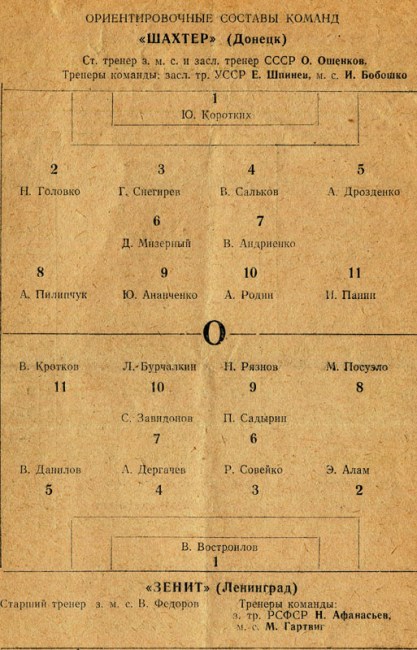
Here are the two teams, both set out in a daring 4-2-4 formation. “Зенит“ obviously means “Zenith” and “Шахтëр” means a “coalminer”. Донетск /Donetsk is now in the Ukraine, in the Donbass region, famous for its coal and iron ore.

That same team of Shakhtyor Donetsk/”Donbass Coalminers” is the away team in the next encounter, against “СКА Ростов” which is “SKA Rostov” “SKA” stands for “Sports Klub of the Army”. Rostov is a very large city and the stadium hosted five games in the 2018 World Cup. This link will take you to some pictures of Rostov’s beautiful buildings.

The game kicked off at 1700 hours (bottom) on July 1st 1971 (middle left). The large yellow letters say “кубок СССР по футболу” which means “Cup of the USSR in football”. It is the 30th tournament (top left, with “30-й турнир”).  Underneath the big yellow letters it is revealed that the game is the “матч ¼ финал” or “quarter final match”.  Rostov, though, have never been a very successful cup team. Just under the right hand yellow pentagon it says “35-й кубковый матч СКА”. So, if this is Rostov’s 35th cup match, and the cup competition is now thirty years old, then they must have only ever won five cup ties.


9 Comments

Filed under Football, History, Literature, Personal, Russia

My Dad, Fred, and his favourite poetry (5)

When I was a little boy, my Dad, Fred, used to be a teacher at Hastings Road School in Gresley. Unfortunately excessive mining operations underneath the school led to its premature collapse.  My Dad is at the right hand end of the back row:

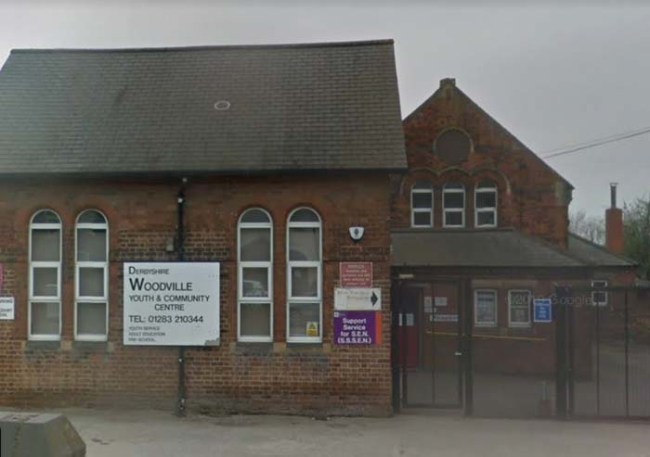
My Dad had to move to the Woodville Church of England Junior School, the school I attended, where, after a number of years, I finished up in his class, which was possibly Class 4. This is the school now.

One afternoon,  I can recall being one of the many children who were all so very frightened when my Dad read out to the fifty of us the narrative poem, “Flannan Isle”, by Wilfrid Wilson Gibson, written in 1912. Here’s the author:

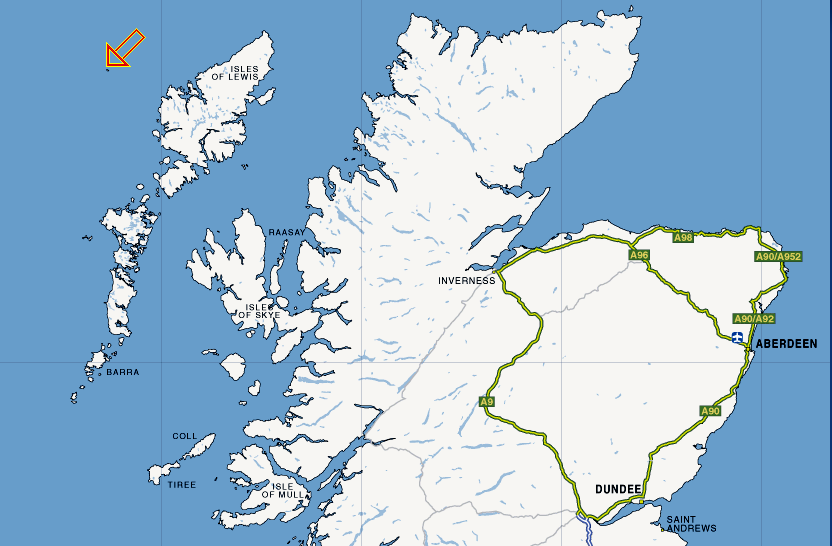
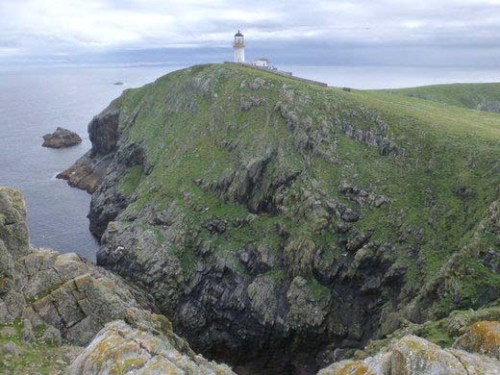
The Flannan Isles incidentally are pretty much as remote as you can get in Britain. The orange arrow is 553 miles from London, in a straight line, slightly less than London-Berlin:

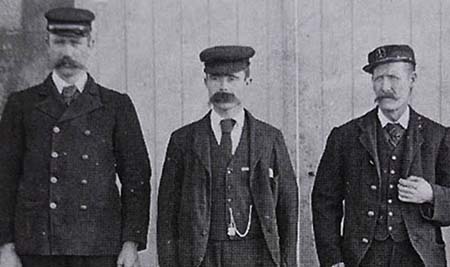
On an unknown date in December 1900, the lighthouse on Flannan Isle suddenly failed to shine. A few days later, when a group of lighthouse men came to investigate, they found that the whole island was completely deserted. The three lighthouse keepers had completely disappeared.

Fred used to recite this poem regularly to his classes, and I can still recall how intriguing many of us found this true story, and how animatedly and at what great length we discussed all the possible reasons for the disappearance of those three unfortunate lighthouse keepers only sixty years previously. We were all convinced that the men had been magically transformed into seabirds,  an absolutely horrific idea for nine year olds in that more innocent age of the early 1960s. Anyway, here’s the first section:

“THOUGH three men dwell on Flannan Isle
To keep the lamp alight,
As we steered under the lee, we caught
No glimmer through the night.” A passing ship at dawn had brought
The news; and quickly we set sail,
To find out what strange thing might ail
The keepers of the deep-sea light.
The Winter day broke blue and bright,
With glancing sun and glancing spray,
As o’er the swell our boat made way,
As gallant as a gull in flight. But, as we neared the lonely Isle;
And looked up at the naked height;
And saw the lighthouse towering white,
With blinded lantern, that all night
Had never shot a spark
Of comfort through the dark,
So ghostly in the cold sunlight
It seemed, that we were struck the while
With wonder all too dread for words.
That sets the scene, although, initially, when I came back to this poem after 60 odd years, I was a little disappointed with the quality of the poetry. Gibson seems so often to add an extra phrase or an extra couple of words, when the poem would actually read better without them.
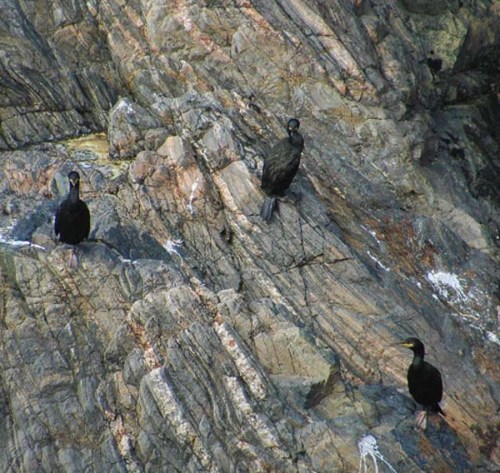
Anyway, a possible solution is hinted at by the description below of the three strange seabirds:
And, as into the tiny creek
We stole beneath the hanging crag,
We saw three queer, black, ugly birds—
Too big, by far, in my belief,
For guillemot or shag—
Like seamen sitting bolt-upright
Upon a half-tide reef:
But, as we neared, they plunged from sight,
Without a sound, or spurt of white.

Those three birds, guillemots or shags, were the very things that would go on to terrify a bunch of 9-year olds.

And still to ‘mazed to speak,
We landed; and made fast the boat;
And climbed the track in single file,
Each wishing he was safe afloat,
On any sea, however far,
So it be far from Flannan Isle:
And still we seemed to climb, and climb,
As though we’d lost all count of time,
And so must climb for evermore.
Yet, all too soon, we reached the door—
The black, sun-blistered lighthouse-door,
That gaped for us ajar.


As, on the threshold, for a spell,
We paused, we seemed to breathe the smell
Of limewash and of tar,
Familiar as our daily breath,
As though ‘t were some strange scent of death:
And so, yet wondering, side by side,
We stood a moment, still tongue-tied:
And each with black foreboding eyed
The door, ere we should fling it wide,
To leave the sunlight for the gloom:
Till, plucking courage up, at last,
Hard on each other’s heels we passed,
Into the living-room.
Actually, at this point, I might well retract what I said before. The further I went into the poem, the more I realised, that it is clearly meant to be slowly and deliberately declaimed out loud. Have a go. You’ll see what I mean. And sincere apologies, Wilf !
Yet, as we crowded through the door,
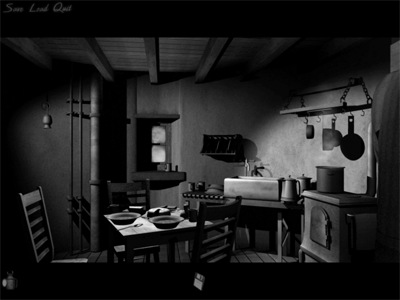
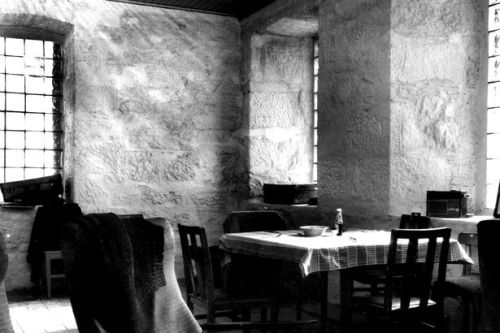
We only saw a table, spread
For dinner, meat and cheese and bread;
But, all untouched; and no one there:
As though, when they sat down to eat,
Ere they could even taste,
Alarm had come; and they in haste
Had risen and left the bread and meat:
For at the table-head a chair
Lay tumbled on the floor. We listened; but we only heard
The feeble cheeping of a bird
That starved upon its perch:
And, listening still, without a word,
We set about our hopeless search.
We hunted high, we hunted low;
And soon ransacked the empty house;
Then o’er the Island, to and fro,
We ranged, to listen and to look
In every cranny, cleft or nook
That might have hid a bird or mouse:
But, though we searched from shore to shore,
We found no sign in any place:
And soon again stood face to face
Before the gaping door:
And stole into the room once more
As frightened children steal.
Aye: though we hunted high and low,
And hunted everywhere,
Of the three men’s fate we found no trace
Of any kind in any place,
But a door ajar, and an untouched meal,
And an overtoppled chair.
And, as we listened in the gloom
Of that forsaken living-room—
A chill clutch on our breath—
We thought how ill-chance came to all
Who kept the Flannan Light:
And how the rock had been the death
Of many a likely lad:
How six had come to a sudden end,
And three had gone stark mad:
And one whom we’d all known as friend
Had leapt from the lantern one still night,
And fallen dead by the lighthouse wall:
And long we thought
On the three we sought,
And of what might yet befall.
Like curs, a glance has brought to heel,
We listened, flinching there:
And looked, and looked, on the untouched meal,
And the overtoppled chair.
We seemed to stand for an endless while,
Though still no word was said,
Three men alive on Flannan Isle,
Who thought, on three men dead.
Hopefully, you made it this far. It is definitely a great poem to be declaimed out loud. But you’ve got to take it slowly and deliberately. If you stumble at the words, go back and give it another go.
And here’s the three birds that we children all thought the lighthouse keepers had been transformed into:

In the future, I hope to produce some blog posts looking at the possible reasons that the three men disappeared.

Portrait of Gibson borrowed from poeticous

16 Comments

Filed under Criminology, Cryptozoology, History, Literature, my Dad, Personal, Science, Wildlife and Nature