Tag Archives: Coventry

Brincliffe Grammar School for Girls (1)

When I am writing blog posts, just like David Bowie and Jimi Hendrix, I don’t normally do requests. On the other hand, I did feel a little bit guilty that, months ago, somebody contacted me and said, very politely, “Maybe one day you could tell us a bit more about Brincliffe School, please?”. Regrettably, I did not record their name. On the other hand, the Hairy Godmother has granted their wish………

Brincliffe School was situated in Balmoral Road in Nottingham, immediately to the east of the High School. This Grammar School for Girls occupied the area between the western corner of the junction with Forest Road East, as far south as No 23, the first house of a row of three storey Edwardian properties. The Orange Arrow tells the tale, indicating precisely the southern boundary of the now demolished school:

Here’s the Victorian equivalent of the same area. The Brincliffe building is south west of the “B-A-L” of “Balmoral Road”.:

Brincliffe didn’t really look much like a school. It was more like a school housed in a private dwelling house:
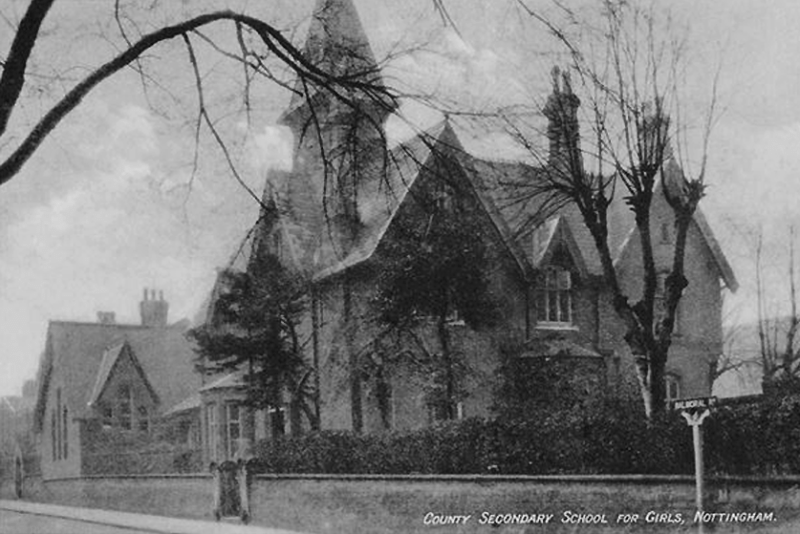
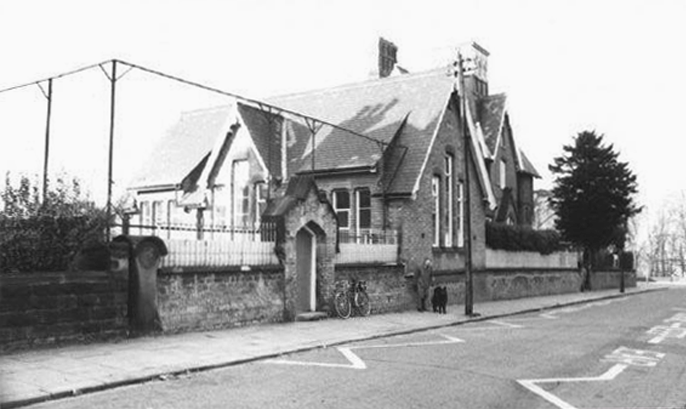
At one time, when it was a private house, Dame Laura Knight, the artist, had lived there. Not many pictures of the building are left nowadays. It was demolished in the late 1970s. Here is the view from the south. The key to linking up the two photographs is the bottom left of the photograph above, and the centre right of the photograph below. The three windows and the gate with a portico are crucial links. Don’t miss one man and his dog who have stopped for eternity next to the telegraph post.
Brincliffe was an all girls’ grammar school, which operated from 1907-1974. Entry was by passing a competitive examination. Unlike Nottingham Girls’ High School, no fees were payable. Such selective, and free, schools were a fantastic source of social mobility and an excellent examination for the poor.  Everybody in the school had a talent and the schoolwork they did was of a very high standard. At Brincliffe, girls had a genuine opportunity to do what they wanted to do with their lives, with little interferece, except from their own families.

The school produced a Gold Medallist in the 1974 Commonwealth Games, an Oxford don, a member of the D’Oyley Carte Opera Company, any number of students at Oxford and Cambridge Universities, and innumerable doctors, dentists, solicitors and politicians. And all of them came from an ordinary background. If you doubt that, then go and look at their Facebook page.

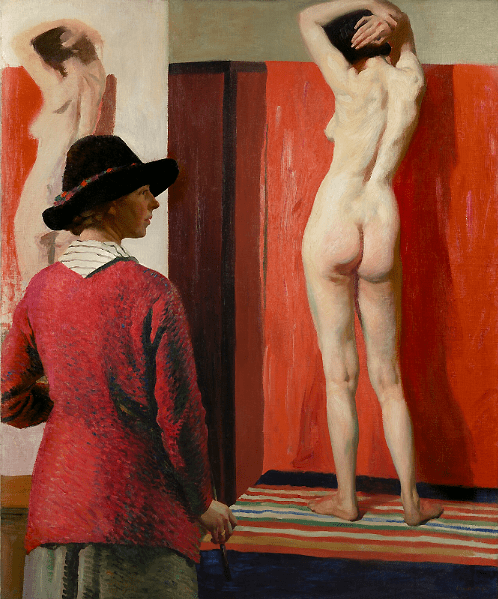
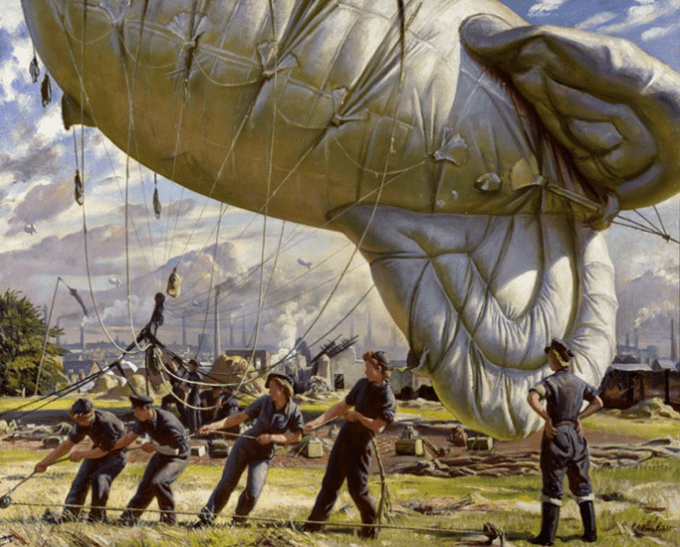
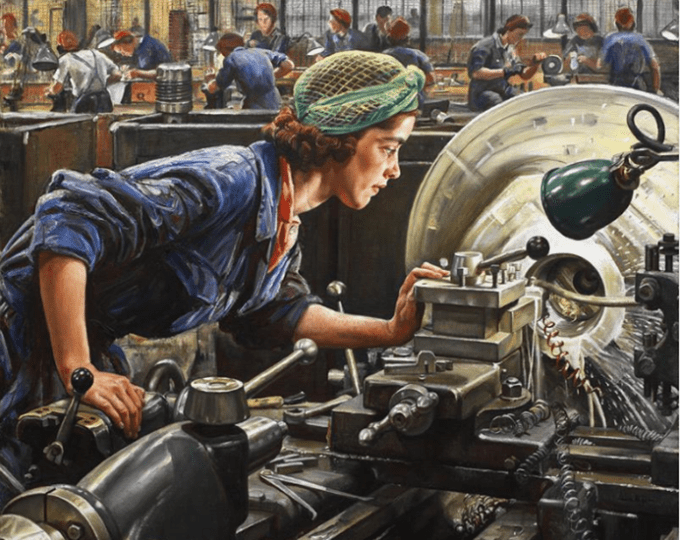
The most famous high achiever from Brincliffe was surely Dame Laura Knight, the painter.   One of her most famous paintings was “Self portrait with a nude”. It caused a right fuss:
She also did a lot of paintings of World War Two. They included “A Balloon Site, Coventry” in 1943:
The superbly composed “Ruby Loftus Screwing a Breech-ring” in the same year of 1943:
And a portrayal of the crew of a Short Stirling bomber in 1943. It is entitled “Take Off “, and I found in one account that the poor young wireless operator had been killed almost before the paint on the painting had dried :

Dame Laura was one of a very few female artists during her era. Another famous Old Brincliffian was Enid Bakewell who played for the English women’s cricket team in twelve Tests between 1968 and 1979. Her batting and bowling averages show that she could well be  regarded as the best all-rounder that the English women’s game has ever produced.

The Brincliffe School ran from 1907 onwards, for almost seventy years. There was only a single thirty girl form in each year, so everybody knew each other. The pupils used to wear dark green blazers and berets. Here is a typical green blazer of the period:

Brincliffe had only five Headmistresses during its history, the Misses Randall, Yates, Yonge, Lloyd and Carter. Teaching at Brincliffe came to an end in 1974 and I can remember still seeing the typical Victoria building during my first few years at the High School, from 1975 onwards. I have vague memories that, as the school was so close to the High School, we were allowed to use the empty classrooms for some of our smaller classes, such as Sixth Form groups. Brincliffe didn’t die in 1974, but it was severely wounded by a Labour Council’s decisions.  It was merged with another school for girls on Gregory Boulevard. This was the Manning School, formally opened by Alderman Manning in April 1931. (Aren’t local politicians just shameless?)

When Brincliffe and Manning merged, they also became a comprehensive school catering for girls aged between 11 and 16 years. In 1983 the school moved to new buildings in Aspley, a suburb further to the west, whilst the old school buildings on Gregory Boulevard became the Forest Comprehensive School. In September 2011, the Manning School became the Nottingham Girls’ Academy, the first all girls’ academy in Nottingham. It catered for girls aged between 11 and 18 years old.
34 Comments

Filed under History, Nottingham, The High School

Strathallan…………the lost air museum (1)

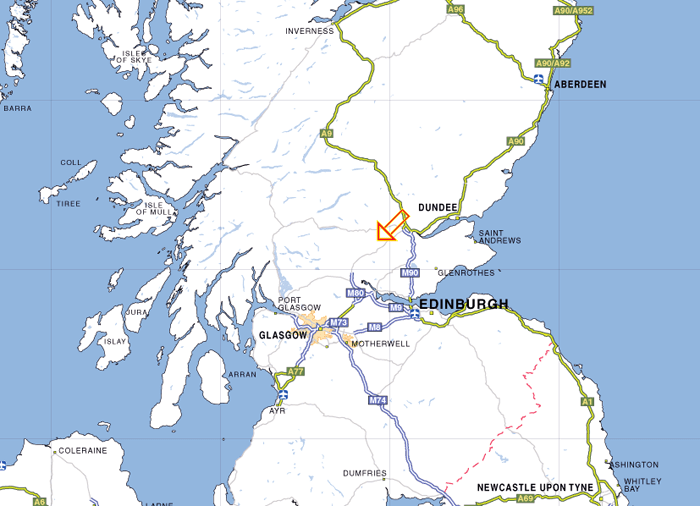
In the mid-1970s, Bill Brown, a friend of mine, and I used to spend time camping around Scotland, the Land of Mountains, Mist and Midges. For the most part, we explored the wild west coast, but one year, probably 1975, on our return home, we stopped at a place called Strathallan, on the eastern side of Scotland, to visit the air museum there. No digital cameras then. At RAF Cosford in 2011 I took 854 photographs. At Strathallan, in around 1975, with 16 shots on each rather expensive roll of film, I took 11 photographs. Strathallan is quite a remote place. Look for the orange arrow, resplendent in his kilt:    

 I didn’t realise at the time that Strathallan was well on the way to having to close, because of financial pressures. As somebody said, it was too remote from any large city and hardly anybody could be bothered to visit it. And back then, the motorway north of Edinburgh, the M90, simply did not exist.

That said, I was happy enough with the museum and I took photographs of the majority of the aircraft. Whether there were any more aircraft that I did not think were worth the cost of a photograph, I do not know. I can’t remember any more. That fact, to me, is plain scary. What percentage of our lives have we totally forgotten? 50%? 70%? 90%?

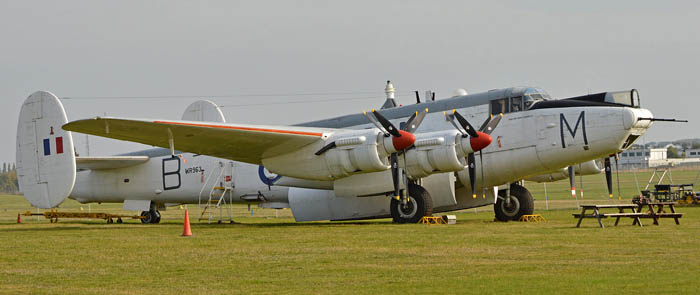
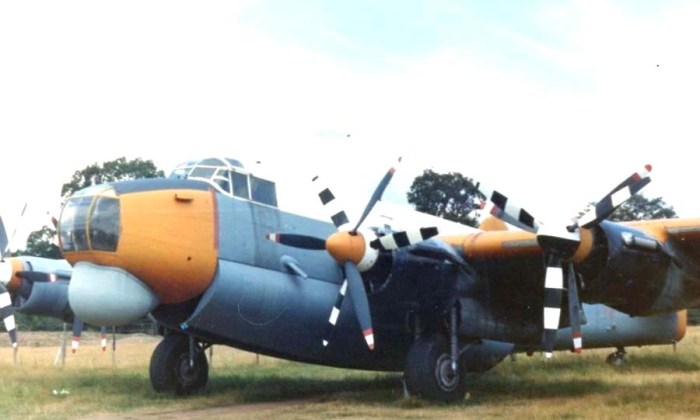
My favourite exhibit was their very colourful Avro Shackleton T4. The Shackleton was the last of the Manchester-Lancaster-Lincoln-Shackleton line and was used for maritime reconnaissance. I have clear memories of them flying over our house in South Derbyshire in the early 1960s. Presumably, they were following a Severn-Trent shortcut.

Here’s my only photograph:

The stripes on some of the eight propellers are to stop you walking into them. Here’s a photograph taken by a proper photographer. I found it on the internet:

As far as the Avro Shackleton is concerned, the British and the South African Air Force were the only countries to use it.

Here it is in even stripier hue. This particular aircraft was operated by the South African Air Force.

My Dad once saw a man walk accidentally into the propeller of a Lancaster. It affected him for the rest of his life, I always thought. He only ever spoke of it to me once.

Strathallan’s Shackleton was broken up eventually, although its nose is now in the Midland Air Museum in Coventry. Not how I envisage my own eventual fate.

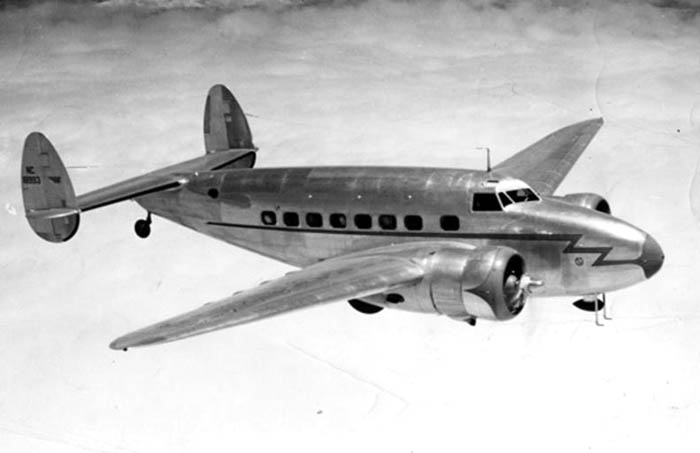
The museum had a Lockheed Hudson, an America  light bomber and coastal reconnaissance aircraft, primarily operated by the RAF. It was a military conversion of the Lockheed Super Electra airliner, and the first ever large contract for Lockheed. Here’s the Model 14 Super Electra:


And here’s the Lockheed Hudson at Strathallan:

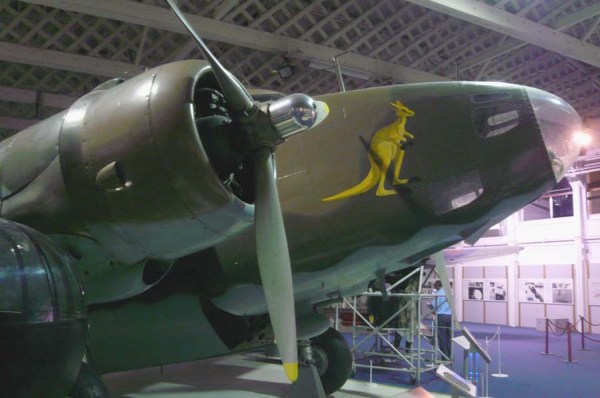
I would meet this aircraft again at Hendon and take three photographs of it, rather than just the one:

The kangaroo is the obvious link between the two encounters:

Next time, we’ll continue this mini-tour around the lost aircraft of Strathallan.

25 Comments

Filed under Aviation, Bomber Command, History, military, Personal

Old Nottinghamian saves the World OR Why no statue? (4)

Thomas Hawksley was born on July 12th 1807 at Arnot Hill House in Arnold, Nottingham, to parents John Hawksley and Sarah Thompson. Arnot Hill House is still there:

John was a worsted woollen manufacturer who co-owned the mill in Arnold. The mill engine’s cooling pond is now the ornamental lake, situated in front of Arnot Hill House. That’s still there too:

Thomas was educated at the Free School, or Grammar School, in Stoney Street, studying under the Headmaster, Dr Robert Wood.

Thomas arrived on May 27th 1821, at the age of 13 years 6 months. His school days were comparatively brief, for in September 1822 he was removed, with a view to practical training.

Thomas was self-taught from the age of 15 but eventually he was articled to an architect and surveyor Mr Edward Staveley, of Nottingham. He soon became a partner, along with Mr Jalland, of “Staveley, Hawksley and Jalland, engineers, architects, &c.” By 1835, Thomas was based at Middle Pavement and Trent Bridge, and “Staveley & Dudley” were based in Stoney Street. Mr Hawksley and Mr Jalland then worked together until 1850 when Jalland left. Thomas then left for London.

During his time in Nottingham, in 1823, aged only 23, Thomas had constructed a new pumping station for the Trent Waterworks Company near Trent Bridge.

Before this, Nottingham’s water was taken from shallow wells or from the Trent or its tributaries. The new pumping station filtered water taken from the Trent through natural beds of sand and gravel. The water was then pumped through a 15 inch main to a reservoir near the General Hospital. The pipes that carried the water were always kept under high pressure, and taps provided water day and night. Thomas eliminated leakage, and ensured an unvarying supply of fresh water. The pressure also meant that germs could not get in. This arrangement provided “Britain’s first constant supply of clean water, whose high pressure prevented contamination.”

In 1832, the young engineer personally turned on the tap. Anybody in Nottingham could now have clean fresh water from the tap in the yard, thanks to Thomas’ pumping station:

Thomas was the first engineer to set up a scheme of this type in a large and generally fairly dirty industrial town, and to make it work. The local plumbers, of course, objected tooth and nail to doing what Thomas told them to do, but his patience and, presumably, the threat of the sack, persuaded them to obey him.

In 1845, Thomas became chief engineer of the newly formed Nottingham Water Company. Five years later he excavated a seven feet wide and 250 foot deep borehole to get at the purest water which was present in the Bunter sandstone below the town:


Before long, Thomas was setting up schemes like the one at Nottingham across the length and breadth of England.

In this way, an Old Nottinghamian provided clear fresh water at the turn of a tap for most of the citizens of Barnsley, Barnstaple, Birmingham, Boston, Bridgwater, Brighton & Hove, Bristol, Cambridge, Coventry, Darlington, Derby, Durham, Great Yarmouth, Haslingden, Hinckley, Huddersfield, Leeds, Leicester, Lichfield, Lincoln, Liverpool, Lowestoft, Merthyr Tydfil, Middlesbrough, Newark Newcastle-on-Tyne Northampton, Norwich, Oxford, Rochdale, Southport, Sheffield, Southend, Stockton, Sunderland, Wakefield Waterford, Wexford, Windsor, Worcester and York.

Sunderland seems to have revered Thomas. There is a Thomas Hawkesley Park in Sunderland, full of expensive four and five bedroom houses:

It’s not as beautiful, though, as Hawkesley House:


Thomas was also a gas engineer and, applying the same basic principles for gas as for water, he advised about how to set up the supply for large cities. The number of gas-works he built was very large, and included Barnsley, Bishop Auckland, Burton-on-Trent, Cambridge, Chesterfield, Derby, Folkestone, Gosport, Lowestoft, Newark, Normanton, Nottingham, Pilkington, Radcliffe, Sunderland and Bombay.

Thomas also worked hard on sewage treatment and, as with water and gas, he helped a great many places including Aylesbury, Birmingham, Hertford, Whitehaven, Windsor and Worcester. He anticipated modern methods in refusing to discharge raw sewage into rivers and recommended treatment with chemicals. He believed that spreading the resultant mixture on farmland might well render it completely harmless.

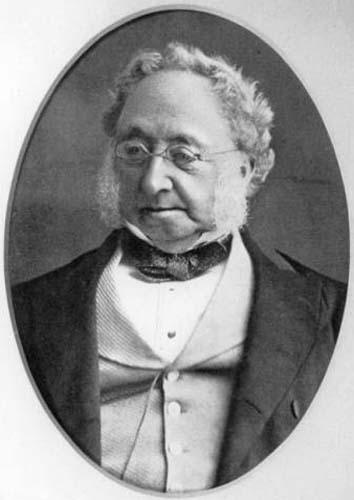
Here is Thomas in later life:

Thomas became the first president of the Institution of Gas Engineers and Managers (1863), President of the Institution of Civil Engineers (1872), President of the Institution of Mechanical Engineers and of the Institution of Gas Engineers (1876) and Fellow of the Royal Society (1878). And he was not a one-trick-pony. In 1885 he received a gold medal for the invention of an instrument for the assistance of the deaf.

Thomas died on September 15th 1893 at 14 Phillimore Gardens in Kensington. London.

In 1907, Thomas’ son, Charles, established the Thomas Hawksley Fund on the centenary of his father’s birth on July 12th 1907. In 1913 Charles initiated the Thomas Hawksley lectures. The first was given by Edward B Ellington, an expert in hydraulic engineering, talking about “Water as a Mechanical Agent”. The lecture was presented at the headquarters of the Institution of Mechanical Engineers and then given again in Birmingham, Leeds, Liverpool and Nottingham. Subsequent speakers have included H L Callendar (published the first steam tables), F W Lanchester, (the car engine), Harry Ricardo (an engine designer) and Sir Noel Ashbridge (broadcasting). Hawksley lectures still take place today.


photo of lake courtesy of geogreph


14 Comments

Filed under History, Nottingham, Science, The High School

The place where I grew up, Woodville, in World War 2

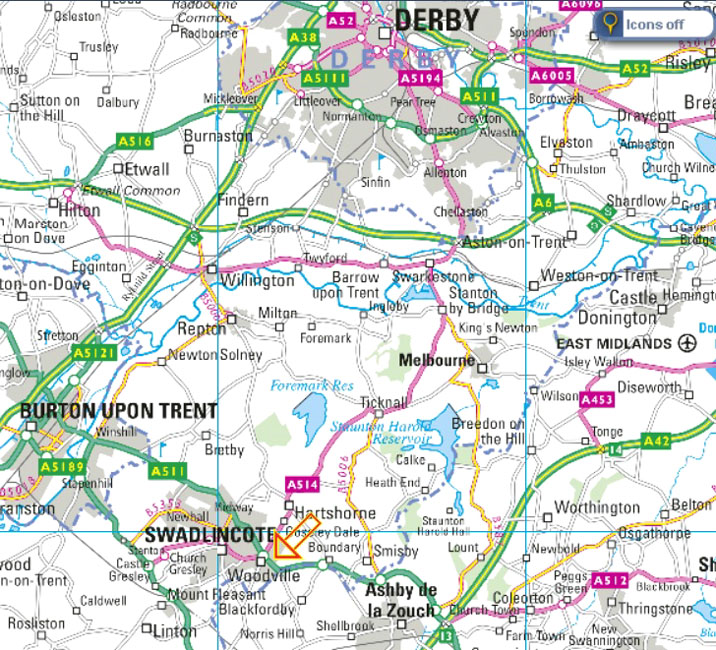
I grew up in a small village called Woodville, just to the south of Derby, in more or less the centre of England. Cue “The Orange Arrow” :

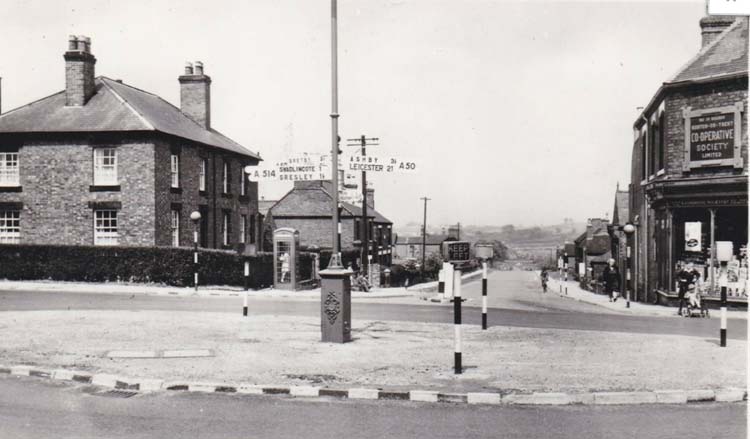
The village used to be called Wooden Box because of the large wooden box occupied by the man who operated the toll gate on the toll road between Ashby de la Zouch and Burton-upon-Trent.  The name Woodville first appeared in 1845. Nowadays, there is a roundabout where his box used to be, although the location itself is still called “Tollgate”. Here’s an old postcard of the “Tollgate” :

My Dad, Fred, told me that the majority of the people in Woodville were pretty much unaware of the existence of World War Two. It had comparatively little impact in this mostly country area, where rationing was offset by the inhabitants’ ability to grow food for themselves, and even to raise their own pigs and chickens. Food, therefore, was relatively freely available, if not abundant, and the war seemed to be very distant. Woodville seemed to be an unchanging pastoral paradise:

The twenty year old Fred despised the comfortable lives of the older people in Woodville. They would live out their humdrum lives without any risk whatsoever, while he was laying his life on the line pretty much every single day in Bomber Command:

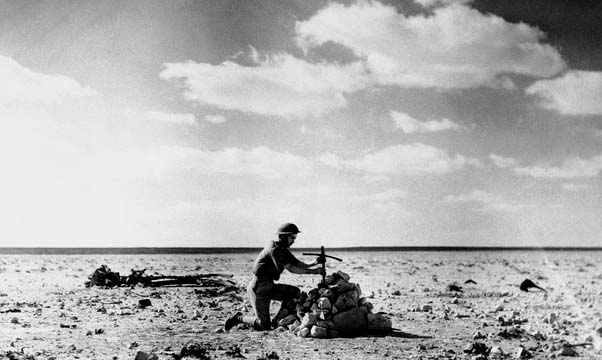
The contempt he had for the inhabitants of the village, though, was perhaps a measure of his own fear at being asked to fly over burning Bremen or Cologne, or some other heavily defended Bomber Command target :

Young men, of course, went away from Woodville and from time to time their parents were duly informed that they would never return:

It was only too easy, though, for others to view that profoundly sad process as similar to that of the young men who might have moved away from the village for reasons of employment, or even in order to emigrate to another country.

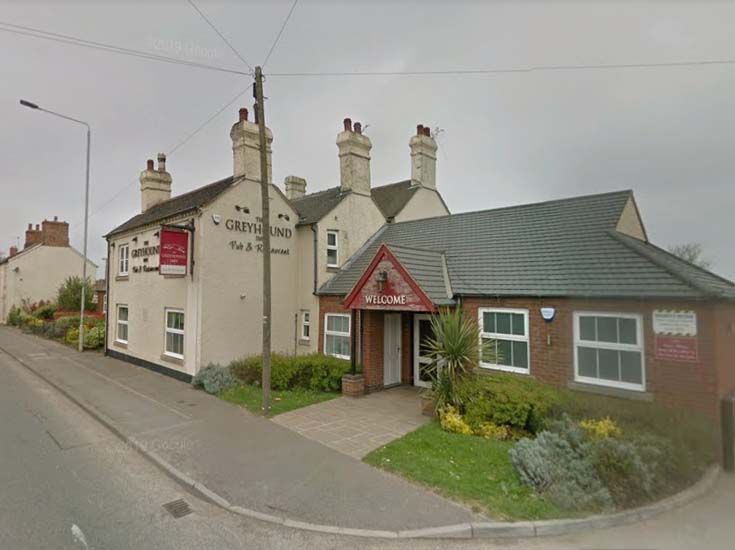
Occasionally, enemy aircraft would fly over Woodville, identifiable by their particular and peculiar engine noise. On one dark night, on November 14th 1940, many local people, Fred included, walked up to the Greyhound Inn near Boundary :

Everybody stood on the opposite side of the road from the public house and looked south. The view from that spot stretches thirty or forty miles or more into the southern Midlands

As they stood and looked, they were able to see the bright glow in the sky as Coventry burned, a city whose centre was almost completely destroyed by the Germans. There was, though, very little direct effect of German bombing on the local area around Woodville.

On one occasion, a Heinkel III night bomber, panicking about where he was, possibly pursued by a night fighter and perhaps worried that he might not make it back to the Fatherland, jettisoned all his bombs over the nearby village of Church Gresley. Look for “der fliegende orangefarbene Pfeil” :

The bombs all landed near Hastings Road, not far from the school where Fred would teach immediately after the war. They demolished an entire row of houses which backed onto Gresley Common, and all the inhabitants, almost thirty unfortunate people, were accidentally killed.

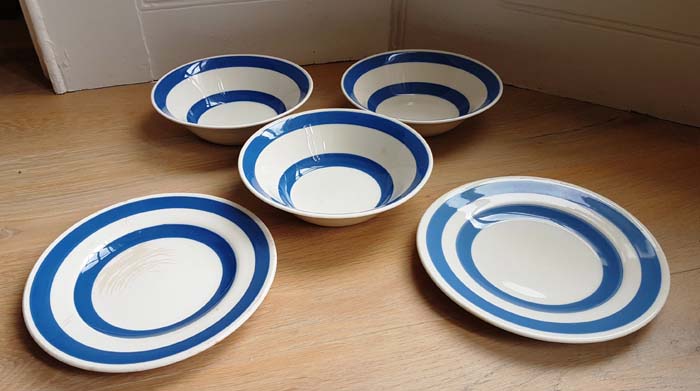
Years later, in the 1990s, Fred was able to explain these events to a man digging in the garden of his new townhouse, built recently on the site of the Second World War disaster. The man could not understand why the soil was so full of broken bricks, bath tiles and so many smithereens of old fashioned blue and white patterned crockery:

The only other direct connection with World War 2 was the unfortunate soldier and ex-prisoner-of-war who finally returned to Woodville in late 1945 or early 1946, having spent years as the unwilling guest of Emperor Hirohito, and the Japanese Imperial Army.

The poor man was unbelievably gaunt, and he had lost so much weight that his clothes flapped on his body like sails on a mast:

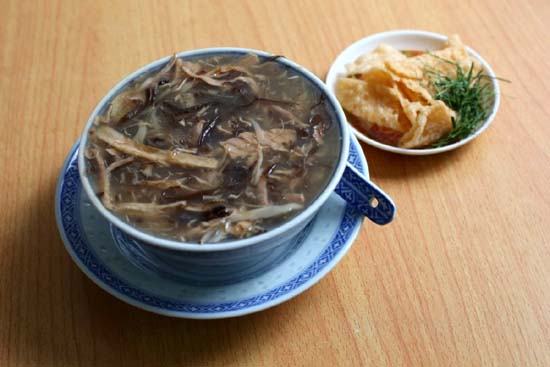
He did not receive as much sympathy as he might have done from the citizens of Woodville, though, when they found out that he had actually eaten snakes in his efforts not to starve to death. “Really ! Snakes ! ! ” Here’s snake soup, a delicacy in China but not as highly prized as bat and pangolin, apparently:

Fred, of course, had a view of such events very different from that of the average native of Woodville. Almost sixty years later, when I cleared out his house after his death, there was not a single Japanese electrical device to be found. Everything came from the factories of Philips in Eindhoven in the Netherlands.


33 Comments

Filed under History, Personal, the Japanese, war crimes