Author Archives: jfwknifton

“Hilarity with Heraldry” (3)

Last time I was looking at old football club badges from the late 1950s. Many clubs back then were using the heraldic coats of arms of their town or city. A fair proprtion of the rest, though, were using animals. Bolton Wanderers and Dumbarton in Scotland are presumably slow and ponderous yet very powerful in their play:

This slideshow requires JavaScript.

Derby County have a ram because of a folk song called “The Derby Ram”:
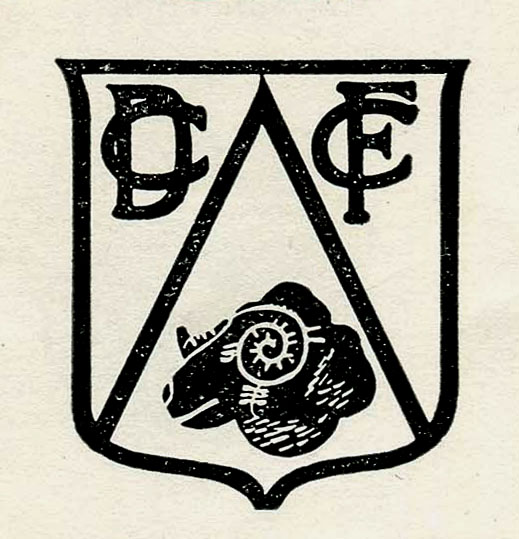
I was going to insert a link here to let you all hear the song that we sang in our junior school classes near Derby all those tears ago, but I decided not to. If you go to YouTube and search for “Derby Ram folk song” you’ll soon see my problem.

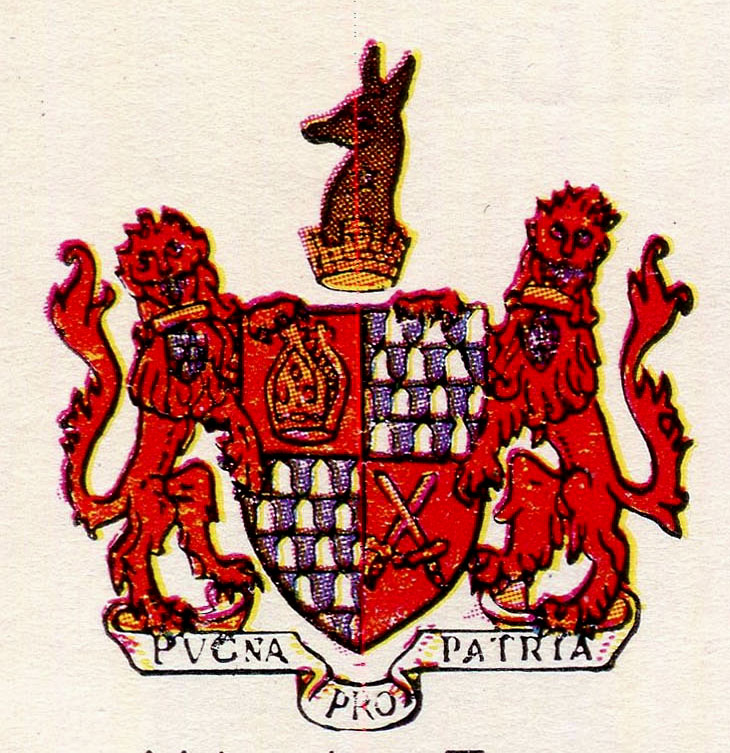
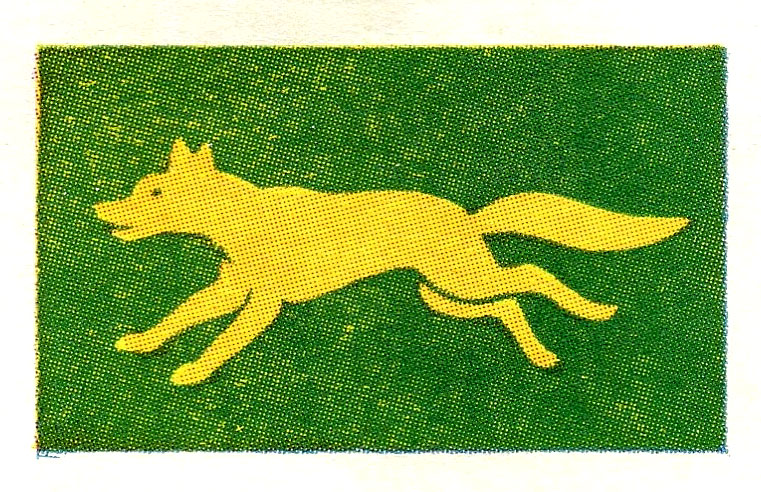
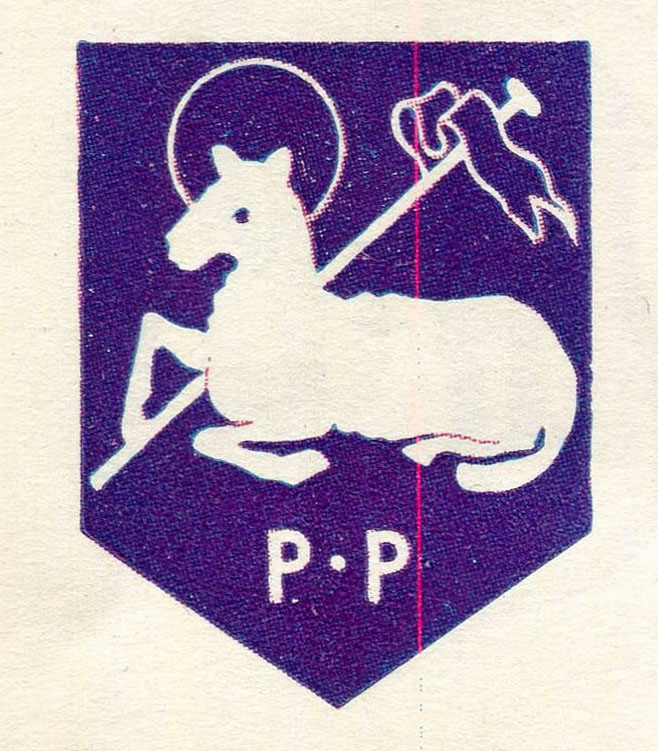
Leicestershire County Cricket team have a fox because the county was full of very keen foxhunting men and women and, indeed, children:Preston North End make use of the Paschal Lamb. “PP” stands for “Proud Preston”, who, in the 1880s, managed by the now long forgotten William Sudell, were the greatest team in the land:
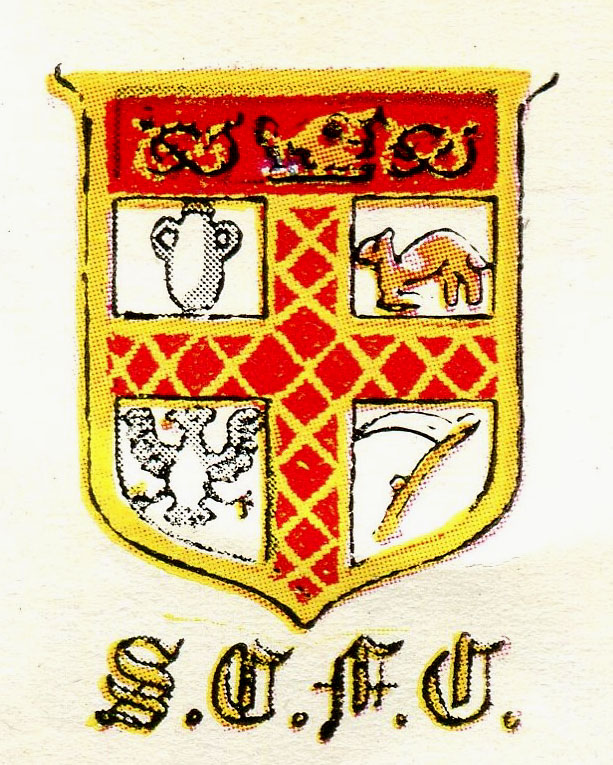
Stoke City have a strange badge which, to me, features a humpless camel. Intrigued, I looked it up and it is indeed a camel. The Stoke City camel comes from an original camel featured on the badge of the nearby town of Hanley. The Hanley camel comes from the coat of arms of John Ridgway, the first Mayor of Hanley. Ridgway had his very own camel on his shield because Stoke is the home of a huge pottery industry. Indeed, Stoke City’s nickname is “The Potters”.  Anyway, John Ridgway included the camel in honour of the land of origin of the pottery industry, Egypt. You couldn’t make it up.
A few clubs have badges with birds on them. The first is West Bromwich Albion who were nicknamed “The Throstles” years ago:
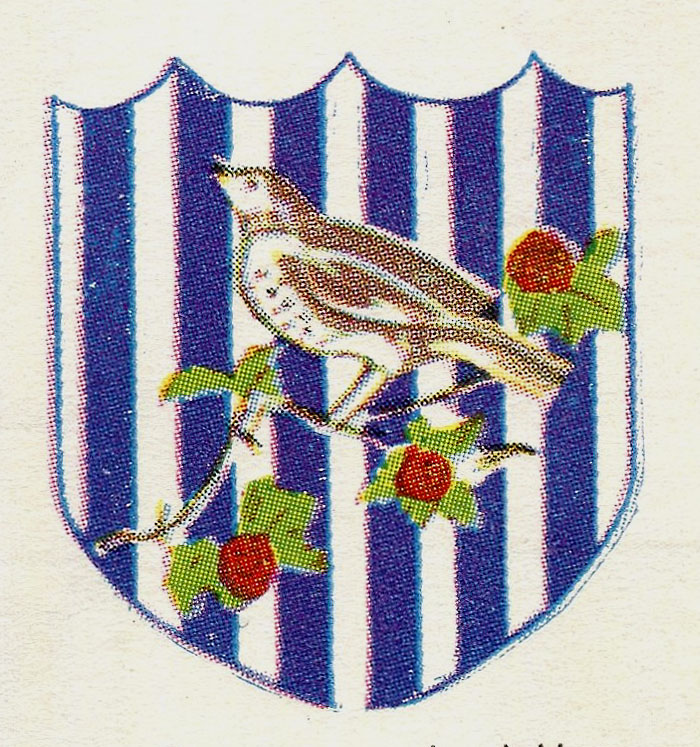
A “throstle” is a dialect word in the English Midlands for a song thrush, turdus philomelos.

Albion play in blue and white stripes so that isn’t the reason for the bird. I will quote Tony Matthews, the club’s official historian:

“The club was formed in 1878 as ‘The Albion’. In 22 years the team was based at five different grounds before settling at ‘The Hawthorns’ in 1900. The new ground brought with it a new nickname ‘The Throstles’, as the song thrush was a commonly seen bird in the hawthorn bushes from which the area took its name.”

This is the effigy of a ‘throstle’ at the current WBA ground in West Bromwich. It has been rescued after renovations and is about five or six feet high.

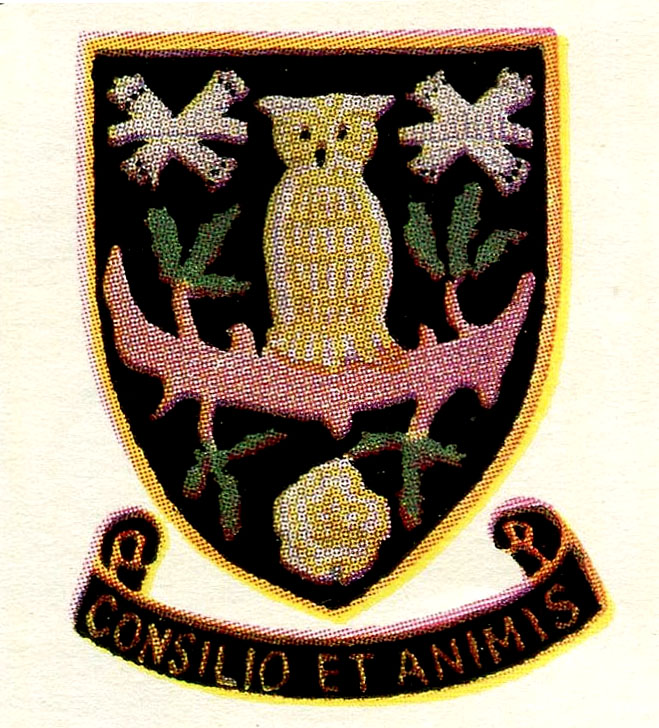
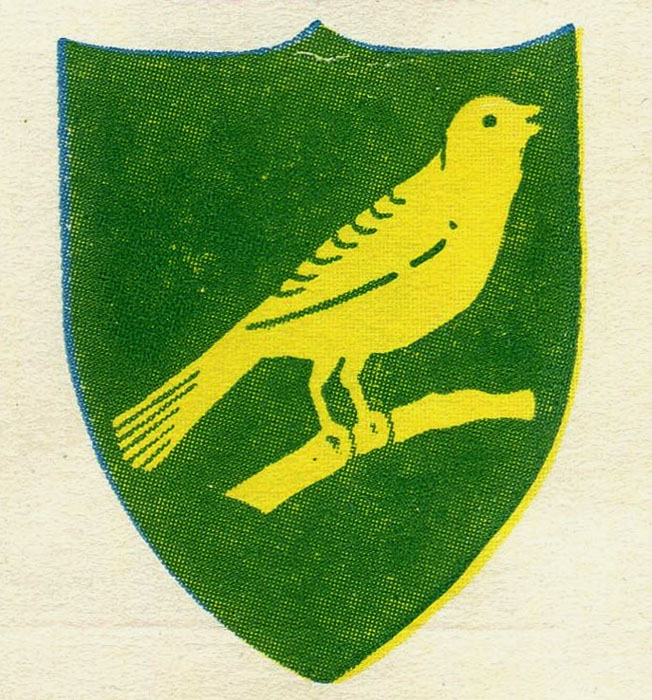
Sheffield Wednesday came from a district of the city called “Owlerton” and played when it was half day closing on Wednesdays, rather like the Welsh team, Abergavenny Thursday. Norwich, nicknamed “The Canaries”, play in green and yellow, the latter colour always strongly denied as merely representative of the city’s main employer, Colman’s Mustard. An image search might persuade you otherwise, though:
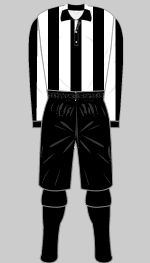
Other teams have particular birds on their shields because of the colour of their shirts. Cardiff City are the Bluebirds, Swansea City are the Swans, Bristol City are the Robins, and both Notts County and Newcastle United, in black and white are the Magpies:
And here’s one of Notts County’s many different badges, In this case, it’s the Ladies’ Team:

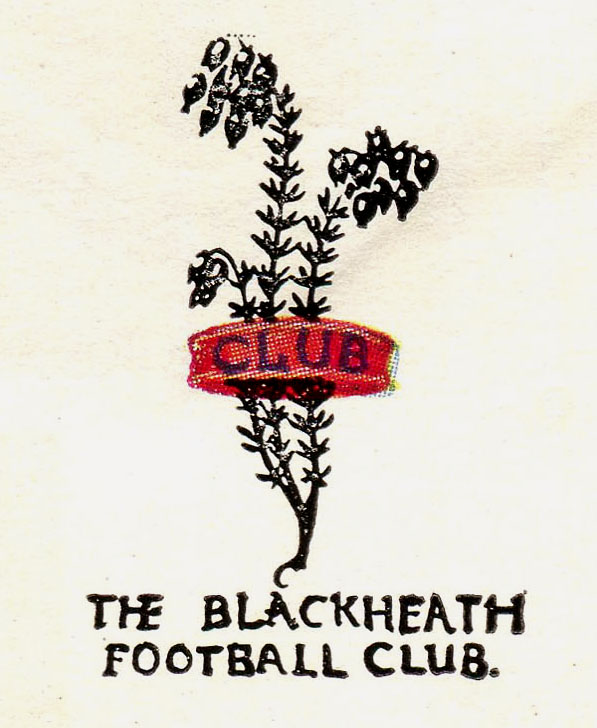
Flowers are often used as badges but hardly ever in football. In rugby this is the emblem of the Blackheath Club. It shows a piece of black heather, as a kind of pun:
In Heraldry such rib ticklers are called “canting arms”. Here are the shields of families called Shelley, Wellwood and Keyes:

This is a Spanish effort representing ‘Castile and Léon’ or ‘Castle and Lion’.

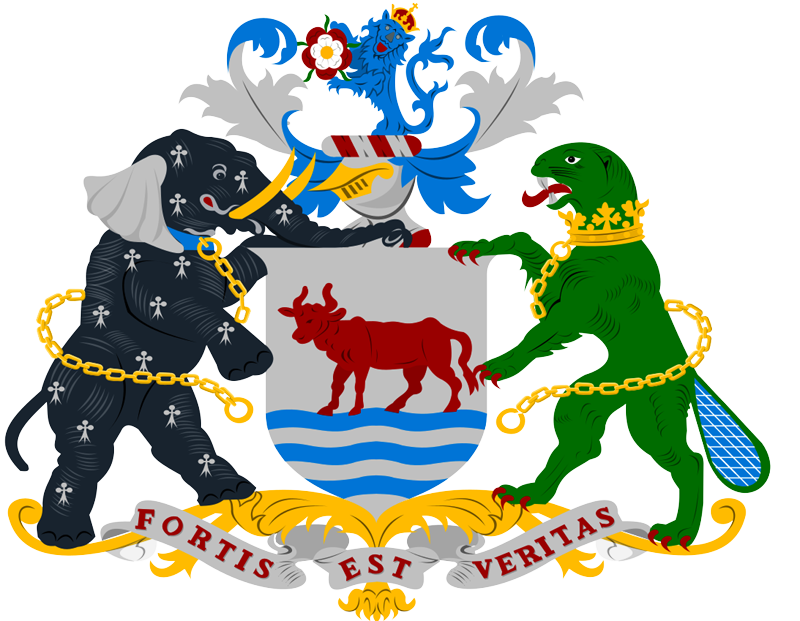
The arms of the city of Oxford seems to have been heavily influenced by student drug use in the 1960s:
London Irish uses the Irish national plant and the two cricket clubs, Glamorgan and Lancashire, use the daffodil and the red rose respectively:

This slideshow requires JavaScript.

Next time, badges with a story behind them.
 

15 Comments

Filed under Derby County, Football, History, Humour, Personal, Wildlife and Nature

Renegade Football at the High School (5)

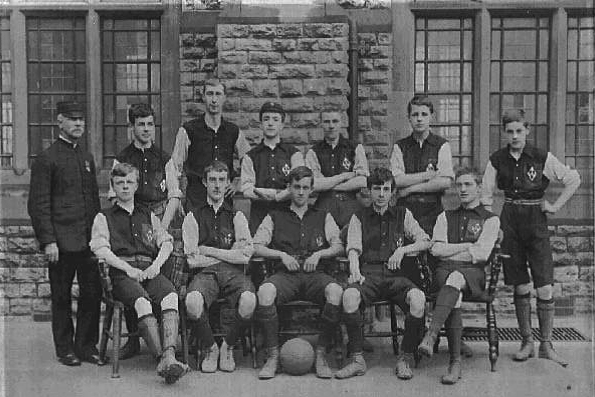
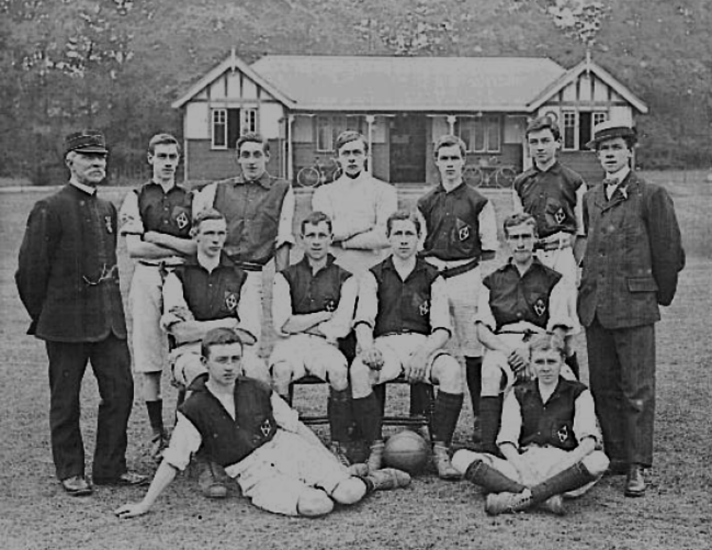
This photograph shows the First Team in the 1904-1905 season. It was taken at Mapperley Park Sports Ground, opposite the old Carrington Lido on Mansfield Road.

Sergeant Holmes is again present, and the players are….

(back row)      S.D.M.Horner, C.F.R.Fryer, M.J.Hogan, R.E.Trease and J.P.K.Groves

(seated)          R.G.Cairns, R.B.Wray, R.Cooper (Captain) and L.W.Peters

(seated on grass)        H.E.Mills and P.G.Richards

On the right is twelfth man, F.C.Mahin. You can read about the incredible life of Frank Cadle Mahin in three of my previous blog posts.

I believe that the photograph was taken on the afternoon of Wednesday, October 12th 1904, just before the High School played against Mr.Hughes’ XI, perhaps to commemorate the game for the old Drill Sergeant. The School won 12-5, and we know that Cooper in defence was the outstanding player, but the whole team played well, and the forwards’ finishing was particularly deadly. This year, the team was amazingly successful. Their season began with victories by 5-4, 2-1, 23-0, 12-5, 9-0, 15-0, 3-1, 4-1, 11-0, 16-1. They had scored exactly 100 goals by November 3rd, in only ten games.

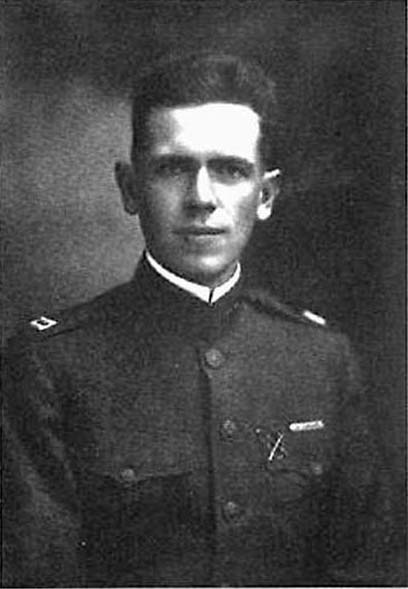
Notice that it is warm enough for the changing room windows to be open, and the design of the ball is still that old fashioned “Terry’s Chocolate Orange”. Horner has forgotten his football socks, and, because this game marked his début for the side, Fryer’s mother has not yet had the time to sew his school badge onto his shirt. Frank Mahin is, in actual fact, in the full School uniform of the time…a respectable suit or jacket, topped with a Sixth Form white straw boater, with a school ribbon around it. Here he is in American military uniform:

Football, though always, seems to have appealed to the rebellious nature of the boys. Even when it was a school sport, some of them wanted more, and they were quite prepared to break the rules of the High School to achieve that aim. The Prefects’ Book records how “an extraordinary meeting of the Prefects was held after morning school on November 23rd 1908”.

AB Jordan reported that a Master, Mr WT “Nipper” Ryles…

“… had complained about a cutting in the “Football Post” & “Nottingham
Journal”, stating that the High School had been beaten 5-1 by some unknown team called Notts Juniors, reported 8 boys out of IIIC, 1 out of IIIB, 1 out of IVB. The boys were Davie (J.R.), Herrick (R.L.W.), Gant (H.G.) Hemsley, Major, Parrott, Wilmot, Tyler, Cowlishaw & Sadler. They had played against a team of Board School boys down at Bridgford, under the name of Nottm High School Third Form. The other team had put the result in the paper. They were told that such teams must not be played, & that nothing must be sent to the papers except the results of 1st XI & 2nd XI matches.   Signed  AB Jordan”.

The School Archives also have a photograph of older boys in an unknown team.  Nobody has any real, definite and provable idea about who they might be. Perhaps they were something unofficial too:

The man behind the team is not a known member of staff. Here he is:

Is the mystery man is one of  Haig’s staff officers from 1914, on an early lookout for likely cannon fodder for the Western Front? Why should I think that? Well, take a look at this photograph of a group of what were probably the cleverest, shrewdest military thinkers of their age, “Field Marshal Haig and the Blockheads”. Perhaps, front left, Tubby Watson?  :

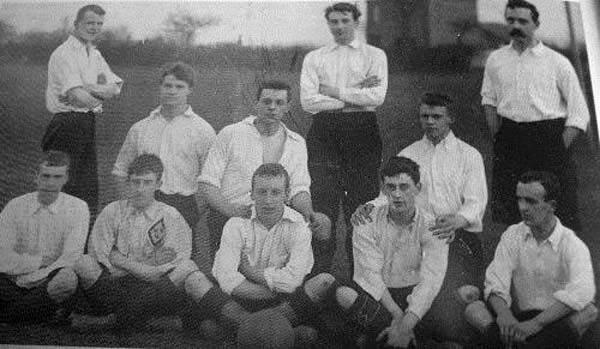
The next team photograph is not one I am particularly proud of. It is the sad result of the practise of using a camera to scan images because it is so much quicker. It appeared in the School Magazine a few years ago  and they seemed to have little knowledge of who it is:

The caption reads

“Is the above photograph a School Football Team of the early 1890s? The only proof that the team is the three merles badge on the shirt of one of the boys. The photograph is supplied by Don E Stocker (1926-1932) and his father EB Stocker (1889-1891). Is the man on the right a master or possibly Mr Onions, the groundsman and cricket coach?

Well, he’s neither a Master nor Mr Onions in my opinion:

This slideshow requires JavaScript.

And the badge may mean it is a High School team but not 100% definitely. It might be the only football shirt he has:

And surely, if it was a High School football team, more than one would be wearing a proper football shirt. As far as I can see, the majority of the players are wearing ordinary white shirts such as they might wear in the bank where they worked, or the technical drawing office.

I don’t think the team is pre-1900 either because the ball is made of 18 panels sewed together. Balls from this period tended to be like a Terry’s Chocolate Orange with lots of segments held in place by a circular piece of leather on either side. It may be a renegade team though, because School football stopped in 1914 and this photograph may well date from after that.

More Ché Guevarras of High School football next time.

20 Comments

Filed under Football, History, Nottingham, The High School

The problems with researching World War Two (3)

Last time I was talking about the difficulties faced by the researcher trying to link a High School boy with a war casualty, in the absence of any details to prove that link.

Let’s move on, though, to some even more complex examples. We all know this rhyme:

“This little piggy went to market, this little piggy stayed home, this little piggy had roast beef, this little piggy had none and this little piggy cried wee wee wee wee all the way home.”

Can you pick out which one is which in this slideshow?

This slideshow requires JavaScript.


Well, how many little piggies were involved? And which jobs could have been done by the same, single, pig?

Let’s take it one stage further.

What is the minimum number of little piggies required to satisfy the rhyme?

And what is the maximum number of little piggies possible to satisfy the rhyme?

Let’s look at the maximum possible first. We begin with two little piggies, one to go to market (TLP-1) and one not to (TLP-2). TLP-2 stays at home, worried that he has agoraphobia. And then there is TLP-3 who gorged himself on roast beef in a fast-food restaurant in Texas. TLP-4 was worried that the meat was not beef but pork, so he did not eat any. His friend, TLP-5, was so upset by the idea of porcine cannibalism being broached that he ran home as fast as his little legs would carry him. So the answer is FIVE.

In the minimalist world, TLP-1 and TLP-2 are mutually exclusive, so they are both needed. In other words, you cannot go to market and stay home as well.

But it’s perfectly possible to go to market (TLP-1) and to have roast beef when you get there (TLP-3).

And it is equally possible that a little piggy could stay at home (TLP-2) and then prefer to watch television and eat ice cream and chocolate rather than consume roast beef (TLP-4). That means that TLP-1 and TLP-2 can easily cover the workload of TLP-3 and TLP-4. What about TLP-5? Do we need a third small porcine individual just to run home? Of course not. When TLP-1 has finished his work as TLP-3, he can return to base as TLP-5. So all that work, but, in actual fact, only TWO pigs are needed to do it.

When you are a little more experienced, you should try looking at the other possibilities. Could “The Three Little Pigs” have been hired for the job? And what about four?

And my point is? Well, if you are investigating William Brown, Boy No 3553, you may have to look at which William Brown could have been in a certain place at a certain time, and which William Brown could not. Your carefully planned series of events may come crashing down to earth when you realise that your Private Brown has been killed in Libya but buried in Burma. And William Brown is a nightmare name anyway, with any solution highly unlikely.  Boy No 3553 might well have grown up to be Able Seaman Brown (D/JX169407), but then again, he might have become Flight Sergeant Brown (R/111993) or Gunner Brown (1443935) or Lance Corporal Brown (3770585) of the Royal Irish Fusiliers or Stoker 1st Class Brown (D/KX 88989) or Ordinary Signalman Brown (D/JX 269496) or Stoker 1st Class Brown (D/KX 165881) or Corporal Brown (532583) of the Royal Air Force or Gunner Brown (1721406) or Private Brown (13000452) of the Pioneer Corps or Private Brown (7262686 of the Royal Army Medical Corps.

The unusual nature of somebody’s name is a reasonable indicator of a link but it should not really be the only evidence presented. Boy No 5168 was William Henry Goodwin which I thought would be an unusual enough name to link the little boy with any war casualty of that name who might turn up on the CWGC list. In actual fact, just to disprove the point, I managed to find two different William Henry Goodwins, neither of whom attended the High School.
The first one was wounded in Libya in North Africa but he lived to tell the tale (WHG-1). The second one was on a different list because he was killed in North Africa. He is buried in the Alexandria War Memorial Cemetery in Egypt (WHG-2). Which one was Boy No 5168? Was it just one of them?
Or was it both of them, as WHG-1 was first wounded in Libya, and then, as WHG-2, a few months later in a second incident, was hit a second time by machine gun fire, killed, and then buried in Egypt?

Or was it neither of them, because there were actually three individuals? One was wounded in Libya (WHG-1), one was killed in Egypt (WHG-2) and one stayed at home and spent the whole of the Second World War managing a fish and chip shop in Basford so that he never turned up in military records (WHG-3).

Supporting details are absolutely crucial.

Let’s continue with the WHG-community as an example. Simple question. Can we be certain that WHG-1 and WHG-2 and WHG-3 are all different people without supporting details? And contrariwise, can we be certain that they are all the same person without supporting details? Well, in a word. NO. We can’t. In fact, we can’t be certain of anything.

That’s why we examined those little pigs. In the WHG-community, at least one person has to go to North Africa and if he does, then he can be killed but he can’t spend all six years of the conflict in Basford managing his chip shop. Even if he does change his name to Billy to avoid military service:

23 Comments

Filed under History, Nottingham, The High School, Writing

“Hilarity with Heraldry” (2)

Last time, I was talking about “The Tiger Album of Football Club Badges” and I made the point that, back in 1961, lots of football clubs turned straight to the local town’s arms for their own badge. Here’s Aldershot, their nickname is “The Shots”. They’re not that bad, though:

Here’s Barnsley and Birmingham City which both refer back to their industrial heritage:

This slideshow requires JavaScript.

There are lots of animals used. Glamorgan Rugby play like dragons and Leicester Rugby Club are actually called “Leicester Tigers”.

This slideshow requires JavaScript.

In football, Newcastle United  are close to the sea which is probably full of seahorses at that point and Rotherham United must have had lots of deer in the area at one time:

This slideshow requires JavaScript.

Lions are always popular as ‘supporters’, in heraldic terms really, rather than sitting behind the goal, roaring on their team. Here’s Halifax Town and Plymouth Albion rugby club. Funny how both pairs of lions have learned to dance:

This slideshow requires JavaScript.

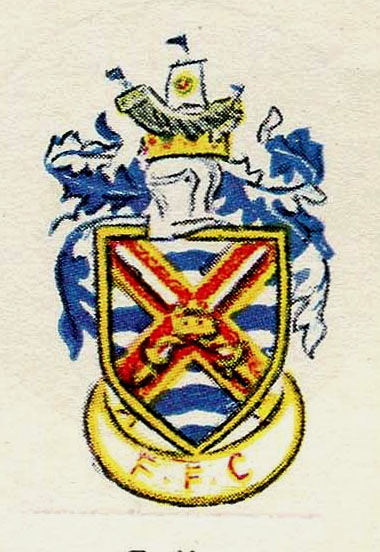
Some don’t fit into any category. Perhaps Fulham have the waters of the nearby River Thames on the shield:

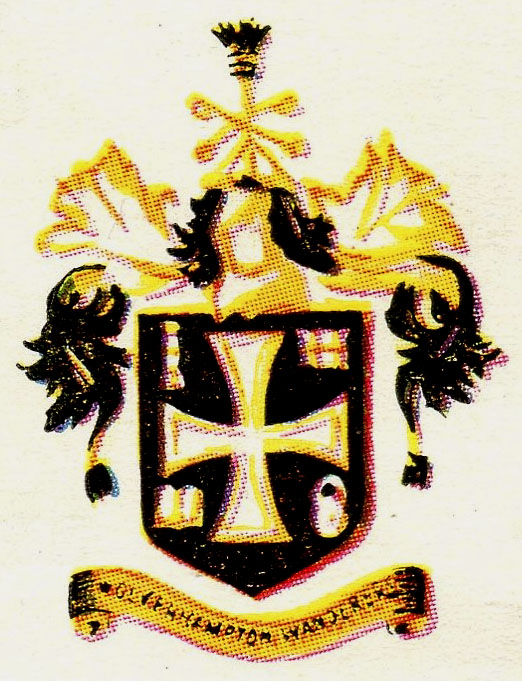
Wolverhampton Wanderers supporters obviously have their cross to bear:

Other badges are derived from their local town’s coat of arms but in a less elaborate way. Luton Town, Pontypridd Rugby Club, Torquay by the sea and Tranmere Rovers:

This slideshow requires JavaScript.

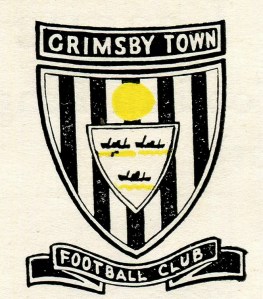
Grimsby is by the sea and the team are nicknamed “the Mariners” and Falkirk supporters look very fierce indeed:

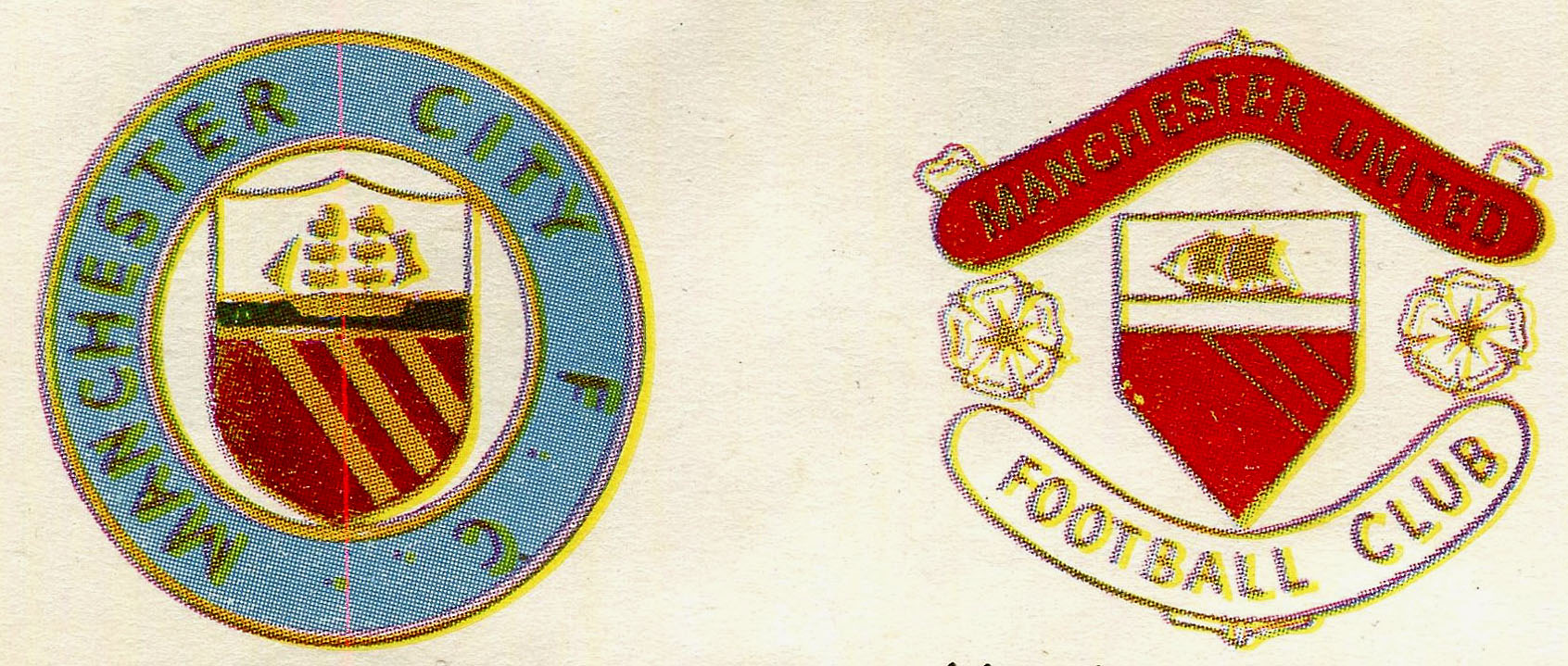
Most interesting are the old Manchester City and Manchester United badges:

Despite their century or more of rivalry, both clubs wanted clearly to reflect their city. Here is the city’s coat of arms:

And what about those Bristols, I hear you shout. Bristol City, the Robins with a bright red breast and Bristol Rovers, “the Black Arabs”. I looked that up, and apparently when they were first founded, Rovers played in all black because they very much admired the Arabs rugby team who also played in all black. Here are the old badges of the two clubs:

This slideshow requires JavaScript.

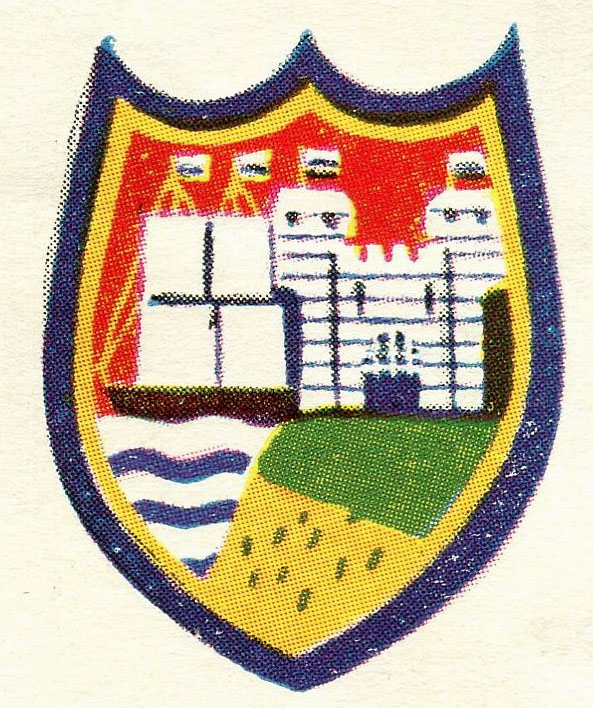
And here is the badge of the City of Bristol:

The idea even seems to have influenced Gloucester Rugby Club:
Next time, football and a bunch of animals.

21 Comments

Filed under Football, History, Wildlife and Nature

Renegade Football at the High School (4)

In the Spring Term of 1915 more than fifty or sixty boys began to turn up for rugby practice every single Wednesday and Saturday at the High School’s Sports Ground in Mapperley Park. “Welcome Back O Orange Arrow” :

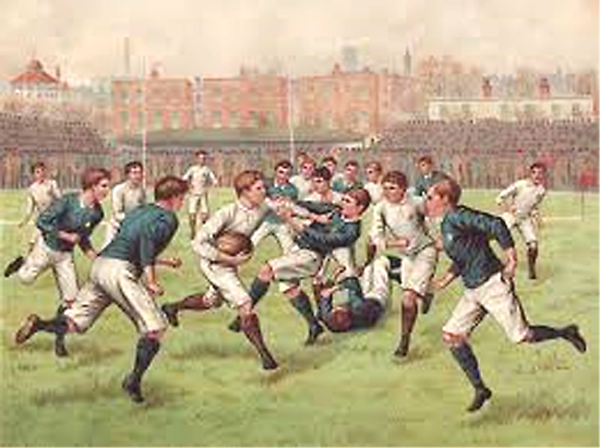
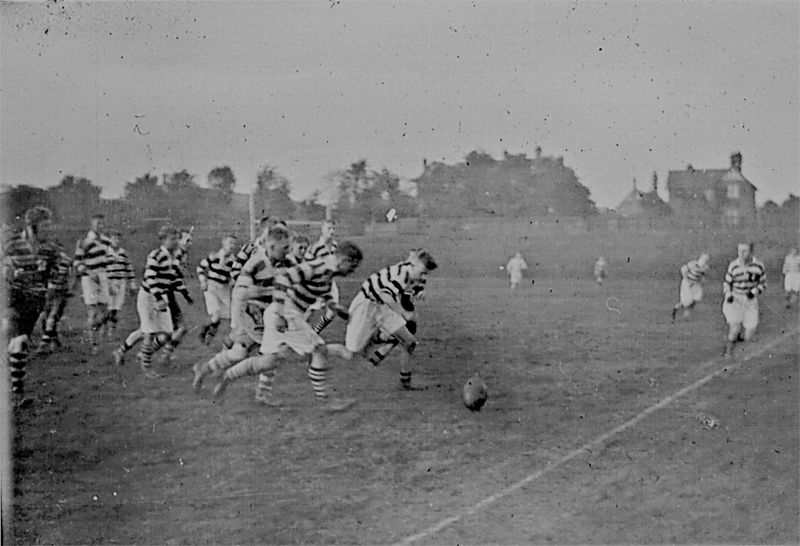
This is the sport they were learning. Notice the oval ball:

So far the school was not playing any fixtures but merely learning the game. Official matches began in the Christmas Term of 1915 but the First XV were forced to anticipate their first ever victory for quite some time. One heavy defeat came at Newark Magnus School by 0-43. When they played the return game against Newark, in very poor weather, much was made of the fact that they lost by only 0-8, the team’s best performance so far in the new sport of rugby. Their best quality seems to have been their sportsmanship and they played at least one game without conceding a single penalty. Here’s a rugby game from long, long ago, before anybody thought of playing with a ball:

The Second XV found life equally difficult but much of it was their own fault. The whole lot of them were what Philip Larkin would one day call “Losers, loblolly-men, louts” :

“….the fly in the ointment this term has been the very irregular amount of keenness shown in the Second Game. There are far too many hefty fellows in the Upper part of the School who prefer to spend their half holidays idling about, perchance frequenting picture palaces, or doing something equally futile…It is not as if these fellows spent their afternoons in some profitable pursuit ; that might be mistaken, but it would be to a certain extent excusable. They simply waste their time.”

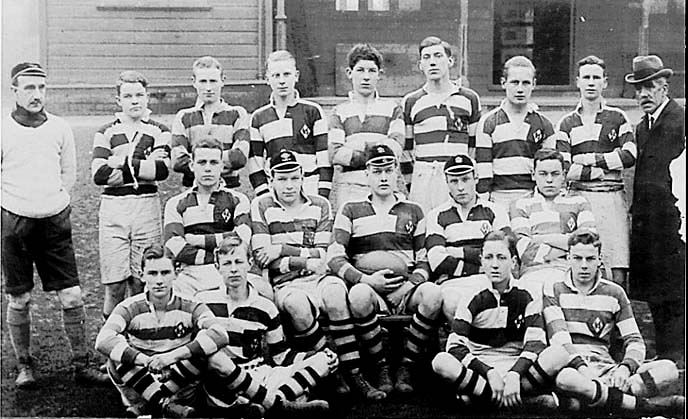
The first victories for both teams came in the Christmas Term of 1916 when the First XV won five of its six matches. Here is one of the earliest photographs of the High School First XV I could find. It is the team in 1926 and “Guts” Kennard stands on the left and the Groundsman, Mr Albert Onions is on the right:

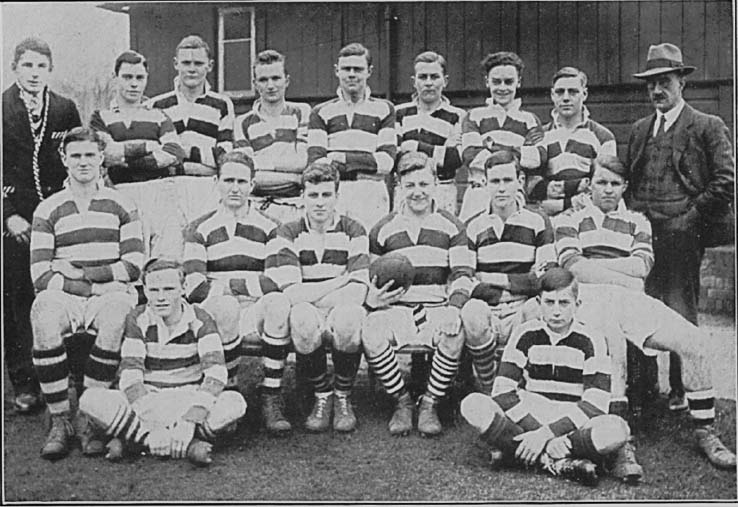
Here is the team for 1929:

We know who the players are in this photograph:

Back row: BF Sander, MH Pockson, HR Lawrence, TC Doar, GB Green, LCS Sutton, AH Bowman, NH Baker, Mr Kennard

Middle row: CF Carr, AG Payne, JT Thompson, AS Hancock (Captain), RP Lawrence, AV Spencer

Front row: JR Bignall, G Cooke

This is a photograph of the earliest rugby match I could find, played at Valley Road Playing Fields on Thursday, October 6th 1932. The First XV played Mr R A Palmer’s XV, but lost by 0-18:

I did mention in previous posts about this subject, though, the fact that: “The boys, by a substantial majority, would have opted for football.” instead of making the change to rugby. Not that that was enough to persuade the boys actually to attend football practices, of course.

Football, though, always seems to have appealed to the rebellious nature of the boys, especially when rugby took over as the Chosen Sport. Even when football was a school sport, though, some of the younger boys wanted more of it, and they were quite prepared to break the rules of the High School to achieve that aim. The first incident occurred on Saturday, November 21st 1908, and shocked the School Prefects to the core. We’ll see how that came about and why the Prefects had to hold an emergency meeting, another time.

15 Comments

Filed under Football, History, Nottingham, The High School

The problems with researching World War Two (2)

Last time, I wrote about what problems may be caused when the wonderful website of the Commonwealth War Graves Commission contains no details whatsoever about a particular individual, other than the date of his death:

The name of his regiment, by the way, is of little help. Men were switched between regiments and battalions all the time. It would give you a very large shove, in, probably, the right direction, but you could never be 100% water tight sure.

If all you have is the name and the date of death, I suppose that you could try to find a website that has all the past issues of local newspapers in Britain. Hopefully, you might find Fred Walker in the Deaths section for May 22nd 1946 onwards. But how would you know which newspaper to look in? You would have to try all of the Nottingham ones and then perhaps Mansfield and then perhaps Newark. But what if Fred’s family had moved to Durham after he left the High School at the age of seven? Or Tobermory? Or Armagh? Or, as one did, Paraguay?

The second major problem is that any possibly helpful supporting details about the individual serviceman can be almost impossible to come by. So difficult, in fact, that the whole situation soon becomes an impossible one.

This is because detailed service records after 1922 are still, ninety years after World War Two, accessible only to a direct relative, such as a son or a grandson. And these records are all held in the steely grip of the Ministry of Defence:

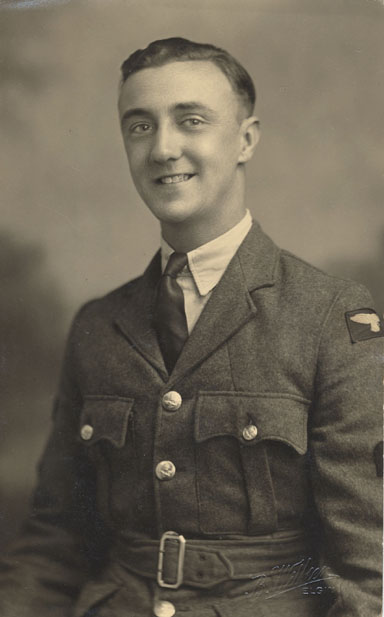
To take my own experiences as an example, I decided to buy access to my Dad’s records of his service in the RAF.

I had to send them his death certificate and my own birth certificate, to prove that he was dead and that I was his son. Both of them had to be the original documents, because photocopies were not allowed. I also had to send them a large sum of money. Here’s my Dad, ready to take on the Führer:

And what I got back contained very little indeed of any consequence, although it did make me think of studying for “GCSE Abbreviations (Paper 1 : RAF)”.  The abbreviations included:

“S/GCA”,  “P/R”,  “NVC”,  “A3B”,  “3RC”,  16.B.C.”,  “B/X”,  “S.F.U”,  “W/Mech”,  “W/T Equip”,  “X”, “H”, “HH”,  “HHH”,  “1.S.S.” or perhaps “I.S.S.”,  “S/GCA”,  “2 GCA Unit”  and “15 R.C.”.

Just imagine. All that palaver to get the records and when you get them you can’t understand them.
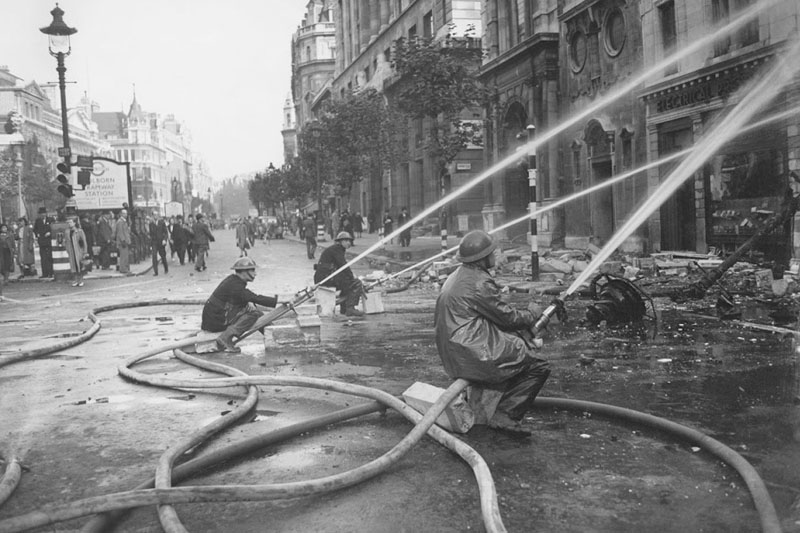
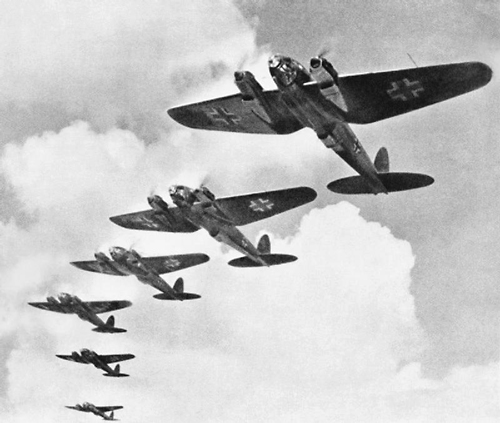
And that isn’t the only problem  with accessing the records of an individual serviceman. In 1940,  just to provide the splendid celebratory pink icing on the top of the researcher’s celebration cake, heavy bombing by the Luftwaffe destroyed up to 60% of all the war records in existence up to that point.

And what the Luftwaffe missed, the various fire brigades gave a damn good soaking to make most of it completely unusable;

And that’s not all. The 1931 National Census was completely destroyed by fire on Saturday, December 19th 1942. All of its documents were being stored in a building at Hayes in Middlesex.

This catastrophe cannot be blamed on the naughty Luftwaffe though. It was just an ordinary fire, although it is difficult to believe that storing huge amounts of furniture right next to tons of census paperwork was a particularly clever move.

At all times, there were six paid firewatchers on duty in the building but it is now known that some of them were smokers and that at least one of them threw a lighted cigarette stub down on the floor at one point. That was not a particularly clever move either.

Don’t be downhearted though. Other countries are just as fond of a nice welcoming fire. A substantial proportion of the USA’s 1890 census went up in smoke. And the Irish! Well, it’s almost unbelievable!

The Irish censuses for 1821, 1831, 1841, and 1851 were all burned by a large fire at the Public Records Office. Oscar Wilde was Irish. And what was it he said?

“To burn one census may be regarded as a misfortune.

To burn two censuses looks like carelessness.

To burn three censuses might be regarded as third time unlucky,

But to burn four censuses may well be the work of

Der man ‘imself,

Art’ur Brown”


25 Comments

Filed under Bomber Command, History, Nottingham, The High School, Writing

the Curtiss P-40 Warhawk at Hendon

On July 22nd 2010, we visited the RAF Museum at Hendon. I took a great number of photographs and these few show the Curtiss Kittyhawk IV.

First  a general view of the aircraft, taken from the rear, as the museum is very, very, full. The peculiar colours are because of the strange Jacques Cousteau type lighting which is supposed to prevent deterioration of the original paint from the 1940s. They originally found some thirteen P-40s abandoned in the New Guinea jungle in 1974 but I suppose you can’t be too careful! Incidentally that was the same operation that retrieved the RAAF Beaufort I depicted a little while back:

Here’s a second view of the Hendon P-40 with perhaps a little bit less of the “Under the Sea” effect and a lot more of that strange deep purple light made famous by the Aviator Formerly Known as Prince. Here’s a very slightly different view of the P-40. And by the way, I don’t know why the question mark is there:

And here, incidentally, is that Bristol Beaufort, with the link to read about it:

This slideshow requires JavaScript.

One of the most interesting things about this plane is its name. Manufactured by Curtiss-Wright of Buffalo, New York, the largest aviation company in the USA during the 1930s, the P-40D and subsequent models was called the Kittyhawk by the RAF, the RAAF, the RCAF and the RNZAF as well as the South African Air Force. It was used extensively in North Africa:

The earlier P-40A, P-40B, and P-40C models were called Tomahawks. I have no idea whatsoever why, other than a sneaking feeling that it was just to confuse everybody who wasn’t aware of the story. The Kittyhawk had a more powerful engine and if you like aircraft engines, you can read a tale involving substandard or defective aircraft engines for military use, conspiracy, false testimony, gross irregularities, neglect of duty, troublemakers and a general court martial via this link. Amazingly, the paragraph you need is called “”Defective engines sold to U.S. military in World War II. It was apparently such a big story at the time that Arthur Miller wrote a play about it.

These two pictures show the most famous thing about so many P-40s and Kittyhawks. The shark’s mouth nose art:

This slideshow requires JavaScript.

On a P-40, the first people to use this design seem to have been the Chinese Nationalist Air Force although they seem to have thought that they were using a big cat, insofar as they were dubbed “The Flying Tigers”. They were still the most famous of the Shark’s Mouth aircraft though:

So just treat yourself to a little bit of the film “The Flying Tigers”. John Wayne at his very best:

In this film, “The Duke” actually speaks Chinese. Two words, “Ding Hao”.

In case you don’t know, “Ding Hao” means good luck, or good day or very good or fantastic and so on. Not as universally applicable a word as “Mao” in “The Deer Hunter” but not bad. It’s quite impressive when one single word is an entire language:


17 Comments

Filed under Aviation, History

Renegade Football at the High School (3)

High School Football had provided three captains of England and the highest scorer in the FA Cup. In 1897, Fred Chapman, who would go on to win an Olympic gold medal when he scored the opening goal in the final of the Olympic Football Tournament in 1908, was just a little boy at the right hand end of the back row. At least two or three of the others would appear in the pop group “Madness” :

In summer, he was the wicketkeeper in the School cricket team. You can just about see the ridges on his pads. Can you see any boys who are in both photographs?:

Just eighteen years later, the School had stopped playing football completely, even if hundreds of young English and German soldiers suddenly developed a desire to play the game during the truce of Christmas 1914:

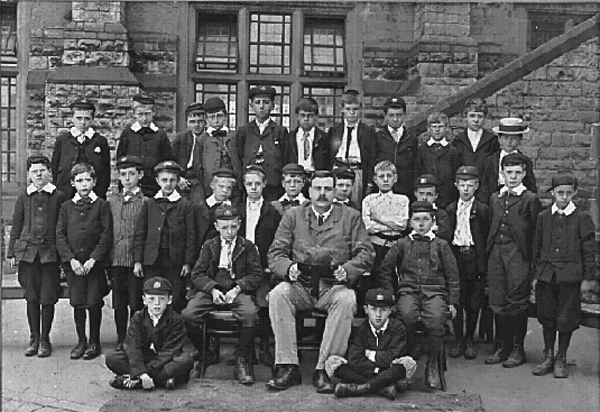
The High School stopped playing football therefore and changed to rugby union. The decision to change sports at Christmas 1914 was made by the School’s General Committee by a two to one majority and both the Old Boys and the parents were in favour. The boys, however, by a substantial majority, would have opted for football. Here are a Year Seven class in 1901, eager to get their chance in the team. That goalie could do with losing a bit of weight, though:

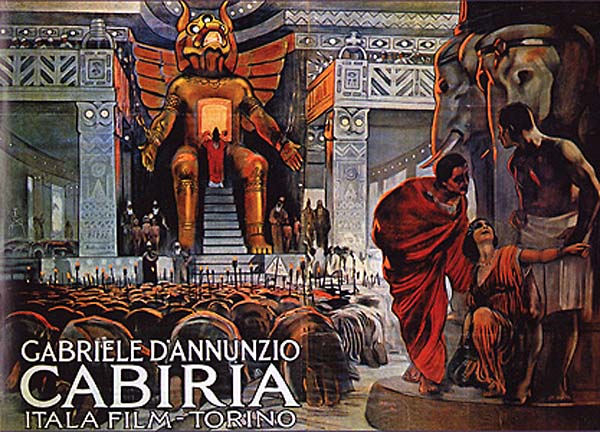
Why did football disappear in the High School when the sport was just beginning to conquer the world? I have already spoken of a long list of “things better to do than football” last time. Films such as “Cabiria” turned our lads’ heads:

But deep down, it may well have been the boys themselves. It was as if football became less and less popular as the years went by. This is shown by a number of reports in the “Nottinghamian” of boys who seemed completely apathetic. Basically, they just didn’t want to play:

“One cannot be legally compelled to play football, but it ought to be a point of honour with each boy to turn out when called upon. Such excuses as “ doing extra work with Mr.——,” “ didn’t know it was footer today,” or “ my things are at the laundry,” are too often merely excuses to cover a desire to skive, and they strike an altogether unworthy note.”

And a second one:

“The interest of the School in its own football, and in that of its representative teams is much less than it was four or five years ago. The feeble attendance at School matches, the falling numbers of spectators during the “Eight-a-side” competitions, the widespread objections when House matches fall on a Wednesday-half day holiday, the complete disappearance of cheering of victorious teams on their arrival in the Hall for Prayers—all these facts prove a lack of interest and “esprit de corps” that is nothing less than lamentable.”

My own opinion, for what it is worth, is that the boys, far from any sinister motives imputed to them, were merely beginning to expand their expectations, as regards what might be available for their two half days of leisure per week, Wednesday and Saturday. In the last post, I looked at the possibilities of the new technology which gave them a whole range of new pleasures outside school. Personally, I have always thought that the falling numbers of boys at football practices is connected to the invention of the “What the Butler Saw” machine, even if you have fallen asleep by the time she’s got her cardigan off:

“The Nottinghamian” had already complained in December, 1915 of how boys were “frequenting picture-palaces, or doing something equally futile.”

Even inside School, the possibilities were seemingly endless, with various editions of the School magazine reporting the activities of the Officer Training Corps, with lengthy accounts of their camps and their Field Days, School Musketry, the Debating Society, the Literary Society, the Voluntary Gymnastic Club and the N.H.S. Boy Scouts.

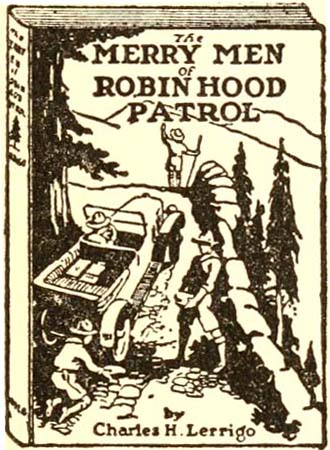
Here are those High School Boy Scouts, still working for their “Car-jacking Badge”:

Here’s the Officer Training Corps in 1907. To the left of the stairs is the present day Language Centre. The rooms to the right were demolished in 1938 in a vast cloud of dust, to be replaced by a new three storey science block. The latter was to be erected gradually over the course of the next five years. The Officer Training Corps was very popular among the boys, especially with a World War on the horizon:

“We’ll show those damned Boers and those damned Germans and those damned Turks and those damned Austro-Hanoverians and those damned Japanese……”:

Between 1910 and the beginning of the First World War, many older clubs such as the Literary and the Debating Societies seem to have been extremely popular, and numerous other activities were expanded, especially the military ones such as the Boy Scouts or the O.T.C. The latter pursuits were presumably in response to the increasing militarism of the era.

One other factor about which we know very little is the academic side of School life. It may well be that as other schools in the area, such as High Pavement, for example, were increasingly successful, and raised their academic standards, then the High School was forced to respond, and boys found themselves quite simply with more work to do:

“The Nottinghamian” complained at one point that the excuse “doing extra work with Mr.——,” was one used far too frequently to get out of football practices, but the fact remains that the excuse may well have been true.

Who could resist the lure of Cambridge, and the promise of fish, chips and mushy peas in such wonderful academic surroundings?


11 Comments

Filed under Football, History, Nottingham, The High School

The problems with researching World War Two (1)

During my researches of the High School’s war casualties, I soon encountered one, huge, huge, problem. This was the fact that somebody at the High School, a pupil or a member of staff, might have exactly the same name as a casualty listed on the Commonwealth War Graves Commission’s website, but beyond that, there was nothing else to link them together, or to keep them firmly apart. No date of birth. No date of death. No parents’ names. No place where they had lived. Nothing.

The reason for this strange state of affairs is that in the huge number of names listed on the CWGC website there are thousands, if not tens of thousands, of casualties which provide no extra details at all which would allow any definite links to be made. In particular, no date of birth is ever listed.

I have always presumed that this has happened because, when the new recruit filled in the paperwork early in his military career, there was some kind of option which allowed him to preserve his privacy in this way.

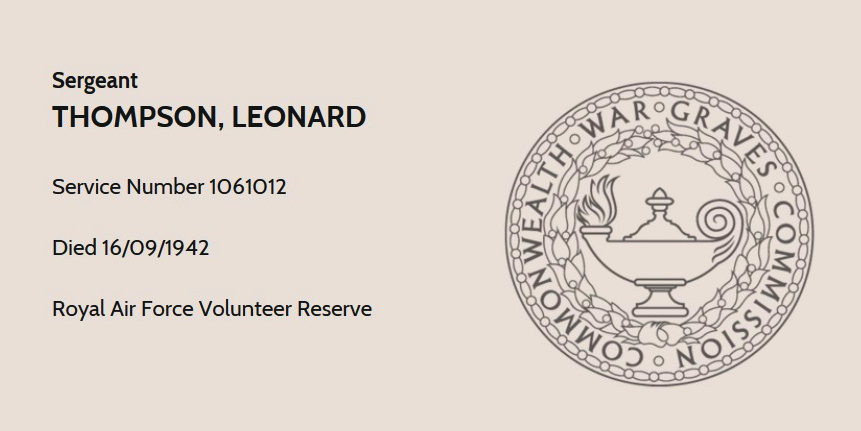
To take a completely random example, Sergeant Leonard Thompson in the RAF was killed on Wednesday, September 16, 1942 and his sacrifice is commemorated on the Runnymede Memorial near London. And there are no more details than that provided about Leonard, no date of birth, no age, no parents’ names, no town of origin, and no town of residence, absolutely nothing. So if there is a Leonard Thompson in the School Register, of an age to be in the Royal Air Force, there is no definite way of linking the two together, unless you find it mentioned in another book or on another website elsewhere (something which I have not yet done in five years of research).

This is all there is to link Leonard to anybody else:

Certainly, photographic evidence is of little value. Are these the same person? The little bugler boy at the High School:

And the rear gunner on an Avro Lancaster bomber (front row, right) ?

Let’s take another completely random example. In the School Register, Boy No 4959, John Taylor, is an orphan and has no parents listed. Only Mrs AM Cooke is recorded as a “Father or next Friend”. She is most probably a relative of one of John’s parents and is now the adult legally responsible for John Taylor’s welfare. Clearly, the original Mr Taylor has passed away and so too, probably, has Mrs Taylor.

But was young High School boy, John Taylor, Boy No 4959 in the School Register, the same person as Private Taylor, 4748560, of the York and Lancaster Regiment? Or was he Able Seaman Taylor, D/JX 303159, in the Royal Navy? Or perhaps he was Engine Room Artificer 4th Class,  John Taylor, D/MX 75819. Or maybe Stoker 1st Class JohnTaylor,  P/KX 601918 ?

Or perhaps the High School’s John Taylor was Flight Sergeant Taylor, Service Number  1079856? Or was he Gunner John Taylor, 4385260 ? or Private John Taylor, 3909612 of the South Wales Borderers? Or Sapper John Taylor 1888052 of the Royal Engineers? Maybe  he was Gunner John Taylor, 941298, of the Royal Artillery ?

Back to Leonard Thompson. Another war casualty to bear the same name was Gunner Leonard Thompson. He was killed on Thursday, May 18, 1944 and he is buried in the Beach Head War Cemetery at Anzio in Italy. He was a member of the 92 Field Regiment of the Royal Artillery. There are no more details about him either. There is no age, no parents’ names, no town of origin, no town of residence, nothing. He might well be the Leonard Thompson in the School Register but then again, he might not. There is nothing definite to link him to the High School. Here is the beach at Anzio, as usual, full of Americans in their flashy, cheap tanks:

Still, at least it kept the Germans’ towels off the sunloungers:


24 Comments

Filed under Aviation, Bomber Command, History, Nottingham, The High School, Writing

“Hilarity with Heraldry” (1)

Dr Sheldon Cooper is famous for his series of podcasts “Fun with Flags”:

I have always enjoyed vexillology enormously but I would have to confess to an even greater love for heraldry, the study of coats of arms. I don’t really have the time to launch “Hilarity with Heraldry” in any great depth, but I don’t think anybody would find it particularly boring to take a brief look back at some old football, or soccer, badges.
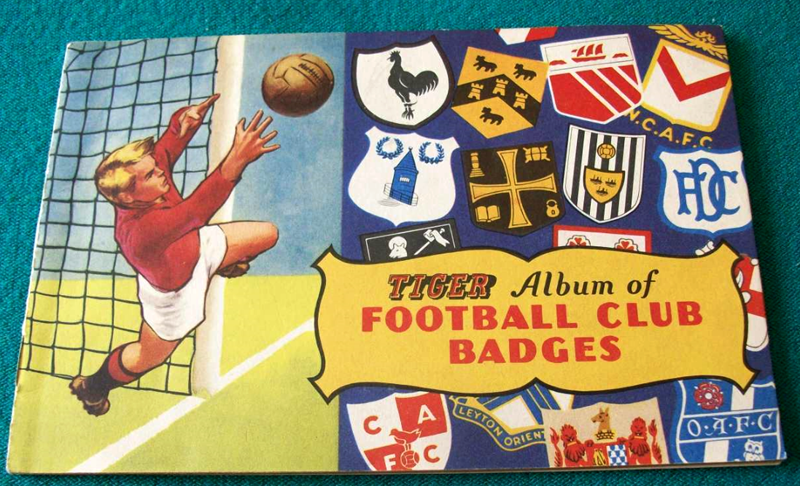
I used to read a comic called “Tiger” when I was a boy and in one issue they sowed the seeds of my interest when they gave away, free, an album of football club badges. This was on an unknown date in 1961, so we are looking back quite a long way. Here’s the album:

The picture comes from ebay where the albums can sell for quite good prices. So too do the 1967 versions of the album, entitled “Roy Race’s Album of Football Club Badges” in honour of the fictional star of the fictional Melchester Rovers. Roy Race was Tiger comic’s “Roy of the Rovers”:

In both 1961 and 1967 the buyer was given the booklet and then in the succeeding weeks, he received sheets of paper with around 30 small badges printed on them. He then had to cut out the badges carefully and then stick them in the booklet with extreme care and glue.
Most boys couldn’t do this, which makes it extremely difficult to buy a booklet where they are stuck in straight, and are not over-trimmed, or, in some cases, they are not stuck in upside down.

This album has a pretty good start to page one. although there is a slight crease:

This is average:

I would not buy this. They are crooked and cut out wrongly. At least two are in the wrong position:

These three are shockers:

And these two badges below are simply the wrong way round. Blackpool is a seaside holiday town with seagulls and BW may conceivably stand for “Bolton Wanderers”. And if this page is like that, the other ones will all be of a similar quality:

I was at an indoor market a few years ago when I bought several colour pages of football, cricket and rugby club badges which dated from the 1950s. The badges seemed to divide into four groups. The first were obviously based on the coat of arms of the town which the club represented. This is Notts County with the tree from Sherwood Forest. Whoever or whatever holds the shield up is called the “supporters” and Notts County have the normal two, namely a lion and some other unknown mammal, possibly on otter, or perhaps a weasel. On top of the shield is the “crest” which, in this case, is a tower from Nottingham Castle. “On top of the shield” is just an optical illusion. The crest actually used to rest on top of the knight’s helmet, so a tower is, to say the least, a challenging choice for his neck muscles. The only bit of the helmet that you can see is the padding between the tower and the metal helmet, which is yellow and green and is called the “wreath” or, because it is twisted, the “torse”:

This is Nottingham Forest with the same type of thing. The supporters are stags and on the shield is a green rustic type cross with three crowns that I know nothing about, I’m afraid.

A similar badge was used for the Nottinghamshire cricket team:

In heraldry, what we would call colours, or tinctures to use the technical phrase, are divided into two groups. The first group is called ‘colours’ and the second is called ‘metals’. All of them have Norman French names. The metals are ‘or’ and ‘argent’, which are ‘gold’ and ‘silver’. The colours are red or ‘gules’ which comes from the word for the mouth of an animal, “la gueule”. ‘Azur’  is easy as it obviously comes from azure blue. ‘Vert’ is green and it has survived a thousand years into modern French, much like ‘purpure’ which is actually a very rare colour. ‘Sable’ is black and comes from the fur for coats, It’s a sort of rich man’s ferret, apparently:

There is just one rule about all these tinctures. Colours cannot go on top of colours and metals cannot go on top of metals. This is because Heraldry was designed for the purposes of identification in battle so everything has to be exceptionally obvious and visible. Here’s the somewhat over dressed queue for the fish and chip shop after a hard day’s peasant slaughtering:

31 Comments

Filed under Film & TV, Football, France, History, Humour, Personal