Author Archives: jfwknifton

Groups of people at the High School

On my home made CD of old photographs of the High School, one of the constant recurring themes is that of “groups of people”. Here is the staff in 1885:
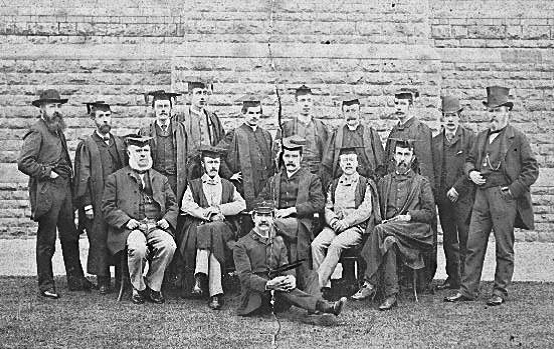
It’s not one of my best scans, but it is possible to recognise Dr Gow in the middle of the five who are seated. In front of him, like a faithful great hound, is the new Drill Serjeant, George Holmes, an ex-army man, who was responsible for “…the usual manual exercise and marching drill, bayonet exercise, sword drill for infantry and cavalry and Indian club exercise.” His appointment was “…to the great advantage of all our games.”

This group are pupils but I don’t think  anybody knows who they are. The variety of dress is quite astonishing:

Some seem to have school badges. They are worn on a….

“cap fitted close to the head, and bore the quaint lozenge shaped crest of the school, with its three black birds on a white ground, a badge restored to use by Doctor Gow, and of which the boys were proud. It was known by the vulgar boys of the town as the “three crows”.

One boy, No 2 sitting on the bench, is wearing a Scottish or French tam o’shanter and there is an Ed Balls lookalike if you study the faces carefully. And is Boy No 1 on the back row, a person  of colour, if it’s OK to put it that way?

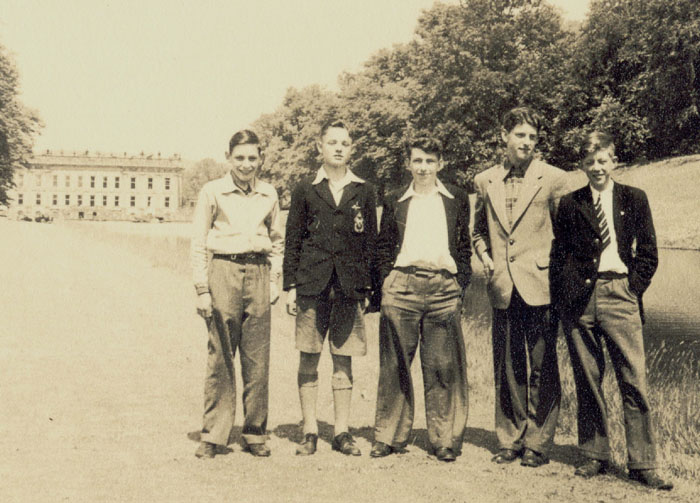
Not all groups are from 139 years ago. Here is a picture about which absolutely nothing seems to be known. Was it taken on a School trip abroad in the 1930s?
And this is probably the First XV but in an unknown year. Notice the 1st XV official caps and blazers awarded when the players were given their colours:

The master is Mr Joseph William Lucas Kennard who joined the High School in November 1910, as a teacher of Modern Languages . He was employed primarily as the Form Master of a newly created Fourth Form which, presumably, had been operating without a fixed Form Master up to that point. He had previously taught at the Liverpool Institute and then in Switzerland. I found only one description of Mr Kennard’s methods in the classroom around this time, from Roy Henderson who said that

“He had the unfortunate habit with smaller boys of pulling them close and then tugging their hair very hard. It was extremely painful.”

Mr Kennard’s main rôle was to introduce rugby into the School. He was quite highly qualified to do so, having captained Lancashire, and having played for the North of England XV. On one occasion he had played for the North against the South in an England trial. The school duly switched from football to rugby in January 1915.

Let’s come forward a little. Here are some members of 2K, caught by the Reverend Stephens as they rehearsed “The Island of Doom” in 1958:

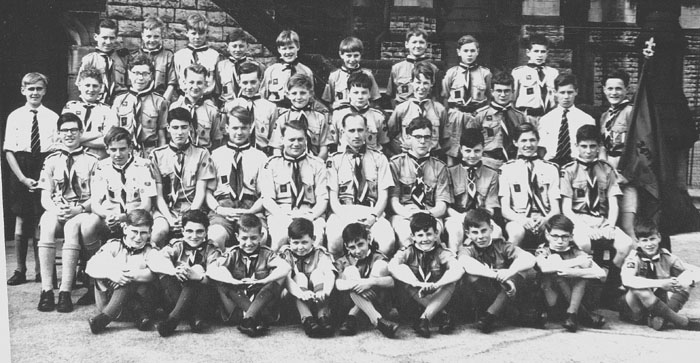
The last group comes from four years later in 1962, when the Reverend Stephens took a photograph of the School’s rather large Scout group.:
 

15 Comments

Filed under History, Nottingham, The High School

The World of the Mysterious (5)

I said last time that I would take Cliff Barackman, James “Bobo” Fay, Ranae Holland and Matt Moneymaker back into history and legend, to see if I could find any creatures, perhaps based on Bigfoot, mentioned over the course of the last 5,000 years or so.  I spoke of Enkidu, and Moses’ Twelve Spies in the land of  Canaan. I also rejected Goliath, and I described Grendel who, although I thought he was possibly not as dangerous as he has been portrayed, I thought was not necessarily armless.

This time, I would like to touch upon the story of Jean Grin, a subject which I have explored before. It all took place in early 19th century France  in the wonderfully picturesque and unspoilt region of Lozère, which is here:
This time the situation is a little more complex in that Jean Grin was, supposedly, a historical figure who was active as recently as 1800. He lived in a mountain ravine, in a crude cottage of stone with what is now a collapsed roof, surrounded by pine trees and dry scrubland. Inside, against the very rock itself, there is the oven where he roasted children to eat. Outside are several piles of stones covered with soil, supposedly the burial places of his victims:

Jean Grin was living here because of his inability to get along with his neighbours. They called him an ogre, and considered him an ambiguous being, “mi-homme mi-bête”, half way between animal and man. Soon after his arrival in the ravine, he seemed increasingly to take on the attributes of a savage, brutal, wild person that no social norms could restrain:

Young shepherds and shepherdesses began to disappear in the surrounding region. At the time, in a neighbouring area, there had been severe problems with some kind of mystery animal, either a very large wolf or a canid of an unknown species. It had been termed the “Beast of Veyreau” or “La Bête de Veyreau” and I have already written about it:

Whatever the killer in Lozère was, it only attacked weak people or children. In just six months, from June-December 1799,  three victims were killed and eaten.

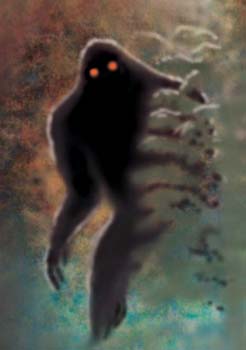
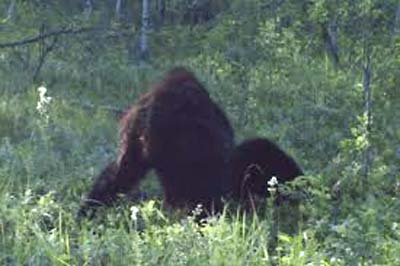
Physically, Jean Grin was by now dreadful to look at. He supposedly wore just animal skins and he could run extremely fast across the countryside and up and down slopes:In the dark, his eyes gleamed bright, shining red and you could see him coming from far away. Jean Grin too has been given the attributes of a Bigfoot. Memories from centuries ago have been added to his story. He had luminous red eyes.  He possessed prodigious speed both going up and coming down mountainsides. He had an appearance generally thought to be “mi-homme mi-bête”. In addition, photographs show that he lived in exactly the same kind of dry, rocky environment where Bigfoot lives nowadays in the Sierra Nevada of California:

It is my contention though, that the story of Jean Grin is obviously much, much older than a mere 200 years. Indeed, I think that quite a complex process has therefore come about here.

Firstly, the people had a dim memory from centuries previously of Bigfoot type creatures in the forest and in the mountains. Secondly, there was an eccentric and unpopular man called Jean Grin who lived in the area. He was big and ugly. Thirdly, an unknown animal,  the “Beast of Veyreau”, was attacking, killing and eating the young children who were left on their own to guard the flocks of sheep.

And what has happened is that these three elements, of Bigfoot, of gory deaths and of weird loners have all been melded together to give us the present legend. There are no Bigfoots in France nowadays, but in the centuries when the east of the country, in particular, was covered in extensive thick forest, I think there were, and recent enough for memories to linger on.

Next time, England’s Bigfoot.


17 Comments

Filed under Cryptozoology, Film & TV, France, History, Personal, Science, Wildlife and Nature, Writing

George Norman Hancock, Old Nottinghamian and RAF (1)

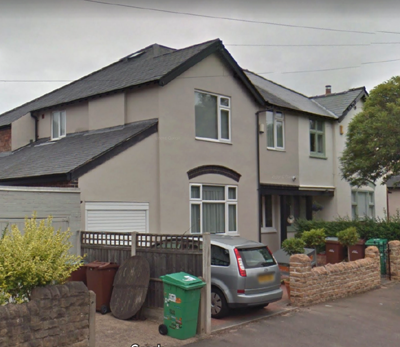
George Norman Hancock was born on May 31st 1913. His father was George Augustus Hancock who was a lace manufacturer. His mother was Sarah Grace Hancock, but everyone knew her as Sadie. His sister was called Grace. During the First World War, George Augustus was in the 1st Battalion of the Sherwood Foresters. He was a Captain and his bravery was such that he was eventually awarded a Military Cross. The family lived at 11 Ramsdale Crescent. Ramsdale Crescent is a quiet, pleasant street in Sherwood, the very same suburb of Nottingham where I myself live:

George Norman Hancock entered the High School on April 29th 1921 as Boy No 4376. He spent ten years there and by the time he left he had achieved a fair bit. In the School List, the rather ornate “M” next to his name signified that he had passed a “University Matriculation Examination”, possibly the London University version. That meant he had reached the high standards needed for entry to any university in the land.
In George’s case, I get the impression that even at this early stage he was looking to enter the Forces in some way. He was a member of the Officer Training Corps, and, as well as the “M” next to his name, there was an “A” to signify that he had passed his OTC Certificate A. This was a qualification issued by the Government and was a military equivalent really of the “University Matriculation Examination”. It seems to have covered basic training at the very least and in 1939, totally raw recruits were being taught the absolute basics by young school leavers who held the Certificate A. This included some recent Sixth Formers from the High School. Here is a Certificate ‘A’. If you can’t read the small print, then just tap on it and it should open up:

Indeed, George was so outstanding in the OTC that he had won the Certificate A Prize for the whole School in 1929-1930. And he was now Corporal Hancock. And a few short months later, Sergeant Hancock. In 1930-1931 George passed his Higher School Certificate, the equivalent of today’s ‘A’ level.
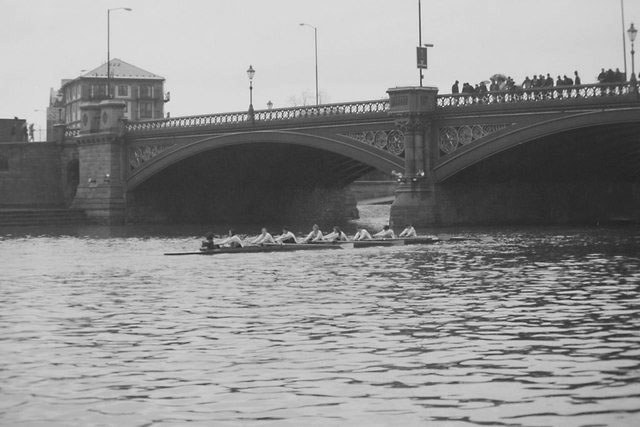
He also won his 2nd Colours for Rowing although I have found out very little about his individual triumphs. In those days of the late 1920s, the Nottinghamian always seemed to talk about sport in rather general terms. When it did single people out, they were usually the very top, star performers and I have found no mention of George’s specific contributions in the Second Boat. This is a rowing eight going under Trent Bridge. The High School seems to have had four rowers in the boat during the interwar period. I just don’t know if this happens any more:

George left the High School at the end of the Summer Term in July 1931.

Shortly afterwards, he sat the Army Entrance Examination and was placed second in the Order of Merit for the Royal Air Force College at Cranwell in Lincolnshire:

George won a Prize Cadetship valued at £210, the first ever won by a pupil from the High School. This was announced in the publication, “Flight”, on September 4th 1931…

“The Air Council have awarded Prize Cadetships, each of the value of £105 per annum for two years, to the following successful candidates at the examination held in June, 1931, for entry into the Royal Air Force College.”

There were six successful candidates…

“AFR Bennett (Harrow County School), GN Hancock (Nottingham High School), K Gray (Leeds Grammar School), TL Moseley (Tamworth Grammar School), GAV Knyvett (Malvern College) and JAP Owen (St Bees School, Cumberland).”

We’ll see what happened to those six young men next time

17 Comments

Filed under Aviation, History, Nottingham, The High School

Fred goes to Lincoln Cathedral

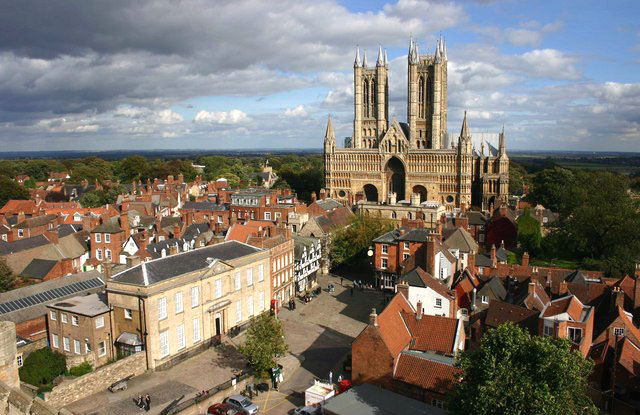
Towards the early part of his career in the Royal Air Force, probably in the winter of 1941-1942, Fred was stationed for a short period at Cranwell, the RAF College. Cranwell is a very imposing place:

This episode took place at the very start of his stay there, when, in his first period of free time, Fred decided to go out on a visit somewhere.

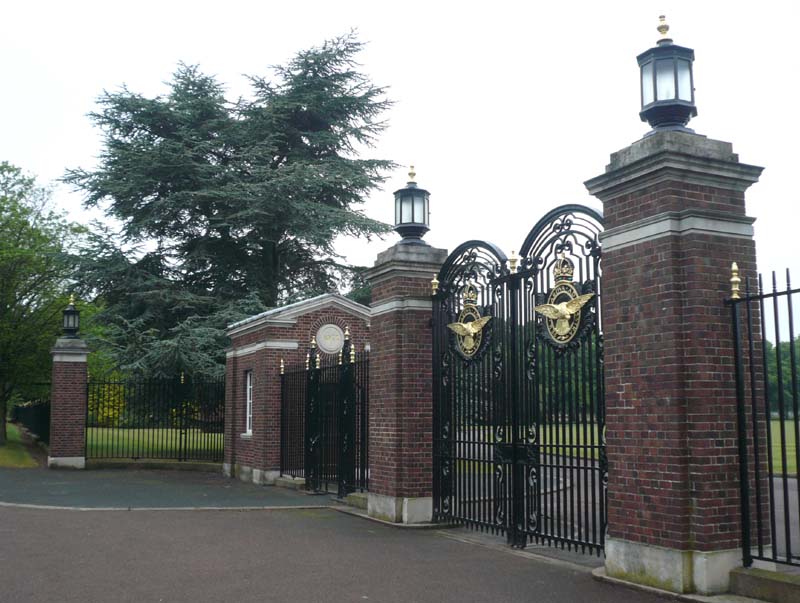
It was a glorious, cold, clear, bright blue, frosty day, and Fred went out of the front gate of the camp accompanied by a friend. It’s difficult to miss the gates at Cranwell:

Seeing a local man pushing his bike along the road, Fred asked him the way to Lincoln, but instead of offering directions, the man just stretched out his arm and pointed along the road, which was a Roman one, and absolutely straight, to the distinctive shape of the cathedral, silhouetted sharply against the bright light of the sky. Lincoln Cathedral is on a high hill, surrounded by a flat landscape, so it is fairly difficult to miss:

The man said not a single word but just carried on trudging along with his bicycle. Fred and his friend, armed with the usual 24 hour pass, set off cycling along the road to Lincoln.

This initially unnamed friend may well have been Joe Fielding, a highly educated man who had studied, among other things, Latin at Oxford University.  The two young airmen were taken around the cathedral by one of the amateur guides, who had many interesting things to explain to them. When they reached the shrine to St Hugh, at the eastern end of the cathedral, near the altar, the guide told them all about the life of the saint, and his pet swan, but he confessed that, as a modestly educated working class man, he was unable to translate the Latin inscription on one of the metal tablets near the altar. Joe, however, with his degree level knowledge of Latin, proceeded to translate the inscription fluently.

The guide though seemed to be really, really, upset. Fred felt that, while Joe’s behaviour was perhaps the product of innocent helpfulness, he should rather just have kept his mouth shut, and let the guide remain the expert. Fred was certainly highly embarrassed by the whole affair.

As one of the coincidences that fill all our lives, Fred was to pass away on the very same day that I myself took a party of schoolboys to visit Lincoln Cathedral. I was able with ease to find that single plaque written in Latin, unchanged in the sixty or so years between the two events.

15 Comments

Filed under Aviation, Bomber Command, History, Personal

The World of the Mysterious (4)

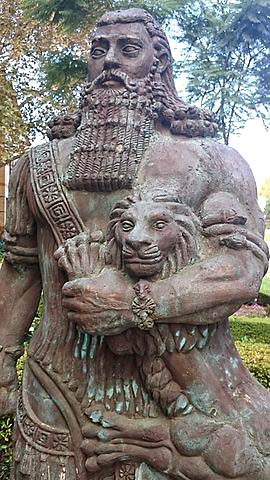
I said last time that I would take my Syma X5C-1 2.4G HD Camera RC Quadcopter RTF RC Helicopter with 2.0MP Camera back into history and legend to see if I could find any hints of creatures similar to Bigfoot mentioned over the course of the last 5,000 years or so. I spoke of Enkidu and Moses’ Twelve Spies in the land of  Canaan. I also  rejected Goliath, an obvious candidate, but not a valid one. Here’s Enkidu’s pal, Gilgamesh again:

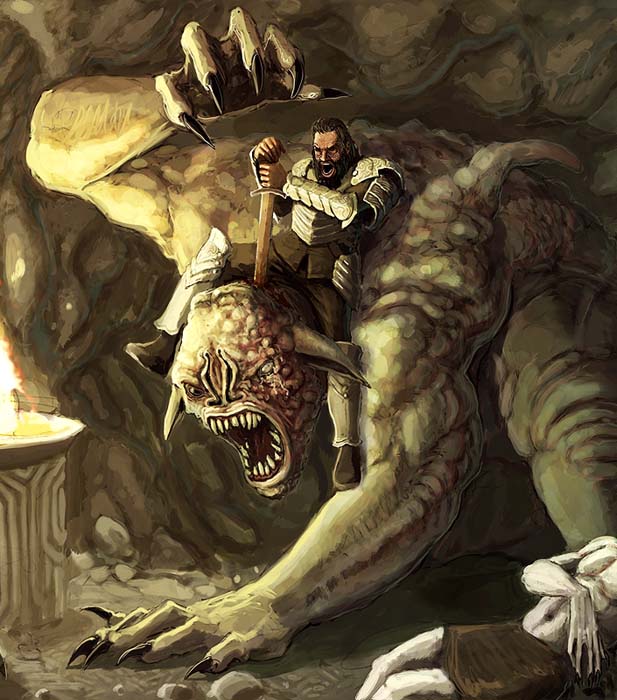
In my researches, however, I did find “Beowulf”. This is an Old English epic poem written between 975-1025 AD. It concerns Hrothgar, the king of the Danes, who has grave problems with the fact that his feasting hall is repeatedly being attacked by a monster known as Grendel:

Here’s an old illustration of the creature:

Wikipedia describes events from the point of view of Grendel:

“Grendel is “harrowed” by the sounds of singing that come every night from the hall. He is unable to bear it anymore, and attacks. Grendel continues to attack the Hall every night for twelve years, killing its inhabitants and making this magnificent hall unusable. Beowulf arrives to destroy Grendel. He is welcomed with a banquet. Beowulf and his warriors bed down in the hall to await the creature. Grendel stalks outside the building for a time, spying the warriors inside. He makes a sudden attack, bursting the door with his fists and continuing through the entry. The first warrior Grendel finds is asleep, so he seizes the man and devours him.”

There are so many similarities here with the behaviour of Bigfoot. Active at night, attracted by noise, stalking round the building, looking at the people inside, smashing in through the door, and, certainly according to some of the tales of the Native Americans, eating one of the humans.

Grendel’s exact appearance is never directly described by the original Beowulf poet, except that he is “man-like”. He is referred to as a “sceadugenga”, which means “a shadow walker, a night goer”. This latter phrase, “night goer”, is a good fit for Bigfoot.

I’ve already shown you an older illustration of the monster. More modern sources such as films seem to just do what they feel like on the day:

Mind you, Grendel is big. So big, in fact, that when his head is finally cut off, it takes four men to move it. This is Goliath’s head, but I’m sure you’ll get the idea and that you’ll forgive me, especially when you notice the stone shaped hole in the Big Man’s forehead :

Back to the story. Having seen what he was dealing with, Beowulf decides to fight Grendel without using any weapons because he thinks he can match him. As Grendel comes into the hall, Beowulf leaps up and grabs his hand. Beowulf’s retainers come to help but their swords are unable to pierce Grendel’s skin. Beowulf then rips off Grendel’s arm and Grendel flees to the marsh where he lives and, indeed, dies.

Some excellent similarities there. Grendel’s size, his home in a watery place such as a marsh and his impenetrable skin.

A translation of the poem by Seamus Heaney in 1999 describes Grendel’s arm which gets ripped off in the struggle:

“Every nail, claw-scale and spur, every spike
and welt on the hand of that heathen brute
was like barbed steel. Everybody said
there was no honed iron hard enough
to pierce him through, no time proofed blade
that could cut his brutal, blood-caked claw.”

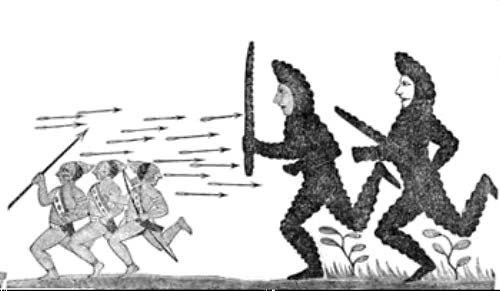
The Iroquois, a Native American tribe of the eastern Great Lakes area, described a whole race of giants twice as big as men, with bodies covered in rock-hard scales that repelled all of their weapons. Here we are:

Modern man has also repeatedly been baffled by the apparent ability of Bigfoot to escape both rifle and shotgun fire.

I’ll finish with three quick references to literature and legend of roughly the same period. Firstly the “kelpie” of Celtic folklore which is often seen as a water horse, but which could change shape and become a “rough, shaggy man who leaps behind a solitary rider, gripping and crushing him… tearing apart and devouring humans”.

Secondly a tale comes from Norway (not that far from Beowulf territory) called “Konungs skuggsjá” or Speculum Regale or “the King’s Mirror”. It was written around 1250 and describes a “wild man”

“It once happened in that country (and this seems indeed strange) that a living creature was caught in the forest as to which no one could say definitely whether it was a man or some other animal; for no one could get a word from it or be sure that it understood human speech. It had the human shape, however, in every detail, both as to hands and face and feet; but the entire body was covered with hair as the beasts are, and down the back it had a long coarse mane like that of a horse, which fell to both sides and trailed along the ground when the creature stooped in walking.”

The mane on this unknown, hairy creature…is that the origin of the confusion about the shape-shifting Kelpie which was both a “rough, shaggy man” and a water horse?

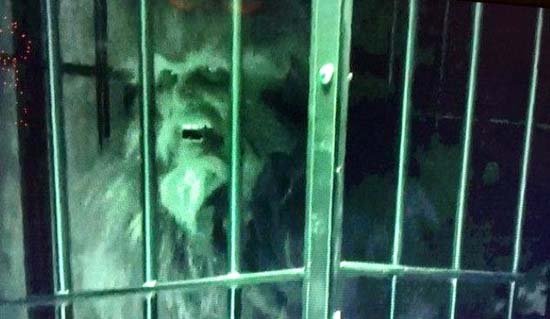
Perhaps it looked a little bit like the fake documentary made recently:

The third detail involves the Long Man of Wilmington who adorns a hillside in East Sussex. He is 235 feet tall and he is cunningly designed to look perfectly in proportion when viewed from below. He dates from, apparently, the 1600s and he carries two large sticks, and, even allowing for the effects of perspective, he does have enormously long arms, just like Bigfoot:

And next time, “ce sera une visite en France”.


24 Comments

Filed under Bigfoot, Cryptozoology, History, Literature, Personal, Science, Wildlife and Nature, Writing

Fred goes to Rotherham

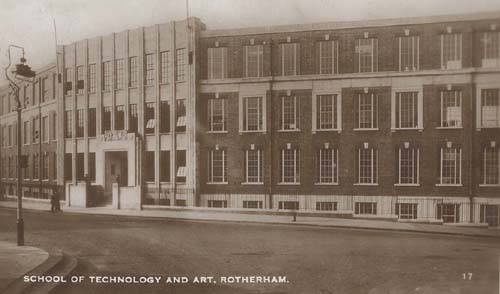
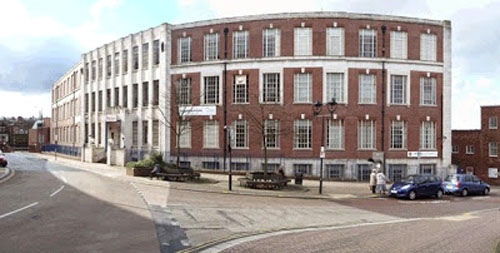
In his early career with the RAF, Fred lived in Rotherham, where he was training to be a wireless operator. He attended the local Technical College, and for his ab initio training in electronics, he studied topics such as radar and the many other technical devices which he would need to use as a Wireless Operator / Air Gunner.

The college is still there today:

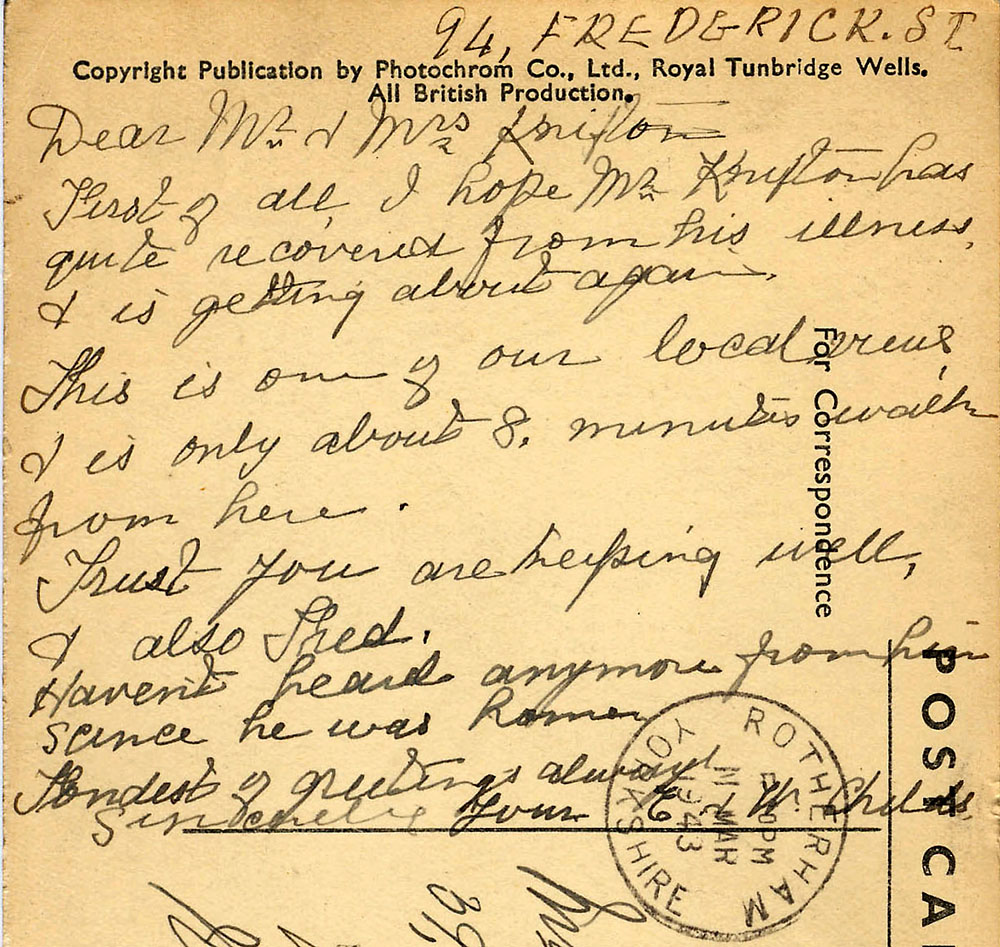
Fred was staying at 94, Frederick Street, with Mr and Mrs Childs, as a lodger in their house. The latter acted more or less as surrogate parents, and in actual fact, frequently corresponded with Fred’s own parents, Will and Fanny. They reported Fred’s progress to them, and postcards were sent back and forth quite regularly. This is the reverse of the postcard of the School of Technology above:

The postcard was posted on June 22nd 1942 at 9.00pm. As far as I can see, the text reads

“ Dear Mr Mrs thanking you for your kind and welcome letter I had a letter from fred I am sending you this I though (sic) you would like it it is were fred and the boy went to school I saw it and though you will like it kind regards to fred when you write hoping you are both well we remain yours faithful  E W Childs”

This date proves that Fred had finished what must have been fairly elementary technical training relatively early in his RAF career. More of these postcards have survived and this one is of Boston Park in Rotherham:

The reverse has the same address as the card above and the message reads:

The text reads:

“74, FREDERICK. ST. Dear Mr & Mrs Knifton  First of all I hope that Mr Knifton has recovered from his illness & is getting about again. This is one of our local areas & is only about 8 minutes walk from here. Trust you are keeping well & also Fred. Haven’t heard anymore from him since he was home. Fondest of greetings always sincerely from E (&) W Childs”

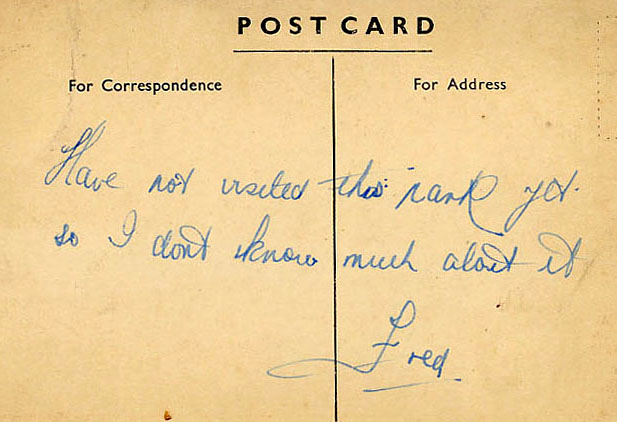
Imaginative as most young men are, Fred chose the very same picture postcard to send home. His message was hardly informative:

The text reads

“Have not visited this park yet so I don’t know much about it Fred ”

It was probably when he was still being trained at Rotherham Technical College, that Fred, as a serving member of the armed forces, was invited on a distant, almost forgotten, occasion to be one of the people to meet the Mayor of Barnsley. The latter was the Lieutenant Colonel of the local regiment, and came round, as we would say nowadays, to “raise his profile”. One thing that Fred did remember was how overawed he felt given the high rank of the distinguished visitor, compared to his own status as a simple Aircraftman Second Class.

In similar vein, Fred had also been somewhat embarrassed when, in uniform, he was given a lift back home from Burton-on-Trent station, by Dr Love, the local doctor in Woodville, the village where Fred lived. Dr Love was himself a high ranking officer in the Royal Army Medical Corps during the First World War, and he had carried this rank with him, over into the local South Derbyshire Home Guard forces. Everybody in the High Street in Woodville was amazed when Dr Love stopped his car, at the time one of the only privately owned vehicles in the area, and out stepped Fred.

19 Comments

Filed under Aviation, Bomber Command, History, Humour, Personal

The World of the Mysterious (3)

I said last time that I would take my trailcams back into history and legend to see if I could find any suggestions that creatures similar to Bigfoot were mentioned over the course of the last 5,000 years or so. I told you of Enkidu, the creation of the god Anu, and the companion of Gilgamesh, who was one third human and two thirds beast, very hairy and very wild:

The most obvious place to continue the search, of course, is the Bible. In the Book of Numbers, Moses sends out his Twelve Spies to have a look at the land of  Canaan. They return and say that they have seen fearsome giants there. They tell him:

“The land, through which we have gone to search, is a land that eateth up the inhabitants thereof; and all the people that we saw in it are men of a great stature. And there we saw the giants, the sons of Anak, which come of the giants: and we were in our own sight as grasshoppers, and so we were in their sight.”

What I will freely admit though, is that in another version of some of the quotation above, the translation is given as:

“And there we saw the Nephilim, the sons of Anak, who come of the Nephilim; and we were in our own sight as grasshoppers, and so we were in their sight.”

I don’t know what’s happening here or how it is possible to translate a word as “giant” and then on another occasion as “Nephilim”. What I did find out, though, is that the proper name ‘Anak’ is the Hebrew word for “giant” (ענק). Here’s a picture I found of the Twelve Spies, recounting the size of the giants in Canaan. It looks like the recreation of a Bigfoot sighting in “Finding Bigfoot” when Bobo stretches his hand over his head and Ranae says “But that makes it fifteen feet tall!”:

Because of this idea that there were giants in Canaan, I also looked at the possibility that the famous Goliath was not a human being but some kind of Bigfoot. In actual fact this proved not to have been a very likely thing to have occurred. The general feeling seems to be that successive translators have just added a cubit here and a cubit there and that is why the Big Man  is nine feet tall rather than just over six feet, which was not desperately taller than King Saul himself. There are also a great many other details about Goliath known from other sources which prove that he was a human being rather than a member of another species:

According to Wikipedia, the exaggeration of his height is relatively easy to trace:

“the Dead Sea Scrolls text of Samuel, the 1st-century historian Josephus, and the 4th-century Septuagint manuscripts, all give his height as “four cubits and a span” (6 feet 9 inches) whereas the Masoretic Text gives this as “six cubits and a span” (9 feet 9 inches)”.

When I was a little boy around nine or ten years of age, our entire class, forty or so of us, all helped to make a two dimensional Goliath with paper and cardboard. He was actually dressed as a Roman soldier with armour of tinfoil and a red curtain for his little kilt. He was six cubits and a span tall and, trust me, he was extremely large!

Just for comparison, here is Robert Pershing Wadlow, who was almost nine feet tall:

Sadly, I couldn’t find any pictures of Robert with nine or ten year old children. Don’t forget though, that Goliath would have been at least a foot taller than the famous American, allegedly.


14 Comments

Filed under Cryptozoology, History, Literature, Personal, Science, Wildlife and Nature, Writing

Nottingham High School on ebay (7)

Last time I showed you the strange writing on a postcard I bought from somebody on ebay. At the same time, it was a magnificent coloured picture of the High School:

Just look at the chimneys, the pinnacles, Dr Dixon’s house on the left, Brincliffe School on the right, the gas light and the beautiful, light and complex metal fence. And just look at that Shrubbery:

I actually think that if you watch this second scene right to the very end, when the knights actually get their shrubbery, that the High School arguably received a much better one:

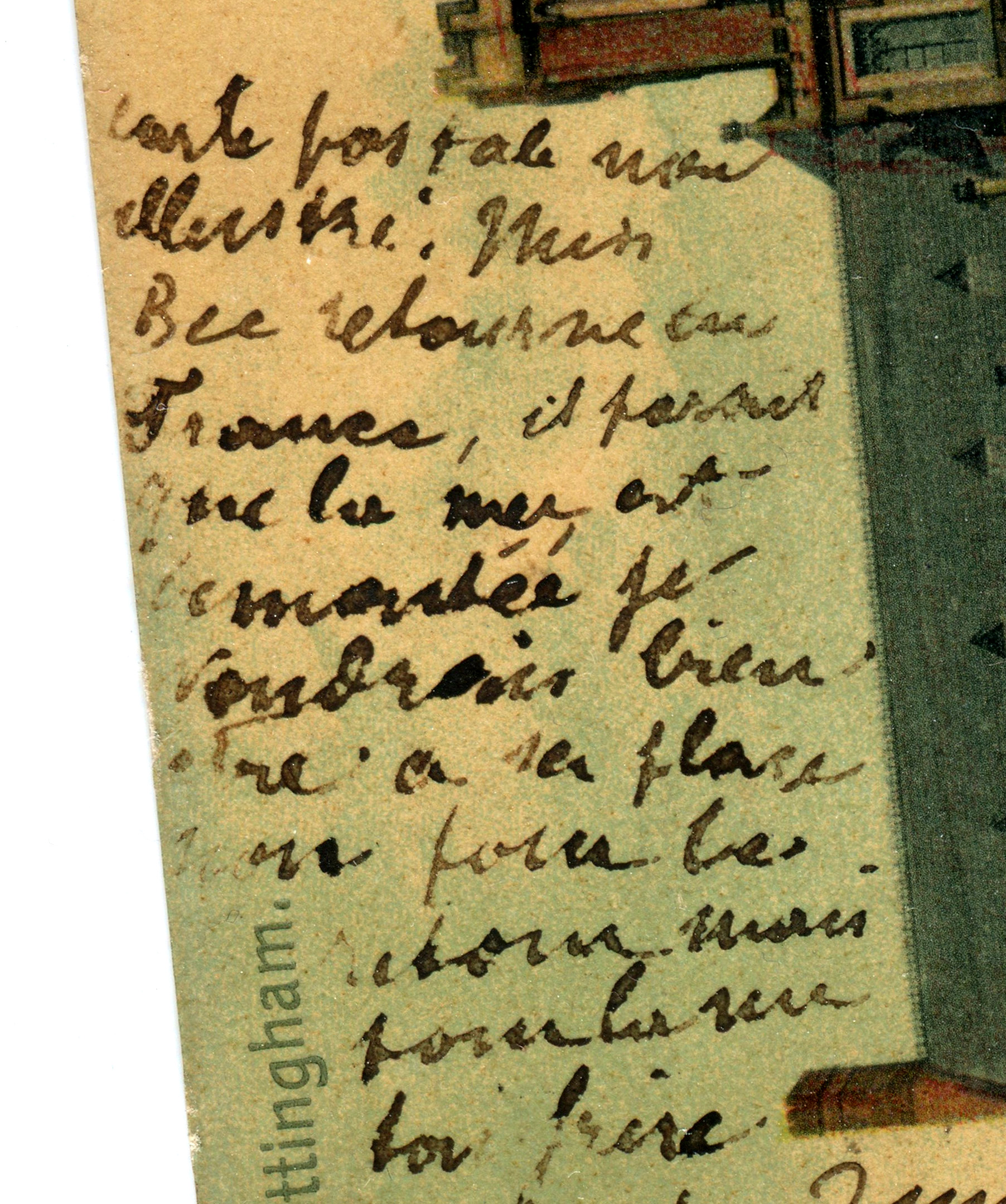
My researches have revealed that if you want to view the peculiar writing on the postcard of the High School, it is as legible as it is ever going to be on an ordinary tower computer.

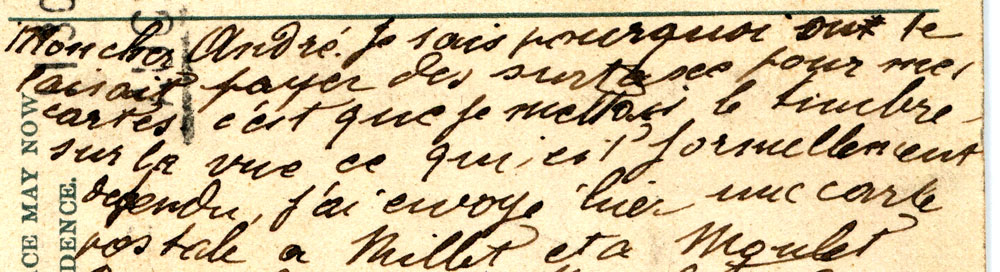
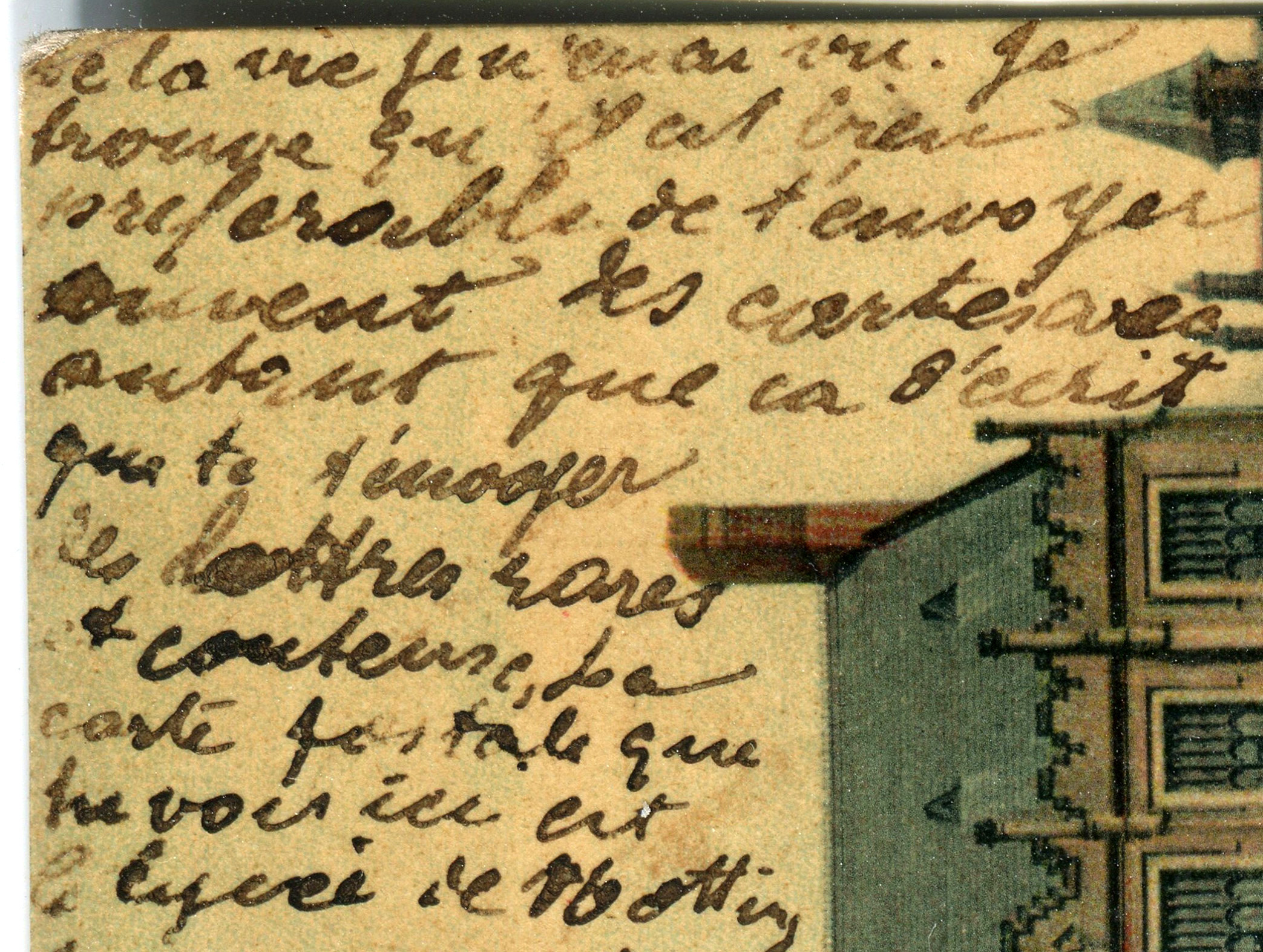
In actual fact, the beginning of the letter begins on the reverse of the postcard as the writer begins with “Mon cher André” because (did you realise it?) the correspondence is conducted in French. Here’s the first bit:

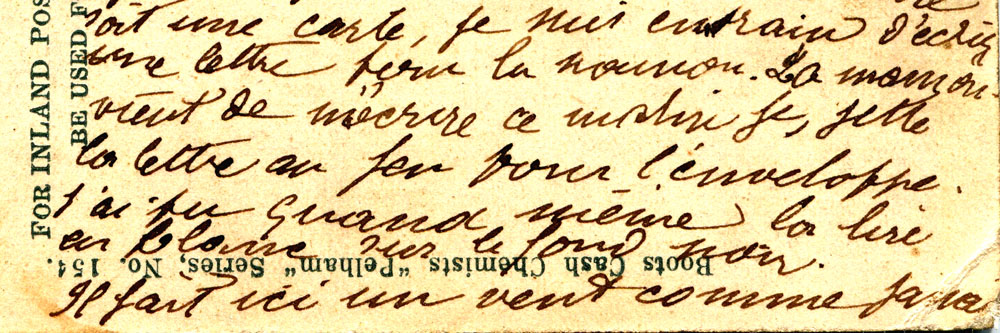
This second section ends with “une lettre”:

The third bit starts with “soit une carte” which goes with the end of the last line of the second section, which ends with “soit une lettre”.

This last bit then links up with the front of the card with the view of the School. Hopefully, somebody out there will be expert enough to read this French missive. I found it rather difficult, because I was never able to decipher a sufficiently long run of words to extract much in the way of meaning.

The card was addressed  to Monsieur André Mallieu. The next line is “Caporal avec le 4 ème Génie 14/2” which means “Corporal with the Fourth Engineers”. The Little Corporal is based at Grenoble in Isère in France. Tne date is difficult, if not impossible to read. It was probably not written in wartime though, because the stamp shows Edward VII who died  (“qui s’est poppé les clogues”) in 1910.

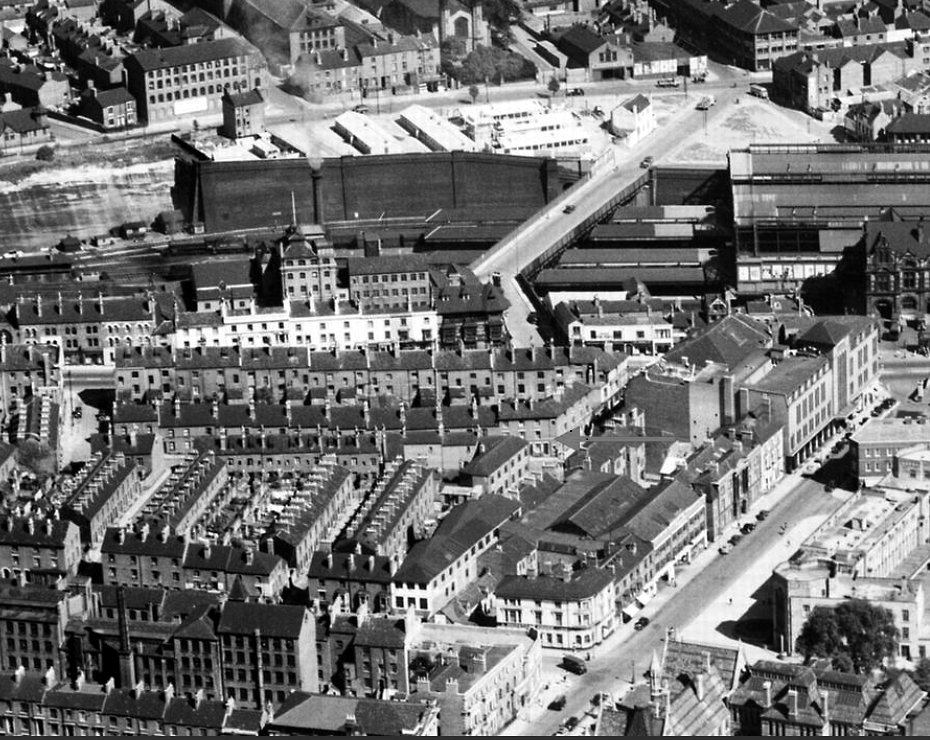
I’m always amazed at how different the past is. Just look at this amazing photograph of Nottingham I found on the Internet. Notice the Watson Fothergill pub called the “Yorker” or the “Rose of England”, on the right edge of the photograph. There’s Shakespeare Street and at the far end, the Victoria Station. To its left is the vast hole containing what was then a working station. And don’t miss the road suspended over the abyss. Just try to pick out any other landmarks you can identify:


23 Comments

Filed under France, History, Humour, Nottingham, Personal, The High School

The World of the Mysterious (2)

I said last time that I would take my thermal imaging camera into history and legend to see if I could find any intimations that creatures similar to Bigfoot were mentioned over the course of the last 5,000 years or so:

Have you ever read “The Epic of  Gilgamesh”? It is a fantastic tale of adventure, demons, despotism, eternal life, physical beauty, the secrets of the gods, sex, temple prostitutes, a twin-peaked mountain and bull wrestling. And that’s only about two thirds of the plot. It makes “Lust in the Dust” look like Jane Austen. No wonder there’s a statue of him at Sydney University:

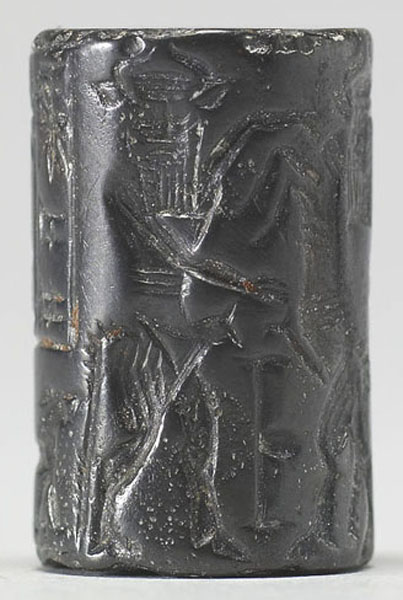
The hero of the epic, Gilgamesh, was probably a real king who came from Sumeria, present day Iraq, in around 2800-2500 BC. He has a companion called Enkidu who, for me, is based on knowledge of a Bigfoot type ape. Enkidu was deliberately created by the god Anu as one third human and two thirds beast. He was suckled by the animals and he is portrayed as being brawny, “endowed with strength”, hairy and he wears animal skins as garments. Wearing tattered clothes is a frequent epithet in many early reports of Bigfoot from North America.

But why does Enkidu bother with animal skins? We know from other descriptions of him in the book that he was completely covered in shaggy hair, all over his body. He must have looked fairly terrifying because when an ordinary human, an animal trapper, first meets Enkidu, the author says that the “trapper’s face was stark with fear”. This is a common element of Bigfoot encounters, not surprisingly, perhaps! Here is Enkidu vanquishing the bull of Heaven:

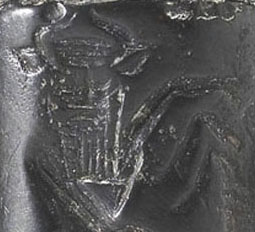
Enkidu has responsibility for protecting the animals, but he also lives among them as an animal himself. This is the reason that he is portrayed with what look to be cows’ horns and ears, and in the next illustration, hooves:

Much more like Bigfoot are his hairy legs. Don’t miss the hooves:

One interesting feature of Enkidu is that he was fashioned entirely from clay and he has no soul. Man, of course, is fashioned from clay but he does have a soul, given to him by the breath of God during his creation process. No soul, of course, and you might become a Golem, another gigantic creature from, very roughly, the same part of the world.

The only detail lacking with Enkidu is the huge stature but it must not be forgotten that a very high proportion of Bigfoot encounters in the early days of the USA concerned beings of the same size as a man.  Very often they had the remnants of tatty clothes on them but there always was that covering of fur. I just can’t get over Enkidu’s hairy legs! :

The descriptions of Enkidu certainly tick a lot of boxes for his being based on a Bigfoot type creature, something which, thousands of years ago, roamed, perhaps, forests now long cut down, or even the marshes of Iraq. These now largely drained areas were once the largest wetlands in Western Eurasia.

“The Epic of Gilgamesh” is available for free at :

https://archive.org/details/TheEpicofGilgamesh_201606

I selected the Pdf and then right clicked and went to “save target as” which means that I could choose which folder to put it in.
The book is also available at http://www.gutenberg.org/ebooks/18897
Here, I right clicked on “Read this book online: HTML” which again allows me to decide where it goes.
This version is not as good as the previous one, which is excellent, and I’m not sure that it is complete, but it does have text in Ancient Sumerian , transliterated into English form. So…….

it-bi-e-ma iluGilgamiš šu-na-tam i-pa-aš-šar.
iz-za-kar-am a-na um-mi-šu
um-mi i-na ša-a-at mu-ši-ti-i̭a
ša-am-ḫa-ku-ma at-ta-na-al-la-ak
i-na bi-ri-it id-da-tim
ib-ba-šu-nim-ma ka-ka-’a ša-ma-i
ki-?-?-rum ša a-nim im-ku-ut a-na ṣi-ri-i̭a
áš-ši-šu-ma ik-ta-bi-it e-li-i̭a
ilam iš-šu-ma nu-uš-ša-šu6 u-ul el-ti-’i̭
ad-ki ma-tum pa-ḫi-ir7 e-li-šu
id-lu-tum ú-na-ša-ku ši-pi-šu

which means

“Gilgamish arose interpreting dreams,
addressing his mother.
“My mother! during my night
I, having become lusty, wandered about
in the midst of omens.
And there came out stars in the heavens,
Like a … of heaven he fell upon me.
I bore him but he was too heavy for me.
He bore a net but I was not able to bear it.
I summoned the land to assemble unto him,
that heroes might kiss his feet.”

It’s certainly something for the kids to think about for “Show and tell”.

28 Comments

Filed under Bigfoot, Cryptozoology, History, Literature, Personal, Science, Wildlife and Nature, Writing

Nottingham High School on ebay (6)

My last two posts in this series are a little bit out of the ordinary, perhaps. I bought this postcard on ebay. It is very strange to say the least:

The post card has been coloured beautifully and it is interesting to note the wonderfully delicate fence, the gas light and a shrubbery that the Knights who say “Ni” would be proud of. The full set of chimneys and pinnacles are there and, back left, is Dr Dixon’s house and back right is Brincliffe School, both of which were still standing when I started in the High School in 1975. But what about all that writing?

Well, I’ve spent some time working on it, and here are my enlargements, in order, from the top right to top left. Here’s No 1:

And No 2:

And No 3:

And No 4:

Why not have a go at trying to read it? Writing like this was fairly common practice in the last century. To save money, particularly money spent on mere paper, people would frequently write on it twice, once horizonally, and once vertically. That must have been a little difficult to read !

33 Comments

Filed under Football, France, History, Nottingham, Personal, The High School