Category Archives: Aviation

George Norman Hancock, Old Nottinghamian and RAF (2)

Last time, we saw how George Norman Hancock sat the Army Entrance Examination and was placed second in the Order of Merit for the Royal Air Force College at Cranwell in Lincolnshire. There were six successful candidates:

AFR Bennett (Harrow County School), GN Hancock (Nottingham High School), K Gray (Leeds Grammar School), TL Moseley (Tamworth Grammar School), GAV Knyvett (Malvern College) and JAP Owen (St Bees School, Cumberland).

These were six optimistic young men, the brightest and the best, who would dedicate their lives to the Royal Air Force and their country. Some of them would lose those lives for ever.

Wing Commander Albert Frank Reuben Bennett worked at the Royal Aircraft Establishment at Farnborough. He was killed on Wednesday, July 1, 1942 at the age of 29.

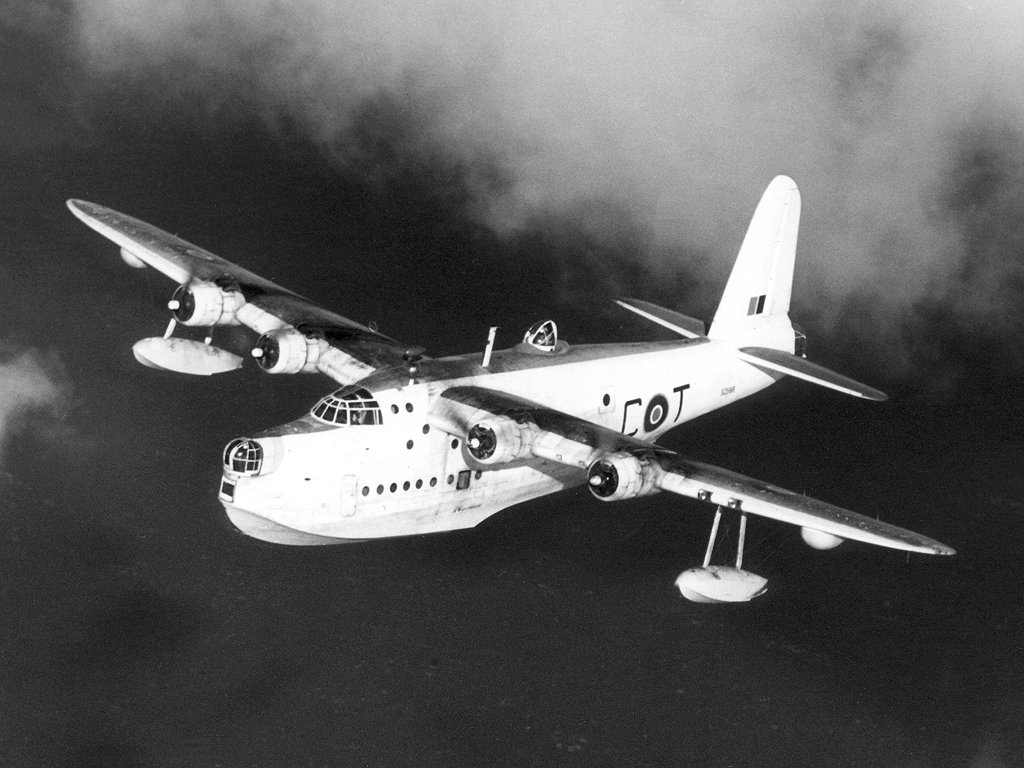
Wing Commander Thomas Lawton Moseley was with 228 Squadron when he was killed on August 25th 1942 at the age of 29. He was in the same Short Sunderland flying boat in which the Duke of Kent was killed:
As for K Gray of Leeds Grammar School, I found three Kenneth Grays who were all killed but they were members of the Royal Air Force Volunteer Reserve, so, unless he left the RAF and then returned to it, I am not sure that this particular K Gray is very likely to be any of them. On the other hand, he may well be.

I first found George’s name in the RAF list for 1933 when on July 15th 1933, he was appointed to a permanent commission as a Pilot in the General Duties Branch of the RAF. In 1938-1940 he was recorded as Flight Lieutenant GN Hancock with the date July 14th 1938 after his name. This corresponds, presumably, to the date when his rank of Flight Lieutenant began. In June 1938 he qualified as a Special Signals Officer and for the rest of his life, he was to work in this area of the service. He would always be engaged in flying an aircraft rather than a desk.
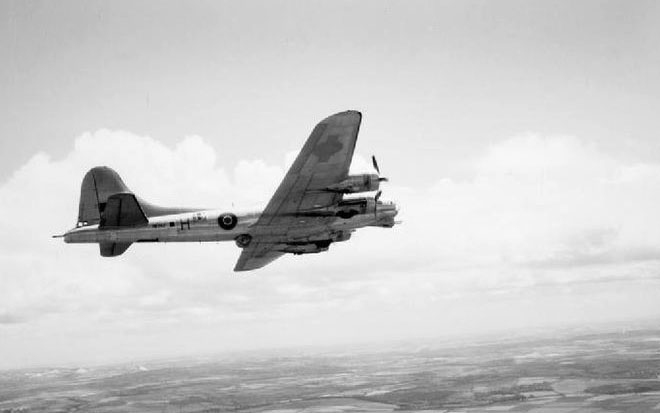
Interestingly, he soon became an Experimental Signals Officer at the Aeroplane And Armament Experimental Establishment, which was originally located on the east coast, at Martlesham Heath near Woodbridge in Suffolk. When the war broke out, it was moved to the less vulnerable site of RAF Boscombe Down in Wiltshire.  Boeing B-17s were frequently used in research of the electronic variety. This one was specifically part of the AAEE:

The next time we meet George is in the “Flight” edition of April 13th 1939 when Flight Lieutenant GN Hancock became Squadron Leader GN Hancock with effect from April 1st 1939. On April 24th 1939, George was transferred to the Technical Branch from General Duties.
George’s name also cropped up in the King’s Birthday Honours for 1944, which celebrated the official birthday of King George VI. He was listed as Group Captain GN Hancock, “Mentioned in Despatches”, this time for his work with Coastal Command.
In 1946, George was awarded the CBE in the New Year’s Honours List as senior Signals Officer of the entire RAF. He must have also been promoted, if only temporarily, to the rank of Group Captain.

On November 1st 1947 George relinquished his temporary rank of Group Captain to become a Wing Commander (substantive). On July 1st 1953, he reverted to being a permanent Group Captain because on October 6th 1953, he was transferred to the General Duties Branch, retaining his rank…Group Captain GN HANCOCK, CBE, MIEE (seniority 1st July 1951).
I’ve not found the second abbreviation yet, but it possibly means “Member of the Institution of Electrical Engineers”. He certainly joined the Institution as a university graduate in 1940 and by 1942, he was an Associate Member, and ten years later, a full Member. At the time of his death, George was also the proud holder of two prestigious diplomas. One was the AMIEE and the other was the AMI Radio Engineers. One was “Associate Member of the Institution of Electrical Engineers” and the other was, presumably, “Associate Member of the Institution of Radio Engineers”.

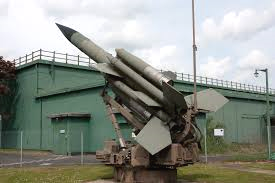
George’s obituary lists the various jobs he did in the RAF and they certainly make a long and impressive list. He was the Chief Signals Officer in Coastal Command, the Senior Staff Officer at the Air Traffic Headquarters at Uxbridge, and the Command Signals Officer with the British Air Force of Occupation in Germany. At the time of his death on March 31st 1954, he was working with the Ministry of Supply as the Senior Air Force Representative to the Controller of Guided Weapons and Electronics in the Ministry of Supply. Here is an early Bloodhound anti-aircraft missile:
To carry out all of these important posts, George needed immense dedication to the cause, and he had it in abundance, being committed both to the Royal Air Force and to his profession as a telecommunication engineer. He was known universally and affectionately by his nickname of “Hank”. His friends loved his courage and his jovial optimism. His work colleagues had great respect for his plainly expressed opinions and his dogged persistence in working away at things and overcoming any problems. Indeed, his obituary writer thought that George’s character was the very reason that he was always called “Hank”.

“This bestowal of a nickname gave an accurate measure of the esteem in which he was held by his colleagues.”
8 Comments

Filed under Aviation, History, Nottingham, The High School

Fred’s travels with the RAF

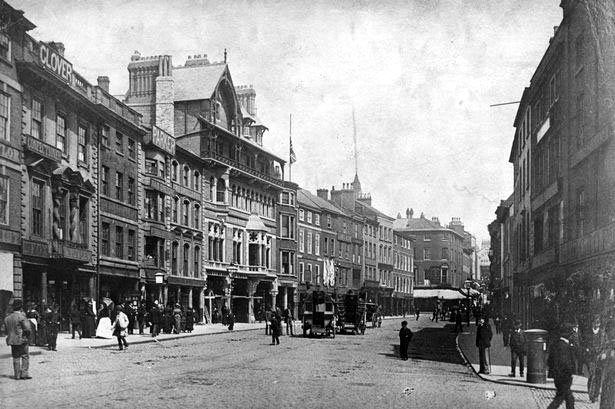
During the war years, Nottingham was a city which welcomed huge numbers of RAF men from all of the many airbases in Lincolnshire. One of the most famous pubs was the Black Boy, designed by Nottingham’s greatest architect, Watson Fothergill. The famous hotel is the very large building in the middle of the buildings on the left :

Alas, this wonderful, wonderful building was demolished to make way for a supermarket and a very ugly supermarket at that. The Black Boy was a hotel which was very convenient for the dashing Brylcreem Boys, who could easily get to Nottingham from their scores of bomber bases across Lincolnshire. Once they were there, they could get up to whatever they wanted and the Black Boy had enough bedrooms to accommodate all of them. I saw a programme recently which said that the rates of venereal disease among RAF aircrew were so high around this time that serious measures had to be taken. It was decided therefore that any man diagnosed with VD would have his mission total taken back to zero. Once you had done 30 missions, you were taken off combat flying, so if you had done a decent number, around 20, for example, this would have been a huge disaster, and a life threatening one at that.

Fred used Nottingham as a place to get a connection for Derby. When he was at Elsham Wolds, I think he must have caught a train at nearby Barnetby and then either got a connection at Lincoln or gone straight through to Nottingham. From there he could easily reach Derby or even Burton-on-Trent.  The orange arrow points at Elsham Wolds and nearby Barnetby:

Fred was no fool and he soon discovered that there was a small railway station, almost in the centre of Nottingham, called, he thought, High Pavement. It was an open station which meant that there were never any inspectors there to check tickets as the passengers alighted from the train.

The smart thing to do therefore, if you were either coming to Nottingham to visit, or were just changing trains at Nottingham, was not to bother with buying a ticket, but just to get off, not at the main station, but at High Pavement. You could then either disappear into the city, or walk the short distance to the main station and then catch the train to Derby or to Burton-on-Trent.

In later life, Fred was to retain little memory of the details of High Pavement station except that there were lots of blue brick walls and you had to go down some steps on your way to the main bit of the station.

I don’t really know where he means, but this remaining railway-type blue brick wall may be something to do with a station in this area:

Fred often had a 24 hour pass, which would run from 00h00 to 23h59. He frequently used to travel, therefore, in the early hours of the night. At that time there were certainly very few welcoming faces on the platforms, except the members of the Salvation Army, who were always on hand to dispense cups of tea or plates of hot food, most welcome out in the damp fogs of autumn, or in the cold icy blasts of winter. In later life, Fred was always to say that the Salvation Army were the only religious organisation to show any practical interest whatsoever in the welfare of the forces. He would always try to give them a donation whenever he saw them, because they had done so much to help soldiers, sailors and airmen when they really needed it in the cold dark days of World War Two.

23 Comments

Filed under Aviation, Bomber Command, History, Nottingham, Personal

George Norman Hancock, Old Nottinghamian and RAF (1)

George Norman Hancock was born on May 31st 1913. His father was George Augustus Hancock who was a lace manufacturer. His mother was Sarah Grace Hancock, but everyone knew her as Sadie. His sister was called Grace. During the First World War, George Augustus was in the 1st Battalion of the Sherwood Foresters. He was a Captain and his bravery was such that he was eventually awarded a Military Cross. The family lived at 11 Ramsdale Crescent. Ramsdale Crescent is a quiet, pleasant street in Sherwood, the very same suburb of Nottingham where I myself live:

George Norman Hancock entered the High School on April 29th 1921 as Boy No 4376. He spent ten years there and by the time he left he had achieved a fair bit. In the School List, the rather ornate “M” next to his name signified that he had passed a “University Matriculation Examination”, possibly the London University version. That meant he had reached the high standards needed for entry to any university in the land.
In George’s case, I get the impression that even at this early stage he was looking to enter the Forces in some way. He was a member of the Officer Training Corps, and, as well as the “M” next to his name, there was an “A” to signify that he had passed his OTC Certificate A. This was a qualification issued by the Government and was a military equivalent really of the “University Matriculation Examination”. It seems to have covered basic training at the very least and in 1939, totally raw recruits were being taught the absolute basics by young school leavers who held the Certificate A. This included some recent Sixth Formers from the High School. Here is a Certificate ‘A’. If you can’t read the small print, then just tap on it and it should open up:

Indeed, George was so outstanding in the OTC that he had won the Certificate A Prize for the whole School in 1929-1930. And he was now Corporal Hancock. And a few short months later, Sergeant Hancock. In 1930-1931 George passed his Higher School Certificate, the equivalent of today’s ‘A’ level.
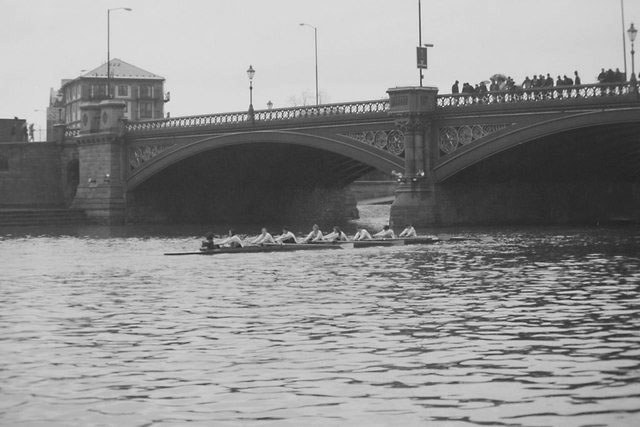
He also won his 2nd Colours for Rowing although I have found out very little about his individual triumphs. In those days of the late 1920s, the Nottinghamian always seemed to talk about sport in rather general terms. When it did single people out, they were usually the very top, star performers and I have found no mention of George’s specific contributions in the Second Boat. This is a rowing eight going under Trent Bridge. The High School seems to have had four rowers in the boat during the interwar period. I just don’t know if this happens any more:

George left the High School at the end of the Summer Term in July 1931.

Shortly afterwards, he sat the Army Entrance Examination and was placed second in the Order of Merit for the Royal Air Force College at Cranwell in Lincolnshire:

George won a Prize Cadetship valued at £210, the first ever won by a pupil from the High School. This was announced in the publication, “Flight”, on September 4th 1931…

“The Air Council have awarded Prize Cadetships, each of the value of £105 per annum for two years, to the following successful candidates at the examination held in June, 1931, for entry into the Royal Air Force College.”

There were six successful candidates…

“AFR Bennett (Harrow County School), GN Hancock (Nottingham High School), K Gray (Leeds Grammar School), TL Moseley (Tamworth Grammar School), GAV Knyvett (Malvern College) and JAP Owen (St Bees School, Cumberland).”

We’ll see what happened to those six young men next time

17 Comments

Filed under Aviation, History, Nottingham, The High School

Fred goes to Lincoln Cathedral

Towards the early part of his career in the Royal Air Force, probably in the winter of 1941-1942, Fred was stationed for a short period at Cranwell, the RAF College. Cranwell is a very imposing place:

This episode took place at the very start of his stay there, when, in his first period of free time, Fred decided to go out on a visit somewhere.

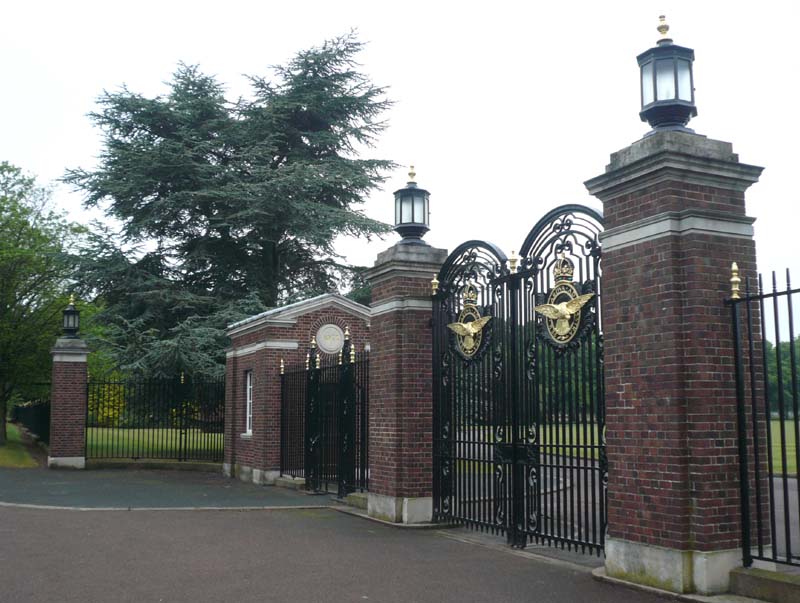
It was a glorious, cold, clear, bright blue, frosty day, and Fred went out of the front gate of the camp accompanied by a friend. It’s difficult to miss the gates at Cranwell:

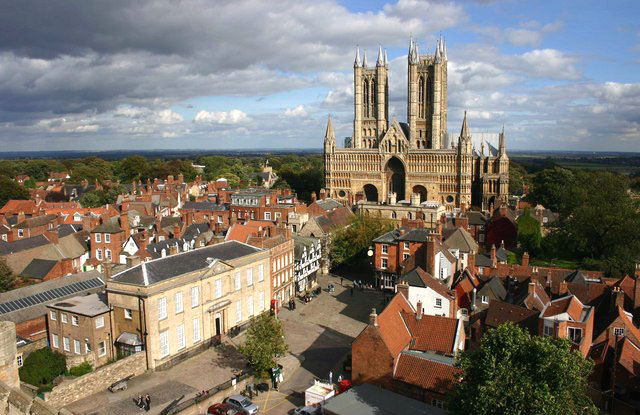
Seeing a local man pushing his bike along the road, Fred asked him the way to Lincoln, but instead of offering directions, the man just stretched out his arm and pointed along the road, which was a Roman one, and absolutely straight, to the distinctive shape of the cathedral, silhouetted sharply against the bright light of the sky. Lincoln Cathedral is on a high hill, surrounded by a flat landscape, so it is fairly difficult to miss:

The man said not a single word but just carried on trudging along with his bicycle. Fred and his friend, armed with the usual 24 hour pass, set off cycling along the road to Lincoln.

This initially unnamed friend may well have been Joe Fielding, a highly educated man who had studied, among other things, Latin at Oxford University.  The two young airmen were taken around the cathedral by one of the amateur guides, who had many interesting things to explain to them. When they reached the shrine to St Hugh, at the eastern end of the cathedral, near the altar, the guide told them all about the life of the saint, and his pet swan, but he confessed that, as a modestly educated working class man, he was unable to translate the Latin inscription on one of the metal tablets near the altar. Joe, however, with his degree level knowledge of Latin, proceeded to translate the inscription fluently.

The guide though seemed to be really, really, upset. Fred felt that, while Joe’s behaviour was perhaps the product of innocent helpfulness, he should rather just have kept his mouth shut, and let the guide remain the expert. Fred was certainly highly embarrassed by the whole affair.

As one of the coincidences that fill all our lives, Fred was to pass away on the very same day that I myself took a party of schoolboys to visit Lincoln Cathedral. I was able with ease to find that single plaque written in Latin, unchanged in the sixty or so years between the two events.

15 Comments

Filed under Aviation, Bomber Command, History, Personal

Fred goes to Rotherham

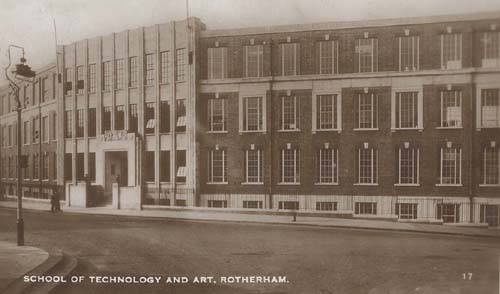
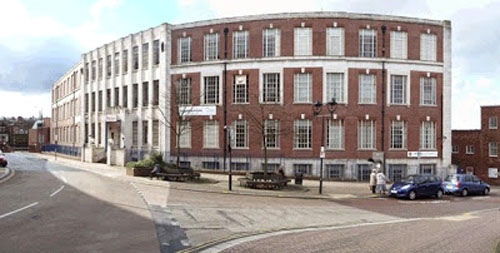
In his early career with the RAF, Fred lived in Rotherham, where he was training to be a wireless operator. He attended the local Technical College, and for his ab initio training in electronics, he studied topics such as radar and the many other technical devices which he would need to use as a Wireless Operator / Air Gunner.

The college is still there today:

Fred was staying at 94, Frederick Street, with Mr and Mrs Childs, as a lodger in their house. The latter acted more or less as surrogate parents, and in actual fact, frequently corresponded with Fred’s own parents, Will and Fanny. They reported Fred’s progress to them, and postcards were sent back and forth quite regularly. This is the reverse of the postcard of the School of Technology above:

The postcard was posted on June 22nd 1942 at 9.00pm. As far as I can see, the text reads

“ Dear Mr Mrs thanking you for your kind and welcome letter I had a letter from fred I am sending you this I though (sic) you would like it it is were fred and the boy went to school I saw it and though you will like it kind regards to fred when you write hoping you are both well we remain yours faithful  E W Childs”

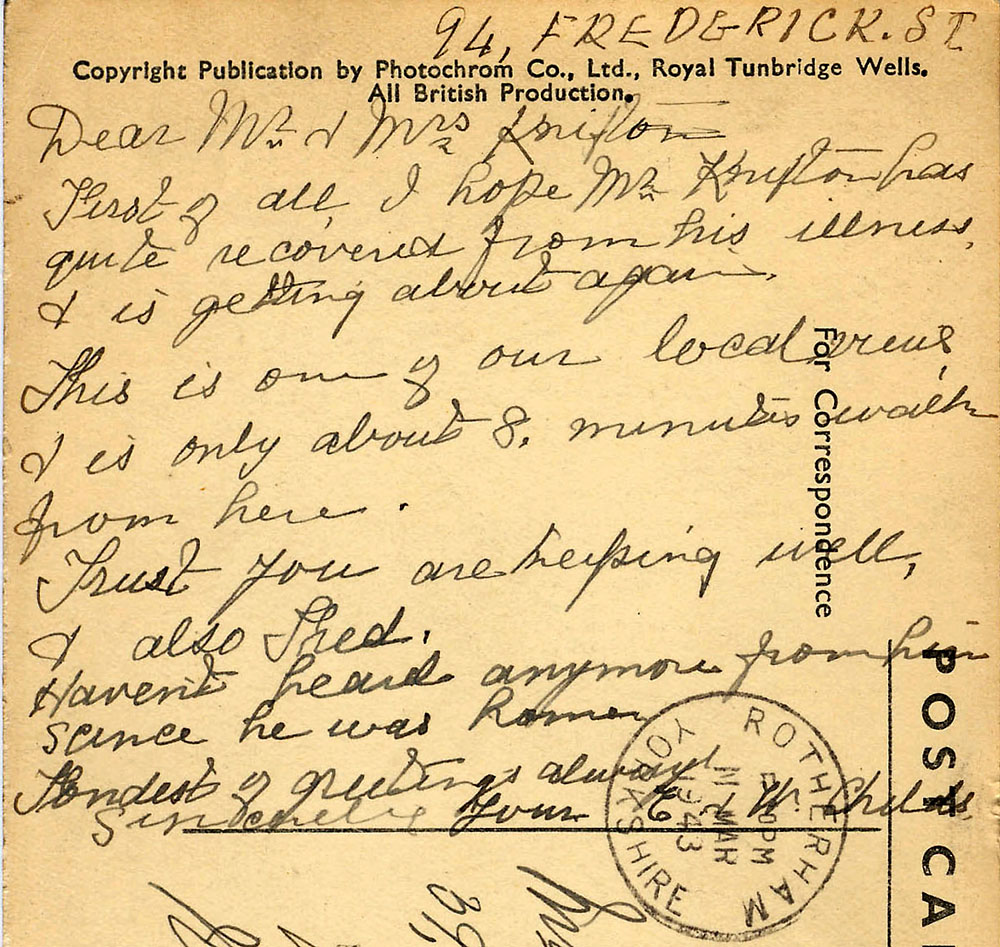
This date proves that Fred had finished what must have been fairly elementary technical training relatively early in his RAF career. More of these postcards have survived and this one is of Boston Park in Rotherham:

The reverse has the same address as the card above and the message reads:

The text reads:

“74, FREDERICK. ST. Dear Mr & Mrs Knifton  First of all I hope that Mr Knifton has recovered from his illness & is getting about again. This is one of our local areas & is only about 8 minutes walk from here. Trust you are keeping well & also Fred. Haven’t heard anymore from him since he was home. Fondest of greetings always sincerely from E (&) W Childs”

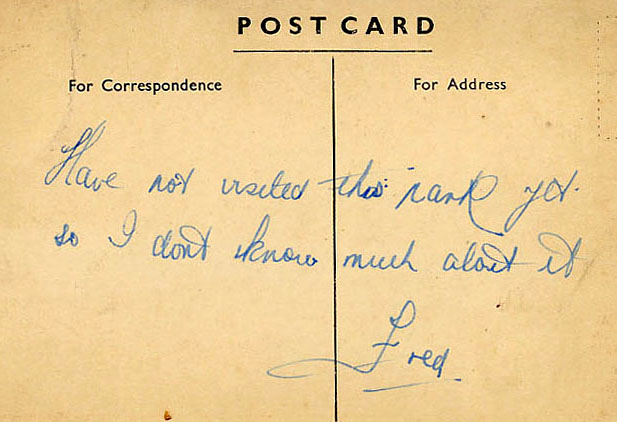
Imaginative as most young men are, Fred chose the very same picture postcard to send home. His message was hardly informative:

The text reads

“Have not visited this park yet so I don’t know much about it Fred ”

It was probably when he was still being trained at Rotherham Technical College, that Fred, as a serving member of the armed forces, was invited on a distant, almost forgotten, occasion to be one of the people to meet the Mayor of Barnsley. The latter was the Lieutenant Colonel of the local regiment, and came round, as we would say nowadays, to “raise his profile”. One thing that Fred did remember was how overawed he felt given the high rank of the distinguished visitor, compared to his own status as a simple Aircraftman Second Class.

In similar vein, Fred had also been somewhat embarrassed when, in uniform, he was given a lift back home from Burton-on-Trent station, by Dr Love, the local doctor in Woodville, the village where Fred lived. Dr Love was himself a high ranking officer in the Royal Army Medical Corps during the First World War, and he had carried this rank with him, over into the local South Derbyshire Home Guard forces. Everybody in the High Street in Woodville was amazed when Dr Love stopped his car, at the time one of the only privately owned vehicles in the area, and out stepped Fred.

19 Comments

Filed under Aviation, Bomber Command, History, Humour, Personal

The Battle of Britain (5)

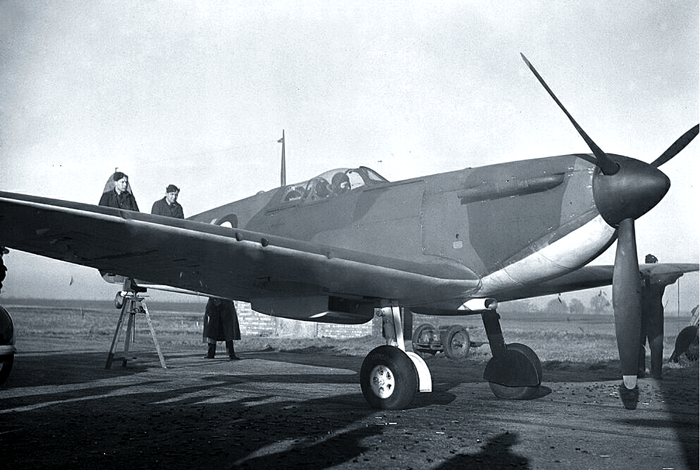
Last time I mentioned the name of “Watty” Watson who was the High School’s only member of Churchill’s famous “Few” that I have discovered so far. I did find one other Old Nottinghamian who was in Fighter Command during the period of the Battle of Britain, but he did not fly the legendary Spitfire, yet another picture of  a Mark I which I just cannot resist:

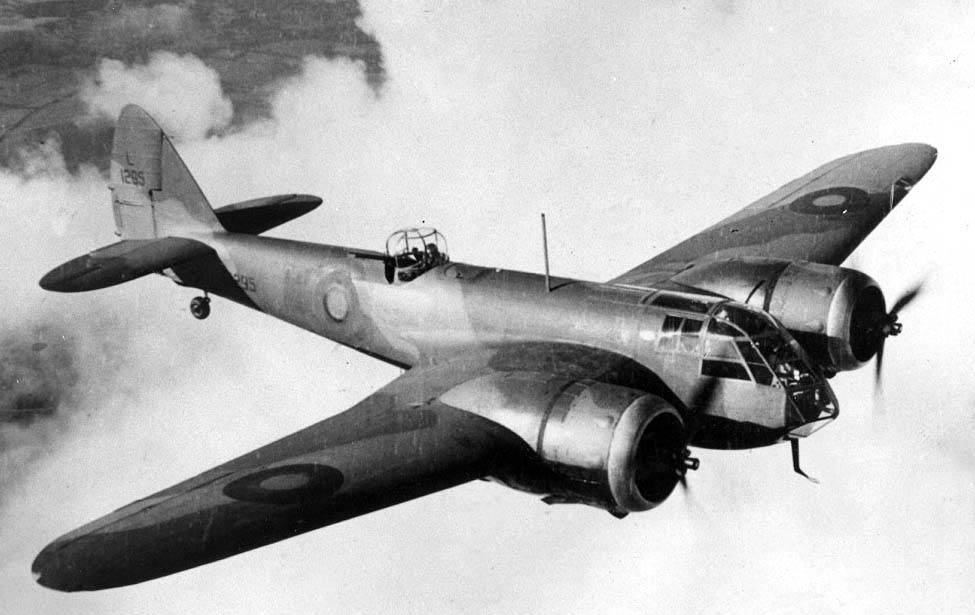
Instead, Flying Officer Walker flew the Bristol Blenheim Mark I which was desperately pressed into service as a night fighter:

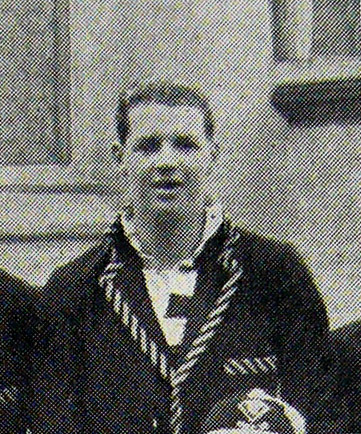
While he was at school, “Watty” had been a keen rugby player for the First XV:

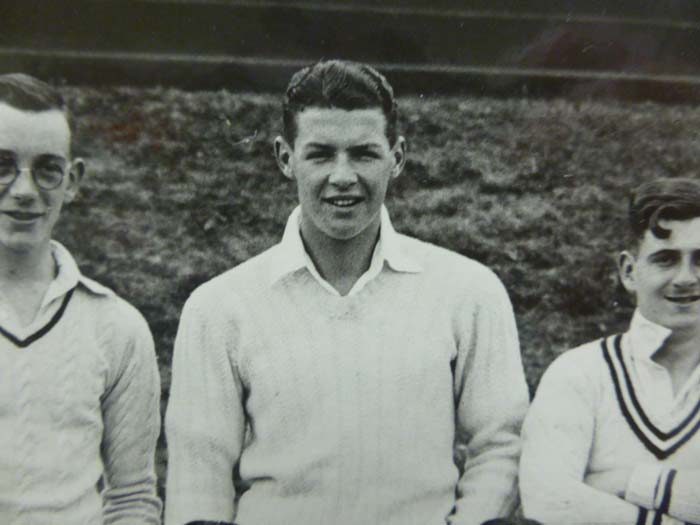
He was a keen member of the Second XI at cricket:

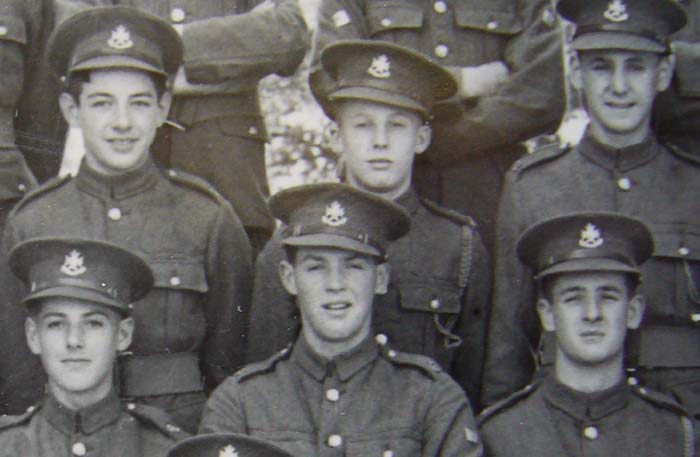
Most of all, he loved the Officers Training Corps:

As you look at the photograph the boy on the left is “Higgs” and the boy on the right is “MacKirdy”. The three behind, left to right, are JMT Saunders, Burley and MJ Dodds, as far as we know.

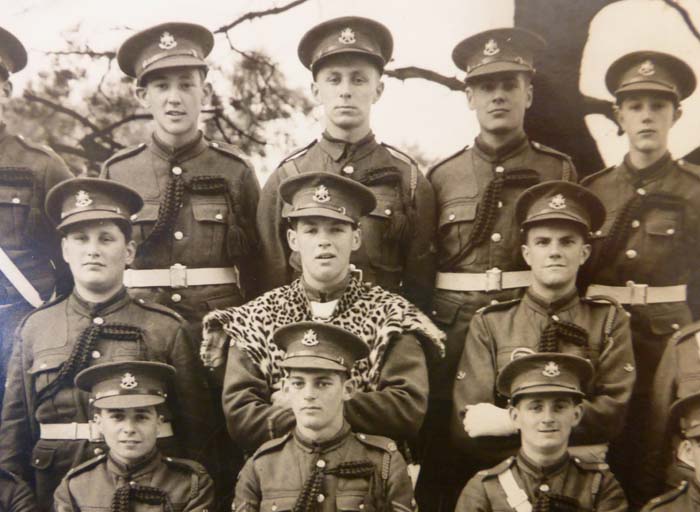
Eventually, “Watty” was promoted to Drum Major, every boy’s dream, having your own drum. Having your own leopard skin wasn’t bad either:

And in close up:

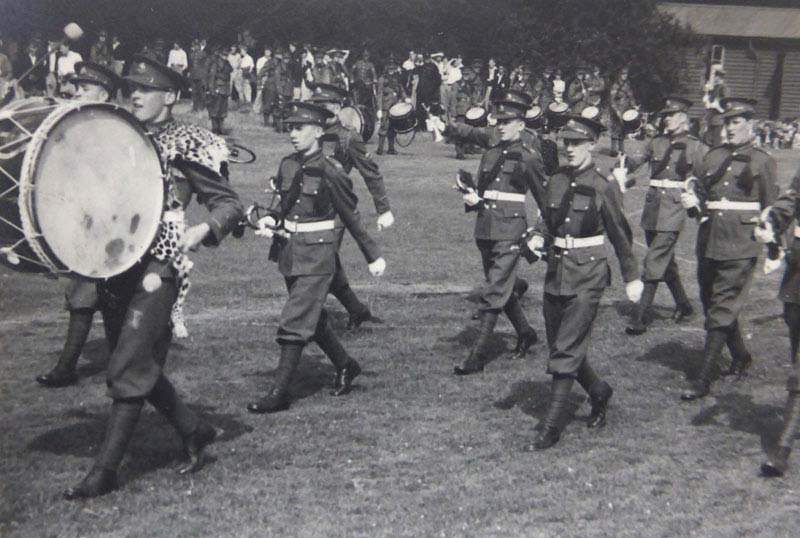
But if you have a big drum, then you’ve got to bang it, bang it loud and march like a maniac:

What’s that quotation?

“When I was a child, I spake as a child, I understood as a child, I thought as a child: but when I became a man, I put away childish things.”

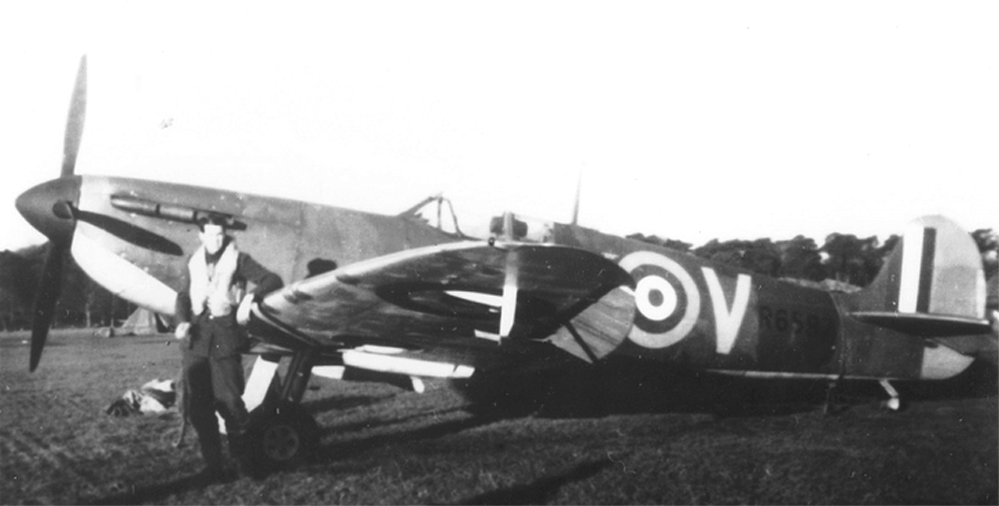
So “Watty” gave up his drum and his leopard skin, but he was eventually given something he liked a whole lot better:

Here he is, in close up:

“Watty” gave his life for this country’s freedom on November 28th 1940. He was “Blue Two” and he was just 19 years of age.

If you ever want to put some flowers on his grave, “Watty” is buried in the Nottingham Southern Cemetery on Wilford Hill, off the A60 Loughborough Road,  in Section  M.24, Grave 74. We all owe him, and his colleagues, one hell of a debt.


29 Comments

Filed under Aviation, History, Nottingham, The High School

The Battle of Britain (4)

The Battle of Britain was Nazi Germany’s first defeat. It was brought about by the famous “Few”.

In the picture above the pilots are running towards their Hurricanes, formidable fighters which claimed 60% of the Luftwaffe aircraft shot down. Here is the most beautiful aircraft ever built:

Even as a little boy, I was fascinated by that magic sounding colour for the underneath of a Spitfire, “duck egg blue”.

I used to teach at Nottingham High School. Two of our Old Boys fought, and died, in the Battle of Britain.

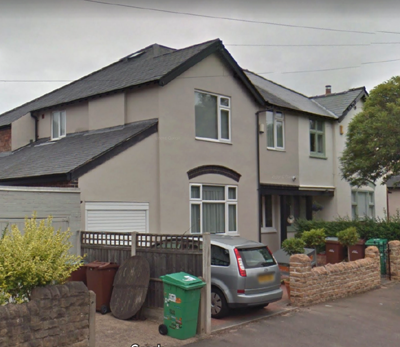
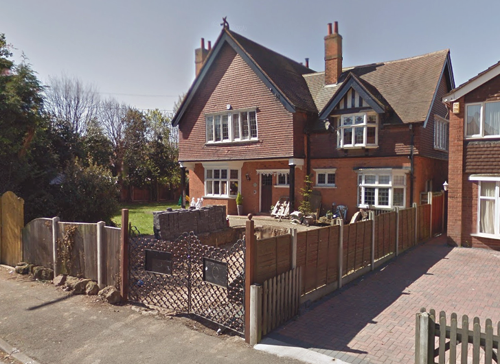
One of them was Arthur Roy Watson. He was born in Basford, a district in the north of Nottingham. Originally the family lived at 193 College Street in Long Eaton, a suburb to the west of Nottingham. College Street runs roughly north to south in Long Eaton. Here is his house, now divided into two semi-detached houses:

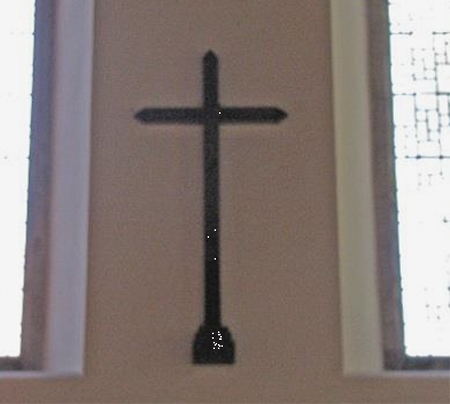
College Street’s southern end is on Derby Road more or less opposite Trent College where a propeller from Albert Ball’s aircraft is on display in the library and the original cross from his grave in France is kept in the college chapel:

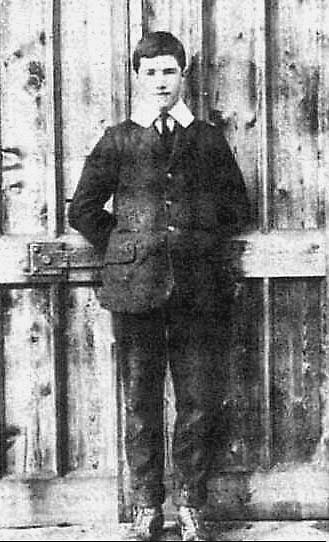
Did young Arthur ever go to see these important relics? Did they inspire him?  I have already written about the famous World War One fighter ace and the various escapades he found himself involved in. Here he is in his days at Trent College, after his expulsion from Nottingham High School and the King’s School, Grantham:

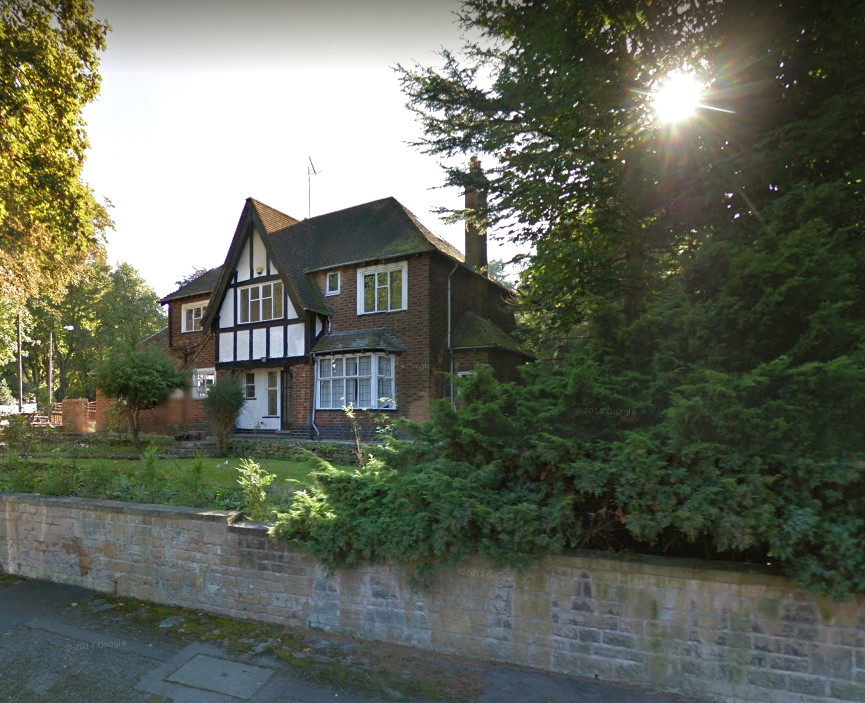
After living in Long Eaton, the Watson family then moved to 48 Carisbrooke Drive, a leafy suburban road that overlooks the old High School playing fields at Mapperley Park:

His friends in the squadron called him “Watty”, “Rex” or “Doc” because that made him “Doctor Watson”. Here he is standing by his Spitfire. He was just 19 when he was killed:


24 Comments

Filed under Aviation, History, Humour, Nottingham, Politics, The High School

The Battle of Britain (3)

This slideshow requires JavaScript.

There is no better person to tell the story of the Battle of Britain that the greatest ever Englishman, Sir Winston Churchill:

“The Battle of France is over … the Battle of Britain is about to begin. Upon this battle depends the survival of Christian civilisation. Upon it depends our own British life, and the long continuity of our institutions and our Empire. The whole fury and might of the enemy must very soon be turned on us. Hitler knows that he will have to break us in this island or lose the war. If we can stand up to him, all Europe may be freed and the life of the world may move forward into broad, sunlit uplands. But if we fail, then the whole world, including the United States, including all that we have known and cared for, will sink into the abyss of a new dark age made more sinister, and perhaps more protracted, by the lights of perverted science” :

This slideshow requires JavaScript.

“Let us therefore brace ourselves to our duties, and so bear ourselves, that if the British Empire and its Commonwealth last for a thousand years, men will still say, “This was their finest hour.”

He produced a second speech which gave us another memorable phrase:

“The gratitude of every home in our Island, in our Empire, and indeed throughout the world, except in the abodes of the guilty, goes out to the British airmen who, undaunted by odds, unwearied in their constant challenge and mortal danger, are turning the tide of the World War by their prowess and by their devotion. Never in the field of human conflict was so much owed by so many to so few.”

“All hearts go out to the fighter pilots, whose brilliant actions we see with our own eyes day after day, but we must never forget that all the time, night after night, month after month, our bomber squadrons travel far into Germany, find their targets in the darkness by the highest navigational skill, aim their attacks, often under the heaviest fire, often with serious loss, with deliberate, careful discrimination, and inflict shattering blows upon the whole of the technical and war-making structure of the Nazi power.”

We actually know exactly how that phrase “Never in the field….” came about.

On August 20th 1940 Churchill was travelling in a car with Major General Hastings Ismay to give a speech about the Battle of Britain in the House of Commons. Churchill was reading the speech out aloud to Ismay and it was originally “Never in the history of mankind have so many owed so much to so few”. Ismay interrupted him and said “What about Jesus and his disciples?” Churchill concurred and immediately changed it to its present form “Never in the field of human conflict was so much owed by so many to so few.”.

27 Comments

Filed under Aviation, Bomber Command, France, History, Politics

The Battle of Britain (2)

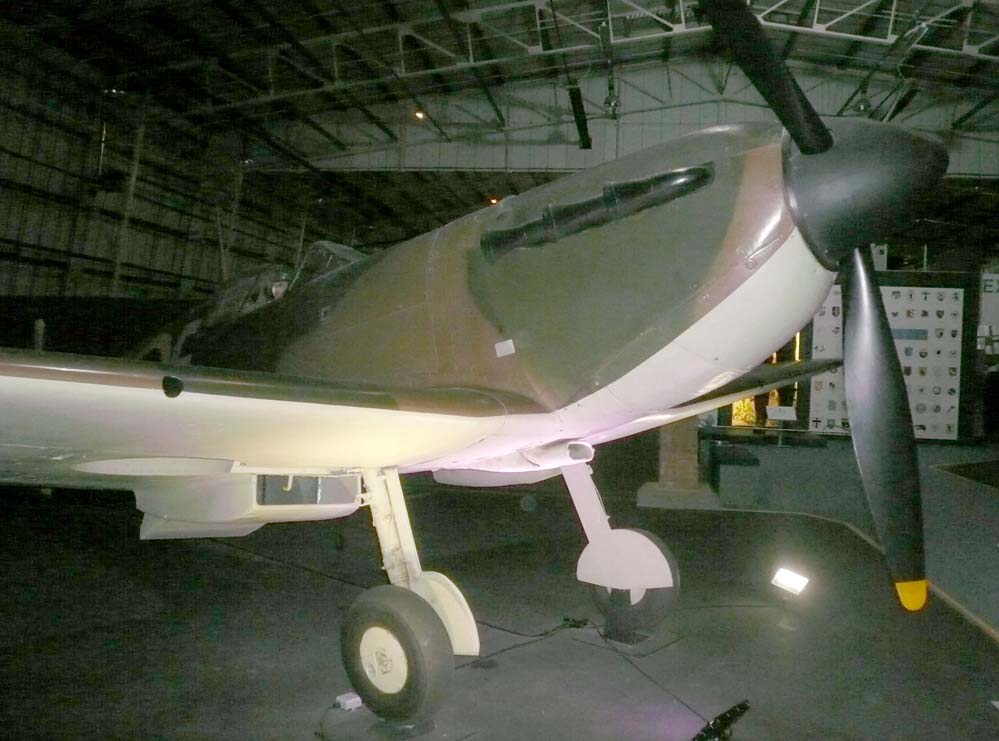
Deep in the bowels of the RAF Museum at Hendon is the Battle of Britain section where the lighting is of a strange purple colour so that delicate ancient paint is not faded by direct sunlight. That’s an extra excuse for these rather weird photographs. First of all, the baddies, with that old favourite, the Junkers Ju 87 Stuka, an aircraft used in the blitzkrieg to dive bomb defenceless refugees:

This slideshow requires JavaScript.

Here’s a Heinkel He111 which was all right as a bomber but which didn’t carry a particularly significant bomb load. Even so, it performed well at Guernica, Rotterdam, London, Warsaw and half a hundred other places as the Germans invented the much criticised concept of “area bombing”.

This slideshow requires JavaScript.

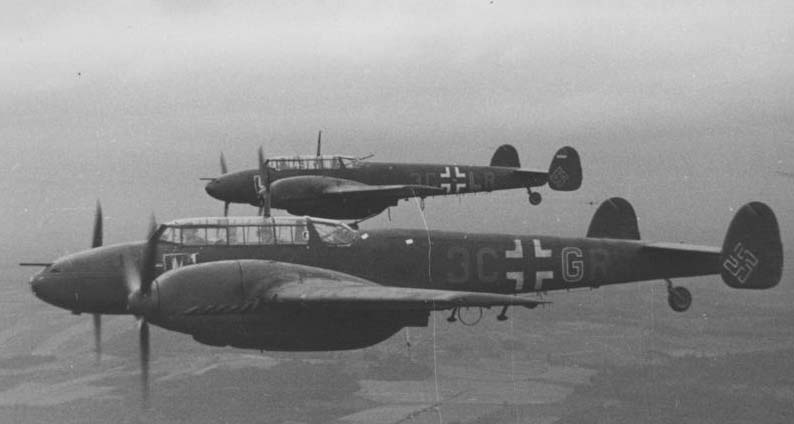
The fighters were the Messerschmitt Bf110, a rather slow aircraft for daylight use which would eventually finish up having to be escorted by better performing fighters:

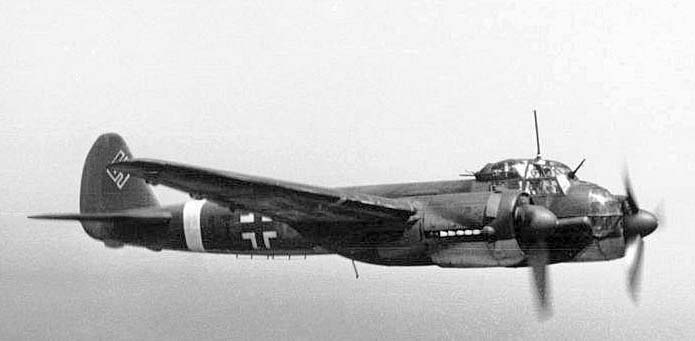
This is the Junkers Ju 88, a twin engined and very versatile aircraft which was arguably, a competent Bristol Blenheim or a poor man’s De Havilland Mosquito:

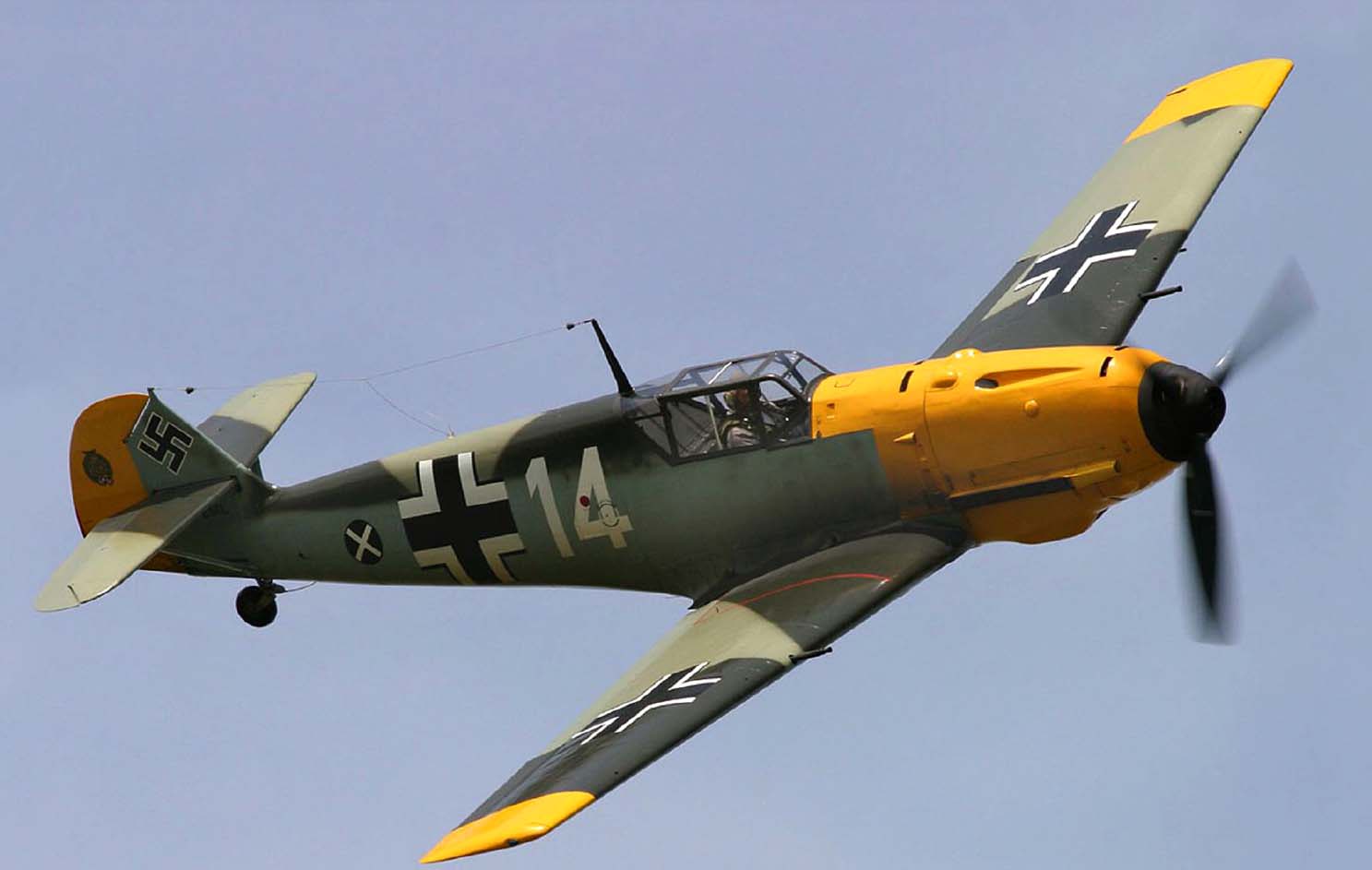
Last and certainly not least is the famous Messerschmitt Bf 109, a decent fighter, but an aging design which was prepared in response to a Reichsluftfahrtministerium specification of 1933. Bf 109s couldn’t carry enough fuel to fight for very long over Southern England. And a Spitfire, in theory, could always escape them by turning tightly inside them:

This slideshow requires JavaScript.

The Bf 109 at Hendon does not really allow you to stand back and get a decent general photograph. Here is one I found on the Internet. It certainly is a stunning photograph:

The Hendon individual is a Bf 109E-3 and it may have been painted as a yellow nosed member of Jagdgeschwader JG26, “The Abbeville Boys”. There must have been a little plaque in front of it, but I can’t remember what it said. Its detailed history can be accessed here.

And in the blue corner…….the Supermarine Spitfire. Here’s my effort at a picture:

As one writer said,

“It was one of the most beautiful aircraft ever conceived with elegant, flowing lines that make it look perfect from every angle.”

And the most stunning Spitfire ever was the Mark I or Ia or the Mark IIa.

This gallery of photographs comes from the Internet. With a little bit of luck, you should be able to see what I mean about a beautiful aircraft:

This slideshow requires JavaScript.

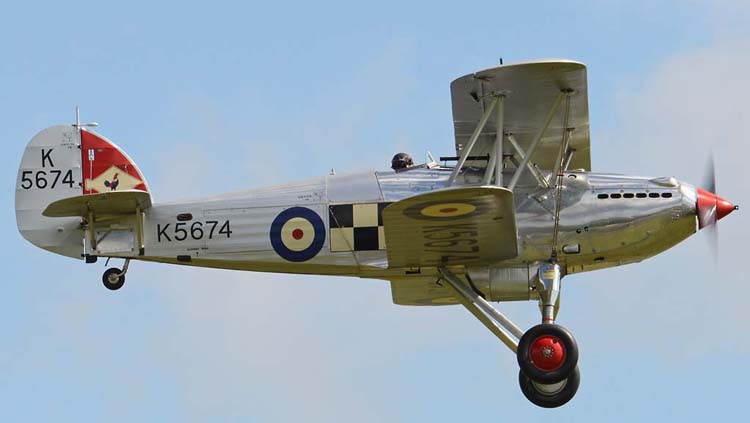
And there’s also a Hawker Hurricane, an aircraft which, as we all know, shot down more German aircraft in the Battle of Britain than the Spitfire. The scores were roughly 60% to 40%. The Hurricane was a design which looked backwards to its biplane ancestors, especially the Hawker Fury:

On the plus side the Hurricane was a lot easier to repair than its cooler cousin, the Spitfire. It was easier to make as well, 10,300 man hours rather than 15,200 for the Spitfire. And easier to make meant cheaper, of course. Here are my unworthy efforts:

This slideshow requires JavaScript.

And now some proper photographs:

This slideshow requires JavaScript.

And next time, the Old Nottinghamians make an appearance.


35 Comments

Filed under Aviation, History, Humour, Politics, The High School

The Battle of Britain (1)

We visited RAF Hendon on July 22nd 2010. It seems an age ago. Hendon is a fantastic museum, easy to get to from the M1 and FREE ENTRY. What is there not to like?

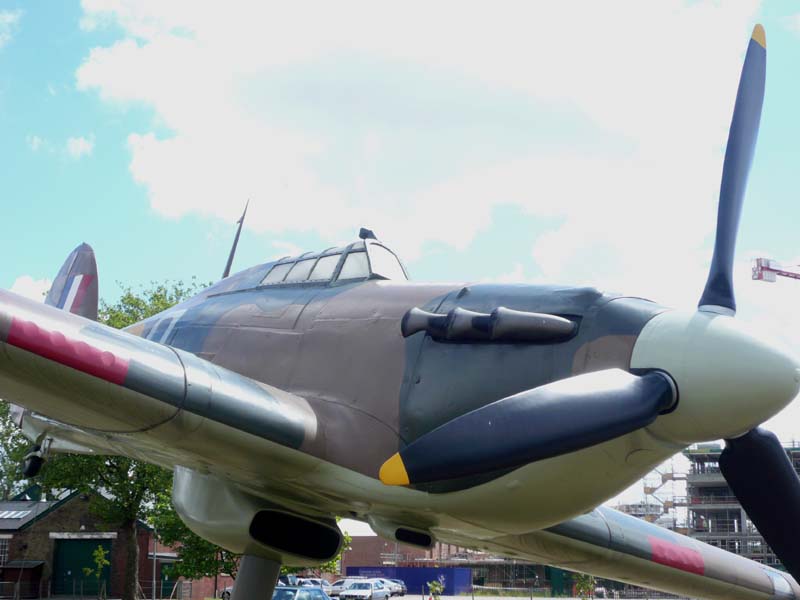
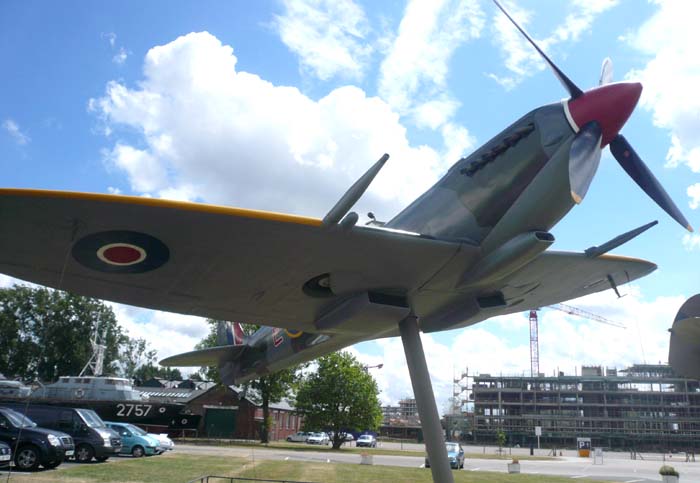
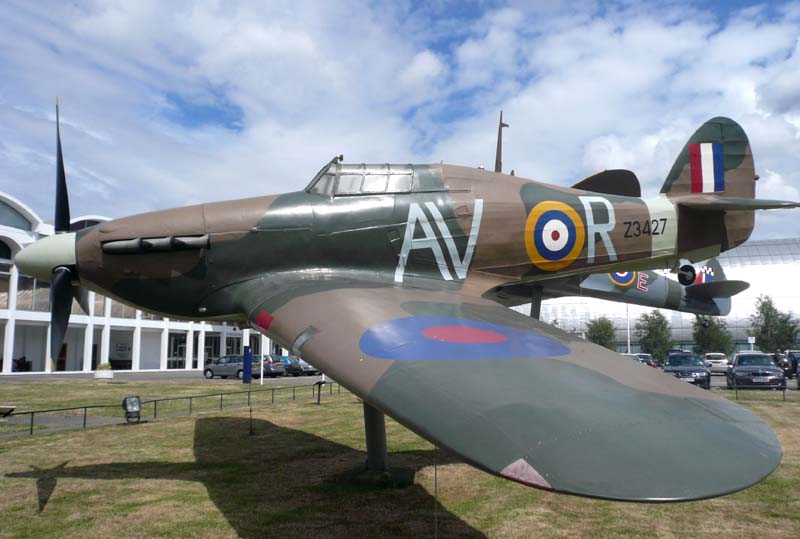
The first few photographs show the display outside the museum. One is a Hurricane and the other is a Spitfire. I’ll leave you to work out which is which. Here’s an aircraft with a cannon in each wing which, I think, means that it cannot have been a Battle of Britain participant:

Here’s another view of the very first aircraft:

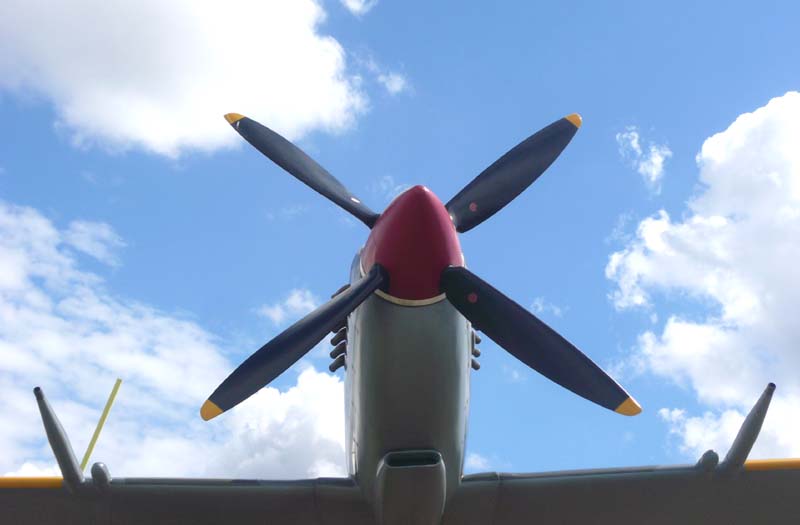
And the second aircraft again… This is as close as I get to that weirdo artistic sort of photograph:

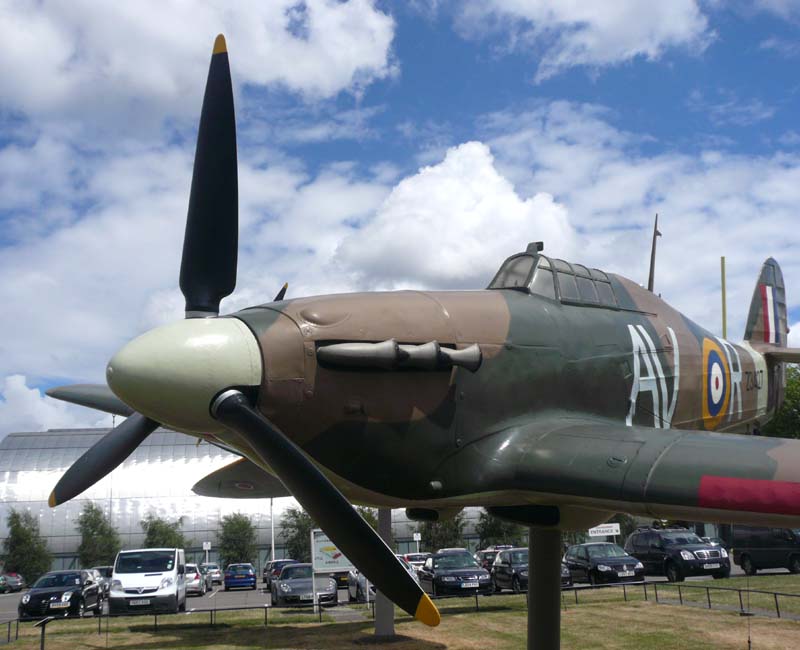
Here’s the last picture of aircraft No 1 and 3:

And here’s a free clue to the identity of this aircraft. American readers…”Sorry!”

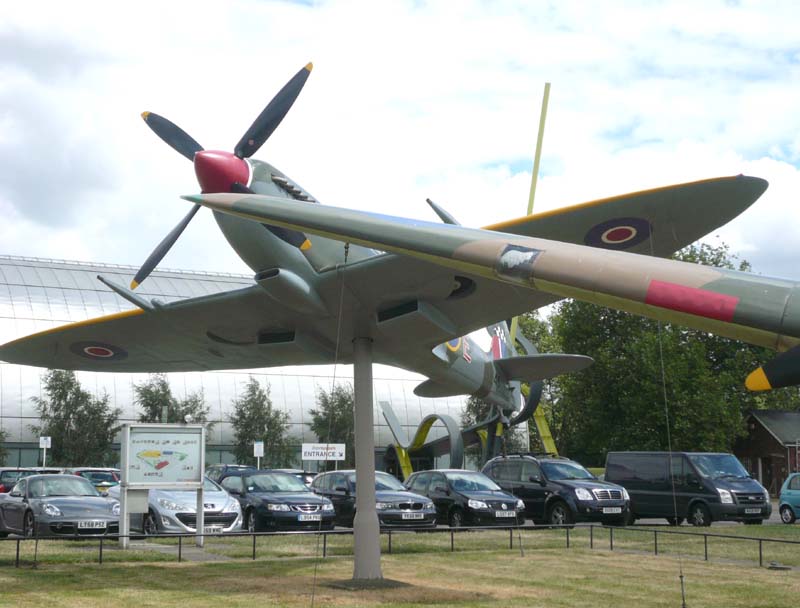
And here’s aircraft No 2 and 4 again:

Well, the odd numbers are the Hawker Hurricane and the even numbers are the Supermarine Spitfire, originally called the Supermarine Shrew. The way to tell them apart is that the Hurricane, or “Harry Kane” to give you the answer to the clue, has one huge radiator under the fuselage and the Spitfire always has two smaller ones, one under each wing.

It was months after our visit that I found out that both aircraft outside the museum were counterfeit. Made of plastic, apparently. The museum people don’t make that particularly obvious. I suspect that they’re scared that they’ll be killed in the crush of middle aged men who all want one for the front lawn.
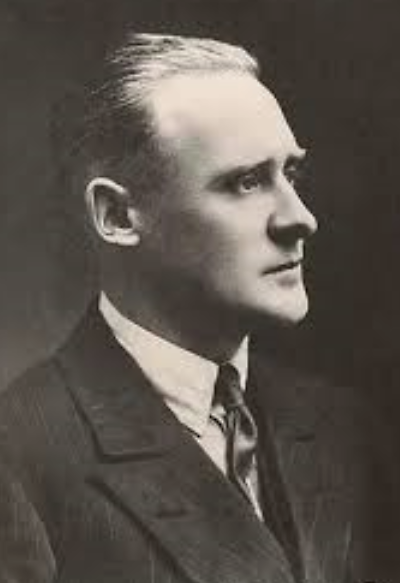
The Spitfire was, of course, designed by Reginald Joseph Mitchell who worked for Supermarine Aviation of Southampton. Here he is:

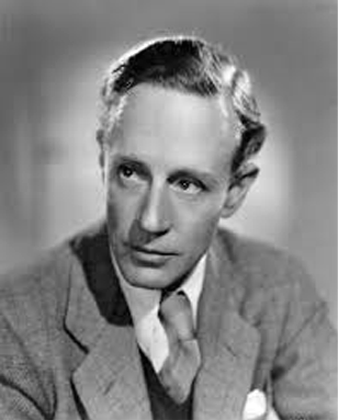
Many Germans could not separate RJ Mitchell from the man who played him in the film, Leslie Howard. Here’s Leslie Howard:

They could be identical twins, couldn’t they?

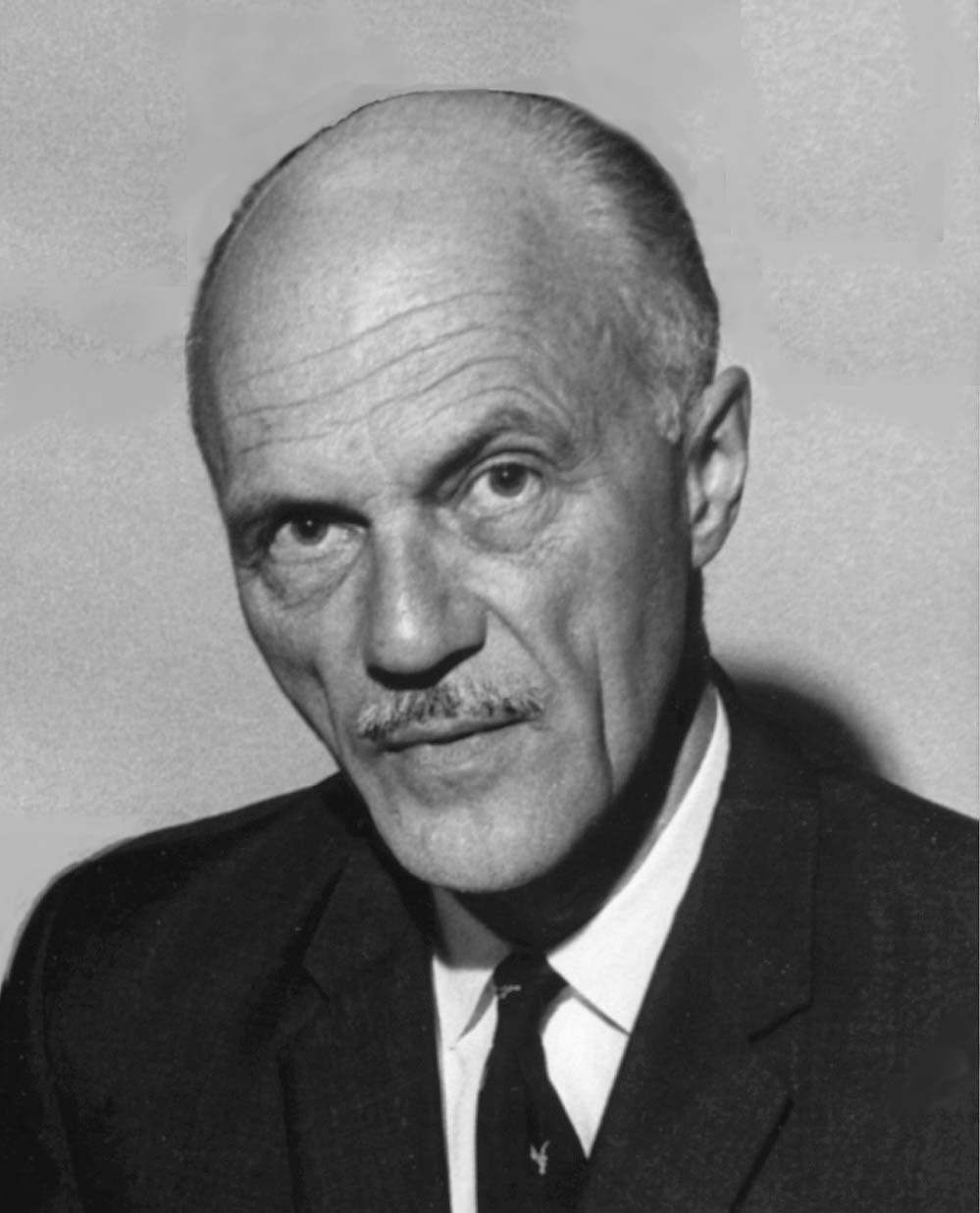
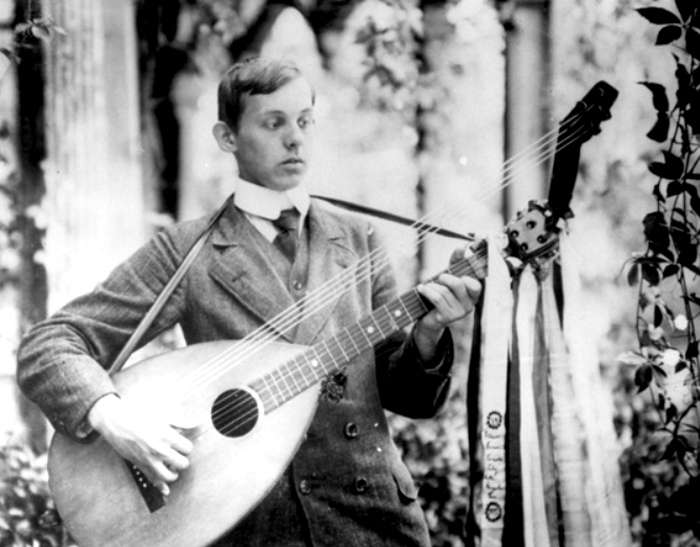
The Spitfire’s wing was of an innovative shape at the time. I didn’t know though, that there was a good deal of input from Beverley Strahan Shenstone, a Canadian engineer. Here he is. He isn’t in the film. The British  always seem to have kept Australians, Canadians and New Zealanders well out of their films:

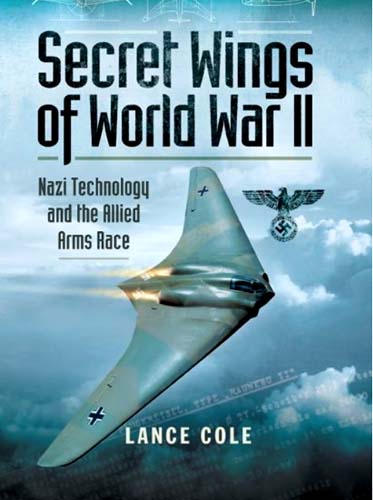
Beverley Shenstone studied in Germany under Hugo Junkers and Alexander Lippisch. I found this out in a marvellous book I read recently called “Secret Wings of World War II” by Lance Cole. Here it is. It’s an excellent book:

To quote the author:

“By 1932, Shenstone had authored several papers stemming from his German studies…he was soon employed by RJ Mitchell, Shenstone was the man who within four years had shaped the Spitfire’s ellipsoid wing, its wing fillet and many of its aerodynamic design features.”
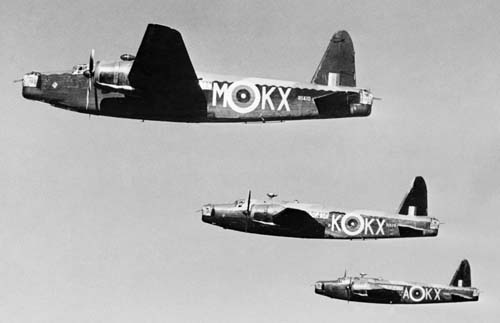
A wing fillet is the smooth curve between the fuselage and the wing. It improves air flow. It isn’t particularly obvious in the plastic Spitfire above but there will be a Spitfire Mark I appearing soon and it’s a lot more obvious on that aircraft.

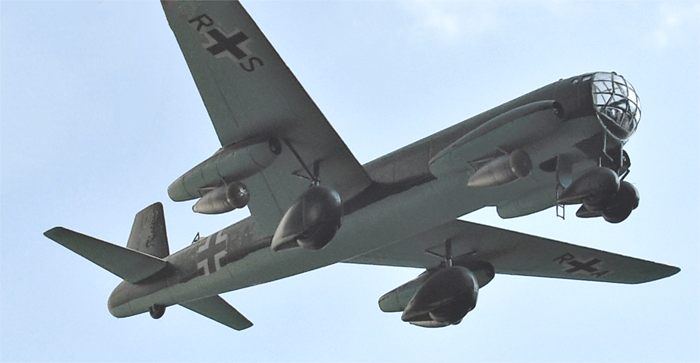
Hugo Junkers was beyond the cutting edge of aircraft design in 1945. This is his Junkers Ju 287 bomber with forward pointing wings. And yes, it flew perfectly:

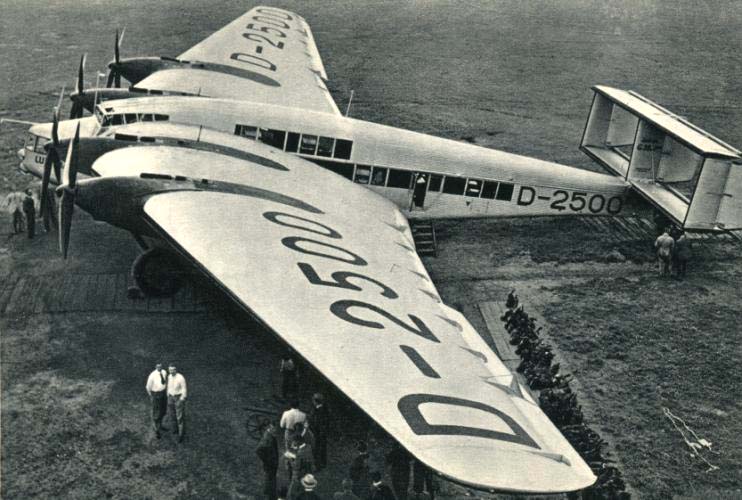
Even in the 1930s, his designs were astounding. Swept back wings with propellers:

 And a flying wing, the J 1000 Super Duck:

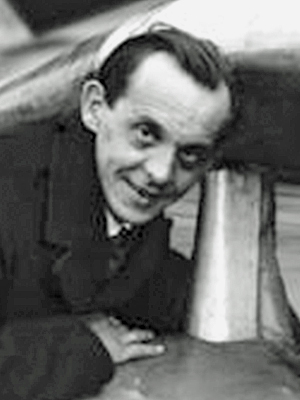
Alexander Lippisch was even better than Hugo Junkers. Here he is:

His first aircraft was not very good:

But after that, by the standards of 1940, WOW!

 The Americans are still flying around in his thoughts and ideas:

This slideshow requires JavaScript.


30 Comments

Filed under Aviation, History, Humour