Category Archives: Criminology

The Incredible Story of Frank Mahin, Volume III, 1921-1942

I have previously written three articles about Frank Mahin. The first recounted how he had carved his name on a stone fireplace in the High School:
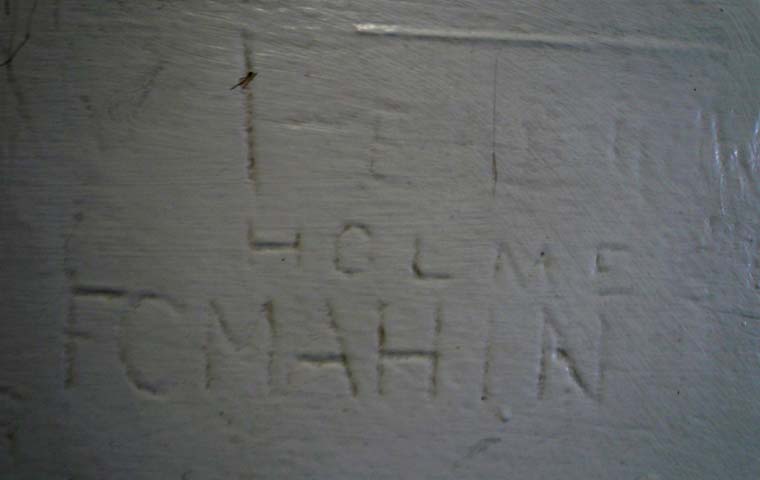
mahin cccccc

The second article had a title very similar to this present one, but it was called The Incredible Story of Frank Mahin, Volume I, 1887-1909.

After that, I wrote the next one in the series, imaginatively entitled The Incredible Story of Frank Mahin, Volume II, 1908-1920.

And now, Dear Reader, The Incredible Story of Frank Mahin, Volume III, 1921-1942:

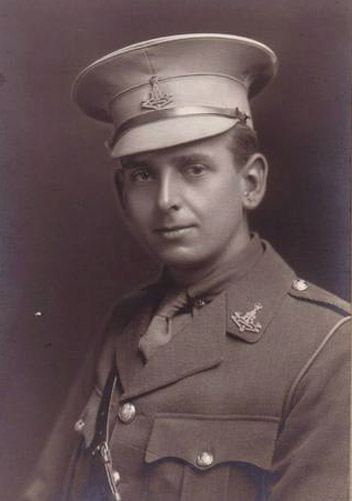
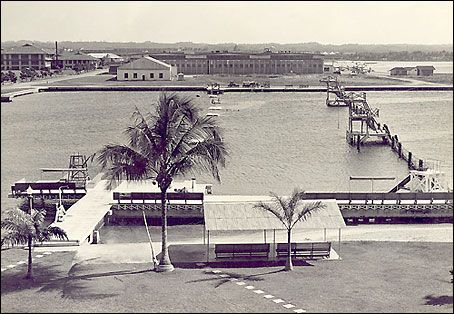
A survivor of the horrors of the Great War, Frank Cadle Mahin immediately resumed his formal military studies.  By 1925, and now promoted to Major Mahin, Frank was a “distinguished graduate” of the Command and General Staff School . He was graduated from the Army War College in 1929 and then became acting Inspector-General of the Panama Canal Department:
TTE_14_Panama_locks-2

I do not know if Frank was available to attend the 25th annual reunion of the Class of 1909 at his old “Alma Mater”, Harvard University in June 1934. Hopefully, if he did, Frank was not there to renew his friendship with Ernst Hanfstaengl, the Harvard graduate, personal friend of Adolf Hitler and the man who took his book, “Mein Kampf”, to the top of the German bestseller lists. According to Wikipedia, Ernst Hanfsteangl also:

“helped to finance the publication of the NSDA’s official newspaper, the Völkischer Beobachter. Adolf Hitler himself was the godfather of Hanfstaengl’s son Egon. Hanfstaengl wrote both Brownshirt and Hitler Youth marches patterned after his Harvard football songs and, he later claimed, devised the chant “Sieg Heil”.”

In 1923, just over ten years before the reunion of the Class of 1909, after the failure of the Beer Hall Putsch, a wounded Adolf Hitler had fled to “Putzi” Hanfstaengl’s house in Uffing, a village a short distance outside Munich. Supposedly, Mrs Hanfstaengl managed to dissuade Adolf from committing suicide, when the police came to arrest him. (What a difference that might have made to the world!).

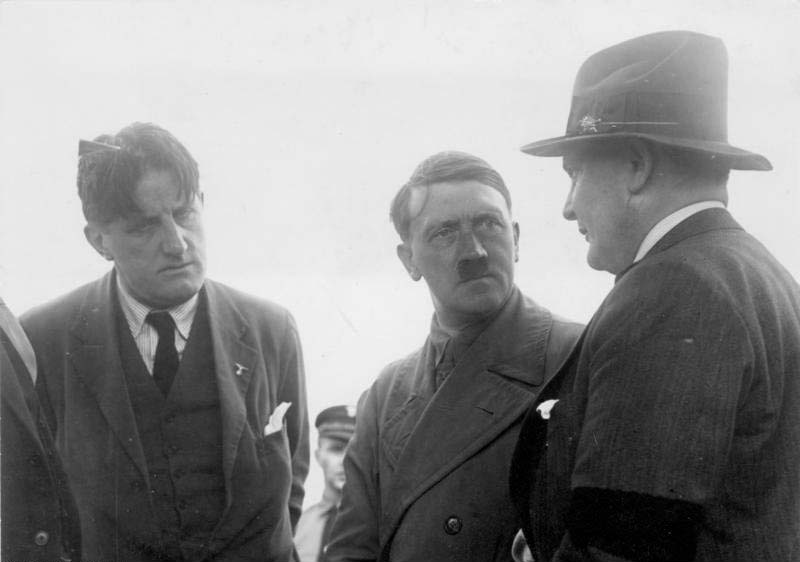
As you might imagine, at Harvard in 1934, there was a certain kerfuffle about this gentleman and his anti-Semitic views, and here are two websites where you can read about these events. Meanwhile, here’s “Putzi” chatting to a couple of his pals about the games in the next round of the German Soccer Cup. “Putzi”, on the left, is happy to play as goalkeeper, Adolf demands to be team captain as his inalienable right and new team signing Hermann Göring promises to lose fifty kilos and play up front, probably on the extreme right:
Bundesarchiv_Bild_102-14080,_Berlin,_Hitler,_Göring_und_Hanfstaengl

In 1937, Frank was placed in command of the 3rd Infantry Division, nicknamed the “Rock of the Marne”, soldiers who were later, in November 1942, to land with General Patton’s task force on the coast of Morocco:

3_Infantry_Div_cccccc

They eventually overwhelmed the French Vichy defenders, in a highly contested amphibious landing, French fascist traitors v the Americans!
In 1939 Frank organized the 60th Infantry Regiment, the “Go Devils”, commanding them until October 1941, when he was promoted to Brigadier General:

60_IR_Coat_Of_Arms

The “Danville Bee” newspaper in Virginia carried a report of army war games played on June 6th 1941:

WAR GAMES
BRAGG DIX UNITS MOVE INTO BATTLE
Red Forces of South Pitted Against Outnumbered Northern Blues
By JOHN DAFFRON BOWLING GREEN
June.  A 14 mile no man’s land in northeastern Carolina soaked only by rain and reddened by of the north and south (sic) moved into bloodless battle today. At war technically since 5 p.m. yesterday when Second Army Corps Headquarters gave the word, the red forces of the south from Fort Bragg North Carolina pitted their motorized might against the three and a half to one superiority in manpower of the northern blue from Fort Dix New Jersey. There were 75 observers from the General Staff in Washington alone who with many other officers from the 28th and 29th divisions and the Second Army Corps staff moved out onto the battleground to watch the new army perform in modern manner. Planes of the 119th  Observation Squadron from Newark New Jersey scouted the camouflaged position of the Ninth Division southerners In the woodland five miles east of here while flying observers from Bragg based at Richmond droned over the men of the north encamped around Rappahannock Academy Virginia. Northern planes were based at the Quantico Marine Base Virginia. As the units jockeyed for position and closed the separating gap over ground rich in Confederate war lore only one major factor separated the impending battle for Garand and Springfield rifles held blanks in their cartridge clips and the artillery loads were not capped by shells. The khaki clad southern forces wearing red arm bands were under command of Colonel F. C. Mahin. They included the 60th Infantry Battalion Company of the Ninth Medical, one platoon of Company C, 15th Engineers, one section of the Ninth Signal Corps and the second squadron of the Third Horse Cavalry from Fort Myer leant to the Ninth Division for the maneuvers. Northern forces under command of Major General C R Powell comprised the entire 44th Division. They wore blue fatigue uniforms for battle dress. They slogged over terrain made muddy and heavy by several days of sporadic rain. Ironically they moved through woodland blackened by the fires that swept Caroline county forests during the prolonged drought which was broken only last week.”

Frank became a Major General after assuming command of the 33rd Division, nicknamed the “Illinois Division” or the “Prairie Division” at Camp Forrest, Tennessee in May 1942:

33rd_Infantry_Division_SSI_svg

Before his appointment, he had been assistant commander of the 45th Division, called “The Thunderbirds” at Camp Berkley in Texas:

600px-45thIBCTSSI
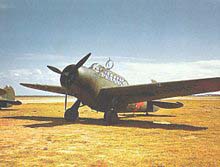
Sadly, on July 24, 1942, the apparently very capable Frank Cadle Mahin and two Army flyers were killed near Waynesboro, Tennessee in the crash of their Army observation plane, a North American O-47, Serial number 37-337. The official report said that the casualties perished as a result of a forced landing caused by engine failure. This explanation bears out the researches carried out by Frank’s wife, Mauree Pickering Mahin (see below).  Here is a North American O-47B of the 112th Observation Squadron, Ohio National Guard. It is preserved in the National Museum of the United States Air Force:

800px-North_XXXXXXXXXXX

This is an O-47B painted for the army manoeuvres of June 1941, detailed in the report of the “Danville Bee” newspaper above. The insignia on the fuselage shows that the aircraft was hastily painted as a member of “red force”:
220px-North_American_O-47B_1941

The fatal crash was reported as faraway as Perth, Western Australia, in their local newspaper, “The West Australian“:
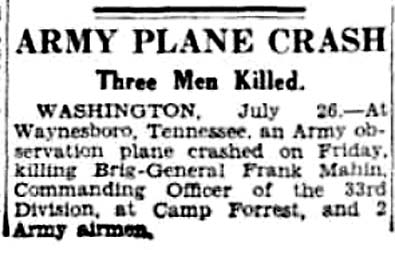
newspaper

Frank’s death was also reported on the front pages of local newspapers:
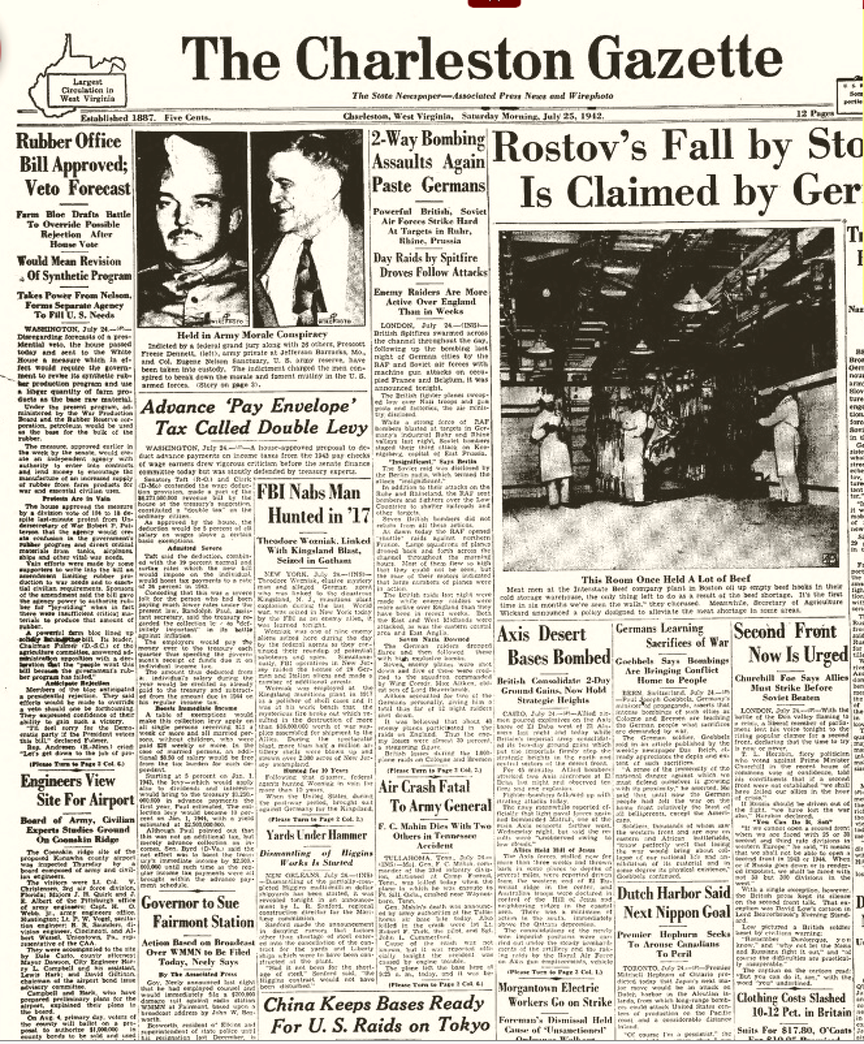
newspaper reoport cccccc

Mrs. Walter Brewer, wife of the Wayne County Sheriff, said:

“The plane struck a tree five miles west of here, but did not burn”.

The three occupants were en route from Tullahoma to Fort Sill, Oklahoma. An Army official identified the two others killed as the pilot, Second Lieutenant Robert F. Turk of Wichita, Kansas, and a second passenger, Sergeant John Camerford of Alamo, Texas, both attached to the 127th Observation Squadron, nicknamed the “Jayhawks”, at Tullahoma:

127th_Observation_Squadron_-_Emblem

The 127th was a non-flying squadron operating the Distributed Common Ground System.
Frank’s wife, Mauree Pickering Mahin tells the harrowing tale in her autobiographical “Life in the American Army from the Frontier Days to Army Distaff Hall” :

“I had just fallen asleep when a knock came at the door and I saw Anna and Ernest come in so I knew something was wrong when I looked at their faces! I asked “Is it Dad?” and they both nodded “yes”. “Is he dead?” and again came the same reply. After a few minutes I said: “I think it’s better this way, as it is the way he would want to go; your dad was too intense a man to stand being incapacitated. Did it happen at Fort Sale?” Then Ernest spoke up: “No, Mother it happened at 10.30 this morning, in the mountains near Waynesboro, Tennessee.”

Mauree did her own research about the circumstances of the crash:

“The falling plane was seen by a man traveling on the road nearby, and he knew the terrain around there and was afraid the plane could not land safely any place, so he rushed to the scene and found all three occupants dead. He very quickly notified the Waynesboro Police and they notified the Camp Forrest Air Base. Then the Police immediately came out and picked up the three bodies and sent them on to Camp Forrest.

“And why did the Air Force cancel the Major’s promise to Dad that he would send Dad in his official four engine plane? No adequate explanation was given, and only a two engine plane was supplied. Dad’s chauffer remarked afterwards, that the engines sounded so terrible that he did not think the plane would ever get off the ground!”

Relatively few Old Nottinghamians have ever been murdered, and even fewer have perished as the result of a treasonous act:

“Not too long after that there was another similar accident from there, and an investigation revealed that one of the men who worked on both of those planes admitted he had done something to the engines of both of those planes, thus this was a real case of sabotage!”

I have not been able to trace what was done to this evil saboteur, but in most countries during time of war, the penalty would automatically have been death.

A memorial service was held for Frank at Camp Forrest, Tennessee on Saturday, July 25th, and then the family left for Washington later that afternoon. The interment in the National Cemetery at Arlington was on Tuesday, July 29th.
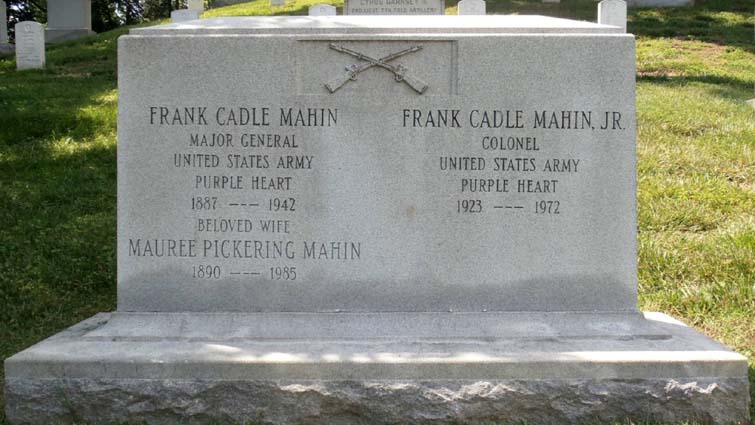
double grave xxxxxx

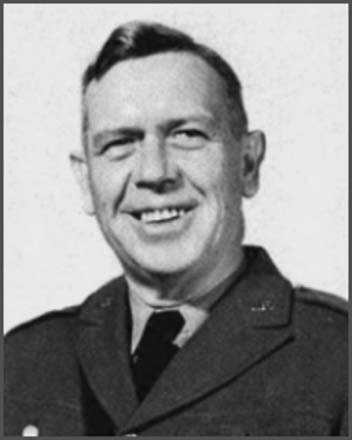
Major General Mahin is buried side by side with his son Colonel Frank Cadle Mahin Junior, a graduate of the West Point Class of 1944. The Major General is also commemorated in the Memorial Church at Harvard University. There is a list of the Harvard men who died in World War II, carved in stone on the wall at the right side of the church when facing the altar. There are ten columns. Frank has some very famous colleagues in this list, and it is very difficult to believe that he did not know them, given what must have been their common interest in all things military, and the fact that he, like them, was studying Law.
Since the High School was to abandon football at Christmas 1914, by his tragic death, Frank therefore became the only High School footballer to die during the Second World War. He is the only Old Nottinghamian to be awarded the Purple Heart and the only one to be interred in the National Cemetery at Arlington. I would also argue that Major General Mahin is the highest ranked Old Nottinghamian of all time.
His wife, Mauree, wrote this fitting epitaph:

“Thus ended thirty two years of faithful service given by a true soldier to his country. No soldier could have had a greater devotion to duty than did your Dad, and no matter where that duty called him he responded instantly. He died “with his boots on” which is exactly what he wanted to do!!
Mahin_Frank_Cadle

Incidentally, I believe that Mahin’s surname was pronounced “Marr-hin”. Certainly at West Point his son was often teased by his fellow cadets who all called him “Ma-Heen”.
10 Comments

Filed under Aviation, Criminology, History, Nottingham, The High School

The Beast of the Vosges

The Beast of the Vosges is a fairly recent monster to rampage through the French countryside and it has a very different flavour from the Beast of Gévaudan, the Beast of the Cevennes, the Beast of Trucy or the Beast of Sarlat. Its victims, for example, were not human beings but rather livestock, much like the modern monsters of the USA such as the Grassman of Perry County, Ohio or the Devil Dog of Logan County, West  Virginia.

And there were more than just one Beasts of the Vosges. The first struck between 1975-1977 and the second reared his enraged, ugly head from 1994-1995.  And then a third Beast appeared as recently as 2011.

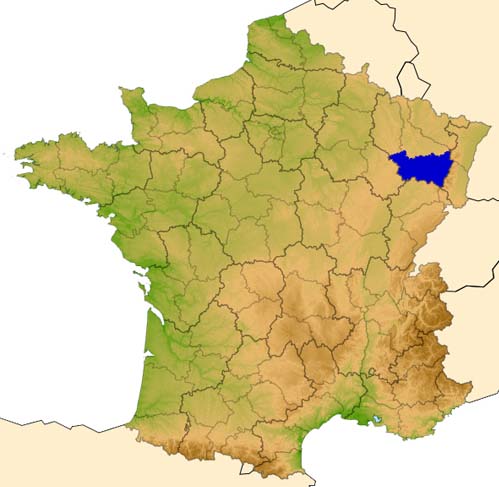
But first, some geography. The Vosges are in the east of France:

carte_francezzzzz

They are mountains which are much lower than the Alps and they do not have the same snow capped peaks. They are more rounded, with conifers and moorland:

SNV84400 zzzzzzzzzz

While not a top tourist destination, the Vosges are famous for their savoury cuisine and their beers, both of which look towards Germany and the east for inspiration.

For the Beast, once again, I will look at a number of French cryptozoological websites and you can take your own average between them. “Vampire Dark News” says:

“The “Beast of the Vosges” is one of the favourite topics of discussion for residents of the local cafés. Everyone remembers the ravages of this strange creature from 1977 to 1988.(these dates differ from other sources).  It killed more than 300 animals, between Epinal and Bresse (an area of over 150 square kilometres).  Poultry houses were attacked, horses were injured, at least 200 sheep were slaughtered … but there were no attacks against human beings.

La_bete_des_Vosges zzzzzzz

The animal would disappear only to reappear later and begin its misdeeds all over again. Was it a wolf?  A rabid dog?  Several stray dogs?  An animal trained to kill?  The mystery was never solved because nobody ever managed to get a really good look at the beast, neither hunters nor the police nor the military despite 26 hunts being  organized to kill it.  The Beast was able to avoid all the ambushes and all the traps.  Shot at several times from fairly closely range, the animal was never wounded or identified. The only conclusion was that it was some sort of canid.  And because of this, stray dogs were killed everywhere.

And then in 1994, a she-wolf that attacked flocks of sheep was saddled with the nickname of the “Beast of the Vosges”.
1994

It was filmed by an amateur and was active for several months before being found dead in 1995. Protected by a Decree of the Ministry of the Environment, the protected animal could not be hunted, at least officially.  But who buried the remains which were found in early 1995?

The name of the Beast of the Vosges was later given to a type of lager produced in the Vosges area.”

(My own translation)

This slideshow requires JavaScript.

Wikipedia adds a few more details:

In December 1975, at Rambervillers, forest workers noticed footprints of a carnivore that they could not identify. In March 1976 , in Domèvre-sur-Durbion, seven cattle and a number of sheep were found slaughtered.  A few days later, cattle were the victims at Moriville and sheep at Hadigny-les-Verrières.  They accused the Beast of attacks on poultry sheds, of  injuring horses and of slaughtering at least two hundred sheep. No attack though was made against human beings  After a final attack on sheep on June 2, 1976 , nothing more was heard of the animal.
A few years later, in 1994 , a female wolf was given the nickname of the “Beast of the Vosges”.  For several months it maintained its attacks on  flocks of sheep, before its remains were found on May 19th 1995 .
In 2011, after an absence of some 17 years, the Beast again attacked flocks of sheep in the Vosges in the village of Ventron; forty sheep were found dead in less than a month.”

(My own translation)

Another well known cryptozoological website adds some extra, more scandalous suggestions :

“It all begins with a report on February 6th 1977 when Lucien Baret, a Federal Guard, is the witness as the beast stalks a roe deer in the woods at Rambervillier. It is some kind of enormous wolf-dog which hunts in the open without making the least noise. And then in less than ten months, not far short of 62 sheep, two lambs and a bullock weighing 300 kg have their throats cut out, and more than a dozen cattle are attacked.

canadien

What seemed at first sight to be a mere footnote in a newspaper, just mentioning  feral dogs, now becomes transformed into an affair with a monster where everybody has their very own something to contribute. First of all the talk is of a wolf or a dog or a lynx. And then suspicion turns to human beings. Fingers are pointed at certain people, but the favourite is Herr Reinartz, the owner of a vast estate which partially covers sections of a more ancient hunting ground, the most frequently hunted area in the region. Furthermore this German industrialist is not particularly lucky because he has a name very like that of a Nazi colonel, Colonel Reinardt, who committed atrocities in the region during the Second World War, only thirty years previously. This is a similarity which fans the flames of old hatreds. Present day Monsieur Reinartz fears for his life. Has he imported a couple of wolves to guard his estate, but then they have escaped, as certain people claim? Certainly not. A wolf only attacks in certain conditions and these were not fulfilled here. The estate of Monsieur Reinartz being a hunting ground, the wolves would have had more than enough to eat without having to go beyond their enclosures in search of what they already had in their cage. A large cage covering several hectares but a cage nevertheless.
And against all expectations, the press goes wild. The German industrialist is attacked. Abuse is heaped upon him. He is insulted on the front page of certain newspapers. The affair goes to court. Had he been of another nationality, things would probably not have degenerated in this way. None of this, though, stopped flocks of sheep being ripped to pieces by the teeth of the beast:

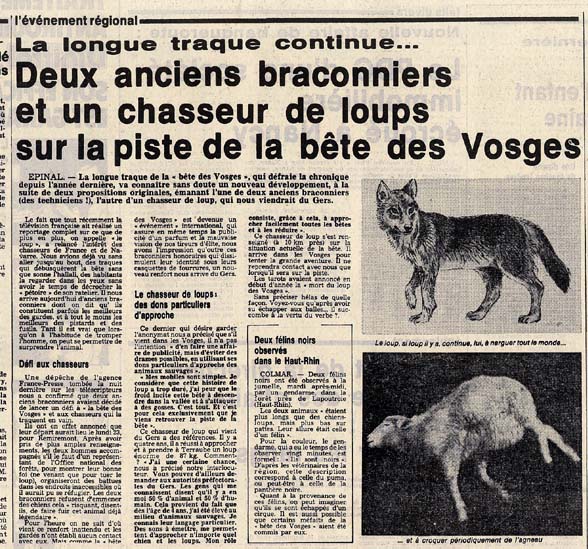
nespapere zzzz

And then one day, roughly one year later,  everything just stops. No more massacres, no more animals to put out of their misery in the first light of morning. As mysteriously as it appeared, the Beast of the Vosges disappears. It flies away. All of this, of course, without anybody really understanding at all why. But after its disappearance, the Beast leaves lots of unanswered questions, and even 32 years later, tongues will not be loosened. There are a few clues perhaps, and doubtless some details are completely true, but the people who know, or who think they know, just add to the legend. One can well imagine what will have been written about this Beast in 210 years’ time when other people look at this business, in exactly the same way that we nowadays look back at the Beast of Gévaudan. How many arguments there will be in future generations between all the different viewpoints !
It is impossible not to see in this business numerous similarities with the Beast of Gévaudan. The same black magic seems to protect the animal which escapes through the fingers of the hunters on every single occasion . Beats are organised, but with only the same effectiveness of those of Duhamel in 1765, despite the fact they are now carried out with methods which the eighteenth century could not possibly have imagined. One day the Beast of the Vosges manages to escape its pursuers because one of the hunters is not at his post. A strange reminder of the indignation felt by the noblemen at Malzieu in 1765 when the Beast of Gévaudan was similarly allowed  to escape its pursuers because a guard was not in the correct place. And as one thing leads to another, people realise that this affair is not, in actual fact, very different from that of the Beast of Gévaudan. There are no human victims to pity, of course, but the chain of events is a mechanism which remains essentially the same for both affairs: first of all, people want to put things into perspective: it’s just a wolf. Everything will soon be taken care of. Then, as the Beast evades beats, traps and poisons, it becomes a tool of vengeance. In the Gévaudan of the eighteenth century the Bishop of Choiseul Beaupré sees the Beast as the avenging arm of God. In 1977, in the Vosges, it soon turns into a dog, radio controlled from some distance. But nobody will say a word about it. Nobody?”

 (My own translation)

This same website, and many others, contain the only three known photographs of the Beast of the Vosges. They prove it, apparently, to have been a canid of some sort, but not definitely a wolf. The account concludes with:

“always this question comes to everyone’s lips: the Beast, what was it? I asked Daniel Jumentier, who was present when the photos were taken, and he himself saw the Beast from afar

aa bete des vosges 1

The animal was probably a wolf dog cross, first or second generation, weighing at least sixty pounds.

vosges_02

It was released to attack herds and flocks to hurt their owners.  Vengance between men, but through the intermediary of animals.  We can see two periods in the attacks: at first the Beast is confined to attacks on the plain, but then goes beyond La Bresse (a mountainous area) where it then goes wild. According to Daniel, one reason for this fit of madness: the loss of its master.”

And of course, unless somebody suddenly decides to speak up and reveal some hitherto hidden secret about this creature, we have reached the end of our investigation. Here some films to keep you going. The ancient ones date back as far as 1977, when Mankind’s existence was only occasionally slipping into colour:

And here is the second:

And this one shows that even a third comeback is not necessarily excessive:

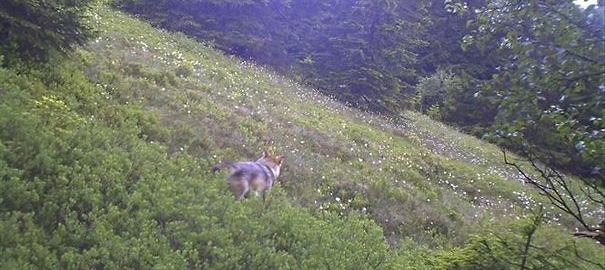
There will be no more Beasts of the Vosges though. The Grey Wolf has now officially returned to the Vosges Mountains, thanks to the conservation efforts of a number of countries in the European Union, including Spain, Italy and Germany. Indeed, the Beast in 2011 was most probably one of the first two wolves who arrived in the Vosges that very year.  “Smile, you’re on Trailcam!”:

ATTAQUE DE LOUP


26 Comments

by | June 10, 2015 · 2:15 pm

Ancient initials carved a century ago

In the High School, there is a much vandalised stone mantelpiece over an old fireplace on the ground floor. Boys have carved their names on it well over a hundred years ago and the letters are only just beginning to disappear into the thick levels of gloss paint now used to cover the original stone. The fireplace is located between the General Office and the entrance to the Assembly Hall, so literally thousands of boys will have queued past it as they go into Morning Assembly.

On Wednesday, January 18th 1899, Thomas Ignatius Joseph Gillott entered the school. He was to leave during the course of his fourth academic year, in July 1902. Sadly Thomas died on Sunday, July 6th 1913, after a failed operation at the London Hospital. On that same day in 1899, his brother Bernard Cuthbert Gillott, also entered the school. He was destined to remain a pupil only until the end of that academic year and he left in July 1899. With the advent of the Great War, Bernard was to join the army, where he served as a Captain in the 6th Northamptonshire Regiment. A brave man, he won both the British Military Cross and the French Croix de Guerre. Eventually he was  severely wounded, but thankfully he survived, and he was invalided home to England.

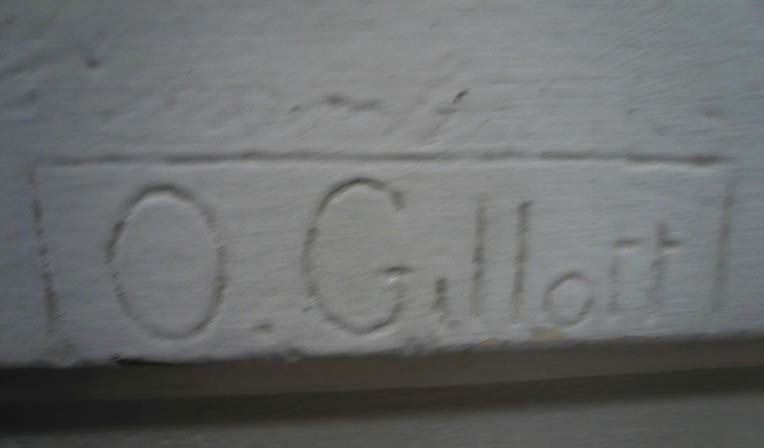
On Tuesday, September 12th 1899, the youngest of the three brothers, Oswald Cornek Gillot entered the school aged nine. Oswald was born in Ripley on July 22nd 1890 and his father was Thomas Gillot, M.I.C.E., a civil engineer whose address was given as either, Upland House, Eastwood, or Langley Mill near Ilkeston.  Possibly towards the end of the Summer Term, 1905, Oswald carved his name on that extremely popular stone mantelpiece on the ground floor fireplace between the General Office and the Assembly Hall. Oswald left the High School in March 1907.

Gillott ccccccccc

Taking decent photographs of these carved signatures has in actual fact, proved extremely difficult. They are located on the northern side of the school where the usually tropical English sun does not often penetrate,  and they are surrounded by vast thick walls of stone and brick, with a singular lack of windows. This means that the whole area is more or less permanently dark from a photographic point of view. Added to this is the fact that in the century or so since these interesting acts of senseless vandalism were carried out, a succession of school caretakers, under the almost inhuman management pressure to hurry up that all school caretakers permanently face, have repainted the mantelpiece with a succession of layers of whitish gloss paint, all of them applied without having the time to remove the previous one. The stone therefore, now wears a building’s equivalent of an inflatable Sumo suit.
Consequently, I have been forced to Photoshop the pictures I took so that the now faint carvings stand out a little more clearly from the dimly lit and pale coloured background. One unfortunate young man, R.Salew, has proved completely impossible to conjure out of the camouflaging layers that now hide his signature. But he is definitely there.
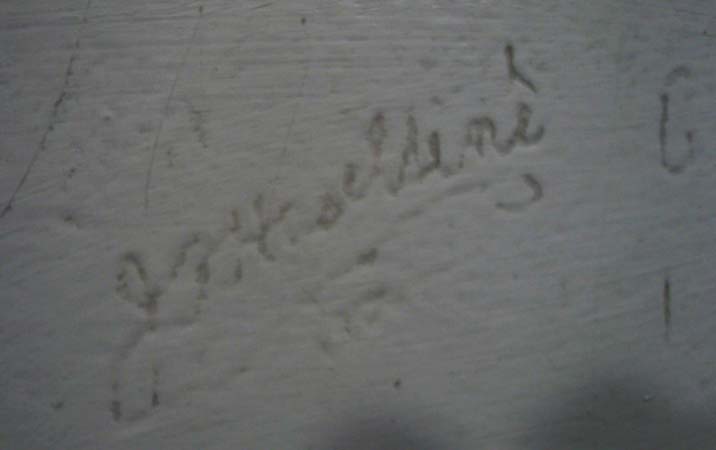
Towards the end of the Christmas Term, 1904, John Francis Haseldine carved his name, in rather florid handwriting, on that same stone mantelpiece.

haseldine cccccc

John was born on December 28th 1886 and entered the High School on May 4th 1896, aged nine. His father was Frank Haseldine, a lace manufacturer of St.John’s Grove, Beeston. John was a very good footballer (soccer player), and made his début for the First XI on Wednesday, March 26th 1902, in an away game against Loughborough Grammar School. We know that the school’s best player, J.B.Sim, worked hard throughout the match, but, according to the School Magazine of the time,“The Forester”, he was “too carefully watched” by the Loughborough defence, and the game was lost by 0-2. That particular spring, John had been in the team which had won the Football Sixes, a six-a-side competition organised within the school by the boys themselves, with the teams all drawn out of a hat. It was taken, of course, extremely seriously. Coincidentally, the winning team’s captain was that very same J.B.Sim, who was a well-known High School footballer of that era, with more than fifty appearances for the First XI.
On Wednesday, February 14th 1903, John scored his only goal for the school, in a 4-1 away victory over Mansfield Grammar School, “a rather poor and one-sided game”. As an ever present in the team, John won his football colours at the end of this season and was also awarded a “Standard Medal” for Football . In season 1903-1904, he became Captain of Football.  John spent the Christmas Term of 1904 at the High School, but, like so many boys during this period, he left half way through the academic year in December 1904.
In the Great War John was a Major in the Royal Engineers, Special Reserve. He was Mentioned in Dispatches on June 3rd 1916 and received the Military Cross on January 1st 1917. By 1929, he was living at Northdene, New Barnet, in  the northern suburbs of Greater London.
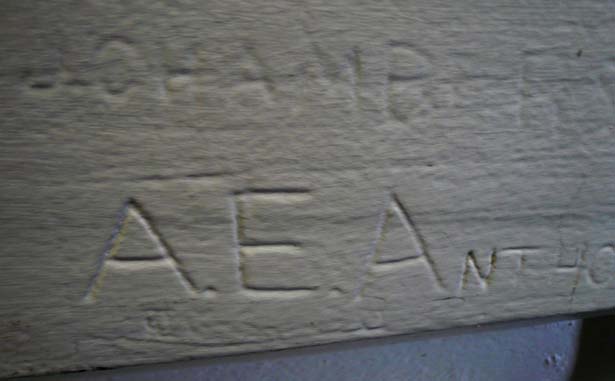
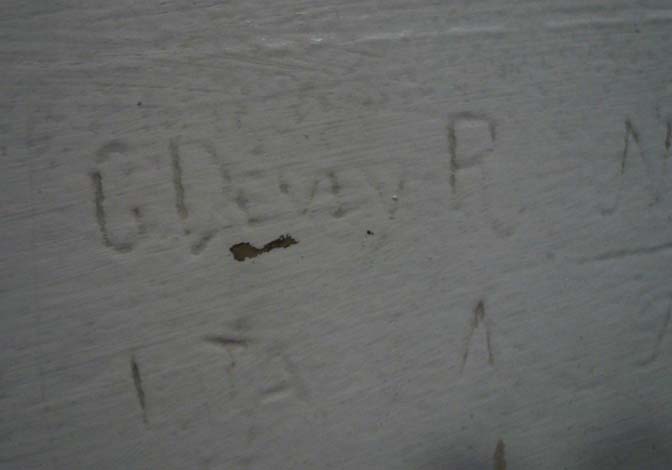
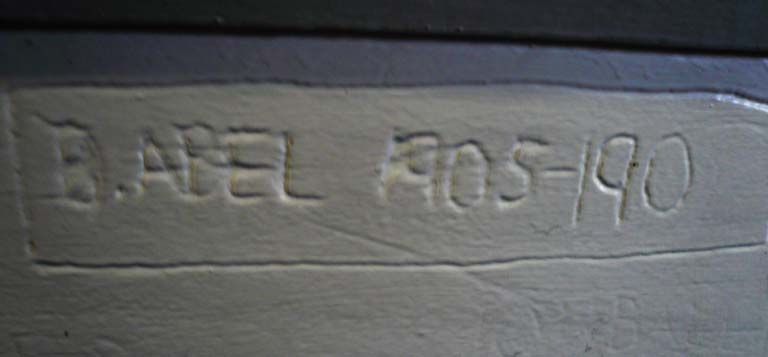
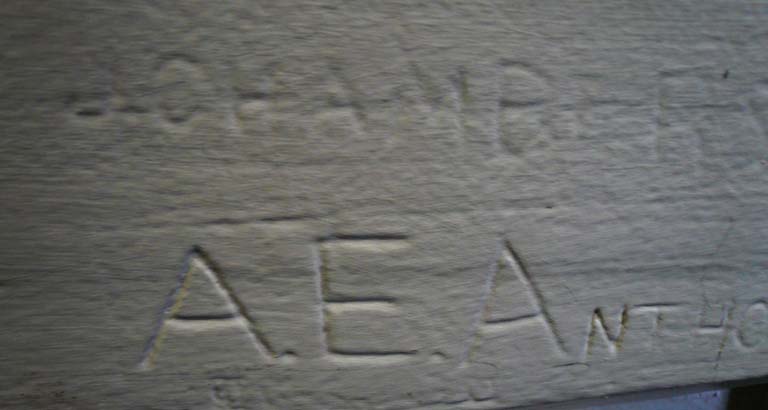
Among the other more legible carved names are “A.E.Anthony” and “G.Devey”. What is apparently “R.Salew” is also there, although there are many, many  layers of gloss paint to obscure the lettering of this particular name, and the photo has not come out because of this. Another seems to read “B.Abel 1905-190” as if the young man had been interrupted, perhaps by a Master (teacher), as he came towards the end of his carving, and then did not ever return to finish the job.

Alfred Edward Anthony was born on June 12 1906, and entered the school on September 18th 1918, aged twelve. His father was F.W.Anthony of 120, Radcliffe Road, West Bridgford. He was the Managing Director of Gotham Co Ltd (apparently sic). Alfred left the school in December 1922.

anthony 1 ccccccc

“G.Devey” was the elder brother of Reginald Devey, whose own name had already been carved on the fireplace upstairs, in the staffroom corridor, alongside that of D.H.Lawrence and L.S.Laver, the High School’s very own Latin Champion of the World.

r.a. devey cccccccv

This ground floor effort though, was Gerald Bertil Devey, who was born on June 10th 1903,. Gerald entered the school on May 27th 1918 at the rather late age of fourteen. His father was James Edward Devey, a civil servant, and the family lived at 22, Ebury Road, Sherwood Rise. Gerald left the High School in July 1919.

devey cccccc

John Rylett Salew entered the school on May 4th 1916, aged fourteen. He left in December 1918. John was born on February 28th 1902 and his father was Joseph William Salew, an “agent” of 19, William Rd, West Bridgford.

Bertram Albert Abel was born on July 31st 1889 and entered the school on September 13th 1905, aged sixteen. His father was William Jenkinson Abel, a clerk to the Nottingham Education Committee. The family lived at 99, Waterloo Crescent, and Bertram left the school in July 1907.

b abell ccccccc
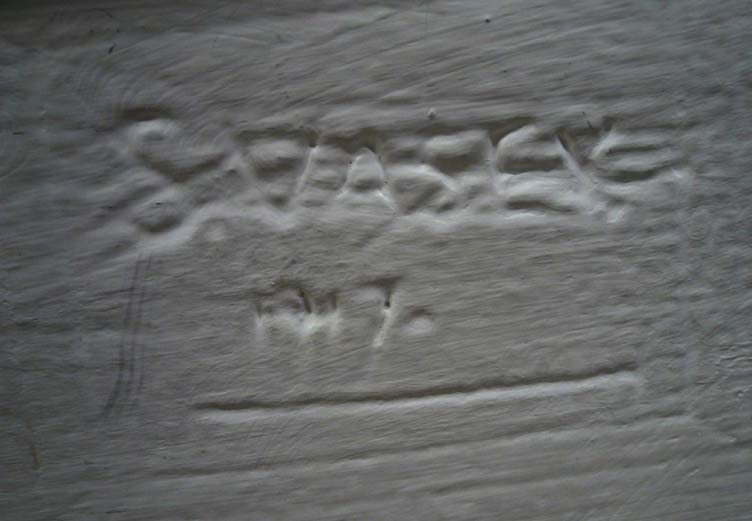
The fact that “S.Vasey” has carved his name in two different places on the stone, one of them complete with his own personal dates, namely “1917” and “1917-1922” shows not only that he had an extremely strong desire for immortality, but that, within the context of the High School, it has been fulfilled. He must have been a very swift, and fairly brazen, vandal.

zzzzz s vasey 1907

Stanley Vasey was born on June 5th 1905 and he entered the school at the age of thirteen, on September 18 1918. His father was Alfred Vasey, a shop inspector, and the family lived at 15, Glebe Road, West Bridgford. He left in December 1922.

zzzzzzzzzz vasey 1922
It is actually possible to best guess friendship groups among these carved names. Messrs Anthony, Devey and Vasey, for example, all joined the school in 1918. They all left in the latter half of 1922. They must surely have known each other. John Rylett Salew and Stanley Vasey both lived within a penknife’s throw of each other in the very posh Nottingham suburb of West Bridgford. Did the four boys seal their friendship by committing their names to the hard surface of that much painted fireplace ? Did three of them keep watch while the fourth scratched his name into the welcoming stone ?

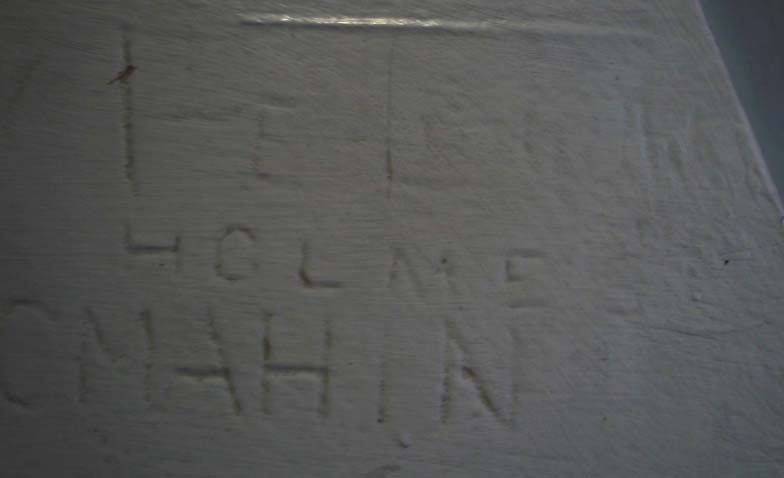
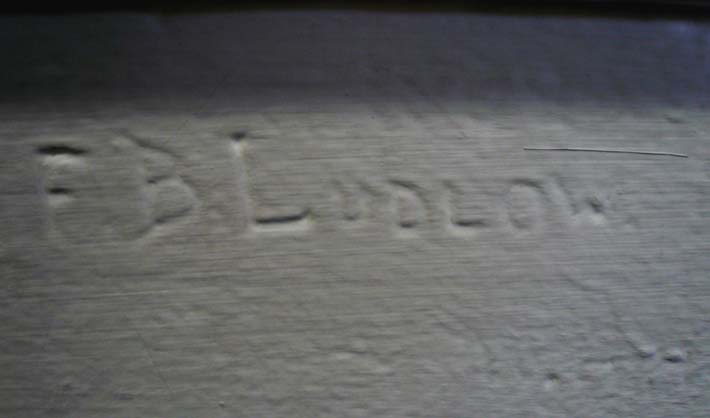
The other names on the fireplace, some of them extremely indistinct, include “F.B.Ludlow”, “N.G.Peet”, “Littler”, “Meigh” and “Holmes”. The latter was possibly the George Chudleigh Holmes who was a regular player in the First XI football team during the 1902-1903 season. Born on June 15th 1887, George entered the school on January 17th 1900, aged twelve. His father was George H.Holmes, a Lace Manufacturer of Gregory Street, Old Lenton. George left at Easter 1903, perhaps once the football season was over.

hiolmes 2 ccccccccc
Fred (sic) Ball Ludlow was born on April 28th 1891. He entered the school on May 1st 1900 aged  nine. His father was William Ludlow, a clerk in the Gas Depôt. The family lived at 10, Willoughby Avenue, Lenton in the western suburbs of the City. Fred left in June 1907.

ludlow cccccc

Noel George Peet was born on December 26th 1901 and entered the High School on April 26th 1917, aged fifteen. His father was William George Peet, a “general agent”, and the family lived at 413, Mansfield Road. Noel left the school in July 1919. Perhaps he was a relative of Mrs.Mary Peet who was the school’s nurse during the late 1970s and the 1980s.

Samuel Littler was born on May 16th 1891. He entered the school on September 16th 1903 aged twelve. The family lived at 8, Appleton Gate, Newark-on-Trent, and his father, a veterinary surgeon, was also called Samuel Littler. Samuel junior left in July 1908.

Vincent George Meigh entered the school as an Agnes Mellers scholar on September 12th 1899 aged ten, the cost of his place in the school automatically paid for. His father was George Meigh, a schoolmaster of 3, Willoughby Avenue, Lenton. Vincent left in December, 1903.

meigh ccccc
On the mantelpiece, one set of letters to set the heart a-flutter is “(illegible)BALL  1900-1907” , but this cannot be the famous air ace, as there are clearly a fair number of letters before the B-A-L-L. In any case, Albert Ball did not stay long in the High School, being expelled after an incident when he disrupted school assembly by emptying a large bag of bullseyes, gobstoppers and bouncing sweets onto the floor.

Best fit is probably Oliver Herbert Ball, who was born on August 13th 1891. He had entered the school on January 17th 1900, aged eight, as the third of three brothers. Oliver was to leave in July 1907. His mother was called Emma, and his father was Alfred Holmes Ball, the “Laundry Man” of “Sunnyside”, Daybrook, Notts.  Presumably, this was the company which was eventually to become the massive “Daybrook Laundry”.’ It was situated opposite the Home Brewery on the Mansfield Road, and was only recently demolished during the first decade of the twenty first century. The Arnold branch of the “Aldi” supermarket chain has now been built on this site during the latter part of 2014. It was open for business by the end of the year. Look for the orange arrow:

north nottingham

During the Great War, Oliver Ball was to serve as a Second Lieutenant in the 10th Battalion of the Yorkshire Regiment.  Aged only twenty five, he was killed on September 28th 1916 and is buried in the Guards’ Cemetery at Lesboeufs in France. Oliver’s  death was part of the Somme offensive.  He shares the cemetery with 1,492 identified casualties, and a grand total of 3.136 men.

oh ball

Oliver Ball’s elder brother was Walter William Ball, the second son of the three, and himself an Old Nottinghamian. Walter had returned to the Western Front, and the Yorkshire Regiment, from his leave in Nottingham on Friday, November 19th 1915. The “Nottingham Guardian” reported his death on Monday, November 29th 1915. He had apparently been shot through the head by a sniper while organising a firing party with his captain. The tragic news was communicated to his parents by his younger brother, Second Lieutenant Oliver Ball, who held a commission in the same regiment. According to the “Nottingham Guardian”, Walter was “well-known in Nottingham and had a large circle of friends”. He had received his commission as a Second Lieutenant a mere twelve months previously. Walter is buried in Houplines Communal Cemetery Extension in France, Plot 1, Row A, Grave 21. He was 28 years of age.

ww ball

As far as I can trace, the third brother seems to have survived the war.

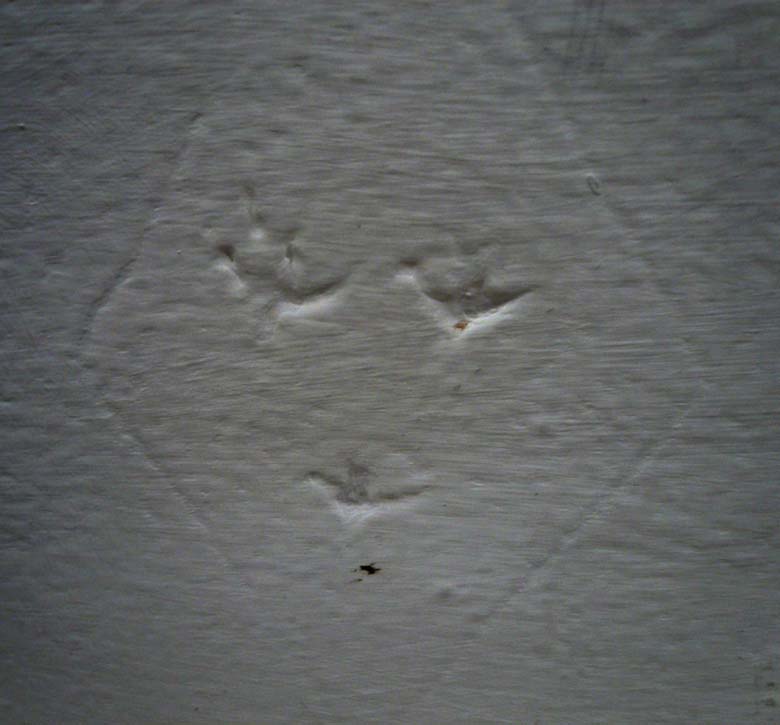
One of the more notable objects on the mantelpiece is perhaps the school badge which has been carved relatively large, and in primitive style, with the lozenge and the three merles or heraldic blackbirds still recognisable even now, the best part of a century after it was executed by some unknown, juvenile artist.

badge cccccccc c

Less time proof perhaps, are the boys who managed to carve only their initials, namely “JL”, “MV”, either “WA” or “WR”, and either “BFW” or “SFW”. It is just so difficult to be certain about whose initials they might be. In some cases, there are literally dozens of possible candidates in the school registers, and it becomes almost a pointless effort to try and guess who has carved them.

Some boys seem to have been able to make only part of their name legible. We appear to have, therefore, a group of letters which seems to spell “H-LLF”.

Similarly, I have tried so hard to turn “—-NGTON” into Victor George Darrington, one of the very few young men to have captained the school at both football and rugby. The time is right (he entered the school in 1909, aged twelve) but the fact is that the blurred and multi-layer gloss paint painted-over obscured letters just do not look like they were ever meant to spell Darrington.

Even more striking is the young member of what is probably the “Chambers” family who did not manage to carve his initials clearly. The name can be seen just above “A.E.Anthony”, although the letters seem to be an even whiter shade of pale.  Just a cursory perusal of the school registers reveals the existence, between 1897 and 1926, of “E.Chambers”, “W. Chambers”, “P. Chambers”, “N. Chambers”, “J.F. Chambers”, “J.S. Chambers”, “A. Chambers”, “C.G. Chambers”, “J. Chambers”, “B.J. Chambers”, “C.C. Chambers”,  “S.H. Chambers”, “D.B. Chambers”, and a second “W. Chambers”

chambers 1zzzzzzzzzzzz

No doubt a really thorough search would reveal even more members of the apparently vast Chambers clan.
It would be nice to think, though, that the perpetrator was the (uninitialled) Chambers of Form IVb, whose doings are reported in the Prefects’ Book for Thursday, February 1st 1912….

“…A meeting was held before afternoon school, Towles and Haubitz (prefects) being absent. Chambers (IVb) had been reported for carrying a loaded revolver in his pocket. He admitted the offence, and produced the weapon, which proved to be loaded in four chambers. He was requested not to bring it to school again, and the School Captain decided to interview the Headmaster.”

Most unfortunately, no record has survived of the outcome of this conversation. Here again, it is possible to guess at putative friendships between the names in the stone. Two of the boys, for example, Fred Ball Ludlow and Oliver Herbert Ball, both joined the school in 1900, and their entries are virtually next to each other in the School Register. Perhaps the use of the surname of one as the middle name of the other hints at a blood relationship, rather than just one of mere friendship.
Coincidentally, a third name on this single ancient page of the school register is that of Harold Binks, who entered the school in the very same year of 1900, although Harold was never to carve his own name on the fireplace. From his reminiscences, published in April 1935, we know that one of his best friends in the Senior School was called Ball. It seems likely too that another of the friends was Oswald Cornek Gillot, who was already in the school when Ludlow, Ball and Binks arrived. All these boys were of the same age, and they all left the school in the latter part of the academic year 1906-1907. As we have already noted, Gillot lived near distant Ilkeston, but Holmes lived in Gregory Street, Old Lenton, very close to Ludlow and Meigh who themselves both lived in the same street, namely Willoughby Avenue, Lenton. Again, we can imagine two keeping watch while the third one carried out the evil deed with his penknife.

On Thursday, June 7th 1917, just  ten years after carving his name on the stone fireplace, Oswald Cornek Gillott was killed at the age of twenty six, yet another hapless victim of the Great War. Even a school as small as the High School (400  pupils) was to provide some three hundred young men, all destined to die well before their time.

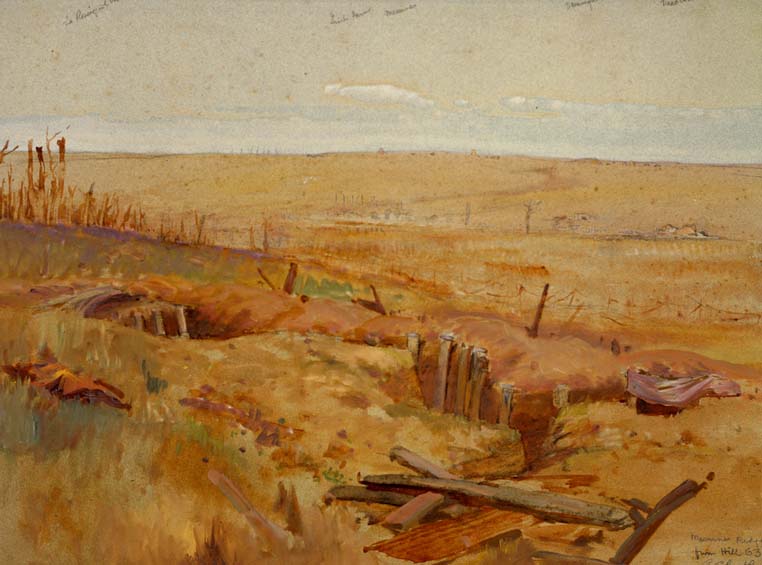
After he left the school, Oswald moved to Teesside, and became a twenty year old apprentice mechanical engineer living at 2, Woodland Terrace, Borough Road, Middlesbrough, Yorkshire. When the Great War came, Oswald joined the 68th Field Company of The Royal Engineers. They trained at Newark-on-Trent before sailing from Liverpool for Gallipoli at the end of June 1915. They remained at Lala Baba in Suvla Bay until December 19th and 20th 1915, when they withdrew and returned to Egypt by the end of January. Oswald was recorded as having been wounded during this period. In June 1916 the Division was ordered to France to reinforce the Third Army on the Somme. By July, they were in the Front Line and took part in the fighting at Thiepval. In early 1917 they were fighting on the Ancre, and then moved north to Flanders for the Battle of Messines
Messines_Ridge_from_Hill_63 cccccccSecond Lieutenant Oswald Gillott’s last day on Earth was June 7th 1917, coincidentally no doubt, the first day of the successful attack on the Messines Ridge.  The assault was preceded by the detonation of nineteen large mines, in what was described at the time as “the loudest explosion in human history”. Oswald, as a member of the Royal Engineers, may well have been involved in this activity when he was killed. On the Commonwealth War Graves Commission website there are a mere three pages of Gillotts, with only thirty two men of this name killed. Oswald Gillott lies in the Messine Ridge British Cemetery in Mesen, West-Vlaanderen in Belgium along with the 577 of his colleagues whose remains have been identified.

This slideshow requires JavaScript.

Second Lieutenant Gillott, aged twenty seven was one of a trifling 24,562 casualties, as the British under Field Marshal Herbert Charles Onslow Plumer, 1st Viscount Plumer, GCB GCMG GCVO GBE slowly began to learn how to fight battles at much lower costs than previously. (Battle of the Somme, 623,907 dead).

The other side of the coin, of course, is the fact that if the Field Marshall and his lordly colleagues are not much more careful with the lives of their social inferiors, they will risk actually running out of men. The  623,907 men killed in the Battle of the Somme is a catastrophe, but the apparently much lower figure of 24,562 killed during the assault on Messine Ridge could well be regarded as every single man in a town the size of, say, present-day Arnold or Newark-on-Trent.

One set of initials I have not dealt with. That is F.C.Mahin, one of the High School’s very few Americans, and I will talk about his incredible and hitherto completely unknown life in another blog post.


6 Comments

Filed under Criminology, History, Humour, Nottingham, The High School

Gun Battle on Derby Road: three slain, and a horse

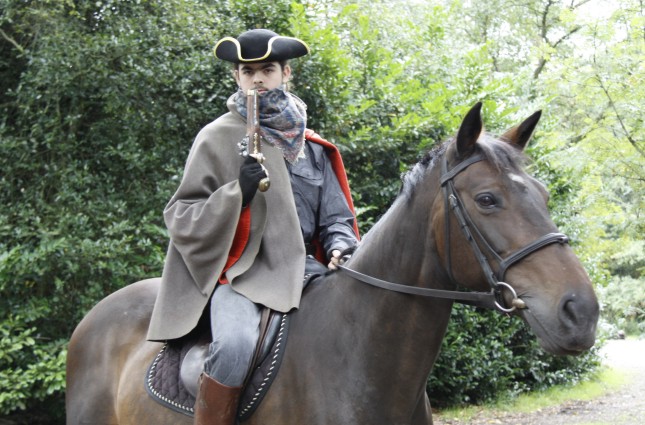
Derby Road seems reasonably peaceful now, but not in 1701, when Timothy Buckley, a 29-year old criminal from Stamford, Lincolnshire, was arrested after a ferocious gun battle as he tried to rob a stagecoach on its way to Derby.  The coach contained three gentlemen attended by two footmen. Buckley had previously been a shoemaker’s apprentice in London, but gradually became a more and more hardened criminal after his return to Nottinghamshire and the Wild North.
Beyond “two miles from Nottingham”, we do not know exactly where this gun battle took place, but usually, highwaymen would strike as the coach was moving uphill, and was therefore travelling at its very slowest pace.

highwayman

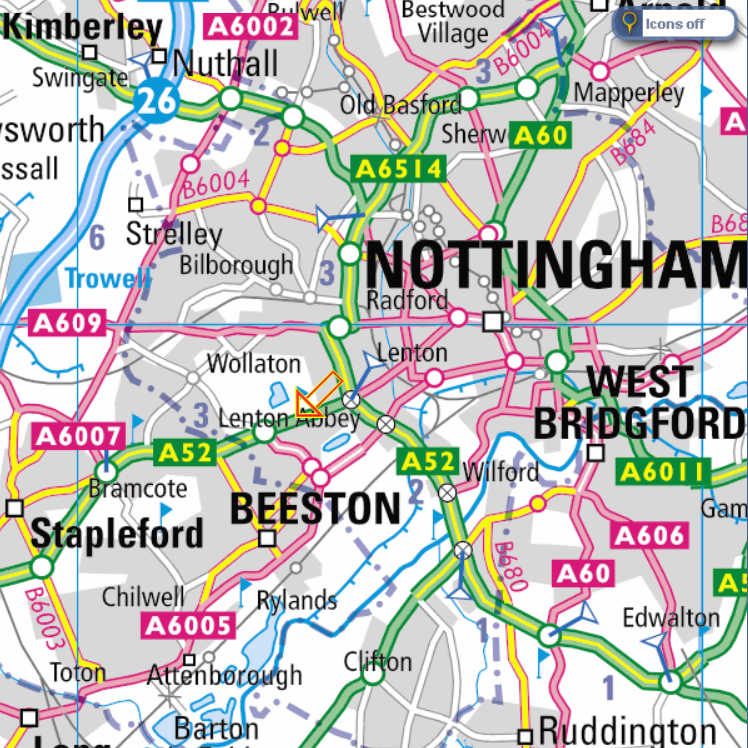
To me, the steep slope near the present day St.Barnabas Cathedral is too close to the city centre, so my best guess would be that stretch of the A52 as it climbs steadily after the present-day Ring Road, between the back of Wollaton Park and the grounds of Nottingham University. On this map, look for the orange arrow which is over the green A52 road with the words “Lenton Abbey” written over it. If the incident was any further on, then it might have been on the shorter slope near to the present day Bramcote Leisure Centre.

shoot out
No sooner had Buckley commanded the stagecoach to “Stand and Deliver, Your Money or your Life!”, than one of the passengers, unwilling “to submit to a single bravo”, blasted him with a blunderbuss. Buckley’s horse was shot out from under him, and died instantly.

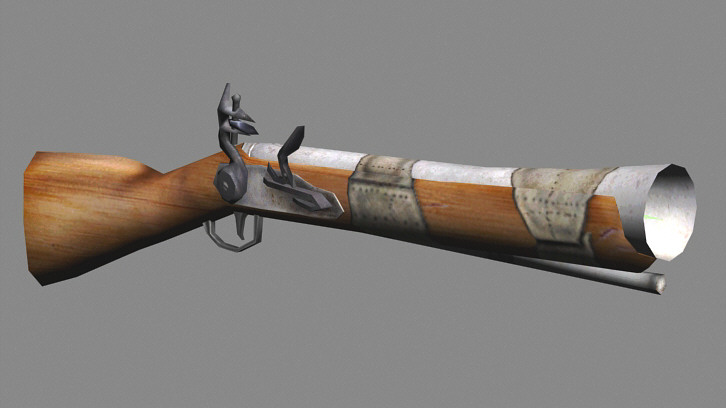
Blunderbuss1

A blunderbuss was a murderous weapon, used for close-in fighting, in the words of Wikipedia, “when it was unimportant to protect objects around the intended target”. This formidable firearm was loaded with shot and anything else the user thought might do the job, small pieces of metal, nails, bits of rock or stone, or even salt. It was flared at the muzzle, and was the 17th-19th century equivalent of the shotgun so beloved of Wells Fargo personnel.
Interestingly, the military term dragoon is taken from the fact that early blunderbusses (or should that be “blunderbi”?) were decorated with dragon’s heads around the muzzle, and the blast would seem a little like the fire of a real dragon.
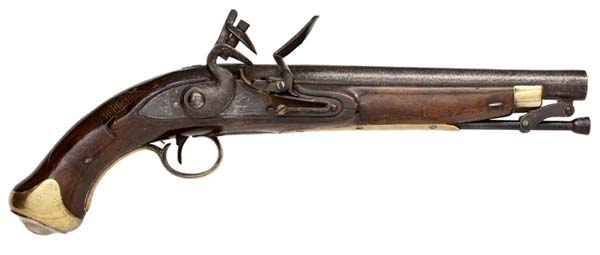
Buckley was not lightly armed either. He was carrying eight horse pistols. The largest were up to twenty inches long, and were carried in holsters across the horse’s back just in front of the saddle. This seems an unlikely number of such large weapons, but perhaps some were coat pistols (carried in the pocket of a greatcoat) coach pistols, (carried in a saddlebag perhaps), or belt pistols, (carried on a belt, hanging from a hook).

horse pistol xxxxxxxxIn any case, Buckley was very attached to his favorite horse and enraged by its untimely demise, “a most desperate conflict ensued”. Buckley let fly with all his pistols.
One male passenger and a footman both fell dead, shot through the heart. Eventually, though, Buckley was overcome by the remaining occupants of the stagecoach, as he grew gradually weaker and weaker from loss of blood, caused by his eleven severe gunshot wounds.

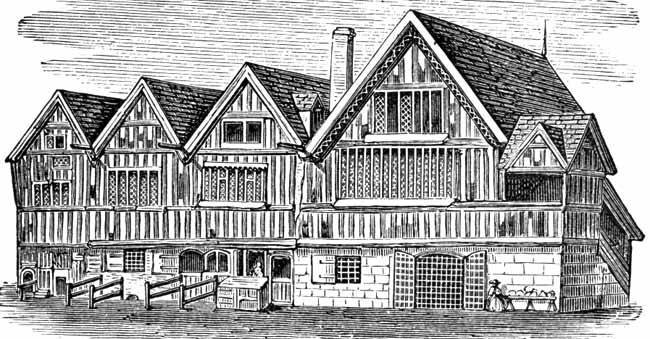
Guild-hall-1750 and prison

After a brief trial at Nottingham Shire Hall, Buckley was found guilty and was later hanged. He was only 29 years of age, and he was sentenced also to be “hanged in chains”. I don’t know how long his rotting cadaver was left exposed to the elements, but as a birdwatcher, I certainly know that there was one famous case in Nottingham where a dead criminal decayed over the course of the winter, helped by passing crows and magpies, only to have, with the advent of spring, a pair of blue tits raise their young inside his empty skull, using his eye sockets to go in and out, perhaps even operating their own one-way system.

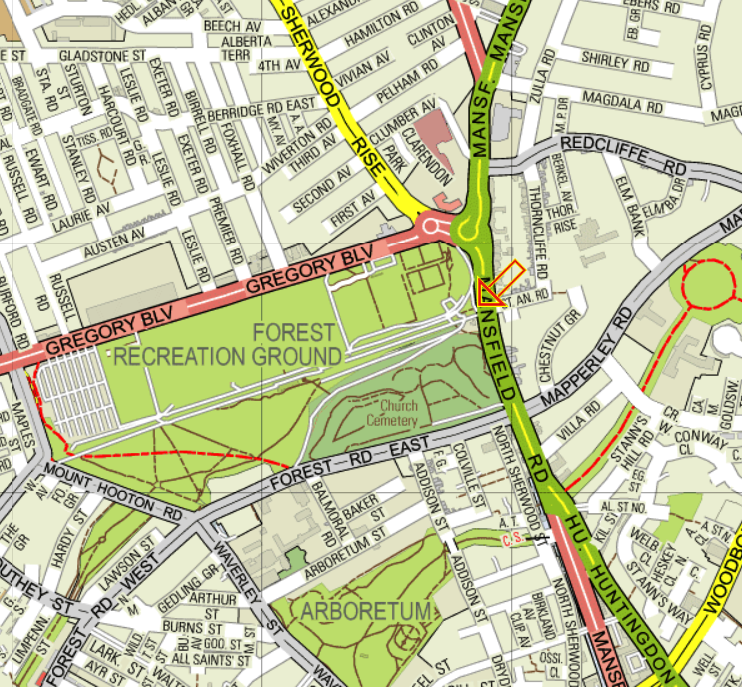
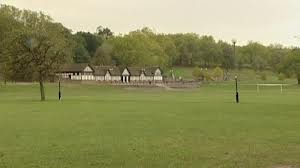
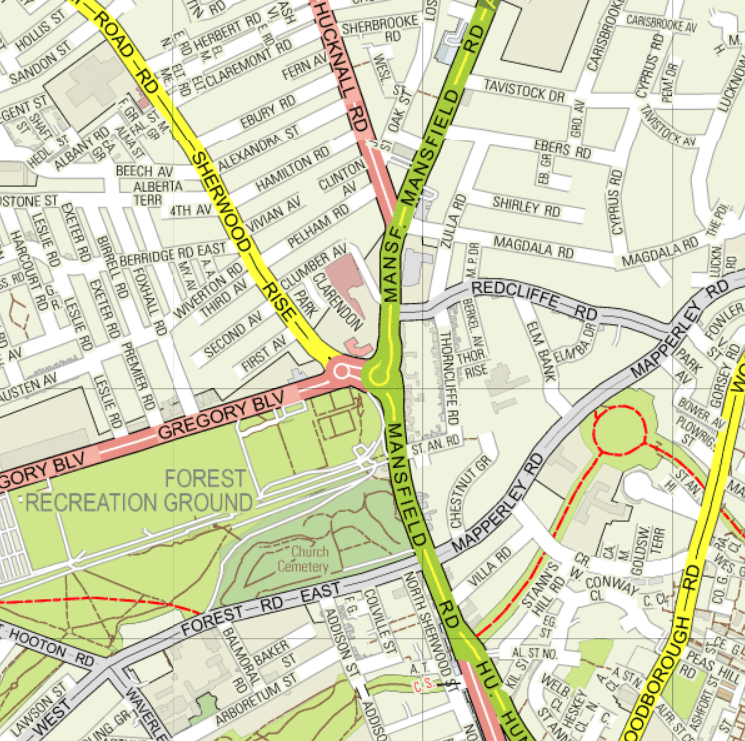
As these events all took place in 1701, Buckley would have been executed on what is now “The Forest Recreation Ground”. Centuries ago, “The Forest”, was called “The Lings” and was a very different place from what it is like nowadays. Largely covered by gorse and scrub, it was considered to be the southernmost part of Sherwood Forest itself. It was only as late as 1845 that, under the Nottingham Inclosure Act, some eighty acres of Sherwood Forest were set aside for recreational use. This area became “The Forest Recreation Ground” and to commemorate the event the Mayor of Nottingham planted a special Oak tree called the “Inclosure Oak” which can still be seen today at the Mansfield Road entrance. The orange arrow marks the oak tree:

Untitled

Pretty well straightway, the area became a site for sports and shows, or a combination of the two.

forest

In the summer of 1801, four butchers held their weddings there simultaneously, and decided who was to pay for the wedding picnic by holding a donkey race, with four animals, each equipped with mascots taken from the wardrobes of their respective owners’ new wives. The race was easily won by the donkey which had corsets attached to his tail with a bow of green ribbon. In second and third place were the animal with a pair of stockings around its neck, and another with a saddle made out of a nightgown.  Needless to say, the donkey wearing a voluminous pair of ladies’ drawers was placed last.
By this time, the Forest had already been a horse racing course for well over a hundred years. Not long before that, bear baiting had taken place on the very site where the horse racing course was later to be constructed. In 1798, a new horse racing track in the form of a figure-of-eight was built. Unfortunately, this rather novel choice of layout, designed to give the maximum length of course in the smallest possible area, was not overly successful, as spectators did not have a sufficiently good view. Crashes between horses were apparently too infrequent to compensate for this.
By the middle of the nineteenth century, though, there were at least two major race meetings per year, in spring and autumn, and the area was beginning to attract the same kind of people who can still be found there nowadays, well over a hundred and fifty years later…

“…loiterers…policemen…tooting footmen…toddling children…enterprising
vendors… overcharging greenhorns…patterers, chanters and beggars…sailors without arms or legs… “downy blokes”…holiday makers….villains…detectives …boozers and nymphs of easy virtue…ministers of religion……“black sheep”…enterprising merchants…aristocratic swells… pleasure seekers…a few robberies, a few drunks, a few fights…married men, sitting in the drinking places at the Stand with an assemblage of whores…the unemployed poor…”

Indeed, with whisky at an all-time low of 75p a gallon, so unsavoury did the area become that in 1879, male members of Nottingham University staff were threatened with instant dismissal if they were ever found at the horse races.
Other sports were played there as well. From 1865-1879, Nottingham Forest both practiced and played soccer here, being known therefore as “Forest Football Club”. Cricket was widely played in the summer, as were types of field hockey known variously as bandy, shinney or shinty.
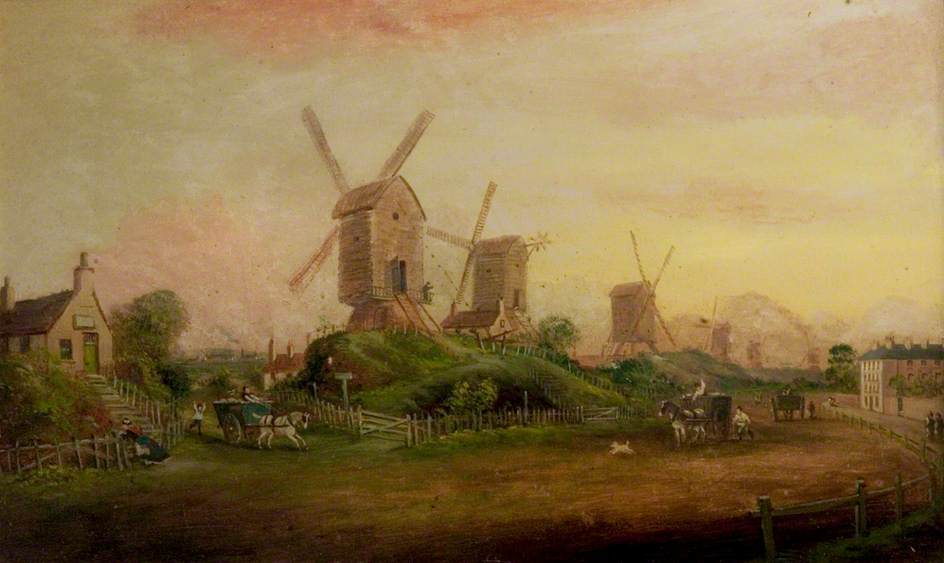
Apart from sport, alongside what is now Forest Road East, there was a long line of thirteen windmills, all taking advantage of the strong winds and updrafts which blew across the open ground lower down to the north.

(c) Nottinghamshire Archives; Supplied by The Public Catalogue Foundation

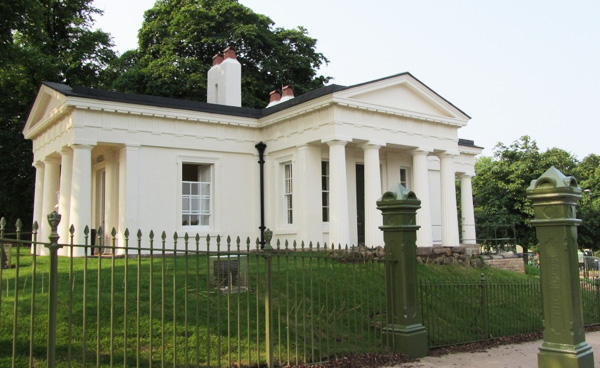
The exact place where the gallows stood and where Tinothy Buckley met his Maker has not necessarily been recorded absolutely accurately. Public executions took place here until as recently as 1827, and I am fairly certain that, many years ago, I read that the gallows used to stand a little distance down Mansfield Road from St.Andrew’s Church, within the present day Rock Cemetery. This was to the south of the white, recently refurbished, Lodge House. Clearly, in the latter part of the nineteenth century, there was still some judicial rôle for this building to fulfil, as it was originally used as a Police or Keeper’s Lodge and a police cell can still be seen at basement level.

forestlodge

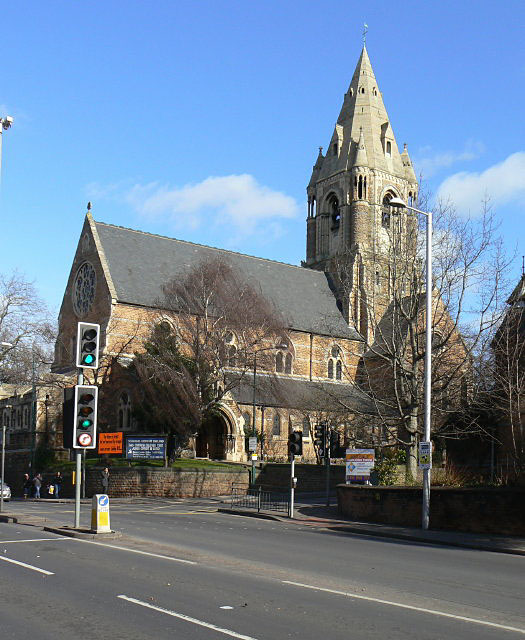
Others say that  there was a gallows on the same site as present-day St.Andrew’s Church, and, indeed, when excavation work was done here in 1826 for the church foundations, more than fifteen apparently medieval skeletons were found. This was presumably connected with a much earlier era, when travellers left the City of Nottingham through the gate in the mediaeval wall near what is now the Victoria Centre branch of Boots the Chemist. As they climbed painfully slowly up the hill which is now Mansfield Road, stagecoach robbers and mere footpads would sometimes pounce at Forest Road: hence the gallows which were constructed here, and might even have concentrated the thieves’ minds a little as they waited to swoop upon their prey from behind the bushes.

Notingham_St_Andrew_Nottinghamshire

“Garner’s Old Nottingham Notes” (date unknown) somehow contrive to be both illuminating and yet somehow confusing…

From information given, the gallows appear to have been erected on the level ground which now forms the upper portion of the Rock Cemetery, and it was probably 100 yards or rather more from Mansfield Road…..
Judging by the large old official map of the borough, measuring from the present Forest Road East, I consider it probable that, going northwards, the site of the gallows was about 100 yards from the southern boundary of the Rock Cemetery, and probably rather more from Mansfield Road, according to the contour of the ground, as depicted upon the official map. There is much likelihood that the gallows was erected near to where the last windmill on that side of the Forest then stood or was afterwards constructed.
It is certainly proper to state that I have seen two or more old maps on which the ground now covered by St Andrews Church, and southwards from there, is entitled Gallows Hill. The upper part of the ground is no doubt higher than any portion of the Rock Cemetery, and I have thought that this might possibly be the original place on which the gallows stored a few centuries back and perhaps afterwards were moved to the spot above designated.”

to gallowszzzzzzzzzz

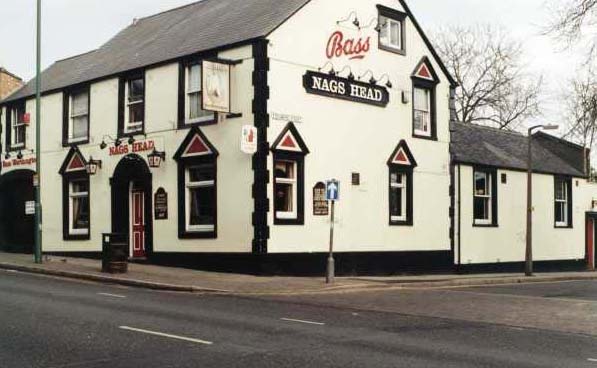
Wherever the exact location of the gallows, when convicted prisoners were to be hanged, they were usually brought from the County Hall in High Pavement, or the Town Hall at Week-day Cross, through the maze of streets in Hockley, and then walked along Clumber Street, Milton Street and finally up the hill along Mansfield Road. Prisoners were entitled to one last drink at the Nag’s Head Public House, which was traditionally paid for by the landlord.

00001tmp

There is, of course, a traditional tale, told no doubt, of every road with a set of gallows and a public house. One particular prisoner, who was a teetotaller, therefore, refused his last mug of ale at the Nag’s Head. He was taken straight on to the gallows and duly hanged. Seconds later a much flustered horse rider came galloping up the hill, and screamed to a halt by the little knot of people. He was waving a piece of paper which was, of course, the Royal Pardon for the Recently Hanged Man. Had the latter been just a little later in arriving at his place of execution, then he would have been saved. The “little later” of course, is exactly the time it takes to quaff a pint of ale.
The last person to be executed at these gallows on Forest Road was William Wells, a 45 year old native of Peterborough, who had robbed James Corden in Basford Lane and Mansfield Road on March 7th 1827. He was executed on April 2nd 1827.
Not all highwaymen meet with disaster however. Just occasionally one of them can make that leap from criminality to superstardom…


6 Comments

Filed under Criminology, History, Nottingham

Murderer strung up for 67 years. It’s not enough !!!

Scrooby is a country village in the north of the county of Nottinghamshire.

Just to the north of the village, a toll-house used to exist on what was then called “The Great North Road”.

This slideshow requires JavaScript.

On July 3rd 1779, it was the scene of two truly horrendous and violent murders.

In this largely rural and peaceful community, the tolls were always collected by Scrooby’s toll-bar keeper, William Yeadon. On the date of the slayings, William Yeadon, was being visited by his middle aged mother, Mary Yeadon. This particular evening, he had been playing cards with John Spencer, a man from the village of North Leverton with Habblesthorpe.  After the Yeadons had gone to bed, however, Spencer returned to the toll-house in the early morning and attempted to steal the money that had been collected as tolls the previous day. Gaining re-admittance to the building under a pretence that a drove of cattle wished to pass that way, Spencer then tried to carry off the strongbox under the cover of darkness, but unfortunately for everyone concerned he made far too much noise. Later it was thought that he had carelessly rattled the coins in the old wooden box too loudly. Mary and William were made immediately aware of what Spencer was trying to do, but the latter reacted with extreme violence…

“In a most barbarous manner he fractured their skulls by repeated blows with a heavy hedge stake.”

Spencer seized the money and then made the best of his opportunity to ransack the house. The murderer was interrupted by travellers as he dragged one of the bodies across the road to dispose of it in the nearby River Ryton. He was arrested shortly thereafter by a search party, but managed to escape. After he was apprehended for a second time, Spencer was taken to Nottingham and put on trial soon afterwards at the Shire Hall in High Pavement.
There was, of course, only one possible outcome, and Spencer was duly found guilty, taken on foot up to Gallows Hill and hanged on July 16th 1779.

3716238That was not the end of it though, as the rest of his sentence was that Spencer be taken to the scene of his crime in Scrooby, and

“to have his body hung in chains with the hedge stake in his right hand… near the place where the awful deed was perpetrated, on the gibbet post, near the Scrooby Toll-Bar”.

This was after his corpse had been liberally smeared with pitch and tar.

H in chains

These gruesome steps were taken “in accordance with the express words of his sentence”. More horror was to follow however, as I discovered as I sat one evening flicking through my back copies of “The Armagh Guardian” newspaper. In the June 9th 1846 edition I found an interesting account which was itself quoting the “Doncaster Chronicle”…

“After the lapse of a few weeks, a party of soldiers conveyed a deserter passing by the place, the sergeant fired his carbine, loaded with ball, at the corpse, and hit it, which caused a stench, almost unbearable for several days afterwards. The circumstances becoming known, the party was followed, and the sergeant taken, and on being subsequently tried by Court-martial he was found guilty and degraded on the ranks. Years rolled on, and the body gradually became less and less, until nothing was left but the chains which originally shackled it, and these in course of time fell and were secretly conveyed away. For several late years the post, with its withered and weather-beaten arm, was the only vestige left of that deed of blood which sixty-seven years ago filled the minds of the inhabitants of the surrounding districts with horror. But Time, which levels all terrestrial objects with his corroding breath, had for years past been gradually gnarling this once loathing stump to its core, and on the 15th of April 1846 actually accomplished his task, and it fell to rise no more.”

On the other hand, what is reputed to be the upright of the ancient Scrooby gibbet is currently preserved in Doncaster Museum.

Not surprisingly, after the murderer’s decaying body had been left dangling for so many years…

“the creaking cage and bleaching bones occasioned the haunting of the place by either disturbed spirits, or morbid sight-seers”

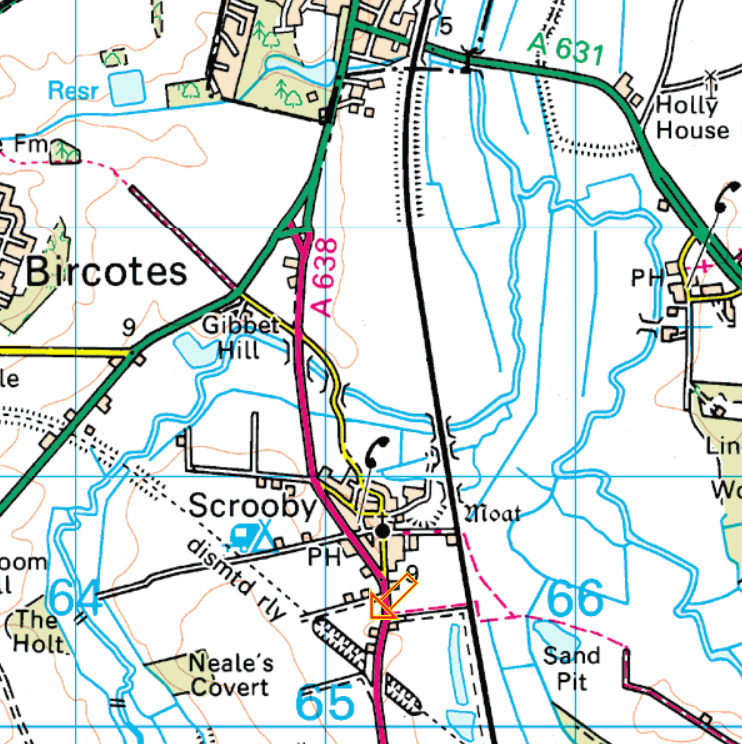
The hill, in Spencer’s honour, still keeps its name of “Gibbet Hill”. Nearby is the modern “Gibbet Hill Lane”. Nowadays, of course, Spencer’s rotting bones have been replaced by an owl sanctuary and a garden centre. What may conceivably have been the original toll-house, the scene of this dastardly crime, is still visible on the A638 leading north from the village, just before its junction with the green road.

map with gibbet hill

5 Comments

Filed under Criminology, History, Nottingham

Just what WAS the Beast of Gévaudan?

There is no shortage of theories as to the identity of the murderous beast I described recently,  la Bèstia de Gévaudan,which terrorised a whole province of France from 1764-1767, and claimed upwards of a hundred victims, mostly women and young girls. From what I have read, but above all, from what I have watched on “Youtube”,  basically, you will have to make your own  choice.

The creature was, therefore, perhaps a single enormous wolf, or maybe a number of wolves in a single pack, or even a large number of wolves in a number of separate packs.

Less fancifully, it could have been some type of enormous domestic dog, or perhaps even a wolf dog hybrid, perhaps with a red coloured mastiff involved. Its supposed invulnerability to bullets was because it wore the armoured hide of young boar.

It may have been a hyena although this species is thought to have been long extinct in Europe at this time. It has even been suggested that it was not a real animal, but a sex-crazed serial killer who dressed in a fur costume, pretending to be a wolf. In the same vein, it was perhaps a werewolf with a penchant for hunting women and young girls.

An initial, perhaps simplistic approach, is quite simply to look at pictures of the beast, and to compare it with photographs of the most likely candidates, and then to make up your own mind.

Firstly, here are some pictures of the beast itself. You need to bear in mind that they are unlikely to have been drawn directly from a witness descriptions, and that many of them may have been mere copies of the work of other artists. Furthermore, at this time, it was accepted practice to draw animals in a very stylised fashion, rather than in the more accurate zoological one. Because of this, therefore, the head and limbs are often out of proportion, and the body is frequently too large for a small head and legs. In many pictures, the artist sought to portray an unknown animal by reaching into his knowledge of Heraldry…


This slideshow requires JavaScript.

Here are some photographs of wolves. I have deliberately picked what I consider to be the largest individuals, and to provide illustrations of animals in poses which are hopefully similar to those in the engravings of the beast.

This slideshow requires JavaScript.

Here are some photographs of what are usually called wolf dog hybrids. Having looked at a much larger number of them on the Internet, I do feel that most can be dismissed immediately because an ordinary person would think that they were pure bred wolves. They are only noticeably different when crossed with a very distinctive breed of dog.

This slideshow requires JavaScript.

Many cryptozoologists favour the hyena. Certainly, a number of the original drawings from the eighteenth century are titled as being “la Bèstia de Gévaudan, the hyena”.  Many of them, even the most wolf-like, have their flanks covered with either stripes or spots.
This picture was allegedly drawn by the killer of the second beast, Jean Chastel.

drawn chastel

Here are some pictures of the striped hyena.

This slideshow requires JavaScript.

And here are some pictures of the spotted hyena.

This slideshow requires JavaScript.

Basically, you pay your euros, and you take your choice.
As blogposts cannot be of infinite length, let me summarise the fors and againsts of all the possibilities as I see them.

A wolf or wolves?

This is the mot acceptable of a very large number of  explanations. Certainly, the prints found were deemed to be those of a wolf. Monsieur Antoine de Beauterne who was to kill the first animal, the Wolf of Chazes, said that there was « aucune différence avec le pied d’un grand loup » “no difference with the pawprint of a large wolf”

BUT…

Wolves do not normally attack Man. The locals used to kill around 700 wolves every year, so they all knew what a wolf looked like and could defend themselves against them. All the witnesses were adamant that the animal was not a wolf, but an animal that they did not know. That is why it was immediately christened “la bèstia”. Neither can wolves have a white breast and underparts, as a large number of witnesses said in their descriptions and, indeed, as is portrayed in many of the contemporary illustrations. Only a hybrid animal could exhibit this pattern of coloration.

Wolves do not strip the clothes off their victims, neither do they decapitate their prey.

After the Wolf of Chazes was killed, the deaths did not stop.

A rabid wolf?

An animal  diseased in this way would not have been afraid of Man, but it would certainly have died well before the three year period was  up. A number of rabid wolves? Isn’t that possibly stretching the argument a little?

A hyena?

The animal would certainly have been unknown to the inhabitants of the area. Members of the French nobility, however, frequently indulged themselves by importing exotic animals such as lions and tigers into the country, and we know that hyenas were brought into France at this time. So too, hyenas are supposedly relatively easy to train, or at least, easier than you might expect! Whether this would extend to converting them into fearless and ferocious attack animals is a different matter, however.
Hyenas are certainly capable of decapitating their prey. I have been unable to ascertain if they take the clothes off their victims, although I would have thought that they might have needed opposable thumbs for any particularly intricate garments.

BUT…

the second beast to be killed, the Bête de Chastel, did not have enough teeth to be a hyena. This creature was, without doubt, a canid of some description, according to the King’s Notary, Roch Étienne Marin, the man who carried out what appears to be an extraordinarily thorough autopsy. On the other hand, the creature was also examined by the famous Comte de Buffon, an extremely famous scientist and naturalist of the day, whose ideas were to have a great influence on Charles Darwin. Buffon pronounced it to be a very large wolf.

skulls ccccccc

The Striped Hyena, which resembles most closely perhaps, la Bèstia, does not hunt but scavenges. The Spotted Hyena does  hunt for itself, but nobody has ever really mentioned spots as a feature of la Bèstia.
In one of his blogposts, C.R. Rookwood suggests another exotic solution. He suggests that la Bèstia was a  mesonychid, a prehistoric mammal related to present day whales. They were very large predators with huge heads, long tails, and hooves instead of feet. The largest was Andrewsarchus mongoliensis, known only from its skull, minus the jawbone: for this reason, illustrations of its colour are, for the most part, just well informed guesswork. The structure of the animal is based on the other members of the family, whose skeletal structure is better known.

This slideshow requires JavaScript.

This animal does fit quite closely the description given by many of the peasants who saw la Bèstia. A few of the reports did mention hooves instead of feet, although the creature may well have been described as having hooves to emphasise its connection with the Devil.

BUT…

How could a gigantic, fierce, flesh eating mammal have survived from a prehistoric era until the eighteenth century, without anybody noticing it?

A human serial killer?

Humans can remove dead people’s clothes. Humans can decapitate their victims. Some bizarre serial killers would enjoy the chance to mask their activities behind the depredations of a very large trained carnivore.

BUT…

All the reports by eye witnesses say that only an animal was involved. This idea of a human serial killer can only be maintained  if mutilated bodies were found and there were no eye witnesses who saw an animal attacking them. Only in the Cantal area, apparently, were these circumstances fulfilled.
Of late, many people have  become increasingly concerned by the involvement of Jean Chastel in this marvellous enigma. Jean, a farmer and inn-keeper in the province of Gévaudan, and his son Jean-Antoine, have come under suspicion because when both of them were imprisoned for a period  because of their aggressive attitude to two of Francois Antoine’s gamekeepers, the number of attacks by the monster diminished noticeably.

chastel 2 ccccccc
It has therefore been put forward that la Bèstia was the result of Jean’s crossing either his own or his son’s red-coloured mastiff with a wolf, and then subsequently training it to kill. Almost all the evidence is perforce circumstantial, but much of it is quite compelling.
The creature may have been, therefore, a particularly  aggressive hybrid, which Jean-Antoine Chastel trained to have no fear of human beings, but instead to attack and to kill them. Witnesses have said that if its attacks were met with strong resistance, la Bèstia would retreat fifty yards or so, then sit and wait, as if sizing up the situation, before finally returning to the fray. This has been  taken to be the behaviour of a trained animal, unafraid of its opponent, rather than a wild one, whose natural instinct in an equal contest would have been to save itself by fleeing. Furthermore, witnesses thought that la Bèstia was driven not by hunger but by its own fury and an innate aggressiveness. It could also be more agile and jump much higher than a normal dog.
According to hunters in the eighteenth and nineteenth centuries, crosses between dogs and wolves were invariably very varied in appearance with dark or light tinges, sometimes marked with yellow or white or striped a little like a zebra. This, of course, agrees with many of the eye witness descriptions of la Bèstia.
Here are some pictures of mastiffs, although it is very difficult to know exactly what they looked like two and a half centuries ago. Nowadays, they simply don’t look particularly fierce….


Here is an English Mastiff around 1700.
mastiff 1700 ccccccc

If we are going down the road of wolf-dog hybrids, then I was quite attracted to a long extinct breed of German bulldog, or Bullenbeisser…

Bullenbeisser extinct ccccccccc

On the other hand, others have said that no successful interbreeding of a Mastiff, or Mastiff type dog, has ever been successfully carried out with a wolf, even though such a hybrid might explain the colours noted by many witnesses.
From the summer 1764 to its death in 1767, la Bèstia wandered over vast distances in almost no time whatsoever. Perhaps the two Chastel were conveying their creature around the province by some artificial means…an explanation of the high frequency of attacks spread over a not inconsiderable area.
On many occasions, people reported the apparent invulnerability of the creature when either stabbed or shot at. It has been suggested that it was wearing some kind of body armour made from the skin of a wild boar. Many witnesses told of the creature being shot several times by experienced hunters, and not being affected by it. Other witnesses spoke of its entrails hanging down after it was stabbed. Could this have been the strapping for some kind of home made armour?
When it was killed, la Bèstia died in the parish of La Besseyre Saint Mary, where Jean Chastel and his son lived. Perhaps they felt that they were about to be discovered, so they shot the creature and then manufactured a tale of heroism and religious devotion to snatch a glorious propaganda victory from the jaws of ignominious discovery and defeat.
As to why the two Chastel would want to kill so many of the people in the area where they lived, that remains a matter of pure guesswork. Certainly, Jean Chastel was supposed to have been an unpopular loner, and given his previous record of various episodes of fairly serious criminal behaviour, he may well have been a man who the locals disliked and feared in equal measure.
Perhaps les Chastel, père et fils were rejected and hated by local women and children, and then took their massive revenge on them, like those American teenagers who return to their High School and kill everybody they can. Perhaps they were sexual psychopaths who enjoyed killing and eating women and little girls.

One further detail which may be of significance is that the loud, belligerent and generally anti-social behaviour of the father, Jean Chastel, seems to have changed profoundly from May 16th 1767 onwards. On this date, in the village of Septols, Marie Denty was attacked in a little lane near her house, right under the eyes of her parents, and killed, just before her twelfth birthday. Supposedly, she and Jean Chastel were very close friends and he doted on her like the grand-daughter he never had. Now he was “fou de douleur”, “mad with grief”, and seemed about to lose his sanity. Perhaps, les Chastel and their appalling pet had killed by mistake. Certainly, his ne’er-do-well son, Antoine, seemed suddenly to be released from an evil spell, and he turned straightway to God. Jean spent his time in pure pursuits such as prayer, confession and penitence. For his redemption to be complete, he and he alone had to be the man who finally killed la Bèstia. According to which sources you believe, in best werewolf killer tradition, he made some silver bullets. Or perhaps, he made them from molten lead which had had a statue of the Virgin Mary dipped into it. Or perhaps he made them from the medals of the Virgin Mary which he wore on his hat. Whatever the case, he certainly had them blessed at a religious ceremony.

The manner in which he killed the creature is extremely suspicious, and could very easily be interpreted as a tale told merely to satisfy contemporary religious feelings, and to exonerate a man who is not bravely hunting down a ferocious killer beast, but who is, instead, shooting it through the head in its kennel before the locals find out it is actually his beloved pet, and then string him up from the nearest tree. The following account I have translated from the French Wikipédia

“On June 19th, the Marquis d’Apcher decides to organise a beat around Mont Mouchet in the wood of la Ténazeire. He is accompanied by a few neighbours as volunteers including Jean Chastel reputed to be an excellent hunter. The latter finds himself at a place called la Sogne d’Auvers,  a crossroads where he sees the animal go past. Chastel fires at it, and manages to wound on the shoulder. Quickly the marquis’ dogs arrive to finish off the beast.”
“As regards this rifle shot, Legend has preserved the romanticised words of the priest Pierre Pourcher which he used to say came from tale told by his family, “When the beast came along, Chastel was saying prayers to the Holy Virgin. He recognised it straightaway, but through a feeling of piety and confidence in the Mother of God, he wanted to finish his prayers. Afterwards, he closes his prayerbook, folds his glasses up, puts them in his pocket and takes his rifle. In an instant he kills the beast which had been waiting for him.”

“A week after the destruction of the beast by Jean Chastel,on June 25th, a female wolf which according to several witness accounts used to accompany the beast itself was killed by Sir Jean Terrisse, one of the hunters His Grace de la Tour d’Auvergne.  He received £78 as a reward.”

Perhaps they were acting on behalf of somebody else. The usual favourite is Jean-François-Charles de La Molette, the Count of Morangiès. He may have wanted to destabilise the area, so that he could take over when the revolution inevitably came.  There were others. The Church wanted to teach the King and the members of the  intelligentsia of the time that free thinking is frowned uon by God….

“Return to the Ways of the Lord or face the Hound of Hell”

As I said before, basically, you pay your euros, and you take your choice.

I had just finished my investigations about la Bèstia de Gévaudan, and had made up my own mind that all the devastation could be attributed, without necessarily knowing the real motivation behind it, to Jean Chastel and his son Antoine.
And then I bought “Real Wolfmen: True Encounters in Modern America” by Linda S. Godfrey. I was enjoying reading this interesting and innovative book, when I stumbled upon page 93 which was about the Wampus Cat of Ariton in Alabama.

“The man who wrote me was disturbed by unidentifiable animal sounds while camping on his ten acres on the Pea River near Ariton, which lies about half an hour’s drive south of the picturesquely named town of Smut Eye. His normally rambunctious standard poodle refused to leave the safety of his trailer that afternoon, and the man was having a cup of tea at about 5.00 p.m. when he heard loud rustling sounds coming from outside the camper.”
“As he peered out the camper window he noticed a large black furred animal with a doglike face surveying his campsite on all fours. It was bigger than his standard poodle and, he said, “Looks like a cross between an ugly collie and an even uglier lab.” Weirdly, it sported a white chest.”
“The creature ambled nonchalantly through the camp and when it jumped over a fallen tree, the man saw that it had a long, sinuous tail like that of a cougar. He reported the creature to the area game warden who said that while she didn’t know what it was, others have reported seeing it, too!”

You can pursue this interesting hunt for truth a lot further if you have any knowledge of French. There are three exceptionally good videos about la Bèstia which can be found on a tourist website for the Auvergne region. They are well worth your time, and seem to portray this most baffling of stories in a fairly reasonable and sensible way. Un, deux et trois.
If you want to see even more videos about la Bèstia, then go to this website which is the French equivalent of “Youtube”. If you search for “la Bête du Gévaudan”, you will find a huge number of films, varying from 15 or 20 seconds long to an hour or more. On the first page, there are eighteen different videos, a further eighteen on the second page, and any number of pages after that.

Bonne chance! And don’t be put off by having to practice your French!

55 Comments

Filed under Criminology, Cryptozoology, France, History, Science, Wildlife and Nature

Murder most foul: Chapter Two

A second episode of blood soaked murder in the history of the old Free School was published in a series of “Reminiscences”  in the High School Magazine in December 1929. They came from Mr John Braithwaite, of Bournemouth, who, at the time, was thought to be the School’s oldest Old Boy….

“Schooldays, 1857-1862″

“I went to the old Grammar School in Stoney Street about Midsummer,1857, and left at Midsummer, 1862. The Rev. W. Butler was Headmaster.”

“The old building was very unsuitable, dull and cheerless. The upper school consisted of one large room and one small classroom. There were no cloakrooms or conveniences of any kind, and the sanitary arrangements in the small playground were most primitive.”

free school

“The whole building sadly wanted painting, but no money was spent; the reason given was that the Trustees were saving up to have enough money to build a new school.”

“We began work at 8 o’clock and finished at 5 o’clock, or later, with two hours’ break at midday. In winter we had to use candles… “long eights” I think they were called. One candle was allowed between two boys, and lighting them was the signal for all sorts of play. We amused ourselves by blowing the candles out and in again, making a nasty smelling smoke.”

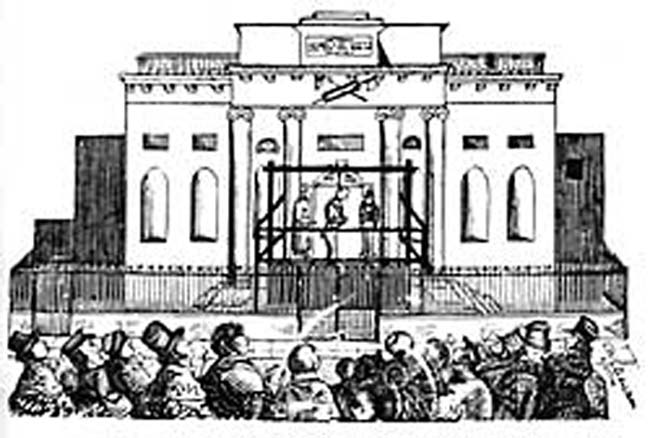
gallows

“About the autumn of 1859, a man was sentenced to death in the Nottinghamshire Courts for a murder in the northern part of the county.

Our headmaster, the Rev.W.Butler, as Chaplain of the County Gaol, was required to read the burial Service at the execution, which was fixed for 8 o’clock one morning at the County Gaol in the High Pavement.”

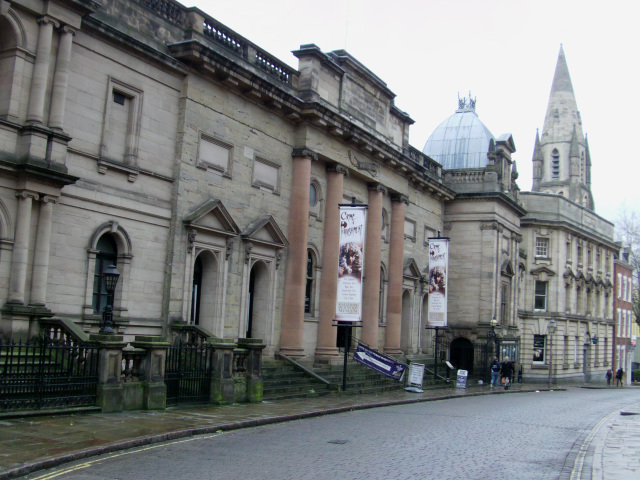
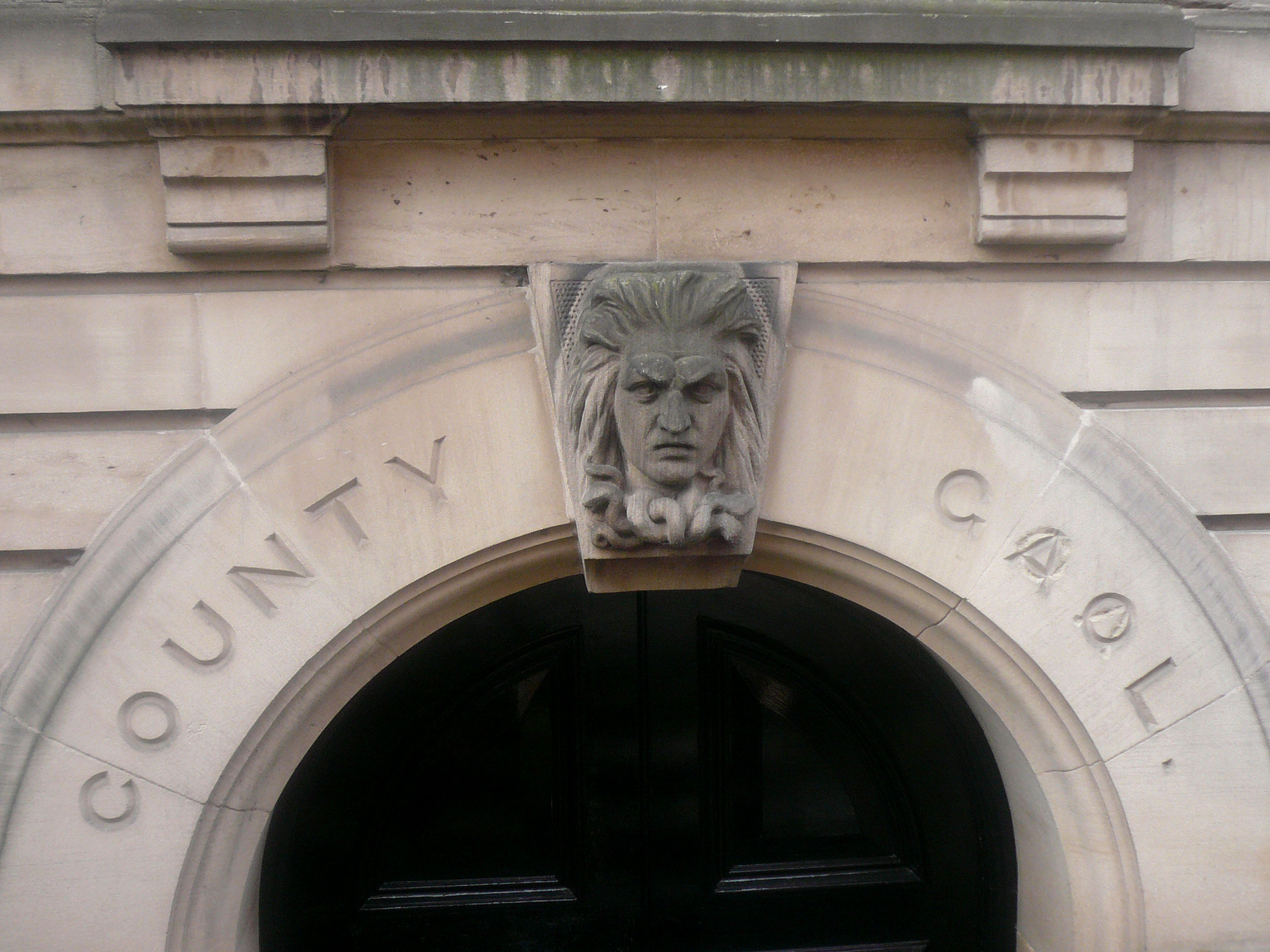
The main building on High Pavement, which dates from 1770, is quite imposing. The Normans were the first to use this site, appointing a Sheriff to preserve law and order in Nottingham, and to collect taxes. The oldest written  mention of law courts comes in 1375.

DCIM100MEDIA

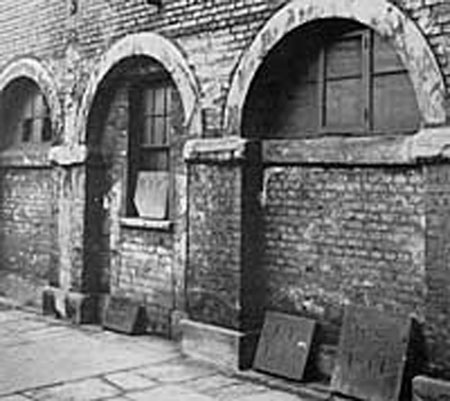
The cells are below street level. They date back to at least 1449.

P1120126

The scaffold used to be erected on the steps in front of the brown columns. There are special square holes cut in the stone steps to hold the wooden beams. They are still there to this day.

hanging-at-shire-hallThe dead hangees were buried in unconsecrated ground around the back of the building, their feet disrespectfully pointing towards Jerusalem.

Yard at Shire Hall with headston

“As usual we were at our desks at 8 o’clock on that particular morning, but the headmaster was absent. We all knew where he was, and each of us was thinking of him and visualising the dreadful scene which was being enacted only a short distance away. Back in school, the Deputy Master read prayers, and we waited, silent and awed. Presently the door was burst open, and poor Mr.Butler, with face white and drawn, stumbled in and staggered to his seat, almost spent. After resting awhile he stood up and said, “Boys, I have just come from….” and then he broke down. After recovering himself, he began again, and then he preached us a more impressive sermon than I have heard from any pulpit. As no one was in the mood for lessons we were sent home for the day…”

3716238The hanged man was one John Fenton, a blacksmith and publican, executed at the age of thirty-seven for the murder of Charles Spencer at Walkeringham on March 6th 1860. This was a public execution, held on the front steps of what is now the Shire Hall in High Pavement.

The crowd, however, was a lot smaller than expected. This was because, even though it was fourteen years previously, the last public hanging in Nottingham had resulted in the crushing to death of seventeen people, almost all of them children.

Given this blood soaked past, it is no surprise to find that the Galleries of Justice have a plethora of ghosts. On some wet Tuesday afternoons, there can sometimes be as many ghosts as living tourists. Here is a selection of the ghosts I saw on my own visit…

This slideshow requires JavaScript.

Wooooooooooooo………………………………

7 Comments

Filed under Criminology, History, Nottingham, The High School, Uncategorized

Murder most foul: Chapter One

Strangely enough, the theme of murder runs bright scarlet through the early history of the High School. First, came George Somers, who was the Headmaster for an unknown period of time between, probably 1530, and , hopefully, not long after Friday, July 15th 1532.

Eighteen years earlier, in more probably April, but perhaps in early May, 1514, the Free School’s main benefactress, Dame Agnes had died.

a mell

She left much of her property to the school and was buried alongside her husband in St.Mary’s Church, Nottingham.

This slideshow requires JavaScript.

Within a few short years of Dame Agnes’ death, however, her high standards of morality were more or less forgotten. Money frequently went missing and both the Headmasters and the school wardens neglected their duties. A number of teachers appeared in court on various charges, which varied from failing to maintain the church windows to the theft of pupils’ books.

In perhaps January of 1532, the Headmaster, George Somers, was accused of stealing a featherbed, a long pillow, two short pillows, a green and red quilt, a covering and a pair of sheets to the value of 46s 8d. (£2.33p in modern money. Oh for a time machine!)  Somers also owed twelve pence for the hire of the same bed. For what purpose has not been recorded. But you can probably guess…..

IMG_4607 bed

On Friday, July 15th of the same year, in a much more dramatic episode, George Somers, was now accused of murder. The Records tell how.

“…We indict the School Master of wilful murder.”

The incident had taken place almost a month earlier, on June 17th, and Somers had supposedly assaulted John Langton, Chaplain of Nottingham,

“by violence and weapons, namely a stick and daggers, of malice aforethought, and… had feloniously killed and wilfully murdered the same John, against the peace of our Lord the King.”

fox in the snow cvgbh

Unfortunately, the outcome of these events remains completely unknown, although it is devoutly to be wished that, if convicted, Somers did not keep his post as Headmaster of the school.

Hopefully too, this woodcut does not show Somers’ eventual fate. Notice the moment when the Mexican Wave was invented. Presumably it must be some  Tudor oik losing his focus during the thirty seconds while the rope is put on.

tudor hang

Leave a comment

Filed under Criminology, History, Nottingham, The High School