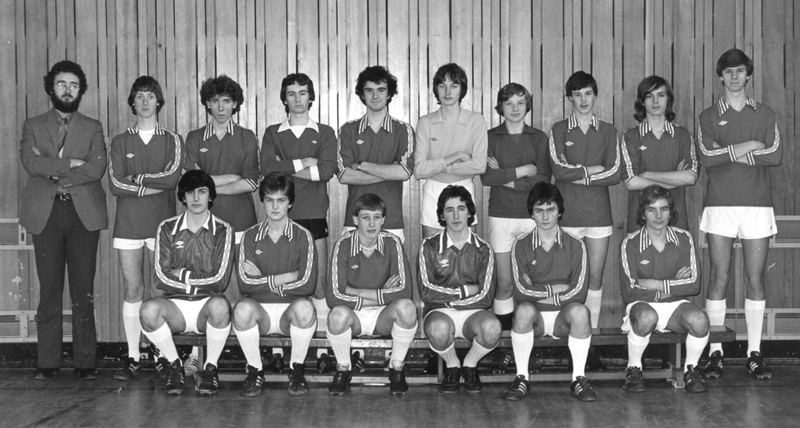
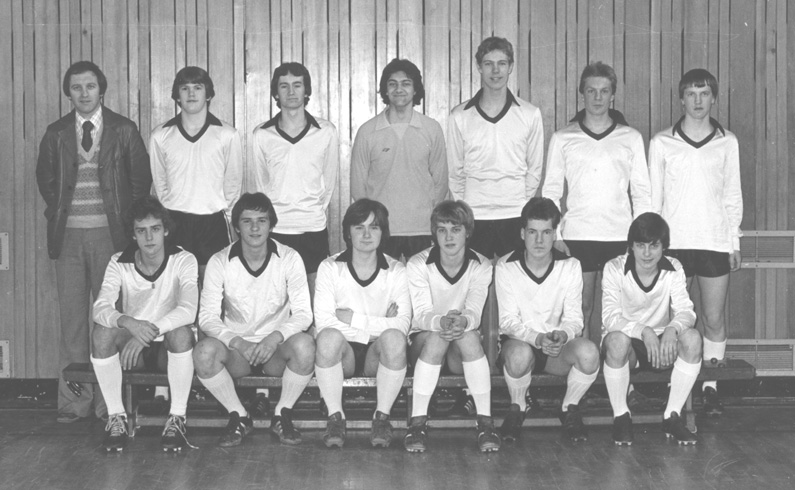
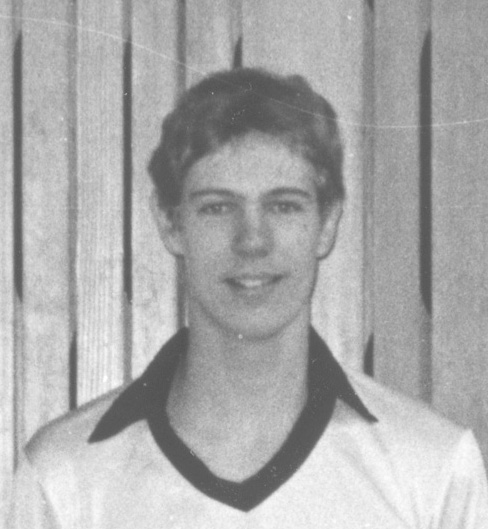
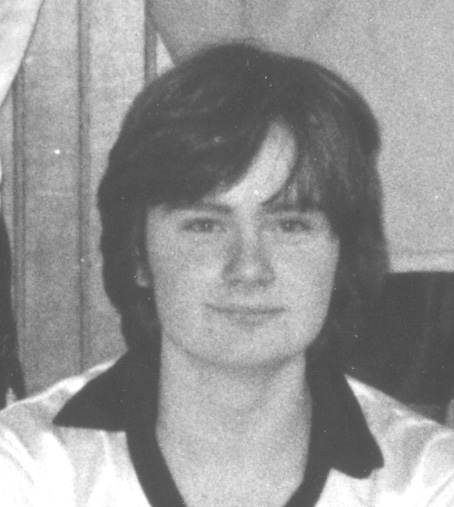
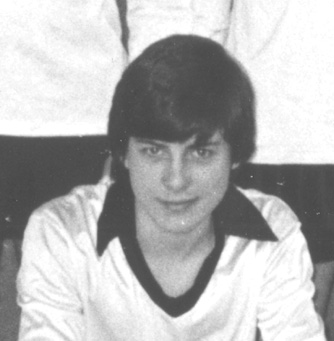
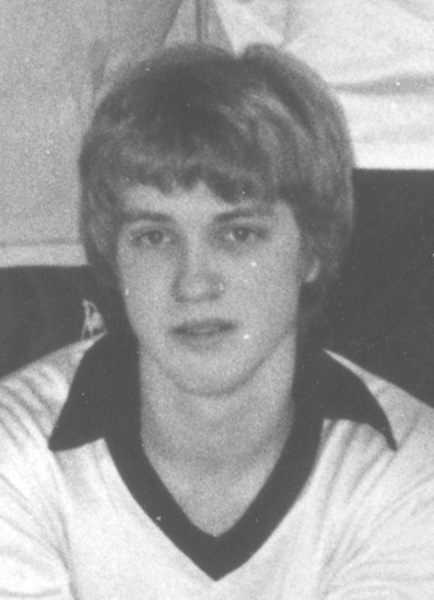
The Second XI had a pleasant and reasonably successful season back in 1980-1981, although it was possible to organise only seven fixtures. They lost their first match against Becket School, but were only to lose one more of the next five matches. Their record for the season of two wins, three draws and just two losses would have placed them comfortably in mid-table in the Premier League of today. Perhaps another Crystal Palace, Everton or West Ham. We drew games against High Pavement, Bramcote and Clarendon and then defeated Clarendon by 3-0 in the return and Bilborough by 5-2. Not a bad record for a team of eleven players picked from just nineteen available candidates:
The goalkeeper was Richard Clark:
And his deputy was, I think, David Lloyd:
In defence we had Chris Turner:
Alongside him was Julian Bower:
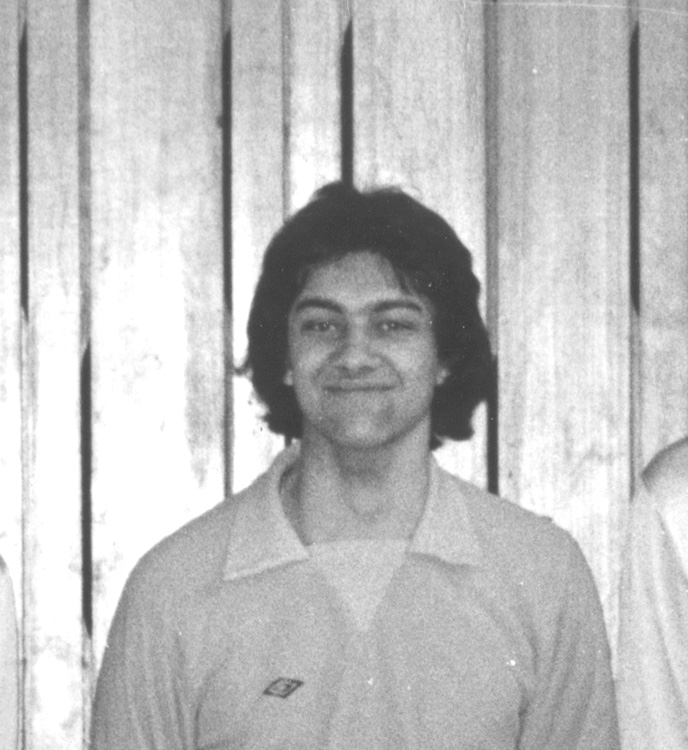
Ken Blecher was the sweeper. He was the Team Captain, so he had the shiny satin finish shirt:
For some reason, we played in fairly dark blue shirts of a shade called ‘Admiral’ or ‘Azure’ apparently. This had been worn as a change strip by Sunderland in the First Division a few years previously. The sleeves had a red and white design on them, as did the collars.
Now, back to the players.
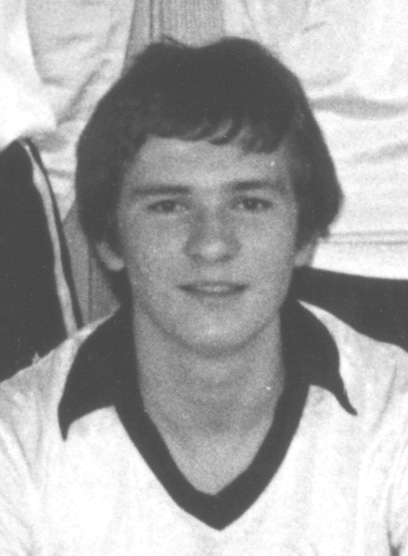
Phil Sermon was a 100% team player who, although he was often a little quiet, always gave everything on the pitch:
Paul Chappell was almost surgical in the strength and calmness of his tackles:
Chris Batty was an accurate passer of the ball, with a powerful shot:
Bert Crisp was a strong runner and created many chances:
Phil Colley supplied energy in midfield:
Chris Ffinch played well in attack:
Robert Harwood was a confident goalscorer:
Stuart Burns also contributed well in attack:
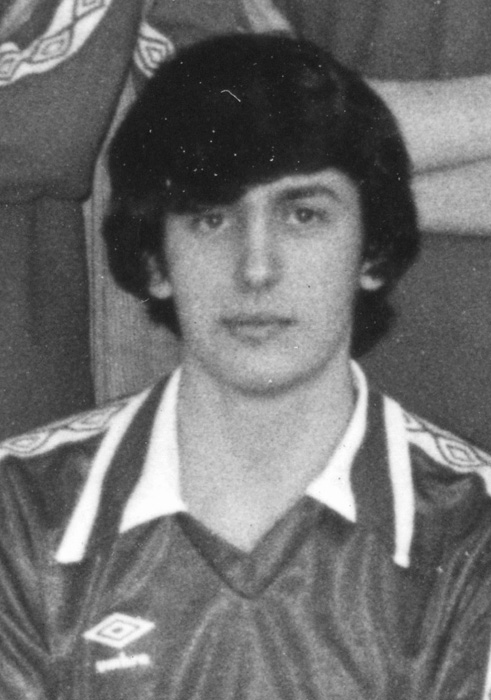
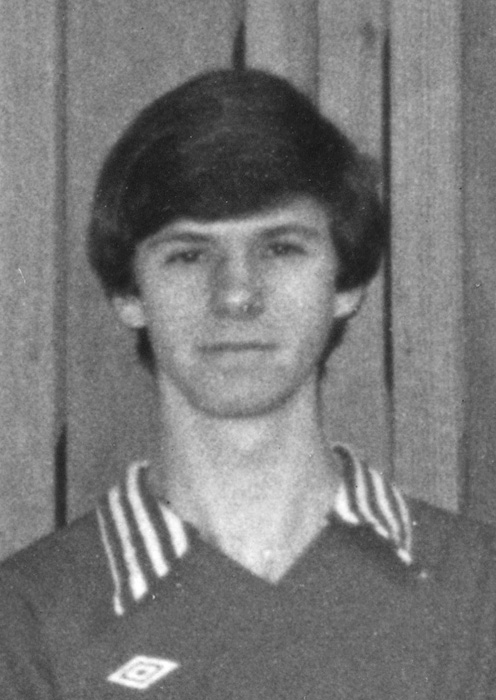
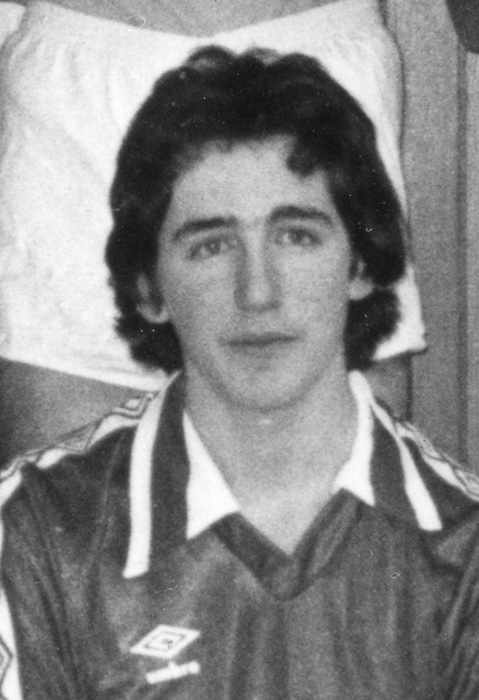
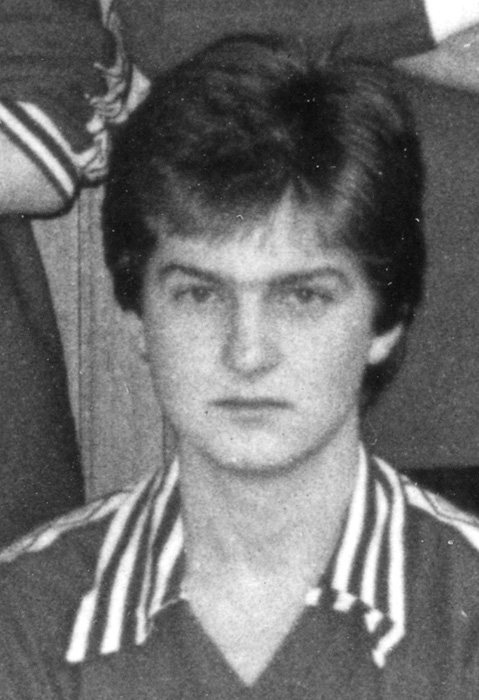
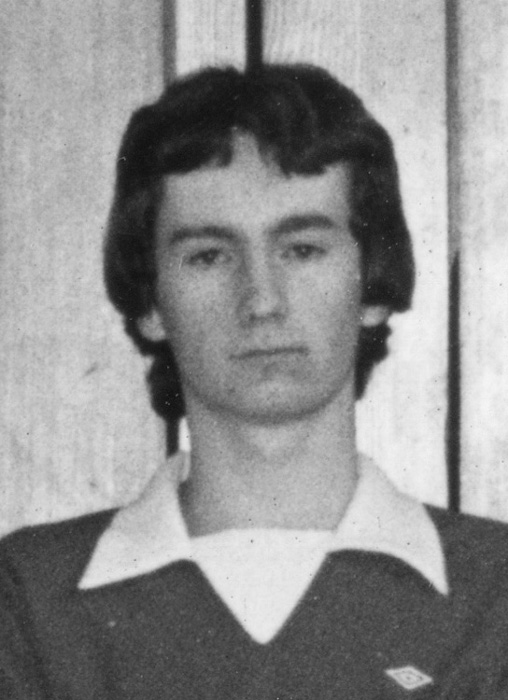
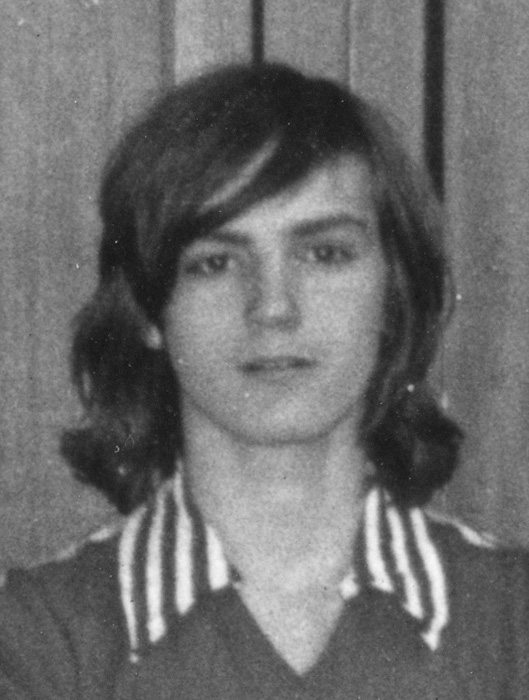
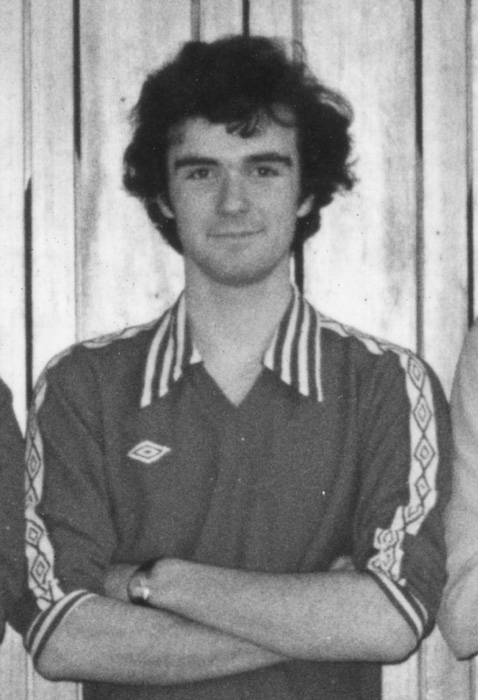
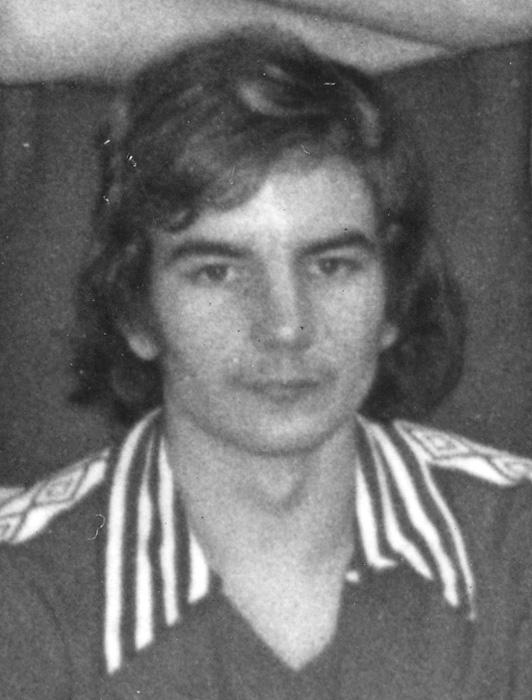
On the team photograph, two players remain a mystery to me, although this all took place some 35 years ago now. The first is CD Richardson:
And the other is David Nowell, who, as you can see from the comments below, was the left full back, but who was unfortunately injured very early in the season :
Forgive me gentlemen.
Overall, the Nottinghamian reported that the players were “all keen to play and all contributed to a most enjoyable season. Everyone has done his best and given his all.”
A lot of my readers, of course, will not be familiar with any of these young men. Let them stand, therefore, for your own sporting efforts at school. Did you do your best and give it your all?
Perhaps you were not in a sports team of any kind. Well, just look at the faces of these sixteen, seventeen and eighteen year old young men. Look at their expressions. Their inner thoughts.
Nowadays they will be in their early fifties. Their team coach back in the day was in his late thirties. Well now, I am in my early sixties, and I just regret that I didn’t enter more Ché Guevara lookalike contests when I had the chance:
Overall, it must be said, the football team at the High School since 1968 has not really had a great deal of success. The exception to this, though, was the 1980-1981 season which was easily the most successful of the modern era. By the time the School Magazine, the Nottinghamian, was published, the team were undefeated in twelve matches. This record was extended to the very last game of the season which was a most unfortunate defeat at home by High Pavement Second XI who managed to score two goals without reply.
Here is the team photograph:
(back row) Dr.D.A.Slack, Norman Garden, Robert Crisp, Richard Mousley, Jon Bullock, Simon Derrick, John Ellis
(front row) Rob Persey, Raich Growdridge, Chris Peers, Neil McLachlan, Nick Cope, Chris Ingle
The team’s goalkeeper was Richard Mousley, whom the school magazine described as “reliable, agile, and when needed, very courageous.”
They continued with the rest of the team:
In defence Richard Townsend was the left full back, replaced occasionally by Norman Garden. Both of them were deemed to be “consistently good players, and very determined in the tackle.” On the opposite side as right full back was Nick Cope, equally determined, and occasionally over-enthusiastic in the tackle:
Alas, Richard Townsend did not attend the team photograph on that coldish but fairly bright day in the Summer Term of 1981.
The central defenders included Raich Growdridge who was both team captain and sweeper. Raich was very skilful, with total commitment and a tenacious tackle. He was always capable of lifting the side when things were going against them. Raich had a trial with Derby County’s A team during the Spring Term, and is believed to have played perhaps three games for them. I was told by the Derby coach that had he not been over 18 years of age, they would have signed him for the club:
The other central defender was Jon Bullock who was extremely commanding in defence and particularly useful when attacking at corners. He actually scored a hat-trick at Bilborough, an extremely unusual feat for a defender:
In midfield, Tim Little was hard working and consistent. He also scored some very useful and well taken goals when he moved into a more attacking role:
Rob Persey was a tireless player, and a very determined tackler who possessed a great deal of skill when coming forward into attack. He was not the strongest defensive player, however:
John Ellis played on the right, and scored a number of remarkable, even unbelievable goals, from between fifteen and thirty yards out:
Chris Peers was a fine left footed player, who could dribble well past a succession of opponents. He was a particularly skilful taker of corner kicks:
Among the forwards, Simon Derrick was perhaps rather small, but very aggressive as a centre forward, with a lot of skill on the ground:
Chris Ingle was an excellent finisher, with tremendous pace. In the author’s humble opinion, he was the fastest High School forward of the modern era, with the possible exception of Leo Fisher. Chris scored nine goals in the season, with a hat-trick against St Hugh’s College, in Tollerton:
Other players to have figured in the squad included Neil McLachlan, who occasionally lacked total commitment, but had sufficient skill to play well as a replacement both in defence, midfield or attack. A veritable “Jack of All Positions”, the Nottinghamian called him and a valuable asset to the group!
Robert Crisp, universally known as “Bert” was a skilful midfielder, who never let the side down when called upon:
Both Ken Blecher and Chris Turner also played in the team:
Overall, the side played seventeen games and won eleven of them. Five games were drawn, and there was a single defeat, by 0-2, in controversial circumstances, if I remember correctly, against High Pavement 2nd XI. It is interesting to notice how many of these schools no longer exist nowadays, thirty four years later. The team’s victories came over Brunts of Mansfield (twice), Becket(twice), Bluecoat(twice), Forest Fields 2nd XI (twice), High Pavement 2nd XI, Bramcote, Bilborough and St Hugh’s College in Tollerton. Drawn games came against Bilborough, West Bridgford, Bramcote and twice against Trent Polytechnic.
The team’s goals were scored by Ingle 9, Ellis 8, Derrick 6, Bullock 3, Little 2, Persey 2, McLachlan 1 and two own goals.
The football report in the Nottinghamian paid the fullest tribute, and rightly so, to the endless support given to High School football by Tony Slack, who was retiring at the end of this splendid season:
He in turn generously praised the team’s achievements, despite the limitations of selecting a team from a very small number of players. Set against this, however, was the players’ commitment to the game, their willingness to work for each other, and their high level of team work, which, on many occasions, enabled them to defeat opponents who were, technically, far more skilled than they.
Nowadays, these young men will be in their early fifties. It would be interesting to find out where any of them are now, perhaps with a message in the “Comments” section?
Of late, there has been an increasing number of claims by people who think that they have seen Bigfoot in Great Britain. If you think Bigfoot is a physical being, descended from gigantopithecus blacki, then for me, that particular idea of seeing such gigantic creatures in tiny England is almost beyond ludicrous.
If you think Bigfoot and all his pals come through vortices in time and space, wormholes in the structure of the dimension, then I suppose his existence here would perhaps be a definite maybe.
Rather reminiscent of the “Barmston Drain Dog Destroyer”, this is a tale from Tunbridge Wells. I have précised the account in the Daily Mail, although it did appear in a good few other newspapers in almost identical form.
Tunbridge Wells, incidentally, is located in west Kent, forty miles from London. The population is about 56,000:
“Terrified walker claims 8ft-tall creature roared at him…
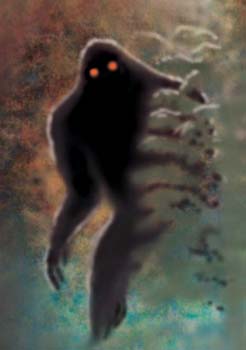
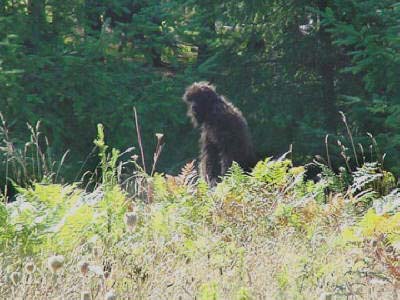
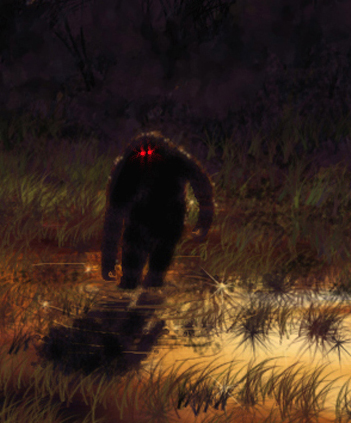
A man walking in the 200 acres of woodland beside the town’s common claims to have spotted an 8ft tall black beast with demonic red eyes and long arms.
The ape-like creature, which looked like America’s legendary Bigfoot, roared at the walker, who immediately ran off in fear.”
And of course, that is not the only report in Tunbridge Wells. All the people who have seen Bigfoot in the local library car park suddenly come out of the woodwork to tell the tale.
“Over the past six months there have been a number of sightings. Locals in Tunbridge Wells have mixed opinions, with some believing it could be a joker wearing a fancy dress costume.
Scientists say rumours of its existence have come from folklore and hoax.”
Interestingly enough, though, there is a tale of a strange creature being seen in Tunbridge Wells well over seventy years ago in 1942. Every monster has to have a name, preferably slightly comic, and presumably in an effort to make it a little less monsterish. He has, therefore, been christened “The Kentish Apeman” or “The Apeman of Kent”. The tale was told best in the Kentish News:
“He was first spotted on the town’s common seventy years ago.
An elderly couple saw it in 1942.’They were sitting on a bench when they became aware of a shuffling noise behind them.
Turning around they saw a tall, ape-like creature with eyes that were burning red moving slowly towards them at a slow pace.. They observed this creature for some time until they became afraid and both fled – terrified.”
“The old lady went on to say that they told the police and members of their family, thinking that a gorilla had escaped from a zoo, but they were laughed at and were not believed.”
This account also mentions other reports of the creature in more detail. One extraordinary tale, even in the context of gigantic unknown apemen, came in Dartford when a student saw a creature with long arms and knees which came up under its chin as it walked. If it’s nice weather tonight, or perhaps tomorrow morning, then go out on your lawn, and give that a go. And don’t forget: “knees which came up under its chin as it walked”.
Five members of the Territorial Army in 1991 spotted this beast on Blue Bell Hill, near Maidstone. They threw stones and shouted at it before running away. A young girl in Chatham saw the apeman appear then run off into the bushes.
Well, there we are. No real, concrete explanation. Not like the famous Man-Monkey of Ranton. (The what?):
“On January 21st 1879, a labourer was employed to take a cart of luggage from Ranton in Staffordshire to Woodcock in Shropshire.
“He was late coming back. His horse was tired, and could only crawl along, so that it was late at night when he arrived at the place where the road crosses the Birmingham and Liverpool canal.
“Just before he reached the bridge, a strange black creature with great white eyes sprang out of the plantation by the roadside and alighted on his horse’s back.”
A bit like this?
“He tried to push it off with his whip, but to his horror the whip went right through the thing, and he dropped it on the ground in fright.”
When the man recovered from the fright, he returned home and excitedly spread the story.
A few days later, a policeman came round to his house and told the frightened man: “That was the Man-Monkey sir.”
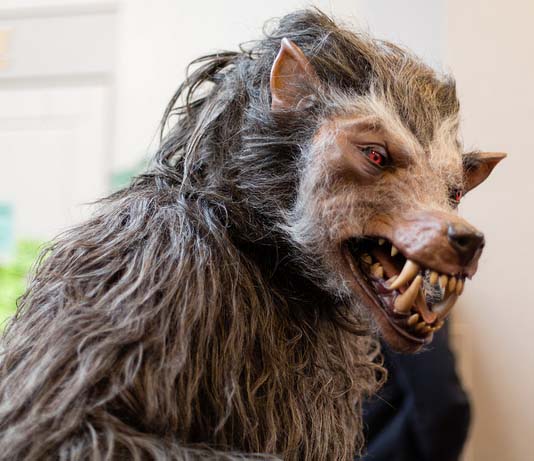
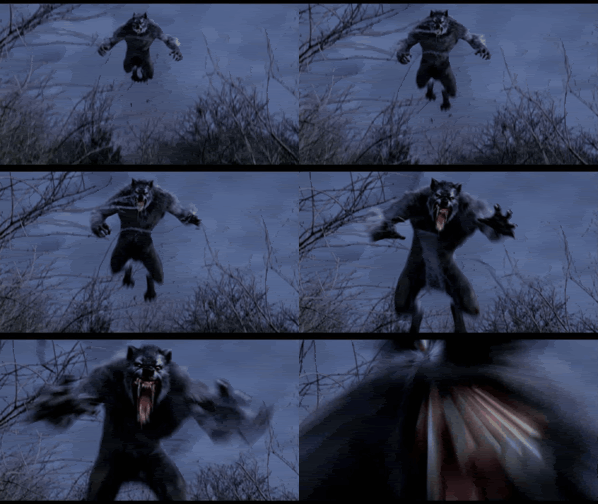
I told you in previous articles that there were more werewolves about than you might think. News came in recently, on Sunday May 15th, of werewolf sightings near Hull in East Yorkshire. The national newspaper, the Daily Express, took up the story. Here is a highly abridged version:
“Seven separate eye witnesses claim to have spotted the 8ft tall creature lurking in an abandoned industrial area outside the centre of Hull.
Residents and folklore experts believe the beast is Old Stinker who, according to legend, is a foul-breathed creature in the Yorkshire Wolds.
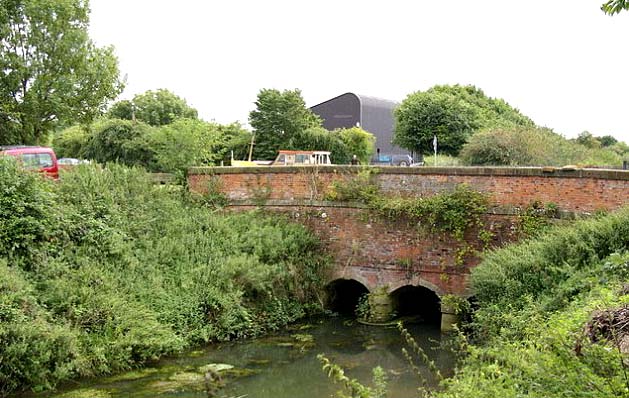
The lonely banks of Barmston Drain are where the creature was first reported before Christmas.
One woman claims to have seen it turn from man to beast as she stood on the bridge”:
She said: “It was stood upright one moment. The next it was down running like a dog. I was terrified.
It bounded along, then stopped and reared up on its back legs, before running down the embankment towards the water.
It vaulted thirty feet over to the other side and vanished into some allotments. It both ran on all two legs and on all fours, as if with the qualities of both human and wolf.”
A couple saw “something tall and hairy” eating a German Shepherd dog next to the Drain.
They saw it jump an 8ft high fence before vanishing into the night, its prey still in its jaws.
A woman walking her dog spotted something “half-man, half-dog” in the distance.
She was terrified, and her pet began shaking and refused to go any further:
Well, this monster could well have become a minor source of tourist revenue, particularly with the right people in the right costumes. Unfortunately, though, the locals chose to shoot themselves in the foot.
Leave well alone?? Rake in the cash?? No. No. NO!
Let’s take the high risk strategy of going to look for “Old Stinker”, the moment the next full moon raises her beautiful head. Notice how the local councillor just can’t keep away, and his almost childlike faith in Hull Council:
“Now locals plan a werewolf hunt with cameras and recording equipment. Councillor Steve Wilson has offered to keep an incident log: “I am happy to keep a diary of sightings by people around here and report them to Hull Council.”
Just one step from the Stasi.
Local author Charles Christian said: “Old Stinker was actually said to be operating on the other side of the Yorkshire Wolds but it would be no distance at all for a large animal to get to Hull.”
What faith in the public transport system. Why, it’s probably run by Hull Council:
Mike Covell, an expert in the supernatural, said: “No one really knows what to do. You can hardly pop down the local council office or police station and say you’d like to report a werewolf.”
Well, Mike, have I got news for you. That is exactly what everybody has been doing. On a discussion forum, watertight evidence was provided of previous werewolves in Yorkshire by “wmysteries90″:
“I had one witness claim they saw a huge dog which stood up, jumped over a fence and then run off with a cattle animal.(sic) Then his friend came forward to his fried stating he had seen a huge dog in the same area. (sic) A woman claimed she heard a strange howl. While a former military guy with an undisclosed area on the moors stated that few years back with a routine team in the middle of the night they had the sense of being watched by something.
Also there have been claims made by people around the moors stating that they have either seen or heard strange howls, growls.”
Indeed, the Daily Mail were to concentrate more fully on placing the “Barmston Drain Dog Destroyer” in its proper context, once they had established that the Werewolf Councillor was from the Labour Party.
Old Stinker, therefore, was supposed to haunt the “Wold Newton Triangle” (the what??), an area known for mysterious activity (really?):
“For centuries, tales have circulated of zombies, ghosts, and Old Stinker – a great hairy beast with red eyes, who was so called because he had bad breath…people would glimpse the rear lights of a car in front, but it would reveal itself to be the red eyes of a wolf.”
How often that has happened to me. Although driving a 1994 Volvo I don’t catch up too many cars, or werewolves, for it to be a real problem. Well, it’s not as bad as ice or sudden banks of fog.
If you want to investigate further the question of “How gullible can people get?”, then this is a similar story, set in the same area, but harking back in the “Golden Age of Satanic Panic”.
My previous story about the “Barmston Drain Dog Destroyer” and the “Golden Age of Satanic Panic” was soon followed in the national press by the story of two people who saw what they thought was a puma type creature as they returned home along country lanes around Pershore in Worcestershire in the early hours of the morning:
They suddenly saw a “muscular black animal” in the middle of the road. It was around one metre long and they were forced into an emergency stop. The creature circled the car and appeared to be about as tall as the car window. Its eye reflection was green. Frightened, the couple drove off, but not before they had noticed what they took to be the eyes of the creature’s mate hiding in the darkness of the hedgerow:
There have apparently been other sightings of puma type animals elsewhere in the county, at Evesham, Malvern and in the Malvern Hills.
Indeed, there are continuing reports of pumas or ABCs as they are called (Alien Big Cats) all over the country. In Leicestershire, for example, experts have said that there are two territories which overlap around the East Midlands Airport at Castle Donington. Rutland Water is included in one of them:
Even I have seen one, while I was trying out my new “see in the dark” binoculars. I thought it was a fox at the time, but I now realise that foxes don’t have long curved tails, wide faces or big round ears. There are even videos of these killer cats. This one comes from AnimalInfoTV, who produce a great number of really interesting looking videos on a number of different subjects. I would commend them to you:
Going back to the “Puma of Pershore” though, what makes this news story quite extraordinary, however, is the fact that when the couple did a drawing of what they had seen, because a werewolf had been spotted near Hull around the same time, the consensus of opinion suddenly became that they had actually seen the “Worcestershire Werewolf” rather than the “Puma of Pershore”.
Well, here is their drawing. Make your own mind up. “Worcestershire Werewolf”?? or the “Puma of Pershore”??
I went to Pershore twitching once. It’s a really lovely place. It was to see a Black-throated Thrush, which was at the time, a mega-rarity:
Liverpool and the leafy parks and graveyards in its suburbs was not the only place to be involved in the Great English Fairy Flap of 1964.
In June 1964, strange things started happening in Gateshead, a very ordinary, humdrum town in the north east of England. It is a suburb of Newcastle-on-Tyne, where polar bears and walruses (or should that be “walri” ?) roam regularly in colder winters. Look for the orange arrows:
This slideshow requires JavaScript.
At ten past four in the afternoon of June 2nd 1964, four boys were playing together in Leam Lane Estate, Gateshead. This looks a fairly desolate site, right on the shores of the freezing, windswept North Sea:
Looking at the map, though, as it does have one or two of the features that would link it with Celtic fairy sites, and indeed, with the old idea of dimensional portals out of which ghosts, goblins, UFOs and lots of other exciting beings may emerge:
First of all, it is (or was then) heath covered waste land with gorse and bracken, the very landscape beloved of fairies in Cornwall. It also has a very ancient Roman road, which would have been built directly over a Celtic track. Indeed, the reason that Roman roads across Western Europe are so unbelievably straight, is that Celtic tracks were. Quite a link, therefore, with times long, long ago.
Another indicator of pathways into other dimensions is the presence of any natural water, such as streams, and, for me, what clinches the deal, a natural spring. (that is what the blue “spr” stands for, at the centre bottom of the map). You can’t tell from this map. but I have looked at some larger scale ones, and the area also has a couple of cemeteries, absolutely classic places for crossing over into other realities.
Back to those four boys who were playing together at ten past four on that early June afternoon. They reported having sighted:
“a silver domed object about the size of a table, with portholes around the top and three legs. It was seen falling like a leaf through the sky making a low buzzing noise descending approximately 120 yards away from where they were standing.”
Here is the closest the Internet has to offer. It is in actual fact, the new Smart Car:
At half past five in the evening, another, fifth boy, Mark Smith, aged 14, decided to walk down to the farm to collect some straw for his rabbits. When he arrived, he saw a group of around ten children, standing about twenty yards away from a haystack. This was followed by the startling sight of:
“around six or eight tiny human beings on top of the stack: they were about two and a half feet tall and dressed in bright green suits. They appeared to be digging into the haystack, as if searching for something. Their hands seemed like lighted electric light bulbs.”
Mark went home and told his parents what he had seen and decided to make his way back to the scene, but he was stopped by the farmer. Mark says that he was told by another child that:
“she had seen a circular silvery object take off from the ground with a spinning motion giving off an orange glow.”
On June 6th, 1964 several members of the local UFO Organisation visited the locality concerned and spent some considerable time speaking to many of the residents and children about the matter.
One child who admitted having seen “the little green men” told them:
“the leader of the little men was dressed in black and carried a baton with pink stripes.”
Another girl claimed:
“He was sitting on the roof of the barn watching us.”
Another girl told them that she had seen ‘him’ riding on the back of a cow whilst others claimed the whole thing was a hoax. The farmer who owns the land said
“All the claims are a load of nonsense. If anything has landed I would’ve known about it. I have a dog kept in the yard, he would warned me if anybody had been prowling around the farm.”
And that was not the end of it. Three months or so later…
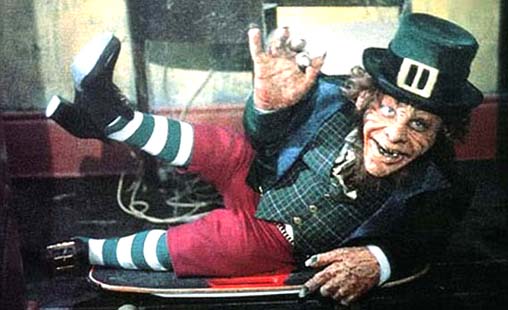
It was claimed that a “Leprechaun” had been sighted in Tamar Street East in Belfast on or about September 10th 1964.
In fact, this particular Little Green Man was later identified as six-year-old Billy Knowles.
He was playing at Robin Hood, dressed in his nice new costume:
He was playing in a derelict house, something Belfast was not short of at the time:
Poor little Billy was soon chased away by police who were frightened for his safety.
Too late!!!
The hint of a real life Leprechaun, and a real life pot of gold, triggered off the local people’s imaginations. Vast numbers of them descended into the streets causing massive disorder. Ironically the crowds that gathered there included not just children, but many adults. The incident, which involved the police and the fire service in some numbers, also attracted the presence of David Bleakley, the Labour MP for Victoria, who handed over a hastily written petition to Belfast Corporation, demanding action to keep the crowds and children away from the embankment and the many derelict houses there. One senior police officer was quoted as saying:
“A grown man, cold stone sober, insisted to me that he had seen a leprechaun.“
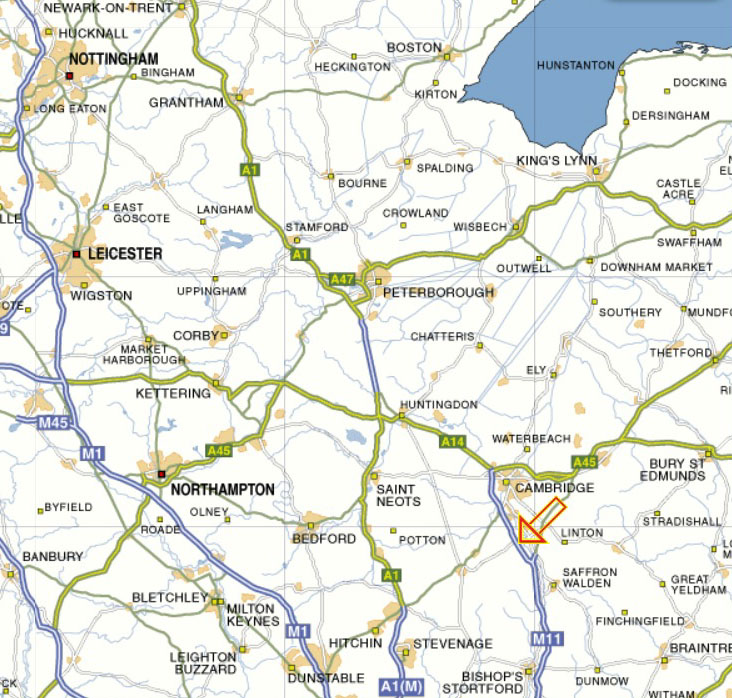
A few years ago, when I was still a teacher, along with four other teachers and more than a hundred members of Year 9, we all went in two coaches to Duxford near Cambridge to see the Imperial War Museum. Look for the orange arrow:
None of you will be surprised that the very first plane I rushed to see was the Avro Lancaster. The planes are rather crowded together, but there it was:
There were trolleys and a little tractor to transport the bombs to the bomb-bay:
The bomb-bay is enormous, and eventually would be capable of taking a ten ton bomb, the “Grand Slam”:
The green cylindrical bomb in the background in the below photograph is a blockbuster bomb or “cookie” and weighs 4,000 pounds which is around two tons. Quite often two of them were strapped together to make an 8,000 pound bomb. On occasion three of them would be bolted together to make things go with a real bang:
This is the mid-upper turret, armed with two .303 Browning machine guns. The gunners were seldom particularly happy that a target was provided underneath for the Luftwaffe night fighters to aim at:
This is the radome, behind the cockpit canopy. On more than one occasion my Dad would stand there. looking out, as the bombers all taxied out to the end of the runway for the take-off. My Dad was abundantly aware of the enormous casualty rates in Bomber Command, and more than once he wondered to himself how many of the aircraft he could see slowly making their way to the runway to take off would be coming back in the morning:
Overall, Bomber Command lost 8,325 aircraft to enemy action. A total of 55,573 young men, all of them volunteers, were killed, a casualty rate of 44.4%. Of every hundred airmen, 55 were killed, three were injured on active service, 12 became prisoners of war, two were shot down and made their way back to England and 27 survived. One of the two reasons my Dad was one of those 27 fortunate young men was the fact that he flew in Lancasters. “A Lanc will always get you back” he told me on more than one occasion. I owe my own existence, therefore, to the excellence of the Avro Lancaster.
Sooooo….when the moment was right, a fat old man quickly jumped over the rope, walked up to KB889, gave it a good pat and said “Thank you for my life”.
There will, however, always be some idiot child who is seduced by the flighty, undependable glamour of fighter aircraft and who will stand there taking photographs of Spitfires until the bus leaves. Just look at him in this photograph here:
The fact that a small group of children in Nottingham claim to have seen gnomes in leafy Wollaton Park seems incredible, almost ludicrous, in the cold light of day, but it is by no means an isolated incident.
I have spoken in the past of so-called “UFO flaps”, when many sightings occur in just one small area. An example would be the Nottingham UFO flap of July 1967. Similar events occurred nationally in 1964, although this time it involved gnomes, pixies, leprechauns, fairies and their ilk rather than extraterrestrial spacecraft:
What was particularly bizarre though, was that the little people, who were seen in three separate places in England during the course of the year, were not closely linked with one particular city, but occurred independently hundreds of miles from each other.
And these widely separated events cannot possibly have been interlinked, because communication in those days was so limited and so private. Just letters or postcards. Telephones were a lot less frequent than you might imagine. You read only national newspapers or your own local paper. Local newspapers from distant cities were more or less unobtainable. The only television was national television… not really a medium for gnomes and fairies!
It sometimes seems that goblins and their ilk are part of our natural landscape and seem to pop out into our world on a rare but fairly regular basis. I presume that this is why nowadays a lot of modern folklorists tend to equate widespread ancient belief in gnomes and their various friends with our current widespread modern belief in space aliens, little green men and tales of abduction.
It is this process of flitting between dimensions which remains the same over thousands of years, even if those who do it may have slightly differently coloured clothes and a vastly changed appearance.
And their activites are the same too. After all, how much difference is there between fairies who hold people hostage in their fairy realm and our modern tales of UFOs and extra-terrestrial kidnap?
Back to the simpler stuff.
On June 30th 1964, children saw varying numbers of “little men” in Jubilee Park, Liverpool. Here is the entrance to the park. No Leprechauns in sight yet:
Nobody knows exactly what the children saw. The little men had “white hats”, and were all seen to be enthusiastically throwing clods of earth at each other.
It took the children very little time indeed to put two and two together, and within minutes they had made a “Positive I.D.” and decided that the little men were, in fact, leprechauns.
Don’t just a few of the Leprechaun Community look really menacing? It spoils it for the rest.
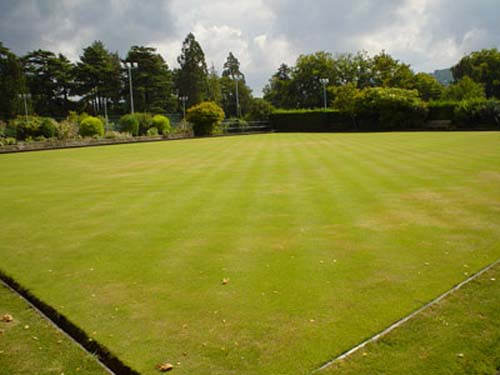
The following day, July 1st 1964, all the local newspapers claimed that thousands of children had started a hunt, following reports that little green men or leprechauns had been seen near the Bowling Green in Jubilee Park on Jubilee Drive in Liverpool. This was in the Edgeline district in the eastern suburbs of the city. A huge orange arrow has been fired right into the middle of the Bowling Green. No Leprechauns were injured:
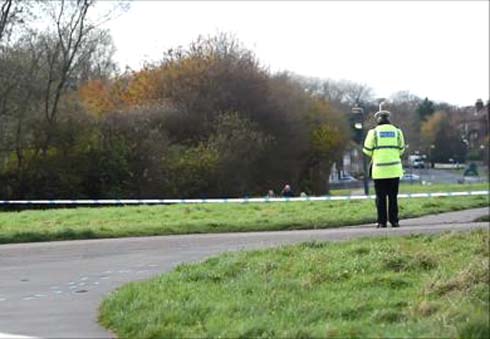
Very soon, Members of the Police Community had to be called in to control the crowds:
A nine year old boy told a reporter that he had seen little men in white hats, throwing stones and mud at each other on the Bowling Green. Another local boy, fourteen year-old David Wilson, claimed to have seen several small green creatures about two feet high running around a haystack on a farm near to the Edgeline Estate:
A little girl said:
“I was one of the school children that saw those leprechauns. I attended Brae Street School and we all saw them popping in and out of a window overlooking the school yard. There were about four of them, all tiny, dressed like a school book idea of a typical gnome and they sat swinging their legs on the window ledge getting in and out. What they were I don’t know. I only know what they looked like. I’d love to know the truth!!!”
Another child said:
“I remember the siege of St Mary’s Church when the police and Father Rose (or Father Spain) appealed for calm. I was one of the huge crowd of children shouting out “there they are”.
Someone said they had crossed the road into St Mary’s Infants School and were now hiding in the lockers (small cube-like cupboards). I never slept for days, and have had a fear of these type of cupboards to this day, which is still tested as my grandchildren’s nursery school use something similar.”
Nobody ever found the leprechaun who was sitting quietly smoking his pipe:
A further witness said:
“I certainly remember the leprechauns, and I actually saw a few of them on Kensington Fields, close to the library, but my parents and other adults tried to convince me that I”d been seeing things. This would be one afternoon in early July 1964, around 4.30pm, and I remember it as if it were yesterday. I was ten at the time and on my way to play football with my mates and saw these little (I’d say just a few inches tall) men dressed in red and black, standing in the grass, looking at me. I’m sure one of them had some type of hat on. I panicked and ran all the way home. My mum said there had been reports of leprechauns and little men on Jubilee Drive and Edge Lane the day before. That same evening crowds turned up on Jubilee Drive, and I remember a girl with a jam jar that she was going to put the leprechauns in!”
The Bowling Green was so crowded that the police attenpted to clear the park and to guard it from the bands of children who were tearing up plants and turf in the search for the little creatures.
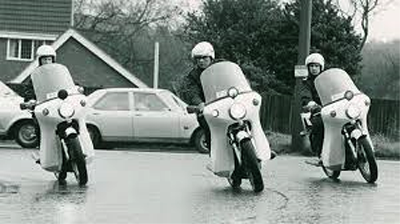
A rather bewildered Park Constable James Nolan had to wear a crash helmet to protect himself from the children throwing stones. At the time of the incident Constable Nolan was one of some fifty City and Parks Police Officers who patrolled the city on blue coloured Vespa scooters with a fixed radio mounted on it – in those days it was state of the art in police communications.
A local woman said to reporters at the time:
“This all started on Tuesday, how I just don’t know, but the sooner it ends the better. Stones have been thrown on the Bowling Green, and for the second night running no one has been able to play. The kids just won’t go away. Some swear they have seen leprechauns. The story has gone round and now we are being besieged by Leprechaun Hunters.”
Here is the Bowling Green in more recent times:
Such was the desperation of the children’s search that the police had to set up a temporary first aid shelter to treat at least a dozen children who suffered from cuts and bruises. The evening newspapers described the strange visitors as “little green men in white hats, with rhinestones and hurling tiny clubs of earth at each other.”
Thousands of children organised an extensive hunt for them, tearing up plants and turf, scaling surrounding walls, and searching empty houses well beyond the boundaries of Jubilee Park. Eddie McArdle recalled:
“I remember the story well as I have a scar as a constant reminder of the event. We, the kids from St Marie’s, Kirkby, went en masse into the church and as we hunted the little people, some bright spark shouted that they were coming out after us. Panic ensued and as we all fled quicker than we entered. A boy who is sadly no longer with us swung the church gate in his haste to escape, and I was hit on the forehead by the metal cross on it. The lad, Danny Callahan, didn’t even know he had injured me as he was well up the street and along Elric Walk where I lived. I had to have my head stitched by Dr Cole. As far as I know I was the only person injured by the little visitors. “
Life was getting no easier for Park Constable Nolan, who called in the City Police. Constables in cars and on motorcycles arrived.
They again attempted to clear the hundreds of youngsters from the bowling greens, which were the alleged playground of the Leprechauns. But the youngsters still thronged there, toddlers to teenagers. They crowded onto the top of the covered reservoir for a better view of the bowling green. Tolerant policemen tried to get the youngsters to leave, but the children would not accept that there were no Leprechauns. Only at 10.00pm was the park finally cleared of children.
Over the next few days, thousands of kids visited not just Jubilee Park, but nearly all of the parks in the City. Some of the Leprechauns still managed to look a bit “iffy”:
The Little People were seen in Abercromby Park, in Stanley Park, in Newsham Park, and in Sefton Park, where a 13-year-old girl said she even grabbed one little man but he slithered from her grasp and fled laughing.
In Kirkby it took almost a fortnight for the clergy and the police to clear more than two hundred children from the graves and tombs of St Chad’s Church where it was believed fairies were living. Certainly, witnesses had repeatedly seen elfin figures dancing in the moonlight and, a sure sign of the supernatural, a crop circle had appeared. A month or more afterwards trolls were repeatedly seen outside St Mary’s Church in Northwood.
But then gradually reports became fewer and fewer and further and further in between, until the City returned slowly but surely to its humdrum normality.
Last time, I left you awaiting the arrival of Ragnar Lothbrok and his rather fierce friends in Anglo-Saxon Nottingham.
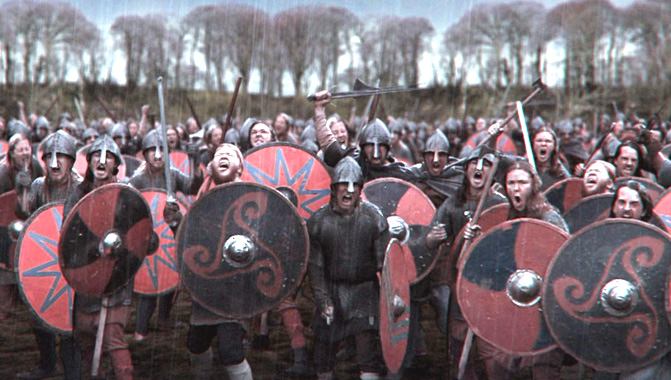
Well, by 867, Anglo-Saxon Nottingham had been well and truly captured by the Vikings and it became one of the Five Boroughs of the Danelaw. There may have been little in the way of extreme weather in this era, but their names were fabulous. The Five Boroughs of the Danelaw is a striking enough phrase, but the name of the army which made Snotingaham, at sword point, an offer they could not refuse, is, quite simply, wonderful. A thousand years before Heavy Metal bands, they rejoiced in the name of “The Great Heathen Army“. And here they are. They’re really quite handsome, aren’t they?
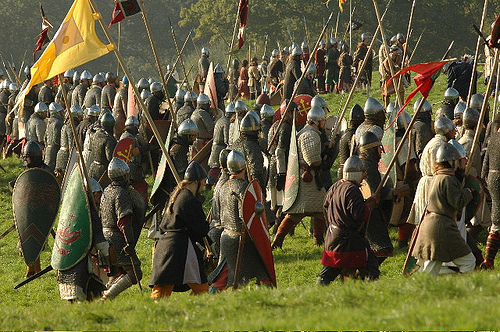
Then again, I really don’t see them as a group of people capable of waiting quietly for a bus: Another episode of extreme weather on the rain front came in 1141 when there was another Great Flood. And once again, the flooding was caused, as in 1947, by the mechanism of a sudden melt of large quantities of snow after prodigious amounts of rain. People in 1141 looked like this. Around this time there was clearly a significant risk for everybody of just rusting solid into one great mass:
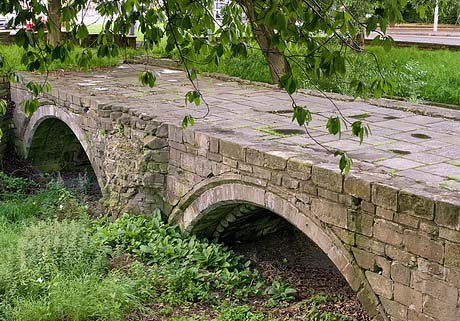
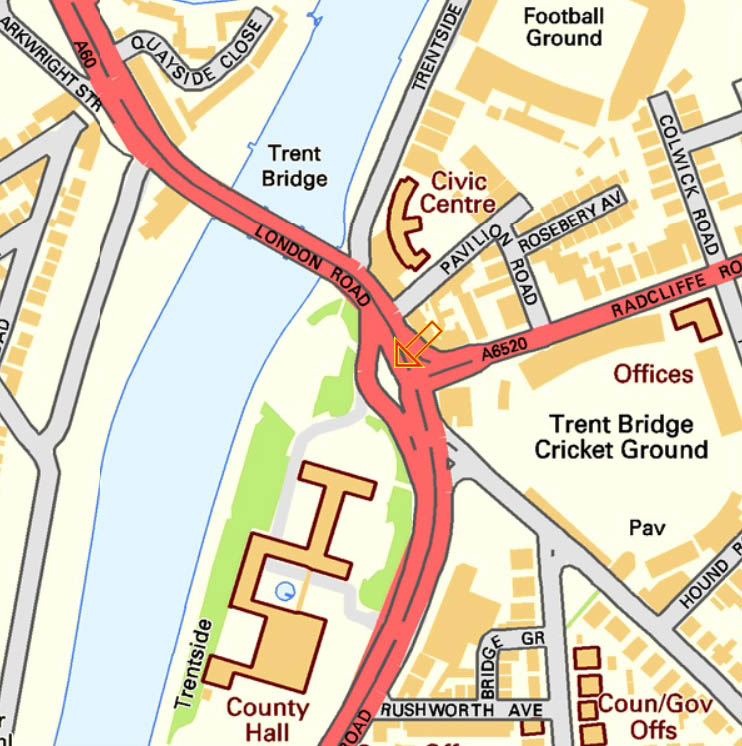
In 1309, Hethbeth Bridge, the medieval precursor of today’s Trent Bridge, was washed away by severe winter floods. A small fragment of this old bridge is still visible on the road island at the southern end of the modern Trent Bridge: If you go to see it, be very careful. Traffic nowadays is much more dangerous than “The Great Heathen Army”. Look for the orange arrow:
In 1346, little detail has come down to us, other than:
“from mid-summer to Christmas, the rains fell almost without intermission”.
The River Trent duly experienced:
“One of the earliest recorded floods.”
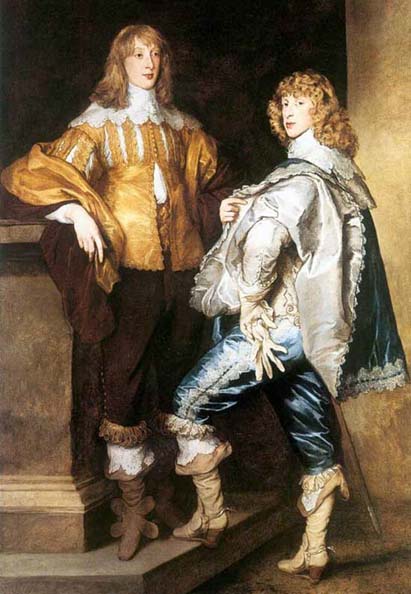
In 1499 Richard Mellers, the husband of Dame Agnes Mellers, of High School fame, is known to have given twenty shillings to help repair one of an apparent succession of Hethbeth Bridges, but it was pretty much in vain, as the Great Flood of 1683 washed a good proportion of it away. Here are two men in 1683. That’s not a look you can just throw together:
The worst ever flood in Nottingham was the so-called “Candlemas Flood” of February 1795, when two months of continuous ice and snow all melted extremely rapidly. Every single bridge on the entire River Trent was either damaged or washed away, including the Hethbeth Bridge for the umpteenth time. In the Narrow Marsh area of the city, around what is nowadays Canal Street and the land to the south of St Mary’s Church, the residents were all trapped in the upstairs of their houses and had to be given food from boats. At Wilford, up to 100 sheep were drowned and ten cows perished in West Bridgford. That doesn’t sound much, but they only had twelve.
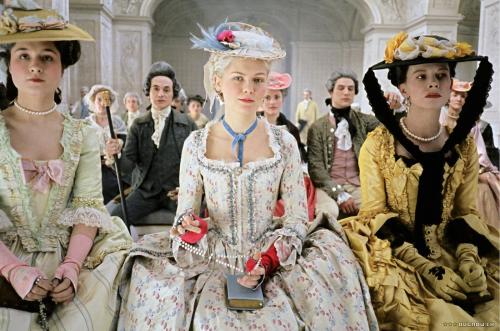
The late eighteenth century provided some wonderfully ornate dresses, all guaranteed to keep you afloat until help arrived:
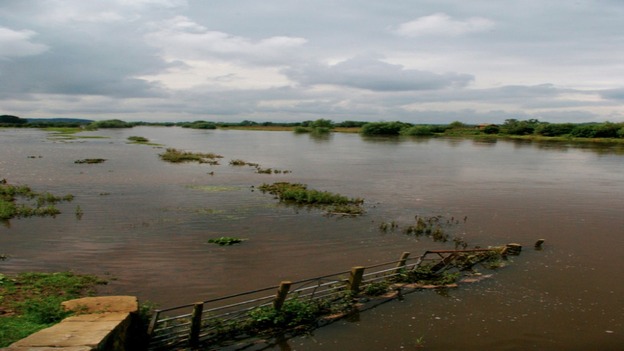
Another less severe flood came in November 1852 when the peak flow of the Trent was measured at some 38,200 cubic feet per second, between twelve and thirteen times the normal levels. A second, slightly worse Victorian inundation came in October 1875 when floodwater was up to six feet deep. During this latter flood the peak flow of the Trent was 45,000 cubic feet per second, fifteen times the normal levels. On Wilford Road an overcrowded cart was washed away and six people were killed. Higher up the river, huge numbers of farm animals were drowned and they must have been a ghastly sight as they floated down to the sea past Trent Bridge:
In a previous article, I wrote about the flooding of Nottingham during the modern era, and the ways in which we have learnt lessons from the floods of 1947 and constructed concrete embankments and sluices so that the River Trent is nowadays, to all intents and purposes, relatively tame. (“relatively” being the operative word.) If you walk down to Trent Bridge and look underneath the bridge on the City side, directly beneath the Riverbank Bar and Kitchen, however, you will see how the flood levels of previous years of watery disaster have been recorded. They are scarily impressive and well worth a visit:
This slideshow requires JavaScript.
The very first records of floods in Nottingham are more a case of inference than anything else. According to the (Royal) Journal of the Statistical Society, Volume XLI and “The Insurance Cyclopaedia” by Cornelius Walford (I need to get out more):
“29 A.D. There was a great overflow of the River Trent in England”.
In 214 A.D. the entire River Trent was again in flood and overflowed its banks by some 20 miles on each side from the normal course of its flow. Many people were drowned as the whole Trent valley was awash and there was great destruction. Both of these dates are during the Roman era, although Nottingham was not, as far as I know, a Roman town. Perhaps they knew that an underlying band of hard rock could be used to ford the river and its adjacent marshes. Just to establish our dates firmly, here is a Roman. Like every single Roman, he is a legionnaire, although he doesn’t look particularly ill to me, but that hat is really something: In 525 A.D. the entire Trent again burst its banks and a great number of cattle were drowned. The locals at his time may well have been Celts since we know that Nottingham, in the Brythonic Celtic language was called “Tigguo Cobauc”, meaning “The Place of Caves”. The Welsh may have been aware of Nottingham’s existence since they called it “Y Ty Ogofog” and even the distant Irish had a word or two for it, namely “Na Tithe Uaimh”, “The Cavey Dwelling”. Here are some Celts, managing to appear very, very fierce indeed, although admittedly, there is more than a dash of Village People in the overall look, especially the one at the front who may have no clothes on at all: Whoever the locals were in 530 A.D., they would certainly have got extremely wet at some point. The mighty River Humber is known to have flooded extensively onto adjacent low-lying ground and most of the region’s cattle were drowned. Much of that excess of water, of course, was bound to have come from the River Trent, which feeds into the Humber. It is difficult to see how Nottingham, at the side of the River Trent, of course, could have escaped floods of such severity. It was slightly after this date that Nottingham, by now a small group of wooden huts and a line of washing, came under the sway of the wonderfully named “Snot”, an Anglo-Saxon chieftain. The place where “The Mighty Snot” lived was immediately called “Snotingaham”, the “home of the people of Snot the Magnificent”. At this time, “Snotingaham”, was part of the Kingdom of Elmet. Here is an Anglo-Saxon chief and his friend. What impressive elmets they are wearing:
I just couldn’t resist that!
Next time, we will see what happens when Ragnar Lothbrok and his pals arrive in Nottingham on a seven-day-cruise in 867AD.
The period when the seventeenth century turned into the eighteenth was not the easiest of times for the Nottingham Free School, the ancient predecessor of the present day High School. You only have to look at the wooden board behind the school receptionist’s desk at the High School, and the list of names and dates that is up there. During this period, some three hundred years ago, Headmasters come and go, thick and fast. Just to refresh your memory:
Edward Griffith 1691 – 1707 Richard Johnson 1707 – 1720 William Smeaton 1718 – 1719 William Saunders 1719 Thomas Miles 1719 John Womack 1720 – 1722 John Swaile 1722 – 1731
Let’s look at the diary of these turbulent and potentially disastrous twenty years. Edward Griffith, the first Headmaster on the list, seems to have been an astonishing man. He could have talked his way into so many jobs in our own time, most of them probably in politics. Or maybe even financial advice:
August 1697
Edward Griffith, the Headmaster for the last six years, was summoned to court “for neglecting the school, whereby the school is much decayed in its reputation.” Griffith promised to concentrate on the school and never to work again as a full-time clergyman as well as his main job as the Headmaster.
early 1698
Griffith took up a lucrative post as the new Vicar of Stapleford.
Friday, December 19th 1698
The Town Council gave Edward Griffith the sack, alleging that
“…he has very much neglected his duty, whereby the said Free School is very much decayed and lessened, ….. the School Wardens do give him a discharge, which they have done accordingly. And if he shall refuse to leave the said Free School, that they shall withdraw his Salary.”
Griffith made no reply whatsoever to this decision. Sit tight and it will all blow over. May 1699
The Town Council issued a second decree that Griffith should quit his post. He took absolutely no notice of this one either. January 1700
It was agreed by the Town Council that Griffith should keep his job and salary until further notice. Result!! January 1705
The Town Council told Griffith that he was “discharged from being Schoolmaster any longer”, an order which, not surprisingly perhaps, he again ignored completely. He did, however, make a promise to depart in the very near future. June 1705
Griffith was again told to leave his job, and that his salary would henceforth not be paid. March 1706
The school wardens were told by the Town Council to pay the £85 of Griffith’s wages which had not been paid to him over the past two years. Once he had been given this cash settlement, Griffith had promised to leave. March 1707
Griffith at long last departed, a mere ten short years after being told to do so. And now, Richard Johnson…..
1707
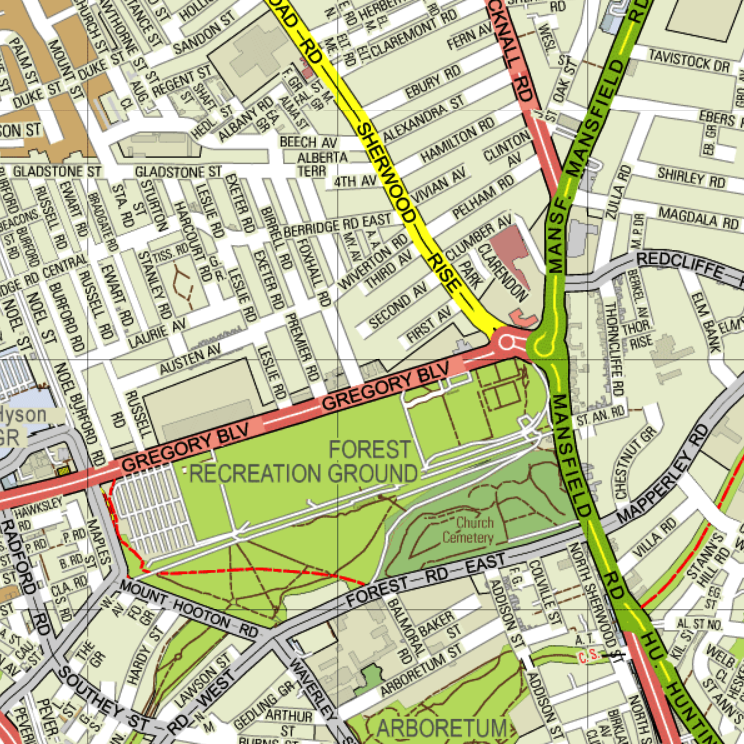
The new Headmaster, Richard Johnson, seems to have been, for the first five years or so of his reign, a vast improvement on his predecessor. Johnson was the author of an impressively long Latin poem describing a horse race on the Forest Recreation Ground, which was then called “The Lings”. Here is the site nowadays:
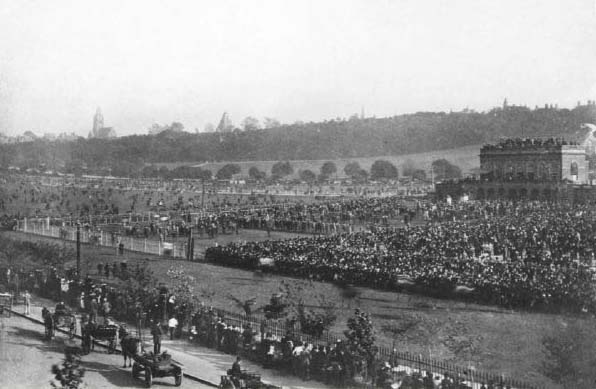
Race meetings used to take place in July of every year, and they attracted prominent people from miles around. Here is the Racecourse in the late nineteenth century:
In 1708, the race was won by the Earl of Cardigan on his horse, Carlessus. Johnson’s long Latin poem mentions the Duke of Rutland, Sir Thomas Willoughby of Wollaton Hall and Sir Thomas Parkyns of Bunny. It refers specifically to the fact that, because of the recent outbreak of smallpox in the town, comparatively few women were present…
“Now, to enhance the glories of the race,
See, many lovely women bring their grace.
Yet others, eager for the festive day,
With tearful prudence choose to stop away,
Lest swift and dreaded pestilence arise,
And desecrate that loveliness they prize.”
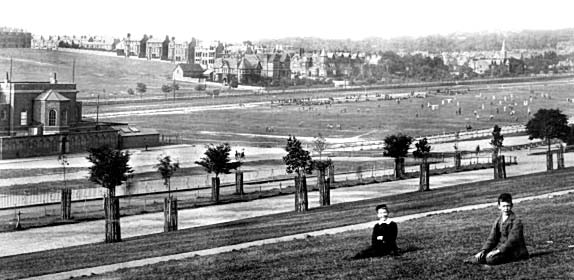
Here is another, mid-Victorian view of the Forest Racecourse with two boys, who may well have been members of the new High School. Notice the distant footballers busy playing in the middle of the racecourse:
1708
The newly appointed Headmaster, Richard Johnson, gave so many promises about how well he would perform in his new job at the Free School that it was decided to improve his living quarters and to build extra classrooms for all the new pupils who were bound to be attracted by the extreme excellence of this new Headmaster. Plans were already afoot to appoint two more members of staff, namely a second Usher and a visiting Writing Master, giving an overall staff of four. That should cope with the almost countless hordes, all eager for a free education of a very high standard.
(This won’t end well. It all sounds like pie in the sky to me.)
June 1718
Very little is known about what happened in the school in the years between 1711-1718, but, as an expert on the subject, I was 100% right about the pie.
The Council now sought to sack Richard Johnson, given that they thought he was a madman:
“…for all or most of the time…he very much omitted and neglected to teach and instruct the Sons of Nottingham….For the space of three Months and upward, he hath been, and is now, Delirious and Non Compos Mentis. He is incapable of performing and executing the Office of the Headmaster of the said school.”
Certainly, Johnson had fallen ill in 1714. He wrote ….
“I suffered such pains in my limbs that for a whole year I could not sleep without the aid of opium.”
(A drug addict running the school. That’s just what we need.)
More seriously, though, Johnson does seem to have suffered from a certain amount of ill health. The Town Council’s motivation for removing him from his position, though, may have had more to do with politics than any touching concern for his welfare or the school’s success. They conceivably exaggerated the Headmaster”s medical problems to create a trumped up charge of incompetence, which could then be used to remove a political thorn from the Town Council’s side.
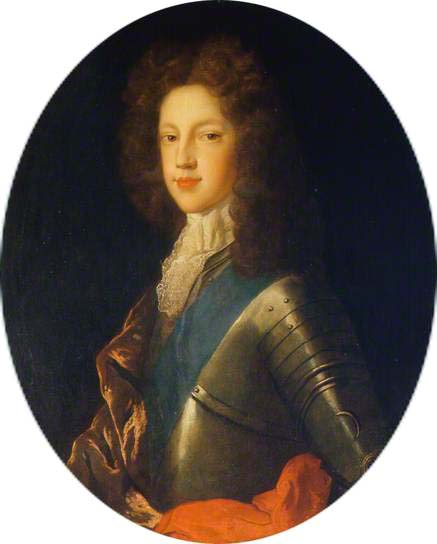
Inadmissible circumstantial evidence it may well be, but Johnson’s difficulties certainly seem to have begun not long after the national Jacobite rebellion in 1715, which was led by the so-called “Old Pretender”, James Stuart. Here he is in his younger days:
Nottingham was a Whig town, and Johnson may well have been a Jacobite. Around this time many other schoolmasters throughout England lost their jobs because they were Jacobites.
For whatever reason though, madness, drugs or politics, the Town Council tried to throw Johnson out. Johnson may well have spoken to his predecessor, Edward Griffith, though, because he decided that the best policy was, quite simply, to refuse, point blank, to leave.
(If that happens, just ignore the situation, and bring in another Headmaster of your choice)
August 11th 1718
The Town Council appointed William Smeaton as Headmaster.
(In that case, Jacobite Johnson, just ignore them. Take no notice whatsoever)
August 12th 1718
Johnson refused physically to leave the school.
Later on in late 1718 or, more probably, early 1719
Fed up with the whole situation, Sulky Smeaton resigned in an apparent fit of pique, and eventually got out of Dodge, never to be heard of again.
1719
The Council then appointed a local man, William Saunders, but at a much reduced salary. A legal action to eject Johnson from the school was taken, but in court Clever Clogs Johnson did not bother with a lawyer. He conducted his own defence with great skill. He duly won his case:
Johnson explained to the court how unreasonable it was to leave a man of his advanced age penniless in the world, and asked that he be given a decent reference, so that at the very least he could go elsewhere and earn an honest living. At one point, Councillor Abney, knowing of Johnson’s previous mental frailty, accused him:
“…what has happened to you is what Felix said of St.Paul ; much learning has made you mad.”
Johnson replied to the Councillor
“…you will never go mad from the same cause.”
(That got a lot of laughs)
The school now had, arguably, more Headmasters and ex-Headmasters than pupils. There were only five students left. The Deputy Headmaster, George Bettinson, taught two, and Johnson, gallant to the end, did the lion’s share of the work with the other three. Indeed, there were so few pupils that they could well have had a couple of windows each:
Very soon afterwards, the Town Council was again repeating its charge that Johnson had been delirious for the last eighteen months and that he was, to use the technical terms of psychology, as mad as a fish.
Finally, though, a compromise was reached. Johnson would leave and in return, he would be paid a pension of £10 a year for life.
(Mmm…..Nice)
William Saunders, the Town Council’s very, very recently appointed choice for the job, was now told that he too had to leave town before sundown.
later in 1719
Thomas Miles was made Headmaster.
(Problem solved !! Result !!)
Thomas Miles did not take up the post.
(Oh, noooooooooooooo!)
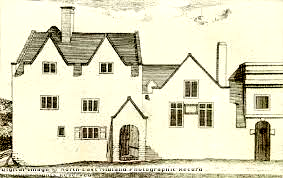
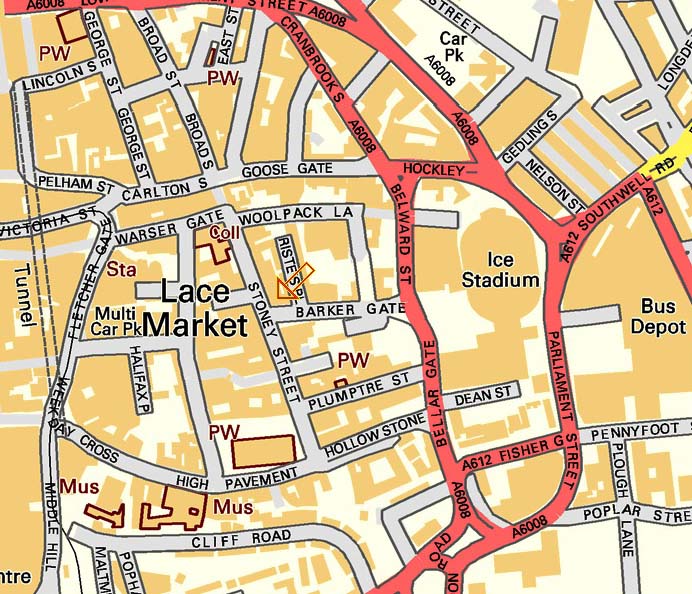
Amazingly and incomprehensibly, Thomas Miles said he didn’t want to work in an atmosphere of such considerable confusion. There was no confusion with the boys, though. Their parents voted with their feet. Numbers were still exceedingly low. On a good day, classes could have fitted inside a telephone box, if they had only been invented. Here is the site of the very confused Free School. No traces remain nowadays of the original building on the corner of Stoney Street and Barker Gate. Look for the orange arrow:
1720
Next up to the plate was John Womack, a Bachelor of Arts from Corpus Christi College at Cambridge University, no less. I have been unable to trace if he was related to Bobby Womack, but this is still a superb soul classic. Enjoy:
Neither John Womack nor Bobby Womack held the poisoned chalice for long. John Womack died in April 1722. By now, the school was well on its way to six headmasters in three years. It was beginning to look like an unsuccessful football club.
But then the knockabout fun of “The Free School meets the Crazy Gang” came to an abrupt end.
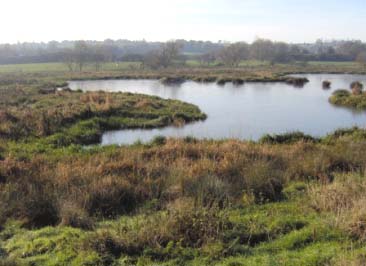
Richard Johnson, Headmaster Number Two in a Series of Seven, Johnson the Madman, “Mr Delirious”, “Mr Non Compos Mentis”, “Jacobite” Johnson the Opium Addict, the Drug User, went out one day into the Nottingham Meadows, found a small stream which ran through it, and then, in a fit of despondency, he apparently drowned himself:
A witness spoke:
“of the extreme horror of meeting, one evening as I was walking in the Meadows, a venerable grey-haired man, carried dead on a stretcher. It was Richard Johnson. He appeared to have been sitting on the bank of the river, and was found in shallow water with his head downward.”
The incident was even reported in London newspapers:
“They write from Nottingham that some days since, the Reverend Mr. Richard Johnson, lately Master of the Free School there, being a little Melancholly, took a walk into the Meadows, and drowned himself in a Pit near the Old Trent.”
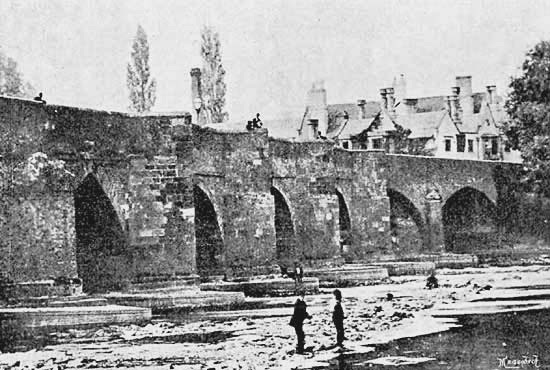
Here is the old Trent Bridge of the time, the so-called Bridge of Hethbeth:
Despite his apparent suicide, Johnson was eventually allowed to be buried in consecrated ground. He was probably given the benefit of the doubt, and his death was adjudged to be an unfortunate accident. And indeed, he may have had some kind of seizure or fit, perhaps brought on by trying some of those Ecstasy tablets which contain dog de-worming substances. (Unbelievably, yes, some of them do.) Equally, if Johnson’s death were suicide, then it may well have been decided that he was insane at the time he committed the act.
All of these strange circumstances have led a number of historical analysts to suggest, though, that Johnson’s burial in consecrated ground came about, not because his death was not the result of suicide, but because somebody knew very well that that his unfortunate demise was actually murder. Consider some more circumstantial evidence. Johnson was an awkward so-and-so as his appearances in court show only too well. He was a political problem as a possible Jacobite, eager to see a different monarch in place and a return to Roman Catholicism. He was a financial burden to the Town Council with his Golden Goodbye of a pension of £10 a year for life.
Shadowy figures might well have decided that their own lives would be easier with one less Johnson in the world. One fewer ex-Headmaster above ground. Scratch one Jacobite. The questions are there to be asked. Why the mysterious drowning? Why did a man racked with pain in all his limbs go for a long walk at the side of a river? How did he then manage to drown in the “shallow water” of a “small stream” ?
If only one sadly missed detective had been around:
Whatever the reason, this era marks probably the lowest level to which the school has ever sunk.
For years and years afterwards, wary of appointing another highly qualified and learned man who might turn out to be a second Johnson, the Town Council limited itself to local men, whose good character was well known, even if that meant that they did not have any university experience.
During this period, in the summer, the classes used to begin at 7 am, and then continued until 11 am The afternoon then began at 1 pm, and finally finished at 5 pm, or even later, if the Master so decided. From October 14th to February 14th, school started at 8 am, and finished at 4 pm. It was a six day week, but the Master was allowed to grant holidays and extra playtimes up to twelve hours per week.
(Not a bad deal. Twelve hours free every single week, if you feel so inclined! Twelve hours!)
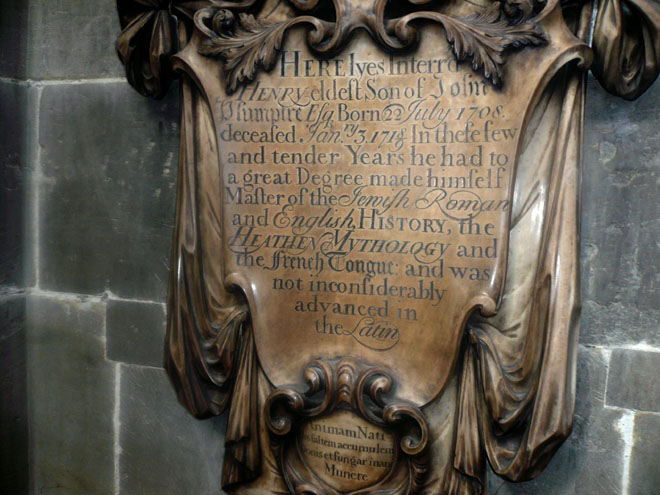
A poignant plaque in St.Mary’s Church has always been considered to be a description of the education given at the Free School. I have translated it from Ye Olde Englishe:
“ Here lies interred
Henry eldest son of John
Plumptre Esquire.,
Born 22 July, 1708
Deceased January 3, 1718.
In these few
and tender years he had to
a Great Degree made himself
Master of the Jewish, Roman
and English History, the
Heathen Mythology and
the French tongue, and was
not inconsiderably advanced in
the Latin ”
1722
Not quite the end! Let’s not forget, John Swaile. He succeeded John Womack, and steadied a very shaky ship over the next nine years, 1722-1731. He did, however, have his problems with George Bettinson, the Usher or Second Master , who, after serving under six different headmasters in just two and a half years, was well used to running the school himself, and did not take kindly to some fool of a new Headmaster trying to give him orders. But that, as they say, is a different story…










































 John Knifton