Category Archives: Personal

“Hilarity with Heraldry” (4)

Last time we were looking at the old badges of mainly football clubs in the late 1950s and early 1960s:

As well as coats of arms, animals, birds and flowers, some football clubs have a story behind their badge.

The English FA Cup Final was played from 1895 onwards near to the famous Crystal Palace Exhibition building. The owners of the latter attraction wanted other things for the tourist to do (or rather, to pay to do) and so a football team was formed. It was called, rather imaginatively, “Crystal Palace Football Club”:
Here’s the building and the badge:

This slideshow requires JavaScript.

Heart of Midlothian was a team formed in Edinburgh by a group of dance loving friends from the Heart of Midlothian Quadrille Assembly Club. Midlothian is a Scottish county and the Heart of Midlothian is a heart-shaped mosaic in the pavement near St Giles Cathedral in the Royal Mile in Edinburgh. People spit on it for good luck, so don’t go too close if you visit it. The pavement can be treacherous:

Another Scottish club, Third Lanark, went out of business in 1967. They began as the football team of the Third Lanarkshire Rifle Volunteers on December 12th 1872. The soldiers were inspired by the first ever international match between England and Scotland just two weeks previously:

Three teams at least display the Moslem symbol of the crescent moon and star. There are many, many explanations offered for Portsmouth:

The rugby club Saracens supposedly adapted the emblem because of the “endurance, enthusiasm and perceived invincibility of Saladin’s desert warriors”. More likely is the fact that the other local team was already called the Crusaders:

The best story is that of Irish football team, Drogheda United. Around a million people perished in the Great Potato Famine in Ireland in 1847. The Ottoman Emperor, Sultan Abdülmecid I, sent three ships full of food to Drogheda and a gift of £10,000. This wonderful gesture was praised worldwide. Even Queen Victoria had sent only £2,000.

No problem about embarrassment for the Queen of Mean, though. The Ottoman Emperor was asked by the British Government to reduce his gift to £1,000 so that the impoverished Queen of England and Empress of India was not embarrassed by her own frugality.

The Sultan was not forgotten though, and the crescent and star went onto the city’s badge and in 1919, that of the football club:

In a Festival of Original Thought, a lot of badges are formed merely from initial letters. These here are the rather imaginative badges of Blackburn Rovers Supporters Club, Hartlepool United Football Club, Headingley Football Club (who play rugby), the Scottish team, Stranraer Football Club and Watford Football Club:

This slideshow requires JavaScript.

When the letters are really seriously tangled, though, it gets a lot more difficult. Try sorting, one from another, “Edinburgh Academical Football Club” and “St Johnstone Football Club”, from Perth in Scotland. I have deliberately removed the name of one club:

This slideshow requires JavaScript.

Three badges, I thought, were just plain strange. They were Bective Rangers, a rugby club from Dublin:

Second was Stockport County near Manchester. Does the shield have three diamonds on it? And why?

The last one is a Scottish club called Dunfermline Athletic. Ever since I glued it into my Tiger album of football club badges in 1961, it has haunted me. No idea why!

I checked in Wikipedia and I wasn’t far wrong

“The current Dunfermline Athletic badge was created in 1957 by Colin Dymock, an art teacher at Dunfermline High School. It was allegedly inspired by one of his nightmares. The tower is Malcolm Canmore’s Tower, adopted by the town of Dunfermline for its own coat of arms. Malcolm Canmore was King of Scotland from 1057-1093, and lived in what is now Pittencrieff Park. The park is represented by the stormy, ghostly blue and black night scene behind the tower, including the park’s infamous hanging tree. The green area represents the club’s stadium.”

10 Comments

Filed under Football, History, Personal

On holiday with Ross Poldark (2)

Last time I talked in very general terms about the main, and most obvious, sights at Botallack, a disused tin mine in Cornwall:

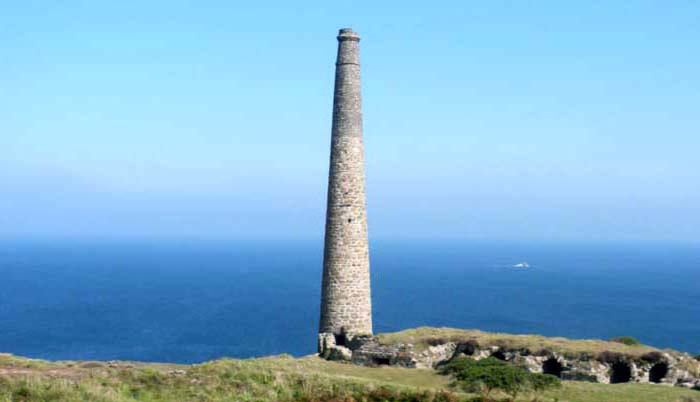
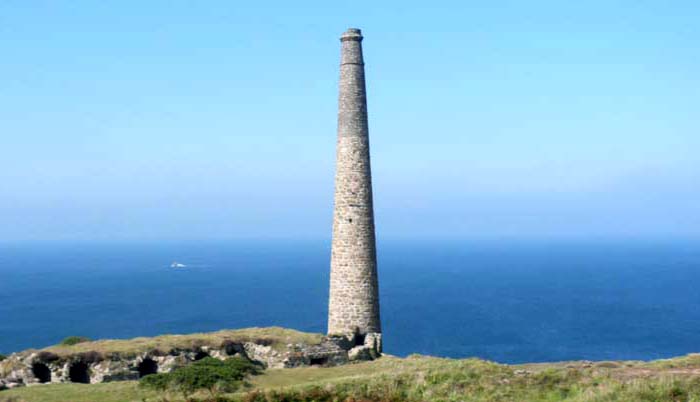
First, there is the enormous stone chimney, to power the pumps that maintain low water levels in the mine:

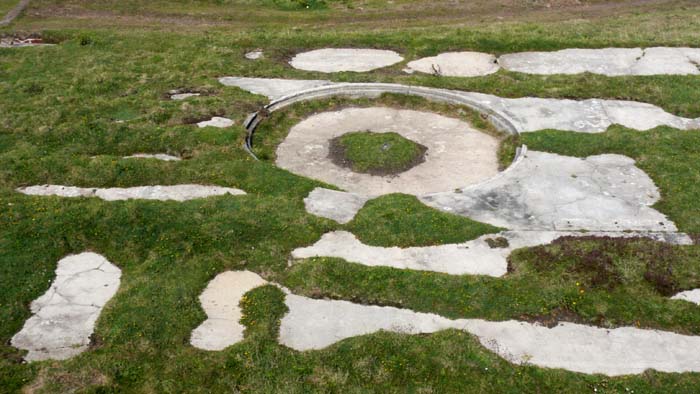
And then there is something which I have never managed to fathom out. It looks rather like Cornwall’s attempt at Peru’s Nazca lines, but constructed with stone and concrete:

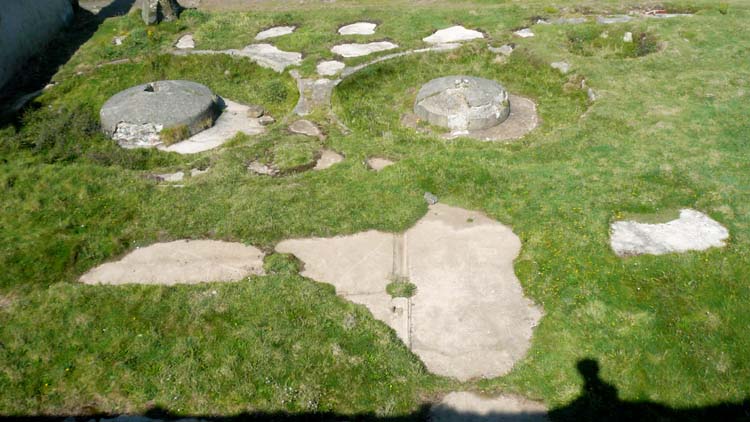
In among them were two Georgian missile silos, their “Hanover” ICBMs targeted on Napoléon’s distant boudoir. Spot the photographer, by the way:

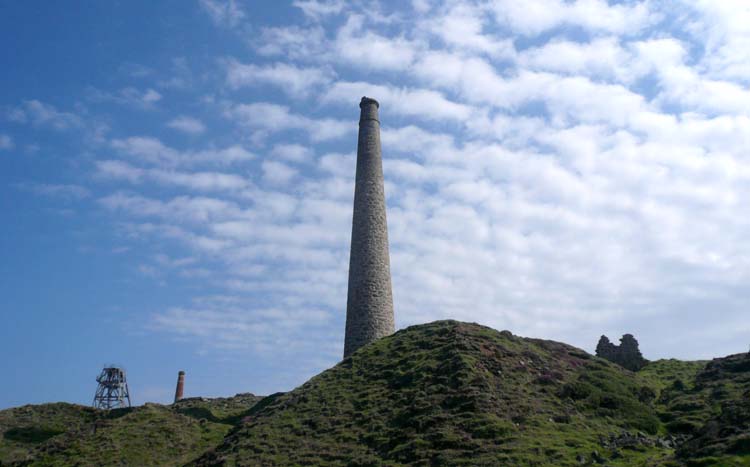
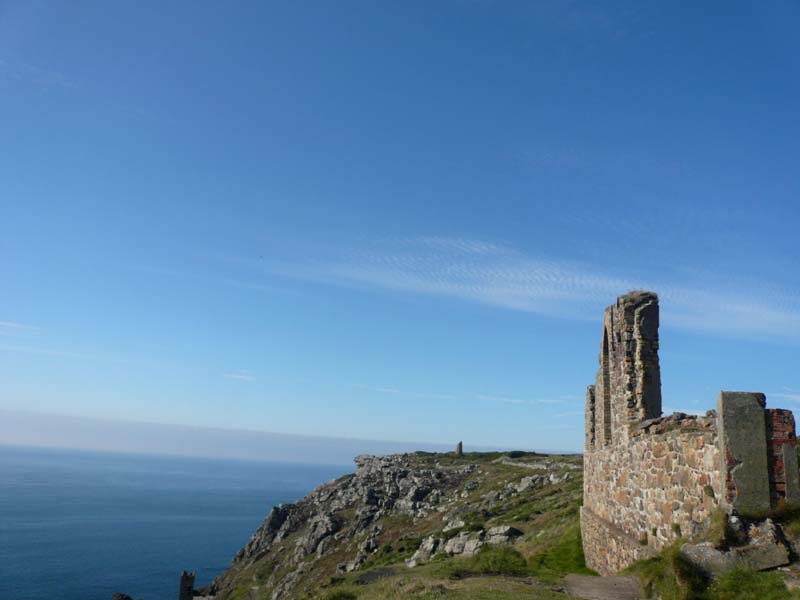
Walk a little further on to the south and there is a view of  the winding gear, the top bits of a more modern chimney, and a ruined wall. And what a sky! :

Keep walking and there is a view back towards the car park. The metal winding gear has not been used for a long time, perhaps as far back as 1900.

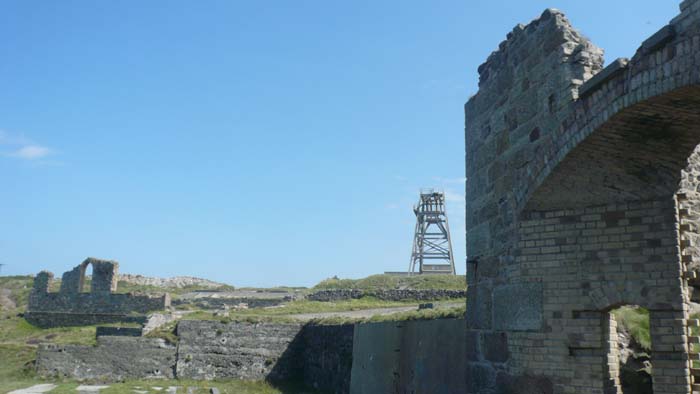
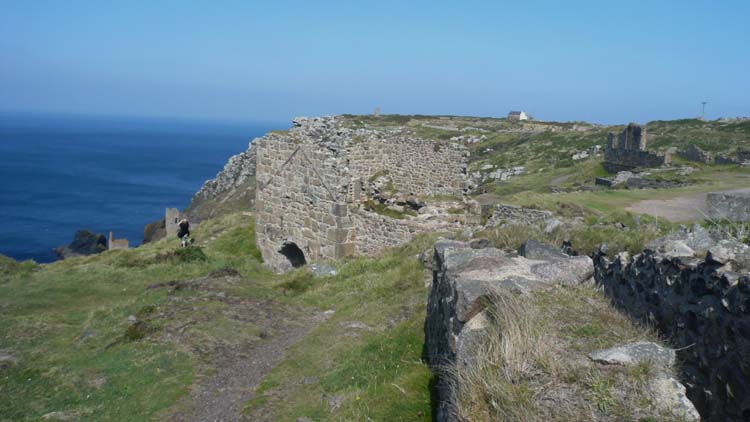
Again, everywhere there are ruined buildings, all of them in local stone:

At least one of the forgotten buildings was an arsenic-refining works. In areas of volcanic rock where tin and copper are mined, some nasty substances may always  be encountered such as arsenic, cadmium, lithium and even uranium.
I suspect that perhaps, over the years, the local builders and farmers have been helping themselves to many of the pre-cut stone blocks for their own walls and/or barn building or perhaps even as the hard core for country roads.

If you turn round and walk past the big stone chimney:

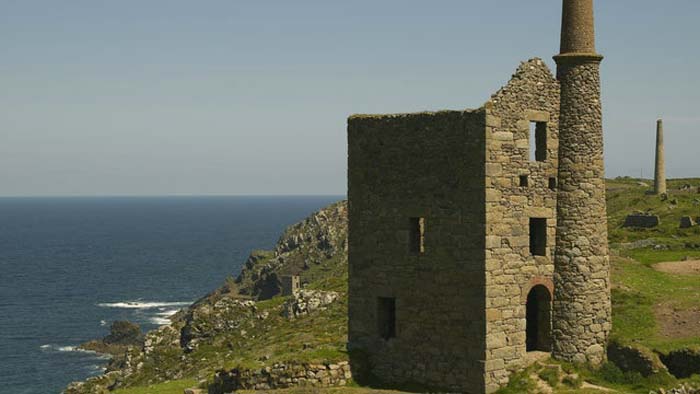
You can then continue for fifty or a hundred yards, until you get to the “abandoned mine engine of Wheal Owles”:

That particular disused mine is frequently used in Poldark episodes when the work force is filmed  actually working the mine. I have walked over to the Wheal Owles on just one occasion but I didn’t take any photographs. To be honest there are so many of this type of ruined pump house in this part of West Cornwall that the old adage “Seen one, you’ve seen ‘em all” comes into play.

This is the view straight ahead of the bench towards the north. There is another large ruined building and then what looks like the stump of a demolished chimney nearer to the tip of the headland.

Here’s that same view looking slightly more northwards;

You can just see the reason why the BBC people chose this site. It’s at the bottom left of the photograph above, and it’s one of the Crowns mines, the most photogenic industrial location in Cornwall and its second most photographed tourist site after the Men-an-Tol:

We’ll walk down to see  the Crowns mines next time.

26 Comments

Filed under Cornwall, Film & TV, History, Humour, Personal, Science

On holiday with Ross Poldark (1)

We visited Cornwall on family holidays in every year between 1987-2012. Sometimes, the largest town, Penzance, can be really wet, wet, wet:

Overall, though, Cornwall can be a magical place:

The west of Cornwall, of course, is where the TV series “Poldark” is set.   Here is the cast without their TV make-up:

It was only in our last year in Cornwall that I realised that, on several occasions, we had visited one of the main filming locations for this popular TV series without even knowing it.
The site which we knew is near a ex-tin mining village called Botallack. First of all, this map shows where Cornwall is situated in England (although the native Cornish, it must be said, do not consider themselves to be English). The orange arrow points to the car-park for the National Trust site at Botallack:

The orange arrow, on all three maps, remember, is pointing to the car-park for the National Trust property where filming takes place. Here it is on a slightly more detailed level:

And here is the largest scale of all, where you can see just how convenient it is for filming, as both of the roads going north are dead ends, and the entrance road in the south can easily be blocked off from the public.

You’d never think that every household in the country is forced to pay the BBC an annual sum of £154.50 if they want to watch TV in this country. And that’s not watching BBC television. It’s to watch any channel at all. Hopefully,  my foreign friends will now realise that we English don’t get our TV for free.

And if the BBC programmes are good, then so should they be with an annual income in 2019 of £4,889,000,000. Incidentally, none of the roads that have to be blocked are a public right of way, so there are no legal problems:


This is the view looking away from the car park. There are lots and lots of shattered buildings, as if the demolition company one day got a better offer and just cleared off in the middle of the job:

Up near the car park is the most modern structure, a set of nineteenth century metal winding gear:

Outside the museum type building which acts as a tourist centre, there were two scarecrows, or at least, we took them to be scarecrows, rather than peasants starved by Sir George Warleggan:

As you walk down towards the mine, the first thing you see is one of the area’s two or three large stone chimneys and a ruined building. Beyond that is the mighty Atlantic Ocean and ultimately, America. Almost invisible, gannets pass by ceaselessly:

And then there is a welcoming bench, from which you can see most of the best attractions. It’s good for mother and daughter:

And for two dear friends:

Next time, we’ll take a closer look at the attractions that have made Botallack one of the hidden treasures of West Penrith, as this area is more properly called.

16 Comments

Filed under Cornwall, Film & TV, History, Humour, Personal

“Hilarity with Heraldry” (3)

Last time I was looking at old football club badges from the late 1950s. Many clubs back then were using the heraldic coats of arms of their town or city. A fair proprtion of the rest, though, were using animals. Bolton Wanderers and Dumbarton in Scotland are presumably slow and ponderous yet very powerful in their play:

This slideshow requires JavaScript.

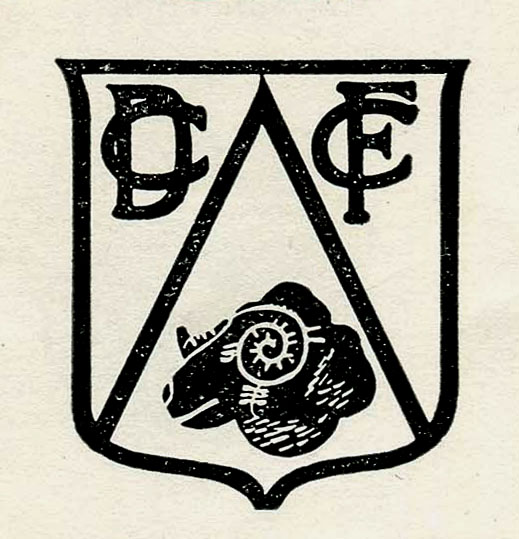
Derby County have a ram because of a folk song called “The Derby Ram”:

I was going to insert a link here to let you all hear the song that we sang in our junior school classes near Derby all those tears ago, but I decided not to. If you go to YouTube and search for “Derby Ram folk song” you’ll soon see my problem.

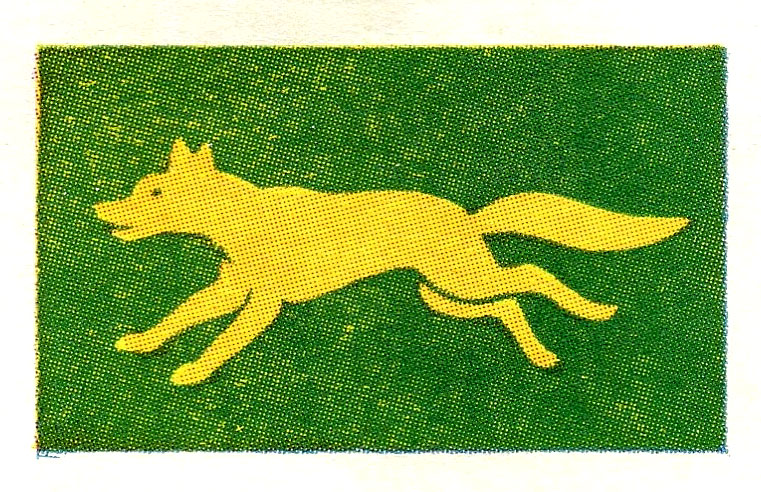
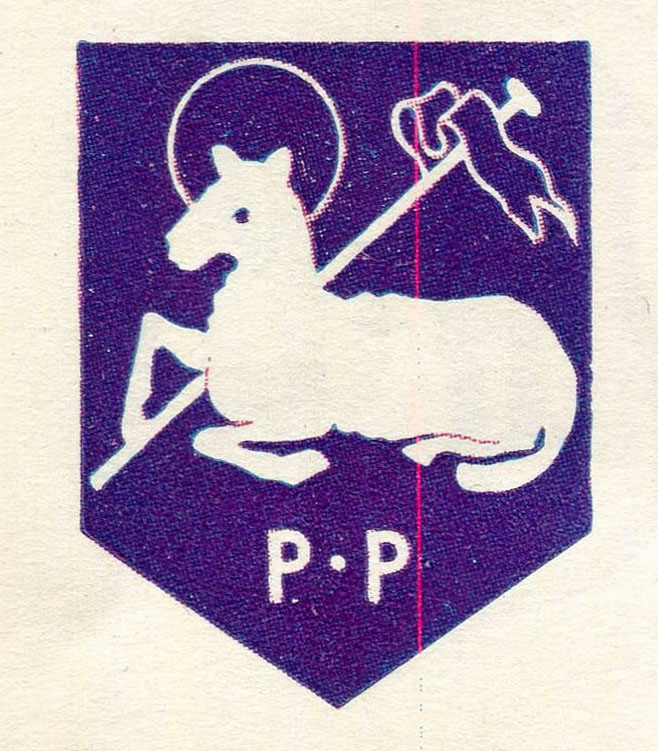
Leicestershire County Cricket team have a fox because the county was full of very keen foxhunting men and women and, indeed, children:Preston North End make use of the Paschal Lamb. “PP” stands for “Proud Preston”, who, in the 1880s, managed by the now long forgotten William Sudell, were the greatest team in the land:

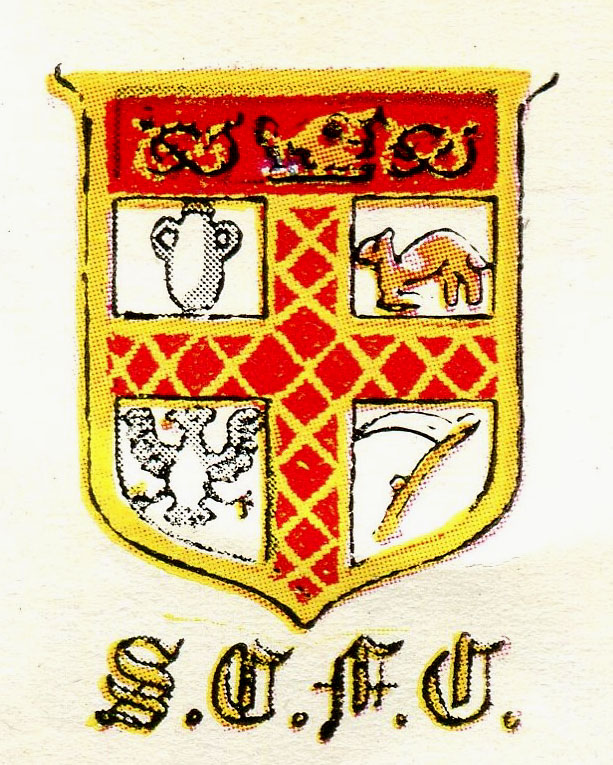
Stoke City have a strange badge which, to me, features a humpless camel. Intrigued, I looked it up and it is indeed a camel. The Stoke City camel comes from an original camel featured on the badge of the nearby town of Hanley. The Hanley camel comes from the coat of arms of John Ridgway, the first Mayor of Hanley. Ridgway had his very own camel on his shield because Stoke is the home of a huge pottery industry. Indeed, Stoke City’s nickname is “The Potters”.  Anyway, John Ridgway included the camel in honour of the land of origin of the pottery industry, Egypt. You couldn’t make it up.

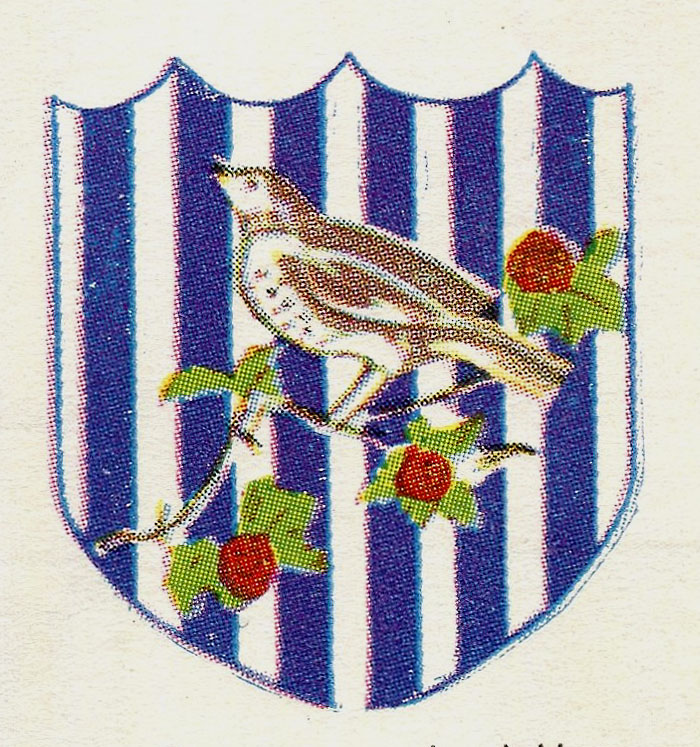
A few clubs have badges with birds on them. The first is West Bromwich Albion who were nicknamed “The Throstles” years ago:

A “throstle” is a dialect word in the English Midlands for a song thrush, turdus philomelos.

Albion play in blue and white stripes so that isn’t the reason for the bird. I will quote Tony Matthews, the club’s official historian:

“The club was formed in 1878 as ‘The Albion’. In 22 years the team was based at five different grounds before settling at ‘The Hawthorns’ in 1900. The new ground brought with it a new nickname ‘The Throstles’, as the song thrush was a commonly seen bird in the hawthorn bushes from which the area took its name.”

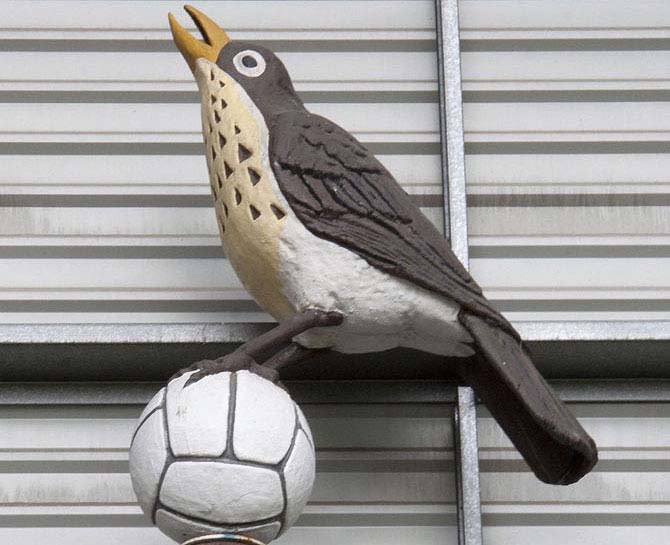
This is the effigy of a ‘throstle’ at the current WBA ground in West Bromwich. It has been rescued after renovations and is about five or six feet high.

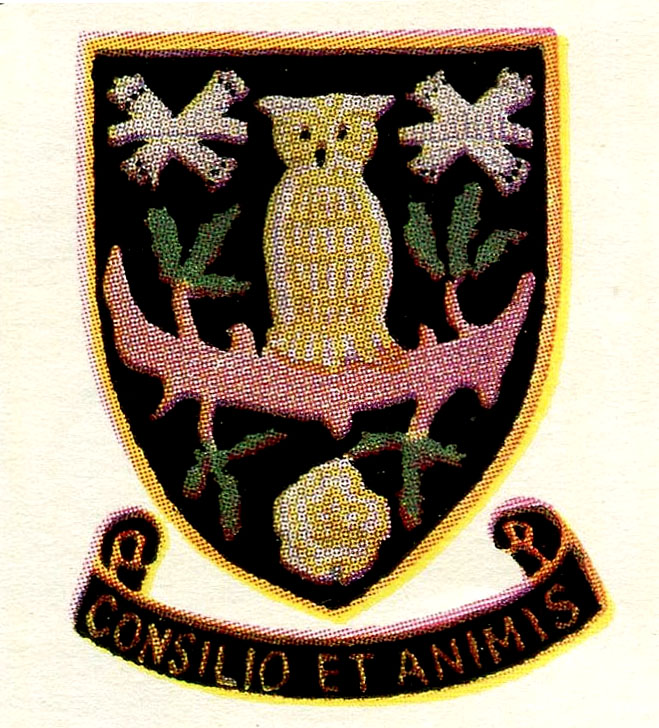
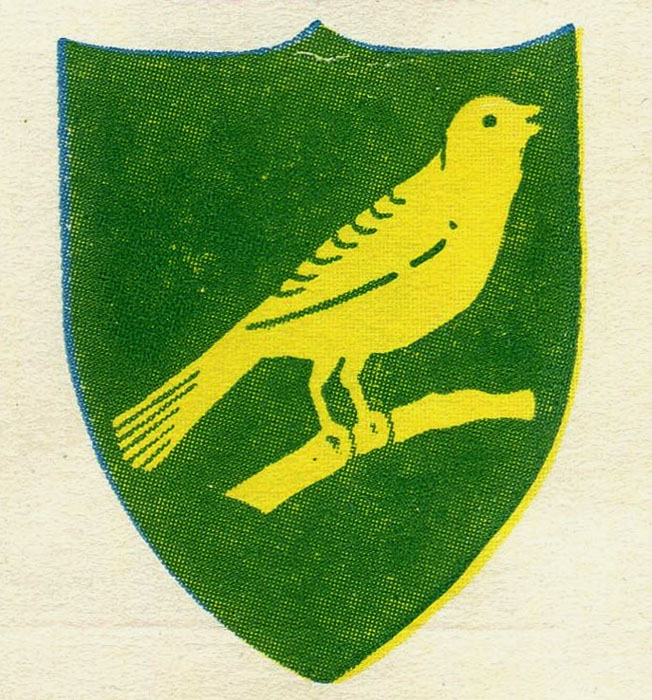
Sheffield Wednesday came from a district of the city called “Owlerton” and played when it was half day closing on Wednesdays, rather like the Welsh team, Abergavenny Thursday. Norwich, nicknamed “The Canaries”, play in green and yellow, the latter colour always strongly denied as merely representative of the city’s main employer, Colman’s Mustard. An image search might persuade you otherwise, though:
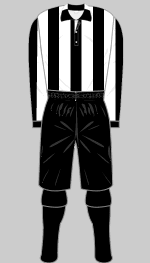
Other teams have particular birds on their shields because of the colour of their shirts. Cardiff City are the Bluebirds, Swansea City are the Swans, Bristol City are the Robins, and both Notts County and Newcastle United, in black and white are the Magpies:

And here’s one of Notts County’s many different badges, In this case, it’s the Ladies’ Team:

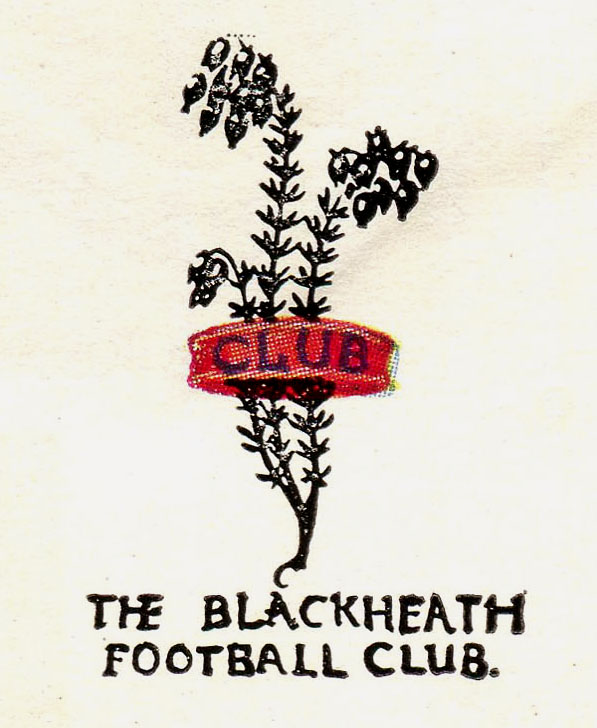
Flowers are often used as badges but hardly ever in football. In rugby this is the emblem of the Blackheath Club. It shows a piece of black heather, as a kind of pun:

In Heraldry such rib ticklers are called “canting arms”. Here are the shields of families called Shelley, Wellwood and Keyes:

This is a Spanish effort representing ‘Castile and Léon’ or ‘Castle and Lion’.

The arms of the city of Oxford seems to have been heavily influenced by student drug use in the 1960s:

London Irish uses the Irish national plant and the two cricket clubs, Glamorgan and Lancashire, use the daffodil and the red rose respectively:

This slideshow requires JavaScript.

Next time, badges with a story behind them.


15 Comments

Filed under Derby County, Football, History, Humour, Personal, Wildlife and Nature

“Hilarity with Heraldry” (1)

Dr Sheldon Cooper is famous for his series of podcasts “Fun with Flags”:

I have always enjoyed vexillology enormously but I would have to confess to an even greater love for heraldry, the study of coats of arms. I don’t really have the time to launch “Hilarity with Heraldry” in any great depth, but I don’t think anybody would find it particularly boring to take a brief look back at some old football, or soccer, badges.
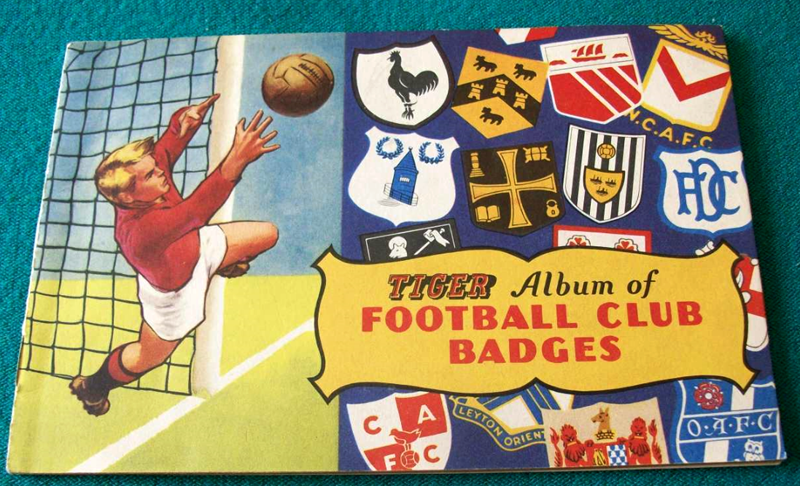
I used to read a comic called “Tiger” when I was a boy and in one issue they sowed the seeds of my interest when they gave away, free, an album of football club badges. This was on an unknown date in 1961, so we are looking back quite a long way. Here’s the album:

The picture comes from ebay where the albums can sell for quite good prices. So too do the 1967 versions of the album, entitled “Roy Race’s Album of Football Club Badges” in honour of the fictional star of the fictional Melchester Rovers. Roy Race was Tiger comic’s “Roy of the Rovers”:

In both 1961 and 1967 the buyer was given the booklet and then in the succeeding weeks, he received sheets of paper with around 30 small badges printed on them. He then had to cut out the badges carefully and then stick them in the booklet with extreme care and glue.

Most boys couldn’t do this, which makes it extremely difficult to buy a booklet where they are stuck in straight, and are not over-trimmed, or, in some cases, they are not stuck in upside down.

This album has a pretty good start to page one. although there is a slight crease:

This is average:

I would not buy this. They are crooked and cut out wrongly. At least two are in the wrong position:

These three are shockers:

And these two badges below are simply the wrong way round. Blackpool is a seaside holiday town with seagulls and BW may conceivably stand for “Bolton Wanderers”. And if this page is like that, the other ones will all be of a similar quality:

I was at an indoor market a few years ago when I bought several colour pages of football, cricket and rugby club badges which dated from the 1950s. The badges seemed to divide into four groups. The first were obviously based on the coat of arms of the town which the club represented. This is Notts County with the tree from Sherwood Forest. Whoever or whatever holds the shield up is called the “supporters” and Notts County have the normal two, namely a lion and some other unknown mammal, possibly on otter, or perhaps a weasel. On top of the shield is the “crest” which, in this case, is a tower from Nottingham Castle. “On top of the shield” is just an optical illusion. The crest actually used to rest on top of the knight’s helmet, so a tower is, to say the least, a challenging choice for his neck muscles. The only bit of the helmet that you can see is the padding between the tower and the metal helmet, which is yellow and green and is called the “wreath” or, because it is twisted, the “torse”:

This is Nottingham Forest with the same type of thing. The supporters are stags and on the shield is a green rustic type cross with three crowns that I know nothing about, I’m afraid.

A similar badge was used for the Nottinghamshire cricket team:

In heraldry, what we would call colours, or tinctures to use the technical phrase, are divided into two groups. The first group is called ‘colours’ and the second is called ‘metals’. All of them have Norman French names. The metals are ‘or’ and ‘argent’, which are ‘gold’ and ‘silver’. The colours are red or ‘gules’ which comes from the word for the mouth of an animal, “la gueule”. ‘Azur’  is easy as it obviously comes from azure blue. ‘Vert’ is green and it has survived a thousand years into modern French, much like ‘purpure’ which is actually a very rare colour. ‘Sable’ is black and comes from the fur for coats, It’s a sort of rich man’s ferret, apparently:

There is just one rule about all these tinctures. Colours cannot go on top of colours and metals cannot go on top of metals. This is because Heraldry was designed for the purposes of identification in battle so everything has to be exceptionally obvious and visible. Here’s the somewhat over dressed queue for the fish and chip shop after a hard day’s peasant slaughtering:

31 Comments

Filed under Film & TV, Football, France, History, Humour, Personal

Renegade Football at the High School (1)

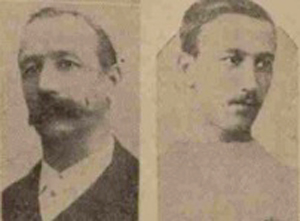
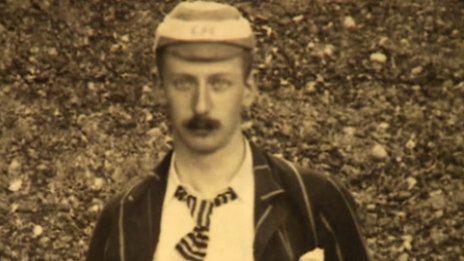
The High School plays rugby nowadays. Before this, they used to play football, (or soccer) and were very, very successful. They provided nine England players, who were Frank Ernest Burton, Arthur William Cursham, Henry Alfred Cursham, John Auger Dixon, Arthur Cooper Goodyer, John Edward Leighton, Tinsley Lindley, Harold Morse and Frederick William Chapman who was an Amateur international. Many of these Victorian superstars are now long forgotten. Who would recognise Arthur Goodyer if he walked in through the High School’s front gate?

Three of these men captained England. One was Arthur William Cursham who captained his country on two occasions, namely against Scotland in 1878, when he scored a goal, and against Wales in 1879. His second goal for his country came against  Wales in 1883.

The most famous captain of the three was Tinsley Lindley, the man who had a career total of fifteen goals in thirteen appearances for his country. He also held an England scoring record of having scored in nine consecutive games between March 1886 and April 1889. This record was eventually beaten by Ian Wright of Arsenal, more than a century later.

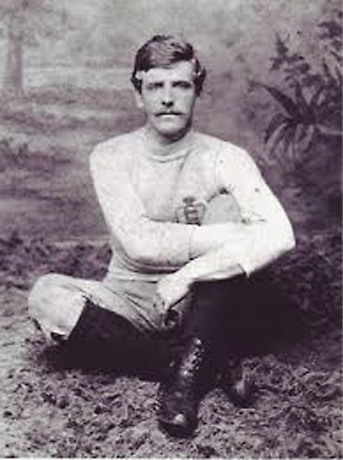
The High School also provided the highest scorer in the history of the FA Cup, Harry Cursham:

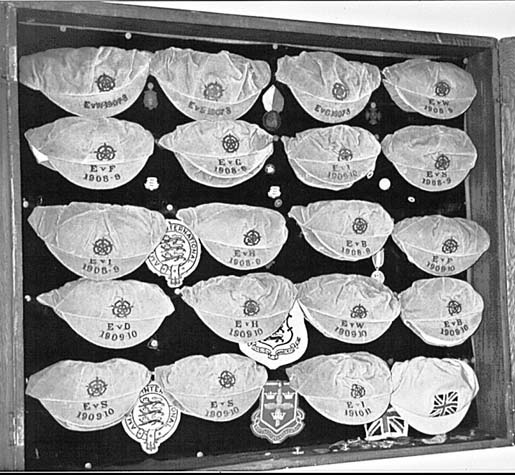
The High School also gave us Frederick William Chapman, who appeared in the Great Britain team which competed in the Olympic Football Tournament in 1908. Great Britain won the final 2-0 against Denmark, and Chapman scored the opening goal. Always called simply “Fred”, he is the only Old Nottinghamian ever to win an Olympic gold medal, and, given the limited number of countries who were playing football at this time, he had good reason to consider himself a champion of the world. Chapman went on to play for the  England amateur team on twenty occasions, captaining them at least once, thereby becoming the third captain of England to be provided by the High School.

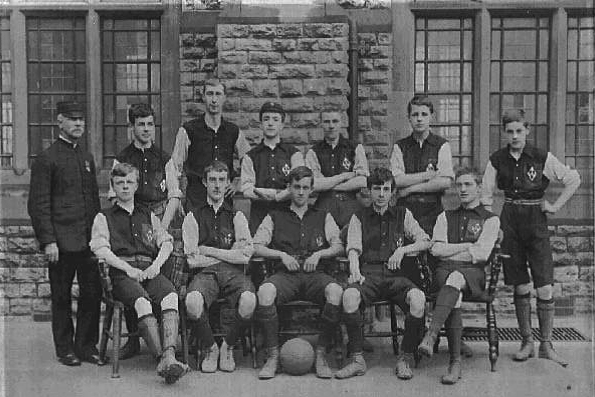
Here is a picture of the Nottingham High School 1st XI in 1897. Frederick William Chapman, the winner of an Olympic Gold Medal, stands at the right hand end of the back row. A determined detective could make a code out of the bricks in the wall behind the team, and discover where the picture was taken. A large clue is that the team were standing in the modern Dining Room, at the end opposite the area where the meals are served:

And here are his international caps:

The High School switched to rugby after Christmas 1914. Ironically, this was shortly after football was seen to be an amazing peace maker during the First World War with the Christmas Truce which brought much of the Western Front to a temporary stop for a few days. Even so, it was well worth it, insofar as British casualties were running at the time at an average of 4,000 men a day killed or wounded:

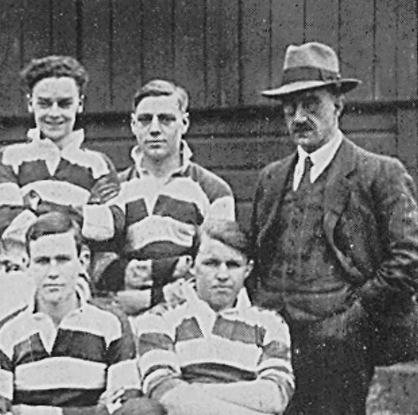
The two prime movers in the High School’s change to rugby were Mr Leggett of the Preparatory School and Mr Lloyd Morgan. When they volunteered to go to the war, Mr Kennard took over. He had captained the Lancashire XV and played for the North of England in an England trial. Here is Joseph Kennard with four of the First XV  in 1929:

Mr Kennard could be a hard man sometimes, and occasionally he could justifiably be described as rather strange.

Around 1935 he was living at 58 Ebers Road in Mapperley, a small semi-detached house. By 1936, he had moved to No 41, a very much larger detached house with a larger garden. For some reason he was violently opposed to the Salvation Army and continually expressed his disgust that they would come and play outside his house in Ebers Road on a Sunday morning. By now he was seen as, in the words of Geoffrey Tompkin, as “exceedingly fierce with a bald head, a black military moustache and spectacles”.

We’ll have a more detailed look at the reasons why the change from football to rugby was made next time.


12 Comments

Filed under Football, History, Nottingham, Personal, The High School

Vandalism in the School Archives? Or is it Art?

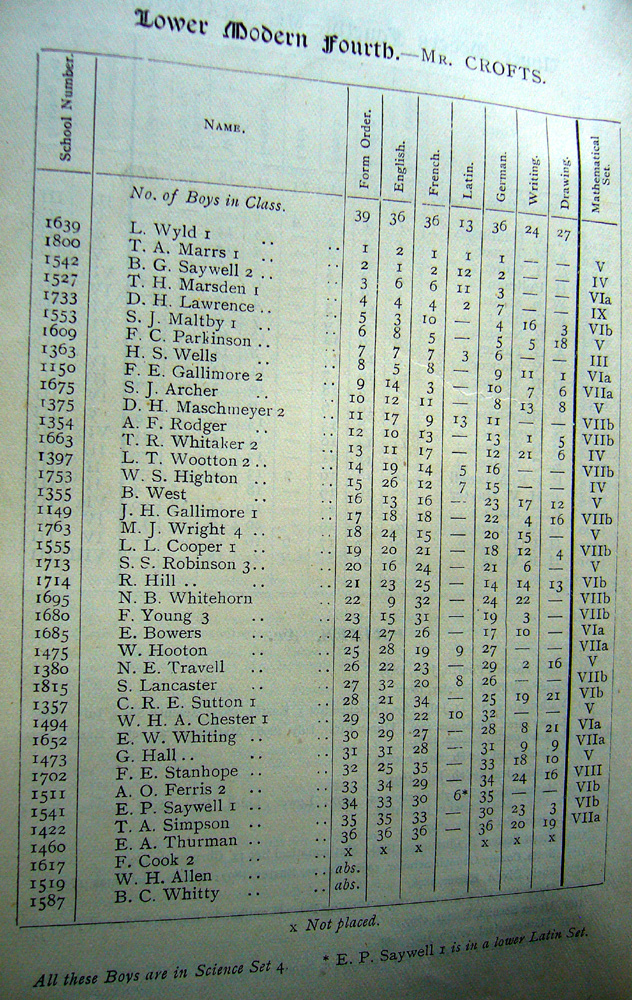
A few months ago, I went into the School Archives to photograph the School Lists. They are quite boring little booklets to be brutally honest, but they are very informative and record the names of all the members of all the forms in the School for every year. The oldest ones date from the late 1860s, but because I was researching the school’s casualties in World War II, I started my James Bond activities with 1892 and then went forwards as far as 1950. Just for the sake of argument, here’s one, with a particularly famous ex-pupil on it:

With all that information, it is actually a Victorian Excel Spreadsheet!

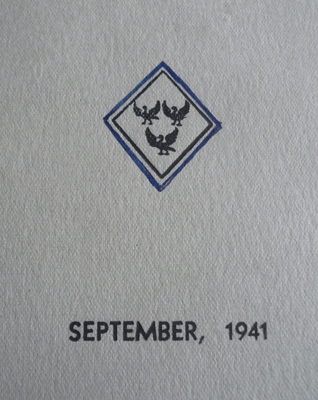
The only thing out of the ordinary that I found in 3.96 GB of School Lists was in the edition for 1941:

Once again, some young man was feeling the ‘Call of the Skies’:

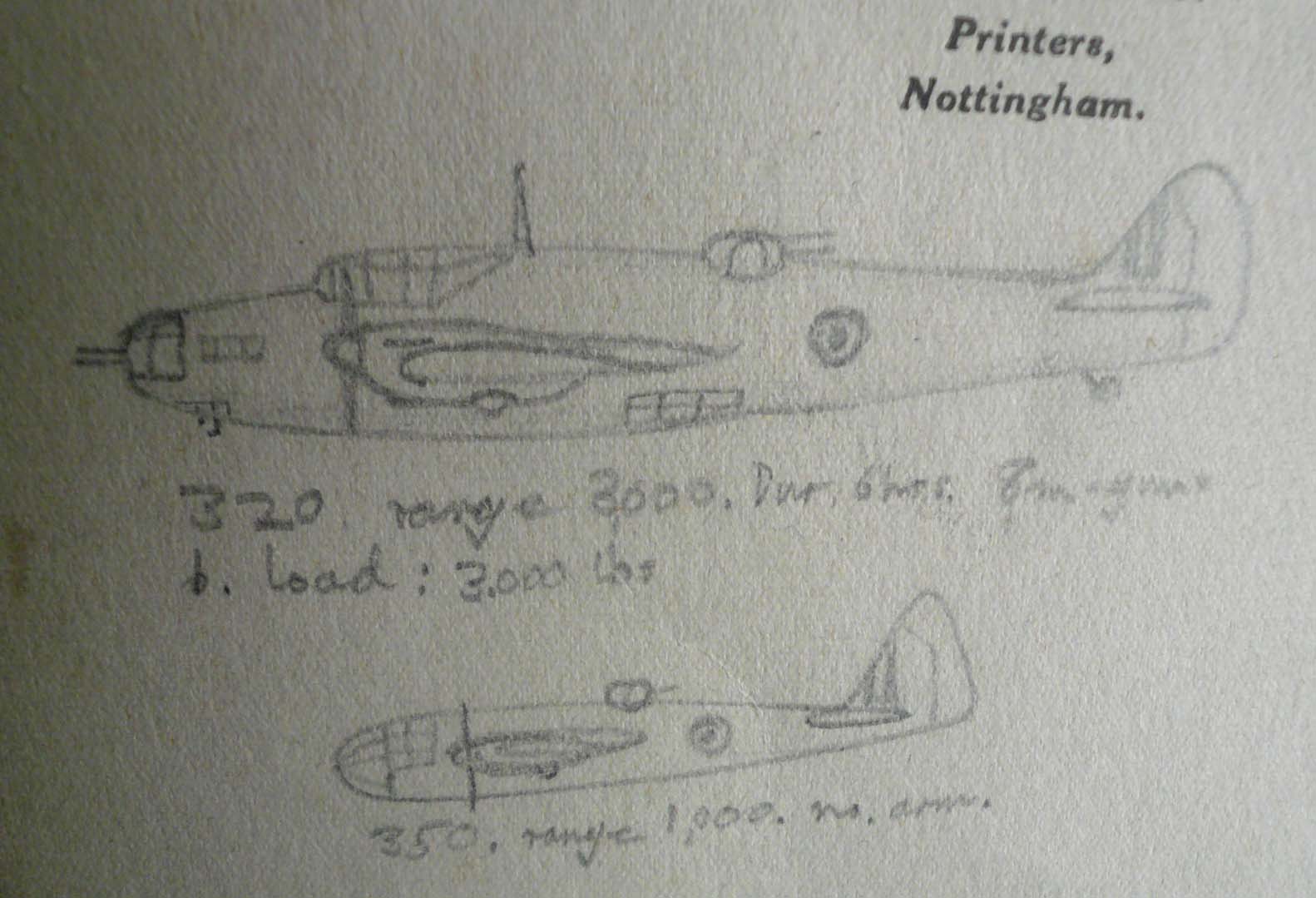
Below the printers’ name, he had knocked out a couple of bombers;

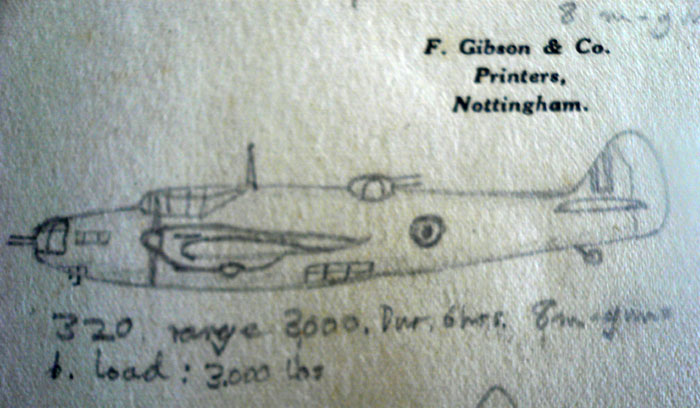
Here’s the larger of the two bombers blown up as best I can:

It is called the 320 and has a range of 3,000 miles, with an endurance, I think he means, not ‘duration’, of 6 hours 8 minutes and a bomb load of 3,000lbs. It also has 8 machine guns. Looks a bit like a Blenheim with the nose of a Heinkel, the tail of an Airspeed Oxford perhaps and inline engines.

Here’s the smaller of the two bombers blown up as best I can:

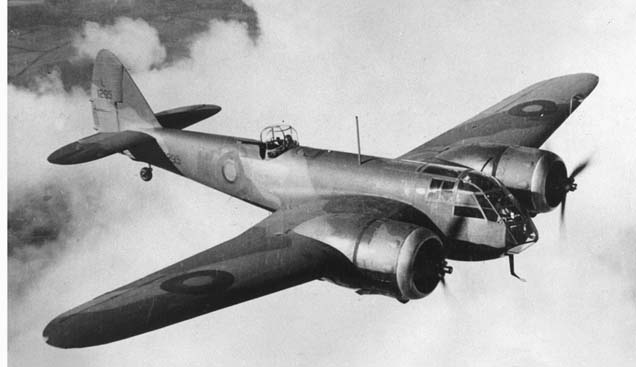
It is called the 350 and has a range of 1,000 miles, with no armament. It looks a bit like a Blenheim with the nose of a Heinkel, the tail of an Airspeed Oxford perhaps and inline engines. Here’s one I prepared earlier:

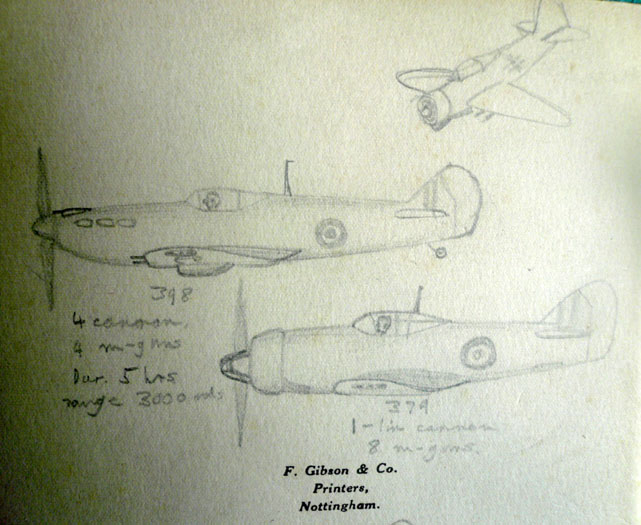
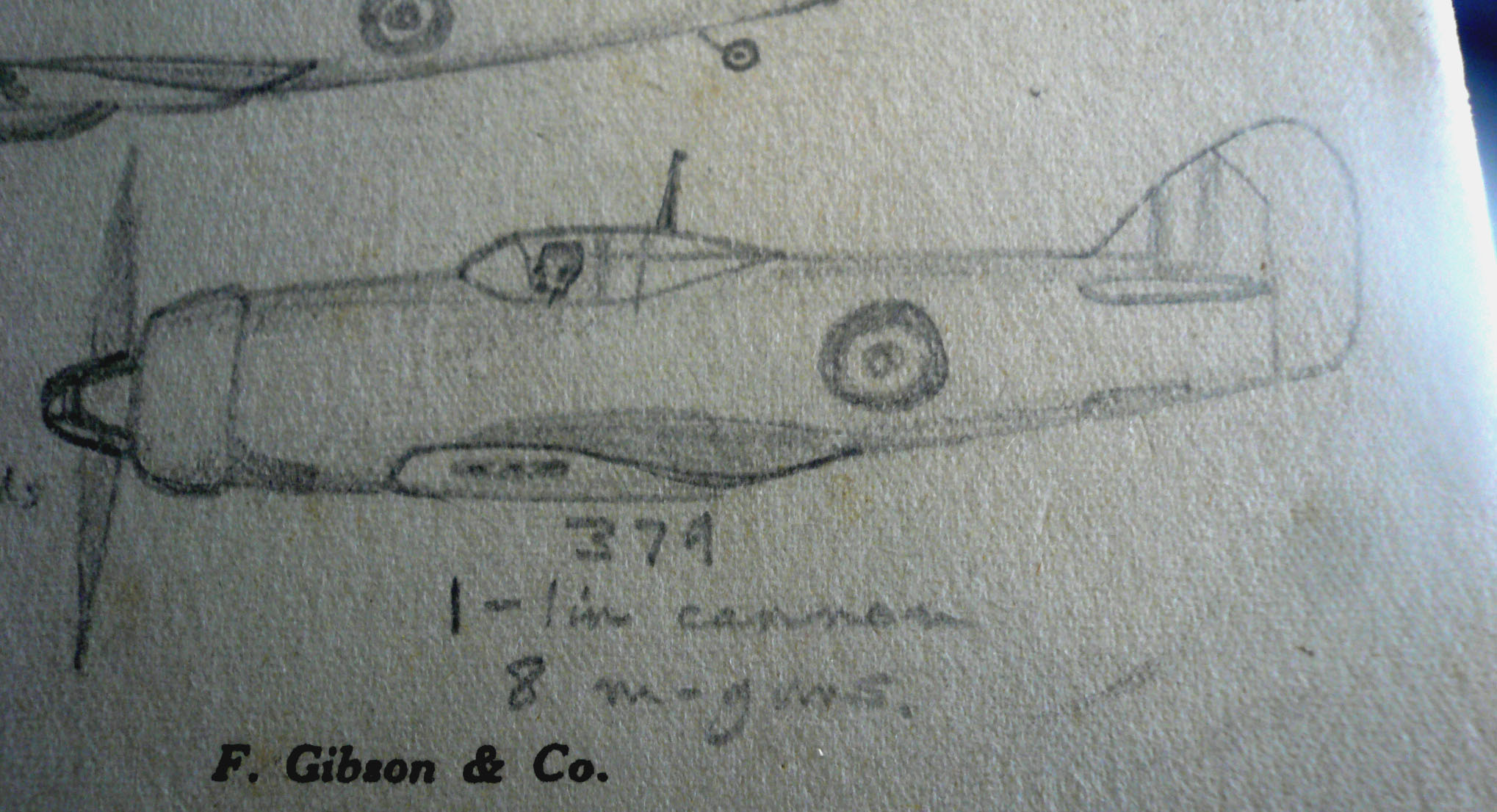
I have also tried hard to blow up the first of the fighters:

It has one 1 inch cannon, in the propeller boss, by the look of it, and 8 machine guns.

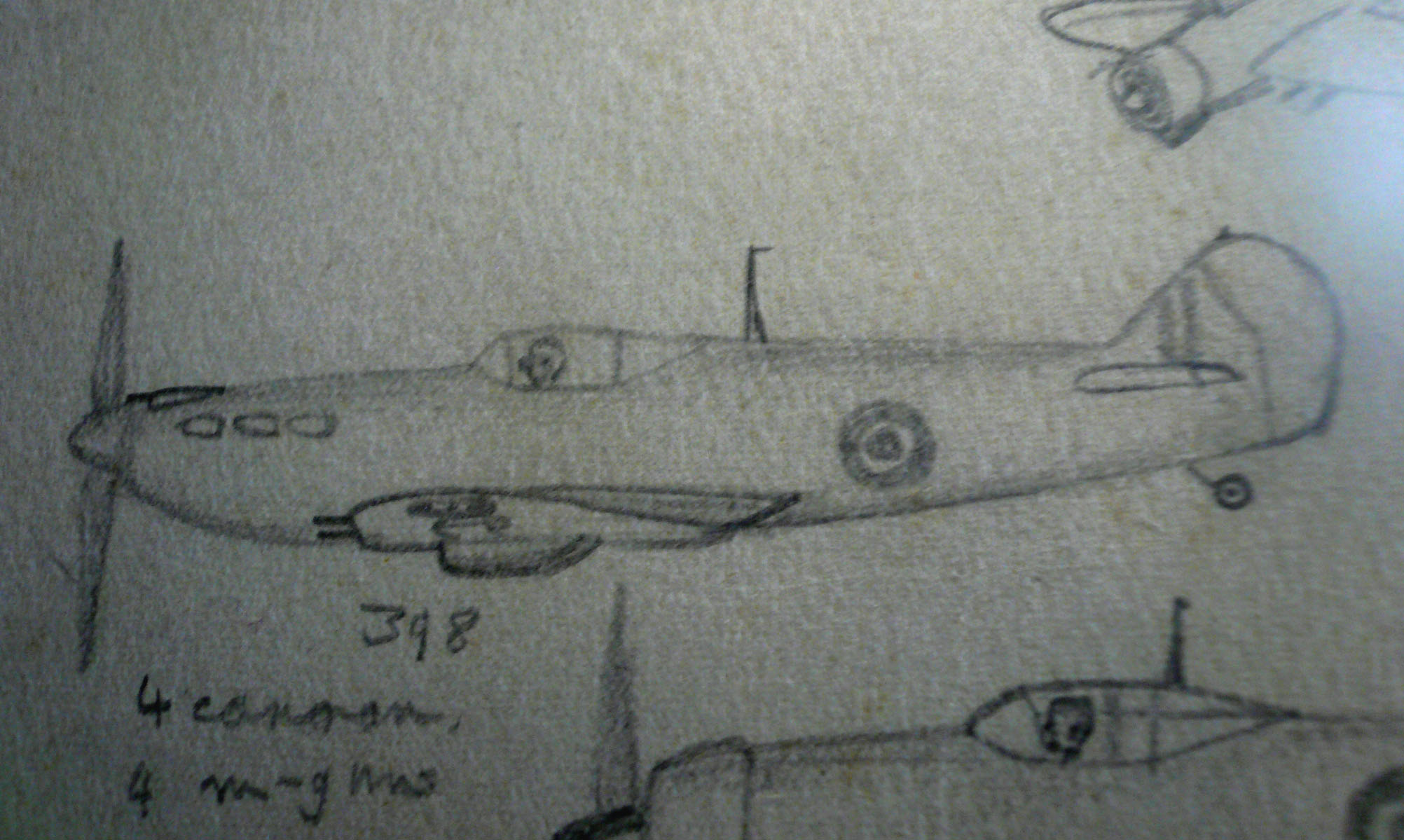
The other fighter is rather Spitfire like:

It is called the 398 and has 4 cannon, 4 machine guns, an endurance of 5 hours and a range of 3,000 miles. I’m sorry to say that Maths was not necessarily this young man’s strong point! The German fighter has no names or specifications:

For me, it is mainly Focke Wulf Fw 190, but there is a little dash of Mitsubishi Zero in it as well perhaps.

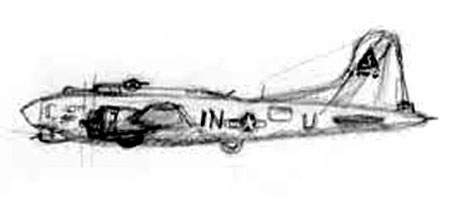
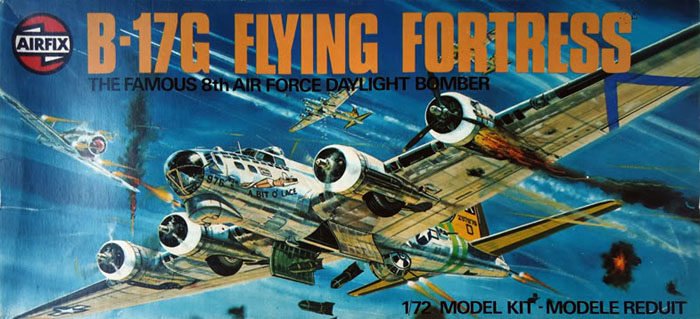
I often think that we regret what we do not do far more than what we do do. When I was in the Sixth Form at Ashby-de-la-Zouch Boys’ Grammar School, we used to have French lessons in a smaller room because there were only 12 of us. One of the desks had a fantastic carving of a B-17 Flying Fortress, deep into the wood of the lid, with all the ailerons, all the machine guns and all the ventilation holes in the gun barrels. It was fabulous. This is the closest I can find on the Internet:Looking back at how much money the school had, I suspect it dated from  1943 rather than 1963 and the Airfix kit of that era:

My regret is that I did not find any way of preserving this work of art rather than it be thrown into a skip in the middle 70s.

Not much survives of the pupils in any school. And what does would have been classified as vandalism at the time. Such as this example from 1922:

or this one from 1942:

or this one from a young man who upset the High School more than he could ever imagine:


26 Comments

Filed under Aviation, Bomber Command, History, Nottingham, Personal, The High School

Eagle Comic (5)

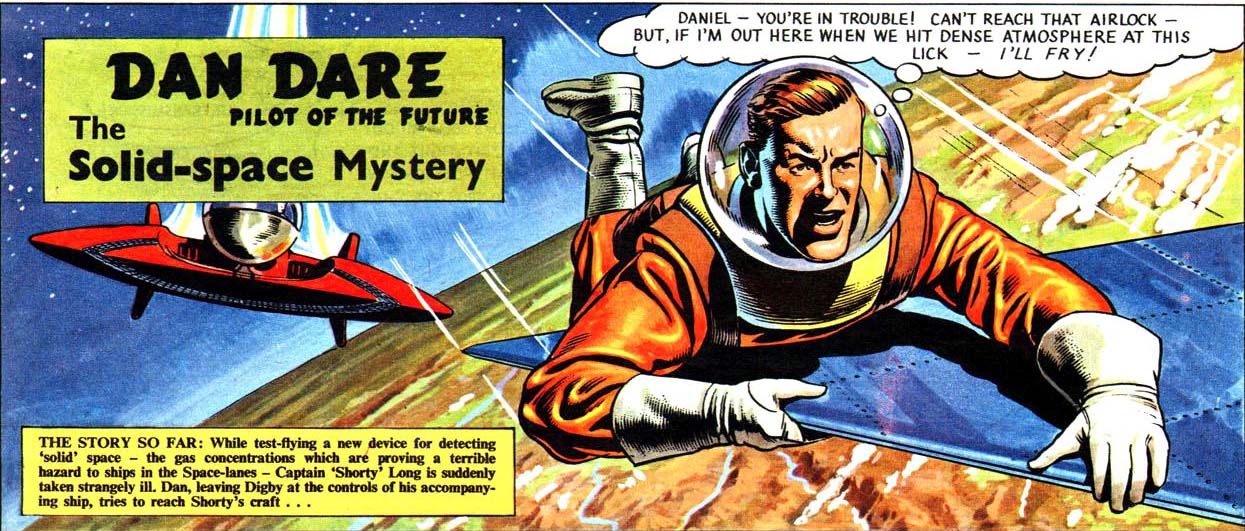
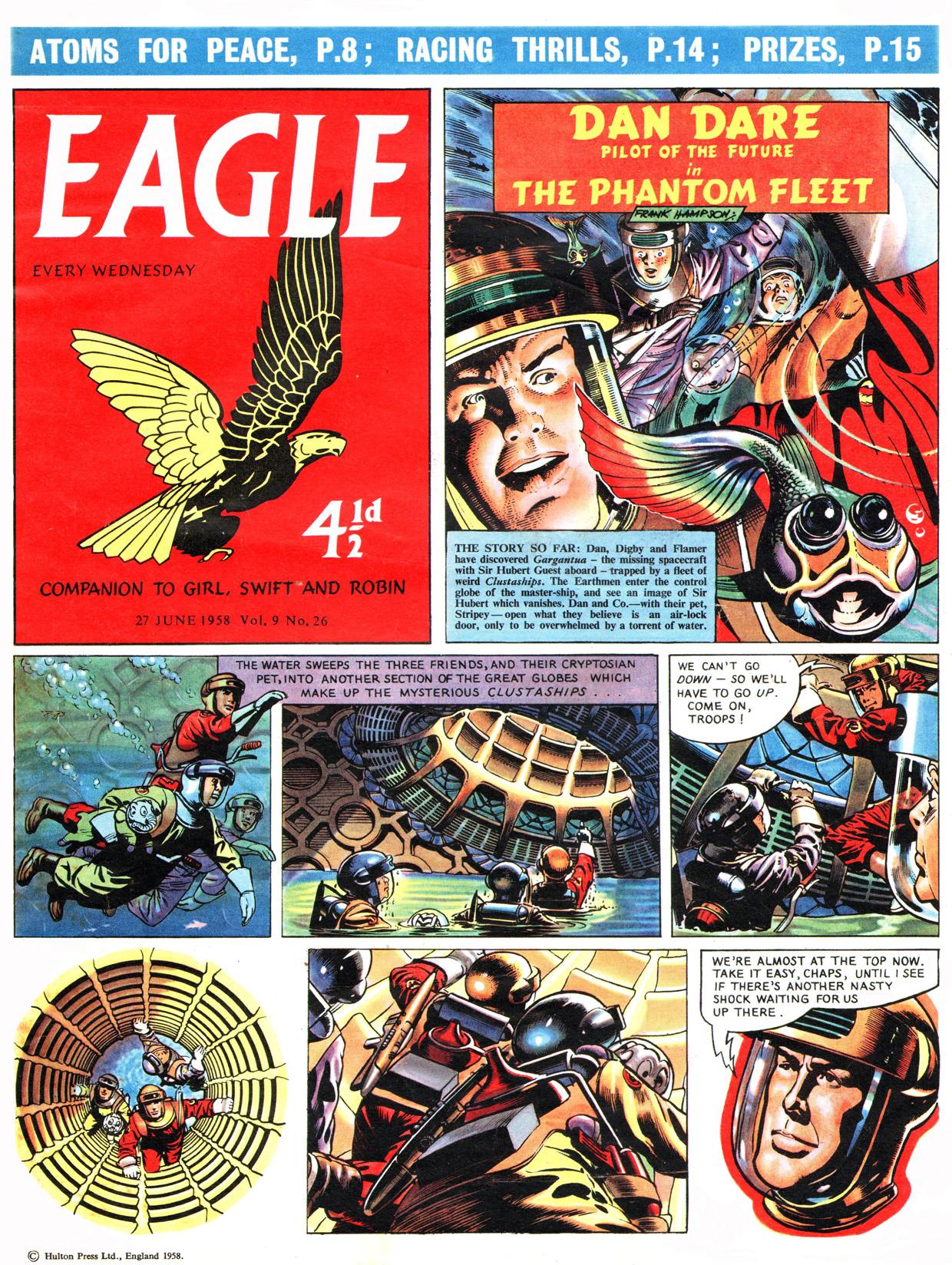
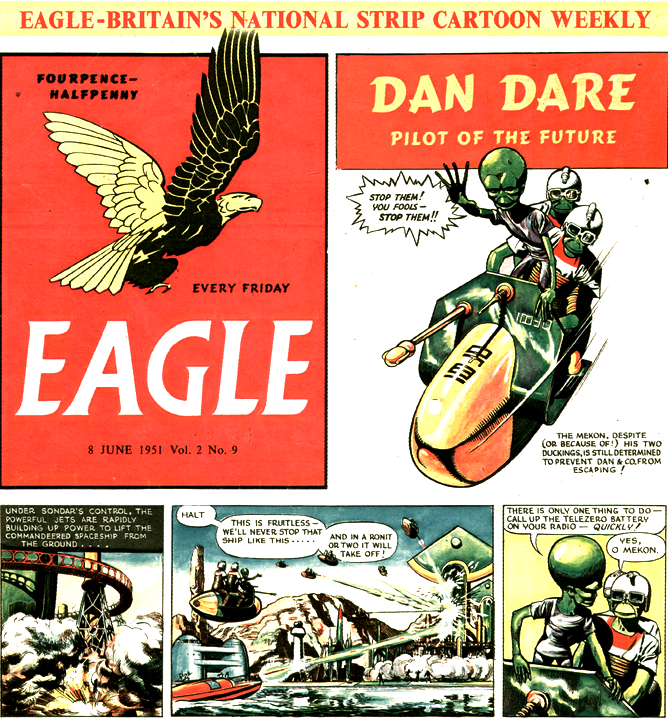
On the front cover, Eagle featured Dan Dare, the lantern jawed squeaky clean hero:

He could easily dominate the whole front page:

He was always helped, and occasionally hindered, by Digby, his rather podgy sidekick:

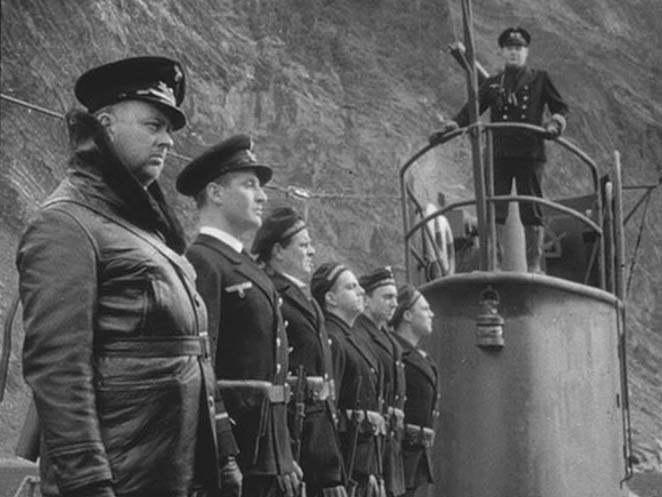
Presumably, he was named after an extremely obscure aircraft called the Digby, which was the name given to the Douglas B-18 Bolo in Canadian Air Force service. You can see this lost aircraft in action in the Powell and Pressburger film “49th Parallel” made in 1941 with Leslie Howard and Laurence Olivier. It’s a thriller well worth keeping an eye out for, and a film which portrays perfectly the repulsive attitudes of the Nazis:

Here’s another picture of Digby:

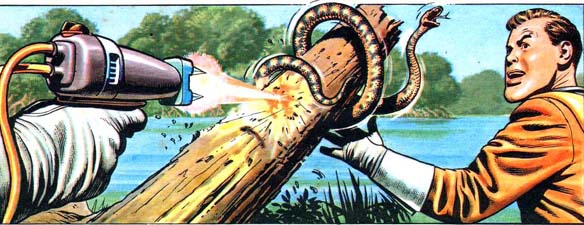
And, yes, he is using an electric hairdryer as a weapon:

I shouldn’t poke fun, though. Some of the science was years ahead of its time. Who else had heard of nuclear fusion in 1950?:

Dan Dare and Digby had their nemesis in the extraterrestrial figure of “The Mekon”:

Dan, Digby and the Mekon caused a revolution in the unchanging comic world of Weary Willie and Tired Tim. Issue N0 2 of Eagle came out on April 21st and the comic was on its way. Here’s the top half of that second issue:

And the bottom half of the same page:

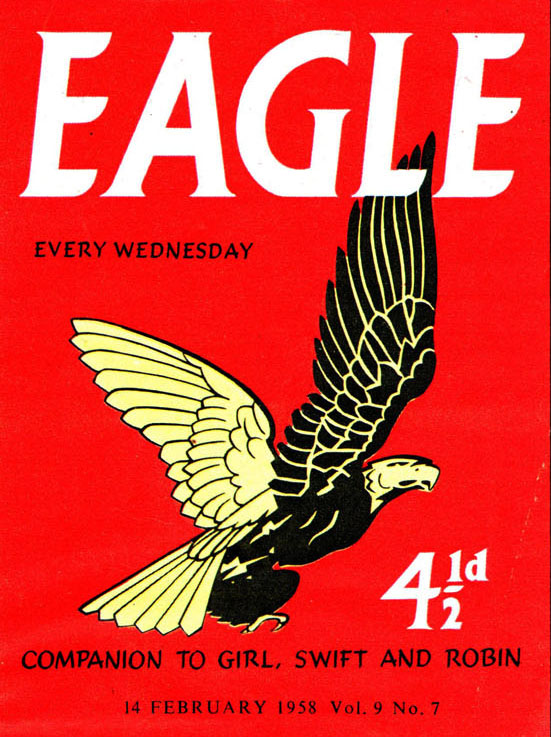
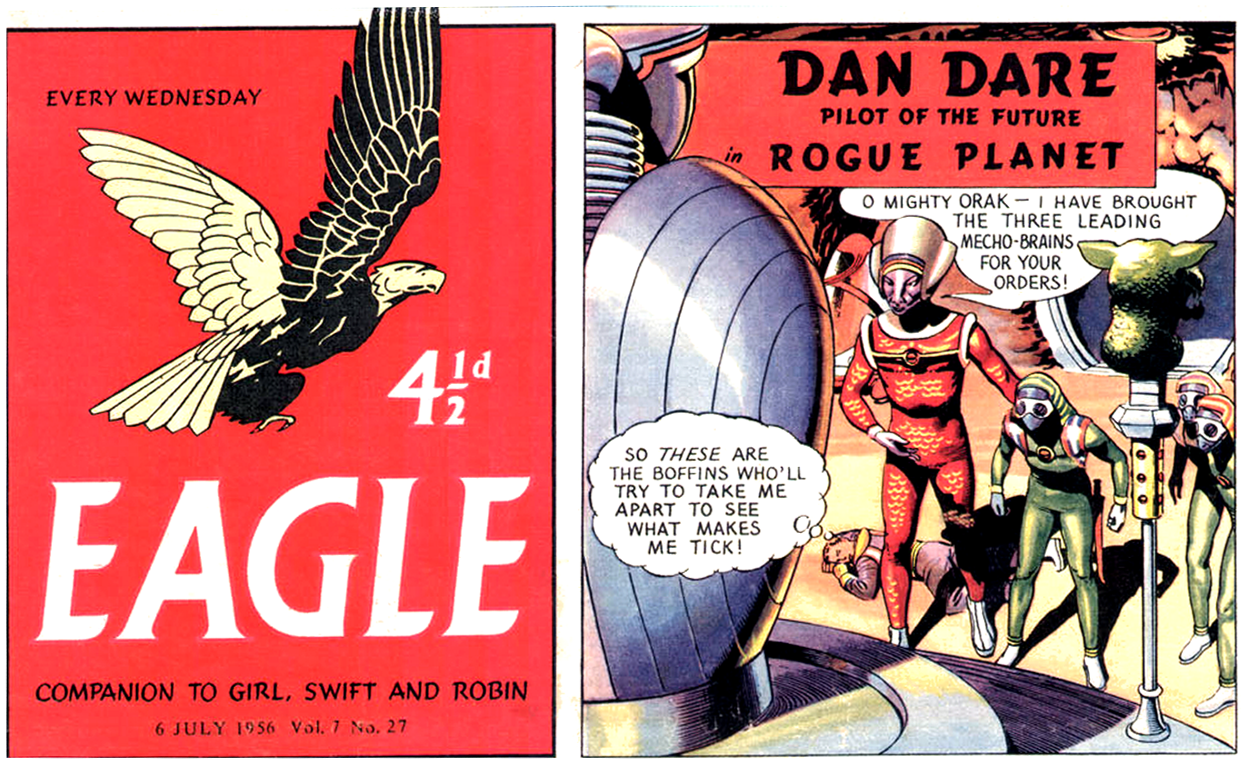
Sometimes the price of the comic was rather strange. This issue cost 4½ old pence which even in the days of a pound made up of 240 pence was an unusual price. I can’t get enough of that eagle personally:

On the other hand, there was a 4½d  stamp at the time. Here’s a special one for National Nature Week:

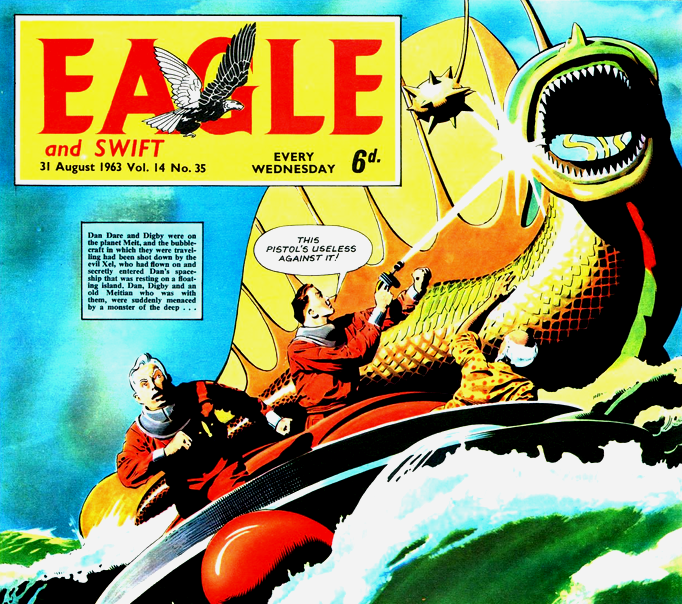
The Eagle went from strength to strength, with its brightly coloured, vigorous art work…

It always had futuristic machines…

Here’s that orange caption:

There are occasional monsters…

And the Dan Dare stories always had lots of alien species. Was it this type of picture that inspired the bars and cafes of “Star Wars” ?

Why, they even had girls from time to time…


19 Comments

Filed under Aviation, Film & TV, History, Literature, Personal, Science, Writing

“The Devil’s Doctors” by Dr Mark Felton (1)

I haven’t done many book reviews over the course of my blog posts but every now and again, I come across a book which recounts almost unbelievably serious wrongdoing which has gone unpunished, often deliberately on somebody’s part. I feel that such incidents deserve to be given a little publicity. In such a category is “The Devil’s Doctors” by Dr Mark Felton.

The book’s subtitle says it all: “Japanese Human Experiments on Allied Prisoners of War”. It recounts how the Japanese, terrified of the ultimate loss of face when they lose a war they themselves have started, make huge efforts to develop and perfect Biological Weapons, BWs. Before they are used, these weapons will need to be tested on both Europeans and Americans. The latter group are more important for the tests because Japanese attacks will target the West Coast of the USA, physically much closer to Japan.

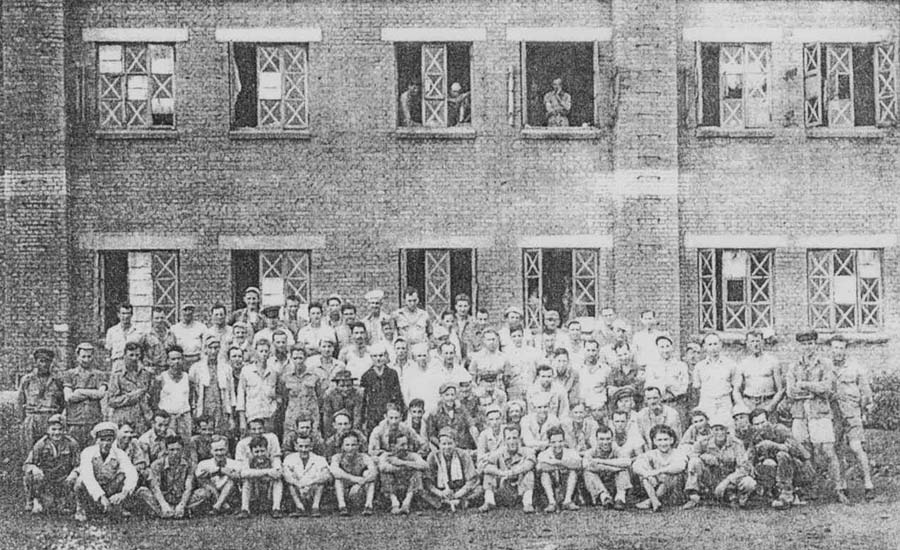
“The Devil’s Doctors” concerns itself with the Allied prison camp at Mukden in Manchuria. Between one and three men are dying every day, only a short time after suddenly developing sickness and severe diarrhoea. On March 12th 1943, the senior officer records in his diary that 195 men have died in 126 days. All of the men who died were Americans with “not a single British, Australian or New Zealand prisoner“ involved. Here are some prisoners at Mukden during the time of the book:

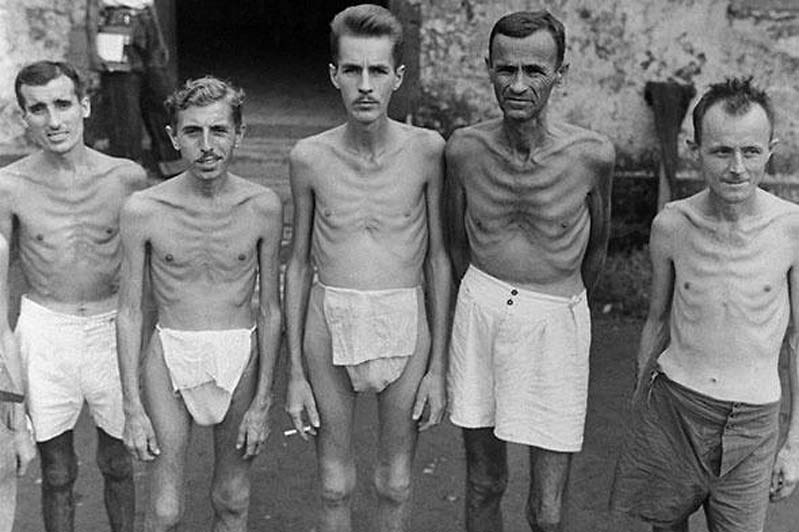
As you can just about see in that photograph, conditions in the camp are infinitely better than the average Japanese POW camp, with clean fresh drinking water, hot water in the  bathhouse and three meals a day, with as many as 3,000 calories consumed. Discipline is enforced in a much more lenient way, with no random beatings or beheadings. Why is this? Why are men dying when there seems little reason for this to happen? Why are conditions so much better than, say, the Burma-Siam railway? Are the Japanese trying to reproduce life in California so that their testing of biological weapons produces accurate results? Here are some typical Japanese POWs. They are nothing like the prisoners at Mukden:

The author carefully follows the dreadful trail to the truth. Is there a link between biological weapons tests and the “barrage of hypodermic injections” to which the prisoners at Mukden are subject. Why do the deaths increase just after the injections have been administered? Why do the deaths increase just after the distribution of fresh fruit to the prisoners? And what about the reports from prisoners about being awakened in bed by Japanese orderlies touching their faces with feathers. Just what is going on at Mukden?

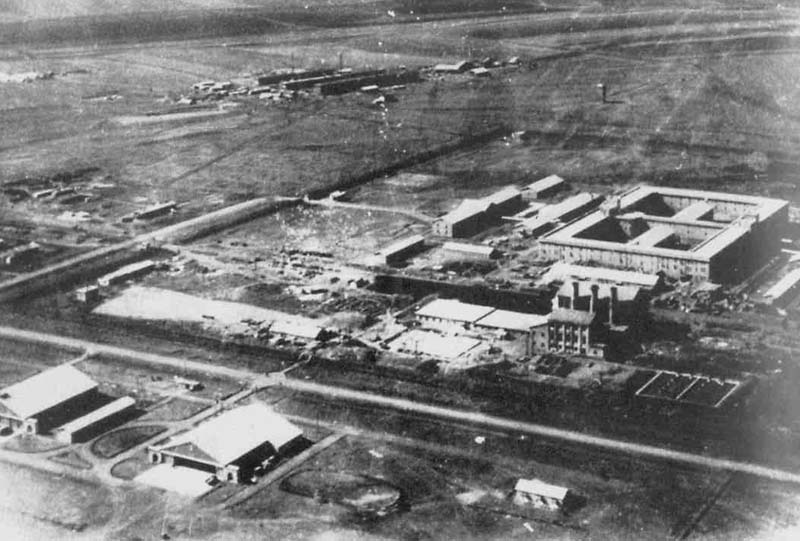
The feather stories and the injections and the free fruit might all be construed as just silliness were it not for link the author makes with the proximity of Pingfan to the camp. Pingfan is the home of Unit 731, where Japanese doctors and scientists carry out acts of appalling barbarity and cruelty on thousands of Chinese nationals. Although there were seventeen other places in the South East Asia Co-Prosperity Sphere where this frightful barbarism went on in secret, Pingfan was the undoubted capital of this Evil Empire. The author will spend most of the book exploring the idea, persistent over the last seventy years, that the doctors of the nearby Mukden POW Camp were testing BWs developed at nearby Pingfan on white men of varying origins. This is Pingfan:

It wasn’t as if such treatment of prisoners was unique among prisoners of  the Japanese.  The author quotes evidence of horrific medical experiments at Shinagawa Hospital in Tokyo where Captain Hisikichi Tokada injected the bile from prisoners with amoebic dysentery into prisoners with tuberculosis. POWs were sprayed facially with dysentery amoebas, a practice which is known to have been carried out at Mukden. And these were Tokada’s more responsible deeds:

You can read about Tokada’s other Mengele moments when you buy the book! Tokada, thank goodness, would be hanged after the war:

More to come next time.


31 Comments

Filed under Criminology, History, Personal, Politics, Science

Eagle Comic (4)

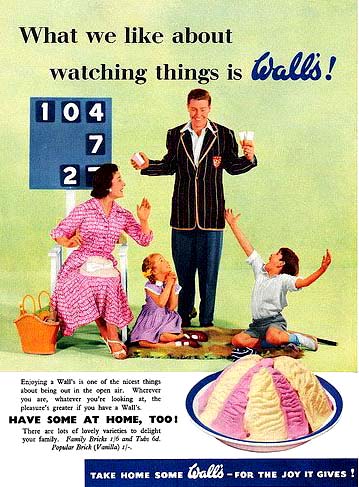
In Eagle Comic, the sponsored stories and advertisers’ contributions were  always very interesting.  Walls Ice Cream had their ordinary run-of-the-mill  adverts:

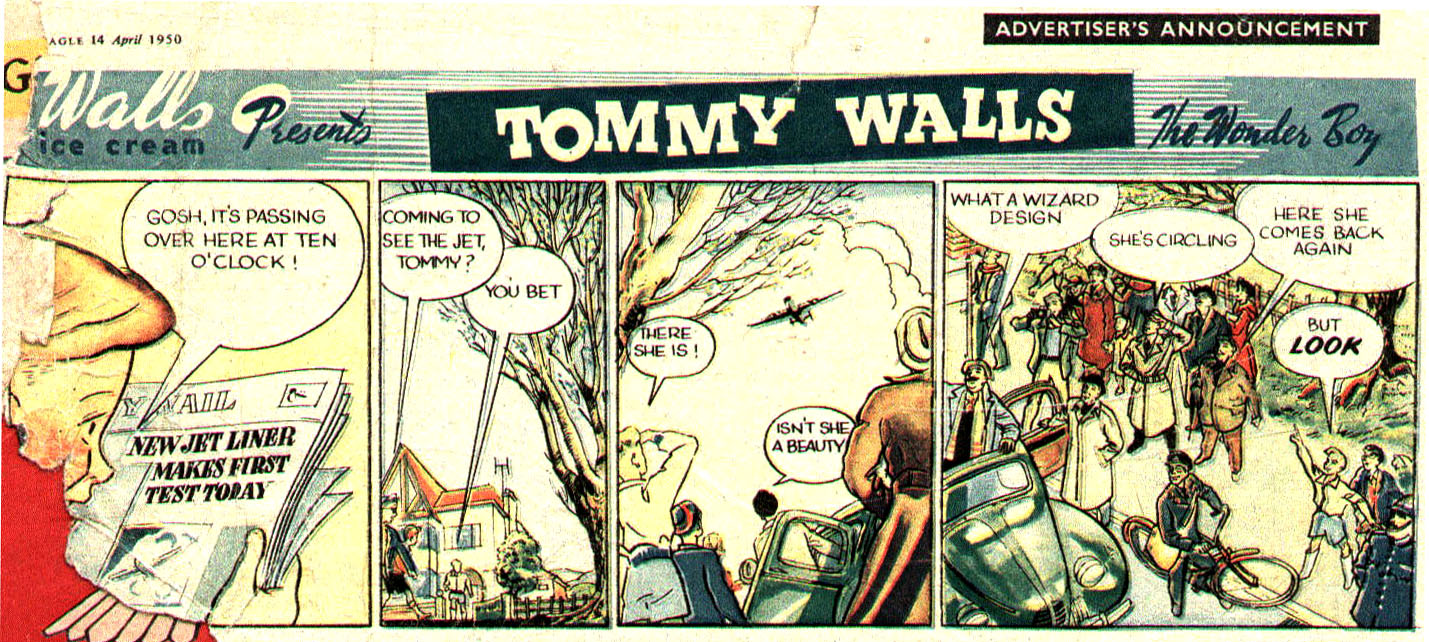
But they also had “Tommy Walls- the Wonder Boy”. The first stirrings of product placement. The perfect planting of a brand name in young, impressionable minds. I think that lots of the young readers actually thought that this story was part of the comic itself. I know I did:

The first picture says “NEW JET LINER MAKES FIRST TEST TODAY”

The last one says “WHAT A WIZARD DESIGN” which is countered by “BUT LOOK

Clearly something has gone drastically wrong, but if you eat lots and lots and lots of Walls ice cream, you’ll be able to save the day:

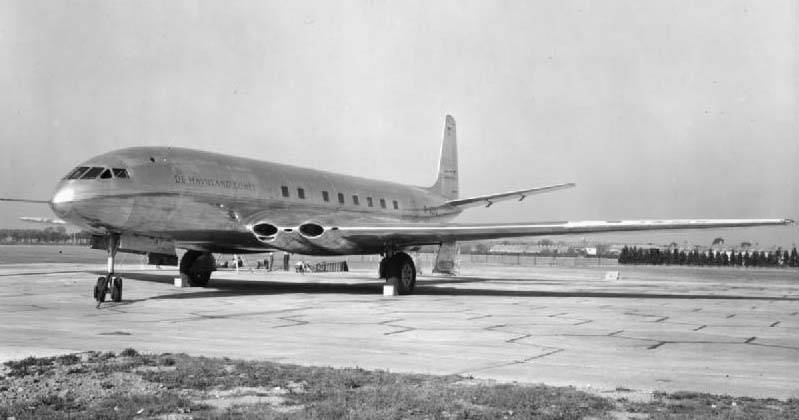
It must take sacks and sacks of sugar consumed to have the strength to hold the wing and the fuselage of a jet airliner together as it flies to an airport and makes a normal landing. Where was Tommy Walls when the De Havilland Comet was crashing all over Europe?

Cadbury’s came a close second with their “Cadbury’s Corner Quiz”. Here’s the first question:And Question 2:And Question 3:

And the final question:

And, of course, there were the ordinary quarter page adverts. Television told our mothers not to forget the Rowntrees Fruit Gums. Only listen to this irritating tune if you have always wanted your brain reformatted :

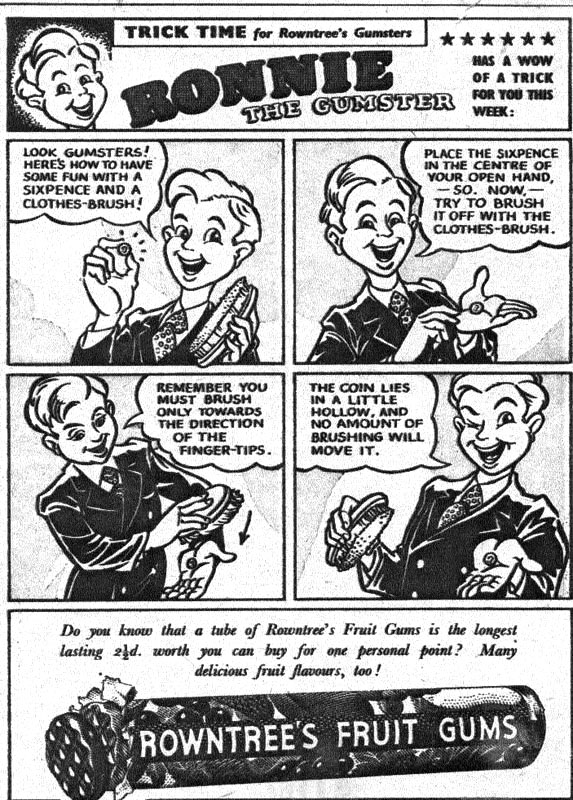
As well as the commercial links between our mothers and Rowntrees Fruit Gums, ‘Eagle’ Comic also emphasised the point with a comic strip starring “Ronnie the Gumster” :


But what’s a “Gumster” ? Something you find in a Forrest? Like Forrest Gumster.

17 Comments

Filed under Aviation, Film & TV, History, Literature, Personal, Science, Writing