Category Archives: Wildlife and Nature

Jer Falcon. one shot at Park Hall by Mr Shelton. Now in my collection.

In his own vastly expanded version of “Notes on the Birds of Nottinghamshire”, published in 1907, and now housed in the local collection of Mansfield Library, author Joseph Whitaker has added, for the most part in pencil, his own notes and additions. In some cases, he has pasted newspaper clippingts onto the pages. At one particular point, towards the end of the book, he has added the following handwritten note, misspellings and all:

“Jer Falcon. one shot at Park Hall by Mr Shelton. We were beating a plantation on Clipstone Road near the Red House Farm it was misty + this falcon flew low over the trees + was shot by him.
I missed this bird out when this book was written. Now in my collection”.

Sceptics might say, of course, that Joseph Whitaker was mistaken in his identification of the bird and that it was, quite simply, not a definite Gyrfalcon. This is, however, a rather unlikely scenario. Joseph Whitaker was familiar with many, many different kinds of raptor. If anything, he had probably seen more species within the county than the majority of present-day birdwatchers. And don’t forget. Mr Shelton shot it. They were identifying a corpse, not a distant dot disappearing into a dismal sky:
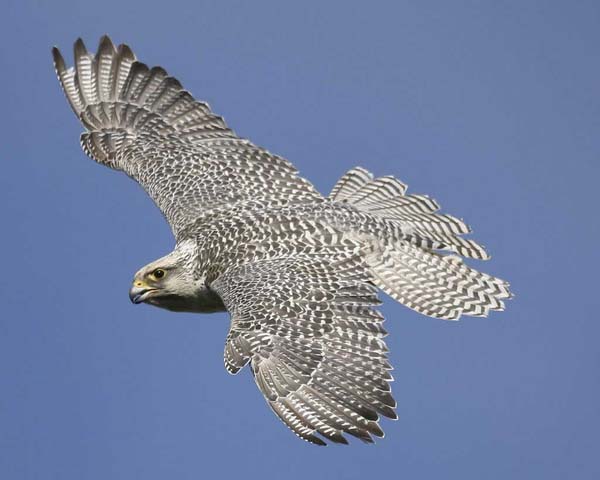
Gyrfalcon_e0 zzzzzzzzzzzzzzzzz
In any case a Gyrfalcon would have been easily identifiable on size alone. It is a falcon as big as a Common Buzzard And if Whitaker’s bird was a white phase individual, it would have been totally unmistakeable:

faucon-gerfaut-vol-tm3 zzzzzzz

There are only two birds of this size which are completely white, namely Gyrfalcon and Snowy Owl. The latter is not exactly difficult to identify:
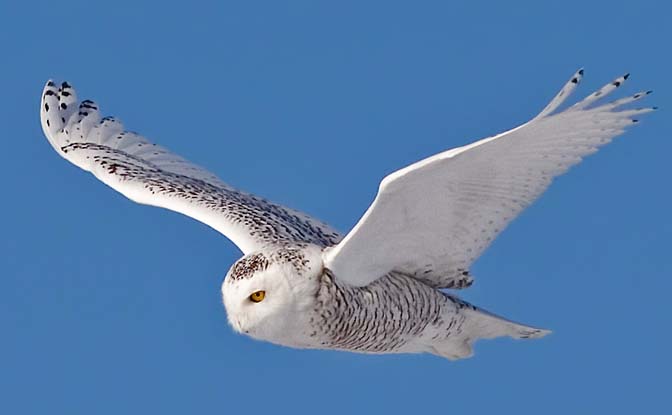
speciexxxxxxxxxxxxxxxxxxxxxxxxxxxxxxxxxxxxxxxx

Gyrfalcons exist in two different colour morphs and it would, admittedly, have been more difficult to identify a dark morph bird:
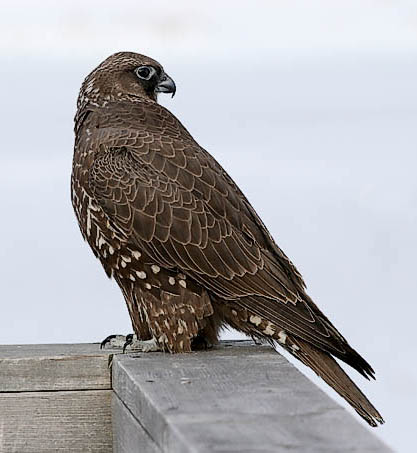
dark

The issue of size would still have been there, of course. Gyrfalcons of both white and dark morphs are huge birds. Furthermore, even dark phase Gyrfalcons are very distinctive birds, especially when viewed as dead specimens.

Dark morph birds may just be an academic problem anyway. According to at least one ornithological authority, namely Fisher in 1967, the vast majority of Gyrfalcons seen in England during the Victorian era were, in actual fact, white phase birds, with apparently only one dark morph individual recorded nationally during the last third of the 19th century.

And in Whitaker’s day, of course, there was no need to worry about the presence of escaped foreign falcons from Australia, or exotic, artificially inseminated hybrids produced by Baron Frankenstein the Falconer. It would have been very difficult to misidentify one of these charismatic killers:

32_GYRFALCON stuffed zzzzzz

Indeed, it is difficult to imagine what Mr Shelton shot, if it were not a Gyrfalcon. We also know that the bird went into Joseph Whitaker’s collection. This fact in itself would have served as some kind of checking mechanism, since the specimen would have been mounted and then inspected by the continuous parade of visitors to Whitaker’s house in Rainworth. These would have included a large number of nationally reputable ornithologists and it would have been impossible for a man like Joseph Whitaker to have shown them such an important county specimen without their quickly mentioning the fact had the bird be misidentified.
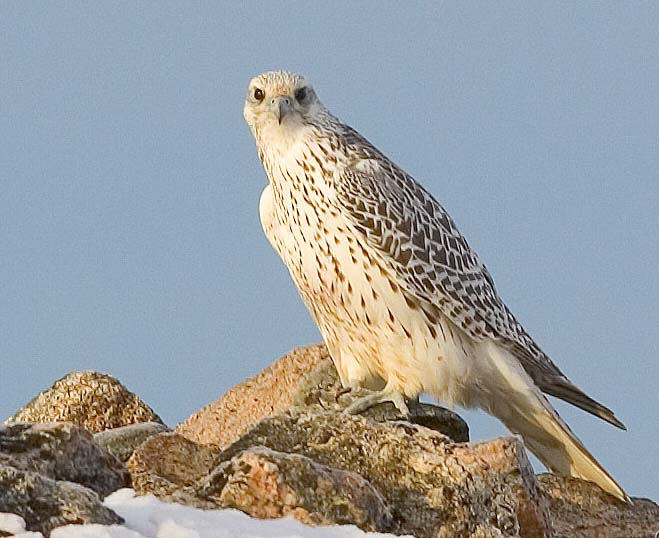
gyrr zzzzzzzzzzzzzzzz

Why then do we not have the Gyrfalcon now? Again, answers are not difficult to find. The bird may have been sold privately, either before or after Whitaker’s death. Equally it was common practice, when the owner of a great collection died, for selected individual birds to be passed onto close friends, before the collection as a whole was sold, usually at a public auction. It is also conceivable that the specimen may have been stolen after Whitaker’s death.

On the death of a great collector, it was a frequent occurrence that the beneficiaries of the estate had little or no expert knowledge of the worth or importance of certain individual stuffed birds. These vulnerable specimens were then liable to disappear between the death of the collector and the public disposal of the collection. This has certainly happened to a number of other birds which are known to have been in Whitaker’s possession but have now disappeared, presumably between his death and the acquisition of his collection on behalf of the Mansfield Museum.
In any case, why should we automatically cast doubt on Whitaker’s handwritten note? What clearer message can the great man have hurled forward into the future, than the one we now have? He offers us the word of an honest man.

You might be lucky enough one day to see a Gyrfalcon in this country. I never have. But I console myself by watching the Peregrine Falcons which have nested for years in the middle of the City of Nottingham:
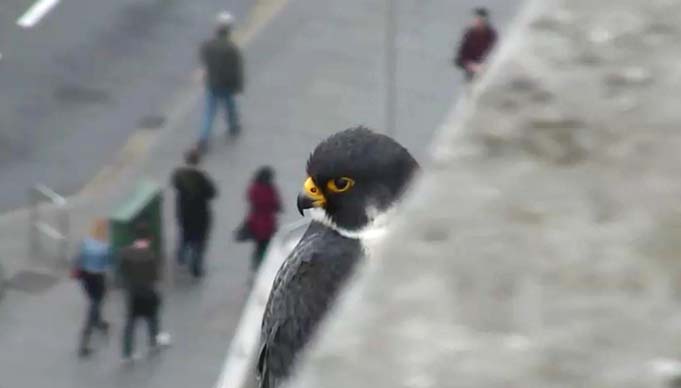
the urban peregrine zzzzzzzzzzzzzzzzzzz

They can be seen on the Newton and Arkwright Building of Nottingham Trent University on South Sherwood Street, Nottingham.

In this aerial view, the Fire Station is coloured orange as it is the most well known building in this part of the city for the majority of people. (No, it’s not on fire):
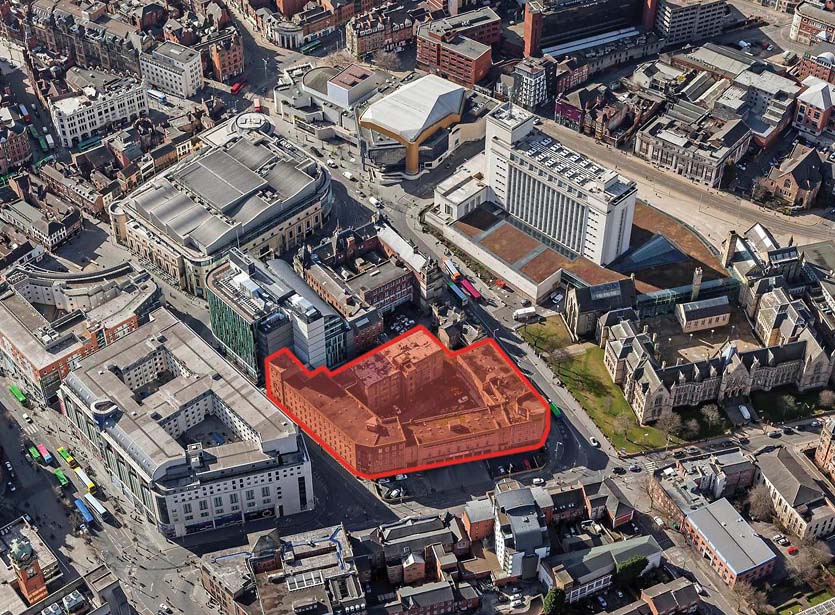
fire station zzzzzzzzz

Look at the street to the right of the Fire Station and follow it towards the top of the photo. The Newton and Arkwright Building is the enormous white building on the right as you walk up the slight slope towards the Theatre Royal. It is a very distinctive Third Reich type of 1930s architecture.

If you go there, take some binoculars if you have any. Look at the right side of the building. The nest is on a wide lip that runs the whole length of the building, just below a row of largish windows. This street map might help. Look for the orange arrow:
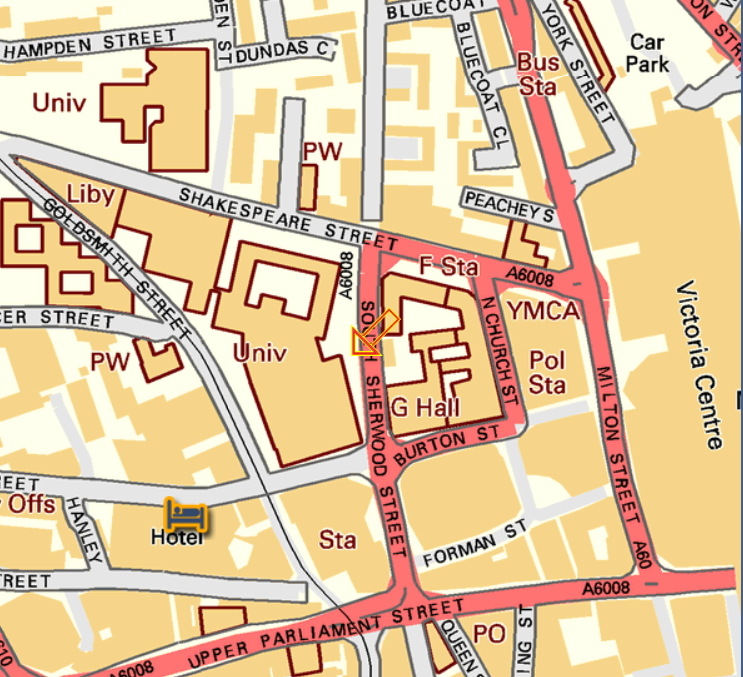
map of south shwood st

If you wish, you can watch them on a live webcam. The birds are present pretty much all they year round. Theoretically, they should not be here in the winter, but somehow they seem quite frequently drawn back, a little bit like teenagers returning to the Bank of Dad. At the moment, they should be feeding their young. In the past, there have been catastrophes with this, as is always the case with Mother Nature, but if all goes well, it can be a wonderfully blood spattered spectacle.

But back to Gyrfalcons.
Here are a pair of them, filmed by “thegowser1” at 78 degrees north between Svalbard and Greenland:


More typical for a twitcher in north west Europe would be these two films of a bird which had strayed to  Champtocé-sur-Loire, in Maine-et-Loire, France. The two films come from Alain Fossé, and show a raptor doing what they spend most of their time doing…absolutely nothing!. High calorie meals of meat mean you only need move around infrequently (or so I tell my wife).

These are much more typical  of a March day near Mansfield than an icebreaker near the North Pole!
14 Comments

Filed under History, Nottingham, Science, Twitching, Wildlife and Nature

The Beast of the Cévennes, the Beast of the Gard, the Beast of Vivarais (it did get around)

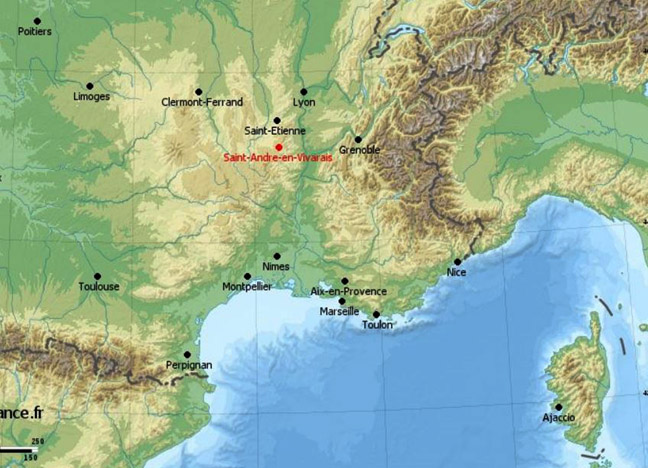
From 1809-1817, the Beast of the Cévennes, the Beast of the Gard or the Beast of Vivarais,(a creature which obviously ranged far and wide) was just one more in the long, long series of creatures, beasts, monsters, feral or hybrid dogs, wolves with completely atypical behaviour or sexual psychopath serial killers who have ravaged different areas of France from around 1550 until the present day. Here is the  Cévennes region:

Carte-cevennes-france

Here is the Vivarais area, in red, in the centre:

vivarais

And here is the Gard area, famous for the Pont du Gard. Again, it is in red:

This slideshow requires JavaScript.

Once again, I have looked at a number of French cryptozoological websites and you can take your own average between them. “Vampire Dark News” provides a solid, simple introduction to the latest killer:

“This particular creature spread panic in a vast region comprising Lozère, the Grand Gard and the Ardèche from 1809-1817. It killed, however, comparatively few victims compared to the eight long years when it was active. There were only 29 victims, almost exclusively women and children, six of whom were decapitated. On the other hand, the monster was brave enough to venture into the very houses where people lived. Their descriptions said that the beast was a wolf the size of a donkey with brown fur, a black mane and large udders. Perhaps it was an animal which had escaped from a circus. This creature was never killed.”

(My own translation)

How many wolves fit that description? A black mane? The size of a donkey? Large udders?

The French version of Wikipedia, provides a slightly more developed tale. It begins with the story of how :

«  The Journal du Gard on Octobre 21st 1809 announced the attacks by this animal in these terms :
« In just a few days, a ferocious animal has spread terror in the region of the Gard. Just like the Beast of Gévaudan of days long past (1764-1767), the Beast of the Cévennes is ravaging this part of the “country.”

2653590908_1Wikipédia then goes on to say:

“The Beast killed 29 people, including 19 children, but the list might actually be longer, because the Death Certificates do not always mention the reason for the death. A child called François Marcy, seven years old, was devoured on September 8th 1812 next to his house. Augustin Colomb, aged eight, was carried off on January 9th 1813. Only his head was ever found. In the middle of October, little Rose Henriette Dumas, aged seven, was devoured in the woods.  The attacks went on from 1809-1816, and the audacity of the creature recalls the famous affair of the Beast of Gévaudan. A woman of 34 was attacked just coming out of the church and the beast even attacked villagers inside their own houses.  The rumour was current that it had even eaten the hands of a child who was being rocked in his cradle.  Despite numerous beats and traps set by the people of the different villages the creature remained uncatchable. The attacks came to a final end in 1816 but the affair was never cleared up. It is unknown if this animal was killed during a beat, whether it changed its area of operation or if it was a question of crimes which had been carried out by human beings but were then disguised as being the work of a monster.
Several theories are offered about the origin of this aggressive animal. According to certain people it was a female wolf from Spain even though its behaviour did not resemble that of a wolf in any way whatsoever. The pins in the clothing of certain of his female victims had been removed (hardly the behaviour of a wolf) and six corpses were found decapitated, their necks seemingly having been cut by a blade. The very act of decapitation, of course, is not one which is done deliberately by any animal.

Mont Lozère seems to have been the epicentre of the whole business and had already experienced widespread attacks by wolves in the seventeenth century.

mont lozere

The descriptions which were given by witnesses at the time are extremely variable. Some people talk of an immense wolf, the size of a donkey with a mane and a coat of brown or red fur. Other witnesses describe a creature, or a wolf, the size of a calf, with a grey and red coat. In the majority of the descriptions, the witnesses agree on the presence of a huge belly covered in white fur which almost dragged on the ground. The beast had large ears, a long muzzle and a thick, heavy, tail.”

(My own translation)

What animal was this?  An immense wolf, the size of a donkey with a mane and a coat of brown or red fur? A wolf the size of a calf ? A huge belly covered in white fur almost dragging on the ground? A creature, or a wolf? This is beginning not to make any sense at all. The French peasants in this area, just like those in Gévaudan, all knew a wolf when they saw one. And white fur underneath its body means it cannot have been any species of wolf known today. And the Beast of Gévaudan explanation, based on crazed killers who used hybrid creatures to kill on their own perverted and vengeful behalf will only stretch so far. Indeed, the more I think about it, the more I am beginning to have my doubts even about Jean or Antoine Chastel and the rest of the local lunatics who were supposed to have masterminded the Gévaudan outrages.

BETE VIVARAIS

Another website relates how :

“The Beast of Vivarais (or of Cévennes) killed many women and children between 1809 and 1817 within the departments of Lozère, Gard and Ardèche. The animal is described as having the form of a wolf, but with longer ears and black hair bristling over the entire length of its back.  Another report, dating from 1813, speaks of a wolf the size of a calf, with grey and red fur, with a dangling belly covered in white fur with “roudeaux” (a word I have been unable to find in any dictionary, but they are tabby or tiger striped with white).  The head and muzzle are long, the tail is long and sticks up at the end. The official number of victims is twenty-nine.  However it is likely that the list is actually longer because Death Certificates do not necessarily mention the cause of death. In an article on the Beast of the Cevennes, Guy Crouzet details all of these killings, some of which say a great deal about the horror and helplessness of the local people in trying to overcome events which had left them completely out of their depth. And so near the village of Brahic: “was interred the body of François Marcy of Vénissac, seven years old, eaten by a wild beast on September 8th 1812, just a few steps from his home. Vézian, minister of the church.”
“ January 9th, 1813, the death of Augustine Columbus, aged eight. Devoured by a wolf, only the head was found. The boy was abducted on January 8th at five o’clock in the evening in the place called Beaujeu.”
On October 23rd 1813 at Saint-André-de-Cruzières, before the authorities there appeared: “Jacques Dumas, a farmer by profession, the uncle of the deceased, who lived in Chazelles and also Monsieur Graffand the Imperial Solicitor, who lived in Pierregras. They stated that Rose Henriette Dumas, seven years old, the daughter of Louis Dumas, a builder and Marie Maurin, from Chazelles has died from having been devoured in the woods by a ferocious wild beast yesterday, October 22nd, The remaining fragments of the deceased’s body were collected up, inspected carefully and then wrapped in the blood soaked skin of the little girl. They were recognized by her father Monsieur Dumas to be those of his late daughter Rose Henriette.”
Guy Crouzet also made a good point about Mont Lozère, which seems to have been the focus point of the Beast’s activities. Mont Lozère has already played host in the past to other monsters of the same type: in the seventeenth century, attacks by wolves on human beings were reported in the region of Saint-Julien-du-Tournel. And don’t forget that that the very first attacks by the Beast of Gévaudan were reported in Langogne, on the very edge of the Vivarais region. The Beast of Vivarais finally disappeared from the region in 1817, without ever being found. Perhaps it was killed during one of the many organized beats. Nobody knows.

(My own translation)

A wolf, but with longer ears and black hair bristling over the entire length of its back??  A wolf the size of a calf, with grey and red fur?? A dangling belly covered in white fur?? A tail that is long and sticks up at the end? For a wolf?
The “Midnight Forum” possibly isn’t quite the kind of website you might have expected, but it provides many of the details we have previously noted:

“The Beast of the Vivarais was also known as the Beast of the Cévennes or the Beast of the Gard, This monster killed 19 children. This creature first appeared in the regions of Ardèche and Gard in 1809. The descriptions of the monster vary widely. Some say it was a huge wolf the size of a donkey, with a thick mane and a coat of brown or red fur.  Others said that the creature was completely black, or that it was a wolf the size of a calf with a grey and red coat.  In most descriptions, however, witnesses spoke of a big belly covered in white fur, which hung almost to the ground.  Many thought it was a she-wolf that could have come from Spain, even if the behaviour of the animal was in no way whatsoever like that of a wolf.  It had big ears, with a long snout and a luxuriant tail.”

(My own translation)

This last one may well be a rehash of other accounts, but it is equally possible that it may be the firstborn account which all the others have rehashed.
Nobody could accept without question that this animal was an everyday, common or garden wolf. These French people two hundred years ago knew wolves.

This slideshow requires JavaScript.

From 1818-1829, supposedly 14,000 wolves were killed every single year in France. Even in 1889, around 500 wolves were trapped or shot nationally. The last wolf was killed as recently as 1937. It is, of course, a different question to explain exactly what the Beast of the Cévennes, the Beast of the Gard or the Beast of Vivarais may have been. And at this distance in time, it is not really very likely to happen. Having said that, I am working on it, even as we speak….

2 Comments

Filed under Cryptozoology, France, History, Wildlife and Nature

The Great Storm of 1703. Get your kite!
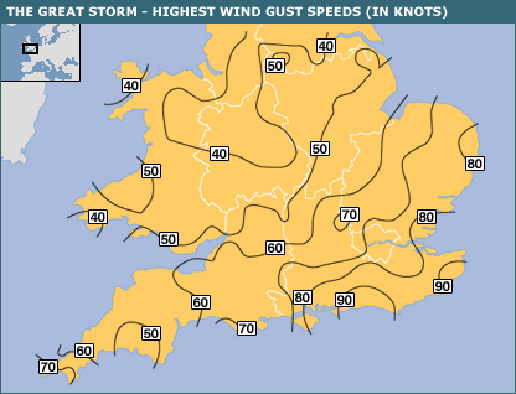
The Great Storm of November 1703 was reckoned to be the most severe storm ever recorded. The hurricane that struck the English Channel and the south of England was beyond anything in living memory:

_44175913_wind_patterns

Unlike today’s storms, when we have advanced warning and can prepare for the worst, the poor souls of 1703 had very little idea about what was about to hit them, other than the fact that the country had been buffeted by a persistent south westerly wind for quite a few weeks. Sailing ships could not sail against it and had therefore been confined in great numbers to whichever port they happened to find themselves near. Inland though, people were largely innocent of the catastrophe they were about to experience. Furthermore, the Great Storm persisted not just for a few shocking hours, but for nine terrible days. How could anything, buildings, ships, farm animals or men stand up against well over a week of wind speeds like those recorded in the eastern part of the English Channel or East Anglia? They would have approached 100 mph for long periods.

It has been variously estimated that between 8,000 and 15,000 people were to perish. John Evelyn, the seventeenth century diarist, described it in his diary as:

“not to be paralleled with anything happening in our age or in any history … every moment Job’s messengers brings the sad tidings of this universal judgement.”

The inhabitants of London felt the first strong breezes during the morning of Wednesday, November 24th 1703, (December 5th 1703 in our current calendar). By four o’clock in the afternoon the winds had noticeably increased. In London, recently out of prison, Daniel Defoe, the journalist, pamphleteer, spy, trader, writer and author, of course, of “Robinson Crusoe”, had a narrow escape in the street when part of a nearby house fell down and luckily missed him. On Friday the 26th, the wind began to blow with even greater ferocity and when the Great Man checked his barometer, he found the mercury had sunk lower than he had ever seen it. After midnight the gale increased to such strength that it was almost impossible to sleep. The noise of the chimneys of surrounding houses crashing into the street made the whole family afraid that their own solid brick townhouse might collapse on their heads. When they opened their back door to escape into the garden, they saw roof tiles scything through the air, some landing thirty or forty yards away, embedding themselves eight inches or more into the ground. The Defoe family decided to stay in their house and trust in the Lord.

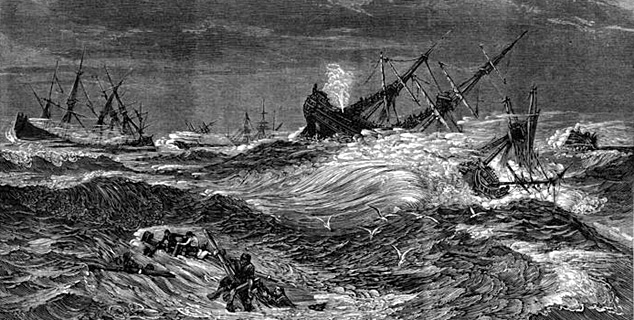
That night of November 26th-27th was catastrophic for the Royal Navy which lost 13 major warships, which were, for the most part, moored along the south coast.  HMS Resolution was driven onto the shore at Pevensey but the ship’s company was lucky and all 221 sailors were saved:

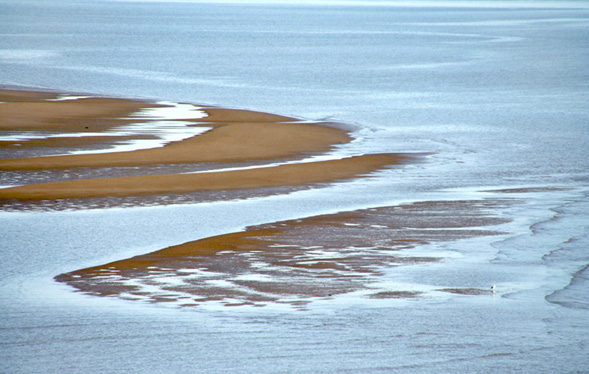
HMS%20ResolutionNot so fortunate were the men on board HMS Restoration, HMS Mary, HMS Northumberland, HMS Stirling Castle and the quaintly named HMS Mortar-bomb, who were all shipwrecked on the Goodwin Sands off the Kent coast:

Sandbanks_Credit_Ben_Salter

In the aftermath, when the tide fell, the sailors of the wrecked vessels who were able to find a foothold on the huge sandbar, were all wandering around knowing that when the tide rose they were certain to be drowned. It was said that a man called Thomas Powell, a shopkeeper in Deal, organised the rescue of some two hundred of them. Supposedly Powell was so appalled by his neighbours’ reluctance to help that he gave them five shillings each for their support. Certainly, the greedy citizens of Deal were widely accused of being more interested in plunder from the unfortunate ships than in helping to rescue the crew members. Indeed, some sources say that only three fortunate individuals survived the Goodwin Sands catastrophe. Supposedly, about 1,500 sailors in total were left to die.
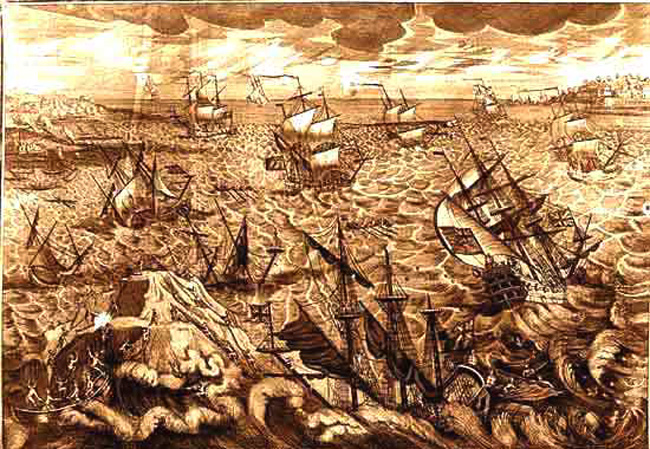
Lots of other naval ships were driven through the Straits of Dover and out into the storm tossed expanses of the North Sea where some survived to return days later but many others were lost without trace:

stormb_1703

Ships were so driven by the wind that not only did sails have to be lowered but the masts had be cut off level with the deck. Well in excess of a hundred merchant ships were sunk in the North Sea, many of which were colliers from the fleet which at the time was used to transport cargoes of coal down the east coast from Newcastle to London. Some of these ships would have been empty, moored or at anchor when the incredible tempest struck, casting them out into the open sea. Most were ill-prepared and foundered, and their crews perished to a man:

141126-great-storm-b

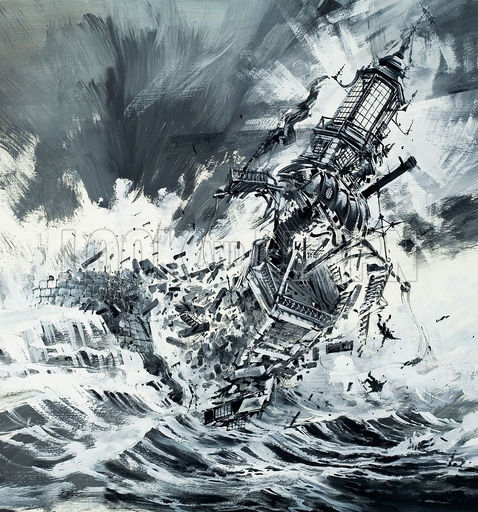
The storm caught a convoy of 130 merchant ships and the six Men O’ War escorting them as they sheltered at Milford Haven. The warships included HMS Dolphin, HMS Cumberland, HMS Coventry, HMS Looe, HMS Hastings and HMS Hector. By the middle of the following afternoon the losses amounted to thirty vessels. Overall it was estimated that more than 8,000 sailors perished as the storm annihilated the Royal Navy. Around 20% of its sailors were drowned. The first Eddystone Lighthouse was completely destroyed:

Destruction of the Eddystone Lighthouse, 1703

Its erection had been started a mere seven years before, and  its light had been lit for the first time only on November 14th 1698.  Now all six of its occupants were killed, including the brave builder Henry Winstanley.

This slideshow requires JavaScript.

This lighthouse was of inestimable importance and stood 120 feet tall,  some twelve miles to the south of Plymouth, one of England’s most important naval harbours. Even the French valued it, when during the period of construction, a French ship took Winstanley and his men prisoner. King Louis XIV, “le Roi-Soleil” ordered their release, explaining that “France is at war with England, not with humanity”, « La France est en guerre contre l’Angleterre, non contre l’humanité! »:

Louis_XIV_of_France

The Great Storm reached its appalling apogee, its catastrophic climax, during the following night, that of November 28th-29th (December 9th-10th 1703). Between the south coast and the Midlands, entire villages from Northamptonshire in the north to Suffolk in East Anglia were devastated  as the winds of the Great Storm rampaged across the country, striking hardest in the south and east of England, sending house roofs flying, flattening barns, razing everything in its path. Both men and animals were lifted off their feet and carried for long distances through the air. Roofs were ripped from more than a hundred churches, the lead was rolled up like a sheet of paper and dumped hundreds of yards away.
Millions of trees were blown over or uprooted; knocked flat in their tens of thousands, they lay prostrate in rows like soldiers mown down in battle. It was said that more than 4,000 oak trees crashed down in the New Forest.  An attempt was made to count the flattened trees in Kent but the count was abandoned at 17,000. The diarist John Evelyn lost in excess of 2,000 trees on his own Surrey estate.
Every kind of building was totally demolished and salt spray was driven almost as far inland as Tunbridge Wells. Animals refused to eat the resultant salty grass.
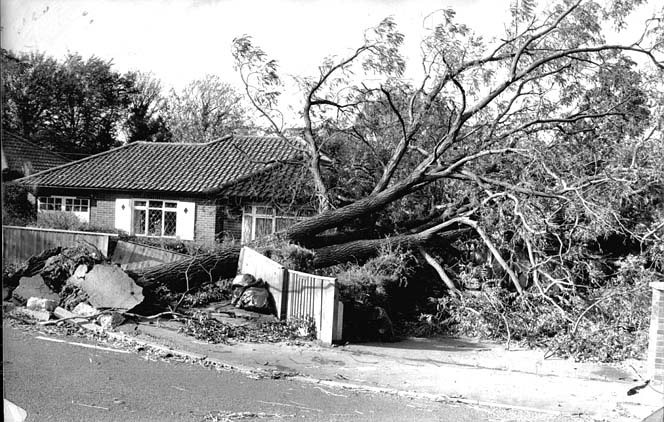
The maximum wind speeds were similar to those of the Great Storm of 1987 but the bad  weather lasted for much, much longer, well over a week, and thereby increased the enormous loss of life. Here is one of the enduring images of 1987:

1987

People could not decide whether it was safer to stay in their house and risk its collapse or to go into the street where flying tiles killed large numbers.
In East Anglia the wind reached over 80m.p.h. and killed well over a hundred people.  More than four hundred windmills were blown down. Many of them  burst into flames because the friction of their sails spinning round at high speed caused their wooden machinery to catch fire. In Cambridge, part of St Mary’s Church fell down and the falling stones completely flattened the organ. It had only recently been installed at a cost of £1,500. Kings College Chapel was equally badly damaged with stone pinnacles toppled and many of the wonderful stained glass windows destroyed.
In the capital, around 2,000 massive chimneys were blown over. The roof was blown off Westminster Abbey and the Queen, Queen Anne, had to take shelter in a cellar at St James’s Palace to avoid falling chimneys and tiles whizzing off the roof. Daniel Defoe told how the Reverend James King of London wrote him a letter about a chimney which crashed down and buried a maid. She was thought to be literally dead and buried, but she came out the following day from a small cavity in the rubble.

Watersnood_1809

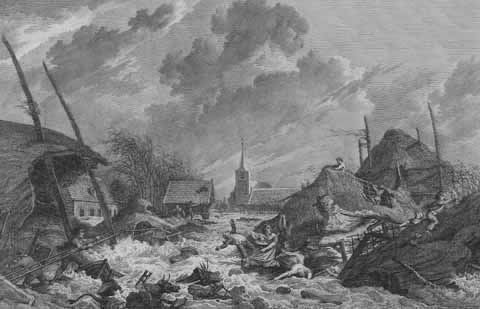
Floods devastated the whole country, especially in the east of England and along the Severn Estuary. In the West Country in general, flooding was extensive and prolonged, particularly around Bristol where just under a thousand houses were totally destroyed. Hundreds of people were drowned on the Somerset Levels, where uncounted tens of thousands of farm animals, mainly sheep and cattle, perished. One lost ship was found fifteen miles inland. At Wells, Bishop Richard Kidder was crushed when two chimneys in the palace collapsed onto him and his wife, both peacefully asleep in their bed. Part of the Great West Window in Wells Cathedral was blown in and smashed to smithereens. At Fairford the church’s west window, facing the raging anger of the oncoming wind, bulged inward and crashed into the nave. In Wales, major damage occurred to the southwest tower of Llandaff Cathedral at Cardiff.
The storm began to die down around December 2nd, and on December 3rd,  Daniel Defoe visited the Pool of London, where, in the section downstream from London Bridge, he saw more than 700 sailing ships all piled up into heaps one on top of another:

vvvvvv Daniel_Defoe_Kneller_Style

Daniel Defoe told the tale of the captain of a leaking ship who tried to escape what seemed to him at the time to be an inevitable death by drowning, and instead committed suicide—only for his ship to survive. One possibly taller tale related how a sailing ship at Whitstable in Kent was blown out of the foaming sea and then deposited more than a quarter of a mile inland.
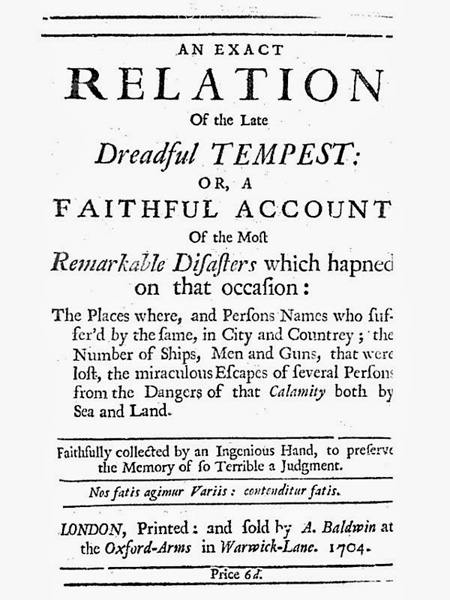
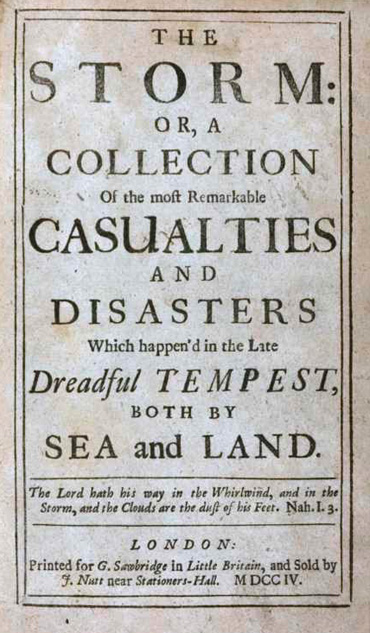
Unsurprisingly, in the aftermath of the Great Storm many special newspapers and publications appeared with information and eyewitness accounts:

the_dreadful_tempest_01b

Conceivably this disaster became “national news” in a way that had seldom, if ever, happened before. It was just like a modern “big story”.
Daniel Defoe himself sought out testimony from as many witnesses as he could find.  When the weather ameliorated, he the whole country assessing the damage. He then produced what was subsequently described as “the first substantial work of modern journalism”, a book of more than 75,000 words, which was called “The Storm”.  It was the first proper book of Defoe’s career.

The_Storm_by_Daniel_Defoe_cover_page
*****************************************

http://historicaltrinkets.blogspot.co.uk/2013/10/the-great-storm-of-1703-eyewitness.html

http://en.wikipedia.org/wiki/Great_Storm_of_1703

http://www.historytoday.com/richard-cavendish/great-storm

12 Comments

Filed under France, History, Science, Wildlife and Nature

As promised, a beautiful bird in the garden

In a previous blogpost I extolled at great length the many ways in which a fascinating plant called the teasel was extremely beneficial to wildlife. In the summer therefore, our garden played host to a number of lovely butterflies:

This slideshow requires JavaScript.

The teasel also kept us human beings interested by drowning passing insects and slowly absorbing the chemicals from their bodies. Here is the teasel in flower:

Teaselxxxxxxxxxxxxxxxxxxxx

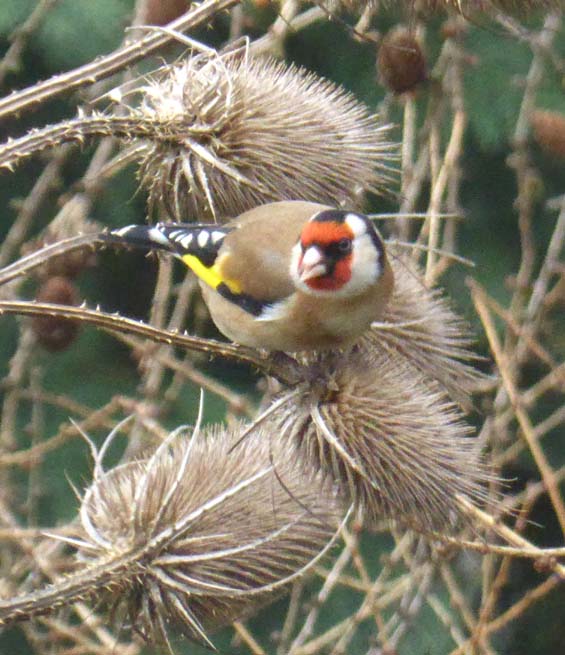
I hope you have not forgotten though, how I made a solemn promise that, when the seeds had matured, the seed heads would play host to one of our most beautiful birds, the Goldfinch.
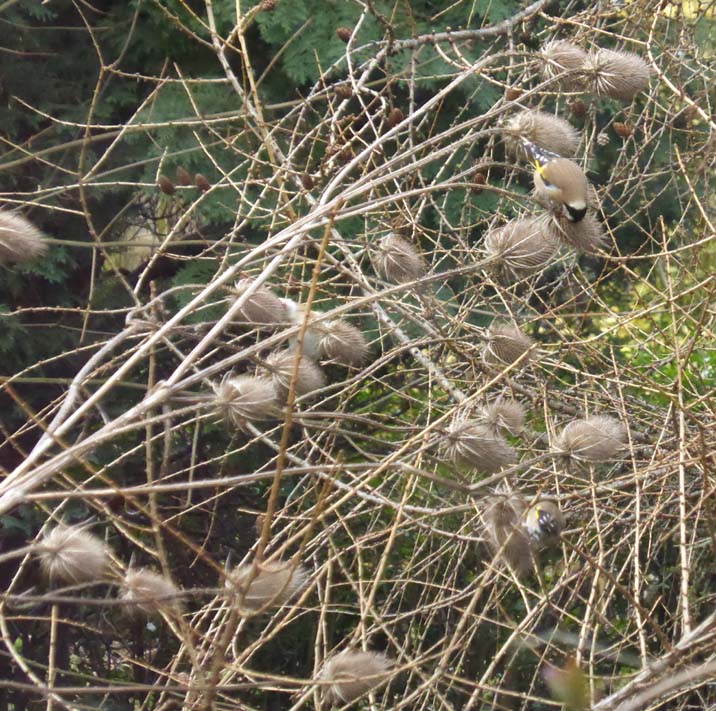
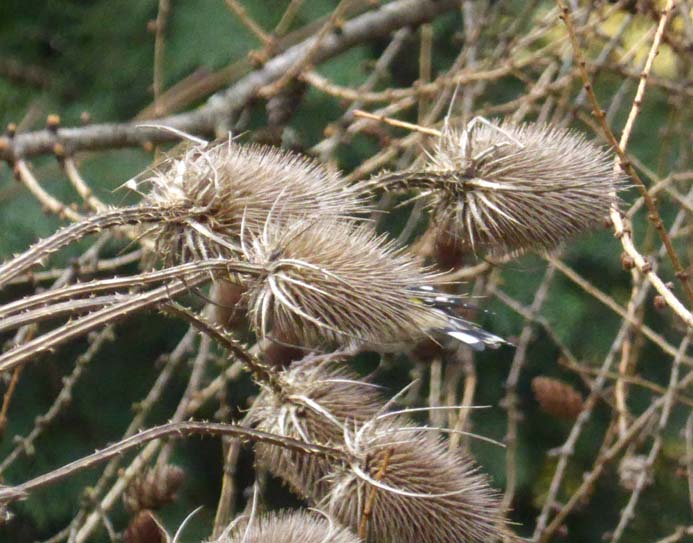
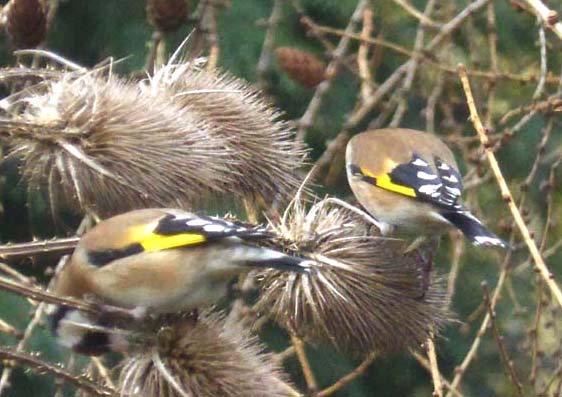
They should have been here in autumn, but now, at last, they have finally made their long awaited appearance. I, of course, missed them on their first visit, but my daughter and fellow blogger saw them and took a few photographs. Here are some of them.

Firstly, it may actually be a case of “Spot the bird”:

P1010677xxxxxxxx

Not always an easy decision to make:

P1010651xxxxxxxxx

Yes, at last, a Goldfinch:

P1010673xxxxxxxx

As far as I know, the males and females are the same:

P1010640xxxxxxxxxxxx

At least, they look it:

P1010692xxxxxxxxxxx


3 Comments

Filed under My Garden, My House, Nottingham, Science, Wildlife and Nature

Excitement with a capital Egret

(An extract from my old birdwatching diary “Crippling Views”)

.
Saturday, June 18, 1988

.
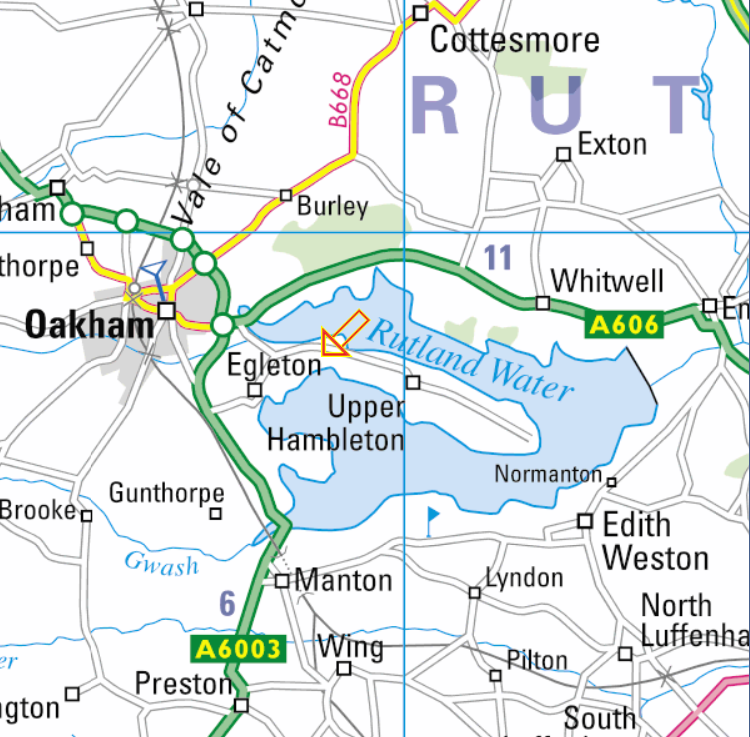
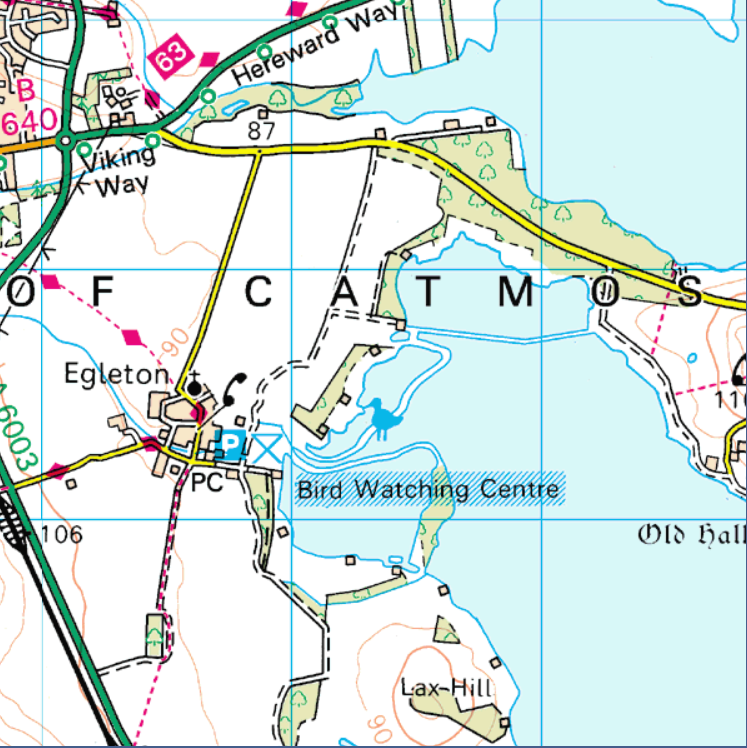
Excitement with a capital E. I ring faithful old Birdline, at two o’clock, and for once strike lucky. The pre-recorded message tells me that a Great White Egret is present at Rutland Water, on the Egleton Reserve. I ring Paul before jumping into the car and heading off at a rate of knots. Noble and honourable to the core. Except Paul isn’t there. I decide on a compromise, or, as you are entitled to call it, the coward’s way out. I’ve already promised my wife that I’ll take her to Sainsbury’s, so I spend the next half hour driving round the Ring Road at 90 miles per hour, doing a week’s shopping in a British Olympic qualifying time, and then returning to phone Paul just once more. Still no answer. Knowing him, he’s properly gone off with his mate Mark to see the bird without bothering to tell me. So into the car I jump, and off I go.

volvo-240-hmb-645-n

It takes me about three quarters of an hour to do the forty miles to Rutland Water, with an irritating delay in the Saturday shopping traffic at both Melton Mowbray and Oakham.

Untitled bigger

When I get to the reserve, there is a heart stopping moment when I see that there are no cars in the reserve car park. Not to worry, the bird has just moved a short distance out of the reserve, towards the Hambleton Road. The warden on duty gives me a disconcertingly long set of immensely complex instructions to take me down to a crossroads, where the bird is still on view. In actual fact, his instructions prove to be wonderfully exact and easy to follow, and I am soon beside a crossroads, where there is an obvious crowd of birdwatchers, and a great tangle of carelessly parked and apparently abandoned cars.

Untitled

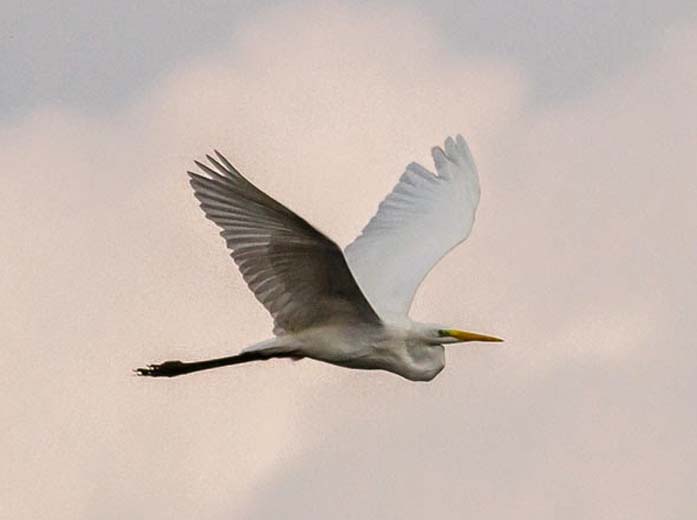
I see the bird immediately from the car, before I even pull to a halt. It flies in an almighty arc, with that same translucent pearly white as the  Little Egret I saw at Frampton, only this time the bird is a lot bigger, the size of a Grey Heron.

02343-Great-Egret-043xxxxxxxxxxx

When I finally arrive on foot at “The Place”, “The Bird” has landed on the very topmost branch of a tree, about seventy yards from the road. It is a very striking individual, looking absolutely enormous, perched in the very top twigs of what is not really a particularly large  tree. The bird appears to be extremely precariously balanced, but it seems happy enough. I get it in my telescope and watch it until boredom sets in. The bird is, by now, just very gradually beginning to get more and more restless, as a larger and larger crowd builds up, and the hum of human conversation gradually becomes louder and louder. It keeps looking around in an almost panicky sort of way, until it finally flies off low between the trees, looking for all the world as if it is going just a few hundred yards away.

dsc01625_great_white_egret xxxxxx

In actual fact, it isn’t, and the rare visitor is never seen again on the reserve.I drive around to the northern section of the reserve, where there are a lot of quiet places, all ideal habit for an egret. It isn’t there. I look for a good half hour, but finally have to admit defeat. It’s really sad how many birdwatchers arrive after the bird’s departure, some from as far away as Somerset. On the other hand, it is certainly arguable that it is the large number of noisy, chattering birdwatchers that have caused the bird to fly off.

.

Nowadays, some twenty five years later, the Great White Egret is by no means a rare bird in England.

They have bred here on at least two occasions, in 2012 and 2013, at Shapwick Heath, Nature England’s National Nature Reserve in Somerset.

This slideshow requires JavaScript.


Every year, up to forty individuals will arrive in England in the winter, having left the colder climes of mainland Europe. The bird which remains still genuinely rare in England, though, is the American version of this bird, the Great Egret Ardea alba egretta (as opposed to the European Great White Egret Ardea alba alba). This subspecies is suspected as having occurred in the UK as a very rare vagrant on just a few occasions.

2 Comments

Filed under Nottingham, Twitching, Wildlife and Nature

The Beast of Benais

The ferocious so-called “Beast of Benais”, in central France, was either one unbelievably long lived monster, or a series of, conceivably, related animals.

7741547673_carte-de-situation-de-benais-indre-et-loire

According to one account…..

“At the end of the winter of 1693, on February 19th, a wolf attacked a nine-year-old child, Pierre Boireau, at Saint-Patrice. The victim was found partially devoured and five days later, a mother found the remains of her own daughter, Antoinette, aged seven, in the heathland around Continvoir. In March 1694, a wolf killed two more victims, adults on this occasion, at Benais. In April, there were three more, four in May and eight in June, including a mother and her child.

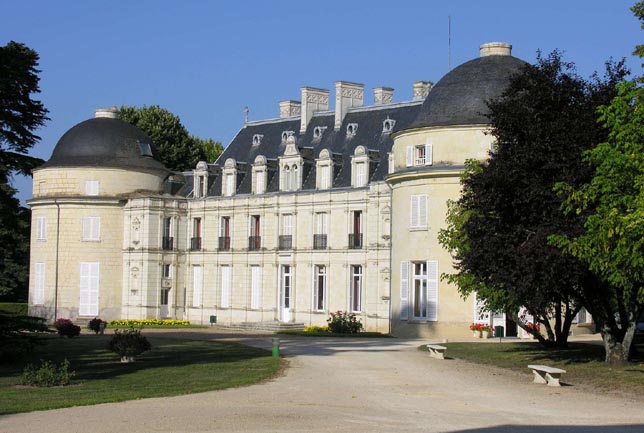
chateau ccccccc

Monsieur de Miromesnil, the Lord Lieutenant in charge of the province of Touraine, then organised a series of beats. According to his account in June 1694, “In fewer than six months, wolves have killed in the area around Benais more than 70 people and have wounded the same number”.

benais

In June two shepherdesses had their throats ripped out, a father died defending his daughter at Ingrandes and in July there were three further killings in Benais and at Les Essards. In August a sixty four year old woman was devoured in Benais, and the same fate befell a little girl and two adult women in Bourgueil. None of this  behaviour, of course, is that of a wolf such as we experience them in the 21st century. As I have noted elsewhere, only one attack by a wolf on a human being has ever been documented in North America, and even then, it was a wolf which was used to scavenging on a landfill site and  had therefore lost its fear of Man.
Until the following winter of 1693-1694, the attacks stopped but the population of the area was still completely terrified. Two wolves were killed during the beats organised by Monsieur de Miromesnil, but the death of a young man of eighteen in December 1693, with two other young people killed in Saint-Michel-sur-Loire  in the January of 1694 proved that the Beast far from finished. There was, however, a long hiatus until the very last victim came in August of that same year, 1694. Then everything came to a stop.

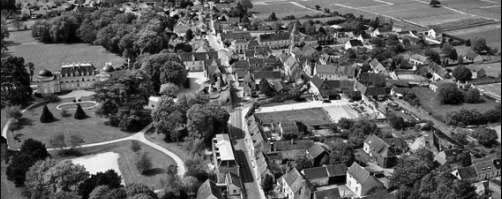
coloiur village

Some fifty seven years later, on June 9th 1751 a young shepherd was attacked and devoured at Nouzilly to the north of Tours. The animal was not seen but wolves were considered to be the culprits. The body of the young man was horribly mutilated accorded to the description given by the village priest, Danican, the man charged with burying the body…

“The child from La Charité who used to live near your tenant farmer at Les Fosses Rouges, looking after his six animals, was ripped to pieces and devoured at eight o’clock in the morning by carnivorous wolves.  I buried her at quarter past twelve. They brought the sad remains of her corpse to the church, wrapped up in a woman’s apron with the child’s own clothes covered in blood. The beast had ripped her tracheal artery and part of her right cheek and had eaten her thigh which had been ripped off her body as far down as the knee.  This was in such a way that the top part of the bone of this thigh was extensively gnawed away and devoid of flesh as if it had been trimmed off purposefully by a knife. The beast in order to devour her intestines had eaten all of her belly and gnawed her ribs. Of all her viscera, there remained only one foot of (illegible, perhaps fortunately) and a small part of the spleen.”

This formidable animal resembled in every point including its behaviour « La Bête du Gévaudan ». To be convinced of this, it is enough to be aware of the story which was told by the village priest at Varennes…

“These beasts were almost like a wolf, except that they had much wider muzzles. When they first saw people, they were amiable like a dog would be, but then they leapt on their throats.”

Here is a different account

“A ferocious beast of which nobody knew the name, but with an unheard of daring and ferocity, struck, for the most part, in the Forest of Benais, not far from the village of the same name. It began in 1693 and the attacks were to last for a year and a half……during this time the animal had 300 victims. The attacks suddenly stopped in the month of August 1694. The Beast of Benais was never killed.”

A different website says…

“According to the evidence of the village priest at Varennes, it was thought that there were 300 victims, whereas the parish registers of the area report only 72 deaths caused by animal attacks during the same period, a total which is both more plausible and yet still quite a considerable one……The witnesses of the era said to the priest that there was not just one beast but several acting in concert and that the latter looked like wolves, but may not have been real wolves. They were very much like wolves but had a wider muzzle. One detail of their behaviour was quite remarkable in that they allowed themselves to be patted, but then leapt on the throat of the victim. People thought that they were “loups cerviers”. The people, however, were not so sure”.

“loups cerviers” does not exist as a phrase in the online foreign language dictionary that I usually consult, but I did find it in what looked to be quite a good alternative to my initial choice. In any case, the writer of the original cryptozoology website has added in brackets after “loup cervier”, the word “lynx”.  Google agrees with this and offers the expression as the French Canadian phrase  for “Le Lynx du Canada”. Strangely enough, when the French police spend a merry weekend recently looking for a wandering tiger near Paris, the suggestion that their expert put forward was that the animal was a “loup cervier”. In none of these cases, however, does the unbelievably secretive behaviour of the lynx, Camadian or otherwise, fit the details given by the witnesses.

This slideshow requires JavaScript.

In France at this time, parish registers would perhaps record the fact that somebody had died, but there was no legal stipulation that the person writing the account (usually the priest, the only one in the parish who was literate) should record the reason for death. If the priest at Varennes recorded his total of animal attack victims as three hundred, then this might well be a reasonably accurate total, based on his own local knowledge of the real facts, whereas the parish registers of an area which reports only 72 deaths caused by animal attacks might merely be providing a politically more acceptable figure. Certainly, this economy with the truth is known to have happened with the Beast of Gévaudan, whose kill rate was deliberately suppressed once the King’s official representatives, the d’Enneval father and son, had supposedly put an end to the monster.

Could the Beast or Beasts of Benais have been a number of feral dogs or the hybrids of wolves and large dogs? Certain death counts attributed to the Beast or Beasts are incredible. I do not really have the time to be meticulously exact but this list captures the flavour…

“In November 1693, there were deaths on the 18th, the 19th, the 22nd, the 23rd, the 25th, the 26th and the 27th. At Mazières, from November 29th to December 3rd, there were four victims. In Langeais in three days, November 29th-December 1st, there were three dead. More followed in Langeais on December 13th, 14th and 15th.
In early March of 1694, several children in Continvoir were devoured. Desperate, the inhabitants no longer knew what they could do to stop this scourge. The local clergy increased their prayers. God, after turning a deaf ear for so long, finally heard them. At the beginning of the month of August 1694 the carnage ceased.”

Subsequent writers then began their own attempts to count the victims. The priest at Varennes suggested 300 victims. Marie-Rose Souty proposed 95 definite kills, but added that this figure was certainly much lower than the real one, because most village priests of the time did not ever mention the cause of death for their parishioners when  recording their demise. Marie-Rose Souty suggests then, at least 200 victims in a year and a half, that is to say around ten or eleven per month. Above all, the monster seems to have appreciated “fresh meat” and always attacked the weakest people, those who were the least able to defend themselves. Its ferocity was unbelievable. Even the Beast of Gévaudan only managed a mere three victims a month.

.
Yet more creatures appeared in Touraine in 1751 in the north of the province, and then more in 1808 and more again in 1814. They were all thought to be wolves,  even though the behaviour of wolves in our present era just would not encompass their attacking human beings, killing them and then devouring them. Wolves just don’t behave like that nowadays!

As an afterthought, the more I read about these many monsters in the France of yesteryear, the less satisfied I am about any of the most frequently quoted explanations. I would reject wolf more or less totally and even feral dogs or wolf-dog hybrids seems to me increasingly less likely, whether or not they were trained by serial killers, sexual psychopaths or whoever. The peasants of the time were familiar with wolves and frequently rejected that animal as an explanation for the Beast of Benais. Their descriptions often have, variously, wide muzzles, reddish fur, black manes, a black stripe between head and tail, a belly that drags low towards the ground and a full tail, that could even be used to strike people. The more books I read the less I understand this. Perhaps in France there was  a very small and thinly scattered population of a ferocious animal, nowadays extinct, but which still hung on in the wilder regions. Perhaps we should be looking at the idea of a mesonychid ?

13 Comments

Filed under Cryptozoology, France, History, Wildlife and Nature

“Where are the snows of yesteryear?”

Over the centuries, the weather can often be extreme, and some amazingly strange things have happened. In 1110, nearly a thousand years ago, Nottingham experienced a terrifying earthquake. Bizarrely, the River Trent dried up for several hours, presumably as it drained into, and then eventually filled up, a huge new crack in the ground that it had created somewhere upstream.

In the Nottingham of 1682, extremely low temperatures lasted from September until February of the next year. Shortages of coal, wood and food were caused by difficulties in the transport system, and  the fields, roads and rivers were all frozen up. The Trent, for example, was completely impossible to navigate throughout the entire period of the freeze.

It was equally cold in 1855 when a cricket match was played on the frozen River Trent. The victors roasted, and ate, the greater part of a whole sheep without the ice either melting or giving way. When the thaw set in, an iceberg weighing many tons was unleashed in the river and it destroyed a bridge downstream when it crashed into it.

6419523017_ebf7e7e31c

A local solicitor, William Parsons, recorded the weather’s outrages in his diary:

“In 1814, we had so severe a frost as to freeze the Trent over, the first time I believe. It continued 16 weeks. The Trent was then so frozen that a fair was held and oxen, sheep and pigs were roasted.”

In 1838, the River Trent froze over at the beginning of the year. William’s entry for January 20th reads:

“The frost has now continued about twelve days but with greater severity than is remembered. Many thousands from Nottingham went to see the Trent today. The frost continues extremely severe. The Trent this afternoon is now frozen completely over and I was sliding upon it just above Trent Bridge.  I shall visit it tomorrow again it being of rare occurrence to be frozen. The snow continues upon the ground about six inches deep. My hands are very severely chapped that I am now writing in kid gloves”.

He described the river as:

“in that state frozen it appeared like a frothy, foaming river of snow. Many people were crossing on the ice. I walked down to the bridge and crossed the river just above it where numbers were also winding their way through projecting masses of snow covered in ice. The river was more rough and picturesque in this part than in any other.”

The most charming thing about William’s diary is his great honesty. As regards the consumption of alcohol in very large quantities, he was a man many years before his time:

“Time worse than wasted, money spent, health injured, myself debased! Let these days of drunken, senseless riot be remembered only as incitements to become a rigid teetotaller”.

We’ve all been there.

6419523525_986f696990

The River Trent was a very different river in those days and that is why it used to freeze fairly regularly during exceptionally cold weather. There were, of course, no power stations releasing huge quantities of warm water which might increase the natural temperature of the river, but that is not the most fundamental reason for the change. Nowadays, the waters of the Trent have been for the most part  tamed and confined firmly in great ramparts of concrete. Because of the way in which the river has been turned into a giant canal, it is now much deeper and fast flowing than it used to be. The edges of the river do not extend outwards in leisurely fashion into marshes or shallow ponds with very little flow. The modern Trent no longer stretches, as it did in primeval times, from the sandstone cliffs south of St Mary’s Church for many, many hundreds of yards into present day West Bridgford. And the old wide river, of course, was a shallow, more slow flowing river, the kind of waterway that was much more likely to freeze in severe weather.

St Mary’s Church is in the top left of the map, near to the word “Museum”. It is represented by a cross and a square joined together. Trent Bridge is indicated by the orange arrow, and the southern edge of the waters centuries ago would have been well to the south of the present day B679 (bottom left of the map) or the Trent Valley Way (top middle right of the map).

old trent bridge

In those ancient of days, when the river was so very much wider, the only safe crossing, either on  foot or on horseback, was across the band of harder rock where Trent Bridge now stands.

images8WR58W3V

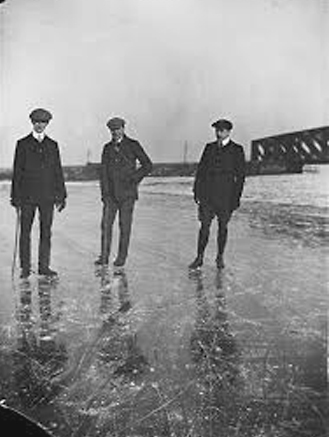
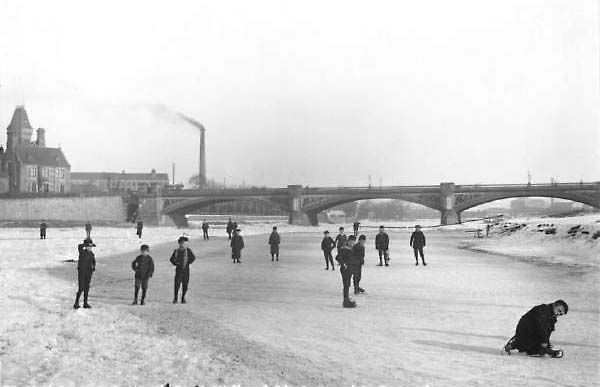
On January 16th 1892, on a “piercingly cold” Saturday, Nottingham Forest played Newcastle East End at the City Ground. When the crowd arrived at Trent Bridge, they were surprised to see “skating in progress on the old course of the River Trent.”  Because of the recent introduction of the penalty kick, the frozen football pitch had some new markings, which in this case were made of broad strips of black soot. Newcastle changed from their normal crimson shirts into black and white stripes. Hopefully, before the game, Old Nottinghamian Tinsley Lindley, Forest’s centre forward, was able to walk across the Trent to the game, just like Brian Clough used to do.

NTGM006720

Three years later, in 1895, the river froze for the last time. Again, the region’s economy suffered. Numerous tributary rivers smaller than the Trent were also frozen, and many jetties and warehouses became unusable. This caused huge job losses in local industry.

MS 258/3

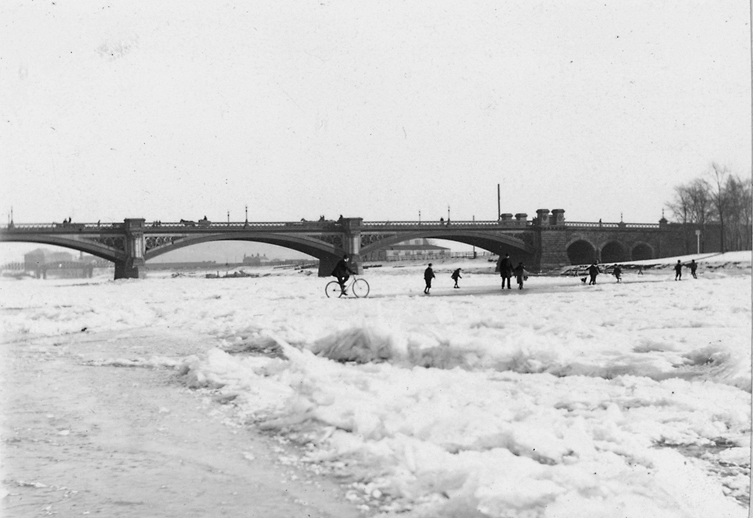
The river was caught in this devastating frost for almost a fortnight.  Skaters were able to venture onto the safe and solid ice over many miles of the Trent’s length. The ice was thick enough to allow a hockey game between teams from Newark and Burton-on-Trent to take place on a pitch somewhere upstream from Averham Weirs.

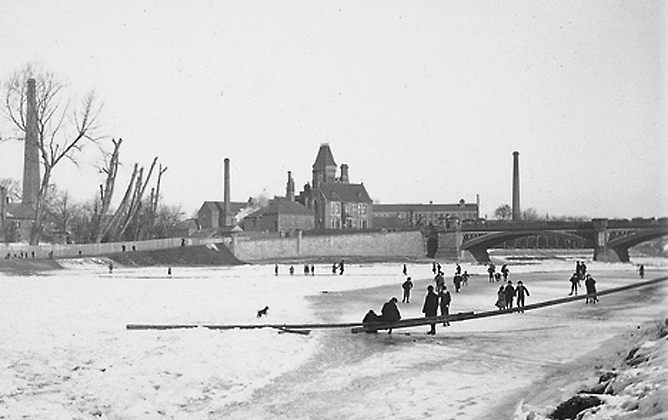
Here a huge crowd of boys are standing on the thick ice. Everybody looks very happy, but there were several fatalities, as people contrived to find excessively thin ice to stand on. Lady Bay Bridge can just be seen through the arches of Trent Bridge.

freezes caption 1

And not a scarf or a pair of gloves in sight. Kids were tough, and Health and Safety hadn’t even been thought of yet.

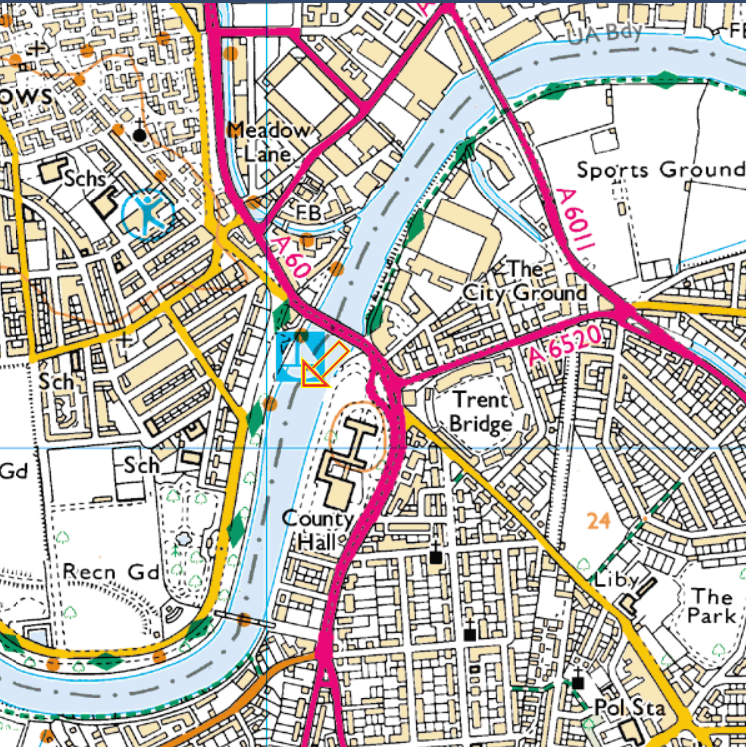
The photograph above was taken from opposite the West Bridgford embankment, to the south of Trent Bridge, near to the present day County Hall. Look for the orange arrow:

county hall

In places the extreme frost, the most severe in living memory, penetrated into the ground so deeply that it froze the tap water in the mains. Ordinary people suffered greatly and many had no water supply whatsoever, a parlous situation which was to last for several weeks. To overcome this most basic of problems, stand-pipes fitted with taps were set up at various places in the streets, and buckets could be filled up there. January and February of 1895 was a time of difficulty and danger for ordinary people and those who survived it were to remember it for the rest of their lives.
caption 2

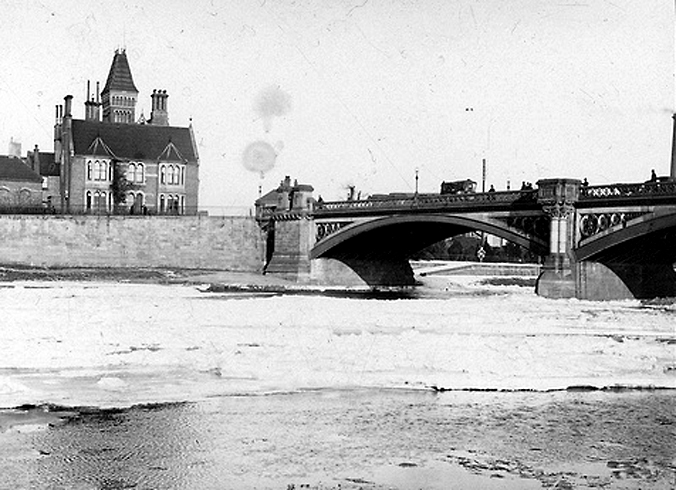
In the photograph above, a fire can be seen burning against the bridge, one of the many which blazed happily on the surface of the ice. The river’s rate of flow is reduced by the ice floes so much that it is almost reminiscent of a river during a drought.

During these bitterly cold winters at the turn of the twentieth century, my grandfather, Will, who had emigrated to Canada around 1905, saw Niagara Falls, for the large part frozen, on at least one occasion, this postcard dating most probably from 1911.

naiagara

2 Comments

Filed under History, Nottingham, Science, Wildlife and Nature

A child minding dilemma

(An extract from my old birdwatching diary “Crippling Views”)

Saturday, June 11, 1988

I walk back home from the local newsagents, my eyes peeled as always for the odd brilliant white Gyrfalcon, soaring over the City Hospital. But, as always, without any luck.

zzzz gyr

Suddenly, a big brown raptor comes into sight, making its way purposefully along the Ring Road, flying along the line of the valley, heading roughly eastwards.

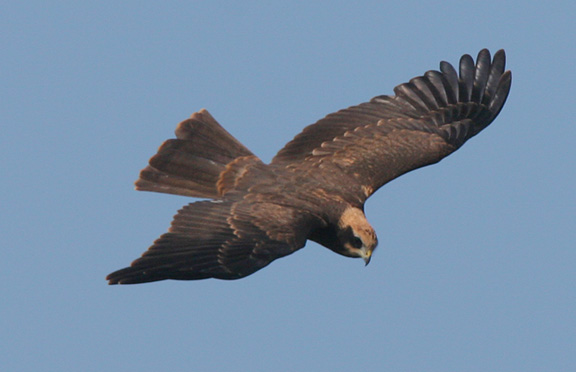
surf marsh harrier

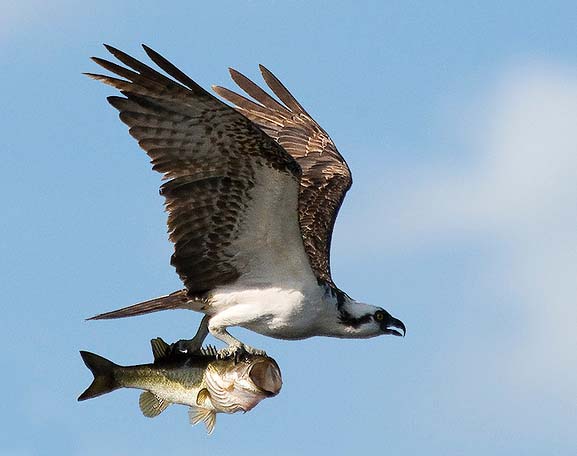
At first, because of the time of year, I presume that it must be an Osprey, although I can’t really imagine why, because it doesn’t look anything like an Osprey and it isn’t carrying a fish.

zzzzzzzzzzzzzz  osprey-with-bass

For a start, it has an obviously pale, or even white head. It is this latter feature that makes me realise that it is a Marsh Harrier.

zzzzz  marsh_harier_

Then there is an agonising decision to face. Do I run a home like the clappers, and then the bird will become eligible to be included in my “Seen from the Garden List”? If it were left to me, there would be no contest, but the problem is that I have my Baby Daughter, aged two, asleep in my arms. Mum will be a bit displeased if I plonk her down on the pavement and leave her, just so that I can see the same bird a second time, only thirty seconds after I have seen it for the first time, although, granted, from a different place. So, I forget the idea of momentarily hanging Baby Daughter on somebody’s front fence, and walk maturely on, trying to persuade myself that moral ticks count just as much as real ones do. It’s a lot more difficult to make these decisions when you’ve only just moved house and your Garden List is not yet in double figures.

Twenty six years later and I still haven’t seen an enormous number of raptors from my back garden. Sparrowhawks are probably the commonest.

zzzzz sparrow

In nearly thirty years, there has only ever been one Kestrel.

zzzzzzzCommon_kestrel_in_flight

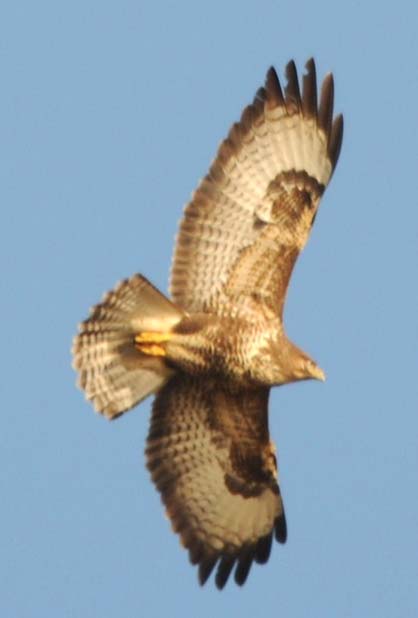
I have seen a good number of Common Buzzards.

zzzzzzzzzzzzzzzz_Buzzard---Frisa

I have also seen Peregrines on several occasions, but this is because the latter now nest on the top of the Newton Building in South Sherwood Street in the middle of the City.

This slideshow requires JavaScript.

The best bird of all has been Red Kite, which is a good bird to see out in the countryside of wildest Nottinghamshire, never mind in a suburb of its largest conurbation. 

This slideshow requires JavaScript.

Birds of prey, or raptors, are notoriously difficult to identify, and fleeting glimpses, often without binoculars, quite often make you feel that you may have seen a particular species, but, alas, not well enough, or with enough certainty, to add it to your Garden List. In this category would be Hobby, Goshawk and Rough-Legged Buzzard.

This slideshow requires JavaScript.

2 Comments

Filed under Nottingham, Twitching, Wildlife and Nature

Two local twitches

(An extract from my old birdwatching diary “Crippling Views”)

Monday, September 5, 1988

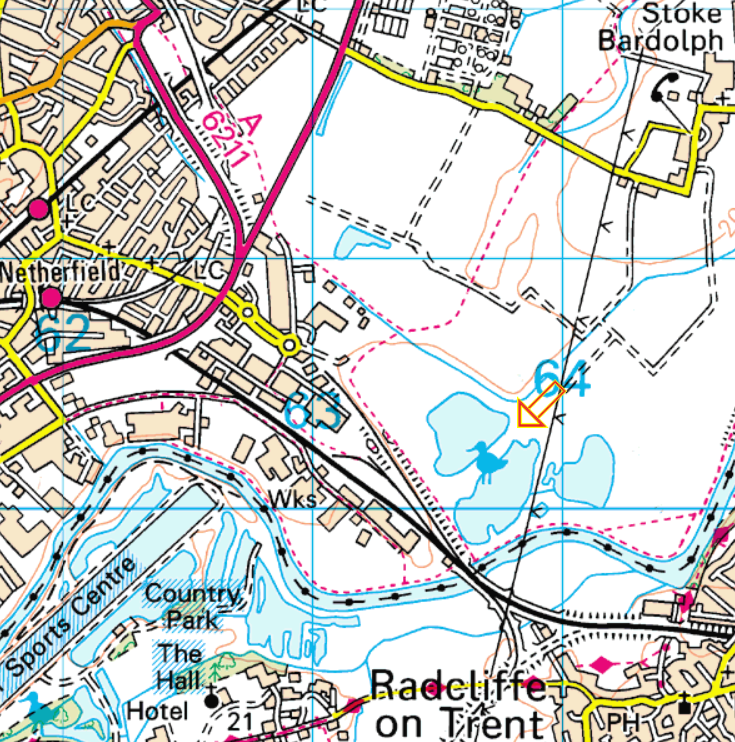
Another walk around my local patch, Netherfield  Sludge Pits, the Cape May of the Nottinghamshire gravel pits complex. (see the orange arrow)

Untitled

Once again, it turns up the big one, with immediate and excellent views of Sedge Warbler, and a male Reed Bunting in the same fifteen yards of hedge.

This slideshow requires JavaScript.

At the side of the path, there is a little flock of fifteen or twenty Yellow Wagtails and over the main lake, a Common Tern.

This slideshow requires JavaScript.

They used to nest on the little island, until it was submerged by the rising tide of slurry from the local coalmine. Knocking around the fields are a Kestrel, some Jackdaws and a few Stock Doves.

This slideshow requires JavaScript.

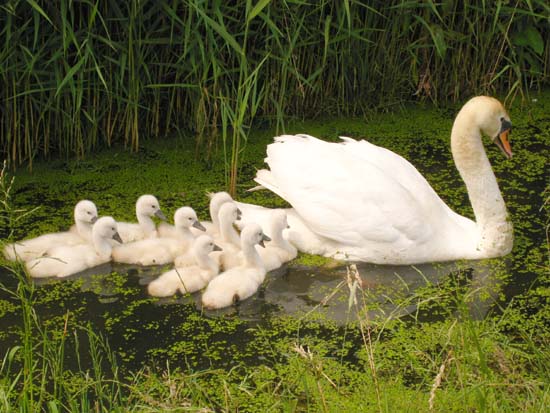
On one of the smaller pools, Mute Swans have bred.

Swan_with_nine_cygnets_xxxxxxxxx

They have produced several cygnets, but don’t worry, the anglers lead shot will soon put a stop to that. It’s amazing to think that Curlew used to breed here fifty years ago, and that, at this very site, Black-winged Stilts nested just after the Second World War.

A flock of finches here once contained an Ortolan Bunting and Little Bunting travelling together, and just after the Second World War, there was an apparent family  group of Gull-billed Terns come through, .

This slideshow requires JavaScript.

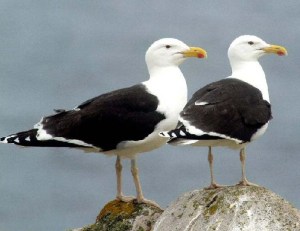
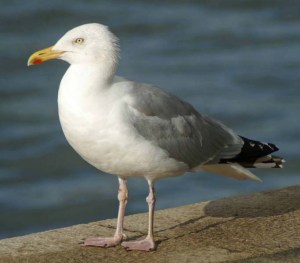
Today, there are three Great Black-backed Gulls, and a Herring Gull.

That’s what the destruction of habitat is all about.

**********************************************************************************************
Wednesday, September 7, 1988

An evening trip this time. A local birdwatcher has told me about a superb new place that attracts wonderful birds by Nottinghamshire’s normal standards. It’s a couple of flooded meadows down by the River Trent at Stoke Bardolph (now, alas, with houses built on them). Look for the orange arrow:

This slideshow requires JavaScript.

For some reason, the farmer has allowed the fields to flood, and for an even more obscure reason, he has permitted them to remain flooded. Waders in unprecedented numbers have been attracted for a short stopover as they fly south down the Trent Valley to Africa. Previously, I would only have thought of Stoke Bardolph for the incredible stink of the sewage works that are down there, but this is really something else. It’s just like a hide at Cley-next-the-Sea, with Curlew Sandpipers, Spotted Redshanks, a dozen or so Dunlin and some Greenshanks.

This slideshow requires JavaScript.

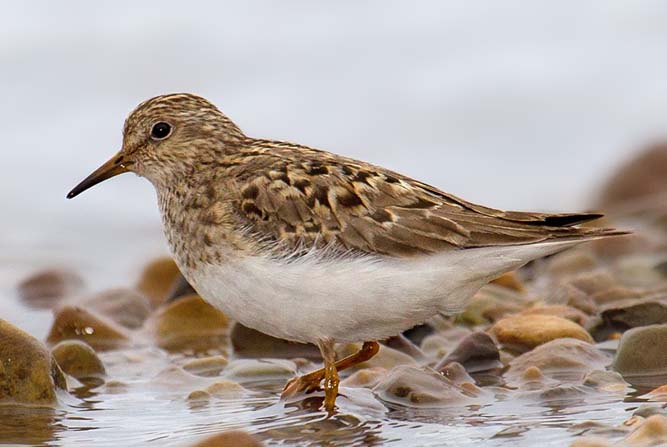
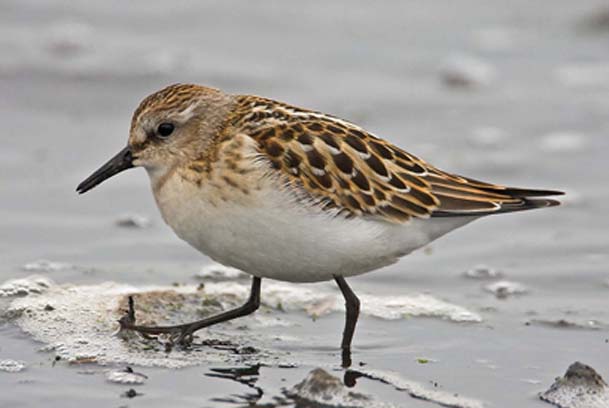
There is  a single stint, which causes us a little excitement as Steve and I try very hard to turn it into a Temminck’s Stint.

Temmincks_zzzzzzzzzzzzzzzzzzz

But it must, unfortunately, stay as a Little Stint. Still, it was a good try.

Little Stint1zzzzzzzzzzzzzzzzzzzzzzz

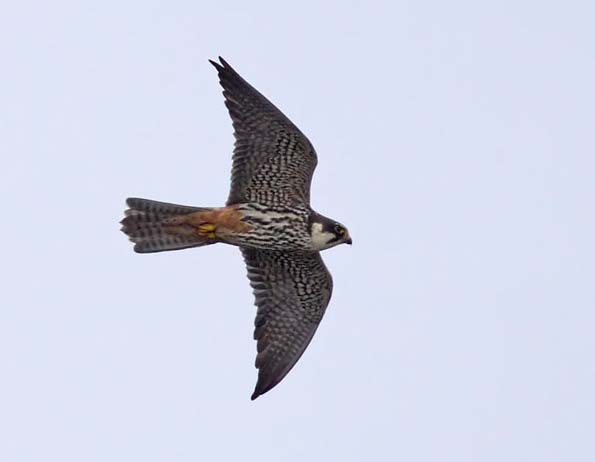
The only negative thing about the whole evening is the failure of the Hobby to appear at the appointed time.

Hobby xxxxxxxxxxxxxxxxxxxxx

There is at least one, if not two, birds in the area, and it, or they, often hunt over the woodland on the opposite side of the river. It’s even been seen knocking around in the gardens of neighbouring Burton Joyce, a riverside village. Tonight, though, there’s nothing.
Never mind – it’s a really brilliant wader site for somewhere as far from the coast is this. What a pity, therefore, that only a few months later, despite the impassioned pleas of a number of different conservation bodies, the farmer  should plough up the land without compunction, and what could have been a brilliant inland nature reserve is lost forever. So much for a democratic society. We are about as democratic as the Democratic Republic of East Germany is democratic. If you own the land, you can do whatever you like with it, irrespective of how many people subsidise you with their taxes and would like some kind of input as to what is done with the land.

Leave a comment

Filed under Nottingham, Politics, Twitching, Wildlife and Nature

Black Shuck on the world stage

As I have said in two previous blogposts, Old Shuck, Black Shuck, or simply Shuck is the name of the huge, phantom black dog which roams, allegedly, the fields and fens of Norfolk and Suffolk. There are, of course, many places other than East Anglia where completely credible reports occur. We have already looked at three in Nottinghamshire, but almost every county in England has its own version of the creature, whether that be the “Bogey Beast” in Lancashire, the Lincolnshire “Hairy Jack”, the “Gallytrot” in Suffolk or the “Bargheust” in Yorkshire and the North.

hellhound zzzzz

They are often associated with electrical storms, such as Black Shuck’s appearance at first Bungay and then Blythburgh in Suffolk. More often, though, they are linked to places rather than meteorological conditions. Churchyards and graveyards at midnight are a favourite, as well as crossroads. Equally, if not more, favoured are dark lanes, ancient pathways and lonely footpaths in the countryside. Occasionally, there is a connection with water, such as a river, a lake or even a beach. Sometimes, such as at Launceston in Cornwall, it may be an ancient tumulus, as is the case with the….

“graves and prehistoric burials whose attendant hounds proliferate densely in Wiltshire and West Somerset on the grounds that they can be seen as passages downwards to the World of the Dead, and so also suicide graves and scenes of execution…”

(Theo Brown: ‘The Black Dog’, in Porter and Russell (ed.) ‘Animals in Folklore’ (1978).”

Likewise, the Black Dog is seen as the “guardian of the threshold, escorting souls into the afterlife”. According to Jennifer Westwood in her book “Albion” (1985) :

“Black Dogs commonly haunt lanes, footpaths, bridges, crossroads and graves – all points of transition, …..held to be weak spots in the fabric dividing the mortal world from the supernatural.”

And :

“If a count be made of the kind of places favoured by these apparitions one thing becomes plain. Quite half the localities are places associated with movement from one locality to another: roads, lanes, footpaths, ancient trackways, bridges, crossroads.”

Let’s now leave Nottinghamshire’s Shuck eating his Pedigree Chum for just a moment, and skip thousands of miles to the north east of the United States. In her most excellent book, “Real Wolfmen True Encounters in Modern America” the author Linda S Godfrey explains her idea that…

“One common factor seems to emerge from every collection of strange creature accounts: there is an unmistakable connection between anomalous beings and certain features of the land. Unexplainable creatures and events tend to occur near freshwater; on hills; at boundary areas such as roads; and on or near burial grounds, and military zones, and all types of sacred areas around the world.
This geographic predictability supports the premise of many contemporary investigators like Rosemary Ellen Guiley, Nick Redfern, and the late John Keel, who suspect that anomalous creatures are not natural animals; they are entities that belong to a completely non-human realm and are attracted to certain energies of the Earth and all living creatures.”

The researchers listed above, and many others, believe that werewolves, Bigfoot, alien big cats, grey aliens, UFOs and sea monsters as well as more traditional entities such as fairies, dragons and ogres are all part of a planet-wide “spirit” population that manifests “in some sort of concert with the human mind, intent on  its own enigmatic purposes.”

.
And of course, this theory does go quite a long way to explaining a very large question, namely, “Why do so many apparently reliable witnesses continue to report the same, impossible things?”

.
If we just think of Great Britain, how many UFOs, Black Dogs, ghosts and even sea serpents have been reported over the years?

Linda S Godfrey, who specialises in the more exotic of the world’s canids and possible canids writes about the Wolfmen who are regularly seen in her native Wisconsin.

portrait xxxxxxx

Wolfmen in form are rather like Bigfoot, except that they have a wolf’s head.  They are thinner than Bigfoot, and consequently, can move very quickly if required. The most famous of the American Wolfmen is the “Beast of Bray Road”.

This slideshow requires JavaScript.


Witnesses have sketched what they saw on this most famous of cryptozoological highways…

This slideshow requires JavaScript.

Linda S Godfrey first became interested in the Beast when she was a journalist and had the opportunity to speak to one of the first witnesses….
WisconsinWolfnespaper ccccccc

Fairly frequently, the Wolfman’s favourite food is roadkill. These were originally witness sketches…

This slideshow requires JavaScript.

There are at least two photographs…

This slideshow requires JavaScript.

One of the very earliest known sightings of a Wolfman occurred not in Bray Road, but at the St Coletta School for Exceptional Children, where Mark Shackelman worked as a security guard. Linda S Godfrey tells the story….

“The nightwatchman’s main duty was to make quiet surveillance of the 174 acre grounds…The land was dotted with ancient Native American burial mounds.
One evening, movement on the mound behind the main building drew the sharp nightwatchman’s attention as he observed what appeared to be a large animal digging furiously atop the raised earth. The creature was roughly man-size, covered in dark fur, and knelt in a way that should have been physically impossible for a four-footed beast And it fled on two feet rather than four as soon as it noticed Shackelman’s presence.
The flummoxed Watchman examined the mound next day and saw that the Earth had been torn by what looked like big claw marks, with raking slashes in sets of three. That night, he made sure to arm himself with a big, club-like flashlight before making his rounds. Sure enough, the creature was there again, digging in the mound near midnight. This time, however, it rose upon its hind legs and faced Shackelman. It stood about six feet tall and reeked of rotten meat.
Shackelman bravely shined his light at the creature so that he could get a good, long look at it. Although it was covered in fur, he could make out powerful arms that ended in hands with thumbs and little fingers that were much smaller than the middle three digits, explaining the triple slashes in the dirt. It had a muscular torso and a canid head with a muzzle and pointed ears. Perhaps most surprisingly of all, the creature made a growling vocalisation that Shackelman later described as a “neo-human voice” and that sounded to him like three syllables, “ga- dar-rah”. The creature continued to make fearless eye contact with Shackelman, who felt he was in imminent and mortal danger.”

If you want to read what happens to Mr. Shackelman, or the Wolfman, then you will have to buy the book! You will not be disappointed! It is a marvellous book which opens a whole world of strangeness that takes a lot to explain away. This report of a wolfman was just the first of the many. According to Linda S Godfrey…

“Was the St Coletta creature just a sign of things to come? The Shackelman sighting was only the first of over one hundred reports nationwide of a human sized canine that could run upright or crouch with a chunk of bloody carrion clutched in its paws. In that incident and most sightings since, the creature is described with a head that appears wolf-like but a body that often – except for its fur, dog shaped limbs, and elongated pause – looks somewhat humanoid because of its powerfully muscular torso and shoulders.”

Here are some more modern colour photos, in some cases taken by trailcams.

This slideshow requires JavaScript.

If you look at Youtube, a search for the “Beast of Bray Road” will reveal scores of films of varying quality. This lasts an interesting three minutes…

and this is a more thorough full length programme

If, however, you find yourself being tempted towards the “Gable Film”, please be aware that its maker has already acknowledged, several years ago, that the film is (a very accomplished) fake .

7 Comments

Filed under Cryptozoology, Science, Wildlife and Nature