The Beast of Noth

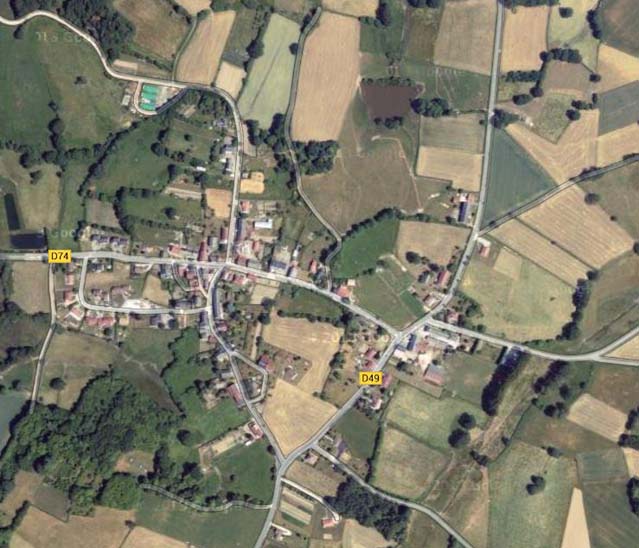
A more modern monster to menace the peace and tranquillity of the French countryside and its inhabitants was the wonderfully named “Beast of Noth”, “La Bête de Noth”. Here is an aerial view of where it was seen:

Capture

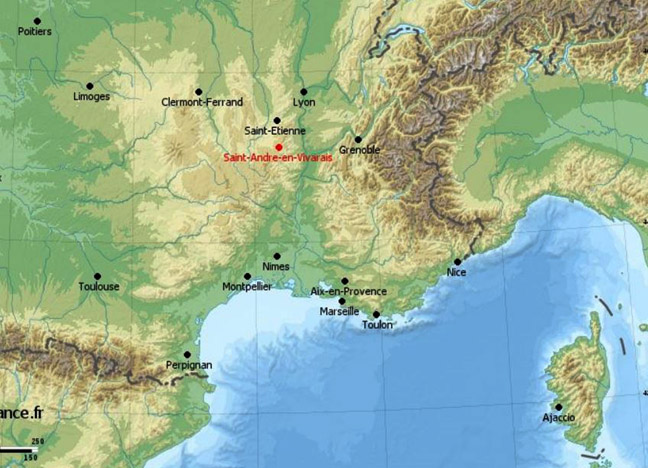
Noth is a small village to the north of Limoges. It is marked in red on the map of France. The street map shows just how small a place it is:

This slideshow requires JavaScript.

Once again, I will look at a number of French cryptozoological websites and you can take your own average between them. I have combined two apparently closely related websites to produce this, slightly more detailed, account…

“In November 1982 the sun is rising over Noth, a village of just 450 people. Marcel Jinjeau, a market gardener from Fongeneuille near Noth, steps into his field to start the first jobs of the morning. Suddenly he notices through a veil of mist a shape lying on the grass. He thinks it is a calf. The animal feels his presence, sniffs the air then stands up. Marcel pinches himself: it is not a cow, or any bovine. The back end of the animal is slim but the neck is like that of a bull. And the way it walks. It’s like some kind of cat!

autumn mists zzzzzz

The animal walks off to take refuge in the woods. Terrified, Marcel rushes back home. If he tells this story to the village, they will think he is a madman. The following day at first light, just a few hundred metres away, at the Castle of La Fot, one of the servants goes to fetch his master’s car from the garage. As he is approaching the vehicle, he hears a savage growling in the darkness. Frightened, the man goes off to find a torch and a rifle, but when he returns to the garage, there is nothing there. Outside on the other hand, the strange visitor has left the imprint of his paws: four inches long (10cm) long, and nearly five inches(12 cm) across; a hefty animal. In the following days, the beast will leave other tracks: the corpses of lambs, that of a bullock, and a heifer. They are ripped to pieces, torn to shreds. Today though, a storm will wash away all trace of it.
Died of Fright
Meanwhile, that very afternoon the Mayor of Noth, André Lalande, and his friend, one of the partners in the Wolf Centre at Dun-le-Palestel then organise a beat. About thirty local hunters rush off to scour the forest, but the weather is against them. A storm brews up, the wind cuts out all electric power, and vast torrents of water wash their cars away. The animal is seen by several witnesses but many hunters turn back.
Not Rémy L. To prove his reputation as a crack shot, and to brave the elements which have been unleashed, he rushes off into the mud when suddenly – the beast looms up just five metres in front from him. He aims his rifle. But all of his body is shaking. He has never faced an animal of this kind. He fires, but only hits the cabbages. And he flees without further ado, quaking with fear. He will remain in shock for two days, completely incapable of putting a name to this creature. Which disappears, only to reappear forty kilometres away in Haute-Vienne, near Chateauponsac. In this area, witnesses talk of an animal a great deal bigger than a dog, with a long tail and with fur the colour of burnt sienna (a dark orangey-brown). The victims increase in number and terror spreads. People think they are seeing this feline everywhere. In the schools the children take fright and their teachers reassure them as best they can. The Mayor of Noth gives the cast of the paw prints to Dr Klein, a Parisian veterinary who is totally upfront.

noth prints

“They are those of a lion or a puma.” And just what is an animal like this doing right in the middle of the Creuse region?
Some people have their own ideas. Since no circus has reported any escape of an animal, there must be a man behind it. Somebody who has come back from Africa. Somebody who is wealthy enough to carry out the scheme. All eyes all turn towards an aristocrat in North, the Marquis de V. The rumours become increasingly accusatory, “There has been an incident”, they murmur in the village. “He has lost his lion and he can’t get his hands back on it.” An even stronger rumour is that the Marquis remains a  ghostly figure, never there, always somewhere else, away in Moselle. The gossips have an answer for everything. When the zoologists state that the beast’s appetite is abnormally light for a big cat, they argue “It’s because the hand of Man is feeding it”. Moreover when there is a new beat near Chateauponsac on December 12th, two witnesses state that they have caught a glimpse of the Beast deep in the forest……with a man. An hallucination?
During a year there are sporadic reports of people who think that they may have seen this feline, until the gossip finally dies away.  Today in the village, nobody is keen to retract what has been said. “No….I tell you….there was an animal, the people who saw it said it used to have a strange expression in its eyes. But one that they will never forget.”

A slightly less dramatic telling of the tale comes in Wikipedia:

“The « Bête de Noth » was a carnivorous animal behind a series of attacks on flocks of sheep from November 1982 onwards, in the Department of Creuse.  Among others, on November 10th the Beast of Noth killed a bullock and a heifer each weighing 900lb, both at a place called Maison-neuve.

farm barns zzzzzz

And then on November 19th, two lambs at Auzillac, with another at Maupas on December 3rd, and then a second heifer at Grand-bourg on December 9th. It was not the attacks on farm animals which appalled people so much as the state in which the corpses were found. They were all horribly ripped to shreds. Rumours began to circulate, suggesting a lion or a puma imported by an aristocrat in the area. During a beat organised in the Forest of Noth in November 1982 one huntsman was confronted by the animal but he was not able to identify it. The whole affair has never been explained.”

7 Comments

Filed under Cryptozoology, France, History, Science, Wildlife and Nature

The Officer Training Corps 1915 Part One

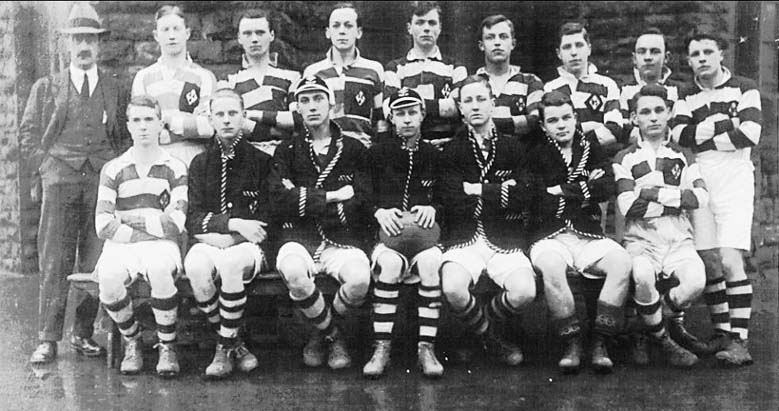
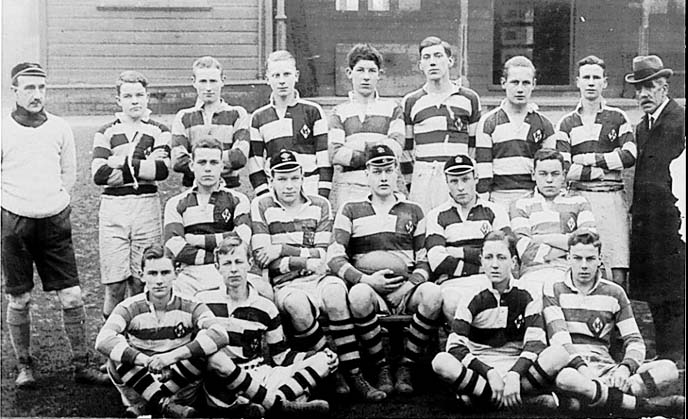
This photograph shows the Officer Training Corps in 1915. You might be forgiven for thinking that they are all far too young to have left the High School, to have immediately joined the army, trained as officers, gone to the Western Front and then been killed. But you would be wrong. This time, it was only three dead out of twelve though, and this represents a much better casualty rate than the rugby team of Boxing Day, 1913. On the other hand, though, it is still a staggering 25%!

otc 1915

On the back row of the photograph are, from left to right, F.A.Bird, J.R.Coleman, D.J.Clarkson, J.Marriott, A.W.Barton, G.R.Ballamy, S.I.Wallis and W.D.Willatt.

On the front row are, from left to right, L.W.Foster, V.G.Darrington, Second Lieutenant J.L.Kennard, Captain G.F.Hood, Second Lieutenant L.R.Strangeways, G.James and R.I.Mozley.

In 1915, the High School, according to the anonymous writer of some reminiscences about school life at the time, was a place:

“…dominated by the War and its effects. Masters disappeared and were replaced by women teachers, the Officer Training Corps underwent intensive training, and the School Flag seemed to be constantly at half-mast for Old Boys, many of whom had left us only a few months before.”

Only a year earlier, before August 1914, the O.T.C. had been poorly equipped and they frequently complained of the lack of equipment, both rifles and bayonets. Over the course of the war, however, the O.T.C. was to take on a much greater importance. According to the “History of the Corps”, written fifty years later by a member of staff, Mr.A.G.Duddell:

“By 1913 the O.T.C. had become a well-established organisation in the school, and while it had exchanged its picturesque uniform, of which the wide-awake hat with green puggaree and plume of black feathers was a striking feature, for the more conventional khaki tunic with flat peaked cap, knee-breeches and puttees, it had also become a contingent of the Officers’ Training Corps (Junior Division)…The reality of war brought a great increase in numbers, and gave urgency to the training ; parties of cadets were taken for camps at Barton-in-Fabis and field exercises were carried out on the Gotham Hills. Field Days then, and for many years after, were held at Ramsdale Park, and as no transport was available in the early days, much of the time, and energy, was used for the five mile long march out and back. Later the position was eased, but at first only by special trams between the Forest and Daybrook Square. Another handicap of those earlier days was the state of the School playground, the surface of which consisted of the raw sandstone rock, with a covering of loose sand. Uneven at all times, from dust in dry weather, it became a quagmire after rain.”

The senior officers in the O.T.C., Mr Leggett of the Preparatory School and Mr Lloyd Morgan, were among the first to join up in 1914, becoming Captain and Lieutenant, in the 11th Service Battalion of the Sherwood Foresters and the 2nd Battalion of the Cambridgeshire Regiment respectively. The school magazine hoped that:

“they will both have a “smack” at the enemy and return safely again.”

Ironically, Messrs Leggett and Morgan had been the two prime movers in favour of the school’s switch from football to rugby in December 1914. Here is one of the oldest photographs of a school rugby team that I have been able to find. It was taken around 1924:

rugger xxxxx

Presumably, if they had got to the Front in time, Messrs Leggett and Morgan would have been able to encourage the soldiers during the Christmas Truce to forget the football and play rugby across no-man’s-land.

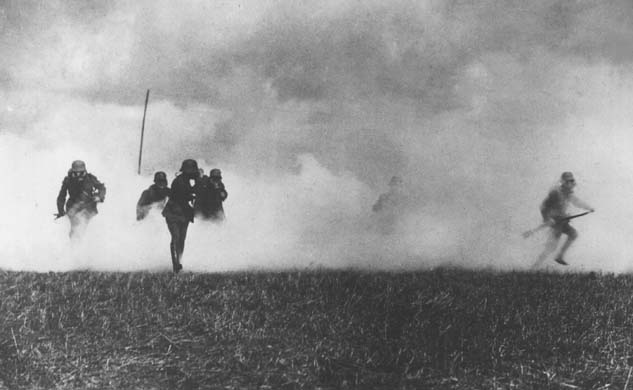
As soon as they left, the O.T.C. was taken over by Captain Hood, assisted by Mr Kennard. I could not write a biography of Captain Hood, but I can recount one or two occasions when his name was on people’s lips. He had come to the school in 1908 as a teacher of Chemistry, or “Stinks” as it was nicknamed at this time. Mr Hood’s own nickname was “Freddy”, although I have been unable to trace his real first name. After three years in charge of the O.T.C., he finally received his very own chance to have “a “smack” at the enemy”, although by now it was a rather unsporting enemy who was using phosgene, chlorine and any other “Stinks” that could kill human beings in large numbers. Luckily though, the call came as late as July of 1918 so the chances are that Captain Hood may not have seen a lot of action during his spell with the Royal Engineers. A more sinister interpretation would be that when the Royal Engineers sent for somebody with a degree in Chemistry, they themselves were the ones trying to manufacture poison gas in larger quantities and at a faster rate than the Germans:

16-Gas-Attack-Getty

In 1925, the School was feeling the financial pinch and seems to have been, on occasion, extremely strapped for cash. Mr Hood, along with Mr Betts, offered to install electric lighting in part of the school while their classes were taking examinations. The offer was eagerly accepted, presumably in the days before that fateful phrase, “Health and Safety” had quite the ring to it that it has now.

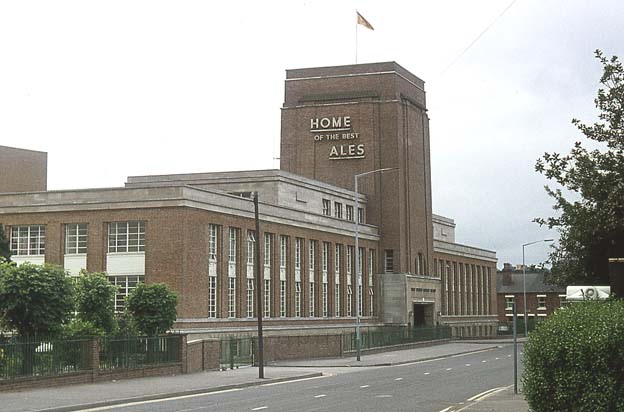
A few years later, Mr Hood must have become a pastoral tutor, since, on Monday, July 6th 1931, in an effort to improve the general behaviour of one Burton of 2C, he put in him detention for receiving “too many detentions”.  On Tuesday, April 5th 1932, Mr Hood, accompanied by Mr Houghton, took a group of thirty boys to visit the Home Brewery in Daybrook. They saw the entire brewing process, from barley to the finished product. At the end of the visit, the boys were given sandwiches and soft drinks, while the delighted teachers “sampled the real stuff”:

home alse zzzzzzzz

In July 1946, Mr Hood retired after decades of service to the school. After 38 years as a dedicated teacher, his departure was marked in the school magazine by a warm tribute and farewell which lasted for just a line and a half of print, and must have been quite a bit short of one word for every year.

Second Lieutenant J.L.Kennard had the first name Joseph. He had come to the school in November 1910, and had previously been a teacher in Switzerland. He was a famous sportsman, having captained Lancashire at rugby, and having played for the North of England in an England trial. Here he is, on the left, with Mr Onion the groundskeeper and the First XV after the Great War in 1926-1927:

1926 xxxxxxxxxxxxxxxxxxx

Inside the classroom, Mr Kennard was a teacher of Modern Languages and his nickname was “Guts”. When Mr E.P.Gaskin, the Head of Languages, retired in July 1927, he was succeeded by Mr Kennard. Around this time, Mr Kennard became the Housemaster of Mellers.

When war again came knocking at the school doors in 1939, the school had enormous difficulties carrying on with the ordinary day-to-day teaching because a large number of classrooms were being used by the men of the South Notts Hussars. By the Spring Term of 1940, Mr Kennard, along with Mr Duddell, came up with an emergency schedule, which allowed a full timetable of lessons to be taught, although every form had to spend one day per week at the Games Field, with normal classes in the mornings and then games in the afternoon:

sp day

The masters, who in many cases were forced to commute the mile and a half between the main school and the Games Field by bicycle, were somewhat less than happy with this situation. In 1941 when Mr Goddard retired, Mr Kennard was appointed Second Master. He had himself retired as the school rugby coach in 1939, although he was soon forced to resume these duties at the age of sixty by the absence of younger members of staff who were away in the forces. Mr Kennard finally retired in 1947.  After a splendidly long retirement, he died on Sunday, January 5th 1969, at the age of eighty-seven, after a short illness:

“sentiment had little place in his character, and his guiding principles were devotion to duty, loyal service and firm discipline”

Second Lieutenant L.R.Strangeways had come to the High School in 1908 as just Leonard Ralph Strangeways. He was a teacher of Classics and had been educated at Sheffield Royal Grammar School:

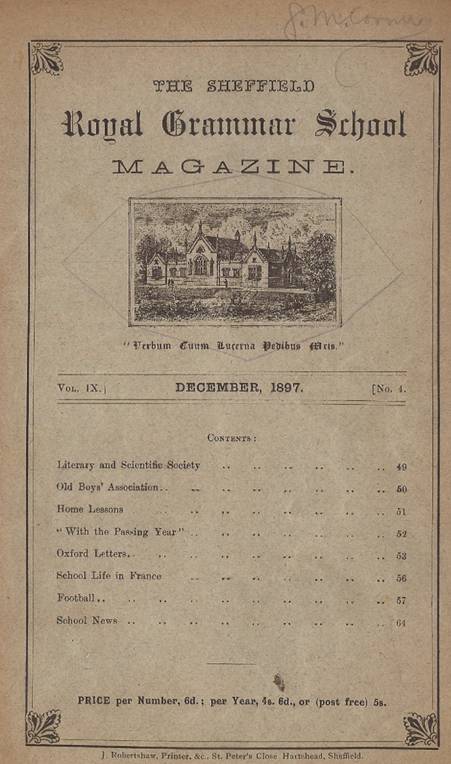
sheffield magazine

By late 1916, he was helping to produce food for the starving population of a U-boat beleaguered Britain:

“An area of some three quarters of an acre was cultivated by the boys at Woodthorpe. Despite being a “very uncompromising clay dump”, it was eventually to produce much fresh food. One member of staff, Mr Strangeways, a Classics teacher, dug so energetically that he “not only shattered one spade in sunder, and so bent another that it was impossible to discern which side was which, but also succeeded in unearthing an ancient Roman broom.”

Two years later, in January 1918, “The Highvite” carried the humorous story about two prefects and one teacher:

“Barton, Bird and Co Ltd. had an advertisement for poisons, the quality of which was endorsed by Mr Strangeways.”

Mr Strangeways left the school in 1918. He went to Bury Grammar School where he was Headmaster from 1919-1936. The school still has its Strangeways Library.

In my next blog post about this photograph, I will try to find out what happened to the boys in the years after it was taken.


10 Comments

Filed under Football, France, History, Nottingham, The High School

Jer Falcon. one shot at Park Hall by Mr Shelton. Now in my collection.

In his own vastly expanded version of “Notes on the Birds of Nottinghamshire”, published in 1907, and now housed in the local collection of Mansfield Library, author Joseph Whitaker has added, for the most part in pencil, his own notes and additions. In some cases, he has pasted newspaper clippingts onto the pages. At one particular point, towards the end of the book, he has added the following handwritten note, misspellings and all:

“Jer Falcon. one shot at Park Hall by Mr Shelton. We were beating a plantation on Clipstone Road near the Red House Farm it was misty + this falcon flew low over the trees + was shot by him.
I missed this bird out when this book was written. Now in my collection”.

Sceptics might say, of course, that Joseph Whitaker was mistaken in his identification of the bird and that it was, quite simply, not a definite Gyrfalcon. This is, however, a rather unlikely scenario. Joseph Whitaker was familiar with many, many different kinds of raptor. If anything, he had probably seen more species within the county than the majority of present-day birdwatchers. And don’t forget. Mr Shelton shot it. They were identifying a corpse, not a distant dot disappearing into a dismal sky:

Gyrfalcon_e0 zzzzzzzzzzzzzzzzz
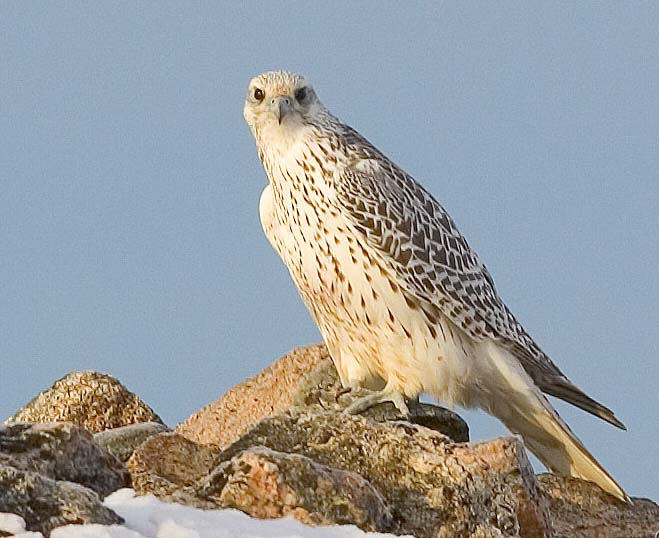
In any case a Gyrfalcon would have been easily identifiable on size alone. It is a falcon as big as a Common Buzzard And if Whitaker’s bird was a white phase individual, it would have been totally unmistakeable:

faucon-gerfaut-vol-tm3 zzzzzzz

There are only two birds of this size which are completely white, namely Gyrfalcon and Snowy Owl. The latter is not exactly difficult to identify:

speciexxxxxxxxxxxxxxxxxxxxxxxxxxxxxxxxxxxxxxxx

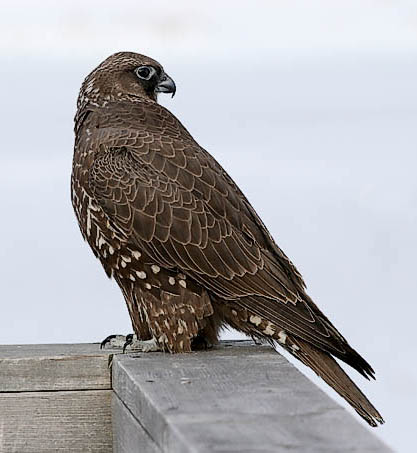
Gyrfalcons exist in two different colour morphs and it would, admittedly, have been more difficult to identify a dark morph bird:

dark

The issue of size would still have been there, of course. Gyrfalcons of both white and dark morphs are huge birds. Furthermore, even dark phase Gyrfalcons are very distinctive birds, especially when viewed as dead specimens.

Dark morph birds may just be an academic problem anyway. According to at least one ornithological authority, namely Fisher in 1967, the vast majority of Gyrfalcons seen in England during the Victorian era were, in actual fact, white phase birds, with apparently only one dark morph individual recorded nationally during the last third of the 19th century.

And in Whitaker’s day, of course, there was no need to worry about the presence of escaped foreign falcons from Australia, or exotic, artificially inseminated hybrids produced by Baron Frankenstein the Falconer. It would have been very difficult to misidentify one of these charismatic killers:

32_GYRFALCON stuffed zzzzzz

Indeed, it is difficult to imagine what Mr Shelton shot, if it were not a Gyrfalcon. We also know that the bird went into Joseph Whitaker’s collection. This fact in itself would have served as some kind of checking mechanism, since the specimen would have been mounted and then inspected by the continuous parade of visitors to Whitaker’s house in Rainworth. These would have included a large number of nationally reputable ornithologists and it would have been impossible for a man like Joseph Whitaker to have shown them such an important county specimen without their quickly mentioning the fact had the bird be misidentified.

gyrr zzzzzzzzzzzzzzzz

Why then do we not have the Gyrfalcon now? Again, answers are not difficult to find. The bird may have been sold privately, either before or after Whitaker’s death. Equally it was common practice, when the owner of a great collection died, for selected individual birds to be passed onto close friends, before the collection as a whole was sold, usually at a public auction. It is also conceivable that the specimen may have been stolen after Whitaker’s death.

On the death of a great collector, it was a frequent occurrence that the beneficiaries of the estate had little or no expert knowledge of the worth or importance of certain individual stuffed birds. These vulnerable specimens were then liable to disappear between the death of the collector and the public disposal of the collection. This has certainly happened to a number of other birds which are known to have been in Whitaker’s possession but have now disappeared, presumably between his death and the acquisition of his collection on behalf of the Mansfield Museum.
In any case, why should we automatically cast doubt on Whitaker’s handwritten note? What clearer message can the great man have hurled forward into the future, than the one we now have? He offers us the word of an honest man.

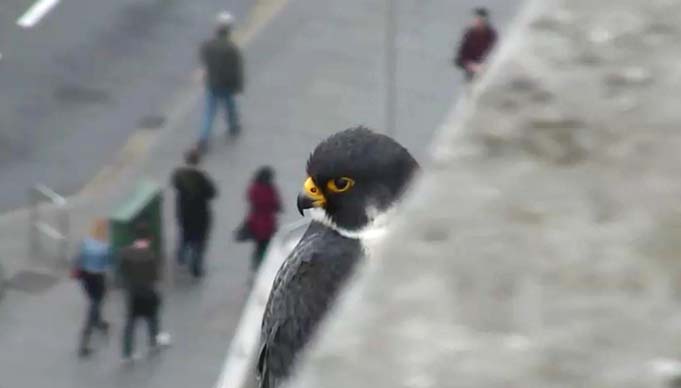
You might be lucky enough one day to see a Gyrfalcon in this country. I never have. But I console myself by watching the Peregrine Falcons which have nested for years in the middle of the City of Nottingham:

the urban peregrine zzzzzzzzzzzzzzzzzzz

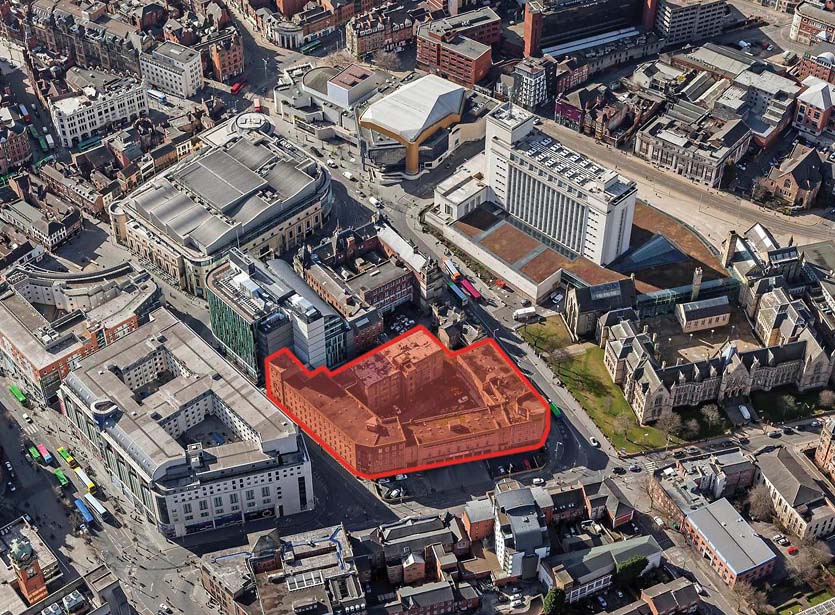
They can be seen on the Newton and Arkwright Building of Nottingham Trent University on South Sherwood Street, Nottingham.

In this aerial view, the Fire Station is coloured orange as it is the most well known building in this part of the city for the majority of people. (No, it’s not on fire):

fire station zzzzzzzzz

Look at the street to the right of the Fire Station and follow it towards the top of the photo. The Newton and Arkwright Building is the enormous white building on the right as you walk up the slight slope towards the Theatre Royal. It is a very distinctive Third Reich type of 1930s architecture.

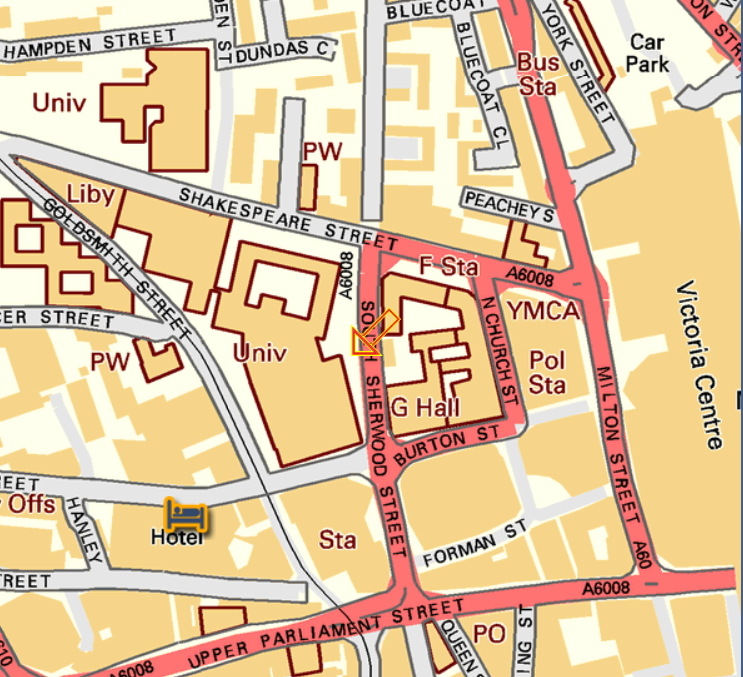
If you go there, take some binoculars if you have any. Look at the right side of the building. The nest is on a wide lip that runs the whole length of the building, just below a row of largish windows. This street map might help. Look for the orange arrow:

map of south shwood st

If you wish, you can watch them on a live webcam. The birds are present pretty much all they year round. Theoretically, they should not be here in the winter, but somehow they seem quite frequently drawn back, a little bit like teenagers returning to the Bank of Dad. At the moment, they should be feeding their young. In the past, there have been catastrophes with this, as is always the case with Mother Nature, but if all goes well, it can be a wonderfully blood spattered spectacle.

But back to Gyrfalcons.
Here are a pair of them, filmed by “thegowser1” at 78 degrees north between Svalbard and Greenland:


More typical for a twitcher in north west Europe would be these two films of a bird which had strayed to  Champtocé-sur-Loire, in Maine-et-Loire, France. The two films come from Alain Fossé, and show a raptor doing what they spend most of their time doing…absolutely nothing!. High calorie meals of meat mean you only need move around infrequently (or so I tell my wife).

These are much more typical  of a March day near Mansfield than an icebreaker near the North Pole!

14 Comments

Filed under History, Nottingham, Science, Twitching, Wildlife and Nature

Seven graves to Penzance

If you cast your minds back what seems now a very long time, my continuing researches about the German bomber shot down in St.Just in western Cornwall on September 27th 1942 , had led me to the cemetery in Penzance. I have already spoken about some of the graves to be found there, and this article continues that theme.

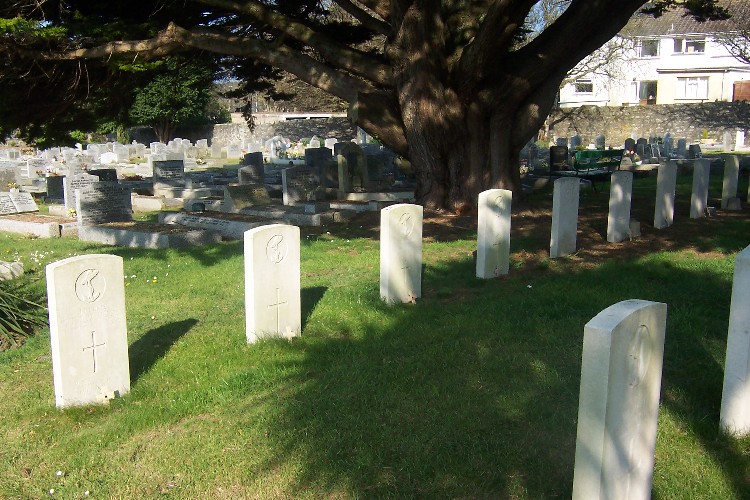
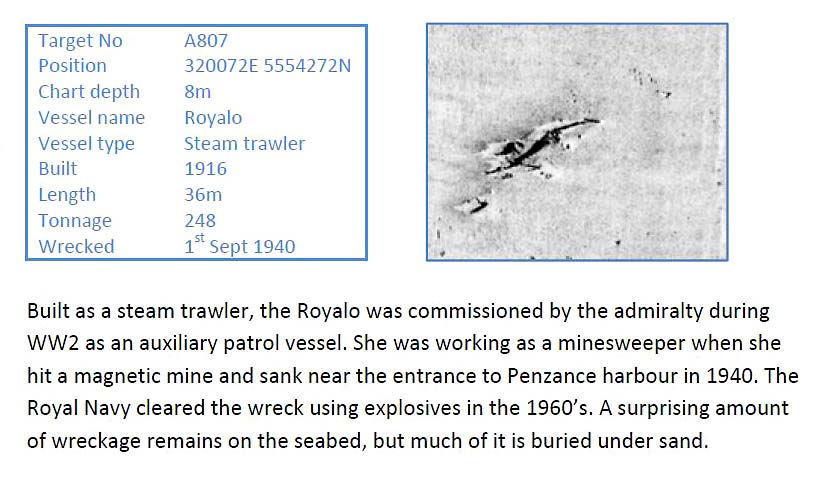
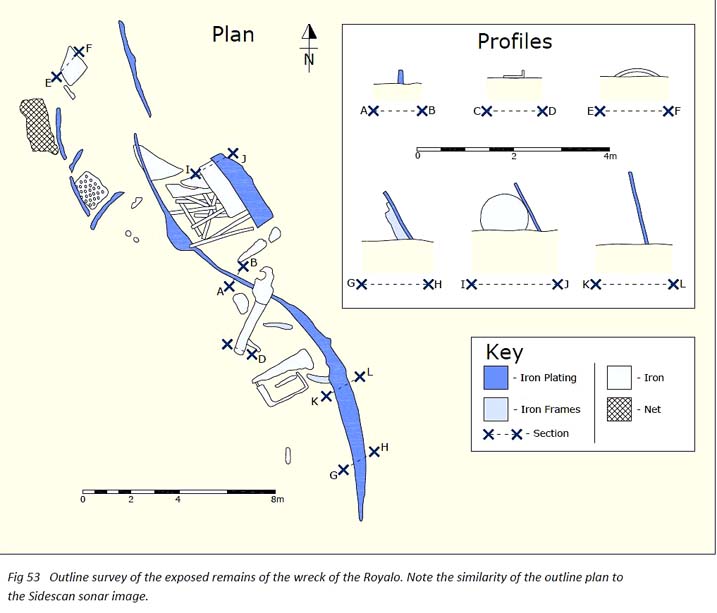
This beautiful, tranquil place contains seventy one Second World War burials, including the six graves of the crew of H.M.Trawler “Royalo”:

Royalo_Crew_04_Penzance

They were killed when their vessel was sunk by a magnetic mine on September 1st 1940 just outside Penzance Harbour, around one mile from the seafront. The orange arrow gives the approximate position:

This slideshow requires JavaScript.

The “Royalo” was built by Cook, Welton & Gemmell of Beverley, Yorkshire, and was launched on December 6th 1915, being fully completed by August of 1916. I have been unable to trace any photographs of the vessel. A ship of only 248 tons, when the Great War broke out, it was immediately requisitioned and converted into a minesweeper. After the end of the Great War, in 1919, it was returned to its owners. In 1933 the ship passed into the ownership of Sleight & Humphrey of Grimsby, only for it to be requisitioned for a second time in November 1939, just after the beginning of the Second World War. This time it was converted into an APV, an “Auxiliary Patrol Vessel”. In 1940, the vessel was converted for the second time into a minesweeper and given the serial number of FY825. It was armed with just one six pounder anti-aircraft gun.
A short but very vivid account of the ship’s sinking is given on the “Hearts of Oak” website:

“The “Royalo”, under Commanding Officer, Skipper William Durrant Warford RNR, was sweeping Mount’s Bay clear of mines which had been previously laid there by a German aircraft. Around midday, there came the sound of a huge explosion, which was easily heard in Penzance. My brother-in-law remembers, as a child, hearing the sound of an enormous explosion. He ran out of the house, and down the road, to see nothing but a pall of smoke; there was no sign of the vessel. She had been blown up by a magnetic mine, and a column of water had lifted her out of the water.
And she was gone.
The Penzance lifeboat was launched, and small boats came to the rescue of the survivors.
The “Royalo” had sunk in position 50.06N : 05.30W, about one mile off Penzance.”

On at least one other website, Lieutenant Irvine Willox Watt is given as the Commanding Officer.

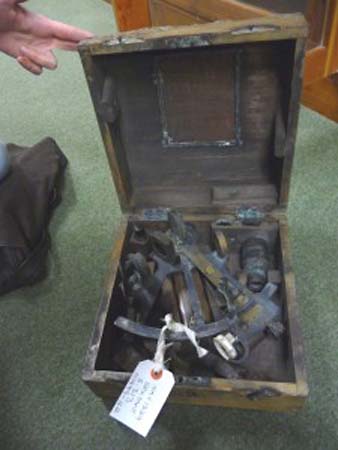
Given the dramatic way in which the “Royalo” had met its end, its position remained well known over the years to the people of Penzance. In 1962 a group of divers explored the wreck, which lay some ten metres below the surface. They were able to recover a wooden box. It turned out to contain a sextant, which is a navigational aid. This particular one was manufactured in 1939 by the celebrated Hughes & Son Ltd. of London. The Royal Museum at Greenwich acquired the sextant at some point during the 1970s:

sexrant

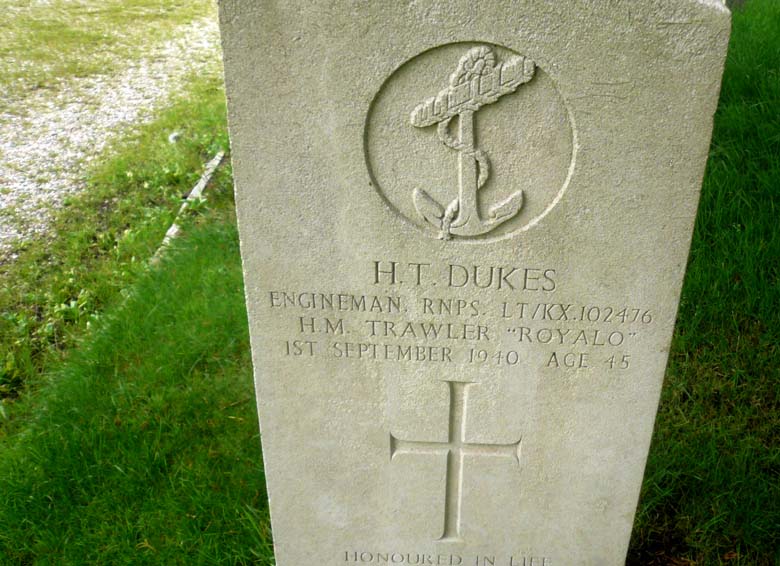
Of the casualties buried in Penzance Cemetery, Henry Thomas Dukes was an Engineman in the Royal Naval Patrol Service who was forty five years of age at the time of his death:

P1500286XXXXXX

He was the husband of Ellaline Isabell Dukes of Grimsby, Lincolnshire. The rather bittersweet verse inscribed on the lower section of his gravestone reads…

Honoured in life
Treasured in Death
A Beautiful Memory
Is all we have left.

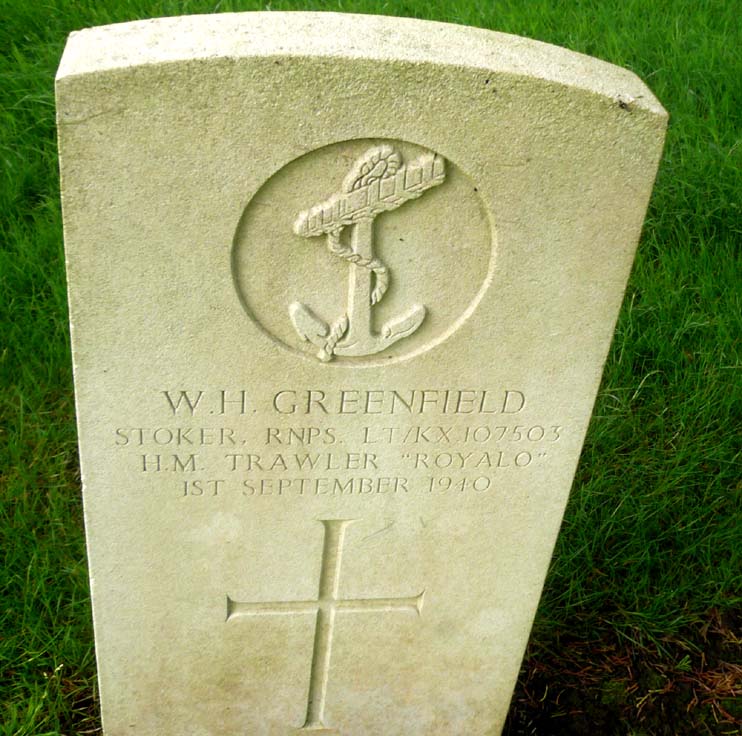
William Henry Greenfield was a Stoker in the Royal Naval Patrol Service. His age at the time of his death has not been recorded, and I have been unable to trace any further details about him:

P1500288XXXX

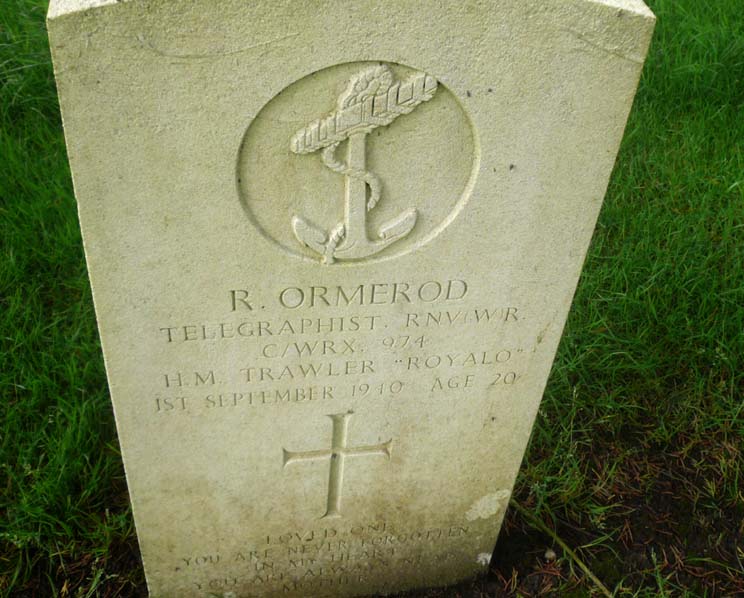
Raymond Ormerod was a Telegraphist in the Royal Naval Volunteer (Wireless) Reserve and was twenty years old at the time of his death:

P1500244 XXXX

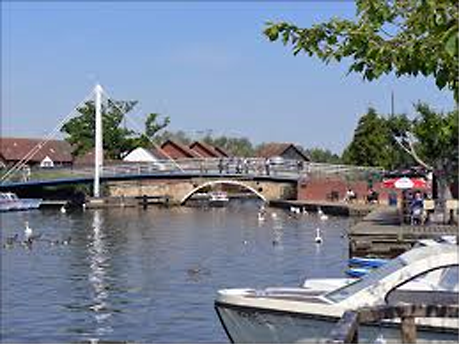
He was the son of Reginald and Octavia Ormerod, of Wroxham, Norfolk:

weoxham

His mother had the following verse inscribed on the lower section of his gravestone:

Loved one
You are never forgotten
In my heart
You are always near
Mother

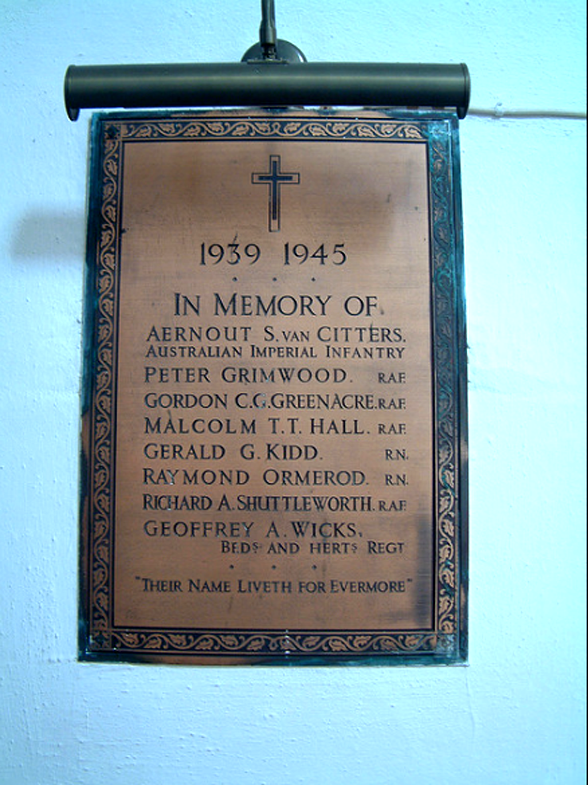
Raymond is listed on the memorial plaque in the Church of St Mary the Virgin in Wroxham:

wroxham church

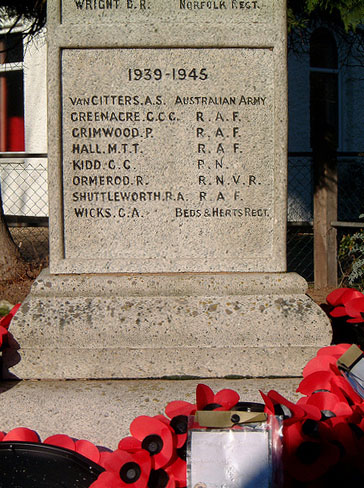
He also appears on the town’s War Memorial:

wroxham xxxxxxxxxxx

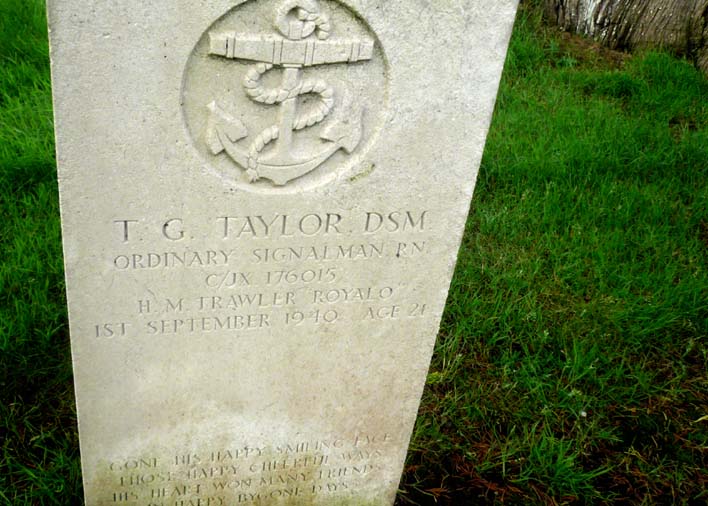
Thomas Gardner Taylor was an Ordinary Signalman in the Royal Navy who was twenty one years of age at the time of his death:

P1500296XXXXXX

He had already been awarded the Distinguished Service Medal. He was the son of Thomas Gardner Taylor and Hannah Ann Taylor, of High Heaton, Newcastle-on-Tyne. The verse inscribed on the lower section of his gravestone reads:

Gone his happy smiling face
Those happy cheerful ways
His heart won many friends
In happy bygone days

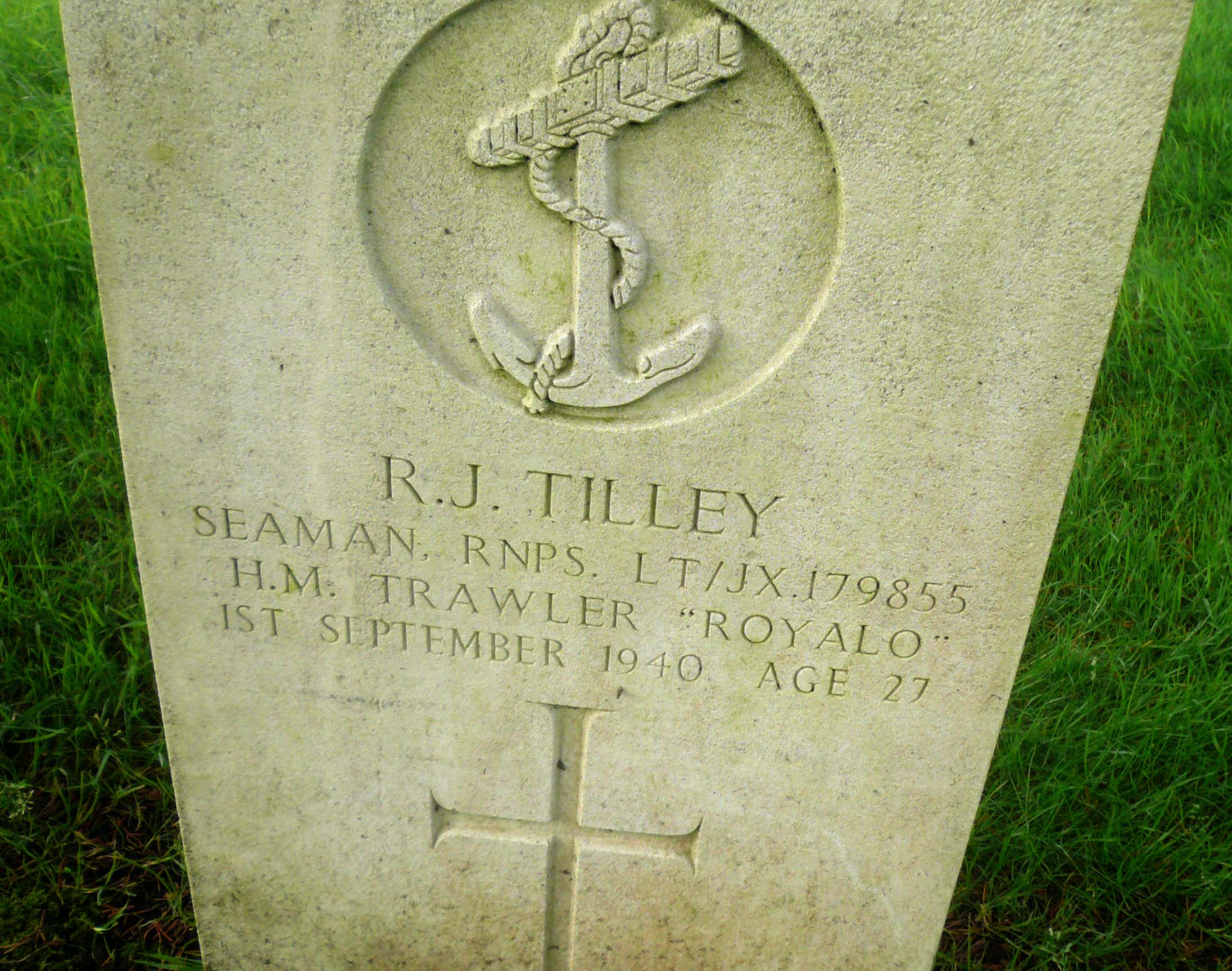
Robert John Tilley was a Seaman in the Royal Naval Patrol Service who was twenty seven years of age at the time of his death:

P1500297XXXXXX

The verse inscribed on the lower section of his gravestone reads…

No one knows
How much we miss him
None but aching hearts
Can tell
Mum and Mary

Robert John Tilley’s sacrifice is commemorated on the Memorial of the Whitstable Royal British Legion Club in Kent.

legion

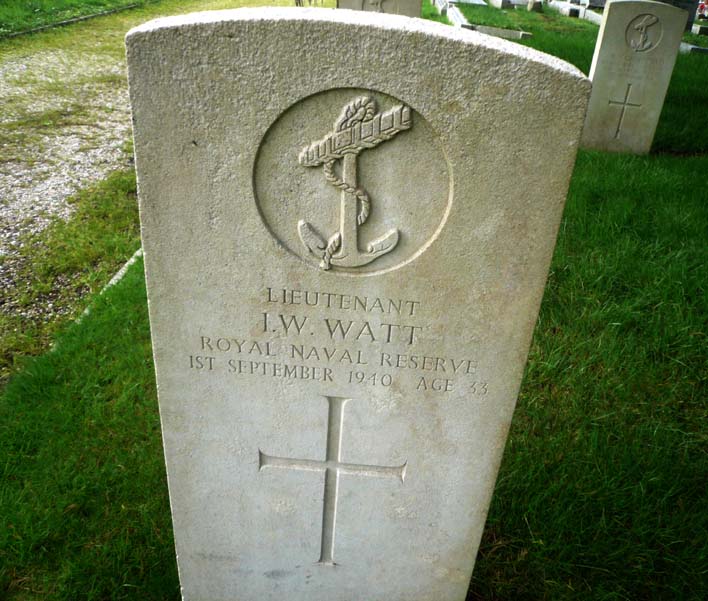
Irvine Willox Watt was a Lieutenant in the Royal Naval Patrol Service who was thirty three years of age at the time of his death.  He was the son of G. Fieldes Watt and Jean Fieldes Watt, of Kensington, London.

P1500319XXXXX

Of the tiny crew of the Royalo, at least one is not buried here in Penzance, Sam Lockwood-Dukes was the son of Samuel and Emily Lockwood-Dukes, of Worsborough Bridge in distant South Yorkshire.  He was twenty two years of age when he was killed. He was not buried with the rest of his naval family in Penzance, as his parents no doubt wanted to be able to place flowers on his grave regularly, so he was interred in Saint Thomas Church Cemetery in Worsborough Dale.
Because of the nature of the incident, however, not all of the casualties were found.
One of these was Engineman Robert William Edward Grant Burgoyne who was an amazing sixty four years of age at the time of his death. He was the son of Robert and Sarah Burgoyne and the husband of Rosina Burgoyne. They all lived in Willington Quay, Northumberland. His sacrifice is commemorated on the Royal Naval Patrol Service Memorial at Lowestoft:

lowestoft_mem2xxxxxxxxxxxxxx
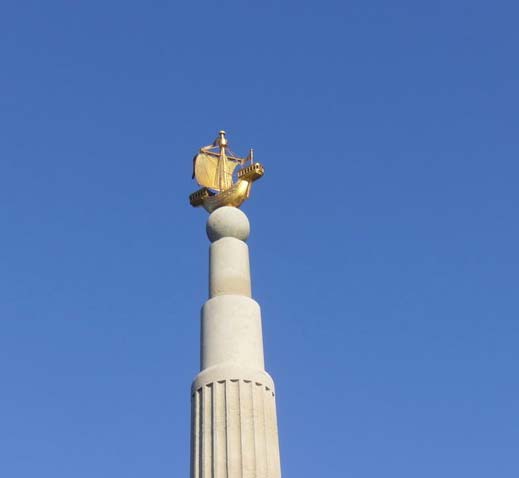
Second Hand Leonard Rye was in the Royal Naval Patrol Service. He was twenty six years of age at the time of his death and a holder of the Distinguished Service Medal. He was the son of Charles John and Clara Louise Rye and the husband of Florence Lilian Rye. They all lived in Hull in East Yorkshire. His sacrifice is commemorated on the Royal Naval Patrol Service Memorial at Lowestoft:

galleon

Engineman Jim Walker Pitts was twenty eight years of age at the time of his death. He was the son of Mr and Mrs James Pitts and the husband of Joan Agnes Norah Pitts. They all lived in Great Yarmouth, Norfolk. His sacrifice is commemorated on the Royal Naval Patrol Service Memorial at Lowestoft:

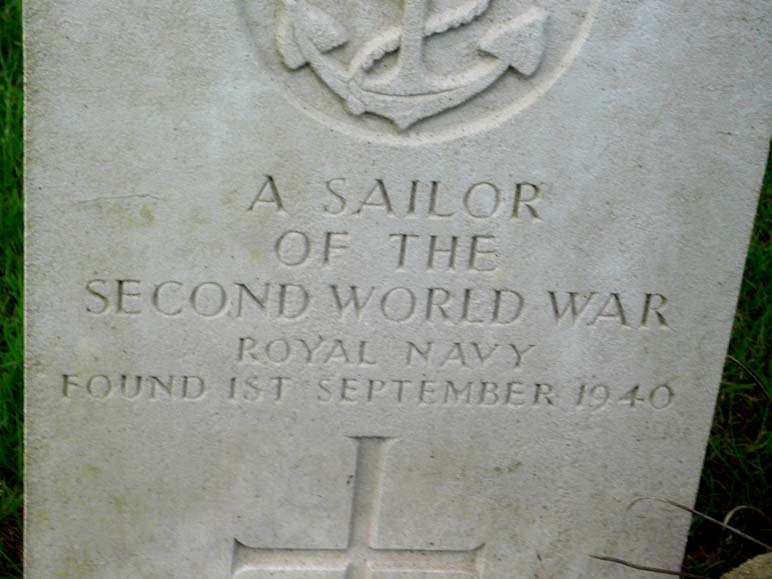
Surely one of these gallant seamen must be in this grave, whose date is the same, as the “Royalo”…

P1500241XXXX

I said that I had been unable to trace a photograph of the unfortunate “Royalo”. That is true, but I did find this…

Capture

And this…

Capture 2

 “Full fathom five thy father lies;
Of his bones are coral made;
Those are pearls that were his eyes:
Nothing of him that doth fade,
But doth suffer a sea-change
Into something rich and strange.
Sea-nymphs hourly ring his knell:
Ding-dong.
Hark! now I hear them—Ding-dong, bell.”


13 Comments

Filed under Aviation, Cornwall, History

The Beast of the Cévennes, the Beast of the Gard, the Beast of Vivarais (it did get around)

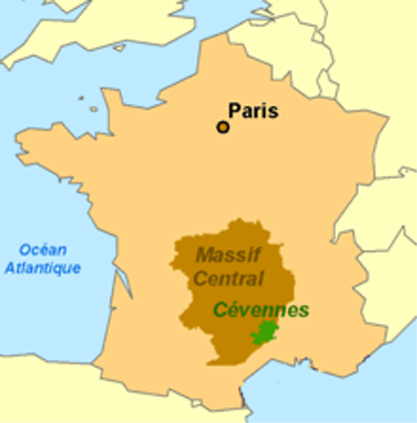
From 1809-1817, the Beast of the Cévennes, the Beast of the Gard or the Beast of Vivarais,(a creature which obviously ranged far and wide) was just one more in the long, long series of creatures, beasts, monsters, feral or hybrid dogs, wolves with completely atypical behaviour or sexual psychopath serial killers who have ravaged different areas of France from around 1550 until the present day. Here is the  Cévennes region:

Carte-cevennes-france

Here is the Vivarais area, in red, in the centre:

vivarais

And here is the Gard area, famous for the Pont du Gard. Again, it is in red:

This slideshow requires JavaScript.

Once again, I have looked at a number of French cryptozoological websites and you can take your own average between them. “Vampire Dark News” provides a solid, simple introduction to the latest killer:

“This particular creature spread panic in a vast region comprising Lozère, the Grand Gard and the Ardèche from 1809-1817. It killed, however, comparatively few victims compared to the eight long years when it was active. There were only 29 victims, almost exclusively women and children, six of whom were decapitated. On the other hand, the monster was brave enough to venture into the very houses where people lived. Their descriptions said that the beast was a wolf the size of a donkey with brown fur, a black mane and large udders. Perhaps it was an animal which had escaped from a circus. This creature was never killed.”

(My own translation)

How many wolves fit that description? A black mane? The size of a donkey? Large udders?

The French version of Wikipedia, provides a slightly more developed tale. It begins with the story of how :

«  The Journal du Gard on Octobre 21st 1809 announced the attacks by this animal in these terms :
« In just a few days, a ferocious animal has spread terror in the region of the Gard. Just like the Beast of Gévaudan of days long past (1764-1767), the Beast of the Cévennes is ravaging this part of the “country.”

2653590908_1Wikipédia then goes on to say:

“The Beast killed 29 people, including 19 children, but the list might actually be longer, because the Death Certificates do not always mention the reason for the death. A child called François Marcy, seven years old, was devoured on September 8th 1812 next to his house. Augustin Colomb, aged eight, was carried off on January 9th 1813. Only his head was ever found. In the middle of October, little Rose Henriette Dumas, aged seven, was devoured in the woods.  The attacks went on from 1809-1816, and the audacity of the creature recalls the famous affair of the Beast of Gévaudan. A woman of 34 was attacked just coming out of the church and the beast even attacked villagers inside their own houses.  The rumour was current that it had even eaten the hands of a child who was being rocked in his cradle.  Despite numerous beats and traps set by the people of the different villages the creature remained uncatchable. The attacks came to a final end in 1816 but the affair was never cleared up. It is unknown if this animal was killed during a beat, whether it changed its area of operation or if it was a question of crimes which had been carried out by human beings but were then disguised as being the work of a monster.
Several theories are offered about the origin of this aggressive animal. According to certain people it was a female wolf from Spain even though its behaviour did not resemble that of a wolf in any way whatsoever. The pins in the clothing of certain of his female victims had been removed (hardly the behaviour of a wolf) and six corpses were found decapitated, their necks seemingly having been cut by a blade. The very act of decapitation, of course, is not one which is done deliberately by any animal.

Mont Lozère seems to have been the epicentre of the whole business and had already experienced widespread attacks by wolves in the seventeenth century.

mont lozere

The descriptions which were given by witnesses at the time are extremely variable. Some people talk of an immense wolf, the size of a donkey with a mane and a coat of brown or red fur. Other witnesses describe a creature, or a wolf, the size of a calf, with a grey and red coat. In the majority of the descriptions, the witnesses agree on the presence of a huge belly covered in white fur which almost dragged on the ground. The beast had large ears, a long muzzle and a thick, heavy, tail.”

(My own translation)

What animal was this?  An immense wolf, the size of a donkey with a mane and a coat of brown or red fur? A wolf the size of a calf ? A huge belly covered in white fur almost dragging on the ground? A creature, or a wolf? This is beginning not to make any sense at all. The French peasants in this area, just like those in Gévaudan, all knew a wolf when they saw one. And white fur underneath its body means it cannot have been any species of wolf known today. And the Beast of Gévaudan explanation, based on crazed killers who used hybrid creatures to kill on their own perverted and vengeful behalf will only stretch so far. Indeed, the more I think about it, the more I am beginning to have my doubts even about Jean or Antoine Chastel and the rest of the local lunatics who were supposed to have masterminded the Gévaudan outrages.

BETE VIVARAIS

Another website relates how :

“The Beast of Vivarais (or of Cévennes) killed many women and children between 1809 and 1817 within the departments of Lozère, Gard and Ardèche. The animal is described as having the form of a wolf, but with longer ears and black hair bristling over the entire length of its back.  Another report, dating from 1813, speaks of a wolf the size of a calf, with grey and red fur, with a dangling belly covered in white fur with “roudeaux” (a word I have been unable to find in any dictionary, but they are tabby or tiger striped with white).  The head and muzzle are long, the tail is long and sticks up at the end. The official number of victims is twenty-nine.  However it is likely that the list is actually longer because Death Certificates do not necessarily mention the cause of death. In an article on the Beast of the Cevennes, Guy Crouzet details all of these killings, some of which say a great deal about the horror and helplessness of the local people in trying to overcome events which had left them completely out of their depth. And so near the village of Brahic: “was interred the body of François Marcy of Vénissac, seven years old, eaten by a wild beast on September 8th 1812, just a few steps from his home. Vézian, minister of the church.”
“ January 9th, 1813, the death of Augustine Columbus, aged eight. Devoured by a wolf, only the head was found. The boy was abducted on January 8th at five o’clock in the evening in the place called Beaujeu.”
On October 23rd 1813 at Saint-André-de-Cruzières, before the authorities there appeared: “Jacques Dumas, a farmer by profession, the uncle of the deceased, who lived in Chazelles and also Monsieur Graffand the Imperial Solicitor, who lived in Pierregras. They stated that Rose Henriette Dumas, seven years old, the daughter of Louis Dumas, a builder and Marie Maurin, from Chazelles has died from having been devoured in the woods by a ferocious wild beast yesterday, October 22nd, The remaining fragments of the deceased’s body were collected up, inspected carefully and then wrapped in the blood soaked skin of the little girl. They were recognized by her father Monsieur Dumas to be those of his late daughter Rose Henriette.”
Guy Crouzet also made a good point about Mont Lozère, which seems to have been the focus point of the Beast’s activities. Mont Lozère has already played host in the past to other monsters of the same type: in the seventeenth century, attacks by wolves on human beings were reported in the region of Saint-Julien-du-Tournel. And don’t forget that that the very first attacks by the Beast of Gévaudan were reported in Langogne, on the very edge of the Vivarais region. The Beast of Vivarais finally disappeared from the region in 1817, without ever being found. Perhaps it was killed during one of the many organized beats. Nobody knows.

(My own translation)

A wolf, but with longer ears and black hair bristling over the entire length of its back??  A wolf the size of a calf, with grey and red fur?? A dangling belly covered in white fur?? A tail that is long and sticks up at the end? For a wolf?
The “Midnight Forum” possibly isn’t quite the kind of website you might have expected, but it provides many of the details we have previously noted:

“The Beast of the Vivarais was also known as the Beast of the Cévennes or the Beast of the Gard, This monster killed 19 children. This creature first appeared in the regions of Ardèche and Gard in 1809. The descriptions of the monster vary widely. Some say it was a huge wolf the size of a donkey, with a thick mane and a coat of brown or red fur.  Others said that the creature was completely black, or that it was a wolf the size of a calf with a grey and red coat.  In most descriptions, however, witnesses spoke of a big belly covered in white fur, which hung almost to the ground.  Many thought it was a she-wolf that could have come from Spain, even if the behaviour of the animal was in no way whatsoever like that of a wolf.  It had big ears, with a long snout and a luxuriant tail.”

(My own translation)

This last one may well be a rehash of other accounts, but it is equally possible that it may be the firstborn account which all the others have rehashed.
Nobody could accept without question that this animal was an everyday, common or garden wolf. These French people two hundred years ago knew wolves.

This slideshow requires JavaScript.

From 1818-1829, supposedly 14,000 wolves were killed every single year in France. Even in 1889, around 500 wolves were trapped or shot nationally. The last wolf was killed as recently as 1937. It is, of course, a different question to explain exactly what the Beast of the Cévennes, the Beast of the Gard or the Beast of Vivarais may have been. And at this distance in time, it is not really very likely to happen. Having said that, I am working on it, even as we speak….

2 Comments

Filed under Cryptozoology, France, History, Wildlife and Nature

School Sports Day, 2.30 pm, Wednesday, April 5th 1930

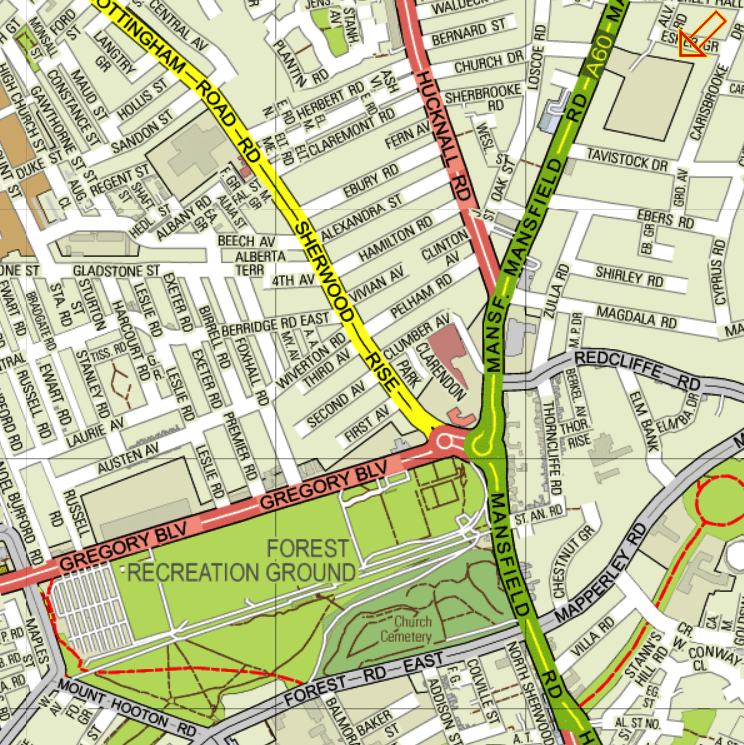
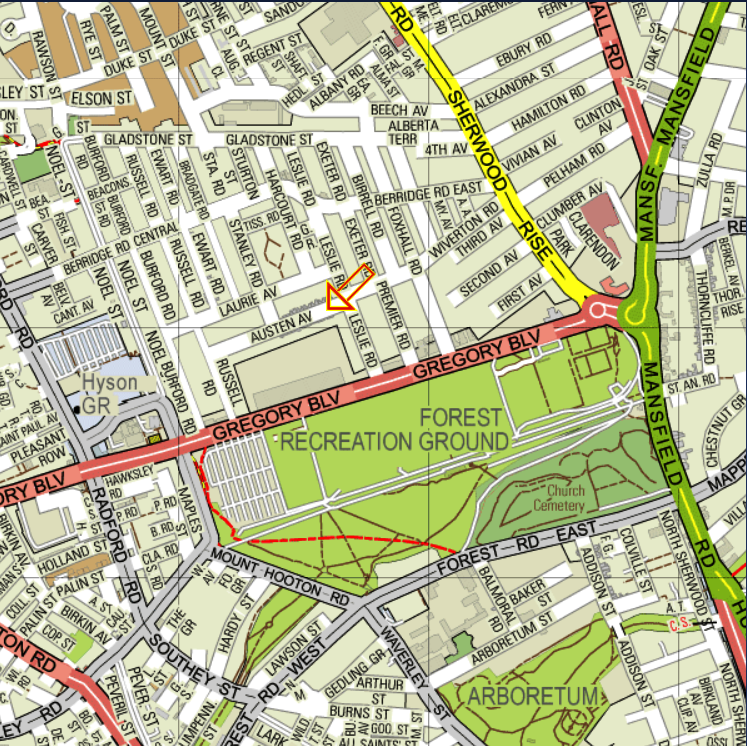
On Wednesday, April 22nd 2015 at 1.00pm, yet another High School Sports Day will begin. A couple of years ago, I was fortunate enough to purchase, in an online auction, the aging programme which was sold (not given away, as they are now) to spectators who turned up at the School Ground in Mapperley at 2.30 pm on Wednesday, April 5th 1930. The programme was priced at 3d, which is around 2p in decimal money. We have already seen the long walk along Mansfield Road to the sports ground. Look for the orange arrow. The High School is in the bottom left corner of the map, near the meeting point of Mount Hooton Road and Forest Road East. The school is the incomplete beige rectangle which is outlined in black:

Untitled 2

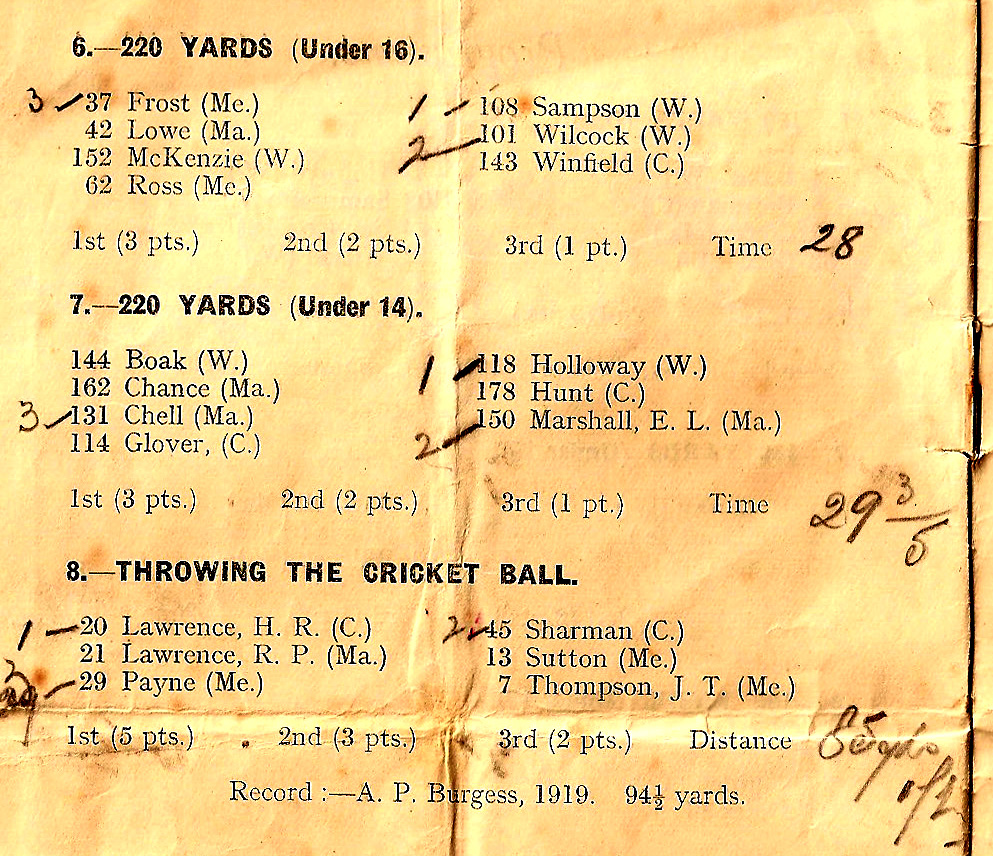
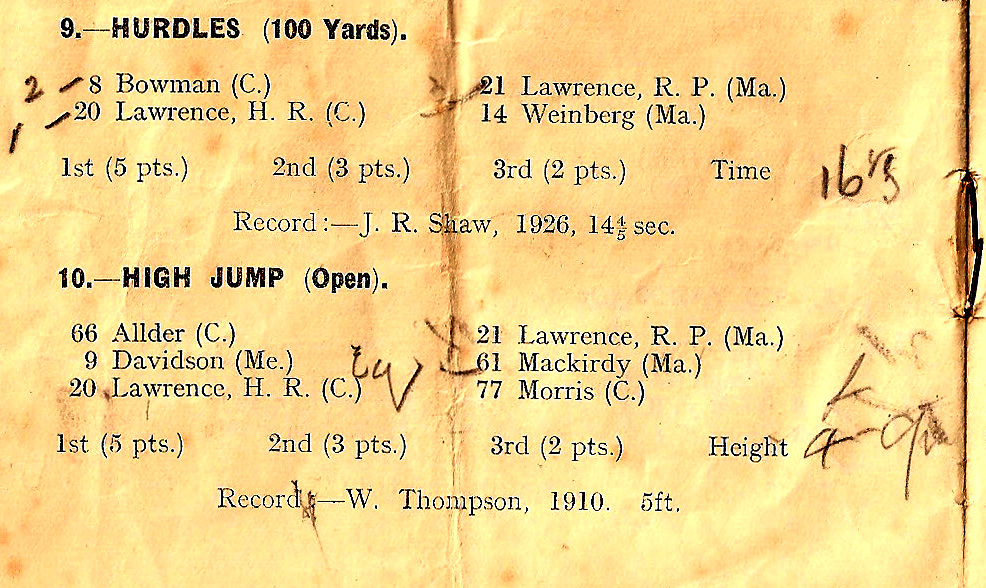
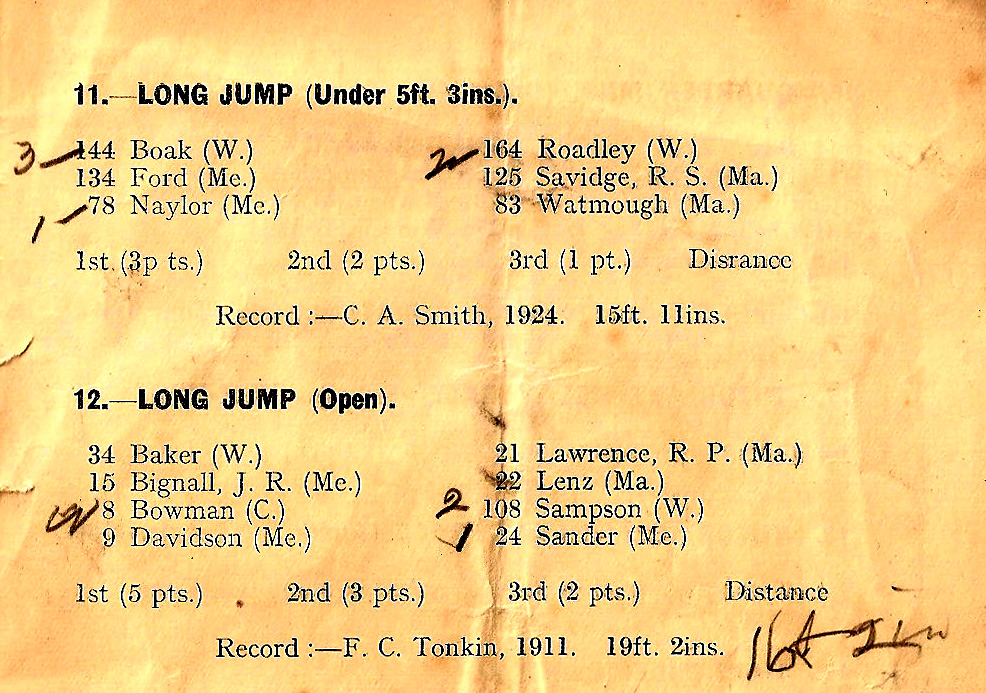
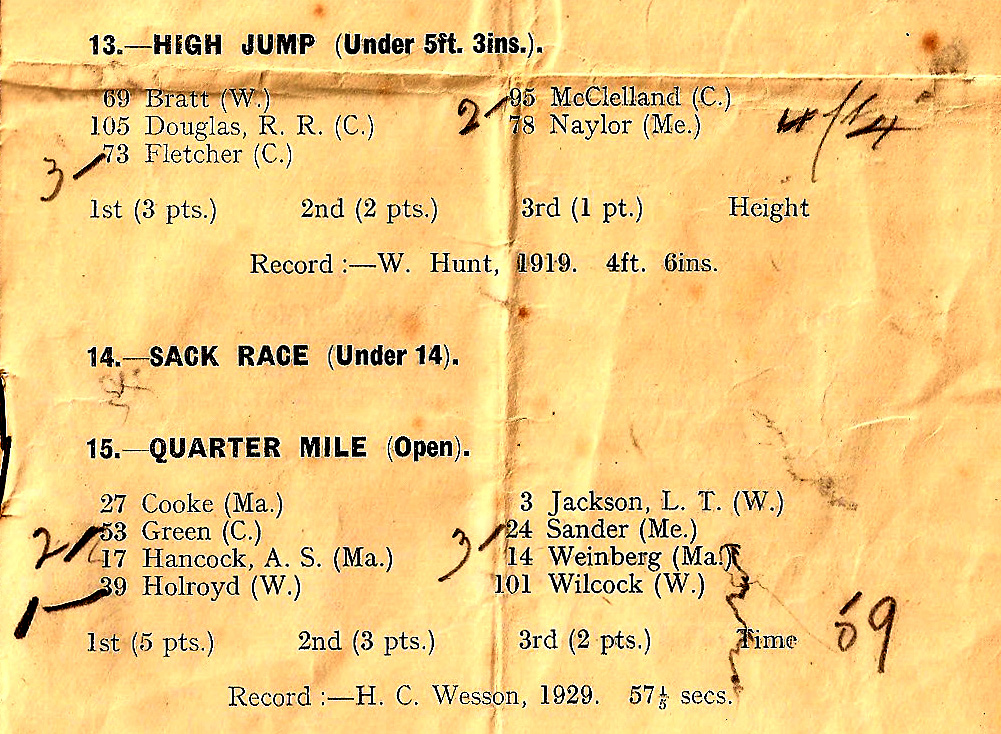
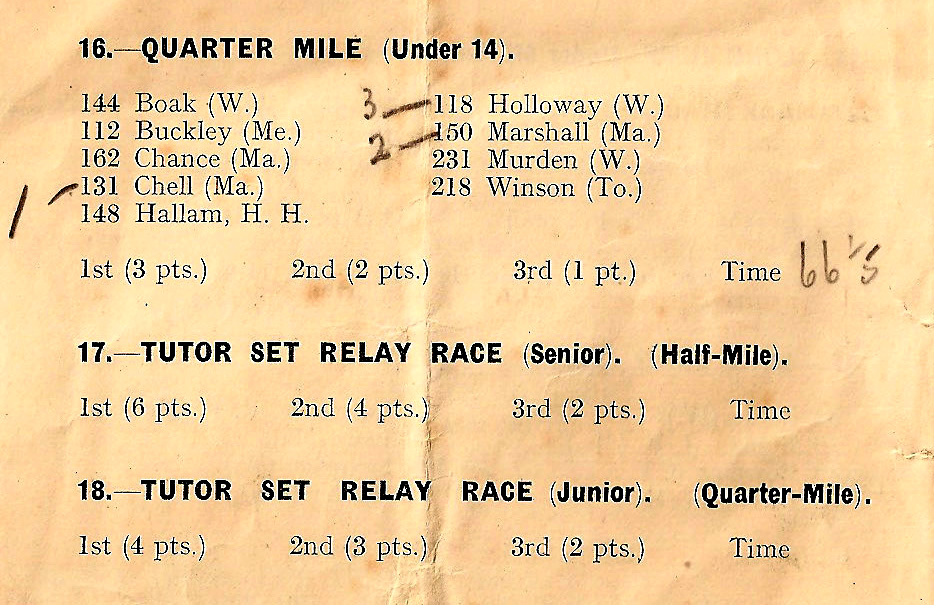
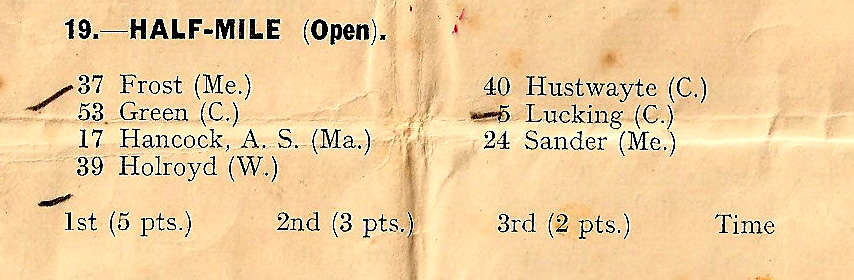
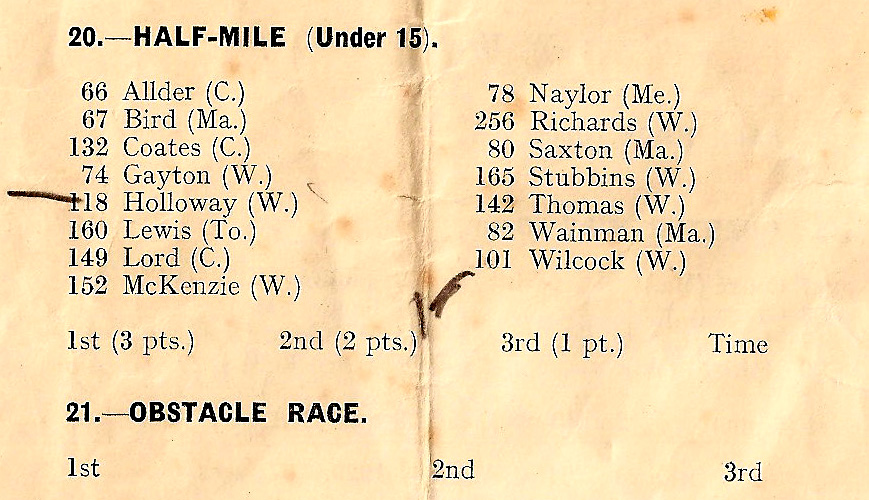
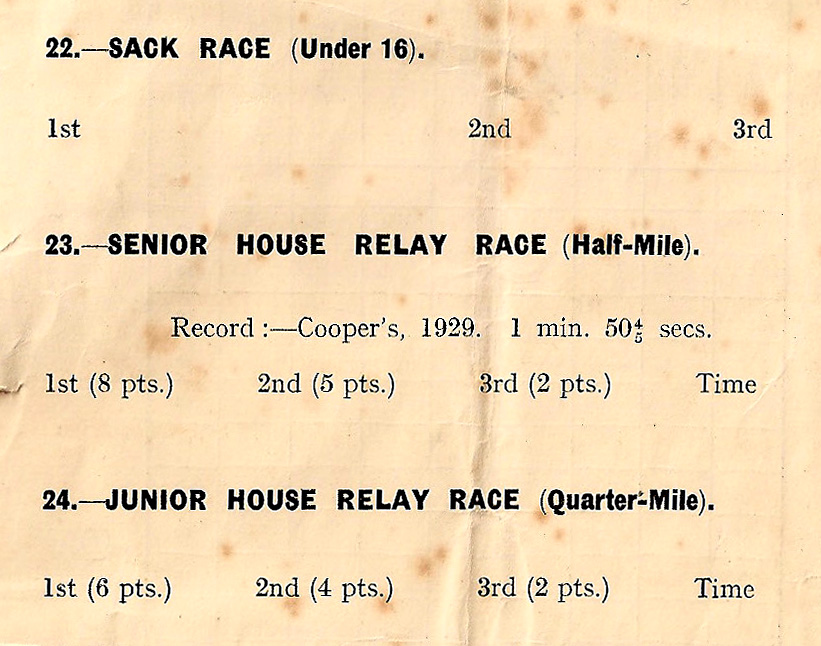
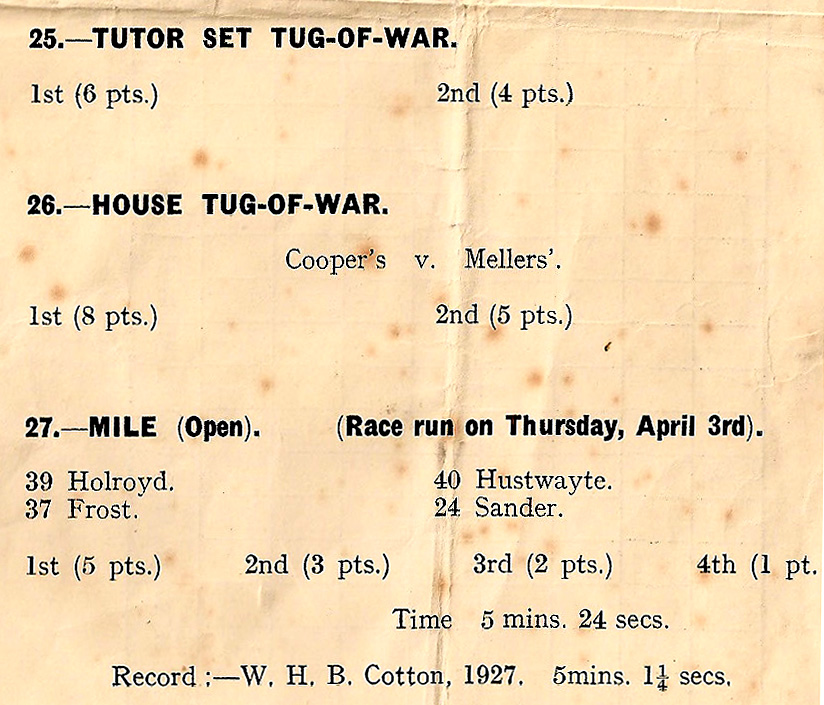
I found it extremely difficult to scan this aging document. I have therefore divided it into a long series of smaller scans where, hopefully, all of the print will be large enough to be legible. An unknown parent has gone through each event and added the order of the finishers, and, in some cases, the performance they achieved. I taught at the High School for almost forty years, and how familiar are some of the boys’ names! I suspect that they may have been the grandfathers, or even great grandfathers of some of my own erstwhile pupils.
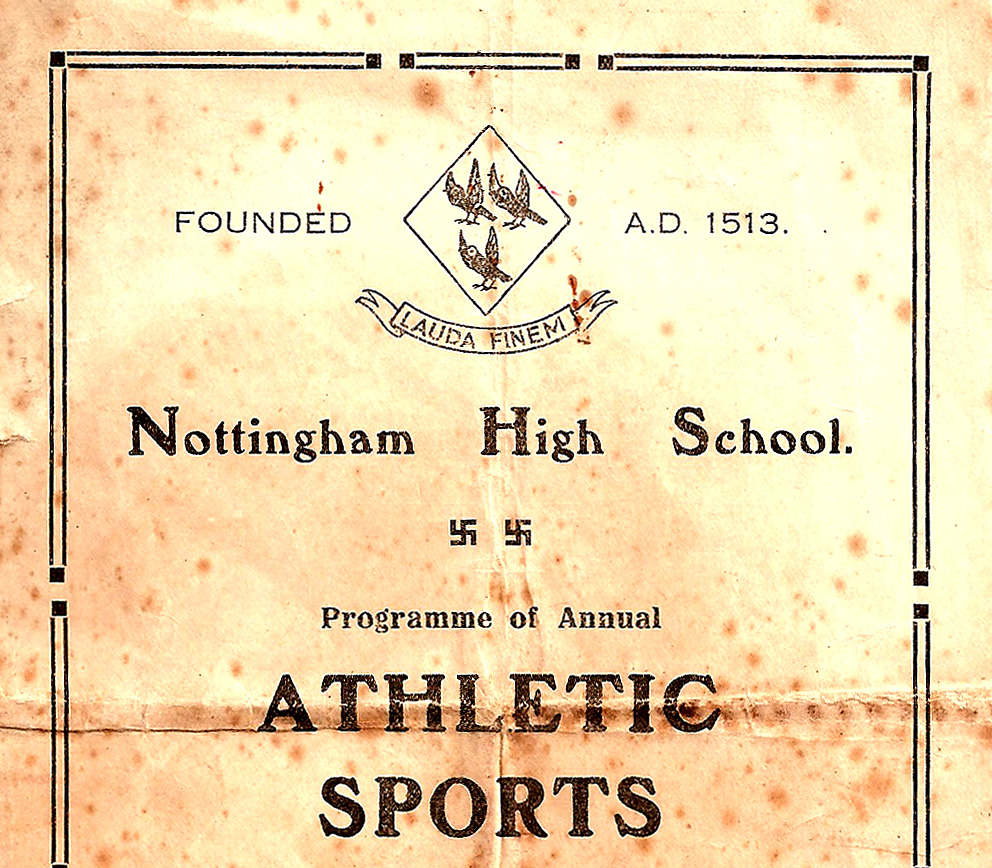
Here is the top of the front cover. The school badge is the same as nowadays, and so is the Latin motto. What I do not understand, though, is the presence of two swastikas. And they are proper swastikas, right-facing ones and not Hindu good luck symbols or badges taken from the horse bridles of the Lakota Sioux. And I don’t know why they are there. Perhaps the event had a secret sponsor:

cover top half

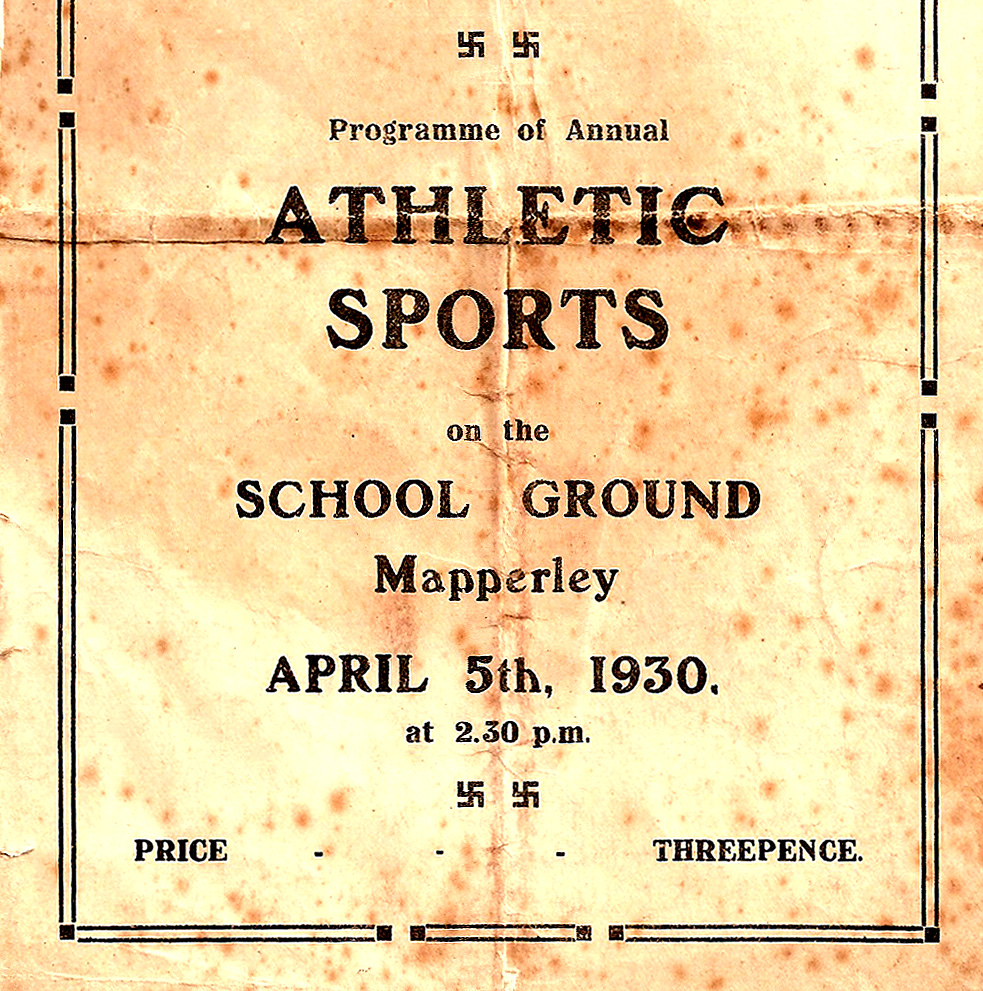
This is the bottom of the front cover. Three pence from so many different spectators must have been a nice little earner:

cover bottom  half
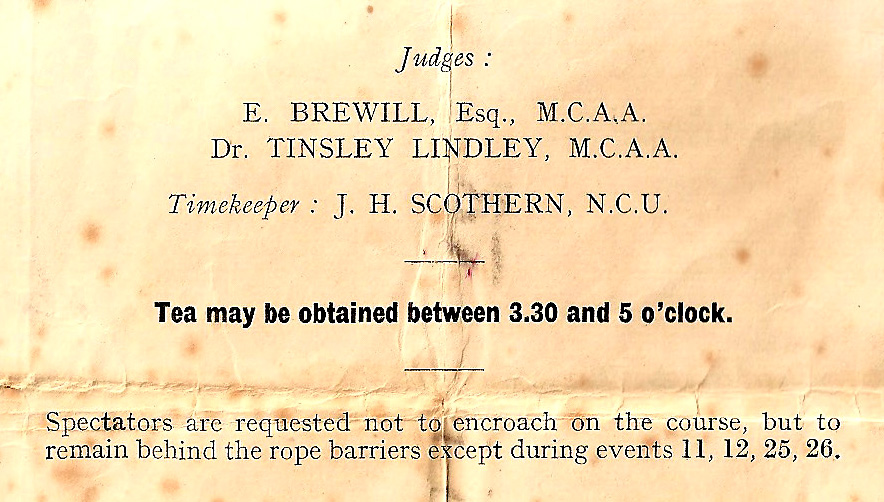
Here is the second page, with the  names of the two track judges. Nowadays there are twelve of them. but in 1930 things were a lot more sedate. The Brewills were a family with at least two famous athletes (G.F. and G.W.) who, in the latter years of the Victorian era, had both achieved a number of triumphs at national level in both sprinting and hurdling . A.S.Brewill had been the commander of the 7th Sherwood Foresters throughout most of the Great War. Almost thirty years previously, on the afternoon of Saturday, July 25th 1903, our current track judge, E.Brewill, had participated in the School Sports held at the same venue. Along with G.F.Brewill, he had been a member of “The Past” (Old Boys) tug of war team against “The Present” (Masters and Boys). The latter were a team of  three boys, namely R.Marrs, W.Oldershaw and H.A.Watson, and three masters, Messrs Hughes, Jones and Yates. The Old Boys soon pulled the School over the line, but were found to have included a seventh member of the team, J.Johnstone. (Cheats!!!) The result was overturned, and the School soon won a fair contest by 3-0. (Hurrah!)
Tinsley Lindley was a very famous figure in High School history and in the history of Nottingham itself. He will perhaps warrant his own blog post one day:

intro page 1

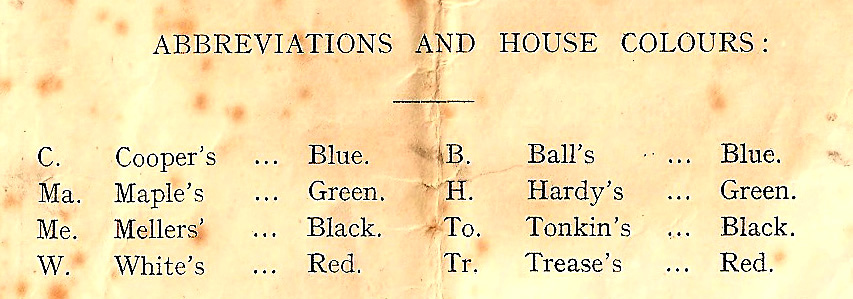
I have been unable to find any background information about J.H.Scothern, although there was a “Scothern” who played amateur football internationals for England before the Great War. As a frequent team mate of the High School’s Olympic Gold Medal winner, Frederick Chapman, both for Oxford City and for England, he would certainly have known him, and probably Tinsley Lindley as well. This bottom half of the page, with its list of House Colours, attests the presence of boys from both the Main School (the four on the left) and the Preparatory School (the four on the right):

intro 2

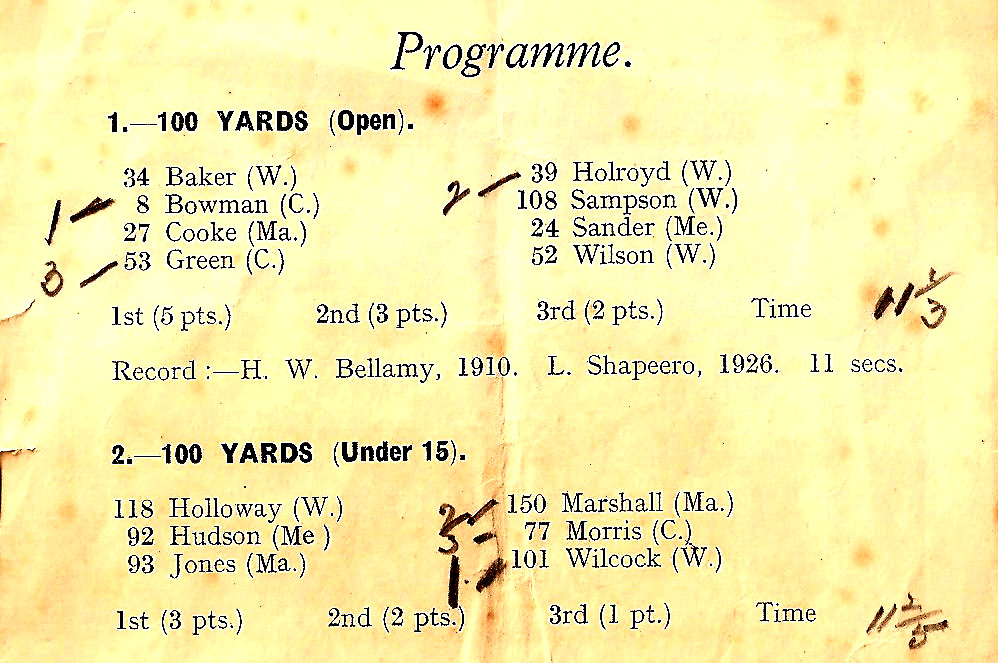
Here are the first two events, with winners and times, the latter expressed as fractions (much more of a challenge than those silly decimals):

1 & 2

H.W.Bellamy was a misprint. It should be H.W.Ballamy. Even here, more than ten years later, the Great War’s foul tentacles stretch out. Harold Ballamy came from a poor family. His father was a commercial traveller. Harold won many school prizes such as Silver Medals for Mathematics and Science, and Dr Gow’s Prize for Geometry. He was Captain of Football, Secretary of First Team Cricket, the School Librarian, the Colour Sergeant in the Officer Training Corps and the Captain of the School.
At Cambridge University, he won the Bishop Open Exhibition for Natural Science. He obtained a First Class Degree in Mathematics. He then changed to Natural Sciences, where he was placed first in the whole University of Cambridge. What more ideal choice, what better qualified man, to put in charge of a pile of mud near the village of Passchendaele ? And then he was killed:

ballamy 1234

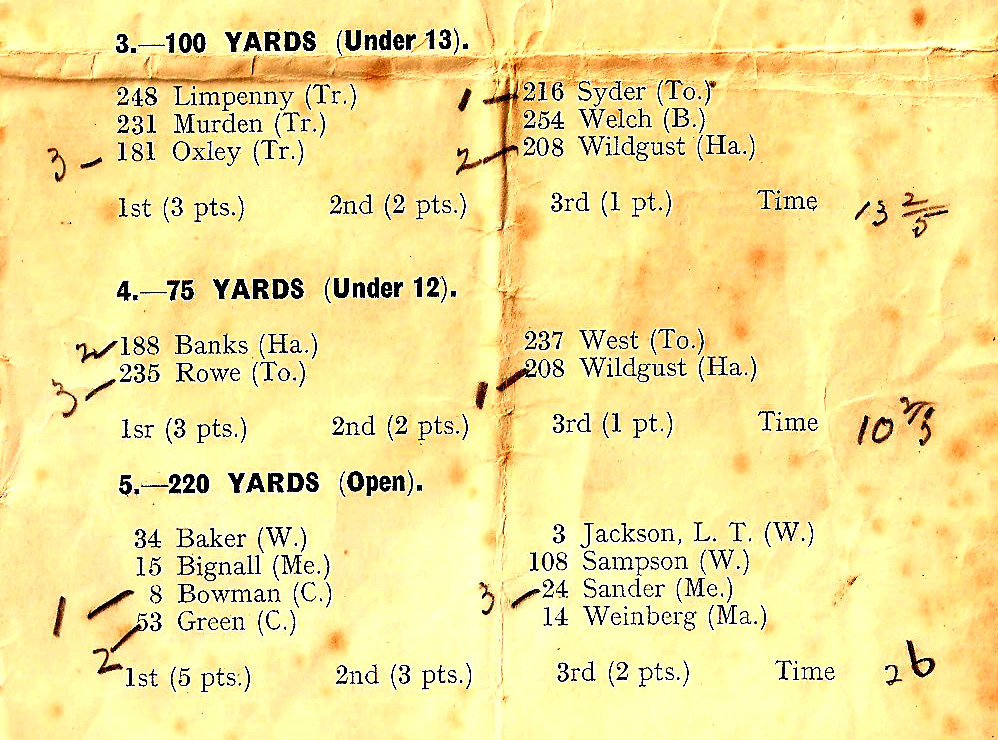
And now, Events 3, 4 and 5. I have taught a Wildgust and a Weinberg:

3, 4 & 5
And I have taught a Sharman and a Lawrence. I wonder who the latter was related to. And why don’t they have “Throwing the Cricket Ball” any more? Health and Safety, I wouldn’t wonder:

6, 7, 8,

Notice that the High Jump was an Open Event with no age restrictions. I think the pencil mark means that the winners both achieved equal heights:

9 and 10

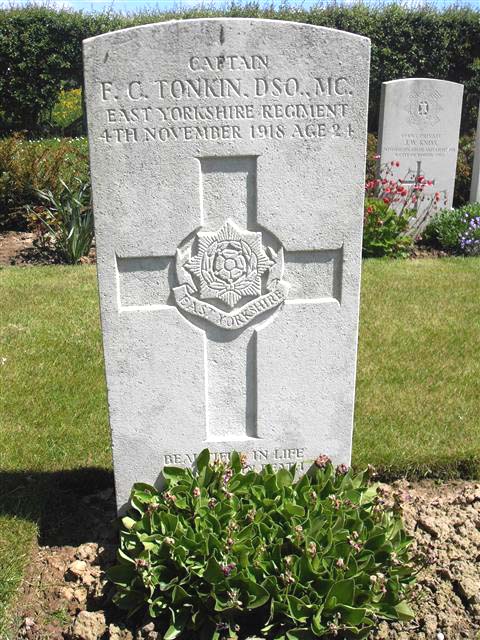
And here are the next events, except that another foul tentacle reaches out and grabs another victim. Captain Frederick Cuthbert Tonkin lived at 13 George Road, West Bridgford. He represented the High School at football, cricket and athletics. He interrupted his Dentistry studies at Guy’s Hospital to enlist and was killed on November 4th 1918, only seven days before the end of the war. He was just 24 years old:

medium

There were two long jumps, sensibly based on height, rather than age:

11 and 12

Why don’t they bring back the Sack Race? H.C.Wesson, by the way, had been Captain of the School in 1928:

13, 14 & 15
I just don’t know how the Tutor Set relay races worked:

16-18

Another Open Event, with no age restrictions:

19

An obstacle race. Much more fun than boring old athletics!

20  21

And another Sack Race. You can’t have enough of them, I say. Have you noticed how the parent has gradually began to lose interest. Fewer pencil marks. Fewer performance times.

22-24

Two more tug of wars. Or should that be tugs of war? Or just tugs? Sounds like fun for everybody, though. W.H.B.Cotton was a hero, a genuine hero, as well as a record holding athlete. Spending his holidays in Glamorgan in Wales in 1928, he had managed to rescue two sailors from a ship which was sinking, just offshore from Porthcawl:

25-27

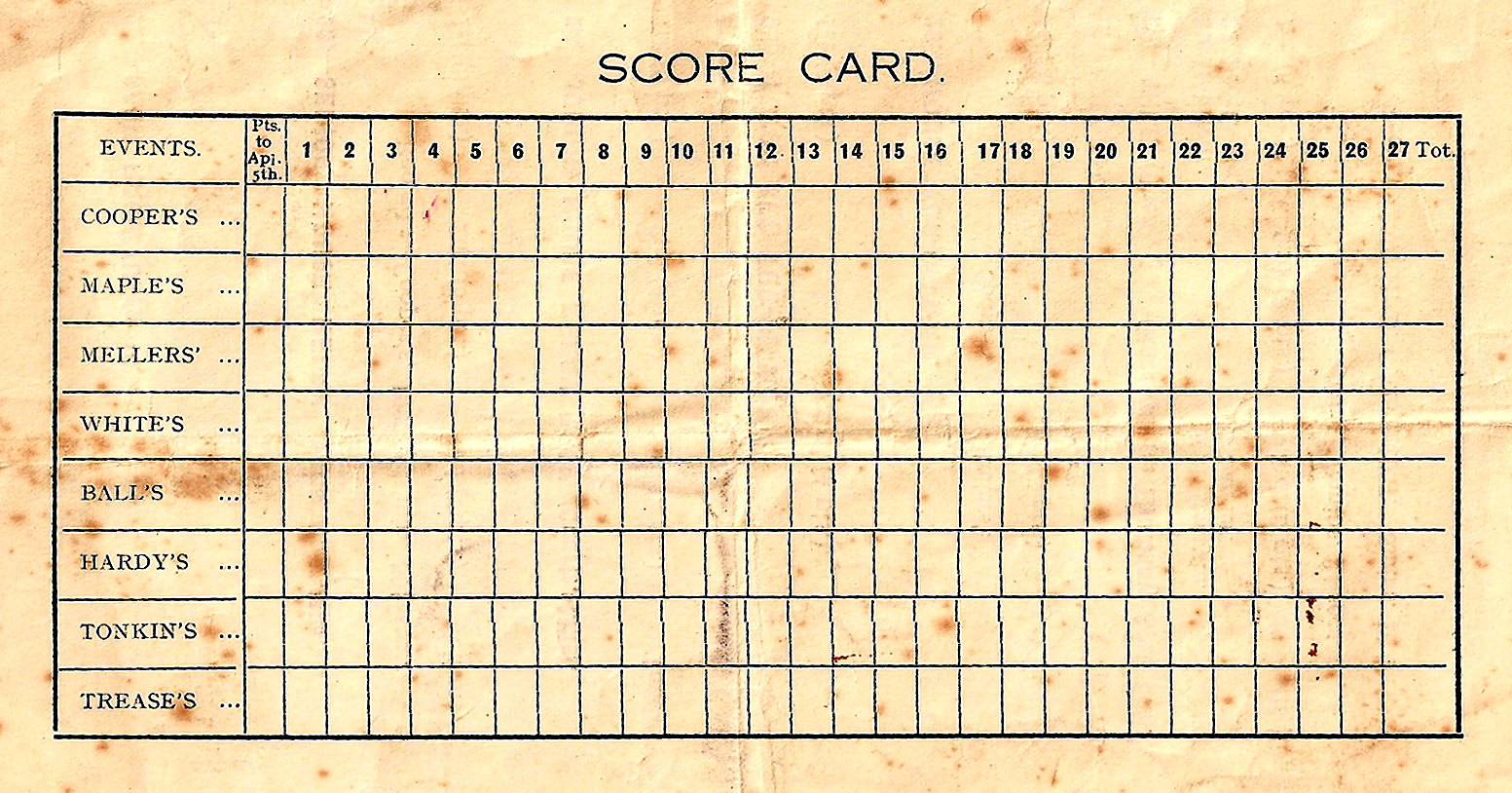
The back of the programme is a grid where all the keen and interested parents can keep the inter-house score, event by thrilling event:

scan seven

And that’s it! The Annual Athletic Sports were over for another year. And, indeed, the days of holding them at Mapperley were over for ever. The Valley Road Playing Fields had been purchased for £5.600 in 1929. The ground had been levelled, the marsh had been drained and they were ready for athletic action by Thursday, April 30th and Saturday, May 2nd 1931. But that, as they say, is another story.

4 Comments

Filed under History, Humour, Nottingham, The High School

Sports Day in the Victorian era

Nowadays, School Sports are held in April and can be, just occasionally, on the rainy or even the chilly side. The first School Sports I have been able to find any information about took place over two days, well over a hundred years ago…and not in April.

Instead, they were on Wednesday and Thursday, September 28th and 29th 1870, at Trent Bridge. (not for the first time, apparently). Events included the popular “High Leap with a Pole”, won by Woodhouse with a jump of 7ft 6ins, “a good jump for a man”. A total of 36 boys entered the stone gathering race, and the sack race was won by Darby, who had the bright idea of inserting a toe tightly into each corner of the sack, and then “shuffled along capitally”.
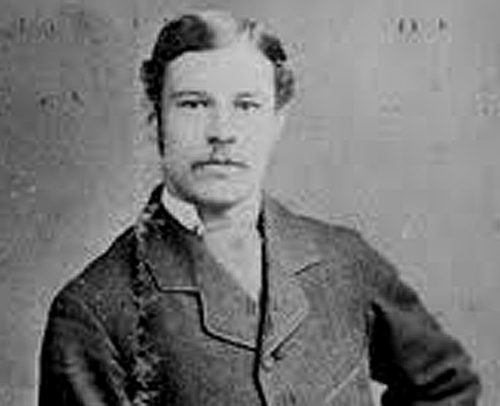
On the second day there was a “Stranger’s Race” with people not directly connected with the school allowed to compete. There was general reluctance to enter this race, because of the presence of Mr Sam Weller Widdowson, the famous captain of the Nottingham Forest Foot-ball Club:
weller

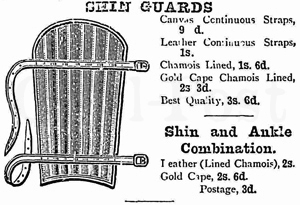
Named after the character in Dickens,  Widdowson was the inventor of the shin-pad:
shinguards

A number of gentlemen finally took part in this race, running in top hats and overcoats. As expected, Mr Widdowson was in first place, with Mr Frederick Rothera second. There was a “blind donkey race” with large boys blindfolded, and small boys riding piggyback, giving them directions. It was won by “Purchase and Brown”.

The next School Sports I can trace were on Monday, April 8th 1878, at Trent Bridge, in front of a “numerous gathering”, entertained by the playing of the Sax Tuba Band. Events included throwing the cricket ball, a 220 yard football dribbling race, a 100 yard three-legged race, a 100 yard sack race, a one mile bicycle race, and an Old Boys’ race.

One of the highlights was the 220 yards running race when the course had been marked out wrongly. One of the eleven runners, Sulley, took the wrong turning, and “effectually disposed of his chance”. The other runners also went wrong, but because they were trailing so far behind Sulley, they were able to run back, and get onto the correct route. Unfortunately, Small was knocked over in the confusion, and eliminated from the race, which was eventually won by G.F.Chalcraft. His prize was a handsome desk, donated by the teaching staff.
In the final of the sack race, F.Bailey finished second behind “the younger Walker”, having decided not to jump inside his sack, but instead, to lie down and roll along the ground.
Most interesting, though, was the “Bumping Match”, the exact rules of which, unfortunately, have not survived. It was surely one of two scenarios. Either a huge circle was marked out by a rope, and the last boy left in it was the winner, or it was some kind of sumo type pushing contest, where boy after boy fought in round after round, until only one remained as the victor:

“The contest caused great merriment among the spectators, who greeted the overturned combatants with roars of laughter. Finally two, varying greatly in size were left in, and after a prolonged struggle, W.A.Walker, who showed great quickness and dexterity in avoiding the attacks of his tall opponent, R.E.Fletcher, succeeded in knocking the latter over the line, amidst loud applause.”

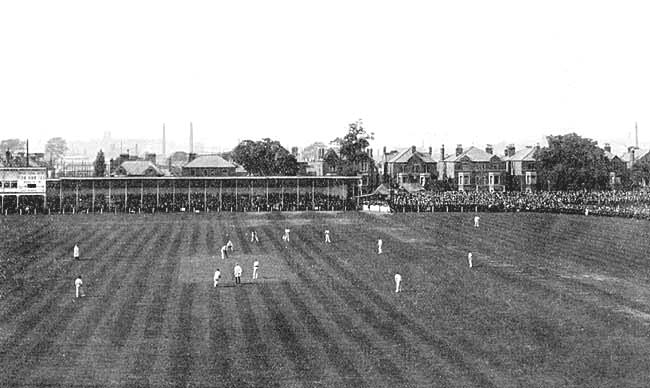
The following year, on Tuesday, April 29th 1879, again at Trent Bridge Cricket Ground, “a numerous and fashionable assemblage” was entertained by the Sax Tuba Band, under the conductorship of Mr J.Hindley. There were 22 events, including throwing the cricket ball and a 100 yards race with a Gladstone bag as first prize, presented by Sir James Oldknow. This is Trent Bridge  at the time, during a Test Match:

trent-bridge-cricket-ground

There was a half mile handicap race where the prize was a silver watch, presented by Captain W.E.Dennison  M.P., and the M.P., Saul Isaac.  J.E.Woolley led for nearly six hundred yards, but Barlow overcame his ten yard handicap about 120 yards from the finish, and went on to win. Woolley eventually finished third, and C.Cullen was second. The prize in the long jump was a luncheon basket, presented by the Borough Members. There was a three-legged race and a 400 yards race with only two competitors, G.B.Chalcraft beating E.H.Wells by ten yards. In actual fact, there should have been three runners for the race to start at all, but it was “run through an error on the part of the starter.” The one mile handicap bicycle race was won by A.V.Paton, and F.Bailey won the sack race. This event “…as usual, afforded great amusement.” C.Cullen won the 220 yards football race. His first prize was a cabinet Shakespeare, presented by the Dame Agnes Mellers Club. E.Thornley was doing very well until he kicked the ball out of his lane, and Cullen then went on to win.

H.R.Bramwell won the 100 yards hurdles, which was over six flights of hurdles. His prize was a writing desk, presented by Messrs J & J. Vice. In the 220 yards, C.Daft won a pair of binoculars presented by the Assistant Masters. “The most exciting race”, was the Old Boys’ race over 220 yards  won by F.F.Cleaver in 24 seconds.  At the end of the day came the “…usual bumping match and two consolation races”, won by Thornley and Butler.
Mr Charles Daft was the starter throughout, and Herr Altdorfer and Mr W.H.Bailey were the judges. The prizes were presented by Miss Lindley, and the President seconded a vote of thanks to her for her kindness. She was given a small bouquet of flowers, and three cheers by the school. Her father offered thanks for this kind gesture, and then called for three cheers for the President. With this, the day came to a happy close.
One interesting detail about the competitors in these sports is that there was a small fee payable to enter any of the events. At least one Old Boy in later life was to state that this cash payment did much to limit the number of competitors.

School Sports then seem to have died a death until, during his first term in office, in March 1885, the new Headmaster, Dr James Gow, started an Athletics Contest for senior boys. This soon evolved into a full School Sports Day. Over the years, the school magazines have given us a series of snapshots of the event has changed.

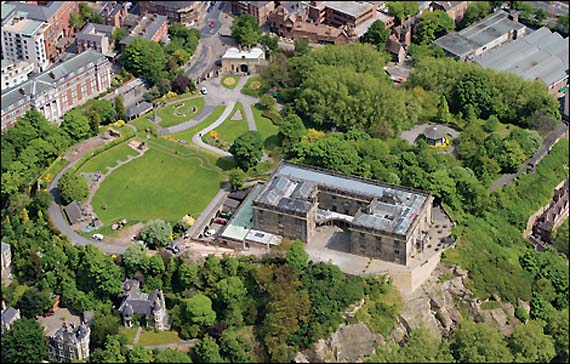
On Friday, June 29th 1888, for example, the School Sports, “…for many years in abeyance”, were revived, and were held in “very unfavourable weather” on the Castle Grounds. I am not really very sure, but I would presume that the Castle Grounds are the area of flat ground at the side of the Castle:
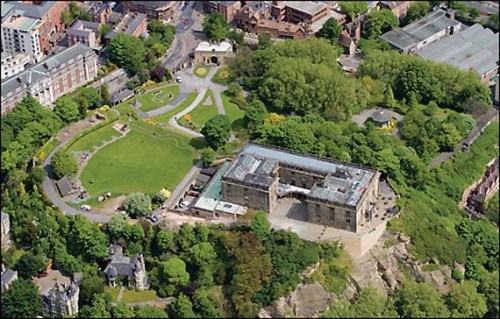
castle grouundszzzzzzzzzzzzzzzz

There was a good attendance of spectators, and among the more usual events was a three-legged race, won by W.A.Möller and C.P.S.Sanders, a sack race won by J.Blake, and a bicycle race over one mile, won by W.A.Möller in 3 minutes 45.4 seconds. F.Bramley won the “Throwing the Cricket Ball (for boys under 14), with a distance of 57 yards.
The Masters’ Race was won by the Reverend T.W.Peck, with Mr W.T.Ryles in second place, two yards behind. There was also an Old Boys’ Race which was a handicap, run over 220 yards, and a Tug of War, won by Team No 1, who defeated Team No 2 in the final. Again many prizes were in evidence, all presented by Mrs.Gow.

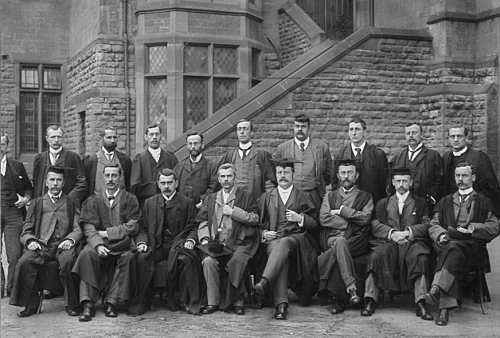
This staff group shows Mr W.T.Ryles in the back row, fifth from the right. His nickname was “Nipper”. His brother, Mr W.E.Ryles, “Jumbo” is on the front row, second from the left. The Headmaster, fourth from the right on the front row, is Dr Gow:
staff 1901

On the afternoon of Tuesday, June 3rd 1890, Sports Day was again held at the Castle Ground in dull and windy weather. Nevertheless, a large crowd attended, and enjoyed a day of “very fair sport”, and a selection of music played by the Nottingham Borough Police Band, under the leadership of Bandmaster Redgate. The prizes were presented by Miss Goldschmidt. Most of the events were similar to previous years including the 220 yards football dribbling race, throwing the cricket ball, an Old Boys’ bicycle race, a sack race and a whole series of running races, all of them with varying handicaps for the competitors .

The most interesting event, though, was the hundred yards Medley Handicap. In this, boys competed in a number of heats over one hundred yards, and the handicap consisted in the means by which they had to cover the distance. The methods included skipping, sack race, three legged, pick-a-back, on all fours, and, most spectacular of all, perhaps, on stilts. The final seems to have been a normal foot race, as the winner’s time was fifteen seconds.

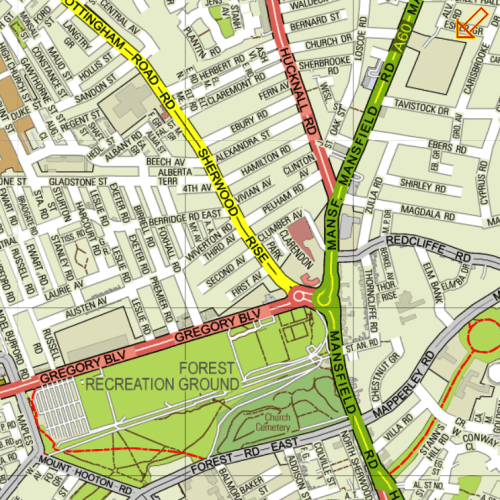
On the afternoon of Friday, March 29th 1901, the School Sports took place at the brand new sports ground at Mapperley Park. We already know how to get there. Look for the orange arrow. The High School is in the bottom left corner of the map, where Mount Hooton Road and Forest Road East meet. It is the incomplete beige rectangle which is outlined in black:
Untitled 2

A large number of boys, friends, parents and Old Boys were in attendance, but the day was spoiled by the bitterly cold weather,

“…the turf was naturally affected by the overnight fall of snow, which made the going heavy.”

Two years later, on the afternoon of Saturday, July 25th 1903, the weather was beautiful, although not too warm, and there was another large crowd,

“including many ladies, whose bright, summer dresses amidst the pretty surroundings of trees and shrubs, made the scene most picturesque”

The spectators were entertained by “the lively strains of a band, and a hospitable tea tent.”
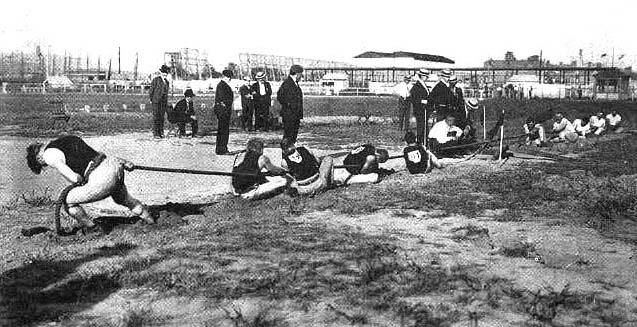
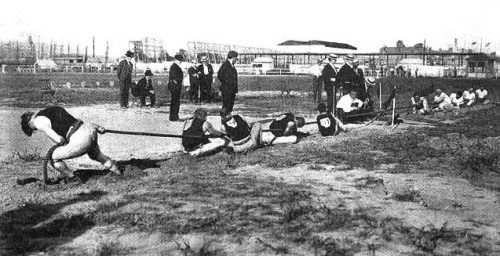
The numerous prizes were presented by Lady Blain and events included the one mile walking race, won by B.G.Saywell and an U-11 obstacle race won by C.F.Brasher. L.W.Malton won the potato race and a tug of war was held between “The Past” (Old Boys), and “The Present” (Masters and Boys). The Old Boys were G.C.Allsebrook, W.Allsebrook, G.F.Brewill, E.Brewill, S.Hoyte and H.A.Wootton. Their opposition contained three boys, namely R.Marrs, W.Oldershaw and H.A.Watson, and three masters, Messrs Hughes, Jones and Yates. The Old Boys soon pulled the School over the line, but were found to have included a seventh member of the team, J.Johnstone (Cheats!). The result was overturned, and the School soon won a fair contest by 3-0. I could find no photographs of this event, but here is the tug of war at the 1904 Olympics in Los Angeles. I’m sure it will give you the rough flavour:
The-Olympic-1904 xxxxxxxxxxxxxxxx

On Saturday, June 24th 1905, it was very fine weather at Mapperley Park. Spectators were entertained by the band of the Robin Hood Rifles, under the directorship of Mr A.Pounder. The sports should have taken place the previous Saturday, but the rain was so torrential that this was completely impossible. Events included the usual ones, such as the 220 yards football dribbling race (R.B.Wray in 35 seconds) and the U-11 race over 75 yards (F.C.Tonkin, 10.8 seconds). There was a one mile bicycle race won by H.E.Mills (3 minutes 9.6 seconds) after the other two competitors, S.S.Parkinson and P.H.Hart collided with each other and both fell off. H.E.Mills  also won the potato race this year. J.H.Simpson won the U-11 obstacle race where competitors had to crawl through barrels and under pegged down clothes. The event created “much amusement”. The Old Boys won the tug of war against the Masters & Boys.

As war clouds slowly gathered, on the afternoon of Saturday, June 15th 1912, the Athletic Sports were held in splendid sunshine, again at Mapperley. The attendance was very large, and great interest was generated. Harold Ballamy ran 100 yards in 10.6 seconds, a marvellous performance on grass and wearing, presumably, ordinary pumps. There was again a football dribbling race, won by R.L.W.Herrick. This latter event was by now the only survivor of the many unusual and interesting events which had previously characterised the Victorian and Edwardian sports days. Now, virtually every event was a serious sporting trial.

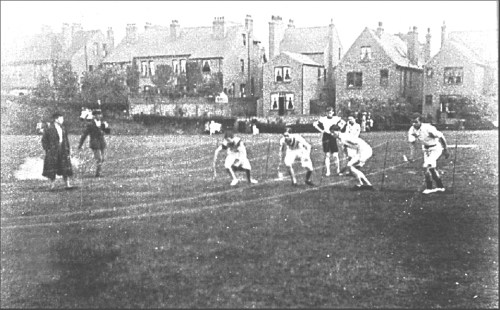
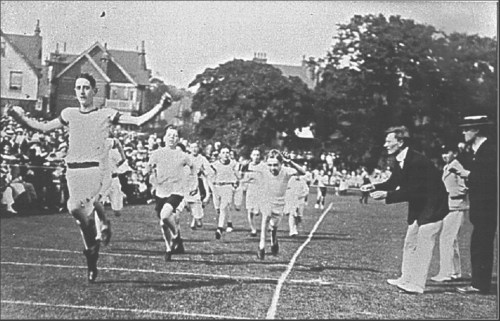
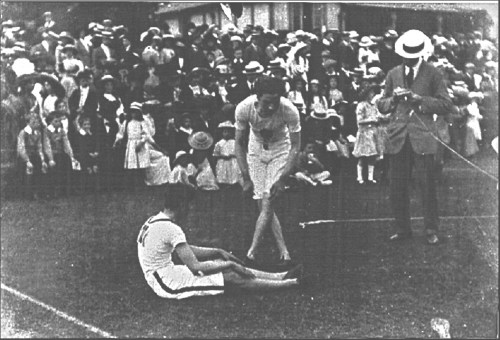
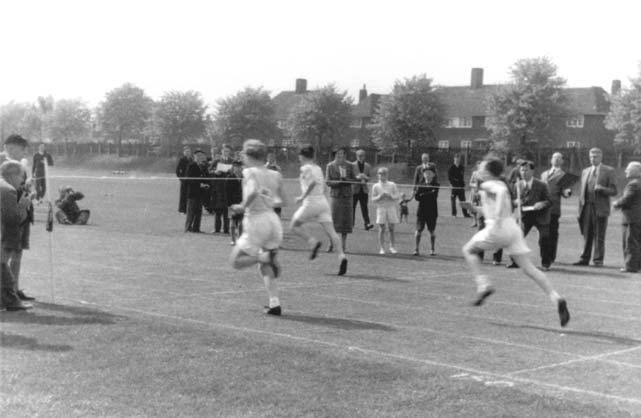
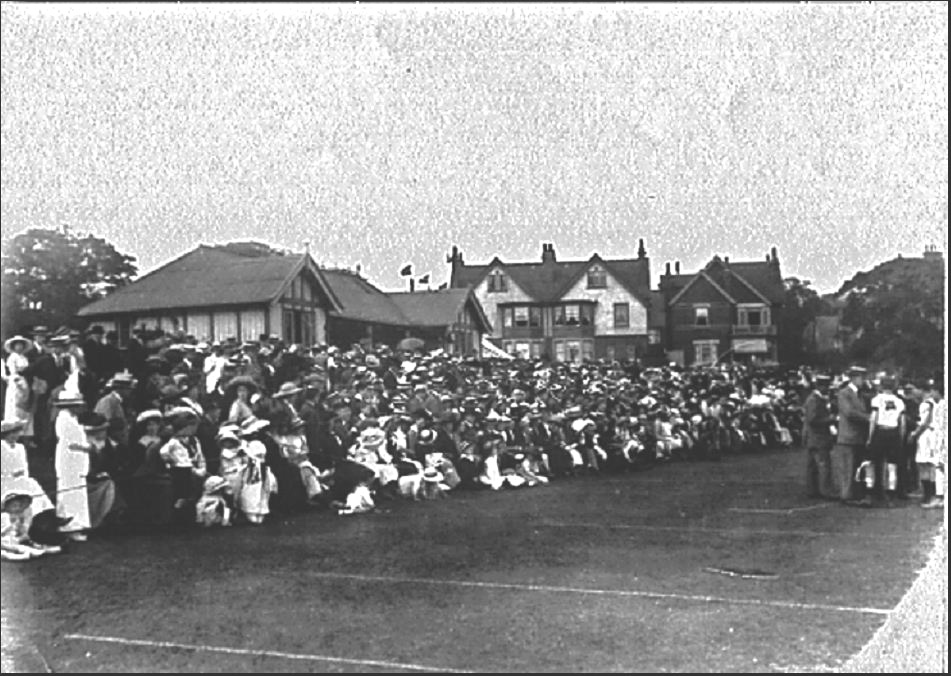
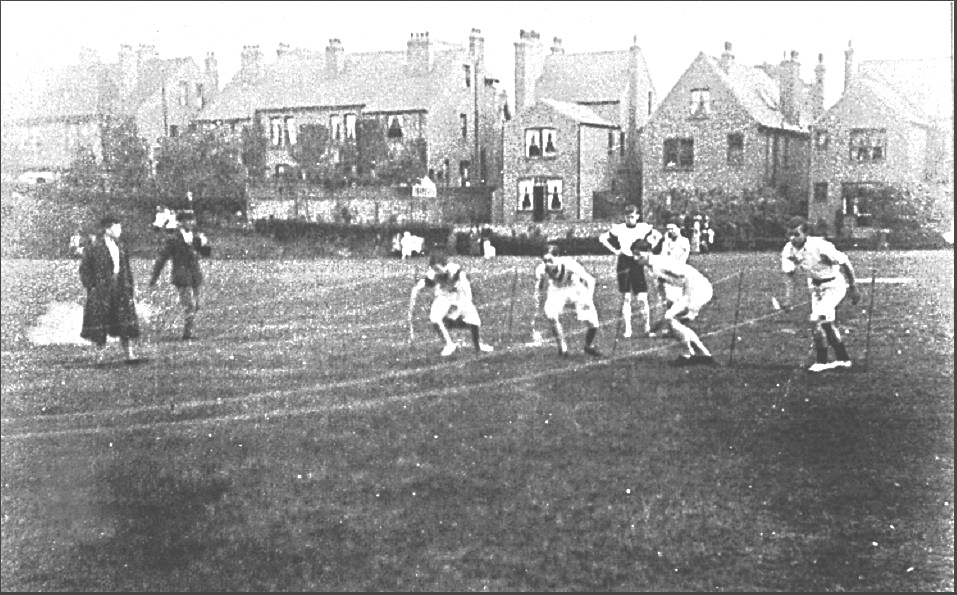
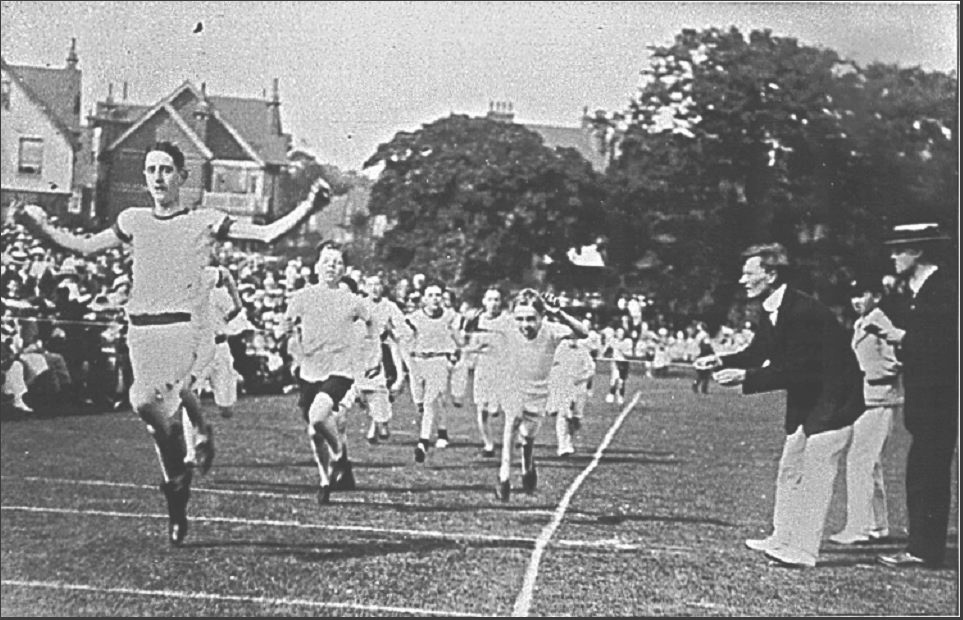
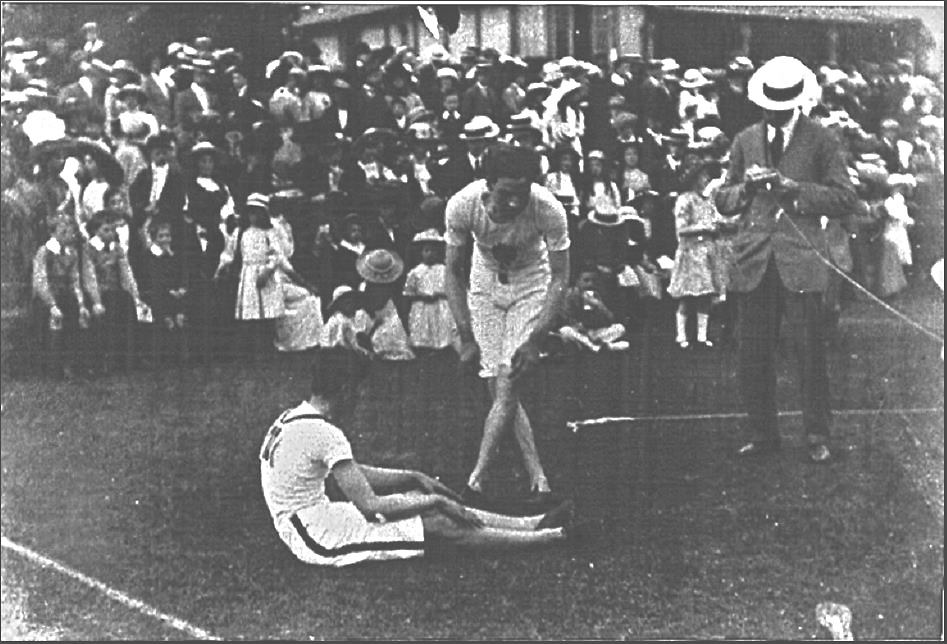
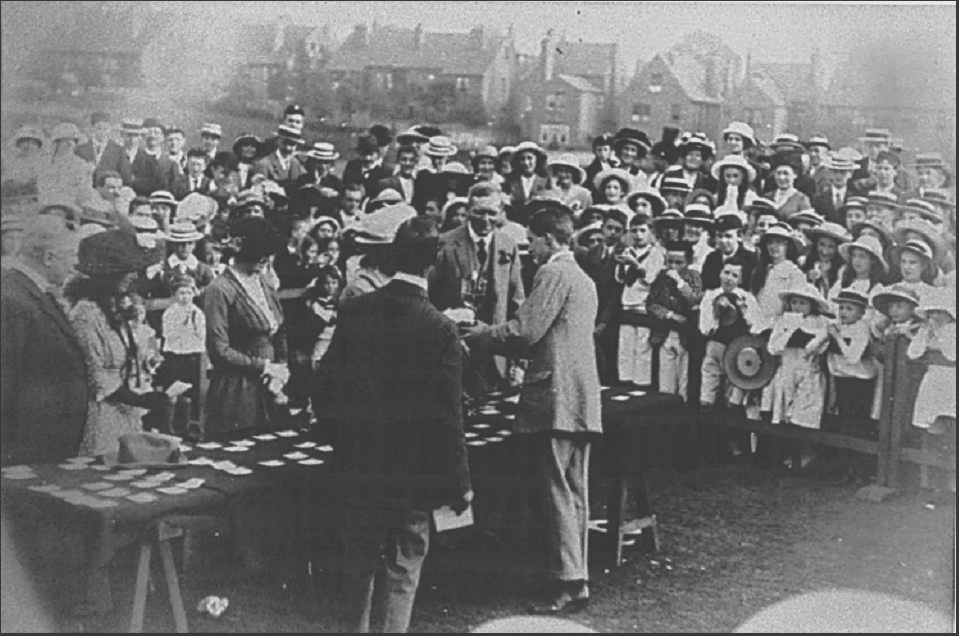
The following year, 1913, was, of course, the very last Sports Day before the thunderstorm that was the Great War carried away the best of this talented generation of young men from the whole of the continent of Europe. Ironically, it was this bittersweet occasion that has bequeathed to us the only photographs that we have of a Sports Day of yesteryear. It is such a pity that they are of comparatively poor quality. This year, of course, marked the 400th anniversary of the school and both this day of athletics and the photographs themselves came as part of this occasion. Here is the huge crowd:
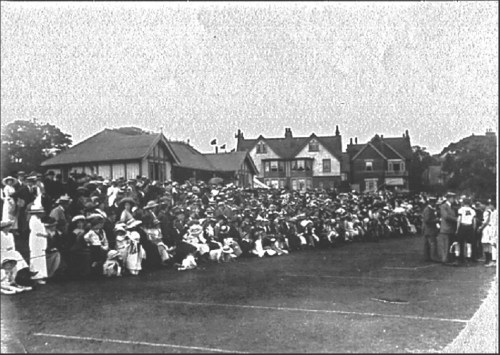
the crowd 1913

Here is the start of a race:

start of race

…and the exciting finish:

end of race 1913 handicap size runners

These are two exhausted athletes:

sports day 1913

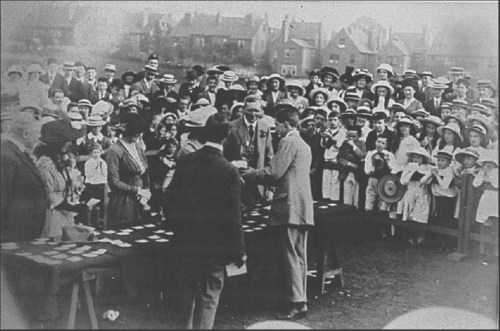
The Headmaster, Dr Turpin, is the gentleman in the very middle of the picture, as the prizes are distributed:
give out prizes

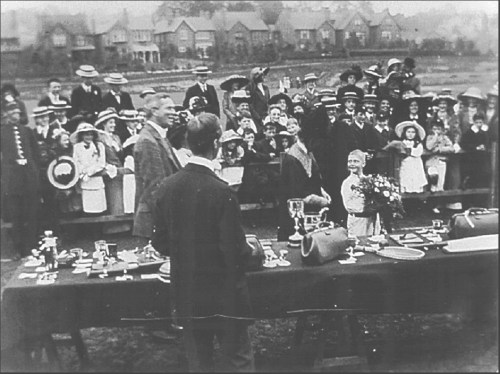
And here he is again, this time making a speech. Look at the policeman and how impressed the little boy is:
prizes 1913

It should still be possible to establish the exact location of the majority of these events. I am sure that the all large Victorian houses in the background will still be there.



8 Comments

Filed under History, Nottingham, The High School

The Great Storm of 1703. Get your kite!

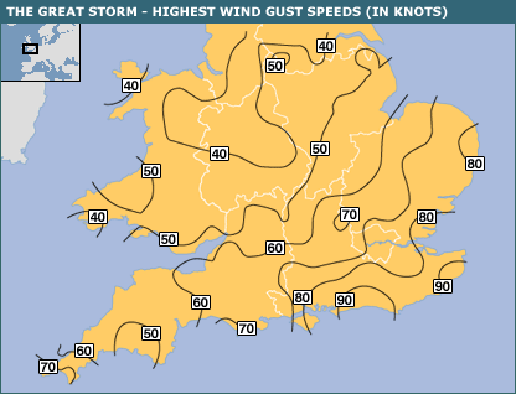
The Great Storm of November 1703 was reckoned to be the most severe storm ever recorded. The hurricane that struck the English Channel and the south of England was beyond anything in living memory:

_44175913_wind_patterns

Unlike today’s storms, when we have advanced warning and can prepare for the worst, the poor souls of 1703 had very little idea about what was about to hit them, other than the fact that the country had been buffeted by a persistent south westerly wind for quite a few weeks. Sailing ships could not sail against it and had therefore been confined in great numbers to whichever port they happened to find themselves near. Inland though, people were largely innocent of the catastrophe they were about to experience. Furthermore, the Great Storm persisted not just for a few shocking hours, but for nine terrible days. How could anything, buildings, ships, farm animals or men stand up against well over a week of wind speeds like those recorded in the eastern part of the English Channel or East Anglia? They would have approached 100 mph for long periods.

It has been variously estimated that between 8,000 and 15,000 people were to perish. John Evelyn, the seventeenth century diarist, described it in his diary as:

“not to be paralleled with anything happening in our age or in any history … every moment Job’s messengers brings the sad tidings of this universal judgement.”

The inhabitants of London felt the first strong breezes during the morning of Wednesday, November 24th 1703, (December 5th 1703 in our current calendar). By four o’clock in the afternoon the winds had noticeably increased. In London, recently out of prison, Daniel Defoe, the journalist, pamphleteer, spy, trader, writer and author, of course, of “Robinson Crusoe”, had a narrow escape in the street when part of a nearby house fell down and luckily missed him. On Friday the 26th, the wind began to blow with even greater ferocity and when the Great Man checked his barometer, he found the mercury had sunk lower than he had ever seen it. After midnight the gale increased to such strength that it was almost impossible to sleep. The noise of the chimneys of surrounding houses crashing into the street made the whole family afraid that their own solid brick townhouse might collapse on their heads. When they opened their back door to escape into the garden, they saw roof tiles scything through the air, some landing thirty or forty yards away, embedding themselves eight inches or more into the ground. The Defoe family decided to stay in their house and trust in the Lord.

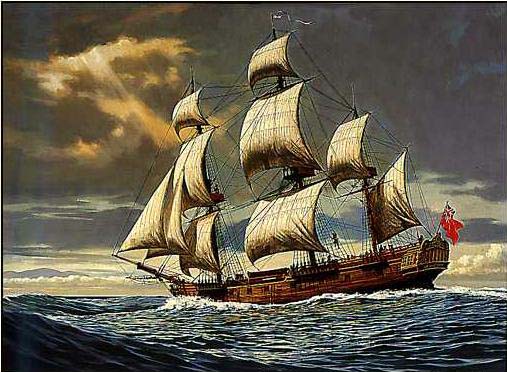
That night of November 26th-27th was catastrophic for the Royal Navy which lost 13 major warships, which were, for the most part, moored along the south coast.  HMS Resolution was driven onto the shore at Pevensey but the ship’s company was lucky and all 221 sailors were saved:

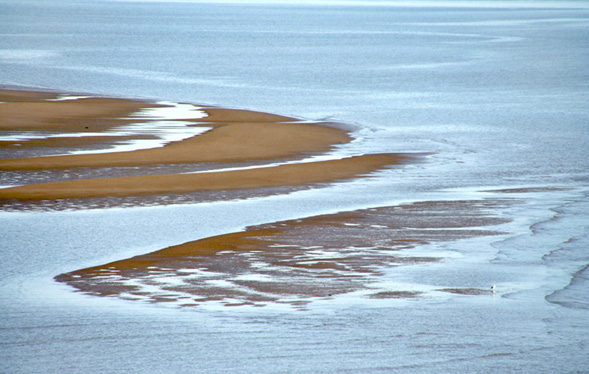
HMS%20ResolutionNot so fortunate were the men on board HMS Restoration, HMS Mary, HMS Northumberland, HMS Stirling Castle and the quaintly named HMS Mortar-bomb, who were all shipwrecked on the Goodwin Sands off the Kent coast:

Sandbanks_Credit_Ben_Salter

In the aftermath, when the tide fell, the sailors of the wrecked vessels who were able to find a foothold on the huge sandbar, were all wandering around knowing that when the tide rose they were certain to be drowned. It was said that a man called Thomas Powell, a shopkeeper in Deal, organised the rescue of some two hundred of them. Supposedly Powell was so appalled by his neighbours’ reluctance to help that he gave them five shillings each for their support. Certainly, the greedy citizens of Deal were widely accused of being more interested in plunder from the unfortunate ships than in helping to rescue the crew members. Indeed, some sources say that only three fortunate individuals survived the Goodwin Sands catastrophe. Supposedly, about 1,500 sailors in total were left to die.
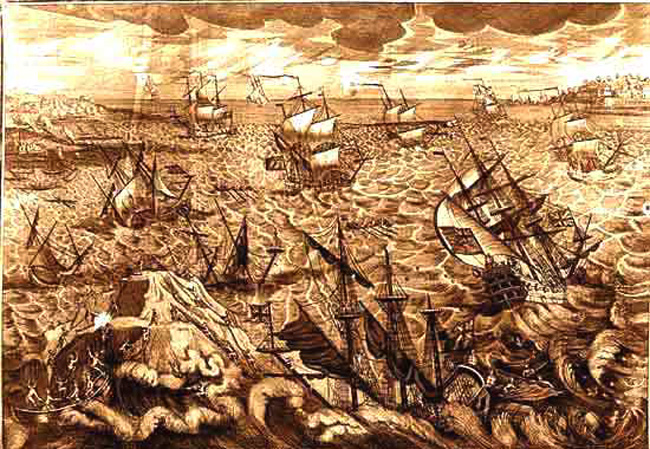
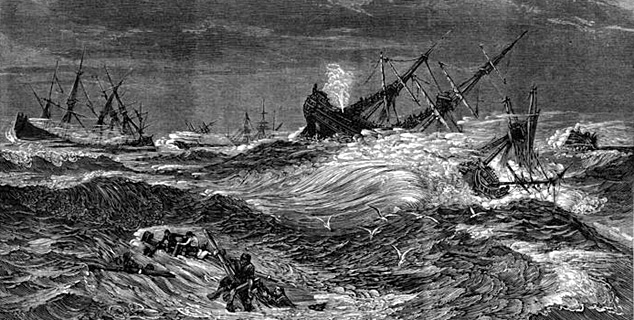
Lots of other naval ships were driven through the Straits of Dover and out into the storm tossed expanses of the North Sea where some survived to return days later but many others were lost without trace:

stormb_1703

Ships were so driven by the wind that not only did sails have to be lowered but the masts had be cut off level with the deck. Well in excess of a hundred merchant ships were sunk in the North Sea, many of which were colliers from the fleet which at the time was used to transport cargoes of coal down the east coast from Newcastle to London. Some of these ships would have been empty, moored or at anchor when the incredible tempest struck, casting them out into the open sea. Most were ill-prepared and foundered, and their crews perished to a man:

141126-great-storm-b

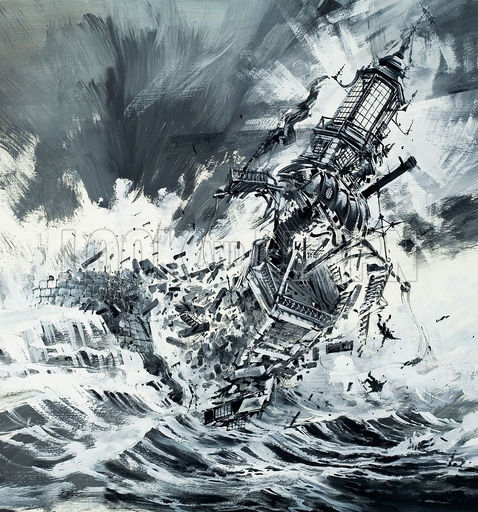
The storm caught a convoy of 130 merchant ships and the six Men O’ War escorting them as they sheltered at Milford Haven. The warships included HMS Dolphin, HMS Cumberland, HMS Coventry, HMS Looe, HMS Hastings and HMS Hector. By the middle of the following afternoon the losses amounted to thirty vessels. Overall it was estimated that more than 8,000 sailors perished as the storm annihilated the Royal Navy. Around 20% of its sailors were drowned. The first Eddystone Lighthouse was completely destroyed:

Destruction of the Eddystone Lighthouse, 1703

Its erection had been started a mere seven years before, and  its light had been lit for the first time only on November 14th 1698.  Now all six of its occupants were killed, including the brave builder Henry Winstanley.

This slideshow requires JavaScript.

This lighthouse was of inestimable importance and stood 120 feet tall,  some twelve miles to the south of Plymouth, one of England’s most important naval harbours. Even the French valued it, when during the period of construction, a French ship took Winstanley and his men prisoner. King Louis XIV, “le Roi-Soleil” ordered their release, explaining that “France is at war with England, not with humanity”, « La France est en guerre contre l’Angleterre, non contre l’humanité! »:

Louis_XIV_of_France

The Great Storm reached its appalling apogee, its catastrophic climax, during the following night, that of November 28th-29th (December 9th-10th 1703). Between the south coast and the Midlands, entire villages from Northamptonshire in the north to Suffolk in East Anglia were devastated  as the winds of the Great Storm rampaged across the country, striking hardest in the south and east of England, sending house roofs flying, flattening barns, razing everything in its path. Both men and animals were lifted off their feet and carried for long distances through the air. Roofs were ripped from more than a hundred churches, the lead was rolled up like a sheet of paper and dumped hundreds of yards away.
Millions of trees were blown over or uprooted; knocked flat in their tens of thousands, they lay prostrate in rows like soldiers mown down in battle. It was said that more than 4,000 oak trees crashed down in the New Forest.  An attempt was made to count the flattened trees in Kent but the count was abandoned at 17,000. The diarist John Evelyn lost in excess of 2,000 trees on his own Surrey estate.
Every kind of building was totally demolished and salt spray was driven almost as far inland as Tunbridge Wells. Animals refused to eat the resultant salty grass.
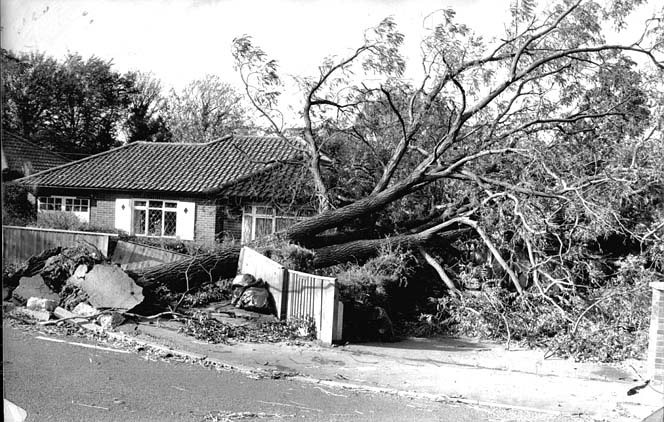
The maximum wind speeds were similar to those of the Great Storm of 1987 but the bad  weather lasted for much, much longer, well over a week, and thereby increased the enormous loss of life. Here is one of the enduring images of 1987:

1987

People could not decide whether it was safer to stay in their house and risk its collapse or to go into the street where flying tiles killed large numbers.
In East Anglia the wind reached over 80m.p.h. and killed well over a hundred people.  More than four hundred windmills were blown down. Many of them  burst into flames because the friction of their sails spinning round at high speed caused their wooden machinery to catch fire. In Cambridge, part of St Mary’s Church fell down and the falling stones completely flattened the organ. It had only recently been installed at a cost of £1,500. Kings College Chapel was equally badly damaged with stone pinnacles toppled and many of the wonderful stained glass windows destroyed.
In the capital, around 2,000 massive chimneys were blown over. The roof was blown off Westminster Abbey and the Queen, Queen Anne, had to take shelter in a cellar at St James’s Palace to avoid falling chimneys and tiles whizzing off the roof. Daniel Defoe told how the Reverend James King of London wrote him a letter about a chimney which crashed down and buried a maid. She was thought to be literally dead and buried, but she came out the following day from a small cavity in the rubble.
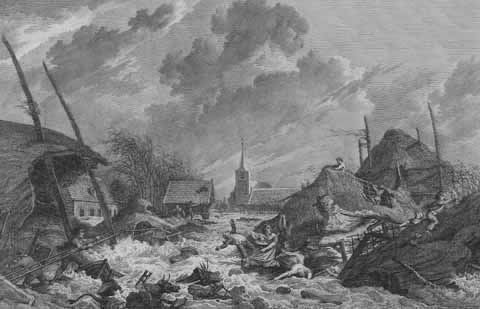
Watersnood_1809

Floods devastated the whole country, especially in the east of England and along the Severn Estuary. In the West Country in general, flooding was extensive and prolonged, particularly around Bristol where just under a thousand houses were totally destroyed. Hundreds of people were drowned on the Somerset Levels, where uncounted tens of thousands of farm animals, mainly sheep and cattle, perished. One lost ship was found fifteen miles inland. At Wells, Bishop Richard Kidder was crushed when two chimneys in the palace collapsed onto him and his wife, both peacefully asleep in their bed. Part of the Great West Window in Wells Cathedral was blown in and smashed to smithereens. At Fairford the church’s west window, facing the raging anger of the oncoming wind, bulged inward and crashed into the nave. In Wales, major damage occurred to the southwest tower of Llandaff Cathedral at Cardiff.
The storm began to die down around December 2nd, and on December 3rd,  Daniel Defoe visited the Pool of London, where, in the section downstream from London Bridge, he saw more than 700 sailing ships all piled up into heaps one on top of another:

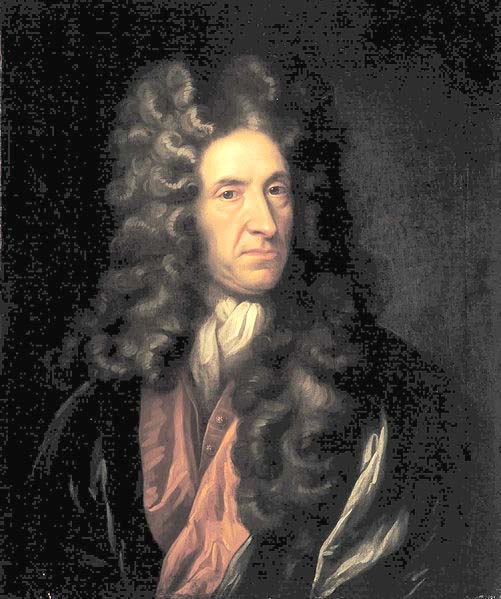
vvvvvv Daniel_Defoe_Kneller_Style

Daniel Defoe told the tale of the captain of a leaking ship who tried to escape what seemed to him at the time to be an inevitable death by drowning, and instead committed suicide—only for his ship to survive. One possibly taller tale related how a sailing ship at Whitstable in Kent was blown out of the foaming sea and then deposited more than a quarter of a mile inland.
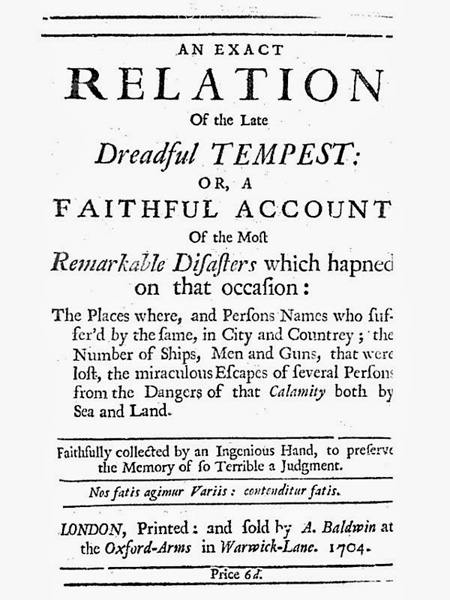
Unsurprisingly, in the aftermath of the Great Storm many special newspapers and publications appeared with information and eyewitness accounts:

the_dreadful_tempest_01b

Conceivably this disaster became “national news” in a way that had seldom, if ever, happened before. It was just like a modern “big story”.
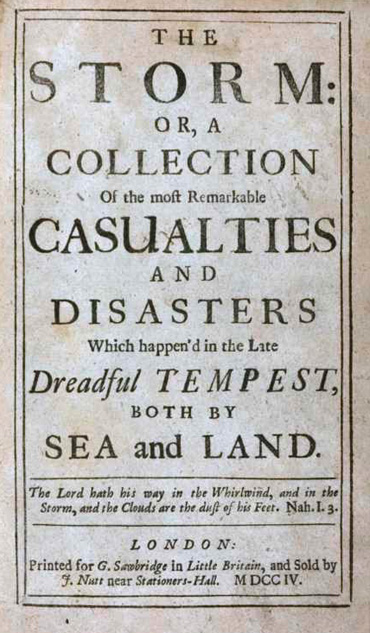
Daniel Defoe himself sought out testimony from as many witnesses as he could find.  When the weather ameliorated, he the whole country assessing the damage. He then produced what was subsequently described as “the first substantial work of modern journalism”, a book of more than 75,000 words, which was called “The Storm”.  It was the first proper book of Defoe’s career.
The_Storm_by_Daniel_Defoe_cover_page
*****************************************

http://historicaltrinkets.blogspot.co.uk/2013/10/the-great-storm-of-1703-eyewitness.html

http://en.wikipedia.org/wiki/Great_Storm_of_1703

http://www.historytoday.com/richard-cavendish/great-storm

12 Comments

Filed under France, History, Science, Wildlife and Nature

Letters carved in stone, sixty years ago

How many times have you walked out of the school’s Forest Road gate, and quite simply, failed to notice the extensive collection of carved initials on the left hand pillar? And if you did notice them, did you disregard them as being just more of the pointless graffiti that we are now forced to accept in the society of the early twenty first century? Or did you carefully look at the dates? But just wait awhile, gentle reader, and imagine the scene to yourself…

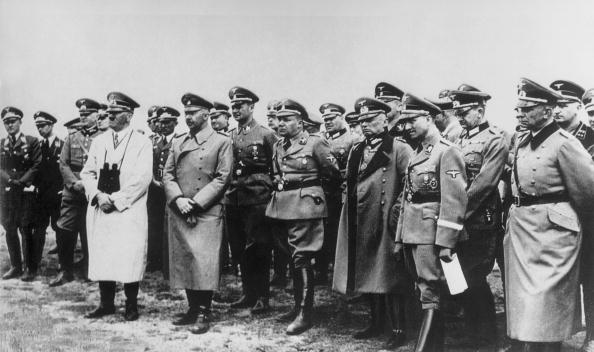
It is late 1942.  In Europe, Hitler stands on the opposite side of the English Channel, watching Dover through his binoculars.

Not A Chance

Great Britain remains resolutely defiant, but largely unable to press home any significant advantage. The British  armed forces are quite simply, not strong enough. There have been hardly any significant victories so far for the British, and there seem to be few obvious ways forward to rid the continent of what will eventually become known as “The Scourge of the Swastika”. Only the victory by Montgomery at El Alamein in North Africa lights up the Stygian gloom. And how many British people actually realise at the time the real significance of the telegram General Friedrich Paulus sends his Führer, telling him that the German Sixth Army is now completely surrounded?

stalingrad_dead_germans_ww2_

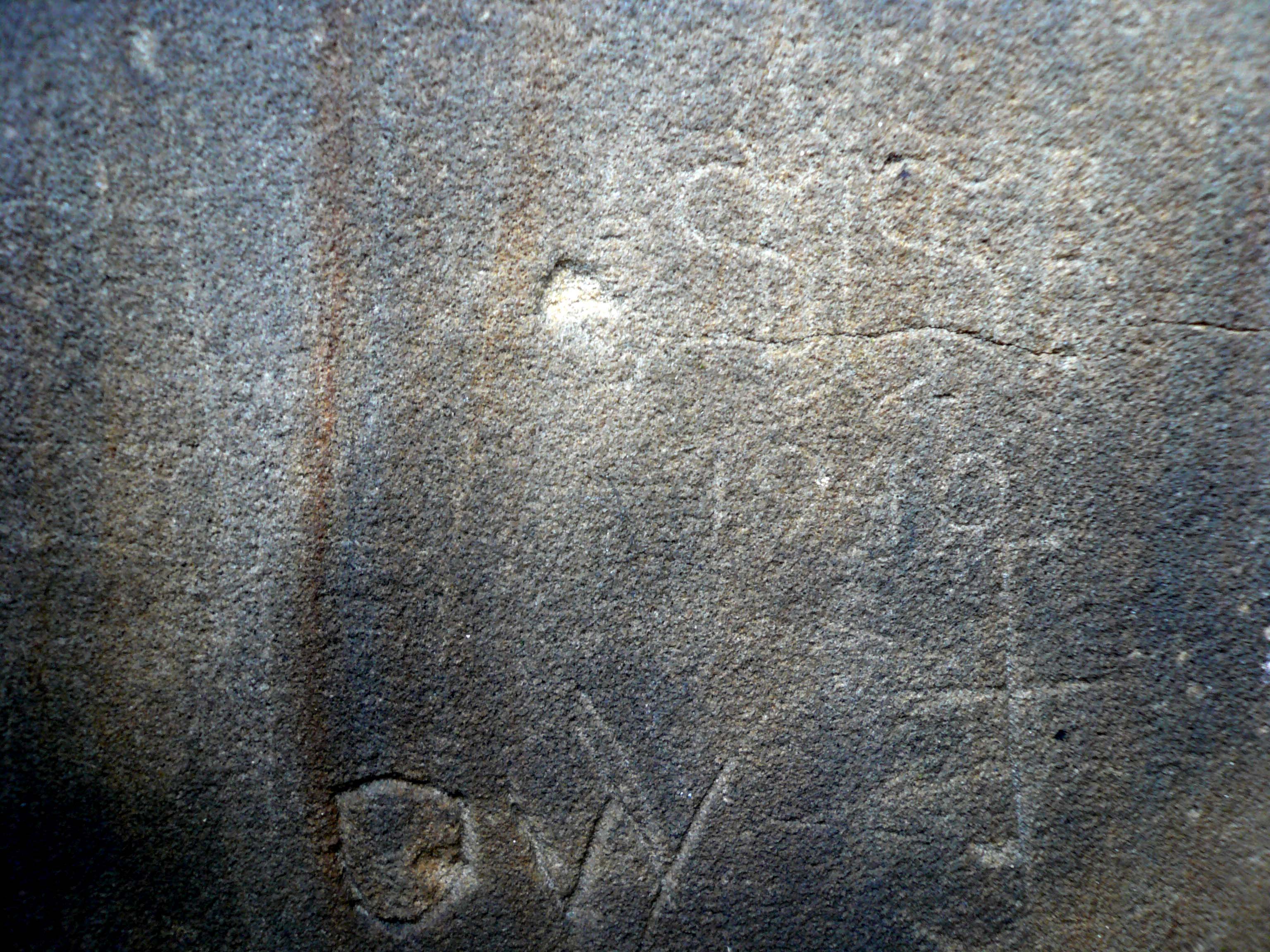
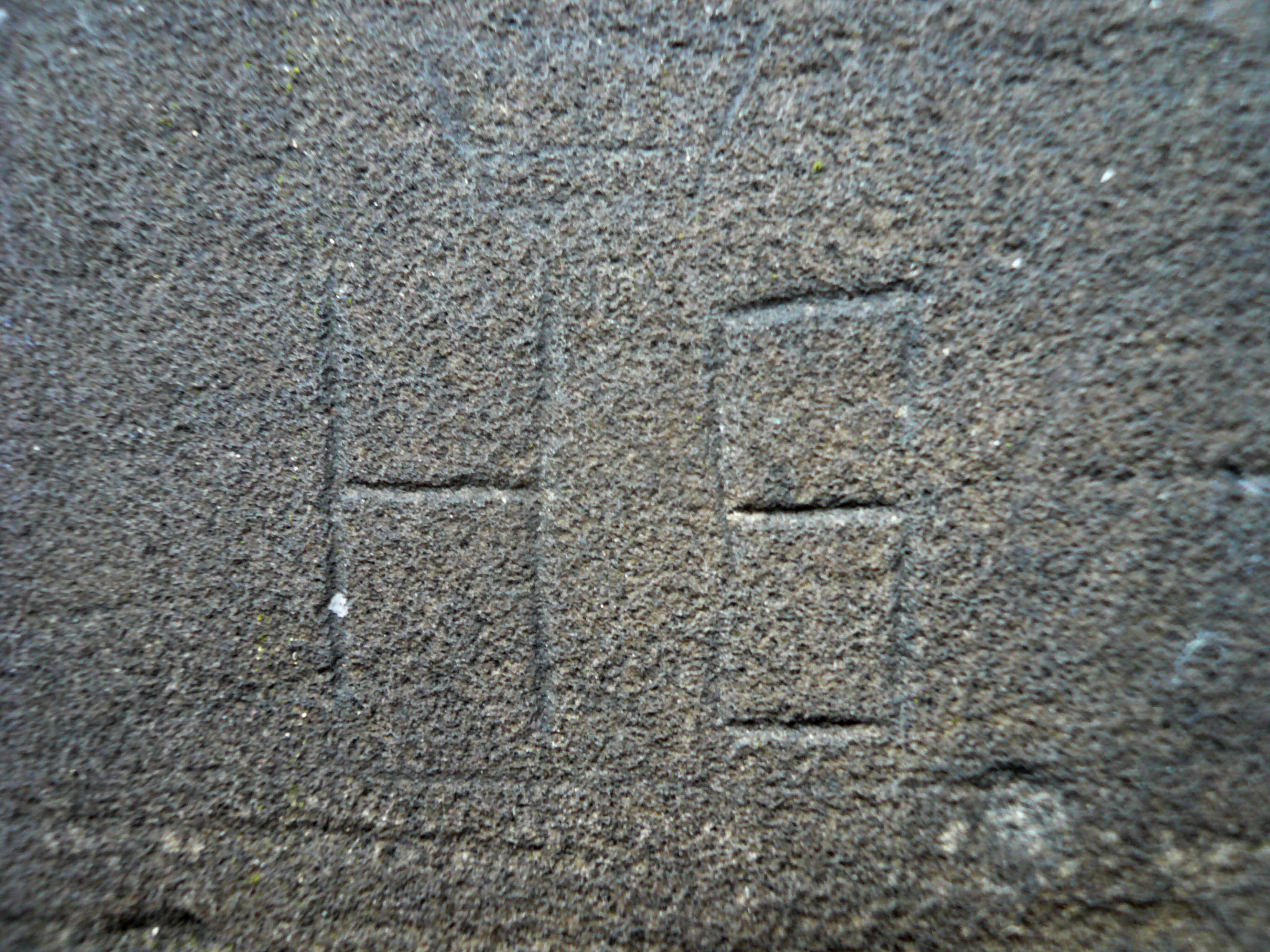
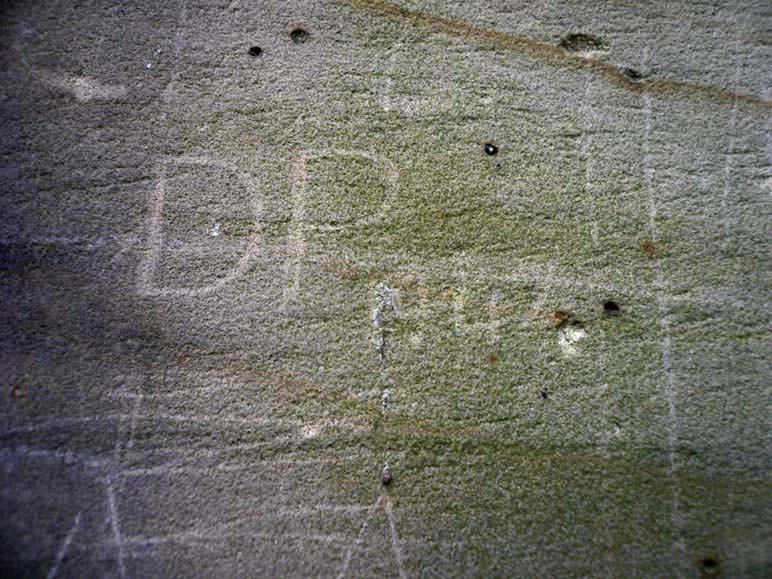
These dark days are recalled on the Forest Road entrance of the High School, where boys, or, more likely, young men, have carved their initials more than seventy years ago. And some dates, and even a slightly misunderstood swastika.

first one

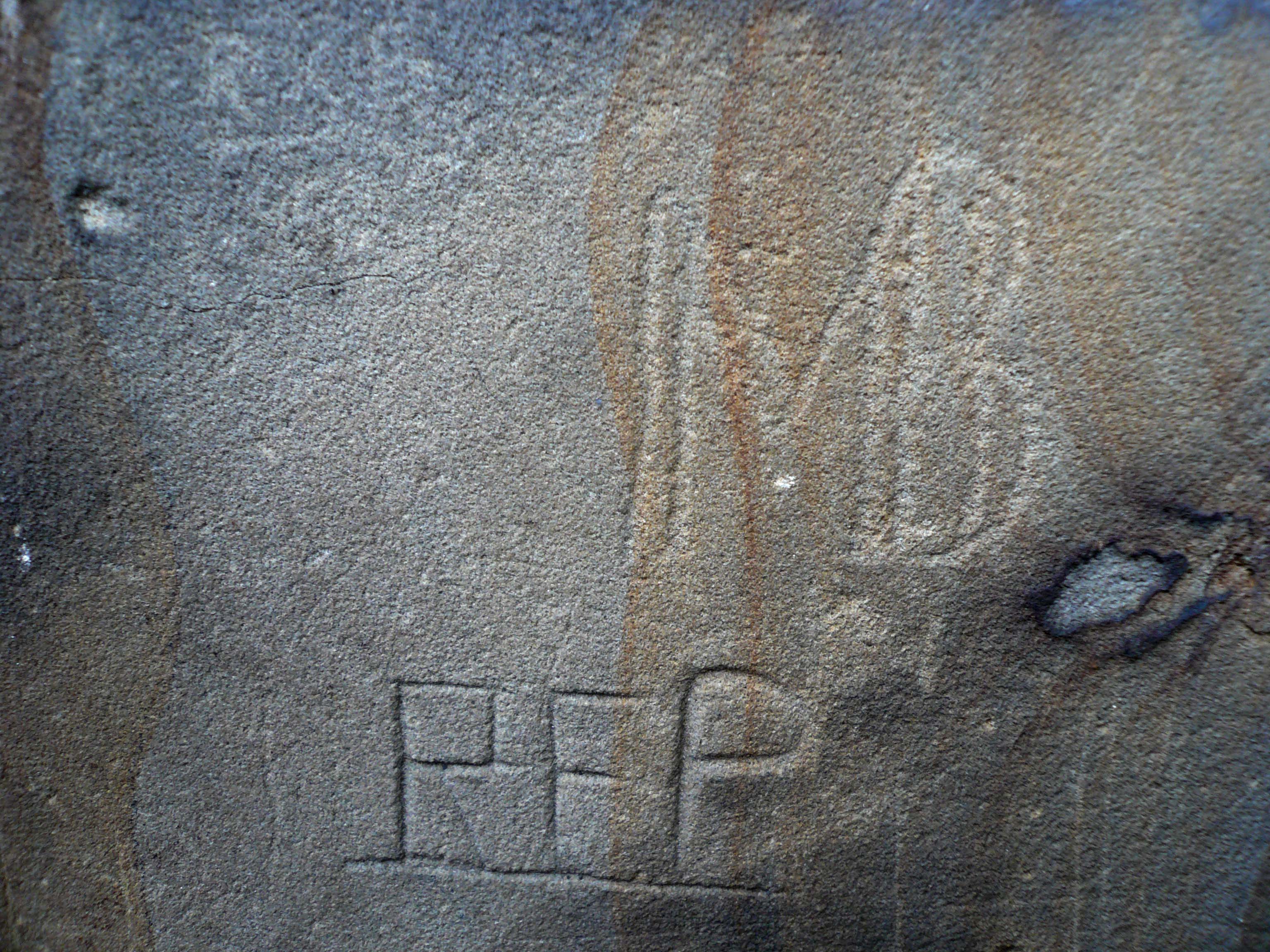
Judging by the physical height of this insolent vandalism, they may well have been in, say, the Fifth Form, literally, upwards. They include what appears to be “WH 1942”, “DP” and “DP 1942”, along with what may possibly be “SS 1940”, and the undated “MB”, “HE”, “HS” and “PFP”. Indeed, the only problem with these initials is that they are extremely difficult to photograph, because, like other interesting acts of vandalism, they are hidden away from direct sunlight, and the subleties of the various shades of stone have proved beyond the capabilities of my camera, even though it does have quite a decent lens. Only Photoshop has dragged the past out into the present.

P1220254START VHERE

My subsequent researches, and best guesses, have revealed a few likely suspects. “WH” and “DP” may conceivably have been young colleagues in the Fifth Form A with Mr.Whimster during the academic year 1941-1942.

William Norman Hill was born on November 23rd 1927, and entered the High School on September 20th 1938 at the age of ten. His father was Mr F.Hill, a School Master of 8, Lexington Gardens, Sherwood. He left the school on July 31st 1945.

Dennis Plackett was born on October 22nd 1927. He entered the school on Monday, September 25th 1939, at the age of eleven. His mother was Mrs.Ellen Plackett, a housewife of 7, Anthill Street, Stapleford.  Dennis was a gifted young man, a Nottinghamshire County Council Scholar, and he left the school on August 1st 1944.

Another interpretation is that “WH 1942” was William Jack Harrison. This young man was, quite simply, outstanding. He was born on December 5th 1924, and entered the High School on September 19th 1935 at the age of ten. His mother was Mrs E.M.Harrison of 53, Burlington Road, Sherwood.  He would have been in the Upper Fifth Form with Mr.Palmer in 1941-1942, and then in the Mathematical and Science Sixth Form with Mr.Holgate during the academic year of 1942-1943. William stood out in two separate areas. In 1940 he was initially a Lance-corporal in the Junior Training Corps, but he soon became a full Corporal. In 1941, he won Mr Frazier’s prize for the most efficient Junior NCO or cadet, and was then named Commander of the Most Proficient House Platoon. At some point towards the end of the academic year of 1941-1942, he promoted to be the Junior Training Corps Company Sergeant Major.

In addition, in the sporting world, by the time the School List for 1942-1943 was published, William had won his First XV Colours and his Cap for Rugby and had been named as Captain of Rugby. In the Summer Term, he went on to be the Captain of Cricket, and to be awarded his Cricket Colours and his Scarf. He was also, by dint of his sporting position as Captain of Cricket, a School Prefect. William left the school on December 19th 1942.

The reason that I myself would prefer this interpretation is that “DP” and “DP 1942” may well be David Phillips, who was in the Economics Sixth Form with Mr Smyth during the two academic years of 1940-1941 and 1941-1942. He may well have been carrying out some kind of school tradition when he carved his name and the date on the pillar, knowing that he was going to leave the school in July 1942.

7ngttrrrrr

David was born on May 2nd 1923, and entered the school on January 13th 1935 at the age of eleven. His father was Mr P.Phillips, a Factory Manager of 45, Austen Avenue, on the far side of the Forest Recreation Ground.

austen a2

We have relatively few details of David’s career at the High School, but we do know that by September 1941, he was a Corporal in the Junior Training Corps. In the Christmas Term of 1942, he was awarded his Full Colours for Rugby, and he became a School Prefect. David was also awarded his Rowing Colours for his achievements with the Second IV.

I have a very strong feeling that these two young men were friends. Austen Avenue, of course, is arguably, on the same cycle route home as Burlington Road, Sherwood, where William Harrison lived.

burlington a2


Perhaps the two walked down together across the Forest Recreation Ground, and David would then get on his bike and cycle slowly off towards Austen Avenue. William would continue down what would have been at the time an undoubtedly more traffic free Mansfield Road, towards Burlington Road in Sherwood.

David Phillips shared the very same interests as William Harrison. They were both in the same rugby team, and both seemed to have loved sport, whether rugby, cricket or rowing. They were both in the Junior Training Corps and clearly were attracted to the military life. As regards their academic classes, they were a year apart, but I feel that their common interests would have overcome this difference, especially when the two rugby players, or Junior Training Corps members, realised that they could walk down across the Forest together every evening after a hard day at school.

And when the end of 1942 came round, they may well both have left the school on the same day, December 19th. Were they both going into the Army together?

The interpretations above are all based on a combination of informed best guesses, a thorough search of the relevant School Lists and registers and the usual human desire to take purely circumstantial evidence as proven fact. Not surprisingly, though, it has proved impossible to trace any of the other initials in any meaningful kind of way. There were quite simply too many possible “SS”s in 1940, and “MB”, “HE” and even “PFP” have all proved equally beyond my powers. Even so, this must be among the oldest graffitti in Nottingham.

one


13 Comments

Filed under History, Nottingham, The High School

Staff v Prefects Football Match Christmas 1980 (3)

These are the last four of the ten photographs I found recently of the Teachers v School Prefects football match.  This keenly fought fixture took place probably just before Christmas in 1980, give or take a year either way. My beautiful new wife was watching the game, armed with my camera, if I remember correctly.
This first photograph shows myself and Ron Gilbert, the ex-Chemistry teacher who retired recently. We look as if we are holding a quick debate about who is going to chase after the ball:

PHOTO A

The second photograph shows the then Head of Music, Stephen Fairlie, and the red shirted referee, Richard Willan. Red Fourteen is a Prefect playing in a staff shirt to make up the numbers. Incidentally, the staff are playing in the shirts normally worn by the school Second Eleven Football Team. These, in their turn, were, for reasons that must surely remain unknown now for ever, the second, change, strip of Sunderland A.F.C.

PHOTO B

The third photograph shows three members of staff. Number Three on the right with his back to the camera is Paul Morris, the now retired Physics teacher. I myself am Number Two in the middle and Number One is Andrew Ayres, a native of Hartlepool if I remember correctly, a young teacher of Chemistry and a colleague of Ron Gilbert. Andrew moved on to Wisbech Grammar School in Cambridgeshire, where he became the senior tutor and examinations officer as well as continuing as a chemistry teacher. He retired in July, 2014. Once again, the Prefects will have to remain nameless:

PHOTO C

The final picture shows Stephen Fairlie, the then Head of Music, as Number One on the left, and Bob Howard, Geography teacher and Best Man at our wedding, as Number Three on the right. In the centre is Number Two, Phil Eastwood, who was the then Head of Chemistry. Phil is a very keen supporter of Manchester City and that is where, I would imagine, his socks came from:

PHOTO D

I would like to finish these three blog posts with a piece of medieval poetry. Medieval French poetry, no less. Well, from 1533. It was written by François   Villon. (You can click on both names)
The days when I knew about such things are very distant, but ironically, that is the whole point of the poem:

Dictes moy où, n’en quel pays,

Tell me where, in which country

Est Flora, la belle Romaine ;

Is Flora, the beautiful Roman;

Archipiada, né Thaïs,

Archipiada, born Thaïs,

Qui fut sa cousine germaine;

Who was her first cousin;
Echo, parlant quand bruyt on maine

Echo, speaking when one makes noise

Dessus rivière ou sus estan,

Over river or on pond,

Qui beauté eut trop plus qu’humaine?

Who had a beauty too much more than  human ?

.

Mais où sont les neiges d’antan!    

Oh, where are the snows of yesteryear!


Où est la très sage Heloïs,

Where is the very wise Heloise,

Pour qui fut chastré et puis moyne

For whom was castrated, and then made a monk

Pierre Esbaillart à Sainct-Denys?

Pierre Abelard in Saint-Denis ?

Pour son amour eut cest essoyne.

For his love he suffered this sentence.

Semblablement, où est la royne

Similarly, where is the Queen

Qui commanda que Buridan

Who ordered that Buridan

Fust jetté en ung sac en Seine?

Be thrown in a sack into the Seine?


Mais où sont les neiges d’antan!    

Oh, where are the snows of yesteryear!


La royne Blanche comme ung lys,

The queen Blanche, white, as a lily

Qui chantoit à voix de sereine;

Who sang with a Siren’s voice;

Berthe au grand pied, Bietris, Allys;

Bertha of the Big Foot, Beatrix, Aelis;

Harembourges qui tint le Mayne,

Erembourge who ruled over the Maine,

Et Jehanne, la bonne Lorraine,

And Joan of Arc the good woman from Lorraine

Qu’Anglois bruslerent à Rouen;

Whom the English burned in Rouen ;
Où sont-ilz, Vierge souveraine ?

Where are they, oh sovereign Virgin?

.

Mais où sont les neiges d’antan!         

Oh, where are the snows of yesteryear!


Prince, n’enquerez de sepmaine

Prince, do not ask me in the whole week

Où elles sont, ne de cest an,

Where they are – neither in this whole year,

Qu’à ce refrain ne vous remaine:

Lest I bring you back to this refrain:

Mais où sont les neiges d’antan!         

Oh, where are the snows of yesteryear!

7 Comments

Filed under Football, France, History, Humour, Literature, Nottingham, Personal, The High School