Frank Roy Daughton, friend of S.A.Casswell

A little while ago, I wrote about a Schoolboy’s Diary which I had bought on ebay. The 1935 diary had been owned by S.A.Casswell , who lived in Lincolnshire, at Sutterton near Boston. Only a few minutes searching on the Internet revealed some rather sad details about the one single person listed by S.A.Casswell in the address section of his Diary.
Frank Roy Daughton had lived firstly at 385, Kings Road Chelsea and then at 5, Gerald Road S.W 1. He was an officer originally in the RAFVR, the Royal Air Force Volunteer Reserve, and then in the RAF.
Given that Daughton’s job was to fly aircraft over long distances, both within Great Britain and abroad, he was surely continually in search of meteorological information before he set off on any of his trips. What more logical person to consult than his friend S.A.Casswell, who we know worked on the staff of the Meteorological Office as a Meteorological Officer?
Roy Daughton was born in London around 1915. His father was Frank Daughton and his mother was Bertha Daughton. The first personal detail that I have been able to trace is that before the war he was a member of the Metropolitan Police. His warrant number was 124334. He joined the force on July 15th 1935, and he left on February 25th 1944. His last posting was as a Police Constable in the C.I.D in X Division.

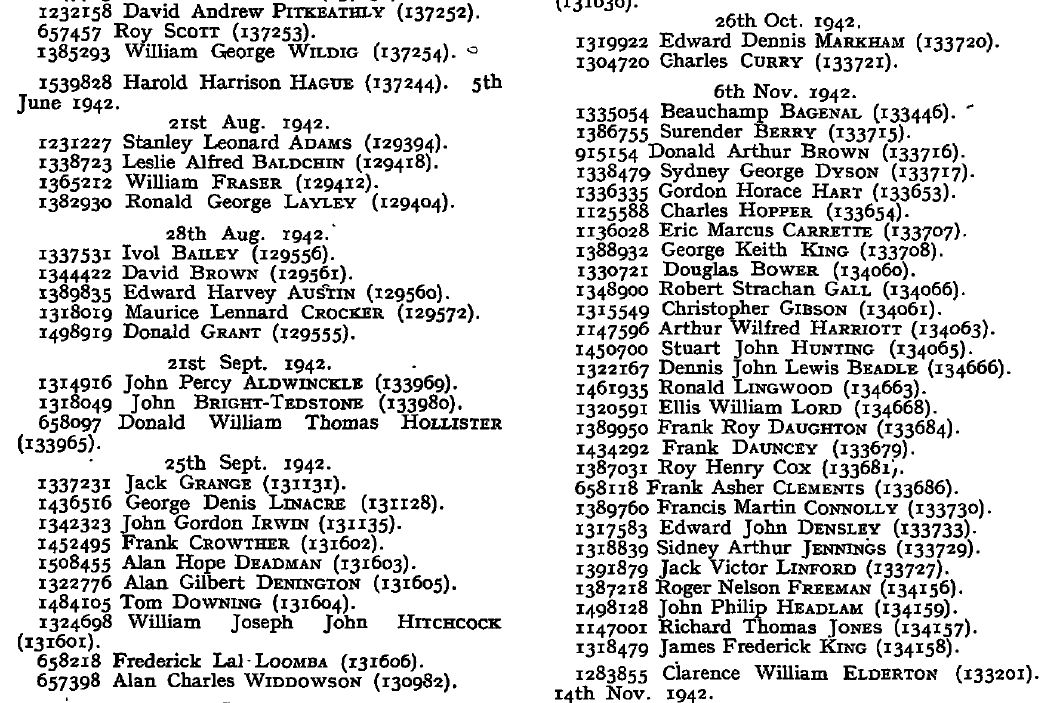
During the war, Roy Daughton was a Flying Officer, Number 133684. He began his career as a pilot with 9 OTU (Operational Training Unit) who were tasked with training long-range fighter aircrew. They operated from RAF Aldergrove in Northern Ireland, eighteen miles from Belfast. Roy Daughton must have served with 9 OTU at some point between 1942-August 11th 1944, as they were a comparatively short lived organisation.  He had received his commission on February 2nd 1943.

2' 2'43  supplement to LOndon Gazette
Roy Daughton then served with the OADU, the Overseas Aircraft Despatch Unit.  Their difficult and dangerous job was, quite simply, to co-ordinate the ferry flights of military aircraft, perhaps, for example, from the end of a factory production line in the United Kingdom to their new home on some distant foreign airbase. The commonest destination was North Africa or the Middle East. Sometimes, they ferried American aircraft which had just been flown across the Atlantic Ocean. This latter task in itself could be enormously dangerous, especially in the case of relatively small aircraft such as the Lockheed Hudson. The Overseas Aircraft Despatch Unit operated from RAF Portreath in west Cornwall.

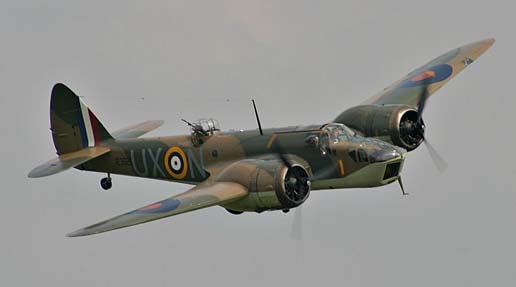
The OADU’s very first customers were four Boeing B17C Flying Fortresses bound for Egypt. Other frequent flyers were Bristol Blenheims, Bristol Beaufighters, and Vickers Wellington bombers.

This slideshow requires JavaScript.

Roy was to die on February 25th, 1944 aged only 29. I have been completely unable to trace the circumstances of his death, although it was presumably either while or after delivering an aircraft from the United Kingdom to North Africa.

map of rabat

Roy is buried in Morocco, a very long way indeed from his cosy home in London. He lies in Rabat European Cemetery, Mil. Plot 21. Grave 673.

Daughton_F_R grave

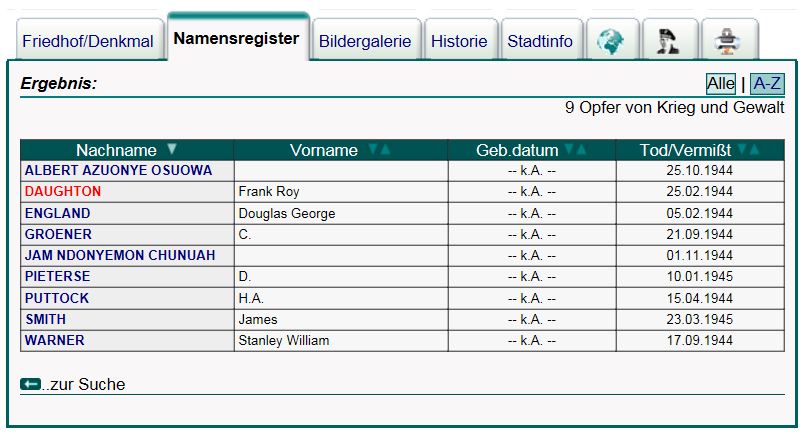
Roy is one of only nine war casualties in this far flung cemetery.

gereman websiteAt the time of his death Frank was a married man. His wife, who was about a year younger than him, was called Doreen Margaret Daughton, and the family home was in Maida Vale in London. In addition, I also discovered that in 1946, a Doreen M. Daughton left the port of Southampton in England and sailed to Halifax in Nova Scotia, Canada. She later crossed the border into the USA, but after that, the trail has, as they say, “run cold”.
And that is it. Frank Roy Daughton’s life, or what I personally have been able to find out about it. No medals, no fanfares. Nobody even seems to remember why he died at that premature age of around twenty nine years, or how or exactly where. What was he doing when he was killed? Was it his fault? Was he flying? Did he run out of fuel? Was he just walking perhaps, tired and inattentive, across a busy Moroccan street? And did S.A.Casswell ever know that his brave young friend was dead?

Leave a comment

Filed under Aviation, Cornwall, History

Schweinfurt One: sixty B-17s downed, 559 airmen killed

I am sure that most people would understand the difference between “hot courage” and “cold courage”. During a robbery, the person who suddenly confronts the would-be robber and tries, as the English say, to “have a go” is showing hot courage. The same would be true of the person who tries to drag an unconscious victim out of a burning car crash. In the context of war, it may be the man who solves the sudden problem of an enemy tank by jumping onto the top of it and throwing a hand grenade in through the hatch.
All of these acts show great heroism, but as far as I am concerned, “cold courage” takes it all into a different dimension. “Cold courage” is the person who faces a painful terminal disease without losing his dignity. “Cold courage” is the person who sets off to walk along a highwire stretched hundreds of feet off the ground between two skyscrapers. “Cold courage” is the fireman who looks up at that staircase in the North or South Tower, and starts climbing, because he knows that it is his duty to try and save people, even if it may be at the expense of his own life. In the context of war, “cold courage” is the man who sits on his bunk for a whole afternoon, waiting for the chance to get into a bomber at nine o’clock and then fly off into the night skies over Germany, not only risking death, but knowing that, statistically, death is a very likely outcome. The only thing more difficult than doing this as far as I’m concerned, would be the chance to fly over Germany in broad daylight, when you have the opportunity to see exactly what is happening to everybody else, and may well happen to you.
Early on in the Second World War, the RAF tried to place their tiny bombs accurately on exclusively military targets during the hours of daylight when, theoretically, it should have been relatively easy to do so. The only problem was that the German fighters of the day were all easily capable of shooting down these poorly armed bombers without any real problems. Between May 10th-May 28th 1940, losses of the Bristol Blenheim bomber, for example, were almost unbelievable. (Search for “Known Individual Aircraft Records”)

bristol-blenheim-xxxxx

For that reason, the RAF soon turned to night bombing. Equally swiftly, they found that it was virtually impossible to hit relatively small military targets with any accuracy at night. They would be better employed in bombing the areas of the city around the enemy factories, in an effort to kill or injure the workers who worked there. This new tactic carried out the directive that had been agreed on at the Casablanca Conference.

“Your Primary object will be the progressive destruction and dislocation of the German military, industrial, and economic system, and the undermining of the morale of the German people to a point where their capacity for armed resistance is fatally weakened.”

When the United States came into the war in Europe, effectively in 1942, their bombers were equipped with the famous Norden bombsight, which was supposedly capable of dropping a bomb into a pickle barrel from 30,000 feet up. Putting their faith into the bombing accuracy achievable with their marvellous bombsight, the Eighth Air Force ignored British advice that, because of the very high standards of Luftwaffe fighter pilots, bombing at night was the only sustainable method of carrying on the struggle against the Germans. The Americans, therefore, persisted with their daylight raids.

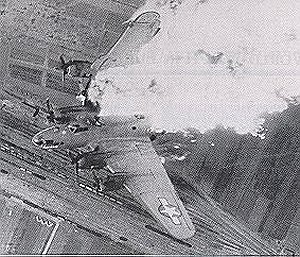
B-17G%20Flying%20FortresszzzzzzzzAfter a few months of daylight bombing, much of it over France rather than the Reich itself, the idea was mooted that enormous and significant damage could be inflicted by bombing the German factories which produced ball-bearings, as they were vitally important to the entire German war machine. Virtually every single military vehicle and aircraft depended on them. The Mighty Eighth, therefore, exactly a year to the day after their first gentle raid, Mission 1 on August 17, 1942 against the Sotteville Marshalling Yard at Rouen in France, decided to attack these important factories . This would be Mission 84, scheduled for August 17, 1943, a complex two-pronged attack on the ball-bearing works at Schweinfurt and the Messerschmitt aircraft works at Regensburg. The raid would be the furthest penetration into German territory to date, some 800 miles from the coast. What happened is the most wonderful example of “cold courage” that anybody could wish to meet.
The greatest problem for the Eighth Air Force was that none of their own fighters, nor those of the RAF, had anywhere near the range required to escort the slow, heavily laden B-17s to their targets. The main defensive tactic, therefore, was to form up the Flying Fortress bombers into huge boxes, where, theoretically, every single aircraft could protect, and could be protected by, all the other aircraft.

1157x829xBoeing-B-17E-Flying-Fortresses-form-up-over-England-1942_jpg_pagespeed_ic_CkVpDznVhI

This procedure took a very long time to organise with hundreds of bombers to be fitted into the formation. And this was the first problem: all this activity was completely visible to the German radar. I can remember my own father telling me how he had watched these brave young men get ready to go into battle…

“ On a number of occasions, Fred had stood on a long forgotten airfield in East Anglia and watched the American Eighth Air Force prepare to depart on a daylight raid over Germany. Their B-17 Flying Fortresses would circle seemingly for hours over their bases, as they slowly and precisely formed up into their famous defensive boxes, intricate arrangements of, perhaps, up to a thousand heavily armed bombers whose almost countless machine guns, in theory, were capable of offering covering fire to all of their fellow aircraft. Once the B-17s were ready, it was as if somebody blew a bugle unheard far below on the ground and all the bombers would then suddenly set off to war, tracing their gleaming contrails across the blue sky, eastwards in the sunshine towards the Third Reich.”

This slideshow requires JavaScript.

The Eighth Air Force raid caused a 34 per cent loss of production at Schweinfurt but this was soon made up for by surplus supplies of ball bearings from all over Germany. The industry’s infrastructure, while vulnerable to a sustained campaign, was not vulnerable to destruction by a single raid.
The Nazi Minister of Armaments, Albert Speer , later wrote that the Eighth Air Force’s major error was to attempt a second attack on Regensburg at the same time as the main attack on Schweinfurt, and not to continue with further raids on Schweinfurt after the first one.
Some of the B-17s were over Germany for a period in excess of two hours with no fighter protection whatsoever, and the Luftwaffe were quick to take advantage of the situation. Given the fact that they had picked them up on radar over East Anglia, the Germans were able to call up extra fighters from all of their bases, stretching from southern France to Norway in the north. Many fighters were able to expend their ammunition in massed attacks on the American bombers, land again for fresh supplies of fuel and weapons and then rejoin the battle.

This slideshow requires JavaScript.

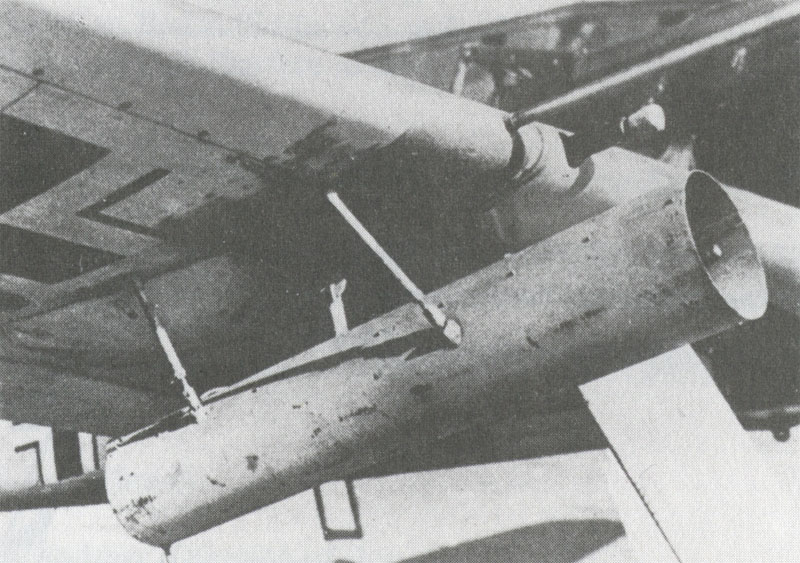
The German fighters were well aware of the B-17s’ inadequate forward armament and their vulnerability to head-on attack. Against the 0.50 calibre Browning machine guns of the Flying Fortresses, the German fighters were all equipped with cannon which fired explosive shells. In theory, just one hit could bring down a bomber. Much longer ranged than the machine guns, this enabled the Germans to fly well out of the range of the B-17s’ machine guns and fire off short bursts of cannon shells at intervals. Some fighters carried sophisticated rocket weapons, including mortars propelled by rockets, all of them capable of wiping out a B-17 in just one shot.

rocket tubes

Tales are also told of the Germans using either obsolete combat aircraft or training aircraft to fly high above the American formation and drop air-to-air bombs.
This account from  Archie J.Old Junior, a thirty seven year old Texan,  is quoted in “The Mighty Eighth” by Gerald Astor

“The fighters were all over us. They really got interested in me. German fighters came up from every point of the compass after our fighters turned around. (Just before the German frontier). And they were already throwing flak at us when we were five to ten minutes away from the target.” (Some thirty or forty miles)

In “Eighth Air Force”, Donald L.Miller describes pretty much the same situation, once the P-47s had been forced to turn back…

“…a hailstorm of fighter assaults that continued almost all the way to the target. (Beirne Lay, Jr) wrote, “I knew that I was going to die, and so were a lot of others.”

b17_direct%20hit

Overall, American casualties were way beyond the sustainable. For Bomber Command that most basic of figures had been set at 4%. On this raid 230 bombers had taken part, and sixty of these were destroyed. A tiny number finished up in Switzerland, and “thanks to the luck and the skill of the RAF Air-Sea rescue teams”, everybody who went into the icy waters of the North Sea (yes, even in August) was rescued. Five hundred and fifty two men were killed in the air, and seven poor souls made it back home, but, alas, were to succumb to their injuries. Twenty one men were badly wounded.
Beyond the sixty B-17s shot down, between 55-95 further aircraft were badly damaged. Of these, many were too severely damaged ever to be repaired.

This slideshow requires JavaScript.

Of the fighter escort, two P-47s of the 56th Fighter Group were destroyed and so too were two Spitfires from the RAF. The fighters claimed more than 30 kills, but the gunners on the B-17s were very optimistic with their claim of 288 German fighters destroyed. After the war, Luftwaffe records showed just 27 aircraft had been lost.
The very biggest problem of daylight raids by the Eighth Air Force deep into enemy territory was the lack of adequate long-range fighter escort. Some of the Schweinfurt Flying Fortresses were over German-occupied territory for three hours and thirty minutes. Of this period of time, there was no fighter support whatsoever for two hours and ten minutes, which included all of the time spent over Germany itself.

By one of those extraordinary coincidences which are sometimes thrown up, the night of August 17th-18th 1943, saw the British RAF engaged in “Operation Hydra”, which turned out to be one of the more significant raids of the war. Using 324 Avro Lancasters, 218 Handley Page Halifaxes and 54 Short Stirlings, attacks were made on the V-Weapon rocket testing grounds at Peenemünde in the Baltic to the east of Denmark.

Clearly, rocket weapons of the calibre of the V-1 and the V-2 quite simply had to be destroyed, certainly with the Allies envisaging a landing on the coast of France within less than a year.

Indeed, the bomber crews were actually told at their briefings that unless they were successful that particular night, they would be going back to Peenemünde again on the 18th, the 19th, the 20th, and, indeed, they would keep returning until the target was completely destroyed. This certainly concentrated their minds enormously, and, with  operations directed for the first time by a “Master Bomber”, namely  Group Captain John Searby, the Commanding Officer of 83 Squadron, they achieved great success.
Joseph Goebbels, Hitler’s Minister of Propaganda, himself said that the raid had cost the German efforts “six to eight weeks”, a figure agreed by the RAF who wrote in their official history that the attack “may well have caused a delay of two months.”

Although there were those who judged that the raid was “not effective”, an important figure, Chief Engineer Walther, was killed, but most significantly perhaps, so too was the hugely influential Doctor Walter Thiel who had provided the key ideas for the A4 rocket engine, later used to power the horrendous V-2 and indeed, in its developed form, NASA’s rockets into space.
The protection of the darkness was obvious in the casualty figures. Bomber Command lost 6.7% of their bombers and a total of 215 men were killed out of an approximate total of just over four thousand participants. Focke-Wulf Fw 190 night fighters claimed 29 of the 40 bombers shot down. Coincidentally again, the German night forces had employed for the first time ever, three twin engined Messerschmitt Bf 110 fighters with the deadly combination of radar and Schräge Musik upward firing cannons.

This slideshow requires JavaScript.

To make their night fighters even more formidable, the Luftwaffe taught  all their crews exactly where a Lancaster’s most vulnerable spots were…the enormous fuel tanks.

schrage-004

In another blog post, I will look at what the Eighth Air Force did next after the Schweinfurt raid, and their continuing “cold courage”, as they regrouped their strength after what must surely be considered, despite the immense resolution and extraordinary bravery of the Americans, one of the great catastrophes of the Allied air war.

12 Comments

Filed under Aviation, Bomber Command, History

A Greater Sand Plover? A Lesser? A Medium Sized??

(An extract from my old birdwatching diary “Crippling Views”)

Sunday, July 31, 1988

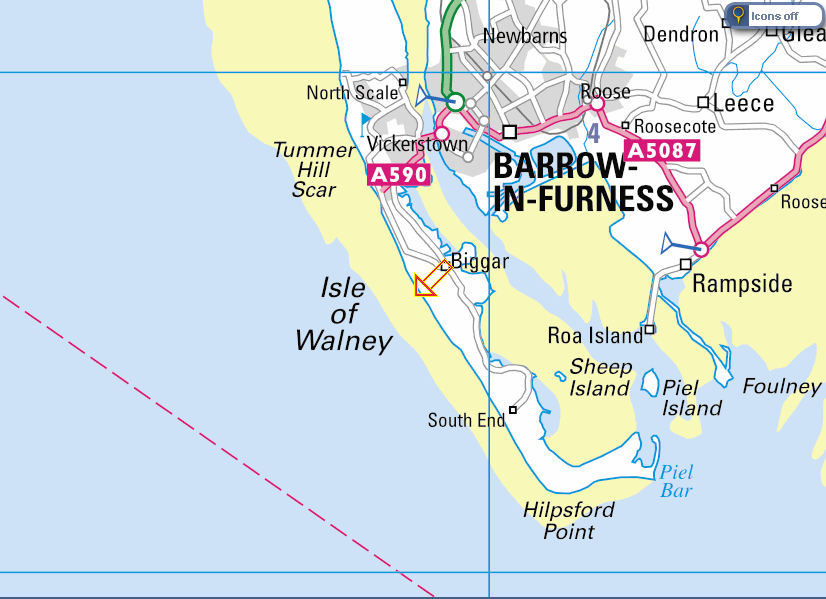
This Sunday, Ken is planning to go out somewhere, out there into the universe, to look for a decent bird (the story of his life actually). I get onto Paul, and between us we persuade him to go for the Greater Sand Plover in Cumbria, at a nature reserve on the Isle of Walney. It’s about 8,000 miles from Nottingham, but not too far for Ken and his Ford Escort XYZ 3i with Turbo intercooling and reheat.

-Ford-Escort-zzzzzzzzzz

Ken takes the concept of distance as a personal challenge. He occasionally gets under 70 miles an hour, and if the car’s on four wheels, he’s parked it. I’ve never even dared to tell him the type of car that I drive, GUR 25N, a bright orange Volvo 240 that weighs approximately the same as a canal barge.

volvo-240-hmb-645-n

To our great surprise, Ken agrees to go for this bird. He isn’t usually into twitching, since he dislikes crowds, (he has been a keen Notts County fan for years), and he much prefers a quiet stroll around North Norfolk, in the hope of finding his own birds.

First of all, we scorch to a pool in northern Lancashire, where a Grey Phalarope has been present for the last few days. It’s there when we arrive, but I am surprised how different it is to the individual I recently saw at Datchet Reservoir near London. It’s very active, flitting around the lake, and very loathe to come too close inshore. There are one or two birdwatchers there, but not very many. It makes me wonder where all the locals are. Do they know something we don’t?

Grey%20Phalaropexxxxxx
Onward and ever northward (look for the orange arrow).

north of englaND ZZZZZZZ

We leave the M6 and strike west towards Walney, passing our first patches of winter snow, and the odd few ragged beggars at the side of the A590. Just before we arrive at the Isle of Walney, we have to travel through Barrow in Furness, a really remarkable town. Most of it appears to be a single solitary shipyard, surrounded by thousands upon thousands of grey terraced houses, all clustered around the dock cranes for safety. Why is there nobody up there filming adverts,? Or those half hour documentaries that they put on after “The Bill”? Perhaps because overall, it is a grim, grim place, although nowhere near as bad as some of the localities I am yet destined to visit.

walney islandzzzzzz
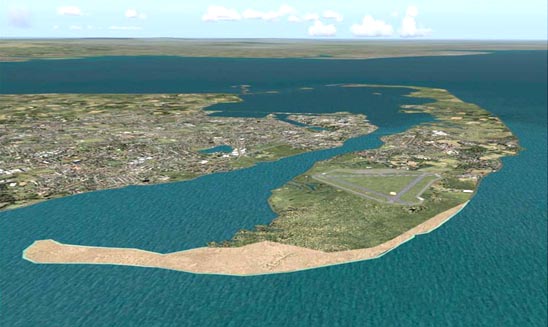
The Isle of Walney itself is a peculiar place, a bit like a grassy, tussocky version of Spurn Head. It has an infinitely worse road, though, but those years of training at Minsmere and Holme finally pay off. Unfortunately, we are not able to locate the appropriate turnoff for the bird itself.

walnet aerilxxxx

The tiny dirt track is supposed to be on the right, near the village rubbish dump, but we eventually have to go to the very end of the “road”, having fought our way past the thousands upon thousands of rather large seagulls that sit lugubriously around, all waiting for a piece of carrion to fall out of the sky at their feet. It reminds me very strongly indeed of the ending of “The Birds”, that well-known RSPB / Alfred Hitchcock co-production.

seagull-flock-jj zzzzzzzzzzz

The warden is tremendously friendly. We are the first people he has seen in four years. He explains that he has put up a sign at the side of the road, indicating the correct path to take. It’s not his fault that it’s fallen over. Anyway, all’s well that ends well, because we eventually do make it to the right bit of seashore. There is only one birdwatcher there, a local who says that the Sand Plover isn’t there, but not to despair, since it will be somewhere around, just waiting for us to refind it. And sure enough, one person, in the slowly growing knot of birdwatchers, does in fact refind it, after a delay of some twenty minutes or so. It’s with a largish group of Ring Plovers, and is a very distinctive pale brown. It’s extremely fluffy looking for some reason, and lacks the sharp black-and-white contrasts of its temporary colleagues. Indeed the Sand Plover is well capable of disappearing into the shingle very easily. It’s exceptionally well camouflaged, and tends to be obvious only after it has moved.

greater sand

The bird has, of course, been the subject of some pretty intense discussion about whether it is perhaps a Lesser Sand Plover and therefore a potential first for Britain. I’m only too happy to accept the views of the experts on this one, but nevertheless, our bird here does seem to have what seems to me a very small bill. Unless, of course, a Lesser Sand Plover has an extremely teeny-weeny-weeny-teeny bill, just like a pimple on the front of its head.

This lovely film was taken by Terence Ang in the Sand Plover’s usual habitat, in Hong Kong.

Having got over the excitement of seeing the bird, there is not a lot to keep us here. The day is bright, but the wind is strong, and rather gusty, and there are very few passing seabirds to look at. Locals say that sea watching here is generally very poor, and the only thing of interest that I can see are the tops of several obviously gigantic factory chimneys, just over the horizon to the North West. I never do find out what they are… Southern Scotland, the Isle of Man, or even Ireland. I don’t have a clue, and neither do any of the people I meet. I get the impression that I’m the first person who has ever noticed them. Perhaps they are an illusion… Some kind of mirage, reflected from the eastern United States… Perhaps they are a hologram of Three Mile Island, being transmitted as part of the twinning process with Windscale. (or is that Seascale?)

chimneys

On our way back, we call in at Leighton Moss in Lancashire.

Leighton0Moss

I am obsessed with the desire to see a Bittern.

bittern xxxxxx

No luck, of course. Although this is the furthest north that Bitterns breed, and is, in actual fact, one of its strongholds, I don’t manage to see one. Apparently, the water levels are too high, and have forced them back into the reeds. What we do see however, are three juvenile Marsh Harriers, because this year the birds have bred, and have produced five young. It is particularly nice to see them in a new breeding area. It gives you a nice warm feeling inside to see a place where rare birds are on the increase rather than disappearing for ever.

Juvenile Marsh Harrier, Cley, Norfolk, August 2006 (Steve Gantlett).

That apart, I find Leighton Moss to be a somewhat boring place. There seem to be very few birds about, and if anything, the birdwatchers may actually outnumber them. The old out-of-date Annual Reports that they are selling off in the reserve shop are right little scorchers too.

5 Comments

Filed under Humour, Personal, Twitching, Wildlife and Nature

This sepulchre of crime

Today is the eleventh day of the eleventh month, a date which, in this country is celebrated, if that is the right word, as Remembrance Day. In the United States I believe that it used to be called Armistice Day but is now renamed as the more inclusive Veterans Day. I always feel rather guilty at this time of year because I have never been able to see the “First World War”, or what we used to be able to call,  unfortunately, “The Great War”, in any really positive light. I am now of such an age that in earlier years I was able to speak personally to at least two veterans of the Great War, both of whom were able to give me their highly critical points of view.
It is not my intention to offend anybody by what I say in this blogpost, but it has always been my firm conviction that there are fundamental truths about the Great War which are always quite simply ignored because they are so unpalatable, and it is far more convenient just to forget them. Because of this, I would fully concur with the writer whose article I read in a newspaper recently, who called “The Great War”, “ineptitude followed by annihilation”.
I have never been able to see The Great War as anything other than the story of, literally, millions of well intentioned, patriotic young men whose idealism was taken advantage of by older men of a supposedly better social class, but who were in reality buffoons who signed treaties, and then declared wars which other people had to fight. And when the conflict itself was fought, the way in which it was carried out guaranteed unbelievable levels of casualties, most of which as far as I can see, were considered as merely inevitable by the top brass as they enjoyed constant  five star cuisine in their châteaux five or six miles behind the lines. In the trenches the average life expectancy of the ordinary soldier was about six weeks. An average of at least 6,000 men were killed every day, as the two sides fought over an area about the size of Lincolnshire, or Delaware, or half the size of Connecticut.
You may think that I am being appallingly cynical, but I have always seen these young men as having been robbed of their lives for little real purpose, victims who, if they had been given the choice, would have ultimately rejected a government gravestone in France or Belgium in favour of an ordinary life in their own home town or village, with a wife and children and all the usual cares and happiness which we now, a hundred years later, see as a basic right. Most of all, I would not take particularly kindly to criticism of my point of view from anybody who has not been to visit the cemeteries of the Great War which are scattered in great profusion across the areas where the battles took place.

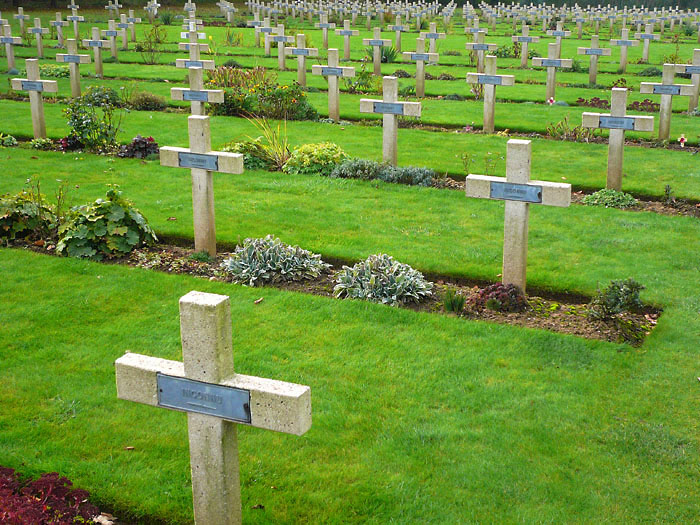
P1090541 zzzzzzzzzzz

This piece of land is perhaps as large as a medium-sized house with a medium-sized garden. It contains the remains of just fewer than 25,000 men. They were for the most part killed in the very first few weeks of the war, when, having joined up straightaway so that they didn’t miss any of the excitement or the glory, they were worried in case it was all over by Christmas. A very large number of them are now known to have been university students, who were soon to find that war had its negative side. At least one of these young men is not forgotten, though.Here is a little remembrance offered to his brother, Friedrich Stieme from Halle, who was killed in 1915.

P1090547zzzzzz

Here are the names of just some of the young men who are buried in that plot of land.

P1090571

Here are the names of some British and Commonwealth troops. They are recorded in enormous number on the Menin Gate in Ypres as the soldiers who were killed in fighting around the Ypres Salient and whose graves are unknown. There are 54,896 of these men and they were killed before August 15th 1917, a date chosen as a cut-off point when the people who designed what Siegfried Sassoon  called this “sepulchre of crime” suddenly realised that they had not built the monument big enough for all the casualties to be recorded. These, of course, are just the men with no known grave. If every death is counted, then the total Allied casualties exceeded 325,000.(the population of Coventry or Leicester). German casualties were in excess of 425,000.(the population of Liverpool)

P1090628

This whole area is dotted with cemeteries whose names, like this one, I have now forgotten. Some of them have just twenty or thirty graves, whereas some of them have a number that would take you a very long time indeed to count.

P1090669 zzzzzzz

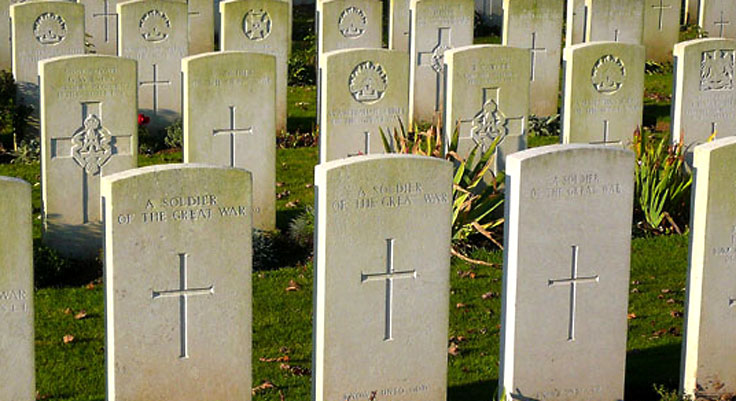
Too many of these men were unable to be identified because the British Army would not pay for their soldiers to have metal dog tags. The soldiers’ dog tags were made of leather, so that if their bodies remained in the wet ground for very long, the dog tags would rot away. This is why so many of them can be identified only as “A soldier of the Great War”. In addition, the fact that sixty per cent of casualties on the Western Front were caused by shellfire often made identification of casualties difficult. Notice too how nearly all the graves are covered in green slime, almost inevitably, given the rainfall totals in north western Europe.

P1090673333333

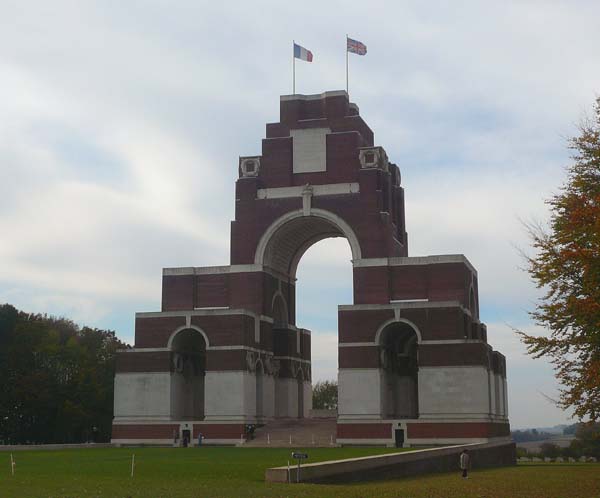
These graves are in a cemetery containing 300 British Commonwealth and 300 French graves which lies at the foot of the Thiepval Memorial.

P1090809

More important, though, is the enormous building itself wherein are recorded the names of the fallen who have no known resting place.

P1090790 zzzzzzzzz

A large inscription on an internal surface of the memorial reads:

“Here are recorded names of officers and men of the British Armies who fell on the Somme battlefields between July 1915 and March 1918 but to whom the fortune of war denied the known and honoured burial given to their comrades in death.”

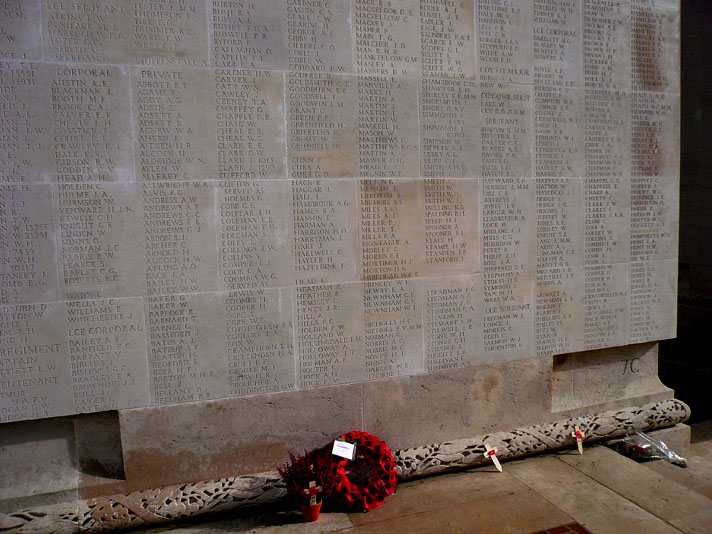
On the stone piers are engraved the names of more than 72,000 men who were slaughtered in the Somme battles between July 1915 and March 1918. More than 90% of these soldiers died in the first Battle of the Somme between July 1st and November 18th 1916. Here are some of the names.

P1090831

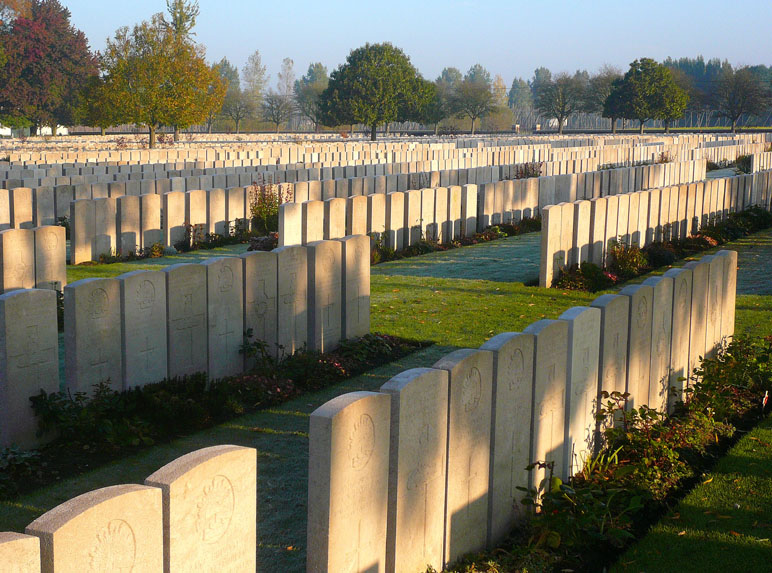
Here are some of the graves in another, fairly large cemetery whose name I am afraid I cannot remember …

P1090879

It is an insane thought that the Great War still continues to kill people nowadays. I was told by our tour guide that on average usually one person is killed every week as they explore the old battlefields looking for souvenirs.  This shell has been found by the farmer and has been left at the side of a country lane so that the regular patrols by the local council lorries can take it away. Only idiot foreigners, of course, touch these unstable objects. The French and the Belgians leave them alone.

P1090886 xxxxxx

This graveyard too I am afraid is one whose name I have forgotten. I remember that we went there because one of the other people on the coach had a relative who was buried there and he laid some poppies on his grave.

P1090932

This is one of the few places where I saw French graves. France had approximately 1,397,800 men killed in the war, with a further 4,266,000 wounded, giving a total of 5,663,800 casualties. Nowadays there are many areas of the country, particularly in central and southern France, which remain unfarmed wilderness because of this conflict a century ago which left whole provinces chronically short of men. The population of Greater Manchester, the West Midlands and West Yorkshire added together is approximately 5.7 million.

P1090967 xxxxxxx

This is part of the Tyne Cot Cemetery which is a burial ground for those who were killed in the Ypres Salient on the Western Front. It contains 11,956 men, of which 8,369 remain unidentified.

P1100069 zzzzzzzzzz

This is the “Tyne Cot Memorial to the Missing.” As mentioned above, the builders of the Menin Gate discovered it was not large enough to contain all the names, so the casualties after August 15th 1917 were inscribed on the Tyne Cot memorial instead. The memorial contains the names of 34,949 soldiers of the British and Commonwealth armies. The panels on which the names are written stretch away, seemingly  to the horizon.

This slideshow requires JavaScript.

Sadly, at Tyne Cot cemetery, there are always relatives looking for members of their family who fell during the Battle of Passchendaele in 1917.

P1100072

It is very difficult to find a neat conclusion to all this, but I am happy to leave the last word to His Majesty King George V, speaking in Flanders in 1922…

“I have many times asked myself whether there can be more potent advocates of peace upon earth through the years to come than this massed multitude of silent witnesses to the desolation of war.”

3 Comments

Filed under History, Uncategorized

Armistice signed! But keep fighting!

Let me first say that it is not really my intention to offend anybody by my views in this blog post, but I believe that many uncomfortable truths about the Great War are quite simply ignored because they are so unpalatable, and it is far more convenient just to forget them.
Most people, therefore, are completely unaware that at the end of the Great War, inanely and insanely, combat continued right up until 11.00 a.m. on that very last day, November 11th 1918, even though it had been widely known for five or six hours across the whole world that hostilities would soon cease, and despite the fact that the war had already claimed an enormous number of lives.

On the Allied side there had already been 5,525,000 soldiers killed and 4,121,000 missing in action. A total of 12,831,500 soldiers had been wounded, including both of the veterans that I myself had the privilege of knowing. In the east, the Russian Empire had  suffered casualties of 3,394,369 men killed with as many as 4,950,000 wounded.  On the side of the Central Powers, 4,386,000 soldiers were killed and 3,629,000 were missing in action. A total of 8,388,000 soldiers were wounded.
-armistice-day-1918 zzzzzzz

In total, Allied casualties were 22,477,500 and for the Central Powers the figure was 16,403,000. Overall, that is 38,880,500, roughly the current population of Poland, or a total more than Canada (35 million) or Belgium and Australia combined. Presumably, a few more pointless deaths on the last day were not seen as being particularly important.
http://www.world-war-pictures.com

The last to arrive in the carnage of the Great War, of course, had been the Americans, but they soon began to waste their poor young “Doughboys” lives in the same way as their more experienced allies had already done for three long years.

doughboys2 freshfaced

In the first four hours in the Argonne Forest, for example, they lost more men than they were to lose on D-Day. Indeed, the Meuse-Argonne was “probably the bloodiest single battle in U.S. history,” with the largest number of U.S. dead, at more than 26,000. Hopefully, this blood soaked struggle is not as forgotten as many websites claim, and if the Argonne War Cemetery, which contains the largest number of American military dead in Europe (14,246) is apparently often ignored by the tourist coaches, then it clearly should not be. Overall,  the American casualties in the Great War were to number 117,465 men.

Foch zzzzz

Negotiations to end hostilities had actually begun on November 8th but Marshall Foch, the Commander-in-Chief of the Allied Armies, refused to stop the war, because of fears that the German delegation, led by Matthias Erzberger, were not totally sincere in their desire for peace.

ger,manThis was after Foch’s own country had lost 1,737,800 men killed. The story is told by Joseph E.Persico

“On average, 2,250 troops on all sides were dying on the Western Front every day. “For God’s sake, Monsieur le Maréchal,’ Erzberger pleaded, ‘do not wait for those seventy-two hours. Stop the hostilities this very day.’ The appeal fell on deaf ears. Before the meeting, Foch had described to his staff his intention “to pursue the Feldgrauen (field greys, or German soldiers) with a sword at their backs” to the last minute until an armistice went into effect.”

So, the next day, November 9th, the Canadians attacked Mons and General Currie, helped by the men of the Canadian Infantry Brigade, captured the town during the night of November 10th-11th. As for the Americans…

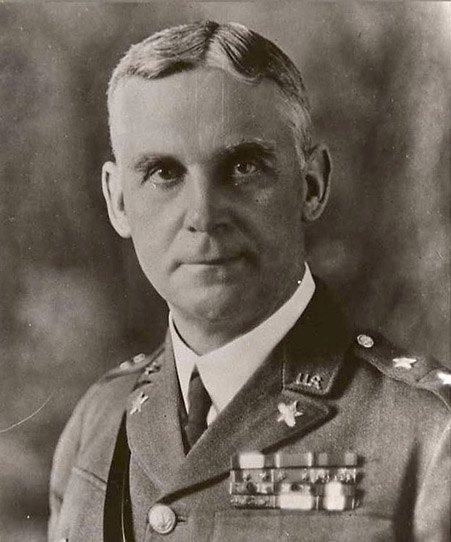
“Late on November 9th, instructions from the Allied Commander-In Chief were transmitted, directing a general attack, which was executed by the First Army on November 10th-11th. Crossings of the Meuse were secured by General Summerall’s (V) Corps during the night of November 10th-11th and the remainder of the army advanced on the whole front.”

16-summerall_l

Summerall’s actions on November 10th-11th resulted in more than eleven hundred American casualties, mainly in the Marine Corps.

All of this military action took place despite the fact that the Armistice had already been signed at 5:10 a.m. on the morning of November 11th. Within minutes of the signing, news of the cease fire had been transmitted all around the world. The “war to end all wars”, was finally over. And every general and every high ranking officer knew this. They were all aware of what had happened that day at 5.10 a.m., a time which was then backed up officially to 5.00 a.m.

Even the primitive technology of the day allowed the wonderful news to be in every major city by 5.30 p.m. and celebrations began in the streets well before most soldiers were aware of the end of hostilities.
Except that technically, the “war to end all wars”, was not yet actually over, because the cease-fire was not to come into effect until Foch’s deadline: the eleventh month, the  eleventh day and the eleventh hour of 1918. In this way all the soldiers in the trenches would be completely sure of being told the news that the conflict had finished.

220px-Hw_wright_01

For this reason General William M. Wright thought it would be a fine idea for the American 89th Division to attack the tiny village of Stenay in north-eastern France only hours before the war ended.

stenay zzzzzz

A total of 365 men died because, in Wright’s words,

“the division had been in the line a considerable period without proper bathing facilities, and since it was realized that if the enemy were permitted to stay in Stenay, our troops would be deprived of the probable bathing facilities there.”

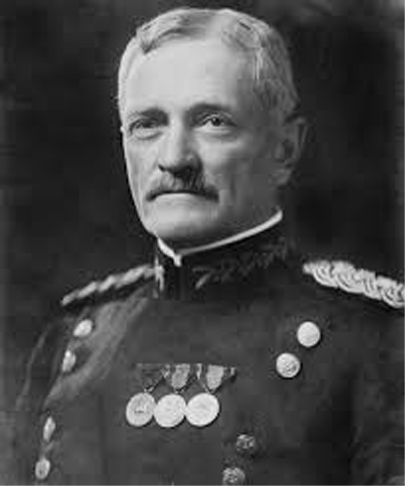
Indeed, the Americans were to take heavy casualties on the last day of the war. This was because their commander, General John Pershing, believed that the Germans had to be severely defeated at a military level to effectively “teach them a lesson”. Pershing saw the Armistice as being too soft. He supported the commanders who wanted to attack German positions – even though he knew that an Armistice had been signed.
pershing zzzzzz

It says it all perhaps to reveal the detail that the French commander of the “80th Régiment d’Infanterie” received two simultaneous orders on that morning of November 11th. The first  was to launch an attack at 9.00 a.m., the second was to cease fire at 11.00 a.m..

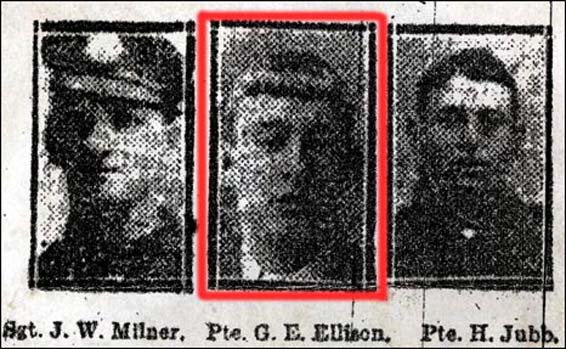
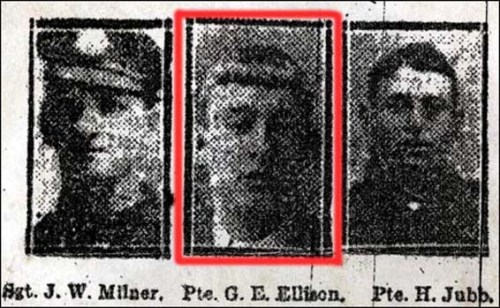
The last British soldier to die in the Great War seems to have been Private George Edwin Ellison, who was killed at 9.30 a.m. after serving a full four years on the Western Front. He was forty years of age, and had seen combat on the very first day of the conflict.
last english

A soldier in the 5th Royal Irish Lancers, Ellison was scouting on the outskirts of the Belgian town of Mons where German soldiers had been reported in a wood. In just ninety minutes or so, the war would be over and George Ellison, an ex-coal miner and the son of James and Mary Ellison, would go back to 49, Edmund Street, in Leeds, to his wife Hannah Maria and their four-year-old son James.  And then a rifle shot rang out, and George was dead. He would never go home to his loving family, but would rest for ever in St.Symphorien Military Cemetery.

This slideshow requires JavaScript.

The last French soldier to be killed was Augustin Trebuchon from the “415th Régiment d’Infanterie”. He was a runner and was taking a message to his colleagues at the front telling them of the ceasefire. He was hit by a single shot and killed at 10.50 a.m. Some seventy five French soldiers were killed on the last half-day of the war but their graves all give November 10th as the date of death. Optimists believe the reason for this discrepancy was that by stating that these men had died well before the end of the war, their family would be guaranteed a war pension. Realists believe that the government wanted to avoid any political scandal if it ever became known that so many brave men had died so pointlessly on the last day of the conflict.

last frenbch

The last Canadian to be killed was Private George Lawrence Price of the Canadian Infantry (Second Canadian Division) who died, like Englishman George Ellison, at Mons in Belgium. Private Price was killed at 10.58 a.m., and he was officially the last Commonwealth casualty in the Great War. So Private Price would never be going home to Port Williams, in Nova Scotia to see again his loving parents, James and Annie Price. Instead their wonderful son would rest for ever in St.Symphorien Military Cemetery, just a short distance from the grave of Private George Ellison.
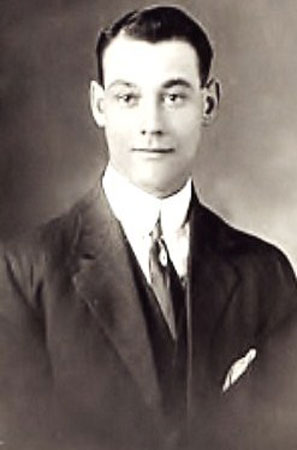
George_lawrence_price

The last American soldier to be killed was Private Henry Gunter who was killed at 10.59 a.m, one minute later than Private Price, the Canadian. A Private from Baltimore, ironically, of German ancestry, Gunter was officially the last Allied soldier to die in the Great War.

According to Joseph E.Persico

“His unit had been ordered to advance and take a German machine gun post. It is said that even the Germans – who knew that they were literally minutes away from a ceasefire – tried to stop the Americans attacking. But when it became obvious that this had failed, they fired on their attackers and Gunter was killed. His divisional record stated: “Almost as he fell, the gunfire died away and an appalling silence prevailed.”

Again according to Joseph E.Persico,

“The last casualty of the Great War seems to have been a junior German officer called Tomas who approached some Americans to tell them that the war was over and that they could have the house he and his men were just vacating. However, no one had told the Americans that the war had finished because of a communications breakdown and Tomas was shot as he approached them after 11.00 a.m.”

The total British Empire losses on the last day of the war were around 2,400 dead. Total French losses on that day amounted to an estimated 1,170. The Americans suffered more than 3,000 casualties, and the Germans lost 4,120 soldiers.

Indeed, Armistice Day, with its ridiculous totals of killed, wounded or missing, exceeded the ten thousand casualties suffered by all sides on D-Day, some twenty six years later. There was a crucial difference however. The men beginning to liberate Western Europe on June 6th, 1944, were risking their lives to win a war. The men who died on November 11, 1918, were losing their lives in a war that the Allies had already won.

This account occurs on an American website……

“When the American losses became public knowledge, such was the anger at home that Congress held a hearing regarding the matter. In November 1919, Pershing faced a House of Representatives Committee on Military Affairs that examined whether senior army commanders had acted accordingly in the last few days of the war.”

The story is continued on another website….

“Bland, the other Republican on Subcommittee 3, knifed quickly to the heart of the matter when his turn came to question General Conner.
“Do you know of any good reason,” Bland asked, “why the order to commanders should not have been that the Armistice had been signed to take effect at 11 o’clock and that actual hostilities should cease as soon as possible in order to save human life?”
General Conner conceded that American forces “would not have been jeopardized by such an order, if that is what you mean.”
Bland then asked, regarding Pershing’s notification to his armies merely that hostilities were to cease at 11 a.m., “Did the order leave it up to the individual commanders to quit firing before, or to go ahead firing until, 11 o’clock?”
“Yes,” General Conner answered.
Bland then asked, “In view of the fact that we had ambitious generals in this Army, who were earnestly fighting our enemies and who hated to desist from doing so…would it have been best under the circumstances to have included in that order that hostilities should cease as soon as practicable before 11 o’clock?”
General Conner answered firmly, “No sir, I do not.”
“How many generals did you lose on that day?” Bland went on.
“None,” General Conner replied.
“How many colonels did you lose on that day?”
General Conner: “I do not know how many were lost.”
“How many lieutenant colonels did you lose on that day?”
General Conner: “I do not know the details of any of that.”
“I am convinced,” Bland continued, “that on November 11 there was not any officer of very high rank taking any chance of losing his own life….”
General Conner, visibly seething, retorted, “The statement made by you, I think, Mr. Bland, is exceedingly unjust, and, as an officer who was over there, I resent it to the highest possible degree.”
Bland shot back, “I resent the fact that these lives were lost and the American people resent the fact that these lives were lost; and we have a right to question the motive, if necessary, of the men who have occasioned this loss of life.”
With that, General Conner was dismissed from giving evidence.

Would that such a hearing had taken place in every country, especially Great Britain.

P1100069 zzzzzzzzzz

2 Comments

Filed under History, Uncategorized

Gunpowder, treason and Nottingham

Not many people would connect the High School and Guy Fawkes’ Gunpowder Plot, but the link is there, if you trace it through carefully……

…..Brian Garnett, or Garnet, is thought to have been the Master of the Free School during some unknown period between the years 1564-1575.

free school

It is considered most probable that he took up the post between 1564-1567, and then retired in, probably, 1575. He may then have lived in Beeston, but he was certainly buried in Heanor in Derbyshire on December 21st 1576, as the “Late Skoolemaster of Nottingham”.

With his wife, Alice Jay, he had at least three sons, Richard, John and Henry, and three daughters, Margaret, Eleanor and Anne,  all of whom became nuns at Louvain.

Of the sons, Henry is the most notable, because eventually he was to become the Superior of the Jesuits in England, and, allegedly, an active member of the Gunpowder Plot which, in earlier centuries, often used to be called the Gunpowder Treason Plot or the Jesuit Treason. In general terms, the plot, of course, was a failed assassination attempt to blow up the Protestant King James I of England and his entire Parliament, by filling the cellars of the building with gunpowder. lighting the fuse, and retiring quickly and sensibly to a minimum distance of at least fifty yards.

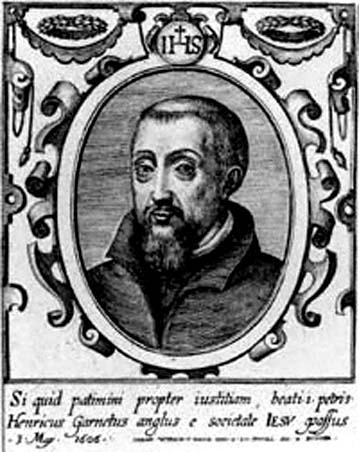
GunpowderPlot dddddddddGarnet was not quite tasked with carrying the barrels of gunpowder into the cellars, but rather, he was deemed to have been guilty of knowing all the details of the assassination attempt, but then doing nothing to save either the King’s life or those of his courtiers. Here he is….

google 2 zzzzzzzzz
In recent times, some doubt has been cast on the extent to which Garnet was actually aware of the dastardly plot, because all the details he knew were revealed to him through the plotters’ confessions. Of course, by the strict rules of his Catholic religion, Garnet was automatically prevented from informing the authorities by the absolute confidentiality of the confessional.

None of this alters the basic fact, though, that Henry Garnet was executed for treason, on May 3rd 1606. At his trial, the jury had needed only fifteen minutes to reach their verdict.

Where the tiniest of doubts still exists, however, is whether Henry was ever a pupil at the Free School, as no registers of this period are still in existence. It is certainly true, though, that he was educated in Nottingham, and the national rules in place at the time allowed only one school in each town or city. In any case, it is surely beyond credibility that he was not associated with the Free School during his father’s tenure of the position of Master, that is to say, the only teacher who was working there.
Indeed, at least one source says that young Henry came to the Free School during Henry Cockrame’s time as Master (most probably 1563-1564), possibly a year or so before Cockrame left in 1565 and was replaced by Henry’s father, Brian Garnett of Heanor, Derbyshire. Henry is supposed to have studied for two years under his father’s tutelage, before leaving for Winchester College where he was elected as a scholar on August 24th 1567 and duly entered the school in 1568.

WinCollege1_ccccccccccccccccc

Henry had been well taught in Nottingham, and proved to be an able student at Winchester. According to “The Oxford Dictionary of National Biography”…..

“His love of music and “rare and delightful” voice were complemented by an ability to perform songs without preparation, and he was reportedly also skilled with the lute.
Father Thomas Stanney wrote that Garnet was “the prime scholar of Winchester College, very skilful in music and in playing upon the instruments, very modest in his countenance and in all his actions, so much that the schoolmasters and wardens offered him very great friendship, to be placed by their means in New College, Oxford.”

Instead of the delights of New College, Oxford, however, when he left the school in 1571, Garnet moved to London to work for a publisher. Shortly afterwards, in 1575, he travelled to the continent and joined the Society of Jesus. Garnet then moved to Rome to study for the priesthood with the Jesuits. He was finally ordained as a priest around 1582. (Note the ear of corn which will be important)

henry again xxcccccdxdx

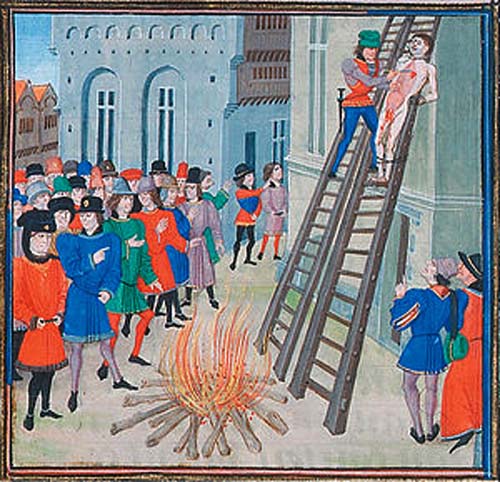
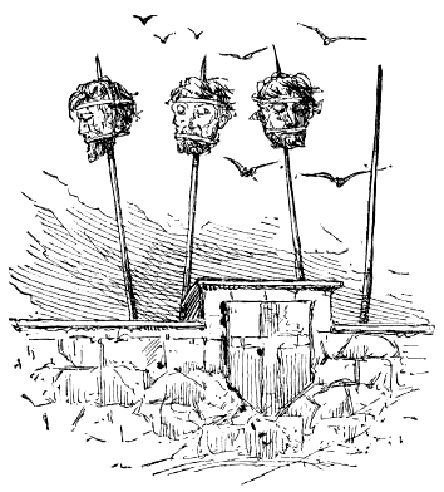
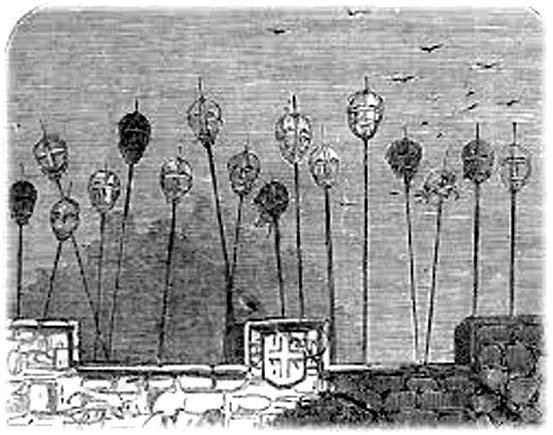
Whatever happened in his life during the next twenty three years in the service of the Lord, by virtue of the events of May 3rd 1606, Henry Garnet must surely remain the only Old Nottinghamian ever to have been convicted as a terrorist, and, indeed, one of the very few ever to have been hanged, drawn and quartered, and then to have had his severed head placed on a pole on London Bridge.

Froissar txxxxxxxxx

(That’s going to hurt)

Heads_on_spikes xxxxxxxxx

(This engraving will be next month’s Caption Contest)

Thankfully, the more lurid details of his execution have survived in Antonia Fraser’s book, “The Gunpowder Plot”…..

“Garnet said his prayers, and was then thrown off the ladder and hanged.

beforfe execuion xxxxxxxxxx

Before the executioner could cut him down alive, many in the crowd pulled on his legs, and as a result, Garnet did not suffer the remainder of his grim sentence. There was no applause when the executioner held Garnet’s heart aloft and said the traditional words, “Behold the heart of a traitor”.
His head was set on a pole on London Bridge, but crowds of onlookers fascinated by its pallid appearance eventually forced the government to turn the head upwards, so its face was no longer visible.”

From this peculiar pallid appearance of course, came the widely held belief that Garnet’s head did not suffer any signs of decay or change.

nov 4th heads xxxxxxx(Can you spot Garnet’s head?)

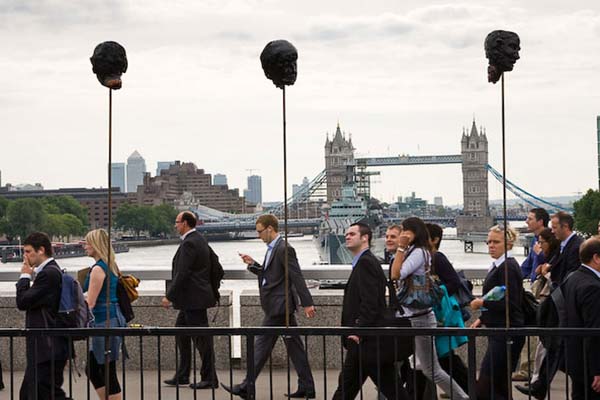
Nowadays, of course, we are a lot more civilised and the heads of traitors are no longer placed on a pole on London Bridge. Instead, we have just two or three of the more unsuccessful Premier League managers.

modern cddddddddddd

(Why is nobody taking any notice?)

The final, and a slightly more serious thing to be said about Henry Garnet is that way back on May 3rd 1606, according to those who were there, a miraculous portrait of him apparently appeared on an ear of corn onto which drops of his blood had fallen at the moment of his execution. This particular ear of corn was later credited with achieving a number of miracles. At one point, it was taken secretly out of the country into the possession of the Society of Jesus, before, with its size surely playing a part, it was lost, rather appropriately, during the French Revolution.

-Portrait_of_Henry_Garnett zzzzzzzzz

The Roman Catholic Church, of course, has a large number of saints who have done far less than Henry Garnet to earn their sainthoods. Names which spring to my mind would include St.Buriana, St.Erc, St.Ia and any number of Cornish villages named after other dimly remembered saints.

Perhaps one fine day, Henry Garnet may yet become the only Old Nottinghamian ever to be canonised.

Leave a comment

Filed under History, Humour, Nottingham, Politics, The High School

And the Hallowe’en winner is………..

Around ten or fifteen years ago, I was a teacher of Religious Studies as well as my main subject of French. We were  studying the Afterlife, so, towards the end of, I think, the Christmas term, I asked the boys to write down for homework their own ghostly experience or a ghostly encounter that either their parents or anyone close to them had had. Here is a selection of the stories they came up with.
And, of course, yes, boys can tell lies just like everybody else, but by then I had taught this class for four months, seeing them for an hour and a half every week and I did not really think that anybody was lying. They may have been mistaken in their interpretation of events, but I’m sure they were sincere in what they thought was happening. This effort came from the parent, or even grandparent, of one of the pupils…

“My ghost story”

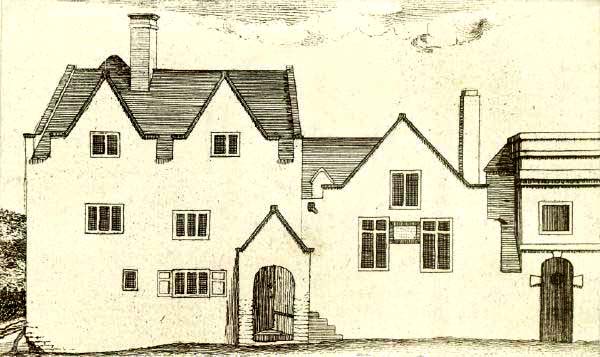
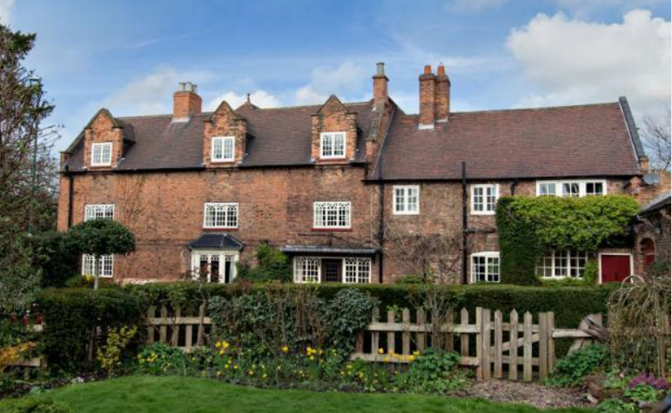
from Daniel J Furse who lived in the Old Manor House from 1956 to 1964.

gregory_st_manor

“I bought the house from one of the printer Milward family and he told me that when he moved in there was a row of wire operated bells hanging in the passage by the kitchen, although they were all disconnected. Every now and then, at night, these bells would ring wildly. On investigation, no one was ever seen but the bells were all swinging on their springs!
Our own contribution was fairly mundane but baffling. In what was the dining room – next to the kitchen where there now appears to be a door, we had a very large Jacobean oak sideboard tight against the wall, and above it hung a picture. Sometimes, when coming down in the morning, we would find the picture neatly stowed under the sideboard, with the hook still in the wall, and the cord intact.”
I live in the Old Manor House in Lenton regularly referred to as haunted. We have some accounts of manifestations of the ghost in the past one of which I have quoted above. There is one room that is thought to be the “haunted” room. It was in this room that someone was so frightened by what they saw or heard that it caused the previous owners to have an exorcism in the house. We ourselves have had some strange experiences. We seem to have a “Visitor’s curse”. More often than can be explained, something has happened with our lighting, heating or kitchen appliances when a guest was either there or coming. Sometimes just one system fails, but the most dramatic was when a bar of spotlights fell down from the ceiling near some guests. Another time when we were expecting guests for Christmas, all lighting, heating and cooking appliances, including the Aga which runs on gas and the electric cooker which relies on electricity, refused to work.
Hopefully we can have a ghost- free Christmas this year!”

olg manor house cccccc

This was a very popular topic indeed with boys of fourteen and fifteen.
One young man told me the story of how he had seen a ghost when he met up with one of his friends who attended another school in, I think, Grantham. The boy went from Nottingham to spend the whole weekend as his friend lived quite a long way out in the Lincolnshire countryside. They stayed in the friend’s house which was very large with a very large garden. On the Friday evening, as soon as the visitor had unpacked, both boys went outside to see if they could see the phantom which the host had already explained could often be seen as it walked in the garden. The visitor from Nottingham was very excited that the garden was haunted and that he might actually see a real ghost.
The young man told me that as he stood there with his Lincolnshire friend in the early evening they saw not a sharply defined ghost, but a pale blue patch of mist or smoke, shaped like a human form. It moved across the end of the garden from right to left and by the time it reached the left-hand edge it was beginning to disappear.
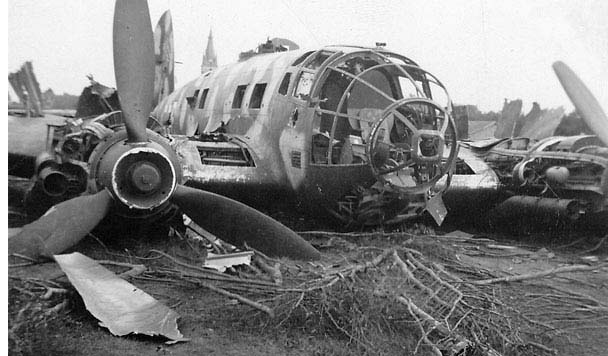
Supposedly, it was the ghost of a Second World War Luftwaffe flier whose aircraft, a Heinkel III bomber had been shot down, and he had been killed.

he111-5 zzzzz

Previously, I had been told about a slightly similar ghost by a now retired school technician called Frank. When he was young he used to live on the southern side of the Humber Estuary in Lincolnshire. Naturally, as a boy, he was keen to explore, and on one occasion he went with two of his friends out onto the salt marshes south of the estuary. He told me that there was a lookout tower right on the edge of the land, overlooking the waters of the estuary and of the North Sea. It had been put there for military purposes, probably either in the First or the Second World Wars. It was now in ruins but the shell of the brick built building was still there.

tower-inst xxxxxxxxxx

As the three boys made their way across the absolutely flat landscape, a saltmarsh covered in vegetation which was no more than four or five inches high, they suddenly saw a figure on the top of the tower.
Apparently an adult man, he stood there for a little while, and the boys watched him. I do not remember from the account whether he seemed aware that he was being watched, but I suspect that he did not. Anyway after five minutes or so, the figure leapt off the top of the tower which was at least twenty or thirty feet high, exactly as if he was doing a parachute jump or, as they always say, something silly. The three boys certainly thought so because they ran along the path which led to the building, to see if they could help what they presumed would be a fairly severely injured man. When they got there though, the place was completely deserted. Nobody was there.
What makes it so strange is that the landscape was such that he could not possibly have run away across either the saltmarsh or to the distant sandy beach without the boys seeing him. In any case it had not taken the boys long enough to get to the tower for him to have disappeared. He had not passed them on any of the paths which led across the marsh. They searched the tower but he was not there. They presumed therefore that he was a ghost of some kind. Later on, Frank explained that tales had been told of an occurrence just like this having been seen before in the very same location, but nobody had ever been able to explain what it was.

Two other stories were very scary indeed…..

“The crippled Ghost that learns to walk

Every so often when I lie awake in my bed at night and I leave the door open I see an old man in a brown wheel chair. He has grey hair and a mutilated face like it’s been taken off and jumbled about and then stuck back on.
It moves towards me without using its hands to move the wheels at all. Then when it reaches the door it stops and stands up. It starts to walk towards me. At that point I turn away and face the wall and try to force myself to believe it’s not real, it’s not real.

Then when it reaches my bed, it reaches out to touch me. The reason I know this is because I see its shadow on the wall. But as soon as it touches my head it disappears and so does the wheelchair which disappears as soon as he gets out of it. The only other thing that is strange about the man is that he is extraordinarily long thin fingers and shoulder length white hair.”

This extraordinary tale is recounted more or less exactly as the boy wrote it down. I have not altered anything at all except to make the tense used the present tense, rather than a mixture of several different ones.
What would be really interesting would be to try and trace in the history of the house if there was anybody who ever lived there who had the long fingers and long white hair, perhaps of a musician, or the mutilated face and the wheelchair of, perhaps, a Great War victim. It is however, even with the Internet, extremely difficult to trace who has lived in any house, and what his job was, or the hardest thing of all, what he did during his life and what happened to him.
And the winner is…….
…….This very last final story, which was clearly connected with my preparations for Christmas with the class. It is dated November 4th 2005, and is entitled…

“The white man with no face”

Interview with my Dad:
What size and age did the ghost appear to be?
He was a six-foot male…age impossible to say.
But roughly did he look middle-aged or quite young?
He was oldish but that’s the most accurate description I could give.
Did you contact any spiritualists or mediums about the ghost?
No I didn’t; it never crossed my mind. It didn’t really bother me personally, but I never thought to ask my wife whether she thought we should get somebody in to try and sort things out.
What was the scariest thing about the ghost?
It would be that every time you were fast asleep, this ‘thing’ could be looking over you; I wasn’t frightened about it at all, but it didn’t do anything… just stared endlessly at you.
If only I had ever seen the ghost and you hadn’t, would you believe me about it being ‘around’ or not? Would you look out for it?
I would believe you, but I wouldn’t go out of my way to find something that could only be found if ‘it’ wanted to be.
How did the ghost appear and what did it look like?
I was in deep sleep and there was a wind as if all the windows were open, and my shoulders felt cold like ice. Both your mum and I woke up basically at exactly the same time, and we saw ‘it’. All it did was just look down at us. I can’t remember the curtains blowing just a fairly strong wind, so the windows were definitely not open. My wife asked me: “Tell me what you just saw?” trying not to put any ideas into my head, and her expression when I replied, confirmed this was not a dream. We both looked away, and after a period of time I cannot remember, I eventually look back to see ‘it’ had vanished.
Did you ever feel like you are being watched?
Well obviously you knew there was something around but you just had to ignore it. My wife at the time was so terrified; she nearly moved out of the house and lived with her parents for a short time.
Did you ever stay on your own in the house?
Yes, of course, it didn’t bother me that much, it was your mum who was worried about it the most. However, this was one of the reasons why we eventually moved house. My mum has told me that for weeks she was terrified of the ghost reappearing, and too many times felt her shoulders turn ice cold even during the summer (just like when she first saw the ghost).
Apparently I saw the ghost on many occasions – more than my parents – and that I asked them “Who the white man in my room was” more than once. The ghost could communicate with “the living” as it asked me what my name was.
Chloe my sister regularly saw the ghost – which was obviously concerned my mom, and on one occasion she told my parents “a white man with no face keeps waking me up and then just staring at me”. At the time she wasn’t afraid of ‘it’ as she was too young to realise what was happening. Chloe can’t recall any of this but my parents remember it all too well.

3 Comments

Filed under Aviation, History, Nottingham, The High School

Hallowe’en Nights (5) Ghosts in the High School

It is often supposed that in a building as old as the present High School there should be a school ghost.

ray cccccccc

Ray Eastwood, the caretaker, once told me this story, in the early or mid-1980s, although to be honest, I have forgotten the exact date…..

“One year, a small number of boys were expelled from the school because of their appalling behaviour. They made threats that they would return, and either vandalise, or even set fire to the school. Because of this, my colleague Tony Hatcher and myself were asked to sleep in the school to forestall any problems. In actual fact, we borrowed a German Shepherd dog from a security firm that I had connections with, and all three of us moved with our camp beds into one of the rooms at the front of the school, underneath Reception, on the ground floor.

One morning, around 6.15 a.m., Tony and myself were sitting up in our beds having a cup of tea and a cigarette, when we clearly heard footsteps in the corridor above. They seemed to start near the staffroom, and then to proceed around the corner, past the staff toilets, and along the corridor towards the offices, directly above us. We both of us thought that these must be the footsteps of somebody who had broken into the school, and we rushed out of our temporary accommodation. We grabbed the dog, and threw him up the stairs to pursue the presumed miscreants. The poor animal wanted none of it, and he slunk off back into the room to his basket, his tail between his legs. We ourselves went on, rushed up the stairs and charged into the area around Reception. We could find absolutely nobody. We explored all around. All the windows were secure. All the doors that should have been locked were locked. There was no explanation whatsoever of what we had heard. There was certainly nobody there.”

In actual fact, Ray did offer me an explanation….He thought that the footsteps that both Ray and he had so clearly heard were those of Eric Oldham, a caretaker who had worked at the High School until some eight or ten years previously. One sunny Saturday evening at the end of that blistering hot August of 1976, after many years of faithful and steadfast service, poor Eric had collapsed and died as he made his rounds to lock up the school. He was found by his poor wife, lying on the sandstone paving slabs just inside the Main Gates. In the School Magazine, Mr.Oldham was described as “one of the school’s most devoted servants and a warm hearted friend”.

P1470416 cccccc

When Eric used to unlock the many various rooms inside the school every morning, he invariably followed the same route at the same time of day. Eric would have been walking along those same corridors, in the very same direction as the mysterious footsteps we so clearly heard, at the same early hour of the morning. Perhaps it was him, reluctant still to pass the school into anyone else’s care.

Shortly after the idea of a school ghost was first mooted, it later emerged that there had already been another claimant to the position. This phantom was in the then Preparatory School which educated boys aged between eight and eleven years of age.

Quite a number of reports had emerged that as boys walked down a particular set of stairs towards the Waverley Street end of the building, they repeatedly had felt what could only be described as invisible fingers grabbing at the bottoms of their trousers, as if somebody was trying to clutch at their ankles as they went past. This story was told to me quite a few times in the Main School by a number of boys of varying ages, so it must have been fairly well known at the time, although it was unclear whether any of the teachers in the Preparatory School were aware of it. At least one member of the Main School staff knew of it, however.
I have an explanation for this although it does require a certain “leap of faith”. The new building of the Preparatory School was constructed on the site of a magnificent Victorian house. It was still used for Sixth Form lessons for a short period during the early years of my time at the High School, and may well have been the Sixth Form Centre, although I am no longer totally certain of this. Originally, the house had belonged to Dr.Dixon, Headmaster of the school from 1868-1884. On May 29th 1876, his wife, Ada, died “of the effects of a chill”, leaving her husband with five children, who were, according to “The Forester”, “Robert, Charles, Harold, Sydney and one daughter to bring up, four sons and a daughter”.

My best guess is that the clutching fingers belonged to Ada, who, as a spirit, was unwilling to leave her children, as she could see that her husband was struggling with the job of looking after them. It may well be that the staircase in the modern Preparatory School occupied the same three dimensional space as a long forgotten room in the now demolished Victorian house.

Interestingly, neither of the two ghosts, if indeed they were ghosts, has persisted. The stories in the Preparatory School disappeared after just a couple of years at most, and as regards the tale of the footsteps in the corridor, both Ray and Tony were denying vehemently that anything had ever happened within weeks of originally talking about the event. Why that was, I never did discover, although it is always nice to have a School Conspiracy Theory.

Next time……The School Werewolf and how to apply for the job

wolf xxxxxx

Periods of work……only a few days every full moon

werewflopcddddaef fgbb

Paid holidays…….once in a blue moon

If you are interested in the ghosts of Nottinghamshire, there are at least two lists of reported hauntings.

Wooooooo

Hooooooo


Leave a comment

Filed under History, Nottingham, The High School

Hallowe’en Nights (4) Three ghosts from my past

My father was called Fred Knifton. He lived from 1922-2003, for the most part in Hartshorne Road, Woodville, which is to the south of Derby and Nottingham, in the East Midlands.

This slideshow requires JavaScript.

Woodville at the time was a village of some 5,000 people. It was exactly on the edge of  a geological fault line, so to the west, coarse, heavy clay was mined in opencast quarries, and sewer pipes and drainpipes were manufactured. To the east there was no clay, but instead there were open green fields with Friesian cattle and tall hedges of hawthorn.

SLD_Herd ddddddd

Although as far as I know he never experienced any of the RAF’s many ghostly occurrences, Fred once told me that there was a well-known haunted hangar somewhere out there in East Anglia, possibly in Norfolk, where mechanics as they repaired aircraft late at night, would often hear dance music, even though of course, there was no orchestra within miles.

A modern day equivalent may well have been the occasion when I stood at the bathroom sink one summer’s morning, a good few years after Fred’s death, looking out over the roof tops of Nottingham. I was listening to “American Patrol” being played by the Glenn Miller Orchestra on a CD.

This moment suddenly gave me probably the most distinctive feeling of “déjà vu” I have ever had. I have wondered ever since whether my father had perhaps done exactly the same thing on some airbase in Lincolnshire on a long forgotten day some sixty or so years previously.

Strangely enough, for a man who always had so many tales to tell, ghosts and phantoms did not feature particularly highly in Fred’s repertoire, and I would struggle to think of any direct reference he ever made about the afterlife, although I am sure that he was aware of the alleged haunted house down near the Bull’s Head Inn in Hartshorne.

As a native of nearby Woodville, Fred would certainly have heard all the tales of the phantom attached to this large black and white timber framed Elizabethan house which stood between the old Georgian coaching inn and the Anglo-Saxon church in the middle of Hartshorne.

This slideshow requires JavaScript.

Apparently, the story was often told of how….

“A brave group of people, made curious by the many ghostly accounts of bumps in the night, had gone up into the attic, unvisited through many decades of neglect, and found furniture piled up across the entire room. On the inaccessible far wall of the room, there was a delicate but obvious print in the centuries old dust, the unmistakeable impression of a ghostly human hand. Nobody could possibly have penetrated the great mass of tables, chairs and rubbish stacked across the floor. It could only have been the work of a phantom. ”

In 1970, I experienced an extremely strange happening when I accompanied my father, Fred, down to his parents’ house at number 39, Hartshorne Road. Fred’s parents, Will and Fanny, had both recently died recently within a few months of each other in hospital at Burton-on-Trent, with Fanny remaining mercifully unaware of Will’s demise after more than sixty years of marriage.

This slideshow requires JavaScript.

Fred was paying regular visits to the property, presumably attempting little by little to clear the house out so that it could be resold. At the time, as a teenager of some sixteen  years of age, I was unaware of this, although, with the benefit of hindsight, I wish I had been, and I could perhaps have stopped Fred from throwing away so many of his father Will’s Great War souvenirs, such as his complete Canadian Army uniform, his German soldier’s leather belt and his extensive collection of German guns and ammunition.

We entered the deserted house through the front door, and as I walked along the hallway towards the kitchen, I distinctly heard the upstairs toilet flush. I turned round and asked Fred, who had been following me into the hall, how this could have happened, and who it could have been, given that we both knew that the house was locked up and empty.

Fred gave me some non-committal answer at the time, but afterwards, perhaps when he had regained his composure a little, he told me that, as he was some way behind me, he had been able to look up the stairs when he heard the sudden noise of the toilet being flushed. He had distinctly seen his recently deceased father, Will, walk out of the bathroom, across the landing and into the front bedroom.

My father Fred certainly knew the story about how an aging Mrs.Edwards had sadly passed away. This old lady had lived in the village a hundred yards further down Hartshorne Road from Fred’s own house, in a Victorian house next to the entrance of a factory making drainpipes.

Her old  friend, and our own family friend, Gertrude Betteridge, went down to Mrs.Edwards’  house to pay her respects and offer her condolences to her daughter, Margaret Edwards. The latter greeted Gertrude and showed her into the front room. Margaret then invited her guest to sit down on the settee while she went into the kitchen to make “a nice cup of tea”.

After a couple of minutes, as Gertrude sat there quietly and politely with the sunlight streaming brightly through the front windows, the door opened. It was not, however, Margaret with the expected tray of tea and biscuits, but Mrs.Edwards herself, exactly as she had been in life, who came in. She walked across the room to Gertrude completely normally, and quietly and calmly said to her, “Tell Margaret not to worry. I’m all right.” Then she turned and walked away, opened the front room door and disappeared back out into the hall, never to be seen again.


5 Comments

Filed under Aviation, Bomber Command, History, Personal

Hallowe’en Nights (3) Black Shuck in Notts

In my first blog post about the cryptic canid, it becomes perfectly obvious that for hundreds of years Black Shuck has been seen fairly frequently throughout all of East Anglia. Not only that, but he can still be seen there right up to the present day. Well known folklorist Ivan Bunn continues even now to find regular examples of Black Shuck’s appearances in our 21st-century world.

And so too, Black Shuck has been seen throughout the whole of the country. One website details 329 different places in the British Isles where spectral dogs of various size, shape, colour and attitude have cropped up over the centuries.
But has this famous dog ever been seen in our own county of Nottinghamshire? By careful searching on the Internet, I have managed to find just three examples. Read them through very carefully and make sure that you follow all the directions on the maps provided. There will be a test at the end!
The first tale is of a little village which now has the high-speed A631 dual carriageway constructed around it to the south west, allowing the peaceful, quiet community to preserve its rural tranquillity. Centuries ago, though, the main road from Sheffield to Gainsborough went right through the very middle of the village, which, with the frequent passage of mail coaches, it may well have been livelier than it is now….

bigger scale

Perhaps this is why Beckingham’s most famous phantom, a colossal Black Dog, always keeps faithfully to his old tried and trusted route. The animal is reputed to be up to five feet tall and has dull red eyes that burn with an inner fire like the glowing embers on a coal fire
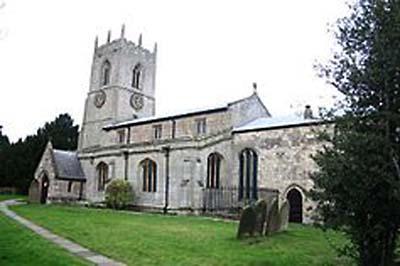
black_shuck_by_mearcu-d3lgpnd ccccccThe Black Dog invariably leaves from the churchyard of Beckingham’s parish church of “All Saints” which dates mostly from the thirteenth century, although the exterior is apparently fifteenth century.

church beck

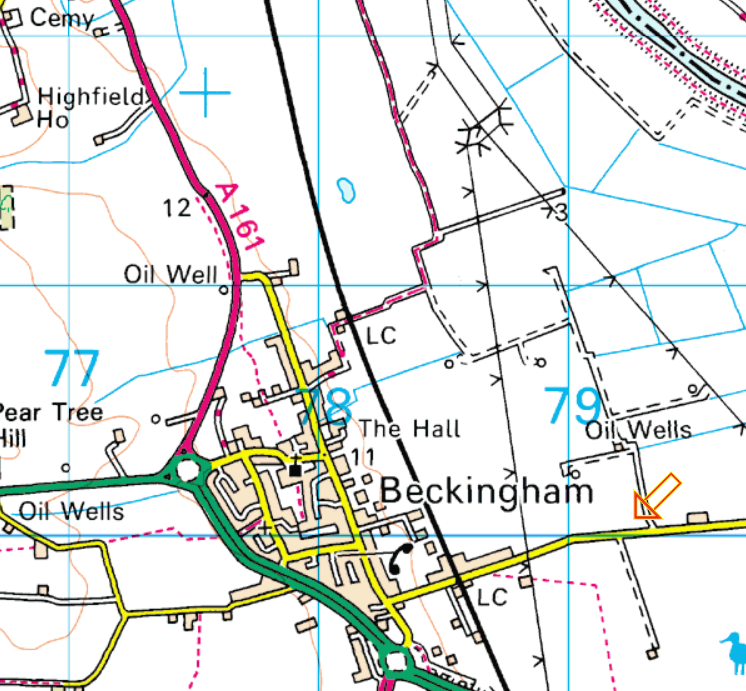
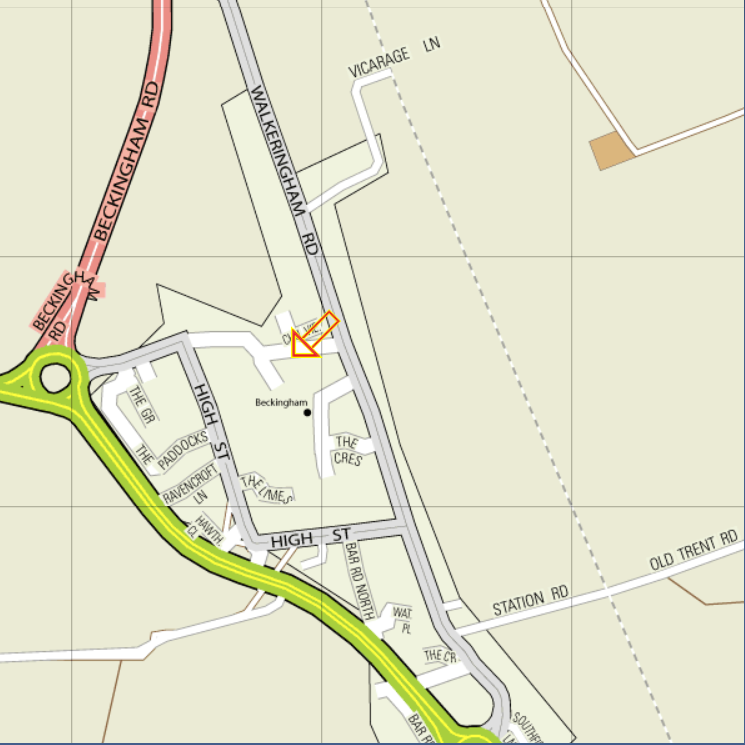
The Cryptic Canid leaves the little church with its square tower and makes his way, presumably down Walkeringham Road and then Station Street, before finally leaving the village along the Old Trent Road, walking purposefully out towards the marshy water meadows.
This map shows the church with its square tower and the red arrow points to the Old Trent Road.
better backingham
Some of the streets are indicated on this larger scale map. The red arrow points to the church…

at long last

The Black Dog always leaves the Old Trent Road (yellow on the map) near the Old Shipyard and then sets off along the old path to the south, alongside the old River Trent. The red arrow points to the riverside route he invariably uses.

red varrow

Black Shuck though, for it is no less than he, is not a dog to mess with.  Anybody who tries to get in his way or to prevent his progress from church to river does so very much at their own risk. A good many years ago a man from Gainsborough attempted to stop Black Shuck by refusing to stand aside and allegedly asking it what it was doing. The dog looked with great anger at this foolish person, who was later found unconscious in the middle of the road. He was paralysed down one side of his body for the rest of his life and never recovered the feelings in his arm or leg.

A second Black Shuck has occurred not too far from Newark-on-Trent. In the Nottingham County Library there is a manuscript dating back to as recently as 1952 which records the words of a Mrs Smalley, who was then about seventy five years old.
Her grandfather, who was born in 1804 and died in 1888, used to have occasion to drive from Southwell to Bathley, a village near North and South Muskham, in a pony and trap. This involved going along Crow Lane, which leaves South Muskham opposite the school and goes to Bathley. Along that lane he frequently, used to see a large Black Dog trotting alongside his trap.
Here is a map of South Muskham, with all the landmarks in the story visible.

better map soujkth muskbhanmThe red arrow points towards Crow Lane, which goes westward  to Bathley. In the other direction, to the east, it runs, typically, past a church with a square tower.

pextne xxxxxxxxxxxxxxxxxxxxxxxxxxx

St. Wilfrid’s Church in South Muskham is medieval but seems to have taken a long time to construct. The square tower, therefore, has its lowest section of thirteenth century construction, the middle section is fourteenth century and the top is fifteenth century. One of the more interesting features are the carved ends of the wooden benches in the chancel, which include a number of “hideous monsters” and one crab.

“Round about 1915, Mrs Smalley’s son Sidney, used to ride out from Newark on a motorcycle to their home at Bathley. He went into Newark to dances and frequently returned at about 11 o’clock at night. He too often saw a black dog in Crow Lane; he sometimes tried to run over it but was never able to. One night Sidney took his father on the back of the motorcycle especially to see the dog, and both of them saw it.”

Overall, South Muskham is an area with a good deal of water in the landscape.

south musk is wetzzzzz

The third story is considerably more modern. It was 2.14 a.m. on May 11th 1991 and….

“Victoria Rice-Heaps had been visiting her boyfriend in Worksop, and was on her way home when she had her unusual experience. It was a journey she had made “thousands of times”. She wasn’t particularly tired, having slept earlier in the evening. Making her way out along the Blythe Road, she soon left the comforting glow of the streetlights for the dark country roads beyond.
After a mile or so, near to Hodsock Priory, Victoria saw illuminated in the beam of her headlights about 150 yards ahead “two red dots.”

beast_main ccccccc

“I slowed right down to a crawl as I saw a huge black dog. It looks like something from hell! It had very shiny fur and a short coat; the nearest thing I’ve seen to it in size was a Great Dane, but it had a good 18 inches over a dog of that breed. Its ears were erect and it appeared to be dragging something quite large across the road.”

Victoria had lived with dogs all her life, but had seen nothing like this creature.
As she waited for the dog to get out of the way of her Fiat Panda, the headlights of another vehicle announced its approach from the opposite direction. The driver of the red Montego estate, evidently seeing her at a standstill, pulled up and wound down his window to ask if anything was wrong. Victoria, having wound down her own window, asked the man if he could see the dog in front of her car.

“At this moment he shouted “Oh Jesus!” and sped off into the night. I looked in front of me again and to my joy and amazement the creature had vanished. I drove home as fast as I could. I did a little research later and found a tumulus nearby, a river and an old boundary as well as the priory”.

There is a lot less exact geographical detail for this particular story and I have therefore made one or two “best guesses”.
Victoria was driving north out of Worksop along the B6045 in the direction of Blyth. This road is fairly straight and leads quickly to the Hodsock area. The very narrow yellow road to the west of the B6045 is the turn off to Hodsock Priory, which is a big country house, rather than anything of particularly religious significance. In Nottinghamshire, it is very famous for its magnificent displays of snowdrops in the very first days of Spring.
B6045

My contention, though, is that Victoria only saw a single snapshot moment of Black Shuck’s usual journey. I believe that the huge dog would have started his journey in the northern section of the B6045.  Here is a map with the middle of Blyth and the old unnamed northern section of the B6045 (see arrow). It leads past a church with the square tower, St Mary and St Martin.
wet blyth

Shuck’s exact point of departure would surely have been the churchyard of this ancient church which dates from as early as 1088, when it was a part of a Benedictine monastery. Clearly, if you are driving down the B6045 in a saloon car at 40-50 m.p.h. in the darkness of the night, you will see Black Shuck for a lot less time than if you are on foot, or in a pony and trap, or even on a slow motorbike back in 1915.

The one thing I would really like to know, though, is what “quite large something”  Black Shuck was dragging across the road. And the driver of the red Montego, how had he not seen the ghostly dog when he first stopped? He was going in the opposite direction to Victoria, and Black Shuck was right in front of her car. The driver of the red Montego must have been parked almost directly next to the “Hound from Hell”. Indeed, she actually asked him if he could see the dog in front of her car.

When he apparently and finally saw this enormous beast, he shouted out in terror and drove off into the night. Why? He left a defenceless young woman behind on her own. Did he see what Black Shuck was dragging? Given the Hell Hound’s connection with the imminent death of those who see it, did the man see his own ghostly corpse?
If you have followed the directions and maps carefully, you will not find my next question a particularly difficult one!

“What is the connection between all three of the Black Dogs seen in Nottinghamshire?”

Well, if you have paid attention, you will have realised the elements which occur and recur throughout all three stories.

There is always a church, and the Ordnance Survey map shows that it is always a church with a square tower. That church of course, will have a graveyard around it. Black Shuck then follows a route which is always a very ancient one, rather than opting for the new bypass or the new dual carriageway. It is always a road which has been there for centuries, almost as if he has been following that path for that same amount of time. And as the road continues away from the church, it will gradually become more and more lonely and isolated. At the same time it will lead through a landscape which contains enormous amounts of water, either in the form of lakes, rivers or streams. In one case, namely that of Beckingham, the road leads to the wettest place of all. This is an area of riverside water meadows, which have now been taken by the RSPB to form an official wetland nature reserve.

rspb reservezzzz

Black Shuck makes his departure from this route not only at an old shipyard, but he also sets off southwards alongside the River Trent itself. As if to prove that this is the strongest manifestation of Black Shuck in the county, the phantom animal will pass an ancient hill which is called “Black Island”. This may have been a tumulus in the dim and distant past. Somewhere as flat and wet as this area is certainly a strange place for a completely natural hill.

Victoria Rice-Heaps mentions a tumulus near the B6045, but I have been unable to trace it, although I have not visited the area personally. This does not mean that it is not there, of course. But there is a “Hodsock Red Bridge”, red with the colour of Black Shuck’s eyes, perhaps? And what is “Black Screed”? Nowadays, a screed is “a levelled layer of material (e.g. cement) applied to a floor or other surface.” Earlier than this, it was “a fragment cut from a main piece”, and then “a torn strip”. Was it called “Black Screed” because it was connected with Black Shuck and being “torn to shreds”?
I was delighted to find all these various connections, because they fit in perfectly with the book “Real Wolfmen: True Encounters in Modern America” by Linda S Godfrey. She provides a key quotation about the appearance of spectral canids. And this quotation applies not only to North East Nottinghamshire, but also to the state of Wisconsin in the north eastern part of the United States.

I will be looking at all these various connections and trying to explain why they are so important in another blog post in the future.

6 Comments

Filed under Cryptozoology, History, Nottingham, Science, Wildlife and Nature